Taming Volatility: Strategies for Precursor Control in Robotic Materials Synthesis
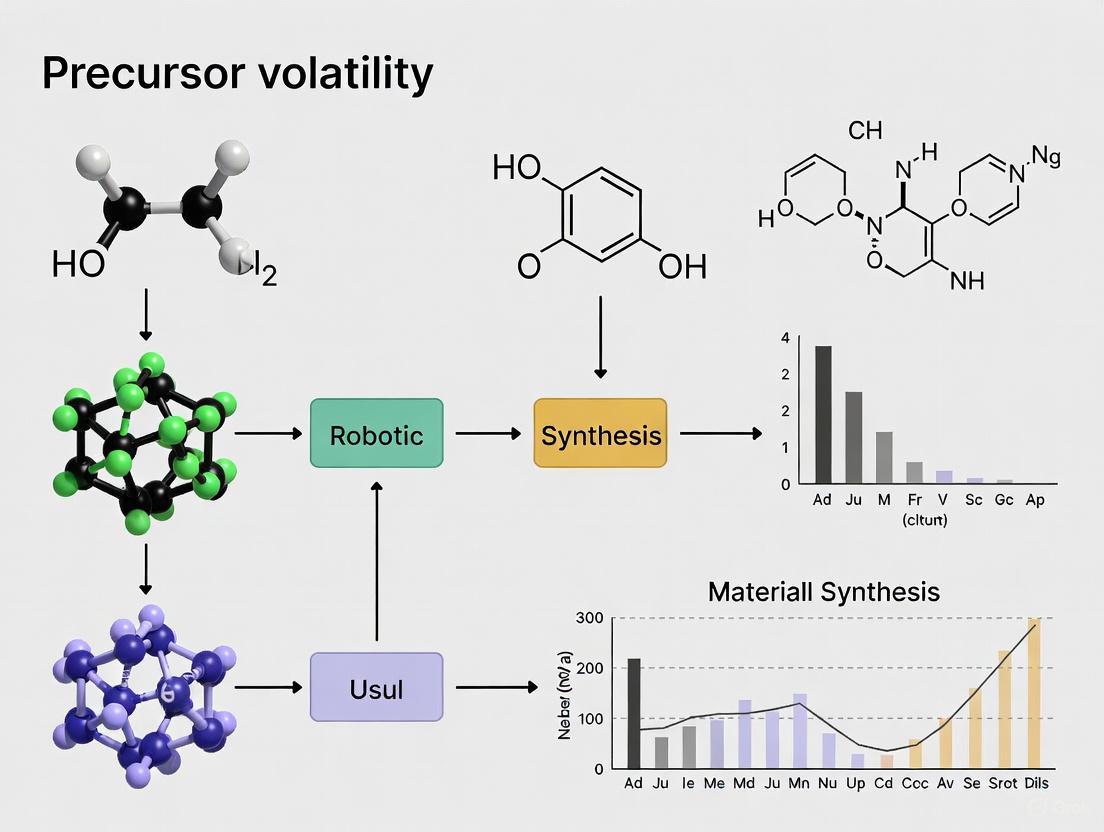
Precursor volatility presents a significant challenge in autonomous materials synthesis, impacting reproducibility, yield, and the successful discovery of novel compounds.
Taming Volatility: Strategies for Precursor Control in Robotic Materials Synthesis
Abstract
Precursor volatility presents a significant challenge in autonomous materials synthesis, impacting reproducibility, yield, and the successful discovery of novel compounds. This article explores the integration of computational guidance, innovative precursor design, and closed-loop optimization within robotic platforms to manage volatile precursors. Drawing on case studies from leading self-driving labs, we detail methodological approaches for high-throughput experimentation and troubleshooting. The discussion extends to validation techniques that compare robotic and traditional synthesis outcomes, offering researchers and drug development professionals a comprehensive framework to overcome volatility barriers and accelerate the development of advanced materials, including metal-organic frameworks and pharmaceutical intermediates.
Understanding Precursor Volatility: A Foundational Challenge in Automated Synthesis
Defining Precursor Volatility and Its Impact on Synthesis Yield and Reproducibility
Frequently Asked Questions (FAQs)
What is precursor volatility and why is it critical in materials synthesis?
Precursor volatility refers to a substance's tendency to transition from a solid or liquid phase into a vapor. In materials synthesis, this property is crucial because it determines how effectively and consistently a precursor can be delivered as a vapor to the reaction chamber. High and consistent volatility is essential for achieving uniform thin films in processes like Atomic Layer Deposition (ALD) and Chemical Vapor Deposition (CVD). Inconsistent vapor pressure or low volatility leads to irreproducible precursor delivery, which directly compromises the yield, quality, and stoichiometry of the final synthesized material [1] [2] [3].
What are common signs of precursor delivery problems in a robotic synthesis system?
Common symptoms indicating precursor delivery issues include:
- Irreproducible Synthesis Outcomes: Inconsistent film thickness, composition, or crystallization between batches despite identical recipe parameters [1].
- Decreasing Yield Over Sequential Injections: A noticeable drop in the mass of precursor delivered in pulsed injection systems, particularly when using "flow over" type vessels [1].
- Clogging in Gas Lines: Solidification of low-volatility precursors within delivery lines [4].
- Unstable Process Signals: Fluctuations in pressure or mass spectrometer readings during precursor injection pulses [1].
How does the choice of saturator design affect yield with low-volatility precursors?
The saturator design is a major factor in managing low-volatility precursors. Experimental comparisons between a bubbler (where carrier gas is bubbled through the precursor via a dip tube) and a flow over vessel (where gas flows over the precursor's surface) show significant performance differences [1] [3].
- Bubbler Design: Demonstrates higher efficiency and more consistent mass carryover per injection. Its performance can be accurately predicted using the "bubbler equation" with knowledge of vapor pressure and head-space pressure, making it more reliable for cyclical processes [1] [3].
- Flow Over Vessel Design: Exhibits lower efficiency, and its performance is poorly described by simple models without an additional, hard-to-predict "efficiency factor." This factor can decrease over a series of injections, leading to unstable delivery until it settles at a lower value [1] [3].
The table below summarizes the key differences observed in one study:
| Performance Metric | Bubbler | Flow Over Vessel |
|---|---|---|
| Delivery Efficiency | Higher [1] | Lower [1] |
| Model Predictability | High (follows "bubbler equation" well) [1] | Low (requires empirical efficiency factor) [1] |
| Consistency Over Sequential Injections | Stable mass carryover [1] | Can decrease before stabilizing [1] |
Impact of Idle Time (tidle) |
Negligible impact [1] | Mass carryover increases with longer idle times [1] |
What computational methods can help screen and design better precursors?
Computational screening uses density functional theory (DFT) to predict key properties of potential precursors, guiding the design of safer and more effective molecules before synthesis is ever attempted [2]. Key calculated properties include:
- Bond-Dissociation Energy (BDE): The energy required to break the metal-ligand (M-L) bond. A weaker bond generally suggests higher reactivity [2].
- Thermolysis Energy and Barrier: Predicts the precursor's thermal stability and the energy barrier for thermal decomposition [2].
- Hydrolysis Energy: Models the energy change for a reaction with water, simulating the precursor's reactivity with hydroxyl-covered surfaces [2].
- Formation Energy: Relates to the precursor's intrinsic stability [2].
- Surface Reactivity Modeling: The most reliable method, which involves modeling the full ALD reaction mechanism with the surface, accounting for steric hindrance and true interaction dynamics [2].
What are the best practices for handling and storing reactive ALD precursors?
Safe handling is paramount due to the reactive, pyrophoric, or toxic nature of many precursors [4].
- Storage and Transportation: Use specialized containers with temperature control and pressure regulation. Maintain an inert atmosphere (e.g., nitrogen or argon) to prevent reactions with air or moisture [4].
- Personal Protective Equipment (PPE): Use appropriate gloves, respiratory protection, eye protection, and protective clothing. Engineering controls like fume hoods and closed handling systems are critical [4].
- Chemical Compatibility: Ensure all containers, delivery lines, and process equipment are made of materials that are compatible and will not react with the precursor [4].
- Specialized Delivery Systems: Employ systems with heated lines, precise flow control, and leak detection to ensure safe and consistent delivery [4].
- Waste Management: Implement procedures for neutralizing reactive precursors and ensure compliant disposal of toxic or hazardous waste [4].
Troubleshooting Guides
Problem: Low or Irreproducible Synthesis Yield
Potential Cause: Inefficient precursor vaporization and delivery due to low-volatility precursors or suboptimal saturator configuration.
Investigation and Resolution Protocol:
Verify Saturator Type and Configuration:
- Symptom: Yield decreases over a series of pulsed injections, especially with short idle times.
- Action: Confirm if a flow over vessel is in use. If so, consider switching to a bubbler design for more efficient and consistent delivery of low-volatility liquids [1]. For a robotic system, ensure the vessel is compatible with the robotic handling and that the inlet dip tube (for bubblers) is correctly positioned.
Characterize Process Parameters:
- Systematically vary and record key parameters to understand their impact on your specific setup. The following table, based on experimental data for a low-volatility liquid precursor, shows how these parameters typically influence mass carryover [1]:
Process Parameter Impact on Mass Carryover (Bubbler) Impact on Mass Carryover (Flow Over Vessel) Injection Time ( tinj)Increases with longer tinj[1]Increases with longer tinj[1]System Pressure ( PCDG2)Increases with lower pressure [1] Increases with lower pressure [1] Carrier Gas Flow Rate ( FArSTP)Increases with higher flow [1] Increases with higher flow [1] Vessel Idle Time ( tidle)Negligible impact [1] Increases with longer tidle[1]Optimize Parameters: Based on the characterization, increase the precursor carryover by:
Problem: Precursor Decomposition or Clogged Delivery Lines
Potential Cause: The precursor is thermally unstable, or its volatility is too low, causing it to condense or decompose in the gas lines.
Investigation and Resolution Protocol:
Check Heating Temperatures:
- Action: Verify that the temperature of the precursor vessel and all gas delivery lines is carefully controlled. The temperature must be high enough to generate sufficient vapor pressure but must not exceed the precursor's thermal decomposition temperature [2] [4].
- Protocol: Consult the precursor's material safety data sheet (MSDS) and technical data for recommended temperature ranges. Use heating jackets and trace heating for all lines between the vessel and the reactor.
Evaluate Precursor Suitability:
- Action: Computationally screen or research alternative precursors with better thermal stability profiles. Look for precursors with higher thermolysis barriers or those designed with improved safety profiles, such as amino-based or adducted precursors [2] [4].
- Protocol: If clogging is frequent, consider switching from a solid to a liquid precursor, as liquids can offer more straightforward and reproducible delivery dynamics [1].
Problem: Synthesis Failure of a Novel, Computationally Predicted Material
Potential Cause: While the target material may be thermodynamically stable, kinetic barriers or incorrect precursor selection can prevent its formation.
Investigation and Resolution Protocol:
Analyze the Reaction Pathway:
- Action: Use an active-learning algorithm, like ARROWS³, that integrates computed reaction energies with experimental outcomes. The goal is to identify and avoid intermediate phases that have a very small driving force (<50 meV per atom) to form the target, as these lead to sluggish kinetics [5].
- Protocol: For your target, compute the decomposition energy and the pairwise reaction energies between potential precursor combinations. Prioritize synthesis routes that form intermediates with a large driving force to proceed to the final target [5].
Expand Precursor Selection:
- Action: Do not rely on a single precursor recipe. Use natural-language models trained on literature data to propose multiple initial synthesis attempts based on analogy to known related materials [5].
- Protocol: If the initial recipe fails, the robotic system should automatically test alternative precursor sets informed by both historical data and thermodynamic calculations [5].
The Scientist's Toolkit: Key Research Reagent Solutions
The following table details essential materials and tools used in the field for managing precursor volatility.
| Item | Function / Explanation |
|---|---|
| Bubbler Saturator | A vessel with a dip tube that bubbles carrier gas directly through the liquid precursor, providing high interfacial area for efficient vaporization. Preferred for low-volatility liquids [1] [3]. |
| Non-Dispersive Infrared (NDIR) Gas Analyzer | An analytical instrument used to directly measure the mass carryover of a precursor in the gas stream by absorbance, enabling precise characterization of delivery performance [1] [3]. |
| Computational Fluid Dynamics (CFD) Software | Used to simulate gas flow and precursor vapor distribution within a saturator, helping to diagnose inefficiencies in vessel design, such as those found in flow over configurations [1]. |
| Stainless Steel Inert Gas Manifold | A system of pipes, valves, and regulators that delivers high-purity inert gas (e.g., Ar, N₂) to create and maintain an oxygen- and moisture-free environment for precursor storage and delivery [4]. |
| Air-Stable Precursor Formulations | Newer precursor molecules designed to be less reactive with air and moisture, reducing handling risks and improving shelf life without significantly compromising performance [4]. |
Workflow and System Diagrams
Robotic Synthesis and Troubleshooting Workflow
The following diagram outlines the core workflow of an autonomous materials discovery lab and integrates the key troubleshooting checks for precursor-related issues.
Precursor Screening and Design Strategy
This diagram illustrates the computational and experimental strategy for screening and designing effective ALD precursors.
Frequently Asked Questions (FAQs)
1. What is precursor volatility and how does it disrupt robotic materials synthesis? Precursor volatility refers to the tendency of a solid or liquid precursor to evaporate or sublimate at synthesis temperatures. In robotic workflows, this leads to the inconsistent delivery of reactants, causing significant deviations from the intended stoichiometry in the final product. This results in compositional drift, where the chemical composition of the synthesized material is inconsistent and off-target. In high-throughput settings, this can compromise entire experimental batches, as the robotic system may be working with reactant mixtures that no longer match the programmed ratios [5].
2. What are the common signs of volatility-related issues in my robotic lab? You may be experiencing volatility-related issues if you observe:
- Inconsistent synthesis yields or product compositions across identical experimental runs [5].
- The failure to obtain a target material despite using computationally predicted stable compositions [5].
- Unaccounted-for mass loss in precursor crucibles after heating.
- Crystallization of materials on cooler parts of the reaction chamber, away from the main sample.
3. My robotic system has high positional repeatability, but my synthesis results are inconsistent. Could precursor volatility be the cause? Yes. A robot can have excellent positional repeatability (precision in moving to a location) while still suffering from compositional drift caused by precursor volatility [6]. This occurs because the issue is not with the robot's movement but with the changing physical state and quantity of the chemical reactants themselves before and during the reaction. Your robot may be dispensing and mixing powders with high precision, but if a precursor evaporates during heating, the actual reaction pathway is altered.
Troubleshooting Guide: Addressing Precursor Volatility
Diagnosis and Quantitative Impact
The first step is to identify the scope of the problem. The following table summarizes common failure modes and their prevalence as observed in a large-scale autonomous laboratory study.
Table 1: Failure Modes in Robotic Solid-State Synthesis (Based on 58 Target Materials)
| Failure Mode | Prevalence (Number of Targets Affected) | Description of Impact |
|---|---|---|
| Slow Reaction Kinetics | 11 | Reaction steps with low driving forces (<50 meV per atom) hinder target formation [5]. |
| Precursor Volatility | Not Specified (Listed as a primary category) | Evaporation or sublimation of precursors leads to incorrect stoichiometry in the final product [5]. |
| Amorphization | Not Specified (Listed as a primary category) | Failure of precursors to crystallize into the desired ordered structure [5]. |
| Computational Inaccuracy | Not Specified (Listed as a primary category) | Inaccurate ab initio predictions of material stability hinder initial recipe success [5]. |
Experimental Protocols for Mitigation
Here are detailed methodologies, drawn from recent research, to diagnose and counteract precursor volatility.
Protocol 1: Implementing Pairwise Reaction Analysis
This methodology aims to select precursors that minimize unwanted side reactions and volatile byproducts.
- Principle: Solid-state synthesis reactions often proceed through a series of simpler reactions between two precursors at a time. By mapping these potential pairwise interactions, researchers can choose a precursor set that avoids pathways with high volatility or low driving force [7].
- Procedure:
- For your target material, generate a list of all possible solid precursor combinations.
- Using thermodynamic databases (e.g., Materials Project), compute the reaction energy for every possible pairwise reaction between the proposed precursors.
- Prioritize precursor sets where the pairwise reactions have large, negative formation energies (high driving force) and are unlikely to produce volatile intermediates.
- Let the robotic system test the top-ranked precursor sets.
- Outcome: This approach has been validated in a robotic lab, resulting in higher phase purity for 32 out of 35 target materials compared to traditional precursor selection methods [7].
Protocol 2: Dynamic Flow Experiments for Real-Time Monitoring
This protocol uses a continuous flow reactor system to intensively monitor reactions and identify volatility issues in real-time.
- Principle: Instead of traditional batch reactions, precursors are continuously flowed and mixed in a microchannel. The composition is dynamically varied, and the output is characterized in real-time, providing a "movie" of the reaction instead of a "snapshot" [8].
- Procedure:
- Precursor solutions are loaded into automated syringe pumps connected to a continuous flow reactor.
- The system is programmed to dynamically vary chemical mixtures while continuously monitoring the output with integrated sensors (e.g., UV-Vis, Raman spectroscopy).
- Data is collected as often as every half-second, generating at least 10 times more data than steady-state methods [8].
- Machine learning algorithms use this rich, time-resolved data to quickly identify optimal synthesis conditions and detect anomalies caused by factors like volatility.
- Outcome: This method accelerates materials discovery by providing a dense stream of high-quality data, allowing the system to pinpoint and correct for issues like stoichiometric drift much faster than conventional methods [8].
Workflow Visualization
The following diagram illustrates a recommended robotic workflow that integrates proactive measures to manage precursor volatility.
Robotic Workflow with Volatility Checks
The Scientist's Toolkit: Key Research Reagent Solutions
When designing experiments to mitigate volatility, having the right tools and materials is critical. The following table lists essential components for building a robust robotic synthesis platform.
Table 2: Essential Materials and Tools for a Volatility-Aware Robotic Lab
| Item | Function in the Workflow | Relevance to Volatility Mitigation |
|---|---|---|
| Sealed Crucibles | Containers for solid-state reactions during high-temperature heating. | Physically contains volatile precursors, preventing mass loss and cross-contamination between samples. |
| Controlled Atmosphere Furnaces | Provide inert (e.g., Argon) or reactive gas environments during heating. | An inert atmosphere can suppress oxidation and reduce the decomposition and evaporation of sensitive precursors. |
| Continuous Flow Reactor | A system for performing chemical reactions in a continuously flowing stream. | Enables real-time monitoring and rapid parameter adjustment, allowing for immediate correction of stoichiometric drift [8]. |
| In-line Spectrometers | Analytical instruments (e.g., Raman, UV-Vis) integrated into the flow reactor. | Provide real-time data on reaction products and intermediates, helping to detect volatility-induced composition changes as they happen [9]. |
| Thermodynamic Database | A computed database of material formation energies (e.g., Materials Project). | Allows for in-silico screening of precursors via pairwise reaction analysis to avoid pathways with volatile intermediates [5] [7]. |
| Active Learning Software | AI/ML algorithms that decide the next experiment based on previous outcomes. | Can use real-time data to proactively adjust recipes and precursor choices to compensate for observed volatility [5] [9]. |
Autonomous laboratories (self-driving labs) represent a paradigm shift in materials research, integrating artificial intelligence, robotics, and high-throughput computation to accelerate discovery. These systems operate on a closed-loop cycle of Design, Make, Test, and Analyze (DMTA) [10]. However, the synthesis of predicted materials remains a critical bottleneck [5] [11]. While computational methods can screen thousands of potential materials at scale, their experimental realization is often challenging, time-consuming, and prone to failure [5]. The A-Lab, an autonomous laboratory for solid-state synthesis of inorganic powders, demonstrated this challenge by successfully synthesizing only 41 of 58 novel compounds (71% success rate) over 17 days of continuous operation [5]. This case study analyzes the failure modes encountered in autonomous synthesis, with particular focus on precursor volatility within the broader context of robotic materials synthesis research. Understanding these failure mechanisms is essential for developing more robust autonomous research systems and improving experimental success rates.
Quantitative Analysis of Synthesis Outcomes
Over its operational period, the A-Lab conducted extensive synthesis campaigns targeting novel inorganic materials identified through computational screening. The outcomes provide valuable quantitative data on success and failure rates in autonomous materials discovery.
Table 1: Synthesis Outcomes from the A-Lab Campaign [5]
| Metric | Value | Context/Explanation |
|---|---|---|
| Operation Duration | 17 days | Continuous operation |
| Target Compounds | 58 | Variety of oxides and phosphates from Materials Project and Google DeepMind |
| Successfully Synthesized | 41 compounds | 71% success rate |
| Failed Syntheses | 17 compounds | 29% failure rate |
| Initial Recipe Success | 37% | Percentage of 355 tested recipes that produced targets |
| Active Learning Optimizations | 9 targets | 6 obtained with zero initial yield |
Analysis revealed that literature-inspired recipes were more likely to succeed when reference materials were highly similar to synthesis targets, confirming that target "similarity" provides a useful metric for precursor selection [5]. However, precursor selection remains nontrivial even for thermodynamically stable materials, as the choice profoundly influences whether a synthesis forms the target or becomes trapped in a metastable state [5].
Comprehensive Analysis of Failure Modes
Detailed analysis of the 17 unsuccessful syntheses identified four primary categories of failure modes that prevented target formation. The prevalence and characteristics of each are detailed below.
Table 2: Categorization and Prevalence of Synthesis Failure Modes [5]
| Failure Mode | Prevalence | Key Characteristics | Example Challenges |
|---|---|---|---|
| Slow Reaction Kinetics | 11 of 17 failures | Reaction steps with low driving forces (<50 meV/atom) | Targets remained as intermediate phases without forming final products |
| Precursor Volatility | Multiple targets | Loss of precursor materials during heating | Alters final stoichiometry, prevents target formation |
| Amorphization | Multiple targets | Products lack crystalline structure | Difficult to characterize with standard XRD analysis |
| Computational Inaccuracy | Multiple targets | Discrepancies between predicted and actual stability | Targets potentially less stable than computations indicated |
Precursor Volatility: Mechanisms and Impact
Precursor volatility represents a particularly challenging failure mode for autonomous synthesis. This occurs when precursor materials partially or completely evaporate during high-temperature processing, altering the final stoichiometry of the reaction mixture and preventing target formation [5]. The problem is exacerbated in robotic systems where real-time mass loss cannot be easily monitored or compensated during reactions.
In traditional materials synthesis, researchers might compensate for volatile precursors through excess stoichiometry or specialized containment strategies. However, autonomous systems operating without this contextual knowledge may repeatedly attempt failed syntheses using the same compromised precursor sets. This highlights the need for improved precursor selection algorithms that incorporate volatility parameters and potential compensation mechanisms.
Diagnostic Framework: Troubleshooting Failed Syntheses
Troubleshooting Guide for Autonomous Synthesis Failure
Table 3: Troubleshooting Guide for Common Synthesis Failures
| Observed Problem | Potential Causes | Diagnostic Steps | Corrective Actions |
|---|---|---|---|
| Low target yield, persistent intermediates | Slow reaction kinetics, low driving force (<50 meV/atom) [5] | Analyze reaction pathway energetics using DFT computations | Implement higher temperatures, longer dwell times, or mechanical activation |
| Unexpected stoichiometry deviations | Precursor volatility or decomposition [5] | Perform thermogravimetric analysis (TGA) on precursors | Use alternative precursors, add excess of volatile components, or lower reaction temperature |
| Poorly crystalline or amorphous products | Insufficient thermal energy, incorrect heating profile | Analyze XRD patterns for broad peaks, optimize heating protocol | Increase maximum temperature, extend annealing time, or try different cooling rates |
| Phase instability under synthesis conditions | Computational inaccuracies in stability prediction [5] | Recompute formation energy with higher-level theory | Adjust target composition or consider metastable synthesis approaches |
| Inconsistent results between similar precursor sets | Uncontrolled pairwise reaction pathways [7] | Identify intermediates through step-wise analysis | Select precursors to avoid low-driving-force intermediates [5] |
Frequently Asked Questions (FAQs) on Synthesis Failures
Q: Why does my autonomous system repeatedly fail to synthesize certain materials despite using computationally-predicted optimal conditions? A: Computational predictions primarily address thermodynamic stability, whereas synthesis success often depends on kinetic factors. Failed syntheses frequently result from slow reaction kinetics, particularly when reaction steps have low driving forces (<50 meV/atom) [5]. These kinetic barriers prevent the system from reaching the thermodynamic minimum state within the experimental timeframe.
Q: How can precursor volatility be mitigated in autonomous synthesis workflows? A: Precursor volatility can be addressed through several strategies: (1) selecting alternative precursors with higher decomposition temperatures, (2) adding excess stoichiometry of volatile precursors to compensate for anticipated mass loss, (3) utilizing sealed containers to limit vapor escape, or (4) adjusting thermal profiles to minimize time at volatilization temperatures [5].
Q: What role does precursor selection play in synthesis success? A: Precursor selection critically determines synthesis pathway and success. Research shows that pairwise reactions between precursors dominate synthesis outcomes [7]. Selecting precursors that avoid intermediates with small driving forces to form the target (≤8 meV/atom) can dramatically improve yields—by up to 70% in documented cases [5].
Q: How can we improve the success rate of autonomous materials synthesis? A: Success rates can be improved by: (1) integrating active learning algorithms that leverage observed reaction pathways to avoid low-driving-force intermediates [5], (2) expanding precursor selection criteria beyond simple similarity to include reaction pathway analysis [7], and (3) developing better computational stability predictions that more accurately reflect experimental conditions.
Q: Why are some syntheses successful with one precursor set but fail with others, even when all are thermodynamically feasible? A: Different precursor sets create distinct reaction pathways with varying kinetic barriers. The A-Lab found that knowledge of these pathways could reduce the synthesis search space by up to 80% [5]. Precursors that form intermediates with large driving forces to proceed to the target (77 meV/atom in one successful case) typically outperform those that form kinetically trapped intermediates [5].
Experimental Protocols for Failure Analysis
Protocol for Diagnosing Synthesis Failures via Pathway Analysis
Characterize Synthesis Products: Perform X-ray diffraction (XRD) on all synthesis products using automated protocols [5]. Employ probabilistic machine learning models to identify phases and weight fractions from XRD patterns, comparing against computed structures from materials databases.
Map Observed Reaction Pathways: Document all intermediate phases detected during synthesis attempts. Build a database of pairwise reactions observed in experiments—the A-Lab identified 88 unique pairwise reactions during its campaign [5].
Compute Reaction Energetics: Calculate driving forces for all observed reaction steps using formation energies from ab initio databases (e.g., Materials Project). Flag steps with low driving forces (<50 meV/atom) as potential kinetic barriers [5].
Propose Alternative Pathways: Using active learning algorithms (e.g., ARROWS3), identify precursor sets that avoid low-driving-force intermediates and prioritize pathways with larger overall driving forces to the target [5].
Validate Optimized Recipes: Execute revised synthesis recipes with robotic systems, focusing on precursor combinations that theoretically avoid kinetic traps. Iterate until target is obtained or all possibilities are exhausted.
Protocol for Mitigating Precursor Volatility
Precursor Screening: Conduct thermogravimetric analysis (TGA) on all candidate precursors to determine decomposition temperatures and volatility profiles.
Container Selection: For precursors with significant volatility below target reaction temperatures, select sealed containers rather than open crucibles.
Stoichiometry Adjustment: Calculate and incorporate excess stoichiometry of volatile precursors based on TGA mass loss data.
Thermal Profile Optimization: Develop ramp rates and dwell times that minimize precursor loss while still achieving sufficient reaction rates.
Alternative Precursor Identification: Maintain a database of precursor alternatives with similar chemical functionality but improved thermal stability.
Visualization of Diagnostic and Mitigation Workflows
Synthesis Failure Diagnosis Pathway
Precursor Selection Strategy
Research Reagent Solutions for Autonomous Synthesis
Table 4: Essential Research Reagents and Materials for Autonomous Synthesis
| Reagent/Material | Function | Considerations for Autonomous Use |
|---|---|---|
| Precursor Powders | Starting materials for solid-state reactions | Physical properties (density, flow behavior) affect robotic handling [5] |
| Alumina Crucibles | Containment for high-temperature reactions | Standardized sizing enables robotic transfer between stations [5] |
| XRD Reference Standards | Calibration of characterization equipment | Essential for automated phase identification and quantification [5] |
| Diverse Precursor Library | Enables alternative pathway testing | Critical for avoiding kinetic barriers and volatility issues [5] [7] |
| Ball Milling Media | Particle size reduction and mixing | Zirconia media preferred for contamination-free processing |
The Critical Intersection of Thermodynamic Predictions and Experimental Volatility
FAQs: Understanding Volatility in Materials Synthesis
Q1: What makes a precursor 'volatile' in robotic synthesis, and why is it problematic?
A precursor is considered volatile when it has a high tendency to evaporate or sublimate under standard synthesis conditions, typically characterized by a high saturation vapor pressure (pvap) [12]. In robotic solid-state synthesis, this is problematic because it leads to inconsistent precursor mixing ratios and changed reaction stoichiometry during high-temperature processing. For instance, in the A-Lab's autonomous operations, precursor volatility was identified as a direct cause of synthesis failure for several target materials [5]. This occurs when the vapor pressure of a precursor falls within the semi-volatile organic compound (SVOC) or intermediate-volatility organic compound (IVOC) range [12], causing significant mass loss during heating.
Q2: Which computational methods best predict vapor pressure for novel organic precursors?
Multiple computational approaches exist with varying accuracy:
- Machine Learning GC2NN Models: Group contribution-assisted graph convolutional neural networks represent the current state-of-the-art, achieving a mean absolute error of 0.37 log-units for organic compounds commonly encountered in materials synthesis [12].
- Density Functional Theory (DFT) with Dispersion Corrections: Periodic DFT methods with dispersion corrections (DFT-D3, DFT-D4) can predict sublimation thermodynamics for heterocyclic compounds, though performance varies with the specific functional and dispersion model used [13].
- Group Contribution Methods: Established methods like SIMPOL and EVAPORATION provide reasonable estimates but may show significant errors when applied to molecules outside their trained compound classes [12].
Q3: What structural features in organic molecules typically increase volatility?
Molecular volatility is primarily governed by:
- Low Molecular Weight: Smaller molecules generally have higher vapor pressures.
- Limited Hydrogen-Bonding Capacity: Molecules unable to form strong intermolecular interactions evaporate more readily.
- Presence of Specific Functional Groups: Non-polar groups and certain heterocyclic structures can enhance volatility. For example, in a study of tricyclic heterocycles, sulfur-containing molecules like dibenzothiophene and thianthrene exhibited sufficient volatility for direct vapor pressure measurement [13].
- Rigid, Planar Structures: Fused rigid ring systems with extensive π-electron conjugation can facilitate sublimation, as seen in carbazole and phenothiazine [13].
Q4: How can I modify a problematic precursor to reduce its volatility?
Strategic molecular modification can effectively reduce volatility:
- Introduce Hydrophilic Substituents: Adding groups like hydroxyethyl to piperazine significantly raises the boiling point from 420 K to 519 K, moving it outside the typical desorption column operating range and drastically reducing solvent loss [14].
- Increase Molecular Weight and Size: Adding substituents that increase molecular mass without compromising functionality.
- Enhance Hydrogen-Bonding Potential: Incorporating groups that participate in strong intermolecular interactions, thereby increasing the energy required for vaporization.
Troubleshooting Guides: Addressing Volatility Failures
Issue: Inconsistent Product Stoichiometry Due to Precursor Volatilization
Problem: Final synthesized material shows inconsistent elemental composition and failed phase validation via XRD, despite correct initial precursor weighing.
Diagnosis and Solutions:
| Diagnostic Step | Observation | Recommended Solution |
|---|---|---|
| Check Precursor pvap | Estimated log(pvap) > -3 at reaction temperature | Select alternative precursor from database with log(pvap) < -5 [12] |
| Analyze Thermal Profile | Mass loss observed during TGA at target ramp rate | Modify thermal protocol: use sealed capsules or lower ramp rate to 1°C/min [5] |
| Verify Sealing Integrity | Visible sublimation on cooler parts of reaction vessel | Implement cold-welded ampoules for oxygen-sensitive syntheses [5] |
| Assess Stoichiometry Buffer | Failed synthesis with <50% target yield | Apply active learning (ARROWS3) to adjust precursor ratios accounting for volatilization [5] |
Experimental Workflow for Mitigation:
Issue: Failed Synthesis Due to Slow Kinetics and Volatility
Problem: Target material not obtained because volatile precursor is lost before desired reaction kinetics can occur, particularly problematic with low driving forces (<50 meV per atom) [5].
Diagnosis and Solutions:
| Diagnostic Step | Observation | Recommended Solution |
|---|---|---|
| Calculate Driving Force | Reaction steps with <50 meV/atom driving force [5] | Identify alternative synthesis route with larger driving force (>70 meV/atom) [5] |
| Analyze Pairwise Reactions | Database shows volatile precursor forms stable intermediates | Use ARROWS3 to design pathway avoiding intermediates with small driving forces [5] |
| Assess Thermal Stability | Precursor degradation before reaction completion | Implement multi-stage heating: lower temperature for initial reaction, then higher for crystallization |
Decision Process for Kinetic Issues:
Experimental Protocols
Protocol 1: Vapor Pressure Measurement for Precursor Screening
Purpose: Establish reliable reference sublimation data for novel precursors using vapor pressure measurements and calorimetric experiments [13].
Materials:
- TGA apparatus with high-resolution balance (±0.1 μg)
- Reference materials with known vapor pressure (benzoic acid, ferrocene)
- Hermetic sample pans with pinhole lids
- Inert gas purge (N2) at 50 mL/min
Procedure:
- Calibration: Perform temperature and sensitivity calibration using magnetic and melting point standards.
- Sample Loading: Precisely weigh 5-10 mg of precursor into hermetic aluminum pan. Create pinhole in lid for vapor egress.
- Temperature Ramp: Program method from 25°C to 500°C at 5°C/min under nitrogen purge.
- Data Collection: Record mass loss as function of temperature with 0.1 s data interval.
- Analysis: Apply Langmuir equation for free evaporation: log(p) = log(dm/dt) + 0.5 log(T) + log(2πR/M)½ - log(α·A) - 2.265 Where: dm/dt = mass loss rate, T = temperature (K), M = molar mass, α = vaporization coefficient, A = pinhole area
Validation: Compare measured vapor pressure values at 298 K with GC2NN predictions [12] and established group contribution methods (SIMPOL, EVAPORATION).
Protocol 2: Thermodynamic Modeling of Mixed Systems with Volatile Components
Purpose: Develop accurate thermodynamic model for systems containing volatile precursors using electrolyte NRTL (eNRTL) framework [14].
Materials:
- Vapor-liquid equilibrium data for binary systems
- Reaction calorimetry data for heat of absorption
- Property regression software (Aspen Properties, OLI Studio)
Procedure:
- Data Collection: Measure CO2 solubility in mixed systems at various temperatures (313.15 K, 343.15 K, 373.15 K, 393.15 K) and concentrations.
- Parameter Regression: Regress eNRTL parameters using:
- Pure component properties (boiling point, density, heat capacity)
- Vapor pressure of pure components
- CO2 solubility data in mixed systems
- Model Validation: Compare predicted vapor-liquid equilibrium, absorbed heat, and speciation with experimental data.
- Process Simulation: Implement model in flowsheet simulator to predict volatility losses under actual synthesis conditions.
Application: Use model to evaluate energy-saving potential of novel absorbents and predict volatility-induced stoichiometry changes [14].
The Scientist's Toolkit: Research Reagent Solutions
| Reagent/Category | Function in Volatility Management | Example Applications |
|---|---|---|
| HEPZ (N-(2-Hydroxyethyl) piperazine) | High-boiling point activator (519 K) replaces volatile piperazine (420 K); enhances water solubility while maintaining absorption performance [14]. | Mixed amine systems for CO2 capture; reduces solvent loss in high-temperature processes [14]. |
| Sulfur-Containing Heterocycles | Model compounds for studying dispersion interactions in OSC precursors; suitable vapor pressure for experimental measurement [13]. | Dibenzothiophene, thianthrene as benchmark materials for volatility prediction methods [13]. |
| DFT-D3/D4 Dispersion Corrections | Computational methods for predicting crystal cohesion and sublimation thermodynamics of molecular crystals [13]. | Benchmarking volatility predictions for nitrogen/sulfur heterocycles with limited hydrogen bonding [13]. |
| GC2NN Prediction Models | Machine learning approach for vapor pressure estimation using graph convolutional neural networks with group contribution [12]. | Screening novel precursors for synthetic feasibility prior to experimental testing [12]. |
| Active Learning (ARROWS3) | Autonomous optimization of synthesis recipes using ab initio computed reaction energies and observed outcomes [5]. | Overcoming volatility-induced failures by optimizing precursor selection and heating profiles [5]. |
Methodological Solutions: From Precursor Design to Closed-Loop Control
Troubleshooting Guides
Guide 1: Troubleshooting Failed Syntheses Due to Precursor Volatility
Problem: The robotic synthesis system fails to synthesize the target material, and precursor volatility is suspected.
Step 1: Identify the Problem
- Symptom: Low yield or no yield of the target material.
- Data Gathering: Review synthesis logs and X-ray diffraction (XRD) results from the automated characterization station. Look for patterns indicating missing volatile components [5].
- Question: Did the initial synthesis recipes propose precursors with known low decomposition temperatures or high vapor pressures?
Step 2: Establish a Theory of Probable Cause
Step 3: Test the Theory to Determine the Cause
- Experiment: Propose a follow-up experiment using the active-learning algorithm (ARROWS3) to suggest alternative precursor sets that avoid the volatile compound [5].
- Validation: Cross-reference the new precursor candidates with the lab's historical database of successful pairwise reactions to assess feasibility [5].
Step 4: Establish a Plan of Action and Implement the Solution
- Plan: Select a new precursor set with higher decomposition temperatures and similar thermodynamic similarity to the target material.
- Implementation: Submit the new recipe to the robotic lab's control interface for execution. The system will automatically handle powder dispensing, mixing, heating, and XRD characterization [5].
Step 5: Verify Full System Functionality
- Verification: Analyze the new XRD pattern using probabilistic machine learning models and automated Rietveld refinement. Confirm a significant increase in the target material's weight fraction [5].
Step 6: Document Findings
- Documentation: Log the failed and successful recipes, including all precursors, temperatures, and characterization data, into the lab's database. This updates the historical data for future ML-driven recipe generation [5].
Guide 2: Addressing Slow Reaction Kinetics in Solid-State Synthesis
Problem: The target material does not form even with thermodynamically favorable precursors, indicating a kinetic barrier.
Step 1: Identify the Problem
- Symptom: XRD analysis shows the presence of intermediate phases but not the final target, even after multiple heating steps.
- Data Gathering: Use the active-learning algorithm to compute the driving force (in meV per atom) to form the target from the observed intermediates. A low driving force (<50 meV per atom) suggests sluggish kinetics [5].
Step 2: Establish a Theory of Probable Cause
- Theory: The reaction pathway is trapped by metastable intermediate phases, preventing the formation of the final target material [5].
Step 3: Test the Theory to Determine the Cause
- Experiment: The A-Lab's AI will automatically prioritize synthesis routes that form intermediates with a larger driving force to react and form the target, avoiding low-driving-force pathways [5].
Step 4: Establish a Plan of Action and Implement the Solution
- Plan: Implement a new recipe that uses a different precursor set to bypass the kinetic bottleneck, as guided by the active-learning algorithm.
- Implementation: The robotic system executes the new recipe, which may involve different milling times or a modified heating profile to enhance reactivity [5].
Step 5: Verify Full System Functionality
- Verification: Post-synthesis XRD analysis confirms the disappearance of the problematic intermediates and the appearance of the target phase with high yield.
Step 6: Document Findings
- Documentation: The successful reaction pathway and the ineffective intermediates are recorded in the database, improving future kinetic predictions [5].
Frequently Asked Questions (FAQs)
Q1: How does the A-Lab use historical data to propose its initial synthesis recipes? The A-Lab uses machine learning models trained on a large database of syntheses extracted from scientific literature. These models employ natural-language processing to assess "similarity" between a new target material and known compounds, allowing the system to propose initial synthesis recipes by analogy to previously successful experiments [5].
Q2: What is an active-learning cycle in robotic synthesis, and how does it work? Active learning creates a closed-loop system where the outcomes of failed experiments inform the next set of trials. In the A-Lab, the Autonomous Reaction Route Optimization with Solid-State Synthesis (ARROWS3) algorithm uses observed reaction products and ab initio computed reaction energies to predict better solid-state reaction pathways. It avoids intermediates with small driving forces and prioritizes those that lead more directly to the target, continuously optimizing the synthesis route [5].
Q3: What are the common failure modes in autonomous materials synthesis? Analysis of the A-Lab's operations identified several key failure modes:
- Slow reaction kinetics, often associated with reaction steps that have a low driving force (<50 meV per atom) [5].
- Precursor volatility, where a precursor evaporates before reacting, altering the final stoichiometry [5].
- Amorphization of the product or precursors.
- Computational inaccuracies in the predicted stability of the target material [5].
Q4: My synthesis failed due to precursor volatility. What is the AI-driven solution? The system leverages its active-learning algorithm to propose alternative precursor sets that avoid the volatile compound. It does this by consulting a growing database of pairwise reactions and using thermodynamic data to find a new reaction pathway that is both kinetically and thermodynamically favorable, thus circumventing the volatility issue [5].
Q5: What quantitative success rate has been demonstrated by autonomous labs like the A-Lab? In one documented continuous 17-day operation, the A-Lab successfully synthesized 41 out of 58 novel target materials, resulting in a 71% success rate. The study suggested this could be improved to 78% with minor improvements to both decision-making algorithms and computational techniques [5].
Data Presentation
Table 1: Synthesis Outcomes and Failure Analysis from Autonomous Laboratory Operation
| Target Material Category | Number of Targets | Successfully Synthesized | Failed Syntheses | Primary Failure Mode |
|---|---|---|---|---|
| Predicted Stable Compounds | 50 | 38 | 12 | Slow kinetics (11), Other (1) [5] |
| Predicted Metastable Compounds | 8 | 3 | 5 | Not Specified |
| Total | 58 | 41 | 17 |
Table 2: Effectiveness of Different Recipe Proposal Methods
| Recipe Proposal Method | Number of Targets Synthesized | Key Mechanism | Reference |
|---|---|---|---|
| Literature-Inspired ML Models | 35 | Natural-language processing & target similarity | [5] |
| Active Learning Optimization (ARROWS3) | 6 | Thermodynamic-driven force & pairwise reaction avoidance | [5] |
| Total Successful Syntheses | 41 |
Experimental Protocols
Protocol 1: Autonomous Synthesis and Characterization of Novel Inorganic Powders
Objective: To autonomously synthesize a novel, computationally predicted inorganic material and characterize its phase purity.
Methodology:
- Target Identification: Targets are identified from large-scale ab initio phase-stability data from the Materials Project and are predicted to be air-stable [5].
- Precursor Selection: For each target, up to five initial synthesis recipes are generated by a machine learning model trained on historical literature data. A synthesis temperature is proposed by a second ML model [5].
- Robotic Execution:
- Sample Preparation: Precursor powders are automatically dispensed and mixed by a robotic station and transferred into alumina crucibles [5].
- Heating: A robotic arm loads crucibles into one of four box furnaces for heating [5].
- Characterization: After cooling, samples are ground and measured by X-ray diffraction (XRD) [5].
- Data Analysis: The phase and weight fractions of the product are extracted from XRD patterns by probabilistic ML models, with confirmation via automated Rietveld refinement [5].
- Active Learning: If the target yield is below 50%, the ARROWS3 algorithm proposes new follow-up recipes based on observed reactions and thermodynamic data. This loop continues until success or recipe exhaustion [5].
Protocol 2: Pairwise Reaction Analysis for Precursor Selection
Objective: To select optimal precursors by minimizing the formation of low-driving-force intermediates.
Methodology:
- Database Construction: The A-Lab continuously builds a database of pairwise reactions observed in its experiments. In one study, 88 unique pairwise reactions were identified [5].
- Pathway Inference: This database allows the products of untested recipes to be inferred, reducing the experimental search space by up to 80% [5].
- Energetic Prioritization: Using formation energies from the Materials Project, the driving force to form the target from any intermediate is calculated. Pathways involving intermediates with a small driving force (<50 meV per atom) are deprioritized [5].
- Validation: This approach was shown to increase the yield for targets like CaFe2P2O9 by ~70% by avoiding intermediates with a small driving force (8 meV per atom) and favoring a pathway with a larger driving force (77 meV per atom) [5].
Workflow Visualization
Synthesis Decision Workflow
Active Learning Logic
The Scientist's Toolkit: Research Reagent Solutions
Table 3: Essential Components for a Robotic Materials Synthesis Laboratory
| Item | Function in the Context of Autonomous Synthesis |
|---|---|
| Precursor Powders | High-purity raw materials serving as the starting points for solid-state reactions. Their selection is guided by ML models analyzing historical data and thermodynamic stability [5]. |
| Robotic Powder Dispensing & Mixing Station | Automates the precise weighing and homogeneous mixing of precursor powders, ensuring consistency and reproducibility across a high volume of experiments [5]. |
| Automated Box Furnaces | Provide the high-temperature environment required for solid-state reactions. Robotic arms handle loading and unloading, enabling continuous 24/7 operation [5]. |
| X-ray Diffractometer (XRD) | The primary characterization tool used for phase identification and quantification. It provides the critical data on synthesis success or failure [5]. |
| Machine Learning Models for XRD Analysis | Probabilistic models that automatically identify phases and calculate weight fractions from XRD patterns, replacing manual analysis and enabling rapid iteration [5]. |
| Active Learning Algorithm (e.g., ARROWS3) | The "brain" that closes the experimentation loop. It uses data from failed syntheses to propose improved recipes based on thermodynamic principles and observed pairwise reactions [5]. |
Molecular Engineering of Single-Source Precursors to Mitigate Volatility
## Troubleshooting Guide: Precursor Volatility in Robotic Synthesis
This guide addresses common challenges researchers face with precursor volatility during automated materials synthesis, providing targeted solutions to ensure experimental reproducibility and efficiency.
Table 1: Troubleshooting Common Volatility-Related Issues
| Symptom | Potential Cause | Diagnostic Steps | Solution |
|---|---|---|---|
| Low vapor pressure hindering delivery [15] | Precursor molecule too large or heavy [16]. | Check for recondensation at temperatures below 60°C [16]. | Use a dedicated powder-surface-modification system with a controlled vapor-transport path [15]. |
| Inconsistent thin film deposition or low growth rate | Insufficient or fluctuating vapor pressure from precursor source [16]. | Calibrate vapor pressure; check for precursor decomposition in the source bottle. | Optimize precursor temperature; for Si-Ge precursors, maintain source between -20°C and -5°C for adequate vapor pressure [16]. |
| Precursor decomposition before vaporization [16] | Thermal instability; molecular design prone to scrambling or degradation [16]. | Use thermal analysis (e.g., TGA) to identify decomposition temperature. | Redesign molecular precursor to avoid preformed Si-C bonds and introduce stabilizing ligands (e.g., aryl groups) at Ge atoms [16]. |
| Failed deposition on low-reactivity fillers | Inherently low surface reactivity of the substrate material [15]. | Verify surface energy and functional groups of the filler. | Deposit a thin silicon suboxide (SiOx) interlayer via PECVD to activate the surface prior to functionalization [15]. |
| High carbon contamination in final material | Inefficient cleavage of organic ligands during CVD [16]. | Perform elemental analysis (e.g., EDX) of the deposited film. | Select precursors where ligand cleavage occurs at moderate temperatures (e.g., Ge-C bonds over Si-C bonds) [16]. |
## Frequently Asked Questions (FAQs)
Q1: What are the primary molecular design strategies for tuning precursor volatility? The core strategy involves a careful balance of molecular mass and intermolecular interactions. Introducing organic ligands, such as aryl (e.g., phenyl) or alkyl (e.g., n-butyl) groups, can significantly enhance a precursor's stability against oxidation and scrambling [16]. However, larger groups increase molecular mass and can reduce volatility. For instance, a precursor with phenyl groups may be less volatile than one with n-butyl groups due to π-π interactions, despite having a similar molecular structure [16]. The design should also avoid preformed Si-C bonds, which are stable and can lead to carbon contamination, in favor of Ge-C bonds that cleave more readily [16].
Q2: My robotic synthesis lab uses low-volatility precursors. How can I adapt my CVD system? Conventional vapor deposition systems struggle with low-volatility precursors. A proven solution is to integrate a powder-surface-modification system with a controlled vapor-transport path [15]. This system is specifically engineered to vaporize and deliver low-volatility precursors effectively. Furthermore, for substrates with low surface reactivity, a two-step process is recommended: First, activate the filler surface by depositing a thin SiOx interlayer via Plasma-Enhanced Chemical Vapor Deposition (PECVD), then proceed with the functionalization using your target precursor [15].
Q3: How does precursor choice impact the quality of Si₁₋ₓGeₓ thin films? The molecular structure of the single-source precursor directly influences the film's stoichiometry, purity, and crystallinity. Well-designed precursors, such as mixed-substituted molecules with preformed Si-Ge bonds, enable better control over the Si:Ge ratio in the deposited film and help achieve low carbon contamination [16]. The thermal properties of the precursor determine the required deposition temperature, which in turn affects the film's crystallinity. For example, using a Ga metal-supported CVD process can facilitate the partial crystallization of Si₁₋ₓGeₓ at lower temperatures [16].
Q4: What quantitative metrics should I use to evaluate a new single-source precursor? When characterizing a new precursor, key metrics to report include:
- Volatility/Recondensation Temperature: The temperature at which the precursor can be recondensed under a reduced pressure (e.g., ~10⁻³ mbar) [16].
- Thermal Stability: The temperature at which decomposition begins.
- Vapor Pressure: Quantified at various temperatures to model delivery rates.
- Film Composition Retention: The ratio of Si:Ge in the film compared to the precursor molecule, analyzed by techniques like EDX [16].
- Carbon Content: Measured in the final material to assess ligand cleavage efficiency [16].
## Experimental Protocols for Volatility Management
Protocol 1: Vapor Deposition of Low-Volatility Precursors via Transport-Controlled System
This protocol is adapted from methods designed to functionalize diverse fillers using low-volatility precursors [15].
- System Setup: Employ a powder-surface-modification system with a specifically designed vapor-transport path that allows for the vaporization of low-volatility precursors.
- Surface Activation (For Low-Reactivity Fillers): For fillers such as alumina, magnesium hydroxide, or lignocellulose, first deposit a thin silicon suboxide (SiOx) interlayer using Plasma-Enhanced Chemical Vapor Deposition (PECVD). This layer activates the surface for subsequent reactions.
- Precursor Vaporization: Place the low-volatility precursor in the designated vessel. The controlled transport path will facilitate its vaporization without thermal decomposition.
- Anhydrous Silylation: Expose the activated filler powder to the precursor vapor in a catalyst- and solvent-free environment. This enables the attachment of functional groups (e.g., methyl, vinyl, phenyl, amine, epoxide) to the filler surface.
- Validation: The successful functionalization will tune the filler-matrix interface, leading to measurable changes in composite properties, such as reduced viscosity, increased adhesion strength, or enhanced thermal conductivity [15].
Protocol 2: Synthesis and CVD of Tailored Si-Ge Single-Source Precursors
This protocol is based on the synthesis and application of (H₃Si)₂(GeR₂)ₙ precursors [16].
- Precursor Synthesis:
- Synthesize chlorinated intermediates (e.g., Cl₃Si–Ph₂Ge–SiCl₃) by reacting organic germanium dichlorides (e.g., Ph₂GeCl₂) with disilicon hexachloride (Si₂Cl₆) in the presence of a catalyst like [nBu₄N]Cl.
- Recover the product, a colorless liquid, in high yield (~82-94%).
- Perform hydrogenation by treating the chlorinated intermediate with an excess of Li[AlH₄] to obtain the hydride precursor (e.g., H₃Si–Ph₂Ge–SiH₃), which is isolated as a volatile liquid.
- Low-Pressure CVD for Thin Film Deposition:
- Use a home-built cold-wall reactor with a low background pressure of ~10⁻⁶ mbar.
- For a precursor like H₃Si–nBu₂Ge–SiH₃, set the precursor temperature between -20°C and -5°C to generate sufficient vapor pressure.
- Set the substrate temperature between 500°C and 700°C for film growth.
- This process results in Si₁₋ₓGeₓ films with retention of the precursor's Si:Ge ratio and low carbon contamination [16].
## Workflow Visualization
The following diagram illustrates the logical decision pathway for selecting the appropriate strategy to mitigate precursor volatility issues, integrating solutions from the troubleshooting guide and protocols.
## The Scientist's Toolkit: Research Reagent Solutions
Table 2: Essential Materials for Single-Source Precursor Research
| Reagent / Material | Function / Application | Key Characteristics |
|---|---|---|
| Disilicon Hexachloride (Si₂Cl₆) | Key reactant for building molecular precursors with Si–Ge bonds [16]. | Serves as a source of the [SiCl₃]⁻ nucleophile in the presence of catalysts like [nBu₄N]Cl [16]. |
| Organogermanium Dichlorides (e.g., Ph₂GeCl₂) | Co-reactant providing the germanium core and organic ligands [16]. | The organic group (R = Ph, nBu) influences volatility and provides stability against oxidation [16]. |
| Lithium Aluminum Hydride (Li[AlH₄]) | Reducing agent for converting chlorinated intermediate precursors into their more reactive hydride forms (e.g., Cl to H) [16]. | Essential for the final synthesis step of hydride precursors like H₃Si–Ph₂Ge–SiH₃ [16]. |
| Tetrabutylammonium Chloride ([nBu₄N]Cl) | Catalyst for the silylation reaction during precursor synthesis [16]. | Facilitates the formation of Si–Ge bonds by generating [SiCl₃]⁻ in situ [16]. |
| Silicon Suboxide (SiOx) | Surface activation interlayer for low-reactivity fillers [15]. | Deposited via PECVD, it creates a reactive surface enabling subsequent vapor-phase functionalization [15]. |
Implementing Closed-Loop Optimization for Dynamic Parameter Adjustment
Troubleshooting Guides and FAQs
Frequently Asked Questions
Q1: What are the common failure modes in autonomous robotic synthesis, and how can they be addressed? The primary failure modes in autonomous robotic synthesis, as identified by the A-Lab, include slow reaction kinetics, precursor volatility, amorphization, and computational inaccuracy [5]. Precursor volatility, in particular, can lead to failed syntheses by altering the precise stoichiometry of the reaction mixture. This can be mitigated by selecting alternative non-volatile precursors, adjusting reaction conditions to lower temperatures where feasible, or using sealed reaction vessels to contain volatile components [5].
Q2: How can a closed-loop system ensure it makes reliable decisions based on analytical data? Reliability in decision-making is achieved by using orthogonal, multimodal characterization techniques and robust data interpretation algorithms. For instance, one modular robotic platform uses a heuristic decision-maker that processes both UPLC-MS and NMR data, giving a binary pass/fail grade for each analysis [17]. A reaction typically only proceeds to the next stage if it passes both analyses, ensuring decisions are not based on a single, potentially misleading, data stream. This mimics the multifaceted approach of a human researcher [17].
Q3: What is the role of active learning in handling synthesis failures? Active learning algorithms close the loop in autonomous experimentation. When an initial synthesis recipe fails, the algorithm uses the observed outcome—such as the formation of specific intermediates—to propose a new, improved recipe [5]. The A-Lab's ARROWS³ algorithm, for example, integrates ab initio computed reaction energies with experimental outcomes to suggest pathways that avoid intermediates with low driving forces to form the target material, thereby increasing the success rate in subsequent attempts [5].
Q4: Can closed-loop optimization work with existing laboratory equipment? Yes, a modular approach using mobile robots demonstrates that closed-loop optimization can be integrated into existing labs without requiring extensive and costly redesigns [17] [18]. Mobile robots can transport samples between standard, unmodified commercial instruments like synthesizers, chromatographs, and spectrometers, creating a flexible and scalable autonomous workflow [17]. The AMPERE-2 platform also builds upon the open-source Opentrons OT-2 liquid-handling robot, showing how custom tools can be added to standard platforms for specific tasks like electrodeposition [18].
Troubleshooting Common Experimental Issues
Table 1: Troubleshooting Common Issues in Closed-Loop Robotic Synthesis
| Problem | Potential Causes | Recommended Solutions |
|---|---|---|
| Low Target Yield | Sluggish kinetics, low driving force for reaction, incorrect precursor selection [5]. | Use active learning to propose recipes with higher-driving-force intermediates [5]. Increase reaction temperature or time if thermodynamically permissible. |
| Precursor Volatility | Use of precursors with low boiling points or high vapor pressure at reaction temperatures [5]. | Source alternative, less volatile precursor compounds [5]. Implement sealed reaction vessels. Adjust reaction conditions to milder temperatures. |
| Irreproducible Results | Inconsistent liquid handling, clogged lines, insufficient cleaning between experiments [18]. | Implement automated flush-and-clean cycles between experiments [18]. Calibrate robotic liquid handlers regularly. Use redundant cleaning steps. |
| Failed Data Interpretation | Complex product mixtures, poor signal-to-noise in analytical data, limitations in AI model training data [17]. | Employ orthogonal characterization techniques (e.g., NMR + MS) for cross-validation [17]. Refine heuristic rules or model training sets with broader data. |
| Unsuccessful Scale-up | Changes in heat/mass transfer, reaction heterogeneity not present in small-scale screens [17]. | Automatically test reproducibility of screening hits at a slightly larger scale before full scale-up [17]. |
Experimental Protocols for Key Procedures
Protocol 1: Closed-Loop Optimization of Solid-State Synthesis (A-Lab Workflow)
This protocol details the autonomous synthesis of inorganic powders, as implemented by the A-Lab, for discovering and optimizing novel materials [5].
- Target Identification: Select target materials predicted to be stable using large-scale ab initio phase-stability data from sources like the Materials Project [5].
- Initial Recipe Proposal:
- Robotic Synthesis:
- A robotic system dispenses and mixes precursor powders in the calculated stoichiometric ratios.
- The mixture is transferred to an alumina crucible and loaded into a box furnace for heating under the proposed conditions [5].
- Automated Characterization and Analysis:
- Decision and Iteration:
- If the yield of the target material is >50%, the synthesis is deemed successful [5].
- If the yield is low, the active learning algorithm (ARROWS³) is triggered. It uses the observed reaction pathway and thermodynamic data from the Materials Project to propose a new set of precursors or conditions that avoid low-driving-force intermediates [5].
- Steps 3-5 are repeated until the target is obtained, or all viable recipes are exhausted.
Protocol 2: Modular Workflow for Exploratory Organic and Supramolecular Chemistry
This protocol uses mobile robots and a heuristic decision-maker for exploratory synthesis where multiple products are possible [17].
- Synthesis Setup:
- An automated synthesizer (e.g., Chemspeed ISynth) is used to perform parallel reactions, for instance, the combinatorial condensation of amine and isocyanate/thiocyanate building blocks [17].
- Sample Preparation for Analysis:
- Upon reaction completion, the synthesizer automatically takes aliquots of the reaction mixture and reformats them into vials suitable for UPLC-MS and NMR analysis [17].
- Robotic Sample Transport:
- Mobile robots collect the sample vials and transport them to the respective, unmodified analytical instruments located elsewhere in the laboratory [17].
- Multimodal Data Acquisition:
- The UPLC-MS and benchtop NMR spectrometers run autonomously using customizable scripts after the robots deliver the samples [17].
- Heuristic Decision-Making:
- The raw UPLC-MS and NMR data are processed automatically.
- A domain-expert-designed heuristic assigns a binary pass/fail grade to each analysis based on pre-defined, experiment-specific criteria (e.g., presence of expected mass peak, cleanliness of NMR spectrum) [17].
- The decision-maker combines these grades. In the demonstrated workflow, a reaction must pass both analyses to be selected for scale-up or further elaboration in a multi-step synthesis [17].
System Workflows and Signaling Pathways
Autonomous Synthesis Closed-Loop Workflow
The following diagram illustrates the high-level logical flow of a closed-loop optimization system for autonomous materials synthesis, integrating computation, robotics, and active learning.
Modular Robotic Platform for Exploratory Chemistry
This diagram details the physical and data flow of a modular autonomous platform that uses mobile robots to interconnect synthesis and analysis modules.
The Scientist's Toolkit: Research Reagent Solutions
Table 2: Key Reagents and Materials for Robotic Synthesis Platforms
| Item / Component | Function / Role in the Workflow |
|---|---|
| Precursor Powders | Source of elemental components for solid-state synthesis of inorganic materials; selection is critical for reaction pathway and success [5]. |
| Alumina Crucibles | High-temperature containers for powder reactions during furnace heating [5]. |
| Building Blocks (Monomers) | Diverse amines, isocyanates, boronic acids, etc.; enable combinatorial synthesis of organic molecules and supramolecular complexes in drug discovery [17]. |
| Complexing Agents (e.g., NH₄OH, Na-citrate) | Stabilize metal ions in solution, tune deposition rates and surface morphology in automated electrodeposition of catalysts [18]. |
| Custom Electrodes (Ni Rod, Ag/AgCl) | Enable automated electrodeposition and subsequent electrochemical testing (e.g., for OER) within a robotic platform [18]. |
| Opentrons OT-2 with Custom Tools | Open-source, affordable robotic liquid-handling platform that serves as a foundational framework for building custom automated workflows [18]. |
FAQs: Robotic Synthesis of Metal Halide Perovskites
Q1: What are the main advantages of using a robotic platform over manual synthesis for air-sensitive perovskites? Robotic platforms offer significant advantages, including enhanced reproducibility, the ability to systematically explore vast and complex synthesis parameter spaces, and the minimization of human error and batch-to-batch variation. They integrate automated synthesis with real-time characterization and machine learning-driven decision-making, enabling accelerated navigation of high-dimensional parameter spaces to optimize optical properties like photoluminescence quantum yield (PLQY) and emission linewidth [19]. Furthermore, they liberate the scientific workforce from repetitive tasks and standardize procedures, which is crucial for handling air-sensitive materials [20].
Q2: Which specific robotic systems are used in this field and what are their key functions? Several specialized robotic systems have been developed for perovskite research:
- Rainbow: A multi-robot self-driving laboratory that integrates automated nanocrystal synthesis, real-time characterization, and machine learning-driven decision-making. It uses parallelized, miniaturized batch reactors and is designed to efficiently navigate the mixed-variable high-dimensional landscape of metal halide perovskite nanocrystals (MHP NCs) [19].
- ROSIE (Robotic Operating System for Ink Engineering): A liquid-handling robot constructed from a hobbyist robotic arm and a syringe pump, designed for precise and automated ink formulation. This system helps explore the vast compositional space of halide perovskites and reduces operator error in complex mixing tasks [20].
- Platform with PAL DHR System: An automated platform using a commercial "Prep and Load" (PAL) system for nanoparticle synthesis. It features robotic arms, agitators, a centrifuge, and an integrated UV-vis module, allowing for fully automated synthesis and characterization in a compact, commercially available setup [21].
Q3: What are the critical discrete and continuous parameters that these robotic systems optimize? Robotic systems typically navigate a mixed-variable parameter space [19]:
- Discrete Parameters: These often include the choice of organic acid ligands and ligand structures, which critically control NC optical properties and growth [19].
- Continuous Parameters: These include precursor concentrations, reaction temperatures, reaction times, and solvent ratios, which are optimized to target specific optical properties [19] [21].
Q4: How is stability testing incorporated into automated high-throughput workflows? Systems like HITSTA (High-Throughput Stability Testing Apparatus) are designed for this purpose. HITSTA is a platform for optical characterization and accelerated aging, capable of housing up to 49 samples and subjecting them to elevated temperatures (up to 110 °C) and light intensities (2.2 suns) while continuously monitoring their absorptance and photoluminescence. This allows for parallelized stability assessment under controlled stress conditions [20].
Troubleshooting Guides
Guide 1: Addressing Incorrect Robotic Movement or Positioning
| Symptom | Potential Cause | Troubleshooting Action | Preventive Maintenance |
|---|---|---|---|
| Robot not moving or not reaching desired position [22]. | Power supply issues; mechanical obstruction or wear; software/controller error [22]. | 1. Verify power supply and check circuit breakers [22].2. Inspect joints, gears, and belts for damage or obstructions [22].3. Recalibrate sensors and review programming for errors [22]. | Conduct regular mechanical inspections; keep joints lubricated [22]. |
| Incorrect liquid handling volumes. | Calibration drift of syringe pumps; partial clogging in fluidic lines. | 1. Recalibrate syringe pumps and liquid handling arms.2. Perform system purges and check filters in fluidic paths. | Schedule regular calibration; use high-purity, filtered solvents. |
Guide 2: Resolving Issues in Perovskite Film Quality and Synthesis
| Symptom | Potential Cause | Troubleshooting Action | Preventive Maintenance |
|---|---|---|---|
| Low photoluminescence quantum yield (PLQY) or broad emission linewidth [19]. | Suboptimal ligand structure or concentration; poor crystal quality; precursor impurities [19] [23]. | 1. Use the AI agent to explore the ligand structure-property relationship [19].2. Fine-tune precursor ratios and use additives to enhance crystallinity [23].3. Ensure precursor solution purity and optimal colloidal properties [23]. | Implement rigorous inert atmosphere protocols; use fresh, high-purity precursors. |
| Inconsistent results between experiments (lack of reproducibility). | Precursor volatility leading to concentration changes; environmental fluctuations (O₂, H₂O); robotic dispensing inaccuracy. | 1. Seal precursor reservoirs and minimize headspace [20].2. Monitor and control glovebox atmosphere rigorously.3. Recalibrate liquid handling robots and validate dispensing volumes. | Maintain stable environmental conditions; perform regular robotic system performance checks [22]. |
Guide 3: Troubleshooting Data and Communication Errors
| Symptom | Potential Cause | Troubleshooting Action | Preventive Maintenance |
|---|---|---|---|
| Communication failure between robot, controller, and characterization units [22]. | Loose or damaged communication cables; incorrect communication settings [22]. | 1. Inspect and reseat or replace all communication cables [22].2. Verify baud rate, parity, and other settings on all devices [22]. | Use high-quality cables; document communication protocol settings. |
| AI agent proposing implausible experiments. | Poorly defined search space boundaries; insufficient or noisy training data. | 1. Review and constrain the parameter search space based on chemical knowledge.2. Incorporate human feedback loops to label and correct poor suggestions. | Curate initial dataset with known successful experiments; use transfer learning from related systems. |
Experimental Protocols & Data
Key Experimental Workflow for Autonomous Optimization
The following diagram illustrates the closed-loop workflow for the autonomous robotic optimization of metal halide perovskites.
Quantitative Performance of Robotic Platforms
The table below summarizes key performance metrics from documented robotic platforms used in nanomaterials synthesis.
| Robotic Platform / Study | Key Performance Metric | Result / Outcome | Reference |
|---|---|---|---|
| Rainbow for MHP NCs | Navigation of a 6-dimensional input space to optimize PLQY and emission linewidth. | Successful identification of Pareto-optimal formulations for targeted spectral outputs. | [19] |
| GPT & A* Algorithm Platform | Optimization of Au nanorods (LSPR 600-900 nm). | Comprehensive parameter search completed in 735 experiments. | [21] |
| GPT & A* Algorithm Platform | Optimization of Au nanospheres / Ag nanocubes. | Parameter search completed in 50 experiments. | [21] |
| GPT & A* Algorithm Platform | Reproducibility of Au NR synthesis. | Deviation in LSPR peak ≤ 1.1 nm; FWHM ≤ 2.9 nm. | [21] |
| New Precursor Selection + ASTRAL Lab | Synthesis of 35 target materials in 224 reactions. | Higher phase purity for 32/35 materials; completed in weeks. | [7] |
The Scientist's Toolkit: Research Reagent Solutions
This table details key reagents and their functions in the robotic synthesis of metal halide perovskites.
| Reagent / Material | Function / Role in Synthesis | Key Consideration |
|---|---|---|
| Organic Acid/Base Ligands (e.g., varying alkyl chain lengths) | Surface ligation of NCs; controls growth, stability, and optical properties via acid-base equilibrium [19]. | Ligand structure is a critical discrete variable; shorter chains can increase NC edge lengths [19]. |
| Cesium & Lead Precursors (e.g., CsPbBr₃) | Forms the core metal halide perovskite structure; post-synthesis halide exchange (Cl⁻, I⁻) tunes bandgap [19]. | Precursor purity and concentration are key continuous variables; volatility must be managed [20]. |
| Coordination Solvents (e.g., DMSO, DMF) | Dissolves precursors and coordinates with PbI₂ to form an intermediate phase, decelerating crystallization for high-quality films [23]. | Coordination ability must be appropriate; too high can lead to irregular grain sizes and surface roughness [23]. |
| Additives (e.g., Dimethylammonium) | Promotes the development of intermediate phases and controls crystallization sequence, grain size, and orientation [23]. | Can be used to fine-tune the colloidal properties of the precursor solution, reducing defect concentration [23]. |
| Antisolvents | Used in anti-solvent engineering (ASE) to rapidly trigger supersaturation and control nucleation & growth of perovskite films [23]. | Timing and nature of the antisolvent are critical processing parameters for achieving uniform, pinhole-free films. |
High-Throughput Screening of Precursor Combinations and Decomposition Pathways
Technical Support Center
Troubleshooting Guides & FAQs
FAQ: What are common failure modes in autonomous materials synthesis and how can they be addressed? Failure modes in robotic materials synthesis include sluggish reaction kinetics, precursor volatility, amorphization, and computational inaccuracies [5]. Precursor volatility is a specifically identified barrier that can prevent successful synthesis [5]. Mitigation strategies involve using the active-learning cycle to design alternative synthesis routes that avoid volatile intermediates and selecting precursors with higher thermodynamic driving forces for the target reaction [5].
FAQ: How does the A-Lab's active-learning cycle improve synthesis outcomes? The A-Lab uses an active-learning algorithm (ARROWS3) that integrates observed synthesis outcomes with ab initio computed reaction energies to propose improved follow-up recipes [5]. This cycle helps identify synthesis routes with improved yield by avoiding intermediate phases that leave only a small driving force to form the target material, as these often require long reaction times and high temperatures and can be susceptible to volatility issues [5].
Troubleshooting Guide: Addressing Low Target Yield If your high-throughput screening identifies combinations with low efficacy, consider these steps:
- Verify Precursor Stability: Ensure that precursor volatility is not leading to inconsistent reaction pathways or compositions [5].
- Analyze Reaction Pathways: Use computed formation energies to identify and avoid intermediates with low driving forces to form the target, as these can stall reactions [5].
- Explore Alternative Routes: Leverage active learning to propose new precursor sets that form different, more favorable intermediates with larger driving forces to complete the reaction [5].
Data Presentation
Table 1: Quantitative Data from a High-Throughput Drug Combination Screen in Myeloma [24]
| Metric / Parameter | Description / Value |
|---|---|
| Screening Scale | 47 multiple myeloma (MM) cell lines |
| Analytical Method | In silico Huber robust regression analysis of drug responses |
| Key Output | 43 potentially synergistic drug combinations identified |
| Primary Hypothesis | Effective combinations reduce MYC expression and enhance p16 activity |
| Validation | Significant survival prolongation in a Ras-driven allograft model of advanced MM |
| Key Pathways Affected | Downregulated: Cell cycle transition; Upregulated: TGFβ/SMAD signaling |
| Example Combination | Dinaciclib and Entinostat |
Experimental Protocols
Protocol: High-Throughput Screening of Drug Combinations for Multiple Myeloma [24]
- Cell Line Preparation: Culture a panel of 47 multiple myeloma (MM) cell lines, including both proteasome inhibitor-resistant and sensitive lines.
- Compound Library Screening: Expose cell lines to a library of drug combinations.
- Viability Assessment: Measure reductions in cell viability using standardized assays (e.g., ATP-based assays).
- Data Analysis: Perform in silico Huber robust regression analysis on the drug response data to identify synergistic combinations.
- Secondary Validation:
- Mechanistic Studies: Analyze cooperative reduction of MYC protein and increase in p16 expression in treated cells via Western blot or flow cytometry.
- In Vivo Validation: Test efficacy of top combinations in a transplantable Ras-driven allograft mouse model that recapitulates high-risk/refractory myeloma. Monitor survival as a key endpoint.
- Ex Vivo Testing: Treat patient-derived MM cells ex vivo with the combinations to confirm viability reduction.
Protocol: Autonomous Synthesis of Novel Inorganic Materials (A-Lab Workflow) [5]
- Target Identification: Select air-stable target materials predicted to be stable using large-scale ab initio phase-stability data from resources like the Materials Project.
- Recipe Generation:
- Use machine learning models trained on historical literature data to propose initial solid-state synthesis recipes and heating temperatures based on analogy to known materials.
- Robotic Execution:
- Preparation: A robotic station dispenses and mixes precursor powders in alumina crucibles.
- Heating: A robotic arm loads crucibles into box furnaces for heating.
- Characterization: After cooling, samples are ground into a fine powder and analyzed by X-ray diffraction (XRD).
- Data Interpretation & Active Learning:
- Phase and weight fractions of products are extracted from XRD patterns using probabilistic ML models and automated Rietveld refinement.
- If target yield is below 50%, an active-learning algorithm (ARROWS3) proposes improved follow-up recipes. This algorithm uses a growing database of observed pairwise reactions and thermodynamic data to suggest alternative precursors that avoid low-driving-force intermediates, thereby addressing issues like slow kinetics or precursor volatility [5].
Visualization Diagrams
A-Lab Synthesis and Failure Analysis
Precursor Volatility Failure Analysis
The Scientist's Toolkit
Table 2: Essential Research Reagents & Materials for High-Throughput Screening and Synthesis
| Item | Function / Explanation |
|---|---|
| Multiple Myeloma Cell Lines | A panel of cell lines (e.g., 47 lines) used to screen for drug combination efficacy and identify synergistic effects, including in resistant disease [24]. |
| Compound Libraries | Collections of small molecules or drugs used in high-throughput screens to find those that affect cell viability or a specific pathway of interest [24]. |
| Inorganic Powder Precursors | High-purity solid powders of elements or simple compounds used as starting materials for the solid-state synthesis of novel inorganic materials in systems like the A-Lab [5]. |
| Active Learning Algorithm (ARROWS3) | Software that integrates experimental outcomes with thermodynamic data to propose improved solid-state synthesis routes, helping to overcome failure modes like precursor volatility [5]. |
| Machine Learning Models for XRD | Probabilistic models trained on structural databases to automatically identify phases and weight fractions from XRD patterns of synthesis products [5]. |
Troubleshooting and Optimization: Practical Strategies for Robotic Platforms
Diagnosing Volatility Issues through Real-Time Process Monitoring
This technical support center provides troubleshooting guidance for researchers diagnosing precursor volatility in automated robotic materials synthesis. The following guides and FAQs address common issues encountered when implementing real-time process monitoring systems.
Frequently Asked Questions
Q1: What are the primary indicators of precursor volatility in real-time sensor data? Precursor volatility typically manifests as unexpected deviations in key process parameters. Look for anomalous fluctuations in mass flow rates, sudden pressure changes within reaction chambers, and inconsistent temperature readings from thermal sensors. In high-throughput screening, this presents as a high variance in yield quality across parallel experiments under supposedly identical conditions, indicating unstable precursor delivery [25].
Q2: Our robotic synthesis system shows inconsistent results despite stable environmental controls. What monitoring points should we verify? First, verify the integrity of your real-time monitoring calibration. Focus on the synchronization between your analytical sensors (e.g., mass spectrometers, optical monitors) and the robotic actuation system. A common failure point is the communication link between the perception system and the programmable logic controller (PLC). Check that class IDs from your vision system are being transmitted to the PLC without latency via industrial protocols like Profinet [26].
Q3: How can we distinguish between true precursor volatility and sensor drift in long-duration experiments? Implement a hybrid monitoring framework that cross-validates multiple sensor modalities. For example, correlate data from your gas chromatograph with in-situ Raman spectroscopy and mass flow controllers. A true volatility event will show correlated deviations across all sensors, while sensor drift appears in isolation. Schedule regular calibration checks using standard reference materials to establish baseline drift rates [27].
Q4: What system architecture ensures resilient real-time monitoring for volatile precursor studies? A robust architecture employs a closed-loop control system with real-time drift handling. The monitoring system should feature SHAP-guided feature replacement to maintain data integrity when specific sensor signals degrade, and event-driven retraining of detection models to adapt to new volatility patterns. This preserves accuracy and fairness in automated decision-making despite concept drift in the sensor data [27].
Troubleshooting Guides
Issue: Loss of Synchronization Between Monitoring Sensors and Robotic Actuators
Problem Description The real-time monitoring system detects precursor volatility events, but the robotic dispensing arm fails to execute compensatory actions within the required timeframe, leading to failed synthesis batches.
Diagnostic Procedure
- Step 1: Verify the communication bridge between the monitoring computer and the PLC. In systems using Python-based interfaces, check for bottlenecks in the socket communication handling the transmission of class IDs or sensor alerts [26].
- Step 2: Inspect the Profinet (or equivalent) network for packet loss. Use a network analyzer to confirm that command signals from the Siemens S7-1200 series PLC (or equivalent) are arriving at the robotic controller with sub-100ms latency [26].
- Step 3: Check the operational state of the robotic arm itself. Ensure it is not in a fault state due to a previous collision or joint overload error, which would prevent it from receiving new commands.
Resolution If a communication delay is confirmed, optimize the data packet size transmitted from the monitoring system. Implement a priority flag for volatility alerts to ensure they bypass any queued lower-priority commands in the control stack.
Issue: High Data Variance in Parallel Synthesis Experiments
Problem Description When running high-throughput screening of multiple precursors, the results show unacceptable variance across identical reactor stations, making it difficult to identify truly volatile precursors versus system artifacts.
Diagnostic Procedure
- Step 1: Perform a system-wide calibration of all dispensing units and analytical sensors using a single, stable reference precursor. This establishes the baseline performance variance of the robotic system itself [25].
- Step 2: Map the environmental conditions (temperature, humidity) at each reactor station. Micro-environments within the synthesis workcell can cause localized precursor volatility.
- Step 3: Use the framework's explainability features, such as SHAP analysis, to identify which sensor features are contributing most to the variance classification. This can reveal if a specific sensor type is failing [27].
Resolution Based on the diagnostic data, create a station-specific calibration offset model. If the variance stems from a few critical sensors, implement the system's SHAP-guided feature replacement capability to deprecate the unstable sensor and rely on a surrogate signal from a more stable one [27].
Experimental Protocols & Data
Protocol for Establishing a Volatility Baseline
This methodology details how to characterize a new precursor's baseline volatility profile before its use in automated synthesis.
- System Preparation: Place the precursor in the standard environmental conditions of your synthesis workcell (e.g., controlled atmosphere, standard temperature).
- Sensor Calibration: Activate and calibrate all monitoring sensors—mass flow sensors, pressure transducers, and optical emission spectrometers.
- Data Acquisition: Over a 24-hour period, record all sensor data at a high frequency (≥10 Hz). This establishes the natural drift and noise floor of your monitoring system.
- Controlled Perturbation: Introduce a known, minor perturbation to the system (e.g., a 1°C temperature increase) and record the system's response.
- Analysis: Calculate the baseline volatility index (BVI) for the precursor. See Table 1 for the calculation of key metrics.
Table 1: Key Quantitative Metrics for Baseline Volatility Assessment
| Metric Name | Calculation Formula | Acceptable Threshold | Measurement Unit | ||
|---|---|---|---|---|---|
| Baseline Volatility Index (BVI) | ( \frac{\sigma{P}}{\mu{P}} \times \frac{\sigma{T}}{\mu{T}} ) | < 0.05 | Dimensionless | ||
| Pressure Standard Deviation (( \sigma_{P} )) | Standard deviation of pressure readings | < 0.5 | kPa | ||
| Mass Flow Consistency | ( 1 - \frac{ | M{actual} - M{setpoint} | }{M_{setpoint}} ) | > 0.98 | Ratio |
| Sensor Response Latency | ( t{alert} - t{event} ) | < 18 | seconds [27] |
Protocol for Real-Time Drift Detection and Mitigation
This protocol uses an event-driven retraining strategy to maintain monitoring accuracy when a volatility event is detected [27].
- Continuous Monitoring: The system operates with real-time drift detection, scanning for deviations in the feature importance of key volatility indicators.
- Event Trigger: A drift detection alert is triggered. In robust frameworks, this can occur within 18 seconds of a significant deviation [27].
- Feature Validation: The system performs a SHAP analysis to identify if the drift is due to true precursor behavior or a specific sensor failure.
- Model Adaptation: If a sensor failure is suspected, the system initiates a SHAP-guided feature replacement. If true volatility is confirmed, it triggers a fairness-aware retraining of the detection model using the latest data.
- Stakeholder-in-the-loop Check: An alert is sent to the researcher to validate the system's diagnosis and approve the model retraining, ensuring ethical and correct governance [27].
The Scientist's Toolkit
Table 2: Essential Research Reagent Solutions for Volatility Monitoring
| Item Name | Function / Application | Critical Specification |
|---|---|---|
| Stable Reference Precursor | Used for system calibration and baseline establishment to distinguish system noise from true volatility. | >99.9% purity, certified volatility index. |
| Calibration Gas Mixture | For calibrating mass spectrometers and gas sensors in the monitoring system. | NIST-traceable concentration. |
| In-situ Spectroscopy Cell | Enables real-time, non-invasive monitoring of precursor concentration and decomposition in reaction chambers. | High-pressure, high-temperature rated. |
| Programmable Logic Controller (PLC) | The industrial computer that synchronizes sensor data acquisition with robotic actuator commands in real-time [26]. | Profinet communication, sub-100ms cycle time. |
| SHAP Analysis Software | Provides explainability for the AI models, identifying which sensor inputs are driving volatility alerts [27]. | Integration with real-time data streams. |
Monitoring System Workflow
The diagram below outlines the core workflow for a real-time monitoring system designed to diagnose precursor volatility, incorporating resilience features like feature replacement and human oversight.
Real-Time Volatility Diagnosis and Adaptation Workflow
This technical support center provides targeted guidance for researchers addressing the critical challenge of precursor volatility in robotic materials synthesis.
Frequently Asked Questions (FAQs)
Q1: How can a continuous temperature ramp protocol benefit my robotic synthesis experiments? Continuous ramp protocols can significantly accelerate data collection. Unlike traditional discrete step protocols that require holding constant temperatures for extended periods to reach steady state, a continuous ramp gradually increases temperature within a single trial. This method, when paired with models that compensate for system delays, can generate rich, diverse datasets for training deep learning models in a much more time-efficient manner without compromising the validity of the collected data [28].
Q2: What are the primary sealing solutions for protecting robotic joints in volatile environments? Advanced sealing solutions are critical for protecting robotic components from volatile chemical precursors. Key technologies include:
- IPSR (Ingress Protection Seals for Robots): These feature a Z-shaped geometry that dynamically adapts to multi-directional movements in robotic joints, providing superior protection against dust and moisture (achieving IP65 certification) while reducing friction [29] [30].
- Advanced Elastomers:
- PTFE-based Seals: Used in applications requiring long-term ingress protection and low rolling resistance, such as in Automated Guided Vehicles (AGVs) [29].
Q3: My robotic synthesis fails to produce the target material, often with low yield. What should I investigate? Failures in solid-state synthesis, such as low yield or failure to form the target material, can often be attributed to precursor-related issues. According to research from autonomous laboratories, key barriers include:
- Precursor Volatility: The loss of precursor material during heating due to evaporation [31].
- Slow Reaction Kinetics: The selected synthesis pathway may have a small driving force to form the target material, causing the reaction to get trapped in a metastable state [31].
- Amorphization: Failure of the precursors to crystallize into the desired structure [31].
An active-learning approach that integrates computational thermodynamics with observed experimental outcomes can help identify precursor combinations that avoid low-driving-force intermediates and suggest more favorable synthesis routes [31].
Troubleshooting Guides
Problem: Inconsistent Synthesis Outcomes Due to Precursor Volatility
Symptoms: Unpredictable reaction yields, loss of precursor mass during heating, and contamination of the robotic system.
Solutions:
- Optimize Thermal Protocol:
- Implement a gradual temperature ramp instead of a rapid temperature spike to minimize sudden vaporization of volatile precursors [28].
- Use a sealed reaction environment where possible to contain vapors.
- Precursor Selection and Handling:
- Where feasible, select less volatile precursor compounds that fulfill a similar chemical role.
- Ensure precursors are stored in sealed, moisture-proof containers to prevent hydration or degradation before use.
- System Maintenance:
- Inspect and Replace Seals Regularly: Check the integrity of seals on reaction chambers, dispensers, and robotic joints. Replace worn seals with high-performance options like Fluoroprene XP or PTFE-based seals that resist chemical swelling and degradation [29] [30].
- Clean Gas Lines and Sensors: Volatile precursors can condense in gas delivery lines and on sensor surfaces, leading to clogs and inaccurate readings. Establish a routine cleaning schedule.
Problem: Overheating and Performance Degradation of Robotic Arms
Symptoms: Robotic joints become hot to the touch, cycle times slow down, and precision is lost. This can be exacerbated by heat from furnaces or exothermic reactions.
Solutions:
- Implement Temperature Monitoring:
- Deploy sensors to monitor joint temperature in real-time.
- Use an ML model to analyze temperature trends and trigger alerts for proactive intervention before critical failure occurs [32].
- Optimize Robot Positioning for Efficiency:
- Position the robot base so that its typical tool path operates at approximately 50% of its maximum reach. This minimizes the moment of inertia and reduces the torque and energy required for movements, thereby lowering heat generation [33].
- Minimize unnecessary vertical movements, as lifting against gravity requires significant torque and energy [33].
- Ensure Adequate Cooling:
- Verify that all cooling systems (fans, liquid cooling loops) are functioning correctly and are not obstructed by dust or debris.
The following tables summarize key experimental parameters and material properties from the literature to guide your protocol optimization.
Table 1: Comparison of Discrete vs. Continuous Ramp Protocols for Data Collection [28]
| Protocol Parameter | Discrete Step Protocol | Continuous Ramp Protocol |
|---|---|---|
| Speed/Temperature Profile | Constant speeds for 6 minutes each | Linear increase from minimum to maximum |
| Rest Between Trials | 3 minutes | Not applicable (single trial) |
| Data Processing | Averaging of final 3 minutes of data | Compensation for respiratory delay required |
| Key Advantage | Established steady-state measurement | High time-efficiency and data diversity |
Table 2: Performance Characteristics of Advanced Sealing Materials for Robotics [29] [30]
| Material | Key Properties | Ideal Application Environment |
|---|---|---|
| Fluoroprene XP | Superior chemical resistance (solvents, oils, acids), ozone & UV resistance | Chemically aggressive settings (e.g., semiconductor, pharmaceutical processing) |
| EPDM | Excellent low-temperature flexibility, high aging resistance, performs in high humidity | Outdoor logistics, environments with wide temperature fluctuations |
| Reinforced PTFE | Low friction, high durability, resistance to wear | AGVs/AMRs, high-speed industrial robot arms |
Experimental Protocol: Active-Learning Driven Synthesis Optimization
This methodology, derived from autonomous materials discovery platforms like the A-Lab, is designed to overcome synthesis failures by iteratively learning from experimental outcomes [31].
- Initial Recipe Proposal: Use machine learning models trained on historical synthesis data to propose an initial set of up to five precursor recipes and a starting temperature.
- Robotic Execution:
- The robotic system dispenses and mixes precursor powders in an alumina crucible.
- A robotic arm loads the crucible into a furnace and executes the heating profile.
- Automated Characterization:
- After cooling, the sample is automatically transferred, ground into a powder, and analyzed via X-ray Diffraction (XRD).
- Phase Analysis:
- Machine learning models analyze the XRD pattern to identify phases and calculate the weight fraction of the target material.
- Active Learning Feedback Loop:
- If yield >50%: The synthesis is deemed successful.
- If yield is low: An active learning algorithm (e.g., ARROWS3) analyzes the result. It uses a database of observed pairwise solid-state reactions and thermodynamic data to propose a new recipe with modified precursors or heating profile, avoiding intermediates with a small driving force to form the target. The process returns to Step 2.
Experimental Workflow and Signaling Pathways
The Scientist's Toolkit: Research Reagent & Material Solutions
Table 3: Essential Materials and Components for Robust Robotic Synthesis
| Item | Function / Description | Key Consideration for Volatility |
|---|---|---|
| IPSR Seals | Z-shaped robotic seals providing ingress protection (IP65) against dust and moisture in dynamic joints [29] [30]. | Prevents environmental contamination and contains low-level vapors. |
| Fluoroprene XP Gaskets | Elastomer gaskets for sealing reaction chambers and dispensers [29] [30]. | Resists swelling and degradation from chemical solvents and vapors. |
| Alumina Crucibles | High-temperature containers for solid-state reactions [31]. | Inert material that can withstand high temperatures without reacting with volatile precursors. |
| Active Learning Software | Algorithm (e.g., ARROWS3) that uses thermodynamic data and failed experiment data to propose new synthesis recipes [31]. | Identifies alternative precursor sets that avoid volatile compounds or unfavorable pathways. |
| XRD Analysis System | Integrated X-ray diffractometer for real-time phase analysis of synthesis products [31]. | Critical for the feedback loop to quantitatively assess synthesis success and guide iterations. |
Adapting Synthesis Routes to Avoid Low-Drive-Force Intermediates
Troubleshooting Guide: Robotic Solid-State Synthesis
This guide addresses common challenges in autonomous materials synthesis, focusing on issues related to precursor selection and the formation of low-drive-force intermediates.
Problem: Synthesis Fails Due to Low-Drive-Force Intermediates
Symptoms: The reaction fails to produce the target material, instead forming stable intermediate phases that consume the available reaction driving force. X-ray diffraction (XRD) analysis shows persistent impurity phases instead of the target compound [34].
Diagnosis and Solution:
| Diagnostic Step | Explanation & Action |
|---|---|
| Analyze Reaction Pathway [34] | Use in situ characterization (e.g., XRD) to identify specific stable intermediate phases that form. The algorithm ARROWS3 uses this data to learn which pairwise reactions inhibit target formation [34]. |
| Calculate Driving Force [34] | Use thermodynamic data (e.g., from Materials Project) to compute the driving force (( \Delta G )) for the target-forming step after intermediates have formed (( \Delta G' )). Prioritize precursor sets that maximize ( \Delta G' ) [34]. |
| Consult Observed Pairwise Database [5] | Check a database of previously observed pairwise reactions. If a precursor set is known to form a low-drive-force intermediate, deprioritize it to reduce the experimental search space [5]. |
Problem: Slow Reaction Kinetics and Sluggish Reactions
Symptoms: The target material does not form even after prolonged heating, or forms in very low yield. Analysis shows low driving forces (<50 meV per atom) for key reaction steps [5].
Diagnosis and Solution:
| Diagnostic Step | Explanation & Action |
|---|---|
| Identify Low-Energy Steps [5] | Calculate the driving force for each step in the predicted reaction pathway. Steps with a driving force of <50 meV per atom are likely to be slow [5]. |
| Modify Precursor Selection [34] | Use an active learning algorithm (e.g., ARROWS3) to propose alternative precursors that bypass the low-energy step by forming a different, more reactive intermediate [34]. |
| Adjust Synthesis Parameters | If precursor substitution is not feasible, consider increasing the reaction temperature or time, or introducing intermittent grinding to overcome kinetic barriers. |
FAQs on Synthesis and Volatility
Q1: What does "avoiding low-drive-force intermediates" mean in practice? It means actively selecting precursor chemicals that, when reacted, are unlikely to form stable byproducts that "trap" the reaction pathway. Avoiding these intermediates preserves the thermodynamic driving force needed to ultimately form the desired target material [34]. For example, in synthesizing CaFe2P2O9, avoiding the formation of FePO4 and Ca3(PO4)2 (which have a small 8 meV per atom driving force to form the target) and instead forming a CaFe3P3O13 intermediate (77 meV per atom driving force) led to a ~70% increase in target yield [5].
Q2: How can an autonomous lab tackle the problem of precursor volatility? While precursor volatility is a noted challenge in the thesis context, autonomous labs address it through integrated planning and execution. The system can use text-mined historical data to suggest initial recipes that may avoid volatile precursors. If volatility is suspected in a failed synthesis, the active learning cycle can propose follow-up experiments that substitute the volatile precursor with a more stable alternative, all within a closed-loop, robotic workflow [5].
Q3: Our synthesis of a novel compound failed. How can we decide what to try next? Adopt a methodical, data-driven approach:
- Characterize: Use XRD to identify all crystalline phases in your product.
- Map the Pathway: Determine which pairwise reactions between your precursors led to the observed intermediates [34].
- Learn and Adapt: Use an algorithm like ARROWS3 to learn from this outcome. It will recommend new precursor sets predicted to avoid the intermediates that consumed your driving force, thus increasing the likelihood of success in the next iteration [34].
Q4: We have a limited budget for experiments. How can we optimize our search for a successful synthesis route? Leverage active learning algorithms that integrate thermodynamic data. These methods are designed to find effective precursor sets with substantially fewer experimental iterations compared to black-box optimization or exhaustive trial-and-error. By using domain knowledge (thermodynamics) to guide the search, they reduce the number of failed experiments required [34].
Experimental Data and Workflows
Quantitative Synthesis Outcomes
The following data is derived from experimental validations of the ARROWS3 algorithm [34].
Table 1: Synthesis Experiments for YBCO Benchmark Dataset
| Parameter | Value / Description |
|---|---|
| Target Material | YBa2Cu3O6.5 (YBCO) |
| Total Experiments | 188 |
| Precursor Sets Tested | 47 different combinations |
| Temperature Range | 600 to 900 °C |
| Successful Experiments | 10 (produced pure YBCO) |
| Partial Yield Experiments | 83 (YBCO plus impurities) |
| Algorithm Performance | ARROWS3 identified all effective precursor sets with fewer iterations than Bayesian or genetic algorithms. |
Table 2: Pairwise Reactions Observed in Autonomous Operation
| Metric | Value / Description |
|---|---|
| Context | Data from the A-Lab's synthesis of 41 novel compounds [5]. |
| Unique Pairwise Reactions Observed | 88 |
| Search Space Reduction | Up to 80% by inferring known pathways [5]. |
Detailed Protocol: Using ARROWS3 to Guide Synthesis
This methodology outlines how the ARROWS3 algorithm was used to autonomously select precursors and optimize synthesis routes [34].
1. Input and Initialization
- Target Definition: Specify the desired compound's composition and structure.
- Precursor Library: Define a list of available precursor powders.
- Algorithm Setup: The algorithm generates all stoichiometrically balanced precursor sets that can yield the target.
2. Initial Ranking and First Experiments
- Thermodynamic Ranking: In the absence of experimental data, ARROWS3 ranks all possible precursor sets based on the calculated Gibbs free energy change (( \Delta G )) to form the target, using data from sources like the Materials Project. Precursor sets with the most negative ( \Delta G ) are prioritized [34].
- Experimental Validation: The top-ranked precursor sets are tested experimentally. Each set is heated at several different temperatures for a set duration (e.g., 4 hours).
3. Analysis and Learning
- In Situ Characterization: After heating, the products are analyzed using X-ray diffraction (XRD).
- Phase Identification: Machine-learned analysis of XRD patterns identifies all crystalline phases present in the product, including any intermediate compounds [5].
- Pathway Determination: ARROWS3 determines which specific pairwise reactions between the precursors (or earlier intermediates) led to the formation of each observed phase [34].
4. Predictive Re-ranking and Iteration
- Model Update: The algorithm uses the experimental outcomes to predict which low-drive-force intermediates are likely to form in other, untested precursor sets.
- New Priority Metric: The ranking of all precursor sets is updated. The new priority is no longer the initial ( \Delta G ), but the predicted driving force to form the target after accounting for the energy consumed by intermediate formation (( \Delta G' )) [34].
- Next Experiments: The highest-ranked precursor sets under this new criterion are selected for the next round of testing.
5. Completion
- The loop (Steps 3-4) repeats until the target material is synthesized with a user-defined acceptable yield, or until all viable precursor sets have been tested.
Visualization: The ARROWS3 Workflow
Autonomous Synthesis Optimization Loop
The Scientist's Toolkit: Key Reagents & Materials
Table 3: Essential Components for Robotic Solid-State Synthesis
| Item | Function / Description |
|---|---|
| Precursor Powders | High-purity solid powders that are stoichiometrically balanced to form the target material upon heating [5]. |
| Alumina Crucibles | Chemically resistant containers used to hold precursor powders during high-temperature reactions in box furnaces [5]. |
| Robotic Arm & Labware | Automation system for dispensing, mixing, and transferring powders and crucibles between workstations [5]. |
| Box Furnaces | High-temperature ovens for heating solid-state reactions; typically multiple furnaces allow for parallel experimentation [5]. |
| X-ray Diffractometer (XRD) | Primary characterization tool for identifying crystalline phases in synthesis products. Essential for detecting target, intermediates, and impurities [5]. |
| Thermodynamic Database | Computational database (e.g., Materials Project) providing formation energies used to calculate reaction driving forces (( \Delta G )) [34] [5]. |
Data Fusion Techniques for Correlating Process Parameters with Volatility Outcomes
Frequently Asked Questions (FAQs)
1. What are the most common failure modes when synthesizing materials with volatile precursors, and how can data fusion help?
The most common failure modes include sluggish reaction kinetics, precursor volatility, amorphization, and computational inaccuracies in predicting stability [5]. Data fusion helps by integrating real-time sensor data (like temperature and mass loss) with computational models. This allows the system to detect early signs of failure, such as unexpected mass loss indicating evaporation, and automatically adjust process parameters like annealing temperature or precursor selection to mitigate the issue [5] [35] [36].
2. Which sensors are most critical for monitoring volatile elements during solid-state synthesis?
A combination of sensors is crucial for reliable monitoring. Key sensors and their functions include:
- Temperature Sensors: Essential for monitoring thermal profiles and ensuring processes stay within safe limits to prevent decomposition [5] [35].
- Inertial Measurement Units (IMUs) and Optical Sensors: While often used for robotic positioning, the principle of fusing high-frequency IMU data with high-precision optical data can be applied to correct for sensor drift and improve the reliability of in-situ monitoring systems [36].
- Mass Spectrometry/Gas Sensors: Critical for directly detecting and quantifying the evaporation of volatile species from the reaction crucible [35].
3. Our robotic synthesis system often gets trapped in metastable states. How can data fusion guide it toward the target material?
Data fusion can address this by integrating historical synthesis data, real-time characterization (like XRD), and computational thermodynamics. If a synthesis path leads to a metastable intermediate with a low driving force to form the target, the system can use this fused data to propose an alternative precursor set or reaction pathway that has a larger thermodynamic driving force, thus avoiding kinetic traps [5].
4. What is an effective strategy to allow high-temperature annealing for compounds with volatile elements?
A pre-annealing step can be highly effective. Research on n-type Bi₂Te₃-based alloys has shown that mechanical deformation can induce heterogeneous Te-rich phases, which are the primary source of volatile Te loss during subsequent high-temperature annealing. A lower-temperature pre-annealing step removes these unstable Te-rich phases, allowing the main high-temperature annealing to proceed without excessive volatility and the formation of detrimental micropores [35].
Troubleshooting Guides
Problem: Unexpected Volatility and Mass Loss During Thermal Processing
Symptom: The final synthesized material shows significant deviation from stoichiometry, low density, or the presence of micropores, indicating the loss of a volatile element during processing [35].
Investigation and Resolution:
| Step | Action | Rationale and Data Interpretation |
|---|---|---|
| 1 | Review thermal profile data from furnace sensors. | Identify if temperature exceeded the eutectic point of precursor mixtures, which can dramatically enhance volatility [35]. |
| 2 | Fuse historical data on precursor behavior with real-time mass loss estimates. | Determine if the current precursors are known to form volatile eutectic phases. Correlate mass change with temperature spikes. |
| 3 | Implement a pre-annealing protocol based on fused thermal and phase data. | A lower-temperature pre-anneal can remove unstable, volatile-rich phases, permitting successful high-temperature post-annealing [35]. |
| 4 | Adjust the synthesis recipe. | Use an active learning algorithm to propose a new precursor set or heating profile that minimizes the formation of volatile intermediates [5]. |
Problem: Synthesis Fails Due to Slow Reaction Kinetics
Symptom: The target material is not formed, and characterization shows persistent precursor phases or intermediates, even after extended reaction times [5].
Investigation and Resolution:
| Step | Action | Rationale and Data Interpretation |
|---|---|---|
| 1 | Analyze in-situ XRD or other real-time sensor data. | Identify which reaction intermediates are forming. |
| 2 | Fuse the identified intermediates with thermodynamic data from ab initio databases. | Calculate the driving force (e.g., decomposition energy) to form the target from the observed intermediates. A low driving force (<50 meV/atom) confirms sluggish kinetics [5]. |
| 3 | Consult the system's database of observed pairwise reactions. | Find an alternative synthesis route that avoids intermediates with a low driving force to the target, prioritizing pathways with larger thermodynamic favorability [5]. |
| 4 | Propose a new recipe with different precursors or a modified temperature profile. | The goal is to steer the reaction through a pathway with a higher driving force, overcoming kinetic barriers [5]. |
Experimental Protocol: Mitigating Volatility via Pre-Annealing and Sensor Fusion
Objective: To reproducibly synthesize high-density n-type Bi₂Te₃-based alloys by suppressing Te volatility through a data-informed pre-annealing step [35].
1. Materials and Sensor Setup:
- Precursors: High-purity Bismuth (Bi) and Tellurium (Te) powders.
- Equipment: Robotic powder handling system, ball mill for mechanical deformation, box furnaces, sealed quartz ampoules for annealing.
- Sensors:
- Thermal Sensors: Calibrated thermocouples integrated with the furnace for precise temperature control and logging.
- Mass Monitoring: Thermo-gravimetric analysis (TGA) system to establish baseline mass loss profiles for different precursor conditions.
2. Methodology:
- Step 1 - Precursor Preparation and Deformation: Mix Bi and Te powders in the stoichiometric ratio for Bi₂Te₃. Subject a portion of the powder to mechanical deformation (e.g., ball milling).
- Step 2 - Establish Volatility Baseline: Use TGA to analyze both deformed and undeformed powder samples under a standard annealing temperature profile. Fuse the mass loss data with thermal data to confirm that deformation induces Te-rich phases that volatilize at lower temperatures [35].
- Step 3 - Pre-Annealing: For the deformed powder, execute a pre-annealing step in a sealed quartz ampoule. The temperature and duration are determined from the fused TGA and thermal data to be sufficient to remove the unstable Te-rich phases without causing significant overall stoichiometric deviation.
- Step 4 - High-Temperature Annealing: Subject the pre-annealed powder to the final high-temperature annealing step required to form the high-performance phase.
- Step 5 - Characterization: Characterize the final product for phase purity (XRD), density (e.g., Archimedes' method), and thermoelectric performance. The successful outcome is a high-density material with a thermoelectric figure-of-merit (zT) of ~1.1 [35].
Workflow and System Diagrams
Sensor Fusion for Volatility Control
Optimized Synthesis Workflow
The Scientist's Toolkit: Research Reagent Solutions
Essential Materials for Automated Synthesis with Volatile Precursors
| Item | Function in Experiment |
|---|---|
| Sealed Ampoules (e.g., Quartz) | Creates a closed environment during annealing to contain vapor pressure, suppress evaporation of volatile species, and allow for gas-phase transfer of elements to maintain stoichiometry [35]. |
| Pre-Annealed Precursors | Starting materials that have undergone a low-temperature heat treatment to remove volatile, unstable secondary phases, enabling successful high-temperature processing without excessive mass loss [35]. |
| Inert Atmosphere Glovebox | Provides a controlled environment for handling and mixing air-sensitive precursors to prevent oxidation or hydrolysis before the reaction [5]. |
| Calibrated Thermal Sensors | Integrated with furnaces to provide accurate, real-time temperature data, which is critical for fusing thermal profiles with other sensor data to predict and control volatility [5] [35]. |
| Ab Initio Thermodynamic Database | Computational data providing formation energies and phase stability information, used to predict decomposition energies and identify synthesis pathways with high driving forces, avoiding kinetic traps [5]. |
Active Learning Algorithms for Navigating Complex Synthesis Landscapes
Frequently Asked Questions (FAQs)
FAQ 1: What is the primary value of using active learning for materials synthesis compared to high-throughput screening?
Active learning is a decision-making process that goes beyond simple high-throughput screening by incorporating iterative analysis and action [37]. It uses a surrogate model and a utility function to prioritize which experiments to perform next, focusing on the most informative candidates to efficiently navigate the vast search space of possible compounds [38]. This approach can reduce the number of experiments required by more than 60% in some cases, offering a systematic and resource-efficient strategy for discovery [39] [40].
FAQ 2: My synthesis targets often fall prey to precursor volatility. How can active learning algorithms help mitigate this?
Precursor volatility is a recognized failure mode in autonomous synthesis campaigns [5]. Active learning frameworks can address this by integrating predictive models that help avoid reaction pathways involving volatile precursors. Furthermore, by leveraging multi-objective optimization, these systems can simultaneously optimize for both target yield and pathway stability, effectively steering experiments away from conditions that favor volatility [41].
FAQ 3: What are the main types of active learning query strategies, and how do I choose one?
Query strategies are generally based on principles of uncertainty estimation, diversity, expected model change maximization, and representativeness, often used in hybrid combinations [39] [40]. The choice depends on your specific goal. For initial exploration in a data-scarce environment, uncertainty-driven methods or diversity-hybrid strategies (like RD-GS) have been shown to outperform random sampling and geometry-only heuristics [39] [40].
FAQ 4: Can I use active learning to optimize for multiple material properties at once?
Yes, this is a key strength. Multi-objective active learning, often using a Bayesian optimization framework, is designed for this purpose. For example, the Expected Hypervolume Improvement (EHVI) function has proven effective in finding optimal Pareto fronts—sets of solutions that represent the best trade-offs between conflicting properties, such as strength and ductility in an alloy—while sampling only a small fraction (e.g., 16-23%) of the entire search space [41] [42].
FAQ 5: A large database of historical synthesis recipes exists. Can I use it to bootstrap my active learning system?
While historical data is valuable, a critical reflection suggests that text-mined synthesis recipes from literature often suffer from limitations in volume, variety, veracity, and velocity [11]. Machine-learning models trained solely on this data may capture how chemists have synthesized materials in the past but offer limited new insights for novel materials. A more effective approach is to use these datasets to identify general heuristics or anomalous, successful recipes that can inspire new mechanistic hypotheses, which are then tested and refined within your own active learning cycle [11].
Troubleshooting Guides
Issue 1: Slow Reaction Kinetics and Low Yield
Problem: The synthesis pathway gets trapped, resulting in low yield of the target material due to sluggish reaction kinetics, often caused by intermediate phases with a low driving force (e.g., <50 meV per atom) to form the final target [5].
Solution:
- Diagnose the Pathway: Use in-situ characterization (like XRD) to identify the specific intermediate phases that are forming [5].
- Apply Thermodynamic Guidance: Use an active learning algorithm (like ARROWS3) that integrates computed formation energies from databases (e.g., the Materials Project). The algorithm should prioritize precursor sets that avoid intermediates with a small driving force to the target and favor those with a large driving force [5].
- Build a Knowledge Base: Maintain a database of pairwise reactions observed in your experiments. This allows the system to infer full reaction pathways without retesting, reducing the search space by up to 80% and focusing resources on more promising routes [5].
Issue 2: Failure Due to Precursor Volatility
Problem: One or more precursors decompose, sublimate, or evaporate during the heating process, leading to an off-stoichiometric reaction and failure to form the target compound [5].
Solution:
- Precursor Selection: The initial ML model for proposing recipes should use "target similarity" based on historical data to avoid precursors known to be volatile under the proposed conditions [5] [11].
- Process Parameter Optimization: Actively learn optimal process parameters. For solid-state synthesis, this could involve optimizing the heating profile (ramp rates, hold temperatures, and times) to minimize the time precursors spend in a volatile state [42].
- Alternative Precursor Exploration: Use the active learning cycle's exploration capability to test different precursor compounds for the same target element that have higher thermal stability [5].
Issue 3: Poor Performance of the Active Learning Model with Small Data
Problem: In the early stages, with very few labeled data points, the surrogate model is inaccurate, leading to poor decision-making by the acquisition function.
Solution:
- Leverage AutoML: Integrate Automated Machine Learning (AutoML) to automatically search and optimize between different model families and their hyperparameters. This ensures you have the best possible surrogate model at every stage of the data acquisition process, even with limited data [39] [40].
- Choose a Robust AL Strategy: Benchmarking shows that in data-scarce regimes, uncertainty-driven strategies (like LCMD or Tree-based-R) and diversity-hybrid strategies (like RD-GS) are particularly effective within an AutoML framework [39] [40].
- Incorporate Multi-Fidelity Data: If available, use cheaper, lower-fidelity computational data (e.g., from DFT) or historical data to pre-train the initial model, improving its starting performance [38].
Experimental Protocols & Data
Protocol 1: Implementing an Active Learning Cycle for Solid-State Synthesis
This protocol is based on the methodology used by the A-Lab for synthesizing inorganic powders [5].
- Target Identification: Select a target material predicted to be stable or near-stable (e.g., on the convex hull from the Materials Project).
- Initial Recipe Proposal:
- Robotic Synthesis:
- Use an automated system to dispense and mix precursor powders.
- Load the mixture into a furnace and execute the heating profile.
- Allow the sample to cool.
- Automated Characterization:
- Grind the cooled product into a fine powder.
- Perform X-ray Diffraction (XRD).
- Data Analysis & Decision Making:
- Use probabilistic ML models to analyze the XRD pattern and determine the phases and weight fractions of the product. For novel targets, use simulated XRD patterns from computed structures [5].
- Confirm phases with automated Rietveld refinement.
- If the target yield is >50%, the process is successful. If not, proceed to the active learning step.
- Active Learning Loop:
- Use an algorithm like ARROWS3 that integrates ab initio computed reaction energies with observed synthesis outcomes.
- The algorithm should propose new, optimized synthesis routes, avoiding intermediates with low driving forces and leveraging the growing database of observed pairwise reactions.
- Return to Step 3 with the new recipe. Continue until the target is obtained or all recipe options are exhausted.
Protocol 2: Multi-Objective Optimization for Process Parameters
This protocol is adapted from studies optimizing additive manufacturing parameters [41] [42].
- Define Objectives: Clearly define the properties to optimize (e.g., Ultimate Tensile Strength (UTS) and Total Elongation (TE) for an alloy).
- Construct Initial Dataset: Compile an initial labeled dataset from historical data or a small set of initial experiments.
- Set Up the Active Learning Framework:
- Surrogate Model: Use a Gaussian Process Regressor (GPR) or an AutoML framework to model the relationship between process parameters and the target properties.
- Acquisition Function: Use a multi-objective function like Expected Hypervolume Improvement (EHVI) to find candidates that improve the Pareto front [41] [42].
- Iterative Experimentation:
- The EHVI function selects the most promising unlabeled data point(s) (e.g., a combination of laser power, scan speed, heat treatment temperature, and time).
- Perform the experiment (e.g., fabricate the alloy using LPBF and the selected parameters) and measure the properties (e.g., via tensile tests).
- Add the new data point to the training set.
- Model Update & Repeat: Update the surrogate model with the new data and repeat the cycle until a satisfactory Pareto-optimal set of materials is identified.
| Strategy Type | Principle | Best Use Case | Example Algorithms |
|---|---|---|---|
| Uncertainty-Based | Queries points where the model's prediction is most uncertain. | Data-scarce regimes; highly nonlinear landscapes. | LCMD, Tree-based-R [39] [40] |
| Diversity-Based | Queries points to maximize the diversity of the training set. | Initial exploration; ensuring broad coverage of the search space. | GSx, EGAL [39] |
| Hybrid | Combines uncertainty and diversity for a balanced approach. | General purpose; robust performance under AutoML. | RD-GS [39] [40] |
| Model-Change | Queries points that would cause the largest change to the model. | Complex models where refining decision boundaries is key. | Expected Model Change Maximization (EMCM) [39] |
| Multi-Objective | Optimizes for several, often conflicting, properties simultaneously. | Designing materials with multiple target properties. | Expected Hypervolume Improvement (EHVI) [41] [42] |
Table 2: Essential Research Reagent Solutions for Robotic Synthesis
| Item | Function in Synthesis | Example/Notes |
|---|---|---|
| Precursor Powders | Raw materials that react to form the target compound. | High-purity oxides, phosphates; selected for minimal volatility and good reactivity [5]. |
| Alumina Crucibles | Containers for solid-state reactions during high-temperature heating. | Inert, high-melting-point material to avoid contamination [5]. |
| Grinding Media | Used to homogenize and reduce particle size of precursor mixtures. | Ensures intimate contact between precursors for improved reaction kinetics [5]. |
| Calibration Standards | For validating and calibrating automated characterization equipment. | Essential for ensuring the accuracy of XRD phase identification [5]. |
Workflow Diagrams
Active Learning for Synthesis
Multi-Objective Optimization
Validation and Comparative Analysis: Benchmarking Robotic Performance
In robotic materials synthesis research, particularly when addressing challenges like precursor volatility, accurately quantifying the success of a synthesis is paramount. This guide provides researchers and scientists with standardized metrics, troubleshooting advice, and detailed protocols to effectively compare the purity and yield of their synthesized materials, enabling robust and reproducible results in automated platforms.
FAQs: Core Metrics and Concepts
Q1: What are the key metrics for evaluating synthesis success in an automated context?
The most direct metrics are yield (the quantity of product obtained) and purity (the quality of the product). For a holistic, sustainability-conscious evaluation, the RGBsynt model is recommended. This model assesses "whiteness"—an overall score that balances functional effectiveness with environmental impact. It is based on six key parameters [43]:
- Red Criteria (Functional Performance): Yield (R1) and Product Purity (R2).
- Green Criteria (Environmental Impact): E-factor (G1) and ChlorTox Scale (G2).
- Blue Criteria (Practicality & Cost): E-factor (B1), Time-efficiency (B2), and Energy Demand (B3).
Q2: My robotic system produces lower yield or purity than manual synthesis. What should I investigate?
Discrepancies between automated and manual synthesis are common initial challenges. Focus your troubleshooting on these areas [44]:
- Liquid Handling Verification: Calibrate robotic liquid handlers to ensure precise dispensing of reactants, especially volatile precursors where volume inaccuracies directly impact stoichiometry.
- Reaction Parameter Mapping: Systematically explore how parameters like temperature, mixing/shaking speed, and reaction time differ in your robotic platform compared to manual bench conditions.
- Solid-Phase Handling: If using solid-phase combinatorial chemistry, ensure the system correctly handles and aspirates solid beads to avoid inconsistencies in reactant loading [44].
Q3: How can I objectively compare two synthesis methods that have different strengths and weaknesses?
Use a multi-criteria decision-making model like RGBsynt. By inputting the six key parameters (yield, purity, E-factor, etc.) for each method into its standardized Excel spreadsheet, the model calculates and visualizes a unified "whiteness" score. This allows for an objective, side-by-side comparison that balances functional performance with green and practical attributes, helping you identify the optimal compromise [43].
Q4: How is purity typically analyzed for compounds from automated synthesizers?
Common techniques include Ultra High-Pressure Liquid Chromatography (UPLC) and Matrix-Assisted Laser Desorption/Ionization Time-of-Flight Mass Spectrometry (MALDI-TOF MS). These are integrated into or used offline from automated systems to confirm product identity and quantify purity [44].
Troubleshooting Guides
Issue 1: Low Product Yield in Robotic Synthesis
| Possible Cause | Investigation | Resolution |
|---|---|---|
| Inaccurate Liquid Handling | Verify calibration of liquid dispensing units. Check for clogged tips or lines. | Re-calibrate the liquid handler. Implement regular maintenance and pre-run priming cycles. |
| Suboptimal Reaction Parameters | Compare temperature and agitation profiles with successful manual protocols. | Perform a Design of Experiment (DoE) on the robotic platform to re-optimize temperature, mixing speed, and duration [19]. |
| Precursor Volatility | Check for evaporation from open wells during synthesis, affecting concentration. | Use sealed reaction vessels. Minimize time that precursor plates are open. Consider pre-dilution in a higher-boiling solvent if compatible. |
| Inefficient Solid-Phase Reactions | Confirm resin beads are being adequately mixed and washed. | Adjust shaking/agitation parameters to ensure full access to reaction sites on solid supports [44]. |
Issue 2: Low or Inconsistent Product Purity
| Possible Cause | Investigation | Resolution |
|---|---|---|
| Incomplete Reactions | Use real-time monitoring (e.g., in-line UV-Vis) to track reaction progress. | Extend reaction time or optimize catalyst loading on the platform. |
| Inefficient Washing/Purification | Review the automated wash cycle sequence and solvent volumes. | Increase wash cycle count or volume. Integrate an on-bead cleanup step if using solid-phase synthesis [44]. |
| Cross-Contamination | Check robotic liquid handler for carryover between wells or samples. | Implement more robust wash steps for robotic pipettors between reagent transfers. |
| Decomposition | Check if methods expose products to harsh conditions (e.g., high heat) for too long. | Modify methods to shorten incubation times or lower post-synthesis storage temperatures. |
Quantitative Data and Comparison Tables
This table illustrates a direct comparison for a specific compound library, highlighting the trade-offs between speed and quality that can occur.
| Compound # | Purity (%) (Automated) | Yield (%) (Automated) | Purity (%) (Manual) | Yield (%) (Manual) |
|---|---|---|---|---|
| 1 | 68 ± 11 | 36 | 92 | 56 |
| 4 | 92 ± 6 | 41 | 98 | 62 |
| 8 | 71 ± 1 | 25 | 60 | 23 |
| 9 | 49 ± 6 | 23 | 36 | 20 |
| 10 | 86 ± 3 | 36 | 13 | ND |
| 16 | 70 ± 4 | 27 | 82 | 36 |
| Library Average | 51 ± 29 | 29 ± 8 | 74 ± 30 | 47 ± 15 |
Use this table to understand the full set of metrics needed for a comprehensive comparison of synthesis methods.
| Metric | Symbol | Category | Description & Unit |
|---|---|---|---|
| Yield | R1 | Red (Functional) | Mass of final product obtained, expressed as a percentage of the theoretical yield. |
| Product Purity | R2 | Red (Functional) | Purity of the final product, analyzed by techniques like UPLC/HPLC, expressed as a percentage. |
| E-Factor | G1 / B1 | Green & Blue | Mass of total waste generated divided by the mass of product; unitless. Lower is better. |
| ChlorTox Scale | G2 | Green (Environmental) | Comprehensive risk score based on hazards and quantities of all reagents used; unitless. Lower is better. |
| Time-Efficiency | B2 | Blue (Practical) | Total time to complete synthesis from setup to isolated product; hours or minutes. |
| Energy Demand | G3 / B3 | Green & Blue | Estimated energy consumption of the synthesis process; kW·h or a relative score. |
Experimental Protocols
This protocol outlines a generalized workflow for automated parallel synthesis, adaptable for various compound classes.
1. Resin Loading:
- Action: Transfer 10-50 mg of 2-chlorotrityl chloride resin to a reaction vessel.
- Dispense: Add 1 mL of DCM containing the first precursor (e.g., 4-vinylaniline) and a base (e.g., 80 μL DIPEA).
- Agitate: Shake the mixture for a specified duration to load the precursor onto the resin.
2. Coupling Reaction:
- Wash: Automatically wash the resin-bound intermediate with an appropriate solvent.
- Add Reagents: Dispense the second precursor, catalyst (e.g., Pd(OAc)₂/P(o-Tol)₃), and solvent (e.g., TBAB) into the reaction vessel.
- Heat: Transfer the vessel to a heated rack or microwave reactor and initiate the reaction (e.g., at 100°C).
3. Elongation/Cyclization:
- Wash: Perform wash cycles after reaction completion.
- Dispense: Add reagent for the next step (e.g., KOtBu in toluene).
- Microwave React: Transfer the vessel to a microwave reactor for a specified time and power.
4. Cleavage and Finalization:
- Wash: Wash resins post-reaction.
- Cleave: Add cleavage cocktail (e.g., 20% TFA/DCM) to release the final product from the solid support.
- Collect: Transfer the solution containing the final product to a collection plate.
- Analyze: Characterize products via UPLC and MALDI-TOF MS.
The following workflow diagram visualizes this automated process:
This protocol describes a workflow for autonomous optimization, crucial for handling complex parameter spaces like those involving volatile precursors.
1. Robotic Precursor Preparation:
- A liquid handling robot prepares NC precursors in a multi-well plate according to an initial design or an AI agent's suggestion, varying parameters like ligand structure and precursor ratios.
2. Parallelized Synthesis:
- The robot aliquots precursors into parallelized, miniaturized batch reactors to initiate synthesis.
3. Real-Time Robotic Characterization:
- A characterization robot automatically samples the reaction mixture and acquires UV-Vis absorption and emission spectra to determine key output parameters like Photoluminescence Quantum Yield (PLQY) and emission linewidth (FWHM).
4. AI-Driven Analysis and Decision:
- The characterization data is fed to an AI/ML agent.
- The agent processes the results and, based on the user-defined objective (e.g., maximize PLQY at a specific emission energy), proposes a new set of input conditions for the next experiment.
5. Iterative Loop:
- The system iterates steps 1-4 autonomously, navigating the synthesis parameter space efficiently until the target performance is achieved or the experimental budget is exhausted.
The following diagram illustrates this closed-loop, autonomous optimization system:
The Scientist's Toolkit: Research Reagent Solutions
Table 3: Essential Materials for Automated Synthesis
| Item | Function in Synthesis |
|---|---|
| 2-Chlorotrityl Chloride Resin | A common solid support for solid-phase synthesis, allowing for easy attachment and cleavage of products [44]. |
| Palladium Acetate (Pd(OAc)₂) | A catalyst used in cross-coupling reactions (e.g., Heck reaction) on automated platforms [44]. |
| Triethylamine (TEA) / DIPEA | Organic bases used to scavenge acids or maintain reaction pH, crucial for many synthesis steps [44]. |
| Tributylammonium Bromide (TBAB) | A phase-transfer catalyst that can facilitate reactions between reagents in different phases [44]. |
| Trifluoroacetic Acid (TFA) | A strong acid commonly used in cleavage cocktails to release the final product from solid-phase resin [44]. |
| Organic Acid/Base Ligands | Ligands like oleic acid and oleylamine used in nanocrystal synthesis to control growth and stabilize surface properties [19]. |
The emergence of robotic inorganic materials synthesis laboratories presents an exciting opportunity to accelerate the discovery and manufacturing of complex functional oxides [45]. However, the transition from traditional manual synthesis to automated robotic platforms introduces unique challenges, with precursor volatility standing out as a critical factor influencing synthesis success. Unlike traditional methods where an experienced chemist might make real-time adjustments, robotic systems require precise pre-programming of parameters, making the selection of precursors with appropriate volatility profiles essential for achieving phase-pure products.
This technical support center addresses specific issues researchers encounter when working with robotic synthesis platforms, particularly focusing on troubleshooting precursor-related problems and providing optimized experimental protocols for synthesizing complex oxides.
Troubleshooting Guides & FAQs
Frequently Asked Questions
Q1: Why does precursor volatility matter in robotic solid-state synthesis? In robotic synthesis platforms, precursors must provide consistent vapor pressure and decomposition behavior throughout automated processes. Significant volatility discrepancies between different precursors can lead to non-uniform elemental distribution and the formation of undesired intermediate phases, ultimately reducing yield and phase purity of the target material [46]. This is particularly critical in gas-phase deposition methods like CVD and ALD, where precise volatility is mandatory [47].
Q2: How can I predict the volatility of a novel precursor? Traditional quantum mechanical calculations struggle to accurately predict volatility due to the fine balance of interatomic forces involved. Machine learning models now offer a practical solution, with demonstrated capability to predict evaporation/sublimation temperatures for organometallic complexes with an average accuracy of ±9°C (approximately 3% of absolute temperature) [48]. These models can screen hundreds of candidate structures computationally before experimental synthesis.
Q3: What are the key advantages of robotic synthesis over traditional methods? Robotic laboratories enable high-throughput, reproducible experimentation that would be prohibitively time-consuming manually. A single experimentalist can perform hundreds of synthesis reactions spanning numerous elements and precursor combinations [45]. This creates a data-rich environment for developing fundamental synthesis insights and optimizing parameters.
Q4: How do I address inconsistent particle morphology in robotic nanoparticle synthesis? Particle morphology is primarily controlled by the melting point of the nanoparticles relative to the process temperature. In flame synthesis, for instance, morphology changes from aggregates to spherical particles and back to aggregates as composition varies, directly correlating with melting point variations [46]. Monitoring and adjusting the process temperature relative to the expected melting point can help maintain consistent morphology.
Troubleshooting Common Robotic Synthesis Issues
Problem: Low Target Phase Purity in Multi-Component Oxide Synthesis
- Symptoms: X-ray diffraction shows multiple phases present; desired compound forms in low yield.
- Potential Causes:
- Solutions:
- Design precursor pairs to initiate reactions between only two components at a time [45].
- Select high-energy (unstable) precursors to maximize thermodynamic driving force [45].
- Modify precursor volatility through additive selection (e.g., using 2-ethylhexanoic acid) to better match evaporation profiles [46].
- Ensure the target material is the deepest energy point in the reaction convex hull for greater nucleation driving force [45].
Problem: Inconsistent Robotic System Operation
- Symptoms: Robot stops unexpectedly; produces inconsistent movements; fails to complete cycles.
- Potential Causes:
- Faulty safety sensor triggers or interrupted safety circuits [49].
- Program commands directing the robot to unattainable positions [49].
- Worn end-effector components (e.g., split suction cups in gripping systems) [49].
- Electrical issues: blown fuses, bad switches, faulty solenoids, or broken wires in high-flex cables [49].
- Solutions:
- Check teach pendant for specific fault codes and consult manufacturer documentation [49].
- Verify all safety mechanisms (gate guards, sensors) are properly engaged [49].
- Perform system restart to clear registers and reset flags [49] [50].
- Inspect end-effector condition and replace worn components [49].
- Run robot through multiple cycles (50+ recommended) to observe repeatability and identify intermittent faults [50].
Experimental Protocols for Addressing Precursor Volatility
Protocol 1: Optimizing Precursor Volatility Matching for Spray Flame Synthesis
This protocol is adapted from research on Y₂O₃/Al₂O₃ composite nanoparticles [46].
- Objective: To achieve target crystal phase purity by minimizing precursor volatility discrepancies.
- Materials:
- Yttrium and Aluminum precursors (e.g., nitrates, metalorganics)
- 2-ethylhexanoic acid (EHA) as volatility modifier
- Spray flame synthesis system with temperature control
- Methane fuel and compressed air
- Procedure:
- Prepare precursor solutions with varying EHA addition (50% to 120% equivalence ratio).
- Set adiabatic flame temperature to 2340°C to enhance atomic diffusion.
- Atomize precursor solution into flame reactor using constant feed rates.
- Collect synthesized nanoparticles on filters downstream.
- Characterize crystal phase using XRD and morphology using SEM.
- Expected Outcomes: With EHA addition at 120% equivalence ratio, target phase formation increased from 6% to 98% due to better-matched precursor volatilities enabling co-evaporation and co-nucleation [46].
Protocol 2: High-Throughput Screening of Oxide Synthesis Pathways
This protocol implements thermodynamic precursor selection principles in a robotic workflow [45] [51].
- Objective: To identify optimal precursor combinations that avoid low-energy intermediate phases.
- Materials:
- Robotic liquid handling station (e.g., Eppendorf epMotion 5075)
- Oxide precursor suspensions (wet-milled in planetary mill)
- Custom PET well plates for sample containment
- Isopress for pellet formation
- High-temperature furnaces
- Procedure:
- Create aqueous slurries of precursor powders using wet milling with zirconia media.
- Use robotic liquid handler to dispense and mix precursor combinations into well plates.
- Dry suspensions, isopress into pellets, and calcine at predetermined temperatures.
- Characterize phase purity of products using automated X-ray diffraction.
- Analyze results against thermodynamic predictions of reaction pathways.
- Expected Outcomes: Precursors selected using thermodynamic principles (considering reaction energy and inverse hull energy) frequently yield target materials with higher phase purity than traditional precursors [45].
Effect of Synthesis Parameters on Target Phase Formation
Table 1: Impact of Process Parameters on Y₂O₃/Al₂O₃ Nanoparticle Synthesis [46]
| Parameter | Condition | Target Phase Yield | Particle Morphology |
|---|---|---|---|
| Adiabatic Flame Temperature | 1551°C | 66% | Aggregates with sintering necks |
| 2340°C | 99% | Spherical particles | |
| EHA Addition (Equivalence Ratio) | 50% | 6% | Irregular aggregates |
| 120% | 98% | Uniform spherical particles | |
| Y/Al Atomic Ratio | Low Al | High YAH phase | Sintered aggregates |
| Medium Al | Medium YAH phase | Spherical particles | |
| High Al | Low YAH phase | Irregular aggregates |
Performance Comparison: Robotic vs Traditional Synthesis
Table 2: Synthesis Efficiency Comparison for Complex Oxides [45]
| Metric | Traditional Synthesis | Robotic Synthesis |
|---|---|---|
| Experimental Scale | 35 targets individually | 35 targets, 224 reactions |
| Human Resource Requirement | 1 chemist per few reactions | 1 experimentalist for entire campaign |
| Elemental Diversity | Limited by manual effort | 27 elements, 28 unique precursors |
| Typical Outcome | Frequent impurity phases | Higher phase purity with optimized precursors |
| Data Generation | Limited, unstructured | Systematic, machine-learnable |
Thermodynamic Principles for Effective Precursor Selection
Table 3: Precursor Design Principles for Robotic Synthesis [45]
| Principle | Description | Impact on Synthesis |
|---|---|---|
| Two-Precursor Initiation | Reactions should initiate between only two precursors | Minimizes simultaneous pairwise reactions forming kinetic traps |
| High Precursor Energy | Select relatively unstable precursors | Maximizes thermodynamic driving force for fast kinetics |
| Deepest Hull Point | Target should be lowest energy in reaction hull | Greatest nucleation driving force compared to competing phases |
| Minimal Competing Phases | Reaction slice should intersect few competing phases | Reduces opportunity for by-product formation |
| Large Inverse Hull Energy | Target substantially lower than neighboring phases | Large driving force even if intermediates form |
The Scientist's Toolkit: Research Reagent Solutions
Essential Materials for Robotic Oxide Synthesis
Table 4: Key Reagents for Robotic Synthesis of Complex Oxides
| Reagent/Category | Function | Example Applications |
|---|---|---|
| Volatile Liquid Precursors | Provide consistent vapor pressure for gas-phase deposition; enable uniform conformal films [47] | MoCl₂(thd)₂ for molybdenum-containing films; Silver complexes for Ag CVD/ALD [52] |
| Bidentate β-ketonate Ligands | Modify metal precursor properties to improve volatility, thermal stability, and liquid phase stability [47] | 2,2,6,6-Tetramethyl-3,5-heptanedione (thdH) for creating volatile Mo complexes |
| Machine Learning Volatility Models | Computationally predict evaporation/sublimation temperatures for novel precursor design [48] | Screening organometallic complexes before experimental synthesis |
| Wet Milling Suspensions | Create homogeneous precursor mixtures with controlled particle size for robotic dispensing [51] | BaYₓSn₁₋ₓO₃₋ₓ/₂ solid solutions; Nb-Al-P-O composition space exploration |
| Zirconia Milling Media | Reduce precursor particle size in aqueous suspensions without contamination [51] | Preparation of oxide precursor slurries for high-throughput workflows |
Workflow Visualization
Robotic Synthesis Workflow
Precursor Volatility Control
Frequently Asked Questions (FAQs)
Q1: What is precursor volatility and why is it a critical challenge in scaling robotic materials synthesis? Precursor volatility refers to the tendency of a solid or liquid precursor to evaporate or decompose into gaseous form at elevated synthesis temperatures. In robotic materials synthesis, this is a critical scaling challenge because it leads to inconsistent stoichiometry in the final product, as the evaporated precursor is no longer available for the intended solid-state reaction. This results in failed syntheses, impurity phases, and irreproducible results when scaling from small-scale robotic discovery to gram-scale production [5].
Q2: How can a robotic screening system help identify and mitigate precursor volatility issues? Robotic high-throughput screening systems can systematically test multiple precursor combinations and heating profiles across many parallel experiments. By analyzing the outcomes of these experiments, researchers can identify which precursors are prone to volatility issues under specific conditions. The quantitative HTS (qHTS) approach, which tests reactions at multiple concentrations and temperatures, is particularly valuable for constructing concentration-response curves that reveal volatility-related failure points [53].
Q3: What experimental strategies can minimize precursor volatility during high-temperature synthesis? Effective strategies include: (1) Using alternative precursor compounds with higher decomposition temperatures, (2) Implementing multi-stage heating profiles that allow less stable precursors to react at lower temperatures before ramping to final synthesis temperatures, (3) Utilizing sealed containers or controlled atmospheres to suppress evaporation, and (4) Selecting precursor combinations that form intermediate compounds rapidly, locking in volatile components before they can escape [5] [7].
Q4: How does the ULSA framework improve reproducibility when scaling robotic synthesis? The Unified Language of Synthesis Actions (ULSA) provides a standardized vocabulary for describing inorganic synthesis procedures, enabling precise communication of synthesis protocols between researchers and robotic systems. This eliminates ambiguity in method descriptions and ensures that successful small-scale syntheses can be accurately replicated at larger scales, directly addressing reproducibility challenges in materials synthesis [54].
Troubleshooting Guides
Problem: Inconsistent Stoichiometry in Scaled-Up Syntheses
Symptoms: Batch-to-batch variation in phase purity, unexpected impurity phases, and inconsistent material properties when scaling robotic discoveries to gram-scale production.
Diagnosis and Solutions:
| Step | Procedure | Expected Outcome |
|---|---|---|
| 1 | Characterize precursor thermal stability using TGA analysis of individual precursors. | Identification of decomposition/volatilization temperatures for each precursor. |
| 2 | Test pairwise precursor reactions using robotic screening at multiple temperatures [7]. | Mapping of low-temperature reaction pathways that can stabilize volatile precursors. |
| 3 | Implement multi-stage heating profiles based on pairwise reaction data. | Formation of stable intermediate phases before reaching volatilization temperatures. |
| 4 | Validate stoichiometry preservation using XRD with Rietveld refinement [5]. | High target phase yield (>90%) with minimal impurity phases. |
Problem: Slow Reaction Kinetics Hampering Scale-Up
Symptoms: Incomplete reactions even with extended heating times, low target yield, and persistent intermediate phases.
Diagnosis and Solutions:
| Step | Procedure | Expected Outcome |
|---|---|---|
| 1 | Calculate driving forces for reaction steps using formation energies from computational databases [5]. | Identification of reaction steps with <50 meV/atom driving force. |
| 2 | Apply active learning optimization (e.g., ARROWS3) to explore alternative precursor combinations [5]. | Discovery of synthesis routes with larger driving forces for target formation. |
| 3 | Optimize milling and mixing parameters to improve precursor reactivity. | Reduced particle size and improved homogeneity of precursor mixtures. |
| 4 | Introduce mineralizers or flux agents to enhance reaction kinetics. | Increased reaction rates at lower temperatures, mitigating volatility. |
Problem: Robotic System Failures During Extended Synthesis Campaigns
Symptoms: Unplanned downtime, inconsistent powder handling, and sample cross-contamination during long-duration scaling experiments.
Diagnosis and Solutions:
| Step | Procedure | Expected Outcome |
|---|---|---|
| 1 | Perform regular mechanical inspection of robotic joints and end-effectors [55]. | Identification of worn components before catastrophic failure. |
| 2 | Implement automated fault code monitoring and diagnosis protocols [55]. | Early detection of system errors before they halt operations. |
| 3 | Calibrate motion systems and powder handling equipment weekly [55]. | Consistent powder dispensing and transfer accuracy. |
| 4 | Establish preventative maintenance schedule for high-wear components. | Reduced unplanned downtime during extended synthesis campaigns. |
Table 1: Success Rates for Robotic Synthesis of Novel Materials
| Synthesis Approach | Number of Targets Attempted | Success Rate | Common Failure Modes |
|---|---|---|---|
| Literature-Inspired Recipes [5] | 58 | 71% (41/58) | Precursor volatility, slow kinetics |
| Active Learning Optimization [5] | 9 | 66% (6/9) | Computational inaccuracy, amorphization |
| Pairwise Reaction-Guided Synthesis [7] | 35 | 91% (32/35) | Insufficient driving force |
Table 2: Characterization Techniques for Identifying Volatility Issues
| Technique | Application | Volatility Indicators |
|---|---|---|
| Thermogravimetric Analysis (TGA) | Precursor screening | Weight loss before reaction temperature |
| X-ray Diffraction (XRD) with Rietveld Refinement [5] | Phase analysis | Missing elements in final stoichiometry |
| Automated Image Analysis | Morphology examination | Unusual porosity or surface features |
| Concentration-Response Curves (qHTS) [53] | Reaction optimization | Inconsistent yield across concentration gradients |
Experimental Protocols
Protocol 1: High-Throughput Screening for Precursor Volatility
Objective: Identify volatile precursors before scaling up synthesis.
Materials and Equipment:
- Robotic powder handling system
- TGA instrument
- Multi-well furnace platform
- XRD characterization system
Procedure:
- Precursor Selection: Choose 3-5 alternative precursor sources for each target element.
- Thermal Screening: Perform TGA on each precursor individually using robotic system.
- Pairwise Testing: Combine precursors in pairwise combinations and heat to 50°C below volatilization temperature.
- Intermediate Analysis: Characterize reaction products by XRD to identify low-temperature phases.
- Route Optimization: Select precursor combinations that form stable intermediates below volatilization thresholds.
Validation: Successful protocols should yield target phases with >90% purity as verified by XRD Rietveld refinement [5].
Protocol 2: Active Learning Optimization for Volatile Systems
Objective: Use machine learning to discover alternative synthesis routes that avoid volatility issues.
Materials and Equipment:
- A-Lab or equivalent autonomous laboratory [5]
- Computational database (Materials Project, Google DeepMind)
- Natural language processing for literature mining
- Automated XRD with ML-based analysis
Procedure:
- Initial Failure: When volatility is suspected in initial synthesis attempt, characterize products completely.
- Database Integration: Feed failure data into active learning system (ARROWS3) with computed reaction energies.
- Alternative Generation: System proposes new precursor sets based on pairwise reaction database.
- Iterative Testing: Robotically test 3-5 most promising alternative routes.
- Route Validation: Scale successful route to gram-scale and verify stoichiometry preservation.
Validation: Increased target yield by >50% compared to initial volatile precursor route [5].
Workflow Visualization
Precursor Selection and Screening Workflow
Troubleshooting Logic for Synthesis Failures
Research Reagent Solutions
Table 3: Essential Materials for Addressing Precursor Volatility
| Reagent Category | Specific Examples | Function in Volatility Mitigation |
|---|---|---|
| Alternative Precursors | Alkali carbonates instead of nitrates, Phosphates instead of oxides | Higher decomposition temperatures reduce volatilization |
| Mineralizers/Flux Agents | Halide salts, Boron oxides | Enhance reaction kinetics at lower temperatures |
| Getter Materials | Zr getters for oxygen-sensitive systems | Scavenge volatile decomposition products |
| Sealed Container Systems | Amorphous carbon, Welded quartz ampoules | Physically contain volatile precursors |
| Decomposition Inhibitors | Stabilizing coatings, Surface modifiers | Slow precursor decomposition kinetics |
Benchmarking Novel Precursor Selection Criteria Against Traditional Methods
Within the evolving field of robotic materials synthesis, a significant challenge is the selection of optimal precursors—the raw material powders that react to form new inorganic compounds. Traditional selection methods often rely on domain expertise and literature analogy, which can be time-consuming and may lead to impurities. This technical support center addresses these challenges, focusing on a novel, criteria-driven approach for precursor selection that has been validated using high-throughput robotic laboratories. The following guides and protocols are designed to help researchers overcome common experimental hurdles, with particular attention to mitigating issues related to precursor volatility and other synthesis failure modes.
Troubleshooting Guides and FAQs
Frequently Asked Questions (FAQs)
Q1: What is the core principle behind the novel precursor selection criteria? The new method is founded on the understanding that reactions between pairs of precursors dominate the solid-state synthesis pathway. By carefully analyzing phase diagrams and considering these pairwise reactions, researchers have established new criteria to select precursors that avoid unwanted, highly stable intermediate phases which consume the thermodynamic driving force needed to form the final target material [7] [34].
Q2: How was this new approach validated, and what was the result? The criteria were tested by synthesizing 35 target materials in 224 separate reactions. This large-scale validation was accelerated by a robotic laboratory, which completed the task in a few weeks—a process that would typically take months or years. The new method achieved higher phase purity in 32 out of the 35 target materials compared to traditional precursor selection methods [7].
Q3: What role does the ARROWS3 algorithm play in synthesis optimization? ARROWS3 (Autonomous Reaction Route Optimization with Solid-State Synthesis) is an active-learning algorithm that integrates experimental outcomes with thermodynamic data. When an initial synthesis recipe fails, ARROWS3 identifies the stable intermediate phases that formed and then proposes new precursor sets predicted to avoid these intermediates, thereby preserving a larger driving force to form the target material [5] [34].
Q4: What are common failure modes in solid-state synthesis, and how can they be addressed? Analysis of failed syntheses in autonomous labs has identified several failure modes [5]:
- Slow Reaction Kinetics: Often occurs when reaction steps have a low driving force (<50 meV per atom). Mitigation involves using precursors selected to avoid low-driving-force intermediates or exploring longer reaction times.
- Precursor Volatility: Certain precursors may vaporize at synthesis temperatures, altering the reaction stoichiometry. Selecting alternative, less volatile precursors that meet the new selection criteria is the recommended solution.
- Amorphization: The failure of the powder to crystallize into the desired structure.
- Computational Inaccuracy: Instability in the target material predicted by computational screening.
Troubleshooting Common Synthesis Issues
Problem: Low Yield of Target Phase Due to Impurities
- Possible Cause: Formation of stable, unwanted intermediate phases that block the reaction pathway to the target material.
- Solution:
- Re-precursor: Use the novel precursor selection criteria to choose a new set of starting materials that are thermodynamically less likely to form the observed impurities [7].
- Apply ARROWS3: If an autonomous system is available, implement the ARROWS3 algorithm. It will learn from the failed experiment and automatically suggest a new precursor set with a higher predicted driving force for the target [34].
- Pathway Analysis: Manually analyze the reaction pathway using the identified intermediates. Consult computational phase diagrams to find precursor combinations that bypass these phases.
Problem: Inconsistent Results or Failed Replication
- Possible Cause: Precursor volatility, where one or more precursors partially evaporate during heating, leading to an off-stoichiometric reaction.
- Solution:
- Confirm Stability: Check the thermal stability and vapor pressure of all precursors at the planned synthesis temperatures.
- Alternative Precursors: Identify a less volatile precursor for the same element that still satisfies the new pairwise reaction criteria [5].
- Sealed Environment: Consider carrying out the reaction in a sealed quartz tube to prevent mass loss.
Problem: Robotic Laboratory Dispensing Inconsistent Liquid Volumes
- Possible Cause (for liquid-handling robotic systems): This is often related to the liquid valves or system calibration.
- Solution:
- Calibrate: Recalibrate the machine to ensure the intended liquid volume is being dispensed.
- Check Hardware: Inspect the liquid lines for kinks or crystallization. If the valve fires but dispensing is inconsistent or the valve drips when inactive, the solenoid valve may need to be replaced [56].
Experimental Protocols and Data
Protocol: High-Throughput Validation of Precursor Selection
This methodology is adapted from the validation workflow used to benchmark the novel precursor selection criteria [7].
- Target Selection: Choose a set of target multi-element oxide materials.
- Precursor Proposal:
- For the traditional method, select precursors based on literature reports and common heuristics.
- For the novel method, select precursors based on the new criteria that minimize unfavorable pairwise reactions by analyzing phase diagrams.
- Robotic Synthesis:
- System: Utilize a robotic inorganic materials synthesis laboratory (e.g., A-Lab or ASTRAL).
- Execution: The robotic system automatically dispenses and mixes precursor powders, transfers them to crucibles, and loads them into furnaces for heating according to a predefined temperature profile.
- Characterization and Analysis:
- After cooling, the robotic system grinds the synthesis products and performs X-ray diffraction (XRD).
- Machine learning models analyze the XRD patterns to identify phases and quantify the weight fraction of the target material.
- Validation: Compare the phase purity (yield) of the target material obtained from the novel precursor sets against those from the traditional sets.
Quantitative Performance Data
The table below summarizes the comparative results from the large-scale validation study [7].
| Metric | Traditional Selection Method | Novel Selection Method |
|---|---|---|
| Number of Target Materials | 35 | 35 |
| Total Reactions | 224 | 224 |
| Materials with Higher Purity | - | 32 |
| Success Rate | Not specified | 91% (32/35) |
Workflow and System Diagrams
Robotic Materials Synthesis and Optimization Workflow
ARROWS3 Algorithm Logic for Precursor Optimization
The Scientist's Toolkit: Research Reagent Solutions
The following table details key components and materials essential for conducting robotic materials synthesis experiments, as featured in the cited research.
| Item | Function in Experiment |
|---|---|
| Precursor Powders | Raw materials containing the required elements. Their careful selection based on new phase-diagram criteria is the foundation of the novel synthesis approach [7]. |
| Robotic Materials Synthesis Lab (e.g., A-Lab, ASTRAL) | An integrated platform with robotics for automated powder dispensing, mixing, heating, and sample transfer. It drastically accelerates the testing of synthesis recipes [7] [5]. |
| ARROWS3 Algorithm | An active-learning software that optimizes synthesis routes by learning from failed experiments and proposing new precursors that avoid kinetic traps [5] [34]. |
| Box Furnaces | High-temperature ovens used for the solid-state reactions between precursor powders. Robotic labs typically integrate multiple furnaces for parallel processing [5]. |
| X-ray Diffractometer (XRD) | The primary characterization tool for identifying crystalline phases in the synthesis products. Coupled with ML analysis for rapid, automated phase identification [5]. |
The Role of Advanced Characterization in Validating Phase Purity and Composition
Frequently Asked Questions
FAQ 1: What is the most efficient characterization workflow to diagnose issues related to precursor volatility in a robotic synthesis platform? A multi-technique approach is crucial for diagnosing precursor volatility. Begin with X-ray Diffraction (XRD) to identify crystalline phases and quantify target yield [5] [57]. Then, use Energy Dispersive X-ray Spectroscopy (EDS) in conjunction with electron microscopy to check for expected elements and detect compositional deviations in the final product that suggest precursor loss [58] [57]. X-ray Photoelectron Spectroscopy (XPS) can provide sensitive analysis of the surface composition to identify volatile element depletion or contaminant layers [58] [57].
FAQ 2: Our robotic lab (A-Lab) failed to synthesize a target material. XRD shows amorphous halos, and EDS indicates a lack of one key element. What does this suggest? This combination of results strongly points to precursor volatility as the primary failure mode [5]. The amorphous structure suggests the reaction pathway was disrupted, and the missing element, likely lost as a volatile species during high-temperature heating, prevented the crystallization of the target phase. This is a known failure mode in autonomous synthesis, where precursors can decompose or evaporate before reacting [5].
FAQ 3: Beyond phase identification, how can XRD data help us improve synthesis recipes for phase-pure materials? XRD is vital for quantitative phase analysis [57]. Using Rietveld refinement on XRD patterns, you can calculate the weight fractions of all crystalline phases present, not just confirm the target's existence [5]. This quantitative data is essential for an autonomous lab's active-learning cycle, allowing it to calculate reaction yields and propose modified recipes with different precursors or heating profiles to avoid undesirable intermediate phases and maximize the target phase [5].
FAQ 4: Why is a multi-modal characterization strategy non-negotiable for validating new materials? No single technique provides a complete picture. A synergistic approach is required because each method reveals different information [57]. For example, you might use:
- SEM for surface morphology [57].
- XRD for crystalline structure and phase identification [57].
- XPS for surface chemical composition and oxidation states [58] [57]. This integration allows you to correlate a material's performance with specific structural or chemical features, providing a direct link between processing, structure, and performance [57].
Troubleshooting Guides
Problem: Low Yield of Target Phase Due to Volatile Precursors
Symptoms:
- XRD pattern shows dominant peaks for undesired intermediate phases and weak peaks for the target [5].
- EDS analysis reveals an off-stoichiometry composition, with a deficiency in a volatile element (e.g., P, Li, Zn) [5] [57].
Resolution Protocol:
- Confirm Volatility: Cross-reference the suspected volatile precursor's thermal decomposition temperature with your synthesis temperature.
- Modify Recipe: Use the robotic platform's active learning algorithm to propose an alternative precursor that is less volatile or has a higher decomposition temperature [5]. The algorithm can leverage knowledge of observed pairwise reactions to avoid pathways with low driving forces [5].
- Adjust Parameters: If a new precursor is not feasible, modify the heating profile. A lower temperature with a longer duration may reduce volatility.
- Validate: Re-synthesize the modified recipe and characterize the new product with XRD and EDS to confirm improved stoichiometry and target phase yield [5].
Problem: Amorphous Product Formation
Symptoms:
- XRD pattern has a broad "hump" and no sharp crystalline peaks [5].
- TEM analysis confirms a lack of long-range atomic order.
Resolution Protocol:
- Check Kinetics: Amorphous products often result from sluggish reaction kinetics or a reaction pathway that bypasses crystalline intermediates [5].
- Increase Thermal Energy: Program the robotic furnace for a higher synthesis temperature or a longer reaction time to overcome kinetic barriers.
- Improve Precursor Mixing: Ensure the robotic system performs thorough grinding or milling to enhance homogenization and solid-state diffusion.
- Characterize: Perform thermal analysis (e.g., DSC) on the amorphous product to determine its crystallization temperature.
Data Presentation Tables
Table 1: Key Characterization Techniques for Phase and Composition Analysis
| Technique | Core Function | Application in Diagnosing Precursor Volatility | Sample Output |
|---|---|---|---|
| X-ray Diffraction (XRD) | Identifies crystalline phases and quantifies their abundance [57]. | Detects missing target phase and presence of undesired intermediates due to reactant loss [5]. | Diffraction pattern with Rietveld-refined phase fractions [5]. |
| Energy Dispersive X-ray Spectroscopy (EDS) | Provides elemental composition and distribution [57]. | Identifies stoichiometric deficiencies indicating loss of a volatile element [57]. | Elemental map and quantitative atomic percentage table. |
| X-ray Photoelectron Spectroscopy (XPS) | Determines elemental composition and chemical state at the surface (top 1-10 nm) [58] [57]. | Detects surface contamination or oxide layers formed due to volatile precursor decomposition. | Spectrum showing elemental peaks and chemical shift information. |
| Transmission Electron Microscopy (TEM) | Resolves internal crystal structure, defects, and morphology at near-atomic resolution [58] [57]. | Reveals amorphous regions or nanoscale intermediates that bulk XRD might miss. | High-resolution lattice-fringe image and selected-area electron diffraction pattern. |
| Field Emission Scanning Electron Microscopy (FESEM) | High-resolution imaging of surface topography and microstructure [58]. | Visualizes morphological defects (e.g., porosity) that may be linked to volatile release during synthesis. | High-resolution secondary electron image. |
Table 2: Characterization Techniques and Their Detection Capabilities for Volatile Products
| Technique | Directly Detects Volatilized Species? | Information Provided on Volatility | Required Sample Form |
|---|---|---|---|
| XRD | No | Indirect, through identification of non-volatile secondary phases and absence of target. | Solid powder on a holder. |
| EDS/EDX | No | Indirect, through quantification of elemental deficiencies in the final solid product. | Solid, typically coated for conductivity. |
| XPS | No | Indirect, through surface chemical analysis showing depletion or altered states of volatile elements. | Solid slab or powder under ultra-high vacuum. |
| Thermogravimetric Analysis (TGA) | Yes | Directly measures mass loss of a sample as a function of temperature. | Small amount of solid powder. |
| Mass Spectrometry (coupled with TGA) | Yes | Directly identifies the gaseous species evolved during heating. | Small amount of solid powder. |
Experimental Protocols
Protocol 1: Validating Phase Purity via XRD and Rietveld Refinement
Objective: To quantitatively determine the phases present in a synthesis product and calculate the weight fraction of the target material.
Methodology:
- Sample Preparation: Grind the synthesized powder to a fine, homogeneous consistency using the robotic grinding station. Load it onto a sample holder for XRD analysis, ensuring a flat surface [5].
- Data Collection: Place the sample in the X-ray diffractometer. Use Cu Kα radiation and scan a 2θ range from 10° to 80° with a slow scan speed for high-resolution data.
- Phase Identification: Analyze the resulting diffraction pattern by comparing peak positions and intensities with reference patterns from databases like the ICDS or Materials Project (with DFT-error correction for novel materials) [5].
- Quantitative Analysis: Perform Rietveld refinement using software such as TOPAS or GSAS. This method fits the entire calculated pattern to the observed data, allowing for the precise determination of weight fractions for all identified crystalline phases and providing a statistical measure of the target phase yield [5].
Protocol 2: Cross-sectional Compositional Analysis of Synthesis Products
Objective: To correlate microstructure with local composition and identify spatial inhomogeneities caused by volatile precursors.
Methodology:
- Sample Sectioning: Embed the synthesized powder or a sintered pellet in resin. Use a focused ion beam (FIB) or ultramicrotomy to prepare a thin cross-section.
- SEM/FESEM Imaging: Image the cross-section to observe the overall microstructure, porosity, and grain distribution [58] [57].
- EDS Mapping: Use the EDS detector on the SEM to collect X-rays from the sample. Perform an area scan to create elemental maps for all constituent elements. The maps will visually reveal any segregation or deficiency of a volatile element [57].
- Point Analysis: Conduct quantitative EDS point analysis on specific features (e.g., large grains, porous regions) to obtain localized stoichiometric data.
Workflow and Signaling Diagrams
Autonomous Synthesis-Characterization Feedback Loop
The Scientist's Toolkit: Research Reagent & Solutions
Table 3: Essential Materials for Characterization
| Item | Function in Characterization |
|---|---|
| Alumina Crucibles | Inert containers for high-temperature solid-state reactions in box furnaces [5]. |
| XRD Sample Holders | Specialized plates for presenting a flat, uniform surface of powdered samples for diffraction analysis. |
| Conductive Carbon Tape | Used to mount non-conductive powder samples for SEM/EDS analysis to prevent charging. |
| Sputter Coater | Applies an ultra-thin layer of conductive metal (e.g., gold, platinum) onto non-conductive samples for clear SEM imaging. |
| Ultra-Pure Resin & Hardener | For embedding samples to prepare cross-sections via FIB or microtomy for cross-sectional analysis. |
| Polishing Slurries | Colloidal silica or diamond suspensions for final polishing of samples to a mirror finish for microstructural analysis. |
Conclusion
The integration of robotic synthesis with AI-driven decision-making presents a paradigm shift in managing precursor volatility. By combining foundational knowledge of decomposition pathways with methodological advances in precursor design and closed-loop optimization, autonomous labs can successfully navigate the challenges that have traditionally hampered the synthesis of sensitive materials. The validated success of these platforms in producing novel inorganic powders and optimizing metal halide perovskites underscores their potential. For biomedical and clinical research, these developments promise to accelerate the discovery and reliable synthesis of novel metal-organic frameworks for drug delivery, advanced imaging agents, and other functional materials, ultimately shortening the development timeline from laboratory discovery to clinical application.
References
- 1. Comparison of saturator designs for delivery of low- ... [https://www.sciencedirect.com/science/article/abs/pii/S0022024823000283]
- 2. Review Theoretical design and computational screening of ... [https://www.sciencedirect.com/science/article/abs/pii/S0010854516301291]
- 3. Comparison of saturator designs for low volatility liquid ... [https://www.nist.gov/publications/comparison-saturator-designs-low-volatility-liquid-precursor-delivery]
- 4. ALD Precursor Safety And Handling Best Practices [https://eureka.patsnap.com/report-ald-precursor-safety-and-handling-best-practices]
- 5. An autonomous laboratory for the accelerated synthesis of ... [https://www.nature.com/articles/s41586-023-06734-w]
- 6. Influence of Drift on Robot Repeatability and Its ... [https://www.mdpi.com/2076-3417/11/22/10813]
- 7. New Approach to Materials Synthesis—with Quick ... [https://www.energy.gov/science/bes/articles/new-approach-materials-synthesis-quick-validation-robotic-lab]
- 8. This AI-powered lab runs itself—and discovers new ... [https://www.sciencedaily.com/releases/2025/07/250714052105.htm]
- 9. Harnessing data and control with AI/ML-driven polymerization ... [https://pubs.rsc.org/en/content/articlehtml/2025/fd/d5fd00066a]
- 10. Challenges and Perspectives on Establishing a Self-Driving Lab [https://pmc.ncbi.nlm.nih.gov/articles/PMC9454899/]
- 11. A critical reflection on attempts to machine-learn materials ... [https://pubs.rsc.org/en/content/articlehtml/2025/fd/d4fd00112e]
- 12. Improved vapor pressure predictions using group contribution ... [https://gmd.copernicus.org/articles/18/7357/2025/]
- 13. Volatility, thermodynamic properties and dispersion ... [https://pubs.rsc.org/en/content/articlehtml/2025/cp/d5cp01485a]
- 14. Thermodynamic modeling and absorption capability ... [https://www.sciencedirect.com/science/article/abs/pii/S1385894725107602]
- 15. Expanding vapor deposition to low-volatility precursors and ... [https://www.sciencedirect.com/science/article/pii/S2666523925001953]
- 16. Mixed-Substituted Single-Source Precursors for Si1–xGex ... [https://pmc.ncbi.nlm.nih.gov/articles/PMC9627566/]
- 17. Autonomous mobile robots for exploratory synthetic chemistry [https://www.nature.com/articles/s41586-024-08173-7]
- 18. AMPERE-2: an open-hardware, robotic platform for automated ... [https://pubs.rsc.org/en/content/articlehtml/2025/dd/d5dd00180c]
- 19. Autonomous multi-robot synthesis and optimization of ... [https://www.nature.com/articles/s41467-025-63209-4]
- 20. Accelerating optimization of halide perovskites [https://pmc.ncbi.nlm.nih.gov/articles/PMC12381630/]
- 21. A chemical autonomous robotic platform for end-to- ... [https://www.nature.com/articles/s41467-025-62994-2]
- 22. How to troubleshoot industrial robots? - Blog [https://www.lcbom.com/blog/how-to-troubleshoot-industrial-robots-1785965.html]
- 23. Achievements, challenges, and future prospects for ... [https://www.nature.com/articles/s41377-024-01461-x]
- 24. Drug combinations identified by high-throughput screening ... [https://pubmed.ncbi.nlm.nih.gov/37356470/]
- 25. Robotics in Drug Discovery Market Trends and Growth ... [https://finance.yahoo.com/news/robotics-drug-discovery-market-trends-150000460.html]
- 26. Real-Time and Fully Automated Robotic Stacking System ... [https://www.mdpi.com/1424-8220/25/22/6960]
- 27. Hybrid MLOps framework for automated lifecycle ... [https://www.nature.com/articles/s41598-025-23600-z]
- 28. A time-efficient continuous ramp protocol for data-driven ... [https://pmc.ncbi.nlm.nih.gov/articles/PMC12487484/]
- 29. Beyond Protection: How Advanced Sealing Solutions Are ... [https://www.roboticstomorrow.com/article/2025/03/beyond-protection-how-advanced-sealing-solutions-are-enhancing-robotic-performance-/24515/]
- 30. How Robots Can Survive the Harshest Environments [https://spectrum.ieee.org/cobots-ipsr]
- 31. An autonomous laboratory for the accelerated synthesis of ... [https://pmc.ncbi.nlm.nih.gov/articles/PMC10700133/]
- 32. Preventing overheating in robotic arms through temperature ... [https://docs.bmc.com/xwiki/bin/view/IT-Operations-Management/Operations-Management/BMC-Helix-Edge/bhedge251/Getting-started/Use-cases/Preventing-overheating-in-robotic-arms-through-temperature-trend-analysis/]
- 33. Evaluating Energy Efficiency and Optimal Positioning of ... [https://www.mdpi.com/2504-4494/8/6/276]
- 34. Autonomous and dynamic precursor selection for solid- ... [https://www.nature.com/articles/s41467-023-42329-9]
- 35. based alloys for the reproducible fabrication of high ... [https://www.sciencedirect.com/science/article/pii/S0925838822048678]
- 36. Hybrid Mode Sensor Fusion for Accurate Robot Positioning [https://pmc.ncbi.nlm.nih.gov/articles/PMC12115087/]
- 37. Active learning in robotics: A review of control principles [https://www.sciencedirect.com/science/article/pii/S0957415821000659]
- 38. Active learning in materials science with emphasis on ... [https://www.nature.com/articles/s41524-019-0153-8]
- 39. A comprehensive benchmark of active learning strategies ... [https://www.nature.com/articles/s41598-025-24613-4]
- 40. A comprehensive benchmark of active learning strategies ... [https://pmc.ncbi.nlm.nih.gov/articles/PMC12550062/]
- 41. Rapid discovery of promising materials via active learning ... [https://www.sciencedirect.com/science/article/abs/pii/S2352492823019360]
- 42. Active learning framework to optimize process parameters ... [https://www.nature.com/articles/s41467-025-56267-1]
- 43. Comparison of greenness and whiteness of selected ... [https://pubs.rsc.org/en/content/articlehtml/2025/gc/d4gc05097e]
- 44. A robotic system for automated chemical synthesis of ... [https://pmc.ncbi.nlm.nih.gov/articles/PMC11181120/]
- 45. Navigating phase diagram complexity to guide robotic ... [https://www.nature.com/articles/s44160-024-00502-y]
- 46. Effects of precursor volatility and Y/Al ratio on particle ... [https://www.sciencedirect.com/science/article/abs/pii/S0021850225000618]
- 47. Volatile molybdenum precursors in liquid phase for vapor ... [https://www.sciencedirect.com/science/article/abs/pii/S0277538723001675]
- 48. How machine learning enables accurate prediction of ... [https://www.schrodinger.com/materials-science/learn/white-papers/how-machine-learning-enables-accurate-prediction-of-precursor-volatility/]
- 49. Troubleshooting Common Robot Problems [https://www.acieta.com/blog/robot-troubleshooting/]
- 50. How to Troubleshoot a Robot [https://www.nrtcautomation.com/blog/how-to-troubleshoot-a-robot]
- 51. A high throughput synthetic workflow for solid state synthesis ... [https://pubs.rsc.org/en/content/articlehtml/2024/sc/d3sc05688k]
- 52. Silver CVD and ALD Precursors: Synthesis, Properties, and ... [https://pubmed.ncbi.nlm.nih.gov/39683864/]
- 53. A Robotic Platform for Quantitative High-Throughput Screening [https://pmc.ncbi.nlm.nih.gov/articles/PMC2651822/]
- 54. ULSA: unified language of synthesis actions for the ... [https://pubs.rsc.org/en/content/articlehtml/2022/dd/d1dd00034a]
- 55. Troubleshooting Industrial Robots: Skills Technicians Need [https://www.uti.edu/blog/robotics-and-automation/troubleshooting-industrial-robots-skills]
- 56. Synthesizer common question and troubleshooting [https://www.biosearchtech.com/support/nac/synthesizer-common-question-and-troubleshooting]
- 57. Advanced Materials Characterization: Driving Scientific ... [https://www.labmanager.com/advanced-materials-characterization-driving-scientific-and-industrial-advancement-34314]
- 58. Advanced characterization techniques for nanostructured ... [https://www.sciencedirect.com/science/article/pii/S2542504823000180]