Resistive Switching Mechanisms in ReRAM: A 2025 Comparative Guide to ECM, VCM, and Filamentary Dynamics
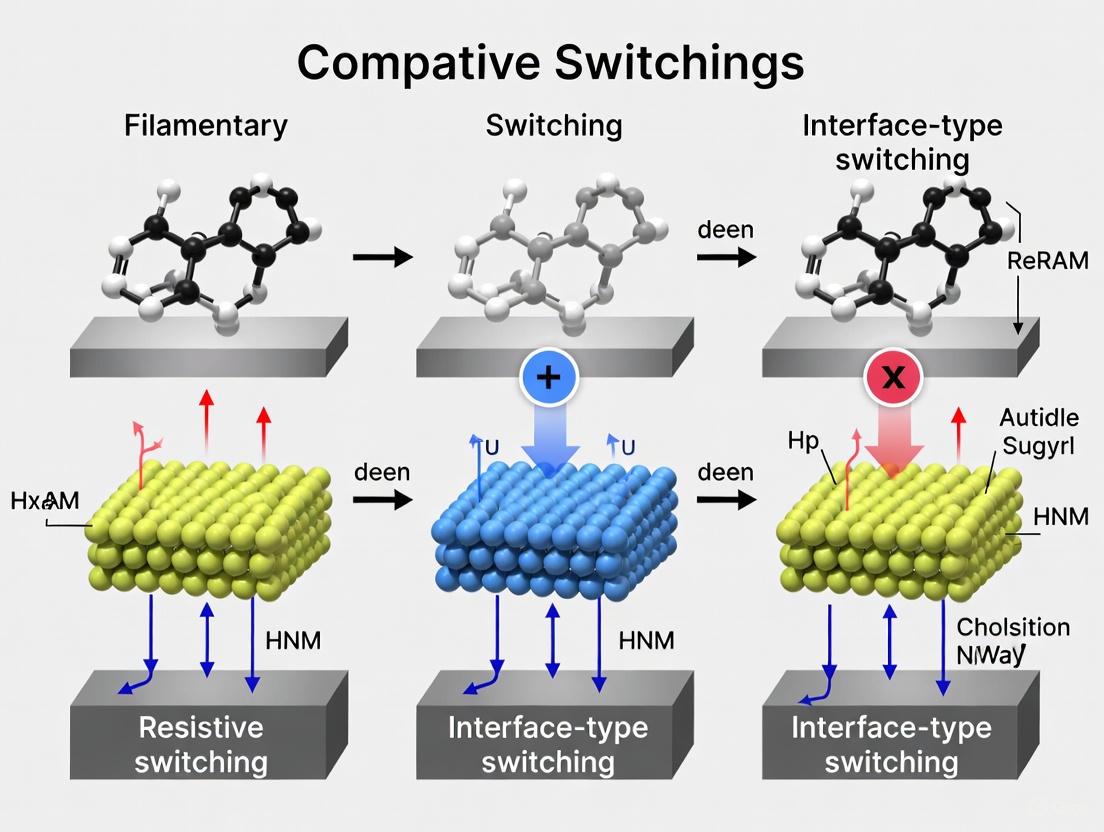
This article provides a comprehensive comparison of the fundamental resistive switching mechanisms in Resistive Random-Access Memory (ReRAM), tailored for researchers and scientists.
Resistive Switching Mechanisms in ReRAM: A 2025 Comparative Guide to ECM, VCM, and Filamentary Dynamics
Abstract
This article provides a comprehensive comparison of the fundamental resistive switching mechanisms in Resistive Random-Access Memory (ReRAM), tailored for researchers and scientists. It explores the operational principles of Electrochemical Metallization (ECM) and Valence Change Mechanism (VCM), detailing their distinct ion migration and conductive filament dynamics. The scope extends to advanced characterization methodologies, performance optimization strategies for tackling device variability and endurance, and a comparative analysis for selecting the optimal mechanism for specific applications, including neuromorphic computing, AI hardware, and embedded memory solutions. The insights herein are grounded in the latest research to guide future material and device engineering efforts.
Unraveling the Core Principles: ECM vs. VCM Resistive Switching Mechanisms
Operating Principles and Resistive Switching Mechanisms
Resistive Random Access Memory (ReRAM) is an emerging non-volatile memory technology that stores data by changing the resistance of a material layer sandwiched between two electrodes. [1] Its fundamental structure is a two-terminal Metal-Insulator-Metal (MIM) capacitor-like device, where the insulating layer functions as the resistive switching layer. [2] The memory function is achieved through resistive switching, a reversible change in electrical resistance induced by applying appropriate voltage pulses. [3]
The basic operation involves three key processes: [2]
- Electroforming: An initial voltage application that forms conductive paths in a pristine device, transitioning it from a high resistance state (HRS) to a low resistance state (LRS).
- SET Process: Subsequent switching from HRS to LRS at a specific voltage (V_SET).
- RESET Process: Switching back from LRS to HRS at a different voltage (V_RESET).
Two primary resistive switching modes exist based on voltage polarity: [2]
- Bipolar Resistive Switching (BRS): SET and RESET processes occur under voltages of opposite polarity.
- Unipolar Resistive Switching (URS): Both SET and RESET processes are triggered by voltages of the same polarity.
Two predominant physical mechanisms explain resistive switching in ReRAM devices, both involving the formation and rupture of conductive filaments (CFs) within the insulating layer. [4] [5]
Electrochemical Metallization (ECM): Also known as Conductive Bridging RAM (CBRAM), this mechanism involves the movement of metal cations (e.g., Ag⁺, Cu²⁺) from an electrochemically active electrode (e.g., Ag, Cu). These cations migrate through the insulating layer under an electric field and are reduced to form metallic conductive filaments. The RESET process occurs when these filaments are dissolved by a voltage of opposite polarity. [2]
Valence Change Mechanism (VCM): This mechanism relies on the migration of oxygen anions (O²⁻) and the corresponding movement of oxygen vacancies (V_O) within metal oxide insulating layers (e.g., HfO₂, Ta₂O₅, NiO). The formation and rupture of oxygen vacancy-based conductive filaments cause the resistance change. The SET process involves vacancy formation and filament buildup, while the RESET process involves vacancy recombination and filament disruption. [4] [6]
Performance Comparison of ReRAM Technologies
ReRAM is one of several emerging memory technologies competing to overcome the limitations of conventional NAND flash and DRAM. The table below compares ReRAM with other prominent emerging memory technologies based on key performance metrics.
Table 1: Performance Comparison of Emerging Memory Technologies
| Technology | Switching Speed | Endurance (Write Cycles) | Retention | Power Consumption | Scalability | Primary Mechanism |
|---|---|---|---|---|---|---|
| ReRAM | ~10 ns [5] | 10⁶ - 10¹² cycles [5] [7] | >10 years [5] | Low (Sub-1V operation demonstrated) [7] | Excellent (<10 nm) [5] | Filamentary (ECM/VCM) |
| PCRAM | ~50 ns | ~10⁸ cycles | ~10 years | Moderate | Moderate | Phase Change |
| MRAM | ~10 ns | >10¹⁵ cycles | >10 years | Low | Good | Magnetic Polarization |
| FeRAM | ~10 ns | ~10¹⁰ cycles | ~10 years | Low | Challenging | Ferroelectric Polarization |
| NAND Flash | ~100 μs | ~10⁵ cycles | ~10 years | High | Challenging below 10 nm [5] | Charge Storage |
ReRAM's commercial market position reflects its technical characteristics. In 2024, the global ReRAM market was valued at approximately USD 786.9 million and is projected to grow at a CAGR of 17.2% to reach USD 3.79 billion by 2034. [8] MRAM currently leads the emerging memory market with a 42% share, followed by PCM at 27%, while ReRAM is expected to capture approximately 18% of the emerging memory market. [5]
Material Platforms and Their Performance
The performance of ReRAM devices heavily depends on the materials used for the insulating switching layer and electrodes. Different material systems yield significantly different device characteristics.
Table 2: Comparison of ReRAM Switching Layer Materials and Performance
| Material System | Switching Type | SET/ RESET Voltage | Endurance (Cycles) | Retention | ON/OFF Ratio | Key Advantages |
|---|---|---|---|---|---|---|
| HfO₂-based [6] [9] | VCM (Bipolar) | ~2-3 V / ~-1.5-2 V | >10⁶ | >10 years | 10-1000 | CMOS compatibility, excellent scalability |
| NiO-based [6] [3] | VCM (Bipolar/Unipolar) | ~2-5.4 V / ~-2.9 V [3] | >400-10⁷ | ~10³ sec - 10 years | 10-1000 | Forming-free operation, flexible compatibility |
| TaOₓ-based [6] | VCM (Bipolar) | ~1-2 V / ~-1-2 V | >10¹⁰ | >10 years | 10-100 | High endurance, fast switching |
| TiO₂-based [6] | VCM (Bipolar) | ~2-3 V / ~-1-2 V | >10⁶ | >10 years | 10-100 | Good uniformity, well-studied material |
| CBRAM (Cu/SiO₂) [5] [7] | ECM (Bipolar) | <1 V / ~-0.5 V | 10⁵-10⁷ | >10 years | 100-10000 | Ultra-low power, high ON/OFF ratio |
Metal oxides dominate the ReRAM material landscape, with oxide-based devices retaining 46.3% market share in 2024. [7] Hafnium oxide (HfO₂) is particularly prominent due to its compatibility with CMOS processes and excellent switching properties. [6] Recent research demonstrates that HfO₂ treated with H-plasma shows increased capacitance and conductance quantization, beneficial for in-memory computing applications. [9] Nickel oxide (NiO) offers advantages for flexible electronics, with demonstrated bipolar resistive switching in Ti/NiO/AZO/PET structures with SET voltage ≈ 5.4 V and RESET voltage ≈ -2.9 V. [3]
Experimental Protocols and Characterization Methods
Device Fabrication and Measurement
A typical ReRAM device fabrication and characterization workflow involves several critical steps to ensure reproducible performance and accurate measurement of switching parameters.
Detailed Fabrication Protocol for Flexible NiO-based ReRAM [3]:
- Substrate Preparation: Use polyethylene terephthalate (PET) substrate for flexibility.
- Bottom Electrode Formation: Deposit aluminum-doped zinc oxide (AZO) layer (~70 nm) via spray coating as a transparent conductive electrode.
- Switching Layer Deposition: Deposit nickel oxide (NiO) thin film (~130 nm) using RF magnetron sputtering with a NiO target, argon environment, pressure of 10⁻² mbar, and applied power of 100 W.
- Top Electrode Deposition: Deposit titanium (Ti) top electrode (~50 nm) using e-beam evaporation through a shadow mask in a vacuum of 5 × 10⁻⁶ mbar.
Electrical Characterization Method [2] [3]:
- Use a semiconductor parameter analyzer (e.g., Keithley 2400 source meter) with a probe station.
- Apply voltage sweeps in the sequence: 0 V → +6 V → 0 V → -6 V → 0 V.
- Implement a compliance current (typically 1 mA) during SET operation to prevent permanent device breakdown.
- Measure current-voltage (I-V) characteristics to identify SET voltage (VSET), RESET voltage (VRESET), and resistance states.
- Perform endurance testing through repeated SET/RESET cycling.
- Conduct retention tests by programming devices and monitoring state retention over time.
Advanced Characterization Techniques
In-situ Transmission Electron Microscopy (TEM) [2]:
- Enables real-time observation of conductive filament formation and dissolution during resistive switching.
- Reveals dynamic processes of ion migration and redox reactions at nanoscale resolution.
- Overcomes limitations of static ex situ TEM characterization by capturing filament evolution dynamics.
Capacitance Measurements [9]:
- Monitor capacitance changes in MIM structures during switching operations.
- H-plasma treated HfO₂ devices show capacitance increase from 3.904 to 3.917 pF/μm² with applied pulse widths.
- Provides insights into dielectric constant modulation due to oxygen vacancy migration.
The Researcher's Toolkit: Essential Materials and Methods
Table 3: Essential Research Reagents and Materials for ReRAM Development
| Material/Equipment | Function | Specific Examples | Application Notes |
|---|---|---|---|
| Transition Metal Oxides | Resistive switching layer | HfO₂, TiO₂, TaOₓ, NiO, ZnO [6] | HfO₂ offers CMOS compatibility; NiO enables forming-free operation [3] |
| Electrode Materials | Electrical contact formation | Ti, Pt, Ag, Cu, AZO (Al-doped ZnO) [3] | Active electrodes (Ag, Cu) for ECM; inert electrodes (Pt, Ti) for VCM; AZO for transparent flexible devices |
| Deposition Systems | Thin film fabrication | RF sputtering, ALD, e-beam evaporation [3] | ALD for conformal ultra-thin films; sputtering for metal oxides; e-beam for electrodes |
| Characterization Tools | Performance analysis | Semiconductor parameter analyzer, in-situ TEM [2] [3] | Keithley 2400 for I-V curves; in-situ TEM for real-time filament observation |
| Substrate Materials | Device support | Silicon wafers, PET for flexibility [3] | PET enables flexible electronics with bending radii of 10-15 mm |
| Metallic Dopants | Performance enhancement | Various transition metals [6] | Improves endurance, retention, and switching uniformity |
Applications and Future Research Directions
ReRAM technology demonstrates significant potential beyond conventional memory applications, particularly in emerging computing paradigms:
Neuromorphic Computing: ReRAM's analog switching capability and synaptic behavior make it ideal for artificial neural networks. Its ability to mimic synaptic weight plasticity enables efficient in-memory computing, overcoming von Neumann architecture limitations. [8] [3]
Edge AI and IoT Devices: ReRAM's low power consumption (sub-1V operation) and non-volatility are crucial for battery-powered edge devices. The technology supports on-device inference and learning with minimal energy requirements. [8] [1]
Flexible Electronics: Transparent conductive oxide electrodes (e.g., AZO) combined with flexible substrates (e.g., PET) enable bendable memory for wearable electronics and smart textiles. [3] Devices maintain stable switching parameters under bending conditions with radii of 10-15 mm.
In-Memory Computing: ReRAM crossbar arrays can perform matrix multiplication and vector operations directly within memory, drastically reducing data transfer bottlenecks in AI workloads. [7]
Future research priorities include improving device uniformity and reliability, reducing operational variability, enhancing endurance characteristics, developing effective selector devices, and optimizing integration with CMOS processes. [5] Material engineering focusing on "perfect imperfections" in transition metal oxides shows particular promise for enhancing switching dynamics. [3]
Electrochemical Metallization (ECM) represents a fundamental resistive switching mechanism where conductive filament formation and dissolution through active metal ion migration enables non-volatile memory operation. As a cornerstone technology for Resistive Random-Access Memory (ReRAM), ECM cells operate through the voltage-induced movement of cations from an electrochemically active electrode (typically Ag or Cu) through a solid electrolyte layer, forming conductive bridges that switch the device between low and high resistance states [2]. This mechanism has attracted significant research attention due to its potential for neuromorphic computing, low-power logic circuits, and artificial intelligence hardware that can overcome the von Neumann bottleneck [10] [2].
Within the broader landscape of resistive switching mechanisms, ECM stands in contrast to the Valence Change Mechanism (VCM), which relies on the migration of anion vacancies (typically oxygen vacancies) and subsequent modulation of Schottky barrier heights at metal-oxide interfaces [4] [11]. While VCM devices typically use inert electrodes like Pt or Pd with ohmic counter electrodes, ECM cells fundamentally require an electrochemically active electrode (Ag, Cu) that provides mobile cations, paired with an inert counter electrode (Pt, Au) [2] [11]. Understanding these distinctions is crucial for researchers selecting appropriate mechanisms for specific memory and computing applications.
Comparative Analysis of Resistive Switching Mechanisms
Table 1: Fundamental comparison between ECM, VCM, and emerging FCM mechanisms
| Parameter | ECM | VCM | FCM |
|---|---|---|---|
| Switching Species | Active metal cations (Ag⁺, Cu⁺) | Anions (O²⁻) / oxygen vacancies | Both cation and anion species |
| Active Electrode | Electrochemically active (Ag, Cu) | Inert (Pt, Pd) with high work function | Ohmic electrodes (Hf, Ta, Zr) |
| Filament Nature | Metallic (Ag, Cu) | Oxygen vacancy-rich region | Nanoscale conduction channels with variable oxidation states |
| Key Driving Force | Electrochemical redox reactions | Electric field-driven ion migration | Localized electrochemical redox reactions |
| Typical SET Polarity | Positive on active electrode | Positive on active electrode | Negative bias (c8w switching) |
| Interface Requirement | Ohmic contacts | One Schottky contact essential | Dual ohmic contacts |
| Representative Structure | Ag/CrPS₄/Au [10] | Pt/Ta₂O₅/Ta [11] | Hf/Ta₂O₅/Ta [11] |
Table 2: Performance metrics across different material platforms
| Material System | ON/OFF Ratio | Endurance (Cycles) | Retention | Operating Voltage | Reference |
|---|---|---|---|---|---|
| 2D CrPS₄-based ECM | >10³ | >10⁴ | >10⁴ s | ~1 V | [10] |
| Halide Perovskite ECM | 10³-10⁵ | Varies by structure | Varies by structure | 0.5-2 V | [12] [13] |
| Ta₂O₅-based VCM | >10² | ~10⁶ | >10 years | 1-2 V | [11] |
| Ta₂O₅-based FCM | >10³ | >10⁷ | >10 years | ~1.5 V | [11] |
| HfO₂-based VCM | 10-100 | ~10¹⁰ | >10 years | 1-3 V | [4] |
The comparative analysis reveals that ECM mechanisms typically leverage the high conductivity of metallic filaments (Ag, Cu) to achieve large ON/OFF ratios, while VCM systems benefit from complementary metal-oxide-semiconductor (CMOS) compatibility and potentially higher endurance [4] [11]. The emerging Filament Conductivity Change Mechanism (FCM) represents an innovative approach that combines aspects of both ECM and VCM, utilizing dual ohmic contacts to reduce physicochemical complexity while enabling both binary and analog switching [11].
Experimental Methodologies in ECM Research
Device Fabrication Protocols
The foundational Ag/CrPS₄/Au cross-point device architecture exemplifies standard ECM fabrication methodology. Single-crystalline CrPS₄ is grown from high-purity Cr, P, and S powders using chemical vapor transport, then mechanically exfoliated and transferred onto pre-patterned bottom Au electrodes (3 μm width) on SiO₂/Si substrates [10]. The active Ag top electrodes (~110 nm thickness, 3 μm width) are deposited via electron-beam evaporation following electron-beam lithography patterning and lift-off processes, creating well-defined metal-insulator-metal (MIM) structures [10]. This approach ensures clean interfaces and controlled device geometry essential for reproducible ECM operation.
For halide perovskite-based ECM devices, fabrication often incorporates specialized interface engineering. As demonstrated in 2D/3D halide perovskite heterostructures, a 2D perovskite layer can be introduced to efficiently prevent Ag ion migration into the 3D perovskite film and control the rupture of Ag conductive filaments, substantially enhancing device endurance [14]. This approach highlights the critical role of interface design in modulating ion migration kinetics—a key consideration for ECM device optimization.
Electrical Characterization Standards
Comprehensive electrical characterization forms the cornerstone of ECM mechanism validation. Standard protocols involve obtaining current-voltage (I-V) curves by sweeping DC bias voltages between top and bottom electrodes using semiconductor parameter analyzers (e.g., Agilent 4156B), with the inert electrode typically grounded [10]. During SET switching (transition to Low Resistance State, LRS), current compliance (CC) is critical to prevent permanent device breakdown [2]. For bipolar switching characteristics of ECM cells, positive bias applied to the active electrode facilitates cation migration and filament formation, while reversal to negative bias induces filament dissolution through electrochemical processes assisted by Joule heating, resetting the device to High Resistance State (HRS) [10] [2].
Endurance testing involves continuous cycling between resistance states (typically 10³-10¹⁰ cycles depending on material system), while retention measurements assess non-volatility by monitoring state stability over time (seconds to years at elevated temperatures) [2] [4]. These standardized metrics enable direct comparison across different ECM material systems and architectures.
Advanced Characterization Techniques
Cross-sectional transmission electron microscopy (TEM) and energy-dispersive X-ray spectroscopy (EDS) provide critical direct evidence of filament configurations in various resistance states. Sample preparation involves creating wedge-shaped specimens through the backside milling method using dual-beam focused ion beam (FIB) systems with Ga⁺ ions at 30 keV [10]. High-resolution TEM (HRTEM) and high-angle annular dark-field (HAADF) imaging enable visualization of filament morphology and electrode/electrolyte interfaces, while EDS mapping confirms the elemental composition of filaments and their spatial distribution [10] [2].
In situ TEM techniques represent a significant advancement, enabling real-time observation of dynamic filament formation and dissolution processes during resistive switching, overcoming limitations of static ex situ observations [2]. This approach has revealed various filament growth modes and structures, providing insights into the kinetic parameters governing ion migration and redox reactions [2]. Complementary computational studies using density functional theory (DFT) calculations and kinetic Monte Carlo simulations further elucidate atomistic migration mechanisms, energy barriers, and vacancy formation energies critical to ECM operation [10] [12].
Diagram 1: Experimental workflow for ECM mechanism investigation
Research Reagent Solutions and Materials Toolkit
Table 3: Essential materials and reagents for ECM device research
| Material Category | Specific Examples | Function in ECM Devices | Key Characteristics |
|---|---|---|---|
| Active Electrodes | Ag, Cu, Ni, and their alloys [11] | Source of mobile cations for filament formation | High electrochemical activity, suitable redox properties |
| Inert Electrodes | Pt, Au, Pd [10] [11] | Electron injection/extraction without participation in ion migration | High work function, chemical stability |
| 2D Solid Electrolytes | CrPS₄, other TMPSₓ materials [10] | Ion transport medium with confined migration pathways | Two-dimensionally confined properties, van der Waals gaps |
| Halide Perovskite Electrolytes | MAPbBr₃, CsSnI₃, 2D/3D heterostructures [12] [14] | Switching layer with defect-mediated ion migration | Exceptional ion mobility, defect tolerance |
| Oxide Electrolytes | Ta₂O₅, HfO₂, TiO₂, Al₂O₃ [2] [11] | Conventional switching materials for comparison | CMOS compatibility, controlled oxygen vacancy density |
| Characterization Tools | TEM/EDS, In Situ TEM, DFT Calculations [10] [2] | Mechanism elucidation and filament visualization | Atomic-resolution capability, real-time observation |
The selection of active electrode material significantly influences ECM dynamics, with Ag and Cu being predominant choices due to their suitable electrochemical properties and mobility in various solid electrolytes [11]. Recent studies have explored traditionally "inert" metals like Pd in specific matrix materials such as sputtered SiOₓ, where Pd cation transport enables reversible switching—expanding the design space for ECM devices [15].
Solid electrolyte materials dictate ion transport characteristics and filament stability. Two-dimensional layered materials like CrPS₄ offer confined migration pathways that can potentially enhance switching uniformity [10], while halide perovskites demonstrate exceptional ion mobility but require interface engineering for stability [14]. Oxide electrolytes remain widely studied due to their CMOS compatibility and well-understood properties [2] [11].
Diagram 2: Material selection strategy for ECM device development
Future Perspectives and Applications
ECM technology is evolving beyond binary non-volatile memory toward multifunctional neuromorphic and in-memory computing applications. The filament conductivity change mechanism (FCM) represents an innovative approach that combines advantages of both ECM and VCM, demonstrating ultra-stable binary and analog switching, broad voltage stability windows, high temperature stability, and improved endurance [11]. These characteristics enable applications in continual learning systems that overcome catastrophic forgetting problems in conventional deep neural networks [11].
Emerging material platforms including engineered 2D/3D halide perovskite heterostructures [14] and single-crystalline 2D layered materials [10] offer new pathways to control ion migration and filament dynamics. Interface engineering strategies—such as incorporating appropriate capping layers to prevent electrode passivation while maintaining ohmic contacts—continue to address stability challenges in practical ECM device implementation [11]. As fundamental understanding of nanoscale electrochemical processes advances, ECM-based memristive systems are poised to play increasingly important roles in next-generation computing architectures, hardware security, and intelligent edge devices.
Resistive Random-Access Memory (ReRAM) has emerged as a leading candidate for next-generation non-volatile memory technology, offering advantages such as simple metal-insulator-metal (MIM) structure, high switching speed, low power consumption, and high integration density [4] [2]. Among the various operational mechanisms underpinning ReRAM devices, the Valence Change Mechanism (VCM) has attracted significant research interest due to its reliability and potential for neuromorphic computing applications [4] [16]. VCM-based ReRAM operates through the migration of anion vacancies (most commonly oxygen vacancies) within a switching layer, typically a transition metal oxide [4] [17]. This migration alters the local stoichiometry and consequently modulates the electronic transport properties of the material, enabling reversible resistive switching between high resistance states (HRS) and low resistance states (LRS) [2].
The fundamental principle of VCM revolves around the field-driven redistribution of mobile ionic defects, primarily oxygen vacancies (V_O••), and the consequent change in the valence state of the cation sublattice [16] [17]. When an electric field is applied, oxygen vacancies migrate, leading to the formation and rupture of conductive filaments or the modulation of interface barriers. This process is often accompanied by a redox reaction at the electrodes, which serves as a reservoir for oxygen ions [17]. The resulting change in the material's resistance is non-volatile, making it suitable for data storage. The dynamics of oxygen vacancies—their formation, migration, and interaction with the host lattice—are therefore critical to the performance and reliability of VCM-based ReRAM devices [18]. Understanding these dynamics provides the foundation for comparing VCM with other resistive switching mechanisms and guides the design of future memory technologies.
Comparative Analysis of VCM Performance and Characteristics
Key Performance Metrics Across Material Systems
The performance of VCM-based ReRAM is highly dependent on the choice of materials for the switching layer and electrodes. Different material systems yield varying switching parameters, which directly influence device suitability for specific applications. The table below summarizes the key performance metrics reported for various VCM-based ReRAM devices.
Table 1: Performance Comparison of VCM-Based ReRAM Devices Using Different Material Systems
| Switching Layer / Structure | Resistance Ratio (R OFF/RON) | Set Voltage (V SET) | Reset Voltage (V RESET) | Endurance (Cycles) | Retention | Key Features |
|---|---|---|---|---|---|---|
| ErMnO3 Polymorphs [16] | ~10⁵ | ~ -2.07 V | N/A | N/A | N/A | Ultra-low RON (~10 Ω); Phase boundary engineering |
| NiO on AZO/PET [3] | >10² | ~ 5.4 V | ~ -2.9 V | >400 | ~10³ s | Flexible, forming-free, transparent |
| LSMO Thin Films [17] | Multiple distinct states | N/A | N/A | Excellent reproducibility | N/A | Three reversible resistance states; Structural phase transition |
VCM vs. ECM: A Fundamental Mechanism Comparison
To objectively evaluate VCM, it must be contrasted with the other primary resistive switching mechanism: the Electrochemical Metallization Mechanism (ECM). While both operate in a MIM structure and involve ion migration, their fundamental principles and characteristics differ significantly.
Table 2: Comparison between Valence Change Mechanism (VCM) and Electrochemical Metallization Mechanism (ECM)
| Feature | Valence Change Mechanism (VCM) | Electrochemical Metallization Mechanism (ECM) |
|---|---|---|
| Mobile Species | Anions (e.g., Oxygen, O²⁻) and Anion Vacancies (V_O••) [4] [17] | Cations from active electrode (e.g., Ag⁺, Cu²⁺) [2] |
| Filament Type | Oxygen vacancy-based conductive filament [16] [17] | Metallic filament (e.g., Ag, Cu) [2] |
| Typical Electrodes | Inert metals (e.g., Pt, TiN, Au) [16] [3] | Active metal (e.g., Ag, Cu) and inert metal (e.g., Pt, W) [19] [2] |
| Switching Polarity | Bipolar [16] [3] | Bipolar (primarily) [2] |
| Key Driving Force | Migration of oxygen vacancies under electric field, often coupled with Joule heating [17] | Electrochemical redox reactions and field-driven cation migration [2] |
| Material Systems | Transition metal oxides (e.g., HfO₂, Ta₂O₅, SrTiO₃, ErMnO₃) [4] [16] | Solid electrolytes (e.g., GeS₂, GeOx, Ta₂O₅) with active electrodes [19] |
The choice between VCM and ECM depends on the application requirements. VCM devices, utilizing inert electrodes, often demonstrate better endurance and higher integration density due to the stability of the electrodes [4]. The ECM mechanism, while enabling very low power operation, can face challenges with filament stability and requires the integration of electrochemically active metals [19] [2].
Experimental Protocols for Probing VCM
In Situ Transmission Electron Microscopy (TEM) for Direct Observation
Objective: To directly observe the atomic-scale dynamics of oxygen vacancy migration and the resulting structural phase transitions in real-time. Protocol Details:
- Sample Fabrication: Prepare a cross-sectional TEM sample featuring the ReRAM stack, typically a thin film (e.g., 20 nm La₂/₃Sr₁/₃MnO₃ or LSMO) epitaxially grown on a conductive substrate (e.g., Nb-doped SrTiO₃) [17].
- In Situ Electrical Biasing: Mount the sample on a specialized TEM holder with a piezo-controlled metal probe. Bring the electrically grounded probe into contact with the film surface, creating a nanoscale contact area (~30 nm diameter). Apply a series of short triangular voltage pulses (e.g., 100 ms duration) to the substrate [17].
- Simultaneous Imaging and Electrical Measurement: While applying voltage pulses, use high-resolution Scanning TEM (STEM) to image the lattice structure. Simultaneously, continuously monitor the electrical resistance of the sample. This correlative approach directly links structural changes to resistance states [17].
- Spectroscopic Analysis: Complement imaging with Electron Energy-Loss Spectroscopy (EELS) to probe changes in the oxidation state and local oxygen concentration within the switching layer, providing chemical evidence for oxygen vacancy migration [17].
Key Insights from Protocol: This methodology has been pivotal in demonstrating that resistive switching in VCM systems is driven by the reversible horizontal migration of oxygen vacancies within the film, leading to uniform structural phase transitions (e.g., from perovskite to brownmillerite structure in LSMO) rather than the formation of nanoscale filaments alone [17].
Electrical Characterization of Bipolar Resistive Switching
Objective: To electrically characterize the switching parameters, endurance, and retention of VCM-based ReRAM devices. Protocol Details:
- Device Fabrication: Fabricate a metal-insulator-metal (MIM) capacitor structure. For example, deposit a switching layer (e.g., NiO, ErMnO₃) via RF sputtering or pulsed laser deposition between inert top and bottom electrodes (e.g., Pt, Ti, AZO) [16] [3].
- Current-Voltage (I-V) Sweeping: Use a semiconductor parameter analyzer to perform voltage sweeps. A typical bipolar sweep sequence is: 0 V → +Vmax → 0 V → -Vmax → 0 V. A current compliance (CC) is set during the SET process to prevent irreversible hard breakdown [2] [3].
- Parameter Extraction: From the I-V characteristics, determine key metrics:
- Endurance and Retention Testing: Cycle the device repeatedly between HRS and LRS to test endurance (number of stable switching cycles). Measure retention by applying a small read voltage to each state over time (e.g., 10³ seconds) to ensure non-volatility [3].
Key Insights from Protocol: This standard electrical testing reveals the forming-free behavior, operating voltages, and stability of the device. Analysis of the I-V curves in different regions (e.g., ohmic conduction, Space Charge Limited Conduction - SCLC) provides insight into the dominant conduction mechanisms in the HRS and LRS, which are often linked to the configuration of oxygen vacancies [3].
Visualization of VCM Dynamics and Workflows
Oxygen Vacancy Dynamics in VCM Switching
The following diagram illustrates the core physical processes of the Valence Change Mechanism, driven by oxygen vacancy dynamics.
Experimental Workflow for VCM Analysis
This diagram outlines a comprehensive experimental workflow for characterizing VCM-based ReRAM devices, from fabrication to advanced analysis.
The Scientist's Toolkit: Key Research Reagents and Materials
The experimental study of VCM relies on a suite of specialized materials, deposition tools, and characterization instruments. The following table details the essential components of the research toolkit for this field.
Table 3: Essential Research Toolkit for VCM ReRAM Investigation
| Category | Item / Technique | Specific Examples | Primary Function in VCM Research |
|---|---|---|---|
| Switching Layer Materials | Transition Metal Oxides | HfO₂, Ta₂O₅, TiO₂, NiO, SrTiO₃, La₂/₃Sr₁/₃MnO₃ (LSMO), ErMnO₃ [4] [16] [17] | Host matrix for oxygen vacancy generation and migration; determines switching characteristics. |
| Electrode Materials | Inert Electrodes | Pt, Ti, TiN, Au, Al-doped ZnO (AZO) [16] [3] | Provide electrical contact without actively participating in redox reactions; act as oxygen ion reservoirs. |
| Fabrication Equipment | Thin Film Deposition | RF Sputtering, Pulsed Laser Deposition (PLD), Thermal Evaporation [16] [3] | Precisely deposit thin, uniform layers of electrode and switching materials. |
| Structural Characterization | Microscopy & Diffraction | Scanning Electron Microscopy (SEM), X-ray Diffraction (XRD), Raman Spectroscopy [16] [3] | Analyze film morphology, crystallinity, phase composition, and polymorph distribution. |
| Electrical Characterization | Semiconductor Analyzer | Keithley 2400 Series Source Meter [3] | Perform precise I-V, endurance, and retention measurements with current compliance. |
| Advanced In Situ Analysis | Transmission Electron Microscopy | in situ TEM/STEM, Electron Energy-Loss Spectroscopy (EELS) [2] [17] | Directly observe oxygen vacancy dynamics and structural transitions in real-time under bias. |
This guide has provided a comprehensive comparison of the Valence Change Mechanism, highlighting its fundamental principles, performance metrics across material systems, and direct contrast with the Electrochemical Metallization Mechanism. The detailed experimental protocols and visualization of oxygen vacancy dynamics offer a roadmap for researchers to probe and validate VCM in ReRAM devices. The consistent observation of oxygen vacancy-driven structural and resistive transitions, as made possible by advanced in situ techniques like TEM, underscores the critical role of anion dynamics in this mechanism [17]. The ongoing development of diverse material platforms—from traditional transition metal oxides to novel polymorphic and flexible systems [16] [3]—continues to expand the potential of VCM-based memory. This progress positions VCM-ReRAM as a key technology not only for high-density, non-volatile memory but also for the realization of energy-efficient neuromorphic computing systems.
Resistive Random-Access Memory (ReRAM) has emerged as a promising technology for next-generation non-volatile memory and neuromorphic computing, owing to its simple metal-insulator-metal (MIM) structure, fast switching speed, low power consumption, and excellent scalability [4] [6]. The fundamental operation of ReRAM devices relies on electrically induced resistance switching between high-resistance states (HRS) and low-resistance states (LRS). Among the various physical mechanisms that govern this switching behavior, the Thermochemical Mechanism (TCM) plays a crucial role, particularly in the formation and stability of conductive filaments (CFs) that bridge the electrodes through the insulating oxide layer [20] [21].
The TCM is distinguished from other prominent mechanisms such as the Electrochemical Metallization Mechanism (ECM) and Valence Change Mechanism (VCM) by its primary driving force. While ECM involves the oxidation and reduction of active electrode metals, and VCM is primarily driven by electric field-induced migration of oxygen vacancies, TCM is dominated by Joule heating-induced effects that facilitate the formation and rupture of conductive filaments through thermal processes [21]. In TCM-based devices, the local temperature increase caused by Joule heating under an applied electric field enables the thermally activated reduction of the metal oxide layer, leading to the creation of a conductive channel composed of oxygen vacancies or metal cations. The stability of this filament is critically dependent on the precise control of Joule heating, which, if uncontrolled, can lead to undesirable variability in switching parameters and device performance degradation [20] [22].
This review provides a comprehensive comparison of the thermochemical mechanism against other resistive switching mechanisms, with particular emphasis on the role of Joule heating in filament stability. We present experimental data from diverse material systems, analyze methodologies for characterizing thermal effects, and discuss material design strategies to control Joule heating for enhanced device performance.
Comparative Analysis of Resistive Switching Mechanisms
Fundamental Operating Principles
ReRAM devices operate through different physical mechanisms depending on the materials system, electrode configuration, and switching conditions. The table below compares the three primary resistive switching mechanisms:
Table 1: Comparison of Major Resistive Switching Mechanisms in ReRAM
| Feature | Thermochemical Mechanism (TCM) | Valence Change Mechanism (VCM) | Electrochemical Metallization (ECM) |
|---|---|---|---|
| Primary Driving Force | Joule heating | Electric field | Electric field + electrochemical reactions |
| Filament Composition | Oxygen vacancies or metal cations | Oxygen vacancies | Active metal ions (Ag, Cu) |
| Key Processes | Thermal reduction, phase change | Oxygen ion/vacancy migration | Metal oxidation/redox, cation migration |
| Temperature Dependency | Strong (thermal activation) | Moderate | Weak to moderate |
| Typical Materials | NiO, TaOx, HfO2 | TaOx, HfOx, TiO2 | Ag/chalcogenides, Cu/solid electrolytes |
| Switching Polarity | Unipolar (voltage polarity-independent) | Bipolar (voltage polarity-dependent) | Bipolar (voltage polarity-dependent) |
| Filament Stability Challenge | Thermal runaway during reset | Interface reactions | Overgrowth into counter electrode |
The Role of Joule Heating in TCM Operation
In TCM-based ReRAMs, Joule heating is the predominant factor governing both the SET (transition to LRS) and RESET (transition to HRS) processes. During the forming or SET process, applied voltage creates a conductive filament through the insulator. The subsequent current flow through this narrow filament generates significant localized heating due to the substantial current density, which can reach temperatures sufficient to cause thermal reduction of the oxide material or facilitate ionic movement [22] [21].
The RESET process in TCM devices is particularly dependent on Joule heating effects. As the table below illustrates, the rupture of the conductive filament occurs when the local temperature reaches a critical point that enables oxidation of the filament material or atomic rearrangement through thermal diffusion. This is in contrast to VCM devices, where the reset process is primarily driven by the reverse electric field that pushes oxygen vacancies away from the filament or attracts oxygen ions back into the filament region [22] [21].
Table 2: Experimental Evidence of Joule Heating Effects in Different ReRAM Systems
| Material System | Device Structure | Switching Type | Key Findings on Joule Heating Role | Reference |
|---|---|---|---|---|
| AlOx | Pt/AlOx/ITO | Unipolar & Bipolar | Unipolar switching disappears at 40 K, indicating thermal mechanism essential for RESET | [22] |
| TaOx/HfO2 | Bilayer with inert electrodes | Bipolar (TCM features) | MD simulations show thermally activated oxygen vacancy generation stabilizes filament growth | [21] |
| NiO | Ni/HfO2/Si(n+) | Unipolar | Current-controlled operation reduces variability by controlling Joule heating | [23] |
| TaOx | ITO/TaOx/NiOx/Al | Bipolar | Interface engineering suppresses abrupt filament rupture by modulating thermal effects | [24] |
Molecular dynamics simulations of TaOx/HfO2-based ReRAMs have provided atomistic insights into the role of thermal effects in filament formation. These simulations reveal that while electric fields initiate ionic displacement, the filament growth during electroforming is primarily attributed to a localized thermally-activated mechanism [21]. Specifically, once a voltage threshold is exceeded, the generation of oxygen vacancy defects becomes stabilized by local electric fields near the nucleated filament, with Joule heating accelerating this process by providing the necessary thermal energy for defect generation and aggregation.
Experimental Methodologies for Investigating Joule Heating Effects
Temperature-Dependent Electrical Characterization
The most direct approach for investigating the role of Joule heating in TCM devices involves temperature-dependent electrical characterization. By measuring current-voltage (I-V) characteristics across a wide temperature range, researchers can isolate thermal effects from electric field effects. In a notable study on AlOx-based RRAM, devices exhibited dramatically different behavior when cooled to cryogenic temperatures (40 K) [22]. The complete disappearance of unipolar resistive switching at low temperatures provided compelling evidence that Joule heating is essential for the RESET process in unipolar operation. Meanwhile, bipolar switching persisted but transformed from abrupt to gradual reset behavior, indicating that Joule heating assists in filament rupture even in bipolar mode [22].
The analysis of conduction mechanisms through I-V characterization at various temperatures further reveals the influence of thermal effects. In TCM-dominated devices, the LRS typically exhibits ohmic conduction (I∝V) due to the metallic or highly conductive nature of the filament, while the HRS often follows Space-Charge-Limited Conduction (SCLC) or Schottky emission patterns [24] [22]. The temperature dependence of these conduction mechanisms provides indirect information about the role of Joule heating in filament stability.
Current vs. Voltage Control Methodologies
The fundamental difference between current-controlled and voltage-controlled operation provides important insights into Joule heating management in TCM devices. Experimental studies on Ni/HfO2/Si(n+) structures have demonstrated that current-controlled switching significantly reduces variability in resistance states compared to voltage-controlled operation [23]. This improvement stems from the direct control over Joule heating (P = I²R) afforded by current programming, which enables more precise thermal management during the critical filament formation and rupture processes [23].
Voltage-controlled switching, in contrast, allows current—and consequently Joule heating—to vary dramatically based on the filament's instantaneous resistance state. This often leads to uncontrolled thermal runaway during RESET, causing abrupt filament rupture and consequently higher cycle-to-cycle variability [23]. The comparison between these operational methodologies highlights the critical importance of controlled Joule heating for stable TCM operation.
Advanced Characterization Techniques
Advanced structural and chemical characterization techniques provide direct evidence of Joule heating effects on filament stability. Scanning Transmission Electron Microscopy (STEM) combined with Electron Energy Loss Spectroscopy (EELS) has been employed to analyze the structural transformation in multilayer RRAM devices such as Pt/AlOx/ZnO/Ti [25]. These techniques have revealed distinct filament morphologies across different oxide layers, with continuous oxygen vacancy filaments in ZnO and discontinuous oxygen-deficient regions in AlOx [25]. The variation in filament structure directly influences current confinement and thus localized Joule heating, ultimately determining power consumption and switching stability.
Table 3: Methodologies for Investigating Joule Heating in TCM ReRAMs
| Technique | Application | Key Insights | Limitations |
|---|---|---|---|
| Temperature-Dependent I-V | Electrical characterization across temperature ranges | Identifies thermal activation energies; distinguishes thermal from field-driven effects | Does not directly measure filament temperature |
| Current-Control Methodology | Comparing current vs. voltage programming | Demonstrates improved uniformity with controlled Joule heating | Requires specialized instrumentation |
| Molecular Dynamics Simulations | Atomistic modeling of filament dynamics | Reveals temperature-driven ion migration and vacancy generation | Computationally intensive; simplified models |
| STEM/EELS Analysis | Nanoscale structural and chemical characterization | Direct observation of filament morphology and composition | Post-mortem analysis; challenging in operando |
Material and Interface Engineering for Thermal Management
Interface Engineering Strategies
Interface engineering has emerged as a powerful approach to modulate Joule heating effects and improve filament stability in TCM devices. The introduction of engineered interfaces between oxide layers and electrodes can significantly alter the thermal and electrical profiles during switching operations. In one notable study, researchers inserted a thin NiOx layer between TaOx and the top electrode in an Al/TaOx/ITO device [24]. This interface barrier successfully suppressed the uncontrolled rupture of filaments by confining their formation and rupture throughout the entire bulk structure under critical bias setups [24].
The physical mechanism behind this improvement was identified as a combination of space-charge-limited conduction (SCLC) dominating the SET process and Schottky emission dominating under reverse bias. The NiOx/TaOx interface barrier effectively redistributed the electric field and associated Joule heating, leading to more controlled filamentary switching with improved endurance and uniformity [24]. The cumulative distribution of switching voltages showed remarkable concentration in devices with the NiOx interface layer, with SET voltages ranging from 0.64 to 0.78V and RESET voltages from -0.68 to -0.88V, compared to much broader distributions (1.3-4.9V for SET, -1.7 to -5.0V for RESET) in control devices without the interface layer [24].
Bilayer Oxide Structures
Bilayer oxide structures represent another effective strategy for managing Joule heating and improving filament stability in TCM devices. These structures typically combine two different oxide materials with complementary properties to better control the formation and rupture of conductive filaments. For instance, Pt/AlOx/ZnO/Ti RRAM devices have demonstrated excellent performance characteristics, including forming-free operation, self-compliance, and low power consumption (0.586 nW for SET and 0.596 nW for RESET) [25].
In this architecture, the switching mechanism involves the formation of continuous oxygen vacancy filaments in the ZnO layer, while the AlOx layer contains discontinuous oxygen-deficient regions that enable electron hopping conduction [25]. This multi-functional conducting filament system naturally restricts current levels, thereby controlling Joule heating and reducing power consumption. The current confinement in the AlOx layer occurs through hopping distances of approximately 1.5 nm, as evidenced by EELS mapping and fitting results [25]. Such controlled current flow directly modulates the localized Joule heating, preventing thermal runaway and enabling more stable switching behavior over thousands of cycles.
Material Selection Criteria
The selection of appropriate oxide materials is crucial for optimizing TCM operation through Joule heating management. Transition metal oxides such as NiO, TaOx, HfO2, and TiO2 have been extensively investigated for TCM-based ReRAMs, each offering distinct advantages and challenges [6]. The thermal conductivity, specific heat capacity, and activation energy for ion migration of these materials directly influence how Joule heating affects filament stability.
Materials with moderate thermal conductivity are often preferred for TCM operation, as they allow sufficient localized heating for filament formation and rupture while preventing excessive heat dissipation that would require higher operating power. Additionally, the oxygen ion mobility and reduction enthalpy of the oxide material determine its susceptibility to thermally driven redox processes that underlie the TCM [21] [6]. By carefully selecting material combinations in bilayer or multilayer structures, researchers can tailor the thermal and electrical properties to achieve optimal TCM switching characteristics with enhanced filament stability.
The Scientist's Toolkit: Essential Research Reagents and Materials
Table 4: Key Research Materials and Characterization Tools for Investigating TCM and Joule Heating Effects
| Category | Specific Materials/Tools | Function in TCM Research | Representative Examples |
|---|---|---|---|
| Transition Metal Oxides | TaOx, HfO2, NiO, AlOx, ZnO | Switching layer material exhibiting TCM behavior | TaOx/HfO2 bilayers [21], NiO unipolar devices [23] |
| Electrode Materials | Pt, Ti, ITO, Ni, Al | Inert and active electrodes for MIM structures | Pt top electrode in Pt/AlOx/ZnO/Ti [25] |
| Interface Engineering Layers | NiOx, AlOx | Modulate interfacial barriers and thermal profiles | NiOx in ITO/TaOx/NiOx/Al [24] |
| Characterization Tools | Temperature-dependent I-V, C-AFM, STEM, EELS | Electrical and structural analysis of filament dynamics | STEM/EELS for Pt/AlOx/ZnO/Ti filament visualization [25] |
| Simulation Methods | Molecular Dynamics with CTIP/EChemDID | Atomistic modeling of filament formation and thermal effects | MD simulations of TaOx/HfO2 bilayer [21] |
Comparative Performance Analysis and Future Directions
Performance Metrics Across Mechanisms
The performance advantages and limitations of TCM relative to other switching mechanisms become evident when comparing key device metrics. While TCM-based devices traditionally faced challenges with variability and power consumption due to the stochastic nature of thermally driven filament formation, recent advances in interface and material engineering have yielded significant improvements.
The following diagram illustrates the experimental workflows for investigating Joule heating effects in TCM ReRAM devices, incorporating key methodologies discussed in this review:
Current-controlled operation has demonstrated particular promise for TCM devices, with studies showing both variability reduction and power enhancement compared to voltage-controlled switching [23]. In Ni/HfO₂/Si(n⁺) devices, current sweeps during both SET and RESET processes resulted in more stable resistance states and lower power consumption, as the direct control over current enables more precise management of Joule heating effects [23].
Future Research Directions
Future research on TCM and Joule heating effects should focus on several promising directions. First, the development of advanced thermal management strategies through nanoscale material design could further improve filament stability. This includes the exploration of heterogeneous structures with precisely engineered thermal properties and the implementation of local thermal probes to directly measure temperature distributions in operating devices.
Second, the integration of multiscale modeling approaches combining atomistic simulations with compact models will enhance our understanding of Joule heating effects across different length and time scales. Reactive molecular dynamics simulations have already provided valuable insights into filament formation mechanisms [21], and extending these approaches to include additional material systems and operational conditions will yield further design guidelines for stable TCM operation.
Finally, the exploration of novel material systems beyond conventional transition metal oxides may open new pathways for controlling Joule heating effects. Two-dimensional materials, organic-inorganic hybrids, and phase-change materials offer unique thermal and electrical properties that could be leveraged to develop TCM devices with improved performance characteristics for next-generation memory and neuromorphic computing applications.
The thermochemical mechanism in ReRAM devices presents both challenges and opportunities related to Joule heating effects on filament stability. While uncontrolled thermal effects can lead to variability and reliability issues, properly managed Joule heating provides the fundamental driving force for stable resistive switching in TCM devices. Through interface engineering, bilayer structures, current-control methodologies, and advanced thermal characterization, researchers have made significant progress in harnessing Joule heating for improved device performance.
Comparative analysis with VCM and ECM mechanisms reveals that TCM offers unique advantages for unipolar operation and simplified device integration, though it requires careful thermal management. Future research focusing on nanoscale thermal engineering, multiscale modeling, and novel material systems will further enhance our ability to control Joule heating effects, ultimately enabling the development of high-performance, reliable TCM-based ReRAM devices for next-generation computing applications.
Resistive Random-Access Memory (ReRAM) has emerged as a leading candidate for next-generation non-volatile memory and neuromorphic computing, offering advantages such as simple structure, high speed, low power consumption, and excellent scalability [26] [27]. At the core of ReRAM operation are two fundamental resistive switching modes: unipolar and bipolar. These modes are classified based on how the applied voltage controls the resistance transitions between high-resistance (HRS) and low-resistance states (LRS). While unipolar switching depends only on the voltage magnitude, bipolar switching requires opposite voltage polarities for SET and RESET operations [28]. Understanding the distinct physical mechanisms governing these switching modes is crucial for optimizing device performance for specific applications, from high-density memory to artificial synapses. This guide provides a comprehensive comparison of unipolar and bipolar switching modes by examining their operational principles, underlying physical mechanisms, experimental characterization, and material dependencies.
Fundamental Operational Principles
Defining Characteristics and Voltage Polarities
The primary distinction between unipolar and bipolar resistive switching lies in their voltage polarity requirements for resistance transitions:
Unipolar Resistive Switching (URS): The SET (transition to LRS) and RESET (transition to HRS) processes are controlled solely by the magnitude of the applied voltage, independent of its polarity [28]. The same voltage polarity can be used for both operations, though the RESET voltage is typically higher than the SET voltage.
Bipolar Resistive Switching (BRS): The SET and RESET processes require opposite voltage polarities [28]. For instance, a positive voltage might trigger the SET process, while a negative voltage is required for the RESET process, or vice-versa.
Table 1: Comparative Overview of Unipolar and Bipolar Switching Modes
| Feature | Unipolar Switching (URS) | Bipolar Switching (BRS) |
|---|---|---|
| Voltage Polarity Dependency | Independent of polarity | Dependent on opposite polarities |
| SET/RESET Mechanism | Voltage magnitude-driven | Voltage polarity-driven |
| Filament Nature | Typically thicker, thermally ruptured | Typically thinner, ion-migration controlled |
| Primary Physical Mechanism | Thermo-chemical filament rupture & formation [29] | Electrochemical ion migration & interface modulation [30] [31] |
| Key Controlling Parameter | Current compliance (for SET) | Voltage polarity & sweep direction |
| Typical I-V Characteristic | Symmetrical (similar shape for both polarities) | Asymmetrical (different shape for opposite polarities) |
| Switching Uniformity | Often less uniform | Generally better uniformity [28] |
| Operational Power | Can require higher RESET power | Typically lower operational power [28] |
Visualizing the Operational Workflow
The fundamental electrical operations for characterizing both switching modes involve applying voltage sweeps and measuring the current response to induce resistance transitions.
Underlying Physical Mechanisms
Unipolar Switching and the Thermo-Chemical Filament Model
Unipolar resistive switching is predominantly explained by the formation and rupture of conductive filaments within the insulating oxide layer via thermo-chemical processes [29]. The switching cycle involves:
Forming and SET Process: An initial high voltage (forming voltage) creates a conductive filament composed of metallic atoms or oxygen vacancies through the insulating layer. After forming, a lower SET voltage can re-establish a conductive filament.
RESET Process: As current flows through the filament in the LRS, Joule heating increases the local temperature. When the current reaches a critical value sufficient to initiate a thermo-chemical reaction (e.g., oxidation of the filament material), the filament ruptures at its weakest point, typically in the center where the temperature is highest [29]. This rupture returns the device to the HRS.
A universal power-law relationship has been observed between the switching power (P) and the switching resistance (R) during the RESET process in unipolar devices: P ∝ R−β, where β is a constant [29]. This universality across different binary metal oxide systems (e.g., NiO, TiO₂, HfO₂) suggests that the RESET operation is governed by a common thermal mechanism where the power required to rupture a filament decreases as the filament resistance increases.
Bipolar Switching and the Electrochemical Mechanism
Bipolar switching operates primarily through an electrochemical mechanism driven by ion migration under an electric field, which is strongly polarity-dependent [30] [31]. The switching cycle involves:
SET Process: Application of one voltage polarity (e.g., positive on the top electrode) drives mobile ions (e.g., oxygen vacancies or metal cations) toward the bottom electrode, forming a conductive filament or modulating the interface barrier, thereby switching the device to the LRS.
RESET Process: Reversing the voltage polarity (e.g., negative on the top electrode) drives the ions back, rupturing the filament or re-establishing the interface barrier, which returns the device to the HRS.
In some bipolar systems, the resistance change is attributed to the modulation of the Schottky barrier at the metal-oxide interface due to the migration of oxygen ions or vacancies, rather than a complete filamentary rupture [31]. The presence of an oxygen scavenging layer (e.g., Ti, Ta) adjacent to the switching oxide is crucial in many bipolar ReRAMs, as it provides a reservoir for oxygen ions, facilitating the redox reactions that control the concentration of oxygen vacancies in the switching layer [31].
Diagram of Physical Mechanisms
The core physical processes differentiating unipolar and bipolar switching mechanisms are illustrated below.
Experimental Characterization and Data
Key Experimental Protocols
Resistive switching characterization primarily relies on direct current (DC) voltage sweep measurements performed using a semiconductor parameter analyzer:
Device Structure: The standard test structure is a Metal-Insulator-Metal (MIM) capacitor, where the "insulator" is the switching material (e.g., metal oxide) [29] [30].
Forming Operation: A pristine device is initially in a highly resistive state. A one-time, higher voltage "forming" process is required to activate the reversible switching behavior by creating an initial conductive path [29] [32].
DC Sweep Measurement:
- A voltage sweep sequence (e.g., 0 V → +Vmax → 0 V → -Vmax → 0 V) is applied to the top electrode while the bottom electrode is grounded.
- The current is measured continuously. Abrupt changes in current indicate resistive switching events.
- For the SET process, a current compliance is set to prevent permanent device breakdown by limiting the maximum current that can flow upon switching to the LRS [30] [31].
Data Analysis: The current-voltage (I-V) curves are plotted on linear and log-log scales to determine switching parameters (VSET, VRESET, HRS/LRS resistance) and identify conduction mechanisms (Ohmic, Space-Charge-Limited Conduction, etc.) [28].
Comparative Experimental Data
Experimental data from various material systems highlights the distinct electrical characteristics of unipolar and bipolar switching.
Table 2: Experimental Data from Different Material Systems
| Material System | Switching Mode | Key Experimental Observations | Switching Parameters | Cited Study |
|---|---|---|---|---|
| NiO, TiO₂, HfO₂ | Unipolar | Universal power-law P ∝ R⁻¹.¹² for RESET; LRS shows metallic conductivity | RESET power decreases with increasing R; Thermo-chemical rupture | [29] |
| Pt/ZnO/TiN | Bipolar | Gradual SET/RESET; Stable endurance (>100 cycles); Multilevel capability | Set voltage: ~0.7 V; Reset voltage: ~ -1.0 V; Self-compliance | [30] |
| Ta/Ta₂O₅/Pt | Bipolar & CRS | Switching mode transition (BRSCRS) with compliance current and Ta thickness | CRS appears at higher C.C. (3 mA) with thin Ta (20 nm) layer | [31] |
| ITO/GOAu/Al | Non-Polar (Both URS & BRS) | Exhibits both unipolar and bipolar switching in the same device | Unipolar VSET: 2.3 V, VRESET: 1.7 V; Bipolar V_SET: -1.6 V | [28] |
The Researcher's Toolkit: Materials and Reagents
The performance and switching mode of ReRAM devices are heavily influenced by the choice of materials. The table below details key materials used in the fabrication of ReRAM devices featured in the cited studies.
Table 3: Essential Materials for Resistive Switching Memory Research
| Material Category | Specific Examples | Function in the Device |
|---|---|---|
| Switching Oxides | Binary Metal Oxides (NiO, TiO₂, HfO₂, Ta₂O₅, ZnO) [29] [30] [26] | Primary layer where resistive switching occurs; hosts the conductive filament. |
| Oxygen Scavenger/ Reservoir Layers | Ta, Ti [31] | Adjacent layer that getters oxygen from the switching oxide, promoting the formation of oxygen vacancies crucial for bipolar switching. |
| Active Electrodes | Ag, Cu [32] | For CBRAM devices, these electrodes provide metal cations (Ag⁺, Cu⁺) that form the conductive filament. |
| Inert Electrodes | Pt, TiN, ITO [29] [30] [28] | Electrodes that do not readily supply ions; used to probe the switching layer and apply electric field. |
| 2D Materials | Graphene Oxide (GO) [28] | Emerging switching material offering flexibility, tunable oxygen content, and potential for complex switching behaviors like non-polar and complementary switching. |
Application Context and Selection Guidelines
The choice between unipolar and bipolar switching modes depends critically on the target application:
Unipolar Switching has been historically significant, particularly in earlier oxide-based ReRAM. Its simplicity in not requiring polarity reversal can be an advantage in some circuit designs. However, its typically higher RESET power and larger operational variability can be limitations [28].
Bipolar Switching is the predominant mode in modern ReRAM development due to its better uniformity, lower power consumption, faster switching speed, and superior controllability [28]. It is especially suited for:
- High-Density Memory: Its reliability and endurance are key for storage-class memory.
- Neuromorphic Computing: The gradual, analog-like resistance modulation achieved in bipolar switching (e.g., in Pt/ZnO/TiN devices) is ideal for emulating synaptic weights in artificial neural networks [30].
- Multilevel Cell (MLC) Storage: Bipolar devices more readily achieve multiple intermediate resistance states, increasing storage density [30] [26].
Complementary Resistive Switching (CRS), a derived mode from bipolar switching, is specifically designed to mitigate sneak-path currents in crossbar arrays. It connects two bipolar cells anti-serially, ensuring that the combined resistance is always high in the idle state, which is crucial for achieving high-density memory arrays without selector devices [31] [28].
Unipolar and bipolar resistive switching modes are governed by fundamentally different physical mechanisms—thermo-chemical and electrochemical, respectively. This fundamental distinction dictates their operational characteristics, performance metrics, and ultimate application domains. While unipolar switching demonstrates a universal thermal rupture mechanism, bipolar switching offers greater control through field-driven ion migration, making it the leading contender for advanced memory and neuromorphic computing applications. The ongoing research into diverse material systems, from binary metal oxides to graphene oxide and bilayer structures, continues to refine our understanding of these mechanisms and enables the engineering of ReRAM devices with tailored properties for the future of electronics.
Resistive Random-Access Memory (ReRAM) has emerged as a leading contender for next-generation non-volatile memory technology, offering significant advantages in scalability, switching speed, and power consumption compared to conventional flash memory. At the core of ReRAM evaluation lie three fundamental performance metrics: the ON/OFF ratio, which measures the distinguishability between memory states; endurance, which quantifies the device's lifetime; and retention, which defines its data stability over time. These metrics collectively determine the practical viability of ReRAM devices across diverse applications, from embedded memory and storage-class memory to neuromorphic computing and field-programmable gate arrays (FPGAs).
The performance of ReRAM is intrinsically linked to its resistive switching mechanisms, primarily governed by the formation and rupture of conductive filaments (CFs) within a thin insulating layer sandwiched between two metal electrodes. The most prevalent mechanisms include the Electrochemical Metallization (ECM) mechanism, involving active metal electrode ions (e.g., Ag⁺ or Cu⁺), and the Valence Change Mechanism (VCM), reliant on the migration of oxygen anions (O²⁻) and the consequent redistribution of oxygen vacancies [33] [4]. Understanding these mechanisms is crucial, as they directly influence the metrics under discussion, often creating inherent trade-offs that device engineers must navigate.
This guide provides a comprehensive comparison of these key metrics across diverse ReRAM material systems and architectures, presenting consolidated experimental data and the methodologies used to obtain them. By framing this data within the context of resistive switching mechanisms, this analysis aims to provide researchers and development professionals with a clear framework for evaluating ReRAM technologies.
Metric Definitions and Switching Mechanisms
ON/OFF Ratio
The ON/OFF ratio is a critical parameter defined as the ratio between the resistance in the High-Resistance State (HRS) and the Low-Resistance State (LRS). A higher ratio allows for easier and more reliable distinction between logical '0' and '1' states, which is particularly vital for multi-level cell (MLC) storage, where a single cell stores multiple bits of information [34]. The ON/OFF ratio is fundamentally governed by the completeness of conductive filament formation and dissolution. In ECM-based devices, the ratio depends on the robustness of metallic filaments, while in VCM-based devices, it is controlled by the configuration of oxygen vacancy filaments [33] [26].
Endurance
Endurance refers to the number of reliable SET (transition to LRS) and RESET (transition to HRS) cycles a memory device can undergo before failure. It is a direct measure of the device's operational lifetime and is often limited by the degradation of the switching layer or electrodes over repeated cycling. The stochastic nature of filament formation and rupture leads to cycle-to-cycle (C2C) and device-to-device (D2D) variability, which negatively impacts endurance [35] [36]. Optimizing operational conditions, such as using tailored voltage pulses, has been shown to improve endurance by mitigating damage during the filament dissolution process [36].
Retention
Retention describes the ability of a device to maintain its programmed resistance state (either HRS or LRS) over an extended period, typically measured at elevated temperatures to accelerate testing. It is a key indicator of non-volatility. Data retention is challenged by the spontaneous diffusion of ions or oxygen vacancies that constitute the conductive filament, leading to a gradual drift of the resistance state over time [26]. Superior retention ensures data integrity in memory applications, with a common benchmark being stability for 10 years at operating temperatures.
Table 1: Key Performance Metrics and Their Definitions
| Metric | Definition | Key Influencing Factors | Ideal Target |
|---|---|---|---|
| ON/OFF Ratio | Ratio of HRS resistance to LRS resistance | Switching mechanism, electrode materials, ON/OFF ratio of the resistive device [35] | > 10³ for MLC operation [37] |
| Endurance | Number of sustained SET/RESET cycles | Filament stability, operational voltage, current compliance [36] | > 10¹⁰ cycles [26] |
| Retention | Data storage duration without degradation | Material stability, filament volatility, operating temperature | > 10 years at 85°C [26] |
Performance Comparison Across Material Systems
ReRAM performance varies significantly based on the choice of switching layer material, electrode materials, and device structure. The following section compares the documented performance of different ReRAM technologies, highlighting how material choices and switching mechanisms influence key metrics.
Table 2: Performance Metrics of Different ReRAM Material Systems
| Device Structure | Switching Layer / Mechanism | ON/OFF Ratio | Endurance (Cycles) | Retention (Seconds) | Key Characteristics |
|---|---|---|---|---|---|
| Ti/Pt/ZnS/Ag [34] | ZnS (Likely ECM) | ~ 5 × 10³ | ~ 2 × 10³ | ~ 6 × 10³ | Multi-level switching (6 states), low variability |
| Pd/HfOx/p-Ge [37] | HfOx (MIS Structure) | > 10⁵ | 2 × 10⁴ (DC sweep) | N/D | Large memory window, low operating power (~1 nW) |
| TiN/HfOx/Pt [37] | HfOx (MIM Structure) | ~ 10³ | N/D | N/D | Standard MIM benchmark, lower ON/OFF ratio |
| Pt/ZnO/TiN [36] | ZnO (VCM) | N/D | 1,053 to 4,300* | N/D | *Endurance improved via pulse optimization |
| Ti/NiO/AZO/PET [3] | NiO (Flexible Device) | N/D | > 400 | ~ 1,000 | Flexible, forming-free, transparent |
The data reveals several key trends. First, the metal-insulator-semiconductor (MIS) structure used in the Pd/HfOx/p-Ge device achieves a significantly larger ON/OFF ratio (>10⁵) compared to its metal-insulator-metal (MIM) counterpart based on HfOx (~10³). This is attributed to a more complete rupture of the conductive filament in the MIS structure, leading to a lower HRS current [37]. Second, material choice directly impacts performance. The ZnS-based device demonstrates a balanced combination of a high ON/OFF ratio, decent endurance, and multi-level capability, which is linked to its intrinsic defects facilitating stable filamentary switching [34]. Third, operating conditions are critical. Research on Pt/ZnO/TiN devices shows that optimizing the amplitude and timing of the write voltage pulse can more than triple the endurance (from 1,053 to 4,300 cycles) by gently controlling the filament collapse and minimizing damage to the switching layer [36]. Finally, the emergence of flexible devices like Ti/NiO/AZO/PET demonstrates that performance can be maintained even on non-conventional substrates, which is crucial for wearable electronics [3].
Experimental Protocols for Metric Characterization
Measuring ON/OFF Ratio
The ON/OFF ratio is typically extracted from current-voltage (I-V) characterization sweeps. A standard protocol involves:
- SET Process: Sweep the voltage from 0 V to a positive VSET (e.g., ~1-2 V for HfOx devices [37]) with a current compliance (CC) to prevent hard breakdown. This forms the conductive filament and switches the device to the LRS.
- READ Operation: Apply a small, non-destructive read voltage (e.g., 0.1-0.2 V) to measure the LRS current (ILRS).
- RESET Process: Sweep the voltage to a negative VRESET (e.g., ~ -1 V to -2 V) to rupture the filament, switching the device to the HRS.
- READ Operation: Again, apply the read voltage to measure the HRS current (IHRS). The ON/OFF ratio is then calculated as RHRS/RLRS, which is equivalent to ILRS/IHRS at the read voltage. For MLC operation, multiple discrete ON/OFF ratios are defined by controlling the writing current or stop voltage to achieve intermediate resistance states [34] [26].
Endurance Testing
Endurance is evaluated by continuously switching the device between HRS and LRS while monitoring the resistance values.
- A tester (e.g., a semiconductor parameter analyzer) is used to apply repetitive SET and RESET voltage pulses.
- After a predefined number of cycles (e.g., every 100 or 1000 cycles), the testing is paused, and a read operation is performed to check if the HRS and LRS remain within a specified tolerance band.
- The test continues until the device fails to switch or the resistance window closes beyond an acceptable level. The total number of cycles before failure is recorded as the endurance. As shown in ZnO-based devices, using optimized alternating voltage pulses instead of DC sweeps can significantly enhance the cycling lifetime by reducing damage during the RESET process [36].
Retention Characterization
Retention tests assess the non-volatile stability of both the LRS and HRS.
- The device is first programmed into a target state (LRS or HRS).
- The resistance is measured at a specific read voltage immediately after programming and then at regular time intervals.
- To accelerate testing and predict long-term behavior, the device is often baked at an elevated temperature (e.g., 85°C or 125°C). The test continues until the resistance state degrades or for a sufficient duration to extrapolate to a target (e.g., 10-year) retention time [26]. A device like the ZnS-based ReRAM demonstrated a stable retention of over 6,000 seconds at room temperature [34].
Advanced Techniques: Ratio-Based Encoding for MLC
A significant challenge in MLC ReRAM is the inherent variability of resistive states. A promising solution to this problem is ratio-based encoding (RatioBE), which fundamentally changes how information is stored.
The Principle of Ratio-Based Encoding
Instead of relying on the absolute resistance of a single device (Resistance-Based Encoding, or ReBE), RatioBE uses the resistance ratio of a pair of devices configured as a voltage divider. A read voltage (Vread) is applied across the series, and the normalized output voltage (Vstate/Vread) at the mid-point, which is equal to R2/(R1+R2), is used to determine the memory state [35].
This method offers a profound advantage: the statistical distribution of a resistance ratio is much tighter than the distribution of the absolute resistances of the individual devices. Consequently, the probability of a read error is dramatically reduced. Mathematical analysis has shown that for a given system, if the bit error probability (BEP) of ReBE is 10⁻ˣ, the BEP of RatioBE will be between 10⁻²ˣ and 10⁻√²ˣ—an improvement of several orders of magnitude [35]. This allows for either more reliable operation or a reduction in programming time and energy by 5-10 times for the same BEP.
Application in Multi-Level Cells
For an n-level MLC, RatioBE requires determining the optimal mean resistance values for the two devices (R1 and R2) to create n distinct and well-separated ratio states. The variances of these ratio states differ, making the search for optimal reference voltages non-trivial [35]. However, once optimized, this approach enables a 20-40% higher memory capacity for a given bit error probability and programming effort compared to traditional ReBE, pushing the limits of high-density data storage.
The Scientist's Toolkit: Essential ReRAM Research Materials
Table 3: Key Research Reagent Solutions and Materials for ReRAM Fabrication
| Material / Reagent | Function in ReRAM Device | Examples from Literature |
|---|---|---|
| Switching Layer Materials | Thin film where resistive switching occurs; forms/ruptures conductive filaments. | ZnS [34], HfOₓ [37], ZnO [36], NiO [3] |
| Active Electrode (TE) | Provides mobile ions (for ECM) or serves as oxygen reservoir (for VCM). | Ag [34], Ti [3] |
| Inert Electrode (BE) | Serves as a chemically stable contact; blocks ion migration. | Pt [34] [37], TiN [36] [37], AZO [3] |
| Fabrication Equipment | Deposits thin, uniform, and high-quality functional layers. | RF Magnetron Sputtering [34] [3], Atomic Layer Deposition (ALD) [37] [26] |
| Semiconductor Parameter Analyzer | Performs electrical characterization (I-V sweeps, endurance, retention). | Agilent B1500A [37], Keithley 2400 Source Meter [3] |
The performance landscape of ReRAM is defined by the interplay between ON/OFF ratio, endurance, and retention. As the comparative data shows, no single material system currently dominates all metrics; rather, the choice involves inherent trade-offs. MIS structures like Pd/HfOx/p-Ge offer a large memory window crucial for FPGA and compute-in-memory applications [37], while material engineering in ZnS devices enables promising multi-level storage capabilities [34]. Furthermore, innovative approaches like ratio-based encoding [35] and pulse optimization [36] demonstrate that circuit- and system-level solutions can effectively overcome device-level variability and endurance limitations. Ongoing research into novel materials, refined switching mechanisms, and intelligent architectural designs continues to push the boundaries of these key metrics, steadily paving the way for the commercial adoption of ReRAM in next-generation electronics.
From Theory to Practice: Characterization Methods and Cutting-Edge Applications
In-situ and ex-situ TEM for Real-Time Observation of Filament Growth and Dissolution
Resistive Random-Access Memory (ReRAM) has emerged as a leading candidate for next-generation non-volatile memory technology and neuromorphic computing, offering compelling characteristics such as low power consumption, fast operating speed, and high endurance [38]. At the heart of ReRAM operation lies the resistive switching phenomenon, wherein an insulating material undergoes reversible changes in electrical resistance under applied voltage biases. For many device architectures, this switching effect is attributed to the formation and dissolution of nanoscale conducting filaments (CFs) within a dielectric layer sandwiched between two metal electrodes [39]. Understanding the dynamics of these filaments—their growth, dissolution, and structural composition—is paramount for continued device optimization and performance enhancement.
Transmission Electron Microscopy (TEM) has proven to be an indispensable tool in this endeavor, providing a direct window into the nanoscale and atomic-scale processes governing resistive switching. Two distinct methodological approaches have been developed: ex-situ TEM, which analyzes device states before and after switching events, and in-situ TEM, which enables real-time observation of dynamic processes during device operation [2]. This guide provides a comprehensive comparison of these techniques, detailing their experimental protocols, applications, and the unique insights they offer into the complex dynamics of filamentary switching in ReRAM devices, particularly those operating via the Electrochemical Metallization (ECM) mechanism.
Technical Comparison of Ex-Situ and In-Situ TEM Methodologies
The fundamental difference between these techniques lies in their approach to observation. Ex-situ TEM provides high-resolution structural and compositional analysis of static, pre-defined states, while in-situ TEM sacrifices some ultimate resolution for the critical ability to observe dynamic processes in real time. The table below summarizes their core characteristics.
Table 1: Core Characteristics of Ex-Situ and In-Situ TEM for ReRAM Analysis
| Feature | Ex-Situ TEM | In-Situ TEM |
|---|---|---|
| Primary Objective | Post-mortem analysis of filament structure and composition | Real-time observation of filament growth and dissolution dynamics |
| Temporal Resolution | Static (pre- and post-switching states) | Dynamic (millisecond to second timescales) |
| Spatial Resolution | Atomic-scale (sub-nanometer) | Nanoscale to atomic-scale (can be limited by environmental cells) |
| Sample Environment | High vacuum | Controlled gas/liquid environments, with applied electrical bias |
| Key Strength | Unparalleled resolution for definitive filament identification | Direct correlation of electrical response with structural evolution |
| Major Limitation | Destructive sample preparation; misses transient dynamics | Complex setup; potential for electron beam-induced artifacts |
Experimental Protocols and Workflows
The experimental journey from device preparation to data analysis differs significantly between the two approaches. The following diagram illustrates the key steps for each methodology.
Ex-Situ TEM Workflow: The process begins with the electrical operation of the ReRAM device (e.g., Cu/SiO₂/Pt) outside the TEM. After a forming, SET, or RESET process, the device is carefully de-processed. A critical and delicate step involves using a Focused Ion Beam (FIB) to lift out a cross-sectional lamella precisely from the switched device region. This lamella is then thinned to electron transparency for high-resolution TEM, High-Angle Annular Dark-Field (HAADF) STEM imaging, and Energy-Dispersive X-ray Spectroscopy (EDS) analysis. This method can unambiguously identify the elemental composition of filaments, as demonstrated when filaments in SiO₂ were verified to be composed of elemental Ag [39].
In-Situ TEM Workflow: This approach requires specialized microelectromechanical systems (MEMS) chips that integrate with the TEM holder to serve as device platforms. The ReRAM stack is fabricated directly onto the chip, which contains electrical contacts. The chip is then loaded into a TEM holder capable of applying voltage biases. During real-time observation, a voltage is applied to the active electrode (e.g., Ag) relative to the inert electrode (e.g., Pt), and the resulting structural changes in the dielectric layer (e.g., Al₂O₃, a-Si) are recorded simultaneously with the current response [39]. This allows for the direct correlation of an abrupt increase in current (indicating the SET event) with the visual formation of a conductive bridge.
Key Experimental Insights into Filament Dynamics
The application of these TEM techniques has fundamentally advanced our understanding of filamentary switching, revealing details that were previously only theoretical.
Direct Observation of Filament Growth Modes
In-situ TEM studies on ECM-based cells have revealed unexpected filament growth dynamics. Contrary to some established theories, filaments do not always grow uniformly from the inert electrode. In materials like sputtered SiO₂, which are not typical fast ion conductors, filament growth is limited by cation supply. The filament initiates at the inert electrode, but subsequent growth is dominated by cation reduction at the tip of existing filaments, leading to a dendritic or conical growth mode pointed towards the active electrode [39]. The narrowest, most critical region of the filament is often found near the dielectric/inert-electrode interface, not the active electrode as previously hypothesized.
Resolving the Filament Dissolution Process
Ex-situ and in-situ studies have collaboratively illuminated the RESET process. In-situ TEM monitoring during erasing has shown that filament dissolution consistently begins at the narrowest region near the inert electrode interface [39]. This creates a small gap that disconnects the filament, transitioning the device to the High Resistance State (HRS). Ex-situ analysis of partially erased devices confirms this, showing broken filament ends near the inert electrode and re-deposited metal species closer to the active electrode. This explains why subsequent SET voltages are often lower than the initial forming voltage—filament remnants remain in the dielectric, facilitating easier re-growth [39].
Quantitative Analysis of Filament Characteristics
Both techniques provide quantitative data critical for modeling and scaling. Ex-situ TEM and EDS can measure filament dimensions and confirm their metallic composition. When combined with electrical data, researchers can calculate the relationship between operational parameters and filament size. For instance, one study calculated that the diameter of a Cu filament could be reduced from 10.4 nm to 0.17 nm by decreasing the current compliance from 500 μA to 0.1 μA, highlighting the potential for extreme scaling and multi-level operation [40].
Table 2: Key Material Systems and Observed Filament Properties
| Material System | Switching Mechanism | Filament Composition | Observed Growth Morphology | Primary Characterization Technique |
|---|---|---|---|---|
| Ag/SiO₂/Pt | ECM (Cation Migration) | Elemental Ag [39] | Conical/Dendritic [39] | In-situ & Ex-situ TEM [39] |
| Cu/TaOₓ/W | ECM (Cation Migration) | Elemental Cu [40] | Nanoscale Filament [40] | Ex-situ TEM/EDS [40] |
| Cu/Ti/TaOₓ/W | ECM (Oxygen Exchange) | Not Directly Imaged | Controlled by Ti Nanolayer [40] | Electrical Data & XPS [40] |
| Transition Metal Oxides | VCM (Anion Migration) | Oxygen Vacancy Chains [38] | Not Specified | Ex-situ Analysis [38] |
The Scientist's Toolkit: Essential Reagents and Materials
Successful TEM analysis of ReRAM devices relies on a specific set of materials and instrumentation.
Table 3: Essential Research Reagents and Solutions for TEM Studies of ReRAM
| Category | Item | Specific Examples | Function in Experiment |
|---|---|---|---|
| Electrode Materials | Active Electrode | Ag, Cu [39] [40] | Source of mobile cations (Ag⁺, Cu²⁺) for filament formation |
| Inert Electrode | Pt, W [39] [40] | Provides a redox site for cation reduction; does not oxidize | |
| Dielectric Layers | Oxide Films | SiO₂, Al₂O₃, TaOₓ [39] [40] | Switching medium; matrix for filament growth and dissolution |
| Interfacial Layers | Ti Nanolayer [40] | Controls ion migration, prevents electrode oxidation [40] | |
| Instrumentation | TEM Platform | FEI Helios-400 [40] | High-resolution structural and chemical imaging |
| In-Situ Holder | MEMS-based Biasing Holder [39] | Applies electrical stimuli to the device inside the TEM | |
| Analysis Tools | Spectroscopy | EDS, XPS [40] | Determines elemental composition and chemical state |
In-situ and ex-situ TEM are not competing techniques but rather complementary pillars of nanoscale characterization in ReRAM research. Ex-situ TEM provides the definitive, high-resolution "fingerprint" of a filament's final structure and composition, offering unparalleled clarity for post-mortem analysis. In contrast, in-situ TEM captures the "movie" of the switching process, revealing the dynamic and often unexpected growth and dissolution pathways that static analysis cannot.
The insights gained from both methods have been transformative. They have confirmed the existence of metallic filaments, revealed complex growth modes dependent on material microstructure, identified the critical point of filament rupture, and provided quantitative data for scaling projections. As ReRAM technology progresses toward higher densities and neuromorphic applications, these TEM methodologies will remain indispensable for guiding material selection, interface engineering, and the development of more reliable and performant memory devices.
Resistive Random-Access Memory (ReRAM) has emerged as a leading contender for next-generation non-volatile memory and neuromorphic computing, offering a straightforward metal-insulator-metal (MIM) structure, low power consumption, and fast switching capabilities [4] [41]. At the core of ReRAM technology lies the resistive switching phenomenon, where an insulating material undergoes reversible electrical breakdown, enabling switching between distinct high and low resistance states [2]. The performance and operational mechanisms of these devices are profoundly influenced by their material composition, encompassing electrodes, switching layers, and substrates [42] [43]. This guide provides a comprehensive comparison of material systems engineered for two predominant resistive switching mechanisms: Electrochemical Metallization (ECM) and Valence Change Mechanism (VCM), offering researchers experimental data and protocols for informed material selection.
Fundamental Resistive Switching Mechanisms
Resistive switching memory devices operate on a simple metal-insulator-metal (MIM) capacitor-like structure [2] [44]. The fundamental operation involves an initial "electroforming" step, where a high voltage induces the formation of conductive pathways, followed by reversible "SET" (to low resistance state, LRS) and "RESET" (to high resistance state, HRS) processes [2]. The two primary switching modes are bipolar switching, where SET and RESET occur at opposite voltage polarities, and unipolar switching, where both processes occur under the same polarity [2]. The underlying physical mechanisms can be broadly classified into two categories, each dominated by distinct material systems.
Electrochemical Metallization (ECM)
The ECM mechanism, also known as conductive bridge RAM (CBRAM), relies on the electrochemical formation and dissolution of metallic conductive filaments (CFs) [4] [2]. Active electrodes made from electrochemically active metals such as Silver (Ag) or Copper (Cu) serve as a source of metal cations (Ag+, Cu+) [2]. Upon applying a voltage, these cations migrate through a solid electrolyte layer (e.g., metal oxides, chalcogenides) and are reduced at the inert counter electrode, forming a nanoscale metallic filament that bridges the two electrodes and switches the device to the LRS [2]. The application of a reverse voltage polarity dissolves this filament, resetting the device to the HRS [2]. Advances in in-situ Transmission Electron Microscopy (TEM) have enabled the real-time observation of the dynamic growth and dissolution of these metallic filaments, providing crucial insights into the switching dynamics [2].
Valence Change Mechanism (VCM)
The VCM mechanism is typically observed in metal oxide-based systems (e.g., HfO₂, TaOₓ, TiO₂) with both inert electrodes (e.g., Pt, TiN) [4] [16] [42]. The switching originates from the migration of native anions (e.g., oxygen ions) and the subsequent redistribution of oxygen vacancies (V₀) within the oxide layer [16] [44]. Under an external electric field, oxygen vacancies, which act as electron donors, form and rearrange, creating a conductive filamentary path or modulating the Schottky barrier at the electrode-oxide interface [16] [42] [44]. This process leads to a gradual, analog change in resistance, which is ideal for emulating synaptic behavior in neuromorphic computing [44]. The resistive switching in Pt/polycrystalline ErMnO₃/Ti/Au devices, for instance, is attributed to the formation and rupture of an oxygen-vacancy-based conductive filament [16].
The following diagram illustrates the fundamental processes and material requirements for these two core mechanisms.
Material Systems and Performance Comparison
Electrode Materials
The choice of electrode material is critical as it directly governs the dominant switching mechanism and device performance.
Active Electrodes for ECM: Silver (Ag) and Copper (Cu) are the most prevalent active electrodes used to induce ECM switching [2]. Their low ionization tendency makes them prone to oxidize and provide mobile cations (Ag⁺, Cu⁺) for filament formation [2]. In dense Ag-nanowire networks, the polymeric coating (e.g., PVP) at nanowire cross-points can facilitate memristive-like switching by modulating ion transport [45].
Inert Electrodes for VCM: Platinum (Pt) and Titanium Nitride (TiN) are widely used as inert electrodes in VCM systems due to their high work function and stability, which suppress cation migration and promote oxygen-related switching [16] [44]. The TiN bottom electrode in Al/TiOx/TiN devices provides a conducive interface for analog switching driven by oxygen vacancies [44].
Engineered Electrodes for Performance Tuning: Recent studies show that electrode thermal conductivity significantly impacts VCM operation. Titanium (Ti) top electrodes, with their relatively low thermal conductivity (21.9 W/m·K), localize heat effectively, lowering the forming voltage to -1.72 V and promoting stable filament formation with a tight resistance distribution (σ/μ = 0.011 in LRS) [42]. In contrast, Tungsten (W) electrodes, with high thermal conductivity (174 W/m·K), dissipate heat, requiring a higher forming voltage of -2.01 V and suppressing filament growth [42].
Table 1: Comparison of Key Electrode Materials and Their Impact on ReRAM Performance
| Electrode Material | Role/Type | Thermal Conductivity (W/m·K) | Key Influence on Switching | Forming/Set Voltage | Compatible Switching Layer |
|---|---|---|---|---|---|
| Silver (Ag) [2] [45] | Active (ECM) | ~430 | Source of Ag⁺ cations for metallic filament formation | Low | Metal oxides, Chalcogenides |
| Copper (Cu) [2] | Active (ECM) | ~400 | Source of Cu⁺ cations for metallic filament formation | Low | Metal oxides, Chalcogenides |
| Titanium (Ti) [42] | Inert/Active (VCM/Interface) | 21.9 | Lowers forming voltage; promotes stable filament growth | -1.72 V (Forming) | HfO₂, TaOₓ |
| Platinum (Pt) [16] | Inert (VCM) | ~71.6 | Promotes oxygen vacancy migration at interface | Varies with oxide | ErMnO₃, HfO₂ |
| Tungsten (W) [42] | Inert (VCM) | 174 | Suppresses filament growth; increases forming voltage | -2.01 V (Forming) | HfO₂, TaOₓ |
| Titanium Nitride (TiN) [3] [44] | Inert (VCM) | ~20-29 | Serves as oxygen vacancy reservoir; CMOS compatible | Varies with oxide | TiOx, NiO |
Switching Layer Materials
The insulating layer where resistive switching occurs can be engineered from diverse material platforms to tailor device characteristics for specific applications.
Metal Oxides: Binary transition metal oxides like HfO₂, TaOₓ, and TiO₂ are the most studied VCM systems due to their CMOS compatibility and excellent switching properties [42] [44] [43]. Amorphous titanium oxide (TiOx) layers deposited by pulsed-DC sputtering demonstrate forming-free analog resistive switching, with thickness (31 nm vs. 44 nm) directly influencing the current conduction mechanism and enabling synaptic plasticity for neuromorphic applications [44]. Nickel Oxide (NiO) is another promising material for flexible electronics, showing stable bipolar resistive switching in Ti/NiO/AZO/PET structures [3].
Complex Oxides and Polymorphs: Ternary and complex oxides offer additional tuning knobs. Devices based on polycrystalline ErMnO₃ demonstrate that the relative fraction of hexagonal (h-ErMnO₃) and orthorhombic (o-ErMnO₃) polymorphs dramatically impacts performance [16]. An increased fraction of the more conductive orthorhombic phase reduces the operating voltage (down to VSet ~ -2.07 V) and its variability, while the presence of the hexagonal phase reduces leakage currents [16].
Emerging Material Platforms:
- Halide Perovskites: Low-dimensional perovskite semiconductors are gaining attention for memristors due to their structural diversity, superior stability, and pronounced ion migration dynamics that underlie hysteresis and switching behavior [46].
- Biomaterials and Polymers: These materials are explored for biocompatible electronics and flexible memory devices, leveraging their ionic transport properties for ECM-like switching [4] [41].
- Two-Dimensional (2D) Materials: 2D materials provide atomically smooth interfaces and unique defect physics, offering a promising platform for controlling switching uniformity and scalability [4].
Table 2: Comparison of Switching Layer Material Systems and Their Performance
| Switching Layer Material | Switching Mechanism | Key Performance Metrics | Endurance/ Retention | Notable Features |
|---|---|---|---|---|
| TiOx (Amorphous) [44] | VCM (Analog) | Forming-free, gradual conductance change | >300 cycles / >1500 s | Synaptic plasticity (LTP/LTD), thickness-dependent conduction |
| NiO (Amorphous) [3] | VCM (Bipolar) | VSET ≈ 5.4 V, VRESET ≈ -2.9 V | >400 cycles / ~1000 s | Forming-free, flexible (on PET), stable under bending |
| ErMnO₃ (Polycrystalline) [16] | VCM (Bipolar) | RON ~10 Ω, ROFF/RON ~10⁵, VSet ~ -2.07 V | N/A | Polymorph engineering; o-ErMnO₃ reduces VSet, h-ErMnO₃ reduces leakage |
| HfO₂ / TaOₓ [42] [43] | VCM (Bipolar) | Low operating voltage, high speed | High (>10⁴) / 10,000-s at 150°C | CMOS compatibility, high scalability, reliable filamentary switching |
| Low-Dimensional Perovskites [46] | Ion Migration | Multistate storage, tunable hysteresis | Operational stability under research | Structural diversity, high defect mobility, potential for photonic modulation |
| Ag-based Nanowire Network [45] | ECM (Analog) | Tunable internal resistance states, non-linear behavior | Configurable by electrical protocol | Brain-inspired networks; combines synaptic and neuronal features |
Experimental Protocols and Characterization
Fabrication Methodologies
The performance of ReRAM devices is highly dependent on fabrication techniques, which dictate the microstructure, stoichiometry, and interface quality of the functional layers.
Pulsed-DC Reactive Magnetron Sputtering for TiOx-based Devices: This method is employed for fabricating Al/TiOx/TiN MIM structures with excellent uniformity and low thermal budget [44]. The process involves:
- Depositing a 60 nm TiN bottom electrode on an n++ Si substrate by reactive sputtering from a Ti target in an Ar/N₂ atmosphere (1:2 flow ratio) at 1000 W and 3 mTorr [44].
- Without breaking vacuum, depositing the TiOx active layer by reactive sputtering of a Ti target in an Ar/O₂ atmosphere (3:2 flow ratio) at 1000 W and 5 mTorr. Film thickness (e.g., 31 nm and 44 nm) is controlled by deposition time (7 and 10 minutes, respectively) [44].
- Patterning top Al electrodes via photolithography and lift-off process [44].
RF Magnetron Sputtering for Flexible NiO-based ReRAM: For fabricating flexible Ti/NiO/AZO/PET devices [3]:
- Synthesize AZO nanoparticles via a precipitation method using zinc acetate dihydrate and aluminium nitrate nonahydrate, followed by calcination at 500°C [3].
- Spray coat a ~70 nm AZO layer onto a PET substrate to serve as the transparent bottom electrode [3].
- Deposit a ~130 nm NiO active layer via RF magnetron sputtering using a NiO target in an argon environment at 100 W and 10⁻² mbar pressure [3].
- Deposit a 50 nm Ti top electrode using an e-beam evaporator through a shadow mask [3].
Chemical Solution Deposition for Complex Oxide Devices: For Pt/ErMnO₃/Ti/Au devices [16]:
- Deposit an amorphous ErMnO₃ film on a Pt-coated substrate.
- Crystallize the film and induce polymorph formation via rapid thermal annealing at 750°C. The relative fraction of hexagonal and orthorhombic phases is controlled by annealing parameters and substrate-induced strain [16].
- Complete the device stack by depositing Ti/Au top electrodes.
Electrical Characterization and Data Analysis
Standard electrical characterization involves using a semiconductor parameter analyzer (e.g., Keithley 2400/4200) connected to a probe station [3] [44].
Current-Voltage (I-V) Sweeping: This is the primary method for assessing resistive switching behavior. A voltage sweep sequence (e.g., 0 V → +Vmax → 0 V → -Vmax → 0 V) is applied while measuring the current to identify SET and RESET voltages and the switching mode (bipolar/unipolar) [2] [3]. A compliance current (typically 1 mA-10 mA) is set during the SET process to prevent permanent hard breakdown of the device [2] [3].
Endurance and Retention Testing: Endurance is evaluated by applying repetitive SET/RESET voltage pulses and monitoring the stability of the HRS and LRS over cycles (≥400 cycles is often reported) [3]. Retention tests involve programming the device into HRS or LRS and measuring the state resistance over time (at elevated temperatures, e.g., 150°C, to accelerate testing) at zero bias, with a target of 10 years for commercial applications [42].
Conduction Mechanism Analysis: Analyzing the I-V characteristics on a log-log scale in different resistance states and voltage ranges helps identify the dominant charge transport mechanism [3] [44]. Common mechanisms include:
- Ohmic Conduction (I ∝ V): Dominates in the LRS and at low voltages in the HRS, indicating metallic or trap-free transport [3] [44].
- Space Charge Limited Conduction (SCLC, I ∝ V²): Occurs in the HRS when the density of injected carriers exceeds the thermally generated free carrier density [3] [44].
- Trap-Filled Limit (TFL): A sudden current jump in the HRS I-V curve, indicating all trap states are filled by injected carriers [3].
The following workflow outlines the key stages from material synthesis to device characterization and mechanism validation.
The Scientist's Toolkit: Essential Research Reagents and Materials
This section catalogs key materials and their functions, serving as a quick reference for researchers designing experiments in resistive switching memory.
Table 3: Essential Materials and Their Functions in ReRAM Research
| Material/Reagent | Function in Device | Key Properties & Research Considerations |
|---|---|---|
| Silver (Ag) Nanowires [45] | Active electrode for ECM; core component of neuromorphic networks | Source of Ag⁺ cations; PVP coating enables memristive junctions; density tunes network connectivity. |
| Titanium (Ti) Target [44] | Sputtering source for TiOx switching layer and TiN/Ti electrodes | Enables reactive sputtering of TiOx; Ti layer acts as oxygen scavenger for VCM. |
| Nickel Oxide (NiO) Target [3] | RF sputtering source for NiO-based ReRAM on flexible substrates | Forms amorphous switching layer; compatible with flexible PET substrates. |
| Erbium Manganese Oxide (ErMnO₃) Precursors [16] | Forms polycrystalline switching layer with tunable polymorphs | Phase fraction (hexagonal vs. orthorhombic) critically controls VSet and leakage current. |
| Aluminium-doped Zinc Oxide (AZO) Nanoparticles [3] | Transparent conductive oxide (TCO) bottom electrode for flexible devices | Abundant, non-toxic elements; provides transparency and flexibility vs. traditional ITO. |
| Polyethylene Terephthalate (PET) Substrate [3] | Flexible substrate for wearable and bendable electronics | Optimal bending radius, light weight, optical transparency. |
| Titanium Nitride (TiN) [44] | Inert bottom electrode; oxygen vacancy reservoir | CMOS-compatible, high melting point, stable. |
| Hafnium Oxide (HfO₂) [42] [43] | High-k dielectric for VCM-based ReRAM | Excellent scalability, high ROFF/RON ratio, well-integrated with CMOS processes. |
The selection of material systems in ReRAM devices is a decisive factor in determining the dominant resistive switching mechanism and the resulting device performance. ECM mechanisms, driven by active electrodes like Ag and Cu, enable the formation of metallic conductive filaments and are promising for low-power memory and neuromorphic applications. In contrast, VCM mechanisms, prevalent in metal oxides like HfO₂, TaOₓ, and TiOx with inert electrodes, rely on oxygen vacancy migration and offer advantages in CMOS compatibility, analog switching for synaptic emulation, and reliability. Emerging materials, including complex oxides with engineered polymorphs, low-dimensional perovskites, and biomaterials, continue to expand the design space. Future developments will likely focus on hybrid material systems and sophisticated interface engineering to simultaneously optimize switching speed, energy efficiency, endurance, and manufacturability, ultimately solidifying ReRAM's position as a key technology for next-generation computing and storage.
The Role of Stack Structure and Layer Thickness in Switching Behavior
Resistive Random-Access Memory (ReRAM) has emerged as a leading candidate for next-generation non-volatile memory and neuromorphic computing, offering advantages such as simple structure, high speed, low power consumption, and excellent scalability [27]. At the core of ReRAM technology lies the resistive switching phenomenon, where an external electric field reversibly switches the resistance state of a material between high and low resistance states [4]. The performance, reliability, and operational mechanisms of ReRAM devices are profoundly influenced by two critical design parameters: the stack structure of the switching layer and its dimensional characteristics [6]. Engineering the switching layer through multilayer architectures or thickness optimization provides a powerful approach to control the formation and rupture of conductive filaments, ultimately dictating key device metrics including operating voltage, endurance, retention, and variability [47] [48]. This guide systematically compares the switching behaviors across diverse material systems and stack configurations, providing researchers with experimental data and methodologies to inform device optimization for targeted applications.
Comparative Analysis of Switching Layer Architectures
Single-Layer vs. Multilayer Stack Structures
Table 1: Performance Comparison of Single-Layer vs. Stacked Switching Layers
| Device Structure | Forming Voltage (V) | Set Voltage (V) | Reset Voltage (V) | Endurance (Cycles) | ON/OFF Ratio | Key Findings |
|---|---|---|---|---|---|---|
| Stacked InₓGa₁₋ₓO [47] | 1.5 | 0.76 | -0.66 | >4,000 | ~230 | Gradient oxygen vacancy concentration enhances stability |
| Single-Layer IGO [47] | >4.0 | >1.7 | ~ -0.66 | Not Specified | Not Specified | Higher operating voltages and poor stability |
| HfO₂/Al₂O₃ (7 nm/3 nm) [48] | Not Specified | Not Specified | Not Specified | Not Specified | >10 | Optimal retention and fatigue resistance |
| HfO₂/Al₂O₃ (5 nm/5 nm) [48] | Not Specified | Not Specified | Not Specified | Not Specified | >10 | Inferior performance to 7nm/3nm stack |
| Planar ITO/WOₓ/ITO (Helical) [49] | Not Specified | Not Specified | ~60% reduction at low CCL | Reproducible at 500 µA | 400-600% expansion | Geometry-driven field enhancement for low-power operation |
The strategic engineering of the switching layer stack presents a significant advancement over conventional single-layer structures. Research demonstrates that a stacked InₓGa₁₋ₓO structure, where gallium content varies systematically across layers, achieves a remarkably low forming voltage of 1.5 V compared to >4.0 V for single-layer counterparts [47]. This architecture creates a controlled gradient in oxygen vacancy concentration, facilitating more predictable filament formation and leading to superior stability evidenced by an endurance exceeding 4,000 cycles and reduced variation in set/reset voltages [47].
Similarly, bilayer HfO₂/Al₂O₃ structures leverage the material properties of both oxides to confine filament formation. The electric field distributes more strongly in the low-κ material (Al₂O₃), potentially localizing the filament and improving switching uniformity [48]. Experimental results identify the 7 nm HfO₂/3 nm Al₂O₃ combination as optimal for retention and endurance, outperforming other thickness combinations like 5 nm/5 nm or 3 nm/7 nm [48].
Beyond vertical stacks, device geometry also plays a crucial role. Planar ITO/WOₓ/ITO devices with porous helical switching layers demonstrate a distinct low-power operating regime, sustaining reproducible operation at 500 µA compliance current where traditional thin-film devices fail [49]. This helical architecture reduces RESET power by approximately 83% and significantly expands the memory window by 400-600% through selective suppression of HRS leakage current [49].
Impact of Switching Layer Thickness
Table 2: Effect of Thickness on RRAM Device Performance
| Material System | Thickness Variation | Impact on Forming Voltage | Impact on Resistive Parameters | Optimal Thickness |
|---|---|---|---|---|
| SiOₓ-based ReRAM [50] | Increased | Electroforming voltage increased | Influenced RS behavior and variability | Not Specified |
| HfO₂/Al₂O₃ Bilayer [48] | Multiple combinations tested (e.g., 5/5, 7/3, 3/7 nm) | Not Specified | 7nm/3nm combination showed best retention & fatigue resistance | 7 nm HfO₂ / 3 nm Al₂O₃ |
| Planar WOₓ (Thin Film) [49] | 50, 100, 200 nm | Not Specified | Switching behavior showed no significant change, indicating geometry dominance | Geometry over thickness |
Switching layer thickness directly influences critical operating parameters, particularly the electroforming process. In SiOₓ-based ReRAM devices, increasing the oxide thickness leads to a higher electroforming voltage, which subsequently amplifies the current overshoot and adversely affects the resistive switching behavior and its variability [50]. This relationship underscores the importance of thickness optimization for reliable device operation.
The interface between the switching layer and electrode also becomes increasingly significant at smaller dimensions. Surface roughness at the bottom electrode interface (e.g., Mo/SiOₓ) can impact filament formation by influencing the oxide's columnar microstructure, thereby contributing to performance variations [50].
However, the impact of thickness can be secondary to structural architecture in some configurations. In planar ITO/WOₓ/ITO devices, testing across 50 nm, 100 nm, and 200 nm active-layer thicknesses revealed that switching behavior remained consistent, indicating that the lateral geometry and field confinement dominated the operational characteristics rather than the absolute thickness dimension [49].
Experimental Protocols and Methodologies
Fabrication and Characterization Techniques
Figure 1: Generalized experimental workflow for ReRAM device fabrication and characterization, illustrating the sequence from substrate preparation to electrical testing.
The stacked InₓGa₁₋ₓO devices were fabricated using a sputtering process to deposit multiple layers with varying indium and gallium contents. The specific electronic configuration of indium ions ((n–1)d¹⁰ns⁰) contributes to distinct mobility, while gallium acts as an effective suppressor of oxygen vacancies due to its higher bond-dissociation energy (Ga–O: 374 kJ/mol vs. In–O: 346 kJ/mol) [47]. The resulting structure showed a deliberate gradient, with indium decreasing and gallium increasing from the top to the bottom electrode, creating a corresponding gradient in oxygen vacancy concentration as verified by X-ray photoelectron spectroscopy (XPS) [47].
A comprehensive three-step experimental process was employed to characterize TiOX/TiN-based RRAM cells:
- Forming Step: Voltage sweeps from 0 to 6 V with a current compliance (I_COMPL) to form the conductive filament and verify electrical connections.
- Reset Verification: Voltage sweeps from 0 to V_RESET to confirm devices switch back to a high resistance state.
- Cyclic Testing: Ten consecutive I-V sweeps with fixed set voltage (5 V), reset voltage (V_RESET), and current compliances to analyze switching probabilities, ON/OFF ratios, and failure modes [51].
Performance Evaluation Metrics
The key performance metrics for evaluating ReRAM devices include [51]:
- Switching Probability: The likelihood that an applied voltage pulse will successfully switch the device resistance state.
- Operating Voltage: The set voltage (VSET) and reset voltage (VRESET) required for resistance switching.
- ON/OFF Ratio: The ratio between low-resistance state (LRS) and high-resistance state (HRS) currents.
- Endurance: The number of reliable set/reset cycles a device can endure before failure.
- Retention: The ability to maintain a programmed resistance state over time, typically tested at elevated temperatures (e.g., 85°C) [52].
- Variability: Cycle-to-cycle and device-to-device variations in parameters like operating voltages and resistance states.
Figure 2: Relationship between switching layer design parameters and resulting ReRAM device performance characteristics, showing how architecture, thickness, and material selection influence key metrics.
The Researcher's Toolkit: Essential Materials and Methods
Table 3: Key Research Reagent Solutions for ReRAM Development
| Category | Specific Materials | Function in Device Development | Application Example |
|---|---|---|---|
| Switching Layer Materials | HfO₂, TiO₂, TaOₓ, SiOₓ, WOₓ, InGaO | Primary medium for resistive switching; formation/rupture of conductive filaments [48] [53] [49] | Bilayer HfO₂/Al₂O₃ for improved uniformity [48] |
| Electrode Materials | TiN, Pt, ITO, Au, Ti, Ta | Inert electrodes or oxygen scavenging layers; influence interface reactions [51] [48] [53] | TiN as oxygen scavenger in HfO₂ RRAM [53] |
| Fabrication Techniques | ALD, Sputtering, Glancing Angle Deposition (GLAD) | Precise thickness control; creation of complex nanostructures [48] [49] | Porous helical WOₓ via GLAD for low-power operation [49] |
| Characterization Tools | XPS, TEM, AFM, Semiconductor Parameter Analyzer | Quantify oxygen vacancies; structural analysis; electrical characterization [47] [48] | XPS analysis of oxygen vacancy gradient in InGaO [47] |
The strategic design of switching layer architecture and precise control of layer thickness are fundamental to optimizing ReRAM device performance. Stacked multilayer structures consistently outperform single-layer devices by enabling controlled oxygen vacancy gradients, leading to lower operating voltages, enhanced endurance, and improved switching uniformity. Similarly, optimal thickness selection directly influences electroforming voltages, switching characteristics, and overall device reliability. The experimental data and methodologies presented in this guide provide researchers with a framework for designing ReRAM devices tailored to specific application requirements, from high-density memory to neuromorphic computing systems. Future research directions include exploring novel material combinations, developing advanced three-dimensional architectures, and further refining nanoscale thickness control to overcome current challenges in variability and reliability.
Enabling Neuromorphic Computing and Synaptic Plasticity with Analog Switching
The relentless growth of data-intensive computing applications, including machine learning and artificial intelligence, has exposed the fundamental limitations of traditional von Neumann architecture, where the physical separation of memory and processing units creates a critical performance bottleneck known as the "memory wall" [54]. This architectural constraint results in significant energy consumption and computational delays as data shuffles between separate components. In response, neuromorphic computing has emerged as a transformative approach that takes inspiration from the human brain—a remarkably efficient system capable of processing complex, unstructured data in real-time while consuming only about 20 watts of power [55]. The brain achieves this efficiency through its massive parallel network of approximately 10¹¹ neurons and 10¹⁵ synapses, where memory and processing are co-located [54].
At the heart of this neuromorphic paradigm lies resistive random-access memory (ReRAM), a promising non-volatile memory technology that stores data by changing the resistance of a material layer sandwiched between two electrodes [1]. Unlike conventional flash memory, ReRAM operates through a mechanism known as resistive switching, enabling faster read/write speeds, lower power consumption, and higher endurance [1]. Crucially, certain types of ReRAM devices exhibit analog switching characteristics, where the resistance can be incrementally modulated across a continuum of states rather than simply switching between binary on/off states. This analog behavior enables ReRAM devices to mimic the synaptic plasticity of biological synapses—the fundamental mechanism by which connections between neurons strengthen or weaken in response to neural activity, forming the physiological basis for learning and memory in the brain [54]. This article provides a comprehensive comparison of resistive switching mechanisms in ReRAM technologies, focusing on their capability to enable neuromorphic computing through the emulation of synaptic plasticity.
Resistive Switching Mechanisms in ReRAM
Fundamental Switching Mechanisms
Resistive switching in ReRAM devices occurs through fundamentally different physical mechanisms, each with distinct implications for neuromorphic computing applications. The table below compares the primary switching mechanisms:
Table 1: Comparison of ReRAM Switching Mechanisms
| Switching Mechanism | Physical Principle | Key Materials | Neuromorphic Applicability |
|---|---|---|---|
| Filamentary (ECM) | Formation/rupture of metallic conductive filaments through electrochemical processes [4] | Silver (Ag), Copper (Cu) based CBRAM [56] | Limited by abrupt switching; better for digital memory |
| Filamentary (VCM) | Formation/rupture of oxygen vacancy filaments [4] [54] | HfO₂, TaOₓ, TiO₂ [5] | Improved analog switching with oxygen vacancy control |
| Interface-type | Resistance change through modulation of interface barriers [5] | Perovskites, transition metal oxides [4] | Promising for analog switching and synaptic plasticity |
The electrochemical metallization mechanism (ECM), typically observed in conductive bridging RAM (CBRAM), involves the formation and dissolution of metallic filaments such as silver or copper through electrochemical processes [4]. While offering excellent switching speeds, this mechanism often exhibits abrupt resistance changes that are less ideal for emulating the gradual weight modulation of biological synapses.
In contrast, the valence change mechanism (VCM) relies on the migration of oxygen vacancies (ions) rather than metal cations, leading to the formation and disruption of conductive filaments through redox processes [4]. This mechanism, prevalent in oxide-based ReRAM (OxRAM), demonstrates superior capability for analog switching behavior, particularly when oxygen vacancy concentration and mobility are carefully engineered through material selection and device structure [5]. The VCM approach enables more gradual resistance transitions, making it particularly suitable for implementing synaptic plasticity with multiple intermediate states.
Material Systems for Analog Switching
Diverse material systems have been investigated to optimize analog switching characteristics for neuromorphic applications:
Metal Oxides: Systems such as HfO₂, TaOₓ, and TiO₂ have demonstrated promising analog switching capabilities when oxygen vacancy profiles are properly engineered [5]. These materials benefit from CMOS compatibility and established fabrication processes.
Chalcogenide-Based Heterostructures: Novel structures like Pt/Cu₂Se/Sb₂Se₃/FTO leverage the superionic behavior of Cu₂Se, where Cu⁺ ions have strong mobility, and the decent carrier mobility of Sb₂Se₃ to enable synaptic functions [57]. In these systems, the transfer of Se²⁻ ions and selenium vacancies facilitates both resistive switching and artificial synaptic phenomena.
Multilayer Structures: The introduction of thin barrier layers, such as amorphous Ta₂O₅ in ZrO₂ memristors, has been shown to significantly improve analog switching characteristics by serving as a barrier that modulates the switching behavior of the primary switching layer [54]. This approach enhances uniformity, reduces operating voltages, and enables more linear conductance modulation.
Experimental Comparison of ReRAM Synaptic Devices
Methodologies for Emulating Synaptic Plasticity
Researchers have developed sophisticated experimental protocols to characterize the synaptic functionalities of analog ReRAM devices. The following diagram illustrates a typical experimental workflow for evaluating synaptic plasticity in ReRAM devices:
Diagram 1: Experimental Workflow for ReRAM Synaptic Characterization
The experimental methodology typically begins with device fabrication using various deposition techniques including RF-magnetron sputtering, atomic layer deposition (ALD), and thermal evaporation [57] [54]. For instance, in the Pt/Cu₂Se/Sb₂Se₃/FTO heterostructure, pure Sb₂Se₃ and Cu₂Se powders prepared using Bridgman's melt growth technique are thermally evaporated under high vacuum (~3×10⁻⁶ Torr) to create approximately 125nm thick films [57]. Electrodes are then deposited through DC sputtering using shadow masks.
Structural and compositional characterization is performed using techniques such as X-ray diffraction (XRD), X-ray photoelectron spectroscopy (XPS), high-resolution transmission electron microscopy (HRTEM), and energy-dispersive X-ray spectroscopy (EDS) to verify material phases, interface quality, and elemental distribution [54]. Electrical characterization involves both DC voltage sweeps to assess forming voltages, SET/RESET operations, and current-voltage (I-V) characteristics, as well as pulse-based measurements to emulate synaptic functions.
Key Synaptic Plasticity Emulations
The following protocols are essential for evaluating synaptic plasticity in analog ReRAM devices:
Long-Term Potentiation/Depression (LTP/LTD): These fundamental learning rules are emulated by applying identical presynaptic voltage pulses (typically 50-100 pulses) with specific amplitudes (1-3V), widths (100μs-1ms), and intervals [54]. The conductance change is measured after each pulse, with ideal synaptic devices demonstrating linear and symmetric conductance modulation.
Spike-Timing-Dependent Plasticity (STDP): This sophisticated learning rule is implemented by applying precisely timed voltage spikes to both pre-synaptic and post-synaptic terminals with varying temporal differences (Δt = tpost - tpre) ranging from -100ms to +100ms [57] [54]. The weight change (ΔW) is measured as a function of Δt, typically following a biological STDP learning window.
Paired-Pulse Facilitation (PPF): This short-term plasticity mechanism is characterized by applying two consecutive presynaptic pulses with varying time intervals (10ms-1s) and measuring the percentage facilitation of the second postsynaptic current relative to the first [54].
Multilevel Cell Operation: The capability to store multiple bits per cell is tested by controlling current compliance during SET operations or stop voltages during RESET operations to achieve intermediate resistance states [54].
Quantitative Performance Comparison
The table below summarizes key performance metrics for recently demonstrated analog ReRAM synaptic devices:
Table 2: Performance Comparison of Analog ReRAM Synaptic Devices
| Device Structure | Switching Mechanism | Energy/Operation | Endurance (Cycles) | Retention | MNIST Accuracy | Key Synaptic Functions Demonstrated |
|---|---|---|---|---|---|---|
| Pt/Cu₂Se/Sb₂Se₃/FTO [57] | Migration of Se²⁻ ions and selenium vacancies | Not specified | 10² (multilevel states) | Not specified | 73% | STDP, multilevel switching, transition from STM to LTM |
| Ta/Ta₂O₅/ZrO₂/Pt [54] | Oxygen vacancy filament modulation | Not specified | 10⁴ | 10⁴ s | ~85% | LTP/LTD, STDP, SRDP, PPF, PTP, multilevel storage |
| ZrO₂ without Ta₂O₅ [54] | Oxygen vacancy filament | Not specified | Lower than with Ta₂O₅ | Lower than with Ta₂O₅ | Not specified | Limited synaptic functions with poor uniformity |
The experimental results clearly demonstrate the impact of material engineering on synaptic performance. The incorporation of a ~2nm amorphous Ta₂O₅ barrier layer in the ZrO₂ memristor significantly improved multiple device characteristics: lower forming/SET voltages, improved cycle-to-cycle uniformity, enhanced pulse endurance (10⁴ cycles), and longer retention time (10⁴ seconds) [54]. These improvements translated to superior neuromorphic capabilities, including more linear LTP/LTD characteristics that achieved approximately 85% accuracy in MNIST handwritten digit recognition simulations [54].
Similarly, the Pt/Cu₂Se/Sb₂Se₃/FTO heterostructure demonstrated essential biological synaptic functions including nonlinear conductance changes, potentiation/depression characteristics, and the transition from short-term memory (STM) to long-term memory (LTM) [57]. This device achieved a recognition accuracy of 73% on the MNIST dataset and implemented multilevel switching with four distinct states (2-bit), highlighting its potential for high-density data storage alongside neuromorphic computing [57].
The Scientist's Toolkit: Essential Research Reagents and Materials
Table 3: Key Research Materials for ReRAM Synaptic Device Development
| Material/Reagent | Function | Application Example | Considerations |
|---|---|---|---|
| HfO₂, TaOₓ, TiO₂ | Primary switching layer in oxide-based ReRAM | Resistive switching through oxygen vacancy formation [5] | Oxygen stoichiometry control critical for performance |
| Chalcogenides (Cu₂Se, Sb₂Se₃) | Ionic conduction layers | Heterostructures for bio-inspired synaptic functions [57] | Leverage superionic behavior and decent carrier mobility |
| Amorphous Ta₂O₅ | Barrier/interface layer | Improving switching uniformity in ZrO₂ memristors [54] | ~2nm thickness optimal for performance enhancement |
| Phase-Change Materials (PCM) | Analog memory elements | IBM's Hermes chip for in-memory computing [58] | Chalcogenide glass state change enables analog weights |
| Pt, TiN, Ta | Electrode materials | Inert and oxygen scavenging electrodes [54] | Electrode chemistry affects interface and switching |
| Sputtering Targets | Thin film deposition | Fabrication of metal oxide layers [54] | High purity (>99.9%) required for consistent performance |
Resistive Switching Mechanisms and Neuromorphic Implementation
The relationship between specific resistive switching mechanisms and their implementation in neuromorphic systems can be visualized as follows:
Diagram 2: Resistive Switching Mechanisms and Neuromorphic Applicability
The valence change mechanism (VCM) emerges as the most promising approach for implementing synaptic plasticity in neuromorphic systems. In VCM-based devices, the concentration and distribution of oxygen vacancies within the switching layer can be precisely controlled by applied voltage pulses, enabling gradual and analog-like resistance modulation that closely mimics synaptic weight changes [4] [54]. This analog switching behavior is fundamental to implementing learning rules such as spike-timing-dependent plasticity (STDP), where the precise timing of pre-synaptic and post-synaptic spikes determines the direction and magnitude of synaptic weight changes [57] [54].
The implementation of these learning rules through analog ReRAM devices represents a significant advancement toward brain-inspired computing systems. Whereas conventional computers physically separate memory and processing—leading to the von Neumann bottleneck—neuromorphic architectures with analog ReRAM devices co-locate memory and processing through synaptic crossbar arrays [58]. This architectural shift enables highly parallel and energy-efficient computation, similar to the brain's operation. IBM's research on in-memory computing chips demonstrates how storing synaptic weights in analog memory devices (PCM or RRAM) and performing computations directly within the memory array can minimize data movement and dramatically reduce energy consumption [58].
The experimental comparison of resistive switching mechanisms reveals that analog switching capability is the crucial determinant for implementing synaptic plasticity in neuromorphic computing systems. While filamentary switching mechanisms like ECM are suitable for digital memory applications, the VCM-based analog switching demonstrates superior performance for emulating biological learning rules. Material engineering strategies, particularly the incorporation of barrier layers and heterostructures, have proven effective in enhancing the linearity, symmetry, and uniformity of conductance modulation—key metrics for neuromorphic computing applications.
The future development of ReRAM-based neuromorphic systems will likely focus on several key challenges: improving the cycle-to-cycle and device-to-device uniformity, enhancing endurance characteristics to compete with emerging technologies like MRAM, and reducing the forming voltage required for initial device operation [5]. Additionally, the integration of ReRAM devices into large-scale crossbar arrays while mitigating sneak path currents remains a critical hurdle for commercial implementation [5]. As these material and architectural challenges are addressed, analog ReRAM technology is poised to play a transformative role in next-generation computing systems that bridge the gap between biological efficiency and artificial intelligence capabilities.
The von Neumann bottleneck, a fundamental performance limitation inherent in the classic computer architecture that separates the central processing unit (CPU) from memory, has become a critical impediment to advancing modern artificial intelligence (AI) and data-intensive computing. In this architecture, the constant shuttling of data between distinct memory and compute units consumes excessive energy and introduces significant latency [59]. This is particularly detrimental for AI workloads, which often involve simple, numerous, and highly predictable operations on massive, static datasets (such as model weights) [59]. During these operations, processors frequently remain idle, operating below full capacity while waiting for data to be transported, a phenomenon where the energy cost of data transfer can far exceed the energy required for the computation itself [59].
Resistive Random-Access Memory (ReRAM) has emerged as a foundational technology for a new class of computer architectures designed to overcome this bottleneck. By enabling Compute-in-Memory (CIM), ReRAM allows computations to be performed directly within the memory array, dramatically reducing the need for energy-intensive data movement [60]. This guide provides a comparative analysis of ReRAM-based in-memory computing architectures, placing them in the context of other emerging paradigms and traditional von Neumann systems. It is structured to offer researchers and scientists a detailed, data-driven overview of performance metrics, experimental methodologies, and the essential tools driving this field forward.
Architectural Paradigms: From von Neumann to In-Memory Computing
The journey beyond the von Neumann architecture involves several distinct approaches, each aiming to bring computation closer to data.
The Prevailing Model: Von Neumann Architecture
The von Neumann model, which has dominated computing for decades, is characterized by a single, unified memory for both instructions and data, connected to a central processor via a shared bus [61]. Its key advantage is flexibility, making it suitable for general-purpose computing. However, the shared bus creates the von Neumann bottleneck, as instruction and data fetches cannot happen simultaneously, forcing the CPU to wait and leading to underutilization [59] [61].
An Early Alternative: Harvard Architecture
The Harvard architecture addresses the bottleneck by employing separate physical memory units and signal pathways for instructions and data [61]. This permits the CPU to fetch an instruction and access data concurrently, significantly increasing throughput. While this makes it ideal for performance-critical environments like digital signal processing and microcontrollers, its increased complexity and cost have limited its widespread adoption in general-purpose computing [61].
The Paradigm Shift: Compute-in-Memory (CIM)
CIM represents a more radical departure by collocating computing and memory functions within the same physical structure. This is most effectively realized using non-volatile memory technologies like ReRAM. In a CIM architecture, data stored as resistance levels in a ReRAM crossbar array can be processed in situ using physical laws, such as Ohm's law for multiplication and Kirchhoff's law for accumulation [60]. This approach is exceptionally well-suited for the matrix-vector multiplications that form the core of neural network inference and training, virtually eliminating the data movement penalty that plagues von Neumann systems [60].
Table: Comparison of Core Computer Architectures
| Architectural Feature | Von Neumann | Harvard | Compute-in-Memory (CIM) |
|---|---|---|---|
| Memory Structure | Single, unified memory for instructions & data | Separate memories for instructions & data | Memory and compute are integrated |
| Data Pathways | Single, shared bus | Separate buses for instructions & data | Computation occurs within the memory array |
| Key Advantage | Flexibility, simplicity, low cost | Higher throughput via parallel data/instruction fetch | Ultra-low energy consumption for specific workloads |
| Primary Limitation | Von Neumann bottleneck | Complexity and higher implementation cost | Limited general-purpose programmability |
| Ideal Application | General-purpose computing | Digital signal processing, microcontrollers | AI acceleration, neuromorphic computing |
Resistive RAM (ReRAM) as a CIM Enabler
Fundamental Mechanisms
ReRAM is a non-volatile memory technology that stores information via the resistive switching of a material between a high-resistance state (HRS) and a low-resistance state (LRS) [4] [2]. The switching mechanism typically involves the formation and dissolution of a conductive filament (CF) within a dielectric layer sandwiched between two metal electrodes [2]. Two primary mechanisms are:
- Electrochemical Metallization (ECM): Relies on the migration of metal cations (e.g., from Ag or Cu active electrodes) to form a metallic conductive filament [2].
- Valence Change Mechanism (VCM): Driven by the migration of anion vacancies (e.g., oxygen vacancies) within a metal oxide switching layer [4] [2].
Advanced characterization techniques, particularly in situ Transmission Electron Microscopy (TEM), have been instrumental in directly observing the dynamic formation and rupture of these filaments at the nanoscale, providing critical insights for improving device performance and reliability [2].
The ReRAM Device and Workflow
A ReRAM cell has a simple Metal-Insulator-Metal (MIM) structure. The transition from HRS to LRS (SET process) and back (RESET process) is controlled by applying specific voltage pulses. The fundamental workflow for utilizing ReRAM in CIM involves several stages, from device programming to the in-situ computation of results.
Performance Benchmarking and Comparative Analysis
ReRAM vs. Traditional and Alternative Memories
When evaluated against established memory technologies, ReRAM demonstrates a unique blend of characteristics that make it particularly suitable for CIM applications.
Table: Performance Comparison of Memory Technologies
| Performance Metric | DRAM | NAND Flash | Phase-Change Memory (PCM) | Resistive RAM (ReRAM) |
|---|---|---|---|---|
| Read Speed | ~10-50 ns (Very Fast) [62] | ~10-100 μs (Slow) | ~50-100 ns (Fast) | ~10-100 ns (Fast) [62] |
| Write Speed | ~10-50 ns (Very Fast) [62] | ~100 μs - 1 ms (Very Slow) | ~100-500 ns (Moderate) | ~10-100 ns (Fast) [62] |
| Endurance (Write Cycles) | >10^15 (Extremely High) [62] | ~10^3 - 10^5 (Low) | ~10^6 - 10^9 (Moderate) | ~10^6 - 10^9 (Moderate) [62] |
| Data Retention | Volatile (ms) | Non-Volatile (>10 years) | Non-Volatile (>10 years) | Non-Volatile (>10 years) [62] |
| Power Consumption | High (Requires refresh) | Moderate (High write power) | Moderate | Low (No refresh, low voltage) [8] |
| Non-Volatility | No | Yes | Yes | Yes [62] |
| Scalability | Challenging | Challenging | Good | Excellent [8] |
System-Level Performance: Case Study of NeuRRAM
The NeuRRAM chip, a fully integrated ReRAM-CIM platform, demonstrates the real-world potential of this architecture. Through co-design across all levels of the stack—from device to algorithm—NeuRRAM achieves a balance of efficiency, versatility, and accuracy previously unseen [60].
In system-level benchmarks, NeuRRAM demonstrated software-comparable inference accuracy on diverse AI tasks while delivering twice the energy efficiency of the previous state-of-the-art RRAM-CIM chips [60]. This performance is a direct result of overcoming the von Neumann bottleneck for the most common AI operations.
Table: NeuRRAM Chip Benchmark Results on AI Tasks [60]
| AI Task | Model Type | Dataset | Measured Accuracy | Software Baseline (4-bit) |
|---|---|---|---|---|
| Image Classification | CNN | MNIST | 99.0% | Comparable |
| Image Classification | CNN | CIFAR-10 | 85.7% | Comparable |
| Speech Recognition | LSTM | Google Speech Commands | 84.7% | Comparable |
| Image Recovery | Probabilistic Graphical Model | MNIST | 70% reduction in error | Comparable |
Other industry implementations further validate the performance gains. For instance, IBM's NorthPole processor, which uses near-memory computing with digital SRAM, demonstrated a 47x speedup and 73x improvement in energy efficiency compared to a high-performing GPU on a 3-billion-parameter LLM inference task [59]. Similarly, GlobalFoundries' 22FDX+ RRAM technology is specifically designed for AI and wireless applications, offering improved energy efficiency and faster speeds compared to traditional memory solutions [8].
Experimental Protocols for ReRAM-CIM Evaluation
For researchers seeking to validate and benchmark CIM architectures, a rigorous experimental methodology is essential. The following protocol outlines key steps for characterizing a ReRAM-based CIM chip like NeuRRAM.
Core Experimental Workflow
Detailed Methodology
- Device Fabrication and Integration: The NeuRRAM chip was fabricated on a 300mm CMOS wafer, monolithically integrating over 3 million RRAM devices with CMOS peripheral circuits. The RRAM devices used were HfOx-based, chosen for their high analog programmability and endurance, which are critical for accurate weight representation [60].
- RRAM Array Programming: The conductance of each RRAM cell in the crossbar array is precisely tuned to represent a specific weight value of a pre-trained neural network model. This is typically done using iterative write-verify pulses to achieve the target analog conductance state. To represent signed weights, a differential programming scheme is used where a single weight is encoded as the conductance difference between two paired RRAM devices [60].
- Weight Mapping and Dataflow Configuration: The model weights are mapped onto the TNSA architecture, selecting between forwards, backwards, or recurrent dataflow paths by configuring the neuron circuit switches. For large models, weights are segmented across multiple CIM cores to exploit model and data parallelism [60].
- Input Application and MVM Execution: Input vectors are converted to voltage pulses and applied to the rows (word lines) of the RRAM crossbar. The resulting currents, which represent the multiplied results, are summed simultaneously along the columns (bit lines) in accordance with Kirchhoff's current law, naturally performing the MVM operation [60].
- Output Conversion and Measurement: The summed analog currents from the bit lines are converted to digital values by the on-chip, voltage-mode neuron circuits that also implement activation functions. The final outputs are then read out and compared against software-generated results to measure inference accuracy. A precision source measurement unit (SMU) is used to simultaneously measure the energy consumption and latency of the computation [60].
The Scientist's Toolkit: Key ReRAM Research Reagents and Materials
For researchers developing novel resistive switching materials and devices, a specific set of materials and characterization tools is essential.
Table: Essential Materials and Tools for ReRAM Research
| Category | Item | Function/Description | Example Materials/Models |
|---|---|---|---|
| Electrode Materials | Active Electrode (for ECM) | Provides mobile metal cations (Ag+, Cu+) for conductive filament formation | Silver (Ag), Copper (Cu) [2] |
| Inert Electrode | Serves as the counter electrode; does not actively participate in filament formation | Platinum (Pt), Tungsten (W) [2] | |
| Switching Layer Materials | Metal Oxides (for VCM) | Host matrix for the migration of oxygen vacancies; most common ReRAM material class | HfO2, TiO2, Ta2O5 [4] [2] |
| Halide Perovskites | Emerging materials showing promising switching characteristics | CsPbBr3, MAPbI3 [4] | |
| 2D Materials | Ultra-thin switching layers for enhanced scaling and unique switching dynamics | Graphene Oxide, MoS2 [4] | |
| Characterization Equipment | Semiconductor Parameter Analyzer | Measures I-V characteristics, endurance, retention of memory devices | Keysight B1500A [2] |
| Transmission Electron Microscope (TEM) | Provides nanoscale and atomic-resolution imaging of conductive filaments | In-situ TEM Holders [2] | |
| Probe Station | Enables electrical contact and testing of fabricated devices on a wafer | Cascade Microtech M150 [60] |
The maturation of ReRAM-based Compute-in-Memory architectures marks a pivotal advancement in the pursuit of computing systems that transcend the von Neumann bottleneck. As demonstrated by benchmark results from platforms like NeuRRAM and commercial developments from companies like Weebit Nano and GlobalFoundries, this technology offers a compelling path toward unprecedented energy efficiency for edge AI, neuromorphic computing, and data-intensive applications [8] [60] [63]. While challenges in endurance, integration cost, and programming precision persist, the co-optimization of devices, circuits, and algorithms is steadily addressing these hurdles. The future of computing is not likely to be a wholesale replacement of the von Neumann model but rather a heterogeneous integration of architectures, where ReRAM-CIM will play a central role in accelerating the scalable and efficient AI systems of tomorrow [59].
Resistive Random-Access Memory (ReRAM) has emerged as a transformative technology for artificial intelligence hardware, particularly for edge computing and embedded AI applications. As a memristive technology, ReRAM operates on the principle of electrical resistance switching in metal-insulator-metal (MIM) structures, enabling non-volatile data storage with exceptional energy efficiency. The growing computational demands of AI workloads, especially at the edge where power constraints are critical, have accelerated research into ReRAM-based solutions that can overcome the memory bottlenecks of traditional von Neumann architectures. By storing AI model weights in dense, analog, non-volatile memory cells and performing computations directly within memory, ReRAM technologies promise to eliminate power-hungry data movement between separate compute and memory units [60].
The relevance of ReRAM for AI accelerators stems from its compatibility with compute-in-memory (CIM) paradigms, which are particularly advantageous for neural network inference tasks. The technology's fundamental resistive switching mechanisms—primarily categorized as Electrochemical Metallization (ECM) and Valence Change Mechanism (VCM)—provide the physical basis for implementing synaptic functions in hardware neural networks. This comparative guide examines these switching mechanisms from both theoretical and applied perspectives, providing researchers with experimental frameworks and performance data essential for evaluating ReRAM in the context of AI hardware development for edge devices and embedded systems [4] [2].
Fundamental Resistive Switching Mechanisms
Operational Principles and Physical Phenomena
At its core, ReRAM operation relies on reversible resistance changes in a dielectric material sandwiched between two electrodes. The memory cell transitions between a high resistance state (HRS) and a low resistance state (LRS) through the application of appropriate voltage pulses. The initial electroforming process establishes the conductive pathways, after which the device can be switched between states through SET (HRS→LRS) and RESET (LRS→HRS) operations. Current compliance is critical during the SET process to prevent irreversible device damage [2].
Two primary resistive switching modes have been characterized: bipolar and unipolar. Bipolar resistive switching requires opposite voltage polarities for SET and RESET operations, with the SET typically occurring at a positive threshold voltage (Vth) and RESET at a negative Vth. This mode exhibits a distinctive hysteresis loop in current-voltage (I-V) characteristics and is predominantly associated with both ECM and VCM mechanisms. In contrast, unipolar resistive switching enables both SET and RESET operations under the same voltage polarity, with the transition determined by current compliance rather than voltage polarity. The fundamental I-V characteristics of these switching modes provide critical signatures for mechanism identification during experimental characterization [2].
Table 1: Comparative Characteristics of Bipolar and Unipolar Switching Modes
| Characteristic | Bipolar Switching | Unipolar Switching |
|---|---|---|
| Voltage Polarity for SET/RESET | Opposite polarities required | Same polarity sufficient |
| I-V Hysteresis | Counter-clockwise or clockwise loop | Symmetrical with current compliance dependency |
| Primary Mechanisms | ECM, VCM | Thermochemical mechanism |
| Filament Type | Metallic (ECM) or Oxygen vacancy (VCM) | Typically metallic with thermal effects |
| Switching Speed | Fast (<10ns) | Moderate to fast |
| Endurance | High (>10^10 cycles) | Moderate to high |
Electrochemical Metallization (ECM) Mechanism
The Electrochemical Metallization (ECM) mechanism relies on the formation and dissolution of conductive filaments through electrochemical reactions. In ECM-based devices, an electrochemically active electrode (typically Ag or Cu) serves as a source of metal cations, while an inert electrode (such as Pt or W) acts as the counter electrode. When a positive voltage is applied to the active electrode, metal atoms oxidize to cations (M → M⁺ + e⁻), which migrate through the solid electrolyte toward the inert electrode. Upon reaching the inert electrode, the cations reduce back to metal atoms (M⁺ + e⁻ → M), initiating the formation of a conductive filament. This filament grows toward the active electrode until a complete conductive bridge is established, switching the device to the LRS. The RESET process occurs when a reverse bias dissolves the filament through electrochemical oxidation [2].
Advanced characterization techniques, particularly in situ Transmission Electron Microscopy (TEM), have enabled direct observation of filament dynamics in ECM cells. These observations reveal that filament growth follows complex patterns influenced by interfacial energy, ion mobility, and local electric field distributions. The geometry and growth direction are governed by kinetic parameters related to ion migration and redox reactions, leading to various filament growth modes including bottom-up, top-down, and lateral expansion. Real-time TEM studies have captured the formation of conical or dendritic filament structures with diameters ranging from a few nanometers to several tens of nanometers, directly correlating filament morphology with switching parameters such as operating voltage, switching speed, and variability [2].
Valence Change Mechanism (VCM)
The Valence Change Mechanism (VCM) operates through the movement of anion vacancies (typically oxygen vacancies) rather than metal cations. VCM devices typically employ two electrochemically inert electrodes with metal oxide switching layers (such as HfO₂, Ta₂O₅, or TiO₂). The initial electroforming process creates a network of oxygen vacancies within the switching layer. Applying a voltage bias drives the migration of these vacancies, modulating the local conductivity through changes in oxidation state at the oxide lattice sites. The SET process occurs when oxygen vacancies accumulate to form a continuous conductive path, while the RESET process disperses this path through vacancy recombination or drift away from the filament region [4].
Unlike ECM devices with asymmetric electrode materials, VCM cells can utilize symmetric electrode configurations since both electrodes remain inert throughout the switching process. The primary driving force is the electric field-induced drift of oxygen vacancies rather than electrochemical reactions at the electrodes. This fundamental difference leads to distinct switching characteristics, including typically higher operating voltages but potentially better retention properties compared to ECM devices. The VCM mechanism demonstrates particularly strong potential for neuromorphic computing applications due to its analog resistance tuning capabilities and potential for implementing synaptic plasticity functions with high linearity and symmetry [4].
Experimental Characterization and Benchmarking
Methodology for Comparative Analysis
Standardized experimental protocols are essential for meaningful comparison between different resistive switching mechanisms and their implementation in AI hardware. For fundamental switching characterization, a combination of DC voltage sweeping and pulse measurement techniques provides comprehensive insight into device performance. The DC characterization protocol involves applying voltage sweeps with controlled current compliance to capture I-V hysteresis loops, from which key parameters including SET/RESET voltages, ON/OFF ratio, and switching uniformity can be extracted. For pulse characterization, sequences of programming pulses with varying amplitudes and durations are applied to determine switching speed, energy consumption, and endurance characteristics [2].
When evaluating ReRAM for AI accelerator applications, additional benchmarking methodologies specific to compute-in-memory operations are necessary. The matrix-vector multiplication (MVM) verification protocol involves programming crossbar arrays with known weight matrices and applying input vectors to measure computation accuracy and energy efficiency. This requires specialized testing setups that integrate ReRAM arrays with peripheral circuits including digital-to-analog converters (DACs), analog-to-digital converters (ADCs), and activation function circuits. The NeuRRAM chip implementation described in Nature (2022) provides a reference framework for such evaluations, incorporating 48 CIM cores with 3 million integrated RRAM devices and supporting diverse AI models including CNNs, LSTMs, and probabilistic graphical models [60].
Figure 1: Experimental characterization workflow for ReRAM devices, covering from fabrication to system-level benchmarking for AI applications.
Performance Comparison of Switching Mechanisms
Comprehensive benchmarking reveals distinct performance trade-offs between ECM and VCM mechanisms that significantly impact their suitability for different AI accelerator applications. ECM devices generally exhibit superior switching speeds and lower operating voltages, making them attractive for low-power edge inference applications. However, they often face challenges with variability and retention, particularly at elevated temperatures. VCM devices typically demonstrate better endurance and higher temperature stability, advantageous for automotive and industrial applications, though they may require higher programming energies [7] [2].
Recent material innovations have substantially improved key performance metrics for both mechanisms. Endurance exceeding 10¹² cycles has been demonstrated in optimized ECM and VCM devices, positioning ReRAM as a viable alternative to Flash memory even for write-intensive workloads. Sub-1V switching operation has been achieved in conductive-bridge ReRAM variants, with research demonstrating 0.6V operation consuming only 8 pJ per write, eliminating charge-pump overhead and extending battery life for edge AI devices. These advancements are particularly critical for IoT sensors and mobile AI systems where power constraints are severe [7].
Table 2: Performance Benchmarking of ECM and VCM Mechanisms for AI Applications
| Performance Parameter | ECM Mechanism | VCM Mechanism | Measurement Protocol |
|---|---|---|---|
| Switching Speed | <10 ns | 10-50 ns | Pulse measurement with 1-100ns width |
| Operating Voltage | 0.6-1.5 V | 1.5-3.0 V | DC sweep with 10mV steps |
| Endurance | 10^6-10^10 cycles | 10^10-10^12 cycles | Cyclic switching until failure |
| Retention | 10 years @ 85°C | 10 years @ 125°C | High-temperature acceleration test |
| ON/OFF Ratio | 10-100 | 10-1000 | I-V sweep at read voltage (0.1-0.3V) |
| Variability (σ/μ) | 10-30% | 5-15% | Statistical analysis of 1000+ devices |
| Energy per Switch | 1-100 pJ | 10-1000 pJ | Current integration during switching |
The Scientist's Toolkit: Essential Research Reagents and Materials
Table 3: Key Experimental Materials and Characterization Tools for ReRAM Research
| Material/Tool | Function in Research | Application Context |
|---|---|---|
| HfO₂ switching layer | Primary oxide material for VCM devices | High-performance ReRAM with CMOS compatibility |
| Ag/Cu active electrodes | Cation source for ECM filament formation | Conductive-bridge RAM (CBRAM) devices |
| Pt/Ir inert electrodes | Electrochemically stable counter electrodes | Both ECM and VCM device configurations |
| In situ TEM setup | Real-time observation of filament dynamics | Fundamental switching mechanism studies |
| Parameter Analyzer | I-V characterization and pulse testing | Electrical performance quantification |
| Probe Station | Device-level electrical contact | Pre-packaged device characterization |
| Crossbar Array Testbed | CIM functionality verification | AI accelerator performance validation |
Implementation in AI Accelerators and Edge Computing
Compute-in-Memory Architectures
Compute-in-memory architectures represent the most significant application of ReRAM in AI accelerators, addressing the von Neumann bottleneck by performing computations directly within memory arrays. The NeuRRAM chip, reported in Nature (2022), exemplifies this approach with its 48-core architecture where 256×256 RRAM crossbar arrays perform analog matrix-vector multiplication operations with software-comparable accuracy across diverse AI tasks including image classification (99.0% on MNIST, 85.7% on CIFAR-10), speech recognition (84.7% on Google speech commands), and image reconstruction [60].
The architectural implementation details critically influence system performance. NeuRRAM introduced a bidirectional transposable neurosynaptic array (TNSA) architecture that enables reconfigurable dataflow directions with minimal overhead. This architecture physically interleaves RRAM weights and CMOS neuron circuits along both rows and columns, allowing dynamic reconfiguration for different dataflow patterns including forward pass, backward pass (for on-chip training), and recurrent connections. Such flexibility supports diverse AI model architectures—from convolutional neural networks (CNNs) and long short-term memory (LSTM) networks to probabilistic graphical models—without the substantial energy and area penalties associated with conventional approaches that require duplicating peripheral circuits [60].
Figure 2: Compute-in-memory workflow for AI inference showing data flow from weight mapping to output generation.
Edge AI Implementation and Performance
Edge AI systems impose stringent requirements on power consumption, latency, and form factor that align closely with ReRAM advantages. Deploying AI at the edge introduces unique challenges beyond raw computational capability, including memory bandwidth limitations that can create performance bottlenecks despite advances in model complexity and compute power. The industry is addressing these challenges through specialized edge AI processors that combine optimized compute architectures with efficient memory systems [64] [65].
Successful edge AI implementations demonstrate the practical benefits of ReRAM-based solutions. The Hailo-10H AI processor, delivering up to 40 TOPS, exemplifies this trend with its structure-driven dataflow architecture that exploits the core properties of neural networks for efficient edge deployment. When combined with Micron's LPDDR5X memory technology offering 9.6 Gbits/s per pin with 20% better power efficiency compared to LPDDR4X, such solutions deliver balanced compute-memory performance within tight energy budgets. These implementations enable diverse applications from autonomous mobile robots and video surveillance to smart city infrastructure, processing complex deep learning models at the edge with minimal cloud dependency [64].
For embedded memory applications, ReRAM technologies are increasingly targeting embedded integration rather than challenging standalone memory markets. This strategic shift addresses the fundamental scaling challenges of conventional embedded Flash and NOR Flash below 28nm nodes. Companies including Weebit Nano, Everspin Technologies, and GlobalFoundries are commercializing embedded ReRAM and MRAM solutions that offer fast access times, high endurance, better power efficiency, and superior scaling potential compared to legacy embedded memory technologies. These characteristics make emerging memories ideal for microcontrollers, automotive electronics, industrial IoT, and edge AI systems where reliability, power efficiency, and data retention are critical [66].
Comparative Analysis with Alternative AI Accelerators
The AI hardware landscape encompasses diverse solutions with distinct trade-offs for edge deployment. Graphics Processing Units (GPUs) provide general-purpose AI acceleration but face power efficiency challenges in edge environments. Field-Programmable Gate Arrays (FPGAs) offer hardware reconfigurability for evolving models and protocols, while Application-Specific Integrated Circuits (ASICs) deliver peak efficiency for fixed workloads at volume production. Within the ASIC category, specialized neural processing units (NPUs) like Google's Edge TPU and Hailo's processors optimize for specific AI operations with superior performance-per-watt [65].
ReRAM-based CIM architectures occupy a unique position in this landscape by fundamentally rearchitecting the compute-memory relationship. Benchmarking results demonstrate that NeuRRAM achieves two-times better energy efficiency than previous state-of-the-art RRAM-CIM chips across various computational bit-precisions while maintaining software-comparable inference accuracy. This performance advantage stems from the intrinsic energy efficiency of in-memory computation, which minimizes data movement—typically the dominant energy component in conventional AI accelerators. The non-volatile nature of ReRAM further enhances system efficiency by enabling instant-on operation and maintaining model weights during power cycles without refresh power [60].
Table 4: Edge AI Accelerator Comparison Including ReRAM-Based Solutions
| Accelerator Type | Power Efficiency (TOPS/W) | Flexibility | Development Complexity | Best-Suited Applications |
|---|---|---|---|---|
| ReRAM CIM (NeuRRAM) | 2× previous RRAM-CIM [60] | Model reconfigurability | High (cross-layer optimization) | Energy-constrained edge inference |
| Edge GPUs | Moderate (0.5-2 TOPS/W) | High (general purpose) | Low (mature software stack) | Prototyping, diverse workloads |
| FPGAs | Moderate to High (1-5 TOPS/W) | High (hardware reconfigurable) | Medium (HDL expertise required) | Evolving algorithms, low-volume |
| ASIC NPUs | High (5-20 TOPS/W) | Low (fixed function) | Medium to High (chip design) | High-volume, fixed functions |
| Neuromorphic Chips | Very High (>20 TOPS/W for sparse workloads) | Moderate (event-based) | High (novel programming paradigms) | Sensor processing, temporal data |
Emerging Trends and Commercial Landscape
Market Adoption and Commercialization
The ReRAM market shows accelerating adoption across multiple segments, with in-memory computing accounting for 32.2% of 2024 sales driven by analog multiply-accumulate operations within crossbar arrays that reduce energy consumption compared to conventional AI accelerators. The persistent storage segment demonstrates even faster growth at 29.2% CAGR as NAND endurance limits become apparent under AI workload demands. Geographically, Asia-Pacific commanded 41.3% of 2024 revenue, supported by massive foundry investments from Samsung, SK Hynix, and Kioxia that have expanded embedded ReRAM design kits below 28nm nodes [7].
The competitive landscape features both established semiconductor leaders and specialized innovators. Companies including Samsung, Intel, and Micron combine chip-scale manufacturing expertise with extensive patent portfolios to supply embedded ReRAM IP libraries to ASIC and MCU customers. Simultaneously, specialized firms such as Crossbar, Weebit Nano, and 4DS Memory compete through licensing and fab-less partnerships. Strategic moves in 2024-2025 include SK Hynix's $75 billion capacity expansion, Everspin's $9.25 million radiation-hardened eMRAM contract, and SoftBank-Intel collaboration on stacked DRAM-ReRAM hybrids targeting 50% power reduction in AI servers [7].
Research Directions and Future Outlook
Current research focuses on addressing key challenges in ReRAM technology while expanding its capabilities for next-generation AI systems. Device-level innovations target variability reduction through improved switching layer engineering and interface control. Filament uniformity remains a significant challenge, with studies on Ta₂O₅ devices linking voltage-dependent noise to degraded weight resolution in neural network implementations. Material solutions including vacancy-engineered layers and novel selector devices show promise for enhancing cycle-to-cycle consistency [7] [2].
At the architecture and system levels, research explores three-dimensional integration, heterogeneous memory hierarchies, and enhanced support for on-chip learning. The commercial outlook through 2025 anticipates increased vendor consolidation through mergers and acquisitions, with companies focusing on integrating AI acceleration modules into broader platforms. Pricing is expected to become more competitive driven by supply chain improvements and technological advancements, while vendors will emphasize energy efficiency and security features to meet growing enterprise demands. Strategic shifts include Intel's push into FPGA-based solutions, NVIDIA's expansion into edge deployments, and emerging players like Tenstorrent gaining traction with scalable processors [67] [7].
For researchers and professionals developing AI solutions, these trends indicate a maturation path for ReRAM technologies that balances fundamental material innovations with system-level integration requirements. The continuing convergence of memory and compute functions suggests that ReRAM-based architectures will play an increasingly significant role in enabling efficient, intelligent processing at the edge while supporting more complex AI models within strict power constraints.
Addressing Performance Hurdles: Variability, Endurance, and Yield Optimization
Identifying and Mitigating Device-to-Device and Cycle-to-Cycle Variability
Resistive Random-Access Memory (ReRAM) is a leading candidate for next-generation non-volatile memory and neuromorphic computing, offering a simple metal-insulator-metal (MIM) structure, high switching speed, scalability, and low power consumption. [27] However, its path to widespread commercialization is hindered by reliability challenges, primarily device-to-device (D2D) and cycle-to-cycle (C2C) variability. [68] These variations stem from the stochastic nature of the formation and rupture of conductive filaments (CFs) within the resistive switching layer. [69] This variability manifests as fluctuations in key operating parameters such as set/reset voltages and resistance states, which can deteriorate the performance and yield of memory arrays and in-memory computing systems. [68] This guide provides a comparative analysis of variability across different ReRAM technologies and material systems, presents experimental data on their impacts, and details methodologies for their identification and mitigation.
Comparative Analysis of ReRAM Variability
The performance of a ReRAM device is governed by the microscopic dynamics within the switching layer. The primary sources of variability are:
- Stochastic Filament Formation: The growth path and morphology of CFs during the electroforming and SET processes are inherently random, leading to C2C variations in a single device and D2D variations across different devices. [69]
- Material and Interface Properties: Factors such as the thickness of the switching and scavenger layers, the presence of background oxygen during fabrication, and the interface quality between layers significantly influence the available oxygen vacancies and ion migration rates, thereby affecting D2D uniformity. [70] [51]
- Operational Conditions: Parameters like compliance current (C.C.) during the SET operation and the reset voltage magnitude can induce different switching modes and alter the stability of the CF. [70]
Performance Comparison Across Material Systems
Different material systems and device structures exhibit distinct trade-offs between performance and variability. The table below summarizes key findings from recent studies.
Table 1: Comparison of Variability and Performance in Different ReRAM Systems
| Material Stack & Structure | Switching Mode | Key Performance Metrics | Variability Observations | Reference |
|---|---|---|---|---|
| Pt/Ta/Ta₂O₅/Pt (Bilayer) | Bipolar (BRS) & Complementary (CRS) | - CRS mode at high C.C. & thin Ta layer.- Reversible BRS/CRS transition. | LRS resistance highly dependent on C.C. and scavenger layer thickness; higher variability in CRS mode. | [70] |
| HfO₂-based (1T-1R, Stanford Model) | Bipolar | - Accurate XOR/output voltage range defined.- Suitable for encryption/decryption. | Output voltage variation highly sensitive to switching parameters (g₀, γ₀, β) and random noise. | [68] |
| TiOX/TiN-based (MIM) | Bipolar | - Trade-off between high ON/OFF ratio and low variation.- Multi-level cell (MLC) capability. | Optimal conditions for high ON/OFF ratio differ from those for low variability and high yield. | [51] |
| Ti/NiO/AZO/PET (Flexible) | Bipolar, Forming-Free | - Endurance >400 cycles.- Retention ~10³ s.- Stable under bending. | Demonstrates the potential for low-variability operation in flexible electronics. | [71] |
The data reveals that there is no single "best" material stack. The choice involves inherent trade-offs. For instance, the TiOX/TiN system [51] explicitly highlights that operating conditions which produce a large ON/OFF ratio are often not the same as those that yield low device-to-device variations and high switching probabilities.
Experimental Protocols for Variability Assessment
Standardized Characterization Workflow
A systematic experimental approach is required to quantify D2D and C2C variability. The following protocol, synthesized from the analyzed studies, provides a robust methodology.
Table 2: Key Research Reagent Solutions and Materials
| Item Name | Function in Experiment |
|---|---|
| Keithley 4200 SPA | A semiconductor parameter analyzer for performing precise I-V sweeps and pulse measurements. |
| RF Magnetron Sputtering | A common physical vapor deposition technique for depositing uniform electrode and oxide layers. |
| CMOS-Compatible Electrodes (Pt, TiN, Ti) | Inert electrodes (Pt) or oxygen scavenging layers (Ti, Ta) that form part of the MIM stack. |
| Transition Metal Oxide Layer (HfO₂, Ta₂O₅, NiO, TiOX) | The resistive switching layer where the conductive filament forms and ruptures. |
| Current Compliance (C.C.) | A crucial parameter in the SMU that limits current to prevent irreversible hard breakdown of the device. |
Protocol Workflow:
Device Fabrication & Preparation: Fabricate MIM devices using a defined process (e.g., photolithography and lift-off). The stack structure (e.g., Pt/Ta/Ta₂O₅/Pt [70] or TiOX/TiN/Pt [51]) and layer thicknesses must be meticulously controlled. For a 1T-1R configuration, integrate the selector transistor. [68]
Electroforming: For devices that require it, an initial electroforming step is performed by applying a sweeping voltage (e.g., 0 V → 6 V) with a low C.C. to activate the switching capability. [51]
Endurance Cycling (I-V Sweep): Perform consecutive DC voltage sweeps to induce SET and RESET transitions.
- SET Process: Apply a positive sweeping voltage (e.g., 0 V → 5 V) with a fixed C.C. to switch the device to the Low Resistance State (LRS).
- RESET Process: Apply a negative sweeping voltage (e.g., 0 V → V_RESET) to switch the device back to the High Resistance State (HRS). [70] [51]
- A single cycle consists of one SET and one RESET sweep.
Data Collection: For each cycle, record the set voltage (VSET), reset voltage (VRESET), and the resistance values of the LRS and HRS (read at a small, non-disturbing voltage, e.g., -0.3 V [70]).
Statistical Analysis: Collect data from multiple cycles (e.g., 10-100) on a single device to assess C2C variation, and from a large number of devices (e.g., 70-1120 [51]) across a wafer to assess D2D variation. Analyze the distributions and standard deviations of VSET, VRESET, LRS, and HRS.
The workflow for this protocol, from fabrication to data analysis, is visualized below.
Case Study: Impact on Encryption Circuits
The impact of variability extends beyond simple memory cells to complex circuits. A study implementing a 4-bit encryption/decryption process using HfO₂-based RRAM in a V/R-R logic XOR gate demonstrated this criticality. [68] Researchers used the Stanford RRAM model in a Cadence circuit simulator, varying key switching parameters to analyze their effect on the output voltage of the XOR gate and the encryption process.
Table 3: Effect of RRAM Model Parameters on XOR Gate Output [68]
| Switching Parameter | Impact on Output | Range for Correct Operation |
|---|---|---|
| Initial Filament Gap (g₀) | High sensitivity; small changes cause failure. | Very narrow |
| Fitting Parameter (γ₀) | High sensitivity; small changes cause failure. | Very narrow |
| Fitting Parameter (β) | High sensitivity; small changes cause failure. | Very narrow |
| Initial Voltage (V₀) | Moderate sensitivity. | Medium |
| Initial Current (I₀) | Low sensitivity. | Wide |
| Random Gaussian Noise (C2C) | Significant output variation, leading to failure. | - |
The study concluded that the circuit's output was highly sensitive to specific parameters governing filament dynamics (g₀, γ₀, β), and that C2C variations could cause the encryption process to fail entirely. [68] This underscores the necessity of stabilizing the CF to enable reliable in-memory computing.
Mitigation Strategies for ReRAM Variability
Material and Interface Engineering
Optimized Bilayer Structures: Using a bilayer stack, such as Ta/Ta₂O₅, where the Ta layer acts as an oxygen scavenger, can help control the concentration of oxygen vacancies. [70] Precise control over the thickness of this layer is critical; a thinner Ta layer was shown to promote undesirable, variable CRS behavior at high C.C., while a thicker layer maintained stable BRS. [70]
Control of Background Oxygen: During fabrication, introducing background oxygen can increase the resistivity of the switching layer's sidewalls. This can reduce leakage current and potentially improve device uniformity, as investigated in TiOX/TiN systems. [51]
Operational and Structural Optimizations
Compliance Current Tuning: The C.C. is a powerful knob for modulating CF strength and stability. [70] A higher C.C. typically leads to a stronger, more stable CF, which can reduce C2C variability. However, as seen in Ta/Ta₂O₅ devices, it can also induce a switching mode change (BRS to CRS), which may not be desirable. [70] Therefore, optimizing the C.C. for a specific material stack is essential.
Filament Geometry Control (Phase Field Insights): Computational phase field models show that the morphology of the CF during the RESET operation is a key factor in variability. [69] A sharp, point-like CF tip leads to a large and abrupt resistance change, while a blunt, dome-shaped CF tip results in a small, gradual change that is more prone to C2C variability. [69] Engineering the RESET conditions to promote a sharper CF rupture can enhance endurance and stability.
The following diagram contrasts the two filament rupture morphologies and their impact on device reliability, as predicted by phase field modeling. [69]
Device-to-device and cycle-to-cycle variability remain significant challenges for ReRAM. This guide has demonstrated that the magnitude of this variability is highly dependent on the material system, device structure, and operational conditions. Key strategies for mitigation include engineering bilayer interfaces, precisely controlling fabrication parameters like layer thickness and oxygen content, and optimizing operational parameters such as the compliance current. Furthermore, computational models provide critical insights into filament dynamics, guiding the design of more stable devices. As ReRAM technology progresses towards higher-density integration and novel computing paradigms like neuromorphic systems, the continued identification and mitigation of variability will be paramount to achieving commercial success and reliability.
Trade-offs Between High ON/OFF Ratio, Low Operating Voltage, and High Endurance
The development of Resistive Random-Access Memory (ReRAM) is central to the evolution of next-generation non-volatile memory and neuromorphic computing. A core challenge in this field lies in the inherent trade-offs between three fundamental performance metrics: a high ON/OFF ratio (the difference between the low and high resistance states), low operating voltage, and robust endurance (the number of reliable switching cycles) [6]. Excelling in one area often leads to compromises in others, making the understanding and optimization of these trade-offs a primary focus of current research [51] [37]. This guide objectively compares the performance of different ReRAM technologies based on material systems and device structures, providing researchers with a detailed overview of the experimental data and methodologies that define the current state of the art. The analysis is framed within the broader context of resistive switching mechanisms, particularly the dynamics of conductive filament formation and rupture in electrochemical metallization (ECM) and valence change memory (VCM) systems [2] [72].
Performance Comparison of ReRAM Technologies
The pursuit of an ideal ReRAM device requires a careful balance of performance parameters. The following table summarizes key metrics for different material systems and device structures as reported in recent experimental studies.
Table 1: Performance Trade-offs in Different ReRAM Technologies
| Device Structure & Materials | ON/OFF Ratio | Set/Reset Voltage | Endurance (Cycles) | Key Trade-offs and Characteristics |
|---|---|---|---|---|
| MIM: TiN/HfOx/Pt [37] | ~103 | ~3 V / -3 V | 106–107 | Balanced performance; moderate ON/OFF ratio and endurance. |
| MIS: Pd/HfOx/p-Ge [37] | >105 | N/A | 20,000 (DC sweep) | Very high ON/OFF ratio and low operating power, but demonstrated endurance is lower than some MIM counterparts. |
| Ti/TiOX/TiN [51] | Variable (10-100) | Optimized via compliance current | Multi-cycle testing | High device-to-device variation; performance highly dependent on layer thickness and oxygen content. |
| Flexible: Ti/NiO/AZO/PET [3] | Stable BRS (value not specified) | ~5.4 V / -2.9 V | >400 | Forming-free operation and flexibility, but requires higher set voltage and has limited endurance. |
| 1T1R: Ti/HfO2/TiN [72] | N/A | Set: Positive; Reset: -0.9 to -1.7 V | 50 cycles per voltage | Study focused on resistance variability; higher Reset voltage increases HRS but also increases spread. |
Abbreviations: MIM: Metal-Insulator-Metal; MIS: Metal-Insulator-Semiconductor; BRS: Bipolar Resistive Switching.
The data reveals clear patterns. For instance, a Metal-Insulator-Semiconductor (MIS) structure using a germanium substrate (Pd/HfOx/p-Ge) can achieve an ON/OFF ratio exceeding 105, which is about 100 times larger than a standard Metal-Insulator-Metal (MIM) structure (TiN/HfOx/Pt) [37]. This is attributed to a more complete annihilation of the conductive filament in the high resistance state. However, this comes at a cost, as the endurance of the MIS device (20,000 cycles) was demonstrated to be lower than the 106-107 cycles typical of the MIM device [37]. Furthermore, the search for low-voltage operation must contend with device variability. Research on HfO2-based devices shows that using a lower Reset voltage (e.g., -0.9 V) reduces the spread of the High Resistance State (HRS), which is beneficial for uniformity, but it also results in a lower overall HRS resistance, thereby shrinking the ON/OFF ratio [72].
Experimental Insights into Performance Trade-offs
Methodology for Investigating TiOX/TiN RRAM
A comprehensive study on TiOX/TiN-based RRAM provides a clear methodology for investigating performance trade-offs [51]. The experimental protocol involved three key steps conducted on wafers with varying TiOX and TiN layer thicknesses:
- Formation: A voltage sweep from 0 to 6 V was applied to form the conductive filament. A critical part of this step was setting a current compliance (ICOMPL) in the source-measurement unit (SMU) to limit the current and prevent permanent device breakdown. The formation voltage was typically observed between 3 V and 4.5 V [51].
- Reset Verification: A voltage sweep from 0 to a specific VRESET (e.g., -3.5 V) was applied to switch a batch of devices back to the HRS, verifying the reset functionality [51].
- Cyclic Testing: Ten consecutive current-voltage (I-V) sweeps were performed on each device, incorporating both set (5 V) and reset (variable VRESET) operations. The current compliance during the set operation was the primary variable, directly influencing the formation of the conductive filament and the resulting ON/OFF ratio [51].
This study concluded that operating conditions that produce a large ON/OFF ratio are often not the same as those that produce low device-to-device variations and high switching probabilities, highlighting an inherent optimization conflict [51].
Mechanism of Multifilament Switching and Variability
The fundamental physical mechanism underlying these trade-offs is often linked to the stochastic nature of conductive filament (CF) formation and rupture. A model of multifilamentary switching has been proposed to explain the intrinsic variability of RRAM devices [72]. This model suggests that during the switching process, not one but several conductive filaments of different lengths can form simultaneously within a single memory cell.
Table 2: Impact of Multifilamentary Switching on Device Performance
| Phenomenon | Impact on Performance | Physical Mechanism |
|---|---|---|
| Cycle-to-Cycle Variability | The resistance in the High Resistance State (HRS) is not reproducible from one cycle to the next [72]. | The number and precise configuration of multiple filaments change randomly during each reset/set cycle. |
| Device-to-Device Variability | Different cells on the same chip exhibit different switching characteristics, such as sharp or gradual reset [72]. | The initial distribution of oxygen vacancies and interface roughness varies from cell to cell, leading to different filament growth patterns. |
| Gradual Reset | Enables analog-like switching and multilevel storage, which is crucial for neuromorphic computing [72]. | Caused by the non-simultaneous, partial rupture of multiple filaments of different lengths during the reset process. |
In this model, while a single "dominant" filament primarily controls the conductivity, the presence and behavior of secondary "side filaments" significantly impact the statistical distribution of resistance states. The rupture of these filaments is controlled by factors like ion migration and local Joule heating, which are in turn influenced by the applied voltage and current compliance [2] [72]. The following diagram illustrates the logical relationship between external operating conditions, the internal multifilamentary mechanism, and the resulting device performance.
Diagram 1: Multifilament Impact on Performance. This diagram shows how external operating conditions influence the internal multifilamentary switching mechanism, which in turn dictates key device performance metrics, illustrating the root of performance trade-offs.
The Scientist's Toolkit: Essential Materials and Methods
Optimizing ReRAM performance requires careful selection of materials and fabrication techniques. The table below details key reagents and materials used in the featured experiments, along with their functions in the device stack.
Table 3: Key Research Reagent Solutions for ReRAM Fabrication
| Material / Reagent | Function in ReRAM Device | Experimental Example & Impact |
|---|---|---|
| Hafnium Oxide (HfOx) | Resistive Switching Layer | A common, CMOS-friendly oxide. Used in MIM and MIS structures; 7 nm thickness deposited by ALD provides a good balance of performance [37] [72]. |
| Titanium (Ti) / Titanium Nitride (TiN) | Electrode / Oxygen Scavenging Layer | The Ti layer atop HfO2 creates oxygen vacancies. TiN serves as both an electrode and an oxygen scavenging layer, crucial for forming the conductive filament [51] [72]. |
| Germanium (Ge) Substrate | Bottom Electrode (Semiconductor) | In MIS structures, a p-Ge substrate enables a very high ON/OFF ratio (>105) due to more complete filament rupture [37]. |
| Nickel Oxide (NiO) | Resistive Switching Layer | Used in flexible ReRAM on AZO/PET substrates. Amorphous NiO enables forming-free bipolar switching [3]. |
| Aluminium-doped Zinc Oxide (AZO) | Transparent Bottom Electrode | A transparent conductive oxide (TCO) used as a bottom electrode on flexible PET substrates, enabling flexible and transparent devices [3]. |
| Current Compliance (ICOMPL) | Electrical Testing Parameter | A critical SMU setting that limits current during the SET process. It controls the filament size and strength, directly influencing the ON/OFF ratio and endurance [51] [37]. |
The experimental workflow for characterizing these devices typically involves a semiconductor parameter analyzer (e.g., Agilent B1500A or Keithley 2400 source meter) to perform voltage sweeps and measure current-voltage (I-V) characteristics. The process involves sequential forming, set, and reset cycles, with careful control of compliance current and voltage sweep ranges to collect data on switching voltage, ON/OFF ratio, and endurance [51] [37] [3].
Diagram 2: ReRAM Testing Workflow. This flowchart outlines the standard experimental process for fabricating and electrically characterizing a ReRAM device, from material deposition to data analysis.
The experimental data and methodologies presented in this guide confirm that fundamental trade-offs between ON/OFF ratio, operating voltage, and endurance are a defining feature of ReRAM technology. There is no universal material or structure that simultaneously optimizes all three metrics. The choice of technology must therefore be application-driven. For instance, MIS structures based on HfOx/Ge are promising for applications requiring a large memory window and low static power, such as FPGA and compute-in-memory, where some endurance can be traded off [37]. In contrast, optimized MIM structures like TiN/HfOx/Pt may be better suited for applications requiring higher endurance, albeit with a more modest ON/OFF ratio [37]. Future research directions include the continued engineering of switching oxides through doping and interface control, the development of more accurate models that account for multifilamentary switching, and the exploration of novel device architectures like 3D integration to overcome these inherent trade-offs [2] [72] [6].
The Impact of Electroforming Processes and Current Compliance on Device Reliability
Resistive Random-Access Memory (ReRAM) is a leading candidate for next-generation non-volatile memory and neuromorphic computing, valued for its simple metal-insulator-metal (MIM) structure, low power consumption, fast switching speed, and high scalability [27] [33]. The reliability of ReRAM devices—encompassing endurance, retention, variability, and stability—is critically influenced by two foundational processes: the initial electroforming and the subsequent setting of current compliance. Electroforming is the initial electroforming process that creates a conductive filament (CF) within the insulating layer, transitioning the device from a pristine, highly resistive state to one capable of reversible resistive switching [2]. Current compliance (CC), a parameter that limits the maximum current during either the forming process or subsequent SET operations, is a key determinant of the CF's physical characteristics and, consequently, the device's operational reliability [73] [33]. This review objectively compares the impact of these parameters across diverse material systems and switching mechanisms, providing a structured analysis of experimental data to guide research and development.
Foundational Concepts and Switching Mechanisms
The reliability of a ReRAM device is intrinsically linked to the nature and stability of the conductive filament, which is shaped during the electroforming process and modulated during switching. The two predominant resistive switching mechanisms are the Valence Change Mechanism (VCM) and the Electrochemical Metallization Mechanism (ECM).
- VCM is typically observed in metal-oxide-based systems (e.g., HfOx, TaOx). In these devices, the conductive filament comprises oxygen vacancies, and resistive switching is governed by the migration of anions (oxygen ions) and the subsequent redox processes that modify the vacancy concentration within the filament [73] [2] [33].
- ECM primarily occurs in systems with an electrochemically active electrode (e.g., Ag, Cu). The filament is composed of metal cations originating from the active electrode, and switching occurs through the voltage-driven formation and dissolution of these metallic filaments [2] [4].
Electroforming is the one-time, initial "forming" process that creates the first conductive filament in a pristine device, often requiring a higher voltage than subsequent SET operations [2]. Current compliance (CC), a crucial operational parameter, is the preset maximum current allowed to flow during the electroforming or SET process. It directly controls the current density, influencing the filament's diameter, composition, and overall morphology. A higher CC typically leads to a thicker, stronger CF, which can enhance data retention but may also require a higher power for reset operations and contribute to device variability [73] [33].
The following workflow diagram illustrates the logical relationship between electroforming, current compliance, filament characteristics, and the resulting device reliability metrics.
Comparative Analysis of Electroforming and Compliance Current Effects
Experimental data from various research groups demonstrates how electroforming and current compliance parameters directly impact key device performance metrics. The following tables summarize quantitative findings across different material systems.
Table 1: Impact of Electroforming Compliance Current on TaOx and HfOx 1T1R Devices [73]
| Device Stack | Forming Compliance Current | Resultant Device Conductance | Number of Distinct Conductance States | System-level Benchmark Accuracy |
|---|---|---|---|---|
| TaOx-based 1T1R | 200 µA | ~10× lower than HfOx | >35 | 96.4% |
| HfOx-based 1T1R | 200 µA | Higher baseline conductance | >29 | 90.5% |
| TaOx-based 1T1R | 500 µA | Low conductance maintained | Large number achieved | Up to 96.4% |
Key Findings: Using a low current during electroforming and a higher compliance during analog switching enables a large number of conductance states while maintaining low power consumption [73]. The TaOx devices consistently showed 10x lower conductance, which is crucial for reducing array-level power consumption. Furthermore, implementing the Tiki-Taka v2 (TTv2) in-memory training algorithm with TaOx devices yielded a system-level accuracy of 96.4%, closely approaching the 97% floating-point baseline and significantly outperforming HfOx devices [73].
Table 2: Reliability Performance of Diverse ReRAM Material Systems
| Device Stack | Switching Mechanism | Electroforming Requirement | Endurance (Cycles) | Retention | Key Reliability Findings |
|---|---|---|---|---|---|
| Pt/LiNbOx/W [74] | Bipolar | Required | >10¹² | Stable over 10⁴ s at 85°C | Hybrid switching (DC set, AC pulse reset) reduces stress, improves endurance. |
| Ti/Pt/SnOx/Pt [75] | Bipolar, Analog | Self-compliance / Forming-free | >100 | 11 states stable for >1000 s | Compliance-free operation due to high internal resistance of SnOx films. |
| GeSeTe OTS Selector [74] | OTS (Selector) | N/A | >10¹² | N/A | Excellent endurance and device-to-device uniformity (<5% variability). |
Key Findings: The integration of a ReRAM cell with an Ovonic Threshold Switching (OTS) selector in a 1S1R configuration significantly enhances reliability by suppressing sneak currents in crossbar arrays [74]. Innovative switching schemes, such as using a DC sweep for the SET operation and a single AC pulse for the RESET operation, can minimize electrical stress on the device and prevent breakdown, thereby improving endurance [74]. Furthermore, materials like SnOx that exhibit self-compliance or forming-free behavior offer a pathway to more reliable and robust devices by eliminating the high-voltage stress associated with the initial electroforming step [75].
Experimental Protocols for Reliability Assessment
To ensure the comparability and reproducibility of reliability data, researchers adhere to standardized experimental protocols for device fabrication and electrical characterization.
Device Fabrication methodologies
- CMOS-integrated 1T1R Fabrication (HfOx/TaOx): A monolithic integration scheme on a 300 mm wafer-scale 65 nm CMOS platform is used [73]. The RRAM devices are integrated between the Metal 1 (M1) and Metal 2 (M2) interconnect layers above high-voltage I/O FETs. The bottom electrode is a structured TiN layer. The switching layer (6.3 nm HfOx or 7 nm TaOx) is deposited, followed by an oxygen scavenger layer (Ti for HfOx, Ta for TaOx), and a TiN top electrode. A dual-damascene process is used for the Via 1 (V1) and M2 layers, ensuring BEOL compatibility [73].
- Metal-Oxide RRAM Fabrication (SnOx): The bottom electrode (Ti/Pt) is deposited on a SiO₂/Si substrate via e-beam evaporation and patterned by photolithography and lift-off [75]. The 30 nm SnOx switching layer is deposited via reactive magnetron sputtering of a Sn target in an Ar/O₂ atmosphere. The top electrode (Pt) is then deposited and patterned using the same lift-off process [75].
- 1S1R Integration (OTS + ReRAM): The ReRAM cell (e.g., Pt/LiNbOx/W) is fabricated first [74]. The top electrode (W) of the ReRAM also functions as the bottom electrode for the OTS selector (e.g., GeSeTe layer). The OTS layer and its top electrode (W) are then deposited and patterned, creating a vertically integrated 1S1R structure [74].
Electrical Characterization and Reliability Testing
- Electroforming and DC I-V Characterization: An initial electroforming step is performed on pristine devices using a voltage sweep with a current compliance. Subsequently, the DC current-voltage (I-V) characteristics are measured using a semiconductor parameter analyzer (e.g., Keithley 4200 SCS) to assess bipolar or unipolar switching behavior, including parameters like SET/RESET voltages and the ON/OFF ratio [73] [75] [74].
- Pulse Switching and Endurance Testing: The device is subjected to repetitive voltage pulses (e.g., from an arbitrary function generator) to switch it between HRS and LRS. The conductance is read after each pulse or cycle at a low read voltage (e.g., 0.2 V) to avoid disturbance. Endurance is measured as the number of cycles the device can endure before failure [73] [74].
- Retention Testing: The device is programmed into HRS and LRS, and the stability of each state is monitored at a specific read voltage over time, often at elevated temperatures (e.g., 85°C) to accelerate failure and predict room-temperature retention [75] [74].
- Analog Switching Characterization: For neuromorphic applications, the device's ability to achieve multiple intermediate conductance states is tested using sequences of identical pulses (pulse train) or incremental step pulse programming (ISPP). The number of stable states and the linearity of potentiation (increasing conductance) and depression (decreasing conductance) are key metrics [73].
The Scientist's Toolkit: Essential Research Reagents and Materials
Table 3: Key Materials and Reagents for ReRAM Reliability Research
| Material / Reagent | Function in Research | Example Use Case |
|---|---|---|
| HfOx & TaOx | VCM switching layer | CMOS-integrated 1T1R for on-chip learning [73]. |
| SnOx | Self-compliant RS layer | Forming-free, analog RRAM for low-power neuromorphic applications [75]. |
| LiNbOx | RS layer for 1S1R integration | Robust bipolar switching in crossbar arrays with high endurance [74]. |
| GeSeTe | Ovonic Threshold Switching (OTS) layer | Selector element in 1S1R to suppress sneak currents [74]. |
| TiN / Pt / W | Inert Electrodes (BE/TE) | Provide electrical contact and interface with the switching layer [73] [75] [74]. |
| Ag / Cu | Electrochemically Active Electrode | Source of metal cations for filament formation in ECM cells [2] [33]. |
The experimental data and comparative analysis presented in this guide unequivocally demonstrate that electroforming processes and current compliance are not merely initialization steps but are fundamental determinants of ReRAM device reliability. Key conclusions for researchers include:
- Material Selection Dictates Optimization Strategy: VCM systems based on HfOx or TaOx require careful optimization of electroforming CC and switching schemes to control oxygen vacancy profiles and filament stability, with TaOx showing a distinct advantage for low-power, high-accuracy applications [73]. ECM cells need protocols to manage the growth and dissolution of metallic filaments.
- Advanced Operational Schemes Enhance Reliability: Moving beyond simple DC voltage sweeps to hybrid switching methods—such as using a DC sweep for SET and a short AC pulse for RESET—can significantly reduce device stress and improve endurance, as demonstrated in 1S1R crossbar arrays [74].
- The Path to Robust Devices: The pursuit of forming-free and self-compliant materials, like SnOx, represents a promising research direction to circumvent the intrinsic reliability challenges posed by the high-voltage electroforming event [75]. Furthermore, the co-engineering of selector devices (OTS) with ReRAM cells is essential for realizing reliable high-density memory arrays [74]. A holistic approach that integrates material science, switching mechanism understanding, and innovative operation protocols is paramount for advancing ReRAM technology toward commercial maturity.
Optimizing Layer Thickness and Oxygen Content in TiOX-based Systems
Titanium oxide (TiOx) stands as a cornerstone material in the development of advanced electronic devices, particularly within the field of resistive random-access memory (ReRAM). Its appeal lies in a combination of desirable properties, including compatibility with complementary metal-oxide-semiconductor (CMOS) processes, excellent scalability, and reliable resistive switching behavior [5]. The performance and efficiency of TiOx-based ReRAM cells are not intrinsic but are profoundly influenced by two critical and controllable parameters: the thickness of the TiOx layer and its oxygen content, which is directly related to the concentration of oxygen vacancies (OVs).
This guide provides a comparative analysis of how these parameters impact device characteristics. It synthesizes experimental data on the optimization of TiOx layers, detailing the methodologies used to correlate material properties with device performance. The insights are framed within the broader context of ReRAM research, focusing on the electrochemical metallization (ECM) and valence change mechanism (VCM), the latter being particularly relevant for TiOx-based systems where OV dynamics dictate resistive switching [4] [5].
Comparative Performance Data
The following tables consolidate key experimental findings from recent studies, illustrating how layer thickness and oxygen content directly influence the properties of TiOx films and the performance of devices incorporating them.
Table 1: Impact of TiOx Layer Thickness on Material and Device Properties
| Thickness (nm) | Crystalline Size (nm) | Lattice Strain (%) | Optical Bandgap (eV) | Power Conversion Efficiency (PCE) / Performance | Key Observation |
|---|---|---|---|---|---|
| 100 | Smaller | Higher | Larger | Lower | Thinner films exhibit higher lattice strain and larger bandgaps [76]. |
| 120 | - | - | - | - | - |
| 140 | Increasing | Decreasing | Decreasing | Increasing | A trend of improving crystallinity and performance with thickness [76]. |
| 160 | - | - | - | - | - |
| 180 | - | - | - | - | - |
| 200 | Larger | Lower | Smaller | Higher | Optimal for solar cells; increased grain size and reduced stress [76]. |
| 0 - 124 (as ETL) | - | - | - | Strongly affects JSC | In perovskite solar cells, continuity is critical; ~30 nm is often optimal for planar structures [77]. |
Table 2: Impact of Oxygen Content and Vacancies in TiOx Systems
| Material System | Key Parameter Change | Catalytic/Device Performance Outcome | Function of Oxygen Vacancies |
|---|---|---|---|
| Pt/TiO2(OV)-CNT ORR Catalyst | Introduction of OVs | Mass activity of 788 mA/mgPt @0.85V; durability nearly 3x that of commercial Pt/C [78]. | Enhance SMSI, anchor Pt NPs, lower d-band center, reduce activation energy [78]. |
| P25 & TS-1 Catalysts | Formation of OVs during reaction | Permanent deactivation; calcination cannot restore initial activity [79]. | Form Ti3+ species, reduce energy gap, modify active site strength [79]. |
| Resistive Switching Memory (ReRAM) | Controlled OV concentration | Enables non-volatile resistance states; critical for VCM switching [4] [5]. | Form/rupture conductive filaments; high concentration can reduce uniformity [5]. |
Experimental Protocols for Optimization
Controlling and Varying TiOx Layer Thickness
The thermal evaporation technique is a well-established physical vapor deposition method for producing TiOx thin films with precise thickness control.
Procedure:
- Preparation: High-purity (99.9%) TiO2 powder is placed in a quartz crucible with a heating filament in a high-vacuum coating unit.
- Deposition: The pressure is reduced to a high vacuum (e.g., using an Edwards E306A system). The TiO2 source material is heated until it sublimes.
- Thickness Monitoring: A quartz crystal monitor (e.g., Edwards FTM4) is used in real-time to measure the deposition rate and total thickness, allowing precise termination at targets such as 100, 120, 140, 160, 180, and 200 nm [76].
- Substrate: The vapor condenses onto a substrate (e.g., glass or p-type silicon) held at room temperature.
Alternative Method - E-beam Evaporation: This method evaporates a pure titanium metal source under a controlled oxygen atmosphere.
- Reactive Evaporation: The chamber is backfilled with pure oxygen to a specific pressure (e.g., 2×10⁻⁵ Torr to 2×10⁻⁴ Torr). The titanium metal is evaporated using an electron beam, and it reacts with the oxygen to form TiOx on the substrate [80].
- Post-Annealing: The as-deposited films are typically annealed in air (e.g., at 200 °C for 1 hour) to adjust stoichiometry and crystallinity [80].
Engineering Oxygen Vacancies
The high-temperature reduction method is an effective post-synthesis treatment for introducing oxygen vacancies into pre-formed TiOx structures.
- Procedure:
- Material Synthesis: First, a TiOx-based composite material (e.g., a TiO2-CNT support) is prepared, often via a sol-gel process [78].
- Thermal Reduction: The material is subjected to a high-temperature treatment (specific temperature can vary) under a reducing atmosphere (e.g., in a stream of inert gas like argon or forming gas). This process forcibly removes a portion of the lattice oxygen, creating oxygen vacancies [78].
- Characterization: The success of OV introduction is confirmed through techniques like X-ray photoelectron spectroscopy (XPS), which can detect the formation of Ti3+ states and the signature of oxygen vacancies in the O 1s spectrum [78] [79].
Characterizing the Films and Devices
The synthesized TiOx films must be thoroughly characterized to link their physical properties to device performance.
- Structural Properties: X-ray diffraction (XRD) is used to determine the crystalline phase (anatase, rutile, or amorphous), crystallite size (using the Debye-Scherrer formula), and lattice strain [76] [80].
- Surface Morphology: Field-Emission Scanning Electron Microscopy (FESEM) confirms the surface uniformity, checks for pinholes or cracks, and analyzes grain size [76] [80]. Energy-Dispersive X-ray Spectroscopy (EDS) can be coupled with SEM to determine the metal-to-oxygen atomic concentration ratio and verify stoichiometry [80].
- Optical Properties: Variable angle spectroscopic ellipsometry measures the refractive index and extinction coefficient, allowing for the calculation of the optical bandgap using Tauc plots [76] [80].
- Electrical/Device Performance: For ReRAM, current-voltage (I-V) characteristics are measured to analyze resistive switching parameters like ON/OFF ratio, endurance, and retention [5]. For solar cells, dark and illuminated current density-voltage (J-V) characteristics are used to extract key parameters such as the fill factor (FF) and power conversion efficiency (PCE) [76].
TiOx in ReRAM Switching Mechanisms
In resistive switching memory, the behavior of TiOx is central to the valence change mechanism (VCM). In this mechanism, the resistance state of the device is not determined by a metallic filament, as in the electrochemical metallization mechanism, but by the configuration of oxygen vacancies within the TiOx layer [4] [5].
The following diagram illustrates the logical relationship between TiOx properties, the VCM mechanism, and the resulting device performance in a ReRAM cell.
Diagram: The logical pathway from TiOx material properties to ReRAM device performance via the valence change mechanism (VCM). The thickness and oxygen content of the TiOx layer directly control the configuration of oxygen vacancies, which switch the device between low and high resistance states, ultimately defining key performance metrics.
The optimization of thickness is a balance: thinner layers may offer faster switching and lower operating voltages but risk higher leakage currents and poor retention if they are too thin to form stable filaments. Conversely, thicker layers can improve retention and reduce leakage but may require higher operating voltages [76] [5]. Engineering oxygen vacancies is crucial for stabilizing the filamentary switching process, improving cycle-to-cycle uniformity, and reducing the high forming voltage often required to activate a fresh memory cell [78] [5].
The Scientist's Toolkit: Essential Research Reagents and Materials
Table 3: Key Materials and Reagents for TiOx-Based ReRAM Research
| Item | Function in Research | Example / Note |
|---|---|---|
| Titanium Dioxide (TiO2) Powder | High-purity source material for thermal evaporation of TiOx thin films [76]. | 99.99% purity; sourced from suppliers like Aldrich Chem. Co., USA [76]. |
| Titanium Metal Source | High-purity metal for reactive e-beam evaporation of stoichiometric TiOx films [80]. | 99.995% purity Ti pellets from suppliers like Kurt J. Lesker [80]. |
| Titanium Diisopropoxide Bis(acetylacetonate) | Common metal-organic precursor for spin-coating TiOx sol-gel solutions [77]. | Used as a 75% wt solution in isopropanol [77]. |
| Fluorine-Doped Tin Oxide (FTO) Glass | Conducting transparent substrate for building and testing devices like solar cells [77]. | Typical sheet resistance ~7 Ω/sq [77]. |
| p-Type Silicon (p-Si) Wafer | Semiconductor substrate for forming heterojunctions in electronic devices [76]. | - |
| Oxygen Gas | Reactive gas for controlling stoichiometry during e-beam evaporation or post-annealing [80]. | High-purity O2 used to achieve desired TiOx phases. |
| Platinum (Pt) / Gold (Au) Targets | Source materials for sputtering or evaporating inert top electrodes for ReRAM metal-insulator-metal (MIM) stacks [5]. | Inert metals prevent unwanted electrochemical reactions. |
| Hafnium (Hf) / Tantalum (Ta) Targets | Sources for depositing other popular resistive switching oxides (e.g., HfO2, Ta2O5) for comparative studies [5]. | - |
Strategies for Improving Yield and Switching Uniformity in Large-Scale Arrays
The advancement of Resistive Random-Access Memory (ReRAM) is critical for developing next-generation non-volatile memory and neuromorphic computing systems. A significant challenge in its commercialization, especially for large-scale arrays, is improving yield and switching uniformity. The intrinsic stochasticity of conductive filament (CF) formation leads to device-to-device and cycle-to-cycle variability, negatively impacting reliability and performance [81] [82]. This guide objectively compares three dominant strategies—switching scheme optimization, electrode engineering, and material property control—by synthesizing recent experimental data and simulations. The analysis is framed within the broader thesis that understanding and controlling resistive switching mechanisms is fundamental to advancing ReRAM technology.
Comparative Analysis of Improvement Strategies
The table below compares three primary strategies for enhancing yield and switching uniformity, summarizing their core principles, key findings, and impacts on performance metrics.
Table 1: Comparative Analysis of Strategies for Improving Yield and Switching Uniformity
| Strategy | Core Principle | Experimental Key Findings | Impact on Forming Voltage | Impact on Uniformity (σ/μ) | Endurance |
|---|---|---|---|---|---|
| Switching Scheme Optimization [83] | Use DC sweeping for set and AC single-pulse for reset to minimize device stress. | Robust bipolar resistive switching with multi-bit capability. | Not specified | Low variability in operation | >10^12 cycles |
| Electrode Engineering [81] | Use protruding electrodes to create deterministic locations of electric field crowding for controlled filament formation. | Finite element simulations show drastically improved switching uniformity. | Reduced variation | Significant improvement vs. planar electrodes | Not specified |
| Material Property Control [84] | Tuning the electrical and thermal conductivity of the oxide switching layer to govern filament dynamics. | Higher electrical conductivity reduces forming voltage; higher thermal conductivity increases it. | Controllable via material properties | HRS σ/μ as low as 0.045; LRS σ/μ ≈ 0.009 | Not specified |
Detailed Experimental Protocols and Data
Hybrid Switching Scheme
- Objective: To enhance reliability by minimizing electrical stress during the reset operation in a 1 Selector-1 ReRAM (1S1R) crossbar array [83].
- Device Fabrication:
- The 1S1R structure integrated a GeSeTe-based ovonic threshold switching (OTS) selector with a Pt/LiNbOx/W-based ReRAM cell.
- The tungsten top electrode of the ReRAM also functioned as the bottom electrode for the OTS selector, ensuring precise alignment and strong electrical contact.
- Electrical Measurement:
- Set Operation: A DC voltage sweep was applied to transition the device from a High-Resistance State (HRS) to a Low-Resistance State (LRS).
- Reset Operation: A single AC pulse was applied to return the device from LRS to HRS.
- Switching characteristics were assessed using a semiconductor parameter analyzer, with pulse generation managed by an arbitrary function generator.
- Key Results: This hybrid approach demonstrated excellent endurance exceeding 10^12 cycles, with the selector showing less than 5% device-to-device variability [83].
Electrode Engineering for Filament Control
- Objective: To mitigate the stochastic nature of filament formation in planar devices by guiding the filament location [81].
- Simulation Methodology:
- A finite element model was developed, treating the switching material as a two-phase mixture of low-resistance and high-resistance phases.
- The model incorporated a phase variable that changed based on the local electric field, simulating defect generation and CF formation.
- The simulation compared standard planar electrodes with protruding electrodes.
- Key Results:
- In planar structures, the forming voltage varied significantly due to random electric field crowding at initial defect sites.
- The protruding electrode created a deterministic location for electric field concentration, leading to a drastic improvement in forming voltage uniformity [81].
Tuning Material Transport Properties
- Objective: To systematically investigate how the electrical and thermal conductivity of the TaOx switching layer influence CF formation and switching uniformity [84].
- Simulation Methodology:
- A comprehensive physical model for a Ta₂O₅/TaOx bilayer structure was developed.
- The model self-consistently solved three partial differential equations: a continuity equation for oxygen vacancy drift/diffusion, a current continuity equation, and a Fourier equation for Joule heating.
- The simulations analyzed the effects of varying the electrical and thermal conductivity of the oxide on forming voltage and resistance state uniformity.
- Key Results:
- Electrical Conductivity: A higher electrical conductivity promotes oxygen vacancy generation and reduces the forming voltage.
- Thermal Conductivity: A higher thermal conductivity enhances heat dissipation, increasing the forming voltage.
- Uniformity: The study identified conditions for optimal uniformity, with a standard deviation-to-mean ratio (σ/μ) for the HRS as low as 0.045 [84].
The Researcher's Toolkit: Essential Materials and Reagents
The table below lists key materials and their functions in ReRAM research, as identified from the cited experimental studies.
Table 2: Key Research Reagent Solutions for ReRAM Fabrication and Analysis
| Material/Reagent | Function in Research | Example Application |
|---|---|---|
| GeSeTe OTS Selector | Prevents sneak currents in crossbar arrays; provides high non-linearity. | Integrated with ReRAM in 1S1R structure for high endurance [83]. |
| LiNbOx ReRAM Layer | Active switching medium for bipolar resistive switching. | Used as the ReRAM component in a 1S1R crossbar array [83]. |
| HfO₂-based Multilayer | Switching layer with improved CMOS compatibility and reliability. | Used in TCAD simulations for neuromorphic computing applications [53]. |
| NiO on AZO/PET | Forms a flexible, forming-free, transparent ReRAM device. | Active layer in flexible memory devices for wearable electronics [3]. |
| Protruding Electrode | Engineered structure to control electric field crowding. | Simulated to achieve deterministic filament formation and improved uniformity [81]. |
Visualizing Strategy Pathways and Workflows
The following diagram illustrates the logical relationships between the core challenges in ReRAM arrays and the strategies discussed to address them, providing a visual overview of the pathways to improved performance.
Material and Interface Engineering for Enhanced Performance and Stability
Resistive Random Access Memory (ReRAM) has emerged as a leading candidate for next-generation non-volatile memory technology, capable of revolutionizing data storage and neuromorphic computing. At its core, ReRAM operation relies on the resistive switching phenomenon in a metal-insulator-metal (MIM) structure, where the resistance of a dielectric material can be reversibly switched between high and low resistance states through applied electrical stimuli. The performance metrics of ReRAM devices—including endurance, retention, switching speed, and variability—are profoundly influenced by the choice of switching materials and the engineering of their interfaces. As the semiconductor industry continues its pursuit of higher density, lower power consumption, and enhanced reliability, strategic material selection and interface optimization have become critical differentiators in the competitive landscape of emerging memory technologies. This review comprehensively examines recent advancements in material systems and interface engineering strategies, providing researchers with experimental data and methodological frameworks to guide future innovations in ReRAM development.
The fundamental operating principle of ReRAM involves the formation and rupture of conductive filaments (CFs) within a switching layer sandwiched between two electrodes. This reversible switching mechanism enables binary data storage, with high and low resistance states representing "0" and "1" respectively [2]. Unlike charge-based memories, ReRAM stores information through physical changes in material structure, offering inherent non-volatility and potential for multi-bit storage [52]. The growing demand for high-performance, energy-efficient memory solutions across sectors such as consumer electronics, automotive, healthcare, and industrial automation has accelerated ReRAM development, positioning it as a critical enabler for applications ranging from edge computing and artificial intelligence to automotive safety systems [1] [85].
Comparative Analysis of Resistive Switching Material Systems
Metal Oxide-Based Switching Layers
Metal oxides represent the most extensively studied material system for ReRAM applications due to their compatibility with complementary metal-oxide-semiconductor (CMOS) processes, tunable electrical properties, and potential for scalable fabrication. Among these, hafnium oxide (HfO₂) and tantalum oxide (TaOₓ) have emerged as leading candidates, each offering distinct advantages for specific applications.
Hafnium Oxide (HfO₂) has gained significant traction in commercial development due to its excellent switching characteristics and integration compatibility. TSMC has leveraged HfO₂-based resistive layers in their 22nm ultra-low leakage (22ULL) embedded ReRAM technology, emphasizing its superior non-volatile switching properties [86]. HfO₂-based ReRAM devices typically exhibit excellent switching uniformity, high ON/OFF ratios (>10), and endurance cycles ranging from 10⁶ to 10⁹, making them suitable for both embedded and standalone memory applications. The switching mechanism in HfO₂ primarily involves the formation and rupture of oxygen vacancy-based conductive filaments, which can be precisely controlled through doping engineering and interface optimization.
Tantalum Oxide (TaOₓ)-based ReRAM, championed by companies like Fujitsu in their 22ULL embedded ReRAM technology, offers exceptional stability and endurance characteristics [86]. The switching mechanism in TaOₓ layers involves the migration of oxygen ions and the subsequent formation of tantalum-rich conductive filaments. This material system demonstrates particularly robust retention capabilities, with data retention exceeding 10 years at 85°C, making it well-suited for automotive and industrial applications where operational reliability under extreme conditions is paramount. The filament formation in TaOₓ-based devices is typically more localized, contributing to reduced variability and improved cycling endurance compared to other metal oxide systems.
Titanium Dioxide (TiO₂) represents another important material system for ReRAM applications, offering complementary characteristics to HfO₂ and TaOₓ. While less prevalent in commercial implementations, TiO₂-based ReRAM has demonstrated exceptional performance in research settings, particularly for analog switching and neuromorphic computing applications. The oxygen vacancy mobility in TiO₂ can be precisely controlled through stoichiometric engineering, enabling gradual resistance modulation essential for synaptic weight implementation in neural networks.
Table 1: Performance Comparison of Metal Oxide-Based ReRAM Systems
| Material | ON/OFF Ratio | Endurance (Cycles) | Retention (@85°C) | Switching Speed | Key Applications |
|---|---|---|---|---|---|
| HfO₂ | >10³ | 10⁶-10⁹ | >10 years | <10 ns | Embedded Memory, AI Accelerators |
| TaOₓ | >10⁴ | 10⁸-10¹⁰ | >10 years | <50 ns | Automotive, Industrial IoT |
| TiO₂ | 10²-10⁴ | 10⁵-10⁷ | >1 year | <100 ns | Neuromorphic Computing |
| ZnO | 10³-10⁵ | 10⁴-10⁶ | >1000 hours | <1 μs | Flexible Electronics, Displays |
Emerging Material Systems and Hybrid Approaches
Beyond conventional metal oxides, several emerging material systems show promise for enhancing ReRAM performance and stability. Organic-inorganic hybrid nanocomposites represent an innovative approach to resistive switching layer engineering, combining the advantages of both material classes. Recent research has demonstrated that PMMA-ZnO nanoparticles (NPs) hybrid composites can achieve exceptional memory performance, with devices exhibiting a high LRS/HRS ratio of 1×10⁴, excellent data retention stability exceeding 1000 hours, and endurance of 1×10⁴ switching cycles [87]. The incorporation of ZnO nanoparticles within a poly(methyl methacrylate) matrix creates a unique switching environment where charge transport is governed by ohmic conduction and Schottky emission during the SET process, while ohmic conduction and Fowler-Nordheim tunneling dominate during the RESET process.
Two-dimensional (2D) materials such as transition metal dichalcogenides (TMDs) and hexagonal boron nitride (h-BN) have recently emerged as promising switching layers for ReRAM applications. These materials offer atomic-scale thickness, excellent electrostatic control, and unique defect properties that can be engineered for optimized resistive switching behavior. While still in early research stages, 2D material-based ReRAM devices have demonstrated ultralow power consumption (
Conductive Bridging RAM (CBRAM), which utilizes electrochemically active electrodes (typically Ag or Cu) to form metallic conductive filaments in a solid electrolyte, represents another important material paradigm. CBRAM technology is anticipated to dominate the type segment of the ReRAM market, capturing 42.0% of the total market share in 2025 [1]. This material system offers particularly low operating voltages (<2V) and the potential for multi-level cell operation, making it attractive for low-power IoT devices and energy-efficient computing applications.
Interface Engineering Strategies and Experimental Validation
Electrode-Switching Layer Interface Optimization
The interface between the electrode and switching layer plays a critical role in determining ReRAM device performance and reliability. Interface engineering focuses on controlling chemical reactions, modifying electronic band alignment, and regulating ion migration kinetics to enhance switching characteristics. Experimental studies have demonstrated that inserting ultra-thin interface layers (≤2nm) between the electrode and switching material can significantly improve device performance.
Oxygen Exchange Layers, such as thin titanium or tantalum layers inserted between the top electrode and switching oxide, serve as oxygen reservoirs that modulate the concentration and distribution of oxygen vacancies within the switching layer. This approach has been shown to reduce forming voltages, improve cycling endurance, and enhance retention characteristics by stabilizing the filament formation process. For HfO₂-based ReRAM, a Ti oxygen exchange layer (OEL) with thickness optimized between 0.5-2nm can reduce the electroforming voltage by 30-40% while increasing device yield to >95% in array-level implementations.
Interface Defect Engineering through plasma treatment or ultraviolet ozone exposure can precisely control the concentration of interfacial defects, which subsequently influences the initial electroforming process and subsequent switching behavior. Nitrogen plasma treatment of the bottom electrode surface before switching layer deposition has been shown to improve switching uniformity by creating preferential nucleation sites for conductive filament formation, reducing the stochasticity inherent in the resistive switching process.
Barrier Layer Integration addresses the critical challenge of interdiffusion and chemical reactions at electrode-switching layer interfaces. For copper electrodes, thin diffusion barriers such as TaN or TiN (2-5nm) prevent copper migration into the switching layer while maintaining low interface resistance. In transparent electrode systems for emerging display applications, ITO/IZO interfaces with engineered oxygen content demonstrate improved switching stability through controlled oxygen ion mobility.
Table 2: Interface Engineering Approaches and Their Impact on ReRAM Performance
| Interface Engineering Approach | Key Materials | Impact on Forming Voltage | Impact on Endurance | Impact on Variability | Implementation Method |
|---|---|---|---|---|---|
| Oxygen Exchange Layer | Ti, Ta, Hf | Reduction: 30-40% | Improvement: 10-100x | Reduction: 50-70% | Sputtering, ALD |
| Interface Defect Engineering | N₂, O₂, NH₃ | Tuning: ±20% | Improvement: 3-10x | Reduction: 40-60% | Plasma Treatment, UV-Ozone |
| Barrier Layer Integration | TiN, TaN, WN | Minimal Change | Improvement: 5-20x | Reduction: 30-50% | ALD, Sputtering |
| Interface Dipole Engineering | Mg, Al, LiF | Reduction: 20-30% | Improvement: 2-5x | Reduction: 20-40% | Thermal Evaporation, ALD |
| Graphene/2D Material Interface | Graphene, MoS₂ | Increase: 10-20% | Improvement: 10-100x | Reduction: 60-80% | Transfer, CVD |
Experimental Protocols for Interface Characterization
Comprehensive characterization of material interfaces is essential for understanding and optimizing ReRAM device behavior. Advanced microscopy and spectroscopy techniques provide critical insights into interfacial chemical composition, electronic structure, and dynamic switching processes.
In Situ Transmission Electron Microscopy (TEM) has emerged as a powerful technique for directly observing the dynamic processes during resistive switching in real-time. This approach has revealed critical insights into the growth and dissolution of conductive filaments in electrochemical metallization (ECM) memory cells, showing that metal filaments primarily comprising copper (Cu) or silver (Ag) atoms grow through complex kinetic pathways influenced by ion migration and redox reactions [2]. The experimental protocol involves:
Specimen Preparation: Fabricating cross-sectional TEM specimens using focused ion beam (FIB) milling with in situ biasing capabilities. The sample thickness is optimized to 50-100nm to ensure electron transparency while maintaining device functionality.
Electrical Biasing Setup: Integrating nanomanipulators with electrical probing capabilities inside the TEM chamber, allowing for the application of voltage pulses while simultaneously observing structural changes.
Image Acquisition: Recording high-resolution TEM images at frame rates exceeding 100 frames per second to capture rapid filament dynamics, complemented by electron energy loss spectroscopy (EELS) for chemical analysis of filament composition.
Data Analysis: Correlating structural evolution with current-voltage characteristics to establish structure-property relationships governing resistive switching behavior.
X-ray Photoelectron Spectroscopy (XPS) Depth Profiling provides quantitative information about chemical composition and bonding states across electrode-switching layer interfaces with sub-nanometer resolution. The standard protocol involves:
Sample Preparation: Fabricating full MIM stacks on silicon substrates with identical processing conditions to actual devices.
Stepwise Sputter Etching: Using low-energy Ar⁺ ion sputtering (0.5-1keV) to remove material layers sequentially while minimizing artifact generation.
Spectra Acquisition: Collecting high-resolution spectra for relevant core levels (e.g., O 1s, Hf 4f, Ti 2p, Ta 4f) after each etching step to track chemical state variations.
Data Processing: Quantifying elemental concentrations and identifying chemical shifts associated with interface reactions or interdiffusion processes.
Conducting Atomic Force Microscopy (C-AFM) enables nanoscale mapping of electronic properties and switching behavior at material interfaces. The experimental methodology includes:
Sample Preparation: Preparing blanket switching layer films on conductive substrates with appropriate electrode materials.
Topography and Current Mapping: Simultaneously acquiring surface topography and current distribution using conductive AFM tips with controlled bias application.
Local Switching Experiments: Performing nanoscale SET/RESET operations at specific locations to investigate spatial variations in switching characteristics.
Statistical Analysis: Correlating interface morphology with electronic properties through multivariate analysis of large datasets (>1000 switching events).
Advanced Characterization of Switching Mechanisms
Conductive Filament Dynamics and Observation Techniques
The formation, growth, and rupture of conductive filaments represent the fundamental physical processes underlying resistive switching in ReRAM devices. Understanding these dynamics at the nanoscale is essential for improving device performance and reliability. Advanced characterization techniques, particularly in situ TEM, have provided unprecedented insights into filament behavior in various material systems.
In ECM-based ReRAM devices, in situ TEM observations have directly visualized the growth of metallic filaments from active electrodes (typically Cu or Ag) through the switching layer [2]. These experiments reveal that filament growth follows complex trajectories influenced by local electric field distributions, temperature gradients, and material heterogeneity. The filament morphology varies significantly between different material systems, with HfO₂ typically showing conical or tree-like filament structures, while TaOₓ exhibits more localized, cylindrical filaments. These morphological differences directly impact device characteristics, including switching speed, variability, and endurance.
The experimental workflow for filament dynamics characterization typically involves:
- Device Fabrication for TEM: Preparing specialized TEM specimens with accessible switching regions and integrated electrodes for electrical biasing.
- Dynamic Imaging: Applying voltage pulses with precisely controlled amplitude, duration, and polarity while acquiring high-resolution TEM images in real-time.
- Structural Analysis: Quantifying filament dimensions, growth rates, and dissolution behavior under different electrical stress conditions.
- Correlative Electrical Characterization: Simultaneously recording current-voltage characteristics during filament observation to establish direct structure-property relationships.
For valence change mechanism (VCM) ReRAM based on oxygen vacancy migration, electron energy loss spectroscopy (EELS) combined with TEM provides chemical mapping of oxygen distribution during switching processes. This approach has revealed the critical role of oxygen vacancy profiles in determining switching characteristics and variability in oxide-based ReRAM devices.
Electrical Characterization and Parameter Extraction
Comprehensive electrical characterization provides essential insights into switching mechanisms and device performance. Standardized measurement protocols enable meaningful comparison between different material systems and device architectures.
DC Sweep Characterization involves applying voltage sweeps with current compliance to investigate basic switching characteristics. The standard protocol includes:
- Electroforming: Initial breakdown process with carefully optimized current compliance to establish the initial conductive filament.
- Bipolar Switching Cycles: Applying voltage sweeps with opposite polarities for SET and RESET operations, typically with sweep rates of 0.1-1 V/s.
- Parameter Extraction: Determining key metrics including SET/RESET voltages, HRS/LRS resistance values, and switching margins from statistical analysis of multiple cycles (>100).
Pulse Switching Endurance Testing evaluates device reliability under realistic operating conditions. The experimental methodology involves:
- Pulse Programming: Applying voltage pulses with optimized amplitude and duration (typically 1-100ns) for SET and RESET operations.
- Resistance Monitoring: Measuring LRS and HRS resistance values after specified cycle intervals using non-destructive read pulses.
- Failure Analysis: Identifying endurance failure mechanisms through detailed analysis of resistance evolution and switching parameter degradation.
Retention Testing assesses the stability of resistance states over extended time periods under various temperature conditions. The standard protocol includes:
- Accelerated Testing: Baking devices at elevated temperatures (85-150°C) to accelerate retention failure mechanisms.
- Resistance Tracking: Periodically measuring resistance states during baking to quantify retention characteristics.
- Activation Energy Extraction: Determining thermal activation energies for state loss through Arrhenius analysis of temperature-dependent retention behavior.
Research Reagent Solutions and Experimental Toolkit
The advancement of ReRAM technology relies on specialized materials, characterization tools, and fabrication equipment. This section details essential research reagents and experimental resources for investigating material and interface engineering strategies.
Table 3: Essential Research Reagents and Experimental Tools for ReRAM Development
| Category | Specific Materials/Tools | Function/Application | Key Characteristics |
|---|---|---|---|
| Switching Layer Materials | HfO₂, TaOₓ, TiO₂, ZnO targets | Resistive switching medium | High purity (4N-5N), Controlled stoichiometry, Uniform morphology |
| Electrode Materials | TiN, TaN, Pt, W, ITO sputtering targets | Top/bottom electrode formation | Low resistivity, Controlled work function, Good adhesion |
| Interface Engineering | Ti, Ta, Mg, Al evaporation sources | Oxygen exchange layers, Interface modification | High purity (5N), Precise thickness control, Uniform deposition |
| Characterization Tools | In Situ TEM, XPS, C-AFM systems | Interface analysis, Filament observation | Nanoscale resolution, Electrical biasing capability, Environmental control |
| Deposition Equipment | ALD systems, Sputtering tools | Thin film deposition, Interface engineering | Atomic-level thickness control, Excellent uniformity, Low defect density |
| Electrical Test Systems | Parameter analyzers, Pulse generators | Device characterization, Endurance testing | High temporal resolution, Low noise, Multi-channel capability |
Visualization of ReRAM Switching Mechanisms and Experimental Workflows
Diagram 1: Experimental workflow for ReRAM device fabrication and characterization, highlighting key interface engineering steps and switching mechanism pathways.
Diagram 2: Material selection framework based on application requirements, connecting specific use cases with optimized material systems and interface engineering strategies.
Material and interface engineering represents the cornerstone of enhanced performance and stability in ReRAM technology. Through systematic comparison of different material systems, including HfO₂, TaOₓ, and emerging hybrid composites, this review has established clear relationships between material properties, interface characteristics, and device performance metrics. The experimental data and characterization methodologies presented provide researchers with comprehensive frameworks for optimizing ReRAM devices for specific applications ranging from embedded memory and automotive electronics to neuromorphic computing.
The future trajectory of ReRAM development will likely focus on several key areas: multi-material stacking approaches that combine the advantages of different switching layers, atomic-scale interface control through advanced deposition techniques, and the integration of ReRAM with emerging computing paradigms such as neuromorphic and in-memory computing. As the technology matures beyond standalone memory applications toward more complex system-level implementations, the role of material and interface engineering will become increasingly critical in unlocking the full potential of resistive switching technology for next-generation electronic systems.
Mechanism Selection: A Comparative Analysis for Next-Generation Applications
Resistive Random-Access Memory (ReRAM) is a leading candidate for next-generation non-volatile memory, promising high-speed operation, excellent scalability, and low power consumption [4] [88]. Its operation hinges on the resistive switching (RS) phenomenon in a metal-insulator-metal (MIM) structure, primarily governed by the formation and rupture of conductive filaments (CFs) [89]. Two dominant physical mechanisms for CF operation are the Electrochemical Metallization Mechanism (ECM) and the Valence Change Mechanism (VCM). Understanding the fundamental differences between ECM and VCM is crucial for guiding material selection and device architecture for specific applications, from high-density memory to neuromorphic computing. This guide provides a direct, objective comparison of these two mechanisms, focusing on their filament composition, switching speed, and scalability, supported by experimental data and detailed methodologies.
The table below summarizes the fundamental distinctions between ECM and VCM-based ReRAM devices, providing a high-level overview for researchers.
Table 1: Fundamental Characteristics of ECM and VCM ReRAM
| Feature | ECM (Electrochemical Metallization) | VCM (Valence Change Mechanism) |
|---|---|---|
| Filament Composition | Metallic cations from the active electrode (e.g., Ag, Cu) [89] [88] | Oxygen vacancies (VO••) within the metal oxide switching layer [89] [88] |
| Switching Mode | Typically Bipolar [89] | Bipolar or Unipolar [89] [88] |
| Active Electrode | Required (Electrochemically active metal, e.g., Ag) [89] | Not Required (Typically inert electrodes, e.g., Pt) [88] |
| Primary Applications | Low-power memory, neuromorphic circuits [90] | High-density memory, high-endurance applications [4] [88] |
Quantitative Performance Comparison
Data extracted from recent experimental studies highlights key performance differences. The following table consolidates quantitative metrics for direct comparison.
Table 2: Experimental Performance Metrics of ECM and VCM Devices
| Performance Metric | ECM Device Example | VCM Device Example | Comparative Insight |
|---|---|---|---|
| Set/Reset Voltage | 0.3 V / -0.4 V (Ag/ZnO/Pt) [89] | ~1-2 V (Pt/NiO/Nb₂O₅₋ₓ/Pt) [88] | ECM offers lower operating voltages, enabling lower power consumption [89]. |
| Endurance (Cycles) | Lower overall reliability [88] | >10⁴ (Pt/NiO/Nb₂O₅₋ₓ/Pt) [88] | VCM provides superior endurance due to more stable oxygen vacancy filaments [88]. |
| Retention Time | Slightly lower [88] | >10⁴ s (Pt/NiO/Nb₂O₅₋ₓ/Pt) [88] | VCM exhibits longer retention times, beneficial for long-term data storage [88]. |
| Filament Size | Confined to ~20 nm diameter by sidewall electrode [89] | Funnel-shaped CF, neck at interface [88] | Both can be scaled to nanoscale dimensions, critical for high density. |
| Variability | Exhibits device-to-device (D2D) and cycle-to-cycle (C2C) variations [90] | Exhibits D2D and C2C variations, large in single-layer devices [90] [88] | Both mechanisms suffer from non-idealities, necessitating robust models and designs [90]. |
Experimental Insights and Protocols
Filament Composition and Observation
ECM Filament Analysis: In ECM cells (e.g., Ag/ZnO/Pt), applying a positive voltage to the active Ag electrode oxidizes Ag atoms, enabling Ag⁺ cations to migrate into the ZnO dielectric. These ions are reduced at the inert electrode (Pt) to form a nanoscale metallic Ag filament [89]. Direct experimental observation via Transmission Electron Microscopy (TEM) and Energy-Dispersive X-ray Spectroscopy (EDS) is used to confirm the presence and composition of metallic Ag in the filament, distinguishing it from the surrounding matrix [89].
VCM Filament Analysis: In VCM cells (e.g., Pt/ZnO/Pt or Pt/NiO/Nb₂O₅₋ₓ/Pt), applying a voltage drives the migration of positively charged oxygen vacancies (VO••) within the oxide layer. The accumulation of these vacancies forms a conductive path [89] [88]. Experimental confirmation involves techniques like Electron Energy-Loss Spectroscopy (EELS) and high-resolution X-ray photoelectron spectroscopy (HRXPS) to analyze the chemical state and reveal oxygen deficiency in the filament region compared to the pristine oxide [88]. For instance, in a Pt/NiO/Nb₂O₅₋ₓ/Pt bilayer device, these methods confirmed a funnel-shaped conductive filament composed of oxygen vacancies [88].
Enhancing Performance through Bilayer Structures
A key experimental strategy for improving ReRAM performance is the use of bilayer structures.
- Protocol: Compare a single-layer device (e.g., Pt/Nb₂O₅₋ₓ/Pt) with a bilayer device (e.g., Pt/NiO/Nb₂O₅₋ₓ/Pt). The secondary layer, such as NiO, can act as an oxygen reservoir, modulating the formation and rupture of filaments [88].
- Finding: The introduction of a NiO layer in a Nb₂O₅₋ₓ-based device reduced the set voltage and doubled the cycling endurance while switching the mode from unipolar to bipolar [88]. This demonstrates how interfacial engineering can tailor device properties and improve VCM performance.
The Researcher's Toolkit: Essential Materials and Methods
The following table details key materials and characterization tools central to ReRAM research based on the cited studies.
Table 3: Essential Research Reagents and Tools for ReRAM Development
| Item / Material | Function in Research | Example from Literature |
|---|---|---|
| Active Electrode (Ag) | Source of metal cations for filament formation in ECM cells. | Ag sidewall electrode in Ag/ZnO/Pt ECM VRRAM [89]. |
| Inert Electrode (Pt) | Serves as an electrochemically stable contact; the site for filament reduction in ECM. | Pt electrode in both ECM (Ag/ZnO/Pt) and VCM (Pt/ZnO/Pt) cells [89] [88]. |
| Switching Oxide (e.g., ZnO, Nb₂O₅) | Dielectric layer where conductive filaments form and rupture. | ZnO layer for both ECM and VCM operation [89]; Nb₂O₅₋ₓ as the primary switching layer [88]. |
| Oxygen Reservoir Layer (e.g., NiO) | Secondary layer in bilayer devices to store/release oxygen, stabilizing VCM switching. | Polycrystalline NiO layer in a Pt/NiO/Nb₂O₅₋ₓ/Pt device [88]. |
| Transmission Electron Microscope (TEM) | Enables direct, atomic-scale observation of conductive filaments and structural evolution. | Used to observe funnel-shaped CF and analyze filament composition via EELS/EDS [89] [88]. |
| Electron Energy-Loss Spectroscopy (EELS) | Analyzes chemical composition and bonding states within the filament region. | Employed to confirm the presence of oxygen vacancies in the CF of a VCM device [88]. |
Visualizing the Resistive Switching Mechanisms
The diagrams below illustrate the fundamental operational principles of ECM and VCM ReRAM cells.
The choice between ECM and VCM ReRAM is fundamentally a trade-off driven by application requirements. ECM cells, characterized by their low operating voltage and metallic filaments, are strong candidates for low-power applications. However, their reliability and retention can be challenges. In contrast, VCM cells, based on more stable oxygen vacancy filaments, offer superior endurance and retention, making them suitable for high-density memory, though often at slightly higher operating voltages. The ongoing development of bilayer structures and 3D vertical architectures demonstrates a clear path toward enhancing the performance and scalability of both mechanisms, pushing the boundaries of next-generation electronics [4] [89] [88].
Resistive Random-Access Memory (ReRAM) has emerged as a leading candidate for next-generation non-volatile memory and neuromorphic computing, largely due to its simple metal-insulator-metal (MIM) structure, scalability, and low-power operation [91] [27]. At the heart of ReRAM technology are two primary resistive switching (RS) mechanisms: filamentary and interface-based switching. The fundamental distinction lies in the physical area where the resistance change occurs. Filamentary switching involves the formation and rupture of nanoscale conductive paths, while interface-based switching modulates the resistance at the electrode-insulator interface across a broader area. Understanding the performance characteristics, advantages, and limitations of each mechanism is critical for selecting the appropriate technology for specific applications, from high-density data storage to artificial intelligence hardware.
Comparative Analysis: Filamentary vs. Interface-Based Switching
The table below summarizes the core characteristics and performance metrics of these two dominant switching mechanisms.
| Feature | Filamentary Switching | Interface-Based Switching |
|---|---|---|
| Fundamental Mechanism | Formation/rupture of nanoscale conductive filaments (CFs) via ion migration [91] [2]. | Modulation of Schottky barrier or interface resistance at the electrode-oxide interface [91]. |
| Switching Locality | Localized (nanoscale filaments). | Uniform (area-dependent). |
| Primary Physical Effects | Valence Change Memory (VCM) or Electrochemical Metallization (ECM) [91] [2]. | Interface trapping/detrapping, ferroelectric polarization, or electronic effects. |
| Typical ON/OFF Ratio | High (can be >100) [51]. | Usually low to moderate. |
| Variability & Uniformity | Higher variability due to stochastic filament formation [51]. | Better uniformity and lower device-to-device variation [91]. |
| Endurance | Can be high (e.g., >1012 cycles shown in TaOx-based devices) [91]. | Varies, but can be impacted by interface degradation. |
| Power Consumption | Can be very low, but high local power density in filament [92]. | Potentially low, dependent on interface engineering. |
| Multi-Level Cell (MLC) Capability | Good, but can be limited by filament stability [51]. | Good, potentially more linear and symmetric tuning. |
| Key Challenges | High device-to-device and cycle-to-cycle variation; current overshoot control [51] [91]. | Smaller ON/OFF ratio; precise interface engineering required [91]. |
Performance Metrics and Experimental Data
Quantitative data from experimental studies further highlights the performance trade-offs between these mechanisms, particularly for filamentary switching which is more widely reported in the searched literature.
Filamentary Switching Performance Data
The following table consolidates key experimental findings from recent studies on filamentary-based ReRAM devices.
| Device Stack | Switching Type | ON/OFF Ratio | Endurance (Cycles) | Retention | Set/Reset Voltage | Key Findings / Trade-offs |
|---|---|---|---|---|---|---|
| TiOX/TiN [51] | Bipolar Filamentary (VCM) | High | Not Specified | Not Specified | ~3-5 V (Set), ~ -3.5 V (Reset) | Clear trade-off: High ON/OFF ratio and high resistance tunability come with high device-to-device variations [51]. |
| HfO2-based [92] | Bipolar Filamentary (VCM) | >10 (RHRS/RLRS) | >200 | Not Specified | ~ -2 to -3 V (Reset) | Filament hot spots can exceed 1300°C, yet electrode temps stay low (~350°C). Critical for thermal engineering in dense arrays [92]. |
| TaOx-based [91] | Asymmetric Filamentary | Not Specified | >1012 | Not Specified | Not Specified | Demonstrates potential for extreme cycling endurance in optimized filamentary systems [91]. |
| TiN/HfOx/Pt [91] | Filamentary | Not Specified | Not Specified | 104 s at 85°C | Not Specified | Shows reliable data retention at elevated temperatures [91]. |
Experimental Protocols for Mechanism Characterization
Distinguishing between filamentary and interface-based switching requires specific experimental methodologies. Below are detailed protocols for key characterization experiments cited in the literature.
Protocol for Investigating Filamentary Switching and Trade-offs
- Objective: To systematically study the influence of intrinsic device properties and operating conditions on key performance metrics like ON/OFF ratio, variation, and switching probability [51].
- Device Fabrication: Fabricate multiple wafers with a TiOX/TiN-based stack, varying the thickness of the TiOX and TiN layers. Half of the devices on each wafer are etched with background oxygen to increase the sidewall resistivity [51].
- Electrical Characterization:
- Forming Step: Apply a voltage sweep from 0 to 6 V with a current compliance (e.g., 500 µA) to form the conductive filament [51].
- Reset Verification: Apply a voltage sweep from 0 to VRESET (e.g., -3.5 V) to switch devices back to a high resistance state (HRS) [51].
- Cyclic Testing: Perform consecutive current-voltage (I-V) sweeps (e.g., 10 cycles) with fixed set voltage (e.g., 5 V), reset voltage (VRESET), and current compliances. This step is used to analyze ON/OFF ratio, switching probabilities, set voltages, and multi-state capabilities [51].
- Analysis: Correlate performance metrics with layer thicknesses and the presence of background oxygen to identify inherent trade-offs [51].
Protocol for Direct Nanoscale Filament Temperature Measurement
- Objective: To directly measure the temperature of nanoscale conductive filaments (CFs) during operation [92].
- Device Fabrication: Fabricate crossbar RRAM devices using HfO2 as the switching layer and various top electrodes (TEs), including conventional TiN and ultrathin graphene. Graphene TEs enable superior thermal intimacy with the buried filament [92].
- Measurement Technique: Use Scanning Thermal Microscopy (SThM).
- The SThM probe, featuring a sharp thermoresistor, is scanned over the device surface under steady-state electrical bias.
- It simultaneously maps surface topography and temperature (via the SThM voltage, VSThM
- Calibration: Critically calibrate the SThM tip using fabricated metal heater lines of widths from 50 nm to 750 nm to account for the nanoscale heat source and thermal exchange radius [92].
- Data Interpretation: The measured surface temperature rise (ΔTS) is deconvoluted to account for lateral heat spreading in the TE. The actual filament temperature (ΔTCF) is significantly higher than ΔTS [92].
Visualization of Switching Mechanisms and Workflows
Filamentary vs. Interface-Based Resistance Switching
Experimental Workflow for ReRAM Characterization
The Scientist's Toolkit: Essential Research Reagents & Materials
The following table details key materials and their functions in ReRAM research, as evidenced in the cited literature.
| Material / Solution | Function in ReRAM Research | Example Use Case |
|---|---|---|
| Transition Metal Oxides (HfO2, TiO2, TaOx) | Switching layer where resistive switching occurs [91] [92]. | HfO2 is a widely studied, CMOS-compatible switching layer for filamentary VCM memory [91] [92]. |
| Electrochemically Active Electrodes (Ag, Cu) | Source of metal cations (Cu+, Ag+) for filament formation in ECM cells [91] [2]. | Used as the active electrode in Conductive Bridging RAM (CBRAM), a type of filamentary memory [91]. |
| Inert Electrodes (Pt, TiN, Graphene) | Inert counter electrode that does not readily oxidize; serves as a electron supplier and blocking electrode [91] [92]. | TiN is a common inert bottom electrode. Graphene top electrodes enable intimate thermal measurement of filaments [92]. |
| Source-Measure Unit (SMU) | Precision instrument for applying voltage/current sweeps and measuring the resulting electrical response [51]. | Used for I-V characterization, forming, set/reset operations, and endurance cycling with current compliance protection [51]. |
| Current Compliance (ICOMPL) | A critical circuit or instrument setting that limits current to prevent permanent breakdown of the device during the SET process [51] [2]. | Setting ICOMPL during forming and SET operations controls the filament size and resistance in the LRS [51]. |
| In-situ/Operando Transmission Electron Microscopy (TEM) | Enables real-time, nanoscale observation of dynamic processes like filament formation and rupture [2]. | Directly visualizing the evolution of conductive filaments during electrical switching to confirm mechanism [2]. |
| Scanning Thermal Microscopy (SThM) | A scanning probe technique for mapping temperature with nanoscale resolution [92]. | Directly measuring the intense localized heating (>1300°C) in nanoscale conductive filaments during operation [92]. |
Comparative Suitability for High-Density Memory vs. Neuromorphic Synapses
Resistive Random-Access Memory (RRAM) has emerged as a leading beyond-CMOS technology due to its simple metal-insulator-metal (MIM) structure, non-volatility, and excellent scalability [51] [38]. At its core, RRAM operation relies on electrically induced resistance modulation between high and low resistance states [4]. While this fundamental mechanism remains consistent across applications, the specific requirements for high-density memory versus neuromorphic synapses diverge significantly, necessitating different optimizations of material systems, switching mechanisms, and device characteristics [93] [51].
The physical mechanisms enabling resistive switching are primarily categorized into electrochemical metallization (ECM), valence change mechanism (VCM), and ferroelectric polarization [4] [38]. ECM cells operate through the formation and dissolution of metallic conductive filaments (typically from active electrodes like Ag or Cu), whereas VCM cells rely on the migration of oxygen ions/vacancies to modulate conductivity [4]. A more recent discovery shows the coexistence of resistive and capacitive switching within a single RRAM structure, opening possibilities for ultra-high-density memory through multiple state variables [94]. For neuromorphic computing, RRAM devices function as non-volatile analog memory resistors that emulate biological synapses by dynamically adjusting their conductance in response to input spikes [93] [95].
This comparison guide examines how these divergent application goals—high-density data storage versus bio-inspired neural computation—drive the selection and optimization of RRAM technologies, supported by experimental data on performance metrics and material characteristics.
Performance Requirements by Application
Key Metrics for High-Density Memory Applications
For high-density memory applications, the primary focus centers on achieving high integration density, stable data retention, and reliable read/write operations [51] [96]. Key performance metrics include a high ON/OFF ratio (>100) to ensure sufficient distinction between logical states, excellent cycle-to-cycle and device-to-device uniformity to guarantee manufacturing yield, long data retention (>10 years) for non-volatile storage, and high endurance (>10^12 cycles) to withstand frequent access [51]. The fundamental requirement is binary operation with clearly distinguishable states and minimal write noise.
Experimental studies highlight the critical trade-offs in optimizing for memory applications. Research on TiOX/TiN-based RRAM cells reveals that operating conditions producing large ON/OFF ratios often differ from those yielding low variations and high switching probabilities [51]. For instance, devices with a 3nm TiOX layer demonstrated a ON/OFF ratio >100 and stable retention at 85°C, suitable for memory applications, but achieving this required careful balancing of current compliances and reset voltages [96]. Furthermore, the discovery of dual memory behavior—where resistive and capacitive switching coexist—enables innovative approaches for increasing memory density by storing information in both resistance and capacitance states within a single cell [94].
Key Metrics for Neuromorphic Computing Applications
For neuromorphic synapses, the emphasis shifts toward analog programmability, dynamic weight modulation, and energy-efficient operation [93] [95]. Critical metrics include multi-level resistance states (≥32 levels) to emulate synaptic weight precision, linear and symmetric conductance modulation for effective learning, low switching energy (<0.1 pJ per operation) to approach biological efficiency, and long-term retention of analog states for maintaining learned patterns [93]. Unlike binary memory, neuromorphic applications require gradual resistance transitions controlled by input spike timing, amplitude, and waveform [95].
Experimental implementations demonstrate these requirements through various material systems and device structures. Silicon Oxide (SiOx) RRAM devices have shown the multilevel capability essential for synaptic weights, with resistance states programmable through variations in compliance current during set operations or stop voltage during reset operations [95]. This programmability enables the implementation of Hebbian learning rules, spike-timing-dependent plasticity (STDP), and homeostatic mechanisms that stabilize neural networks against runaway synaptic growth [95]. The intrinsic capability of RRAM devices to co-locate memory and computation addresses the von Neumann bottleneck, enabling in-memory computing with orders-of-magnitude higher energy efficiency for data-intensive neural network tasks [93] [95].
Table 1: Key Performance Metrics for High-Density Memory vs. Neuromorphic Synapses
| Performance Metric | High-Density Memory | Neuromorphic Synapses |
|---|---|---|
| ON/OFF Ratio | >100 [96] | >10 (per state) [95] |
| State Precision | 2 distinct states (Binary) [51] | ≥32 analog levels (Multi-level) [93] |
| Endurance | >10^12 cycles [51] | 10^6-10^9 cycles [93] |
| Retention | >10 years [51] | Hours to days (programmable) [93] |
| Switching Energy | ~0.1 pJ (focus on speed) [93] | <0.1 pJ (critical for efficiency) [93] |
| Uniformity | Critical (device-to-device) [51] | Less critical (compensated by algorithms) [95] |
| Linearity | Not applicable | Critical for learning accuracy [93] |
Material Systems and Switching Mechanisms
Material Platforms and Their Characteristics
The selection of material systems for RRAM devices significantly influences their suitability for either memory or neuromorphic applications. Transition metal oxides such as TaOₓ, HfOₓ, and TiOX have been extensively investigated for both domains, though with different optimization priorities [51] [96] [94]. For high-density memory, materials enabling self-rectifying behavior and minimal intrinsic variability are preferred, as they enhance array integration density and reduce read disturbances [51]. Experimental studies on TiOX/TiN-based systems reveal clear trade-offs between high ON/OFF ratio and low device-to-device variation, necessitating careful material engineering based on application priorities [51].
For neuromorphic applications, materials exhibiting gradual resistance transition and stable intermediate states are crucial. Silicon Oxide (SiOx) RRAM devices have demonstrated excellent analog programmability with a wide resistive window (over one order of magnitude), enabling faithful emulation of biological synaptic functions [95]. The multilevel capability in these devices is achieved through precise control of compliance current (IC) during set operations and stop voltage (VSTOP) during reset operations, allowing continuous resistance modulation analogous to synaptic weight updates in neural networks [95]. Emerging materials including ferroelectrics, chalcogenides, polymers, and two-dimensional materials offer additional degrees of freedom for tailoring switching dynamics toward neuromorphic functionalities [4] [38].
Resistive Switching Mechanisms
The underlying physical mechanisms governing resistive switching play a decisive role in determining application suitability. The valence change mechanism (VCM), typically observed in transition metal oxides, operates through the migration of oxygen ions and the subsequent formation/rupture of oxygen vacancy filaments [4] [51]. This mechanism predominates in both application domains due to its compatibility with CMOS processes and excellent controllability [51]. For high-density memory, VCM enables filamentary switching with high ON/OFF ratios, though variations in filament formation can lead to reliability challenges [51].
The electrochemical metallization (ECM) mechanism involves the formation and dissolution of metallic filaments from active electrodes (typically Ag or Cu) and often demonstrates superior analog switching characteristics beneficial for neuromorphic computing [4]. ECM cells can exhibit gradual conductance modulation under appropriate voltage stimuli, making them ideal for implementing synaptic plasticity rules like STDP [4]. Recent research has also uncovered the coexistence of resistive and capacitive switching in RRAM devices, suggesting a more complex interplay of mechanisms than previously understood [94]. This dual-mode operation, where low resistance state (LRS) coincides with high capacitance state (HCS) and vice versa, presents intriguing possibilities for multi-bit storage in high-density memory applications [94].
Table 2: Material Systems and Their Application Suitability
| Material System | Switching Mechanism | High-Density Memory Suitability | Neuromorphic Synapse Suitability |
|---|---|---|---|
| TiOX/TiN [51] | VCM (Oxygen Vacancy) | High (ON/OFF ratio >100, good retention) [51] | Medium (moderate analog programmability) [51] |
| TaOX-based [96] | VCM (Oxygen Vacancy) | High (endurance >10^4 cycles, low current operation) [96] | Medium (limited multi-level capability) [96] |
| SiOx-based [95] | VCM (Oxygen Vacancy) | Medium (variability challenges) [95] | High (excellent multi-level states >1 order magnitude) [95] |
| HfO₂-based [94] | VCM (Oxygen Vacancy) | High (CMOS compatibility, scaling) [94] | High (compatible with STDP learning) [94] |
| Ferroelectric [38] | Polarization Switching | Emerging (theoretical high speed) [38] | Emerging (natural analog behavior) [38] |
Experimental Protocols and Characterization
Standard Experimental Methodology for RRAM Characterization
The experimental characterization of RRAM devices follows a systematic protocol to evaluate their performance for either memory or neuromorphic applications. The process typically begins with electroforming, where a pristine device undergoes an initial breakdown to activate resistive switching functionality [96]. This is followed by DC sweep testing to determine the basic current-voltage (I-V) characteristics, including set voltage (transition to LRS), reset voltage (transition to HRS), and ON/OFF ratio [51] [94]. For statistical significance, these measurements are performed across numerous devices (often >1000 cells per wafer) to assess cycle-to-cycle and device-to-device variability [51].
Pulse testing represents a more application-relevant characterization approach, particularly for neuromorphic applications. This involves applying programming pulses with varying amplitudes, widths, and sequences to evaluate switching speed, energy consumption, and analog programmability [95] [94]. For synaptic emulation, researchers employ spike-like waveforms with specific timing relationships to implement learning rules such as spike-timing-dependent plasticity (STDP) [95]. Retention and endurance tests are conducted under both DC and pulse conditions to assess the stability of resistance states over time and switching cycles [96]. Advanced characterization may include temperature-dependent measurements to understand conduction mechanisms and capacitance-voltage analysis to probe interfacial effects [94].
The Scientist's Toolkit: Essential Research Reagents and Materials
Table 3: Essential Materials and Equipment for RRAM Research
| Category | Specific Examples | Function in Research |
|---|---|---|
| Substrate Materials | Si/SiO₂ wafers, Pt/Ti/SiO₂/Si [51] [94] | Provides mechanical support and bottom electrode functionality |
| Active Switching Layers | TiOX (3-10nm), TaOX (7-15nm), HfO₂ (20nm) [51] [96] [94] | Forms the core resistive switching material where filament formation/rupture occurs |
| Electrode Materials | Pt, TiN, W, Al [51] [96] [94] | Serves as top and bottom electrical contacts; choice influences switching characteristics |
| Fabrication Equipment | E-beam evaporator, RF sputtering, ALD [96] [94] | Deposits thin films with precise thickness control and composition |
| Characterization Tools | Semiconductor Parameter Analyzer, PMU, CVU [51] [94] | Measures I-V characteristics, pulse responses, and capacitance properties |
| Physical Analysis | HR-TEM, EDS, AES [96] [94] | Characterizes material structure, composition, and filament formation |
Comparative Analysis: Performance Trade-offs and Optimization Strategies
The optimization of RRAM devices for high-density memory versus neuromorphic synapses involves navigating fundamental trade-offs across multiple performance parameters. Experimental data from TiOX/TiN-based RRAM cells clearly demonstrates that operating conditions producing large ON/OFF ratios are often incompatible with those yielding low variations and high switching probabilities [51]. This creates a fundamental tension where memory applications prioritize ON/OFF ratio and retention while neuromorphic applications emphasize linear conductance modulation and endurance [51].
For high-density memory, key optimization strategies include interface engineering to improve uniformity, current compliance optimization to control filament size, and stack design to enhance retention [96]. The introduction of Ti nanolayers in W/TaOX structures has demonstrated significantly improved memory characteristics, enabling >10,000 consecutive switching cycles with excellent retention at 85°C [96]. This approach leverages the oxygen-gettering capability of Ti to create a more oxygen-deficient TaOX layer, facilitating more controlled filament formation [96].
For neuromorphic synapses, optimization focuses on achieving gradual resistance transitions through pulse programming schemes and material selection that supports analog behavior. SiOx-based RRAM devices have shown exceptional promise in this domain, with their multilevel capability enabling the implementation of homeostatic Hebbian learning for autonomous navigation tasks [95]. The key innovation lies in using the multilevel capability of the devices to modulate neuronal thresholds, acting as homeostatic boundaries for firing activities that stabilize the network against divergent weight growth [95].
Diagram 1: RRAM Optimization Pathways for Different Applications. This diagram illustrates how high-density memory and neuromorphic synapse applications drive different optimization priorities and material solutions, with dashed lines indicating cross-domain applicability.
Emerging Trends and Future Research Directions
The RRAM research landscape continues to evolve with several emerging trends shaping both high-density memory and neuromorphic computing applications. For memory applications, the discovery of coexistent resistive and capacitive switching presents a paradigm-shifting opportunity for ultra-high-density memory implementations [94]. This dual-mode operation enables a single device to store information in both resistance and capacitance states, potentially doubling storage density without further feature size scaling [94]. Experimental results from Al/Al₂O₃/HfO₂/SiOx/p+-Si structures demonstrate that low resistance state (LRS) coincides with high capacitance state (HCS), contrary to conventional expectations that filament formation would decrease capacitance [94].
For neuromorphic computing, the integration of RRAM arrays into complete neuromorphic systems represents the most significant advancement. Experimental demonstrations include self-adaptive hardware with resistive switching synapses that implement experience-based neurocomputing for autonomous navigation tasks [95]. These systems leverage homeostatic Hebbian learning to achieve state-of-the-art accuracy while maintaining bio-inspired plasticity, successfully solving complex reinforcement learning problems like Mars rover navigation with significantly higher speed and power efficiency compared to conventional deep learning techniques [95].
Future research directions focus on addressing remaining challenges, including variability management through novel programming schemes, 3D integration for enhanced density, and heterogeneous material integration to combine the benefits of different switching mechanisms [51] [94]. The development of accurate compact models that capture device physics while remaining computationally efficient for circuit simulation will be crucial for transitioning laboratory demonstrations to commercial applications in both domains [51]. As these technologies mature, we anticipate increasing specialization of RRAM technologies toward specific application niches, with some material systems optimized exclusively for high-density memory while others target neuromorphic computing workloads.
Assessing CMOS Compatibility and Integration Pathways for Different Mechanisms
Resistive Random-Access Memory (ReRAM) has emerged as a leading candidate for next-generation non-volatile memory and neuromorphic computing, offering significant advantages in power efficiency, switching speed, and scalability. As research progresses, assessing the CMOS compatibility and integration pathways for different resistive switching mechanisms has become crucial for practical implementation. This comparison guide objectively evaluates three predominant resistive switching mechanisms—oxide-based bipolar ReRAM, flexible forming-free ReRAM, and two-dimensional memtransistor technologies—focusing on their integration feasibility with standard CMOS processes, performance metrics, and application-specific suitability. The analysis is framed within the broader context of resistive switching mechanism research, providing researchers and development professionals with experimental data and comparative insights to inform material selection and integration strategies for various applications, from embedded memory to wearable neuromorphic systems.
Comparative Analysis of Resistive Switching Mechanisms
Table 1: Performance Comparison of Major Resistive Switching Mechanisms
| Mechanism Type | CMOS Compatibility | Forming Requirement | Endurance (Cycles) | Retention | Key Advantages | Integration Challenges |
|---|---|---|---|---|---|---|
| HfO₂-Based with TaOₓ Insertion | High | Required | >10⁸ | >72 hours [97] | Excellent uniformity, fast switching (~10 ns) [97] | Forming voltage optimization, thickness-dependent performance [98] |
| Flexible NiO/AZO | Moderate | Forming-free [3] | >400 | ~10³ seconds [3] | Flexible substrate compatibility, transparent | Limited endurance, higher operating voltages (~5.4V) [3] |
| MoS₂ Memtransistors | High (BEOL) | Required | N/A | >3 years [99] | Gate-tunable weights, high density (1.94 Mb/cm²) [99] | Device-to-device variation, complex fabrication [99] |
Table 2: Quantitative Performance Metrics for CMOS-Integrated ReRAM
| Parameter | 250nm CMOS | 130nm CMOS | Performance Impact |
|---|---|---|---|
| Pristine Leaky Devices | >20% (30/61 dies) [98] | <20% (all dies) [98] | Improved yield in scaled technologies |
| Forming Voltage | Higher | Reduced with thinner dielectrics [98] | Better for low-power operation |
| Multilevel Capacity | 4 conductance levels [98] | 7 conductance levels [98] | Enhanced synaptic plasticity implementation |
| Dielectric Thickness | 8nm HfO₂ [98] | 5nm HfO₂ [98] | Improved forming characteristics |
Experimental Protocols and Methodologies
CMOS Integration and Electrical Characterization
For integrated 1T-1R RRAM arrays, fabrication follows standard CMOS processes with RRAM elements integrated between metal layers. The Metal-Insulator-Metal (MIM) structure typically employs TiN/dielectric layer/Ti/TiN stacks, with dielectric layers deposited via Atomic Layer Deposition (ALD) at 300°C [98]. Electrical characterization involves:
- Pristine State Current Measurement: Read-out operation at 0.2V to identify leaky devices (>1µA considered leaky) [98]
- Forming/Set/Reset Operations: Implemented using Incremental Step Pulse with Verify Algorithm (ISPVA) with voltage pulses applied at Bit Line (BL) for forming/set and Source Line (SL) for reset operations [98]
- Multi-level Switching Assessment: Programming verified through read operations at 0.2V with varying Word Line (WL) voltages and threshold currents [98]
Time-Domain Compute-in-Memory Implementation
The SPIKA architecture implements a novel time-domain approach for ReRAM-based compute-in-memory:
- Input Encoding: Digital inputs are converted to pulse-width modulated signals (digital-to-time conversion) [100]
- Vector Matrix Multiplication: Implemented naturally through Ohm's law (multiplication) and Kirchhoff's law (accumulation) in crossbar arrays [100]
- Output Mechanism: Employing a "clicking mechanism" where column capacitor voltage resets upon reaching threshold, with counts representing digital outputs [100]
- Negative Weight Handling: Adjacent columns for positive/negative weights share a single counter, enabling natural subtraction without additional circuitry [100]
Flexible Device Fabrication and Characterization
Flexible Ti/NiO/AZO/PET devices are fabricated through:
- AZO Electrode Synthesis: Precipitation method using zinc acetate dihydrate and aluminum nitrate nonahydrate, calcined at 500°C [3]
- NiO Deposition: RF magnetron sputtering with NiO target in argon environment [3]
- Top Electrode Formation: Titanium deposition via e-beam evaporation [3]
- Bending Characterization: Electrical performance evaluation under various bending radii (10mm, 15mm) to assess flexibility [3]
CMOS Compatibility Assessment
Material and Process Compatibility
The integration of resistive switching devices with CMOS technology requires careful consideration of material compatibility and process temperatures. HfO₂-based ReRAM demonstrates excellent CMOS compatibility, as HfO₂ is already employed in high-κ metal gate stacks in modern CMOS nodes [97] [98]. The ALD deposition temperature of 300°C for HfO₂ is compatible with back-end-of-line (BEOL) thermal budgets [98]. Doping HfO₂ with aluminum further enhances performance, demonstrating reduced forming voltage and improved uniformity [98].
MoS₂ memtransistors offer promising BEOL integration capabilities due to their low-temperature processing requirements [99]. The transfer process for large-area MoS₂ films enables integration above CMOS circuitry, potentially enabling high-density 3D integration [99]. However, controlling device-to-device variation remains challenging for large-scale implementation [99].
Scaling Considerations and Integration Pathways
CMOS technology scaling significantly impacts ReRAM performance and integration density. Studies comparing 250nm and 130nm CMOS technologies demonstrate substantial improvements in scaled nodes:
- Reduced Leaky Devices: 130nm technology shows significantly fewer devices with high pristine state currents (>1µA) compared to 250nm technology [98]
- Thinner Dielectrics: 5nm HfO₂ in 130nm technology enables lower forming voltages compared to 8nm HfO₂ in 250nm technology [98]
- Enhanced Multi-level Capability: 130nm technology supports seven conductance levels versus four in 250nm, crucial for neuromorphic applications [98]
The emerging CMOS 2.0 paradigm, leveraging 3D heterogeneous integration with sub-micron bonding pitches, offers new pathways for ReRAM integration [101]. This approach enables dedicated layers for memory and processing, potentially overcoming the memory wall problem in von Neumann architectures [101].
Research Reagent and Material Solutions
Table 3: Essential Materials for ReRAM Research and Development
| Material/Reagent | Function | Application Examples | Key Properties |
|---|---|---|---|
| HfO₂ | Resistive switching layer | CMOS-integrated ReRAM [97] [98] | High-κ, CMOS compatibility, scalability |
| TaOₓ | Interface layer | Performance enhancement in HfO₂ ReRAM [97] | Improved filament stability, uniformity |
| Al-doped HfO₂ | Doped switching layer | Reduced forming voltage, improved uniformity [98] | Controlled oxygen vacancy formation |
| NiO | Active switching layer | Flexible ReRAM devices [3] | Forming-free operation, amorphous structure compatible |
| AZO (Al:ZnO) | Transparent electrode | Flexible, transparent memory devices [3] | Transparency, flexibility, non-toxic |
| MoS₂ | Channel material | Memtransistor crossbar arrays [99] | Gate-tunable conductance, BEOL integrable |
| Al₂O₃/HfO₂/Al₂O₃ | Charge-trapping stack | Memtransistor gate dielectric [99] | Charge trapping efficiency, retention |
Application-Specific Implementation
Neuromorphic Computing and In-Memory Processing
For neuromorphic computing applications, the three-terminal MoS₂ memtransistor architecture offers unique advantages through gate-tunable conductance states, enabling dynamic weight modulation without reprogramming [99]. This capability mimics heterosynaptic plasticity in biological systems, allowing resolution of classification confusions in inference tasks without costly retraining [99]. Experimental demonstrations have achieved handwritten digit classification from the MNIST database using 64×32 memtransistor crossbar arrays [99].
The SPIKA architecture demonstrates exceptional energy efficiency for inference tasks, achieving 195 TOPS/W in 180nm CMOS technology through its time-domain approach that eliminates power-hungry data converters [100]. This represents a significant advantage for edge AI applications where power constraints are critical.
Flexible and Wearable Electronics
For wearable applications, flexible NiO/AZO-based ReRAM devices offer compelling characteristics, including transparency (>75% in visible spectrum) and stable operation under bending conditions [3]. The forming-free operation simplifies integration into flexible electronics platforms, while the use of abundant, non-toxic materials addresses cost and environmental concerns [3]. However, limited endurance (~400 cycles) and retention (~10³ seconds) compared to conventional ReRAM may restrict applications to specific use cases [3].
This comparison guide demonstrates that CMOS compatibility and integration pathways vary significantly across different resistive switching mechanisms. HfO₂-based ReRAM with optimized interface layers offers the most straightforward integration path for conventional CMOS applications, with proven scalability to 130nm technology nodes and beyond. MoS₂ memtransistors provide unique advantages for neuromorphic computing through their gate-tunable weights, enabling advanced computational paradigms without the overhead of frequent reprogramming. Flexible NiO-based devices address emerging applications in wearable electronics but require further development to match the endurance and retention of conventional ReRAM. Future research directions should focus on reducing device-to-device variability, improving endurance characteristics, and developing design automation tools capable of optimizing system architecture for these emerging resistive switching technologies within advanced CMOS platforms.
Resistive Random-Access Memory (ReRAM) has emerged as a leading contender for next-generation non-volatile memory, offering the potential for high density, fast switching speeds, and low power consumption. [102] Its operation hinges on the reversible switching of a material's resistance between high resistance states (HRS) and low resistance states (LRS) induced by an external electric field. [2] The core of ReRAM technology lies in the resistive switching material system, which directly determines key performance metrics. Among the numerous materials investigated, Hafnium Oxide (HfOx), Tantalum Oxide (TaOx), and Electrochemical Metallization Memory (ECM, also commonly referred to as Conductive-Bridge RAM or CBRAM) represent three of the most promising and widely studied material systems. Each system operates on distinct physical mechanisms: HfOx and TaOx are often associated with the Valence Change Mechanism (VCM), where the migration of oxygen anions (or vacancies) modulates conductivity, whereas CBRAM relies on the formation and dissolution of metallic filaments from active electrodes (e.g., Cu, Ag). [2] [12] This guide provides a performance review and objective comparison of these three leading material systems, presenting experimental data and methodologies to inform material selection and device optimization for researchers and scientists in the field.
Performance Comparison Tables
The following tables summarize the key performance characteristics and typical experimental protocols for HfOx, TaOx, and CBRAM material systems, based on published research.
Table 1: Key Performance Metrics of HfOx, TaOx, and CBRAM Material Systems
| Performance Metric | HfOx | TaOx | CBRAM |
|---|---|---|---|
| Switching Mechanism | VCM (Filamentary & Interface) [103] | VCM (Filamentary) [104] | ECM (Metallic Filament) [2] |
| Endurance (Cycles) | >1011 (with optimized structure) [104] | >108 (3D vertical structure) [105] | Varies with electrode/oxide combination |
| Retention | Extrapolated >10 years at 85°C [104] | >180 hours at 150°C [105] | Varies with electrode/oxide combination |
| Switching Speed | ≤5 ns [104] | ~105 ps [102] | ~300 ps [102] |
| ON/OFF Ratio | ~10 [103] | ~10 [102] | Typically high |
| Operating Current | < 1 μA (Low-power mode) [103] | ~80 μA (Acceptable operation) [102] | Low current operation possible |
| Key Advantages | CMOS compatibility, interface switching capability [103] | High thermal stability, excellent endurance [105] | Low power, high speed, multi-level capability [2] |
Table 2: Typical Experimental Protocols and Material Stacks
| Aspect | HfOx | TaOx | CBRAM |
|---|---|---|---|
| Typical Material Stack | TiN/Ti/HfO2/TiN [103], Ta/HfO2/Pt [104] | Pt/TaOx/Ta/Pt [102], TiN/TaOx/W [102] | Cu/HfO2/Pt [106], Active Metal/Ion Conductor/Inert Metal [2] |
| Key Fabrication Methods | Magnetron sputtering [106], Atomic Layer Deposition (ALD) | Thermal oxidation of Ta electrode [105], Sputtering | Sputtering, ALD |
| Electrical Characterization | DC voltage sweep, pulse switching [104] | DC I-V sweep, endurance testing [105] | DC I-V sweep, pulse testing |
| Switching Analysis | Low-frequency noise measurement, EBAC [103] | TEM/EELS for filament observation [104] | In-situ TEM for filament observation [2] |
Resistive Switching Mechanisms
The fundamental switching behavior of ReRAM devices can be classified based on the nature of the conductive path and the primary mobile species.
Filamentary vs. Interface Switching
Resistive switching is broadly categorized into two types based on the conduction path:
- Filamentary-Type Switching: The switching originates from the formation and rupture of nanoscale conductive filaments (CFs) within the switching material. [102] The SET process forms a conductive path, switching the device to LRS, while the RESET process ruptures the path, returning it to HRS.
- Interface-Type Switching: The resistance change is attributed to modulation of the barrier height or width at the metal-oxide interface, often involving the trapping/detrapping of charges or the migration of ions near the electrode interface. [103] [102] Research on HfOx-based devices has shown that under low-power operation (< 1 μA), an interface-type switching mechanism can dominate, whereas a filamentary mechanism is observed at higher conventional operation currents. [103]
Electrochemical Metallization (ECM) and Valence Change (VCM)
- ECM (CBRAM): This is a filamentary process where an electrochemically active electrode (e.g., Cu, Ag) oxidizes under a positive voltage, releasing metal cations (Cu²⁺, Ag⁺) into the switching layer. These cations migrate toward the inert cathode (e.g., Pt, W) and are reduced to form a metallic conductive filament. A voltage of opposite polarity dissolves the filament. [2] [12]
- VCM (HfOx, TaOx): This mechanism is primarily driven by the migration of oxygen anions and the corresponding redistribution of oxygen vacancies (Vo). [104] The SET process involves the formation of a oxygen vacancy-rich conductive filament, while the RESET process occurs when vacancies are redistributed or recombined with oxygen ions, rupturing the filament. While oxygen vacancies are the primary charge carriers, the role of metal cations (e.g., Ta in a Ta/HfO2 system) in the conduction channel has also been directly observed, suggesting a more complex interplay. [104]
The diagram below illustrates the core operational mechanisms for VCM and ECM-based ReRAM.
Experimental Insights and Characterization Techniques
HfOx-Based ReRAM
- Switching Modes: A single HfOx-based device (e.g., TiN/Ti/HfO2/TiN) can exhibit different switching modes controlled by the current compliance (CC). A low CC (< 1 μA) can induce an interface-type switching mechanism with no observable conductive filament, leading to ultra-low power consumption. A higher CC triggers a conventional filamentary switching mode. [103]
- Performance Optimization: Introducing a thin Cu interlayer in a HfOx/Cu/HfOx/Ti structure can significantly improve switching uniformity and reliability. The diffused Cu atoms and oxygen vacancies collectively contribute to filament formation, with stable residual filaments acting as precursors for subsequent cycles, enhancing endurance and parameter distribution. [106]
- Characterization: Electron Beam Absorbed Current (EBAC) analysis can directly visualize the presence or absence of conductive filaments in different operation modes. [103] Low-frequency noise measurements further help distinguish between switching mechanisms; a power spectral density (PSD) proportional to 1/f is characteristic of multiple traps in a filamentary LRS, while a 1/f² PSD in HRS suggests a limited number of traps. [103]
TaOx-Based ReRAM
- Performance Excellence: TaOx-based devices are renowned for their high endurance and thermal stability. A Ta/HfO2/Pt memristor has demonstrated record endurance exceeding 120 billion cycles, retention extrapolated to 70,000 years at 85°C, and fast switching speeds of ≤5 ns. [104]
- Filament Characterization: Using scanning transmission electron microscopy (STEM) and electron energy loss spectroscopy (EELS), researchers have directly observed a sub-10 nm Ta-rich and O-deficient conduction channel within the HfO2 layer, confirming the crucial role of cation migration in the switching process alongside oxygen vacancy motion. [104]
- 3D Integration: A novel vertical 3D RRAM structure utilizing self-localized switching regions formed by sidewall electrode oxidation of Ta has been demonstrated. This structure isolates adjacent cells, suppressing interference and leading to superior endurance (>10⁸ cycles) and retention (>180 hours at 150°C) compared to conventional 3D structures. [105]
CBRAM
- Switching Dynamics: The formation and dissolution of metallic filaments in CBRAM devices are governed by electrochemical reactions and cation migration. The use of in-situ Transmission Electron Microscopy (TEM) has been pivotal in visually confirming the growth and rupture of these metallic filaments (e.g., Cu, Ag) in real-time. [2]
- Material Systems: While CBRAM concepts can be applied to various materials, including halide perovskites, the core mechanism remains the electrochemical formation of a conductive bridge from an active electrode. [12] The choice of the ion-conducting layer (e.g., HfO2, SiO2) and the active electrode material (Cu, Ag) critically determines performance metrics like switching speed, endurance, and variability.
The Scientist's Toolkit: Essential Research Materials
Table 3: Key Research Reagents and Materials for ReRAM Fabrication and Analysis
| Item | Function/Description |
|---|---|
| Hafnium Oxide (HfO₂) Target | Sputtering target for depositing the switching layer in HfOx-based ReRAM. [103] [106] |
| Tantalum (Ta) Target/Source | Source for forming the TaOx switching layer via sputtering or thermal oxidation. Also used as an electrode. [104] [105] |
| Platinum (Pt) & Titanium Nitride (TiN) | Inert, chemically stable bottom electrodes commonly used in MIM structures for VCM devices. [103] [104] |
| Copper (Cu) & Silver (Ag) Sources | Active metal electrodes for CBRAM devices, providing the mobile cations (Cu²⁺, Ag⁺) for filament formation. [2] [106] |
| Atomic Layer Deposition (ALD) System | Equipment for depositing highly conformal, ultra-thin, and pinhole-free oxide films, crucial for nanoscale devices. |
| Scanning Transmission Electron Microscope (STEM) | Enables high-resolution imaging and compositional analysis (via EELS) of conductive filaments. [104] |
| Electron Beam Absorbed Current (EBAC) | A technique for direct, in-situ observation of conductive filaments within operating devices. [103] |
| Parameter Analyzer (e.g., Keithley 2400) | Instrument for performing DC I-V sweeps to characterize switching curves, endurance, and retention. [3] |
HfOx, TaOx, and CBRAM each present a compelling set of attributes for future memory and neuromorphic applications. HfOx offers excellent CMOS compatibility and the unique feature of controllable switching mechanism via operational parameters. TaOx stands out with its exceptional endurance, retention, and thermal stability, making it a robust candidate for high-reliability applications. CBRAM technology provides a fundamentally different pathway based on metallic filaments, enabling very low power operation and high-speed switching. The choice between these systems is not a matter of absolute superiority but depends on the specific application requirements, whether they prioritize ultra-low power, maximum endurance, or integration density. Future research will likely focus on further elucidating the nanoscale switching dynamics, improving device-to-device uniformity, and optimizing these material systems for 3D integration and neuromorphic computing.
Resistive Random-Access Memory (ReRAM) has emerged as a leading contender in the next-generation memory landscape, promising to address the fundamental limitations of traditional NAND flash and DRAM technologies. At the heart of ReRAM's functionality lie two primary resistive switching mechanisms: the Electrochemical Metallization (ECM) mechanism and the Valence Change Mechanism (VCM). The ECM mechanism involves the movement of cations from an electrochemically active electrode (such as Ag or Cu), creating conductive metal filaments that bridge the two electrodes [4] [2]. In contrast, the VCM mechanism relies on the migration of anions (typically oxygen vacancies) within a metal oxide switching layer (such as HfO₂ or TiO₂), altering the local conductivity through changes in stoichiometry [4]. The future commercialization and adoption of ReRAM technology are intrinsically linked to the race between these competing mechanisms, each with distinct performance characteristics, scalability profiles, and integration challenges. This guide provides a comparative analysis of these mechanisms, supported by experimental data and methodologies, to inform research and development strategies in the field of emerging memory technologies.
Experimental Comparison: Methodology and Performance Metrics
Experimental Protocols for Mechanism Characterization
To objectively compare ECM and VCM-based ReRAM devices, researchers employ standardized fabrication and characterization protocols. The following methodology outlines a typical experimental workflow for evaluating device performance:
Device Fabrication: ReRAM cells are typically fabricated in a Metal-Insulator-Metal (MIM) sandwich structure [87] [2]. The process begins with substrate preparation (e.g., quartz, silicon, or flexible PET), followed by deposition of the bottom electrode (e.g., ITO, AZO, or Pt) using techniques such as sputtering or evaporation. The switching layer is then deposited via methods including magnetron sputtering, atomic layer deposition, or sol-gel spin coating, with thicknesses ranging from 10nm to 100nm. Finally, the top electrode (e.g., Al, Ti, or Ag) is deposited through a shadow mask using e-beam evaporation [87] [3].
Electrical Characterization: Current-Voltage (I-V) measurements are performed using a semiconductor parameter analyzer (e.g., Keithley 2400 source meter). The voltage sweep sequence for bipolar switching typically follows: 0 V → VSET → 0 V → VRESET → 0 V. A compliance current (1-10 mA) is set during the SET process to prevent permanent dielectric breakdown [2] [3].
Performance Metrics Evaluation: Endurance is tested by applying continuous SET/RESET pulses and monitoring the resistance states. Retention is evaluated by programming devices into HRS and LRS and measuring resistance over time (typically at elevated temperatures to accelerate testing). Statistical analysis is performed on multiple devices to account for variability [87] [2].
Conduction Mechanism Analysis: The dominant conduction mechanisms (Ohmic conduction, Schottky emission, Fowler-Nordheim tunneling, Space Charge Limited Current - SCLC) are identified by fitting the I-V curves to theoretical models in double-logarithmic scale [87] [3].
In Situ Characterization: Advanced studies employ in situ Transmission Electron Microscopy (TEM) to observe real-time filament formation and dissolution dynamics in ECM cells, providing direct visual evidence of the switching mechanism [2].
Comparative Performance Data
Experimental data from recent studies reveals distinct performance characteristics between ECM and VCM-based ReRAM devices. The table below summarizes key performance metrics for each mechanism, drawing from multiple research initiatives:
Table 1: Performance Comparison of ECM and VCM-Based ReRAM Devices
| Performance Parameter | ECM-Based Devices | VCM-Based Devices | Measurement Conditions |
|---|---|---|---|
| Switching Speed | ≤4.7 ns (PCMO Interface) [107] | 10-100 ns [108] | Voltage pulse programming |
| Endurance (Cycles) | 10^4-10^6 [87] | 10^6-10^9 [108] | Continuous switching |
| Retention | >1000 hours [87] | >10 years (extrapolated) | At elevated temperatures |
| LRS/HRS Ratio | ~10^4 [87] | 10-100 [4] | Read at 0.1-0.5 V |
| Operating Voltage | 2-5 V [108] | 1-3 V [4] | SET/RESET voltages |
| Energy Consumption | Low (fast switching) [107] | Moderate | Per switching event |
| Device Uniformity | Moderate (filament variability) [2] | High (interface switching) [107] | Cycle-to-cycle, device-to-device |
The data reveals a fundamental trade-off: ECM-based devices generally offer faster switching speeds, while VCM-based devices typically demonstrate superior endurance and reliability. This performance dichotomy directly influences their suitability for different application domains.
Table 2: Material Systems and Switching Characteristics
| Material System | Switching Mechanism | Switching Type | Forming Voltage | Set/Reset Voltage |
|---|---|---|---|---|
| PMMA-ZnO NPs [87] | Likely VCM | Bipolar | Not specified | Not specified |
| Ti/NiO/AZO/PET [3] | VCM (Oxygen vacancies) | Bipolar | Forming-free | VSET ≈ 5.4 V, VRESET ≈ -2.9 V |
| PCMO-based [107] | Interface-based (Oxygen ions) | Bipolar | Not specified | Not specified |
Commercialization Trajectory and Market Analysis
Current Market Landscape and Adoption Barriers
The ReRAM market is experiencing robust growth, with projections indicating the global market will reach USD 719.6 million in 2025 and grow at a CAGR of 17.4% to attain USD 3,054.1 million by 2034 [1]. The U.S. market specifically is projected to grow from USD 424.75 Million in 2025 to USD 1,535.0 Million by 2035, exhibiting a CAGR of 13.71% [109]. Despite this promising growth, ReRAM faces significant commercialization barriers, particularly when challenging established memory technologies like DRAM and NAND flash in standalone applications.
The primary challenge is the production-cost trap: low production volumes lead to high prices, which suppresses demand and prevents scale-up [66]. This economic reality has led to the failure of promising technologies like Intel and Micron's Optane, despite their technical advantages [66]. Furthermore, traditional memory technologies benefit from decades of ecosystem development and manufacturing scale, creating a significant barrier to entry for emerging memories [66].
Embedded Memory: The Path of Least Resistance
In response to these barriers, ReRAM developers have pivoted toward embedded applications where legacy technologies like embedded Flash and NOR Flash are struggling to keep pace as semiconductor processes move below the 28-nanometer node [66]. This strategic shift leverages ReRAM's inherent advantages:
- Superior Scaling: ReRAM scales effectively to advanced nodes below 28nm, unlike embedded Flash [66].
- Low Power Operation: ReRAM operates at lower voltages and offers low standby power, critical for IoT and mobile applications [1].
- Fast Access Times: ReRAM provides faster write speeds compared to NOR Flash, beneficial for real-time processing [66].
- Non-Volatility: Data retention without power simplifies system architecture and reduces energy consumption [108].
Major foundries have embraced this embedded focus, with GlobalFoundries and TSMC offering 22nm ReRAM within their platforms, and Samsung developing 14nm embedded MRAM [66]. Companies like Weebit Nano are working with SkyWater Technology and GlobalFoundries to bring ReRAM into volume production for embedded system-on-chip applications [66] [107].
Application-Specific Adoption Trends
The commercialization path for ReRAM varies significantly across application domains, as illustrated in the following market analysis:
Table 3: ReRAM Market Analysis by Application Segment
| Application Segment | Market Position | Growth Drivers | Dominant Mechanism |
|---|---|---|---|
| Consumer Electronics | Largest segment (40% share) [1] | Demand for faster, more efficient devices | VCM for high endurance |
| Automotive Electronics | Fastest-growing segment [109] [1] | ADAS, EV control units, infotainment | VCM for high temperature operation |
| Data Centers | Largest end-use segment [109] | AI/ML workloads, in-memory computing | Both (ECM for cache, VCM for storage) |
| Industrial IoT & Edge Computing | Emerging segment [109] [1] | Low power, real-time processing | VCM for reliability |
| AI Hardware & Neuromorphic Computing | Innovation frontier [1] | In-memory computing, neural network acceleration | ECM for analog switching |
The Scientist's Toolkit: Essential Research Reagents and Materials
Research into resistive switching mechanisms requires specific materials and characterization tools. The following table details key components of the experimental toolkit for ReRAM development:
Table 4: Essential Research Materials and Tools for ReRAM Mechanism Studies
| Item | Function/Description | Example Materials/Models |
|---|---|---|
| Switching Layer Materials | Dielectric medium where resistive switching occurs | NiO, HfO₂, TiO₂, ZnO, Ta₂O₅ [87] [2] [3] |
| Active Electrode (for ECM) | Source of metal cations for filament formation | Ag, Cu [2] |
| Inert Electrode | Electron injection without participating in switching | Pt, Ti, ITO, AZO [87] [3] |
| Semiconductor Parameter Analyzer | Electrical characterization (I-V curves, endurance, retention) | Keithley 2400 Source Meter [3] |
| Material Deposition Systems | Thin film fabrication | RF Magnetron Sputtering, E-beam Evaporator, Sol-gel Spin Coater [87] [3] |
| In Situ TEM | Real-time observation of filament dynamics | High-resolution Transmission Electron Microscope [2] |
| Selector Devices | Prevent sneak paths in crossbar arrays | Two-terminal selectors [107] |
Visualizing Mechanism Differences and Experimental Workflows
Resistive Switching Mechanisms
ReRAM Device Fabrication and Testing Workflow
The path to commercialization for ReRAM technologies increasingly points toward embedded applications as the most viable entry point, rather than direct competition with established standalone memories [66]. This strategic pivot leverages ReRAM's inherent advantages in scaling, power efficiency, and non-volatility where traditional embedded Flash is struggling at advanced nodes.
Regarding the competition between ECM and VCM mechanisms, the emerging consensus suggests a application-dependent coexistence rather than a single dominant mechanism. ECM-based technologies appear particularly promising for applications requiring ultra-fast switching and neuromorphic computing capabilities, where nanosecond-scale switching and analog behavior are critical [107]. Conversely, VCM-based technologies demonstrate advantages in endurance-sensitive applications and scenarios requiring higher operational reliability [108].
The future trajectory of ReRAM commercialization will likely be characterized by continued material innovations, such as 4DS's PCMO-based interface switching [107] and Weebit Nano's SiOx ReRAM [107], alongside architectural advances in 3D integration and selector devices. Furthermore, the integration of ReRAM into emerging computing paradigms like neuromorphic computing and in-memory processing represents a significant growth vector, particularly for AI hardware applications [1]. As fabrication costs decrease through foundry partnerships and manufacturing scale improves, ReRAM is positioned to become an increasingly important enabler for next-generation electronics across consumer, automotive, and industrial domains.
Conclusion
The comparative analysis of resistive switching mechanisms reveals that ECM and VCM, while distinct in their ion migration and filament formation processes, are both pivotal to the future of ReRAM. ECM, driven by active metal cations, and VCM, governed by oxygen vacancy movement, offer different trade-offs in terms of speed, variability, and control. Overcoming challenges related to device uniformity and endurance through advanced material engineering and precise control of switching parameters is crucial. The future of ReRAM lies in the targeted application of these mechanisms, with VCM being highly promising for dense memory arrays and both mechanisms holding immense potential for transforming neuromorphic computing and AI hardware, ultimately paving the way for a post-von Neumann computing paradigm.
References
- 1. Resistive Random Access Memory (ReRAM) Market Size ... [https://dimensionmarketresearch.com/report/resistive-random-access-memory-reram-market/]
- 2. Advances in resistive switching memory - RSC Publishing [https://pubs.rsc.org/en/content/articlehtml/2025/ma/d5ma00337g]
- 3. Exploring resistive switching in flexible, forming-free Ti/NiO ... [https://www.nature.com/articles/s41598-025-88549-5]
- 4. Recent advances in resistive switching memory devices ... [https://www.sciencedirect.com/science/article/pii/S2468217925001133]
- 5. Comparisons Between Resistive RAM and Emerging Memory ... [https://eureka.patsnap.com/report-comparisons-between-resistive-ram-and-emerging-memory-technologies]
- 6. Transition metal oxide based resistive random-access ... [https://www.sciencedirect.com/science/article/pii/S2468217924001448]
- 7. Resistive RAM Market Size & Share Analysis [https://www.mordorintelligence.com/industry-reports/resistive-ram-market]
- 8. Resistive Random Access Memory (ReRAM) Market Size [https://www.gminsights.com/industry-analysis/resistive-random-access-memory-reram-market]
- 9. Experimental Comparison of HfO>2>/X-Based ReRAM ... [https://researchwith.njit.edu/en/publications/experimental-comparison-of-hfosub2subx-based-reram-devices-switch/]
- 10. Understanding filamentary growth and rupture by Ag ion ... migration [https://www.nature.com/articles/s41427-020-00272-x?error=cookies_not_supported]
- 11. Electrochemical ohmic memristors for continual learning [https://www.nature.com/articles/s41467-025-57543-w]
- 12. A Comprehensive Review of Electrochemical Metallization ... [https://pubmed.ncbi.nlm.nih.gov/40891500/]
- 13. A Comprehensive Review of Electrochemical Metallization and ... [https://sejong.elsevierpure.com/en/publications/a-comprehensive-review-of-electrochemical-metallization-and-valen/]
- 14. A Comprehensive Review of Electrochemical Metallization and ... [https://www.semanticscholar.org/paper/A-Comprehensive-Review-of-Electrochemical-and-in-of-Kim-Yang/c78b2debf008a33c42ba8fb51d0a3b7ace43f1a6]
- 15. switching with a platinum group Electrochemical ... metallization metal [https://pubmed.ncbi.nlm.nih.gov/27166623/]
- 16. Valence-change bipolar resistive switching devices based ... [https://www.nature.com/articles/s43246-025-00929-6]
- 17. Direct observation of oxygen vacancy-driven structural and ... [https://pmc.ncbi.nlm.nih.gov/articles/PMC5331213/]
- 18. Structural chemistry of oxides: Oxygen vacancy dynamics [https://www.sciencedirect.com/science/article/abs/pii/S2095495625008733]
- 19. Comparison of resistive switching characteristics using ... [https://pmc.ncbi.nlm.nih.gov/articles/PMC4235176/]
- 20. Conduction mechanisms, dynamics and stability in ReRAMs [https://www.sciencedirect.com/science/article/pii/S0167931717303672]
- 21. Based ReRAMs using Reactive Molecular Dynamics ... [https://arxiv.org/html/2505.24468v1]
- 22. Effect of Joule Heating on Resistive Switching ... [https://pmc.ncbi.nlm.nih.gov/articles/PMC6962414/]
- 23. Variability and power enhancement of current controlled ... [https://www.sciencedirect.com/science/article/pii/S0167931723000734]
- 24. Enhanced stability of filament-type resistive switching by ... [https://www.nature.com/articles/srep43664]
- 25. A novel high-performance and energy-efficient RRAM ... [https://www.sciencedirect.com/science/article/abs/pii/S2211285520312891]
- 26. Resistive Random Access Memory (RRAM): an Overview ... [https://link.springer.com/article/10.1186/s11671-020-03299-9]
- 27. Resistive random access memory: introduction to device ... [https://pmc.ncbi.nlm.nih.gov/articles/PMC10409712/]
- 28. Non-Polar and Complementary Resistive Switching ... [https://www.nature.com/articles/s41598-019-51538-6]
- 29. Switching Power Universality in Unipolar Resistive ... [https://www.nature.com/articles/srep23930]
- 30. Bipolar and Complementary Resistive Switching ... [https://pmc.ncbi.nlm.nih.gov/articles/PMC7911158/]
- 31. based resistive switching memory (ReRAM) [https://www.nature.com/articles/s41598-020-68211-y]
- 32. Resistive random-access memory [https://en.wikipedia.org/wiki/Resistive_random-access_memory]
- 33. Advances of RRAM Devices: Resistive Switching ... [https://pmc.ncbi.nlm.nih.gov/articles/PMC7466260/]
- 34. High on/off ratio ZnS-based ReRAM with multi-level ... [https://www.sciencedirect.com/science/article/pii/S1369800125005347]
- 35. Ratio-based multi-level resistive memory cells [https://www.nature.com/articles/s41598-020-80121-7]
- 36. Improving endurance and reliability by optimizing the ... [https://www.sciencedirect.com/science/article/pii/S2211379722004053]
- 37. HfO x /Ge RRAM with High ON/OFF Ratio and Good ... [https://www.mdpi.com/2079-9292/11/22/3820]
- 38. Resistive switching in emerging materials and their ... [https://www.sciencedirect.com/science/article/pii/S2772949422000043]
- 39. Observation of conducting filament growth in nanoscale ... [https://www.nature.com/articles/ncomms1737]
- 40. Excellent resistive memory characteristics and switching ... [https://pmc.ncbi.nlm.nih.gov/articles/PMC3436867/]
- 41. Resistive Switching Memories Featuring Neuromorphic ... [https://www.sciencedirect.com/science/article/pii/S2468217925001601]
- 42. Role of electrode materials in resistive switching ... [https://www.sciencedirect.com/science/article/pii/S2773064625000131]
- 43. Electrolyte Innovations in Resistive RAM Technology [https://eureka.patsnap.com/report-electrolyte-innovations-in-resistive-ram-technology]
- 44. Analog Resistive Switching Phenomena in Titanium Oxide ... [https://pmc.ncbi.nlm.nih.gov/articles/PMC12347081/]
- 45. Unconventional resistive switching in dense Ag-based ... [https://arxiv.org/html/2501.16886v1]
- 46. Emerging low-dimensional perovskite resistive switching ... [https://www.oejournal.org/article/doi/10.29026/oea.2025.240316]
- 47. Stability-Enhanced Resistive Random-Access Memory via ... [https://pmc.ncbi.nlm.nih.gov/articles/PMC8153763/]
- 48. Effect of film thickness and temperature on the resistive ... [https://www.sciencedirect.com/science/article/abs/pii/S0038110120303476]
- 49. Impact of Switching Layer Architecture on Power ... [https://arxiv.org/html/2510.17831v1]
- 50. Investigation of ReRAM Devices for Emerging Memory and ... [https://discovery.ucl.ac.uk/id/eprint/10215639/]
- 51. Investigation of key performance metrics in TiOX/TiN based ... [https://www.nature.com/articles/s41598-025-07925-3]
- 52. A Comparative Research on Resistive RAM and Other ... [https://eureka.patsnap.com/report-a-comparative-research-on-resistive-ram-and-other-memory-technologies]
- 53. TCAD Simulation of Resistive Switching Devices [https://pmc.ncbi.nlm.nih.gov/articles/PMC11643058/]
- 54. Emulating synaptic plasticity and resistive switching ... [https://www.sciencedirect.com/science/article/pii/S0272884221023129]
- 55. Neuromorphic Computing - An Overview [https://arxiv.org/html/2510.06721v1]
- 56. Resistive Random-Access Memory (ReRAM) Market [https://www.openpr.com/news/4267917/resistive-random-access-memory-reram-market-trends-that-will]
- 57. Synaptic plasticity and learning behaviour in multilevel ... [https://pmc.ncbi.nlm.nih.gov/articles/PMC10142452/]
- 58. How neuromorphic computing takes inspiration from our ... [https://research.ibm.com/blog/what-is-neuromorphic-or-brain-inspired-computing]
- 59. How the von Neumann bottleneck is impeding AI computing [https://research.ibm.com/blog/why-von-neumann-architecture-is-impeding-the-power-of-ai-computing]
- 60. A compute-in-memory chip based on resistive random- ... [https://www.nature.com/articles/s41586-022-04992-8]
- 61. Von Neumann vs Harvard Architecture: Memory Access ... [https://eureka.patsnap.com/article/von-neumann-vs-harvard-architecture-memory-access-models-compared]
- 62. Resistive RAM vs Traditional RAM: Performance Insights [https://eureka.patsnap.com/report-resistive-ram-vs-traditional-ram-performance-insights]
- 63. 2025 is the year of ReRam [https://procurementpro.com/2025-is-the-year-of-reram/]
- 64. Accelerating AI at the edge demands the right kind of ... [https://www.micron.com/about/blog/applications/ai/accelerating-ai-at-the-edge-demands-the-right-kind-of-processor-and-memory?srsltid=AfmBOoqCSwFj8eJZ31N04RbHduCMytImGqqUF0L-eJW2b3TbCmY9LJHX]
- 65. Global AI Hardware Landscape 2025 : Comparing Leading... - Geniatech [https://www.geniatech.com/ai-hardware-2025/]
- 66. Emerging Memory Takes the Embedded Route [https://www.edge-ai-vision.com/2025/05/emerging-memory-takes-the-embedded-route/]
- 67. Top AI Module Companies & How to Acceleration Them... Compare [https://www.linkedin.com/pulse/top-ai-acceleration-module-companies-how-compare-them-sar4e]
- 68. The effect of switching and cycle-to-cycle variations ... [https://www.sciencedirect.com/science/article/abs/pii/S0167931724001138]
- 69. [2201.12304] Factors that control stability, variability, and ... [https://arxiv.org/abs/2201.12304]
- 70. Reversible switching mode change in Ta2O5-based resistive ... [https://www.nature.com/articles/s41598-020-68211-y?error=cookies_not_supported&code=12b261cb-b6e0-48c2-82e3-fa81eb104231]
- 71. Exploring resistive in flexible, forming-free Ti/NiO/AZO/PET... switching [https://pubmed.ncbi.nlm.nih.gov/40059132/]
- 72. Experimental and Theoretical Study of Multifilamentary ... [https://pmc.ncbi.nlm.nih.gov/articles/PMC12461412/]
- 73. Material to system-level benchmarking of CMOS-integrated ... [https://www.nature.com/articles/s41598-023-42214-x]
- 74. Improving Reliability of 1 Selector-1 ReRAM Crossbar ... [https://www.mdpi.com/1996-1944/18/4/761]
- 75. Compliance-free, analog RRAM devices based on SnO x [https://www.nature.com/articles/s41598-024-64662-9]
- 76. The pivotal role of TiO 2 layer thickness in optimizing ... [https://www.sciencedirect.com/science/article/pii/S0925838821005570]
- 77. The Influence of the Thickness of Compact TiO2 Electron ... [https://pmc.ncbi.nlm.nih.gov/articles/PMC8232335/]
- 78. Oxygen vacancy strategy enhancing the performance of ... [https://www.sciencedirect.com/science/article/abs/pii/S1572665724007124]
- 79. Performance controlled via surface oxygen-vacancy in Ti ... [https://www.nature.com/articles/s41598-020-76094-2]
- 80. Enhanced perovskite solar cells performance with TiO x ... [https://www.nature.com/articles/s41598-024-83600-3]
- 81. Investigation of switching uniformity in resistive memory via finite element simulation of conductive-filament formation - PMC [https://www.ncbi.nlm.nih.gov/pmc/articles/PMC7843989/]
- 82. Resistive RAM's Potential in Transformative Semiconductor ... [https://eureka.patsnap.com/report-resistive-ram-s-potential-in-transformative-semiconductor-applications]
- 83. Improving Reliability of 1 Selector-1 ReRAM Crossbar ... [https://pmc.ncbi.nlm.nih.gov/articles/PMC11857201/]
- 84. Investigating the effect of electrical and thermal transport properties on oxide-based memristors performance and reliability | Scientific Reports [https://www.nature.com/articles/s41598-025-02909-9]
- 85. ReRAM Market Drivers & Strategic Growth Review [2024– ... [https://www.emergenresearch.com/industry-report/reram-market?srsltid=AfmBOopkR4bCdTG7V8Zt1Y2bAnofCrHmWxBrLhnZNNQyQzCsVM9uIczN]
- 86. TSMC vs. Fujitsu: A Brief Comparison of 22ULL Embedded ... [https://www.techinsights.com/blog/tsmc-vs-fujitsu-brief-comparison-22ull-embedded-reram-technologies]
- 87. Highly stable memory performance of PMMA-ZnO NPs ... [https://www.sciencedirect.com/science/article/pii/S2468217925002011]
- 88. Enhanced resistive switching performance and structural ... [https://www.sciencedirect.com/science/article/abs/pii/S0925838824004766]
- 89. Low Power Consumption Nanofilamentary ECM and VCM ... [https://pmc.ncbi.nlm.nih.gov/articles/PMC6918122/]
- 90. Realistic behavioral model for ReRAMs capturing non- ... [https://www.nature.com/articles/s43246-025-00807-1]
- 91. Physical Mechanism and Performance Factors of Metal ... [https://www.sciencedirect.com/science/article/abs/pii/S1005030215001887]
- 92. Direct measurement of nanoscale filamentary hot spots in ... [https://pmc.ncbi.nlm.nih.gov/articles/PMC8967235/]
- 93. Resistive Switching Devices for Neuromorphic Computing [https://pmc.ncbi.nlm.nih.gov/articles/PMC10976006/]
- 94. coexistence of resistive and capacitive switching phenomena [https://www.nature.com/articles/s41598-025-96782-1]
- 95. A self-adaptive hardware with resistive switching synapses ... [https://www.nature.com/articles/s41467-023-37097-5]
- 96. Enhanced resistive switching memory characteristics and ... [https://pmc.ncbi.nlm.nih.gov/articles/PMC3995362/]
- 97. Uniform, fast, and reliable CMOS compatible resistive ... [https://www.jos.ac.cn/article/id/398eb6d6-795f-4176-b28c-0990b1b8a048?viewType=HTML]
- 98. Optimization of technology processes for enhanced CMOS ... [https://link.springer.com/article/10.1140/epjb/s10051-024-00821-1]
- 99. Large-scale crossbar arrays based on three-terminal MoS2 ... [https://www.nature.com/articles/s41467-025-64536-2]
- 100. SPIKA: an energy-efficient time-domain hybrid CMOS ... [https://www.frontiersin.org/journals/electronics/articles/10.3389/felec.2025.1567562/full]
- 101. Invited Paper: CMOS 2.0 - Redefining the Future of Scaling [https://arxiv.org/html/2510.04535v1]
- 102. TaOx-based resistive switching memories: prospective and ... [https://pmc.ncbi.nlm.nih.gov/articles/PMC4124699/]
- 103. ReRAM under low power and conventional operation modes [https://www.nature.com/articles/srep39510]
- 104. Sub-10 nm Ta Channel Responsible for Superior ... [https://www.nature.com/articles/srep28525]
- 105. Novel Vertical 3D Structure of TaOx-based RRAM with Self ... [https://www.nature.com/articles/srep21020]
- 106. Uniform switching behavior of HfO x -based memory with ... [https://www.sciencedirect.com/science/article/abs/pii/S0042207X21001792]
- 107. 4DS Plots ReRAM Roadmap [https://www.eetimes.com/4ds-plots-reram-roadmap/]
- 108. Comparative Analysis of Resistive RAM and DRAM ... [https://eureka.patsnap.com/report-comparative-analysis-of-resistive-ram-and-dram-technologies]
- 109. US ReRAM Market [https://www.marketresearchfuture.com/reports/us-reram-market-14178]