Oxford Nanopore vs. Illumina for Microbial Diversity: A 2025 Researcher's Guide
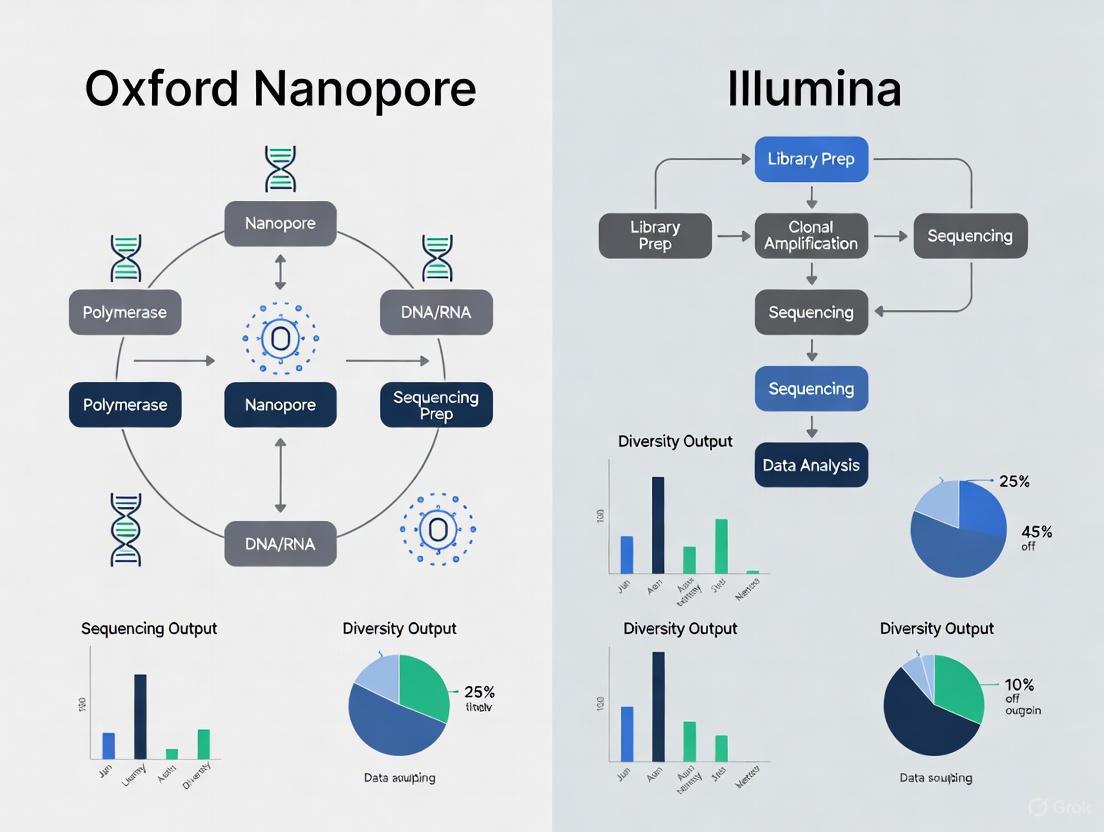
This article provides a comprehensive comparison of Oxford Nanopore Technologies (ONT) and Illumina sequencing platforms for microbial diversity studies, tailored for researchers and drug development professionals.
Oxford Nanopore vs. Illumina for Microbial Diversity: A 2025 Researcher's Guide
Abstract
This article provides a comprehensive comparison of Oxford Nanopore Technologies (ONT) and Illumina sequencing platforms for microbial diversity studies, tailored for researchers and drug development professionals. It covers foundational principles, practical workflows, and data analysis strategies. Drawing on recent 2025 studies, it details how Illumina's high-accuracy short-reads excel in genus-level surveys and species richness, while ONT's long-reads enable superior species-level resolution and real-time sequencing. The guide includes troubleshooting for platform-specific biases and error rates, a comparative validation of performance across sample types, and evidence-based recommendations for platform selection and hybrid sequencing approaches to advance biomedical and clinical research.
Understanding the Core Technologies: A Primer on Sequencing Mechanics for Microbiome Research
In the field of microbial ecology, accurately characterizing community diversity is fundamental to understanding the roles of microbes in health, disease, and environmental processes. The choice of sequencing platform is a critical decision that directly impacts the resolution and reliability of taxonomic data. While long-read sequencing technologies like Oxford Nanopore have emerged, Illumina short-read chemistry remains a cornerstone for high-accuracy profiling, particularly for genus-level diversity studies. This guide objectively compares the performance of Illumina and Oxford Nanopore Technologies (ONT) platforms, providing researchers with the experimental data necessary to select the appropriate tool for their microbial diversity research goals.
Performance Comparison: Illumina vs. Oxford Nanopore
Extensive comparative studies have quantified the performance characteristics of Illumina and Nanopore sequencing for 16S rRNA amplicon sequencing. The table below summarizes key findings from recent direct comparisons.
Table 1: Direct Performance Comparison of Illumina and Oxford Nanopore Sequencing Platforms for 16S rRNA Profiling
| Performance Metric | Illumina Short-Read | Oxford Nanopore Long-Read |
|---|---|---|
| Typical Read Length | ~300 bp (e.g., V3-V4 region) [1] | ~1,500 bp (Full-length 16S gene) [1] |
| Raw Read Accuracy | >99.9% (Q30) [1] | ~96-99% (Varies with chemistry and basecaller) [2] [3] |
| Genus-Level Resolution | Excellent, high consistency with WGS at this level [4] [3] | Good, but community evenness can be more variable [1] |
| Species-Level Resolution | Limited due to short read length [1] [4] | Superior, enabled by full-length 16S sequencing [1] [3] |
| Taxonomic Bias | Detects a broader range of taxa; can underrepresent some species [1] [4] | Can overrepresent certain dominant species (e.g., Enterococcus, Klebsiella) [1] |
| Alpha Diversity (Richness) | Captures greater species richness in complex microbiomes [1] | May yield lower richness estimates; affected by error rate [1] |
| Best Application | Large-scale microbial surveys, genus-level community ecology [1] | Species-level identification, rapid in-field sequencing [1] [3] |
The data show a clear trade-off: Illumina provides a more accurate and quantitative profile of community membership, ideal for genus-level analysis, while ONT offers deeper taxonomic resolution at the species level, albeit with a less quantitative profile and higher error rate that can affect diversity estimates [1]. A study on pig gut microbiota further confirmed the general compatibility between the platforms for distinguishing beta-diversity across sample groups, validating ONT's use for field applications, though it also highlighted differences in the detected abundance of some taxa [3].
Experimental Data and Protocols
The comparative performance data is derived from standardized experimental protocols. The following workflow illustrates a typical experimental design for a cross-platform comparison study.
Diagram 1: Experimental workflow for cross-platform 16S rRNA sequencing comparison.
Key Methodological Details
Sample Collection and DNA Extraction: To ensure a fair comparison, studies often use the same original biological samples. For instance, one comparative analysis used 34 respiratory samples from humans and pigs, with genomic DNA extracted and then split for sequencing on both platforms [1]. Using the same DNA extract is critical to avoid biases from sample heterogeneity.
Platform-Specific Library Preparation:
- Illumina: Libraries typically target a specific hypervariable region. A common approach is amplifying the V3-V4 region (~460 bp) using primers like 341F and 805R, followed by sequencing on an Illumina NextSeq or MiSeq for 2x300 bp paired-end reads [1] [3].
- Oxford Nanopore: Libraries are prepared to sequence the full-length 16S rRNA gene (~1,500 bp). This is often done using the 16S Barcoding Kit (SQK-16S114), followed by sequencing on a MinION device with R9.4.1 or R10.4.1 flow cells [1].
Data Processing and Bioinformatics:
- Illumina Data: The nf-core/ampliseq pipeline is a standardized workflow. It includes quality control (FastQC), primer trimming (Cutadapt), and error-correction and Amplicon Sequence Variant (ASV) inference using DADA2, which is crucial for Illumina's high-accuracy reads [1].
- Nanopore Data: Basecalling and demultiplexing are performed using ONT's Dorado basecaller or MinKNOW software. The EPI2ME Labs 16S Workflow is then commonly used for quality filtering and taxonomic classification [1]. For both platforms, the Silva database is a frequent choice for taxonomic assignment [1].
The Scientist's Toolkit: Research Reagent Solutions
The following table details key reagents and kits used in the featured comparative studies, providing a resource for experimental planning.
Table 2: Essential Research Reagents for 16S rRNA Amplicon Sequencing
| Item | Function / Description | Example Product / Protocol |
|---|---|---|
| DNA Extraction Kit | Isolates high-quality, inhibitor-free genomic DNA from complex samples. | PowerFecal Pro DNA Kit (Qiagen) [3] |
| Illumina 16S Library Kit | Prepares amplicon libraries targeting specific hypervariable regions for Illumina sequencing. | 16S Metagenomic Sequencing Library Prep (Illumina) [3] |
| Illumina Sequencing Primer Set | Amplifies a specific 16S region (e.g., V3-V4). | 341F (5'-CCTACGGGNGGCWGCAG-3') / 805R (5'-GACTACHVGGGTATCTAATCC-3') [3] |
| Nanopore 16S Library Kit | Prepares barcoded libraries for full-length 16S rRNA gene sequencing on ONT devices. | 16S Barcoding Kit (SQK-16S114, Oxford Nanopore) [1] |
| Positive Control | Synthetic DNA control used to monitor library preparation efficiency and detect contamination. | QIAseq 16S/ITS Smart Control (Qiagen) [1] |
| Reference Database | Curated collection of 16S sequences for taxonomic classification of sequencing reads. | Silva 138.1 prokaryotic SSU database [1] |
The experimental data firmly establishes the context for selecting a sequencing platform. Illumina's short-read chemistry is the superior choice for studies where accurate, quantitative profiling of genus-level diversity is the primary objective. Its high per-base accuracy provides exceptional reliability for calculating alpha and beta diversity metrics and for detecting a wide spectrum of taxa within complex communities [1].
The strengths of Oxford Nanopore, in contrast, lie in its long-read capability, which provides excellent species-level resolution and its portability for in-field sequencing [1] [3]. However, its higher error rate can lead to an overestimation of rare species and less quantitative abundance profiles, making it less ideal for precise genus-level ecology studies [1].
Ultimately, the choice is not about which platform is universally better, but which is better suited to the specific research question. For large-scale population studies, environmental monitoring, and any research requiring highly reproducible, quantitative data on community structure at the genus level, Illumina short-read sequencing remains the established gold standard.
The choice of sequencing platform is a critical decision in microbial ecology, directly influencing the depth and resolution of microbial community analysis. For years, Illumina's short-read technology has been the benchmark for 16S rRNA gene sequencing, providing high-throughput, accurate data for broad microbial surveys. However, its limitation to specific hypervariable regions (e.g., V3-V4) restricts its taxonomic resolution, particularly at the species level [1] [5]. In contrast, Oxford Nanopore Technologies (ONT) enables full-length sequencing of the entire ~1,500 bp 16S rRNA gene, spanning the V1-V9 regions. This long-read approach promises superior taxonomic discrimination [6] [7]. This guide provides an objective, data-driven comparison of these platforms, framing their performance within the context of modern microbial diversity research.
Performance Comparison: Nanopore vs. Illumina
Direct comparative studies reveal distinct performance characteristics for each platform. The table below summarizes key quantitative findings from recent evaluations.
Table 1: Comparative Performance of Illumina and Oxford Nanopore 16S rRNA Sequencing Platforms
| Performance Metric | Illumina (Short-Read) | Oxford Nanopore (Long-Read) | References |
|---|---|---|---|
| Typical Read Length | ~300 bp (targeting V3-V4) | ~1,500 bp (full-length V1-V9) | [1] [8] |
| Species-Level Resolution | Lower (e.g., 47-48% of sequences classified) | Higher (e.g., 76% of sequences classified) | [7] [8] |
| Genus-Level Resolution | 80% of sequences classified | 91% of sequences classified | [8] |
| Error Rate | Low (<0.1%) | Historically higher (5-15%), now significantly improved with new chemistry | [1] [9] |
| Alpha Diversity (Richness) | Often captures greater species richness | Slightly lower observed richness in some studies | [1] |
| Community Evenness | Comparable to Nanopore | Comparable to Illumina | [1] |
| Differential Abundance | Broader detection of taxa; reliable for genus-level surveys | Better resolution of dominant species; can over/under-represent specific taxa | [1] [3] |
| Correlation of Abundance | Benchmark for genus-level quantification | High correlation with Illumina at genus level (R² ≥0.8) | [7] [3] |
| Best Application | Large-scale population studies, broad microbial surveys | Species-level identification, real-time diagnostics, field sequencing | [1] [3] |
The data shows a fundamental trade-off: while Illumina can capture a slightly broader range of taxa, Nanopore provides significantly higher taxonomic resolution. Full-length 16S rRNA sequencing on Nanopore classified 29% more sequences to the species level than Illumina's V3-V4 approach [8]. Furthermore, a study on colorectal cancer biomarkers found that despite differences, bacterial abundance at the genus level correlated well (R² ≥0.8) between the two platforms [7].
Experimental Protocols and Workflows
Understanding the experimental methodologies behind the data is crucial for interpreting results and designing studies.
Library Preparation and Sequencing
Typical protocols for comparative studies involve parallel processing of the same DNA extracts.
Table 2: Key Research Reagent Solutions for 16S rRNA Sequencing
| Item | Function | Illumina Workflow Example | Nanopore Workflow Example |
|---|---|---|---|
| DNA Extraction Kit | To obtain high-quality microbial DNA | PowerFecal Pro DNA Kit | PowerFecal Pro DNA Kit |
| 16S PCR Primers | To amplify the target region | 341F/785R (for V3-V4) | 27F/1492R (for full-length V1-V9) |
| Library Prep Kit | To prepare amplicons for sequencing | Illumina 16S Metagenomic Library Prep | ONT 16S Barcoding Kit (SQK-16S114.24) |
| Sequencing Platform | To generate sequence data | Illumina NextSeq / MiSeq | MinION or GridION |
| Flow Cell/Chemistry | The medium for sequencing reactions | NextSeq High Output Kit | R10.4.1 Flow Cell |
| Control | To validate library preparation & sequencing | PhiX Control v3 | ZymoBIOMICS Microbial Community Standard |
Illumina Workflow: The V3-V4 hypervariable regions are amplified using primers like 341F and 785R. Libraries are typically prepared following the "16S Metagenomic Sequencing Library Preparation" protocol, which involves a two-step PCR process to attach Illumina adapter sequences and sample-specific barcodes. Sequencing is then performed on platforms like MiSeq or NextSeq to generate short, paired-end reads (e.g., 2x300 bp) [1] [3].
Nanopore Workflow: The full-length 16S rRNA gene is amplified using universal primers like 27F and 1492R. The ONT "16S Barcoding Kit" is used to attach barcodes and sequencing adapters in a single PCR step. The pooled library is loaded onto a MinION flow cell (e.g., R10.4.1), and sequencing runs for 24-72 hours, often using the High Accuracy (HAC) basecalling model within the MinKNOW software [1] [6] [7].
Diagram 1: Comparative 16S rRNA sequencing workflow for Illumina and Nanopore platforms.
Bioinformatic Analysis
The different error profiles of the two technologies necessitate distinct bioinformatic approaches.
Illumina Data Processing: Due to high per-base accuracy, Illumina reads are typically processed using DADA2 to infer Amplicon Sequence Variants (ASVs), which provide single-nucleotide resolution [1] [10]. The QIIME2 platform is also widely used. Taxonomic classification is often performed against the SILVA database [8] [10].
Nanopore Data Processing: The higher raw error rate of Nanopore reads makes denoising with DADA2 challenging. Common analysis pipelines include EPI2ME (ONT's user-friendly platform) and Emu, a specialized tool that uses an expectation-maximization approach for accurate taxonomic profiling from long, error-prone reads [1] [7] [10]. Recent improvements in basecalling (e.g., Dorado with Super-accurate models) and chemistry (R10.4.1) have significantly enhanced accuracy, making species-level identification robust [7] [9].
Application in Microbial Research
The choice between platforms should be guided by the specific research objectives, as illustrated by their performance in various fields.
- Respiratory Microbiome: A 2025 study found that while Illumina captured greater richness in respiratory samples, community evenness was comparable. Beta diversity differences were more pronounced in complex porcine microbiomes than in human samples, indicating that platform effects are sample-dependent [1].
- Disease Biomarker Discovery: In colorectal cancer research, Nanopore's full-length sequencing identified specific bacterial biomarkers like Parvimonas micra, Fusobacterium nucleatum, and Bacteroides fragilis with high confidence, facilitating a more precise disease prediction model (AUC of 0.87) [7].
- Clinical and Field Applications: Nanopore's portability and real-time sequencing capability make it ideal for field applications and in-situ diagnostics. A study on pig farm health status demonstrated Nanopore's compatibility with Illumina and justified its use for on-site monitoring of animal health [3].
- Low-Biomass Samples: In head and neck cancer tumor tissues, a challenging low-biomass environment, full-length Nanopore sequencing identified 75% of bacterial isolates at the species level, compared to only 18.8% with Illumina's V3-V4 sequencing, when validated against MALDI-TOF MS [5].
Illumina and Oxford Nanopore are complementary technologies that address different needs in microbial ecology. Illumina remains the gold standard for large-scale, high-throughput studies where cost-effectiveness and high accuracy for genus-level profiling are paramount. Oxford Nanopore excels when the research question demands species-level resolution, rapid turnaround time, or portability for field-based sequencing.
Future research will likely explore hybrid approaches, leveraging the strengths of both technologies. As Nanopore's accuracy continues to improve with advancements in chemistry and basecalling, its utility for precise, full-length 16S rRNA gene sequencing is poised to expand further, solidifying its role in the scientist's toolkit for unlocking the complexities of microbial communities.
The selection of an appropriate sequencing platform is a critical decision in genomics research, influencing the resolution, accuracy, and scope of scientific conclusions. For microbial diversity studies, particularly those investigating complex communities through 16S rRNA gene sequencing, the trade-offs between different technologies are especially pronounced. As of 2025, Illumina and Oxford Nanopore Technologies (ONT) represent two dominant yet fundamentally different approaches to DNA sequencing. Illumina continues to refine its short-read, high-accuracy sequencing-by-synthesis technology, while ONT has advanced its long-read, real-time nanopore-based sequencing. This comparison guide provides a detailed, data-driven analysis of both platforms' key performance metrics—error rates, throughput, and read lengths—synthesized from recent comparative studies to inform researchers, scientists, and drug development professionals in the context of microbial ecology and diversity research.
At-a-Glance Platform Comparison
The table below summarizes the core technical specifications and performance characteristics of Illumina and Oxford Nanopore sequencing platforms as documented in 2025 comparative studies.
Table 1: Key Performance Metrics for Illumina and Oxford Nanopore Platforms in 2025
| Metric | Illumina | Oxford Nanopore Technologies (ONT) |
|---|---|---|
| Typical Read Length | Short reads (~300 bp for V3-V4 16S sequencing) [1] | Full-length 16S rRNA reads (~1,500 bp); long reads (kb to Mb range) [1] [11] |
| Native Raw Read Error Rate | Very low (<0.1%) [1] | Higher than Illumina; recent chemistry (R10.4.1) shows ~96.8% accuracy (Q15) [12] [11] |
| Primary Error Type | Substitution errors [12] | Historically higher (5-15%); improved with chemistry and base-calling [1] |
| Throughput | High; suited for large-scale population studies [1] | Varies by device (MinION, PromethION); suitable for field sequencing [1] [12] |
| Ideal Application in Microbial Research | Broad microbial surveys; genus-level classification; high-resolution epidemiology [1] [12] | Species-level resolution; real-time, in-field applications; closing complex genomes [1] [12] |
| Sample Multiplexing | High-plexity available | Possible, but may impact yield and read length distribution [11] |
Performance in Microbial Diversity Studies
16S rRNA Profiling for Respiratory Microbiomes
A direct comparative analysis of Illumina (NextSeq) and ONT (MinION) for 16S rRNA profiling of respiratory microbiomes revealed distinct performance profiles. The study, which sequenced human and pig respiratory samples in parallel, found that Illumina captured greater species richness, while community evenness was comparable between platforms [1]. Taxonomic biases were evident: ONT overrepresented certain taxa (e.g., Enterococcus, Klebsiella) while underrepresenting others (e.g., Prevotella, Bacteroides) [1]. The key differentiator was the region sequenced. Illumina targeted the V3-V4 hypervariable regions (~300 bp), providing reliable genus-level classification. In contrast, ONT sequenced the full-length 16S rRNA gene (~1,500 bp), enabling higher taxonomic resolution, often to the species level [1]. This makes Illumina ideal for broad microbial surveys and ONT excels when species-level identification is critical.
Whole Genome Sequencing for Epidemiological Surveillance
For pathogen surveillance, a study on Clostridioides difficile compared the platforms' ability to generate accurate genomes for transmission tracking. Illumina sequencing produced reads with an average quality of 99.68% (Q25), while Nanopore reads reached 96.84% (Q15)—a tenfold difference in quality [12]. This higher error rate had concrete consequences: Nanopore assemblies alone exhibited an average of 640 base errors per genome, which led to the incorrect assignment of over 180 alleles in core genome MLST (cgMLST) analysis [12]. Consequently, Nanopore-derived phylogenies were inadequate for investigating precise transmission events. However, both platforms performed comparably in detecting major virulence genes. The study concluded that Nanopore is a viable alternative when fast, less detailed analyses are preferred, but Illumina remains the gold standard for high-resolution epidemiological surveillance [12].
Performance in Environmental DNA (eDNA) Studies
In the context of tracking invasive species using aquatic eDNA, a 2025 study found that Illumina sequencing remained more efficient at detecting species from eDNA samples [13]. Both technologies showed similar detection rates for an invasive host species, but only when Nanopore sequencing was performed under optimal conditions. For a cryptic intracellular parasite, results were discrepant: Illumina failed to detect it, while Nanopore identified its DNA in multiple sites [13]. The authors suggested this could be due to different bioinformatic approaches or Nanopore's higher error rate leading to misassignments during species identification.
Human Genomic Variant Calling
Beyond microbial applications, a comprehensive benchmark of 14 human genomes evaluated ONT's performance against Illumina short-read sequencing and microarrays for detecting different variant types. For single nucleotide variants (SNVs) in high-complexity regions, ONT's accuracy was slightly lower than Illumina's (F-measure: 0.954 vs. 0.967) [11]. However, ONT showed a significant advantage in detecting structural variants (SVs), identifying 2.86 times more SVs than Illumina, and excelling at detecting large variants (>6 kb) [11]. Furthermore, ONT performance was robust for small indels in high-complexity regions, while Illumina agreement decreased substantially in low-complexity and "dark" regions of the genome [11].
Experimental Protocols from Key Studies
Protocol: 16S rRNA Profiling of Respiratory Samples
The following workflow visualizes the parallel sequencing methodology used in the direct comparative study of respiratory microbiomes [1].
Protocol: Bacterial Whole Genome Sequencing for Surveillance
The study comparing C. difficile genome analysis utilized the following experimental approach for a head-to-head comparison of sequencing and assembly quality [12].
The Scientist's Toolkit: Essential Research Reagents
The table below catalogues key reagents, kits, and software tools referenced in the 2025 comparative studies, providing researchers with a practical resource for experimental planning.
Table 2: Essential Research Reagents and Tools for Sequencing Comparisons
| Item Name | Type | Primary Function in Research | Example Use Case |
|---|---|---|---|
| QIAseq 16S/ITS Region Panel (Qiagen) | Library Prep Kit | Amplification and preparation of 16S rRNA V3-V4 regions for Illumina sequencing [1] | 16S rRNA gene sequencing for microbial community profiling [1] |
| ONT 16S Barcoding Kit | Library Prep Kit | Preparation of full-length 16S rRNA gene libraries for Nanopore sequencing [1] | Full-length 16S sequencing for species-level resolution [1] |
| Silva 138.1 SSU Database | Reference Database | Taxonomic classification of 16S rRNA sequences [1] | Assigning taxonomy to ASVs/reads from both platforms [1] |
| nf-core/ampliseq | Bioinformatics Pipeline | Reproducible analysis of Illumina-derived 16S amplicon data [1] | Processing V3-V4 reads from quality control to taxonomic assignment [1] |
| EPI2ME Labs 16S Workflow | Bioinformatics Platform | Real-time analysis and taxonomic classification of Nanopore 16S data [1] | Rapid in-field analysis of full-length 16S reads [1] |
| Nextera XT DNA Library Prep Kit | Library Prep Kit | Preparation of genomic DNA libraries for Illumina sequencing [12] | Whole-genome sequencing of bacterial isolates like C. difficile [12] |
| SQK-RBK114.96 Rapid Barcoding Kit | Library Prep Kit | Rapid preparation and barcoding of genomic DNA libraries for Nanopore [12] | Multiplexed whole-genome sequencing of bacterial isolates [12] |
| DADA2 | Algorithm | Inference of exact amplicon sequence variants (ASVs) from Illumina data [1] | High-resolution sample inference in 16S microbiome studies [1] |
The choice between Illumina and Oxford Nanopore Technologies in 2025 remains highly dependent on the specific research questions and applications in microbial diversity studies. Illumina maintains its advantage in applications requiring high accuracy and depth, such as broad ecological surveys and high-resolution epidemiological tracking where detecting subtle genetic differences is crucial [1] [12]. In contrast, ONT excels in applications requiring long reads and rapid turnaround, such as species-level resolution from full-length 16S sequencing, real-time in-field analysis, and resolving complex genomic regions [1] [11]. Rather than a one-size-fits-all solution, the current evidence supports a pragmatic approach where platform selection is dictated by study objectives. Future methodological developments will likely continue to narrow the performance gaps, particularly in error rate reduction for ONT and read length extension for Illumina, further empowering researchers to unravel the complexities of microbial systems.
In microbial ecology and clinical diagnostics, accurately identifying the constituents of a microbial community is fundamental to understanding its function and impact on health and disease. The choice of sequencing technology often dictates the depth of taxonomic information attainable, primarily influenced by one key parameter: read length. Short-read sequencing platforms, such as those offered by Illumina, have become the workhorse for 16S rRNA gene amplicon studies, typically sequencing single hypervariable regions (e.g., V3-V4) and providing reliable genus-level classification. In contrast, third-generation long-read sequencing platforms, exemplified by Oxford Nanopore Technologies (ONT), can sequence the entire ~1,500 base pair (bp) 16S rRNA gene, enabling a more definitive resolution at the species level and beyond [1] [7]. This guide objectively compares the performance of Illumina and Oxford Nanopore sequencing platforms, focusing on how their inherent read lengths impact taxonomic resolution in microbial diversity research.
A Tale of Two Technologies: Fundamental Differences in Read Length
The core difference between Illumina and Nanopore technologies lies in their approach to determining DNA sequence.
Illumina (Short-Reads): This technology utilizes sequencing-by-synthesis on a flow cell, generating massive numbers of short, parallel reads. For 16S rRNA sequencing, it typically targets one or two hypervariable regions (e.g., V3-V4), producing reads around 300-600 bp in length [1] [14]. While this method boasts high per-base accuracy (exceeding Q30, or 99.9% accuracy), the short read length limits the amount of taxonomic information that can be retrieved from a single read, restricting definitive classification to the genus level for many taxa [15].
Oxford Nanopore (Long-Reads): Nanopore sequencing involves passing single DNA strands through a protein nanopore while measuring changes in ionic current. This process allows for the generation of reads that are thousands to millions of base pairs long. For full-length 16S rRNA gene sequencing, reads are approximately 1,500 bp, spanning all nine hypervariable regions (V1-V9) [7] [3]. Although historically associated with higher per-base error rates (5-15%), recent advancements in chemistry (R10.4.1) and basecalling models (e.g., Dorado) have significantly improved raw read accuracy to over 99% [1] [7]. The key advantage is that the longer read encompasses more unique variation, providing a much stronger taxonomic signal for discriminating between closely related species.
Table 1: Core Technological Characteristics of Illumina and Oxford Nanopore Platforms for 16S rRNA Sequencing.
| Feature | Illumina | Oxford Nanopore |
|---|---|---|
| Read Type | Short-read | Long-read |
| Typical 16S Read Length | 300-600 bp (e.g., V3-V4 region) | ~1,500 bp (full-length V1-V9) |
| Per-Base Accuracy | >99.9% (Q30) [7] | >99% (Q20) with recent chemistries [7] |
| Primary Strength | High accuracy, high throughput, well-established protocols | Species-level resolution, portability, real-time data access |
| Primary Limitation | Limited species-level resolution | Higher raw error rate requires specialized bioinformatics |
Performance Comparison: Quantifying Resolution from Genus to Species
Comparative studies consistently demonstrate that while both platforms reliably profile microbial communities at the genus level, only long-read technologies like Nanopore consistently achieve high resolution at the species level.
Taxonomic Resolution Across Ranks
A study on rabbit gut microbiota directly quantified the percentage of sequences classified at each taxonomic level. The results, summarized in Table 2, clearly show the advantage of full-length 16S sequencing [8].
Table 2: Percentage of Sequences Classified at Successive Taxonomic Levels by Platform [8].
| Taxonomic Level | Illumina (V3-V4) | PacBio (Full-Length) | ONT (Full-Length) |
|---|---|---|---|
| Phylum | 99% | 99% | 99% |
| Family | 99% | 99% | 99% |
| Genus | 80% | 85% | 91% |
| Species | 48% | 63% | 76% |
This data shows that all platforms perform equally well down to the family level. However, at the species level, ONT's full-length 16S sequencing classified 76% of sequences, a significant increase over Illumina's 48% [8]. This 28-percentage-point improvement is directly attributable to the additional taxonomic information contained within the longer read.
Diversity Metrics and Biomarker Discovery
The impact of platform choice extends beyond simple classification rates to influence fundamental diversity metrics and the ability to discover biologically relevant biomarkers.
- Alpha Diversity: Illumina sequencing often captures greater species richness, as measured by the number of distinct taxa, partly due to its higher sequencing depth. However, community evenness is typically comparable between platforms [1].
- Beta Diversity: Differences in microbial community composition (beta diversity) can appear significant between platforms, especially in complex microbiomes like those from pig farms [1]. This highlights that data from different technologies should be compared with caution.
- Biomarker Discovery: The superior resolution of Nanopore translates directly into more precise clinical insights. In a colorectal cancer study, Illumina-V3V4 analysis identified biomarker genera, while ONT-V1V9 sequencing pinpointed specific species such as Parvimonas micra, Fusobacterium nucleatum, and Peptostreptococcus anaerobius. This species-level data enabled the construction of a predictive model with an AUC of 0.87, a level of diagnostic precision not achievable with genus-level data alone [7].
Experimental Protocols in Focus
To ensure reproducible results, understanding the core methodologies used in comparative studies is essential. The following workflow outlines a typical experimental design for benchmarking sequencing platforms.
Diagram 1: Experimental workflow for comparing Illumina and Nanopore sequencing platforms for 16S rRNA gene-based microbial profiling.
Detailed Methodological Breakdown
Sample Collection and DNA Extraction
- Sample Types: Studies utilize various sample types, including human feces [7], nasal swabs [15], respiratory samples [1], and pig gut content [3]. Immediate freezing at -80°C is standard for preservation.
- DNA Extraction: Kits designed for microbial communities, such as the PowerFecal Pro DNA Kit (Qiagen) [3] or DNeasy PowerSoil kit (Qiagen) [8], are commonly used. The goal is to obtain high-quality, high-molecular-weight DNA, with concentration and purity assessed using fluorometry (e.g., Qubit) and spectrophotometry (e.g., Nanodrop) [1].
Library Preparation and Sequencing
- Illumina Protocol: The "16S Metagenomic Sequencing Library Preparation" protocol (Illumina) is standard. It involves a two-step PCR amplification to target the V3-V4 regions (~460 bp amplicon) using primers (e.g., 341F/785R) and attach dual indices for multiplexing. Sequencing is performed on platforms like MiSeq or NextSeq to generate paired-end reads (e.g., 2x300 bp) [1] [3].
- Nanopore Protocol: The "16S Barcoding Kit" (SQK-16S024) from ONT is used. A single PCR amplifies the full-length 16S rRNA gene (~1,500 bp) with barcoded primers. The library is loaded onto a flow cell (e.g., R9.4.1 or R10.4.1), and sequencing occurs on a MinION or GridION device, often for up to 72 hours [1] [7]. Basecalling is performed using Dorado models (e.g., fast, hac, sup), with the High Accuracy (hac) model offering a good balance between speed and precision [7].
Bioinformatic Analysis
- Illumina Data: Typically processed using DADA2 within pipelines like nf-core/ampliseq or QIIME2 to generate high-resolution Amplicon Sequence Variants (ASVs). Taxonomic classification is performed against reference databases like SILVA [1] [8].
- Nanopore Data: Due to higher error rates, different tools are required. Common pipelines include Emu [7], EPI2ME Labs 16S Workflow [1], or Spaghetti [8], which often employ an Operational Taxonomic Unit (OTU) clustering approach or error-profile-aware abundance estimation. The same reference database (e.g., SILVA) should be used for cross-platform comparisons [8].
Table 3: Key Reagents and Kits for 16S rRNA Gene Sequencing Studies.
| Item | Function | Example Products & Kits |
|---|---|---|
| DNA Extraction Kit | Isolates microbial genomic DNA from complex samples. | PowerFecal Pro DNA Kit (Qiagen) [3], DNeasy PowerSoil Kit (Qiagen) [8] |
| Illumina Library Prep Kit | Prepares amplicon libraries for Illumina sequencers. | 16S Metagenomic Sequencing Library Prep (Illumina) [3] |
| Nanopore Library Prep Kit | Prepares amplicon libraries for Nanopore sequencers. | 16S Barcoding Kit (SQK-16S114.24, Oxford Nanopore) [1] |
| Sequencing Primers | Amplifies the target region of the 16S rRNA gene. | Illumina: 341F/785R (V3-V4) [3]. ONT: 27F/1492R (full-length) [8]. |
| Bioinformatic Tools | Processes raw data into taxonomic tables. | Illumina: DADA2, QIIME2, Mothur [1] [15]. Nanopore: Emu, EPI2ME, Spaghetti [1] [8] [7]. |
| Reference Database | For taxonomic classification of sequences. | SILVA [1] [8], Emu's Default Database [7] |
The choice between Illumina and Oxford Nanopore for 16S rRNA-based studies is not a matter of which platform is universally superior, but which is most fit-for-purpose.
- Platform Selection Guidance: Illumina is the preferred choice for large-scale epidemiological studies where high-throughput, cost-effective genus-level profiling is the primary goal, and maximum sequence depth for rare taxa is critical [1]. Oxford Nanopore is unequivocally superior when the research question demands species-level or strain-level resolution, such as in pinpointing specific pathogens or biomarkers [16] [7]. Its portability and real-time sequencing capabilities also make it ideal for field-based and point-of-care applications [3].
- Acknowledging Limitations and Biases: Researchers must account for platform-specific biases. Illumina's short reads struggle to resolve closely related species [1]. Nanopore's higher error rate, though improving, necessitates specialized bioinformatics and can lead to overconfident classification if database curation is poor [8] [7]. Both platforms can be affected by primer choice and database completeness [15].
- Future Outlook: The field is moving towards hybrid approaches that leverage the deep, accurate coverage of Illumina with the long-range phylogenetic context of Nanopore [1]. As Nanopore's accuracy continues to improve and costs decrease, its utility for routine, high-resolution microbiome analysis is poised to expand significantly.
In conclusion, read length is a fundamental determinant of taxonomic resolution. While Illumina provides a robust, high-throughput view of microbial communities at the genus level, Oxford Nanopore's long-read technology unlocks the crucial species-level detail, empowering researchers to move from correlation toward causation in microbiome science.
From Lab to Data: Designing Your Microbial Study with Illumina or Nanopore
The choice between Oxford Nanopore Technologies (ONT) and Illumina sequencing platforms is a critical decision in microbial diversity research, with implications for data quality, experimental workflow, and analytical outcomes. This guide provides an objective comparison of these two leading technologies, focusing on three core aspects: library preparation procedures, sequencing time, and real-time analysis capabilities. As microbiome studies increasingly demand both high accuracy and comprehensive taxonomic resolution, understanding the practical differences between these platforms is essential for researchers, scientists, and drug development professionals to design effective sequencing strategies. This comparison is framed within the context of optimizing workflows for microbial community analysis, including 16S rRNA gene sequencing and whole-genome sequencing of bacterial isolates.
Library Preparation Workflows
Library preparation represents the first major divergence in workflow between ONT and Illumina platforms. The processes differ significantly in time requirements, complexity, and handling of nucleic acids, factors that directly impact experimental planning and potential biases in microbial community representation.
Oxford Nanopore Technologies (ONT) Library Prep
ONT provides a range of DNA library preparation kits designed for various applications and time constraints. Their workflows are notably streamlined, with some kits requiring as little as 10 minutes of hands-on preparation time [17]. The Rapid Sequencing Kit, for example, utilizes a transposase-based approach that simultaneously fragments DNA and attaches sequencing adapters in a rapid, single-tube reaction, completing preparation in approximately 10 minutes [18]. For amplicon sequencing, such as full-length 16S rRNA gene analysis, ONT's 16S Barcoding Kit enables PCR-based library preparation in about 60 minutes plus PCR time [18]. A key advantage of ONT's DNA library kits is their capacity for amplification-free preparation, allowing direct sequencing of native DNA and preserving base modifications alongside nucleotide sequence information [18].
Illumina Library Prep
Illumina library preparation typically involves more steps and longer processing times compared to ONT's fastest options. For 16S rRNA microbiome studies targeting the V3-V4 hypervariable regions, the process often requires two PCR amplification steps: first to amplify the target region, and then to attach dual-index barcodes for sample multiplexing [1]. This multi-step amplification process typically takes several hours. While Illumina is developing streamlined approaches like constellation mapped reads technology to eliminate traditional library prep in the future, current workflows remain more time-intensive [19]. Illumina's strength lies in the high reproducibility of their library prep kits, which undergo rigorous quality control testing to ensure consistent performance across batches [1].
Table: Library Preparation Comparison for Microbial Studies
| Parameter | Oxford Nanopore Technologies | Illumina |
|---|---|---|
| Fastest Prep Time | 10 minutes (Rapid Sequencing Kit) [18] | Several hours (typically includes multiple PCR steps) [1] |
| 16S rRNA Prep Time | ~60 minutes + PCR (16S Barcoding Kit) [18] | Several hours (multiple PCR amplifications) [1] |
| Amplification-Free Option | Yes (preserves base modifications) [18] | Limited (most protocols require PCR) [1] |
| Fragmentation Method | Transposase-based (rapid kits) or optional [18] | Usually enzymatic or mechanical |
| Barcoding Options | Native Barcoding Kit (24/96-plex) [18] | Dual-index barcodes (e.g., Nextera XT Index Kit) [12] |
Sequencing Time and Real-Time Analysis
The sequencing phase reveals fundamental differences between platforms, particularly regarding run duration and when data becomes available for analysis. These temporal considerations significantly impact research flexibility and time-to-insight in microbial studies.
Oxford Nanopore Sequencing Characteristics
ONT sequencing operates on a real-time paradigm where data generation and analysis begin immediately after loading the library and continue throughout the run. Sequencing occurs until flow cell exhaustion, typically up to 72 hours, but data can be accessed within minutes to hours of starting a run [1] [12]. This real-time capability enables adaptive sampling, a software-controlled feature that allows researchers to enrich or deplete specific targets during sequencing based on early read data [18]. For 16S rRNA sequencing studies, researchers can analyze microbial community composition at multiple timepoints (e.g., 12h, 18h, 24h, 72h) to optimize project-specific sequencing depth [1]. The MinION Mk1C device exemplifies this integrated approach by combining sequencing, compute, and analysis capabilities in a single portable unit, enabling complete sample-to-answer workflows in field or point-of-care settings [1] [12].
Illumina Sequencing Characteristics
Illumina employs a cyclic sequencing approach where data generation occurs through repeated cycles of nucleotide incorporation and imaging. A typical MiSeq run for 16S rRNA sequencing (2×300 bp) requires approximately 24-56 hours to complete, after which data analysis begins [8]. During the run, the Real-Time Analysis (RTA) software operates onboard the instrument, performing base calling, quality scoring, and alignment to PhiX control sequences [20]. However, unlike ONT, Illumina's real-time data is primarily used for run monitoring and quality control rather than early access to sample data. The post-run analysis phase includes secondary analysis steps like demultiplexing and FASTQ file generation, which add to the total time-to-results [20]. Recent developments like Illumina's Connected Multiomics platform aim to streamline downstream analysis but maintain this distinct separation between sequencing completion and comprehensive data availability [19].
Table: Sequencing Performance and Output Characteristics
| Characteristic | Oxford Nanopore Technologies | Illumina |
|---|---|---|
| Sequencing Mode | Real-time (data available as generated) [1] | Cyclic (data available after run completion) [20] |
| Typical 16S Run Duration | Up to 72 hours (data accessible from start) [1] | 24-56 hours (fixed run time) [8] |
| Read Length | Full-length 16S (~1,500 bp) [1] [8] | Short-read (V3-V4 ~300-600 bp) [1] [8] |
| Error Rate | Historically higher (5-15%), improving with new chemistries [1] | Very low (<0.1%) [1] [12] |
| Key Advantage | Adaptive sampling, long reads, portability [18] | High accuracy, established protocols [1] |
Experimental Data and Performance in Microbial Studies
Comparative studies directly evaluating ONT and Illumina platforms provide empirical evidence for their performance characteristics in microbial research. The trade-offs between read accuracy, taxonomic resolution, and experimental flexibility inform platform selection for specific research objectives.
16S rRNA Gene Sequencing for Microbiome Profiling
In respiratory microbiome studies comparing Illumina NextSeq (V3-V4 region) and ONT MinION (full-length 16S), Illumina demonstrated greater capture of species richness, while community evenness was comparable between platforms [1]. ONT's key advantage emerged in taxonomic resolution, with full-length 16S rRNA sequencing enabling superior species-level identification [1]. A separate rabbit gut microbiota study found ONT classified 76% of sequences to species level, significantly higher than Illumina's 47% [8]. However, this came with a notable caveat: many species-level classifications were labeled as "uncultured_bacterium," indicating limitations in reference databases rather than platform capabilities [8]. Differential abundance analysis revealed platform-specific biases, with ONT overrepresenting certain taxa (e.g., Enterococcus, Klebsiella) while underrepresenting others (e.g., Prevotella, Bacteroides) [1].
Whole Genome Sequencing of Bacterial Isolates
For bacterial whole genome sequencing, a study on Clostridioides difficile isolates found Illumina provided higher raw read accuracy (Q25, 99.68%) compared to Nanopore (Q15, 96.84%) [12]. This accuracy difference translated to approximately 640 base errors per genome in Nanopore assemblies, affecting downstream applications like core genome MLST analysis [12]. However, Nanopore successfully identified sequence types and virulence genes, making it suitable for applications where speed and long-range information outweigh the need for ultra-high accuracy [12]. A broader benchmarking study on ESKAPE pathogens confirmed that while Illumina provides consistently high-quality reads (median Q35), ONT's R10.4.1 flow cells with super accuracy basecalling achieve median Q15.3, significantly improving earlier error rates [21]. Both platforms reliably detected antimicrobial resistance genes, with hybrid approaches combining Illumina accuracy and ONT contiguity yielding optimal results [21].
The Scientist's Toolkit: Research Reagent Solutions
Table: Essential Research Reagents for Sequencing Workflows
| Reagent/Kit | Platform | Function | Key Features |
|---|---|---|---|
| 16S Barcoding Kit (SQK-16S114) | ONT [1] | Full-length 16S rRNA amplicon sequencing | Targets V1-V9 regions (~1,500 bp), includes barcodes for multiplexing |
| QIAseq 16S/ITS Region Panel | Illumina [1] | Hypervariable region amplification | Targets V3-V4 regions, includes positive controls and ISO-certified quality |
| Rapid Sequencing Kit | ONT [18] | Fast DNA library preparation | 10-minute prep, transposase-based fragmentation, no PCR requirement |
| Nextera XT DNA Library Prep Kit | Illumina [12] | Whole-genome sequencing library prep | Enzymatic fragmentation, index adapters, optimized for bacterial genomes |
| Native Barcoding Kit | ONT [18] | Sample multiplexing | 24- or 96-plex barcoding, enables pooling of multiple samples |
| DNeasy PowerSoil Pro Kit | Both [12] | DNA extraction from complex samples | Mechanical lysis, effective for microbial communities, soil, and fecal samples |
The choice between Oxford Nanopore and Illumina sequencing platforms involves balancing multiple factors: library preparation time, sequencing duration, data analysis workflow, and specific research objectives. ONT offers compelling advantages in speed of library prep, real-time data access, and long-read capabilities that enable species-level resolution in microbiome studies. Illumina provides established protocols, high base-level accuracy, and detection of rare taxa in diverse microbial communities. For comprehensive microbial characterization, hybrid approaches that leverage both technologies' strengths are emerging as powerful strategies, combining Illumina's accuracy with ONT's long-range phylogenetic information. Researchers should align platform selection with their specific needs—prioritizing ONT for rapid turnaround and taxonomic resolution, and Illumina for large-scale surveys requiring high sensitivity and accuracy.
In microbial diversity research, the choice of sequencing platform is not one-size-fits-all. The decision between Oxford Nanopore Technologies (ONT) and Illumina technologies fundamentally shapes the depth, resolution, and application of research outcomes. Illumina has set the benchmark for high-accuracy, short-read sequencing, making it a stalwart for broad microbial surveys. In contrast, ONT's long-read capability provides unprecedented resolution for species-level identification and real-time analysis. This guide provides an objective, data-driven comparison to help researchers select the optimal platform based on two primary goals: high-resolution pathogen surveillance or comprehensive microbial community ecology studies.
The core technological differences between Illumina and Oxford Nanopore platforms dictate their performance characteristics. Illumina sequencing is characterized by short-read lengths (typically 150-300 bp) generated via sequencing-by-synthesis with reversible dye-terminators. This method delivers exceptionally high base-level accuracy (Q30 and above, representing a 0.1% error rate), making it ideal for variant calling and quantitative abundance measurements [1]. However, its short-read length limits its ability to resolve repetitive genomic regions and achieve species-level taxonomic classification from 16S rRNA gene sequencing.
Oxford Nanopore technology employs a fundamentally different approach: DNA strands are threaded through protein nanopores, with nucleotide sequences determined by changes in ionic current. This allows for long-read sequencing (from thousands to millions of bases), enabling full-length 16S rRNA gene sequencing (~1,500 bp) and complete genome assembly [1] [22]. Historically associated with higher error rates (5-15%), recent advancements in chemistry (R10.4.1 flow cells) and base-calling algorithms (such as Dorado with High Accuracy mode) have substantially improved accuracy to approximately Q20 (99%) [1] [8]. This balance of long reads with improving accuracy makes ONT particularly powerful for resolving complex genomic regions and achieving finer taxonomic classification.
Table 1: Direct Performance Comparison of Illumina and Oxford Nanopore Technologies
| Performance Metric | Illumina | Oxford Nanopore |
|---|---|---|
| Typical Read Length | Short reads (100-300 bp) [1] | Long reads (up to 4.2 Mb achieved) [22] |
| 16S rRNA Target | Hypervariable regions (e.g., V3-V4, ~300 bp) [1] | Full-length gene (~1,500 bp) [1] [8] |
| Raw Read Accuracy | Very High (~Q30, 99.9% accuracy) [12] | Moderate-High (Recent chemistries: ~Q20, 99% accuracy) [8] |
| Error Mode | Mainly substitutions [12] | Mostly indels (insertions and deletions) [12] |
| Species-Level Resolution | Limited (e.g., 47-48% of sequences classified) [1] [8] | Superior (e.g., 76% of sequences classified) [8] |
| Typical Cost & Throughput | High throughput, higher cost per run | Lower upfront cost, scalable from Flongle to PromethION |
| Time to Result | Days | Hours to real-time [23] |
| Best Application | High-resolution epidemiology, quantitative abundance | Species-level ID, rapid detection, complex region assembly |
Platform Selection by Research Goal
Pathogen Surveillance and Outbreak Investigation
Pathogen surveillance requires precise identification of transmission chains, demanding high accuracy for single-nucleotide variant (SNV) calling. For high-resolution epidemiological surveillance, Illumina remains the gold standard. A 2025 study on Clostridioides difficile underscored this, finding that Illumina data provided a robust foundation for core genome multilocus sequence typing (cgMLST), generating accurate phylogenies for investigating transmission events [12]. In contrast, the same study found that Nanopore sequences exhibited an average of 640 base errors per genome, which led to the incorrect assignment of over 180 alleles in cgMLST analysis, rendering Nanopore-derived phylogenies inadequate for precise transmission tracking [12].
However, the landscape of pathogen surveillance is changing. When speed is critical, ONT's portability and real-time data stream are transformative. Research on severe respiratory infections in intensive care units demonstrated that ONT metagenomic sequencing could identify bacteria, fungi, and viruses from respiratory samples in a single 24-hour assay, detecting additional pathogens missed by standard culture methods [23]. This rapid turnaround provides actionable data for guiding antimicrobial therapy and implementing infection control measures long before traditional methods yield results.
Recommendation: For high-resolution outbreak tracing where accuracy is paramount for public health decision-making, Illumina is superior. For rapid detection and initial characterization of pathogens in clinical or field settings, ONT is optimal.
Microbial Community Ecology
In studies of complex microbial communities, such as those in the respiratory tract, gut, or soil, the research question determines the best platform. If the goal is a broad, quantitative survey of community structure (alpha and beta diversity) at the genus level, Illumina excels. A 2025 comparative analysis of respiratory microbiomes found that Illumina captured greater microbial richness, making it ideal for ecological studies aiming to compare taxonomic distributions across many samples [1].
When the research demands species-level identification or the resolution of closely related strains, ONT's long-read capability is a game-changer. Full-length 16S rRNA sequencing provides the taxonomic specificity needed to distinguish between species. A study on rabbit gut microbiota confirmed this, showing that ONT classified 76% of sequences to the species level, a significant improvement over Illumina's 48% [8]. This resolution is crucial for linking specific species to host phenotypes or environmental conditions. Furthermore, for discovering novel microbes in complex environments like soil, ONT's long reads are essential for assembling complete, closed genomes from metagenomic data without relying on reference databases [24].
Recommendation: For broad diversity surveys and genus-level community profiling, Illumina is ideal. For high-resolution taxonomy and de novo genome assembly from complex metagenomes, ONT is the preferred choice.
Experimental Protocols and Data Analysis
Typical 16S rRNA Amplicon Sequencing Workflow
The experimental workflow for 16S rRNA sequencing differs between platforms, primarily in the library preparation and sequencing stages. The following diagram illustrates the key steps for both Illumina and ONT protocols.
Key Bioinformatics Considerations
The higher error rate of ONT data requires specific bioinformatic strategies. For Illumina data, the DADA2 pipeline is widely used for error correction and the resolution of amplicon sequence variants (ASVs), providing high-resolution, reproducible outputs [1]. For ONT 16S data, DADA2's error model is less effective. Instead, pipelines like EPI2ME Labs or Spaghetti (an OTU-based clustering pipeline) are often employed [1] [8]. For whole-genome surveillance of pathogens, tools like DeepSomatic have been developed specifically to leverage long-read data for accurate variant calling, outperforming other somatic variant callers when using Nanopore data [23].
The Scientist's Toolkit: Essential Research Reagents
The following table details key reagents and kits used in the featured studies for generating robust, comparable data on each platform.
Table 2: Essential Research Reagents and Kits for Microbial Sequencing
| Item Name | Function/Application | Platform |
|---|---|---|
| QIAseq 16S/ITS Region Panel [1] | Targeted amplification of hypervariable regions (e.g., V3-V4) for 16S rRNA amplicon sequencing. | Illumina |
| Nextera XT DNA Library Preparation Kit [12] | Library preparation for whole-genome sequencing of bacterial isolates. | Illumina |
| Oxford Nanopore 16S Barcoding Kit (SQK-16S114.24) [1] | PCR-based barcoding and library prep for full-length 16S rRNA gene amplification and sequencing. | Oxford Nanopore |
| SQK-RBK114-96 Rapid Barcoding Kit [12] | Rapid library preparation for multiplexing up to 96 whole-genome samples without fragmentation. | Oxford Nanopore |
| DNeasy PowerSoil Pro Kit [12] [8] | DNA extraction from complex, difficult-to-lyse samples like soil, feces, and sputum. | Both |
| SILVA 138.1 SSU Database [1] | Curated reference database for taxonomic classification of 16S rRNA gene sequences. | Both |
| Dorado Basecaller [1] | Converts raw Nanopore electrical signal (FAST5) to nucleotide sequence (FASTQ) using HAC or SUP models. | Oxford Nanopore |
| nf-core/ampliseq Pipeline [1] | A portable, reproducible pipeline for end-to-end analysis of 16S rRNA amplicon data. | Both (Primarily Illumina) |
The choice between Illumina and Oxford Nanopore is not a simple verdict of one being superior to the other. Instead, the decision tree is guided by the research objective. Illumina is the optimal choice for large-scale, high-resolution pathogen surveillance and studies where quantitative accuracy and genus-level community profiling are the primary goals. Oxford Nanopore is the platform of choice when speed, portability, species-level resolution, and the ability to assemble complete genomes from complex samples are the driving requirements.
Future advancements will likely continue to blur the lines, with ONT's accuracy improving and Illumina developing longer-read capabilities. However, the most powerful approach may be a hybrid one, leveraging the strengths of both technologies to achieve a comprehensive characterization of the microbial world that neither could provide alone [1].
The respiratory microbiome plays a crucial role in both health and disease, influencing immune responses and susceptibility to conditions like ventilator-associated pneumonia (VAP). Accurate characterization of these microbial communities is therefore essential for clinical and preclinical research [1]. High-throughput 16S ribosomal RNA (rRNA) gene sequencing has emerged as the standard method for such analyses, with the Illumina and Oxford Nanopore Technologies (ONT) platforms representing two of the most widely used technologies [1]. This case study provides a comparative analysis of these two platforms—Illumina NextSeq and ONT MinION—for 16S rRNA profiling of respiratory microbial communities from human and swine models. The objective is to deliver an objective performance comparison to guide researchers in selecting the most appropriate technology for specific research goals.
The Illumina and ONT platforms employ fundamentally distinct sequencing technologies, leading to different performance characteristics. Illumina sequencing is known for its high accuracy and short-read lengths (~300 bp), typically targeting hypervariable regions (e.g., V3-V4) and providing reliable genus-level classification [1]. In contrast, Oxford Nanopore Technology generates long reads (~1,500 bp) that can span the full-length 16S rRNA gene, enabling higher taxonomic resolution, albeit with historically higher error rates [1].
Table 1: Fundamental Technical Characteristics of the Sequencing Platforms
| Feature | Illumina NextSeq | Oxford Nanopore Technologies (ONT) |
|---|---|---|
| Read Length | Short reads (~300 bp) | Long reads (full-length ~1,500 bp) |
| Target Region | V3-V4 hypervariable region | Full-length 16S rRNA gene |
| Primary Strength | High accuracy, high throughput for broad surveys | Species-level resolution, real-time data |
| Reported Error Rate | < 0.1% [1] | 5-15% (historically), improved with recent chemistries [1] |
Comparative Performance Analysis
Diversity Metrics and Taxonomic Profiling
A direct comparison of the two platforms on the same set of 34 respiratory samples (20 human VAP patients, 14 swine VAP models) revealed distinct performance profiles [1] [25].
- Alpha Diversity: Analysis indicated that Illumina captured greater species richness, while community evenness remained comparable between the two platforms [1].
- Beta Diversity: The effect of the sequencing platform on beta diversity was context-dependent. Significant differences were observed in the complex microbiomes of pig samples, but not in the human samples, suggesting that platform-specific biases are more pronounced in highly diverse communities [1].
- Taxonomic Resolution and Bias: Taxonomic profiling demonstrated that Illumina detected a broader range of taxa, making it ideal for comprehensive microbial surveys. ONT, with its long-read capability, exhibited improved resolution for dominant bacterial species [1]. Differential abundance analysis (ANCOM-BC2) highlighted specific biases: ONT overrepresented certain taxa (e.g., Enterococcus, Klebsiella) while underrepresenting others (e.g., Prevotella, Bacteroides) compared to Illumina [1].
Table 2: Summary of Comparative Performance on Respiratory Samples
| Performance Metric | Illumina NextSeq | Oxford Nanopore Technologies |
|---|---|---|
| Species Richness | Higher | Lower |
| Community Evenness | Comparable | Comparable |
| Species-Level Resolution | Limited | Improved |
| Beta Diversity Impact | Significant in complex (swine) samples | Significant in complex (swine) samples |
| Taxonomic Breadth | Broader range of taxa | Improved resolution for dominant species |
| Key Biases | Underrepresents Enterococcus, Klebsiella | Overrepresents Enterococcus, Klebsiella |
These findings are consistent with comparisons in other sample types. A study on rabbit gut microbiota found that ONT classified 76% of sequences to the species level, compared to 47% for Illumina, although many were labeled as "uncultured_bacterium" [8]. Another study on soil microbiomes concluded that despite differences in sequencing accuracy, ONT produced results that closely matched those of the long-read PacBio platform, suggesting that its inherent errors do not significantly affect the interpretation of well-represented taxa [26].
Experimental Protocols and Methodologies
To ensure a robust comparison, the study implemented standardized yet platform-optimized protocols for sample processing and data analysis [1].
Sample Collection and DNA Extraction: A total of 34 respiratory samples (human and swine) were collected and stored at -80°C. Genomic DNA was extracted in parallel for both platforms using the Sputum DNA Isolation Kit (Norgen Biotek), with concentrations assessed via Nanodrop and Qubit fluorometer [1].
Library Preparation and Sequencing:
- Illumina: DNA libraries of the V3-V4 region were prepared using the QIAseq 16S/ITS Region Panel (Qiagen) and sequenced on a NextSeq platform to generate 2x300 bp paired-end reads [1].
- ONT: Libraries were prepared using the ONT 16S Barcoding Kit (SQK-16S114.24). Barcoded libraries were pooled and sequenced on a MinION Mk1C device with an R10.4.1 flow cell for up to 72 hours [1].
Data Processing and Analysis:
- Illumina Data was processed using the nf-core/ampliseq workflow, which utilizes DADA2 for error correction, merging of paired-end reads, and generation of amplicon sequence variants (ASVs). Taxonomy was classified using the Silva 138.1 database [1].
- Nanopore Data was basecalled and demultiplexed using the Dorado basecaller with the High Accuracy (HAC) model. Subsequent processing used the EPI2ME Labs 16S Workflow for quality control and taxonomic classification against the same Silva database [1].
All downstream diversity and differential abundance analyses were performed in R using packages such as phyloseq, vegan, and ANCOMBC [1].
The Scientist's Toolkit: Essential Research Reagents
The following table details key reagents and kits used in the featured comparative study, which are essential for replicating this research [1].
Table 3: Key Research Reagent Solutions for 16S rRNA Sequencing
| Item | Function/Description | Example Product (from Study) |
|---|---|---|
| Nucleic Acid Extraction Kit | Isolation of high-quality genomic DNA from complex respiratory samples. | Sputum DNA Isolation Kit (Norgen Biotek) |
| Illumina Library Prep Kit | Amplification and preparation of the V3-V4 region for sequencing. | QIAseq 16S/ITS Region Panel (Qiagen) |
| ONT Library Prep Kit | Amplification and barcoding of the full-length 16S rRNA gene. | 16S Barcoding Kit SQK-16S114.24 (ONT) |
| Illumina Sequencing Platform | High-throughput short-read sequencing system. | Illumina NextSeq |
| ONT Sequencing Device | Portable benchtop system for long-read sequencing. | MinION Mk1C |
| Flow Cell | The consumable containing nanopores for sequencing. | MinION R10.4.1 Flow Cell |
| Reference Database | Curated database for taxonomic classification of 16S sequences. | Silva 138.1 prokaryotic SSU |
The choice between Illumina and Oxford Nanopore Technologies should be guided by the specific objectives of the research study.
- Illumina NextSeq is the preferred platform for large-scale microbial surveys where the goal is to achieve a comprehensive, genus-level overview of community composition with high accuracy and depth. Its high per-base accuracy makes it ideal for detecting a broad range of taxa and quantifying subtle shifts in community structure [1].
- Oxford Nanopore Technologies excels in applications requiring species-level identification and those that benefit from real-time data generation. The MinION's portability and speed make it particularly suited for time-sensitive clinical research and field-based applications [1]. It is important to note that recent improvements, such as the R10.4.1 flow cell and enhanced basecalling algorithms, have significantly increased ONT's basecalling accuracy, mitigating its historical limitation of high error rates [26] [27].
Future research should explore hybrid sequencing approaches that leverage the complementary strengths of both technologies to achieve the most comprehensive and accurate characterization of respiratory and other complex microbiomes [1].
The selection of an appropriate sequencing platform is a critical step in the design of microbiome studies, directly impacting the resolution, accuracy, and biological relevance of the findings. Within the context of gut microbiota research in animal models such as rabbits and mice, the debate often centers on the use of short-read Illumina technologies versus long-read Oxford Nanopore Technologies (ONT). This guide provides an objective, data-driven comparison of these platforms, drawing upon recent case studies in rabbit and mouse gut microbiome research. The analysis synthesizes experimental data on taxonomic resolution, diversity metrics, and functional insights to aid researchers, scientists, and drug development professionals in selecting the optimal technology for their specific research objectives.
Platform Performance in Key Animal Models
Direct comparisons of Illumina and ONT performance in recent animal gut microbiota studies reveal distinct profiles of strengths and limitations.
Comparative Analysis in Rabbit Gut Microbiota
A 2025 study directly compared Illumina MiSeq (targeting the V3-V4 regions) and ONT MinION (sequencing the full-length 16S rRNA gene) for analyzing the gut microbiota of rabbit does using identical DNA samples [8].
Table 1: Performance Metrics for Rabbit Gut Microbiota Analysis
| Metric | Illumina MiSeq | ONT MinION |
|---|---|---|
| Target Region | V3-V4 hypervariable regions (~442 bp) [8] | Full-length 16S rRNA gene (~1,412 bp) [8] |
| Average Read Depth | 30,184 ± 1,146 reads/sample [8] | 630,029 ± 92,449 reads/sample [8] |
| Taxonomic Resolution at Species Level | 47% of sequences classified [8] | 76% of sequences classified [8] |
| Taxonomic Resolution at Genus Level | 80% of sequences classified [8] | 91% of sequences classified [8] |
| Limitations | A high proportion of species-level classifications were labeled as "uncultured_bacterium" [8] | A high proportion of species-level classifications were labeled as "uncultured_bacterium" [8] |
The data demonstrates that ONT provides a substantial advantage in taxonomic resolution, classifying 29% more sequences to the species level than Illumina [8]. This is a direct benefit of sequencing the full-length 16S rRNA gene, which contains all nine hypervariable regions, providing more information for discrimination. However, a critical limitation common to both platforms was that most species-level classifications were assigned ambiguous names like "uncultured_bacterium," highlighting that database quality remains a bottleneck for precise species-level characterization, regardless of the technology used [8].
Furthermore, the study found that while the most abundant microbial families (e.g., Lachnospiraceae, Oscillospiraceae) were detected by all platforms, their relative abundances varied significantly [8]. For instance, the relative abundance of Lachnospiraceae was nearly double in ONT (51.06%) compared to Illumina (27.84%) [8]. Diversity analyses confirmed that these differences in taxonomic composition and abundance were significant, indicating that the choice of sequencing platform is a major technical factor influencing outcomes [8].
Performance in Mouse Model Microbiome Research
While direct platform comparisons in mouse studies are less common, research demonstrates the application of both technologies in this model. A 2025 study on laboratory mice engrafted with natural gut microbiota relied exclusively on Illumina for 16S rRNA gene profiling to monitor microbiota changes over time [28]. This established approach provides high-accuracy short reads suitable for tracking broad community shifts.
Conversely, a 2023 study that directly compared platforms for gut microbiota analysis concluded that Nanopore is preferable to Illumina when the research focus is on species-level taxonomic resolution, investigating rare taxa, or achieving an accurate estimation of richness [29]. The study, which used a mock community and human fecal samples, found that Nanopore with updated chemistry (Kit 12) had less noise, better accuracy with the mock community, a higher proportion of reads classified to species, and better replicability between technical replicates compared to Illumina [29].
Technical Specifications & Methodological Workflows
The performance differences between platforms stem from their underlying technologies and the resulting experimental workflows.
Table 2: Technical Specifications and Workflow Comparison
| Aspect | Illumina | Oxford Nanopore |
|---|---|---|
| Core Technology | Short-read; Sequencing by synthesis [1] | Long-read; Nanopore-based electronic sequencing [1] |
| Typical 16S Read Length | ~300 bp (targeting specific hypervariable regions, e.g., V3-V4) [1] [30] | ~1,500 bp (full-length 16S rRNA gene) [1] [8] |
| Reported Error Rate | < 0.1% [1] | Historically 5-15%; modern chemistry >99% (Q20+) [1] [29] |
| Typical Data Output | Millions to billions of reads per run [30] | Hundreds of thousands to millions of reads per flow cell [8] |
| Primary Bioinformatic Approach | Amplicon Sequence Variants (ASVs) using DADA2 [1] [31] | Operational Taxonomic Units (OTUs) or ASVs with specialized tools (e.g., Spaghetti, Emu) [8] [9] |
Experimental Protocol: A Side-by-Side View
The following workflow diagrams outline the standard experimental procedures for 16S rRNA amplicon sequencing using Illumina and ONT, as applied in the cited animal studies.
The Scientist's Toolkit: Key Research Reagents
Table 3: Essential Materials for 16S rRNA Gene Sequencing
| Item | Function | Example Products & Kits |
|---|---|---|
| DNA Extraction Kit | Isolation of high-quality microbial genomic DNA from complex samples like feces. | DNeasy PowerSoil Kit (QIAGEN) [8] [31], Quick-DNA Fecal/Soil Microbe Microprep Kit (Zymo Research) [9] |
| PCR Amplification Primers | Target-specific amplification of the 16S rRNA gene or sub-regions. | Illumina: V3-V4 primers (e.g., 341F/805R) [31]. ONT: Full-length 27F/1492R primers [8]. |
| Library Preparation Kit | Preparation of amplicons for sequencing, including barcoding for multiplexing. | Illumina: QIAseq 16S/ITS Region Panel [1] or Nextera XT Index Kit [8] [31]. ONT: 16S Barcoding Kit (e.g., SQK-16S114.24) [1]. |
| Sequencing Platform & Consumables | Execution of the sequencing reaction. | Illumina: NextSeq, MiSeq systems with relevant flow cells [1] [30]. ONT: MinION Mk1C with flow cells (e.g., R10.4.1) [1] [9]. |
| Reference Database | Taxonomic classification of sequenced reads. | SILVA database [1] [31], EzBioCloud [29] |
The choice between Illumina and Oxford Nanopore for gut microbiota analysis in animal models is not a matter of one platform being universally superior, but rather depends on the specific research questions and logistical constraints.
- Choose Illumina sequencing when your study requires high-accuracy, short-read data for large-scale cohort studies focused on community-level (genus-level) profiling and cost-effective, high-throughput analysis is a priority [1] [30]. Its well-established protocols and high per-run throughput make it ideal for expansive surveys.
- Choose Oxford Nanopore sequencing when your primary goal is achieving species-level or strain-level resolution [1] [29], when access to real-time, in-house sequencing is beneficial, or when long reads are necessary to reduce ambiguity in taxonomic assignment [9]. The higher per-read error rate is less of a concern for well-represented taxa in community analysis [9].
For the most comprehensive understanding, future research may explore hybrid approaches, leveraging the high accuracy of Illumina for broad surveys and the superior resolution of ONT for in-depth investigation of key taxa or functional roles [1]. This two-tiered strategy can maximize the strengths of both platforms in unraveling the complex interactions between the gut microbiome and host physiology in animal models.
Metagenome-Assembled Genomes (MAGs) and Strain-Level Tracking
Metagenome-assembled genomes (MAGs) have revolutionized microbial ecology by enabling researchers to reconstruct genomes of uncultivated microorganisms directly from environmental samples. The quality of MAGs—measured by completeness, contiguity, and accuracy—is profoundly influenced by the choice of sequencing technology. This guide objectively compares the performance of Oxford Nanopore Technologies (ONT) and Illumina sequencing platforms for MAG generation and strain-level tracking, synthesizing recent experimental findings to inform platform selection for microbial diversity research.
Technology Comparison: Performance Metrics for MAG Generation
Direct comparisons between ONT and Illumina platforms reveal distinct performance characteristics that impact their utility for MAG generation and strain-level resolution. The table below summarizes key findings from controlled studies.
Table 1: Direct performance comparison between ONT and Illumina for MAG-related applications
| Performance Metric | Oxford Nanopore Technologies | Illumina Short-Read | Illumina Complete Long Read (ICLR) |
|---|---|---|---|
| Assembly Contiguity | 91.0 ± 43.8 kbp N50 (metagenomic assemblies) [32] | 9.9 ± 4.5 kbp N50 (metagenomic assemblies) [32] | 119.5 ± 24.8 kbp N50 (metagenomic assemblies) [32] |
| Genome Completeness | 85.9% ± 23.0% (draft genomes from metagenomes) [32] | Highly fragmented assemblies [33] | 94.0% ± 20.6% (draft genomes from metagenomes) [32] |
| Base-Level Accuracy | Higher error rates requiring polishing [32] | High accuracy (Q25-Q30) [12] | High accuracy with long reads [32] |
| Plasmid Recovery | Effective with Flye assembler [33] | Limited by short read length [33] | Not specifically reported |
| Strain-Level Resolution | Suitable when fast, less detailed analyses are preferred [12] | Limited by short read length [33] | Comparable to ONT for contiguity [32] |
| Error Profile | ~0.015% substitution rate (~640 base errors/genome) [12] | Average quality 99.68% (Q25) [12] | Lower indel rates than ONT [32] |
Recent advancements in both technologies have narrowed the performance gap. ONT's long reads facilitate assembly across repetitive regions, while Illumina's new ICLR assay combines long fragments with high accuracy. A 2025 study found that ICLR assemblies achieved significantly higher completeness (94.0% ± 20.6%) compared to ONT draft genomes (85.9% ± 23.0%) from the same human gut microbiome samples [32]. However, the study also noted that ONT assemblies demonstrated comparable contiguity to ICLR assemblies (N50 of 91.0 ± 43.8 kbp vs. 119.5 ± 24.8 kbp; P = 0.32) [32].
Experimental Protocols and Methodologies
Comparative Study Design for MAG Assessment
Standardized experimental protocols enable meaningful comparison between sequencing platforms. Benchmarking studies typically employ mock microbial communities with known composition to quantify platform performance:
Mock Community Sequencing: The ZymoBIOMICS Microbial Community Standard, comprising seven bacterial and one yeast species with known genome sequences, provides a controlled system for evaluation [32] [33]. This community includes organisms with varying GC content (32.9% to 66.2%) and genome sizes (2.73 to 6.792 Mbp), challenging assemblers across diverse genomic contexts [33].
Sequencing Protocols:
- ONT Library Preparation: For the mock community, 1μg of HMW DNA is processed using VolTRAX V2 (VSK-VSK002 workflow) with sequencing on MinION mk1b using R9.4.1 flow cells for 48 hours [33]. Basecalling employs Guppy (v5.0.7+) with super-accuracy model and minimum quality filter of Q≥10 [33].
- Illumina ICLR Protocol: The ICLR assay utilizes nucleotide analogs to randomly mark long fragments during early PCR amplification [32]. Marked fragments are amplified, fragmented, and sequenced as short reads, which are then informatically reconstructed into long fragments (6-7 kbp N50) [32].
Assembly and Binning Workflow:
- Subsampling: Reads are subsampled to various depths (10×, 20×, 30×, 50×, 100×, 200×) using tools like trycycler to assess depth impact [33]
- Assembly: Multiple assemblers are compared (Flye, Raven, Redbean) with standard parameters [33]
- Binning: Contigs are binned into draft genomes based on composition and abundance [32]
- Polishing: ONT assemblies often undergo short-read polishing using tools like Medaka [33]
- Quality Assessment: Completeness and contamination are assessed with CheckM or similar tools against known reference genomes [32]
Workflow Visualization: MAG Generation from Sequencing to Genome Binning
The following diagram illustrates the comparative workflows for generating MAGs using ONT, Illumina short-read, and Illumina Complete Long Read technologies:
Diagram Title: MAG Generation Workflow Comparison
Strain-Level Tracking Applications
Performance in Epidemiological Surveillance
Strain-level tracking requires sufficient resolution to distinguish closely related bacterial isolates, a capability that varies significantly between platforms:
High-Resolution Typing: Illumina short-read sequencing consistently outperforms ONT for high-resolution phylogenetic analysis. A 2025 study on Clostridioides difficile found that Nanopore sequences exhibited approximately 640 base errors per genome (~0.015% substitution rate), which resulted in incorrect assignment of over 180 alleles in core genome multilocus sequence typing (cgMLST) analysis [12]. Consequently, Nanopore-derived phylogenies were not as accurate as the Illumina reference, limiting their utility for precise investigation of transmission events [12].
Rapid Strain Typing: Despite lower resolution, ONT provides valuable strain-level information when turnaround time is critical. For Streptococcus pneumoniae, ONT sequencing successfully identified strains, serotypes, and antimicrobial resistance profiles, with the newer R10.4.1 flow cells and Kit14 chemistry significantly improving multilocus sequence typing (MLST) accuracy [34]. This demonstrates ONT's potential for rapid clinical diagnostics where comprehensive strain characterization is needed quickly.
Performance in Metagenomic Strain Tracking
In complex microbial communities, strain tracking presents unique challenges that are differently addressed by each platform:
Assembly-Based Tracking: ONT's long reads provide superior ability to resolve strain-specific genomic regions in metagenomes. A benchmarking study found Flye assembler with ONT data to be most robust across diverse bacterial taxa and most effective at recovering plasmids from metagenomes [33]. This capability is crucial for tracking antibiotic resistance genes often carried on plasmids.
Variant Resolution: Illumina's accuracy provides advantages for detecting single nucleotide variants distinguishing strains. The high error rate of ONT sequencing complicates identification of true biological variants, though recent chemistry improvements (R10.4.1) have substantially enhanced performance [34]. Hybrid approaches that leverage both technologies often provide optimal strain resolution.
Table 2: Strain-level tracking capabilities across sequencing platforms
| Tracking Application | ONT Performance | Illumina Performance | Optimal Approach |
|---|---|---|---|
| Outbreak Investigation | Limited by higher error rates for precise transmission mapping [12] | High resolution for SNP-based transmission networks [12] | Illumina for high-resolution outbreak analysis |
| Antimicrobial Resistance Tracking | Effective for AMR gene and plasmid detection [33] [34] | Limited by inability to resolve repetitive AMR contexts [33] | ONT or hybrid assembly |
| Virulence Genotyping | Comparable results for virulence gene detection [12] | Comparable results for virulence gene detection [12] | Either platform sufficient |
| Strain Discrimination in Communities | Long reads span strain-specific regions [33] | Higher accuracy for variant detection [32] | Hybrid assembly for comprehensive analysis |
The Scientist's Toolkit: Essential Research Reagents and Materials
Successful MAG generation and strain-level tracking require careful selection of laboratory reagents and computational tools. The following table catalogues essential solutions used in the featured experiments:
Table 3: Research reagent solutions for MAG and strain tracking studies
| Reagent/Material | Function | Example Products | Application Notes |
|---|---|---|---|
| HMW DNA Extraction Kits | Preserve long DNA fragments for sequencing | Quick-DNA HMW MagBead Kit [34], DNeasy PowerSoil Pro Kit [12] | Critical for ONT sequencing success; minimizes fragmentation |
| Library Prep Kits | Prepare DNA for sequencing | ONT Rapid Barcoding Kits (SQK-RBK110.96, SQK-RBK114.96) [12] [34], Illumina DNA Prep Kit [34] | ONT kits optimized for speed; Illumina for complexity |
| Flow Cells | Platform-specific sequencing matrix | ONT R9.4.1, R10.4.1 [34]; Illumina MiSeq V2 [34] | R10.4.1 improves homopolymer accuracy [34] |
| Polymerase for Amplification | Target enrichment in complex samples | EquiPhi29 DNA Polymerase [35] | Higher specificity and shorter incubation vs. Phi29 [35] |
| Mock Communities | Method benchmarking | ZymoBIOMICS HMW DNA Standard [32] [33] | Enables quantitative performance assessment |
| Computational Tools | Data analysis and assembly | Guppy/Dorado (basecalling), Flye/Raven/Redbean (assembly), CheckM (quality) [33] | Tool selection dramatically impacts outcomes |
The choice between Oxford Nanopore and Illumina technologies for MAG generation and strain-level tracking involves balancing multiple factors including required resolution, turnaround time, and resource constraints. ONT excels in assembly contiguity and plasmid recovery, making it ideal for generating complete genomic context from complex metagenomes. Illumina platforms, particularly the newer ICLR assay, provide superior base-level accuracy and genome completeness, enabling more reliable variant calling for strain discrimination. For the most comprehensive microbial diversity studies, hybrid approaches that leverage the complementary strengths of both technologies often yield the highest-quality MAGs and most accurate strain tracking, though at increased cost and computational complexity. Researchers should align platform selection with specific research objectives, whether prioritizing rapid pathogen characterization (favoring ONT) or high-resolution epidemiological tracking (favoring Illumina).
Navigating Pitfalls and Enhancing Data Quality in Microbial Sequencing
The perception of Oxford Nanopore Technologies (ONT) sequencing as a high-error-rate technology has been fundamentally transformed by recent advancements. The development of Q20+ chemistry, super-accurate (SUP) basecalling models, and sophisticated bioinformatics tools has dramatically improved accuracy, making ONT a competitive alternative to Illumina for many microbial genomics applications. While Illumina maintains an advantage in raw per-base accuracy for short-read applications, ONT's long-read capability provides comprehensive genome coverage and structural variant detection that Illumina cannot match. The optimal choice between these platforms now depends primarily on the specific research questions rather than inherent technology limitations.
Table 1: Key Performance Metrics Comparison Between ONT and Illumina
| Metric | Oxford Nanopore Technologies (Latest) | Illumina |
|---|---|---|
| Raw Read Accuracy | >99% (Q20) with R10.4.1 flow cells and SUP basecalling; up to 99.75% (Q26) with Dorado v5 [36] | ~99.9% (Q30), with some datasets showing 99.88% accuracy [37] [38] |
| Typical Read Length | Long to ultra-long reads (entire 16S rRNA gene ~1,500 bp); capable of kilobase-to-megabase lengths [1] | Short reads (typically 150-300 bp; V3-V4 16S region ~300 bp) [1] |
| Consensus Accuracy (Assembly) | Can exceed Q40 (99.99%) with sufficient coverage; Q50 demonstrated for bacterial assembly [36] | High consensus accuracy, though assemblies are fragmented due to short reads [39] |
| 16S rRNA Taxonomic Resolution | Species- and strain-level resolution via full-length 16S gene sequencing [1] [3] | Primarily genus-level resolution due to short read lengths targeting hypervariable regions (e.g., V3-V4) [1] |
| Error Profile | Mostly random errors, effectively corrected with increased coverage [36] [40] | Low random error rate, but systematic errors in complex regions [2] |
Performance Benchmarking in Microbial Studies
16S rRNA Profiling for Microbiome Studies
Comparative analysis of respiratory microbiome communities demonstrated platform-specific strengths. Illumina captured greater species richness, attributed to its higher sequencing depth, while ONT provided superior species-level resolution for dominant taxa due to its full-length 16S rRNA gene coverage [1]. Differential abundance analysis revealed systematic biases: ONT overrepresented certain taxa (Enterococcus, Klebsiella) while underrepresenting others (Prevotella, Bacteroides) [1]. These findings emphasize that the "more accurate" platform is context-dependent—Illumina for comprehensive diversity assessment, ONT for precise taxonomic classification of abundant community members.
In gut microbiome studies of swine, ONT and Illumina demonstrated remarkable compatibility in identifying microbial community differences between high and low health-status farms [3]. ONT reliably identified identical pathogenic (Escherichia-Shigella) and beneficial microorganisms (Lactobacillus spp.) despite its different error profile, validating its application for in-field diagnostics using the portable MinION device [3].
Whole Genome Sequencing and Assembly
For whole genome sequencing of bacterial pathogens, performance differences have significant practical implications. A 2025 study on Clostridioides difficile surveillance found:
- Illumina produced reads with an average quality of 99.68% (Q25), while Nanopore reads reached 96.84% (Q15)—a tenfold difference in error rate [2].
- This higher error rate resulted in approximately 640 base errors per genome in Nanopore assemblies, leading to incorrect assignment of over 180 alleles in core genome MLST analysis [2].
- Despite lower raw accuracy, Nanopore correctly identified all virulence genes (tcdA, tcdB, cdtAB) and sequence types, making it suitable for rapid diagnostics when high-resolution phylogenetics is not essential [2].
Hybrid approaches, using long reads for assembly scaffolding and short reads for polishing, have emerged as the gold standard. Benchmarking studies show that Flye assembler with Racon and Pilon polishing produces optimal results, combining the contiguity of long reads with the accuracy of short reads [39].
Figure 1: Hybrid sequencing and assembly workflow, combining the strengths of both Illumina and ONT platforms.
Experimental Protocols for Accuracy Optimization
Wet-Lab Procedures for Enhanced ONT Accuracy
- Sample Quality Control: Use fluorometric quantification (Qubit) and spectrophotometric assessment (Nanodrop) to ensure high-molecular-weight, pure DNA [1].
- Library Preparation: For 16S rRNA sequencing, employ the ONT 16S Barcoding Kit with full-length amplification [1]. For WGS, the Ligation Sequencing Kit V14 on R10.4.1 flow cells provides optimal accuracy [36].
- Flow Cell Selection: R10.4.1 flow cells with a dual reader head significantly improve base calling accuracy, particularly in homopolymer regions [36].
- Sequencing Depth: Target 30-50x coverage for bacterial genomes to achieve high consensus accuracy (Q50+) [36].
Bioinformatics Pipelines for Error Mitigation
- Basecalling: Use the latest Dorado basecaller with SUP (Super Accurate) models for maximum raw read accuracy [36] [41].
- Read Correction: Implement hybrid error correction using tools like Ratatosk with Illumina reads to correct ONT read errors prior to assembly [39].
- Assembly: Flye assembler has demonstrated superior performance for long-read assembly, particularly when combined with Ratatosk error correction [39].
- Polishing: Conduct multiple polishing rounds—first with long-read focused tools (Racon), followed by short-read polishers (Pilon) for optimal results [39].
Table 2: Essential Bioinformatics Tools for ONT Data Analysis
| Tool | Function | Application Context |
|---|---|---|
| Dorado | Basecalling with Fast, HAC, and SUP models [41] | All ONT data processing; SUP recommended for maximum accuracy |
| Flye | Long-read assembler [39] | De novo genome assembly from long reads |
| Racon | Long-read consensus polishing [39] | First-stage assembly polishing |
| Pilon | Short-read based improvement [39] | Final polishing with Illumina data (hybrid approach) |
| Medaka | ONT-specific consensus polishing [36] | Alternative to Racon for ONT-only pipelines |
| Modkit | Modified base analysis [41] | Epigenetic modification detection |
The Scientist's Toolkit: Research Reagent Solutions
Table 3: Essential Research Reagents and Kits for ONT Sequencing
| Reagent/Kits | Function | Application Note |
|---|---|---|
| 16S Barcoding Kit (SQK-16S114) | Full-length 16S rRNA gene amplification and barcoding [1] | Enables species-level taxonomic resolution in microbiome studies |
| Ligation Sequencing Kit V14 | Prepares genomic DNA libraries for WGS [36] | Optimal for R10.4.1 flow cells; provides high sequencing yields |
| R10.4.1 Flow Cells | Nanopore arrays with dual reader head chemistry [36] | Significantly improves raw read accuracy (>99%) |
| Q20+ Chemistry Reagents | Enzyme and buffer system for high-fidelity sequencing [36] | Enables >99% raw read accuracy; requires SUP basecalling |
| Assembly Polishing Kit (APK) V141 | Specialized reagents for high-fidelity consensus sequencing [36] | Used in telomere-to-telomere assembly projects |
The narrative of ONT's high error rate has been substantially revised through continuous improvements in chemistry, basecalling, and bioinformatics. While Illumina maintains advantages in raw per-base accuracy for standard short-read applications, ONT now delivers sufficient accuracy for most microbial genomics applications while providing the substantial benefits of long-read sequencing. The research community is increasingly adopting a platform-agnostic approach, leveraging the complementary strengths of both technologies through hybrid strategies. For applications requiring maximum taxonomic resolution, complete genome assembly, or rapid in-field sequencing, ONT has become a competitive, and often superior, alternative to Illumina.
In microbial diversity research, 16S ribosomal RNA (rRNA) gene sequencing serves as the cornerstone for profiling complex microbial communities across various environments, from the human respiratory tract to soil ecosystems [1]. The choice of sequencing technology profoundly influences the depth and accuracy of taxonomic classification. For over a decade, Illumina short-read sequencing has dominated this field, prized for its high accuracy (<0.1% error rate) and exceptional throughput [1]. However, this technology faces an inherent constraint: by typically sequencing only short fragments of the 16S rRNA gene (~300 bp targeting V3-V4 regions), it struggles to achieve precise species-level resolution essential for distinguishing closely related microbial taxa [1] [8].
This resolution limitation presents a significant methodological challenge for researchers requiring fine-scale taxonomic discrimination, such as tracking pathogen strains in clinical samples or differentiating functionally distinct species in environmental communities. While long-read technologies from Oxford Nanopore Technologies (ONT) and PacBio offer full-length 16S rRNA gene sequencing (~1,500 bp) for superior resolution, Illumina remains widely adopted due to its established infrastructure, lower cost, and analytical maturity [1] [8]. This article examines the bioinformatic strategies and experimental designs that mitigate Illumina's resolution constraints, enabling researchers to extract maximum taxonomic information from short-read data while objectively comparing performance against long-read alternatives.
Performance Comparison: Illumina Versus Long-Read Platforms
Direct comparative studies reveal consistent patterns in the performance characteristics of short-read (Illumina) versus long-read (ONT, PacBio) platforms for 16S rRNA amplicon sequencing. The table below summarizes key quantitative findings from recent controlled comparisons:
Table 1: Experimental performance comparison across sequencing platforms for 16S rRNA amplicon sequencing
| Performance Metric | Illumina (Short-Read) | Oxford Nanopore (Long-Read) | PacBio HiFi (Long-Read) |
|---|---|---|---|
| Read Length | ~300 bp (V3-V4) [1] | ~1,412-1,500 bp (full-length) [1] [8] | ~1,453 bp (full-length) [8] |
| Species-Level Classification Rate | 47-48% [8] | 76% [8] | 63% [8] |
| Genus-Level Classification Rate | 80% [8] | 91% [8] | 85% [8] |
| Error Rate | <0.1% [1] | 5-15% (improving with latest chemistries) [1] | ~0.1% (Q27) with HiFi [8] |
| Alpha Diversity (Richness) | Higher captured richness [1] | Comparable evenness, slightly lower richness [1] | Slightly lower richness [9] |
| Taxonomic Bias Examples | Underrepresents Prevotella, Bacteroides [1] | Overrepresents Enterococcus, Klebsiella [1] | Varies by study [8] |
| Platform-Specific Strength | Broad microbial surveys, large cohort studies [1] | Species-level resolution, real-time applications [1] | High-accuracy long reads [8] |
These comparative data demonstrate that while Illumina provides robust genus-level classification suitable for many ecological studies, its limitation in species-level resolution (approximately half that of ONT) remains a significant constraint for applications requiring finer taxonomic discrimination [8]. This performance gap stems directly from the fundamental difference in sequencing approach: short-read technology captures only limited genetic variation from brief 16S rRNA segments, while long-read technology accesses the complete genetic context of the entire gene.
Experimental Protocols for Cross-Platform Comparison
To generate the comparative data presented in this analysis, recent studies have implemented standardized experimental protocols that enable direct performance assessment across sequencing platforms. The methodology typically involves parallel processing of identical biological samples through each technology's optimized workflow, as detailed below:
Sample Preparation and DNA Extraction
In comparative studies of respiratory and gut microbiomes, researchers extracted genomic DNA from samples (respiratory secretions, fecal matter) using commercial kits such as the Sputum DNA Isolation Kit (Norgen Biotek) or DNeasy PowerSoil Kit (QIAGEN) [1] [8]. Critical to ensuring comparable results was using the same DNA extract for all sequencing platforms, thereby eliminating extraction bias as a confounding variable. DNA quality and concentration were standardized across platforms using fluorometric quantification (e.g., Qubit Fluorometer) and quality assessment tools [1].
Library Preparation and Sequencing
For Illumina sequencing, the hypervariable V3-V4 regions of the 16S rRNA gene were amplified using platform-specific primers (e.g., 341F/805R) following established protocols such as the Illumina 16S Metagenomic Sequencing Library Preparation guide [1] [8]. Libraries were typically sequenced on Illumina NextSeq or MiSeq systems to generate 2×300 bp paired-end reads [1].
For Oxford Nanopore sequencing, the full-length 16S rRNA gene was amplified using primers 27F/1492R spanning the V1-V9 regions, followed by library preparation using the 16S Barcoding Kit (SQK-16S024) [1] [8]. Sequencing was performed on MinION devices using R10.4.1 flow cells, with basecalling performed using Dorado basecaller in high-accuracy (HAC) mode [1].
Table 2: Key research reagents and their functions in 16S rRNA sequencing workflows
| Reagent Solution | Function in Workflow | Application Across Platforms |
|---|---|---|
| DNeasy PowerSoil Kit (QIAGEN) | DNA extraction removing PCR inhibitors | Illumina, ONT, PacBio [8] |
| QIAseq 16S/ITS Region Panel (Qiagen) | Target amplification and library prep | Illumina-specific [1] |
| 16S Barcoding Kit (SQK-16S024) | Full-length 16S amplification and barcoding | ONT-specific [1] |
| SMRTbell Express Template Prep Kit 2.0 | Library preparation for SMRT sequencing | PacBio-specific [8] |
| Silva 138.1 SSU Database | Reference database for taxonomic assignment | Illumina, ONT, PacBio [1] [8] |
Bioinformatic Processing Pipelines
Each platform requires specialized bioinformatic processing to account for technology-specific error profiles and read characteristics:
For Illumina data, the nf-core/ampliseq workflow implementing DADA2 has emerged as a standard approach [1]. This pipeline includes quality filtering (FastQC), primer trimming (Cutadapt), error correction, amplicon sequence variant (ASV) inference, and chimera removal, with taxonomic classification against the SILVA database [1].
For Nanopore data, specialized pipelines like EPI2ME Labs 16S Workflow or Spaghetti account for higher error rates through different denoising approaches, often employing operational taxonomic unit (OTU) clustering rather than ASV inference [1] [8].
The following workflow diagram illustrates the experimental and computational steps in a typical cross-platform comparison study:
Bioinformatic Strategies to Enhance Short-Read Resolution
While Illumina's short-read approach inherently limits species-level discrimination, several bioinformatic strategies can partially mitigate this constraint:
Advanced Denoising and Sequence Variant Inference
Implementing sophisticated denoising algorithms like DADA2 for Illumina data significantly improves resolution by distinguishing true biological variation from sequencing errors [1] [8]. Unlike traditional OTU clustering that groups sequences by similarity thresholds (typically 97%), DADA2 infers exact amplicon sequence variants (ASVs), providing single-nucleotide resolution that maximizes discriminatory power within short read lengths [1]. This approach can resolve some species-level distinctions when genetic variation exists within the sequenced region, though it remains limited when discriminatory nucleotides fall outside the sequenced fragment.
Optimized Hypervariable Region Selection
Strategic selection of hypervariable regions based on the specific microbial community under study can enhance resolution. While the V3-V4 region (commonly targeted in Illumina protocols) provides reasonable genus-level classification, studies focusing on specific bacterial groups may benefit from alternative regions with higher discriminatory power for those taxa [9]. For instance, the V1-V2 or V4-V5 regions sometimes offer better species differentiation for certain bacterial lineages, though this approach requires prior knowledge of taxonomic variation patterns.
Customized Database Curation
The limitations of short-read sequencing can be partially offset by using customized reference databases tailored to the specific amplicon region [8]. By training classifiers (such as the Naïve Bayes classifier in QIIME2) exclusively on the sequenced region rather than full-length sequences, taxonomic assignment accuracy improves significantly [8]. This approach reduces misclassification that occurs when short reads are matched against full-length references where discriminatory nucleotides may lie outside the sequenced region.
Hybrid Assembly Approaches
Emerging methodologies combine short-read Illumina data with long-read data in hybrid assembly approaches [1]. In this strategy, low-coverage long reads provide the taxonomic context for placing high-coverage short reads into phylogenetic frameworks, potentially offering both the cost-efficiency of Illumina and the resolution of long-read technologies. While still developing, this approach shows promise for maximizing data utility across platforms.
The conceptual relationship between read length and taxonomic resolution, along with strategies to bridge the gap, is illustrated below:
The fundamental resolution limitation of Illumina short-read sequencing for 16S rRNA profiling stems from biochemical constraints that cannot be completely overcome through computational means alone. While the bioinformatic strategies outlined here can optimize the informational content derived from short reads, species-level identification rates for Illumina (47-48%) remain substantially below those achievable with ONT (76%) or PacBio (63%) full-length 16S sequencing [8].
Platform selection should be guided by study objectives: Illumina remains ideal for large-scale microbial surveys where genus-level profiling suffices and cost-efficiency is paramount, while Oxford Nanopore excels when species-level resolution, rapid turnaround, or real-time analysis are critical [1] [23]. For clinical applications requiring precise pathogen identification or studies investigating functional differences between closely related species, long-read technologies provide unequivocal advantages despite their historically higher error rates, which have improved significantly with recent chemistries [1] [9].
Future methodological developments will likely focus on hybrid sequencing approaches that leverage the complementary strengths of both technologies [1], as well as continued refinement of bioinformatic tools specifically designed to extract maximum phylogenetic signal from short-read data. Until then, researchers must carefully balance resolution requirements, throughput needs, and resource constraints when selecting a sequencing platform for microbial diversity studies.
Correcting for Platform-Specific Taxonomic Biases (e.g., Enterococcus, Prevotella)
High-throughput 16S rRNA gene sequencing has revolutionized microbial ecology, but the choice of sequencing platform introduces specific biases that can dramatically impact taxonomic profiles. For researchers investigating complex microbial communities, understanding and correcting for these platform-specific biases is not merely a technical detail but a fundamental requirement for generating biologically accurate data. The central dichotomy in modern microbial genomics lies between the short-read, high-accuracy capabilities of Illumina platforms and the long-read, full-length 16S rRNA sequencing offered by Oxford Nanopore Technologies (ONT) [1]. Each system captures different aspects of microbial diversity, with varying proficiency in detecting specific bacterial taxa including critical genera like Enterococcus and Prevotella.
This guide provides an objective comparison of these competing technologies, presenting experimental data that quantifies their taxonomic biases and offers methodologies for correction. By framing this comparison within the context of respiratory and gut microbiome research—where accurate pathogen detection and community profiling are critical for both basic research and drug development—we equip scientists with the analytical framework needed to select, implement, and interpret sequencing data appropriately for their specific research questions.
Comparative Performance Analysis: Illumina vs. Nanopore
Technical Specifications and Fundamental Trade-offs
The core technical differences between Illumina and Nanopore sequencing technologies create a natural trade-off between read accuracy and taxonomic resolution. Illumina platforms (e.g., MiSeq, NextSeq, NovaSeq) utilize short-read sequencing-by-synthesis with reversible terminators, achieving exceptionally low error rates (<0.1%) but limited read lengths (typically 300-600 bp) that cover only partial hypervariable regions of the 16S rRNA gene [1] [29]. In contrast, Oxford Nanopore Technologies employs nanopore-based sequencing that measures changes in electrical current as DNA strands pass through protein nanopores, generating long reads (≥1,500 bp) that span the entire 16S rRNA gene but with historically higher error rates (5-15%) [1]. However, recent advancements in ONT chemistry (R10.4.1 flow cells) and basecalling algorithms (Dorado basecaller with Super Accurate models) have significantly improved raw read accuracy to over 99% [29] [9].
Table 1: Fundamental Technical Specifications of Sequencing Platforms
| Parameter | Illumina (NextSeq/NovaSeq) | Oxford Nanopore (MinION) |
|---|---|---|
| Read Length | Short reads (~300 bp) targeting V3-V4 regions [1] | Long reads (~1,500 bp) covering full-length 16S [1] [8] |
| Accuracy | <0.1% error rate [1] | >99% with Kit 12+ chemistry [29] [9] |
| Taxonomic Resolution | Genus-level reliability [1] | Species-level potential [1] [8] |
| Run Time | Standardized cycles (24-48 hours) | Flexible (minutes to 72 hours); real-time analysis [1] [41] |
| Error Profile | Substitution errors [42] | Higher indel rates, improving with new models [1] |
Quantitative Comparison of Taxonomic Resolution
Multiple controlled studies have directly compared the taxonomic profiling capabilities of Illumina and Nanopore technologies across various sample types. The pattern that emerges consistently demonstrates that while Illumina frequently captures greater estimated richness, ONT provides superior species-level classification—though both platforms struggle with uncultured taxa.
A comprehensive 2025 comparison of respiratory microbiome profiling revealed that Illumina sequencing captured greater species richness (alpha diversity) in complex samples, while community evenness remained comparable between platforms [1]. Notably, beta diversity differences were more pronounced in complex porcine microbiomes than in human samples, suggesting that sequencing platform effects intensify with increasing microbial complexity [1]. For species-level identification, ONT consistently outperforms Illumina across multiple studies. Research on rabbit gut microbiota demonstrated that ONT classified 76% of sequences to species level, compared to 48% for Illumina [8]. Similarly, a 2023 study on human gut microbiota found ONT had a higher proportion of reads classified to species level and better replicability between technical replicates [29].
Table 2: Taxonomic Resolution Across Multiple Studies
| Study (Year) | Sample Type | Platform | Genus-Level Resolution | Species-Level Resolution |
|---|---|---|---|---|
| Biada et al. (2025) [8] | Rabbit Gut Microbiota | Illumina (MiSeq) | 80% | 48% |
| Oxford Nanopore | 91% | 76% | ||
| PacBio | 85% | 63% | ||
| Strokach et al. (2025) [9] | Soil Microbiome | Illumina (V3-V4) | ~99% (family level) | Limited |
| Oxford Nanopore | ~99% (family level) | Improved | ||
| Scientific Reports (2025) [1] | Respiratory Microbiome | Illumina (NextSeq) | Reliable | Limited |
| Oxford Nanopore | Reliable | Improved |
Documented Taxonomic Biases for Key Genera
Platform-specific biases significantly impact the relative abundance estimates of specific bacterial taxa, with consistent patterns emerging across studies. The ANCOM-BC2 differential abundance analysis highlighted systematic biases where ONT overrepresents certain taxa (e.g., Enterococcus, Klebsiella) while underrepresenting others (e.g., Prevotella, Bacteroides) compared to Illumina [1]. These biases have profound implications for studies focusing on these genera, particularly in clinical contexts where accurate quantification influences diagnostic conclusions or treatment decisions.
For Prevotella species—important anaerobes in both respiratory and gut environments—Illumina typically detects higher relative abundances compared to ONT [1]. This underrepresentation in ONT data may relate to amplification efficiency differences or bioinformatic classification challenges for this genus. Conversely, Enterococcus and Klebsiella often appear enriched in ONT datasets [1], potentially due to their genomic features or the improved resolution of certain regions of the 16S gene that Nanopore captures more effectively.
Other consistently reported biases include the overrepresentation of Lachnospiraceae in ONT data (51.06% relative abundance) compared to Illumina (27.84%) in rabbit gut studies [8], while Illumina may better capture certain rare taxa in complex environmental samples [43]. These systematic biases necessitate careful platform selection based on the target taxa of interest for specific research questions.
Experimental Protocols for Bias Assessment
Standardized DNA Extraction and Library Preparation
To accurately compare platform performance and quantify taxonomic biases, studies must implement rigorous standardized protocols from sample collection through data analysis. The following methodology, adapted from multiple comprehensive comparisons, provides a robust framework for cross-platform evaluation:
Sample Collection and DNA Extraction:
- Collect biological samples (e.g., respiratory, gut, soil) and immediately store at -80°C [1] [8]
- Extract genomic DNA using standardized kits (e.g., Sputum DNA Isolation Kit, DNeasy PowerSoil Kit) [1] [8]
- Quantify DNA concentration using fluorometric methods (Qubit) and assess quality via spectrophotometry (NanoDrop) and electrophoresis [1] [9]
- Critical Step: Use the same DNA extract for both Illumina and Nanopore library preparations to eliminate extraction bias
Library Preparation:
- For Illumina: Amplify V3-V4 hypervariable regions using primers (e.g., 341F/805R) and recommended amplification programs (20-25 cycles) [1] [44]. Use platform-specific kits (e.g., QIAseq 16S/ITS Region Panel) with dual indexing to enable multiplexing [1]
- For Nanopore: Amplify full-length 16S rRNA gene using primers (27F/1492R) with 40 amplification cycles [8]. Prepare libraries using ONT 16S Barcoding Kit (SQK-16S114.24) following manufacturer protocols [1]
- Quality Control: Verify amplicon size and quality using Fragment Analyzer or agarose gel electrophoresis for both platforms [8] [9]
Figure 1: Experimental workflow for cross-platform comparison of Illumina and Nanopore sequencing technologies
Sequencing Parameters and Quality Control
Optimal sequencing parameters differ significantly between platforms and must be adjusted to ensure comparable data quality:
Illumina Sequencing:
- Platform: NextSeq 500/550/2000 or NovaSeq 6000
- Configuration: 2×300 bp paired-end reads for V3-V4 region
- Target: 50,000-100,000 reads per sample after quality filtering [44]
Nanopore Sequencing:
- Platform: MinION Mk1C with R10.4.1 flow cells
- Basecalling: Dorado basecaller with High Accuracy (HAC) or Super Accurate (SUP) model
- Sequencing time: 24-72 hours (monitor output to reach sufficient coverage)
- Target: Similar read count as Illumina for direct comparison [1] [29]
Quality Control Metrics:
- Illumina: Assess Q30 scores (>80% expected), cluster density, and phasing/prephasing rates
- Nanopore: Monitor pore activity, read length distribution (>1,000 bp expected), and read quality (Q20+ with current chemistry)
- Both Platforms: Track yield over time, eliminate potential contaminants, and include positive controls (mock communities) [29]
Bioinformatic Correction Strategies
Platform-Specific Processing Pipelines
The substantially different error profiles and read characteristics of Illumina and Nanopore data require specialized bioinformatic processing pipelines before meaningful cross-platform comparisons can be performed:
Illumina Data Processing:
- Use nf-core/ampliseq (v2.11.0) or QIIME2 (v2024.5) with DADA2 for denoising [1] [44]
- Quality filtering: Remove reads with expected errors >2, trim primers with Cutadapt [1]
- Generate amplicon sequence variants (ASVs) rather than OTUs for higher resolution [29]
- Taxonomic classification with SILVA 138.1 or Greengenes2 database [1]
Nanopore Data Processing:
- Basecalling: Use Dorado (v7.3.11+) with super-accurate model [1] [41]
- Demultiplexing: Built into MinKNOW or use Dorado barcode demux
- Quality filtering: Remove reads <1,000 bp or >1,800 bp, expected errors >10 [8]
- Denoising: Emu or DADA2 (with adjusted parameters) for generating ASVs [9]
- Taxonomic classification: Apply same database as Illumina for consistency [1]
Critical Consideration: Despite using the same reference database, classification performance differs between platforms due to the different 16S regions sequenced. For Nanopore, the full-length 16S enables more accurate species-level assignment (76% classified vs. 48% for Illumina) [8], but both platforms frequently assign "uncultured_bacterium" designations at species level, highlighting database limitations.
Bias Quantification and Normalization Methods
Once processed, several statistical approaches can quantify and correct platform-specific biases:
Differential Abundance Analysis:
- Apply ANCOM-BC2 to identify taxa with significant abundance differences between platforms [1]
- Use DESeq2 or edgeR with appropriate normalization for count data
- Employ mixMC for multivariate analysis of cross-platform differences
Cross-Platform Normalization:
- Rarefy data to even sequencing depth before alpha diversity comparisons [8] [9]
- Use a Centered Log-Ratio (CLR) transformation for beta diversity analysis based on Aitchison distance [8]
- Employ spike-in controls (mock communities) to calibrate abundance estimates [29]
Validation Approaches:
- Compare with culture-based quantification for specific taxa of interest [45]
- Utilize qPCR for absolute abundance measurements of biased taxa [45]
- Apply consensus approaches: Use both platforms for critical samples and develop correction factors [1]
Figure 2: Bioinformatic workflow for detecting and correcting platform-specific taxonomic biases
The Scientist's Toolkit: Essential Research Reagents
Table 3: Key Research Reagents for Cross-Platform Sequencing Studies
| Reagent/Kit | Function | Application Notes |
|---|---|---|
| DNeasy PowerSoil Kit (Qiagen) | Standardized DNA extraction from diverse sample types | Minimizes extraction bias; critical for cross-platform comparisons [8] |
| ZymoBIOMICS Gut Microbiome Standard | Mock community positive control | Contains defined bacterial ratios to quantify technical biases [29] |
| QIAseq 16S/ITS Region Panel (Qiagen) | Illumina library preparation for V3-V4 regions | Provides standardized amplification for Illumina platforms [1] |
| 16S Barcoding Kit SQK-16S114.24 (ONT) | Nanopore full-length 16S library prep | Enables multiplexed full-length 16S sequencing [1] |
| SILVA 138.1 SSU Database | Taxonomic classification reference | Use consistently across platforms despite different target regions [1] |
| MagMAX Microbiome Ultra Nucleic Acid Isolation Kit | High-quality DNA extraction from low-biomass samples | Alternative for challenging samples like respiratory specimens [29] |
The choice between Illumina and Nanopore for 16S rRNA-based microbial studies depends primarily on the specific research objectives, with each platform offering distinct advantages:
Select Illumina when:
- The study requires maximum sequencing accuracy for rare variant detection
- Research questions focus on community richness estimates in complex environments
- The experimental design involves very large sample sizes (>1000)
- Infrastructure supports centralized sequencing with longer turnaround times
Select Nanopore when:
- Species-level taxonomic resolution is critical for the research question
- The experimental design requires rapid results or real-time analysis
- Research involves fieldwork or decentralized sequencing locations
- The study targets specific genera (e.g., Klebsiella) that Nanopore detects effectively
Hybrid Approach: For the most comprehensive understanding of complex microbial communities, a hybrid sequencing approach leveraging both platforms provides optimal coverage. Use Illumina for broad microbial surveys and richness estimates, while employing ONT for species-level resolution of dominant taxa and validation of potentially biased genera [1]. This dual-platform strategy, while more resource-intensive, offers the most robust solution for critical applications in clinical diagnostics and drug development where missing or misrepresenting key taxa has significant consequences.
As both technologies continue to evolve—with Illumina developing longer read lengths and Nanopore steadily improving accuracy—the distinctions documented here will likely shift. However, the fundamental principle remains: understanding and correcting for platform-specific biases is not optional but essential for generating reliable, reproducible microbial community data that advances both basic science and clinical applications.
Optimizing DNA Extraction and PCR Protocols for Unbiased Representation
In microbial genomics, the accuracy of research findings is fundamentally dependent on the initial steps of DNA extraction and library preparation. Biases introduced during these processes can skew the representation of microbial communities, leading to inaccurate biological conclusions. Within the context of comparing Oxford Nanopore Technologies (ONT) and Illumina sequencing platforms, optimizing these upstream protocols is not merely a preliminary step but a critical determinant for achieving unbiased data. This guide provides a comparative analysis of methodologies designed to minimize bias, ensuring a fair and accurate evaluation of sequencing platform performance in microbial diversity studies.
Experimental Protocols for Minimizing Bias
Optimized DNA Extraction for Complex Samples
The goal of DNA extraction in microbial studies is to achieve complete lysis of all cell types without introducing representational bias. A comparative study evaluated the effectiveness of various extraction methods for recovering DNA from diverse microbial cell types, including gram-negative bacterial cells (Pseudomonas putida), bacterial endospores (Bacillus globigii), and fungal conidia (Fusarium moniliforme) [46].
Key Findings: [46]
- Bead Mill Homogenization: This physical disruption method was essential for lysing tough cell structures like endospores and conidia. It was ineffective when used alone for these cell types.
- Hot-Detergent Treatment: The use of a hot sodium dodecyl sulfate (SDS) solution was effective for lysing vegetative cells but proved insufficient for spores.
- Combined Approach: The most effective, non-selective method combined hot-detergent treatment with bead mill homogenization. This synergy yielded the highest DNA amounts from all three microbial cell types and provided DNA from the broadest range of microbial groups in a natural soil community.
Recommended Protocol: A subsequent study optimized this combined approach for soils and sediments, detailing the following method: [47]
- Lysis: Subject samples to brief, low-speed bead mill homogenization (30–120 seconds) in a lysis mixture containing phosphate-Tris buffer (pH 8), SDS, NaCl, and chloroform.
- Purification: Purify the crude DNA extract using Sephadex G-200 spin column chromatography. This method was found to be the most effective for removing PCR-inhibiting substances like humic acids while minimizing DNA loss.
Minimizing PCR Amplification Bias in Library Preparation
PCR amplification during Illumina library preparation is a major source of base-composition bias, leading to the under-representation of extremely GC-rich and AT-rich genomic regions [48]. Tracing sequences with GC content from 6% to 90% through the library prep process identified PCR as the principal source of this bias.
Key Findings: [48]
- Standard protocols with Phusion DNA polymerase and fast thermocycling ramp rates severely depleted loci with >65% GC content.
- The make and model of the thermocycler, which determines the ramp rate, had a significant effect on the degree of bias.
Optimized PCR Protocol: The following modifications significantly reduced amplification bias: [48]
- Polymerase: Substitute Phusion HF with the AccuPrime Taq HiFi blend of DNA polymerases.
- Additive: Include 2M betaine in the reaction mixture.
- Thermocycling Profile: Extend the initial denaturation step to 3 minutes and the denaturation step during each cycle to 80 seconds, even on thermocyclers with fast ramp rates.
This optimized protocol successfully rescued loci across the entire GC spectrum (23% to 90% GC), producing more even sequencing libraries.
Comparative Platform Performance with Optimized Methods
When DNA extraction and library preparation are optimized, the inherent strengths and weaknesses of ONT and Illumina for microbial profiling become clear. The following table summarizes a direct comparison for 16S rRNA gene sequencing of respiratory samples [1] and whole-genome sequencing of bacterial isolates [2].
Table 1: Performance Comparison of Illumina and Oxford Nanopore Sequencing Platforms
| Feature | Illumina (NextSeq) | Oxford Nanopore (MinION) | Experimental Context |
|---|---|---|---|
| Read Length | Short (~300 bp for V3-V4 16S) [1] | Long, full-length 16S (~1,500 bp) [1] | 16S rRNA profiling [1] |
| Raw Read Accuracy | Very high (>99.9%) [1] | Lower than Illumina, but improving (Q15 in recent study) [2] | Clostridioides difficile isolates [2] |
| Taxonomic Resolution | Reliable for genus-level classification [1] | Enables species-level and strain-level resolution [1] | 16S rRNA profiling [1] |
| Alpha Diversity (Richness) | Captured greater species richness [1] | Lower richness compared to Illumina [1] | 16S rRNA profiling [1] |
| Bias in Taxonomic Profiling | Detected a broader range of taxa; overrepresented Prevotella & Bacteroides [1] | Improved resolution for dominant species; overrepresented Enterococcus & Klebsiella [1] | 16S rRNA profiling with ANCOM-BC2 analysis [1] |
| Utility for Epidemiology | Gold standard for high-resolution typing (cgMLST/SNP) [2] | Higher error rate limits high-resolution typing; suitable for rapid virulence gene detection [2] | Clostridioides difficile isolates [2] |
| Homopolymer Calling | Accurate for short homopolymers | R9.4.1: Prone to indels in homopolymers. R10.4: Vastly improved, enables near-finished genomes [27] | Bacterial isolate & metagenome assembly [27] |
The Scientist's Toolkit: Essential Research Reagents
The following reagents are critical for executing the optimized protocols described in this guide and for conducting sequencing comparisons.
Table 2: Key Research Reagents and Their Functions
| Reagent / Kit | Function | Application in Protocol |
|---|---|---|
| SDS (Sodium Dodecyl Sulfate) | Chemical lysis agent; disrupts lipid membranes [46] [47] | DNA extraction from vegetative cells [46] [47] |
| Bead Mill Homogenizer | Physical disruption; lyses tough cell structures (spores, fungi) [46] [47] | Essential step for non-selective DNA extraction [46] [47] |
| Sephadex G-200 | Size-exclusion chromatography matrix [47] | Purification of DNA from PCR inhibitors (e.g., humic acids) [47] |
| AccuPrime Taq HiFi Polymerase | High-fidelity PCR enzyme blend [48] | Reducing GC-bias during Illumina library amplification [48] |
| Betaine | PCR additive; equalizes template melting temperatures [48] | Mitigating amplification bias against GC-rich sequences [48] |
| ONT 16S Barcoding Kit | Library preparation for full-length 16S rRNA genes [1] | ONT-based microbial community profiling [1] |
| QIAseq 16S/ITS Region Panel | Targeted library preparation for hypervariable regions [1] | Illumina-based 16S rRNA profiling (e.g., V3-V4) [1] |
Workflow Diagram: From Sample to Analysis
The following diagram illustrates the critical steps for achieving unbiased sequencing results across both platforms, integrating the optimized protocols discussed.
The choice between Illumina and Oxford Nanopore technologies should be guided by specific research objectives. Illumina is the preferred platform for applications demanding high accuracy for genus-level profiling and high-resolution epidemiological typing [1] [2]. In contrast, Oxford Nanopore excels in projects requiring rapid turnaround, species-level resolution from long-read amplicons, and the assembly of contiguous genomes from isolates or metagenomes, especially with the latest R10.4 chemistry [1] [27].
Crucially, a fair comparison of these platforms is only possible when underpinned by unbiased DNA extraction and library preparation protocols. The optimized methods detailed herein—employing bead-beating and hot-SDS for extraction, and betaine with modified thermocycling for PCR—ensure that the resulting data accurately reflect the native microbial community, enabling researchers to make full and informed use of each sequencing technology's unique strengths.
High-throughput sequencing has become indispensable for microbial diversity research, with platform selection and operational workflow being critical strategic decisions. For laboratories investigating complex microbial communities using Oxford Nanopore Technologies (ONT) and Illumina platforms, a central challenge involves choosing between establishing in-house sequencing capabilities or leveraging external service providers. This guide provides an objective, data-driven comparison of these two approaches, focusing on performance metrics, cost structures, and operational logistics. Furthermore, it explores potential funding mechanisms to support research in this field, providing a comprehensive framework for decision-making tailored to the needs of research scientists and drug development professionals.
Performance Comparison: ONT vs. Illumina for Microbial Diversity
The choice between ONT and Illumina significantly impacts the resolution, depth, and application of microbial study outcomes. The table below summarizes key performance characteristics based on recent comparative studies.
Table 1: Sequencing Platform Performance for Microbial Diversity Studies
| Feature | Oxford Nanopore (ONT) | Illumina |
|---|---|---|
| Read Length | Long reads (≥1,500 bp for full-length 16S) [1] [8] | Short reads (~300 bp, typically targeting V3-V4) [1] |
| Taxonomic Resolution | Superior species-level resolution (e.g., 76% classified to species) [8] | Lower species-level resolution (e.g., 47-48% classified to species) [8] |
| Key Strength | Identifies dominant species and provides strain-level insights [1] | Captures greater species richness and detects a broader range of taxa [1] |
| Reported Error Rate | Historically higher, but significantly improved with latest chemistries and basecallers [9] | Very low (<0.1%) [1] |
| Ideal Application | Studies requiring species-level resolution, real-time pathogen identification [1] [23] | Broad microbial surveys, population studies where reproducibility is critical [1] |
| Throughput & Speed | Real-time data streaming, with potential for same-day results [23] | High throughput, but requires longer run completion before analysis [1] |
Experimental Evidence and Data
Recent comparative studies across various sample types solidify these performance characteristics.
- Respiratory Microbiomes: A 2025 study comparing ONT and Illumina for 16S rRNA profiling of respiratory samples found that while Illumina captured greater species richness, ONT's full-length 16S rRNA sequencing (~1,500 bp) enabled higher taxonomic resolution. Community evenness was comparable. ONT overrepresented certain taxa (e.g., Enterococcus, Klebsiella) while underrepresenting others (e.g., Prevotella, Bacteroides), highlighting platform-specific biases [1].
- Gut Microbiomes: A study on rabbit gut microbiota reported that ONT classified 76% of sequences to the species level, compared to 63% for PacBio and 48% for Illumina. However, a significant portion of these species-level identifications were labeled as "uncultured_bacterium," indicating limitations in reference databases [8].
- Soil Microbiomes: Research on soil microbiomes concluded that ONT and PacBio provided comparable bacterial diversity assessments, with PacBio having a slight edge in detecting low-abundance taxa. The study found that ONT's inherent sequencing errors did not significantly affect the interpretation of well-represented taxa, and sample clustering by soil type was consistent across technologies [9].
In-House Sequencing vs. Outsourced Services
The decision to sequence in-house or to outsource involves a complex trade-off between control, cost, speed, and infrastructural overhead.
Table 2: Cost-Benefit Analysis of In-House vs. Outsourced Sequencing
| Factor | In-House Sequencing | Outsourced Service Providers |
|---|---|---|
| Turnaround Time | Faster for urgent projects; immediate access and prioritization [49]. | Slower due to shipping and queue times [49]. |
| Quality Assurance | Direct control over processes and calibration [49]. | Reliance on provider's accredited standards (e.g., ISO 17025) [50] [49]. |
| Data Confidentiality | Maximum security; sensitive data never leaves the organization [49]. | Risk of data exposure despite confidentiality agreements [49]. |
| Infrastructure & Expertise | Requires significant investment in equipment, maintenance, and hiring/retaining skilled personnel [50]. | No capital expense; access to specialized equipment and expertise [49]. |
| Operational Costs | High upfront cost, but cost-effective at high volumes [49]. | Pay-as-you-go; ideal for low-volume needs but can be costly long-term for high volume [49]. |
| Liability | The organization bears 100% responsibility for errors leading to recalls or other events [50]. | The third-party lab shares the liability burden [50]. |
| Supply Chain | Reduced buying power; may pay 4-5 times more for supplies and struggle during shortages [50]. | Leveraged buying power of a large lab to ensure supply chain stability [50]. |
Case Study: Clinical In-House Implementation
A cost analysis at AdventHealth Orlando demonstrated the potential benefits of in-house sequencing. After implementing an in-house ONT workflow for bacterial and mycobacterial identification, their cost per isolate dropped from approximately $364-$369 to $63. The lab achieved a return on investment within one month and reduced the average turnaround time from 9 days to 48 hours, showcasing the dramatic efficiency gains possible with a well-executed in-house operation [51].
Decision Workflow and Experimental Design
To guide researchers in selecting the optimal strategy, the following workflow visualizes the key decision points and their implications.
Detailed Experimental Protocols
To ensure reproducibility and informed platform selection, below are detailed methodologies from key comparative studies.
- Sample Collection: 34 respiratory samples (20 from ventilator-associated pneumonia patients, 14 from a swine model) stored at -80°C.
- DNA Extraction: Using the Sputum DNA Isolation Kit (Norgen Biotek) with modified protocols. Quality assessed via Nanodrop and Qubit fluorometer.
- Illumina Library Prep: V3-V4 regions amplified using QIAseq 16S/ITS Region Panel (Qiagen). Sequencing on Illumina NextSeq for 2x300 bp paired-end reads.
- ONT Library Prep: Full-length 16S rRNA gene amplified with ONT 16S Barcoding Kit (SQK-16S114.24). Sequencing on MinION Mk1C with R10.4.1 flow cell for up to 72 hours.
- Bioinformatic Analysis:
- Illumina Data: Processed with nf-core/ampliseq, using DADA2 for error correction, merging, and chimera removal. Taxonomy classified with SILVA 138.1 database.
- ONT Data: Basecalled and demultiplexed with Dorado. Processed with EPI2ME Labs 16S Workflow and classified against the SILVA 138.1 database.
- Sample Collection: Soft feces from four rabbit does, frozen at -72°C.
- DNA Extraction: DNeasy PowerSoil kit (QIAGEN).
- Multi-Platform Sequencing:
- Illumina: V3-V4 regions amplified per Illumina's protocol, sequenced on MiSeq.
- PacBio: Full-length 16S rRNA gene amplified with barcoded primers 27F/1492R, sequenced on Sequel II.
- ONT: Full-length V1-V9 regions amplified with 16S Barcoding Kit, sequenced on MinION (FLO-MIN106 flow cells).
- Bioinformatic Analysis:
- Illumina and PacBio data processed with DADA2 for Amplicon Sequence Variants (ASVs).
- ONT data processed with Spaghetti pipeline for Operational Taxonomic Units (OTUs).
- All sequences classified in QIIME2 with a Naïve Bayes classifier trained on the SILVA database.
The Scientist's Toolkit: Research Reagent Solutions
Successful execution of sequencing projects requires specific reagents and kits. The following table details essential materials and their functions.
Table 3: Essential Research Reagents and Kits for Sequencing
| Item | Function / Application | Example Use Case |
|---|---|---|
| DNA Extraction Kit (e.g., DNeasy PowerSoil, Quick-DNA Fecal/Soil Microbe Microprep) [8] [9] | Isolates high-quality microbial genomic DNA from complex samples like soil, feces, or sputum. | Foundational step in all cited protocols to obtain pure DNA for downstream amplification. |
| 16S Amplification & Barcoding Kit (e.g., ONT 16S Barcoding Kit, PacBio SMRTbell Prep Kit) [1] [8] | Amplifies the target 16S rRNA gene region and attaches sample-specific barcodes for multiplexing. | ONT library prep for full-length 16S sequencing [1]; PacBio library construction [8]. |
| Positive Control (e.g., ZymoBIOMICS Gut Microbiome Standard, QIAseq 16S/ITS Smart Control) [1] [9] | Synthetic or mock community DNA used to validate library preparation steps and monitor sequencing run performance. | Ensuring accuracy and detecting potential contamination during Illumina library construction [1]. |
| Library Prep Kit (e.g., Illumina QIAseq 16S/ITS Panel, PacBio SMRTbell Express Template Prep Kit) [1] [8] | Prepares the amplified and barcoded DNA in the format required for the specific sequencing platform. | Preparing V3-V4 amplicons for Illumina NextSeq sequencing [1]. |
| Flow Cell (e.g., ONT Flongle/ MinION R10.4.1, Illumina flow cells) | The consumable where sequencing chemistry operates and reads are generated. | ONT sequencing on MinION Mk1C [1]; tailored for platform-specific throughput and read length. |
Funding Opportunities
Securing dedicated funding is often essential for initiating or expanding genomic research capabilities.
- Industry Research Grants: Companies like GenScript offer a Life Science Research Grant Program (LSRG) to support projects in areas including gene and cell therapy, antibody drug discovery, and diagnostics. This program provides funding explicitly for purchasing the company's reagents and services, with grants reaching up to $100,000 for qualifying projects [52]. Researchers are encouraged to investigate similar grant programs offered by other key industry players in the sequencing and reagent supply space.
- Justifying Your Investment: The cost-benefit data and case studies presented in this guide, such as the AdventHealth analysis showing a rapid return on investment [51], can be powerful components of a grant application or business proposal, demonstrating the long-term value and operational efficiency of establishing in-house sequencing.
Head-to-Head Performance Review: Alpha Diversity, Taxonomy, and Real-World Concordance
In microbial ecology, alpha and beta diversity metrics are fundamental for characterizing community structures. Alpha diversity describes the species diversity within a single sample, incorporating aspects of richness (number of species), evenness (abundance distribution among species), and phylogenetic relationships [53]. In contrast, beta diversity measures the dissimilarity in species composition between two or more microbial communities [54]. The choice of sequencing technology—Illumina or Oxford Nanopore Technologies (ONT)—significantly influences the results of these analyses due to fundamental differences in read length and accuracy. Illumina provides short reads with high accuracy, ideal for broad microbial surveys, while ONT generates long, full-length 16S rRNA reads that offer superior taxonomic resolution, albeit with a traditionally higher error rate [1]. This guide provides an objective comparison of how these platforms perform in the context of microbial alpha and beta diversity analysis.
Key Concepts: Alpha and Beta Diversity
Alpha and beta diversity metrics provide complementary insights into microbial community structures. Below is a summary of the most commonly used metrics in microbiome studies.
Table 1: Key Alpha and Beta Diversity Metrics and Their Interpretations
| Diversity Type | Metric | Description | Biological Interpretation |
|---|---|---|---|
| Alpha Diversity | Shannon Index | Combines species richness and evenness [54]. | Higher values indicate greater sample diversity. |
| Simpson Index | Measures dominance, giving more weight to common species [54]. | Values closer to 1 indicate higher diversity. | |
| Richness (e.g., Chao1) | Estimates the total number of species in a sample [53]. | A higher value indicates a greater number of distinct species. | |
| Phylogenetic Diversity (Faith) | Incorporates evolutionary relationships among species [53]. | A higher value indicates greater evolutionary diversity. | |
| Pielou's Evenness | Measures how evenly individuals are distributed among species. | Values closer to 1 indicate a more even community. | |
| Beta Diversity | Bray-Curtis Dissimilarity | A quantitative measure that considers species abundances [54]. | Values range from 0 (identical) to 1 (completely different). |
| Jaccard Index | A qualitative measure based on species presence/absence [54]. | Values range from 0 (identical) to 1 (completely different). | |
| UniFrac Distance | Measures phylogenetic distance between communities. | Higher values indicate communities with more divergent evolutionary histories. |
Platform Comparison: Experimental Data and Performance
Direct comparisons of Illumina and ONT for 16S rRNA sequencing reveal how platform-specific biases influence diversity metrics.
Alpha Diversity Comparisons
Studies consistently show that the choice of platform affects alpha diversity measurements. A study on respiratory microbiomes found that Illumina captured greater species richness than ONT, while community evenness remained comparable between platforms [1]. This difference in richness is often attributed to Illumina's higher sequencing depth and accuracy, which can detect rarer taxa. Conversely, a study on piglet gut microbiomes demonstrated that despite technical differences, both platforms identified the same biologically significant patterns, such as lower evenness in piglets from farms with low health status [3]. The following workflow illustrates the typical steps for a comparative analysis:
Beta Diversity and Taxonomic Profiling
For beta diversity, the effects of the sequencing platform can be context-dependent. Research on respiratory samples showed that beta diversity differences were significant in complex microbiomes (e.g., pig samples) but not in human samples, suggesting that sequencing platform effects are more pronounced in highly diverse communities [1]. Regarding taxonomic profiling, Illumina often detects a broader range of taxa, but ONT's long reads provide improved resolution for dominant bacterial species, sometimes enabling identification to the species level [1] [3]. Differential abundance analysis (e.g., ANCOM-BC2) has highlighted specific biases, with ONT sometimes overrepresenting certain taxa (e.g., Enterococcus, Klebsiella) while underrepresenting others (e.g., Prevotella, Bacteroides) [1].
Table 2: Summary of Illumina and Oxford Nanopore Performance in Diversity Studies
| Aspect | Illumina (Short-Read) | Oxford Nanopore (Long-Read) |
|---|---|---|
| Read Length | ~300 bp (targeting V3-V4) [1] | ~1,500 bp (full-length 16S) [1] |
| Typical Error Rate | < 0.1% [1] | 5-15% (improving with new basecallers) [1] |
| Species Richness | Generally higher [1] | Generally lower [1] |
| Taxonomic Resolution | Genus-level [1] | Species- and potentially strain-level [1] [3] |
| Community Evenness | Comparable to ONT [1] | Comparable to Illumina [1] |
| Beta Diversity | Can detect more subtle clusters [54] | Effects are microbiome-dependent [1] |
| Ideal Application | Broad microbial surveys, high-throughput studies [1] | Species-level resolution, rapid, in-field diagnostics [1] [3] |
Detailed Experimental Protocols
To ensure meaningful comparisons, consistent and rigorous experimental protocols are essential. The following methodologies are adapted from recent comparative studies.
Sample Collection and DNA Extraction
In a comparison of respiratory microbiomes, samples were stored at -80°C immediately after collection. Genomic DNA was extracted in parallel for both platforms using the same kit (e.g., Sputum DNA Isolation Kit) to minimize pre-sequencing bias. DNA quality and concentration were assessed using a Nanodrop spectrophotometer and a Qubit fluorometer [1]. For gut microbiome studies, the use of DNA/RNA shield upon collection and consistent extraction kits (e.g., PowerFecal Pro DNA Kit) across samples is recommended to preserve nucleic acid integrity [3].
Library Preparation and Sequencing
- Illumina Library Prep: For respiratory microbiome analysis, the V3-V4 hypervariable regions of the 16S rRNA gene were amplified using specific primers (e.g., from the QIAseq 16S/ITS Region Panel). The amplification program typically involves an initial denaturation at 95°C, followed by 20-25 cycles of denaturation, annealing, and extension, with a final elongation step [1]. The resulting libraries are sequenced on a NextSeq platform to generate 2x300 bp paired-end reads [1].
- Nanopore Library Prep: Libraries are prepared using the ONT 16S Barcoding Kit (e.g., SQK-16S114.24), following the manufacturer's protocol. This approach amplifies the full-length 16S rRNA gene. Barcoded libraries are pooled and loaded onto a flow cell (e.g., R10.4.1) for sequencing on a MinION Mk1C device, often for up to 72 hours [1].
Data Processing and Bioinformatic Analysis
A critical step is processing data through optimized, platform-specific pipelines.
- Illumina Data Processing: One common method uses the nf-core/ampliseq pipeline. This includes assessing sequence quality with FastQC, primer trimming with Cutadapt, and inferring Amplicon Sequence Variants (ASVs) using DADA2, which includes error correction, read merging, and chimera removal [1]. Taxonomy is then classified using a reference database like SILVA [1].
- Nanopore Data Processing: Raw reads are basecalled and demultiplexed using the Dorado basecaller with a High Accuracy (HAC) model. Subsequently, reads can be processed through the EPI2ME Labs 16S Workflow or classified directly using tools like Kraken2 against the NCBI 16S database [1] [55]. Quality filtering (e.g., retaining reads ≥ Q15) is essential [55].
Downstream Diversity Analysis
Processed ASV or OTU tables are imported into R for statistical analysis. Key R packages include phyloseq for data handling, vegan for calculating diversity indices and PERMANOVA, and ggplot2 for visualization [1]. Alpha diversity is assessed using metrics like Shannon and Simpson indices, with statistical comparisons between sample groups performed via Kruskal-Wallis tests or ANOVA [55]. Beta diversity is visualized using PCoA plots based on distance matrices (Bray-Curtis, Jaccard, UniFrac), and group differences are tested with PERMANOVA [55].
The Scientist's Toolkit
Successful diversity studies rely on a suite of trusted reagents, kits, and software.
Table 3: Essential Reagents and Software for 16S rRNA Diversity Studies
| Category | Item | Function / Description | Example Use Case |
|---|---|---|---|
| Wet Lab | PowerFecal Pro DNA Kit (Qiagen) | DNA extraction from complex samples (e.g., stool) [3]. | Standardized DNA isolation for gut microbiome studies. |
| QIAseq 16S/ITS Region Panel (Qiagen) | Targeted amplification for Illumina sequencing [1]. | Preparing Illumina 16S libraries (V3-V4 region). | |
| ONT 16S Barcoding Kit | Amplifying and barcoding full-length 16S rRNA genes [1] [55]. | Preparing multiplexed Nanopore libraries. | |
| Bioinformatics | nf-core/ampliseq | A reproducible pipeline for processing Illumina-derived 16S amplicons [1]. | End-to-end analysis from raw reads to ASV table. |
| DADA2 | Algorithm for accurate inference of ASVs from Illumina reads [1]. | Error correction and ASV calling within nf-core/ampliseq. | |
| EPI2ME Labs / wf-metagenomics | ONT's real-time and post-run workflows for taxonomic classification [56]. | Rapid analysis of Nanopore 16S data. | |
| Kraken2 | k-mer based taxonomic classification system [56] [55]. | Classifying reads against a reference database. | |
| Reference Databases | SILVA 138.1 | Curated database of ribosomal RNA sequences [1]. | Taxonomic classification in Illumina and ONT studies. |
| NCBI 16S Database | NCBI's collection of 16S sequences [55]. | Taxonomic classification, often used with Kraken2. |
The comparison between Illumina and Oxford Nanopore Technologies for assessing alpha and beta diversity reveals a clear trade-off. Illumina is the more established platform for measuring species richness and conducting large-scale surveys where high accuracy and throughput are paramount. In contrast, ONT excels in applications requiring high taxonomic resolution down to the species level, rapid turnaround time, and portability for in-field sequencing [1] [3]. The decision between them should be guided by the specific research question: Illumina for broad, high-resolution diversity surveys, and ONT for targeted, species-level identification and rapid diagnostics. Future developments in hybrid sequencing approaches and continuously improving Nanopore accuracy promise to further enhance the robustness of microbial diversity studies.
In the field of microbial genomics, the choice of sequencing platform can fundamentally shape research outcomes, especially for studies requiring precise taxonomic classification. The enduring debate between long-read and short-read sequencing technologies centers on a critical trade-off: the superior accuracy of Illumina versus the enhanced resolution of Oxford Nanopore Technologies (ONT). As both technologies continue to evolve, researchers require clear, data-driven comparisons of their performance in assigning taxonomy at genus and species levels—a capability fundamental to microbiome studies, clinical diagnostics, and environmental monitoring. This guide synthesizes recent evidence to objectively compare the taxonomic classification rates of Illumina and ONT platforms, providing researchers with the experimental data necessary to inform their sequencing strategy.
Quantitative Comparison of Classification Performance
Direct comparisons of Illumina and ONT across diverse sample types reveal distinct patterns in taxonomic classification performance. The following table consolidates key findings from multiple studies to provide a comprehensive overview.
Table 1: Comparative Taxonomic Classification Rates Across Sequencing Platforms
| Study & Sample Type | Sequencing Platform | Region Sequenced | Genus-Level Classification Rate | Species-Level Classification Rate |
|---|---|---|---|---|
| Rabbit Gut Microbiota [8] | Illumina MiSeq | V3-V4 (~442 bp) | 80% | 47% (mostly uncultured) |
| PacBio HiFi | Full-length (~1,453 bp) | 85% | 63% (mostly uncultured) | |
| ONT MinION | Full-length (~1,412 bp) | 91% | 76% (mostly uncultured) | |
| Respiratory Microbiome [57] | Illumina NextSeq | V3-V4 (~300 bp) | Reliable genus-level | Limited species-level |
| ONT MinION | Full-length (~1,500 bp) | Comparable genus-level | Improved species-level | |
| Clinical Metagenomics [58] | Illumina | Whole Genome | High (Bracken: 97.8% correct species ID) | Varies by classifier/tool |
| ONT | Whole Genome | Good (Filtered long reads ~ Illumina) | Improved with longer reads | |
| Soil Microbiome [9] | Illumina | V4 and V3-V4 | Platform choice affected taxa abundances | Limited resolution |
| PacBio | Full-length | Slightly higher efficiency for low-abundance taxa | Improved resolution | |
| ONT | Full-length | Results closely matched PacBio | Improved resolution |
The data consistently demonstrates that while both platforms perform well at higher taxonomic ranks, full-length 16S rRNA sequencing with ONT provides a distinct advantage for species-level classification. However, this advantage must be balanced against platform-specific error rates and the troubling prevalence of "uncultured" assignments across all technologies, highlighting limitations in current reference databases rather than sequencing capabilities alone.
Experimental Protocols and Methodologies
16S rRNA Amplicon Sequencing of Respiratory Microbiome
A 2024 study directly compared Illumina NextSeq and ONT MinION Mk1C for profiling respiratory microbial communities from human and pig samples [57].
Sample Collection & DNA Extraction: 34 respiratory samples were collected and stored at -80°C. Genomic DNA was extracted using the Sputum DNA Isolation Kit with modifications for optimal yield and purity. DNA quality was verified using Nanodrop 2000 and Qubit 4 Fluorometer [57].
Library Preparation & Sequencing:
- Illumina NextSeq: Libraries targeting the V3-V4 hypervariable region were prepared using QIAseq 16S/ITS Region Panel with a 20-cycle amplification program. Final pooling and sequencing generated 2 × 300 bp paired-end reads [57].
- ONT MinION: Libraries were prepared using the 16S Barcoding Kit 24 V14, following manufacturer protocol. Barcoded libraries were pooled and loaded onto a MinION flow cell (R10.4.1) and sequenced for up to 72 hours [57].
Bioinformatic Analysis:
- Illumina Data: Processed using nf-core/ampliseq with DADA2 for error correction, chimera removal, and Amplicon Sequence Variant (ASV) generation. Taxonomic classification used Silva 138.1 database [57].
- ONT Data: Basecalled and demultiplexed using Dorado basecaller with High Accuracy model. Processed through EPI2ME Labs 16S Workflow with quality control and classification against Silva 138.1 database [57].
Full-Length 16S Sequencing for Biomarker Discovery
A 2025 study evaluated ONT's capability for species-level identification in colorectal cancer biomarker discovery [7].
Participant Recruitment & Sampling: 123 subjects (93 CRC patients, 30 healthy controls) provided fecal samples with strict inclusion criteria (no recent antibiotics, chemotherapy, or immune disorders) [7].
Sequencing Approaches:
- Illumina-V3V4: Previously sequenced data targeting V3-V4 regions, processed with DADA2 and QIIME2 [7].
- ONT-V1V9: Full-length 16S sequencing using R10.4.1 chemistry with three Dorado basecalling models (fast, hac, sup) compared. Taxonomic classification performed using Emu with both SILVA and Emu's Default database [7].
Statistical Analysis: Machine learning approaches applied to identify disease-specific biomarkers, comparing the predictive power of features identified by each platform [7].
Workflow and Platform Selection Guide
The experimental workflows for Illumina and ONT platforms share common initial steps but diverge in library preparation and bioinformatic processing. The following diagram illustrates the key stages and differences.
Diagram 1: Comparative experimental workflows for Illumina and ONT 16S rRNA sequencing. Yellow: common initial steps; Green: primer selection; Blue: Illumina-specific pathway; Red: ONT-specific pathway.
The Scientist's Toolkit: Essential Research Reagents
Successful implementation of either sequencing platform requires careful selection of laboratory reagents and bioinformatic tools. The following table details key solutions used in the cited studies.
Table 2: Essential Research Reagents and Tools for Sequencing Studies
| Category | Specific Product/Tool | Application/Function | Platform |
|---|---|---|---|
| DNA Extraction | Sputum DNA Isolation Kit (Norgen Biotek) | Optimal yield/purity from respiratory samples | Both [57] |
| DNeasy PowerSoil Pro Kit (Qiagen) | Standardized extraction from soil/fecal samples | Both [8] [59] | |
| Library Prep | QIAseq 16S/ITS Region Panel (Qiagen) | Amplification of V3-V4 hypervariable regions | Illumina [57] |
| 16S Barcoding Kit SQK-16S114.24 (ONT) | Full-length 16S amplification with barcodes | ONT [57] | |
| Sequencing | NextSeq 500/550 Reagents (Illumina) | Generate 2×300 bp paired-end reads | Illumina [57] |
| MinION Flow Cell R10.4.1 (ONT) | Pore configuration for improved accuracy | ONT [7] | |
| Bioinformatics | DADA2 (QIIME2) | Error correction, ASV generation from short reads | Illumina [57] [59] |
| Emu | Taxonomic classification of long-read 16S data | ONT [7] | |
| Dorado basecaller (ONT) | Basecalling with fast/hac/sup accuracy models | ONT [7] | |
| Reference Databases | SILVA 138.1 | Curated 16S database for taxonomic assignment | Both [57] |
| NCBI-nt | Comprehensive database for metagenomics | Both [60] |
Discussion and Research Implications
The collective evidence indicates that platform selection should align with specific research objectives rather than seeking a universal superior technology. Illumina remains the benchmark for applications requiring high sequence accuracy and reliable genus-level classification, particularly for large-scale population studies where reproducibility is paramount [57]. In contrast, ONT excels in studies demanding species-level resolution, rapid turnaround time, and field deployment capability [57] [7].
Recent advancements in ONT chemistry (R10.4.1 flow cells) and basecalling algorithms (Dorado with super-accuracy mode) have substantially improved error rates, making the technology increasingly competitive for taxonomic assignments [7] [9]. However, as evidenced by the high percentage of "uncultured" classifications across all platforms, reference database completeness remains a critical limitation for species-level characterization regardless of sequencing technology [8].
For researchers requiring both high accuracy and taxonomic resolution, emerging hybrid approaches show significant promise. Combining Illumina's accuracy with ONT's long reads for hybrid assembly, or utilizing ONT for full-length 16S sequencing with Illumina for validation, may offer the most comprehensive solution for challenging microbial communities [12].
The choice of sequencing platform is a critical determinant in microbiome study outcomes, introducing specific biases that can significantly impact taxonomic profiles. This guide provides a comparative analysis of the Illumina NextSeq and Oxford Nanopore Technologies (ONT) MinION platforms, leveraging ANCOM-BC2 differential abundance analysis to systematically identify and quantify platform-biased taxa. Data reveal that Illumina captures greater species richness, making it ideal for comprehensive microbial surveys, whereas ONT's full-length 16S rRNA sequencing provides superior species-level resolution, benefiting applications requiring precise taxonomic classification. Experimental data from respiratory microbiome samples demonstrate that ONT tends to overrepresent dominant taxa such as Enterococcus and Klebsiella, while underrepresenting others like Prevotella and Bacteroides. These findings underscore the necessity of aligning platform selection with specific research objectives and caution against cross-platform comparisons without proper normalization.
High-throughput sequencing technologies have revolutionized microbial ecology, with Illumina and Oxford Nanopore Technologies emerging as two prominent platforms for 16S rRNA gene sequencing. The comparative performance of these platforms stems from fundamental technological differences: Illumina employs short-read sequencing with high accuracy, typically generating ~300 bp reads targeting hypervariable regions, while ONT utilizes long-read sequencing capable of producing full-length ~1,500 bp 16S rRNA reads, albeit with historically higher error rates [1]. These technical distinctions translate into meaningful biological variations in observed microbial communities, necessitating rigorous evaluation through advanced statistical methods like ANCOM-BC2 (Analysis of Compositions of Microbiomes with Bias Correction) to identify genuine biological signals from platform-specific artifacts [1]. This analysis is particularly crucial in respiratory microbiome research, where accurate characterization of microbial communities plays an essential role in understanding health and disease states, and where platform selection must be optimized for either broad microbial surveys or species-level resolution.
Experimental Design & Methodologies
Sample Collection and DNA Extraction
The comparative analysis employed 34 respiratory samples from two distinct sources: human specimens from ventilator-associated pneumonia patients (n=20) and samples from an experimental swine model of VAP (n=14) [1]. This dual-origin design enabled assessment of platform performance across different microbiome complexities. All samples were immediately stored at -80°C upon collection to preserve nucleic acid integrity. Parallel processing was conducted for both sequencing platforms using identical DNA sources to ensure comparable results. Genomic DNA was extracted from approximately 1 mL of each sample using the Sputum DNA Isolation Kit (Norgen Biotek), with quality and concentration verification via Nanodrop 2000 spectrophotometer and Qubit 4 fluorometer [1].
Library Preparation and Sequencing Protocols
Illumina NextSeq Platform
- Target Region: V3-V4 hypervariable region of the 16S rRNA gene (~465 bp)
- Library Kit: QIAseq 16S/ITS Region Panel (Qiagen)
- Amplification Protocol: Initial denaturation at 95°C for 5 minutes; 20 cycles of denaturation at 95°C for 30s, primer annealing at 60°C for 30s, extension at 72°C for 30s; final elongation at 72°C for 5 minutes
- Indexing: QIAseq 16S/ITS Index barcodes attached via additional amplification
- Sequencing Parameters: NextSeq platform generating 2×300 bp paired-end reads [1]
Oxford Nanopore MinION Platform
- Target Region: Full-length 16S rRNA gene (~1,500 bp covering V1-V9)
- Library Kit: ONT 16S Barcoding Kit 24 V14 (SQK-16S114.24)
- Sequencing Device: MinION Mk1C with R10.4.1 flow cell
- Sequencing Duration: Extended runs up to 72 hours to maximize yield
- Basecalling: Dorado basecaller (v7.3.11) integrated into MinKNOW v24.02.16 using High Accuracy model [1]
Bioinformatic Processing Pipelines
Illumina Data Processing
- Primary Pipeline: nf-core/ampliseq version 2.11.0 [1]
- Quality Control: FastQC for sequence quality evaluation, MultiQC for summary visualization
- Adapter Trimming: Cutadapt for primer removal
- Sequence Processing: DADA2 for error correction, chimera removal, and Amplicon Sequence Variant (ASV) generation [1]
- Taxonomic Classification: SILVA 138.1 prokaryotic SSU database [1]
Nanopore Data Processing
- Basecalling/Demultiplexing: Integrated MinKNOW real-time processing
- Post-sequencing Analysis: EPI2ME Labs 16S Workflow for quality control and filtering [1]
- Taxonomic Classification: SILVA 138.1 prokaryotic SSU database (consistent with Illumina) [1]
Differential Abundance Analysis with ANCOM-BC2
The ANCOM-BC2 methodology was employed to identify differentially abundant taxa between platforms, using a log-linear model with bias correction to account for sampling fractions and zero inflation [1]. This approach provides robust false discovery rate control while addressing compositionality effects inherent in microbiome data. All analyses were performed in R v4.2.0 using the ANCOMBC package, with statistical significance determined at FDR-adjusted p-value < 0.05.
Results & Comparative Analysis
Sequencing Performance and Technical Metrics
Table 1: Sequencing Platform Technical Specifications and Performance
| Parameter | Illumina NextSeq | Oxford Nanopore MinION |
|---|---|---|
| Read Length | ~300 bp (V3-V4 region) | ~1,500 bp (full-length 16S) |
| Average Error Rate | <0.1% (Q30) | 5-15% (Q15-Q20) [1] |
| Taxonomic Resolution | Genus-level | Species-level [1] |
| Alpha Diversity | Higher richness | Lower richness but comparable evenness [1] |
| Beta Diversity Impact | Significant in complex microbiomes (e.g., pig samples) | Less pronounced in human samples [1] |
| Ideal Application | Broad microbial surveys | Species-level resolution, real-time applications [1] |
Taxonomic Profiling and Platform-Specific Biases
Table 2: Differentially Abundant Taxa Identified by ANCOM-BC2 Analysis
| Taxon | Platform Bias | Functional Implications |
|---|---|---|
| Enterococcus | Overrepresented in ONT | Potential overestimation of this opportunistic pathogen in clinical samples [1] |
| Klebsiella | Overrepresented in ONT | May affect assessment of healthcare-associated infection risks [1] |
| Prevotella | Underrepresented in ONT | Potential underestimation of this commensal airway bacterium [1] |
| Bacteroides | Underrepresented in ONT | Could impact metabolic function interpretation in microbiome studies [1] |
| Rare Taxa | Better detected by Illumina | More comprehensive diversity assessment with Illumina [1] |
| Dominant Species | Better resolved by ONT | Superior species-level identification with ONT [1] |
Diversity Metric Comparisons
Analysis of alpha and beta diversity revealed platform-dependent patterns. Illumina consistently captured greater species richness, particularly for rare taxa, while community evenness remained comparable between platforms [1]. Beta diversity differences were more pronounced in complex microbiomes, with significant variations observed in pig samples but not in human samples, suggesting that sequencing platform effects are amplified in high-complexity environments [1]. These findings highlight the context-dependent nature of platform performance and the importance of considering sample type when selecting sequencing technologies.
The Scientist's Toolkit: Essential Research Reagents
Table 3: Key Experimental Materials and Their Applications
| Reagent/Kit | Manufacturer | Application | Considerations |
|---|---|---|---|
| Sputum DNA Isolation Kit | Norgen Biotek | Nucleic acid extraction from respiratory samples | Optimized for low-biomass respiratory specimens [1] |
| QIAseq 16S/ITS Region Panel | Qiagen | Illumina library preparation (V3-V4 region) | Includes controls for library construction quality [1] |
| ONT 16S Barcoding Kit | Oxford Nanopore | Full-length 16S rRNA amplification and barcoding | Enables multiplexing for cost-efficient sequencing [1] |
| SILVA 138.1 Database | SILVA | Taxonomic classification | Consistent database usage enables cross-platform comparisons [1] |
| DADA2 Algorithm | Open Source | ASV generation for Illumina data | Provides high-resolution amplicon variant calling [1] |
| EPI2ME Labs 16S Workflow | Oxford Nanopore | ONT-specific data analysis | Optimized for Nanopore error profiles and characteristics [1] |
Experimental Workflow Visualization
Discussion
Interpretation of Platform-Specific Biases
The systematic biases identified through ANCOM-BC2 analysis reflect fundamental technological differences between sequencing platforms. ONT's overrepresentation of dominant taxa like Enterococcus and Klebsiella may stem from its longer read lengths providing better resolution for abundant species, while its underrepresentation of Prevotella and Bacteroides could relate to amplification efficiency variations or bioinformatic challenges with specific genomic regions [1]. Conversely, Illumina's superior detection of rare taxa aligns with its higher sequencing accuracy, enabling more reliable identification of low-abundance organisms. These biases have profound implications for clinical interpretations, particularly in respiratory disease contexts where specific pathogens drive diagnostic and therapeutic decisions.
Recommendations for Platform Selection
Platform selection should be guided by specific research objectives rather than seeking a universally superior technology:
- Choose Illumina for studies requiring comprehensive diversity assessment, rare taxa detection, or large-scale epidemiological investigations where reproducibility and depth are paramount [1].
- Select ONT for applications demanding species-level resolution, rapid turnaround time, or field-based sequencing where portability and real-time analysis provide significant advantages [1].
- Consider hybrid approaches that leverage both technologies, using Illumina for broad community profiling and ONT for detailed characterization of key taxa of interest [1].
This comparative analysis demonstrates that both Illumina and Oxford Nanopore platforms introduce specific, measurable biases in respiratory microbiome characterization, identifiable through rigorous ANCOM-BC2 differential abundance testing. Illumina excels in taxonomic breadth and rare organism detection, while ONT provides superior species-level resolution for dominant community members. These complementary strengths suggest that rather than favoring one technology universally, researchers should align platform selection with specific study objectives or consider integrated approaches. Future methodological developments should focus on hybrid sequencing strategies and improved bioinformatic corrections to mitigate platform-specific biases, ultimately advancing more accurate and reproducible microbiome science across diverse research and clinical applications.
Concordance with Metagenomic Sequencing for Taxonomic Validation
High-throughput sequencing technologies have revolutionized microbial ecology, enabling culture-independent characterization of complex communities. For 16S rRNA gene-based taxonomic profiling, the choice of sequencing platform introduces specific biases that influence downstream biological interpretations. This guide objectively compares the performance of Oxford Nanopore Technologies (ONT) and Illumina sequencing platforms against metagenomic sequencing for taxonomic validation. Metagenomics, which sequences all genomic DNA in a sample, often serves as a reference for evaluating the accuracy of targeted 16S rRNA amplicon sequencing. Understanding the concordance between these methods is crucial for researchers, scientists, and drug development professionals to select the optimal platform for their specific research context and ensure the reliability of their microbial diversity data.
Experimental Protocols for Comparison
To ensure a fair and reproducible comparison between platforms, standardized experimental and bioinformatic protocols are essential.
Sample Collection and DNA Extraction
- Sample Types: Studies typically utilize a range of samples, including human respiratory specimens (e.g., from ventilator-associated pneumonia patients), animal models (e.g., experimental swine model), environmental samples (e.g., activated sludge), and commercial mock microbial communities (e.g., ZymoBIOMICS standards) [1] [27]. Using mock communities with known composition allows for precise accuracy calculations.
- DNA Extraction: A critical first step, genomic DNA is extracted from samples using standardized kits, such as the DNeasy PowerSoil Kit or Sputum DNA Isolation Kit, following manufacturer protocols [1] [8]. The extracted DNA is then quantified and quality-checked using spectrophotometry (e.g., Nanodrop) and fluorometry (e.g., Qubit) [1].
Library Preparation and Sequencing
The library preparation process differs significantly between the two platforms due to their underlying chemistry.
- Illumina Library Prep: For 16S sequencing, this involves a targeted amplicon approach. Specific hypervariable regions of the 16S rRNA gene (e.g., V3-V4) are amplified using primer sets tailed with sample-specific barcodes and Illumina adapter sequences [1] [8]. Libraries are then sequenced on platforms like Illumina NextSeq or MiSeq to generate short, paired-end reads (e.g., 2x300 bp) [1].
- ONT Library Prep: This also uses an amplicon approach but targets the full-length 16S rRNA gene (~1,500 bp). Libraries are prepared using kits like the 16S Barcoding Kit (SQK-16S114.24), where the full-length gene is amplified and barcoded before being loaded onto flow cells (e.g., MinION Mk1C) for sequencing [1] [8].
- Metagenomic Sequencing: This serves as the validation benchmark. Instead of amplifying a specific gene, total genomic DNA is sheared and prepared for sequencing without target-specific amplification. This can be performed on both short-read (e.g., Illumina for high accuracy) and long-read (e.g., ONT or PacBio for improved assembly) platforms [27]. For a high-quality reference, ONT R10.4 flow cells have been shown to generate near-finished microbial genomes from metagenomes without the need for short-read polishing, due to improved accuracy in homopolymer regions [27].
Bioinformatic Analysis
- Illumina Data Processing: Typically processed using pipelines like nf-core/ampliseq or DADA2. This involves quality filtering, primer trimming, error correction, merging of paired-end reads, and chimera removal to generate high-resolution Amplicon Sequence Variants (ASVs) for taxonomic classification [1].
- ONT Data Processing: Due to a historically higher error rate, specialized tools are often used. The EPI2ME Labs 16S Workflow or Spaghetti pipeline are employed for basecalling, demultiplexing, quality filtering, and clustering into Operational Taxonomic Units (OTUs) or ASVs [1] [8].
- Metagenomic Data Processing: This involves quality control, assembly into contigs, and binning to group contigs into Metagenome-Assembled Genomes (MAGs). The quality of MAGs is assessed using metrics like the MIMAG standard [27]. Taxonomic classification of contigs or MAGs can be further refined using tools like Taxometer, which uses a neural network and features like tetra-nucleotide frequencies and abundance profiles to improve annotations from standard classifiers [61].
Performance Data and Comparative Analysis
The table below summarizes key performance metrics for Illumina and ONT when compared to metagenomic sequencing for taxonomic validation.
Table 1: Comparative Performance of ONT and Illumina for Taxonomic Profiling
| Feature | Illumina | Oxford Nanopore (ONT) |
|---|---|---|
| Sequencing Approach | Short-read amplicon (e.g., V3-V4) [1] | Long-read amplicon (Full-length 16S) [1] |
| Typical Read Length | ~300 bp (paired-end) [1] | ~1,500 bp [1] |
| Reported Error Rate | <0.1% [1] | 5-15% (historically), improved with latest models [1] |
| Species-Level Resolution | Lower (e.g., 47-48% of sequences) due to short read length [1] [8] | Higher (e.g., 63-76% of sequences) due to full-length gene data [1] [8] |
| Taxonomic Bias | Detects a broader range of taxa; better for rare species [1] | Overrepresents certain dominant taxa (e.g., Enterococcus, Kisella); may underrepresent others [1] |
| Alpha Diversity (Richness) | Captures greater species richness [1] | Lower observed richness compared to Illumina [1] |
| Community Evenness | Comparable to ONT [1] | Comparable to Illumina [1] |
| Concordance with Metagenomics | High correlation for community structure (beta diversity) but limited species-level validation [8] | Good species-level concordance for dominant taxa; improved strain discrimination from long reads [27] |
The differences in performance lead to tangible discrepancies in taxonomic profiles. For instance, a study on the rabbit gut microbiome showed that the relative abundance of common families like Lachnospiraceae was reported as 51.06% by ONT, nearly double the 27.84% reported by Illumina [8]. Furthermore, differential abundance analysis (e.g., ANCOM-BC2) reveals platform-specific biases, with ONT overrepresenting genera like Enterococcus and Klebsiella, while Illumina may better represent Prevotella and Bacteroides [1].
Workflow and Technology Selection
The choice between Illumina and ONT is not a matter of which is universally better, but which is more appropriate for the specific research goals. The following diagram illustrates the core decision pathways for platform selection based on common research objectives.
The Scientist's Toolkit
The following reagents and materials are essential for executing the experimental protocols described in this guide.
Table 2: Essential Research Reagents and Materials
| Item | Function | Example Products / Kits |
|---|---|---|
| DNA Extraction Kit | Isolates high-quality genomic DNA from complex samples. | DNeasy PowerSoil Kit (Qiagen), Sputum DNA Isolation Kit (Norgen Biotek) [1] [27] |
| 16S Amplification & Library Prep Kit (Illumina) | Prepares targeted amplicon libraries for Illumina sequencers. | QIAseq 16S/ITS Region Panel (Qiagen), 16S Metagenomic Sequencing Library Prep Protocol (Illumina) [1] [8] |
| 16S Barcoding Kit (ONT) | Prepares full-length 16S amplicon libraries for Nanopore sequencers. | 16S Barcoding Kit SQK-16S114.24 (Oxford Nanopore) [1] |
| Ligation Sequencing Kit (ONT) | Prepares metagenomic or whole-genome libraries for Nanopore sequencers. | Ligation Sequencing Kits SQK-LSK109 / SQK-LSK112 (Oxford Nanopore) [27] |
| Metagenomic Library Prep Kit (Illumina) | Prepares complex genomic libraries for Illumina shotgun sequencing. | Nextera DNA Library Prep Kit (Illumina), NEB Next Ultra II DNA Library Prep Kit (NEB) [27] |
| Taxonomic Classification Database | Reference database for assigning taxonomy to sequence variants. | SILVA, GTDB, NCBI [1] [61] |
| Bioinformatic Tools | Software for processing, analyzing, and validating sequencing data. | DADA2, nf-core/ampliseq, EPI2ME, Spaghetti, Taxometer [1] [61] [8] |
The concordance between 16S amplicon sequencing and metagenomic sequencing for taxonomic validation is not perfect, as each platform presents a unique profile of strengths and limitations. Illumina remains the benchmark for high-throughput, accurate sequencing that excels in revealing community structure and capturing a wide range of taxa, making it ideal for broad ecological surveys. In contrast, Oxford Nanopore Technologies provides a powerful alternative when the research question demands species-level resolution, rapid turnaround, or portability, despite its traditionally higher error rate and biases toward dominant organisms.
There is no single "best" platform; the optimal choice is dictated by the specific research objectives, required taxonomic resolution, and available resources. Future developments in bioinformatics, such as tools like Taxometer that refine taxonomic assignments, and hybrid approaches that leverage the strengths of both technologies, will further enhance the accuracy and depth of microbial community characterization [61].
The selection of an appropriate sequencing platform is a critical determinant of success in microbial ecology, particularly when analyzing challenging samples such as those from low-biomass environments or environmental DNA (eDNA) studies. These samples are characterized by extremely low quantities of microbial or eukaryotic DNA, often mixed with inhibitors and dominated by host or background environmental DNA. Oxford Nanopore Technologies (ONT) and Illumina have emerged as the two primary sequencing platforms used in this sphere, each with distinct technical advantages and limitations [1] [62] [63]. This guide provides an objective, data-driven comparison of their performance, focusing on metrics critical for researchers working in drug development, clinical diagnostics, and environmental monitoring. The comparison hinges on key performance indicators including sensitivity, taxonomic resolution, error profiles, operational flexibility, and suitability for in-situ deployment—all factors that directly impact the reliability and interpretability of data derived from complex sample types.
Platform Performance Comparison in Challenging Samples
Direct comparisons across multiple studies reveal how ONT and Illumina perform in real-world scenarios involving low-biomass and eDNA samples. The following table synthesizes key performance metrics from recent, rigorous evaluations.
Table 1: Direct Performance Comparison of ONT and Illumina in Challenging Samples
| Study & Sample Type | Platforms Compared | Key Performance Findings | Implications for Challenging Samples |
|---|---|---|---|
| Respiratory Microbiome (Low-Biomass) [1] | Illumina NextSeq (V3-V4)ONT MinION (Full-length 16S) | Illumina: Captured greater ASV richness.ONT: Provided superior species-level resolution; showed significant taxonomic biases (e.g., overrepresented Enterococcus). | Illumina better for comprehensive diversity surveys; ONT better for species-level identification of dominant taxa, but requires bias awareness. |
| Zambian Vertebrate eDNA [63] [64] | IlluminaONT (R10.4.1 chemistry) | ONT: Recapitulated or surpassed Illumina detections; enabled a complete mobile lab workflow in remote national park. | ONT's improved chemistry makes it highly competitive for eDNA; its portability is a unique advantage for in-situ, rapid monitoring. |
| Rabbit Gut Microbiota [8] | Illumina MiSeq (V3-V4)PacBio HiFiONT MinION (Full-length) | Species-Level Resolution:Illumina: 47%PacBio: 63%ONT: 76% | ONT's full-length 16S sequencing delivers the highest taxonomic resolution, crucial for distinguishing closely related species. |
| Soil Microbiome [9] | Illumina (V4 & V3-V4)PacBio (Full-length)ONT (Full-length) | ONT and PacBio provided comparable diversity assessments and clear soil-type clustering; Illumina V4 region failed to cluster samples by type (p=0.79). | Long-read platforms (ONT/PacBio) are superior for revealing sample-specific microbial community structures in complex environments. |
| Ultra-Low Biomass Cleanrooms [62] | ONT (Custom protocol) | Successfully sequenced ultra-low biomass samples with amplification 1-2 orders of magnitude above controls; dominated by Paracoccus and Acinetobacter. | Demonstrated ONT's potential for ultra-low biomass but highlighted the absolute necessity of multiple negative controls to account for kitome contamination. |
Experimental Protocols and Methodologies
The performance data summarized in Table 1 are derived from optimized, platform-specific protocols. Reproducing these results requires careful attention to library preparation, sequencing, and data analysis.
Protocol for Illumina-Based 16S rRNA Gene Sequencing
The established Illumina protocol for 16S rRNA gene sequencing, as used in the comparative studies, involves short-amplicon generation and high-depth sequencing [1] [8].
- Target Region: Hypervariable regions V3-V4 (~460 bp) or V4 (~290 bp).
- Primers: 341F (5'-CCTACGGGNGGCWGCAG-3') and 805R (5'-GACTACHVGGGTATCTAATCC-3') for V3-V4.
- Library Preparation: A two-step PCR amplification is typically performed. The first PCR amplifies the target region with region-specific primers. The second PCR attaches dual indices and Illumina sequencing adapters. This protocol is demonstrated in the "16S Metagenomic Sequencing Library Preparation" guide from Illumina [65].
- Sequencing: Performed on Illumina NextSeq, MiSeq, or iSeq platforms to generate paired-end reads (e.g., 2 × 300 bp) [1] [66].
- Bioinformatic Analysis: Processed using pipelines like nf-core/ampliseq or DADA2. This involves quality filtering, denoising, merging of paired-end reads, chimera removal, and Amplicon Sequence Variant (ASV) generation. Taxonomic assignment is performed against reference databases such as SILVA [1].
Protocol for ONT-Based Full-Length 16S rRNA Gene Sequencing
The ONT methodology leverages long-read capability to sequence the entire 16S rRNA gene, providing higher taxonomic resolution [1] [8].
- Target Region: Full-length 16S rRNA gene (V1-V9, ~1,500 bp).
- Primers: 27F (5'-AGAGTTTGATYMTGGCTCAG-3') and 1492R (5'-GGTTACCTTGTTAYGACTT-3').
- Library Preparation: Utilizes the ONT "16S Barcoding Kit" (e.g., SQK-16S024). The full-length gene is amplified with barcoded primers in a single PCR (typically 35-40 cycles), then the barcoded amplicons are pooled and loaded onto a flow cell without fragmentation [1] [9].
- Sequencing: Conducted on MinION or MinION Mk1C devices using FLO-MIN106 (R9.4.1) or FLO-MIN112 (R10.4.1) flow cells. The latter provides higher accuracy [1] [63].
- Bioinformatic Analysis: Due to higher per-read error rates, specialized pipelines are used. These include EPI2ME Labs (for real-time analysis) or tools like Spaghetti and Emu that employ an Operational Taxonomic Unit (OTU) clustering approach or error-corrected denoising, which is better suited for Nanopore's error profile than DADA2 [8] [9].
Protocol for Nanopore eDNA Metabarcoding in Remote Locations
A key application of ONT is rapid, in-situ eDNA analysis, as demonstrated in Zambia [63] [64]. The workflow is summarized in the diagram below.
Diagram: ONT eDNA field workflow, enabling sample-to-answer in <24 hours in remote locations [63] [64].
The Scientist's Toolkit: Essential Reagents and Materials
Successful sequencing of challenging samples requires careful selection of reagents and kits to maximize sensitivity and minimize contamination. The following table lists key solutions used in the cited studies.
Table 2: Essential Research Reagents and Kits for Challenging Sample Sequencing
| Item Name | Function / Application | Key Considerations |
|---|---|---|
| DNeasy PowerSoil Kit (Qiagen) [8] [63] | DNA extraction from low-biomass, eDNA, and complex samples (soil, water filters, feces). | Effective at removing PCR inhibitors (humic acids, etc.); widely considered the gold standard for difficult samples. |
| Oxford Nanopore 16S Barcoding Kit [1] [8] | Amplification and barcoding of the full-length 16S rRNA gene for ONT sequencing. | Allows multiplexing; includes all necessary primers and enzymes for library preparation from amplicons. |
| Oxford Nanopore Rapid PCR Barcoding Kit [62] [63] | Rapid library preparation for shotgun metagenomics or metabarcoding of low-input DNA. | Can be modified for ultra-low input (<10 pg) samples, sometimes requiring carrier DNA or extra PCR cycles. |
| SILVA SSU rRNA Database [1] [8] | Curated reference database for taxonomic classification of 16S rRNA gene sequences. | Essential for accurate taxonomic assignment; requires training a classifier with the specific primers used. |
| InnovaPrep CP Concentrator [62] | Concentration of dilute environmental samples (e.g., water from SALSA sampler) prior to DNA extraction. | Critical for eDNA studies to concentrate analyte from large volumes of water, increasing detection sensitivity. |
| ZymoBIOMICS Microbial Standards [9] | Positive controls (mock communities) for validating entire workflow from extraction to sequencing. | Crucial for identifying technical biases and error rates in low-biomass studies. |
The choice between ONT and Illumina for profiling challenging samples is not a matter of one platform being universally superior, but rather of selecting the right tool for the specific research question and logistical context.
- For Maximum Accuracy and Richness in Controlled Settings: Illumina remains the benchmark for sequencing accuracy (<0.1% error rate) and is excellent for detecting a wide range of taxa in low-biomass samples, making it ideal for broad microbial surveys and clinical studies where reproducibility and depth are paramount [1] [66]. Its main limitation is the lower taxonomic resolution due to short reads.
- For Taxonomic Resolution and In-Situ Deployment: ONT, with its ability to sequence the full-length 16S rRNA gene, provides significantly higher species-level resolution [1] [8]. The latest R10.4.1 chemistry and improved base-calling have dramatically increased accuracy, making its data quality competitive with Illumina for many applications [9] [63]. Its defining advantage is portability, enabling real-time, in-field sequencing which bypasses sample export delays and facilitates rapid decision-making—a critical feature for conservation and remote public health projects [63] [64].
A critical consideration for both platforms, especially in low-biomass work, is the pervasive issue of contamination from "kitomes" and laboratory reagents [62]. This necessitates the rigorous use of negative controls at every stage, from sample collection through library preparation. Furthermore, the bioinformatic pipelines for the two platforms are not interchangeable; ONT's higher error rate requires specialized tools for optimal results [8] [9].
In conclusion, the landscape of sequencing for challenging samples is no longer dominated by a single technology. Illumina offers proven, high-throughput accuracy, while Oxford Nanopore provides unparalleled resolution and operational flexibility. The most forward-looking approaches may involve hybrid strategies, leveraging the strengths of both platforms to achieve a comprehensive and accurate characterization of the world's most elusive microbiomes and eDNA.
Conclusion
The choice between Oxford Nanopore and Illumina is not a matter of superiority but of strategic alignment with research objectives. Illumina remains the robust choice for high-throughput, cost-effective genus-level profiling and quantifying species richness. In contrast, Oxford Nanopore is transformative for studies demanding species-level resolution, real-time results, and the detection of complex genomic features. Future directions point toward hybrid sequencing approaches that leverage the strengths of both platforms. For clinical and biomedical research, this means more precise microbial characterization, accelerated diagnostic workflows, and a deeper functional understanding of microbiomes in health and disease, ultimately powering the next wave of therapeutic discoveries.
References
- 1. Comparative analysis of illumina and oxford nanopore ... [https://www.nature.com/articles/s41598-025-18768-3]
- 2. Comparison of Illumina and Oxford Nanopore sequencing ... [https://pmc.ncbi.nlm.nih.gov/articles/PMC11783910/]
- 3. Nanopore versus Illumina to study the gut bacterial diversity of ... [https://bmcvetres.biomedcentral.com/articles/10.1186/s12917-025-04693-0]
- 4. TaxaCal: enhancing species-level profiling accuracy of 16S ... [https://pmc.ncbi.nlm.nih.gov/articles/PMC12107961/]
- 5. A comparison between full-length 16S rRNA Oxford nanopore ... [https://pmc.ncbi.nlm.nih.gov/articles/PMC11076400/]
- 6. Workflow overview: 16S sequencing [https://nanoporetech.com/resource-centre/workflow-16s-sequencing]
- 7. Nanopore full length 16S rRNA gene sequencing ... [https://www.nature.com/articles/s41598-025-10999-8]
- 8. Comparative analysis of Illumina, PacBio, and nanopore ... [https://www.frontiersin.org/journals/microbiomes/articles/10.3389/frmbi.2025.1587712/full]
- 9. Comparative evaluation of sequencing platforms [https://pmc.ncbi.nlm.nih.gov/articles/PMC12365774/]
- 10. Benchmarking 16S rRNA Gene-Based Approaches to ... [https://pmc.ncbi.nlm.nih.gov/articles/PMC12367389/]
- 11. Investigating the Performance of Oxford Nanopore Long ... [https://www.mdpi.com/1422-0067/26/10/4492]
- 12. Comparison of Illumina and Oxford Nanopore sequencing ... [https://bmcgenomics.biomedcentral.com/articles/10.1186/s12864-025-11267-9]
- 13. How does the efficiency of Nanopore compare to Illumina ... [https://www.sciencedirect.com/science/article/pii/S2772735125000666]
- 14. Sequencing Read Length:Everything You Need to Know [https://www.cd-genomics.com/blog/sequencing-read-length-comprehensive/]
- 15. Comparison of Illumina versus Nanopore 16S rRNA Gene ... [https://pmc.ncbi.nlm.nih.gov/articles/PMC7565314/]
- 16. Species-level resolution using the RESCUE pipeline and ... [https://nanoporetech.com/news/news-interview-species-level-resolution-using-rescue-pipeline-and-nanopore-sequencing]
- 17. Library preparation for nanopore sequencing [https://nanoporetech.com/products/prepare]
- 18. DNA Library preparation [https://nanoporetech.com/products/prepare/dna-library-preparation]
- 19. Illumina transforms multiomic research with new ... [https://www.illumina.com/company/news-center/press-releases/2025/15da9928-16c1-453a-b908-a4469a1fc91c.html]
- 20. Real-Time Analysis [https://support-docs.illumina.com/IN/MiSeqi100Series/Content/IN/MiSeqi100/SeqOutput_RTAOver.htm]
- 21. Benchmarking Illumina and Oxford Nanopore ... - Sciety [https://sciety.org/articles/activity/10.21203/rs.3.rs-7036422/v1]
- 22. Microbial genetics [https://nanoporetech.com/applications/research-areas/microbiology]
- 23. Science unlocked: publication picks from October 2025 [https://nanoporetech.com/blog/science-unlocked-publication-picks-from-october-2025]
- 24. Built for discovery: scaling BaseClear's Oxford Nanopore ... [https://nanoporetech.com/blog/built-for-discovery-scaling-baseclear-s-oxford-nanopore-services-for-microbial-insights]
- 25. Comparative analysis of illumina and oxford nanopore ... [https://pubmed.ncbi.nlm.nih.gov/41023034/]
- 26. Frontiers | Comparative evaluation of sequencing platforms: Pacific Biosciences, Oxford Nanopore Technologies, and Illumina for 16S rRNA-based soil microbiome profiling [https://www.frontiersin.org/journals/microbiology/articles/10.3389/fmicb.2025.1633360/full]
- 27. Oxford Nanopore R10.4 long-read sequencing enables the ... [https://www.nature.com/articles/s41592-022-01539-7]
- 28. Laboratory mice engrafted with natural gut microbiota ... [https://www.nature.com/articles/s41467-025-60554-2]
- 29. Nanopore Is Preferable over Illumina for 16S Amplicon ... [https://pmc.ncbi.nlm.nih.gov/articles/PMC10059749/]
- 30. Human Microbiome Analysis | Profile microbial ... [https://www.illumina.com/areas-of-interest/microbiology/human-microbiome-analysis.html]
- 31. Gut microbiota variations over the lifespan and longevity in ... [https://www.nature.com/articles/s41598-025-01729-1]
- 32. Illumina complete long read assay yields contiguous ... [https://pmc.ncbi.nlm.nih.gov/articles/PMC12363240/]
- 33. Accuracy and Completeness of Long Read Metagenomic ... [https://pmc.ncbi.nlm.nih.gov/articles/PMC9861289/]
- 34. Comparison of Illumina and Oxford Nanopore Technology ... [https://pmc.ncbi.nlm.nih.gov/articles/PMC12210953/]
- 35. Comparison of nanopore with illumina whole genome ... [https://www.nature.com/articles/s41598-025-94737-0]
- 36. Oxford Nanopore sequencing accuracy [https://nanoporetech.com/platform/accuracy]
- 37. Illumina (Hiseq!) reads are 99.88% Accurate? (0.12% error ... [https://bitsof.bio/p/illumina-hiseq-reads-are-9998-accurate]
- 38. Quality Scores for Next Generation Sequencing [https://knowledge.illumina.com/instrumentation/general/instrumentation-general-reference_material-list/000006557]
- 39. enchmarking of bioinformatics tools for the hybrid de novo ... [https://www.sciencedirect.com/science/article/pii/S2001037025002867]
- 40. Nanopore sequencing technology, bioinformatics and ... [https://www.nature.com/articles/s41587-021-01108-x]
- 41. Data analysis [https://nanoporetech.com/document/data-analysis]
- 42. Ultima Genomics UG 100 platform vs. Illumina NovaSeq X ... [https://www.illumina.com/science/genomics-research/articles/ultima-ug-100-vs-illumina-novaseq-x-wgs-data.html]
- 43. Nanopore Sequencing Assessment of Bacterial Pathogens ... [https://pmc.ncbi.nlm.nih.gov/articles/PMC10745997/]
- 44. Comparison of the performance of MiSeq and NovaSeq in oral ... [https://pmc.ncbi.nlm.nih.gov/articles/PMC11028001/]
- 45. Genomic diversity and antimicrobial resistance of ... [https://pmc.ncbi.nlm.nih.gov/articles/PMC8942031/]
- 46. Small-Scale DNA Sample Preparation Method for Field PCR ... [https://pmc.ncbi.nlm.nih.gov/articles/PMC106412/]
- 47. Evaluation and Optimization of DNA Extraction ... [https://pmc.ncbi.nlm.nih.gov/articles/PMC91634/]
- 48. Analyzing and minimizing PCR amplification bias in Illumina ... [https://genomebiology.biomedcentral.com/articles/10.1186/gb-2011-12-2-r18]
- 49. In-House vs. Outsourced Testing: Balancing Cost and Control [https://www.labmanager.com/in-house-testing-vs-outsourced-testing-balancing-cost-and-control-33643]
- 50. 8 Hidden Costs & Challenges of In-House Lab Testing [https://fsns.com/8-hidden-costs-of-in-house-lab-testing/]
- 51. Oxford Nanopore at ASM Microbe 2025 [https://nanoporetech.com/about/events/conferences/asm-microbe-2025]
- 52. GenScript Life Science Research Grant Program 2025 [https://www.genscript.com/grantprogram-2025.html]
- 53. Key features and guidelines for the application of microbial ... [https://www.nature.com/articles/s41598-024-77864-y]
- 54. Alpha & beta diversity [https://help.partek.illumina.com/partek-flow/user-manual/task-menu/metagenomics/alpha-and-beta-diversity]
- 55. Alpha and Beta Diversity Analyses for 16S rRNA Nanopore ... [https://forum.qiime2.org/t/request-for-bioinformatics-support-alpha-and-beta-diversity-analyses-for-16s-rrna-nanopore-sequencing-data/33082]
- 56. wf-metagenomics [https://nanoporetech.com/document/epi2me-workflows/wf-metagenomics]
- 57. Comparative analysis of illumina and oxford nanopore ... [https://pmc.ncbi.nlm.nih.gov/articles/PMC12480654/]
- 58. Benchmarking taxonomic classifiers with Illumina and ... [https://pubmed.ncbi.nlm.nih.gov/36269282/]
- 59. Comparison of Oxford Nanopore Technologies and ... [https://www.nature.com/articles/s41598-023-36101-8]
- 60. Advancing molecular macrobenthos biodiversity monitoring [https://peerj.com/articles/19158/]
- 61. Improving taxonomic classification of metagenomics contigs [https://www.nature.com/articles/s41467-024-52771-y]
- 62. Analysis of Microbiomes from Ultra-Low Biomass Surfaces ... [https://pmc.ncbi.nlm.nih.gov/articles/PMC10644977/]
- 63. Evaluation of nanopore sequencing for increasing ... [https://pmc.ncbi.nlm.nih.gov/articles/PMC12530551/]
- 64. Evaluation of nanopore sequencing for increasing ... [https://journals.plos.org/plosone/article?id=10.1371/journal.pone.0333994]
- 65. Environmental DNA Sequencing | Biomonitoring using eDNA [https://www.illumina.com/techniques/sequencing/dna-sequencing/targeted-resequencing/environmental-dna.html]
- 66. Illumina iSeq 100 and MiSeq exhibit similar performance in ... [https://www.nature.com/articles/s41598-021-95360-5]