Overcoming the Hurdles: Key Challenges and Solutions for Generative AI in Materials Research and Drug Development
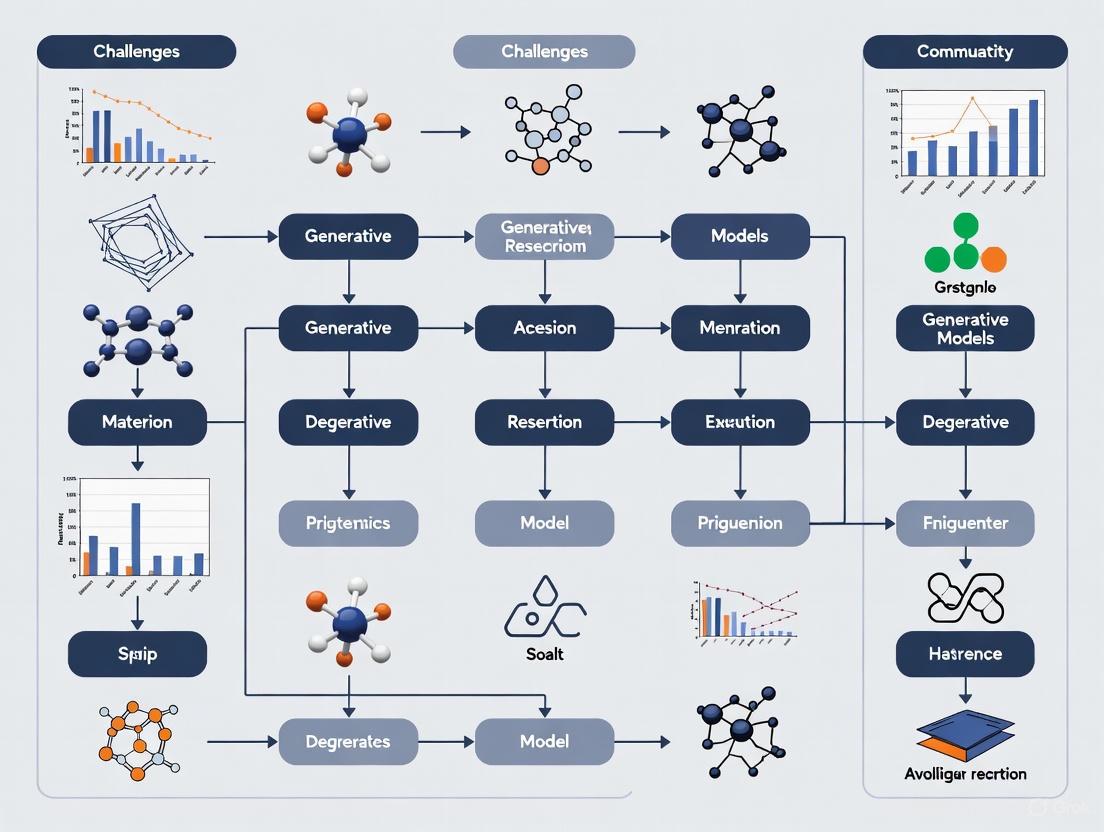
Generative artificial intelligence holds transformative potential for accelerating the discovery of novel materials and therapeutic compounds.
Overcoming the Hurdles: Key Challenges and Solutions for Generative AI in Materials Research and Drug Development
Abstract
Generative artificial intelligence holds transformative potential for accelerating the discovery of novel materials and therapeutic compounds. However, its application in scientific research faces significant, domain-specific challenges. This article provides a comprehensive analysis for researchers and drug development professionals, exploring the foundational data and computational limitations of generative models. It delves into methodological advances for designing nanoporous materials and small molecules, outlines critical strategies for troubleshooting model instability and bias, and finally, establishes a rigorous framework for validating and benchmarking AI-generated candidates to ensure they are stable, diverse, and ready for experimental pursuit.
The Core Hurdles: Understanding Data Scarcity, Cost, and Fundamental Model Limitations
In the field of materials science, the discovery of new materials is often bottlenecked by the "small data" problem. Unlike data-rich domains, the acquisition of high-quality materials data through experiments or high-fidelity computations is typically slow, expensive, and resource-intensive [1]. This creates a fundamental challenge for generative AI models, which require large datasets to learn from. These models, designed for the "inverse design" of new materials with desired properties, often struggle when data is scarce, leading to generated materials that are either unstable, non-synthesizable, or fail to exhibit the target exotic properties [2] [3]. This technical support center addresses the specific issues researchers encounter when applying generative models to small data environments, providing practical guides and solutions to accelerate materials discovery.
Frequently Asked Questions (FAQs)
FAQ 1: What defines a "small data" problem in materials science? The concept is relative, but "small data" in materials science primarily focuses on a limited sample size of available data [1]. This often arises when data is sourced from human-conducted experiments, which are costly and time-consuming, rather than from large-scale, automated observations. The quality and targeted information of this data are often prioritized over sheer quantity [1].
FAQ 2: Why do generative AI models fail to propose viable quantum materials? Popular generative models from major tech companies are often optimized to generate materials that are structurally stable [3]. However, materials with exotic quantum properties (e.g., superconductivity, unique magnetic states) require specific, and often unstable, geometric atomic patterns (like Kagome or Lieb lattices) to function [3]. Models trained on general datasets typically do not generate these unconventional structures, creating a bottleneck for discovering groundbreaking quantum materials.
FAQ 3: Can synthetic data truly solve the problem of data scarcity? Yes, but with caveats. Synthetic data generated by models like Con-CDVAE can improve property prediction models in data-scarce scenarios [4]. However, its effectiveness varies. In some cases, using a combination of real and synthetic data for training yields the best performance, while in others, training solely on synthetic data can underperform models trained only on real data [4]. The quality and distribution of the synthetic data are critical.
FAQ 4: Is it possible for an AI model to make accurate predictions beyond its training data? Conventional machine learning models are generally interpolative, meaning their predictions are reliable only for materials similar to those in their training set [5]. However, novel algorithms like E2T (Extrapolative Episodic Training) have been developed to enable extrapolative predictions. This meta-learning approach trains a model on a large number of artificially generated "extrapolative tasks," allowing it to learn how to make predictions for material features not present in the original training data [5].
Troubleshooting Guides
Problem 1: Generative Model Produces Physically Implausible or Non-Synthesizable Materials
This is a common issue when models are trained on small or biased datasets and learn incorrect structure-property relationships.
- Step 1: Integrate Physical Constraints. Use a tool like SCIGEN to enforce geometric constraints during the generation process. This steers the model to create structures known to give rise to desired quantum properties [3].
- Step 2: Implement a Multi-Stage Screening Pipeline. Do not rely on the generative model alone. Pass generated candidates through a rigorous funnel:
- Stability Screening: Use computational tools (e.g., Density Functional Theory) to filter for thermodynamic stability [3].
- Synthesizability Check: Screen candidates against known synthesis protocols or use predictive models for synthesizability.
- Step 3: Iterate with Active Learning. Use an active learning loop. Select the most promising (and diverse) generated candidates for actual synthesis or high-fidelity simulation. Feed this new, high-quality data back into the model to iteratively improve its performance [6].
Problem 2: Poor Performance of Predictive Models Trained on Limited Data
When your dataset is too small to train an accurate property prediction model, which in turn hampers the evaluation of generated materials.
- Step 1: Apply Data Augmentation. Use feature combination methods or conditional generative models to create synthetic data. The MatWheel framework is an example of this approach, which can be used in both fully-supervised and semi-supervised learning scenarios [4].
- Step 2: Leverage Transfer Learning. Begin with a pre-trained model (a foundation model) that has been trained on a large, versatile dataset from a related domain. Fine-tune this model on your small, specific dataset to achieve higher predictive accuracy with less data [6] [5].
- Step 3: Incorporate Domain Knowledge. Generate descriptors based on domain knowledge (e.g., physical laws, empirical rules) to construct more interpretable and robust machine learning models. This helps the algorithm capture key information more effectively [1].
- Step 4: Utilize Extrapolative Algorithms. For exploring completely new material spaces, employ algorithms specifically designed for extrapolation, such as the E2T method, which can maintain higher accuracy for materials with features outside the training distribution [5].
Problem 3: High Experimental Cost and Slow Data Generation
The core of the small data problem is the expense and time required to acquire new data points.
- Step 1: Deploy High-Throughput Methods. Where possible, use high-throughput computations (e.g., high-throughput first-principles calculations) or high-throughput experimentation tools to generate data more rapidly [1] [2].
- Step 2: Adopt a Centralized Data Management System. Use a platform like MaterialsZone's Centralized Data Hub to aggregate data from diverse sources (spreadsheets, databases, ERP systems). This minimizes inconsistencies, streamlines workflows, and ensures that all existing data is readily available and usable, maximizing the value of every data point [7].
- Step 3: Practice Research Data Management (RDM). Adhere to the FAIR Guiding Principles—making data Findable, Accessible, Interoperable, and Reusable. This promotes collaboration, reduces redundant data generation, and accelerates the overall research lifecycle [8].
Experimental Protocols
Protocol 1: The MatWheel Framework for Synthetic Data Generation
This protocol outlines the methodology for using the MatWheel framework to generate and utilize synthetic materials data to improve property prediction models under data scarcity [4].
1. Objective: To enhance the performance of a material property prediction model by incorporating synthetic data generated by a conditional generative model.
2. Methodology:
- Scenario A: Fully-Supervised Learning
- Train Conditional Generative Model: Train a model (e.g., Con-CDVAE) using the entire available set of real training data.
- Generate Synthetic Data: Sample the trained model using scalar properties as conditions to create a synthetic dataset (e.g., 1,000 samples).
- Train Predictive Model: Train the property prediction model (e.g., CGCNN) on a combined dataset of real and synthetic data.
- Scenario B: Semi-Supervised Learning (The Data Flywheel)
- Initial Training: Train the predictive model on only a small fraction (e.g., 10%) of the real training data.
- Generate Pseudo-Labels: Use this initial model to infer pseudo-labels for the remaining 90% of the training data.
- Train Generative Model: Train the conditional generative model (e.g., Con-CDVAE) on the combined set of real-labeled and pseudo-labeled data.
- Generate Synthetic Data: Use the trained generative model to create an expanded synthetic dataset.
- Re-train Predictive Model: Finally, re-train the predictive model using a combination of the original small real dataset and the new synthetic dataset.
3. Materials/Models Used:
- Property Prediction Model: CGCNN (Crystal Graph Convolutional Neural Network).
- Conditional Generative Model: Con-CDVAE (Conditional-Crystal Diffusion Variational Autoencoder).
- Data Source: Data-scarce property datasets from the Matminer database (e.g., Jarvis2d exfoliation, MP poly total) [4].
The workflow for this framework is illustrated below.
Protocol 2: Constrained Generation of Quantum Materials with SCIGEN
This protocol describes the process of using the SCIGEN tool to constrain a generative AI model to produce materials with specific geometric lattices associated with exotic quantum properties [3].
1. Objective: To generate candidate materials with specific geometric structural patterns (e.g., Archimedean lattices) that are likely to host exotic quantum phenomena.
2. Methodology: 1. Tool Integration: Apply the SCIGEN computer code to a generative diffusion model (e.g., DiffCSP). 2. Define Constraints: Input user-defined geometric structural rules (e.g., Kagome lattice, Lieb lattice) that the model must follow at each step of the generation process. 3. Generate Candidates: Run the constrained model to produce a large pool of candidate materials (e.g., millions of candidates). 4. Screen for Stability: Filter the generated candidates for thermodynamic stability. 5. Simulate & Validate: Select a subset of stable candidates for detailed simulation (e.g., using supercomputers to model atomic behavior) and ultimately, experimental synthesis to validate the model's predictions.
3. Materials/Models Used:
- Generative Model: DiffCSP (a diffusion model for crystal structure prediction).
- Constraining Tool: SCIGEN (Structural Constraint Integration in GENerative model).
- Validation: Synthesis in lab settings (e.g., TiPdBi and TiPbSb compounds were synthesized and tested) [3].
The following diagram outlines this constrained generation and validation pipeline.
The following table summarizes quantitative results from key studies that tackled the small data problem, providing a comparison of their performance.
Table 1: Performance Comparison of Small Data Solutions on Benchmark Tasks
| Method / Model | Core Function | Dataset(s) Used | Key Result / Performance |
|---|---|---|---|
| MatWheel [4] | Synthetic data generation for property prediction | Jarvis2d exfoliation (636 samples) | Combining real + synthetic data gave best performance (MAE*: 57.49) vs. real data only (MAE: 62.01). |
| MatWheel [4] | Synthetic data generation for property prediction | MP poly total (1056 samples) | Real data only performed best (MAE: 6.33), highlighting variable success of synthetic data. |
| SCIGEN [3] | Constrained generation of quantum materials | Application with DiffCSP model | Generated 10M+ candidates with Archimedean lattices; 41% of a 26k-sample subset showed magnetism in simulation. |
| E2T (Extrapolative Episodic Training) [5] | Meta-learning for extrapolative prediction | 40+ property prediction tasks for polymers & inorganics | Outperformed conventional ML in extrapolative accuracy in almost all cases, with comparable performance on interpolative tasks. |
*MAE: Mean Absolute Error (lower is better).
The Scientist's Toolkit: Key Research Reagent Solutions
Table 2: Essential Tools and Models for Small Data Materials Research
| Tool / Model Name | Type | Primary Function in Small Data Context |
|---|---|---|
| Con-CDVAE [4] | Conditional Generative Model | Generates synthetic crystal structures conditioned on target properties to augment small datasets. |
| SCIGEN [3] | Generative AI Constraint Tool | Applies geometric rules to generative models, steering them to produce materials with specific, target structures. |
| E2T Algorithm [5] | Meta-Learning Algorithm | Enables models to make accurate predictions for material features that lie outside the training data distribution. |
| CGCNN [4] | Property Prediction Model | A graph neural network that predicts material properties from crystal structure, effective even with limited data. |
| MaterialsZone Hub [7] | Data Management Platform | A centralized system to aggregate and manage disparate materials data, ensuring maximum utility of existing data. |
| Active Learning Cycles [6] | Machine Learning Strategy | Intelligently selects the most valuable data points to acquire next, optimizing the cost of data generation. |
Skyrocketing Computational Costs and Environmental Impact of Model Training
The integration of artificial intelligence, particularly generative models, into materials research and drug development has inaugurated a new paradigm of scientific discovery, enabling the inverse design of novel materials and molecules. However, this revolution is accompanied by two formidable challenges: skyrocketing computational costs and a significant environmental footprint. Training state-of-the-art AI models now requires financial investments that can exceed hundreds of millions of dollars, effectively placing frontier model development beyond the reach of all but the most well-funded organizations [9] [10]. Concurrently, the immense computational power demanded by these models translates into massive electricity consumption and water usage for cooling, raising urgent sustainability concerns for the field [11] [12]. This technical support center is designed to help researchers and scientists navigate these challenges by providing practical, actionable guidance for optimizing computational efficiency and mitigating environmental impact within their experiments.
Frequently Asked Questions (FAQs)
Q1: What is the typical cost range for training different tiers of AI models in materials science?
Training costs vary dramatically based on the model's size and complexity. The following table summarizes estimated benchmarks for different tiers [9] [10].
Table: AI Model Training Cost Benchmarks
| Model Tier | Example Models | Typical Training Cost (Compute) | Primary Use Cases |
|---|---|---|---|
| Frontier Models | GPT-4, Gemini Ultra, Llama 3.1-405B | $100 million - $192 million [9] | General-purpose, state-of-the-art foundational models |
| Mid-Scale Models | GPT-3, Mistral Large | $4.6 million - $41 million [9] [10] | Strong performance for commercial applications |
| Efficient/Compact Models | DeepSeek-V3, Llama 2-70B | $3 million - $6 million [9] [10] | Domain-specific tasks, fine-tuning base |
| Small-Scale & Fine-Tuning | RoBERTa Large, Domain-specific adaptations | Thousands to hundreds of thousands of dollars [10] | Specialized tasks, proof-of-concept studies |
Q2: Why is AI model training so resource-intensive and environmentally impactful?
The resource intensity stems from several factors:
- Computational Demand: Training models with billions or trillions of parameters requires thousands of high-performance GPUs/TPUs running continuously for weeks or months [11] [13].
- Energy Consumption: This computational process consumes enormous electricity. For instance, training OpenAI's GPT-3 was estimated to use 1,287 MWh, enough to power about 120 U.S. homes for a year [12].
- Inference Costs: After training, using the model (inference) accounts for 80-90% of AI's total computing power and energy demand. A single ChatGPT query can use five times more electricity than a simple web search [12] [13].
- Cooling Overhead: Data centers require massive water and energy for cooling, with an estimated 2 liters of water used for every kilowatt-hour of energy consumed [12].
Q3: What are the key components that contribute to the total cost of a training run?
The cost is not just for compute cycles. A comprehensive budget includes the following components [10]:
Table: Breakdown of Neural Network Training Cost Components
| Cost Component | Share of Total Cost | Description |
|---|---|---|
| GPU/TPU Accelerators | 40% - 50% | Rental or amortized purchase cost of the primary processing hardware. |
| Research & Engineering Staff | 20% - 30% | Salaries for scientists and engineers designing and running experiments. |
| Cluster Infrastructure | 15% - 22% | Servers, storage, and crucially, high-speed interconnects. |
| Networking & Synchronization | 9% - 13% | (Included in cluster infrastructure) Overhead for coordinating thousands of chips. |
| Energy & Electricity | 2% - 6% | Direct power consumption for computation and cooling. |
Q4: What strategies can my research team adopt to reduce costs and environmental impact?
- Prioritize Model Efficiency: Use architectures like Mixture-of-Experts (e.g., DeepSeek-V3), which activates only a fraction of total parameters, dramatically cutting compute needs [10].
- Leverage Parallel Computing: Utilize Message Passing Interface (MPI) libraries like MPI4Py to parallelize data preprocessing and model training across multiple processors, significantly speeding up workflows and reducing rental time [14].
- Employ Lower Precision: Using FP8 precision instead of BF16 for most operations can effectively double calculation speed with minimal quality loss [10].
- Focus on Fine-Tuning: Instead of training from scratch, fine-tune existing pre-trained models for your specific domain. This is far less costly and computationally intensive [10].
- Optimize Data Center Selection: Choose cloud providers or data centers that are powered by renewable energy sources to lower the carbon footprint of your computations [11].
Troubleshooting Guides
Issue 1: Experiment Costs Exceeding Budget
Problem: Your model training runs are consuming more computational resources than allocated, leading to unexpected costs and stalled projects.
Diagnosis and Solutions:
- Step 1: Audit Compute Usage. Use cloud monitoring tools to analyze your past runs. Identify if costs are high due to long training times, inefficient use of hardware, or overly large experimental batches.
- Step 2: Implement Early Stopping. Define clear performance metrics and stop training runs early if the model is not converging as expected. This prevents wasting resources on unproductive experiments.
- Step 3: Start Small. Use a smaller subset of your data for initial model architecture and hyperparameter experiments. Scale up to the full dataset only once you have a promising configuration.
- Step 4: Optimize Hyperparameters. Systematically search for optimal hyperparameters (e.g., learning rate, batch size) using efficient methods like Bayesian optimization instead of exhaustive grid searches, which can be prohibitively expensive.
Issue 2: High Energy and Carbon Footprint
Problem: Your lab or institution is concerned about the sustainability of your AI-driven research, citing high energy usage or carbon emissions.
Diagnosis and Solutions:
- Step 1: Measure Your Footprint. Utilize tools like the
codecarbonlibrary to track the energy consumption and estimated carbon emissions of your code runs directly. - Step 2: Schedule for "Greener" Times. If using cloud resources, configure training jobs to run during off-peak hours when the local energy grid may have a higher mix of renewable sources, or align with periods of peak renewable availability [11].
- Step 3: Select Efficient Hardware. When provisioning resources, choose the latest-generation AI accelerators that offer better performance-per-watt compared to older hardware.
- Step 4: Consolidate Experiments. Bundle multiple inference or testing tasks together to maximize GPU utilization and reduce the total active compute time, rather than running jobs sporadically.
Issue 3: Managing Data and Feature Complexity in Materials ML
Problem: The materials science dataset is messy, with high-dimensional feature spaces, leading to long preprocessing times and inefficient model training.
Diagnosis and Solutions:
- Step 1: Standardize Data Preprocessing. Use robust Python packages like
Matminerfor inorganic materials orRDKitfor molecular data to automatically generate and standardize descriptors, ensuring consistency and saving time [15]. - Step 2: Apply Feature Selection. Before training, employ feature selection methods (e.g., filter methods like maximum information coefficient, or embedded methods like LASSO) to identify and retain only the most relevant features. This reduces model complexity and training time [15].
- Step 3: Parallelize Preprocessing. Use parallel computing frameworks like MPI4Py to distribute data cleaning, feature engineering, and normalization tasks across multiple CPU cores, drastically speeding up this critical stage [14].
Experimental Protocol: Cost-Effective Model Training with Parallelization
This protocol outlines a methodology for leveraging parallel computing to reduce the time and cost of training a generative model for molecular design.
1. Objective: To train a variational autoencoder (VAE) for generating novel molecular structures, while minimizing training time and associated cloud compute costs.
2. Hypothesis: Implementing data parallelism using MPI4Py will significantly reduce model training time compared to a serial implementation, leading to a direct reduction in computational costs.
3. Materials and Reagents (Computational): Table: Research Reagent Solutions for Computational Experiment
| Item Name | Function/Description | Example/Alternative |
|---|---|---|
| HPC Cluster/Cloud VM | Provides the computational backbone with multiple nodes/CPUs. | AWS ParallelCluster, Google Cloud VMs, Azure HPC. |
| MPI Implementation | Enables communication and coordination between processes. | OpenMPI, MPICH. |
| MPI4Py Python Library | Provides Python bindings for MPI, allowing Python scripts to run in parallel [14]. | pip install mpi4py |
| Training Dataset | Curated set of molecular structures (e.g., in SMILES string format). | ZINC database, PubChem. |
| Deep Learning Framework | Provides the infrastructure for building and training neural networks. | PyTorch, TensorFlow, JAX. |
4. Methodology:
- Step 1: Data Preparation and Partitioning. Load and preprocess the entire molecular dataset. The root process (Rank 0) will then partition the dataset into N nearly equal subsets, where N is the total number of processes.
- Step 2: Model and Optimizer Initialization. Initialize the identical VAE model architecture and optimizer on every computational process.
- Step 3: Parallelized Training Loop.
- Scatter Data: The root process scatters one data subset to each process (including itself).
- Local Forward/Backward Pass: Each process performs a forward pass, calculates the loss, and a backward pass on its local data subset.
- Gradient Synchronization: All processes communicate to average the gradients computed locally using
MPI4Py'sAllreduceoperation. - Parameter Update: Each optimizer updates the model parameters using the averaged gradients, ensuring all models remain synchronized.
- Step 4: Validation and Checkpointing. A designated process can periodically evaluate the model on a validation set and save checkpoints.
5. Workflow Visualization:
The Scientist's Toolkit: Key Reagents for Sustainable AI Research
Table: Essential "Reagents" for Cost-Effective and Sustainable AI Research
| Tool / Technique Name | Category | Brief Function & Explanation |
|---|---|---|
| MPI4Py | Parallel Computing | A library for parallel execution of Python code, crucial for speeding up data preprocessing and distributed model training [14]. |
| Matminer / RDKit | Data Handling | Python libraries for automatically generating standardized, domain-aware feature descriptors for inorganic and organic materials, respectively [15]. |
| Mixture-of-Experts (MoE) | Model Architecture | A neural network design that uses only a subset of parameters per input, drastically reducing computation and cost during training and inference [10]. |
| FP8 Precision Training | Numerical Optimization | Using 8-bit floating-point precision for computations, which increases speed and reduces memory usage with minimal impact on model accuracy [10]. |
| CodeCarbon | Sustainability Tracking | A Python package that estimates the energy consumption and carbon emissions of your computational code, enabling measurement and accountability. |
Instability and Lack of Diversity in Generated Material Structures
Frequently Asked Questions (FAQs)
FAQ 1: Why does my generative model produce chemically implausible or unstable material structures? This is a common issue where models prioritize structural stability over exotic properties. Generative models like diffusion models are often trained on datasets that optimize for stability, which can cause them to miss promising candidates for applications like quantum computing. Furthermore, models trained on 2D representations (like SMILES) may omit critical 3D conformational information, leading to structures that are invalid in three-dimensional space [16]. A key technical challenge is that the model's input space may not be smooth with respect to parameter variation, making optimization difficult and leading to generations that are unstable [17].
FAQ 2: My model's outputs lack diversity, often generating slight variations of the same structure. What is causing this? This problem, known as mode collapse, is a fundamental limitation of several generative models, particularly Generative Adversarial Networks (GANs) [18]. It occurs when the model learns to produce a limited variety of outputs that it has determined are "successful," failing to explore the wider design space. This is especially problematic for complex metamaterials like kirigami, where the design space has non-trivial restrictions. If the model relies on an inappropriate similarity metric like Euclidean distance, it can get stuck in one region of the design space [19].
FAQ 3: How can I steer my generative model to produce materials with specific target properties, like a particular geometric lattice? Constraining a model requires specialized techniques. One approach is to use a tool like SCIGEN, which can be integrated with diffusion models. SCIGEN works by blocking model generations that do not align with user-defined structural rules at each iterative step of the generation process [3]. This allows researchers to enforce specific geometric patterns (e.g., Kagome or Lieb lattices) known to give rise to desired quantum properties.
FAQ 4: Why do generative models that work well for images struggle with my materials data? Images typically exist in a design space where a simple metric like Euclidean distance is a reasonable measure of similarity. However, for material structures, the Euclidean distance between two parameter sets can be a poor indicator of their actual similarity in terms of function or admissibility. A short path in Euclidean space might pass through a region of invalid materials, making it an ineffective guide for the model [19]. This is a key reason why models struggle with geometrically complex metamaterials.
FAQ 5: What are the best metrics to evaluate the diversity and quality of my generated materials? Evaluation should be multi-faceted. The table below summarizes key quantitative metrics. It is also crucial to validate model outputs with physical simulations (e.g., for stability and magnetic properties) and, ultimately, experimental synthesis to confirm that the generated materials can be created and exhibit the predicted properties [3] [20].
Table 1: Key Metrics for Evaluating Generative Model Outputs
| Metric | Description | Application in Materials Science |
|---|---|---|
| Fréchet Inception Distance (FID) [20] | Assesses realism by comparing distributions of real and generated data. | Can be adapted to compare distributions of material properties or structural descriptors. |
| Inception Score (IS) [20] | Balances quality and variety of generated outputs. | Useful for a high-level assessment of diversity, though may require domain adaptation. |
| Self-BLEU [20] | Measures diversity by comparing generated outputs to each other. | Lower scores suggest higher diversity in generated structures. |
| Mode Coverage [20] | Measures how many unique categories or modes the model captures. | Ensures the model explores different classes of crystal structures or compositions. |
| Synthesizability Score | (Proposed) Prediction of whether a proposed material can be synthesized. | Would require a separate model trained on experimental synthesis data. |
| Stability Screening | Percentage of generated materials predicted to be thermodynamically stable [17]. | A high failure rate indicates the model is generating implausible structures. |
Experimental Protocols & Methodologies
Protocol: Integrating Structural Constraints with SCIGEN
This protocol is based on the methodology developed by MIT researchers to generate materials with specific geometric lattices using the SCIGEN tool [3].
Objective: To steer a generative diffusion model (e.g., DiffCSP) to produce crystal structures that conform to a user-defined geometric pattern.
Workflow:
- Define Constraint: Precisely define the target structural constraint (e.g., a specific Archimedean lattice like Kagome).
- Model Integration: Integrate the SCIGEN code with your chosen generative diffusion model.
- Constrained Generation: Run the generative process. At each iterative denoising step, SCIGEN evaluates the emerging structure.
- Rule Enforcement: If the structure violates the predefined geometric rule, SCIGEN blocks that generation path, steering the model toward admissible structures.
- Output: The final output is a set of material candidates that conform to the target geometry.
The following diagram illustrates this iterative constraint-enforcement workflow.
Protocol: Validating Generative Output for Quantum Materials
This protocol details the steps taken to validate AI-generated materials, as described in the MIT study that led to the synthesis of new compounds [3].
Objective: To screen, simulate, and experimentally validate material candidates generated by a constrained AI model.
Workflow:
- Initial Generation: Use a constrained generative model to produce a large pool of candidate structures (e.g., millions).
- Stability Screening: Apply a stability filter to remove thermodynamically unstable candidates, significantly reducing the pool.
- Property Simulation: Use high-performance computing (HPC) and Density Functional Theory (DFT) or other advanced simulations on a smaller sample (e.g., tens of thousands) to predict quantum properties like magnetism.
- Candidate Selection: Select the most promising candidates based on simulation results for experimental synthesis.
- Experimental Validation: Synthesize the selected materials (e.g., via solid-state reaction) and characterize their properties (e.g., using X-ray diffraction and magnetic susceptibility measurements) to compare with AI predictions.
The following flowchart outlines this multi-stage validation process.
The Scientist's Toolkit: Research Reagent Solutions
Table 2: Essential Computational and Experimental Tools for AI-Driven Materials Discovery
| Tool / Resource | Type | Function in Research |
|---|---|---|
| DiffCSP [3] | Generative Model | A crystal structure prediction model that can be augmented with constraint tools for targeted generation. |
| SCIGEN [3] | Constraint Tool | Computer code that enforces user-defined geometric rules during the generative process. |
| Archimedean Lattices [3] | Design Blueprint | A collection of 2D lattice tilings (e.g., Kagome) used as target constraints for generating materials with exotic quantum properties. |
| High-Performance Computing (HPC) [3] | Computational Resource | Essential for running large-scale stability and property simulations (e.g., DFT) on thousands of AI-generated candidates. |
| Stability Prediction Model [17] | Screening Tool | A separate machine learning model used to predict the thermodynamic stability of a generated structure, filtering out implausible candidates. |
| Wasserstein GAN (WGAN) [19] | Generative Model | A variant of GAN that can be more stable in training, though it may still struggle with complex geometric constraints. |
| Denoising Diffusion Model [19] | Generative Model | A state-of-the-art model that excels at generating high-quality outputs; its iterative nature is well-suited to constraint integration. |
In the field of materials science, generative AI models offer unprecedented capabilities for accelerating the discovery of new compounds. However, these models are susceptible to "hallucinations" – the generation of implausible, incorrect, or physically impossible material designs – and can inherit and amplify biases present in their training data. This technical support guide helps researchers identify, troubleshoot, and mitigate these issues within their experimental workflows.
Frequently Asked Questions (FAQs)
Q1: What exactly is an "AI hallucination" in the context of materials design? A hallucination occurs when a generative AI model produces a material structure that is superficially plausible but is factually incorrect, physically invalid, or non-synthesizable [21]. In materials science, this often manifests as structurally unstable crystals, compositions that violate chemical rules, or properties that defy physical laws [22].
Q2: How do inherited biases affect generative models for materials? Biases in training data can severely limit a model's creativity and applicability. For instance, if a model is trained predominantly on stable, common crystal structures, it may be biased against generating novel materials with exotic, target properties like the geometric lattices needed for quantum spin liquids [3]. This results in a generative process optimized for historical stability rather than groundbreaking discovery.
Q3: What are the most common types of hallucinations to look for?
- Structural Hallucinations: Generation of crystal structures with impossible coordination environments or periodic lattices [22].
- Compositional Hallucinations: Proposing material compositions with incompatible elements or unstable stoichiometries.
- Property Hallucinations: Predicting exotic physical properties (e.g., superconductivity, specific magnetic behaviors) that are not supported by the generated structure [21].
Q4: Can hallucinations ever be beneficial for research? While often problematic, the uncontrolled "creativity" of hallucinations can be harnessed in a constrained environment for idea generation and to explore highly novel, non-obvious material spaces that might not be proposed through traditional reasoning [23]. The key is to implement rigorous validation to separate plausible breakthroughs from implausible noise.
Troubleshooting Guide: Identifying and Mitigating Hallucinations
Problem 1: Model Generates Structurally Unstable Materials
Symptoms:
- Generated structures have very high energy upon Density Functional Theory (DFT) relaxation [22].
- Structures collapse into different configurations during simulation.
- Low success rate in proposing stable crystals [22].
Solutions:
- Impose Geometric Constraints: Use tools like SCIGEN to enforce specific structural rules (e.g., Archimedean lattices) during the generation process, guiding the model toward physically realistic and interesting geometries [3].
- Refine with Adapter Modules: Fine-tune pre-trained base models on smaller, high-fidelity datasets labeled with property data (e.g., formation energy). This steers generation toward stability without requiring massive retraining [22].
- Implement Confidence Thresholds: Reject generated samples where the model's internal confidence scores are low, indicating uncertainty or fabrication.
Experimental Protocol for Validation:
- DFT Relaxation: Use software like VASP or Quantum ESPRESSO to relax the generated atomic structure and calculate its total energy.
- Stability Check: Compute the energy above the convex hull (Ehull). A material is generally considered stable if Ehull is below 0.1 eV/atom [22].
- Phonon Dispersion Calculation: Perform a phonon calculation to confirm dynamic stability (no imaginary frequencies).
Problem 2: Model is Biased Towards Common Structures and Lacks Diversity
Symptoms:
- Generated materials are minor variations of known crystals in the training database.
- The model fails to propose materials with user-specified, exotic properties.
- Outputs lack novelty and do not constitute a meaningful expansion of chemical space.
Solutions:
- Data Curation and Augmentation: Augment training datasets with hypothetical structures, under-represented chemical systems, and materials with target properties to balance intrinsic data biases [24].
- Employ Retrieval-Augmented Generation (RAG): Ground the generative model by retrieving relevant information from a trusted, curated database of materials (e.g., Materials Project) before generating an output, improving factual accuracy and relevance [25] [26].
- Leverage Classifier-Free Guidance: During sampling, use techniques that allow you to steer the generation by specifying a desired property (e.g., "high magnetic density"), pushing the model away from its default, biased distribution [22].
Problem 3: Model Generates Physically Implausible Property Values
Symptoms:
- Predicted property values (e.g., band gap, magnetic moment) are extreme outliers with no physical justification.
- Property predictions are inconsistent with the generated structure (e.g., predicting metallicity for a wide-gap insulator).
Solutions:
- Incorporate Physical Constraints: Integrate known physical laws (e.g., symmetry constraints, thermodynamic boundaries) directly into the model's loss function or architecture to penalize unphysical outputs [21].
- Human-in-the-Loop Validation: Never trust AI-generated outputs blindly. Establish a mandatory review step where domain experts critically evaluate the plausibility of generated materials and their properties before further investment [25] [26].
- Uncertainty Quantification: Use models that provide uncertainty estimates for their predictions. Treat high-uncertainty outputs as likely hallucinations and subject them to greater scrutiny [21].
Quantitative Data on Model Performance and Hallucination Rates
The following table summarizes the performance of different generative models, highlighting their propensity to generate stable versus hallucinated structures.
Table 1: Performance Comparison of Generative Models for Materials Design
| Model / Method | Stable, Unique, and New (SUN) Materials | Average RMSD to DFT-Relaxed Structure | Key Mitigation Strategy |
|---|---|---|---|
| MatterGen (Base Model) | 75% below 0.1 eV/atom hull [22] | < 0.076 Å [22] | Diffusion model with physical constraints [22] |
| MatterGen-MP | 60% more SUN materials than CDVAE/DiffCSP [22] | 50% lower than CDVAE/DiffCSP [22] | Trained on diverse dataset (Alex-MP-20) [22] |
| SCIGEN + DiffCSP | Generated 10M candidates; 1M stable [3] | N/A (Focused on lattice constraints) | Hard-coded geometric constraints [3] |
| CDVAE / DiffCSP | (Baseline for comparison) Lower SUN yield [22] | (Baseline for comparison) Higher RMSD [22] | Standard generative approach |
The Scientist's Toolkit: Essential Research Reagents & Solutions
Table 2: Key Computational and Experimental Tools for Validating AI-Generated Materials
| Item / Tool | Function / Purpose |
|---|---|
| Density Functional Theory (DFT) Codes | The foundational computational method for validating structural stability and predicting electronic properties of generated materials. |
| Phonopy Software | Calculates phonon spectra to confirm the dynamic stability of a crystal structure (absence of imaginary frequencies). |
| SCIGEN | A tool for applying hard geometric constraints to generative models, forcing them to produce specific lattice types (e.g., Kagome) [3]. |
| Adapter Modules | Small, tunable components added to a pre-trained base model that allow for efficient fine-tuning on small, property-specific datasets [22]. |
| High-Throughput Synthesis Workflow | An experimental setup for rapidly synthesizing and characterizing a shortlist of the most promising AI-generated candidates. |
Workflow Diagram for Hallucination Mitigation
The following diagram illustrates a robust experimental workflow to integrate generative AI into materials discovery while proactively identifying and mitigating hallucinations and biases.
AI-Driven Materials Discovery and Validation Workflow
Hallucinations and inherited biases are not terminal flaws but inherent challenges of generative AI. By understanding their origins and implementing a rigorous, multi-layered validation protocol—combining constrained generation, computational physics checks, and irreplaceable human expertise—researchers can harness the transformative power of AI while maintaining the integrity of the scientific discovery process.
Generative AI in Action: From MOFs to Molecules - Methods and Real-World Applications
Technical Support & Troubleshooting Hub
This section addresses common technical challenges encountered when deploying generative models for materials discovery. The FAQs and troubleshooting guides are framed within the context of a broader thesis on overcoming instability, data scarcity, and computational constraints in materials research.
Frequently Asked Questions (FAQs)
FAQ 1: What are the primary trade-offs when choosing between GANs, VAEs, and Diffusion Models for generating new crystal structures?
The choice involves a fundamental trade-off between sample quality, diversity, and training stability [27]. The table below summarizes the key performance characteristics based on current research:
Table 1: Comparative Analysis of Generative Models for Materials Science
| Feature | Generative Adversarial Networks (GANs) | Variational Autoencoders (VAEs) | Diffusion Models |
|---|---|---|---|
| Sample Quality | High-fidelity, sharp samples [27] [28] | Often blurrier, lower fidelity outputs [27] | High-fidelity and diverse samples [27] |
| Sample Diversity | Can suffer from mode collapse (low diversity) [27] [28] | High diversity, better data coverage [27] | High diversity [27] |
| Training Stability | Unstable, sensitive to hyperparameters [29] [28] | Generally more stable due to likelihood-based training [28] | More stable than GANs [29] |
| Training Speed | Faster training [29] | - | Slower training [29] |
| Sampling Speed | Fast sampling [30] | Fast sampling [30] | Slow, iterative sampling [27] [30] |
| Latent Space | Implicit, less interpretable [28] | Explicit, structured, and meaningful [28] | - |
FAQ 2: Our Diffusion Model for molecule generation is computationally slow. What strategies can accelerate sampling?
The slow sampling of diffusion models is a known challenge, as they require many iterative steps to denoise a sample [27] [30]. Several strategies have been developed to address this:
- Advanced Solvers: Use dedicated ODE/SDE (Ordinary/Stochastic Differential Equation) solvers designed to reduce the number of steps required without significantly compromising quality [30].
- Model Distillation: Distill a complex, multi-step diffusion model into a model that can generate samples in fewer steps (e.g., one or a handful) [30].
- Latent Diffusion: Perform the diffusion process in a lower-dimensional latent space instead of the raw data space. Models like Stable Diffusion use a VAE to achieve this, dramatically reducing computational cost [31] [32].
FAQ 3: How can we improve the stability and physical realism of crystals generated by our model?
Ensuring generated crystals are stable and physically plausible is a core challenge. Beyond choosing an appropriate model architecture, you can:
- Incorporate Physics-Guided Loss Functions: Introduce loss terms that penalize physically impossible structures, such as atoms that are too close or too far apart [29].
- Leverage Reinforcement Learning (RL) with Energy Feedback: Fine-tune a pre-trained diffusion model using reinforcement learning, where the reward is based on formation energy (a measure of stability) calculated from Density Functional Theory (DFT). This directly guides the model to generate more stable structures [33].
- Use Symmetry-Aware Representations: Employ crystal representations like CrysTens [29] or other graph-based methods that inherently respect the periodic and symmetric nature of crystal structures.
FAQ 4: Our GAN for material generation is suffering from mode collapse. What are the remediation steps?
Mode collapse occurs when the generator produces a limited variety of samples [27] [28].
- Switch to More Stable GAN Variants: Implement advanced GAN architectures like Wasserstein GAN (WGAN) [29], which uses a different loss function to improve training stability and mitigate mode collapse.
- Modify Training Techniques: Use techniques like minibatch discrimination, which allows the discriminator to look at multiple data samples simultaneously, helping it to identify a lack of diversity in the generator's output.
- Adjust Hyperparameters: Carefully tune the learning rates and the frequency of training between the generator and discriminator. A common strategy is to train the discriminator more frequently than the generator.
Troubleshooting Guides
Issue: Unstable Training and Mode Collapse in Generative Adversarial Networks (GANs)
- Symptoms: The generator produces a very limited variety of structures, or the quality of generated samples oscillates wildly during training. The loss values for the generator and discriminator may become unstable.
- Diagnosis: This is a classic sign of GAN training instability and/or mode collapse [28].
- Resolution Protocol:
- Implement Gradient Penalties: Switch from a standard GAN to a Wasserstein GAN with Gradient Penalty (WGAN-GP). This imposes a constraint on the discriminator's gradients, leading to more stable training [29].
- Review Network Architecture: Ensure the generator and discriminator are not too powerful relative to each other. A common practice is to use a structured design like Deep Convolutional GANs (DCGANs).
- Adjust Training Schedule: Try training the discriminator more times (e.g., 3-5 times) per each generator training step.
- Monitor Progress: Use multiple, fixed noise vectors to generate samples throughout training to visually monitor for mode collapse, rather than relying solely on loss values.
Issue: Blurry or Over-Smoothed Outputs from a Variational Autoencoder (VAE)
- Symptoms: Generated crystal structures or material images lack sharp, defined features and appear blurry.
- Diagnosis: This is a known limitation of VAEs, often resulting from the use of pixel-based reconstruction loss (like MSE) and the inherent averaging in the latent space [27] [31].
- Resolution Protocol:
- Modify the Loss Function: Increase the weight of the KL divergence term in the VAE loss function. This encourages the latent space to conform better to the prior distribution, which can sometimes improve feature separation. Alternatively, consider using a different reconstruction loss.
- Use a Hybrid Approach: Use the VAE as a tool for learning a compressed, meaningful latent space. Then, train a separate generative model (like a GAN or a diffusion model) on this latent space to generate new, sharp samples [31].
- Explore Alternative Architectures: For tasks requiring high visual fidelity, consider transitioning to a GAN or diffusion model, which are generally better at producing sharp outputs [27].
Issue: Extremely Slow Sampling with Diffusion Models
- Symptoms: Generating a single new material structure takes a prohibitively long time, hindering high-throughput screening.
- Diagnosis: This is a fundamental characteristic of diffusion models, which require many denoising steps (often hundreds or thousands) [27] [30].
- Resolution Protocol:
- Employ a Distilled Model: If available, use a version of your diffusion model that has undergone model distillation. This can reduce the number of sampling steps to 10 or fewer [30].
- Utilize an Advanced Solver: Integrate a fast ODE/SDE solver (e.g., DPM-Solver) into your sampling pipeline. These solvers are designed to take fewer, smarter steps [30].
- Validate Output Quality: After implementing acceleration techniques, always validate that the quality, diversity, and stability (e.g., via formation energy calculations) of the generated materials have not significantly degraded.
Experimental Protocols & Workflows
This section details specific methodologies cited in research for developing and optimizing generative models in materials science.
Protocol: Reinforcement Learning Fine-Tuning with Formation Energy Feedback (RLFEF)
This protocol describes a method to fine-tune a pre-trained material diffusion model to generate crystals with lower formation energy, implying higher stability [33].
- Objective: To shift the output distribution of a diffusion model towards regions of the chemical space that correspond to more stable materials.
- Primary Materials:
- A pre-trained crystal diffusion model (e.g., CDVAE, DiffCSP).
- A dataset of crystal structures with computed formation energies (e.g., from Pearson's Crystal Database).
- A DFT code (e.g., VASP) or a pre-computed database for formation energy calculation.
Table 2: Research Reagent Solutions for RLFEF Protocol
| Reagent / Resource | Function in the Experiment |
|---|---|
| Pre-trained Diffusion Model | Serves as the foundation model that already understands the general distribution of crystal structures. Provides the initial policy for the RL agent. |
| Formation Energy (from DFT) | Functions as the reward signal in the RL framework. Guides the model update towards generating more stable structures. |
| Reinforcement Learning Algorithm | The optimization framework (e.g., Policy Gradient) that updates the diffusion model's parameters based on the formation energy reward. |
- Methodology:
- Formulate the MDP: Model the denoising process of the diffusion model as a Markov Decision Process (MDP). Each denoising step is an action, and the state is the partially denoised crystal.
- Compute Rewards: For each fully generated crystal structure, compute its formation energy using DFT. A lower (more negative) formation energy should result in a higher reward.
- Policy Gradient Update: Using a reinforcement learning algorithm (like REINFORCE), calculate the policy gradient. The key theoretical insight is that optimizing the expected reward in RL is equivalent to applying policy gradient updates to the diffusion model [33].
- Fine-tune the Model: Update the parameters of the diffusion model using the calculated gradient, effectively teaching it to generate crystals that are more likely to yield a high reward (low formation energy).
- Symmetry Assurance: Theoretically, it has been proven that this fine-tuning process can be designed to maintain the fundamental physical symmetries (e.g., invariance to rotation, translation) of the crystal structures [33].
Protocol: Crystal Generation using CrysTens and Diffusion Models
This protocol outlines the process of generating novel crystal structures using the CrysTens representation and a diffusion model, as described by Alverson et al. (2024) [29].
- Objective: To generate theoretical, synthesizable crystal structures by leveraging a standardized image-like crystal embedding.
Primary Materials:
- Pearson's Crystal Database (PCD): A comprehensive source of Crystallographic Information Files (CIFs).
- CrysTens Representation: A pre-processing pipeline to convert CIFs into a 64x64x4 tensor representation.
Methodology:
- Data Curation: Filter a large collection of CIFs from the PCD. Remove any structures with more than 52 atoms in the basis and any erroneous or incomplete files. A final dataset of ~53,000 CIFs is used [29].
- Create CrysTens: For each CIF, generate its CrysTens representation. This tensor is designed to capture both chemical and structural crystal properties in an image-like format, making it suitable for image-generation models [29].
- Model Training: Train a diffusion model on the dataset of CrysTens. The model learns the data distribution by gradually adding noise to the CrysTens (forward process) and then learning to reverse this process (reverse process).
- Generation & Validation: Sample new crystal structures by running the reverse diffusion process from random noise. The output is a novel CrysTens, which can be decoded back into a standard CIF format for analysis and validation using domain expertise and stability metrics.
The Scientist's Toolkit
This section catalogs essential computational resources, datasets, and representations used in modern generative materials discovery research.
Table 3: Key Research Reagents in Generative Materials Science
| Tool / Resource | Type | Primary Function |
|---|---|---|
| CrysTens [29] | Crystal Representation | An image-like tensor representation (64x64x4) that encodes crystal structure and composition, compatible with standard image-generation models. |
| Formation Energy [33] | Stability Metric | A property calculated via DFT that measures a crystal's stability; used as a reward signal to guide generative models. |
| Reinforcement Learning (RL) [33] | Optimization Framework | A machine learning paradigm used to fine-tune generative models by optimizing for specific objectives (e.g., low formation energy). |
| Diffusion Model [29] [30] | Generative Model | A state-of-the-art model that generates data by iteratively denoising from random noise; known for high-quality and diverse samples. |
| Generative Adversarial Network (GAN) [29] [28] | Generative Model | A model comprising a generator and discriminator in an adversarial game; can produce high-fidelity samples but may be unstable. |
| Variational Autoencoder (VAE) [31] [28] | Generative Model | An encoder-decoder model that learns a probabilistic latent space; useful for interpolation and ensuring diverse outputs. |
| Pearson's Crystal Database (PCD) [29] | Dataset | A large, curated database of Crystallographic Information Files (CIFs) used for training crystal generative models. |
Technical Support Center: Troubleshooting Guides and FAQs
This technical support center addresses common challenges researchers face when using generative AI for designing novel small molecules and proteins. The guidance is framed within the broader thesis that generative models for materials research must overcome issues of data scarcity, computational cost, and model interpretability to achieve real-world impact [2].
Frequently Asked Questions (FAQs)
FAQ 1: My generative model produces invalid molecular structures. What could be the cause? This is often a problem with the training data or the model's representation of molecules.
- Potential Cause 1: The model was trained on a dataset containing invalid or noisy chemical structures.
- Solution: Curate a high-quality, clean dataset. Use tools like the CAS Content Collection, a human-curated repository of scientific information, to ensure data integrity [34].
- Potential Cause 2: The method for representing molecules (e.g., SMILES strings) allows for grammatically incorrect sequences during generation.
- Solution: Utilize advanced molecular representation techniques. Implement models like ChemBERTa or MolBERT that learn molecular embeddings from SMILES notation, which can improve the validity of generated structures [35]. Alternatively, use models like DeepSMILES or ReLeaSE that are specifically designed for de novo molecular design and can learn the rules of valid chemical structures [35].
FAQ 2: How can I improve my model's prediction of protein-ligand binding affinity? Accurate prediction of Drug-Target Interaction (DTI) is crucial for efficacy.
- Solution 1: Employ advanced deep learning architectures. Transformer models, which use self-attention mechanisms, are highly effective at analyzing vast datasets of protein-ligand interactions to suggest potential drug candidates [35].
- Solution 2: Use specialized diffusion models. Models like DiffDock enhance drug binding prediction by simulating how molecules fit into protein binding sites, providing a more dynamic assessment of interaction [35].
- Methodology: For a typical DTI prediction experiment, fine-tune a pre-trained transformer model on a dataset of known protein-ligand pairs with measured binding affinities (e.g., Ki, Kd). The model will learn to map structural features of the protein and ligand to the binding strength.
FAQ 3: My AI-designed compound failed in wet-lab testing. How can I make the models more predictive of real-world behavior? This highlights the "synthesizability" and "accuracy" challenges in generative AI for materials research [2].
- Solution 1: Integrate physics-informed architectures. Use AI models that incorporate known physical laws and constraints, which can make the generated molecules more realistic and synthesizable [2].
- Solution 2: Implement closed-loop discovery systems. Integrate AI generation with high-throughput experimentation tools, where AI proposes candidates, they are tested in the lab, and the results are fed back to retrain and improve the AI model [2].
- Solution 3: Perform early validation with in silico models. Before lab testing, simulate biological responses to drug candidates using AI-powered digital twins or quantitative systems pharmacology (QSP) models to evaluate toxicity risks and off-target effects, weeding out weak compounds early [34] [35].
FAQ 4: What are the best practices for using generative AI to design a PROTAC? PROteolysis TArgeting Chimeras (PROTACs) are a promising class of drugs that degrade target proteins.
- Challenge: Most designed PROTACs act via a limited set of E3 ligases (e.g., cereblon, VHL) [34].
- Solution: Use AI to expand the E3 ligase toolbox. Leverage predictive models to identify and design PROTACs that utilize novel or less common E3 ligases, such as DCAF16, DCAF15, or KEAP1. This can enable the targeting of previously inaccessible proteins [34].
- Experimental Protocol:
- Data Collection: Compile a dataset of known E3 ligases, their structures, and known binders.
- Ligase Selection: Use a transformer model to predict the compatibility of a target protein with various E3 ligases.
- Linker Design: Employ a diffusion model or RNN to generate potential chemical linkers that connect the E3 ligase binder to the target protein binder, optimizing for length and stability.
- Validation: Use molecular dynamics simulations and in vitro binding assays to validate the designed PROTAC.
Experimental Data and Protocols
Table 1: Key AI Techniques in Drug Discovery
| AI Technique | Primary Function | Example Models/Tools | Key Application in Drug Discovery |
|---|---|---|---|
| Transformer Models [35] | Processes large-scale biological data using self-attention. | AlphaFold, ChemBERTa, MolBERT | Protein structure prediction, molecular representation learning, drug-target interaction prediction. |
| Diffusion Models [35] | Generates structures by iteratively refining noise. | PocketDiffusion, DiffDock | Molecular generation, ligand-protein docking, de novo drug design. |
| Recurrent Neural Networks (RNNs) [35] | Processes sequential data; ideal for SMILES strings. | DeepSMILES, ReLeaSE | De novo molecular design, molecular property prediction, optimization of drug candidates. |
Table 2: Recent Breakthroughs in AI-Driven Drug Discovery (2025)
| Breakthrough Area | Key Finding | Quantitative Impact | Significance |
|---|---|---|---|
| Personalized CRISPR Therapy [34] | A seven-month-old infant with CPS1 deficiency received personalized CRISPR base-editing therapy. | Developed in just 6 months; marked the first use of CRISPR tailored to a single patient. | Demonstrates feasibility of rapid, individualized gene editing for rare diseases with no existing treatments. |
| AI-Powered Clinical Trials [34] | AI-powered digital twins and "virtual patient" platforms simulate disease trajectories. | AI-augmented virtual cohorts can reduce placebo group sizes considerably, ensuring faster timelines. | Accelerates clinical trial process and provides more confident data without losing statistical power. |
| PROTAC Development [34] | Sharp increase in PROTAC-related publications in less than 10 years. | More than 80 PROTAC drugs are in the development pipeline, with over 100 commercial organizations involved. | Demonstrates significant therapeutic potential and commercial interest in AI-driven protein degradation. |
Research Reagent Solutions
Table 3: Essential Research Reagents for AI-Driven Drug Discovery
| Reagent / Material | Function in the Experimental Workflow |
|---|---|
| E3 Ligase Assay Kits | Validate the binding and functionality of AI-designed PROTACs against specific E3 ubiquitin ligases (e.g., VHL, cereblon) [34]. |
| Cell Lines for Target Validation | Engineered cell lines (e.g., for specific cancer types) used to test the efficacy and cytotoxicity of AI-generated small molecules in in vitro models. |
| Protein Crystallization Kits | Used to determine the 3D structure of target proteins or protein-ligand complexes, providing critical data for training and validating AI models like AlphaFold [35]. |
| Lipid Nanoparticles (LNPs) | A delivery system for in vivo CRISPR therapies, enabling the transport of gene-editing machinery to target cells [34]. |
Workflow Visualizations
AI-Driven Drug Discovery Workflow
PROTAC Mechanism of Action
Synthetic Data Generation to Overcome Clinical Data Scarcity and Privacy Issues
Frequently Asked Questions
Q1: What is synthetic data and how can it help with data scarcity in medical research? Synthetic data is artificially generated information that mimics the statistical properties of real patient data without containing any sensitive personal information [36]. It is a promising solution for rare disease research, where small patient populations lead to limited data, hindering the development of AI-driven diagnostics and treatments [36]. By providing diverse and privacy-preserving datasets, synthetic data enables the training of robust AI models, the simulation of clinical trials, and secure collaboration across institutions [36] [37].
Q2: What are the main technical methods for generating synthetic clinical data? The primary methods can be grouped into three categories [36]:
- Rule-based approaches: Use predefined rules and statistical distributions (e.g., for age or gender) to create artificial patient records.
- Statistical modelling: Relies on techniques like Bayesian Networks or Markov chains to capture and replicate relationships between variables in real data.
- Machine learning-based techniques: State-of-the-art methods, including:
- Generative Adversarial Networks (GANs): Two neural networks (a generator and a discriminator) are trained together to produce highly realistic data. Variants include Conditional GANs (cGANs) for generating data with specific diseases, and Tabular GANs for numerical and categorical data [36].
- Variational Autoencoders (VAEs): Use probabilistic modeling to encode data into a latent space and decode it to generate new datasets. They often have a lower computational cost than GANs [36].
Q3: My model trained on synthetic data is performing poorly on real-world data. What could be wrong? This is often a sign of a simulation-to-reality gap [38], where the synthetic data fails to capture some crucial complexity of the real world. Key issues and solutions include:
- Data Fidelity: The synthetic data may not accurately replicate complex relationships between variables in the original dataset. Solution: Validate the synthetic data's statistical similarity to a held-out set of real data and refine the generative model [38].
- Missing Edge Cases: Generative models can miss rare but critical anomalies. Solution: Actively identify and oversample these edge cases during the data generation process, if possible [38].
- Model Collapse (Data Pollution): If a model is trained on synthetic data generated by another AI, it can lead to a degradation in quality. Solution: Whenever possible, use fresh, real-world data for validation and final tuning [38].
Q4: How can I ensure the synthetic data I generate preserves patient privacy? While synthetic data reduces privacy risks, it is not automatically anonymous. High-fidelity synthetic data could potentially be reverse-engineered to identify individuals [38]. To mitigate this:
- Use Privacy-Preserving Techniques: Incorporate methods like Differential Privacy into your generative models. This adds calibrated noise to the data or model outputs to prevent the identification of any individual record [36] [38].
- Conduct Disclosure Risk Assessments: Before sharing synthetic datasets, perform rigorous tests to evaluate the risk of re-identifying individuals [36].
- Maintain Provenance Tracking: Keep clear records of the real datasets used to create the synthetic version to enable audits [38].
Q5: What are the best practices for validating the quality of synthetic data? A multi-faceted validation approach is essential [38]:
- Statistical Validation: Check that the synthetic data matches the real data's distributions, correlations, and other statistical properties.
- Utility Validation: Train a standard model on the synthetic data and test it on a held-out real dataset. Performance close to a model trained on real data indicates high utility.
- Privacy Validation: Perform penetration tests and attempt re-identification attacks on the synthetic dataset to uncover privacy vulnerabilities.
- Avoid Circular Validation: Never validate synthetic data using another synthetic dataset, as this creates a "hall of mirrors" effect and gives false confidence [38].
Troubleshooting Guides
Problem: Generative model fails to learn complex relationships in clinical data. Applicability: Issues with GANs or VAEs generating low-quality, nonsensical, or oversimplified data.
| Step | Action & Description |
|---|---|
| 1 | Verify Data Preprocessing. Ensure categorical variables are properly encoded and continuous variables are normalized. The model may be struggling with inconsistent data formats. |
| 2 | Inspect Model Architecture. For GANs, a common failure is "mode collapse," where the generator produces limited varieties of samples. Consider using advanced GAN architectures like Wasserstein GAN (WGAN) or CTGAN for tabular data [36]. |
| 3 | Adjust Hyperparameters. Systematically tune learning rates, batch sizes, and the number of training epochs. The discriminator and generator must be balanced to avoid one overpowering the other [36]. |
| 4 | Implement Hybrid Models. If using a VAE, the output may be blurry or lack sharpness. A VAE-GAN hybrid can combine the stability of VAEs with the sharp output of GANs [36]. |
Problem: Synthetic data is amplifying existing biases. Applicability: The generated data under-represents certain patient subgroups (e.g., based on ethnicity, age, or gender), leading to biased AI models.
| Step | Action & Description |
|---|---|
| 1 | Audit the Source Data. Profile the original, real-world dataset to identify and quantify existing biases in the representation of different groups [38]. |
| 2 | Use Conditional Generation. Employ conditional generative models (e.g., cGANs, Con-CDVAE) to explicitly generate data for underrepresented subgroups, effectively oversampling them in the synthetic dataset [36] [4]. |
| 3 | Apply Fairness Metrics. Use metrics like demographic parity or equalized odds to evaluate the synthetic data and the models trained on it, ensuring fairness across groups [38]. |
| 4 | Engage Domain Experts. Involve clinicians and patient advocates to review the synthetic data and the choices made during generation, ensuring they are clinically and ethically sound [38]. |
Problem: High computational cost and long training times for generative models. Applicability: Training large-scale generative models on high-dimensional medical data (e.g., MRI images, genomic sequences) is prohibitively slow.
| Step | Action & Description |
|---|---|
| 1 | Start with a Smaller Model. Begin with a less complex model, such as a VAE, which generally has a lower computational cost than GANs, to establish a baseline [36]. |
| 2 | Use Transfer Learning. Leverage a pre-trained generative model from a similar domain (e.g., a general image GAN) and fine-tune it on your specific clinical dataset. |
| 3 | Optimize Hardware. Utilize GPUs or TPUs, which are specifically designed for parallel processing of the matrix operations fundamental to deep learning. |
| 4 | Implement Distributed Training. Split the training process across multiple machines or processors to reduce the overall time required. |
Experimental Protocols & Data
Table 1: Comparison of Synthetic Data Generation Techniques
| Method | Key Mechanism | Best For Data Type | Key Advantages | Key Limitations |
|---|---|---|---|---|
| Generative Adversarial Networks (GANs) [36] | Two-network adversarial training (Generator vs. Discriminator) | Images (MRIs, X-rays), tabular data, time-series (ECG) | Produces very high-quality, sharp data samples | Training can be unstable; prone to mode collapse |
| Variational Autoencoders (VAEs) [36] | Probabilistic encoding/decoding to a latent space | Numerical data, bio-signals, smaller datasets | More stable and robust training than GANs | Generated data can be blurrier than GAN output |
| Conditional Generative Models (e.g., cGAN, Con-CDVAE) [36] [4] | Generation conditioned on specific input parameters (e.g., disease type, material property) | Creating data for specific subpopulations or property targets | Enables targeted data generation; improves control | Requires labeled data for conditioning |
| Rule-based & Statistical Models [36] | Predefined rules and statistical distributions (Gaussian Mixture Models, etc.) | Simple tabular data, data with known distributions | Highly interpretable and transparent | Struggles with complex, high-dimensional data |
Table 2: Performance of Predictive Models Using Synthetic Data Augmentation (Materials Science Example)
The following table from a materials science study illustrates the potential of synthetic data in a data-scarce environment, which is analogous to many clinical research scenarios [4]. The Mean Absolute Error (MAE) is used, where lower values are better.
| Dataset & Scenario | Training on Real Data Only | Training on Synthetic Data Only | Training on Real + Synthetic Data |
|---|---|---|---|
| Jarvis2d Exfoliation (Fully-Supervised) | 62.01 | 64.52 | 57.49 |
| MP Poly Total (Fully-Supervised) | 6.33 | 8.13 | 7.21 |
| Jarvis2d Exfoliation (Semi-Supervised) | 64.03 | 64.51 | 63.57 |
| MP Poly Total (Semi-Supervised) | 8.08 | 8.09 | 8.04 |
Experimental Protocol: Using Conditional Generation for a Data-Scarce Study
This protocol is adapted from the MatWheel framework for materials science and is applicable to clinical data [4].
- Objective: Augment a small dataset of patient records or material properties to improve a predictive model.
- Data Splitting:
- Split the full dataset into Training (70%), Validation (15%), and Test (15%) sets.
- For a semi-supervised scenario, further split the Training set into a small labeled portion (e.g., 10%) and a larger unlabeled portion.
- Generative Model Training:
- Train a conditional generative model (e.g., CTGAN, Con-CDVAE) on the labeled training data. The model learns to generate samples based on specific property or disease conditions.
- Synthetic Data Sampling:
- Use Kernel Density Estimation (KDE) on the training data's property distribution to create a conditional input distribution.
- Sample from this KDE to generate conditional inputs for the generative model, producing a synthetic dataset.
- Predictive Model Training & Evaluation:
- Train the predictive model (e.g., a classifier or regressor) on three setups: the original real data only, the synthetic data only, and a combined real+synthetic dataset.
- Evaluate the final model's performance on the held-out real test set.
The Scientist's Toolkit: Research Reagent Solutions
Table 3: Essential Tools for Synthetic Data Generation in Research
| Tool / Solution | Type | Primary Function | Relevance to Research |
|---|---|---|---|
| GANs & VAEs [36] | Algorithm Family | Generate high-fidelity synthetic data of various types (images, tabular, time-series). | Core engine for creating artificial datasets where real data is scarce or sensitive. |
| Differential Privacy [36] [38] | Privacy Framework | A mathematical guarantee that limits the disclosure of individual information in a dataset. | Integrated into generative models to provide robust privacy protection for synthetic data. |
| Conditional Generative Models (e.g., cGAN, Con-CDVAE) [36] [4] | Specialized Algorithm | Generate data samples that meet specific, predefined criteria or conditions. | Crucial for creating targeted data for rare disease subtypes or materials with desired properties. |
| Synthea [37] | Open-Source Software | A synthetic patient population simulator that generates realistic but fictional patient health records. | Provides a readily available, standardized source of synthetic clinical data for method development and testing. |
| CTAB-GAN+ [36] | Specialized Algorithm | A GAN variant specifically designed for generating synthetic tabular data. | Effective for creating synthetic electronic health records (EHRs) that mimic complex, mixed-type real-world tables. |
Workflow Visualization
Diagram 1: GAN Training for Data Generation
Diagram 2: Conditional Synthetic Data Flywheel
Debugging the Design: Strategies to Enhance Stability, Fairness, and Efficiency
Mitigating Thermodynamic Instability in AI-Proposed Materials
Generative artificial intelligence offers a promising avenue for accelerating the discovery of new inorganic crystals, a process that has traditionally been slow and resource-intensive [39]. However, a significant challenge persists: many materials proposed by these models are thermodynamically unstable and thus not synthetically viable [39] [40]. These models sometimes lack rigorous physical constraints, leading to structures that are energetically unfavorable [40]. This guide provides targeted troubleshooting and methodologies to help researchers identify, mitigate, and overcome the root causes of instability in AI-driven materials discovery.
Troubleshooting Guides & FAQs
Generative Model Outputs
Q: Why do my generative models produce materials that are thermodynamically unstable? A: This is a common issue often stemming from two sources: the model's architecture and its training data. Generative models learn the probability distribution of known materials; without explicit physical constraints, they can sample from regions of this distribution that represent high-energy, unstable structures [40]. Furthermore, if the training data lacks diversity or sufficient examples of stable configurations, the model's outputs will reflect this limitation.
- Troubleshooting Steps:
- Audit Your Training Data: Ensure your dataset is comprehensive and includes formation energies or other stability metrics. A model trained only on structural data without energetic information has no signal to learn what "stable" means.
- Incorporate Physical Inductive Biases: Utilize or develop models that embed physical laws. For example, SE(3)-equivariant models respect translational and rotational invariance, and some diffusion models can be trained to output gradients that drive atomic coordinates toward lower energy states [40].
- Implement a Post-Generation Screening Filter: Do not treat raw generative outputs as final candidates. Pass all proposed structures through a low-cost, pre-trained stability filter, such as a universal interatomic potential or a machine learning model trained to predict formation energy [39]. This has been shown to substantially improve the success rate of generative methods [39].
Q: How can I balance novelty with stability when using generative AI? A: There is often a trade-off. Established baseline methods like data-driven ion exchange are excellent at generating stable, novel materials, though they often produce structures closely resembling known compounds [39]. In contrast, generative models like VAEs or diffusion models are better at proposing novel structural frameworks [39].
- Troubleshooting Steps:
- Benchmark Against Baselines: Always compare your generative model's outputs against simpler methods like random enumeration or ion exchange to contextualize its performance on stability and novelty [39].
- Use a Multi-Step Pipeline: Adopt a unified framework that combines a generative model for broad exploration with a robust validation step for exploitation. Generate a large number of candidates, then use active learning with ML interatomic potentials to filter and optimize them for stability [40].
Property Prediction & Validation
Q: The property prediction model for formation energy is inaccurate for my generated materials. What could be wrong? A: This is frequently a problem of distribution shift. Your generated materials likely have chemical compositions or structural features that are underrepresented in the dataset used to train the property predictor. Standard Graph Neural Networks (GNNs) that only consider topological information may also fail to capture spatial configurations critical for accurate energy calculations [41].
- Troubleshooting Steps:
- Employ Advanced Prediction Models: Move beyond basic GNNs. Use models that fuse multiple types of information. The TSGNN model, for instance, uses a dual-stream architecture to integrate both topological information (via a GNN) and spatial information (via a CNN), leading to superior prediction of properties like formation energy [41].
- Adopt a Modular Framework: For highly diverse or novel generated materials, consider a modular framework like MoMa. Instead of one monolithic model, MoMa trains specialized modules for different material tasks and adaptively composes them for a downstream prediction, which improves performance on a wide range of tasks and systems [42].
- Utilize Ensemble Methods: Improve the robustness and accuracy of your predictions by using ensemble models. Averaging the predictions of multiple Graph Convolutional Neural Networks (e.g., CGCNN) can lead to a substantial increase in precision for key properties like formation energy [43].
Synthesis & Experimental Validation
Q: How can I make the journey from a stable computational prediction to a synthesized material more efficient? A: The gap between computational prediction and successful synthesis, often called the "valley of death," is a major bottleneck [44]. Traditional lab processes designed for human operators create inefficiencies.
- Troubleshooting Steps:
- Design for "Born-Qualified" Materials: Integrate considerations of cost, scalability, and synthesizability from the earliest stages of material design, rather than as an afterthought [44].
- Develop Autonomous Workflows: Implement closed-loop, autonomous science systems that use AI and robotics to iteratively propose, synthesize, and characterize materials. This accelerates the entire research-to-industry pipeline by closing the loop from theory to manufacturing [44].
- Leverage High-Fidelity Potentials with Active Learning: For accurate stability validation, use a protocol that combines Machine Learning Interatomic Potentials (MLIPs) with active learning. As you screen generated candidates, the MLIP can be retrained "on-the-fly" using a strategy like Query by Committee (QBC) when it encounters structures with high predictive uncertainty, ensuring high-fidelity predictions without the cost of exhaustive DFT calculations [40].
Experimental Protocols & Workflows
Protocol 1: A Unified Generative and Active Learning Framework
This protocol, adapted from a study on predicting ultrahigh lattice thermal conductivity, provides a robust pathway for ensuring thermodynamic stability [40].
Objective: To generate and identify novel, thermodynamically stable materials with target properties.
Workflow Description: The process begins with a generative model producing initial candidate structures. These candidates are then optimized for local stability using Machine Learning Interatomic Potentials (MLIPs). An initial screening based on structural symmetry helps focus on promising candidates. The most diverse structures are selected as benchmarks for accurate property validation, where an active learning loop continuously improves the MLIP. Finally, candidates that pass the validation are clustered to identify groups of promising materials for further analysis.
Methodology Details:
- Generative Model: Train an SE(3)-equivariant Crystal Diffusion VAE (CDVAE) on a dataset of known crystal structures. Generate a large number (e.g., 100,000) of initial candidate structures [40].
- Structure Optimization: Relax all generated structures using a pre-trained Machine Learning Interatomic Potential (MLIP) to ensure they are at a local energy minimum [40].
- Initial Screening: Remove duplicates via structural similarity analysis. Filter materials based on structural symmetry (e.g., unit cells with N ≤ 12 atoms and SO ≥ 4 symmetry operations) to retain promising candidates [40].
- Diversity Sampling: Use the Farthest Point Sampling (FPS) algorithm to select a subset (e.g., m=50) of the most structurally diverse materials as benchmarks [40].
- Active Learning & Validation: For each benchmark candidate:
- Use the MLIP to predict the target property (e.g., lattice thermal conductivity, κL) via an evaluation protocol.
- Employ the Query by Committee (QBC) strategy: if the uncertainty among an ensemble of MLIPs is too high, that structure is added to the training set, and the MLIP is retrained. This loop continues until model uncertainty is low [40].
- Cluster Analysis: Use k-nearest neighbors (KNN) to cluster all materials based on structural similarity to the benchmarks. Full property validation is then focused on clusters containing high-performing benchmarks [40].
Protocol 2: Dual-Stream Property Prediction for Stability Screening
This protocol uses a sophisticated property prediction model to act as a high-quality filter for generated materials [41].
Objective: To accurately predict the formation energy of AI-generated materials to screen for thermodynamic stability.
Workflow Description: The material's crystal structure is processed through two parallel streams. The topological stream analyzes the connectivity between atoms using a Graph Neural Network, while the spatial stream analyzes the 3D spatial configuration using a Convolutional Neural Network. The features extracted from both streams are then fused, and a final neural network layer uses this combined information to predict the formation energy, which determines the material's stability.
Methodology Details:
- Input Representation: Convert the crystal structure into a graph (atoms as nodes, bonds as edges) and a 3D voxelized grid.
- Topological Stream: Process the graph using a GNN. Initialize node features using a comprehensive embedding based on the periodic table (e.g., atomic number, electronegativity, row/column) for a rich atomic representation [41].
- Spatial Stream: Process the 3D spatial representation of the atomic coordinates using a CNN to learn patterns based on relative positions [41].
- Fusion and Prediction: Concatenate the latent features from both the GNN and CNN streams. Feed the fused vector into a fully connected network to output the final formation energy prediction [41]. A highly negative formation energy typically indicates thermodynamic stability.
Data Presentation
Table 1: Comparative Performance of Generative and Baseline Methods for Novel Stable Material Discovery
This table summarizes findings from a benchmark study comparing various material discovery approaches [39]. "Novel Stable" refers to the model's ability to propose materials that are both thermodynamically stable and not present in the training database.
| Method Category | Specific Method | Strengths | Weaknesses | Post-Screening Success Improvement |
|---|---|---|---|---|
| Baseline | Random Enumeration | Simple, charge-balanced | Low probability of success | Substantial |
| Baseline | Ion Exchange (data-driven) | Best at generating novel, stable materials | Many outputs resemble known compounds | Substantial |
| Generative AI | Variational Autoencoder (VAE) | Excels at novel structural frameworks | Lower stability rates without filtering | Substantial |
| Generative AI | Diffusion Model | Can incorporate physical biases | May require stability filtering | Substantial |
| Generative AI | Large Language Model (LLM) | Can target specific properties | Lower stability rates without filtering | Substantial |
Table 2: Research Reagent Solutions: Key Computational Tools for Stability Mitigation
This table details essential software and algorithmic "reagents" for building a robust pipeline to address instability.
| Tool / Solution | Function | Rationale for Use |
|---|---|---|
| SE(3)-Equivariant Generative Model (e.g., CDVAE) | Generates crystal structures with built-in rotational and translational symmetry. | Incorporates physical inductive biases directly into the generation process, producing more realistic initial structures [40]. |
| Machine Learning Interatomic Potentials (MLIPs) | Fast, near-DFT accuracy force fields for energy and force calculation. | Enables rapid structure relaxation and energy evaluation for high-throughput screening of generated candidates [40]. |
| Active Learning (Query by Committee) | An algorithm to selectively improve ML models by querying the most uncertain data points. | Dynamically improves the accuracy of MLIPs during screening, ensuring high-fidelity stability predictions for novel structures [40]. |
| Dual-Stream Prediction Model (e.g., TSGNN) | A deep learning model that fuses spatial and topological information. | Provides more accurate property predictions (e.g., formation energy) for stability screening, overcoming limitations of topology-only models [41]. |
| Modular Framework (e.g., MoMa) | A system that composes specialized, pre-trained modules for property prediction. | Enhances prediction accuracy and generalization across diverse and disparate material types, leading to more reliable stability assessment [42]. |
Techniques for Debiasing Models and Building Representative Training Datasets
FAQs on Debiasing and Data Challenges
FAQ 1: What are the primary sources of bias in generative models for materials science? Bias in generative models primarily arises from the training data and the algorithms themselves. Models can learn spurious correlations—or "shortcuts"—between non-essential attributes and target labels instead of the underlying scientific principles [45]. For instance, a model trained on existing materials data might be biased toward generating only highly stable compounds, missing out on exotic materials with desirable quantum properties [3]. Furthermore, if the training data is unrepresentative—for instance, lacking diversity in elemental composition or molecular structures—the generated outputs will reflect and amplify these gaps [46] [47].
FAQ 2: How can we debias a model when information about the bias is not available (unsupervised debiasing)? Unsupervised debiasing methods are crucial for real-world applications where bias annotations are scarce. A powerful novel approach is Diffusing DeBias (DDB) [45]. This technique uses a conditional diffusion model to learn and amplify the biased data distribution present in the original training set. It generates a synthetic, purely bias-aligned dataset, which is then used to train a "bias amplifier" model. Since this synthetic set contains no real bias-conflicting samples, the amplifier learns the biases without the interference of memorization. The signals from this amplifier are then used to steer the training of the primary model away from these learned shortcuts [45].
FAQ 3: What role does synthetic data play in creating representative datasets? Synthetic data is instrumental in overcoming the challenges of data scarcity, privacy, and diversity [48] [49]. It is artificially generated information that mimics real-world data but does not contain actual sensitive details. In materials science, it can be used to:
- Overcome Data Scarcity: Generate vast amounts of data on hypothetical materials, filling gaps where real data is expensive or impossible to obtain [49].
- Enhance Diversity: Deliberately create data representing rare or edge-case scenarios (e.g., materials with specific geometric lattices like Kagome) to ensure models are trained on a balanced and representative set [3] [49].
- Address Privacy: While less common in materials science, it allows for the sharing of data-derived insights without exposing proprietary chemical formulations [49].
FAQ 4: Our internal materials data is limited and fragmented. How can we start using data-driven methods? Limited data maturity is a common challenge. The key is to start a structured data collection process without delay. Platforms like Matilde are designed to integrate heterogeneous and fragmented sources—from legacy systems to spreadsheets—and provide value even with partial information [47]. This approach allows R&D teams to gain initial insights, perform comparative analyses, and receive AI-driven suggestions, which in turn helps define and structure future data collection needs in a targeted manner [47].
FAQ 5: What are some best practices for ensuring the quality of synthetic data? Ensuring the quality of synthetic data is critical for its utility. Key best practices include [48]:
- Deep Understanding of Original Data: Analyze the distributions, correlations, and relationships between variables in the real data.
- Choose the Right Generation Technique: Select methods like Generative Adversarial Networks (GANs) for complex data or rule-based generation for scenarios with clear business logic.
- Evaluate Quality and Fidelity: Use statistical tests (e.g., Kolmogorov-Smirnov tests) to compare synthetic and original data distributions and involve domain experts to validate realism.
- Ensure Diversity and Balance: Actively generate synthetic data that covers edge cases and underrepresented scenarios to prevent the perpetuation of biases.
Troubleshooting Guides
Issue 1: Model generates chemically implausible or unstable materials.
- Potential Cause: The generative model is solely optimizing for a single target property (e.g., superconductivity) without incorporating the fundamental constraints of physics and chemistry.
- Solution:
- Integrate Domain Knowledge: Use tools like SCIGEN to impose structural constraints during the generation process. This steers the model to create materials that adhere to specific geometric patterns (e.g., Archimedean lattices) known to be associated with target quantum properties [3].
- Leverage Physics-Informed Models: Integrate neural networks with physics-based models to ensure predictions align with known physical and chemical laws [47].
- Implement Multi-Stage Screening: Adopt a workflow where AI-generated candidates are first screened for stability using high-throughput simulations (e.g., with density functional theory) before further evaluation [3] [50].
Issue 2: Model performance is poor on rare material classes or edge cases.
- Potential Cause: The training dataset lacks sufficient examples of these rare classes, causing the model to underperform on them.
- Solution:
- Leverage Large Public Datasets: Train or fine-tune your model on large, diverse datasets like Open Molecules 2025 (OMol25), which contains over 100 million molecular simulations with substantial chemical diversity, including metal complexes and biomolecules [51] [50].
- Use Synthetic Data for Augmentation: Employ techniques like Diffusing DeBias (DDB) or other generative models (GANs, VAEs) to create synthetic samples of the underrepresented classes, deliberately balancing the training dataset [45] [48] [49].
Issue 3: Debiasing method fails to improve model fairness, or hurts overall performance.
- Potential Cause: The auxiliary model used to identify bias has memorized the few bias-conflicting samples in the training set, failing to provide a reliable signal for debiasing [45].
- Solution:
- Adopt Synthetic Bias Amplification: Implement the DDB protocol. Replace the original training data with a synthetically generated, purely bias-aligned dataset to train a robust bias amplifier, effectively eliminating the problem of memorizing rare, bias-conflicting samples [45].
- Recipe I (Two-Step): Use the DDB bias amplifier to identify bias-aligned and bias-conflicting subpopulations, then apply a robust training algorithm like Group DRO (G-DRO) on these groups [45].
- Recipe II (End-to-End): Integrate the loss signal from the DDB bias amplifier directly into an end-to-end debiasing framework to guide the main model's training [45].
Experimental Protocols & Data
Table 1: Quantitative Overview of Featured Datasets and Models
| Name | Type | Key Quantitative Metric | Primary Application in Debiasing/Representation |
|---|---|---|---|
| Open Molecules 2025 (OMol25) [51] [50] | Molecular Simulation Dataset | 100+ million density functional theory (DFT) calculations; molecules up to 350 atoms. | Provides a vast, chemically diverse foundation dataset for training models, reducing bias from limited data scope. |
| SCIGEN [3] | Generative AI Tool (Constraint Integration) | Generated 10+ million material candidates; synthesized 2 novel magnetic compounds (TiPdBi, TiPbSb). | Steers generative models to create materials following specific design rules (e.g., geometric lattices) to bypass stability biases. |
| Diffusing DeBias (DDB) [45] | Debiasing Protocol (Synthetic Data) | Used synthetic bias-aligned images to train a bias amplifier, avoiding memorization of rare bias-conflicting samples. | An unsupervised plug-in for debiasing methods that amplifies and mitigates bias without needing bias annotations. |
| Architector Software [51] | Molecular Structure Prediction | Generated data on ~20,000 structures for each of 17 rare earth elements, vastly expanding prior datasets. | Creates balanced training data for underrepresented chemistries (e.g., lanthanides and actinides). |
Protocol 1: Implementing the SCIGEN Method for Constrained Materials Generation This protocol details the methodology for using SCIGEN to generate materials with specific geometric constraints, as described in the MIT research [3].
- Define the Target Constraint: Identify the specific geometric pattern or rule the generative model must follow (e.g., a Kagome lattice, a square lattice, or any of the Archimedean lattices).
- Integrate SCIGEN: SCIGEN is a computer code that acts as a wrapper around existing generative diffusion models (e.g., DiffCSP). It works by intercepting the model's generation process at each iterative step.
- Apply the Constraint: At each generation step, SCIGEN checks the emerging atomic structure against the user-defined geometric rule.
- Filter Outputs: Any generation that does not align with the structural rule is blocked or corrected. Only compliant structures proceed through the iterative refinement process.
- Screen for Stability: The millions of generated compliant candidates are then passed through stability screening simulations (e.g., using supercomputing resources) to filter for physically viable materials.
- Synthesis and Validation: The most promising stable candidates are synthesized in the lab (e.g., via solid-state reactions) and their properties are experimentally validated against the model's predictions.
The following workflow diagram illustrates the SCIGEN protocol:
Protocol 2: Diffusing DeBias (DDB) for Unsupervised Model Debiasing This protocol outlines the steps for using the DDB method to debias a classifier without bias annotations [45].
- Train a Conditional Diffusion Model: Train a Conditional Diffusion Probabilistic Model (CDPM) on the original (biased) training dataset. This model will learn the per-class data distribution, including its biases.
- Generate Synthetic Bias-Aligned Data: Use the trained CDPM to generate a new, synthetic dataset. By sampling from the learned distribution, this dataset will contain only "bias-aligned" samples, effectively amplifying the spurious correlations present in the original data.
- Train the Bias Amplifier Model: Train an auxiliary model (the bias amplifier) exclusively on this synthetic, bias-aligned dataset. Since this dataset contains no real bias-conflicting samples, the model learns to capture the bias without memorizing exceptions.
- Debiasing Execution (Two Recipes):
- Recipe I (Two-Step): Use the trained bias amplifier to analyze the original training set and assign each sample a "bias score" or pseudo-label (e.g., bias-aligned vs. bias-conflicting). Use these labels with a robust optimization algorithm like Group DRO to train the final, debiased model.
- Recipe II (End-to-End): Directly use the loss or gradient signals from the bias amplifier to reweight the importance of samples in the original training set during the training of the final model, guiding it to focus on learning bias-invariant features.
The following workflow diagram illustrates the DDB protocol:
The Scientist's Toolkit
Table 2: Essential Research Reagents and Resources
| Item | Function in Debiasing and Representative Datasets |
|---|---|
| Open Molecules 2025 (OMol25) [51] [50] | A foundational dataset of 100+ million molecular simulations providing a diverse and extensive base for training models, reducing initial data bias. |
| SCIGEN [3] | A software tool that acts as a plug-in for generative AI models, enforcing user-defined structural constraints to steer generation away from biased outcomes. |
| Diffusing DeBias (DDB) Framework [45] | A full protocol and codebase for implementing synthetic data-based bias amplification and subsequent model debiasing in an unsupervised manner. |
| Architector Software [51] | A state-of-the-art tool for predicting the 3D structures of metal complexes, crucial for generating balanced data on rare-earth and actinide elements. |
| Generative Adversarial Networks (GANs) [48] [49] | A class of machine learning frameworks used to generate high-quality synthetic data for augmenting datasets and creating diverse training examples. |
| High-Performance Computing (HPC) [3] [52] | Essential computational infrastructure for running large-scale density functional theory (DFT) calculations and screening millions of AI-generated candidates. |
In the pursuit of novel materials for applications ranging from sustainable energy to pharmaceuticals, researchers increasingly rely on generative models and data-driven design. However, a significant challenge often arises when the underlying design space is non-smooth. A non-smooth design space contains objective functions or constraints that are not continuously differentiable—they may have sharp corners, discontinuities, or regions where gradients are not defined [53]. This is a common reality when using highly accurate but mathematically irregular predictive models, such as gradient boosting or random forests, which excel at prediction but lack the differentiability required for traditional gradient-based optimization algorithms [54]. This creates a critical bottleneck in the inverse design process, where the goal is to discover new materials based on desired properties. This technical support center is designed to help you troubleshoot the specific challenges that emerge when optimizing within these complex, non-smooth landscapes, thereby improving the predictability and reliability of your generative models for materials discovery.
FAQs: Core Challenges in Non-Smooth Optimization
Q1: Our generative model for electrode materials suggests promising candidates, but our optimization process fails to consistently find the best ones. The performance seems to hit a plateau. What could be wrong?
A1: This is a classic symptom of a non-smooth design space. The generative model might be producing candidates where the relationship between the input variables and the target property (e.g., catalytic activity) is highly complex and non-differentiable. Standard gradient-based optimizers used in the loop can get "stuck" because they rely on gradients that may not exist or may point in suboptimal directions at these points of non-smoothness [54] [53]. The optimizer is unable to navigate the sharp changes in the objective function's landscape effectively.
Q2: We are using a random forest model to predict material properties, and we want to use this model for inverse design. Why can't we directly use efficient algorithms like quasi-Newton methods?
A2: Algorithms like quasi-Newton methods (e.g., BFGS) and other derivative-based optimizers require the computation of gradients to find a descent direction [54]. Models like random forests and XGBoost, while highly accurate, are often non-differentiable or even discontinuous [54]. This means a formal gradient does not exist at every point, making these powerful optimizers inapplicable. You are forced to choose between model accuracy and optimization efficiency.
Q3: What is the practical difference between a "non-differentiable" function and a "stiff" problem?
A3:
- A non-differentiable function lacks a defined gradient at certain points, such as the absolute-value function at zero. This is a mathematical property of the function itself [53].
- A stiff problem is analytically smooth but behaves as if it were numerically nonsmooth. The gradient can change so rapidly that it becomes practically impossible for smooth optimization methods to traverse the landscape effectively without taking infinitesimally small steps [53]. In practice, both situations require the tools of nonsmooth optimization.
Q4: When we finally find an optimal candidate material, how can we trust the result given the complexities of the design space?
A4: Trust is built through a combination of validation and diagnostics. First, verify that the proposed solution satisfies all constraints (e.g., composition, stability). Second, use a trustworthy surrogate model or a direct simulation to validate the predicted properties. Third, analyze the sensitivity of the solution; if small perturbations in the input variables lead to large, erratic changes in the output, it may indicate you are operating in a highly non-smooth region, and the solution may not be robust. Techniques that build local approximation models, like bundle methods, can provide more confidence than methods that rely on a single subgradient [53].
Troubleshooting Guides
Problem: Optimization Algorithm Fails to Converge or Converges to a Poor Local Minimum
Symptoms:
- The objective function value oscillates wildly between iterations without showing clear improvement.
- The algorithm terminates at a solution that is known to be suboptimal based on domain knowledge.
- Small changes in the starting point lead to vastly different "optimal" solutions.
Diagnosis: This is typically caused by applying a gradient-based optimizer to a function that is non-differentiable or using a derivative-free method that is ill-suited for the problem's dimensionality [54] [53]. The optimizer is unable to find a consistent descent direction.
Solution: Implement a specialized nonsmooth optimization algorithm. The following table compares the primary methods.
Table 1: Nonsmooth Optimization Algorithms for Materials Discovery
| Method | Core Principle | Key Advantage | Potential Drawback | Best For |
|---|---|---|---|---|
| Bundle Methods [53] | Accumulates subgradients from past iterations into a "bundle" to build a local model of the function. | Considered one of the most robust and reliable methods for NSO. | Requires more memory and computation per iteration than subgradient methods. | Complex, high-dimensional problems where robustness is critical. |
| Gradient Sampling [53] | Approximates the subdifferential by randomly sampling gradients in a small neighborhood around the current point. | Strong theoretical guarantees for locally Lipschitz functions; does not require explicit subgradient calculations. | Can be computationally expensive due to the multiple gradient evaluations. | Problems where the objective is smooth almost everywhere. |
| Subgradient Methods [53] | Generalizes gradient descent by using an arbitrary subgradient instead of the gradient. | Very simple to implement and has low computational cost per iteration. | Can suffer from slow convergence and is often sensitive to step-size choice. | Very large-scale problems where simplicity is paramount. |
| Differentiable Surrogates [54] | Trains a differentiable model (e.g., a neural network) as a surrogate for the non-differentiable predictor. | Enables use of fast, gradient-based optimizers like SLSQP. | The surrogate model may not perfectly capture the original function's optima. | When a highly accurate but non-differentiable model (e.g., XGBoost) is already in use. |
Experimental Protocol: Implementing a Differentiable Surrogate Approach [54]
- Model Training Phase:
- Train your primary, high-accuracy predictive model (e.g., XGBoost) on your materials dataset.
- In parallel, train a differentiable surrogate model (e.g., a neural network) on the same dataset. The goal is for the surrogate to approximate the input-output relationships of the primary model.
- Optimization Phase:
- Use a gradient-based optimization algorithm (e.g., SLSQP) to find the variables that optimize the output of the surrogate model.
- The optimizer can efficiently compute gradients of the surrogate model via backpropagation.
- Validation Phase:
- Take the optimal solution found by the optimizer and evaluate it using your primary, high-accuracy model (XGBoost).
- This final step ensures you benefit from both the optimization efficiency of the neural network and the predictive accuracy of XGBoost.
Problem: High Computational Cost of Evaluating Candidate Materials
Symptoms:
- Each function evaluation involves a costly simulation or experimental process.
- The optimization process takes weeks or months to complete, hindering research progress.
Diagnosis: Derivative-free optimization methods (e.g., genetic algorithms) often require a vast number of function evaluations to converge, which is infeasible when each evaluation is expensive [54].
Solution: Adopt a surrogate-based optimization framework. A surrogate model (e.g., Kriging model, neural network) is an inexpensive-to-evaluate approximation of the expensive objective function [54] [55].
Experimental Protocol: Surrogate-Based Optimization with a Kriging Model [55]
- Design of Experiment (DoE):
- Select a limited number of sample points in your design space using a space-filling strategy like Latin Hypercube Sampling (LHS). This ensures the data points are representative of the entire space.
- Data Collection:
- Run your expensive simulation or experiment for each of the sample points defined by the DoE to obtain the response (e.g., aerodynamic drag, catalytic activity).
- Surrogate Model Construction:
- Use the input-output data from steps 1 and 2 to build a Kriging model (or other surrogate model). This model will act as a fast approximation of your true objective function.
- Optimization on the Surrogate:
- Use an optimization algorithm (even a heuristic one like a genetic algorithm) to find the optimum of the cheap-to-evaluate surrogate model.
- Model Validation and Update:
- Evaluate the proposed optimum from the surrogate with a few precise simulations/experiments.
- If the accuracy is unsatisfactory, add these new data points to your training set and update the surrogate model in an iterative process.
The Scientist's Toolkit: Essential Reagents for Computational Optimization
Table 2: Key Research Reagent Solutions for Non-Smooth Optimization
| Reagent / Tool | Function / Explanation | Example in Context |
|---|---|---|
| XGBoost / Random Forests | High-accuracy, non-differentiable predictive models for mapping material structure to properties. | Used as the primary model to predict electrode conductivity or catalyst stability [54]. |
| Differentiable Surrogates (Neural Networks) | A smooth approximation of a non-differentiable model, enabling gradient-based optimization. | A neural network trained to mimic an XGBoost model's predictions for use in an optimization loop [54]. |
| Kriging Model (Gaussian Process) | A statistical surrogate model that provides both a prediction and an uncertainty estimate at untested points. | Used to optimize the circular concave parameters on a minivan's roof for drag reduction with a limited number of CFD simulations [55]. |
| SLSQP Optimizer | A sequential quadratic programming algorithm for solving smooth, constrained optimization problems. | Used to optimize the design variables by leveraging gradient information from a neural network surrogate [54]. |
| Multi-Island Genetic Algorithm (MIGA) | A derivative-free, population-based heuristic search algorithm. | Used for global optimization on a Kriging surrogate model to find the best non-smooth surface parameters [55]. |
| Clarke Subdifferential [53] | The set of all subgradients (generalized gradients) for a locally Lipschitz continuous function. | The fundamental mathematical object used by bundle methods to build a local model of the non-smooth function. |
Workflow Visualizations
Nonsmooth Optimization Decision Diagram
The following diagram outlines a logical workflow for selecting an appropriate optimization strategy when faced with a non-smooth design space.
Differentiable Surrogate Optimization Workflow
This diagram details the specific two-phase workflow for combining a non-differentiable predictor with a differentiable surrogate for efficient optimization, as described in the troubleshooting guide [54].
Frequently Asked Questions (FAQs)
Q1: What is model quantization and what are its primary benefits for deploying large models in materials research? Model quantization is a technique that reduces the numerical precision of neural network weights and activations, typically from 32-bit floating-point formats to lower-precision formats like 8-bit integers [56]. The primary benefits for materials research include a 4x reduction in model size, a 2-3x speedup in inference, and up to a 16x increase in performance per watt [56] [57]. This makes it feasible to run large generative models, such as those for inverse materials design, on resource-constrained hardware, including edge devices or a single GPU, which is crucial for accelerating discovery cycles [56] [57] [58].
Q2: My quantized model has a significantly degraded accuracy. What are the main strategies to mitigate this? A significant accuracy drop often stems from mismatched activation distributions or over-aggressive quantization. Key mitigation strategies are:
- Quantization-Aware Training (QAT): Simulates quantization during training, allowing the model to adapt to lower precision. This is superior to Post-Training Quantization (PTQ) for very low bit-widths (e.g., 4-bit) but requires more computational resources [56] [57].
- Advanced PTQ Techniques: Methods like SmoothQuant address the challenge of quantizing activations by mathematically migrating the quantization difficulty from activations to the easier-to-quantize weights, enabling effective 8-bit weight and 8-bit activation (W8A8) quantization for Large Language Models [57].
- Hybrid Quantization Schemes: As seen in spiking neural networks, a hybrid approach (e.g., using 2-bit for the first layer and 8-bit for subsequent layers) can balance aggressive compression with accuracy preservation [59].
Q3: How can a hybrid cloud or cloud continuum framework accelerate my materials discovery workflow? The cloud continuum—integrating cloud, edge, and fog computing—enhances materials discovery by enabling decentralized data processing and efficient resource management [60]. This architecture allows you to run data-intensive simulation workflows (e.g., using Bayesian optimization for virtual high-throughput screening) on powerful cloud HPC resources, while deploying leaner, quantized models for real-time inference or data pre-processing on edge devices closer to robotic lab equipment [60] [58]. This reduces latency, improves scalability, and facilitates intelligent, closed-loop discovery systems [60] [58].
Q4: What are the key challenges when using generative models like PGCGM or MatterGen for inverse materials design? State-of-the-art generative models for materials, such as MatterGen, have made significant progress, but several challenges persist [61] [22]:
- Input Space Smoothness: The input space (latent space) of some models is not smooth, meaning small changes can lead to large, unpredictable jumps in the output material's properties, making optimization difficult [61].
- Thermodynamic Stability: A large proportion of structures generated by models may be predicted as thermodynamically unstable, requiring careful validation through simulation or experiment [61] [22].
- Output Diversity: Models can sometimes lack diversity, generating many similar structures that cluster in a particular region of the design space, potentially missing novel, high-performing materials [61].
Troubleshooting Guides
Issue: High Memory Usage and Slow Inference with Large Generative Models
Problem: Models like GPT-3 (175B parameters) or large generative models for materials require hundreds of gigabytes of memory, making them impractical to run on standard hardware and slowing down inference critical for high-throughput screening [57].
Solution: Implement model quantization.
Step-by-Step Guide:
- Profile the Model: Use profiling tools (e.g., PyTorch profiler) to identify the model's largest layers and those most sensitive to precision reduction.
- Choose a Quantization Method:
- For a quick deployment with a small calibration dataset, use Static Post-Training Quantization (PTQ) [56].
- If no calibration data is available, Dynamic PTQ can be applied, which quantizes weights in advance and activations dynamically during inference [56].
- For maximum accuracy with very low bit-widths (e.g., INT4), use Quantization-Aware Training (QAT) [56] [57].
- Calibrate (for Static PTQ): Run a representative dataset (calibration dataset) through the model to compute the optimal scale and zero-point factors for activations [56].
- Convert and Deploy: Convert the model to its quantized version using frameworks like PyTorch or TensorFlow. Test the quantized model's accuracy on a validation set before deploying it to production [56].
Experimental Protocol: Evaluating Quantization Impact
- Objective: Compare the performance of a full-precision model and its quantized counterpart.
- Methodology:
- Baseline Measurement: Record the original model's size, inference speed (latency), and accuracy/performance on a benchmark dataset.
- Apply Quantization: Use a chosen method (e.g., Static PTQ) to produce an 8-bit integer model.
- Post-Quantization Evaluation: Measure the same metrics (size, latency, accuracy) for the quantized model.
- Analysis: Calculate the trade-off between gains (size reduction, speedup) and any potential loss in accuracy.
Table 1: Expected Performance Gains from Quantization (FP32 to INT8)
| Metric | Full Precision (FP32) Baseline | Quantized (INT8) | Improvement |
|---|---|---|---|
| Model Size | 280 GB (for a 70B model) | ~70 GB | ~4x reduction [56] |
| Inference Speed | 1x (baseline) | 2-3x | 2-3x speedup [56] |
| Performance per Watt | 1x (baseline) | Up to 16x | Up to 16x increase [56] |
| Accuracy Drop | — | Typically <1% | Minimal loss [56] [57] |
Problem: The materials discovery pipeline involves multiple, disconnected steps—data extraction from literature, simulation, generative modeling, and experimental validation—leading to inefficiencies and reproducibility challenges [58].
Solution: Leverage a hybrid cloud architecture with unified AI platforms to create an integrated, automated workflow.
Step-by-Step Guide:
- Data Ingestion and Knowledge Graph Creation: Use platforms like IBM DeepSearch to convert unstructured data from patents and papers into structured JSON format. Apply Named Entity Recognition (NER) to build a knowledge graph linking materials, properties, and synthesis conditions [58].
- AI-Driven Simulation and Hypothesis Generation: Use the knowledge graph to inform generative models (e.g., MatterGen [22]). Employ Bayesian optimization to intelligently prioritize which candidate materials to simulate or test, rather than relying on exhaustive screening [58].
- Automated Experimental Validation: Streamline the handoff from digital design to physical testing by connecting cloud-based AI models to robotic lab automation systems, closing the discovery loop [58].
Issue: Generative Model Produces Unstable or Non-Diverse Materials
Problem: A generative model for materials, such as a default PGCGM, produces structures that are largely unstable or lack diversity, limiting its utility for inverse design [61].
Solution: Implement model fine-tuning and advanced sampling techniques.
Step-by-Step Guide:
- Stability Fine-Tuning: Fine-tune a pre-trained, general-purpose generative model (like MatterGen) on a smaller dataset labeled with stability metrics (e.g., energy above the convex hull from DFT calculations). This steers the generation towards more stable materials [22].
- Property Conditioning: Use adapter modules during fine-tuning to condition the model on specific property constraints (e.g., bandgap, magnetic density, specific chemistry). This allows for targeted inverse design [22].
- Enhance Diversity: Improve the training data to include a broader range of material classes and chemistries. Techniques like data augmentation in the latent space can also help the model explore a wider region of valid structures [61].
Experimental Protocol: Assessing Generated Material Quality
- Objective: Evaluate the stability and novelty of materials generated by a model.
- Methodology:
- Generate Samples: Use the generative model to produce a large set of candidate structures (e.g., 10,000).
- Relax Structures: Perform DFT relaxation on a representative sample of the generated structures to find their local energy minimum.
- Calculate Stability: Compute the energy above the convex hull for each relaxed structure. A value below 0.1 eV/atom is often considered potentially stable [22].
- Check Novelty: Compare the generated structures against a large known database (e.g., Materials Project, ICSD) using a structure matcher to determine if they are new.
- Metric: The percentage of generated materials that are Stable, Unique, and New (SUN) is a key performance indicator [22].
Table 2: Key Research Reagents & Computational Tools for AI-Driven Materials Discovery
| Item / Tool Name | Type | Primary Function in Research |
|---|---|---|
| MatterGen [22] | Generative AI Model | A diffusion model for generating stable, diverse inorganic materials; can be fine-tuned for inverse design with property constraints. |
| SmoothQuant [57] | Quantization Algorithm | A PTQ method that enables 8-bit weight and activation quantization for LLMs by smoothing outlier activations. |
| Bayesian Optimization [58] | AI-Prioritization Algorithm | An active learning technique to intelligently select the most promising candidate materials for simulation or testing, optimizing resource use. |
| DeepSearch Platform [58] | Data Processing Tool | Converts unstructured scientific documents into structured knowledge graphs, enabling deep querying and data extraction. |
| DFT (Density Functional Theory) | Simulation Method | The computational workhorse for calculating material properties (e.g., formation energy, band structure) and validating model outputs. |
Beyond Generation: Rigorous Validation, Benchmarking, and Interpretability
The Critical Role of Molecular Simulations in Validating AI-Generated Candidates
FAQs & Troubleshooting Guides
Frequently Asked Questions
Q1: What is the primary advantage of using a consensus docking approach over a single tool? A1: Consensus docking significantly improves hit enrichment by combining results from multiple docking tools. Research shows that exponential consensus ranking improves docking outcomes by mitigating the individual biases and limitations of any single software package [62].
Q2: My AI-generated ligands show good binding affinity in docking but perform poorly in subsequent MD simulations. What could be the cause? A2: This is a common issue. Docking provides a static "snapshot" of binding, often with rigid protein side chains. MD simulations reveal binding stability over time. Poor MD performance often indicates that the pose is not stable when protein flexibility and solvation effects are considered. Focus on the stability of key interaction fingerprints (e.g., hydrogen bonds, pi-stacking) throughout the simulation trajectory [62].
Q3: Which docking software tools have been benchmarked as top performers for specific protein targets like A2aR and USP7? A3: In a benchmark study against the Adenosine A2A Receptor (A2aR) and Ubiquitin-Specific Protease 7 (USP7), AutoDock FR and AutoDock Vina consistently outperformed other tools in pose prediction accuracy [62].
Q4: How can we address the challenge of "undruggable" targets with current AI generation and validation pipelines? A4: Targeting undruggable sites requires models trained specifically on this challenge. New generative models like BoltzGen are being tested on 26 diverse targets, including therapeutically relevant ones and those explicitly chosen for their dissimilarity to training data. Success hinges on a model's ability to generate functional proteins that don't defy physical constraints and a rigorous wet-lab validation process [63].
Troubleshooting Common Experimental Issues
Issue 1: Low Consensus Score Among Docking Tools
- Potential Cause: The generated ligand may be engaging in non-specific or unstable interactions.
- Solution: Re-prioritize candidates based on consensus. Consider using a different generation strategy or applying post-processing filters to your AI model to encourage more "drug-like" properties.
Issue 2: High Root-Mean-Square Deviation (RMSD) During MD Simulations
- Potential Cause: The ligand pose is unstable or the binding mode predicted by docking is incorrect.
- Solution: Analyze the simulation trajectory to identify which residues are causing the instability. Short-range, specific interactions are more stable than long-range, charge-based ones. Consider using the simulation's final pose to re-dock the ligand and check for consistency.
Issue 3: AI Model Generates Physically Implausible Molecules
- Potential Cause: The generative model's constraints are insufficient or the training data contains biases.
- Solution: Incorporate built-in physical and chemical constraints into the model, a strategy successfully employed by tools like BoltzGen. Additionally, use rigorous data curation to minimize biases in training datasets [63].
Experimental Protocols & Data
Table 1: Benchmarking Docking Software for Validation
Table comparing the performance of different molecular docking tools based on a benchmark study against A2aR and USP7 targets [62].
| Docking Tool | Pose Prediction Accuracy | Best For | Considerations |
|---|---|---|---|
| AutoDock FR | Consistently High | Pose prediction, consensus docking | Outperformed other tools in benchmark studies [62]. |
| AutoDock Vina | Consistently High | Speed and accuracy balance | Good balance of speed and accuracy; top performer [62]. |
| AutoDock 4 | Variable | Standard protocols | An established tool, but may be outperformed by newer methods [62]. |
| LeDock | Variable | — | Evaluated in benchmark studies [62]. |
| PLANTS | Variable | — | Evaluated in benchmark studies [62]. |
| rDock | Variable | — | Evaluated in benchmark studies [62]. |
Table 2: Essential Research Reagent Solutions
Table of key software and resources used in the integrated AI validation pipeline.
| Research Reagent / Tool | Type | Primary Function in Validation |
|---|---|---|
| AutoDock Vina/FR | Software | Molecular docking for initial pose and affinity prediction [62]. |
| GROMACS | Software | Performing all-atom Molecular Dynamics (MD) simulations to assess binding stability and interaction fidelity over time [62]. |
| BoltzGen | AI Model | De novo generation of novel protein binders from scratch, designed with physical constraints for functionality [63]. |
| Exponential Consensus Scoring | Method | Refining hit prioritization by combining results from multiple docking tools to improve enrichment [62]. |
| Molecular Footprint Comparisons | Method | Docking-rescoring technique using detailed interaction analysis [62]. |
Integrated Validation Workflow Protocol
This detailed methodology outlines the multi-step pipeline for validating AI-generated ligands, from initial docking to final stability assessment [62].
Benchmarking Docking Tools:
- Objective: Select the most accurate docking software for your specific target.
- Procedure: Run a set of known reference ligands against your target protein using a panel of docking tools (e.g., AutoDock 4, AutoDock FR, AutoDock Vina, LeDock, PLANTS, rDock).
- Output: Identify the top 2-3 tools with the highest pose prediction accuracy for subsequent steps.
Screening & Consensus Scoring:
- Objective: Prioritize the most promising AI-generated candidate ligands.
- Procedure: Screen your library of AI-generated compounds against the target using the top-performing docking tools from Step 1.
- Apply exponential consensus scoring to the results from the different tools to create a refined, rank-ordered list of hits. This method helps overcome individual software biases.
Molecular Dynamics (MD) Simulation:
- Objective: Assess the binding stability and interaction fidelity of the top-ranked candidates.
- Procedure: Subject the most promising candidate complexes (from Step 2) to all-atom MD simulations using software like GROMACS.
- Analysis: Monitor the Root-Mean-Square Deviation (RMSD) of the ligand-protein complex, Root-Mean-Square Fluctuation (RMSF), and the persistence of key intermolecular interactions (hydrogen bonds, hydrophobic contacts) throughout the simulation trajectory (typically 50-100 ns).
Workflow Visualization
AI Candidate Validation Workflow
Research Reagent Relationships
Frequently Asked Questions (FAQs)
Q1: Why do my generative models produce high-novelty but unstable materials? This is a common issue where metrics are not aligned with physical reality. A model might optimize for novelty by creating structures that are chemically implausible or thermodynamically unstable. The solution is to integrate stability checks into your evaluation pipeline. Rely on metrics like the percentage of stable, unique, and new (SUN) materials [22]. A structure is typically considered stable if its energy above the convex hull is within a threshold (e.g., 0.1 eV/atom) after DFT relaxation [22]. Furthermore, assess the distance to a local energy minimum by measuring the average RMSD between the generated structure and its DFT-relaxed counterpart; a lower value indicates the model produces structures closer to equilibrium [22].
Q2: How can I ensure my model is exploring new designs and not just copying the training data? This problem centers on distinguishing between novelty and diversity. To measure this, use a combination of metrics:
- Uniqueness: The fraction of generated materials that are distinct from each other [64].
- Novelty: The fraction of generated materials not present in your training and reference datasets [22].
- Diversity: Go beyond uniqueness by quantifying the coverage of the chemical or design space. This can be measured by the number of unique substructures or the number of clusters identified via algorithms like sphere exclusion [64]. A model with high diversity will populate many different regions of the design manifold.
Q3: My evaluation results change drastically when I generate more molecules. What is the cause? This is a critical and often overlooked confounder. The size of the generated library has a significant impact on evaluation outcomes [65] [64]. Common metrics like the Frèchet ChemNet Distance (FCD) or distributional similarity are highly sensitive to sample size. Using a library that is too small (e.g., 1,000 designs) can lead to misleading and non-reproducible results, falsely making one model appear superior to another. The remedy is to increase the number of designs until the evaluation metrics plateau, often requiring more than 10,000 samples [64].
Q4: How do I validate a generative model for a real-world drug discovery project? Retrospective validation in drug discovery is notoriously difficult. A robust method is time-split validation, which mimics the human drug design process [66]. Split your dataset chronologically, training the model only on early-stage project compounds. Then, evaluate its ability to generate the middle- and late-stage compounds that were actually discovered later in the project. This tests the model's capacity for meaningful exploration rather than mere distribution matching. Be aware that success rates in this task can be very low for real-world in-house projects, highlighting the complexity of actual discovery workflows [66].
Q5: How can I steer a generative model to create materials with specific, exotic properties? Standard generative models are often optimized for stability, not for exotic quantum properties. To steer generation, you need to impose structural constraints. For example, use a tool like SCIGEN to force a diffusion model to adhere to user-defined geometric patterns (e.g., Kagome or Lieb lattices) during the generation process [3]. These specific atomic arrangements are known to give rise to properties like quantum spin liquids. For a more general approach, models like MatterGen can be fine-tuned with adapter modules to condition the generation on desired chemistry, symmetry, and scalar properties like magnetic density [22].
Troubleshooting Guides
Guide 1: Diagnosing and Fixing Low Validity and Stability
Symptoms: Generated structures are physically implausible, have unrealistic bond lengths/angles, or are computationally predicted to be unstable (high energy above convex hull).
Diagnostic Steps:
- Check the Validity Rate: Calculate the percentage of generated structures that are chemically valid. This is a fundamental first check.
- Compute Stability Metrics: For a sample of generated materials, perform DFT calculations to determine:
- Energy above the convex hull.
- RMSD between the generated and relaxed structures.
Solutions:
- Incorporate Physical Laws: Use a physics-informed architecture or a diffusion process that respects periodic boundaries and crystal symmetries [22].
- Post-Generation Filtering: Implement a screening pipeline that uses a machine learning force field (MLFF) or a fast stability predictor to filter out unstable candidates before proceeding to expensive DFT validation.
- Re-balance Training Data: Ensure your training data is curated for stable materials, as models learn the distribution of their input data.
Guide 2: Addressing Poor Novelty and Diversity
Symptoms: The model reproduces known materials from the training set ("mode collapse") or generates many similar variations of the same core structure.
Diagnostic Steps:
- Calculate Novelty and Uniqueness: Use the formulas in the table above. Low novelty indicates memorization; low uniqueness indicates a lack of variation.
- Visualize the Design Space: Use dimensionality reduction techniques (e.g., PCA, t-SNE) to plot the generated materials and the training data. This reveals if the model is exploring new regions or clustering in known ones [67].
Solutions:
- Adjust Sampling Parameters: During generation, use techniques like multinomial sampling or adjust the "temperature" to encourage exploration over exploitation [64].
- Use Diversity-Promoting Models: Employ models specifically designed for diversity, such as MO-PaDGAN, which includes a penalty for generating designs that are too similar [67].
- Define a Target Novelty Threshold: Set a minimum novelty score (e.g., 0.95) in your evaluation pipeline and use it as a criterion for successful model runs.
Quantitative Metrics Reference Tables
Table 1: Core Metrics for Benchmarking Generative Models in Materials Science and Drug Discovery
| Metric Name | Definition | Interpretation | Ideal Value |
|---|---|---|---|
| Validity | Percentage of generated structures that are chemically valid and physically plausible. | Measures the model's ability to create realistic outputs. | Close to 100% |
| Uniqueness | Percentage of valid generated structures that are distinct from each other. | Assesses the model's avoidance of duplicates. | High, but can decrease at very large library sizes [22] |
| Novelty | Percentage of valid generated structures not found in the training/reference dataset. | Measures the model's ability to create new designs, not just replicate data. | High, depending on application |
| Stable, Unique, New (SUN) % | The percentage of generated materials that are stable, unique, and novel [22]. | A composite metric for the direct success rate of generating promising candidates. | As high as possible; state-of-the-art is >15% for some models [22] |
| Frèchet ChemNet Distance (FCD) | Measures the similarity between the distributions of generated and target molecules in a learned chemical space [64]. | Lower values indicate the generated set is more chemically/biologically similar to the target set. | Lower is better; should be evaluated at large library sizes [64] |
Table 2: State-of-the-Art Performance Benchmarks (for reference)
| Generative Model | Reported SUN % | Reported Avg. RMSD to DFT (Å) | Key Innovation |
|---|---|---|---|
| MatterGen (Base Model) | >60% (new & stable) [22] | <0.076 [22] | Diffusion model tailored for crystals; generates across the periodic table. |
| CDVAE / DiffCSP (Previous SOTA) | Lower than MatterGen (specifics not detailed) [22] | ~10x higher than MatterGen [22] | Earlier variational autoencoder and diffusion models for materials. |
Experimental Protocols for Key Evaluations
Protocol 1: Evaluating for Inverse Design (Property-Targeted Generation)
This protocol assesses a model's ability to generate materials that meet specific property constraints.
- Model Fine-Tuning: Fine-tune a pre-trained base generative model (e.g., MatterGen) on a dataset labeled with the target property (e.g., magnetic moment, band gap) using adapter modules [22].
- Conditional Generation: Generate a large library (e.g., 10,000+ candidates) using classifier-free guidance, conditioning on the desired property value or range [22].
- Initial Screening: Filter the generated library for validity, uniqueness, and structural soundness.
- Property Prediction: Use high-fidelity simulations (DFT) or accurate surrogate models to predict the properties of the screened candidates.
- Success Calculation: Determine the percentage of generated candidates that meet the target property constraints and are also stable (SUN). The synthesis and experimental validation of a top candidate, as done with MatterGen, serves as the ultimate proof of concept [22].
Protocol 2: Time-Split Validation for Drug Discovery
This protocol tests a model's ability to mimic a realistic drug discovery trajectory [66].
- Data Curation: Obtain a dataset from a drug discovery project with timestamped compound registrations or a proxy for project elapsed time.
- Data Splitting: Split the data into "early-stage" (e.g., the first 30% of compounds by time) and "middle/late-stage" compounds (the remaining 70%).
- Model Training: Train your generative model exclusively on the early-stage compounds.
- Generation and Rediscovery: Generate a large library of novel molecules (e.g., 50,000-100,000) [64].
- Performance Assessment: Calculate the rediscovery rate: the percentage of middle/late-stage compounds that appear in the top-k ranked generated molecules. A low rate indicates the model's limitations in capturing real-world optimization complexity [66].
Evaluation Workflow and Pitfalls
The Scientist's Toolkit: Essential Research Reagents & Solutions
Table 3: Key Computational Tools and Datasets for Evaluation
| Item / Resource | Function / Description | Relevance to Evaluation |
|---|---|---|
| Density Functional Theory (DFT) | A computational method for electronic structure calculations. | The gold standard for validating the stability (energy above convex hull) and electronic/magnetic properties of generated materials [22]. |
| Machine Learning Force Fields (MLFFs) | Fast, approximate potentials trained on DFT data. | Enables rapid pre-screening and relaxation of a large number of generated structures before full DFT validation [22]. |
| RDKit | Open-source cheminformatics toolkit. | Used for handling molecular representations (SMILES), calculating molecular descriptors, and checking chemical validity [66]. |
| Alexandria & Materials Project | Large, curated databases of computed and experimental crystal structures. | Provide training data and serve as the reference dataset for calculating novelty and stability (via convex hull construction) [22]. |
| SCIGEN | A computer code for integrating structural constraints into diffusion models. | Essential for steering generative models to produce materials with specific geometric patterns linked to quantum properties [3]. |
| Adapter Modules | Tunable components injected into a base generative model. | Allows for efficient fine-tuning of a large pre-trained model on small, property-specific datasets for inverse design [22]. |
FAQs: Navigating the In-Silico to Experimental Pipeline
Q1: Our in-silico model identified a promising metal-organic framework (MOF), but we cannot synthesize a phase-pure material. What could be wrong? A common issue is that the simulated structure exists in a global energy minimum, but the synthesis pathway leads to a more stable, unwanted polymorph or amorphous byproduct. Ensure your synthetic conditions (solvent, temperature, modulator) are optimized to mimic the thermodynamic assumptions of your model. Furthermore, re-check the chemical feasibility of your organic linkers; a molecule may be stable in a database but prone to degradation under your reaction conditions [68].
Q2: We see a significant discrepancy between the predicted and experimental gas adsorption capacity for a newly synthesized material. How should we troubleshoot this? First, characterize your synthesized material thoroughly to confirm its porosity and absence of blocked pores. Low adsorption can result from residual solvent, incomplete activation, or framework collapse. On the computational side, ensure your simulation parameters (e.g., partial atomic charges, force fields) are appropriate. Grand Canonical Monte Carlo (GCMC) simulations, for instance, require accurate partial charges derived from methods like dispersion-corrected DFT for reliable predictions of CO2 adsorption [68].
Q3: How can we assess the credibility of our in-silico model before committing to costly experimental work? Follow a risk-informed credibility assessment framework, such as the ASME V&V 40 standard. This involves:
- Defining the Context of Use (COU): Precisely state what the model is supposed to predict.
- Performing Verification: Ensure the computational model is solved correctly.
- Executing Validation: Compare model predictions against relevant experimental data to assess its accuracy. The required level of validation rigor depends on the model's risk, which is a combination of its influence on the final decision and the consequence of an incorrect prediction [69].
Q4: What are the common challenges when sourcing or synthesizing organic linkers predicted by generative models? Generative models can propose molecules that are not commercially available or are synthetically challenging. Key hurdles include:
- Supplier Availability: The proposed molecule may not be available from chemical suppliers [70].
- Complex Synthesis: The synthetic route may be low-yielding or require complex purification from natural sources, which can also raise ecological concerns [70].
- Sample Quantity: The amount of sample initially available for testing may be insufficient for full characterization and biological evaluation [70]. Always begin with a feasibility check on linker synthesizability before proceeding with material synthesis.
Q5: Our in-silico screening of natural products identified a hit, but its experimental activity is poor. What are potential reasons? This can occur due to several factors:
- Compound Purity: Natural product extracts are complex mixtures. The active compound may not have been isolated correctly.
- Incorrect Stereochemistry: The database structure may not reflect the correct stereochemistry of the isolated compound, leading to different binding properties.
- Promiscuous Inhibitors: The compound could be a pan-assay interference compound (PAINS) that shows false-positive activity in simulations.
- ADMET Issues: The compound may have poor solubility, stability, or cell permeability not accounted for in the initial virtual screen [70].
Troubleshooting Guides
Guide 1: When Simulated Material Performance Does Not Match Experimental Results
| Problem Area | Potential Cause | Recommended Action |
|---|---|---|
| Material Structure | Simulated structure is not the synthesized phase. | Perform PXRD on synthesized material and compare with simulated pattern from the model [68]. |
| Material Porosity | Pores are blocked or framework collapsed. | Analyze N2 adsorption isotherms to confirm surface area and pore volume match predictions [68]. |
| Computational Model | Incorrect forcefield or simulation parameters. | Re-run simulations with refined parameters, such as REPEAT-derived charges for open-metal site MOFs [68]. |
| Experimental Condition | Incomplete activation of material. | Re-activate the sample under different conditions (e.g., higher temperature, prolonged vacuum). |
Guide 2: Overcoming Hurdles in Experimental Validation of Predicted Bio-Active Compounds
| Challenge | Impact on Research | Mitigation Strategy |
|---|---|---|
| Compound Availability | Research halt if linker/compound is unavailable [70]. | Prioritize targets predicted from commercially available or easily synthesized molecules [68]. |
| Source Species Sustainability | Ecological damage from exhaustive extraction [70]. | Use sustainable sources or plan for total synthesis for scalable production. |
| Sample Quantity & Purity | Insufficient material for conclusive testing [70]. | Develop robust extraction/purification protocols early; use micro-screening assays. |
| ADMET Failures | Late-stage attrition of promising hits [70]. | Integrate early in-silico ADMET profiling (e.g., prediction of absorption, metabolism, toxicity) into the screening pipeline [70]. |
The Scientist's Toolkit: Essential Research Reagents & Materials
The following table details key materials and reagents essential for conducting research that bridges in-silico prediction and experimental validation.
| Item | Function & Application |
|---|---|
| Patient-Derived Xenografts (PDXs) / Organoids | Biologically relevant experimental models used to validate AI-driven predictions of tumor behavior and drug response in a pre-clinical setting [71]. |
| CRISPR-Cas9 Systems | Gene-editing technology used for functional validation of predicted gene targets, creating knock-out/knock-in models to study gene function [72]. |
| AccuPrime Pfx DNA Polymerase | A high-fidelity polymerase recommended for critical PCR applications like site-directed mutagenesis, which is used to create precise genetic variants predicted in silico [73]. |
| CorrectASE Enzyme | An enzyme used in gene synthesis kits to correct errors in synthesized DNA sequences, ensuring the final construct matches the in-silico design [73]. |
| Dam+/Dcm+ Bacterial Strains | E. coli strains used for plasmid propagation that protect DNA via methylation. Essential to consider for subsequent restriction enzyme digestion (e.g., XbaI is dam-sensitive) [73]. |
Experimental Workflows & Protocols
Workflow 1: Integrated Computational-Experimental Material Discovery
This diagram outlines a proven workflow for the in-silico design and subsequent experimental validation of novel metal-organic frameworks.
Workflow 2: Model Credibility Assessment for Regulatory Submission
This diagram visualizes the risk-informed credibility assessment process for computational models, as defined by the ASME V&V-40 standard.
Protocol 1: In-Silico Assembly and Screening of MOF-74 Analogs
This methodology outlines the key steps for generating and screening hypothetical MOF structures, as demonstrated for MOF-74 analogs [68].
Ligand Identification:
- Database Selection: Choose a large, chemically-validated database (e.g., PubChem Compounds).
- Connectivity Filter: Use substructure searching (e.g., with SMARTs strings in OpenBabel) to identify molecules with exactly two functional groups that match the target MOF's connectivity (e.g., a phenol adjacent to a carboxylic acid for MOF-74).
Crystal Structure Assembly:
- Employ a geometric optimization algorithm to insert the candidate linkers into the target MOF topology, generating a library of hypothetical crystal structures.
Computational Analysis & Screening:
- Dispersion-Corrected DFT: Perform DFT calculations to optimize the geometry of each assembled structure and obtain accurate electron distributions.
- Property Prediction: Use the optimized structures to simulate properties of interest (e.g., CO2 adsorption via Grand Canonical Monte Carlo (GCMC) simulations). The GCMC simulations require partial atomic charges, which can be derived from the DFT calculations (e.g., using the REPEAT method).
Prioritization for Synthesis:
- Rank the hypothetical structures based on the simulated properties and the commercial availability of their linkers. Target the most promising and synthetically feasible candidates for experimental validation.
Protocol 2: Validation of AI-Driven Oncology Models with Experimental Data
This protocol describes a framework for validating computational predictions of drug response or tumor behavior in oncology [71].
AI Model Prediction:
- Develop an AI model (e.g., a deep learning framework) that integrates multi-omics data (genomics, transcriptomics, proteomics) to predict tumor behavior or therapeutic response.
Cross-Validation with Experimental Models:
- Select Model System: Use biologically relevant models such as Patient-Derived Xenografts (PDXs), organoids, or tumoroids that carry the genetic mutations of interest.
- Generate Experimental Data: Treat the selected PDX/organoid models with the drug(s) of interest and measure the response (e.g., tumor growth inhibition, cell viability).
- Compare Outcomes: Perform a direct comparison between the AI-predicted response and the experimentally observed response in the biological models.
Model Refinement:
- Incorporate longitudinal data from the experimental studies (e.g., tumor growth trajectories) to further refine and retrain the AI algorithms, improving their predictive accuracy.
Key Validation Techniques for Different Data Types
The table below summarizes common experimental techniques used to validate various types of bioinformatics predictions [72].
| Prediction Type | Example In-Silico Method | Experimental Validation Techniques |
|---|---|---|
| Gene Expression | Differential Expression Analysis, PCA [72] | Quantitative PCR (qPCR), RNA-Seq [72] |
| Protein-Protein Interaction (PPI) | Structure-based or Network-based Prediction [72] | Co-Immunoprecipitation (Co-IP), Yeast Two-Hybrid, Mass Spectrometry [72] |
| Drug/Target Efficacy | Virtual Screening, Molecular Dynamics [70] [71] | In vitro cell-based assays, In vivo animal models (e.g., PDX) [71] [72] |
| Genetic Function | Machine Learning Classifiers [72] | CRISPR-Cas9 Gene Editing (Knock-out/Knock-in) [72] |
Achieving Trust through Explainable AI (XAI) and Concept Bottleneck Models
Core Concepts: XAI and CBMs
What are Explainable AI (XAI) and Concept Bottleneck Models (CBMs)?
Explainable AI (XAI) comprises techniques and models designed to make the decision-making processes of artificial intelligence systems transparent and understandable to humans. In high-stakes fields like materials research and drug discovery, XAI addresses the "black-box" nature of complex models, particularly deep neural networks, by revealing the reasoning behind their predictions [74] [75]. This transparency is crucial for building trust, ensuring reliability, and facilitating the adoption of AI in scientific domains.
Concept Bottleneck Models (CBMs) are a specific class of interpretable models that enforce a transparent reasoning process [76] [77]. Instead of mapping inputs directly to outputs, CBMs first predict a set of human-understandable concepts relevant to the task (e.g., "bandgap" or "crystal structure" for materials, "bone spurs" for medical imaging) [76] [77]. These predicted concepts are then used to make the final prediction. This architectural design creates a natural bottleneck of human-defined concepts, making the model's reasoning process explicit [76].
Why are they crucial for generative models in materials research?
Generative AI models can propose novel molecular structures or materials with desired properties [78]. However, their outputs are often difficult to verify. XAI and CBMs address key challenges:
- Verifiability of Generated Content: They help combat hallucinations by providing a traceable reasoning path for why a specific material was generated [78].
- Safety and Reliability: Embedded interpretability allows researchers to identify potentially unstable or hazardous molecular structures early in the discovery process [79].
- Human-Model Interaction: Scientists can interact with the model by correcting concept predictions (e.g., "This molecule is not highly soluble") and immediately seeing the effect on the final output, enabling a collaborative design process [76] [77].
Technical Support & Troubleshooting
FAQ 1: My CBM has low final task accuracy, even though concept predictions are accurate. What is wrong?
Possible Cause: A weak link between concepts and the final task. The model has learned the concepts but cannot effectively combine them to make the correct final prediction.
Solution:
- Intervene and Test: Use the CBM's intervention capability. Manually provide the ground-truth concept labels during testing. If the final accuracy improves significantly, it confirms the concepts are good, but the second-stage model (from concepts to target) is underperforming [76].
- Enhance the Second-Stage Model: Replace the simple linear model often used in the second stage with a more powerful, yet still interpretable, model (e.g., a shallow decision tree or a sparse linear model).
- Consider a Hybrid Architecture: Implement a Hybrid Concept Bottleneck Model (HybridCBM). This approach supplements predefined concepts with a dynamic concept bank that learns complementary concepts during training, capturing information that might be missing from your initial concept set [80].
FAQ 2: My generative model produces outputs that seem reasonable but are physically invalid. How can XAI help?
Possible Cause: The model has learned spurious correlations in the training data rather than the true underlying physical principles.
Solution:
- Employ Post-hoc Explanation Techniques: Apply techniques like SHAP (SHapley Additive exPlanations) or LIME (Local Interpretable Model-agnostic Explanations) to your generative model [81] [75] [82]. For a given invalid output, these tools can highlight which input features (e.g., specific atoms in a seed molecule) most influenced the generation. This can reveal if the model is relying on incorrect cues.
- Integrate a CBM for Verification: Use a CBM as a discriminator or critic. The generative model's output (e.g., a new molecular structure) is fed into the CBM. The CBM then explains why it predicts certain properties for this generated structure, allowing you to verify if the reasoning aligns with known physical laws [79] [83].
- Implement Concept Bottleneck LLMs (CB-LLMs): For text-based generative tasks (e.g., generating synthesis instructions), use a CB-LLM. This framework allows for precise concept detection and controlled generation, enabling you to steer the model away from generating text that implies physically impossible steps [79] [83].
FAQ 3: Acquiring a large dataset with full concept annotations is too expensive for my specific material domain. Are there alternatives?
Possible Cause: The cost of expert labeling for numerous concepts is prohibitive for novel research areas.
Solution:
- Leverage Multi-Modal Models: Use pre-trained vision-language models (VLMs) or large language models (LLMs) to reduce annotation costs. These models can align visual representations (e.g., of material microstructures) or textual data (e.g., from research papers) with textual concept embeddings, often requiring only a few examples for concept prediction [80].
- Utilize the HybridCBM Framework: Implement HybridCBM, which is designed to work with incomplete concept sets. Its dynamic concept bank automatically learns and refines valuable concepts during training, lessening the dependency on a fully predefined and exhaustive concept list [80].
- Explore Weak Supervision: Use heuristics, knowledge bases, or existing computational simulations to generate noisy labels for concepts, which can then be refined during CBM training.
FAQ 4: How can I be sure that the explanations provided by my XAI method are faithful to the model's actual reasoning?
Possible Cause: Post-hoc explanation methods can sometimes create plausible-but-false rationales, a problem known as explanation hallucination.
Solution:
- Prefer Intrinsically Interpretable Models: Where possible, use CBMs, which are intrinsically interpretable by design. The concepts are the reasoning process, ensuring high faithfulness [76] [79].
- Conduct Faithfulness Testing:
- Concept Ablation Test: Systematically remove or perturb important concepts identified by the explanation and observe the change in the model's output probability. A faithful explanation should show a significant drop in probability when the important concepts are altered [76].
- Randomization Test: Randomize the inputs for a specific concept. If the explanation method still attributes high importance to that concept, it is not faithful.
- Focus on Mechanistic Interpretability: For the most rigorous analysis, invest in mechanistic interpretability research, which aims to reverse-engineer the internal computational patterns of neural networks. While challenging, it offers the highest potential for true faithfulness [81].
Quantitative Data on XAI Adoption
Table 1: Top 10 Countries/Regions in XAI for Drug/Pharma Research (Data up to June 2024) [75]
| Rank | Country | Total Publications | Percentage (%) | Total Citations | Citations per Paper (TC/TP) |
|---|---|---|---|---|---|
| 1 | China | 212 | 37.00% | 2949 | 13.91 |
| 2 | USA | 145 | 25.31% | 2920 | 20.14 |
| 3 | Germany | 48 | 8.38% | 1491 | 31.06 |
| 4 | UK | 42 | 7.33% | 680 | 16.19 |
| 5 | South Korea | 31 | 5.41% | 334 | 10.77 |
| 6 | India | 27 | 4.71% | 219 | 8.11 |
| 7 | Japan | 24 | 4.19% | 295 | 12.29 |
| 8 | Canada | 20 | 3.49% | 291 | 14.55 |
| 9 | Switzerland | 19 | 3.32% | 645 | 33.95 |
| 10 | Thailand | 19 | 3.32% | 508 | 26.74 |
Table 2: Annual Publication Trends in XAI for Drug/Pharma Research [75]
| Period | Average Annual Publications | Key Trend Description |
|---|---|---|
| 2017 and before | Below 5 | Field in early exploration stage; low attention. |
| 2019 - 2021 | 36.3 | Period of rapid growth and high-quality development. |
| 2022 - 2024 (mid-year) | Exceeded 100 | Steady development; high-quality literature emerging. |
Experimental Protocols
Protocol 1: Implementing a Standard Concept Bottleneck Model (CBM)
Objective: To build an interpretable model for predicting material properties using human-defined concepts.
Workflow:
Methodology:
- Concept Definition: Collaborate with domain experts to define a set of relevant, human-understandable concepts (e.g., "aromaticity," "molecular weight," "presence of specific functional groups"). Annotate your training data with these concept labels.
- Model Architecture:
- Feature Encoder: A neural network (e.g., CNN for images, GNN for graphs) that maps the raw input to a latent feature vector.
- Concept Predictor: A layer (typically linear) that takes the feature vector and outputs predictions for each concept,
ĉ. - Label Predictor: A simple, interpretable model (e.g., a single linear layer) that takes the predicted concepts
ĉand produces the final task predictionŷ[76] [77].
- Training: Train the model end-to-end using a combined loss function:
L_total = L_concepts(ĉ, c) + λ * L_task(ŷ, y), whereL_conceptsensures accurate concept prediction,L_taskensures accurate final prediction, andλis a hyperparameter balancing the two objectives. - Intervention: At test time, you can intervene by replacing a predicted concept
ĉ_iwith a ground-truth or expert-provided valuec_ito correct model mistakes and improve final accuracy [76].
Protocol 2: Explaining a Black-Box Generative Model with SHAP
Objective: To understand which input features most influence the outputs of a pre-trained generative model for materials.
Workflow:
Methodology:
- Model and Sample Selection: Select a pre-trained generative model and a specific input-output pair you wish to explain.
- Define the Explanation Target: Decide what you want to explain (e.g., the probability of generating a specific element, or a particular property of the generated material).
- Instantiate SHAP Explainer: Choose an appropriate SHAP explainer (e.g.,
KernelExplainerfor model-agnostic explanations) and pass it your model and a sample of background data. - Calculate SHAP Values: For your input of interest, compute the SHAP values. Each feature (e.g., each atom in a seed molecule) receives a SHAP value representing its marginal contribution to the output, considering all possible feature combinations [75] [82].
- Visualize and Interpret: Plot the SHAP values (e.g., using a bar plot or force plot). Features with high positive SHAP values are the most influential drivers for that particular prediction.
The Scientist's Toolkit: Essential Research Reagents
Table 3: Key Software and Computational "Reagents" for XAI/CBM Research
| Item Name | Type | Primary Function |
|---|---|---|
| SHAP (SHapley Additive exPlanations) | Software Library | Provides post-hoc, model-agnostic explanations by calculating feature importance values [81] [75]. |
| LIME (Local Interpretable Model-agnostic Explanations) | Software Library | Explains individual predictions by approximating the black-box model with a local, interpretable model [81] [75]. |
| Concept Bottleneck Models (CBM) | Model Architecture | Provides intrinsic interpretability by forcing predictions through a layer of human-defined concepts [76] [77]. |
| HybridCBM | Model Framework | Extends CBMs by learning complementary concepts, addressing the challenge of incomplete concept sets [80]. |
| Concept Bottleneck LLMs (CB-LLMs) | Model Framework | Integrates concept bottlenecks into Large Language Models for interpretable text classification and generation [79] [83]. |
| Mechanistic Interpretability Tools | Research Approach | A set of techniques for reverse-engineering the internal circuits and algorithms of neural networks [81]. |
Conclusion
The path to fully leveraging generative AI in materials research and biomedicine is a collaborative one, demanding continuous dialogue between AI experts and domain scientists. While significant challenges in data quality, model stability, and computational cost remain, the methodological progress and optimization strategies outlined provide a clear roadmap. Future progress hinges on developing more robust, interpretable, and physics-aware models, integrated within closed-loop systems that connect AI design directly with high-throughput validation. By systematically addressing these challenges, generative AI is poised to move from a promising tool to a central driver of innovation, ultimately shortening the development timeline for life-saving drugs and next-generation sustainable materials.
References
- 1. Small data machine learning in materials science [https://www.nature.com/articles/s41524-023-01000-z]
- 2. Artificial Intelligence and Generative Models for Materials ... [https://arxiv.org/abs/2508.03278]
- 3. New tool makes generative AI models more likely to create ... [https://news.mit.edu/2025/new-tool-makes-generative-ai-models-likely-create-breakthrough-materials-0922]
- 4. MatWheel: Addressing Data Scarcity in Materials Science ... [https://arxiv.org/html/2504.09152v1]
- 5. AI that masters predictions beyond existing data [https://www.eurekalert.org/news-releases/1080705]
- 6. Recent progress on machine learning with limited ... [https://www.sciencedirect.com/science/article/pii/S2352847824001552]
- 7. A Centralized Approach to Materials Data Management [https://www.materials.zone/blog/a-centralized-approach-to-materials-data-management]
- 8. Accelerating the adoption of research data management ... [https://www.sciencedirect.com/science/article/pii/S259023852200594X]
- 9. Charted: The Surging Cost of Training AI Models [https://www.visualcapitalist.com/the-surging-cost-of-training-ai-models/]
- 10. Machine Learning Model Training Cost Statistics [2025] [https://www.aboutchromebooks.com/machine-learning-model-training-cost-statistics/]
- 11. Why AI uses so much energy—and what we can do about it [https://iee.psu.edu/news/blog/why-ai-uses-so-much-energy-and-what-we-can-do-about-it]
- 12. Explained: Generative AI's environmental impact [https://news.mit.edu/2025/explained-generative-ai-environmental-impact-0117]
- 13. We did the math on AI's energy footprint. Here's the story ... [https://www.technologyreview.com/2025/05/20/1116327/ai-energy-usage-climate-footprint-big-tech/]
- 14. Minimization of high computational cost in data ... [https://www.sciencedirect.com/science/article/pii/S2666827023000361]
- 15. The mastery of details in the workflow of materials machine ... [https://www.nature.com/articles/s41524-024-01331-5]
- 16. Foundation models for materials discovery – current state ... [https://www.nature.com/articles/s41524-025-01538-0]
- 17. Evaluating the diversity and utility of materials proposed by ... [https://arxiv.org/abs/2309.12323]
- 18. Mastering Generative AI: A comprehensive guide [https://www.scribbledata.io/blog/mastering-generative-ai-a-comprehensive-guide/]
- 19. Generative models struggle with kirigami metamaterials [https://www.nature.com/articles/s41598-024-70364-z]
- 20. The Complete Guide to Generative AI Models | Explained [https://www.jellyfishtechnologies.com/the-complete-guide-to-generative-ai-models/]
- 21. Hallucination, reliability, and the role of generative AI in ... [https://arxiv.org/html/2504.08526v1]
- 22. A generative model for inorganic materials design [https://www.nature.com/articles/s41586-025-08628-5]
- 23. Not All Hallucinations Are Bad: The Constraints and ... [https://www.nttdata.com/global/en/insights/focus/2024/not-all-hallucinations-are-bad-the-constraints-and-benefits-of-generative-ai]
- 24. AI Bias and Perception: The Hidden Challenges in ... [https://www.cademix.org/ai-bias-and-perception-the-hidden-challenges/]
- 25. When AI Gets It Wrong: Addressing AI Hallucinations and ... [https://mitsloanedtech.mit.edu/ai/basics/addressing-ai-hallucinations-and-bias/]
- 26. How to Avoid AI Hallucinations in Legal Research [https://www.paxton.ai/post/how-to-avoid-ai-hallucinations-in-legal-research-best-practices-for-lawyers]
- 27. Comparing Diffusion, GAN, and VAE Techniques [https://generativeailab.org/l/generative-ai/a-tale-of-three-generative-models-comparing-diffusion-gan-and-vae-techniques/569/]
- 28. Generative Models in AI: A Comprehensive Comparison ... [https://www.geeksforgeeks.org/deep-learning/generative-models-in-ai-a-comprehensive-comparison-of-gans-and-vaes/]
- 29. Generative adversarial networks and diffusion models in ... [https://pubs.rsc.org/en/content/articlehtml/2024/dd/d3dd00137g]
- 30. A Survey on Generative Diffusion Models [https://arxiv.org/html/2209.02646v10]
- 31. Synthetic Scientific Image Generation with VAE, GAN, and ... [https://www.mdpi.com/2313-433X/11/8/252]
- 32. Synthetic Scientific Image Generation with VAE, GAN, and ... [https://pmc.ncbi.nlm.nih.gov/articles/PMC12387873/]
- 33. Reinforcement Learning with Formation Energy Feedback ... [https://www.sciencedirect.com/science/article/abs/pii/S0893608025010263]
- 34. The latest trends in drug | CAS discovery [https://www.cas.org/resources/cas-insights/2025-drug-discovery-trends]
- 35. A Complete Guide on Generative AI in Drug Discovery [https://www.sparxitsolutions.com/blog/generative-ai-in-drug-discovery/]
- 36. : a Synthetic -preserving approach to... data generation privacy [https://pmc.ncbi.nlm.nih.gov/articles/PMC11958975/]
- 37. Harnessing the power of synthetic in healthcare: innovation... data [https://www.nature.com/articles/s41746-023-00927-3?error=cookies_not_supported&code=7a717870-f977-45dd-88e2-d6f4cdcc7487]
- 38. Synthetic data, real harm [https://www.adalovelaceinstitute.org/blog/synthetic-data-real-harm/]
- 39. Establishing baselines for generative discovery of inorganic ... [https://pubs.rsc.org/en/content/articlehtml/2025/mh/d5mh00010f]
- 40. Generative deep learning for predicting ultrahigh lattice ... [https://www.nature.com/articles/s41524-025-01592-8]
- 41. Enhancing material property prediction via a dual stream ... [https://www.sciencedirect.com/science/article/abs/pii/S0927025625000369]
- 42. MoMa: A Modular Deep Learning Framework for Material ... [https://arxiv.org/html/2502.15483v1]
- 43. Enhancing material property prediction with ensemble ... [https://www.frontiersin.org/journals/materials/articles/10.3389/fmats.2024.1474609/full]
- 44. AI Could Help Bridge Valley of Death for New Materials [https://www.nrel.gov/news/detail/program/2025/ai-could-help-bridge-valley-of-death-for-new-materials]
- 45. Diffusing DeBias : Synthetic Bias Amplification for Model Debiasing [https://arxiv.org/html/2502.09564v5]
- 46. Systematic literature review on bias mitigation in ... [https://link.springer.com/article/10.1007/s43681-025-00721-9]
- 47. Materials Informatics: The Emerging Field Combining ... [https://intellico.ai/blog/materials-informatics-the-emerging-field-combining-ai-and-materials-science/]
- 48. Everything You Should Know About Synthetic Data in 2025 [https://insights.daffodilsw.com/blog/everything-you-should-know-about-synthetic-data-in-2025]
- 49. Synthetic Data: Revolutionizing Modern AI Development in ... [https://www.netguru.com/blog/synthetic-data]
- 50. A Record-Breaking Dataset to Train AI Models has Launched [https://newscenter.lbl.gov/2025/05/14/computational-chemistry-unlocked-a-record-breaking-dataset-to-train-ai-models-has-launched/]
- 51. Lab contributes to unprecedented dataset to train AI models [https://www.lanl.gov/media/news/0603-ai-models-dataset]
- 52. Transforming Materials Development Through Data Analytics [https://www.nttdata.com/global/en/insights/focus/2025/060]
- 53. Nonsmooth Optimization (NSO) [https://napsu.karmitsa.fi/nso/]
- 54. Optimization of non-smooth functions via differentiable ... [https://pmc.ncbi.nlm.nih.gov/articles/PMC12124525/]
- 55. Aerodynamic Shape Optimization Method of Non-Smooth ... [https://www.mdpi.com/2311-5521/6/10/365]
- 56. Model Quantization: Meaning, Benefits & Techniques [https://www.clarifai.com/blog/model-quantization]
- 57. A Comprehensive Study on Quantization Techniques for ... [https://arxiv.org/html/2411.02530v1]
- 58. Accelerating materials discovery using artificial intelligence ... [https://www.nature.com/articles/s41524-022-00765-z]
- 59. Balancing accuracy and efficiency: co-design of hybrid ... [https://pmc.ncbi.nlm.nih.gov/articles/PMC12570339/]
- 60. The journey to cloud as a continuum [https://www.sciencedirect.com/science/article/pii/S2405959525000608]
- 61. and Progress in Challenges for Generative Design Models Material [https://scisimple.com/en/articles/2025-09-30-challenges-and-progress-in-generative-models-for-material-design--a9no01n]
- 62. Integrated In Silico Pipeline for Validating AI-Generated ... [https://link.springer.com/chapter/10.1007/978-3-032-08455-2_3]
- 63. MIT scientists debut a generative AI model that could ... [https://news.mit.edu/2025/mit-scientists-debut-generative-ai-model-that-could-create-molecules-addressing-hard-to-treat-diseases-1125]
- 64. How Evaluation Choices Distort the Outcome of Generative ... [https://arxiv.org/html/2501.05457v2]
- 65. How evaluation choices distort the outcome of generative ... [https://pubmed.ncbi.nlm.nih.gov/41225661/]
- 66. On the difficulty of validating molecular generative models ... [https://jcheminf.biomedcentral.com/articles/10.1186/s13321-023-00781-1]
- 67. Rethinking Metrics for Deep Generative Models in ... [https://arxiv.org/html/2302.02913v5]
- 68. design and screening of hypothetical MOF-74 analogs and... In silico [https://pubs.rsc.org/en/content/articlehtml/2016/sc/c6sc01477a]
- 69. In silico trials: Verification, validation and uncertainty ... [https://pmc.ncbi.nlm.nih.gov/articles/PMC7883933/]
- 70. in natural product-based drug discovery assisted with in... Challenges [https://pmc.ncbi.nlm.nih.gov/articles/PMC10613855/]
- 71. In Silico Models in Oncology: Validating AI-Driven ... [https://blog.crownbio.com/in-silico-models-in-oncology-validating-ai-driven-predictive-frameworks]
- 72. From In to In Vitro: A Comprehensive Guide to Silico ... Validating [https://arxiv.org/html/2502.03478v1]
- 73. Gene Synthesis and Mutagenesis Support - Troubleshooting [https://www.thermofisher.com/us/en/home/technical-resources/technical-reference-library/cloning-technical-support-center/gene-syn-mut-cloning/gene-synthesis-and-mutagenesis-cloning-troubleshooting.html]
- 74. [1910.10045] Explainable Artificial Intelligence ( XAI ): Concepts ... [https://arxiv.org/abs/1910.10045]
- 75. Explainable Artificial Intelligence in the Field of Drug Research [https://pmc.ncbi.nlm.nih.gov/articles/PMC12129466/]
- 76. Concept Bottleneck Models [https://proceedings.mlr.press/v119/koh20a.html]
- 77. [2007.04612] Concept Bottleneck Models [https://arxiv.org/abs/2007.04612]
- 78. Explainable Generative AI (GenXAI): A Survey, ... [https://arxiv.org/html/2404.09554v1]
- 79. [2412.07992] Concept Bottleneck Large Language Models [https://arxiv.org/abs/2412.07992]
- 80. Hybrid Concept Bottleneck Models - CVF Open Access [https://openaccess.thecvf.com/content/CVPR2025/html/Liu_Hybrid_Concept_Bottleneck_Models_CVPR_2025_paper.html]
- 81. The Explainability Challenge of Generative AI and LLMs [https://www.oceg.org/the-explainability-challenge-of-generative-ai-and-llms/]
- 82. Explainable Artificial Intelligence: A Perspective on Drug ... [https://www.mdpi.com/1999-4923/17/9/1119]
- 83. Concept Bottleneck Large Language Models [https://openreview.net/forum?id=RC5FPYVQaH]