Modular Robotic Workflows for Chemical Synthesis: Accelerating Discovery from Bench to Clinic
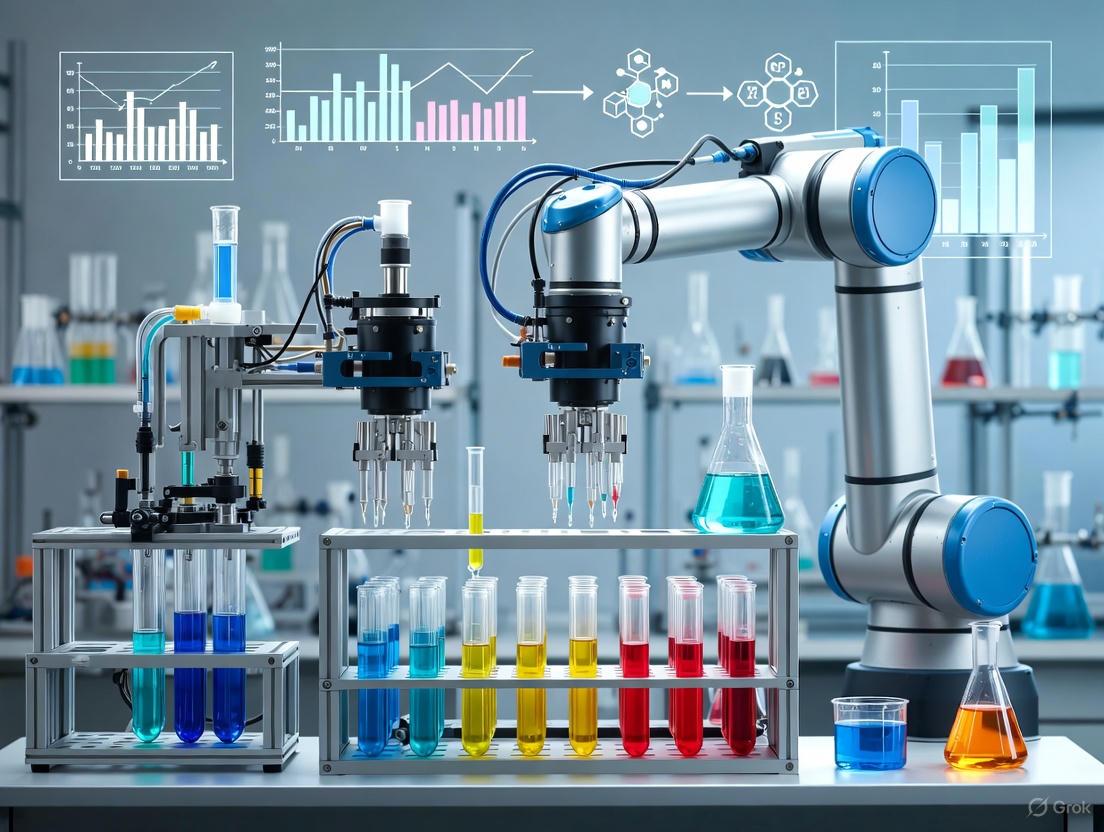
This article explores the transformative impact of modular robotic workflows on modern chemical synthesis, particularly in pharmaceutical research and development.
Modular Robotic Workflows for Chemical Synthesis: Accelerating Discovery from Bench to Clinic
Abstract
This article explores the transformative impact of modular robotic workflows on modern chemical synthesis, particularly in pharmaceutical research and development. It details how these systems, which integrate mobile robots, automated synthesizers, and orthogonal analytical techniques like UPLC-MS and NMR, are creating autonomous discovery environments. The content covers the foundational principles of platforms like the Chemputer and mobile robotic chemists, their application in complex tasks from molecular machine synthesis to drug candidate screening, and the critical challenges of integration and data management. By presenting validation metrics that demonstrate enhanced reproducibility and a 12-fold increase in weekly reaction output, this article provides a comprehensive resource for scientists and professionals aiming to implement and optimize these technologies to compress R&D timelines and improve success rates in drug discovery.
The Foundations of Autonomous Chemistry: What are Modular Robotic Workflows?
Defining Modular Robotic Workflows in Chemical Synthesis
Modular robotic workflows represent a transformative approach in modern chemical synthesis, moving beyond simple automation to create integrated systems capable of autonomous decision-making. Unlike traditional automated platforms that rely on bespoke, hard-wired equipment, modular systems use free-roaming mobile robots to connect physically separated synthesis and analysis modules [1]. This architecture allows robots to operate standard laboratory equipment, sharing infrastructure with human researchers without requiring extensive redesign or monopolizing instruments [2] [1]. The core principle involves partitioning the laboratory into specialized modules for synthesis, analysis, and decision-making, with mobile robots providing the physical linkage through sample transportation and handling [1]. This paradigm is particularly valuable for exploratory synthesis where outcomes are not predefined, as it enables multimodal characterization data from orthogonal techniques to inform subsequent synthetic steps through heuristic decision-making algorithms [1].
Table 1: Performance Metrics of Documented Modular Robotic Workflows
| Platform / Study | Synthetic Focus | Workflow Scale | Key Analytical Techniques | Reported Performance |
|---|---|---|---|---|
| Chemputer [3] [4] | Molecular machine ([2]rotaxane) synthesis | 4-step divergent synthesis; ~800 base steps over 60 hours [3] | On-line NMR, Liquid Chromatography [3] | Automated yield determination & purification; analytical scale output [3] |
| Mobile Robotic Platform [1] | Exploratory synthesis (structural diversification, supramolecular, photochemical) | Parallel synthesis with autonomous decision-making | UPLC-MS, Benchtop NMR (80-MHz) [1] | Human-like decision-making; equipment sharing without redesign [1] |
| Mobile Process Chemist [2] | Process chemistry (paracetamol demonstration) | Back-to-back experiments over 21 hours | UHPLC-MS [2] | 12x weekly output vs. human chemist; matching human yield/purity [2] |
Detailed Experimental Protocols
Protocol: Autonomous Multi-step Synthesis of Functional Molecular Machines
Application Note: This protocol details the automated synthesis of [2]rotaxanes using the Chemputer platform, demonstrating capability for complex molecular architecture construction with minimal human intervention [3] [4].
Workflow Overview: The synthetic sequence involves a divergent four-step synthesis with integrated purification, averaging 800 base steps executed over 60 hours [3] [4].
Equipment Configuration:
- Chemputer robotic synthesis platform
- On-line NMR spectrometer for real-time reaction monitoring
- Liquid chromatography system for separation and analysis
- Automated column chromatography modules (silica gel and size exclusion) [3]
Step-by-Step Procedure:
- Reaction Setup: The Chemputer initializes the synthesis by preparing starting materials in appropriate solvents under controlled atmosphere.
- Reaction Execution: The platform executes the multi-step synthetic sequence with precise temperature and addition rate control.
- Real-time Monitoring: On-line NMR spectroscopy dynamically monitors reaction progression, providing feedback for process adjustment [3].
- Yield Determination: Automated yield calculation occurs via on-line ¹H NMR analysis at critical synthetic stages [3].
- Purification: The system performs automated purification using multiple column chromatography techniques (silica gel and size exclusion) [3].
- Product Isolation: Final products are isolated on analytical scale for feasibility studies and characterization.
Critical Parameters:
Protocol: Exploratory Synthesis Using Mobile Robotic Agents
Application Note: This protocol enables exploratory chemical synthesis for applications including structural diversification, supramolecular host-guest chemistry, and photochemical synthesis using mobile robots [1].
Workflow Overview: Mobile robots transport samples between synthesis and analysis modules, with heuristic decision-making determining subsequent synthetic steps based on orthogonal analytical data [1].
Equipment Configuration:
- Chemspeed ISynth synthesizer or equivalent automated synthesis platform
- Two mobile robotic agents with specialized grippers
- UPLC-MS system for separation and mass analysis
- Benchtop NMR spectrometer (80-MHz)
- Central control software for workflow orchestration [1]
Step-by-Step Procedure:
- Synthesis Initiation: The automated synthesis platform performs parallel reactions based on initial experimental design.
- Sample Aliquoting: Post-synthesis, the platform reformats reaction mixtures into separate aliquots for MS and NMR analysis.
- Robot Dispatch: Mobile robots are dispatched to transport samples to appropriate analytical instruments.
- Autonomous Analysis: Python scripts control autonomous data acquisition on UPLC-MS and NMR instruments.
- Data Processing: Analytical data is saved to a central database and processed by the heuristic decision-maker.
- Decision Implementation: The system automatically determines which reactions to scale up or elaborate based on pass/fail criteria for both analytical techniques.
- Reproducibility Checking: The platform automatically checks reproducibility of screening hits before scale-up.
Critical Parameters:
Diagram 1: Modular exploratory synthesis workflow with mobile robots (76 characters)
The Scientist's Toolkit: Essential Research Reagent Solutions
Table 2: Key Research Reagent Solutions for Modular Robotic Synthesis
| Reagent/Instrument | Function/Role | Application Notes |
|---|---|---|
| Chemputer Platform [3] [4] | Universal chemical robotic synthesis | Executes complex synthetic sequences (e.g., 800+ steps) via XDL programming [3] |
| Mobile Robotic Agents [1] | Sample transport and equipment operation | Interface with unmodified laboratory equipment; anthropomorphic manipulation capabilities [1] |
| On-line NMR Spectroscopy [3] | Real-time reaction monitoring and yield determination | Provides dynamic feedback for process adjustment; enables autonomous yield calculation [3] |
| UPLC-MS/UHPLC-MS [2] [1] | Product separation, identification, and purity assessment | Orthogonal technique to NMR; provides molecular weight and purity data [1] |
| Heuristic Decision-Maker [1] | Autonomous data interpretation and workflow direction | Processes multimodal analytical data to determine subsequent synthetic steps [1] |
| Automated Chromatography Systems [3] | Product purification between synthetic steps | Includes silica gel and size exclusion techniques for automated purification [3] |
Workflow Architecture and System Integration
Diagram 2: Three-layer architecture for modular synthesis (57 characters)
Application Notes
The integration of mobile robots, automated synthesis platforms, and orthogonal analytics is establishing a new paradigm for modular robotic workflows in chemical and materials research. This triad of core components enables closed-loop, autonomous experimentation that enhances reproducibility, accelerates discovery, and frees researchers from labor-intensive tasks [3] [1]. These systems are particularly transformative for complex synthetic domains such as molecular machines, supramolecular chemistry, and nanomaterial development, where traditional trial-and-error methods are often a major bottleneck [3] [5] [6].
A principal advantage of this modular approach is its ability to be deployed within existing laboratory infrastructure. Unlike bespoke, hardwired automation, mobile robotic agents can transport samples between stand-alone, commercially available instruments, allowing them to share space and equipment with human researchers without requiring extensive facility redesign [1] [2]. This workflow mirrors human experimental protocols—synthesizing molecules, preparing samples for analysis, using multiple characterization techniques to obtain conclusive results, and making informed decisions on the next steps—but executes it with machine precision and continuous operation [1].
The critical intelligence of this workflow is delivered by orthogonal analytics, where multiple analytical techniques are used to cross-validate experimental outcomes. This is a key feature of human experimentation, and its automation is vital for reliable autonomous discovery. For instance, combining Ultra-High-Performance Liquid Chromatography-Mass Spectrometry (UHPLC-MS) with benchtop Nuclear Magnetic Resonance (NMR) spectroscopy provides independent data on molecular mass and structure, greatly reducing the uncertainty inherent in relying on a single measurement technique [1] [7]. This multi-faceted data is then processed by heuristic or AI-driven decision-makers that can navigate complex, open-ended research problems, such as identifying successful supramolecular assemblies or optimizing nanoparticle synthesis [1] [6].
Table 1: Representative Modular Robotic Platforms for Chemical Synthesis
| Platform Name / Type | Core Function | Integrated Analytical Techniques | Reported Application |
|---|---|---|---|
| Chemputer [3] [8] | Programmable robotic synthesis | On-line NMR, Liquid Chromatography | Synthesis of [2]rotaxane molecular machines |
| Mobile Robot Workflow [1] | Exploratory synthetic chemistry | Benchtop NMR, UPLC-MS | Supramolecular host-guest chemistry, structural diversification |
| Mobile Robotic Process Chemist [2] | Process chemistry development | UHPLC-MS | Scalable synthesis (e.g., paracetamol) |
| AI-driven PAL Platform [6] | Nanomaterial synthesis & optimization | UV-vis spectroscopy, TEM (targeted sampling) | Optimization of Au nanorods, Ag nanocubes |
Experimental Protocols
Protocol: Autonomous Multi-Step Synthesis and Analysis of Urea/Thiourea Library
This protocol adapts a workflow for the autonomous structural diversification of organic molecules, demonstrating a closed-loop design-make-test-analyze cycle [1].
Experimental Setup and Reagents
- Synthesis Module: A Chemspeed ISynth synthesizer or equivalent automated synthesis platform.
- Mobile Robotics: One or more mobile robots equipped with anthropomorphic grippers for sample vial transport.
- Analytical Modules:
- Ultra-High-Performance Liquid Chromatography-Mass Spectrometer (UHPLC-MS)
- Benchtop NMR Spectrometer (e.g., 80 MHz)
- Software: Central control software to orchestrate the workflow and a heuristic decision-making algorithm.
- Reagents:
- Alkyne Amines: 1-Aminopentyne (1), 1-Aminodecyne (2), 1-Aminopentadecyne (3).
- Electrophiles: Phenyl isothiocyanate (4), Phenyl isocyanate (5).
- Solvents: Anhydrous dimethylformamide (DMF) or dichloromethane (DCM).
Procedure
Synthesis Program Initiation:
- The host computer instructs the Chemspeed ISynth to initiate a parallel synthesis. The platform autonomously executes the combinatorial condensation of the three alkyne amines (1-3) with the two electrophiles (4-5) to attempt the synthesis of three ureas and three thioureas.
- Reactions are performed under an inert atmosphere in appropriate solvents.
Sample Aliquoting and Reformating:
- Upon completion of the prescribed reaction time, the ISynth synthesizer automatically takes an aliquot from each of the six reaction mixtures.
- Each aliquot is reformatted into separate vials specifically configured for MS and NMR analysis.
Robotic Sample Transport:
- A mobile robot collects the prepared sample vials from the ISynth platform.
- The robot transports the vials to the locations of the UPLC-MS and benchtop NMR spectrometers, placing them in the appropriate autosamplers.
Orthogonal Analysis:
- The UPLC-MS and NMR instruments autonomously run their predefined methods for sample analysis.
- UPLC-MS data (retention time, mass) and ¹H NMR spectra are automatically saved to a central database.
Heuristic Decision-Making:
- The decision-making algorithm processes the data from both analytical techniques, applying pre-defined, experiment-specific pass/fail criteria (e.g., presence of a mass ion for the expected product, appearance of characteristic NMR peaks).
- Reactions that pass both the UPLC-MS and NMR criteria receive a binary "pass" and are selected for the next stage of synthesis.
- The algorithm sends instructions back to the ISynth platform to scale up the successful reactions for further elaboration in a divergent synthesis.
Iteration:
- The workflow (synthesis → analysis → decision → next synthesis) repeats autonomously for the subsequent synthetic step, with minimal human intervention required beyond restocking reagents and managing waste.
Protocol: Autonomous Optimization of Au Nanorod Synthesis using an AI-Driven Platform
This protocol details a closed-loop workflow for the optimization of nanomaterial synthesis parameters using an AI-guided robotic platform [6].
Experimental Setup and Reagents
- Synthesis & Analysis Platform: A commercial "Prep and Load" (PAL) system equipped with:
- Z-axis robotic arms and pipettes.
- Agitators for mixing.
- Integrated UV-vis spectrophotometer.
- AI Modules: A literature mining module using a GPT model and an optimization module using the A* search algorithm.
- Reagents:
- Gold Seed Solution: Chloroauric acid (HAuCl₄), sodium borohydride (NaBH₄), and cetyltrimethylammonium bromide (CTAB) in water.
- Growth Solution: HAuCl₄, CTAB, silver nitrate (AgNO₃), and ascorbic acid.
Procedure
Literature Mining and Initial Method Generation:
- The user queries the integrated GPT model with a natural language request for Au nanorod synthesis methods.
- The model returns a suggested synthesis procedure based on its training from a database of scientific literature.
Script Editing and Experiment Initiation:
- The user edits the platform's automation script (mth file) based on the suggested procedure or directly calls an existing execution file.
- The PAL platform is initialized with the starting parameters (concentrations, volumes, timing).
Automated Synthesis and In-line Characterization:
- The PAL system autonomously prepares the seed and growth solutions in separate vials according to the script.
- The robotic arm mixes the solutions to initiate nanorod growth and transfers the reaction mixture to the integrated UV-vis spectrometer for characterization.
- The UV-vis spectrum, including the Longitudinal Surface Plasmon Resonance (LSPR) peak and Full Width at Half Maxima (FWHM), is automatically saved.
AI-Driven Parameter Optimization:
- The synthesis parameters and the resulting UV-vis data are fed as input to the A* algorithm.
- The A* algorithm, functioning as a heuristic search tool, processes this data and proposes a new set of optimized synthesis parameters for the next experiment.
- This proposal is based on minimizing the difference between the measured LSPR peak and the target wavelength (e.g., between 600-900 nm).
Closed-Loop Iteration:
- The platform automatically begins the next synthesis experiment using the updated parameters.
- The cycle of synthesis → UV-vis characterization → A* algorithm analysis → parameter update continues autonomously until the synthesized Au nanorods meet the target specifications (e.g., LSPR peak within 1-2 nm of the target with a narrow FWHM).
Validation:
- At key milestones, the system can be programmed to perform targeted sampling, where a sample is prepared for ex-situ analysis by Transmission Electron Microscopy (TEM) to visually confirm nanorod morphology and size distribution.
Workflow and Relationship Visualization
Autonomous Chemical Synthesis Workflow
Orthogonal Analytics Data Integration
Research Reagent Solutions
Table 2: Essential Reagents and Materials for Modular Robotic Synthesis
| Reagent / Material | Function in Workflow | Example Application |
|---|---|---|
| Alkyne Amines & Isocyanates [1] | Building blocks for combinatorial library synthesis | Parallel synthesis of ureas and thioureas for structural diversification. |
| Macrocyclic Templates & Axle Precursors [3] | Components for complex molecular architecture | Automated multi-step synthesis of [2]rotaxane molecular machines. |
| Chloroauric Acid (HAuCl₄) & Cetyltrimethylammonium Bromide (CTAB) [6] | Metal precursor and shape-directing surfactant | Optimization of gold nanorod synthesis in a closed-loop AI-driven platform. |
| Strained Alkyne Reagents (e.g., for SPAAC) [9] [7] | Bioorthogonal reaction components | Strain-promoted azide-alkyne cycloaddition for polymer functionalization and bioconjugation. |
| Specialized Solvents | Reaction medium; must be compatible with robotic fluidic systems | Used across all synthetic protocols in automated platforms. |
| Deuterated Solvents (e.g., CDCl₃, DMSO-d₆) | Solvent for NMR spectroscopy analysis | Essential for online or offline NMR characterization of reaction outcomes [1]. |
The Shift from Fixed Automation to Flexible, Modular Systems
The field of chemical synthesis is undergoing a significant transformation, moving away from rigid, bespoke automated systems towards flexible, modular robotic workflows. This paradigm shift enables unprecedented levels of productivity, reproducibility, and exploration in chemical research and drug development. Unlike traditional fixed automation that operates in self-contained, instrument-specific environments, modern modular systems leverage mobile robotic agents and distributed instrumentation that can be shared between automated workflows and human researchers without requiring extensive laboratory redesign [1]. This approach more closely mimics human experimental protocols while achieving a level of consistency and throughput unattainable through manual processes. The core advantage lies in the system's inherent expandability—there is no fundamental limit to the number of instruments that can be incorporated other than those imposed by laboratory space [1]. This document provides detailed application notes and experimental protocols for implementing such modular systems in chemical synthesis research, with particular emphasis on pharmaceutical applications.
Key Research Applications and Quantitative Outcomes
Modular robotic systems have demonstrated significant advancements across multiple domains of chemical synthesis. The table below summarizes key experimental applications and their quantitative outcomes, highlighting the versatility and performance of these systems.
Table 1: Performance Outcomes of Modular Robotic Workflows in Chemical Synthesis
| Application Domain | Specific Workflow | Key Quantitative Results | Decision-Making Basis |
|---|---|---|---|
| Structural Diversification Chemistry | Parallel synthesis of ureas and thioureas followed by divergent synthesis [1] | Successful autonomous multi-step synthesis; Reproducibility checks passed before scale-up [1] | Binary pass/fail grading from both UPLC-MS and 1H NMR analysis [1] |
| Supramolecular Host-Guest Chemistry | Autonomous identification of supramolecular assemblies with functional binding properties [1] | Identification of successful host-guest systems; Extended to autonomous function assays [1] | Heuristic analysis of orthogonal UPLC-MS and NMR data [1] |
| Photochemical Synthesis | Integration of commercial photoreactor into modular workflow [1] | Expansion of reaction scope without physical reconfiguration of core system [1] | Context-based decisions on which data streams to focus on [1] |
| Molecular Machine Synthesis | Divergent four-step synthesis and purification of molecular rotaxane architectures [8] | Averaged 800 base steps over 60 hours; Products on analytical scale for feasibility studies [8] | Autonomous feedback through on-line NMR and liquid chromatography [8] |
| Pharmaceutical Production | End-to-end multistep synthesis of diphenhydramine hydrochloride [10] | Completed within 15 minutes (compared to 5 hours in batch process) [10] | Digital recipes with machine-powered learning and AI-driven route planning [10] |
| Process Chemistry | Automated paracetamol synthesis experiment [2] | 12x potential weekly reaction output compared to human chemist; Matching human performance in yield and purity [2] | UHPLC-MS product analysis guiding reactor cleaning and subsequent runs [2] |
Detailed Experimental Protocols
Protocol: Modular Workflow for Exploratory Synthetic Chemistry
This protocol outlines the procedure for conducting exploratory synthesis using a modular robotic system, based on the workflow demonstrated for supramolecular chemistry and structural diversification [1].
Materials and Equipment
- Chemspeed ISynth synthesizer or equivalent automated synthesis platform
- Mobile robotic agents with multipurpose grippers
- UPLC-MS system
- Benchtop NMR spectrometer (80 MHz)
- Central database for data aggregation
- Python scripts for automated data acquisition
- Laboratory consumables (standard format)
Procedure
- Reaction Setup and Initial Synthesis
- Program the Chemspeed ISynth platform to perform the desired parallel syntheses using combinatorial condensation of starting materials.
- Utilize the platform's gravimetric solid handling (μg to g) and gravimetric liquid handling (μL to mL) capabilities for reagent dispensing.
- Employ glass reactor arrays with screwless self-sealing opening/closing, with mixing by shaking (up to 1,000 rpm), heating (up to 150°C), and cooling (-20°C) as required [11].
Sample Aliquot and Reformating
- Upon reaction completion, command the ISynth synthesizer to take aliquots of each reaction mixture.
- Reformate samples separately for MS and NMR analysis using the platform's liquid handling capabilities.
Mobile Robot-Mediated Sample Transport
- Dispatch mobile robots to retrieve sample containers from the ISynth platform through automated doors equipped with electric actuators.
- Transport samples to the UPLC-MS system and benchtop NMR spectrometer located elsewhere in the laboratory.
- For systems with multiple robots, coordinate tasks to avoid instrument conflicts; single-robot systems utilize multipurpose grippers for all operations [1].
Orthogonal Analytical Characterization
- Initiate UPLC-MS analysis through customizable Python scripts, saving data to the central database.
- Perform 1H NMR analysis using standard parameters appropriate for the chemical system under investigation.
- Ensure all analytical instruments remain available for shared use by human researchers between measurements.
Heuristic Decision-Making Process
- Process UPLC-MS and NMR data through an algorithmic decision-maker implementing experiment-specific pass/fail criteria.
- Apply binary grading to each analytical technique independently, then combine results for a pairwise binary grading for each reaction.
- For reactions passing both orthogonal analyses, proceed to scale-up or subsequent synthetic steps.
- For supramolecular systems, extend analysis to include autonomous function assays for host-guest binding properties.
Iterative Synthesis and Optimization
- Based on decision-maker output, program subsequent reactions in the Chemspeed ISynth platform.
- Implement reproducibility checks for screening hits before commit to scale-up.
- Continue cycles of synthesis-analysis-decision until project endpoints are reached.
Protocol: Automated Multi-Step Synthesis of Molecular Machines
This protocol specifies the procedure for synthesizing functional molecular machines using a universal chemical robotic synthesis platform (Chemputer) [8].
Materials and Equipment
- Chemputer synthesis platform
- On-line NMR spectrometer
- Liquid chromatography system (silica gel and size exclusion)
- Purification modules
- Digital control software
Procedure
- Reaction Pathway Programming
- Design a divergent four-step synthesis pathway for target molecular architectures.
- Program the base steps (approximately 800 steps over 60 hours) into the Chemputer control software.
Synthesis with On-line Analysis
- Initiate the first synthetic step under automated control.
- Implement on-line 1H NMR at predetermined points for yield determination.
- Use real-time analytical data to trigger subsequent synthetic steps.
Automated Purification
- Upon reaction completion, direct crude products to appropriate purification modules.
- Employ multiple column chromatography techniques (silica gel and size exclusion) based on compound characteristics.
- Monitor purification efficiency through integrated analytical capabilities.
Product Characterization and Isolation
- Analyze purified products using on-line characterization methods.
- Direct successful syntheses to collection vessels for further study.
- Scale production to analytical levels suitable for feasibility assessments.
Workflow Visualization
Modular Robotic Chemical Synthesis Workflow
Analytical Decision-Making Logic
The Scientist's Toolkit: Essential Research Reagent Solutions
Table 2: Essential Components for Modular Robotic Synthesis Workflows
| Component | Specification | Function in Workflow |
|---|---|---|
| Automated Synthesis Platform | Chemspeed ISynth with deck modularity [11] | Provides versatile reaction execution including multistep synthesis, work-up, purification, and analysis in fully automated fashion |
| Mobile Robotic Agents | Free-roaming robots with multipurpose grippers [1] | Physical linkage between modules; handles sample transportation and instrument operation without laboratory redesign |
| Orthogonal Analysis Instruments | UPLC-MS and benchtop NMR (80 MHz) [1] | Provides complementary characterization data mimicking human researcher approach to unambiguous identification |
| Modular Reactor Arrays | Disposable glass reactors with screwless self-sealing [11] | Enables various synthesis workflows at scales from μL to mL with heating, cooling, mixing, and special operations |
| Heuristic Decision Software | Customizable Python scripts with experiment-specific criteria [1] | Processes multimodal analytical data to autonomously determine subsequent synthesis steps without human intervention |
| Central Data Management System | Database aggregating all experimental and analytical data [1] | Stores digital recipes, experimental parameters, and outcomes for reproducibility and machine learning applications |
| Integrated Purification Modules | Multiple column chromatography techniques (silica gel, size exclusion) [8] | Provides automated purification capabilities essential for multi-step syntheses and functional molecule production |
The convergence of robotics, artificial intelligence (AI), and sophisticated digital-physical interfaces is establishing a new paradigm in chemical synthesis research. These technologies are coalescing into modular robotic workflows that transform laboratories from manual, artisanal operations into automated, data-rich discovery environments. This shift addresses critical limitations in traditional chemical research, including labor-intensive processes, challenges in reproducibility, and the inherent physical and cognitive constraints of human researchers [3] [1]. By creating closed-loop systems where AI-driven software plans experiments, robotic hardware executes them, and integrated analytics provide real-time feedback, these platforms accelerate the design-make-test-analyze cycle. This article details the specific enabling technologies behind this transformation, provides application notes on their implementation, and outlines standardized protocols for their use in advanced chemical synthesis, particularly within drug development and functional molecule production.
Technology Platforms & System Architectures
Recent advancements have produced several distinct but complementary architectural models for autonomous chemical synthesis. The table below summarizes the core specifications of three leading platforms.
Table 1: Comparison of Key Autonomous Chemical Synthesis Platforms
| Platform Name | System Architecture | Core Analytical Techniques | AI/Decision-Making Layer | Reported Synthesis Scale & Duration |
|---|---|---|---|---|
| Chemputer [3] [8] | Universal chemical robotic synthesis platform; Modular fluidic & purification modules | On-line 1H NMR, Liquid Chromatography | Chemical description language (XDL) for standardized, reproducible protocols | Analytical scale; ~800 base steps over 60 hours |
| Mobile Robotic Chemist [1] | Distributed modules linked by free-roaming mobile robots | Benchtop NMR, UPLC-MS | Heuristic decision-maker processing orthogonal NMR & MS data | Not Specified |
| Synbot [12] | Integrated batch reactor system with dedicated modules (pantry, dispensing, reaction, etc.) | Liquid Chromatography-Mass Spectrometer (LC-MS) | Hybrid dynamic optimization (HDO) combining Message-Passing Neural Networks (MPNNs) & Bayesian Optimization (BO) | Validated on three organic compounds; outperformed reference conversion rates |
Workflow Visualization
The following diagram illustrates the typical closed-loop workflow of an autonomous robotic chemistry platform, integrating the AI planning, robotic execution, and analytical feedback components.
Application Notes: Implementation & Performance
Implementation of Key Technologies
a) The Chemputer for Molecular Machine Synthesis: The Chemputer platform demonstrates the automation of complex, multi-step syntheses, specifically for [2]rotaxane-based molecular machines. Its key innovation lies in integrating online 1H NMR and liquid chromatography to provide dynamic, real-time feedback on reaction progression and purity. This allows the system to adjust process conditions autonomously, moving beyond simple pre-programmed instruction sets to a responsive synthesis strategy. The platform uses the chemical description language XDL to codify the synthetic procedure, which enhances reproducibility and allows protocols to be shared digitally and executed reliably on different Chemputer systems across locations [3].
b) Mobile Robots for Exploratory Synthesis: This architecture leverages one or more mobile robots to interconnect standalone, unmodified laboratory instruments—such as a Chemspeed ISynth synthesizer, a UPLC-MS, and a benchtop NMR—into a cohesive autonomous workflow. The mobility and dexterity of the robots allow them to operate equipment designed for human use, enabling integration into existing laboratory infrastructure without costly customizations. This system is particularly suited for exploratory chemistry, where multiple potential products can arise. Its heuristic decision-maker is designed to process orthogonal data from NMR and MS analyses, mimicking a human researcher's decision to "pass" or "fail" a reaction and select promising candidates for further investigation or scale-up [1].
c) AI-Driven Optimization with Synbot: Synbot features a sophisticated three-layer architecture (AI S/W, Robot S/W, and Robot layer) designed for full autonomy from planning to execution. Its AI layer employs a collaborative retrosynthesis approach and a Hybrid Dynamic Optimization (HDO) model. The HDO model associates Message-Passing Neural Networks (MPNNs)—which exploit prior knowledge from chemical databases—with Bayesian Optimization (BO) to handle novel or rare synthetic tasks. This allows the system to harmoniously balance the exploitation of known data with the exploration of new reaction spaces, dynamically optimizing recipes based on experimental feedback [12].
Quantitative Performance Data
The performance of these systems is quantified not just by synthesis success but also by gains in efficiency and throughput.
Table 2: Documented Performance Metrics of Autonomous Systems
| Performance Metric | Chemputer [3] | Mobile Robotic Chemist [1] [2] | Synbot [12] |
|---|---|---|---|
| Synthetic Reproducibility | Standardized via XDL language | Matches human chemist performance in yield & purity | Outperformed reference conversion rates |
| Operational Scale | Analytical scale (feasibility studies) | Process scale (pharmaceutical development) | Not Specified |
| Throughput / Efficiency | Autonomous execution of 800-step sequence | Potential for 12x weekly output vs. human chemist | Autonomous determination of optimal recipes |
| Key Demonstrated Output | Functional [2]rotaxanes | Pharmaceutical compounds (e.g., Paracetamol), supramolecular assemblies | Three optimized organic compounds |
Experimental Protocols
Protocol: Autonomous Multi-Step Synthesis of a [2]Rotaxane on the Chemputer Platform
Objective: To autonomously execute the divergent four-step synthesis and purification of a [2]rotaxane molecular architecture with minimal human intervention.
I. Reagent and Equipment Setup
Table 3: Research Reagent Solutions & Essential Materials
| Item Name | Function / Description | Notes |
|---|---|---|
| Pre-cursor Molecules | Building blocks for rotaxane synthesis | Typically amine-functionalized threads and macrocycles. |
| Anhydrous Solvents | Reaction medium | e.g., DCM, DMF; stored in air-tight, septum-capped bottles on the platform. |
| Purification Columns | Product isolation and purification | Includes both silica gel and size exclusion columns. |
| Chemputer Platform | Automated synthesis robot | Comprises fluidic modules, reaction vessels, and solid-phase extraction units. |
| On-line 1H NMR | Real-time reaction monitoring | Provides dynamic feedback on reaction progression. |
| Liquid Chromatograph | Purity analysis | Used in-line for quality control during and after synthesis. |
II. Procedure
System Initialization:
- Power on all modules of the Chemputer and the connected analytical instruments (NMR, LC).
- Prime all fluidic lines with the appropriate solvents.
- Load the XDL script detailing the synthetic sequence for the target [2]rotaxane.
Synthetic Execution:
- The platform autonomously dispenses pre-cursors and solvents into the designated reaction vessel.
- The reaction mixture is stirred and heated according to the XDL protocol.
- The on-line 1H NMR probe periodically monitors reaction progress. The software analyzes spectra in real-time to determine conversion.
Dynamic Feedback & Control:
- Based on the real-time NMR data, the system can dynamically adjust process conditions (e.g., extend reaction time, add more reagent) to drive the reaction to completion.
Work-up and Purification:
- Upon reaction completion (as determined by NMR), the platform automatically directs the crude mixture through a series of purification columns (e.g., silica gel, size exclusion).
- The liquid chromatograph monitors eluent streams to identify and isolate the product fraction.
Product Isolation:
- The purified product solution is collected in a designated vial. The system may initiate solvent evaporation under reduced pressure.
- The final product is analyzed by LC-MS and NMR for confirmation of structure and purity.
III. Data Analysis and Output
- The system logs all operational parameters, analytical data, and decisions made during the process.
- The yield is determined via on-line 1H NMR quantification.
- The purity is assessed from the LC chromatogram. The entire sequence, averaging 800 base steps over 60 hours, is completed autonomously [3] [8].
Protocol: Exploratory Synthesis & Screening Using a Mobile Robotic Workflow
Objective: To autonomously perform a screen of synthetic reactions, identify successful products via orthogonal analytics, and scale-up promising hits.
I. Reagent and Equipment Setup
- Reagents: A library of building blocks (e.g., alkyne amines 1-3, isothiocyanate 4, isocyanate 5 for urea/thiourea synthesis) [1].
- Synthesis Module: A Chemspeed ISynth or equivalent automated synthesizer.
- Analytical Modules: UPLC-MS and a benchtop NMR spectrometer.
- Mobile Robot(s): Fitted with a gripper for transporting sample vials between modules.
II. Procedure
Parallel Synthesis:
- The ISynth platform is instructed to perform a combinatorial array of reactions from the building block library.
Sample Reformating and Transport:
- Upon completion of the reaction time, the ISynth automatically aliquots each reaction mixture into separate vials for MS and NMR analysis.
- A mobile robot collects the vials and transports them to the UPLC-MS and NMR instruments.
Orthogonal Analysis:
- The UPLC-MS and NMR instruments run pre-defined methods to analyze the samples. Data is automatically saved to a central database.
Heuristic Decision-Making:
- The decision-making algorithm analyzes the UPLC-MS and NMR data for each reaction.
- Based on pre-set, chemistry-specific pass/fail criteria (e.g., presence of a molecular ion peak in MS, characteristic proton shifts in NMR), each reaction is assigned a binary grade.
- Reactions that pass both analyses are flagged as "successful hits."
Scale-up and Diversification:
- The system automatically instructs the synthesis module to scale up the successful reactions.
- These scaled-up products can then be used as precursors for a subsequent round of divergent synthesis, restarting the cycle from step 1.
III. Data Analysis and Output
- The heuristic decision-maker provides a list of successful reactions and excludes failures.
- The system automatically checks the reproducibility of any screening hits before they are scaled up [1].
The Scientist's Toolkit: Essential Materials & Reagents
The following table details key reagents and solutions commonly used in the automated synthesis experiments cited.
Table 4: Key Research Reagent Solutions for Automated Synthesis
| Reagent/Solution Name | Function in the Experimental Workflow | Example Use-Case |
|---|---|---|
| Alkyne Amines (e.g., 1-3) | Amine-containing building blocks with alkyne functional handle for diversification. | Combinatorial condensation with iso(thio)cyanates to form ureas/thioureas [1]. |
| Isothiocyanate (4) & Isocyanate (5) | Electrophilic coupling partners for amines. | Used in parallel synthesis with amine building blocks to create a library of derivatives [1]. |
| Rotaxane Pre-cursors | Molecular components for constructing interlocked architectures. | Thread-like molecules and crown-ether-like macrocycles for automated rotaxane synthesis [3]. |
| Chromatography Supplies | Separation and purification of reaction products. | Silica gel and size exclusion columns for automated purification post-synthesis [3]. |
Implementing Modular Robotics: From Molecular Machines to Drug Candidates
The precise assembly of molecular machines represents a frontier in nanotechnology, promising structures with unparalleled complexity and function. However, the labor-intensive nature of their synthesis critically limits scalability and innovation [3]. This application note details a case study on employing a universal chemical robotic synthesis platform, the Chemputer, to autonomously produce functional molecular machines, specifically [2]rotaxanes [3] [8]. The content is framed within a broader thesis on modular robotic workflows, demonstrating how such integrated systems can overcome key bottlenecks in chemical synthesis research, enhance reproducibility, and free researchers from repetitive manual tasks for more exploratory work [3].
Experimental Setup & Modular Workflow
The autonomous synthesis was executed using a programmable modular robotic platform. This system integrates automated synthesis units with analytical instruments through a digital control language, XDL (Chemical Description Language), which affords synthetic reproducibility and standardization [3].
Key Research Reagent Solutions
The following table details the essential materials and their functions central to the autonomous synthesis of [2]rotaxanes.
Table 1: Key Research Reagent Solutions for Rotaxane Synthesis
| Item | Function / Role in Synthesis |
|---|---|
| Chemical Building Units (CBUs) | Fundamental chemical entities (e.g., metal clusters, ligands) that serve as the molecular components for constructing the rotaxane architecture [13]. |
| Generic Building Units (GBUs) | Define the geometric roles and spatial arrangement for the assembly of components, guiding the topological compatibility of the final structure [13]. |
| XDL (Chemical Description Language) | A standardized digital language that programs and controls the synthetic sequence, ensuring reproducibility and precise execution of complex procedures [3]. |
| On-line NMR Spectrometer | Provides real-time, autonomous feedback for in-situ reaction monitoring and yield determination, crucial for dynamic process adjustment [3] [8]. |
| On-line Liquid Chromatograph | Works in concert with NMR for real-time analysis and facilitates product purification via automated column chromatography techniques (e.g., silica gel, size exclusion) [3] [8]. |
Modular Robotic Workflow Architecture
The synthesis follows a "design-make-test-analyze" cycle within a modular framework. The physical linkage between synthesis and analysis modules is achieved using mobile robots, which transport samples and operate equipment, emulating human scientists and allowing for flexible use of existing laboratory instrumentation [1]. The entire process is orchestrated by a central control system.
The diagram below illustrates the logical flow and relationships within this autonomous workflow.
Detailed Experimental Protocol
This section provides the step-by-step methodology for the autonomous synthesis of [2]rotaxanes.
Protocol: Autonomous Four-Step Synthesis of [2]Rotaxanes
Objective: To autonomously execute a divergent four-step synthesis and purification of [2]rotaxane architectures using a modular robotic platform with real-time analytical feedback.
Materials:
- Chemputer robotic synthesis platform [3]
- On-line ( ^1 \text{H} ) NMR spectrometer [3] [8]
- On-line liquid chromatograph (LC) [3] [8]
- Integrated purification modules (silica gel and size exclusion chromatography) [3]
- Required chemical reagents and solvents (as specified by the target rotaxane's XDL protocol)
Procedure:
System Initialization and Protocol Upload:
- Initialize the Chemputer platform and all connected analytical modules.
- Upload the XDL script defining the complete four-step synthetic sequence for the target [2]rotaxane. The XDL protocol averages 800 base steps, detailing every operation from reagent addition to purification [3].
Automated Synthesis Execution:
- The Chemputer autonomously executes the synthetic steps as per the XDL script. This includes:
- Precise dispensing and mixing of reagents.
- Controlling reaction parameters (temperature, stirring, time).
- Transferring reaction mixtures between vessels as required.
- The Chemputer autonomously executes the synthetic steps as per the XDL script. This includes:
Real-Time Reaction Monitoring and Feedback:
- At predefined stages (e.g., after a reaction step is complete), the system automatically routes an aliquot of the reaction mixture to the on-line NMR and LC instruments [3] [8].
- The on-line ( ^1 \text{H} ) NMR provides data for yield determination, while the LC assists in assessing reaction progress and purity [3].
- Critical Decision Point: The control software processes the analytical data in real-time. Based on heuristic algorithms (e.g., yield threshold, purity criteria), the system decides the next action:
Automated Product Purification:
- Upon successful completion of the synthetic sequence, the system directs the crude product to the integrated purification module.
- The platform autonomously performs purification using techniques such as silica gel or size exclusion chromatography, as specified in the XDL protocol [3].
Product Isolation and Shutdown:
- The purified [2]rotaxane product is collected in a designated output vessel.
- The system may perform a final analytical check to confirm product quality.
- The workflow concludes, and the platform can be prepared for the next operation.
Typical Workflow Metrics: The entire synthetic sequence, from start to purified product, averages 60 hours to complete on an analytical scale for feasibility studies [3]. The entire process is designed to proceed with minimal human intervention beyond initial setup and chemical restocking.
Workflow Integration and Material Flow
The following diagram details the physical movement of materials and integration of hardware within the modular laboratory, highlighting the role of mobile robotics.
Results and Performance Data
The autonomous workflow was successfully validated through the synthesis of a series of [2]rotaxanes. The quantitative performance data is summarized below.
Table 2: Quantitative Performance Metrics of Autonomous Synthesis
| Metric | Performance Data / Outcome | Context & Significance |
|---|---|---|
| Synthetic Sequence Complexity | Averaged 800 base steps per full synthesis [3] | Demonstrates the platform's capability to handle highly complex, multi-step procedures beyond manual practicality. |
| Process Duration | Approximately 60 hours per synthetic sequence [3] | Highlights the system's endurance and ability to operate continuously over extended periods without human fatigue. |
| Analytical Integration | Real-time feedback via on-line ( ^1 \text{H} ) NMR and liquid chromatography [3] [8] | Enables dynamic adjustment and yield determination, key for autonomous decision-making. |
| Purification | Automated column chromatography (silica gel and size exclusion) [3] | Addresses a critical bottleneck in autonomous synthesis, delivering purified, functional products. |
| Primary Outcome | Production of functional [2]rotaxanes on an analytical scale [3] [8] | Validates the entire workflow from digital code to a complex, functional molecular machine. |
The field of supramolecular chemistry, which focuses on the non-covalent interactions between molecules to form complex architectures, has emerged as a pivotal platform for the discovery of new functional materials and systems [14]. These chemistries are fundamental to the development of molecular machines—nanoscale devices with exquisite functional properties [8]. However, the synthesis of such sophisticated constructs is often labor-intensive, critically limiting the pace of discovery and development [8]. This case study explores the integration of a programmable modular robotic platform into the exploratory synthesis of supramolecular systems, specifically targeting the synthesis of molecular rotaxanes. We detail the application notes and protocols for employing this unified workflow, which bridges molecular nanotechnology and macroscale chemical processes to enhance reproducibility, reliability, and throughput in chemical research [8].
Application Notes: The Robotic Synthesis Platform
The universal chemical robotic synthesis platform (Chemputer) is a modular system designed for the autonomous synthesis of functional molecular machines [8]. Its core function is to execute complex multi-step synthetic sequences under digital control, unifying the principles of supramolecular chemistry with automated, programmable hardware.
- Key Capabilities: The platform is capable of performing a divergent four-step synthesis and purification sequence, averaging 800 base steps over approximately 60 hours to produce molecular rotaxane architectures on an analytical scale [8].
- Integrated Feedback Systems: A defining feature is the integration of on-line NMR spectroscopy and liquid chromatography for autonomous feedback. This allows for real-time yield determination and process monitoring, addressing significant bottlenecks in autonomous synthesis [8].
- Modular Workflow: The system incorporates a multitasking mobile robot that operates between an automated synthesis reactor and an ultra-high-performance liquid chromatography-mass spectrometer (UHPLC-MS). This robot is responsible for transporting samples and cleaning the reactor between experimental runs, enabling continuous, round-the-clock operation [2]. Its anthropomorphic manipulation capabilities allow it to interface with minimally redesigned, industry-standard equipment, facilitating adoption in shared research environments [2].
Performance metrics indicate that reaction yields and purity achieved with this robotic platform match the performance of a human chemist. Furthermore, its operational efficiency suggests a potential to exceed the weekly reaction output of a human process chemist by a factor of 12 in an industrial setting [2].
Research Reagent Solutions and Essential Materials
The following table details key reagents and materials essential for supramolecular assembly and the described robotic synthesis workflows.
Table 1: Essential Research Reagent Solutions for Supramolecular Chemistry and Robotic Synthesis
| Item Name | Function / Explanation |
|---|---|
| Benzene-1,3,5-tricarboxamide (BTA) | A well-studied supramolecular building block that self-assembles into helical structures via hydrogen bonding, serving as a foundational monomer for creating functional supramolecular polymers and materials [14]. |
| Molecular Machine Precursors | Custom-synthesized organic molecules designed to form specific architectures (e.g., rotaxanes) through non-covalent interactions. Their structure dictates the assembly process and final functional properties of the machine [8]. |
| Orthogonal Self-Assembly Modules | Molecular building blocks programmed with multiple, independent non-covalent interaction sites. These enable the controlled, hierarchical assembly of complex superstructures from simpler components in a single step [14]. |
| Chromatography Materials | Stationary phases such as silica gel and size exclusion media are critical for the automated purification of synthetic products. Their use is integrated into the robotic workflow to isolate desired molecular machines from reaction mixtures [8]. |
| Deuterated Solvents | Essential for on-line NMR analysis, providing the medium for real-time, non-destructive monitoring of reaction progression and yield determination within the autonomous feedback loop [8]. |
Experimental Protocols
Protocol 1: Automated Divergent Synthesis of Molecular Rotaxanes
This protocol describes the automated, multi-step synthesis of molecular rotaxane architectures using the Chemputer platform [8].
I. Pre-Run Setup and System Initialization 1. Reagent Preparation: Load all necessary molecular precursors and solvents into the designated, robot-accessible input modules of the synthesis reactor. 2. System Calibration: Execute calibration routines for all fluidic handling systems, the on-line NMR spectrometer, and the UHPLC-MS. 3. Digital Protocol Upload: Load the machine-readable synthetic sequence (averaging 800 base steps) into the Chemputer's control software.
II. Automated Synthesis Execution 1. Sequence Initiation: Start the programmed synthetic sequence from the control interface. The platform will autonomously handle reagent addition, reaction temperature control, and stirring. 2. On-line Reaction Monitoring: The system will automatically transfer aliquots from the reactor to the on-line NMR at predetermined time points. The collected `H NMR data is analyzed in real-time to determine reaction conversion and yield. 3. Intermediate Handling: Upon reaching a specified conversion threshold (as determined by NMR), the platform will proceed to the next step, which may involve quenching, phase separation, or other work-up procedures.
III. Product Purification and Analysis 1. Automated Purification: Direct the reaction crude to the integrated chromatography system. The method may involve sequential or selective use of silica gel and size exclusion columns to isolate the pure rotaxane product. 2. Final Product Verification: The purified product is automatically transferred to the UHPLC-MS for definitive analysis of chemical identity and purity. 3. Reactor Reset: The mobile robot cleans the synthesis reactor in preparation for the next experimental run.
IV. Data Collection and Output - Primary Data: The system generates a complete digital log of all operations, real-time NMR spectra, and UHPLC-MS chromatograms. - Key Quantitative Data:
Table 2: Quantitative Summary of Automated Rotaxane Synthesis
| Synthesis Metric | Result / Value |
|---|---|
| Total Number of Base Steps | 800 steps [8] |
| Average Total Synthesis Time | 60 hours [8] |
| Scale of Production | Analytical scale [8] |
| Key Analytical Techniques | On-line `H NMR, UHPLC-MS [8] |
| Purification Methods | Silica Gel Chromatography, Size Exclusion Chromatography [8] |
Protocol 2: Self-Assembly of Supramolecular Materials
This general protocol outlines the principles for conducting supramolecular self-assembly, a process central to creating the functional components used in molecular machines [14].
I. Molecular Design and Monomer Preparation 1. Selection of Building Blocks: Choose monomers (e.g., BTAs) with functional groups capable of specific, directional non-covalent interactions such as hydrogen bonding, metal coordination, or π-π stacking. 2. Solvent System Preparation: Select a solvent that supports the desired non-covalent interactions without irreversibly binding to the monomers.
II. Assembly Process 1. Monomer Combination: Dissolve the molecular building blocks in the prepared solvent system. 2. Environmental Control: Subject the solution to specific environmental conditions (e.g., controlled temperature, pH, or light) that promote and guide the self-assembly process. 3. Kinetic vs. Thermodynamic Control: Allow the assembly to proceed under thermodynamic control to achieve the most stable structure, or under kinetic control to trap metastable states.
III. Analysis of Supramolecular Architecture 1. Structural Characterization: Employ techniques such as NMR spectroscopy, X-ray scattering, and electron microscopy to confirm the structure and morphology of the assembled superstructure. 2. Functional Property Testing: Characterize the emergent properties of the material (e.g., mechanical strength for gels, charge transport for electronic materials, or guest release for delivery systems).
Workflow and System Visualizations
Supramolecular Self-Assembly Workflow
The following diagram illustrates the conceptual pathway for creating functional materials via self-assembly, from monomer design to final application.
Modular Robotic Synthesis Platform
This diagram outlines the physical and data flow within the integrated robotic chemist platform, highlighting the closed-loop feedback system.
The integration of modular robotic workflows is revolutionizing the efficiency and scope of chemical synthesis in pharmaceutical research. These automated systems, which synergistically combine artificial intelligence (AI), robotics, and advanced data analytics, are fundamentally altering the paradigm of drug discovery. They enable the rapid design, synthesis, and testing of novel compounds, dramatically accelerating the critical stages of lead optimization and library synthesis. This document details the application notes and protocols for implementing such systems, framing them within a broader thesis on modular robotic workflows for chemical synthesis research. By providing tangible performance data and detailed methodologies, this guide serves as a resource for researchers, scientists, and drug development professionals seeking to harness these transformative technologies.
Key Results and Performance Data
Automated platforms have demonstrated significant quantitative improvements in the speed, output, and success of lead optimization and library synthesis campaigns. The performance of several systems is summarized in the table below.
Table 1: Documented Performance of Automated Platforms in Discovery and Optimization
| Platform / Study | Application / Target | Key Performance Metrics | Source / Citation |
|---|---|---|---|
| Autonomous Enzyme Engineering Platform | Engineering of Arabidopsis thaliana halide methyltransferase (AtHMT) | 90-fold improvement in substrate preference; 16-fold improvement in ethyltransferase activity. Achieved in 4 weeks over 4 rounds. | [15] |
| Autonomous Enzyme Engineering Platform | Engineering of Yersinia mollaretii phytase (YmPhytase) | 26-fold improvement in activity at neutral pH. Achieved in 4 weeks over 4 rounds. | [15] |
| Mobile Robotic Process Chemist | Automated process chemistry (e.g., paracetamol synthesis) | Weekly reaction output could exceed that of a human process chemist by a factor of 12. Reaction yields and purity matched human performance. | [2] |
| Exscientia's AI-Driven Platform | Small-molecule drug design | In silico design cycles ~70% faster and required 10x fewer synthesized compounds than industry norms. | [16] |
| Coscientist AI System | Automated chemical synthesis design & planning | Successfully optimized palladium-catalysed cross-couplings and performed complex, autonomous experimental designs. | [17] |
The success of these platforms is rooted in the seamless integration of their components. The following workflow diagram illustrates the closed-loop, "self-driving" cycle that defines modern autonomous discovery systems.
Detailed Experimental Protocols
This section provides a detailed methodology for executing an autonomous enzyme engineering campaign, a prime example of an integrated lead optimization workflow. The protocol is adapted from a generalized platform for AI-powered autonomous enzyme engineering [15].
Protocol: Autonomous Enzyme Engineering Cycle
Principle: To automate the iterative Design-Build-Test-Learn (DBTL) cycle for optimizing enzyme properties such as activity, selectivity, or stability, using a biofoundry, machine learning, and large language models.
Materials: See Section 5, "The Scientist's Toolkit," for a complete list of reagents and solutions.
Procedure:
Initial Library Design (AI-Powered "Design" Module)
- Input: Provide the wild-type protein sequence and a quantifiable fitness function (e.g., enzymatic activity under specific conditions).
- Variant Generation: Use a combination of a protein Large Language Model (LLM) like ESM-2 and an epistasis model like EVmutation to generate a diverse and high-quality initial library of mutant sequences.
- Rationale: The LLM predicts amino acid likelihoods based on global sequence context, while the epistasis model incorporates evolutionary information from local homologs. This combination maximizes the chance of identifying beneficial mutations early.
- Output: A list of 150-200 prioritized mutant sequences for the first round of experimentation.
Automated Library Construction ("Build" Module)
- DNA Assembly: Employ a high-fidelity (HiFi) assembly-based mutagenesis method on the automated biofoundry. This method is optimized for high accuracy (~95%) and eliminates the need for intermediate sequence verification, enabling a continuous workflow.
- Transformation: Perform automated microbial transformations in a 96-well format.
- Colony Picking: Use a central robotic arm to pick transformed colonies and inoculate cultures for protein expression.
- Key Feature: The workflow is divided into seven fully automated, modular sub-programs (e.g., mutagenesis PCR, transformation, plating) for robustness and ease of troubleshooting.
High-Throughput Screening ("Test" Module)
- Protein Expression: Automate the induction of protein expression and cell culture in designated incubators on the platform.
- Lysate Preparation: Execute automated steps for cell lysis and crude lysate removal from the 96-well plates.
- Functional Assay: Perform the specific, pre-programmed enzyme activity assay (e.g., a colorimetric or fluorometric readout) compatible with high-throughput automation and the defined fitness function.
- Data Capture: Automatically record all raw data and associated metadata from the assay.
Model Training and Refinement ("Learn" Module)
- Data Integration: Compile the experimental data (variant sequence and measured fitness) into a training dataset.
- Machine Learning: Train a low-data requirement (low-N) machine learning model to predict variant fitness based on sequence.
- Next-Cycle Design: The trained model is used to design the subsequent library, proposing new variants that are predicted to have higher fitness. This closes the autonomous loop, with the process repeating from Step 1.
Notes: A full campaign typically consists of 3-4 iterative cycles, which can be completed within a month, requiring the construction and characterization of fewer than 500 total variants to achieve significant improvements [15].
System Architecture and Modular Workflows
A modular architecture is critical for the flexibility and robustness required in automated chemical research. The following diagram deconstructs a generalized autonomous system into its core logical and physical components.
AI & Planning Brain: This is the central intelligence of the platform. It can be driven by Large Language Models (LLMs) like GPT-4, as seen in Coscientist, which can plan syntheses and use robotic application programming interfaces (APIs) [17], or by specialized models like protein LLMs (ESM-2) for enzyme engineering [15]. Its function is to propose experiments and analyze outcomes.
Modular Physical Units: The physical execution is handled by a suite of interoperable robotic modules.
- Synthesis Robots: These include automated synthesis reactors (e.g., for process chemistry [2]) and liquid handling systems for biological assembly [15].
- Analytical Instruments: On-line analytics, such as UHPLC-MS, are crucial for real-time or high-throughput analysis of reaction outcomes [2] [15].
- Logistics Robot: A mobile robotic manipulator can interface with minimally redesigned, human-shareable equipment, transporting samples between synthesis and analysis stations and performing tasks like cleaning reactors [2].
Control & Data Layer: Orchestrating the hardware is a central scheduler (e.g., Thermo Momentum software [15]). All experimental data and metadata are captured in a structured data platform, which is essential for training machine learning models and ensuring reproducibility [18] [15].
The Scientist's Toolkit
Successful implementation of automated lead optimization relies on a suite of integrated reagents, hardware, and software solutions. The table below catalogs essential components referenced in the featured protocols and literature.
Table 2: Essential Research Reagent Solutions for Automated Workflows
| Item Name | Type | Function / Application in Workflow |
|---|---|---|
| iBioFAB (Illinois Biological Foundry) | Integrated Robotic Platform | A fully automated biofoundry for end-to-end biological workflows, from DNA assembly to cell culture and assay [15]. |
| HiFi-Assembly Mutagenesis | Molecular Biology Reagent | A high-fidelity DNA assembly method used for creating variant libraries with high accuracy, eliminating the need for intermediate sequencing [15]. |
| ESM-2 | Software / AI Model | A state-of-the-art protein Large Language Model (LLM) used to predict the fitness of protein variants based on sequence context for initial library design [15]. |
| EVmutation | Software / AI Model | An epistasis model that uses evolutionary information from local protein homologs to inform the design of mutant libraries [15]. |
| Coscientist (GPT-4 driven) | Software / AI System | An AI system that autonomously designs, plans, and executes complex chemical experiments by leveraging LLMs and robotic APIs [17]. |
| Opentrons Python API | Software / Driver | An application programming interface that allows AI systems and control software to programmatically operate Opentrons liquid handling robots [17]. |
| MO:BOT Platform | Automated Instrument | A fully automated system for standardizing 3D cell culture (organoids), improving reproducibility in biological testing [18]. |
| eProtein Discovery System | Automated Instrument | An integrated system that automates protein design, expression, and purification, streamlining protein production for screening [18]. |
Application Note: Autonomous Robotic Platforms for Chemical Synthesis
The development of modular robotic workflows is transforming chemical research by integrating synthesis, purification, and analysis into seamless, automated processes. These end-to-end systems address critical bottlenecks in molecular discovery and development, particularly for complex targets like molecular machines and pharmaceutical compounds. This note details the implementation and capabilities of two advanced platforms: the universal chemical robotic synthesis platform (Chemputer) and a Large Language Model-based Reaction Development Framework (LLM-RDF) [3] [19].
Platform Comparison and Performance Metrics
The table below summarizes the core characteristics and reported performance of these automated systems.
Table 1: Comparison of Automated Chemical Synthesis Platforms
| Feature | Chemputer Platform [3] [8] | LLM-RDF Framework [19] | Mobile Robotic Chemist [2] |
|---|---|---|---|
| Primary Function | Synthesis of molecular machines ([2]rotaxanes) | End-to-end synthesis development & optimization | Process chemistry scale-up |
| Core Automation Technology | Programmable modular robot | Six specialized AI agents (GPT-4) | Mobile anthropomorphic robot |
| Integrated Analysis | On-line 1H NMR, Liquid Chromatography | Reaction kinetics study, spectrum analysis | UHPLC-MS (Ultra-High-Performance Liquid Chromatography-Mass Spectrometry) |
| Purification Method | Automated column chromatography (silica gel, size exclusion) | Product purification guidance | Automated work-up |
| Synthetic Scale | Analytical scale | Not specified | Process scale |
| Reported Efficiency | ~800 base steps over 60 hours | Automation of literature search, experiment design, etc. | 12x weekly output of a human chemist |
| Key Outcome | Reliable and reproducible synthesis | Lowered barrier for high-throughput screening | Reaction yields and purity matching human performance |
The Scientist's Toolkit: Research Reagent Solutions
Successful implementation of automated workflows relies on specific reagents and materials. The following table details key components used in the featured studies.
Table 2: Essential Research Reagents and Materials
| Item Name | Function/Application | Example/Note |
|---|---|---|
| Cu/TEMPO Dual Catalytic System [19] | Catalyst for aerobic oxidation of alcohols to aldehydes | Emerging sustainable aldehyde synthesis protocol. |
| Cu(I) Salts [19] | Catalyst precursor in aerobic oxidation | e.g., Cu(OTf), CuBr; requires stable stock solutions for automation. |
| Acetonitrile (MeCN) [19] | Solvent for reactions like aerobic oxidation | High volatility can challenge reproducibility in open-cap, automated systems. |
| Molecular Machine Building Blocks [3] | Synthesis of [2]rotaxane architectures | Enable creation of nanostructures with complex functionality. |
| Silica Gel & Size Exclusion Media [3] | Stationary phases for automated column chromatography | Critical for purifying complex molecules in an autonomous workflow. |
Experimental Protocols
Protocol 1: Automated Four-Step Synthesis and Purification of [2]Rotaxanes
This protocol outlines the procedure for the autonomous synthesis of molecular machines using the Chemputer platform [3].
I. Primary Objective To standardize and autonomously execute a divergent four-step synthesis and purification of [2]rotaxane architectures with minimal human intervention, leveraging real-time analytical feedback.
II. Specialized Equipment & Reagents
- Equipment: Chemputer robotic synthesis platform; On-line 1H NMR spectrometer; On-line Liquid Chromatograph.
- Software: XDL (Chemical Description Language) for programming synthesis procedures.
- Reagents: All necessary chemical precursors for [2]rotaxane synthesis; HPLC-grade solvents; Silica gel and size exclusion chromatography media.
III. Step-by-Step Procedure
- Workflow Programming: Code the complete synthetic sequence, including all reaction steps, liquid handling, and purification schedules, using the XDL language.
- Platform Initialization: Load the method and initialize all modules of the Chemputer, including the reagent delivery system, reaction modules, and in-line analysis units.
- Automated Synthesis Execution:
- The robot executes the synthetic sequence, which averages 800 base steps.
- The system dynamically adjusts process conditions (e.g., temperature, reaction time) based on real-time feedback from the on-line NMR and liquid chromatography.
- Real-time Yield Determination: On-line 1H NMR is used to monitor reaction progression and determine intermediate yields autonomously.
- Automated Purification: Upon reaction completion, the system performs product purification using multiple, sequential automated column chromatography techniques (silica gel and size exclusion).
- Product Isolation: The final, purified [2]rotaxane product is collected in an output vessel. The total process time is approximately 60 hours.
Protocol 2: LLM-Guided End-to-End Synthesis Development
This protocol employs the LLM-RDF framework to develop a synthetic reaction, using copper/TEMPO-catalyzed aerobic alcohol oxidation as a model [19].
I. Primary Objective To leverage a suite of large language model (LLM) agents for the fully-guided development of a synthetic reaction, from literature mining to condition optimization and purification.
II. Specialized Equipment & Reagents
- Software: LLM-RDF web application with six specialized agents (Literature Scouter, Experiment Designer, Hardware Executor, Spectrum Analyzer, Separation Instructor, Result Interpreter).
- Equipment: Automated high-throughput screening (HTS) platform; Gas Chromatograph (GC) or other analytical instruments.
- Reagents: Substrate alcohols; Copper(I) salts (e.g., CuBr, Cu(OTf)); TEMPO; Acetonitrile solvent; Air or oxygen source.
III. Step-by-Step Procedure
- Literature Search & Information Extraction:
- Prompt the
Literature Scouteragent with the desired transformation (e.g., "Searching for synthetic methods that can use air to oxidize alcohols into aldehydes"). - The agent will scour the Semantic Scholar database and recommend protocols, such as the Cu/TEMPO system.
- Provide the literature document to the agent to extract detailed experimental procedures.
- Prompt the
- Substrate Scope & Condition Screening:
- The
Experiment Designeragent designs a high-throughput screening experiment. - The
Hardware Executoragent translates the design into commands to run the screening on an automated HTS platform.
- The
- Reaction Kinetics Study & Optimization:
- The
Spectrum AnalyzerandResult Interpreteragents analyze the GC or other spectral data from the screening. - Based on the results, the system can guide reaction kinetics studies and condition optimization using self-driven algorithms.
- The
- Scale-up and Purification:
- The
Separation Instructoragent provides guidance on product purification. - The framework guides the reaction scale-up based on the optimized conditions.
- The
Workflow Visualization
The following diagrams, created using Graphviz DOT language, illustrate the logical relationships and data flow within the described autonomous workflows. The color palette adheres to the specified brand colors to ensure high contrast and visual consistency.
Diagram 1: Chemputer Autonomous Synthesis Loop
Diagram 2: LLM-RDF Agent Interaction Flow
Overcoming Implementation Hurdles: Integration, Data, and Workflow Design
Navigating Integration Complexity in Legacy Lab Environments
The integration of legacy laboratory equipment with modern data systems and robotic workflows represents a critical challenge in chemical synthesis research. Despite the proliferation of advanced instrumentation and automation technologies, most established laboratories remain populated with older, legacy instruments that are analytically sound and operationally critical but difficult to replace due to cost and specialized functionality [20]. These outdated data interfaces and operating systems create significant gaps between legacy instruments and modern digital systems, including Laboratory Information Management Systems (LIMS) and Electronic Lab Notebooks (ELNs) [20]. This integration complexity necessitates human intervention to bridge data flows, introducing potential for error and fragmenting workflows in ways that compromise accuracy, efficiency, and compliance with data integrity standards [20]. Within the context of modular robotic workflows for chemical synthesis, addressing these integration challenges becomes paramount for achieving seamless, end-to-end automation in pharmaceutical and agrochemical development.
The Legacy Integration Landscape: Challenges and Quantitative Impact
The transition toward automated, robotic chemistry platforms faces significant headwinds from organizational and technical debt associated with legacy laboratory infrastructure. Understanding the scope and quantitative impact of these challenges provides crucial context for developing effective integration strategies.
Table 1: Quantitative Impact of Legacy System Integration Challenges
| Challenge Area | Key Statistic | Business Impact |
|---|---|---|
| System Integration | 95% of organizations struggle to integrate data across systems [21] | Creates competitive disadvantages and bottlenecks in digital transformation |
| Data Silos | 68% of enterprise data remains completely unanalyzed [21] | Massive waste of potentially valuable information and lost competitive advantage |
| Productivity Loss | Knowledge workers waste 12 hours per week chasing data across systems [21] | Employees spend 30% of their time on non-value-added activities |
| Financial Impact | Downtime costs reach $14,056 per minute [21] | Global 2000 companies lose $400 billion annually from downtime [21] |
| Staff Burnout | 57% of employees experience negative effects on job satisfaction from outdated equipment [22] | Contributes to high turnover and difficulties in retaining technical talent |
Beyond the quantitative impacts, legacy laboratory environments present specific operational risks that directly affect research continuity and compliance:
- Obsolescence Risk: Legacy LIS vendors who have yet to transition to modern cloud architecture are vulnerable to acquisition and being phased out, potentially leaving customers scrambling for new solutions [22].
- On-Premise Limitations: Systems hosted on-site require maintenance and upkeep, diverting resources from core research activities and creating challenges for interfacing with external systems, portals, and EHRs [22].
- Compliance Vulnerabilities: Manual data transfers between legacy instruments and modern systems introduce transcription errors, fragmented workflows, and incomplete audit trails that compromise data integrity standards like ALCOA+ (Attributable, Legible, Contemporaneous, Original, and Accurate) [23].
Integration Protocols for Legacy Laboratory Equipment
Developing robust methodologies for connecting legacy equipment to modern data systems requires a systematic approach that addresses both physical connectivity and data standardization challenges. The following protocols provide a framework for achieving seamless integration within modular robotic workflows.
Protocol 1: Equipment Assessment and Connectivity Mapping
Objective: To systematically evaluate legacy equipment interfaces and establish appropriate connectivity pathways for integration with modular robotic systems.
Materials:
- Legacy laboratory instruments with data output capabilities
- Connectivity assessment toolkit (serial cable, Ethernet cable, USB adapters)
- Network documentation tools
- Computer with terminal emulation software
Methodology:
- Interface Identification: Physically inspect each legacy instrument to identify available communication ports (RS-232, USB, Ethernet, GPIB, proprietary connectors) [23].
- Protocol Determination: Consult instrument documentation to establish supported communication protocols (serial communication, OPC, proprietary formats) [23].
- Data Output Characterization: Execute standard instrument methods to analyze raw data output format, structure, and delimiters.
- Connectivity Pathway Mapping: Document the complete data flow from instrument to destination systems (LIMS, ELN, robotic controller) identifying all potential integration points.
Validation: Confirm bidirectional communication where supported through command transmission and response verification. Establish baseline data transfer reliability metrics through repeated transmission tests.
Protocol 2: Automated Data Transfer Implementation
Objective: To establish automated, error-free data transfer from legacy instruments to centralized data management systems.
Materials:
- Data extraction hardware (serial-to-Ethernet converters, protocol translators)
- Middleware integration platform
- Data validation software tools
- Computer with integration runtime environment
Methodology:
- Hardware Interfacing: Deploy appropriate connectivity hardware to bridge legacy interfaces to modern network infrastructure [20].
- Data Capture Implementation: Configure automated data capture routines using protocols including serial communication, OPC, and file monitoring [23].
- Parser Development: Create structured data parsers to transform proprietary instrument outputs into standardized, vendor-neutral formats using pre-built parser libraries [23].
- Transfer Automation: Implement automated transfer mechanisms to route standardized data to designated endpoints (LIMS, ELN, data lakes).
Validation: Execute parallel manual and automated data transfers for method correlation. Verify data integrity through checksum validation and audit trail completeness.
Protocol 3: Robotic Workflow Integration
Objective: To incorporate legacy instruments into modular robotic chemical synthesis workflows through standardized command and control interfaces.
Materials:
- Modular robotic platform (e.g., Chemputer, mobile robotic chemist)
- API integration framework
- Laboratory equipment with automation compatibility
- Synthesis execution platform
Methodology:
- Workflow Deconstruction: Analyze synthesis procedures to identify discrete operations suitable for automation [24].
- Action Sequencing: Convert experimental procedures into structured action sequences using standardized synthesis actions (Table 2) [24].
- Instrument Command Mapping: Establish instrument-specific command sets for each action in the synthesis sequence.
- Integration Bridging: Implement middleware that translates standardized workflow commands into instrument-specific instructions.
- Feedback Integration: Incorporate real-time monitoring data from legacy instruments to enable conditional workflow execution.
Validation: Execute standardized synthesis protocols comparing manual and automated performance metrics. Verify product quality and yield equivalence across methods.
Table 2: Structured Synthesis Actions for Robotic Workflow Integration
| Action Category | Specific Actions | Implementation Requirements |
|---|---|---|
| Reaction Setup | Add, Dissolve, Cool, Heat | Temperature control, liquid handling, solid dispensing |
| Process Control | Stir, Reflux, Purge, Wait | Timing control, environmental atmosphere management |
| Reaction Monitoring | Monitor, Sample, Analyze | In-line analytics, sampling capability |
| Work-up | Concentrate, Extract, Wash, Quench | Phase separation, solvent handling |
| Purification | Filter, Chromatograph, Recrystallize, Dry | Separation technologies, collection systems |
Integration Architecture and Data Flows
A well-designed integration architecture is essential for connecting legacy laboratory equipment within modern robotic workflows. The following diagrams visualize the key relationships and data flows necessary for successful implementation.
Figure 1: High-level architecture for legacy instrument integration with robotic workflows, showing bidirectional data and command flow between legacy equipment, transformation layers, and automated systems.
Figure 2: Detailed data flow for converting experimental procedures into executable actions for robotic systems, highlighting the role of structured data extraction and instrument feedback loops.
The Scientist's Toolkit: Essential Research Reagent Solutions
Successful integration of legacy equipment into modular robotic workflows requires both hardware and software components. The following table details key solutions and their functions within automated chemical synthesis environments.
Table 3: Essential Research Reagent Solutions for Legacy System Integration
| Solution Category | Specific Products/Technologies | Function in Integration Workflow |
|---|---|---|
| Connectivity Hardware | Serial-to-Ethernet converters, Protocol translators | Bridges physical interface gaps between legacy equipment and modern networks [20] |
| Middleware Platforms | Lab Data Automation Solutions (LDAS), Custom integration software | Provides data acquisition, orchestration, and standardization across disparate systems [23] |
| Data Standards | Allotrope, AnIML, XDL (Chemical Descriptive Language) | Enables vendor-neutral data representation and exchange between systems [3] [23] |
| Robotic Platforms | Chemputer, Mobile robotic chemists | Executes standardized synthesis protocols with minimal human intervention [3] [2] |
| Analytical Interfaces | On-line NMR, UHPLC-MS with automated sampling | Provides real-time feedback for process control and optimization [3] |
| Compliance Tools | Automated audit trail systems, Electronic signature capabilities | Ensures data integrity and regulatory compliance (ALCOA+, 21 CFR Part 11) [23] |
Implementation Considerations for Modular Robotic Workflows
Integrating legacy equipment into modular robotic synthesis platforms requires addressing several practical considerations to ensure operational reliability and scientific validity.
Balancing Automation and Flexibility
While full automation represents the ideal endpoint, practical implementation often requires balancing automated sequences with human oversight points. This is particularly relevant for complex synthesis operations where judgment-based decisions remain challenging to fully automate. Effective integration strategies should incorporate exception handling protocols that identify scenarios requiring human intervention while maintaining automated data capture throughout the process.
Compliance and Data Integrity
Regulated laboratory environments must maintain compliance with data integrity principles throughout the integration process. Automated data capture from legacy instruments should preserve complete audit trails, electronic signatures, and metadata context to meet ALCOA+ principles and regulatory requirements such as 21 CFR Part 11 [23]. Implementation should include validation protocols demonstrating equivalent data integrity between manual and automated processes.
Scalability and Maintenance
Integration solutions should be designed with scalability in mind, allowing additional instruments to be incorporated with minimal reengineering. A modular approach to connectivity, using standardized interfaces and protocols where possible, reduces long-term maintenance overhead. Additionally, consideration should be given to the ongoing support requirements for custom integration components, including documentation, version control, and change management procedures.
Navigating integration complexity in legacy lab environments requires a systematic approach that addresses both technical and operational challenges. By implementing robust connectivity solutions, standardized data transformation processes, and automated workflow orchestration, research organizations can successfully incorporate legacy equipment into modern modular robotic platforms for chemical synthesis. The protocols and architectures presented provide a foundation for extending the productive lifespan of valuable laboratory assets while advancing toward increasingly automated research environments. As the field continues to evolve, emphasis on open standards, modular design principles, and cross-platform compatibility will further enhance integration capabilities and accelerate innovation in automated chemical synthesis.
Ensuring Data Quality and Traceability for AI and Analytics
In modern chemical synthesis research, the integration of modular robotic workstations has revolutionized the pace and scope of discovery. These automated systems can execute complex, repetitive synthesis tasks with unparalleled precision and endurance [25]. However, the reliability of the insights generated by the artificial intelligence (AI) and analytics engines that guide these robots is fundamentally constrained by the quality and traceability of the data they are built upon. The principle of "garbage in, garbage out" is acutely relevant; without high-quality, trustworthy data, even the most sophisticated robotic platform can produce flawed or irreproducible results, leading to costly delays and erroneous conclusions [26]. This document outlines application notes and protocols for ensuring data quality and traceability, framed within the context of a modular robotic workflow for chemical synthesis.
Foundational Data Quality Dimensions for Robotic Chemistry
To ensure that data is fit for its intended purpose in guiding AI-driven robotics, it must be measured against a set of key quality dimensions. The following six dimensions are critical for reliable operations in an automated synthesis environment [27] [28] [29].
- Completeness: This dimension assesses whether all critical data fields required for a process are fully populated. In a robotic workflow, a customer record missing a ZIP code is incomplete. For synthetic chemistry, this could mean a reaction record lacking parameters like temperature, duration, or catalyst concentration. Note that it may be acceptable for some optional fields to be empty [27].
- Accuracy: Accuracy measures the extent to which data correctly represents the real-world scenario or object it is intended to model [28]. For example, an automated system must dispense the precise molar amount of a reagent as specified in the synthesis recipe. Inaccurate data can lead to failed reactions or incorrect structural assignments. Accuracy is typically verified by comparing data to a known, verifiable source or checking if it falls within accepted logical bounds [27].
- Consistency: Consistency evaluates whether data values drawn from multiple sources or instances agree with one another [28]. For instance, when merging customer data from two different sources, the customer should have the same street address and phone number. In a modular robotic platform, consistency ensures that data from the liquid handler, reaction module, and analysis module are synchronized and do not conflict, indicating potential errors in one or more systems [27].
- Timeliness: Sometimes called currency, timeliness measures the age and relevance of data [27]. In dynamic chemical processes, more current data is likely to be more accurate and relevant. Using outdated data in a synthesis pipeline risks propagating errors through all intermediate data repositories and subsequent experimental steps [27].
- Uniqueness: This metric tracks the presence of duplicate records within a dataset [27]. In a chemical library generated by a robotic system, each unique compound must be represented by a single, non-duplicated record. Duplicates can unduly weight analytical results and lead to misinformed decisions about which compounds to pursue [27] [28].
- Validity: Validity checks that data conforms to specified business rules, formats, and allowable parameters [27]. For example, a data field for a two-digit alphabetic state code cannot contain three letters or any numbers. In a synthesis protocol, a validity check would ensure that a pH value is numeric and within a predefined operational range (e.g., 0-14) [29].
Quantitative Data Quality Metrics
The table below summarizes how these dimensions can be quantified and monitored within an automated synthesis platform.
Table 1: Data Quality Metrics for Robotic Synthesis Workflows
| Quality Dimension | Measurement Approach | Target Metric | Impact on Robotic Synthesis |
|---|---|---|---|
| Completeness [27] | Percentage of mandatory fields populated in a reaction record. | >99% of critical fields (e.g., reagent IDs, volumes) filled. | Prevents halted processes and failed experiments due to missing parameters. |
| Accuracy [27] | Comparison of dispensed volume/weight against target value from recipe. | >99.5% agreement with verifiable source or recipe. | Ensures reaction stoichiometry is correct, directly impacting yield and purity. |
| Consistency [27] | Cross-referencing compound identity from synthesis module with LC-MS analysis results. | 100% agreement across all system modules. | Flags sensor errors or sample misidentification between workflow stages. |
| Timeliness [27] | Time delta between a reaction's completion and the availability of its analytical results. | Data available for AI decision-making within 1 hour of reaction completion. | Enables rapid, closed-loop optimization of reaction conditions. |
| Uniqueness [28] | Number of duplicate compound entries in a screening library. | 0% duplication in final compound registry. | Ensures accurate structure-activity relationship (SAR) analysis. |
| Validity [29] | Percentage of data entries conforming to predefined formats (e.g., SMILES strings, date formats). | 100% validity for data ingested by AI/analytics models. | Prevents model failure due to unexpected or corrupt input data. |
Implementing a Traceability Framework: The AI Model Passport
Traceability provides a historical record of the data's origin, movement, and transformation, which is essential for debugging, compliance, and reproducing results. For AI-driven analytics in chemical synthesis, a robust traceability framework is non-negotiable. The concept of an AI Model Passport is a advanced framework that functions as a digital identity for AI models, capturing essential metadata to uniquely identify, verify, trace, and monitor them across their entire lifecycle [30].
This framework is particularly suited to modular robotic workflows as it ensures:
- Provenance: Tracks the origin of all training and validation data, including the specific synthesis batches and analytical instruments used.
- Reproducibility: Logs all preprocessing steps, model parameters, and software versions, allowing any model output to be perfectly recreated.
- Accountability: Creates a clear chain of custody for data and models, which is critical for regulatory compliance in drug development [30].
Protocol for Action and Decision Logging
A core component of traceability is the detailed logging of all system actions and AI decisions. The following protocol outlines the implementation steps.
- Define Logging Scope: Identify all critical events to log, including: robotic actuator commands (dispense, heat, stir), sensor readings (temperature, pressure), AI model inferences (predicted yield, recommended condition), and analytical results (LC-MS peak area, NMR shifts) [31].
- Structured Data Capture: Each log entry must capture, at a minimum:
Timestamp: Precise time of the event.Actor: The system component or AI agent responsible (e.g.,Liquid_Handler_01,Yield_Prediction_Model_v2.1).Action: The specific command or decision executed (e.g.,dispense_reagent_A,set_temperature_100C).Input: The data that triggered the action (e.g.,target_volume=250uL,input_smiles="CCO").Output/Outcome: The result of the action (e.g.,actual_volume=249.8uL,predicted_yield=85%,measured_yield=79%) [31].
- Centralized Storage: Transmit all logs to a centralized, immutable data store, such as a vector database (e.g., Pinecone) or a dedicated logging database, to ensure data is secure and easily retrievable for audit purposes [31].
- Implement Lineage Tracking: Use tools to track the lineage of data at a variable level, monitoring changes to individual data points as they flow through the system. This is crucial for explaining AI decisions and diagnosing errors [31].
Experimental Protocol: Automated Synthesis with Integrated Quality Control
This protocol describes the end-to-end process for executing a closed-loop, AI-optimized chemical synthesis using a modular robotic platform, with embedded data quality checks and traceability logging.
Research Reagent Solutions
Table 2: Essential Materials for Automated Synthesis
| Item | Function / Explanation |
|---|---|
| 2-Chlorotrityl Chloride Resin [25] | A solid-phase support for synthesis, enabling the use of excess reagents and simplifying purification through filtration. |
| Anhydrous Solvents (e.g., DCM, DMF) [25] | Essential for moisture-sensitive reactions common in organic and peptide synthesis. |
| Pd(OAc)₂ / P(o-Tol)₃ Catalyst System [25] | A palladium-based catalyst for facilitating Heck coupling reactions, a key carbon-carbon bond forming transformation. |
| DIPEA (N,N-Diisopropylethylamine) [25] | A base used to scavenge acids generated during reactions, such as resin loading and coupling steps. |
| LC-MS & NMR Solvents [32] | High-purity solvents (e.g., Acetonitrile, Deuterated DMSO) required for the accurate analysis of reaction outcomes. |
Step-by-Step Workflow
Step 1: Recipe Submission and Validation
- The researcher or an AI planning tool submits a target molecule (e.g., a BMB derivative for nerve-targeting agents) to the robotic platform's scheduler [25] [12].
- The system validates the recipe for completeness and validity, checking for the presence and format of all required parameters (reagents, volumes, temperatures, durations). The AI Model Passport for this experiment is initialized.
Step 2: Robotic Execution with Real-Time Logging
- The pantry robot retrieves necessary chemicals, and the liquid handler dispenses them into reaction vials. Actual dispensed volumes are logged, and accuracy is verified against the recipe [12].
- The reaction vial is transported to a heating/stirring module or a microwave reactor (e.g., 100°C for a Heck reaction) [25]. The system logs all actuator commands and sensor readings to ensure consistency.
- Data Quality Checkpoint: A sample is automatically withdrawn at a specified time point.
Step 3: Automated Analysis and Data Ingestion
- The sample is transferred to the sample-prep module, where it may be diluted or filtered.
- The prepared sample is injected into an online analytical instrument, such as Liquid Chromatography-Mass Spectrometry (LC-MS) [12] [32].
- The analytical results (e.g., conversion percentage, product mass) are automatically parsed and ingested into the database. The timeliness of this data flow is critical for closed-loop operation.
Step 4: AI-Powered Decision and Iteration
- The analytical results, along with the experimental parameters, are passed to the AI decision-making module.
- The AI assesses the outcome against the goal (e.g., yield maximization). Based on its algorithm (e.g., Bayesian optimization), it decides to either continue the reaction, terminate it, or initiate a new experiment with modified conditions [12].
- This decision, its rationale, and all associated data are logged to the central store and linked to the experiment's AI Model Passport.
- The system iterates Steps 2-4 until a success criterion is met or the campaign is concluded.
Workflow Visualization
Diagram 1: Automated synthesis and optimization loop.
Case Study: Data Quality in Automated Synthesis of Nerve-Targeting Agents
A study synthesizing a library of 20 nerve-targeting contrast agents (BMB derivatives) provides a quantitative demonstration of the importance of automated, quality-controlled workflows [25].
Performance Comparison: Automated vs. Manual Synthesis
The table below compares the outcomes of automated versus manual synthesis for the same set of compounds, highlighting the trade-offs and benefits.
Table 3: Synthesis Performance: Automated vs. Manual [25]
| Metric | Automated Small Batch (10 mg resins) | Manual Synthesis (10 mg resins) | Automated Large Batch (50 mg resins) |
|---|---|---|---|
| Total Synthesis Time | 72 hours | 120 hours | 46 hours |
| Average Purity | 51% ± 29% | 74% ± 30% | 73% ± 34% |
| Average Yield | 29% ± 8% | 47% ± 15% | 42% ± 19% |
| Key Advantage | Speed & Throughput | Higher Avg. Purity/Yield | Scalability & Consistency |
Analysis of Results
While the manual synthesis initially achieved higher average purity and yield, the automated system completed the library 40% faster (72h vs 120h) [25]. This demonstrates a key value proposition of robotics: accelerated research cycles. The variance in automated purity (±29%) suggests a need for further optimization of the synthetic recipes specifically for the robotic platform. However, the ability to scale up to a 50mg batch with consistent purity (73%) and improved speed (46h) showcases the robustness and potential of the automated workflow once optimized [25]. This case underscores that data quality (in the form of reproducible yields and purities) is not automatic but must be engineered into the robotic workflow through iterative refinement and precise traceability.
For researchers and drug development professionals leveraging modular robotic systems, a deliberate and systematic approach to data quality and traceability is paramount. By rigorously measuring data against the six core dimensions, implementing a traceability framework like the AI Model Passport, and adhering to detailed experimental protocols that embed quality checks, laboratories can ensure that their automated platforms produce not only more data but reliable, actionable, and reproducible scientific insights. This data-centric foundation is what ultimately unlocks the full potential of AI and analytics in accelerating chemical discovery.
Heuristic vs. AI-Driven Decision-Making in Open-Ended Discovery
The integration of automation into chemical synthesis research represents a paradigm shift in how scientists approach discovery. A central challenge in this field lies in the decision-making engine that guides experimental exploration: should it be driven by human-coded heuristics or by artificial intelligence (AI) capable of learning from data? This article examines this critical dichotomy within the context of modular robotic workflows, which employ mobile robots to connect standardized, non-dedicated laboratory equipment [1]. Such modularity offers unparalleled flexibility, allowing human researchers to share infrastructure with automated systems. The choice of decision-making strategy, however, fundamentally shapes the platform's capacity for open-ended discovery, efficiency, and accessibility. We explore the operational principles, practical implementations, and comparative performance of heuristic and AI-driven approaches to inform the design of next-generation autonomous laboratories.
Comparative Analysis of Decision-Making Approaches
The following table summarizes the core characteristics of heuristic and AI-driven decision-making in autonomous chemical discovery platforms.
Table 1: Core Characteristics of Heuristic and AI-Driven Decision-Making
| Feature | Heuristic Decision-Making | AI-Driven Decision-Making |
|---|---|---|
| Core Principle | Rule-based systems using pre-defined, expert-designed logic [1]. | Data-driven inference using machine learning (ML) or large language models (LLMs) [19] [33]. |
| Typical Workflow | Pre-set criteria (e.g., pass/fail) applied to orthogonal analytical data (e.g., NMR, MS) [1]. | Autonomous planning and execution via AI agents (e.g., LLM-RDF, Coscientist) [19] [33]. |
| Strengths | High interpretability, reliability within known domains, mimics expert judgment, lower computational cost [1]. | Ability to handle high-dimensional complexity, discover novel patterns, and scale with data [34] [33]. |
| Limitations | Limited novelty and adaptability; requires extensive prior domain knowledge to encode rules [1]. | Can generate plausible but incorrect information; requires large, high-quality data; "black box" nature [35] [33]. |
| Ideal Use Case | Exploratory synthesis with well-defined, multi-faceted success criteria (e.g., supramolecular assembly) [1]. | Complex optimization (e.g., nanomaterial synthesis) and end-to-end synthesis development [19] [36]. |
Quantitative benchmarking further clarifies the operational profile of these approaches. The data below, drawn from real-world implementations, highlights trade-offs in resource use and performance.
Table 2: Quantitative Benchmarking of Implemented Systems
| System / Approach | Reported Performance and Resource Use | Key Outcome |
|---|---|---|
| Generative Synthesis (Evolutionary) | Discovered a new, counter-intuitive heuristic for sCO₂ Brayton cycles [34]. | Identified novel process configurations without prior domain knowledge. |
| Modular Robotics with Heuristics | Used mobile robots to share UPLC-MS and NMR instruments with humans [1]. | Enabled autonomous, multi-technique characterization in a standard lab environment. |
| LLM-RDF Framework | Six specialized GPT-4 agents guided end-to-end synthesis development [19]. | Automated literature search, experiment design, execution, and analysis via natural language. |
| A* Algorithm for Nanomaterial | Optimized Au nanorods over 735 experiments; outperformed Bayesian methods in efficiency [36]. | Demonstrated efficient navigation of a discrete parameter space with a heuristic search algorithm. |
Experimental Protocols for Modular Robotic Workflows
Protocol 1: Heuristic-Driven Exploratory Synthesis and Screening
This protocol is adapted from the modular robotic workflow used for autonomous exploratory chemistry [1]. It is particularly suited for reactions where outcomes are not easily reduced to a single scalar value, such as supramolecular assembly or structural diversification.
1. Reagent and Instrument Preparation:
- Synthesis Module: Load the automated synthesizer (e.g., Chemspeed ISynth) with stock solutions of reactants, catalysts, and solvents.
- Analysis Modules: Ensure the UPLC-MS and benchtop NMR spectrometer are operational, calibrated, and have necessary consumables (e.g., LC vials, NMR tubes) [1].
- Mobile Robot: Verify the robot's gripper is functional and its pathfinding is calibrated for navigation between the synthesizer, UPLC-MS, and NMR.
2. Automated Synthesis Execution:
- The host computer instructs the synthesis module to carry out a batch of parallel reactions according to a pre-defined experimental plan [1].
- Reactions are conducted in standard laboratory glassware within the synthesizer.
3. Sample Aliquoting and Reformating:
- Post-reaction, the synthesis module automatically takes aliquots from each reaction vessel.
- It then reformats these aliquots into appropriate containers for MS and NMR analysis [1].
4. Robotic Sample Transportation and Analysis:
- A mobile robot collects the prepared samples from the synthesizer.
- The robot transports and loads samples into the UPLC-MS for analysis [1].
- After UPLC-MS, the robot may transport the same or a different sample set to the benchtop NMR spectrometer for orthogonal characterization [1].
- Data from both instruments are automatically saved to a central database.
5. Heuristic Data Analysis and Decision-Making:
- The heuristic decision-maker processes the UPLC-MS and ¹H NMR data for each reaction [1].
- For MS: A pass/fail grade is assigned based on the presence of expected m/z values from a pre-computed lookup table or the detection of significant new peaks.
- For NMR: A pass/fail grade is assigned using techniques like dynamic time warping to detect reaction-induced spectral changes compared to controls.
- A reaction must pass both analytical criteria to be considered a "hit" and selected for the next stage (e.g., scale-up or diversification) [1].
6. Autonomous Workflow Progression:
- The decision-maker sends instructions back to the synthesis module to initiate the next round of experiments. This may involve:
- Replication: Re-running promising reactions to confirm reproducibility.
- Scale-up: Scaling a successful reaction for product isolation or functional assay.
- Diversification: Using a successful intermediate as a substrate for subsequent reaction steps in a multi-step synthesis [1].
Protocol 2: AI-Driven Synthesis Planning and Closed-Loop Optimization
This protocol outlines the use of a large language model (LLM) based framework for end-to-end chemical synthesis development, as demonstrated by the LLM-RDF system [19]. It is ideal for optimizing reaction conditions and navigating complex synthetic pathways.
1. Literature Mining and Information Extraction:
- The user provides a natural language prompt to the Literature Scouter agent (e.g., "Search for synthetic methods to oxidize primary alcohols to aldehydes using air") [19].
- The agent, leveraging vector search technologies and a connected academic database (e.g., Semantic Scholar), retrieves and summarizes relevant literature.
- It extracts detailed experimental procedures, including viable reagents, catalysts, and solvents, providing a foundation for initial experimentation [19].
2. AI-Guided Experimental Design:
- The Experiment Designer agent, often in conjunction with the Literature Scouter, proposes an initial set of experiments for substrate scope screening or condition optimization [19].
- This design can be based on extracted literature data or augmented by self-driven optimization algorithms.
3. Automated Execution and Analysis:
- The Hardware Executor agent translates the experimental design into commands for the automated synthesis platform (which could be a modular robotic system as in Protocol 1) [19].
- After synthesis, the Spectrum Analyzer and Result Interpreter agents process the analytical data (e.g., GC, LC, MS) to determine reaction outcomes like yield and conversion [19].
4. Closed-Loop Optimization and Iteration:
- The Result Interpreter feeds the results back to the AI decision core.
- For optimization tasks, an AI algorithm (e.g., A* algorithm [36], Bayesian optimization) analyzes the structure-activity relationship and proposes a new set of refined conditions or substrates.
- This loop continues autonomously until a predefined performance target is met (e.g., yield >90%, specific LSPR peak for nanomaterials) [19] [36].
Workflow Visualization
The following diagrams, created using DOT language, illustrate the logical flow of the two primary decision-making paradigms within a modular robotic laboratory.
Heuristic-Driven Exploratory Workflow
AI-Driven Closed-Loop Optimization
The Scientist's Toolkit: Essential Research Reagents & Materials
The successful implementation of autonomous workflows, whether heuristic or AI-driven, relies on a foundation of robust hardware and software components. The table below details key solutions used in the featured research.
Table 3: Key Research Reagent Solutions for Modular Autonomous Workflows
| Item / Solution | Function in Workflow | Example Use Case |
|---|---|---|
| Mobile Robots with Anthropomorphic Grippers | Sample transportation and equipment operation in a human-designed lab environment [1] [2]. | Transporting samples from a synthesizer to a benchtop NMR spectrometer [1]. |
| Automated Synthesis Reactor (e.g., Chemspeed ISynth) | Precise, automated dispensing of reagents and control of reaction conditions (temperature, stirring) [1]. | Performing parallel synthesis of ureas and thioureas for a diversification library [1]. |
| Orthogonal Analysis Suite (UPLC-MS & Benchtop NMR) | Provides complementary structural and compositional data for comprehensive reaction characterization [1]. | Simultaneously confirming product molecular weight (MS) and structural identity (NMR) for a supramolecular assembly [1]. |
| LLM-Based Agent Framework (e.g., LLM-RDF, Coscientist) | Serves as the "AI brain" for autonomous planning, execution, and analysis of experiments via natural language [19] [33]. | Guiding the end-to-end development of a copper/TEMPO-catalyzed aerobic oxidation reaction [19]. |
| Heuristic Decision-Maker Software | Algorithmically applies expert-defined rules to analytical data to make pass/fail decisions on reaction outcomes [1]. | Autonomously selecting successful reactions from a screen to proceed to scale-up based on MS and NMR criteria [1]. |
| Make-on-Demand Building Block Libraries (e.g., Enamine REAL) | Provides a vast chemical space of reliably synthesizable starting materials for AI-driven molecular design [37]. | Supplying purchasable building blocks for the SynFormer model to generate synthesizable molecular designs [37]. |
The integration of collaborative robots (cobots) into modular robotic workflows, particularly within chemical synthesis research, represents a significant advancement in laboratory automation. This paradigm shift enhances productivity and places a critical emphasis on the usability and ergonomic design of human-robot collaboration (HRC) systems. In the context of a modular robotic workflow for chemical synthesis, ergonomics transcends physical comfort, encompassing cognitive workload and the seamless integration of robotic systems into established research practices. The adoption of a human-centric perspective, a cornerstone of the Industry 5.0 framework, is essential for creating safe, efficient, and acceptable collaborative environments that foster innovation in drug development and molecular science [38] [39]. Proper ergonomic design mitigates physical strain and cognitive fatigue, which is crucial for maintaining the high levels of precision and sustained attention required in complex, multi-step synthetic procedures [39]. This document outlines application notes and detailed protocols for assessing, implementing, and optimizing ergonomic HRC in modular chemistry platforms.
Key Ergonomic Principles and Assessment Metrics for HRC
The design of ergonomic HRC workstations must integrate both psychological and physical risk evaluations to provide a safe and inclusive work environment suitable for a diversified workforce [38]. The evaluation can be broken down into physical and cognitive ergonomics.
Physical ergonomics focuses on the human body's responses to physical and physiological work demands. In a laboratory context, this involves assessing musculoskeletal strain during repetitive tasks such as vial handling, pipetting, or instrument interfacing. Cognitive ergonomics concerns the mental processes of perception, memory, and reasoning and how they are affected by interaction with the cobot. Factors such as the robot's speed, trajectory, and proximity can increase mental workload and stress, leading to human error [39] [40].
Quantitative Ergonomic Assessment Data
The following table summarizes key metrics and methods for evaluating ergonomics in HRC settings, derived from experimental studies.
Table 1: Methods for Ergonomic Assessment in Human-Robot Collaboration
| Assessment Method | Measured Parameters | Application in HRC Evaluation |
|---|---|---|
| Surface Electromyography (sEMG) [38] | Muscle activity and fatigue levels in arm muscles [38]. | Quantifies physical strain during collaborative tasks like lifting reagents or manipulating lab equipment. |
| Inertial Measurement Units (IMUs) & Digital Ergonomic Platforms [38] | Postural risk scores (e.g., RULA/REBA) [38]. | Objectively assesses body posture to identify high-risk movements and inform workstation layout redesign. |
| Psychophysical Scales (e.g., NASA-TLX) [39] | Perceived mental workload, temporal demand, effort, and frustration [39]. | Gauges cognitive impact and user acceptance of different cobot behaviors and workstation configurations. |
| Performance Metrics [40] | Task completion time, error rates, number of collisions [40]. | Provides objective data on how cobot design influences efficiency and safety in shared tasks. |
Impact of Robot Design on Human Factors
Experimental studies using virtual reality simulations have quantified how specific robot design factors influence human operators. Key findings are summarized below.
Table 2: Impact of Cobot Design Parameters on Human Operator [40]
| Cobot Design Parameter | Tested Levels | Observed Impact on Human Operator |
|---|---|---|
| Robot Speed | 25 cm/s; 75 cm/s; 150 cm/s | Higher speeds (150 cm/s) unfavorably impacted strain, performance, and well-being [40]. |
| Distance from Worker | 30 cm; 140 cm | A smaller distance (30 cm) increased perceived strain and negatively affected well-being [40]. |
| Trajectory of Movement | Predictable; Unpredictable | Unpredictable trajectories led to increased strain and reduced performance and well-being [40]. |
Application in Modular Chemical Synthesis Workflows
Modular robotic systems, composed of interchangeable and reconfigurable modules, are ideal for the dynamic environment of research chemistry. Their plug-and-play functionality allows for customizing automated workflows for specific synthetic protocols, from multi-step molecular machine synthesis [3] to exploratory reaction screening [1]. In these settings, cobots can act as mobile agents, physically connecting discrete modules like synthesizers and analyzers.
Workflow Visualization: Ergo-Aware Modular Chemistry Platform
The following diagram illustrates the integration of ergonomic principles into a modular robotic workflow for chemical synthesis, highlighting the closed-loop feedback between the human researcher, the robotic systems, and the chemical process.
The Scientist's Toolkit: Essential Reagents and Materials
The implementation of advanced robotic workflows requires both chemical reagents and specialized robotic components. The following table details key resources for setting up a modular robotic chemistry platform.
Table 3: Essential Research Reagent Solutions for a Modular Robotic Chemistry Platform
| Item Name | Function / Application | Specific Example / Note |
|---|---|---|
| Modular Robotic Platform | Executes synthetic protocols programmatically; comprises pumps, fluidic paths, and reaction vessels. | "Chemputer" [3] or "Chemspeed ISynth" [1] platforms. |
| Mobile Robotic Agent | Transports samples between modular stations (synthesis, purification, analysis). | Free-roaming mobile robots with anthropomorphic manipulators [1] [2]. |
| Orthogonal Analysis Instruments | Provides real-time feedback on reaction outcome and purity. | Integrated on-line NMR and Liquid Chromatography-Mass Spectrometry (UPLC-MS) [3] [1]. |
| Chemical Programming Language (XDL) | Describes chemical recipes in a standardized, machine-readable format for reproducibility. | XDL affords synthetic reproducibility across different modular platforms [3]. |
| Collaborative Robot (Cobot) | Assists human researchers with repetitive or strenuous tasks in a shared workspace. | Used for tasks like loading samples or cleaning reactors [38] [39]. |
| Ergonomics Assessment Kit | Monitors physical strain and cognitive load of researchers working with/alongside cobots. | Kit includes sEMG for muscle activity and IMUs for postural assessment [38]. |
Experimental Protocols
Protocol: Ergonomic Assessment of a Human-Robot Collaborative Task in a Laboratory Setting
This protocol details a methodology for quantitatively evaluating the ergonomic impact of a collaborative robot assisting a researcher with a repetitive laboratory task.
1. Objective: To measure the physical and cognitive strain on a human operator during a collaborative sample preparation and transport task and to optimize the cobot's operational parameters for improved ergonomics.
2. Materials and Reagents:
- Collaborative robotic arm (e.g., from Universal Robots, Doosan Robotics) [41].
- Surface Electromyography (sEMG) system with electrodes.
- Inertial Measurement Units (IMUs) and compatible digital ergonomic software (e.g., for RULA/REBA scoring) [38].
- NASA-TLX or similar subjective workload assessment forms [39].
- Laboratory workstation equipped with a synthesis platform (e.g., Chemspeed ISynth) and an analysis station (e.g., UPLC-MS) [1].
- Standard chemical samples (e.g., alkyne amines, isothiocyanates for urea synthesis) [1].
3. Procedure: 1. Baseline Measurement: Attach sEMG electrodes to the operator's primary arm muscles (e.g., forearm flexors/extensors, deltoid) and IMUs to the torso and upper limbs. Record baseline muscle activity and posture while the operator is at rest. 2. Task Definition: Define a repetitive cycle involving: - Retrieving a reaction vial from the synthesis platform. - Transporting it to the mobile robot's transfer station. - The cobot then takes over, gripping the vial and delivering it to the analysis module. 3. Experimental Trials: Conduct multiple trials under different cobot operational conditions, as defined in Table 2. Test a matrix of: - Cobot Speed: Low (25 cm/s), Medium (75 cm/s), High (150 cm/s) [40]. - Cobot Proximity: Close (30 cm), Far (140 cm) from the operator's primary work zone [40]. - Trajectory: Predictable (straight-line) vs. Unpredictable (complex path) [40]. 4. Data Collection: For each trial: - Continuously record sEMG and IMU data. - Log task completion time and any errors or interventions. - After each trial, have the operator complete a NASA-TLX form. 5. Data Analysis: - Process sEMG data to compute muscle fatigue indices. - Use IMU data with the digital ergonomic platform to generate postural risk scores. - Correlate objective metrics (fatigue, posture) with subjective NASA-TLX scores and robot parameters.
4. Expected Outcome: The data will identify the combination of cobot speed, distance, and trajectory that minimizes operator physical strain and cognitive load while maintaining task efficiency. This optimized configuration should be adopted for routine operations.
Protocol: Autonomous Multi-Step Synthesis with Ergonomic Cobot Assistance
This protocol describes the setup for an autonomous chemical synthesis, incorporating a cobot to reduce researcher ergonomic load.
1. Objective: To autonomously execute a divergent multi-step synthesis (e.g., of [2]rotaxanes or ureas) using a modular robotic platform, with a collaborative robot handling sample logistics and interfacing, thereby freeing the researcher from repetitive manual tasks [3] [1].
2. Materials and Reagents:
- Programmable modular synthesis platform (Chemputer or Chemspeed ISynth) [3] [1].
- On-line or at-line analysis instruments: Benchtop NMR and UPLC-MS [3] [1].
- Mobile collaborative robot with a gripper capable of handling labware [1] [2].
- Chemical starting materials for the target synthesis (e.g., for [2]rotaxanes or a urea library) [3] [1].
- Solvents, purification columns (silica gel, size exclusion) [3].
3. Procedure: 1. Workflow Programming: Code the synthetic sequence into the XDL (XDL) for the Chemputer or the native software for the Chemspeed platform. The sequence should include reaction steps, work-up, and purification. 2. Integration and Scheduling: Orchestrate the workflow via central control software. Program the mobile cobot's tasks: - Transport NMR/UPLC-MS samples from the synthesis platform to the analyzers. - Open/close instrument doors or lids as needed. - Handle reactor cleaning between synthetic runs [2]. 3. Ergonomic Cobot Configuration: Implement the optimized cobot parameters (from Protocol 4.1) for all interactions within the shared human-robot workspace. 4. Autonomous Execution: - Initiate the synthesis workflow. The platform prepares reactions, and the cobot autonomously shuttles samples for analysis. - On-line NMR and UPLC-MS provide real-time feedback on reaction progression and purity [3]. - A heuristic decision-maker algorithm processes the analytical data to determine the success of a reaction and instructs the platform on the next steps (e.g., scale-up, purification, or abort) [1]. 5. Researcher Role: The researcher monitors the high-level process and system status alerts but is not involved in the repetitive physical tasks of sample transfer and instrument operation.
4. Expected Outcome: The synthesis and purification of target molecules are completed autonomously over an extended period (e.g., 60 hours for a rotaxane synthesis averaging 800 base steps) with minimal human intervention [3]. The use of the cobot mitigates ergonomic risks associated with manual repetition of these tasks.
Benchmarking Performance: Reproducibility, Efficiency, and Economic Impact
The integration of modular robotic workflows into chemical synthesis research demonstrably enhances experimental reproducibility, success rates, and throughput. The quantitative gains reported across recent studies are summarized in the table below.
Table 1: Quantitative Performance Metrics of Modular Robotic Systems in Chemical Synthesis
| Metric | Reported Performance | Experimental Context | Source |
|---|---|---|---|
| Reproducibility Rate | 92% (46/50 re-synthesized samples) | Re-synthesis of selected reactions from a parallel synthesis workflow. | [1] |
| Screening Success Rate | 67% (Scale-up transitions) | Proportion of successful small-scale reactions that were successfully scaled up in a multi-step synthesis. | [1] |
| Analytical Yield Accuracy | ≤5% error (e.g., 20% yield measured as 19-21%) | Yield quantification via UV-Vis and spectral unmixing, validated against traditional analysis. | [42] |
| Throughput | ~1,000 reactions/day | Execution and characterization capacity of a low-cost, high-throughput robotic platform. | [42] |
| Analytical Correlation | R² = 0.96 | Correlation between yields quantified by the robotic platform and ex-roboto purification/traditional analysis. | [42] |
Experimental Protocols
Protocol: Modular Robotic Workflow for Exploratory Synthesis
This protocol details the methodology for autonomous, multi-step synthesis and analysis using mobile robots and existing laboratory instrumentation [1].
I. Key Research Reagent Solutions
Table 2: Essential Materials and Equipment for the Modular Robotic Workflow
| Item Name | Function / Explanation |
|---|---|
| Chemspeed ISynth Synthesizer | An automated synthesis platform for executing chemical reactions and reformatting aliquots for analysis. |
| Mobile Robotic Agents | Free-roaming robots for transporting samples between physically separated synthesis and analysis modules. |
| UPLC-MS System | Provides ultra-high-performance liquid chromatography and mass spectrometry data for reaction monitoring and product identification. |
| Benchtop NMR Spectrometer | Provides nuclear magnetic resonance data (e.g., 1H NMR) for structural elucidation of reaction products. |
| Heuristic Decision-Maker | A rule-based algorithm that processes orthogonal UPLC-MS and NMR data to autonomously determine subsequent synthesis steps. |
II. Methodology
- Synthesis Setup: The Chemspeed ISynth platform is programmed to perform a batch of parallel reactions. Reactions are selected from a predefined chemical space by domain experts.
- Sample Aliquoting: Upon reaction completion, the synthesizer automatically takes an aliquot of each reaction mixture and reformats it into standard vials for UPLC-MS and NMR analysis.
- Robotic Transport: Mobile robots collect the sample vials and transport them to the respective analytical instruments (UPLC-MS and benchtop NMR), which are located elsewhere in the laboratory.
- Autonomous Data Acquisition: Customizable Python scripts control the analytical instruments to acquire UPLC-MS and 1H NMR data autonomously. All data is saved to a central database.
- Heuristic Decision-Making:
- The decision-maker algorithm analyzes the UPLC-MS and NMR data for each reaction.
- Based on experiment-specific pass/fail criteria defined by a domain expert, each analysis receives a binary grade.
- Reactions that pass both orthogonal analyses are selected for the next step (e.g., scale-up or further elaboration).
- The algorithm also triggers the re-synthesis of screening hits to confirm reproducibility before they are taken forward.
- Workflow Iteration: The system proceeds to the next set of synthesis operations as instructed by the decision-maker, creating a closed-loop synthesis–analysis–decision cycle.
Protocol: High-Throughput Reaction Hyperspace Mapping
This protocol describes a high-throughput method for quantifying reaction yields and mapping product distributions across thousands of conditions using primarily optical detection [42].
I. Key Research Reagent Solutions
Table 3: Essential Materials for High-Throughput Hyperspace Mapping
| Item Name | Function / Explanation |
|---|---|
| House-Built Robotic Platform | A low-cost, custom-built robot capable of handling organic solvents and executing ~1,000 reactions per day. |
| UV-Vis Spectrophotometer | Integrated for rapid acquisition of absorption spectra of crude reaction mixtures. |
| Basis Set of Purified Products | Isolated fractions of all major products and by-products identified via traditional HPLC/NMR/MS analysis of a combined crude mixture. |
II. Methodology
- Hyperspace Grid Definition: A multi-dimensional grid of reaction conditions (e.g., varying concentrations, temperatures) is defined for the reaction under study.
- High-Throughput Execution & Spectral Acquisition: The robotic platform sets up reactions at each point of the grid. After a specified time, it acquires a UV-Vis absorption spectrum for each crude reaction mixture.
- Basis Set Identification: Crude mixtures from all hyperspace points are combined and separated by chromatography. The isolated fractions (the "basis set" of products) are identified using traditional NMR and MS techniques.
- Calibration Curve Construction: The UV-Vis absorption spectra of all purified basis set components (and substrates) are acquired at different concentrations to construct concentration-absorbance calibration curves.
- Spectral Unmixing (Vector Decomposition): The complex UV-Vis spectrum from each individual crude mixture is computationally decomposed by fitting it to a linear combination of the reference spectra from the basis set. This provides yield estimates for all major components at each condition.
- Anomaly Detection: The algorithm calculates residuals between the experimental and fitted spectra. Systematic deviations indicate the formation of an unexpected product in specific regions of the hyperspace, flagging areas of novel reactivity.
Workflow Visualization
Modular Robotic Synthesis-Action Loop
High-Throughput Hyperspace Mapping Workflow
The integration of modular robotic workflows into chemical synthesis represents a paradigm shift in research and development for the pharmaceutical and agrochemical industries. This application note provides a detailed economic analysis of this technology, quantifying the significant throughput gains and presenting a framework for cost-benefit considerations. Within the context of a broader thesis on modular robotic systems, this document serves as a practical guide for researchers, scientists, and drug development professionals seeking to evaluate and implement these automated platforms. We summarize quantitative performance data, detail experimental protocols for benchmarking, and visualize the core operational workflows to facilitate adoption and further innovation.
Quantitative Throughput Analysis
A direct comparison of output between manual and automated synthesis processes reveals the profound impact of automation on laboratory efficiency. The following table summarizes key performance metrics from recent implementations.
Table 1: Comparative Analysis of Manual vs. Robotic Synthesis Throughput
| Performance Metric | Manual Synthesis Process | Robotic Synthesis Process | Gain Factor |
|---|---|---|---|
| Weekly Reaction Output (Industrial Setting) | Baseline | Exceeded human output by a factor of 12 [2] | 12x |
| Synthetic Sequence Duration | Not Specified | ~60 hours for a divergent four-step synthesis and purification of molecular rotaxane architectures [8] | N/A |
| Operational Capability | Limited by working hours | Round-the-clock, back-to-back experiments without intervention [2] | Continuous |
| Data Generation | Limited by manual data entry | Integrated, automated feedback via on-line NMR and liquid chromatography [8] | High-Fidelity |
The core of the throughput gain lies in the system's ability to function autonomously for extended periods. One robotic platform demonstrated this by performing three back-to-back automated experiments over 21 hours [2]. This "hands-off" operation, combined with the robot's ability to manage multiple reactors and perform auxiliary tasks like cleaning, underpins the dramatic increase in weekly output [2].
Experimental Protocols for Benchmarking
To objectively assess the performance of a modular robotic chemistry platform against traditional manual methods, the following detailed protocol is provided. This methodology focuses on a standardized synthesis to ensure a fair and quantifiable comparison.
Protocol: Throughput and Yield Comparison of Paracetamol Synthesis
Objective: To quantitatively compare the throughput, yield, and purity of a target compound (e.g., paracetamol) synthesized by a modular robotic platform versus a skilled human chemist.
Equipment and Materials
- Modular Robotic System: A platform such as the "Chemputer" or a mobile robotic chemist with anthropomorphic manipulation capabilities [2] [8].
- Automated Synthesis Reactor & UHPLC-MS: For automated reaction execution, work-up, and product analysis [2].
- Standard Glassware: (For manual synthesis) round-bottom flasks, condensers, heating mantles, vacuum filtration apparatus.
- Chemicals: 4-aminophenol, acetic anhydride, sodium acetate (or another standard catalyst), and appropriate solvents (e.g., water, ethanol) for both synthesis and purification.
Procedure
Methodology Definition:
- Define and program the exact synthetic route, including reaction, work-up, and purification steps, into the robotic platform. The sequence for a paracetamol synthesis, for instance, should be precisely documented [2].
- Provide the same defined methodology to a human chemist.
Experimental Execution:
- Robotic Synthesis: Initiate the automated workflow. The robot should perform the synthesis, cleaning the reactor between runs, and conduct product analysis via integrated UHPLC-MS [2]. The process should run for a set period (e.g., 24 hours) or for a defined number of back-to-back experiments.
- Manual Synthesis: A skilled chemist executes the same synthetic procedure in a traditional laboratory setting, adhering to standard safety protocols but working within normal human operational hours.
Data Collection and Analysis:
- Throughput: Record the total number of successful synthesis experiments completed by both the robot and the human chemist over the designated timeframe.
- Yield and Purity: For each experiment, determine the product yield and purity. The robotic platform should use its integrated analysis (e.g., on-line NMR or UHPLC-MS) [8] [2]. The manual synthesis products should be analyzed using the same off-line techniques (e.g., NMR) to ensure comparability.
- Statistical Analysis: Perform a t-test to determine if the difference in the average yield between the two methods is statistically significant. The t-test compares the means of the two groups, while an F-test should first be used to compare the variances of the datasets to decide whether to assume equal or unequal variances in the t-test [43].
Workflow Visualization of Modular Robotic Systems
The efficiency of modular robotic systems is derived from a tightly integrated and cyclic workflow. The diagram below illustrates the core operational logic that enables continuous, unattended operation.
Diagram 1: Core automated synthesis cycle.
The "Reactome" of a high-throughput experimentation (HTE) dataset—the hidden chemical insights within the data—can be systematically uncovered using a robust statistical framework. The High-Throughput Experimentation Analyser (HiTEA) methodology, as shown in the diagram below, provides a structured approach to extract these insights [44].
Diagram 2: HiTEA statistical analysis framework.
The Scientist's Toolkit: Essential Research Reagents & Materials
The successful operation of a modular robotic synthesis platform relies on a suite of specialized reagents, hardware, and analytical tools. The following table details key components and their functions within the automated workflow.
Table 2: Key Research Reagent Solutions for Robotic Process Chemistry
| Item Name | Function / Application in Robotic Workflow |
|---|---|
| Modular Robotic Platform (e.g., Chemputer) | The central hardware system that performs anthropomorphic manipulation tasks, transfers materials, and interfaces with laboratory equipment [2] [8]. |
| Automated Synthesis Reactor | A reactor integrated into the robotic workflow for conducting chemical reactions under programmable conditions (temperature, stirring, etc.) [2]. |
| On-Line UHPLC-MS | Provides ultra-high-performance liquid chromatography-mass spectrometry analysis for real-time or near-real-time feedback on reaction yield and purity without manual intervention [2] [8]. |
| On-Line NMR | Enables yield determination and reaction monitoring via nuclear magnetic resonance spectroscopy directly integrated into the automated workflow [8]. |
| Automated Column Chromatography Systems | Performs product purification via silica gel or size exclusion chromatography as part of the autonomous sequence, crucial for multi-step syntheses [8]. |
| High-Throughput Experimentation (HTE) Reaction Plates | Standardized plates (e.g., 96-well) used to screen vast arrays of reaction conditions (catalysts, ligands, solvents, bases) efficiently [44]. |
| Statistical Analysis Software (for HiTEA) | Software capable of running Random Forest, ANOVA-Tukey, and Principal Component Analysis to deconvolute HTE data and identify critical factors for success [44]. |
The paradigm for conducting chemical synthesis is undergoing a fundamental shift, moving from traditional manual processes and fixed automation systems toward flexible, modular robotic workflows. Traditional manual synthesis, while versatile, is inherently limited by researcher throughput, reproducibility challenges, and physical constraints on experimentation. Fixed automation systems addressed some throughput limitations but introduced rigidity, often requiring dedicated, single-purpose equipment that cannot be easily reconfigured for new chemical challenges [45].
Modern modular robotic workflows represent a third approach, characterized by their interoperability, reconfigurability, and ability to integrate with existing laboratory infrastructure. These systems leverage mobile robotics, standardized software interfaces, and plug-and-play architectures to create adaptable synthesis platforms that maintain the strengths of automation while enabling the flexibility required for exploratory research and process development [1] [2]. This analysis examines the technical capabilities, performance metrics, and implementation considerations of modular workflows against traditional approaches, providing researchers with a framework for selecting appropriate automation strategies for chemical synthesis.
Comparative Performance Metrics
The quantitative advantages of modular workflows become evident when examining key performance indicators across different automation approaches. The table below summarizes comparative data gathered from recent implementations.
Table 1: Performance Comparison of Synthesis Workflow Approaches
| Performance Metric | Traditional Manual | Fixed Automation | Modular Robotic Workflows |
|---|---|---|---|
| Experimental Throughput | Limited by researcher capacity (typically 1-3 complex reactions/day) | High for specific protocols (up to 96 reactions/day) [46] | Sustained 24/7 operation; 12x weekly output of human chemist [2] |
| Reproducibility | Technique-dependent, variable | High for identical repetitions | Standardized execution; enhanced reproducibility [3] [45] |
| Reconfiguration Time | Immediate but physically demanding | Days to weeks (often requires hardware changes) | Hours (software-driven re-tasking) [1] |
| Equipment Sharing | Full sharing possible | Dedicated use typically required | Enables sharing with human researchers [1] |
| Multimodal Analysis | Full access to lab instruments | Typically limited to integrated instruments | Enables UPLC-MS, NMR, and more [1] |
| Reaction Scale | Milligram to kilogram | Typically microgram to gram | Demonstrated from analytical to process scale [3] [2] |
Implementation Protocols for Modular Workflows
Protocol: Mobile Robotic Platform for Exploratory Synthesis
This protocol outlines the implementation of a modular system using mobile robots to integrate automated synthesis with diverse analytical instrumentation, based on the system described in [1].
3.1.1 Principle Mobile robotic agents physically transport samples between specialized but physically separated modules for synthesis and analysis, mimicking human researcher behavior while enabling 24/7 operation and sophisticated decision-making based on multimodal data.
3.1.2 Equipment and Software
- Synthesis Module: Chemspeed ISynth synthesizer or equivalent automated synthesis platform.
- Analytical Modules: UPLC-MS system and benchtop NMR spectrometer.
- Mobile Robots: Two task-specific robots or one multipurpose robot with anthropomorphic manipulators.
- Control Software: Central host computer running customizable Python scripts for orchestration.
- Data System: Database for storing all experimental data and analytical results.
3.1.3 Step-by-Step Procedure
- Reaction Setup: The synthesis platform automatically prepares reaction mixtures in appropriate vessels and conducts the specified synthetic operations.
- Aliquot Sampling: On reaction completion, the synthesizer automatically takes aliquots of each reaction mixture and reformats them separately for MS and NMR analysis.
- Sample Transport: Mobile robots handle the sample vials and transport them to the respective analytical instruments located elsewhere in the laboratory.
- Autonomous Analysis: Customizable Python scripts trigger data acquisition on the UPLC-MS and NMR instruments autonomously after sample delivery.
- Data Processing: Analytical data (UPLC-MS and 1H NMR) are automatically processed and saved to a central database.
- Heuristic Decision-Making: An algorithm evaluates the multimodal data against experiment-specific pass/fail criteria defined by domain experts to determine subsequent synthesis steps.
3.1.4 Key Applications
- Structural diversification chemistry and library synthesis [1]
- Supramolecular host-guest chemistry with complex product mixtures
- Photochemical synthesis requiring flexible equipment configuration
Protocol: LLM-Based Reaction Development Framework (LLM-RDF)
This protocol implements a software-centric modular framework that uses large language model (LLM) based agents to orchestrate various aspects of synthesis development, based on the system reported in [19].
3.2.1 Principle Six specialized LLM-based agents (Literature Scouter, Experiment Designer, Hardware Executor, Spectrum Analyzer, Separation Instructor, and Result Interpreter) work in concert to automate the end-to-end synthesis development process, from literature search to purification.
3.2.2 Equipment and Software
- LLM Backend: GPT-4 or equivalent large language model.
- Web Application: User interface for natural language interaction with the LLM agents.
- Automated Synthesis Platform: Compatible flow reactor or high-throughput screening system.
- Analytical Instruments: GC, LC, or other chromatography systems with data export capabilities.
- External Tools: Python interpreter, academic database search APIs, and reaction optimization algorithms.
3.2.3 Step-by-Step Procedure
- Literature Search & Information Extraction: The Literature Scouter agent queries academic databases (e.g., Semantic Scholar) using natural language prompts to identify relevant synthetic methodologies and extract experimental procedures.
- Experiment Design: The Experiment Designer agent translates the extracted information into specific experimental plans, including substrate scope screening and condition optimization.
- Hardware Execution: The Hardware Executor agent communicates with automated experimental platforms to execute the designed experiments.
- Spectrum Analysis: The Spectrum Analyzer agent processes and interprets chromatographic data (e.g., GC traces) to determine reaction outcomes.
- Separation Instruction: The Separation Instructor agent analyzes results and provides purification recommendations based on reaction outcomes.
- Result Interpretation: The Result Interpreter agent evaluates all collected data to draw conclusions and recommend next steps in the development workflow.
3.2.4 Key Applications
- End-to-end development of copper/TEMPO-catalyzed aerobic alcohol oxidation [19]
- SNAr reaction optimization and substrate scope exploration
- Photoredox C-C cross-coupling reaction development
The Scientist's Toolkit: Essential Research Reagents and Solutions
Table 2: Key Research Reagent Solutions for Modular Workflow Implementation
| Reagent/Component | Function/Purpose | Example Applications |
|---|---|---|
| Pyridoxal Phosphate (PLP)-dependent Enzymes | Biocatalytic synthesis of non-canonical amino acids via nucleophilic substitution | Modular synthesis of ncAAs with C-S, C-Se, and C-N side chains from glycerol [47] |
| Cu/TEMPO Dual Catalytic System | Sustainable aerobic oxidation of alcohols to aldehydes | Model transformation for end-to-end synthesis development in LLM-RDF [19] |
| Pd-Catalysts for Migratory cycloannulation | Construction of 5- to 8-membered oxaheterocycles from alkenes | Diverse synthesis of bioactive heterocyclic compounds [48] |
| Engineered OPSS Enzyme | Key catalyst for C-N bond formation in ncAA synthesis | Gram to decagram-scale production of triazole-functionalized ncAAs [47] |
| Chemical Description Language (XDL) | Standardized programming language for chemical synthesis protocols | Enables reproducible, automated synthesis on the Chemputer platform [3] |
Workflow Architecture and Signaling Pathways
Modular Robotic Workflow Architecture
Diagram 1: Modular robotic chemical synthesis workflow
LLM-RDF Agent Interaction Pathway
Diagram 2: LLM-based reaction development framework
Discussion and Implementation Guidance
Strategic Selection Criteria
The choice between traditional, fixed automation, and modular workflows depends on specific research objectives and operational constraints:
Traditional Manual Synthesis remains appropriate for initial exploratory work with high uncertainty, very small-scale investigations, or when capital investment in automation is not justified.
Fixed Automation Systems provide optimal efficiency for high-volume, repetitive operations with well-established protocols, such as dedicated library synthesis or routine analytical testing.
Modular Robotic Workflows offer superior value for exploratory research requiring multiple analytical techniques, process development with varying parameters, and laboratories supporting diverse research programs with limited equipment budgets.
Implementation Challenges and Mitigation
Successful implementation of modular workflows requires addressing several practical challenges:
Integration Complexity: Modular systems require robust communication protocols between heterogeneous instruments. Mitigation involves adopting standardized data formats and developing middleware with well-defined APIs.
Methodology Transfer: Converting established manual protocols to automated execution requires validation and potential optimization. The chemical description language XDL provides a framework for standardizing this translation process [3].
Maintenance Overhead: Distributed systems have multiple potential failure points. Implementing comprehensive monitoring and diagnostic capabilities is essential for maintaining system reliability.
The evolution from traditional to modular automation represents a fundamental shift in how chemical research is conducted. By providing flexible, reconfigurable platforms that leverage existing laboratory infrastructure, modular workflows democratize access to automated synthesis while maintaining the experimental diversity essential for innovative research.
Validation in the pharmaceutical industry has evolved from a regulatory checkbox to a strategic, integrated discipline that significantly shortens drug development timelines and de-risks clinical pipeline progression. By 2025, technological transformation has redefined validation paradigms, with Artificial Intelligence (AI) and automation enabling predictive modeling and continuous verification approaches that compress traditional development cycles [49] [50]. These advanced validation methodologies provide the foundational evidence that processes, methods, and systems consistently produce products meeting predetermined quality attributes, directly impacting key metrics from first-in-human trials to regulatory approval [50] [51].
Within modular robotic workflows for chemical synthesis, validation takes on heightened importance. These integrated systems require a holistic validation strategy that encompasses equipment qualification, computer system validation (CSV), process validation, and analytical method validation in a coordinated framework [50] [52]. The seamless data flow and closed-loop control in automated platforms enables Continuous Process Verification (CPV), shifting quality assurance from traditional batch-end testing to real-time monitoring and control throughout the product lifecycle [50] [52]. This application note details how implementing robust, forward-looking validation strategies within automated synthesis environments accelerates drug discovery while maintaining regulatory compliance.
Table 1: Quantitative Impact of Advanced Validation Technologies on Drug Discovery Timelines
| Technology Trend | Traditional Timeline | 2025 Enhanced Timeline | Efficiency Gain | Key Validation Consideration |
|---|---|---|---|---|
| AI-Driven Target-to-Lead | 24-36 months [53] | 12-18 months [49] [16] | ~50% reduction [49] | Algorithm validation and training data integrity |
| Hit-to-Lead Optimization | 12-18 months | 2-6 months [49] | 70-85% reduction [49] | High-throughput system qualification |
| Process Validation | 6-12 months | Continuous verification [50] [52] | Real-time release | CPV implementation with PAT |
| Analytical Method Validation | 4-8 weeks | 1-2 weeks [51] | 65-75% reduction [51] | QbD approaches with MODR |
| Clinical Trial Data Analysis | 3-6 months | 2-4 weeks [53] [54] | ~75% reduction [53] | Electronic system validation per 21 CFR Part 11 |
Advanced Validation Methodologies for Accelerated Development
AI and ML Model Validation in Drug Discovery
The integration of Artificial Intelligence and Machine Learning into drug discovery pipelines requires robust validation frameworks to ensure predictive accuracy and regulatory acceptance. AI-designed therapeutics have demonstrated remarkable timeline compression, with examples such as Insilico Medicine's idiopathic pulmonary fibrosis drug progressing from target discovery to Phase I trials in just 18 months—approximately one-third the traditional timeline [16]. This acceleration hinges on validating the AI models across multiple parameters.
Experimental Protocol 1: Validation of Generative Chemistry AI Models Objective: To establish credibility and reliability of AI models used for de novo molecular design within automated synthesis platforms.
Materials:
- Curated training datasets (e.g., ChEMBL, CAS Content Collection)
- High-performance computing infrastructure
- Automated compound management systems
- Validated analytical instrumentation (UHPLC-HRMS, NMR)
- Modular robotic synthesis platform with integrated purification
Procedure:
- Data Quality Assessment: Validate training data completeness, accuracy, and relevance against ALCOA+ principles [50] [52].
- Model Benchmarking: Compare AI-generated compound proposals against known actives using enrichment factors and receiver operating characteristic curves [49].
- Prospective Validation: Synthesize and test 50-100 AI-prioritized compounds against target biology.
- Experimental Correlation: Compare predicted vs. experimental binding affinities (IC50/Ki), solubility, and metabolic stability.
- Robustness Testing: Challenge models with scaffold hops and novel chemotypes not represented in training data.
- Documentation: Maintain comprehensive audit trails of model versions, training data, and performance metrics [55].
Quality Controls:
- Implement version control for all AI models and training datasets
- Establish acceptance criteria for predictive performance (e.g., >70% accuracy for potency prediction)
- Independent verification of a subset of predictions by medicinal chemists
Continuous Process Verification in Automated Synthesis
Continuous Process Verification represents a fundamental shift from traditional three-stage validation to lifecycle approach enabled by modular robotic platforms. CPV uses statistical process control and real-time monitoring to maintain processes in a state of control throughout production [50] [52]. For drug discovery applications where material quantities are limited and timelines compressed, CPV provides continuous quality assurance while significantly reducing validation-related delays.
Experimental Protocol 2: Implementation of CPV for Automated Synthesis Workflows Objective: To establish a CPV framework for a modular robotic chemical synthesis platform enabling real-time quality assurance.
Materials:
- Modular robotic synthesis platform with integrated PAT (e.g., ReactIR, FBRM)
- Process control software with data historization
- Statistical analysis software (e.g., JMP, SIMCA)
- Qualified sensors (temperature, pressure, pH, flow rate)
- Automated sampling and analysis interfaces
Procedure:
- Process Understanding: Identify Critical Process Parameters (CPPs) and Critical Quality Attributes (CQAs) via Risk Assessment and DoE [51].
- Control Strategy Development: Establish MODRs for each CPP and define their relationship to CQAs.
- Monitoring System Qualification: Calibrate and qualify all in-line and on-line analytical sensors.
- Data Infrastructure Setup: Configure secure data flow from PAT sensors to centralized data repository with automated alert generation.
- Statistical Model Development: Create multivariate statistical process control models using historical data.
- Ongoing Monitoring: Implement real-time monitoring with automated deviation detection and response protocols.
- Periodic Review: Conduct quarterly system performance assessments and update control limits based on accumulated data.
Quality Controls:
- Data integrity per ALCOA+ principles with comprehensive audit trails [52]
- Automated data backup with disaster recovery protocols
- Regular verification of sensor calibration and system accuracy
- Documented investigation procedures for special cause variation
Table 2: Research Reagent Solutions for Validation in Automated Synthesis
| Reagent/Category | Function in Validation | Specific Application Example | Quality Standards |
|---|---|---|---|
| QbD Software Suites | DoE execution and MODR establishment | Optimization of reaction parameters for API synthesis | 21 CFR Part 11 compliance [51] |
| PAT Probes (e.g., FTIR, Raman) | Real-time reaction monitoring | Kinetic analysis and endpoint determination | USP <1058> qualification [51] |
| Reference Standards | System suitability testing | Method validation for impurity profiling | USP/EP/JP certification |
| Automated Sampling Interfaces | Representative sample extraction | In-process control testing | GAMP 5 category 3/4 [50] |
| Data Integrity Platforms | Audit trail and metadata management | Complete data lifecycle documentation | ALCOA+ compliance [50] [52] |
Analytical Method Validation for Accelerated Quality Control
Modern analytical method validation has transitioned from traditional parameters to Quality-by-Design approaches aligned with ICH Q14 and Q2(R2) guidelines [51]. For automated synthesis platforms, method validation must demonstrate robustness across the entire design space rather than just at nominal conditions. The 2025 trend toward Multi-Attribute Methods and real-time release testing further compresses timelines by combining multiple quality assessments into single, validated procedures [51].
Experimental Protocol 3: QbD-Based Analytical Method Validation for Automated Synthesis Output Objective: To validate an UHPLC-UV method for purity assessment of compounds synthesized via modular robotic platform using QbD principles.
Materials:
- UHPLC system with photodiode array detector
- Chromatography data system
- Qualified reference standards and test compounds
- Validated mobile phase preparation procedures
- Automated sample preparation station
Procedure:
- Analytical Target Profile Definition: Define method requirements (e.g., resolution >2.0, runtime <10 minutes).
- Risk Assessment: Identify critical method parameters (CMPs) via Ishikawa diagram and prior knowledge.
- DoE Execution: Perform screening DoE (e.g., fractional factorial) to identify significant factors followed by response surface methodology (e.g., Central Composite Design) to model responses [51].
- Method Operable Design Region Establishment: Define ranges for CMPs where method performance criteria are met.
- Robustness Testing: Challenge method with deliberate variations in CMPs using DoE approach.
- Validation Parameter Assessment: Evaluate accuracy, precision, specificity, LOD/LOQ, linearity, and range per ICH Q2(R2).
- Control Strategy Implementation: Establish system suitability tests and ongoing performance monitoring.
Quality Controls:
- Document all experiments with complete metadata
- Verify method precision with %RSD <2% for retention time and <5% for peak area
- Demonstrate specificity through peak purity index >0.999
- Establish stability-indicating capability through forced degradation studies
Impact on Clinical Pipeline Progression
Clinical Trial Acceleration Through Validated Data Systems
The transition to decentralized clinical trials and complex data ecosystems requires robust validation of clinical data management systems to maintain data integrity while accelerating trial timelines. By 2025, sponsors using validated AI-powered analytics platforms have demonstrated up to 75% reduction in clinical data analysis timelines, substantially compressing the period between database lock and regulatory submission [53] [54]. This acceleration hinges on pre-validated systems and standardized approaches to handling diverse data sources.
Experimental Protocol 4: Validation of Clinical Data Management Systems for DCTs Objective: To ensure reliability, security, and compliance of integrated clinical data systems supporting decentralized trial models.
Materials:
- Electronic Data Capture system
- Clinical Data Management System
- Validated wearable devices and ePRO platforms
- Secure cloud infrastructure
- Data integration middleware
Procedure:
- Requirements Specification: Document user and functional requirements for all system components.
- Vendor Assessment: Qualify technology providers based on validation documentation and compliance history.
- Infrastructure Qualification: Execute IQ/OQ/PQ for hardware, software, and network components.
- Process Validation: Test data flow from source to analysis, including transfer, transformation, and storage.
- User Acceptance Testing: Conduct testing with clinical research coordinators and data managers.
- Training Documentation: Maintain records of all user training on validated systems.
- Change Control Implementation: Establish procedures for managing system modifications post-validation.
Quality Controls:
- 21 CFR Part 11 compliance assessment [56]
- Data encryption validation both in transit and at rest
- Automated audit trail functionality testing
- Business continuity and disaster recovery testing
Regulatory Strategy Integration
The global regulatory landscape increasingly recognizes modern validation approaches, with agencies providing guidance on AI/ML model validation and continuous verification [55]. Companies that strategically align their validation approaches with evolving regulatory expectations can accelerate multi-regional submissions through increased agency confidence in the data [55]. The 2025 implementation of ICH M14 for pharmacoepidemiological studies and updated ICH E6(R3) for clinical trials further emphasizes risk-based validation approaches [55].
Table 3: Validation-Focused Regulatory Strategy for Global Submissions
| Region | Key Regulatory Trends | Validation Implications | Timeline Impact |
|---|---|---|---|
| United States | FDA draft guidance on AI validation (2025); Emphasis on CPV [55] [50] | Requirement for algorithm credibility frameworks; Real-time process monitoring | Reduced pre-approval inspection cycles |
| European Union | EU Pharma Package (2025); AI Act (2027) [55] | Modulated exclusivity based on evidence strength; High-risk AI system requirements | Coordinated submissions possible with harmonized validation |
| Japan | PMDA acceptance of modeling & simulation | Comprehensive CMC validation data packages | Rolling review opportunities |
| China | NMPA alignment with ICH Q12-Q14 [55] | Lifecycle validation approaches required | Reduced repeat testing for import |
Validation in the 2025 pharmaceutical landscape serves as a critical accelerator rather than a bottleneck when strategically implemented within automated workflows. The integration of AI-assisted validation, continuous verification, and QbD approaches within modular robotic synthesis platforms demonstrates measurable timeline compression across the drug development continuum. Organizations that embrace these advanced validation paradigms position themselves for reduced cycle times, decreased attrition rates, and more predictable progression through clinical pipelines. As regulatory frameworks continue evolving to recognize these modern approaches, the strategic integration of validation throughout the drug development lifecycle becomes increasingly essential for competitive advantage.
Conclusion
Modular robotic workflows represent a paradigm shift in chemical synthesis, moving the field toward a future of autonomous, data-driven discovery. By integrating mobile robotics, modular hardware, and intelligent decision-making, these systems demonstrably enhance reproducibility, accelerate exploratory chemistry, and significantly boost experimental throughput. The key takeaways are the critical importance of orthogonal analytics for reliable autonomous decisions, the flexibility of modular designs over bespoke automation, and the tangible efficiency gains—up to a 12-fold increase in weekly output—that compress R&D cycles. For biomedical and clinical research, the implications are profound. These workflows promise to expedite the journey from target identification to clinical candidate, enable the practical exploration of vast chemical spaces for personalized medicine, and improve the predictive value of preclinical models through superior data quality and consistency. Future directions will see deeper AI integration for predictive synthesis, expanded capabilities in biologics production, and the rise of cloud-based platforms that democratize access to automated discovery, ultimately paving the way for faster development of novel therapeutics.
References
- 1. Autonomous mobile robots for exploratory synthetic chemistry [https://www.nature.com/articles/s41586-024-08173-7]
- 2. A Mobile Robotic Process Chemist [https://chemrxiv.org/engage/chemrxiv/article-details/68de5d31f4163037703ff5d6]
- 3. Article A programmable modular robot for the synthesis of ... [https://www.sciencedirect.com/science/article/pii/S2451929425000944]
- 4. A programmable modular robot for the synthesis ... [https://ui.adsabs.harvard.edu/abs/2025Chem...1102504R/abstract]
- 5. Material intelligence by the convergence of artificial ... [https://www.sciencedirect.com/science/article/pii/S2950160125000300]
- 6. A chemical autonomous robotic platform for end-to- ... [https://pmc.ncbi.nlm.nih.gov/articles/PMC12354731/]
- 7. An orthogonal analytical platform for determining critical ... [https://www.sciencedirect.com/science/article/pii/S0032386124010644]
- 8. A programmable modular robot for the synthesis of ... [https://pubmed.ncbi.nlm.nih.gov/40895201/]
- 9. Click Chemistry and Bioorthogonal Chemistry Market Size [https://www.insightaceanalytic.com/report/click-chemistry-and-bioorthogonal-chemistry-market/3226]
- 10. Digitising chemical synthesis in automated and robotic flow [https://pmc.ncbi.nlm.nih.gov/articles/PMC8163218/]
- 11. FLEX ISYNTH for materials synthesis and crystallization ... [https://www.chemspeed.com/example-solutions/flex-isynth-with-online-xrd/]
- 12. AI-driven robotic chemist for autonomous synthesis of ... [https://pmc.ncbi.nlm.nih.gov/articles/PMC10619927/]
- 13. Extraction of chemical synthesis information using the World ... [https://pubs.rsc.org/en/content/articlehtml/2025/dd/d5dd00183h]
- 14. Supramolecular Chemistry: A Toolkit for Soft Functional ... [https://www.sciencedirect.com/science/article/pii/S2451929417304345]
- 15. A generalized platform for artificial intelligence-powered ... [https://www.nature.com/articles/s41467-025-61209-y]
- 16. Leading AI-Driven Drug Discovery Platforms: 2025 Landscape and Global Outlook - ScienceDirect [https://www.sciencedirect.com/science/article/abs/pii/S0031699725075118]
- 17. Autonomous chemical research with large language models [https://www.nature.com/articles/s41586-023-06792-0]
- 18. Inside ELRIG's Drug Discovery 2025 [https://www.drugtargetreview.com/article/190237/inside-elrigs-drug-discovery-2025/]
- 19. An automatic end-to-end chemical synthesis development ... [https://www.nature.com/articles/s41467-024-54457-x]
- 20. How to Integrate Legacy Lab Equipment with Data Systems [https://www.labmanager.com/how-to-integrate-legacy-lab-equipment-with-data-systems-33625]
- 21. 50 Integration Challenges with Legacy Technologies in ... [https://www.adalo.com/posts/integration-challenges-with-legacy-technologies-b2b-stats]
- 22. Uncovering the Risks of Legacy Lab Information Systems ... [https://dendisoftware.com/blog/uncovering-the-risks-of-legacy-lab-information-systems-and-keys-to-a-successful-lis-switch]
- 23. Lab Data Automation (LDAS) [https://zifornd.com/services/lab-data-automation-solution-ldas/]
- 24. Automated extraction of chemical synthesis actions from ... [https://www.nature.com/articles/s41467-020-17266-6]
- 25. A robotic system for automated chemical synthesis of ... [https://pmc.ncbi.nlm.nih.gov/articles/PMC11181120/]
- 26. Data Quality Management for AI Success: Your 2025 Guide [https://www.alation.com/blog/data-quality-management-ai-success-2025/]
- 27. 6 Data Quality Metrics and Key Measures for Reliable Data [https://firsteigen.com/blog/6-key-data-quality-metrics-you-should-be-tracking/]
- 28. The 6 Data Quality Dimensions with Examples [https://www.collibra.com/blog/the-6-dimensions-of-data-quality]
- 29. Data Quality Metrics & Measures — All You Need To Know [https://www.informatica.com/resources/articles/data-quality-metrics-and-measures.html]
- 30. AI Model Passport: Data and system traceability framework ... [https://www.sciencedirect.com/science/article/pii/S2001037025004015]
- 31. Comprehensive AI Audit Trail Requirements for 2025 [https://sparkco.ai/blog/comprehensive-ai-audit-trail-requirements-for-2025]
- 32. Autonomous mobile robots for exploratory synthetic chemistry [https://www.chemspeed.com/news/autonomous-mobile-robots-for-exploratory-synthetic-chemistry/]
- 33. Artificial intelligence-driven autonomous laboratory for ... [https://www.oaepublish.com/articles/cs.2025.66]
- 34. Comparing generative process synthesis approaches with ... [https://www.sciencedirect.com/science/article/pii/S0098135425002595]
- 35. How AI is quietly changing drug manufacturability [https://www.drugtargetreview.com/article/181304/how-ai-is-quietly-changing-drug-manufacturability/]
- 36. A chemical autonomous robotic platform for end-to- ... [https://www.nature.com/articles/s41467-025-62994-2]
- 37. Generative AI for navigating synthesizable chemical space [https://pmc.ncbi.nlm.nih.gov/articles/PMC12541314/]
- 38. Ergonomic design of Human-Robot collaborative ... [https://www.sciencedirect.com/science/article/pii/S0360835224008519]
- 39. Ergonomic human-robot collaboration in industry: A review [https://pmc.ncbi.nlm.nih.gov/articles/PMC9893795/]
- 40. Design of the system ergonomics - Collaborative robots [https://www.dguv.de/ifa/fachinfos/kollaborierende-roboter/systemergonomische-gestaltung/index-2.jsp]
- 41. Modular Robotics Market Size and Share | Statistics 2025 [https://www.nextmsc.com/report/modular-robotics-market]
- 42. Robot-assisted mapping of chemical reaction hyperspaces ... [https://www.nature.com/articles/s41586-025-09490-1]
- 43. A Quick Comparison of Experimental Results [https://www.chemedx.org/blog/quick-comparison-experimental-results]
- 44. Probing the chemical 'reactome' with high-throughput ... [https://www.nature.com/articles/s41557-023-01393-w]
- 45. Synthetic Automations: A Revolution from Stone Age to ... [https://www.synthiaonline.com/resources/white-paper/synthetic-automations-a-revolution-from-stone-age-to-modern-era]
- 46. Advancing Organic Chemistry Using High‐Throughput ... [https://pmc.ncbi.nlm.nih.gov/articles/PMC12462754/]
- 47. Modular multi-enzyme cascades enable green and ... [https://www.nature.com/articles/s41467-025-63341-1]
- 48. Modular and Diverse Synthesis of Oxaheterocycles via Pd- ... [https://chemrxiv.org/engage/chemrxiv/article-details/68a87c68728bf9025ecdbfca]
- 49. Top 5 Drug Discovery Trends 2025 Driving Breakthroughs [https://www.pelagobio.com/cetsa-drug-discovery-resources/blog/drug-discovery-trends-2025/]
- 50. The Future of US FDA Pharmaceutical Validation Services ... [https://confiancapharmazon.com/future-us-fda-pharmaceutical-validation-services-2025/]
- 51. 2025 Trends In Pharmaceutical Analytical Methods ... [https://agnopharma.com/blog/trends-in-pharmaceutical-analytical-methods-development-validation/]
- 52. Leading Pharmaceutical Validation Trends for 2025 [https://www.ellab.com/blog/transforming-the-industry-landscape-leading-pharmaceutical-validation-trends-for-2025/]
- 53. Clinical trial data analytics: Revolution in 2025 [https://lifebit.ai/blog/clinical-trial-data-analytics/]
- 54. Role of Data Management in Successful Clinical Trials [https://ccrps.org/clinical-research-blog/data-management-in-clinical-trials]
- 55. Regulatory strategy reimagined: Three trends accelerating ... [https://www.drugdiscoverytrends.com/regulatory-strategy-reimagined-three-trends-accelerating-drug-development/]
- 56. Rethinking Clinical Trial Data in the Era of Decentralization [https://www.fiercebiotech.com/sponsored/rethinking-clinical-trial-data-era-decentralization]