Mobile Robots vs. Fixed Automation in Chemistry Labs: A 2025 Guide for Researchers
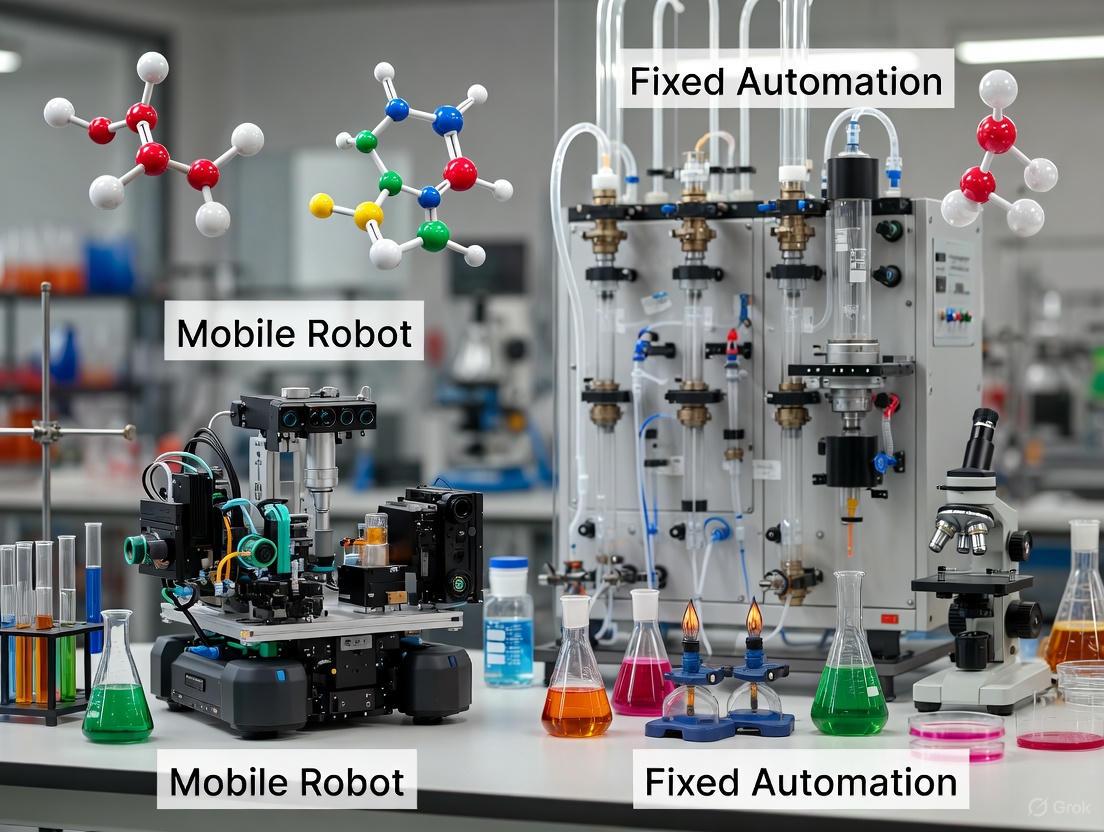
This article provides a comprehensive comparison between mobile robotics and fixed automation for chemical research and drug development.
Mobile Robots vs. Fixed Automation in Chemistry Labs: A 2025 Guide for Researchers
Abstract
This article provides a comprehensive comparison between mobile robotics and fixed automation for chemical research and drug development. It explores the foundational principles of both systems, details their specific methodological applications in modern labs—from self-driving laboratories to process chemistry—and offers practical guidance for troubleshooting and optimization. By synthesizing recent case studies and performance data, it delivers a validated, comparative framework to help scientists and research professionals make informed, strategic decisions on integrating automation to accelerate discovery.
Understanding the Core Technologies: From Fixed Arms to Mobile Chemists
In the landscape of modern chemistry research, the push for faster discovery and higher reproducibility has made automation a central pillar. While mobile robots are emerging for exploratory tasks, fixed automation remains the undisputed champion for applications where precision, power, and repeatability are non-negotiable. This guide objectively compares the performance of fixed robotic systems against mobile alternatives, providing the data-driven insights researchers need to make informed automation decisions.
Fixed vs. Mobile Automation: A Strategic Comparison for Laboratories
Fixed automation, also known as stationary robotics, involves systems that are permanently mounted to perform tasks in a single, optimized location [1] [2]. In industrial settings, they are the "gym bros of automation"—all power, zero cardio—excelling at high-volume, repetitive jobs by focusing all their energy on speed and precision rather than movement [1].
The table below summarizes the core differences between fixed and mobile robots as they apply to a research context.
| Feature | Fixed Automation | Mobile Robots |
|---|---|---|
| Core Strength | Precision, repeatability, and high-power tasks [1] | Flexibility, transport, and exploratory work [1] [3] |
| Typical Lab Tasks | Automated synthesis, repetitive sample analysis, high-throughput screening [4] | Sample transportation between fixed stations, feeding instruments to fixed systems [3] |
| Adaptability to Change | Low; requires reprogramming and potential hardware reconfiguration [1] | High; navigates dynamic environments and reroutes easily [1] [2] |
| Best-Suited Environment | Stable, high-volume processes with consistent workflows [1] | Dynamic labs with changing layouts and multi-step processes across rooms [1] [5] |
| Precision & Repeatability | Exceptional; can achieve variances as low as 0.01 mm [1] | Subject to navigation tolerances; generally lower than fixed systems [2] |
Performance Data: Quantitative Advantages of Fixed Systems
The theoretical strengths of fixed automation translate into measurable performance benefits. A key advantage is enhanced reproducibility, a critical challenge in manual chemistry. Automated chemistry systems precisely control reaction variables like temperature, stirring speed, and dosing, logging data in real-time to eliminate human error and produce reliable, repeatable results [4].
Furthermore, fixed systems drive significant gains in productivity. They can operate 24/7, performing complex multi-step recipes without interruption, which frees up skilled researchers to focus on higher-level analysis and experimental design [4]. This "walk-away time" is a substantial benefit, allowing experiments to run safely overnight or over weekends [4].
While one study noted that automation can sometimes lead to a decline in certain aspects of human performance in bonus-related evaluations, it crucially found that the perceived fairness and trust in the automated process remained unaffected [6].
Inside the Modern Lab: Key Fixed Automation Technologies
Fixed automation in chemistry labs is not a single tool but an ecosystem of integrated technologies. Understanding the components is essential for evaluating their application.
Research Reagent Solutions and Essential Materials
The following table details core components of a advanced fixed automation workflow for synthetic chemistry, as exemplified in modern research [3].
| Item | Function in the Automated Workflow |
|---|---|
| Automated Synthesis Platform (e.g., Chemspeed ISynth) | Performs the physical act of chemical synthesis; handles liquid dosing, mixing, and heating of reactions autonomously [3]. |
| Ultrahigh-Performance Liquid Chromatography-Mass Spectrometer (UPLC-MS) | Provides orthogonal analytical data on reaction products, separating components (chromatography) and identifying molecular weights (mass spectrometry) [3]. |
| Benchtop Nuclear Magnetic Resonance (NMR) Spectrometer | Provides critical structural information about synthesized molecules, acting as a second, orthogonal analysis technique to confirm results [3]. |
| Heuristic Decision-Maker Software | Processes data from UPLC-MS and NMR analyses using expert-defined rules to autonomously decide the next experimental steps (e.g., pass/fail, scale-up) [3]. |
Experimental Protocol: An Autonomous Workflow for Exploratory Synthesis
The following diagram and protocol detail a modular workflow for autonomous synthetic chemistry that integrates fixed automation, drawing from a landmark study published in Nature [3].
Autonomous Exploratory Synthesis Workflow
Methodology Summary [3]:
- Synthesis: Reactions are prepared and executed in an automated synthesis platform (e.g., Chemspeed ISynth).
- Sample Preparation: The synthesizer automatically takes an aliquot of the reaction mixture and reformats it into vials suitable for MS and NMR analysis.
- Transport: Mobile robots collect the sample vials and transport them to the separate, fixed analytical instruments. This demonstrates a hybrid model where mobility supports fixed automation.
- Orthogonal Analysis: The samples are analyzed by both UPLC-MS and a benchtop NMR spectrometer. This combination provides complementary data on molecular weight and structure.
- Decision-Making: A heuristic decision-maker algorithm processes the analytical data. It assigns a binary pass/fail grade to each reaction based on pre-defined criteria from domain experts. Reactions that pass both analyses are automatically selected for scale-up, while failed reactions are discarded.
The choice between fixed and mobile automation is not about which is superior, but which is appropriate for the task.
Choose fixed automation if your primary need is precision and repeatability for well-defined, repetitive tasks. It is ideal for high-throughput synthesis, standardized analytical protocols, and any process where hitting the same spot, cycle after cycle, is paramount [1] [4]. Its superior speed and power make it the workhorse for stable, high-volume workflows.
Choose mobile robots if your research demands physical flexibility and adaptation to a changing laboratory environment. They excel in tasks like transporting samples between fixed stations (e.g., from a synthesizer to an NMR) and are better suited for truly exploratory work where the experimental pathway is not fully linear [3] [5].
Ultimately, the most powerful modern laboratories are increasingly adopting a hybrid approach. They leverage fixed automation for its brute strength and precision at dedicated workstations, while employing mobile robots as agile assistants that connect these islands of automation into a seamless, efficient discovery pipeline [1] [3].
The transition towards automated processes in research and development represents a fundamental shift in how scientific discovery is approached. Within chemistry and drug development, two distinct automation philosophies have emerged: fixed automation and mobile robotics. Fixed automation refers to permanent, pre-installed systems designed for repetitive, high-throughput tasks without direct human intervention [7]. In contrast, mobile robotics encompasses autonomous devices that move goods and operate equipment within existing laboratory spaces without requiring fixed infrastructure [7] [8].
The critical distinction lies in their fundamental design principles: fixed automation prioritizes speed and repeatability for predictable workflows, while mobile robotics emphasizes flexibility and adaptability for evolving research environments [9]. This comparison guide objectively examines both approaches within the context of modern chemistry research, where the ability to rapidly reconfigure experimental workflows can significantly accelerate discovery timelines.
Core Operational Comparison
The selection between fixed and mobile automation systems requires a thorough understanding of their performance characteristics across key operational parameters that directly impact research productivity.
Table 1: Performance Comparison of Mobile Robots vs. Fixed Automation Systems
| Performance Parameter | Mobile Robotics | Fixed Automation |
|---|---|---|
| Setup Time & Reconfiguration | Minimal infrastructure requirements; quickly adaptable [7] [8] | Extensive installation; difficult/expensive to modify [9] |
| Integration with Legacy Equipment | High (can operate standard, unmodified instruments) [3] | Low (typically requires bespoke, integrated equipment) [3] |
| Typical Deployment Scale | Scalable from single units to fleets; suited for brownfield sites [10] | Large-scale, centralized systems; best for greenfield sites [10] |
| Multiplexing Capability (Equipment Sharing) | High (robots can share instruments with humans and other workflows) [3] | None or very low (equipment is typically dedicated and monopolized) [3] |
| Best-Suited Workflow Type | High-mix, low-volume; exploratory research [11] [9] | Low-mix, high-volume; standardized, repetitive tasks [9] |
| Upfront Cost | $$ (Lower initial investment) [12] | $$$$ (High initial investment) [12] |
| Operational Workflow | Parallel, asynchronous tasks [3] | Linear, sequential processing |
Experimental Evidence: Mobile Robots in Exploratory Chemistry
Case Study: Autonomous Synthesis and Analysis
A landmark 2024 study published in Nature demonstrated the capability of a mobile robot system to conduct fully autonomous exploratory synthetic chemistry [3]. The experimental setup provides a compelling template for evaluating mobile robotics in a research environment.
Experimental Protocol: The workflow involved a modular platform where mobile robots operated a Chemspeed ISynth synthesis platform, transported samples to standalone analytical instruments (UPLC-MS and a benchtop NMR spectrometer), and returned samples—all without human intervention [3]. A heuristic decision-maker algorithm then processed the orthogonal NMR and UPLC-MS data to autonomously select successful reactions for further investigation and scale-up.
Key Outcomes: The system successfully performed structural diversification chemistry, identified supramolecular host-guest assemblies, and even conducted photochemical synthesis. Crucially, it characterized reaction outcomes using multiple techniques, mimicking human experimental protocols rather than relying on a single, hard-wired characterization method [3]. This multi-modal analysis is critical for exploratory work where reaction products are unknown or complex.
Quantitative Performance Data
The practical value of automation systems is ultimately determined by their measurable impact on research operations. The following data, synthesized from recent implementations, highlights the performance profile of mobile robotic systems.
Table 2: Experimental Performance Metrics from Recent Implementations
| Metric | Mobile Robotics Performance | Context & Application |
|---|---|---|
| Nucleic Acid Normalization Time | 20-25 minutes per plate (manual process: 45 minutes) [11] | Liquid handling automation in a bioscience lab [11] |
| Volumetric Transfer Consistency | Under 5% Coefficient of Variation (CV) [11] | Precision measurement for sensitive reagents [11] |
| Analytical Instrument Sharing | Successful operation of unmodified, shared NMR & UPLC-MS [3] | Enables use of standard laboratory equipment [3] |
| System Reconfiguration Effort | Minimal (software-driven task reassignment) [11] [8] | Adapting to new experimental protocols |
The Researcher's Toolkit: Essential Components for a Mobile Robotic Workflow
Implementing a mobile robotics system requires the integration of several key components that work in concert to create a functional automated research environment.
Table 3: Essential Research Reagent Solutions & System Components
| Item / Component | Function in the Workflow | Implementation Example |
|---|---|---|
| Mobile Robotic Agent(s) | Physical linkage between modules; handles sample transportation and instrument operation [3]. | Free-roaming robots with multipurpose grippers for manipulating labware [3]. |
| Modular Synthesis Platform | Executes chemical reactions automatically in a centralized location. | Commercial Chemspeed ISynth synthesizer or equivalent automated synthesis platform [3]. |
| Orthogonal Analysis Instruments | Provides diverse characterization data for reliable decision-making. | Standalone, unmodified UPLC-MS and benchtop NMR spectrometers [3]. |
| Heuristic Decision-Maker Algorithm | Processes analytical data to autonomously determine subsequent workflow steps. | Customizable software applying experiment-specific "pass/fail" criteria to NMR and MS data [3]. |
| Central Control Software | Orchestrates the entire workflow, coordinating robots, synthesizer, and instruments. | Host computer running control scripts that allow domain experts to develop routines without robotics expertise [3]. |
Workflow Visualization: Mobile Robotics in Action
The following diagram illustrates the integrated, cyclical workflow that mobile robots enable in a chemistry research laboratory, demonstrating their unique ability to connect discrete pieces of equipment into a cohesive automated system.
Integrated Mobile Robotics Workflow
This workflow highlights the core advantage of mobile robotics: the creation of a flexible, modular automation loop. The mobile robot acts as the central nervous system, physically connecting specialized but standalone instruments—synthesis, MS, NMR—without requiring them to be permanently and exclusively hardwired together [3]. This preserves the independent utility of each instrument for other researchers or workflows, a key benefit over fixed automation.
The choice between mobile robotics and fixed automation is not about identifying a universally superior technology, but rather about matching the system's capabilities to the research organization's specific needs.
Fixed automation remains a powerful solution for high-volume, repetitive tasks with well-established protocols, such as certain aspects of clinical screening or large-scale reagent production, where its superior speed and precision deliver maximum value [9].
Mobile robotics, however, presents a compelling alternative for exploratory R&D environments like drug discovery and chemistry research. Its strengths in adaptability, seamless integration with existing laboratory equipment, and suitability for high-mix, low-volume workflows directly address the core requirements of innovative research [3] [11]. By enabling scientists to automate complex, multi-step processes without locking them into rigid, single-purpose systems, mobile robotics enhances experimental flexibility and ultimately supports a more dynamic and efficient path to scientific discovery.
In the modern chemistry research laboratory, the adoption of automation is no longer a luxury but a necessity for maintaining competitive advantage. However, the choice between fixed automation systems and mobile robotic platforms presents a fundamental strategic decision centered on core trade-offs: raw throughput against operational flexibility, and precision against scalability. Fixed automation, often characterized by integrated, bespoke systems, excels in high-throughput, repetitive tasks but often at the cost of adaptability. In contrast, emergent mobile robot platforms emulate human researchers by operating existing laboratory equipment, offering unparalleled flexibility for exploratory research at the potential expense of maximum speed. This guide provides an objective comparison of these paradigms, underpinned by experimental data and detailed methodologies, to inform researchers, scientists, and drug development professionals in their automation investments.
Throughput vs. Flexibility: A Fundamental Trade-off
In laboratory automation, throughput refers to the number of samples or experiments processed in a given time, while flexibility is the system's ability to adapt to new protocols, workflows, and equipment.
The Fixed Automation Approach: Maximizing Throughput
Fixed or bespoke automated systems are typically engineered for a single, well-defined purpose. They are characterized by tightly integrated components operating on a fixed takt time, which is the rate at which a finished product leaves a production system. This architecture is ideal for applications where the process is stable and the goal is the rapid processing of a large number of identical samples, such as in high-throughput screening (HTS) for drug discovery [11]. A core advantage is the minimization of non-value-added time; samples move directly between dedicated stations without transportation delays.
The Mobile Robot Approach: Prioritizing Flexibility
Mobile robotic agents, such as those described in a Nature study, adopt a different philosophy. They are designed to operate within existing laboratory environments, transporting samples and using standard, unmodified instruments like liquid chromatography–mass spectrometers (UPLC-MS) and benchtop NMR spectrometers [3]. This paradigm mirrors human workflows, where a single robot can service multiple, geographically separated instruments. The key advantage is exceptional flexibility; the workflow can be reconfigured for a new experimental campaign simply by updating the robot's software, without physical re-engineering of the laboratory. This is particularly valuable in exploratory synthesis and research and development (R&D), where protocols change rapidly in response to new data [11].
Comparative Data: Throughput and Flexibility
Table 1: Comparative Analysis of Fixed Automation vs. Mobile Robots
| Performance Metric | Fixed Automation System | Mobile Robot System |
|---|---|---|
| Throughput (Samples/Hour) | High (Optimized for repetition) [11] | Lower (Due to transportation time) [3] |
| Flexibility (Protocol Change) | Low (Often requires hardware reconfiguration) [11] | High (Software-driven re-tasking) [3] |
| System Integration | Bespoke, tightly coupled [3] | Modular, loosely coupled [3] |
| Ideal Use Case | High-throughput screening, routine analysis [11] | Exploratory research, multi-step synthesis [3] |
| Upfront Cost & Complexity | High (Custom engineering) [3] | Potentially lower (Leverages existing lab equipment) [3] |
Precision vs. Scalability: Strategic Scaling Decisions
Precision in this context refers to the accuracy and reproducibility of experimental operations and results. Scalability is the ease with which an automation solution can be expanded, either in capacity (vertical scaling) or in functional scope (horizontal scaling).
Precision in Laboratory Automation
Both fixed and mobile systems can achieve high levels of precision, but through different means. Fixed automation guarantees precision through rigid mechanical positioning and hard-wired processes. Mobile robots, conversely, must employ advanced localization and control algorithms to achieve repeatable manipulation and transportation. In practice, both can perform precise liquid handling, with automated systems demonstrating coefficients of variation (CV) under 5% for volumetric transfers, a precision comparable to careful manual pipetting [11]. The defining difference is that precision in a fixed system is a built-in characteristic, while in a mobile system it is a dynamically achieved outcome.
Scalability Pathways
Scalability is a key differentiator. Fixed systems are scaled vertically; to increase throughput, one must enhance the capability of a single node (e.g., by adding a faster robot arm or more modules to a line), which is ultimately hardware-constrained [13]. Mobile robot systems are inherently suited for horizontal scaling. As stated in the Nature article, "there is no limit to the number of instruments that can be incorporated under this paradigm, other than those imposed by laboratory space" [3]. One can add more mobile agents to a fleet or more standard instruments to the laboratory network, providing a more flexible and potentially cost-effective path to expansion.
The Data Scaling Perspective
The relationship between model or data scale and performance offers a parallel to physical automation. In AI-driven labs, larger models generally show superior performance and greater resilience. For instance, a study on large language models (LLMs) found that larger models (e.g., 70B parameters) maintain high accuracy even when quantized to 4-bit precision to save memory, outperforming smaller models (e.g., 7B) running at higher precision under a similar memory budget [14]. This principle of "scale confers robustness" can inform the design of AI controllers for both fixed and mobile automated labs; a more capable AI brain can potentially compensate for physical limitations.
Table 2: Scaling and Performance of AI Models for Laboratory Control
| Model Scale | Precision | Memory Use | Performance on Complex Tasks | Resilience to Precision Loss |
|---|---|---|---|---|
| Small (e.g., 7B params) | 32-bit | 28 GB [14] | Moderate | Low |
| Small (e.g., 7B params) | 4-bit | 7 GB [14] | Significantly Reduced | - |
| Large (e.g., 70B params) | 32-bit | 168 GB [14] | High | High |
| Large (e.g., 70B params) | 4-bit | 42 GB [14] | Remains High | - |
Experimental Protocols and Workflows
To ground these comparisons, below are detailed methodologies from key studies demonstrating mobile robotic systems in action.
Protocol: Autonomous Exploratory Synthesis using Mobile Robots
This protocol is derived from the modular workflow published in Nature [3].
1. Synthesis Setup: A Chemspeed ISynth automated synthesizer is loaded with starting materials. The mobile robot(s) are not involved in this initial stage. 2. Reaction Execution: The synthesizer performs the parallel reactions. Upon completion, it automatically prepares aliquots in standard vials for UPLC-MS and NMR analysis. 3. Sample Transport: A mobile robot equipped with a gripper picks up the prepared sample vials and navigates through the laboratory to deliver them to the UPLC-MS instrument and the benchtop NMR spectrometer. This transportation is the critical mobile component. 4. Autonomous Analysis: The instruments, once loaded by the robot, run their pre-programmed analysis methods (e.g., a 5-minute gradient elution for UPLC-MS, a 2-minute proton NMR pulse sequence). 5. Data Integration and Decision Making: Analytical data (chromatograms, mass spectra, NMR spectra) are automatically processed by a heuristic decision-maker algorithm. This algorithm uses pre-defined, domain-expert rules to assign a binary "pass/fail" grade to each reaction based on the orthogonal data. 6. Closed-Loop Action: Based on the decision, the system autonomously instructs the synthesizer on the next steps. For example, reactions that "pass" are selected for scale-up or further diversification in a subsequent synthetic step, recreating the human "design-make-test-analyze" loop without intervention.
Workflow Visualization: Mobile Robot vs. Fixed Automation
The following diagram illustrates the fundamental logical differences in the workflow of a mobile robot system versus a fixed automation system.
The Scientist's Toolkit: Key Research Reagents & Solutions
The transition to automated chemistry, particularly using mobile robots, relies on a foundation of standardized materials and software. The following table details key components of this toolkit as evidenced in the cited research.
Table 3: Essential Toolkit for an Automated Chemistry Laboratory
| Tool / Reagent | Function / Description | Role in Automation |
|---|---|---|
| Automated Synthesis Platform (e.g., Chemspeed ISynth) | A robotic platform for precisely dispensing reagents and executing reactions in parallel [3]. | Serves as the core "make" module, preparing samples for analysis. |
| Orthogonal Analysis Instruments (UPLC-MS, NMR) | Provides complementary characterization data (molecular weight/identity and structural information) [3]. | The key "test" modules. Their standard design allows integration by mobile robots. |
| Heuristic Decision-Maker Algorithm | Software that processes analytical data using expert-defined rules to autonomously decide the next experimental steps [3]. | The "brain" that closes the autonomous loop, replacing human judgment for specific criteria. |
| Mobile Robotic Agent | A free-roaming robot capable of navigating the lab and manipulating standard sample vials and instrument doors [3]. | The physical integrator, providing flexibility by linking disparate, unmodified instruments. |
| Standardized Sample Vials | Consumable vials compatible with both the synthesizer and the analysis instruments. | Ensures seamless hand-off between different modules and robots, preventing "incompatibility deadlocks." |
| Central Data Management Platform | Software that unifies data from synthesizers, analyzers, and decision algorithms [15]. | Creates a single source of truth, enabling traceability and providing clean data for AI/ML analysis. |
The choice between mobile robots and fixed automation is not about identifying a universally superior option, but about matching the system's strengths to the research problem. Fixed automation remains the champion of throughput and precision for well-defined, repetitive tasks in environments with low variability. Conversely, mobile robotic platforms are the emerging solution for flexibility and scalability, enabling autonomous exploratory chemistry in dynamic R&D settings by leveraging existing laboratory infrastructure. As the field progresses, the integration of more robust AI—inspired by the resilience of large-scale models—will further blur these lines, potentially leading to hybrid systems that offer both high throughput and adaptive intelligence. For the modern research lab, the strategic evaluation of the throughput-flexibility and precision-scalability trade-offs is the first critical step toward successful and sustainable automation.
The integration of robotics and artificial intelligence (AI) is fundamentally transforming scientific laboratories, shifting the research paradigm from manual, time-consuming processes to highly efficient, automated factories of discovery. In the context of chemistry research and drug development, this transition is characterized by a spectrum of automation, ranging from simple assistive devices to fully autonomous systems that require no human intervention. The core distinction lies in the division of labor between human and machine: automated experiments are those where researchers make the decisions, while autonomous experiments are those where machines record and interpret analytical data to make decisions based on them [3]. This evolution is critical for accelerating scientific progress, as traditional trial-and-error approaches are often slow and labor-intensive, delaying breakthroughs in fields like medicine and energy [16].
The drive toward automation is fueled by its ability to enhance reproducibility, minimize human error, and allow scientists to focus on higher-level creative research questions [16] [17]. Furthermore, robotic systems can handle hazardous substances, significantly reducing safety risks for lab personnel [16]. This guide will objectively compare two dominant architectural paradigms enabling this transition: mobile robotics and fixed automation systems. By examining their performance, implementation, and suitability for different research environments, we aim to provide researchers and drug development professionals with a clear framework for selecting the optimal automation strategy.
The Five Levels of Laboratory Automation
A useful framework for understanding this transition defines five distinct levels of laboratory automation [16]. This hierarchy helps in assessing progress, establishing safety protocols, and setting future research goals.
Table 1: The Five Levels of Laboratory Automation
| Level | Name | Description | Typical Human Role |
|---|---|---|---|
| A1 | Assistive Automation | Automation of individual tasks (e.g., liquid handling) while humans handle the majority of the workflow. | Handles most of the work, including setup and execution. |
| A2 | Partial Automation | Robots perform multiple sequential steps, but humans remain responsible for setup and supervision. | Responsible for setup and active supervision. |
| A3 | Conditional Automation | Robots manage entire experimental processes. Human intervention is required for unexpected events. | Required to intervene when unexpected events arise. |
| A4 | High Automation | Robots execute experiments independently, setting up equipment and reacting to unusual conditions autonomously. | Not required for routine operation, but still oversees the system. |
| A5 | Full Automation | Robots and AI systems operate with complete autonomy, including self-maintenance, safety management, and experimental decision-making. | Not required for operation; the system is self-sufficient. |
Mobile Robots vs. Fixed Automation: A Comparative Analysis
The physical implementation of automation falls into two primary categories: mobile robots and fixed automation. Mobile robots are free-roaming agents that transport samples and operate equipment across a distributed laboratory space [3]. In contrast, fixed automation (or bespoke automated equipment) involves physically integrated systems where samples are transferred via conveyors or robotic arms within a single, dedicated unit [3].
Performance and Flexibility Comparison
Table 2: Performance Comparison of Mobile Robot vs. Fixed Automation
| Feature | Mobile Robot Automation | Fixed Automation |
|---|---|---|
| System Architecture | Modular, distributed, and connected by mobile robots [3]. | Integrated, bespoke, and physically hard-wired [3]. |
| Instrument Integration | High flexibility; can incorporate any instrument within navigation range without physical redesign [3]. | Low flexibility; limited to pre-integrated instruments; expansion is complex and costly [3]. |
| Equipment Sharing | Enables sharing of high-value equipment (e.g., NMR, MS) with human researchers [3]. | Typically monopolizes equipment for the automated workflow. |
| Characterization Capability | Supports multi-modal analysis (e.g., UPLC-MS and NMR) by moving samples between different stations [3]. | Often relies on a single, hard-wired characterization technique due to integration complexity [3]. |
| Upfront Investment | Potentially lower for initial setup and incremental expansion. | Often very high due to bespoke engineering and integration [18]. |
| Best Suited For | Exploratory research, multi-step syntheses, and labs requiring diverse analytical techniques [3]. | High-throughput, repetitive analysis, and dedicated production lines [3]. |
Experimental Data and Case Studies
A landmark study published in Nature demonstrated the efficacy of a mobile robotic system for exploratory synthetic chemistry. The platform used mobile robots to link an automated synthesizer (Chemspeed ISynth) with separate, unmodified analysis instruments, including a liquid chromatography–mass spectrometer (UPLC-MS) and a benchtop NMR spectrometer [3].
Experimental Protocol: The workflow involved:
- Synthesis: The Chemspeed platform performed chemical reactions in parallel.
- Sample Aliquoting: The synthesizer prepared aliquots of the reaction mixtures for MS and NMR analysis.
- Transport & Handling: Mobile robots collected the samples and transported them to the respective instruments.
- Data Acquisition & Analysis: The instruments performed orthogonal measurements, and a heuristic decision-maker processed the data to grade reactions as pass/fail.
- Decision & Iteration: The system used these results to autonomously decide which reactions to scale up or replicate, checking for reproducibility [3].
Key Outcome: This modular approach successfully conducted autonomous multi-step syntheses and identified supramolecular host-guest assemblies, showcasing an ability to handle complex, open-ended chemical problems that are less suited to optimization of a single, known metric [3].
In the realm of biotechnology, a study in Scientific Reports detailed an Autonomous Lab (ANL) system that used a transfer robot (the Brooks PF400) to connect modular devices for culturing, preprocessing, and analysis [17]. The system employed Bayesian optimization to autonomously run a closed loop from culturing through to analysis and hypothesis formulation. In a case study optimizing medium conditions for a glutamic acid-producing E. coli strain, the ANL successfully improved both the cell growth rate and maximum cell growth by optimizing the concentrations of four key nutrients (CaCl₂, MgSO₄, CoCl₂, and ZnSO₄) [17]. This demonstrates the power of integrated, AI-driven systems to tackle complex bioproduction challenges.
The Scientist's Toolkit: Essential Components for an Automated Lab
Building an automated laboratory, whether mobile or fixed, requires a suite of core technologies. The following table details key research reagent solutions and essential hardware/software components.
Table 3: Essential Research Reagents and Core Technologies
| Category | Item | Function / Description |
|---|---|---|
| Research Reagents | M9 Minimal Medium | A defined medium containing only essential nutrients, allowing for precise optimization of additional components [17]. |
| Trace Elements (e.g., CoCl₂, ZnSO₄) | Act as cofactors for enzymes; their concentration can be optimized to regulate multi-step enzymatic reactions in pathways like glutamic acid biosynthesis [17]. | |
| Basic Components (e.g., CaCl₂, MgSO₄) | Affect cell growth and osmotic pressure; optimization is crucial for balancing growth and product yield [17]. | |
| Core Technologies | Automated Synthesis Platform (e.g., Chemspeed ISynth) | Executes chemical reactions autonomously, including sample preparation and aliquoting [3]. |
| Mobile Robot (e.g., Brooks PF400) | Provides physical linkage between modular stations by transporting samples and operating equipment [3] [17]. | |
| Analytical Instruments (UPLC-MS, NMR) | Provides orthogonal, multimodal data for comprehensive reaction characterization, which is essential for reliable autonomous decision-making [3]. | |
| Liquid Handler (e.g., Opentrons OT-2) | Automates precise liquid transfer tasks in workflows such as sample reformatting or PCR setup [17]. | |
| Bayesian Optimization Algorithm | An AI-driven approach that models the relationship between experimental parameters (e.g., concentration) and outcomes (e.g., growth) to intelligently suggest the next best experiment [17]. |
Workflow Visualization: Mobile Robot Architecture
The following diagram illustrates the logical workflow and data flow in a modular, mobile robot-driven automated laboratory.
The landscape of laboratory automation presents a clear spectrum, from assistive tools that augment human capability to fully autonomous systems that can independently conduct discovery research. The choice between mobile robot and fixed automation architectures is not a matter of which is universally superior, but which is most appropriate for the research goal. Mobile robots offer unparalleled flexibility and modularity, making them ideal for exploratory chemistry and dynamic environments that require diverse analytical techniques [3]. Fixed automation systems excel in high-throughput, dedicated applications where maximum speed and reproducibility for a specific, repeated workflow are paramount.
The future of laboratory science lies in the seamless integration of robotics, data infrastructure, and AI. As noted by researchers at UNC-Chapel Hill, the integration of AI is key to advancing beyond mere physical automation to fully autonomous research cycles [16]. Successfully implementing these systems will require a new generation of scientists skilled in both their domain expertise and in collaborating with these advanced technologies, ultimately leading to faster, safer, and more reliable scientific breakthroughs.
From Synthesis to Analysis: Deploying Mobile and Fixed Systems in Real-World Chemistry
In the landscape of contemporary chemical research, automation has become a cornerstone for achieving new levels of efficiency, reproducibility, and discovery. This guide focuses on fixed automation systems, which include benchtop liquid handlers and integrated high-throughput synthesis platforms that are physically stationary. These systems are characterized by their precision, repeatability, and high-speed operation within a confined workspace, making them ideal for standardized, high-volume tasks [1]. Unlike mobile robotic systems that navigate laboratory spaces to connect distributed instruments, fixed automation is typically dedicated to specific workflows such as PCR setup, serial dilution, compound screening, and parallel synthesis [19].
The drive toward automation is reshaping laboratories globally. The laboratory automation market, valued at $5.2 billion in 2022, is projected to grow to $8.4 billion by 2027, driven by demands for higher throughput, improved accuracy, and cost efficiency in pharmaceutical, biotech, and environmental sectors [20]. Similarly, the automated liquid handling market specifically is expected to rise from USD 1.39 billion in 2025 to USD 2.57 billion by 2033 [19]. This growth underscores a fundamental shift in how scientific research is conducted, with fixed automation playing a pivotal role in this transformation by providing the foundational tools for accelerating the design-make-test-analyze cycle in chemistry and drug discovery.
Performance Comparison: Fixed vs. Mobile Automation
Selecting the appropriate automation strategy requires a clear understanding of how fixed and mobile systems perform across key operational parameters. The table below provides a comparative summary based on available data and documented implementations.
Table 1: Performance Comparison of Fixed and Mobile Automation Systems
| Performance Metric | Fixed Automation (Benchtop Systems) | Mobile Robotic Automation |
|---|---|---|
| Primary Strength | Precision, speed, and high-throughput in confined workflows [1] | Flexibility, adaptability, and connectivity of distributed equipment [21] |
| Typical Throughput | Very high for dedicated tasks (e.g., plate replication, PCR setup) [19] | Lower overall throughput due to transportation time between stations [22] |
| Operational Flexibility | Low; optimized for specific, repetitive protocols [1] | High; can be reprogrammed to access different instruments and perform diverse tasks [21] |
| Precision & Repeatability | Exceptional; sub-microliter liquid handling with minimal variance [19] | Subject to potential variances from navigation and manipulation in dynamic environments |
| Integration Complexity | Moderate; can be integrated into workcells but primarily standalone [19] | High; requires orchestration with laboratory infrastructure (doors, elevators) and instruments [23] |
| Space Utilization | Defined benchtop footprint | Uses existing laboratory space without monopolizing equipment [3] |
| Best-Suited Applications | Drug discovery assays, genomic research, serial dilution, high-throughput screening [19] | Exploratory synthesis, multi-step processes requiring diverse characterization [3] |
Experimental Protocols in Practice
To illustrate the implementation of fixed automation, the following section details two key experimental protocols that highlight its capabilities in high-throughput synthesis and analysis.
Protocol: Parallel Synthesis for Structural Diversification
This protocol, derived from autonomous laboratory research, demonstrates a fixed automation workflow for synthesizing a library of small molecules, a common bottleneck in drug discovery [3].
- Objective: To autonomously synthesize a library of ureas and thioureas through combinatorial condensation and subsequently identify successful reactions for scale-up.
- Automated Equipment Used:
- Synthesis Module: Chemspeed ISynth synthesizer or similar automated platform.
- Analysis: Integrated or nearby UPLC-MS and Benchtop NMR.
- Procedure:
- Reagent Setup: The automated platform is loaded with stock solutions of three alkyne amines and one isothiocyanate and one isocyanate.
- Parallel Synthesis: The liquid handling system autonomously dispenses specified volumes of amines and electrophiles into reaction vessels in a combinatorial array, initiating reactions under controlled conditions.
- Automated Sampling and Quenching: Upon completion, the system takes an aliquot from each reaction mixture and quenches it as needed.
- Sample Reformating: The platform reformats the aliquots into appropriate vials for UPLC-MS and NMR analysis.
- Orthogonal Analysis: Samples are transferred (manually or via mobile robot) to UPLC-MS and NMR for characterization. In a fully fixed system, these instruments may be directly integrated into the workcell.
- Heuristic Decision-Making: A pre-defined algorithm processes the UPLC-MS and NMR data, giving each reaction a binary pass/fail grade. Reactions that pass both analyses are automatically selected for subsequent scale-up or further elaboration [3].
- Key Performance Metric: The system's efficacy is measured by its ability to correctly identify successful reactions based on orthogonal data without human intervention, enabling an uninterrupted design-make-test-analyze cycle.
Protocol: Automated Process Chemistry and Analysis
This protocol showcases a fixed, modular workflow for process chemistry, demonstrating robustness and reproducibility matching human performance [22].
- Objective: To perform automated process chemistry for scalable synthesis, including reaction, work-up, purification, and analysis.
- Automated Equipment Used:
- Synthesis Reactor: Automated synthesis reactor (e.g., in a fumehood).
- Liquid Handling: Robotic arm for sample transfer and liquid handling.
- Analysis: UHPLC-MS system.
- Procedure:
- Synthesis: The reactor executes the synthetic sequence (e.g., paracetamol synthesis) from starting materials to product.
- Work-up and Quenching: The system automatically quenches the reaction and performs a liquid-liquid extraction if required.
- Sample Transfer: A stationary robotic arm retrieves a sample vial from the reactor and transports it to the UHPLC-MS for injection.
- Chromatographic Analysis: The UHPLC-MS runs a predefined method to separate and analyze the product, quantifying yield and purity.
- System Cleaning: The robotic arm cleans the reactor and associated fluidic paths to prevent cross-contamination between experimental runs.
- Iteration: The system initiates the next experiment based on the analytical results or a predefined schedule.
- Key Performance Metric: The reported performance for this workflow includes reaction yields and purity matching human chemists, with a potential weekly reaction output 12 times greater than that of a human process chemist in an industrial setting when running multiple reactors around the clock [22].
Workflow Visualization
The following diagram illustrates the logical flow and decision-making process of an autonomous fixed system, as described in the parallel synthesis protocol.
Autonomous Synthesis Workflow
The Scientist's Toolkit: Essential Research Reagent Solutions
Successful implementation of fixed automation relies on a suite of specialized equipment and reagents. The table below details key components for setting up a high-throughput synthesis and liquid handling workstation.
Table 2: Essential Materials and Equipment for Automated workflows
| Item | Function/Description |
|---|---|
| Automated Liquid Handler | Programmable system for precise, high-volume dispensing of liquids. Key for PCR setup, serial dilution, and reagent addition [19]. |
| Standalone Benchtop Workstation | A compact, fixed system that automates specific tasks like pipetting or plate washing on a benchtop, conserving space [24]. |
| Chemspeed ISynth Platform | An example of an automated synthesis platform used for parallel synthesis in exploratory chemistry and library generation [3]. |
| UPLC-MS / LC-MS | Ultra-High Performance Liquid Chromatography coupled with Mass Spectrometry for rapid separation and identification of reaction products [3] [22]. |
| Benchtop NMR Spectrometer | A compact NMR instrument used for structural analysis and verification of synthesized compounds, integrable into automated workflows [3]. |
| Disposable Pipette Tips | Sterile, single-use tips for liquid handlers to prevent cross-contamination between samples, crucial for reliable results [19]. |
| Microplates & Labware | Standardized plates (e.g., 96-well, 384-well) and tubes that are compatible with automated handling systems [25]. |
| Heuristic Decision Algorithm | Customizable software that processes analytical data (UPLC-MS, NMR) to autonomously decide the next experimental steps [3]. |
Fixed automation systems, exemplified by high-throughput benchtop liquid handlers and synthesis platforms, are powerful tools that deliver unmatched precision, speed, and reproducibility for well-defined, high-volume tasks. Their strength lies in optimizing specific workflows such as assay preparation, compound screening, and parallel synthesis, which are fundamental to modern drug discovery and chemical research.
The choice between fixed and mobile automation is not a matter of superiority, but of strategic alignment with research goals. Fixed systems excel in dedicated, high-throughput environments where task repetition and precision are paramount. In contrast, mobile robotic systems offer a broader, more flexible form of automation that can connect disparate instruments for exploratory, multi-step chemistry [3] [21]. The emerging paradigm in advanced laboratories is a hybrid approach, where mobile robots transport samples to and from fixed, high-performance workstations, leveraging the strengths of both automation strategies to create a truly integrated and self-driving laboratory [20].
The integration of robotics into chemical laboratories represents a paradigm shift in how researchers approach discovery and synthesis. This evolution presents a critical choice: to implement fixed, hardwired automation or to adopt a flexible, modular approach using mobile robots. Fixed automation systems, typically built for high-throughput, dedicated tasks, involve significant financial investment and permanent reconfiguration of laboratory space [26]. In contrast, a modular strategy utilizing mobile robots to connect standard, unmodified laboratory instruments offers a path to automation that preserves existing infrastructure and shares resources with human researchers [3]. This article provides a comparative analysis of these two approaches, focusing on their performance in exploratory synthesis, where chemical outcomes are uncertain and multiple analytical techniques are required for unambiguous characterization. We objectively evaluate a documented implementation of the modular mobile robot approach against the established benchmarks of fixed automation, providing the experimental data and methodologies necessary for research professionals to make informed decisions.
Comparative Framework: Mobile Robots vs. Fixed Automation
The fundamental distinction between these approaches lies in their core architecture. Fixed automation creates a closed, optimized ecosystem, often with integrated, dedicated analytical tools. The modular mobile robot approach constructs an open, dynamic network where robots act as mobile agents, physically transporting samples between standalone, high-end instruments [3]. The following table summarizes the key comparative characteristics.
Table 1: Core Characteristics of Mobile Robot and Fixed Automation Approaches
| Feature | Mobile Robot (Modular Approach) | Fixed Automation (Integrated Approach) |
|---|---|---|
| System Architecture | Open, distributed, and reconfigurable [3] | Closed, centralized, and hardwired [3] |
| Laboratory Integration | Uses standard, unmodified instruments; shares equipment with human researchers [3] [27] | Often requires bespoke, custom-engineered equipment [3] |
| Typical Analytical Scope | Multi-modal, orthogonal techniques (e.g., UPLC-MS & NMR combined) [3] | Often reliant on a single, hardwired characterization technique [3] |
| Upfront Financial Outlay | Potentially lower; leverages existing lab assets [3] | Typically high ($50,000 to $300,000+) [26] |
| Operational Flexibility | High; easily reprogrammed for new workflows and expanded with new instruments [3] | Low; optimized for a specific, narrow workflow [26] |
| Ideal Research Environment | Exploratory chemistry, multi-product facilities, academic labs [3] | High-volume production, dedicated quality control, routine synthesis [26] |
Experimental Performance and Benchmarking Data
A landmark study published in Nature provides a direct performance benchmark for the modular mobile robot approach. The system was deployed for three distinct exploratory chemistry campaigns: structural diversification, supramolecular host-guest chemistry, and photochemical synthesis [3]. The core performance metric was the system's ability to autonomously make correct "pass/fail" decisions on reaction outcomes, replicating human expert judgment using orthogonal data from UPLC-MS and NMR.
Table 2: Experimental Performance in Exploratory Synthesis Campaigns
| Chemistry Campaign | Key Experimental Task | Decision-Making Basis | Reported Autonomous System Performance |
|---|---|---|---|
| Structural Diversification | Parallel synthesis of ureas/thioureas; scale-up and elaboration of successful substrates [3] | Heuristic analysis of UPLC-MS and ¹H NMR data [3] | Successful emulation of end-to-end human-led process; autonomous decision to scale-up and diverge successful reactions [3] |
| Supramolecular Assembly | Identification of successful synthetic macrocyclic hosts from a dynamic combinatorial library [3] | Heuristic analysis of UPLC-MS and ¹H NMR data [3] | Correct identification of a known host molecule and a new, previously unreported self-assembled host [3] |
| Photochemical Synthesis | Exploration of photocatalytic hydroaminoalkylation reactions [3] | Heuristic analysis of UPLC-MS and ¹H NMR data [3] | Autonomous discovery of a new, high-performing catalytic reaction condition [3] |
| Functional Assay | Evaluation of host-guest binding properties for identified supramolecular hosts [3] | Analysis of fluorescence quenching data via UPLC-MS [3] | Successful extension beyond synthesis to autonomous functional testing [3] |
The system demonstrated a key advantage in supramolecular chemistry, where reactions can produce multiple products from the same starting materials. Its ability to process orthogonal data streams (UPLC-MS and NMR) with a "loose" heuristic was crucial for remaining open to novel discoveries, unlike optimization-focused algorithms that target a single, pre-defined outcome [3].
Detailed Experimental Protocol: The Modular Workflow in Action
To ensure reproducibility and provide a clear understanding of the methodology, the core experimental protocol from the Nature study is detailed below [3].
The modular workflow integrates synthesis, sample handling, analysis, and decision-making into a continuous, autonomous cycle. The following diagram visualizes this process and the physical layout of the modular laboratory.
Diagram Title: Modular Mobile Robot Workflow for Autonomous Chemistry
Step-by-Step Methodology
- Synthesis: The automated synthesis platform (Chemspeed ISynth) performs parallel reactions based on an initial input recipe.
- Sample Aliquoting and Reformating: Upon reaction completion, the synthesizer automatically takes an aliquot of each reaction mixture and reformats it into standard vials suitable for the UPLC-MS and benchtop NMR instruments.
- Mobile Robot Transport: One or more mobile robots, equipped with specialized grippers, retrieve the sample vials. They navigate freely through the laboratory to transport samples to the specific locations of the UPLC-MS and benchtop NMR spectrometers. The robots operate these instruments by triggering pre-configured methods for data acquisition.
- Orthogonal Data Acquisition: The UPLC-MS and NMR instruments, which are standard commercial models with minimal or no physical modification, analyze the samples. The raw analytical data (chromatograms, mass spectra, and NMR spectra) are saved to a central database.
- Heuristic Decision-Making: A software-based decision-maker, programmed with rules defined by domain experts, processes the analytical data.
- UPLC-MS Analysis: A pass/fail grade is assigned by checking for expected mass-to-charge (m/z) peaks against a pre-computed lookup table and by detecting significant changes in chromatographic traces using dynamic time warping.
- NMR Analysis: A pass/fail grade is assigned by analyzing the ¹H NMR spectrum for reaction-induced changes, also using dynamic time warping to compare spectra.
- The binary results from both techniques are combined. In the referenced study, a reaction typically needed to pass both analyses to be considered a "hit" and proceed to the next stage [3].
- Autonomous Execution of Next Steps: Based on the decision, the system autonomously instructs the synthesis platform to proceed with the next set of actions. This could include:
- Scale-up: Re-running a successful reaction at a larger scale.
- Replication: Repeating a reaction to confirm reproducibility of a screening hit.
- Structural Diversification: Using a successful intermediate in a subsequent, different reaction.
- Functional Assay: Automatically proceeding to test the function of a synthesized compound (e.g., host-guest binding).
The Scientist's Toolkit: Key Research Reagents and Materials
The following table details the core components and their functions that enabled the modular robotic laboratory as described in the primary research [3].
Table 3: Essential Components for a Modular Robotic Laboratory
| Component Name | Type/Model Cited | Primary Function in the Workflow |
|---|---|---|
| Mobile Robot | Kuka mobile robot (or similar) [28] | Physical agent for sample transport and operation of instrument interfaces. |
| Automated Synthesizer | Chemspeed ISynth [3] [27] | Execution of parallel chemical syntheses with automated liquid handling and aliquotting. |
| UPLC-MS System | UltraPerformance Liquid Chromatography-Mass Spectrometry [3] | Provides orthogonal analytical data on product mixture composition and molecular weight. |
| Benchtop NMR | 80 MHz Benchtop Nuclear Magnetic Resonance Spectrometer [3] | Provides orthogonal analytical data on molecular structure and reaction-induced changes. |
| Heuristic Decision-Maker | Custom Python scripts with expert-defined rules [3] | The "brain" that processes UPLC-MS and NMR data to autonomously decide the next experimental steps. |
| Central Control Software | Custom software suite [3] | Orchestrates the entire workflow, coordinating robot actions, synthesis, and analysis. |
Discussion and Outlook
The experimental data demonstrates that the modular mobile robot approach is not merely a logistical alternative but a fundamentally different paradigm suited for exploratory research. Its strength lies in leveraging the existing, high-quality infrastructure of a modern chemistry laboratory—sharing NMR, MS, and other instruments with human researchers—without requiring costly, permanent dedication of these resources [3]. This makes high-level automation more accessible to academic and industrial R&D groups without the capital for a fully hardwired facility.
The fixed automation model remains powerful for high-throughput, dedicated tasks where throughput and reliability for a narrow scope of work are the primary objectives [26]. However, for the complex, open-ended problems that define the frontiers of chemical research, the flexibility, data richness, and resource-sharing of the modular mobile approach offer a compelling and proven alternative. The convergence of this hardware paradigm with increasingly sophisticated AI and large language models (LLMs) for planning and decision-making promises to further accelerate the pace of autonomous chemical discovery [28] [29].
The automation of process chemistry represents a pivotal advancement in pharmaceutical and agrochemical development, aiming to transform labor-intensive and time-consuming route scouting and optimization into a streamlined, high-throughput endeavor. The central debate for modern research facilities revolves around the choice of automation architecture: mobile robotic systems that navigate existing laboratory spaces versus fixed automation workstations that perform dedicated, integrated workflows. Mobile robots, as exemplified by recent research, are free-roaming agents that leverage artificial intelligence (AI) to physically operate multiple, discrete pieces of standard laboratory equipment [3] [5]. In contrast, fixed automation typically consists of bespoke, benchtop-scale systems where robotic arms and analytical instruments are physically hard-wired into a single, optimized unit [3]. This guide provides an objective comparison of these two paradigms, drawing on the latest experimental data and research to inform researchers, scientists, and drug development professionals.
Performance Comparison: Mobile Robots vs. Fixed Automation
The following tables summarize key performance characteristics and a direct comparison based on recent experimental findings.
Table 1: Key Performance Metrics of Mobile Robotic Chemistry Systems
| Performance Metric | Reported Result/Characteristic | Context and Measurement Basis |
|---|---|---|
| Weekly Reaction Output | Up to 12x that of a human chemist [22] | Estimated for a system operating multiple reactors in an industrial setting [22] |
| Decision-Making Speed | Near-instantaneous (minutes) [5] | AI processing of analytical data (UHPLC-MS, NMR) to decide next steps [5] |
| Operational Duration | 21+ hours unattended (3 back-to-back experiments) [22] | Demonstration of continuous, round-the-clock operation [22] |
| Equipment Integration | Modular; interfaces with UHPLC-MS, NMR, synthesis reactors [3] | Uses standard, commercially available instruments with minimal redesign [3] |
| Analytical Orthogonality | High (UPLC-MS & NMR) [3] | Uses multiple, orthogonal techniques for robust product characterization [3] |
Table 2: Direct Comparison of Mobile Robot and Fixed Automation Systems
| Feature | Mobile Robot Systems | Fixed Automation Systems |
|---|---|---|
| Architecture | Distributed, modular workflow [3] | Integrated, bespoke workflow [3] |
| Infrastructure Flexibility | High; shares equipment with human researchers [3] [5] | Low; equipment is typically dedicated and monopolized [3] |
| Scalability | Inherently scalable by adding more mobile robots [5] | Limited by the physical footprint and capacity of the unit [15] |
| Upfront Instrument Cost | Potentially lower; can utilize existing lab equipment [3] | Typically high due to custom engineering and integration [3] |
| Characterization Flexibility | High; can employ multiple, diverse analytical techniques [3] | Often limited to a single, hard-wired characterization technique [3] |
| Suitability for Exploratory Chemistry | High; heuristic AI can handle diverse, multi-product outcomes [3] | Lower; better suited for optimizing a single, known figure of merit (e.g., yield) [3] |
Experimental Protocols and Workflows
Detailed Methodology for Mobile Robotic Synthesis
The experimental protocols for mobile robotic systems, as validated in recent peer-reviewed studies, involve a cyclic, autonomous process [3] [5].
- Synthesis Module Setup: An automated synthesis platform (e.g., Chemspeed ISynth) prepares reactions in parallel. It aliquots the resulting reaction mixtures and reformats them into standard vials for MS and NMR analysis [3].
- Sample Transport and Handling: Mobile robots, equipped with anthropomorphic grippers, collect the sample vials from the synthesizer. They transport these vials across the laboratory to the respective analytical instruments (UPLC-MS and a benchtop NMR spectrometer) [3] [5].
- Autonomous Data Acquisition: The robots interface with the instruments to load the samples. Customizable Python scripts then trigger the analytical methods (e.g., UPLC-MS method, NMR shimming and acquisition) without human intervention [3].
- AI-Driven Decision-Making: The raw analytical data (chromatograms, mass spectra, NMR spectra) are saved to a central database. A heuristic decision-making algorithm, designed by domain experts, processes this orthogonal data. It assigns a binary "pass/fail" grade to each reaction based on pre-defined criteria (e.g., presence of target mass, cleanliness of NMR spectrum). Reactions that pass both analyses are automatically selected for the next stage, such as scale-up or diversification [3].
- Reactor Reset: The mobile robot can perform maintenance tasks, such as cleaning the synthesis reactor between experimental runs, to enable continuous operation [22].
Workflow Visualization
The following diagram illustrates the integrated workflow of a mobile robotic chemist system.
Mobile Robotic Chemist Workflow
The Scientist's Toolkit: Essential Research Reagent Solutions
For the researchers implementing these systems, the core components extend beyond chemicals to encompass the integrated hardware and software platforms.
Table 3: Key Research Reagent and Platform Solutions
| Item / Platform | Function / Role in the Workflow |
|---|---|
| Automated Synthesis Reactor | Platforms like Chemspeed ISynth perform precise, automated liquid handling, mixing, and heating for reaction execution [3]. |
| Mobile Robotic Agent | Free-roaming robots (e.g., 1.75m tall units) provide physical linkage between modules, transporting samples and operating equipment [5]. |
| Orthogonal Analytics | Coupled systems like UHPLC-MS and Benchtop NMR Spectrometer provide complementary data for definitive reaction outcome characterization [3]. |
| Heuristic Decision-Maker | Customizable algorithm that replaces human judgment to autonomously grade results and select successful reactions based on analytical data [3]. |
| Central Control Software | Orchestrating software that coordinates the entire workflow, from synthesis commands to robot navigation and data aggregation [3]. |
The empirical data demonstrates that mobile robotic systems offer a distinct paradigm of flexibility, modularity, and collaborative potential with human researchers, making them particularly suited for exploratory chemistry and process development where workflows and analytical needs may evolve [3] [5]. Their ability to leverage existing, high-quality laboratory instrumentation without monopolization can lower barriers to entry and enhance resource utilization. In contrast, fixed automation systems excel in environments dedicated to high-throughput, repetitive optimization of known reactions where maximum speed for a specific, narrow task is the primary objective [3] [15]. The choice between these architectures is not a matter of superiority but of strategic alignment with the research facility's goals, existing infrastructure, and the nature of the chemical challenges being addressed.
This guide compares the implementation of closed-loop workflows in chemical research using two distinct automation paradigms: mobile robots and fixed automation systems. For researchers and drug development professionals, the choice between these approaches significantly impacts the flexibility, scalability, and efficiency of autonomous discovery processes.
In modern chemical research, a closed-loop workflow represents the pinnacle of automation, integrating the entire Design-Make-Test-Analyze (DMTA) cycle into a seamless, autonomous system. Artificial intelligence designs experiments, robotic systems execute synthetic procedures, analytical instruments characterize products, and data analysis algorithms interpret results to inform the next cycle of experimentation [30] [16]. The core distinction lies in how these components are physically and digitally integrated—either through fixed, hardwired automation or through flexible, mobile robotic systems that navigate existing laboratory environments.
The evolution toward fully autonomous laboratories is often categorized in five levels, progressing from assistive automation (A1) where humans perform most work, to full automation (A5) where robots and AI operate with complete autonomy, including self-maintenance and safety management [16]. Most current implementations reside at levels 2-4, where the interplay between physical execution systems and AI decision-making creates distinct advantages and limitations for mobile versus fixed approaches.
System Architectures and Integration Methods
Mobile Robot Architectures
Mobile robotic systems for chemical research employ free-roaming robots that physically transport samples between standalone instruments, mimicking human researcher behaviors. This approach creates a modular laboratory workflow where synthesis platforms, analytical instruments, and other equipment remain physically separate but are connected via robotic mobility [3].
A documented implementation uses mobile robots to operate a Chemspeed ISynth synthesizer, transport samples to liquid chromatography-mass spectrometry (LC-MS) and benchtop NMR spectrometers, and return them for further processing [3]. The physical linkage occurs through mobile manipulation rather than fixed tubing or conveyors. This architecture particularly suits exploratory synthesis where reactions can yield multiple potential products requiring orthogonal characterization techniques [3].
The AI decision-making layer in these systems often employs heuristic decision-makers that process multimodal analytical data (e.g., combining NMR and UPLC-MS results) to select successful reactions for further investigation [3]. This replicates human decision-making protocols where multiple characterization techniques inform experimental progression.
Fixed Automation Architectures
Fixed automation systems typically consist of hardwired components physically integrated into a continuous workflow. These systems often employ flow chemistry approaches with configurable fluidic circuits, valves, and pumps that directly connect synthesis, analysis, and purification modules [31].
Implementations like the Synbot (synthesis robot) platform exemplify this approach, featuring dedicated modules for pantry storage, dispensing, reaction, sample preparation, and analysis arranged in a fixed footprint of approximately 9.35m × 6.65m [31]. Transfer between modules occurs through robotic arms or conveyors within an enclosed system, minimizing human intervention but requiring dedicated infrastructure.
The AI architecture in fixed systems often employs a blackboard design where multiple specialized modules (retrosynthesis, experiment design, optimization) access a shared database [31]. This facilitates collaborative problem-solving, with the AI initially planning synthetic pathways and iteratively refining them using experimental feedback.
Table 1: Comparative Architecture Features
| Feature | Mobile Robot Systems | Fixed Automation Systems |
|---|---|---|
| Integration Method | Mobile sample transport between instruments | Hardwired fluidic/robotic connections |
| Laboratory Footprint | Distributed; utilizes existing equipment | Consolidated; dedicated footprint (e.g., 9.35m × 6.65m) [31] |
| Instrument Accessibility | Shared with human researchers | Typically dedicated to automation |
| Scalability | High; additional instruments easily incorporated | Limited by physical system constraints |
| Implementation Timeline | Weeks to months | Months to years |
| Typical Cost Range | $25,000-$200,000+ [12] | $150,000-$500,000+ [12] |
Experimental Performance and Capabilities
Synthesis and Workflow Execution
Mobile robotic systems demonstrate particular strength in exploratory chemistry applications where reaction outcomes are uncertain and require multiple characterization techniques. Documented implementations have successfully performed structural diversification chemistry, supramolecular host-guest chemistry, and photochemical synthesis [3]. In one case, mobile robots autonomously executed a divergent multi-step synthesis involving reactions with medicinal chemistry relevance, making decisions about which reactions to scale up based on orthogonal analytical data [3].
Fixed automation systems excel in optimization tasks where reaction targets are well-defined. The Synbot platform, for instance, has demonstrated the ability to not only execute synthetic procedures but also dynamically optimize molecular synthesis recipes through iterative experimentation [31]. Its AI-driven system can determine whether to continue with current reaction conditions, try alternative conditions, or abandon synthetic routes based on real-time analytical data.
Decision-Making and AI Integration
The effectiveness of closed-loop workflows fundamentally depends on AI decision-making capabilities that transform automated experiments into autonomous discovery systems.
Mobile robot workflows often employ heuristic decision-makers designed by domain experts to process complex, multimodal data. In documented implementations, these decision-makers provide binary pass/fail grading for each analysis type, which are combined to determine experimental progression [3]. This approach maintains openness to novel discoveries while ensuring chemically meaningful advancement.
Fixed systems frequently implement more sophisticated hybrid dynamic optimization models that combine message-passing neural networks with Bayesian optimization [31]. This architecture balances exploitation of existing knowledge with exploration of novel chemical spaces, particularly valuable for optimizing reaction yields where prior data exists but optimal conditions are unknown.
Diagram 1: Mobile robot systems use distributed instruments connected by physical sample transport, enabling flexible workflow redesign.
Diagram 2: Fixed automation systems tightly integrate dedicated modules through hardwired connections, optimizing for throughput over flexibility.
Quantitative Performance Comparison
Table 2: Experimental Performance Metrics
| Performance Metric | Mobile Robot Systems | Fixed Automation Systems |
|---|---|---|
| Experiment Throughput | Moderate; limited by transportation time | High; optimized for continuous operation |
| Characterization Flexibility | High; multiple techniques (NMR, MS, etc.) [3] | Typically limited to integrated techniques |
| Reaction Success Identification | Based on orthogonal data fusion [3] | Based on predefined optimization targets |
| System Uptime | High; instrument sharing reduces dependency | Variable; single point failures affect entire system |
| Optimization Efficiency | Demonstrated for exploratory discovery [3] | Demonstrated for yield optimization [31] |
| Multistep Synthesis Capability | Verified for up to 2-3 steps [3] | Verified for complex multi-step optimizations [31] |
Implementation Considerations
Cost and Infrastructure Requirements
The financial investment required for these automation strategies varies significantly. Basic collaborative robot (cobot) systems start around $25,000, while full industrial automation systems can reach $500,000 or more [12]. Mobile robot implementations typically range from $40,000 to $150,000 including tooling and basic integration, while fixed automation systems often require $150,000 to $500,000 when accounting for comprehensive integration [12].
Beyond initial hardware costs, implementation expenses include system integration (potentially doubling robot costs), facility modifications ($10,000-$50,000), operator training ($500-$5,000), and ongoing maintenance contracts (10-15% of purchase price annually) [12]. Mobile robots generally require less infrastructure modification but may incur costs for navigation infrastructure and safety systems.
Flexibility and Adaptability
Mobile robots offer superior adaptability to existing laboratories, operating in shared human-robot environments without monopolizing equipment [3]. This allows researchers to continue using valuable instrumentation between robotic experiments. The modular nature of these systems also supports gradual expansion, with additional analytical techniques incorporated as needed.
Fixed automation provides higher throughput for well-defined workflows but suffers from limited reconfigurability. Once dedicated to specific processes, these systems are difficult and expensive to repurpose for new research directions. This makes them ideal for high-volume, repetitive tasks in established research domains but less suitable for exploratory work requiring frequent methodological changes.
Research Reagent Solutions and Essential Materials
The implementation of closed-loop workflows requires careful selection of reagents, materials, and instruments that enable automated handling and analysis.
Table 3: Essential Research Reagents and Materials for Automated Workflows
| Item | Function in Automated Workflow | Compatibility Notes |
|---|---|---|
| Alkyne Amines (e.g., 1-3) [3] | Building blocks for combinatorial synthesis | Stable for automated storage and dispensing |
| Isothiocyanates/Isocyanates (e.g., 4-5) [3] | Electrophiles for urea/thiourea formation | Compatible with automated liquid handling |
| Deuterated Solvents | NMR spectroscopy for reaction monitoring | Required for automated structural validation |
| LC-MS Grade Solvents | Chromatographic separation and mass detection | Essential for automated analysis systems |
| Solid-Supported Reagents | Enable purification in flow systems | Critical for fixed automation workflows |
| Stable Catalyst Systems | Ensure reproducible reaction performance | Necessary for reliable automation |
| Standardized Reference Materials | System calibration and validation | Maintain analytical instrument performance |
The comparison between mobile robotic systems and fixed automation for closed-loop chemical research reveals complementary strengths. Mobile robots excel in exploratory research environments where flexibility, equipment sharing, and multimodal characterization are prioritized. Their ability to navigate existing laboratories makes them particularly valuable for academic settings and drug discovery stages where chemical space is broadly explored.
Fixed automation systems demonstrate superior performance for focused optimization tasks, where throughput, reproducibility, and dedicated operation justify the significant infrastructure investment. Their integrated nature minimizes transfer times and potential contamination, providing more robust operation for well-defined synthetic pathways.
Future developments in AI-driven decision-making [30] [32], autonomous mobile manipulators [33], and standardized interoperability protocols will likely blur the distinctions between these approaches, enabling hybrid systems that combine the flexibility of mobile platforms with the throughput of fixed automation. For research organizations, the optimal path forward may involve implementing mobile systems for exploratory stages followed by fixed automation for development and optimization phases, creating an integrated ecosystem that accelerates the entire discovery pipeline.
Maximizing Efficiency and Overcoming Implementation Challenges
The integration of robotics and automation is fundamentally changing the landscape of chemical and materials research, enabling unprecedented levels of throughput and data-driven experimentation [28]. For researchers, scientists, and drug development professionals, a key strategic decision lies in choosing between the flexibility of mobile robots and the high-throughput specialization of fixed automation. This guide provides an objective framework for this critical selection, supported by current data and experimental insights.
Understanding the Core Technologies
The choice between mobile and fixed automation hinges on their inherent capabilities and the specific demands of your research workflows.
- Fixed Automation refers to stationary systems, such as robotic arms or benchtop automation workcells, designed to perform repetitive, high-volume tasks with exceptional speed and precision in a controlled, dedicated footprint [34] [35]. Examples include automated liquid handlers and the modular Chemputer system for chemical synthesis [28].
- Mobile Robots or Autonomous Mobile Robots (AMRs) are machines that can perceive their environment and navigate autonomously from one location to another [36]. In a lab context, they act as dynamic material transporters, linking islands of automation—such as moving sample plates from a synthesis station to an analytical instrument [28] [37].
The following workflow diagram illustrates how these two types of automation can be integrated into a research environment to create a cohesive, automated pipeline.
Objective Comparison: Mobile Robots vs. Fixed Automation
A direct comparison of quantitative and qualitative factors is essential for an objective evaluation. The tables below summarize key performance and financial metrics.
Table 1: Performance and Operational Characteristics
| Criterion | Mobile Robots (AMRs) | Fixed Automation (Robotic Arms / Workcells) |
|---|---|---|
| Primary Role | Dynamic transport and logistics between fixed stations [37] | Dedicated, high-precision execution of a specific task [28] |
| Throughput | Enables higher system-wide throughput by reducing idle time [36] | Very high throughput for the specific task at the station [38] |
| Flexibility & Reconfigurability | High; routes and tasks can be reprogrammed, adaptable to new workflows [37] [39] | Low to Moderate; often dedicated to a single process, reconfiguration can be complex [35] |
| Typical Tasks | Moving vials, plates, and materials; operating instruments [28] | Liquid handling, sample prep, synthetic chemistry, high-throughput screening [28] [24] [38] |
| Error Reduction | Reduces manual handling and transport errors [36] [37] | Eliminates manual execution errors in repetitive tasks (e.g., pipetting) [24] |
| Space Requirement | Uses existing aisle space; no dedicated footprint beyond charging [34] | Requires a dedicated, optimized footprint on a bench or floor [34] |
Table 2: Financial Analysis and Cost Drivers
| Financial Factor | Mobile Robots (AMRs) | Fixed Automation (Robotic Arms / Workcells) |
|---|---|---|
| Base Unit Cost | $25,000 - $150,000 [12] | $25,000 - $500,000+ [12] |
| Typical Total System Cost | $50,000 - $200,000 (incl. fleet mgmt.) [12] | $40,000 - $500,000+ (incl. tooling & integration) [12] |
| Integration Complexity & Cost | Lower; requires facility mapping but no major infrastructure changes [40] | Higher; can double robot cost, requires safety systems, facility mods [12] |
| ROI Timeline | Often <24 months via labor reduction and error avoidance [36] [12] | 18-30 months, driven by labor savings and massive quality/throughput gains [12] |
| Key Cost Drivers | Navigation tech, payload, fleet management software [12] | Payload, precision, reach, specialized tooling (e.g., custom grippers) [12] |
Experimental Protocols for Performance Validation
When evaluating automation for your lab, these experimental protocols can provide objective, data-driven insights into system performance.
Protocol 1: Assessing System-Wide Throughput Gain with AMRs
- Objective: To quantify the reduction in process cycle time achieved by integrating a mobile robot for sample transport between two fixed stations.
- Methodology:
- Setup: Establish two fixed workstations: a liquid handler for sample preparation and a plate reader for analysis, placed 15 meters apart.
- Control Arm: A trained technician manually transports a batch of 10 microplates one at a time between the stations. The total time from the start of the first transport to the completion of the last analysis is recorded.
- Test Arm: An AMR is programmed to perform the same transport task. The total process time for the AMR is recorded.
- Data Collection: Repeat each arm 10 times to establish average cycle times and standard deviations.
- Data Analysis: Calculate the percentage reduction in total cycle time. As demonstrated in real-world cases, a successful integration can lead to a 90% reduction in transport errors and a significant increase in overall productivity [36].
Protocol 2: Quantifying Precision and Reproducibility of Fixed Automation
- Objective: To measure the precision and reproducibility of a fixed robotic arm or liquid handler compared to manual execution in a common lab task.
- Methodology:
- Task Selection: Serial dilution in a 96-well plate, a ubiquitous but error-prone manual task.
- Control Arm: A team of 3 technicians performs the serial dilution protocol independently. Each technician prepares three plates.
- Test Arm: A fixed automation liquid handler is programmed to perform the same serial dilution protocol, also preparing nine plates.
- Analysis: The final concentration in each well is measured using a calibrated spectrophotometer. The coefficient of variation (CV) across all wells and all plates is calculated for both the manual and automated groups.
- Data Analysis: Compare the average CVs. Automation is expected to show a significantly lower CV, demonstrating superior reproducibility. This directly addresses the need for precision and repeatability in pharmaceutical R&D and diagnostics [24] [38].
The Scientist's Toolkit: Essential Reagents & Materials for Automation
Transitioning to an automated lab requires more than just robots. The table below details key "research reagent solutions" and consumables that are fundamental to running automated workflows.
Table 3: Essential Materials for Automated Research Workflows
| Item | Function in Automated Workflows |
|---|---|
| Standardized Microplates & Labware | Ensures compatibility and reliable robotic gripping, positioning, and movement across different instruments. Dimensional inconsistency is a major source of failure [34]. |
| Robust Chemical Synthesis Kits | Reagents and catalysts designed for stability and compatibility with automated dispensing and reaction execution in systems like the Chemputer [28]. |
| LIMS (Laboratory Information Management System) | The digital backbone; manages sample accessioning, chain of custody, instrument scheduling, and regulatory reporting, ensuring data integrity [38]. |
| Specialized End-Effectors (Grippers) | Custom robotic "hands" designed to handle specific labware like cryo-vials, culture flasks, or synthesis reactors, enabling complex manipulation [38]. |
| XDL (Chemical Description Language) Scripts | For systems like the Chemputer, these scripts are the "methods" that define and control the step-by-step execution of synthetic chemistry protocols [28]. |
A Strategic Framework for Selection
The decision between mobile and fixed automation is not mutually exclusive; the most advanced labs integrate both. Use the following framework to guide your strategy:
- Analyze the Workflow Bottleneck: Is your primary challenge the speed of a specific, repetitive task (e.g., pipetting, synthesis), or is it the logistical movement of materials between multiple instruments? Fixed automation excels at the former, mobile robots at the latter.
- Evaluate Flexibility Needs: For labs with rapidly evolving research questions or high-mix, low-volume workflows, the flexibility of AMRs may offer a better long-term value than a highly specialized fixed system [39].
- Calculate Total Cost of Ownership (TCO): Look beyond the sticker price. For fixed automation, factor in integration, safety systems, and potential facility modifications. For mobile robots, consider fleet management software and the potential for operational disruption during initial deployment [12].
- Plan for a Hybrid Future: The most efficient "autonomous lab of the future" will likely feature a hybrid model. This vision combines specialized fixed workstations for high-precision tasks with flexible mobile robots that weave them together into a seamless, efficient pipeline [28] [35], as visualized in the workflow diagram above.
Ultimately, the right tool empowers researchers to offload repetitive and hazardous tasks, freeing up human creativity for higher-level scientific reasoning, hypothesis generation, and knowledge co-creation with increasingly intelligent machines [28].
The integration of automation into chemistry laboratories represents a paradigm shift in how scientific research is conducted. This transformation is primarily driven by two distinct approaches: fixed automation, which involves bespoke, tightly integrated workstations, and mobile robot platforms, which use free-roaming robots to connect existing laboratory equipment. The choice between these paradigms has profound implications for a laboratory's flexibility, scalability, and research output. This guide objectively compares these systems by examining their approaches to overcoming the three core technical challenges in laboratory automation: data integration from multiple analytical sources, translation between communication protocols, and physical hardware interfacing. Evidence from recent implementations demonstrates that the optimal choice depends significantly on whether the research requires high-throughput specialization or exploratory flexibility.
Technical Hurdle Comparison: Mobile Robots vs. Fixed Automation
The table below summarizes how mobile robots and fixed automation address the key technical hurdles in laboratory automation.
Table 1: Technical Hurdle Comparison Between Mobile Robots and Fixed Automation
| Technical Hurdle | Mobile Robot Approach | Fixed Automation Approach |
|---|---|---|
| Data Integration | Centralized database from distributed, orthogonal instruments (e.g., UPLC-MS, NMR) [3]. | Single, hard-wired characterization technique; limited, pre-defined data streams [3]. |
| Protocol Translation | Modular software (e.g., Python scripts) and middleware (e.g., ROS) for orchestration [3]. | Bespoke, system-specific integration; often vendor-locked with limited interoperability [3]. |
| Hardware Interfacing | Mobile manipulators transport samples between existing, unmodified instruments [3] [41]. | Physically integrated, bespoke equipment; requires extensive redesign and monopolizes hardware [3]. |
| Key Advantage | Flexibility to share equipment with human researchers and incorporate new instruments [3]. | Potentially higher speed and precision for a single, repetitive, high-throughput task [3]. |
| Primary Limitation | Throughput can be limited by robot mobility and scheduling of shared equipment [3]. | High initial cost and inflexibility; poorly suited to exploratory or rapidly changing protocols [3]. |
Experimental Data and Performance Metrics
Quantitative data from real-world implementations provides a clearer picture of the operational differences between these two automation strategies.
Table 2: Experimental Performance and Characteristic Comparison
| Metric | Mobile Robot Implementation | Typical Fixed Automation System |
|---|---|---|
| Characterization Techniques per Workflow | 2+ (UPLC-MS & Benchtop NMR) [3] | Often 1 (e.g., UPLC or NMR alone) [3] |
| Instrument Sharing Capability | Yes (used by humans between automated runs) [3] | No (equipment is dedicated and monopolized) [3] |
| Typical Deployment Scope | End-to-end multi-step synthesis & analysis [3] | Individual, high-throughput unit operations (e.g., synthesis or analysis only) [3] |
| Reported Workflow Success Rate | High (Autonomous identification of successful supramolecular assemblies) [3] | High for targeted, known reactions [3] |
| Laboratory Infrastructure Modifications | Minimal (e.g., automated doors only) [3] | Extensive (requires bespoke engineering and physical integration) [3] |
Experimental Protocol: Autonomous Exploratory Synthesis
A seminal study published in Nature provides a direct experimental comparison context. The mobile robot system was tasked with performing exploratory synthetic chemistry, including structural diversification and supramolecular host-guest chemistry [3].
- Methodology: The workflow used a Chemspeed ISynth synthesizer, with a mobile robot transporting sample aliquots to an unmodified ultrahigh-performance liquid chromatography–mass spectrometer (UPLC-MS) and a benchtop nuclear magnetic resonance (NMR) spectrometer. A heuristic decision-making algorithm processed the orthogonal data from these instruments to autonomously grade reactions as a "pass" or "fail" and determine the subsequent synthesis steps without human intervention [3].
- Outcome: The system successfully executed a multi-step synthesis, autonomously selecting successful reactions for scale-up based on combined MS and NMR data. It was also able to conduct a functional assay by evaluating host-guest binding properties. This demonstrates the platform's capacity for open-ended discovery, as it was not simply optimizing for a single, known output [3].
System Architecture and Workflow
The fundamental difference between the two paradigms lies in their system architecture, which directly dictates their capabilities and limitations. The diagrams below illustrate the core workflow for each system.
Mobile Robot Workflow Architecture
Fixed Automation Workflow Architecture
The Scientist's Toolkit: Essential Research Reagents and Materials
The following table lists key hardware and software components that form the foundation of modern automated chemistry platforms, as evidenced by the cited research.
Table 3: Key Research Reagent Solutions for Automated Chemistry Laboratories
| Item | Function | Example in Use |
|---|---|---|
| Synthesis Platform | Automated execution of chemical reactions in parallel. | Chemspeed ISynth for combinatorial condensation reactions [3]. |
| Orthogonal Analysers | Provide complementary data for unambiguous product identification. | UPLC-MS for mass data and Benchtop NMR for structural information [3]. |
| Mobile Manipulator | Physically connects modules by transporting samples between instruments. | RB-THERON+ or similar robots for handling vials and operating equipment [3] [41]. |
| Communication Protocol | Enables reliable communication between sensors, controllers, and actuators. | CAN Bus protocol for robust, real-time communication in electrically noisy environments [42]. |
| Middleware Framework | Provides standardized messaging and tools for system integration. | Robot Operating System (ROS) for modular software development and node communication [41] [43]. |
| Decision-Making Algorithm | Autonomously interprets data and determines subsequent experimental steps. | Heuristic or AI-driven models to pass/fail reactions and guide exploratory synthesis [3]. |
The technical comparison reveals that the choice between mobile robots and fixed automation is not about superiority, but about strategic alignment with research goals. Fixed automation excels in environments dedicated to high-throughput, repetitive tasks focused on optimizing a single, known output, where speed and precision are paramount. Conversely, mobile robot platforms are uniquely suited for exploratory research, where pathways are not fully known, and conclusions must be drawn from multiple, orthogonal data sources. Their ability to leverage existing laboratory infrastructure without modification offers a flexible and scalable path to automation, making them particularly advantageous for dynamic research environments aiming to emulate human-driven discovery processes.
Science laboratories, particularly in chemistry and drug development, are undergoing a significant transformation driven by the need for greater reproducibility, efficiency, and data integrity. Automation offers a powerful solution to these challenges, with robotic systems performing experiments continuously without human fatigue, handling hazardous substances to improve safety, and generating more consistent results [16]. However, laboratories face a fundamental choice in their automation strategy: implementing fixed automation systems designed for specific, repetitive tasks versus deploying mobile robots that offer flexibility and adaptability in dynamic research environments [44].
This comparison guide examines the capabilities of both fixed and mobile robotic automation in enhancing reproducibility and data quality. We will demonstrate that the physical automation platform is only one component of the solution; comprehensive metadata management and data traceability are equally critical for establishing a reliable, auditable chain of custody from experimental design to final results [45] [46]. By objectively evaluating performance data and experimental protocols, this guide provides researchers and drug development professionals with the evidence needed to make informed automation decisions tailored to their specific research contexts.
Fixed vs. Mobile Automation: A Systematic Comparison
Table 1: Comparative Analysis of Fixed and Mobile Automation Systems
| Feature | Fixed Automation | Mobile Robotics |
|---|---|---|
| Core Architecture | Dedicated, task-oriented systems physically integrated with specific instruments [44]. | Free-roaming robots that operate equipment in a human-like way across distributed laboratory modules [3]. |
| Typical Workflow | Linear, high-throughput processes with minimal variability [11]. | Non-linear, exploratory processes capable of adaptive decision-making [3]. |
| Characterization | Often limited to single, hard-wired characterization techniques [3]. | Modular approach combining multiple orthogonal techniques (e.g., UPLC-MS and NMR) [3]. |
| Data Traceability | Built into system design but limited to predefined data pathways. | Enabled through robotic sample transport and centralized data recording [3]. |
| Best Suited For | Stable, high-volume processes like routine screening and manufacturing [44] [47]. | Exploratory research, multi-step syntheses, and environments requiring equipment sharing [3] [44]. |
| Relative Flexibility | Low - Difficult and costly to reconfigure for new processes [44]. | High - Modular and reprogrammable for changing experimental needs [44] [41]. |
| Implementation Cost | High initial investment but justified for standardized, high-throughput tasks [48]. | Variable - Can leverage existing lab equipment without extensive redesign [3]. |
Experimental Protocols and Performance Data
Protocol: Autonomous Exploratory Synthesis Using Mobile Robotics
A landmark study published in Nature demonstrates a modular autonomous platform for general exploratory synthetic chemistry using mobile robots [3]. The methodology below details the experimental protocol:
- Synthesis Module: A Chemspeed ISynth synthesizer prepares reaction mixtures autonomously. Upon completion, it aliquots each reaction mixture and reformats it separately for MS and NMR analysis [3].
- Sample Transport: Mobile robots handle the samples and transport them to the appropriate, remotely located characterization instruments (UPLC-MS and a benchtop NMR spectrometer). The laboratory instruments are physically unmodified and can be shared with human researchers [3].
- Data Acquisition & Integration: Customizable Python scripts control autonomous data acquisition after sample delivery. The resulting orthogonal datasets (UPLC, MS, and 1H NMR) are saved in a central database [3].
- Heuristic Decision-Making: A heuristic algorithm, designed with domain expertise, processes the combined analytical data. It gives a binary pass/fail grade to each reaction based on experiment-specific criteria for both MS and NMR data. Reactions must pass both analyses to proceed automatically to the next step, such as scale-up or further elaboration, mimicking human decision-making protocols [3].
Performance Comparison: Throughput vs. Discovery
Table 2: Experimental Data and Performance Metrics
| Metric | Fixed Automation System | Mobile Robot System |
|---|---|---|
| Analysis Techniques per Workflow | Typically 1 (single, hard-wired technique) [3] | 2+ (e.g., UPLC-MS and NMR) [3] |
| System Reconfiguration Time | Days to weeks (often requires hardware redesign) [44] | Minutes to hours (software reprogramming) [44] [41] |
| Error Rate (CV for liquid handling) | Not available for fixed systems in search results | <5% for volumetric transfers [11] |
| Typical Operational Autonomy Level | A2 - A3 (Partial to Conditional) [16] | A3 - A4 (Conditional to High) [16] |
| Key Outcome | Maximizes throughput for a known, scalar output (e.g., yield) [3] | Enables discovery in open-ended problems (e.g., identifying new supramolecular assemblies) [3] |
Visualizing Automated Workflows and Data Traceability
Mobile Robot Laboratory Workflow
The following diagram illustrates the integrated synthesis-analysis-decision cycle employed by mobile robotic systems for exploratory chemistry:
Data Traceability Graph
Traceability in regulated research requires an unbroken chain from source data to final analysis. The following diagram visualizes this concept using a graph-based representation, which can be automatically validated for completeness [45]:
The Scientist's Toolkit: Essential Reagents and Materials
Table 3: Key Research Reagent Solutions for Automated Chemistry
| Item | Function in Automated Workflow |
|---|---|
| Alkyne Amines (e.g., 1-3) | Building blocks for combinatorial condensation synthesis in autonomous structural diversification; their predictable reactivity suits automated protocols [3]. |
| Isothiocyanates / Isocyanates (e.g., 4-5) | Core reactants for parallel synthesis of urea and thiourea libraries in automated platforms, a reaction with high relevance to medicinal chemistry [3]. |
| CDISC Standards (ODM-XML, Define-XML) | Standardized metadata models that provide the foundation for computable traceability, required for regulatory submissions to agencies like the FDA [45]. |
| Trace-XML Extension | An extension to CDISC standards that enables explicit reference to source variables, allowing automated validation of end-to-end traceability across the data lifecycle [45]. |
The choice between fixed and mobile automation is not about which is universally superior, but which is optimal for a specific research goal. Fixed automation excels in environments where throughput, repetition, and stability are paramount, such as high-throughput screening for quality control or late-stage optimization [44] [11]. In contrast, mobile robotic systems are uniquely suited for exploratory chemistry, process development, and fundamental research where protocols change rapidly and orthogonal characterization is needed to make complex decisions [3] [44].
The ultimate goal of integrating metadata and traceability is to build a foundation for reproducible, auditable, and efficient science. As laboratories evolve, a hybrid approach often emerges, leveraging the strengths of both fixed and flexible systems. By understanding the capabilities and limitations of each platform, and by implementing robust data management practices, researchers can strategically invest in automation that truly accelerates discovery while ensuring the highest standards of data quality.
The integration of automation into chemical research represents a fundamental shift in how scientific discovery is approached. This analysis compares two principal automation paradigms: Autonomous Mobile Robots (AMRs), which are free-roaming robotic systems that can navigate existing laboratory spaces to operate multiple, dispersed instruments, and Fixed Automation, which consists of dedicated, stationary systems often physically linked by tracks or conveyors for specific, high-volume tasks. The core distinction lies in their flexibility; mobile robots emulate human researchers by transporting samples between standard laboratory equipment, while fixed automation creates an integrated, and often inflexible, production line [3] [41] [49].
The drive toward automation is fueled by the need to accelerate the design-make-test-analyze (DMTA) cycle, improve experimental reproducibility, and free highly skilled scientists from repetitive tasks [16] [50]. As laboratories face pressures to increase throughput and precision while managing costs, understanding the financial and operational implications of these two automation strategies is critical for making a sound investment.
Quantitative Comparison: Investment and Returns
The financial commitment and potential returns for mobile and fixed automation systems differ significantly. The following tables summarize the key cost components and the quantifiable benefits as reported in recent studies and market analyses.
Table 1: Cost Analysis of Mobile Robot vs. Fixed Automation
| Cost Component | Mobile Robot Automation | Fixed Automation / Total Laboratory Automation (TLA) |
|---|---|---|
| Initial Acquisition | $10,000 - $100,000 per robot unit [51] | Typically requires a multi-million dollar investment for a complete system [49]. |
| Hardware/Software | Cost depends on model capabilities and load capacity; includes fleet management software licenses [52]. | High-cost, integrated analyzers and proprietary software are bundled into the system price. |
| Infrastructure & Installation | $10,000 - $50,000 for professional installation, charging stations, and potential minor facility upgrades [51]. | Very high installation costs; requires significant physical infrastructure like tracks (e.g., $50,000+ [51]). |
| System Integration | $20,000 - $100,000 for integration with existing Warehouse/Laboratory Information Systems [51]. | Integration is a core part of the initial system design and cost. |
| Staff Training | $5,000 - $20,000 for operational and maintenance training [51]. | Requires extensive training for operators and specialized engineers. |
Table 2: Benefit Analysis and Return on Investment (ROI)
| Benefit Metric | Mobile Robot Automation | Fixed Automation / Total Laboratory Automation (TLA) |
|---|---|---|
| Labor Cost Reduction | Can reduce operational costs by up to 65% by optimizing workforce [51] [53]. | Primarily reduces labor in high-volume, repetitive testing sequences [50] [49]. |
| Productivity & Throughput | Enables 24/7 operation; documented productivity gains of 20% to 300% in industrial settings [53]. | Extremely high throughput for specific, repetitive analytical tasks (e.g., hundreds of samples per hour) [49]. |
| Error Reduction | Can reduce picking and handling errors by up to 70%, leading to higher experimental reproducibility [53]. | Dramatically reduces human error in manual steps like pipetting, leading to higher analytical accuracy [50]. |
| ROI Timeframe | Typically 18 to 36 months in warehouse settings; research lab ROI may vary [51] [52]. | Longer payback period due to much higher initial investment; often justified by massive sample volumes. |
| Space Utilization | Can save up to 75% of warehousing space [53]. | Requires a large, dedicated, and permanently modified laboratory footprint [3]. |
Experimental Protocols and Workflow Impact
The choice between mobile and fixed automation has a profound impact on laboratory workflow, experimental flexibility, and the types of research that can be effectively automated.
Mobile Robot Workflow for Exploratory Chemistry
A landmark study published in Nature detailed a protocol for using mobile robots in exploratory synthetic chemistry. This workflow demonstrates how mobile robots can achieve a level of autonomy reminiscent of human researchers by leveraging existing lab equipment [3].
Experimental Protocol:
- Synthesis: An automated synthesis platform (e.g., Chemspeed ISynth) performs parallel chemical reactions. Upon completion, it automatically aliquots each reaction mixture into standard sample vials [3].
- Sample Reformating: A mobile robot equipped with a gripper accesses the synthesizer and transports the sample vials to dedicated stations for preparation for Liquid Chromatography-Mass Spectrometry (LC-MS) and Nuclear Magnetic Resonance (NMR) analysis [3].
- Transport and Analysis: The mobile robot delivers the prepared samples to the respective instruments (LC-MS and a benchtop NMR), which are standard, unmodified models. The instruments run autonomously after sample loading [3].
- Data Integration and Decision-Making: Analytical data from both instruments are processed by a heuristic algorithm. Based on pre-defined, expert-designed criteria (e.g., pass/fail for both MS and NMR data), the system autonomously decides which reactions are successful and should be scaled up or used as precursors for the next stage of a multi-step synthesis [3].
This workflow is visually summarized in the following diagram:
Fixed Automation Workflow for Standardized Analysis
In contrast, Fixed Automation or Total Laboratory Automation (TLA) is designed for efficiency in applications where the analytical process is consistent and does not require physical flexibility.
Experimental Protocol (Clinical Chemistry):
- Sample Introduction: A batch of patient samples in standardized test tubes is loaded onto the TLA system's input module [49].
- Pre-Analytical Processing: An automated track system moves each sample to pre-analytical modules for tasks like centrifugation, aliquoting, and sorting [49].
- Analysis: The track directs each sample to the appropriate high-throughput, stand-alone analyzer (e.g., a clinical chemistry or immunoassay analyzer) based on the tests requested [49].
- Post-Analytical Processing: After analysis, the system transports the sample to a storage module for medium-to-long-term archiving [49].
The following diagram illustrates this linear, integrated workflow:
The Scientist's Toolkit: Key Research Reagent Solutions
The implementation of advanced automation, particularly mobile robotic systems, relies on a suite of specialized reagents and materials to function reliably.
Table 3: Essential Materials for Automated Laboratory Workflows
| Item | Function in Automated Research |
|---|---|
| Alkyne Amines & Isothiocyanates | Building blocks used in autonomous multi-step synthesis workflows for creating structurally diverse chemical libraries, such as ureas and thioureas [3]. |
| Standardized Sample Vials | Essential consumable for mobile robots; must be of consistent size and shape for reliable gripping and transport between different laboratory instruments [3]. |
| LC-MS Solvents & Columns | High-purity reagents and consumables required for the unattended operation of liquid chromatography-mass spectrometry systems in an automated workflow [3]. |
| NMR Solvents & Tubes | Deuterated solvents and standardized NMR tubes used for automated sample preparation and analysis by benchtop NMR spectrometers [3]. |
| Microplates & Labware | Standardized labware (e.g., 96-well plates) that are compatible with both automated synthesis platforms and analytical equipment for high-throughput processing [41]. |
The choice between mobile robot and fixed automation is not a matter of which is universally superior, but which is strategically appropriate for a given research context.
Mobile Robot Automation is the clear choice for exploratory, flexible, and multi-disciplinary research. Its strengths lie in its ability to adapt to existing laboratory layouts, share equipment with human researchers, and handle complex, multi-modal characterization workflows. The lower initial investment and modularity also make it suitable for labs with evolving research goals or those seeking to incrementally adopt automation. This approach is ideally suited for synthetic chemistry, materials science, and drug discovery where reaction pathways and outcomes are not fully known in advance [3] [16].
Fixed Automation / TLA is optimal for environments with very high throughput and standardized, repetitive testing. Its superior speed and efficiency for a defined set of tasks are unmatched. This makes it a standard in clinical diagnostics and high-volume quality control laboratories where the analytical menu is consistent and the sample volume justifies the massive capital expenditure and dedicated space [50] [49].
For most research institutions and drug development companies, mobile robots offer a more accessible and adaptable path toward automation, enabling faster experimentation, improved reproducibility, and the liberation of scientific talent to focus on higher-level analysis and innovation.
Data-Driven Comparison: Performance Metrics and Future-Proofing Your Lab
The integration of automation into chemical research represents a fundamental shift in how scientific discovery is approached. This evolution has created a distinct dichotomy between two technological paradigms: fixed automation, characterized by stationary, dedicated workstations, and mobile robot systems, defined by their autonomous mobility and flexibility [41] [54]. For researchers, scientists, and drug development professionals, the choice between these systems is critical, impacting everything from daily throughput and reproducibility to long-term adaptability and scalability. Fixed systems, often consisting of benchtop robotic arms or integrated workcells, excel at dedicated, high-speed repetition of specific tasks [55]. In contrast, mobile robots—Autonomous Mobile Robots (AMRs) and more flexible Automated Guided Vehicles (AGVs)—function as dynamic links between islands of automation, introducing a new level of process integration and operational flexibility [56] [23]. This guide provides an objective, data-driven comparison of these platforms, benchmarking their performance against the core metrics of throughput, reproducibility, and reaction output to inform strategic laboratory decisions.
Performance Comparison: Mobile Robots vs. Fixed Automation
The following tables synthesize quantitative and qualitative data to compare the performance of mobile robots and fixed automation systems across key operational metrics.
Table 1: Quantitative Performance Benchmarking
| Performance Metric | Fixed Automation | Mobile Robots (AMRs/AGVs) | Key Supporting Data |
|---|---|---|---|
| Throughput (Samples/Shift) | Very High for dedicated tasks | High for system integration | Fixed: 1,536+ experiments in parallel via droplet microarrays [55].Mobile: Enable 24/7 "lights-out" operation, potentially tripling throughput [55]. |
| Reaction Output Volume | Low-volume, high-density (nL-μL) | Standard microplate volumes (μL-mL) | Fixed: Acoustic handling enables nanoliter volumes in droplet arrays [55].Mobile: Typically transport microplates & vials, handling standard reagent volumes [41]. |
| Reproducibility (Error Rate) | Very High | High | Fixed: Automated, precise handling minimizes human error and variability [55].Mobile: Reduces manual transport errors and contamination risks [41] [36]. |
| System Integration Time | Long (weeks-months) | Moderate (days-weeks) | Mobile: SAMI software connects distributed instruments via mobile robots [23]. AMRs designed for simpler integration with existing Lab Information Management Systems (LIMS) [54]. |
| Reconfiguration Flexibility | Low | High | Fixed: Hardware is dedicated to a single process [54].Mobile: Modular systems adapt to new tasks without significant reinvestment [41]. |
Table 2: Operational and Economic Considerations
| Characteristic | Fixed Automation | Mobile Robots (AMRs/AGVs) |
|---|---|---|
| Core Function | Task execution | Material transport and linking |
| Operational Environment | Structured, static | Dynamic, human-populated |
| Typical Applications | High-throughput screening, acoustic liquid handling, lab-on-a-chip [55] | Sample transport, loading/unloading incubators/analyzers, inventory management [41] [23] |
| Navigation Method | Not applicable | AMRs: SLAM, LiDAR, autonomous navigation [41].AGVs: Predefined paths (magnetic tape, floors) [56] |
| Human-Robot Collaboration | Minimal; safety gated | High; advanced sensors for dynamic obstacle avoidance [56] |
| Scalability | High cost, duplicate workcells | Modular and fleet-scalable [41] |
| Return on Investment (ROI) | Justified by volume of a single process | Justified by system-wide efficiency gains and labor reallocation |
Experimental Protocols for Benchmarking
To collect the comparative data presented, standardized experimental protocols are essential. The following methodologies outline key tests for evaluating system performance.
Protocol for Throughput and Efficiency Benchmarking
Objective: To quantify the total number of samples processed per unit time in a simulated, multi-step workflow.
- Materials: Microplates (96-well or 384-well), prepared reagent solutions, an incubator, a plate reader, and a centrifuge.
- Workflow: The test involves a sequential process of plate transport, reagent dispensing, incubation, centrifugation, and final analysis.
- Procedure:
- Fixed Automation System: The microplate is automatically transferred between integrated, fixed stations via a conveyor or robotic arm. The time from the initiation of the first dispense step to the completion of the final readout is measured.
- Mobile Robot System: The mobile robot (AMR/AGV) is tasked with transporting the microplate between discrete, stand-alone instruments (dispenser, incubator, centrifuge, plate reader). The total time from pickup at the start location to drop-off at the final reader is measured. This includes the robot's navigation time and its interaction with each station (e.g., opening doors, loading/unloading) [23].
- Metrics: Total samples processed per hour; Total workflow completion time; Hands-on researcher time required.
Protocol for Reproducibility and Error Rate Assessment
Objective: To measure the consistency and reliability of automated systems by quantifying error rates in sample handling and transport.
- Materials: Color-coded or barcoded sample tubes, microplates with pre-defined sample maps, a barcode scanner, and a balance for gravimetric analysis.
- Procedure:
- Liquid Handling Reproducibility (Fixed Automation): A fixed liquid handler is programmed to dispense a set volume of water into all wells of a microplate. The plate is weighed after each dispense cycle to determine dispensing accuracy and coefficient of variation (CV) across the plate [55].
- Transport and Logistical Accuracy (Mobile Robots): A mobile robot is programmed to perform a series of transport tasks, moving specific tubes or plates between different locations in the lab. The experiment tracks the robot's success rate in: a) correctly identifying and picking up the designated sample via barcode/RFID, b) delivering it to the correct destination, and c) avoiding mishandling (e.g., drops, spills) [41] [36].
- Metrics: Coefficient of Variation (%) for liquid handling; Sample misidentification rate (%); Successful delivery rate (%).
System Workflow and Decision Logic
The following diagrams illustrate the fundamental operational workflows and decision-making logic for both types of automation, highlighting their distinct roles in the laboratory.
Mobile Robot Laboratory Workflow
Fixed Automation Workflow
The Scientist's Toolkit: Essential Research Reagent Solutions
The effective use of automation, whether mobile or fixed, relies on a foundation of specialized materials and reagents designed for robotic handling.
Table 3: Key Reagents and Materials for Automated Workflows
| Item | Function in Automated Research |
|---|---|
| Microtiter Plates (96, 384, 1536-well) | Standardized plates for high-throughput experimentation, allowing 96 to 1,536 reactions to be conducted in parallel [55]. |
| Droplet Microarray Slides | Glass slides with individual droplets that enable tens of thousands of reactions to happen in parallel, surpassing the physical limits of well-based plates [55]. |
| Lab-on-a-Chip (Microfluidics) | Miniaturized devices that integrate one or several laboratory functions on a single chip, enabling high-speed, sequential experiments with minimal reagent use [55]. |
| Laboratory Information Management System (LIMS) | Digital record-keeping software that is indispensable for managing workflows, tracking samples, and ensuring data integrity in automated labs [55]. |
| Electronic Lab Notebooks (ELN) | Digital systems that save time in preparing test records and checking for errors, enabling better management of flexible research workflows [55]. |
The choice between mobile robots and fixed automation is not a matter of declaring one superior to the other, but of strategically aligning technology with research objectives. The data indicates that fixed automation remains unmatched for raw throughput and precision in dedicated, repetitive tasks such as high-volume screening. Conversely, mobile robots excel as systemic force multipliers, enhancing overall laboratory efficiency by integrating disparate instruments, ensuring 24/7 operation, and providing the flexibility to adapt to changing research needs [55] [41]. For drug development professionals facing staff shortages and growing workflow complexity, mobile robots offer a compelling solution to reduce bottlenecks and improve reproducibility across the entire R&D pipeline [54]. The most productive laboratories of the future will likely be those that successfully integrate both paradigms, leveraging fixed workstations for their specialized power and mobile platforms as the dynamic connective tissue that unifies the automated laboratory ecosystem.
In the competitive landscape of pharmaceutical development, the demand for faster and more efficient process chemistry is a constant driver of innovation. Process chemistry, which creates scalable routes for new lead molecules, is a crucial but laborious stage in pharmaceutical and agrochemical development cycles [22]. The broader thesis of comparing mobile robotics against fixed automation in research settings hinges on a key trade-off: the high, repetitive throughput of stationary systems versus the flexible, adaptive workflow integration offered by mobile platforms. This case study objectively analyzes a specific implementation of a mobile robotic chemist, comparing its performance and output directly against the benchmark of human chemist performance.
The subject of this case study is an automated process chemistry platform designed to tackle late-stage process development. Its core innovation lies in a multitasking mobile robot that operates within a modular workflow, integrating both industry-standard tools and bespoke devices [22].
The system's primary function is to conduct process-scale synthesis, work-up, and analysis. The mobile robot's key role is to work between an automated synthesis reactor and an Ultra-High-Performance Liquid Chromatography-Mass Spectrometer (UHPLC-MS) used for product analysis. A critical feature that enhances continuous operation is the robot's ability to clean the reactor between experimental runs [22]. The robot's anthropomorphic manipulation capabilities allow it to interface with lab equipment that has been only minimally redesigned, enabling seamless sharing of infrastructure between automated and human researchers [22].
Performance Comparison: Robotic Workflow vs. Human Chemist
The most direct comparison of this mobile robotic system against human performance is quantified through experimental data from back-to-back, round-the-clock operations.
Quantitative Output and Efficiency
The following table summarizes the key performance metrics from the experimental runs, directly comparing the mobile robotic system to a human process chemist.
Table 1: Performance Metrics of Mobile Robotic Chemist vs. Human Chemist
| Performance Metric | Mobile Robotic Workflow | Human Chemist |
|---|---|---|
| Weekly Reaction Output (Operating multiple reactors) | Could exceed human performance by a factor of 12 [22] | 1x (Baseline) |
| Single Experiment Duration | ~6 hours 54 minutes [22] | Not specified in search results |
| Continuous Operation Capability | 21 hours for three back-to-back experiments [22] | Limited by human factors |
| Reaction Yield & Purity | Matches human chemist performance [22] | Baseline performance |
Experimental Protocol and Workflow
The experimental data supporting these comparisons were derived from the automated synthesis of paracetamol, as detailed in the supplementary materials of the research paper [22]. The detailed methodology can be summarized in the following workflow, which highlights the mobile robot's central role in connecting different laboratory stations.
Figure 1: Mobile Robot Experimental Workflow.
The methodology for the comparative study involved the mobile robot performing multiple, sequential experiments. The core steps of a single automated experiment, as demonstrated in the synthesis of paracetamol, were [22]:
- Synthesis: The reaction is carried out in an automated synthesis reactor.
- Transfer & Analysis: The mobile robot transports the sample to the UHPLC-MS instrument for product analysis.
- Data-Driven Decision: The analysis results are processed to confirm successful completion of the step.
- Reset: The mobile robot cleans the reactor to prepare it for the next run.
- Repetition: The workflow repeats for the next experiment. The system demonstrated the capability to run three back-to-back experiments over 21 hours without human intervention, showcasing its potential for continuous, 24/7 operation [22].
Mobile vs. Fixed Automation in the Research Context
To fully understand the significance of this mobile robotic system, its capabilities must be framed within the broader comparison of mobile and stationary robots. The system in this case study exemplifies a mobile robot, which is defined by its ability to move freely and perform tasks at multiple, disparate locations [2] [57].
Table 2: Mobile vs. Stationary Robots for Laboratory Research
| Feature | Mobile Robots (e.g., the case study system) | Stationary (Fixed) Robots |
|---|---|---|
| Mobility & Workspace | Flexible, location-independent; can travel between different lab stations [2] [1]. | Tied to a fixed point with a limited, predefined workspace [2] [57]. |
| Primary Strength | Adaptability, task variety, and integrating multiple, separate instruments into a single workflow [22] [1]. | High speed, precision, and repeatability for a single, repetitive task [2] [1]. |
| Typical Lab Application | Connecting synthesis, analysis, and sample preparation across different benchtops or fume hoods [22]. | High-throughput, miniaturized screening in a dedicated, fixed system (e.g., a microfluidics station or liquid handler) [58]. |
| Adaptability to Change | High; can be reprogrammed and rerouted to accommodate new lab layouts or experimental procedures [2]. | Low; changing the process often requires physical reconfiguration of the cell or station [1]. |
| Integration with Legacy Equipment | High; anthropomorphic design allows it to use minimally modified, standard lab equipment [22]. | Low; typically requires custom-built or heavily modified equipment to be integrated into a fixed cell. |
This comparison clarifies that the value of the mobile robotic chemist is not in outperforming a stationary system at a single, repetitive task, but in its ability to replicate the flexible, multi-step workflow of a human researcher by moving between specialized, stationary instruments.
The Scientist's Toolkit: Essential Components of the Automated Workflow
The successful implementation of this mobile robotic system relies on a suite of integrated hardware and software. The following table details the key research reagent solutions and essential materials that form the core of the automated platform.
Table 3: Essential Components of the Mobile Robotic Workflow
| Component Name | Type | Function in the Experiment |
|---|---|---|
| Mobile Robot with Anthropomorphic Manipulator | Hardware (Robotics) | The core mobile unit that physically conducts tasks: transports samples, operates instruments, and cleans apparatus [22]. |
| Automated Synthesis Reactor | Hardware (Process Chemistry) | Performs the actual chemical synthesis under controlled conditions, replacing the traditional lab round-bottom flask and setup [22]. |
| UHPLC-MS (Ultra-High Performance Liquid Chromatography - Mass Spectrometry) | Hardware (Analytical Chemistry) | Provides rapid and precise analysis of the reaction product, determining yield and purity to inform the workflow's decision-making [22]. |
| AI and Control Software | Software | The "brain" of the operation. It coordinates the robot's actions, schedules tasks, and processes analytical data to decide on the next steps [22]. |
| Minimally Redesigned Lab Equipment | Hardware (Interface) | Standard lab glassware and instruments slightly modified to allow reliable interfacing with the robotic manipulator, enabling equipment sharing with humans [22]. |
Implications for the Future of Drug Development
The demonstrated 12-fold potential increase in weekly reaction output has significant implications for the pharmaceutical industry [22]. This leap in productivity directly addresses key pressures highlighted in industry analyses, including the need to improve R&D productivity, combat rising costs, and accelerate development timelines in the face of declining pricing power [59]. By automating a labor-intensive stage of development, mobile robotic systems can help shift human expertise from repetitive tasks to higher-value functions like experimental design and data interpretation, a trend consistent with the industry's move towards leveraging AI and automation to "transform how work is conducted" [59] [60].
While this case study focuses on a single mobile system, the future likely lies in hybrid approaches. As one source notes, "Some modern facilities use mobile bots to feed parts to a stationary robot, which handles precision work" [1]. In a lab context, this could manifest as mobile robots like the one studied here performing sample logistics and setup, while highly specialized fixed automation systems, such as the AI-driven "Rainbow" platform capable of running over 1,000 nanocrystal synthesis reactions a day, execute ultra-high-throughput, dedicated tasks [58]. This synergy between mobile and fixed automation promises to create even more powerful and efficient research environments.
The integration of artificial intelligence (AI) and robotics is fundamentally transforming the landscape of chemical and materials research, enabling the rise of autonomous laboratories capable of conducting high-throughput, data-driven experimentation with minimal human intervention [28]. In the context of AI-driven drug discovery, automation systems are broadly categorized into two paradigms: fixed automation and mobile robotics. Fixed automation systems, also referred to as fixed systems, consist of dedicated, integrated equipment designed for specific, repetitive laboratory tasks within a confined workflow [61] [3]. These systems typically involve automated synthesis platforms, sample preparation rails, and integrated analytical instruments that are physically connected or placed in close proximity to create a continuous, streamlined process [61].
This case study provides an objective comparison of fixed automation systems, evaluating their performance against emerging mobile robotic alternatives. It details their core components, operational workflows, and quantifiable performance metrics, framed within the broader thesis of optimizing automation strategies for chemistry research. For researchers, scientists, and drug development professionals, understanding the capabilities and limitations of these systems is crucial for making informed investments in laboratory infrastructure that can accelerate the drug discovery pipeline, from initial target identification to lead optimization [62] [63].
System Architectures and Core Components
Fixed automation systems are engineered to perform defined sequences of operations with high precision and reproducibility. Their architecture is characterized by physical integration and dedicated hardware.
Definition and Characteristics of Fixed Systems
Fixed automation systems are characterized by their static configuration and task-specific design. Unlike mobile robots that can navigate a lab to use different instruments, fixed systems are set up to perform a predetermined set of functions, often in a linear sequence [3]. Common examples include:
- Automation Rails: Systems from manufacturers like PAL and Gerstel feature robotic arms on fixed rails that move samples between dedicated stations for tasks like pipetting, dilution, mixing, incubation, and injection into analytical instruments [61].
- Integrated Synthesis Platforms: Systems like the Chemspeed ISynth are self-contained units that automate chemical synthesis within a single, fixed platform [3].
- Liquid Handling Robots: Benchtop systems like the WATERS Andrew+ pipetting robot automate liquid transfer tasks in a compact, fixed footprint [61].
The primary strength of this architecture is its optimized performance for high-throughput, repetitive tasks. By dedicating hardware to a specific workflow, fixed systems can achieve superior speed, precision, and reproducibility compared to manual processes or more generalized robotic systems [61].
Key Fixed System Technologies in Drug Discovery
Table 1: Key Fixed Automation Systems and Their Applications in Drug Discovery
| System Type | Example Products | Primary Applications | Key Features |
|---|---|---|---|
| Automation Rails | PAL Systems, Gerstel MPS | Sample preparation for analysis; derivatization; solid-phase extraction [61] | Modular stations (pipetting, dilution, incubation, vial transport); integration with GC/LC; offline/online operation [61] |
| Automated Synthesizers | Chemspeed ISynth | High-throughput parallel synthesis; reaction optimization [3] | Self-contained reactor blocks; integrated reagent dispensing; temperature and stirring control [3] |
| Liquid Handling Robots | WATERS Andrew+ | PCR preparation; plasmid DNA prep; serial dilution [61] | Electronic single/multi-channel pipettes; modular labware ("dominos"); no programming required [61] |
| Integrated Platforms | Emerald Cloud Lab | Remote, fully automated experimentation [28] | Cloud-controlled instrumentation; standardized methods across biology and chemistry [28] |
Experimental Performance and Benchmarking
Quantitative Performance Metrics of Fixed Systems
The value of fixed automation is demonstrated through measurable gains in efficiency, data quality, and operational cost. The following table summarizes key performance data from implemented systems.
Table 2: Quantitative Performance Metrics of Fixed Automation Systems
| Performance Metric | Fixed System Performance | Manual Protocol Benchmark | Context & Measurement |
|---|---|---|---|
| Liquid Handling Precision | %RSD < 1% for small volumes [61] | Typically higher %RSD, varying by operator | Measured for a Gerstel automation rail; demonstrates superior consistency [61] |
| Sample Preparation Time | High-throughput; overnight operation [61] | Limited to working hours and analyst stamina | Enables unattended operation, drastically increasing lab capacity [61] |
| Process Reproducibility | High consistency; eliminates human variation [15] [61] | Subject to technician skill and fatigue | Provides "data you can trust years later" due to robust, stable protocols [15] |
| Synthesis & Analysis Cycle | Fully integrated synthesis and characterization [3] | Requires manual transfer between steps | Fixed integration between Chemspeed ISynth and analytical instruments [3] |
| Method Downsizing | Enabled by automation, reducing solvent use by ~90% [61] | Standard volumes defined by manual handling | Miniaturization to 1.0 mL vials; enhances safety and reduces waste [61] |
Experimental Protocols: Showcasing Fixed System Workflows
Protocol 1: Autonomous Multi-Step Synthesis and Analysis This protocol, derived from a published modular workflow, demonstrates a fixed system's capability for closed-loop experimentation [3].
- Synthesis Setup: A Chemspeed ISynth synthesizer is loaded with starting materials and solvents. The control software is programmed with a set of initial reactions, such as the combinatorial condensation of alkyne amines with isothiocyanates or isocyanates to form ureas and thioureas [3].
- Reaction Execution: The ISynth autonomously executes the parallel synthesis in its reaction vessels, controlling temperature, stirring, and reagent addition.
- Integrated Sample Preparation: Upon reaction completion, the ISynth itself takes aliquots of the reaction mixtures and reformats them into vials suitable for UPLC-MS and NMR analysis.
- Automated Analysis: The prepared vials are automatically transferred via a fixed robotic arm or rail to an integrated UPLC-MS and a benchtop NMR spectrometer for orthogonal analysis [3].
- Data Processing and Decision Making: A heuristic decision-maker algorithm processes the analytical data (e.g., checking for expected MS peaks and NMR signals). Based on pre-defined pass/fail criteria, it automatically selects successful reactions for subsequent scale-up or diversification, sending instructions back to the ISynth to begin the next cycle [3].
Protocol 2: Automated Sample Preparation for Analytical Testing This protocol is typical for systems like the PAL or Gerstel automation rails used in analytical laboratories [61].
- Sample Loading: Samples are placed in the system's autosampler or a vial tray accessible by the robotic arm.
- Method Initiation: A technician selects a pre-programmed method in the control software (e.g., PAL Method Composer or Gerstel Maestro).
- Automated Preparation: The rail system executes a complex sequence. For example, it might:
- Pick up a vial and transport it to a balance for weighing.
- Add a precise volume of internal standard using an integrated syringe.
- Move the vial to a vortex mixer for homogenization.
- Transfer the vial to a heated agitator for derivatization.
- Finally, place the prepared vial into the injector tray of a Gas Chromatograph (GC) or Liquid Chromatograph (LC) [61].
- Analysis and Data Output: The analytical instrument runs its method, and data is recorded. The entire process from raw sample to analytical result requires minimal human intervention.
Comparative Analysis: Fixed Systems vs. Mobile Robotics
The choice between fixed and mobile automation depends heavily on the research goals, with each paradigm offering distinct advantages.
Performance, Flexibility, and Cost Comparison
Table 3: Fixed Systems vs. Mobile Robotics - A Comparative Overview
| Parameter | Fixed Automation Systems | Mobile Robotic Systems |
|---|---|---|
| Throughput & Speed | High. Optimized for specific, repetitive tasks [61]. | Moderate. Tasks are performed sequentially with transit time between stations [3]. |
| Precision & Reproducibility | Very High. Dedicated hardware ensures consistent operation [15] [61]. | High, but may be influenced by navigation and gripper variability. |
| Experimental Flexibility | Low. Difficult and costly to reconfigure for new tasks or chemistries [3]. | Very High. Can access any standard instrument in the lab, enabling diverse workflows [3]. |
| Upfront Investment | High for integrated systems [28]. | Variable. Can be lower by leveraging existing lab equipment [3]. |
| Operational Cost & Footprint | Dedicated footprint; can monopolize equipment [3]. | Shared equipment; efficient use of lab space [3]. |
| Suitability | Ideal for standardized, high-volume tasks (e.g., ADME screening, library synthesis) [61]. | Ideal for exploratory, multi-step research requiring diverse characterization [3]. |
Workflow and Logical Architecture
The following diagram illustrates the fundamental operational differences between the two automation paradigms.
Diagram 1: A comparison of fixed and mobile robotic workflows. The fixed system is a linear, pre-defined sequence, while the mobile system operates via a central planner that directs a robot to use distributed, shared instruments, enabling non-linear and adaptive experimentation.
The Scientist's Toolkit: Essential Reagents and Materials
The effective use of fixed automation systems relies on a suite of specialized consumables and reagents designed for reliability and compatibility with robotic hardware.
Table 4: Key Research Reagent Solutions for Automated Platforms
| Item | Function in Automated Workflows |
|---|---|
| Standardized Chemical Libraries | Curated collections of building blocks (e.g., alkyne amines, isocyanates) with known compatibility for automated synthesis platforms, enabling high-throughput reaction screening [3]. |
| Magnetic Vial Caps | Enable robotic arms to pick up and transport vials between different stations on an automation rail (e.g., PAL, Gerstel) [61]. |
| Specialized Dominos (Labware) | Magnetically-bound, standardized labware holders for pipetting robots like the Andrew+, designed to accommodate various vial sizes and shapes and integrate with heating/shaking modules [61]. |
| SPE (Solid-Phase Extraction) Cartridges | Miniaturized cartridges formatted for automated sample preparation rails, used for clean-up and extraction of analytes from complex matrices [61]. |
| Derivatization Reagents | High-purity reagents used to chemically modify compounds to make them amenable to automated analysis (e.g., by GC-MS), with protocols optimized for robotic dispensers [61]. |
| Stir Bar Sorptive Extraction (Twister) | A GERSTEL technology for solvent-free extraction and enrichment of analytes from liquid or gaseous samples, easily automated on their rails for sensitive trace analysis [61]. |
This case study demonstrates that fixed automation systems remain the cornerstone for applications demanding high-throughput, exceptional precision, and robust reproducibility in well-defined workflows. Their static, integrated nature makes them ideal for standardized tasks in analytical sample preparation, library synthesis, and routine screening [61]. The experimental data and protocols outlined provide a clear benchmark for their performance.
However, the comparison with mobile robotics reveals a critical trade-off: fixed systems excel at efficiency for specific tasks, while mobile systems offer superior flexibility for exploratory research [3]. The optimal choice for a drug discovery laboratory is not necessarily one over the other, but rather a strategic combination of both. A hybrid approach, leveraging fixed systems for high-volume routine operations and mobile robots for adaptive, multi-instrument experimentation, represents the future of the fully autonomous laboratory envisioned by leading researchers [28] [3]. This synergy will ultimately be the most powerful engine for accelerating the journey from novel target to viable therapeutic candidate.
In the fast-paced world of chemical research and drug development, efficiency, reproducibility, and speed are paramount. The automation of laboratory processes is no longer a luxury but a necessity for maintaining competitive advantage. Within this context, two distinct technological paradigms have emerged: the highly specialized, high-throughput world of fixed automation and the adaptable, intelligent realm of mobile robotics. Fixed automation systems, characterized by dedicated machinery performing repetitive tasks with unparalleled speed, have long been the backbone of industrial-scale chemistry. Meanwhile, a recent report highlighted an unprecedented 610% growth in the adoption of mobile robotics for diagnostics and laboratory analysis in 2024, signaling a major shift in research infrastructure [41].
This guide objectively compares these two approaches, arguing that the future of chemical research lies not in choosing one over the other, but in their strategic integration. By combining the raw throughput of fixed systems with the cognitive flexibility of mobile platforms, laboratories can achieve a new level of productivity and accelerate the path from discovery to development.
Technology Comparison: Core Characteristics and Performance Data
Understanding the fundamental differences between mobile robots and fixed automation is the first step toward their effective integration. The table below summarizes their core characteristics, performance metrics, and ideal application spaces.
Table 1: Comparative Analysis of Mobile Robots and Fixed Automation in Chemistry Research
| Feature | Mobile Robots (AMRs) | Fixed Automation |
|---|---|---|
| Core Definition | Autonomous Mobile Robots (AMRs) that navigate freely without guided paths, often equipped with manipulators [64] [65]. | Dedicated machinery permanently installed to perform a specific, repetitive task [66] [67]. |
| Flexibility & Adaptability | High; easily reprogrammed for new tasks and navigates around obstacles [64] [65]. | Low (Hard Automation); difficult and costly to reconfigure for new products or processes [66] [67]. |
| Typical Workload | Low- to mid-volume, high-mix tasks; exploratory synthesis, material transport [41] [3]. | Very high-volume, low-mix production; repetitive assay processing, packaging [66]. |
| Initial Investment | Generally lower upfront cost; "blank slate" robots can perform multiple jobs [65]. | High initial capital investment for custom-designed, specialized equipment [66] [67]. |
| Operational Cost | Reduced labor costs, increased efficiency in dynamic environments [41]. | Lower long-term operational costs due to high efficiency and reduced labor for the specific task [66] [67]. |
| Primary Advantage | Flexibility, reusability, and ability to connect disparate laboratory equipment [64] [3]. | Maximum efficiency, speed, and consistency for a single, well-defined task [66]. |
| Key Limitation | Can be slower for a single repetitive task than a dedicated fixed system. | Lack of flexibility; expensive and time-consuming changeovers [66] [67]. |
| Ideal Chemistry Use Case | Exploratory synthetic workflows, transporting samples between stand-alone instruments (e.g., NMR, MS) [3]. | High-throughput screening (HTS), routine clinical sample analysis, repetitive liquid handling [41]. |
Experimental Protocols: Implementing a Hybrid Workflow
To illustrate the power of a hybrid approach, we examine a landmark experiment in autonomous exploratory synthesis, as detailed in Nature [3]. This protocol successfully leverages mobile robots to unite specialized, fixed instruments into a cohesive, intelligent system.
Detailed Methodology: A Mobile-Centric Hybrid Workflow
The following diagram maps the autonomous, mobile robot-driven workflow for exploratory chemical synthesis.
Title: Mobile Robot-Driven Synthesis Workflow
Step-by-Step Protocol:
- Synthesis Execution: The workflow begins within a fixed automated synthesizer (e.g., a Chemspeed ISynth platform), which performs parallel chemical reactions based on a pre-defined set of starting materials and conditions [3].
- Sample Preparation: Upon reaction completion, the synthesizer automatically takes an aliquot of each reaction mixture and reformats it into appropriate vials for subsequent mass spectrometry (MS) and nuclear magnetic resonance (NMR) analysis [3].
- Mobile Robot Transport: A mobile robot, equipped with a specialized gripper, picks up the prepared sample vials. It autonomously navigates the laboratory space to transport samples to the physically separated, stand-alone analysis stations—first to the UPLC-MS, and then to the benchtop NMR spectrometer. This demonstrates the robot's role as a flexible logistical link [3].
- Orthogonal Analysis: The samples are analyzed by UPLC-MS and 1H NMR. A key feature of this workflow is that these are standard, unmodified instruments that can be shared with other research efforts or human researchers, maximizing resource utilization [3].
- Data Integration and Decision-Making: The analytical data from both instruments are automatically processed by a heuristic decision-making algorithm. This algorithm, designed with domain expertise, assigns a binary pass/fail grade to each reaction based on the combined MS and NMR data [3].
- Autonomous Workflow Progression: Based on the algorithm's decision, the system autonomously determines the next steps. Successful reactions are selected for scale-up or further chemical elaboration, and the cycle repeats without human intervention, creating a closed-loop "synthesis-analysis-decision" cycle [3].
The Scientist's Toolkit: Essential Reagents and Solutions
The following table details the key hardware and software components that form the foundation of the advanced autonomous workflow described above [3].
Table 2: Key Research Reagent Solutions for an Autonomous Hybrid Laboratory
| Item Name | Function in the Experimental Workflow |
|---|---|
| Mobile Robot (e.g., RB-THERON+ or Kuka platform) | The physical link that transports samples between fixed stations; combines mobility with manipulation capabilities for handling vials and operating instruments [41] [3]. |
| Automated Synthesis Platform (e.g., Chemspeed ISynth) | A fixed system that performs the actual chemical synthesis in a high-throughput, reproducible, and automated manner [3]. |
| Benchtop NMR Spectrometer | Provides structural information on reaction products. Its compact size and ease of automation make it ideal for integration into autonomous workflows [3]. |
| UPLC-MS (Ultra-High-Performance Liquid Chromatography–Mass Spectrometer) | Delivers orthogonal data on molecular weight and purity of the reaction products, complementing the structural data from NMR [3]. |
| Heuristic Decision-Maker Algorithm | The "brain" of the operation. This custom software processes the multimodal analytical data to make pass/fail decisions and guide the subsequent experimental path autonomously [3]. |
| Central Control Software | Orchestrates the entire workflow, coordinating the actions of the synthesizer, mobile robot, and analytical instruments to ensure seamless operation [3]. |
Strategic Integration: Building the Hybrid Laboratory
The experimental protocol demonstrates that mobile and fixed technologies are not mutually exclusive but synergistic. The strategic integration paradigm involves using fixed automation as high-throughput specialized "hubs" (e.g., for synthesis, plate reading, or centrifugation) and mobile robots as the adaptive "connective tissue" that moves samples between these hubs [41] [3]. This architecture is particularly powerful in "brownfield" facilities—existing laboratories not originally designed for large-scale automation—as mobile robots can integrate into existing workflows without requiring major, costly structural changes [64].
This hybrid model directly addresses the core challenges of modern research. It enhances utilization of high-value fixed assets like NMR spectrometers by enabling their round-the-clock use by both humans and robots [3]. It also introduces unprecedented flexibility, allowing a laboratory to rapidly reconfigure its operational workflow simply by reprogramming the mobile robots' tasks, rather than physically dismantling and rebuilding production lines, as is the case with fixed automation [64] [66].
The future of chemistry research is hybrid. Fixed automation remains unmatched for raw speed in repetitive, high-volume tasks, while mobile robotics brings cognitive flexibility, resilience, and the ability to navigate complexity. The most forward-thinking laboratories will be those that architect their infrastructure around the strategic integration of both. By deploying fixed systems for what they do best and using mobile robots to weave them into an intelligent, responsive network, researchers can create a laboratory environment that is not only faster and more efficient but also fundamentally more capable of exploration and discovery. This hybrid approach ultimately empowers scientists to offload routine tasks to machines and focus their intellectual efforts on higher-level scientific reasoning and innovation.
Conclusion
The choice between mobile robots and fixed automation is not a binary one but a strategic decision based on a lab's specific goals. Fixed systems deliver unmatched precision and throughput for well-defined, repetitive tasks, while mobile robots offer unparalleled flexibility for exploratory research and can leverage existing lab infrastructure. The future of chemical discovery lies in hybrid, AI-orchestrated environments that seamlessly combine the strengths of both. This synergistic approach will be crucial for building the resilient, high-output labs needed to accelerate breakthroughs in biomedical and clinical research, ultimately shortening the path from concept to cure.
References
- 1. Stationary robots & fixed systems: A 2025 guide for ... [https://standardbots.com/blog/stationary-vs-mobile-robots]
- 2. Mobile vs. stationary robots: a comparison [https://info.sensopart.com/en/robotics/mobile-vs-stationary-robots]
- 3. Autonomous mobile robots for exploratory synthetic chemistry [https://www.nature.com/articles/s41586-024-08173-7]
- 4. 5 benefits of automated chemistry systems [https://www.syrris.com/5-benefits-of-automated-chemistry-systems_/]
- 5. AI-driven mobile robots team up to tackle chemical synthesis [https://news.liverpool.ac.uk/2024/11/06/ai-driven-mobile-robots-team-up-to-tackle-chemical-synthesis/]
- 6. The impact of process automation on performance [https://www.sciencedirect.com/science/article/pii/S2214804325000448]
- 7. Fixed automation or mobile robotics: Which is the best ... [https://www.tgw-group.com/en/news/detail/fixed-automation-or-mobile-robotics-which-is-the-best-solution-for-a-warehouse]
- 8. Mobile Robots: What's ahead in 2025? [https://opteran.com/resources/Blogs/mobile-robots-whats-ahead-in-2025]
- 9. Flexible Automation vs Fixed Automation: Which is best for ... [https://kawasakirobotics.com/blog/flexible-automation-vs-fixed-automation-which-is-best-for-your-application/]
- 10. Warehouse automation starts 2025 strong, but faces ... [https://www.automatedwarehouseonline.com/interact-analysis-warehouse-automation-starts-2025-strong-but-faces-uncertainty/]
- 11. Lab Automation in R&D: Why Adaptability Is the New ... [https://www.labmanager.com/lab-automation-in-r-d-why-adaptability-is-the-new-throughput-34116]
- 12. How much do robots cost? 2025 price breakdown [https://standardbots.com/blog/how-much-do-robots-cost]
- 13. Differentiating Performance from Scalability [https://www.dynatrace.com/resources/ebooks/javabook/performance-and-scalability/]
- 14. Quantifying the Capabilities of LLMs across Scale and ... [https://arxiv.org/html/2405.03146v2]
- 15. Inside ELRIG's Drug Discovery 2025 [https://www.drugtargetreview.com/article/190237/inside-elrigs-drug-discovery-2025/]
- 16. Study: Robotic Automation, AI Will Accelerate Progress in ... [https://chem.unc.edu/news/study-robotic-automation-ai-will-speed-up-scientific-progress-in-science-laboratories/]
- 17. Development of the autonomous lab system to support ... [https://www.nature.com/articles/s41598-025-89069-y]
- 18. Lab Automation Market Size, Trends & Forecast 2025-2035 [https://www.futuremarketinsights.com/reports/lab-automation-market]
- 19. Automated Liquid Handling Market Size, Share & Trends [https://straitsresearch.com/report/automated-liquid-handling-market]
- 20. HPLC 2025 Day 1: Automating The Analytical Laboratory [https://www.chromatographyonline.com/view/hplc-2025-day-1-automation]
- 21. Rise of the Robochemist [https://arxiv.org/html/2510.10337v1]
- 22. A Mobile Robotic Process Chemist [https://chemrxiv.org/engage/chemrxiv/article-details/68de5d31f4163037703ff5d6]
- 23. Mobile robots in automated laboratory workflows [https://www.sciencedirect.com/science/article/pii/S2472630324001225]
- 24. Laboratory Benchtop Automation Market Analysis 2025– ... [https://www.futuremarketinsights.com/reports/laboratory-benchtop-automation-market]
- 25. Automated Liquid Handling Systems Market Report 2025 ... [https://finance.yahoo.com/news/automated-liquid-handling-systems-market-152900323.html]
- 26. Chemical robot: 2025 guide to costs, uses, and benefits [https://standardbots.com/blog/chemical-robot]
- 27. Autonomous mobile robots for exploratory synthetic chemistry [https://www.chemspeed.com/news/autonomous-mobile-robots-for-exploratory-synthetic-chemistry/]
- 28. democratizing automation and the evolution towards true AI ... [https://pubs.rsc.org/en/content/articlehtml/2025/sc/d5sc03183d?page=search]
- 29. Artificial intelligence-driven autonomous laboratory for ... [https://www.oaepublish.com/articles/cs.2025.66]
- 30. democratizing automation and the evolution towards true AI ... [https://pubs.rsc.org/en/content/articlehtml/2025/sc/d5sc03183d]
- 31. AI-driven robotic chemist for autonomous synthesis of ... [https://pmc.ncbi.nlm.nih.gov/articles/PMC10619927/]
- 32. Autonomous chemical research with large language models [https://www.nature.com/articles/s41586-023-06792-0]
- 33. Mobile Robot Market Size, Share & Forecast Analysis, 2032 [https://www.persistencemarketresearch.com/market-research/mobile-robot-market.asp]
- 34. Benchtop Automation | Thermo Fisher Scientific - US [https://www.thermofisher.com/us/en/home/life-science/lab-equipment/lab-automation/benchtop-automation.html]
- 35. From Benchtop to Full-Scale Automation: How XLab Flexes ... [https://retisoft.com/from-benchtop-to-full-scale-automation-how-xlab-flexes-with-lab-needs/]
- 36. Do Mobile Robots Really Increase Productivity? [https://www.arculus.de/mobile-robots-increase-productivity]
- 37. How does mobile robot technology increase warehouse ... [https://robotnik.eu/how-does-mobile-robot-technology-increase-warehouse-productivity/]
- 38. Total Lab Automation Market Size, Research Report [https://www.mordorintelligence.com/industry-reports/global-total-lab-automation-market-industry]
- 39. The Top 5 Robotics Automation Trends Shaping 2025 [https://www.hitbotrobot.com/the-top-5-robotics-automation-trends/]
- 40. Robotics and Automation - Transforming Industries with MiR [https://mobile-industrial-robots.com/blog/robotics-and-automation]
- 41. Laboratory robotics: Automation, efficiency and adaptation [https://robotnik.eu/laboratory-robotics-automation-efficiency-and-adaptation/]
- 42. CAN Bus Protocol in Robotics: The Ultimate Guide to ... [https://thinkrobotics.com/blogs/learn/can-bus-protocol-in-robotics-the-ultimate-guide-to-reliable-robot-communication?srsltid=AfmBOorF6LHaDCQEQuZkyOQSZq8_GuthB99zEuv8kktll_DiBFlOuVa-]
- 43. Choose your Communication Method [https://roboticsknowledgebase.com/wiki/robotics-project-guide/choose-comm/]
- 44. Balancing act: when to flex and when to stay fixed [https://www.sciencedirect.com/science/article/abs/pii/S2589597423002496]
- 45. Visualizing and Validating Metadata Traceability within the ... [https://pmc.ncbi.nlm.nih.gov/articles/PMC5543378/]
- 46. Traceability - Where is Your Clinical Information? [https://www.quanticate.com/blog/bid/66818/how-to-find-traceability-solutions-for-your-outsourced-clinical-data]
- 47. What's the Difference Between Automation and Robotics? [https://blog.robotiq.com/whats-the-difference-between-automation-and-robotics]
- 48. HPLC 2025 Preview: The Present and Future of ... [https://www.chromatographyonline.com/view/hplc-2025-preview-the-present-and-future-of-automation-in-analytical-laboratories]
- 49. Clinical Chemistry Laboratory Automation in the 21st Century [https://pmc.ncbi.nlm.nih.gov/articles/PMC4204236/]
- 50. Cost-Benefit Analysis of Laboratory Automation [https://www.wakoautomation.com/cost-benefit-analysis-of-laboratory-automation-unveiling-the-financial-advantages]
- 51. Cost-Benefit Analysis of an AMR Robot [https://www.g2probots.com/cost-benefit-analysis-of-an-amr-robot/]
- 52. The ROI Vs Cost Of AMRs [https://addverb.com/the-roi-vs-cost-of-amrs/]
- 53. Unveiling the ROI and Cost-Benefit Analysis of ... [https://www.quicktron.com/en_US/blogs/188]
- 54. How Mobile Robots Tackle Modern Life Science Challenges [https://www.quasi.ai/blog-mobile-robots-for-lab-challenges/?srsltid=AfmBOor1W3rXj4fl0VhouPw4YIcDeTCy-n-s1pdpm7u8AnWujPFQPF5q]
- 55. From bench to bedside: Transforming R&D labs through ... [https://www.mckinsey.com/industries/life-sciences/our-insights/from-bench-to-bedside-transforming-r-and-d-labs-through-automation]
- 56. How autonomous do mobile robots need to be? [https://www.keba.com/en/news/industrial-automation/boosting-efficiency-with-mobile-robots]
- 57. Technology Differences: Stationary Robots vs Mobile Robots [https://control.com/technical-articles/technology-differences-stationary-robots-vs-mobile-robots/]
- 58. Four AI-driven robots make easy work of quantum dot synthesis [https://cen.acs.org/synthesis/Four-AI-driven-robots-make/103/web/2025/08]
- 59. Next in pharma 2025: The future is now [https://www.pwc.com/us/en/industries/pharma-life-sciences/pharmaceutical-industry-trends.html]
- 60. TOP 5 Global Robotics Trends 2025 [https://ifr.org/ifr-press-releases/news/top-5-global-robotics-trends-2025]
- 61. The benefits and limitations of laboratory automation in ... [https://www.cinz.nz/posts/the-benefits-and-limitations-of-laboratory-automation-in-analytical-laboratories]
- 62. Artificial Intelligence (AI) Applications in Drug Discovery and ... [https://pmc.ncbi.nlm.nih.gov/articles/PMC11510778/]
- 63. The future of pharmaceuticals: Artificial intelligence in drug ... [https://www.sciencedirect.com/science/article/pii/S2095177925000656]
- 64. Mobile manipulators: Flexibility through mobility [https://www.roboticstomorrow.com/article/2025/07/mobile-manipulators-flexibility-through-mobility/25110]
- 65. Autonomous Mobile Robots Bring Cost Savings and ... [https://hyperionautomation.com/robotics/autonomous-mobile-robots-bring-cost-savings-and-flexibility-to-manufacturing/]
- 66. What is fixed automation? Examples, pros & cons [https://standardbots.com/blog/fixed-automation]
- 67. What is Fixed Automation? [https://www.geeksforgeeks.org/blogs/fixed-automation/]