Mobile Robots for Exploratory Synthetic Chemistry: Accelerating Discovery in Drug Development and Beyond
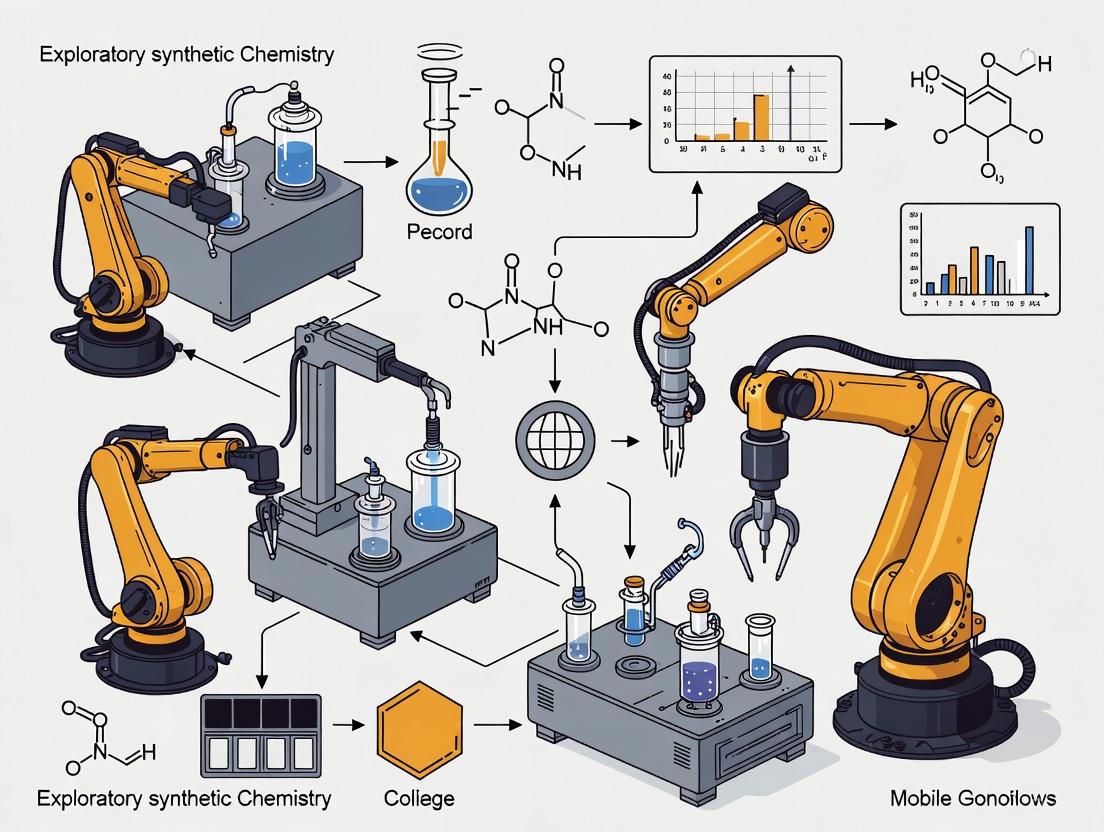
This article explores the transformative integration of mobile robots into exploratory synthetic chemistry workflows.
Mobile Robots for Exploratory Synthetic Chemistry: Accelerating Discovery in Drug Development and Beyond
Abstract
This article explores the transformative integration of mobile robots into exploratory synthetic chemistry workflows. Aimed at researchers, scientists, and drug development professionals, it details how these autonomous systems, leveraging artificial intelligence and modular design, are overcoming the limitations of traditional and automated laboratories. We cover the foundational shift towards mobile robotic chemists, examine their core methodologies and applications in areas like structural diversification and supramolecular chemistry, address key troubleshooting and optimization challenges, and validate their performance through comparative analysis with human researchers and specialized systems. The synthesis of these insights highlights how mobile robots are not merely automating tasks but are enabling a new paradigm of collaborative, data-driven, and accelerated scientific discovery.
From Automation to Autonomy: The Foundational Shift to Mobile Robotic Chemists
The Limitations of Traditional and Static Automation in Chemistry Labs
The adoption of automation in chemistry laboratories has traditionally been driven by the goal of enhancing throughput, reproducibility, and efficiency in analytical testing and synthetic workflows [1]. Traditional or static automation typically involves bespoke, hardwired systems where analyzers or synthesizers are physically integrated using tracks or conveyor belts, often dedicated to a single, high-volume task [1] [2]. In contrast, a new paradigm is emerging: mobile robotic systems that use free-roaming robots to connect otherwise independent laboratory instruments, creating a flexible and modular workflow [3] [4]. This application note details the core limitations of traditional static automation, supported by quantitative data, and provides detailed protocols for implementing a mobile robotic solution tailored for exploratory synthetic chemistry.
Key Limitations of Traditional Static Automation
The table below summarizes the principal constraints of traditional static automation systems, which become particularly pronounced in research and development environments characterized by diverse experiments and the need for rapid iteration.
Table 1: Core Limitations of Traditional Static Automation in Chemistry Labs
| Limitation Category | Specific Constraints | Impact on Exploratory Research |
|---|---|---|
| Infrastructure & Cost | High initial capital investment and significant physical space requirements [1]. | High financial barrier to entry and inflexible lab layout. |
| Operational Rigidity | Fixed configuration and workflow; difficult and costly to modify or expand [3] [1]. | Inability to adapt to new experimental protocols or incorporate new analytical techniques swiftly. |
| Analytical Breadth | Often reliant on a single, hard-wired characterization technique (e.g., HPLC or a specific spectrometer) [3]. | Provides a narrow data view, unlike manual experiments that use orthogonal techniques (e.g., both MS and NMR) for unambiguous results [3]. |
| Operational Risks | System downtime can halt all integrated processes; creates psychological dependence on a single system [1]. | Significant disruption to research timelines and output during technical failures. |
| Resource Access | Instruments within the automated track are monopolized by the system and unavailable for shared use [3]. | Inefficient for environments where expensive equipment must be shared among human researchers and multiple workflows. |
Mobile Robotic Solution: A Modular Workflow for Exploratory Synthesis
Mobile robotic platforms address these limitations by leveraging free-roaming robots to bridge discrete, standard laboratory instruments. The following section outlines the implementation of such a system.
Research Reagent Solutions & Essential Materials
Table 2: Key Materials and Equipment for a Mobile Robotic Workflow
| Item | Function & Application Notes |
|---|---|
| Mobile Robot(s) | Free-roaming robotic agents for transporting samples and operating equipment. Can be single-purpose or fitted with a multipurpose gripper [3]. |
| Automated Synthesis Platform | A platform like a Chemspeed ISynth for executing chemical reactions in an automated fashion [3]. |
| Liquid Chromatography–Mass Spectrometer | Provides orthogonal data on reaction outcome (chromatographic retention and molecular mass) [3]. |
| Benchtop NMR Spectrometer | Provides orthogonal data on molecular structure and reaction conversion [3]. |
| Central Control Software | Host computer software orchestrates the entire workflow, from synthesis to analysis and decision-making [3]. |
| Standard Laboratory Consumables | The system is designed to use standard vials and tubes, avoiding the need for custom, proprietary consumables [3]. |
Experimental Protocol: Autonomous Multi-Step Synthesis and Screening
This protocol is adapted from pioneering work using mobile robots for exploratory synthesis, demonstrating an end-to-end process from reaction execution to autonomous decision-making [3].
1. Objective: To autonomously perform a parallel synthesis of a chemical library, characterize the products using orthogonal techniques, and use a heuristic decision-maker to select successful reactions for subsequent scale-up or diversification.
2. Equipment & Reagents Setup:
- Ensure the automated synthesis platform (e.g., Chemspeed ISynth) is stocked with necessary solvents and starting materials (e.g., alkyne amines, isothiocyanates, isocyanates).
- Confirm that the UPLC-MS and benchtop NMR are operational, with appropriate methods pre-loaded.
- Verify that mobile robots are charged and their paths to all instruments (synthesizer, UPLC-MS, NMR) are unobstructed.
3. Procedure:
- Step 1: Reaction Execution. The control software instructs the synthesis platform to combinatorially conduct a set of parallel reactions (e.g., condensation reactions to form ureas and thioureas).
- Step 2: Sample Aliquoting. On reaction completion, the synthesis platform automatically takes an aliquot from each reaction mixture and reformats it into separate vials for MS and NMR analysis.
- Step 3: Robotic Transport. A mobile robot retrieves the prepared sample trays and transports them to the UPLC-MS and NMR instruments [3]. Sample loading is performed by the robot or an integrated actuator.
- Step 4: Orthogonal Analysis.
- UPLC-MS Analysis: Runs pre-programmed methods. Data (chromatograms and mass spectra) are saved to a central database.
- NMR Analysis: Runs pre-programmed proton (1H NMR) methods. Data (spectra) are saved to the central database.
- Step 5: Heuristic Decision-Making.
- A software-based decision-maker, pre-loaded with experiment-specific pass/fail criteria defined by a domain expert, processes the UPLC-MS and NMR data for each reaction.
- Example criteria: A "pass" for MS requires a chromatographic peak with the correct mass-to-charge ratio; a "pass" for NMR requires a spectrum consistent with the expected product structure and purity [3].
- Reactions that pass both analyses are automatically selected for the next stage (e.g., scale-up or use as substrates in a divergent synthesis).
- Step 6: Autonomous Scale-up/Reproducibility Check. The system automatically initiates a scale-up or replicate of the "hit" reactions to confirm reproducibility before further investigation.
4. Workflow Visualization: The following diagram illustrates the closed-loop, modular workflow enabled by the mobile robotic system.
Mobile Robotic Chemistry Workflow
Comparative Technical Specifications
The table below quantifies the advantages of a mobile robotic approach over traditional static automation in a laboratory setting.
Table 3: Technical Comparison: Static Automation vs. Mobile Robotic Systems
| Specification | Traditional Static Automation | Mobile Robotic System |
|---|---|---|
| System Modularity | Low; fixed, hardwired configuration [1]. | High; modular, "plug-and-play" instruments [3]. |
| Characterization Techniques | Typically single technique [3]. | Multiple orthogonal techniques (e.g., UPLC-MS & NMR) [3]. |
| Equipment Sharing | Impossible; instruments are monopolized by the track [3]. | Enabled; robots share existing lab equipment with humans [3]. |
| Initial Investment | Very high [1]. | Lower; utilizes standard, sometimes pre-existing, instruments [3]. |
| Layout Flexibility | Requires permanent, dedicated space [1]. | High; instruments can be located anywhere with robot access [3]. |
| Scalability | Difficult and expensive to scale [1]. | Inherently scalable by adding more robots or instruments [3]. |
| Typical Throughput | Very high (e.g., 1000s of samples/hour) [1]. | Lower but sufficient for R&D (e.g., 10s of reactions/batch) [3]. |
Traditional static automation, while powerful for high-volume, repetitive diagnostic testing, presents significant limitations for exploratory chemistry in research and development. Its rigidity, high cost, and narrow analytical scope hinder the agile and multi-faceted experimentation required for discovery. The mobile robotic paradigm overcomes these barriers by creating a modular, shared, and flexible environment. By leveraging free-roaming robots to connect standard analytical equipment, this approach mirrors human decision-making processes, utilizes orthogonal characterization data, and allows laboratories to accelerate discovery without a complete and prohibitively expensive infrastructure overhaul.
Core Concepts
A Mobile Robotic Chemist is an autonomous system comprising one or more free-roaming mobile robots that perform chemical experiments and analyses by physically operating standard laboratory equipment, emulating the actions of a human researcher within an existing laboratory infrastructure [3].
The core operational paradigm is a modular workflow. Unlike bespoke, integrated automated systems, mobile robotic agents serve as the physical link between standalone, often unmodified, laboratory instruments such as automated synthesizers, liquid chromatography–mass spectrometers (UPLC-MS), and benchtop nuclear magnetic resonance (NMR) spectrometers [3]. This modularity allows the robots to share equipment with human researchers without monopolizing it or requiring extensive laboratory redesign [3].
Central to the concept is the integration of autonomous decision-making. This involves a synthesis–analysis–decision cycle where analytical data from multiple orthogonal techniques (e.g., UPLC-MS and NMR) is processed by a heuristic or algorithmic decision-maker. This system selects successful reactions to scale up, checks the reproducibility of screening hits, and determines subsequent workflow steps without human intervention, moving beyond simple automation to genuine autonomy [3].
Key Differentiators from Traditional Automation
The table below summarizes the key differences between Mobile Robotic Chemists and traditional fixed automation.
| Differentiator | Mobile Robotic Chemist | Traditional Fixed Automation |
|---|---|---|
| Laboratory Integration | Modular; uses free-roaming robots to connect existing, unmodified instruments [3]. | Bespoke; requires physically integrated and often custom-built equipment [3]. |
| Physical Flexibility | High; robots can be re-tasked and navigate existing lab spaces [3]. | Low; systems are typically hard-wired for a specific workflow or location [3]. |
| Characterization Approach | Multi-modal; leverages orthogonal techniques (e.g., UPLC-MS & NMR) for robust analysis, mimicking human protocols [3]. | Often unidimensional; relies on a single, hard-wired characterization technique due to integration complexity [3]. |
| Decision-Making Scope | Suited for exploratory synthesis; can handle open-ended problems with multiple potential products using heuristic or AI-driven analysis [3]. | Primarily focused on optimization; excels at maximizing a single, known figure of merit (e.g., yield of a target compound) [3]. |
| Scalability & Cost | Inherently scalable by adding robots or instruments; potentially lower initial cost by utilizing standard lab equipment [3]. | High initial cost and complexity for setup and integration; scaling often requires duplicating entire systems [3]. |
Experimental Protocol: Autonomous Exploratory Synthesis and Screening
This protocol details a representative workflow for an autonomous multi-step synthesis and functional screening, as exemplified in recent literature [3].
The following diagram illustrates the autonomous workflow for synthesis, analysis, and decision-making.
Detailed Methodology
Synthesis and Sample Preparation
- Reaction Setup: An automated synthesis platform (e.g., Chemspeed ISynth) performs parallel combinatorial synthesis in reaction vials. For instance, this involves the condensation of different alkyne amines with isothiocyanates or isocyanates to form a library of ureas and thioureas [3].
- Aliquot and ReformAT: Upon reaction completion, the synthesizer automatically takes an aliquot from each reaction mixture and reformats it into standard vials for UPLC-MS and NMR analysis [3].
Mobile Robot-Mediated Analysis
- Sample Transport: A mobile robot (or multiple task-specific robots) retrieves the prepared sample vials from the synthesizer and transports them across the laboratory to the respective analytical instruments [3].
- Orthogonal Data Acquisition:
- Autonomous Data Collection: Customizable Python scripts control the instruments to acquire data autonomously after sample delivery. All resulting data (chromatograms, mass spectra, NMR spectra) are saved to a central database [3].
Autonomous Decision-Making
- Data Processing: A heuristic decision-maker, designed with domain expertise, processes the data from both analytical streams [3].
- Binary Grading: The algorithm assigns a binary "pass" or "fail" grade to each reaction based on experiment-specific criteria applied to both the MS and NMR data. For example, it may look for evidence of expected molecular weight and structural motifs consistent with the desired product [3].
- Consensus Decision: The results from both analyses are combined. In the demonstrated workflow, a reaction must pass both the MS and NMR checks to be considered a success and proceed to the next stage [3].
- Reproducibility Check: Reactions deemed successful are automatically repeated by the synthesis platform to confirm reproducibility before valuable resources are committed to scale-up [3].
- Workflow Progression: Reproducible hits are scaled up, and the products can be directed to subsequent synthetic diversification or to a functional assay (e.g., testing host-guest binding properties in supramolecular chemistry) [3].
The Scientist's Toolkit: Research Reagent Solutions
The table below lists key reagents, materials, and equipment essential for establishing a mobile robotic chemistry workflow.
| Item | Function / Description |
|---|---|
| Mobile Robotic Agent(s) | Free-roaming robots capable of navigation, object grasping, and transporting samples between modules. Can be single-purpose or equipped with a multipurpose gripper [3]. |
| Automated Synthesis Platform | A robotic platform (e.g., Chemspeed ISynth) for dispensing liquids, handling reactants, and performing parallel chemical reactions in an automated fashion [3]. |
| Benchtop NMR Spectrometer | A compact, lower-field (e.g., 80 MHz) NMR instrument that provides structural information on reaction products and is suitable for integration into an automated workflow [3]. |
| UPLC-MS System | An ultra-high-performance liquid chromatography-mass spectrometry system used to separate reaction mixtures and identify components based on mass and retention time [3]. |
| Heuristic Decision-Maker | The software core that autonomously interprets analytical data from multiple sources (NMR, MS) to make pass/fail decisions on reaction outcomes and guide the next experimental steps [3]. |
| Central Database | A structured data management system (e.g., a NewSQL database like "Molar") that stores all experimental parameters, operational data, and analytical results, enabling data persistence and analysis [5]. |
| Simulation Toolkit (Chemistry3D) | A 3D simulation platform (e.g., built on NVIDIA Omniverse) for training robot operations in a virtual chemical lab, enabling safe task practice and Sim2Real transfer [6]. |
| Orchestration Software (ChemOS) | Software designed to democratize autonomous discovery by orchestrating experiment scheduling, machine learning algorithms, and hardware control across the workflow [5]. |
The Critical Role of Modular Workflows and Shared Laboratory Equipment
The integration of mobile robotic systems into research laboratories represents a paradigm shift in experimental science, particularly in the field of exploratory synthetic chemistry. Traditional autonomous laboratories often rely on bespoke, hard-wired equipment that monopolizes instrumentation and limits analytical flexibility [3]. This approach stands in stark contrast to human experimentation practices, where researchers dynamically employ multiple characterization techniques to validate results. The emergence of modular robotic workflows addresses this fundamental limitation by creating systems that share existing laboratory equipment with human researchers without requiring extensive infrastructure redesign [3]. This application note details the implementation, protocols, and benefits of such modular approaches, with specific emphasis on their application within exploratory synthetic chemistry workflows utilizing mobile robots.
Conceptual Framework and Definitions
The Modular Workflow Paradigm
Modular workflows in autonomous laboratories involve physically separated synthesis and analysis modules connected by mobile robotic agents for sample transportation and handling [3]. This architecture creates a flexible and scalable system that can access distributed instrumentation throughout a laboratory environment. The key innovation lies in the decoupling of automated synthesis platforms from specialized analytical instruments, allowing robots to share equipment with human researchers and utilize a wider array of characterization techniques than typically available in integrated systems [3].
Biofoundry operations provide a valuable conceptual framework for understanding modular laboratory automation through a defined abstraction hierarchy [7]. This hierarchy organizes automated experimental processes into four distinct levels:
- Level 0: Project - The overall research objective to be carried out in the automated system.
- Level 1: Service/Capability - Specific functions required from the system, such as compound synthesis or analysis.
- Level 2: Workflow - The sequence of tasks needed to deliver a service, typically following a Design-Build-Test-Learn (DBTL) cycle.
- Level 3: Unit Operations - Individual experimental or computational tasks performed by specific hardware or software [7].
This hierarchical abstraction enables researchers to operate at high conceptual levels without needing detailed understanding of underlying instrumentation, while maintaining flexibility and reconfigurability in experimental design.
Implementation Architecture
System Components and Integration
The modular autonomous platform for exploratory synthetic chemistry integrates several key components through a centralized control system [3]:
- Mobile Robots: Free-roaming robotic agents responsible for sample transportation and instrument operation across the laboratory space.
- Automated Synthesis Platform: A Chemspeed ISynth synthesizer or equivalent system for performing chemical reactions autonomously.
- Analytical Instruments: Standard laboratory equipment including Ultrahigh-Performance Liquid Chromatography-Mass Spectrometry (UPLC-MS) and Benchtop Nuclear Magnetic Resonance (NMR) spectrometers.
- Decision-Maker Algorithm: Heuristic software that processes orthogonal analytical data to autonomously determine subsequent experimental steps.
Table 1: Core Components of a Modular Robotic Laboratory
| Component Category | Specific Examples | Function in Workflow |
|---|---|---|
| Mobile Robotics | Task-specific robots or multipurpose gripper systems | Sample transport between modules; instrument operation |
| Synthesis Module | Chemspeed ISynth platform | Automated chemical synthesis and reaction setup |
| Analytical Instruments | UPLC-MS, Benchtop NMR Spectrometer | Orthogonal characterization of reaction outcomes |
| Control Software | Customizable Python scripts | Orchestration of workflow; data acquisition and processing |
| Decision Algorithm | Heuristic decision-maker | Data interpretation and experimental direction selection |
Workflow Visualization
The following diagram illustrates the logical relationships and workflow in a modular robotic laboratory system:
Experimental Protocols
Autonomous Exploratory Synthesis Protocol
This protocol enables the autonomous discovery and optimization of chemical compounds using mobile robots and shared laboratory equipment.
Equipment and Reagents
Table 2: Essential Research Reagent Solutions
| Item | Specification | Function/Purpose |
|---|---|---|
| Automated Synthesis Platform | Chemspeed ISynth with temperature control and inert atmosphere capability | Perform chemical reactions under controlled conditions |
| Mobile Robotic Agents | Free-roaming robots with specialized grippers | Transport samples between modules; operate instruments |
| UPLC-MS System | Ultrahigh-performance liquid chromatography coupled with mass spectrometry | Separation and molecular weight characterization |
| Benchtop NMR | 80 MHz Fourier Transform NMR spectrometer | Structural elucidation of reaction products |
| Python Control Scripts | Customizable scripts for instrument control and data acquisition | Orchestrate workflow execution and data management |
| Reaction Substrates | Building blocks relevant to target chemistry (e.g., alkyne amines, isothiocyanates) | Starting materials for synthetic exploration |
Procedure
Reaction Setup
- Program the automated synthesis platform to prepare parallel reactions according to a predefined experimental matrix.
- Example: Combinatorially combine three alkyne amines (1-3) with either an isothiocyanate (4) or isocyanate (5) to form ureas and thioureas [3].
- Ensure proper mixing and temperature control throughout the reaction period.
Sample Aliquot and Reformating
- Upon reaction completion, command the synthesis platform to withdraw aliquots from each reaction vessel.
- Reformate samples into appropriate vials for UPLC-MS and NMR analysis separately.
- Seal vials to prevent evaporation or contamination during transport.
Robotic Sample Transport
- Dispatch mobile robots to retrieve prepared samples from the synthesis platform.
- Transport samples to the respective analytical instruments (UPLC-MS and NMR).
- Robots physically deliver samples to the autosamplers of each instrument.
Automated Analysis
- Initiate predefined analytical methods on each instrument:
- UPLC-MS Method: Gradient elution with appropriate mobile phases; positive/negative ion mode MS detection.
- NMR Method: Standard proton NMR acquisition parameters with solvent suppression.
- Save raw data to a centralized database with unique identifiers linking to specific reactions.
- Initiate predefined analytical methods on each instrument:
Data Processing and Decision-Making
- Process analytical data using automated algorithms:
- MS Data Analysis: Identify expected molecular ions and characterize purity.
- NMR Data Analysis: Detect characteristic protons and assess reaction conversion.
- Apply heuristic decision rules with binary pass/fail grading for each technique.
- Combine orthogonal analysis results - reactions must pass both MS and NMR criteria to proceed.
- Process analytical data using automated algorithms:
Subsequent Steps
- For reactions passing both analyses, command the synthesis platform to scale up successful reactions.
- Use scaled-up products for subsequent synthetic steps in divergent syntheses.
- Automatically document all steps, parameters, and results in an electronic laboratory notebook system.
Data Analysis and Integration Protocol
The following protocol utilizes Python-based workflows for processing and integrating diverse analytical data, facilitating autonomous decision-making.
Equipment and Software
- Computational Environment: Jupyter notebook running Python 3.x with scientific modules (NumPy, SciPy, Pandas, Matplotlib) [8].
- Data Sources: Raw analytical files from UPLC-MS and NMR instruments.
- Analysis Tools: Custom Python scripts for data processing and model fitting.
Procedure
Data Acquisition and Preprocessing
- Import raw UPLC-MS data and process to extract chromatographic peaks and mass spectra.
- Import raw NMR free induction decays (FIDs) and process with apodization, Fourier transformation, and phase correction [8].
- Identify and pick peaks representing metabolites or reaction products of interest.
Quantitative Analysis
- For UPLC-MS: Integrate peak areas and calculate concentrations using calibration standards.
- For NMR: Quantify metabolites through fitting of Gaussian or Lorentzian functions with normalization to an internal standard [8].
- Generate structured data tables (using Pandas DataFrames) with concentrations and spectral parameters.
Data Integration and Model Fitting
- Combine datasets from multiple analytical techniques into unified data structures.
- For kinetic analyses: Fit time-course data to appropriate kinetic models using SciPy optimization routines.
- Estimate kinetic parameters through iterative minimization of sum of squares between model and experimental data [8].
Heuristic Decision Implementation
- Apply domain-specific rules to evaluate reaction success:
- Example: Presence of molecular ion corresponding to expected product plus characteristic NMR shifts.
- Generate binary outcomes (pass/fail) for each reaction based on combined analytical evidence.
- Automatically determine subsequent experimental steps based on decision algorithm output.
- Apply domain-specific rules to evaluate reaction success:
Visualization and Reporting
- Create composite figures showing analytical results from multiple techniques.
- Document all processing steps, parameters, and decisions within the Jupyter notebook.
- Export results for long-term storage and sharing with research team.
Applications in Exploratory Chemistry
Case Study: Structural Diversification Chemistry
The modular workflow has been successfully applied to structural diversification chemistry, particularly in the synthesis of compound libraries for drug discovery [3]. In one demonstration, the system autonomously performed parallel synthesis of ureas and thioureas through combinatorial condensation of alkyne amines with isothiocyanates or isocyanates. The robotic system analyzed reaction outcomes using orthogonal UPLC-MS and NMR techniques, then applied heuristic decision-making to select successful reactions for scale-up and further elaboration in multi-step synthetic sequences [3]. This approach effectively emulates the decision processes of expert chemists in prioritizing compounds for library development.
Case Study: Supramolecular Host-Guest Chemistry
The platform has demonstrated particular utility in exploratory supramolecular chemistry, where self-assembly processes can yield multiple potential products from the same starting materials [3]. Unlike traditional optimization approaches that maximize a single figure of merit, the heuristic decision-maker can identify and characterize diverse supramolecular assemblies. The system was extended beyond synthesis to autonomously assay function by evaluating host-guest binding properties, demonstrating how modular workflows can encompass both synthesis and functional characterization [3].
Technical Specifications and Optimization
Performance Metrics
Table 3: Quantitative Performance Metrics for Modular Robotic Workflows
| Parameter | Specification | Impact on Workflow Efficiency |
|---|---|---|
| Analytical Technique Integration | 2+ orthogonal methods (UPLC-MS + NMR) | Increases confidence in reaction outcome assessment |
| Decision Algorithm Type | Heuristic rules based on domain expertise | Maintains openness to novel discoveries |
| Equipment Sharing Capability | Robots share instruments with human researchers | Reduces capital investment; increases facility utilization |
| Sample Transport Mechanism | Mobile robots with multipurpose grippers | Enables flexible laboratory layout |
| Data Integration Framework | Python scripts with centralized database | Ensures traceability and reproducibility |
Modular workflows utilizing mobile robots and shared laboratory equipment represent a transformative approach to autonomous research in exploratory synthetic chemistry. By physically decoupling synthesis and analysis modules while maintaining coordination through mobile robotic transport and centralized control software, these systems achieve unprecedented flexibility in automated experimentation. The implementation of heuristic decision-makers capable of processing orthogonal analytical data enables authentic emulation of human expert decision-making processes, particularly valuable in exploratory research where outcomes are not easily reduced to simple optimization parameters. This architecture promises to accelerate discovery in synthetic chemistry while maximizing utilization of existing laboratory instrumentation.
Enabling Exploratory Synthesis Beyond Single-Metric Optimization
The transition from automated to truly autonomous laboratories represents a paradigm shift in chemical research. Unlike automation, which requires researchers to make all decisions, autonomous experiments leverage agents, algorithms, or artificial intelligence to interpret analytical data and determine subsequent experimental steps [3]. This capability is particularly valuable for exploratory synthesis, where reactions can yield multiple potential products rather than a single target compound [3]. Traditional optimization approaches that maximize a single figure of merit, such as yield, are insufficient for these open-ended problems. This article details the implementation of a modular robotic platform that enables exploratory synthesis through multimodal characterization and heuristic decision-making, moving beyond the limitations of single-metric optimization.
Platform Architecture: A Modular Workflow
The core architecture employs a modular workflow that physically separates synthesis and analysis modules, connected by mobile robotic agents for sample transportation and handling [3]. This design allows robots to share existing laboratory equipment with human researchers without requiring extensive redesign or monopolizing instruments [3].
Integrated System Components
The platform integrates several standard instruments into a cohesive system:
- Synthesis Module: A Chemspeed ISynth synthesizer performs automated chemical synthesis [3].
- Analytical Modules:
- Mobile Robots: Free-roaming robots handle samples and operate equipment, transporting samples between modules [3].
- Control Software: A central host computer orchestrates the workflow, running customizable Python scripts for data acquisition [3].
This architecture is inherently expandable, as demonstrated by the seamless integration of a standard commercial photoreactor [3].
Workflow Visualization
The following diagram illustrates the continuous closed-loop operation of the autonomous laboratory:
Heuristic Decision-Making Framework
A key innovation of this platform is its heuristic decision-maker that processes orthogonal NMR and UPLC-MS data to autonomously select successful reactions [3]. This system mimics human expert judgment rather than relying solely on AI models constrained by their training data.
Decision Logic Protocol
The decision-making process follows this structured protocol:
- Binary Grading: The decision-maker assigns a pass/fail grade to MS and ¹H NMR analyses for each reaction based on experiment-specific criteria defined by domain experts [3].
- Data Combination: Binary results from both analyses are combined to generate a pairwise, binary grading for each reaction [3].
- Orthogonal Validation: Reactions must pass both analytical assessments to proceed, ensuring robust selection [3].
- Reproducibility Check: The system automatically checks the reproducibility of screening hits before scale-up [3].
This "loose" heuristic approach remains open to novelty, making it particularly suitable for chemical discovery where reactions may produce complex product mixtures [3].
Experimental Protocols
Application 1: Structural Diversification Chemistry
This protocol demonstrates autonomous multi-step synthesis for creating structurally diverse compound libraries.
Objective: Perform parallel synthesis of ureas and thioureas followed by divergent synthesis of triazoles [3].
Synthetic Route:
- Primary Reaction: Combinatorial condensation of three alkyne amines (1-3) with either an isothiocyanate (4) or an isocyanate (5) to form ureas and thioureas [3].
- Click Chemistry: Scale-up of successful substrates for copper-catalyzed azide-alkyne cycloaddition with organic azides to form triazoles [3].
Autonomous Workflow:
- Synthesis: Chemspeed ISynth executes parallel synthesis in batch format.
- Sampling: The synthesizer takes aliquots of each reaction mixture and reformats them separately for MS and NMR analysis.
- Transport: Mobile robots transport samples to the respective analytical instruments.
- Analysis: UPLC-MS and benchtop NMR perform orthogonal characterization.
- Decision: The heuristic decision-maker evaluates data and selects successful reactions for scale-up and subsequent diversification.
Pass/Fail Criteria:
- UPLC-MS: Presence of expected m/z values for target compounds.
- NMR: Characteristic chemical shifts confirming product formation.
Application 2: Supramolecular Host-Guest Chemistry
This protocol enables autonomous identification and functional testing of supramolecular assemblies.
Objective: Discover and characterize novel supramolecular host-guest complexes [3].
Synthetic Approach: Combination of ditopic nitrogen donors and palladium(II) salts to form self-assembled architectures [3].
Autonomous Workflow:
- Screening: Multiple combinations are simultaneously synthesized and analyzed.
- Multimodal Characterization: UPLC-MS identifies molecular weights of assemblies, while NMR provides structural information about coordination environments.
- Function Assay: Successful hosts are autonomously subjected to binding studies with guest molecules.
- Decision: The system selects hosts with promising binding properties for further investigation.
Pass/Fail Criteria:
- UPLC-MS: Detection of high-mass ions corresponding to expected assemblies.
- NMR: Characteristic shifts indicating metal coordination and assembly formation.
Application 3: Photochemical Synthesis
This protocol demonstrates the platform's extensibility through integration of a commercial photoreactor.
Objective: Conduct photochemical reactions with autonomous analysis and decision-making.
Workflow Integration:
- The standard workflow is maintained with the addition of photochemical reaction capability.
- Mobile robots handle sample transfer to and from the photoreactor module.
- Multimodal analysis (UPLC-MS and NMR) characterizes photoproducts.
- Decision-maker evaluates reaction outcomes based on predefined criteria.
The Scientist's Toolkit: Research Reagent Solutions
Table 1: Essential materials and reagents for autonomous exploratory synthesis
| Item Name | Function | Application Examples |
|---|---|---|
| Chemspeed ISynth Synthesizer | Automated synthesis platform | Parallel synthesis of ureas, thioureas, supramolecular complexes [3] |
| Benchtop NMR Spectrometer (80-MHz) | Structural elucidation of reaction products | Verification of supramolecular assembly formation, reaction product identification [3] |
| UPLC-MS System | Separation and mass analysis | Molecular weight confirmation, reaction monitoring [3] |
| Mobile Robotic Agents | Sample transport and equipment operation | Transfer between synthesis and analysis modules [3] |
| Heuristic Decision-Maker Software | Data interpretation and experimental planning | Autonomous selection of successful reactions for further investigation [3] |
Performance Metrics and Outcomes
Table 2: Quantitative performance assessment of the autonomous platform
| Performance Metric | Result/Observation | Significance |
|---|---|---|
| Analytical Versatility | Combines UPLC-MS and NMR data | Enables comprehensive characterization comparable to manual experimentation [3] |
| Decision Accuracy | Mimics expert chemist judgment | Reduces reliance on single-metric optimization [3] |
| Equipment Utilization | Shares instruments with human researchers | Minimizes dedicated infrastructure requirements [3] |
| Application Scope | Successful in structural diversification, supramolecular, and photochemical synthesis | Demonstrates platform generality across chemical domains [3] |
| Functional Testing | Autonomous host-guest binding assays | Extends beyond synthesis to property evaluation [3] |
Implementation Protocol
System Setup and Calibration
Instrument Integration:
- Physical Modifications: Install electric actuators on synthesis module doors to enable automated robot access [3].
- Software Configuration: Implement Python scripts for autonomous data acquisition and instrument control [3].
- Robot Programming: Train mobile robots for sample handling operations and navigation between modules.
Decision-Maker Configuration:
- Domain Expert Input: Define experiment-specific pass/fail criteria for MS and NMR analyses.
- Algorithm Tuning: Establish rules for combining orthogonal data streams.
- Validation Testing: Verify system performance with known reaction systems before exploratory work.
Operational Workflow
The operational sequence follows the continuous loop illustrated below:
Step-by-Step Execution:
- Experiment Planning: Initial reaction set designed by domain experts.
- Autonomous Synthesis: Chemspeed ISynth executes reactions in parallel format.
- Sample Preparation: Synthesizer reformats aliquots for different analytical techniques.
- Robotic Transport: Mobile robots deliver samples to appropriate instruments.
- Data Acquisition: UPLC-MS and NMR analyses performed autonomously.
- Decision Cycle: Heuristic algorithm evaluates data and selects next experiments.
- Iterative Exploration: Cycle continues until stopping criteria met or novel discoveries identified.
Technical Advantages and Limitations
Key Advantages
- Infrastructure Flexibility: Mobile robots can access any instrument in the laboratory, enabling scalable expansion without physical reconfiguration [3].
- Data Richness: Orthogonal analytical techniques provide comprehensive characterization, reducing false positives/negatives from single-technique approaches [3].
- Human-Mimetic Decision Making: Heuristic approach incorporates chemical intuition, remaining open to unexpected discoveries [3].
- Resource Efficiency: Shared instrument use maximizes equipment utilization and minimizes dedicated infrastructure [3].
Current Limitations
- Reaction Scope: Limited to chemistry compatible with the installed synthesis platform and analytical techniques [3].
- Expert Dependency: Initial pass/fail criteria and reaction selection require domain expert input [3].
- Hardware Constraints: Physical manipulation capabilities limited to predefined operations [3].
This autonomous platform represents a significant advancement in exploratory synthetic chemistry by moving beyond single-metric optimization. Through the integration of mobile robotics, multimodal characterization, and heuristic decision-making, it enables the discovery of complex chemical systems that would challenge conventional optimization approaches. The modular architecture ensures scalability and adaptability across chemical domains, from drug discovery intermediates to functional supramolecular assemblies. As autonomous laboratories continue to evolve, this workflow provides a blueprint for combining human chemical intuition with robotic precision to accelerate chemical discovery.
Application Notes
Autonomous laboratories represent a paradigm shift in chemical discovery, integrating robotics, artificial intelligence, and advanced analytics into a continuous closed-loop system [9]. These systems minimize human intervention and subjective decision points, transforming processes that once required months of trial and error into routine high-throughput workflows [9]. The core innovation lies in combining mobile robots, automated synthesis platforms, and orthogonal analytical instruments into a modular architecture that mimics human researcher behavior while operating with machine precision and endurance [3].
This modular approach is particularly valuable for exploratory synthetic chemistry, where reaction outcomes are often unpredictable and cannot be adequately assessed by a single analytical technique [3]. Unlike optimization-focused autonomous systems that maximize a single figure of merit, exploratory chemistry requires assessing multiple potential products, as commonly encountered in supramolecular assemblies and structural diversification chemistry [3]. The integration of mobile robots enables this flexibility while allowing shared use of existing laboratory equipment with human researchers without requiring extensive facility redesign [3].
Core Component Specifications
Table 1: Core technical components of autonomous exploratory chemistry platforms
| Component Category | Specific Instrument Examples | Key Functions | Technical Specifications |
|---|---|---|---|
| Mobile Robots | Free-roaming robotic agents with multipurpose grippers | Sample transportation, instrument operation, physical manipulation | Capable of operating standard laboratory equipment and doors [3] |
| Synthesis Platforms | Chemspeed ISynth synthesizer | Automated reagent dispensing, reaction control, sample aliquot collection | Integrated with electric actuators for robotic access; compatible with organic solvents [3] |
| Orthogonal Analytical Instruments | UPLC-MS (Ultra-high Performance Liquid Chromatography-Mass Spectrometry) | Molecular weight determination, reaction mixture separation, compound identification | Standard commercial configuration; enables characterization of diverse product mixtures [3] |
| Orthogonal Analytical Instruments | Benchtop NMR (Nuclear Magnetic Resonance) Spectrometer | Molecular structure elucidation, reaction monitoring | 80-MHz unmodified benchtop instrument; provides structural information complementary to MS [3] |
| Decision-Making System | Heuristic decision-maker with experiment-specific criteria | Binary pass/fail grading of reactions; determines subsequent experimental steps | Processes orthogonal NMR and UPLC-MS data; can be weighted to favor specific analytical methods [3] |
Experimental Protocols
Protocol 1: Autonomous Workflow for Structural Diversification Chemistry
Objective: To demonstrate an end-to-end autonomous process for parallel synthesis and structural diversification of compounds with medicinal chemistry relevance, specifically ureas and thioureas, without intermediate human intervention [3].
Materials and Reagents:
- Alkyne amines (compounds 1-3)
- Isothiocyanate (compound 4)
- Isocyanate (compound 5)
- Appropriate organic solvents for reaction and analysis
Procedure:
- Reaction Setup: Program the Chemspeed ISynth platform to perform combinatorial condensation of three alkyne amines (1-3) with either an isothiocyanate (4) or an isocyanate (5) to produce three ureas and three thioureas [3].
- Automated Sampling: Upon reaction completion, the ISynth platform automatically takes aliquots of each reaction mixture and reformats them separately for MS and NMR analysis [3].
- Sample Transport: Mobile robots retrieve sample plates and transport them to the appropriate analytical instruments (UPLC-MS and benchtop NMR) [3].
- Orthogonal Analysis:
- UPLC-MS analysis: Separation and molecular weight confirmation
- NMR analysis: Structural verification through 1H NMR spectra
- Data Processing: The heuristic decision-maker applies binary pass/fail grading to both MS and NMR datasets using experiment-specific criteria defined by domain experts [3].
- Decision Implementation: Reactions that pass both analytical assessments are automatically selected for scale-up and further elaboration in divergent synthesis [3].
Protocol 2: Autonomous Identification of Supramolecular Host-Guest Assemblies
Objective: To autonomously synthesize and identify supramolecular self-assembled structures and evaluate their host-guest binding properties [3].
Materials and Reagents:
- Supramolecular building blocks
- Guest molecules for binding studies
- Appropriate solvents for self-assembly processes
Procedure:
- Reaction Setup: Program the Chemspeed ISynth to perform multiple supramolecular syntheses using various building block combinations [3].
- Automated Sampling and Transport: The system automatically collects reaction aliquots, which mobile robots transport to UPLC-MS and NMR instruments [3].
- Multimodal Analysis:
- UPLC-MS: Identifies molecular weights of assembled structures
- NMR: Provides structural information about supramolecular complexes
- Heuristic Assessment: The decision-maker evaluates the orthogonal data streams, remaining open to detecting novel assemblies that may exhibit complex spectral characteristics [3].
- Function Assay: Successful supramolecular syntheses are automatically advanced to host-guest binding assessment, extending autonomy beyond synthesis to functional characterization [3].
- Hit Validation: The system automatically checks reproducibility of any screening hits before scale-up [3].
Protocol 3: Integration of Photochemical Synthesis Modules
Objective: To demonstrate the expandability of the modular autonomous platform by incorporating additional reaction capabilities, specifically photochemical synthesis [3].
Materials and Reagents:
- Photoreactive substrates
- Appropriate catalysts if required
- Solvents compatible with photochemical reactions
Procedure:
- Module Integration: Incorporate a standard commercial photoreactor into the existing modular workflow without requiring extensive reengineering [3].
- Reaction Execution: Program the Chemspeed ISynth to prepare photochemical reactions using appropriate substrates and conditions [3].
- Robotic Handling: Mobile robots transport reaction vessels between the synthesis platform and the photoreactor as needed [3].
- Analysis and Decision-Making: Follow the standard protocol for orthogonal UPLC-MS and NMR analysis, with the heuristic decision-maker applying photochemistry-specific pass/fail criteria [3].
Research Reagent Solutions
Table 2: Essential research reagents and materials for autonomous exploratory chemistry
| Category | Specific Examples | Function in Workflow |
|---|---|---|
| Synthesis Building Blocks | Alkyne amines, isothiocyanates, isocyanates [3] | Core substrates for constructing diverse molecular architectures |
| Supramolecular Building Blocks | Self-assembling ligands, metal ions, host-guest pairs [3] | Components for creating complex supramolecular structures |
| Photochemical Reagents | Photocatalysts, photoreactive substrates [3] | Enable light-mediated transformations in expanded workflow |
| Analytical Solvents | Deuterated solvents, UPLC-MS grade solvents [3] | Maintain instrument performance and ensure accurate characterization |
| Laboratory Consumables | Standard NMR tubes, MS vials, sample plates [3] | Compatible with both robotic handling and analytical instruments |
Workflow Visualization
Autonomous Chemistry Workflow
Component Integration Logic
Inside the Self-Driving Lab: Methodologies and Real-World Applications
Autonomous laboratories represent a paradigm shift in chemical synthesis, accelerating discovery by integrating automated measurements with reliable decision-making [3]. Unlike traditional automated systems that rely on single, hard-wired characterization techniques, a new approach using mobile robots enables a more human-like methodology [3]. This framework leverages modular workflows that combine mobile robotics, automated synthesis platforms, and orthogonal analytical techniques, allowing robots to share existing laboratory equipment with human researchers without monopolizing it or requiring extensive redesign [3] [10]. This article details the application notes and protocols for implementing such a system, specifically within the context of exploratory synthetic chemistry workflows using mobile robots.
Platform Architecture & Workflow Orchestration
The core of this autonomous laboratory is a modular platform that physically separates synthesis and analysis modules, linked by mobile robots responsible for sample transportation and handling [3]. This architecture is inherently expandable, allowing the incorporation of additional instruments limited only by laboratory space [3].
System Components and Integration
The workflow integrates several key hardware components, coordinated by a central control software that orchestrates the entire specified workflow without requiring robotics expertise from the domain expert [3]. The system can be operated by a single mobile robot fitted with a multipurpose gripper, or multiple task-specific robots for increased throughput [3].
Table: Core Hardware Components of the Autonomous Mobile Robot Laboratory
| Module Type | Specific Component | Primary Function |
|---|---|---|
| Synthesis | Chemspeed ISynth synthesizer [3] | Automated execution of chemical reactions. |
| Analytical | Ultrahigh-performance liquid chromatography–mass spectrometer (UPLC-MS) [3] | Provides separation and mass analysis for reaction monitoring. |
| Analytical | Benchtop Nuclear Magnetic Resonance (NMR) spectrometer [3] | Provides structural analysis for reaction monitoring. |
| Actuation & Transport | Mobile Robot(s) [3] | Transports samples between modules and operates equipment. |
| Control | Host Computer with Control Software [3] | Orchestrates the entire workflow and data flow. |
The following diagram illustrates the logical workflow and data flow between these components, from synthesis initiation to the final decision-making step.
Experimental Protocols
The following protocols describe specific applications of the autonomous workflow in exploratory synthetic chemistry.
Protocol: Autonomous Structural Diversification Synthesis
This protocol automates a divergent multi-step synthesis, relevant to medicinal chemistry, without intermediate human intervention [3].
3.1.1. Primary Synthesis (Urea/Thiourea Formation)
- Reaction Setup: The Chemspeed ISynth is loaded with three alkyne amines (building blocks 1-3) and one isothiocyanate (4) or isocyanate (5) [3].
- Parallel Reaction Execution: The platform autonomously performs the combinatorial condensation between the amines and (iso)cyanates to attempt the synthesis of three ureas and three thioureas [3].
- Sample Aliquot and Reformation: Upon completion, the ISynth synthesizer takes an aliquot of each reaction mixture and reformats it into appropriate vials for UPLC-MS and NMR analysis [3].
3.1.2. Orthogonal Analysis
- Sample Transport: A mobile robot collects the prepared sample vials and transports them to the UPLC-MS and benchtop NMR instruments [3].
- Data Acquisition: Autonomous data acquisition is triggered using customizable Python scripts. UPLC-MS and 1H NMR spectra are collected for each reaction mixture and saved to the central database [3].
3.1.3. Decision-Making for Scale-Up
- Heuristic Evaluation: The decision-maker assigns a binary pass/fail grade to the MS and NMR data for each reaction based on pre-defined, experiment-specific criteria (e.g., presence of expected molecular ion in MS, disappearance of starting material signals in NMR) [3].
- Consensus Decision: Reactions that pass both orthogonal analyses are automatically selected for scale-up [3].
- Reproducibility Check: The system may automatically check the reproducibility of any screening hits before proceeding [3].
3.1.4. Subsequent Elaboration
- Scale-Up Synthesis: The ISynth platform performs a larger-scale synthesis of the successful precursor molecules.
- Further Functionalization: The scaled-up products are then used as substrates for subsequent divergent synthesis steps, with the cycle of analysis and decision-making repeating [3].
Protocol: Exploratory Supramolecular Host-Guest Chemistry
This protocol is designed for exploratory chemistry where multiple self-assembled products are possible, extending the method to an autonomous function assay [3].
3.2.1. Supramolecular Synthesis
- The ISynth platform is tasked with combining building blocks known to form supramolecular assemblies under various conditions [3].
- Multiple parallel reactions are set up to explore a wide reaction space.
3.2.2. Multi-Modal Product Characterization
- The resulting complex mixtures are analyzed using the standard UPLC-MS and NMR workflow as described in section 3.1.2 [3].
- The "loose" heuristic decision-maker is employed, which remains open to novelty and is capable of identifying a wide range of potential products, not just a single target [3].
3.2.3. Autonomous Function Assay
- For reactions deemed successful by the decision-maker, the workflow is extended to evaluate host-guest binding properties [3].
- The system autonomously introduces a candidate guest molecule to the synthesized host assembly.
- Binding is assessed through analytical techniques (likely NMR or MS titration), allowing the platform to not only identify new supramolecular structures but also to autonomously characterize their function [3].
The Scientist's Toolkit: Research Reagent & Material Solutions
The following table details key materials and reagents used in the featured experiments.
Table: Essential Research Reagents and Materials for Autonomous Exploratory Synthesis
| Item Name | Function / Application | Specific Example / Note |
|---|---|---|
| Alkyne Amines | Building blocks for combinatorial synthesis. | Used as amines 1-3 in the structural diversification protocol [3]. |
| Isothiocyanate / Isocyanate | Electrophilic coupling partners for urea/thiourea synthesis. | Used as reagents 4 and 5 in the structural diversification protocol [3]. |
| Supramolecular Building Blocks | Components for self-assembly into complex host structures. | Specific chemicals are selected by domain experts for supramolecular exploration [3]. |
| Guest Molecules | Analytes for testing the function of synthesized supramolecular hosts. | Used in the autonomous function assay to evaluate host-guest binding [3]. |
| Deuterated Solvents | Required for NMR spectroscopy. | Ensure compatibility with the automated benchtop NMR system. |
| LC-MS Grade Solvents | Essential for reliable UPLC-MS performance. | Used for mobile phases and sample dilution to avoid instrument contamination and background interference. |
Decision-Making Logic
The autonomous decision-making process is a critical differentiator from simple automation. It relies on a heuristic system that processes orthogonal data streams to guide the discovery process.
The decision-maker first gives a binary pass or fail grade to the MS and 1H NMR analysis of each reaction, based on experiment-specific criteria defined by a domain expert [3]. The binary results are then combined to give a pairwise, binary grading for each reaction [3]. In the workflows described here, reactions must pass both orthogonal analyses to proceed to the next step, such as scale-up or further elaboration [3]. This heuristic approach is designed to be "loose" and open to novelty, making it particularly suited for exploratory synthesis where outcomes are not easily defined by a single scalar metric like yield [3].
Data Presentation & Quantitative Thresholds
The heuristic decision-maker relies on quantitative data from analytical instruments. The following table summarizes key metrics and parameters involved in the autonomous workflow.
Table: Quantitative Data and Parameters for Autonomous Workflow Execution
| Parameter | Typical Value / Threshold | Context & Notes |
|---|---|---|
| MS & NMR Pass/Fail Thresholds | Defined by domain expert | Criteria are experiment-specific and not based on a universal numeric value [3]. |
| Large Text Contrast Ratio | 3:1 (Minimum) [11] | For diagram labels (≥18pt or ≥14pt bold). Ensures legibility. |
| Normal Text Contrast Ratio | 4.5:1 (Minimum) [11] | For standard diagram labels. Ensures legibility. |
| UI Component Contrast Ratio | 3:1 (Minimum) [11] | For graphical objects in diagrams (e.g., node borders). |
| Analytical Technique Combination | 2 (NMR & MS) | Use of orthogonal techniques for robust decision-making [3]. |
| Decision Logic | Binary Consensus | Requires a "Pass" from all integrated analytical techniques [3]. |
In the development of autonomous mobile robots for exploratory synthetic chemistry, the paradigm for decision-making is shifting. The core of this evolution lies in how robots process complex, multi-modal data to choose their subsequent actions. Heuristic decision-makers, based on pre-defined expert rules, stand in contrast to AI-driven decision-makers that leverage machine learning models to navigate experimental outcomes. The choice between these approaches fundamentally impacts a system's adaptability, discovery potential, and operational robustness. This document details the application, protocols, and practical toolkit for implementing these decision-makers within modular robotic chemistry workflows, providing a foundation for their evaluation and use.
Comparative Analysis: Heuristic vs. AI-Driven Decision-Making
The table below summarizes the core characteristics of heuristic and AI-driven decision-makers in the context of autonomous chemical exploration.
Table 1: Comparison of Decision-Making Frameworks for Autonomous Chemistry
| Feature | Heuristic Decision-Maker | AI-Driven Decision-Maker |
|---|---|---|
| Core Logic | Pre-defined, rule-based "if-then" statements from domain expertise [3] | Machine learning models (e.g., Bayesian Optimization, Neural Networks) that learn from data [12] |
| Data Processing | Processes orthogonal data (e.g., NMR, MS) with binary (pass/fail) grading for each modality [3] | Fuses multi-modal data into a continuous optimization process; can handle complex, non-linear relationships [12] |
| Adaptability | Limited to the scope of the pre-programmed rules; struggles with novelty outside its design [3] | High; iteratively refines its model based on experimental feedback, optimizing for objectives like yield [12] |
| Typical Application | Exploratory synthesis where outcomes are open-ended (e.g., supramolecular chemistry) [3] | Optimization tasks with a clear scalar objective (e.g., maximizing reaction yield or conversion rate) [12] |
| Interpretability | High; the decision pathway is transparent and based on human-readable rules [3] | Low to medium; often a "black box," though Explainable AI (XAI) techniques can be applied [13] |
| Infrastructure Demand | Lower computational power; relies on clear, programmable rules [14] | High computational power for training and running models; requires significant data storage [15] [12] |
Experimental Protocols
Protocol for Heuristic, Multi-Modal Data Integration in Exploratory Synthesis
This protocol is adapted from workflows using mobile robots for autonomous synthetic chemistry, where the goal is to identify successful reactions in exploratory contexts, such as supramolecular assembly or library synthesis [3].
1. System Setup and Instrument Integration
- Robotic Platform: Employ a mobile robot capable of transporting samples between physically separated modules [3] [4].
- Synthesis Module: Utilize an automated synthesizer (e.g., Chemspeed ISynth).
- Analysis Modules: Integrate orthogonal characterization techniques, specifically a Liquid Chromatography-Mass Spectrometer (LC-MS) and a benchtop Nuclear Magnetic Resonance (NMR) spectrometer [3].
- Software Control: Establish a central control software to orchestrate the workflow and a database to store all experimental data [3].
2. Defining the Heuristic Decision Rules Before autonomous operation, domain experts must define the pass/fail criteria for each analytical technique. For example:
- UPLC-MS Analysis: A "pass" is assigned if the mass spectrum indicates the presence of a product with the expected mass-to-charge ratio and the chromatogram shows a clean profile with a single dominant peak.
- NMR Analysis: A "pass" is assigned if the 1H NMR spectrum shows a set of signals matching the predicted chemical shifts and integration for the target product, with minimal extraneous peaks.
3. Autonomous Workflow Execution
- Step 1 - Synthesis: The automated synthesis platform performs a set of parallel reactions.
- Step 2 - Sample Preparation & Transport: The synthesizer takes aliquots from each reaction mixture and reformats them for MS and NMR analysis. A mobile robot collects and transports these samples to the respective instruments [3].
- Step 3 - Data Acquisition & Processing: The LC-MS and NMR instruments run autonomously after sample delivery. The resulting data is saved to the central database.
- Step 4 - Heuristic Decision-Making: The decision-maker algorithm grades each reaction based on the pre-defined rules. A reaction must "pass" both the MS and NMR analyses to be considered a hit and selected for further investigation or scale-up [3].
- Step 5 - Action: The system automatically initiates the next set of experiments, focusing on the successful reactions, including reproducibility checks for screening hits.
Protocol for AI-Driven Optimization of Synthetic Reactions
This protocol is modeled after systems like the "Synbot," which employs AI to autonomously discover and optimize synthetic recipes for target molecules [12].
1. AI and Robotic System Architecture
- AI Software Layer: Contains modules for retrosynthesis pathway planning, Design of Experiments (DoE), and optimization (e.g., using a hybrid model combining Message-Passing Neural Networks and Bayesian Optimization) [12].
- Robot Software Layer: Translates abstract synthetic recipes from the AI layer into concrete, executable commands for the robotic hardware.
- Robot Layer: A modular system encompassing pantries, a dispensing module, reaction reactors (batch type), a sample-prep module, and an analysis module (e.g., LC-MS), all coordinated by transfer robots [12].
2. Autonomous Optimization Workflow
- Step 1 - Task Initiation: A user inputs a target molecule and the optimization objective (e.g., maximize yield).
- Step 2 - AI Planning: The retrosynthesis module proposes viable synthetic pathways. The DoE and optimization module suggest initial reaction conditions within a predefined search space.
- Step 3 - Recipe Execution: The robot software layer translates the highest-ranked recipe into commands. The robotic layer executes the synthesis, including dispensing, reaction monitoring, and sampling.
- Step 4 - Analysis & Feedback: Sampled reaction solutions are automatically prepared and analyzed by the LC-MS. The result (e.g., conversion rate) is fed back to the AI's database.
- Step 5 - AI Decision & Iteration: The decision-making module assesses the result. It may decide to:
- Continue the current reaction for more time.
- Withdraw the current recipe and try a new condition.
- Sweep the current synthetic path and attempt a different route. The AI model is updated, and the recipe repository is revised. This loop continues until the optimization objective is met [12].
Workflow Visualization
The diagrams below illustrate the logical flow of information and decisions in the two contrasting frameworks.
Heuristic Decision Flow
AI-Driven Optimization Loop
The Scientist's Toolkit: Research Reagent Solutions
Table 2: Essential Materials for a Mobile Robotic Chemistry Workflow
| Item | Function in the Workflow |
|---|---|
| Automated Synthesis Platform | Performs parallel chemical reactions with precise control over temperature, stirring, and reagent addition. It is the core synthesis module [3]. |
| Mobile Robot(s) | Provides physical linkage between modules; transports samples from the synthesizer to analytical instruments, enabling a flexible, non-dedicated lab layout [3] [4]. |
| Liquid Chromatography-Mass Spectrometer | Provides primary analysis of reaction outcome, offering data on product mass (MS) and reaction purity/presence of byproducts (Chromatography) [3] [12]. |
| Benchtop NMR Spectrometer | Offers orthogonal structural confirmation complementary to MS. Essential for unambiguous product identification in exploratory synthesis [3]. |
| Heuristic Decision-Maker Software | The algorithm that applies pre-defined, expert-designed rules to multi-modal (e.g., MS and NMR) data to autonomously grade reactions and decide the workflow's next steps [3]. |
| AI Optimization Software | The "brain" containing retrosynthesis, experiment design, and decision-making modules that plan and iteratively optimize synthetic recipes based on experimental feedback [12]. |
Exploratory synthetic chemistry, particularly in early-stage drug discovery, requires the efficient synthesis and analysis of diverse molecular libraries. The design–make–test–analyse cycle is a known bottleneck, where parallel synthesis of common precursors followed by divergent elaboration is a standard, yet time-consuming, approach [3]. Autonomous laboratories have the potential to accelerate this process, but traditional systems often lack the flexibility and multifaceted analysis capabilities of human researchers. This case study details the application of a modular robotic workflow using mobile robots to perform autonomous structural diversification and library synthesis, emulating and accelerating the decision-making processes typically conducted by scientists [3] [16].
The autonomous platform integrates mobile robots with standard laboratory equipment to create a flexible system that does not require extensive redesign of existing laboratory spaces [3].
- Core Modules: The workflow is partitioned into physically separated synthesis and analysis modules, linked by mobile robots [3].
- Mobile Robots: Free-roaming robotic agents are responsible for sample transportation and operating equipment. The system can operate with two task-specific robots or a single robot with a multipurpose gripper, demonstrating scalability [3].
- Instrumentation: The platform incorporates a
Chemspeed ISynthautomated synthesis platform, anultrahigh-performance liquid chromatography–mass spectrometer (UPLC-MS), and abenchtop NMR spectrometer[3]. - Decision-Making Core: A heuristic decision-maker algorithm processes the orthogonal UPLC-MS and NMR data to autonomously grade reactions and determine subsequent synthesis steps, mimicking human decision-making protocols [3].
Case Study: Autonomous Divergent Synthesis
The platform's capability was demonstrated by performing an end-to-end autonomous divergent multi-step synthesis of compounds with medicinal chemistry relevance [3].
Experimental Objective and Design
The objective was to emulate a typical library synthesis workflow: the parallel synthesis of precursor molecules, followed by autonomous analysis and decision-making to select successful substrates for scale-up and subsequent divergent synthesis [3].
The first step involved the combinatorial condensation of three alkyne amines (1-3) with either an isothiocyanate (4) or an isocyanate (5) to produce three ureas and three thioureas [3].
Workflow Execution
The following workflow diagram illustrates the autonomous cycle of synthesis, analysis, and decision-making.
Heuristic Decision-Making Protocol
The decision-maker algorithm was designed to be "loose" and application-agnostic, allowing it to remain open to novel discoveries [3].
- Binary Grading: Each reaction in a batch received a binary pass/fail grade for its MS and ¹H NMR analysis based on pre-defined, experiment-specific criteria set by a domain expert [3].
- Data Fusion: The results from both orthogonal analyses were combined to give a pairwise, binary grading for each reaction. In this instance, reactions were required to pass both the MS and NMR analyses to proceed to the scale-up phase [3].
- Throughput: The AI logic processes analytical datasets and makes autonomous decisions nearly instantaneously, a task that could take a human researcher hours [16].
Key Experimental Protocols
Protocol: Autonomous Parallel Synthesis and Screening
Objective: To autonomously synthesize a library of precursor molecules, analyze the outcomes, and select successful reactions for further elaboration.
Materials:
- See "Research Reagent Solutions" table for key materials.
Chemspeed ISynthsynthesizer.- UPLC-MS instrument.
- Benchtop NMR spectrometer (80 MHz).
- Mobile robot(s) for sample transport.
Procedure:
- Reaction Setup: The
Chemspeed ISynthplatform is programmed to perform the parallel synthesis of precursors. For the case study, this involved the combinatorial reaction of three alkyne amines with an isothiocyanate and an isocyanate [3]. - Sample Aliquoting: Upon reaction completion, the synthesizer automatically takes an aliquot of each reaction mixture and reformats it into separate vials for MS and NMR analysis [3].
- Sample Transport: A mobile robot collects the sample vials and transports them to the located UPLC-MS and benchtop NMR instruments [3].
- Automated Analysis:
- Data Processing and Decision: Acquired data is saved to a central database. The heuristic decision-maker processes the data, applies the pass/fail criteria, and generates instructions for the next set of experiments [3].
- Scale-up and Divergent Synthesis: Reactions that pass the analysis are automatically scaled up on the
Chemspeed ISynth. These scaled-up precursors are then used as substrates in a subsequent divergent synthesis to create a library of diversified compounds [3].
Data Presentation and Analysis
The following table summarizes the type of quantitative data generated and compared in a typical autonomous screening campaign, as exemplified by the parallel synthesis of ureas and thioureas.
Table 1: Summary of Quantitative Data from an Autonomous Synthesis Screen
| Reaction ID | Starting Materials | UPLC-MS Result | ¹H NMR Result | Combined Grade | Decision |
|---|---|---|---|---|---|
| R001 | Amine 1 + Isothiocyanate 4 | Pass | Pass | Pass | Scale-up |
| R002 | Amine 1 + Isocyanate 5 | Pass | Fail | Fail | Do not proceed |
| R003 | Amine 2 + Isothiocyanate 4 | Fail | Pass | Fail | Do not proceed |
| R004 | Amine 2 + Isocyanate 5 | Pass | Pass | Pass | Scale-up |
| R005 | Amine 3 + Isothiocyanate 4 | Pass | Pass | Pass | Scale-up |
| R006 | Amine 3 + Isocyanate 5 | Fail | Fail | Fail | Do not proceed |
The platform's decision-making is based on orthogonal analytical techniques, providing a robust basis for autonomous choices. The relationship between these techniques and the final decision is illustrated below.
The Scientist's Toolkit: Research Reagent Solutions
Table 2: Essential Materials and Reagents for Autonomous Structural Diversification
| Item | Function / Role in the Workflow |
|---|---|
| Chemspeed ISynth Platform | An automated synthesis platform that performs parallel reactions, heating, stirring, and liquid handling in the synthesis module [3]. |
| Mobile Robots | Free-roaming robotic agents that physically transport samples between modular stations and operate instruments, providing the physical linkage in the workflow [3]. |
| UPLC-MS (Ultrahigh-Performance Liquid Chromatography–Mass Spectrometer) | Provides analysis for reaction monitoring, assessing purity, and determining molecular weight of reaction products [3]. |
| Benchtop NMR Spectrometer | Used for structural elucidation of synthesized compounds, providing orthogonal confirmation to MS data [3]. |
| Alkyne Amines | Key building blocks (e.g., compounds 1-3) used in the combinatorial synthesis of precursor molecules for library generation [3]. |
| Isothiocyanate / Isocyanate | Electrophilic coupling partners (e.g., compounds 4 and 5) that react with amines to form thiourea and urea libraries, respectively [3]. |
Supramolecular host-guest assemblies, formed through non-covalent interactions, represent a cornerstone of modern functional materials and drug discovery research. [17] These complexes, where a "host" molecule recognizes and binds a "guest" molecule, exhibit properties critical for applications in targeted drug delivery, sensing, and adaptive materials. [18] [19] Traditionally, exploring the vast chemical space of these assemblies has been a slow, human-intensive process. However, the integration of autonomous mobile robots into synthetic workflows is poised to revolutionize this field. [20] This case study details a protocol for constructing and analyzing supramolecular host-guest systems within an autonomous laboratory, highlighting how mobile robots can execute exploratory synthesis and functional assays with minimal human intervention.
Autonomous Workflow for Supramolecular Exploration
The exploration of supramolecular assemblies benefits immensely from a closed-loop, autonomous workflow that integrates synthesis, analysis, and decision-making. This approach is particularly powerful for open-ended exploratory synthesis, where multiple potential products can form from the same starting materials. [20] The following diagram illustrates the integrated workflow combining robotic automation with supramolecular chemistry.
This automated workflow mirrors the decision-making process of a human researcher but with enhanced speed and reproducibility. The physical linkage between modules is achieved using mobile robots that transport samples and operate shared laboratory equipment, such as benchtop NMR and UPLC-MS instruments, without requiring extensive redesign of the existing lab infrastructure. [20] [10] This modularity allows the platform to be expanded with additional analytical instruments as needed.
Experimental Protocols
Protocol 1: Constructing a Hierarchical Host-Guest Assembly in Water
This protocol is adapted for automated synthesis platforms and focuses on steps for creating and initially characterizing supramolecular assemblies in an aqueous environment. [21]
Objective: To autonomously form a host-guest complex and capture its basic structural and morphological characteristics.
Materials:
- Host Molecule: e.g., Cucurbit[(n)]uril (CB[(n)]) or Octa-Acid (OA) derivatives. [22]
- Guest Molecule: e.g., a surfactant like hexadecyl trimethyl ammonium bromide (CTAB) or a drug-like organic molecule. [18] [22]
- Solvent: Deionized water or specified buffer.
- Equipment: Automated synthesis platform (e.g., Chemspeed ISynth), vials, and liquid handling systems.
Procedure:
- Solution Preparation: The automated platform prepares stock solutions of the host and guest in the chosen solvent. The concentrations should be precise to ensure reproducible molar ratios.
- Reaction Setup: The robot aliquots the host and guest solutions into reaction vials. A range of host-guest molar ratios (e.g., 0.5:1 to 2:1) should be screened to probe the binding stoichiometry. [21]
- Incubation: The reaction mixtures are stirred at a controlled temperature (e.g., 25°C) for a defined period to allow complexation to reach equilibrium.
- Primary Analysis - UV-vis Spectroscopy: An aliquot from each vial is transferred to a UV-vis cuvette. The spectrum is recorded. A shift in the absorption wavelength (( \lambda_{max} )) or a change in absorbance upon complexation can provide initial evidence of binding.
- Sample Reformating for Orthogonal Analysis: The synthesis platform prepares aliquots of the reaction mixture specifically formatted for NMR and MS analysis, placing them in standard containers for the mobile robot to transport.
Protocol 2: Orthogonal Analysis via Mobile Robot
This protocol begins after the synthesis module has prepared analysis samples.
Objective: To characterize the successful formation, binding structure, and morphology of the host-guest assembly using multiple complementary techniques. [21] [20]
Materials:
- Samples: Aliquots from Protocol 1.
- Equipment: Mobile robot, Benchtop NMR spectrometer (e.g., 80 MHz), UPLC-MS system, Scanning Electron Microscope (SEM), Transmission Electron Microscope (TEM).
Procedure:
- Robot Transport: The mobile robot collects the sample containers from the synthesis module and transports them to the respective analysis stations. [20]
- Nuclear Magnetic Resonance (NMR) Analysis:
- The robot loads the sample into the NMR spectrometer.
- ( ^1\text{H} ) NMR spectra are acquired autonomously.
- Data Interpretation: The heuristic decision-maker analyzes the spectra for chemical shift changes, signal broadening, or the appearance of new peaks, which indicate binding and provide information on the molecular structure of the complex. [21]
- UPLC-MS Analysis:
- The robot delivers the sample to the UPLC-MS autosampler.
- The UPLC system separates the components, and the mass spectrometer detects the mass-to-charge (( m/z )) ratios.
- Data Interpretation: The presence of a new peak corresponding to the mass of the host-guest complex, or the disappearance of free guest peaks, confirms successful assembly. [20]
- Morphology Capture (SEM/TEM):
- For selected successful reactions, a sample droplet is deposited on a silicon wafer (for SEM) or a carbon-coated copper grid (for TEM).
- The solvent is evaporated, and the sample is analyzed.
- Data Interpretation: This step visualizes the higher-order structures (e.g., vesicles, nanotubes) formed by the hierarchical self-assembly, providing data on morphology and size distribution. [21]
Protocol 3: Autonomous Functional Assay for Host-Guest Binding
Beyond synthesis and characterization, the autonomous platform can be extended to assay the function of successful supramolecular assemblies, such as their binding properties. [20]
Objective: To evaluate the binding affinity and specificity of a confirmed host-guest complex for a target analyte.
Principle: This can be achieved by adapting a competitive assay. For example, a host-guest complex with a fluorescent reporter can be challenged with a target molecule. The displacement of the reporter leads to a change in fluorescence, which can be correlated to the target's concentration and affinity. [19]
Procedure:
- The autonomous platform prepares a solution of the confirmed host-guest complex.
- A solution of the target analyte is added in a stepwise manner.
- After each addition, a fluorescence spectrum is measured automatically.
- The decision-maker processes the fluorescence data, fitting it to a binding model to calculate the dissociation constant (( K_d )), a quantitative measure of binding affinity. This functional data is used to rank the performance of different successful assemblies.
Key Research Reagents and Materials
The following table details essential reagents and materials used in the exploratory synthesis of supramolecular host-guest assemblies.
Table 1: Key Research Reagent Solutions for Host-Guest Chemistry
| Reagent/Material | Function in Supramolecular Assembly | Example & Notes |
|---|---|---|
| Macrocyclic Hosts | Provides a cavity for guest encapsulation, enabling molecular recognition. | Cucurbit[(n)]urils (CBs), [18] [22] Octa-Acid (OA), [22] Cyclodextrins, [17] Pillararenes. [17] |
| Surfactant Guests | Acts as an amphiphilic guest; its binding can be used to sense other competitive targets. | CTAB (Hexadecyl trimethyl ammonium bromide). [18] |
| Drug-like Guest Molecules | To form complexes with potential therapeutic applications. | Small organic molecules selected for fragment-based drug discovery. [22] |
| Metal-Organic Capsules | Acts as a supramolecular host that can mimic enzyme pockets and incorporate cofactors. | Zn-MPB capsule used to encapsulate fluorescent substrates for enhanced detection. [19] |
| Buffers & Solvents | Provides the medium for self-assembly; pH and ionic strength can critically influence binding. | Deionized water, phosphate-buffered saline (PBS). Control of buffer conditions is essential for accurate affinity prediction. [22] |
Data Analysis and Heuristic Decision-Making
The core of the autonomous discovery process lies in the algorithmic interpretation of orthogonal data to make decisions about subsequent experiments.
The Heuristic Decision-Maker: Unlike optimization algorithms that maximize a single variable (e.g., yield), a heuristic decision-maker for exploratory synthesis is designed to remain open to novelty. [20] It operates on rules defined by domain experts.
Process:
- Binary Grading: The decision-maker gives a binary "pass" or "fail" grade to the data from each analytical technique (NMR and UPLC-MS) based on pre-defined, experiment-specific criteria. For example, a "pass" in NMR might require a significant chemical shift, while a "pass" in MS requires the detection of a complex ion. [20]
- Data Fusion: The binary results are combined. A simple rule is that a reaction must pass both NMR and MS analyses to be considered a successful hit and proceed to the next stage. [20]
- Action: Based on the combined grade, the system autonomously decides the next steps:
- Pass: The reaction is selected for scale-up, functional assay (Protocol 3), or further elaboration in a multi-step synthesis. [20]
- Fail: The reaction is concluded and not investigated further in that cycle.
This process is summarized in the following diagram, which visualizes the logical flow of the decision-making process after data acquisition.
This case study demonstrates a functional and modular platform for the autonomous exploration of supramolecular host-guest assemblies. By integrating mobile robotics with automated synthesis and orthogonal analysis, the workflow replicates and extends human-driven research processes. The ability to perform closed-loop synthesis, analysis, and decision-making, and even functional assays, dramatically accelerates the discovery and optimization of new supramolecular systems with desired properties. This approach is particularly powerful for navigating the complex and open-ended reaction spaces inherent in supramolecular chemistry, offering a robust paradigm for the future of exploratory materials and drug discovery research.
The integration of artificial intelligence (AI) and robotic automation is fundamentally transforming exploratory synthetic chemistry, establishing a new paradigm for the discovery and development of functional nanomaterials. This transformation is particularly evident in the synthesis of nanocrystals, where traditional labor-intensive, trial-and-error approaches have long constrained the pace of research and development [23]. The emerging paradigm leverages mobile robotic agents and modular workflows that operate within existing laboratory environments, sharing instrumentation with human researchers without requiring extensive facility redesign [3]. This case study examines cutting-edge platforms that exemplify this transformation, focusing on their application in high-throughput nanocrystal synthesis for advanced materials and pharmaceutical applications.
The core innovation lies in implementing fully autonomous Design-Make-Test-Analyze (DMTA) cycles where AI systems not only execute experiments but also interpret analytical data, make informed decisions about subsequent experiments, and continuously refine synthesis parameters without human intervention [24]. This approach has demonstrated remarkable capabilities across diverse nanocrystal systems, including gold nanorods (Au NRs) with precisely tunable optical properties, metal halide perovskite quantum dots (QDs) for optoelectronic applications, and CdSe nanocrystals with controlled quantum confinement effects [23] [25] [26]. By framing these developments within the context of mobile robotics for exploratory chemistry, this analysis provides researchers with both theoretical foundations and practical methodologies for implementing these transformative technologies in their own laboratories.
Platform Architectures & Performance Metrics
Comparative Analysis of Automated Platforms
Recent advances in automated nanocrystal synthesis have yielded diverse platform architectures, each optimized for specific research applications and throughput requirements. The table below summarizes the key characteristics and performance metrics of representative systems documented in the literature.
Table 1: Performance Comparison of AI-Driven Robotic Platforms for Nanocrystal Synthesis
| Platform Name/ Reference | Nanomaterial Systems | AI Decision Algorithm | Throughput & Experimental Scale | Key Performance Metrics |
|---|---|---|---|---|
| GPT-integrated Platform [23] | Au NRs, Au NSs, Ag NCs, Cu₂O, PdCu | Generative Pre-trained Transformer (GPT) & A* algorithm | 735 experiments for multi-target Au NRs; 50 experiments for Au NSs/Ag NCs | Reproducibility: LSPR peak deviation ≤1.1 nm; FWHM deviation ≤2.9 nm |
| Rainbow System [25] | Metal halide perovskite QDs | AI agent for autonomous precursor selection | >1,000 reactions per day | Autonomous optimization of emission color, brightness, and particle size |
| Sonochemical MAP [26] | CdSe QDs and magic-sized clusters | SHAP analysis for statistical modeling | 625 conditions in triplicate (1,875 total samples) | Sample volume: 0.5 mL; Diameter range: 1.3-2.1 nm |
| Mobile Robot Integration [3] | Supramolecular assemblies, small molecules | Heuristic decision-maker | Variable, module-based operation | Orthogonal characterization (UPLC-MS, NMR); Enables exploratory synthesis |
Platform Architecture Diagrams
The following workflow diagrams visualize the core operational processes of the AI-driven robotic platforms discussed in this case study, illustrating the integration of physical robotic operations with AI decision-making modules.
Figure 1: AI-driven robotic platform workflow integrating literature mining, automated synthesis, and closed-loop optimization for nanocrystal development [23].
Figure 2: Modular robotic workflow for exploratory synthetic chemistry using mobile robots for sample transport between independent synthesis and analysis modules [3].
Experimental Protocols
Protocol 1: AI-Optimized Synthesis of Gold Nanorods (Au NRs)
This protocol details the procedure for high-throughput synthesis and optimization of gold nanorods using an AI-driven robotic platform, adapted from the methodology described in [23] and [27].
Research Reagent Solutions
Table 2: Essential Reagents for Gold Nanorod Synthesis
| Reagent Solution | Function in Synthesis | Example Composition |
|---|---|---|
| Gold Precursor | Source of gold atoms for nanocrystal formation | Chloroauric acid (HAuCl₄) in deionized water |
| Structure-Directing Agents | Control nanocrystal morphology and aspect ratio | Cetyltrimethylammonium bromide (CTAB), silver nitrate (AgNO₃) |
| Reducing Agents | Initiate and sustain reduction of metal ions | Sodium borohydride (NaBH₄), ascorbic acid |
| Seed Solution | Provide nucleation sites for controlled growth | Gold nanoseeds (for seed-mediated growth) |
| Growth Solution | Support continued nanocrystal development | Mixture of CTAB, HAuCl₄, and ascorbic acid |
Step-by-Step Procedure
Literature Mining & Initial Parameter Selection
- Input target Au NR properties (LSPR peak position 600-900 nm, aspect ratio) into the GPT-based literature mining module [23].
- Extract synthesis parameters from vector-embedded database of 400+ Au nanoparticle papers.
- Generate initial synthesis parameters including precursor concentrations, growth time, and temperature.
Robotic Preparation of Seed Solution (Seed-Mediated Growth)
- Program liquid-handling robot to transfer 5 mL of 0.1 M CTAB solution to a 20 mL reaction vial.
- Add 5 mL of 0.5 mM HAuCl₄ to the CTAB solution with continuous mixing at 800 rpm.
- Inject 0.6 mL of fresh 10 mM NaBH₄ solution using cooled injection needle (4°C).
- Maintain vigorous stirring for 2 minutes until solution turns brownish-yellow.
- Age seed solution at 25°C for 30 minutes before use.
Robotic Preparation of Growth Solution
- Dispense 10 mL of 0.1 M CTAB solution into a clean reaction vial.
- Sequentially add 0.2 mL of 4 mM AgNO₃, 10 mL of 0.5 mM HAuCl₄, and 0.08 mL of 78.8 mM ascorbic acid.
- Mix thoroughly until the solution becomes colorless.
Seed-Mediated Growth of Au NRs
- Transfer 0.024 mL of aged seed solution to the growth solution using automated pipetting.
- Mix by inversion (5-10 times) and allow reaction to proceed for at least 3 hours at 25°C.
- Monitor color change from colorless to brownish-red, indicating NR formation.
Automated Purification & Characterization
- Transfer aliquot to centrifuge module (2600 × g for 10 minutes) to separate Au NRs from growth solution.
- Remove supernatant and resuspend pellet in deionized water.
- Transfer purified sample to UV-vis spectrometer module for spectral acquisition (400-1000 nm range).
- Measure LSPR peak position and FWHM for quality assessment.
AI-Driven Parameter Optimization
- Upload synthesis parameters and corresponding UV-vis spectral data to A* algorithm module.
- AI evaluates current results against target LSPR properties.
- Algorithm generates updated synthesis parameters for next experimental iteration.
- Repeat steps 2-6 until target properties are achieved (typically within 50-735 iterations) [23].
Protocol 2: High-Throughput Sonochemical Synthesis of CdSe Nanocrystals
This protocol describes the automated sonochemical synthesis of CdSe quantum dots and magic-sized clusters using an open-hardware materials acceleration platform, adapted from [26].
Research Reagent Solutions
Table 3: Essential Reagents for CdSe Nanocrystal Synthesis
| Reagent Solution | Function in Synthesis | Example Composition |
|---|---|---|
| Cadmium Precursor | Source of cadmium ions | Cadmium acetate (Cd(Ac)₂) in octadecene |
| Selenium Precursor | Source of selenium ions | Elemental selenium in octadecene |
| Ligands | Control nanocrystal growth and provide surface stabilization | Oleic acid (OA), oleylamine (OAm) |
| Solvent | Reaction medium | 1-octadecene (ODE) |
Step-by-Step Procedure
Design of Experiments (DOE) Setup
- Program liquid-handling robot (Opentrons OT-2) to implement full factorial design (5⁴) exploring 4 parameters at 5 concentration levels each [26].
- Define parameter ranges: Cd(Ac)₂ (0.1-0.5 mmol), Se (0.1-0.5 mmol), OA (1-5 mmol), OAm (1-5 mmol).
- Generate 625 unique experimental conditions with triplicate samples (1,875 total reactions).
Automated Reagent Dispensing
- Prime liquid-handling robot with stock solutions in designated source containers.
- Program robot to dispense calculated volumes of ODE solvent to each well of 96-well plates.
- Add specified quantities of Cd(Ac)₂, OA, and OAm solutions to appropriate wells.
- Finally, add Se precursor solution to initiate reaction mixture.
- Maintain total reaction volume of 0.5 mL per well to minimize reagent consumption.
Sonochemical Synthesis
- Transfer 96-well plate to Jubilee tool-changing motion platform equipped with sonication horn.
- Program sonication parameters: 20 kHz frequency, 50% amplitude, 30-minute duration.
- Maintain temperature at 25°C throughout sonication process.
- Monitor cavitation-induced nucleation and growth by visible color changes in reaction wells.
High-Throughput Optical Characterization
- Transfer reaction plate to microplate reader for automated UV-vis extinction spectroscopy.
- Acquire absorption spectra from 300-700 nm for each well.
- Measure photoluminescence spectra with appropriate excitation wavelengths.
- Calculate approximate nanocrystal diameters using effective mass approximation based on absorption onset.
Data Analysis & Modeling
- Process spectral data using Python scripts for baseline correction and peak identification.
- Perform SHAP (SHapley Additive exPlanations) analysis to determine parameter importance.
- Build statistical models correlating synthesis parameters with optical properties.
- Identify optimal conditions for target nanocrystal size and optical properties.
Results & Interpretation
Quantitative Performance Metrics
The implementation of AI-driven robotic platforms has demonstrated exceptional performance in nanocrystal synthesis optimization, with specific quantitative achievements documented across multiple studies:
Optimization Efficiency: The A* algorithm implementation achieved comprehensive optimization of Au NRs with target LSPR peaks across the 600-900 nm range in 735 experiments, while comparable optimization of Au nanospheres and Ag nanocubes required only 50 experiments [23]. This represents a significant improvement in search efficiency compared to alternative algorithms like Optuna and Olympus.
Synthesis Reproducibility: Under identical synthesis parameters, the characteristic LSPR peak positions of Au NRs showed minimal deviation (≤1.1 nm), with full width at half maxima (FWHM) deviations ≤2.9 nm, demonstrating exceptional batch-to-batch consistency unattainable through manual synthesis methods [23].
Throughput Capabilities: The Rainbow AI-driven platform achieves remarkable throughput of over 1,000 quantum dot synthesis reactions per day, enabling rapid exploration of complex multi-parameter spaces [25]. Similarly, the sonochemical MAP processes 625 unique conditions in triplicate with minimal reagent consumption (0.5 mL per sample) [26].
AI Decision-Making Algorithms
The efficacy of these automated platforms hinges on specialized AI algorithms tailored for experimental optimization:
A* Search Algorithm: This graph traversal algorithm efficiently navigates the discrete parameter space of nanomaterial synthesis by employing a best-first search strategy guided by a heuristic function [23]. The algorithm maintains a tree of paths from initial to target parameters, extending these paths iteratively based on minimal cost estimation, making it particularly effective for well-defined synthesis parameter optimization.
Heuristic Decision-Making: For exploratory synthesis where outcomes aren't easily quantifiable as single objective functions, heuristic decision-makers process orthogonal characterization data (UPLC-MS and NMR) to make binary pass/fail determinations [3]. This approach mimics human expert decision-making by applying domain-specific rules to multi-modal data streams.
Autonomous Precursor Selection: Advanced systems employ AI agents that freely select ligands, solvents, and metal salts based on target properties, generating their own training data and learning iteratively to identify optimal precursor combinations [25].
Discussion
Integration with Mobile Robotics for Exploratory Chemistry
The platforms examined in this case study exemplify the transformation of traditional laboratory workflows through mobile robotics. The modular approach demonstrated in [3], where mobile robots transport samples between physically separated synthesis and analysis modules, presents a scalable paradigm for laboratory automation. This architecture offers significant advantages over fixed-configuration systems:
Infrastructure Flexibility: Mobile robots can operate within existing laboratory environments without requiring extensive redesign or dedicated automation infrastructure [3]. This dramatically lowers the barrier to implementation compared to bespoke automated systems.
Resource Sharing: Analytical instruments (UPLC-MS, NMR, etc.) can be shared between automated workflows and human researchers, maximizing utilization of expensive characterization equipment [3].
Scalability: Multiple specialized mobile robots can be deployed to handle different tasks (synthesis, transport, analysis), with the system capacity easily expanded by adding additional robotic agents [3].
Implications for Drug Development & Pharmaceutical Applications
The advances in high-throughput nanocrystal synthesis have profound implications for pharmaceutical research and development:
Accelerated Formulation Development: The ability to rapidly explore thousands of nanocrystal formulations enables faster optimization of drug delivery systems, including controlled-release nanoparticles and targeted therapeutics [28].
Co-crystal Discovery: High-throughput screening methods, such as Encapsulated Nanodroplet Crystallisation (ENaCt), have demonstrated remarkable efficiency in navigating complex experimental landscapes for pharmaceutical co-crystal development [28]. These approaches have successfully identified novel binary, ternary, and even quaternary co-crystal forms with improved physicochemical and pharmacokinetic properties.
Sensor Development: Automated platforms facilitate the development of advanced sensing technologies, such as hydrogel-nanoparticle fentanyl sensors, through high-throughput virtual screening of protein-catalyzed capture agents [29].
Future Directions & Implementation Considerations
As AI-driven robotic platforms continue to evolve, several key considerations emerge for laboratories planning implementation:
Automation Levels: Laboratories should assess their readiness according to the five-level automation framework proposed by [24], which ranges from Assistive Automation (A1) to Full Automation (A5). Most current platforms operate at Conditional Automation (A3), where robots manage entire processes but require human intervention for unexpected events.
Data Standardization: Effective implementation requires standardized data formats and protocols to ensure interoperability between different instruments and platforms [26].
Workforce Development: Successful integration demands interdisciplinary expertise spanning chemistry, materials science, robotics, and data science, highlighting the need for specialized educational programs [24].
The continued advancement of AI-driven robotic platforms for nanocrystal synthesis promises to dramatically accelerate materials discovery and development, potentially reducing development timelines from years to months while simultaneously improving reproducibility and optimization outcomes.
Navigating Challenges: Troubleshooting and Optimizing Robotic Workflows
Overcoming Data Scarcity and Noise for Robust AI Model Performance
The development of robust artificial intelligence (AI) models for synthetic chemistry faces two fundamental challenges: the insufficient availability of high-quality training data (data scarcity) and the prevalence of chemically incorrect entries in existing datasets (data noise) [30] [31]. Data scarcity in AI refers to the insufficient availability of high-quality training data, which hinders the development of effective machine learning models and leads to reduced AI performance [30]. This scarcity is particularly acute in chemistry, where the quality of datasets plays a crucial role in the performance of prediction models, and human curation is often prohibitively expensive [31]. Meanwhile, autonomous exploratory chemistry powered by mobile robots generates complex, multimodal data that requires sophisticated interpretation [3]. This application note details integrated methodologies to overcome these dual challenges through advanced data processing techniques and modular robotic systems, enabling more reliable and discovery-oriented AI applications in chemical research and drug development.
Understanding the Data Challenge
The Scarcity Dimension
The AI community is grappling with a potential data crisis. As one Forbes contributor notes, "The Internet is a vast ocean of human knowledge, but it isn't infinite, and artificial intelligence researchers have nearly sucked it dry" [30]. This sentiment is echoed by industry leaders, with Goldman Sachs' chief data officer stating, "We've already run out of data," pointing to how this shortage may already be influencing how new AI systems are built [32]. However, this perspective isn't universal. Some experts argue that the internet constitutes "a very, very small minority of the total data that exists in the world," with the vast majority being proprietary data sitting on company servers [30]. This suggests the problem may be less about absolute scarcity and more about accessibility and usability.
The Noise Dimension
In chemical reaction datasets, noise manifests as chemically incorrect entries that undermine model performance. With deep learning models for reaction prediction in organic chemistry achieving accuracy levels >90%, data quality becomes the critical limiting factor [31]. Traditional manual curation approaches cannot scale to meet the demands of modern AI systems, creating a pressing need for unassisted, automated noise-reduction methodologies [31].
Solution Framework: Integrated Data Management for Autonomous Chemistry
Unassisted Noise Reduction Protocol
Principle: A machine learning-based, unassisted approach to remove chemically wrong entries from chemical reaction collections without human intervention or predefined chemical rules [31] [33].
Table 1: Performance Metrics of Unassisted Noise Reduction on USPTO Patent Data
| Metric | Original Dataset | After Cleaning | Improvement |
|---|---|---|---|
| Round-Trip Accuracy | Baseline | +13 percentage points | Significant enhancement |
| Cumulative Jensen-Shannon Divergence | 100% | 70% of original | 30% decrease |
| Coverage | Not specified | 97% | Maintained at high level |
| Class Diversity | Not specified | Unaffected | No negative impact |
Experimental Protocol:
- Data Source Identification: Utilize existing chemical reaction collections (e.g., Pistachio collection or open datasets from United States Patent Office patents) [31]
- Model Application: Apply machine learning-based filtering to identify and remove chemically implausible entries
- Balancing: Ensure cleaned datasets maintain class balance and diversity
- Validation: Train retrosynthetic models on cleaned data and evaluate using round-trip accuracy and divergence metrics
- Iteration: Continuously apply the process as new data becomes available
This approach represents the first unassisted rule-free technique for automatic noise reduction in chemical datasets, achieving improved prediction quality without sacrificing coverage or diversity [31].
Synthetic Data Generation Protocol
Principle: Artificially generate information that mimics the statistical properties and patterns of real-world data without containing any original, identifiable real-world elements [34].
Table 2: Synthetic Data Applications and Benefits
| Application Area | Synthetic Data Type | Key Benefit |
|---|---|---|
| Rare Chemical Event Simulation | Visual/tabular data of uncommon reactions | Enables model training for low-probability scenarios |
| Data Imbalance Correction | Targeted class generation | Solves bias in underrepresented reaction types |
| Model Retraining | Condition-specific examples | Counters model drift with current condition data |
| Privacy-Sensitive Chemistry | Anonymized reaction data | Protects proprietary formulations while enabling AI training |
Experimental Protocol:
- Gap Analysis: Identify specific "weak" classes or edge cases in existing datasets where models underperform [34]
- Data Generation: Use generative AI models (GANs, VAEs, diffusion models) to create targeted synthetic data
- Human-in-the-Loop Validation: Implement human oversight to validate quality and relevance of synthetic datasets [34]
- Augmentation: Blend synthetic data with real-world data in appropriate proportions
- Performance Monitoring: Track model performance metrics specifically for previously weak areas
The strategic combination of synthetic data with human expert review creates a powerful mechanism for maintaining ground truth integrity while achieving the scale necessary for robust AI model development [34].
Proprietary Data Utilization Framework
Principle: Leverage the vast reserves of untapped proprietary data residing on company servers, which far exceeds publicly available internet data in both volume and potential value [30] [32].
Experimental Protocol:
- Data Inventory: Catalog proprietary data sources across the organization (e.g., failed experiments, process optimization data, analytical results)
- Contextual Understanding: Document business context and domain-specific knowledge required to interpret datasets correctly [32]
- Normalization: Develop chemical-specific normalization procedures to make data consumable for AI models
- Rephrasing Augmentation: Use small models to manipulate existing data points into new formats and presentations [30]
- Integration Pipeline: Create automated workflows for continuously incorporating proprietary data into model training cycles
As one expert notes: "The vast majority of data in the world is proprietary, and sitting on company servers, and we want to help companies actually unlock the ability to access that data and get value out of it" [30].
Mobile Robotics Platform for Exploratory Chemistry
System Architecture
The modular autonomous platform for general exploratory synthetic chemistry integrates mobile robots with existing laboratory infrastructure, enabling human-like experimentation and decision-making [3].
Table 3: Research Reagent Solutions for Autonomous Chemistry Workflows
| Component | Specification | Function |
|---|---|---|
| Mobile Robots | Free-roaming with multipurpose grippers | Sample transportation and equipment operation |
| Synthesis Module | Chemspeed ISynth synthesizer | Automated chemical synthesis |
| Analytical Instruments | UPLC-MS, 80-MHz benchtop NMR | Orthogonal reaction characterization |
| Control Software | Customizable Python scripts | Workflow orchestration and data management |
| Decision Maker | Heuristic algorithm | Autonomous experiment selection and prioritization |
Integrated Workflow Implementation
The following diagram illustrates the complete autonomous discovery workflow, from synthesis through to decision-making:
Autonomous Discovery Workflow (Fig. 1): Integrated cycle from synthesis to decision-making.
Experimental Protocol:
- Synthesis Operations: Mobile robots initiate reactions in the automated synthesis platform using standard laboratory consumables [3]
- Sample Reformating: The synthesizer takes aliquots of each reaction mixture and reformats them separately for MS and NMR analysis
- Robot-Mediated Transport: Mobile robots handle samples and transport them to appropriate instruments (UPLC-MS and NMR)
- Orthogonal Data Acquisition: Multiple characterization techniques are applied autonomously using customizable Python scripts
- Heuristic Decision-Making: Algorithmic processing of multimodal data to determine subsequent synthesis operations
This modular approach allows robots to share existing laboratory equipment with human researchers without monopolizing it or requiring extensive redesign, significantly lowering the barrier to adoption for autonomous experimentation [3].
Decision-Making Logic
The heuristic decision-maker processes orthogonal NMR and UPLC-MS data to autonomously select successful reactions without human input. The logical flow of this decision process is detailed below:
Decision Logic (Fig. 2): Heuristic evaluation process for reaction selection.
Experimental Protocol:
- Binary Grading: Apply experiment-specific pass/fail criteria to MS and 1H NMR analyses of each reaction [3]
- Pairwise Combination: Combine binary results from each analysis to generate composite reaction grading
- Reproducibility Checking: Automatically verify the reliability of any screening hits before scale-up
- Reaction Selection: Instruct the synthesis platform which experiments to perform next based on heuristic outcomes
- Continuous Learning: Refine decision criteria based on accumulated experimental results
This "loose" heuristic approach remains open to novelty and chemical discovery, unlike chemistry-blind optimization methods that might overlook unconventional results [3].
Integrated Case Study: Supramolecular Host-Guest Chemistry
Application Protocol
Objective: Autonomous identification and functional assessment of supramolecular host-guest assemblies through integrated synthesis, analysis, and decision-making.
Experimental Protocol:
- Reaction Design: Domain experts pre-select building blocks and reaction types for supramolecular assembly
- Parallel Synthesis: Execute multiple synthetic pathways simultaneously using automated synthesis platform
- Orthogonal Characterization: Apply UPLC-MS and NMR analyses to identify successful assembly formation
- Function Assay: Extend autonomous assessment to evaluate host-guest binding properties of successful syntheses [3]
- Hit Confirmation: Verify reproducibility of promising assemblies before scale-up and further investigation
This approach is particularly suited to exploratory chemistry that can yield multiple potential products, as commonly encountered in supramolecular assemblies where reactions can produce diverse combinations from the same starting materials [3].
The integration of advanced data management strategies—including unassisted noise reduction, synthetic data generation, and proprietary data utilization—with modular robotic platforms for exploratory chemistry creates a powerful framework for overcoming data scarcity and noise in AI models. By implementing the detailed application notes and protocols outlined in this document, researchers and drug development professionals can significantly enhance the robustness and discovery potential of their AI-driven chemical research programs. The future of high-performing, ethical, and scalable AI in chemistry depends on these smart data strategies, combining synthetic data with human expertise and autonomous robotic experimentation to push the boundaries of chemical discovery.
Ensuring Safety and Error Recovery in a Shared Human-Robot Environment
Application Notes
The integration of mobile robots into exploratory synthetic chemistry workflows represents a paradigm shift in pharmaceutical research and development. These systems combine the physical autonomy of mobile robotic agents with advanced decision-making algorithms to create laboratories where humans and robots collaborate closely. The primary safety challenges in these environments stem from two key areas: ensuring safe physical Human-Robot Interaction (HRI) and establishing reliable error recovery protocols for both hardware and analytical decision-making processes [35].
In synthetic chemistry applications, mobile robots perform tasks ranging from sample transportation and handling to operating analytical equipment and making contextual decisions on experimental progression [3] [16]. This requires a safety framework that addresses not only traditional industrial robot risks like collisions but also the unique challenges of chemical environments, including handling of hazardous substances, operation in sterile conditions, and managing unexpected chemical reactions [36].
A critical safety advancement in these shared spaces is the move from static risk assessments to dynamic systems that can predict and prevent incidents. Technologies such as Speed and Separation Monitoring (SSM) use real-time sensing to maintain safe distances between humans and robots, while algorithmic fault detection enables rapid recovery from equipment or process errors [37] [35]. The implementation of a heuristic decision-maker that processes orthogonal analytical data (e.g., UPLC-MS and NMR) further enhances system safety by reducing human exposure to potentially hazardous chemical screening processes [3].
Safety and Error Recovery Protocols
Protocol 1: Dynamic Risk Assessment for Human-Robot Collaboration
Objective: To establish a continuous risk assessment protocol for shared workspaces where mobile robots operate alongside human researchers.
Step 1: System Characterization
- Map the entire collaborative workspace, identifying fixed obstacles, human workstations, robot pathways, and emergency exits.
- Document all robot tasks, including sample transport, equipment operation, and charging cycles.
- Identify potential hazardous areas (e.g., chemical storage, synthesis platforms, analytical instrument zones).
Step 2: Safety Volume Calculation
- Implement a voxel-based methodology to dynamically calculate safety volumes for both robots and humans [35].
- Robot Safety Volume: Space occupied by the robot + volume potentially swept in upcoming movements + worst-case braking distance.
- Human Safety Volume: Acquired via camera systems with segmentation, uncertainty margins, and safety additions.
- Trigger: Initiate robot stopping protocol immediately upon overlap of these calculated safety volumes.
Step 3: Implementation of Protective Measures
- Technical Measures: Install protective stops triggered by safety volume overlap. Implement torque and force monitoring to limit contact forces. Use safety-rated monitored speed to reduce velocity when humans are detected in proximity [38] [35].
- Administrative Measures: Establish clear operational protocols and provide comprehensive safety training for all human personnel. Define distinct collaborative workspaces and robot-only zones based on task risk assessment [38].
Step 4: Validation via Digital Twin
- Create a digital replica of the entire human-robot collaborative assembly system.
- Simulate and validate the effectiveness of all safety measures virtually before physical implementation.
- Use the digital twin for continuous safety refinement and operator training [38].
Protocol 2: Robotic System Fault Recovery
Objective: To provide a systematic procedure for diagnosing and recovering from faults in mobile robotic systems used for synthetic chemistry workflows.
Step 1: Fault Identification and Classification
- When a fault occurs, record the specific fault code displayed on the robot controller [37].
- Consult system manuals to classify the fault:
Step 2: Initial Recovery Attempts
- Controlled Power Cycle: Power down the robotic system completely. Wait a minimum of 2-5 minutes before restoring power. This can clear temporary software glitches and reset minor errors [37].
- Connection Inspection: Visually inspect all power, communication, and sensor cables for damage or loose connections. Pay special attention to connectors frequently handled or moved by the mobile robot [37].
Step 3: Environmental and Component Verification
- Workspace Check: Inspect the robot's immediate environment for physical obstructions, liquid spills, or debris that could interfere with operation [37].
- Teach Pendant Operation: If applicable, use the teach pendant to manually jog the robot to a safe position and clear specific operational errors (e.g., collision detection faults) [37].
- Component Testing: Execute diagnostic routines for critical components like servo motors, encoders, and end-effectors. Replace faulty components with genuine or high-quality refurbished parts [37].
Table 1: Common Robotic Faults and Recovery Actions in Synthetic Chemistry Labs
| Fault Code/Type | Potential Cause | Immediate Recovery Action | Follow-up Investigation |
|---|---|---|---|
| SRVO-021 (SRDY Off) [37] | Servo ready signal issue; problem with servo amplifier. | Check servo amplifier connections and power supply; reset amplifier. | Inspect amplifier unit for damage; test with known good component. |
| SRVO-050 (Collision Detect) [37] | Robot detects unexpected physical collision. | Inspect for obstructions; use teach pendant to move robot to safe position; reset fault. | Check robot trajectory programming; validate collision sensitivity settings. |
| INTP-311 (Fence Open) [37] | Safety fence or door sensor triggered. | Ensure all safety gates/doors are securely closed; check safety interlock circuits. | Verify sensor alignment and function; inspect interlock wiring. |
| Communication Fault [37] | Loss of communication with central controller or other equipment. | Power cycle communication modules; check network connections and cables. | Update communication drivers; diagnose network switch issues. |
Protocol 3: Analytical Data Quality and Decision-Making Error Recovery
Objective: To ensure the reliability of autonomous decision-making in exploratory synthesis by implementing error recovery for analytical data interpretation.
Step 1: Orthogonal Data Verification
- Program the heuristic decision-maker to require confirmation from multiple analytical techniques before proceeding with synthesis steps [3].
- Example: A reaction must produce a passable result in both UPLC-MS (for molecular weight confirmation) and 1H NMR (for structural insight) to be considered successful and proceed to the next stage [3].
Step 2: Reproducibility Check
- Automatically re-run any screening "hits" identified by the decision-making algorithm to confirm reproducibility before committing to valuable resources for scale-up [3].
- Flag results that show significant variation between replicates for human researcher review.
Step 3: Contextual Boundary Setting
- Define experiment-specific pass/fail criteria for each analytical technique based on domain expertise before initiating autonomous workflows [3].
- This "loose" heuristic approach keeps the system open to novel discoveries while operating within safe and chemically plausible boundaries, preventing the pursuit of erroneous results based on instrumental artifacts.
Implementation in Exploratory Synthetic Chemistry
The safety and error recovery protocols find their practical application in advanced exploratory synthetic chemistry workflows, such as those developed for drug discovery and materials science.
Workflow Integration
The following diagram illustrates how safety and decision-making protocols are integrated into a mobile robotic chemistry workflow:
The Scientist's Toolkit: Key Research Reagent Solutions
Table 2: Essential Materials for Mobile Robotic Synthetic Chemistry Workflows
| Item | Function in the Workflow | Safety & Error Recovery Consideration |
|---|---|---|
| Mobile Robot Platform | Physical agent for sample transport, equipment operation, and linking modular stations [3] [16]. | Equipped with collision avoidance, torque sensing, and emergency stop functions for safe HRI [35]. |
| Automated Synthesis Platform (e.g., Chemspeed ISynth) | Performs liquid handling, mixing, and heating/cooling of reactions autonomously [3]. | Integrated fault detection (e.g., pressure sensors, liquid level detection) and self-diagnostic routines [37]. |
| Orthogonal Analytical Instruments (UPLC-MS, Benchtop NMR) | Provides complementary data streams (molecular weight, structural information) for reliable decision-making [3]. | Automated data quality checks and calibration routines prevent erroneous decisions based on faulty instrument data [3]. |
| Heuristic Decision-Maker Algorithm | Processes analytical data to autonomously decide which reactions to progress, scale up, or abandon [3]. | Implements fail-safes by requiring orthogonal verification and reproducibility checks, mimicking human caution [3]. |
| Digital Twin of the Laboratory | Virtual model of the entire physical setup, including robots, equipment, and workflows [38]. | Allows for pre-validation of safety measures, risk assessment, and recovery protocol simulation without disrupting live experiments [38]. |
The safe and resilient operation of mobile robots in shared environments for exploratory chemistry hinges on a multi-layered approach. This integrates dynamic physical safety measures, systematic fault recovery protocols, and intelligent analytical decision-making with built-in error checking. The protocols outlined—ranging from real-time safety volume monitoring to heuristic-based data verification—provide a framework that protects both human researchers and valuable experiments. As these technologies evolve, the continued development of robust safety and recovery systems will be paramount to fully realizing the potential of autonomous mobile robotics in accelerating scientific discovery.
The integration of autonomous mobile robots (AMRs) into exploratory synthetic chemistry represents a paradigm shift in scientific research, enabling high-throughput, data-driven experimentation with minimal human intervention [3] [39]. These systems combine mobile robotics with specialized laboratory instruments to create modular, flexible workflows capable of conducting complex multi-step experiments. However, the seamless operation of such systems hinges on overcoming significant hardware and software integration hurdles. This document details these challenges within the context of synthetic chemistry workflows and provides standardized protocols to facilitate robust implementation, aiming to accelerate the adoption of AMRs in research laboratories.
Hardware Integration Hurdles and Solutions
System Architecture and Physical Integration
The foundational challenge lies in creating a cohesive hardware architecture where mobile robots can reliably interact with diverse laboratory equipment. A proposed system, as demonstrated in modular robotic workflows, typically partitions the laboratory into physically separated synthesis and analysis modules, linked by mobile robots responsible for sample transportation and handling [3].
Core Hardware Components: A standard AMR for laboratory use incorporates several critical subsystems, as outlined in open-source hardware designs [40]:
- Main Single Board Computer (SBC): Often a Raspberry Pi 5, responsible for high-level control and data processing.
- Sensing Suite: Includes LiDAR for mapping and navigation (e.g., RPLIDAR A1), ultrasonic and infrared sensors for obstacle detection at short ranges, and a camera for additional visual context.
- Motion Control System: Comprises BLDC motors with drivers, encoders for precise wheel revolution tracking, and a microcontroller (e.g., Teensy board) for low-level motor control.
- Power System: Batteries with a Battery Management System (BMS) and potentially a wireless charging receiver.
- Safety Components: Emergency stop buttons and bumper sensors are mandatory for safe operation in shared human-robot environments [40].
Table 1: Key Hardware Components and Their Functions in a Laboratory AMR
| Component Category | Specific Example | Function in Laboratory Workflow |
|---|---|---|
| Main Computer | Raspberry Pi 5 [40] | Orchestrates robot tasks, communicates with central control software, processes sensor data. |
| Navigation Sensor | RPLIDAR A1 (Range: up to 12m) [40] | Creates a map of the lab and localizes the robot within it for autonomous navigation between instruments. |
| Safety Sensors | Ultrasonic (range: up to 3m) and IR (range: up to 80cm) sensors [40] | Detects dynamic obstacles (e.g., researchers) to prevent collisions during movement. |
| Motor & Driver | ZD BLDC Motor & Driver [40] | Provides precise locomotion and maneuverability in cramped laboratory spaces. |
| Localization | IMU (Inertial Measurement Unit) [40] | Tracks the robot's acceleration and rotation, contributing to accurate odometry. |
| Manipulator | Custom Gripper [3] | Allows the robot to perform physical tasks such as operating instrument doors, pressing buttons, and transporting sample vials. |
Integration Challenges:
- Space Constraints: Laboratories are often crowded, and unrealistic space expectations can limit automation efficacy. Simply squeezing a robot into a cramped space is inferior to slightly reconfiguring the layout (e.g., moving pedestrian aisles) to optimize workflow efficiency [41].
- Utility Requirements: Robotic systems often require compressed air, water, and significant electrical power. Facilities may lack the necessary infrastructure, necessitating costly upgrades. Alternative solutions, such as vacuum blower systems that eliminate compressed air needs, can offer long-term savings [41].
- Physical Interfacing: Enabling AMRs to physically operate standard laboratory equipment (e.g., synthesizers, chromatographs) is a non-trivial task. This can require minor modifications, such as installing electric actuators on doors for automated access, as done for a Chemspeed ISynth synthesizer [3]. The use of standardized laboratory consumables is crucial for broad compatibility.
Connectivity and Power Management
Robust connectivity and power are prerequisites for continuous operation.
- Electrical Supply: AMR systems can draw significant power, and facilities may need to upgrade their electrical infrastructure to handle the additional load. This requires the involvement of licensed electricians to ensure compliance and safety [41].
- Communication Buses: Reliable communication between the SBC, microcontroller, motors, and sensors is critical. Wiring diagrams must be carefully followed, often involving PWM for motor control and serial communication (e.g., RS485/CAN) for advanced motor feedback [40].
- Signal Integrity: Proper wiring practices are essential. Using double-shielded cables, dedicated signal trays, and comprehensive grounding prevents electromagnetic interference (EMI) from disrupting sensor accuracy and control signals, which is especially critical in environments with multiple electronic instruments [42].
Software Integration Hurdles and Solutions
Coordination and Control Architecture
The "brain" of an autonomous laboratory is its software stack, which must coordinate the robot's actions with all laboratory instruments and a central decision-making algorithm.
Core Software Stack:
- Robot Operating System (ROS2): Serves as the middleware, providing a structured communication layer for all software components. The ROS2 navigation stack and SLAM (Simultaneous Localization and Mapping) algorithms are typically used for robot navigation [40].
- Central Control Software: Host computer software orchestrates the entire workflow. It dispatches commands to the robot, triggers synthesis protocols on the automated platform (e.g., Chemspeed ISynth), and initiates data acquisition on analytical instruments (e.g., UPLC-MS, NMR) [3].
- AI/Decision-Making Agent: This can range from a heuristic decision-maker that processes analytical data (NMR, MS) using expert-defined rules to select subsequent experiments [3], to more advanced Large Language Model (LLM)-based agents like Coscientist or ChemCrow that can design experiments and plan synthetic routes [9] [39].
Integration Challenges:
- Software Incompatibility: A primary hurdle is ensuring the robot's control system can communicate with existing Laboratory Information Management Systems (LIMS), PLCs, and the proprietary software of various instruments. Closed-source platforms and legacy systems pose significant challenges [43] [42]. Solutions include adopting open-platform architectures and using middleware to bridge compatibility gaps [43].
- Data Harmonization: Instruments generate data in diverse formats. Standardizing these data formats and protocols is essential for the AI agent to perform autonomous analysis. This often requires customizable Python scripts for data acquisition and a central database for storage [3] [44].
- Uncertainty in AI Decisions: LLM-based agents can sometimes generate plausible but incorrect chemical information. Implementing robust validation checks and uncertainty quantification is critical to prevent expensive failed experiments [9].
The following diagram illustrates the information flow and logical relationships within a standard autonomous chemistry platform, highlighting the critical integration points between software and hardware.
Experimental Protocols for System Validation
Before embarking on autonomous discovery campaigns, it is crucial to validate the integrated system's performance and reliability. The following protocols provide a methodology for this validation.
Protocol: Navigation and Instrument Interaction Reliability Test
Objective: To quantify the AMR's success rate in navigating between workstations and successfully completing physical interactions with laboratory equipment.
Materials:
- Fully assembled and programmed AMR.
- Target laboratory instruments (e.g., synthesis platform, UPLC-MS autosampler).
- Test samples (e.g., vials containing solvent).
Method:
- Path Definition: Define and map a critical pathway in the laboratory, for example, from the synthesis module to the analysis module.
- Task Definition: Program a sequence of physical tasks, such as:
- a. Moving from a home position to the synthesizer.
- b. Activating the door opener on the synthesizer.
- c. Retrieving a sample vial from a specified location inside.
- d. Transporting the vial to the UPLC-MS autosampler.
- e. Placing the vial in a designated autosampler slot.
- Stress Testing: Execute this cycle 100 times continuously, as suggested by best practices for stress-testing integrations [42].
- Data Recording: For each cycle, log:
- Successful completion (Yes/No).
- Total cycle time.
- Nature of any failure (e.g., navigation error, failed gripper operation, missed door activation).
Validation Criteria: The test is considered passed if the AMR achieves a ≥95% success rate over the 100 cycles without major intervention, demonstrating robust integration for core material transfer tasks.
Protocol: Closed-Loop Decision-Making Validation
Objective: To verify the functionality of the complete closed-loop system, from synthesis and analysis to AI-driven decision-making.
Materials:
- Validated AMR system (from Protocol 4.1).
- Integrated synthesis platform and analytical instruments (UPLC-MS, NMR).
- Pre-defined chemical system with known outcomes (e.g., a simple condensation reaction to form a urea).
- Heuristic or AI decision-maker with pre-programmed "pass/fail" criteria for the test reaction.
Method:
- Initialization: The central control software instructs the synthesis platform to prepare the test reaction in parallel replicates (e.g., n=3).
- Execution: Upon synthesis completion, the system autonomously:
- a. Takes aliquots and reformats them for MS and NMR analysis.
- b. Uses the AMR to transport samples to the UPLC-MS and NMR.
- c. Acquires analytical data.
- Analysis & Decision: The decision-maker algorithm processes the analytical data:
- Heuristic Example: Pass criteria require the MS to show the correct m/z for the product ion and the NMR to show a disappearance of the starting amine signal and appearance of a new urea peak [3].
- Action: Based on a "pass" grading, the system should autonomously initiate a pre-programmed next step, such as scaling up the successful reaction.
Validation Criteria: The system is validated if it correctly identifies the successful reaction based on the orthogonal data and autonomously triggers the correct subsequent workflow step, confirming the software-hardware integration is functional for chemical discovery.
The Scientist's Toolkit: Research Reagent Solutions
The following table details key hardware and software "reagents" essential for establishing an autonomous mobile robot platform for synthetic chemistry.
Table 2: Essential Research Reagents for an Autonomous Chemistry Platform
| Item Name | Type (HW/SW) | Function/Benefit | Integration Consideration |
|---|---|---|---|
| Modular Gripper | Hardware | Enables the robot to manipulate diverse labware (vials, doors, buttons). A multipurpose gripper can reduce equipment redundancy [3]. | Requires precise URDF configuration of robot dimensions for collision-free operation [40]. |
| Linorobot2 OS Package | Software | An open-source ROS2-based package providing standard navigation, control, and hardware interface functionalities, accelerating development [40]. | Must be compatible with the chosen SBC (e.g., Raspberry Pi 5) and motor controllers. |
| Heuristic Decision-Maker | Software | Processes orthogonal analytical data (NMR, MS) using expert-defined rules to make human-like "go/no-go" decisions on experiments, remaining open to novelty [3]. | Must be customizable by domain experts and integrate seamlessly with the central database. |
| Standardized Data Format | Software/Protocol | A uniform format (e.g., based on Allotrope or AnIML) for all analytical data ensures consistent parsing and analysis by the AI agent, mitigating data scarcity and inconsistency issues [9]. | Requires buy-in and customization for each instrument's data output. |
| Benchtop NMR & UPLC-MS | Hardware | Provide orthogonal characterization data (molecular structure & mass) essential for unambiguous product identification in exploratory synthesis [3]. | Robots must be able to transport samples to and operate these shared instruments without monopolizing them. |
| Safety Sensor Suite (US, IR, Bumper) | Hardware | Creates a peripheral safety system around the robot, detecting obstacles that LiDAR might miss and ensuring safe co-habitation with human researchers [40] [43]. | Sensor placement must be calibrated to cover the robot's entire expanded footprint (e.g., including a large gripper). |
Addressing the 'Hallucination' Problem in LLM-Driven Experiment Planning
The integration of Large Language Models (LLMs) into autonomous scientific discovery platforms, particularly those using mobile robots for exploratory synthetic chemistry, presents a transformative opportunity to accelerate research [3] [16]. However, the deployment of LLMs for critical tasks such as experiment planning is inherently constrained by their propensity to generate factually incorrect or fabricated information, a phenomenon known as "hallucination" [45] [46]. In a laboratory context, where robotic agents execute planned procedures autonomously, such errors can lead to invalid experiments, wasted resources, and significant safety risks [47]. This application note details protocols and mitigation strategies to suppress hallucinations within LLM-driven planners, ensuring the reliability of autonomous workflows in exploratory chemistry.
Understanding LLM Hallucinations in a Scientific Context
Hallucinations in LLMs manifest as outputs that are factually inaccurate, nonsensical, or unfaithful to the provided source material [45] [48]. Within the specific domain of chemical experiment planning, these errors can be categorized as follows:
- Factual Inaccuracies: The LLM proposes a synthetic pathway or reagent that is chemically impossible or unsafe. For example, it might suggest an inappropriate catalyst or ignore reaction thermodynamics [48].
- Input-Conflicting Hallucinations: The generated plan contradicts the constraints provided in the user's prompt, such as specifying a prohibited solvent or ignoring required temperature ranges [48].
- Fabricated Sources: The model cites non-existent scientific literature or patents to justify its proposed experimental plan, undermining the credibility of the research [45].
Recent research reframes hallucinations not merely as a technical bug but as a systemic incentive problem [46]. The next-token-prediction objective used in training LLMs, combined with human feedback that often rewards confident, detailed answers, encourages the model to guess plausibly rather than express calibrated uncertainty [46]. This is particularly perilous in scientific exploration, where acknowledging the unknown is a critical part of the discovery process.
Integrated Workflow for Hallucination-Suppressed Experiment Planning
The following protocol describes an end-to-end workflow that integrates an LLM-based planner with a suite of mitigation techniques and a physical robotic execution system. This design is tailored for the exploratory synthesis of organic molecules and supramolecular assemblies, leveraging the modular robotic platform described in the search results [3] [16].
Diagram 1: Hallucination-suppressed experiment planning workflow.
Protocol Components
LLM Planner (Experiment Proposal): The initial planning module that takes a natural language input (e.g., "Suggest synthetic routes for macrocycle X") and generates a preliminary experimental plan. The system prompt must explicitly instruct the model to express uncertainty and avoid fabrication.
Knowledge Grounding (Retrieval-Augmented Generation - RAG): This critical component intercepts the LLM's initial proposal and grounds it in verified data. It queries a curated database of trusted scientific sources (e.g., Reaxys, proprietary reaction databases) and incorporates relevant information into the context window before the final plan is generated [45] [46]. Best practices now include span-level verification, where each generated claim is matched against specific spans of text in the retrieved evidence [46].
Tool Augmentation (Chemical Rule Checker): The proposed plan is passed to specialized tools that codify chemical knowledge. These can check for valency violations, functional group incompatibilities, and safety hazards. This step acts as an automated, domain-specific fact-checker.
Uncertainty Calibration (Self-Evaluation): The LLM is prompted to perform a self-evaluation of its own proposed plan, assigning a confidence score and flagging potential uncertainties [46]. Plans with low confidence scores are automatically routed for human review.
Human-in-the-Loop (Scientist Approval): A human researcher reviews and approves plans flagged as high-risk or low-confidence. This step is crucial for novel, exploratory chemistry where the AI's contextual understanding is limited [16].
Robotic Execution & Analysis: The validated protocol is executed by a system of mobile robots operating a modular workflow, which includes an automated synthesis platform (e.g., Chemspeed ISynth), a liquid chromatography–mass spectrometer (UPLC-MS), and a benchtop NMR spectrometer [3]. The robots transport samples between these instruments, emulating human researchers.
Feedback Loop: The analytical results (UPLC-MS and NMR data) are processed by a heuristic decision-maker. Successful experiments and their corresponding plans are fed back into the trusted database, creating a virtuous cycle of improvement for the RAG system and providing high-quality data for potential model fine-tuning [3].
Quantitative Evaluation of Hallucination Mitigation Strategies
The effectiveness of various mitigation techniques can be measured using benchmarks and studies. The table below summarizes performance data from recent research.
Table 1: Efficacy of Hallucination Mitigation Techniques in Scientific Domains
| Mitigation Strategy | Reported Performance / Quantitative Effect | Applicability to Experiment Planning | Key Reference / Benchmark |
|---|---|---|---|
| Retrieval-Augmented Generation (RAG) with Verification | Significantly reduces factual errors; simple RAG is insufficient, span-level verification is critical. | High. Essential for grounding proposed reactions in known chemical literature & data. | SemEval 2025 REFIND Benchmark [46] |
| Fine-Tuning on Hallucination-Focused Datasets | Reduced hallucination rates by ~90–96% in specific tasks (e.g., translation) without hurting quality. | Medium-High. Requires creating a dataset of faithful vs. unfaithful experiment plans. | NAACL 2025 Study [46] |
| Uncertainty-Calibrated Prompting & Rewards | Prompt-based mitigation cut GPT-4o's hallucination rate from 53% to 23% in a medical QA study. | High. Directly applicable to prompting the planner to express uncertainty. | npj Digital Medicine 2025 Study [46] |
| Factuality-Based Reranking of Candidate Plans | Best-of-N reranking using a lightweight factuality metric significantly lowers error rates. | Medium. Can be used to generate multiple candidate plans and select the most faithful one. | ACL Findings 2025 [46] |
The Scientist's Toolkit: Essential Reagents & Materials
The following reagents and materials are core to the exploratory synthesis workflows executed by the autonomous mobile robot system described in the protocols [3].
Table 2: Key Research Reagent Solutions for Exploratory Synthetic Chemistry
| Item Name | Function / Explanation | Example in Workflow |
|---|---|---|
| Alkyne Amines (e.g., 1-3) | Building blocks for combinatorial synthesis. | Used as core reactants in the parallel synthesis of ureas and thioureas for structural diversification [3]. |
| Isothiocyanate & Isocyanate (e.g., 4, 5) | Electrophilic coupling agents. | React with alkyne amines to form thiourea and urea libraries, a common motif in medicinal chemistry [3]. |
| Deuterated Solvents (e.g., CDCl₃) | NMR-active solvents for reaction characterization. | Used by the mobile robots to prepare samples for benchtop NMR analysis to determine reaction outcome and product structure [3]. |
| LC-MS Grade Solvents | High-purity solvents for chromatographic separation. | Essential for the UPLC-MS module to accurately analyze reaction mixtures and identify successful reactions [3]. |
| Supramolecular Building Blocks | Pre-designed molecular components for self-assembly. | Used in exploratory workflows to create complex host-guest systems, whose success is judged by orthogonal LC-MS and NMR data [3]. |
Experimental Protocol: Implementing a Hallucination-Checked Synthesis
This detailed protocol provides a step-by-step guide for executing a single, validated experiment plan using the integrated system.
Pre-Experiment: Plan Validation and Instrument Check
- Plan Submission: The researcher submits a target molecule to the LLM Planner via a natural language interface.
- Automatic Grounding & Checking: The system automatically engages the RAG module and Chemical Rule Checker (Protocol Section 3.1, Steps 2-3).
- Confidence Assessment & Approval:
- The system displays the proposed plan along with a confidence score and the key sources of retrieved evidence.
- If the confidence score is below a pre-set threshold (e.g., 85%), the plan is flagged for mandatory human review (Protocol Section 3.1, Steps 4-5). The scientist must approve, edit, or reject the plan.
- A high-confidence plan may proceed automatically or with a final quick sign-off, depending on the system's configuration.
- Robotic System Initialization: Verify that the mobile robots, the Chemspeed synthesizer, the UPLC-MS, and the NMR spectrometer are operational and calibrated. Restock solvents and reagents in the designated pantries.
Execution: Autonomous Synthesis and Analysis
- Synthesis Module: The validated recipe is sent to the Chemspeed ISynth synthesizer. The system automatically dispenses the specified reagents into a reaction vial and initiates the reaction under the prescribed conditions (temperature, stirring) [3].
- Sample Aliquot and Reformating: Upon reaction completion, the ISynth synthesizer takes an aliquot of the reaction mixture and reformats it into separate vials for MS and NMR analysis.
- Mobile Robot Transport: A mobile robot picks up the sample vials and transports them to the respective analytical instruments [3] [16]. This demonstrates the modularity and shared equipment use of the platform.
- Orthogonal Analysis:
- The UPLC-MS instrument analyzes one sample, providing data on conversion, mass of products, and reaction mixture complexity.
- The benchtop NMR spectrometer analyzes the second sample, providing structural information about the reaction products.
- Data Upload: The raw analytical data (chromatograms, mass spectra, NMR spectra) are automatically saved to a central database.
Post-Experiment: Decision and Feedback
- Heuristic Decision-Making: A heuristic decision-making algorithm, designed with domain expertise, processes the orthogonal UPLC-MS and NMR data [3]. It assigns a binary "pass" or "fail" grade based on experiment-specific criteria (e.g., presence of desired mass, cleanliness of NMR spectrum).
- Autonomous Decision: Based on the "pass" grade, the system can autonomously decide to scale up the reaction or use the product as a substrate for the next synthetic step in a multi-step sequence.
- Feedback and Database Update: If the experiment is successful, the complete dataset—including the original prompt, the validated plan, and the analytical results—is added to the trusted database. This enriches the RAG system's knowledge base for future planning, creating a powerful, self-improving loop.
Optimizing for Generalization Across Diverse Chemical Domains and Tasks
Application Note: A Modular Robotic Platform for Exploratory Synthesis
Autonomous laboratories represent a paradigm shift in chemical discovery, yet their widespread adoption is hindered by specialized, single-domain architectures [9]. This application note details a modular autonomous platform that leverages mobile robots and heuristic decision-making to achieve unprecedented generalization across diverse chemical domains [3]. By physically and computationally decoupling core components, the system performs exploratory synthesis, analysis, and decision-making in a manner that closely mimics human researcher workflows, demonstrating robust performance in structural diversification, supramolecular host-guest chemistry, and photochemical synthesis [3] [49].
Key Achievements and Quantitative Performance
The platform's performance was quantitatively assessed across three distinct chemical domains. The following table summarizes key outcomes and success metrics.
Table 1: Quantitative Performance Metrics Across Chemical Domains
| Chemical Domain | Primary Objective | Success Metric | Reported Performance/Outcome |
|---|---|---|---|
| Structural Diversification [3] | Parallel synthesis of ureas and thioureas; divergent synthesis of sulfonamides. | Successful multi-step synthesis without human intervention. | Autonomous execution of a multi-step synthesis workflow, including analysis, decision-making, and subsequent scale-up and elaboration of successful precursors. |
| Supramolecular Chemistry [3] | Identification and functional assay of host-guest assemblies. | Autonomous identification of successful supramolecular syntheses and evaluation of binding properties. | Successful extension of the autonomous method beyond synthesis to include functional assay of host-guest binding properties. |
| Photochemical Synthesis [3] | Integration of a standard commercial photoreactor. | Demonstration of workflow expandability. | Successful incorporation of additional, specialized equipment into the modular workflow using mobile robotic agents. |
| System Workflow [3] | Sample transport and analysis. | Operational reliability of mobile robots. | Mobile robots successfully handled and transported samples between synthesis and analysis modules (Supplementary Videos 1-5). |
Experimental Protocols
Protocol: End-to-End Autonomous Divergent Synthesis
2.1.1. Objective: To autonomously synthesize a library of ureas/thioureas and subsequently elaborate successful precursors into sulfonamides [3].
2.1.2. Materials:
- Synthesis Module: Chemspeed ISynth synthesizer [3].
- Analysis Modules: UPLC-MS and Benchtop NMR spectrometer [3].
- Mobile Robots: Two task-specific or one multipurpose gripper robot for sample transport [3].
- Reagents: Alkyne amines (1-3), isothiocyanate (4), isocyanate (5), sulfonyl chlorides (6-8) [3].
2.1.3. Procedure:
- Parallel Synthesis: The ISynth platform combinatorially condenses amines (1-3) with (iso)thiocyanates (4, 5) to form three ureas and three thioureas [3].
- Automated Sampling: The synthesizer takes an aliquot of each reaction mixture and reformats it for UPLC-MS and NMR analysis [3].
- Robotic Transport: Mobile robots transport the sample plates to the respective analytical instruments [3].
- Orthogonal Analysis: UPLC-MS and
H NMRdata are acquired autonomously [3]. - Heuristic Decision-Making: a. The decision-maker assigns a binary pass/fail grade to each reaction based on pre-defined, domain-expert criteria for both MS and NMR data [3]. b. Reactions that pass both analyses are selected for scale-up [3].
- Divergent Synthesis: Scaled-up successful precursors are autonomously reacted with sulfonyl chlorides (6-8) to form a library of sulfonamides [3].
- Validation: The entire process from initial synthesis to final compound set is completed with no intermediate human intervention [3].
Protocol: Autonomous Discovery and Functional Assay of Supramolecular Assemblies
2.2.1. Objective: To autonomously identify successful supramolecular self-assemblies from a complex reaction space and evaluate their host-guest binding function [3].
2.2.2. Materials: As in Protocol 2.1, with appropriate self-assembling building blocks.
2.2.3. Procedure:
- Exploratory Synthesis: The platform executes a screen of potential supramolecular reactions [3].
- Analysis & Decision-Making: Steps 2-5 from Protocol 2.1 are repeated. The "loose" heuristic is critical here, as it remains open to novel products and complex mixtures characteristic of self-assembly processes [3].
- Functional Assay: For reactions deemed successful, the platform autonomously conducts a binding assay to evaluate the host-guest properties of the synthesized supramolecular assembly [3].
- Hit Confirmation: The system automatically checks the reproducibility of any screening hits before they are taken forward [3].
System Workflow and Signaling Pathways
Workflow Diagram: Modular Autonomous Laboratory
Logic Diagram: Heuristic Decision-Making Process
The Scientist's Toolkit: Research Reagent Solutions
Table 2: Essential Materials and Software for Modular Autonomous Chemistry
| Item Name | Function / Role | Specific Example / Implementation |
|---|---|---|
| Mobile Robot Agents | Physically connect modules by transporting samples and operating equipment [3]. | Free-roaming robots that handle samples from the Chemspeed ISynth and operate the UPLC-MS and NMR [3]. |
| Modular Synthesis Platform | Performs automated liquid handling and reaction execution [3]. | Chemspeed ISynth synthesizer [3]. |
| Orthogonal Analytical Instruments | Provide complementary characterization data for robust decision-making [3]. | UPLC-MS for mass and separation data; Benchtop NMR for structural information [3]. |
| Heuristic Decision-Maker | Algorithmically processes analytical data to make human-like pass/fail decisions and plan next steps [3]. | Customizable software that applies domain-expert rules to MS and NMR data, using techniques like dynamic time warping for NMR and m/z lookup tables for MS [3]. |
| Central Control Software | Orchestrates the entire workflow, coordinates hardware, and executes the experimental sequence [3]. | Host computer running customizable Python scripts for data acquisition and workflow control [3]. |
Benchmarking Performance: Validation and Comparative Analysis of Robotic Systems
The integration of autonomous mobile robots (AMRs) into exploratory synthetic chemistry represents a paradigm shift, offering the potential to accelerate discovery in fields such as pharmaceutical development and materials science. These systems are designed to operate continuously, overcoming human limitations and streamlining the entire research workflow from synthesis to analysis. This document provides detailed application notes and protocols for quantifying the significant efficiency gains—in terms of reaction output and operational uptime—delivered by mobile robotic platforms in a chemistry laboratory setting. The data and methods outlined herein are framed within broader research on developing fully autonomous, mobile systems for exploratory synthesis.
Quantitative Efficiency Gains
The deployment of mobile robots in laboratory environments leads to substantial, measurable improvements in both the pace of research and the robustness of operations. The tables below summarize key performance metrics.
Table 1: Operational Uptime and Output Metrics of Mobile Robotic Chemists
| Metric | Manual Workflow | Mobile Robot Workflow | Efficiency Gain | Source / Context |
|---|---|---|---|---|
| Experimental Output | Limited by working hours | Up to 700 experiments in 8 days [16] | Operates 24/7 without fatigue | Liverpool University Research [16] |
| Decision-Making Speed | Hours for data analysis & decision [16] | Near-instantaneous (<1 min) [16] | Decisions made immediately after data acquisition [16] | AI-driven heuristic decision-maker [3] [16] |
| Operational Uptime | ~8-12 hour shifts | ~99% system reliability [50] | Enables true 24/7 operations [50] | Warehouse automation data (analogous system) [50] |
| Productivity Increase | Baseline | Up to 50% [50] | From optimized workflow & reduced errors [50] | AMR adoption in operational facilities [50] |
Table 2: Quantitative Market and Technical Data for Mobile Robotics
| Category | Specific Metric | Value | Notes / Source |
|---|---|---|---|
| Market Growth | Autonomous Mobile Robots (AMRs) Market CAGR | 18.1% (2022-2032) [51] | Reflects rapid adoption across sectors [51] |
| Software & AI | Data Center Robotics Market CAGR | 21.6% (2024-2030) [52] | Driven by AI and software integration [52] |
| System Reliability | Charging System Lifespan | Over 100,000 cycles [50] | Enables frequent micro-charging [50] |
| Battery Cycle Life (48V Li-ion) | 3,000 - 4,500 cycles [50] | Foundation for long-term operation [50] | |
| Navigation Precision | SLAM Robot Market CAGR | 14.8% (2025-2032) [53] | Critical for autonomous navigation [53] |
| Modern AMR Positioning Accuracy | Within 10mm [54] | Essential for manipulating lab equipment [54] |
Experimental Protocols for Quantification
To reliably measure the efficiency gains outlined in Section 2, controlled experiments and consistent data collection are required. The following protocols describe key methodologies.
Protocol for Measuring Workflow Cycle Time
This protocol quantifies the time savings in a complete synthesis-analysis-decision cycle.
- Objective: To compare the total time required to complete a batch of synthetic reactions, including product analysis and decision-making for the next steps, between a manual workflow and a mobile robot-assisted workflow.
- Materials:
- Method:
- Step 1: Design a multi-step synthetic sequence (e.g., the synthesis of ureas/thioureas followed by elaboration via CuAAC "click" chemistry, as in Figure 2 of the cited research [3]).
- Step 2: For the manual workflow, a researcher performs all tasks: setting up reactions, transporting samples to analyzers, running instruments, interpreting MS and NMR data, and deciding which reactions to scale up.
- Step 3: For the robotic workflow, the automated synthesizer prepares reactions. Mobile robots then transport samples to the UPLC-MS and NMR. Data is acquired automatically and fed to the heuristic decision-maker.
- Step 4: Measure the total time from the start of the first synthesis to the moment a final decision is made on which reactions to proceed with. For the robotic workflow, this includes any autonomous charging time.
- Data Analysis: The efficiency gain is calculated as the reduction in total cycle time for the robotic workflow compared to the manual baseline. The decision-making speed, a major contributor, is separately logged by the control software.
Protocol for Assessing Operational Uptime and Reliability
This protocol evaluates the system's ability to maintain continuous, unattended operation.
- Objective: To determine the operational uptime and reliability of a mobile robotic chemistry system over an extended period (e.g., 7 days).
- Materials:
- Method:
- Step 1: Initiate a continuous workflow of repetitive but representative tasks (e.g., periodic sampling and analysis of a long-running reaction).
- Step 2: Allow the system to operate autonomously, with the robotic agents managing their own charging via autonomous docking when battery levels fall below a predefined threshold (e.g., 40%) [50].
- Step 3: The system should use micro-charging techniques to keep batteries at optimal levels (60-80%) rather than fully depleting and charging, which extends battery lifespan and minimizes downtime [50].
- Step 4: Log all system errors, interventions, charging events, and task completions.
- Data Analysis:
- Operational Uptime (%) = (Total time - (Downtime for errors + Manual intervention time)) / Total time * 100.
- Charging Efficiency: Calculate the ratio of time spent on productive tasks versus time spent charging.
- System reliability can be claimed if uptime meets or exceeds the industry benchmark of ~99% [50].
Workflow and System Logic Visualization
The following diagrams illustrate the core operational logic and physical setup of a mobile robotic system for synthetic chemistry.
Autonomous Mobile Robot Decision-Making Logic
This diagram outlines the heuristic decision-making process that allows the robotic system to autonomously evaluate reaction success and determine subsequent steps.
Physical Laboratory Setup and Workflow
This diagram maps the physical layout and sample flow within a modular laboratory environment integrated with mobile robots.
The Scientist's Toolkit: Research Reagent Solutions
Table 3: Essential Components for a Mobile Robotic Chemistry Platform
| Item | Function in the Workflow | Specific Example / Specification |
|---|---|---|
| Modular Synthesis Platform | Core unit for automated preparation and aliquoting of reaction mixtures. | Chemspeed ISynth platform [3] |
| Mobile Robotic Agent(s) | Physically connect modules by transporting samples; can be single or multiple units. | 1.75m tall mobile robots with multipurpose grippers [3] [16] |
| Orthogonal Analyzers | Provide complementary data (molecular mass & structure) for robust decision-making. | UPLC-MS and 80-MHz Benchtop NMR [3] |
| Heuristic Decision-Maker | Algorithmic core that processes analytical data to autonomously decide subsequent steps. | Customizable software with pass/fail criteria defined by domain experts [3] |
| Fleet Management Software | Orchestrates the entire workflow, scheduling tasks and robot movements. | Central control software host [3] |
| Autonomous Charging Dock | Enables 24/7 operation by allowing robots to recharge without human intervention. | Docking station with magnetic alignment and pogo pins [50] |
| 48V Lithium-Ion Battery | Powers the mobile robots for extended missions; allows parallel connection for longer runtime. | High-performance pack (e.g., 280Ah, 100A continuous discharge) [50] |
Within exploratory synthetic chemistry, the integration of mobile robotic systems is transforming research workflows. A principal advantage cited for this automation is the enhancement of experimental reproducibility and data fidelity. These systems minimize human-induced variability in repetitive tasks, thereby strengthening the reliability of generated data. This application note provides a comparative analysis of manual and automated methods, detailing specific protocols and presenting quantitative data on reproducibility within the context of mobile robotics for synthetic chemistry and biomedical research. The transition to automated platforms, particularly those utilizing mobile robotic agents, is driven by the need for more robust, traceable, and reproducible scientific processes in drug discovery and development [3] [55].
Comparative Analysis: Manual vs. Automated Methods
Quantitative comparisons across diverse scientific fields consistently demonstrate that automated methods enhance reproducibility. The following tables summarize key findings from recent studies.
Table 1: Comparative Efficacy in Cell Isolation and Segmentation Tasks
| Application Area | Metric | Manual Method | Automated/Semi-Automated Method | Citation |
|---|---|---|---|---|
| MNC Isolation from Bone Marrow | Mononuclear Cell (MNC) Yield | Baseline | Slightly Higher | [56] |
| Colony-Forming Unit (CFU) Formation | No significant difference | No significant difference | [56] | |
| Mesenchymal Stem Cell (MSC) Characteristics | No significant difference | No significant difference | [56] | |
| Coronary Artery Segmentation in PET/CT | Dice Similarity Coefficient (DSC) vs. Manual Ground Truth | (Intra-observer baseline) | 0.61 ± 0.05 (Not significantly different from intra-observer variability) | [57] |
| Left Atrial Strain Analysis in Echocardiography | Measurement Time | Significantly Longer | Significantly Shorter | [58] |
| Intra- and Inter-observer Agreement | Good | Excellent | [58] |
Table 2: Analysis of Radiomic Feature Reproducibility and Reliability
| Feature Category | Inter-Observer Reproducibility (Manual) | Intra-Observer Reproducibility (Manual) | Reliability (AI-derived vs. Manual Segmentation) | Citation |
|---|---|---|---|---|
| CT Radiomics | 47/373 (12.6%) | 133/373 (35.8%) | 147/428 (34.3%) | [57] |
| PET Radiomics | 25/333 (7.5%) | 57/333 (15.3%) | 81/428 (18.9%) | [57] |
| First-Order Features | 7/72 (9.7%) CT; 18/72 (25.0%) PET | Reproducible for both analyses | 78/144 (54.2%) | [57] |
| Shape Features | Not Specified | Not Specified | 2/112 (1.8%) | [57] |
Experimental Protocols
Protocol 1: Automated MNC Isolation using the Sepax System
This protocol describes the automated isolation of Mononuclear Cells (MNCs) from bone marrow for subsequent mesenchymal stem cell (MSC) culture, a critical step in advanced therapy medicinal products (ATMPs) [56].
- Principle: Density gradient centrifugation using Ficoll-Paque PLUS to separate MNCs from other cellular components in bone marrow.
- Materials:
- Sepax S-100 automated cell processing system (Biosafe) [56].
- DGBS/Ficoll CS-900 single-use kit (Biosafe) [56].
- Bone Marrow Sample: 100 mL, undiluted, collected in sodium heparin [56].
- Wash Solution: 500 mL of minimal essential medium (α-MEM) supplemented with 20% Fetal Bovine Serum (FBS), 10 mmol glutamine, and 1% antibiotic-antimycotic solution [56].
- Procedure:
- System Setup: Connect the bone marrow collection bag to the input port of the CS-900 kit. Attach the wash solution bag and ensure the waste/Ficoll bag is filled with 100 mL of Ficoll-Paque PLUS [56].
- Run Initiation: Load the single-use kit into the Sepax S-100 instrument and select the appropriate program for MNC isolation via density gradient.
- Automated Processing: The system automatically performs the density gradient centrifugation, fraction collection, and cell washing steps.
- Product Recovery: Upon completion, the isolated MNCs are recovered in a 150 mL transfer bag in a final volume of 50 mL of wash medium [56].
- Cell Counting: Determine MNC count and viability using an automated hematology analyzer like the Sysmex XN-20 [56].
Protocol 2: Autonomous Exploratory Synthesis using a Mobile Robotic Workflow
This protocol outlines a modular autonomous platform for general exploratory synthetic chemistry, utilizing mobile robots to integrate synthesis and analysis instruments [3].
- Principle: Mobile robots transport samples between independent, unmodified laboratory instruments, enabling closed-loop synthesis-analysis-decision cycles for exploratory chemistry.
- Materials:
- Mobile Robotic Agents: One or more free-roaming mobile robots equipped with grippers for sample plate handling [3].
- Synthesis Module: Chemspeed ISynth synthesizer or equivalent automated synthesis platform [3].
- Analysis Modules: UPLC-MS system and a benchtop NMR spectrometer (e.g., 80 MHz) [3].
- Control Software: Host computer with workflow control software for orchestration [3].
- Procedure:
- Synthesis: The Chemspeed ISynth platform executes the scheduled chemical reactions in parallel. Upon completion, it automatically aliquots each reaction mixture and reformats it for MS and NMR analysis [3].
- Sample Transport: A mobile robot collects the prepared sample plates from the ISynth platform and transports them to the UPLC-MS instrument for analysis. After UPLC-MS, the same or another robot transports the samples to the benchtop NMR spectrometer [3].
- Data Acquisition: Python scripts autonomously control the UPLC-MS and NMR instruments to acquire data, which is saved to a central database [3].
- Heuristic Decision-Making: A decision-making algorithm processes the orthogonal UPLC-MS and NMR data. Based on experiment-specific pass/fail criteria defined by a domain expert, the algorithm grades each reaction and selects the successful ones to proceed to the next stage, such as scale-up or further diversification [3].
- Workflow Iteration: The system automatically schedules and executes the next set of experiments based on the decision-maker's output, creating a fully autonomous discovery loop [3].
Workflow Visualization
The following diagrams illustrate the core logical relationships and workflows for the manual and automated methods described in this note.
Manual Experimental Workflow
Automated Robotic Workflow
The Scientist's Toolkit: Key Research Reagent Solutions
Table 3: Essential Materials and Reagents for Automated Workflows
| Item | Function/Application | Protocol |
|---|---|---|
| Ficoll-Paque PLUS | Density gradient medium for the isolation of mononuclear cells (MNCs) from bone marrow and other samples. | 1 [56] |
| Sepax CS-900 Kit | Single-use, closed-system kit for automated MNC isolation on the Sepax S-100 platform, ensuring GMP compliance. | 1 [56] |
| α-MEM with Supplements | Culture and wash medium for MSCs, typically supplemented with FBS, glutamine, and antibiotics to support cell growth. | 1 [56] |
| Mobile Robotic Agents | Free-roaming robots that physically link modular laboratory equipment by transporting samples, enabling flexible automation. | 2 [3] |
| Heuristic Decision-Maker | Algorithmic software that processes orthogonal analytical data (UPLC-MS, NMR) to autonomously guide synthetic workflows. | 2 [3] |
Within the paradigm of autonomous chemical research, a fundamental trade-off defines platform selection: the high throughput of specialized, integrated systems versus the exceptional flexibility of mobile robotic platforms. This application note quantitatively benchmarks these approaches, framing the analysis within the broader thesis that mobile robots are uniquely positioned to accelerate exploratory synthetic chemistry. These systems emulate human researchers by leveraging existing, unmodified laboratory instrumentation, thereby enabling rapid reconfiguration for diverse, open-ended research tasks without prohibitive capital investment [3]. The following data, protocols, and analyses provide a framework for scientists and drug development professionals to evaluate the optimal automation strategy for their discovery pipelines.
Quantitative Benchmarking Data
The performance of mobile robotic systems can be quantified against both manual labor and specialized, fixed automation. The following tables summarize key metrics related to operational efficiency and analytical decision-making.
Table 1: Benchmarking of a Semi-Self-Driving Formulation Platform vs. Manual Labor
| Metric | Manual Process | Semi-Self-Driving Robot | Relative Improvement |
|---|---|---|---|
| Formulations Tested (over 6 days) | ~12 | 256 | ~7x more formulations |
| Researcher Time Required | ~4 days | ~1 day | 75% less human time |
| Discovery Efficiency | Sampled ~0.15% of 7776-formulation space | Sampled 3.3% of formulation space | ~22x more space coverage [59] |
Table 2: Performance Metrics for an Autonomous Mobile Robot Chemist
| Aspect | Human Researcher | Mobile Robot System | Key Implication |
|---|---|---|---|
| Decision-Making Speed | Hours to process data and decide next step | Decisions made "in the blink of an eye" (e.g., ~1 minute) | Near-instantaneous feedback, enables 24/7 operational cycle [16] |
| Instrument Integration | Requires extensive lab redesign and dedicated equipment | Uses standard, unmodified LC-MS and benchtop NMR | No instrument monopolization; shares equipment with human researchers [3] |
| Characterization Standard | Often limited to a single technique in automated workflows | Orthogonal UPLC-MS and 1H NMR for each reaction | Mimics human protocol, provides robust data for complex exploratory chemistry [3] |
Experimental Protocols
Protocol: Autonomous Exploratory Synthesis Using Mobile Robots
This protocol details the core workflow for conducting closed-loop synthesis and analysis using mobile robots, as applied to structural diversification and supramolecular chemistry [3].
1. Reaction Setup on Automated Synthesis Platform
- Synthesis Module: Load precursors (e.g., alkyne amines, isothiocyanates/isocyanates) into a Chemspeed ISynth synthesizer or equivalent automated platform.
- Reaction Execution: Program the platform to perform parallel synthesis in a combinatorial manner. The system should be set to autonomously execute reactions under specified conditions (temperature, stirring).
- Aliquot Sampling: Upon reaction completion, the synthesizer automatically takes an aliquot of each reaction mixture and reformats it into separate vials for UPLC-MS and NMR analysis.
2. Mobile Robot-Mediated Sample Transport and Analysis
- Sample Pickup: A mobile robot (equipped with a multipurpose gripper) is dispatched to the synthesizer. An automated door mechanism opens, allowing the robot to retrieve the prepared sample trays.
- Instrument Operation: The robot transports the samples to the designated, unmodified analytical instruments:
- UPLC-MS Analysis: The robot delivers the sample to the autosampler of the liquid chromatography–mass spectrometer. A customizable Python script triggers the method and data acquisition.
- NMR Analysis: The robot delivers the separate NMR sample to the benchtop NMR spectrometer (e.g., 80 MHz), where another automated script controls the measurement.
- Data Handling: All raw analytical data (chromatograms, mass spectra, NMR spectra) are automatically saved to a central database.
3. Heuristic Decision-Making and Workflow Progression
- Data Processing: A heuristic decision-making algorithm, designed with domain expertise, processes the orthogonal UPLC-MS and 1H NMR data.
- Binary Grading: The algorithm assigns a binary "pass" or "fail" grade to each reaction based on experiment-specific criteria (e.g., presence of expected mass peak, characteristic NMR signals). For the workflows cited, a reaction must pass both analyses to proceed.
- Autonomous Decision: Based on the combined grading, the system instantaneously decides the next steps. This can involve:
- Scale-up: Instructing the synthesis platform to scale up successful reactions.
- Reproducibility Check: Automatically re-running promising reactions to confirm hits.
- Pathway Elaboration: Using successful precursors in a subsequent divergent synthesis step.
Protocol: Semi-Self-Driven Formulation Discovery
This protocol outlines a hybrid approach for discovering high-solubility drug formulations, demonstrating a specialized, high-throughput workflow [59].
1. Define Formulation Space and Prepare Seed Dataset
- State Space Definition: Define the total formulation space by selecting excipients (e.g., Tween 20, Tween 80, DMSO, propylene glycol) and their concentration ranges (e.g., 0%, 1%, 2%, 3%, 4%, 5%).
- Seed Generation: Apply k-means clustering to the state space to select a diverse initial set of 96 formulations for a "seed" dataset.
- High-Throughput Preparation: Use a liquid handling robot (e.g., an Opentrons OT-2) to automatically prepare these seed formulations in triplicate, each containing the target drug (e.g., curcumin).
2. Automated Characterization and Data Handling
- Centrifugation: Centrifuge the prepared plates to separate dissolved and undissolved material.
- Automated Dilution: Use the liquid handler to dilute the supernatant from each well.
- Absorbance Measurement: Transfer the plate to a spectrophotometer plate reader to measure absorbance, which serves as a proxy for drug solubility.
- Automated Data Processing: Scripts automatically process the absorbance data and format it for the optimization algorithm.
3. Bayesian Optimization and Iterative Learning Loops
- Algorithmic Design: A Bayesian Optimization (BO) algorithm uses the collected data to build a surrogate model of the formulation landscape and suggests the next set of 32 formulations predicted to maximize solubility.
- Closed-Loop Execution: The system automatically translates the BO suggestions into instructions for the liquid handling robot, which prepares the new formulations.
- Iteration: The loop of formulation, characterization, and BO-driven design is repeated (e.g., 5 learning loops). The only manual interventions are loading drug powder and transferring plates between devices.
Workflow Visualization
The following diagrams illustrate the logical structure and data flow of the key autonomous workflows described in the protocols.
Autonomous Mobile Robot Chemistry Workflow
Semi-Self-Driven Formulation Discovery
The Scientist's Toolkit: Research Reagent Solutions
The following table catalogs the essential hardware and software components that form the foundation of the featured autonomous systems.
Table 3: Key Research Reagents and Platforms for Autonomous Laboratories
| Item Name | Type | Function in Protocol |
|---|---|---|
| Chemspeed ISynth | Automated Synthesis Platform | Executes parallel chemical synthesis autonomously; equipped for heating, stirring, and aliquot sampling [3]. |
| Mobile Robot with Gripper | Robotic Agent | Physically links laboratory modules by transporting samples between synthesizer, LC-MS, and NMR; operates 24/7 [3] [16]. |
| UPLC-MS | Analytical Instrument | Provides ultra-high-performance liquid chromatography and mass spectrometry data for reaction monitoring and product identification [3]. |
| Benchtop NMR (80 MHz) | Analytical Instrument | Provides orthogonal 1H nuclear magnetic resonance data for structural elucidation of reaction products [3]. |
| Heuristic Decision-Maker | Software Algorithm | Processes orthogonal UPLC-MS and NMR data to make autonomous, human-like pass/fail decisions on reaction outcomes [3]. |
| Bayesian Optimization Algorithm | Software Algorithm | Models complex formulation landscapes and proposes the next most informative experiments to maximize a target property (e.g., solubility) [59]. |
| Liquid Handling Robot (e.g., OT-2) | Automated Liquid Handler | Precisely dispenses microliter volumes of excipients and drugs for high-throughput formulation preparation [59]. |
The integration of mobile robotic systems into synthetic chemistry represents a paradigm shift in how researchers approach exploratory synthesis and process validation. These autonomous laboratories, or "self-driving labs," merge artificial intelligence (AI), robotic experimentation systems, and advanced process analytical technologies (PAT) to create continuous closed-loop cycles for chemical discovery and development [9]. This workflow is particularly transformative for the validation of complex, multi-step synthetic routes, such as those required for active pharmaceutical ingredients (APIs) and novel functional molecules. Unlike traditional automated systems that often rely on bespoke, hardwired equipment and a single characterization technique, modular approaches using free-roaming mobile robots can leverage a laboratory's existing suite of analytical instruments [3]. This enables a validation standard comparable to manual experimentation, where decisions are rarely based on a single measurement. By employing orthogonal analytical techniques and heuristic decision-making, these systems can autonomously navigate complex chemical spaces, verify reaction outcomes with high confidence, and provide robust validation for intricate multi-step processes [3] [49]. This application note details the methodologies, protocols, and key tools enabling this advanced validation paradigm.
Case Study: Autonomous Multi-step Synthesis and Validation
A landmark case study demonstrating validation through complex synthesis is the development of a modular autonomous platform for exploratory synthetic chemistry, which utilized mobile robots to integrate synthesis and analysis [3] [49].
The platform's operation is a continuous cycle of synthesis, analysis, and decision-making, mimicking expert human processes but with enhanced speed and reproducibility. The core of this system is its modular design, where mobile robots act as physical links between specialized, unmodified laboratory stations.
Diagram 1: Autonomous Validation Workflow
The system was applied to three challenging domains:
- Structural Diversification Chemistry: Autonomous parallel synthesis of ureas and thioureas, followed by scale-up and elaboration of successful substrates into a library of sulfonylureas and sulfonylthioureas [3].
- Supramolecular Host-Guest Chemistry: Screening for successful supramolecular assembly, followed by an autonomous functional assay to evaluate host-guest binding properties [3].
- Photochemical Synthesis: Exploration of a photochemical reaction, demonstrating the platform's adaptability to different reactor types [3].
Key Performance Data and Validation Metrics
The success of the validation process hinges on the system's ability to make correct "pass/fail" decisions based on orthogonal data. The following table summarizes quantitative outcomes from the case study, illustrating the system's effectiveness.
Table 1: Performance Metrics from Autonomous Multi-step synthesis
| Metric | Value / Outcome | Context / Significance |
|---|---|---|
| Analytical Techniques | UPLC-MS, Benchtop NMR ( [3]) | Orthogonal techniques provide complementary data (molecular mass & structure) for robust validation. |
| Decision-making Basis | Heuristic "pass/fail" on both MS and NMR data ( [3]) | Mimics expert judgment; reactions must pass both analyses to proceed, ensuring high-confidence validation. |
| Application Domain | Structural diversification, supramolecular assembly, photochemistry ( [3]) | Demonstrates platform versatility across diverse and complex chemical syntheses. |
| System Throughput | Capable of multi-day, continuous operation for screening, replication, and scale-up ( [3]) | Enables rapid exploration and validation of complex reaction spaces without human intervention. |
| Functional Validation | Autonomous host-guest binding assay performed on successful supramolecular syntheses ( [3]) | Extends validation beyond synthesis to functional properties, critical for application-oriented molecules. |
This case study underscores that the key to validation in complex synthesis is not just automation, but the intelligent integration of physical operations and data interpretation. The mobile robots provide the physical link, while the heuristic decision-maker acts as the cognitive core, ensuring that only verified successful reactions are taken forward in the multi-step process.
Experimental Protocols
This section provides a detailed methodology for implementing an autonomous, multi-step synthesis workflow validated by mobile robotics and orthogonal analytics.
Protocol 1: System Setup and Workflow Integration
Objective: To integrate a mobile robotic platform with automated synthesis and analytical instruments for closed-loop operation.
Materials:
- Mobile robotic agent(s) with anthropomorphic manipulators.
- Automated synthesis platform (e.g., Chemspeed ISynth).
- Orthogonal analytical instruments (e.g., UPLC-MS, benchtop NMR).
- Central control computer and software for orchestration.
- Standard laboratory consumables (vials, plates).
Procedure:
- Platform Positioning: Place the automated synthesis platform, UPLC-MS, and benchtop NMR at their designated stations within the laboratory. The mobile robot must have clear navigation paths between all stations.
- Hardware Interfacing: Install electric actuators on the synthesis platform's door to allow automated access by the mobile robot. Note: Other instruments typically require no physical modification [3].
- Software Integration: Develop or implement Python scripts on the central control computer to achieve the following:
- Orchestrate the start of synthesis sequences on the automated platform.
- Command the mobile robot to transport samples.
- Trigger method execution on the UPLC-MS and NMR spectrometers upon sample delivery.
- Automate the transfer of resulting analytical data (chromatograms, mass spectra, NMR spectra) to a central database [3].
- Heuristic Decision-Maker Configuration: Program the decision-making algorithm with experiment-specific pass/fail criteria for both MS and NMR data. For instance:
- MS Criteria: A "pass" may require the detection of a mass-to-charge ratio (
m/z) matching the expected product ion within a specified tolerance. - NMR Criteria: A "pass" may require a significant spectral change, assessed via techniques like dynamic time warping, indicating consumption of starting material and formation of a new compound [3].
- The final decision logic should be defined (e.g., a reaction must pass both MS and NMR analyses to proceed to the next stage).
- MS Criteria: A "pass" may require the detection of a mass-to-charge ratio (
Protocol 2: Executing an Autonomous Multi-step Validation
Objective: To autonomously conduct a multi-step synthetic sequence, with validation at each stage, culminating in a target compound or library.
Materials:
- Stock solutions of starting materials and reagents.
- Clean, dry reaction vessels appropriate for the synthesis platform.
- Solvents for analysis (UPLC-MS grade, deuterated solvents for NMR).
Procedure:
- Initialization: The host computer initiates the first synthetic step (e.g., a parallel reaction screen) on the automated synthesis platform based on a pre-defined campaign plan.
- Post-Reaction Sampling: Upon completion of the reaction time, the synthesis platform automatically takes an aliquot from each reaction mixture and reformats it into separate vials for MS and NMR analysis.
- Robotic Sample Transport: A mobile robot collects the sample vials and transports them to the queue for the UPLC-MS and the benchtop NMR spectrometer.
- Orthogonal Analysis:
- UPLC-MS Analysis: The system automatically injects the sample, runs the chromatographic method, and acquires mass spectrometric data.
- NMR Analysis: The system automatically acquires a pre-defined NMR experiment (e.g., ¹H NMR).
- Data Processing and Decision: The control software executes the heuristic decision-maker, which processes the new data and applies the pass/fail criteria.
- Iterative Workflow:
- If Pass: The system commands the synthesis platform to proceed with the next step for the successful reactions. This could involve scaling up the reaction, using the crude product in a subsequent synthetic step, or elaborating the molecule through divergent synthesis [3].
- If Fail: The system flags the reaction as unsuccessful and does not take it forward. This data is logged for future analysis.
- Final Validation: The cycle (synthesis → analysis → decision) repeats until the final target molecules are synthesized and fully characterized. For supramolecular systems or functional molecules, the workflow can include an additional step for autonomous functional assay [3].
The Scientist's Toolkit: Key Research Reagent Solutions
The following table outlines essential materials and their functions in establishing and operating an autonomous robotic chemistry platform for complex synthesis validation.
Table 2: Essential Research Reagent Solutions for Autonomous Robotic Synthesis
| Item | Function / Application |
|---|---|
| Automated Synthesis Platform (e.g., Chemspeed ISynth) | Executes liquid handling, reagent mixing, and reaction control in an automated and reproducible manner, serving as the core "synthesis module" [3]. |
| Mobile Robotic Agents | Provide physical linkage between modules; transport samples, operate equipment, and are capable of sharing existing lab instrumentation with human researchers [3] [4]. |
| Orthogonal Analytical Instruments | UPLC-MS: Provides data on product formation, purity, and molecular mass. Benchtop NMR: Provides structural confirmation and reaction progress data [3]. |
| Heuristic Decision-Making Software | The "brain" of the operation; processes orthogonal analytical data to autonomously make pass/fail decisions on reaction outcomes, guiding the subsequent workflow [3]. |
| Central Control Software & Database | Orchestrates the entire workflow, synchronizing hardware operations, data acquisition, and storage, enabling a true closed-loop operation [3]. |
| Process Analytical Technology (PAT) | Inline tools (e.g., NMR, IR, UV/Vis) for real-time reaction monitoring in continuous flow synthesis, providing immediate feedback for process control [60]. |
| AI/ML Planning Tools | Algorithms (e.g., Bayesian optimization) and LLM-based agents for experimental planning, optimization, and even autonomous execution of complex chemical tasks [9] [61]. |
The advent of mobile robotic systems for exploratory synthetic chemistry has established a new benchmark for validating complex multi-step processes. By physically integrating standalone laboratory equipment and leveraging heuristic, multi-criteria decision-making based on orthogonal analytical data, these platforms achieve a level of autonomy and reliability that closely mirrors expert human practice. The presented case studies, protocols, and toolkit specifications provide a foundational framework for researchers and drug development professionals to implement these advanced workflows. This paradigm not only accelerates the discovery and validation of novel molecules and synthetic routes but also ensures that the processes are robust, reproducible, and data-rich, thereby de-risking the entire development pathway from laboratory discovery to scaled-up manufacturing.
The integration of automation into laboratory environments represents a paradigm shift in scientific research, particularly in the field of exploratory synthetic chemistry. This transformation is characterized by a systematic progression from basic manual tools to fully autonomous systems capable of independent operation and decision-making. The classification of laboratory automation into distinct levels provides a valuable framework for assessing current technological capabilities, guiding strategic investment, and defining future research and development goals. Within this context, mobile robotic systems have emerged as a transformative technology, enabling flexible, modular automation that can coexist and collaborate with human researchers without requiring extensive laboratory redesign. This application note delineates the five essential levels of laboratory automation, provides detailed experimental protocols for implementing mobile robotic systems in synthetic chemistry workflows, and visualizes the core architectures and relationships driving this technological evolution.
The Five-Level Classification Framework for Laboratory Automation
A clear understanding of the hierarchy of laboratory automation is fundamental for selecting appropriate technologies and planning their implementation. The following table adapts and expands upon established industrial automation classifications to create a practical framework relevant to modern research laboratories, particularly those engaged in synthetic chemistry [62].
Table 1: Levels of Laboratory Automation with Examples and Applications
| Automation Level | Description | Representative Equipment | Common Applications in Research |
|---|---|---|---|
| Level 1: Manual Tools | Relies entirely on human power with no powered tools. | Glassware, spatulas, manual scalpels. | Basic material handling, glass washing, simple dissections. |
| Level 2: Static Hand Tools | Manual work supported by non-adjustable, static tools. | Fixed-size wrenches, dissection scalpels. | Equipment assembly, sample dissection. |
| Level 3: Flexible Hand Tools | Manual work supported by adjustable, flexible tools. | Adjustable pipettes, multi-size wrenches. | Reagent dispensing, variable volume measurements. |
| Level 4: Powered Tools | Manual work assisted by automated, powered tools. | Electronic pipettes, handheld dispensers, power drills. | Repetitive dispensing, mixing, or drilling tasks. |
| Level 5: Task-Specific Automated Workstations | Automatic work by a machine designed for a specific, fixed task. | Centrifuges, PCR thermal cyclers, plate readers. | Sample separation, DNA amplification, absorbance/fluorescence measurement. |
| Level 6: Flexible Automated Workstations | Automatic work by a reconfigurable machine capable of different tasks. | Motorized stage microscopes, configurable liquid handlers. | High-content screening, automated assay pipelines. |
| Level 7: Totally Autonomous Systems | Fully automatic systems that can solve operational problems and make decisions without human intervention. | Mobile robotic chemists, automated cell culture systems, self-optimizing synthesis platforms. | Exploratory synthesis, closed-loop design-make-test-analyze cycles, 24/7 process chemistry. |
This progression from Level 1 to Level 7 is marked by a steady decrease in required human intervention and a corresponding increase in system complexity, decision-making capacity, and overall operational independence. Most academic research laboratories are predominantly equipped with Level 5 automation, which performs specific subtasks but requires significant manual intervention before and after operation [62]. The frontier of laboratory automation lies at Level 7, where systems like mobile robotic chemists not only perform physical tasks but also interpret complex data and make heuristic decisions about subsequent experimental steps [3] [10].
Level 7 in Practice: Mobile Robotic Systems for Exploratory Synthesis
Level 7 represents the most advanced tier of laboratory automation, characterized by integration, mobility, and cognitive capabilities. A seminal example is the autonomous mobile robot system developed for exploratory synthetic chemistry, which demonstrates the key attributes of this level.
System Architecture and Workflow
This system employs a modular architecture where mobile robots act as the physical link between specialized, standalone modules. The workflow integrates an automated synthesis platform (e.g., Chemspeed ISynth), an ultra-high-performance liquid chromatography–mass spectrometer (UPLC-MS), and a benchtop nuclear magnetic resonance (NMR) spectrometer [3] [10]. The robots transport samples between these stations, operating equipment that was minimally redesigned for shared use by both robots and human researchers.
The following diagram illustrates the information flow and decision-making logic within this autonomous system.
Figure 1. Logical workflow of an autonomous mobile robotic system for synthetic chemistry. The system integrates synthesis, orthogonal analysis, and a heuristic decision-maker to form a closed-loop, discovery-oriented platform.
The Scientist's Toolkit: Key Research Reagent Solutions
The implementation of advanced automation requires a suite of specialized reagents and materials. The following table details essential components for a mobile robotic synthetic chemistry platform.
Table 2: Essential Research Reagents and Materials for an Automated Synthesis Workflow
| Item Name | Function/Description | Application in Workflow |
|---|---|---|
| Alkyne Amines (e.g., 1-3) | Building blocks with terminal alkyne and amine functional groups for combinatorial coupling. | Used as core substrates in the parallel synthesis of ureas and thioureas for structural diversification [3]. |
| Isocyanate (5) & Isothiocyanate (4) | Electrophilic coupling partners for amines. | React with alkyne amines to form urea and thiourea libraries, demonstrating divergent synthesis capability [3]. |
| TIDA (Tetramethyl N-methyliminodiacetic acid) | A supporting ligand for cobalt catalysts. | Enables automated iterative cross-coupling for C-Csp3 bond formation in complex small molecule synthesis [63]. |
| Standardized Solvents | High-purity solvents compatible with automated fluidic systems. | Used for reaction setup, dilution for analysis, and system cleaning to prevent cross-contamination. |
| Barcoded Vials & Labware | Sample containers with machine-readable unique identifiers. | Critical for sample tracking, management, and ensuring data integrity throughout the automated workflow [64]. |
| Quality Control (QC) Standards | Compounds with known analytical signatures. | Used for periodic calibration and validation of analytical instruments (UPLC-MS, NMR) within the autonomous loop. |
Detailed Experimental Protocol: Autonomous Exploratory Synthesis
This protocol details the methodology for conducting autonomous, multi-step synthesis and analysis using a Level 7 mobile robotic system, as exemplified in recent literature [3] [10].
Protocol Title
Autonomous Multi-Step Synthesis and Heuristic Analysis for Exploratory Chemistry.
Objective
To autonomously execute a parallel synthesis of a chemical library, characterize the products using orthogonal techniques, and use a heuristic decision-maker to select successful reactions for subsequent scale-up or functional elaboration without human intervention.
Materials and Equipment
- Mobile Robotic Platform(s): Fitted with anthropomorphic grippers for equipment manipulation.
- Automated Synthesis Unit: Chemspeed ISynth or equivalent.
- Analytical Instruments: UPLC-MS system and benchtop NMR spectrometer.
- Software: Laboratory orchestration software (e.g., Green Button Go, Cellario) for workflow control and a central database.
- Consumables: Barcoded reaction vials, LC/MS vials, NMR tubes.
- Reagents: As listed in Table 2, plus other relevant building blocks, catalysts, and solvents for the target chemistry.
Step-by-Step Procedure
Workflow Initialization and Synthesis
- The host computer, running the orchestration software, sends instructions to the automated synthesis unit.
- The synthesis unit performs the parallel synthesis of the initial library (e.g., condensation of amines with isothiocyanates/isocyanates). Reactions are conducted in barcoded vials.
- Upon completion, the synthesis unit automatically takes aliquots from each reaction mixture and reformats them into separate, appropriately labeled vials for UPLC-MS and NMR analysis.
Robot-Mediated Sample Transport
- A mobile robot collects the prepared analysis samples from the synthesis unit. (In systems with multiple robots, different agents may be dedicated to different instruments).
- The robot navigates to the UPLC-MS and NMR instruments, opens their doors using its gripper, and loads the samples into the autosamplers.
- After loading, the robot closes the instrument doors and moves to a standby position or proceeds to another task.
Orthogonal Analytical Characterization
- Custom Python scripts trigger data acquisition on the UPLC-MS and NMR instruments.
- UPLC-MS Analysis: Runs are performed to separate components and obtain mass data for product identification.
- NMR Analysis: 1H NMR spectra are acquired to provide structural information.
- All raw and processed data are automatically saved to a central database.
Heuristic Decision-Making and Next-Step Execution
- The heuristic decision-maker algorithm, pre-configured with domain-specific pass/fail criteria by an expert scientist, processes the multimodal UPLC-MS and NMR data.
- The algorithm assigns a binary grade (Pass/Fail) to each reaction based on the combined data. For instance, a reaction might need to show both the correct mass ion and a characteristic NMR profile to pass.
- Based on these grades, the decision-maker instructs the synthesis platform on the next set of experiments. This may include:
- Scaling up and elaborating on successful precursor molecules in a divergent synthesis.
- Automatically checking the reproducibility of screening hits by repeating the synthesis.
- In the case of supramolecular chemistry, initiating an autonomous function assay to evaluate host-guest binding properties of the synthesized compounds [3].
- The workflow returns to Step 1, forming a closed-loop synthesis-analysis-decision cycle that can run for days or weeks.
The following diagram maps the physical components and their interactions in this protocol.
Figure 2. Physical system architecture of a modular autonomous laboratory. Mobile robots physically integrate standalone instruments, enabling flexible and scalable Level 7 automation.
Data Analysis and Interpretation
- The heuristic decision-maker combines binary outcomes from orthogonal analyses. A reaction must typically pass both MS and NMR criteria to be considered a success and proceed.
- This "loose" heuristic approach, guided by expert rules, remains open to novel discoveries unlike hard-wired optimization algorithms focused on a single metric.
- The system logs all actions, data, and decisions, providing a complete and reproducible audit trail for the entire exploratory process.
The delineation of laboratory automation into five distinct levels provides a clear roadmap for technological advancement in synthetic chemistry. While most current research labs operate at Level 5, the emergence of Level 7 systems, powered by mobile robotics and heuristic decision-making, demonstrates a transformative leap toward fully autonomous discovery. These systems offer tangible benefits, including enhanced reproducibility through orthogonal analysis, increased productivity via 24/7 operation, and the ability to navigate complex, open-ended chemical spaces [65] [3].
Future developments will be shaped by several key trends. The deeper integration of Artificial Intelligence (AI) will move systems beyond pre-defined heuristics toward adaptive learning and predictive hypothesis generation [66] [63]. Furthermore, a growing emphasis on modularity and scalability will make high-level automation more accessible to laboratories with constrained financial and spatial resources, effectively democratizing this powerful technology [66] [62]. As these trends converge, the role of the scientist will evolve from conducting repetitive manual tasks to designing creative experimental strategies and interpreting complex results generated by their autonomous collaborators.
Conclusion
The integration of mobile robots into synthetic chemistry represents a paradigm shift, moving beyond simple automation to create intelligent, adaptive partners in discovery. By synthesizing the foundational principles, methodological applications, and validated performance of these systems, it is clear they offer unparalleled advantages in speed, reproducibility, and the ability to navigate complex chemical spaces. For biomedical and clinical research, this translates to a dramatically accelerated design-make-test-analyze cycle, enabling faster exploration of novel drug candidates and materials. Future directions will hinge on developing more advanced and generalized AI models, creating standardized modular hardware interfaces, and fostering seamless human-robot collaboration. As these technologies mature, the symbiotic partnership between human intuition and robotic precision is poised to unlock new frontiers in pharmaceutical development and beyond, fundamentally changing the pace and nature of scientific innovation.
References
- 1. Advantages and limitations of total laboratory ... automation [https://www.degruyterbrill.com/document/doi/10.1515/cclm-2018-1323/html]
- 2. Clinical Chemistry in the 21st Century - Amat... Laboratory Automation [https://pmc.ncbi.nlm.nih.gov/articles/PMC4204236/]
- 3. Autonomous mobile robots for exploratory synthetic chemistry [https://www.nature.com/articles/s41586-024-08173-7]
- 4. A Mobile Robotic Process Chemist [https://chemrxiv.org/engage/chemrxiv/article-details/68de5d31f4163037703ff5d6]
- 5. Challenges and Perspectives on Establishing a Self-Driving Lab [https://pmc.ncbi.nlm.nih.gov/articles/PMC9454899/]
- 6. Robotic Interaction Benchmark for Chemistry Experiments [https://arxiv.org/html/2406.08160v1]
- 7. Abstraction hierarchy to define biofoundry workflows and ... [https://pmc.ncbi.nlm.nih.gov/articles/PMC12214803/]
- 8. Workflow for Data Analysis in Experimental and ... [https://www.mdpi.com/2227-9717/7/7/460]
- 9. Artificial intelligence-driven autonomous laboratory for ... [https://www.oaepublish.com/articles/cs.2025.66]
- 10. Autonomous mobile robots for exploratory synthetic chemistry [https://www.chemspeed.com/news/autonomous-mobile-robots-for-exploratory-synthetic-chemistry/]
- 11. Color contrast - Accessibility - MDN Web Docs - Mozilla [https://developer.mozilla.org/en-US/docs/Web/Accessibility/Guides/Understanding_WCAG/Perceivable/Color_contrast]
- 12. AI-driven robotic chemist for autonomous synthesis of ... [https://pmc.ncbi.nlm.nih.gov/articles/PMC10619927/]
- 13. (PDF) Explainable Multi - Modal Frameworks for Real-Time... AI [https://www.academia.edu/143941669/Explainable_Multi_Modal_AI_Frameworks_for_Real_Time_Autonomous_Vehicle_Decision_Making]
- 14. Unimodal vs. Multimodal AI : Key Differences Explained [https://www.index.dev/blog/comparing-unimodal-vs-multimodal-models]
- 15. What is Multimodal AI ? [10 Pros & Cons] [2025] - DigitalDefynd [https://digitaldefynd.com/IQ/multimodal-ai-pros-cons/]
- 16. AI-driven mobile robots team up to tackle chemical synthesis [https://news.liverpool.ac.uk/2024/11/06/ai-driven-mobile-robots-team-up-to-tackle-chemical-synthesis/]
- 17. Recent Advances in Supramolecular Systems for Precision ... [https://pmc.ncbi.nlm.nih.gov/articles/PMC12473587/]
- 18. Host-guest liquid gating mechanism with specific ... [https://www.nature.com/articles/s41467-022-29549-1]
- 19. A Host–Guest Platform for Highly Efficient, Quantitative ... [https://www.mdpi.com/2227-9040/12/8/145]
- 20. Autonomous mobile robots for exploratory synthetic chemistry [https://pmc.ncbi.nlm.nih.gov/articles/PMC11602721/]
- 21. Protocol for constructing a hierarchical host-guest ... [https://www.sciencedirect.com/science/article/pii/S2666166723004550]
- 22. Overview of the SAMPL6 host-guest binding affinity prediction ... [https://pmc.ncbi.nlm.nih.gov/articles/PMC6301044/]
- 23. A chemical autonomous robotic platform for end-to- ... [https://www.nature.com/articles/s41467-025-62994-2]
- 24. Study: Robotic Automation, AI Will Accelerate Progress in ... [https://chem.unc.edu/news/study-robotic-automation-ai-will-speed-up-scientific-progress-in-science-laboratories/]
- 25. Four AI-driven robots make easy work of quantum dot synthesis [https://cen.acs.org/synthesis/Four-AI-driven-robots-make/103/web/2025/08]
- 26. A high-throughput workflow for the synthesis of CdSe ... [https://pubs.rsc.org/en/content/articlehtml/2023/dd/d3dd00033h]
- 27. Machine learning and robot-assisted synthesis of diverse ... [https://www.sciencedirect.com/science/article/pii/S2949747723000283]
- 28. High-throughput encapsulated nanodroplet screening for ... [https://pubs.rsc.org/en/content/articlelanding/2025/sc/d4sc07556k]
- 29. High-throughput virtual screening of protein-catalyzed ... [https://chemrxiv.org/engage/chemrxiv/article-details/686d6911e1957b8c61d31643]
- 30. Running Out Of Data: It's A Strange Problem [https://www.forbes.com/sites/johnwerner/2025/10/15/running-out-of-data-its-a-strange-problem/]
- 31. Unassisted Noise Reduction of Chemical Reaction Data Sets [https://arxiv.org/abs/2102.01399]
- 32. AI has already run out of training data [https://www.businessinsider.com/ai-training-data-shortage-slop-goldman-sachs-2025-10]
- 33. Unassisted noise reduction of chemical reaction datasets [https://research.ibm.com/publications/unassisted-noise-reduction-of-chemical-reaction-datasets]
- 34. Why Synthetic Data Is Taking Over in 2025: Solving AI's Data ... [https://humansintheloop.org/why-synthetic-data-is-taking-over-in-2025-solving-ais-data-crisis/]
- 35. Editorial: Safety in close human-robot interaction - PMC [https://pmc.ncbi.nlm.nih.gov/articles/PMC10623410/]
- 36. Use of robots in the pharmaceutical industry: potential benefits and... [https://www.powtech-technopharm.com/en/industry-insights/2024/article/robots-in-pharmaceutical-industry-benefits-developments]
- 37. Basic Fault Recovery: A Step-by-Step Guide for Successful ... [https://www.robots.com/articles/basic-fault-recovery-a-step-by-step-guide-for-successful-execution]
- 38. Development and validation of guidelines for safety in ... [https://www.sciencedirect.com/science/article/pii/S0360835221007051]
- 39. democratizing automation and the evolution towards true AI ... [https://pubs.rsc.org/en/content/articlehtml/2025/sc/d5sc03183d]
- 40. Hardware and Software Integration: Autonomous Mobile ... [https://avancio.com/insights/hardware-and-software-integration-autonomous-mobile-robot-diy-guide]
- 41. Overcoming the Challenges of Robotics Integration [https://www.qcomp.com/blog/overcoming-the-challenges-of-robotics-integration]
- 42. Robotic integration 101: What it is and why it matters in 2025 [https://standardbots.com/blog/robotic-integration]
- 43. Common Robotic Integration Challenges and Solutions [https://www.remtecautomation.com/common-robotic-integration-challenges-and-solutions/]
- 44. Overcoming Integration Challenges in Robotics and ... [https://fulfillmentiq.com/integrating-robotics-automation-supply-chain/]
- 45. LLM hallucinations and failures: lessons from 5 examples [https://www.evidentlyai.com/blog/llm-hallucination-examples]
- 46. LLM Hallucinations in 2025: How to Understand and ... [https://www.lakera.ai/blog/guide-to-hallucinations-in-large-language-models]
- 47. LLM-based Agents Suffer from Hallucinations: A Survey of ... [https://arxiv.org/html/2509.18970v1]
- 48. LLM Hallucination—Types, Causes, and Solutions [https://nexla.com/ai-infrastructure/llm-hallucination/]
- 49. Autonomous mobile robots for exploratory synthetic chemistry [https://pubmed.ncbi.nlm.nih.gov/39506122/]
- 50. How Warehouse Robots Are Running Non-Stop [https://nyobolt.com/resources/blog/how-warehouse-robots-are-running-non-stop-the-reality-of-24-7-operations/]
- 51. Autonomous Mobile Statistics and Facts ( Robots ) 2025 [https://scoop.market.us/autonomous-mobile-robots-statistics/]
- 52. Data Center Robotics Business Report 2025 [https://finance.yahoo.com/news/data-center-robotics-business-report-101900679.html]
- 53. SLAM Robots Market Outlook 2025-2032 [https://www.intelmarketresearch.com/slam-robots-market-14890]
- 54. in Mobile : Industry and Home Innovations Robots 2025 [https://www.nextmsc.com/blogs/how-are-mobile-robots-revolutionizing-industries-and-homes-in-2025]
- 55. Inside ELRIG's Drug Discovery 2025 [https://www.drugtargetreview.com/article/190237/inside-elrigs-drug-discovery-2025/]
- 56. Comparison between manual and automated methods for ... [https://www.frontiersin.org/journals/cell-and-developmental-biology/articles/10.3389/fcell.2025.1556697/full]
- 57. Auto-segmentation, radiomic reproducibility, and comparison ... [https://ejnmmiphys.springeropen.com/articles/10.1186/s40658-025-00751-6]
- 58. Comparison between semi-automatic and manual left atrial ... [https://pubmed.ncbi.nlm.nih.gov/40484926/]
- 59. Efficient discovery of new medicine formulations using a semi ... [https://pubs.rsc.org/en/content/articlehtml/2025/dd/d5dd00171d]
- 60. Advanced Real‐Time Process Analytics for Multistep ... [https://pmc.ncbi.nlm.nih.gov/articles/PMC8048486/]
- 61. Autonomous laboratories in China: an embodied intelligence ... [https://pubs.rsc.org/en/content/articlehtml/2025/dd/d5dd00072f]
- 62. Automation in the Life Science Research Laboratory - PMC [https://pmc.ncbi.nlm.nih.gov/articles/PMC7691657/]
- 63. Synthetic Automations: A Revolution from Stone Age to ... [https://www.synthiaonline.com/resources/white-paper/synthetic-automations-a-revolution-from-stone-age-to-modern-era]
- 64. 5 Key Essentials of Laboratory Automation Software [https://highresbio.com/blog/automation-software/5-essentials-lab-automation-software/]
- 65. The 5 essential benefits of laboratory automation [https://biosero.com/blog/automation-101-the-benefits-of-laboratory-automation/]
- 66. The Present and Future of Automation in Analytical ... [https://www.chromatographyonline.com/view/the-present-and-future-of-automation-in-analytical-laboratories]