GUIDE-seq vs. CIRCLE-seq: A Comprehensive Comparison of CRISPR Off-Target Detection Methods
This article provides a detailed comparison of two prominent genome-wide methods for identifying CRISPR-Cas9 off-target effects: GUIDE-seq, a cell-based assay, and CIRCLE-seq, a biochemical in vitro assay.
GUIDE-seq vs. CIRCLE-seq: A Comprehensive Comparison of CRISPR Off-Target Detection Methods
Abstract
This article provides a detailed comparison of two prominent genome-wide methods for identifying CRISPR-Cas9 off-target effects: GUIDE-seq, a cell-based assay, and CIRCLE-seq, a biochemical in vitro assay. Aimed at researchers and drug development professionals, it explores the foundational principles, methodological workflows, and relative strengths and limitations of each technique. Drawing on recent comparative studies and clinical guidelines, the content synthesizes evidence on sensitivity, specificity, and practical application in therapeutic development. It also offers guidance on selecting and optimizing these methods for robust off-target profiling, a critical step in ensuring the safety of CRISPR-based gene therapies.
Understanding the Landscape and Core Principles of Off-Target Detection
{article content start}
The Critical Need for Off-Target Analysis in Therapeutic CRISPR Applications
Why Off-Target Analysis is Non-Negotiable for Clinical Safety
The transformative potential of CRISPR-based therapies was solidified with the recent approval of the first CRISPR medicine, Casgevy (exa-cel), for sickle cell disease [1] [2]. This milestone, however, brings intensified scrutiny of the technology's safety, particularly the risk of unintended "off-target" edits where the CRISPR system cuts DNA at locations other than the intended target. Such off-target effects can confound experimental results and, in a clinical setting, pose critical patient risks, including the potential for activating oncogenes or disrupting tumor suppressor genes [2]. Consequently, regulatory bodies like the FDA now emphasize comprehensive off-target characterization, recommending genome-wide analysis during preclinical development [1]. This article provides a comparative guide for researchers navigating the evolving landscape of off-target detection methods, focusing on the established yet evolving GUIDE-seq and CIRCLE-seq techniques.
Comparison of Genome-Wide Off-Target Detection Methods
No single assay is yet recognized as the gold standard for off-target analysis, placing the onus on researchers to select the most appropriate method [1]. These techniques are broadly categorized by their approach: in silico (computational prediction), biochemical (using purified genomic DNA), cellular (in living cells), and in situ (in fixed cells) [1]. Biochemical and cellular methods represent the two most common paths for unbiased, genome-wide discovery.
The table below summarizes the core characteristics of GUIDE-seq, its next-generation version GUIDE-seq2, and CIRCLE-seq.
| Feature | GUIDE-seq (Cellular) | GUIDE-seq2 (Cellular) | CIRCLE-seq (Biochemical) |
|---|---|---|---|
| Core Principle | Captures DSBs in living cells via integration of a double-stranded oligodeoxynucleotide (dsODN) tag [3]. | Enhanced GUIDE-seq using tagmentation (Tn5 transposase) for library preparation [4]. | Uses circularized genomic DNA and exonuclease digestion to enrich for Cas9-cleaved fragments in vitro [5] [6]. |
| Detection Context | Native cellular environment with chromatin structure and DNA repair machinery [1] [7]. | Native cellular environment with chromatin structure and DNA repair machinery. | Purified genomic DNA ("naked" DNA), lacking cellular context [1]. |
| Key Strength | Identifies biologically relevant off-targets that occur in a cellular context [1]. | Retains biological relevance of GUIDE-seq with a streamlined, high-throughput workflow [4]. | Ultra-high sensitivity; can reveal a broader spectrum of potential off-target sites than cell-based methods [5] [1]. |
| Key Limitation | Requires efficient delivery of editing components and dsODN into cells; may miss rare sites [1] [7]. | As a newer method, it has a shorter track record than the original GUIDE-seq. | May overestimate cleavage activity due to the absence of chromatin, which can block access in real cells [1] [7]. |
| Workflow Complexity | Complex library prep: "an 8-hour day to complete" with multiple enzymatic steps and nested PCR [4]. | Streamlined: "Total library preparation can now be completed in 3 hours" via tagmentation [4]. | Protocol can be "completed in two weeks," including cell growth, DNA purification, and sequencing [6]. |
| Input DNA | Genomic DNA from edited cells. | Genomic DNA from edited cells; 4-fold reduction in input DNA requirement [4]. | Nanogram amounts of purified genomic DNA [1]. |
| Sensitivity | High sensitivity for detecting off-target DSBs in cells [3]. | Demonstrated high sensitivity and reproducibility in primary T cells [4]. | Highly sensitive; can identify sites with as many as 6 mismatches relative to the on-target site [5]. |
Experimental Protocols and Workflows
Understanding the technical workflows is crucial for selecting and implementing these assays. The following diagrams and descriptions outline the core procedural steps for each method.
GUIDE-seq2 Workflow
The GUIDE-seq2 method represents a significant evolution of the original protocol by integrating a tagmentation-based library preparation, dramatically improving its efficiency and scalability [4].
- Step 1: Delivery and Tagging. Plasmids encoding the CRISPR-Cas9 Ribonucleoprotein (RNP) and a protective double-stranded oligodeoxynucleotide (dsODN) are delivered into living cells. During editing, the dsODN is integrated into double-stranded breaks (DSBs) via the Non-Homologous End Joining (NHEJ) repair pathway [4] [3].
- Step 2: Genomic DNA Extraction. Genomic DNA is harvested from the edited cells.
- Step 3: Tagmentation. This is the key improvement over GUIDE-seq. The genomic DNA is fragmented and tagged with sequencing adapters in a single step using a pre-loaded Tn5 transposase (e.g., seqWell's Tagify reagent). This replaces multiple steps of mechanical shearing, end-repair, and adapter ligation, cutting library prep time from 8 hours to 3 hours [4].
- Step 4: PCR and Sequencing. A single round of PCR amplifies the fragments, incorporating sample barcodes. The final libraries are sequenced, and bioinformatics pipelines identify genomic locations with dsODN integrations, revealing off-target sites [4].
CIRCLE-seq Workflow
CIRCLE-seq is a sensitive in vitro method that detects potential off-target sites by treating purified, circularized DNA with the CRISPR-Cas9 nuclease [5] [6].
- Step 1: DNA Preparation. Genomic DNA is isolated from cells and randomly sheared into fragments via ultrasonication [6].
- Step 2: Circularization. These linear DNA fragments are circularized using a DNA ligase. A key enrichment step follows, using exonucleases to digest any remaining linear DNA, leaving only covalently closed circles [5] [6].
- Step 3: In Vitro Cleavage. The circularized DNA library is treated with the purified Cas9 protein complexed with the guide RNA of interest. Cas9 cleaves at its on- and off-target sites, linearizing the circular DNA at these specific locations [5].
- Step 4: Adapter Ligation and Sequencing. Illumina sequencing adapters are ligated to the newly created ends of the cleaved (linearized) DNA. The library is then amplified and sequenced. Bioinformatic analysis maps the cleavage sites back to the reference genome with nucleotide-level precision [6].
The Scientist's Toolkit: Essential Research Reagents
Successful execution of these sophisticated assays relies on high-quality, consistent reagents. The table below details key components used in the featured protocols.
| Reagent / Solution | Function in the Assay |
|---|---|
| Tagify i5 UMI Loaded Tn5 (seqWell) | A commercially available Tn5 transposase pre-loaded with sequencing adapters and Unique Molecular Indexes (UMIs); essential for the streamlined GUIDE-seq2 tagmentation step [4]. |
| Phosphorothioate-Modified dsODN | A double-stranded oligodeoxynucleotide with modified, nuclease-resistant ends that is integrated into DSBs during GUIDE-seq; critical for efficient tag capture in cells [3]. |
| Cas9 Nuclease (S. pyogenes) | The engineered CRISPR-associated nuclease that, when complexed with a guide RNA, introduces double-stranded breaks at specific genomic sites [6]. |
| Synthetic guide RNA (gRNA) | The programmable RNA component that directs the Cas9 nuclease to a specific DNA sequence [6]. |
| Agencourt AMPure XP Beads | Magnetic beads used for efficient purification and size selection of DNA fragments during library preparation [6]. |
| Kapa HiFi HotStart ReadyMix | A high-fidelity PCR enzyme mix used for the amplification of sequencing libraries, minimizing PCR-induced errors [6]. |
The journey of a CRISPR-based therapy from bench to bedside demands a rigorous, multi-faceted approach to off-target risk assessment. GUIDE-seq (and its successor, GUIDE-seq2) and CIRCLE-seq offer complementary strengths: the former provides critical biological context by identifying off-targets that are actually engaged in living cells, while the latter offers unparalleled sensitivity for mapping the full potential of a gRNA's cleavage landscape in vitro [5] [1] [7].
A strategic approach for therapeutic development would leverage both methods. CIRCLE-seq can be used initially for broad, sensitive discovery during gRNA candidate screening. The most promising candidates can then be validated in therapeutically relevant cells (such as primary T cells or hematopoietic stem cells) using GUIDE-seq2 to confirm which nominated sites are biologically relevant. Furthermore, the FDA's focus on genetic diversity [1] underscores the importance of considering patient-specific variants. The ability of GUIDE-seq2 to profile cells from diverse populations makes it exceptionally valuable for comprehensive safety profiling [4]. As the field advances, the integration of these evolving, complementary methods will be the cornerstone of developing safe and effective CRISPR therapies.
{article content end}
The advent of CRISPR-Cas9 genome editing has revolutionized biological research and therapeutic development, yet off-target effects remain a significant concern for clinical translation. These unintended genetic alterations occur when the CRISPR system cleaves DNA at locations other than the intended target site, potentially leading to detrimental consequences such as oncogenic mutations [1] [8]. As the first CRISPR-based therapy (exa-cel for sickle cell disease) received FDA approval in December 2023, regulatory scrutiny of off-target profiling has intensified considerably [1]. The FDA now recommends using multiple complementary methods to measure off-target editing events, including genome-wide analysis [1]. This evolving regulatory landscape underscores the critical importance of selecting appropriate detection methodologies that balance sensitivity, biological relevance, and practical feasibility.
Off-target effects primarily occur through two mechanisms: Cas9 binding to PAM-like sequences (protospacer adjacent motifs) or guide RNAs (gRNAs) hybridizing to genomic sequences with partial complementarity to the intended target [8] [9]. The resulting unintended double-strand breaks (DSBs) can produce insertions, deletions (indels), or chromosomal rearrangements that may compromise genomic integrity [8]. To address these risks, researchers have developed diverse detection strategies that can be broadly categorized as biased versus unbiased and cellular versus biochemical approaches, each with distinct strengths and limitations for therapeutic development [1].
Methodological Categories: Fundamental Distinctions
Biased vs. Unbiased Approaches
Biased methods (also called hypothesis-driven or targeted approaches) rely on a priori knowledge to investigate predicted off-target sites. These methods begin with in silico prediction tools that identify genomic loci with high sequence similarity to the intended target, followed by experimental validation through PCR amplification and sequencing of these specific regions [1] [8].
- Key Examples: Cas-OFFinder, CRISPOR, MIT CRISPR Design Tool [1] [8]
- Strengths: Rapid, inexpensive, and require no specialized laboratory work [1]. They are particularly useful during initial gRNA design and screening phases [1].
- Limitations: Inherently incomplete, as they can only detect off-target sites that resemble the target sequence and may miss structurally or sequence-dissimilar sites [8]. Their effectiveness depends on the accuracy of underlying prediction algorithms, which may not fully account for cellular context like chromatin structure [1] [8].
Unbiased methods (also called genome-wide or discovery approaches) comprehensively survey the entire genome for nuclease activity without pre-selection of target regions [8].
- Key Examples: GUIDE-seq, CIRCLE-seq, CHANGE-seq, Digenome-seq [1] [8] [5]
- Strengths: Capable of identifying novel, unexpected off-target sites regardless of sequence similarity to the intended target [8] [3]. Essential for comprehensive safety profiling.
- Limitations: Generally more complex, expensive, and require specialized protocols and bioinformatics analysis [1] [8].
Cellular vs. Biochemical Approaches
Cellular methods (also called in vivo or in situ methods) detect off-target activity within living or fixed cells, thereby capturing the full complexity of the cellular environment including chromatin architecture, DNA repair pathways, and transcriptional activity [1] [8].
- Key Examples: GUIDE-seq, DISCOVER-seq, UDiTaS, BLISS, HTGTS [1]
- Strengths: Provide biologically relevant data that reflects true editing activity in physiological conditions [1]. Can identify which potential off-target sites are actually cleaved in the target cell type.
- Limitations: Require efficient delivery of editing components and detection reagents into cells [1]. May be less sensitive for detecting very rare off-target events due to cellular bottlenecks [1] [5].
Biochemical methods (also called in vitro approaches) utilize purified genomic DNA and recombinant nucleases under controlled conditions to map cleavage sites without cellular influences [1] [5].
- Key Examples: CIRCLE-seq, CHANGE-seq, Digenome-seq, SITE-seq [1] [5]
- Strengths: Ultra-sensitive and comprehensive; can reveal a broad spectrum of potential off-target sites often missed by cellular methods [1] [5]. Bypass challenges associated with cell culture and transfection [5].
- Limitations: May overestimate biologically relevant editing activity since they lack cellular context like chromatin structure [1]. Sites identified require validation in cellular systems to determine clinical relevance.
Comparative Analysis of GUIDE-seq and CIRCLE-seq
Methodology and Workflow
GUIDE-seq (Genome-wide, Unbiased Identification of DSBs Enabled by Sequencing) is a cellular method that detects double-strand breaks directly in living cells [3]. The approach involves transfecting cells with CRISPR components along with a specially designed double-stranded oligodeoxynucleotide (dsODN) tag. When a DSB occurs, cellular repair mechanisms incorporate this tag into the break site via non-homologous end joining (NHEJ) [3]. Genomic DNA is then extracted, fragmented, and sequenced using primers specific to the dsODN tag, allowing precise mapping of cleavage sites throughout the genome [3]. A significant advancement called GUIDE-seq2 has recently been developed, incorporating tagmentation (simultaneous fragmentation and adapter tagging using Tn5 transposase) to dramatically streamline library preparation from 8 hours to 3 hours and reduce input DNA requirements approximately 4-fold [4].
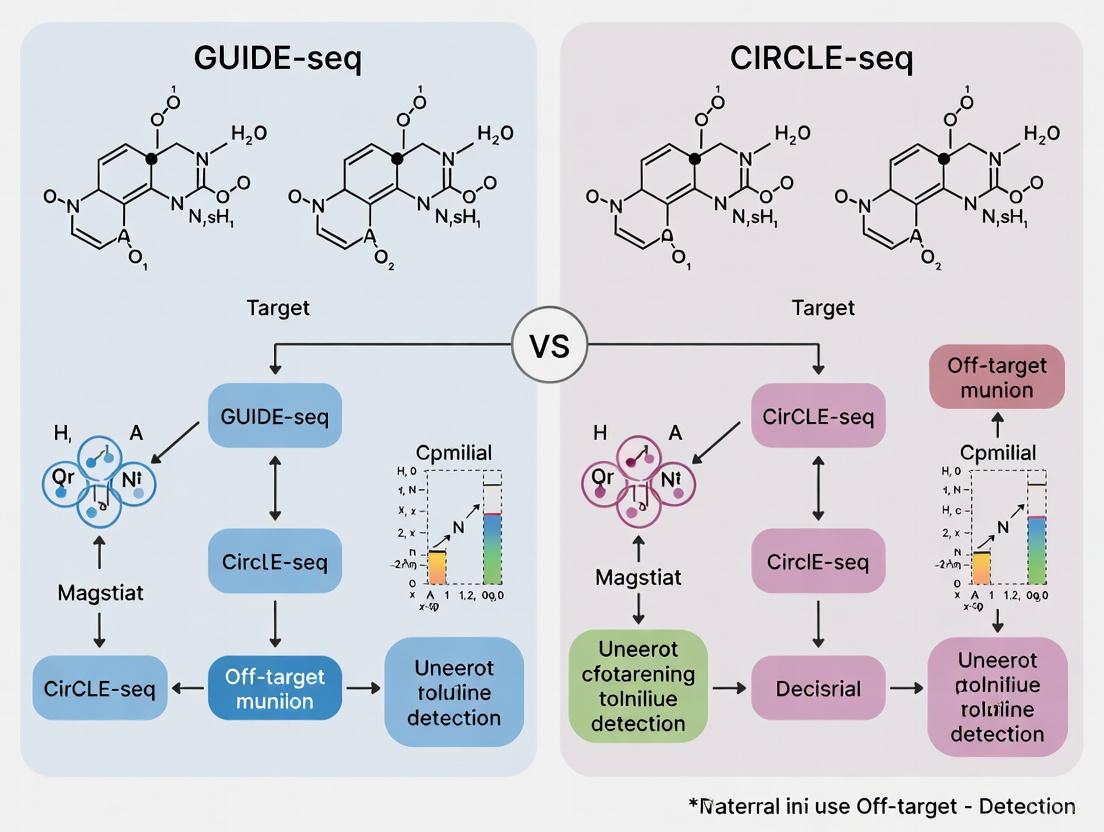
Workflow comparison of cellular GUIDE-seq and biochemical CIRCLE-seq methods.
CIRCLE-seq (Circularization for In vitro Reporting of Cleavage Effects by sequencing) is a biochemical method that achieves ultra-sensitive detection through sophisticated DNA processing [5]. The protocol begins with purification of genomic DNA, which is fragmented and circularized [5]. Exonuclease treatment then degrades any remaining linear DNA, enriching for circularized molecules and dramatically reducing background noise [5]. These circularized DNA libraries are incubated with Cas9-gRNA complexes in vitro, which linearize circles only at sites complementary to the gRNA [5]. The linearized fragments are then prepared for sequencing, allowing identification of cleavage sites with nucleotide-level precision [5].
Performance Characteristics and Comparative Data
Table 1: Direct comparison of GUIDE-seq and CIRCLE-seq methodologies
| Parameter | GUIDE-seq | CIRCLE-seq |
|---|---|---|
| Approach Category | Cellular, Unbiased | Biochemical, Unbiased |
| Detection Context | Living cells (native chromatin) | Purified genomic DNA (naked DNA) |
| Primary Readout | DSB sites tagged via NHEJ | In vitro cleavage sites |
| Sensitivity | High (detects sites with >0.1% indel frequency) [3] | Ultra-high (substantially more sensitive than Digenome-seq) [5] |
| Typical Workflow Duration | 2-3 days (original); Streamlined with GUIDE-seq2 [4] | 2-3 days |
| Input Material | 200-500ng genomic DNA (GUIDE-seq2: ~4x reduction) [4] | Nanogram amounts of genomic DNA [5] |
| Key Advantages | Captures biologically relevant editing in physiological context; identifies which potential sites are actually cleaved in cells [1] [3] | Exceptional sensitivity; identifies more off-target sites than cell-based methods; not limited by delivery efficiency [5] |
| Key Limitations | Requires efficient delivery; may miss rare sites; potentially lower sensitivity than biochemical methods [1] | May overestimate biologically relevant sites; lacks cellular context (chromatin, repair factors) [1] |
Table 2: Experimental detection performance comparison
| gRNA Target | GUIDE-seq Sites Detected | CIRCLE-seq Sites Detected | Overlap | Notes |
|---|---|---|---|---|
| EMX1 | 5 [5] | 50 [5] | 4 of 5 (80%) [5] | CIRCLE-seq identified many additional sites |
| VEGFA | 8 [5] | 53 [5] | 7 of 8 (88%) [5] | CIRCLE-seq identified many additional sites |
| Various (6 gRNAs) | Variable (0-150+) [3] | 21-124 [5] | CIRCLE-seq detected all or nearly all GUIDE-seq sites for 4/6 gRNAs [5] | For two gRNAs, CIRCLE-seq missed one site each (low frequency in GUIDE-seq) [5] |
The comparative data reveals a consistent pattern: CIRCLE-seq demonstrates higher sensitivity and identifies substantially more potential off-target sites than GUIDE-seq [5]. However, this increased sensitivity comes with an important caveat - not all sites identified by CIRCLE-seq may be biologically relevant in cellular contexts [1]. Therefore, these methods are best used complementarily, with CIRCLE-seq providing comprehensive discovery of potential off-target sites, and GUIDE-seq validating which of these sites are actually edited in therapeutically relevant cells [1] [5].
Advanced Applications and Emerging Considerations
Population-Scale Off-Target Analysis
Recent research has revealed that genetic variation significantly influences CRISPR off-target activity [4]. Single nucleotide polymorphisms (SNPs) can either create or abolish off-target sites, meaning that assays conducted in a single genetic background may miss clinically relevant off-target effects in diverse patient populations [4]. A landmark 2025 study utilizing GUIDE-seq2 analyzed 665 libraries from 95 individuals across four ethnic groups and found that off-target events frequently overlapped with genetic variants [4]. The highest frequency occurred in individuals of African ancestry (16.6%), highlighting the critical importance of population-scale off-target assessment for therapeutic development [4].
Bioinformatics Requirements
Both GUIDE-seq and CIRCLE-seq generate complex sequencing datasets that require specialized bioinformatics processing. For GUIDE-seq, the GUIDEseq Bioconductor package in R provides a flexible analysis platform with over 60 adjustable parameters to accommodate different nuclease systems and experimental conditions [10]. The software processes unique molecular indexes (UMIs) to correct for PCR amplification bias, maps integration sites to the reference genome, and annotates identified off-target sites with genomic features [10]. CIRCLE-seq data analysis involves identifying cleavage sites based on bidirectionally mapped read pairs that align with expected Cas9 cutting patterns (3 base pairs upstream of the PAM) [5]. Both methods benefit from integration with off-target prediction algorithms to prioritize sites for further validation.
The Research Toolkit: Essential Reagents and Solutions
Table 3: Key research reagents and solutions for off-target detection methods
| Reagent/Solution | Function | Application | Notes |
|---|---|---|---|
| Phosphorothioate-modified dsODN | Protects oligonucleotide from degradation; enhances NHEJ-mediated integration into DSBs | GUIDE-seq | Essential for efficient tag integration [3] |
| Tagify i5 UMI / Loaded Tn5 | Transposase pre-loaded with sequencing adapters; enables simultaneous fragmentation and adapter tagging | GUIDE-seq2, CHANGE-seq | Dramatically streamlines library prep [4] |
| Exonuclease Mixture | Degrades linear DNA molecules; enriches for circularized DNA | CIRCLE-seq | Critical for background reduction [5] |
| UMI-containing Adapters | Unique molecular identifiers for bioinformatic removal of PCR duplicates | GUIDE-seq, CIRCLE-seq | Improves quantification accuracy [5] [10] |
| Cas9 Nuclease (active or high-fidelity variants) | Engineered nucleases with reduced off-target activity | Validation studies | Used to compare against wild-type Cas9 [1] |
Integrated strategy for comprehensive off-target assessment throughout therapeutic development.
The comprehensive comparison between GUIDE-seq and CIRCLE-seq reveals that these methods are not competitive but rather complementary approaches that address different questions in the off-target assessment pipeline. CIRCLE-seq serves as an powerful discovery tool capable of identifying virtually all potential off-target sites with ultra-sensitive in vitro detection, while GUIDE-seq provides essential biological validation by revealing which of these sites are actually edited in therapeutically relevant cellular environments [1] [5].
For therapeutic development, a tiered approach is recommended, beginning with comprehensive in vitro screening using CIRCLE-seq or related biochemical methods (e.g., CHANGE-seq) to identify potential off-target sites, followed by cellular validation using GUIDE-seq or its enhanced GUIDE-seq2 version in target cell types [1] [4]. This combined strategy leverages the respective strengths of each methodology while mitigating their limitations, providing both sensitivity and biological relevance. Furthermore, the emergence of population-scale off-target analysis underscores the necessity of evaluating editing specificity across diverse genetic backgrounds, particularly for therapies destined for broad clinical application [4]. As the field advances toward increasingly sophisticated therapeutic applications, this multifaceted approach to off-target assessment will be essential for ensuring both efficacy and safety of CRISPR-based genetic medicines.
The translation of CRISPR-Cas9 nucleases into human therapeutics requires comprehensive knowledge of their off-target effects to minimize potential risks. Among various methods developed for identifying off-target cleavage activities, GUIDE-seq (Genome-wide Unbiased Identification of DSBs Enabled by Sequencing) stands out for its ability to capture double-stranded breaks (DSBs) directly in a cellular context. This approach provides a critical bridge between biochemical predictions and actual cellular activity, offering unique advantages for researchers and drug development professionals evaluating genome-editing reagents. This guide objectively compares GUIDE-seq with CIRCLE-seq, a leading in vitro method, examining their core principles, performance metrics, and appropriate applications based on experimental data.
Core Technological Principles
GUIDE-seq: Capturing DSBs in Living Cells
GUIDE-seq operates on the principle of tagging nuclease-induced DSBs in living cells through the non-homologous end joining (NHEJ) DNA repair pathway. The method utilizes a blunt, double-stranded oligodeoxynucleotide (dsODN) tag that is efficiently integrated into DSBs created by CRISPR-Cas9 or other nucleases. These tags contain phosphorothioate linkages at their ends, which provide resistance to cellular exonuclease activity and significantly enhance integration efficiency [11] [3]. Once integrated, the dsODN tags serve as molecular landmarks that can be specifically amplified and sequenced to map cleavage sites throughout the genome.
The workflow involves two critical stages. In Stage I, cells are co-transfected with the nuclease components (Cas9 and guide RNA) along with the dsODN tag. After a typical culture period of 3 days, genomic DNA is harvested. In Stage II, the tag-integrated genomic DNA is selectively amplified using a method called Single-Tail Adapter/Tag (STAT)-PCR, which employs primers complementary to the dsODN tag and next-generation sequencing adapters. This approach, incorporating unique molecular indices (UMIs), enables specific amplification of tag-flanking sequences while correcting for PCR amplification biases, allowing precise nucleotide-level mapping of DSB locations [11] [3].
CIRCLE-seq: In Vitro Cleavage Detection
In contrast to GUIDE-seq's cellular approach, CIRCLE-seq (Circularization for In vitro Reporting of CLeavage Effects by sequencing) is an in vitro biochemical method that detects nuclease cleavage sites using purified genomic DNA. The core innovation involves converting randomly sheared genomic DNA into covalently closed circular molecules. When these circles are exposed to Cas9 nuclease, cleavage at target and off-target sites linearizes the DNA fragments, releasing ends that are subsequently tagged with sequencing adapters. This circularization strategy dramatically reduces background noise by enriching for nuclease-cleaved fragments, providing approximately 180,000-fold better enrichment of cleavage-specific reads compared to earlier in vitro methods like Digenome-seq [5].
Direct Performance Comparison
Detection Sensitivity and Validation
Experimental comparisons reveal distinct performance characteristics between GUIDE-seq and CIRCLE-seq. When profiling six different gRNAs targeted to non-repetitive sequences, CIRCLE-seq identified between 21 and 124 off-target sites, successfully detecting 94-100% of the off-target sites previously identified by GUIDE-seq for most gRNAs [5]. Importantly, CIRCLE-seq also identified numerous additional off-target sites not detected by GUIDE-seq, suggesting higher theoretical sensitivity.
However, the key consideration lies in validation rates. GUIDE-seq demonstrates a very high validation rate (approximately 80-93%) when sites identified by the method are checked for bona fide indel mutations in cells edited without the dsODN tag [3]. This high confirmation rate stems from GUIDE-seq directly capturing nuclease activity within the native cellular environment, including relevant factors like chromatin accessibility, DNA repair machinery, and cellular fitness.
Table 1: Comparison of GUIDE-seq and CIRCLE-seq Performance Characteristics
| Parameter | GUIDE-seq | CIRCLE-seq |
|---|---|---|
| Experimental Context | Living cells | Purified genomic DNA |
| Detection Principle | dsODN integration via NHEJ | In vitro cleavage of circularized DNA |
| Theoretical Sensitivity | ~0.1% indel frequency [11] | Higher than GUIDE-seq [5] |
| Validation Rate | 80-93% [3] | Lower than GUIDE-seq [11] |
| Sequencing Efficiency | 2-5 million reads per sample [11] | Approximately 100-fold fewer reads than Digenome-seq [5] |
| Background Noise | Low in tolerant cells [11] | Minimal due to circularization [5] |
Detection Overlap and Complementarity
Studies directly comparing both methods reveal both overlap and complementarity. For four out of six gRNAs tested, CIRCLE-seq detected all off-target sites found by GUIDE-seq. For the remaining two gRNAs, CIRCLE-seq missed one site each, though these sites had supporting reads that didn't exceed statistical thresholds and represented the lower boundary of detection in GUIDE-seq experiments [5]. Similarly, when compared to another cell-based method (HTGTS), CIRCLE-seq identified 50 of 53 previously known off-target sites (94%), with the undetected sites having low HTGTS scores [5].
These findings suggest that while CIRCLE-seq exhibits exceptional sensitivity in detecting potential cleavage sites in purified DNA, the cellular context of GUIDE-seq provides important biological filtering. The discrepancies between the methods likely reflect both the higher sensitivity of CIRCLE-seq and the influence of cellular factors on actual cleavage and repair outcomes.
Table 2: Experimental Detection Comparison Between GUIDE-seq and CIRCLE-seq
| gRNA Target | Off-target Sites Detected by GUIDE-seq | Off-target Sites Detected by CIRCLE-seq | Overlap | Additional Sites Found by CIRCLE-seq |
|---|---|---|---|---|
| RNF2 | 0 | Multiple | N/A | All sites were new detections [5] |
| Six different gRNAs | Variable | 21-124 | 94-100% for 4/6 gRNAs | Many for all gRNAs [5] |
| EMX1 and VEGFA | Not specified | 50 | 94% compared to HTGTS | More than HTGTS [5] |
Methodological Workflows
The fundamental difference between GUIDE-seq and CIRCLE-seq is encapsulated in their experimental workflows, which determine their applications and limitations.
Practical Implementation
Research Reagent Solutions
Both methods require specific reagents and optimization strategies for successful implementation:
Table 3: Essential Research Reagents and Their Functions
| Reagent/Material | Function | Method |
|---|---|---|
| End-protected dsODN tag | 34 bp double-stranded oligodeoxynucleotide with phosphorothioate linkages; integrates into DSBs via NHEJ [11] [3] | GUIDE-seq |
| Cas9-gRNA complex | Genome editing nuclease programmed with specific guide RNA; creates DSBs at target sites | Both |
| Single-tail sequencing adapters | Enable specific unidirectional amplification of sequences adjacent to integrated tags [3] | GUIDE-seq |
| Unique Molecular Indices (UMIs) | 8 bp random barcodes that correct for PCR amplification bias [10] | GUIDE-seq |
| Covalently closed circular DNA | Genomic DNA fragments circularized to enrich for nuclease-cleaved fragments [5] | CIRCLE-seq |
| NdeI restriction enzyme | Quick validation of dsODN integration efficiency at target sites [11] | GUIDE-seq |
Optimization Considerations
Successful GUIDE-seq implementation requires careful optimization of dsODN integration. Researchers must titrate dsODN amounts to maximize integration frequencies while maintaining cell viability, with successful experiments typically achieving integration rates exceeding 5% of total nuclease-induced mutations [11]. The dsODN tag contains an NdeI restriction site that facilitates quick validation of integration efficiency through restriction digestion of PCR amplicons.
For CIRCLE-seq, the critical parameter is the efficiency of DNA circularization, which virtually eliminates background noise from non-cleaved genomic DNA. This method does not require a reference genome, enabling off-target profiling in organisms with incomplete genomic sequences or outbred populations with sequence heterogeneity [5].
Advantages and Limitations in Research Context
GUIDE-seq Strengths and Constraints
GUIDE-seq offers several distinctive advantages for off-target detection. As a cell-based method, it directly measures nuclease activity within the relevant biological context, accounting for cellular factors like chromatin structure, DNA repair mechanisms, and transcriptional activity. GUIDE-seq is highly sensitive, capable of detecting off-target sites with indel frequencies of 0.1% and below [11]. The method is also sequencing-efficient, requiring only 2-5 million reads per sample, making it compatible with benchtop sequencers [11]. GUIDE-seq read counts strongly correlate with indel mutation frequencies in cells, providing a quantitative measure of off-target activity [3].
The primary limitation of GUIDE-seq is its dependence on efficient delivery and tolerance of dsODN tags, which may not be compatible with all cell types. Some sensitive cell types, such as human hematopoietic stem cells or iPS cells, may undergo apoptosis in response to high levels of free DNA ends or dsODN transfection [11]. Additionally, in vivo delivery of dsODNs for GUIDE-seq analysis has not been reported, limiting its application to cellular models [11].
CIRCLE-seq Advantages and Considerations
CIRCLE-seq provides complementary strengths, particularly its exceptional sensitivity in identifying potential cleavage sites without cellular constraints. The method can be practiced with widely accessible next-generation sequencing technology and doesn't require a reference genome [5]. CIRCLE-seq can identify off-target mutations associated with cell-type-specific SNPs, demonstrating feasibility for generating personalized specificity profiles [5]. The biochemical nature of CIRCLE-seq makes it highly reproducible and scalable, bypassing challenges associated with cell transfection and viability [5].
A significant consideration with CIRCLE-seq is its lower validation rate compared to GUIDE-seq, as it identifies many sites that may not be cleaved in actual cellular environments [11]. This discrepancy likely results from the high protein:DNA concentrations achievable in vitro that may not reflect physiological conditions in cells.
GUIDE-seq represents a powerful method for capturing CRISPR-Cas9 off-target effects in a cellular context, providing biologically relevant specificity profiles that directly reflect nuclease activity in living systems. While CIRCLE-seq offers higher theoretical sensitivity and different advantages as an in vitro method, GUIDE-seq maintains critical value through its direct measurement of cellular DSB repair outcomes. For researchers and drug development professionals, the choice between these methods depends on specific experimental needs—GUIDE-seq for its high validation rates and biological relevance in tractable cell types, and CIRCLE-seq for maximum sensitivity or when working with challenging cell types. Together, these complementary approaches provide a robust framework for comprehensive off-target assessment in therapeutic genome editing applications.
The translation of CRISPR-Cas9 nucleases into human therapeutics necessitates the sensitive detection of their off-target effects [12] [5]. While CRISPR-Cas9 can be easily programmed to create targeted double-stranded breaks (DSBs), its specificity depends on the guide RNA (gRNA) recognizing the intended target DNA sequence. Unintended cleavage can occur at off-target sites with similar sequences, potentially leading to deleterious mutations [5] [13]. CIRCLE-seq (Circularization for In Vitro Reporting of CLeavage Effects by sequencing) was developed as a highly sensitive, sequencing-efficient in vitro screening strategy that comprehensively identifies genome-wide off-target mutations of CRISPR-Cas9 [12] [5]. Unlike cell-based methods, which can be limited by cell fitness, transfection efficiency, and the inability to detect very rare off-target events (typically below ~0.1% frequency in a cell population), biochemical methods like CIRCLE-seq offer greater reproducibility and scalability [5] [7]. By using purified genomic DNA and controlled reaction conditions, CIRCLE-seq bypasses cellular barriers, allowing for the identification of potential cleavage sites that might be missed in living cells [5] [14].
Core Principle and Workflow of CIRCLE-seq
The fundamental innovation of CIRCLE-seq lies in its strategic circularization of sheared genomic DNA to create a background-free library for nuclease cleavage. This process virtually eliminates the high background of random genomic reads that plagues other in vitro methods like Digenome-seq, thereby dramatically enhancing the signal-to-noise ratio for detecting rare off-target events [5]. The method achieves an estimated 180,000-fold better enrichment for nuclease-cleaved sequences compared to Digenome-seq, enabling highly sensitive detection with approximately 100-fold fewer sequencing reads [5]. The entire process, from cell growth to sequencing, can be completed within two weeks [15] [14].
Detailed Experimental Workflow
The CIRCLE-seq protocol can be broken down into four main stages [5] [14]:
Genomic DNA (gDNA) Preparation and Circularization: High-molecular-weight genomic DNA is isolated from the cell type of interest (e.g., K562 cells, iPSCs) [14]. This gDNA is then randomly sheared into small fragments (e.g., via focused ultrasonication) [14]. The sheared DNA is treated with exonucleases to remove any remaining linear DNA fragments, and the resulting blunt-ended fragments are circularized using a DNA ligase [5]. This creates a library of covalently closed, circular double-stranded DNA molecules.
In Vitro Cleavage with Cas9-gRNA Complex: The purified circularized DNA library is incubated with the pre-assembled Cas9 protein and the gRNA of interest. At sites where the Cas9-gRNA complex recognizes a complementary sequence (both on-target and off-target), it introduces a double-strand break, linearizing that specific circular DNA molecule.
Enrichment and Library Preparation for Sequencing: Following cleavage, the reaction mixture is treated with a plasmid-safe DNase. This enzyme degrades all remaining circular DNA but cannot act on the linearized DNA fragments that resulted from Cas9 cleavage. This critical step selectively enriches the population for Cas9-cleaved DNA [5] [14]. The linearized, enriched DNA fragments are then purified and prepared as a sequencing library for an Illumina platform. Adapters are ligated to the ends of the fragments, and they are amplified via PCR.
Sequencing and Bioinformatics Analysis: The final library is sequenced using paired-end sequencing on an Illumina platform [15] [5]. The resulting paired-end reads are analyzed through a dedicated CIRCLE-seq bioinformatics pipeline. This pipeline maps the reads back to the reference genome and identifies cleavage sites with nucleotide-level precision, typically characterized by a cluster of read starts at a position 3 base pairs upstream of a PAM sequence [5].
The following diagram illustrates the logical flow of the CIRCLE-seq experimental process:
Performance Comparison with Other Off-Target Detection Methods
CIRCLE-seq occupies a specific niche within the ecosystem of genome-wide, unbiased off-target detection methods. Its in vitro, biochemical nature contrasts with cell-based methods like GUIDE-seq and HTGTS, as well as other in vitro methods like Digenome-seq and SITE-seq.
Comparative Analysis of Method Characteristics
The table below summarizes the key characteristics of CIRCLE-seq against other prominent off-target detection techniques:
| Method | Type | Principle | Sensitivity | Advantages | Limitations |
|---|---|---|---|---|---|
| CIRCLE-seq [5] [14] | In vitro (Biochemical) | Circularization of gDNA, Cas9 cleavage, enrichment of linearized fragments | Extremely High (Low background) | Does not require reference genome; identifies cell-type-specific SNP-based off-targets; low sequencing depth needed. | Lacks cellular context (chromatin, repair machinery); can have a higher false-positive rate [13]. |
| GUIDE-seq [7] [13] [14] | Cell-based | Tagging of DSBs in living cells with dsODN via NHEJ. | High (in cells) | Captures off-targets in a cellular context with chromatin; low false-positive rate; signal correlates with editing frequency [13]. | Requires efficient delivery into cells; limited by cell fitness and NHEJ activity; can miss very rare events. |
| Digenome-seq [5] [7] | In vitro (Biochemical) | Whole-genome sequencing of Cas9-cleaved gDNA. | Moderate | Simple in vitro concept. | Very high sequencing depth required; high background noise limits sensitivity [5]. |
| SITE-seq [7] [13] | In vitro (Biochemical) | Capture of Cas9-cleaved ends with streptavidin beads. | High | Lower false-positive nominations than CIRCLE-seq [13]. | Read counts do not correlate with cellular editing frequency [13]. |
| DISCOVER-Seq [7] [14] | Cell-based / in situ | Relies on MRE11 binding to DSBs via ChIP. | Context-dependent | Identifies DSBs in a cellular context at the time of sampling. | Only detects breaks present at fixation; depends on MRE11 recruitment [14]. |
Head-to-Head Experimental Comparisons
Independent and comparative studies have quantified the performance of CIRCLE-seq relative to other methods. A comprehensive evaluation by scientists at CRISPR Therapeutics directly compared GUIDE-seq, CIRCLE-seq, and SITE-seq using eight different gRNAs [13]. The study concluded that all three methods were competent at nominating off-target sites, but with key differences:
- Sensitivity vs. Precision: While all three methods nominated most sequence-confirmed edited sites, they differed vastly in the number of false-positives. GUIDE-seq demonstrated the highest precision, whereas CIRCLE-seq had the lowest, nominating a larger number of sites that were not validated upon deeper sequencing [13].
- Correlation with Cellular Editing: GUIDE-seq read counts correlated highly with the observed indel mutation frequency in cells. This correlation was lower for CIRCLE-seq, and no correlation was observed for SITE-seq, indicating that biochemical assay signals are less predictive of actual cellular editing outcomes [13].
Further experimental data from the original CIRCLE-seq publication demonstrates its high sensitivity in direct comparisons with other methods, as shown in the table below.
| gRNA Target | Off-Target Sites Identified by CIRCLE-seq | Off-Target Sites Also Found by Cell-Based Methods (GUIDE-seq/HTGTS) | New Bona Fide Off-Targets Found by CIRCLE-seq | Key Finding |
|---|---|---|---|---|
| HBB [5] | 182 | 26 of 29 (Digenome-seq) | 156 | Identified 29 sites missed by Digenome-seq due to its high background. |
| Six gRNAs targeted to non-repetitive sequences [5] | 21 - 124 | For 4/6 gRNAs: 100% of GUIDE-seq sites. For 2/6: all but one. | Many more for all gRNAs. | CIRCLE-seq identified many off-targets not found by GUIDE-seq, including for an RNF2 gRNA with no previously known off-targets. |
| EMX1 & VEGFA [5] | >50 | 50 of 53 (HTGTS) | Many more than HTGTS. | CIRCLE-seq also identified a much greater number of off-target sites than HTGTS. |
Research Toolkit: Essential Reagents and Solutions
Successfully implementing the CIRCLE-seq protocol requires a suite of specific reagents and equipment. The following table details the key components and their functions based on the established methodology [5] [14].
| Category | Item / Reagent | Critical Function in the Protocol |
|---|---|---|
| Starting Material | High-quality genomic DNA (e.g., from iPSCs, K562 cells) | Serves as the substrate for creating the circularized library, representing the genome to be interrogated. |
| DNA Processing | Covaris S220 or similar ultrasonicator | Provides focused acoustics for consistent and random shearing of gDNA into small fragments. |
| T4 DNA Ligase | Catalyzes the formation of phosphodiester bonds to create covalently closed circular DNA molecules. | |
| Exonucleases (I & III) | Degrades any remaining linear DNA fragments after shearing, enriching the final library for successfully circularized molecules. | |
| Cleavage Reaction | Purified Cas9 Nuclease | The engineered endonuclease that, in complex with the gRNA, introduces double-strand breaks at cognate DNA sites. |
| Synthetic guide RNA (gRNA) | Determines the specificity of the Cas9 nuclease by base-pairing with the target DNA sequence. | |
| Enrichment & Library Prep | Plasmid-Safe DNase | An ATP-dependent DNase that selectively degrades linear and circular dsDNA. Used post-cleavage to digest uncut circular DNA, dramatically enriching for Cas9-cleaved fragments [5] [14]. |
| Illumina-Compatible Library Prep Kit | Provides enzymes and buffers for end-repair, A-tailing, and adapter ligation to prepare the enriched DNA for sequencing. | |
| Analysis | MiSeq or similar benchtop sequencer | Enables affordable paired-end sequencing due to the method's low background and high enrichment. |
| CIRCLE-seq Analysis Pipeline | A dedicated bioinformatics workflow to map sequencing reads and call cleavage sites from the sequencing data. |
CIRCLE-seq represents a significant advancement in the in vitro profiling of CRISPR-Cas9 nuclease activity. Its core principle—circularizing genomic DNA to create a low-background screening library—confers exceptional sensitivity and sequencing efficiency, allowing labs with access to benchtop sequencers to conduct comprehensive off-target assessments [5]. The method's ability to identify potential off-targets independent of a reference genome and to profile the impact of individual SNPs makes it a powerful tool for developing personalized therapeutic strategies [5].
However, the absence of cellular context remains its primary limitation. Chromatin accessibility, DNA methylation, and the cellular DNA repair machinery all influence the final mutational outcome, and these factors are not captured by CIRCLE-seq [13] [14]. Therefore, its strongest application is in a tiered screening strategy, where it serves as an ultra-sensitive, initial, genome-wide nomination tool. The most concerning nominated sites, particularly those in open chromatin regions or with high CIRCLE-seq read counts, must then be validated in therapeutically relevant cell types using targeted amplicon sequencing [13].
The field continues to evolve, with newer methods like CHANGE-seq building upon the circularization principle while integrating more streamlined, tagmentation-based library preparation to enhance throughput and scalability [4]. Furthermore, the recent development of GUIDE-seq2 demonstrates a parallel trend of improving cell-based methods for higher throughput and application in population-scale studies [4]. Ultimately, CIRCLE-seq stands as a pivotal technique that has set a high bar for sensitivity in biochemical off-target detection, contributing significantly to the ongoing effort to ensure the safety of CRISPR-based genome editing.
For researchers and drug development professionals advancing CRISPR-based therapies, a critical early decision is the selection of an off-target detection method. This choice often centers on a fundamental trade-off: the biological relevance offered by cell-based methods versus the maximum sensitivity of biochemical approaches [1]. GUIDE-seq and CIRCLE-seq are cornerstone techniques representing these two philosophies. GUIDE-seq captures editing events within the native cellular environment, while CIRCLE-seq offers an ultra-sensitive, context-agnostic screen [1] [5]. This guide provides a direct, data-driven comparison of these methods to inform preclinical experimental design and therapeutic safety assessment.
Methodological Foundations: A Tale of Two Workflows
The distinct principles of GUIDE-seq and CIRCLE-seq result in profoundly different experimental workflows, which directly influence their output and interpretation.
Cellular Context: GUIDE-seq Workflow
GUIDE-seq (Genome-wide, Unbiased Identification of DSBs Enabled by Sequencing) operates in living cells. It leverages the cell's own DNA repair machinery to incorporate a double-stranded oligodeoxynucleotide (dsODN) tag at the site of a CRISPR-Cas9-induced double-strand break [16]. These tagged sites are then enriched and sequenced, providing a map of where editing occurred in a specific cellular context.
Biochemical Sensitivity: CIRCLE-seq Workflow
CIRCLE-seq (Circularization for In vitro Reporting of Cleavage Effects by sequencing) is an in vitro biochemical assay. It begins with purified genomic DNA that is sheared and circularized. This circular DNA is then treated with Cas9-gRNA complexes, which linearize the DNA at cleavage sites. Sequencing adapters are ligated specifically to these newly created ends, allowing for highly enriched sequencing of potential off-target sites without the background of intact genomic DNA [5] [6].
Head-to-Head Performance Comparison
Independent, head-to-head evaluations provide the most reliable data for comparing these methods. A landmark 2020 study in The CRISPR Journal systematically benchmarked GUIDE-seq, CIRCLE-seq, and SITE-seq using eight different gRNAs in HEK293T cells, with validation across 75,000 computationally nominated sites [16] [13].
Table 1: Empirical Performance Metrics for GUIDE-seq vs. CIRCLE-seq
| Performance Metric | GUIDE-seq | CIRCLE-seq | Experimental Context |
|---|---|---|---|
| Detection Principle | In-cell dsODN tag integration [16] | In vitro cleavage of circularized DNA [5] | HEK293T cells / purified genomic DNA |
| Sensitivity | Identified majority of confirmed off-targets [16] | Identified all sites found by GUIDE-seq plus many additional, lower-affinity sites [5] | 8 gRNAs with known off-target activity [16] [13] |
| False Positive Rate | Low [13] | Higher (due to absence of cellular context) [6] | Benchmarking against sequenced sites [16] |
| Correlation with Cellular Editing | High correlation between read counts and observed indel frequency [13] | Lower correlation with cellular indel frequency [13] | Hybrid capture sequencing of nominated sites [16] |
| Primary Strength | High biological relevance, low false-positive rate [1] [13] | Maximum sensitivity, identifies rare and cell-inaccessible sites [5] |
The Scientist's Toolkit: Essential Research Reagents
Successful execution of these protocols requires specific, often specialized, reagents. The following table details the core components for each method.
Table 2: Key Research Reagent Solutions for GUIDE-seq and CIRCLE-seq
| Reagent / Solution | Function in Assay | Method |
|---|---|---|
| Double-stranded ODN (dsODN) | Marker integrated into DSBs by cellular repair machinery for later enrichment and sequencing [16] | GUIDE-seq |
| Tagmentation Enzyme (e.g., Tn5) | Streamlines NGS library prep by simultaneously fragmenting DNA and adding sequencing adapters [4] | GUIDE-seq2 (Enhanced) |
| Covaris Ultrasonicator | Provides consistent, physical shearing of genomic DNA to a desired fragment size [16] [6] | CIRCLE-seq |
| Plasmid-Safe ATP-Dependent DNase | Digests linear DNA molecules post-circularization, enriching for circularized DNA and reducing background [16] [5] | CIRCLE-seq |
| Lambda Exonuclease | Processes DNA ends during the circularization process to facilitate intramolecular ligation [6] | CIRCLE-seq |
Strategic Application and Modern Workflows
Choosing between these methods depends on the research or development phase. GUIDE-seq is exceptionally suited for final validation in therapeutically relevant cell types (e.g., hematopoietic stem and progenitor cells), as its results directly reflect editing in a physiological context with chromatin structure and DNA repair machinery present [17]. Its high predictive value for actual cellular indels makes it a conservative and reliable choice for late-stage preclinical safety studies [13].
Conversely, CIRCLE-seq is a powerful discovery and screening tool. Its ability to nominate a comprehensive list of potential off-target sites, including those that may be rarely cleaved or located in genomically inaccessible regions in any specific cell type, makes it ideal for initial gRNA candidate screening and for understanding the full potential cleavage landscape of a CRISPR reagent [5].
The field continues to evolve, with next-generation versions of these assays emerging. GUIDE-seq2, which incorporates tagmentation-based library preparation, dramatically simplifies the workflow, reduces hands-on time, and improves scalability without compromising the core biology [4]. Similarly, CHANGE-seq represents a tagmentation-powered evolution of CIRCLE-seq, offering higher throughput, reduced input DNA requirements, and greater reproducibility for biochemical profiling [4] [18]. For the most comprehensive off-target risk assessment, a combined approach is often recommended: using a sensitive biochemical method like CIRCLE-seq for broad discovery, followed by validation of nominated sites in therapeutically relevant cells using a cellular method like GUIDE-seq [16].
Step-by-Step Workflows and Ideal Use Cases
The therapeutic application of CRISPR-Cas9 genome editing demands rigorous assessment of nuclease specificity to ensure safety and efficacy. Unintended off-target editing can confound experimental results and poses significant safety risks in clinical applications, particularly if mutations occur in functional genomic regions or oncogenes [2]. In response, researchers have developed multiple genome-wide methods to empirically identify off-target cleavage sites, which fall into two primary categories: cell-based and biochemical assays [1]. Cell-based methods, such as GUIDE-seq, detect double-strand breaks (DSBs) within the native cellular environment, accounting for biological factors like chromatin accessibility and DNA repair pathways. In contrast, biochemical methods, including CIRCLE-seq, operate on purified genomic DNA in vitro, offering ultra-sensitive detection unconstrained by cellular context [16] [1]. Understanding the workflow, capabilities, and limitations of GUIDE-seq provides crucial insights for researchers selecting appropriate off-target assessment strategies for therapeutic development.
The GUIDE-seq Workflow: A Step-by-Step Guide
Genome-wide, Unbiased Identification of DSBs Enabled by Sequencing (GUIDE-seq) is a sensitive, cell-based method that directly captures the locations of nuclease-induced double-strand breaks in living cells [11]. The core principle relies on the integration of a specially designed double-stranded oligodeoxynucleotide (dsODN) tag into DSB sites via the non-homologous end joining (NHEJ) repair pathway, followed by amplification and sequencing of tag-integrated genomic regions to map cleavage events genome-wide [11] [16].
Key Experimental Steps and Reagents
The standard GUIDE-seq protocol can be completed in approximately 9 days, with library preparation, sequencing, and analysis requiring about 3 days once tag-integrated genomic DNA is isolated [11]. The following table details the essential components and their functions in the GUIDE-seq workflow:
Table 1: Key Research Reagent Solutions for GUIDE-seq
| Reagent/Material | Function in Workflow | Critical Specifications |
|---|---|---|
| dsODN Tag | Integrates into nuclease-induced DSBs to mark cleavage locations | Double-stranded, 5'-phosphorylated, 3'-phosphorothioate linkages on one strand for exonuclease protection [11] |
| Cas9 Nuclease & gRNA | Generate targeted double-strand breaks | Delivered as plasmid DNA or pre-complexed ribonucleoprotein (RNP) [11] |
| Transfection Reagent / Nucleofector | Introduces RNP and dsODN tag into cells | Optimized for high efficiency in target cell type (e.g., Lonza 4D Nucleofector) [16] |
| Nested PCR Primers | Amplify genomic DNA fragments containing integrated dsODN tag | One set complementary to dsODN tag, another to ligated NGS adapters [11] |
| Unique Molecular Index (UMI) Adapters | Ligate to fragmented genomic DNA | Enables PCR bias correction and accurate quantification of editing activity [11] |
Detailed Workflow Description
The GUIDE-seq workflow proceeds through several critical phases, from cell preparation to sequencing analysis, as visualized below:
Critical Step: Optimization of dsODN Integration. Successful GUIDE-seq requires efficient integration of the dsODN tag into nuclease-induced breaks. Researchers must titrate the amount of transfected dsODN to maximize integration frequencies while maintaining cell viability. The integration rate should exceed 5% of total nuclease-induced mutations for a successful experiment [11]. A quick validation method utilizes an NdeI restriction enzyme site engineered into the dsODN tag, allowing detection via restriction digestion of PCR amplicons spanning the target site [11].
Comparative Analysis: GUIDE-seq vs. CIRCLE-seq
While GUIDE-seq operates in a cellular context, CIRCLE-seq (Circularization for In vitro Reporting of Cleavage Effects by sequencing) represents a leading biochemical approach for identifying CRISPR-Cas9 genome-wide off-target mutations [12] [5]. The fundamental distinction lies in their operational environments: GUIDE-seq captures biologically relevant off-target activity within cells, whereas CIRCLE-seq offers ultra-sensitive in vitro detection using purified genomic DNA.
Workflow Comparison: CELL-BASED vs. BIOCHEMICAL
The following diagram contrasts the fundamental operational workflows of GUIDE-seq and CIRCLE-seq:
Performance and Application Comparison
Direct comparisons between GUIDE-seq and CIRCLE-seq reveal complementary strengths and limitations, making each method suitable for different research scenarios.
Table 2: Quantitative Comparison of GUIDE-seq and CIRCLE-seq
| Parameter | GUIDE-seq | CIRCLE-seq |
|---|---|---|
| Detection Context | Living cells (native chromatin, repair pathways) [16] | Purified genomic DNA (no cellular context) [5] |
| Reported Sensitivity | ~0.1% mutation frequency [11] | Higher than Digenome-seq; identifies sites missed by cell-based methods [5] |
| Typical Input | 2-5 million cells [11] | Nanograms of purified genomic DNA [1] |
| Sequencing Efficiency | 2-5 million reads per sample [11] | High signal-to-noise; ~100-fold fewer reads than Digenome-seq [5] |
| Key Advantages | • Biological relevance• High validation rate• Quantitative (correlates with indel frequency) [11] [16] | • Ultra-sensitive• Not limited by cell viability/transfection• Identifies sites enhanced by SNPs [12] [5] |
| Primary Limitations | • Requires dsODN transfection• Some cell types sensitive to dsODN• May miss rare sites [11] [1] | • May overestimate cleavage (false positives)• Lower validation rate than GUIDE-seq• Lacks cellular context [16] [1] |
| Best Applications | • Validating biologically relevant off-targets• Therapeutic development in tolerant cells• Quantitative off-target ranking [11] [16] | • Maximum sensitivity discovery• Profiling in hard-to-transfect cells• Personalized off-target profiling with SNPs [12] [5] |
A comprehensive 2020 comparative study benchmarked GUIDE-seq and CIRCLE-seq alongside other methods by sequencing 75,000 homology-nominated sites, finding that all methods performed similarly in nominating sequence-confirmed off-target sites but with large differences in the total number of sites nominated [16]. GUIDE-seq demonstrated a particularly low false-positive rate and high correlation of its signal with observed editing, highlighting its suitability for nominating off-target sites for ex vivo CRISPR-Cas therapies [16].
Recent Advancements and Future Directions
Evolution to GUIDE-seq2
The original GUIDE-seq protocol has been significantly improved with the development of GUIDE-seq2, which incorporates tagmentation-based library preparation using Tn5 transposase loaded with unique molecular indexes and sequencing adapters [4]. This advancement streamlines the workflow by replacing physical DNA shearing, end-repair, A-tailing, and ligation steps with a single tagmentation reaction, reducing library preparation time from 8 hours to just 3 hours and cutting input genomic DNA requirements approximately 4-fold [4]. The updated method maintains the biological relevance of the original GUIDE-seq while improving scalability, reproducibility, and compatibility with modern sequencing platforms.
Population-Scale Off-Target Analysis
Recent applications of GUIDE-seq2 have demonstrated the critical importance of considering human genetic diversity in off-target assessment. Research analyzing 665 GUIDE-seq2 libraries from six gRNA targets in lymphoblastoid cells across 95 individuals from diverse ethnic backgrounds revealed that off-target events frequently overlapped with human genetic variants, with the highest frequency observed in the African ancestry group (16.6%) [4]. These findings indicate that individual genetic variants can frequently create or abolish CRISPR off-target sites, emphasizing the necessity of population-scale CRISPR analyses rather than relying solely on reference genomes [4].
GUIDE-seq provides a highly sensitive, quantitative, and biologically relevant method for genome-wide identification of CRISPR-Cas off-target activity in living cells. Its workflow, centered on dsODN tag integration at sites of double-strand breaks, produces a comprehensive catalogue of off-target sites ranked by nuclease activity. While biochemical methods like CIRCLE-seq offer superior sensitivity for comprehensive discovery phases, GUIDE-seq excels in validating biologically relevant off-targets and providing quantitative data correlated with actual editing outcomes in cells [16] [5]. The recent development of GUIDE-seq2 with tagmentation-based library preparation further enhances this method's accessibility and scalability. For therapeutic development, GUIDE-seq remains a cornerstone technique, particularly valuable for its high validation rate and ability to directly measure off-target editing in physiologically relevant cellular contexts [11] [17].
The clinical translation of CRISPR-Cas9 gene editing faces a significant barrier: off-target effects that can disrupt vital genes and pose safety risks to patients [6]. As CRISPR-based therapies like exagamglogene autotemcel (Casgevy) receive regulatory approval, the ability to accurately identify unintended cleavage sites has become increasingly critical [1]. In its 2024 guidance, the U.S. Food and Drug Administration (FDA) recommends using multiple methods, including genome-wide analysis, to measure off-target editing events [1]. Among the various techniques developed to address this challenge, Circularization for In Vitro Reporting of Cleavage Effects by Sequencing (CIRCLE-seq) has emerged as a particularly sensitive in vitro method for the impartial identification of CRISPR-Cas9 cleavage sites [15] [6].
CIRCLE-seq belongs to a broader ecosystem of off-target detection methods that can be categorized into four approaches: in silico prediction tools, biochemical methods (in vitro), cellular methods (in vivo), and in situ techniques [1]. Each approach offers distinct strengths and limitations in sensitivity, biological relevance, and workflow complexity. Biochemical methods like CIRCLE-seq, DIGENOME-seq, CHANGE-seq, and SITE-seq utilize purified genomic DNA and engineered nucleases to map cleavage sites without cellular influences, providing ultra-sensitive, comprehensive detection that often reveals a broader spectrum of potential off-target sites than cell-based methods [1]. This guide provides a detailed examination of the CIRCLE-seq workflow, its technical advantages, and its performance relative to other key off-target detection methodologies.
The CIRCLE-seq Workflow: From Genomic DNA to Cleavage Site Identification
Core Principles and Procedural Timeline
CIRCLE-seq is designed to sensitively and impartially map the genome-wide off-target activity of Cas9 nuclease in complex with a guide RNA (gRNA) of interest [6]. Its fundamental innovation lies in circularizing sheared genomic DNA, which is subsequently treated with Cas9 protein and the gRNA. Following cleavage, the linearized DNA fragments are purified and prepared as a sequencing library, enabling comprehensive identification of cleavage sites [15] [6]. The entire CIRCLE-seq process can be completed within two weeks, allowing sufficient time for cell growth, DNA purification, library preparation, and Illumina sequencing [15].
Step-by-Step Workflow and Visualization
The diagram below illustrates the comprehensive CIRCLE-seq workflow, from genomic DNA preparation to final off-target site identification.
CIRCLE-seq Workflow: From DNA Preparation to Off-target Identification
Detailed Methodology of Key Workflow Steps
Genomic DNA Isolation and Fragmentation: The protocol begins with culturing the cells of interest and isolating high-quality genomic DNA (gDNA) [6]. The gDNA is then randomly sheared into manageable fragments, typically averaging 150-200 base pairs, using focused ultrasonication (e.g., Covaris ME220) [6] [19]. This fragmentation step is critical for subsequent circularization efficiency.
DNA Circularization and Purification: The fragmented DNA undergoes phosphorylation and denaturation, priming it for circularization catalyzed by CircLigase II ssDNA ligase, which creates a lasso-like DNA configuration [19]. Any excess linear DNA is eliminated through exonuclease cleaning (e.g., using plasmid-safe DNase), which degrades linear DNA fragments while leaving circularized DNA intact [6] [19]. This purification step is essential for enriching circular DNA templates and reducing background noise.
In Vitro Cleavage with Cas9-gRNA Complex: The enriched circular DNA is exposed to the Cas9 protein complexed with the gRNA of interest [6]. The nuclease induces double-strand breaks (DSBs) at both intended target sites and unintended off-target sites within the circular DNA. Since circular DNA lacks free ends, only Cas9-cleaved fragments become linearized and thus suitable for adapter ligation in subsequent steps [6].
Cleaved DNA Enrichment and Library Preparation: The linearized DNA fragments resulting from Cas9 cleavage undergo end repair to generate blunt ends, followed by adenylation of the 3' termini (A-tailing) to make them amenable for adapter ligation [19]. Sequencing adapters are then ligated to the adenylated DNA fragments, followed by amplification via polymerase chain reaction (PCR) to enrich the cleaved fragments [6] [19]. This process ensures that the final sequencing library is highly enriched for DNA fragments containing information about both target and off-target cleavage sites.
Sequencing and Bioinformatic Analysis: The prepared library undergoes next-generation sequencing (typically Illumina platforms), yielding millions of reads corresponding to DNA fragments cleaved by the nuclease [19]. The sequencing data are analyzed using specialized bioinformatics pipelines. Tools such as BWA and SAMtools facilitate alignment of reads to a reference genome, enabling precise identification of DSBs at both on-target and off-target loci [19]. The paired-end sequencing approach generates comprehensive data on each cleavage site, with each read containing all information necessary to characterize individual cleavage events [15] [6].
Comparative Analysis of Major Off-Target Detection Methods
Biochemical vs. Cellular Approaches
The table below summarizes the key characteristics of major genome-wide off-target detection methods, highlighting the positioning of CIRCLE-seq within the methodological landscape.
Table 1: Comparison of Genome-wide Off-Target Detection Methods
| Method | Approach | Input Material | Detection Context | Key Strengths | Key Limitations |
|---|---|---|---|---|---|
| CIRCLE-seq [1] [6] | Biochemical (in vitro) | Purified genomic DNA | Naked DNA (no chromatin) | Ultra-sensitive; minimal sequencing depth; low background | May overestimate cleavage; lacks biological context |
| GUIDE-seq [1] | Cellular (in vivo) | Living cells (edited) | Native chromatin + repair | Reflects true cellular activity; identifies biologically relevant edits | Requires efficient delivery; less sensitive; may miss rare sites |
| DIGENOME-seq [1] | Biochemical (in vitro) | Purified genomic DNA | Naked DNA (no chromatin) | Direct detection without enrichment | Requires deep sequencing; moderate sensitivity |
| CHANGE-seq [1] | Biochemical (in vitro) | Purified genomic DNA | Naked DNA (no chromatin) | Very high sensitivity; reduced false negatives | Similar biochemical limitations as CIRCLE-seq |
| DISCOVER-seq [1] | Cellular (in vivo) | Living cells (edited) | Native chromatin + repair | Utilizes endogenous repair machinery (MRE11) | Only detects DSBs present at sampling time |
| SITE-seq [1] | Biochemical (in vitro) | Purified genomic DNA | Naked DNA (no chromatin) | Strong enrichment of true cleavage sites | Requires microgram DNA amounts |
Performance Characteristics and Detection Capabilities
Table 2: Performance Metrics and Technical Specifications of Biochemical Off-Target Assays
| Parameter | CIRCLE-seq [1] [6] | GUIDE-seq [1] | DIGENOME-seq [1] | CHANGE-seq [1] | SITE-seq [1] |
|---|---|---|---|---|---|
| Sensitivity | High sensitivity; lower sequencing depth needed | High sensitivity for off-target DSB detection | Moderate; requires deep sequencing to detect off-targets | Very high sensitivity; can detect rare off-targets | High sensitivity; strong enrichment |
| Input DNA | Nanogram amounts | Cellular DNA from edited, tagged cells | Micrograms of purified genomic DNA | Nanogram amounts | Microgram amounts |
| Enrichment Method | Circularization + exonuclease | Oligonucleotide integration at DSBs | None (direct WGS of digested DNA) | Circularization + tagmentation | Biotinylated Cas9 pulldown |
| Sequencing Depth | Minimal requirements | Moderate | High | Moderate | Moderate to High |
| Biological Context | No cellular influences | Full cellular context + repair mechanisms | No cellular influences | No cellular influences | No cellular influences |
| Detection of Rare Off-Targets | Excellent | Good | Moderate | Excellent | Good |
Strategic Implications of Method Selection
The comparative analysis reveals that CIRCLE-seq occupies a unique position in the off-target assessment toolkit, offering an optimal balance of sensitivity and practical efficiency for comprehensive off-target screening. While cellular methods like GUIDE-seq and DISCOVER-seq provide valuable information about editing in biological contexts, they may miss rare off-target sites due to delivery limitations or lower sensitivity [1]. CIRCLE-seq's ability to detect these rare events with minimal sequencing requirements makes it particularly valuable for pre-clinical gRNA screening and risk assessment [6].
However, the absence of cellular context in CIRCLE-seq means that detected sites represent potential rather than confirmed cellular off-targets [6]. This characteristic can lead to overestimation of biologically relevant off-target activity but provides a comprehensive safety margin for therapeutic development. Consequently, a tiered approach combining CIRCLE-seq for broad discovery followed by cellular methods for validation of prioritized sites represents a strategically sound paradigm for therapeutic development [1].
Research Reagent Solutions for CIRCLE-seq Implementation
Table 3: Essential Research Reagents and Materials for CIRCLE-seq
| Reagent/Equipment | Function in Workflow | Example Product/Catalog |
|---|---|---|
| Cas9 Nuclease | Creates DSBs at target and off-target sites | Streptococcus pyogenes Cas9 (NEB M0386M) [6] |
| Guide RNA (gRNA) | Directs Cas9 to specific genomic sequences | Synthego [6] |
| CircLigase II | Catalyzes circularization of ssDNA fragments | CircLigase II ssDNA ligase [19] |
| Focused Ultrasonicator | Fragments genomic DNA to optimal size | Covaris ME220 [6] |
| Exonuclease I | Degrades residual linear DNA after circularization | E. coli Exonuclease I (NEB M0293L) [6] |
| Plasmid-safe DNase | Enriches circular DNA by degrading linear DNA | Plasmid-safe DNase [6] |
| Agencourt AMPure XP Beads | Purifies DNA fragments between enzymatic steps | Beckman Coulter A63881 [6] |
| Kapa HTP Library Preparation Kit | Prepares sequencing libraries from cleaved fragments | Kapa Biosystems KK8235 [6] |
Integration with Complementary Methods and Future Directions
Synergy with Computational Prediction Tools
While CIRCLE-seq provides empirical data on nuclease cleavage, computational prediction tools play a complementary role in guide RNA design and preliminary risk assessment [20]. Tools like CRISPOR employ cutting frequency determination (CFD) scores that incorporate position-specific mismatch tolerance weights to predict potential off-target sites [21]. More recently, deep learning frameworks such as CCLMoff have been developed, incorporating pretrained RNA language models to capture mutual sequence information between sgRNAs and target sites [20]. These computational approaches can help prioritize gRNA candidates before proceeding to experimental validation with CIRCLE-seq.
However, current prediction tools face limitations in accuracy, with precision-recall area under the curve (PR-AUC) values often remaining between 0.3 and 0.5 in most cases [21]. This performance gap highlights the continued necessity of experimental methods like CIRCLE-seq for comprehensive off-target profiling, particularly in therapeutic development where complete risk characterization is essential.
Emerging Technologies and Standardization Efforts
The field of off-target detection continues to evolve with new methodologies addressing various aspects of the challenge. Methods like AID-seq enable massively parallel identification of off-targets for different CRISPR nucleases in vitro using a pooled strategy to simultaneously evaluate multiple gRNAs [22]. Meanwhile, CAST-seq was specifically designed to identify and quantify chromosomal rearrangements resulting from CRISPR editing [2].
As the field advances, standardization remains a significant challenge. Currently, no assay is universally recognized as the gold standard for measuring off-target gene editing activity [1]. Organizations such as the National Institute of Standards and Technology (NIST) Genome Editing Program are working to develop reference materials, standardized assays, and best practices that will allow researchers to more effectively evaluate the fidelity, safety, and reproducibility of gene therapies [1]. Until such standards are widely adopted, researchers must carefully select appropriate method combinations based on their specific applications, with CIRCLE-seq representing a robust choice for comprehensive, sensitive off-target discovery.
CIRCLE-seq represents a powerful methodology for interrogating the genome-wide off-target activity of CRISPR-Cas9 with high sensitivity and minimal sequencing requirements. Its unique approach of circularizing genomic DNA followed by Cas9 cleavage and selective enrichment of linearized fragments enables unbiased detection of both intended and unintended cleavage events [15] [6]. While the method's in vitro nature means it may overestimate biologically relevant off-target activity due to the absence of cellular context like chromatin structure and DNA repair machinery [6], this comprehensive detection profile is actually advantageous for therapeutic safety assessment, as it provides a wide safety margin.
When strategically combined with cellular methods for validation and computational tools for initial gRNA screening, CIRCLE-seq forms an essential component of a rigorous off-target assessment pipeline. As CRISPR-based therapies continue to advance through clinical development, sensitive and comprehensive off-target detection methods like CIRCLE-seq will play an increasingly vital role in ensuring the safety and efficacy of these transformative treatments. The methodology's relatively straightforward protocol, minimal sequencing requirements, and compatibility with standard laboratory equipment make it accessible to most research laboratories, further supporting its adoption across the gene editing community [6].
For researchers and drug development professionals advancing CRISPR-Cas9 therapies, a critical challenge lies in accurately identifying off-target editing sites that possess biological relevance in a therapeutic context. While numerous off-target detection methods exist, GUIDE-seq (Genome-wide Unbiased Identification of DSBs Enabled by Sequencing) stands apart for its unique capacity to profile nuclease activity within the native cellular environment of living cells. This capability directly addresses the FDA's emphasis on understanding off-target effects in physiologically relevant systems during therapeutic development [1]. This guide objectively examines the application strengths of GUIDE-seq through direct comparison with alternative methods, particularly the biochemical assay CIRCLE-seq, supported by experimental data and methodological details.
How GUIDE-seq Works: Capturing Cellular Reality
The fundamental strength of GUIDE-seq stems from its innovative workflow that captures nuclease-induced double-strand breaks (DSBs) as they occur in living cells, thereby incorporating the influences of native chromatin structure, DNA repair pathways, and cellular physiology.
Experimental Protocol
The GUIDE-seq methodology involves a two-stage process [3]:
- Stage I: DSB Tagging in Living Cells. Cells are co-transfected with CRISPR-Cas9 components (plasmid DNA or ribonucleoprotein complexes) and a specially designed 34 bp double-stranded oligodeoxynucleotide (dsODN) tag. This dsODN is blunt-ended, phosphorylated, and contains phosphorothioate linkages at its 5' and 3' ends to enhance stability against cellular exonucleases and promote efficient integration into Cas9-induced DSBs via the Non-Homologous End Joining (NHEJ) pathway.
- Stage II: Tagged Site Amplification and Sequencing. Genomic DNA is extracted, sheared, and prepared for next-generation sequencing using a method called Single-Tail Adapter/Tag (STAT)-PCR. This approach uses primers specific to the integrated dsODN alongside standard sequencing adapters to selectively amplify and sequence genomic regions flanking the DSB sites, enabling precise, nucleotide-level mapping of cleavage events throughout the genome.
Comparative Performance Data: GUIDE-seq vs. CIRCLE-seq
Direct comparisons between GUIDE-seq and CIRCLE-seq reveal critical differences in their output and predictive value for therapeutic applications. The table below summarizes quantitative findings from a systematic evaluation of both methods using eight different gRNAs in HEK293T cells [16].
Table 1: Performance Comparison of GUIDE-seq and CIRCLE-seq
| Metric | GUIDE-seq | CIRCLE-seq |
|---|---|---|
| Detection Context | Living cells (native chromatin) | Purified genomic DNA (no chromatin) |
| Primary Strength | Identifies biologically relevant off-target sites | High sensitivity; comprehensive site nomination |
| False Positive Rate | Low | Higher than GUIDE-seq |
| Correlation with Cellular Editing | High correlation | Lower correlation; may over-predict cleavage |
| Therapeutic Relevance | High - reflects activity in physiological context | Moderate - requires cellular validation |
A comprehensive benchmark study that sequenced approximately 75,000 homology-nominated sites found that while GUIDE-seq and CIRCLE-seq nominated a similar number of sequence-confirmed off-target sites, GUIDE-seq demonstrated a lower false-positive rate and its signal strength showed a higher correlation with observed editing frequencies in cells [16]. This makes its readout a more reliable proxy for actual therapeutic risk assessment.
Furthermore, in a separate study focusing on clinically relevant hematopoietic stem and progenitor cells (HSPCs), GUIDE-seq demonstrated high positive predictive value (PPV), meaning a high percentage of its nominated sites were validated as true off-targets in edited cells [17].
Key Differentiators: Why Cellular Context Matters
Incorporation of Chromatin Effects
The most significant advantage of GUIDE-seq is its operation within living cells, where DNA is packaged into chromatin. Chromatin accessibility and epigenetic modifications strongly influence whether Cas9 can bind and cleave a particular genomic site [18]. Biochemical methods like CIRCLE-seq use purified, "naked" DNA and therefore identify all potentially cleavable sites, regardless of their chromatin state in a specific cell type. GUIDE-seq reports only the sites actually cleaved in a specific physiological context, which is more relevant for predicting actual therapeutic outcomes.
Reflection of Endogenous DNA Repair
GUIDE-seq leverages the cell's own NHEJ repair machinery to integrate the dsODN tag, directly engaging with the same cellular pathways that process CRISPR-induced breaks into mutations. This captures biological variables that purely biochemical systems cannot, providing a more accurate picture of the eventual editing outcomes.
Lower False Positives and Higher Clinical Predictive Value
Because GUIDE-seq only detects sites cleaved under physiological conditions, it avoids the over-prediction problem common with hypersensitive in vitro methods. This higher PPV is crucial for therapeutic development, where resources for validating potential off-target sites are limited, and focusing on the most biologically relevant risks is paramount [17].
The Researcher's Toolkit: Essential Reagents for GUIDE-seq
Successful implementation of GUIDE-seq requires specific reagents designed to maximize efficiency and specificity.
Table 2: Key Research Reagents for GUIDE-seq
| Reagent | Function | Critical Feature |
|---|---|---|
| Phosphorothioate-Modified dsODN | Integrated into DSBs to tag cleavage sites | Phosphorothioate linkages at 5' and 3' ends resist exonuclease degradation, enhancing tag retention [3]. |
| Cas9 Nuclease (WT or Engineered) | Creates targeted double-strand breaks | Can be delivered as plasmid, mRNA, or pre-complexed Ribonucleoprotein (RNP). |
| Single-Tail Adapters & Tag-Specific Primers | Enable unbiased PCR amplification of tagged sites | Selective amplification reduces background and enriches for true tagged fragments [3]. |
| NHEJ-Competent Cells | The physiological environment for the assay | Primary cells or cell lines relevant to the intended therapeutic application. |
For researchers and drug development professionals, GUIDE-seq provides an indispensable method for identifying biologically relevant off-target effects in physiologically relevant environments. While biochemical methods like CIRCLE-seq offer superior sensitivity for nominating potential cleavage sites from purified DNA, GUIDE-seq excels where it matters most for clinical translation: predicting which off-target sites will actually be edited in a specific therapeutic cell type. Its operation within living cells, direct engagement with cellular repair machinery, and high validation rate make it a critical tool for de-risking the development of CRISPR-based therapies. For a comprehensive off-target assessment strategy, many experts recommend a tiered approach, using hypersensitive in vitro methods like CIRCLE-seq or CHANGE-seq for broad discovery, followed by GUIDE-seq to determine the biological relevance of nominated sites in therapeutically relevant cells [1].
For researchers and drug development professionals working with CRISPR-Cas9 and other genome-editing technologies, accurately identifying off-target effects is a critical safety requirement. The landscape of off-target detection methods includes two primary approaches: cell-based methods like GUIDE-seq, which capture editing events within a cellular context, and biochemical in vitro methods like CIRCLE-seq, which provide unparalleled sensitivity in a controlled environment [1]. CIRCLE-seq (Circularization for In Vitro Reporting of Cleavage Effects by sequencing) has established itself as a powerful platform for hypothesis-free, genome-wide screening due to its exceptional sensitivity and minimal background interference [5]. This guide provides an objective comparison of its performance against other methods, supported by experimental data and detailed protocols.
Head-to-Head Method Comparison
The table below summarizes the core characteristics of leading genome-wide off-target detection methods, highlighting the distinct operational profiles of cellular and biochemical approaches.
| Method | Detection Context | Key Principle | Reported Sensitivity | Key Strengths | Key Limitations |
|---|---|---|---|---|---|
| CIRCLE-seq [23] [5] | In vitro (Biochemical) | Genomic DNA circularization; nuclease cleavage releases linear fragments for sequencing. | High; identifies sites with frequencies below 0.1% [24]. | High sensitivity, low sequencing depth, low background, works without a reference genome. | Lacks cellular context (chromatin, repair); may overestimate cleavage. |
| GUIDE-seq [4] [1] | Cellular | Double-stranded oligodeoxynucleotide (dsODN) integration into DSBs via NHEJ in living cells. | ~0.1% in nuclease-treated cell populations [5]. | Captures biologically relevant edits in native chromatin. | Requires efficient transfection; limited by cell fitness and delivery. |
| CHANGE-seq [4] [1] | In vitro (Biochemical) | Advanced version of CIRCLE-seq with integrated tagmentation for library prep. | Very high; can detect rare off-targets with reduced false negatives [1]. | Simplified, scalable workflow; high sensitivity. | Lacks cellular context. |
| Digenome-seq [5] [24] | In vitro (Biochemical) | Whole-genome sequencing of nuclease-cleaved genomic DNA without enrichment. | Moderate; requires ~400 million reads for detection [5] [24]. | PCR-free; works with base editors. | High background; high sequencing depth and cost. |
Experimental Workflow and Protocol Details
The CIRCLE-seq Workflow
The core innovation of CIRCLE-seq is its strategy to virtually eliminate background noise by sequencing only nuclease-cleaved DNA fragments. The following diagram illustrates the key steps in this process.
The detailed experimental protocol can be broken down into two main phases over approximately two weeks [24] [6]:
Phase 1: Library Preparation (3 days)
- Genomic DNA (gDNA) Isolation and Shearing: High-quality, high-molecular-weight gDNA is isolated from the cells of interest (e.g., using the Gentra Puregene Cell Core Kit) [6]. The gDNA is then randomly fragmented into manageable pieces, typically using focused ultrasonication (e.g., Covaris ME220) to an average size of 150-200 bp [24] [19].
- Circularization and Purification: The sheared DNA fragments are converted into covalently closed, double-stranded circles using a restriction-enzyme-independent ligation strategy [5] [24]. A critical subsequent step involves treating the DNA with exonucleases (e.g., Exonuclease I and Lambda Exonuclease) to degrade any remaining linear DNA fragments. This enriches the circularized DNA population, dramatically reducing background [5] [6].
- In Vitro Cleavage and Library Construction: The purified circular DNA is treated with the CRISPR-Cas9 ribonucleoprotein (RNP) complex of interest. Cleavage at on-target and off-target sites linearizes the circular DNA, creating free ends. These ends are then repaired, ligated to Illumina sequencing adapters, and PCR-amplified to create the final sequencing library [24] [6].
Phase 2: Sequencing and Bioinformatics
- The prepared library is sequenced on an Illumina platform. Due to the high enrichment of cleaved fragments, CIRCLE-seq requires low sequencing depth (3-5 million reads) compared to other methods [24].
- Bioinformatics pipelines (using tools like BWA and SAMtools) align the reads to a reference genome. The start positions of the paired-end reads cluster at specific genomic sites with nucleotide-level precision, identifying them as Cas9 cleavage sites [5] [19].
Comparative Experimental Data
In direct comparisons, CIRCLE-seq has demonstrated a superior ability to identify off-target sites compared to both biochemical and cell-based methods.
- Vs. Digenome-seq: When profiling a gRNA targeted to the human HBB gene, CIRCLE-seq identified 26 of the 29 off-target sites found by Digenome-seq and 156 additional new sites. The signal-to-noise ratio of CIRCLE-seq was estimated to be ~180,000-fold better than Digenome-seq, accounting for its greater sensitivity with 100-fold fewer sequencing reads [5].
- Vs. GUIDE-seq: In a study of six different gRNAs, CIRCLE-seq detected all off-target sites found by GUIDE-seq for four of them, and all but one for the remaining two. Furthermore, CIRCLE-seq identified many more off-target sites than GUIDE-seq for all gRNAs tested, including for an RNF2-targeted gRNA for which GUIDE-seq found no off-targets [5].
- Vs. HTGTS: CIRCLE-seq identified 50 out of 53 (94%) off-target sites previously found by the cell-based HTGTS method for two gRNAs, while again revealing a much larger number of additional sites [5].
Essential Research Reagent Solutions
Successful implementation of the CIRCLE-seq protocol relies on several key reagents and kits, as detailed below.
| Item | Function in Protocol | Specific Examples |
|---|---|---|
| gDNA Isolation Kit | To obtain high-quality, high-molecular-weight input DNA. | Gentra Puregene Cell Core Kit [6]. |
| Ultrasonicator | For random, controlled shearing of gDNA. | Covaris ME220 Focused Ultrasonicator [6]. |
| Enzymes |
|
New England BioLabs (NEB) enzymes; Kapa Biosystems kits [6]. |
| CRISPR-Cas9 Components | For in vitro cleavage of circularized DNA. | S. pyogenes Cas9 Nuclease (NEB M0386M), synthetic gRNAs [6]. |
| Size Selection System | To isolate correctly sized library fragments. | Sage Science PippinHT system [6]. |
| Sequencing Platform | For high-throughput sequencing of the final library. | Illumina MiSeq or HiSeq systems [19]. |
Application in Research and Development
The hypothesis-free nature of CIRCLE-seq makes it particularly valuable in specific research and therapeutic contexts.
- Profiling Across Genetic Diversity: CIRCLE-seq can identify off-target sites associated with cell-type-specific single-nucleotide polymorphisms (SNPs), demonstrating the feasibility of generating personalized specificity profiles [23] [5]. This is crucial for therapeutic applications, as genetic variation can create or abolish off-target sites in different individuals [4].
- Sensitive First-Pass Screening: Due to its high sensitivity, CIRCLE-seq is ideal for the initial, comprehensive discovery phase of off-target profiling. The numerous sites it identifies can then be prioritized and validated using targeted methods (e.g., amplicon sequencing) in therapeutically relevant cell types to confirm their biological relevance [1] [24].
- Evolving Ecosystem: The field continues to innovate, with new methods like GUIDE-seq2 incorporating tagmentation to streamline the cellular assay workflow [4]. However, CIRCLE-seq remains a cornerstone for ultra-sensitive, unbiased biochemical profiling.
CIRCLE-seq stands as a powerful method for hypothesis-free, genome-wide off-target screening, offering a unique combination of high sensitivity, low background, and minimal sequencing requirements. While it may detect sites that are not cleaved in a cellular environment due to the lack of chromatin context, its ability to cast a wide net makes it an indispensable tool for comprehensive risk assessment. For researchers and drug developers, employing CIRCLE-seq as a primary discovery tool, followed by validation of top-ranked sites in biologically relevant models, represents a robust strategy for ensuring the safety and efficacy of genome-editing therapeutics.
Ensuring the safety of CRISPR-Cas9 genome editing is paramount for its successful translation into human therapeutics. A critical aspect of this safety profile is the comprehensive identification of off-target effects—unintended edits at genomic locations with sequence similarity to the intended target. Among the various methods developed, GUIDE-seq and CIRCLE-seq have emerged as prominent techniques, each with distinct approaches, technical requirements, and applications. GUIDE-seq operates in a cellular context, capturing the biological complexity of living systems, while CIRCLE-seq is a biochemical assay performed on purified genomic DNA, offering ultra-sensitive, genome-wide screening. This guide provides an objective, side-by-side comparison of their input material and technical requirements, framed within the broader context of selecting the appropriate off-target detection assay for research and therapeutic development. Understanding these distinctions enables researchers, scientists, and drug development professionals to make informed decisions that align with their experimental goals, whether for initial, broad discovery or for validating biologically relevant editing events.
Comparative Analysis of Methodologies
Core Principles and Workflow Comparison
The fundamental difference between GUIDE-seq and CIRCLE-seq lies in their experimental milieu: GUIDE-seq is a cellular method, whereas CIRCLE-seq is a biochemical method [1]. This distinction dictates their workflow, input material, and the biological context they capture.
GUIDE-seq leverages living cells. When a double-stranded break (DSB) occurs due to CRISPR-Cas9 activity, a short, double-stranded oligodeoxynucleotide (dsODN) tag is integrated into the break site via the cell's own repair machinery. These tagged sites are then enriched and identified through next-generation sequencing (NGS), providing a map of DSBs that occurred within the native cellular environment [1] [4]. An evolved version, GUIDE-seq2, has incorporated tagmentation (fragmentation and tagging via a Tn5 transposase), which dramatically streamlines the library preparation, reducing hands-on time and input DNA requirements [4].
CIRCLE-seq is an in vitro assay that uses purified genomic DNA. The DNA is first circularized, then treated with the Cas9-gRNA complex of interest. The enzyme cleaves at its recognition sites, linearizing the circular DNA at those points. The cleaved, linear fragments are then selectively enriched and prepared for sequencing, providing a highly sensitive map of all potential cleavage sites in the provided genome [1] [6].
The workflows are summarized in the diagram below.
Input Material and Detection Characteristics
The choice between a cellular and biochemical approach entails a direct trade-off between biological relevance and analytical sensitivity. The following table summarizes the core requirements and detection profiles of each method.
| Feature | GUIDE-seq | CIRCLE-seq |
|---|---|---|
| Approach Category | Cellular [1] | Biochemical [1] |
| Input Material | Genomic DNA from edited cells (requires delivery of CRISPR components and dsODN tag into living cells) [1] | Purified genomic DNA (micrograms required) [1] [6] |
| Detection Context | Native chromatin and active DNA repair pathways [1] | Naked DNA (lacks chromatin structure and cellular repair) [1] |
| Key Strength | Identifies biologically relevant off-target edits in a physiological context [1] | Ultra-sensitive, comprehensive discovery; low background and high enrichment for cleaved DNA [1] [6] |
| Key Limitation | Requires efficient delivery into cells; may miss rare off-target sites due to lower sensitivity [1] | May overestimate cleavage activity due to lack of biological constraints like chromatin [1] |
| Sensitivity | High for detecting cellular DSBs [1] | Ultra-high sensitivity; minimal sequencing depth required [6] |
Technical and Practical Requirements
Workflow and Reagent Specifications
Moving from core principles to practical implementation, the two methods diverge significantly in their workflow complexity, time investment, and reagent needs. GUIDE-seq's procedure is inherently linked to cell culture and efficient transfection, while CIRCLE-seq demands meticulous in vitro DNA manipulation.
GUIDE-seq requires the delivery of three components into the nucleus of living cells: the Cas9 nuclease (or its mRNA), the guide RNA (gRNA), and the double-stranded ODN tag. Efficient delivery is critical and can be a bottleneck, especially in hard-to-transfect primary cells. The initial library preparation was complex, involving multiple enzymatic steps and cleanups. The advent of GUIDE-seq2 has simplified this by using a tagmentation-based library prep, which reduces the total library preparation time to approximately 3 hours and cuts the input DNA requirement by about four-fold [4].
CIRCLE-seq bypasses cellular delivery challenges but involves a multi-step biochemical protocol. The process includes isolating high-quality genomic DNA, shearing it via focused ultrasonication, and then circularizing the fragments using ligases. The circularized DNA is treated with exonucleases to degrade any remaining linear DNA, enriching for circular molecules. This purified circular DNA is then incubated with the pre-complexed Cas9-gRNA ribonucleoprotein (RNP). The cleaved products are finally processed into an NGS library. The entire CIRCLE-seq process, from cell growth to sequencing data, can be completed in approximately two weeks [6].
Side-by-Side Workflow Requirements
The specific steps and reagents required for each method highlight their distinct technical demands. The table below details the key components and their functions within each protocol.
| Method | Key Steps | Key Reagents & Solutions | Function |
|---|---|---|---|
| GUIDE-seq | 1. Co-deliver Cas9, gRNA, and dsODN into cells2. Harvest genomic DNA 5-7 days post-editing3. Prepare NGS library (traditional or tagmentation)4. Sequence and analyze data [4] | - dsODN tag: Integrates into DSBs for capture.- Tagify i5 UMI reagent (for GUIDE-seq2): Tn5 transposase pre-loaded with adapters for streamlined library prep [4].- PCR reagents: For library amplification. | The dsODN is the core of the assay, serving as a marker for breaks. Tagmentation reagents modernize and simplify the workflow. |
| CIRCLE-seq | 1. Isolate and shear genomic DNA2. Circularize DNA fragments3. Exonuclease treatment to enrich circles4. In vitro cleavage with Cas9-gRNA RNP5. Library preparation and sequencing [6] | - Cas9 nuclease, S. pyogenes: The editing nuclease.- Synthetic gRNA: Guides Cas9 to target sites.- Ligase & Exonucleases (e.g., Exo I, Lambda Exo): For circularization and enrichment.- Plasmid-safe DNase: Degrades residual linear DNA after circularization [6]. | Reagents are focused on creating and purifying a substrate (circular DNA) for the sensitive in vitro cleavage reaction. |
Data Output and Interpretation
Analysis and Performance Comparison
The data generated by GUIDE-seq and CIRCLE-seq require different interpretation frameworks, reflecting their underlying biology. GUIDE-seq reports sites that were actually cleaved and tagged in a cellular environment, making them high-confidence, biologically relevant off-target candidates. However, its sensitivity is constrained by tag integration efficiency and the cellular context [1]. In contrast, CIRCLE-seq identifies all possible sites that Cas9 can cleave in a given genome with extremely high sensitivity, but this can include sites that would be inaccessible in a real cell due to chromatin packaging or other biological barriers. This can lead to a higher number of potential off-target sites that require further validation in a cellular system to confirm their biological relevance [1] [6].
Recent computational advancements, such as the deep learning tool CCLMoff, are being developed to improve off-target prediction by integrating data from multiple detection methods, including both GUIDE-seq and CIRCLE-seq [20]. Furthermore, a 2024 study comparing eccDNA detection methods highlighted that analysis pipelines like Circle-Map and Circle_finder are well-suited for processing short-read data from CIRCLE-seq, achieving high F1-scores (a measure of accuracy) of 0.908 and 0.912, respectively [25]. This underscores the importance of pairing the correct experimental method with a robust bioinformatics pipeline.
Application in Therapeutic Development
The choice between GUIDE-seq and CIRCLE-seq has direct implications for drug development pipelines. The U.S. FDA, in its 2024 guidance, has recommended using multiple methods to measure off-target editing, including genome-wide analysis [1]. The first FDA-approved CRISPR therapy, CASGEVY (exa-cel), relied on an in silico-biased approach for off-target assessment, but during the review, the FDA highlighted the limitations of such methods, particularly regarding population genetic diversity [1]. This underscores the growing importance of unbiased, genome-wide methods.
In a therapeutic workflow, CIRCLE-seq is exceptionally valuable in the early discovery phase for its ability to comprehensively profile a gRNA's cleavage potential against a reference genome. GUIDE-seq, particularly in its updated GUIDE-seq2 format, is crucial for preclinical validation in therapeutically relevant cell types (e.g., primary T cells or hematopoietic stem cells) to confirm which predicted sites are actually edited in a physiological setting [4]. GUIDE-seq2 has also been demonstrated for population-scale analysis, profiling off-targets across cells from 95 individuals of diverse ancestries to understand how human genetic variation influences Cas9 activity—a critical consideration for ensuring the safety of therapies across broad patient populations [4].
GUIDE-seq and CIRCLE-seq are complementary pillars of a robust off-target assessment strategy. CIRCLE-seq serves as a powerful, ultra-sensitive discovery tool to map the full universe of potential off-target sites in vitro, while GUIDE-seq provides the necessary biological context to determine which of those sites are genuinely edited in living cells. The evolution of these methods, such as the tagmentation-streamlined GUIDE-seq2, is actively addressing previous limitations in throughput and scalability. For researchers and drug developers, the choice is not necessarily one over the other; rather, a tiered approach leveraging the high sensitivity of CIRCLE-seq for initial gRNA screening, followed by the biological fidelity of GUIDE-seq for validation in therapeutically relevant models, represents a comprehensive path forward. This side-by-side comparison of their input materials and technical requirements provides a foundation for making these critical, safety-determining decisions.
Navigating Limitations and Enhancing Performance
For researchers and drug development professionals, ensuring the safety of CRISPR-based therapies hinges on the accurate genome-wide profiling of off-target editing activity. Among the various methods developed, GUIDE-seq (Genome-wide, Unbiased Identification of DSBs Enabled by Sequencing) has established itself as a sensitive, cell-based technique that captures the biological context of nuclease activity within living cells [1] [11]. However, its transition from a research tool to a reliable pillar in therapeutic safety assessment has been hampered by two significant limitations: the potential cytotoxicity of its essential double-stranded oligodeoxynucleotide (dsODN) tag and the variable efficiency of this tag's delivery and integration [26] [11]. This guide objectively compares innovative solutions that have emerged to address these very challenges, providing experimental data to inform your choice of off-target detection methods.
Core Limitations of GUIDE-seq and Emerging Solutions
The standard GUIDE-seq protocol relies on the efficient integration of a blunt, 5’-phosphorylated, and end-protected 34 bp dsODN into CRISPR-Cas9-induced double-strand breaks (DSBs) via the non-homologous end joining (NHEJ) pathway [11]. The primary bottlenecks are:
- dsODN Toxicity: Some cell types, particularly primary cells like human hematopoietic stem cells (HSCs) or induced pluripotent stem cells (iPSCs), possess a robust DNA damage response that can trigger apoptosis upon exposure to high levels of free DNA ends like the dsODN tag, making GUIDE-seq challenging or unfeasible in these sensitive systems [11].
- Delivery and Integration Efficiency: The original 34 bp dsODN suffers from suboptimal integration efficiency, which can lead to failed experiments with low signal-to-noise ratios. This is compounded by inefficient PCR priming during library construction, ultimately limiting the assay's sensitivity for detecting rare off-target events [26].
To overcome these hurdles, two significant methodological advancements have been developed: OliTag-seq and GUIDE-seq2. The following workflow diagram illustrates the key improvements in these next-generation assays.
Quantitative Comparison of Advanced GUIDE-seq Methods
The following table summarizes the key performance metrics of the improved methods compared to the original GUIDE-seq protocol, based on published experimental data.
| Method | Key Innovation | dsODN Integration Efficiency | PCR/Workflow Efficiency | Reported Sensitivity Gain | Primary Application Context |
|---|---|---|---|---|---|
| Original GUIDE-seq [11] | 34 bp blunt, end-protected dsODN | Baseline | Complex workflow (8 hours) [4] | Reference | Standard cell lines tolerant to dsODN transfection |
| OliTag-seq [26] | 39 bp GC-rich dsODN; NHEJ-enhancing small molecules | 1.4-fold overall increase; 1.3-2.3 fold increase in full-length integration [26] | Triple-priming PCR (~1.6-8.3 fold read count increase) [26] | Superior detection across multiple sgRNAs and loci [26] | Sensitive cells (e.g., iPSCs); enhanced detection of rare off-targets |
| GUIDE-seq2 [4] | Tagmentation-based library prep (Tn5 transposase) | Not explicitly altered, but input DNA reduced ~4-fold [4] | ~3-hour library prep (from 8 hours); elimination of nested PCR [4] | High correlation with original GUIDE-seq; enables population-scale studies [4] | High-throughput labs; large cohort and therapeutic studies |
Detailed Experimental Protocols and Validation
OliTag-seq Protocol for Enhanced dsODN Integration
The OliTag-seq protocol directly tackles the issue of dsODN delivery efficiency through biochemical and pharmacological enhancements [26].
- dsODN Design and Transfection: A 39 bp dsODN is used, featuring GC-rich clamps at both ends to improve molecular stability. This is co-transfected with the Cas9 ribonucleoprotein (RNP) complex into cells (e.g., K562, U2OS, or iPSCs) via electroporation [26].
- NHEJ Efficiency Boosting: To further promote dsODN integration, cells are treated with small molecule inhibitors of the homologous recombination pathway, such as B02 (RAD51 inhibitor) or Mirin (Mre11 nuclease inhibitor). Experimental data shows these inhibitors can augment integration frequency by approximately 1.8-fold [26].
- Library Preparation with Triple-Priming PCR: Genomic DNA is extracted and subjected to an initial PCR using a unique triple-priming strategy. This employs one adapter-ligation primer and two primers specific to the dsODN integration points in a 2:1:1 ratio, simultaneously amplifying both upstream and downstream junctions. This method replaced the separate amplification steps of GUIDE-seq and resulted in a 1.6 to 8.3-fold increase in sequencing read counts [26].
- Sequencing and Analysis: A second PCR adds sample barcodes for multiplexed high-throughput sequencing. Bioinformatic analysis, using tools like CRISPResso2, identifies off-target sites based on dsODN integration reads. OliTag-seq demonstrates strong reproducibility across technical (R² = 0.88) and biological replicates [26].
GUIDE-seq2 Protocol for Streamlined Workflow
GUIDE-seq2 focuses on simplifying the labor-intensive library preparation of GUIDE-seq, making it more scalable for therapeutic development pipelines without altering the initial dsODN integration step [4].
- Cell Transfection and gDNA Extraction: Cells are transfected with Cas9 RNP and the original dsODN tag. After a 72-hour incubation, genomic DNA is isolated [4] [11].
- Tagmentation-Based Library Prep: The key innovation is replacing the mechanical shearing, end-repair, A-tailing, and adapter ligation steps with tagmentation. This uses a Tn5 transposase pre-loaded with sequencing adapters (e.g., seqWell's Tagify i5 UMI reagent) to simultaneously fragment and tag the genomic DNA [4].
- PCR Amplification and Sequencing: A single round of PCR amplification with barcoded primers is sufficient to generate sequencing-ready libraries, eliminating the need for nested PCR. This reduces the total library preparation time from 8 hours to just 3 hours and reduces the input DNA requirement by approximately 4-fold [4].
- Validation and Scaling: GUIDE-seq2 has been validated across five therapeutic loci in human primary T cells, showing a near-perfect correlation (R² = 0.99-1.00) with the original GUIDE-seq method. This streamlined process enabled a landmark population-scale study, generating 665 libraries from 95 individuals to investigate how human genetic variation influences off-target activity [4].
The Scientist's Toolkit: Essential Research Reagents
Successful implementation of these advanced off-target detection assays relies on key reagents. The following table details these essential materials and their critical functions.
| Reagent / Solution | Function in the Protocol | Examples & Notes |
|---|---|---|
| GC-Rich 39 bp dsODN [26] | Enhanced stability and integration efficiency at DSBs; improves PCR priming and assay sensitivity. | Core component of OliTag-seq; features terminal GC-clamps. |
| NHEJ-Boosting Small Molecules [26] | Inhibits homologous repair pathway to favor NHEJ, increasing dsODN tag integration. | B02 (RAD51 inhibitor), Mirin (Mre11 inhibitor). |
| Tagmentation Enzyme [4] | Streamlines library prep by combining fragmentation and adapter tagging into a single step. | Commercially available as seqWell Tagify; Tn5 transposase pre-loaded with adapters and UMIs. |
| End-Protected dsODN [11] | Resists cellular exonuclease degradation, enabling integration into CRISPR-induced breaks. | Standard for GUIDE-seq; 3'-end phosphorothioate protection is most critical. |
The evolution of GUIDE-seq through OliTag-seq and GUIDE-seq2 effectively addresses the critical limitations of dsODN toxicity and workflow inefficiency. OliTag-seq provides a robust solution for profiling off-target activity in sensitive, therapeutically relevant cell models like iPSCs by fundamentally improving dsODN integration. Meanwhile, GUIDE-seq2 transforms the method into a scalable, high-throughput process suitable for the large cohort studies required by regulatory agencies. For drug development professionals, the choice between these advanced methods depends on the specific biological context: OliTag-seq is superior for challenging cell types and maximizing detection sensitivity, while GUIDE-seq2 is ideal for scalable profiling and population-scale genetic variation studies. Integrating these refined tools into preclinical pipelines will significantly strengthen the safety dossier of next-generation CRISPR-based therapies.
The transition of CRISPR-Cas9 genome editing from research to clinical therapeutics necessitates rigorous assessment of nuclease specificity. Among the various methods developed for identifying off-target effects, CIRCLE-seq (Circularization for In vitro Reporting of CLeavage Effects by sequencing) has emerged as a highly sensitive in vitro approach. However, despite its technical advantages, CIRCLE-seq faces two significant limitations: a tendency to over-predict biologically relevant off-target sites and an inherent inability to account for the chromatin context of living cells. This analysis objectively compares CIRCLE-seq's performance against other detection methods, particularly cell-based approaches like GUIDE-seq, to provide researchers with a clear framework for selecting appropriate off-target assessment strategies.
Methodological Foundations: How CIRCLE-seq and GUIDE-seq Work
CIRCLE-seq Experimental Workflow
CIRCLE-seq is a biochemical method that utilizes purified genomic DNA in a controlled in vitro environment. The protocol involves several key steps [5]:
- DNA Circularization: Genomic DNA is fragmented and circularized to form covalently closed DNA structures
- Cas9 Cleavage: Circularized DNA is treated with preassembled Cas9-guide RNA ribonucleoprotein (RNP) complexes
- Exonuclease Digestion: Linear DNA fragments (including those released by Cas9 cleavage) are enriched through exonuclease treatment that degrades non-cleaved circular DNA
- Library Preparation & Sequencing: Cleaved fragments are processed into sequencing libraries and analyzed via next-generation sequencing
This approach achieves exceptional sensitivity by virtually eliminating background reads through circularization, enabling detection of even rare off-target cleavage events with nucleotide-level precision [5].
GUIDE-seq Experimental Workflow
In contrast, GUIDE-seq (Genome-wide Unbiased Identification of DSBs Enabled by Sequencing) operates within living cells, capturing the biological context of nuclease activity [3]:
- Cell Transfection: Cells are co-transfected with CRISPR-Cas9 components and a double-stranded oligodeoxynucleotide (dsODN) tag
- Tag Integration: During DNA repair via non-homologous end joining (NHEJ), the dsODN is incorporated at Cas9-induced double-strand break sites
- Genomic DNA Isolation & Processing: Genomic DNA is extracted, fragmented, and processed for sequencing
- Tag-Specific Amplification & Sequencing: Integration sites are selectively amplified using tag-specific primers and sequenced
This method identifies off-target sites that are actually accessible and cleaved in living cells, providing biological validation of nuclease activity within the native chromatin environment [3] [10].
Comparative Performance Analysis: CIRCLE-seq vs. GUIDE-seq
Technical Specifications and Operational Characteristics
The fundamental differences in methodology between CIRCLE-seq and GUIDE-seq translate to distinct operational profiles, advantages, and limitations as summarized in Table 1.
Table 1: Technical and Operational Comparison of CIRCLE-seq and GUIDE-seq
| Parameter | CIRCLE-seq | GUIDE-seq |
|---|---|---|
| Approach | Biochemical (in vitro) | Cellular (in vivo) |
| Input Material | Purified genomic DNA [1] | Living cells [1] |
| Chromatin Context | No chromatin structure [1] | Native chromatin environment [3] |
| DNA Repair Influence | Not applicable (no cellular repair) | Captures NHEJ activity [3] |
| Sensitivity | Exceptionally high (detects rare sites) [5] | High (detects sites with ≥0.1% indel frequency) [10] |
| Throughput | High | Moderate |
| Validation Rate in Cells | Lower (over-predicts biologically relevant sites) [17] | Higher (identifies sites actually cleaved in cells) [3] |
| Primary Application | Broad discovery without biological filtering | Biologically relevant off-target identification |
Detection Sensitivity and Validation Rates
Head-to-head comparisons reveal critical differences in how these methods perform in practical applications. A 2023 study comparing CRISPR off-target discovery tools after ex vivo editing of CD34+ hematopoietic stem and progenitor cells found that while CIRCLE-seq identified numerous potential off-target sites, not all predicted sites showed evidence of editing in cellular contexts [17]. This observation highlights the over-prediction limitation of CIRCLE-seq, where the absence of chromatin barriers in purified DNA allows identification of sites that would not be accessible in actual biological systems.
When compared with GUIDE-seq for six different gRNAs targeting non-repetitive sequences, CIRCLE-seq identified all off-target sites found by GUIDE-seq for four gRNAs and all but one for the remaining two gRNAs [5]. Importantly, CIRCLE-seq also detected many additional sites not identified by GUIDE-seq, demonstrating its superior sensitivity. However, the critical question remains how many of these additional sites represent biologically relevant off-target events in therapeutic contexts.
Table 2: Experimental Performance Comparison for Six Different gRNAs [5]
| gRNA | GUIDE-seq Sites | CIRCLE-seq Sites | Overlap | CIRCLE-seq-Only Sites |
|---|---|---|---|---|
| RNF2 | 0 | 21 | 0 | 21 |
| Example 2 | 6 | 45 | 5 | 40 |
| Example 3 | 7 | 52 | 7 | 45 |
| Example 4 | 9 | 68 | 8 | 60 |
| Example 5 | 11 | 89 | 11 | 78 |
| Example 6 | 13 | 124 | 12 | 112 |
The Chromatin Context Challenge: Implications for Predictive Accuracy
The absence of chromatin structure in CIRCLE-seq represents a fundamental limitation with significant implications for interpreting results. In living cells, DNA is packaged into chromatin with varying degrees of accessibility, and this packaging profoundly influences Cas9 binding and cleavage efficiency. The epigenetic landscape - including DNA methylation, histone modifications, and nucleosome positioning - creates barriers that restrict access to certain genomic regions while facilitating access to others [21] [27].
This limitation explains why CIRCLE-seq may identify potential off-target sites that never actually get cleaved in cells: these sites are sterically hindered by nucleosomes or other chromatin features in their native context. GUIDE-seq, by operating within living cells, automatically incorporates these biological constraints, providing a more accurate prediction of which sites are practically relevant for therapeutic safety assessment [3] [1].
Recent methodological advancements have attempted to bridge this gap. Extru-seq was developed as a hybrid approach that aims to retain information about the intracellular environment while maintaining the practical advantages of in vitro methods [27]. In standardized tests, Extru-seq demonstrated a validation rate comparable to GUIDE-seq with a significantly lower miss rate (2.3% versus 29%), suggesting potential for improved accuracy while maintaining sensitivity [27].
Strategic Implementation for Comprehensive Off-target Assessment
Complementary Method Applications
Given their complementary strengths and limitations, CIRCLE-seq and GUIDE-seq can be strategically deployed throughout the therapeutic development pipeline:
- Early Stage gRNA Screening: CIRCLE-seq's high sensitivity makes it ideal for initial comprehensive screening of potential off-target sites across multiple gRNA candidates [5] [1]
- Lead Candidate Validation: GUIDE-seq provides critical biological validation for top therapeutic candidates in relevant cell types [3] [17]
- Risk Assessment: Sites identified by CIRCLE-seq but not GUIDE-seq can be prioritized for additional validation based on genomic location and potential functional impact [1]
Integrated Workflow for Comprehensive Off-target Profiling
A robust, multi-stage approach to off-target assessment leverages the strengths of both methods while mitigating their individual limitations, as illustrated in the following workflow:
The Researcher's Toolkit: Essential Reagents and Materials
Successful implementation of CIRCLE-seq and GUIDE-seq requires specific reagents and specialized materials. Table 3 outlines key components for each method.
Table 3: Essential Research Reagents and Materials for Off-target Detection Methods
| Reagent/Material | Function/Purpose | Method |
|---|---|---|
| Purified Genomic DNA | Substrate for in vitro cleavage assays [5] | CIRCLE-seq |
| Cas9 Nuclease (wild-type or high-fidelity) | Targeted DNA cleavage [5] [17] | Both |
| Guide RNA (gRNA) | Targets Cas9 to specific genomic loci [5] [3] | Both |
| dsODN Tag | Integration at DSB sites for amplification and identification [3] | GUIDE-seq |
| Phosphothiorate-modified dsODN | Enhanced stability in cellular environments [3] | GUIDE-seq |
| Exonuclease | Enrichment of cleaved fragments by degrading circular DNA [5] | CIRCLE-seq |
| Next-generation Sequencer | Identification and quantification of off-target sites [5] [3] | Both |
| Computational Analysis Tools | Processing sequencing data and identifying off-target sites [10] | Both |
CIRCLE-seq represents a powerful technological advancement for sensitive, genome-wide identification of CRISPR-Cas9 off-target sites, offering unparalleled sensitivity in detecting rare cleavage events. However, its limitations - particularly the tendency to over-predict biologically relevant sites due to the lack of chromatin context - necessitate careful interpretation of results and validation through complementary methods. GUIDE-seq provides this essential biological validation by capturing off-target activity within the native cellular environment, though with potentially lower sensitivity for rare events.
The optimal approach for therapeutic development involves strategic deployment of both methods: using CIRCLE-seq for comprehensive initial screening followed by GUIDE-seq for biological validation in relevant cell types. As CRISPR-based therapies advance toward clinical application, this multi-faceted assessment strategy will be essential for ensuring both efficacy and safety, providing comprehensive off-target profiling while accounting for the biological complexity of living systems.
The therapeutic application of CRISPR-Cas9 genome editing demands rigorous assessment of off-target effects to ensure efficacy and safety. Among the various methods developed to identify unintended cleavage sites, GUIDE-seq (Genome-wide, Unbiased Identification of DSBs Enabled by Sequencing) and CIRCLE-seq (Circularization for In vitro Reporting of Cleavage Effects by Sequencing) have emerged as prominent techniques. GUIDE-seq operates in a cellular context, capturing biologically relevant double-strand breaks (DSBs), while CIRCLE-seq offers an ultra-sensitive, biochemical approach using purified genomic DNA. This guide provides a direct comparison of their performance, experimental protocols, and applications to inform strategic off-target assessment in therapeutic development.
Performance Comparison: GUIDE-seq vs. CIRCLE-seq
The selection between GUIDE-seq and CIRCLE-seq involves trade-offs between biological relevance and comprehensive sensitivity. The table below summarizes their comparative performance based on published head-to-head evaluations.
Table 1: Direct Comparison of GUIDE-seq and CIRCLE-seq
| Feature | GUIDE-seq | CIRCLE-seq |
|---|---|---|
| Fundamental Approach | Cellular (in cells) | Biochemical (in vitro) |
| Detection Context | Native chromatin, functional DNA repair pathways [28] | Purified genomic DNA, no chromatin influence [5] [16] |
| Sensitivity | High; detects off-target sites with editing rates ≥ 0.1–0.2% in cells [29] [3] | Very high; identifies more off-target sites than cell-based methods, including rare sites [5] |
| Positive Predictive Value (PPV) | High (along with DISCOVER-Seq) [28] | Can overestimate cleavage compared to in vivo conditions [1] |
| Key Workflow Steps | dsODN tag integration in cells, genomic DNA shearing, adapter ligation, and PCR [3] | Genomic DNA circularization, Cas9 cleavage, exonuclease digestion, library construction [5] |
| Input Material | Living cells (edited) | Purified genomic DNA (micrograms to nanograms) |
| Throughput & Scalability | Moderate; limited by cell culture and transfection [4] | High; reproducible, bypasses cell culture [5] |
| Detection of Translocations | No [1] | No [1] |
Experimental Protocols in Detail
GUIDE-seq Workflow
GUIDE-seq identifies DSBs by capturing the integration of a double-stranded oligodeoxynucleotide (dsODN) tag via the Non-Homologous End Joining (NHEJ) pathway in living cells [3].
- dsODN Design: A blunt-ended, 5' phosphorylated 34 bp dsODN with phosphorothioate linkages at both ends is used to stabilize the molecule against intracellular degradation [3].
- Tag Integration: The dsODN is co-delivered with the Cas9:gRNA ribonucleoprotein (RNP) complex into cells via electroporation or other transfection methods. When Cas9 creates a DSB, the cellular NHEJ repair machinery integrates the dsODN tag into the break site [3].
- Genomic DNA Preparation: After allowing 48-72 hours for editing and tag integration, genomic DNA is extracted and sheared to an average size of 200-500 bp [16] [3].
- Library Preparation and Sequencing: Early protocols used a multi-step process involving end-repair, A-tailing, adapter ligation, and nested PCR with a tag-specific primer [3]. The modern GUIDE-seq2 protocol simplifies this significantly by incorporating tagmentation. In this updated workflow, the tagmented gDNA undergoes a single round of PCR amplification, reducing library preparation time from 8 hours to just 3 hours [4].
- Data Analysis: Sequenced reads are analyzed to map the genomic locations of dsODN insertions, which correspond to Cas9 cleavage sites (both on-target and off-target) [3].
CIRCLE-seq Workflow
CIRCLE-seq is an in vitro method that uses circularized genomic DNA as a substrate to identify potential cleavage sites with high sensitivity [5].
- Genomic DNA Isolation and Shearing: Genomic DNA is purified from cells of interest and sheared to ~300 bp fragments [5] [16].
- DNA Circularization: The sheared DNA fragments are circularized using a DNA ligase. Any remaining linear DNA is degraded by an ATP-dependent exonuclease, enriching the sample for circular DNA molecules [5].
- In Vitro Cleavage: The circularized genomic DNA is incubated with the Cas9:gRNA RNP complex. When Cas9 cleaves a circular DNA molecule, it linearizes the fragment [5].
- Library Preparation and Sequencing: The linearized DNA fragments (resulting from cleavage) are purified and prepared for sequencing. Unlike early versions, the advanced CHANGE-seq method incorporates a tagmentation-based library prep, which is more efficient and less biased [4].
- Data Analysis: Sequencing reads are aligned to the reference genome. Breakpoints identified with nucleotide-level precision reveal the locations of Cas9 cleavage [5].
The following diagram illustrates the core procedural steps for each method.
Head-to-Head Experimental Data
A 2020 study directly benchmarked GUIDE-seq against CIRCLE-seq and SITE-seq using eight different gRNAs in HEK293T cells [16]. The performance was validated by deep sequencing of over 75,000 homology-based nominated sites.
Table 2: Empirical Performance Metrics from Comparative Studies
| gRNA Target | Total Off-Targets Identified (GUIDE-seq) | Total Off-Targets Identified (CIRCLE-seq) | Overlap with Validated Editing | Key Findings |
|---|---|---|---|---|
| Multiple gRNAs (HEK293T cells) [16] | Variable per gRNA | Variable per gRNA | All three methods (GUIDE-seq, CIRCLE-seq, SITE-seq) performed similarly in nominating sequence-confirmed off-targets. | CIRCLE-seq nominated a larger total number of sites. GUIDE-seq's signal highly correlated with observed editing and had a low false-positive rate. |
| 11 gRNAs (Primary HSPCs) [28] | High sensitivity | High sensitivity | An average of <1 off-target site per gRNA was found. All sites from HiFi Cas9 were identified by all methods except SITE-seq. | Empirical methods (like GUIDE-seq) did not find off-target sites that were not also identified by refined bioinformatic methods. |
| HBB gRNA (K562 genomic DNA) [5] | Not specified | 182 off-target sites (26 previously known, 156 new) | 29 of the 156 new sites showed evidence of cleavage in independent data. | CIRCLE-seq identified more off-target sites than Digenome-seq with ~100-fold fewer sequencing reads, demonstrating superior signal-to-noise. |
The Scientist's Toolkit: Essential Research Reagents
Successful execution of these assays requires specific reagents and materials. The following table details key components and their functions.
Table 3: Essential Reagents for GUIDE-seq and CIRCLE-seq
| Reagent / Material | Function | Example Assay |
|---|---|---|
| Tagmented dsODN | Double-stranded oligodeoxynucleotide that integrates into DSBs; phosphorothioate bonds enhance stability [3]. | GUIDE-seq |
| Cas9 Nuclease (WT or HiFi) | Engineered nuclease that creates double-strand breaks; HiFi variants reduce off-target activity [28]. | Both |
| Synthetic guide RNA (gRNA) | Directs Cas9 to specific genomic loci based on sequence complementarity. | Both |
| Loaded Tn5 Transposase (Tagify) | Enzyme that simultaneously fragments DNA and adds sequencing adapters (tagmentation), streamlining library prep [4]. | GUIDE-seq2, CHANGE-seq |
| ATP-dependent DNase (Plasmid-Safe) | Digests linear DNA molecules after circularization, enriching for circularized DNA in the library [5] [16]. | CIRCLE-seq |
| NGS Platform (e.g., Illumina) | High-throughput sequencing to identify and quantify DSB locations genome-wide. | Both |
The choice between GUIDE-seq and CIRCLE-seq is not a matter of which is universally superior, but which is most appropriate for the specific research or development phase.
- For therapeutic development, where biological relevance is paramount, GUIDE-seq provides a critical assessment of off-target activity in clinically relevant primary cells like HSPCs [28]. Its high positive predictive value and direct reflection of cellular editing outcomes make it ideal for late-stage preclinical safety studies. The recent GUIDE-seq2 protocol, with its streamlined tagmentation workflow, further enhances its practicality for larger studies [4].
- For initial, broad discovery and gRNA screening, CIRCLE-seq offers an unparalleled, sensitive first pass to identify all potential off-target sites, including those that might be rare or occur in inaccessible chromatin regions in vivo [5] [16]. This makes it exceptionally valuable for early-stage guide RNA selection and risk assessment.
A robust off-target assessment strategy for a therapeutic candidate would logically employ both: using CIRCLE-seq for a comprehensive, initial screen to nominate potential off-target sites, followed by GUIDE-seq in the target cell type (e.g., primary T cells or HSPCs) to confirm which of those sites are actually edited in a therapeutically relevant context. This combined approach ensures both comprehensive coverage and biological validation, aligning with the FDA's recommendation to use multiple methods for a thorough evaluation of off-target effects [1].
The Role of Bioinformatics in Data Analysis and Cutoff Thresholds
The advent of CRISPR-Cas9 genome editing has revolutionized biological research and therapeutic development, yet the potential for unintended alterations at off-target sites remains a significant concern for clinical translation [9]. Off-target effects occur when the CRISPR-Cas9 system cleaves genomic locations with sequence similarity to the intended target site, potentially leading to detrimental consequences including oncogenic transformation [6]. Thorough preclinical assessment of off-target editing is therefore imperative, particularly for therapeutic applications [1]. The FDA has responded to this need by recommending multiple methods for measuring off-target events, including genome-wide analysis [1].
Two prominent approaches for off-target nomination are empirical genome-wide assays and bioinformatics prediction tools. GUIDE-seq (Genome-wide, Unbiased Identification of DSBs Enabled by Sequencing) represents a cell-based method that captures double-strand breaks (DSBs) in living cells through incorporation of a double-stranded oligodeoxynucleotide (dsODN) tag [1] [16]. In contrast, CIRCLE-seq (Circularization for In Vitro Reporting of Cleavage Effects by Sequencing) is a biochemical method that utilizes purified, circularized genomic DNA as a substrate for Cas9 cleavage in a controlled environment without cellular influences [1] [6]. Each method offers distinct advantages: GUIDE-seq provides biological relevance by capturing editing events in a cellular context with native chromatin structure and DNA repair mechanisms, while CIRCLE-seq offers ultra-sensitive, comprehensive detection unconstrained by cell viability or delivery efficiency [1].
Bioinformatics serves as the critical bridge connecting these experimental methods to actionable insights, providing the computational framework for data processing, site nomination, and cutoff determination that ultimately defines the reliability and accuracy of off-target assessments. The selection of appropriate cutoff thresholds directly influences the sensitivity and specificity of detection, balancing the risk of false negatives against the burden of false positives [16].
Methodological Foundations: Experimental Protocols
GUIDE-seq Workflow
GUIDE-seq employs a cell-based approach to identify CRISPR-Cas9 off-target effects within a physiological context [1] [16]. The protocol begins with co-delivery of Cas9 (as protein, mRNA, or plasmid), the guide RNA of interest, and a proprietary double-stranded oligodeoxynucleotide (dsODN) tag into living cells. This dsODN tag is efficiently integrated into DNA double-strand breaks (DSBs) generated by Cas9 cleavage via the cellular non-homologous end joining (NHEJ) repair pathway [16].
After a 48-hour incubation period allowing for editing and tag integration, genomic DNA is extracted and sheared. The library preparation involves multiple enzymatic steps: end repair, A-tailing, and adapter ligation, followed by two rounds of nested PCR to enrich for fragments containing the integrated dsODN tag [16]. These prepared libraries are then sequenced using next-generation sequencing (NGS). Bioinformatics analysis aligns the sequenced reads to a reference genome and identifies genomic locations flanked by dsODN tags, nominating these sites as potential on-target and off-target cleavage events [1].
A recent innovation termed GUIDE-seq2 has streamlined this protocol by incorporating tagmentation—a simultaneous fragmentation and tagging process using Tn5 transposase loaded with sequencing adapters [4]. This advancement reduces library preparation time from approximately 8 hours to just 3 hours, decreases input DNA requirements by 4-fold, and improves reproducibility while maintaining strong correlation with original GUIDE-seq results [4].
CIRCLE-seq Workflow
CIRCLE-seq is an in vitro biochemical approach designed for highly sensitive, genome-wide profiling of Cas9 cleavage sites [6]. The protocol begins with extraction and purification of genomic DNA from the cell type of interest, followed by mechanical shearing via focused ultrasonication to generate fragments of approximately 300 base pairs [6].
The key innovation of CIRCLE-seq is the circularization of sheared DNA fragments. This involves end repair, A-tailing, and intramolecular ligation to form circular DNA molecules. These circles are then treated with plasmid-safe ATP-dependent DNase to degrade any remaining linear DNA, thereby enriching for circularized molecules and reducing background signal [6]. The circular genomic DNA library is subsequently incubated with preassembled Cas9-gRNA ribonucleoprotein (RNP) complexes under optimized cleavage conditions.
Following Cas9 treatment, DNA that has been linearized by cleavage is adapter ligated and amplified via PCR to create sequencing libraries. As CIRCLE-seq physically links both ends of each cleavage event within a single circular molecule, it enables highly efficient sequencing library generation from minimal input material and allows for comprehensive detection of cleavage sites with lower sequencing coverage requirements compared to other methods [6].
Comparative Performance Analysis
Sensitivity and Specificity Metrics
Direct comparative studies provide valuable insights into the performance characteristics of GUIDE-seq and CIRCLE-seq. A comprehensive 2020 benchmark evaluation examined three homology-independent off-target nomination methods—GUIDE-seq, CIRCLE-seq, and SITE-seq—using eight guide RNAs with varying predicted promiscuity in HEK293T cells [16]. The study employed hybrid capture sequencing of 75,000 homology-nominated sites to validate nominated off-target sites, providing a robust ground truth for comparison.
The results revealed that while all three methods successfully nominated sequence-confirmed off-target sites, they exhibited substantial differences in the total number of sites nominated and their false positive rates [16]. GUIDE-seq demonstrated a notably low false-positive rate and high correlation between its signal strength and observed editing frequencies, highlighting its suitability for nominating off-target sites for ex vivo CRISPR-Cas therapies [16].
A separate 2023 study comparing off-target discovery tools in primary human hematopoietic stem and progenitor cells (HSPCs) further contextualized these findings [28]. This investigation revealed that off-target activity in clinically relevant primary cells is remarkably rare, with researchers identifying an average of less than one off-target site per guide RNA when using high-fidelity Cas9 variants with standard 20-nucleotide guides [28]. Under these conditions, the majority of off-target nomination tools exhibited high sensitivity, with GUIDE-seq, DISCOVER-seq, and COSMID (a bioinformatics tool) achieving the highest positive predictive values [28].
Table 1: Performance Comparison of GUIDE-seq vs. CIRCLE-seq
| Performance Metric | GUIDE-seq | CIRCLE-seq | Experimental Context |
|---|---|---|---|
| Detection Approach | Cellular (in vivo) | Biochemical (in vitro) | [1] |
| Sensitivity | High sensitivity for biologically relevant edits | Ultra-sensitive; comprehensive detection | [1] [16] |
| False Positive Rate | Low false-positive rate | May overestimate biologically relevant cleavage | [16] [6] |
| Positive Predictive Value | High PPV in primary cells | Moderate PPV | [28] |
| Throughput | Lower throughput; improved with GUIDE-seq2 | Higher throughput; amenable to automation | [1] [18] |
| Biological Context | Captures native chromatin structure & DNA repair | Lacks cellular context; no chromatin influences | [1] [6] |
Complementary Strengths and Limitations
The comparative analysis of GUIDE-seq and CIRCLE-seq reveals fundamentally complementary profiles rather than a straightforward superiority of one method over the other. Each technique excels in different dimensions of off-target detection, making them suitable for distinct phases of therapeutic development.
GUIDE-seq offers the critical advantage of biological relevance by capturing off-target editing within the native cellular environment, complete with authentic chromatin structure, DNA accessibility patterns, and functional DNA repair mechanisms [1]. This context provides high confidence that identified off-target sites are physiologically relevant, but comes with potential limitations in detection sensitivity for rare editing events and technical challenges associated with efficient delivery of all components into difficult-to-transfect primary cell types [1] [16].
Conversely, CIRCLE-seq provides exceptional sensitivity for detecting potential cleavage sites—including extremely rare events—unconstrained by cell viability, delivery efficiency, or cellular context [1] [6]. This comprehensive detection profile makes it invaluable for identifying the full spectrum of potential off-target risks during early guide RNA selection. However, this sensitivity comes at the cost of reduced biological specificity, as CIRCLE-seq may identify sites that would never be cleaved in actual cellular environments due to chromatin inaccessibility or other protective cellular mechanisms [6]. This can result in overestimation of clinically relevant off-target activity [1].
Table 2: Methodological Strengths and Limitations
| Attribute | GUIDE-seq | CIRCLE-seq |
|---|---|---|
| Strengths | • Reflects true cellular activity• Identifies biologically relevant edits• Low false-positive rate• Incorporates chromatin effects | • Ultra-sensitive detection• Comprehensive site identification• Standardized workflow• Not limited by delivery efficiency |
| Limitations | • Requires efficient delivery• Lower sensitivity for rare events• May miss inaccessible sites• Throughput limitations | • Lacks biological context• May overestimate cleavage• No chromatin, repair, or nuclease activity captured• Higher false-positive rate for cellular relevance |
Bioinformatics Analysis and Cutoff Thresholds
Data Processing Pipelines
The transformation of raw sequencing data from GUIDE-seq and CIRCLE-seq into reliable off-target nominations requires sophisticated bioinformatics pipelines. While specific implementation details vary, both methods share common computational stages while employing distinct algorithms tailored to their experimental designs.
For GUIDE-seq data, the bioinformatics workflow begins with quality control of raw sequencing reads, followed by alignment to a reference genome using tools such as BWA or Bowtie2 [16]. The core detection algorithm then identifies genomic locations flanked by dsODN tags, requiring both forward and reverse reads to contain the tag sequence for high-confidence site nomination [16]. Subsequent filtering removes potential artifacts, such as sites with minimal similarity to the intended target sequence, which may represent random DSBs or PCR artifacts rather than true Cas9 cleavage events [6].
CIRCLE-seq data analysis involves similar initial quality control and alignment steps, but employs specialized algorithms to detect cleavage sites based on the unique circular library structure [6]. The method leverages the physical linkage of both cleavage ends within original circular molecules to precisely map breakpoints while minimizing false positives from random DNA ends. Bioinformatics processing typically involves identifying read pairs with unexpected orientation or mapping distances that indicate Cas9-induced linearization of circular molecules [18].
A critical advancement in both pipelines is the implementation of read count thresholds to distinguish true cleavage events from background noise. These thresholds are typically established empirically through negative control experiments (Cas9 treatment without guide RNA or dsODN tag-only controls) and vary based on sequencing depth and experimental conditions [16] [18].
Cutoff Determination Strategies
The establishment of appropriate cutoff thresholds represents one of the most critical bioinformatics challenges in off-target detection, directly influencing the balance between detection sensitivity and false positive rates. Multiple complementary approaches have emerged for threshold determination across different detection platforms.
For GUIDE-seq analysis, a fundamental strategy involves setting a minimum read count threshold, below which sites are considered potential background noise rather than true cleavage events [16]. This threshold is typically informed by control experiments in which cells receive only the dsODN tag without active Cas9-guide RNA complexes. Additionally, GUIDE-seq often employs sequence similarity filters that require nominated off-target sites to bear reasonable homology to the intended target, excluding locations with poor sequence matching that likely represent random DSB capture [6].
CIRCLE-seq analysis employs more aggressive background subtraction approaches due to the method's inherently higher sensitivity. The bioinformatics pipeline typically includes specialized algorithms to distinguish Cas9-dependent cleavage from background DNA breaks present in the original genomic DNA preparation or introduced during library construction [18]. This is often achieved through comparative analysis of replicate experiments and careful quantification of read pileups at each potential cleavage site [16].
Comparative studies have demonstrated that quantitative signals from both GUIDE-seq and CIRCLE-seq show strong correlation with experimentally measured editing frequencies when appropriate cutoff thresholds are applied [16]. This correlation enables not only binary classification of sites as on-target or off-target, but also relative risk stratification of nominated sites based on their predicted editing frequencies—critical information for prioritizing validation experiments and assessing clinical risk.
Machine Learning and Predictive Modeling
The integration of large-scale off-target datasets from methods like CHANGE-seq (a CIRCLE-seq derivative) with machine learning approaches represents a cutting-edge application of bioinformatics in off-target prediction [18]. These models leverage features including sequence complementarity, mismatch position and type, genomic context, and epigenetic features to predict cleavage likelihood at potential off-target sites.
Recent advances include deep learning frameworks like CCLMoff, which incorporates a pretrained RNA language model to capture mutual sequence information between sgRNAs and potential target sites [20]. This model, trained on comprehensive datasets from 13 genome-wide off-target detection technologies, demonstrates strong generalization across diverse detection methods and has successfully identified biologically important features such as the seed region's critical role in off-target activity [20].
Essential Research Reagents and Tools
Successful implementation of GUIDE-seq and CIRCLE-seq requires specific reagent systems and computational tools that have been optimized for each method's unique workflow and analytical requirements.
Table 3: Essential Research Reagents and Computational Tools
| Category | Specific Reagents/Tools | Function/Purpose |
|---|---|---|
| GUIDE-seq Wet Lab | Double-stranded ODN tag | Integration into DSBs for sequencing tag identification |
| Efficient transfection/electroporation system | Delivery of RNP and tag into living cells | |
| Tagify i5 UMI-loaded transposase (for GUIDE-seq2) | Streamlined tagmentation-based library prep [4] | |
| CIRCLE-seq Wet Lab | Covaris ultrasonicator or equivalent | Genomic DNA shearing to ~300 bp fragments |
| Plasmid-safe ATP-dependent DNase | Elimination of linear DNA after circularization | |
| High-fidelity Cas9 nuclease | In vitro cleavage of circularized DNA libraries | |
| Bioinformatics Tools | CIRCLE-seq analysis pipeline | Processing and interpretation of cleavage sites [6] |
| GUIDE-seq analysis software | Identification of dsODN-tagged genomic sites | |
| CCLMoff prediction model | Deep learning framework for off-target prediction [20] | |
| Cas-OFFinder | Genome-wide search for potential off-target sites [20] |
The comprehensive comparison of GUIDE-seq and CIRCLE-seq reveals a landscape of complementary rather than competing methodologies for CRISPR off-target detection. GUIDE-seq excels in biological relevance by capturing editing events within authentic cellular environments, making it particularly valuable for late-stage therapeutic development where physiological accuracy is paramount [1] [16]. Conversely, CIRCLE-seq offers unparalleled sensitivity for comprehensive risk assessment during early guide RNA selection and optimization [1] [6].
Bioinformatics serves as the essential foundation enabling effective interpretation of data from both platforms, with sophisticated computational pipelines transforming raw sequencing data into reliable off-target nominations. The determination of appropriate cutoff thresholds represents a particularly critical bioinformatics function, directly influencing the balance between detection sensitivity and false positive rates [16]. Advances in machine learning, exemplified by tools like CCLMoff, further enhance predictive capabilities by integrating diverse data sources to improve generalization across experimental contexts [20].
For researchers and therapeutic developers, the optimal approach involves strategic deployment of both methodologies throughout the development pipeline: leveraging CIRCLE-seq's sensitivity for initial comprehensive risk assessment during guide selection, followed by GUIDE-seq's biological relevance for final validation in therapeutically relevant cell types [1] [28]. This integrated approach, supported by robust bioinformatics analysis and appropriate cutoff thresholds, provides the most rigorous foundation for assessing and mitigating off-target risks in CRISPR-based therapeutics.
Strategic Combination with In Silico Tools for a Balanced Approach
For researchers, scientists, and drug development professionals working with CRISPR-Cas9 systems, off-target editing poses a significant challenge for therapeutic safety. Unintended double-stranded breaks (DSBs) can lead to local mutations, larger deletions, or genomic rearrangements, raising concerns about oncogenic transformation [3] [29]. The FDA's recent guidance emphasizes using multiple methods, including genome-wide analysis, to measure off-target events [1]. This guide objectively compares two principal off-target discovery methods—GUIDE-seq (cell-based) and CIRCLE-seq (biochemical)—and demonstrates how their strategic integration with in silico tools creates a robust, balanced framework for preclinical safety assessment.
Methodological Foundations: Core Principles and Workflows
CIRCLE-seq: In Vitro Biochemical Profiling
CIRCLE-seq (Circularization for In vitro Reporting of CLeavage Effects by sequencing) is a highly sensitive, sequencing-efficient in vitro screening strategy that identifies CRISPR-Cas9 genome-wide off-target mutations using purified genomic DNA [5].
Experimental Protocol:
- Genomic DNA Preparation: Purified genomic DNA is mechanically sheared.
- Circularization: DNA fragments are converted into covalently closed circular molecules.
- Exonuclease Digestion: Linear, non-circularized DNA is digested, enriching the circularized library.
- Cas9 RNP Cleavage: Circularized DNA is incubated with pre-assembled Cas9 ribonucleoprotein (RNP) complexes.
- Library Preparation & Sequencing: Cas9-cleaved linear fragments are released, adapter-ligated, and sequenced via next-generation sequencing (NGS). The method sequences both sides of a cleavage site in one DNA molecule using paired-end sequencing, enabling nucleotide-level precision mapping [5].
GUIDE-seq: In Cellulo DSB Tagging
GUIDE-seq (Genome-wide Unbiased Identification of DSBs Enabled by Sequencing) is a cell-based method that detects nuclease-induced double-stranded breaks directly in living cells, capturing the influences of native chromatin structure, DNA repair pathways, and cellular context [3] [1].
Experimental Protocol:
- dsODN Tag Delivery: A blunt, 5' phosphorylated 34 bp double-stranded oligodeoxynucleotide (dsODN) with phosphorothioate linkages at both ends is co-delivered with CRISPR-Cas9 components (e.g., as plasmid or RNP) into cells.
- Tag Integration: The dsODN is captured into CRISPR-induced DSBs via the non-homologous end joining (NHEJ) repair pathway.
- Genomic DNA Extraction & Shearing: Genomic DNA is harvested and randomly sheared.
- STAT-PCR Amplification: Single-Tail Adapter/Tag (STAT)-PCR is performed using primers specific to the dsODN and ligated sequencing adapters. This unbiasedly amplifies fragments containing the integrated tag.
- Sequencing & Analysis: Amplified products are sequenced, and dsODN integration sites are mapped to pinpoint DSB locations genome-wide [3].
Direct Comparative Analysis: Performance and Practical Considerations
The table below summarizes the fundamental differences and performance characteristics of GUIDE-seq and CIRCLE-seq.
| Feature | GUIDE-seq | CIRCLE-seq |
|---|---|---|
| Approach & Context | Cellular (in cellulo) | Biochemical (in vitro) |
| Input Material | Living cells (edited) [1] | Purified genomic DNA (nanogram amounts) [5] [1] |
| Detection Principle | Capture of dsODN into DSBs via NHEJ [3] | Cleavage of circularized DNA by Cas9 RNP [5] |
| Chromatin Influence | Yes, reflects native state and 3D architecture [27] | No, uses naked DNA [27] |
| Sensitivity | High; detects biologically relevant edits [29] [1] | Ultra-high; can reveal very rare cleavage events [5] [1] |
| Validation Rate in Cells | High (>80% of sites show indels) [3] [17] | Variable; may identify sites not mutated in cells [5] |
| Throughput & Ease | Requires efficient cell delivery and transfection [5] | Highly reproducible and scalable; minimal optimization [5] [27] |
| Therapeutic Relevance | Identifies off-targets in a specific cell type under physiological conditions [1] | Can profile hard-to-transfect, clinically relevant primary cells (e.g., CD34+ HSPCs) [17] [27] |
A 2023 comparative study in primary hematopoietic stem and progenitor cells (HSPCs) provided quantitative performance data, showing that both methods identified all off-target sites generated by HiFi Cas9 with a 20-nt guide RNA. This study reported high sensitivity for both, with GUIDE-seq achieving one of the highest positive predictive values (PPV) among tested methods [17].
The Synergistic Role of In Silico Prediction Tools
In silico tools like Cas-OFFinder, CRISOR, and CCLMoff use computational models to predict potential off-target sites based on sequence similarity to the on-target site and defined PAM rules [30] [1] [31]. These tools are fast, inexpensive, and invaluable for initial sgRNA design and risk assessment. However, they rely on empirical rules or machine learning models trained on existing datasets and do not capture the complexities of chromatin structure or cellular nuclease activity [30] [27]. Consequently, they may yield false positives and miss genuine off-target sites, making them insufficient as standalone methods for therapeutic development [3] [27].
Strategic Integration for a Balanced Workflow
A balanced, multi-layered approach leverages the strengths of each method while mitigating their weaknesses, providing the most comprehensive off-target assessment for preclinical development.
- Initial Risk Assessment with In Silico Tools: Use tools like CRISOR or CCLMoff during sgRNA selection to screen out guides with high predicted off-target potential [30] [31].
- Broad Discovery with CIRCLE-seq: Employ CIRCLE-seq on purified genomic DNA from relevant cell types or those with patient-specific SNPs for a highly sensitive, genome-wide sweep of potential off-target sites. This step ensures no cleavable site is missed, even those with very low frequency [5] [17].
- Validation of Biological Relevance with GUIDE-seq: Test the top candidate gRNAs in physiologically relevant cell models using GUIDE-seq. This confirms which potential off-target sites identified by CIRCLE-seq are actually edited in a cellular environment with intact chromatin and DNA repair mechanisms [3] [17].
- Final Candidate Confirmation: Use targeted amplicon sequencing (e.g., using rhAmpSeq) to quantify the indel frequencies at the nominated off-target sites from the previous steps in the final therapeutic cell lot [17].
This integrated strategy is supported by industry practices. For example, the development of therapies like NTLA-2001 and EDIT-101 involved using multiple complementary off-target prediction methods (including GUIDE-seq and in vitro methods like SITE-seq or Digenome-seq) to minimize the risk of missing valid off-target candidates [27].
Essential Research Reagent Solutions
The table below details key reagents required to implement these methodologies.
| Reagent / Solution | Function in Workflow |
|---|---|
| Purified Cas9 Nuclease | Essential core component for creating both CIRCLE-seq and GUIDE-seq RNP complexes. |
| Synthetic sgRNA | High-quality guide RNA for complexing with Cas9 nuclease. |
| Phosphorothioate-Modified dsODN Tag (GUIDE-seq) | Protected double-stranded tag that is efficiently integrated into DSBs via NHEJ in cells [3]. |
| Exonuclease (CIRCLE-seq) | Enzymatically degrades linear DNA fragments post-circularization, dramatically enriching for Cas9-cleaved sequences and improving signal-to-noise [5]. |
| NGS Library Prep Kit | For constructing sequencing libraries from the resulting DNA fragments (cleaved linear DNA for CIRCLE-seq; tag-integrated fragments for GUIDE-seq). |
| Multiplexed PCR Amplicon Sequencing Kit | For high-throughput, targeted validation of nominated off-target sites across many samples [17]. |
No single off-target detection method provides a complete picture. GUIDE-seq offers high biological relevance by capturing edits in a cellular context, while CIRCLE-seq provides unparalleled sensitivity in an accessible, reproducible format. A strategic workflow that leverages in silico predictions for initial design, followed by broad biochemical discovery with CIRCLE-seq and subsequent validation in cellular systems with GUIDE-seq, establishes a rigorous and balanced framework. This multi-faceted approach, increasingly advocated by regulatory bodies, is paramount for de-risking the development of safe and effective CRISPR-based therapeutics.
Direct Performance Comparison and Clinical Translation
The therapeutic application of CRISPR-based genome editing demands rigorous assessment of nuclease fidelity to ensure patient safety. Unintended off-target edits can potentially lead to deleterious consequences, including oncogenic transformations through inactivation of tumor suppressor genes or creation of chromosomal translocations [3]. Consequently, the development of reliable methods to profile off-target activity has become a critical component of therapeutic development pipelines. Among the numerous techniques available, GUIDE-seq (Genome-wide, Unbiased Identification of DSBs Enabled by sequencing) and CIRCLE-seq (Circularization for In vitro Reporting of CLeavage Effects by sequencing) have emerged as prominent approaches, each with distinct methodological foundations and performance characteristics [3] [5].
This guide provides a head-to-head comparison of these two technologies, focusing on the crucial performance metrics of sensitivity and positive predictive value (PPV). Sensitivity refers to a method's ability to identify all true off-target sites (minimizing false negatives), while PPV indicates the proportion of identified sites that are genuine off-targets (minimizing false positives) [17]. Understanding these metrics is essential for researchers selecting the most appropriate method for their specific application, particularly in preclinical therapeutic development where comprehensive off-target profiling is mandated by regulatory agencies [1].
Methodological Foundations: Cellular versus Biochemical Approaches
GUIDE-seq and CIRCLE-seq employ fundamentally different strategies to identify off-target cleavage sites, which directly influences their performance characteristics and appropriate applications.
GUIDE-seq: Capturing Editing Outcomes in Cellular Context
GUIDE-seq is a cell-based method that operates within living cells, capturing the biological reality of CRISPR editing within native chromatin environments and active DNA repair processes [3] [1]. The technique utilizes a double-stranded oligodeoxynucleotide (dsODN) tag that is incorporated into double-strand breaks via the non-homologous end joining (NHEJ) repair pathway. These integrated tags then serve as anchors for PCR amplification and next-generation sequencing to map cleavage sites throughout the genome [3].
A significant advancement, GUIDE-seq2, has streamlined the original protocol by incorporating tagmentation-based library preparation, which replaces physical DNA shearing and multiple enzymatic steps with a single-tube reaction using Tn5 transposase pre-loaded with sequencing adapters. This innovation reduces library preparation time from 8 hours to approximately 3 hours while decreasing input DNA requirements by approximately 4-fold [4].
CIRCLE-seq: Ultrasensitive In Vitro Profiling
CIRCLE-seq represents a biochemical approach that utilizes purified genomic DNA instead of living cells [5]. The method involves circularizing genomic DNA fragments, followed by exonuclease treatment to eliminate linear DNA—thereby enriching for nuclease-cleaved fragments that have been linearized after Cas9 treatment. This clever enrichment strategy results in exceptionally high sensitivity for detecting potential off-target sites, virtually eliminating the background noise that plagues other in vitro methods [5].
Table 1: Core Methodological Differences Between GUIDE-seq and CIRCLE-seq
| Parameter | GUIDE-seq | CIRCLE-seq |
|---|---|---|
| Approach | Cellular | Biochemical |
| Input Material | Living cells | Purified genomic DNA |
| Biological Context | Native chromatin, active DNA repair | Naked DNA, no cellular influences |
| Key Technology | dsODN integration via NHEJ | DNA circularization & exonuclease enrichment |
| Throughput | Moderate | High |
| Scalability | Moderate to high (improved with GUIDE-seq2) | High |
Direct Performance Comparison: Sensitivity and PPV Metrics
Recent comparative studies have provided quantitative data on the performance of GUIDE-seq and CIRCLE-seq, enabling evidence-based method selection.
Sensitivity: Detection of True Off-Target Sites
Sensitivity measures a method's ability to identify all genuine off-target sites. CIRCLE-seq demonstrates exceptional sensitivity in direct comparisons, identifying not only the majority of sites found by cell-based methods but also additional bona fide off-target sites that were previously undetected [5].
In studies comparing CIRCLE-seq with GUIDE-seq for six different gRNAs targeted to non-repetitive sequences, CIRCLE-seq identified all off-target sites found by GUIDE-seq for four gRNAs and all but one site for the remaining two gRNAs [5]. Importantly, CIRCLE-seq detected many additional off-target sites beyond those identified by GUIDE-seq, including sites for an RNF2-targeted gRNA for which GUIDE-seq had found zero off-targets [5].
The ultrasensitive nature of CIRCLE-seq stems from its biochemical design, which allows for high nuclease concentrations and eliminates cellular fitness constraints that might prevent the detection of rare cleavage events in living cells [5].
Positive Predictive Value: Proportion of True Positives
Positive Predictive Value (PPV) indicates the proportion of identified sites that represent genuine off-target edits. GUIDE-seq demonstrates superior PPV due to its operation in cellular environments where only biologically relevant edits are captured [17].
In a 2023 comparative study analyzing CRISPR off-target discovery tools following ex vivo editing of CD34+ hematopoietic stem and progenitor cells, GUIDE-seq attained one of the highest positive predictive values among all methods tested [17]. This high PPV stems from GUIDE-seq's fundamental principle: it only detects double-stranded breaks that have been engaged and processed by the cellular repair machinery, filtering out sites that might be cleaved in biochemical settings but are protected by chromatin structure or other cellular mechanisms in vivo [3] [1].
Conversely, while CIRCLE-seq exhibits high sensitivity, its biochemical nature may result in the identification of sites that are cleavable in vitro but not in cellular environments, potentially leading to more false positives and consequently lower PPV in cellular contexts [5] [1].
Table 2: Head-to-Head Performance Metrics Comparison
| Performance Metric | GUIDE-seq | CIRCLE-seq | Implications |
|---|---|---|---|
| Sensitivity | Moderate to High | Very High | CIRCLE-seq detects more potential off-target sites, including rare events |
| Positive Predictive Value (PPV) | High | Moderate | GUIDE-seq identifies fewer false positives in biological contexts |
| Validation Rate in Cells | High (by design) | Variable (requires validation) | GUIDE-seq sites are inherently validated; CIRCLE-seq sites need cellular confirmation |
| Reference Standard | Detects biologically relevant edits | Detects biochemically possible edits | GUIDE-seq reflects cellular reality; CIRCLE-seq reveals potential cleavage |
Experimental Protocols and Workflows
Updated GUIDE-seq2 Workflow
The GUIDE-seq2 protocol represents a significant optimization over the original method [4]:
- Cell Transfection: Cells are transfected with CRISPR components (Cas9 + gRNA) along with a double-stranded oligodeoxynucleotide (dsODN) tag containing phosphorothioate modifications to enhance stability [4] [3].
- Genomic DNA Extraction: Genomic DNA is harvested 2-3 days post-transfection.
- Tagmentation: The streamlined GUIDE-seq2 protocol utilizes Tn5 transposase pre-loaded with sequencing adapters and unique molecular indices (commercially available as Tagify reagents) to simultaneously fragment and tag the genomic DNA [4].
- PCR Amplification: A single round of PCR amplification with tag-specific and barcoded primers prepares libraries for sequencing.
- Sequencing & Analysis: Next-generation sequencing followed by bioinformatic analysis identifies genomic locations with dsODN integrations, mapping cleavage sites with nucleotide-level precision [3].
CIRCLE-seq Workflow
The CIRCLE-seq methodology involves [5]:
- Genomic DNA Preparation: High-quality genomic DNA is extracted and fragmented to optimal size.
- DNA Circularization: Fragments are circularized using ligase, creating covalently closed DNA molecules.
- Exonuclease Digestion: Exonucleases are applied to degrade any remaining linear DNA, effectively enriching for successfully circularized fragments and dramatically reducing background.
- Cas9 Cleavage: Circularized DNA is treated with Cas9-gRNA complexes, which linearize molecules at recognition sites.
- Library Preparation & Sequencing: Linearized fragments are processed into sequencing libraries, with the unique advantage of capturing both sides of a single cleavage site in one DNA molecule using paired-end sequencing.
- Bioinformatic Analysis: Sequencing data is analyzed to identify cleavage sites, with precise mapping of cut sites (typically 3 bp upstream of the PAM sequence for SpCas9) [5].
Research Reagent Solutions
Table 3: Essential Research Reagents for Off-Target Detection assays
| Reagent/Resource | Function | Application | Commercial Availability |
|---|---|---|---|
| Tagify Loaded Tn5 Transposase | Tagmentation enzyme pre-loaded with adapters for streamlined library prep | GUIDE-seq2 protocol | seqWell Tagify i5 UMI [4] |
| Phosphorothioate-Modified dsODN | Double-stranded tag resistant to cellular nucleases | GUIDE-seq tag integration | Custom synthesis required [3] |
| High-Fidelity Cas9 Variants | Enhanced specificity nucleases for reduced off-target background | Both methods (improved signal-to-noise) | Various commercial suppliers |
| Exonuclease Mix | Degradation of linear DNA to enrich circularized fragments | CIRCLE-seq background reduction | Common molecular biology suppliers [5] |
| Bioinformatic Tools | Analysis pipelines for site identification and quantification | Both methods | Custom and commercial solutions [3] [5] |
Application Guidelines and Decision Framework
Method Selection Criteria
Choosing between GUIDE-seq and CIRCLE-seq depends on research objectives, cell type feasibility, and resource constraints:
- Select GUIDE-seq when: Studying editing in biologically relevant contexts, working with transfertable cells, prioritizing high PPV over maximum sensitivity, and seeking to identify only cellularly relevant off-target sites [17] [1].
- Select CIRCLE-seq when: Working with hard-to-transfect primary cells, requiring maximum sensitivity for rare off-target events, studying biochemical cleavage preferences independent of cellular context, and when resources allow for subsequent cellular validation of identified sites [5] [27].
Complementary Use in Therapeutic Development
Given their complementary strengths, many therapeutic development pipelines now employ both methods sequentially: using CIRCLE-seq for comprehensive, sensitive off-target nomination followed by GUIDE-seq or targeted sequencing to confirm biological relevance of identified sites [1] [27]. This combined approach aligns with FDA recommendations to use multiple methods for off-target assessment of gene-editing-based therapies [1].
Recent advancements like GUIDE-seq2 have addressed previous throughput limitations, making cellular methods more practical for large-scale studies [4]. Meanwhile, CHANGE-seq (an evolution of CIRCLE-seq) incorporates tagmentation for improved efficiency, demonstrating how both methodological lineages are converging toward more streamlined, scalable solutions [4].
Both GUIDE-seq and CIRCLE-seq offer powerful capabilities for CRISPR off-target detection with distinct performance profiles. GUIDE-seq provides higher positive predictive value by capturing only biologically relevant edits in cellular environments, while CIRCLE-seq offers superior sensitivity through its biochemical design that eliminates cellular constraints. The choice between methods should be guided by specific research needs, with the understanding that they can be deployed complementarily for comprehensive off-target profiling in therapeutic development. As CRISPR-based therapies advance toward clinical application, rigorous assessment using these validated methods remains essential for ensuring therapeutic safety and efficacy.
Correlation with Actual Editing Outcomes in Primary Cells
The transition of CRISPR-Cas9 gene editing from research tool to clinical therapeutic hinges on comprehensively addressing off-target effects—unintended modifications at genomic sites beyond the intended target. For researchers and drug development professionals, selecting the optimal method for identifying these off-target events is complicated by a critical question: how well do detection results predict actual editing outcomes in therapeutically relevant primary cell systems? While numerous off-target detection methods exist, their performance varies significantly when applied to primary human cells, which possess intact DNA repair mechanisms and chromatin architectures that profoundly influence editing outcomes [28] [32].
The clinical urgency of this question intensified with the 2023 FDA approval of the first CRISPR-based therapy, CASGEVY (exa-cel) for sickle cell disease [1]. During regulatory review, FDA officials highlighted concerns about whether off-target assessment methods adequately captured potential risks across diverse genetic backgrounds [1]. This review directly compares two prominent approaches—the cell-based GUIDE-seq and the biochemical CIRCLE-seq—evaluating their correlation with actual editing outcomes in primary cells to inform preclinical therapeutic development.
Methodological Foundations: How GUIDE-seq and CIRCLE-seq Work
GUIDE-seq (Genome-wide, Unbiased Identification of DSBs Enabled by Sequencing)
Principle: GUIDE-seq operates within living cells, leveraging the cell's own DNA repair machinery to mark double-strand breaks (DSBs) for subsequent identification [1] [16]. A short, double-stranded oligodeoxynucleotide (dsODN) tag is co-delivered with the CRISPR-Cas9 components. When a DSB occurs, this tag is integrated into the break site via the non-homologous end joining (NHEJ) pathway. Genome-wide sequencing then detects these integrated tags, precisely mapping DSB locations [29].
Key Strengths: The primary advantage of GUIDE-seq is its operation within a cellular context, capturing the influences of chromatin accessibility, epigenetic modifications, and DNA repair processes on editing outcomes [1]. This provides high biological relevance for predicting off-target activity in therapeutic contexts.
CIRCLE-seq (Circularization for In Vitro Reporting of Cleavage Effects by Sequencing)
Principle: CIRCLE-seq is a biochemical assay performed on purified genomic DNA outside the cellular environment [5]. Genomic DNA is circularized and treated with CRISPR-Cas9 ribonucleoprotein (RNP) complexes in vitro. Cas9 cleavage linearizes circular DNA molecules at potential off-target sites, and these linearized fragments are selectively sequenced [5] [16].
Key Strengths: CIRCLE-seq offers ultra-sensitive detection by eliminating the background of non-cleaved genomic DNA [5]. It can identify potential off-target sites regardless of chromatin status, revealing a comprehensive spectrum of cleavable sequences, including those that might be inaccessible in certain cell types due to chromatin condensation.
Direct Performance Comparison in Primary Cells
Recent comprehensive studies have directly compared GUIDE-seq and CIRCLE-seq performance in human primary cells, particularly hematopoietic stem and progenitor cells (HSPCs)—critical targets for ex vivo gene therapies.
Table 1: Method Performance in Primary Human Hematopoietic Stem and Progenitor Cells (HSPCs)
| Metric | GUIDE-seq | CIRCLE-seq | Experimental Context |
|---|---|---|---|
| Sensitivity | Identified all verified off-target sites for 11 gRNAs with HiFi Cas9 [28] | Identified all verified off-target sites for 11 gRNAs with HiFi Cas9 [28] | CD34+ HSPCs edited with HiFi Cas9 RNP [28] |
| Positive Predictive Value (PPV) | High (few false positives) [28] | Moderate (more false positives than GUIDE-seq) [28] | Comparison across 11 gRNAs; sites verified by targeted sequencing [28] |
| False Positive Rate | Low [16] | Higher than GUIDE-seq [16] | HEK293T/Cas9 cells and primary HSPCs [28] [16] |
| Correlation with Actual Editing | High correlation between signal and observed editing [16] | Overestimates cellular editing (identifies sites not edited in cells) [5] [16] | Sites nominated by each method validated by amplicon sequencing [28] |
| Therapeutic Relevance | High - reflects chromatin structure and cellular accessibility [1] [28] | Moderate - may identify sites not accessible in target cells [28] | Primary cells with functional chromatin and DNA repair [28] |
A landmark 2023 study systematically evaluated these methods after editing primary HSPCs with 11 different guide RNAs complexed with high-fidelity Cas9 protein [28]. This investigation revealed that off-target editing in primary HSPCs is remarkably rare, with less than one off-target site per guide RNA on average. Both GUIDE-seq and CIRCLE-seq successfully identified these verified off-target sites, though with important distinctions in their false positive rates and practical implementation [28].
Experimental Design for Method Comparison
Protocol for Comparative Assessment in Primary Cells
Cell Source and Culture:
- Primary human CD34+ hematopoietic stem and progenitor cells (HSPCs) isolated from peripheral blood or cord blood [28]
- Maintain in serum-free expansion media with cytokines (SCF, TPO, FLT3-L) [28]
CRISPR Delivery:
- Electroporation of Cas9 ribonucleoprotein (RNP) complexes [28]
- Complex formation: incubate 60μM HiFi Cas9 protein with 180μM sgRNA (37°C, 10 minutes) [28]
- Delivery: 2×10^5 cells with 2μg RNP complex per reaction [28]
GUIDE-seq Implementation:
- Co-deliver 500nM double-stranded ODN tag during electroporation [16]
- Culture cells for 48-72 hours post-electroporation [16]
- Extract genomic DNA using silica column-based methods [16]
- Library preparation: tagmentation-based GUIDE-seq2 protocol reduces hands-on time from 8 hours to 3 hours [4]
CIRCLE-seq Implementation:
- Extract genomic DNA from untreated cells of the same type [5]
- Shear DNA to ~300bp fragments (Covaris LE220) [16]
- Circularize DNA with T4 DNA ligase [5]
- Treat circularized DNA with Cas9 RNP (37°C, 60 minutes) [16]
- Digest with plasmid-safe DNase to eliminate linear DNA [5]
- Prepare sequencing libraries from cleaved fragments [5]
Validation:
- Design amplicons for all nominated sites (both GUIDE-seq and CIRCLE-seq)
- Perform targeted deep sequencing (≥100,000x coverage) [28]
- Analyze indel frequencies with computational tools (e.g., CRISPResso2) [28]
Recent Advancements: GUIDE-seq2 and CHANGE-seq
Both methods have evolved to address throughput and scalability limitations:
GUIDE-seq2 incorporates tagmentation-based library preparation, reducing library preparation time from 8 hours to 3 hours and cutting input DNA requirements by 4-fold [4]. Validation across five therapeutic loci in human primary T cells demonstrated strong correlation with the original method while enabling population-scale studies [4].
CHANGE-seq applies similar tagmentation improvements to the CIRCLE-seq workflow, dramatically simplifying library preparation while maintaining the biochemical approach's comprehensive detection capabilities [4].
The Scientist's Toolkit: Essential Research Reagents
Table 2: Key Reagents for Off-Target Detection Experiments
| Reagent / Solution | Function | Implementation Notes |
|---|---|---|
| HiFi Cas9 Protein | High-fidelity nuclease reduces off-target editing while maintaining on-target activity [28] | Use at 60μM for RNP complex formation [28] |
| Synthetic sgRNA | Guide RNA with chemical modifications enhances stability and editing efficiency [28] | Complex with Cas9 at 3:1 ratio (sgRNA:protein) [28] |
| dsODN Tag (GUIDE-seq) | Double-stranded oligodeoxynucleotide incorporated at DSB sites for detection [16] | 500nM final concentration during electroporation [16] |
| Tagify i5 UMI Transposase | Tagmentation reagent for GUIDE-seq2 and CHANGE-seq workflows [4] | Commercial loaded Tn5 transposase (seqWell); equivalent to in-house produced Tn5 [4] |
| SPRI Beads | Solid-phase reversible immobilization for DNA size selection and cleanup [16] | Used in CIRCLE-seq after circularization and DNase treatment [16] |
| ATP-Dependent DNase | Digests linear DNA in CIRCLE-seq, enriching for cleaved circular molecules [5] | Plasmid-Safe DNase (Epicentre) [16] |
Interpretation Guidelines and Clinical Applications
Strategic Method Selection
For therapeutic development, the complementary strengths of GUIDE-seq and CIRCLE-seq suggest a tiered approach:
- Lead Optimization: Begin with CIRCLE-seq for comprehensive identification of all potential cleavable sites, including those that might become relevant in different cell types or genetic backgrounds [5] [20].
- Preclinical Candidate Validation: Use GUIDE-seq in therapeutically relevant primary cells to identify off-target sites actually edited in the target tissue [28]. Its high positive predictive value reduces unnecessary validation burden.
- Population Considerations: Leverage GUIDE-seq2's scalability to assess how genetic variation affects off-target profiles across diverse populations [4]. Studies reveal that African ancestry populations show the highest frequency (16.6%) of off-target events overlapping with genetic variants [4].
Regulatory Alignment
The FDA's emphasis on multiple off-target assessment methods [1] supports using both approaches during preclinical development. The 2023 comparative study suggests that with high-fidelity Cas9 variants, computational prediction combined with either GUIDE-seq or CIRCLE-seq may provide comprehensive off-target assessment [28]. However, for wild-type Cas9 or challenging guides, the orthogonal approaches provide greater confidence.
Both GUIDE-seq and CIRCLE-seq demonstrate value in predicting actual editing outcomes in primary cells, but with important distinctions. GUIDE-seq provides higher biological relevance and fewer false positives in therapeutic contexts, while CIRCLE-seq offers unparalleled sensitivity for comprehensive risk assessment. The emerging consensus indicates that for ex vivo therapies using high-fidelity Cas9 in primary HSPCs, both methods effectively identify the genuinely rare off-target events, with GUIDE-seq offering practical advantages in validation efficiency [28]. The recent development of streamlined protocols (GUIDE-seq2, CHANGE-seq) further enhances their utility for large-scale therapeutic programs, ultimately strengthening the safety profile of CRISPR-based gene therapies entering clinical trials.
The advancement of CRISPR-Cas9 gene editing into clinical trials necessitates rigorous safety profiling, with off-target effect analysis representing a critical component of therapeutic development. For genome editing-based therapies like those targeting BCL11A to reactivate fetal hemoglobin for treating β-hemoglobinopathies, comprehensive off-target assessment is indispensable for ensuring patient safety and meeting regulatory standards [33] [1]. The FDA now recommends using multiple methods, including genome-wide analysis, to measure off-target editing events [1]. This case study examines the application and comparison of two principal off-target detection methods—GUIDE-seq and CIRCLE-seq—within the context of profiling BCL11A-targeting clinical candidates, providing researchers with a framework for method selection based on experimental needs and clinical stage requirements.
BCL11A as a Therapeutic Target: Clinical Context and Off-Target Concerns
Therapeutic Mechanism and Clinical Relevance
BCL11A encodes a transcriptional repressor that suppresses fetal hemoglobin (HbF) expression in adult erythroid cells [33]. CRISPR-Cas9-mediated disruption of specific binding sites in the γ-globin promoters (e.g., at position -115) reactivates HbF production, offering a promising therapeutic strategy for sickle cell disease and β-thalassemia [34] [35]. Clinical trials have demonstrated that editing the BCL11A binding site leads to sustained increases in HbF levels and clinical improvement in patients [35]. The recently approved CRISPR-based therapy exa-cel (Casgevy) utilizes this mechanism, highlighting the translational importance of thorough off-target profiling for such therapies [1].
Experimental Evidence of Editing Efficiency and Specificity
Recent studies in primary human cells demonstrate compelling evidence for BCL11A targeting efficacy and specificity:
- High Editing Efficiency: CRISPR-Cas9-mediated disruption of the BCL11A binding site at HBG-115 achieved 75-92% editing efficiency in mobilized CD34+ hematopoietic stem/progenitor cells (HSPCs) from both healthy donors and β0-thalassemia/HbE patients [34] [35].
- Robust HbF Reactivation: Edited cells from β0-thalassemia/HbE patients showed significant HbF induction up to 62.7 ± 0.9% compared to basal levels, sufficient to ameliorate disease pathology [35].
- Favorable Specificity Profile: Deep sequencing analysis revealed no detectable off-target effects in BCL11A-edited cells across examined loci, indicating high target specificity for well-designed guides [34] [35].
Table 1: Experimental Outcomes of BCL11A-Targeted Editing in Hematopoietic Cells
| Parameter | Healthy Donor Cells | β0-Thalassemia/HbE Patient Cells |
|---|---|---|
| Editing Efficiency | 84.9 ± 17.1% | 88.5 ± 3.1% |
| HbF Induction | 26.2 ± 1.4% | 62.7 ± 0.9% |
| Most Common Indel | 13-bp deletion (21.1 ± 0.6%) | 13-bp deletion (21.6 ± 2.1%) |
| Off-Target Detection | Not observed | Not observed |
Methodological Comparison: GUIDE-seq vs. CIRCLE-seq
Fundamental Principles and Workflows
GUIDE-seq (Genome-wide, Unbiased Identification of DSBs Enabled by Sequencing) is a cellular method that captures double-strand breaks (DSBs) in living cells by incorporating a double-stranded oligodeoxynucleotide (dsODN) tag at cleavage sites, followed by enrichment and sequencing of tag-integrated regions [4] [1]. This approach provides powerful insights into real-world off-target events within their native cellular context, including influences of chromatin structure and DNA repair pathways [4].
CIRCLE-seq (Circularization for In vitro Reporting of Cleavage Effects by Sequencing) is a biochemical method that utilizes circularized genomic DNA exposed to Cas9 nuclease in vitro, followed by exonuclease digestion to eliminate non-cleaved linear DNA, and high-throughput sequencing to identify cleavage sites [1] [31]. This approach offers ultra-sensitive, comprehensive off-target discovery without cellular constraints.
Technical Workflows
The diagram below illustrates the core procedural differences between GUIDE-seq and CIRCLE-seq methodologies:
Comparative Performance Characteristics
Table 2: Method Comparison for Off-Target Detection
| Characteristic | GUIDE-seq | CIRCLE-seq |
|---|---|---|
| Approach Type | Cellular | Biochemical |
| Biological Context | Native chromatin, functional DNA repair | Naked DNA, no cellular influences |
| Sensitivity | High (detects biologically relevant edits) | Ultra-high (may overestimate cleavage) |
| Input Material | Living edited cells | Purified genomic DNA (nanogram amounts) |
| Throughput | Lower throughput, complex delivery | Higher throughput, standardized conditions |
| Detection Scope | Identifies biologically relevant edits | Comprehensive off-target discovery |
| Clinical Relevance | Higher (reflects actual cellular behavior) | Lower (may identify non-physiological sites) |
| Workflow Complexity | Higher (requires efficient delivery) | Lower (controlled in vitro conditions) |
| Key Advantage | Captures true cellular editing context | Maximum sensitivity for rare off-targets |
Experimental Design and Protocol Details
GUIDE-seq Protocol for BCL11A Off-Target Assessment
The standard GUIDE-seq protocol involves:
- Co-delivery System: Transfect or electroporate cells with Cas9-sgRNA RNP complex (targeting BCL11A) along with the dsODN tag using optimized delivery methods [1].
- Genomic DNA Extraction: Harvest cells 72 hours post-delivery and extract genomic DNA using standard phenol-chloroform or column-based methods.
- Library Preparation: Traditional GUIDE-seq requires fragmentation of gDNA, end-repair/A-tailing, ligation, and nested PCR—a process taking approximately 8 hours [4].
- Sequencing and Analysis: Perform high-throughput sequencing (Illumina platforms) and bioinformatic analysis to identify dsODN integration sites, indicating Cas9 cleavage locations.
Recent Innovation - GUIDE-seq2: The recently developed GUIDE-seq2 method integrates tagmentation-based library preparation using Tn5 transposase pre-loaded with adapters (e.g., seqWell's Tagify i5 UMI) [4]. This advancement:
- Reduces library preparation time from 8 hours to 3 hours
- Decreases input genomic DNA requirements by approximately 4-fold
- Eliminates multiple enzymatic steps and nested PCR
- Enhances reproducibility and scalability for large therapeutic pipelines [4]
CIRCLE-seq Protocol for Comprehensive BCL11A Off-Target Discovery
The CIRCLE-seq methodology consists of:
- DNA Circularization: Shear genomic DNA to ~300-bp fragments and circularize using splint oligonucleotides and DNA ligase [1].
- In Vitro Cleavage: Treat circularized DNA with pre-assembled Cas9-sgRNA RNP complex (BCL11A-targeting) under optimized reaction conditions.
- Exonuclease Digestion: Digest with exonuclease to remove linear DNA fragments, thereby enriching for cleaved circular molecules.
- Library Construction and Sequencing: Prepare sequencing libraries from enriched fragments and perform high-throughput sequencing.
- Bioinformatic Analysis: Map cleavage sites to the reference genome to identify potential off-target sites for subsequent validation.
CIRCLE-seq provides an unbiased genome-wide profile of Cas9 cleavage susceptibility, making it particularly valuable for initial sgRNA screening before cellular experiments [1].
Comparative Data Analysis in BCL11A Targeting Studies
Performance in Clinical Candidate Assessment
Recent studies evaluating BCL11A-targeting sgRNAs reveal critical differences in method performance:
- Sensitivity Discrepancy: Biochemical methods like CIRCLE-seq typically identify more potential off-target sites compared to cellular methods like GUIDE-seq, as they are not constrained by chromatin accessibility or cellular repair mechanisms [1].
- Biological Relevance: GUIDE-seq detects only those off-targets that occur in actual cellular environments, making its findings more physiologically relevant for risk assessment [4] [1].
- Population-Scale Considerations: Recent GUIDE-seq2 studies across 95 individuals from diverse ethnic groups revealed that human genetic variation frequently affects Cas9 off-target activity, with the highest variant-overlap frequency in African ancestry populations (16.6%) [4]. This highlights the importance of considering genetic diversity in off-target assessment for clinical trials.
Strategic Implementation in Therapeutic Development
For comprehensive off-risk assessment of BCL11A-targeting therapies, a staged approach is recommended:
- Early Discovery: Employ CIRCLE-seq for comprehensive, ultra-sensitive off-target discovery during sgRNA selection and optimization [1].
- Preclinical Validation: Implement GUIDE-seq in relevant cell models (e.g., CD34+ HSPCs) to identify biologically relevant off-target sites under physiological conditions [34].
- Clinical Development: Utilize advanced methods like GUIDE-seq2 for population-scale studies that account for human genetic diversity, particularly for therapies targeting diverse patient populations [4].
Table 3: Strategic Application in Therapeutic Development Pipeline
| Development Stage | Recommended Method | Primary Objective |
|---|---|---|
| sgRNA Screening | CIRCLE-seq | Comprehensive off-target discovery |
| Preclinical Safety | GUIDE-seq | Biologically relevant off-target validation |
| Lead Optimization | Both methods | Structure-activity relationship analysis |
| Clinical Candidate Profiling | GUIDE-seq2 in primary cells | Physiological relevance assessment |
| Population Risk Assessment | GUIDE-seq2 across diverse genotypes | Genetic variant effect on specificity |
The Scientist's Toolkit: Essential Reagents and Solutions
Table 4: Key Research Reagents for Off-Target Profiling
| Reagent / Solution | Function | Example Application |
|---|---|---|
| Tagify i5 UMI Loaded Tn5 | Tagmentation enzyme for streamlined library prep | GUIDE-seq2 workflow reduction from 8h to 3h [4] |
| dsODN Tag | Double-stranded oligo for DSB capture in cells | GUIDE-seq tag incorporation at cleavage sites [1] |
| Cas9 Nuclease (High-Fidelity) | Enhanced specificity variants reduce off-targets | eSpCas9, SpCas9-HF1 for improved targeting [9] |
| Chemically Modified sgRNAs | 2'-O-methyl and phosphorothioate modifications increase stability and specificity | Reduced off-target editing in clinical guides [2] |
| Biotinylated Cas9 RNP | Streptavidin-based enrichment of cleavage complexes | SITE-seq off-target detection approach [1] |
The comparative analysis of GUIDE-seq and CIRCLE-seq demonstrates complementary value in off-target profiling for BCL11A-targeted clinical candidates. While CIRCLE-seq offers maximum sensitivity for comprehensive risk discovery, GUIDE-seq provides biological relevance in physiological contexts. The recent advancement to GUIDE-seq2 with tagmentation chemistry addresses previous throughput limitations, enabling population-scale studies that account for human genetic diversity—a critical consideration for globally deployed therapies [4].
For therapeutic developers targeting BCL11A, a integrated approach leveraging both methods' strengths provides the most robust off-target assessment strategy. As CRISPR therapies advance through clinical development, continued evolution of off-target detection methodologies will be essential for ensuring both efficacy and safety in the new era of genomic medicine.
The therapeutic application of CRISPR-based gene editing marks a transformative advancement in medicine, exemplified by the recent landmark approval of the first CRISPR therapy, exa-cel (CASGEVY), for sickle cell disease [1] [2]. This progression from research tool to clinical therapeutic has intensified regulatory scrutiny on comprehensively characterizing off-target editing events. The U.S. Food and Drug Administration (FDA) now recommends employing multiple methods, including genome-wide analysis, to assess off-target activity during preclinical development [1]. This evolving regulatory landscape underscores a critical push toward unbiased, comprehensive methods that can identify unexpected off-target sites without relying solely on a priori computational predictions [1].
Off-target editing occurs when the CRISPR-Cas nuclease induces double-strand breaks at unintended genomic locations, posing potential safety risks including oncogenesis [2]. The FDA has specifically highlighted concerns that databases used for in silico prediction may not adequately represent the genetic diversity of target patient populations and that small sample sizes in clinical trials may fail to capture rare off-target events [1]. Consequently, the field is increasingly moving toward unbiased, genome-wide methods that can systematically profile nuclease activity across the entire genome in biologically relevant models [17] [1]. This article provides a comparative analysis of two prominent off-target detection methods—GUIDE-seq and CIRCLE-seq—within this regulatory context, offering experimental data and methodologies to inform preclinical therapeutic development.
Comparative Performance of GUIDE-seq vs. CIRCLE-seq
GUIDE-seq (Genome-wide, Unbiased Identification of DSBs Enabled by Sequencing) is a cellular method that relies on the incorporation of a double-stranded oligonucleotide tag into double-strand breaks (DSBs) within living cells via the non-homologous end joining (NHEJ) repair pathway. These tagged sites are then enriched and identified through next-generation sequencing, providing a genome-wide map of nuclease activity within a native cellular environment, complete with endogenous chromatin structure and DNA repair machinery [1] [29].
CIRCLE-seq (Circularization for In vitro Reporting of CLeavage Effects by sequencing) is a biochemical, in vitro method that employs circularized genomic DNA as a substrate. The circularized DNA is treated with the Cas9 nuclease complex, and cleavage events linearize the DNA molecules. An exonuclease digestion step then removes non-cleaved linear DNA, highly enriching for nuclease-cleaved fragments. This processed DNA is subsequently sequenced to identify off-target sites with high sensitivity, independent of cellular context [5].
Head-to-Head Performance Data
A 2023 comparative study analyzing CRISPR off-target effects following editing of CD34+ hematopoietic stem and progenitor cells (HSPCs)—a clinically relevant cell type for therapies like exa-cel—provides critical, direct performance data [17]. The study compared multiple in silico tools and empirical methods, including GUIDE-seq and CIRCLE-seq, by performing targeted next-generation sequencing of nominated off-target sites.
Table 1: Performance Metrics of GUIDE-seq and CIRCLE-seq from HSPC Study
| Method | Approach | Sensitivity | Positive Predictive Value (PPV) | Key Findings in HSPC Study |
|---|---|---|---|---|
| GUIDE-seq | Cellular | High | High | Attained one of the highest PPVs among methods tested [17]. |
| CIRCLE-seq | Biochemical | High | Not specified | Identified all off-target sites found by HiFi Cas9 with a 20-nt gRNA (except those missed by SITE-seq) [17]. |
The study concluded that for the gRNAs tested, an average of less than one off-target site was found per guide RNA. Furthermore, empirical methods did not identify any off-target sites that were not also identified by bioinformatic methods, suggesting that refined computational algorithms could maintain high sensitivity while improving efficiency [17].
Complementary Strengths and Limitations
The value of each method is best understood by its strengths and limitations within a drug development workflow.
Table 2: Functional Comparison of GUIDE-seq and CIRCLE-seq
| Characteristic | GUIDE-seq | CIRCLE-seq |
|---|---|---|
| Biological Context | Native chromatin, active DNA repair pathways, cellular health [1] | Purified genomic DNA ("naked" DNA), no cellular influences [5] [1] |
| Key Strength | Identifies biologically relevant off-target edits that occur in a physiological setting [1] | Ultra-sensitive and comprehensive; can reveal a broader spectrum of potential off-target sites [5] [1] |
| Primary Limitation | Requires efficient co-delivery of tag and nuclease into living cells; may miss rare or low-frequency events [5] [1] | May overestimate cleavage activity as it lacks cellular checkpoints and repair pathways [1] |
| Throughput & Workflow | Subject to cell culture variability and transfection efficiency [1] | Highly reproducible and scalable; bypasses challenges of cell culture [5] |
| Regulatory Application | Ideal for validating the clinical relevance of off-target effects in therapeutically relevant cell types [17] [1] | Excellent for broad, initial risk assessment and prioritizing candidate off-target sites for further validation [1] |
Experimental Protocols and Workflows
Detailed METHODOLOGY: CIRCLE-seq
The CIRCLE-seq protocol is designed for high-sensitivity, sequencing-efficient off-target profiling in vitro [5].
Step-by-Step Workflow:
- Genomic DNA Isolation and Fragmentation: High-quality genomic DNA is isolated from the desired cell source (e.g., HeLa cells or CD34+ HSPCs) and subjected to controlled fragmentation via sonication or enzymatic digestion.
- DNA Circularization: The fragmented DNA is treated with a DNA ligase to promote intramolecular circularization of the fragments. This creates a library of covalently closed, circular DNA molecules.
- Exonuclease Digestion: A robust exonuclease treatment is applied to digest any remaining linear DNA. This step is crucial as it enriches the final sequencing library for DNA fragments that were linearized by Cas9 cleavage, dramatically reducing background noise.
- In Vitro Cleavage: The purified circular DNA library is incubated with pre-assembled Cas9-gRNA ribonucleoprotein (RNP) complexes under optimized reaction conditions.
- Library Preparation and Sequencing: The Cas9-cleaved (now linearized) DNA fragments are purified, converted into a sequencing library, and subjected to high-throughput sequencing. Specialized bioinformatics pipelines are then used to map the cleavage sites to the reference genome with nucleotide-level precision [5].
Detailed METHODOLOGY: GUIDE-seq
GUIDE-seq directly captures nuclease-induced DSBs in living cells, providing a context-aware off-target profile [1] [29].
Step-by-Step Workflow:
- Cell Transfection/Nucleofection: Therapeutically relevant cells (e.g., HEK293T, primary T-cells, or CD34+ HSPCs) are co-transfected or co-nucleofected with two key components: a plasmid expressing the Cas9 nuclease and guide RNA (or as a Cas9 RNP complex), and the double-stranded GUIDE-seq oligonucleotide tag.
- Tag Integration via NHEJ: Within the cells, when Cas9 induces a DSB, the cellular NHEJ repair machinery incorporates the GUIDE-seq tag into the break site.
- Genomic DNA Extraction and Fragmentation: After a brief incubation period (e.g., 72 hours), genomic DNA is harvested from the cells and fragmented.
- Library Preparation and Tag-Enriched PCR: Sequencing adapters are ligated to the fragmented DNA. A PCR amplification step using a primer specific to the GUIDE-seq tag selectively enriches for genomic fragments that contain the integrated tag.
- Sequencing and Analysis: The amplified library is sequenced. Bioinformatics processing maps the reads to the reference genome, identifying genomic locations flanked by the GUIDE-seq tag, which correspond to Cas9 cleavage sites [1] [29].
The Scientist's Toolkit: Essential Research Reagents
Successful implementation of GUIDE-seq and CIRCLE-seq requires specific reagents and tools. The following table details essential components for establishing these assays.
Table 3: Key Research Reagent Solutions for Off-Target Detection Assays
| Reagent / Tool | Function | Considerations for Selection |
|---|---|---|
| Purified Cas9 Nuclease | Catalytic core of the editing system; creates DSBs at target sites. | For clinical relevance, use high-fidelity (HiFi) variants (e.g., HiFi Cas9) to reduce off-target activity [17] [2]. |
| Synthetic Guide RNA (gRNA) | Directs Cas9 to specific genomic loci via complementary base pairing. | Chemically modified gRNAs (e.g., with 2'-O-Me and PS bonds) can enhance stability and reduce off-target effects [2]. |
| GUIDE-seq Oligonucleotide Tag | A short, double-stranded DNA molecule that is incorporated into DSBs during NHEJ for detection. | Critical for GUIDE-seq; must be designed for efficient cellular uptake and NHEJ integration [1] [29]. |
| High-Fidelity DNA Ligase | Enzymatically catalyzes the circularization of fragmented genomic DNA. | Essential for CIRCLE-seq; enzyme efficiency directly impacts background noise and assay sensitivity [5]. |
| Exonuclease (e.g., Exo III/V) | Digests linear DNA fragments, enriching for Cas9-cleaved (linearized) circular DNA. | A key reagent for CIRCLE-seq that drastically improves signal-to-noise ratio [5]. |
| Bioinformatics Pipelines | Software for processing sequencing data, mapping cleavage sites, and calling off-target events. | Tools like Circle-Map (for CIRCLE-seq) and customized pipelines (for GUIDE-seq) are required for data analysis [25]. |
The comparative analysis of GUIDE-seq and CIRCLE-seq reveals that these methods are not mutually exclusive but are instead highly complementary within a rigorous preclinical safety assessment framework. CIRCLE-seq serves as a powerful, sensitive tool for broad discovery and initial risk assessment due to its ability to profile a wide range of potential off-target sites in a controlled, reproducible manner [5] [1]. GUIDE-seq, in contrast, is indispensable for validation of biological relevance, confirming which of the potential off-target sites are actually edited in therapeutically relevant cells under physiological conditions [17] [1].
The evolving FDA guidance emphasizes a holistic approach. As noted in the FDA's New Alternative Methods Program, there is a concerted effort to "replace, reduce, and refine animal testing" and "improve predictivity of nonclinical testing" through the qualification of advanced methods [36]. For CRISPR-based therapies, this translates to a regulatory expectation for comprehensive off-target assessment, likely employing a combination of in silico, biochemical, and cell-based methods to build a convincing safety profile [1]. The recent direct in vivo adaptation of GUIDE-seq, termed GUIDE-tag, which uses a tethered donor to enhance DSB capture efficiency in mouse models, further highlights the innovation driving this field toward more predictive and physiologically relevant safety analyses [29]. For researchers and drug developers, aligning with these regulatory perspectives by implementing a multi-faceted off-target analysis strategy is no longer just a best practice—it is a fundamental component of the path to clinical approval.
The advancement of CRISPR-based therapies from research tools to clinical treatments hinges on comprehensively assessing one critical parameter: off-target effects. Unintended edits at off-target sites can lead to detrimental consequences, including genotoxicity or oncogenic transformation, making their accurate identification a cornerstone for therapeutic safety [3] [32]. Among the plethora of methods developed, two genome-wide techniques stand out for their sensitivity and widespread adoption: GUIDE-seq (Genome-wide, Unbiased Identification of DSBs Enabled by Sequencing), a cell-based method, and CIRCLE-seq (Circularization for In vitro Reporting of Cleavage Effects by sequencing), a biochemical, cell-free method [1] [5]. Selecting the appropriate method is not a one-size-fits-all decision; it depends on the research phase, biological context, and specific questions being asked. This guide provides a structured framework for researchers, scientists, and drug development professionals to make an informed choice between GUIDE-seq, CIRCLE-seq, or a combined pipeline, supported by objective performance data and detailed experimental protocols.
GUIDE-seq: Capturing Double-Strand Breaks in Living Cells
GUIDE-seq is a cell-based method that directly maps double-strand breaks (DSBs) within the native cellular environment. Its core principle involves the incorporation of a double-stranded oligodeoxynucleotide (dsODN) tag into DSBs via the cell's own non-homologous end joining (NHEJ) repair machinery [3].
The optimized GUIDE-seq experimental protocol involves several key stages [3]:
- Stage I: DSB Tagging in Cells. Living cells (e.g., U2OS, HEK293) are co-transfected with plasmids encoding the Cas9:gRNA ribonucleoprotein (RNP) complex and a blunt, 5' phosphorylated 34 bp dsODN. This dsODN is stabilized with phosphorothioate linkages at its 5' and 3' ends to enhance its cellular integration efficiency.
- Genomic DNA (gDNA) Extraction and Shearing. After a suitable incubation period (typically 2-4 days), genomic DNA is isolated from the transfected cells and randomly sheared.
- Stage II: STAT-PCR and Library Preparation. The sheared DNA undergoes ligation to "single-tail" next-generation sequencing adapters. A series of PCR reactions—termed Single-Tail Adapter/Tag (STAT)-PCR—are then performed. One primer anneals specifically to the integrated dsODN, while the other anneals to the sequencing adapter, enabling unbiased amplification and sequencing of genomic regions flanking the DSB sites.
- Sequencing and Analysis. The resulting libraries are sequenced, and the data is analyzed to map DSB locations genome-wide with nucleotide-level precision. Incorporation of a random 8 bp molecular barcode during amplification corrects for PCR bias, allowing for accurate quantitation.
CIRCLE-seq: Ultra-Sensitive In Vitro Cleavage Profiling
CIRCLE-seq is a biochemical assay that detects nuclease cleavage sites using purified genomic DNA, entirely independent of cellular processes. Its key innovation is the circularization of genomic DNA, which dramatically reduces background noise and enables ultra-sensitive detection [5].
The CIRCLE-seq experimental protocol proceeds as follows [5]:
- Genomic DNA Isolation and Circularization. High-quality genomic DNA is extracted from cells of interest and mechanically sheared. The linear DNA fragments are then circularized using a DNA ligase.
- In Vitro Cleavage. The circularized DNA library is incubated with pre-assembled Cas9:gRNA RNP complexes under optimized reaction conditions. Cas9 cleaves the DNA at sites complementary to the gRNA, linearizing the circular molecules at those specific locations.
- Enrichment and Adapter Ligation. An exonuclease digestion step is performed to degrade any remaining linear DNA (including uncut linear fragments), thereby enriching for the Cas9-cleaved, linearized molecules. Sequencing adapters are then ligated to the ends of these linearized fragments.
- Sequencing and Analysis. The library is amplified and sequenced. Bioinformatic analysis identifies cleavage sites by mapping the sequence reads back to the reference genome. The use of paired-end sequencing allows for the capture of both sides of a single cleavage event from one DNA molecule.
Direct Comparative Analysis: Performance Data and Method Selection
Selecting between GUIDE-seq and CIRCLE-seq requires a clear understanding of their performance characteristics, which are often a trade-off between biological relevance and sheer detection sensitivity. The following table summarizes a direct, objective comparison based on published data.
Table 1: Direct Comparison of GUIDE-seq and CIRCLE-seq
| Feature | GUIDE-seq | CIRCLE-seq |
|---|---|---|
| Core Principle | Tags DSBs via NHEJ in living cells [3] | In vitro cleavage of circularized genomic DNA [5] |
| Detection Context | Native chromatin, functional DNA repair [28] [37] | Purified DNA, no cellular factors [5] [32] |
| Sensitivity | High; detects sites edited in cells (≥ ~0.1% frequency) [3] | Very high; can detect ultra-rare cleavage events missed by cell-based methods [5] |
| Positive Predictive Value (PPV) | High (e.g., >80% of sites show indels in cells) [28] [3] | Lower; identifies sites that may not be edited in living cells due to chromatin inaccessibility [5] |
| Input Material | Living cells (requires efficient RNP/dsODN delivery) [3] [1] | Purified genomic DNA (micrograms to nanograms) [5] |
| Therapeutic Relevance | High; identifies biologically relevant off-targets in primary cells (e.g., HSPCs) [28] | Predictive; may overestimate clinically relevant risks [28] [1] |
| Workflow & Throughput | Moderately complex; requires cell culture and transfection [1] | Highly reproducible and scalable; bypasses cell culture [5] |
| Key Limitation | Requires efficient delivery of dsODN tag into cells [1] | Lacks biological context (chromatin, repair pathways) [37] [32] |
A pivotal comparative study published in 2023 provided crucial, head-to-head performance data for these methods in a clinically relevant model. Researchers edited human primary hematopoietic stem and progenitor cells (HSPCs) using 11 different gRNAs with high-fidelity Cas9 and then performed targeted sequencing of off-target sites nominated by various methods [28].
The key findings were:
- Off-target activity was exceedingly rare in this primary cell system, with an average of less than one off-target site per gRNA when using HiFi Cas9 [28].
- Empirical methods (including GUIDE-seq) did not identify any unique off-target sites that were not also nominated by bioinformatic prediction tools (e.g., COSMID, Cas-OFFinder) in this context [28].
- GUIDE-seq, DISCOVER-Seq, and COSMID attained the highest Positive Predictive Value (PPV), meaning a high proportion of their nominated sites were validated as true off-targets by sequencing [28].
This study suggests that for clinically relevant ex vivo editing in primary cells with high-fidelity nucleases, refined bioinformatic predictions combined with high-PPV validation methods can be highly effective [28].
The Scientist's Toolkit: Essential Research Reagents
Successful implementation of either method relies on key reagents. The table below details the essential materials and their functions.
Table 2: Key Research Reagent Solutions for Off-Target Detection Assays
| Reagent / Solution | Function | Considerations |
|---|---|---|
| Stabilized dsODN Tag (GUIDE-seq) | Integrates into DSBs via NHEJ for genome-wide tagging; phosphorothioate linkages are critical for stability and integration efficiency [3]. | Must be blunt-ended, 5' phosphorylated, and contain phosphorothioate modifications on both strands. |
| Cas9 Nuclease (Wild-type or HiFi) | Creates targeted double-strand breaks. HiFi variants (e.g., HiFi Cas9) can dramatically reduce off-target cleavage [28] [22]. | High-fidelity Cas9 is recommended to minimize the number of off-targets, simplifying the detection landscape. |
| Purified Genomic DNA (CIRCLE-seq) | Substrate for in vitro cleavage. Quality and integrity are paramount for efficient circularization and low background [5]. | Can be sourced from any cell type, including those that are difficult to transfect. |
| T4 DNA Ligase (CIRCLE-seq) | Enzymatically circularizes sheared genomic DNA fragments, a key step for background reduction [5]. | High-concentration, high-activity ligase is required for efficient circularization of complex genomic DNA. |
| Tn5 Transposase / Tagmentation Kits | Used in modern library prep (e.g., CHANGE-seq) and methods like GUIDE-tag for efficient adapter insertion and UMI handling [29]. | Streamlines library preparation, reduces bias, and is amenable to automation. |
The Integrated Pipeline: A Strategic Framework for Selection
The choice between GUIDE-seq and CIRCLE-seq is not mutually exclusive. The most robust strategy for therapeutic development often involves an integrated pipeline that leverages the strengths of both methods. The following decision framework provides a logical pathway for method selection.
Application of the Framework
Select CIRCLE-seq for unbiased, ultra-sensitive discovery. In the early stages of gRNA selection, use CIRCLE-seq to cast a wide net and identify all potential off-target sites, including those with low cleavage probabilities or in difficult-to-transfect cell types [5]. Its scalability makes it ideal for screening dozens of gRNA candidates rapidly.
Select GUIDE-seq for validation of biological relevance. Once candidate gRNAs are narrowed down, use GUIDE-seq in therapeutically relevant cell models (especially primary cells like HSPCs) to determine which of the predicted off-targets are actually edited within a physiological context of chromatin and DNA repair [28] [3]. This step is critical for de-risking clinical candidates.
Implement an Integrated Pipeline for comprehensive profiling. For the most thorough assessment, particularly for lead therapeutic gRNAs, employ a sequential pipeline. First, use CIRCLE-seq on genomic DNA from the target cell population (accounting for patient-specific genetic variation) to generate a comprehensive list of candidate off-targets [5]. Then, use GUIDE-seq in the same cell type to filter this list and confirm which sites are genuinely edited in cells [28]. This approach balances sensitivity with biological relevance, providing a robust safety profile for regulatory submissions.
The journey toward safe and effective CRISPR-based therapeutics demands rigorous off-target assessment. GUIDE-seq and CIRCLE-seq are both powerful genome-wide methods, but they serve distinct purposes. CIRCLE-seq offers unparalleled sensitivity for discovery in a controlled, cell-free system, while GUIDE-seq provides critical validation of biological relevance in living cells. The emerging consensus, supported by recent comparative data in primary human cells, indicates that an integrated pipeline—leveraging the initial breadth of CIRCLE-seq followed by the physiological confirmation of GUIDE-seq—represents the most rigorous strategy. This approach ensures that therapeutic gRNA candidates are scrutinized with both maximum sensitivity and high confidence in their clinical safety profile, effectively de-risking their path to the clinic.
Conclusion
GUIDE-seq and CIRCLE-seq are not mutually exclusive but rather complementary pillars of a comprehensive off-target assessment strategy. GUIDE-seq excels in identifying biologically relevant off-target sites within a specific cellular context, making its data highly actionable for clinical safety assessments. CIRCLE-seq serves as a powerful, ultra-sensitive discovery tool to ensure no potential off-target site is overlooked, even those in rarely accessible genomic regions. The evolving regulatory landscape, underscored by the FDA's emphasis on genome-wide methods, necessitates a strategic, often sequential, use of both techniques. Future directions will involve standardizing these workflows, further improving their specificity and accessibility, and integrating their data with advanced in silico models. For translational research, adopting a rigorous, multi-method approach is paramount to de-risking CRISPR-based therapies and building the robust safety profiles required for clinical success.
References
- 1. BLOG: Selecting the Right Gene Editing Off-Target Assay [https://seqwell.com/guide-to-selecting-right-gene-editing-off-target-assay/]
- 2. CRISPR Off-Target Editing: Prediction, Analysis, and More [https://www.synthego.com/blog/crispr-off-target-editing/]
- 3. GUIDE-Seq enables genome-wide profiling of off-target ... [https://pmc.ncbi.nlm.nih.gov/articles/PMC4320685/]
- 4. BLOG: Evolving Gene Editing Off-Target Assays [https://seqwell.com/bringing-tagmentation-to-guide-seq2/]
- 5. CIRCLE-seq: a highly sensitive in vitro screen for genome- ... [https://pmc.ncbi.nlm.nih.gov/articles/PMC5924695/]
- 6. CIRCLE-seq for interrogation of off-target gene editing - PMC [https://pmc.ncbi.nlm.nih.gov/articles/PMC11912817/]
- 7. Off-Target Analysis in Gene Editing and Applications for ... [https://pmc.ncbi.nlm.nih.gov/articles/PMC8525399/]
- 8. Biased and Unbiased Methods for the Detection of Off- ... [https://pmc.ncbi.nlm.nih.gov/articles/PMC5037784/]
- 9. Methods for detecting off-target effects of CRISPR/Cas9 [https://www.sciencedirect.com/science/article/abs/pii/S0734975025002368]
- 10. GUIDEseq: a bioconductor package to analyze GUIDE-Seq ... [https://bmcgenomics.biomedcentral.com/articles/10.1186/s12864-017-3746-y]
- 11. Defining genome-wide CRISPR-Cas genome editing ... [https://pmc.ncbi.nlm.nih.gov/articles/PMC9331158/]
- 12. - CIRCLE : a highly sensitive in vitro screen for... | Nature Methods seq [https://www.nature.com/articles/nmeth.4278?error=cookies_not_supported]
- 13. Three of a Kind: New Study Grades Methods to Assess Off - Target ... [https://www.genengnews.com/topics/genome-editing/three-of-a-kind-new-study-grades-methods-to-assess-off-target-crispr-edits/]
- 14. CIRCLE-Seq for Interrogation of Off-Target Gene Editing [https://www.jove.com/t/67069/circle-seq-for-interrogation-of-off-target-gene-editing]
- 15. CIRCLE-Seq for Interrogation of Off-Target Gene Editing [https://pubmed.ncbi.nlm.nih.gov/39555799/]
- 16. Evaluation of Homology-Independent CRISPR-Cas9 Off ... [https://pmc.ncbi.nlm.nih.gov/articles/PMC7757695/]
- 17. Comparative analysis of CRISPR off-target discovery tools ... [https://www.sciencedirect.com/science/article/pii/S1525001623000746]
- 18. CHANGE-seq reveals genetic and epigenetic effects on ... [https://pmc.ncbi.nlm.nih.gov/articles/PMC7652380/]
- 19. Comprehensive Review of Circle Sequencing [https://www.cd-genomics.com/biomedical-ngs/resource/comprehensive-review-circle-sequencing.html]
- 20. A versatile CRISPR/Cas9 system off-target prediction tool ... [https://www.nature.com/articles/s42003-025-08275-6]
- 21. Off-target sequence variations driven by the intrinsic ... [https://pmc.ncbi.nlm.nih.gov/articles/PMC12273960/]
- 22. A massively parallel approach for assessing CRISPR off- ... [https://www.sciencedirect.com/science/article/pii/S2667237523002059]
- 23. CIRCLE-seq: a highly sensitive in vitro screen for genome- ... [https://www.nature.com/articles/nmeth.4278]
- 24. Defining CRISPR-Cas9 genome-wide nuclease activities ... [https://pmc.ncbi.nlm.nih.gov/articles/PMC6512799/]
- 25. Comparative analysis of methodologies for detecting ... [https://www.nature.com/articles/s41467-024-53496-8]
- 26. OliTag-seq enhances in cellulo detection of CRISPR-Cas9 ... [https://www.nature.com/articles/s42003-024-06360-w]
- 27. Extru-seq: a method for predicting genome-wide Cas9 off ... [https://genomebiology.biomedcentral.com/articles/10.1186/s13059-022-02842-4]
- 28. Comparative analysis of CRISPR off-target discovery tools ... [https://pmc.ncbi.nlm.nih.gov/articles/PMC10124080/]
- 29. Genome-wide detection of CRISPR editing in vivo using ... [https://www.nature.com/articles/s41467-022-28135-9]
- 30. Genome-wide CRISPR off-target prediction and ... [https://www.nature.com/articles/s41467-023-42695-4]
- 31. A versatile CRISPR/Cas9 system off-target prediction tool ... [https://pmc.ncbi.nlm.nih.gov/articles/PMC12144082/]
- 32. Off-target effects in CRISPR/Cas9 gene editing [https://www.frontiersin.org/journals/bioengineering-and-biotechnology/articles/10.3389/fbioe.2023.1143157/full]
- 33. Therapeutic gene editing strategies using CRISPR-Cas9 for ... [https://pmc.ncbi.nlm.nih.gov/articles/PMC8038529/]
- 34. Disrupting ZBTB7A or BCL11A binding sites reactivates ... [https://pmc.ncbi.nlm.nih.gov/articles/PMC12264176/]
- 35. Disrupting ZBTB7A or BCL11A binding sites reactivates ... [https://www.nature.com/articles/s41598-025-10791-8]
- 36. Implementing Alternative Methods [https://www.fda.gov/science-research/advancing-alternative-methods-fda/implementing-alternative-methods]
- 37. Computational Analysis Concerning the Impact of DNA ... [https://www.sciencedirect.com/science/article/pii/S1525001619304629]