From Linear Models to Deep Learning: A Comprehensive Guide to Modern QSAR in Drug Discovery
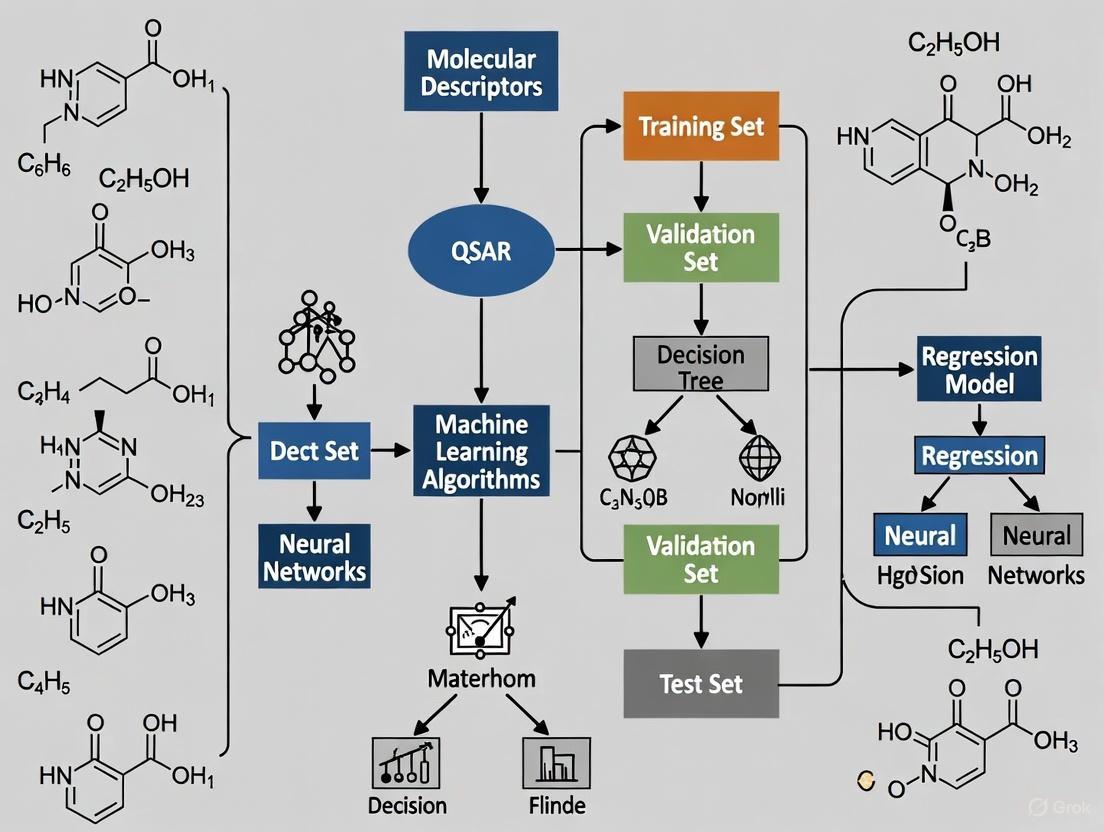
This article explores the transformative integration of machine learning (ML) with Quantitative Structure-Activity Relationship (QSAR) modeling in drug discovery.
From Linear Models to Deep Learning: A Comprehensive Guide to Modern QSAR in Drug Discovery
Abstract
This article explores the transformative integration of machine learning (ML) with Quantitative Structure-Activity Relationship (QSAR) modeling in drug discovery. It traces the evolution from classical statistical approaches to advanced deep learning and generative models, detailing their application in virtual screening, ADMET prediction, and multi-target drug design. The content addresses critical challenges such as data quality, model interpretability, and overfitting, while providing guidance on rigorous validation practices and regulatory compliance. Aimed at researchers and drug development professionals, this review synthesizes current methodologies, best practices, and emerging trends—including quantum machine learning—to offer a practical roadmap for implementing robust and predictive QSAR workflows.
The Evolution of QSAR: From Classical Foundations to AI-Driven Paradigms
The Origins and Core Principles of Traditional QSAR
Quantitative Structure-Activity Relationship (QSAR) modeling stands as a cornerstone of computational chemistry and ligand-based drug design (LBDD), providing a mathematical framework to connect molecular structure to biological activity [1]. For over six decades, these models have been integral to computer-assisted drug discovery, enabling researchers to rationalize bioactivity measurements and predict the properties of unsynthesized compounds, thereby guiding experimental efforts and reducing costs [2] [3]. The core principle underpinning QSAR is that measurable or calculable molecular descriptors can be quantitatively correlated with a compound's biological potency, affinity, or other relevant endpoints [4] [5]. This article details the historical origins, fundamental principles, and standardized protocols of traditional QSAR, framing them within the context of modern, machine-learning-driven research.
Historical Foundations and Evolution
The conceptual roots of QSAR extend back over a century, long before the formalization of the field. Early observations by Meyer and Overton revealed a correlation between the narcotic properties of gases and organic solvents and their solubility in olive oil, marking one of the first recognitions that biological activity could be linked to a physicochemical property [1].
A pivotal advancement came with the work of Hammett in the 1930s and 1940s, who introduced linear free-energy relationships to physical organic chemistry [1]. His famous equation, log(K) = log(K₀) + ρσ, used a substituent constant (σ) to quantify the electronic effects of substituents on reaction rates and equilibria, providing a quantitative parameter that would become a fundamental descriptor in later QSAR work [1].
The field of QSAR was formally born in the early 1960s with the nearly simultaneous publication of two groundbreaking approaches, as summarized in Table 1.
Table 1: Foundational Methodologies in Traditional QSAR
| Methodology | Key Innovators | Core Principle | Mathematical Formulation |
|---|---|---|---|
| Hansch-Fujita Analysis | Corwin Hansch & Toshio Fujita [1] | Correlates activity with a combination of electronic, steric, and hydrophobic substituent parameters. | log(1/C) = b₀ + b₁σ + b₂logP |
| Free-Wilson Analysis | Spencer M. Free & James W. Wilson [1] | Uses additive group contributions from specific substituent positions to predict biological activity. | Activity = μ + ΣGᵢ |
The Hansch-Fujita approach was revolutionary for its time, multi-parametrically combining Hammett's electronic constant (σ) with hydrophobicity (logP) [1]. This acknowledged that biological activity often depends on a molecule's ability to reach the site of action (governed by hydrophobicity) and then interact with it (governed by electronic effects). The Free-Wilson model, based on the principle of additivity, offered a complementary approach that did not require pre-defined physicochemical parameters, instead deriving the contribution of each structural feature directly from the biological data [1].
Core Principles and Theoretical Assumptions
Traditional QSAR modeling is built upon several foundational principles and assumptions that guide its application and interpretation.
- The Chemical Space Principle: A QSAR model is considered reliable only for a specific, well-defined chemical space—the theoretical domain defined by the structural and physicochemical properties of the compounds used to train the model [1]. Predictions for compounds outside this space are unreliable.
- The Principle of Parsimony (Occam's Razor): Given the high dimensionality of molecular descriptors and the risk of overfitting, traditional best practices emphasize building models with a reduced number of highly significant descriptors [4] [5]. This leads to more interpretable and robust models.
- The Domain of Applicability: A robust QSAR model must define its applicability domain, which specifies the structural and property space within which the model's predictions are considered reliable [4]. The leverage method is one common technique used to define this domain statistically.
The following workflow diagram illustrates the standard process for developing a traditional QSAR model, from data collection to deployment.
Standard QSAR Methodology and Workflow
The development of a reliable QSAR model follows a rigorous, multi-step protocol designed to ensure predictive power and statistical significance [4]. The key stages are detailed below.
Data Acquisition and Curation
The process begins with assembling a dataset of compounds with consistently measured biological activity values (e.g., IC₅₀, EC₅₀, Ki) [4]. The dataset must be large enough (typically >20 compounds) and contain comparable activity values obtained from a standardized experimental protocol [4].
Molecular Descriptor Calculation and Feature Selection
Each compound is represented by a vector of molecular descriptors, which can include thousands of physicochemical, topological, and structural features [5]. Common descriptors include molecular weight, logP (octanol-water partition coefficient), topological polar surface area, and various connectivity indices [5]. Due to the high risk of overfitting in a high-dimensional space (p ≫ n), feature selection is critical. Methods include:
- Variance thresholding and correlation pruning to remove non-informative or redundant descriptors [5].
- Random Forest feature importance to select top descriptors [5].
- Penalized regression methods like Lasso (L₁ regularization) that automatically drive the coefficients of irrelevant descriptors to zero [5].
Model Construction and Validation
Classical QSAR models often employed Multiple Linear Regression (MLR) to build an interpretable linear model [4]. The model must undergo rigorous validation:
- Internal Validation: Uses techniques like k-fold cross-validation to assess robustness using only the training set [4].
- External Validation: The gold standard, where the model is used to predict a completely held-out test set of compounds not used in training [4].
- Statistical Metrics: Validation relies on metrics such as R² and root mean square error for regression models, and area under the ROC curve for classification models [5].
Modern Applications and Evolving Paradigms
While the core principles remain relevant, the application of QSAR in modern drug discovery has necessitated a re-evaluation of some traditional best practices, especially for virtual screening.
A significant paradigm shift concerns the handling of imbalanced datasets, which are common in drug discovery (e.g., high-throughput screening datasets are highly skewed towards inactive compounds) [2]. Traditional best practices recommended dataset balancing and optimizing for Balanced Accuracy (BA) to ensure models could predict both active and inactive classes equally well [2]. However, for the task of virtual screening of ultra-large chemical libraries, where the goal is to select a very small number of top-ranking compounds for experimental testing (e.g., 128 compounds matching a well-plate format), a different metric is more critical [2].
Recent studies demonstrate that models trained on imbalanced datasets and optimized for high Positive Predictive Value achieve a hit rate at least 30% higher than models using balanced datasets [2]. The PPV, also known as precision, directly measures the proportion of true actives among the top-ranked predictions, which aligns perfectly with the economic and practical constraints of experimental follow-up [2].
Furthermore, QSAR is increasingly integrated with modern machine learning techniques. The concept of the "informacophore" has been introduced, extending the traditional pharmacophore by incorporating data-driven insights from computed molecular descriptors, fingerprints, and machine-learned representations of chemical structure [3]. This fusion aims to reduce biased intuitive decisions and accelerate the discovery process.
Experimental Protocol: Developing a QSAR Model for NF-κB Inhibitors
The following protocol provides a detailed, practical guide for constructing a validated QSAR model, using the development of NF-κB inhibitors as a case study [4].
Data Compilation
- Source: Identify 121 compounds with reported IC₅₀ values for NF-κB inhibition from the scientific literature [4].
- Curation: Convert the IC₅₀ values (in molar units) to their negative logarithmic scale (pIC₅₀ = -log₁₀(IC₅₀)) to create a more normally distributed dependent variable for regression.
- Division: Randomly split the dataset into a training set (~80 compounds, ~66% of data) for model development and a test set (~41 compounds, ~34%) for external validation [4].
Descriptor Calculation and Selection
- Software: Use chemical computation software like RDKit, Dragon, or PaDEL to calculate a wide range of 1D, 2D, and 3D molecular descriptors for all 121 compounds [5].
- Pre-processing:
- Remove descriptors with zero or near-zero variance.
- Reduce redundancy by excluding one descriptor from any pair with a pairwise correlation coefficient >0.95.
- Feature Selection: Perform an Analysis of Variance (ANOVA) to identify molecular descriptors with high statistical significance for predicting the NF-κB inhibitory activity [4]. Alternatively, use a feature importance method from a Random Forest model to select the top N most relevant descriptors.
Model Construction
- Multiple Linear Regression (MLR): Develop a linear model using the selected descriptors. The general form of the model is:
pIC₅₀ = β₀ + β₁D₁ + β₂D₂ + ... + βₙDₙ, where β are the coefficients and D are the descriptors [4]. - Artificial Neural Network (ANN): For a non-linear model, train an ANN using the same training set and selected descriptors. A potential architecture is the [8.11.11.1] model, indicating an input layer with 8 descriptors, two hidden layers with 11 neurons each, and a single output neuron [4].
Model Validation and Analysis
- Internal Validation: For the MLR model, report the coefficient of determination (R²) and adjusted R². For both MLR and ANN, perform Leave-One-Out (LOO) or k-fold cross-validation and report the cross-validated R² (Q²) [4].
- External Validation: Use the held-out test set to evaluate the final model's predictive power. Report the R² and root mean square error between the predicted and actual pIC₅₀ values for the test compounds [4].
- Applicability Domain: Use the leverage method to define the model's applicability domain. Calculate the leverage (h) for each compound and plot Williams plots (standardized residuals vs. leverage) with a critical leverage threshold of h* = 3p/n, where p is the number of model parameters and n is the number of training compounds [4].
Table 2: Key Research Reagents and Computational Tools for QSAR Modeling
| Resource / Reagent | Type | Primary Function in QSAR |
|---|---|---|
| ChEMBL [2] | Database | A large-scale, open-access bioactivity database used for compiling training datasets. |
| PubChem [2] | Database | A public repository of chemical molecules and their biological activities. |
| eMolecules Explore / Enamine REAL [2] [3] | Virtual Library | Ultra-large, "make-on-demand" chemical libraries used for virtual screening. |
| RDKit [5] | Software Tool | An open-source cheminformatics toolkit for descriptor calculation, fingerprint generation, and molecular informatics. |
| Dragon [5] | Software Tool | A professional software for the calculation of thousands of molecular descriptors. |
| NF-κB Inhibition Assay [4] | Biological Assay | A functional assay (e.g., reporter gene assay) used to generate experimental IC₅₀ values for model training and validation. |
In the realm of Quantitative Structure-Activity Relationship (QSAR) modeling, molecular descriptors serve as the fundamental translation of chemical structures into a numerical language computable by statistical and machine learning algorithms [6] [7]. These descriptors are numerical values that encode various chemical, structural, or physicochemical properties of compounds, forming the basis for predicting biological activity, toxicity, and other pharmacological properties [8]. The evolution of QSAR from its early dependence on simple physicochemical parameters to its current state, which utilizes thousands of complex descriptors, has been pivotal in enhancing the predictive power and applicability of these models in modern drug discovery [7]. The critical challenge lies in selecting descriptors that comprehensively represent molecular properties, correlate meaningfully with biological activity, are computationally feasible, and possess distinct chemical interpretability [7]. This application note details the characteristics, calculation protocols, and practical applications of 1D through 4D molecular descriptors, providing researchers with a framework for their effective deployment in QSAR studies.
Descriptor Dimensions: Characteristics, Applications, and Comparative Analysis
Molecular descriptors are typically classified by their dimensionality, which corresponds to the level of structural information they encode [8]. Understanding the distinctions between these dimensions is crucial for selecting the appropriate descriptors for a specific QSAR problem.
Table 1: Comparative Analysis of Molecular Descriptor Dimensions in QSAR
| Dimension | Description & Data Encoded | Common Examples | Primary Applications | Key Advantages | Major Limitations |
|---|---|---|---|---|---|
| 1D Descriptors | Simple, atom-based counts and molecular properties [8]. | Molecular weight, atom counts, bond counts, number of rings, log P [6] [8]. | High-throughput initial screening, early-stage prioritization of compound libraries [9]. | Fast and easy to calculate; highly interpretable [10]. | Low informational content; poor at capturing complex structure-activity relationships [9]. |
| 2D Descriptors | Topological indices derived from molecular graph connectivity [6] [8]. | Wiener index, Zagreb indices, connectivity indices, 2D fingerprints [6]. | Ligand-based virtual screening, similarity searching, and predictive ADMET modeling [6] [11]. | Invariant to conformation; fast calculation; good for large datasets [12]. | Lack 3D stereochemical information; may miss critical bioactivity-related features [13]. |
| 3D Descriptors | Geometric and surface properties derived from a single, 3D conformation [12] [9]. | Molecular volume, surface area, polarizability, 3D-MoRSE descriptors, WHIM descriptors [9]. | Modeling ligand-target binding where 3D shape and electrostatic complementarity are critical [12]. | Captures steric and electronic effects directly relevant to binding [12]. | Dependent on correct bioactive conformation; alignment can be challenging and introduce bias [13] [9]. |
| 4D Descriptors | Ensembles of properties from multiple molecular conformations and/or protonation states [9] [8]. | Grid-based occupancy descriptors averaged over an ensemble of structures [9]. | Accounting for ligand flexibility and induced fit in binding; refining QSAR models for complex targets [9]. | Explicitly incorporates molecular flexibility; reduces bias from a single conformation [9]. | Computationally intensive; requires sophisticated sampling and analysis methods [9]. |
The choice of descriptor dimension involves a direct trade-off between computational cost, informational content, and the specific biological context. Higher-dimensional descriptors often provide a more realistic representation of the molecular system but require greater computational resources and more complex model-building protocols [9] [7].
Integrated Workflow for Descriptor Calculation and Selection
The process of moving from a chemical structure to a robust QSAR model involves a structured workflow. The following diagram outlines the key steps, emphasizing the iterative nature of descriptor selection and model validation.
Experimental Protocols for Descriptor Calculation and QSAR Modeling
This section provides detailed methodologies for calculating descriptors and building QSAR models, as applied in recent research.
Protocol 1: Building a Random Forest QSAR Model with Feature Selection
This protocol is adapted from a study that identified tankyrase (TNKS2) inhibitors for colon adenocarcinoma, showcasing a modern machine learning-assisted QSAR approach [11].
Dataset Curation:
- Source: Retrieve a curated dataset of known active and inactive compounds from a reliable database such as ChEMBL. For example, a study used 1100 TNKS inhibitors from ChEMBL (Target ID: CHEMBL6125) [11].
- Activity Data: Compile uniform activity data (e.g., IC₅₀, Ki) and convert to a common scale (e.g., pIC₅₀ = -log₁₀(IC₅₀)) [10].
- Structure Standardization: Standardize chemical structures using tools like RDKit or OpenBabel. This includes removing salts, normalizing tautomers, and handling stereochemistry [10].
Descriptor Calculation:
- Software: Use descriptor calculation software such as PaDEL-Descriptor, DRAGON, or Mordred to generate a comprehensive set of 1D, 2D, and 3D descriptors [6] [10].
- Configuration: For 3D descriptors, an energy minimization step is recommended to generate a reasonable 3D conformation before calculation [12].
Data Preprocessing and Feature Selection:
- Preprocessing: Remove descriptors with zero or near-zero variance. Handle any missing values, either by imputation or removal of the offending descriptors/compounds. Scale the remaining descriptors to have zero mean and unit variance [10].
- Feature Selection: Apply feature selection methods to reduce dimensionality and avoid overfitting.
Model Building and Validation:
- Data Splitting: Split the dataset into a training set (e.g., 80%) for model development and an external test set (e.g., 20%) for final validation. The external test set must be kept completely blind during model training [11] [10].
- Model Training: Build a Random Forest classification or regression model on the training set using the selected features.
- Hyperparameter Tuning: Optimize model hyperparameters (e.g., number of trees, tree depth) using cross-validation on the training set [11] [8].
- Validation: Assess model performance using the external test set. Report metrics such as accuracy, sensitivity, specificity, and Area Under the ROC Curve (AUC-ROC). The cited study achieved an AUC-ROC of 0.98 [11].
Protocol 2: Utilizing Bioactive Conformations for 3D-QSAR
This protocol, informed by a comparative study of 2D and 3D descriptors, emphasizes the importance of using biologically relevant conformations for 3D-QSAR [12].
Acquisition of Bioactive Conformations:
- Source: Mine the Protein Data Bank (PDB) for high-resolution crystal structures of protein-ligand complexes relevant to the target of interest [12].
- Curation: Compile a dataset of ligands from these complexes. Extract the 3D coordinates of the ligand in its bound (bioactive) conformation. Ensure the activity data (e.g., IC₅₀) for these ligands is uniform and reported in the same assay system [12].
Descriptor Calculation and Modeling:
- Multiple Descriptor Types: Calculate 2D descriptors, 3D descriptors (e.g., using DRAGON), and a combined "2D+3D" descriptor set for each ligand in its bioactive conformation [12].
- Model Building: Model the activity data using multiple machine learning algorithms (e.g., k-Nearest Neighbors, Random Forest, Lasso Regression) for each descriptor set [12].
- Performance Evaluation: Validate models via external test sets. The comparative study found that combining 2D and 3D descriptors often yields more significant models than using either type alone, as they encode complementary molecular information [12].
Protocol 3: Implementing a 4D-QSAR Analysis
4D-QSAR accounts for ligand flexibility by using an ensemble of conformations and/or orientations, thus incorporating an additional dimension beyond 3D-QSAR [9].
Conformational Sampling:
- Generation: For each molecule in the dataset, generate a representative ensemble of low-energy conformations using molecular mechanics or dynamics simulations. Tools like OMEGA or conformer generation functions in RDKit can be used.
- Alignment: Superimpose all conformers of all molecules according to a common pharmacophore or a scaffold present in the series.
Grid and Interaction Field Calculation:
- Grid Construction: Embed the aligned conformational ensembles within a 3D grid.
- Descriptor Generation: At each grid point, calculate interaction field descriptors (e.g., steric, electrostatic) for each conformation. The 4D descriptor is then the occupancy or average energy at each grid point over the entire ensemble of conformations for a given molecule [9].
Data Analysis and Model Building:
- Data Matrix: Construct a data matrix where rows represent compounds and columns represent the 4D grid descriptors.
- Model Development: Use data reduction techniques like Partial Least Squares (PLS) regression to correlate the 4D descriptors with biological activity and build the predictive model [9].
Table 2: Key Research Reagent Solutions for QSAR Modeling
| Tool / Resource | Type | Primary Function | Example Use in Protocol |
|---|---|---|---|
| ChEMBL [11] | Database | Public repository of bioactive molecules with drug-like properties and curated bioactivity data. | Sourcing a reliable dataset of tankyrase inhibitors for model building (Protocol 1). |
| PDB (Protein Data Bank) [12] | Database | Archive of 3D structural data of biological macromolecules, including protein-ligand complexes. | Acquiring bioactive conformations of ligands for accurate 3D-QSAR (Protocol 2). |
| PaDEL-Descriptor [8] [10] | Software | Calculate molecular descriptors and fingerprints. Supports both 2D and 3D descriptor calculation. | Generating a comprehensive set of 1D/2D molecular descriptors as part of the QSAR workflow. |
| DRAGON [8] | Software | Professional software for the calculation of a very large number of molecular descriptors (>5000). | Calculating advanced 2D, 3D, and 4D descriptors for complex QSAR analyses. |
| RDKit [8] [10] | Cheminformatics Library | Open-source toolkit for cheminformatics, including descriptor calculation, machine learning, and molecular operations. | Standardizing chemical structures, generating conformers, and integrating QSAR pipelines. |
| scikit-learn [8] | Software Library | Open-source machine learning library for Python, featuring a wide array of modeling and feature selection algorithms. | Implementing Random Forest, feature selection methods, and model validation (Protocol 1). |
Molecular descriptors are the critical link that transforms chemical intuition into predictive, quantitative models in QSAR research [7]. The strategic selection of descriptor dimension—from the simplicity of 1D to the conformational complexity of 4D—directly controls the balance between interpretability, computational cost, and biological accuracy of the resulting model [9] [7]. As the field advances, the integration of these classical descriptors with modern AI and deep learning methods, which can learn complex representations directly from molecular graphs or SMILES strings, promises to further expand the applicability and predictive power of QSAR in drug discovery [8] [7]. The protocols and tools outlined herein provide a foundation for researchers to rationally select and apply these descriptors, thereby generating more reliable and actionable hypotheses for rational drug design.
Quantitative Structure-Activity Relationship (QSAR) modeling represents a fundamental methodology in modern chemoinformatics and drug discovery, establishing mathematical relationships between chemical structures and their biological activities or physicochemical properties. These models enable researchers to predict the behavior of untested compounds, prioritize synthesis targets, and rationalize molecular design strategies. Among the diverse statistical approaches available, Multiple Linear Regression (MLR) and Partial Least Squares (PLS) regression have emerged as cornerstone classical techniques for constructing interpretable and predictive QSAR models [14]. MLR provides straightforward, transparent models that directly correlate descriptor values to biological response, while PLS offers robust handling of correlated descriptors and high-dimensional data spaces common in chemical descriptor analysis [15] [16].
The continued relevance of these classical approaches persists even alongside advanced machine learning and deep learning methods, particularly when model interpretability is crucial for guiding chemical optimization in drug development pipelines [17] [18]. This application note details the practical implementation, comparative strengths, and appropriate application domains for both MLR and PLS within QSAR modeling workflows.
Theoretical Foundations
Multiple Linear Regression (MLR) in QSAR
Multiple Linear Regression establishes a linear relationship between multiple independent variables (molecular descriptors) and a single dependent variable (biological activity). [19] The fundamental MLR model takes the form:
Activity = β₀ + β₁D₁ + β₂D₂ + ... + βₙDₙ + ε
Where Activity represents the biological response, β₀ is the intercept, β₁...βₙ are regression coefficients for descriptors D₁...Dₙ, and ε denotes the error term [14]. In QSAR applications, the descriptors (D) quantify specific molecular characteristics including electronic, steric, hydrophobic, or topological properties [19].
A significant advantage of MLR is its high interpretability; each coefficient directly quantifies the contribution of its corresponding descriptor to the biological activity [15]. However, MLR requires careful variable selection to avoid overfitting, particularly when dealing with large descriptor pools where the number of descriptors may approach or exceed the number of compounds [20]. Techniques such as stepwise selection, genetic algorithms, or replacement methods are commonly employed to identify optimal descriptor subsets that yield robust, predictive models [15] [20].
Partial Least Squares (PLS) in QSAR
Partial Least Squares regression addresses a key limitation of MLR: the inability to effectively handle correlated descriptors and datasets where the number of variables exceeds the number of observations [16]. PLS operates by projecting the original descriptor variables into a new space of orthogonal latent variables (factors) that maximize covariance with the response variable [21] [16].
The PLS algorithm successively extracts factors as linear combinations of original descriptors, with each factor oriented to explain both descriptor variance and activity correlation [16]. This projection enables stable solutions even for correlated descriptor sets, making PLS particularly valuable for analyzing 3D-QSAR fields (e.g., CoMFA) and high-dimensional fingerprint descriptors [21] [19]. A critical step in PLS modeling is determining the optimal number of latent variables through cross-validation to prevent overfitting [16].
Comparative Analysis of MLR and PLS
Table 1: Characteristics of MLR and PLS Regression in QSAR Modeling
| Feature | Multiple Linear Regression (MLR) | Partial Least Squares (PLS) |
|---|---|---|
| Descriptor Handling | Requires independent, uncorrelated descriptors | Tolerates correlated descriptors effectively |
| Data Dimensionality | Suitable when n(compounds) >> n(descriptors) | Handles n(descriptors) >= n(compounds) |
| Model Interpretability | High - direct coefficient interpretation | Moderate - requires interpretation of latent variables |
| Variable Selection | Essential pre-processing step | Built-in dimensionality reduction |
| Primary QSAR Applications | 2D-QSAR with carefully selected descriptors | 3D-QSAR (CoMFA, CoMSIA), spectral data, high-dimensional descriptors |
| Validation Approach | Leave-one-out, external test set | Cross-validation to determine optimal factors, external validation |
| Implementation Complexity | Low to moderate (with variable selection) | Moderate to high (factor optimization required) |
Table 2: Performance Comparison of MLR, PLS, and Hybrid Approaches
| Method | Advantages | Limitations | Reported Predictive Performance |
|---|---|---|---|
| MLR | Simple interpretation, clear descriptor contributions | Fails with correlated descriptors, overfitting risk | Highly variable depending on variable selection quality [15] |
| PLS | Handles correlated variables, stable with many descriptors | Abstract factors, less intuitive interpretation | Highly predictive for 3D-QSAR fields and complex descriptor sets [21] |
| GA-MLR | Combines robust variable selection with interpretable models | Computationally intensive for large descriptor pools | Superior to stepwise-MLR and comparable to PLS in validation metrics [15] |
Experimental Protocols
Protocol 1: MLR-QSAR Model Development
Objective: Develop a validated MLR-QSAR model using optimal descriptor subset selection.
Materials and Software:
- Chemical structures of compounds with known biological activity (minimum 20 compounds recommended)
- Molecular descriptor calculation software (PaDEL, Mold2, RDKit, or Dragon)
- Statistical analysis environment (R, Python with scikit-learn, or MATLAB)
- Dataset partitioning utility
Procedure:
Dataset Preparation and Curation
- Compile chemical structures and corresponding experimental biological activities (e.g., IC₅₀, Ki, EC₅₀)
- Apply strict quality control: remove duplicates, compounds with ambiguous stereochemistry, and outliers
- Convert structures to standardized representation (e.g., canonical SMILES) and optimize 3D geometry if needed
Molecular Descriptor Calculation
- Calculate comprehensive descriptor set using multiple software tools (e.g., PaDEL for 1444 0D-2D descriptors, Mold2 for 777 descriptors) [20]
- Pre-filter descriptors: remove constant/near-constant variables and those with missing values
- Address collinearity by identifying highly correlated descriptor pairs (r > 0.95) and retaining one from each pair
Descriptor Selection and Model Construction
- Apply variable selection algorithm (Replacement Method, Genetic Algorithm, or Stepwise Regression)
- For Genetic Algorithm-MLR: Implement population size of 100-500, 50-100 generations, crossover probability 0.8, mutation probability 0.01 [15]
- Evaluate model quality using statistical metrics: R², adjusted R², and standard error of estimation
- Select final model based on parsimony principle and statistical significance
Model Validation
- Partition dataset using Balanced Subsets Method or Kennard-Stone algorithm: 70-80% training, 20-30% test [20]
- Perform internal validation: Leave-One-Out (LOO) or Leave-Multiple-Out cross-validation
- Calculate cross-validation metrics: Q², standard error of prediction
- Conduct external validation: Predict test set compounds not used in model building
- Apply Y-scrambling to verify absence of chance correlation (typically 100-500 iterations)
Model Interpretation and Applicability Domain
- Analyze regression coefficients and their statistical significance
- Define applicability domain using leverage approach or descriptor range analysis
- Generate Williams plots (standardized residuals vs. leverage) to identify outliers and influential compounds
Protocol 2: PLS-QSAR Model Development
Objective: Construct a validated PLS-QSAR model for high-dimensional or correlated descriptor data.
Materials and Software:
- Chemical structures and biological activity data
- Molecular descriptor/fingerprint calculation software
- PLS implementation (SIMCA, R pls package, Python scikit-learn)
- Cross-validation utilities
Procedure:
Data Preparation and Descriptor Calculation
- Prepare standardized molecular structures and experimental activities
- Calculate comprehensive descriptor sets or 3D-field descriptors (for CoMFA/CoMSIA)
- Standardize descriptors: mean-centering and unit variance scaling recommended
Initial Data Analysis and Pre-processing
- Perform exploratory analysis: Principal Component Analysis (PCA) to identify outliers
- Examine descriptor correlation matrix to assess multicollinearity
- Apply unsupervised clustering to verify dataset representativeness
PLS Factor Optimization
- Implement cross-validation (leave-one-out or group-based) to determine optimal number of latent variables [16]
- Plot prediction residual error sum of squares (PRESS) vs. number of components
- Select component number where PRESS is minimized or Q² is maximized
- Consider conservative factor selection to prevent overfitting
Model Training and Validation
- Develop PLS model with optimized number of components
- Calculate model statistics: R²X, R²Y, and Q²
- Validate using external test set prediction
- Perform permutation testing (Y-scrambling) to confirm model robustness
Model Interpretation and Visualization
- Analyze variable importance in projection (VIP) scores to identify influential descriptors
- Examine loading plots to interpret latent variable meaning
- Generate coefficient plots to visualize descriptor-activity relationships
- Create score plots to explore compound clustering and patterns
Table 3: Essential Software Tools for MLR and PLS QSAR Modeling
| Tool Name | Type | Primary Function | QSAR Application |
|---|---|---|---|
| PaDEL-Descriptor | Software | Calculates 1D, 2D molecular descriptors and fingerprints | Generates 1444 molecular descriptors for MLR/PLS input [20] |
| Mold2 | Software | Computes 777 molecular descriptors from 2D structures | Complementary descriptor source for comprehensive coverage [20] |
| QuBiLs-MAS | Software | Calculates 3D molecular descriptors using algebraic forms | Generates 8448 descriptors for complex property encoding [20] |
| R pls package | Library | Implements PLS regression with cross-validation | Factor optimization and model validation [14] |
| Genetic Algorithm | Algorithm | Performs variable selection for MLR | Identifies optimal descriptor subsets from large pools [15] |
| Replacement Method (RM) | Algorithm | Selects descriptor combinations minimizing standard deviation | Efficient alternative to exhaustive search for MLR [20] |
Advanced Applications and Case Studies
PLK1 Inhibitor Modeling Using MLR
A comprehensive study of 530 polo-like kinase-1 (PLK1) inhibitors demonstrated the application of MLR with advanced variable selection. Researchers computed 26,761 initial descriptors using PaDEL, Mold2, and QuBiLs-MAS software, which were pre-filtered to 11,565 linearly independent descriptors [20]. The Replacement Method variable selection technique identified optimal descriptor subsets, producing models with strong predictive performance for external test compounds. This case study highlights the importance of comprehensive descriptor calculation and rigorous variable selection in MLR-QSAR for kinase inhibitors.
3D-QSAR with PLS Regression
In Comparative Molecular Field Analysis (CoMFA) and other 3D-QSAR approaches, PLS regression is the standard statistical method for correlating steric and electrostatic field values with biological activity [19]. The technique successfully handles the thousands of correlated field descriptors generated at lattice points around molecular alignments. Cross-validation determines the optimal number of components, with typical Q² values >0.5 indicating predictive models. The integration of genetic algorithms for field selection further enhances PLS model quality in 3D-QSAR [16].
Troubleshooting and Quality Control
Common Issues and Solutions:
- Overfitting in MLR: Implement stricter variable selection criteria, increase training set size, or apply additional validation techniques
- Low Predictive Power in PLS: Re-evaluate molecular alignment (for 3D-QSAR), examine descriptor relevance, or adjust number of latent variables
- Model Instability: Apply bootstrapping to assess coefficient stability, check for influential outliers, or implement consensus modeling
- Chance Correlation: Always perform Y-randomization tests; significant degradation in scrambled models indicates real structure-activity relationships
Quality Control Metrics:
- For MLR: R² > 0.7, Q² > 0.6, and significance level p < 0.05 for critical descriptors
- For PLS: R²Y > 0.7, Q² > 0.5, and clear PRESS minimum for factor selection
- For both methods: external prediction R² > 0.6 and minimal performance degradation vs. training
MLR and PLS regression continue to be indispensable tools in the QSAR modeling repertoire, each with distinct advantages for specific data scenarios. MLR provides maximum interpretability for carefully curated descriptor sets, while PLS offers robust performance for high-dimensional, correlated data typical of modern chemical descriptor collections. The appropriate selection between these techniques, coupled with rigorous validation practices, enables researchers to develop reliable predictive models that accelerate drug discovery and molecular design.
The fundamental premise of structure-activity relationship (SAR) analysis faces a significant challenge known as the SAR Paradox, which states that it is not the case that all similar molecules have similar activities [19] [22] [23]. This paradox presents substantial obstacles in drug discovery and quantitative structure-activity relationship (QSAR) modeling, where small structural modifications can unexpectedly lead to dramatic fluctuations in biological properties [24]. This Application Note examines the mechanistic basis of the SAR paradox and provides detailed experimental protocols to identify, characterize, and navigate activity cliffs in pharmaceutical research.
The SAR paradox contradicts the central assumption in medicinal chemistry that structurally similar compounds exhibit predictable biological activities [22]. This phenomenon manifests as "activity cliffs" – where minute structural changes result in disproportionate changes in biological activity [24]. Understanding these discontinuities is crucial for developing predictive QSAR models, especially as machine learning approaches become increasingly integral to drug discovery [8] [25].
The paradox arises because different biological activities (e.g., receptor binding, solubility, metabolic stability) may depend on different molecular features, meaning that a "small difference" is not universally defined but varies according to the specific biological context [19] [23]. Recent advances in network pharmacology have further complicated this picture by revealing that drugs typically act on multiple targets rather than single ones, creating complex relationships between structure and activity [24].
Mechanistic Basis of the SAR Paradox
Key Factors Contributing to Activity Cliffs
- Binding Site Specificity: Minor structural modifications can significantly alter binding affinities to protein targets through subtle changes in electrostatic interactions, hydrogen bonding, or steric effects [24].
- Multi-Target Pharmacology: A single compound typically interacts with multiple biological targets, and small structural changes may differentially affect these various interactions [24].
- Molecular Descriptor Limitations: Traditional QSAR descriptors may fail to capture critical three-dimensional and electronic features responsible for discontinuous activity changes [19] [26].
- Physicochemical Property Discontinuities: Small structural changes can lead to disproportionate alterations in key properties like solubility, logP, or membrane permeability [27].
Table 1: Experimental Techniques for SAR Paradox Investigation
| Technique Category | Specific Methods | Information Gained | Throughput |
|---|---|---|---|
| Computational Screening | Matched Molecular Pair Analysis (MMPA), 3D-QSAR, Machine Learning Models | Identifies potential activity cliffs, predicts key molecular descriptors | High |
| Biophysical Assays | Surface Plasmon Resonance (SPR), Isothermal Titration Calorimetry (ITC) | Direct measurement of binding affinity and kinetics | Medium |
| Structural Biology | X-ray Crystallography, Cryo-EM | Atomic-level resolution of ligand-target interactions | Low |
| Cellular Profiling | High-content screening, phenotypic assays | Functional activity in biologically relevant systems | Medium-High |
Visualizing the SAR Paradox Concept
Diagram 1: The SAR Paradox conceptual framework showing how similar structures lead to unexpected activity profiles.
Experimental Protocols
Protocol 1: Systematic Identification of Activity Cliffs Using Matched Molecular Pair Analysis (MMPA)
Purpose: To systematically identify and quantify activity cliffs within compound datasets [19].
Materials:
- Curated chemical structures with associated biological activity data
- Computational tools: RDKit or OpenBabel for structure handling
- MMPA implementation (e.g., Open Source MMP application)
- Statistical analysis software (e.g., R, Python with pandas)
Procedure:
- Data Preparation:
- Compile chemical structures and corresponding biological activity measurements (e.g., IC50, Ki)
- Standardize chemical representations (remove salts, neutralize charges, generate canonical tautomers)
- Apply rigorous data quality filters to remove unreliable measurements
Matched Molecular Pair Generation:
- Fragment molecules at single bonds to identify identical structural contexts
- Identify all pairs of compounds differing only at a single site (e.g., -Cl vs -OH substitution)
- Calculate ΔPActivity = |pActivity₁ - pActivity₂| for each pair (where pActivity = -log10[Activity])
Activity Cliff Definition:
- Set threshold for significant activity difference (typically ΔPActivity > 2.0, representing 100-fold potency change)
- Flag pairs exceeding threshold as potential activity cliffs
- Exclude pairs with poor data quality or insufficient potency measurements
Context Analysis:
- Categorize cliffs by substitution type (e.g., halogen exchange, functional group changes)
- Analyze local chemical environment around substitution site
- Correlate cliff magnitude with specific molecular descriptors
Validation:
- Select representative cliff pairs for experimental confirmation
- Design synthetic routes for analogous compounds to validate cliff observations
Table 2: Key Research Reagents and Computational Tools for SAR Paradox Studies
| Category | Item | Specifications | Application/Function |
|---|---|---|---|
| Computational Descriptors | DRAGON Molecular Descriptors | 3,300+ descriptors covering structural, topological, electronic properties | Quantifying molecular features for QSAR modeling [24] |
| Machine Learning Algorithms | Random Forest, Support Vector Machines (SVM), Graph Neural Networks | Nonlinear pattern recognition, handling high-dimensional data [8] | Predicting biological activity and identifying descriptor importance [8] [25] |
| Structural Biology Reagents | Cryo-EM Grids | Ultra-thin carbon on 300 mesh gold | High-resolution structure determination of ligand-target complexes |
| Binding Assay Systems | SPR Chips | CM5 sensor chips | Label-free binding affinity and kinetics measurement |
| Chemical Informatics Platforms | RDKit, PaDEL-Descriptor | Open-source cheminformatics libraries | Molecular descriptor calculation and structural analysis [8] |
Protocol 2: Integrated QSAR-Gene Expression Approach to Resolve SAR Paradox
Purpose: To enhance QSAR model performance by integrating structural descriptors with gene expression profiles, addressing cases where structural similarity fails to predict biological activity [24].
Materials:
- Compound library with standardized structures
- Cell line appropriate for target biology
- RNA extraction kit (e.g., RNeasy Mini Kit)
- Microarray or RNA-seq platform
- Statistical software with machine learning capabilities
Procedure:
- Gene Expression Profiling:
- Treat biological system (cells, tissues) with compounds showing paradoxical SAR
- Include appropriate vehicle controls and biological replicates (n≥3)
- Extract RNA at optimized time points post-treatment
- Perform transcriptomic analysis using microarray or RNA-seq
Feature Selection:
- Identify differentially expressed genes (fold-change > 2, adjusted p-value < 0.05)
- Apply recursive feature elimination to select most informative genes
- Calculate frequency of selection for each gene across multiple model iterations
Integrated Model Construction:
- Compute conventional molecular descriptors (topological, electronic, geometrical)
- Combine selected molecular descriptors with gene expression features
- Build predictive models using support vector machines or random forests
- Validate model performance through cross-validation and external test sets
Mechanistic Interpretation:
- Pathway analysis of significant genes using KEGG or GO databases
- Relate key molecular descriptors to identified biological pathways
- Generate testable hypotheses regarding mechanism of activity cliffs
Case Study: Navigating the SAR Paradox in HDAC Inhibitor Development
A recent study on indole-based HDAC inhibitors demonstrates practical approaches to the SAR paradox through Quantitative Activity-Activity Relationship (QAAR) analysis [26]. Researchers developed multiple linear regression models correlating molecular descriptors with selectivity profiles (pIC50HDAC8/HDACX).
Key Findings:
- Selectivity-determining descriptors included ASP-6 (atom-type electrotopological state), SpMin3_Bhv (spectral moment descriptors), and PubchemFP697 (structural fingerprint features)
- Model statistics (R² = 0.920, Q² = 0.769 for HDAC8/HDAC1 selectivity) demonstrated robust predictive capability
- The resulting models enabled rational design of selective inhibitors despite complex SAR patterns
This case study illustrates how advanced modeling techniques can extract meaningful patterns from paradoxical SAR data, enabling more predictive chemical optimization.
The SAR paradox represents both a challenge and opportunity in drug discovery. By employing integrated experimental and computational approaches—including matched molecular pair analysis, advanced QSAR modeling, and transcriptomic profiling—researchers can better navigate activity cliffs and develop more predictive structure-activity models.
Emerging strategies including AI-integrated QSAR modeling [8], deep learning descriptors [25], and protein-ligand interaction fingerprints show particular promise for resolving paradoxical SAR cases. These approaches will become increasingly important as drug discovery tackles more complex targets and polypharmacological agents.
Diagram 2: Integrated workflow for addressing the SAR Paradox through computational and experimental approaches.
The field of Quantitative Structure-Activity Relationships (QSAR) has undergone a profound transformation, evolving from classical statistical approaches to modern, data-intensive machine learning (ML) and artificial intelligence (AI) methodologies [8]. This shift was catalyzed by the confluence of large-scale chemical databases, substantial increases in computational power, and advanced algorithmic innovations [8] [4]. Where traditional QSAR relied on linear regression models and manually curated molecular descriptors, contemporary frameworks now leverage graph neural networks, deep learning, and ensemble methods to capture complex, non-linear relationships in chemical data across billions of compounds [8]. This data revolution has fundamentally accelerated virtual screening, lead optimization, and toxicity prediction, establishing computational approaches as indispensable tools in modern drug discovery pipelines [8] [4].
The Evolution of Modeling Approaches
The transition from classical to ML-based QSAR represents not merely a methodological upgrade but a fundamental rethinking of how chemical data is analyzed and modeled.
Table 1: Comparison of Classical and Machine Learning QSAR Approaches
| Aspect | Classical QSAR | Modern ML-QSAR |
|---|---|---|
| Primary Methods | Multiple Linear Regression (MLR), Partial Least Squares (PLS) [8] [4] | Random Forests, Support Vector Machines, Artificial Neural Networks, Deep Learning [8] [4] |
| Data Handling | Limited datasets, linear relationships [8] | High-dimensional chemical spaces, non-linear patterns [8] |
| Descriptor Interpretation | Manual selection and interpretation [8] | Automated feature importance (e.g., SHAP, permutation importance) [8] |
| Computational Demand | Low to moderate [4] | High, requiring specialized hardware (GPUs) [8] |
| Applicability Domain | Clearly defined by training data [4] | Complex, often requiring specialized validation [4] |
Classical Foundations
Classical QSAR methodologies, including Multiple Linear Regression (MLR) and Principal Component Regression (PCR), established the foundational principle of correlating numerical molecular descriptors with biological activity [8] [4]. These methods are valued for their interpretability, simplicity, and regulatory acceptance [8]. They perform effectively when relationships between structure and activity are linear and datasets are reasonably small [8]. However, they frequently falter with highly non-linear relationships or noisy, high-dimensional data, limitations that became increasingly apparent as chemical databases expanded [8].
The Machine Learning Rise
Machine learning algorithms have significantly expanded the predictive power and flexibility of QSAR models [8]. Algorithms such as Random Forests (RF), Support Vector Machines (SVM), and k-Nearest Neighbors (kNN) became standard tools due to their ability to manage complex, non-linear descriptor-activity relationships without prior assumptions about data distribution [8]. The development of graph neural networks and SMILES-based transformers further enabled end-to-end learning from molecular structures without manual descriptor engineering, creating more data-driven and adaptable QSAR pipelines [8].
Application Note: Developing a Modern QSAR Model for NF-κB Inhibition
This protocol details the development of a robust QSAR model for predicting Nuclear Factor-κB (NF-κB) inhibition, illustrating the standard workflow that integrates machine learning and rigorous validation [4]. The process, from data collection to model deployment, typically spans several days to weeks, depending on computational resources and dataset size.
Materials and Reagents
Table 2: Essential Research Reagent Solutions for QSAR Modeling
| Reagent/Category | Specific Examples & Details | Primary Function |
|---|---|---|
| Chemical Compound Library | 121 curated NF-κB inhibitors with reported IC₅₀ values [4] | Provides the essential activity data for model training and validation. |
| Molecular Descriptor Calculator | DRAGON, PaDEL, RDKit [8] | Generates numerical representations (descriptors) of chemical structures. |
| Machine Learning Library | scikit-learn, KNIME, AutoQSAR [8] | Provides algorithms (e.g., ANN, SVM) for building the predictive model. |
| Model Validation Framework | QSARINS, Build QSAR [8] | Offers tools for internal/external validation and applicability domain definition. |
| Cloud/High-Performance Computing | Cloud-based platforms for computational modeling [8] | Supplies the processing power required for complex ML model training. |
Step-by-Step Methodology
Step 1: Data Curation and Preparation
- Activity Data Collection: Assemble a dataset of 121 compounds with experimentally determined IC₅₀ values against NF-κB [4].
- Chemical Structure Standardization: Curate and standardize molecular structures using a tool like RDKit to ensure consistency [8].
- Dataset Division: Randomly split the dataset into a training set (~80 compounds, ~66% for model development) and a test set (~41 compounds, ~34% for external validation) [4].
Step 2: Molecular Descriptor Calculation and Selection
- Descriptor Calculation: Compute a wide range of 1D, 2D, and 3D molecular descriptors using software such as DRAGON or PaDEL [8].
- Descriptor Preprocessing: Apply dimensionality reduction techniques like Principal Component Analysis (PCA) or feature selection methods (e.g., LASSO, recursive feature elimination) to identify the most statistically significant descriptors and reduce overfitting [8] [4].
Step 3: Model Training and Optimization
- Algorithm Selection: Train and compare different models, including Multiple Linear Regression (MLR) and Artificial Neural Networks (ANN) [4].
- Hyperparameter Tuning: Optimize model architectures using grid search or Bayesian optimization. For instance, an ANN architecture with topology
[8.11.11.1]has demonstrated superior performance for this specific task [4].
Step 4: Model Validation and Defining Applicability Domain
- Internal Validation: Assess the training set performance using metrics like the coefficient of determination (R²) and cross-validated R² (Q²) [8] [4].
- External Validation: Evaluate the model's generalizability by predicting the activity of the held-out test set [4].
- Applicability Domain: Use the leverage method to define the chemical space where the model's predictions are reliable [4].
The following workflow diagram visualizes the key stages of this QSAR modeling protocol:
Anticipated Results and Interpretation
- Performance Metrics: A successful ANN model should demonstrate high predictive accuracy on both training and test sets, with metrics such as Q² > 0.6 and R² > 0.8 for the external test set, indicating a robust and non-overfit model [4].
- Model Interpretation: Analyze the MLR model equation or use SHAP (SHapley Additive exPlanations) values for the ANN to identify which molecular descriptors (e.g., hydrophobicity, electronic properties) most significantly influence NF-κB inhibitory activity [8] [4].
- Utility: The validated model enables the efficient virtual screening of large chemical databases to identify new potential NF-κB inhibitor series for synthesis and experimental testing [4].
The Integrated Future: AI and Multi-Method Approaches
The data revolution in QSAR is characterized by the integration of multiple computational disciplines rather than the isolated use of single models. A prominent trend is the combination of ligand-based QSAR with structure-based methods like molecular docking and dynamics simulations [8]. This synergy provides deeper mechanistic insights into ligand-target interactions, enriching the predictive model with structural context. Furthermore, the adoption of cloud-based platforms is democratizing access to advanced modeling capabilities, allowing researchers to perform large-scale virtual screens of chemical libraries containing billions of compounds [8].
The following diagram illustrates how these computational approaches converge in a modern drug discovery pipeline:
Building Predictive Models: Machine Learning Algorithms and Real-World Applications in Drug Discovery
Algorithm Performance in QSAR Modeling
Table 1: Comparative Performance of Key ML Algorithms in QSAR Studies
| Algorithm | Typical QSAR Application | Reported Performance Metrics | Key Advantages for QSAR | Notable Case Studies |
|---|---|---|---|---|
| Random Forest (RF) | Predicting repeat-dose toxicity point-of-departure (POD) values [28] | RMSE: 0.71 log10-mg/kg/day, R²: 0.53 on external test set [28] | Robust to noisy data & outliers, handles high-dimensional descriptors, provides built-in feature importance [8] [29] | Toxicity prediction for 3592 environmental chemicals [28] |
| Support Vector Machine (SVM) | Classification and regression tasks in virtual screening and toxicity prediction [8] [29] | Often requires careful parameter tuning and feature selection for optimal performance [30] | Effective in high-dimensional spaces, works well with a clear margin of separation [8] | ADME evaluation and general molecular property prediction [31] |
| k-Nearest Neighbors (kNN) | Virtual screening, similarity searching, and preliminary compound classification [8] [1] | A simple and rough method to predict and rank molecules [31] | Simple implementation, effective for similarity-based chemical space navigation [1] | Ligand-based virtual screening based on molecular similarity [1] [31] |
Experimental Protocols for QSAR Modeling
Protocol: Developing a Random Forest QSAR Model for Toxicity Prediction
This protocol is adapted from a study that developed QSAR models to predict repeat-dose toxicity point-of-departure values using a large dataset of 3592 chemicals [28].
Reagents and Materials:
- Chemical Dataset: 3592 chemicals with experimentally derived in vivo toxicity data (e.g., from EPA's ToxValDB) [28].
- Software: Computational environment capable of running Random Forest (e.g., Python with scikit-learn, R) [8] [29].
Procedure:
- Data Compilation and Curation: Compile a dataset of chemicals with associated experimental toxicity values (e.g., NOAEL, LOAEL). This dataset may include multiple study types and species [28].
- Descriptor Calculation: Compute molecular descriptors encoding structural and physicochemical properties for each chemical. These can include 1D (e.g., molecular weight), 2D (e.g., topological indices), and 3D descriptors (e.g., molecular surface area) [8] [29].
- Data Preprocessing and Splitting: Split the curated data into a training set (e.g., 80%) for model development and an external test set (e.g., 20%) for final model validation [28].
- Model Training:
- Train a Random Forest regressor on the training set using chemical descriptors as features and the toxicity endpoint (e.g., log10-mg/kg/day) as the target variable [28].
- Optimize hyperparameters (e.g., number of trees, maximum depth) using techniques like grid search or Bayesian optimization within a cross-validation framework on the training set [8].
- Model Validation:
- Uncertainty Quantification (Optional): To account for experimental variability, construct a distribution for the predicted POD (e.g., with a standard deviation of 0.5 log10-mg/kg/day). Use bootstrap resampling to derive confidence intervals for each prediction [28].
- Model Interpretation: Use the RF model's built-in feature importance metrics or post-hoc interpretation tools (e.g., SHAP, LIME) to identify which molecular descriptors most strongly influence the toxicity predictions [8] [29].
Protocol: Comparative Analysis of ML Algorithms using a Bioactivity Dataset
This protocol outlines a method for comparing the performance of RF, SVM, and kNN against classical methods, based on a study screening for triple-negative breast cancer (TNBC) inhibitors [31].
Reagents and Materials:
- Bioactivity Dataset: A curated set of compounds with associated bioactivity data (e.g., IC₅₀, Ki). For example, 7,130 molecules with reported inhibitory activities from a source like ChEMBL [31].
- Software: A cheminformatics platform (e.g., KNIME, OCHEM) or programming environment with necessary ML libraries [31].
Procedure:
- Dataset Preparation: Collect and curate a dataset of compounds with reliable bioactivity data. Standardize the activity values (e.g., convert to log units) [31].
- Descriptor Generation: Calculate molecular descriptors or fingerprints for all compounds. The cited study used a combination of 613 descriptors from AlogP, ECFP, and FCFP fingerprints [31].
- Data Splitting: Randomly split the data into a training set (e.g., 85%) and a fixed external test set (e.g., 15%) [31].
- Model Building and Training:
- Train multiple models on the same training set:
- Random Forest: Optimize the number of trees and other parameters [31].
- Support Vector Machine (SVM): Tune hyperparameters such as the kernel type (e.g., RBF) and regularization parameter [31].
- k-Nearest Neighbors (kNN): Optimize the number of neighbors (k) [31].
- Classical Methods (for baseline): Include methods like Partial Least Squares (PLS) or Multiple Linear Regression (MLR) [31].
- Train multiple models on the same training set:
- Performance Evaluation:
- Use the same external test set to evaluate all trained models.
- Calculate and compare the R²pred (predictive R²) for regression tasks to quantify the models' performance on unseen data [31].
- Analysis of Training Set Size Impact (Optional): Investigate the robustness of each algorithm by repeating the training and evaluation with progressively smaller subsets of the original training data (e.g., 50%, 10%) and observing the change in R²pred on the fixed test set [31].
Workflow Visualization
Figure 1: Generic QSAR Machine Learning Workflow. This diagram outlines the standard process for developing and validating QSAR models using machine learning algorithms, highlighting the crucial step of external validation [28] [31].
Figure 2: Algorithm Performance in a Comparative Study. This diagram visualizes the setup and findings from a study that compared multiple algorithms, including RF, SVM, and kNN, for bioactivity prediction, showing RF's high predictive accuracy [31].
The Scientist's Toolkit: Essential Research Reagents & Solutions
Table 2: Key Computational Tools for ML-Driven QSAR
| Tool / Resource | Function / Application | Relevance to QSAR |
|---|---|---|
| Molecular Descriptors (e.g., ECFP, FCFP, 2D/3D descriptors) [31] | Numerical representations of chemical structure and properties. | Serve as the input features (X-variables) for ML models, capturing essential chemical information that correlates with biological activity [8] [31]. |
| Toxicity Value Database (ToxValDB) [28] | A publicly available database of in vivo toxicity data. | Provides high-quality experimental data (e.g., PODs) for training and validating predictive QSAR models for human health risk assessment [28]. |
| scikit-learn, KNIME [8] [29] | Open-source software libraries for machine learning and data analytics. | Provide accessible, standardized implementations of RF, SVM, and kNN algorithms, facilitating rapid model development, testing, and deployment [8] [29]. |
| SHAP (SHapley Additive exPlanations) [8] [29] | A method for interpreting the output of ML models. | Helps deconstruct "black-box" predictions by quantifying the contribution of each molecular descriptor to the final predicted activity, aiding mechanistic understanding [8] [29]. |
| ChEMBL Database [31] | A large-scale bioactivity database for drug discovery. | A rich source of curated, publicly available bioactivity data for thousands of compounds and protein targets, used to build training sets for ML models [31]. |
The field of Quantitative Structure-Activity Relationships (QSAR) has been fundamentally transformed by the integration of advanced deep-learning methodologies. Modern drug discovery now leverages sophisticated algorithms that can directly learn from molecular structures, moving beyond traditional descriptor-based approaches to enable more accurate and generalizable predictions of molecular properties and biological activities [17] [29]. Among these innovations, Graph Neural Networks (GNNs) and SMILES-based Transformers have emerged as particularly powerful architectures, each offering unique advantages for molecular representation learning [32] [25].
GNNs naturally represent molecules as graph structures, with atoms as nodes and bonds as edges, allowing for direct learning from structural topology [33]. Simultaneously, Transformer architectures adapted from natural language processing treat Simplified Molecular Input Line Entry System (SMILES) strings as sequential data, capturing complex patterns through self-attention mechanisms [32]. The convergence of these approaches represents a paradigm shift in QSAR modeling, enabling researchers to predict pharmacological properties, binding affinities, and toxicity profiles with unprecedented accuracy, thereby accelerating the drug discovery pipeline [17] [34].
Molecular Representation in QSAR
Evolution from Classical to Deep Learning Approaches
Traditional QSAR modeling relied heavily on hand-crafted molecular descriptors, which required significant domain expertise and often failed to capture complex structural relationships [29] [32]. Classical statistical methods including Multiple Linear Regression (MLR) and Partial Least Squares (PLS) were limited to linear relationships and predefined feature sets [29]. The advent of machine learning introduced algorithms like Random Forests and Support Vector Machines, which could capture nonlinear patterns but still depended on manual feature engineering [29].
The breakthrough came with deep learning approaches that enable end-to-end learning directly from molecular representations, eliminating the need for manual descriptor calculation and allowing models to discover relevant features automatically [33] [32]. This shift has dramatically expanded the scope and predictive power of QSAR models, particularly through two primary representation paradigms: graph-based structures and SMILES sequences [35].
Comparative Analysis of Molecular Representations
Table 1: Key Molecular Representation Formats in Modern QSAR
| Representation Type | Data Structure | Key Advantages | Limitations |
|---|---|---|---|
| Molecular Graph | Graph (nodes=atoms, edges=bonds) | Direct structural representation; Captures topology naturally [33] | Requires specialized architectures (GNNs); Over-smoothing/squashing issues [35] |
| SMILES String | Sequential text | Leverages NLP advancements; Simple serialization [32] | Loss of explicit structural information; Syntax sensitivity [35] |
| Molecular Fingerprints | Fixed-length binary vectors | Computational efficiency; Interpretability [36] | Information loss; Dependent on predefined patterns [32] |
| 3D Molecular Geometry | 3D coordinates with atomic features | Captures stereochemistry; Essential for binding affinity prediction [36] | Computationally intensive; Conformational flexibility challenges |
Graph Neural Networks for Molecular Property Prediction
Fundamental Principles and Architectures
GNNs operate on the message-passing framework, where information is propagated through the graph structure to learn meaningful molecular representations [33]. In this paradigm, each atom (node) aggregates information from its neighboring atoms and bonds, updating its own representation through multiple iterative steps [33]. The Message Passing Neural Network (MPNN) framework provides a standardized formulation for this process through three core operations: message generation, message aggregation, and node updating [33].
Several specialized GNN architectures have demonstrated exceptional performance in molecular property prediction:
- Graph Convolutional Networks (GCNs) apply convolutional operations to graph data, aggregating local neighborhood information [36]
- Graph Attention Networks (GATs) incorporate attention mechanisms to weight the importance of different neighbors during message passing [36]
- Graph Isomorphism Networks (GIN) offer maximal discriminative power based on the Weisfeiler-Lehman graph isomorphism test [37]
- Message Passing Neural Networks (MPNN) provide a general framework that encompasses many GNN variants [33]
Advanced GNN Architectures in Recent Applications
Recent research has developed increasingly sophisticated GNN architectures tailored to molecular modeling challenges. The MoleculeFormer architecture introduces a multi-scale feature integration model combining GCN and Transformer components while incorporating rotational equivariance constraints and 3D structural information [36]. This model processes both atom graphs and bond graphs, where bonds are treated as nodes and adjacent bonds are connected, providing complementary structural information [36].
Another significant advancement comes from Equivariant Graph Neural Networks (EGNNs), which maintain rotational and translational equivariance by updating 3D atomic coordinates based on relative positions and preserving distances between adjacent atoms [36]. This approach is particularly valuable for modeling molecular interactions and conformational properties where spatial arrangement is critical.
Table 2: Performance Comparison of GNN Architectures on Molecular Property Prediction Tasks
| Architecture | Key Features | Benchmark Tasks | Reported Performance |
|---|---|---|---|
| MoleculeFormer [36] | GCN-Transformer hybrid; 3D structural integration; Bond graphs | Efficacy/toxicity prediction; Phenotype screening; ADME evaluation | Robust performance across 28 drug discovery datasets |
| Meta-GTNRP [37] | GNN-Transformer fusion; Meta-learning for few-shot prediction | Nuclear receptor binding activity prediction | Outperforms conventional graph-based approaches on 11 NR targets |
| HRGCN+ [36] | Combined molecular graphs and descriptors | Molecular property prediction | Simple but highly efficient modeling |
| FP-GNN [36] | Integration of molecular fingerprints with graph attention | Molecular property prediction | Enhanced performance and interpretability |
SMILES-Based Transformers in Cheminformatics
Transformer Architecture Adaptation for Molecular Data
Transformer architectures originally developed for natural language processing have been successfully adapted to molecular sequences represented as SMILES strings [32]. The core innovation of Transformers is the self-attention mechanism, which computes pairwise relationships between all elements in a sequence, allowing the model to capture long-range dependencies and complex molecular patterns [32].
The adaptation process involves several key considerations:
- Tokenization: SMILES strings are decomposed into meaningful tokens representing atoms, bonds, and structural patterns [32]
- Positional Encoding: Since SMILES strings lack inherent positional information unlike natural language, positional encodings are added to provide sequence order context [32]
- Pretraining Strategies: Models are often pretrained on large unlabeled molecular datasets using objectives like masked language modeling before fine-tuning on specific property prediction tasks [35]
Advanced Transformer Applications and Hybrid Approaches
Recent applications have demonstrated the versatility of Transformer architectures in cheminformatics. ChemBERTa and similar models apply masked language modeling pretraining to SMILES sequences, learning rich molecular representations that transfer effectively to various downstream prediction tasks [35].
The UniMAP framework represents a significant advancement by integrating both SMILES and graph representations within a unified architecture [35]. This multi-modality approach employs four pretraining tasks: Multi-Level Cross-Modality Masking (CMM), SMILES-Graph Matching (SGM), Fragment-Level Alignment (FLA), and Domain Knowledge Learning (DKL) to achieve comprehensive cross-modality fusion [35]. By leveraging both global (molecular-level) and local (fragment-level) alignments, UniMAP captures fine-grained semantics between sequence and graph representations, enabling more nuanced molecular similarity assessments and property predictions [35].
Experimental Protocols and Application Notes
Protocol 1: Implementing a GNN-Transformer Hybrid Model
Purpose: To create a hybrid architecture combining GNNs and Transformers for molecular property prediction, specifically optimized for few-shot learning scenarios with limited labeled data [37].
Workflow:
- Molecular Graph Input Processing:
- Convert SMILES to molecular graphs using RDKit [37]
- Initialize node features using atom descriptors (atom type, degree, hybridization, etc.)
- Initialize edge features using bond descriptors (bond type, conjugation, stereochemistry, etc.)
Graph Neural Network Component:
- Implement a GNN backbone (GIN, GAT, or GCN) for local structural feature extraction [37]
- Apply 3-6 message passing layers to capture increasingly larger molecular substructures
- Generate graph-level embedding through hierarchical pooling or attention-based readout
Transformer Component:
- Process GNN-generated node embeddings as input sequence to Transformer encoder [37]
- Apply multi-head self-attention to capture global dependencies between all atom representations
- Utilize positional encodings adapted from molecular graph topology rather than sequence position
Meta-Learning Framework (for few-shot applications) [37]:
- Formulate learning across multiple related NR-binding tasks
- Implement Model-Agnostic Meta-Learning (MAML) for parameter initialization
- Separate training into meta-training and meta-testing phases with support and query sets
GNN-Transformer Hybrid Architecture for Molecular Property Prediction
Protocol 2: Multi-Modality Molecular Representation Learning
Purpose: To leverage both SMILES and graph representations through unified pretraining for enhanced performance on diverse molecular property prediction tasks [35].
Workflow:
- Multi-Modality Input Representation:
Embedding Layer:
- SMILES Embedding: Map tokens to embedding vectors using learned embeddings
- Graph Embedding: Generate initial atom embeddings using GCN or linear projection [35]
- Positional Encoding: Add learnable position embeddings to SMILES tokens
Transformer Encoder:
- Concatenate SMILES and graph embeddings into unified sequence [35]
- Process through multi-layer Transformer encoder with cross-attention between modalities
- Utilize shared weights across modalities for parameter efficiency
Multi-Task Pretraining:
- Implement Cross-Modality Masking (CMM): Mask tokens and nodes across both modalities
- SMILES-Graph Matching (SGM): Global alignment between modalities
- Fragment-Level Alignment (FLA): Local alignment using BRICS fragments [35]
- Domain Knowledge Learning (DKL): Incorporate chemical knowledge constraints
Multi-Modal Molecular Representation Learning Workflow
Table 3: Key Research Resources for GNN and Transformer Implementation in QSAR
| Resource Category | Specific Tools/Libraries | Primary Function | Application Notes |
|---|---|---|---|
| Cheminformatics Libraries | RDKit [37], DeepChem [35], PaDEL [29] | Molecular processing, descriptor calculation, fingerprint generation | RDKit essential for SMILES-to-graph conversion; DeepChem provides standardized ML pipelines |
| Deep Learning Frameworks | PyTorch, PyTorch Geometric, TensorFlow, DGL | Implementation of GNN and Transformer architectures | PyTorch Geometric offers specialized GNN layers and molecular datasets |
| Molecular Databases | PubChem [35], ChEMBL [37], BindingDB [37], NURA [37] | Source of labeled molecular data for training and validation | NURA database provides nuclear receptor activity data for 15,247 compounds across 11 NRs [37] |
| Benchmarking Platforms | MoleculeNet [36], TDC | Standardized benchmarks for molecular property prediction | MoleculeNet includes multiple classification and regression tasks for fair model comparison |
| Pretrained Models | ChemBERTa [35], GROVER [35], UniMAP [35] | Transfer learning for molecular property prediction | Pretrained on millions of compounds; can be fine-tuned with limited task-specific data |
| Fingerprint Algorithms | ECFP [36], RDKit fingerprints [36], MACCS keys [36] | Molecular representation for traditional ML or hybrid models | ECFP performs best for classification; MACCS keys favorable for regression tasks [36] |
Performance Benchmarking and Comparative Analysis
Quantitative Performance Assessment
Table 4: Performance Benchmarks of Deep Learning Models on Molecular Property Prediction
| Model Architecture | Representation Type | Nuclear Receptor Binding (AUC) | Toxicity Prediction (AUC) | ADME Properties (RMSE) | Few-Shot Learning Capability |
|---|---|---|---|---|---|
| Meta-GTNRP [37] | Graph + Transformer | 0.89-0.94 (across 11 NRs) | N/A | N/A | Excellent (meta-learning optimized) |
| MoleculeFormer [36] | Graph (3D integrated) | N/A | 0.83-0.91 (varies by endpoint) | 0.46-0.59 (RMSE) | Moderate |
| UniMAP [35] | Multi-modal (SMILES + Graph) | N/A | Superior to single-modality | Improved over benchmarks | Good (via pretraining) |
| GCN Baseline [37] | Graph | 0.82-0.87 | 0.79-0.85 | 0.61-0.75 | Limited |
| Transformer Baseline [32] | SMILES | 0.84-0.89 | 0.81-0.87 | 0.58-0.72 | Limited |
| Random Forest [29] | Fingerprints | 0.80-0.85 | 0.78-0.83 | 0.65-0.80 | Poor |
Critical Analysis of Model Selection Criteria
When selecting between GNNs, SMILES-based Transformers, or hybrid approaches for QSAR applications, researchers should consider multiple factors:
- Data Volume and Quality: GNNs generally perform well with moderate dataset sizes, while Transformers benefit from large-scale pretraining [32]
- Interpretability Requirements: GNNs offer inherent interpretability through attention weights that highlight important substructures [36]
- Computational Resources: Transformer training typically requires more memory and computation than GNNs, especially for long sequences [32]
- Property Characteristics: Physical properties often benefit from 3D structural information, while bioactivity may be sufficiently captured by 2D topology [36]
- Few-Shot Learning Needs: Meta-learning approaches like Meta-GTNRP demonstrate superior performance when labeled data is scarce for specific targets [37]
The emerging consensus indicates that hybrid architectures and multi-modal approaches generally outperform single-modality models across diverse molecular prediction tasks, albeit with increased complexity and computational requirements [37] [35].
The integration of GNNs and SMILES-based Transformers represents a significant advancement in QSAR modeling, enabling more accurate and efficient molecular property prediction. These deep learning approaches have demonstrated superior performance compared to traditional methods across various applications, including nuclear receptor binding prediction, toxicity assessment, and ADME property forecasting [37] [36] [25].
Future developments will likely focus on several key areas: improved integration of 3D structural information and quantum chemical properties [36], more efficient few-shot and meta-learning frameworks for low-data scenarios [37], enhanced interpretability methods for regulatory acceptance [29], and unified multi-modal architectures that seamlessly combine sequence, graph, and geometric representations [35]. As these technologies mature, they will increasingly become standard tools in the drug discovery pipeline, accelerating the development of novel therapeutics while reducing late-stage attrition rates.
The integration of Quantitative Structure-Activity Relationship (QSAR) modeling with molecular docking and dynamics simulations represents a transformative approach in modern computational drug discovery. This synergistic methodology addresses fundamental limitations of individual techniques by combining QSAR's predictive power for bioactivity with structural insights into ligand-receptor interactions and temporal stability assessments [29]. The evolution of artificial intelligence (AI) and machine learning (ML) has further enhanced QSAR modeling, enabling researchers to navigate complex chemical spaces more efficiently and prioritize compounds with a higher probability of success in experimental validation [29] [8].
This integrated paradigm is particularly valuable for addressing the high costs and lengthy timelines associated with traditional drug development. By creating a computational pipeline that progresses from large-scale chemical screening to detailed mechanistic studies, researchers can significantly reduce reliance on expensive high-throughput screening while improving the quality of candidates advancing to experimental stages [29] [38]. The following sections detail specific applications, methodological protocols, and resource requirements for implementing this powerful integrated approach.
Application Notes: Integrated Workflows in Drug Discovery
Case Study: Identification of MCF-7 Breast Cancer Inhibitors
A comprehensive study demonstrated the power of integrating Monte Carlo-based QSAR with structural modeling to identify novel naphthoquinone derivatives as potential anti-breast cancer agents [39] [40]. The research developed six robust QSAR models using a hybrid descriptor approach combining SMILES notation and hydrogen-suppressed graphs (HSG), achieving excellent predictive capability through balance of correlation techniques incorporating the Index of Ideality of Correlation (IIC) and Correlation Intensity Index (CII) [39].
Table 1: Key Results from Integrated MCF-7 Inhibitor Study
| Research Stage | Key Findings | Statistical Metrics/Results |
|---|---|---|
| QSAR Modeling | Six models developed using Monte Carlo optimization; identified fragments enhancing/reducing activity | Excellent statistical quality across all six splits |
| Virtual Screening | Predicted pIC50 values for 2,435 naphthoquinone derivatives | 67 compounds with pIC50 > 6; 16 passed ADMET screening |
| Molecular Docking | Docked at topoisomerase IIα binding site (PDB: 1ZXM) | Compound A14 showed highest binding affinity |
| Molecular Dynamics | 300 ns simulation of compound A14 with target protein | Stable interactions maintained throughout simulation |
| Experimental Control | Doxorubicin as reference control | Validated efficacy of compound A14 |
The workflow began with QSAR models predicting pIC50 values for 2,435 naphthoquinone derivatives, identifying 67 compounds with pIC50 > 6. After applying ADMET filters, 16 promising candidates advanced to docking studies at the topoisomerase IIα binding site (PDB ID: 1ZXM) [39]. Compound A14 demonstrated the highest binding affinity and subsequently underwent molecular dynamics simulations for 300 ns, confirming stable interactions with the target protein. This integrated approach provided valuable insights for designing potent inhibitors against breast cancer while demonstrating the efficiency of computational prioritization before experimental validation [40].
Case Study: Targeting Plasmodium falciparum Dihydroorotate Dehydrogenase
In antimalarial drug discovery, researchers explored 3,4-Dihydro-2H,6H-pyrimido[1,2-c][1,3]benzothiazin-6-imine derivatives as inhibitors of Plasmodium falciparum Dihydroorotate Dehydrogenase (PfDHODH), a crucial enzyme in the parasite's pyrimidine biosynthetic pathway [41]. The study employed QSAR analysis, molecular docking, molecular dynamics simulations, and pharmacokinetics studies to evaluate 43 known PfDHODH inhibitors.
Table 2: Results from Antimalarial Drug Discovery Study
| Analysis Type | Key Outcome | Performance Metrics |
|---|---|---|
| QSAR Model | Equation predicting anti-PfDHODH activity | High accuracy (R² = 0.92) |
| Molecular Docking | Predicted binding interactions with active site amino acids | Successful identification of binding poses |
| Molecular Dynamics | 100 ns simulation of compounds 31 and 01 with PfDHODH | Stable RMSD values indicating maintained interactions |
| Pharmacokinetics | Assessment of human oral absorption and molecular weight | Favorable therapeutic potential predicted |
The QSAR model demonstrated high accuracy (R² = 0.92) in predicting anti-PfDHODH activity, while molecular docking revealed critical binding interactions within the enzyme's active site [41]. Molecular dynamics simulations showed that compounds 31 and 01 maintained acceptable RMSD values, indicating stable interactions with the target. Additionally, in-silico pharmacokinetics studies suggested favorable therapeutic potential based on acceptable human oral absorption and molecular weight parameters. This multidimensional approach provided critical insights for designing potent antimalarial agents against drug-resistant Plasmodium falciparum strains [41].
Experimental Protocols
Integrated QSAR-Docking-Dynamics Workflow
The following diagram illustrates the comprehensive workflow for integrating QSAR modeling with molecular docking and dynamics simulations:
QSAR Model Development Protocol
Dataset Curation
- Collect experimentally determined bioactivity data (e.g., IC50, Ki) for a congeneric series of compounds from peer-reviewed literature
- Ensure structural diversity while maintaining common core scaffolds
- Convert activity values to pIC50 (-logIC50) for regression modeling
- Divide dataset using randomization or sphere exclusion methods into training set (75-80%) for model development and test set (20-25%) for external validation [41]
Molecular Descriptor Calculation
- Generate optimized 3D structures using MM2 and MOPAC algorithms (rms gradient: 0.001) [41]
- Calculate molecular descriptors using software such as PaDEL-Descriptor [41], DRAGON, or RDKit [29]
- Include 1D descriptors (molecular weight, atom counts), 2D descriptors (topological indices, connectivity), and 3D descriptors (molecular surface area, volume) [29]
- Apply feature selection techniques like Select KBest, LASSO, or recursive feature elimination to reduce dimensionality and minimize overfitting [42] [29]
Model Building and Validation
- For classical QSAR, employ Multiple Linear Regression (MLR) or Partial Least Squares (PLS) regression [41] [29]
- For machine learning approaches, implement Random Forests, Support Vector Machines, or Artificial Neural Networks using platforms like scikit-learn or KNIME [42] [29] [8]
- Validate models using internal cross-validation (e.g., leave-one-out, 5-fold) and external validation with test set
- Assess model performance using R², Q², and RMSE metrics [41]
- Apply Y-randomization and define the applicability domain using William's plot to ensure model robustness [41] [43]
Virtual Screening and ADMET Profiling Protocol
Virtual Screening Implementation
- Apply validated QSAR models to screen in-house databases or commercial compound libraries
- Prioritize compounds with predicted activity above predetermined thresholds (e.g., pIC50 > 6) [39]
- Apply Lipinski's Rule of Five and other drug-likeness filters to remove compounds with unfavorable properties
ADMET Screening
- Predict absorption, distribution, metabolism, excretion, and toxicity properties using tools like pkCSM or ADMETlab
- Evaluate key parameters including human intestinal absorption, plasma protein binding, CYP450 inhibition, hERG cardiotoxicity, and hepatotoxicity
- Select compounds with favorable ADMET profiles for further investigation [39]
Molecular Docking Protocol
Protein Preparation
- Retrieve 3D protein structure from Protein Data Bank (PDB)
- Remove crystallographic water molecules and heteroatoms unless functionally important
- Add hydrogen atoms and optimize protonation states of amino acid residues at physiological pH
- Perform energy minimization to relieve steric clashes using AMBER, CHARMM, or GROMACS force fields
Ligand Preparation
- Generate 3D structures of selected compounds from virtual screening
- Assign proper bond orders and formal charges
- Perform conformational search and energy minimization using MMFF94 or GAFF force fields
- Prepare ligands in appropriate formats for docking software (e.g., MOL2, PDBQT)
Docking Execution
- Define binding site using known catalytic residues or co-crystallized ligands
- Set appropriate grid box size to encompass binding site and allow ligand flexibility
- Execute docking using programs like AutoDock Vina, GOLD, or Glide
- Run multiple docking simulations (typically 10-100 runs per ligand) to ensure comprehensive sampling
- Select top poses based on docking scores and visual inspection of binding interactions
Molecular Dynamics Simulations Protocol
System Setup
- Select top protein-ligand complexes from docking studies
- Solvate the system in an appropriate water model (e.g., TIP3P) with buffer distance ≥10 Å from protein surface
- Add counterions to neutralize system charge
- Apply force field parameters (e.g., CHARMM36, AMBER14SB) for protein and GAFF for small molecules
Simulation Execution
- Perform energy minimization in two stages: (1) solvent and ions only with protein restraints, (2) entire system without restraints
- Gradually heat system from 0 to 300 K over 100 ps in NVT ensemble with position restraints on protein and ligand
- Equilibrate density in NPT ensemble for 100-500 ps with gradual release of position restraints
- Run production MD simulation for 100-300 ns with 2 fs integration time step [39] [43]
- Maintain constant temperature (300 K) and pressure (1 atm) using coupling algorithms (e.g., Nosé-Hoover, Parrinello-Rahman)
Trajectory Analysis
- Calculate RMSD of protein backbone and ligand to assess stability
- Compute RMSF of protein residues to identify flexible regions
- Analyze hydrogen bonding patterns, hydrophobic contacts, and salt bridges throughout simulation
- Perform MM-PBSA/GBSA calculations to estimate binding free energies
- Use visualization software (e.g., PyMOL, VMD) to examine key interaction mechanisms
Table 3: Essential Computational Tools for Integrated QSAR-Docking-Dynamics Studies
| Tool Category | Specific Software/Resources | Primary Function | Application Notes |
|---|---|---|---|
| QSAR Modeling | CORAL [39], QSARINS [41], PaDEL-Descriptor [41], RDKit [29] | Descriptor calculation, model development, validation | CORAL uses Monte Carlo optimization with SMILES and HSG descriptors; QSARINS specializes in MLR-based models with robust validation |
| Molecular Docking | AutoDock Vina, GOLD, Glide, MOE | Protein-ligand docking, binding pose prediction | Different programs offer varying balances of speed and accuracy; Vina is widely used for its efficiency and reliability |
| Molecular Dynamics | GROMACS, AMBER, NAMD, Desmond [43] | MD simulations, trajectory analysis | GROMACS offers high performance; AMBER provides excellent biomolecular force fields; Desmond has user-friendly interfaces |
| Structure Preparation | PyMOL, Chimera, Avogadro, ChemDraw [41] | Protein/ligand preparation, visualization, rendering | PyMOL excels at publication-quality images; Chimera offers advanced analysis tools |
| Cheminformatics | KNIME [8], Orange Data Mining, scikit-learn [8] | Workflow automation, machine learning, data analysis | KNIME provides visual programming interface with extensive cheminformatics extensions |
| ADMET Prediction | pkCSM, ADMETlab, SwissADME, ProTox | Prediction of pharmacokinetic and toxicity profiles | Essential for prioritizing compounds with drug-like properties before experimental testing |
The integration of QSAR modeling, molecular docking, and molecular dynamics simulations creates a powerful synergistic workflow that significantly enhances the efficiency and success rate of modern drug discovery. This comprehensive approach enables researchers to progress from large-scale chemical screening to detailed mechanistic studies, providing both predictive activity models and structural insights into ligand-receptor interactions. The protocols and resources outlined in this article offer a practical roadmap for implementing this integrated strategy, with case studies demonstrating its successful application across various therapeutic areas including cancer, infectious diseases, and neurodegenerative disorders [39] [41] [44].
As artificial intelligence continues to transform computational drug discovery, further advancements in deep learning architectures, graph neural networks, and automated workflow integration will likely enhance the predictive power and accessibility of these methods [29] [8]. By adopting and refining these integrated computational approaches, researchers can accelerate the identification and optimization of novel therapeutic agents while reducing the high costs and failure rates traditionally associated with drug development.
The integration of machine learning (ML) with traditional Quantitative Structure-Activity Relationship (QSAR) modeling is fundamentally transforming two critical pillars of modern drug discovery: virtual screening and de novo drug design. These approaches are overcoming the limitations of conventional high-throughput screening by enabling the rapid, cost-effective exploration of vast chemical spaces, both real and virtual. Virtual screening leverages computational power to prioritize compounds with a high probability of activity from libraries containing millions of structures [45] [46]. Meanwhile, de novo design goes a step further, using generative models to create novel drug-like molecules from scratch, tailored to possess specific bioactivity, synthesizability, and structural novelty [47]. Framed within the broader context of QSAR machine learning research, these methodologies shift the paradigm from correlative pattern recognition to the predictive and generative engineering of therapeutics, accelerating the journey from target identification to viable lead candidates.
Virtual Screening: Accelerating Hit Identification
Virtual screening acts as a computational funnel, efficiently identifying promising hit compounds from extensive molecular databases before they are ever synthesized or tested in a wet lab. Modern ML-driven QSAR models are central to this process.
Machine Learning-Based QSAR for Targeted Screening
A compelling application is the discovery of novel inhibitors for mutant isocitrate dehydrogenase 1 (IDH1), a key target in gliomas and acute myeloid leukemia. Bai et al. demonstrated a protocol that combines machine learning-based QSAR models with structure-based virtual screening to identify potential inhibitors from the Coconut natural products database [48].
Experimental Protocol: ML-QSAR Virtual Screening for mIDH1 Inhibitors
- Model Training: Construct QSAR models using machine learning algorithms trained on known IDH1 inhibitors. The model learns to predict biological activity (e.g., pIC50 values) from molecular descriptors.
- Virtual Library Preparation: Curate a database of natural products, preparing their 3D structures through energy minimization and conformer generation.
- Primary Screening: Apply the trained QSAR model to screen the virtual library, predicting the pIC50 for each compound. Compounds with predicted activity superior to a reference compound (e.g., AGI-5198) are advanced.
- Structure-Based Refinement: Subject the top-ranking hits to molecular docking into the binding site of the IDH1R132H mutant protein to evaluate binding poses and key interactions.
- Stability Assessment: Perform molecular dynamics (MD) simulations on the ligand-protein complexes. Analyze root-mean-square deviation (RMSD) and radius of gyration (Rg) to confirm complex stability over time.
- Binding Analysis: Decompose binding free energies to identify which amino acid residues (e.g., ALA-111, ARG-119, TYR-285) contribute most to ligand binding, providing insights for further optimization [48].
This integrated workflow identified three natural compounds—CNP0047068, CNP0029964, and CNP0025598—as promising starting points for the development of mIDH1-targeted therapies [48].
Performance of ML Algorithms in Anticancer QSAR
The efficacy of virtual screening hinges on the predictive power of the underlying QSAR models. A study on flavone analogs as anticancer agents systematically compared different ML algorithms, with Random Forest (RF) demonstrating superior performance [49].
Table 1: Performance Metrics of ML Models for Predicting Anticancer Activity of Flavone Analogs [49]
| Machine Learning Model | R² (MCF-7 Cell Line) | R²cv (Cross-Validation) | RMSEtest (Test Set) |
|---|---|---|---|
| Random Forest (RF) | 0.820 | 0.744 | 0.573 |
| Extreme Gradient Boosting | Not Specified | Not Specified | Not Specified |
| Artificial Neural Network (ANN) | Not Specified | Not Specified | Not Specified |
The RF model's high R² and low RMSE for predicting cytotoxicity against breast cancer (MCF-7) and liver cancer (HepG2) cell lines underscore the reliability of ML-driven QSAR for prioritizing synthesized compounds in a lead optimization campaign [49].
De Novo Drug Design: Generating Novel Therapeutics
While virtual screening explores existing chemical space, de novo design uses AI to generate novel molecular structures from scratch. A pioneering approach is DRAGONFLY (Drug-target interActome-based GeneratiON oF noveL biologicallY active molecules), which utilizes deep interactome learning [47].
The DRAGONFLY Framework and Workflow
DRAGONFLY combines a Graph Transformer Neural Network (GTNN) with a Chemical Language Model (CLM) based on a Long-Short-Term Memory (LSTM) network. Its key innovation is leveraging a vast drug-target interactome—a graph of known ligands, proteins, and their bioactivities—for training, eliminating the need for application-specific fine-tuning [47].
Experimental Protocol: Prospective De Novo Design with DRAGONFLY
- Input Definition: Provide the model with either a known ligand template (2D graph) or the 3D structural information of a target protein's binding site.
- Graph Encoding: The GTNN processes the input graph (2D ligand or 3D binding site) into a latent representation.
- Sequence Decoding: The LSTM-based CLM decodes this representation into a SMILES string, effectively generating a new molecule.
- Property-Guided Generation: The generation process can be conditioned on desired physicochemical properties (e.g., molecular weight, lipophilicity), resulting in molecules that are predicted to be bioactive, synthesizable, and novel [47].
- Validation: Top-ranking designs are chemically synthesized and characterized biophysically and biochemically to confirm their predicted activity and selectivity.
Prospective Validation for PPARγ Partial Agonists
The power of this method was prospectively validated by generating new ligands for the human peroxisome proliferation-activated receptor gamma (PPARγ). The top-ranking designs were synthesized, and potent PPARγ partial agonists were identified, demonstrating favorable activity and selectivity. The anticipated binding mode was confirmed via X-ray crystallography of the ligand-receptor complex, a gold-standard validation that underscores the precision of this de novo approach [47].
The Scientist's Toolkit: Essential Research Reagents & Solutions
The successful implementation of these computational protocols relies on a suite of software tools, databases, and algorithms.
Table 2: Key Research Reagents and Computational Tools for AI-Driven Drug Design
| Tool/Resource Name | Type | Primary Function in Research | Application Context |
|---|---|---|---|
| DRAGONFLY [47] | Deep Learning Model | De novo molecular generation using interactome-based learning. | Generating novel, synthesizable molecules with target bioactivity. |
| Random Forest [49] [29] | Machine Learning Algorithm | Constructing robust QSAR models for activity prediction. | Virtual screening and lead optimization for complex biological data. |
| Graph Neural Networks (GNNs) [47] [46] | Deep Learning Architecture | Processing molecular structures represented as graphs for property prediction. | Molecular property prediction and de novo design. |
| Coconut Database [48] | Natural Product Library | A source of compounds for virtual screening. | Discovering novel bioactive scaffolds from natural sources. |
| ChEMBL Database [47] | Bioactivity Database | Provides curated data on drug-target interactions for model training. | Building interactomes and training QSAR/generative models. |
| SHAP (SHapley Additive exPlanations) [49] [29] | Model Interpretability Tool | Explains the output of ML models by quantifying descriptor importance. | Interpreting QSAR models to guide medicinal chemistry. |
| Molecular Dynamics (MD) Simulations [48] [29] | Simulation Software | Assesses the stability and dynamics of ligand-protein complexes over time. | Validating binding poses and calculating binding free energies. |
Integrated Workflows and Signaling Pathways
The true power of modern computational drug discovery lies in the seamless integration of virtual screening and de novo design into cohesive workflows that bridge the digital and physical worlds. The following diagram illustrates this integrated pipeline, from initial data input to validated lead compounds.
Diagram 1: Integrated AI-Driven Drug Discovery Workflow. The process integrates both virtual screening and de novo design pathways, creating a closed feedback loop where experimental validation data informs and refines subsequent computational cycles [48] [45] [47].
The workflow demonstrates the synergy between different computational methods and their connection to experimental biology. A critical pathway often targeted in such campaigns is oncogenic signaling. For instance, the successful inhibition of mutant IDH1 (mIDH1) disrupts a key metabolic pathway implicated in cancer [48]. The following diagram details this targeted signaling pathway.
Diagram 2: Oncogenic Signaling Pathway Targeted by mIDH1 Inhibitors. The mutant IDH1 enzyme produces the oncometabolite 2-HG, which disrupts cellular epigenetics and blocks differentiation, promoting tumorigenesis. Inhibitors discovered via virtual screening or de novo design bind to mIDH1, blocking this pathway [48].
Virtual screening and de novo drug design, powered by advanced QSAR and machine learning, are no longer speculative technologies but essential components of the modern drug discovery toolkit. As evidenced by the discovery of mIDH1 inhibitors from natural products and the generative creation of novel PPARγ agonists, these approaches are delivering tangible results. They compress discovery timelines, enhance the rational design of compounds, and increase the diversity of available chemical starting points. The future of this field lies in the continued refinement of integrated, automated workflows that tightly couple AI-driven design with rapid experimental validation, creating a virtuous cycle of learning and optimization that promises to reshape the development of new therapeutics.
The integration of Multi-Target Quantitative Structure-Activity Relationships (mt-QSAR) with Absorption, Distribution, Metabolism, Excretion, and Toxicity (ADMET) prediction represents a paradigm shift in modern computational drug discovery. This approach addresses a critical challenge in pharmaceutical development: the high attrition rate of drug candidates, approximately 40-45% of which fail in clinical stages due to ADMET liabilities [50]. Traditional single-target QSAR models, while valuable, fall short in addressing the complex, multi-factorial nature of most diseases. The emergence of mt-QSAR, powered by advanced machine learning (ML) and artificial intelligence (AI), enables the simultaneous prediction of compound activity against multiple biological targets and their pharmacokinetic and safety profiles, thereby accelerating the identification of safer, more effective therapeutic agents [51] [8].
This paradigm is particularly crucial for complex diseases like Alzheimer's and Parkinson's disease, where multifactorial pathology demands compounds acting on multiple targets [52] [53], and for neglected parasitic diseases, where drug resistance and side effects limit current treatments [51]. By consolidating multiple objectives into a single modeling framework, researchers can efficiently navigate the vast chemical space, prioritize lead compounds with balanced polypharmacology and desirable ADMET properties, and ultimately reduce the time and cost associated with experimental screening [54] [8].
Theoretical Foundations and Key Concepts
Evolution from Classical to Multi-Target QSAR
Classical QSAR modeling establishes relationships between molecular descriptors and a single biological activity using statistical methods like Multiple Linear Regression (MLR) and Partial Least Squares (PLS) [8]. These models are valued for their interpretability but often fail to capture the complex, non-linear relationships present in large, heterogeneous chemical datasets.
Multi-target QSAR (mt-QSAR) overcomes these limitations by integrating chemical and biological data from multiple experimental conditions or against multiple biological targets into a single, unified model [55]. The foundational technique enabling this integration is the Box-Jenkins moving average approach. This method calculates deviation descriptors by considering the influence of different experimental or theoretical conditions. A simple formulation is:
Δ(D_i)c_j = D_i - avg(D_i)c_j
where Δ(D_i)c_j is the modified descriptor for a compound under condition c_j, D_i is the original descriptor, and avg(D_i)c_j is the arithmetic mean of the descriptor for active chemicals under that specific condition c_j [55]. This transformation allows the model to simultaneously correlate structures with activities across diverse targets or assay conditions.
The Critical Role of ADMET Prediction
ADMET prediction is no longer a late-stage filter but an integral part of early lead optimization. It encompasses:
- Absorption: Prediction of a drug's uptake, influenced by properties like lipophilicity (LogP) and polar surface area.
- Distribution: Estimation of a drug's dispersal throughout the body, including volume of distribution (
V_d) and blood-brain barrier penetration. - Metabolism: Forecasting the biotransformation of a drug, particularly via Cytochrome P450 enzymes.
- Excretion: Prediction of elimination routes (e.g., renal or biliary clearance) and half-life (
t_{1/2}). - Toxicity: Assessment of potential adverse effects, including genotoxicity and organ-specific toxicity [56].
The convergence of mt-QSAR and ADMET prediction allows for the multi-parametric optimization of drug candidates, balancing potency against multiple targets with favorable pharmacokinetics and safety [8].
Methodologies and Experimental Protocols
Protocol 1: Developing a Linear mt-QSAR Model using the Box-Jenkins Approach
This protocol outlines the steps for building a linear mt-QSAR model using the QSAR-Co-X open-source toolkit [55].
Objective: To develop a predictive linear mt-QSAR model for identifying multi-target inhibitors against a defined set of disease-associated proteins.
Step 1: Data Curation and Dataset Preparation
- Collect bioactivity data (e.g., IC₅₀, Ki) for compounds tested against the selected targets from public databases like ChEMBL [51] or BindingDB [53].
- Curate the dataset by standardizing chemical structures, removing duplicates, and addressing missing values. Classify compounds as "active" or "inactive" based on target-specific potency thresholds (e.g., IC₅₀ ≤ 800 nM) [51].
- Dataset Division: Split the curated dataset into training and validation sets. The QSAR-Co-X toolkit supports:
- Pre-determined distribution: Using a known split for comparison.
- Random division: Based on a user-specified percentage for the validation set.
- k-Means Cluster Analysis (kMCA): A rational division ensuring both sets represent the entire chemical space [55].
Step 2: Molecular Descriptor Calculation and Modification
- Calculate a comprehensive set of molecular descriptors (e.g., 1D, 2D, 3D) for all compounds using software like DRAGON or PaDEL-Descriptor [8].
- Apply the Box-Jenkins Moving Average: Use the
LMmodule in QSAR-Co-X to transform the input descriptors into deviation descriptors (Δ(D_i)c_j) that encode information about the specific biological target or experimental condition [55].
Step 3: Feature Selection and Model Development
- Perform descriptor pre-treatment to remove constants and correlated variables.
- Employ feature selection algorithms within the
LMmodule, such as:- Fast-Stepwise (FS)
- Sequential Forward Selection (SFS)
- Genetic Algorithm-based Linear Discriminant Analysis (GA-LDA) [55]
- Develop the Linear Discriminant Analysis (LDA) model using the selected subset of modified descriptors.
Step 4: Model Validation and Application
- Internal Validation: Assess the model's fit and internal predictive ability using the training set. Key statistical parameters include the Wilks' lambda (
Λ), Fisher ratio (F), and cross-validated accuracy [55]. - External Validation: Evaluate the model's generalizability on the untouched validation set. Calculate classification accuracy, sensitivity, and specificity [53] [55].
- Applicability Domain (AD): Define the chemical space region where the model's predictions are reliable. The model is then used for the virtual screening of large chemical databases to prioritize potential multi-target agents [53].
- Internal Validation: Assess the model's fit and internal predictive ability using the training set. Key statistical parameters include the Wilks' lambda (
Protocol 2: An AI-Enhanced Virtual Screening Workflow for Multi-Target Ligands
This protocol leverages machine learning and structure-based methods for a comprehensive identification of multi-target drug candidates with favorable ADMET properties [52] [8].
Objective: To identify natural product-derived multi-target ligands for complex diseases through an integrated AI and molecular modeling pipeline.
Step 1: Target Selection and Structure-Based Pharmacophore Modeling
- Select key disease-relevant targets (e.g., for Alzheimer's disease: AChE, MAO-B, BACE1) [53].
- For each target protein, generate a structure-based pharmacophore model using the 3D structure of the target (from PDB) complexed with a known inhibitor. The model should capture essential interaction features like hydrogen bond donors/acceptors, hydrophobic regions, and aromatic rings [52].
Step 2: Multi-Target Virtual Screening
- Perform a parallel virtual screening of a large natural product database (e.g., COCONUT) using all generated pharmacophore models.
- Shortlist compounds that exhibit a high pharmacophore fit score (e.g., ≥ 0.6) against multiple targets simultaneously [52].
Step 3: AI-Powered Mt-QSAR and ADMET Filtering
- Subject the shortlisted compounds to a pre-validated mt-QSAR model to predict their multi-target inhibitory activity [51] [53].
- In parallel, predict the ADMET properties of these hits using graph-based deep learning models (e.g., platforms like Deep-PK, DeepTox) [54] [50]. Filter out compounds with poor predicted pharmacokinetics (e.g., low bioavailability, high CYP inhibition) or toxicity alerts.
Step 4: Molecular Docking and Binding Affinity Analysis
- Conduct molecular docking (e.g., using CDOCKER) of the top-ranked compounds from the previous step into the binding sites of all target proteins.
- Analyze the binding poses and interactions to confirm the mechanistic basis of multi-target activity suggested by the pharmacophore and QSAR models [52].
Step 5: Binding Free Energy and Stability Assessment
- Perform Molecular Dynamics (MD) Simulations for the top complexes to assess stability over time.
- Calculate the binding free energy (e.g., using MM/PBSA or MM/GBSA methods) to quantitatively rank the compounds. This step provides a more reliable estimate of binding affinity than docking scores alone [52].
- Density Functional Theory (DFT) Studies: Optional DFT calculations can be performed on the final hits to gain insights into their electronic properties and reactivity [52].
Table 1: Key Statistical Metrics for QSAR Model Validation
| Metric Category | Specific Metric | Acceptance Threshold / Interpretation |
|---|---|---|
| Internal Validation | Cross-validated Accuracy (Q² or Accuracy_CV) |
> 0.6 (for classification) [55] |
Wilks' Lambda (Λ) |
A value closer to 0 indicates a better model [55] | |
| External Validation | External Validation Set Accuracy | > 0.7-0.8, as reported in recent studies [51] |
| Sensitivity / Specificity | Model's ability to correctly identify actives/inactives [55] | |
| Robustness Check | Y-Randomization | The model should perform significantly worse on randomized activity data, confirming it's not based on chance correlation [55] |
Table 2: Key ADMET Properties and Predictive Modeling Approaches
| ADMET Property | In Silico Model Examples | Key Influencing Molecular Descriptors/Features |
|---|---|---|
| Absorption (e.g., Caco-2 permeability) | QSPR, Machine Learning (PBPK) | Molecular Weight, LogP, Hydrogen Bond Donors/Acceptors, Polar Surface Area (PSA) [56] |
| Distribution (e.g., Blood-Brain Barrier Penetration) | QSAR, Machine Learning | LogP, PSA, Molecular Weight, Hydrogen Bonding [56] |
| Metabolism (e.g., CYP450 Inhibition) | Structure-based, Ligand-based (QSMR) | Structural alerts (e.g., furans, imidazoles), Electronic descriptors [56] |
| Excretion (e.g., Renal Clearance) | QSAR, PBPK Models | Molecular Weight, Polarity, pKa [56] |
| Toxicity (e.g., Hepatotoxicity) | QSAR, Rule-based Expert Systems, Graph Neural Networks | Presence of toxicophores (e.g., aromatic nitro groups), Reactivity indices [54] [56] |
Essential Tools and Research Reagents
A successful mt-QSAR and ADMET modeling campaign relies on a suite of software tools, databases, and computational resources.
Table 3: The Scientist's Toolkit for Multi-Target QSAR and ADMET Research
| Tool/Reagent Name | Type | Primary Function in Research |
|---|---|---|
| QSAR-Co-X [55] | Open-Source Software Toolkit | Specialized for building mt-QSAR models using the Box-Jenkins approach; includes modules for linear and non-linear modeling. |
| ADMET Predictor [57] | Commercial Software Platform | Provides comprehensive in silico predictions of ADMET properties; includes modules for pKa, metabolite prediction, and toxicity. |
| Apheris Federated ADMET Network [50] | Federated Learning Platform | Enables collaborative training of ADMET models across multiple pharma companies without sharing proprietary data, enhancing model generalizability. |
| DRAGON / PaDEL-Descriptor [8] | Molecular Descriptor Calculator | Generates thousands of 1D, 2D, and 3D molecular descriptors from chemical structures for QSAR analysis. |
| ChEMBL / BindingDB [51] [53] | Public Bioactivity Database | Provides curated, publicly available bioactivity data for a vast number of compounds and protein targets, essential for model training. |
| Graph Neural Networks (GNNs) [54] [8] | Machine Learning Algorithm | Learns molecular representations directly from graph structures of molecules, improving predictions for activity and ADMET endpoints. |
| scikit-learn / KNIME [8] | Machine Learning Library / Platform | Provides a wide array of classical and machine learning algorithms (SVM, RF, etc.) for building and validating QSAR models. |
Workflow Visualization
The following diagram illustrates the integrated computational workflow for multi-target drug discovery, combining the protocols outlined above.
Integrated Multi-Target Discovery Workflow
The strategic integration of multi-target QSAR modeling with advanced ADMET prediction represents a powerful, holistic framework for modern drug discovery. By employing the protocols and tools detailed in this application note—from the foundational Box-Jenkins approach in QSAR-Co-X to the predictive power of graph neural networks and federated learning for ADMET—researchers can systematically address the complexity of polypharmacology and human pharmacokinetics. This integrated computational strategy significantly de-risks the drug development process by ensuring that lead compounds are not only potent against multiple disease targets but also possess a high probability of success in subsequent preclinical and clinical studies. As AI and machine learning continue to evolve, their deep integration into these computational pipelines promises to further accelerate the delivery of safer and more effective multi-target therapeutics.
Overcoming Practical Hurdles: Data Quality, Interpretability, and Model Optimization
Quantitative Structure-Activity Relationship (QSAR) modeling serves as a cornerstone in modern drug discovery, enabling researchers to predict the biological activity and properties of chemical compounds based on their structural features [58]. However, the real-world application of QSAR is frequently hampered by imperfect datasets—those characterized by small sample sizes, sparse annotations, and incomplete labeling across multiple properties [59]. These limitations pose significant obstacles to developing robust, generalizable models, as conventional machine learning algorithms require substantial, well-annotated data to discern reliable patterns.
Imperfectly annotated data, where each property of interest is labeled for only a subset of available molecules, complicate model design and hinder explainability [59]. Similarly, small datasets with limited samples cannot fully reveal population features, leading to overfitting, bias, decreased accuracy, and poor generalization [60]. This application note addresses these challenges by presenting structured protocols and strategic approaches for leveraging imperfect data in QSAR research, supported by recent methodological advances.
Strategic Frameworks for Imperfect Data
Hypergraph Learning for Sparse Data
Concept and Rationale: The OmniMol framework formulates molecules and their corresponding properties as a hypergraph, where each property labels a subset of molecules represented as a hyperedge [59]. This approach explicitly captures three critical relationships: correlations among molecular properties, molecule-to-property mappings, and underlying physical principles among molecules themselves.
Implementation Architecture:
- Task-Routed Mixture of Experts (t-MoE): Integrates task embeddings with a flexible backbone to discern explainable correlations among properties and produce task-adaptive outputs
- SE(3)-Encoder: Incorporates physical symmetry considerations through equilibrium conformation supervision, recursive geometry updates, and scale-invariant message passing
- Unified Processing: Maintains O(1) complexity independent of task number, avoiding synchronization issues in multi-head models
Applications: Particularly valuable for ADMET-P (absorption, distribution, metabolism, excretion, toxicity, and physicochemical) property prediction, where data is inherently sparse and imperfectly annotated due to prohibitive experimental costs [59].
Virtual Sample Generation for Small Datasets
Concept and Rationale: Virtual Sample Generation (VSG) addresses small dataset problems by creating and adding synthetic samples to training data, enabling machine learning algorithms to better recognize feature-target relationship patterns [60].
Mechanism of Action: VSG improves the distribution characteristics of small datasets by filling value gaps and creating more even distributions of descriptor values, which in turn enhances the correlation between molecular descriptors and target properties such as inhibition efficiency [60].
Performance Evidence: Research demonstrates that adding virtual samples can transform descriptor status from uncorrelated to correlated with target properties, significantly reducing Root Mean Square Error (RMSE) values—from 12.122 to 1.639 for thiophene derivatives and from 45.711 to 3.888 for amino acids datasets [60].
Imputation Methods for Incomplete Data
Concept and Rationale: Imputation machine learning leverages relationships between different toxicological endpoints to extract more valuable information from each data point compared to well-established single-endpoint QSAR approaches [61].
Advantages Over Traditional QSAR:
- Demonstrates improvement of up to approximately 0.2 in the coefficient of determination (R²)
- Exhibits resilience to inclusion of extraneous chemical or experimental data
- Reduces need for laborious manual preprocessing tasks such as feature selection
- Remains unaffected by additional data that typically introduces noise in single-endpoint QSAR modeling [61]
Quantum Machine Learning with Limited Data
Concept and Rationale: Parameterized Quantum Circuit (PQC)-based quantum machine learning offers potential quantum advantages in generalization power when working with limited data availability and reduced feature numbers [62].
Performance Characteristics: Quantum classifiers demonstrate superior performance compared to classical counterparts when a small number of features are selected and the number of training samples is limited, potentially due to the larger Hilbert space inherited from fundamental properties of quantum mechanics [62].
Experimental Protocols
Protocol 1: Hypergraph-Based Multi-Task QSAR
Objective: Implement unified molecular representation learning for imperfectly annotated ADMET-P data.
Materials:
- Molecular dataset with partial property annotations
- OmniMol framework (publicly available GitHub repository)
- Computational resources capable of graph neural network processing
Procedure:
- Data Formulation:
- Represent the entire molecular set ( \mathcal{M} = {m1, m2, ..., m{|\mathcal{M}|}} ) and all properties of interest ( \mathcal{E} = {e1, e2, ..., e{|\mathcal{E}|}} ) as a hypergraph ( \mathcal{H} = {\mathcal{M}, \mathcal{E}} )
- Define each property ( ei \in \mathcal{E} ) as a hyperedge connecting the subset of molecules ( \mathcal{M}{e_i} \subseteq \mathcal{M} ) labeled with that property
Model Configuration:
- Initialize task-related meta-information encoder to convert property descriptions into task embeddings
- Configure task-routed mixture of experts (t-MoE) backbone with SE(3)-encoder for physical symmetry awareness
- Implement equilibrium conformation supervision and recursive geometry updates
Training Protocol:
- Train model end-to-end on all available molecule-property pairs
- Utilize multi-task optimization with adaptive weighting
- Monitor explainability through attention distributions across three relationship types
Validation:
- Evaluate performance on held-out molecular properties
- Assess explainability through comparison with structure-activity relationship study results
- Benchmark against state-of-the-art single-task and multi-task baselines
Expected Outcomes: State-of-the-art performance in properties prediction, improved chirality awareness, and demonstrated explainability for molecular, property, and molecule-property relationships [59].
Protocol 2: Virtual Sample Generation for Small Dataset QSAR
Objective: Enhance QSAR model performance on small datasets using virtual sample generation.
Materials:
- Small molecular dataset (typically <100 samples)
- Quantum chemical descriptors (e.g., EHOMO, ELUMO, energy gap, molecular volume)
- K-Nearest Neighbor (KNN) algorithm implementation
- Virtual Sample Generation (VSG) method utilities
Procedure:
- Descriptor Calculation:
- Compute quantum chemical descriptors for all molecules in the dataset using Density Functional Theory (DFT) calculations
- Standardize all descriptors to common scales
Virtual Sample Generation:
- Analyze dataset characteristics for uneven distribution and high-value gaps between data points
- Generate virtual samples using VSG methods to create more even distributions
- Maintain chemical plausibility constraints during sample generation
Model Training:
- Combine actual and virtual samples in training set
- Implement KNN algorithm with optimized neighborhood parameters
- Validate model using only actual samples in test set
Correlation Analysis:
- Calculate Spearman correlation coefficients between descriptors and target property
- Assess improvement in descriptor-target correlations after virtual sample addition
- Use significance level of p < 0.05 to determine meaningful correlations
Expected Outcomes: Significant improvement in model performance metrics (e.g., RMSE reduction from >12 to <4 in benchmark datasets) and enhanced correlation between molecular descriptors and target properties [60].
Protocol 3: Imputation ML for Incomplete Toxicology Data
Objective: Leverage imputation methods to model toxicity data with incomplete annotations.
Materials:
- Sparse toxicological dataset (e.g., OECD QSAR Toolbox data)
- Imputation machine learning algorithms
- Traditional QSAR modeling tools for comparison
Procedure:
- Data Preparation:
- Collect toxicological data with multiple endpoints
- Retain data sparsity pattern reflecting real-world incomplete annotations
- Partition data into training and validation sets
Imputation Model Training:
- Implement imputation algorithms that leverage cross-endpoint relationships
- Train model on available annotations without manual feature selection
- Compare with traditional single-endpoint QSAR models
Performance Validation:
- Evaluate using coefficient of determination (R²) and relevant classification metrics
- Assess robustness to inclusion of extraneous chemical data
- Test generalization to unseen toxicological endpoints
Expected Outcomes: Improvement of approximately 0.2 in R² compared to traditional QSAR approaches, with maintained performance despite additional noisy features [61].
Data Presentation and Analysis
Performance Comparison of Small Dataset Handling Methods
Table 1: Comparative performance of machine learning approaches on small QSAR datasets
| Method | Dataset | Sample Size | Performance without VSG | Performance with VSG | Improvement |
|---|---|---|---|---|---|
| KNN + VSG | Thiophene Derivatives | 11 | RMSE = 12.122 | RMSE = 1.639 | -85.5% |
| KNN + VSG | Benzimidazole Derivatives | 20 | RMSE = 12.890 | RMSE = 3.880 | -69.9% |
| KNN + VSG | Amino Acids | 28 | RMSE = 45.711 | RMSE = 3.888 | -91.5% |
| KNN + VSG | Pyridines & Quinolones | 41 | RMSE = 20.424 | RMSE = 2.707 | -86.7% |
| KNN + VSG | Commercial Drugs | 10 | RMSE = 7.113 | RMSE = 3.858 | -45.8% |
| KNN + VSG | Pyridazine Derivatives | 20 | RMSE = 12.848 | RMSE = 1.135 | -91.2% |
Data adapted from corrosion small datasets study [60]
Hypergraph Framework Performance on ADMET-P Prediction
Table 2: OmniMol performance on imperfectly annotated ADMET-P datasets
| Metric | Traditional Single-Task | Multi-Head Multi-Task | OmniMol (Hypergraph) |
|---|---|---|---|
| Number of ADMET Tasks | 52 | 52 | 52 |
| State-of-the-Art Tasks | 32/52 | 41/52 | 47/52 |
| Explainability Capacity | Limited | Partial | Comprehensive (3 relationship types) |
| Computational Complexity | O((| \mathcal{E} |)) | sub-O((| \mathcal{E} |)) | O(1) |
| Chirality Awareness | Variable | Limited | State-of-the-art |
| Training Synchronization | Not applicable | Challenging | Optimized |
Data synthesized from OmniMol research [59]
Workflow Visualization
Diagram 1: Hypergraph formulation for imperfectly annotated QSAR data. Molecules (yellow) connect to properties (green) via hyperedges, enabling the unified model to leverage all available annotations.
Diagram 2: Virtual Sample Generation workflow for small dataset QSAR modeling. VSG creates synthetic samples to address distribution gaps, improving model training and generalization.
The Scientist's Toolkit: Essential Research Reagents
Table 3: Key computational tools and resources for imperfect data QSAR research
| Tool/Resource | Type | Primary Function | Application Context |
|---|---|---|---|
| OmniMol | Software Framework | Hypergraph-based multi-task molecular representation learning | Sparse, imperfectly annotated ADMET-P data |
| RDKit | Cheminformatics Library | Molecular descriptor calculation and fingerprint generation | General QSAR preprocessing and feature engineering |
| KNN + VSG | Algorithmic Approach | Small dataset modeling with virtual sample generation | Limited sample size QSAR (n < 100) |
| Imputation ML | Methodological Approach | Leveraging cross-property relationships for incomplete data | Sparse toxicological data with multiple endpoints |
| PQC-Based QML | Quantum Algorithm | Quantum-enhanced classification with limited features | Small dataset scenarios with quantum resources |
| Tox21 Dataset | Data Resource | Curated toxicological assay data for validation | Benchmarking QSAR model performance |
| MACCS Fingerprints | Molecular Representation | 166-bit structural keys for molecular characterization | Traditional QSAR feature input |
| ECFP | Molecular Representation | Extended-Connectivity Fingerprints for circular substructures | State-of-the-art structural representation |
| PaDEL Software | Descriptor Calculator | 1,875 physicochemical property descriptor generation | Comprehensive molecular feature extraction |
| ComptoxAI | Graph Database | Multimodal toxicological data with biological context | Graph neural network approaches for QSAR |
Addressing imperfect data represents a critical frontier in QSAR research, with significant implications for accelerating drug discovery and reducing development costs. The strategies outlined in this application note—hypergraph learning for sparse data, virtual sample generation for small datasets, imputation methods for incomplete annotations, and quantum approaches for limited features—provide researchers with practical methodologies to overcome data quality limitations.
Future directions in this field include developing more sophisticated hybrid approaches that combine these strategies, creating standardized benchmarks for evaluating imperfect data handling techniques, and establishing regulatory acceptance frameworks for non-traditional QSAR methodologies. As these approaches mature, they promise to enhance the reliability and applicability of QSAR modeling across the drug discovery pipeline, ultimately contributing to more efficient development of therapeutic compounds.
By implementing the protocols and strategies detailed in this application note, researchers can substantially improve QSAR modeling outcomes when working with the imperfect datasets commonly encountered in real-world drug discovery applications.
In Quantitative Structure-Activity Relationship (QSAR) modeling, the primary goal is to establish reliable relationships between chemical structures and biological activity to accelerate drug discovery. However, these models frequently face the challenge of overfitting, where a model performs exceptionally well on training data but fails to generalize to unseen test data. This phenomenon is particularly prevalent in QSAR studies due to the high-dimensional nature of chemical descriptor data, where the number of features often vastly exceeds the number of available compounds [63].
The curse of dimensionality presents significant computational and statistical challenges. As feature space expands, the data becomes increasingly sparse, making it difficult for models to learn meaningful patterns without memorizing noise [64]. In cheminformatics, molecular representations such as Morgan fingerprints and various molecular descriptors can generate feature vectors with dimensionalities exceeding 10,000 dimensions [63] [62]. This high-dimensional space creates an environment ripe for overfitting, especially when dealing with limited compound datasets, which is common in specialized toxicity studies or drug discovery projects targeting specific biological pathways.
Understanding Feature Selection and Dimensionality Reduction
Feature selection and dimensionality reduction represent two complementary approaches for mitigating overfitting in QSAR modeling. While both techniques aim to reduce the number of input variables, they employ fundamentally different strategies.
Feature selection involves identifying and retaining the most informative subset of original features while discarding less relevant ones. This approach maintains the interpretability of features, which is crucial in drug discovery where understanding which structural elements contribute to biological activity is as important as prediction accuracy [65] [64]. Techniques like sequential feature selection operate by evaluating feature subsets based on their impact on model performance.
In contrast, dimensionality reduction transforms the original feature space into a lower-dimensional representation through feature extraction. Methods like Principal Component Analysis (PCA) create new composite features that are linear combinations of the original variables, potentially capturing the most informative aspects of the data in fewer dimensions [65] [63] [64]. While these transformed features may sacrifice some interpretability, they often provide superior noise reduction and can reveal underlying patterns not apparent in the original feature space.
Feature Selection Techniques for QSAR
Sequential Feature Selection Algorithms
Sequential feature selection methods represent a systematic approach to identifying optimal feature subsets by iteratively adding or removing features based on their impact on model performance.
Sequential Backward Selection (SBS) is a top-down approach that begins with the complete feature set and iteratively removes the least important feature at each step. The algorithm evaluates feature importance based on a predefined criterion, typically the performance difference before and after feature removal. SBS aims to reduce feature dimensionality while preserving model performance, often achieving a balance where minor performance trade-offs yield significant computational benefits and reduced overfitting [65].
Sequential Forward Selection (SFS) operates in the opposite direction, starting with an empty feature set and iteratively adding the most informative features. The first feature selected is the one that performs best individually. Subsequent features are chosen based on which additional feature, when combined with the already selected features, produces the greatest performance improvement. While SFS is computationally efficient, especially for high-dimensional datasets, it may overlook feature interactions that become apparent only when features are considered in combination [65].
Table 1: Comparison of Sequential Feature Selection Methods
| Method | Initialization | Selection Direction | Computational Efficiency | Risk of Local Optima |
|---|---|---|---|---|
| SBS | Full feature set | Reverse elimination | Lower for large feature spaces | Moderate |
| SFS | Empty feature set | Forward selection | Higher for large feature spaces | Higher |
Regularization as Implicit Feature Selection
Regularization techniques incorporate penalty terms into the model's loss function to discourage overfitting by constraining model complexity. In QSAR modeling, L1 regularization (Lasso) serves a dual purpose: it prevents overfitting and performs implicit feature selection by driving the coefficients of less important features to zero [65]. This characteristic is particularly valuable in cheminformatics, where molecular descriptors often contain redundant or correlated information.
The effectiveness of L1 regularization depends heavily on the regularization parameter λ (or its inverse, parameter C in scikit-learn). When C is small (λ is large), the penalty term dominates, resulting in sparse feature weight vectors where many coefficients become zero. As C increases (λ decreases), the model assigns non-zero weights to more features, potentially improving performance at the risk of increased overfitting [65]. Systematic hyperparameter tuning is therefore essential to strike the right balance for a given QSAR dataset.
Dimensionality Reduction Techniques for QSAR
Linear Dimensionality Reduction
Principal Component Analysis (PCA) is the most widely used linear dimensionality reduction technique in QSAR modeling. PCA operates by identifying the orthogonal directions of maximum variance in the data, known as principal components, and projecting the data onto a subset of these components. This transformation effectively captures the most informative aspects of the original feature space while filtering out noise and redundancy [63] [64].
The application of PCA in QSAR follows a systematic protocol. First, the molecular descriptor data is standardized to have zero mean and unit variance, ensuring that all features contribute equally to the variance calculation. The covariance matrix is then computed, and its eigenvectors and eigenvalues are derived. The eigenvectors corresponding to the largest eigenvalues form the principal components that define the new feature space [63]. The number of components to retain is typically determined by examining the explained variance ratio, often aiming to preserve 90-95% of the total variance.
Research on mutagenicity prediction has demonstrated that PCA can effectively reduce dimensionality from over 10,000 features to just a few hundred while maintaining model performance, confirming that many chemical descriptor datasets are at least approximately linearly separable in accordance with Cover's theorem [63].
Nonlinear Dimensionality Reduction
While linear methods suffice for many QSAR applications, the complex relationships in chemical space sometimes necessitate nonlinear dimensionality reduction approaches.
Autoencoders represent a powerful nonlinear alternative based on neural networks. An autoencoder consists of an encoder that compresses the input into a lower-dimensional latent representation, and a decoder that reconstructs the input from this compressed form. The model is trained to minimize the reconstruction error, forcing the latent space to capture the most essential patterns in the data [63] [64]. In deep learning-driven QSAR models, autoencoders have demonstrated performance comparable to PCA while offering greater flexibility for capturing complex, nonlinear manifolds in chemical space [63].
t-Distributed Stochastic Neighbor Embedding (t-SNE) excels at visualizing high-dimensional data in two or three dimensions by preserving local neighborhood structures. While less frequently used for preprocessing in QSAR modeling due to computational intensity and inability to transform new data, t-SNE provides valuable insights into cluster separation and dataset structure that can inform feature selection strategies [64].
Table 2: Comparison of Dimensionality Reduction Techniques for QSAR
| Technique | Type | Preserves | QSAR Applications | Interpretability |
|---|---|---|---|---|
| PCA | Linear | Global variance | Mutagenicity prediction, Aquatic toxicity | Moderate |
| Autoencoder | Nonlinear | Data manifold | Drug discovery, Molecular property prediction | Low |
| t-SNE | Nonlinear | Local neighborhoods | Data visualization, Cluster analysis | Low |
Experimental Protocols and Applications
Protocol 1: Sequential Backward Selection for QSAR
This protocol outlines the application of Sequential Backward Selection (SBS) for feature selection in a QSAR classification task, such as predicting compound mutagenicity.
Materials and Reagents:
- Dataset: Curated Ames mutagenicity dataset (11,268 compounds) [63]
- Software: Python with scikit-learn, RDKit for molecular descriptor calculation
- Computing Resources: Standard workstation with sufficient memory for feature matrices
Procedure:
- Data Preparation: Standardize molecular structures using RDKit's MolVS package to generate canonical SMILES representations. Remove explicit hydrogen atoms, apply normalization rules, and reionize acidic groups [63].
- Feature Calculation: Compute molecular descriptors or fingerprints (e.g., Morgan fingerprints with 512 bits) for all compounds.
- Class Label Assignment: Combine strongly mutagenic (Class A) and weakly mutagenic (Class B) compounds into a single "mutagenic" class to address data imbalance, with Class C as "non-mutagenic" [63].
- Data Splitting: Perform stratified splitting to create training (70%) and test (30%) sets, preserving class distribution.
- SBS Implementation: Initialize SBS with a base classifier (e.g., Logistic Regression) and set the target feature subset size. Use k-fold cross-validation (k=5) to evaluate feature subsets at each iteration.
- Feature Elimination: At each iteration, remove the feature whose exclusion results in the smallest decrease in cross-validation accuracy.
- Model Evaluation: Train final models on selected feature subsets and evaluate on the held-out test set using accuracy, sensitivity, and specificity.
Figure 1: Sequential Backward Selection (SBS) workflow for feature selection in QSAR modeling.
Protocol 2: PCA for Dimensionality Reduction in QSAR
This protocol details the application of Principal Component Analysis for reducing dimensionality in QSAR datasets prior to model training.
Materials and Reagents:
- Dataset: Any QSAR dataset with high-dimensional features (e.g., molecular descriptors, fingerprints)
- Software: Python with scikit-learn, NumPy
- Computing Resources: Standard workstation
Procedure:
- Data Standardization: Standardize the feature matrix to have zero mean and unit variance using StandardScaler from scikit-learn. This ensures all features contribute equally to the principal components.
- PCA Initialization: Initialize the PCA object without specifying the number of components to first assess the full explained variance profile.
- Variance Analysis: Fit PCA on the training data and examine the cumulative explained variance ratio to determine the optimal number of components (typically preserving 90-95% of variance).
- PCA Transformation: Reinitialize PCA with the selected number of components and fit on the training data, then transform both training and test sets.
- Model Training: Train the QSAR model (e.g., Deep Neural Network) on the PCA-transformed training data.
- Performance Validation: Evaluate model performance on the PCA-transformed test set and compare with results from the full feature set.
Figure 2: PCA workflow for dimensionality reduction in QSAR modeling.
Protocol 3: Hyperparameter Tuning for Regularized QSAR Models
This protocol focuses on optimizing regularization parameters to prevent overfitting while maintaining predictive performance in QSAR models.
Procedure:
- Model Initialization: Initialize a logistic regression or linear SVM model with L1 or L2 regularization.
- Parameter Grid: Define a logarithmic range for the regularization parameter C (e.g., from 10⁻² to 10²).
- Cross-Validation: Perform k-fold cross-validation (k=5 or 10) on the training set for each parameter value.
- Performance Tracking: Record cross-validation accuracy and the number of non-zero coefficients for each C value.
- Optimal Selection: Identify the C value that provides the best balance between performance and model simplicity.
- Final Evaluation: Train the model with the optimal C on the entire training set and evaluate on the test set.
Table 3: Essential Research Reagents and Computational Tools for QSAR Anti-Overfitting Studies
| Item | Function in QSAR Studies | Example Applications |
|---|---|---|
| RDKit | Open-source cheminformatics toolkit for computing molecular descriptors and fingerprints | Generation of Morgan fingerprints, molecular descriptors [63] [62] |
| Scikit-learn | Machine learning library implementing feature selection and dimensionality reduction algorithms | Sequential feature selection, PCA, regularized models [65] |
| PubChem | Public chemical database for accessing molecular structures and bioactivity data | Compound curation, descriptor cross-referencing [63] |
| MolVS | Molecule standardization tool for generating canonical SMILES representations | Data preprocessing, molecular structure standardization [63] |
| Autoencoder Frameworks | Deep learning tools for nonlinear dimensionality reduction | TensorFlow, PyTorch for implementing custom autoencoders [63] |
Comparative Performance Analysis
Table 4: Performance Comparison of Anti-Overfitting Techniques on Mutagenicity QSAR
| Technique | Feature Reduction | Test Accuracy | Training Time | Overfitting Reduction |
|---|---|---|---|---|
| Full Feature Set | None | ~65% | Reference | Baseline |
| SBS Feature Selection | 80-90% reduction | ~70% | Reduced by 30-40% | Significant |
| PCA | 85-95% reduction | ~70-78% | Reduced by 50-60% | Significant |
| L1 Regularization | Implicit (sparse features) | ~68-72% | Similar to baseline | Moderate to Significant |
| Autoencoder | 90% reduction | ~70% | Increased during training | Significant |
The fight against overfitting in QSAR modeling requires a multifaceted approach combining feature selection, dimensionality reduction, and regularization techniques. As demonstrated in mutagenicity prediction and other QSAR applications, methods like sequential feature selection, PCA, and L1 regularization can significantly reduce overfitting while maintaining or even improving model performance on test data [65] [63].
The choice of technique depends on dataset characteristics and research objectives. Feature selection methods preserve interpretability, crucial when identifying which structural features contribute to biological activity. In contrast, dimensionality reduction techniques often provide greater noise reduction and can capture complex patterns in the data. For optimal results, QSAR researchers should consider integrating multiple approaches, such as using PCA for initial dimensionality reduction followed by feature selection for final model refinement.
Emerging approaches, including quantum machine learning classifiers, show promise for enhancing generalization power when limited training data is available [62]. As QSAR datasets continue to grow in size and complexity, the development of more sophisticated anti-overfitting strategies will remain essential for building robust, predictive models that accelerate drug discovery and toxicological risk assessment.
In modern Quantitative Structure-Activity Relationship (QSAR) modeling, machine learning (ML) and deep learning (DL) have significantly transcended the predictive performance of classical statistical approaches. However, this enhanced predictive power often comes at the cost of interpretability, creating a significant "black box" problem that hinders trust and acceptance in pharmaceutical research and development. Explainable Artificial Intelligence (XAI) has emerged as a critical discipline to bridge this gap, providing methodologies to elucidate the underlying decision-making processes of complex models. The primary goals of integrating XAI into QSAR pipelines are multifaceted: to build trust and reliability in model predictions, facilitate regulatory compliance by providing transparent justifications, enable model debugging and improvement by identifying weaknesses, and, most importantly, to extract novel scientific insights into structure-activity relationships. Techniques such as SHapley Additive exPlanations (SHAP) and Local Interpretable Model-agnostic Explanations (LIME) are at the forefront of this effort, offering both local and global interpretability for models ranging from gradient boosting ensembles to deep neural networks. Their application is particularly vital in drug discovery, where understanding the structural features influencing compound potency, selectivity, and toxicity is paramount for informed decision-making in lead optimization and virtual screening campaigns.
Theoretical Foundations of Interpretability Methods
SHAP (SHapley Additive exPlanations)
SHAP is an XAI method rooted in cooperative game theory, specifically leveraging the concept of Shapley values to assign feature importance. The core principle involves calculating the marginal contribution of each feature to the final prediction, averaged over all possible sequences of feature introduction. This provides a unified measure of feature importance that is both consistent and locally accurate. SHAP's theoretical foundation ensures that the sum of the contributions of all feature values equals the difference between the model's prediction and its baseline (typically the average prediction over the training dataset). This property makes it highly intuitive for understanding how different molecular descriptors collectively contribute to a predicted activity in a QSAR model. SHAP is model-agnostic, meaning it can be applied to any ML model, though efficient computational approximations are often required for complex models. Its ability to provide both local explanations (for a single compound's prediction) and global interpretability (by aggregating Shapley values across a dataset) makes it exceptionally valuable for medicinal chemists seeking to understand both specific activity predictions and general structure-activity trends.
LIME (Local Interpretable Model-agnostic Explanations)
In contrast to SHAP's game-theoretic approach, LIME operates on the principle of local surrogate modeling. It explains individual predictions by approximating the complex, black-box model with a simpler, interpretable model (such as linear regression or decision trees) in the local vicinity of the instance being explained. The methodology involves generating perturbed versions of the original instance (e.g., a molecule represented by a fingerprint), obtaining predictions from the black-box model for these perturbations, and then training the interpretable model on this newly generated dataset, weighted by the proximity of the perturbations to the original instance. The explanation produced is then derived from this local surrogate model. While LIME is highly flexible and can be applied to various data types (including text and images), its explanations are inherently local and can be sensitive to the choice of perturbation parameters and kernel functions. In QSAR, LIME can be used to highlight which specific molecular substructures or descriptor values were most influential for the prediction of a single compound's activity, providing actionable insights for chemical modification.
Comparative Theoretical Analysis
The following table summarizes the core theoretical differences between SHAP and LIME.
Table 1: Theoretical Foundations of SHAP and LIME
| Aspect | SHAP | LIME |
|---|---|---|
| Theoretical Basis | Cooperative game theory (Shapley values) | Local surrogate modeling |
| Explanation Scope | Both local and global interpretability | Primarily local interpretability |
| Consistency Guarantees | Yes (theoretically guaranteed) | No |
| Model-Agnostic | Yes | Yes |
| Computational Load | Generally higher; requires approximation for complex models | Generally faster for local explanations |
| Stability | High (deterministic for given model and instance) | Can be unstable due to random sampling in perturbation |
Flowchart: Selecting an Interpretability Method in QSAR Workflows
Practical Application and Protocols in QSAR
Protocol 1: Implementing SHAP for QSAR Model Interpretation
This protocol details the steps for applying SHAP to interpret a typical QSAR model, such as an XGBoost model predicting compound potency.
Materials and Software Requirements:
- Dataset: A curated set of compounds with biological activity data (e.g., pIC50, pKi).
- Molecular Descriptors/Fingerprints: Pre-calculated molecular representations (e.g., ECFP4 fingerprints, 2D/3D descriptors from DRAGON, or PaDEL).
- Trained ML Model: A fitted predictive model (e.g., XGBoost, Random Forest, or DNN).
- Programming Environment: Python with libraries including
shap,pandas,numpy,scikit-learn, andmatplotlib/seabornfor visualization.
Step-by-Step Procedure:
- Model Training and Preparation: Train your chosen QSAR model using standard procedures and validate its predictive performance on an external test set. Ensure the model object is saved and can be used for prediction.
- SHAP Explainer Initialization: Select an appropriate SHAP explainer based on your model type. For tree-based models (e.g., XGBoost, Random Forest), use the highly efficient
shap.TreeExplainer(). For model-agnostic explanations (e.g., for neural networks), useshap.KernelExplainer()orshap.GradientExplainer()for DNNs. - Calculation of SHAP Values: Compute the SHAP values for the instances you wish to explain. This can be the entire training set for global interpretation or a specific test compound for local interpretation.
- Visualization and Interpretation:
- Summary Plot: Generate a summary plot to get a global view of feature importance and the distribution of their impacts.
- Force Plot: For a local explanation of a single prediction, use a force plot to visualize how each feature pushed the model's output from the base value to the final prediction.
- Dependence Plot: To investigate the relationship between a specific molecular descriptor and its impact on the prediction, use a dependence plot, optionally colored by a correlated feature.
Key Applications in QSAR:
- Identifying Critical Molecular Descriptors: SHAP analysis can pinpoint which molecular features (e.g., logP, polar surface area, presence of specific pharmacophores) are the strongest drivers of predicted activity.
- Validating Model Mechanistic Plausibility: By examining whether the identified important descriptors align with known medicinal chemistry principles, researchers can assess the model's reliability.
- Guiding Lead Optimization: Insights from force plots and dependence plots can directly inform which structural features to retain, modify, or remove to enhance potency.
Protocol 2: Implementing LIME for Local QSAR Explanations
This protocol outlines the use of LIME to explain individual predictions from a QSAR model, which is particularly useful for debugging or understanding specific activity cliffs.
Materials and Software Requirements:
- The same materials as Protocol 1.
- Python with the
limepackage installed.
Step-by-Step Procedure:
- LIME Explainer Initialization: Create a
LimeTabularExplainerobject for tabular QSAR data. Provide the training data to establish the feature space and distribution. - Instance Explanation: Select a specific compound from the test set and generate an explanation for its predicted activity.
- Visualization of Results: Display the explanation, which will show the top features contributing to the prediction for that specific instance. The output lists the features and their respective contributions, showing which increased and which decreased the predicted activity.
Key Applications in QSAR:
- Analyzing Activity Cliffs: LIME can help rationalize why two structurally similar compounds have vastly different predicted activities by highlighting subtle feature differences.
- Communicating Specific Predictions: The simple, linear explanation for a single compound is easy to communicate to cross-functional teams, including medicinal chemists.
Comparative Performance and Empirical Validation
Recent studies have quantitatively evaluated the effectiveness of different explanation methods in various domains, providing insights for their application in QSAR.
Table 2: Empirical Comparison of SHAP and LIME in Practical Studies
| Study Context | Key Metric | SHAP Performance | LIME Performance | Interpretation |
|---|---|---|---|---|
| Clinical Decision Support [66] | User Acceptance (WOA) | 0.61 (with results) | N/A | SHAP alone was less accepted than when paired with a clinical explanation. |
| Clinical Decision Support [66] | Trust Scale Score | 28.89 (with results) | N/A | SHAP increased trust over results-only, but less than a clinical explanation. |
| Intrusion Detection [67] | Explanation Stability | High (with XGBoost) | Lower than SHAP | SHAP provided more consistent explanations across different runs. |
| Intrusion Detection [67] | Fidelity to Original Model | High | High | Both methods faithfully approximated the black-box model's decision boundary locally. |
The Scientist's Toolkit: Essential Research Reagents and Software
This section catalogs the key computational tools and resources essential for implementing interpretable machine learning in QSAR research.
Table 3: Key Research Reagents and Software for Interpretable QSAR
| Item Name | Type/Category | Primary Function in Interpretable QSAR | Example Sources/Platforms |
|---|---|---|---|
| Molecular Descriptors | Data Feature | Numerically encode chemical structures for model input. | DRAGON, PaDEL, RDKit, Mordred |
| ECFP4 Fingerprints | Structural Representation | Encode molecular topology as bit vectors; features are chemically interpretable. | RDKit, CDK (Chemistry Development Kit) |
| SHAP Library | Software Library | Compute and visualize Shapley values for model explanations. | https://github.com/shap/shap |
| LIME Library | Software Library | Generate local surrogate explanations for individual predictions. | https://github.com/marcotcr/lime |
| Curated Bioactivity Data | Dataset | Provide ground truth for model training and validation; critical for assessing explanation plausibility. | ChEMBL, BindingDB |
| XGBoost / scikit-learn | Modeling Framework | Build high-performance predictive models with built-in integration for XAI tools. | https://xgboost.ai/, https://scikit-learn.org/ |
Current Limitations and Future Directions
Despite their significant utility, both SHAP and LIME possess limitations that QSAR researchers must acknowledge. A critical limitation is that these methods explain the model's behavior based on the features provided, not the underlying biological reality. As noted in reassessments of SHAP-based interpretations, these supervised explainers can faithfully reproduce and even amplify model biases and do not infer causality [68]. They are also sensitive to model specification and can struggle with highly correlated molecular descriptors, potentially leading to unstable or misleading interpretations. Furthermore, high predictive accuracy does not guarantee reliable feature importance rankings.
The field is evolving to address these challenges. Future directions include the development of more robust and causality-aware explanation methods that go beyond correlation. There is a growing emphasis on integrating unsupervised, label-agnostic descriptor prioritization to complement and validate supervised explanations [68]. Additionally, the trend is moving towards hybrid and context-aware explanation frameworks. As demonstrated in clinical settings, the highest levels of acceptance and trust are achieved when technical explanations from SHAP are paired with domain-specific, clinical explanations [66]. In QSAR, this translates to integrating XAI outputs with mechanistic knowledge from molecular docking, dynamics simulations, and medicinal chemistry expertise to create a more holistic and trustworthy interpretability environment for drug discovery.
In Quantitative Structure-Activity Relationship (QSAR) modeling, the journey from molecular structures to predictive models requires careful optimization at multiple stages. The core objective is to build robust models that can accurately predict biological activity or physicochemical properties based on molecular descriptors [69] [11]. This process involves two critical components: selecting appropriate machine learning algorithms and tuning their hyperparameters to maximize predictive performance. The reliability of QSAR models directly impacts their utility in computational drug discovery and cheminformatics, making proper optimization protocols essential for researchers and drug development professionals [69] [70].
The foundational step in any QSAR workflow begins with calculating molecular descriptors, which are mathematical representations of molecular structures and properties. These descriptors are classified based on their complexity and the structural information they encode, ranging from simple atom counts to complex 3D geometrical properties [71]. The choice of descriptors significantly influences model performance, necessitating careful selection and optimization aligned with the algorithm selection process.
Molecular Descriptors: The Input Features for QSAR
Molecular descriptors serve as the input features for QSAR models, quantitatively representing structural characteristics that influence biological activity. These descriptors are typically categorized based on the structural complexity they capture [71]:
Table 1: Classification of Molecular Descriptors in QSAR Modeling
| Descriptor Type | Description | Examples |
|---|---|---|
| 0D Descriptors | Basic molecular properties requiring no structural information | Bond counts, molecular weight, atom counts |
| 1D Descriptors | Fragment-based properties and simple counts | H-Bond acceptors/donors, fragment counts, Crippen descriptors, polar surface area |
| 2D Descriptors | Topological descriptors based on molecular connectivity | Balaban, Randic, Wiener indices, BCUT, kappa shape indices, connectivity indices |
| 3D Descriptors | Geometrical descriptors derived from 3D molecular structure | 3D WHIM, 3D autocorrelation, 3D-Morse descriptors, surface properties, COMFA fields |
| 4D Descriptors | 3D structural information incorporating multiple conformations | JCHEM conformer descriptors, CORINA descriptors |
Various computational tools are available for descriptor calculation, including both commercial and open-source options. Prominent examples include alvaDesc (covering ~4000 descriptors), CDK Descriptor GUI (open source), PaDEL-Descriptor (737 2D/3D descriptors), and Dragon (over 5,000 descriptors) [71]. For QSAR modeling, descriptor selection must align with the biological endpoint being modeled, with careful attention to removing invariant or highly correlated descriptors to improve model interpretability and performance.
Algorithm Selection: Matching Models to QSAR Tasks
Selecting appropriate machine learning algorithms is crucial for successful QSAR modeling. Different algorithms offer distinct advantages depending on dataset characteristics, descriptor types, and the specific modeling task.
Regression Algorithms for Continuous Endpoints
For QSAR models predicting continuous properties (e.g., IC₅₀, binding affinity, solubility), regression algorithms are employed. Recent research has evaluated multiple algorithms for predicting physicochemical and topological properties like molecular weight (MW) and topological polar surface area (TPSA) [69]:
Table 2: Performance Comparison of Regression Algorithms in QSAR Studies
| Algorithm | Mean Squared Error (MSE) | R² Score | Key Characteristics for QSAR |
|---|---|---|---|
| Lasso Regression | 3540.23 | 0.9374 | Effective for feature selection, handles multicollinearity, prevents overfitting |
| Ridge Regression | 3617.74 | 0.9322 | Handles correlated descriptors, good for datasets with linear relationships |
| Linear Regression | 5249.97 | 0.8563 | Simple, interpretable, performs well with inherent linear relationships |
| Gradient Boosting | 1494.74 (after tuning) | 0.9171 | Captures nonlinear relationships, requires extensive hyperparameter tuning |
| Random Forest | 6485.45 | 0.6643 | Handles nonlinear relationships, robust to outliers, provides feature importance |
The performance comparison reveals that simpler models like Ridge and Lasso regression often outperform more complex algorithms for many QSAR datasets, particularly when linear relationships dominate [69]. These linear models also provide inherent interpretability—a valuable feature in regulatory contexts where understanding structure-activity relationships is crucial.
Classification Algorithms for Categorical Endpoints
For classification tasks (e.g., active/inactive prediction, toxicity classification), different algorithms are employed. In a study targeting TNKS2 inhibitors for colorectal cancer, a Random Forest classification model achieved exceptional performance with a ROC-AUC of 0.98, demonstrating the capability of ensemble methods for complex classification tasks in QSAR [11]. The model was constructed using a dataset of 1100 TNKS inhibitors from ChEMBL database, with rigorous validation using both internal cross-validation and external test sets [11].
Hyperparameter Tuning Methodologies
Hyperparameter tuning optimizes algorithm performance by systematically searching for the best combination of parameters that control the learning process. For QSAR models, this step is essential for maximizing predictive accuracy while preventing overfitting.
Fundamental Tuning Techniques
Grid Search (GridSearchCV) represents the most straightforward approach, where a predefined set of hyperparameters is exhaustively evaluated. In QSAR modeling, GridSearchCV has been successfully employed for tuning Linear, Ridge, and Lasso regression models [69]. The method systematically works through multiple combinations of parameter tunes, cross-validating as it goes to determine which tune gives the best performance.
Randomized Search offers a more efficient alternative for complex models with large parameter spaces. Instead of exhaustive search, it samples a fixed number of parameter settings from specified distributions. This approach is particularly valuable for tuning ensemble methods like Random Forest and Gradient Boosting, where the hyperparameter space is large [69].
Gradient Boosting Regression provides a compelling case study in hyperparameter tuning value. Before optimization, the algorithm performed poorly (MSE: 4488.04, R²: 0.5659), but after "fine-tuning with an expanded hyperparameter grid," its performance improved dramatically (MSE: 1494.74, R²: 0.9171) [69].
Protocol: Hyperparameter Tuning via GridSearchCV
This protocol outlines the systematic optimization of algorithm hyperparameters using GridSearchCV with cross-validation:
Define the Parameter Grid: Specify the hyperparameters and their value ranges to be searched. For example, for Ridge Regression, define a range of alpha values:
{'alpha': [0.1, 1.0, 10.0, 100.0]}. For Random Forest, include parameters liken_estimators,max_depth, andmin_samples_split[69].Select Evaluation Metric: Choose an appropriate scoring metric aligned with the QSAR objective. Common choices include negative mean squared error ('negmeansquarederror') for regression or 'accuracy'/'rocauc' for classification [72] [73].
Initialize GridSearchCV: Configure the GridSearchCV object with the algorithm, parameter grid, scoring metric, and cross-validation strategy (e.g., 5-fold or 10-fold CV). Setting
refit=Trueensures the final model is retrained on the entire dataset with the best parameters [69].Execute the Search: Fit the GridSearchCV object to the training data. The process will systematically train and evaluate a model for each combination of hyperparameters using the specified cross-validation strategy [69].
Extract Optimal Parameters: After fitting, access the best parameters via the
best_params_attribute and evaluate the performance of the best model on the held-out test set.
Evaluation Metrics for QSAR Models
Selecting appropriate evaluation metrics is essential for assessing model performance and guiding the optimization process. Different metrics provide unique insights into various aspects of model quality.
Table 3: Essential Regression Metrics for QSAR Model Evaluation
| Metric | Formula | Interpretation in QSAR Context | Advantages | Disadvantages |
|---|---|---|---|---|
| R² (R-squared) | ( R^2 = 1 - \frac{SSR}{SST} ) | Proportion of variance in activity/property explained by descriptors [72] | Scale-independent, intuitive interpretation [74] | Sensitive to outlier; increases with added features [74] |
| Mean Squared Error (MSE) | ( MSE = \frac{1}{n}\sum{i=1}^{n}(yi - \hat{y}_i)^2 ) | Average squared difference between predicted and actual values [72] | Emphasizes larger errors; differentiable for optimization [74] [75] | Sensitive to outliers; units squared [73] |
| Root Mean Squared Error (RMSE) | ( RMSE = \sqrt{MSE} ) | Square root of MSE, in original units of the target variable [72] | Same units as target; preserves error magnitude [74] | Not robust to outliers [73] |
| Mean Absolute Error (MAE) | ( MAE = \frac{1}{n}\sum{i=1}^{n}|yi - \hat{y}_i| ) | Average absolute difference between predicted and actual values [72] | Robust to outliers; intuitive interpretation [73] | Not differentiable; doesn't emphasize large errors [73] |
For classification-based QSAR models (e.g., active/inactive prediction), additional metrics are essential, including ROC-AUC (Area Under the Receiver Operating Characteristic Curve), accuracy, precision, and recall [11]. The ROC-AUC metric is particularly valuable for imbalanced datasets common in drug discovery.
Integrated QSAR Workflow: From Data to Optimized Model
A comprehensive QSAR workflow integrates data preparation, algorithm selection, and hyperparameter tuning into a systematic pipeline. The entire process can be visualized as a connected workflow with multiple decision points:
Figure 1: Comprehensive QSAR modeling workflow integrating data preparation, algorithm selection, and hyperparameter optimization.
Data Curation and Preprocessing Protocol
High-quality input data is fundamental to successful QSAR modeling. Current research emphasizes that "many molecular databases contain inaccuracies, such as invalid structures and duplicates, that compromise model performance and reproducibility" [70]. The MEHC-curation framework provides a standardized approach for this critical step:
Data Acquisition: Retrieve molecular structures and associated activity data from reliable databases such as ChEMBL (as used in the TNKS2 inhibitor study) [11], PubChem, or ChemSpider [69].
Structure Validation: Process SMILES strings or structural files to identify and remove invalid molecular representations using automated curation tools [70].
Duplicate Removal: Identify and merge duplicate entries based on structural similarity or standardized identifiers [70].
Activity Data Verification: Ensure biological activity measurements (e.g., IC₅₀, Ki) are within reasonable ranges and associated with correct molecular entities.
Dataset Splitting: Divide the curated dataset into training (∼70%), validation (∼30%), and optionally an external test set not used during model development [71]. Cross-validation techniques should be applied, especially when limited molecules are available [71].
Experimental Protocol: Building a Optimized QSAR Model
This integrated protocol combines data preparation, algorithm selection, and hyperparameter tuning:
Data Preparation Phase:
- Curate molecular dataset using MEHC-curation or similar framework [70].
- Calculate molecular descriptors using appropriate tools (e.g., alvaDesc, PaDEL-Descriptor) [71].
- Apply feature selection to remove invariant or highly correlated descriptors.
- Split data into training and test sets (typically 70-80% for training, 20-30% for testing).
Algorithm Selection Phase:
- Start with simple, interpretable models (Linear, Ridge, Lasso Regression) as baselines [69].
- Progress to more complex algorithms (Random Forest, Gradient Boosting) if nonlinear relationships are suspected.
- For classification tasks, consider Random Forest classification based on its demonstrated success in QSAR applications [11].
Hyperparameter Optimization Phase:
Model Validation Phase:
- Evaluate final optimized model on held-out test set.
- Apply statistical analysis to ensure significance of results.
- Conduct external validation if additional datasets are available.
Table 4: Essential Research Reagent Solutions for QSAR Modeling
| Tool/Category | Specific Examples | Primary Function in QSAR |
|---|---|---|
| Molecular Databases | ChEMBL, PubChem, ChemSpider | Source of bioactivity data and molecular structures [69] [11] |
| Data Curation Tools | MEHC-curation Python framework | Validate SMILES strings, remove duplicates, ensure dataset quality [70] |
| Descriptor Calculation | alvaDesc, PaDEL-Descriptor, Dragon, CDK | Compute 0D-3D molecular descriptors for QSAR modeling [71] |
| Machine Learning Libraries | scikit-learn (Python) | Implement algorithms, hyperparameter tuning, and evaluation metrics [72] |
| Hyperparameter Optimization | GridSearchCV, RandomizedSearchCV (scikit-learn) | Systematic parameter search with cross-validation [69] |
Optimizing QSAR models through careful algorithm selection and hyperparameter tuning represents a critical capability in modern computational drug discovery. The protocols and guidelines presented provide researchers with a structured approach to building robust, predictive models that can reliably guide experimental efforts. As QSAR continues to evolve with advances in machine learning and computational chemistry, these optimization principles will remain foundational for extracting meaningful structure-activity relationships from molecular data.
Navigating Multi-Objective Optimization for Conflicting Endpoints
Quantitative Structure-Activity Relationship (QSAR) modeling is a cornerstone of modern computational drug discovery. However, a fundamental challenge arises when a molecule must be optimized for multiple, often conflicting, biological and pharmacokinetic endpoints simultaneously, such as maximizing efficacy while minimizing toxicity [76]. Traditional single-objective optimization approaches, which address these endpoints sequentially, are often inadequate for navigating these complex trade-offs [77].
Multi-objective optimization (MOOP) provides a robust mathematical framework for this challenge, designed specifically to handle problems where several pharmaceutically important objectives must be adequately satisfied despite the presence of conflicts [76]. In contrast to single-objective problems, MOOP seeks a set of optimal compromise solutions, known as the Pareto front, where improvement in one objective leads to the deterioration of another [78]. The application of MOOP in QSAR represents a paradigm shift, enabling the parallel optimization of multiple endpoints from the very beginning of a drug discovery project [76]. This document outlines key protocols and applications for implementing MOOP in QSAR modeling, providing researchers with a structured approach to advance their drug discovery programs.
Core Concepts and Definitions
A Multi-objective Optimization Problem (MOP) can be formally defined as finding a vector of decision variables ( \mathbf{x} = (x1, x2, ..., xn) ) that satisfies constraints and optimizes a vector function [78]: [ \text{Minimize/Maximize } \mathbf{F}(\mathbf{x}) = [f1(\mathbf{x}), f2(\mathbf{x}), ..., fk(\mathbf{x})]^T ] where ( k ) (( \geq 2 )) is the number of objectives. The quality of a solution is defined by Pareto dominance: a solution ( \mathbf{x}^* ) is Pareto optimal if no other solution exists that is better in at least one objective without being worse in any other [78]. The set of all Pareto optimal solutions forms the Pareto front, which represents the best possible trade-offs between the objectives.
When the number of objectives ( k ) exceeds three, the problem is often classified as a Many-Objective Optimization Problem (ManyOOP), which introduces additional challenges in visualization and computational cost [78]. In de novo drug design, the process is inherently a ManyOOP, as it involves simultaneously optimizing potency, structural novelty, pharmacokinetic profile, synthesis cost, and side effects [78].
Table 1: Common Conflicting Endpoint Pairs in QSAR-Based Drug Discovery
| Primary Objective | Conflicting Objective | Nature of Conflict |
|---|---|---|
Biological Activity/Potency (PIC50, IC50) |
Toxicity (e.g., Hepatotoxicity) | Increasing potency often requires specific hydrophobic or reactive groups that can cause off-target toxic effects [79] [80]. |
| Target Binding Affinity | Selectivity (against anti-targets) | High-affinity interactions with a primary target can lead to undesired binding at structurally similar anti-targets, causing side effects [76]. |
| Lipophilicity (for membrane permeability) | Aqueous Solubility | Lipophilicity aids cell membrane absorption but excessively hydrophobic compounds have poor solubility, hindering drug delivery [76]. |
| Metabolic Stability | Systemic Clearance | Extensive metabolic modification can lead to rapid clearance, reducing the drug's half-life and efficacy [76]. |
Methodological Approaches and Protocols
Classical and Evolutionary Multi-Objective Algorithms
Several computational algorithms have been developed to solve MOOPs in QSAR. Classical methods often use desirability functions, which transform each objective into a individual desirability scale and then combine them into a overall composite function [77]. However, population-based Evolutionary Algorithms (EAs) are particularly powerful for this task, as they can approximate the entire Pareto front in a single run [78].
- NSGA-II (Non-dominated Sorting Genetic Algorithm-II): A widely used multi-objective EA that employs a) fast non-dominated sorting to rank solutions by Pareto dominance, and b) a crowding distance operator to maintain diversity along the front [79]. It performs well on problems with two or three objectives but can struggle with ManyOOPs [78].
- AGE-MOEA (Adaptive Geometry Estimation-based Multi-Objective Evolutionary Algorithm): An example of a more recent algorithm that has been successfully improved and applied to optimize anti-breast cancer candidate drugs, demonstrating superior search performance compared to other methods [79].
- Perturbation-Theory Machine Learning (PTML) Models: This cutting-edge approach combines perturbation theory (describing how a system changes under the influence of external factors) with machine learning. PTML models are particularly suited for MOOP as they can fuse chemical data with complex biological information (e.g., multiple targets, strains, and assay protocols) to predict multiple endpoints simultaneously under diverse experimental conditions [81]. A key feature is the creation of Multi-Label Descriptors (MLDs), which integrate both structural and biological information.
Application Note: A Protocol for Multi-Objective Anti-Breast Cancer Candidate Optimization
The following protocol, adapted from a published study, provides a concrete workflow for applying MOOP in a QSAR context [79].
Objective: To identify candidate compounds with high biological activity (PIC50) and favorable ADMET properties against breast cancer.
Step 1: Data Curation and Feature Selection
- Data Source: Collect a dataset of compounds with experimentally measured
IC50(converted toPIC50) and a panel of ADMET properties (e.g., Caco-2 permeability, cytochrome P450 inhibition, hepatotoxicity). - Molecular Descriptors: Compute a comprehensive set of molecular descriptors for all compounds.
- Feature Selection: Implement an unsupervised spectral clustering-based feature selection method to reduce redundancy.
- Calculate the correlation coefficient, cosine similarity, and grey correlation degree between all descriptor pairs.
- Use spectral clustering to group highly correlated descriptors into distinct clusters.
- Within each cluster, select the most important descriptor based on the sum of the weights of the edges connected to it in the similarity network. This yields a final subset of descriptors with low redundancy and comprehensive information.
Step 2: Constructing QSAR Relationship Mapping Models
- Algorithm Selection: Train and validate multiple machine learning algorithms (e.g., Random Forest, Support Vector Machines, CatBoost) to build QSAR models for each of the six objectives (
PIC50and five ADMET properties). - Model Evaluation: Use cross-validation and an external test set to evaluate predictive performance (e.g., R², RMSE). The study cited found the CatBoost algorithm to provide superior prediction performance for this task [79].
- Final Models: Retrain the best-performing model for each endpoint on the entire training set.
Step 3: Defining and Solving the Multi-Objective Optimization Problem
- Problem Formulation: Define the MOOP with the molecular descriptors as decision variables and the outputs of the six QSAR models as objectives to be maximized or minimized.
- Conflict Analysis: Quantitatively confirm the conflicting relationships between the objectives (e.g.,
PIC50vs. certain toxicity endpoints). - Optimization Execution: Employ an improved AGE-MOEA algorithm (or another suitable ManyOEA) to solve the problem. The algorithm will search the molecular descriptor space to find a set of non-dominated solutions that form the approximated Pareto front.
Step 4: Analysis and Candidate Selection
- Pareto Front Analysis: Visualize the 6-dimensional Pareto front using projection or dimensionality reduction techniques to understand the trade-offs.
- Decision-Making: Select one or more candidate solutions from the Pareto front based on the project's priorities. The corresponding values of the molecular descriptors for these candidates provide the ideal profile for a compound with balanced properties.
- Virtual Compound Generation: Use the optimal descriptor ranges to guide the de novo design or virtual screening of new compounds predicted to possess the desired multi-property profile.
Figure 1: Experimental workflow for multi-objective optimization of anti-breast cancer drug candidates [79].
The Scientist's Toolkit: Key Research Reagents and Computational Solutions
Successful implementation of MOOP in QSAR relies on a suite of computational tools and conceptual frameworks.
Table 2: Essential Research Reagents and Computational Solutions for MOOP in QSAR
| Tool Category | Specific Example/Item | Function and Role in MOOP |
|---|---|---|
| Feature Selection Algorithms | Unsupervised Spectral Clustering [79] | Reduces descriptor redundancy and selects a feature subset with comprehensive information expression, simplifying the optimization search space. |
| Machine Learning Algorithms | CatBoost [79] | Builds accurate QSAR models for individual endpoints (e.g., activity, toxicity), which serve as the objective functions for the MOOP. |
| Multi-Objective Evolutionary Algorithms (MOEAs) | NSGA-II [79] [78] | A workhorse algorithm for finding a diverse set of non-dominated solutions for problems with 2-3 objectives. |
| Improved AGE-MOEA [79] | An advanced algorithm demonstrating strong performance on complex, many-objective problems in drug design. | |
| Specialized QSAR Modeling Approaches | PTML (Perturbation-Theory ML) Models [81] | Integrates chemical and complex biological data directly into model descriptors, enabling native MOOP for multi-target/multi-condition prediction. |
| Data Sources | Public Repositories (e.g., CO-ADD) [81] | Provide large, diverse chemical datasets with screening data against multiple bacterial strains, essential for building robust multi-objective models. |
Advanced Protocol: PTML Model Development for Multi-Objective Antibacterial Discovery
The PTML approach offers a powerful and unified framework for MOOP. The following protocol details its implementation.
Objective: To develop a PTML model for the simultaneous prediction of antibacterial activity against multiple drug-resistant strains and toxicity endpoints.
Step 1: Data Compilation and Multi-Label Descriptor (MLD) Construction
- Data Curation: Compile a diverse dataset of chemical compounds from public sources like CO-ADD [81]. For each compound, gather data on:
- Chemical Structure (for descriptor calculation).
- Biological Effects/Endpoints (e.g., Minimum Inhibitory Concentration (MIC) against E. coli, K. pneumoniae, Acinetobacter baumannii; cytotoxicity).
- Targets (the specific bacterial strains).
- Assay Protocols (e.g., MTT, resazurin assay).
- Apply the Box-Jenkins Approach: Fuse the chemical and biological information to create Multi-Label Descriptors (MLDs). For example, a simple molecular weight descriptor becomes a vector of descriptors:
[MW_for_E.coli_MTT, MW_for_K.pneumoniae_resazurin, ...][81].
Step 2: Model Training and Validation
- Dataset Partition: Split the dataset into training and test sets, ensuring structural diversity and representation of all experimental conditions in both.
- Algorithm Selection: Train a machine learning model (e.g., a neural network) using the MLDs as input features to predict the multiple biological endpoints.
- Validation: Rigorously validate the model on the external test set. The model should be evaluated on its ability to accurately predict all endpoints across all conditions simultaneously.
Step 3: Multi-Objective Optimization and Virtual Design
- Virtual Screening & Design: Use the trained PTML model as a surrogate to score virtual compounds. The model can predict the full profile of a compound (activity against multiple strains and toxicity) in a single pass.
- FBTD (Fragment-Based Topological Design): Physicochemically and structurally interpret the PTML model to identify molecular fragments that positively contribute to the desired multi-objective profile (e.g., fragments that increase potency against a specific strain while decreasing cytotoxicity) [81].
- Generate Ideal Candidates: Apply this knowledge to guide the de novo design of new chemical entities, peptides, or metal-containing nanoparticles predicted to be versatile antibacterial agents.
Figure 2: Workflow of Perturbation-Theory Machine Learning (PTML) model development for multi-objective optimization [81].
Critical Challenges and Future Perspectives
Despite its power, navigating MOOP for conflicting endpoints in QSAR presents several challenges. A primary issue is experimental uncertainty in the underlying biological data, which can obscure true structure-activity relationships and mislead optimization [82] [83]. Furthermore, as the number of objectives grows into the many-objective regime, the computational cost increases and the visualization and selection from the resulting high-dimensional Pareto front become non-trivial tasks for the researcher [78].
Future advancements in this field are likely to be driven by:
- Hybrid EA-ML Models: The integration of machine learning surrogates within evolutionary algorithms to drastically reduce the computational expense of evaluating candidate molecules [78].
- Enhanced Uncertainty Quantification: The development of methods that explicitly account for both implicit and explicit uncertainties in QSAR predictions during the optimization process, leading to more robust and reliable outcomes [82].
- Transfer and Multi-Task Learning: Leveraging knowledge from related data-rich domains to improve model performance in data-scarce target domains, which is a common scenario in drug discovery [84].
- Explainable AI (XAI) for MOOP: Implementing XAI techniques to interpret complex models like PTML, thereby providing medicinal chemists with clear, actionable insights for molecular design [81].
In conclusion, the transition from single-objective to multi-objective optimization represents a necessary evolution in QSAR modeling. By adopting the protocols and frameworks outlined in this document, researchers can more effectively navigate the inherent trade-offs of molecular design, accelerating the discovery of safer and more efficacious drug candidates.
Ensuring Reliability: Robust Validation, Regulatory Standards, and Benchmarking Performance
Quantitative Structure-Activity Relationship (QSAR) modeling represents a cornerstone of modern computational drug discovery, enabling researchers to predict the biological activity of compounds from their chemical structures. These mathematical models correlate molecular descriptors—numerical representations of chemical properties—with a biological endpoint, such as receptor binding affinity or inhibition potency [1]. The predictive capability and reliability of any QSAR model, however, are entirely dependent on the rigor of its validation process. Proper validation assesses a model's ability to generalize to new, unseen data from the population of interest, distinguishing scientifically sound models from those that produce misleading results [85].
In the context of increasing regulatory scrutiny, with frameworks like the NIST AI Risk Management Framework and the EU AI Act emphasizing validation as a core component of trustworthy AI systems, robust validation practices have transitioned from best practices to essential requirements [85]. This document outlines a comprehensive validation framework encompassing internal, external, and blind testing protocols, providing researchers with detailed methodologies to ensure their QSAR models are both predictive and reliable for decision-making in drug development.
Foundational Principles of Validation
The validation of QSAR models is guided by several core principles that form the scientific foundation for all specific techniques and protocols.
Rule 1: Independent Data for Model Building and Evaluation: A fundamental principle requires that data used for model building (training and validation sets) and for evaluating generalization performance (test set) must be independent [85]. This separation is crucial because models often perform better on data they were built upon, a phenomenon known as overfitting. The perceived generalization performance—measured on the test set—can become overly optimistic if this independence is violated, a problem known as data leakage, where information from the test set inadvertently influences the model building process [85].
Rule 2: Consistency with Real-World Application: The test set, the defined population of interest, and the intended real-life application of the model must be consistent [85]. As Esbensen and Geladi state, "All prediction models must be validated with respect to realistic future circumstances" [85]. This means the test set must be representative of the chemical space and experimental conditions the model will encounter in practice. Any data processing operations (e.g., mean-centering, scaling, variable selection) must be performed using only information from the model building set, as these operations define model parameters that would be fixed before encountering new data in real-world use [85].
Internal Validation Techniques
Internal validation assesses the stability and robustness of a model using only the data available during model construction. These techniques primarily involve various resampling methods.
Cross-Validation Protocols
Cross-validation (CV) is the most widely used internal validation technique in QSAR modeling. The following protocol describes a standard k-fold cross-validation procedure, which can be adapted for different values of k (typically 5 or 10).
Protocol: k-Fold Cross-Validation
- Dataset Splitting: Randomly partition the entire model building dataset (training set) into k approximately equal-sized, non-overlapping subsets (folds) [86].
- Iterative Training and Validation: For each unique fold:
- a. Designate the current fold as the temporary validation set.
- b. Use the remaining k-1 folds as the temporary training set.
- c. Train the QSAR model (including any feature selection or parameter optimization) using only the temporary training set.
- d. Apply the trained model to predict the activities of compounds in the temporary validation set.
- e. Calculate the prediction error for the temporary validation set.
- Performance Aggregation: After cycling through all k folds, aggregate the prediction errors from all iterations to compute an overall cross-validated performance metric, such as Q² (cross-validated R²) [86] [87].
- Repetition for Stability: To account for variability introduced by the random splitting, repeat the entire k-fold procedure multiple times (e.g., 10 or 20 times) and report the average performance metrics along with their standard deviations [86].
For datasets with limited compounds, Leave-One-Out (LOO) CV is an alternative where k equals the number of compounds. However, k-fold CV with k=5 or 10 is generally preferred as it provides a better balance between bias and variance.
Key Metrics for Internal Validation
The following table summarizes the primary metrics used to evaluate model performance during internal validation.
Table 1: Key Metrics for Internal Validation of QSAR Models
| Metric | Formula | Interpretation | Optimal Range |
|---|---|---|---|
| Q² (Cross-validated R²) | Q² = 1 - (PRESS/SS)PRESS: Sum of squared prediction errorsSS: Total sum of squares | Measures the model's predictive capability within the training data. | > 0.5 is acceptable; > 0.6 is good [87]. |
| RMSE₍CV₎ | RMSE₍CV₎ = √(PRESS/n) | The average magnitude of prediction errors in cross-validation. | Lower values indicate higher precision. |
| MAE₍CV₎ | MAE₍CV₎ = (1/n) Σ|yᵢ - ŷᵢ| | The average absolute difference between observed and predicted values. Less sensitive to outliers than RMSE. | Lower values indicate higher precision. |
External Validation Techniques
External validation is the most critical step for confirming a model's true predictive power and ability to generalize. It involves testing the model on a completely independent dataset that was not used in any part of the model building process [85].
External Test Set Construction
Protocol: Creating and Using an External Test Set
- Initial Data Splitting: Before performing any modeling steps, randomly split the entire available dataset into two subsets: a model building set (typically 70-80%) and an external test set (the remaining 20-30%) [87].
- Stratification (If Applicable): Ensure the external test set is representative of the chemical and biological activity space of the entire dataset. For classification models, maintain similar class ratios in both sets.
- Strict Separation: The external test set must be set aside and locked away. It must not be used for feature selection, parameter tuning, descriptor preprocessing, or any other aspect of model development [85].
- Final Model Training: Train the final QSAR model using the entire model building set (employing internal validation techniques like CV for model selection within this set).
- Final Evaluation: Apply the finalized model to the external test set to obtain predictions. Calculate performance metrics (e.g., R²ₑₓₜ, RMSEₑₓₜ) by comparing these predictions to the experimentally observed values. This provides the most reliable estimate of the model's performance on new, unseen compounds [87].
Metrics and Interpretation for External Validation
The performance metrics for external validation are similar in form to those used internally but are calculated exclusively on the held-out test set. A model is considered predictive if R²ₑₓₜ > 0.6 and the slope of the regression line (through the origin) between predicted and observed values is close to 1 [87].
Table 2: Comparison of Key Validation Techniques and Their Outcomes
| Validation Type | Data Used | Primary Purpose | Strengths | Weaknesses | Reported Outcome in Literature |
|---|---|---|---|---|---|
| Internal (e.g., 5-Fold CV) | Training set only | Model robustness and stability assessment; model selection. | Efficient use of limited data; provides variance estimate. | Can overestimate true predictive ability for new chemicals. | R²: 0.7869, Q²: >0.65 [87] [88] |
| External Test Set | Fully independent test set | Estimate true generalization error to new, unseen data. | Gold standard for assessing real-world predictive performance. | Requires a larger initial dataset. | R²ₑₓₜ: 0.7413 [87] |
| Blind/Prospective Testing | Novel compounds, often newly synthesized or acquired | Ultimate validation of model utility in a real discovery campaign. | Tests the entire modeling pipeline and its practical value. | Resource-intensive and time-consuming. | Correlation between predicted and observed pIC₅₀ in MTT assays [87] |
Experimental and Prospective Validation
Moving beyond computational checks, experimental validation provides the ultimate confirmation of a QSAR model's value in a drug discovery pipeline.
Integrated Computational-Experimental Protocol
The protocol below, adapted from a study on FGFR-1 inhibitors, outlines a comprehensive approach to validating a QSAR model prospectively [87].
Protocol: Integrated Validation via Synthesis and Biological Assay
- Design or Select Novel Compounds: Use the validated QSAR model to predict the activity of compounds not present in the original dataset. These could be newly designed virtual compounds or physically available compounds from external libraries.
- Prioritize Candidates: Rank the compounds based on their predicted activity and other desirable properties (e.g., drug-likeness, synthetic feasibility).
- Acquire or Synthesize Compounds: Procure the top-ranked compounds from commercial suppliers or synthesize them de novo.
- Experimental Activity Determination:
- Cell-Based Assays: Determine the experimental activity (e.g., IC₅₀) using relevant assays. For anticancer peptides, this might involve MTT assays on cancer cell lines (e.g., K-562, A549) to measure cytotoxicity [89] [87].
- Selectivity Assessment: Test cytotoxicity on normal cell lines (e.g., HEK-293, VERO, PBMCs) to assess selectivity [89] [87].
- Secondary Assays: Perform additional experiments such as wound healing or clonogenic assays to confirm functional effects [87].
- Correlation Analysis: Statistically compare the model's predictions with the experimental results obtained in step 4. A significant positive correlation confirms the model's practical utility and predictive power [87].
Advanced Computational Corroboration
Before committing resources to experimental work, advanced computational methods can provide further confidence.
- Molecular Docking: Dock the top-ranked compounds into the binding site of the target protein to evaluate potential binding modes and interactions (e.g., hydrogen bonds, hydrophobic contacts) [89] [87].
- Molecular Dynamics (MD) Simulations: Run MD simulations (e.g., for 100 ns) to assess the stability of the protein-ligand complex. Key metrics include Root-Mean-Square Deviation (RMSD), which should be low (e.g., 0.25–0.35 nm) for a stable complex, and binding free energy calculations (e.g., -108 to -146 kcal/mol), which quantify binding affinity [89].
The QSAR Validation Workflow
The following diagram illustrates the complete, integrated workflow for developing and validating a QSAR model, incorporating the principles and protocols described in this document.
Diagram 1: Comprehensive QSAR Model Validation Workflow. The locked external test set ensures unbiased evaluation of the final model's generalizability.
Table 3: Essential Research Reagents and Computational Tools for QSAR Validation
| Category / Item | Specific Examples | Function in QSAR Validation | Reference / Source |
|---|---|---|---|
| Public Biological Data | ChEMBL, AODB | Source of experimental bioactivity data (e.g., IC₅₀) for model training and comparative analysis. | [88] [90] |
| Descriptor Calculation | Alvadesc, Mordred, DRAGON, PaDEL | Software/packages to compute molecular descriptors from chemical structures. | [87] [90] |
| Machine Learning Algorithms | Random Forest, Extra Trees, SVM, LightGBM | Algorithms for building the QSAR models; different algorithms are tested to find the best performer. | [88] [86] [90] |
| Validation Software/Frameworks | QSARINS, scikit-learn, KNIME | Software environments that provide built-in functions for cross-validation and metric calculation. | [8] |
| Experimental Assay Kits | MTT Assay, DPPH Assay | Kits for experimentally determining cytotoxicity (MTT) or antioxidant activity (DPPH) for prospective validation. | [87] [90] |
| Structural Biology Tools | Molecular Docking (AutoDock, GOLD), MD (GROMACS) | Tools for advanced computational validation of binding mode and complex stability. | [89] [87] |
Robust validation is the critical factor that transforms a statistical correlation into a reliable predictive tool for drug discovery. A rigorous, multi-tiered strategy—combining internal cross-validation for robustness, external validation with a held-out test set for generalizability, and prospective blind testing for ultimate practical verification—is essential. Adherence to the detailed protocols and principles outlined in this document, including the strict separation of training and test data and the use of representative chemical space, will enable researchers to develop QSAR models that are not only computationally sound but also truly predictive and valuable for accelerating scientific discovery and therapeutic development.
Defining the Applicability Domain for Trustworthy Predictions
In the realm of Quantitative Structure-Activity Relationships (QSAR) and machine learning, the Applicability Domain (AD) defines the boundaries within which a model's predictions are considered reliable [91]. It represents the chemical, structural, and biological space covered by the training data used to build the model [91]. The fundamental principle is that predictions for compounds within the AD are more trustworthy, as the model is primarily valid for interpolation within the training data space rather than extrapolation beyond it [91]. Defining the AD is not merely a technical exercise; it is an essential component of validated QSAR models according to OECD guidelines, ensuring their legitimate use in regulatory decision-making and drug discovery pipelines [92] [91].
The core challenge is that QSAR models inherently experience performance degradation when predicting on data outside their domain of applicability, leading to high errors and unreliable uncertainty estimates [93]. Without a clear definition of the AD, researchers cannot know a priori whether predictions on new compounds are reliable [93]. This document provides a comprehensive framework for defining the AD, incorporating both established and emerging methodologies to equip researchers with practical tools for assessing prediction trustworthiness.
Core Concepts and Definitions
The AD can be conceptualized as the "response and chemical structure space in which the model makes predictions with a given reliability" [94]. Determining the AD is fundamentally linked to estimating the probability of misclassification for individual predictions. Methodologies for defining the AD generally fall into two categories:
- Novelty Detection: This approach flags predictions as unreliable if the query compound is too dissimilar to the training set compounds in terms of its molecular descriptors [94]. It focuses solely on the explanatory variables and does not use the class label information from the underlying QSAR model.
- Confidence Estimation: This approach assesses reliability based on an object's distance to the decision boundary of the classifier [94]. It directly uses information from the trained QSAR model, with the intuition that predictions are less reliable for compounds near the decision boundary where class overlap is most pronounced.
Comparison of Key AD Measures
A benchmark study comparing various AD measures found that the performance of different measures depends on the classifier and the nature of the data set [94]. The following table summarizes the principal methodologies for defining the AD.
Table 1: Key Methodologies for Defining the Applicability Domain
| Method Category | Specific Measures | Underlying Principle | Key Advantages | Key Limitations |
|---|---|---|---|---|
| Range-Based/Geometric [92] [91] | Bounding Box, Descriptor Range | A compound is in-domain if all its descriptor values fall within the min-max range of the training set descriptors. | Simple to implement and interpret. | May include large, data-sparse regions; assumes descriptor independence. |
| Distance-Based [91] [94] | Leverage, Euclidean Distance, Mahalanobis Distance, Tanimoto Distance | Measures the distance of a new compound from the centroid or neighbors of the training set in descriptor space. | Leverage is a standard hat-value calculation [92]. Tanimoto distance on fingerprints aligns with molecular similarity principle [95]. | No unique distance measure; performance varies with metric and data [93] [94]. |
| Probability-Density Based [93] [91] | Kernel Density Estimation (KDE) | Estimates the probability density of the training data distribution; new points are assessed against this density. | Accounts for data sparsity; handles arbitrarily complex region geometries [93]. | Choice of kernel and bandwidth can influence results. |
| Model-Specific Confidence [94] | Class Probability Estimation (e.g., from Random Forest) | Uses the built-in confidence score or class membership probability provided by the classifier itself. | Directly related to the model's decision boundary; often the best performer [94]. | Specific to the classifier type; scores may require calibration. |
Experimental Protocols for AD Determination
This section provides detailed, actionable protocols for implementing two robust and complementary methods for AD determination: the leverage approach and kernel density estimation.
Protocol 1: Leverage-Based Approach
The leverage method is a well-established technique for assessing the structural AD based on the hat matrix of the molecular descriptors [92] [91]. A leverage value greater than a critical threshold indicates that the compound is located outside the optimum prediction space.
Detailed Methodology:
- Descriptor Matrix Preparation: Let ( X ) be the ( n \times p ) matrix of standardized molecular descriptors for the ( n ) compounds in the training set.
- Leverage Calculation: The leverage value ( hi ) for each ( i )-th compound (whether in the training set or a new query compound) is calculated using the formula: ( hi = \mathbf{x}i^T (\mathbf{X}^T \mathbf{X})^{-1} \mathbf{x}i ) where ( \mathbf{x}_i ) is the descriptor row vector for the ( i )-th compound [92].
- Critical Leverage Threshold: The critical leverage value ( h^* ) is defined as: ( h^* = 3(p + 1)/n ) where ( p ) is the number of descriptor variables used in the model, and ( n ) is the number of training compounds [92].
- Domain Classification:
- If ( hi \leq h^* ), the compound ( i ) is considered to be within the AD.
- If ( hi > h^* ), the compound ( i ) is considered to be outside the AD, and its prediction should be treated as unreliable.
Protocol 2: Kernel Density Estimation (KDE) Approach
KDE offers a powerful, non-parametric way to define the AD by estimating the probability density function of the training data in feature space [93]. This method naturally accounts for data sparsity and can identify multiple, disjoint ID regions.
Detailed Methodology:
- Data Pre-processing: Standardize all descriptors to have zero mean and unit variance to ensure all features contribute equally to the distance measure.
- KDE Model Fitting: Using the training data's descriptor matrix ( X ), fit a KDE model. The multivariate KDE at a point ( x ) is given by: ( \hat{f}H(x) = \frac{1}{n} \sum{i=1}^{n} KH(x - Xi) ) where ( K_H ) is a kernel function (e.g., Gaussian) parameterized by a bandwidth matrix ( H ). Use cross-validation to select an appropriate bandwidth.
- Density Threshold Determination: Calculate the log-likelihood for all training set compounds using the fitted KDE. Define a density threshold, for instance, as the 5th percentile of the log-likelihood values of the training data. This establishes the minimum density required for a point to be considered in-domain.
- Domain Classification for New Compounds: For a new query compound with descriptor vector ( x{new} ), compute its density estimate ( \hat{f}H(x_{new}) ).
- If ( \hat{f}H(x{new}) \geq \text{threshold} ), the compound is classified as In-Domain (ID).
- If ( \hat{f}H(x{new}) < \text{threshold} ), the compound is classified as Out-of-Domain (OD).
Research has demonstrated that test cases with low KDE likelihoods are generally chemically dissimilar to the training set and are associated with large prediction residuals and inaccurate uncertainty estimates [93].
Workflow for Integrated AD Assessment
The following diagram illustrates a logical workflow integrating both leverage and KDE methods for a robust AD assessment.
Integrated AD Assessment Workflow
The Scientist's Toolkit: Essential Research Reagents and Computational Solutions
Implementing a rigorous AD analysis requires a suite of computational tools and conceptual "reagents." The following table details key solutions.
Table 2: Key Research Reagent Solutions for AD Analysis
| Tool/Reagent | Type | Function in AD Analysis | Example Use Case |
|---|---|---|---|
| Molecular Descriptors (e.g., from Mold2, PaDEL, RDKit) | Data Feature | Numerical representations of molecular structures that define the chemical space. | Used as the input feature space ( X ) for all distance and density-based AD methods. |
| Fingerprints (e.g., ECFP, Morgan, Atom-Pair) | Data Feature | Binary vectors representing the presence/absence of structural fragments. | Calculating Tanimoto distance to training set for similarity-based AD [95]. |
| KDE Implementation (e.g., scikit-learn, SciPy) | Software Library | Fits a non-parametric probability distribution to the training data in descriptor space. | Implementing the KDE-based AD protocol to identify dense regions of training data [93]. |
| Hat Matrix Calculator | Software Function | Computes the leverage values for compounds based on the descriptor matrix. | Essential for executing the leverage-based AD protocol [92]. |
| Consensus Model Framework | Methodological Approach | Combines predictions from multiple, heterogeneous QSAR models (e.g., Decision Forest) [96]. | The variation in consensus predictions (e.g., standard deviation) can be used as a confidence measure to define the AD. |
Defining the Applicability Domain is a critical step in the development and deployment of trustworthy QSAR models. While no single, universally accepted algorithm exists, methods based on leverage and kernel density estimation provide robust, complementary protocols for determining whether a prediction falls within the model's domain of competence [93] [92]. The integration of these methods into a standardized workflow, as presented in this document, empowers researchers and drug development professionals to quantify the reliability of their predictions. This practice is indispensable for prioritizing compounds for synthesis, mitigating the risks of extrapolation, and ultimately accelerating confident decision-making in drug discovery pipelines. As the field evolves, the combination of powerful machine learning algorithms with rigorous AD assessment will continue to be a cornerstone of reliable predictive modeling in chemoinformatics.
Quantitative Structure-Activity Relationship (QSAR) modeling represents a cornerstone of modern computational drug discovery, enabling the prediction of compound bioactivity based on molecular structure. Over decades, these methodologies have evolved from classical statistical approaches to incorporate sophisticated machine learning (ML) and deep learning (DL) algorithms. This evolution aims to enhance predictive accuracy, handle increasingly complex chemical spaces, and ultimately accelerate therapeutic development. For researchers and drug development professionals, selecting the appropriate QSAR modeling paradigm involves critical trade-offs between interpretability, computational resource requirements, data needs, and predictive performance. This application note provides a structured comparative analysis of classical, ML, and deep QSAR models, supported by quantitative performance data, detailed experimental protocols, and practical implementation workflows to guide model selection and application in pharmaceutical research.
Performance Comparison of QSAR Modeling Paradigms
The table below summarizes the key characteristics, strengths, and limitations of the three primary QSAR modeling paradigms, providing a foundation for informed methodological selection.
Table 1: Comparative Overview of Classical, Machine Learning, and Deep QSAR Modeling Approaches
| Feature | Classical QSAR | Machine Learning (ML) QSAR | Deep Learning (DL) QSAR |
|---|---|---|---|
| Representative Algorithms | Multiple Linear Regression (MLR), Partial Least Squares (PLS) [8] [31] | Random Forest (RF), Support Vector Machines (SVM), k-Nearest Neighbors (kNN) [8] | Graph Neural Networks (GNNs), Transformers, Deep Neural Networks (DNNs) [8] [97] |
| Molecular Representation | 1D/2D descriptors (e.g., molecular weight, topological indices) [8] | 2D/3D descriptors and fingerprints (e.g., ECFP, FCFP) [8] [31] | Molecular graphs, SMILES strings, learned representations [8] [97] |
| Interpretability | High (clear descriptor-activity relationships) [8] | Moderate (requires SHAP/LIME for interpretation) [8] | Low (inherent "black-box" nature) [8] [25] |
| Data Efficiency | Effective with small datasets (10s-100s of compounds) [8] [31] | Requires medium datasets (100s-1000s of compounds) [31] | Requires large datasets (1000s+ of compounds) [31] |
| Nonlinear Handling | Poor (assumes linear relationships) [8] | Good (can capture complex nonlinearities) [8] | Excellent (excels at highly complex patterns) [8] [97] |
| Typical Application | Preliminary screening, lead optimization, regulatory toxicology [8] | Virtual screening, toxicity prediction, lead discovery [8] [11] | De novo drug design, ultra-large virtual screening, polypharmacology [8] [98] |
Quantitative Performance Benchmarking
Empirical benchmarks from computational challenges and retrospective studies provide critical insights into the real-world performance of these modeling approaches. A key finding from the 2025 ASAP-Polaris-OpenADMET Antiviral Challenge, which involved over 65 international teams, revealed a nuanced performance landscape: classical and traditional ML methods remained highly competitive for predicting compound potency (e.g., pIC50), while modern deep learning algorithms significantly outperformed them in ADME (Absorption, Distribution, Metabolism, Excretion) prediction tasks [99].
Another rigorous comparative study on a database of 7,130 molecules with reported inhibitory activities against MDA-MB-231 (triple-negative breast cancer) cells yielded quantitative performance metrics. When trained on a large set of 6,069 compounds, both DNN and RF models achieved prediction R² values near 0.90, substantially outperforming classical PLS and MLR models, which achieved R² values of approximately 0.65 [31]. This performance gap was maintained even with reduced training set sizes, underscoring the robustness of ML approaches.
Table 2: Quantitative Performance Metrics (R²) for Different QSAR Models on a TNBC Inhibitor Dataset [31]
| Training Set Size | Deep Neural Network (DNN) | Random Forest (RF) | Partial Least Squares (PLS) | Multiple Linear Regression (MLR) |
|---|---|---|---|---|
| 6069 Compounds | ~0.90 | ~0.90 | ~0.65 | ~0.65 |
| 3035 Compounds | ~0.89 | ~0.87 | ~0.45 | ~0.24 |
| 303 Compounds | ~0.84 | ~0.78 | ~0.24 | ~0.00* |
| Note: The MLR model with 303 training compounds showed severe overfitting, resulting in an R² of zero on the test set. |
Experimental Protocols for QSAR Model Development
Protocol 1: Random Forest QSAR Classification Model
This protocol outlines the steps for developing a robust RF classification model for virtual screening, as applied in the identification of Tankyrase (TNKS2) inhibitors for colon adenocarcinoma [11].
Data Curation and Pre-processing
- Source: Retrieve a dataset of known bioactive molecules from a public database such as ChEMBL (e.g., target ID: CHEMBL6125 for TNKS2) [11].
- Curation: Apply stringent curation criteria: remove duplicates, compounds with missing activity data, and resolve inconsistent annotation. For the TNKS2 study, this resulted in a curated set of 1,100 inhibitors [11].
- Activity Labeling: Convert continuous IC50 values into binary classes (e.g., "active" vs. "inactive") based on a defined activity threshold.
Descriptor Calculation and Feature Selection
- Calculation: Compute molecular descriptors and fingerprints using software like RDKit, PaDEL, or DRAGON. These can include 2D/3D descriptors and circular fingerprints (ECFPs) [8] [11].
- Selection: Employ feature selection algorithms (e.g., Recursive Feature Elimination, LASSO) to identify the most predictive molecular descriptors and reduce model dimensionality [8] [11].
Model Training with Imbalanced Data
- Dataset Splitting: Split the curated dataset into a training set (e.g., 80%) and an external test set (e.g., 20%). For classification tasks with imbalanced data, it is now recommended to use the imbalanced dataset directly to maximize the Positive Predictive Value (PPV) in virtual screening, rather than balancing the dataset [2].
- Training: Train a Random Forest classifier on the training set. Optimize hyperparameters (e.g., number of trees, tree depth) using techniques like grid search or Bayesian optimization [8] [11].
Model Validation
- Internal Validation: Use k-fold cross-validation (e.g., 5-fold) on the training set to assess robustness.
- External Validation: Evaluate the final model on the held-out test set. For a classification model, report metrics such as ROC-AUC, sensitivity, specificity, and critically, the PPV for the top-ranked predictions to estimate real-world virtual screening hit rates [11] [2].
Protocol 2: Explainable Graph Neural Network for Drug Response Prediction
This protocol details the methodology for the eXplainable Graph-based Drug response Prediction (XGDP) approach, which leverages GNNs for enhanced prediction and interpretability [97].
Data Acquisition and Integration
- Source Data: Obtain drug response data (e.g., IC50 values) from databases like the Genomics of Drug Sensitivity in Cancer (GDSC). Acquire corresponding gene expression data for cancer cell lines from the Cancer Cell Line Encyclopedia (CCLE) [97].
- Data Integration: Combine datasets by matching cell lines present in both resources. Filter gene expression features down to landmark genes (e.g., 956 genes from the LINCS L1000 project) to reduce dimensionality [97].
Molecular Graph Representation
- Graph Construction: Represent each drug molecule as a graph where atoms are nodes and chemical bonds are edges.
- Advanced Node Features: Compute node (atom) features using a circular algorithm inspired by ECFPs, which incorporates the atom's chemical properties and its surrounding environment, providing a richer representation than basic atom features [97].
- Edge Features: Incorporate chemical bond types (e.g., single, double, aromatic) as edge features [97].
Multi-Modal Deep Learning Architecture
- GNN Module: Process the molecular graph through a Graph Neural Network (e.g., using message passing or graph attention layers) to learn a latent feature vector for the drug.
- CNN Module: Process the cell line gene expression profile through a Convolutional Neural Network to learn a latent feature vector for the cell line.
- Integration and Prediction: Integrate the two latent feature vectors using a cross-attention mechanism. Feed the integrated representation into a final regression layer to predict the drug response value (e.g., IC50) [97].
Model Interpretation
- Attribution Analysis: Use explainable AI techniques such as GNNExplainer and Integrated Gradients to interpret the model's predictions. This identifies salient functional groups in the drug molecules and significant genes in the cancer cell lines that most influence the predicted response, thereby providing mechanistic insights [97].
The following workflow diagram visualizes the key steps involved in developing and validating a QSAR model, integrating elements from both protocols above.
Figure 1: Generalized QSAR Modeling Workflow. This diagram outlines the key phases of developing and applying a QSAR model, from data preparation to experimental validation.
The Scientist's Toolkit: Essential Research Reagents and Solutions
The table below catalogs key software tools, databases, and platforms that are indispensable for implementing the QSAR protocols described in this document.
Table 3: Essential Research Reagents and Solutions for QSAR Modeling
| Tool/Solution | Type | Primary Function | Reference |
|---|---|---|---|
| ChEMBL | Public Database | Repository of bioactive molecules with drug-like properties and curated bioactivity data. | [11] |
| RDKit | Open-Source Cheminformatics | Calculates molecular descriptors, handles chemical transformations, and generates molecular graphs. | [8] [97] |
| PaDEL, DRAGON | Descriptor Calculation Software | Computes comprehensive sets of 1D-3D molecular descriptors and fingerprints for model building. | [8] |
| Scikit-learn | ML Library | Provides implementations of classical (PLS, MLR) and machine learning (RF, SVM) algorithms. | [8] |
| DeepChem | Deep Learning Library | Offers specialized layers and models for deep learning on molecular data, including GNNs. | [97] |
| DeepAutoQSAR | Commercial Platform | Automated, scalable platform for building, evaluating, and deploying QSAR/QSPR models using both classical and deep learning methods. | [100] |
| GDSC / CCLE | Public Database | Provides drug sensitivity data and multi-omics data (e.g., gene expression) for cancer cell lines. | [97] |
| GNINA | Docking Software | An example of a structure-based tool that uses convolutional neural networks for scoring protein-ligand poses, often used complementarily with QSAR. | [25] |
The landscape of QSAR modeling is rich with methodologies, each offering distinct advantages. Classical models provide a transparent, interpretable foundation for smaller-scale analyses. Traditional machine learning, particularly Random Forest, consistently delivers robust, high-performance models for standard virtual screening tasks and is a strong default choice. Deep learning approaches, especially those using graph-based representations, push the boundaries of predictive accuracy and are powerful for de novo design and complex bioactivity prediction, though they demand larger datasets and greater computational resources.
The choice of model should be guided by the specific research question, the available data, and the desired balance between interpretability and predictive power. Furthermore, the emerging best practice of optimizing for Positive Predictive Value (PPV) rather than balanced accuracy when performing virtual screening on ultra-large libraries represents a critical paradigm shift for maximizing experimental efficiency. By leveraging the protocols, benchmarks, and tools outlined in this application note, researchers can make informed decisions to effectively integrate these powerful computational strategies into their drug discovery pipelines.
The Organisation for Economic Co-operation and Development (OECD) principles for Quantitative Structure-Activity Relationship (QSAR) model validation provide an internationally recognized framework to ensure the scientific rigor and regulatory acceptability of computational models used in chemical safety assessment. With growing regulatory interest in alternatives to animal testing, including (Q)SARs in chemical hazard assessments, adherence to these principles has become paramount for successful regulatory submission [101]. The OECD (Q)SAR Assessment Framework (QAF) serves as guidance for regulators when evaluating (Q)SAR models and predictions in chemical assessments, establishing clear requirements for model developers and users while maintaining flexibility for different regulatory contexts and purposes [101].
These principles were drafted and agreed upon by all OECD member countries with the expectation that they would provide a robust basis for evaluating (Q)SAR models and their predictions within chemical safety assessments [102]. As a conceptual and general framework, the principles represent a major advance toward appropriate reporting and regulatory consideration of QSARs, facilitating the use of alternative methods in chemical assessments while ensuring scientific rigor [101] [102].
The Five OECD QSAR Validation Principles: Detailed Analysis
Principle 1: Defined Endpoint
A clearly defined endpoint is fundamental to any QSAR model intended for regulatory use. The endpoint must be unambiguous, biologically relevant, and specified in terms of the specific property or activity being predicted. For regulatory purposes, the endpoint definition should align with standardized testing guidelines or assessment criteria used in chemical risk evaluation.
- Regulatory Context: Endpoints should correspond to specific regulatory needs, such as mutagenicity, carcinogenicity, hepatotoxicity, skin sensitization, environmental fate, or physicochemical properties like water solubility [103].
- Endpoint Specificity: Models must specify whether they predict qualitative (e.g., classification as positive/negative) or quantitative (e.g., continuous values like EC3 or solubility measurements) outcomes [104] [103].
- Measurement Conditions: For physicochemical properties like water solubility, experimental conditions (temperature, pressure, measurement methodology) must be documented as they significantly impact endpoint values [102].
Principle 2: Unambiguous Algorithm
The model algorithm must be transparently described to allow for reproducibility of predictions. This principle demands complete disclosure of the computational method, descriptor calculation procedures, and any data transformation steps to avoid "black box" limitations that hinder regulatory acceptance.
- Algorithm Transparency: The model should be described with sufficient detail to allow independent reproduction of predictions, including specific software, version numbers, and mathematical formulae [102] [103].
- Descriptor Generation: Methods for generating molecular descriptors must be explicitly documented, including software tools and specific descriptor sets used [102].
- Knowledge-Based Systems: For expert systems like Derek Nexus, this includes documenting structural alerts and associated reasoning [103].
- Modern Machine Learning: With sophisticated algorithms like random forests, extra effort is needed to document implementation details, hyperparameters, and feature importance measures to maintain interpretability [102].
Principle 3: Defined Domain of Applicability
The domain of applicability (AD) defines the chemical space where the model can reliably make predictions based on the structural and response information contained in its training set. Establishing a well-defined AD is crucial for identifying when model extrapolations may be unreliable.
- Structural Representation: The AD should be defined based on the structural fragments and descriptors present in the training data [103].
- Similarity Measures: Approaches may include distance-based measures, range-based methods for continuous data, or structural fragment coverage [103].
- Out-of-Domain Identification: Models should incorporate mechanisms to flag compounds outside their AD, such as highlighting atoms not represented in training set fragments [103].
- Regulatory Utility: Clear AD definition enables assessors to determine whether a model is appropriate for specific chemicals of regulatory interest [101].
Principle 4: Appropriate Measures of Goodness-of-Fit, Robustness, and Predictivity
Model validation through comprehensive statistical assessment is essential to demonstrate predictive capability and reliability. This principle requires both internal validation (assessing model performance on training data) and external validation (evaluating predictive accuracy on independent test sets).
- Goodness-of-Fit: Measures how well the model describes the training data, using metrics like R² for regression models or accuracy for classification models [102].
- Robustness: Evaluates model stability through techniques like cross-validation or bootstrap resampling to ensure small variations in training data don't significantly impact predictions [102].
- Predictivity: The most critical aspect, assessed through external validation using data not employed in model development, reported using appropriate statistical metrics (e.g., Q², RMSE, sensitivity, specificity) [102] [103].
- Validation Documentation: Both internal and external validation should be documented for each model release using proprietary and public data [103].
Principle 5: Mechanistic Interpretation, If Possible
A mechanistic interpretation strengthens the scientific foundation and regulatory acceptance of QSAR models by linking structural features to biological activity or physicochemical properties through plausible biological or chemical mechanisms.
- Biological Plausibility: For toxicity models, alerts should include information on mechanism of action and biological targets where available [103].
- Structural Basis: Documentation of how specific structural features contribute to activity, such as direct reactivity or production of reactive species capable of reacting with biological macromolecules [103].
- Physicochemical Rationalization: For property models like water solubility, interpretation based on established physicochemical principles (e.g., hydrogen bonding, molecular volume) enhances credibility [102].
- Expert Knowledge Integration: In knowledge-based systems, mechanistic interpretation derives from expert-curated structure-activity relationships with supporting evidence [103].
Table 1: Essential Components for Each OECD Validation Principle
| OECD Principle | Essential Documentation | Common Assessment Methods | Regulatory Significance |
|---|---|---|---|
| Defined Endpoint | - Specific biological or physicochemical property- Measurement conditions- Testing protocol reference | - Alignment with standardized guidelines- Biological relevance assessment | Ensures predictions address specific regulatory requirements |
| Unambiguous Algorithm | - Complete mathematical description- Software implementation details- Descriptor calculation methods | - Reproducibility testing- Code review- Independent verification | Enables transparency and scientific scrutiny of methodology |
| Domain of Applicability | - Structural domain definition- Chemical space boundaries- Similarity metrics | - Coverage-based analysis- Distance-to-model calculations- Structural fragment mapping | Prevents inappropriate extrapolation beyond validated chemical space |
| Statistical Validation | - Goodness-of-fit measures- Cross-validation results- External validation statistics | - Internal validation (cross-validation)- External validation (test set)- Performance metrics (R², RMSE, accuracy) | Demonstrates predictive reliability and uncertainty quantification |
| Mechanistic Interpretation | - Proposed mechanism of action- Structure-activity relationships- Biological/chemical rationale | - Literature support- Experimental evidence- Analogous compound analysis | Enhances scientific confidence through plausible biological/chemical basis |
Protocol for Implementing OECD Principles: A Case Study of Water Solubility Prediction
Experimental Design and Data Curation
The foundation of any robust QSAR model lies in meticulous data curation. In a case study predicting water solubility, researchers carefully assembled and curated a data set consisting of 10,200 unique chemical structures with associated water solubility measurements from multiple public sources, including eChemPortal, AqSolDB, and the Bradley dataset [102]. This process exemplifies the critical "Principle 0" that underpins all OECD principles – the necessity of high-quality, well-curated data.
Data curation protocols should include:
- Structural Verification: Ensure chemical identifiers consistently map to correct structures through cyclic conversion between molecular file formats and standardized identifiers like InChIKeys [102].
- Data Quality Filtering: Implement predefined quality thresholds to minimize noise and uncertainties while maintaining sufficient data representation across the parameter space [102].
- Measurement Standardization: Account for variations in experimental conditions (temperature, pH, measurement methodology) that may impact endpoint values [102].
- Duplicate Resolution: Establish consistent procedures for handling conflicting measurements or duplicate entries across different data sources.
Model Development and Validation Workflow
The following workflow diagram illustrates the comprehensive process for developing OECD-compliant QSAR models:
Diagram 1: OECD-Compliant QSAR Model Development Workflow
Application of OECD Principles to Random Forest Model for Water Solubility
The random forest algorithm represents a modern machine learning approach that requires careful application of OECD principles. In the water solubility case study, researchers applied random forest regression to predict solubility values while explicitly addressing each validation principle [102].
Implementation details include:
- Algorithm Documentation: Comprehensive description of the random forest implementation, including tree count, splitting criteria, and feature importance measures to address Principle 2 [102].
- Descriptor Selection: Mechanistically informed supervision of descriptor selection to enhance model interpretability, incorporating features relevant to water solubility (e.g., hydrogen bonding capacity, molecular volume) [102].
- Performance Assessment: Rigorous validation using 5-fold cross-validation, achieving performance metrics of 0.81 RMSE and 0.98 R², demonstrating adherence to Principle 4 [102].
- Domain Characterization: Explicit definition of applicability domain based on the chemical space covered by training data, using similarity metrics and structural fragment representation [102].
Statistical Validation Protocol
A comprehensive validation framework is essential for demonstrating model reliability. The following protocol ensures robust assessment of model performance:
- Data Splitting Strategy: Implement appropriate train-test splits (typically 70-80% for training, 20-30% for testing) with stratification to maintain endpoint distribution.
- Cross-Validation: Perform k-fold cross-validation (typically 5- or 10-fold) to assess model robustness and prevent overfitting [102].
- External Validation: Reserve a completely independent test set not used in any aspect of model development for final performance assessment.
- Metric Selection: Choose appropriate statistical metrics aligned with the model type (regression: R², RMSE, MAE; classification: accuracy, sensitivity, specificity, ROC-AUC).
- Benchmarking: Compare performance against existing models or baseline approaches to establish comparative advantage.
Table 2: Essential Research Reagents and Computational Tools for OECD-Compliant QSAR Modeling
| Tool/Category | Specific Examples | Function in QSAR Development | Regulatory Documentation Requirements |
|---|---|---|---|
| Chemical Databases | eChemPortal, AqSolDB, DSSTox | Source of curated chemical structures with associated endpoint data | Database version, curation methods, quality controls, citation references |
| Descriptor Calculation | RDKit, PaDEL, Dragon | Generation of numerical representations of chemical structures for modeling | Software version, specific descriptors calculated, normalization methods |
| Modeling Algorithms | Random Forest, Self-Organizing Hypothesis Networks (SOHN) | Pattern recognition and relationship establishment between structures and activities | Algorithm implementation, hyperparameters, mathematical basis, software package |
| Validation Frameworks | OECD QSAR Toolbox, QMRF | Standardized assessment and reporting of model performance and adherence to principles | Complete QMRF documentation, validation statistics, applicability domain criteria |
| Toxicity Prediction Tools | Derek Nexus, Sarah Nexus | Specialized software for predicting specific toxicity endpoints using knowledge-based or statistical approaches | Alert definitions, reasoning rules, training set composition, prediction logic |
Regulatory Implementation and Reporting Framework
The QSAR Model Reporting Format (QMRF)
The QMRF provides a standardized template for summarizing key information on (Q)SAR models, including results of validation studies and demonstration of adherence to OECD principles [103]. This harmonized format is used primarily within life sciences and chemical industries to supply regulators with comprehensive documentation supporting hazard/risk assessments of products and impurities.
QMRF components critical for regulatory acceptance include:
- Model Identification: Clear specification of model purpose, endpoints, and developers.
- Algorithm Documentation: Complete mathematical and procedural description.
- Applicability Domain: Detailed characterization of chemical space and limitations.
- Validation Results: Comprehensive statistical performance measures.
- Mechanistic Basis: Plausible explanation of structure-activity relationships.
OECD (Q)SAR Assessment Framework (QAF)
The QAF represents recent advancement in regulatory assessment of computational approaches, providing specific guidance for regulators when evaluating (Q)SAR models and predictions [101]. This framework establishes principles for evaluating predictions and results from multiple predictions while maintaining flexibility for different regulatory contexts and purposes.
Key advancements in the QAF include:
- Consistent Evaluation Criteria: Assessment elements that lay out specific criteria for assessing confidence and uncertainties in (Q)SAR models and predictions [101].
- Regulatory Flexibility: Adaptation to different regulatory contexts and purposes while maintaining scientific rigor [101].
- Clear Requirements: Explicit expectations for model developers and users to meet regulatory standards [101].
- NAMs Extension: Potential application of similar principles to other New Approach Methodologies (NAMs) to facilitate regulatory uptake [101].
Read-Across Applications Within OECD Framework
Read-across approaches represent a related methodology where endpoint information for one chemical (source chemical) is used to predict the same endpoint for another chemical (target chemical) based on structural similarity or shared mode of action [104]. This approach can be used to assess physicochemical properties, toxicity, environmental fate, and ecotoxicity, performed in either qualitative or quantitative manner.
Regulatory implementation of read-across requires:
- Similarity Justification: Scientific rationale for considering chemicals as analogues based on common substructures or mode of action [104].
- Expert Judgment: Application of scientific expertise in justifying read-across predictions, with transparent documentation of reasoning [104].
- Uncertainty Characterization: Clear description of limitations and uncertainties in the predictions [104].
Adherence to the five OECD principles provides a robust framework for developing scientifically sound and regulatory acceptable QSAR models. As computational approaches continue to evolve, particularly with advanced machine learning methods, these principles remain essential for ensuring model transparency, reliability, and appropriate application in regulatory decision-making. The case study of water solubility prediction using random forest regression demonstrates that modern machine learning approaches can successfully adhere to OECD principles when implemented with careful attention to data quality, algorithm documentation, domain definition, statistical validation, and mechanistic interpretation [102].
The growing regulatory acceptance of (Q)SAR predictions, facilitated by frameworks like the QAF and standardized reporting through QMRFs, highlights the increasing importance of these methodologies in chemical safety assessment [101] [103]. By systematically addressing each OECD principle throughout model development and validation, researchers can create robust, reliable tools that meet the stringent requirements of regulatory agencies while advancing the science of computational toxicology and property prediction.
Quantitative Structure-Activity Relationship (QSAR) modeling represents a cornerstone of modern computational drug discovery, enabling researchers to predict the biological activity of compounds from their chemical structures. While classical machine learning methods have significantly advanced the field, they face inherent limitations in handling high-dimensional data and capturing complex, nonlinear molecular interactions. The emergence of quantum machine learning (QML) offers a paradigm shift, leveraging the principles of quantum mechanics to process information in exponentially large Hilbert spaces. This convergence of quantum computing and QSAR modeling has created new frontiers for accelerating drug discovery and improving predictive accuracy [105].
Quantum computing introduces unique capabilities including superposition and entanglement, which allow QML algorithms to explore chemical spaces and represent molecular feature relationships that are computationally prohibitive for classical systems. Recent studies have demonstrated that hybrid quantum-classical models can achieve competitive performance with classical baselines while exhibiting enhanced generalization power, particularly in data-scarce scenarios common in drug discovery [106] [107]. This article provides a comprehensive overview of the current state of QML for QSAR, detailing experimental protocols, performance benchmarks, and practical implementation guidelines to equip researchers with the foundational knowledge needed to leverage these emerging technologies.
Quantum Advantage in QSAR: Empirical Evidence
Performance Benchmarks
Recent empirical studies provide compelling evidence for the potential advantages of quantum machine learning in QSAR modeling. These advantages manifest particularly in scenarios with limited data availability and when using reduced feature sets, addressing common challenges in pharmaceutical research where high-quality experimental data is often scarce.
Table 1: Performance Comparison of Classical vs. Quantum Classifiers on QSAR Tasks
| Model Type | Dataset | Performance Metric | Result | Key Condition |
|---|---|---|---|---|
| Quantum Classifier [106] | QSAR Prediction | Generalization Power | Outperformed classical | Small number of features & limited training samples |
| Hybrid QCBM-LSTM [107] | KRAS Inhibitors | Success Rate (Passing Filters) | 21.5% improvement vs. classical | Quantum prior integration |
| Variational QNN [108] | Synthetic BindingDB | RMSE | 0.061 ± 0.004 | 4 qubits, circuit depth ≤ 3 |
| Classical SVR [108] | Synthetic BindingDB | RMSE | 0.073 ± 0.006 | Same dataset as QNN |
| Classical Random Forest [108] | Synthetic BindingDB | RMSE | 0.069 ± 0.005 | Same dataset as QNN |
The observed quantum advantages stem from fundamental properties of quantum systems. Superposition allows quantum models to simultaneously evaluate multiple molecular features, while entanglement captures complex, nonlinear correlations between descriptors that might be missed by classical approaches [107]. These properties enable QML models to represent more complex hypothesis spaces with fewer parameters, leading to enhanced generalization when training data is limited [106].
Stability and Robustness
Beyond raw predictive accuracy, quantum models demonstrate superior stability under data perturbations—a critical consideration for reliable QSAR modeling. Bootstrap resampling analyses have revealed that quantum neural networks exhibit approximately 50% lower variance compared to classical support vector regression models [108]. This enhanced stability is attributed to the compactness of quantum state manifolds in Hilbert space, which naturally constrains the optimization trajectory within a lower effective dimensionality, acting as an inherent regularization mechanism.
Experimental Protocols
Protocol 1: Quantum-Classical Hybrid Model for QSAR Classification
This protocol outlines the methodology for building a hybrid quantum-classical classifier for QSAR prediction, adapted from studies demonstrating quantum advantage with limited data [106] [62].
Materials and Data Preparation
- Chemical Compounds: Curate a set of compounds with associated biological activity data (e.g., IC50 values)
- Activity Threshold: Define a binary activity cutoff (e.g., 1μM for antimalarial datasets) [109]
- Molecular Featurization:
- Data Splitting: Implement stratified training/test splits (e.g., 4000/1000 molecules) to maintain activity distribution [109]
Dimensionality Reduction
- Apply Principal Component Analysis (PCA) to reduce feature dimensions to 2^n, where n is the number of qubits available [106] [62]
- For 4-qubit systems, reduce to 16 features; for 28-qubit simulations, reduce to 28 features [109]
Quantum Circuit Implementation
- Qubit Initialization: Prepare n qubits in the |0⟩^⊗n state
- Feature Encoding:
- Apply rotation gates (Ry, Rz) to encode classical features into quantum states [108]
- Use parameterized gates controlled by normalized descriptor values
- Entangling Layers:
- Implement controlled-Z (CZ) or CNOT gates to create entanglement between qubits [108]
- Stack multiple layers to increase model expressivity
- Measurement:
- Measure expectation values of Pauli-Z operators on each qubit
- These measurements serve as inputs to classical post-processing layers
Hybrid Training Loop
- Parameter Optimization: Utilize classical optimizers (COBYLA, Adam) to update quantum gate parameters [108]
- Cost Function: Minimize binary cross-entropy loss between predictions and experimental activities
- Validation: Monitor performance on held-out test set to prevent overfitting
- Iteration: Continue until convergence or performance plateau
Protocol 2: Quantum-Enhanced Generative QSAR for Molecular Design
This protocol describes a generative approach for designing novel drug candidates, based on successful applications in KRAS inhibitor discovery [107].
Training Data Curation
- Known Inhibitors: Compile known active compounds for target of interest (e.g., 650 KRAS inhibitors) [107]
- Virtual Screening: Enrich with top-ranking molecules from large-scale virtual screening (e.g., 250,000 from 100 million) [107]
- Structural Analogs: Generate similar compounds using algorithms like STONED with SELFIES representation [107]
- Synthesizability Filtering: Apply filters to ensure generated molecules are synthetically accessible
Hybrid Generative Model Architecture
- Quantum Prior:
- Implement Quantum Circuit Born Machine (QCBM) with 16+ qubits [107]
- Train using reward signal based on structural validity and target affinity
- Classical Generator:
- Employ Long Short-Term Memory (LSTM) network for sequence generation
- Initialize with quantum prior distribution
- Validation Component:
- Integrate validation software (e.g., Chemistry42) for automated property assessment [107]
- Implement reward function P(x) = softmax(R(x)) based on multiple criteria
Iterative Generation and Optimization
- Sampling: Generate candidate molecules from QCBM-LSTM hybrid
- Evaluation: Compute reward based on docking scores, drug-likeness, and synthesizability
- Parameter Update: Adjust both quantum and classical parameters based on reward signal
- Convergence Check: Continue until generated molecules show consistent improvement in target properties
Experimental Validation
- Compound Selection: Filter generated molecules using medicinal chemistry criteria
- Synthesis: Prioritize and synthesize top candidates (e.g., 15 compounds) [107]
- Biophysical Assays: Test binding affinity using surface plasmon resonance (SPR)
- Cell-Based Assays: Evaluate biological efficacy in relevant cellular models
Research Reagent Solutions
Table 2: Essential Tools and Platforms for Quantum QSAR Implementation
| Category | Tool/Platform | Function | Application in QSAR |
|---|---|---|---|
| Quantum Simulation | Qulacs [109] | High-performance quantum circuit simulation | Benchmarking quantum algorithms before hardware deployment |
| Quantum Development | Qiskit [108] | Quantum circuit design and optimization | Implementing variational quantum algorithms for QSAR |
| Cheminformatics | RDKit [62] [109] | Molecular descriptor and fingerprint generation | Preprocessing chemical structures for quantum encoding |
| Data Curation | E-Clean [109] | Molecular standardization and curation | Preparing datasets for quantum ML training |
| Generative Design | Chemistry42 [107] | AI-driven molecular design and validation | Filtering and optimizing quantum-generated compounds |
| Validation Suite | Tartarus [107] | Benchmarking for drug discovery algorithms | Comparing quantum vs. classical model performance |
Computational Considerations
Implementing quantum QSAR models requires careful consideration of computational resources. For simulations of up to 28 qubits, classical computing cores can successfully execute quantum circuits using packages like Qulacs [109]. Beyond 30 qubits, distributed computing across multiple cores becomes necessary due to the exponential growth of state space. Current quantum hardware with 16+ qubits can already generate meaningful priors for generative models, though hybrid approaches that combine quantum and classical elements often provide the most practical pathway for near-term applications [107].
Workflow Visualization
Hybrid Quantum-Classical QSAR Workflow
Quantum-Enhanced Generative Molecular Design
Future Outlook and Challenges
The integration of quantum machine learning with QSAR modeling represents a promising frontier in drug discovery, though several challenges remain. Current quantum hardware limitations, including qubit coherence times and error rates, constrain the complexity of problems that can be reliably solved. The development of error mitigation techniques and more robust quantum processing units will gradually alleviate these constraints. Algorithmically, research is needed to optimize feature encoding strategies and ansatz design specifically for molecular data [108].
The emerging paradigm of Explainable Quantum Pharmacology (EQP) seeks to address the interpretability challenges of quantum models by linking predictive signals to biophysical meaning [108]. By applying attribution methods like SHAP to quantum circuit outputs, researchers can identify which molecular descriptors contribute most significantly to activity predictions, bridging the gap between quantum advantage and medicinal chemistry intuition.
As quantum computing hardware continues to mature and algorithms become more refined, the integration of QML into mainstream QSAR pipelines promises to accelerate the discovery of novel therapeutics for diseases with unmet medical needs. The protocols and frameworks outlined in this article provide a foundation for researchers to begin exploring this exciting convergence of quantum computation and drug discovery.
Conclusion
The integration of machine learning with QSAR modeling has fundamentally reshaped the drug discovery landscape, enabling a shift from linear, single-objective models to complex, predictive tools capable of navigating vast chemical spaces. The journey from classical statistical methods to deep learning and the emerging field of quantum machine learning underscores a continuous pursuit of greater accuracy and efficiency. For these tools to fulfill their potential, robust validation, unwavering attention to data quality, and a focus on model interpretability remain non-negotiable. Future success in biomedical research will hinge on the ability to further democratize access to these computational resources, develop standardized frameworks for multi-objective optimization, and seamlessly integrate AI-driven QSAR predictions with experimental wet-lab data, ultimately accelerating the delivery of safer and more effective therapeutics.
References
- 1. A (Comprehensive) Review of the Application ... [https://www.mdpi.com/2076-3417/15/3/1206]
- 2. One size does not fit all: revising traditional paradigms for ... [https://jcheminf.biomedcentral.com/articles/10.1186/s13321-025-00948-y]
- 3. From Patterns to Pills: How Informatics Is Shaping Medicinal ... [https://pmc.ncbi.nlm.nih.gov/articles/PMC12114992/]
- 4. Advancing QSAR models in drug discovery for best ... [https://www.sciencedirect.com/science/article/abs/pii/S0169743925002291]
- 5. Quantitative Structure-Activity Relationship Models [https://www.emergentmind.com/topics/quantitative-structure-activity-relationship-qsar-models]
- 6. Descriptors and their selection methods in QSAR analysis [https://www.sciencedirect.com/science/article/abs/pii/S1359644616302318]
- 7. A review of quantitative structure-activity relationship [https://www.sciencedirect.com/science/article/abs/pii/S0169743924002181]
- 8. AI-Integrated QSAR Modeling for Enhanced Drug Discovery [https://pmc.ncbi.nlm.nih.gov/articles/PMC12525248/]
- 9. Multi-dimensional QSAR in drug discovery [https://www.sciencedirect.com/science/article/abs/pii/S1359644607003091]
- 10. A Beginner's Guide to QSAR Modeling in Cheminformatics ... [https://neovarsity.org/blogs/cheminformatics-qsar-beginner-guides]
- 11. A machine learning-Assisted QSAR and integrative ... [https://www.sciencedirect.com/science/article/abs/pii/S0010482525014209]
- 12. A Comparison between 2D and 3D Descriptors in QSAR ... [https://pubmed.ncbi.nlm.nih.gov/36617991/]
- 13. On Exploring Structure Activity Relationships - PMC [https://pmc.ncbi.nlm.nih.gov/articles/PMC4852705/]
- 14. Quantitative Structure-Activity Relationship - an overview [https://www.sciencedirect.com/topics/pharmacology-toxicology-and-pharmaceutical-science/quantitative-structure-activity-relationship]
- 15. Comparison of MLR, PLS and GA-MLR in QSAR analysis [https://pubmed.ncbi.nlm.nih.gov/14758986/]
- 16. Partial Least Squares Program - Method Description [https://vcclab.org/lab/pls/m_description.html]
- 17. AI-Integrated QSAR Modeling for Enhanced Drug Discovery [https://pubmed.ncbi.nlm.nih.gov/41096653/]
- 18. Topological regression as an interpretable and efficient ... [https://www.nature.com/articles/s41467-024-49372-0]
- 19. Quantitative structure–activity relationship [https://en.wikipedia.org/wiki/Quantitative_structure%E2%80%93activity_relationship]
- 20. Linear Regression QSAR Models for Polo-Like Kinase-1 ... [https://pmc.ncbi.nlm.nih.gov/articles/PMC5850101/]
- 21. QSAR and QSPR model interpretation using partial least ... [https://pubmed.ncbi.nlm.nih.gov/22497466/]
- 22. Structure-activity relationship [https://www.bionity.com/en/encyclopedia/Structure-activity_relationship.html]
- 23. Quantitative structure-activity relationship [https://www.wikidoc.org/index.php/Quantitative_structure-activity_relationship]
- 24. Enhanced QSAR Model Performance by Integrating ... [https://www.mdpi.com/1420-3049/18/9/10789]
- 25. Advanced machine learning for innovative drug discovery [https://jcheminf.biomedcentral.com/articles/10.1186/s13321-025-01061-w]
- 26. Quantitative Structure-Activity Relationship - an overview [https://www.sciencedirect.com/topics/physics-and-astronomy/quantitative-structure-activity-relationship]
- 27. Structure-Activity Relationship - an overview [https://www.sciencedirect.com/topics/chemistry/structure-activity-relationship]
- 28. Structure-based QSAR Models to Predict Repeat Dose ... [https://pmc.ncbi.nlm.nih.gov/articles/PMC8128699/]
- 29. AI-Integrated QSAR Modeling for Enhanced Drug Discovery [https://www.mdpi.com/1422-0067/26/19/9384]
- 30. Comparison of random forest, support vector machine and ... [https://www.sciencedirect.com/science/article/abs/pii/S0925400512012671]
- 31. Comparative study between deep learning and QSAR ... [https://www.nature.com/articles/s41598-020-73681-1]
- 32. Application of Transformers in Cheminformatics - PMC [https://pmc.ncbi.nlm.nih.gov/articles/PMC11167597/]
- 33. Graph neural networks for materials science and chemistry [https://www.nature.com/articles/s43246-022-00315-6]
- 34. Graph neural networks driven acceleration in drug discovery [https://www.sciencedirect.com/science/article/pii/S2211383525006884]
- 35. UniMAP: Universal SMILES-Graph Representation Learning [https://arxiv.org/html/2310.14216v2]
- 36. MoleculeFormer is a GCN-transformer architecture for ... [https://www.nature.com/articles/s42003-025-09064-x]
- 37. Combining graph neural networks and transformers for few ... [https://jcheminf.biomedcentral.com/articles/10.1186/s13321-024-00902-4]
- 38. Integrating Molecular Dynamics, Molecular Docking, and ... [https://www.mdpi.com/1420-3049/30/14/2985]
- 39. Integrating QSAR modeling, ADMET screening, molecular ... [https://www.sciencedirect.com/science/article/abs/pii/S0010482525013241]
- 40. Integrating QSAR modeling, ADMET screening, molecular ... [https://pubmed.ncbi.nlm.nih.gov/40850177/]
- 41. Exploring QSAR, molecular docking, molecular dynamics ... [https://link.springer.com/article/10.1007/s44371-025-00170-7]
- 42. 2D and 3D QSAR-Based Machine Learning Models for ... [https://www.sciencedirect.com/science/article/pii/S2468227625005381]
- 43. QSAR, molecular docking, molecular dynamics and DFT ... [https://www.sciencedirect.com/science/article/pii/S3050620425000326]
- 44. 3D-QSAR, design, molecular docking and dynamics ... [https://www.frontiersin.org/journals/pharmacology/articles/10.3389/fphar.2025.1545791/full]
- 45. Convergence of Computer-Aided Drug Discovery and ... [https://www.sciencedirect.com/science/article/pii/S2773216925000388]
- 46. Artificial Intelligence in Small-Molecule Drug Discovery [https://pmc.ncbi.nlm.nih.gov/articles/PMC12472608/]
- 47. Prospective de novo drug design with deep interactome ... [https://www.nature.com/articles/s41467-024-47613-w]
- 48. Machine learning-based QSAR and structure-based virtual ... [https://pubmed.ncbi.nlm.nih.gov/40629220/]
- 49. Machine Learning-Driven QSAR Modeling of Anticancer ... [https://pubmed.ncbi.nlm.nih.gov/40447459/]
- 50. Federated Learning for ADMET Prediction [https://www.apheris.com/resources/blog/federated-learning-for-admet-prediction-expanding-model-applicability]
- 51. QSAR Modeling for Multi-Target Drug Discovery [https://www.frontiersin.org/journals/chemistry/articles/10.3389/fchem.2021.634663/full]
- 52. A computational-based search of natural product derived ... [https://pubmed.ncbi.nlm.nih.gov/41255260/?utm_source=FeedFetcher&utm_medium=rss&utm_campaign=None&utm_content=01YU7fcJp_MIS_6VsnGTBXsJMAUCpsaNdMo844gxrqi&fc=None&ff=20251119072515&v=2.18.0.post22+67771e2]
- 53. Multi-target QSAR modeling for the identification of novel ... [https://www.sciencedirect.com/science/article/abs/pii/S0169743922002453]
- 54. Revolutionizing pharmacology: AI-powered approaches in ... [https://www.sciencedirect.com/science/article/pii/S259009862500020X]
- 55. QSAR-Co-X: an open source toolkit for multitarget QSAR ... [https://jcheminf.biomedcentral.com/articles/10.1186/s13321-021-00508-0]
- 56. ADMET prediction | Medicinal Chemistry Class Notes [https://fiveable.me/medicinal-chemistry/unit-11/admet-prediction/study-guide/Nxye5LI32z7cqP8k]
- 57. Events- Simulations Plus [https://www.simulations-plus.com/events/admet-predictor-tutorial-series/]
- 58. Deep learning meets quantitative structure–activity ... [https://www.sciencedirect.com/science/article/abs/pii/S0376738822000175]
- 59. Unified and explainable molecular representation learning ... [https://www.nature.com/articles/s41467-025-63730-6]
- 60. A machine learning approach for corrosion small datasets [https://www.nature.com/articles/s41529-023-00336-7]
- 61. Quantifying the Benefits of Imputation over QSAR Methods ... [https://pubmed.ncbi.nlm.nih.gov/38091381/]
- 62. Enhancing Drug Discovery: Quantum Machine Learning for ... [https://arxiv.org/html/2501.13395v1]
- 63. Exploring Dimensionality Reduction Techniques for Deep ... [https://pmc.ncbi.nlm.nih.gov/articles/PMC10384850/]
- 64. ML 中的降维Ultralytics [https://www.ultralytics.com/zh/glossary/dimensionality-reduction]
- 65. 机器学习系列12:减少过拟合——降维(特征选择) 原创 [https://blog.csdn.net/Gabriel100yi/article/details/135288019]
- 66. Comparison of SHAP and clinician friendly explanations ... [https://www.nature.com/articles/s41746-025-01958-8]
- 67. Explainable AI for Forensic Analysis: A Comparative Study ... [https://www.mdpi.com/2076-3417/15/13/7329]
- 68. Reassessing SHAP-Based Interpretations in QSAR: Model- ... [https://www.sciencedirect.com/science/article/abs/pii/S0013935125023783]
- 69. Improved QSAR methods for predicting drug properties utilizing topological indices and machine learning models | The European Physical Journal E [https://link.springer.com/article/10.1140/epje/s10189-025-00491-6]
- 70. MEHC-Curation: A Python Framework for High-Quality ... [https://chemrxiv.org/engage/chemrxiv/article-details/69119f7cef936fb4a266439e]
- 71. Molecular Descriptors [https://fiehnlab.ucdavis.edu/staff/kind/chemoinformatics/concepts/descriptors]
- 72. Regression Metrics [https://www.geeksforgeeks.org/machine-learning/regression-metrics/]
- 73. Evaluation Metrics for Your Regression Model [https://www.analyticsvidhya.com/blog/2021/05/know-the-best-evaluation-metrics-for-your-regression-model/]
- 74. A Comprehensive Overview of Regression Evaluation ... [https://developer.nvidia.com/blog/a-comprehensive-overview-of-regression-evaluation-metrics/]
- 75. Regression Metrics for Machine Learning [https://www.machinelearningmastery.com/regression-metrics-for-machine-learning/]
- 76. Multi-objective optimization methods in drug design [https://www.sciencedirect.com/science/article/abs/pii/S1740674913000085]
- 77. Challenges with multi-objective QSAR in drug discovery [https://pubmed.ncbi.nlm.nih.gov/29996683/]
- 78. Multi-and many-objective optimization: present and future ... [https://www.frontiersin.org/journals/chemistry/articles/10.3389/fchem.2023.1288626/full]
- 79. Application of multi-objective optimization in the study ... [https://www.nature.com/articles/s41598-022-23851-0]
- 80. Utilizing Molecular Descriptor Importance to Enhance ... [https://pmc.ncbi.nlm.nih.gov/articles/PMC12115611/]
- 81. Perturbation-Theory Machine Learning for Multi-Objective ... [https://www.mdpi.com/2076-3417/15/3/1166]
- 82. Analysis of implicit and explicit uncertainties in QSAR ... [https://www.sciencedirect.com/science/article/pii/S0273230024001570]
- 83. The effect of noise on the predictive limit of QSAR models [https://jcheminf.biomedcentral.com/articles/10.1186/s13321-021-00571-7]
- 84. Transfer and Multi-task Learning in QSAR Modeling [https://www.frontiersin.org/journals/pharmacology/articles/10.3389/fphar.2018.00074/full]
- 85. A Set of Rules for Model Validation [https://arxiv.org/html/2511.20711v1]
- 86. 4.5.1. QSAR Modeling and Validation [https://bio-protocol.org/exchange/minidetail?id=9460715&type=30]
- 87. Developing a predictive QSAR model for FGFR-1 inhibitors [https://pubmed.ncbi.nlm.nih.gov/41045407/]
- 88. Quantitative structure-activity relationship (QSAR) studies ... [https://www.sciencedirect.com/science/article/pii/S3050787125000186]
- 89. Machine learning-driven QSAR modeling combined with ... [https://www.sciencedirect.com/science/article/abs/pii/S0968089625002731]
- 90. QSAR Models for Predicting the Antioxidant Potential of ... [https://pmc.ncbi.nlm.nih.gov/articles/PMC12194667/]
- 91. Applicability domain [https://en.wikipedia.org/wiki/Applicability_domain]
- 92. 2.6. Applicability domain analysis [https://bio-protocol.org/exchange/minidetail?id=1910905&type=30]
- 93. A general approach for determining applicability domain of ... [https://www.nature.com/articles/s41524-025-01573-x]
- 94. Efficiency of different measures for defining the applicability ... [https://jcheminf.biomedcentral.com/articles/10.1186/s13321-017-0230-2]
- 95. Applicability domains are common in QSAR but irrelevant for ... [https://variationalai.substack.com/p/applicability-domains-are-common]
- 96. Assessment of Prediction Confidence and Domain ... [https://pmc.ncbi.nlm.nih.gov/articles/PMC1277118/]
- 97. Drug discovery and mechanism prediction with explainable ... [https://www.nature.com/articles/s41598-024-83090-3]
- 98. Real-World Applications of AI/ML in Drug Discovery [https://www.evotec.com/sciencepool/real-world-applications-of-ai-ml-in-drug-discovery]
- 99. Deep Learning vs Classical Methods in Potency & ADME ... [https://chemrxiv.org/engage/chemrxiv/article-details/68f6664c3e6156d3be003c86]
- 100. DeepAutoQSAR | Schrödinger Machine Learning Solutions [https://www.schrodinger.com/platform/products/deepautoqsar/]
- 101. The OECD (Q)SAR Assessment Framework: A tool for ... [https://www.sciencedirect.com/science/article/pii/S2468111324000288]
- 102. PMC Search Update - PubMed Central [https://pmc.ncbi.nlm.nih.gov/articles/PMC10357388/]
- 103. How Derek Nexus And Sarah Nexus Meet The 5 OECD ... [https://www.lhasalimited.org/blog/how-derek-nexus-and-sarah-nexus-meet-the-5-oecd-principles/]
- 104. Quantitative Structure-Activity Relationships Project [https://www.oecd.org/en/topics/sub-issues/assessment-of-chemicals/quantitative-structure-activity-relationships-project.html]
- 105. Quantum QSAR for drug discovery [https://ui.adsabs.harvard.edu/abs/2025arXiv250504648G/abstract]
- 106. Quantum Machine Learning for QSAR Prediction with ... [https://arxiv.org/abs/2501.13395]
- 107. Quantum-computing-enhanced algorithm unveils potential ... [https://www.nature.com/articles/s41587-024-02526-3]
- 108. Quantum Machine Learning for Drug Discovery [https://www.preprints.org/manuscript/202510.0790]
- 109. Near-Term Quantum Classification Algorithms Applied to ... [https://pmc.ncbi.nlm.nih.gov/articles/PMC11338495/]