Discriminating MSCs from Fibroblasts: A Flow Cytometry Guide for Marker Selection, Panel Design, and Validation
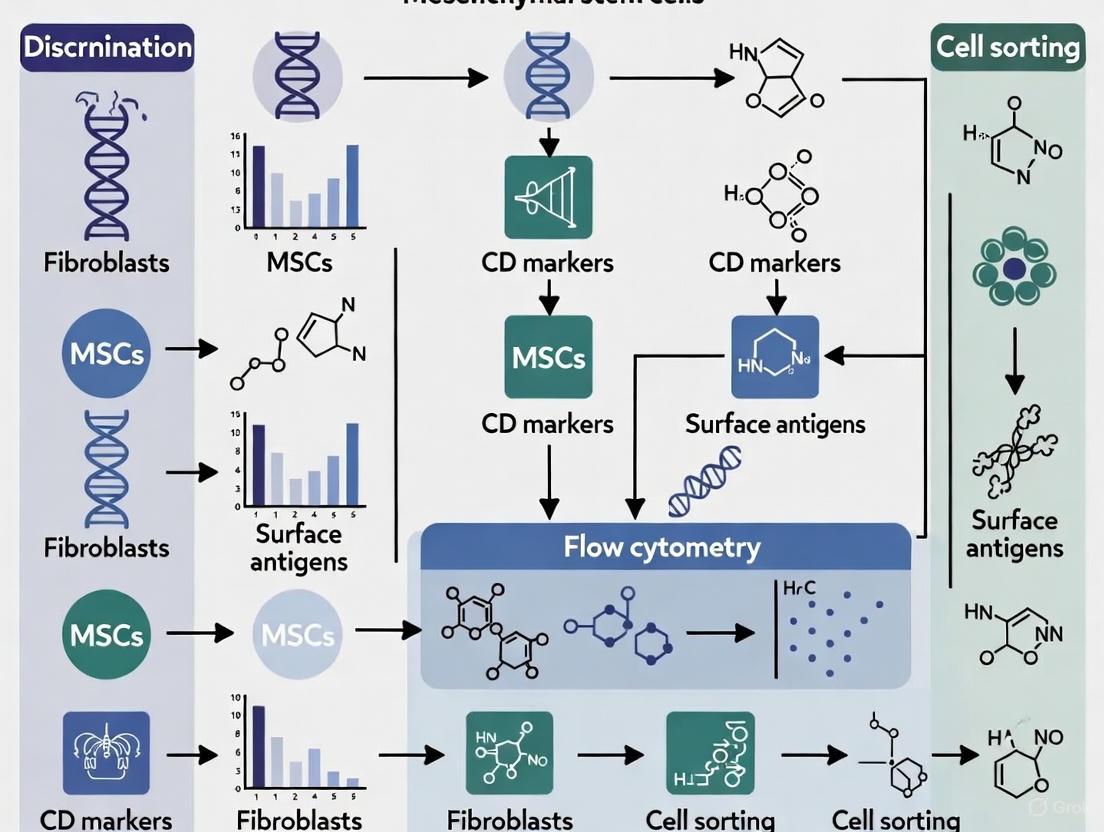
Accurately distinguishing Mesenchymal Stromal Cells (MSCs) from fibroblasts is a critical challenge in cell-based therapy development, as fibroblast contamination can compromise therapeutic efficacy and safety.
Discriminating MSCs from Fibroblasts: A Flow Cytometry Guide for Marker Selection, Panel Design, and Validation
Abstract
Accurately distinguishing Mesenchymal Stromal Cells (MSCs) from fibroblasts is a critical challenge in cell-based therapy development, as fibroblast contamination can compromise therapeutic efficacy and safety. This article provides researchers, scientists, and drug development professionals with a comprehensive framework spanning from foundational principles to advanced validation techniques. We explore the high biological similarity between these cell types, detail source-specific discriminatory surface markers identified in recent studies, offer troubleshooting strategies for robust flow cytometry assays, and outline validation protocols to ensure cell identity and purity for clinical applications.
The Cellular Conundrum: Understanding the High Similarity and Critical Need to Discriminate MSCs from Fibroblasts
The Critical Need for Cellular Discrimination In the rapidly advancing field of regenerative medicine, mesenchymal stromal cells (MSCs) have emerged as a cornerstone for therapeutic applications. However, a significant challenge persists: distinguishing these cells from morphologically and phenotypically similar fibroblasts. This discrimination is not merely academic; it is crucial for ensuring the safety, efficacy, and quality control of cell-based therapies. Fibroblasts frequently contaminate MSC cultures, and their inadvertent transplantation can lead to serious complications, including tumour formation [1]. Furthermore, the biological similarity between these cell types can lead to misinterpretation of research data and variable therapeutic outcomes, underscoring the need for precise, reliable identification methods [2] [3]. Flow cytometry stands as a powerful technology to address this challenge, enabling high-resolution, multi-parameter analysis at the single-cell level [4].
Flow Cytometry Marker Panels for Discrimination
Cell Surface Markers for MSC and Fibroblast Identification The International Society for Cellular Therapy (ISCT) has established minimal criteria for defining MSCs, including positive expression of CD105, CD73, and CD90, and lack of expression of hematopoietic markers such as CD45, CD34, CD14 or CD11b, CD79α or CD19, and HLA-DR [1] [5]. However, these markers are also found on fibroblasts, complicating discrimination [1] [2]. Recent research has identified more specific surface markers that can differentiate between MSCs from various tissue sources and fibroblasts, as detailed in Table 1.
Table 1: Flow Cytometry Markers for Differentiating MSCs from Fibroblasts
| Cell Type | Positive Markers for Identification | Negative or Low-Expression Markers |
|---|---|---|
| MSCs (General ISCT Criteria) | CD105, CD73, CD90 [1] [5] | CD45, CD34, CD14, CD11b, CD79α, CD19, HLA-DR [1] [5] |
| Adipose Tissue (AD)-MSCs | CD79a, CD105, CD106, CD146, CD271 [1] | |
| Bone Marrow (BM)-MSCs | CD105, CD106, CD146 [1] | |
| Wharton's Jelly (WJ)-MSCs | CD14, CD56, CD105 [1] | |
| Placental MSCs | CD14, CD105, CD146 [1] | |
| Fibroblasts (Dermal) | CD90, CD26 (DPP4) [1] [6] | CD106 (low) [1] |
Emerging and Novel Markers from Advanced Technologies The advent of single-cell RNA sequencing (scRNA-seq) has revealed a deeper layer of heterogeneity and provided new candidate markers for cell discrimination. Studies comparing AD-MSCs and dermal fibroblasts from the same donors have identified a panel of 30 genes with significantly different expression. From this panel, proteins such as MMP1, MMP3, S100A4, CXCL1, PI16, IGFBP5, and COMP show high potential for distinguishing these cell types [3]. Proteomic analyses further support the existence of unique protein signatures for MSCs from adipose tissue and dental pulp compared to dermal fibroblasts, highlighting differences in pathways related to cell migration, adhesion, and Wnt signalling [2].
Other novel fibroblast-associated surface markers identified in pathological and physiological states include:
- Inflammatory/Autoimmune Settings: CD74, EDRNA, VCAM1, IFITM2/3, DPEP1, TNFR1/2, IL17RA/IL17RC [6].
- Skin Dysplasia/Malignancy: CXCR4, FAP, HLA-DRA, IL7R, LRRC15, NOTCH3, RGMA, SCARA5, SLITRK6 [6].
Experimental Protocols for Cell Discrimination
Comprehensive Flow Cytometry Assessment A robust flow cytometry protocol is essential for the accurate identification and isolation of stromal cells. The following methodology, optimized for sensitive cells like fibroblasts and MSCs, ensures high viability and purity [7].
Table 2: Key Research Reagent Solutions for Stromal Cell Isolation and Analysis
| Reagent / Equipment | Function / Application | Example / Specification |
|---|---|---|
| Collagenase P / II & DNase I | Enzymatic digestion of extracellular matrix to release cells from tissue [7]. | 2.5 mL preheated digestion buffer per murine lung [7]. |
| GentleMACS Dissociator | Automated mechanical tissue disruption standardizes the process and improves cell yield [7]. | Program "37°CmLDK_1" (31 min, 37°C) [7]. |
| ACK Lysis Buffer | Lyses red blood cells to reduce contamination in the final cell suspension [7]. | 1 min incubation at room temperature to preserve fibroblast viability [7]. |
| Fluorochrome-conjugated Antibodies | Tag specific cell surface markers for detection and sorting [1]. | Antibody clones & fluorochromes must be specified for reproducibility [8]. |
| FACS Aria II / BD Accuri C6 Plus | Flow cytometers for cell sorting and analysis [2] [9]. | Nozzle tip diameter, sheath pressure, and laser settings should be reported [8]. |
Workflow Steps:
- Tissue Digestion and Single-Cell Suspension: Minced tissue is digested in a buffer containing collagenase (e.g., Collagenase P/II) and DNase I using a GentleMACS Dissociator with a heated program (e.g., 31 min at 37°C) [7].
- Cell Recovery and RBC Lysis: The digested suspension is filtered (100 µm) and centrifuged. Red blood cells are lysed using ACK lysis buffer, with a critical incubation time of only 1 minute to maintain stromal cell viability [7].
- Antibody Staining for Flow Cytometry: The cell pellet is resuspended, and cells are incubated with pre-titrated, fluorochrome-conjugated antibodies against target markers for 20-30 minutes in the dark [1] [3].
- Flow Cytometric Analysis and Sorting: Stained cells are analyzed or sorted using a flow cytometer. The instrument's make, model, laser wavelengths, and software must be documented. Compensation is applied using single-stain controls to correct for fluorochrome spectral overlap [8] [4].
- Validation Post-Sort: Sorted cell populations should be re-analyzed to assess purity and used in functional assays (e.g., trilineage differentiation for MSCs) to confirm their identity and biological activity [8] [3].
The following workflow diagram summarizes the key steps for isolating and characterizing stromal cells.
Biological Pathways and Functional Heterogeneity
Signaling Pathways Underlying Functional Differences The therapeutic efficacy of MSCs is largely attributed to their paracrine signaling and secretome, which modulates the microenvironment to promote repair and regeneration [5] [2]. Proteomic and transcriptomic analyses reveal that key signaling pathways are differentially regulated in MSCs compared to fibroblasts.
- Wnt Signaling Pathway: This pathway is often downregulated in dermal fibroblasts (HDFa) compared to dental pulp MSCs (DPSCs). Given the role of Wnt signaling in stem cell maintenance and tissue repair, its reduced activity may predict inferior performance of fibroblasts in defect repair models [2].
- Pathways for Angiogenesis and Vascularization: Adipose-derived MSCs (AD-MSCs) show a strong association with pro-angiogenic pathways, making them potentially more suitable for applications requiring new blood vessel formation than DPSCs or fibroblasts [2].
- Pathways for Tissue Remodeling and Inflammation: Genes highly expressed in AD-MSCs versus fibroblasts, such as MMP1, MMP3, S100A4, and CXCL1, are associated with biological processes including tissue remodeling, cell movement, and activation in response to external stimuli [3]. Fibroblasts themselves can be divided into subpopulations specialized for extracellular matrix production versus immunological and antimicrobial activities [10].
The diagram below illustrates the key signaling pathways that are differentially active in MSCs.
Accurately discriminating between MSCs and fibroblasts is a non-negotiable requirement for advancing safe and effective regenerative therapies. While standard immunophenotyping based on ISCT criteria provides a foundation, it is insufficient for clear distinction. The integration of novel, tissue-specific marker panels, rigorous flow cytometry protocols, and functional assays is essential for authenticating cell populations. Future efforts must focus on the global standardization of these analytical workflows and the validation of emerging markers from high-resolution 'omics' technologies. By adopting these advanced tools and criteria, the scientific community can ensure the purity, safety, and predictable efficacy of cellular products destined for clinical application.
Mesenchymal stromal cells (MSCs) and fibroblasts present a significant challenge in cellular identification due to their shared characteristics, including spindle-shaped morphology, adherence to plastic surfaces, and capacity for trilineage differentiation. This technical guide examines the limitations of conventional characterization methods and establishes flow cytometry as a critical tool for discriminating between these cell types. By integrating traditional surface marker panels with emerging molecular signatures identified through single-cell RNA sequencing, we present a comprehensive framework for authenticating MSC populations in research and clinical applications. The protocols and discriminant markers detailed herein provide researchers with refined methodologies to address cellular heterogeneity and ensure population purity, thereby enhancing experimental reproducibility and therapeutic safety in regenerative medicine.
The discrimination between mesenchymal stromal cells (MSCs) and fibroblasts represents a fundamental challenge in stem cell research and regenerative medicine. Both cell types exhibit strikingly similar characteristics in vitro, including a fibroblast-like spindle-shaped morphology, adherence to plastic surfaces, and expression of overlapping surface markers [10]. This biological convergence complicates quality control in cell-based therapies, where fibroblast contamination in MSC cultures can impact therapeutic efficacy and potentially lead to adverse outcomes such as tumor formation post-transplantation [11]. The International Society for Cellular Therapy (ISCT) established minimal criteria for defining MSCs, including plastic adherence, trilineage differentiation potential (adiopogenic, osteogenic, and chondrogenic), and expression of specific surface markers (CD73, CD90, CD105) with absence of hematopoietic markers (CD34, CD45, CD11b, CD14, CD19, HLA-DR) [12]. However, these criteria alone prove insufficient for reliable discrimination, as fibroblasts frequently express many of these same "MSC-positive" markers [11] [3]. This guide addresses this critical identification problem by providing advanced flow cytometry methodologies and molecular discriminators within the context of broader research aimed at distinguishing MSCs from fibroblasts.
Established Marker Panels and Their Limitations
International Society for Cellular Therapy (ISCT) Criteria
The ISCT minimal criteria provide a foundational framework for MSC identification but were not designed to distinguish MSCs from fibroblasts. According to these standards, MSCs must express CD73, CD90, and CD105 in ≥95% of the population, while ≤2% of cells may express hematopoietic markers including CD34, CD45, CD11b/CD14, CD79α/CD19, and HLA-DR [12]. These markers effectively distinguish MSCs from hematopoietic cells but offer limited utility for discriminating against fibroblasts, which commonly adhere to plastic and may express CD73, CD90, and CD105 [11] [3]. Furthermore, the CD34-negative criterion is particularly problematic, as native MSCs from some tissues (e.g., adipose) express CD34 upon isolation but lose this marker during culture, creating an artifact of cell adaptation rather than a definitive discriminatory feature [12].
Comparative Marker Expression Profiles
Research directly comparing MSCs derived from various tissues with fibroblasts reveals subtle but potentially discriminatory expression patterns. A 2021 study examining MSCs from bone marrow, adipose tissue, Wharton's jelly, and placenta against foreskin fibroblasts identified several candidate discriminators [11].
Table 1: Candidate Discriminatory Markers Between MSCs and Fibroblasts
| Cell Type | Promising Discriminatory Markers | Notes |
|---|---|---|
| Adipose-derived MSCs | CD79a, CD105, CD106, CD146, CD271 | CD106 and CD146 show significantly higher expression in MSCs versus fibroblasts [11]. |
| Bone Marrow-derived MSCs | CD105, CD106, CD146, CD271 | CD271 is considered a highly specific marker for bone marrow-derived MSCs [11] [13]. |
| Wharton's Jelly-derived MSCs | CD14, CD56, CD105 | CD56 expression identifies a distinct MSC subpopulation with enhanced chondrogenic potential [13]. |
| Placental-derived MSCs | CD14, CD105, CD146 | Pattern differs from other MSC sources [11]. |
| Fibroblasts | CD10, CD26 (disputed) | Earlier studies suggested CD26 as fibroblast-specific, but recent evidence contradicts this [11]. |
Contradictory findings regarding certain markers highlight the complexity of this discrimination. For instance, while CD26 was previously proposed as a fibroblast-specific marker, recent evidence challenges this specificity [11]. Similarly, CD34 expression varies based on tissue source and culture conditions, complicating its use as a definitive negative marker for MSCs [12].
Advanced Discriminatory Approaches
Single-Cell Transcriptomics for Novel Marker Discovery
Single-cell RNA sequencing (scRNA-seq) provides unprecedented resolution for identifying novel molecular discriminators between MSCs and fibroblasts. A 2025 study comparing adipose-derived MSCs (from subcutaneous and visceral tissue) with dermal fibroblasts from the same donors identified 30 genes with significantly differential expression between these cell types [3] [14]. These genes are associated with biological processes including tissue remodeling, cell movement, and response to external stimuli. Among the most promising validated discriminators are:
- MMP1 and MMP3: Matrix metalloproteinases involved in extracellular matrix remodeling
- S100A4 (FSP1): A calcium-binding protein traditionally used as a fibroblast marker
- CXCL1: A chemokine involved in inflammatory responses
- PI16: Peptidase inhibitor 16
- IGFBP5: Insulin-like growth factor binding protein 5
- COMP: Cartilage oligomeric matrix protein
This transcriptomic approach reveals that while surface marker expression shows considerable overlap, underlying genetic programs differ significantly between MSCs and fibroblasts, providing new targets for discrimination [3].
Functional Subpopulation Identification
Flow cytometry enables the identification of functionally distinct MSC subpopulations with characteristic marker combinations. Research demonstrates that combinatorial marker strategies significantly enhance discrimination capability [13]:
- MSCA-1+CD56- cells: Enriched for adipogenic differentiation potential
- MSCA-1+CD56+ cells: Exhibit enhanced chondrogenic differentiation capacity
- CD271+ cells: Highly specific for bone marrow-derived MSCs
These subpopulations not only differ in differentiation potential but also express unique marker combinations. For instance, CD10, CD26, CD106, and CD146 expression is restricted to the MSCA-1+CD56− subset, while CD166 expression identifies MSCA-1+CD56± populations [13]. This refined understanding of MSC heterogeneity provides additional dimensions for distinguishing true MSCs from fibroblast populations.
Table 2: Research Reagent Solutions for MSC-Fibroblast Discrimination
| Reagent Type | Specific Examples | Research Application |
|---|---|---|
| Fluorochrome-conjugated Antibodies | Anti-CD73-PE, Anti-CD90-APC, Anti-CD105-PC7, Anti-CD34-FITC, Anti-CD45-ECD [11] [3] | Surface marker profiling for ISCT criteria and extended characterization |
| Intracellular Staining Antibodies | Anti-S100A4, Anti-MMP1, Anti-COMP [3] | Detection of intracellular discriminators identified through transcriptomics |
| Enzymatic Digestion Reagents | Collagenase, Dispase II, TrypLE Select Enzyme [11] [3] | Tissue dissociation for primary cell isolation |
| Cell Culture Supplements | Platelet lysate, Fetal Bovine Serum (FBS), Human Serum, Basic Fibroblast Growth Factor (bFGF) [11] [15] [13] | Culture expansion under defined conditions |
| Viability Assessment Reagents | 7-AAD, DAPI [15] [3] | Exclusion of non-viable cells during flow cytometry analysis |
Comprehensive Experimental Protocols
Sample Preparation and Cell Culture
Basic Protocol 1: MSC Culture and Collection for Flow Cytometry
- Cell Isolation: Isolate MSCs from tissue sources (bone marrow, adipose tissue, etc.) using enzymatic digestion with collagenase (0.35% concentration) for 30-60 minutes at 37°C with continuous shaking [11].
- Culture Conditions: Plate cells at density of 1×10^3 to 4×10^5 cells/cm² in DMEM or α-MEM supplemented with 10% human serum or platelet lysate and 1% penicillin/streptomycin [11] [15].
- Expansion: Culture at 37°C in 5% CO₂ humidified incubator until ≤80% confluence, typically 7-21 days depending on tissue source.
- Harvesting: Harvest subconfluent cells (passage 3-4) using 0.25% trypsin/EDTA, wash with PBS containing 1% penicillin/streptomycin [11] [3].
- Quality Assessment: Determine cell count and viability using Trypan blue exclusion or 7-AAD staining, with viability ≥90% recommended for optimal flow cytometry results [15].
Basic Protocol 2: Fibroblast Isolation and Culture
- Tissue Processing: Wash skin samples in PBS containing antibiotics (100 U/ml penicillin, 100 μg/ml streptomycin) [3].
- Epidermal Removal: Incubate with dispase (6 U/ml) for 16 hours at 4°C or 2.4 U/ml for 16 hours at 40°C to separate epidermis from dermis [11] [3].
- Dermal Digestion: Mince remaining dermis and digest with collagenase (0.35%) at 37°C for 60 minutes with constant shaking [11].
- Culture Establishment: Plate resulting cells in DMEM high glucose supplemented with 10% FBS and antibiotics, culture for 3 weeks with medium changes every 2-3 days [3].
Flow Cytometry Staining and Acquisition
Basic Protocol 3: Staining for Extracellular and Intracellular Markers
- Cell Preparation: Create single-cell suspension at 1×10^6 cells/mL in flow cytometry buffer (PBS with 1-5% FBS) [16] [11].
- Extracellular Staining:
- Aliquot 100 μL cell suspension (1×10^5 cells) per staining tube
- Add fluorochrome-conjugated antibodies at manufacturer-recommended concentrations
- Incubate 20-30 minutes in the dark at room temperature [11] [3]
- Wash with 2 mL flow cytometry buffer, centrifuge at 350-400 × g for 5 minutes
- Resuspend in 300-500 μL flow cytometry buffer for acquisition
- Intracellular Staining (if required):
- Fix cells with 4% paraformaldehyde for 15 minutes after extracellular staining
- Permeabilize with 0.1% Triton X-100 or commercial permeabilization buffer
- Incubate with intracellular primary antibodies (30 minutes, room temperature)
- Wash and resuspend in flow cytometry buffer [3]
- Controls: Include unstained cells, fluorescence minus one (FMO) controls, and isotype controls for accurate gating and background determination [15].
Basic Protocol 4: Flow Cytometry Acquisition and Analysis
- Instrument Setup: Calibrate flow cytometer using calibration beads according to manufacturer instructions [16].
- Compensation: Set compensation using single-stained controls or compensation beads [16].
- Acquisition: Collect a minimum of 10,000 events per sample, focusing on the live cell population identified by forward/side scatter characteristics and viability dye exclusion [15].
- Gating Strategy:
- Analysis: Determine percentage positive cells for each marker compared to isotype controls, using histogram overlays for visualization of expression levels.
Figure 1: Flow Cytometry Gating Strategy for MSC Analysis
Data Interpretation and Quality Control
Accurate interpretation of flow cytometry data requires understanding marker expression patterns in context. The minimal ISCT criteria (≥95% expression of CD73, CD90, CD105; ≤2% expression of hematopoietic markers) provide a starting point, but comprehensive discrimination requires additional considerations [12]. HLA-DR expression deserves particular attention, as it can be induced on MSCs under certain culture conditions and should be interpreted as informative rather than exclusionary [15]. A retrospective analysis of 130 clinical-grade bone marrow MSC batches revealed that HLA-DR+ cells maintained characteristic MSC features including fibroblastic morphology, mesenchymal phenotype, multipotency, and immunomodulatory capacity [15].
When evaluating potential MSC populations, consider the following:
- Expression Patterns: True MSC populations typically show high, homogeneous expression of core markers (CD73, CD90, CD105), while fibroblast populations may show more heterogeneous expression [16] [12].
- Marker Combinations: Utilize combinatorial marker strategies (e.g., MSCA-1+CD56+ for chondrogenic potential) rather than relying on single markers [13].
- Culture Conditions: Recognize that marker expression can change with passage number and culture conditions. CD34 expression is particularly sensitive, with adipose-derived MSCs losing CD34 expression during culture [12].
- Functional Correlation: Whenever possible, correlate marker expression with functional assays including trilineage differentiation potential to confirm MSC identity [3] [13].
Figure 2: Comprehensive MSC Identification Workflow
Distinguishing MSCs from fibroblasts remains challenging due to their overlapping characteristics, but advances in flow cytometry and single-cell technologies provide increasingly sophisticated discrimination strategies. While traditional ISCT criteria establish a foundational framework, they must be supplemented with extended marker panels and emerging molecular signatures identified through transcriptomic analyses. The integration of CD106, CD146, CD271, and CD56 into standard characterization panels significantly enhances discrimination capability, while novel markers such as MMP1, MMP3, and S100A4 show promise for future assay development.
As the field progresses, standardization of discriminatory markers and protocols across different research facilities will be essential for improving reproducibility and comparability between studies [4]. Furthermore, understanding the functional significance of distinct MSC subpopulations identified by markers such as MSCA-1 and CD56 will clarify their respective roles in regenerative applications [13]. Flow cytometry continues to evolve as an indispensable tool in this endeavor, offering the multi-parameter analysis capability necessary to navigate the complex biological relationship between MSCs and fibroblasts in both research and clinical settings.
The International Society for Cellular Therapy (ISCT) criteria for defining mesenchymal stem cells (MSCs) based on CD105, CD73, and CD90 expression have provided a crucial foundation for the field. However, mounting evidence reveals significant limitations in their specificity, particularly in discriminating bona fide MSCs from fibroblasts—a challenge with critical implications for therapeutic safety and experimental reproducibility. This technical review synthesizes current research demonstrating why standard markers are insufficient alone, presents quantitative data on more discriminatory surface markers, and provides advanced methodological frameworks for enhanced cellular discrimination using flow cytometry. Within the broader thesis of MSC discrimination research, we establish that robust identification requires multi-parameter assessment incorporating functional, morphological, and expanded marker profiles beyond the conventional triad.
The ISCT minimal criteria for MSC definition—plastic adherence, tri-lineage differentiation potential, and expression of CD105, CD73, and CD90 in the absence of hematopoietic markers—have served as a critical benchmark for over a decade [11]. Despite this standardization, a persistent challenge has emerged in distinguishing MSCs from fibroblasts, which share remarkable biological similarities including morphology, plastic adherence, and even in vitro differentiation capacity [3]. This discrimination problem is not merely academic; fibroblast contamination in MSC cultures can compromise therapeutic efficacy and potentially lead to adverse outcomes like tumor formation post-transplantation [11].
The core issue lies in the fact that CD105, CD73, and CD90 represent necessary but insufficient markers for definitive MSC identification. These molecules are expressed on various cell types, including fibroblasts, and their expression levels can vary significantly based on MSC tissue source, donor characteristics, and culture conditions [11]. This technical guide examines the specific limitations of standard ISCT criteria and provides advanced methodologies for robust MSC discrimination within the context of flow cytometry-based research.
Critical Limitations of Standard ISCT Markers
Shared Expression with Fibroblasts
The fundamental challenge with CD105, CD73, and CD90 is their ubiquitous expression on fibroblast populations. Multiple studies have demonstrated that dermal fibroblasts exhibit nearly identical surface marker profiles to MSCs for these canonical markers, making discrimination based solely on this triad impossible [3]. Research specifically investigating this limitation found that "fibroblasts have characteristics similar to those of MSCs in that they have similar morphology in culture, possess immune modulatory properties, and are capable of differentiating into adipocytes, osteocytes, and chondrocytes" [11]. This extensive overlap in both phenotypic and functional characteristics underscores the necessity for expanded discrimination strategies.
The expression of standard ISCT markers demonstrates significant heterogeneity across different anatomical sources of MSCs, further complicating reliable identification. This variability extends to both quantitative expression levels and the consistent presence of these markers across MSC populations from different tissue origins.
Table 1: Variability in Standard MSC Marker Expression Across Tissue Sources
| Tissue Source | CD105 Expression | CD73 Expression | CD90 Expression | Key Reference |
|---|---|---|---|---|
| Adipose Tissue | Variable (donor-dependent) | Consistently high | Consistently high | [11] |
| Bone Marrow | High | Consistently high | Consistently high | [11] |
| Wharton's Jelly | Moderate to high | Consistently high | Consistently high | [11] |
| Placental Tissue | Moderate | Consistently high | Consistently high | [11] |
Inability to Detect Early Differentiation
A particularly significant limitation of standard ISCT markers is their inability to identify early stages of MSC differentiation, which has profound implications for maintaining stem cell quality during expansion. Recent research utilizing deep learning-based computer vision has demonstrated that nuclear structural changes can detect MSC differentiation within 6-12 hours after induction, while "known surface markers and morphological markers can only measure late-differentiating cells (after 2-3 weeks differentiation)" [17]. This detection gap represents a critical quality control challenge in therapeutic applications where early differentiation compromises therapeutic efficacy.
Advanced Marker Panels for Enhanced Discrimination
Tissue-Specific Discriminatory Markers
Comprehensive flow cytometry analyses have identified several additional surface markers that show discriminatory power for distinguishing MSCs from fibroblasts based on their tissue of origin. These markers provide enhanced specificity when used in combination with standard ISCT criteria.
Table 2: Discriminatory Markers for MSCs vs. Fibroblasts by Tissue Source
| MSC Source | Markers with Higher Expression in MSCs vs. Fibroblasts | Markers with Higher Expression in Fibroblasts | Key References |
|---|---|---|---|
| Adipose Tissue | CD79a, CD105, CD106, CD146, CD271 | CD26 (contradicts previous studies) | [11] |
| Bone Marrow | CD105, CD106, CD146 | CD14, CD19, CD45 | [11] |
| Wharton's Jelly | CD14, CD56, CD105 | CD34, CD45 | [11] |
| Placental Tissue | CD14, CD105, CD146 | CD34, CD45 | [11] |
Recent single-cell RNA sequencing studies have further refined our understanding of transcriptional differences between these cell types, identifying "30 genes exhibiting the most significant variations in expression between AD-MSCs and fibroblasts," including MMP1, MMP3, S100A4, CXCL1, PI16, IGFBP5, and COMP [3]. These molecular signatures offer promising targets for future flow cytometry panel development.
Novel Markers from Single-Cell Transcriptomics
The application of high-resolution transcriptomic technologies has revealed previously unappreciated heterogeneity in both MSC and fibroblast populations. A 2025 single-cell RNA sequencing study comparing adipose-derived MSCs from subcutaneous and visceral tissues with dermal fibroblasts identified distinct gene expression patterns associated with tissue remodeling, cell movement, and response to external stimuli [3]. The proteins encoded by these differentially expressed genes represent candidate markers for developing more specific flow cytometry panels capable of distinguishing these biologically similar cell types.
Methodological Framework for Enhanced Discrimination
Comprehensive Flow Cytometry Workflow
Robust discrimination of MSCs from fibroblasts requires an optimized, multi-parameter flow cytometry approach that extends beyond basic surface marker detection. The following workflow diagram outlines key steps in this process:
Experimental Protocol for Enhanced Discrimination
Based on current literature, the following detailed protocol provides a framework for reliable discrimination between MSCs and fibroblasts:
Sample Preparation
- Culture MSCs and reference fibroblasts to 70-80% confluence at passage 3-5 to standardize comparison [11] [3]
- Harvest cells using 0.25% trypsin/EDTA solution, wash with PBS containing 1% penicillin/streptomycin [11]
- Prepare single-cell suspension at 1×10⁴ cells per staining assay [11]
Antibody Panel Design
- Include core ISCT markers: CD105, CD73, CD90 (positive) and CD45, CD34, CD14, CD19 (negative)
- Incorporate tissue-specific discriminatory markers identified in Table 2
- Consider inclusion of intracellular markers (e.g., transcription factors) after surface staining and fixation [16]
Staining and Acquisition
- Incubate cells with fluorophore-conjugated antibodies for 30 minutes at room temperature in the dark [11]
- Include unstained controls, single-stained controls for compensation, and isotype controls
- Wash cells, resuspend in PBS, and analyze using calibrated flow cytometer
- For intracellular staining, fix and permeabilize cells before antibody incubation [16]
Data Analysis Strategy
- Apply sequential gating: exclude debris, select singlets (FSC-A versus FSC-H), then analyze marker expression [3]
- Use fluorescence minus one (FMO) controls to establish positive/negative boundaries
- Employ multi-parameter analysis comparing expression patterns across marker combinations
The Researcher's Toolkit: Essential Reagents
Table 3: Key Research Reagent Solutions for MSC Discrimination Studies
| Reagent/Category | Specific Examples | Function/Application | Considerations |
|---|---|---|---|
| Core ISCT Antibodies | CD105-PE, CD73-APC, CD90-FITC | Baseline MSC identification | Clone selection affects specificity |
| Discriminatory Antibodies | CD106, CD146, CD271 | Enhanced discrimination from fibroblasts | Tissue-specific utility |
| Negative Marker Antibodies | CD45, CD34, CD14, CD19 | Exclusion of hematopoietic cells | Essential for purity assessment |
| Viability Dyes | DAPI, Propidium Iodide | Exclusion of dead cells | Critical for accurate analysis |
| Cell Preparation Reagents | Trypsin/EDTA, Collagenase | Single-cell suspension preparation | Enzymatic choice affects epitope integrity |
| Flow Cytometry Controls | Compensation beads, Isotype controls | Experimental validation | Essential for data interpretation |
Emerging Technologies and Future Directions
Imaging Flow Cytometry
Imaging flow cytometry (IFC) represents a powerful advancement that combines the high-throughput capability of conventional flow cytometry with morphological analysis. IFC "pools the principles of FC with microscopy to generate high-resolution images along with quantitative analysis at single-cell resolution" [4]. This technology enables simultaneous assessment of surface marker expression and cellular morphology, providing an additional dimension for discriminating between MSCs and fibroblasts based on structural characteristics.
Computational and Deep Learning Approaches
Beyond conventional flow cytometry, deep learning-based computer vision methods have demonstrated remarkable capability in identifying early MSC differentiation states based on nuclear structure and actin architecture [17]. These approaches can detect differentiation-associated changes much earlier than surface marker analysis—within 6-12 hours versus 2-3 weeks. Integration of these image-based discrimination methods with flow cytometric analysis represents a promising future direction for comprehensive MSC characterization.
Color-Coding and Clonal Tracking
Novel color-coding tools, such as the Zebrabow system that uses combinatorial expression of fluorescent proteins, enable tracking of stem cell clones over time [18]. While primarily used in developmental studies, this approach could be adapted to monitor MSC clonality and identify contamination or overgrowth by fibroblast clones in mixed cultures.
The standard ISCT criteria utilizing CD105, CD73, and CD90 provide an essential but incomplete framework for MSC identification, particularly when discrimination from fibroblasts is required. Robust discrimination necessitates integrated approaches combining expanded surface marker panels, tissue-specific considerations, advanced technologies like imaging flow cytometry, and functional validation. As the field progresses toward increasingly precise therapeutic applications, implementation of these enhanced discrimination protocols will be essential for ensuring MSC population purity, functionality, and safety. Future developments in single-cell technologies and computational analysis promise to further refine our ability to distinguish these biologically similar cell types with implications for both basic research and clinical translation.
Contamination represents a critical and multifaceted risk in biological research and therapy, directly impacting cell yield, tumorigenic potential, and the reliability of research outcomes. In the specific context of discriminating mesenchymal stromal cells (MSCs) from fibroblasts via flow cytometry, contamination risks extend beyond microbial presence to include cellular cross-contamination and the introduction of tumorigenic elements. These compromises can alter experimental results, skew clinical trial data, and potentially endanger patients. A comprehensive survey of cell processing operators revealed that 72% expressed significant concerns about contamination, despite only 18% reporting direct contamination experiences, indicating that the perceived risk substantially exceeds actual incidence rates [19]. This technical guide examines contamination implications through a biosafety lens and provides robust experimental protocols to authenticate MSC populations, a foundational requirement for valid discriminate marker research.
Contamination Implications for Cell Yield, Tumorigenesis, and Research Integrity
Microbial Contamination: Direct Impact on Cell Yield and Viability
Microbial contamination (bacterial, viral, or mycoplasma) directly compromises cell yield and viability by disrupting culture conditions and inducing cell death. In hematopoietic stem cell transplantation, product contamination occurs in approximately 1.2% of cases, with coagulase-negative Staphylococcus being the predominant organism [20]. Although rare, infusion of contaminated products can lead to severe clinical sequelae, including patient bacteremia and fatal outcomes, particularly with gram-negative organisms [20]. Beyond direct clinical harm, microbial presence invalidates research results by altering cell behavior, secretome profiles, and differentiation capacity, ultimately rendering data unreliable for publication or regulatory submission.
Cellular Contamination: Fibroblast Cross-Contamination and Phenotypic Confusion
The high biological similarity between MSCs and fibroblasts presents a substantial challenge for research authenticity, encompassing morphology, differentiation capabilities, and standard flow cytometric markers [3]. Fibroblasts frequently contaminate MSC cultures, affecting cell yield and potentially causing tumor formation after transplantation [11]. This risk is particularly acute in clinical applications where contaminated cultures could introduce uncontrolled cellular elements into patients. The difficulty in establishing definitive discriminatory markers compounds this problem, as traditionally accepted MSC markers (CD105, CD73, CD90) may also be expressed on fibroblast populations [11] [3]. This cellular ambiguity necessitates sophisticated authentication protocols to ensure population purity in discriminate marker studies.
Tumorigenic Contamination: Oncogenic Transformation and Teratogenic Risk
Cell processing and culture conditions can inadvertently introduce tumorigenic risks through multiple mechanisms. Long-term in vitro culture promotes chromosomal abnormalities and spontaneous malignant transformation in human MSCs, with one study reporting approximately 46% transformation after extended culture [21]. Chromosomal abnormalities in adipose-derived MSCs increase significantly starting from passage 5 [21]. For pluripotent stem cell-based therapies, residual undifferentiated cells in the final product pose substantial tumor formation risks in vivo due to their high proliferative and differentiation capacity [22]. Additionally, the freezing and thawing process may render graft-contaminating cells immunogenic through stress protein induction, potentially triggering unpredictable immune responses [23].
Table 1: Summary of Major Contamination Types, Sources, and Consequences
| Contamination Type | Primary Sources | Impact on Cell Yield | Tumorigenesis Risk | Research Outcome Implications |
|---|---|---|---|---|
| Microbial | Inadequate aseptic technique, non-sterile materials, environmental exposure | Culture failure, complete yield loss | Indirect risk via inflammatory milieu | Altered cell behavior, unreliable data, experimental termination |
| Cellular (Fibroblast) | Initial isolation, inadequate purification | Reduced MSC purity, fibroblast overgrowth | Tumor formation post-transplantation [11] | Incorrect marker expression profiles, misattribution of functions |
| Tumorigenic Cells | Extended culture, chromosomal abnormalities, residual undifferentiated cells | Uncontrolled proliferation | Direct tumor formation risk [21] [22] | Safety concerns, invalidated preclinical models |
Experimental Protocols for Discriminating MSCs from Fibroblasts
Sample Collection and Cell Isolation
AD-MSC Isolation from Adipose Tissues Fragments of human subcutaneous (SAT) and visceral (VAT) adipose tissues should be collected from consented donors during scheduled surgical procedures. Following enzymatic isolation (collagenase, 0.35% at 37°C for 30-60 min) and erythrocyte lysis, the stromal vascular fraction should be cultured in Dulbecco's modified Eagle medium (DMEM low glucose-1000 mg/L) supplemented with 10% fetal bovine serum (FBS) and 1% penicillin/streptomycin [11] [3]. Seed cells into 75 cm² flasks and maintain at 37°C with 5% CO₂. Change medium after 24 hours to remove non-adherent cells, then refresh medium every 2-3 days. Passage cells at 70-80% confluence using 0.25% trypsin/EDTA, seeding at 0.375 × 10⁶ cells per passage. Culture for three weeks until passage 3, then cryopreserve for analysis [3].
Dermal Fibroblast Isolation Obtain human skin samples and wash in PBS containing antibiotics (100 units/ml penicillin and 100 µg/ml streptomycin). Remove epidermis by digesting with dispase (6 units/ml), and place the resulting dermis in 6-well plates containing DMEM (high glucose 4.5 g/L) supplemented with 10% FBS and penicillin/streptomycin. Refresh medium every 2-3 days. Conduct first passage after three weeks of culture. At passage 3, collect 1 × 10⁶ actively proliferating cells for cryopreservation and subsequent transcriptomic analysis [3].
Flow Cytometry Analysis for Surface Marker Discrimination
Flow cytometry provides the foundational methodology for discriminating MSCs from fibroblasts through cell surface antigen expression. The International Society for Cellular Therapy (ISCT) recommends evaluating positive markers (CD73, CD90, CD105) and negative markers (CD14, CD19, CD34, CD45) for MSC identification, though significant overlap with fibroblast profiles exists [11] [21].
Staining Protocol:
- Harvest subconfluent cells (≤80%) at passage 3 using 0.25% trypsin [11].
- Wash cells with PBS containing 1% penicillin/streptomycin.
- Aliquot 1 × 10⁴ cells per assay tube.
- Add fluorophore-conjugated monoclonal antibodies in manufacturer-recommended quantities.
- Incubate for 20 minutes in the dark at room temperature.
- Centrifuge at 350-400 g for 5-7 minutes and resuspend in PBS for analysis [11] [3].
Antibody Panels for Discrimination: Research indicates that the following marker combinations can help differentiate MSCs from fibroblasts, though specificity varies by tissue source [11]:
- Adipose tissue MSCs: CD79a, CD105, CD106, CD146, CD271
- Wharton's jelly MSCs: CD14, CD56, CD105
- Bone marrow MSCs: CD105, CD106, CD146
- Placental MSCs: CD14, CD105, CD146
Notably, CD26 is not fibroblast-specific as previously believed [11]. Recent single-cell transcriptomics has identified additional discriminatory genes (MMP1, MMP3, S100A4, CXCL1, PI16, IGFBP5, COMP) that require further validation at the protein level [3].
Table 2: Key Marker Expression Profiles for Discriminating MSCs from Fibroblasts
| Marker | Adipose MSC | Bone Marrow MSC | Wharton's Jelly MSC | Placental MSC | Fibroblasts |
|---|---|---|---|---|---|
| CD73 | Positive | Positive | Positive | Positive | Positive [3] |
| CD90 | Positive | Positive | Positive | Positive | Positive [3] |
| CD105 | Positive [11] | Positive [11] | Positive [11] | Positive [11] | Variable |
| CD106 | Positive [11] | Positive [11] | Variable | Variable | Low/Negative [11] |
| CD146 | Positive [11] | Positive [11] | Variable | Positive [11] | Low/Negative [11] |
| CD14 | Negative | Negative | Positive [11] | Positive [11] | Negative |
| CD79a | Positive [11] | Negative | Negative | Negative | Negative |
Functional Assays for Validation
Trilineage Differentiation Potential Confirm MSC identity through adipogenic, osteogenic, and chondrogenic differentiation capacity per ISCT guidelines [3].
- Adipogenic differentiation: Culture in adipogenic induction medium for 14-21 days, then stain with Oil Red O to visualize lipid vacuoles.
- Osteogenic differentiation: Culture in osteogenic induction medium for 21-28 days, then stain with Alizarin Red to detect calcium deposits.
- Chondrogenic differentiation: Culture in pellet system using chondrogenic differentiation medium for 14-21 days, then stain with Alcian Blue to visualize sulfated proteoglycans [3].
Single-Cell RNA Sequencing For definitive discrimination, employ single-cell RNA sequencing to elucidate transcriptional differences. This high-resolution approach can identify population-specific markers and intrapopulation heterogeneity that flow cytometry might miss [3]. Analyze expression patterns of genes associated with tissue remodeling, cell movement, and activation in response to external stimuli.
The Researcher's Toolkit: Essential Reagent Solutions
Table 3: Key Research Reagents for MSC-Fibroblast Discrimination Studies
| Reagent/Category | Specific Examples | Function/Application | Considerations |
|---|---|---|---|
| Culture Media | DMEM low/high glucose, α-MEM | Cell expansion and maintenance | Supplement with 10% FBS or platelet lysate; consider xeno-free alternatives for clinical applications [11] [21] |
| Dissociation Reagents | Trypsin/EDTA (0.25%), Collagenase, Dispase | Tissue dissociation and cell passaging | Concentration and exposure time optimization critical for viability |
| Flow Cytometry Antibodies | CD73, CD90, CD105, CD106, CD146, CD14, CD19, CD45 | Surface marker profiling | Validate clones and fluorophore combinations; include isotype controls [11] [3] |
| Differentiation Kits | StemPro Chondrogenesis, Osteogenesis, Adipogenesis | Functional validation of MSC identity | Follow manufacturer protocols with precise timing [3] |
| Molecular Biology Reagents | scRNA-seq kits, qPCR reagents | Transcriptomic profiling and marker validation | Identify novel discriminatory genes (MMP1, MMP3, S100A4, etc.) [3] |
Visualizing Experimental Workflows and Contamination Pathways
MSC Authentication Workflow
Contamination Risk Pathways in Cell Processing
Contamination risk management represents an indispensable component of research aimed at discriminating MSCs from fibroblasts. The implications extend beyond simple culture purity to encompass fundamental questions of cell yield, tumorigenic potential, and overall research validity. Effective discrimination requires a multimodal approach integrating rigorous flow cytometry with functional assays and advanced transcriptomic profiling. Furthermore, maintaining sterility throughout cell processing—from initial isolation through final analysis—is paramount for generating reproducible, clinically relevant data. As single-cell technologies continue to reveal novel discriminatory markers, implementing comprehensive contamination control measures will ensure that these advances translate into genuine improvements in both basic science and clinical applications.
The discrimination between Mesenchymal Stromal Cells (MSCs) and fibroblasts represents a significant challenge in regenerative medicine and cellular therapeutics. Both cell types demonstrate remarkable similarities in morphology, surface marker expression, differentiation capacity, and immunomodulatory functions, which has blurred their biological identities and complicated their application in clinical settings [24]. Traditional methods based on the International Society for Cellular Therapy (ISCT) criteria have proven insufficient, as fibroblasts consistently express the canonical MSC markers CD73, CD90, and CD105 while lacking expression of hematopoietic markers such as CD45, CD34, and HLA-DR [24] [1]. This overlap has raised critical safety concerns, as fibroblast contamination in MSC cultures potentially leads to tumor formation after transplantation [1]. The emergence of single-cell transcriptomics has revolutionized our ability to dissect this complexity, revealing unprecedented resolution into the heterogeneous landscapes of both cell populations and providing novel molecular tools for their discrimination.
Single-Cell Transcriptomics Unveils Cellular Heterogeneity and Relationships
Fundamental Biological Insights from scRNA-seq
Recent advances in single-cell RNA sequencing (scRNA-seq) have transformed our understanding of MSC and fibroblast biology. A comprehensive integration analysis of single-cell transcriptomes from human umbilical cord MSCs (HuMSCs), foreskin MSCs (FSMSCs), bone marrow MSCs (BMSCs), and adipose MSCs (ADMSCs) demonstrated 15 distinct cell subsets [24]. When annotated using surface marker phenotypes, 12 of these 15 subsets demonstrated the MSC phenotype (CD105+, CD90+, CD73+, CD45-, CD34-, CD19-, HLA-DRA-, CD11b-), while all 15 subsets demonstrated the fibroblast phenotype (VIM+, PECAM1-, CD34-, CD45-, EPCAM-, MYH11-) [24]. This finding led to a fundamental biological conclusion: cell subsets with the MSC phenotype also demonstrated the fibroblast phenotype, but cell subsets with the fibroblast phenotype did not necessarily demonstrate the MSC phenotype, suggesting that MSCs represent a subclass of fibroblasts rather than entirely distinct entities [24].
The analysis revealed substantial heterogeneity within these populations, identifying 3,275 differentially expressed genes, 305 enriched gene sets, and 34 enriched regulons between the 15 cell subsets [24]. Particularly noteworthy were the C8, C12, and C13 subsets, which exclusively demonstrated the fibroblast phenotype and represented less primitive, more differentiated cell types compared to those with MSC characteristics [24]. This hierarchical relationship provides a crucial framework for understanding the developmental continuum between these cell types.
Cross-Tissue Fibroblast Heterogeneity
Single-cell transcriptomics has simultaneously revealed the remarkable heterogeneity of fibroblasts across human tissues. A spatially resolved atlas of human skin fibroblasts constructed from healthy skin and 23 skin diseases identified six major fibroblast subtypes with distinct functional specializations and tissue microenvironments [25]:
- F1: Superficial (papillary) fibroblasts localized adjacent to the skin epithelium and expressed genes encoding superficial dermal collagens (COL13A1, COL18A1, COL23A1) and Wnt signaling inhibitors (APCDD1, WIF1, NKD2) [25].
- F2: Universal (reticular) fibroblasts located deeper in the skin and characterized by high expression of marker genes of universal PI16+ fibroblasts (PI16, CD34, MFAP5), representing a precursor fibroblast cell state found across human tissues [25].
- F3: Fibroblastic Reticular Cell (FRC)-like fibroblasts transcriptomically resembled FRCs from lymphoid organs, expressing genes that attract and compartmentalize immune cells (CCL19, CXCL12, CH25H) and enable antigen presentation (CD74, MHC-II molecules) [25].
- F4: Hair follicle-associated fibroblasts encompassed three subclusters associated with specific regions of the hair follicle [25].
- F5: Schwann-like fibroblasts included nerve-associated populations expressing genes related to neuropeptide signaling [25].
This refined classification system demonstrates how specialized fibroblast subtypes maintain distinct tissue niches, providing context for understanding why no single marker can discriminate all fibroblasts from MSCs across different biological contexts.
Discriminatory Markers Revealed by Transcriptomic Profiling
Tissue-Specific Surface Marker Signatures
The integration of single-cell transcriptomic data with flow cytometric characterization has yielded tissue-specific marker panels that enable more reliable discrimination between MSCs and fibroblasts. A comprehensive flow cytometric study examining 14 different surface markers across MSCs derived from multiple tissues and fibroblasts revealed distinct combinations that vary by tissue source [1] [11]:
Table 1: Tissue-Specific Marker Panels for Discriminating MSCs from Fibroblasts
| MSC Source | Markers with Higher Expression in MSCs | Markers with Higher Expression in Fibroblasts |
|---|---|---|
| Adipose Tissue | CD79a, CD105, CD106, CD146, CD271 | CD26, CD9 |
| Bone Marrow | CD105, CD106, CD146 | CD10, CD26 |
| Wharton's Jelly | CD14, CD56, CD105 | CD26 |
| Placental Tissue | CD14, CD105, CD146 | CD26 |
Contrary to previous studies, this investigation found that CD26 is not fibroblast-specific, highlighting the importance of validating putative markers across multiple experimental systems and tissue sources [11]. The expression of CD106 (VCAM-1) was consistently elevated in MSCs compared to fibroblasts across multiple tissue sources, with studies reporting at least a tenfold higher expression in MSCs [1].
Transcriptional Biomarkers from scRNA-seq
Single-cell transcriptomics has identified numerous genes with differential expression between MSCs and fibroblasts that extend beyond traditional surface markers. A recent study comparing AD-MSCs from subcutaneous and visceral adipose tissue alongside skin fibroblasts from the same donors identified 30 genes exhibiting the most significant variations in expression between these cell types [3]. Among these, MMP1, MMP3, S100A4, CXCL1, PI16, IGFBP5, and COMP were validated using qPCR and clearly demonstrated potential to differentiate between AD-MSCs and fibroblasts [3]. These genes are associated with biological processes such as tissue remodeling, cell movement, and activation in response to external stimuli, reflecting fundamental functional differences between these cell populations [3].
Table 2: Transcriptional Biomarkers for Discriminating MSCs and Fibroblasts
| Gene Symbol | Protein Name | Expression Pattern | Biological Function |
|---|---|---|---|
| S100A4 | Fibroblast-specific protein 1 | Higher in fibroblasts | Cell motility, invasion |
| CD106 (VCAM1) | Vascular cell adhesion protein 1 | Higher in MSCs | Cell adhesion, signaling |
| CD146 (MCAM) | Cell surface glycoprotein MUC18 | Higher in MSCs | Angiogenesis, migration |
| MMP1 | Matrix metalloproteinase-1 | Higher in fibroblasts | Collagen degradation |
| MMP3 | Matrix metalloproteinase-3 | Higher in fibroblasts | ECM remodeling |
| CCL19 | Chemokine (C-C motif) ligand 19 | Higher in FRC-like fibroblasts | Immune cell recruitment |
| PI16 | Peptidase inhibitor 16 | Higher in universal fibroblasts | Proposed precursor state |
| IL11 | Interleukin 11 | Higher in inflammatory myofibroblasts | Pro-fibrotic signaling |
The functional annotation of these discriminatory genes reveals their involvement in critical biological processes that distinguish MSCs from fibroblasts. Genes upregulated in fibroblasts, such as MMP1, MMP3, and S100A4, are typically associated with extracellular matrix remodeling, inflammatory responses, and tissue repair [3] [10]. In contrast, genes more highly expressed in MSCs, including CD106 and CD146, often function in stem cell maintenance, immunomodulation, and vascular interactions [24] [1].
Experimental Design and Methodological Frameworks
Single-Cell RNA Sequencing Workflow
The power of single-cell transcriptomics in discriminating MSCs from fibroblasts depends on rigorous experimental design and execution. The standard scRNA-seq workflow encompasses multiple critical stages from sample preparation to data analysis [26]:
SCRNA-SEQ WORKFLOW: Key steps from sample collection to marker validation. Yellow: wet-lab; Red: critical QC; Green: analysis.
For MSC and fibroblast discrimination, specific considerations at each stage are crucial. During sample collection, matching donor sources for both cell types reduces biological noise [3]. The single-cell partitioning method—whether droplet-based or combinatorial barcoding—impacts data quality, with the latter being less susceptible to ambient RNA contamination [26]. Quality control must address challenges specific to these cell types, including removing dead cells (high mitochondrial read fraction) and doublets (multiple cells with the same barcode) [26]. Dimensionality reduction using UMAP or t-SNE reveals population structure, while differential expression analysis identifies candidate discriminatory markers [27].
Flow Cytometry Panel Design for Marker Validation
The translation of transcriptomic discoveries into practical discrimination tools requires carefully designed flow cytometry panels. Multicolor flow cytometry protocols must address several technical challenges to ensure accurate results [28]:
FLOW PANEL DESIGN: Systematic workflow for multicolor cytometry. Yellow: planning; Red: critical optimization.
Critical considerations for panel design include:
- Instrument Configuration: Understanding the number and type of lasers, number of detectors, and available filters on the specific flow cytometer being used [28].
- Fluorophore Selection: Matching fluorophore brightness to antigen abundance, using bright fluorophores (PE, APC) for low-abundance targets and dimmer fluorophores for highly expressed antigens [28].
- Spectral Overlap Minimization: Selecting fluorophores with minimal emission spectrum overlap to reduce compensation challenges [28].
- Compensation Controls: Including proper controls for each fluorophore, with positive populations that are at least as bright as experimental samples and comprise at least 10% of the control population [28].
For MSC and fibroblast discrimination, panels should prioritize bright fluorophores for discriminatory markers with low expression differences and include established positive and negative markers for both cell types as internal controls.
Research Reagent Solutions and Technical Tools
The successful implementation of discriminatory strategies between MSCs and fibroblasts requires specialized reagents and computational tools. The following table outlines essential resources for both experimental and analytical workflows:
Table 3: Essential Research Reagents and Tools for MSC-Fibroblast Discrimination
| Category | Specific Product/Tool | Application/Function | Considerations |
|---|---|---|---|
| Surface Marker Antibodies | Anti-CD105, CD73, CD90 | MSC positive marker detection | Verify cross-reactivity for species |
| Anti-CD106 (VCAM-1) | MSC discrimination | Bright fluorophore recommended | |
| Anti-CD146 (MCAM) | MSC/pericyte detection | Expressed in some fibroblast subsets | |
| Anti-CD26, CD10 | Fibroblast marker detection | Tissue-specific expression patterns | |
| scRNA-seq Platforms | 10x Genomics Chromium | Droplet-based single-cell partitioning | Equipment-intensive, cell size limitations |
| Parse Biosciences | Combinatorial barcoding | Fixed cells, no specialized equipment | |
| Analysis Software | Seurat R package | scRNA-seq data integration and analysis | Batch effect correction capabilities |
| SCTransform | Normalization and variance stabilization | Handles technical artifacts | |
| Scrublet, DoubletFinder | Doublet identification | Critical for quality control | |
| Flow Cytometry Reagents | Compensation beads | Compensation controls | Essential for multicolor panels |
| Viability dyes | Live/dead cell discrimination | Exclude false positives from dead cells | |
| MACS Cell Separation kits | CD34+ cell purification | Positive selection for rare populations |
The selection of appropriate reagents and tools must align with specific research objectives. For discovery-phase research, comprehensive scRNA-seq approaches provide the deepest insights into cellular heterogeneity and novel markers [24] [3]. For validation studies, multicolor flow cytometry with carefully designed panels enables confirmation of candidate markers across multiple cell preparations [1] [11]. In clinical applications where cell purity is paramount, specific marker combinations such as CD106+CD146+ for MSCs offer the most reliable discrimination from fibroblasts [1].
The integration of single-cell transcriptomics with traditional flow cytometric approaches has fundamentally advanced our ability to discriminate between MSCs and fibroblasts. Rather than representing distinct cell types, the evidence suggests that MSCs constitute a specialized subclass of fibroblasts with enhanced primitive functions and differentiation capacities [24]. The discriminatory markers identified through these approaches—including CD106, CD146, and tissue-specific combinations—provide practical tools for ensuring cellular purity in therapeutic applications [1] [11].
Future research directions should focus on several key areas. First, the functional validation of newly identified transcriptional biomarkers like MMP1, MMP3, and S100A4 will strengthen the molecular toolbox for cell discrimination [3]. Second, understanding the plasticity and transitional states between MSC and fibroblast phenotypes may reveal new opportunities for cellular reprogramming or quality control in manufacturing [24] [10]. Finally, the development of standardized, validated marker panels specific to tissue sources and clinical applications will be essential for advancing regenerative medicine and ensuring patient safety in cell-based therapies.
The emerging insights from single-cell transcriptomics have not only provided solutions to a long-standing technical challenge but have also revealed the profound complexity and dynamic nature of stromal cell biology. As these technologies continue to evolve, they will undoubtedly uncover further layers of heterogeneity and functional specialization, ultimately enhancing both our fundamental understanding and clinical application of these critical cell populations.
Building Your Assay: A Practical Guide to Discriminatory Marker Panels and Flow Cytometry Protocols
The accurate identification and purification of Mesenchymal Stromal Cells (MSCs) through flow cytometry is a cornerstone of reproducible research and therapeutic applications in regenerative medicine. A significant challenge in the field stems from the high biological similarity between MSCs and fibroblasts, which share morphological characteristics, plastic adherence, and even trilineage differentiation potential [14] [29]. This similarity complicates the authentication of isolated cells, a critical issue given that fibroblast contamination in MSC cultures can affect cell yield and potentially lead to post-transplantation complications, including tumour formation [1]. The tissue origin of MSCs is a crucial determinant of their cellular identity and function, resulting in distinct molecular profiles that transcend the minimal defining criteria set by the International Society for Cell & Gene Therapy (ISCT) [29] [5]. Consequently, a one-size-fits-all approach to flow cytometry panel design is insufficient for the precise discrimination of MSCs from fibroblasts. This whitepaper establishes the core principles for designing effective, tissue source-specific marker panels, providing researchers with a strategic framework to enhance the fidelity of their MSC characterization within the broader context of discriminating MSCs from fibroblasts.
Tissue-Specific Marker Profiles for MSC Identification
The expression of cell surface markers on MSCs varies significantly depending on their tissue of origin. This heterogeneity necessitates the selection of specific marker combinations to effectively distinguish bona fide MSCs from fibroblasts and other contaminating cell types.
Comparative Marker Expression Across Tissues
The following table synthesizes data from recent studies to summarize the key markers that effectively discriminate MSCs of different origins from fibroblasts.
Table 1: Tissue-Specific Marker Panels for Discriminating MSCs from Fibroblasts
| Tissue Source | Positive Markers for MSC Identification | Markers with Low or No Expression | Key Discriminatory Markers vs. Fibroblasts |
|---|---|---|---|
| Adipose Tissue | CD105, CD90, CD73 [1] [29] | CD45, CD34, CD14, CD19, HLA-DR [1] | CD79a, CD106, CD146, CD271 [1] |
| Bone Marrow | CD105, CD90, CD73 [1] | CD45, CD34, CD14, CD19, HLA-DR [1] | CD105, CD106, CD146 [1] |
| Wharton's Jelly | CD105, CD90, CD73 [1] | CD45, CD34, CD14, CD19, HLA-DR [1] | CD14, CD56, CD105 [1] |
| Placental Tissue | CD105, CD90, CD73 [1] | CD45, CD34, CD14, CD19, HLA-DR [1] | CD14, CD105, CD146 [1] |
Insights from Proteomic and Transcriptomic Analyses
High-resolution technologies like proteomics and single-cell RNA sequencing have elucidated the molecular distinctions between MSCs and fibroblasts with unprecedented clarity. A recent proteomic study that compared human dermal fibroblasts (HDFa) with dental pulp stem cells (DPSCs) and adipose-derived MSCs (AD-MSCs) quantified 3,051 proteins and identified 86 that were differentially abundant between the cell types [29]. This analysis revealed that signaling pathways involved in cell migration, adhesion, and Wnt signaling were notably downregulated in HDFa compared to DPSCs, while angiogenesis and vascularization pathways were explicitly associated with AD-MSCs [29].
Similarly, a single-cell RNA sequencing study identified 30 genes with the most significant expression differences between AD-MSCs and dermal fibroblasts. These genes are associated with critical biological processes like tissue remodeling, cell movement, and response to external stimuli. The study further validated MMP1, MMP3, S100A4, CXCL1, PI16, IGFBP5, and COMP as potential molecular markers capable of differentiating between AD-MSCs and fibroblasts [14]. These findings underscore that while surface marker analysis is vital, the underlying functional pathways also define the fundamental differences between these cell types.
Experimental Protocols for Marker Validation
To ensure the reliability and specificity of a designed panel, rigorous experimental validation is required. The following workflow outlines a standard protocol for verifying marker expression and discriminating MSCs from fibroblasts.
Figure 1: Flow cytometry analysis workflow for MSC characterization.
Detailed Flow Cytometry Protocol
The methodology below is adapted from established protocols in recent publications [1] [29].
Cell Culture and Preparation:
- Culture MSCs and control fibroblasts under standard conditions (37°C, 5% CO₂) in appropriate media, such as DMEM-F12 supplemented with 10% FBS [29].
- Use cells at passage 3 to 5 to ensure stability and avoid senescence-related changes in marker expression.
- Harvest cells at ≤80% confluence using a dissociation enzyme like TrypLE Express or 0.25% trypsin [1] [29].
Staining Procedure:
- Prepare a single-cell suspension by passing cells through a 70 μm strainer [29].
- Centrifuge at 400–450 × g for 5–7 minutes and resuspend the pellet [1] [29].
- Aliquot 1×10⁵ cells per staining reaction into FACS tubes.
- Incubate cells in a FACS buffer (e.g., DPBS with 1 mM EDTA and 5% mouse serum) for 30 minutes at 4°C to block non-specific binding [29].
- Add fluorescently labeled antibodies according to the manufacturer's recommended quantities and incubate for 1 hour at 4°C in the dark [1] [29].
- Wash the stained cells with DPBS or FACS buffer to remove unbound antibody, centrifuge, and resuspend the pellet in an appropriate volume of FACS buffer for analysis.
Data Acquisition and Analysis:
- Analyze samples using a flow cytometer (e.g., FACS Aria II), collecting data on at least 10,000 events per sample [29].
- Critical Gating Control: Set all gating strategies based on unstained cells and isotype controls to account for autofluorescence and non-specific antibody binding [1] [29].
- Use software such as BD FACSDiva for acquisition and subsequent analysis to determine the percentage of positive cells for each marker.
Functional Validation: Trilineage Differentiation
Beyond immunophenotyping, confirming the functional multipotency of isolated MSCs is essential. The following protocol verifies this critical characteristic [29].
- Culture Conditions: Seed control and test cells in 6-well plates and culture until subconfluent.
- Induction of Differentiation:
- Osteogenic Differentiation: Replace standard medium with OsteoMAX-XF differentiation medium. On day 21, fix cells and stain calcium deposits with Alizarin Red S solution.
- Adipogenic Differentiation: Replace standard medium with a commercial adipogenesis differentiation kit (e.g., StemPro). On day 21, fix cells and stain lipid vacuoles with Oil Red O solution.
- Analysis: After staining and washing, capture micrographs using an inverted phase-contrast microscope to document successful differentiation.
The Scientist's Toolkit: Essential Research Reagents
The following table catalogues key reagents and their applications for the experimental protocols described in this guide.
Table 2: Essential Research Reagents for MSC-Fibroblast Discrimination Studies
| Reagent / Tool | Function / Application | Example Use Case |
|---|---|---|
| Fluorophore-conjugated Antibodies | Detection of cell surface markers via flow cytometry. | Identifying expression of CD105, CD146, CD106, etc. [1]. |
| TrypLE Express / Trypsin | Enzymatic cell detachment for creating single-cell suspensions. | Harvesting adherent MSCs and fibroblasts from culture plates [29]. |
| OsteoMAX-XF Medium | Induction of osteogenic differentiation in vitro. | Functional validation of MSC multipotency [29]. |
| StemPro Adipogenesis Kit | Induction of adipogenic differentiation in vitro. | Functional validation of MSC multipotency via lipid droplet formation [29]. |
| Alizarin Red S | Histochemical stain for detecting calcium deposits. | Visualizing osteogenic differentiation after 21 days in induction media [29]. |
| Oil Red O | Histochemical stain for detecting neutral lipids and lipoproteins. | Visualizing adipogenic differentiation after 21 days in induction media [29]. |
| FACS Buffer (with serum) | Buffer for flow cytometry; serum blocks non-specific antibody binding. | Resuspending cells during antibody staining steps to reduce background signal [29]. |
| Single-cell RNA sequencing | High-resolution transcriptional profiling of cell populations. | Identifying novel discriminatory genes (e.g., MMP1, S100A4) [14]. |
Strategic Framework for Panel Design and Implementation
Designing a robust flow cytometry panel requires a systematic approach that moves from broad screening to targeted, tissue-specific confirmation. The following decision pathway guides researchers through this process.
Figure 2: Strategic panel design and validation workflow.
A Step-by-Step Guide to Panel Assembly
Establish the Foundation with ISCT Markers: Begin any panel with the core positive (CD105, CD73, CD90) and negative (CD45, CD34, CD14/CD11b, CD19/CD79a, HLA-DR) markers defined by the ISCT. This step confirms the isolated cells meet the minimal criteria for MSCs [1] [5].
Integrate Tissue-Specific Discriminatory Markers: This is the most critical step for distinguishing MSCs from fibroblasts. Based on the data in Table 1, append the most potent markers for your specific tissue source to the core panel. For example:
Employ Transcriptomic/Proteomic Signatures for Deep Characterization: When high-resolution analysis is required and resources allow, utilize the genes and proteins identified in transciptomic and proteomic studies as secondary validation. The proteins and signaling pathways associated with cell migration (downregulated in fibroblasts) and angiogenesis (upregulated in AD-MSCs) provide a functional context to the immunophenotypic data [14] [29].
Validate with Functional Assays: A pure MSC population must be confirmed functionally. The trilineage differentiation assay (adiopogenic, osteogenic, chondrogenic) remains the gold standard to prove multipotency and should be performed alongside flow cytometric characterization to provide a comprehensive validation of the cell population [29] [5].
The precise discrimination of Mesenchymal Stromal Cells from fibroblasts is not a trivial task but a fundamental requirement for advancing reliable research and ensuring the safety and efficacy of cellular therapies. The core principle outlined in this whitepaper is that a targeted, tissue source-specific approach to flow cytometry panel design is indispensable. By moving beyond minimal criteria and incorporating validated discriminatory markers such as CD106 and CD146 for adipose and bone marrow MSCs, or CD56 for Wharton's Jelly MSCs, researchers can significantly improve the accuracy of cell identification. Furthermore, coupling this immunophenotypic strategy with functional assays and emerging omics technologies provides a robust, multi-faceted framework for MSC authentication. Adhering to these principles will enhance experimental reproducibility, facilitate the development of more potent cellular products, and ultimately strengthen the foundation of translational research in regenerative medicine.
Mesenchymal stem cells (MSCs) represent a cornerstone of regenerative medicine due to their multipotent differentiation capacity, self-renewal properties, and immunomodulatory functions. These adult stem cells can be isolated from various tissues, including adipose tissue, bone marrow, Wharton's jelly, and placental tissue. However, a significant challenge in MSC research involves their accurate identification and discrimination from fibroblasts, which share similar morphological characteristics and surface marker expression patterns. This technical guide provides a comprehensive analysis of source-specific discriminatory markers for MSCs, framed within the context of a broader thesis on discriminating MSCs from fibroblasts using flow cytometry markers. The ability to precisely distinguish MSCs from fibroblasts is critical for ensuring research reproducibility, therapeutic efficacy, and safety in clinical applications, particularly because fibroblasts can contaminate MSC cultures and exhibit different functional properties, including reduced differentiation potential and therapeutic effects.
MSC Markers and Fibroblast Discrimination
Core MSC Marker Profile
According to the International Society for Cellular Therapy, MSCs must express specific positive markers while lacking hematopoietic and endothelial markers. The minimal criteria define MSCs as cells positive for CD105, CD73, and CD90, while negative for CD45, CD34, CD14/CD11b, CD79α, and HLA-DR [30]. This marker profile provides a foundational framework for initial MSC identification but proves insufficient for distinguishing between MSCs from different tissue sources or discriminating MSCs from fibroblasts, which may share some of these markers.
Challenges in MSC-Fibroblast Discrimination
Fibroblasts and MSCs share considerable similarities in their surface marker expression, morphology, and plastic-adherence properties, creating significant challenges in their discrimination. Both cell types can express CD73, CD90, and CD105 to varying degrees, while lacking hematopoietic markers. The key differences often lie in their functional capacities, with MSCs possessing trilineage differentiation potential (osteogenic, adipogenic, and chondrogenic) and immunomodulatory functions that fibroblasts typically lack. However, these functional assays are time-consuming and destructive, necessitating the development of surface markers that can reliably distinguish between these cell types using flow cytometry.
Source-Specific MSC Markers
Different tissue sources impart unique biological properties and marker expression profiles to MSCs, reflecting their distinct developmental origins and physiological niches. The following sections and tables detail the source-specific markers for MSCs derived from adipose tissue, bone marrow, Wharton's jelly, and placental tissue.
Adipose-Derived MSCs (AD-MSCs)
Adipose-derived MSCs are typically isolated from lipoaspirate or adipose tissue fragments through enzymatic digestion. AD-MSCs exhibit robust adipogenic differentiation potential and demonstrate higher proliferation rates compared to bone marrow-derived MSCs.
Table 1: Adipose-Derived MSC Markers
| Marker | Expression Level | Function/Role | Discriminatory Value |
|---|---|---|---|
| CD36 | High | Fatty acid translocase | High - distinguishes from other MSCs |
| CD44 | High | Hyaluronic acid receptor, cell adhesion | Moderate - also expressed by other MSCs [30] |
| CD49d | Moderate | VLA-4 integrin subunit | Moderate - higher than BM-MSCs |
| CD54 | Moderate | Intercellular adhesion molecule | Moderate - variable expression |
| CD106 | Low | VCAM-1, adhesion molecule | Low - negative to low expression |
| HLA-ABC | Moderate | MHC Class I | Moderate - constitutively expressed |
| HLA-DR | Negative | MHC Class II | High - typically negative |
Bone Marrow-Derived MSCs (BM-MSCs)
Bone marrow-derived MSCs represent the gold standard in MSC research, being the first discovered and most extensively characterized population. BM-MSCs demonstrate strong osteogenic differentiation capacity.
Table 2: Bone Marrow-Derived MSC Markers
| Marker | Expression Level | Function/Role | Discriminatory Value |
|---|---|---|---|
| CD106 | High | VCAM-1, adhesion molecule | High - strong discriminator from AD-MSCs |
| CD44 | Moderate | Hyaluronic acid receptor | Moderate - shared with other MSCs [30] |
| CD49a | Moderate | Integrin subunit | Moderate - collagen/laminin receptor |
| CD90 | High | Thy-1, cell adhesion | High - strong expression [30] |
| CD271 | Moderate | Nerve growth factor receptor | High - primitive marker |
| STRO-1 | Moderate | Stromal precursor marker | High - primitive marker |
| SSEA-4 | Moderate | Stem cell glycolipid | Moderate - pluripotency-associated |
Wharton's Jelly-Derived MSCs (WJ-MSCs)
Wharton's jelly MSCs are isolated from the gelatinous connective tissue of the umbilical cord. These cells exhibit properties intermediate between embryonic and adult stem cells, with enhanced proliferative capacity and lower immunogenicity.
Table 3: Wharton's Jelly-Derived MSC Markers
| Marker | Expression Level | Function/Role | Discriminatory Value |
|---|---|---|---|
| CD90 | High | Thy-1, cell adhesion | High - consistent expression [30] |
| CD105 | High | Endoglin, TGF-β receptor | High - consistent expression |
| CD44 | Moderate | Hyaluronic acid receptor | Moderate - shared with other MSCs [30] |
| CD73 | High | Ecto-5'-nucleotidase | High - consistent expression |
| HLA-G | Moderate | Non-classical MHC Class I | High - immunomodulatory role |
| SSEA-4 | Moderate | Stem cell glycolipid | Moderate - pluripotency-associated |
| OCT4 | Moderate | Pluripotency transcription factor | High - pluripotency-associated |
Placental MSCs (PL-MSCs)
Placental MSCs can be isolated from various regions of the placenta, including the chorionic plate, decidua basalis, and amniotic membrane. These cells demonstrate remarkable immunomodulatory properties and are particularly useful for allogeneic applications.
Table 4: Placental MSC Markers
| Marker | Expression Level | Function/Role | Discriminatory Value |
|---|---|---|---|
| CD90 | High | Thy-1, cell adhesion | High - consistent expression [30] |
| CD105 | High | Endoglin, TGF-β receptor | High - consistent expression |
| CD73 | High | Ecto-5'-nucleotidase | High - consistent expression |
| CD49f | Moderate | Integrin α6 subunit | Moderate - laminin receptor |
| CD324 | Moderate | E-cadherin, epithelial marker | High - unique to placental sources |
| HLA-G | High | Non-classical MHC Class I | High - immunomodulatory role |
| SSEA-4 | Moderate | Stem cell glycolipid | Moderate - pluripotency-associated |
MSC Signaling Pathways
MSC biology is regulated by complex signaling pathways that maintain stemness, control differentiation, and mediate immunomodulatory functions. Understanding these pathways provides insights into MSC behavior across different tissue sources.
The Wnt/β-catenin, Notch, Hedgehog, and TGF-β/BMP signaling pathways are crucial regulators of MSC biology [30]. These pathways maintain stemness properties, control differentiation fate decisions, and mediate immunomodulatory functions. Each MSC source exhibits variations in pathway activation that contribute to their unique functional characteristics, with perinatal MSCs (Wharton's jelly and placental) often showing heightened activity in pluripotency-associated pathways compared to adult sources (adipose and bone marrow).
Experimental Protocols
Flow Cytometry Panel Design for MSC Discrimination
Comprehensive immunophenotyping requires carefully designed multicolor flow cytometry panels that can simultaneously assess multiple markers while minimizing spectral overlap. The following protocol outlines a standardized approach for MSC characterization and source discrimination.
Table 5: Recommended Flow Cytometry Panel for MSC Discrimination
| Marker | Fluorochrome | Antigen Density | Purpose |
|---|---|---|---|
| CD90 | FITC | High | Core MSC marker |
| CD73 | PE | High | Core MSC marker |
| CD105 | PerCP-Cy5.5 | Medium | Core MSC marker |
| CD44 | PE-Cy7 | High | Adhesion marker [30] |
| CD45 | APC | High | Hematopoietic exclusion |
| CD34 | APC-R700 | High | Hematopoietic exclusion |
| CD106 | BV421 | Variable | BM-MSC discriminator |
| CD36 | BV510 | Variable | AD-MSC discriminator |
| HLA-G | BV605 | Variable | Perinatal MSC marker |
Panel Design Considerations
When designing multicolor flow cytometry panels for MSC analysis, several critical factors must be considered. Fluorochrome selection should minimize spectral overlap, with brighter fluorochromes matched to lower-density antigens [31]. Include fluorescence-minus-one (FMO) controls for proper gating boundaries, particularly for markers with continuous expression patterns. Compensation controls are essential for multicolor panels, using either compensation beads or stained cells. Always include viability dyes (e.g., DAPI or propidium iodide) to exclude dead cells from analysis, and consider incorporating intracellular markers for transcription factors (OCT4, Nanog) after surface staining and fixation.
Sample Preparation Protocol
- Cell Harvesting: Harvest MSCs at 70-80% confluence using trypsin-EDTA (0.25%) with 5-minute incubation at 37°C
- Neutralization: Use complete culture medium (with serum) to neutralize trypsin
- Washing: Centrifuge cells at 400 × g for 5 minutes and resuspend in flow cytometry buffer (PBS with 1% BSA and 0.1% sodium azide)
- Cell Counting: Adjust cell concentration to 1-5 × 10^6 cells/mL
- Staining: Aliquot 100 μL cell suspension per tube, add fluorochrome-conjugated antibodies at predetermined optimal concentrations
- Incubation: Incubate for 30 minutes at 4°C in the dark
- Washing: Wash twice with flow cytometry buffer, centrifuge at 400 × g for 5 minutes
- Fixation: Fix cells in 1-2% paraformaldehyde if not analyzing immediately
- Acquisition: Acquire data on flow cytometer within 24 hours, analyzing at least 10,000 events per sample
Data Analysis Workflow
The analytical workflow for discriminating MSCs from fibroblasts and identifying tissue source involves sequential gating strategies and quantitative analysis of marker expression patterns.
Research Reagent Solutions
Successful MSC characterization requires high-quality reagents and optimized protocols. The following table outlines essential research tools for flow cytometry-based MSC analysis.
Table 6: Essential Research Reagents for MSC Characterization
| Reagent Category | Specific Examples | Application/Function |
|---|---|---|
| Flow Cytometry Antibodies | Anti-human CD73, CD90, CD105, CD44 | Core MSC phenotyping [30] |
| Hematopoietic Exclusion Antibodies | Anti-human CD45, CD34, CD14, CD19 | Purity assessment and hematopoietic cell exclusion |
| Source-Discrimination Antibodies | Anti-human CD106, CD36, HLA-G, CD271 | Tissue source identification |
| Viability Dyes | DAPI, Propidium Iodide, 7-AAD | Exclusion of dead cells from analysis |
| Flow Cytometry Buffers | Staining buffer, fixation buffer, permeabilization buffer | Sample processing and preservation |
| Compensation Beads | Anti-mouse/rat Ig κ compensation beads | Compensation control preparation |
| Cell Preparation Reagents | Trypsin-EDTA, collagenase, RBC lysis buffer | Tissue dissociation and cell isolation |
| Instrument Calibration | Cytometer Setup and Tracking beads | Daily instrument calibration and performance tracking |
The precise discrimination of MSCs from different tissue sources and their distinction from fibroblasts is essential for advancing both basic research and clinical applications in regenerative medicine. This technical guide provides comprehensive marker profiles, detailed methodologies, and practical tools for researchers to accurately characterize and distinguish adipose, bone marrow, Wharton's jelly, and placental MSCs. The continued refinement of discriminatory markers and analytical methods will enhance experimental reproducibility, therapeutic standardization, and ultimately, the successful translation of MSC-based therapies from bench to bedside. Future directions should focus on identifying novel markers with enhanced specificity, developing standardized panels validated across laboratories, and establishing correlation between surface marker profiles and functional potency.
In the fields of regenerative medicine and cell-based therapies, the distinction between Mesenchymal Stem Cells (MSCs) and fibroblasts represents a significant technical challenge with profound implications for therapeutic efficacy and safety. These cell types share striking similarities in morphology, plastic adherence, and even the expression of common surface markers, complicating the authentication of cell lines isolated for clinical applications [11]. The critical nature of this discrimination is underscored by research indicating that fibroblast contamination in MSC cultures can potentially lead to tumor formation after cell transplantation [11]. Furthermore, the biological similarity between these cell types extends to their differentiation capabilities, with fibroblasts also demonstrating the capacity to differentiate into adipocytes, osteocytes, and chondrocytes under appropriate conditions [11] [3].
The International Society for Cellular Therapy (ISCT) has established minimal criteria for defining MSCs, including expression of CD105, CD73, and CD90, and lack of expression of hematopoietic markers such as CD45, CD34, CD14 or CD11b, CD79α or CD19, and HLA-DR [11]. However, these markers alone are insufficient for distinguishing MSCs from fibroblasts, as fibroblasts also typically express CD44, CD90, and CD105 [11] [29]. This overlap in conventional marker expression necessitates a more sophisticated approach to flow cytometric analysis, incorporating additional discriminatory markers and standardized protocols to ensure reproducible and accurate cell identification. The following protocol provides a comprehensive methodological framework for the discrimination of MSCs and fibroblasts, incorporating both established and emerging marker panels to address this pressing need in cellular therapeutics and research.
Materials and Reagents
Research Reagent Solutions
The following table details essential materials and their functions for the discrimination of MSCs from fibroblasts using flow cytometry:
Table 1: Essential Research Reagents for MSC-Fibroblast Discrimination
| Reagent/Material | Function/Application | Examples/Specifications |
|---|---|---|
| Monoclonal Antibodies | Detection of cell surface markers for phenotyping | CD105, CD106, CD146, CD271, CD14, CD56 [11] |
| Cell Dissociation Reagent | Harvesting adherent cells without antigen damage | Trypsin-EDTA (0.25%) or TrypLE Select Enzyme [11] [29] |
| Staining Buffer | Provides optimal medium for antibody binding | PBS with 1-5% serum (FBS or mouse) and optional EDTA [11] [29] |
| Flow Cytometer | Multi-parameter analysis of single-cell suspensions | Instruments with ≥3 lasers; spectral cytometers preferred for large panels [32] |
| Fixation Solution | Cell preservation post-staining (if not sorting live cells) | 1-4% Paraformaldehyde (PFA) [3] |
Step-by-Step Flow Cytometry Protocol
Stage 1: Cell Harvest and Preparation
Objective: To obtain a single-cell suspension while preserving cell surface antigen integrity.
- Culture Conditions: Use subconfluent cells (≤80% confluence) to avoid differentiation changes and ensure logarithmic growth phase. Consistently use cells at a specified passage number (e.g., Passage 3-5) to minimize effects of replicative senescence [11] [29].
- Harvesting: Aspirate culture medium and wash the cell monolayer gently with pre-warmed Dulbecco's Phosphate Buffered Saline (DPBS) without calcium and magnesium. Add a sufficient volume of cell dissociation reagent (e.g., 0.25% trypsin-EDTA or TrypLE Select Enzyme) to cover the monolayer and incubate at 37°C until cells detach (typically 3-5 minutes) [11] [3].
- Neutralization: Neutralize the dissociation reagent by adding a double volume of complete culture medium containing serum.
- Single-Cell Suspension: Gently pipette the cell suspension to break up any clusters. Pass the suspension through a sterile 70 μm cell strainer to ensure a single-cell suspension and remove any remaining aggregates [29].
- Washing and Counting: Centrifuge the cell suspension at 400 × g for 5 minutes at room temperature. Aspirate the supernatant and resuspend the cell pellet in an appropriate staining buffer (e.g., DPBS with 1% FBS). Perform a viable cell count using a hemocytometer or automated cell counter.
Stage 2: Cell Staining for Surface Markers
Objective: To specifically label target surface antigens with fluorochrome-conjugated antibodies for detection.
- Aliquot Cells: Distribute 1 × 10^5 to 1 × 10^6 cells per staining tube. Centrifuge and aspirate the supernatant completely [29].
- Fc Receptor Blocking (Optional but Recommended): Resuspend the cell pellet in FACS buffer containing 5% mouse or human serum and incubate for 10-15 minutes at 4°C to block nonspecific antibody binding via Fc receptors [29].
- Antibody Staining: Add pre-titrated, fluorochrome-conjugated antibodies in the recommended volumes. Include appropriate controls:
- Unstained Control: Cells without antibodies for autofluorescence.
- Isotype Controls: Cells stained with isotype-matched immunoglobulins to assess nonspecific binding.
- Single-Color Controls: Cells stained with each antibody individually for compensation setup.
- Incubation: Vortex tubes gently and incubate for 30 minutes in the dark at 4°C [29].
- Washing: Add 2-3 mL of staining buffer to each tube, centrifuge at 350-450 × g for 5 minutes, and carefully aspirate the supernatant. Repeat this wash step once more.
- Fixation (Optional): For analysis that will not be performed immediately (within 24 hours) or when working with potentially biohazardous samples, resuspend the cell pellet in 200-500 μL of 1-4% paraformaldehyde in PBS. Fixed samples should be stored at 4°C in the dark [3].
- Resuspension for Acquisition: If not fixed, or after fixation and a wash step, resuspend the final cell pellet in 200-500 μL of staining buffer or PBS. Keep samples on ice and in the dark until acquisition.
Stage 3: Data Acquisition on the Flow Cytometer
Objective: To collect high-quality, multi-parameter data from the stained single-cell suspension.
- Instrument Setup and Quality Control: Perform daily startup and quality control procedures on the flow cytometer using standardized fluorescent beads to ensure laser delays and photomultiplier tube (PMT) voltages are optimally aligned and stable [33].
- Compensation Setup: Using the single-color controls, apply spectral compensation to correct for fluorescence spillover between detection channels. This step is critical for accurate interpretation of multi-color data [32] [33].
- Creating a Acquisition Template: Set up a acquisition template with scatter plots (FSC-A vs. SSC-A) and fluorescence detectors relevant to your antibody panel. Establish a gating strategy to identify the target cell population.
- Data Acquisition:
- Begin by running the unstained control to set the baseline for autofluorescence and define negative populations.
- Threshold the acquisition on FSC to ignore small debris.
- Acquire data from the test samples, collecting a minimum of 10,000 events within the live cell gate for robust analysis [29].
- Maintain a slow, steady event rate (e.g., < 1000 events/second) to minimize doublets and ensure data quality.
Diagram 1: Overall experimental workflow for flow cytometry.
Discriminatory Marker Panels for MSCs vs. Fibroblasts
The following tables summarize key cell surface markers that have demonstrated utility in differentiating MSCs from various tissue sources from fibroblasts, based on recent research.
Table 2: Discriminatory Markers for Adipose-Derived MSCs vs. Fibroblasts
| Marker | Expression in Adipose MSCs | Expression in Fibroblasts | Utility in Discrimination |
|---|---|---|---|
| CD105 | Positive [11] | Variable/Low [11] | Higher expression in MSCs |
| CD106 (VCAM-1) | Positive [11] | Low/Negative [11] | Strongly discriminatory |
| CD146 | Positive [11] | Low/Negative [11] | MSC-specific marker |
| CD271 | Positive [11] | Low/Negative [11] | Highly specific for MSCs |
| CD79a | Positive [11] | Low/Negative [11] | Discriminatory marker |
Table 3: Discriminatory Markers for MSCs from Other Tissue Sources vs. Fibroblasts
| MSC Source | Recommended Positive Discriminatory Markers | Recommended Negative Discriminatory Markers (for Fibroblasts) |
|---|---|---|
| Bone Marrow | CD105, CD106, CD146 [11] | - |
| Wharton's Jelly | CD105, CD56, CD14 [11] | - |
| Placental Tissue | CD105, CD146, CD14 [11] | - |
| General Markers | - | CD26 (not fibroblast-specific [11]), CD10 [11] |
Advanced Applications and Integration with New Technologies
Spectral Flow Cytometry for Enhanced Discrimination
The discrimination of MSCs and fibroblasts often requires complex multi-color panels that push the boundaries of conventional flow cytometry. Spectral flow cytometry addresses this challenge by capturing the full emission spectrum of each fluorophore, rather than measuring fluorescence through discrete bandpass filters [32]. This technology significantly increases the number of parameters that can be analyzed simultaneously—modern spectral cytometers can detect up to 40 colors in a single panel [32]. This capability is invaluable for incorporating the numerous positive and negative markers needed to confidently distinguish MSC subpopulations from fibroblasts, especially when analyzing rare cell populations or working with limited sample volumes.
Integration with Single-Cell RNA Sequencing and Proteomics
Flow cytometric analysis is increasingly being combined with other omics technologies to provide a more comprehensive characterization of cellular identity. Single-cell RNA sequencing (scRNA-seq) has revealed profound heterogeneity within both MSC and fibroblast populations, identifying distinct subtypes and organ-specific gene expression signatures [10]. While scRNA-seq provides deep transcriptional insights, flow cytometry remains essential for validating protein expression and isolating viable cells for functional studies. Furthermore, recent proteomic studies have identified distinct protein abundance patterns between dermal fibroblasts and MSCs from different sources, highlighting differences in signaling pathways related to cell migration, adhesion, Wnt signaling, and angiogenesis [29]. These findings can inform the development of new flow cytometry panels that target proteins encoded by discriminatory genes identified in transcriptomic and proteomic screens.
Diagram 2: Marker discovery and validation workflow.
Troubleshooting and Quality Control
Ensuring the reliability and reproducibility of flow cytometry data requires rigorous attention to quality control throughout the experimental process.
- Gating Strategy: Always begin by gating on FSC-A vs. SSC-A to identify the main cell population and exclude debris. Subsequently, apply a singlet gate (FSC-H vs. FSC-A) to exclude cell doublets or aggregates, which can cause inaccurate fluorescence measurements [3] [33].
- Instrument Performance: Regularly track cytometer performance using fluorescent beads, monitoring metrics like laser power and PMT sensitivity. Adherence to standardized protocols such as ICCS guidelines for instrument qualification (Installation, Operational, and Performance Qualification) is recommended for clinical-grade work [33].
- Control Inclusion: No experiment is complete without the proper controls. Fluorescence Minus One (FMO) controls are particularly crucial for setting boundaries for positive and negative populations in complex multi-color panels, especially for dimly expressed antigens [33].
- Data Reproducibility: To achieve consistent and reliable discrimination between MSCs and fibroblasts, it is essential to standardize critical variables such as cell passage number, confluency at harvest, and antibody lot and titration. Documenting these parameters meticulously is key to experimental reproducibility.
Mesenchymal Stem Cells (MSCs) represent a heterogeneous population with immense therapeutic potential, yet their characterization remains a significant challenge in regenerative medicine. The discrimination of MSCs from fibroblasts, which often contaminate cultures, is crucial for ensuring purity, safety, and functional predictability in clinical applications. This technical guide provides a comprehensive analysis of three key positive markers—CD106, CD146, and CD271—detailing their expression patterns across tissue sources, their utility in distinguishing MSCs from fibroblasts, and their correlation with specific functional subpopulations. We synthesize quantitative flow cytometry data, experimental methodologies, and marker-specific functional attributes to establish a refined framework for MSC identification and purification within the broader context of fibroblast discrimination research.
The inherent heterogeneity of Mesenchymal Stem/Stromal Cells (MSCs) presents both an opportunity and a challenge for their application in regenerative medicine and drug development. According to the International Society for Cellular Therapy (ISCT), MSCs are minimally defined by their plastic adherence, tri-lineage differentiation potential (osteogenic, adipogenic, and chondrogenic), and expression of specific surface markers (CD105, CD73, CD90) while lacking hematopoietic markers [11]. However, these criteria are insufficient to distinguish MSCs from fibroblasts, which share similar morphology, plastic adherence, and even some differentiation capacity [11] [1]. This distinction is clinically relevant, as fibroblast contamination in MSC cultures can affect yield and potentially lead to tumour formation after transplantation [11].
The pursuit of discriminant markers has identified several molecules with superior specificity for MSC subpopulations, notably CD106 (VCAM-1), CD146 (MCAM), and CD271 (LNGFR). These markers not only help identify bona fide MSCs but also define subsets with distinct functional properties, from enhanced immunomodulation to specific lineage commitments [34] [35]. Their expression varies significantly based on tissue origin, donor factors, and culture conditions, necessitating a detailed understanding of their patterns and applications. This guide provides researchers with the technical foundation to leverage these markers for precise MSC identification, isolation, and functional characterization.
Marker-Specific Analysis: Expression Patterns and Functional Significance
CD106 (Vascular Cell Adhesion Molecule-1, VCAM-1)
CD106 is a member of the immunoglobulin superfamily that mediates leukocyte adhesion and migration. Its expression on MSCs is highly variable and strongly associated with immunomodulatory potency.
Table 1: CD106 Expression Across MSC Sources
| Tissue Source | Expression Level | Functional Associations |
|---|---|---|
| Bone Marrow | Moderate (30-79% of BM-MSCs) [36] [35] | Enhanced immunosuppressive activity [35], Haematopoietic progenitor binding [35] |
| Placental Chorionic Villi | Highest [35] | Unique immune-associated gene expression, superior immunomodulation [35] |
| Umbilical Cord | Low [35] | Not well-defined |
| Adipose Tissue | Absent [35] | Not applicable |
| Uterosacral Ligament | Positive (defines a fibroblast subpopulation) [36] | High colony-forming capacity, increased collagen I expression [36] |
CD106+ MSCs demonstrate a superior capacity to modulate T helper cell subsets and express a broader profile of immunoregulatory cytokines compared to their CD106- counterparts [35]. Furthermore, the inflammatory cytokines TNF-α and IL-1β are potent inducers of CD106 expression, suggesting a mechanism by which MSCs adapt their immunophenotype in response to inflammatory signals [35]. This makes CD106 a functional marker for isolating MSCs with enhanced therapeutic potential for immune disorders.
CD146 (Melanoma Cell Adhesion Molecule, MCAM)
CD146 is a cell adhesion molecule originally identified on melanoma cells. It is a well-established marker for perivascular cells and is expressed on a subset of MSCs with strong clonogenic and regenerative potential.
Table 2: CD146 Expression and Functional Correlations
| Tissue Source | Expression/Utility | Functional Associations |
|---|---|---|
| Bone Marrow | Heterogeneous; defines CD146High and CD146-/Low subpopulations [34] | CD146High: Committed to vascular smooth muscle (VSMC) lineage (up-regulates calponin-1, SM22α) [34]. CD146-/Low: Slightly faster proliferation [34]. |
| Adipose Tissue | Useful for discriminating from fibroblasts [11] | MSC identity and purification |
| Placental Tissue | Useful for discriminating from fibroblasts [11] | MSC identity and purification |
| Dental Pulp | Low frequency (0.3% STRO-1+/CD146+ cells) [37] | Odontogenic potential |
The expression of CD146 is environmentally sensitive. It is up-regulated under normoxia and down-regulated under hypoxia, correlating with its in situ localization: CD146+ reticular cells are perivascular, while cells near the bone surface are CD146- [34]. Functionally, a high CD146 expression is not associated with standard tri-lineage differentiation but is strongly linked to a commitment towards a vascular smooth muscle cell (VSMC) lineage, characterized by up-regulation of calponin-1 and SM22α and an ability to contract collagen matrix [34].
CD271 (Low-Affinity Nerve Growth Factor Receptor, LNGFR)
CD271 is widely regarded as one of the most specific markers for the prospective isolation of native, uncultured MSCs, particularly from bone marrow.
Table 3: CD271 Expression Across Different Tissues
| Tissue Source | Expression | Functional Associations |
|---|---|---|
| Bone Marrow | Positive; highly specific [38] [39] | All CFU-F activity resides in CD271+ fraction [38], immunosuppressive properties [38] |
| Adipose Tissue | Positive [38] | Higher clonogenic and differentiation potential vs. plastic-adherent cells [38] |
| Dental Pulp | Positive (10.6% of dental pulp cells) [37] | Greatest odontogenic potential among tested marker combinations [37] |
| Wharton's Jelly | Low/Negative [38] | Not a suitable marker for isolation |
| Umbilical Cord Blood | Negative [38] | Not a suitable marker for isolation |
CD271 enables the isolation of a highly purified MSC population directly from tissue, avoiding the alterations induced by plastic adherence and expansion. In bone marrow, the colony-forming unit-fibroblast (CFU-F) activity is found exclusively in the CD271+ fraction, with no CFU-F observed in the CD271- population [38]. Furthermore, CD271+ MSCs possess robust immunosuppressive and lymphohematopoietic engraftment-promoting properties [38]. However, its utility is tissue-dependent, making it unsuitable as a universal MSC marker.
Diagram 1: CD271-Based MSC Isolation Workflow. The CFU-F activity is exclusively found in the CD271+ fraction, enabling high-purity isolation of functional MSCs from bone marrow.
Experimental Protocols for Marker Analysis and MSC Isolation
Flow Cytometry for Phenotypic Characterization
Purpose: To identify and quantify the expression of CD106, CD146, and CD271 on MSCs or heterogeneous cell mixtures for analysis or pre-sorting characterization.
Key Reagents:
- Antibodies: Fluorochrome-conjugated monoclonal antibodies against human CD106, CD146, CD271, as well as standard MSC positive (CD105, CD73, CD90) and negative (CD45, CD34, CD14) markers [11] [1].
- Buffers: Phosphate-Buffered Saline (PBS) supplemented with 2% Fetal Bovine Serum (FBS) for washing and resuspension.
- Cell Preparation: Trypsin-EDTA (e.g., 0.25%) for detaching adherent cells.
Detailed Protocol:
- Cell Harvesting: Harvest subconfluent (≤80%) MSCs (passage 3-6) using 0.25% trypsin-EDTA [11] [1].
- Washing: Wash cells twice with PBS containing 2% FBS to neutralize trypsin and create a single-cell suspension.
- Staining: Incubate approximately 1x10⁵ to 2.5x10⁵ cells with the recommended quantity of fluorochrome-conjugated antibodies for 20-30 minutes in the dark at room temperature [11] [1] [36].
- Washing and Resuspension: Wash cells twice with PBS/2% FBS to remove unbound antibody. Resuspend the final cell pellet in 300-500 µL of PBS and pass through a cell strainer to remove aggregates.
- Analysis: Analyze samples using a flow cytometer (e.g., FACS Calibur, BD FACS Aria II). Use unstained cells and isotype-matched control antibodies to set negative gates and compensate for fluorochrome spillover [34] [35].
Fluorescence-Activated Cell Sorting (FACS) of MSC Subpopulations
Purpose: To isolate highly pure, functionally distinct subpopulations of MSCs based on specific marker expression (e.g., CD271+ or MSCA-1+CD56+ cells) for downstream functional assays or expansion.
Key Reagents:
- Antibodies: As described in Section 3.1.
- Cell Sorter: A fluorescent-activated cell sorter (e.g., BD FACS Aria II) [34] [13].
- Collection Media: Culture medium (e.g., α-MEM) supplemented with a high percentage of serum (e.g., 20-30% FBS) to protect sorted cells.
Detailed Protocol:
- Cell Preparation and Staining: Follow steps 1-4 of the flow cytometry protocol above to prepare a single, stained cell suspension.
- Instrument Setup: Calibrate the cell sorter using calibration beads. Establish sorting gates based on fluorescence-minus-one (FMO) and isotype controls to ensure accuracy.
- Sorting: Sort the target population (e.g., CD271+/CD45- [38] or MSCA-1+CD56+ [13]) into collection tubes containing recovery media. Use a large nozzle size (e.g., 100 µm) and low pressure to maximize cell viability.
- Post-Sort Analysis: A small aliquot of the sorted cells should be re-analyzed on the cytometer to check for purity, which should typically exceed 95%.
- Culture and Expansion: Plate the sorted cells at a density of 1000 cells/cm² [34] or in gelatine-coated flasks [13] in an appropriate MSC culture medium, often supplemented with growth factors like bFGF [13].
Colony-Forming Unit Fibroblast (CFU-F) Assay
Purpose: To quantify the clonogenic potential of either unsorted or FACS-enriched MSC populations.
Key Reagents:
- Culture Vessels: Gelatine-coated T-25 culture flasks or 6-well plates.
- Staining Solutions: Methanol for fixation and Giemsa or crystal violet for staining.
Detailed Protocol:
- Plating: Plate unselected (e.g., 1x10⁶ BM mononuclear cells) or FACS-selected (500-5,000 cells) into culture vessels [13].
- Culture: Culture cells for 10-12 days in appropriate medium (e.g., Knockout medium with 5 ng/mL bFGF [13] or α-MEM with 20% FBS [36]), renewing the medium every 2-3 days.
- Fixation and Staining: After the culture period, wash adherent cells with PBS, fix with 4% paraformaldehyde or methanol for 5-20 minutes, and stain with Giemsa or crystal violet for 30 minutes [13] [36].
- Enumeration: Macroscopically count colonies containing more than 50 cells [36]. The enrichment of CFU-Fs in a sorted fraction (e.g., CD271+) is a key indicator of successful MSC isolation.
The Scientist's Toolkit: Essential Research Reagents
Table 4: Key Reagents for MSC Marker Research
| Reagent / Tool | Specific Example | Function in Research |
|---|---|---|
| Anti-CD106 Antibody | APC anti-human CD106 (Biolegend) [36] | Flags VCAM-1 expressing MSC subpopulations for analysis and sorting. |
| Anti-CD146 Antibody | APC anti-human CD146 (Biolegend) [36] or FITC-CD146 (Becton-Dickinson) [34] | Identifies perivascular and VSMC-committed MSC subsets. |
| Anti-CD271 Antibody | PE anti-human CD271 (Miltenyi Biotec) [37] | Isolates native, clonogenic MSCs from bone marrow and adipose tissue. |
| Flow Cytometer | BD FACS Aria II [34] [37] | Analyzes marker expression and physically sorts cells based on fluorescence. |
| Cell Culture Medium | α-MEM + 10% FCS [34] or Knockout medium + bFGF [13] | Supports the expansion and maintenance of MSCs post-isolation. |
| Collagenase Type I | 0.2% Collagenase Type I (Sigma-Aldrich) [36] | Digests tissue matrices (e.g., uterosacral ligament) to isolate stromal cells. |
Integrated Marker Strategies and Functional Correlation
No single marker can universally define all MSCs. Instead, a combinatorial approach is necessary to isolate pure, functionally distinct subpopulations. For instance, the combination of CD271 with other markers like CD45 (to exclude hematopoietic cells) significantly enriches for bone marrow MSCs [38]. Furthermore, advanced strategies identify even more refined subsets, such as MSCA-1+ (a marker closely related to CD56) CD56+ cells, which are highly enriched for CFU-Fs (up to 180-fold) and demonstrate a propensity for chondrogenic differentiation [13].
Diagram 2: Functional Correlation of MSC Subpopulations. Distinct marker profiles identify MSC subsets with specialized biological functions, underlining the importance of marker-based isolation for targeted applications.
The precise identification and isolation of MSCs using discriminant markers like CD106, CD146, and CD271 is a critical step toward overcoming the challenges of cellular heterogeneity and functional variability. This guide has detailed the expression patterns, functional significances, and practical experimental protocols for working with these markers. CD106 serves as a potent indicator of immunomodulatory capacity, CD146 marks a perivascular, VSMC-primed subset, and CD271 remains the gold standard for isolating pristine, clonogenic MSCs from sources like bone marrow and adipose tissue. By integrating these markers into a refined flow cytometry-based framework, researchers and drug developers can significantly advance the reproducibility, safety, and efficacy of MSC-based therapies, ensuring that the cells being applied are fit for their intended therapeutic purpose.
In the field of regenerative medicine and stem cell research, the distinction between mesenchymal stromal cells (MSCs) and fibroblasts represents a critical challenge with significant implications for therapeutic safety and efficacy. These cell types share remarkable similarities in morphology, plastic adherence, and surface marker expression, complicating the authentication of cell populations intended for clinical applications. Flow cytometry emerges as an indispensable tool in this context, offering high-throughput, multi-parameter analysis at single-cell resolution. This technical guide provides researchers with advanced strategies for gating and marker analysis to reliably discriminate MSCs from fibroblasts, framed within the broader thesis that precise cell identification is fundamental to reproducible research and safe clinical translation.
Biological and Technical Challenges in Discrimination
Phenotypic Overlap Between MSCs and Fibroblasts
The high degree of biological similarity between MSCs and fibroblasts poses a fundamental challenge for researchers. Both cell types demonstrate a spindle-shaped morphology, adhere to plastic surfaces, and possess trilineage differentiation potential under appropriate induction conditions [2] [3]. Furthermore, they express the classic MSC-positive markers defined by the International Society for Cellular Therapy (ISCT), including CD73, CD90, and CD105, while typically lacking hematopoietic markers such as CD45, CD34, CD14, CD19, and HLA-DR [3] [11]. This significant overlap means that conventional characterization methods based on these markers alone are insufficient for definitive discrimination.
Consequences of Misidentification
The inability to reliably distinguish MSCs from fibroblasts has direct implications for both basic research and clinical applications. In culture, fibroblasts represent a common contaminant in MSC isolations [11]. Transferring contaminated MSC populations to patients could potentially lead to tumor formation post-transplantation [11]. From a research perspective, the presence of undetected fibroblast populations can confound experimental results and hamper reproducibility across studies, highlighting the critical need for refined discrimination strategies.
Marker Panels for Discrimination
Comprehensive flow cytometry analysis reveals distinct expression patterns of specific surface antigens that can facilitate discrimination between MSCs from various tissue sources and fibroblasts. The markers outlined below have demonstrated utility in differentiating these cell populations.
Discriminatory Markers for Adipose-Derived MSCs
Research indicates that the following markers are particularly useful for distinguishing adipose-derived MSCs (AD-MSCs) from fibroblasts [11]:
- CD106 (VCAM-1): Expression is significantly higher (at least tenfold) in AD-MSCs compared to fibroblasts.
- CD146 (MCAM): Predominantly expressed on AD-MSCs with minimal expression on fibroblasts.
- CD271 (LNGFR): Shows specificity for AD-MSCs and is not typically expressed by fibroblasts.
- CD79a: Useful for distinguishing AD-MSCs from fibroblasts.
- CD105 (Endoglin): While expressed by both cell types, it shows differential expression patterns that can aid in discrimination.
Discriminatory Markers for MSCs from Other Tissues
The expression patterns of discriminatory markers vary depending on the MSC tissue source [11]:
- Bone Marrow MSCs: CD105, CD106, and CD146.
- Wharton's Jelly MSCs: CD14, CD56, and CD105.
- Placental MSCs: CD14, CD105, and CD146.
It is noteworthy that CD26, previously suggested as a fibroblast-specific marker, has not been consistently validated as a reliable discriminatory marker in recent studies [11].
Quantitative Marker Expression Profiles
Table 1: Marker Expression Profiles for Discriminating MSCs from Fibroblasts
| Cell Type | Highly Expressed Markers | Low/Negative Markers | Key Discriminatory Markers |
|---|---|---|---|
| AD-MSCs | CD73, CD90, CD105, CD106, CD146, CD271 | CD14, CD19, CD45, CD79a | CD106, CD146, CD271 |
| Fibroblasts | CD73, CD90, CD105 | CD106, CD146 | CD26 (variable) |
| Bone Marrow MSCs | CD73, CD90, CD105, CD106, CD146 | CD14, CD19, CD45 | CD106, CD146 |
| Wharton's Jelly MSCs | CD73, CD90, CD105, CD56 | CD14, CD45 | CD14, CD56 |
Single-Cell Transcriptomics Insights
Advanced single-cell RNA sequencing (scRNA-seq) has provided unprecedented resolution in identifying transcriptional differences between MSCs and fibroblasts, revealing distinct subpopulations and novel discriminatory markers beyond conventional surface proteins.
Gene Expression Signatures
A recent single-cell transcriptomics study comparing AD-MSCs and dermal fibroblasts identified 30 genes with significantly differential expression between these cell types [3]. These genes are associated with critical biological processes including tissue remodeling, cell movement, and response to external stimuli. Among the most significantly differentiated genes are:
- MMP1 and MMP3: Matrix metalloproteinases involved in extracellular matrix remodeling
- S100A4: A calcium-binding protein associated with cell motility
- CXCL1: A chemokine involved in inflammatory processes
- PI16: A protease inhibitor
- IGFBP5: Insulin-like growth factor binding protein 5
- COMP: Cartilage oligomeric matrix protein
These molecular signatures provide a higher-resolution discrimination capacity than conventional surface markers alone and highlight the fundamental biological differences between these functionally distinct cell types [3].
Identifying Profibrotic Subpopulations
Single-cell transcriptomics has enabled the identification of specific fibroblast subpopulations with distinct functional roles. In the context of intestinal fibrosis, a specific subset of FAP+ fibroblasts has been identified as a major producer of extracellular matrix (ECM) [40]. Furthermore, these profibrotic fibroblasts exhibit high expression of TWIST1, a transcription factor that promotes fibrotic activity [40]. The identification of such subpopulations underscores the cellular heterogeneity within broader fibroblast populations and highlights potential targets for therapeutic intervention.
Experimental Protocols
Sample Preparation and Staining Protocol
Proper sample preparation is critical for reliable flow cytometry results. The following protocol is adapted from established methodologies for MSC and fibroblast analysis [2] [3] [11]:
Cell Culture and Harvesting:
- Culture cells until they reach 70-80% confluence (typically passage 3-5).
- Harvest using TrypLE Express Enzyme or 0.25% trypsin-EDTA.
- Pass cells through a 70μm strainer to obtain a single-cell suspension.
Cell Counting and Aliquotting:
- Wash cells with DPBS and centrifuge at 400×g for 5 minutes.
- Resuspend in FACS buffer (DPBS with 5% mouse serum and 1mM EDTA).
- Aliquot 1×10^5 cells per staining reaction into FACS tubes.
Antibody Staining:
- Add fluorochrome-conjugated antibodies (typically 5μL per test) to cell aliquots.
- Incubate for 30 minutes at 4°C in the dark.
- Wash with DPBS and centrifuge at 450×g for 4 minutes.
- Resuspend in FACS buffer for analysis.
Controls:
- Include unstained cells for autofluorescence background.
- Use isotype controls for nonspecific binding assessment.
- Consider compensation controls for multi-color panels.
Gating Strategy for Discrimination
A systematic gating strategy is essential for accurate population analysis and discrimination between MSCs and fibroblasts:
Forward Scatter (FSC) vs Side Scatter (SSC):
- Gate on the primary cell population, excluding debris and dead cells.
Singlets Gating:
- Use FSC-A vs FSC-H to exclude cell doublets and ensure single-cell analysis.
Viability Gating:
- Include a viability dye (e.g., DAPI) to exclude dead cells.
Marker Expression Analysis:
- Create sequential gates for positive and negative markers.
- Compare expression levels of discriminatory markers (CD106, CD146, CD271) between test samples and controls.
Table 2: Research Reagent Solutions for Flow Cytometry Analysis
| Reagent/Category | Specific Examples | Function/Application |
|---|---|---|
| Dissociation Enzymes | TrypLE Express, 0.25% Trypsin-EDTA, Collagenase | Cell detachment from culture surface and tissue dissociation |
| Flow Cytometry Antibodies | CD73-PE, CD90-APC, CD105-PC7, CD106-FITC, CD146-PE, CD271-APC | Detection of cell surface markers for phenotyping |
| Viability Stains | DAPI, Propidium Iodide | Exclusion of dead cells from analysis |
| Buffer Components | FBS, Mouse Serum, EDTA, PBS | Maintaining cell viability and reducing nonspecific binding |
| Instrumentation | BD FACS Aria II, Beckman Coulter CytoFLEX | Cell analysis and sorting capabilities |
Data Interpretation and Analysis
Quantitative Analysis of Marker Expression
When interpreting flow cytometry data for discriminating MSCs from fibroblasts, both the percentage of positive cells and the expression level (mean fluorescence intensity, MFI) should be considered:
- CD106 Expression: AD-MSCs typically show strong CD106 expression (MFI at least tenfold higher than fibroblasts) [11].
- CD146 Pattern: Consistently positive in MSCs, with minimal expression in fibroblasts [11].
- CD271 Expression: Highly specific for MSCs, particularly bone marrow-derived populations [11].
Multidimensional Analysis Approach
Rather than relying on a single marker, a combination approach significantly improves discrimination accuracy:
- Primary Triad (ISCT Criteria): Assess CD73, CD90, CD105 positivity as a baseline.
- Discriminatory Panel: Include CD106, CD146, and CD271 for enhanced specificity.
- Exclusion Markers: Confirm absence of CD45, CD34, CD14, CD19, and HLA-DR.
- Comparative Analysis: Compare expression levels of discriminatory markers between test populations and known controls.
Signaling Pathways and Functional Correlates
The differential marker expression between MSCs and fibroblasts reflects underlying functional differences in their biological roles. Proteomic analyses have revealed distinct signaling pathway activities that correlate with the surface marker profiles.
Figure 1: Signaling Pathway Differences Between MSCs and Fibroblasts. Proteomic analysis reveals that MSCs show upregulated activity in pathways related to cell migration, adhesion, Wnt signaling, and angiogenesis, while fibroblasts demonstrate enhanced activity in extracellular matrix (ECM) production and tissue remodeling pathways [2].
Advanced Applications and Technologies
Imaging Flow Cytometry
Imaging flow cytometry (IFC) represents a significant technological advancement that combines the high-throughput capabilities of conventional flow cytometry with morphological analysis [4]. This integration enables:
- High-resolution imaging of individual cells during analysis
- Verification of subcellular localization for detected markers (surface, cytoplasmic, nuclear)
- Morphological characterization alongside marker expression profiling
- Enhanced discrimination of cell types with similar marker expression but distinct morphologies
Organoid and Complex System Analysis
Flow cytometry has expanded beyond single-cell analysis to characterize more complex systems such as organoids [4]. Key applications include:
- Dissociation of organoids into single-cell suspensions for compositional analysis
- Identification and quantification of multiple cell types within organoid cultures
- Monitoring differentiation status across different cellular components
- Quality control for organoid-based therapies and disease models
The discrimination between MSCs and fibroblasts using flow cytometry requires carefully designed marker panels that extend beyond the standard ISCT criteria. While CD73, CD90, and CD105 confirm mesenchymal lineage, additional markers such as CD106, CD146, and CD271 provide critical discriminatory power. The integration of single-cell transcriptomics data revealing genes like MMP1, MMP3, S100A4, and CXCL1 further enhances our ability to distinguish these biologically distinct cell populations.
Future developments in flow cytometry, including increased parameter capabilities, enhanced computational analysis, and integration with morphological data through imaging flow cytometry, will continue to refine our discrimination capacity. Standardization of protocols and marker panels across laboratories remains essential for reproducible research and safe clinical translation. As single-cell technologies continue to reveal the heterogeneity within both MSC and fibroblast populations, flow cytometry will maintain its essential role as a versatile, quantitative tool for cellular characterization in regenerative medicine.
Refining Your Technique: Troubleshooting Common Pitfalls and Optimizing Assay Performance
In the field of cellular biology, discriminating between mesenchymal stem cells (MSCs) and fibroblasts via flow cytometry is crucial for research and therapeutic applications. However, researchers frequently encounter the technical challenge of weak or absent fluorescence signals, which can compromise data accuracy and lead to incorrect conclusions about cell populations. This guide provides an in-depth examination of the causes behind suboptimal fluorescence detection and offers evidence-based solutions to ensure reliable discrimination between MSCs and fibroblasts, which share similar morphological characteristics but have distinct functional roles.
The challenge of distinguishing MSCs from fibroblasts is particularly significant because while they may appear similar in culture, transferring fibroblast-contaminated MSC cultures to patients could potentially lead to tumor formation, emphasizing the critical need for precise identification [1]. Furthermore, a recent study comparing CD marker profiles of isolated MSCs to donor-matched fibroblasts could not detect differences in the CD markers tested, highlighting the technical challenges researchers face in this area [41].
Understanding the Core Challenge: MSC vs. Fibroblast Discrimination
The Biological Context
Mesenchymal stem cells (MSCs) are multipotent stromal cells with significant therapeutic potential in regenerative medicine due to their ability to differentiate into various cell types including osteocytes, chondrocytes, and adipocytes [2]. Fibroblasts are the principal cell type of connective tissue and secrete extracellular matrix components during tissue development, homeostasis, repair, and disease [10]. The discrimination problem arises from several factors:
- Similar Morphology: Both cell types appear spindle-shaped or stellate in culture, making visual distinction difficult [1] [10].
- Overlapping Marker Expression: Both MSCs and fibroblasts typically express similar surface markers including vimentin (VIM), platelet-derived growth factor receptor-alpha (PDGFRA), and CD90 [10].
- Heterogeneity: Both cell populations exhibit significant heterogeneity based on their tissue origin and physiological state [10].
Key Markers for Discrimination
Recent research has identified several surface markers that may help discriminate between MSCs from different sources and fibroblasts:
Table 1: Promising Markers for Discriminating Between MSCs and Fibroblasts
| Cell Type | Positive Markers | Negative Markers | Reference |
|---|---|---|---|
| Adipose-derived MSCs | CD105, CD106, CD146, CD271 | CD79a | [1] |
| Bone Marrow-derived MSCs | CD105, CD106, CD146 | - | [1] |
| Wharton's Jelly MSCs | CD105 | CD14, CD56 | [1] |
| Placental MSCs | CD105, CD146 | CD14 | [1] |
| Fibroblasts | CD10, CD26, CD90 | CD106, CD146 | [1] [10] |
Comprehensive Troubleshooting: Weak or No Fluorescence
Antibody and Staining-Related Issues
Table 2: Troubleshooting Antibody and Staining Issues
| Possible Cause | Solution | Experimental Consideration for MSC/Fibroblast Discrimination |
|---|---|---|
| Antibody degradation or expiration | Ensure proper storage per manufacturer's instructions; track expiration dates | Use validated antibodies for MSC markers (CD105, CD73, CD90) and fibroblast markers (CD10, CD26) [42] [1] |
| Low antibody concentration | Titrate antibodies to find optimal concentration; use positive and negative controls | When working with rare MSC populations, ensure antibody concentrations are optimized for low-abundance targets [42] |
| Suboptimal antigen-antibody binding | Optimize incubation time and temperature; check species specificity | For intracellular transcription factors (e.g., Runx2, Sox9), optimize permeabilization protocols [42] [41] |
| Fluorochrome faded | Store conjugated antibodies away from light; use fresh antibodies | Protect fluorochrome-conjugated antibodies against MSC markers from light exposure during staining procedures [42] |
| Low antigen expression | Pair low-expression antigens with bright fluorochromes (PE, APC) | Weaker MSC markers may require brighter fluorochromes for detection above background [42] |
Instrument-Related Issues
Table 3: Troubleshooting Instrument-Related Issues
| Possible Cause | Solution | Experimental Consideration for MSC/Fibroblast Discrimination |
|---|---|---|
| Incorrect laser and PMT settings | Ensure proper instrument settings; use positive controls to optimize settings for each fluorochrome | When setting compensation, use cells stained with individual markers rather than compensation beads for more accurate results [42] |
| PMT voltage too low | Adjust PMT voltage for specific fluorescent channels | Set PMT voltages using unstained MSC/fibroblast controls to account for autofluorescence [42] |
| Fluorescent signal over-compensated | Use MFI alignment instead of visual comparison for compensation | Proper compensation is critical when using multiple markers to distinguish MSC subpopulations [42] |
| Clogged sample injection tube | Unclog using 10% bleach for 5-10 min, followed by dH2O for 5-10 min | Always filter cell suspensions before analysis to prevent clogs, particularly with tissue-derived MSCs [42] |
Cell Sample and Biological Issues
Biological factors present unique challenges when working with MSCs and fibroblasts:
- Antigen Accessibility: For intracellular antigens, optimize permeabilization protocols. For surface antigens that undergo internalization, perform all protocol steps at 4°C using ice-cold reagents [42].
- Cell Viability: Always include viability dyes like propidium iodide or 7-AAD to gate out dead cells, which exhibit higher autofluorescence and nonspecific antibody binding [42] [43].
- Autofluorescence: Include unstained controls to account for autofluorescence, which can be particularly problematic with certain cell types. For cells with high autofluorescence (e.g., older MSCs), use fluorochromes that emit in the red channel where autofluorescence is minimal (e.g., APC) [42].
- Epitope Loss: Excessive paraformaldehyde fixation or prolonged fixation can damage epitopes. For MSCs and fibroblasts, optimize fixation protocol—most cells only need fixation for less than 15 minutes [42].
Experimental Protocols for Optimal Detection
Standard Flow Cytometry Protocol for MSC/Fibroblast Discrimination
The following protocol provides a framework for robust fluorescence detection when working with MSCs and fibroblasts:
Sample Preparation:
Cell Staining:
- Harvest cells using gentle dissociation reagents to preserve surface epitopes.
- Wash cells with FACS buffer (e.g., PBS with 1% BSA or FBS).
- For FC receptor blocking, incubate cells with Fc block or serum for 10-15 minutes.
- Add fluorescently conjugated antibodies at predetermined optimal concentrations.
- Incubate for 30-60 minutes at 4°C in the dark.
- Wash cells twice to remove unbound antibody.
- Resuspend in FACS buffer containing viability dye if needed.
Data Acquisition:
- Use instrument calibration beads to ensure proper performance.
- Adjust FSC and SSC voltages to clearly visualize cell populations.
- Set fluorescence voltages using unstained and single-stained controls.
- Acquire data using a standardized event count (typically 10,000 events per sample) [1].
Advanced Technique: Live Cell Sorting Based on mRNA Expression
For researchers requiring discrimination based on functional status rather than surface markers, consider this innovative approach:
Probe Design:
- Use SmartFlareTM probes or similar technology for Runx2-Cy3 and Sox9-Cy5 to detect mRNA in live cells [41].
- Include scramble controls to account for nonspecific probe uptake.
Cell Processing:
- Culture MSCs in appropriate medium (e.g., osteogenic induction medium for differentiation studies).
- Add probes directly to culture medium at 1:1000 dilution.
- Incubate cells with probes at 37°C and 5% CO2 overnight (approximately 16 hours).
Cell Analysis and Sorting:
- Detach cells using gentle trypsinization.
- Stain with DAPI to exclude dead cells.
- Analyze using flow cytometry with appropriate gating strategies.
- Sort cells based on fluorescence intensity ratios (e.g., Runx2/Sox9) [41].
Diagram 1: Experimental workflow for MSC and fibroblast analysis with integrated troubleshooting.
The Scientist's Toolkit: Essential Research Reagents
Table 4: Essential Reagents for Flow Cytometric Analysis of MSCs and Fibroblasts
| Reagent Category | Specific Examples | Function | Considerations for MSC/Fibroblast Research |
|---|---|---|---|
| Surface Marker Antibodies | CD73, CD90, CD105, CD44 | Positive MSC markers | Expression levels may vary based on MSC source and passage number [1] [44] |
| Negative Selection Antibodies | CD34, CD45, CD14 | Exclusion of hematopoietic cells | Essential for purifying MSCs from bone marrow aspirates [1] |
| Fibroblast Discriminating Antibodies | CD106, CD146, CD10, CD26 | Differentiation between MSCs and fibroblasts | CD106 and CD146 show higher expression in MSCs; CD10 and CD26 in fibroblasts [1] |
| Viability Dyes | Propidium iodide, 7-AAD, DAPI | Exclusion of dead cells | Critical as dead cells increase background fluorescence [42] [43] |
| Fixation and Permeabilization Reagents | Paraformaldehyde, saponin-based buffers | Cell fixation and intracellular access | Optimize concentration and time to prevent epitope damage [42] |
| Blocking Reagents | Fc receptor blockers, BSA, serum | Reduce non-specific binding | Particularly important for cells with high Fc receptor expression [42] |
Visualization of Signaling Pathways in MSC Differentiation
Understanding the signaling pathways involved in MSC differentiation can inform marker selection and experimental design:
Diagram 2: Key signaling pathways regulating MSC differentiation fate.
Addressing weak or absent fluorescence signals in flow cytometry requires a systematic approach that considers antibody quality, instrument settings, and biological factors. When discriminating between MSCs and fibroblasts, researchers must additionally account for the significant overlap in surface marker expression and the heterogeneity of both cell types. By implementing the troubleshooting strategies and experimental protocols outlined in this guide, researchers can significantly improve the reliability of their fluorescence detection and generate more robust data for their MSC research and therapeutic applications.
The consistent application of appropriate controls—including isotype controls, unstained cells, and positive controls—combined with rigorous antibody titration and instrument calibration, forms the foundation of successful flow cytometric analysis in this challenging research area. Furthermore, as single-cell transcriptomics continues to provide new insights into fibroblast and MSC heterogeneity [10], flow cytometry protocols must evolve to incorporate newly identified discriminatory markers and techniques.
In the field of mesenchymal stem cell (MSC) research, flow cytometry is an indispensable tool for characterizing cell populations and ensuring their purity. A significant challenge, however, lies in the accurate discrimination of MSCs from fibroblasts, as these cell types share many morphological and phenotypic characteristics [3] [10]. This discrimination is critical for clinical applications, as fibroblast contamination in MSC cultures can potentially lead to tumor formation after transplantation [11]. The reliability of this discrimination is heavily dependent on obtaining flow cytometry data with high signal-to-noise ratios. High background and non-specific staining obscure the subtle phenotypic differences used to identify and separate these cell types, compromising data integrity and subsequent experimental or therapeutic outcomes. This guide details evidence-based protocols to minimize these artifacts, with a particular focus on Fc receptor blocking and wash optimization within the context of MSC and fibroblast research.
Core Mechanisms of Background Staining
Understanding the biological and technical sources of background fluorescence is the first step in effectively mitigating it. These sources can be categorized as follows:
- Fc Receptor-Mediated Binding: Fcγ receptors expressed on myeloid cells, B cells, and other lineages, including some mesenchymal cells, can bind the constant region (Fc portion) of antibodies, leading to non-specific staining [45] [46]. This is a major cause of false-positive signals.
- Cellular Autofluorescence: Cells inherently fluoresce due to metabolites like NADPH and flavins. This autofluorescence is often more pronounced in large, active cells, such as some cultured stromal cells, and can be exacerbated by fixation [45].
- Non-Specific Antibody Interactions: Antibodies can bind to cells via electrostatic interactions, hydrophobic forces, or interactions with other cellular components beyond their target epitope. Dead cells are particularly problematic, as their compromised membranes become "sticky" and bind antibodies non-specifically [45].
- Fluorochrome-Specific Interactions: Certain fluorochromes can bind directly to cellular receptors. For example, R-phycoerythrin (PE) can bind to mouse CD16/CD32 [45], and cyanine dyes (e.g., Cy5, PE-Cy5) can bind to human CD64 (Fcγ-RI) and other structures on monocytes [45]. Intracellular biotin can also bind streptavidin conjugates used in detection [45].
Table 1: Summary of Background Staining Causes and Indicators
| Category | Specific Cause | Commonly Affected Cell Types | Key Indicator |
|---|---|---|---|
| Fc Receptor Binding | Binding to Fc portion of antibody [46] | Myeloid cells, B cells, macrophages | Staining with isotype controls on FcR+ cells |
| Cellular Properties | Autofluorescence [45] | Metabolically active cells, fixed cells | Signal in unstained/unlabeled cells |
| Dead cells [45] | Apoptotic/necrotic cells in culture | High background across multiple channels | |
| Antibody Issues | Over-titration [45] | All cells | High background despite good separation |
| Cross-reactivity [45] | Cells sharing similar epitopes | Off-target staining in unexpected lineages | |
| Fluorochrome Issues | PE binding to mouse CD16/32 [45] | Mouse myeloid cells | Specific PE signal in FcR+ populations |
| Cyanine dye binding [45] | Monocytes, some leukemias | Specific signal from Cy5, PE-Cy5, APC-Cy7 |
The Critical Role of Fc Receptor Blocking
Fc receptors (FcRs) are a primary source of non-specific antibody binding in immunophenotyping. When an antibody's Fc region binds to an FcR on a cell, it creates a false positive signal that is indistinguishable from specific antigen-antibody binding [46]. This is a critical consideration when working with primary human cells, monocytes, macrophages, or any cell type derived from the hematopoietic lineage. Blocking these receptors is a non-negotiable step for clean flow cytometry.
Diagram 1: Fc Receptor Blocking Mechanism.
Experimental Protocols for Optimization
Protocol 1: Fc Receptor Blocking
This protocol is optimized for human cells or mouse/rat leukocytes and should be performed on ice or at 4°C to prevent receptor internalization.
Materials:
- Human BD Fc Block Reagent or Purified Rat Anti-Mouse CD16/CD32 (Mouse BD Fc Block) [46]
- Flow Cytometry Staining Buffer (PBS containing 1-5% FBS or BSA) [47]
- Single-cell suspension of interest
Procedure:
- Prepare Single-Cell Suspension: Harvest and wash cells in cold staining buffer. Centrifuge at 350-500 x g for 5 minutes and aspirate supernatant [46].
- Resuspend and Count: Resuspend the cell pellet to a concentration of 1-2 x 10^7 cells/mL [46].
- Add Fc Block: Add the recommended amount of Fc Block reagent (typically <1 µg per million cells) directly to the cell pellet. Gently vortex or tap to mix [46].
- Incubate: Incubate at 4°C for 3-5 minutes. Do not wash out the Fc Block reagent before proceeding to the next step [46].
- Proceed to Staining: Add your pre-titrated antibody cocktail directly to the cells containing the Fc Block reagent. Mix gently and incubate at 4°C for 20-40 minutes in the dark [46].
- Wash and Analyze: Wash cells twice with 2 mL of staining buffer, centrifuging at 350-500 x g for 5 minutes between washes. Resuspend in staining buffer for acquisition [46].
Note: For intracellular staining, a separate Fc blocking step is required after permeabilization, as the permeabilization process can expose intracellular Fc receptors [48].
Protocol 2: Comprehensive Wash Optimization
Effective washing is critical for removing unbound antibodies and reducing background.
Materials:
- Phosphate-Buffered Saline (PBS)
- Flow Cytometry Staining Buffer (PBS + 1-5% FBS or BSA) [47]
- Round-bottom tubes (e.g., FACS tubes)
Procedure:
- Buffer Volume: After antibody incubation, add a large volume (e.g., 2-3 mL) of cold staining buffer to the cell suspension. The protein in the staining buffer (FBS/BSA) helps occupy non-specific binding sites that may have been exposed during staining [45].
- Centrifugation: Centrifuge at 350-500 x g for 5 minutes at 4°C. Use a consistent speed and time to ensure reproducible cell pellets and minimize cell loss [48] [47].
- Supernatant Removal: Carefully decant or aspirate the supernatant. When aspirating, leave a small volume (50-100 µL) to avoid disturbing the cell pellet.
- Resuspension and Vortexing: Gently vortex the tube to loosen the cell pellet before adding the next wash. A poorly resuspended pellet will trap unbound antibody and lead to high background.
- Repeat Washes: Perform a minimum of two washes. If using a biotin-streptavidin system or working with cells known for high non-specific binding (e.g., dead cells, monocytes), a third wash is recommended [46].
- Final Resuspension: Resuspend the final cell pellet in 200-500 µL of staining buffer for acquisition. For absolute counting, use a buffer with protein to prevent cell clumping [47].
Additional Techniques for Background Reduction
- Antibody Titration: Always titrate antibodies to determine the concentration that provides the best signal-to-noise ratio. A surplus of antibody increases non-specific binding [45] [47].
- Viability Staining: Include a fixable viability dye in every experiment to identify and exclude dead cells during analysis, as they are a major source of non-specific staining [47].
- Use of F(ab) Fragments: Where available, using F(ab) or F(ab')₂ fragments eliminates the Fc region entirely, preventing FcR-mediated binding [45].
- Fluorochrome Selection: Be aware of fluorochrome-specific issues. For example, if staining mouse cells, be cautious with PE due to its binding to CD16/32. For human monocytes, avoid cyanine dyes (Cy5, PE-Cy5) which can bind CD64 [45].
Table 2: The Scientist's Toolkit: Essential Reagents for Background Control
| Reagent / Material | Function / Purpose | Example Product / Note |
|---|---|---|
| Fc Blocking Reagents | Blocks Fc receptors to prevent non-specific antibody binding [46]. | Human BD Fc Block; Mouse BD Fc Block (anti-CD16/32) [46]. |
| Flow Cytometry Staining Buffer | Provides protein to block non-specific sites and maintains cell health. | PBS with 1-5% FBS or BSA [47]. |
| Fixable Viability Dyes | Distinguishes live from dead cells for subsequent exclusion during analysis [47]. | DAPI, Propidium Iodide, 7-AAD [48]. |
| Brefeldin A / Monensin | Protein transport inhibitors used to trap cytokines intracellularly for staining [49]. | BD GolgiPlug (Brefeldin A), BD GolgiStop (Monensin) [47]. |
| Permeabilization Buffers | Permeabilizes cell membranes for intracellular/intranuclear staining. | Saponin-based buffers for cytoplasmic targets [48]. |
| BD Horizon Brilliant Stain Buffer | Mitigates dye-dye interactions in polychromatic panels containing BD Horizon Brilliant dyes [47]. | Essential for panels using BV, BUV, and BB dyes. |
Application: Discriminating MSCs from Fibroblasts
The strategies outlined above are paramount for research aimed at distinguishing MSCs from fibroblasts using flow cytometry. These cell types are notoriously difficult to separate due to their overlapping surface marker expression (e.g., CD73, CD90, CD105) [11] [3]. High-quality, low-background data is necessary to detect subtle differences in marker expression levels or the presence of low-abundance discriminatory markers.
Recent studies have sought to identify more definitive markers. For instance, CD106 (VCAM-1), CD146 (MCAM), and CD271 (LNGFR) have been reported to be more specific for MSCs, particularly from bone marrow and adipose tissue, whereas fibroblasts may lack or show lower expression of these markers [11] [50]. Furthermore, transcriptomic analyses have identified differential expression of genes like MMP1, S100A4, and CXCL1 between the cell types [3]. Reliable detection of these subtle phenotypic differences is only possible with rigorous background control. Without proper Fc receptor blocking and wash optimization, the resulting high background and non-specific staining can obscure these critical distinctions, leading to misidentification and potential contamination of cell cultures.
Diagram 2: Optimized Staining Workflow.
A foundational challenge in mesenchymal stem cell (MSC) research is the reliable discrimination of MSCs from contaminating fibroblasts, which share similar morphology and plastic-adherence [11]. Flow cytometry stands as the primary technological solution to this problem, yet its effectiveness is entirely dependent on the strategic pairing of fluorochromes with specific cellular targets. The core principle of this optimization hinges on matching fluorochrome brightness with the expression density of target markers [51]. Low-density targets, which are often the most biologically significant in distinguishing closely related cell types, generate weak fluorescence signals that can be lost amidst background noise if paired with suboptimal fluorochromes. This technical guide, framed within the broader context of discriminating MSCs from fibroblasts, provides an in-depth analysis of fluorochrome properties, presents a quantitative analysis of key surface markers, and outlines detailed experimental protocols to ensure the highest data quality and reliability for researchers and drug development professionals.
Fundamentals of Fluorochromes and Flow Cytometry
Core Principles of Fluorescence
Fluorescence is described in terms of excitation and emission. A fluorochrome is excited by a laser at a specific wavelength, causing it to absorb light photons. As it returns to its ground state, the molecule emits photons at a lower energy and a longer wavelength. The difference between the excitation and emission wavelengths is termed the Stokes shift. Fluorochromes with larger Stokes shifts are generally more desirable, as the emitted light can be more easily distinguished from the exciting light source using optical filters [52].
Types of Fluorochromes
The landscape of fluorochromes has expanded significantly, offering researchers a versatile toolkit:
- Low Molecular Weight Compounds: These include well-characterized fluorophores like fluorescein (FITC) and cyanines [52].
- High Molecular Weight Compounds: Derived from algal sources, these include phycoerythrin (PE), which is known for its high brightness [52].
- Tandem Dyes: These are composed of two covalently attached fluorophores, where one serves as a donor and the other as an acceptor. They behave as a single fluorophore with the excitation properties of the donor and the emission properties of the acceptor (e.g., PE/Cy5, APC/Cy7), making them ideal for multiplexing [52].
- Quantum Dots (Qdots): These are small semiconductor particles that are typically excited by a violet laser and are valued for their bright, sharp emission peaks [52].
- Proprietary Dyes: Several suppliers have developed their own dye families, such as the Alexa Fluor series (Thermo Fisher), Brilliant Violet/UV dyes (BioLegend/BD Biosciences), and eFluor dyes (Thermo Fisher/eBioscience) [52].
Quantitative Marker Analysis for MSC vs. Fibroblast Discrimination
A critical step in panel design is understanding the relative expression levels of surface markers. The following table synthesizes data from recent studies on markers that can differentiate MSCs from fibroblasts, providing a quantitative guide for fluorochrome assignment.
Table 1: Surface Markers for Discriminating MSCs from Fibroblasts
| Marker | Expression in MSCs | Expression in Fibroblasts | Utility for Discrimination | Recommended Fluorochrome Brightness |
|---|---|---|---|---|
| CD106 (VCAM-1) | High (Inducible) [53] | Low/Negative [53] | High - Key discriminative marker [11] [53] | Bright (e.g., PE, Brilliant Violet 421) |
| CD146 (MCAM) | Positive [54] [53] | Negative [53] | High - MSC specific [11] [53] | Bright (e.g., PE, APC) |
| CD271 (NGFR) | Positive (BM-MSCs) [11] | Information Missing | Moderate - Specific for BM-MSCs [11] | Bright (e.g., PE) |
| CD105 (Endoglin) | High (82.9% of studies) [54] | Positive [53] | Low - Expressed on both [53] | Medium (e.g., FITC, Alexa Fluor 488) |
| CD90 | High (75.0% of studies) [54] | Positive [53] | Low - Expressed on both [53] | Medium (e.g., FITC, PerCP-Cy5.5) |
| CD73 | High (52.0% of studies) [54] | Positive [53] | Low - Expressed on both [53] | Medium (e.g., PE-Cy7, APC-Cy7) |
| CD44 | Moderate (42.1% of studies) [54] | Positive [53] | Low - Expressed on both [53] | Medium |
| CD166 (ALCAM) | Moderate (30.9% of studies) [54] | Significantly Lower [53] | Moderate - Expression level differs [53] | Medium to Bright |
Furthermore, marker expression can vary significantly depending on the tissue source of the MSCs, as shown in the table below.
Table 2: Discriminative Markers for MSCs from Different Tissue Origins vs. Fibroblasts
| MSC Tissue Origin | Markers Useful for Discrimination from Fibroblasts |
|---|---|
| Adipose Tissue | CD79a, CD105, CD106, CD146, CD271 [11] |
| Bone Marrow | CD105, CD106, CD146 [11] |
| Wharton's Jelly | CD14, CD56, CD105 [11] |
| Placental Tissue | CD14, CD105, CD146 [11] |
It is also crucial to note that the expression of key discriminative markers, including CD106, CD146, and Integrin alpha 11, is downregulated in MSCs with successive passaging, while CD9 is upregulated. This phenomenon can blur the distinction between MSCs and fibroblasts over time in culture, making careful tracking of passage number essential [53].
Experimental Protocols for Robust Flow Cytometry
Cell Preparation and Staining Protocol
The following protocol is adapted from best practices in the literature for handling MSC samples [11] [55].
- Cell Harvesting: Harvest subconfluent cells (≤80%) using 0.25% trypsin [11].
- Washing: Wash cells in PBS containing 1% Penicillin/Streptomycin [11].
- Staining: Resuspend the cell pellet in a staining buffer (e.g., PBS with 0.5% BSA or 0.1% sodium azide). Add fluorophore-conjugated monoclonal antibodies at the manufacturer's recommended concentration or a predetermined optimal concentration from titration. A typical staining volume is 30-100 µL [56] [11].
- Incubation: Incubate for 20-25 minutes in the dark at room temperature [56] [11].
- Washing and Resuspension: Centrifuge at 350-400 × g for 5-7 minutes, carefully decant the supernatant, and resuspend the cell pellet in PBS for analysis [56] [11].
- Viability Staining: Incorporate a live/dead fixable viability dye (e.g., fixable blue dead cell stain) prior to surface staining to exclude non-viable cells from the analysis [56].
Titration and Panel Validation Protocol
To ensure optimal signal-to-noise ratio and avoid non-specific signals from multiple antibodies labeled with the same fluorochrome, rigorous validation is required.
- Antibody Titration: For every antibody, perform a titration experiment using a constant number of cells and varying antibody concentrations. Plot the fluorescence intensity versus the antibody amount to determine the concentration that provides the best separation (highest staining index) between positive and negative populations without saturation [51].
- Specificity Controls: Standard isotype and fluorescent-minus-one (FMO) controls are useful but may be insufficient to detect non-specific signals from cross-reactivity in complex panels. Consider an internal control staining method using an alternative, non-competing antibody clone for a key marker (e.g., CD4), conjugated to a different fluorochrome, to validate staining specificity [56].
- Signal Optimization: If the fluorescence signal for a critical low-density target remains too low, consider using reagents with a high fluorochrome density, such as Dextramer reagents, to amplify the signal. For extremely rare populations, a dual staining strategy with two differently labeled reagents of the same specificity can help visualize positive cells appearing on the diagonal in a plot [51].
The following diagram illustrates the logical workflow for designing and validating a flow cytometry panel for this specific application.
The Scientist's Toolkit: Essential Research Reagents
The following table lists key reagents and materials essential for conducting flow cytometry experiments aimed at discriminating MSCs from fibroblasts.
Table 3: Research Reagent Solutions for MSC Flow Cytometry
| Item | Function/Description | Example Sources |
|---|---|---|
| Fluorophore-conjugated Antibodies | Detection of specific cell surface markers (CD106, CD146, CD73, etc.). | BD Biosciences, BioLegend, Invitrogen [11] [55] |
| Live/Dead Viability Dyes | Discrimination and exclusion of dead cells from the analysis. | Molecular Probes [56] |
| Staining Buffer | Medium for antibody incubation and washing (e.g., PBS with BSA/azide). | N/A (Often prepared in-lab) [56] |
| FcR Blocking Reagent | Blocks non-specific antibody binding via Fc receptors. | Miltenyi Biotec [55] |
| Proprietary Fluorochromes | Bright, photostable dyes for detecting low-density antigens. | Brilliant Violet (BioLegend/BD), Alexa Fluor (Thermo Fisher) [52] |
| Quantitative Calibration Beads | Convert Mean Fluorescence Intensity (MFI) to Antibody Binding Capacity (ABC). | Bangs Laboratories [57] |
The precise discrimination of MSCs from fibroblasts is a cornerstone of reliable stem cell research and therapeutic development. This guide establishes that success in this endeavor is not merely a function of selecting the correct biological markers but is critically dependent on the strategic pairing of these markers with appropriately bright fluorochromes. By integrating quantitative marker expression data, a deep understanding of fluorochrome properties, and rigorously validated experimental protocols, researchers can design flow cytometry panels that yield clear, interpretable, and publication-quality data. As the field moves towards greater characterization and clinical application of MSCs, these optimization principles will ensure the accurate identification of pure cell populations, forming a solid foundation for all subsequent research and therapeutic outcomes.
The accurate detection of intracellular targets via flow cytometry is a cornerstone of modern cell biology, enabling breakthroughs in immunology, oncology, and stem cell research. For researchers working with therapeutically relevant cells like mesenchymal stromal cells (MSCs), distinguishing them from similar cell types such as fibroblasts requires precise intracellular marker detection [11] [3]. The foundation of this process lies in two critical sample preparation steps: fixation and permeabilization. Fixation preserves cellular architecture by halting biochemical degradation and stabilizing protein structures, while permeabilization disrupts lipid membranes to allow antibody probes access to intracellular compartments [58] [59]. When optimized, these steps maintain antigenicity while providing an accurate "snapshot" of the cell's molecular state, which is particularly crucial when investigating subtle differences between MSC populations and contaminating fibroblasts in culture [11] [53]. The choice of reagents and protocols directly impacts the reliability of downstream analysis, making methodological precision non-negotiable for high-quality research and clinical applications.
Fundamental Principles of Sample Preparation
The Science of Fixation
Fixation serves as the foundational step in intracellular target detection, acting to preserve cellular morphology and stabilize protein structures while preventing proteolytic degradation [58] [60]. Effective fixation rapidly terminates all ongoing biological processes, maintaining antigens in their native state and cellular location until detection can occur. The fixation process prevents autolysis (cellular self-digestion) and putrefaction, thereby preserving the structural integrity of the cell against the rigors of subsequent processing steps [60]. When fixation is delayed or incomplete, critical antigens may diffuse from their original locations into neighboring cellular compartments, leading to misleading staining patterns and compromised data interpretation [60]. For instance, Golgi apparatus proteins may appear dispersed throughout the cytoplasm and nucleus in poorly fixed samples, completely altering the experimental conclusions [60].
The timing of fixation is particularly critical for phosphorylation states and other transient signaling events that may change rapidly after cellular stimulation. Researchers must establish standardized fixation protocols that are initiated immediately following experimental treatments to ensure accurate capturing of these dynamic intracellular processes [61]. Proper fixation also enhances the mechanical strength of cells, allowing them to withstand the multiple washing and centrifugation steps required in flow cytometry protocols without significant cell loss or damage [60].
The Role of Permeabilization
Following effective fixation, permeabilization creates necessary access points for antibody molecules to reach intracellular targets. Under normal conditions, the intact cellular membrane presents a formidable barrier to large antibody molecules, which are too bulky and ionic to passively diffuse across this boundary [60]. Permeabilization agents disrupt the lipid bilayers of cellular and organellar membranes, creating "pores" of varying sizes that allow antibodies to pass through and reach their intracellular targets [58].
The selection of permeabilization method must be carefully matched to the subcellular localization of the target antigen. Soluble cytoplasmic antigens may require only mild permeabilization, while nuclear antigens or targets embedded within organelles often need stronger treatments that can disrupt multiple membrane barriers [59]. The permeabilization step inevitably alters the light scatter properties of cells, which must be considered during flow cytometry data analysis and gating strategies [59]. For targets especially sensitive to structural changes, reversible permeabilization methods can be employed that temporarily disrupt membranes while allowing partial recovery of native architecture [62].
Fixation Methods: A Comparative Analysis
Aldehyde-Based Crosslinking Fixatives
Formaldehyde (typically used as 4% formaldehyde) and formalin (a mixture of dissolved formaldehyde with a lower percentage of methanol) represent the most commonly used aldehyde-based fixatives in flow cytometry applications [63] [58]. These reagents function by creating covalent bonds between lysine residues of adjacent proteins, forming a stable network of cross-linked cellular components [63] [60]. This crosslinking action effectively stabilizes soluble proteins and preserves cellular architecture with minimal displacement of cellular components [63].
The key advantage of aldehyde fixatives lies in their superior preservation of cellular morphology and their reliable stabilization of membrane proteins [60]. They gradually cross the plasma membrane without causing immediate collapse, allowing uniform fixation throughout the cell. This makes them particularly valuable for preserving delicate subcellular structures and maintaining the spatial relationships between cellular components. However, the extensive cross-linking can mask target epitopes by chemically altering antigenic sites or creating steric hindrance that prevents antibody binding [58]. This effect can be mitigated by optimizing fixation duration and implementing antigen retrieval methods when necessary. Aldehyde fixation also generates autofluorescent by-products that emit primarily in the 350-550 nm range, a factor that must be considered when selecting fluorophores for detection [58].
Table 1: Comparison of Common Fixation Methods
| Fixative | Mechanism of Action | Key Advantages | Major Limitations | Optimal Use Cases |
|---|---|---|---|---|
| Formaldehyde (4%) | Protein cross-linking via amine groups [60] | Superior morphology preservation; universal application; ideal for membrane proteins [63] [60] | Epitope masking due to cross-linking; autofluorescence [58] | General intracellular staining; phospho-epitopes; membrane-associated targets [62] |
| Methanol (100%) | Protein precipitation and dehydration [63] [60] | No separate permeabilization needed; good for aldehyde-sensitive epitopes [63] [60] | Removes lipids and soluble proteins; denatures fluorescent proteins [58] [60] | Cytoskeletal and nuclear antigens; when combining fixation and permeabilization [62] |
| Acetone | Protein precipitation [60] | Milder than methanol; fixes and permeabilizes simultaneously [60] | Highly volatile; not suitable for all antigens [60] | Aldehyde and methanol-sensitive epitopes [60] |
Alcohol-Based Precipitating Fixatives
Methanol and acetone belong to the class of precipitating fixatives that act through dehydration rather than cross-linking. These organic solvents displace water molecules surrounding cellular macromolecules, causing proteins to denature and precipitate in situ [63] [60]. Methanol fixation is typically performed using ice-cold 100% methanol, often added slowly to pre-chilled cells while vortexing to achieve a final concentration of 90% methanol [64]. The precipitation mechanism avoids the epitope-masking effects of cross-linking, which can make otherwise inaccessible epitopes available for antibody binding [63].
A significant practical advantage of alcohol-based fixatives is that they simultaneously fix and permeabilize cells in a single step, streamlining the protocol [60]. This dual functionality makes them particularly useful for high-throughput applications. However, this approach carries the risk of extracting soluble proteins and lipids, potentially removing targets of interest or altering cellular morphology [58]. Additionally, alcohol-based fixatives denature protein-based fluorophores such as GFP, RFP, PE, and APC, making them incompatible with experiments involving fluorescent reporter proteins or certain directly conjugated antibodies when applied prior to staining [58] [61]. Methanol fixation can also damage cell membranes, microtubules, and other organelles, necessitating careful validation for each application [60].
Permeabilization Strategies and Reagent Selection
Detergent-Based Permeabilization Agents
Detergents represent the most versatile class of permeabilization agents, offering researchers a range of options tailored to different subcellular targets. Triton X-100 and NP-40 are non-ionic detergents that non-selectively solubilize lipid bilayers by interacting with both membrane proteins and lipids [59] [60]. These harsh detergents effectively permeabilize all cellular membranes, including the nuclear envelope, making them suitable for targets located within the nucleus or membrane-bound organelles [59]. Working concentrations typically range from 0.1% to 0.4% in PBS, with incubation times of 10-15 minutes at room temperature [59] [60]. However, their non-selective action can damage antigen epitopes and alter light scatter properties, which may complicate subsequent flow cytometry analysis [59].
For more delicate applications, saponin and digitonin provide a milder alternative that selectively permeabilizes membranes based on cholesterol content [58] [59]. These agents create pores by complexing with membrane cholesterol, resulting in reversible permeabilization that primarily affects the plasma membrane while leaving intracellular membranes largely intact [59] [62]. This property makes them ideal for detecting cytoplasmic antigens or targets associated with the cytoplasmic face of the plasma membrane [59]. Because saponin-mediated permeabilization is reversible, the detergent must be included in all subsequent wash buffers and antibody diluents to maintain antibody access to intracellular compartments [62]. Typical working concentrations range from 0.1% to 0.5% in PBS, with incubation times of 5-10 minutes at room temperature [60] [62].
Alcohol Permeabilization Methods
Methanol serves dual roles as both a fixative and permeabilization agent, with its permeabilization mechanism stemming from its lipid-dissolving properties [60] [64]. When used after aldehyde fixation, methanol permeabilization combines the morphological preservation of cross-linking fixatives with enhanced antibody access to structurally obscured epitopes [63]. The standard protocol involves adding ice-cold 100% methanol slowly to pre-chilled cells while gently vortexing, achieving a final concentration of 90% methanol, followed by incubation for a minimum of 10 minutes on ice [64].
Methanol permeabilization is particularly effective for targets associated with the cytoskeleton and organelles, often generating superior signal intensity compared to detergent-based methods for certain antibodies [63]. However, methanol damages protein-based fluorophores including PE, APC, and fluorescent proteins like GFP, making it incompatible with these detection methods when applied prior to antibody staining [58] [61]. Additionally, the denaturing action of methanol can destroy certain sensitive epitopes, particularly conformational epitopes that depend on tertiary protein structure [62].
Table 2: Comparison of Permeabilization Methods
| Permeabilization Agent | Mechanism of Action | Pore Size / Selectivity | Key Applications | Protocol Details |
|---|---|---|---|---|
| Triton X-100 | Solubilizes lipid bilayers [60] | Large pores; permeabilizes all membranes including nuclear [59] | Nuclear antigens; general intracellular staining [59] | 0.1-0.4% in PBS; 10-15 min RT [59] [60] |
| Saponin | Binds cholesterol to create pores [60] | Small pores; plasma membrane selective [59] | Cytoplasmic antigens; cell surface antigens with intracellular domains [59] | 0.1% in PBS; include in all buffers [60] [62] |
| Methanol | Lipid dissolution and protein precipitation [60] | Permeabilizes all membranes [60] | Cytoskeletal targets; when combined fixation/permeabilization is needed [63] [62] | 90% final concentration; 10 min on ice [64] |
Experimental Protocols for Intracellular Staining
Standard Formaldehyde Fixation with Detergent Permeabilization
The combination of formaldehyde fixation followed by detergent permeabilization represents the most widely applicable protocol for intracellular staining, offering a balance between morphology preservation and antibody accessibility [59]. The step-by-step methodology is as follows:
- Cell Preparation: Harvest and wash cells according to standard protocols, generating a single-cell suspension. Determine total cell count and confirm viability exceeds 90% for optimal results [59].
- Fixation: Pellet 1×10^6 cells by centrifugation (200-300×g for 5 minutes at 4°C). Resuspend in approximately 100 µl of 4% formaldehyde (methanol-free) per 1 million cells, mixing well to dissociate the pellet and prevent cross-linking of individual cells. Fix for 15 minutes at room temperature [64].
- Washing: Centrifuge fixed cells (200×g for 5 minutes at 4°C) and carefully discard supernatant containing formaldehyde into an appropriate waste container. Wash cells twice with excess 1X PBS to remove residual fixative [59] [64].
- Permeabilization: Resuspend cell pellet in 100 µl of permeabilization solution containing 0.1-0.3% Triton X-100 in PBS. Incubate for 10-15 minutes at room temperature [59] [62].
- Washing: Centrifuge cells (200×g for 5 minutes at 4°C) and discard supernatant. Wash twice with suspension buffer (PBS containing 0.5-1% BSA) to remove detergent [59].
- Antibody Staining: Proceed with intracellular antibody staining according to standard protocols, using appropriate antibody dilutions in buffer compatible with the permeabilization method [64].
This method is particularly suitable for phospho-epitope detection and generally preserves the antigenicity of most intracellular targets while maintaining good light scatter properties for flow cytometry analysis [62].
Methanol Fixation and Permeabilization Protocol
For targets that require both fixation and permeabilization or epitopes that are sensitive to aldehyde cross-linking, methanol provides a single-step alternative:
- Cell Preparation: Harvest and wash cells as described above, preparing a single-cell suspension at 1×10^6 cells per sample [59].
- Methanol Treatment: Pellet cells by centrifugation (200-300×g for 5 minutes at 4°C) and thoroughly remove supernatant. Add ice-cold 100% methanol slowly to pre-chilled cells while gently vortexing to achieve a final concentration of 90% methanol [64].
- Incubation: Permeabilize for a minimum of 10 minutes on ice. Cells can be stored at -20°C in 90% methanol for several weeks if necessary [64].
- Rehydration: Wash cells by centrifugation in excess 1X PBS to remove methanol. Repeat if necessary to ensure complete methanol removal [64].
- Antibody Staining: Resuspend cells in 100 µl of diluted primary antibody prepared in antibody dilution buffer (0.5% BSA in PBS). Incubate for 1 hour at room temperature [64].
- Washing and Detection: Wash by centrifugation in antibody dilution buffer or 1X PBS. For directly conjugated antibodies, proceed to flow cytometry analysis. For unconjugated primary antibodies, incubate with fluorochrome-conjugated secondary antibody for 30 minutes at room temperature, wash again, and resuspend in 200-500 µl of 1X PBS for analysis [64].
This protocol is particularly valuable for cytoskeletal antigens and certain nuclear targets, but should be avoided when working with fluorescent proteins or methanol-sensitive epitopes [60] [62].
Application in MSC and Fibroblast Discrimination Research
Marker Discrimination Challenges
The discrimination between mesenchymal stromal cells (MSCs) and fibroblasts represents a significant challenge in regenerative medicine and stem cell research, with important implications for therapeutic applications [11] [3]. Both cell types share remarkable similarities in plastic-adherence, spindle-like morphology, and trilineage differentiation potential, making morphological distinction nearly impossible [11] [3]. Furthermore, conventional MSC markers including CD105, CD73, and CD90 are similarly expressed on fibroblasts, eliminating these as discriminatory markers [11] [53]. This overlap becomes particularly problematic in clinical contexts where fibroblast contamination in MSC cultures could lead to tumor formation after transplantation [11].
Recent research has identified several markers with differential expression patterns that can facilitate this critical distinction. CD106 (VCAM-1) shows at least tenfold higher expression in MSCs compared to fibroblasts, while CD146 is expressed specifically in MSCs and not in fibroblasts [53]. Similarly, CD166 expression is significantly higher in MSCs, whereas CD9 demonstrates significantly higher expression in fibroblasts [53]. At the transcriptional level, genes including MMP1, MMP3, S100A4, CXCL1, PI16, IGFBP5, and COMP show distinct expression patterns between these cell types [3]. The reliable detection of these discriminatory markers frequently requires optimized intracellular staining protocols, as some epitopes may be inaccessible without proper permeabilization.
Optimized Detection Strategies
Accurate discrimination between MSCs and fibroblasts requires careful optimization of fixation and permeabilization methods to preserve sensitive epitopes while maintaining adequate antibody access. The following strategies have proven effective:
Multiplexing Considerations: When designing panels that include both extracellular phenotyping markers and intracellular discriminatory markers, staining sequence becomes critical. Extracellular markers should be stained prior to fixation and permeabilization, as these treatments can destroy or mask sensitive epitopes [58] [62]. Protein-based fluorophores (PE, APC) conjugated to surface markers are particularly vulnerable to methanol permeabilization and must be stained before this step [62].
Epitope Preservation: For transcription factors and nuclear antigens that help distinguish cell populations, the Foxp3/Transcription Factor Staining Buffer Set provides optimized fixation and permeabilization conditions that preserve these sensitive targets [61]. Similarly, phospho-specific antibodies often require crosslinking fixation with formaldehyde rather than alcohol-based methods to preserve modification-specific epitopes [62].
Passage Considerations: Marker expression differences between MSCs and fibroblasts are influenced by culture passage number, with discriminatory markers such as CD106, integrin alpha 11, and CD146 becoming downregulated in later passages (P6) of MSCs [53]. This necessitates careful standardization of culture conditions and analysis timing when comparing different cell populations.
Table 3: Markers for Discriminating MSCs from Fibroblasts
| Marker | Expression Pattern | Fold Difference | Fixation/Permeabilization Recommendations | Biological Relevance |
|---|---|---|---|---|
| CD106 (VCAM-1) | Higher in MSCs [53] | ≥10-fold [53] | Formaldehyde fixation; TNF-α treatment can upregulate in MSCs [53] | Cell adhesion; upregulated by inflammation [53] |
| CD146 | MSC-specific [53] | Expressed only in MSCs [53] | Formaldehyde fixation with detergent permeabilization [53] | Cell adhesion; perivascular marker [53] |
| CD166 | Higher in MSCs [53] | Significantly higher [53] | Formaldehyde fixation [53] | Cell adhesion; stem cell maintenance [53] |
| CD9 | Higher in fibroblasts [53] | Significantly higher [53] | Formaldehyde fixation [53] | Tetraspanin; cell migration and signaling [53] |
| MMP1, MMP3 | Higher in fibroblasts [53] | ~100-fold [53] | May require intracellular staining for detection | ECM remodeling; tissue organization [3] |
Advanced Techniques and Troubleshooting
Innovative Approaches
Traditional intracellular staining methods present limitations for certain applications, particularly when working with sensitive fluorophores or epitopes that cannot withstand standard fixation and permeabilization conditions. To address these challenges, innovative techniques have emerged:
Multi-pass flow cytometry utilizes optical cell barcoding with laser particles to enable sequential analysis of the same cells, maintaining single-cell resolution across multiple measurements [61]. This approach allows researchers to measure chemically fragile markers (including surface proteins and fluorescent proteins) under optimal conditions before performing destructive fixation and permeabilization steps for intracellular marker detection [61]. The data acquired from sequential measurements are combined using the unique barcode for each cell, enabling comprehensive analysis without methodological compromises [61].
This technique proves particularly valuable for:
- Preserving methanol-sensitive antigens and fluorophores that would be destroyed by conventional processing
- Maintaining fluorescent protein signals (GFP, RFP) that would be denatured by alcohol-based methods
- Simultaneously detecting surface markers, intracellular proteins, and phosphorylation states in the same cells [61]
The multi-pass approach significantly enhances assay flexibility, enabling accurate and comprehensive cell analysis without the constraints of conventional one-time measurement flow cytometry [61].
Troubleshooting Common Challenges
Even with optimized protocols, researchers may encounter challenges with intracellular staining. The following troubleshooting guide addresses common issues:
Poor Signal Intensity: This may result from over-fixation causing excessive cross-linking or epitope denaturation from inappropriate permeabilization methods. Solution: Titrate fixation time and concentration; try alternative permeabilization agents (e.g., saponin instead of Triton X-100); validate with antibodies known to work well with your protocol [59] [60].
High Background Noise: Often caused by inadequate blocking or insufficient washing after permeabilization. Solution: Extend Fc receptor blocking step (30-60 minutes with 2-10% serum); include additional washes with permeabilization buffer; optimize detergent concentration [59].
Loss of Surface Marker Staining: Occurs when surface epitopes are damaged by fixation/permeabilization. Solution: Stain surface markers prior to fixation; use milder permeabilization agents (saponin); confirm antibody compatibility with chosen methods [58] [62].
Altered Light Scatter Properties: Permeabilization inevitably affects forward and side scatter profiles. Solution: Include fixation and permeabilization controls when establishing gating strategies; use internal controls to identify populations of interest [59].
Fluorescent Protein Destruction: Alcohol-based methods denature GFP, RFP, and other fluorescent proteins. Solution: Use crosslinking fixatives (formaldehyde) followed by mild detergents; employ anti-GFP antibodies to detect denatured forms; consider multi-pass approaches [61] [60].
The Researcher's Toolkit
Table 4: Essential Research Reagent Solutions
| Reagent/Category | Specific Examples | Function/Purpose | Application Notes |
|---|---|---|---|
| Crosslinking Fixatives | 4% Formaldehyde (methanol-free) [64], 4% PFA [59] | Preserves cellular architecture through protein cross-linking [60] | Universal application; suitable for most intracellular targets [63] |
| Precipitating Fixatives | 100% Methanol [64], Acetone [60] | Fixes through dehydration and protein precipitation [60] | Simultaneously fixes and permeabilizes; may destroy some epitopes [60] |
| Strong Detergents | Triton X-100 [59] [60], NP-40 [59] | Permeabilizes all cellular membranes including nuclear envelope [59] | Ideal for nuclear antigens; may damage some epitopes [59] |
| Mild Detergents | Saponin [60] [62], Digitonin [60] | Cholesterol-dependent selective membrane permeabilization [60] | Reversible action; ideal for cytoplasmic targets [62] |
| Commercial Kits | Foxp3/Transcription Factor Staining Buffer Set [61], Intracellular Flow Cytometry Kit (Methanol) [64] | Optimized buffer systems for specific applications | Standardized results; simplified protocols [61] [64] |
| Viability Dyes | LIVE/DEAD Fixable Stains [61], 7-AAD, DAPI [59] | Distinguishes live from dead cells to exclude nonspecific binding | DNA dyes cannot be used with fixed cells; use amine-reactive dyes instead [59] |
Workflow Visualization
Diagram 1: This workflow outlines the key decision points in designing an intracellular staining protocol, highlighting how fixation and permeabilization choices should be guided by experimental requirements and target characteristics.
Diagram 2: For challenging applications requiring detection of methanol-sensitive markers alongside intracellular targets, this sequential staining approach using cell barcoding preserves marker integrity across multiple processing steps.
The critical steps of fixation and permeabilization form the foundation of reliable intracellular target detection in flow cytometry, with particular significance for discriminating between therapeutically relevant MSCs and contaminating fibroblasts. The methodological choices between crosslinking and precipitating fixatives, or between harsh and mild permeabilization agents, must be guided by the specific characteristics of the target epitopes and their subcellular localization. As research advances toward increasingly complex multiparametric panels and precise cell population discrimination, the optimization of these fundamental sample preparation steps becomes increasingly vital. By applying the principles and protocols outlined in this technical guide, researchers can enhance the accuracy, reproducibility, and biological relevance of their intracellular flow cytometry data, ultimately supporting advancements in regenerative medicine, drug development, and our fundamental understanding of cellular heterogeneity.
In the pursuit of accurately discriminating mesenchymal stem cells (MSCs) from fibroblasts using flow cytometry, rigorous instrument setup and maintenance are not merely preliminary steps but foundational requirements for data integrity. The identification of these cell populations relies heavily on detecting subtle differences in surface marker expression patterns, such as the positive presence of CD73, CD90, and CD105 alongside the absence of CD34 and CD45 on MSCs. Inconsistent laser alignment, suboptimal photomultiplier tube (PMT) settings, or compromised fluidics can obscure these critical distinctions, leading to misinterpretation of cell populations and flawed experimental conclusions [65]. This technical guide provides detailed methodologies for ensuring laser and PMT compatibility with your fluorophore panel and for maintaining unobstructed flow cells, with specific considerations for MSC research.
Laser and PMT Configuration for Optimal Signal Detection
Principles of Laser and Fluorophore Compatibility
The excitation of fluorochromes conjugated to antibodies is the cornerstone of flow cytometric detection. Each fluorophore has a characteristic excitation spectrum, and aligning the instrument's laser wavelengths to these spectra is the first critical step.
- Laser Wavelength Matching: Ensure that the available laser lines (e.g., 488 nm blue, 633 nm red, 405 nm violet) match the peak excitation wavelengths of the fluorochromes in your panel [66] [67]. For a multicolor panel designed to distinguish MSCs from fibroblasts, verify that your cytometer is equipped with the appropriate lasers to excite all chosen fluorophores efficiently.
- Detector Configuration: The emitted light from an excited fluorophore is captured by a PMT. You must confirm that the optical filters in front of each PMT are correctly configured to transmit the emission wavelength of your fluorophore to the detector [66]. An misconfigured filter set will result in a weak or absent signal, potentially mimicking a negative population.
Photomultiplier Tube (PMT) Optimization
A properly optimized PMT voltage maximizes the separation between the positive and negative signals (the staining index) while keeping the brightest signals within the detector's linear range [65]. Setting the voltage too low compresses the positive signal against the background noise, while setting it too high can lead to signal saturation and poor resolution of dim populations [65].
Table 1: Comparison of PMT Voltage Optimization Methods
| Method | Description | Sample Type | Key Output | Advantage |
|---|---|---|---|---|
| Peak 2 (Voltration) [65] | Running dim fluorescent beads at a series of voltage settings and plotting the coefficient of variation (CV) against voltage. | Dimly fluorescent beads | Inflection point where CV plateaus (Minimum Voltage Requirement, MVR) | Effectively resolves dim signals from background noise. |
| Staining Index (SI) [65] | Calculation using unstained and brightly stained cells or beads. | Cells or Antibody-capture Beads | Voltage that maximizes the SI value | Ensures separation for both dim and bright signals; uses biologically relevant samples. |
| Alternative Staining Index (Alt SI) [65] | A variation of the SI calculation. | Cells or Antibody-capture Beads | Voltage that maximizes the Alt SI value | Provides a robust alternative for MVR determination. |
| Voltration Index (VI) [65] | Another calculated parameter for determining MVR. | Cells or Antibody-capture Beads | Voltage that maximizes the VI value | Comparable performance to SI and Alt SI. |
A study comparing these methods on the Attune NxT flow cytometer determined that while the "Peak 2" method with beads yielded an MVR of ~400 mV for the BL1 (FITC) channel, methods using stained and unstained lymphocytes (a more biologically relevant sample) determined an MVR of ~450 mV [65]. This underscores the value of using appropriate controls for your specific application.
Experimental Protocol: PMT Voltage Optimization using Staining Index
This protocol is adapted from a comparative study of MVR determination techniques [65].
Sample Preparation:
- Prepare a single-cell suspension of your control cells (e.g., untreated MSCs or a lymphocyte control like CYTO-TROL cells).
- Split the cells into two aliquots.
- Stain one aliquot with a saturating concentration of a bright fluorophore-conjugated antibody (e.g., CD90-FITC for MSCs).
- The second aliquot remains unstained as a negative control.
- Alternatively, use commercial antibody-capture beads, following the manufacturer's instructions for stained and unstained preparations.
Data Acquisition:
- On your flow cytometer, set a flow rate of 200 μL/min and a stop criterion of 10,000 gated events.
- For the channel being optimized (e.g., BL1 for FITC), set the voltage to a low starting point (e.g., 50 mV).
- Acquire data for the unstained and stained samples at this voltage.
- Incrementally increase the voltage (e.g., in 50 mV steps) up to a maximum (e.g., 650 mV), acquiring data for both samples at each step.
Data Analysis and MVR Determination:
- For each voltage setting, record the median fluorescence intensity (MFI) of the stained population (
Median_positive) and the unstained population (Median_negative), and the standard deviation of the unstained population (SD_negative). - Calculate the Staining Index (SI) for each voltage using the formula:
SI = (Median_positive - Median_negative) / (2 * SD_negative)[65]. - Plot the calculated SI values against the corresponding PMT voltage settings.
- Identify the voltage at which the SI value reaches a plateau or maximum. This voltage is the Minimum Voltage Requirement (MVR) for that detector [65].
- Repeat this process for every fluorescent channel in your panel.
- For each voltage setting, record the median fluorescence intensity (MFI) of the stained population (
The Scientist's Toolkit: Key Reagents for Instrument Setup
Table 2: Essential Reagents for Flow Cytometer Setup and Quality Control
| Item | Function | Application Note |
|---|---|---|
| UltraComp eBeads / AbC Total Antibody Compensation Beads [65] | To generate single-color controls for calculating spectral spillover and setting compensation. | Critical for any multicolor experiment (>2 colors). |
| Calibration Beads | To standardize instrument performance over time, aligning PMT responses and ensuring day-to-day reproducibility. | Use for weekly or monthly performance tracking. |
| Validation Beads | To verify that the instrument is performing within specified parameters for sensitivity and resolution. | Often used after major maintenance or repairs. |
| Viability Dye (e.g., PI, 7-AAD, Fixable Viability Dyes) [66] [68] | To gate out dead cells, which exhibit high autofluorescence and non-specific antibody binding. | Essential for obtaining clean data from MSC cultures. |
| FC Receptor Blocking Reagent [66] [68] | To block non-specific binding of antibodies to Fc receptors on cells, reducing background. | Particularly important for myeloid-derived cells. |
| Specificity & Isotype Control Reagents [66] | To distinguish specific antibody binding from non-specific background signal. | Crucial for validating new antibodies or markers. |
Maintaining an Unclogged Flow Cell
A clogged flow cell is a common hardware issue that directly impacts data quality by causing abnormal event rates, poor sheath and sample stream stability, and increased coefficient of variation (CV) [66] [69].
Clog Prevention and Identification
- Proper Sample Preparation: The primary defense against clogs is high-quality sample preparation. Always use a single-cell suspension. Filter your samples through a 30-70 μm cell strainer immediately before loading them onto the cytometer to remove aggregates and debris [68].
- Recognizing the Signs of a Clog:
- A significant drop in the event rate while the sample is running.
- An unusually high event rate can also indicate a problem, such as air in the system or a very concentrated sample [68] [67].
- Sheath fluid backing up into the sample tube [69].
- Broadening of the CV and erratic behavior in scatter and fluorescence plots [66].
Protocol for Resolving Flow Cell Clogs
When a clog is suspected, follow this escalating protocol to clear it. Always consult your instrument's manufacturer manual for specific instructions.
Table 3: Flow Cell Unclogging Protocol
| Step | Procedure | Purpose & Details |
|---|---|---|
| 1. Prime [69] | Run the "prime" function on the instrument at least three times in a row. | Forces air back through the fluidic line to dislodge minor debris. |
| 2. Apply Heat [69] | Flush the system with hot water for about 5 minutes, then prime 3+ times. | Heat can help to loosen and dissolve certain types of biological debris. |
| 3. Chemical Clean [66] [69] | Run a cleaning solution (e.g., 10% bleach, commercial Coulter Clenz) for 5-10 minutes, followed by dH₂O for 5-10 minutes, then prime. | Bleach and specific cleaners are effective at breaking down organic material and biofilms. Note: Prolonged use of bleach can be corrosive; always follow with a thorough water rinse. |
| 4. Nozzle Service [69] | a) Sonicate the nozzle in a cleaning solution. \nb) If available, replace the nozzle with a clean, spare part. | For persistent, severe clogs. Sonication uses ultrasonic waves to agitate and dislodge particles. If you are not comfortable with this step, contact your core facility lead or the instrument manufacturer's service representative. |
Application in MSC and Fibroblast Discrimination Research
The precise setup and maintenance protocols outlined above are not generic exercises; they are critical for the specific challenge of distinguishing MSCs from fibroblasts.
- Resolving Dim Markers: Some markers used for discrimination or for identifying MSC subpopulations may be expressed at low density. Pairing these low-density targets with the brightest fluorochromes (e.g., PE, APC) and optimizing PMT voltages using the Staining Index method is essential to pull these dim signals clearly above background autofluorescence [66] [68].
- Minimizing Background in Complex Cultures: MSC preparations can contain differentiated cells, progenitor cells, and fibroblasts. These populations can have varying sizes and granularities, leading to differences in autofluorescence. Proper compensation and voltage settings are vital to prevent false positives. Furthermore, using a viability dye is mandatory to exclude dead cells, which are common in culture and exhibit high non-specific binding, from your analysis [66] [67].
- Data Reproducibility: For long-term studies tracking MSC markers or for preclinical drug development, instrument calibration and validation using beads ensure that data collected today can be reliably compared with data collected weeks or months later [65]. This longitudinal reproducibility is a cornerstone of rigorous scientific research.
Ensuring Accuracy: Validation Strategies and Comparative Analysis of MSC Sources and Markers
In regenerative medicine, the discrimination between mesenchymal stromal/stem cells (MSCs) and fibroblasts represents a critical challenge with significant implications for therapeutic safety and efficacy. The high degree of biological similarity between these cell types—encompassing morphology, plastic adherence, surface marker expression, and multilineage differentiation capacity—complicates accurate identification and poses risks for clinical applications, including potential tumor formation from contaminated cultures [3] [1]. This technical guide outlines a comprehensive validation framework that integrates flow cytometry with functional and molecular assays to authenticate cell populations reliably. Designed for researchers, scientists, and drug development professionals, this framework addresses the urgent need for standardized, high-resolution characterization protocols within the broader context of MSC research.
Core Challenges in Discriminating MSCs from Fibroblasts
The phenotypic overlap between MSCs and fibroblasts necessitates a multi-parametric validation approach. Both cell types express common surface markers such as CD105, CD73, and CD90, adhere to plastic surfaces, and possess the capacity to differentiate into adipocytes, osteocytes, and chondrocytes [3] [2] [1]. This biological convergence means that no single marker can definitively distinguish between these cell types, requiring instead a strategy that correlates surface marker data with functional cellular capabilities and molecular signatures [1].
Recent single-cell RNA sequencing studies have identified approximately 30 genes with significant expression differences between MSCs and fibroblasts, highlighting potential molecular discriminators like MMP1, MMP3, S100A4, CXCL1, PI16, IGFBP5, and COMP [3]. These genes are associated with critical biological processes including tissue remodeling, cell movement, and response to external stimuli, providing a molecular basis for differentiation that can be leveraged in validation frameworks.
Integrated Validation Framework
Flow Cytometry Core Analysis
Flow cytometry serves as the cornerstone of cellular characterization, offering high-throughput, multi-parameter analysis at single-cell resolution. Modern flow cytometers can simultaneously detect up to 60 parameters, enabling comprehensive immunophenotyping [4].
- Instrumentation and Setup: For standard immunophenotyping, configure instruments with lasers appropriate for your fluorochrome panel. Always include forward scatter (FSC) and side scatter (SSC) parameters to assess cell size and granularity [70]. Perform daily calibration and compensation using single-stain controls to ensure accurate fluorescence measurement [71].
- Gating Strategies: Implement sequential gating to eliminate debris, dead cells, and doublets. Begin with FSC-A/SSC-A to identify the main cell population, followed by FSC-A/FSC-H to exclude doublets, and finally, a viability dye to select live cells [70]. This approach ensures analysis of single, viable cells only.
The following workflow outlines the comprehensive validation process from sample preparation through integrated data analysis:
Advanced Flow Cytometry Techniques
Imaging Flow Cytometry (IFC) merges the high-throughput capability of conventional flow cytometry with single-cell image acquisition, providing spatial information alongside fluorescence intensity [71]. This technology enables:
- Morphological analysis: Quantitative assessment of cell shape, size, and structure
- Subcellular localization: Determination of protein distribution within cellular compartments
- Spatial relationships: Analysis of marker co-localization and spatial patterns
For high-throughput applications, optofluidic time-stretch (OTS) IFC systems can achieve throughput exceeding 1,000,000 events per second with sub-micron resolution, enabling large-scale cell analysis while maintaining imaging capabilities [72].
Discriminatory Markers and Functional Correlations
Surface Marker Profiles
Extensive flow cytometry analysis reveals distinct surface marker expression patterns that can discriminate between MSCs from different tissue sources and fibroblasts. The table below summarizes key discriminatory markers based on recent studies:
Table 1: Discriminatory Surface Markers for MSCs vs. Fibroblasts
| Cell Type | Positive Markers | Negative Markers | Source-Specific Discriminators |
|---|---|---|---|
| Adipose-derived MSCs | CD105, CD73, CD90 [3] | CD14, CD19, CD45, CD31 [3] | CD79a, CD106, CD146, CD271 [1] |
| Bone Marrow MSCs | CD105, CD73, CD90 [3] | CD14, CD19, CD45, CD31 [3] | CD106, CD146, CD271 [1] |
| Wharton's Jelly MSCs | CD105, CD73, CD90 [3] | CD14, CD19, CD45, CD31 [3] | CD14, CD56, CD105 [1] |
| Placental MSCs | CD105, CD73, CD90 [3] | CD14, CD19, CD45, CD31 [3] | CD14, CD105, CD146 [1] |
| Fibroblasts | CD105, CD73, CD90 [3] | CD14, CD19, CD45, CD31 [3] | CD10, CD26 (potential) [1] |
Molecular Signature Correlations
Beyond surface markers, molecular profiling provides additional discriminatory power. Proteomic and transcriptomic analyses reveal distinct signatures:
Table 2: Molecular Signatures for MSC and Fibroblast Discrimination
| Analysis Method | Key Upregulated Markers | Associated Biological Processes | Discriminatory Power |
|---|---|---|---|
| Single-cell RNA Sequencing | MMP1, MMP3, S100A4, CXCL1, PI16, IGFBP5, COMP [3] | Tissue remodeling, cell movement, response to stimuli [3] | 30 genes with significant expression differences [3] |
| Proteomic Analysis | Proteins in migration, adhesion, Wnt signaling pathways [2] | Cell migration, adhesion, angiogenesis [2] | 86 differentially abundant proteins [2] |
| Pathway Analysis | Angiogenesis-related proteins [2] | Vascularization, tissue repair [2] | AD-MSCs show stronger angiogenic association [2] |
Experimental Protocols
Standardized Flow Cytometry Protocol
Sample Preparation:
- Cell Source: Isolate MSCs from bone marrow, adipose tissue, Wharton's jelly, or placental tissue using enzymatic digestion (collagenase) or explant culture [1]. Use fibroblasts from foreskin or dermis as control [3] [1].
- Culture Conditions: Culture all cells in DMEM or α-MEM supplemented with 10% FBS, penicillin/streptomycin at 37°C with 5% CO₂ [3] [1].
- Harvesting: At passage 3 (80-90% confluence), harvest cells using 0.25% trypsin or TrypLE Express Enzyme [3] [1].
- Straining: Pass cells through a 70μm strainer to obtain single-cell suspension [2].
Staining Procedure:
- Cell Count: Prepare 1×10⁵ cells per sample in FACS buffer (PBS with 1mM EDTA and 5% mouse serum) [2].
- Blocking: Incubate with FACS buffer for 30 minutes at 4°C to reduce non-specific binding [2].
- Antibody Staining: Add 5μL fluorescently-labeled antibody to 1×10⁵ cells. Incubate for 1 hour at 4°C in the dark [2].
- Washing: Centrifuge at 400-450 × g for 4-5 minutes, discard supernatant, and resuspend in FACS buffer [3] [2].
- Analysis: Acquire data on flow cytometer (e.g., FACS Aria II, CytoFLEX) collecting 10,000 events per sample. Set gates based on unstained/isotype controls [3] [2].
Functional Differentiation Assays
Osteogenic Differentiation:
- Seed cells in 6-well plates at appropriate density.
- Culture in OsteoMAX-XF differentiation medium for 21 days.
- Fix with 4% PFA for 30 minutes at room temperature.
- Stain with Alizarin Red S solution for 3 minutes to detect calcium deposits [2].
Adipogenic Differentiation:
- Seed cells in 6-well plates.
- Culture in StemPro adipogenesis differentiation kit for 21 days.
- Fix with 4% PFA for 30 minutes.
- Stain with Oil Red O solution for 30 minutes to visualize lipid vacuoles [2].
Chondrogenic Differentiation:
- Form micropellets by seeding 8×10⁴ cells per well in 96-well plates.
- Culture in StemPro chondrogenesis differentiation medium for 14 days.
- Fix with 4% PFA for 30 minutes.
- Stain with 1% Alcian Blue pH 2.5 for 30 minutes to detect proteoglycans [3].
The Scientist's Toolkit
Table 3: Essential Research Reagent Solutions for MSC Validation
| Reagent/Category | Specific Examples | Function/Application |
|---|---|---|
| Culture Media | DMEM/F12, α-MEM, DMEM high glucose [3] [1] | Baseline cell culture and expansion |
| Supplement | Fetal Bovine Serum (FBS), Platelet Lysate [3] [1] | Provides essential growth factors and nutrients |
| Dissociation Reagents | Trypsin/EDTA, TrypLE Express, Collagenase [3] [1] | Cell harvesting and tissue dissociation |
| Positive Marker Antibodies | CD73-PE, CD90-APC, CD105-PC7 [3] | Detection of canonical MSC surface markers |
| Negative Marker Antibodies | CD14-ECD, CD19-KO, CD45-KO, CD31-FITC [3] | Exclusion of hematopoietic/endothelial cells |
| Discriminatory Antibodies | CD106, CD146, CD271, CD26 [1] | Differentiation between MSC sources and fibroblasts |
| Differentiation Kits | StemPro Osteogenesis/Chondrogenesis/Adipogenesis [3] [2] | Assessment of trilineage differentiation potential |
| Molecular Analysis Kits | Proteome Profiler Human Pluripotent Stem Cell Array [2] | Targeted protein analysis for stemness markers |
Data Integration and Interpretation Framework
Correlation Analysis Strategy
Effective validation requires correlating data across multiple domains:
- Surface Marker vs. Molecular Data: Confirm that cells expressing typical MSC surface markers (CD73, CD90, CD105) also show appropriate molecular signatures in transcriptomic or proteomic profiles [3] [2].
- Phenotypic vs. Functional Capacity: Verify that cells with MSC surface markers successfully undergo trilineage differentiation, while contaminated cultures show reduced differentiation potential [3] [1].
- Quantitative Thresholds: Establish minimum expression levels for positive markers (e.g., >95% for CD73, CD90, CD105) and maximum thresholds for negative markers (e.g., <2% for CD14, CD19, CD45) based on ISCT guidelines with source-specific adjustments [3] [1].
Quality Control Measures
- Batch-to-Batch Consistency: Implement standardized protocols across experiments to minimize technical variability [73].
- Donor Variation: Account for biological variability by using multiple donors (minimum n=3) in experimental designs [3] [1].
- Passage Effects: Monitor marker stability across passages, as expression patterns may change with prolonged culture [1].
The relationship between analysis techniques and their specific applications in the validation framework can be visualized as follows:
The comprehensive validation framework presented herein enables robust discrimination between MSCs and fibroblasts through correlated flow cytometry, functional assays, and molecular analyses. By implementing this multi-parametric approach, researchers can authenticate cell populations with greater confidence, ensuring purity and functionality for therapeutic applications. As the field advances, continued refinement of discriminatory markers and standardization of protocols will further enhance the reliability and safety of MSC-based therapies. This integrated validation paradigm represents a critical step toward addressing the persistent challenge of MSC-fibroblast discrimination in regenerative medicine.
The discrimination between Mesenchymal Stromal Cells (MSCs) and fibroblasts represents a critical challenge in regenerative medicine and cell-based therapies. Despite their shared morphological characteristics and surface marker expression, these cell types possess distinct functional properties that significantly impact therapeutic efficacy and safety. Current standards from the International Society for Cellular Therapy (ISCT) rely heavily on surface marker analysis using flow cytometry, but growing evidence indicates these markers lack sufficient specificity for reliable discrimination. Fibroblast contamination in MSC cultures poses substantial risks, including potential tumor formation upon transplantation, highlighting the urgent need for more sophisticated authentication methods [1]. This whitepaper explores the integration of proteomic and transcriptomic technologies as a novel framework for cell authentication, moving beyond traditional surface markers to provide unprecedented resolution in distinguishing between biologically similar cell populations.
The Limitation of Current Flow Cytometry-Based Authentication
Biological Similarities Between MSCs and Fibroblasts
MSCs and fibroblasts exhibit remarkable similarities that complicate their discrimination using conventional methods. Both cell types demonstrate plastic-adherence, spindle-shaped morphology, and multipotent differentiation capacity toward adipogenic, osteogenic, and chondrogenic lineages [3] [1]. According to ISCT guidelines, both cell types express characteristic surface markers including CD105, CD73, and CD90 while lacking expression of hematopoietic markers such as CD45, CD34, CD14, CD19, and HLA-DR [3] [1]. This significant overlap in standard immunophenotypic profiles means that relying solely on these markers cannot definitively authenticate cell identity.
Documented Risks and Limitations
The clinical implications of misidentification are substantial. Studies indicate that fibroblast contamination in MSC cultures can affect cell yield and potentially lead to tumor formation following transplantation [1]. The biological similarity between these cell types extends to their immunomodulatory properties and tissue repair functions, further complicating discrimination based solely on functional assays [29]. Even within MSC populations, significant heterogeneity exists based on tissue origin (bone marrow, adipose tissue, Wharton's jelly, placental tissue), donor health status, and anatomical location (subcutaneous versus visceral adipose tissue), introducing additional variables that confound accurate cell authentication [3] [1].
Novel Markers from Transcriptomic and Proteomic Analyses
Single-Cell RNA Sequencing Reveals Distinct Transcriptomic Profiles
Advanced single-cell RNA sequencing (scRNA-seq) technologies have enabled unprecedented resolution in distinguishing AD-MSCs from dermal fibroblasts. A 2025 study analyzing AD-MSCs from subcutaneous and visceral adipose tissue alongside skin fibroblasts from the same donors identified 30 genes exhibiting significant expression variations between these cell types [3] [14]. These genes are associated with critical biological processes including tissue remodeling, cell movement, and activation in response to external stimuli [3]. Among these, seven markers were specifically validated using quantitative PCR, demonstrating consistent and significant differential expression suitable for authentication purposes [3] [14].
Table 1: Key Transcriptomic Markers for Differentiating MSCs and Fibroblasts
| Gene Symbol | Gene Name | Expression Pattern | Biological Function |
|---|---|---|---|
| MMP1 | Matrix Metalloproteinase 1 | Elevated in fibroblasts | Tissue remodeling, collagen degradation |
| MMP3 | Matrix Metalloproteinase 3 | Elevated in fibroblasts | Extracellular matrix degradation |
| S100A4 | S100 Calcium Binding Protein A4 | Elevated in fibroblasts | Cell motility, invasion |
| CXCL1 | C-X-C Motif Chemokine Ligand 1 | Elevated in fibroblasts | Inflammation, cell migration |
| PI16 | Peptidase Inhibitor 16 | Elevated in fibroblasts | Immune regulation, protease inhibition |
| IGFBP5 | Insulin-like Growth Factor Binding Protein 5 | Elevated in fibroblasts | TGF-β signaling, cell growth regulation |
| COMP | Cartilage Oligomeric Matrix Protein | Elevated in MSCs | Extracellular matrix organization |
Proteomic Signatures Confirm Distinct Cellular Identities
Proteomic analyses have reinforced these transcriptomic findings, providing additional validation at the protein level. A comprehensive 2025 proteomic study comparing human dermal fibroblasts (HDFa), dental pulp stem cells (DPSCs), and adipose-derived mesenchymal stem cells (AD-MSCs) identified 86 differentially abundant proteins that effectively distinguish these cell types [29]. Gene Ontology enrichment analysis revealed distinct signaling pathways associated with each cell type, with pathways involved in cell migration, adhesion, and Wnt signaling particularly downregulated in HDFa compared to DPSCs [29]. Additionally, angiogenesis and vascularization pathways were explicitly associated with AD-MSCs, providing functional correlates to the proteomic signatures [29].
Table 2: Proteomic and Flow Cytometry Markers for Cell Discrimination
| Cell Type Comparison | Discriminating Markers | Technology | Reference |
|---|---|---|---|
| AD-MSCs vs. Fibroblasts | CD79a, CD105, CD106, CD146, CD271 | Flow Cytometry | [1] |
| Bone Marrow MSCs vs. Fibroblasts | CD105, CD106, CD146 | Flow Cytometry | [1] |
| Wharton's Jelly MSCs vs. Fibroblasts | CD14, CD56, CD105 | Flow Cytometry | [1] |
| HDFa vs. DPSCs vs. AD-MSCs | 86 differentially abundant proteins | Mass Spectrometry | [29] |
| AD-MSCs vs. Fibroblasts | MMP1, MMP3, S100A4, CXCL1, PI16, IGFBP5, COMP | scRNA-seq/qPCR | [3] [14] |
Technological Frameworks for Multi-Omics Integration
Single-Cell Multi-Omics Technologies
The emergence of single-cell multi-omics technologies has revolutionized our ability to characterize cellular identities at multiple molecular layers. These platforms now enable simultaneous measurement of transcriptomic, epigenomic, and proteomic profiles from the same cells, providing complementary data dimensions for cell authentication [74]. Technologies such as CITE-seq (Cellular Indexing of Transcriptomes and Epitopes by Sequencing) allow concurrent quantification of transcriptome-wide gene expressions and hundreds of surface protein markers in the same cells, creating naturally aligned multi-modal datasets [74]. However, significant technical challenges remain, particularly the weaker correlation between mRNA expression and protein abundance due to post-transcriptional regulation, degradation, and protein modifications [74].
Computational Integration Methods
Advanced computational frameworks have been developed specifically to address the integration challenges posed by multi-omics data. The scMODAL (single-cell Multi-Omics Data Alignment) framework represents a cutting-edge deep learning approach that uses neural networks and generative adversarial networks (GANs) to project different single-cell datasets into a common low-dimensional latent space [74]. This method utilizes prior information from known linked features (e.g., gene expression and corresponding protein abundance) to identify anchor cell pairs that guide integration while preserving the topological structure of all input features [74]. Similarly, GraphDEC employs graph neural networks to decipher cell type proportions in proteomic profiling data, using an autoencoder to extract low-dimensional representations from both reference and target proteomic data [75]. These computational approaches enable researchers to overcome the limitations of analyzing each omics layer in isolation, providing a more holistic view of cellular identity.
Diagram 1: Integrated Multi-omics Authentication Workflow. This workflow illustrates the comprehensive process from sample collection to final cell authentication, incorporating multiple data modalities for enhanced accuracy.
Experimental Protocols for Multi-Omics Authentication
Sample Preparation and Cell Isolation
Standardized sample preparation is crucial for reproducible multi-omics authentication. For AD-MSC isolation, adipose tissue fragments should be processed through enzymatic digestion using collagenase, followed by erythrocyte lysis and seeding in DMEM low glucose medium supplemented with 10% fetal bovine serum [3]. Dermal fibroblasts are typically isolated from skin explants through dispase-mediated epidermis removal, followed by culture of the dermal portion in DMEM high glucose medium [3]. All cells should be cultured until passage 3 to ensure stabilization and expanded under consistent conditions (37°C, 5% CO₂) with medium changes every 2-3 days [3] [1]. At passage 3, actively proliferating cells should be harvested for analysis, with a portion cryopreserved for validation studies.
Multi-Omics Data Generation
Single-Cell RNA Sequencing: Implement scRNA-seq using established platforms such as the 10x Genomics Chromium system. Cell suspensions should be loaded to target 5,000-10,000 cells per sample, following standard protocols for cDNA amplification and library preparation. Sequencing should be performed at sufficient depth (minimum 50,000 reads per cell) to detect both highly and lowly expressed transcripts [3].
Proteomic Profiling: Conduct comprehensive proteomic analysis using nano liquid chromatography coupled with tandem mass spectrometry (nLC-MS/MS). Protein extracts should be digested with trypsin, desalted, and analyzed using a high-resolution mass spectrometer. Data-independent acquisition (DIA) methods are preferred for comprehensive protein quantification [29]. Alternatively, targeted proteomic approaches can be employed for validation of specific protein markers.
Flow Cytometry Analysis: Perform multiparameter flow cytometry using instruments capable of detecting at least 10 fluorescent parameters. Cells should be stained with antibody panels including positive MSC markers (CD73, CD90, CD105), negative markers (CD14, CD19, CD45, CD34), and differentiation markers (CD106, CD146, CD271) [3] [1]. Spectral flow cytometry platforms are particularly advantageous for high-parameter panels, as they capture full emission spectra for each fluorophore, enabling better resolution of overlapping signals [76].
Data Integration and Analysis Pipeline
The computational integration of multi-omics data requires a structured pipeline:
Quality Control: Filter cells based on standard QC metrics - for scRNA-seq: number of detected genes, mitochondrial percentage; for proteomics: number of detected peptides, intensity distribution.
Normalization: Apply appropriate normalization methods for each data type - SCTransform for scRNA-seq, variance-stabilizing normalization for proteomics.
Feature Selection: Identify highly variable genes and proteins across cell populations.
Multi-Omics Integration: Implement scMODAL or similar integration frameworks using known feature links (e.g., gene-protein pairs) to guide alignment.
Cluster Analysis: Identify distinct cell populations in the integrated space using graph-based clustering methods.
Marker Identification: Perform differential expression/abundance analysis to identify signature features for each cell type.
Validation: Confirm key markers using orthogonal methods such as qPCR for genes and western blotting for proteins [3] [74].
Diagram 2: Computational Integration Framework. This diagram illustrates the data flow through the scMODAL deep learning framework, showing how different data types are integrated through feature linking and neural network processing.
The Scientist's Toolkit: Essential Research Reagents and Platforms
Table 3: Essential Research Reagents and Platforms for Multi-Omics Authentication
| Category | Specific Product/Platform | Application | Considerations |
|---|---|---|---|
| Cell Culture | DMEM low/high glucose media | Cell expansion | Use low glucose for MSCs, high glucose for fibroblasts |
| Fetal Bovine Serum | Culture supplement | Batch testing required for optimal performance | |
| TrypLE Express Enzyme | Cell harvesting | Gentler alternative to trypsin | |
| Flow Cytometry | Spectral Flow Cytometers | High-parameter immunophenotyping | Enables 30+ parameter panels |
| CD73/CD90/CD105 antibodies | MSC positive marker detection | Confirm cross-reactivity for species | |
| CD14/CD19/CD45 antibodies | Hematopoietic contamination check | Essential for purity assessment | |
| CD106/CD146/CD271 antibodies | MSC-fibroblast discrimination | Key differential markers | |
| Transcriptomics | 10x Genomics Chromium | Single-cell RNA sequencing | Optimal for cellular heterogeneity studies |
| SMART-seq kits | Full-length transcriptome | Higher sensitivity for lowly expressed genes | |
| Proteomics | nLC-MS/MS systems | Global proteome profiling | Requires specialized expertise |
| Antibody-based arrays | Targeted protein quantification | Higher throughput for validation | |
| Computational Tools | scMODAL Python package | Multi-omics data integration | Requires programming expertise |
| GraphDEC | Proteomic deconvolution | Specialized for spatial proteomics |
The integration of proteomic and transcriptomic data represents a paradigm shift in cell authentication, moving beyond the limitations of surface marker-based approaches. The identification of distinct molecular signatures through scRNA-seq and proteomic profiling enables unprecedented precision in discriminating between MSCs and fibroblasts, despite their superficial similarities. As single-cell multi-omics technologies continue to advance and computational integration methods become more sophisticated, researchers now have access to powerful frameworks for comprehensive cell characterization. These integrated approaches not only enhance quality control in cell-based therapies but also contribute to our fundamental understanding of cellular identity and heterogeneity in regenerative medicine applications. The implementation of these advanced authentication methods will be crucial for ensuring the safety, efficacy, and reproducibility of cellular therapies in clinical settings.
Within the field of regenerative medicine, the isolation and purification of Mesenchymal Stem Cells (MSCs) for therapeutic applications present a significant challenge: distinguishing bona fide MSCs from contaminating fibroblasts in culture. This discrimination is crucial, as fibroblast contamination can affect cell yield and potentially lead to tumor formation after transplantation [1]. While the International Society for Cellular Therapy (ISCT) has proposed minimal criteria for defining MSCs based on marker expression (positive for CD105, CD73, CD90; negative for CD45, CD34, CD14/CD11b, CD79α/CD19, HLA-DR), these markers are also expressed by fibroblasts, complicating clear differentiation [1]. This technical guide provides an in-depth analysis of marker sensitivity and specificity across MSC sources, offering detailed protocols and analytical frameworks to enhance the accuracy of MSC identification within the broader context of discriminating MSCs from fibroblasts using flow cytometry.
Experimental Protocols for MSC-Fibroblast Discrimination
Cell Isolation and Culture
Robust discrimination begins with standardized cell isolation and culture. The following protocols, adapted from comparative studies, ensure consistent starting material for flow cytometric analysis [1]:
Fibroblast Isolation from Foreskin: Wash tissue samples with PBS containing 3% penicillin/streptomycin (P/S), cut into thin pieces, and expose to Dispase II (2.4 U/mL) for 16 hours at 4°C. Peel away and discard the epidermis, then mince the dermis and expose to collagenase (0.35%) at 37°C for 60 minutes with constant shaking. Centrifuge at 400 g for 7 minutes, filter through a cell strainer, and culture isolated cells in DMEM supplemented with 5% platelet lysate and 1% P/S at 37°C in 5% CO₂ until ≤80% confluent [1].
Adipose-Derived MSC (AD-MSC) Isolation: Combine equal volumes of liposuction sample and 75% collagenase solution, incubate at 37°C for 30 minutes with continuous shaking. Add culture medium, centrifuge at 1200 g for 10 minutes, and discard the solid adipose tissue. Wash the pellet (stromal vascular fraction) with red blood cell lysate until erythrocytes are no longer visible. Culture isolated cells in α-MEM supplemented with 5% platelet lysate, 1% P/S, 3 IU/mL Innohep, and 2 mM L-Glutamine at 37°C in 5% CO₂ until ≤80% confluent [1].
Bone Marrow-Derived MSC (BM-MSC) Isolation: Isolate nucleated cells from bone marrow aspirates using a Ficoll-Paque density gradient. Culture cells in the same α-MEM formulation used for AD-MSCs at 37°C in 5% CO₂ until ≤80% confluent [1].
For all cell types, use subconfluent cells (≤80% confluence) at passage 3 for flow cytometric analysis to ensure phenotypic stability [1]. For MSC culture optimization, studies indicate that α-MEM may yield higher proliferation rates and extracellular vesicle production compared to DMEM, though not always with statistical significance [77].
Flow Cytometry Staining Protocol
The following staining protocol ensures consistent results for marker expression analysis:
- Cell Harvesting: Harvest subconfluent cells using 0.25% trypsin and wash with PBS containing 1% P/S [1].
- Antibody Staining: Resuspend cell pellets in fluorophore-conjugated monoclonal antibodies using manufacturer-recommended quantities. incubate for 20 minutes in the dark [1].
- Data Acquisition: Analyze samples using a flow cytometer calibrated with appropriate compensation controls. For high-parameter panels, full-spectrum flow cytometry with automated compensation approaches is recommended [78].
- Optimal Marker Panels: Based on comparative studies, the most effective markers for discriminating MSCs from fibroblasts include CD105, CD106, CD146, CD271, CD14, and CD56, with varying utility depending on MSC tissue source [1].
Comparative Marker Performance Analysis
Comprehensive analysis of 14 different cell surface markers across multiple MSC sources and fibroblasts reveals distinct expression patterns that enable discrimination. The table below summarizes key markers with demonstrated utility for distinguishing MSCs from fibroblasts based on flow cytometric characterization [1].
Table 1: Marker Sensitivity and Specificity for Discriminating MSCs from Fibroblasts
| Marker | AD-MSC | BM-MSC | WJ-MSC | PL-MSC | Fibroblasts | Primary Utility |
|---|---|---|---|---|---|---|
| CD105 | ++ | ++ | ++ | ++ | +/- | High specificity for all MSC sources vs. fibroblasts |
| CD106 | ++ | ++ | + | + | - | High specificity for AD-MSC and BM-MSC discrimination |
| CD146 | ++ | ++ | + | ++ | - | Discriminates AD-MSC, BM-MSC, and PL-MSC from fibroblasts |
| CD271 | ++ | + | +/- | +/- | - | Highest specificity for AD-MSC discrimination |
| CD14 | - | - | ++ | ++ | - | Specific for WJ-MSC and PL-MSC discrimination |
| CD56 | - | - | ++ | +/- | - | High specificity for WJ-MSC discrimination |
| CD79a | ++ | +/- | +/- | +/- | - | Moderate specificity for AD-MSC discrimination |
| CD26 | +/- | +/- | +/- | +/- | +/- | Not fibroblast-specific (contradicts previous studies) |
Expression levels: ++ (highly positive), + (positive), +/- (variable), - (negative) [1]
Source-Specific Marker Panels for Optimal Discrimination
Based on empirical evidence, the most effective marker combinations for discriminating specific MSC types from fibroblasts vary by tissue source:
- Adipose-Derived MSCs: CD79a, CD105, CD106, CD146, and CD271 provide the most effective discrimination from fibroblasts [1].
- Bone Marrow-Derived MSCs: CD105, CD106, and CD146 offer reliable discrimination, with CD271 also showing utility though with variable expression [1].
- Wharton's Jelly MSCs: CD14, CD56, and CD105 enable effective identification and separation from fibroblasts [1].
- Placental MSCs: CD14, CD105, and CD146 constitute the most specific combination for discrimination [1].
These source-specific marker panels significantly improve discrimination accuracy compared to the standard ISCT marker panel alone, which demonstrates inadequate specificity for distinguishing MSCs from fibroblasts [1].
Technical Considerations in Flow Cytometric Analysis
Optimizing Sensitivity and Specificity Balance
Accurate detection of MSCs within heterogeneous cell populations requires careful balancing of sensitivity and specificity in flow cytometry analysis [79]:
- Sensitivity represents the ability to correctly identify true MSC populations (avoiding false negatives), while specificity reflects the ability to exclude fibroblasts and other contaminating cells (avoiding false positives) [79].
- In diagnostic applications, overly high sensitivity may yield excessive false positives, while excessively high specificity may miss legitimate MSC populations, leading to false negatives [79].
- For MSC purification, initial screening should prioritize sensitivity to ensure rare MSC populations are not excluded, while confirmatory analysis should emphasize specificity to guarantee fibroblast exclusion [79].
Table 2: Research Reagent Solutions for MSC Flow Cytometry
| Reagent/Category | Specific Examples | Function/Application |
|---|---|---|
| Culture Media | α-MEM, DMEM | MSC expansion; α-MEM may enhance proliferation [77] |
| Supplement | Human platelet lysate (5%) | Serum-free alternative for clinical-grade expansion [1] |
| Enzymes | Collagenase (0.35%), Dispase II (2.4 U/mL) | Tissue dissociation and cell isolation [1] |
| Positive MSC Markers | CD73, CD90, CD105 | Standard ISCT-positive marker panel [1] |
| Negative MSC Markers | CD45, CD34, HLA-DR | Standard ISCT-negative marker panel [1] |
| Discrimination Markers | CD106, CD146, CD271, CD14, CD56 | Fibroblast discrimination [1] |
| Flow Cytometers | Spectral analyzers, Full-spectrum cytometers | High-parameter analysis; reduced spectral overlap [80] [78] |
Addressing Technical Challenges
Several technical challenges require consideration in MSC flow cytometric analysis:
- Autofluorescence: Lung and other tissues exhibit high autofluorescence that complicates analysis. This can be addressed through autofluorescence segmentation and spectral flow cytometry techniques [78].
- Manual Gating Variability: Operator subjectivity in gating strategies introduces variability. Implementing standardized gating protocols and automated analysis approaches improves reproducibility [79].
- Marker Expression Variability: Passage number, culture conditions, and donor variability affect marker expression. Using consistent culture protocols and analyzing cells at equivalent passages (recommended passage 3) minimizes this variability [1].
- Spectral Overlap: High-parameter panels require careful fluorophore selection and compensation controls. Full-spectrum flow cytometry reduces these issues by capturing the entire emission spectrum [78].
Accurate discrimination between MSCs and fibroblasts represents a critical challenge in regenerative medicine with direct implications for therapeutic safety and efficacy. This analysis demonstrates that while standard ISCT markers provide a foundational framework, they lack sufficient specificity for reliable MSC-fibroblast discrimination. The source-specific marker panels identified herein—particularly CD105/CD106/CD146 for bone marrow-derived MSCs, CD79a/CD105/CD106/CD146/CD271 for adipose-derived MSCs, CD14/CD56/CD105 for Wharton's Jelly MSCs, and CD14/CD105/CD146 for placental MSCs—offer substantially improved discriminatory power. Successful implementation requires careful attention to technical considerations including culture conditions, passage number, flow cytometry configuration, and analytical approaches. By adopting these optimized protocols and marker panels, researchers and clinical developers can significantly enhance the purity, safety, and efficacy of MSC-based therapeutic products. Future standardization efforts should focus on validating these panels across multiple laboratories and establishing consensus protocols for specific clinical applications.
In flow cytometry analysis, defining positive cell populations is a critical step that directly impacts data interpretation and experimental conclusions. This technical guide provides an in-depth examination of statistical methodologies and practical frameworks for establishing robust expression cut-offs, with specific application to the discrimination of mesenchymal stem cells (MSCs) from fibroblasts. We detail systematic approaches encompassing experimental design, data preprocessing, threshold determination, and validation techniques to ensure reproducible and scientifically defensible population definitions in multiparameter flow cytometry.
The discrimination between mesenchymal stem cells and fibroblasts represents a significant challenge in stem cell research and therapeutic development. Both cell types share similar morphological characteristics in culture and can express overlapping surface markers, complicating their isolation and identification [1] [29]. This ambiguity poses substantial risks in clinical applications, where fibroblast-contaminated MSC cultures have been associated with potential tumor formation post-transplantation [1].
The International Society for Cellular Therapy (ISCT) has proposed minimal criteria for defining MSCs, including expression of CD105, CD73, and CD90, and lack of expression of hematopoietic markers such as CD45, CD34, CD14, CD11b, CD79α, CD19, and HLA-DR [1]. However, research has consistently demonstrated that no single marker definitively distinguishes MSCs from fibroblasts, necessitating a multiparameter approach with carefully established expression thresholds [10] [29].
Establishing statistically rigorous cut-offs for marker positivity is therefore not merely an analytical technicality but a fundamental requirement for cell authentication and therapeutic safety. This guide outlines comprehensive statistical frameworks for defining these critical thresholds, with specific application to the MSC-fibroblast discrimination problem.
Foundational Concepts in Flow Cytometry Data Analysis
Flow Cytometry Data Structure and Characteristics
Flow cytometry instruments measure multiple parameters simultaneously for individual cells within a heterogeneous population, generating high-dimensional datasets that can include measurements from up to 20 different fluorescence and light scatter parameters for millions of individual cells [81]. The data typically include:
- Forward scatter (FSC): Indicating cell size
- Side scatter (SSC): Indicating cell granularity/complexity
- Fluorescence channels: Measuring antibody-conjugated fluorochrome signals
The resulting data distributions often exhibit significant skewness and heteroscedasticity, requiring specialized statistical approaches distinct from those used for normally distributed continuous data [81] [82].
Key Challenges in Population Discrimination
Analysis of flow cytometry data presents several distinctive challenges:
- Subjectivity in gating: Traditional manual gating introduces substantial inter-laboratory variation, with coefficients of variation ranging from 17-44% between laboratories analyzing identical samples [81]
- Autofluorescence effects: Cellular autofluorescence correlates with cell size and can create spurious correlations between fluorescence channels if not properly corrected [82]
- Spectral overlap: Fluorescence spillover between channels requires computational compensation to isolate specific signals [83]
- Population heterogeneity: Both MSC and fibroblast populations contain functional subtypes with varying marker expression profiles [10]
Pre-Analysis Phase: Experimental Design and Quality Control
Statistical Power and Sample Size Determination
A priori determination of statistical power is essential for robust experimental design in flow cytometry studies. Underpowered experiments increase the risk of Type II errors (false negatives), potentially missing biologically significant population differences [84].
Statistical power depends on three key parameters:
- Effect size: The expected difference in marker expression between populations
- Significance level (α): Typically set at 0.05
- Sample size: Number of biological replicates
Power analysis should be conducted during experimental planning using specialized software tools. For flow cytometry studies comparing positive population percentages between groups, statistical power calculators can determine the necessary sample size to detect clinically meaningful effect sizes with sufficient power (typically ≥80%) [84].
Hypothesis Formulation
Clear statement of the research hypothesis is fundamental to appropriate statistical testing. For MSC-fibroblast discrimination, a typical null hypothesis might be: "The expression level of marker [X] does not differ significantly between MSCs and fibroblasts." This null hypothesis then guides selection of appropriate statistical tests and controls [84].
Quality Assessment and Normalization
Quality control procedures are essential for generating comparable, reproducible flow cytometry data:
- Instrument standardization: The EuroFlow Consortium has developed comprehensive protocols for instrument setup and calibration to minimize inter-laboratory variability [83]
- Fluorochrome selection: Optimal fluorochrome combinations must account for spectral overlap, brightness, and antigen density to maximize resolution of positive populations [83]
- Sample quality assessment: Removal of debris, dead cells, and doublets through morphological gating on FSC and SSC parameters [81] [82]
Implementation of standardized protocols across experiments and laboratories is critical for generating comparable data suitable for statistical analysis.
Statistical Frameworks for Cut-Off Determination
Negative Control-Based Approaches
The most common method for establishing positivity thresholds utilizes negative controls to define the boundary between negative and positive populations.
Unstained and Isotype Controls
Unstained controls (cells not exposed to fluorescent antibodies) and isotype controls (cells stained with irrelevant antibodies of the same isotype) provide references for autofluorescence and nonspecific binding, respectively. These controls establish the baseline fluorescence against which specific staining is measured [29].
Statistical Thresholds from Control Distributions
Several statistical approaches can derive cut-off values from negative control distributions:
- Mean + 2SD: Calculated as the mean fluorescence intensity (MFI) of the negative control plus two standard deviations, encompassing approximately 97.5% of the negative population in normally distributed data
- Percentile-based: Establishing thresholds at the 99th percentile of the negative control distribution
- Non-parametric approaches: Using the 99.9th percentile for non-normally distributed data
The following table summarizes common statistical approaches for threshold determination:
Table 1: Statistical Methods for Defining Positive Populations
| Method | Calculation | Application Context | Advantages | Limitations |
|---|---|---|---|---|
| Mean + 2SD | Meannegative + (2 × SDnegative) | Normally distributed data | Simple calculation | Assumes normal distribution |
| Percentile-based | 99th percentile of negative population | Non-normal distributions | Distribution-free | Requires sufficient events |
| Stain Index | (MFIpositive - MFInegative) / (2 × SDnegative) | Assay optimization | Incorporates separation and spread | Comparative rather than absolute threshold |
| Cluster-based | Multivariate population separation | High-dimensional data | Accounts for correlated expression | Computational complexity |
Automated Population Identification Algorithms
Advanced computational approaches can identify cell populations without pre-defined gates:
- Dimensionality reduction: Techniques such as t-SNE and UMAP project high-dimensional data into lower dimensions for visualization and clustering
- Density-based clustering: Algorithms like DBSCAN identify populations based on density distributions in multidimensional space
- Model-based approaches: Gaussian mixture models approximate cell populations as combinations of multivariate normal distributions
These unsupervised methods are particularly valuable for discovering novel cell populations or identifying population heterogeneity that might be missed by traditional gating strategies [81].
Signal-to-Noise Optimization: The Stain Index
The Stain Index provides a quantitative measure of assay resolution, calculated as:
[ \text{Stain Index} = \frac{\text{MFI}{\text{positive}} - \text{MFI}{\text{negative}}}{2 \times \text{SD}_{\text{negative}}} ]
Where MFI represents mean fluorescence intensity and SD represents standard deviation [83]. This metric incorporates both the separation between positive and negative populations (signal) and the spread of the negative population (noise), providing a standardized approach for comparing different fluorochrome-antibody combinations and instrument configurations.
Experimental Protocols for MSC-Fibroblast Discrimination
Sample Preparation and Staining
Standardized protocols for sample preparation are essential for reproducible flow cytometry results:
- Cell harvesting: Use subconfluent cells (≤80%) at consistent passage numbers (e.g., passage 3) [1]
- Enzymatic dissociation: Employ standardized enzyme concentrations (e.g., 0.25% trypsin) and incubation times
- Antibody staining: Incubate cells with fluorochrome-conjugated antibodies using manufacturer-recommended concentrations for 20 minutes in the dark [1] [11]
- Washing and centrifugation: Remove unbound antibody through centrifugation (350-400 × g for 5-7 minutes) and resuspension in appropriate buffer [1]
Instrument Setup and Compensation
Proper instrument configuration is prerequisite to accurate population discrimination:
- Fluorochrome selection: Choose combinations with minimal spectral overlap optimized for specific instrument configurations [83]
- Voltage optimization: Adjust photomultiplier tube voltages to position negative populations appropriately on scale
- Compensation controls: Use single-stained controls to calculate spectral overlap and apply compensation matrices [83]
- Standardized setup: Implement daily quality control procedures using calibration beads to ensure consistent performance
Data Acquisition and Analysis
Consistent data acquisition parameters should be maintained across all samples in an experiment:
- Event collection: Acquire sufficient events to adequately represent rare populations (typically 10,000-100,000 events per sample) [29]
- Gating strategy: Implement sequential gating to eliminate debris, doublets, and dead cells before population analysis
- Negative control inclusion: Always include appropriate controls in each experiment to account for day-to-day instrument variation
Application to MSC and Fibroblast Discrimination
Marker Panels for Population Discrimination
Research has identified several promising markers for distinguishing MSCs from fibroblasts, though their utility varies by tissue source:
Table 2: Discriminatory Markers for MSCs vs. Fibroblasts by Tissue Source
| MSC Source | Markers with Higher Expression in MSCs | Markers with Higher Expression in Fibroblasts | Reference |
|---|---|---|---|
| Adipose Tissue | CD79a, CD105, CD106, CD146, CD271 | Not specified | [1] |
| Bone Marrow | CD105, CD106, CD146 | Not specified | [1] |
| Wharton's Jelly | CD14, CD56, CD105 | Not specified | [1] |
| Placental Tissue | CD14, CD105, CD146 | Not specified | [1] |
| Multiple Sources | CD166, CD9 (lower in MSCs) | CD10, CD26 (contested) | [1] [11] |
Threshold Establishment in Multiparameter Space
Discriminating MSCs from fibroblasts typically requires simultaneous assessment of multiple markers rather than relying on individual markers. A combination of positive and negative markers creates a multidimensional immunophenotypic signature that more reliably distinguishes these cell types.
Statistical approaches for multiparameter analysis include:
- Boolean gating: Creating sequential gates for each marker
- Principal component analysis: Reducing dimensionality while preserving population separation
- Machine learning classifiers: Training algorithms on known populations to classify unknown cells
Validation Methods
Establishing expression cut-offs requires rigorous validation:
- Functional assays: Confirm MSC identity through tri-lineage differentiation potential (adiopogenic, osteogenic, chondrogenic) [29]
- Independent methods: Verify population purity through proteomic analysis or single-cell RNA sequencing [29]
- Reproducibility testing: Assess inter-experiment and inter-operator consistency
- Biological validation: Test sorted populations for functional characteristics expected of MSCs vs. fibroblasts
Essential Research Reagent Solutions
The following table outlines critical reagents and their functions in flow cytometry-based MSC-fibroblast discrimination studies:
Table 3: Essential Research Reagents for MSC-Fibroblast Discrimination
| Reagent Category | Specific Examples | Function | Considerations |
|---|---|---|---|
| Dissociation Enzymes | Trypsin-EDTA (0.25%), TrypLE Express Enzyme, Collagenase | Cell detachment from culture surfaces | Concentration and duration affect surface epitope integrity |
| Culture Media | α-MEM, DMEM-F12 | Cell maintenance and expansion | Serum source (FBS vs. platelet lysate) influences phenotype |
| Fluorochrome-Conjugated Antibodies | CD105-FITC, CD146-PE, CD106-APC | Detection of surface markers | Clone specificity and fluorochrome brightness critical |
| Isotype Controls | Mouse IgG1-FITC, IgG2a-PE | Assessment of non-specific binding | Must match primary antibody isotype and concentration |
| Viability Stains | Propidium iodide, DAPI | Exclusion of dead cells | Must be compatible with instrument lasers and filters |
| Compensation Beads | Anti-mouse Ig κ/negative control compensation beads | Instrument calibration and compensation | Should be included in every experiment |
Workflow Visualization
The following diagram illustrates the comprehensive workflow for establishing expression cut-offs in MSC-fibroblast discrimination studies:
Diagram 1: Workflow for Establishing Expression Cut-Offs
Establishing statistically robust expression cut-offs for discriminating MSCs from fibroblasts requires a comprehensive approach spanning experimental design, data acquisition, computational analysis, and biological validation. No single methodology provides a universal solution; rather, researchers must select and implement approaches appropriate to their specific experimental context and marker panels.
The integration of standardized protocols with rigorous statistical frameworks enables reproducible identification of these functionally distinct but phenotypically similar cell populations. As single-cell technologies advance and our understanding of cellular heterogeneity deepens, these statistical approaches will continue to evolve, providing increasingly refined tools for cell population discrimination in research and therapeutic applications.
The discrimination between Mesenchymal Stromal Cells (MSCs) and fibroblasts represents a critical challenge in regenerative medicine and cell-based therapies. Despite sharing similar morphological characteristics and plastic-adherence properties, these cell types possess fundamentally different biological functions and therapeutic potentials. The high biological similarity between MSCs and fibroblasts complicates quality control in manufacturing processes, where fibroblast contamination in MSC cultures can potentially lead to tumor formation after transplantation [1] [11]. This challenge is further compounded by the fact that fibroblasts share many conventional MSC surface markers and possess multilineage differentiation capacity under specific conditions [3].
Within the broader thesis research on flow cytometry markers for discriminating MSCs from fibroblasts, this article presents validated protocols and case studies that successfully address this cellular identification challenge. Recent advances in high-resolution techniques, including single-cell RNA sequencing and multiparameter flow cytometry, have enabled researchers to identify previously unrecognized discriminatory markers and develop standardized validation frameworks [3]. The implementation of robust discrimination protocols is particularly crucial for clinical applications, where cell product quality directly impacts both safety and therapeutic efficacy [85].
This technical guide examines three recent case studies that demonstrate successful validation approaches, provides detailed experimental methodologies, and presents a synthesized analysis of specific markers that reliably distinguish MSCs from fibroblasts across different tissue sources.
Case Studies of Successful Validation Protocols
Case Study 1: Multiplex Flow Cytometry Analysis of MSC-Specific Markers
A comprehensive study conducted by Jordan University of Science and Technology systematically analyzed 14 different cell surface markers to differentiate MSCs from fibroblasts across multiple tissue sources [1] [11]. This research established a robust validation protocol using multiplex flow cytometry to analyze MSCs isolated from bone marrow, adipose tissue, Wharton's jelly, and placental tissue, with fibroblasts isolated from foreskin serving as controls.
The validation approach incorporated rigorous statistical analysis of marker expression patterns, revealing distinct combinations that effectively discriminated MSCs from fibroblasts depending on tissue origin. The research team implemented a standardized culture system, maintaining all cell types under consistent conditions until passage 3 before analysis to minimize environmental variability. Flow cytometry procedures followed manufacturer recommendations for antibody concentrations, with incubation periods strictly controlled at 20 minutes in the dark to prevent fluorophore degradation [11]. This methodological standardization was crucial for ensuring reproducible results across multiple cell populations.
The experimental workflow for this comprehensive marker analysis involved sequential processing stages from sample acquisition through data interpretation, as visualized below:
Table 1: Key Discriminatory Markers Identified in Case Study 1
| MSC Source | Positive Markers (Higher Expression in MSCs) | Negative Markers (Higher Expression in Fibroblasts) |
|---|---|---|
| Adipose Tissue | CD105, CD106, CD146, CD271, CD79a | Not specified |
| Wharton's Jelly | CD105, CD56, CD14 | Not specified |
| Bone Marrow | CD105, CD106, CD146 | Not specified |
| Placental Tissue | CD105, CD146, CD14 | Not specified |
A significant finding from this validation study was the tissue-specific nature of discriminatory markers, highlighting that no universal single marker could distinguish all MSCs from fibroblasts. The research also contradicted previous studies by demonstrating that CD26 is not fibroblast-specific, emphasizing the importance of empirical validation for marker panels [11]. The successful implementation of this protocol provided a methodological framework for authenticating MSC identity across different tissue sources, addressing a critical quality control challenge in cellular therapeutics.
Case Study 2: Single-Cell Transcriptomics for High-Resolution Discrimination
A 2025 study employed single-cell RNA sequencing (scRNA-seq) to achieve unprecedented resolution in discriminating between adipose-derived MSCs (AD-MSCs) and dermal fibroblasts [3]. This innovative approach addressed the limitations of conventional flow cytometry by analyzing the complete transcriptional landscape of these cell types, all sourced from the same donors to eliminate inter-individual variability.
The validation protocol incorporated triangulation of methodologies, including surface marker analysis by flow cytometry, scRNA-seq, and verification with quantitative PCR (qPCR). This multi-layered approach ensured that identified discriminatory markers were validated across multiple technological platforms. All cells were analyzed at passage 3 following standardized culture conditions in DMEM with 10% FBS, maintaining consistency with established MSC characterization guidelines [3]. The scRNA-seq data was particularly valuable for revealing intrapopulation heterogeneity that would be obscured in bulk analysis methods.
The research team identified 30 genes with significantly different expression patterns between AD-MSCs and fibroblasts, which were associated with critical biological processes including tissue remodeling, cell movement, and response to external stimuli. Through rigorous validation, seven genes (MMP1, MMP3, S100A4, CXCL1, PI16, IGFBP5, and COMP) were confirmed via qPCR as robust discriminators between cell types [3]. This molecular signature provides a more fundamental distinction between MSCs and fibroblasts than surface markers alone, representing a significant advancement in cellular identification methodology.
Case Study 3: Proteomic Profiling and Functional Pathway Analysis
A comprehensive proteomic study published in 2025 utilized nanoscale liquid chromatography-mass spectrometry (nanoLC-MS) to quantitatively profile 3,051 proteins across MSCs from different sources and human dermal fibroblasts (HDFa) [2]. This systematic comparison employed strict statistical criteria to identify 86 differentially abundant proteins that distinguish these cell types at the proteomic level.
The validation protocol incorporated functional pathway analysis through Gene Ontology (GO) term enrichment and Gene Set Enrichment Analysis (GSEA), which revealed fundamental biological differences between cell types. The research demonstrated that while HDFa and MSCs shared similar surface markers, growth kinetics, and differentiation capacity, they exhibited significant differences in protein-level signaling pathways [2]. Specifically, pathways involved in cell migration, adhesion, and Wnt signaling were downregulated in HDFa compared to dental pulp stem cells (DPSCs), while angiogenesis and vascularization pathways were uniquely associated with AD-MSCs.
The experimental design for this proteomic analysis involved a structured approach from cell culture through data interpretation, with particular emphasis on functional validation:
Table 2: Proteomically-Defined Characteristic Pathways by Cell Type
| Cell Type | Upregulated Pathways | Functional Implications |
|---|---|---|
| AD-MSCs | Angiogenesis, Vascularization | Enhanced vascular repair capabilities |
| DPSCs | Cell Migration, Adhesion, Wnt Signaling | Superior homing and tissue integration |
| HDFa | ECM Organization, Response to Stimuli | Limited regenerative capacity |
This proteomic validation protocol successfully established protein signatures specific to each cell type origin, providing a more comprehensive discrimination method than surface marker analysis alone. The functional predictions derived from proteomic data were empirically validated through migration and angiogenesis assays, confirming that AD-MSCs are more suitable candidates for angiogenesis models while DPSCs demonstrate superior behavior in defect repair models compared to HDFa [2].
Integrated Analysis of Discriminatory Markers
The synthesis of results across the three case studies reveals a hierarchical validation approach for reliably discriminating MSCs from fibroblasts, incorporating surface markers, transcriptional profiles, and proteomic signatures. This multi-level analysis provides researchers with complementary tools for cellular authentication depending on available resources and required discrimination precision.
The most consistent surface marker identified across studies was CD105 (Endoglin), which demonstrated higher expression in MSCs compared to fibroblasts regardless of tissue source [1] [11]. Other markers with significant discriminatory value included CD106 (VCAM-1) and CD146 (MCAM), particularly for bone marrow-derived MSCs. The Jordan University study additionally identified CD14 and CD56 as discriminatory markers for Wharton's jelly and placental MSCs respectively, highlighting the importance of tissue-specific marker panels [11].
At the transcriptional level, the molecular signature comprising MMP1, MMP3, S100A4, CXCL1, PI16, IGFBP5, and COMP provides a robust discriminatory tool that reflects fundamental functional differences between MSCs and fibroblasts [3]. These genes are associated with extracellular matrix organization and cellular response mechanisms, aligning with the known biological roles of each cell type.
The proteomic analysis further enhanced this discrimination by revealing signaling pathway differences, particularly in Wnt signaling and angiogenic potential [2]. This functional dimension moves beyond mere identification to predict therapeutic performance in specific applications, potentially enabling precision matching of cell source to clinical indication.
Detailed Experimental Protocols
Standardized Cell Culture Conditions
Across all case studies, consistent cell culture protocols were essential for reliable discrimination. The following standardized approach was implemented:
- Culture Medium: Dulbecco's Modified Eagle Medium (DMEM) with low glucose (1000 mg/L) supplemented with 10% fetal bovine serum (FBS) and 1% penicillin/streptomycin [3]
- Passage Consistency: All analyses performed at passage 3 to maintain comparability while avoiding senescence-related changes [11] [3]
- Confluence Control: Cells harvested at 80% confluence using 0.25% trypsin/EDTA solution [3]
- Quality Checks: Regular monitoring for morphological consistency and exclusion of differentiated cells
Flow Cytometry Staining Protocol
The validated flow cytometry protocol for surface marker analysis included these critical steps:
- Cell Preparation: Harvested cells were passed through a 70μm strainer to ensure single-cell suspension [3]
- Staining Procedure: 1×10^5 cells were incubated with fluorescently-conjugated antibodies for 30 minutes at room temperature in the dark [3]
- Antibody Panels: Customized panels based on tissue source, typically including CD73, CD90, CD105, CD14, CD19, CD31, CD34, CD45, and investigational markers [11] [3]
- Instrumentation: Analysis using FACS Aria II or CytoFLEX flow cytometers with appropriate isotype controls and compensation settings [2] [3]
- Data Analysis: Gating strategies excluded debris and doublets, with analysis performed using FACSDiva or Kaluza software [11] [3]
Single-Cell RNA Sequencing Methodology
The high-resolution transcriptomic profiling followed this workflow:
- Cell Preparation: 1×10^6 cryopreserved cells at passage 3 were used for scRNA-seq library preparation [3]
- Platform: 10X Genomics Chromium platform for single-cell partitioning and barcoding
- Sequencing: Illumina platform with minimum depth of 50,000 reads per cell
- Bioinformatics: Cell Ranger pipeline for alignment, feature counting, and digital gene expression matrix generation
- Differential Expression: Seurat package for identifying significantly differentially expressed genes
The Scientist's Toolkit: Essential Research Reagents
Table 3: Essential Research Reagents for MSC-Fibroblast Discrimination
| Reagent/Category | Specific Examples | Function in Discrimination Protocols |
|---|---|---|
| Flow Cytometry Antibodies | CD105, CD106, CD146, CD73, CD90 | Surface marker profiling and quantification |
| Transcriptomic Analysis | scRNA-seq reagents (10X Genomics) | High-resolution gene expression profiling at single-cell level |
| Proteomic Analysis | NanoLC-MS/MS instrumentation and reagents | Comprehensive protein quantification and pathway analysis |
| Cell Culture Media | DMEM with 10% FBS and 1% penicillin/streptomycin | Standardized cell expansion and maintenance |
| Dissociation Reagents | 0.25% trypsin/EDTA solution | Gentle cell detachment while preserving surface epitopes |
| Validation Reagents | qPCR primers for MMP1, MMP3, S100A4, CXCL1, PI16, IGFBP5, COMP | Confirmatory analysis of discriminatory gene signatures |
The case studies presented in this technical guide demonstrate that robust discrimination between MSCs and fibroblasts requires a multiparametric approach incorporating validated surface markers, transcriptional profiling, and functional characterization. The successful validation protocols share common elements including standardized culture conditions, appropriate passage timing, multi-platform verification, and pathway-based interpretation of results.
These refined discrimination methods have significant implications for the broader thesis on flow cytometry markers, suggesting that while surface markers provide a valuable initial screening tool, truly reliable discrimination requires integration of complementary technologies. The identified marker panels and validation frameworks enable researchers and clinicians to ensure cellular identity and purity, ultimately enhancing the safety and efficacy of cell-based therapies.
As the field advances, the implementation of these validated protocols will support quality control in clinical manufacturing, improve reproducibility in preclinical research, and facilitate the development of more targeted therapeutic applications based on the distinct functional properties of MSCs and fibroblasts.
Conclusion
Discriminating MSCs from fibroblasts requires a multi-faceted approach that moves beyond minimal ISCT criteria. Success hinges on selecting source-specific marker panels—such as CD106 and CD146 for adipose-derived MSCs or CD14 and CD56 for Wharton's Jelly-derived MSCs—and implementing rigorous, validated flow cytometry protocols. As the field advances, the integration of high-resolution techniques like single-cell RNA sequencing and proteomics with traditional flow cytometry will be crucial for developing even more precise cellular fingerprints. This ongoing refinement is essential for standardizing cell products, ensuring patient safety, and maximizing the therapeutic potential of MSCs in regenerative medicine.
References
- 1. Flow cytometric characterization of cell surface markers to ... [https://www.archivesofmedicalscience.com/Flow-cytometric-characterization-of-cell-surface-markers-to-differentiate-between,131088,0,2.html]
- 2. Proteomic Study Revealed a Distinction Between Human ... [https://pmc.ncbi.nlm.nih.gov/articles/PMC12408728/]
- 3. Identifying differentiation markers between dermal fibroblasts ... [https://stemcellres.biomedcentral.com/articles/10.1186/s13287-025-04185-w]
- 4. Flow Cytometry: a versatile tool for stem cell research [https://www.sciencedirect.com/science/article/abs/pii/S0006291X25017498]
- 5. Validated methods for isolation and qualification of ... [https://translational-medicine.biomedcentral.com/articles/10.1186/s12967-025-06972-8]
- 6. Markers of Dermal Fibroblast Subpopulations for Viable ... [https://www.mdpi.com/2073-4409/13/14/1206]
- 7. Isolation, Purification, and Comprehensive Flow Cytometry ... [https://pmc.ncbi.nlm.nih.gov/articles/PMC11656274/]
- 8. Separating Stem Cells By Flow Cytometry [https://pmc.ncbi.nlm.nih.gov/articles/PMC3076188/]
- 9. Pluripotency Assessment by Flow Cytometry [https://www.wicell.org/test-cells/pluripotency-assessment-by-flow-cytometry/]
- 10. Identification, discrimination and heterogeneity of fibroblasts [https://www.nature.com/articles/s41467-022-30633-9]
- 11. Flow cytometric characterization of cell surface markers to ... [https://pmc.ncbi.nlm.nih.gov/articles/PMC10507789/]
- 12. Methods to Validate Mesenchymal Stem Cell Quality [https://www.rndsystems.com/resources/articles/markers-and-methods-verify-mesenchymal-stem-cell-identity-potency-and-quality]
- 13. Isolation of functionally distinct mesenchymal stem cell ... [https://haematologica.org/article/view/5156]
- 14. Identifying differentiation markers between dermal fibroblasts ... [https://pubmed.ncbi.nlm.nih.gov/39934849/]
- 15. HLA-DR expression in clinical-grade bone marrow-derived ... [https://pmc.ncbi.nlm.nih.gov/articles/PMC6567533/]
- 16. Optimized, Efficient Measurement of the Expression ... [https://pubmed.ncbi.nlm.nih.gov/40028708/]
- 17. Image-based discrimination of the early stages ... [https://pmc.ncbi.nlm.nih.gov/articles/PMC11321037/]
- 18. Color-Coded Stem Cells | Harvard Medical School [https://hms.harvard.edu/news/color-coded-stem-cells]
- 19. Operator stress factors and cell contamination risks in ... [https://pmc.ncbi.nlm.nih.gov/articles/PMC12019840/]
- 20. Microbial Contamination of Hematopoietic Stem Cell ... [https://www.sciencedirect.com/science/article/pii/S1083879106004563]
- 21. Adverse events, side effects and complications in ... [https://pmc.ncbi.nlm.nih.gov/articles/PMC9659480/]
- 22. Global regulatory considerations and practices for ... [https://www.sciencedirect.com/science/article/pii/S0273230024002101]
- 23. Tumour cell contamination of autologous stem cells grafts ... [https://pmc.ncbi.nlm.nih.gov/articles/PMC2741120/]
- 24. Single-Cell Transcriptome Integration Analysis Reveals the ... [https://pmc.ncbi.nlm.nih.gov/articles/PMC8961367/]
- 25. A single-cell and spatial genomics atlas of human skin ... [https://www.nature.com/articles/s41590-025-02267-8]
- 26. Getting Started with scRNA-seq: Post-Sequencing Data ... [https://www.parsebiosciences.com/blog/getting-started-with-scrna-seq-post-sequencing-data-analysis/]
- 27. scRNA Visualization - GDC Docs - National Cancer Institute [https://docs.gdc.cancer.gov/Data_Portal/Users_Guide/scRNA/]
- 28. Designing a multicolor flow cytometry protocol [https://www.abcam.com/en-us/technical-resources/guides/flow-cytometry-guide/designing-a-multicolor-protocol]
- 29. Proteomic Study Revealed a Distinction Between Human ... [https://link.springer.com/article/10.1007/s12015-025-10926-4]
- 30. Cancer stem cells as a biomarker – A mini review [https://www.probiologists.com/article/cancer-stem-cells-as-a-biomarker-a-mini-review]
- 31. Mastering Multi-Color Panel Design in Flow Cytometry [https://www.elabscience.com/resources/flow-cytometry/1882?srsltid=AfmBOoov9QZYAUV-5z8piLcgXHK-2AqxqlWJT6USaxpee4OgGSydJrCJ]
- 32. Spectral Flow Cytometry: The Current State and Future of ... [https://pmc.ncbi.nlm.nih.gov/articles/PMC12193525/]
- 33. ICCS Quality & Standards Committee Modules [https://www.cytometry.org/web/quality.php]
- 34. CD146 expression on mesenchymal stem cells is ... [https://pmc.ncbi.nlm.nih.gov/articles/PMC3916122/]
- 35. CD106 Identifies a Subpopulation of Mesenchymal Stem Cells ... [https://journals.plos.org/plosone/article?id=10.1371/journal.pone.0059354]
- 36. CD106/VCAM-1 distinguishes a fibroblast subpopulation with ... [https://atm.amegroups.org/article/view/93035/html]
- 37. Single CD271 marker isolates mesenchymal stem cells ... [https://www.nature.com/articles/ijos201529]
- 38. CD271 as a marker to identify mesenchymal stem cells from ... [https://pmc.ncbi.nlm.nih.gov/articles/PMC4369502/]
- 39. Phenotypic Characterization of Mesenchymal Stem Cells ... [https://pmc.ncbi.nlm.nih.gov/articles/PMC3083285/]
- 40. TWIST1+FAP+ fibroblasts in the pathogenesis of intestinal ... [https://www.jci.org/articles/view/179472/figure/4]
- 41. Monitoring live human mesenchymal stromal cell ... [https://www.nature.com/articles/srep26014]
- 42. Troubleshooting Flow Cytometry Issues [https://www.bosterbio.com/protocol-and-troubleshooting/flow-cytometry-troubleshooting?srsltid=AfmBOoqFAASx6IUhnc7xhuxU2pfy-TEbYF49inpDewY51ZMmVsKdj4xM]
- 43. Flow cytometry markers guide [https://www.abcam.com/en-us/knowledge-center/flow-cytometry/flow-cytometry-markers]
- 44. Changes in phenotype and differentiation potential of human ... [https://stemcellres.biomedcentral.com/articles/10.1186/s13287-018-0876-3]
- 45. Flow Cytometry (FACS) Recommendations for Background ... [https://www.sinobiological.com/category/fcm-facs-background-control]
- 46. BD Fc Block™ Reagents [https://www.bdbiosciences.com/en-us/products/reagents/flow-cytometry-reagents/research-reagents/fc-block-reagents]
- 47. 7 Tips for Optimizing Your Flow Cytometry Experiments [https://www.bdbiosciences.com/en-us/learn/science-thought-leadership/blogs/optimizing-tips-flow-cytometry-experiments]
- 48. Intracellular Flow Cytometry Protocol Using Detergents [https://www.novusbio.com/support/support-by-application/flow-cytometry/protocol.html?srsltid=AfmBOopx6BNOUaTE5AIZEARnLwBQMwyIiX0JxI-piW9H8YacHacxeyXx]
- 49. Mesenchymal stem cell-educated macrophages: a novel type ... [https://pmc.ncbi.nlm.nih.gov/articles/PMC2783735/]
- 50. Magnetic separation of peripheral nerve-resident cells ... [https://www.nature.com/articles/s41598-020-74128-3]
- 51. The Fluorescence Signal is Too Low [https://www.immudex.com/resources/blog/the-fluorescence-signal-is-too-low/]
- 52. Understanding Fluorochromes for Flow Cytometry [https://fluorofinder.com/newsletter-understanding-fluorochromes-for-flow-cytometry/]
- 53. Markers distinguishing mesenchymal stem cells from ... [https://pubmed.ncbi.nlm.nih.gov/20528146/]
- 54. Cell surface markers for mesenchymal stem cells related to ... [https://www.sciencedirect.com/science/article/pii/S2405844023006710]
- 55. Comprehensive Characterization of Mesenchymal Stem ... [https://pmc.ncbi.nlm.nih.gov/articles/PMC3373208/]
- 56. Flow cytometric discrimination of seven lineage markers by ... [https://pmc.ncbi.nlm.nih.gov/articles/PMC5708788/]
- 57. Comparative Quantitative Analysis of Cluster ... [https://pmc.ncbi.nlm.nih.gov/articles/PMC3129343/]
- 58. Guide to Fixation and Permeabilization [https://fluorofinder.com/guide-to-fixation-and-permeabilization/]
- 59. Flow Cytometry Protocol | Abcam [https://www.abcam.com/en-us/technical-resources/protocols/flow-cytometry-for-intracellular-and-extracellular-targets]
- 60. Fixation and Permeabilization in Immunocytochemistry [https://www.bio-techne.com/applications/imaging/immunocytochemistry/fixation-and-permeabilization-in-icc-if]
- 61. Overcoming fixation and permeabilization challenges in ... [https://pmc.ncbi.nlm.nih.gov/articles/PMC11343140/]
- 62. Intracellular Flow Cytometry Staining Protocol [https://www.ptglab.com/news/blog/intracellular-flow-cytometry-staining-protocol/?srsltid=AfmBOoqmdl9qV4IH0Dm09qtee-BQArvj2eUPFi_9_qpPj-cvFXjXFuIE]
- 63. Successful Immunofluorescence: Fixation & Permeabilization [https://blog.cellsignal.com/successful-immunofluorescence-fixation-and-permeabilization]
- 64. Flow Cytometry, Methanol Permeabilization Protocol [https://www.cellsignal.com/learn-and-support/protocols/protocol-flow-methanol-permeabilization?srsltid=AfmBOop1R20KgUxtlysSk20rbm6pOPZiAzLlRH5PP1mJpGaIVA2CzL9c]
- 65. Evaluation of Different Techniques for PMT Optimization ... [https://www.thermofisher.com/us/en/home/references/newsletters-and-journals/bioprobes-journal-of-cell-biology-applications/bioprobes-78/photomultiplier-tube-pmt-optimization-attune-nxt-flow-cytometer.html]
- 66. Flow Cytometry Troubleshooting Guide [https://www.cellsignal.com/learn-and-support/troubleshooting/flow-cytometry-troubleshooting-guide?srsltid=AfmBOorpJTOn8f5Zyu_2XqWvxFCAIEUIjq7GCzq1uj4mA5M3eqre8OLA]
- 67. Flow Cytometry Troubleshooting Guide [https://fluorofinder.com/flow-cytometry-troubleshooting/]
- 68. Troubleshooting Flow Cytometry Issues [https://www.bosterbio.com/protocol-and-troubleshooting/flow-cytometry-troubleshooting?srsltid=AfmBOoq7wvxl7wGxt7d7uVFaOkKQhqs4XRfinnzitIUSHXiJRhTqWV8C]
- 69. 4 easy ways to fix clogged flow cytometers [https://bitesizebio.com/38125/unclog-flow-cytometers/]
- 70. Data analysis in flow cytometry [https://www.abcam.com/en-us/technical-resources/guides/flow-cytometry-guide/data-analysis-in-flow-cytometry]
- 71. Imaging flow cytometry: a primer - PMC - PubMed Central - NIH [https://pmc.ncbi.nlm.nih.gov/articles/PMC10468826/]
- 72. Imaging flow cytometry with a real-time throughput beyond ... [https://www.nature.com/articles/s41377-025-01754-9]
- 73. Validated methods for isolation and qualification of ... [https://pubmed.ncbi.nlm.nih.gov/40898279/]
- 74. scMODAL: a general deep learning framework for ... [https://www.nature.com/articles/s41467-025-60333-z]
- 75. Deciphering Cell Type Abundance in Proteomics Data ... [https://pubmed.ncbi.nlm.nih.gov/40539390/]
- 76. Spectral Flow Cytometry Fundamentals [https://www.thermofisher.com/us/en/home/life-science/cell-analysis/flow-cytometry/flow-cytometry-learning-center/flow-cytometry-resource-library/flow-cytometry-methods/spectral-flow-cytometry-fundamentals.html]
- 77. Comparison of production methods for mesenchymal stem ... [https://www.nature.com/articles/s41598-025-21218-9]
- 78. Optimized full-spectrum flow cytometry panel for deep ... [https://www.sciencedirect.com/science/article/pii/S2667237524002686]
- 79. Balancing Sensitivity and Specificity in Flow Cytometry [https://www.flowview.eu/blog/flow-cytometry-sensitivity-specificity/]
- 80. Flow Cytometry Blood Cell Identification - StatPearls - NCBI [https://www.ncbi.nlm.nih.gov/books/NBK608011/]
- 81. A Survey of Flow Cytometry Data Analysis Methods - PMC [https://pmc.ncbi.nlm.nih.gov/articles/PMC2798157/]
- 82. Statistical methods and software for the analysis of ... [https://genomebiology.biomedcentral.com/articles/10.1186/gb-2006-7-8-r77]
- 83. EuroFlow standardization of flow cytometer instrument ... [https://www.nature.com/articles/leu2012122]
- 84. 5 Steps For Accurate Flow Cytometry Statistical Analysis Results [https://expertcytometry.com/5-steps-for-accurate-flow-cytometry-statistical-analysis/]
- 85. Translation of a standardized manufacturing protocol for ... [https://www.sciencedirect.com/science/article/pii/S1465324919300374]