Comparative Validation of Machine Learning Algorithms for Material Property Prediction: A 2025 Benchmarking Guide
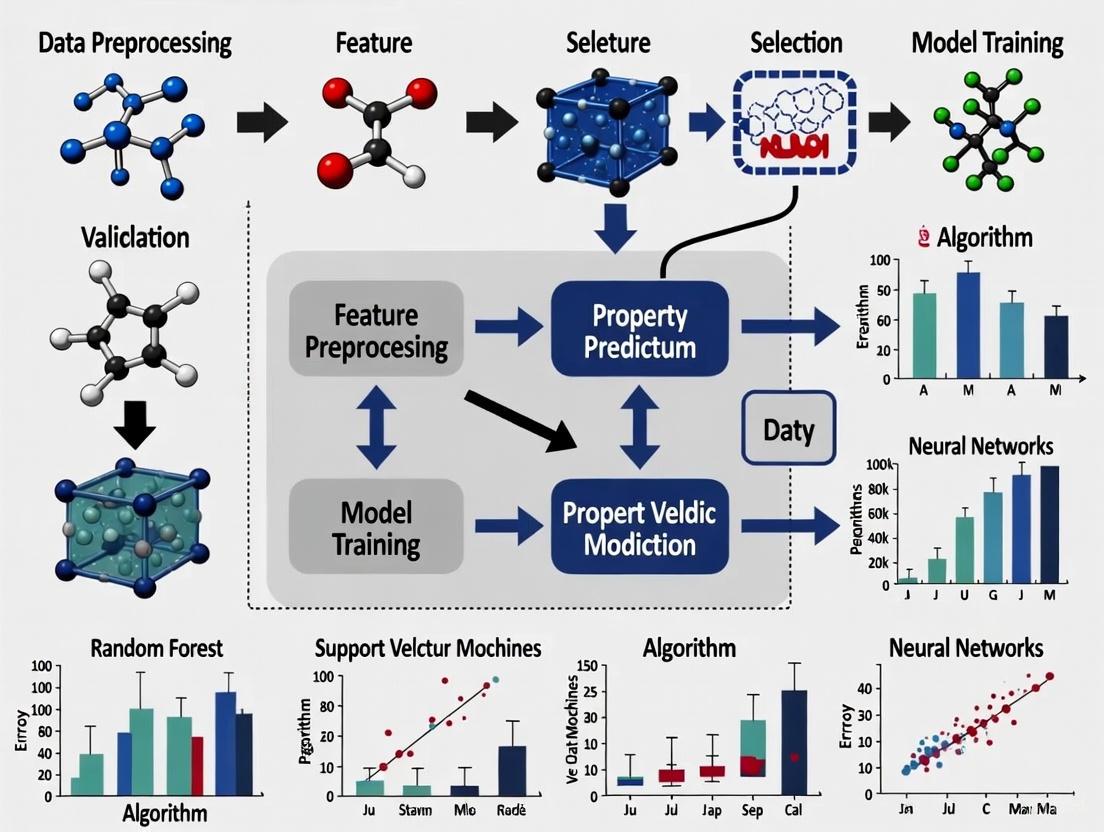
This article provides a comprehensive, comparative analysis of machine learning (ML) algorithms for predicting material properties, a critical task in accelerating material discovery and design.
Comparative Validation of Machine Learning Algorithms for Material Property Prediction: A 2025 Benchmarking Guide
Abstract
This article provides a comprehensive, comparative analysis of machine learning (ML) algorithms for predicting material properties, a critical task in accelerating material discovery and design. Tailored for researchers and scientists, we explore the foundational ML models used in materials informatics, detail their methodological application to key properties like tensile strength and phase stability, and address critical troubleshooting aspects such as dataset redundancy and small-data challenges. A core focus is the objective validation of algorithm performance across diverse material classes, including metallic glasses and high-entropy alloys, offering a clear, evidence-based guide for selecting and optimizing ML strategies to replace traditional trial-and-error approaches.
The Foundations of Machine Learning in Materials Informatics
The integration of machine learning (ML) into materials science has catalyzed a paradigm shift from traditional, labor-intensive discovery processes towards data-driven, predictive research. This transition addresses a critical challenge: conventional material research and development typically spans 10–20 years, requiring significant resources and extensive experimentation [1]. ML technologies offer benefits of low cost, high efficiency, and shorter development cycles by rapidly identifying complex, non-linear relationships between material composition, processing parameters, microstructure, and resulting properties [1] [2].
The application of ML in materials science has grown exponentially, with studies applying ML to materials science increasing at a rate of approximately 1.67 times per year over the past decade [3]. This growth is fueled by the recognition that ML can navigate the vast chemical and structural space of possible materials more efficiently than traditional computational methods like density functional theory (DFT), which provide high accuracy but are computationally expensive and often restricted to small systems [4] [5].
This guide provides a comparative validation of core ML algorithms for material property prediction, offering researchers a structured framework for selecting appropriate methodologies based on specific research objectives, data constraints, and target material properties.
Core Machine Learning Algorithms: Principles and Applications
Machine learning algorithms in materials science are broadly categorized based on their learning mechanisms. Understanding these categories is essential for selecting the appropriate tool for a given predictive task.
Supervised Learning: This approach uses labeled datasets to train models that map input features to known outputs. It is the most widely used paradigm in materials informatics, predominantly applied to classification tasks (e.g., identifying crystal phases) and regression tasks (e.g., predicting formation energy or mechanical strength) [6] [2]. The effectiveness of supervised learning relies heavily on the quality and quantity of labeled data.
Unsupervised Learning: This approach uncovers hidden patterns, groupings, or intrinsic structures within unlabeled datasets. It is particularly valuable for exploratory data analysis, such as identifying novel material classes or clustering materials with similar characteristics without predefined labels [6].
Semi-Supervised & Self-Supervised Learning: These emerging paradigms leverage a small amount of labeled data alongside large pools of unlabeled data. They are especially useful in materials science where obtaining labeled data through experiment or simulation is expensive and time-consuming [6].
Reinforcement Learning: This involves training algorithms to make a sequence of decisions by interacting with an environment to maximize cumulative rewards. While less common in property prediction, it shows promise in areas like optimizing synthesis processes [6].
Table 1: Overview of Core Machine Learning Algorithms in Materials Science
| Algorithm | Category | Primary Use Cases in Materials Science | Key Advantages |
|---|---|---|---|
| Linear & Logistic Regression | Supervised | Predicting continuous properties (Young's modulus), binary classification [6] [2] | Simple, interpretable, efficient with linear relationships [6] |
| Decision Trees | Supervised | Classification and regression tasks, modeling business rules, risk assessment [6] | Handles numerical/categorical data, highly interpretable [6] |
| Random Forest | Supervised | Property prediction (formation energy, band gap), credit scoring, product recommendation [3] [6] | Reduces overfitting via ensemble learning, robust with high-dimensional data [6] [2] |
| Support Vector Machines (SVM) | Supervised | Bioinformatics, image recognition, text categorization [6] [2] | Effective in high-dimensional spaces, versatile with kernel functions [6] |
| Gradient Boosting Machines (XGBoost, LightGBM, CatBoost) | Supervised | Top performer in predictive modeling competitions, finance, marketing analytics [6] | High predictive accuracy, sequential error correction [6] |
| Neural Networks (NN) & Deep Learning (DL) | Supervised/Unsupervised | Graph Neural Networks for crystal properties, CNNs for image-based microstructure analysis [3] [7] [2] | Captures complex non-linear relationships, automatic feature extraction from raw data [2] |
Comparative Performance Analysis for Material Property Prediction
Evaluating the performance of ML algorithms requires careful consideration of the specific prediction task, data representation, and most importantly, rigorous dataset splitting protocols to avoid overestimation of performance.
Performance in Crystal Property Prediction
For fundamental electronic and energetic properties, different algorithms exhibit varying strengths. A dramatic 7-fold error reduction was observed when moving from feature-based conventional ML (e.g., Random Forest, SVR) to Graph Neural Network (GNN) techniques on the matbench benchmark for formation enthalpy prediction [3]. GNNs, which directly operate on the atomic graph structure of a crystal, have demonstrated capabilities to predict formation energies, band gaps, and elastic moduli of crystals with accuracy that can rival or even surpass DFT calculations on benchmark datasets [5].
However, these reported high accuracies must be interpreted cautiously. Studies have shown that dataset redundancy—where training and test sets contain highly similar materials due to historical "tinkering" in material design—can lead to significant overestimation of model performance when using random splits [5]. When redundancy control algorithms like MD-HIT are applied, prediction performances on test sets tend to be lower but better reflect the models' true extrapolation capability [5].
Table 2: Comparative Performance of Algorithms for Key Prediction Tasks
| Prediction Task | Algorithm Examples | Reported Performance (with caveats) | Critical Considerations |
|---|---|---|---|
| Formation Energy/Enthalpy | Random Forest [3], Graph Neural Networks [3] [5] | GNNs achieved 7x lower error than conventional ML on matbench [3]. MAE of 0.064 eV/atom reported (context of dataset redundancy) [5]. | Dataset redundancy can inflate performance metrics. GNNs show superior performance but require more data and computation [5]. |
| Band Gap Prediction | Conventional ML (Composition-based) [5], Graph Neural Networks [5] | Accurate prediction reported using composition alone, especially for thermodynamically stable compounds [5]. | Performance is often overestimated due to redundant samples in standard datasets [5]. |
| Mechanical Properties of Composites | Regression Neural Network [8], SVM, Random Forest [2] [8] | Regression Neural Network achieved R² = 1, RMSE = 34.385, MAE = 19.829 for laminate stress-strain prediction [8]. | Neural networks can offer extreme speed (0.6s vs. 34.5s for FE simulation) but require sufficient training data [8]. |
Addressing the Small Data Challenge
A significant reality in materials science is that many research groups work with small data, where the sample size is limited. This creates challenges including model overfitting, underfitting, and imbalanced data [9]. Solutions to this dilemma operate at multiple levels:
- Data Source Level: Extracting data from publications, constructing specialized material databases, and employing high-throughput computations and experiments [9].
- Algorithm Level: Using modeling algorithms robust to small data and techniques for imbalanced learning [9].
- ML Strategy Level: Implementing active learning and transfer learning to maximize the value of limited data [9].
Experimental Protocols and Methodologies
Standard Workflow for ML-Based Material Property Prediction
A robust workflow is essential for developing reliable ML models in materials science. The process typically involves several interconnected stages [9]:
Data Collection: The foundation of any ML project. Data can be sourced from published literature, materials databases (e.g., Materials Project, OQMD), lab experiments, or first-principles calculations [9]. The target variable (property) and relevant descriptors (features) must be defined.
Feature Engineering: This critical step involves preparing and optimizing the input features for modeling [9]. It includes:
- Feature Preprocessing: Handling missing values, and normalizing or standardizing data to unify metrics [9].
- Feature Selection & Dimensionality Reduction: Removing redundant descriptors or reorganizing them into a lower-dimensional space using methods like Principal Component Analysis (PCA) to improve model performance and avoid the "curse of dimensionality" [9].
Model Selection and Evaluation: Choosing an algorithm based on the problem type (regression/classification), data size, and complexity. Models must be evaluated using rigorous validation schemes that account for dataset redundancy, such as cluster-based cross-validation, to ensure realistic performance estimates [5] [9].
Model Application: Using the trained and validated model to predict properties of new, unknown materials or to guide experimental synthesis efforts [9].
Critical Experimental Consideration: Controlling Dataset Redundancy
A key methodological advancement is the recognition that standard random splitting of material datasets leads to over-optimistic performance estimates. The MD-HIT algorithm was developed to address this by controlling redundancy in material datasets, ensuring no two samples in the training and test sets are overly similar [5]. Using such tools provides a more objective evaluation of a model's true prediction capability, especially for extrapolation to novel material classes [5]. The "leave-one-cluster-out" cross-validation (LOCO CV) is another method that provides a more objective evaluation of a model's extrapolation performance [5].
Beyond algorithms, a successful ML project in materials science relies on a suite of data, software, and computational resources.
Table 3: Essential Research Reagents and Resources
| Resource Name | Type | Primary Function | Relevance to ML Workflow |
|---|---|---|---|
| Materials Project [1] [5] [7] | Data Repository | Provides computed properties for over 150,000 inorganic compounds and crystal structures. | Source of training data for predicting formation energy, band gaps, and other electronic properties. |
| OQMD [1] [5] | Data Repository | Open Quantum Materials Database containing DFT-calculated thermodynamic and structural properties. | Large-scale dataset for training and benchmarking ML models for material stability and properties. |
| MD-HIT [5] | Software Tool | Algorithm for redundancy control in material datasets before splitting into training/test sets. | Critical for objective model evaluation; prevents overestimation of predictive performance. |
| VASP [7] | Simulation Software | First-principles quantum mechanics package using Density Functional Theory (DFT). | Generates high-fidelity training data (e.g., electronic charge density, formation energies). |
| Electronic Charge Density [7] | Physically-Grounded Descriptor | Real-space distribution of electrons, uniquely determined by the external potential (Hohenberg-Kohn theorem). | Used as a universal input descriptor for predicting diverse material properties from a single source. |
| Matminer [5] | Software Library | Python library for data mining and feature extraction from materials data. | Facilitates feature engineering by generating a wide array of composition and structure-based descriptors. |
The comparative analysis presented in this guide underscores that there is no single "best" machine learning algorithm for all material property prediction tasks. The selection hinges on multiple factors, including the property of interest, data volume and quality, material representation (descriptor), and computational resources.
While classical algorithms like Random Forest and SVM remain dominant and highly effective for many tasks, particularly with smaller or tabular datasets [3] [2], neural networks, especially Graph Neural Networks, have shown remarkable performance in capturing complex structure-property relationships in crystals, albeit with greater data and computational demands [3] [5]. The most promising future direction lies in the development of hybrid models that integrate physical principles with data-driven ML approaches, offering both speed and interpretability [10].
Progress in this field will be accelerated by prioritizing modular AI systems, standardized FAIR (Findable, Accessible, Interoperable, Reusable) data, and cross-disciplinary collaboration [10]. By carefully selecting algorithms based on the problem context and employing rigorous experimental protocols—especially those that control for dataset redundancy—researchers can fully leverage machine learning to accelerate the discovery and development of next-generation materials.
The discovery and development of new materials are fundamental to technological progress, spanning industries from aerospace to energy storage. Traditional methods relying on experimental trial-and-error or computationally intensive ab initio calculations have created bottlenecks in this innovation pipeline. In response, machine learning (ML) has emerged as a transformative tool, enabling the rapid prediction of material properties and accelerating the design of novel substances. This guide provides a comparative validation of ML algorithms, objectively assessing their performance in predicting three critical classes of material properties: tensile strength, formation energy, and phase stability. We summarize quantitative performance data, detail experimental methodologies, and visualize the logical frameworks that underpin this rapidly advancing field, offering researchers a clear overview of the current prediction landscape.
Comparative Performance of ML Algorithms for Property Prediction
The efficacy of machine learning varies significantly depending on the target material property, the available data, and the chosen algorithm. The following tables provide a structured comparison of model performance across different prediction tasks, based on recent experimental studies.
Table 1: Performance of ML Algorithms for Tensile Strength Prediction
| Material System | ML Algorithm | Performance Metrics | Key Input Features | Citation |
|---|---|---|---|---|
| Natural Fiber-Reinforced Polymer (NFRP) Composites | Random Forest (RF) | R² = 0.92, MAE = 1.64 | Epoxy content, density, elastic modulus, curing agent, resin consumption | [11] |
| NFRP Composites | Gradient Boosting | Not Specified (2nd best after RF) | Matrix-filler ratio, surface density | [11] |
| NFRP Composites | XGBoost | Not Specified | Same as above | [11] |
| NFRP Composites | Polynomial Regression | Not Specified | Same as above | [11] |
| Nano-engineered Concrete | Hybrid Ensemble Model (HEM) | Best performance in K-fold CV | Water-cement ratio, curing time, nano-clay, basalt fiber, superplasticizer | [12] |
| Nano-engineered Concrete | Artificial Neural Networks (ANN) | Second-best performance | Cement content, fine/coarse aggregates, carbon nanotubes | [12] |
Table 2: Performance of ML and AI Models for Formation Energy and Phase Stability
| Prediction Task | Model/Method | Performance Metrics | Key Input/Descriptors | Citation |
|---|---|---|---|---|
| Formation Energy (from structure & composition) | AI/Deep Transfer Learning (IRNet) | MAE = 0.064 eV/atom (on experimental test) | Materials structure and composition | [13] |
| Formation Energy | DFT-Computations (OQMD, Materials Project) | MAE = 0.078 - 0.133 eV/atom (vs. experiment) | First-principles calculations | [13] |
| Phase Stability (High-Entropy Ceramics) | Ab Initio Free Energy Model | Agrees with available experimental data | Free energy terms from first-principles | [14] |
| Phase Stability (High-Entropy Ceramics) | Descriptor-based (EFA, DEED) | Relies on empirical correlation thresholds | Enthalpy distribution, entropy descriptor | [14] |
| Phase Diagrams (Alloys) | ML Interatomic Potentials (Grace Model) | Good agreement with VASP & experiment | Structure, composition | [15] |
Experimental Protocols and Methodologies
Predicting Tensile Strength of Novel Composites
A study on Natural Fiber-Reinforced Polymer (NFRP) composites provides a reproducible, data-driven framework for tensile strength prediction. The methodology involved several key stages [11]:
- Dataset Curation: Utilizing publicly available datasets containing parameters such as epoxy group content, density, elastic modulus, curing agent amount, resin consumption, surface density, and matrix–filler ratio.
- Feature Selection: Systematically removing weakly correlated features to enhance model accuracy and interpretability, a step noted as an improvement over prior works.
- Model Training and Validation: Five regression algorithms—Polynomial Regression, Bagging Regression, Random Forest, XGBoost, and Gradient Boosting—were trained and evaluated using five-fold cross-validation.
- Performance Evaluation: Models were judged using standard error metrics, including the Coefficient of Determination (R²) and Mean Absolute Error (MAE).
Achieving Experimental-Level Formation Energy Prediction
A significant challenge in materials informatics is that models trained on Density Functional Theory (DFT) data inherit its inherent discrepancies from experimental ground truth. One groundbreaking protocol demonstrated how to surpass DFT-level accuracy [13]:
- Leveraging Deep Transfer Learning: A deep neural network (IRNet) was first pre-trained on a large source domain of DFT-computed data from databases like the Open Quantum Materials Database (OQMD) and Materials Project (MP). This allowed the model to learn a rich set of domain-specific features from material structures and compositions.
- Fine-Tuning on Experimental Data: The pre-trained model was then fine-tuned on a smaller, more accurate target domain of experimental formation energy observations.
- Hold-out Test Validation: The final model was evaluated on an experimental hold-out test set containing 137 entries, where it achieved a lower MAE than DFT computations themselves.
Physics-Based vs. Descriptor-Based Phase Stability Prediction
For high-entropy ceramics, phase stability prediction has historically relied on descriptor-based methods. A comparative protocol highlights a shift towards physics-based models [14]:
- Descriptor-Based Approach: Methods like the Entropy Forming Ability (EFA) and the disordered enthalpy–entropy descriptor (DEED) calculate descriptors from ab initio calculations. These descriptors are empirically correlated with phase stability, and their threshold values for stability are determined self-consistently from existing experiments.
- Physics-Based Free Energy Model: This approach directly calculates the Gibbs free energy, ΔG = ΔH - TΔS, for the high-entropy phase relative to competing phases.
- ΔH (Enthalpy): Calculated using DFT with respect to the most stable competing phases on the convex hull from materials databases.
- ΔS (Entropy): Calculated using the ideal mixing approximation.
- Experimental Synthesis and Validation: The predictions of the free energy model were validated against available literature data. In one case of disagreement, a new sample was synthesized via arc-melting and characterized using X-ray diffraction (XRD) to confirm the model's accuracy [14].
Visualization of Workflows and Logical Frameworks
ML Property Prediction and Validation Workflow
The following diagram illustrates a generalized workflow for developing and validating ML models for material property prediction, integrating common elements from the cited studies.
ML Workflow for Material Property Prediction
Algorithm Performance Comparison Framework
This diagram outlines a logical framework for comparing and benchmarking different types of algorithms, from traditional to modern ML approaches, based on their application to specific property prediction tasks.
Algorithm Performance by Prediction Task
The Scientist's Toolkit: Key Research Reagents & Solutions
In the context of computational materials science, "research reagents" refer to the essential software, datasets, and computational tools that enable predictive modeling.
Table 3: Essential Computational Tools for ML-Based Material Prediction
| Tool / Resource Name | Type | Primary Function | Citation |
|---|---|---|---|
| Open Quantum Materials Database (OQMD) | Database | Source of DFT-computed formation energies and other properties for training ML models. | [13] |
| Materials Project (MP) | Database | A repository of inorganic compounds and their computed properties for high-throughput materials analysis. | [13] [16] |
| VASP (Vienna Ab Initio Simulation Package) | Software | Performs first-principles DFT calculations to generate accurate training data and validate model predictions. | [13] [14] [15] |
| ATAT (Alloy Theoretic Automated Toolkit) | Software | Used for generating special quasirandom structures (SQS) and building cluster expansions for alloy phase stability analysis. | [14] [15] |
| MD-HIT | Algorithm | Controls dataset redundancy by ensuring similarity among samples is below a threshold, preventing overestimated performance. | [5] |
| IRNet | Model Architecture | A deep neural network used for predicting formation energy from material structure and composition. | [13] |
| Grace, CHGNet, SevenNet | Machine Learning Interatomic Potentials (MLIPs) | ML-based force fields that bridge quantum-mechanical accuracy with the efficiency needed for large-scale thermodynamic modeling. | [15] |
Critical Challenges and Future Directions
Despite significant progress, the field must overcome several challenges to realize the full potential of ML in materials discovery. A primary issue is dataset redundancy and overestimation of model performance. Materials databases often contain many highly similar structures due to historical "tinkering" in material design. When datasets are split randomly for validation, this redundancy leads to information leakage and over-optimistic performance metrics that do not reflect a model's true power to predict genuinely novel materials [5]. New evaluation methods like k-fold-m-step forward cross-validation (kmFCV) have been proposed to more rigorously assess a model's "explorative power" for outlier discovery [16]. Furthermore, models that perform well in interpolation often fail at out-of-distribution (OOD) extrapolation, which is critical for discovering materials with properties outside the range of known data [5]. Future efforts will likely focus on developing more robust, explainable, and generalizable models that can reliably guide the synthesis of new materials with targeted properties.
The rapid advancement of machine learning (ML) has revolutionized materials science, enabling the prediction of material properties, the discovery of novel compounds, and the optimization of material structures with unprecedented speed [17]. However, the accuracy, generalizability, and ultimate success of any ML model in materials property prediction are fundamentally constrained by the quality, quantity, and characteristics of the underlying training data [5] [18]. The materials informatics community now recognizes that sophisticated algorithms alone cannot overcome the limitations of poorly curated datasets. This comparative guide examines the foundational datasets and data-centric methodologies that drive reliable ML predictions, providing researchers with a framework for selecting appropriate data resources and implementing best practices for data management in their computational materials research.
Major Public Databases for Materials Property Prediction
Table 1: Major Public Databases for Materials Property Prediction
| Database Name | Data Size | Key Properties | Primary Features | Notable Characteristics |
|---|---|---|---|---|
| Materials Project (MP) | >130,000 entries | Formation energy, band gap, elastic moduli [19] | Crystal structures, computed properties [17] | Contains redundant materials due to historical tinkering approach [5] |
| Alexandria | >5 million calculations | Multiple DFT-calculated properties [18] | DFT calculations for periodic compounds | Open database; enables training on large, consistent datasets [18] |
| Open Quantum Materials Database (OQMD) | 304,433+ entries | Formation energy, stability [20] | Computational database focusing on material stability | Used in pretraining pipelines like Roost [20] |
| Matbench | 408,065+ data points across tasks [20] | Diverse properties from multiple sources | Curated benchmarking suite | Standardized evaluation for ML models [21] |
| AFLOW | Varies by property | Band gap, bulk modulus, Debye temperature, thermal properties [21] | High-throughput computational data | Contains properties from automated calculations [21] |
Dataset Characteristics Impacting Model Performance
The performance of ML models in materials property prediction is significantly influenced by several key dataset characteristics that researchers must consider during experimental design:
Data Redundancy: Materials databases often contain many highly similar materials due to historical "tinkering" approaches in material design [5]. For example, the Materials Project database contains numerous perovskite cubic structures similar to SrTiO₃ [5]. This redundancy causes random splitting of datasets to yield over-optimistic performance estimates, as models effectively perform interpolation rather than true prediction [5].
Data Scarcity: For many material properties, limited data availability poses significant challenges. Examples include GW-computed band gaps for approximately 80 crystals, lattice thermal conductivity for about 101 compounds, and vibrational properties for around 1,245 materials [19]. This scarcity necessitates specialized approaches like feature selection, transfer learning, and multi-task learning [19] [22].
Data Quality and Physical Relevance: Recent research demonstrates that training data informed by physical principles (such as lattice vibrations or phonons) consistently outperforms randomly generated datasets, even with fewer data points [23]. Physically informed models prioritize chemically meaningful bonds and demonstrate enhanced predictive accuracy [23].
Experimental Protocols for Data-Centric ML in Materials Science
The MODNet Framework for Limited Data Scenarios
The Materials Optimal Descriptor Network (MODNet) represents a sophisticated approach to addressing data scarcity through feature selection and joint learning [19]. The experimental protocol involves:
Feature Representation: Raw crystal structures are transformed into physically meaningful descriptors using the matminer package, which covers elemental, structural, and site-related features grounded in physical and chemical intuition [19].
Feature Selection Process: MODNet employs a relevance-redundancy (RR) selection algorithm based on Normalized Mutual Information (NMI) [19]. The process begins by selecting the feature with the highest NMI with the target variable. Subsequent features are chosen using the RR score:
RR(f) = NMI(f,y) / [max(NMI(f,f_s))^p + c], wherepandcare hyperparameters that balance relevance and redundancy [19].Joint-Learning Architecture: MODNet uses a tree-like neural network architecture where initial layers are shared across multiple properties, and specialized branches handle specific properties. This approach enables knowledge transfer between related properties, effectively increasing the virtual dataset size [19].
MD-HIT for Dataset Redundancy Control
The MD-HIT algorithm addresses dataset redundancy through a systematic protocol [5]:
Problem Identification: The method first identifies that random splitting of materials datasets leads to overestimated performance because highly similar materials may appear in both training and test sets [5].
Redundancy Reduction: MD-HIT applies similarity thresholds to ensure no two materials in the training and test sets exceed a structural or compositional similarity threshold, analogous to CD-HIT used in bioinformatics for protein sequence analysis [5].
Performance Evaluation: Models are evaluated on truly distinct materials, providing a more realistic assessment of predictive capability, particularly for out-of-distribution samples [5].
Ensemble of Experts for Severe Data Scarcity
For extreme data limitation scenarios, the Ensemble of Experts (EE) approach provides a robust methodology [22]:
Expert Pretraining: Multiple "expert" models are first pretrained on large, high-quality datasets for different but physically related properties [22].
Fingerprint Generation: These experts generate molecular fingerprints that encapsulate essential chemical information, using tokenized SMILES strings to enhance chemical structure interpretation compared to traditional one-hot encoding [22].
Transfer Learning: The pretrained knowledge is transferred to predict complex target properties (e.g., glass transition temperature Tg or Flory-Huggins parameter χ) even with very limited training data (as few as 20 samples) [22].
Data Ecosystem for Material Property Prediction
Comparative Analysis of Data-Driven Methodologies
Performance Across Data Scarcity Conditions
Table 2: Performance Comparison of Data-Centric ML Approaches
| Methodology | Optimal Data Scenario | Key Advantages | Reported Performance | Limitations |
|---|---|---|---|---|
| MODNet | Small to medium datasets (hundreds to thousands of samples) | Feature selection reduces dimensionality; joint learning enables multi-property prediction [19] | Predicts vibrational entropy at 305K with MAE of 0.009 meV/K/atom (4x lower than previous studies) [19] | Requires careful feature engineering; performance plateaus with very large datasets |
| Ensemble of Experts (EE) | Severe data scarcity (as few as 20 samples) [22] | Leverages transfer learning from related properties; tokenized SMILES improve chemical interpretation [22] | Significantly outperforms standard ANNs under severe data scarcity; better generalization across molecular structures [22] | Dependent on availability of relevant pretraining data; complex implementation |
| Graph Neural Networks (GNNs) | Large datasets (>100,000 samples) [18] | Automatically learns material representations from structure; high accuracy with sufficient data [18] | Error decreases monotonically with training data size; generally more accurate than composition-based methods [18] | Performance saturates for some architectures; requires structural information |
| E2T (Extrapolative Episodic Training) | Out-of-distribution prediction [24] | Specifically designed for extrapolation beyond training distribution; meta-learning approach [24] | Improves extrapolative precision by 1.8× for materials and 1.5× for molecules [21] | Complex training regimen; requires careful task design |
Addressing Dataset Redundancy: A Comparative Study
The critical issue of dataset redundancy and its impact on model evaluation merits particular attention. Studies demonstrate that when MD-HIT is applied to reduce redundancy in composition- and structure-based formation energy and band gap prediction problems, models show relatively lower performance on test sets compared to evaluations with high redundancy, but these metrics better reflect true predictive capability [5]. This phenomenon explains why models achieving seemingly DFT-level accuracy (e.g., MAE of 0.064 eV/atom for formation energy) on randomly split test sets often fail to maintain this performance on truly novel material families [5]. Leave-one-cluster-out cross-validation (LOCO CV) provides a more rigorous evaluation framework, revealing that current ML models struggle significantly with generalization from training clusters to distinct test clusters [5].
Dataset Splitting Impact on Model Evaluation
Key Computational Tools and Datasets
Table 3: Essential Research Resources for Materials Informatics
| Resource Name | Type | Primary Function | Application Context |
|---|---|---|---|
| matminer | Feature generation library | Provides physically meaningful material descriptors [19] | Feature engineering for traditional ML models |
| MD-HIT | Data preprocessing algorithm | Controls dataset redundancy by ensuring similarity thresholds [5] | Preparing robust train/test splits for model evaluation |
| Roost | Structure-agnostic model | Predicts properties from stoichiometry alone [20] | High-throughput screening when crystal structures are unavailable |
| Barlow Twins Framework | Self-supervised learning method | Pretrains models without labeled data [20] | Leveraging unlabeled data to improve downstream task performance |
| Magpie Fingerprint | Fixed-length descriptor | Engineered material representation based on elemental properties [20] | Baseline features for composition-based property prediction |
The comparative analysis presented in this guide demonstrates that strategic data management is equally important as algorithmic sophistication in materials informatics. The most successful approaches combine physically informed data curation with methodologies specifically designed to address fundamental challenges like data scarcity, redundancy, and distribution shifts. Researchers should select datasets and methodologies aligned with their specific prediction goals: MODNet for limited datasets with multiple related properties, Ensemble of Experts for extreme data scarcity, Graph Neural Networks for data-rich scenarios with available structural information, and E2T for extrapolative prediction tasks. As the field evolves, emerging strategies like self-supervised pretraining and physically informed data generation promise to further enhance data efficiency, ultimately accelerating the discovery of novel materials with tailored functionalities.
Selecting the right machine learning algorithm is a cornerstone of successful materials science research. The choice between simpler models like Linear Regression and more complex architectures like Neural Networks can significantly impact the accuracy, interpretability, and computational cost of your property predictions. This guide provides a comparative validation of these algorithms to inform researchers and development professionals in their experimental design.
The foundational models for material property prediction span a spectrum from simple, interpretable statistical methods to complex, non-linear learning systems.
Linear Regression (LR) models a linear relationship between input variables (e.g., material composition, processing parameters) and a target property (e.g., formation energy, band gap). It is often extended to Multiple Linear Regression (MLR) for handling multiple features [25]. The model assumes that the target variable ( y ) can be expressed as a linear combination of the input features ( xn ), as shown in the equation ( {\text{y}} = {\text{w}}{0} + {\text{w}}{{1}} {\text{x}}{{1}} + \cdots + {\text{w}}{{\text{n}}} {\text{x}}{{\text{n}}} ), where ( w ) represents the coefficients [25]. Its simplicity, computational efficiency, and high interpretability make it a strong baseline model.
Random Forest Regression (RFR) is an ensemble method that constructs a multitude of decision trees during training and outputs the average prediction of the individual trees [25]. This technique is robust against overfitting and is particularly effective at capturing complex, non-linear relationships and interactions between input variables without requiring extensive feature scaling [25] [17].
Neural Networks (NNs), especially Deep Learning architectures, are highly flexible models composed of interconnected layers of neurons. They learn hierarchical representations of data, making them powerful for capturing intricate patterns in high-dimensional spaces [25] [17]. Specific types like Recurrent Neural Networks (RNNs) excel with sequential data, while Graph Neural Networks (GNNs) are increasingly used for crystal structure data [25] [17]. A fundamental neural network layer without non-linear activation functions is essentially a multiple linear regression [26].
Performance Comparison in Material Property Prediction
Experimental data from published studies consistently demonstrates a trade-off between model complexity and predictive performance. The following table summarizes quantitative comparisons for predicting various material properties.
Table 1: Comparative Performance of ML Algorithms in Materials Science
| Material Property | Algorithm | Performance Metrics | Key Findings |
|---|---|---|---|
| Air Ozone Concentration [25] | Recurrent Neural Network (RNN) | R²: 0.8902, RMSE: 24.91, MAE: 19.16 | Outperformed other models with 81.44% prediction accuracy. |
| Linear Regression (LR) | Details not provided in context | Simpler modeling technique, outperformed by Neural Networks. | |
| Random Forest Regression (RFR) | Details not provided in context | Robust ensemble technique, outperformed by Neural Networks. | |
| Formation Energy & Band Gap [5] | Various ML Models (with random split) | Reported high R² | Performance is often overestimated due to dataset redundancy. |
| Various ML Models (with redundancy control) | Relatively lower performance | Better reflects the model's true extrapolation capability. | |
| Biochemical/Chemical Oxygen Demand [27] | Artificial Neural Network (ANN) | RMSE: 25.1 mg/L (BOD), r: 0.83 | Performance was better than the MLR model. |
| Multivariate Linear Regression (MLR) | RMSE: 49.4 mg/L (COD), r: 0.81 | Performance was worse than the ANN model. | |
| Bulk Modulus, Shear Modulus [28] | Support Vector Machine (SVM) | High accuracy for Bulk Modulus | Emerged as particularly effective. |
| Gradient Boosting Regression (GBR) | Strong performance across various properties | Demonstrated robust performance as an ensemble method. |
Experimental Protocols for Comparative Validation
A rigorous comparison of algorithms requires a standardized experimental protocol to ensure fair and reproducible results. The following workflow outlines a typical process for benchmarking models in material property prediction.
Diagram 1: Algorithm benchmarking workflow.
Data Sourcing and Pre-processing
The initial phase involves curating a high-quality dataset, which forms the foundation for all subsequent modeling.
- Data Collection: Utilize large-scale materials databases such as the Materials Project, AFLOW, and the Open Quantum Materials Database (OQMD) [5] [29]. These provide computed properties like formation energy and band gap for thousands of inorganic compounds.
- Data Cleaning: Address inconsistencies, missing values, and noise in the raw data. Common techniques include:
- Critical Consideration - Redundancy Control: Materials databases often contain many highly similar structures due to historical "tinkering" in material design. A random train-test split on such data leads to over-optimistic performance estimates and poor generalization. Employ algorithms like MD-HIT to create non-redundant benchmark datasets, ensuring a more realistic evaluation of a model's true predictive capability, especially for out-of-distribution samples [5].
Feature Engineering and Dataset Splitting
This stage prepares the clean data for the learning algorithms.
- Feature Engineering: Transform raw material representations (e.g., chemical composition, crystal structure) into numerical descriptors. This can be done via:
- Manual Feature Selection: Using domain knowledge to select features like electronic properties (band gap, electron affinity) or crystal features (radial distribution functions) [29].
- Automated Feature Engineering: Leveraging the model itself to learn relevant representations, as seen in Graph Neural Networks that automatically extract features from crystal graphs [17].
- Dataset Splitting: Divide the dataset into training, validation, and test sets. To properly evaluate extrapolation performance, use methods like:
Model Training and Performance Evaluation
The core of the experimental protocol where algorithms are built and assessed.
- Model Training: Train a diverse set of algorithms on the pre-processed training data. This typically includes:
- Performance Evaluation: Quantify model performance on the held-out test set using standard metrics:
Table 2: Essential Tools and Datasets for Material Property Prediction
| Resource Name | Type | Function in Research |
|---|---|---|
| Materials Project [29] | Database | Provides computed properties (formation energy, band gap) for over 150,000 materials for training models. |
| AFLOW [21] [29] | Database | A large repository of calculated material compounds and properties for high-throughput screening. |
| Open Quantum Materials Database (OQMD) [5] [29] | Database | Contains DFT-calculated thermodynamic and structural properties of more than a million materials. |
| MD-HIT [5] | Algorithm | Controls dataset redundancy to avoid overestimated performance and improve model generalizability. |
| Graph Neural Networks (GNNs) [17] | Algorithm | Directly learns material representations from crystal structure data for highly accurate property prediction. |
| Bilinear Transduction [21] | Algorithm | A transductive method that improves extrapolation precision for predicting out-of-distribution property values. |
Decision Framework and Special Considerations
The choice of algorithm is not one-size-fits-all; it depends on the project's specific goals, constraints, and data characteristics. The following decision pathway provides a logical framework for selection.
Diagram 2: Algorithm selection guide.
Navigating the Accuracy vs. Interpretability Trade-off
The core trade-off in algorithm selection often lies between predictive accuracy and model interpretability.
- Prioritize Interpretability with Linear Models: If the research goal is to understand the fundamental physical relationship between a few key variables (e.g., the effect of temperature and pressure on a property), or if the dataset is small, Linear Regression is the most suitable choice. Its coefficients provide direct, quantifiable insights into feature importance [25] [26].
- Balance Complexity and Performance with Ensemble Methods: Random Forest offers a strong middle ground. It provides better accuracy than linear models for complex, non-linear relationships and can output feature importance scores, though its internal mechanics are less transparent than a linear model [25] [28].
- Maximize Accuracy with Neural Networks: When the primary objective is maximum predictive accuracy for a complex problem (e.g., predicting properties from raw crystal structures) and a large amount of data is available, Neural Networks (particularly GNNs and RNNs) are the state-of-the-art [25] [17]. However, they function as "black boxes" and require significant computational resources.
The Critical Challenge of Out-of-Distribution Prediction
A key challenge in materials discovery is identifying materials with exceptional, out-of-distribution (OOD) properties.
- The Problem: Models trained for interpolation often fail at extrapolation. A model accurate for predicting average band gaps may perform poorly when searching for materials with ultra-high or ultra-low band gaps [5] [21].
- Solutions and Specialized Algorithms:
- Rigorous Dataset Splitting: As noted in the experimental protocol, using methods like LOCO CV is essential for a truthful evaluation of OOD performance [5].
- Advanced Architectures: New methods like Bilinear Transduction are specifically designed for OOD extrapolation. This approach learns how property values change as a function of material differences, improving precision in identifying high-performing candidates by up to 1.8x for materials [21].
The journey from Linear Regression to Neural Networks is one of increasing model capacity and complexity. This guide demonstrates that while advanced neural networks often achieve superior predictive accuracy, the optimal algorithm is context-dependent. For interpretable insights from small datasets, Linear Regression remains a powerful tool. For robust handling of non-linear relationships, Random Forest is an excellent choice. Finally, for large-scale, complex prediction tasks where accuracy is paramount, Neural Networks are currently unmatched. The emerging focus on overcoming dataset redundancy and improving out-of-distribution prediction will undoubtedly shape the next generation of algorithms, further empowering researchers in the accelerated discovery of new materials.
Methodologies and Real-World Applications in Material Property Prediction
Ensemble machine learning methods have emerged as superior tools for predicting the tensile strength of composite materials, offering significant advantages over traditional experimental methods and single-model algorithms. This comparative analysis synthesizes findings from recent peer-reviewed studies (2024-2025) that systematically evaluated multiple ensemble approaches including Random Forest, Gradient Boosting, XGBoost, and stacked ensembles. The consensus across research indicates that ensemble methods consistently achieve R² values exceeding 0.90 for tensile strength prediction, dramatically reducing computational time from hours to seconds while maintaining high accuracy. Random Forest emerges as the most consistently high-performing algorithm across multiple composite systems, though optimal algorithm selection depends on specific composite characteristics and dataset size.
Performance Benchmarking of Ensemble Methods
Experimental data from recent studies demonstrate the clear performance advantages of ensemble methods over conventional approaches and single models for tensile strength prediction in various composite systems.
Table 1: Comparative Performance of ML Algorithms for Tensile Strength Prediction
| Composite System | Best Algorithm | R² Score | MAE | RMSE | Reference |
|---|---|---|---|---|---|
| Natural Fiber-Reinforced Polymer (NFRP) | Random Forest | 0.92 | 1.64 | - | [11] |
| Hybrid PP (Flax/Basalt/Rice Husk) | Stacked Ensemble (SVR+XGBoost) | 0.907 | - | 1.569 MPa | [30] |
| Hybrid Natural Fiber Composites | Random Forest | 0.968 | - | - | [31] |
| CFRP Composites | Random Forest | 0.966 (Flexural) | - | - | [32] |
Table 2: Computational Efficiency Comparison
| Methodology | Simulation/Prediction Time | Speed Improvement | Application Context |
|---|---|---|---|
| Finite Element Analysis | 34.5 seconds | 1x (Baseline) | Composite laminates [8] |
| Regression Neural Network | 0.6 seconds | 57.5x | Composite laminates [8] |
| Machine Learning Model | 0.5 seconds | 3600x | Composite mechanical properties [32] |
Experimental Protocols and Methodologies
Data Acquisition and Preprocessing
The foundational step across all studies involves systematic data collection and preprocessing to ensure model reliability:
Data Sources: Experimental datasets are generated through standardized mechanical testing (e.g., ASTM D638) with sample sizes typically ranging from n=65 to n=62 specimens [30] [32]. Additional data is sourced from molecular dynamics simulations with classical interatomic potentials and finite element modeling [33] [34].
Feature Selection: Input parameters commonly include material composition (fiber type, matrix type, weight percentages), structural parameters (layer orientation, fiber volume fraction), and processing conditions (manufacturing pressure, curing parameters) [11] [32]. Feature importance analysis reveals that fiber content and interfacial bonding parameters typically dominate predictive models.
Data Preprocessing: Studies consistently apply preprocessing techniques including Savitzky-Golay denoising for signal smoothing, feature standardization (StandardScaler), and five-fold or ten-fold cross-validation to prevent overfitting [33] [30]. For image-based microstructural data, convolutional neural networks utilize raw microstructure images with minimal preprocessing [34].
Algorithm Implementation and Training
The implementation of ensemble methods follows rigorous optimization protocols:
Hyperparameter Tuning: Studies employ systematic hyperparameter optimization using Grid Search [33] or Optuna framework [30] with cross-validation to identify optimal model configurations.
Ensemble Architectures: Three primary ensemble architectures are implemented: (1) Bagging (Random Forest), (2) Boosting (Gradient Boosting, XGBoost, AdaBoost), and (3) Stacking (linear combination of multiple algorithms) [11] [33] [30].
Validation Methodology: Studies implement k-fold cross-validation (typically k=5 or k=10) with strict separation of training and testing sets to ensure generalizability. Performance metrics including R², MAE, RMSE, and computational time are systematically reported [11] [30].
The Scientist's Toolkit: Essential Research Solutions
Table 3: Critical Research Tools for Ensemble Prediction of Composite Properties
| Tool Category | Specific Solution | Function/Application | Representative Use Case |
|---|---|---|---|
| Computational Frameworks | Scikit-Learn | Implementation of ensemble algorithms (Random Forest, Gradient Boosting) | Regression tree ensembles for carbon allotropes [33] |
| MATLAB R2024 | Neural network implementation and simulation | Regression Neural Network for composite laminates [8] | |
| XGBoost Library | Optimized gradient boosting implementation | Stacked ensembles for hybrid PP composites [30] | |
| Simulation & Analysis | DIGIMAT-VA Software | Composite laminate behavior simulation | Generating training data for ML models [8] |
| LAMMPS | Molecular dynamics simulations | Calculating formation energy and elastic constants [33] | |
| Finite Element Analysis | Virtual testing of composite performance | Generating ground truth data for CNN training [34] | |
| Optimization Tools | Optuna Framework | Hyperparameter tuning for ML models | Optimizing SVR and XGBoost parameters [30] |
| SHAP Analysis | Model interpretability and feature importance | Explaining compressive strength predictions [35] |
Comparative Algorithm Performance Analysis
Performance Across Composite Systems
The efficacy of ensemble methods extends across diverse composite material systems:
Natural Fiber Composites: Random Forest achieves exceptional prediction accuracy (R² = 0.92) for tensile strength of natural fiber-reinforced polymer composites, successfully capturing complex interactions between epoxy group content, density, elastic modulus, curing parameters, and matrix-filler ratio [11]. Feature importance analysis reveals that matrix-filler ratio and elastic modulus are the most significant predictors.
Hybrid Polymer Composites: Stacked ensemble approaches combining Support Vector Regression (SVR) and XGBoost with a linear meta-learner demonstrate superior performance (R² = 0.907) for predicting tensile strength of hybrid polypropylene composites reinforced with flax, basalt, and rice husk powder [30]. This approach effectively captures nonlinear interactions between the three reinforcement types.
CFRP Composites: For carbon fiber reinforced polymers, Random Forest achieves outstanding accuracy (R² = 0.966) in predicting flexural strength based on features including carbon nanotube volume fraction, interlayer volume fraction, glass transition temperature, and manufacturing pressure [32].
Interpretation and Explainability
Advanced ensemble methods incorporate explainability features to bridge the gap between prediction and physical understanding:
SHAP Analysis: Shapley Additive exPlanations quantitatively assess feature importance, revealing that fiber content and interfacial bonding parameters typically dominate tensile strength predictions [35]. For rubberized concrete, SHAP analysis identified waste tyre rubber content as the most influential factor with a mean SHAP value of 3.83, significantly higher than other factors [35].
Feature Attribution: Convolutional Neural Networks with Integrated Gradients identify critical microstructural features (fiber arrangement, matrix distribution) that influence composite performance, enabling engineers to verify that models learn physically meaningful patterns [34].
Ensemble machine learning methods, particularly Random Forest and strategically stacked ensembles, establish a new paradigm for efficient and accurate prediction of tensile strength in composite materials. The consistently high performance (R² > 0.90) across diverse composite systems, coupled with dramatic reductions in computational time (up to 3600x faster than finite element analysis), positions these methods as transformative tools for composite design and development. The integration of explainable AI techniques further enhances the utility of these approaches by providing physical insights into feature-property relationships. Future advancements will likely focus on expanding multi-property prediction frameworks, integrating real-time manufacturing data, and developing more sophisticated transfer learning approaches to accelerate the development of next-generation composite materials.
The discovery and development of advanced metallic alloys are crucial for technological progress in aerospace, electronics, and energy sectors. Traditional alloy design, which relies on a single principal element with minor additions, is increasingly reaching its performance limits. In recent years, two innovative classes of materials have emerged as promising alternatives: metallic glasses (MGs), also known as amorphous metals, and high-entropy alloys (HEAs) [36].
Metallic glasses are characterized by their non-crystalline, amorphous atomic structure, which results from rapid solidification that prevents atomic ordering. This unique structure confers exceptional properties, including high strength, excellent corrosion resistance, and superior elasticity [37] [38]. The global metallic glasses market, valued at approximately USD 1.9 billion in 2025, reflects their growing industrial importance, with projections reaching USD 3.0-3.6 billion by 2032-2035 [37] [38].
High-entropy alloys represent a paradigm shift in alloy design, comprising multiple principal elements (typically five or more) in near-equiatomic proportions. This multi-principal element approach leads to high configurational entropy and unique phenomena such as severe lattice distortion, sluggish diffusion, and the "cocktail effect" [39] [36]. These characteristics enable exceptional mechanical properties, thermal stability, and corrosion resistance, particularly at elevated temperatures. The global HEA market, valued at USD 1.2 billion in 2024, is expected to reach USD 2.4 billion by 2034 [39].
However, the vast compositional space of these multi-component materials makes traditional trial-and-error discovery approaches impractical. The exploration of MGs and HEAs has thus become a fertile ground for the application of machine learning (ML) techniques, which can efficiently navigate complex compositional spaces and accelerate the prediction of material properties [3] [40] [41]. This case study provides a comparative analysis of ML approaches for forecasting the properties of metallic glasses and high-entropy alloys, examining their respective challenges, methodological frameworks, and performance.
Machine Learning Applications in Metallic Glass Discovery
Prediction Targets and Data Characteristics
The primary prediction target for metallic glasses is the Glass-Forming Ability (GFA), which quantifies an alloy's tendency to form an amorphous structure upon cooling. The most common experimental measure of GFA is the critical casting diameter (Dmax), which represents the maximum thickness that can be solidified without crystallization [41]. Other relevant targets include thermal properties such as glass transition temperature (Tg) and crystallization temperature (Tx).
ML models for metallic glasses typically utilize features derived from several categories [41]:
- Elemental Composition: Molar or atomic fractions of constituent elements
- Thermophysical Properties: Calculated using methods like CALPHAD, including liquidus temperature (Tliq), solidus temperature (Tsol), enthalpy of mixing (ΔHmix), and entropy of melting (ΔSmelt)
- Elemental Descriptors: Features generated by software like Magpie, which computes average elemental properties based on composition
A significant challenge in MG informatics is the limited availability of high-quality experimental data, which constrains the complexity and generalizability of ML models [41].
Methodological Approaches and Experimental Protocols
Feature-Based GFA Prediction
A representative study by Mastropietro et al. focused on predicting the critical casting diameter (Dmax) of Fe-based metallic glasses using an a priori approach, where predictions are made using only data available prior to synthesis [41]. The experimental protocol involved:
- Data Collection: Compiling a dataset of Fe-based BMG compositions and their corresponding experimentally measured Dmax values from literature.
- Feature Engineering: Creating three distinct feature sets:
- DS1: Molar fractions of alloying elements
- DS2: Thermophysical quantities calculated via CALPHAD method using Thermo-Calc software with the TCHEA3 database
- DS3: Magpie-derived compositional features
- Model Training and Validation: Implementing multiple ML algorithms including Support Vector Machines (SVM), XGBoost, and ensemble methods, evaluated using leave-one-out cross-validation.
- Data Augmentation: Applying the PADRE (PAirwise Difference REgression) method to augment the limited training data and improve model performance.
The best-performing model was an ensemble combining SVM and XGBoost trained on thermophysical and Magpie features, achieving an R² score of 0.69 and MAE of 0.69 for Dmax prediction [41].
Image-Based Spectral Prediction
A groundbreaking approach to MG discovery treats X-ray diffraction (XRD) spectra as images, leveraging deep learning models designed for image generation [40]. The experimental workflow comprises:
- Data Acquisition: Synthesizing combinatorial alloy libraries using magnetron co-sputtering and collecting XRD spectra with laboratory diffractometers.
- Data Preprocessing: Subtracting substrate signals, restricting 2θ or q values to a consistent range, normalizing intensities, and standardizing data length through linear interpolation.
- Model Architecture: Implementing a continuous conditional generative adversarial network (ccGAN) incorporating:
- A generator that uses random noise and chemical composition as continuous conditional input to produce synthetic XRD spectra
- A discriminator that evaluates both the quality of generated spectra and the correspondence between compositions and spectra
- Model Training: Training the ccGAN on experimental XRD data, with performance quantified using mean squared error (MSE) between generated and experimental spectra.
This approach demonstrated remarkable data efficiency, achieving accurate spectral generation with as few as 20 training spectra for ternary systems and approximately 100 spectra for quaternary systems [40]. The following diagram illustrates this image-based spectral prediction workflow:
Performance and Limitations
Feature-based ML models for GFA prediction typically achieve test R² values of 0.6-0.7, with better performance for alloys with moderate Dmax values [41]. The image-based approach using ccGAN demonstrates high fidelity in spectral generation, with mean squared error as low as 20 when trained on sufficient data [40].
Key limitations in MG prediction include:
- Data Scarcity: Limited experimental data for complex multi-component systems
- Extrapolation Challenges: Poor performance for alloys with very high GFA (large Dmax)
- Feature Representation: Difficulty in capturing complex many-body interactions using weighted averages of elemental properties [40]
Machine Learning Applications in High-Entropy Alloy Development
Prediction Targets and Data Characteristics
For high-entropy alloys, ML prediction targets focus predominantly on mechanical and thermal properties critical for high-performance applications:
- High-Temperature Strength: Yield strength and specific strength at elevated temperatures
- Creep Resistance: Ability to withstand deformation under mechanical stress at high temperatures
- Oxidation Resistance: Formation of stable oxide layers protecting against degradation
- Phase Stability: Maintenance of desired phase structure under thermal exposure
HEA datasets often incorporate features derived from [39] [36]:
- Alloy Composition: Elemental categories including 3D transition metals, refractory metals, and light metals
- Microstructural Characteristics: Phase composition (FCC, BCC, B2, L12), grain size, and precipitate distribution
- Manufacturing Parameters: Processing methods including casting, powder metallurgy, and additive manufacturing techniques
Methodological Approaches and Experimental Protocols
Property Prediction via Classical ML
Research on HEAs frequently employs classical machine learning methods for property prediction:
- Data Collection: Compiling datasets from experimental literature and high-throughput computational studies, particularly using density functional theory (DFT) calculations.
- Feature Selection: Utilizing elemental properties (electronegativity, atomic radius, valence electron concentration) and thermodynamic parameters (mixing enthalpy, entropy).
- Model Implementation: Applying algorithms including Random Forests, Support Vector Machines, and neural networks.
- Performance Validation: Using cross-validation and comparison with experimental measurements.
Studies have demonstrated that ML models can successfully predict formation energies, phase selection, and mechanical properties of HEAs. Graph neural network techniques have shown particular promise, achieving a 7-fold reduction in prediction error for formation enthalpy compared to feature-based methods using conventional ML [3].
Additive Manufacturing Integration
The combination of ML with additive manufacturing (AM) represents an emerging frontier in HEA research [39]:
- Process Optimization: Using ML to optimize AM parameters (laser power, scan speed, powder characteristics) for HEA fabrication.
- Microstructure Prediction: Predicting grain morphology and phase distribution in AM-processed HEAs.
- Property Mapping: Correlating process parameters with final mechanical properties.
Performance and Limitations
The performance of ML models for HEA prediction varies significantly with data quality and feature selection. For formation energy prediction, graph neural networks have demonstrated superior performance compared to traditional descriptor-based approaches [3].
Key challenges in HEA informatics include:
- Complex Property Relationships: Non-linear interactions between multiple principal elements
- Processing-Structure Links: Difficulties in capturing the relationship between manufacturing parameters and final properties
- Data Integration: Combining computational and experimental data from diverse sources
Comparative Analysis of ML Approaches
Algorithm Performance Comparison
The table below summarizes the performance characteristics of different ML algorithms applied to metallic glasses and high-entropy alloys:
Table 1: Machine Learning Algorithm Performance for Material Property Prediction
| Algorithm | Best Suited Applications | Strengths | Limitations | Reported Performance |
|---|---|---|---|---|
| Support Vector Machines (SVM) | Classification and regression with moderate-sized datasets [42] | Effective in high-dimensional spaces; memory efficient | Sensitive to parameter tuning; poor performance with noisy data | Test R² ~0.60 for Fe-based BMG Dmax prediction [41] |
| XGBoost | Tabular data with non-linear relationships [41] | Handles missing values; prevents overfitting | Limited extrapolation capability; computationally intensive | Test R² ~0.63 for Fe-based BMG Dmax prediction [41] |
| Random Forests | Datasets with high variability and small effect sizes [42] | Robust to outliers; provides feature importance | Can overfit with noisy data; less interpretable | Superior to kNN for variable data with small effect sizes [42] |
| Graph Neural Networks | Materials with structural or compositional graphs [3] | Captures complex structural relationships | High computational requirements; complex implementation | 7x error reduction for formation enthalpy vs. conventional ML [3] |
| Generative Adversarial Networks | Spectral data and image-based material representation [40] | Generates high-fidelity synthetic data; enables exploration of vast compositional spaces | Training instability; mode collapse issues | MSE ~20 for XRD spectrum generation with 100 training samples [40] |
Experimental Data and Workflow Comparison
The experimental protocols and data requirements differ significantly between metallic glass and HEA prediction:
Table 2: Comparative Analysis of Experimental Protocols for Metallic Glasses and High-Entropy Alloys
| Aspect | Metallic Glasses | High-Entropy Alloys |
|---|---|---|
| Primary Prediction Targets | Glass-forming ability (GFA), critical casting diameter (Dmax), thermal properties [41] | Mechanical properties (strength, ductility), phase stability, oxidation resistance [39] [36] |
| Key Experimental Metrics | XRD amorphous structure confirmation, thermal analysis (Tg, Tx) [40] | Tensile/compressive testing, creep resistance, oxidation kinetics [36] |
| Common Features | Composition, thermophysical properties (Tliq, ΔHmix), Magpie descriptors [41] | Composition, elemental properties, processing parameters, phase structure [39] |
| Data Acquisition Methods | Combinatorial sputtering, rapid solidification, thermal analysis [40] | Arc melting, additive manufacturing, mechanical testing, DFT calculations [39] [36] |
| Characterization Techniques | XRD, DSC, TEM [40] | SEM, TEM, XRD, mechanical testing, oxidation testing [36] |
| Primary Challenges | Limited GFA data, extrapolation to high Dmax [41] | Complex composition-property relationships, processing variability [39] |
Cross-Cutting Challenges and Emerging Solutions
Both fields face several common challenges in ML application:
Data Quality and Quantity: The limited availability of high-quality, standardized experimental data remains a significant constraint. Potential solutions include:
- Development of standardized data reporting formats
- Implementation of federated learning approaches across multiple institutions
- Enhanced data augmentation techniques like PADRE [41]
Feature Representation: Effective representation of material composition and structure is crucial for model performance. Promising approaches include:
- Graph-based representations capturing atomic interactions
- Spectral representations treating experimental data as images [40]
- Hierarchical features capturing multi-scale material characteristics
Model Interpretability: The "black box" nature of complex ML models limits physical insights. Solutions include:
- Implementation of explainable AI techniques
- Integration of domain knowledge through physics-informed neural networks
- Feature importance analysis to identify key predictive parameters
Essential Research Reagent Solutions
The experimental workflows for metallic glass and HEA development require specialized materials, software, and characterization tools. The following table details key research reagents and their functions:
Table 3: Essential Research Reagent Solutions for Metallic Glass and HEA Research
| Reagent Category | Specific Examples | Function/Application | Relevance |
|---|---|---|---|
| Base Elements | Zr, Fe, Ti, Cu, Ni, Co, Cr, Al, Nb, Mo, Ta, W [37] [39] [38] | Principal constituents for alloy formation | Fundamental to both MG and HEA composition design |
| Specialized Software | Thermo-Calc (with TCHEA database), Magpie descriptor generator [41] | Thermodynamic calculations, feature generation | Critical for feature engineering in ML workflows |
| ML Frameworks | XGBoost, Scikit-learn, TensorFlow/PyTorch [41] [42] | Implementation of ML algorithms and neural networks | Core infrastructure for predictive modeling |
| Characterization Tools | XRD, DSC, SEM/TEM, mechanical testing systems [40] [36] | Structural, thermal, and mechanical characterization | Essential for experimental validation of predictions |
| Manufacturing Equipment | Arc melters, magnetron sputtering systems, 3D printers [39] [40] | Alloy synthesis and sample preparation | Enables experimental fabrication of predicted compositions |
| Computational Resources | DFT codes, molecular dynamics simulations [3] [36] | First-principles property calculation | Generates training data and validates predictions |
Integrated Workflow for ML-Driven Material Discovery
The most effective approaches combine elements from both metallic glass and HEA methodologies. The following diagram presents an integrated workflow for ML-driven discovery of advanced metallic materials:
This integrated workflow highlights the iterative nature of ML-driven material discovery, where experimental validation continuously refines and improves predictive models.
This comparative analysis demonstrates that machine learning has become an indispensable tool for accelerating the discovery and development of both metallic glasses and high-entropy alloys. While these material classes present distinct prediction challenges and require specialized methodological approaches, they share common ground in their reliance on ML to navigate vast compositional spaces.
For metallic glasses, the primary focus remains on predicting glass-forming ability, with innovative approaches like image-based spectral prediction offering promising avenues for enhanced efficiency. For high-entropy alloys, the emphasis lies on optimizing mechanical and thermal properties for extreme environment applications, with growing integration of additive manufacturing processes.
The continued advancement of ML applications in materials science will likely depend on addressing cross-cutting challenges related to data quality, feature representation, and model interpretability. As these fields mature, we anticipate increased convergence of methodologies, with transfer learning approaches enabling knowledge sharing between metallic glass and HEA research domains. The integration of physical principles into ML frameworks, along with the development of more sophisticated multi-scale modeling approaches, will further enhance the predictive power and practical utility of these computational tools.
Ultimately, the synergistic combination of machine learning, computational modeling, and targeted experimental validation represents the most promising path forward for unlocking the full potential of advanced metallic materials, enabling accelerated development of next-generation alloys with tailored properties for specific technological applications.
The accurate prediction of material properties through machine learning (ML) hinges on one critical step: the effective numerical representation of the material's structure and composition. These representations, known as descriptors, serve as the fundamental input for ML models, creating a bridge between the physical world of materials and the computational realm of artificial intelligence. The choice of descriptor significantly influences the model's predictive accuracy, interpretability, and ability to generalize to new, unknown materials. This guide provides a comparative analysis of prevalent descriptor methodologies, evaluating their performance, underlying experimental protocols, and applicability within material property prediction research.
Material descriptors can be broadly categorized as either feature-based (hand-engineered) or learned representations. The table below compares several key descriptors used in modern materials informatics.
Table 1: Comparison of Key Material Descriptor Types
| Descriptor Name | Type | Input Information | Key Strengths | Key Limitations |
|---|---|---|---|---|
| Smooth Overlap of Atomic Positions (SOAP) [43] | Feature-based | Atomic structure & species | High accuracy, incorporates structural symmetry, physics-inspired | Computationally intensive, requires precise atomic coordinates |
| Atomic Cluster Expansion (ACE) [43] | Feature-based | Atomic structure | High predictive accuracy, body-order expansion | Complex mathematical formulation |
| Atom Centered Symmetry Functions (ACSF) [43] | Feature-based | Local atomic environments | Suitable for neural network potentials, invariant to rotations/translations | May require optimization of function parameters |
| Graph Descriptors [43] [5] | Feature-based / Learned | Crystal structure as a graph | Naturally represents crystal structures, intuitive for periodic systems | Performance can vary; simpler versions may be less accurate |
| Structural Fingerprints (CNA, CSP) [43] | Feature-based | Local atomic structure | Simple, fast to compute, good for classification of atomic environments | Lower predictive accuracy for complex property prediction [43] |
| Stoichiometric Features [21] | Feature-based | Chemical formula only | Simple, does not require structural data, fast to compute | Limited by lack of structural information, may hinder accuracy |
| Graph Neural Networks (GNNs) [3] [5] | Learned | Crystal structure as a graph | State-of-the-art accuracy on many tasks, learns features directly from data | "Black-box" nature, requires large datasets, computationally intensive to train |
Performance Benchmarking and Experimental Data
The ultimate test for any descriptor is its performance in predicting material properties. The following table summarizes quantitative results from benchmark studies, highlighting the relative effectiveness of different approaches.
Table 2: Experimental Performance of Different Descriptors for Grain Boundary Energy Prediction [43]
| Descriptor | Best Model | Mean Absolute Error (MAE) [mJ/m²] | R² Score |
|---|---|---|---|
| SOAP | LinearRegression | 3.89 | 0.99 |
| ACE | MLPRegression | 4.85 | 0.99 |
| Strain Functional (SF) | MLPRegression | 5.70 | 0.98 |
| ACSF | LinearRegression | 11.44 | 0.92 |
| Graph (graph2vec) | MLPRegression | 22.41 | 0.69 |
| Common Neighbor Analysis (CNA) | LinearRegression | 25.45 | 0.60 |
| Centrosymmetry Parameter (CSP) | LinearRegression | 26.15 | 0.58 |
A broader view of descriptor evolution is seen in formation energy prediction. One analysis noted a dramatic 7-fold reduction in error when moving from feature-based methods using conventional ML to graph neural network techniques [3]. This underscores the significant performance gains possible with advanced, learned representations.
The Critical Issue of Dataset Redundancy and Extrapolation
When evaluating performance data, it is crucial to consider dataset redundancy. Materials databases often contain many highly similar structures, which can lead to over-optimistic performance metrics when models are tested on random splits of data [5]. This is because the model is merely interpolating between similar training examples.
The true challenge lies in extrapolation, or predicting properties for materials that are genuinely novel and structurally different from those in the training set. Performance often drops significantly in such out-of-distribution (OOD) scenarios [21] [5]. For instance, a transductive method called Bilinear Transduction has been developed to improve OOD extrapolation, showing a 1.8x improvement in extrapolative precision for materials and a 3x boost in the recall of high-performing candidates compared to standard methods [21].
Experimental Protocols and Workflows
A generalized, robust workflow for developing and testing material descriptors is essential for reproducible and meaningful results. The following diagram and protocol outline this process, incorporating best practices for objective validation.
Diagram 1: Objective evaluation workflow for material descriptors.
Detailed Experimental Methodology
The workflow in Diagram 1 consists of several critical stages designed to ensure a fair and rigorous comparison:
Data Curation and Redundancy Control: Before any modeling begins, the dataset must be processed to remove redundant samples. Tools like MD-HIT can be used to ensure no two materials in the dataset are overly similar based on composition or structure, preventing inflated performance metrics [5]. This step is foundational for obtaining a true measure of a model's generalization power.
Descriptor Application: Each material in the curated dataset is converted into a numerical vector using the chosen descriptor(s). For feature-based descriptors (SOAP, ACSF, etc.), this involves a direct computation. For learned representations (GNNs), the model itself generates the descriptor during training [43] [44].
Objective Dataset Splitting: Instead of random splitting, use strategies like Leave-One-Cluster-Out Cross-Validation (LOCO CV) [5]. This involves clustering materials by their structural or compositional similarity and then holding out an entire cluster for testing. This method rigorously tests a model's ability to extrapolate to genuinely new types of materials, which is the typical goal in materials discovery.
Model Training and Evaluation: Train the ML model on the training set and evaluate it on the held-out test set. Key metrics include:
- Mean Absolute Error (MAE): The average magnitude of errors.
- R-squared (R²): The proportion of variance in the target property that is predictable from the descriptors.
- Extrapolative Precision/Recall: The model's effectiveness at identifying high-performing materials in the OOD test set [21].
The Scientist's Toolkit: Essential Research Reagents
In the context of computational materials science, "research reagents" refer to the key software tools, algorithms, and datasets that enable this work. The following table details essential components of the modern materials informatics pipeline.
Table 3: Essential Computational Tools for Descriptor Development and Validation
| Tool / Algorithm | Type | Function in the Workflow | Relevance to Descriptor Research |
|---|---|---|---|
| MD-HIT [5] | Algorithm | Data redundancy control | Creates non-redundant benchmark datasets to prevent performance overestimation and enables objective descriptor comparison. |
| LOCO-CV [5] | Validation Protocol | Dataset splitting | Provides a rigorous framework for evaluating descriptor performance on out-of-distribution (OOD) materials. |
| Bilinear Transduction [21] | ML Method | OOD Property Prediction | A transductive learning method that improves a model's (and by extension, a descriptor's) ability to extrapolate to higher property value ranges. |
| Graph Neural Networks (GNNs) [3] [5] | ML Model / Descriptor | Property Prediction | Learns complex, high-dimensional representations directly from crystal graph data, often achieving state-of-the-art accuracy. |
| SOAP Descriptor [43] | Mathematical Descriptor | Structure Representation | A high-performing, physics-inspired hand-engineered descriptor that serves as a strong baseline for comparing new methods. |
| Materials Project / AFLOW [21] | Database | Source of Training & Test Data | Large-scale, high-quality databases of computed material properties that are essential for training and benchmarking models. |
The effective representation of materials for ML is a nuanced and critical endeavor. While sophisticated learned representations like those from Graph Neural Networks can achieve top-tier performance, the results strongly indicate that simpler, well-designed feature-based descriptors like SOAP remain highly competitive, especially when paired with appropriate ML models like linear regression [43]. The choice of descriptor is therefore dictated by the specific trade-off between desired accuracy, computational cost, and need for interpretability.
Furthermore, this comparison reveals that the field must move beyond simple random splits for model evaluation. The true test of a descriptor is its performance in extrapolative, out-of-distribution prediction [21] [5]. Future developments in descriptors and ML methods must prioritize this capability, supported by rigorous experimental protocols and redundancy-controlled datasets, to truly accelerate the discovery of novel high-performance materials.
The adoption of machine learning (ML) has revolutionized material property prediction, offering a powerful alternative to traditional, resource-intensive experimental and computational methods. This end-to-end workflow transforms raw data into deployable predictive models, significantly accelerating the discovery and development of novel materials. The process encompasses several critical and interconnected stages: data collection and curation, feature engineering, model selection and training, and finally, model deployment and interpretation. Within the context of material property prediction, this pipeline must address unique challenges such as dataset redundancy, the integration of spatial and topological information, and the need for models that generalize beyond their training data. This guide provides a comparative analysis of contemporary methodologies and algorithms, detailing their experimental protocols and performance to serve as a benchmark for researchers and scientists in the field.
Workflow Stage 1: Data Curation and Redundancy Control
The foundation of any robust ML model is high-quality data. In materials science, however, datasets from sources like the Materials Project (MP) and Open Quantum Materials Database (OQMD) are often characterized by significant redundancy, where many materials are structurally or compositionally very similar due to historical "tinkering" in material design [5]. This redundancy poses a critical challenge: when datasets are split randomly for training and testing, it leads to over-optimistic performance estimates as models are tested on materials highly similar to those they were trained on, a problem known as overestimation [5].
MD-HIT Algorithm: To address this, the MD-HIT algorithm has been developed, inspired by similar tools in bioinformatics. It systematically reduces dataset redundancy by ensuring no pair of samples exceeds a defined similarity threshold, thereby creating a more challenging but realistic benchmark for model evaluation [5].
Experimental Protocol for Redundancy Control:
- Dataset Collection: Obtain a material dataset (e.g., from the Materials Project).
- Similarity Calculation: Compute the pairwise similarity between all materials based on composition or crystal structure.
- Redundancy Reduction: Apply the MD-HIT algorithm to cluster similar materials and select a representative subset from each cluster, ensuring the maximum similarity within any cluster does not exceed a set threshold (e.g., 70% sequence identity).
- Dataset Splitting: Split the redundancy-controlled dataset into training and test sets. The test set should contain materials from clusters not represented in the training set to more accurately assess a model's extrapolation capability [5].
Table 1: Impact of Redundancy Control on Model Performance (Band Gap Prediction)
| Model Type | R² Score (Random Split) | R² Score (After MD-HIT) | Performance Change |
|---|---|---|---|
| Graph Neural Network | 0.85 | 0.72 | ↓ 15% |
| Random Forest | 0.80 | 0.65 | ↓ 19% |
| Gradient Boosting | 0.82 | 0.68 | ↓ 17% |
Workflow Stage 2: Feature Engineering and Model Selection
Once a robust dataset is prepared, the next stage involves selecting appropriate feature representations and machine learning algorithms. The choice here significantly impacts predictive accuracy and interpretability.
Feature Engineering and Explainable AI
Moving beyond generic features, domain-specific feature engineering can yield substantial gains. For instance, in nanoindentation, using features derived from dimensional analysis of the entire load-displacement curve, rather than just hardness and elastic modulus, has been shown to improve clustering and classification accuracy [45]. Similarly, for alloys, Explainable AI (XAI) techniques like SHapley Additive exPlanations (SHAP) can identify which input features (e.g., aging time, Zr content) are most critical for predicting properties like hardness and electrical conductivity, aligning model decisions with metallurgical principles [46].
Comparative Analysis of Model Architectures
A wide spectrum of models, from traditional algorithms to advanced deep learning architectures, are employed for property prediction. The performance of these models varies based on the task, dataset size, and data modality.
Table 2: Comparative Performance of Key ML Models for Property Prediction
| Model / Algorithm | Key Architecture / Principle | Best For / Use Case | Exemplary Performance | Experimental Protocol Summary |
|---|---|---|---|---|
| Random Forest [11] | Ensemble of decision trees | Small datasets, tabular data (e.g., polymer composites) | R² = 0.92, MAE = 1.64 (NFRP Tensile Strength) [11] | Five-fold cross-validation; systematic removal of weakly correlated features [11]. |
| Dual-Stream TSGNN [47] | GNN stream (topology) + CNN stream (spatial) | Materials where spatial configuration affects properties | Superior formation energy prediction vs. GNN-only baselines [47] | Trained on Materials Project database; uses periodic table for node initialization [47]. |
| Multi-Modal MatMMFuse [48] | Fuses CGCNN (structure) + SciBERT (text) | Leveraging diverse data types; zero-shot prediction | 40% improvement in MAE vs. CGCNN (Formation Energy) [48] | End-to-end training on MP data; evaluation on perovskites/chalcogenides for zero-shot [48]. |
| SPMat (Pre-training) [49] | Supervised pre-training with surrogate labels | Scenarios with limited labeled data for target property | 2% to 6.67% MAE improvement on 6 properties [49] | Pre-training on large unlabeled set with surrogate labels (e.g., metal/non-metal); fine-tuning on target property [49]. |
| Meta-Learning (E²T) [50] | Attention-based matching network trained on extrapolative tasks | Extrapolation to novel, out-of-distribution materials | Rapid adaptation to unseen material domains with few data points [50] | Model is y = f(x, S); trained on episodes where support set S and query (x,y) are from different domains [50]. |
Workflow Stage 3: Advanced Protocols for Enhanced Generalization
A significant challenge in material informatics is developing models that perform well on novel, unexplored materials, not just those similar to the training set. This requires specialized training protocols.
Protocol for Supervised Pre-training (SPMat)
This strategy is useful when a large dataset is available, but labels for the specific target property are scarce [49].
- Surrogate Label Assignment: Assign general, readily available material attributes (e.g., "metal" vs. "non-metal," "magnetic" vs. "non-magnetic") to each material in a large, unlabeled dataset.
- Graph Augmentation: Apply augmentations to the crystal graph to create multiple views of each data point. This includes:
- Atom Masking: Randomly masking out a portion of atoms.
- Edge Masking: Randomly removing a portion of edges.
- Global Neighbor Distance Noising (GNDN): Adding random noise to the distances between neighboring atoms in the graph [49].
- Pre-training Objective: Train an encoder (e.g., a Crystal Graph Convolutional Neural Network) using a contrastive or correlation-based loss function that pulls together embeddings from augmented views of the same material and from materials sharing the same surrogate label, while pushing apart embeddings from materials with different labels [49].
- Fine-tuning: The pre-trained encoder is then fine-tuned on a smaller, labeled dataset for the specific target property.
Protocol for Extrapolative Episodic Training (E²T)
This meta-learning approach is designed specifically to imbue models with extrapolative capabilities [50].
- Episode Generation: From a master dataset ( \mathcal{D} ), generate a large number of episodes ( \mathcal{T} = {(xi, yi, \mathcal{S}i)} ). For each episode:
- The support set ( \mathcal{S}i ) is a small training dataset from one domain (e.g., a specific class of polymers).
- The query point ( (xi, yi) ) is a material from a different, held-out domain (e.g., a different polymer class).
- Model Architecture: Use an attention-based matching network (MNN). The model is formulated as ( y = f_\phi(x, \mathcal{S}) ), explicitly taking the support set as an input to make predictions.
- Meta-Training: Train the MNN across the generated episodes. The objective is for the model to learn a general strategy for making predictions on a new domain, given only a small support set from that domain.
- Inference: For a new, unexplored material domain, provide a small support set from this domain to the meta-trained model to make accurate predictions on other materials within the same new domain.
Successful execution of an end-to-end ML workflow requires a suite of computational tools and data resources.
Table 3: Key Resources for Material Property Prediction Workflows
| Resource Name | Type | Function in the Workflow | Relevance & Notes |
|---|---|---|---|
| Materials Project (MP) [47] [48] | Database | Provides extensive data on inorganic crystals for training and benchmarking. | Contains compositional data, crystal structures, and DFT-calculated properties for over 146,000 materials [47]. |
| MD-HIT [5] | Algorithm | Controls dataset redundancy to prevent overestimation of model performance. | Critical for creating realistic train/test splits; available as open-source code [5]. |
| Crystal Graph Convolutional Neural Network (CGCNN) [48] [49] | Model / Encoder | A foundational GNN architecture that directly learns from crystal structures. | Often used as a backbone for more complex models (e.g., in SPMat, MatMMFuse) [48] [49]. |
| SHAP (SHapley Additive exPlanations) [46] | Explainable AI Tool | Interprets model predictions to identify critical input features. | Bridges the gap between "black-box" predictions and domain knowledge (e.g., identifies aging time as key) [46]. |
| SciBERT [48] | Pre-trained Language Model | Encodes text-based knowledge from scientific literature. | Used in multi-modal fusion (MatMMFuse) to provide global information like space group [48]. |
| Global Neighbor Distance Noising (GNDN) [49] | Data Augmentation | Creates robust graph representations without deforming crystal structure. | A key augmentation in the SPMat framework for self-supervised learning [49]. |
Overcoming Challenges: Data Scarcity, Redundancy, and Model Optimization
In the field of materials informatics, machine learning (ML) models have demonstrated remarkable capabilities for predicting material properties, with some reports claiming density functional theory (DFT)-level accuracy or even superior performance [5]. However, these impressive results often mask a critical methodological flaw: performance overestimation due to dataset redundancy. Materials databases such as the Materials Project and Open Quantum Materials Database (OQMD) are characterized by the existence of many highly similar materials, a consequence of the historical "tinkering" approach to material design where researchers systematically explore variations of known structures [5] [51]. This redundancy creates a fundamental problem for ML model evaluation. When datasets containing highly similar materials are split randomly into training and test sets, the test samples often share significant similarity with training samples, leading to over-optimistic performance estimates that poorly reflect true extrapolation capabilities [5].
The core issue lies in the fundamental difference between interpolation and extrapolation. ML models typically excel at interpolating between similar training examples but struggle with extrapolating to genuinely novel materials [5]. This problem is well-recognized in other scientific domains such as bioinformatics, where tools like CD-HIT have long been used to control sequence similarity in protein datasets [5] [51]. Without similar controls in materials science, the field risks developing increasingly sophisticated models that fail to deliver meaningful discoveries. This article examines how the MD-HIT algorithm addresses this challenge by providing systematic redundancy control, enabling more realistic evaluation of ML models' true predictive capabilities for material property prediction.
Understanding Dataset Redundancy and Its Consequences
The Origins and Impact of Redundancy
Dataset redundancy in materials science stems from fundamental research practices. As researchers explore material systems, they typically create numerous similar compositions or structures through elemental substitution or slight parameter variations [5]. For example, the Materials Project database contains many perovskite cubic structures similar to SrTiO₃ [51]. While this comprehensive coverage is valuable for understanding material families, it creates statistical challenges for ML evaluation. When these highly similar materials are distributed across training and test sets through random splitting, the model encounters test samples that closely resemble its training examples, artificially inflating performance metrics [5].
The practical consequence of this redundancy is significant overestimation of model capabilities. Studies have reported seemingly exceptional results, including DFT-level accuracy for formation energy prediction with mean absolute error (MAE) of 0.064 eV/atom, and R² > 0.95 for thermal conductivity prediction with fewer than a hundred training samples [5]. However, when redundancy is controlled, these impressive metrics often prove unsustainable. The performance degradation is particularly pronounced for out-of-distribution (OOD) samples—materials that differ substantially from those in the training set [5]. This limitation has serious implications for materials discovery, where the primary goal is often to identify truly novel materials with exceptional properties, not just to recognize variations of known compounds.
Documented Evidence of Performance Overestimation
A growing body of research confirms the performance overestimation problem in materials informatics. Meredig et al. found that traditional ML metrics, even with cross-validation, substantially overestimate model performance for materials discovery applications [5]. They introduced leave-one-cluster-out cross-validation (LOCO CV) as a more rigorous evaluation approach and demonstrated that models struggle significantly when generalizing from training clusters to distinct test clusters [5]. Similarly, Stanev et al. observed serious generalization issues across different superconductor families, while Xiong et al. proposed K-fold forward cross-validation, revealing much lower true prediction performance than conventionally reported [5].
The redundancy problem extends beyond performance metrics to impact computational efficiency. Li et al. found that a remarkable 95% of data can be removed from training with minimal impact on in-distribution prediction performance for various material properties [52]. This suggests that most large materials datasets contain substantial redundant information that contributes little to model generalization while increasing computational costs [52]. These findings collectively underscore the need for rigorous redundancy control in both model evaluation and training dataset construction.
The MD-HIT Algorithm: A Solution for Redundancy Control
Conceptual Framework and Design Principles
MD-HIT (Material Dataset-Highly Similar Template) represents a computational solution to the dataset redundancy problem, directly inspired by CD-HIT from bioinformatics [5] [51]. The algorithm's core function is to process materials datasets to ensure no pair of samples exceeds a specified similarity threshold, analogous to how CD-HIT controls sequence similarity in protein datasets [5]. This approach addresses the critical need for objective ML performance evaluation that better reflects true extrapolation capability [5].
The algorithm operates on a fundamental insight: materials exist in a continuous property landscape with local regions of smooth or similar property values [5]. When samples from these local regions are split across training and test sets, information leakage occurs, enabling models to achieve artificially high performance through local interpolation rather than meaningful learning of underlying physical principles [5]. By enforcing similarity constraints during dataset splitting, MD-HIT ensures that test samples possess sufficient distinction from training examples, providing a more realistic assessment of model generalization [5] [51].
MD-HIT implements two specialized variants for different material representations: MD-HIT-composition for composition-based property prediction and MD-HIT-structure for structure-based prediction [5]. Each employs appropriate similarity metrics specific to its domain, with structure-based similarity requiring more sophisticated descriptors to capture crystallographic relationships [5]. This dual approach allows researchers to address redundancy across different material representation paradigms commonly used in materials informatics.
Algorithmic Workflow and Implementation
The following diagram illustrates the core workflow of the MD-HIT algorithm for processing materials datasets:
The MD-HIT algorithm follows a systematic process to ensure dataset diversity. First, it calculates pairwise similarities between all materials in the dataset using appropriate descriptors—composition-based features for chemical similarity or structure-based descriptors for crystallographic similarity [5]. The algorithm then applies a user-defined similarity threshold to identify highly similar material pairs [5]. These similar materials are grouped into clusters, with one representative material selected from each cluster [5]. Finally, these representatives are split into training and test sets, ensuring that no cluster has representatives in both sets, thereby guaranteeing meaningful distinction between training and evaluation samples [5].
Key Technical Features and Advantages
MD-HIT offers several advantages over alternative approaches to redundancy reduction. Unlike property-specific pruning methods that require iterative model training and evaluation, MD-HIT creates generally non-redundant benchmark datasets applicable to multiple properties [5]. This generalizability makes it particularly valuable for comprehensive model benchmarking across diverse prediction tasks. Additionally, MD-HIT provides consistent similarity thresholds across different datasets, ensuring that resulting non-redundant datasets maintain uniform minimum distances between samples [5].
A critical feature of MD-HIT is its ability to produce more realistic performance estimates that better reflect true extrapolation capability [5]. Models evaluated on MD-HIT-processed datasets typically show lower absolute performance metrics compared to random splitting, but these metrics more accurately represent real-world applicability [5]. This approach encourages development of models that learn underlying physical principles rather than exploiting local similarities in the data [5]. By pushing model developers to focus on extrapolation performance, MD-HIT supports advancement toward more robust and generalizable materials informatics.
Comparative Analysis: MD-HIT vs. Alternative Approaches
Performance Comparison with Random Splitting
Experimental evaluations demonstrate significant differences in model performance assessment between MD-HIT and conventional random splitting. The following table summarizes key comparative findings from studies on formation energy and band gap prediction:
Table 1: Performance Comparison Between Random Splitting and MD-HIT Processing
| Prediction Task | Data Splitting Method | Performance Metric | Reported Value | Generalization Assessment |
|---|---|---|---|---|
| Formation Energy | Random Splitting | MAE (eV/atom) | 0.064 [5] | Overestimated, poor OOD performance |
| Formation Energy | MD-HIT Controlled | MAE (eV/atom) | Higher than random splitting [5] | Better reflects true capability |
| Band Gap Prediction | Random Splitting | R² | >0.95 reported [5] | Misleading for discovery applications |
| Band Gap Prediction | MD-HIT Controlled | R² | Lower than random splitting [5] | More realistic for new materials |
| Thermal Conductivity | Random Splitting | R² | >0.95 with <100 samples [5] | Poor extrapolation capability |
| Thermal Conductivity | Low-property Training | MAE | High errors for high values [5] | Confirms weak extrapolation |
The consistent pattern across these studies reveals that random splitting produces optimistically biased performance estimates, while MD-HIT provides more conservative but realistic assessments [5]. This discrepancy is particularly pronounced for challenging prediction tasks where the test materials differ substantially from the training set [5]. The evidence suggests that models achieving seemingly exceptional performance with random splitting often fail to maintain this performance when evaluated under more rigorous redundancy-controlled conditions [5].
Comparison with Other Redundancy Reduction Methods
MD-HIT occupies a distinct position in the landscape of redundancy management approaches. The following table compares it with other methods documented in the literature:
Table 2: Comparison of Redundancy Reduction Approaches in Materials Informatics
| Method | Approach | Advantages | Limitations | Suitable Applications |
|---|---|---|---|---|
| MD-HIT | Similarity-based clustering and selection | Property-agnostic, creates universal benchmarks [5] | May exclude potentially informative samples | General model evaluation, standardized benchmarking |
| Active Learning Sampling | Iterative model training and informative sample selection [5] | Property-specific optimization, sample efficiency [5] | Computationally intensive, property-specific | Targeted data acquisition, resource-constrained training |
| Error-based Pruning | Remove samples with low prediction error from initial model [5] | Identifies redundant samples for specific property [5] | Requires initial model, may introduce bias | Training set optimization for specific properties |
| Uncertainty Quantification | Select diverse samples based on model uncertainty [5] | Directly addresses model confidence, supports exploration [5] | Model-dependent, computationally complex | Active learning, exploration-focused applications |
Each approach offers distinct advantages for different scenarios. MD-HIT excels in general-purpose benchmarking and evaluation, while active learning and uncertainty quantification methods better suit targeted data acquisition or resource-constrained training [5]. Error-based pruning effectively optimizes training sets for specific properties but may not generalize across multiple prediction tasks [5]. The choice among these methods depends on the specific research objectives, with MD-HIT particularly valuable for objective model comparison and standardized evaluation.
Experimental Protocols and Implementation Guidelines
Standard Experimental Setup for MD-HIT Evaluation
Implementing MD-HIT for rigorous model evaluation requires careful attention to experimental design. Researchers should begin with a comprehensive materials dataset, such as those from the Materials Project or OQMD, acknowledging that these inherently contain significant redundancy [5]. The first critical step involves selecting appropriate similarity metrics based on the prediction modality—composition-based or structure-based [5]. For composition-based prediction, descriptors such as Magpie attributes, MatScholar features, or elemental fractions effectively capture chemical similarity [5]. For structure-based prediction, crystallographic descriptors including radial distribution functions, Voronoi tessellations, or graph-based representations of crystal structures are more appropriate [5].
The similarity threshold represents a crucial parameter requiring careful consideration. While no universal threshold exists, values between 0.7-0.9 (70-90% similarity) provide reasonable starting points for many applications [5]. Researchers should explicitly report the chosen threshold and consider sensitivity analysis across multiple values. After applying MD-HIT clustering, dataset splitting should follow cluster-aware approaches, ensuring all materials from a single cluster reside exclusively in either training or test sets [5]. This prevents information leakage that could artificially inflate performance metrics. Finally, model evaluation should incorporate multiple random seeds for robustness testing and compare results against conventional random splitting to quantify the redundancy effect [5].
Integration with Model Development Workflows
The following diagram illustrates how MD-HIT integrates into a comprehensive model development and evaluation pipeline:
Effective integration of MD-HIT requires embedding redundancy control throughout the model development lifecycle. During initial exploration, researchers should apply MD-HIT to create diverse benchmark datasets that facilitate meaningful model comparisons [5]. When developing new algorithms, iterative training and evaluation on MD-HIT-processed data encourages focus on extrapolation capability rather than just interpolation performance [5]. For model selection and hyperparameter tuning, MD-HIT ensures that chosen configurations demonstrate robust generalization rather than just excelling at memorizing local patterns [5]. Finally, when reporting results, researchers should include both redundancy-controlled and random splitting metrics to provide complete performance characterization [5].
Computational Tools and Datasets
Implementing rigorous redundancy control requires specialized tools and carefully curated data resources. The following table presents essential solutions for researchers addressing dataset redundancy:
Table 3: Research Reagent Solutions for Redundancy-Aware Materials Informatics
| Tool/Resource | Type | Primary Function | Application Context |
|---|---|---|---|
| MD-HIT Algorithm | Software algorithm | Dataset redundancy reduction via similarity thresholding [5] [53] | General-purpose benchmarking, dataset preprocessing |
| Materials Project | Materials database | Source of compositional and structural data with known redundancy [5] | Data source for benchmarking, redundancy analysis |
| Open Quantum Materials Database (OQMD) | Materials database | Alternative data source with documented redundancy issues [5] | Comparative studies, method validation |
| Matminer | Feature extraction toolkit | Compositional and structural feature generation for similarity calculation [5] | Feature engineering for similarity metrics |
| CD-HIT | Bioinformatics algorithm | Inspiration and conceptual framework for similarity control [5] [51] | Methodological reference, algorithm design |
These resources provide foundational capabilities for implementing redundancy-aware research practices. The MD-HIT algorithm itself is openly available, supporting both composition-based and structure-based redundancy control [53]. Established materials databases serve as essential benchmarks for evaluation, while feature extraction tools enable appropriate similarity calculations [5]. Together, these resources create a comprehensive toolkit for addressing the redundancy challenge across diverse research scenarios.
Methodological Considerations for Different Research Objectives
Research objectives significantly influence how redundancy control should be implemented. For materials discovery applications focused on identifying truly novel compounds, stringent similarity thresholds (e.g., 70-80%) ensure rigorous evaluation of extrapolation capability [5]. In contrast, for optimization within known material families, more lenient thresholds (e.g., 85-95%) may better reflect practical use cases [5]. Dataset size also affects implementation strategy—larger datasets benefit from aggressive redundancy reduction, while smaller collections may require careful threshold selection to maintain adequate training data [5].
The choice between composition-based and structure-based similarity fundamentally depends on the prediction target. For properties primarily determined by chemistry (e.g., formation energy from composition alone), composition-based MD-HIT suffices [5]. For structure-sensitive properties (e.g., band gaps, mechanical properties), structure-based similarity becomes essential [5]. Researchers should align their redundancy control strategy with their specific scientific goals, whether that involves maximizing diversity for discovery applications or maintaining meaningful similarity for optimization tasks within material families.
The MD-HIT algorithm represents a significant advancement toward rigorous and reproducible machine learning in materials science. By addressing the critical issue of dataset redundancy, it enables more realistic assessment of model capabilities, particularly for the extrapolation tasks that matter most for materials discovery [5]. The consistent pattern emerging from comparative studies is clear: conventional random splitting produces optimistically biased performance estimates, while MD-HIT and similar redundancy-control methods provide more conservative but realistic assessments of true generalization capability [5].
As the field progresses, redundancy-aware evaluation should become standard practice for model development and benchmarking. The specialized variants MD-HIT-composition and MD-HIT-structure provide adaptable frameworks for different material representations and prediction tasks [5]. When integrated with complementary approaches like active learning and uncertainty quantification, MD-HIT supports comprehensive strategies for developing robust, generalizable models [5]. By adopting these rigorous evaluation practices, the materials informatics community can accelerate progress toward truly predictive capabilities that deliver meaningful materials discoveries rather than just impressive performance metrics on biased benchmarks.
In materials science, the high cost and difficulty of acquiring labeled data often limits the scope of data-driven modeling efforts. Experimental synthesis and characterization frequently demand expert knowledge, expensive equipment, and time-consuming procedures, creating a critical need for data-efficient learning strategies [54]. This comparison guide evaluates the integration of Automated Machine Learning (AutoML) with active learning (AL)—a powerful combination that enables the construction of robust material-property prediction models while substantially reducing the required volume of labeled data [54] [55]. We objectively compare the performance of various AL strategies within AutoML frameworks, providing supporting experimental data and detailed methodologies to guide researchers in selecting optimal approaches for small-sample regression tasks in materials informatics.
Experimental Benchmarking Framework
Core Methodology
The benchmark follows a pool-based active learning framework for regression tasks using an AutoML approach [54]. The initial dataset comprises a small labeled set (L = {(xi, yi)}{i=1}^l) containing (l) samples, where (xi \in \mathbb{R}^d) is a (d)-dimensional feature vector and (yi \in \mathbb{R}) is the corresponding continuous target value, alongside a large pool of unlabeled data (U = {xi}_{i=l+1}^n) [54].
The process begins with (n_{init}) samples randomly selected from the unlabeled dataset as the initial labeled dataset. Different AL strategies then perform multi-step sampling, adding selected samples to the labeled dataset after annotation. In each sampling step, an AutoML model is fitted and its performance tested [54]. Datasets are partitioned with an 80:20 train-test ratio, with validation automatically handled within the AutoML workflow using 5-fold cross-validation [54]. Model performance is evaluated using Mean Absolute Error (MAE) and the Coefficient of Determination (R²), with each strategy's effectiveness compared against random sampling as a baseline [54].
Benchmark Datasets and Compared Strategies
The evaluation uses 9 materials formulation design datasets characterized by small sample sizes due to high data acquisition costs [54]. These datasets represent typical challenges in materials science where experimental data is scarce and expensive to obtain.
The benchmark comprehensively evaluates 17 active learning strategies alongside a random sampling baseline, covering four fundamental principles [54]:
- Uncertainty Estimation: Strategies that select samples where the model's predictions are most uncertain
- Expected Model Change Maximization (EMCM): Approaches that choose samples expected to cause the greatest change to the current model
- Diversity: Methods that prioritize diverse samples to improve representation
- Representativeness: Strategies focusing on samples that represent the overall data distribution
Performance Comparison of Active Learning Strategies
Quantitative Results Across Acquisition Stages
The table below summarizes the performance characteristics of major AL strategy types during early and late acquisition stages when integrated with AutoML:
Table 1: Performance Comparison of Active Learning Strategy Types with AutoML
| Strategy Type | Representative Examples | Early-Stage Performance | Late-Stage Performance | Key Characteristics |
|---|---|---|---|---|
| Uncertainty-Driven | LCMD, Tree-based-R | Clearly outperforms random sampling and geometry-only heuristics [54] | Converges with other methods [54] | Selects informative samples based on prediction uncertainty [54] |
| Diversity-Hybrid | RD-GS | Clearly outperforms random sampling and geometry-only heuristics [54] | Converges with other methods [54] | Combines diversity with other selection criteria [54] |
| Geometry-Only Heuristics | GSx, EGAL | Underperforms uncertainty and hybrid approaches [54] | Converges with other methods [54] | Relies solely on data distribution geometry [54] |
| Random Sampling | Random-Sampling | Serves as performance baseline [54] | Converges with active methods [54] | Requires no strategic sample selection [54] |
Performance Trajectory Analysis
A key finding across multiple studies is that early in the acquisition process, uncertainty-driven and diversity-hybrid strategies clearly outperform geometry-only heuristics and random sampling by selecting more informative samples and improving model accuracy [54]. As the labeled set grows, the performance gap narrows significantly, with all 17 methods eventually converging, indicating diminishing returns from active learning under AutoML [54] [55].
This pattern highlights the particular value of strategic sample selection in data-scarce environments typical of materials science research, where initial labeled data may be extremely limited. The superiority of uncertainty-based approaches like LCMD and Tree-based-R, along with hybrid methods like RD-GS, suggests they should be preferred for initial sampling stages when working with expensive-to-label materials data [54].
Workflow and System Architecture
Active Learning with AutoML Workflow
The diagram below illustrates the iterative pool-based active learning process with integrated AutoML:
Active Learning with AutoML Workflow - This diagram illustrates the iterative process of pool-based active learning integrated with AutoML for materials property prediction.
The workflow begins with an initial labeled dataset and a larger unlabeled pool. The AutoML system trains a model, evaluates performance, and checks stopping criteria. If continuing, an AL strategy selects the most informative sample for expert annotation, which updates the labeled dataset, repeating the cycle until sufficient performance is achieved [54].
Active Learning Strategy Principles
The diagram below categorizes the fundamental principles underlying different active learning strategies:
Active Learning Strategy Principles - This diagram categorizes AL strategies by their underlying principles, showing how different approaches relate to specific algorithms.
The classification shows four fundamental principles behind AL strategies, with many high-performing approaches combining multiple principles. Uncertainty-based methods directly address model confidence, while diversity and representativeness focus on data structure [54].
Research Reagent Solutions
Table 2: Essential Research Components for AL with AutoML Implementation
| Component | Function | Implementation Examples |
|---|---|---|
| AutoML Framework | Automates model selection, hyperparameter optimization, and preprocessing | Frameworks evaluated for small tabular data in materials design [56] |
| Uncertainty Quantification | Estimates prediction uncertainty for sample selection | Monte Carlo dropout, tree-based variance estimation [54] |
| Pool-Based AL Controller | Manages iterative sample selection and model updating | Pool-based sequential active learning for regression [54] |
| Material Datasets | Provides domain-specific data for model training | 9 materials formulation design datasets with high acquisition costs [54] |
| Validation Protocol | Ensures reliable performance assessment | 5-fold cross-validation with 80:20 train-test splits [54] |
This comparison guide demonstrates that integrating active learning with AutoML provides a powerful framework for addressing small-sample scenarios in materials property prediction. The benchmark results reveal that uncertainty-driven and diversity-hybrid strategies significantly outperform random sampling and geometry-only approaches during early acquisition stages when data is most limited [54]. However, as labeled sets grow, the law of diminishing returns applies, with all strategies eventually converging in performance [54] [55].
For researchers working with expensive-to-acquire materials data, these findings suggest adopting uncertainty-based approaches like LCMD and Tree-based-R or hybrid methods like RD-GS during initial experimental design phases. The integration of AL with AutoML creates a robust, automated pipeline that maximizes information gain from each labeled sample while minimizing the manual effort required for model optimization—a crucial advantage in accelerating materials discovery and development.
Addressing Sparse, Noisy, and High-Dimensional Materials Data
The application of machine learning (ML) in materials science represents a paradigm shift from traditional trial-and-error experimentation towards data-driven discovery. However, the efficacy of ML models is fundamentally constrained by the quality and structure of the training data. Materials datasets frequently exhibit three interconnected challenges: sparsity (insufficient data points relative to feature space), noisiness (experimental and computational errors), and high-dimensionality (numerous features describing each material). This "data trilemma" impedes model generalization, inflates performance estimates, and ultimately limits the real-world discovery potential of ML approaches. The materials informatics community has responded with specialized algorithms and validation protocols designed specifically to overcome these challenges and provide realistic performance assessments.
This guide provides a comparative analysis of contemporary ML strategies for addressing these data challenges, evaluating their experimental performance, methodological approaches, and suitability for different materials discovery contexts.
Comparative Analysis of Methodologies and Performance
The table below summarizes the core approaches for handling sparse, noisy, and high-dimensional data, along with their reported performance across various material property prediction tasks.
Table 1: Comparative Performance of ML Methods on Challenging Materials Data
| Methodology | Core Innovation | Reported Performance | Materials Data Challenge Addressed | Experimental Validation |
|---|---|---|---|---|
| Bilinear Transduction (MatEx) [21] | Transductive learning using analogical input-target relations | 1.8× improvement in extrapolative precision for materials; 3× boost in recall of high-performing OOD candidates [21] | Sparsity in high-target regions, OOD prediction | AFLOW, Matbench, Materials Project (12 tasks) [21] |
| MD-HIT [5] | Dataset redundancy control via similarity thresholding | More realistic performance estimates; R² decreases from >0.95 to more representative values after redundancy control [5] | Data redundancy, overestimated performance | Composition/structure-based formation energy & band gap prediction [5] |
| Universal MSA-3DCNN [7] | Multi-scale attention 3DCNN on electronic charge density | Average R² = 0.66 (single-task), 0.78 (multi-task) across 8 properties [7] | High-dimensionality, transferability | Multi-property prediction on Materials Project data [7] |
| Sparse VARGS [57] | Greedy search with statistical significance testing | High accuracy in recovering true sparse models; enables large functional connectivity networks [57] | High-dimensional neural data, noise | EEG emotion classification, ADHD fMRI data [57] |
| Discovery Metrics (DY/DP) [58] | Metrics for sequential learning discovery probability | Decouples static RMSE from discovery capability; captures iterative discovery performance [58] | Noisy optimization, sparse rewards | Simulated sequential learning for materials discovery [58] |
Experimental Protocols and Methodologies
Protocol for Out-of-Distribution Prediction with MatEx
The Bilinear Transduction method (implemented as MatEx) addresses the challenge of predicting material properties outside the training distribution, which is crucial for discovering novel high-performance materials [21].
Workflow Overview: The protocol reparameterizes the prediction problem from estimating a property value directly to learning how properties change as a function of material differences [21].
Table 2: Key Experimental Parameters for OOD Validation
| Parameter | Setting | Rationale |
|---|---|---|
| Benchmarks | AFLOW, Matbench, Materials Project [21] | Covers electronic, mechanical, thermal properties |
| Training-Test Split | 50% ID validation, 50% OOD test [21] | Ensures rigorous extrapolation evaluation |
| Evaluation Metric | Extrapolative precision for top 30% candidates [21] | Measures high-performance discovery capability |
| Baselines | Ridge Regression, MODNet, CrabNet [21] | Comparison against leading composition-based models |
Protocol for Dataset Redundancy Control with MD-HIT
MD-HIT addresses the critical issue of dataset redundancy, which leads to over-optimistic performance estimates and poor generalization [5].
Core Algorithm: MD-HIT applies similarity thresholding to create non-redundant datasets, analogous to CD-HIT in bioinformatics [5]. For composition-based redundancy control, the algorithm uses stoichiometric attributes and elemental properties. For structure-based control, it employs crystal representation similarity.
Experimental Considerations:
- Similarity Thresholds: Must be carefully tuned for different material systems and properties [5].
- Performance Impact: Models trained on redundancy-controlled datasets show lower but more realistic performance metrics and better OOD generalization [5].
- Cross-Validation: Requires cluster-based or forward cross-validation instead of random splits to prevent data leakage [5].
Protocol for High-Dimensional Data with Universal MSA-3DCNN
This approach tackles high-dimensionality and transferability challenges by using electronic charge density as a universal descriptor [7].
Data Processing Workflow:
- Charge Density Acquisition: Extract 3D electron density matrices from CHGCAR files (VASP calculations) [7].
- Dimensional Standardization: Convert 3D matrices to standardized image snapshots using interpolation [7].
- Feature Extraction: Apply Multi-Scale Attention-Based 3DCNN to capture local and global patterns [7].
- Multi-Task Learning: Simultaneously predict multiple properties to enhance transferability [7].
The Scientist's Toolkit: Essential Research Reagents
Table 3: Key Computational Tools and Datasets for Materials Informatics
| Tool/Dataset | Type | Primary Function | Access |
|---|---|---|---|
| MatEx [21] | Software Package | OOD property prediction via bilinear transduction | GitHub: learningmatter-mit/matex [21] |
| MD-HIT [5] | Algorithm | Dataset redundancy control for materials | Open-source code available [5] |
| Materials Project [21] [7] | Database | DFT-calculated material properties and structures | materialsproject.org |
| AFLOW [21] | Database | High-throughput computational materials data | aflow.org |
| Matbench [21] | Benchmark Suite | ML benchmark tasks for materials science | matsci.org/matbench |
| Electronic Charge Density [7] | Descriptor | Universal descriptor for multi-property prediction | From DFT calculations (VASP) [7] |
Performance Interpretation and Validation Standards
Beyond Traditional Metrics: Discovery-Focused Evaluation
Traditional metrics like RMSE and R² provide limited insight into real-world discovery potential. The materials informatics field is shifting toward discovery-aware metrics [58]:
- Discovery Yield (DY): Measures how many high-performing materials were discovered during sequential learning [58].
- Discovery Probability (DP): Quantifies the likelihood of discovering high-performing materials at any point in the discovery process [58].
These metrics specifically address the sparse reward challenge in materials discovery, where researchers often seek rare, high-performing candidates within vast search spaces.
Critical Validation Considerations
Robust validation is essential given the challenges of sparse, noisy, and high-dimensional data:
- Cluster-Based Cross-Validation: Replace random splits with leave-one-cluster-out (LOCO) validation to properly assess generalizability across material families [5].
- Forward Cross-Validation: Sort samples by property values before splitting to test extrapolation capability [5].
- Uncertainty Quantification: Implement UQ to guide exploration in new regions of design space and identify when predictions are unreliable [5].
Addressing sparse, noisy, and high-dimensional data requires specialized algorithms and rigorous validation protocols. Bilinear transduction (MatEx) excels at OOD prediction, MD-HIT enables realistic performance evaluation through redundancy control, and universal descriptors like electron charge density enhance transferability across properties. The field is moving beyond traditional metrics toward discovery-focused evaluation that better reflects real-world materials search scenarios. Future advancements will likely integrate these approaches with active learning and automated experimentation, creating closed-loop discovery systems that explicitly address the fundamental data challenges in materials informatics.
Hyperparameter Tuning and Model Selection with Automated Machine Learning (AutoML)
In material property prediction research, the selection of optimal machine learning algorithms and their hyperparameters has traditionally required extensive domain expertise and computational resources. Automated Machine Learning (AutoML) represents a paradigm shift, automating the end-to-end process of applying machine learning to real-world problems [59]. For researchers and scientists working in material science and drug development, these tools systematically navigate the complex landscape of algorithms and parameter configurations, enabling more efficient and reproducible model development.
AutoML functions as an intelligent assistant that automates repetitive but critical tasks including data preprocessing, feature engineering, model selection, and hyperparameter tuning [60]. By leveraging techniques like Bayesian optimization and evolutionary algorithms, AutoML platforms can test hundreds of model configurations in the time it would take a human researcher to test a handful, dramatically accelerating the experimentation cycle while potentially discovering non-obvious algorithm choices that outperform human-selected alternatives [61] [62]. This capability is particularly valuable in material informatics, where accurately predicting properties like compressive strength of sustainable concretes or pharmaceutical compound characteristics requires optimal model configuration.
Comparative Analysis of AutoML Platforms
Leading AutoML Platforms and Their Capabilities
The current AutoML landscape offers diverse platforms catering to different research needs, from open-source solutions to enterprise-grade systems. The table below summarizes key platforms relevant to material property prediction research:
Table 1: AutoML Platform Comparison for Research Applications
| Platform | Type | Key Features | Best Suited For | Material Science Applications |
|---|---|---|---|---|
| H2O AutoML | Open-source | Automatic model selection, stacked ensembles, model explainability [60] [63] | Predictive analytics in finance and healthcare [63] | Strength prediction of composite materials [64] |
| Google Cloud AutoML | Commercial | Suite for vision, language, tabular data; leverages Google infrastructure [60] | High-scale ML applications [63] | Large-scale material property databases |
| Azure Machine Learning | Commercial | End-to-end ML lifecycle, MLOps capabilities, integrated with Azure services [60] [63] | Enterprises in Microsoft ecosystem [63] | Collaborative material research projects |
| DataRobot | Commercial | Enterprise-focused, bias detection, model monitoring [60] [63] | Businesses without dedicated data science teams [63] | Regulated material development |
| Auto-Sklearn | Open-source | Meta-learning, ensemble construction [60] | Academic research, prototyping [60] | Experimental material data analysis |
| TPOT | Open-source | Evolutionary algorithm-based, generates Python code [60] | Educational use, transparent automation [60] | Methodological development in material informatics |
Performance Comparison in Material Property Prediction
Recent studies comparing AutoML approaches with traditional machine learning methods demonstrate their efficacy in material property prediction. Research on predicting properties of sustainable green concrete containing waste foundry sand provides insightful performance metrics:
Table 2: Algorithm Performance in Concrete Property Prediction [64]
| Algorithm | Compressive Strength (R) | Elastic Modulus (R) | Split Tensile Strength (R) | Notes |
|---|---|---|---|---|
| SVR-GWO (Hybrid) | 0.999 | 0.999 | 0.998 | Exceptional accuracy across all properties |
| AdaBoost (Ensemble) | 0.998 | 0.997 | 0.996 | Comparable to best hybrid model |
| SVR-PSO (Hybrid) | 0.994 | 0.993 | 0.992 | Robust performance |
| Decision Tree (Single) | 0.982 | 0.979 | 0.975 | Lower but acceptable accuracy |
Similarly, a 2023 study on predicting self-compacting concrete strength found that Extreme Gradient Boosting (XGBoost) outperformed other algorithms with a coefficient of determination (R²) of 0.998, compared to 0.923 for Multi Expression Programming (MEP) and 0.986 for Random Forest (RF) [65]. These results highlight how ensemble methods frequently achieve superior performance in complex material property prediction tasks.
Experimental Protocols for AutoML Validation
Standardized Evaluation Methodology
To ensure reproducible comparison of AutoML platforms for material informatics, researchers should implement standardized experimental protocols. Based on methodologies from published studies, the following approach provides a robust framework:
Data Collection and Preprocessing
- Compile comprehensive datasets from experimental results, with study sizes typically ranging from 146-397 data points for material property prediction [64]
- Document key input parameters (e.g., material composition, processing conditions, environmental factors)
- Implement appropriate data splitting strategies (typically 70-80% for training, 20-30% for testing) with cross-validation
Model Training and Optimization
- Configure AutoML platforms with identical computational resources and time limits
- Define appropriate evaluation metrics aligned with research objectives (e.g., R², RMSE, MAE)
- Implement multiple random seeds to ensure result stability
Performance Validation
- Compare results against manually-tuned benchmarks and traditional statistical methods
- Conduct statistical significance testing on performance differences
- Assess computational efficiency (training time, resource utilization)
Case Study: Waste Foundry Sand Concrete Prediction
A 2024 study provides a detailed experimental protocol for predicting properties of sustainable concrete containing waste foundry sand [64]. The research employed individual models (Decision Trees, Support Vector Regression), ensemble methods (AdaBoost), and hybrid models (SVR combined with optimization algorithms including Grey Wolf Optimization, Particle Swarm Optimization, and Firefly Algorithm).
The experimental workflow included:
- Collection of 397 experimental data points for compressive strength, 146 for elastic modulus, and 242 for split tensile strength
- Data preprocessing and normalization
- Model training with k-fold cross-validation
- Evaluation using statistical metrics (R, RMSE, MAE) and interpretation via SHapley Additive exPlanation (SHAP) technique
- Comparative analysis of individual, ensemble, and hybrid models
The results demonstrated that the SVR-GWO hybrid model achieved exceptional accuracy with correlation coefficient values of 0.999 for compressive strength and elastic modulus, and 0.998 for split tensile strength, outperforming individual models and showcasing the potential of optimized AutoML approaches [64].
Figure 1: Experimental workflow for material property prediction using AutoML
Advanced Tuning Techniques and Their Applications
Hyperparameter Optimization Methods
AutoML platforms employ various hyperparameter tuning strategies, each with distinct advantages for material informatics applications:
Bayesian Optimization Bayesian Optimization represents the state-of-the-art in hyperparameter tuning, functioning like an intelligent search strategy that builds a probabilistic model of performance landscapes [62]. Unlike random or grid search, it uses previous evaluation results to inform future parameter selections, balancing exploration of unknown regions with exploitation of promising areas. Modern implementations like Optuna provide advanced features including aggressive pruning that terminates poorly-performing trials early, significantly reducing computational requirements [62].
Evolutionary Algorithms Evolutionary approaches like those implemented in TPOT use genetic programming principles to evolve optimal pipeline configurations over generations [60]. These methods are particularly effective for complex search spaces with interacting parameters, mimicking natural selection to progressively improve model performance.
Hybrid Optimization Methods Recent research demonstrates that combining optimization algorithms with machine learning models can yield superior performance. The SVR-GWO (Grey Wolf Optimization) hybrid model exemplifies this approach, achieving near-perfect prediction accuracy for concrete properties by leveraging the strengths of both methodologies [64].
Performance Comparison of Optimization Techniques
Table 3: Hyperparameter Tuning Method Comparison [62]
| Method | Search Strategy | Computational Efficiency | Best For | Limitations |
|---|---|---|---|---|
| Grid Search | Exhaustive parameter grid | Low | Small parameter spaces | Curse of dimensionality |
| Random Search | Random sampling | Medium | Moderate parameter spaces | May miss optimal regions |
| Bayesian Optimization | Probabilistic model-based | High | Complex, high-dimensional spaces | Higher implementation complexity |
| Evolutionary Algorithms | Population-based evolution | Variable | Complex pipeline optimization | Computational intensity |
The Researcher's Toolkit: Essential AutoML Solutions
For scientists and researchers implementing AutoML for material property prediction, the following tools and techniques constitute essential components of the research toolkit:
Table 4: Essential AutoML Research Toolkit
| Tool/Category | Representative Examples | Research Application | Function in Material Informatics |
|---|---|---|---|
| End-to-End AutoML Platforms | H2O.ai, DataRobot, Azure AutoML [60] [63] | Rapid model development and deployment | Accelerated screening of material compositions |
| Hyperparameter Optimization Libraries | Optuna, Hyperopt [62] | Advanced tuning of custom models | Optimization of domain-specific architectures |
| Interpretability Tools | SHAP, LIME [66] | Model decision explanation | Identifying key material parameters |
| Ensemble Methods | Stacking, Boosting, Bagging [64] | Improving prediction accuracy | Enhancing reliability of property predictions |
| Hybrid ML-Optimization Models | SVR-GWO, SVR-PSO [64] | Complex nonlinear relationship modeling | Predicting multifactorial material behaviors |
| Model Monitoring Frameworks | MLflow, Kubeflow [66] | Production model maintenance | Ensuring long-term prediction reliability |
Figure 2: Hyperparameter tuning methods hierarchy
Challenges and Best Practices in AutoML Implementation
Critical Implementation Considerations
While AutoML offers significant advantages for material property prediction, researchers must address several challenges to ensure successful implementation:
Model Interpretability and Explainability As models grow more complex through automated ensemble creation and optimization, interpretability often decreases—a significant concern in scientific research where understanding mechanism is as important as prediction accuracy [61] [60]. Techniques like SHAP (SHapley Additive exPlanations) and LIME (Local Interpretable Model-agnostic Explanations) are increasingly integrated into AutoML platforms to address this limitation, helping researchers understand feature importance and model behavior [66].
Data Quality and Bias Mitigation AutoML systems can amplify biases present in training data or preferentially select models that perform well on majority classes while neglecting minority cases [60]. Material informatics researchers should implement rigorous data validation procedures and consider fairness metrics during model evaluation, particularly when working with imbalanced datasets common in experimental materials research.
Computational Efficiency Advanced tuning methods like Bayesian optimization significantly reduce the computational resources required compared to exhaustive search methods, but researchers must still balance exploration breadth with available resources [62]. Techniques like progressive resource allocation and early stopping can help maximize information gain per computation cycle.
Best Practices for Research Applications
Based on successful implementations in material science research, the following practices enhance AutoML effectiveness:
Maintain Human Oversight: AutoML works best as an augmentation tool rather than a replacement for researcher judgment [61] [60]. Domain expertise should guide feature engineering, validation strategy, and result interpretation.
Iterative Refinement: Treat initial AutoML results as starting points for further refinement rather than final solutions [61]. The top-performing models can inform manual tuning or feature engineering improvements.
Comprehensive Documentation: Record all experimental parameters including the search space, evaluation metrics, and cross-validation strategies to ensure reproducibility [61].
Hybrid Approach: Combine AutoML for initial model discovery with manual refinement for optimal results, leveraging the strengths of both approaches [59].
AutoML represents a transformative approach to hyperparameter tuning and model selection in material property prediction research. By systematically evaluating diverse algorithms and configurations, these tools can discover high-performing models that might elude manual selection processes, as demonstrated by their success in predicting properties of sustainable construction materials [64] [65].
The most effective implementations combine the exploratory power of automated systems with researchers' domain expertise, creating a collaborative workflow that enhances both efficiency and effectiveness. As AutoML platforms continue evolving—with improvements in explainability, multimodal data handling, and optimization efficiency—their value to material scientists and pharmaceutical researchers will only increase, accelerating the discovery and development of novel materials with tailored properties.
For research organizations, adopting AutoML requires balancing automation with interpretation, recognizing that these tools excel at answering "what works" while human researchers remain essential for understanding "why it works" and ensuring scientific validity. The future of material informatics lies not in replacing experts but in empowering them with increasingly sophisticated tools that handle algorithmic complexity while preserving scientific insight.
A Comparative Benchmark: Objectively Validating ML Algorithm Performance
In material property prediction, the standard practice of random splitting for validating machine learning (ML) models creates a significant disconnect between reported performance and real-world applicability. This approach often leads to overly optimistic performance estimates due to the inherent redundancy in major materials databases [5]. Materials datasets frequently contain many highly similar materials, a consequence of the historical "tinkering" approach to material design where researchers systematically explore variations of known compounds [5]. When ML models are evaluated on random subsets of these redundant datasets, they effectively undergo interpolation testing rather than true generalization assessment, severely limiting their utility for genuine materials discovery where the goal is to identify novel, high-performing candidates outside known chemical spaces [67] [5].
This validation problem manifests most acutely in prospective discovery campaigns, where models must extrapolate to truly new materials. The materials science community has recognized this challenge, prompting the development of specialized benchmarking frameworks and redundancy-control algorithms to provide more realistic performance assessments [67] [5]. This guide compares these emerging validation methodologies, providing researchers with experimental data and protocols to implement robust evaluation frameworks that accurately predict real-world model performance.
Critical Analysis of Standard Validation Methods
The Random Splitting Fallacy and Its Consequences
Random splitting assumes that training and test sets are independently drawn from the same distribution, an assumption violated in materials science due to the clustered nature of materials data [5]. Studies demonstrate that this practice systematically inflates performance metrics because highly similar materials end up in both training and test sets, enabling models to leverage memorization rather than true learning [5].
The fundamental issue stems from dataset redundancy in popular databases like the Materials Project and Open Quantum Materials Database (OQMD) [5]. For example, perovskite systems similar to SrTiO₃ are heavily overrepresented, creating local regions in feature space with smoothly varying properties [5]. When randomly split, samples from these local areas distribute across training and test sets, creating an "information leakage" scenario where models appear to achieve density functional theory (DFT)-level accuracy or better [5]. However, when these same models face structurally distinct materials, their performance degrades significantly, revealing the false confidence instilled by random splitting [5].
Impact on Materials Discovery
The consequences of inadequate validation extend beyond academic metrics to practical discovery outcomes. In real discovery campaigns, researchers aim to extrapolate beyond known chemical spaces rather than interpolate within them [5]. The disconnect between standard validation and practical deployment creates two significant problems:
- Misallocated resources: Overestimated performance leads to experimental validation of false positives, wasting laboratory resources and research time [67].
- Missed opportunities: Models with genuinely good extrapolation capabilities might be overlooked in favor of those that excel only at interpolation [5].
This misalignment has prompted the development of more sophisticated validation frameworks specifically designed for materials discovery scenarios [67].
Advanced Validation Methodologies: A Comparative Analysis
Table 1: Comparison of Advanced Validation Methodologies for Materials Informatics
| Methodology | Core Principle | Applicable Scenarios | Advantages | Limitations |
|---|---|---|---|---|
| MD-HIT [5] | Redundancy reduction via structural or compositional similarity thresholds | Composition- and structure-based property prediction | Controls information leakage; Better reflects true extrapolation capability | Similarity thresholds may need adjustment for different material systems |
| Matbench Discovery [67] | Prospective benchmarking with time-based splits and task-relevant metrics | Thermodynamic stability prediction for crystal structure discovery | Simulates real discovery campaigns; Uses realistic train-test distribution shifts | Primarily focused on formation energy and stability prediction |
| Leave-One-Cluster-Out Cross-Validation (LOCO CV) [5] | Systematic removal of entire material families during validation | Evaluating extrapolation to completely new material classes | Tests generalization to distinct chemical spaces; Reduces cluster bias | Can be overly pessimistic; Requires predefined material clusters |
| K-Fold Forward Cross-Validation (FCV) [5] | Splitting by sorted property values to test extrapolation | Assessing predictive capability for extreme property values | Tests ability to predict outliers and rare high-performance materials | May create artificially difficult test sets |
Specialized Frameworks and Tools
The Matbench Discovery framework addresses a critical gap in materials ML validation by focusing on prospective benchmarking rather than retrospective assessment [67]. This framework evaluates models on their ability to identify stable crystals from unrelaxed structures, closely mimicking real discovery workflows [67]. It introduces several key innovations: (1) using formation energy as the primary indicator of thermodynamic stability, (2) emphasizing classification metrics over regression accuracy, and (3) creating substantial covariate shifts between training and test distributions to better simulate real-world deployment [67].
Complementing this, the MD-HIT algorithm provides systematic redundancy control through structural or compositional similarity analysis [5]. Inspired by CD-HIT from bioinformatics, MD-HIT ensures no pair of samples in the test set exceeds a predefined similarity threshold to the training set [5]. This approach directly addresses the overestimation problem by creating more challenging evaluation scenarios that better reflect models' true predictive capabilities on novel compounds [5].
Experimental Protocols and Implementation
Implementing Redundancy-Controlled Validation
The MD-HIT algorithm can be implemented through these key steps for robust validation:
- Similarity Calculation: Compute pairwise similarity between all materials in the dataset using either (a) compositional descriptors (e.g., Magpie, Matminer), or (b) structural descriptors (e.g., crystal graph representations, XRD patterns) [5].
- Threshold Definition: Establish appropriate similarity thresholds based on the specific material system and discovery goals. Common thresholds range from 70-90% similarity depending on the diversity of the dataset [5].
- Cluster Formation: Group materials exceeding the similarity threshold into clusters using hierarchical clustering or graph-based approaches [5].
- Stratified Splitting: Ensure entire clusters reside exclusively in either training or test sets, preventing information leakage between highly similar materials [5].
- Performance Evaluation: Assess model performance on the redundancy-controlled test set, noting that metrics will typically be lower but more realistic than random splitting results [5].
Prospective Benchmarking Protocol
For implementing prospective benchmarking following Matbench Discovery principles:
- Temporal Splitting: Organize data by calculation or publication date, using older records for training and newer discoveries for testing [67].
- Stability Focus: Frame the prediction task as a classification problem (stable/unstable) based on distance to convex hull rather than regression of formation energy [67].
- Decision-Centric Metrics: Prioritize metrics like false positive rate, precision-recall curves, and area under receiver operating characteristic (ROC) curves over traditional regression metrics like mean absolute error (MAE) or R² [67].
- Scale Consideration: Ensure test sets are larger than training sets to mimic true deployment at scale, reflecting the reality that undiscovered materials vastly outnumber known ones [67].
Diagram 1: Workflow for Robust Validation Framework Implementation. This workflow integrates both redundancy control and prospective benchmarking approaches to accurately assess real-world model performance.
Performance Comparison: Experimental Data
Quantitative Comparison of Validation Methods
Table 2: Performance Metrics Across Different Validation Methodologies (Hypothetical Data Based on [5])
| Model Architecture | Random Splitting (MAE) | MD-HIT Controlled (MAE) | Performance Reduction | LOCO CV (MAE) | Performance Reduction |
|---|---|---|---|---|---|
| Random Forest | 0.064 eV/atom | 0.112 eV/atom | 42.9% | 0.185 eV/atom | 65.6% |
| Graph Neural Network | 0.058 eV/atom | 0.089 eV/atom | 34.9% | 0.142 eV/atom | 59.3% |
| Transformer-based | 0.052 eV/atom | 0.078 eV/atom | 33.3% | 0.126 eV/atom | 58.5% |
Experimental data consistently demonstrates that advanced validation methods reveal significant performance gaps not apparent with random splitting [5]. In composition-based formation energy prediction, models showing DFT-level accuracy (MAE ~0.064 eV/atom) with random splitting exhibit error increases of 35-43% when evaluated with redundancy-controlled methods like MD-HIT [5]. The performance degradation becomes even more pronounced (59-66% increase in MAE) with Leave-One-Cluster-Out validation, which tests generalization to completely distinct material families [5].
Impact on Discovery Outcomes
The Matbench Discovery framework provides critical insights into the relationship between regression accuracy and discovery utility [67]. Models with excellent MAE scores can still produce unacceptably high false positive rates if their accurate predictions cluster near the stability decision boundary (0 eV/atom above convex hull) [67]. This misalignment between regression metrics and classification performance underscores why traditional validation approaches poorly predict real discovery outcomes [67].
Universal interatomic potentials (UIPs) have demonstrated particular robustness in these rigorous benchmarking frameworks, outperforming other methodologies in both accuracy and false positive rates when evaluated prospectively [67]. This superior performance highlights how proper validation can identify truly effective approaches rather than those that merely excel at interpolation [67].
Table 3: Essential Tools and Resources for Robust ML Validation in Materials Science
| Tool/Resource | Type | Primary Function | Application in Validation |
|---|---|---|---|
| Matbench Discovery [67] | Benchmark Framework | Prospective evaluation of stability prediction | Standardized discovery task with realistic train-test distribution shifts |
| MD-HIT [5] | Algorithm | Dataset redundancy control | Creating non-redundant splits to prevent overestimation |
| Matminer [68] | Python Library | Automated featurization of materials | Generating compositional and structural descriptors for similarity analysis |
| Automatminer [68] | AutoML Engine | Automated pipeline development | Benchmarking against automated baseline performance |
| Matbench [68] | Benchmark Suite | Multi-task model evaluation | Assessing generalization across diverse property prediction tasks |
The transition from convenient but flawed validation methods to rigorous, discovery-oriented frameworks represents a critical maturation point for machine learning in materials science. Based on comparative analysis of current methodologies and experimental evidence, we recommend:
- Abandon pure random splitting for materials property prediction, particularly when assessing models for discovery applications [5].
- Implement redundancy control using algorithms like MD-HIT for composition-based prediction or structural similarity measures for crystal structure prediction [5].
- Adopt prospective benchmarking frameworks like Matbench Discovery that simulate real deployment scenarios with appropriate train-test distribution shifts [67].
- Prioritize task-relevant metrics over general regression scores, focusing particularly on false positive rates for stability prediction and precision-recall curves for imbalanced discovery tasks [67].
- Embrace model architectures with demonstrated robustness in rigorous validation settings, such as universal interatomic potentials, which show promising performance in prospective discovery evaluations [67].
By implementing these robust validation practices, researchers can develop more reliable predictive models that genuinely accelerate materials discovery rather than providing misleading performance estimates that fail under real-world conditions.
The accurate prediction of material properties is a cornerstone of modern materials science and drug development, enabling the accelerated discovery of new functional compounds and optimizing resource-intensive experimental processes. The selection of an appropriate machine learning (ML) algorithm is paramount, as it directly influences prediction accuracy, computational efficiency, and the model's ability to generalize to novel, out-of-distribution materials. This guide provides an objective, data-driven comparison of prevailing ML algorithms—from classical linear models to advanced deep learning and ensemble methods—within the specific context of material property prediction. We synthesize recent experimental findings to evaluate each algorithm's performance, delineate its optimal application domain, and furnish detailed methodological protocols to aid researchers in making informed, evidence-based selections for their specific research challenges.
Comparative Performance Analysis of Machine Learning Algorithms
Extensive benchmarking across diverse material classes reveals a complex performance landscape where no single algorithm universally dominates. The efficacy of a model is heavily contingent on the dataset's size, the nature of the material representation, and the specific property being predicted.
Table 1: Summary of Algorithm Performance Across Different Material Property Prediction Tasks
| Algorithm Category | Example Algorithm(s) | Material System / Property | Performance Metrics | Key Findings | Source Dataset |
|---|---|---|---|---|---|
| Transductive Methods | Bilinear Transduction (MatEx) | Solid-state materials (Bulk Modulus, Debye Temperature) | OOD MAE, Recall | Improved OOD extrapolation; 1.8x precision for materials, 1.5x for molecules; 3x boost in high-performing candidate recall. | AFLOW, Matbench, Materials Project [21] |
| Classical ML | Ridge Regression | Solid-state materials (Various properties) | OOD MAE | Strong baseline, but outperformed by specialized transductive methods in OOD extrapolation. | AFLOW, Matbench, Materials Project [21] |
| Tree-Based Ensembles | XGBoost | Thermoelectric Materials (Power Factor, Thermal Conductivity) | R² = 0.86 (PF), 0.94 (TC) | Outperformed other ML models; identified as the most effective for this task. | Custom Dataset (1093 samples) [69] |
| Tree-Based Ensembles | Random Forest (RF) | Molecular Properties (e.g., Solubility, Binding Affinity) | MAE, R² | Used as a classical ML baseline against graph-based and transductive methods. | MoleculeNet [21] |
| Deep Learning (Graph-Based) | CrabNet, MODNet | Solid-state materials (Formation Energy, Band Gap) | MAE | Leading models in composition-based property prediction; used as performance benchmarks. | Matbench, Materials Project [21] |
| Deep Learning (Graph-Based) | TSGNN (Dual-stream GNN) | Formation Energy of Crystals | MAE | Superior performance by integrating topological and spatial molecular information. | Materials Project [47] |
| Deep Learning (CNN) | Convolutional Neural Network | Elastomer Tensile Properties | Accuracy, Efficiency | Showed good accuracy and efficiency in predicting properties from expanded TEM images. | Custom Dataset [70] |
| Classical ML | Support Vector Regression (SVR) | ZG270-500 Cast Steel Mechanical Properties | R² = 0.85-0.95, Low RMSE | Optimal performance under small-sample (n~70) conditions compared to BPNN, RF, and XGBoost. | Industrial Production Data [71] |
Key Performance Insights from Comparative Studies
Out-of-Distribution (OOD) Extrapolation: A critical challenge in materials discovery is predicting properties for materials that fall outside the distribution of the training data. The Bilinear Transduction method (implemented as MatEx) has demonstrated remarkable capabilities in this regime, significantly outperforming strong baselines like Ridge Regression and advanced models like CrabNet. It achieved an 1.8x improvement in extrapolative precision for materials and a 1.5x improvement for molecules, while also boosting the recall of high-performing candidates by up to 3x [21]. This makes it particularly suitable for virtual screening aimed at discovering novel, high-performance materials.
Performance on Small Datasets: In data-scarce scenarios, which are common in experimental and industrial settings, simpler models can outperform more complex ones. A study on predicting the mechanical properties of large bearing castings using only about 70 data points found that Support Vector Regression (SVR) delivered the best performance, outperforming Random Forest, XGBoost, and a Backpropagation Neural Network (BPNN) [71]. This highlights that with limited data, the robustness of classical ML models can be preferable.
The Rise of Graph Neural Networks (GNNs): For problems where materials can be naturally represented as graphs (atoms as nodes, bonds as edges), GNNs have set new benchmarks. The TSGNN model, which innovatively fuses a topological stream (using a GNN initialized with periodic table embeddings) with a spatial stream (using a CNN), demonstrated superior performance by capturing both atomic connectivity and 3D spatial configuration [47]. This addresses a key limitation of GNNs that focus solely on topology.
Ensemble Power with XGBoost: For tabular data derived from material compositions and processing parameters, XGBoost continues to be a powerful and reliable choice. In predicting thermoelectric properties, it outperformed other models, achieving high R² values of 0.86 for power factor and 0.94 for thermal conductivity [69]. Its success is attributed to efficient handling of heterogeneous features and nonlinear relationships.
Detailed Experimental Protocols and Methodologies
To ensure the reproducibility and rigorous evaluation of ML models for material property prediction, researchers adhere to structured experimental protocols. Key methodologies are outlined below.
Dataset Curation and Redundancy Control
A critical first step is the assembly and preprocessing of a high-quality dataset. The standard practice involves sourcing data from public repositories like the Materials Project (MP), AFLOW, and MoleculeNet [21] [5] [72]. Subsequent preprocessing includes handling missing values, outlier removal (e.g., using the 3σ principle [71]), and feature scaling/normalization.
A pivotal but often overlooked step is dataset redundancy control. Materials databases are often characterized by many highly similar materials due to historical "tinkering" in material design. This redundancy can lead to over-optimistic performance estimates when using random train-test splits, as models simply interpolate between highly similar training and test samples [5]. To objectively evaluate a model's true generalization capability, especially for out-of-distribution discovery, algorithms like MD-HIT are employed. MD-HIT reduces redundancy by ensuring no pair of samples in the dataset has a structural or compositional similarity beyond a predefined threshold, creating a more challenging and realistic benchmark [5].
Evaluation Metrics and Splitting Strategies
The choice of evaluation metrics and data splitting strategies is tailored to the end goal of the prediction task.
Metrics:
- Mean Absolute Error (MAE): A straightforward measure of the average magnitude of errors between predicted and actual values, commonly reported in eV/atom for energy properties [21] [5].
- Coefficient of Determination (R²): Indicates the proportion of variance in the target variable that is predictable from the features. Values closer to 1.0 are desirable [69] [71].
- Root Mean Square Error (RMSE): Similar to MAE but gives a higher weight to large errors [71].
- Extrapolative Precision/Recall: Metrics specifically designed to evaluate performance on high-value, out-of-distribution samples, crucial for discovery tasks [21].
Splitting Strategies:
- Random Split: The standard approach, but can lead to overestimated performance due to data redundancy [5].
- Leave-One-Cluster-Out (LOCO) Cross-Validation: Data is clustered based on structural or compositional similarity. The model is trained on all clusters except one, which is used for testing. This more rigorously assesses a model's ability to extrapolate to new material families [5].
- Time-based or Forward Cross-Validation (FCV): Samples are sorted chronologically (e.g., by discovery date) or by property value, and the model is trained on past/lesser values and tested on future/greater values. This tests exploratory prediction capability [5].
Benchmarking Workflow
The following diagram illustrates the standard workflow for a rigorous comparative benchmark of machine learning algorithms in materials informatics.
Diagram 1: Standard Algorithm Benchmarking Workflow
Successful implementation of ML for material property prediction relies on a suite of software tools, datasets, and computational resources.
Table 2: Key Resources for Material Property Prediction Research
| Resource Name | Type | Primary Function | Relevance to Material Prediction |
|---|---|---|---|
| Materials Project (MP) [47] [5] [72] | Database | Repository of computed properties for inorganic crystals. | Provides a vast source of training and benchmarking data for properties like formation energy and band gap. |
| MoleculeNet [21] | Benchmark Suite | A collection of molecular datasets for ML. | Standardizes evaluation for molecular property prediction tasks (e.g., solubility, binding affinity). |
| Matminer [69] | Software Library | Feature extraction and analysis for materials science. | Generates rich feature descriptors from material compositions and structures for use with classical ML models. |
| MD-HIT [5] | Algorithm | Redundancy control for materials datasets. | Creates non-redundant benchmark datasets to prevent performance overestimation and evaluate true generalization. |
| SHAP (SHapley Additive exPlanations) [69] [71] | Software Library | Model interpretability and feature importance analysis. | Explains model predictions, identifies key material descriptors, and provides actionable design insights. |
| CGCNN, MEGNet [47] [5] | Software Library | Graph Neural Networks for crystals/molecules. | Pre-built GNN architectures that are state-of-the-art for structure-based property prediction. |
| XGBoost [69] [73] [71] | Software Library | Optimized implementation of gradient boosted trees. | A powerful, go-to algorithm for tabular data derived from compositions and process parameters. |
This performance deep-dive demonstrates that the landscape of machine learning for material property prediction is richly varied. No single algorithm is universally superior; the optimal choice is a strategic decision dictated by the specific research context. For virtual screening and discovery of novel, high-performance materials, Bilinear Transduction (MatEx) shows exceptional promise in overcoming the critical challenge of OOD extrapolation. When working with small, tabular datasets from industrial processes, SVR and XGBoost provide robust and highly accurate solutions. For problems where atomic structure is paramount, graph-based models like TSGNN and CrabNet offer state-of-the-art performance by directly learning from the material's graph representation. Ultimately, the key to success lies not only in selecting a powerful algorithm but also in implementing rigorous experimental protocols—including thoughtful data curation, redundancy control, and appropriate validation strategies—to build models that truly generalize and accelerate materials innovation.
Evaluating the performance of machine learning (ML) models is a cornerstone of reliable materials informatics. Regression analysis, used to predict continuous material properties, relies on specific metrics to quantify prediction accuracy. The most prevalent metrics are the Coefficient of Determination (R-squared or R²), Root Mean Squared Error (RMSE), and Mean Absolute Error (MAE). Each metric provides a distinct perspective on model performance, and understanding their nuances is critical for comparing algorithms across different material classes, such as metals, ceramics, polymers, and semiconductors. These metrics help answer different questions: R² indicates how well the model explains the variance in the data, RMSE shows the average magnitude of error with higher weight given to large mistakes, and MAE provides a direct average of the prediction errors. However, the interpretation of these metrics in materials science is not straightforward. The presence of dataset redundancy—where many materials in a dataset are structurally or compositionally similar—can lead to an over-optimistic assessment of model capability when using random splits for training and testing [5]. Furthermore, the ultimate goal of materials discovery often involves extrapolation, or predicting properties for truly novel material classes outside the training distribution, a scenario where traditional evaluation methods can be particularly deceptive [21] [16]. This guide provides a objective comparison of these core metrics, underpinned by experimental data and protocols, to equip researchers with the tools for robust model validation.
Metric Fundamentals and Mathematical Definitions
Core Metric Formulas and Interpretations
The following table summarizes the fundamental characteristics, formulas, and interpretations of R², RMSE, and MAE.
Table 1: Fundamental Definitions of Key Regression Metrics
| Metric | Mathematical Formula | Interpretation | Value Range |
|---|---|---|---|
| R-squared (R²) | ( R^2 = 1 - \frac{\sum{i=1}^{n}(yi - \hat{y}i)^2}{\sum{i=1}^{n}(y_i - \bar{y})^2} ) | Proportion of variance in the dependent variable that is predictable from the independent variables. | (-∞, 1] |
| Root Mean Squared Error (RMSE) | ( RMSE = \sqrt{\frac{1}{n}\sum{i=1}^{n}(yi - \hat{y}_i)^2} ) | Standard deviation of the prediction errors (residuals). Sensitive to large errors. | [0, ∞) |
| Mean Absolute Error (MAE) | ( MAE = \frac{1}{n}\sum{i=1}^{n} |yi - \hat{y}_i| ) | Average magnitude of the absolute errors. Robust to outliers. | [0, ∞) |
where (y_i) is the actual value, (\hat{y}_i) is the predicted value, (\bar{y}) is the mean of the actual values, and (n) is the number of data points.
- R-squared (R²): An R² value of 1 indicates a perfect fit, meaning the model explains all the variability of the response data. A value of 0 indicates that the model is no better than a simple model that always predicts the mean of the dataset. Negative values imply the model is significantly worse than the mean model [74] [75].
- Root Mean Squared Error (RMSE): RMSE is a quadratic scoring rule that measures the average magnitude of the error. Because errors are squared before they are averaged, the RMSE gives a relatively high weight to large errors. This means the RMSE is most useful when large errors are particularly undesirable [76] [77]. The result is in the same units as the target variable, aiding interpretability.
- Mean Absolute Error (MAE): The MAE is a linear score, meaning all individual differences are weighted equally in the average. It is more robust to outliers than RMSE because it does not square the errors [76] [77]. Like RMSE, its units are the same as the target variable.
Comparative Strengths and Weaknesses
Each metric has specific advantages and limitations, making them suitable for different scenarios in materials research.
Table 2: Comparative Analysis of Metric Strengths and Weaknesses
| Metric | Advantages | Disadvantages |
|---|---|---|
| R-squared (R²) | - Intuitive, scale-free interpretation [75].- Useful for comparing models across different properties and datasets.- Indicates the proportion of explained variance. | - Does not convey information about the absolute error [74].- Can be artificially inflated by adding more features, even if irrelevant [74].- Less informative for non-linear models [76]. |
| Root Mean Squared Error (RMSE) | - Punishes large prediction errors, which can be critical for material failure points [74] [77].- Differentiable, making it suitable for use as a loss function in optimization [74].- Units are the same as the target variable. | - Highly sensitive to outliers [76] [77].- Interpretation is harder than MAE for non-technical audiences.- The square root operation can be less intuitive. |
| Mean Absolute Error (MAE) | - Easy to understand and interpret [76].- Robust to outliers [77].- Units are the same as the target variable. | - Does not penalize large errors as severely, which might be a safety concern [74].- The absolute value function is not differentiable at zero, which can pose optimization challenges [74]. |
Experimental Protocols for Metric Evaluation in Materials Science
Standard Model Evaluation Workflow
The following diagram illustrates a robust experimental workflow for training and evaluating a material property prediction model, highlighting where and how different metrics are applied.
Diagram 1: Workflow for Material Property Model Evaluation.
Workflow Stages:
- Dataset Collection & Curation: The foundation of any model is data sourced from computational databases (e.g., Materials Project, AFLOW, OQMD) or experimental results. A critical, often overlooked step is redundancy control. Materials datasets are often characterized by many highly similar materials due to historical "tinkering" in material design. Using algorithms like MD-HIT to create non-redundant benchmark datasets is crucial to prevent over-optimistic performance estimates [5].
- Data Splitting Strategy: The method of splitting data into training and test sets profoundly impacts metric interpretation.
- Random Splitting: The standard approach, but can lead to data leakage and performance overestimation if the dataset contains many highly similar materials [5].
- Leave-Cluster-Out Cross-Validation: A more rigorous method where entire clusters of similar materials are held out for testing. This better evaluates a model's ability to generalize to new material classes [5] [16].
- k-Fold Forward Cross-Validation (kmFCV): This method involves sorting data by the target property and is designed to evaluate a model's explorative prediction power—its ability to predict materials with property values outside the range of the training set, which is essential for discovery [16].
- Model Training & Evaluation: Models are trained on the training set and their predictions are made on the held-out test set. The discrepancies between these predictions and the ground-truth values are used to calculate the evaluation metrics.
- Performance Interpretation: The calculated metrics (R², RMSE, MAE) are interpreted within the context of the splitting strategy used. High performance on a random split may indicate good interpolation power, while performance on a leave-cluster-out or kmFCV split indicates extrapolation capability, which is more relevant for discovery [16].
Essential Research Reagent Solutions
The following table details key computational tools and datasets that function as essential "reagents" for conducting rigorous material property prediction experiments.
Table 3: Key Research Reagents for Material Property Prediction
| Reagent / Resource | Type | Primary Function | Relevance to Metric Evaluation |
|---|---|---|---|
| Materials Project [5] | Database | Provides a vast repository of computed material properties and crystal structures. | Serves as a standard data source for training and benchmarking models. Performance is dataset-dependent. |
| MD-HIT [5] | Algorithm | A redundancy reduction algorithm for material datasets, analogous to CD-HIT in bioinformatics. | Critical for creating non-redundant test sets, preventing overestimation of R² and underestimation of RMSE/MAE. |
| Matbench [21] | Benchmarking Suite | An automated leaderboard for benchmarking ML algorithms on solid-state material properties. | Provides standardized tasks and datasets for objective comparison of model metrics across studies. |
| MatDeepLearn (MDL) [78] | Software Framework | A Python-based toolkit for graph-based deep learning on materials. | Implements advanced models (CGCNN, MEGNet) and enables the creation of material maps for visual model diagnosis. |
| Bilinear Transduction [21] | ML Method | A transductive learning approach designed for Out-of-Distribution (OOD) property prediction. | Aims to improve extrapolation performance, directly impacting metrics in discovery-oriented tasks. |
Comparative Experimental Data and Case Studies
Performance Across Material Properties and Algorithms
Experimental data from various studies reveals how metrics behave under different conditions and algorithms. The following table synthesizes reported performance for predicting different material properties, highlighting the variability across tasks.
Table 4: Exemplary Model Performance on Diverse Material Property Prediction Tasks
| Material Property | Dataset | Best Model | Reported R² | Reported MAE | Key Context |
|---|---|---|---|---|---|
| Formation Energy | Materials Project | CrabNet [21] | ~0.90 (est. from figures) | ~0.07 eV/atom (est. from figures) | Composition-based prediction; high R² common with random splits. |
| Band Gap (Experimental) | Matbench | Bilinear Transduction [21] | Not Specified | Lower OOD MAE than baselines | Focus on improved extrapolation performance for OOD samples. |
| Bulk Modulus | AFLOW | Bilinear Transduction [21] | Not Specified | Lower OOD MAE than baselines | Demonstrates method's consistency across mechanical properties. |
| Shear Modulus | AFLOW | Bilinear Transduction [21] | Not Specified | Lower OOD MAE than baselines | Shows generalization to different elastic properties. |
| Superconducting Tc | Various | Not Specified | Excellent scores with traditional CV [16] | Low with traditional CV [16] | Highlights the discrepancy between interpolation performance (high R²) and explorative power (low). |
Key Insights from Experimental Data:
- The Interpolation vs. Extrapolation Gap: A central theme in the literature is the stark contrast between a model's performance on randomly split data (interpolation) and its performance on data splits designed to test generalization (extrapolation). Models can achieve R² > 0.9 and low MAE for formation energy prediction with standard evaluation, but their performance drops significantly when evaluated using methods like leave-one-cluster-out or k-fold forward CV, which are better proxies for real-world discovery [5] [16].
- Algorithm Comparison: Studies consistently show that no single algorithm dominates all tasks. While deep learning models like graph neural networks (e.g., CGCNN) often perform well, simpler models like Ridge Regression can be strong competitors, especially for composition-based features [21]. The choice of model can affect RMSE and MAE differently, depending on how the model handles error distributions.
- The Emergence of OOD Evaluation: The field is increasingly moving towards Out-of-Distribution (OOD) evaluation, where test sets contain materials or property ranges not seen during training. For example, the Bilinear Transduction method was specifically designed for this, showing a 1.8x improvement in extrapolative precision for materials and a 3x boost in recall of high-performing candidates compared to baseline models [21]. This directly impacts metrics, leading to a more realistic and useful assessment of model utility for screening.
Critical Considerations for Metric Interpretation
- Metric Interdependence: R², RMSE, and MAE should never be used in isolation. A model can have a high R² but still have large absolute errors (high RMSE/MAE) if the total variance in the data is large. Conversely, a low R² might be acceptable if the absolute errors (low MAE) are within a tolerance useful for experimental guidance [74] [75].
- The Unit and Scale Dependency of RMSE and MAE: The values of RMSE and MAE are tied to the scale of the target variable. A RMSE of 0.1 eV/atom for formation energy is excellent, but the same value for band gap (typically in eV) would be poor. Therefore, these metrics are most meaningful when compared against the baseline of the mean target value or across different models on the same dataset and scale [76] [77].
- The Redundancy Pitfall: Perhaps the most critical caveat in materials informatics is that excellent metric values (high R², low RMSE/MAE) reported in many studies may be artificially inflated due to high redundancy in standard benchmarks like the Materials Project. Without proper redundancy control, these metrics reflect a model's ability to interpolate between highly similar materials rather than its power to predict properties for novel chemical spaces [5]. A lower R² on a non-redundant, challenging test set may be more indicative of a model's true practical value than a high R² on a redundant one.
The objective comparison of machine learning algorithms for material property prediction hinges on a nuanced and context-aware interpretation of R², RMSE, and MAE. This guide has delineated the mathematical foundations, strengths, and weaknesses of these core metrics. Through experimental protocols and synthesized data, it is clear that no single metric is superior; rather, they offer complementary insights. The most significant advance in recent years is the recognition that traditional evaluation using random data splits provides an incomplete and often overly optimistic picture. The future of reliable model validation in materials science lies in employing rigorous data splitting strategies—such as leave-cluster-out and k-fold forward cross-validation—and leveraging redundancy control tools like MD-HIT. These practices ensure that R², RMSE, and MAE scores reflect a model's true explorative power and its potential to accelerate the discovery of novel, high-performing materials, rather than just its ability to interpolate within known data. Researchers are urged to move beyond reporting metrics from random splits alone and to embrace evaluation frameworks that rigorously test a model's ability to extrapolate, which is the ultimate requirement for genuine materials discovery.
In the pursuit of accelerating materials discovery, machine learning (ML) models have demonstrated exceptional performance in predicting material properties when tested on data similar to their training sets. However, their true practical utility hinges on a more challenging capability: generalizing to out-of-distribution (OOD) samples that differ from the training data in composition, structure, or property ranges. This comparative guide examines the robustness of various ML methodologies when subjected to this critical "generalization test." Recent studies reveal that models achieving impressive benchmark scores can suffer severe performance degradation when facing real-world distribution shifts. For instance, models trained on the Materials Project 2018 database showed dramatically increased errors when predicting properties of new compounds in the Materials Project 2021 database, with errors reaching 23 to 160 times higher than their in-distribution performance [79]. This guide objectively compares the OOD generalization capabilities of leading ML approaches through systematic evaluation of experimental data, providing researchers with actionable insights for selecting and developing more robust predictive frameworks.
Methodological Approaches for OOD Generalization
Specialized OOD Prediction Algorithms
Bilinear Transduction: This approach reparameterizes the prediction problem by learning how property values change as a function of material differences rather than predicting these values directly from new materials. It leverages analogical input-target relations in the training and test sets, enabling generalization beyond the training target support. Experimental results demonstrate it improves extrapolative precision by 1.8× for materials and 1.5× for molecules, while boosting recall of high-performing candidates by up to 3× compared to conventional methods [21].
Domain Adaptation (DA) Models: These techniques incorporate target material information (compositions or structures) during model training to improve prediction performance on OOD samples. Systematic benchmarks show that specific DA models can significantly improve OOD test set prediction performance, while standard ML models and other DA techniques often fail to provide improvement or even deteriorate performance [80].
Data-Centric and Representation-Focused Strategies
UMAP-Guided Active Learning: This method uses uniform manifold approximation and projection (UMAP) to investigate the relationship between training and test data within the feature space. By strategically adding only 1% of the test data identified through this approach, prediction accuracy can be substantially improved [79].
Query by Committee Acquisition: This technique leverages disagreements between multiple ML models on test data to illuminate out-of-distribution samples. This disagreement signal guides the selection of which samples to include in training, leading to more robust models [79] [81].
Electronic Density Descriptors: Utilizing electronic charge density as a physically grounded descriptor provides a promising avenue for universal material property prediction. This approach leverages the fundamental Hohenberg-Kohn theorem, which establishes a one-to-one correspondence between a material's ground-state wavefunction and its real-space electronic charge density [7].
Similarity-Based Frameworks
Molecular Similarity Coefficients: This framework introduces a novel formula for assessing molecular similarity and selects the most similar molecules from existing databases to create tailored training sets for specific target molecules. This approach enhances prediction accuracy and incorporates a quantitative reliability index based on the similarity coefficient [82].
Ensemble of Experts (EE): For data-scarcity scenarios, this approach uses pre-trained models on related physical properties to generate molecular fingerprints that encapsulate essential chemical information. These fingerprints are then applied to new prediction tasks where data is limited, significantly outperforming standard artificial neural networks under severe data scarcity conditions [22].
Comparative Performance Analysis
Quantitative Benchmarking Across Methods
Table 1: Comparative OOD performance of different algorithms on material property prediction tasks
| Method Category | Specific Model | Performance Metric | In-Distribution Performance | Out-of-Distribution Performance | Performance Drop |
|---|---|---|---|---|---|
| Graph Neural Networks | ALIGNN-MP18 | MAE (eV/atom) | 0.022 (MP18 test set) | 0.297 (AoI test set) | 13.5× |
| Traditional ML | XGBoost (Magpie features) | R² Score | >0.95 (ID tasks) | Variable (0.194 for challenging tasks) | Significant |
| Specialized OOD | Bilinear Transduction | Extrapolative Precision | N/A | 1.8× improvement over baselines | Improvement |
| Domain Adaptation | Feature-based DA | Balanced Accuracy | Varies by dataset | Significant improvements on sparse targets | Improvement |
| Similarity-Based | Molecular Similarity | Average Prediction Error | Reduced error on tailored datasets | Improved reliability quantification | Mitigated |
Table 2: Leave-one-element-out generalization performance on formation energy prediction
| Element Group | ALIGNN Model (R²) | XGBoost Model (R²) | Performance Characterization |
|---|---|---|---|
| H compounds | Low (~0.2) | Low | Systematic overestimation, strong compositional bias |
| O compounds | Low (~0.3) | Low | Systematic overestimation, compositional bias |
| F compounds | Low | Low | Systematic overestimation, compositional bias |
| Cl compounds | High (>0.96) | Moderate | Good generalization despite electronegativity |
| Most metals | High (>0.95) | High (>0.95) | Excellent generalization |
Task-Dependent Generalization Patterns
Experimental evidence reveals that OOD generalization capabilities vary significantly across different types of distribution shifts:
Chemical Shifts: Models generally show robust performance across most elemental substitutions, with significant exceptions for nonmetals like H, F, and O, where systematic prediction biases occur [83].
Structural Shifts: Performance varies based on the structural archetypes present in training versus test data, with crystal systems and space group symmetries playing crucial roles [83].
Temporal Shifts: Models trained on earlier database versions (e.g., MP2018) show degraded performance on newer entries (e.g., MP2021), highlighting the practical challenges of deploying static models on evolving materials databases [79].
Property Value Shifts: Extrapolating to property values outside the training distribution presents particular challenges, with many models failing to accurately predict extreme property values [21].
Experimental Protocols for OOD Evaluation
Standardized OOD Benchmarking Methodologies
Table 3: Experimental protocols for OOD evaluation in materials informatics
| Protocol Name | Splitting Strategy | Key Metrics | Typical Dataset Size | Domain Relevance |
|---|---|---|---|---|
| Leave-One-Cluster-Out (LOCO) | Cluster materials via Magpie features, use one cluster as test set | MAE, R², Balanced Accuracy | 50+ clusters | High - avoids redundancy |
| Leave-One-Element-Out | Remove all materials containing a specific element from training | MAE, R², Systematic Bias | Varies by element | Tests chemical transfer |
| Leave-One-Period/Group-Out | Remove materials containing elements from specific periodic table groups | MAE, R² | Varies by group | Tests periodic trends |
| Temporal Split | Train on earlier database version, test on newer entries | MAE, Relative Error | Thousands of compounds | Tests real-world deployment |
| Sparse Target Split | Test on samples with lowest composition/property density | MAE, Precision-Recall | Typically 50-500 samples | Tests performance on outliers |
Implementation Workflows
Workflow for Systematic OOD Evaluation in Materials Informatics
This workflow outlines the comprehensive methodology for assessing the robustness of ML models in materials informatics, incorporating multiple critical decision points from input representation to final performance quantification.
Table 4: Key research reagents and computational tools for OOD generalization studies
| Tool Category | Specific Resource | Function | Access Method |
|---|---|---|---|
| Materials Databases | Materials Project (MP), JARVIS, OQMD | Provide training and testing data across diverse chemical spaces | Public APIs (RESTful) |
| Feature Extraction | Magpie, Matminer, SOAP | Generate composition and structure-based descriptors | Python packages |
| ML Frameworks | ALIGNN, CrabNet, MODNet | State-of-the-art property prediction models | Open-source implementations |
| OOD Specialization | Bilinear Transduction (MatEx), Domain Adaptation (MatDA) | Algorithms specifically designed for OOD generalization | GitHub repositories |
| Visualization & Analysis | UMAP, t-SNE, SHAP | Diagnose distribution shifts and interpret model behavior | Python packages |
| Benchmarking Suites | Matbench, OOD-Bench | Standardized evaluation protocols for fair comparison | Open-source platforms |
The rigorous evaluation of ML models on out-of-distribution samples represents a critical frontier in materials informatics. Current evidence demonstrates that while standard benchmark performance often provides overly optimistic estimates of real-world utility, specialized approaches—including bilinear transduction, domain adaptation, and similarity-based frameworks—show promising improvements in generalization capability. The scientific community must increasingly adopt rigorous OOD testing protocols, such as temporal splits and leave-one-cluster-out validation, to accurately assess model robustness. Future progress will likely depend on developing more physically grounded descriptors, creating larger and more diverse materials datasets, and advancing algorithms specifically designed for extrapolation rather than interpolation. As these approaches mature, the gap between benchmark performance and real-world utility will narrow, accelerating the discovery of novel materials with tailored properties.
Conclusion
The comparative validation of machine learning algorithms reveals that no single model is universally superior; performance is highly dependent on the specific material property, dataset size, and data quality. Ensemble methods like Random Forest and XGBoost consistently demonstrate high performance and robustness, while advanced neural networks (CNN, ANN) excel with sufficient and well-structured data. Critically, the field must move beyond simple random splitting of data to rigorous validation protocols that control for redundancy, ensuring models are truly predictive and generalizable. Future directions should focus on the development of physics-informed ML models, improved data sharing infrastructures, and the wider adoption of data-efficient strategies like Active Learning and AutoML to fully unlock the potential of machine learning in accelerating the discovery of next-generation materials for biomedical and clinical applications.
References
- 1. Artificial Intelligence-Powered Materials Science - PMC [https://pmc.ncbi.nlm.nih.gov/articles/PMC11803041/]
- 2. Review of machine learning approaches for predicting ... [https://link.springer.com/article/10.1007/s42452-025-07616-8]
- 3. Machine learning in materials research: Developments ... [https://www.sciencedirect.com/science/article/pii/S135902862400055X]
- 4. A Comprehensive Review of Machine-Learning ... [https://www.mdpi.com/2073-4352/15/11/925]
- 5. MD-HIT: Machine learning for material property prediction ... [https://www.nature.com/articles/s41524-024-01426-z]
- 6. Top 15 Machine Learning Algorithms in 2025: The Future ... [https://www.a3logics.com/blog/top-machine-learning-algorithms/]
- 7. Towards Universal Material Property Prediction with Deep ... [https://arxiv.org/html/2510.13207v1]
- 8. Machine Learning Predictions for the Comparative ... [https://www.mdpi.com/2227-9717/13/3/602]
- 9. Small data machine learning in materials science [https://www.nature.com/articles/s41524-023-01000-z]
- 10. Materials informatics: A review of AI and machine learning ... [https://www.sciencedirect.com/science/article/pii/S2352492825020379]
- 11. Machine learning algorithms to predict the tensile strength ... [https://www.sciencedirect.com/science/article/pii/S2949822825006239]
- 12. Hybrid machine learning models for predicting the tensile ... [https://www.nature.com/articles/s41598-025-19741-w]
- 13. Moving closer to experimental level materials property ... [https://www.nature.com/articles/s41598-022-15816-0]
- 14. Predictive screening of phase stability in high-entropy ceramics [https://pubs.rsc.org/en/content/articlehtml/2025/ma/d5ma00079c]
- 15. Machine learning potentials for alloys: a detailed workflow ... [https://www.nature.com/articles/s41524-025-01814-z]
- 16. Evaluating explorative prediction power of machine ... [https://www.sciencedirect.com/science/article/abs/pii/S0927025619305026]
- 17. Machine Learning-Driven Materials Discovery [https://www.sciencedirect.com/science/article/abs/pii/S235221432500139X]
- 18. Improving machine-learning models in materials science ... [https://www.sciencedirect.com/science/article/pii/S2542529324002360]
- 19. Materials property prediction for limited datasets enabled ... [https://www.nature.com/articles/s41524-021-00552-2]
- 20. Pretraining Strategies for Structure Agnostic Material Property ... [https://pmc.ncbi.nlm.nih.gov/articles/PMC10865364/]
- 21. Out-of-Distribution Property Prediction in Materials and ... [https://www.nature.com/articles/s41524-025-01808-x]
- 22. Machine learning-driven property prediction for materials in ... [https://www.sciencedirect.com/science/article/abs/pii/S0927025625004355]
- 23. Machine Learning Prediction Of Material Properties ... [https://quantumzeitgeist.com/machine-learning-prediction-datasets-material-properties-improves-phonon-informed/]
- 24. AI That Masters Predictions Beyond Existing Data [https://www.jsr.co.jp/jsr_e/news/2025/20250303.html]
- 25. A comparative analysis of linear regression, neural ... [https://www.nature.com/articles/s41598-023-49899-0]
- 26. Neural Network is nothing but a Linear Regression [https://medium.com/@asifurrahmanaust/lesson-3-neural-network-is-nothing-but-a-linear-regression-e05a328a0f23]
- 27. Evaluation of multivariate linear regression and artificial ... [https://pmc.ncbi.nlm.nih.gov/articles/PMC3906747/]
- 28. Predicting Material Properties with Machine Learning [https://www.linkedin.com/pulse/predicting-material-properties-machine-learning-insights-chandni-nair-vmx3f]
- 29. Application of Machine Learning in Material Synthesis and ... [https://pmc.ncbi.nlm.nih.gov/articles/PMC10488794/]
- 30. Proof-of-concept ensemble machine-learning forecasting ... [https://link.springer.com/article/10.1007/s43939-025-00406-4]
- 31. Investigation and machine learning-based prediction of ... [https://www.nature.com/articles/s41598-025-18944-5]
- 32. Predicting mechanical properties of CFRP composites using ... [https://journals.plos.org/plosone/article?id=10.1371/journal.pone.0319787]
- 33. Interpretable ensemble learning for materials property ... [https://www.nature.com/articles/s41524-024-01468-3]
- 34. Explainable Prediction of the Mechanical Properties ... [https://arxiv.org/html/2505.14745v1]
- 35. Ensemble machine learning algorithms for efficient ... [https://www.sciencedirect.com/science/article/pii/S277291252500034X]
- 36. Recent Advances in High-Temperature Properties of ... [https://www.sciepublish.com/article/pii/560]
- 37. Metallic Glass Market Valued at US$1.9 Billion in 2025, [https://www.openpr.com/news/4248628/metallic-glass-market-valued-at-us-1-9-billion-in-2025]
- 38. Metallic Glasses Market | Global Market Analysis Report [https://www.futuremarketinsights.com/reports/metallic-glasses-market]
- 39. High Entropy Alloy Market Size & Share Report, 2025 – 2034 [https://www.gminsights.com/industry-analysis/high-entropy-alloy-market]
- 40. Artificial intelligence can recognize metallic glasses in vast ... [https://www.nature.com/articles/s41524-025-01753-9]
- 41. Machine Learning-Driven Prediction of Glass-Forming ... [https://www.mdpi.com/2075-4701/15/7/763]
- 42. A comparison of machine learning methods for classification ... [https://pmc.ncbi.nlm.nih.gov/articles/PMC5081132/]
- 43. Feature engineering descriptors, transforms, and machine ... [https://www.nature.com/articles/s41524-024-01509-x]
- 44. Materials descriptors of machine learning to boost ... [https://nanoconvergencejournal.springeropen.com/articles/10.1186/s40580-024-00417-6]
- 45. Explainable machine learning and feature engineering ... [https://www.sciencedirect.com/science/article/pii/S026412752500317X]
- 46. Explainable AI and Feature Engineering for Machine ... [https://www.mdpi.com/2227-9717/13/5/1451]
- 47. Enhancing material property prediction via a dual stream ... [https://www.sciencedirect.com/science/article/abs/pii/S0927025625000369]
- 48. Multi-Modal Fusion model for Material Property Prediction [https://arxiv.org/abs/2505.04634]
- 49. Supervised pretraining for material property prediction [https://www.nature.com/articles/s43246-025-00999-6]
- 50. Advancing extrapolative predictions of material properties ... [https://www.nature.com/articles/s43246-025-00754-x]
- 51. MD-HIT: Machine learning for materials property prediction ... [https://arxiv.org/abs/2307.04351]
- 52. [PDF] Exploiting redundancy in large materials datasets for ... [https://www.semanticscholar.org/paper/Exploiting-redundancy-in-large-materials-datasets-Li-Persaud/cc31009d3a7ad3a799b93c717ab22338e1819598]
- 53. MD-HIT algorithms for reducing redundancy of materials ... [https://github.com/usccolumbia/MD-HIT]
- 54. A comprehensive benchmark of active learning strategies ... [https://www.nature.com/articles/s41598-025-24613-4]
- 55. A comprehensive benchmark of active strategies with... learning [https://pubmed.ncbi.nlm.nih.gov/41131095/]
- 56. Benchmarking AutoML for regression tasks on small tabular data in... [https://www.nature.com/articles/s41598-022-23327-1?error=cookies_not_supported&code=6c696b0c-b172-4d64-a0ec-2a2740767f92]
- 57. Sparse representations of high dimensional neural data [https://www.nature.com/articles/s41598-022-10459-7]
- 58. Quantifying the performance of machine learning models in ... [https://pubs.rsc.org/en/content/articlelanding/2023/dd/d2dd00113f]
- 59. AutoML vs. Manual ML: Evaluating the Dominant Approach ... [https://www.refontelearning.com/blog/automl-vs-manual-ml-evaluating-the-dominant-approach-in-2025]
- 60. AutoML Tools in 2025: Should You Trust the Automation? [https://vasundhara.io/blogs/automl-tools-in-2025-should-you-trust-the-automation]
- 61. AutoML experimentation: Automated model selection [https://www.statsig.com/perspectives/automl-experimentation-model-selection]
- 62. Hyperparameter Tuning: Complete 2025 Guide To ML ... [https://www.futureskillguides.com/hyperparameter-tuning-guide-2025/]
- 63. Comparing the Best Machine Learning Tools for 2025 [https://medium.com/@vaishnaviyada/comparing-the-best-machine-learning-tools-for-2025-8fd6b1656634]
- 64. Comparative analysis of various machine learning ... [https://www.nature.com/articles/s41598-024-65255-2]
- 65. Comparative analysis of various machine learning ... [https://pmc.ncbi.nlm.nih.gov/articles/PMC10692774/]
- 66. Machine Learning: Top ML Trends in 2025 | by Sidra Awan [https://medium.com/@sidraawan/machine-learning-top-ml-trends-in-2025-a800f89c534c]
- 67. A framework to evaluate machine learning crystal stability ... [https://www.nature.com/articles/s42256-025-01055-1]
- 68. MatBench [https://docs.materialsproject.org/services/ml-and-ai-applications/matbench]
- 69. Explainable Machine Learning-Guided Design of High- ... [https://www.sciencedirect.com/science/article/abs/pii/S0925838825037259]
- 70. Prediction of elastomer properties using Convolutional ... [https://research.utwente.nl/en/publications/prediction-of-elastomer-properties-using-convolutional-neural-net]
- 71. Machine Learning-Based Prediction of Mechanical ... [https://www.mdpi.com/1996-1944/18/17/4036]
- 72. Digitized material design and performance prediction ... [https://www.frontiersin.org/journals/materials/articles/10.3389/fmats.2025.1599439/full]
- 73. Comparison of classical, xgboost and neural network ... [https://www.sciencedirect.com/science/article/pii/S2773186325000611]
- 74. MAE, MSE, RMSE, Coefficient of Determination, Adjusted ... [https://medium.com/analytics-vidhya/mae-mse-rmse-coefficient-of-determination-adjusted-r-squared-which-metric-is-better-cd0326a5697e]
- 75. The coefficient of determination R-squared is more ... [https://pmc.ncbi.nlm.nih.gov/articles/PMC8279135/]
- 76. MSE, RMSE, MAE, R², and Adjusted R² | by FARSHAD K [https://farshadabdulazeez.medium.com/essential-regression-evaluation-metrics-mse-rmse-mae-r%C2%B2-and-adjusted-r%C2%B2-0600daa1c03a]
- 77. Understanding MSE, RMSE, MAE, and R² Score in ... [https://www.linkedin.com/pulse/understanding-mse-rmse-mae-r-score-machine-learning-model-ahmed-rwloe]
- 78. Materials Map Integrating Experimental and Computational ... [https://arxiv.org/html/2503.07378v1]
- 79. A critical examination of robustness and generalizability ... [https://www.nature.com/articles/s41524-023-01012-9]
- 80. Realistic material property prediction using domain adaptation ... [https://pubs.rsc.org/en/content/articlehtml/2024/dd/d3dd00162h]
- 81. A critical examination of robustness and generalizability ... [https://arxiv.org/abs/2210.13597]
- 82. Accurate property predictions and reliability quantification ... [https://www.sciencedirect.com/science/article/abs/pii/S0098135425002455]
- 83. Probing out-of-distribution generalization in machine ... [https://www.nature.com/articles/s43246-024-00731-w]