CD73, CD90, CD105: A Comprehensive Guide to MSC Phenotyping with Flow Cytometry
This article provides a detailed guide for researchers and drug development professionals on the use of flow cytometry for the phenotyping of mesenchymal stromal cells (MSCs) using the classic marker...
CD73, CD90, CD105: A Comprehensive Guide to MSC Phenotyping with Flow Cytometry
Abstract
This article provides a detailed guide for researchers and drug development professionals on the use of flow cytometry for the phenotyping of mesenchymal stromal cells (MSCs) using the classic marker triad: CD73, CD90, and CD105. It covers the foundational biology of these markers, established methodological protocols for cell surface and intracellular staining, and strategies for troubleshooting common issues like low cell yield and viability. Furthermore, it explores advanced validation techniques, including the use of additional markers like CD44 and CD166 for confirmation, and compares flow cytometry with alternative methods like RT-PCR and imaging flow cytometry. The goal is to equip scientists with the knowledge to generate robust, reproducible, and clinically relevant data for stem cell research and therapy development.
The MSC Trifecta: Understanding the Biology and Significance of CD73, CD90, and CD105
The definitive characterization of mesenchymal stromal cells (MSCs) remains a critical challenge in stem cell research and therapeutic development. This technical guide provides an in-depth analysis of the International Society for Cell & Gene Therapy (ISCT) criteria for defining MSCs, with particular focus on surface marker profiling using flow cytometry for CD105, CD90, and CD73. We synthesize the minimal standards established by the ISCT with contemporary research advancements, presenting standardized experimental protocols, quantitative marker expression data, and essential reagent solutions for researchers engaged in stem cell phenotyping. The comprehensive framework presented here aims to facilitate rigorous MSC characterization and support reproducible research in drug development and regenerative medicine applications.
The field of mesenchymal stromal cell research has experienced exponential growth since Friedenstein's initial isolation of bone marrow stromal cells, with potential applications spanning regenerative medicine, immunomodulation, and tissue engineering [1]. The therapeutic potential of human multipotent mesenchymal stromal cells has generated markedly increasing interest across diverse biomedical disciplines. However, the lack of standardized characterization methodologies has significantly hampered progress, as investigators historically reported studies using different isolation approaches, expansion techniques, and characterization methods, making comparative analysis of research outcomes increasingly challenging [2].
The International Society for Cellular Therapy (now ISCT) addressed this critical issue in 2006 by establishing minimal criteria for defining human MSCs, creating a foundational framework for the field [2]. These criteria encompass three fundamental pillars: plastic adherence under standard culture conditions, specific surface marker expression profiles, and in vitro multipotent differentiation capacity. Despite the widespread adoption of these standards, ongoing research continues to refine our understanding of MSC biology, revealing tissue-specific variations and functional heterogeneity that necessitate more sophisticated characterization approaches [3] [1].
Within this context, flow cytometric analysis of surface markers—particularly CD105, CD90, and CD73—has emerged as an indispensable tool for MSC identification and quality control. This technical guide examines the ISCT criteria through the lens of modern stem cell phenotyping, providing researchers with detailed methodologies, data interpretation frameworks, and practical tools for rigorous MSC characterization within the broader scope of stem cell research and therapeutic development.
The ISCT Minimal Criteria: A Three-Pillar Framework
The ISCT established a consensus framework to define human MSCs through three minimal criteria that collectively verify mesenchymal stromal cell identity [2]. This framework provides essential standardization for the field, ensuring consistent cellular characterization across different laboratories and research applications.
Plastic Adherence
The first criterion requires that MSCs must be plastic-adherent when maintained in standard culture conditions. This functional characteristic represents the primary isolation method for MSCs from various tissues through their selective attachment to tissue culture plastic, while non-adherent cells (including hematopoietic populations) are removed during medium changes [2] [3]. This property is conserved across MSCs derived from diverse sources including bone marrow, adipose tissue, umbilical cord blood, and other tissues [4].
Specific Surface Marker Expression
The second criterion establishes definitive requirements for surface marker expression patterns, which have become a cornerstone of MSC characterization, particularly through flow cytometric analysis [2]. According to the ISCT position statement, MSCs must express CD105 (endoglin), CD73 (ecto-5'-nucleotidase), and CD90 (Thy-1), while lacking expression of hematopoietic and endothelial markers including CD45, CD34, CD14 or CD11b, CD79α or CD19, and HLA-DR [2]. This specific immunophenotypic profile distinguishes MSCs from hematopoietic cell populations and provides a standardized basis for comparative analysis between different MSC isolates and preparations.
Multilineage Differentiation Potential
The third criterion requires demonstration of in vitro trilineage differentiation capacity, specifically the ability to differentiate into osteoblasts (bone), adipocytes (fat), and chondroblasts (cartilage) under standard induction conditions [2]. This functional characteristic confirms the multipotent nature of the isolated cell population and represents a critical validation step beyond surface marker expression alone. The ISCT recommends histological staining techniques to verify successful differentiation, typically using Alizarin Red for osteogenic differentiation, Oil Red O for adipogenic differentiation, and Alcian Blue for chondrogenic differentiation [3].
Table 1: The Three Minimal Criteria for Defining MSCs According to ISCT
| Criterion | Requirement | Standard Assessment Method |
|---|---|---|
| Plastic Adherence | Must adhere to tissue culture plastic under standard conditions | Visual inspection of adherent cell morphology; removal of non-adherent cells |
| Surface Marker Expression | Must express CD105, CD73, CD90 (>95% positive); Must lack expression of CD45, CD34, CD14/CD11b, CD79α/CD19, HLA-DR (<2% positive) | Flow cytometry analysis with appropriate isotype controls |
| Multilineage Differentiation | Must demonstrate in vitro differentiation to osteoblasts, adipocytes, and chondroblasts | Culture in specific induction media followed by histological staining |
Surface Marker Profiles: Beyond the Minimum Criteria
While the ISCT minimum criteria provide a essential foundation, comprehensive MSC characterization requires understanding the broader context of surface marker expression, including additional markers, tissue-specific variations, and functional correlations that enhance the depth of cellular analysis.
The Classic Positive Markers: CD105, CD90, and CD73
The triad of CD105, CD90, and CD73 represents the cornerstone of MSC immunophenotyping, with each marker serving distinct biological functions and characterization purposes. CD105 (endoglin) functions as a component of the TGF-β receptor complex and is expressed on vascular endothelial cells and MSCs, playing roles in angiogenesis and cardiovascular development [1]. CD73 (ecto-5'-nucleotidase) is a membrane-bound enzyme that catalyzes the conversion of extracellular AMP to adenosine, contributing to the immunomodulatory properties of MSCs through purinergic signaling [5]. CD90 (Thy-1) is a glycosylphosphatidylinositol-anchored glycoprotein involved in cell-cell and cell-matrix interactions, with proposed functions in neural development, wound healing, and cancer pathogenesis [4].
Research indicates these markers demonstrate remarkably consistent expression patterns across MSC populations, with studies reporting CD105 expression in 82.9% of publications, CD90 in 75.0%, and CD73 in 52.0% of in vitro studies, establishing them as the most frequently documented positive markers in the literature [1].
Additional Markers and Tissue-Specific Variations
Beyond the core positive markers, numerous additional surface proteins provide valuable characterization information and reflect the tissue-specific properties of MSCs from different anatomical sources. CD44 (hyaluronic acid receptor) and CD29 (β1-integrin) represent adhesion molecules frequently expressed on MSCs, while CD166 (ALCAM) and STRO-1 identify subpopulations with enhanced clonogenic and differentiation potential [4] [1]. CD271 (LNGFR) and CD146 (MCAM) serve as primitive markers for prospective isolation of MSC populations with enhanced stemness properties, particularly in bone marrow-derived cells [4] [6].
Importantly, MSCs from different tissue sources demonstrate variations in marker expression profiles that reflect their anatomical origin and functional specialization. For example, subcutaneous adipose tissue contains a significantly higher percentage of CD73-positive cells (14.87 ± 3.09%) compared to visceral fat (2.04 ± 0.46%), while placental tissues show distinct patterns with amnion containing the highest proportion of CD73-positive cells among placental compartments [5]. Similarly, cranial bone marrow-derived MSCs exhibit neural differentiation propensity marked by specific marker expression patterns distinct from long bone-derived MSCs [3].
Table 2: Surface Marker Expression Patterns in MSCs from Different Tissues
| Surface Marker | Bone Marrow MSCs | Adipose Tissue MSCs | Umbilical Cord MSCs | Functional Association |
|---|---|---|---|---|
| CD105 | 82.9% of studies | Highly expressed | Highly expressed | TGF-β receptor, angiogenesis |
| CD90 | 75.0% of studies | Highly expressed | Highly expressed | Cell adhesion, signaling |
| CD73 | 52.0% of studies | 14.87% in subcutaneous | Variable in UC | Adenosine production, immunomodulation |
| CD44 | 42.1% of studies | Highly expressed | Highly expressed | Hyaluronic acid receptor |
| CD29 | 27.6% of studies | Expressed | Expressed | β1-integrin, matrix adhesion |
| CD166 | 30.9% of studies | Expressed | Expressed | Stemness, hematopoiesis support |
| STRO-1 | 17.7% of studies | Low/negative | Low/negative | Primitive progenitor |
| CD146 | 15.1% of studies | Variable | Variable | Perivascular, stemness |
| CD34 | Typically negative | Positive in native cells | Negative | Hematopoietic progenitor |
Negative Markers and Exclusion Criteria
The absence of specific markers represents an equally critical component of MSC immunophenotyping, serving to exclude hematopoietic, endothelial, and lymphoid cell contaminants. CD45 (leukocyte common antigen) and CD34 (hematopoietic progenitor marker) must be absent to confirm non-hematopoietic identity, while CD14/CD11b (monocyte/macrophage markers) and CD79α/CD19 (B-cell markers) further exclude specific immune cell populations [2] [4]. HLA-DR, the major histocompatibility complex class II molecule, is typically absent on unstimulated MSCs, though it can be upregulated following interferon-γ exposure, reflecting the immunoplasticity of these cells [7].
Recent investigations have revealed nuances in these exclusion criteria, particularly regarding CD34 expression. While in vitro-expanded MSCs typically lack CD34, native MSCs in certain tissues (especially adipose tissue) may express this marker, with culture conditions potentially influencing its expression patterns [7]. This complexity highlights the importance of considering tissue source, isolation method, and culture history when interpreting negative marker profiles.
Experimental Protocols for MSC Characterization
Robust experimental methodologies are essential for accurate MSC characterization. This section provides detailed protocols for flow cytometric analysis and functional differentiation assays that comply with ISCT standards and contemporary research practices.
Flow Cytometry for Surface Marker Analysis
Flow cytometric analysis represents the gold standard for verifying MSC immunophenotype according to ISCT criteria. The following protocol adapts methodologies from multiple sources to provide a comprehensive approach [8] [3].
Sample Preparation:
- Harvest MSCs at passage 3-5 using standard detachment reagents (e.g., 0.25% trypsin or TrypLE solution) when cultures reach 70-80% confluence.
- Wash cells twice with phosphate-buffered saline (PBS) containing 0.5% bovine serum albumin (BSA) and 2 mM EDTA (flow cytometry buffer).
- Filter cells through a 35-70 μm nylon mesh to remove aggregates and ensure single-cell suspension.
- Adjust cell concentration to 1-5 × 10^6 cells/mL in flow cytometry buffer.
Staining Procedure:
- Aliquot 100 μL cell suspension (~1 × 10^5 cells) into separate flow cytometry tubes.
- Add fluorochrome-conjugated antibodies against CD105, CD73, CD90, CD45, CD34, CD14, CD19, and HLA-DR according to manufacturer recommendations (typically 0.1-0.5 μg per test).
- Include appropriate isotype-matched controls for each fluorochrome to establish background staining levels.
- Incubate for 30 minutes at 4°C protected from light.
- Wash cells twice with 2 mL flow cytometry buffer and centrifuge at 300 × g for 5 minutes.
- Resuspend cell pellets in 300-500 μL flow cytometry buffer for immediate analysis or add fixation buffer for delayed acquisition.
Data Acquisition and Analysis:
- Acquire data using a flow cytometer calibrated with appropriate compensation controls.
- Collect a minimum of 10,000 events per sample to ensure statistical reliability.
- Gate on intact cells using forward and side scatter properties to exclude debris and dead cells.
- Analyze fluorescence intensity compared to isotype controls, establishing positive populations using historically validated thresholds.
- Document percentage positive cells for each marker, with acceptable expression defined as ≥95% positive for CD105, CD73, and CD90, and ≤2% positive for negative markers [2].
Trilineage Differentiation Assays
The functional differentiation capacity of MSCs represents the definitive validation of their multipotent character. The following protocols detail standard in vitro differentiation approaches [3].
Osteogenic Differentiation:
- Culture MSCs at 100% confluency in tissue culture plates or chamber slides.
- Replace standard culture medium with osteogenic induction medium (e.g., NH OsteoDiff medium from Miltenyi Biotec or similar formulation containing dexamethasone, ascorbic acid, and β-glycerophosphate).
- Maintain cultures for 21-28 days, replacing induction medium twice weekly.
- Confirm osteogenic differentiation by detecting mineralized matrix deposits using Alizarin Red S staining (2% solution, pH 4.1-4.3), which calcium deposits stain orange-red.
Adipogenic Differentiation:
- Culture MSCs at 100% confluency in tissue culture plates or chamber slides.
- Replace standard culture medium with adipogenic induction medium (e.g., NH AdipoDiff medium from Miltenyi Biotec or similar formulation containing dexamethasone, indomethacin, insulin, and 3-isobutyl-1-methylxanthine).
- Maintain cultures for 14-21 days, replacing induction medium twice weekly.
- Confirm adipogenic differentiation by detecting lipid vacuoles using Oil Red O staining (0.5% in isopropanol), which stains neutral lipids red.
Chondrogenic Differentiation:
- Harvest 2 × 10^5 MSCs by centrifugation at 300 × g for 5 minutes.
- Culture cell pellets in 15 mL conical tubes with chondrogenic induction medium (e.g., NH ChondroDiff medium from Miltenyi Biotec or similar formulation containing TGF-β3, dexamethasone, ascorbic acid, and proline).
- Maintain cultures for 21-28 days, replacing induction medium twice weekly.
- Process pellets for histology by formalin fixation, paraffin embedding, and sectioning.
- Confirm chondrogenic differentiation by detecting sulfated proteoglycan matrix using Alcian Blue staining (1% in 3% acetic acid, pH 2.5), which stains cartilage matrix blue-green.
Visualization of MSC Characterization Workflow
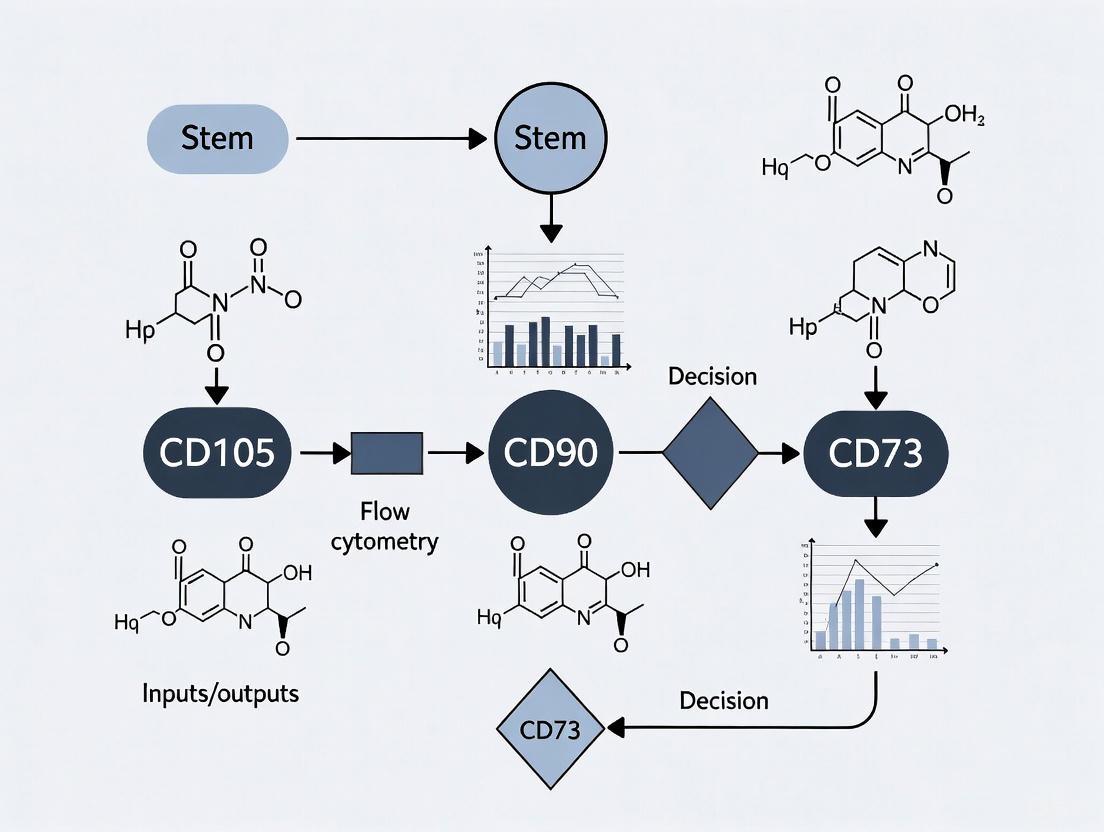
The following diagram illustrates the integrated experimental workflow for comprehensive MSC characterization according to ISCT criteria, encompassing cell isolation, expansion, and validation through multiparameter analysis.
The Scientist's Toolkit: Essential Research Reagents
Successful MSC characterization requires specific reagents and materials that ensure reproducibility and compliance with technical standards. The following table details essential research solutions for comprehensive MSC analysis.
Table 3: Essential Research Reagents for MSC Characterization
| Reagent Category | Specific Examples | Application Purpose | Technical Notes |
|---|---|---|---|
| Flow Cytometry Antibodies | CD73, CD90, CD105, CD45, CD34, CD14, CD19, HLA-DR | Immunophenotyping according to ISCT criteria | Use validated clones from commercial suppliers (e.g., BD Stemflow) with appropriate fluorochrome conjugates |
| Isotype Controls | Mouse IgG1, IgG2a, IgG2b | Background staining determination | Critical for establishing positive/negative thresholds in flow cytometry |
| Cell Separation Media | Ficoll-Paque PLUS | Density gradient isolation of mononuclear cells | Essential for primary isolation from bone marrow and other tissues |
| Culture Media | αMEM, DMEM/F12 | Basal media for MSC expansion | Typically supplemented with 10% FBS or human platelet lysate |
| Differentiation Kits | NH OsteoDiff, AdipoDiff, ChondroDiff media (Miltenyi Biotec) | Trilineage differentiation induction | Standardized formulations ensure reproducibility across experiments |
| Histological Stains | Alizarin Red, Oil Red O, Alcian Blue | Detection of differentiation outcomes | Validate staining with positive and negative control samples |
| Dissociation Reagents | Trypsin-EDTA, TrypLE, collagenase | Cell detachment and tissue digestion | Optimization required for different tissue sources and cell passages |
| Analysis Software | NovoExpress, FlowJo | Flow cytometry data analysis | Enable consistent gating strategies and population quantification |
Advanced Applications and Emerging Research
The standardized characterization of MSCs using ISCT criteria enables advanced research applications and reveals new dimensions of MSC biology with significant therapeutic implications.
Immunomodulatory Properties and Functional Assays
Beyond the minimal criteria, MSCs possess remarkable immunomodulatory capabilities that make them promising therapeutic agents for inflammatory and autoimmune conditions. These properties include suppression of T-cell proliferation, modulation of dendritic cell maturation, and promotion of regulatory T-cell differentiation [3]. Standardized functional assays to quantify these capabilities include:
- T-cell proliferation suppression assays: Co-culture of MSCs with CFSE-labeled peripheral blood mononuclear cells (PBMCs) stimulated with mitogens (e.g., phytohemagglutinin) and interleukin-2, with quantification of T-cell division cycles through CFSE dilution measured by flow cytometry [9].
- Immunophenotypic licensing: Pre-treatment of MSCs with interferon-γ to mimic inflammatory environments and enhance immunosuppressive capacity through increased indoleamine 2,3-dioxygenase expression [7].
Recent research demonstrates that nanotopographical culture surfaces can maintain MSC immunomodulatory capacity during expansion by modulating intracellular tension and metabolic programming, addressing a critical challenge in large-scale manufacturing for clinical applications [9].
Tissue-Specific Properties and Heterogeneity
The ISCT criteria establish a foundational framework that accommodates tissue-specific variations in MSC properties. Single-cell analyses have revealed functional heterogeneity within MSC populations, with distinct subpopulations exhibiting different differentiation potentials and secretory profiles [3]. For example, cranial bone marrow-derived MSCs demonstrate enhanced neurogenic potential compared to long bone-derived MSCs, expressing neural progenitor markers such as olig2 and nestin, and readily differentiating into GABAergic neuron-like cells under appropriate induction conditions [3].
Similarly, CD73-positive cells prospectively isolated from various tissues show distinct functional properties, with subcutaneous adipose-derived CD73+ cells exhibiting superior colony-forming capacity and therapeutic efficacy in models of pulmonary fibrosis compared to visceral fat-derived populations [5]. These findings highlight the importance of considering tissue ontogeny when selecting MSC sources for specific research or therapeutic applications.
The ISCT criteria for defining mesenchymal stromal cells provide an essential standardized framework that has significantly advanced the field of stem cell research. The triad of plastic adherence, specific surface marker expression (particularly CD105, CD90, and CD73), and trilineage differentiation capacity establishes a reproducible foundation for MSC identification and characterization. Flow cytometric analysis of these markers represents a critical methodological approach that enables consistent phenotyping across different laboratories and research applications.
As MSC research continues to evolve, the integration of standard ISCT criteria with emerging knowledge of tissue-specific properties, functional heterogeneity, and advanced functional assays will enhance our understanding of these versatile cells. The experimental protocols, reagent solutions, and analytical frameworks presented in this technical guide provide researchers with comprehensive tools for rigorous MSC characterization within the broader context of stem cell phenotyping and therapeutic development. Through continued refinement of characterization standards and adoption of robust methodologies, the field will advance toward more reproducible research and successful clinical translation of MSC-based therapies.
CD105, also known as endoglin, is a transmembrane glycoprotein that functions as a coreceptor in the transforming growth factor-β (TGF-β) signaling pathway. Highly expressed on proliferating endothelial cells and mesenchymal stromal cells (MSCs), CD105 plays a pivotal role in modulating angiogenesis, vascular development, and immune regulation. This technical review examines the molecular mechanisms of CD105 in balancing TGF-β/ALK1 and TGF-β/ALK5 signaling pathways, its interplay with VEGF signaling components, and implications for cancer biology and hereditary hemorrhagic telangiectasia. The content is framed within stem cell phenotyping research, highlighting CD105's crucial function alongside CD73 and CD90 as definitive MSC surface markers. Comprehensive experimental methodologies and research tools for investigating CD105 function are detailed to support scientific and drug development applications.
CD105 is a 180 kDa homodimeric transmembrane glycoprotein encoded by the ENG gene [10]. It functions as an auxiliary receptor for TGF-β family ligands and is highly expressed on vascular endothelial cells, activated macrophages, fibroblasts, and mesenchymal stromal cells [10] [11]. As an RGD-containing glycoprotein, CD105 can also interact with integrins, potentially influencing cell adhesion and migration [12]. In stem cell research, CD105 alongside CD73 and CD90 forms the minimal immunophenotypic criteria for defining human mesenchymal stromal cells as established by the International Society for Cellular Therapy [13] [14]. The structural organization of CD105 includes a large extracellular domain, a single transmembrane region, and a short cytoplasmic tail that lacks intrinsic enzymatic activity but contains residues that can be phosphorylated by TGF-β receptors [15] [11].
Molecular Functions and Signaling Pathways
Role in TGF-β Signaling
CD105 functions as a critical coreceptor in the TGF-β signaling pathway, predominantly expressed on endothelial cells. It exerts its function by modulating the balance between two distinct TGF-β type I receptors:
- ALK1 Signaling Pathway: CD105 promotes TGF-β/ALK1 signaling, which leads to phosphorylation of Smad1/5 and promotes endothelial cell proliferation and migration [15].
- ALK5 Signaling Pathway: CD105 inhibits TGF-β/ALK5 signaling, which normally activates Smad2/3 and inhibits endothelial cell growth [15].
This balance is physiologically critical, as demonstrated by the embryonic lethality observed in CD105-deficient mice due to defective angiogenesis and cardiovascular development [11]. The molecular mechanism involves CD105's ability to physically associate with signaling receptors in caveolae, where it interacts with endothelial nitric oxide synthase (eNOS) and modulates nitric oxide production, thereby influencing vascular tone [11].
Figure 1: CD105 modulates the balance between TGF-β/ALK1 and TGF-β/ALK5 signaling pathways. CD105 enhances ALK1-Smad1/5 signaling promoting proliferation while inhibiting ALK5-Smad2/3-mediated growth inhibition [15] [11].
Angiogenic Functions and VEGF Pathway Integration
Beyond TGF-β signaling, CD105 functionally integrates with VEGF-mediated angiogenic pathways through formation of a tripartite receptor complex with VEGFR2 and neuropilin-1 (NRP1) [16]. Recent research utilizing fluorescence recovery after photobleaching (FRAP) measurements demonstrates that CD105 forms stable complexes with both VEGFR2 and NRP1 at the endothelial cell surface, with these interactions significantly enhanced by VEGF-A stimulation [16]. In this complex, CD105 appears to bridge VEGFR2 and NRP1, augmenting their interaction and enhancing VEGF-A signaling potency [16]. This molecular cooperation explains the observed requirement for CD105 in optimal VEGF-A-mediated phosphorylation of VEGFR2 and Erk1/2, and subsequent endothelial sprouting angiogenesis [16].
The pro-angiogenic function of CD105 is further evidenced by its role in tumor biology. In renal cell carcinoma, tumor cell-expressed CD105 significantly contributes to tumor angiogenesis by enhancing recruitment of immunosuppressive cell types and potentiating VEGF-induced angiogenesis [10]. Inhibition of CD105 in angiosarcoma models promotes apoptosis and suppresses migration, invasion, and tube formation, confirming its critical role in vascular tumor biology [17].
Figure 2: CD105 forms a tripartite complex with VEGFR2 and NRP1 that enhances VEGF-A signaling and endothelial sprouting. CD105 bridges VEGFR2 and NRP1, stabilizing their interaction and increasing VEGF-A signaling potency [16].
CD105 in Disease Pathogenesis
Hereditary Hemorrhagic Telangiectasia (HHT)
Mutations in the ENG gene cause HHT type 1 (HHT1), an autosomal dominant vascular disorder characterized by arteriovenous malformations (AVMs), recurrent epistaxis, and gastrointestinal bleeding [12] [11]. The disease mechanism involves haploinsufficiency, where reduced CD105 protein levels (approximately 50% of normal) lead to impaired TGF-β/ALK1 signaling and defective vascular remodeling [11]. HHT1 patient cells demonstrate multiple vascular defects including:
- Impaired vascular tone due to disrupted eNOS regulation in caveolae [11]
- Defective vascular repair following ischemic injury [11]
- Abnormal angiogenesis with direct connections between arterioles and venules [12]
Notably, soluble endoglin (sEng), a circulating form of CD105 proteolytically released by MMP14, demonstrates context-dependent effects in HHT1 models. While generally anti-angiogenic, sEng treatment paradoxically decreases AVM number in CD105-deficient retinal angiogenesis models, suggesting potential therapeutic applications [12].
Cancer and Therapeutic Targeting
CD105 is highly expressed on tumor-associated vasculature and certain tumor cells, contributing to cancer progression through multiple mechanisms:
Table 1: CD105 Mechanisms in Cancer Pathogenesis
| Cancer Type | Expression Pattern | Functional Consequences | References |
|---|---|---|---|
| Renal Cell Carcinoma | Tumor cells and tumor-associated vasculature | Stem cell-like properties, immunosuppression, enhanced angiogenesis | [10] |
| Angiosarcoma | Overexpressed on tumor cells | Promotes migration, invasion, tube formation, Warburg effect | [17] |
| Various Solid Tumors | Tumor endothelial cells | Angiogenesis, metastasis, poor prognosis | [10] [11] |
In renal cell carcinoma, tumor cell-expressed CD105 sculpts the tumor microenvironment by enhancing recruitment of immunosuppressive cell types (MDSCs, TAMs) and inhibiting polyfunctionality of tumor-infiltrating CD4+ and CD8+ T cells [10]. In angiosarcoma, CD105 inhibition exerts antitumor effects primarily through regulation of non-Smad TGF-β signaling, reducing survivin levels, decreasing paxillin and VE-cadherin phosphorylation, and suppressing MMP2/9 activities [17].
Experimental Methods for CD105 Research
Flow Cytometry and Cell Characterization
For mesenchymal stromal cell identification, CD105 is typically characterized alongside CD73 and CD90 while lacking hematopoietic markers (CD34, CD45, CD14, CD19, HLA-DR) [13] [14]. Standard flow cytometry protocols include:
- Cell Preparation: Harvest subconfluent cells (≤80% confluence) using 0.25% trypsin [14]
- Antibody Staining: Incubate cell suspensions with fluorophore-conjugated monoclonal antibodies for 20 minutes in the dark [14]
- Analysis: Use conventional flow cytometer with appropriate compensation controls [13]
CD105 expression helps distinguish MSCs from fibroblasts, with differential expression patterns observed across tissue sources [14]. CD105-positive MSCs can be identified in cryopreserved umbilical cord tissue sections using RT-PCR, providing an alternative detection method [8].
Functional Assays
Table 2: Key Functional Assays for CD105 Research
| Assay Type | Methodology | Key Findings with CD105 | References |
|---|---|---|---|
| Colony Formation | Plate 10³ cells, culture 10 days, fix and stain | CD105 knockout reduces colony formation area | [10] |
| Transwell Migration | Seed 4×10⁴ cells in upper chamber, measure migration toward serum | CD105 deficiency decreases migrated cell area | [10] |
| Scratch Assay | Create gap in confluent monolayer, monitor closure | CD105 knockout reduces gap closure rate | [10] |
| Tube Formation | Plate cells on Matrigel, quantify tubular structures | CD105 promotes tube formation; soluble endoglin inhibits it | [10] [12] |
| Sprouting Assay | 3D endothelial culture measuring vascular sprouts | Optimal VEGF-A-induced sprouting requires CD105 and NRP1 | [16] |
Genetic Manipulation
CD105 Knockout Generation:
- Utilize pCas-Guide-EF1a-GFP vector targeting first exon of murine CD105 gene [10]
- Transfert semi-confluent cells, sort GFP-positive cells 48 hours post-transfection [10]
- Perform single-cell cloning to select successfully edited cells [10]
- Validate knockout by Western blot using anti-murine CD105 antibodies [10]
siRNA-Mediated Knockdown:
- Effective for studying CD105 function in endothelial cells [15]
- Validated using rescue experiments with human CD105 in mouse cells [15]
Research Reagent Solutions
Table 3: Essential Research Reagents for CD105 Investigation
| Reagent Category | Specific Examples | Research Applications | References |
|---|---|---|---|
| Antibodies for Flow Cytometry | CD105, CD73, CD90, CD44, CD34, CD45 | MSC characterization and phenotyping | [13] [14] |
| Cell Lines | Renca (murine RCC), HUVECs, MEECs (wild-type and ENG-null) | In vitro angiogenesis and signaling studies | [10] [12] [16] |
| Animal Models | Eng+/− mice (HHT1 model), syngeneic tumor models | In vivo vascular development and tumor studies | [10] [11] |
| Signaling Inhibitors | SB-431542 (ALK5 inhibitor), MEK1/2 inhibitors | Pathway modulation studies | [15] [16] |
| Detection Antibodies | Anti-phospho-Smad1/5, anti-phospho-Smad2/3, anti-pVEGFR2 | Signaling pathway analysis | [15] [16] |
Discussion and Research Implications
CD105 emerges as a multifaceted regulator of vascular biology, functioning at the intersection of TGF-β and VEGF signaling pathways. Its role in stem cell biology is particularly relevant for tissue engineering and regenerative medicine applications, where proper characterization of MSCs requires concurrent assessment of CD105, CD73, and CD90 [13] [14]. The formation of tripartite complexes between CD105, VEGFR2, and NRP1 provides a molecular mechanism for the observed synergy between these receptors in angiogenesis [16].
Therapeutic targeting of CD105 holds significant promise, particularly in angiogenic disorders and cancers with prominent vascular components. The effectiveness of CD105 inhibition in angiosarcoma through non-Smad pathways suggests alternative mechanisms beyond classical TGF-β signaling [17]. Similarly, the context-dependent effects of soluble endoglin in HHT models indicate complex regulation of vascular morphogenesis that might be therapeutically modulated [12].
Future research directions should focus on:
- Elucidating the structural basis of CD105 interactions in tripartite receptor complexes
- Developing tissue-specific targeting approaches for CD105 in pathological angiogenesis
- Exploring CD105's role in immunomodulation within the tumor microenvironment
- Establishing standardized protocols for CD105 detection in stem cell products
The integration of CD105 research across stem cell biology, vascular development, and cancer therapeutics continues to provide valuable insights with significant translational potential.
CD90, also known as Thy-1, is a 25-37 kDa glycosylphosphatidylinositol (GPI)-anchored glycoprotein characterized by a single immunoglobulin variable-like (Ig V-type) domain stabilized by a disulfide bond between Cys 28 and Cys 104 [18] [19]. As a GPI-anchored protein, CD90 lacks transmembrane and cytoplasmic domains but localizes to lipid raft microdomains on the cell surface, enabling its participation in signal transduction through interactions with other membrane proteins [18] [19]. The molecular mass of CD90 is significantly influenced by N-glycosylation, which accounts for approximately one-third of its total weight, with humans possessing two N-glycosylation sites and mice three [19]. First identified in mouse T lymphocytes in 1964, CD90 has since been recognized as a conserved protein from fish to mammals, with homologs even existing in some invertebrates [19].
CD90 demonstrates a diverse expression pattern across multiple cell types and tissues. It is expressed on various cell types including T cells, thymocytes, neurons, endothelial cells, fibroblasts, and mesenchymal stromal cells (MSCs) [18] [20]. In humans, CD90 mRNA is highly expressed in nervous and olfactory systems, and skin tissues [19]. Notably, CD90 serves as a defining marker for mesenchymal stromal cells (MSCs) according to the International Society for Cellular Therapy (ISCT) criteria, which require MSCs to express CD73, CD90, and CD105 while lacking expression of hematopoietic markers such as CD34, CD45, CD11a, CD19, and HLA-DR [20] [21]. Interestingly, CD90 expression varies between species—while it is present on mouse thymocytes and peripheral T cells, in humans it is found predominantly on endothelial cells and smooth muscle cells [19]. This differential expression highlights the importance of considering species-specific contexts when studying CD90 function.
Table 1: Key Structural Features of CD90/Thy-1
| Feature | Description |
|---|---|
| Protein Name | CD90/Thy-1 |
| Molecular Weight | 25-37 kDa (varies with glycosylation) |
| Protein Family | Immunoglobulin (Ig) superfamily |
| Domain Structure | Single V-type Ig domain |
| Membrane Anchor | Glycosylphosphatidylinositol (GPI) anchor |
| Key Structural Elements | Disulfide bond between Cys28-Cys104, N-glycosylation sites |
| Conserved Binding Motif | RLD (Arg-Leu-Asp) integrin-binding sequence |
Molecular Mechanisms of CD90 in Cellular Interactions
CD90 serves as a critical regulator of cell-cell and cell-matrix interactions through its ability to function as a bidirectional signaling molecule. Despite lacking intracellular domains, CD90 engages in both cis and trans interactions that activate diverse signaling pathways, ultimately influencing cellular adhesion, migration, and differentiation [22] [19]. The spatial orientation of these interactions—whether CD90 engages with partners on the same cell (cis) or opposing cells (trans)—can produce dramatically different cellular outcomes, highlighting the context-dependent nature of CD90 signaling [22].
Ligand Interactions and Signaling Partners
CD90 engages with several molecular partners, with integrins and syndecans representing the most well-characterized interactions. The interaction between CD90 and αvβ3 integrin is particularly significant, mediated through a conserved Arg-Gly-Asp (RGD)-like peptide sequence (specifically RLD in rodents) within the CD90 protein [23] [24]. This interaction triggers the formation of focal adhesions and stress fibers through tyrosine phosphorylation and RhoA activation [24]. In neuronal systems, Thy-1 on neurons binds to αvβ3 integrin on astrocytes in trans, stimulating increased astrocyte adhesion to the underlying surface [22]. Conversely, when the same ligand-receptor association occurs in cis on neurites, it triggers neurite retraction and inhibition of axonal growth [22]. CD90 also possesses a heparin-binding domain (HBD) that enables interaction with Syndecan-4, another important regulator of cell migration [23]. Additional reported ligands include αx/β2 integrin, CD90 itself (homophilic interaction), and CD97 [19].
Intracellular Signaling Pathways
Through its interactions with integrins and syndecans, CD90 activates multiple intracellular signaling cascades that regulate cellular behavior. These interactions facilitate the recruitment of signaling components to lipid rafts, where CD90 interacts with G inhibitory proteins, Src family kinase (SFK) members, and tubulin [19]. The downstream consequences include activation of focal adhesion kinase (FAK), Rho GTPases, and various kinases that influence cytoskeletal reorganization [23]. In mesenchymal cells, Thy-1-regulated adhesion and migration involve complex adhesome networks comprising hundreds of proteins organized into distinct functional nodes: ILK-PINCH-Kindlin, FAK-Paxillin, Talin-Vinculin, and α-actinin-Zyxin-VASP [23]. These protein complexes organize into three interconnected layers: the integrin signaling layer (ISL), the force transducing layer (FTL), and the actin regulatory layer (ARL), collectively mediating the mechanical linkage between the extracellular environment and the intracellular cytoskeleton [23].
Figure 1: CD90/Thy-1 Signaling Pathway and Molecular Interactions. CD90 engages with integrins and syndecans to activate intracellular signaling cascades that regulate adhesome formation and cytoskeletal reorganization.
CD90 in Stem Cell Biology and Differentiation
Within stem cell populations, particularly mesenchymal stromal cells (MSCs), CD90 serves as both a surface marker and a functional regulator of stemness and differentiation potential. The International Society for Cellular Therapy (ISCT) includes CD90 among the minimal criteria for defining human MSCs, with studies reporting its expression in 75.0% of MSC-related research [20] [21]. Beyond its utility as a identification marker, CD90 plays an active role in maintaining the undifferentiated state of MSCs and controlling their commitment to specific lineages.
CD90 as a Regulator of MSC Differentiation
Evidence indicates that CD90 expression levels inversely correlate with differentiation status in MSCs. A 2016 study demonstrated that reducing CD90 expression through shRNA-mediated knockdown enhanced both osteogenic and adipogenic differentiation of MSCs in vitro [20]. Interestingly, this enhanced differentiation capacity was accompanied by decreased expression of other surface markers, including CD44 and CD166 [20]. These findings suggest that CD90 acts as a obstacle in the pathway of differentiation commitment, which may be overcome in the presence of appropriate differentiation stimuli [20]. The manipulation of CD90 levels may therefore represent a strategy to improve in vitro differentiation efficiency for regenerative medicine applications. The persistence of CD90 expression in MSCs across various tissue sources—including dental pulp, adipose tissue, and amniotic fluid—further underscores its fundamental role in MSC biology [20].
CD90 in Myogenic Differentiation
Recent single-cell RNA sequencing analyses have revealed that CD90 identifies subpopulations with enhanced differentiation potential within heterogeneous cell populations. In human urine-derived cells (UDCs), CD90 was highly expressed in a limited subpopulation with high myogenic potency [25]. When transduced with MYOD1 (a master regulator of myogenesis), CD90-positive UDCs demonstrated significantly enhanced ability to form multinucleated myotubes expressing high levels of myosin heavy chain and dystrophin compared to CD90-negative cells [25]. Notably, CD90 suppression in CD90-positive UDCs led to decreased myotube formation and reduced myosin heavy chain expression, while overexpression of CD90 in CD90-negative cells did not enhance differentiation [25]. This suggests that CD90 contributes to the fusion of single-nucleated cells into myotubes but is not sufficient to initiate the myogenic program independently. Further analysis revealed that CD90-positive cells expressed higher levels of fusion-related genes, including Myomaker (MYMK) and Myomixer (MYMX), providing a potential mechanism for the observed functional differences [25].
Table 2: CD90/Thy-1 in Stem Cell Differentiation
| Cell Type | Role of CD90 | Experimental Evidence | Reference |
|---|---|---|---|
| Mesenchymal Stromal Cells (MSCs) | Maintains undifferentiated state; inhibits premature differentiation | CD90 knockdown enhanced osteogenic and adipogenic differentiation | [20] |
| Urine-Derived Cells (UDCs) | Marks subpopulation with high myogenic potential; promotes cell fusion | CD90+ UDCs showed enhanced myotube formation after MYOD1 transduction | [25] |
| Various Tissue-Specific Stem Cells | Stemness marker for hematopoietic, hepatic, and keratinocyte stem cells | Used in combination with other markers to isolate stem cell populations | [19] |
CD90 in Disease Pathogenesis and Tissue Remodeling
CD90 plays significant and context-dependent roles in various pathological processes, including fibrosis, cancer, and neurological disorders. The multifaceted functions of CD90 in these conditions reflect its diverse expression patterns and ability to engage different signaling pathways in various tissue environments.
Fibrotic Disorders
In fibrotic conditions, CD90 expression correlates with disease severity but exhibits organ-specific effects. In systemic sclerosis (scleroderma), skin biopsies demonstrate markedly elevated Thy-1 expression compared to controls, localized primarily to the deep dermis and colocalized with fibroblast activation protein (FAP) [26]. This increased expression correlates with the severity of skin involvement as measured by modified Rodnan skin score (r = 0.63, P < 0.0001) [26]. Remarkably, while Thy-1 deficiency exacerbates lung fibrosis, it attenuates skin fibrosis in both bleomycin and tight skin-1 murine models [26]. Thy-1 knockout mice exposed to bleomycin demonstrated reduced dermal thickness and decreased expression of fibrogenic genes including collagen (Col1a1 and Col5a2), α-SMA, and PAI-1 compared to wild-type mice [26]. Similarly, in the Tsk-1 genetic model of fibrosis, Thy-1 deficiency protected against cutaneous fibrosis [26]. Thy-1 regulates multiple pathogenic pathways in fibrosis, including inflammation, myofibroblast differentiation, and apoptosis, positioning it as both a biomarker and potential therapeutic target [26].
Cancer Progression and Metastasis
CD90 expression has been documented in various cancer types, including liver, brain, kidney, and pancreatic tumors, where it often marks cancer stem cell (CSC) populations [19]. The functional consequences of CD90 expression in cancer appear to be context-dependent, influencing multiple aspects of tumor progression. Studies in glioma/glioblastoma multiforme (GBM) have identified CD90 as a marker for GBM stem cells (GSCs), with expression also observed in GBM-associated stromal cells and mesenchymal stem cell-like pericytes, reflecting tumor heterogeneity [19]. Functional investigations using CRISPR-Cas9-mediated CD90 knockout in multiple cancer cell lines (A549, HGC27, and PANC1) demonstrated that CD90 promotes cell migration, invasion, and colony-forming abilities [27]. CD90+ cells exhibited significantly enhanced migration in Boyden chamber assays, faster scratch wound closure, and increased Matrigel invasion compared to CD90- cells [27]. Microarray analysis following CD90 knockout identified six downregulated genes, including TGF-β2, suggesting potential mediators of CD90's functional effects in cancer [27].
Experimental Approaches and Research Methodologies
The investigation of CD90 function employs diverse methodological approaches, from genetic manipulation to advanced imaging techniques. This section details key experimental protocols and reagents used to study CD90 in biological systems.
Genetic Manipulation of CD90 Expression
RNA interference and CRISPR-Cas9 represent two primary approaches for manipulating CD90 expression in experimental systems. Lentiviral transduction with CD90-targeted shRNA has been successfully used to achieve stable CD90 knockdown in MSCs [20]. Typical protocols involve transducing cells at 60% confluence with lentiviral particles at a multiplicity of infection (MOI) of 10 in the presence of 8 μg/ml Polybrene, followed by selection with 5 μg/ml Puromycin for 10 days to establish stable knockdown cells [20]. Knockdown efficiency can be verified by quantitative real-time PCR using specific primers (e.g., forward: CACCCTCTCCGCACACCT; reverse: CCCCACCATCCCACTACC) and flow cytometric analysis [20]. Alternatively, CRISPR-Cas9 systems enable complete CD90 knockout, as demonstrated in cancer cell lines [27]. Following successful knockout, functional assays including Boyden chamber migration, scratch wound healing, Matrigel invasion, and soft agar colony formation can be performed to assess phenotypic consequences [27].
Analytical and Imaging Techniques
Flow cytometry represents the primary method for assessing CD90 expression in cell populations, particularly for stem cell characterization according to ISCT criteria [20] [21]. Standard protocols involve lifting cells using enzymes such as TrypLE, incubating with anti-CD90 antibodies (typically CD90-APC or CD90-FITC conjugates) for 30 minutes in the dark, and analysis using instruments such as the FACSVERSE system with data processing software like FlowJo [20]. For histological assessment, immunofluorescence staining of tissue sections (e.g., skin biopsies) enables visualization of CD90 expression and localization, with quantification possible through image analysis software [26]. In vivo imaging approaches have been developed using Thy-1 yellow fluorescent protein (YFP) reporter mice, where YFP fluorescence intensity measured by IVIS imaging correlates with fibrotic severity (Spearman r = 0.76, P = 0.006 for dermal thickness) [26]. This non-invasive method permits longitudinal tracking of Thy-1 expression during disease progression.
Figure 2: Experimental Workflow for CD90 Functional Analysis. Comprehensive approach combining genetic manipulation, expression analysis, and functional assays to elucidate CD90 biology.
Table 3: Essential Research Reagents for CD90 Investigation
| Reagent Category | Specific Examples | Application/Function | Reference |
|---|---|---|---|
| CD90 Antibodies | CD90-APC, CD90-FITC, anti-CD90 magnetic beads | Flow cytometry, immunostaining, cell separation | [20] [25] |
| Genetic Manipulation Tools | CD90-shRNA lentiviral vectors, CRISPR-Cas9 constructs | CD90 knockdown/knockout | [20] [27] |
| Cell Separation Reagents | Anti-CD90-coupled magnetic beads (Miltenyi Biotec) | Isolation of CD90+ and CD90- cell populations | [20] |
| Detection Primers | Forward: CACCCTCTCCGCACACCTReverse: CCCCACCATCCCACTACC | CD90 mRNA quantification by qRT-PCR | [20] |
| In Vivo Reporters | Thy-1 YFP reporter mice | Longitudinal tracking of Thy-1 expression | [26] |
CD90/Thy-1 emerges as a multifaceted regulator of cell-cell and cell-matrix interactions with significant roles in stem cell biology, tissue homeostasis, and disease pathogenesis. Its function as a GPI-anchored protein enables diverse signaling capabilities through interactions with integrins, syndecans, and other cell surface receptors, influencing cellular adhesion, migration, and differentiation in a context-dependent manner. In stem cell research, particularly concerning MSC characterization through flow cytometric analysis of CD105, CD90, and CD73, CD90 serves not only as a defining surface marker but also as an active regulator of differentiation potential. The experimental approaches detailed herein—from genetic manipulation to functional assays—provide robust methodologies for further elucidating CD90 mechanisms across biological systems. As research continues to unravel the complexities of CD90 signaling, particularly its organ-specific effects in pathological processes such as fibrosis and cancer, this molecule presents promising opportunities as both a biomarker and therapeutic target in regenerative medicine and disease treatment.
Ecto-5'-nucleotidase (CD73) is a glycosylphosphatidylinositol (GPI)-anchored cell surface enzyme that functions as a pivotal regulator of purinergic signaling by catalyzing the conversion of extracellular adenosine monophosphate (AMP) to adenosine. As a key immunomodulatory enzyme, CD73's activity shapes the immunological landscape in multiple physiological and pathological contexts, including cancer, autoimmune diseases, and tissue repair. Within the field of stem cell phenotyping, CD73, alongside CD105 and CD90, serves as a fundamental surface marker for identifying and isolating mesenchymal stromal cells (MSCs). This whitepaper provides a comprehensive technical analysis of CD73's biology, detailing its molecular structure, enzymatic function, and role in immunomodulation, with a specific focus on its critical implications for MSC research and therapeutic development. Experimental protocols for assessing CD73 activity and inhibitor screening are presented to standardize research methodologies for scientists and drug development professionals.
Purinergic signaling is a fundamental mechanism used by all cells to control their internal activities and interact with the environment [28]. As an integral component of this system, CD73 catalyzes the final step in the extracellular metabolism of adenosine triphosphate (ATP) to form adenosine, thus acting as a crucial switch between pro-inflammatory and anti-inflammatory signals [28]. The sequential hydrolysis of ATP involves ecto-nucleoside triphosphate diphosphohydrolase 1 (ENTPD1/CD39), which generates AMP from ATP, followed by CD73, which primarily hydrolyzes AMP to adenosine [28]. CD73 is ubiquitously expressed, with highest levels found in smooth muscle, the female reproductive system, liver, and gastrointestinal tract [28]. Beyond its enzymatic function, CD73 also operates as a signaling receptor for extracellular matrix proteins, influencing cell adhesion and migration [29]. In the context of stem cell research, CD73 has emerged as a definitive surface antigen for identifying and characterizing mesenchymal stromal cells, where it serves not only as a phenotypic marker but also as a critical functional mediator of their immunomodulatory and therapeutic potentials [30] [5] [31].
Molecular Structure and Enzymatic Mechanism
Structural Characteristics
CD73 is a homodimeric glycoprotein with each monomer consisting of 576 amino acid residues [29]. The functional enzyme is tethered to the outer leaflet of the plasma membrane via a glycosylphosphatidylinositol (GPI) anchor [29] [32]. Each monomer contains two zinc ions (Zn²⁺) coordinated in the N-terminal domain that are essential for catalytic activity, while the C-terminal domain provides the binding site for AMP [29]. The enzyme undergoes a significant conformational transition between open and closed states during its catalytic cycle, which is essential for its function [32]. CD73 exists in several tissue-specific glycoforms with molecular weights ranging from 60-80 kDa, differing in their sensitivity to lectins [29].
Table 1: Key Structural Features of CD73
| Feature | Description | Functional Significance |
|---|---|---|
| Quaternary Structure | Homodimer, non-covalently linked | Required for enzymatic activity [29] |
| Membrane Attachment | GPI-anchor | Localizes enzyme to extracellular space; can be shed by phospholipases [29] [32] |
| Cofactors | Two Zn²⁺ ions per monomer | Essential for catalytic activity [29] |
| Glycosylation | 4-5 N-glycosylation sites (species-dependent) | Affects molecular weight and lectin sensitivity [29] |
| Conformational States | Open and closed states | Required for substrate hydrolysis [32] |
Catalytic Mechanism and Pathway
CD73 efficiently dephosphorylates several ribo- and deoxyribonucleoside 5'-monophosphates, with AMP being its most efficiently hydrolyzed substrate [29]. The enzyme's activity is competitively inhibited by adenosine diphosphate (ADP) and its analog, α,β-methylene ADP (APCP), which is the most potent CD73 inhibitor known to date [29]. The catalytic function of CD73 represents the terminal step in the purinergic signaling cascade, converting the pro-inflammatory extracellular ATP into anti-inflammatory adenosine.
Figure 1: CD73 in the Purinergic Signaling Pathway. CD73 catalyzes the final step in the conversion of pro-inflammatory ATP to anti-inflammatory adenosine.
CD73 as a Critical Immunomodulator
Adenosine-Mediated Immunosuppression
CD73-generated adenosine serves as a potent immunosuppressive mediator primarily through the activation of four G-protein coupled adenosine receptors (A₁R, A₂AR, A₂BR, and A₃R) expressed on various immune cells [28]. The A₂A receptor (A₂AR) has the highest affinity for adenosine and plays a predominant role in mediating immunoregulatory effects [28]. Adenosine signaling through A₂AR and A₂BR inhibits effector T cell proliferation and cytotoxic function [28], enhances regulatory T cell (Treg) expansion and immunosuppressive activity [28], inhibits natural killer (NK) cell maturation and target cell killing [28], and facilitates expansion of myeloid-derived suppressor cells (MDSCs) [28].
In the tumor microenvironment, persistent hypoxia and inflammation boost these immunosuppressive responses by elevating extracellular adenosine through modulation of adenosine-related genes [28]. This CD73-mediated immunosuppression has become a validated therapeutic target in oncology, with multiple CD73-targeting antibodies and small-molecule inhibitors undergoing clinical development [28] [32].
Non-Enzymatic Functions
Beyond its enzymatic activity, evidence indicates that CD73 also functions non-enzymatically to regulate T-cell receptor activation, immune-endothelial interactions, apoptosis, and intracellular kinase signaling [28]. Additionally, CD73 acts as an adhesion molecule by binding to extracellular matrix components, including fibronectin, laminin, and tenascin C, thereby influencing cell migration and adhesion [29]. This dual functionality positions CD73 as a multimodal regulator of cellular interactions in both physiological and pathological contexts.
CD73 in Stem Cell Biology and Phenotyping
CD73 as a Definitive MSC Marker
In stem cell phenotyping, CD73 is established as one of the critical surface markers, alongside CD105 and CD90, for identifying and characterizing mesenchymal stromal cells according to the International Society for Cellular Therapy (ISCT) guidelines [30]. The co-expression pattern of CD73, CD90, and CD104 with concurrent absence of hematopoietic markers (CD34, CD45) defines the MSC population [30] [5]. Research demonstrates that prospective isolation of MSCs using CD73 antibody enables purification of high-quality MSCs without requiring long-term culture and passaging [5].
Table 2: CD73 Expression in MSCs from Different Tissue Sources
| Tissue Source | CD73+ Population (%) | Functional Characteristics |
|---|---|---|
| Subcutaneous Fat | 14.87 ± 3.09% | Highest colony-forming ability; strong CD44/CD90 expression [5] |
| Visceral Fat | 2.04 ± 0.46% | Moderate colony-forming capacity [5] |
| Amnion | High (exact % not specified) | Predominantly non-adherent cells [5] |
| Chorion | Variable | Distinct from amnion in colony-forming rate [5] |
| Bone Marrow | Low (exact % not specified) | Requires invasive collection procedure [5] |
Functional Significance of CD73 in MSCs
The CD73-positive MSC subpopulation exhibits enhanced therapeutic potential compared to CD73-negative counterparts. In adipose-derived MSCs (AD-MSCs), the CD73+ subgroup demonstrates superior capacity to promote angiogenesis and cardiac recovery in a rat model of myocardial infarction [31]. Transplantation of CD73+ AD-MSCs resulted in increased secretion of pro-angiogenic factors VEGF, SDF-1α, and HGF, highlighting the critical functional role of CD73 beyond mere phenotypic marking [31].
Furthermore, CD73 activity on endometrial regenerative cells (ERCs), a type of mesenchymal-like stromal cell, has been shown to be critical for their therapeutic efficacy in treating Concanavalin A-induced hepatitis [33]. CD73 on ERCs metabolizes AMP to adenosine, inhibiting the activation and function of conventional CD4+ T cells in vitro and attenuating liver damage in vivo [33]. Deletion of CD73 significantly impaired these immunomodulatory effects both locally and systemically [33].
Experimental Assessment of CD73 Activity
Pharmacological Inhibition Assays
The investigation of CD73 function typically employs specific pharmacological inhibitors and molecular tools, each with distinct mechanisms of action:
- α,β-methylene ADP (APCP): A potent competitive inhibitor that targets the catalytic activity of CD73 by mimicking the substrate AMP [29].
- Polyclonal anti-CD73 antibodies: Bind to internal epitopes of CD73, masking surface exposure and potentially inducing shedding of CD73 molecules from the membrane [29].
- Small interfering RNA (siRNA): Silences NT5E gene expression, reducing both protein levels and enzymatic activity [29].
- Allosteric inhibitors: Novel compounds targeting the dimerization interface of CD73, impairing the large dynamic motions required for enzymatic function [32]. These non-competitive inhibitors have demonstrated inhibition constants in the low micromolar range [32].
Enzymatic Activity Measurement Protocol
Phosphate Assay for AMPase Activity [33]
- Cell Preparation: Harvest and transfer 5 × 10⁴ cells per well into a 96-well plate.
- Washing: Discard culture medium and wash plates three times with saline.
- Reaction Initiation: Add 200 μL of AMP (100 μM)-containing saline to each well.
- Incubation: Incubate at 37°C for time intervals (e.g., 10, 30, 60, 120, and 180 minutes).
- Colorimetric Detection: Add 50 μL of PiColorLock reagent mix to the culture supernatant.
- Stabilization: After 5 minutes, add 20 μL of Stabilizer and mix.
- Measurement: Following 30 minutes of incubation, measure absorbance at 635 nm using a microplate reader.
This protocol allows quantitative assessment of CD73 enzymatic activity by monitoring phosphate release from AMP hydrolysis. For extracellular vesicle preparations, it is important to note that CD73 activity may be detergent-resistant and not always correlate with immunomodulatory capabilities [34].
Figure 2: CD73 Enzymatic Activity Assay Workflow. Protocol for measuring AMPase activity via phosphate release.
Research Reagent Solutions
Table 3: Essential Research Tools for CD73 Investigation
| Reagent/Category | Specific Examples | Function/Application |
|---|---|---|
| Pharmacological Inhibitors | α,β-methylene ADP (APCP) | Competitive inhibition of catalytic activity [29] |
| Allosteric inhibitors (e.g., compounds targeting dimer interface) | Non-competitive inhibition; impairs enzyme dynamics [32] | |
| Molecular Biology Tools | CD73-specific siRNA | Silencing NT5E gene expression [29] |
| CRISPR-Cas9 knockout constructs | Generation of CD73-deficient cell lines [33] | |
| Antibodies for Detection | Anti-CD73 flow cytometry antibodies | MSC phenotyping and isolation [30] [5] |
| Anti-CD73 Western blot antibodies | Protein expression analysis [33] | |
| Activity Assay Kits | Phosphate Assay Kit (e.g., PiColorLock) | Quantitative measurement of AMPase activity [33] |
| Enzyme Sources | Recombinant CD73 | Biochemical characterization and inhibitor screening [32] |
| MSC-derived extracellular vesicles | Studying CD73 in paracrine signaling [34] |
CD73 stands at the intersection of purinergic signaling and immunoregulation, serving both as a critical enzymatic converter of AMP to adenosine and as a definitive phenotypic marker for mesenchymal stromal cells. Its dual functions—both enzymatic and non-enzymatic—enable it to shape immunological responses across various physiological and pathological contexts. In stem cell research, the expression and activity of CD73 not only facilitates the identification and isolation of MSC populations but also significantly contributes to their therapeutic mechanisms, particularly in modulating immune responses and promoting tissue repair. The ongoing development of CD73-targeted therapeutics, including inhibitory antibodies and small molecules, highlights its importance as a clinical target, especially in oncology. Standardized experimental approaches for assessing CD73 activity and inhibition, as outlined in this technical guide, will facilitate more consistent and comparable research outcomes across studies, ultimately advancing both basic science and clinical applications in this rapidly evolving field.
The identification and purification of mesenchymal stem cells (MSCs) expanded in culture for therapeutic use is crucial for improved yield and optimal clinical results [35]. A fundamental challenge in MSC research lies in definitively characterizing these cells, as there is no single unique marker for their identification [36] [4]. Instead, the scientific community relies on a combination of positive and negative markers established by the International Society for Cellular Therapy (ISCT) to define human MSCs [36]. Within this panel, negative markers—those that must be absent—play an indispensable role in ensuring cell purity by conclusively excluding hematopoietic lineage cells from MSC populations [36]. This technical guide provides an in-depth examination of the core negative markers CD34, CD45, CD11b, and CD19, detailing their biological functions, experimental protocols for their detection, and their critical importance in authenticating pure MSC cultures for research and clinical applications.
The ISCT Minimal Criteria and Hematopoietic Exclusion
The ISCT minimal criteria define MSCs by three key characteristics: adherence to plastic, specific differentiation potential, and a defined immunophenotype [36]. This immunophenotype mandates that ≥95% of the MSC population must express CD105, CD73, and CD90, while ≤2% of the population may express a specific set of negative markers used to exclude hematopoietic cells [36] [37]. The negative markers function as a critical quality control check, ensuring that the isolated population is not contaminated with cells from the hematopoietic lineage, which would confound experimental results and pose significant risks in therapeutic contexts [35].
The following table summarizes the primary negative markers and the hematopoietic cell types they help exclude:
Table 1: Core Negative Markers for Human MSC Characterization
| Marker | Primary Function/Biological Role | Hematopoietic Cell Types Excluded | ISCT Status |
|---|---|---|---|
| CD34 | Cell-cell adhesion; expressed on primitive hematopoietic progenitors and endothelial cells [36] | Hematopoietic stem and progenitor cells, endothelial cells [36] [4] | Negative [36] [37] |
| CD45 | Tyrosine phosphatase; critical regulator of T- and B-cell receptor signaling [36] | All nucleated hematopoietic cells (pan-leukocyte marker) including T cells, B cells, NK cells, monocytes, granulocytes [36] [4] | Negative [36] [37] |
| CD11b (or CD14) | Integrin alpha M chain; part of MAC-1 receptor involved in adhesion, migration, and phagocytosis [36] | Monocytes, macrophages, granulocytes, natural killer cells [36] [37] | Negative [36] |
| CD19 (or CD79a) | Component of the B-cell co-receptor complex; essential for B-cell development and activation [36] | B cells and their precursors [36] [37] | Negative [36] [37] |
Detailed Characterization of Negative Markers
CD34: A Disputed Marker
CD34 is a cell-surface glycoprotein that functions in cell-cell adhesion and is highly expressed on primitive hematopoietic progenitors and endothelial cells [36]. Its status as a negative marker is a subject of ongoing discussion, as its expression appears to be context-dependent [36] [4]. While the ISCT lists CD34 as a negative marker, some reports suggest that the CD34-negative status may be an artifact of cell culture conditions [36]. Several research groups have demonstrated that MSCs isolated from adipose tissue express CD34 at the time of isolation but lose this expression during in vitro culture [36]. This is supported by the fact that the STRO-1 antibody, commonly used to identify MSCs, was developed using CD34+ bone marrow as the immunogen [36]. Therefore, while CD34 is a valuable marker for excluding hematopoietic stem cells from bone marrow-derived MSC preparations, researchers should be aware of its potential expression in native, non-cultured MSCs from certain tissue sources.
CD45: The Pan-Leukocyte Marker
CD45, also known as the leukocyte common antigen (LCA), is a tyrosine phosphatase expressed on all nucleated hematopoietic cells, including lymphocytes, monocytes, and granulocytes [36] [4]. It is absolutely critical for signaling through T- and B-cell receptors [36]. The consistent and high-level expression of CD45 across the hematopoietic lineage makes it one of the most reliable and crucial negative markers for verifying that an MSC culture is free of leukocyte contamination [4]. A pure MSC population should demonstrate ≤2% positivity for CD45, ensuring the absence of virtually all types of hematopoietic cells [36].
CD11b and CD14: Excluding the Myeloid Lineage
CD11b (Integrin alpha M) and CD14 are used to exclude cells of the myeloid lineage, specifically monocytes and macrophages [36]. CD11b forms part of the MAC-1 receptor and is involved in adhesion and phagocytosis, while CD14 acts as a co-receptor for bacterial lipopolysaccharide [36]. The ISCT criteria allow for the use of either CD11b or CD14 as a negative marker for this purpose [36]. Their absence in a pure MSC culture helps confirm the lack of monocytic and granulocytic contamination, which is particularly important when MSCs are isolated from tissue sources rich in these cell types, such as bone marrow or adipose tissue [35].
CD19 and CD79a: Ensuring B-Cell Absence
CD19 and CD79a are specific markers for the B-cell lineage. CD19 is a component of the B-cell co-receptor complex and is essential for B-cell development and activation, while CD79a is part of the B-cell antigen receptor complex [36]. The ISCT criteria specify that either CD19 or CD79a can be used as a negative marker to confirm the absence of B lymphocytes in an MSC culture [36] [37]. This exclusion is vital for ensuring the immunophenotypic purity of MSCs, particularly in applications where the immunomodulatory properties of MSCs are being studied, as the presence of B cells could significantly alter experimental outcomes.
Experimental Protocols for Flow Cytometric Analysis
Sample Preparation and Staining Protocol
The following detailed protocol for flow cytometric analysis of MSC surface markers is adapted from established methodologies in the literature [35]. This procedure ensures reliable detection of both positive and negative markers.
- Cell Preparation: Use subconfluent cells (≤80% confluence) at Passage 3 or later. Harvest cells using 0.25% trypsin or a non-enzymatic cell dissociation agent like TrypLE [35] [20].
- Washing: Centrifuge the harvested cells at 350-400 x g for 5-7 minutes and discard the supernatant. Resuspend the cell pellet in PBS containing 1% Penicillin/Streptomycin or a flow cytometry buffer (PBS with 2% FBS) to block non-specific binding [35] [20].
- Antibody Staining: Aliquot cells into staining tubes. Add fluorophore-conjugated monoclonal antibodies in pre-optimated combinations. Use the manufacturer's recommended quantities. Include isotype controls for every fluorochrome used to set appropriate gating boundaries and identify non-specific binding [35] [20].
- Incubation: Incubate the cell-antibody mixtures for 20-30 minutes in the dark at 4°C [35] [20].
- Final Wash: Centrifuge the cells at 350 x g for 5 minutes, discard the supernatant containing unbound antibody, and resuspend the cells in PBS or flow buffer [35].
- Analysis: Analyze the stained cells using a flow cytometer. A minimum of ≥95% of the MSC population should express CD73, CD90, and CD105, while ≤2% should express the negative markers CD34, CD45, CD11b/CD14, and CD19/CD79a to meet ISCT criteria [36].
Workflow Visualization
The following diagram illustrates the key steps and decision points in the MSC validation process via flow cytometry:
The Scientist's Toolkit: Essential Research Reagents
Successful MSC characterization depends on high-quality, well-validated reagents. The following table lists essential materials and their functions for flow cytometric analysis of MSC negative markers.
Table 2: Essential Research Reagents for MSC Characterization by Flow Cytometry
| Reagent/Category | Specific Examples | Function/Application | Technical Notes |
|---|---|---|---|
| Fluorophore-Conjugated Antibodies | Anti-CD34-PE, Anti-CD45-PerCP-Cy5.5, Anti-CD11b-FITC, Anti-CD19-PE [35] [20] | Detection of specific cell surface antigens via flow cytometry | Use pre-titered, directly conjugated antibodies from reputable suppliers [35]. |
| Isotype Controls | Mouse IgG1-FITC, IgG1-PE, IgG1-APC [20] | Differentiate specific antibody binding from non-specific background staining | Critical for setting correct positive/negative gates [20]. |
| Cell Preparation Reagents | TrypLE Select Enzyme, PBS, Fetal Bovine Serum (FBS) [35] [20] | Cell harvesting, washing, and blocking non-specific binding | Use FBS in buffer to reduce background staining [20]. |
| Specialized Kits | Human Mesenchymal Stem Cell Flow Cytometry Kit [37] | Provides a pre-optimized panel of antibodies for streamlined MSC verification | Ideal for standardized verification and quality control [37]. |
Data Interpretation and Common Challenges
Quantitative Marker Expression Profiles
The expression profiles of key markers across different MSC tissue sources can vary. The following table synthesizes quantitative data from multiple studies to provide a comparative overview:
Table 3: Marker Expression Profiles in MSCs from Different Tissue Sources
| Marker | Bone Marrow MSCs | Adipose Tissue MSCs | Wharton's Jelly MSCs | Placental MSCs |
|---|---|---|---|---|
| CD34 | ≤2% [36] [4] | ≤2% (after culture) [36] | ≤2% [4] | ≤2% [4] |
| CD45 | ≤2% [36] [4] | ≤2% [4] | ≤2% [4] | ≤2% [4] |
| CD11b/CD14 | ≤2% [36] [4] | ≤2% [4] | ≤2% [35] | ≤2% [35] |
| CD19/CD79a | ≤2% [36] [37] | ≤2% [35] [37] | ≤2% [37] | ≤2% [37] |
| CD105 | ≥95% [36] | ≥95% [35] [36] | ≥95% [35] | ≥95% [35] |
| CD90 | ≥95% [36] [20] | ≥95% [36] [20] | ≥95% [36] | ≥95% [36] |
| CD73 | ≥95% [36] | ≥95% [36] | ≥95% [36] | ≥95% [36] |
Addressing Heterogeneity and Contamination
A primary challenge in MSC research is distinguishing MSCs from fibroblasts, which share similar morphology and plastic-adherence properties [35]. While negative markers exclude hematopoietic cells, they do not differentiate MSCs from fibroblasts. Recent research indicates that markers like CD106, CD146, and CD271 are expressed at significantly higher levels in MSCs compared to fibroblasts and may be useful for this discrimination [35]. Furthermore, the expression of some negative markers can be influenced by culture conditions and passage number. For instance, CD34 expression in adipose-derived MSCs is lost in culture, and HLA-DR, typically a negative marker, can be induced by cytokine stimulation [36]. These nuances highlight the importance of using the ISCT criteria as a flexible framework rather than an absolute standard and of reporting experimental conditions in detail to ensure reproducibility.
The rigorous application of negative marker analysis for CD34, CD45, CD11b, and CD19 is a non-negotiable component of MSC characterization. These markers provide the essential gatekeeping function of excluding hematopoietic lineage cells, thereby ensuring the phenotypic purity of MSC populations used in both basic research and clinical applications. As the field advances towards more precise therapeutic uses, adherence to these standardized characterization protocols, complemented by an understanding of their limitations and contextual nuances, will be paramount in generating reliable, reproducible, and clinically relevant data on mesenchymal stem cell biology.
Cadherin-11 (CDH-11), also known as OB-cadherin, has emerged as a critical regulator of mesenchymal stem cell (MSC) function beyond its classical role in cell-cell adhesion. This technical review examines CDH-11's dual utility as a screening marker for MSC identification and a mechanistic regulator of cellular migration. We synthesize evidence from recent studies demonstrating CDH-11's necessity in smooth muscle differentiation from MSCs through TGF-β receptor II-dependent pathways and its role in directing MSC migration through RhoA-mediated signaling and focal adhesion dynamics. The compiled data position CDH-11 as a functionally relevant biomarker that complements standard MSC surface markers (CD73, CD90, CD105) by providing direct links to cellular behavior and differentiation potential. This review provides detailed methodologies for investigating CDH-11 expression and function, along with essential reagent resources to facilitate standardized research applications in stem cell characterization and therapeutic development.
Cadherin-11 is a calcium-dependent cell-cell adhesion molecule classified as a type II classical cadherin that has gained significant attention in stem cell research. While initially identified in osteoblasts, CDH-11 is broadly expressed in mesenchymal cells and tissues [38]. In the context of MSCs, CDH-11 has been demonstrated to regulate two fundamental processes: lineage specification and cellular migration. Unlike the standard MSC surface markers (CD73, CD90, CD105) which primarily serve identification purposes, CDH-11 appears to play direct mechanistic roles in determining MSC fate and behavior through its signaling functions [39].
CDH-11's expression correlates strongly with the mesenchymal phenotype, appearing during epithelial-to-mesenchymal transition (EMT) when E-cadherin is repressed [38]. This expression pattern positions CDH-11 as both a marker and regulator of mesenchymal identity. Recent research has revealed that CDH-11 engages in unique cellular activities distinct from other classical cadherins, including localization to focal adhesions and modulation of cell-matrix interactions [40]. These findings significantly expand CDH-11's potential applications in MSC research beyond mere phenotypic characterization toward functional assessment of MSC potency and migratory capacity.
CDH-11 as a Screening Marker for MSCs
Expression Patterns and Detection Methods
CDH-11 has been established as a reliable surface marker for identifying MSCs from various tissue sources. Research demonstrates that CDH-11 mRNA and protein are consistently detected in MSCs expanded from umbilical cord tissue (UCT), with expression levels of 0.11±0.06-fold in MSCs from frozen UCT and 0.14±0.08-fold in MSCs from fresh UCT [8]. These findings position CDH-11 as a valuable single-target detection marker for quick screening of MSC presence in cryopreserved tissues.
The detection of CDH-11 for MSC screening can be accomplished through multiple methodological approaches:
- RT-PCR: Provides sensitive detection of CDH-11 mRNA in tissue samples and cultured cells, enabling rapid screening without requiring cell expansion [8]
- Western Blotting: Confirms protein expression in expanded MSC cultures [8]
- Flow Cytometry: Allows quantification of CDH-11 surface expression at single-cell resolution [14]
- Immunofluorescence: Reveals subcellular localization patterns in fixed cells and tissues [38]
Table 1: CDH-11 Expression in MSCs from Different Tissue Sources
| Tissue Source | Detection Method | Expression Level | Reference |
|---|---|---|---|
| Umbilical Cord Tissue (fresh) | RT-PCR | 0.14 ± 0.08-fold | [8] |
| Umbilical Cord Tissue (frozen) | RT-PCR | 0.11 ± 0.06-fold | [8] |
| Bone Marrow | Flow Cytometry | Positive (>80%) | [14] |
| Adipose Tissue | Flow Cytometry | Positive (>80%) | [6] |
| Placental Tissue | Flow Cytometry | Positive (>80%) | [14] |
Comparative Utility with Standard MSC Markers
The International Society for Cellular Therapy (ISCT) recommends CD73, CD90, and CD105 as minimal surface markers for defining MSCs in vitro [21]. However, evidence suggests these markers represent a generalized mesenchymal phenotype rather than true stemness epitopes. CDH-11 provides complementary information that may have greater functional relevance:
- CD73, CD90, and CD105 are acquired in vitro by most mesenchymal cells capable of expansion, regardless of their original in vivo identity [41]
- CDH-11 expression is maintained in activated, migratory mesenchymal populations and is functionally linked to differentiation capacity [42]
- In skeletal system-associated MSCs, CD105 (82.9%), CD90 (75.0%), and CD73 (52.0%) are most frequently reported, while CDH-11 offers additional discriminatory power [21]
CDH-11 has proven particularly valuable in discriminating between MSCs and fibroblasts in culture, a critical quality control challenge in MSC manufacturing. While both cell types may express standard MSC markers, CDH-11 expression patterns differ significantly [14].
CDH-11 in MSC Differentiation and Lineage Commitment
Regulation of Smooth Muscle Cell Differentiation
CDH-11 plays an essential regulatory role in MSC differentiation toward the smooth muscle cell (SMC) lineage. Research demonstrates that high cell density promotes MSC differentiation into contractile SMCs, a process mediated specifically by CDH-11 rather than the closely related CDH-2 (N-cadherin) [38]. At high density (30×10³ cells/cm²), human hair follicle MSCs (HF-MSCs) showed dramatic increases in SMC markers: α-smooth muscle actin (αSMA/ACTA2) by 8.2-fold, caldesmon (CALD1) by 4.5-fold, and SM22 (TAGLN) by 23.4-fold at the mRNA level [38].
The mechanistic basis for CDH-11-mediated SMC differentiation involves several interconnected pathways:
- TGF-β1 Regulation: CDH-11 controls TGF-β1 expression and affects SMC differentiation through a pathway dependent on TGF-β receptor II (TGFβRII) but independent of SMAD2 or SMAD3 [38]
- ROCK Pathway Activation: CDH-11 engagement activates serum response factor (SRF) and SMC protein expression through Rho-associated protein kinase (ROCK) signaling [38]
- Autoregulatory Feedback: Cadherin-11 engagement increases its own expression through SRF, creating a positive feedback loop that commits MSCs to the SMC fate [38]
The functional significance of CDH-11 in SMC differentiation is demonstrated in vivo, where SMC-containing tissues (aorta and bladder) from cadherin-11-null (Cdh11⁻/⁻) mice show significantly reduced levels of SMC proteins and diminished contractility compared with controls [38].
Experimental Models for CDH-11 Function in Differentiation
The critical role of CDH-11 in lineage commitment can be investigated through several well-established experimental approaches:
Diagram Title: CDH-11 Signaling in SMC Differentiation
Genetic Knockout Models: Cadherin-11-null (Cdh11⁻/⁻) mice display significant defects in SMC-containing tissues, with aorta and bladder showing reduced SMC protein levels and diminished contractility [38]. These models enable the investigation of CDH-11 requirement in specific differentiation pathways.
Density-Mediated Differentiation Protocol:
- Plate MSCs (bone marrow or hair follicle-derived) at high density (30×10³ cells/cm²) in growth medium (DMEM with 10% MSC-FBS and 1 ng/ml bFGF)
- Culture for 5 days without differentiation-inducing factors
- Assess differentiation via immunostaining for αSMA and calponin-1, or Western blotting for αSMA, calponin-1, and smooth muscle myosin heavy chain (MYH11)
- Confirm functional differentiation using hydrogel contraction assays [38]
Molecular Intervention Approaches:
- siRNA knockdown of CDH-11 to confirm necessity for SMC differentiation
- Inhibition of ROCK pathway to test mechanistic requirements
- TGFβRII blockade to determine pathway specificity [38]
CDH-11 as a Regulator of MSC Migration
Mechanisms of Migration Control
CDH-11 plays a multifaceted role in regulating MSC migration through several distinct mechanisms that extend beyond its classical adhesion functions:
Focal Adhesion Localization: Unlike other classical cadherins, CDH-11 uniquely localizes to focal adhesions (FAs) in various cell types, including Xenopus neural crest cells, human foreskin fibroblasts (HFF-1), and multiple mammalian cell lines [40]. At focal adhesions, CDH-11 co-localizes with β1-integrin and paxillin, physically interacting with the fibronectin-binding proteoglycan syndecan-4 to promote cell-substrate adhesion [40].
RhoA GTPase Regulation: CDH-11 depletion reduces RhoA-GTP activity, impairing filopodia protrusion, stress fiber formation, and 3D matrix compaction by valve interstitial cells [43]. Transfection of CDH-11-depleted cells with constitutively active RhoA restores these cellular behaviors, demonstrating RhoA's central position in CDH-11-mediated migration [43].
Collective Migration Control: CDH-11 is essential for collective migration behaviors during embryonic development. CDH-11 deletion or siRNA knockdown reduces migration and eliminates collective migration in aortic valve interstitial cells (VICs) [43]. This function aligns with CDH-11's role in contact inhibition of locomotion, where transient CDH-11-mediated cell-cell adhesion directs directional migration [40].
Experimental Evidence from Migration Studies
Table 2: CDH-11 Functional Roles in Cellular Migration
| Migration Aspect | Experimental System | Key Findings | Reference |
|---|---|---|---|
| Focal Adhesion Function | Xenopus neural crest cells | CDH-11 localizes to FAs, promotes fibronectin adhesion via syndecan-4 | [40] |
| RhoA Signaling | Aortic valve interstitial cells | CDH-11 deletion reduces RhoA-GTP; active RhoA rescues migration | [43] |
| Collective Migration | Valve interstitial cells | CDH-11 knockdown eliminates collective migration | [43] |
| Cell Polarity | Neural crest cells | CDH-11 depletion disrupts leading edge and rear polarity | [40] |
| Matrix Compaction | 3D culture models | CDH-11 deficient cells show impaired matrix compaction | [43] |
The migration regulatory functions of CDH-11 can be visualized through its integrated signaling network:
Diagram Title: CDH-11 Mediated Migration Control
Research Reagent Solutions
The investigation of CDH-11 in MSC biology requires specific reagents and tools optimized for various experimental applications. The following table compiles key research reagents referenced in the literature:
Table 3: Essential Research Reagents for CDH-11 Investigation
| Reagent Category | Specific Product/Clone | Application | Experimental Notes | Reference |
|---|---|---|---|---|
| CDH-11 Antibodies | Life Technologies CDH-11 antibody | Western Blotting | Validated for detection in MSC lysates | [8] |
| Flow Cytometry Antibodies | BD Biosciences panel | Surface Marker Screening | Combine with CD73, CD90, CD105 | [14] |
| siRNA for Knockdown | CDH-11-targeted siRNA | Functional Studies | Suppresses migration and invasion | [8] |
| Genetic Models | Cadherin-11-null mice (Cdh11⁻/⁻) | In Vivo Validation | Available from Taconic Biosciences | [43] |
| Cell Culture | HFF-1 human foreskin fibroblasts | Focal Adhesion Studies | Endogenous CDH-11 localization | [40] |
| Matrix Proteins | Human fibronectin | Adhesion Assays | CDH-11 mediates adhesion via syndecan-4 | [40] |
| Inhibition Reagents | ROCK pathway inhibitors | Mechanism Studies | Test requirement in CDH-11 signaling | [38] |
Detailed Experimental Protocols
CDH-11 Expression Analysis in Cryopreserved Tissues
This protocol adapts methodology from [8] for detecting CDH-11 mRNA in stored umbilical cord tissue samples:
Sample Preparation:
- Obtain human umbilical cord tissue (UCT) with appropriate consent and ethical approval
- Wash UCT with sterile PBS containing 1% penicillin-streptomycin antibiotics
- Section tissue into 0.5 mm squares and cryopreserve with CryoStor CS10
- Store samples in vapor phase of liquid nitrogen
RNA Extraction and RT-PCR:
- Homogenize 100 mg tissue directly in 1 ml Trizol reagent using micro tissue disruptor
- Add 0.2 ml chloroform for phase separation, centrifuge at 14,000 × g for 15 min at 4°C
- Transfer aqueous supernatant, precipitate RNA with 0.5 ml isopropanol
- Centrifuge at 16,000 × g for 10 min at 4°C, wash RNA pellet with 75% ethanol
- Perform reverse transcription using SuperScript III First-Strand Synthesis System
- Conduct real-time PCR with QuantiTect SYBR Green PCR Kit
- Normalize CDH-11 expression to GAPDH using the 2^(-ΔΔCt) method
Quality Control:
- Include positive controls (known CDH-11 expressing MSCs)
- Monitor RNA integrity (A260/A280 ratio ~2.0)
- Perform replicate reactions (minimum n=3 technical replicates)
Functional Assessment of CDH-11 in MSC Migration
This protocol combines approaches from [43] and [40] to evaluate CDH-11's role in MSC migration:
Cell Preparation and CDH-11 Modulation:
- Culture MSCs in αMEM with 10% FBS or human platelet lysate
- Implement CDH-11 knockdown using targeted siRNA or CDH-11 overexpression via transfection
- Include appropriate controls (scramble siRNA, empty vector)
- Verify modulation efficiency via Western blotting 48-72 hours post-transfection
Migration and Adhesion Assays:
- Focal Adhesion Staining: Plate cells on fibronectin-coated coverslips (10 μg/ml), fix after 4 hours, immunostain for CDH-11 and paxillin/vinculin, image via TIRF microscopy
- Matrix Compaction Assay: Embed MSCs in fibrin hydrogels (10⁶ cells/ml), release gels after 1 hour polymerization, measure compaction daily
- Transwell Migration: Seed 5×10⁴ cells in serum-free medium in upper chambers, place complete medium in lower chambers, incubate 6-8 hours, fix and count migrated cells
- Collective Migration Assessment: Create defined wounds in confluent monolayers, track closure over 24 hours with time-lapse microscopy
Data Analysis:
- Quantify focal adhesion number, size, and distribution using ImageJ
- Calculate gel compaction as percentage reduction in surface area
- Normalize migration counts to control conditions
- Track velocity and directionality in collective migration assays
CDH-11 has established itself as a functionally relevant biomarker that extends beyond the conventional MSC surface marker panel. Its dual role in regulating both lineage commitment (particularly toward the smooth muscle lineage) and migratory behavior positions CDH-11 as a critical parameter for assessing MSC functional potency. The mechanistic insights into CDH-11's action through TGF-β signaling, ROCK activation, and focal adhesion localization provide tangible pathways for manipulating MSC behavior in therapeutic contexts.
Future research directions should focus on standardizing CDH-11 quantification methods across different MSC sources, establishing expression thresholds predictive of specific differentiation potentials, and developing CDH-11-based sorting strategies to isolate functionally distinct MSC subpopulations. Additionally, the relationship between CDH-11 expression and in vivo MSC efficacy requires further investigation in disease-specific models. As the field moves toward more precise characterization of therapeutic cell products, CDH-11 represents a promising marker that bridges phenotypic identification and functional assessment in MSC research and development.
Mesenchymal stromal cells (MSCs) represent a cornerstone of regenerative medicine and therapeutic development due to their multipotent differentiation capacity, immunomodulatory properties, and relative ease of isolation from various tissues. The International Society for Cellular Therapy (ISCT) establishes minimal criteria for defining MSCs, including plastic adherence, trilineage differentiation potential, and expression of specific surface markers—primarily CD73, CD90, and CD105—while lacking hematopoietic markers [44]. However, a growing body of evidence indicates that the tissue origin of MSCs significantly influences their phenotypic characteristics, proliferation capacity, and functional potency, creating critical considerations for therapeutic applications [45] [46]. This technical guide examines the variations in marker expression and biological properties of MSCs derived from three principal sources: bone marrow (BM-MSCs), adipose tissue (AT-MSCs), and umbilical cord tissue (UC-MSCs), providing researchers with a framework for selecting appropriate cell sources based on experimental or clinical objectives.
Universal MSC Marker Profile
MSCs from all tissue sources consistently express the classic positive marker triad (CD73, CD90, CD105) as defined by ISCT criteria when expanded in vitro [44]. These markers are consistently present at high levels (>95% expression) in culture-expanded MSCs from bone marrow, adipose tissue, and umbilical cord, confirming their fundamental identity as mesenchymal stromal cells [41] [46]. CD73 functions as a 5'-exonuclease involved in purinergic signaling, CD90 participates in cell-cell and cell-matrix interactions, and CD105 (endoglin) plays roles in angiogenesis and TGF-β signaling [44].
Source-Specific Variations and Additional Markers
Beyond the core markers, significant variations exist in the expression of other surface proteins that reflect tissue-specific identities and functional capacities.
Table 1: Comparative Marker Expression Profiles Across MSC Sources
| Surface Marker | Bone Marrow-MSCs | Adipose Tissue-MSCs | Umbilical Cord-MSCs | Functional Significance |
|---|---|---|---|---|
| CD73/CD90/CD105 | >95% [46] | >95% [46] | >95% [46] | Definitive MSC markers [44] |
| CD34 | ≤2% [44] | Variable (may be present on native cells) [14] | ≤2% [44] | Hematopoietic progenitor marker [44] |
| CD146 | Maintained in long-term culture [45] | Decreases with passage [45] | High expression [14] | Perivascular marker, migration, angiogenesis [45] |
| CD106 (VCAM-1) | High expression [14] [46] | Lower expression [14] | Moderate expression [46] | Cell adhesion, immunomodulation [44] |
| CD271 | Specific marker [14] | Not specific | Not specific | Neural growth factor receptor [14] |
| PW1 | Not expressed [45] | Expressed [45] | Information missing | Stemness, apoptosis regulation [45] |
Bone marrow-derived MSCs demonstrate strong expression of CD106 (VCAM-1) and CD146, which are associated with their potent immunomodulatory capabilities and perivascular identity [14] [46]. CD271 represents a particularly specific marker for BM-MSCs, useful for their purification [14]. Adipose tissue-derived MSCs show a distinct profile where CD146 expression decreases with successive passages, suggesting a reduction in certain progenitor properties during expansion [45]. Umbilical cord tissue (Wharton's Jelly) MSCs consistently exhibit high expression of CD146 and moderate CD106, positioning them with robust angiogenic potential [14].
Quantitative Functional Characteristics
The tissue origin of MSCs significantly impacts their expansion potential and growth kinetics, crucial factors for manufacturing therapeutic cell products.
Table 2: Functional Growth Characteristics of MSCs from Different Sources
| Functional Characteristic | Bone Marrow-MSCs | Adipose Tissue-MSCs | Umbilical Cord-MSCs | References |
|---|---|---|---|---|
| Population Doubling Time | Information missing | 58.2 ± 7.3 hours | 82.3 ± 4.3 hours | [47] |
| Population Doubling Level | Information missing | 10.1 ± 0.7 | 8.2 ± 0.3 | [47] |
| Time to Confluence (Primary Culture) | 4-6 days [46] | 4-6 days [47] | 15-18 days [47] | [47] [46] |
| Cell Yield (from primary culture) | Lower yield | 230 ± 9.0 million | 175 ± 13.2 million | [47] |
AT-MSCs demonstrate a significant proliferation advantage over UC-MSCs, with nearly 30% faster population doubling times and higher cumulative population doublings [47]. This expansion efficiency makes adipose tissue a preferable source for clinical scenarios requiring rapid cell production. While comprehensive quantitative data for BM-MSCs is less available, they typically exhibit intermediate growth characteristics between AT-MSCs and UC-MSCs [46].
Experimental Protocols for Marker Validation
Flow Cytometry for Immunophenotyping
Protocol Objective: To quantitatively assess surface marker expression on MSCs from different tissue sources using multiparameter flow cytometry.
Materials and Reagents:
- Antibody cocktails against CD73, CD90, CD105, CD34, CD45, CD14, CD19, HLA-DR, and additional markers of interest (CD106, CD146, CD271) [14] [46]
- Isotype-matched control antibodies
- Flow cytometry staining buffer (PBS with 1-2% FBS)
- Cell fixation buffer (1-4% paraformaldehyde)
- Viability dye (e.g., DAPI) [48]
Methodology:
- Cell Preparation: Harvest MSCs at 70-80% confluence (passage 3-5) using enzymatic dissociation (TrypLE or Accutase) to preserve surface epitopes [41] [14].
- Cell Counting and Aliquoting: Adjust cell concentration to 1-5×10^6 cells/mL and aliquot 100μL/tube for individual antibody staining panels.
- Antibody Staining: Add fluorochrome-conjugated antibodies at manufacturer-recommended concentrations. Incubate for 20 minutes at 4°C in the dark [14].
- Washing and Fixation: Centrifuge cells at 400×g for 5 minutes, resuspend in staining buffer, and repeat. After final wash, fix cells in 1% paraformaldehyde if not analyzing immediately.
- Data Acquisition and Analysis: Analyze samples using a flow cytometer capable of detecting all fluorochromes used. Collect a minimum of 10,000 events per sample. Use isotype controls to establish negative populations and fluorescence-minus-one (FMO) controls for gating precision [14] [46].
Functional Differentiation Assays
Protocol Objective: To validate MSC multipotency through trilineage differentiation potential, a mandatory criterion alongside marker expression.
Materials and Reagents:
- Osteogenic differentiation medium: αMEM supplemented with 5% FBS, 50μg/mL ascorbate-2-phosphate, 5mM β-glycerophosphate, 10^(-8)M dexamethasone [41]
- Adipogenic differentiation medium: αMEM with 5% FBS, 50μg/mL ascorbate-2-phosphate, 50μM indomethacin, 0.5μM IBMX, 10^(-7)M dexamethasone
- Chondrogenic differentiation medium: High glucose DMEM with 50μg/mL ascorbate-2-phosphate, 100nM dexamethasone, 1x ITS+1, 40μg/mL L-proline, 10ng/mL TGF-β3 [41]
Methodology:
- Osteogenic Differentiation: Seed MSCs at 1.5×10^4 cells/cm². At confluence, replace growth medium with osteogenic medium. Differentiate for 21 days with medium changes every 3-4 days. Confirm differentiation by von Kossa staining for mineralized matrix [41].
- Adipogenic Differentiation: Seed MSCs similarly. At confluence, induce with adipogenic medium for 14-21 days. Confirm differentiation by Oil Red O staining of lipid vacuoles.
- Chondrogenic Differentiation: Pellet 2.5×10^5 MSCs in conical tube. Differentiate in chondrogenic medium for 21-28 days under low oxygen conditions (5% O₂). Confirm differentiation by Alcian Blue staining of sulfated proteoglycans [41].
Signaling Pathways and Molecular Regulation
The functional differences between MSC sources are governed by distinct molecular signatures and signaling pathway activities. The following diagram illustrates the key regulatory relationships and marker interactions that define MSC biology:
Pathway Interactions and Functional Consequences:
- CD105 (Endoglin) directly participates in TGF-β signaling pathways, modulating SMAD activation and influencing MSC differentiation toward osteogenic and chondrogenic lineages [44].
- CD146 engagement activates angiogenic signaling cascades, particularly important for UC-MSCs which demonstrate strong pro-angiogenic properties [45].
- CD106 (VCAM-1) mediates immunomodulatory functions through cell-adhesion mechanisms with immune cells, particularly pronounced in BM-MSCs [44].
- Tissue-specific marker combinations activate distinct signaling networks that ultimately determine functional output, including differentiation bias, immunomodulatory capacity, and tissue-reparative functions.
The Scientist's Toolkit: Essential Research Reagents
Table 3: Key Research Reagents for MSC Characterization
| Reagent/Category | Specific Examples | Research Application | Considerations |
|---|---|---|---|
| Flow Cytometry Antibodies | Anti-human CD73, CD90, CD105, CD34, CD45, CD14, CD19, HLA-DR [48] [46] | Immunophenotyping per ISCT criteria | Validate with isotype controls; check lot-to-lot variability |
| Cell Separation Reagents | Ficoll-Paque density gradient; collagenase for tissue digestion [14] [46] | MSC isolation from tissue sources | Optimize digestion time for different tissues |
| Culture Media | αMEM or DMEM with 10% FBS or 5% platelet lysate [41] [14] | MSC expansion and maintenance | Serum batches affect growth; consider defined media |
| Differentiation Kits | Osteo-, Chondro-, Adipogenic differentiation media [41] | Trilineage differentiation assessment | Include undifferentiated controls for staining |
| Analysis Kits | von Kossa, Oil Red O, Alcian Blue staining kits [41] | Differentiation potential validation | Standardize quantification methods |
Discussion and Research Implications
The tissue origin of MSCs substantially impacts their characteristics beyond surface marker expression. BM-MSCs demonstrate superior immunomodulatory capabilities, significantly inhibiting allogeneic T-cell proliferation, potentially through high secretion of IL-10 and TGF-β1 [46]. AT-MSCs exhibit robust proliferative capacity, making them ideal for applications requiring rapid cell expansion [47]. UC-MSCs offer advantages in angiogenic potential and lower immunogenicity, favorable for allogeneic applications [44].
Critical considerations for research and development include passage-dependent marker changes. Studies demonstrate that expression of characteristic MSC markers decreases with successive passages, particularly in AT-MSCs where anti-inflammatory effects on macrophages diminish in later passages [49]. Furthermore, the distinction between MSCs and fibroblasts remains challenging, with markers like CD106, CD146, and CD271 showing promise for discrimination [14].
For therapeutic applications, selection of MSC source should align with target pathology: BM-MSCs for immunomodulation, AT-MSCs for rapid expansion needs, and UC-MSCs for angiogenic applications. Standardization of isolation protocols, culture conditions, and characterization methods remains essential for comparative studies and clinical translation.
From Theory to Data: A Step-by-Step Flow Cytometry Protocol for MSC Characterization
In stem cell research, particularly for the phenotyping of mesenchymal stromal cells (MSCs) via surface markers CD73, CD90, and CD105, the integrity of experimental data is fundamentally determined by the quality of the initial sample preparation. Inadequate harvesting techniques can introduce variability, clumping, and antigen loss, compromising the reliability of flow cytometry results used for critical characterization. Research demonstrates that in vitro expression of CD73 and CD90 is acquired during culture and may not reflect native in vivo states, highlighting how sensitive these markers are to culture conditions and processing methods [41]. Proper technique ensures that the analyzed cell population accurately represents the cultured cells, allowing researchers to meet the International Society for Cellular Therapy (ISCT) minimal criteria for MSCs, which requires >95% of the cell population to express CD73, CD90, and CD105 [41] [6]. This guide details standardized protocols for harvesting adherent stem cell cultures and creating high-quality single-cell suspensions optimized for CD73, CD90, and CD105 phenotyping.
Core Principles of Harvesting Adherent Stem Cell Cultures
The transition from an adherent layer to a single-cell suspension must preserve cell viability, surface antigen integrity, and minimize stress-induced phenotypic changes. Adherent MSCs require enzymatic dissociation from culture surfaces, a process that must be carefully controlled to prevent degradation of epitopes recognized by antibodies against CD73, CD90, and CD105.
- Confluence Control: Harvest cells at 70-80% confluence to prevent spontaneous differentiation and nutrient depletion-induced stress [6].
- Reagent Selection: Enzymatic detachment reagents must be chosen based on their compatibility with surface epitopes. StemPro Accutase is recommended for maintaining MSC surface marker integrity, as evidenced by its use in studies showing consistent >95% expression of CD73 and CD90 post-harvest [41].
- Temperature Management: Perform all post-harvest steps at 2-8°C to minimize internalization of surface antigens and metabolic activity that could alter the cell surface proteome [50].
- Inhibition of Enzymatic Activity: Immediately after dissociation, neutralize enzymatic activity with serum-containing medium or specific inhibitors to prevent continued proteolysis of CD105, which is particularly sensitive to enzymatic degradation [41].
Step-by-Step Protocol for Creating Single-Cell Suspensions
Pre-harvest Considerations and Preparation
- Culture Monitoring: Visually confirm that cells are in a healthy, logarithmic growth phase without signs of differentiation or contamination.
- Reagent Preparation: Pre-warm dissociation reagent to 37°C (unless manufacturer specifies otherwise) and chill wash buffers to 2-8°C.
- Surface Matrix Consideration: Research shows that altering culture surfaces with extracellular matrix coatings (e.g., collagen, fibronectin, Geltrex) has minimal effect on CD73 and CD90 expression, but may influence detachment efficiency [41].
Harvesting and Dissociation Procedure
- Aspirate culture medium completely and wash the monolayer gently with calcium- and magnesium-free PBS to remove serum components that inhibit enzymatic activity [50].
- Add pre-warmed dissociation reagent (e.g., Accutase) using sufficient volume to cover the entire surface (typically 1-2 mL for a 25 cm² flask).
- Incubate at 37°C for the minimum time required for detachment (typically 3-10 minutes for Accutase). Monitor detachment visually without forcefully dislodging cells.
- Gently tap the vessel sides to facilitate cell release once the majority of cells appear rounded and begin detaching.
- Neutralize the reaction by adding 2-3 volumes of complete culture medium containing serum or specific neutralization buffer.
- Transfer the cell suspension to a conical tube and perform a brief centrifugation (300 × g for 5 minutes) to pellet cells [8].
Creating a High-Quality Single-Cell Suspension
- Resuspend the cell pellet thoroughly in an appropriate staining buffer (PBS with 2% FBS or BSA, 1 mM EDTA) [50]. EDTA helps prevent reaggregation by chelating divalent cations.
- Pass the suspension through a 35-70 μm cell strainer to remove any remaining aggregates and ensure a monodisperse suspension [50]. This is critical for accurate flow cytometry analysis.
- Perform a viability assessment using trypan blue exclusion or automated cell counters. For flow cytometry, incorporate a viability dye (e.g., propidium iodide, SYTOX) to exclude dead cells from analysis [50].
- Adjust cell concentration to the optimal density for subsequent staining steps. For flow cytometry, a concentration of 1×10⁷ cells/mL is typically suitable [50].
Table 1: Troubleshooting Common Issues in Single-Cell Preparation
| Problem | Potential Cause | Solution |
|---|---|---|
| Low cell viability | Over-exposure to enzymatic dissociation | Optimize incubation time; use milder enzymes |
| Cell clumping | Inadequate inhibition of enzymatic activity | Increase serum concentration in neutralization buffer; include EDTA in wash buffers |
| Poor yield | Incomplete detachment | Ensure fresh reagent; coat flask surfaces for more uniform detachment |
| Loss of surface antigen expression | Over-digestion with harsh enzymes | Switch to gentler dissociation agents; reduce enzyme exposure time |
Quantitative Data on MSC Marker Expression Post-Harvest
Understanding expected marker expression levels following proper harvesting is essential for quality control. Studies demonstrate that when appropriate protocols are followed, marker expression remains consistently high.
Table 2: Expression Levels of Key MSC Markers Following Optimal Harvesting Techniques
| Marker | Expression in Periosteal Cultures | Expression in Cartilage Cultures | Change After Osteogenic Differentiation |
|---|---|---|---|
| CD73 | >95% [41] | >95% [41] | Retained in >90% of cells [41] |
| CD90 | >95% [41] | >95% [41] | Retained in >90% of cells [41] |
| CD105 | >95% (ISCT minimum criterion) [6] | >95% (ISCT minimum criterion) [6] | Varies by source; generally retained |
| CD146 | Variable expression | Variable expression | Lost during osteogenic differentiation [41] |
| CD34 | Absent (<2%) [41] | Absent (<2%) [41] | Not applicable |
Research indicates that CD73 and CD90 expression remains remarkably stable through the harvesting process and even during early differentiation events, making them robust markers for MSC identification [41]. In contrast, markers like CD146 and CD106 show more sensitivity to culture conditions and differentiation status [41].
Workflow Visualization
Diagram 1: Single-Cell Suspension Workflow for Stem Cell Phenotyping
The Scientist's Toolkit: Essential Research Reagents
Table 3: Essential Reagents for Harvesting and Preparing Single-Cell Suspensions
| Reagent Category | Specific Examples | Function | Considerations for CD73/CD90/CD105 Research |
|---|---|---|---|
| Dissociation Reagents | Accutase, TrypLE, Collagenase P | Release adherent cells from culture surface | Gentle enzymes preserve epitope integrity; Collagenase P used for primary tissue [41] |
| Buffer Components | PBS (Ca²⁺/Mg²⁺ free), FBS, BSA, EDTA, HEPES | Maintain osmotic balance, provide protein, prevent aggregation | EDTA reduces clumping; FBS neutralizes enzymes [50] |
| Viability Assessment | Propidium Iodide, SYTOX, 7-AAD | Identify dead cells for exclusion | Critical for accurate phenotyping of rare populations [50] |
| Filtration Materials | 35-70 μm cell strainers | Remove aggregates for true single-cell suspension | Essential for flow cytometry; prevents nozzle clogging [50] |
| Antibody Panels | CD73, CD90, CD105, CD45, CD34 | Positive and negative marker staining | Follow ISCT guidelines: >95% positive for CD73, CD90, CD105; <2% for hematopoietic markers [6] |
The precision of stem cell phenotyping for critical markers CD73, CD90, and CD105 is fundamentally dependent on the initial sample preparation phase. Standardized protocols for harvesting and creating single-cell suspensions ensure that subsequent flow cytometry data accurately reflects the biological truth of the cultured cells, enabling researchers to meet international characterization standards and generate reproducible, reliable data. As research continues to reveal the complex relationship between in vitro culture conditions and surface marker expression [41], meticulous attention to these fundamental techniques becomes increasingly vital for advancing both basic stem cell biology and clinical translation efforts.
The precision of multicolor flow cytometry is indispensable for the accurate immunophenotyping of human mesenchymal stem cells (MSCs), a cornerstone of regenerative medicine. Modern medicine will include regenerative medicine as a major breakthrough in the re-establishment of tissues damaged by degenerative diseases or injury [51]. The isolation and characterization of MSCs, which are defined by a specific set of surface markers, rely heavily on flow cytometry. Proper panel design, particularly the selection of fluorochromes, is therefore not merely a technical step but a fundamental prerequisite for generating reliable data that can inform clinical applications. This guide provides an in-depth technical framework for designing robust multicolor antibody panels, specifically contextualized for stem cell phenotyping focusing on CD105, CD90, and CD73. An optimal panel minimizes spectral overlap, maximizes resolution, and ensures that the identity of stem cells is correctly determined, thereby supporting the advancement of therapies aimed at improving patient quality of life [51].
Core Principles of Fluorochrome Selection
The process of fluorochrome selection is a critical step that balances the physical properties of fluorescent molecules with the biological context of the experiment. The main goal is to achieve clear resolution of all markers simultaneously by minimizing spectral spillover and matching fluorochrome brightness with antigen density.
Key Fluorochrome Properties
When evaluating fluorochromes, several intrinsic properties must be considered [52]:
- Excitation and Emission Profiles: The wavelengths at which a fluorochrome is excited and emits light must be compatible with the lasers and filters of the flow cytometer.
- Relative Brightness: This is a product of the fluorochrome's extinction coefficient (how efficiently it absorbs light) and its quantum yield (how many photons it emits per absorbed photon). Brightness is a relative measure, not an absolute one.
- Fluorescence Emission Overlap (Spillover): The emission spectrum of a fluorochrome often extends into the detection channels of other fluorochromes. This spillover must be quantified and mathematically corrected through a process called compensation.
- Stability: The fluorochrome-antibody conjugate should be stable and resistant to quenching from fixation, permeabilization, or exposure to light (photobleaching).
Matching Fluorochrome Brightness with Antigen Density
A fundamental rule in panel design is to pair bright fluorochromes with low-density antigens and dim fluorochromes with high-density antigens [53]. This strategy ensures that weak signals are amplified and strong signals do not overwhelm the detector, thereby optimizing the dynamic range of the assay. Markers can be categorized as follows [53]:
- Primary Antigens: Expressed at high densities and often define lineages or cell subsets (e.g., CD4).
- Secondary Antigens: Often expressed over a continuum, providing nuanced information about cellular states.
- Tertiary Antigens: Expressed at low density but are critical for identifying rare or specialized cell populations.
Table 1: Categorization of Common MSC Markers by Expression Level
| Marker Category | Expression Level | Example MSC Markers |
|---|---|---|
| Primary (High) | High | CD90, CD73 [54] |
| Secondary (Medium) | Medium to Variable | CD105 [54] |
| Tertiary (Low) | Low | Cytokine receptors, activation markers |
| Negative Markers | Absent | CD34, CD45, HLA-DR [51] [54] |
For MSC phenotyping, the positive markers (CD73, CD90, CD105) are typically highly expressed and can be assigned dimmer fluorochromes, though CD105 expression can sometimes be lower and may require a brighter dye [54]. The negative markers (CD34, CD45) are critical for ensuring purity and must be assigned fluorochromes that provide a clean, resolvable signal to confidently distinguish negative populations.
Fluorochrome Classes and Tandems
Fluorochromes used in flow cytometry belong to several groups [52]:
- Small Molecules: e.g., Fluorescein isothiocyanate (FITC), Alexa Fluor dyes, eFluor dyes.
- Protein-Based Molecules: e.g., Phycoerythrin (PE), Allophycocyanin (APC).
- Engineered Polymers: e.g., Brilliant Violet (BV) dyes, which are exceptionally bright.
- Tandem Dyes: These are compounds that couple a donor fluorochrome (e.g., PE or APC) to an acceptor fluorochrome (e.g., a cyanine dye) using Fluorescence Resonance Energy Transfer (FRET). This creates a large Stokes shift, allowing a single laser to excite the donor while detecting emission at the acceptor's wavelength. Examples include PE-Cy7, APC-C750, and BV605. While tandems expand the panel palette, they can be more susceptible to instability and batch-to-batch variation.
A Step-by-Step Guide to Multi-Color Panel Configuration
Designing a multicolor panel is a systematic process that requires careful planning and iteration.
Step 1: Define the Experimental Hypothesis
Start by clearly defining the biological question. For MSC phenotyping, this involves [53]:
- Identifying the critical population: Human mesenchymal stem cells.
- Determining the necessary markers: The minimal phenotype requires positivity for CD73, CD90, and CD105, and negativity for CD34, CD45, HLA-DR, and other hematopoietic markers [51].
- Defining the biological information needed: Confirmation of MSC identity and purity, potentially including additional markers for differentiation potential or functional states.
Step 2: Select the Markers and Know Your Instrument
After defining the marker set, you must understand your flow cytometer's configuration [53]:
- Laser Wavelengths: Identify available lasers (e.g., 405nm violet, 488nm blue, 633nm red).
- Detectors and Filters: Note the number of detectors for each laser and the specific filter sets available. This information dictates which fluorochromes can be detected on your instrument.
Step 3: Assign Fluorochromes to Markers
This is the most critical step in panel design. The process involves [53] [52]:
- Prioritize Markers: Place the most important markers for your critical population first.
- Consult a Spectrum Viewer: Use this tool to visualize the emission spectra of fluorochromes and identify those with minimal spectral overlap.
- Apply Resolution Ranking: Assign the brightest fluorochromes to your lowest-expression markers (e.g., a bright dye like BV421 or PE to CD105 if its expression is variable or low). Assign dim fluorochromes to highly expressed markers (e.g., CD90, CD73).
- Spread Fluorochromes Across Lasers: To reduce complexity, try to use fluorochromes excited by different lasers for markers that are co-expressed on the same cell population. This minimizes the need for compensation and reduces spread error.
- Review and Iterate: Check if a pre-validated panel (e.g., an OMIP or a panel in the BD Panel Repository) exists that meets your needs. Otherwise, your first panel design is a starting point that will require optimization.
Table 2: Proposed Baseline Fluorochrome Set for a 8-Color MSC Panel on a 3-Laser Instrument
| Marker | Expression on MSCs | Recommended Fluorochrome | Laser | Rationale |
|---|---|---|---|---|
| CD105 | Medium (Tertiary) | Brilliant Violet 421 (BV421) | 405 nm Violet | Bright fluorochrome for a potentially lower-density antigen. |
| CD73 | High (Primary) | Fluorescein isothiocyanate (FITC) | 488 nm Blue | Well-known, dim fluorochrome suitable for a high-density antigen. |
| CD90 | High (Primary) | Phycoerythrin (PE) | 488 nm Blue | Very bright; ideal for clearly defining a key positive population. |
| CD45 | Negative | Peridinin-Chlorophyll Protein-Cy5.5 (PerCP-Cy5.5) | 488 nm Blue | Tandem dye with good separation from PE. |
| CD34 | Negative | Allophycocyanin (APC) | 633 nm Red | Bright fluorochrome to ensure clear resolution of negative population. |
| HLA-DR | Negative | Alexa Fluor 700 (AF700) | 633 nm Red | Dim fluorochrome suitable for a negative marker. |
| Viability Dye | N/A | Fixable Viability Dye e.g., eFluor 506 | 405 nm Violet | Distinguish live cells from dead cells to avoid non-specific staining. |
| Lineage Cocktail | Negative | Brilliant Violet 510 (BV510) | 405 nm Violet | Can be used for additional negative markers like CD11b, CD19. |
The following diagram illustrates the logical workflow for the panel design process.
Experimental Protocol: Validation and Optimization
Once a panel is designed, rigorous experimental validation is essential. The following workflow and protocols ensure the reliability of your MSC phenotyping data.
Sample Preparation and Staining
The following protocol is adapted from standard staining procedures used in MSC characterization studies [54].
- Cell Preparation: Human adipose-derived stem cells are harvested from culture at the desired passage (e.g., passage 1). Cells are washed with PBS and counted. A minimum of 1x10^6 cells per test is recommended.
- Fc Receptor Blocking: Incubate cells with an Fc receptor blocking agent for 10-15 minutes on ice to reduce non-specific antibody binding.
- Viability Staining: Use a fixable viability dye to discriminate live from dead cells. This step is crucial as dead cells can exhibit high levels of non-specific antibody binding. Stain according to the manufacturer's instructions, typically for 20-30 minutes on ice in the dark.
- Surface Antigen Staining: Without washing out the viability dye, add the pre-titrated antibody cocktail directly to the cells. Vortex gently and incubate for 30 minutes in the dark at 4°C.
- Washing and Fixation: Wash cells twice with cold flow cytometry staining buffer. If the analysis is not performed immediately, cells can be fixed in a stabilizing fixative (e.g., 1-4% paraformaldehyde). Note that fixation can alter the fluorescence of some fluorochromes.
- Data Acquisition: Acquire data on a flow cytometer within a few hours of staining for optimal results. The instrument should be calibrated daily using standardized beads.
Essential Experimental Controls
Proper controls are non-negotiable for validating a multicolor panel [53].
- Unstained Cells: Cells processed without any antibodies to assess autofluorescence.
- Single-Color Controls: Cells stained individually with each antibody-fluorochrome conjugate used in the panel. These are absolutely required for calculating compensation matrices to correct for spectral overlap.
- Fluorescence Minus One (FMO) Controls: Cells stained with the full panel minus one antibody. These are critical for correctly setting positive/negative gates, especially for dimly expressed markers or when the positive and negative populations are not well separated.
- Biological Controls: Include known positive and negative samples to validate the staining pattern of the antibodies.
Panel Evaluation and Troubleshooting
After data acquisition, evaluate the panel's performance [52].
- Check Compensation: Use the single-color controls to ensure compensation is applied correctly. Over-compensation or under-compensation will distort the data.
- Assess Resolution: Use the FMO controls to confirm that positive populations are clearly resolved from negative populations. The stain index (a measure of the separation between positive and negative populations) can be a useful quantitative metric.
- Identify Issues: Common problems include poor resolution of a dim antigen (solve by assigning a brighter fluorochrome) or high spread error in a channel due to excessive spillover (solve by reassigning the problematic fluorochrome to a different marker or channel).
The Scientist's Toolkit: Essential Reagents and Materials
The following table details key reagents and tools required for successful multicolor flow cytometry panel design and execution in MSC research.
Table 3: Essential Research Reagent Solutions for MSC Flow Cytometry
| Item | Function/Description | Example Application in MSC Research |
|---|---|---|
| Flow Cytometer | Instrument for analyzing fluorescence at the single-cell level. | Requires configuration with violet (405nm), blue (488nm), and red (633nm) lasers for a typical 8-color panel. |
| Antibody Clones | Monoclonal antibodies conjugated to fluorochromes that bind specific cell surface antigens. | Critical for detecting the minimal MSC markers (CD73, CD90, CD105) and hematopoietic linage negatives (CD34, CD45). |
| Fixable Viability Dye | Fluorescent dye that covalently binds to amines in dead cells, allowing their exclusion from analysis. | Essential for ensuring that analysis is performed on live, healthy MSCs, improving data quality. |
| Fc Receptor Blocking Reagent | Blocks non-specific binding of antibodies to Fc receptors on cells. | Reduces background staining, particularly important for myeloid cells and stem cell populations. |
| Staining Buffer | PBS-based buffer with protein (e.g., BSA) and azide for antibody dilutions and washes. | Provides an optimal environment for antibody binding and maintains cell integrity during staining. |
| Compensation Beads | Uniform beads that bind antibodies and are used to create single-color controls. | Used with the antibody conjugates in the panel to generate a compensation matrix on the cytometer. |
| Spectrum Viewer | Software tool that visualizes the excitation and emission spectra of fluorochromes. | Critical for the panel design step to visualize and minimize spectral overlap between chosen fluorochromes. |
| Panel Design Tools | Online repositories (e.g., BD Panel Repository) and resources containing pre-optimized panels. | Provides a starting point and helps researchers avoid common pitfalls in panel design. |
Mastering multicolor panel design is a demanding yet achievable goal that is fundamental to rigorous stem cell research. The process, from defining a biological hypothesis to systematic fluorochrome selection and rigorous experimental validation, ensures that the resulting data is reliable and reproducible. By adhering to the principles outlined in this guide—matching fluorochrome brightness to antigen density, leveraging the instrument's configuration, and implementing comprehensive controls—researchers can confidently characterize MSC populations based on the expression of CD105, CD90, and CD73. As flow cytometry continues to evolve with more lasers, brighter dyes, and higher parameter capabilities, these foundational practices will remain critical for generating high-quality data that drives advancements in drug development and clinical regenerative therapies.
The definitive identification of human Mesenchymal Stem Cells (MSCs) through flow cytometric analysis of cell surface markers represents a cornerstone of quality control in both basic research and clinical therapeutic development. The International Society for Cellular Therapy (ISCT) has established minimal criteria for defining MSCs, which include plastic adherence, tri-lineage differentiation potential (into osteocytes, adipocytes, and chondrocytes), and a specific immunophenotype [55] [14]. This immunophenotype requires ≥95% expression of the positive markers CD73, CD90, and CD105, while ≤2% expression of the hematopoietic markers CD45, CD34, CD14, CD11b, CD79α, and CD19 must be demonstrated [55] [13] [14]. The adherence to this phenotypic profile is not merely academic; it is crucial for ensuring the purity, safety, and identity of cell populations used in clinical applications. Contamination with other cell types, such as fibroblasts which share similar morphology and some surface markers, can affect experimental outcomes and potentially lead to adverse events like tumour formation post-transplantation [14]. Furthermore, the expression of these canonical markers can vary based on the MSC tissue source (e.g., bone marrow, adipose tissue, Wharton's jelly) and species, necessitating robust and standardized protocols for accurate characterization [55]. This guide provides an in-depth technical protocol for the surface staining of CD73, CD90, CD105, and critical negative markers, framing it within the essential practice of stem cell phenotyping for research and drug development.
Marker Expression Profiles and Biological Significance
A thorough understanding of the function and typical expression patterns of each marker is fundamental to interpreting flow cytometry data accurately. The following table summarizes the key characteristics of the primary markers involved in MSC phenotyping.
Table 1: Key Surface Markers for MSC Phenotyping
| Marker | Expression in MSCs | Biological Function | Notes & Considerations |
|---|---|---|---|
| CD73 | ≥95% Positive [8] | Ecto-5'-nucleotidase; converts AMP to adenosine [8] | Part of the minimal ISCT positive marker set. Useful for identifying MSC-derived extracellular vesicles [13]. |
| CD90 | ≥95% Positive [8] | Glycosylphosphatidylinositol (GPI)-anchored glycoprotein; involved in cell-cell and cell-matrix interactions [8] | Part of the minimal ISCT positive marker set. Expression can be weak or negative in some non-human MSCs (e.g., goat, sheep) [55]. |
| CD105 | ≥95% Positive [8] | Endoglin; component of the TGF-β receptor complex [8] | Part of the minimal ISCT positive marker set. A key marker to help differentiate MSCs from fibroblasts [14]. |
| CD44 | ≥95% Positive [13] | Hyaluronic acid receptor; involved in cell adhesion and migration [55] | Widely used for MSC identification, though also expressed on other cell types like fibroblasts [13] [14]. |
| CD34 | ≤2% Positive [13] | Hematopoietic progenitor cell antigen | Hematopoietic marker. Its absence is required for MSC definition, though note it can be expressed in native adipose tissue MSCs [14]. |
| CD45 | ≤2% Positive [13] | Leukocyte common antigen; protein tyrosine phosphatase | Pan-hematopoietic marker. Its absence is required for MSC definition [55] [13]. |
It is critical to note that while CD44 is consistently expressed on MSCs and is often included in characterization panels, it is not part of the minimal ISCT criteria, as it is also expressed on other cell types like fibroblasts [13] [14]. Furthermore, marker expression is not universal across species. While human and mouse MSCs robustly express CD90 and CD105, MSCs from sheep and goats show weak or negative expression for these markers, highlighting the need for species-specific validation [55].
Experimental Protocol: Surface Staining for Flow Cytometry
This section provides a detailed, step-by-step methodology for the flow cytometric characterization of MSCs, based on established protocols from the literature [8] [13] [14].
Materials and Reagent Preparation
- Cell Source: Subconfluent (≤80%) MSCs at passage 3-6, harvested from bone marrow, adipose tissue, Wharton's jelly, or other sources [8] [14].
- Harvesting Reagent: TrypLE solution or 0.25% trypsin-EDTA [8] [14].
- Staining Buffer: Phosphate-buffered saline (PBS), pH 7.2, without calcium or magnesium [8].
- Antibodies: Fluorophore-conjugated monoclonal antibodies. The following panel is recommended:
- Positive Markers: Anti-CD73, Anti-CD90, Anti-CD105, Anti-CD44.
- Negative Markers: Anti-CD34, Anti-CD45.
- Isotype Controls: Corresponding fluorophore-conjugated immunoglobulin isotype controls for each antibody, critical for establishing background fluorescence and gating boundaries.
- Equipment: Flow cytometer (e.g., FACSCalibur), centrifuge, cell strainer (35-70 μm) [8] [13].
Step-by-Step Staining Procedure
- Cell Harvesting and Washing: Harvest cultured MSCs using TrypLE solution or 0.25% trypsin. Neutralize the enzyme with complete culture medium. Pellet the cells by centrifugation at 300 × g for 5 minutes and wash once with PBS [8].
- Cell Counting and Filtration: Resuspend the cell pellet in PBS and perform a cell count. Pass the cell suspension through a 35 μm nylon-mesh filter to remove cell clumps and ensure a single-cell suspension for accurate flow analysis [8].
- Aliquot and Pellet Cells: Dispense a recommended aliquot of 1-5 x 10^5 cells (in a 100 μl volume) into individual flow cytometry tubes. Pellet the cells again by centrifugation at 300 × g for 5 minutes and carefully decant the supernatant [8] [14].
- Antibody Staining: Resuspend each cell pellet in the recommended volume of staining buffer containing the pre-titrated antibody cocktail. Incubate the cells in the dark for 20 minutes at room temperature [8] [14].
- Wash and Resuspend: Add 2 ml of staining buffer to each tube to wash away unbound antibody. Centrifuge at 300 × g for 5 minutes and decant the supernatant. Resuspend the final cell pellet in 0.5-1.0 ml of PBS for analysis [8].
- Flow Cytometric Analysis: Analyze the samples on a flow cytometer. Acquire at least 20,000 events per sample to ensure statistical significance. Use isotype controls and fluorescence minus one (FMO) controls to set appropriate positive/negative gates [8] [13].
The following workflow diagram summarizes the key steps of this protocol:
Diagram 1: MSC Staining Workflow
The Scientist's Toolkit: Essential Research Reagent Solutions
Successful staining and characterization rely on a set of core reagents. The table below outlines essential materials and their functions in the MSC phenotyping workflow.
Table 2: Essential Research Reagents for MSC Surface Staining
| Reagent / Material | Function / Application | Technical Notes |
|---|---|---|
| Fluorophore-Conjugated Antibodies (CD73, CD90, CD105) | Primary staining reagents for positive identification of MSCs via flow cytometry. | Critical to use pre-titrated concentrations and include appropriate isotype controls [8] [14]. |
| Fluorophore-Conjugated Antibodies (CD34, CD45) | Primary staining reagents for negative identification; confirms absence of hematopoietic cells. | Essential for meeting ISCT criteria and ensuring population purity [13] [14]. |
| PBS (without Ca2+/Mg2+) | Base for staining buffer; used for washing and diluting cells/antibodies. | Prevents non-specific cell clumping and activation [8]. |
| TrypLE / Trypsin-EDTA | Enzymatic detachment of adherent MSCs from culture flasks. | Over-exposure can damage surface epitopes; neutralize promptly [8] [14]. |
| Cell Strainer (35-70 μm) | Removal of cell clumps and debris to create a single-cell suspension. | Vital for preventing instrument clogs and ensuring accurate flow cytometry data [8]. |
| Fetal Bovine Serum (FBS) or Human Platelet Lysate (hPL) | Serum supplement for MSC culture medium. | hPL is a GMP-compliant, non-zoonotic alternative to FBS for clinical-grade expansion [6]. |
| Flow Cytometer | Instrument for quantitative analysis of fluorescently-labeled cell populations. | Conventional cytometers can detect extracellular vesicles derived from MSCs using similar marker panels [13]. |
Data Interpretation, Troubleshooting, and Advanced Considerations
Quantitative Expression and Analysis
Quantitative data from experimental studies provides context for expected results. Research has shown that MSCs expanded from fresh umbilical cord tissue express mRNA for these markers at varying levels, which can be confirmed at the protein level by flow cytometry [8]. For instance, one study reported flow cytometric confirmation of CD73, CD90, and CD105 protein expression on MSCs expanded from both fresh and frozen umbilical cord tissues, correlating with mRNA detection via RT-PCR [8].
Troubleshooting Common Issues
- High Background/Non-specific Staining: Ensure antibodies are titrated correctly. Increase the number of washes after staining. Always use isotype and FMO controls to set gates accurately.
- Low Signal for Positive Markers: Verify antibody viability and expiration dates. Check that the fluorophore is compatible with your flow cytometer's laser and filter configuration. Confirm that the cells are from a validated MSC source and at an appropriate passage, as marker expression can diminish over time.
- Cell Clumping: Always filter cells through a nylon mesh strainer prior to analysis. Ensure a single-cell suspension during harvesting by avoiding over-trypsinization and pipetting gently.
Differentiating MSCs from Fibroblasts
A significant challenge in the field is distinguishing MSCs from fibroblasts, which can contaminate cultures. While both cell types may express CD44, CD90, and CD73, studies indicate that CD105, CD106, and CD146 are expressed at significantly higher levels on MSCs compared to fibroblasts [14]. Therefore, including CD106 and CD146 in a characterization panel can provide greater discriminatory power for authenticating MSC populations [14].
The rigorous phenotypic characterization of MSCs through surface staining for CD73, CD90, CD105, and negative markers is a non-negotiable standard in stem cell research and clinical translation. The protocol detailed in this guide, grounded in the ISCT criteria and supported by contemporary research, provides a framework for generating reliable and reproducible data. As the field advances, the incorporation of additional non-classical markers like CD200, CD273, and CD274 may offer deeper insights into MSC function and potency, further refining release criteria for clinical-grade productions [6]. Adherence to standardized protocols ensures not only the quality and identity of MSC populations but also the safety and efficacy of these promising therapeutic agents.
Within the broader framework of stem cell phenotyping research focusing on surface markers such as CD105, CD90, and CD73, the precise intracellular detection of transcription factors represents a critical technical challenge. While flow cytometry is routinely employed to confirm the mesenchymal phenotype using classical surface markers [56] [6], the characterization of a cell's fundamental regulatory machinery—its transcription factors—requires additional, meticulous sample preparation. Key pluripotency transcription factors, including SOX2, NANOG, and OCT4, are localized within the nucleus and are inaccessible to conventional staining protocols [57] [58]. This technical guide provides an in-depth examination of the permeabilization step, a crucial prerequisite for successful intracellular staining, framed within the context of comprehensive stem cell phenotyping for research and drug development.
The Scientific Rationale for Permeabilization
Biological Barriers to Intracellular Staining
The objective of intracellular staining for flow cytometry is to allow fluorescently conjugated antibodies to reach their epitopes on nuclear proteins without compromising cell integrity or light-scattering properties. Two primary barriers must be overcome:
- The Cell Membrane: A phospholipid bilayer that is effectively fixed and rendered impermeable by standard aldehydes like paraformaldehyde.
- The Nuclear Envelope: A double membrane system that encloses the chromosomal DNA and associated transcription factors.
Standard surface staining protocols, which validate the expression of CD73, CD90, and CD105 for defining mesenchymal stem cells (MSCs), leave these internal structures untouched and inaccessible [56] [6]. Permeabilization creates physical pores in these membranes, enabling antibodies to transit the cytoplasm and enter the nuclear compartment.
Role in Stem Cell Phenotyping
The analysis of transcription factors moves characterization beyond the standard immunophenotypic profile. For instance, the discovery that human minor salivary gland mesenchymal stem cells (hMSGMSCs) harbor a high percentage of SOX2-positive cells, along with populations positive for NANOG, was achieved through intracellular staining subsequent to permeabilization [57]. Similarly, research on human amniotic fluid stem cells (AFSCs) investigating the effects of small molecules on pluripotency gene expression relied on intracellular staining for SOX2, NANOG, and OCT4 after cell permeabilization [58]. This provides critical functional insights into the stem cell's primitive state and differentiation potential, information that is complementary to the standard CD105, CD90, CD73 phenotype.
Permeabilization Methodologies
The choice of permeabilization agent is dictated by the target antigen's location and sensitivity. The following table summarizes the primary options.
Table 1: Characteristics of Common Permeabilization Agents
| Agent Type | Mechanism of Action | Best Suited For | Key Considerations |
|---|---|---|---|
| Detergents (e.g., Triton X-100, Saponin) | Dissolves lipid membranes, creating permanent (Triton) or transient (Saponin) pores. | Cytoplasmic and intranuclear antigens. Ideal for transcription factors like SOX2, OCT4, NANOG [58]. | Triton X-100 provides robust permeabilization but can disrupt protein epitopes. Saponin is milder and requires presence in all staining buffers. |
| Alcohols (e.g., Methanol, Ethanol) | Precipitates and extracts lipids, simultaneously fixing and permeabilizing. | Cytoskeletal and nuclear antigens. | Can significantly alter cell morphology and forward/side scatter properties, complicating population gating. May destroy some surface epitopes. |
Workflow and Decision Framework
The process of intracellular staining for transcription factors must be integrated into a seamless workflow that begins with cell preparation and ends with flow cytometric analysis. The following diagram outlines the critical decision points and steps to ensure reliable results.
Detailed Experimental Protocol for Transcription Factor Staining
This protocol is adapted from methodologies used in recent stem cell research to detect SOX2, OCT4, and NANOG [58].
Materials and Reagents
Table 2: Essential Research Reagent Solutions
| Reagent | Function / Purpose | Example from Literature |
|---|---|---|
| Paraformaldehyde (PFA) | Cross-linking fixative that preserves cellular structure and antigenicity. | 2% PFA for 10 minutes at room temperature [58]. |
| Triton X-100 | Non-ionic detergent for robust permeabilization of nuclear envelope. | 0.1% in PBS/1% BSA for 15 minutes at room temperature [58]. |
| Saponin | Mild detergent that creates reversible pores; requires presence in all subsequent buffers. | Not specified in search results, but a common alternative. |
| Bovine Serum Albumin (BSA) | Blocking agent to reduce non-specific antibody binding. | 1% BSA in PBS used as a buffer base [58]. |
| Fluorochrome-conjugated Antibodies | Detection tools for specific transcription factors (e.g., anti-SOX2, anti-OCT4). | Alexa Fluor 488 conjugated Sox2; Alexa Fluor 647 conjugated Oct4 [58]. |
Step-by-Step Procedure
Cell Preparation: Harvest, wash, and resuspend up to 1x10^6 cells in a cold PBS buffer. Perform surface marker staining (e.g., for CD73, CD90, CD105) first if conducting a combined surface/intracellular assay, then proceed to fixation.
Fixation: Resuspend the cell pellet in 2% paraformaldehyde. Incubate for 10 minutes at room temperature. Note: Over-fixation can mask epitopes.
Washing: Centrifuge to pellet cells and carefully aspirate the supernatant. Wash twice with a wash buffer (e.g., PBS containing 1% BSA) to thoroughly remove all traces of PFA.
Permeabilization: Resuspend the fixed cell pellet in a permeabilization buffer (e.g., PBS with 1% BSA and 0.1% Triton X-100). Incubate for 15 minutes at room temperature [58].
Washing (Post-Permeabilization): Centrifuge and aspirate the permeabilization buffer. Wash twice with a permeabilization wash buffer (PBS/1% BSA). If using saponin, it must be included in this and all subsequent buffers.
Intracellular Staining: Resuspend the cell pellet in 50-100 µL of permeabilization wash buffer. Add the pre-titrated, fluorochrome-conjugated antibody against the target transcription factor (e.g., anti-SOX2). Incubate for 30 minutes at 4°C in the dark.
Final Washes: Wash the cells twice with the permeabilization wash buffer to remove unbound antibody.
Resuspension and Analysis: Resuspend the cells in an appropriate flow cytometry buffer (e.g., PBS/1% BSA) for acquisition on the flow cytometer.
Troubleshooting and Quality Control
Even with a standardized protocol, researchers may encounter specific challenges. The following table addresses common issues.
Table 3: Troubleshooting Common Permeabilization and Staining Problems
| Problem | Potential Cause | Recommended Solution |
|---|---|---|
| High Background/Noise | Inadequate blocking or non-specific antibody binding. | Increase BSA concentration to 2-5%; include species-specific serum; titrate antibodies to optimal concentration. |
| Weak or No Signal | Over-fixation with PFA; insufficient permeabilization; antibody concentration too low. | Reduce PFA fixation time; optimize type and concentration of permeabilization agent; titrate antibody. |
| Loss of Cell Population | Excessive centrifugation speed; overly harsh permeabilization. | Reduce centrifugation force; consider using a milder detergent like saponin. |
| Poor Resolution in Flow | Alcohol-based permeabilization altering light scatter. | Switch to a detergent-based permeabilization method to better preserve cell morphology. |
| Inconsistent Results | Variability in permeabilization incubation times or temperatures. | Strictly standardize the timing and temperature for all steps across experiments. |
The integration of transcription factor analysis, via meticulous permeabilization and intracellular staining, with classical surface immunophenotyping creates a powerful, multi-dimensional profile of stem cells. While surface markers like CD73, CD90, and CD105 confirm a mesenchymal lineage [56] [6], the detection of core pluripotency factors like SOX2, OCT4, and NANOG provides a deeper understanding of the cells' regenerative potential and functional state [57] [58]. Mastering the technical considerations of permeabilization is therefore not merely a procedural detail but a fundamental requirement for rigorous stem cell research and the advancement of reliable cell-based therapies.
The accurate identification and characterization of mesenchymal stromal cells (MSCs) through flow cytometry is a cornerstone of modern regenerative medicine and drug development research. The fundamental phenotype for human MSCs, as defined by the International Society for Cellular Therapy (ISCT), includes the positive expression of the surface markers CD73, CD90, and CD105, combined with the absence of hematopoietic markers such as CD34 and CD45 [30] [41]. However, achieving precise and reproducible analysis of these cells requires a meticulous approach to instrument setup, particularly in the realms of compensation controls and gating strategies. As flow cytometry panels become increasingly complex to interrogate cellular heterogeneity, the potential for spectral overlap and analytical error grows. This technical guide provides an in-depth framework for researchers and scientists to establish robust methodologies for the accurate phenotyping of CD105, CD90, and CD73-positive stem cells, ensuring data integrity from the laboratory to the clinic.
Core Principles of Compensation Controls
The Three Rules of Accurate Compensation
Compensation is a mathematical process used to correct for spectral overlap between fluorochromes in a multicolor panel. Adherence to the following three rules is non-negotiable for high-quality data [59]:
- Brightness and Linearity: The positive signal from a compensation control must be at least as bright as, or brighter than, the brightest expression expected in the experimental samples. Furthermore, this signal must be on-scale and within the linear dynamic range of the detector. Using a dim control for a bright fluorochrome will result in under-compensation [59].
- Matched Background: The background fluorescence of the negative population must be identical for both the positive and negative controls in a compensation tube. This prohibits the use of a "Universal Negative" (e.g., an unstained cell sample) that is collected separately from the single-color controls. The carrier (e.g., cells or beads) for the negative and positive populations must be matched to avoid introducing errors in the calculated compensation matrix [59].
- Fluorochrome and Treatment Identity: The compensation control must exactly match the experimental fluorochrome and the detector settings used for the sample. This is especially critical for tandem dyes, which can have lot-to-lot variability. Furthermore, if experimental samples are fixed, the compensation controls must undergo the same fixation process [59].
Practical Application for MSC Markers
Applying these rules to a panel containing CD73, CD90, and CD105 requires careful preparation. For each fluorochrome-conjugated antibody (e.g., CD105-APC, CD90-PerCP-Cy5.5, CD73-FITC), a single-color control must be prepared. Using antibody capture beads stained with each individual antibody is often the most reliable method, as it ensures a bright, consistent signal and a matched negative population [59]. However, for vital dyes or fluorescent proteins, the use of cells is necessary. When analyzing rare populations or antigens with low expression, antibody capture beads are preferred as they allow for the binding of large amounts of antibody to ensure Rule 1 is fulfilled [59]. A minimum of 10,000 events should be collected for bead-based controls and 30,000-50,000 for cell-based controls to ensure an accurate measurement [59].
Gating Strategies for MSC Analysis
A sequential gating strategy is essential to isolate single, live MSCs for final immunophenotypic analysis. This process eliminates debris, aggregates, and dead cells which can cause inaccurate results [60].
The Gating Hierarchy
The following workflow outlines the core gating steps:
- Step 1: Debris Exclusion. Plot Forward Scatter-Area (FSC-A) versus Side Scatter-Area (SSC-A). FSC correlates with cell size, and SSC with internal complexity/granularity [60]. The main population of intact cells will have higher FSC and SSC values; debris, with lower values, is gated out [60].
- Step 2: Singlets Selection. Plot FSC-Height (FSC-H) versus FSC-A from the previously gated population. Single cells will form a diagonal line, as their signal area and height are proportional. Doublets or cell aggregates will have a larger area relative to their height and will fall off this line. Gating on the diagonal population ensures analysis is performed on single cells, preventing misclassification of doublets as large positive events [60].
- Step 3: Viability Gating. From the singlets population, plot a viability dye (e.g., 7-AAD, propidium iodide, or a Live/Dead stain) against FSC-A. Viability dyes are impermeant to live cells but enter dead cells with compromised membranes. The live cell population (viability dye negative) is selected for further analysis, excluding dead cells that can bind antibodies non-specifically [60].
- Step 4: Phenotypic Analysis. The final, cleaned population of single, live cells is used for immunophenotyping. Contour or density plots are used to visualize co-expression of CD73, CD90, and CD105. According to ISCT criteria, a pure MSC population should show >95% expression of these three markers [41]. The absence of hematopoietic markers like CD34 and CD45 should also be confirmed on a separate plot [30].
Advanced Tools and Controls
For complex or high-throughput analysis, automated gating tools are emerging. Software like BD ElastiGate uses elastic image registration to automatically adjust gates from a pre-defined template to new data files, accounting for biological and technical variability while maintaining the intended gating strategy [61]. This can reduce subjectivity and analysis time. Furthermore, for accurately setting boundaries in multicolor panels, Fluorescence Minus One (FMO) controls are critical [60]. An FMO control contains all antibodies in the panel except one, helping to distinguish positive from negative signals and to account for background fluorescence and spread, which is especially important for dimly expressed markers or those with continuous expression [60].
Experimental Protocols for MSC Characterization
Standardized Protocol for Cell Staining and Analysis
The following table provides a detailed methodology for the flow cytometric characterization of MSCs, based on protocols cited in the literature [30] [14] [62].
Table 1: Detailed Staining and Acquisition Protocol
| Step | Parameter | Details |
|---|---|---|
| 1. Cell Preparation | Harvesting | Harvest sub-confluent cells (≤80%) using TrypLE or 0.25% trypsin [14]. |
| Washing | Pellet cells at 300-400 × g for 5-7 min and resuspend in PBS or staining buffer (PBS with 2% FBS) [14]. | |
| Filtering | Pass cells through a 35-70 μm cell strainer to obtain a single-cell suspension [14]. | |
| Counting & Aliquoting | Adjust cell concentration and dispense ~1x10^5 to 1x10^6 cells per staining tube [62]. | |
| 2. Staining | Viability Staining | Incubate cells with a viability dye (e.g., Live/Dead Fixable Aqua) for 20-30 min at 4°C in the dark [62]. |
| Surface Staining | Add fluorochrome-conjugated antibodies (e.g., CD73-FITC, CD90-PerCP-Cy5.5, CD105-APC) and incubate for 20 min at 4°C in the dark [14] [62]. | |
| Washing | Wash cells twice with 2 mL of staining buffer to remove unbound antibody. | |
| Resuspension | Resuspend final cell pellet in 300-500 μL of staining buffer for acquisition [14]. | |
| 3. Controls | Unstained | Cells without any antibodies for instrument setup. |
| FMO | Contains all antibodies except one, for accurate gating. | |
| Compensation | Single-color controls for each fluorochrome, using beads or cells. | |
| 4. Acquisition | Instrument | Calibrate cytometer using CS&T or peak-2 beads before run. |
| Events | Collect a minimum of 20,000 events per sample [14]. For rare populations, collect 50,000+ events [59]. |
Key Research Reagent Solutions
The selection of high-quality reagents is fundamental to the success of MSC phenotyping experiments.
Table 2: Essential Research Reagents for MSC Flow Cytometry
| Reagent | Function | Example(s) |
|---|---|---|
| Fluorochrome-conjugated Antibodies | Specific detection of cell surface markers (CD73, CD90, CD105). | CD73-FITC, CD90-PerCP-Cy5.5, CD105-APC [62]. |
| Viability Dye | Discrimination and exclusion of dead cells from analysis. | 7-AAD, Propidium Iodide (PI), Live/Dead Fixable Aqua stain [60] [62]. |
| Cell Dissociation Reagent | Gentle harvesting of adherent MSCs to preserve surface epitopes. | TrypLE, Accutase, 0.25% Trypsin [41] [14]. |
| Staining Buffer | Provides a protein-rich medium for antibody staining and washes. | Phosphate-buffered saline (PBS) supplemented with 1-2% Fetal Bovine Serum (FBS) [41] [62]. |
| Antibody Capture Beads | Used to generate consistent and bright single-color compensation controls. | BD CompBeads [62]. |
| Flow Cytometry Plates | Low-binding plates designed for efficient staining and washing. | Corning 96-Well Round-Bottom Microplates [48]. |
The path to reliable MSC phenotyping using CD73, CD90, and CD105 is paved with rigorous technical discipline. It is crucial to recognize that the expression of these canonical markers can be influenced by factors such as tissue origin (e.g., bone marrow, adipose tissue, Wharton's jelly) and culture conditions, which may drive a phenotypic convergence in vitro [41] [14]. This biological reality makes a flawless instrument setup not just beneficial, but imperative.
The integration of robust compensation practices, founded on the three cardinal rules, with a hierarchical gating strategy that systematically removes debris, doublets, and dead cells, creates a foundation of data integrity. The protocols and reagent solutions detailed herein provide a actionable roadmap for researchers. By adhering to these guidelines, scientists and drug development professionals can ensure the accurate, reproducible, and objective identification of MSCs, thereby strengthening the validity of preclinical research and accelerating the development of consistent cellular therapies for clinical application.
Flow cytometry is an indispensable tool for the characterization of mesenchymal stromal cells (MSCs), allowing researchers to rapidly analyze multiple cell surface markers on individual cells within a heterogeneous population. For scientists working with MSCs, the technology provides the critical ability to verify cell identity against established criteria, which includes demonstrating that >95% of the cell population expresses the canonical markers CD105, CD73, and CD90 while lacking hematopoietic markers such as CD45, CD34, and CD14 [30] [41] [14]. The accurate interpretation of flow cytometry data—particularly histograms and scatter plots—is therefore fundamental to ensuring the quality and validity of MSC research and therapeutic applications. This guide provides an in-depth technical framework for data acquisition and analysis specific to stem cell phenotyping, with a focused application on characterizing CD105, CD73, and CD90 expression.
Core Principles of Flow Cytometry Data Visualization
Signal Measurement and Detection
In flow cytometry, as fluorescing cells pass through the laser beam, emitted light is detected and converted to voltage pulses by photomultiplier tubes (PMTs). Each distinct event corresponds to a single cell, with the pulse area directly correlating to fluorescence intensity [63]. These events are assigned channels based on pulse intensity, typically displayed on a logarithmic scale. The signal can be amplified by adjusting the PMT voltage, which is a critical setting that requires optimization during experimental setup [63] [64].
Histograms: Single-Parameter Analysis
Histograms graphically present single-parameter data, with the x-axis representing signal intensity and the y-axis showing the number of events (cell count) [65] [63]. They are particularly useful when most cells in a population express a marker of interest and the staining is bright.
In MSC phenotyping, histograms enable researchers to:
- Determine the percentage of cells expressing a specific marker (e.g., CD73, CD90, or CD105)
- Measure Mean Fluorescence Intensity (MFI) as a relative measure of antigen density [65] [63]
- Compare expression levels between different samples or conditions through overlay histograms
A negative control (unstained or isotype control) typically shows events clustered at low fluorescence intensity (left side of the histogram), while a positive sample demonstrates a distinct shift to the right, indicating specific antibody binding and marker expression [65] [63].
Scatter Plots: Multi-Parameter Analysis
Scatter plots (including dot plots, density plots, and contour plots) display two or more parameters simultaneously, allowing researchers to analyze co-expression patterns and relationships between different markers [65] [63].
Common applications in MSC research include:
- Forward Scatter (FSC) vs. Side Scatter (SSC): The fundamental scatter plot used to distinguish cells based on size (FSC) and granularity/internal complexity (SSC), and to gate on viable cell populations while excluding debris [65] [63]
- Fluorescence Parameter Plots: Analyzing co-expression of two MSC markers (e.g., CD90 vs. CD105) using quadrant gates to identify single-positive and double-positive populations [65]
Scatter plots provide a more comprehensive view of cellular heterogeneity than histograms, revealing subpopulations that might be missed in single-parameter analysis [65].
Experimental Protocols for MSC Phenotyping
Sample Preparation and Staining
Proper sample preparation is critical for reliable MSC characterization. The following protocol is adapted from established methodologies for MSC flow cytometry [8] [30] [14]:
Cell Harvesting: Culture MSCs until 70-80% confluent (typically passage 3-6). Harvest using TrypLE or Accutase enzyme solutions to preserve cell surface epitopes [41] [14].
Cell Counting and Viability Assessment: Resuspend cell pellet in appropriate buffer (e.g., PBS with 1-2% FBS) and determine cell concentration and viability using trypan blue exclusion or automated cell counters.
Antibody Staining:
- Aliquot 1×10^5 to 5×10^5 cells per tube in 100μL staining volume
- Add fluorochrome-conjugated antibodies at manufacturer-recommended concentrations
- Include appropriate controls: unstained cells, fluorescence-minus-one (FMO) controls, and isotype controls
- Incubate for 20-30 minutes at 4°C in the dark [14]
Washing and Fixation:
- Wash cells twice with cold flow cytometry buffer to remove unbound antibody
- Optionally fix cells with 1-4% paraformaldehyde if not acquiring immediately
- Resuspend in adequate buffer for acquisition (typically 300-500μL)
Data Acquisition:
- Filter samples through 35-70μm cell strainers immediately before acquisition to remove clumps
- Acquire data using pre-configured instrument settings, collecting a minimum of 10,000 events per sample
- Include viability dye (e.g., DAPI) to exclude dead cells from analysis [48]
Gating Strategy for MSC Characterization
A systematic gating approach ensures accurate identification and quantification of MSC populations:
- FSC-A vs. SSC-A: Gate on the main cell population, excluding debris and dead cells
- FSC-H vs. FSC-A: Apply singlet gate to exclude cell doublets and aggregates
- Viability Dye: Gate on viability dye-negative population to analyze only live cells
- Fluorescence Analysis: Analyze expression of CD73, CD90, and CD105 using histogram overlays and scatter plots with quadrant gates [65] [63]
Quantitative Analysis of MSC Surface Markers
The following tables summarize expression data for canonical MSC markers across different tissue sources and experimental conditions, compiled from published research:
Table 1: Expression of Canonical MSC Markers in Umbilical Cord Tissue-Derived MSCs
| Marker | Fresh UCT mRNA Expression (fold) | Frozen UCT mRNA Expression (fold) | Protein Detection Method |
|---|---|---|---|
| CD73 | 0.09 ± 0.07 | 0.09 ± 0.06 | Flow cytometry |
| CD90 | 0.17 ± 0.11 | 0.13 ± 0.06 | Flow cytometry |
| CD105 | 0.04 ± 0.06 | 0.04 ± 0.05 | Flow cytometry |
| CDH-11 | 0.14 ± 0.08 | 0.11 ± 0.06 | Western blotting |
Data adapted from PMC5984056 [8]
Table 2: Marker Expression Patterns in MSCs Versus Fibroblasts
| Cell Type | Positive Markers | Negative Markers | Discriminatory Markers |
|---|---|---|---|
| Adipose MSCs | CD79a, CD105, CD106, CD146, CD271 | CD34, CD45 | CD79a, CD105, CD106, CD146, CD271 |
| Bone Marrow MSCs | CD105, CD106, CD146 | CD34, CD45 | CD105, CD106, CD146 |
| Wharton's Jelly MSCs | CD14, CD56, CD105 | CD34, CD45 | CD14, CD56, CD105 |
| Fibroblasts | CD90, CD73 (variable) | CD105, CD106 | CD10, CD26 (reported) |
Data compiled from Archives of Medical Science [14]
Workflow Visualization: MSC Phenotyping Analysis
MSC Phenotyping Workflow
Advanced Applications in MSC Research
Beyond the Triad: Additional MSC Markers
While CD73, CD90, and CD105 represent the minimal criteria for defining MSCs, researchers have identified additional markers that provide further characterization:
- CD44: Consistently expressed in adipose-derived MSCs and bone marrow MSCs [30] [6]
- CD146: Expressed in MSC-derived extracellular vesicles and useful for distinguishing MSCs from fibroblasts [30] [14]
- CD271: Considered a specific marker for bone marrow-derived MSCs [14]
- Cadherin-11 (CDH-11): Proposed as a useful single-target MSC marker for quick screening [8]
Analysis of MSC-Derived Extracellular Vesicles
Flow cytometry has been adapted to characterize extracellular vesicles (EVs) released by MSCs, which are increasingly recognized as mediators of their therapeutic effects. MSC-derived EVs are typically defined as particles <0.9μm that are positive for MSC markers (CD90, CD44, CD73) and EV markers (CD63, CD81), while negative for CD34 and CD45 [30].
The Scientist's Toolkit: Essential Reagents for MSC Flow Cytometry
Table 3: Key Research Reagent Solutions for MSC Phenotyping
| Reagent / Material | Function / Application | Examples / Specifications |
|---|---|---|
| Fluorochrome-conjugated antibodies | Detection of specific MSC surface markers | Anti-human CD73, CD90, CD105, CD44, CD34, CD45 |
| Cell dissociation reagent | Gentle detachment of adherent MSCs | TrypLE, Accutase, collagenase |
| Flow cytometry buffer | Cell washing and resuspension | PBS with 1-2% FBS and optional EDTA |
| Viability dyes | Exclusion of dead cells from analysis | DAPI, propidium iodide, LIVE/DEAD fixable dyes |
| Fixation reagents | Sample preservation for delayed acquisition | 1-4% paraformaldehyde |
| Cell strainers | Removal of cell clumps before acquisition | 35-70μm nylon mesh filters |
| Compensation beads | Compensation setup for multicolor panels | Antibody capture beads for single-color controls |
| MSC characterization panel | Pre-configured antibody panel | Commercial kits containing CD73, CD90, CD105 antibodies [48] |
Troubleshooting and Quality Control
Common Challenges in MSC Phenotyping
- Autofluorescence: MSCs can exhibit significant autofluorescence, which may interfere with detection of dim markers. Use FMO controls to establish accurate positive gates [64].
- Marker Heterogeneity: Expression levels of MSC markers may vary based on tissue source, passage number, and culture conditions. Always include appropriate positive controls [41] [14].
- Enzymatic Digestion Effects: Over-digestion during cell harvesting can damage cell surface epitopes. Optimize digestion time and enzyme concentration for each cell type [14].
Best Practices for Data Interpretation
- Use Multiple Controls: Include unstained cells, FMO controls, and isotype controls to establish background fluorescence and positive gates [65] [64].
- Validate with Alternative Methods: Confirm flow cytometry findings with complementary techniques such as RT-PCR (for mRNA expression) or Western blotting (for protein expression) [8].
- Standardize Acquisition Settings: Use consistent PMT voltages and gain settings across experiments to enable valid comparisons between samples [64].
- Document Gating Strategy: Clearly report the gating hierarchy and percentages at each step to ensure reproducibility [65] [63].
The accurate interpretation of histograms and scatter plots is fundamental to successful MSC characterization using flow cytometry. By understanding the principles of signal detection, implementing systematic gating strategies, and applying appropriate controls, researchers can reliably identify and quantify MSC populations based on CD105, CD90, and CD73 expression. As the field advances, incorporating additional markers and adapting methodologies for novel applications such as extracellular vesicle analysis will further enhance our understanding of mesenchymal stromal cells and their therapeutic potential.
Flow cytometry has long been an indispensable tool for characterizing Mesenchymal Stem Cells (MSCs), but its greater potential lies in Fluorescence-Activated Cell Sorting (FACS) for isolating pure, functionally distinct populations. While immunophenotyping against classic surface markers like CD105, CD73, and CD90 provides essential quality control, preparative FACS enables researchers to move beyond simple characterization to the isolation of specific subpopulations for downstream applications. This technical guide details how FACS is being leveraged not merely to identify but to physically isolate pure MSC populations, a capability critical for advancing both basic research and clinical applications in regenerative medicine.
The minimal criteria for defining MSCs, established by the International Society for Cellular Therapy (ISCT), include positive expression of CD105, CD73, and CD90, along with the absence of hematopoietic markers such as CD45, CD34, CD14, or CD11b, and HLA-DR [66]. These standards provide the foundational framework for MSC identification. However, emerging research is exploring additional markers like Cadherin-11 (CDH-11) as potential single-target identifiers for quick screening, potentially streamlining initial isolation protocols [8]. The ability to isolate MSCs based on these defined surface profiles using FACS has become a cornerstone of reproducible stem cell research and therapy development.
Core Markers for MSC Identification and Sorting
Established Positive and Negative Marker Panels
The consistent identification and successful isolation of MSCs rely on a well-defined set of cell surface markers. The ISCT-recommended positive markers (CD105, CD73, CD90) are consistently used to define the mesenchymal lineage, while a panel of negative markers serves to exclude hematopoietic and other contaminating cell types.
Table 1: Essential Surface Markers for Human MSC Characterization and Sorting
| Marker | Expression in MSCs | Primary Function | Application in FACS |
|---|---|---|---|
| CD105 (Endoglin) | Positive | Receptor for TGF-β1 and TGF-β3 [66] | Definitive positive selection marker |
| CD73 | Positive | Ecto-5'-nucleotidase; produces adenosine [66] | Definitive positive selection marker |
| CD90 (Thy-1) | Positive | Cell-cell and cell-matrix interactions [66] | Definitive positive selection marker |
| CD44 | Positive (Commonly reported) | Hyaluronic acid receptor; adhesion and migration [13] [66] | Additional positive marker |
| CD29 | Positive (Commonly reported) | Beta-1 integrin subunit; adhesion [66] | Additional positive marker |
| CD34 | Negative | Hematopoietic progenitor cell marker [8] [66] | Critical exclusion marker |
| CD45 | Negative | Pan-leukocyte marker [8] [13] [66] | Critical exclusion marker |
| CD14/CD11b | Negative | Monocyte/Macrophage markers [66] | Exclusion marker for myeloid cells |
| HLA-DR | Negative (on unstimulated MSCs) | MHC Class II molecule [66] | Exclusion marker; indicates activation or contamination |
The expression of these markers can be quantitatively assessed. For instance, one study on MSCs expanded from umbilical cord tissue (UCT) reported expression levels of 0.09±0.07-fold for CD73, 0.17±0.11-fold for CD90, and 0.04±0.06-fold for CD105 via RT-PCR, confirming their presence while highlighting potential variations in expression levels between sources [8]. Furthermore, this study successfully detected CDH-11 in both cryopreserved UCT and expanded MSCs, suggesting its utility as a supplementary marker [8].
Beyond the Minimum Criteria: Additional Markers for Refined Sorting
While the ISCT criteria provide a essential foundation, many researchers incorporate additional markers to further refine their MSC populations or to isolate specific functional subsets:
- CD146 (MCAM): Expressed on a subpopulation of MSCs with perivascular characteristics and is often associated with higher clonogenic potential [66].
- STRO-1: A classic marker for primitive bone marrow stromal precursors, often used in combination with other markers to isolate a more primitive subset [66].
- CD106 (VCAM-1): An adhesion molecule expressed on a subset of MSCs, particularly those from bone marrow, and often associated with immunomodulatory capacity [66].
The selection of a specific marker panel should be guided by the tissue source of the MSCs and the intended downstream application. The consistency of surface marker profiles is crucial, as demonstrated by their reliable detection on extracellular vesicles (EVs) derived from MSCs, which were defined as particles positive for CD90, CD44, and CD73, and negative for CD34 and CD45 [13].
Technical FACS Protocol for MSC Isolation
Pre-Sort Cell Preparation and Staining
Proper preparation of a single-cell suspension is the most critical step for a successful sort. The following protocol is adapted from established methodologies for MSC handling [8] [13].
Materials:
- EasySep Buffer or PBS (without Ca2+/Mg2+) supplemented with 0.5-2% FBS or HSA [48].
- Antibody Panel: Fluorochrome-conjugated antibodies against CD105, CD73, CD90, and relevant exclusion markers (CD45, CD34, etc.) [13] [48].
- Viability Dye: e.g., DAPI or 7-AAD, to exclude dead cells [48].
- Cell strainers (35-70 µm).
- Refrigerated centrifuge.
Procedure:
- Harvesting: Wash adherent MSCs with PBS and detach using a non-enzymatic cell dissociation buffer (e.g., TrypLE) or low-concentration trypsin/EDTA to minimize protease-induced epitope damage [8].
- Single-Cell Suspension: Resuspend the cell pellet thoroughly and pass it through a 35 µm nylon-mesh filter to remove cell clumps and debris, which is critical for preventing nozzle clogging during sorting [8].
- Cell Counting: Determine total cell count and viability. A viability of >95% is ideal for efficient sorting.
- Staining: Pellet cells (300 × g for 5 min) and resuspend in cold buffer at a concentration of 5-10 × 10^6 cells/mL. Aliquot cells and add pre-titrated antibodies. Vortex gently and incubate shielded from light for 20 minutes at 4°C [8] [13].
- Washing: Add excess buffer, pellet cells (300 × g for 5 min), and carefully decant the supernatant to remove unbound antibody. Resuspend in an appropriate volume of cold sorting buffer (e.g., 1-2 mL) containing a viability dye. Keep samples on ice until sort time.
FACS Instrument Setup and Gating Strategy
A logical, step-wise gating strategy is essential to isolate a pure population of viable MSCs.
Diagram 1: Sequential Gating Strategy for MSC Isolation
Instrument Configuration:
- Use a nozzle size of 70-100 µm to balance cell viability and sort speed.
- Maintain sheath pressure below 70 psi to minimize shear stress on cells.
- Use a low sort rate to maximize purity, especially when isolating rare populations.
- Keep the sample chamber and collection tubes cold (4°C) throughout the sort.
Collection: Collect the sorted "Pure MSC Population" into a tube containing collection media (often a rich basal medium like DMEM-F12 supplemented with a high concentration of FBS or defined factors) [8]. For clinical applications, collection must occur in a closed, sterile system under Good Manufacturing Practice (GMP) conditions.
The Scientist's Toolkit: Essential Reagents and Materials
Table 2: Research Reagent Solutions for FACS-Based MSC Isolation
| Reagent / Material | Function / Application | Example / Note |
|---|---|---|
| MSC Characterization Antibody Panel | Multi-color flow cytometry kit for simultaneous detection of key MSC markers [48] | Commercial kits (e.g., from STEMCELL Technologies) ensure antibody compatibility and validation. |
| EasySep Buffer | Cell separation and staining buffer; maintains cell viability and reduces non-specific binding [48] | Used with cell separation kits and for routine staining and sorting procedures. |
| Anti-Human CD32 Antibody | Fc receptor blocking antibody; reduces non-specific antibody binding [48] | Critical for improving signal-to-noise ratio, especially with primary cells. |
| DAPI (Hydrochloride) | DNA-labeling viability dye; excluded by live cells [48] | A cheap and effective dye for discriminating dead cells during sorting. |
| TrypLE / Non-enzymatic Dissociation Reagent | Cell detachment from culture flasks; minimizes damage to surface epitopes [8] | Preferred over traditional trypsin for preserving cell surface antigens like CD105. |
| 35 µm Nylon Mesh Filter | Removal of cell clumps and debris prior to sorting [8] | Essential for preventing nozzle clogging and ensuring a stable sort stream. |
| CryoStor CS10 | Cryopreservation medium for storing source tissue or isolated MSCs [8] | A GMP-manufactured, serum-free preservation medium. |
Advanced Applications: From Basic Research to Clinical Trials
The isolation of pure MSC populations via FACS is a gateway to numerous advanced applications, enabling greater precision and reproducibility in research and therapy development.
Isolation of MSC-Derived Extracellular Vesicles
FACS can be adapted to characterize and isolate MSC-derived Extracellular Vesicles (EVs). While technically challenging due to their small size, conventional flow cytometers can be used to identify EVs as particles positive for MSC markers (CD90, CD44, CD73) and classic EV markers (CD63, CD81), while negative for hematopoietic markers (CD34, CD45) [13]. This allows for the correlation of EV function with specific MSC subpopulations.
iPSC-Derived MSCs (iMSCs) and Clinical Translation
The field is rapidly advancing toward the use of induced Pluripotent Stem Cell (iPSC)-derived MSCs (iMSCs). These cells offer enhanced consistency and scalability compared to primary MSCs [67]. FACS is critical for quality control during the differentiation process and for isolating pure iMSC populations. This technology is already being applied in FDA-authorized clinical trials, such as a study for High-Risk Acute Graft-Versus-Host Disease (HR-aGvHD) using Cymerus iMSCs (CYP-001) [67]. The first FDA-approved MSC therapy, Ryoncil (remestemcel-L), approved in 2024 for pediatric steroid-refractory acute GVHD, underscores the clinical maturity of the field and the importance of robust cell characterization and isolation methods [67].
Furthermore, FACS is instrumental in pioneering stem cell gene therapies. For instance, UC Davis Health researchers are modifying a patient's own hematopoietic stem cells to deliver a functional gene for Angelman syndrome, a process that relies on precise cell isolation and characterization [68].
FACS has unequivocally evolved from a mere analytical tool to a powerful method for isolating highly pure and functionally distinct MSC populations. By applying a rigorous gating strategy based on the core markers CD73, CD90, and CD105, while excluding hematopoietic contaminants, researchers can obtain well-defined cell populations essential for reproducible in vitro studies and the development of advanced clinical therapies. As the field progresses with the advent of iMSCs and complex EV-based applications, the precision offered by FACS will remain a cornerstone of both discovery and translational science in mesenchymal stem cell research.
Solving Common Challenges: A Troubleshooting Guide for Reliable MSC Flow Cytometry
The therapeutic and research applications of Mesenchymal Stromal Cells (MSCs) hinge on the ability to obtain high-quality, viable cell populations. The integrity of MSC-based research, particularly in stem cell phenotyping flow cytometry for markers CD105, CD90, and CD73, is fundamentally compromised when cell viability is low. The journey from tissue source to analyzed cell population involves critical steps that can induce significant cellular stress and death, with cryopreservation and enzymatic digestion representing two major bottlenecks. This technical guide examines the impact of these processes on MSC viability and phenotype, providing evidence-based strategies to mitigate cell death and ensure the reliability of downstream data. As MSCs continue to gain prominence in drug development and regenerative medicine, establishing robust protocols for their preservation and isolation becomes paramount for both research reproducibility and clinical translation.
Quantitative Impact on Viability and Phenotype
The procedures of enzymatic digestion and cryopreservation are not merely logistical steps; they impose quantifiable stresses that can diminish cell yield, compromise viability, and alter critical surface marker expression.
Enzymatic Digestion Efficiency
The choice of enzyme protocol significantly influences the initial cell yield from tissue sources, setting the stage for all subsequent experiments. A systematic evaluation of 32 different isolation conditions for bovine adipose-derived MSCs revealed striking variations in efficiency.
Table 1: Comparison of Enzymatic Digestion Efficiency for MSC Isolation
| Enzyme / Mixture | Concentration | Incubation Time | Average Cell Yield (cells/g tissue) | Key Observations |
|---|---|---|---|---|
| Liberase | 0.1% | 3 hours | 30.48 × 10^6 to 67.1 × 10^6 | Highest yield; low population doubling time [69] |
| Collagenase Type I | 0.1% | 6 hours | ~35 × 10^6 | Moderate yield; required longer culture time to reach >5 CFU [69] |
| Collagenase Type I + Trypsin | 0.1% | 3 hours | Not significantly higher than Collagenase I alone | No significant yield improvement over single enzyme [69] |
| Collagenase Type IV | 0.04% | 6h, ON, 24h | No plastic-adherent cells | Ineffective for MSC isolation under these conditions [69] |
The data demonstrates that Liberase at 0.1% for 3 hours provides an optimal balance, yielding the highest number of viable cells while minimizing processing time. This is critical for initiating cultures with a robust, representative population [69].
Cryopreservation-Induced Stress
The process of freezing and thawing MSCs inflicts damage that manifests as reduced viability and altered molecular profiles. Research on cryopreserved human umbilical cord tissue (UCT) has quantified this impact on standard MSC markers.
Table 2: Impact of Cryopreservation on MSC Marker Expression in Umbilical Cord Tissue
| MSC Marker | Loss of mRNA Expression in Frozen UCT (Mean ± SD) | Fold Expression in MSCs Expanded from Fresh UCT (Mean ± SD) |
|---|---|---|
| CD73 | 33.2 ± 34.0% | 0.09 ± 0.07 |
| CD90 | 6.2 ± 8.2% | 0.17 ± 0.11 |
| CD105 | 17.7 ± 21.6% | 0.04 ± 0.06 |
| Cadherin-11 (CDH-11) | 30.1 ± 26.7% | 0.14 ± 0.08 |
While the observed mRNA expression losses were not statistically significant in this study, the consistent downward trend highlights a vulnerability to cryopreservation, particularly for CD73 and Cadherin-11 [8]. This molecular-level stress can potentially translate to reduced protein expression, affecting flow cytometry results.
Detailed Experimental Protocols
To ensure reproducibility and maximize cell viability, adherence to detailed, optimized protocols is essential.
Optimized Enzymatic Digestion for Adipose Tissue
The following protocol, adapted from the literature, is designed to maximize MSC yield from adipose tissue [69].
- Tissue Preparation: Rinse subcutaneous adipose tissue thoroughly with sterile phosphate-buffered saline (PBS) containing 1% Penicillin-Streptomycin antibiotic mix (e.g., 100 U/ml penicillin, 100 μg/ml streptomycin) to minimize microbial contamination.
- Digestion: Mince the washed tissue into small pieces and incubate with 0.1% Liberase in a serum-free medium such as DMEM-F12. Perform digestion for 3 hours in a controlled environment (e.g., 37°C with gentle agitation).
- Termination and Filtration: Neutralize the enzyme activity by adding an equal volume of culture medium supplemented with 10% Fetal Bovine Serum (FBS). Filter the resulting cell suspension through a 35 μm nylon-mesh filter to remove debris and undigested tissue aggregates.
- Cell Seeding and Culture: Pellet the cells by centrifugation at 300 × g for 5 minutes, resuspend in growth medium (e.g., DMEM-F12 + 10% FBS), and seed at an appropriate density. Plastic-adherent, spindle-shaped cells should be observable within 2 days, with the first passage possible within 4-7 days upon observing >5 colony-forming units (CFUs).
Cryopreservation and Thawing of MSCs
A standardized cryopreservation protocol is vital for maintaining viability and phenotype. This protocol is applicable to MSCs from bone marrow, adipose, and umbilical cord sources [8] [70].
- Pre-Freeze Preparation: Harvest MSCs at ~80-90% confluency using a gentle dissociation enzyme like TrypLE. Ensure cell viability is high (>95%) prior to freezing.
- Cryoprotectant and Cooling: Resuspend the cell pellet at a concentration of 1-5 x 10^6 cells/mL in a clinical-grade cryopreservation medium such as CryoStor CS10 (containing 10% DMSO) or other NMPA/FDA-approved formulations like CS-SC-D1. Use a controlled-rate freezer to cool the cells to -90°C at a rate of approximately 1°C per minute before transferring to the vapor phase of liquid nitrogen for long-term storage.
- Thawing and Post-Thaw Handling: For thawing, rapidly agitate the vial in a 37°C water bath until only a small ice crystal remains. Immediately transfer the cell suspension to a pre-warmed culture medium (at least 10x the volume of the cryopreservation medium) to dilute the DMSO. Centrifuge at 300 × g for 5 minutes to remove the cryoprotectant and resuspend in complete culture medium for immediate use or analysis. Viability can exceed 90% with optimized protocols [70].
Workflow and Pathway Visualizations
MSC Processing & Viability Assessment Workflow
The following diagram illustrates the critical pathway from tissue sourcing to viable, phenotyped MSCs, highlighting points where viability is most at risk and the key quality control checks.
Critical Parameter Interplay
This diagram summarizes the core interactions between key parameters discussed in this guide, providing a logical model for optimizing MSC health.
The Scientist's Toolkit: Essential Research Reagents
Successful MSC isolation and preservation depend on the consistent use of high-quality, validated reagents.
Table 3: Essential Reagents for MSC Isolation and Cryopreservation
| Reagent / Kit | Specific Function | Research Context |
|---|---|---|
| Liberase | Enzyme blend for gentle and efficient tissue dissociation to maximize MSC yield. | Optimal for isolating MSCs from adipose tissue; superior cell yield compared to collagenase alone [69]. |
| TrypLE | Animal-origin-free recombinant enzyme for cell detachment; gentler than trypsin. | Used for passaging MSCs to maintain viability and surface marker integrity [71] [72]. |
| CryoStor CS10 | cGMP-manufactured, serum-free cryopreservation medium containing 10% DMSO. | Used in research protocols for freezing UCT and MSCs, ensuring high post-thaw viability [8]. |
| MSC Characterization Antibody Panel | Pre-configured multi-color flow cytometry antibodies for CD73, CD90, CD105, etc. | Enables standardized immunophenotyping per ISCT guidelines, crucial for confirming MSC identity post-thaw [48]. |
| Human Platelet Lysate (hPL) | Xeno-free, defined supplement for MSC culture medium, replacing FBS. | Mitigates variability and safety concerns of FBS; supports robust MSC expansion for clinical applications [72]. |
| StemMACS MSC XF Medium | Serum-free, xeno-free chemically defined medium for MSC expansion. | Supports MSC growth while adhering to regulatory standards for clinical-grade cell production [72]. |
The pursuit of reliable and reproducible data in stem cell phenotyping flow cytometry, particularly for the quintessential markers CD105, CD90, and CD73, is intrinsically linked to the health of the starting cell population. This guide has underscored that cryopreservation and enzymatic digestion are not mere technical preliminaries but are decisive factors that can dictate experimental success or failure. By adopting optimized protocols—such as using Liberase for tissue dissociation and validated, controlled-rate freezing techniques—researchers can significantly mitigate the loss of cell viability and preserve critical phenotypic markers. A thorough, quantitative understanding of these processes, as detailed in the provided data and workflows, empowers scientists and drug development professionals to refine their methodologies. This ensures that MSC-based research and therapies are built upon a foundation of robust, high-quality cellular data, ultimately accelerating the translation of promising stem cell science into tangible clinical benefits.
The accurate identification and isolation of rare cell populations, such as mesenchymal stromal cells (MSCs), is a cornerstone of advanced biomedical research and therapeutic development. MSCs, defined by their expression of characteristic cell surface markers including CD105, CD73, and CD90, and absence of hematopoietic markers, possess immense potential for regenerative medicine and immunomodulation [66] [73]. However, their low frequency in biological samples presents a significant analytical challenge. Flow cytometry, while powerful, often lacks the throughput and sensitivity to efficiently analyze these rare events within complex, heterogeneous cell mixtures. This technical guide details how strategic pre-enrichment, particularly through lineage depletion, can overcome these limitations, drastically improving the efficiency, purity, and reliability of rare MSC analysis within the critical context of stem cell phenotyping.
The Critical Need for Pre-Enrichment in Rare Cell Analysis
In flow cytometry, a cell population is typically considered "rare" when it represents less than 0.01% of the total population [74] [75]. Analyzing such scarce populations requires the acquisition of millions of events to achieve statistically robust data, a process that is time-consuming, costly, and can compromise cell viability [74] [76]. Furthermore, the low signal-to-noise ratio in unenriched samples increases the risk of missing critical populations or obtaining false positives.
Pre-enrichment addresses these issues by increasing the relative frequency of the target population before flow cytometric analysis. This is achieved by bulk removal of unwanted cells, which simultaneously reduces the background and concentrates the cells of interest. Research demonstrates that this approach can lead to dramatic improvements. For instance, pre-enrichment of innate lymphoid cells (ILCs) increased their pre-sort purity from 0.1% to 27%, reducing the required cell sorting time from a theoretical 3,200 minutes to just 12 minutes [76]. Similarly, enriching for dendritic cells (DCs) boosted their purity from 2.9% to 44.9%, cutting sorting time by over 80% [76]. These gains are not merely about efficiency; they translate directly into higher data quality and better-preserved cell function for downstream assays.
Pre-Enrichment Methodologies and Workflows
Several technical approaches can be employed for pre-enrichment, each with distinct advantages. The choice of method depends on the specific research question, sample type, and available resources.
Core Pre-Enrichment Strategies
| Method | Principle | Best Use Cases | Advantages | Limitations |
|---|---|---|---|---|
| Immunomagnetic Negative Selection (Lineage Depletion) | Uses antibody-conjugated magnetic beads to target and remove unwanted cell lineages based on multiple surface markers [76]. | Ideal for enriching rare populations like MSCs from bone marrow or adipose tissue by removing CD45+, CD34+, CD14+, etc. cells [6] [66]. | Column-free; fast (∼8 minutes); preserves native phenotype of target cells; no antibody binding to target cell surface [76]. | Requires knowledge of "negative" markers for unwanted cells; potential for non-specific cell loss. |
| Immunomagnetic Positive Selection | Uses magnetic beads to directly label and isolate the target population based on a specific surface antigen [74]. | Suitable when a specific, definitive marker for the target cell is known (e.g., CD271 for some MSC subsets) [6]. | Highly specific; direct enrichment. | Antibody binding may activate cells or interfere with downstream staining/function. |
| Density Gradient Centrifugation | Separates cells based on density, typically to remove red blood cells and granulocytes [74]. | Initial sample cleanup; enriching peripheral blood mononuclear cells (PBMCs) from whole blood. | Low cost; simple protocol; good for bulk removal of non-nucleated cells. | Limited specificity; can lead to significant loss of some mononuclear cells. |
The following workflow diagram illustrates a standardized process for analyzing rare MSCs, integrating pre-enrichment as a critical first step:
Detailed Experimental Protocol: Lineage Depletion for MSC Pre-Enrichment
This protocol outlines the steps for enriching rare MSCs from human bone marrow using an immunomagnetic negative selection kit, adapted from best practices in the literature [41] [6] [76].
Sample Preparation:
- Obtain human bone marrow aspirate with appropriate ethical consent.
- Dilute the aspirate 1:2 with PBS containing 2% fetal bovine serum (FBS).
- Isolate mononuclear cells using density gradient centrifugation (e.g., Ficoll-Paque). Centrifuge at 400 g for 30-40 minutes at room temperature.
- Carefully collect the mononuclear cell layer at the interface and wash twice with PBS/2% FBS. Perform a total nucleated cell count.
Lineage Depletion:
- Resuspend the cell pellet at a concentration of 1 × 10^8 cells/mL in the recommended buffer (e.g., PBS with 2% FBS and 1 mM EDTA).
- Add the lineage-specific antibody cocktail (e.g., containing antibodies against CD45, CD34, CD14, CD19, etc.) to the cell suspension. Mix well and incubate for 15-20 minutes at 4°C.
- Add magnetic particles (e.g., EasySep Nanoparticles) to the cell suspension, mix, and incubate for another 10-15 minutes at 4°C.
- Bring the total volume up to 10mL with buffer. Place the tube into the magnet and incubate for 5-10 minutes at room temperature.
- In a single motion, invert the magnet and tube, pouring the enriched cell suspension (now depleted of lineage-positive cells) into a new tube. The unwanted cells are retained by the magnet.
Post-Enrichment Processing for Flow Cytometry:
- Centrifuge the enriched cell suspension and resuspend in flow cytometry staining buffer.
- Proceed with standard staining protocols for MSC markers. A typical panel would include:
- Positive MSC Markers: Anti-CD105, CD90, and CD73, conjugated to different fluorophores [8] [73].
- Viability Marker: e.g., a fixable viability dye to exclude dead cells.
- Additional Negative Markers: To further define purity, include antibodies against CD34 and CD45 in the staining panel to confirm their absence post-enrichment [66].
- After staining and washing, resuspend cells in a suitable volume for acquisition on a flow cytometer. Acquire a high number of events (often several million) to ensure adequate collection of the now-concentrated rare population.
The Researcher's Toolkit: Essential Reagents for MSC Pre-Enrichment and Phenotyping
| Item Category | Specific Examples | Function & Importance |
|---|---|---|
| Magnetic Separation Kits | EasySep Human Mesenchymal Stem Cell Enrichment Kit; Pan-ILC Enrichment Kit [76] | Designed for negative selection; provides pre-optimized antibody cocktails for specific depletion of non-MSC lineages, standardizing the pre-enrichment step. |
| Cell Dissociation Reagents | Collagenase P (for tissue); TrypLE; Accutase [41] [8] | Generate single-cell suspensions from tissues like umbilical cord or adipose while preserving cell surface epitopes critical for subsequent staining. |
| Viability & Apoptosis Markers | Fixable Viability Dyes (e.g., Viobility); Propidium Iodide [75] | Distinguish live from dead cells during flow analysis, reducing false positives from non-viable cells that exhibit non-specific antibody binding. |
| Core MSC Marker Antibodies | Anti-human CD105, CD73, CD90, CD44 [41] [6] [73] | Fluorochrome-conjugated antibodies used to define the positive identity of MSCs according to ISCT criteria. |
| Hematopoietic Lineage Antibodies | Anti-human CD45, CD34, CD14, CD11b, CD19 [66] [73] | Used in the depletion cocktail and/or staining panel to confirm the absence of hematopoietic contaminants. |
Interpreting Phenotypic Data: The Dynamics of MSC Marker Expression
A critical consideration in stem cell phenotyping is that marker expression is not static. Research shows that the classic MSC markers CD73, CD90, and CD105 are often acquired during in vitro culture and may not faithfully represent the native state of these cells in vivo [41]. For example, one study found that primary cultured cells from periosteum and cartilage universally expressed CD73 and CD90 at >95%, irrespective of their expression prior to culture, indicating a phenotypic convergence in vitro [41]. Furthermore, differentiation can alter marker profiles; osteogenic differentiation leads to the loss of CD106 and CD146, while CD73 and CD90 are retained [41].
This underscores the importance of a robust enrichment and staining strategy that can capture the authentic biology of these cells. The table below summarizes the typical marker expression profile of MSCs derived from various tissue sources, highlighting both consistent and variable markers.
| Tissue Source | Consistently Positive Markers | Consistently Negative Markers | Variable or Source-Specific Markers |
|---|---|---|---|
| Bone Marrow | CD105, CD73, CD90, CD44, CD29 [73] | CD45, CD34, CD14, CD31 [73] | CD146, CD106, STRO-1 [6] [66] |
| Adipose Tissue | CD73, CD90, CD105, CD44, CD29 [6] [73] | CD31, CD45, CD34, HLA-DR [73] | CD36, CD163, CD200, CD273, CD274 [6] |
| Umbilical Cord Tissue | CD73, CD90, CD105 [8] [73] | CD34, CD45, CD19, HLA-DR [73] | CDH-11 (Cadherin-11) [8] |
Integrating pre-enrichment strategies, particularly lineage depletion, into the flow cytometry workflow is not merely an optional optimization but a fundamental requirement for rigorous rare cell analysis. By dramatically improving the purity and frequency of target cells like MSCs, these methods enable faster, more accurate, and more reliable phenotyping. This is especially vital in the context of clinical-grade cell manufacturing, where precise characterization of CD105, CD90, and CD73 expression is paramount for product quality and consistency. As the field of regenerative medicine advances, leveraging these sophisticated pre-analytical techniques will be crucial for unlocking the full therapeutic potential of rare stem cell populations.
Resolving High Background and Non-Specific Staining
In the field of stem cell research, precise phenotyping of human mesenchymal stromal cells (MSCs) via flow cytometry is crucial for validating cellular identity and function according to International Society for Cellular Therapy (ISCT) criteria. The minimal defining markers for MSCs include CD105, CD90, and CD73, with required expression in >95% of the cell population [41] [21]. However, researchers frequently encounter analytical challenges with high background fluorescence and non-specific antibody binding, which can compromise data interpretation and experimental reproducibility. These artifacts are particularly problematic when working with rare progenitor populations or when attempting to distinguish MSCs from fibroblasts, which share similar surface marker expression [14]. Resolving these issues is essential for accurate immunophenotyping, especially in clinical applications where cellular purity is paramount. This guide provides comprehensive, evidence-based strategies to identify, troubleshoot, and prevent the common causes of non-specific staining in MSC flow cytometry.
Non-specific antibody binding occurs when an antibody attaches to cellular components without specific epitope recognition. The table below summarizes the primary causes and their manifestations.
Table 1: Common Causes of Non-Specific Staining and Their Effects
| Cause | Mechanism | Observed Effect |
|---|---|---|
| Excessive Antibody Concentration | Antibody binds to lower-affinity targets when concentration is too high [77] | High background fluorescence across multiple channels; reduced signal-to-noise ratio |
| Fc Receptor-Mediated Binding | Fc region of antibodies binds to Fc receptors on immune cells [77] | False positive staining on monocytes, macrophages, B-cells, neutrophils, and some T-cells |
| Non-Viable Cells | Damaged cellular membranes expose DNA, increasing "stickiness" [77] [78] | Cell clumping and non-specific antibody adherence |
| Insufficient Protein in Buffers | Antibodies (proteins) non-specifically adhere to cells in low-protein environments [77] | Consistently high background across all samples |
| Artifactual Antibody Interactions | Mouse IgG2 antibodies interact via plasma complement protein C1q [77] | Unexpected staining patterns specifically with IgG2 isotypes |
| Inadequate Wash Steps | Unbound antibodies remain in solution, contributing to background [78] | Elevated fluorescence in unstained and stained samples |
Understanding these root causes is the first step in developing an effective troubleshooting strategy. The following visual guide provides a systematic approach to diagnosing these issues.
Comprehensive Troubleshooting Strategies
Optimizing Reagent Preparation and Validation
Antibody Titration and Validation: Antibody concentration is a frequent source of non-specific binding. When antibody concentrations are too high, the reagent will bind to lower-affinity targets [77]. Each antibody lot should be titrated for optimal signal-to-background staining, even for commercially available reagents that are pre-titrated for general use. This is particularly important for MSC markers like CD90, CD73, and CD105, as their expression levels can vary based on tissue source and culture conditions [14]. Titration curves should be established using the same cell type and preparation methods as experimental samples.
Fc Receptor Blocking: Fc regions of many antibodies readily bind to Fc receptors expressed on various immune cell types present in MSC preparations, including neutrophils, monocytes, macrophages, B-cells, natural killer cells, and some T-cell subsets [77]. To eliminate this problem, use an Fc blocking reagent containing recombinant protein derived from immunoglobulin that will bind to Fc receptors and minimize non-specific binding. Some vendors include Fc blocking reagents in their antibody cocktails, while others sell them separately [77]. For complex primary cultures, consider extending the Fc blocking incubation time or increasing the reagent concentration.
Buffer Optimization: The lack of protein in washing and staining solutions contributes significantly to non-specific binding, as all cells adhere to protein at various levels [77]. This problem can be rectified by including bovine serum albumin (BSA) or fetal bovine serum (FBS) in these solutions at concentrations of 0.5-1%. Additionally, increasing buffer volume, number, and duration of washes can reduce background, particularly when using unconjugated primary antibodies [78].
Sample Preparation and Viability Maintenance
Viability Assessment: Non-viable cells are a common source of cell clumping and non-specific binding due to exposed DNA from damaged cellular membranes [77]. Dead cells can be excluded using DNA-binding viability dyes such as 7-aminoactinomycin D (7-AAD), propidium iodide (PI), or DAPI included in the same tube with other antibodies [77] [78]. This approach is particularly important for MSC phenotyping where tissue dissociation and digestion often result in cell death and high background fluorescence [78]. A viability gate in the forward/side scatter dot plot can also help separate viable and non-viable cells, but may be less accurate than DNA-binding dyes [77].
Cell Handling and Processing: For adherent MSC cultures where trypsin is used to dissociate cells from the surface, a source of weak signal or aberrant staining can be related to trypsinization effects on the expression of extracellular molecules [78]. To prevent the internalization of surface antigens, cells should be kept on ice during processing. Sodium azide can be added to staining buffers (at 0.1% concentration) to prevent modulation and internalization of surface antigens [78]. When using cryopreserved cells, researchers should verify that the target antigens haven't been affected by freezing and thawing procedures.
Fixation Considerations: If fixation is required, protocols should be optimized to prevent cell lysis and epitope damage. When fixing cells, it is recommended to follow manufacturer instructions for fixation buffers. If no instructions are given, fixation should not exceed 30 minutes [78]. Certain proteins can be more sensitive to fixation than others; fixing cells with 4% formaldehyde can result in diminished fluorescence signal for some epitopes, and 0.5-1% formaldehyde may be more appropriate in these cases [78].
Instrument Setup and Experimental Controls
Flow Cytometer Optimization: Proper instrument setup is fundamental to reducing background signals. A flow cytometer should be configured by adjusting various instrument settings to produce optimal resolution of dim populations while ensuring that bright populations are maintained within the dynamic range of each photomultiplier tube (PMT) [79]. Misaligned lasers can result in weak signals and improper compensation. The use of calibration beads can help decipher instrument performance for each channel and maintain consistency over time [78].
Appropriate Control Selection: Flow cytometry is crucially dependent on the inclusion of appropriate controls for accurate data interpretation [78]. The table below outlines essential controls for MSC phenotyping experiments.
Table 2: Essential Experimental Controls for MSC Phenotyping
| Control Type | Purpose | Preparation Method |
|---|---|---|
| Unstained Cells | Measure cellular autofluorescence and background signal | Cells processed identically without antibody addition |
| Fluorescence Minus One (FMO) | Determine gating boundaries for multicolor experiments and assess spillover | Cells stained with all antibodies except one of interest |
| Isotype Controls | Assess non-specific antibody binding due to Fc interactions or other non-specific binding | Cells stained with same species and isotype control antibody conjugated to same fluorochrome |
| Single-Stain Controls | Calculate compensation for spectral overlap between fluorochromes | Cells or compensation beads stained with each individual antibody used in panel |
| Viability Dye Control | Distinguish between live and dead cells for accurate gating | Cells stained with viability dye only |
Panel Design Considerations: For MSC phenotyping focusing on CD105, CD90, and CD73, careful fluorochrome selection is essential. Bright fluorochromes should be paired with low-abundance antigens, while highly expressed markers like CD90 and CD73 can be assigned to dimmer fluorochromes [78]. Minimizing spillover spreading by selecting fluorescent probes that do not have overlapping emission spectra improves detection sensitivity. Tools such as spectral viewers and multicolor panel builders can assist in optimal panel design [78].
Experimental Protocols for MSC Phenotyping
Standardized Staining Protocol for MSC Markers
The following protocol provides a step-by-step methodology for reducing non-specific staining when evaluating CD105, CD90, and CD73 expression on MSCs, adapted from best practices in the field [41] [77] [78].
Sample Preparation:
- Cell Harvesting: For adherent MSC cultures, use enzyme-free dissociation buffers when possible to preserve epitope integrity. If trypsin is necessary, limit exposure time and neutralize completely.
- Cell Counting and Viability Assessment: Determine cell concentration and viability using trypan blue or automated cell counters. Acceptable viability for flow cytometry should exceed 90%.
- Wash Step: Centrifuge cells at 300-400 × g for 5 minutes and resuspend in cold flow cytometry staining buffer (PBS with 1% BSA and 0.1% sodium azide).
- Fc Receptor Blocking: Resuspend cell pellet in Fc blocking reagent and incubate for 15 minutes at 4°C. For challenging samples with high immune cell content, extend incubation to 30 minutes.
- Antibody Staining: Add titrated antibodies against CD105, CD90, CD73, and appropriate hematopoietic exclusion markers (CD34, CD45). Include viability dye in the master mix.
- Incubation: Incubate for 30 minutes at 4°C in the dark. Avoid longer incubation times which can increase non-specific binding.
- Washing: Wash cells twice with cold staining buffer, centrifuging at 300-400 × g for 5 minutes between washes.
- Fixation (Optional): If required, fix cells with 1-2% formaldehyde for 15-30 minutes at 4°C.
- Resuspension: Resuspend cells in cold staining buffer for immediate acquisition or in fixation buffer if storing overnight.
Data Acquisition and Analysis:
- Instrument Calibration: Run calibration beads daily to ensure proper laser alignment and fluidics.
- Compensation Setup: Use single-stain controls for each fluorochrome to establish compensation matrix.
- Gating Strategy:
- Exclude debris based on FSC-A vs SSC-A
- Exclude doublets using FSC-A vs FSC-H
- Gate on viable cells using viability dye
- Analyze marker expression on viable, single cells
To identify the specific cause of high background in your MSC phenotyping experiments, implement this systematic troubleshooting approach.
Experimental Design: Set up the following conditions in parallel using the same MSC preparation:
- Standard Protocol: Your current staining method
- Enhanced Fc Block: Extended Fc receptor blocking (30 minutes with increased concentration)
- Reduced Antibody: 50% reduction in antibody concentration for all markers
- Additional Washes: Two additional wash steps after antibody incubation
- Viability Dye Exclusion: Explicit viability dye staining and gating
- Buffer Optimization: Staining buffer with increased protein content (2% BSA)
Evaluation Metrics:
- Median fluorescence intensity (MFI) of unstained control
- MFI of isotype control
- Signal-to-noise ratio (MFI of positive population/MFI of negative population)
- Percentage of positive cells for CD105, CD90, CD73
Expected Outcomes: Based on published troubleshooting guidelines [77] [78], the most effective intervention for your specific application will be identified by comparing the signal-to-noise ratios across conditions. Typically, antibody titration and Fc receptor blocking provide the most significant improvements.
Research Reagent Solutions
The following table outlines essential reagents and their specific functions in minimizing non-specific staining for MSC phenotyping.
Table 3: Essential Research Reagents for Optimized MSC Phenotyping
| Reagent Category | Specific Examples | Function in Reducing Background |
|---|---|---|
| Fc Blocking Reagents | Human Fc Block, FcR Blocking Reagent | Blocks non-specific binding to Fc receptors on immune cells |
| Viability Dyes | 7-AAD, DAPI, PI, Fixable Viability Dyes | Distinguishes live from dead cells to exclude sticky necrotic cells |
| Staining Buffers | PBS with 0.5-1% BSA or FBS | Provides protein to minimize non-specific antibody binding |
| Enzyme-Free Dissociation Buffers | Accutase, Enzyme-free cell dissociation buffers | Preserves surface epitopes during cell harvesting |
| Compensation Beads | Anti-Mouse/Rat Ig Compensation Beads | Creates accurate single-color controls for compensation |
| Isotype Controls | Matching species, isotype, and conjugation | Distinguishes specific from non-specific antibody binding |
Accurate phenotyping of MSCs using CD105, CD90, and CD73 markers requires meticulous attention to technical details to minimize non-specific staining and high background. The strategies outlined in this guide provide a systematic approach to identifying and resolving these common challenges. Key considerations include rigorous antibody titration, comprehensive Fc receptor blocking, maintenance of high cell viability, proper buffer formulation, and appropriate instrument calibration. By implementing these evidence-based practices, researchers can significantly improve the quality and reliability of their flow cytometry data, leading to more accurate characterization of mesenchymal stromal cells for both basic research and clinical applications. Consistent application of these troubleshooting principles will enhance experimental reproducibility and ensure that MSC phenotyping meets the rigorous standards required for scientific and therapeutic advancement.
Managing Cellular Heterogeneity and Debris in Data Analysis
Flow cytometry is an indispensable tool for the phenotyping of Mesenchymal Stromal Cells (MSCs), a population of significant interest in regenerative medicine and drug development. The accurate identification of these cells relies on the detection of specific surface markers, primarily CD105, CD90, and CD73, while excluding hematopoietic lineages [21]. However, the inherent cellular heterogeneity of MSC cultures and the constant presence of cellular debris pose significant challenges to data integrity. This technical guide provides detailed methodologies for managing these variables, specifically within the context of a broader research thesis on stem cell phenotyping. We will outline standardized protocols for sample preparation, data acquisition, and analytical gating strategies designed to ensure the precise quantification of MSC populations and support reproducible research outcomes.
Experimental Protocols for Sample Preparation and Analysis
Isolation and Culture of MSCs
The initial step in managing heterogeneity begins with robust isolation and culture protocols. While MSCs can be derived from various somatic and perinatal tissues, bone marrow remains a common source for research related to the skeletal system [80] [21]. The following adherence-based protocol is widely accepted:
- Tissue Processing: Aseptically collect bone marrow aspirates or other tissues like umbilical cord in sterile containers with transport medium.
- Enzymatic Digestion (if required): For denser tissues like umbilical cord, mince the tissue finely and incubate with a validated enzymatic cocktail (e.g., collagenase) at 37°C for 1-2 hours to dissociate cells from the extracellular matrix [80].
- Density Gradient Centrifugation: Layer the cell suspension onto a Ficoll-Paque or Percoll density gradient. Centrifuge at 400-500 × g for 20-30 minutes. The mononuclear cell layer, containing MSCs, will be isolated from the interface [80].
- Plastic Adherence and Expansion: Seed the isolated mononuclear cells in culture flasks with a complete medium, such as Gamborg's B-5 basal medium or DMEM, supplemented with fetal bovine serum and antibiotics [81] [80]. Incubate at 37°C with 5% CO₂.
- Sub-culturing: After 48-72 hours, remove non-adherent cells by replacing the medium. Continue feeding the adherent, fibroblast-like cells until they reach 70-80% confluence, then passage using trypsin/EDTA [80].
Flow Cytometry Staining and Acquisition
To characterize MSCs according to International Society for Cell Therapy (ISCT) criteria, the following protocol is recommended [21]:
- Harvesting: Gently detach the adherent cells using a cell dissociation reagent like trypsin/EDTA. Neutralize the trypsin with complete medium and collect the cell suspension.
- Washing and Counting: Centrifuge the cells and wash twice with Phosphate Buffered Saline (PBS) containing 1% Bovine Serum Albumin (BSA). Count the cells and adjust the concentration to 1-5 × 10⁶ cells/mL in FACS buffer (PBS + 1% BSA).
- Antibody Staining: Distribute 100 µL of cell suspension into flow cytometry tubes. Add fluorochrome-conjugated antibodies against CD105, CD90, and CD73, as well as a cocktail of negative markers (CD45, CD34, CD11b, CD19, HLA-DR). Include appropriate isotype-matched control antibodies.
- Incubation: Incubate the tubes for 30-45 minutes at 4°C in the dark.
- Washing and Resuspension: Wash the cells twice with FACS buffer to remove unbound antibody. Finally, resuspend the cell pellet in 300-500 µL of PBS for immediate acquisition on the flow cytometer.
- Acquisition: Use a flow cytometer equipped with lasers and filters appropriate for the fluorochromes used. Acquire a minimum of 10,000 events to ensure a representative sample of the population, and record data for subsequent analysis [81].
Data Analysis: Gating Strategies and Debris Exclusion
A stepwise gating strategy is critical for isolating a pure population of MSCs and excluding debris and non-viable cells. The following workflow, also depicted in Figure 1, provides a logical sequence for data analysis.
- Gate 1: FSC-A vs. SSC-A. The primary gate to exclude debris and sub-cellular particles. Intact cells typically exhibit higher Forward Scatter (FSC-A), correlating with cell size, and variable Side Scatter (SSC-A), correlating with internal complexity. Debris appears in the lower left corner of the plot with low FSC and SSC signals [82].
- Gate 2: FSC-H vs. FSC-A. To exclude cell doublets or aggregates, plot the height of the forward scatter signal (FSC-H) against its area (FSC-A). Single cells will form a diagonal population where FSC-H is directly proportional to FSC-A, while doublets will fall off this line.
- Gate 3: Viability Dye. Include a viability dye (e.g., propidium iodide or DAPI) to exclude dead cells. Dead cells, which have compromised membranes, will be positive for the dye.
- Gate 4: Lineage Negative Selection. Gate on cells that are negative for standard hematopoietic lineage markers (CD45, CD34, CD11b, CD19, HLA-DR). This is a critical step to ensure the analysis is focused on the non-hematopoietic, stromal fraction [82] [21].
- Gate 5: MSC Positive Confirmation. Finally, analyze the lineage-negative population for the simultaneous expression of the canonical MSC markers CD105, CD73, and CD90. The co-expression of these three markers confirms the mesenchymal immunophenotype as defined by the ISCT [21].
Quantitative Marker Expression and Research Reagent Solutions
Surface Marker Prevalence
The table below summarizes the prevalence of key surface markers reported in a scoping review of human MSCs associated with skeletal tissue, providing a quantitative benchmark for researchers.
Table 1: Prevalence of Key MSC Surface Markers in Skeletal System Research (In Vitro Studies)
| Surface Marker | Prevalence in Literature | Primary Function / Relevance |
|---|---|---|
| CD105 (Endoglin) | 82.9% | Receptor for TGF-beta; crucial for angiogenesis and commonly used for MSC identification [21]. |
| CD90 (Thy-1) | 75.0% | A GPI-anchored protein involved in cell-cell and cell-matrix interactions [21]. |
| CD73 (Ecto-5'-Nucleotidase) | 52.0% | Surface enzyme that produces adenosine; defines immunophenotype and has immunosuppressive properties [21]. |
| CD44 | 42.1% | Receptor for hyaluronic acid; mediates cell adhesion and migration [21]. |
| CD166 (ALCAM) | 30.9% | Cell adhesion molecule; often associated with primitive stem/progenitor cells [21]. |
| STRO-1 | 17.7% | Early marker for bone marrow stromal precursor cells, often used for isolation [21]. |
Essential Research Reagents and Materials
A successful flow cytometry experiment for MSCs requires a suite of reliable reagents and materials. The following table details key components for the featured experiments.
Table 2: Research Reagent Solutions for MSC Flow Cytometry
| Reagent / Material | Function / Application | Example / Note |
|---|---|---|
| Fluorochrome-conjugated Antibodies | Immunophenotyping of surface markers. | Antibodies against CD105, CD90, CD73, and lineage markers (CD45, CD34, etc.) are essential [82] [21]. |
| Density Gradient Medium | Isolation of mononuclear cells from whole tissue or aspirate. | Ficoll-Paque or Percoll are standard choices for this separation step [80]. |
| Cell Culture Medium | Expansion and maintenance of isolated MSCs. | Gamborg's B-5 basal medium or DMEM/F12, supplemented with FBS, L-glutamine, and ascorbic acid [81] [80]. |
| Enzymatic Digestion Cocktail | Dissociation of cells from dense tissue matrices. | A blend of collagenase enzymes is critical for isolating MSCs from sources like umbilical cord [80]. |
| Viability Stain | Distinguishing live from dead cells during flow analysis. | Propidium Iodide (PI) or DAPI are common dyes for excluding non-viable cells from the analysis. |
| Flow Cytometry Buffer | Washing and resuspending cells during antibody staining. | Phosphate Buffered Saline (PBS) supplemented with 1-2% Bovine Serum Albumin (BSA) or FBS. |
Effectively managing cellular heterogeneity and debris is not merely a technical formality but a fundamental requirement for generating high-quality, reliable flow cytometry data in stem cell research. By implementing the detailed protocols for sample preparation, adhering to the sequential gating strategy for debris and doublet exclusion, and utilizing the standardized reagent solutions outlined in this guide, researchers can significantly improve the accuracy of their CD105/CD90/CD73-positive MSC quantification. These rigorous practices are essential for advancing a robust thesis on stem cell phenotyping and for translating basic research findings into credible drug development applications.
In the rapidly advancing field of stem cell research, the precise definition of cellular identities remains a fundamental challenge. The pursuit of a universal target phenotype for mesenchymal stromal cells (MSCs) represents a critical case study in navigating evolving biological standards. Despite established criteria from the International Society for Cell & Gene Therapy (ISCT), research continues to reveal significant complexities in MSC characterization that challenge the concept of a one-size-fits-all phenotypic definition. This technical guide examines the current landscape of MSC phenotyping, focusing on the core markers CD105, CD90, and CD73, while exploring the biological, technical, and source-specific variables that complicate standardization. As the field moves toward more sophisticated clinical applications, understanding these challenges becomes paramount for researchers and drug development professionals seeking to develop reproducible, efficacious cell-based therapies.
The Established Standard: ISCT Criteria and Core Markers
The most widely accepted framework for defining human MSCs was established by the ISCT, providing a foundational set of criteria that have brought substantial consistency to the field. According to these standards, MSCs must demonstrate:
- Plastic adherence under standard culture conditions
- Tri-lineage differentiation potential into osteocytes, adipocytes, and chondrocytes
- Specific surface marker expression: Positive expression (≥95%) of CD105, CD90, and CD73, combined with negative expression (≤2%) of hematopoietic markers (CD45, CD34, CD14, CD19, and HLA-DR) [80] [21]
These core markers play distinct biological roles:
- CD105 (Endoglin): A component of the TGF-β receptor complex with roles in angiogenesis and cardiovascular development
- CD90 (Thy-1): A glycophosphatidylinositol-anchored protein involved in cell-cell and cell-matrix interactions
- CD73 (Ecto-5'-nucleotidase): An enzyme that catalyzes the conversion of AMP to adenosine, with immunomodulatory functions
Table 1: Core Positive Markers for Human MSC Identification
| Marker | Biological Function | Expression Requirement | Role in MSC Identity |
|---|---|---|---|
| CD105 | TGF-β receptor component; angiogenesis | ≥95% positive | Mesenchymal lineage commitment |
| CD90 | Cell adhesion, migration, signaling | ≥95% positive | Stromal cell identity |
| CD73 | Ectoenzyme; immunomodulation via adenosine production | ≥95% positive | Immunomodulatory capacity |
Despite this clear framework, implementation challenges emerge from source-dependent variations, species-specific differences, and technical methodological inconsistencies that complicate the universal application of these standards.
Complications in Universal Phenotype Definition
Source-Dependent Marker Variations
The tissue origin of MSCs significantly influences their surface marker profile, challenging the notion of a universal phenotype. While the ISCT criteria provide a foundational framework, research consistently demonstrates substantial variations in marker expression patterns across different tissue sources.
| Marker | Bone Marrow | Adipose Tissue | Umbilical Cord (Wharton's Jelly) | Dental Pulp |
|---|---|---|---|---|
| CD105 | High (82.9%) | Variable | High | Moderate |
| CD90 | High (75.0%) | High | High | Present |
| CD73 | High (52.0%) | Moderate | Present | Present |
| CD44 | Frequently expressed (42.1%) | Highly expressed | Expressed | Expressed |
| CD166 | Frequently expressed (30.9%) | Variable | Expressed | Limited data |
Research indicates that bone marrow-derived MSCs typically show the strongest alignment with ISCT criteria, expressing CD105 (82.9%), CD90 (75.0%), and CD73 (52.0%) based on a scoping review of literature from 1994-2021 [21]. Conversely, perinatal tissues such as umbilical cord offer abundant MSC sources but may display variations in standard marker profiles [80]. Studies comparing human umbilical cord-derived MSCs (UC-MSCs) and pediatric adipose-derived stem cells (p-ADSCs) have found that while both populations express core mesenchymal markers, differences in CD34 and CD133 expression can distinguish source-specific subpopulations [83].
Species-Specific Disparities
The challenge of universal phenotyping extends beyond human applications to preclinical models, where significant species-specific variations complicate translational research. Cross-species comparisons reveal striking differences in standard marker expression:
- Human MSCs: Express CD44, CD90, CD105, and CD166 while negative for CD34 and CD45 [55]
- Mouse MSCs: Express CD44, CD90, and CD105 with weak CD166 expression and negative for CD34 [55]
- Ovine/Caprine MSCs: Strongly express CD44 and CD166 but show weak or negative expression of CD90 and CD105 [55]
These disparities highlight the critical limitation of applying human-centric phenotypic standards across species barriers, necessitating species-specific characterization protocols for preclinical studies.
Technical and Methodological Variables
Flow cytometric analysis, while powerful, introduces multiple technical variables that impact phenotypic characterization:
- Antibody panel design: Comprehensive panels require careful fluorochrome selection to minimize spectral overlap while maximizing detection sensitivity [84]
- Instrument standardization: The EuroFlow Consortium demonstrated that standardized instrument settings, fluorescence compensation, and sample preparation protocols are essential for reproducible cross-laboratory results [84]
- Culture conditions: Expansion media and passage number can significantly affect surface marker expression profiles [83]
- Analysis protocols: Gating strategies and positivity thresholds directly influence phenotypic classifications
The EuroFlow standardization efforts emphasized that even with 8-color flow cytometry, strict standard operating procedures (SOPs) for instrument setup, fluorescence compensation, and sample preparation were essential to achieve reproducible results across multiple laboratories [84].
Experimental Protocols for MSC Characterization
Flow Cytometry immunophenotyping
Objective: To quantitatively assess surface marker expression on MSCs using multiparameter flow cytometry.
Materials:
- Single-cell suspension of MSCs (passage 3-5)
- Flow cytometry buffer (PBS with 1-2% FBS)
- Antibody panel: Anti-CD73, CD90, CD105, CD45, CD34, CD14, CD19, HLA-DR
- Viability dye (e.g., DAPI)
- Isotype controls for each fluorochrome
- 5ml round-bottom polystyrene tubes
- Flow cytometer with minimum 3-laser configuration (blue, red, violet)
Procedure:
- Sample Preparation: Harvest MSCs using enzyme-free dissociation buffer to preserve surface epitopes. Wash cells twice with flow cytometry buffer and adjust concentration to 1×10^6 cells/mL.
- Staining Protocol: Distribute 100μL cell suspension per tube. Add fluorochrome-conjugated antibodies at predetermined optimal concentrations. Include isotype controls and fluorescence minus one (FMO) controls for proper gating. Incubate for 30 minutes at 4°C in the dark.
- Viability Staining: Add viability dye following surface staining to exclude dead cells from analysis.
- Acquisition: Acquire data on flow cytometer calibrated using standardized settings per EuroFlow protocols [84]. Collect minimum 10,000 viable cell events per sample.
- Analysis: Identify MSC population using forward/side scatter properties. Apply viability gating, then analyze marker expression compared to isotype controls. Report percentage positive cells and mean fluorescence intensity.
Trilineage Differentiation Potential Assessment
Objective: To functionally validate MSC multipotency through directed differentiation toward osteogenic, adipogenic, and chondrogenic lineages.
Osteogenic Differentiation:
- Induction Medium: DMEM supplemented with 10% FBS, 50μg/mL ascorbic acid 2-phosphate, 10mM β-glycerol phosphate, and 100nM dexamethasone [55]
- Procedure: Seed MSCs at 10,000 cells/cm². Replace with osteogenic induction medium when cells reach 70% confluence. Culture for 21 days, changing medium twice weekly.
- Analysis: Fix cells with 4% paraformaldehyde and stain with 2% Alizarin Red S (pH 4.2) to detect calcium deposits.
Adipogenic Differentiation:
- Induction Medium: DMEM supplemented with 10% FBS, 50μg/mL indomethacin, 50μg/mL ascorbic acid 3-phosphate, and 100nM dexamethasone [55]
- Procedure: Seed MSCs at 20,000 cells/cm². At 100% confluence, induce with adipogenic medium for 21 days, changing medium twice weekly.
- Analysis: Fix cells and stain with 0.3% Oil Red O in 60% isopropanol to visualize lipid vacuoles.
Chondrogenic Differentiation:
- Induction Medium: High-glucose DMEM with 1% ITS+ premix, 50μg/mL ascorbic acid 2-phosphate, 100nM dexamethasone, and 10ng/mL TGF-β3
- Procedure: Pellet 2.5×10^5 MSCs by centrifugation. Culture pellets in chondrogenic medium for 21 days, changing medium every 2-3 days.
- Analysis: Process pellets for paraffin sectioning and stain with 1% Alcian Blue (pH 2.5) to detect sulfated proteoglycans.
Visualizing MSC Characterization Workflows
Diagram 1: Comprehensive MSC characterization workflow integrating phenotypic and functional validation.
The Scientist's Toolkit: Essential Research Reagents
Table 3: Key Research Reagents for MSC Characterization
| Reagent/Category | Specific Examples | Function/Application | Considerations |
|---|---|---|---|
| Flow Cytometry Antibodies | CD73, CD90, CD105, CD45, CD34, CD44, CD166 | Surface marker phenotyping | Validate species reactivity; optimize concentrations |
| Cell Separation Products | Ficoll-Paque, EasySep Buffer | Density gradient centrifugation | Maintain cell viability and function |
| Culture Ware | Corning 96-well round-bottom microplates | Flow cytometry staining | Low protein binding surfaces reduce non-specific binding |
| Viability Stains | DAPI, 7-AAD | Exclusion of non-viable cells from analysis | Compatibility with laser lines and other fluorochromes |
| Differentiation Kits | Osteogenic, Adipogenic, Chondrogenic Media | Functional validation of multipotency | Source-specific optimization may be required |
| Standardization Tools | EuroFlow SOPs, Compensation Beads | Instrument calibration and protocol standardization | Critical for cross-study comparisons |
The pursuit of a universal target phenotype for MSCs must evolve beyond rigid adherence to the current ISCT criteria toward a more nuanced, context-aware framework. Several emerging approaches show promise for advancing this field:
Functional Potency Markers: Future standards may incorporate markers related to specific therapeutic functions, such as immunomodulatory capacity (e.g., CD274/PD-L1) or homing potential (e.g., CXCR4), rather than relying solely on identity markers.
Integrated Omics Profiles: Comprehensive characterization combining surface phenotyping with transcriptomic, proteomic, and secretome analyses could provide more robust cellular identity definitions.
Dynamic Phenotype Tracking: As research reveals phenotypic plasticity in MSCs [85], understanding how phenotypes evolve in response to microenvironmental cues becomes essential for therapeutic applications.
The concept of a universal target phenotype for MSCs remains both a necessary goal and a significant challenge. While standardized criteria have advanced the field substantially, the biological complexities of MSCs across tissues, species, and culture conditions defy simplistic categorization. The path forward requires balancing standardization with flexibility—maintaining core principles while adapting to context-specific requirements. For researchers and drug development professionals, this means implementing rigorous characterization protocols that encompass both phenotypic and functional attributes, while remaining aware of the limitations inherent in any classification system. As the field progresses toward more sophisticated clinical applications, the definition of MSC identity will likely continue to evolve, reflecting deeper understanding of these versatile cells and their therapeutic mechanisms.
For researchers conducting stem cell phenotyping via flow cytometry for markers CD105, CD90, and CD73, standardizing culture conditions is not merely a matter of protocol consistency but a fundamental determinant of data integrity and experimental reproducibility. The physiological microenvironment, including oxygen tension and media composition, exerts a powerful influence on mesenchymal stromal cell (MSC) biology, potentially altering the very characteristics used to define them. The International Society for Cell Therapy (ISCT) establishes minimal criteria for MSCs, including plastic adherence and expression of CD105, CD90, and CD73, while lacking CD45, CD34, CD14 or CD11b, CD79α or CD19, and HLA-DR [86]. However, these criteria do not fully account for how environmental conditions modulate these defining markers. This technical guide synthesizes current evidence on how oxygen tension and culture media affect the expression of critical surface markers, providing methodologies and data frameworks to enhance rigor in stem cell research and drug development.
The Physiological Basis for Oxygen Tension in MSC Culture
In vivo, MSCs reside in niches with low oxygen tension, estimated to range from 1% to 7% O₂ in bone marrow, contrasting sharply with the standard atmospheric 21% O₂ used in many laboratories [87] [88]. This physiological hypoxia is a crucial element of the stem cell niche, maintaining cells in a state poised for self-renewal and undifferentiated function. Culturing MSCs under ambient oxygen represents a hyperoxic condition that can induce oxidative stress, leading to premature senescence, DNA damage, and reduced post-transplantation engraftment efficacy [87].
The cellular response to low oxygen is primarily mediated by the hypoxia-inducible factor (HIF) pathway. Under normoxic conditions, HIF-1α subunits are continuously synthesized but degraded by prolyl hydroxylase (PHD) enzymes and the von Hippel-Lindau tumor suppressor protein (pVHL), targeting them for proteasomal degradation. In hypoxia, PHD activity is inhibited, stabilizing HIF-1α, allowing it to dimerize with HIF-1β, and translocate to the nucleus to activate transcription of hundreds of target genes involved in metabolism, angiogenesis, and cell survival [89]. This fundamental shift in transcriptional programming underpins the observed changes in MSC characteristics under different oxygen tensions.
Impact of Oxygen Tension on MSC Marker Expression and Functionality
Effects on Classical Surface Marker Expression
A consistent finding across multiple studies is that the expression of classical surface markers CD105, CD90, and CD73 remains stable under various oxygen tensions, despite functional changes in the cells. Flow cytometry analyses repeatedly demonstrate that these markers continue to meet ISCT criteria (≥95% positive) under both normoxic and hypoxic conditions [87] [90] [91].
Table 1: Impact of Oxygen Tension on MSC Characteristics Across Studies
| Study & Cell Source | Oxygen Conditions Compared | Proliferation & Viability | CD73/90/105 Expression | Differentiation Capacity | Stemness Genes |
|---|---|---|---|---|---|
| Bone Marrow MSCs [87] | 1% vs 21% O₂ | ↑ in hypoxia (early culture) | No significant change | Not assessed | ↑ OCT4, CXCR7; maintained KLF4, C-MYC |
| Wharton's Jelly MSCs [90] | Hypoxic vs Normoxic (unspecified %) | Significant difference in proliferation & population doubling | No differences in surface markers | Not assessed | Not assessed |
| Adipose-derived MSCs [91] | 2% vs 21% O₂ | Not specified | No significant change (maintained across all conditions) | Maintained (chondrogenic & osteogenic) | ↓ in hypoxia (POU5F1, NANOG, KLF4) |
| Bone Marrow MSCs [88] | 1% vs 21% O₂ | ↓ in hypoxia (G1 arrest) | Unaffected immunophenotype | ↓ adipogenic & osteogenic at 1% O₂ | Not assessed |
Functional and Molecular Consequences
Despite surface marker stability, oxygen tension significantly influences MSC functionality:
- Proliferation: Responses vary by cell source. Bone marrow-derived MSCs showed enhanced proliferation and viability under 1% O₂ during early culture periods [87], while other studies using similar sources reported reduced proliferation and G1 cell cycle arrest under the same condition [88].
- Stemness and Differentiation: Hypoxia (1% O₂) increased expression of stemness-associated genes like OCT4 and delayed senescence in bone marrow-derived MSCs [87]. However, adipose-derived MSCs showed higher expression of stem cell marker genes (POU5F1, NANOG, KLF4) under normoxia [91].
- Lineage-Specific Differentiation: Reduced oxygen tension (1% O₂) can severely impair adipogenic and osteogenic differentiation capacity, with restoration of osteogenic potential at 3% O₂ [88]. This suggests extreme hypoxia may maintain undifferentiated states while compromising specific lineage commitment.
Experimental Protocols for Assessing Marker Expression Under Varied Conditions
Hypoxic Culture Methodology
Materials Required:
- Tri-gas incubator capable of maintaining 1-5% O₂, 5% CO₂, and balance N₂
- Primary human MSCs (bone marrow, adipose, or Wharton's jelly-derived)
- Culture media: Low glucose DMEM with 10% FBS or human platelet lysate (hPL)
- Antibodies for flow cytometry: CD73, CD90, CD105, and appropriate isotype controls
Protocol:
- Isolate and expand MSCs under standard conditions (21% O₂) until 70-80% confluence [87].
- Split cells and plate at standardized density (e.g., 1000 cells/cm²) into two groups:
- Culture cells for predetermined periods (e.g., 7-14 days) with medium changes every 2-3 days.
- Harvest cells using trypsin/EDTA and perform cell counting with trypan blue exclusion.
- Aliquot approximately 5×10⁵ cells per flow cytometry tube for immunophenotyping.
Flow Cytometry Analysis of Surface Markers
Staining Protocol:
- Resuspend cell pellets in 100 µL PBS.
- Add fluorochrome-conjugated antibodies against CD73, CD90, CD105, and appropriate hematopoietic lineage markers (CD45, CD34, CD14, CD19) for exclusion.
- Incubate for 30 minutes at room temperature, protected from light [87] [8].
- Wash cells with PBS and resuspend in 500 µL flow cytometry buffer.
- Analyze using flow cytometer (e.g., BD FACSVerse) with appropriate compensation controls.
- Process data using analysis software (e.g., BD FACSuite), gating on viable cells and determining percentage positivity for each marker [87].
Table 2: Essential Research Reagents for MSC Marker Studies
| Reagent Category | Specific Examples | Function in Research | Key Considerations |
|---|---|---|---|
| Culture Media | Low glucose DMEM, α-MEM | Base nutrient supply | Glucose concentration affects metabolism; LG-DMEM commonly used [87] |
| Serum Supplements | Fetal Bovine Serum (FBS), Human Platelet Lysate (hPL) | Provides growth factors | hPL reduces zoonotic contamination, improves proliferation [6] |
| Digestive Enzymes | Collagenase Type I, Trypsin/EDTA | Tissue dissociation, cell passaging | Concentration and timing critical for viability (e.g., 0.075% collagenase) [6] |
| Flow Cytometry Antibodies | CD73, CD90, CD105, CD45, CD34, CD14 | Surface marker detection | Fluorochrome conjugates must be compatible with laser/filter setup [87] [8] |
| Hypoxia Inducers | Chemical hypoxia mimics (e.g., DFO) | Alternative to chamber hypoxia | Useful for screening but doesn't replicate physiological O₂ depletion |
Additional Markers and Characterization Techniques
While CD73, CD90, and CD105 represent the minimal criteria, comprehensive phenotyping should incorporate additional markers that provide deeper biological insights:
- Cadherin-11 (CDH-11): Identified as a potential single target for MSC detection via RT-PCR, particularly in umbilical cord tissue-derived cells [8].
- Non-classical markers: CD36, CD163, CD271, CD200, CD273, CD274, CD146, CD248, and CD140B show variable expression across donor isolates and may inform manufacturing quality [6].
- Transcriptional analysis: RNA sequencing of MSCs under different oxygen tensions reveals significant changes in gene expression clusters, including those involved in hypoxia response, WNT signaling, and lineage-specific differentiation programs [89].
The stability of CD73, CD90, and CD105 expression across diverse oxygen conditions reinforces their reliability as primary identifiers for MSCs in flow cytometry-based phenotyping. However, researchers must recognize that consistent surface marker expression does not guarantee functional equivalence. The dissociation between phenotypic markers and functional potential underscores the necessity for complementary assays that evaluate differentiation capacity, gene expression profiles, and therapeutic potency.
For drug development professionals and translational scientists, these findings highlight critical considerations for manufacturing standardized MSC products. While hypoxic culture may enhance certain therapeutic properties for specific applications, normoxic expansion remains a valid approach for generating MSCs that meet minimal criteria. Future guidelines should incorporate functional potency assays alongside surface marker analysis to fully characterize MSC products intended for clinical applications. As the field advances, developing more sophisticated profiling methodologies that integrate surface marker data with functional assessments will be essential for realizing the full therapeutic potential of mesenchymal stromal cells.
Beyond the Basics: Validating Your Assay and Comparing Flow Cytometry to Other Platforms
In the field of stem cell research, particularly in the phenotyping of mesenchymal stem cells (MSCs), the accurate characterization of surface markers such as CD73, CD90, and CD105 is paramount for ensuring cellular identity, potency, and quality. The International Society for Cellular Therapy (ISCT) has established minimal criteria defining MSCs as cells that must express CD105, CD73, and CD90 (≥95% of the population) while lacking expression of hematopoietic markers such as CD45, CD34, CD14, CD19, and HLA-DR [55] [36]. These surface proteins serve as fundamental indicators for identifying and validating MSCs isolated from various tissues, including bone marrow, adipose tissue, and umbilical cord [14] [6]. While flow cytometry remains the gold standard for detecting these protein markers, a comprehensive validation strategy often requires correlative molecular techniques to confirm findings at multiple biological levels.
The integration of Reverse Transcription Polymerase Chain Reaction (RT-PCR) and Western blot (WB) provides researchers with a powerful correlative approach to validate MSC marker expression at both the transcriptional (mRNA) and translational (protein) levels. This technical guide explores the principles, methodologies, and applications of these techniques within the context of MSC phenotyping, specifically focusing on the critical markers CD73, CD90, and CD105. Furthermore, it addresses the common challenge of interpreting discordant results between these methods—a frequent occurrence in molecular biology due to the complex, multi-step process of gene expression [92] [93]. For stem cell researchers and drug development professionals, mastering these correlative techniques is essential for robust biomarker validation, quality control in good manufacturing practice (GMP)-compliant production, and advancing therapeutic applications of MSCs in regenerative medicine [6] [36].
Fundamental Principles: mRNA and Protein Detection
The Gene Expression Pathway and Technical Measurement
The central dogma of molecular biology outlines the flow of genetic information from DNA to RNA to protein. RT-PCR and Western blot target different stages of this pathway, providing distinct but complementary information as visualized in the workflow below.
RT-PCR detects messenger RNA (mRNA), the transient intermediate template that carries genetic information from DNA for protein synthesis. In the context of MSC phenotyping, RT-PCR can confirm the presence of transcripts encoding for surface markers like CD73, CD90, and CD105 [8]. The process involves first converting RNA into complementary DNA (cDNA) using reverse transcriptase, followed by amplification of specific target sequences using the polymerase chain reaction. The quantitative real-time variant (qRT-PCR) allows for the monitoring of amplification in real-time, providing data on the relative abundance of specific mRNA species in a sample [8].
Western blot, in contrast, detects the final functional gene products—proteins. It confirms not just the presence but also the size and, in some cases, the post-translational modifications of target proteins like CD73 or CD105 [31]. The technique involves separating proteins by molecular weight using gel electrophoresis, transferring them to a membrane, and probing them with specific antibodies that bind to the target protein. A detection system then visualizes the bound antibody, providing information about protein presence and quantity [92].
When Results Diverge: Understanding Discordance
A common challenge in employing these correlative techniques is the frequent observation that mRNA levels do not always correlate directly with protein abundance. This discordance can arise from both biological phenomena and technical limitations, as summarized in the table below.
Table 1: Common Causes of Discordant RT-PCR and Western Blot Results
| RT-PCR Result | Western Blot Result | Potential Biological Causes | Potential Technical Causes |
|---|---|---|---|
| Increased | Unchanged | Translational repression, long protein half-life [92] | Poor antibody sensitivity, inefficient protein transfer [92] |
| Unchanged | Increased | Enhanced translation, reduced protein degradation [92] | mRNA degradation, poor primer efficiency [92] |
| Increased | Decreased | Accelerated protein degradation (e.g., ubiquitination) [92] | Protein aggregation or modification altering antibody binding [92] |
| No change in mRNA/protein | Functional changes | Post-translational modifications (e.g., phosphorylation) [92] | Antibody detects total protein, not activated form [92] |
Several key biological principles explain these discrepancies:
- Temporal Disconnect: Transcription (mRNA production) precedes translation (protein synthesis). An mRNA peak detected by RT-PCR at 6 hours post-stimulation may not result in detectable protein until 24 hours [92].
- Translational Regulation: mRNA levels do not guarantee protein synthesis. Processes such as microRNA (miRNA)-mediated repression or global translational suppression under stress can inhibit protein production without affecting mRNA abundance [92].
- Protein Turnover: Proteins have varying half-lives. Stable proteins may persist long after their mRNA templates have degraded, while short-lived proteins (e.g., cell cycle regulators) may be difficult to detect even with abundant mRNA [92] [93].
- Post-Translational Modifications: Western blot confirms protein presence but not always functional status. Signaling proteins like phosphorylated ERK may be inactive without altering total protein levels detected by WB [92].
Experimental Protocols for MSC Marker Analysis
RT-PCR Protocol for CD73, CD90, and CD105 mRNA Detection
This protocol is adapted from methodologies used to screen cryopreserved umbilical cord tissue and expanded MSCs for key surface markers [8].
Sample Preparation and RNA Extraction
- Cell Sources: MSCs can be isolated from bone marrow, adipose tissue, Wharton’s jelly, or placental tissue [55] [14] [6]. Culture cells until 70-80% confluent.
- RNA Extraction: Use TRIzol reagent for cell lysis. Add chloroform (0.2 ml per 1 ml TRIzol) for phase separation. Centrifuge at 14,000 × g for 15 min at 4°C. Transfer the aqueous RNA-containing phase to a new tube and precipitate RNA with 0.5 ml isopropanol. Centrifuge at 16,000 × g for 10 min at 4°C. Wash the RNA pellet with 75% ethanol and resuspend in RNase-free water [8].
- RNA Quantification: Measure RNA concentration and purity using a spectrophotometer (A260/A280 ratio of ~2.0 indicates pure RNA).
cDNA Synthesis and PCR Amplification
- Reverse Transcription: Use 50-1000 ng of total RNA with a reverse transcription kit (e.g., SuperScript III First-Strand Synthesis System). Include genomic DNA removal steps.
- PCR Reaction Setup:
- Primer Sequences: Use validated primers for human MSC markers. Example for CD73: Forward:
GGTTGTGGGGATTGTTGGATA, Reverse:GCACTTCTTTGGAAGGTGGAT(269 bp product) [8]. - Reaction Mix: Prepare 10-20 µL reactions containing cDNA template, specific primers, and SYBR Green PCR master mix.
- Cycling Conditions: Initial denaturation at 95°C for 10 min; 40 cycles of 95°C for 15 sec and 60°C for 1 min.
- Primer Sequences: Use validated primers for human MSC markers. Example for CD73: Forward:
- Data Analysis: Use the 2^(-ΔΔCt) method for quantitative analysis. Normalize target gene expression (CD73, CD90, CD105) to a stable housekeeping gene (e.g., GAPDH) [8].
Western Blot Protocol for CD73, CD90, and CD105 Protein Detection
This protocol is based on methods used to characterize CD73 protein expression in adipose-derived MSC subpopulations [31].
Protein Extraction and Quantification
- Cell Lysis: Lyse harvested MSCs in RIPA buffer (or similar) supplemented with protease and phosphatase inhibitors. Incubate on ice for 30 min with occasional vortexing.
- Clarification: Centrifuge lysates at 14,000 × g for 15 min at 4°C. Transfer supernatant to a new tube.
- Protein Quantification: Determine protein concentration using a BCA or Bradford assay.
Gel Electrophoresis and Blotting
- Gel Preparation: Cast 10% SDS-polyacrylamide gels for separation of proteins in the molecular weight range of CD73 (70-72 kDa), CD90 (25-35 kDa), and CD105 (90 kDa homodimer).
- Sample Loading: Load 20-40 µg of total protein per lane alongside a pre-stained protein ladder.
- Electrophoresis: Run gel at constant voltage (100-120V) until dye front reaches the bottom.
- Protein Transfer: Transfer proteins from gel to PVDF membrane using wet or semi-dry transfer systems.
Immunodetection
- Blocking: Incubate membrane in 5% non-fat dry milk in TBST for 1 hour at room temperature.
- Primary Antibody Incubation: Incubate membrane with specific primary antibodies diluted in blocking buffer overnight at 4°C with gentle shaking.
- CD73: Rabbit monoclonal antibody (e.g., ab175396, Abcam) at 1:500 dilution [31].
- CD90/Thy1: Mouse monoclonal antibody (e.g., from BD Biosciences) [36].
- CD105/Endoglin: Mouse monoclonal antibody (e.g., from BD Biosciences) [36].
- Loading Control: β-actin (e.g., AF0003, Beyotime) at 1:1000 dilution [31].
- Washing: Wash membrane 3 times for 5 min each with TBST.
- Secondary Antibody Incubation: Incubate with appropriate HRP-conjugated secondary antibody (anti-rabbit or anti-mouse) for 2 hours at room temperature.
- Detection: Develop blots using enhanced chemiluminescence (ECL) reagents and image with a digital imaging system [31].
The Scientist's Toolkit: Essential Research Reagents
Successful implementation of RT-PCR and Western blot for MSC validation requires specific, high-quality reagents. The following table outlines essential materials and their functions.
Table 2: Key Research Reagent Solutions for MSC Marker Validation
| Reagent Category | Specific Examples | Function/Application |
|---|---|---|
| Antibodies for Flow Cytometry | CD73, CD90, CD105 antibodies (BD Stemflow) [8] | Gold standard for MSC surface protein validation and quantification. |
| Antibodies for Western Blot | CD73 (ab175396, Abcam), β-actin (AF0003, Beyotime) [31] | Detection of specific proteins and loading control in immunoblotting. |
| RNA Extraction Reagents | TRIzol Reagent (Thermo) [8], miRNeasy Mini Kit (Qiagen) [6] | Isolation of high-quality, intact total RNA from MSC samples. |
| cDNA Synthesis Kits | SuperScript III First-Strand Synthesis System (Invitrogen) [6] | Reverse transcription of RNA to cDNA for subsequent PCR amplification. |
| qPCR Master Mixes | QuantiTect SYBR Green PCR Kit (Qiagen) [6], BeyoFast SYBR Green qPCR Mix (Beyotime) [31] | Fluorescent detection and quantification of amplified DNA in real-time PCR. |
| Cell Culture Media | DMEM/F12, α-MEM supplemented with FBS or human platelet lysate (hPL) [14] [6] | Expansion and maintenance of MSCs in vitro under defined conditions. |
| Protein Lysis Buffers | RIPA Lysis Buffer [31] | Extraction of total protein from MSC samples while maintaining integrity. |
Applications in Stem Cell Phenotyping and Research
The correlative use of RT-PCR and Western blot provides critical validation in key areas of MSC research, as illustrated in the following decision pathway.
Phenotypic Validation of MSC Populations
The combination of RT-PCR and Western blot is instrumental in confirming the identity of isolated cells as bona fide MSCs according to ISCT criteria. While flow cytometry remains the primary method for surface marker analysis, molecular techniques provide additional validation, especially when characterizing MSCs from non-human sources or novel tissue origins where antibody reactivity may be limited [55]. For instance, research has shown that while human and mouse MSCs express CD44, CD90, CD105, and CD166, ovine and caprine MSCs may show different expression patterns, strongly expressing CD44 and CD166 but only weakly expressing CD90 and CD105 [55]. In such cases, RT-PCR provides crucial supporting evidence for the presence or absence of marker genes.
Identification of Functionally Distinct Subpopulations
MSCs are inherently heterogeneous, and their therapeutic efficacy may be attributed to specific subpopulations. Correlative techniques enable researchers to identify and characterize these functionally distinct subsets. For example, CD73+ AD-MSCs have been identified as a superior subpopulation for treating myocardial infarction due to their enhanced angiogenic potential compared to CD73- cells [31]. In such studies, RT-PCR and Western blot were crucial in confirming both the mRNA and protein expression of CD73 in the sorted populations, and in demonstrating that CD73+ cells secreted higher levels of therapeutic factors like VEGF, SDF-1α, and HGF [31].
Quality Control in Clinical-Grade MSC Manufacturing
As MSCs move toward clinical applications, rigorous quality control becomes essential. RT-PCR and Western blot provide additional layers of characterization beyond flow cytometry for GMP-compliant production [6]. These techniques can monitor marker expression stability across passages, verify the identity of cryopreserved cells, and detect potential changes during large-scale expansion. Research has demonstrated the utility of RT-PCR for screening cryopreserved umbilical cord tissues for MSC markers (CD73, CD90, CD105) before undertaking costly expansion procedures [8]. Furthermore, the identification of non-classical markers (e.g., CD271, CD146, CD200) via transcriptomic analysis followed by protein validation offers opportunities for developing more robust release criteria for therapeutic MSC products [6].
Troubleshooting and Technical Considerations
Addressing Discordant Results
When facing inconsistent data between RT-PCR and Western blot, a systematic troubleshooting approach is essential. The logical flow below outlines key considerations.
Critical Validation Steps
- Primer and Antibody Validation: Ensure qPCR primer efficiency (85-115%) using standard curves. Validate antibody specificity using knockout/knockdown controls or overexpressing cells [92].
- Internal Reference Selection: Choose stable reference genes for both techniques. Common housekeeping genes like GAPDH and β-actin may vary under experimental conditions. Validate their stability or use multiple references [92] [8].
- Sample Quality Control: Assess RNA integrity number (RIN > 8) for RT-PCR. Confirm protein integrity by visualizing total protein stains or loading controls before Western blot analysis [92].
- Experimental Timeline: Consider the temporal relationship between mRNA and protein expression. Conduct time-course experiments rather than single time points to capture dynamic expression changes [92].
The correlative use of RT-PCR and Western blot provides a powerful, multi-dimensional approach for validating the expression of critical surface markers CD73, CD90, and CD105 in mesenchymal stem cells. While flow cytometry remains essential for MSC phenotyping, these molecular techniques offer complementary information that strengthens experimental findings, enables troubleshooting of discordant results, and provides deeper insights into MSC biology. By understanding both the technical requirements and biological context of these methods, researchers can more effectively characterize MSC populations, identify functionally distinct subpopulations, and ensure quality control in therapeutic development. As the field advances toward more precise clinical applications, the integration of these correlative techniques will continue to be fundamental for establishing robust characterization standards and unlocking the full therapeutic potential of mesenchymal stem cells.
Within stem cell phenotyping research, the accurate assessment of cell viability and identity is a critical prerequisite for generating reliable, reproducible data. The characterization of mesenchymal stromal cells (MSCs), defined by the International Society for Cellular Therapy (ISCT) by the positive expression of surface markers CD73, CD90, and CD105, serves as a central paradigm in this field [36]. The process of cell isolation and culture, however, can introduce artifacts and affect cell health, making rigorous viability assessment a non-negotiable step in the workflow. Two of the most prominent technologies employed for this purpose are flow cytometry and fluorescence microscopy. This whitepaper provides a direct, technical comparison of these two methods, framing the analysis within the essential context of MSC phenotyping for research and drug development. We will summarize quantitative data, detail experimental protocols, and visualize workflows to guide scientists in selecting the optimal tool for their specific application.
The Centrality of CD73, CD90, and CD105 in Stem Cell Research
The trio of CD73 (5'-nucleotidase), CD90 (Thy-1), and CD105 (Endoglin) are well-established as the minimal criteria for defining human MSCs in vitro, requiring that ≥95% of the cell population express these markers [36] [21]. These are not merely arbitrary markers; they are functionally significant molecules. CD73, for instance, works in tandem with CD39 to produce extracellular adenosine, which plays a key role in immunomodulation [5]. CD105 is a component of the TGF-β receptor complex, and CD90 is a glycosylphosphatidylinositol (GPI)-anchored glycoprotein involved in cell-cell and cell-matrix interactions.
It is crucial to note that the expression of these markers can be influenced by the cell source and culture conditions. For example, CD73-positive cells from subcutaneous fat show higher enrichment and proliferative capacity compared to those from visceral fat [5]. Furthermore, recent studies indicate that markers like CD73 and CD90 are largely acquired in vitro and may not faithfully represent the in vivo state of the cells, a phenomenon described as "phenotypic convergence" in culture [41]. This underscores the importance of precise and reliable analytical techniques to monitor these critical markers throughout experimental processes.
Flow Cytometry for Viability and Phenotyping Assessment
Flow cytometry is a high-throughput, quantitative technique that analyzes the physical and chemical characteristics of single cells in suspension as they pass by a series of lasers and detectors. For viability assessment, it typically relies on the use of fluorescent dyes that can distinguish between live and dead cells based on membrane integrity.
Detailed Experimental Protocol for MSC Analysis
The following protocol, adapted from standardized methodologies, outlines the simultaneous assessment of viability and classic MSC surface markers [8] [94].
- Cell Harvesting and Preparation: Culture MSCs (e.g., from bone marrow, adipose tissue, or umbilical cord) until 70-80% confluent. Harvest adherent cells using a dissociation reagent like TrypLE or trypsin-EDTA. Neutralize the enzyme with complete media, pellet the cells at 300 × g for 5 minutes, and resuspend in phosphate-buffered saline (PBS) [8].
- Cell Counting and Viability Staining: Perform a cell count and assess baseline viability using Trypan Blue or an automated cell counter. Resuspend 1 × 10^6 cells per tube in a flow cytometry staining buffer. Add a viability dye such as 7-AAD (7-Aminoactinomycin D) to each tube. 7-AAD is excluded by live cells but penetrates the compromised membranes of dead cells, intercalating into DNA and emitting red fluorescence. Incubate for 20 minutes in the dark [94].
- Surface Marker Staining: Without a washing step (to avoid cell loss), add fluorescently conjugated antibodies against CD73, CD90, and CD105, along with antibodies for hematopoietic exclusion markers (e.g., CD34, CD45). Incubate for 30 minutes in the dark at 4°C [8] [14].
- Washing and Resuspension: Add 2 mL of staining buffer to each tube and centrifuge at 300 × g for 5 minutes. Carefully decant the supernatant and resuspend the cell pellet in 300-500 µL of fixation buffer (e.g., 1-4% paraformaldehyde) or staining buffer for immediate acquisition.
- Flow Cytometric Acquisition and Analysis: Analyze the samples on a flow cytometer calibrated with appropriate single-color and unstained controls. First, gate on cells based on forward scatter (FSC-A) and side scatter (SSC-A) to exclude debris. Then, perform a viability gate to exclude 7-AAD-positive (dead) cells. Finally, analyze the expression of CD73, CD90, and CD105 on the gated live cell population.
Key Capabilities and Limitations
- High-Throughput: Can analyze thousands of cells per second, providing robust statistical power.
- Multiparametric Analysis: Enables simultaneous assessment of viability and multiple surface markers from a single sample.
- Quantitative: Provides precise, numerical data on the percentage of positive cells and marker expression intensity.
- Objective Gating: Analysis is based on defined fluorescence thresholds.
- Limitations: Requires a single-cell suspension, which can be challenging for some cell types. It is a "bulk" analysis tool that does not provide spatial context or visual confirmation of cell morphology.
Fluorescence Microscopy for Viability and Phenotyping Assessment
Fluorescence microscopy uses specific wavelengths of light to excite fluorophores, allowing for the visual observation of labeled components within cells or tissues. For viability, it often employs dual-fluorescence assays that stain live and dead cells different colors, providing a direct visual representation.
Detailed Experimental Protocol
This protocol details the process of co-staining for viability and MSC markers using immunocytochemistry [94].
- Cell Seeding and Culture: Plate MSCs at a low density (e.g., 1 × 10^3 cells/cm²) onto sterile glass coverslips placed in a culture dish. Culture until the cells are approximately 60-80% confluent.
- Viability Staining: Prepare a working solution of a live/dead viability assay, such as calcein-AM and ethidium homodimer-1. Calcein-AM is metabolized by esterases in live cells to produce green fluorescence, while ethidium homodimer-1 enters dead cells with compromised membranes, binding to nucleic acids and producing red fluorescence. Incubate the cells with the dye mix for 20-30 minutes at 37°C in the dark.
- Fixation and Permeabilization: After staining, carefully aspirate the dye solution and gently wash the cells with warm PBS. Fix the cells with 3.7% paraformaldehyde for 20 minutes at room temperature. Note: Fixation kills the cells, so viability must be assessed prior to this step if using metabolic dyes.
- Immunofluorescence Staining:
- Blocking: Incubate the fixed cells with a blocking buffer (e.g., PBS containing 1% bovine serum albumin) for 30-60 minutes to reduce non-specific antibody binding.
- Primary Antibody Incubation: Incubate the coverslips with primary antibodies against CD73, CD90, or CD105 diluted in blocking buffer. A common approach is to use a cocktail of antibodies or stain sequential samples for different markers. Incubate at 4°C overnight in a humidified chamber.
- Washing: Wash the coverslips three times with PBS for 5 minutes each to remove unbound antibody.
- Secondary Antibody Incubation: Incubate with fluorophore-conjugated secondary antibodies (e.g., Alexa Fluor 488, 568, or 647) specific to the host species of the primary antibody. Incubate for 1 hour at room temperature in the dark.
- Nuclear Counterstaining and Mounting: Wash the coverslips three times with PBS. Incubate with a nuclear stain like DAPI (4',6-diamidino-2-phenylindole) for 2-3 minutes. After a final wash, mount the coverslips onto glass slides using an anti-fade mounting medium.
- Image Acquisition and Analysis: Visualize the cells using a fluorescence or confocal microscope. Acquire images using specific filter sets for each fluorophore. The percentage of viable cells and the presence of surface markers can be quantified manually or using image analysis software by counting calcein-AM-positive (green) cells and the total number of DAPI-positive cells.
Key Capabilities and Limitations
- Spatial Context: Preserves the morphology and spatial relationships of cells.
- Visual Confirmation: Allows researchers to visually confirm the health, shape, and adherence of cells.
- Morphological Detail: Provides high-resolution information about the distribution of markers (e.g., membrane-bound vs. cytoplasmic).
- Low-Throughput: The number of cells that can be practically analyzed is much lower than with flow cytometry, limiting statistical power.
- Semi-Quantitative: Analysis is often based on cell counts from representative fields of view, which is less precise than flow cytometry.
- Subjectivity: Can be more susceptible to user bias in image interpretation.
Direct Comparison: Data Presentation and Workflows
The following table provides a consolidated, quantitative comparison of the two techniques based on key performance metrics.
Table 1: Direct Comparison of Flow Cytometry and Fluorescence Microscopy
| Feature | Flow Cytometry | Fluorescence Microscopy |
|---|---|---|
| Throughput | High (10,000+ cells/second) | Low (100s of cells per field) |
| Quantification | Highly quantitative, statistical | Semi-quantitative, manual/software-based |
| Spatial Information | None | High (subcellular localization) |
| Multiplexing Capacity | High (10+ parameters simultaneously) | Moderate (3-5 parameters, depends on filters) |
| Cell Morphology | Limited (FSC/SSC only) | High (direct visual observation) |
| Sample Type | Single-cell suspension essential | Adherent cells, tissue sections |
| Viability Assay | Membrane integrity dyes (7-AAD, PI) | Membrane integrity & metabolic dyes (Calcein-AM/EthD-1) |
| Data Output | Numerical (percent positive, MFI) | Visual (images) and numerical counts |
| Analysis Speed | Fast (post-acquisition) | Slow (image capture and processing) |
| Key Application in MSC Work | Definitive phenotyping (% CD73+/CD90+/CD105+) [8] [94] | Visual confirmation of marker expression and cell health [94] |
Experimental Workflow Visualization
The diagram below illustrates the core procedural pathways for both techniques, highlighting their key divergences.
The Scientist's Toolkit: Essential Research Reagents
Successful implementation of either technique relies on a suite of high-quality reagents. The following table lists key materials and their functions in the context of MSC phenotyping.
Table 2: Essential Research Reagents for MSC Viability and Phenotyping
| Reagent Category | Specific Examples | Function in Experiment |
|---|---|---|
| Viability Dyes | 7-AAD, Propidium Iodide (PI), Calcein-AM, Ethidium Homodimer-1 | Distinguish live cells from dead cells based on membrane integrity or enzymatic activity. |
| Primary Antibodies | Anti-human CD73, CD90, CD105; Anti-human CD34, CD45 (for exclusion) [8] [14] [94] | Specifically bind to target surface markers for identification and validation of MSCs. |
| Secondary Antibodies | Alexa Fluor 488, PE, Cy5-conjugated antibodies | Bind to primary antibodies, enabling fluorescent detection. |
| Cell Staining Buffers | PBS with 1-2% FBS, EDTA | Provide an optimal medium for antibody incubation and washing steps. |
| Fixation/Permeabilization | 4% Paraformaldehyde, Methanol, Commercial Fix/Perm Kits | Preserve cellular structure and allow intracellular antibody access (if needed). |
| Nuclear Counterstains | DAPI, Hoechst 33342 | Label nuclear DNA to visualize all cells in a sample. |
Both flow cytometry and fluorescence microscopy are indispensable tools in the stem cell researcher's arsenal, each offering a distinct set of advantages for viability assessment and phenotyping. The choice between them is not a matter of which is superior, but which is most appropriate for the specific research question.
Flow cytometry is the unequivocal choice for definitive, quantitative phenotyping. When the experimental goal is to rigorously confirm that a cell population meets the ISCT criteria—i.e., that ≥95% of viable cells express CD73, CD90, and CD105—flow cytometry provides the statistical power, multiparametric analysis, and objective quantification required [36]. Its high-throughput nature makes it ideal for screening multiple samples or donors.
Fluorescence microscopy excels in providing morphological validation and spatial context. It is the preferred method when the goal is to visually confirm the health and characteristic spindle-shaped morphology of MSCs, to observe the membrane localization of markers, or to perform analyses where maintaining the spatial architecture of the sample is critical [94].
For the most comprehensive understanding, these techniques are often used in a complementary fashion. A researcher might use flow cytometry for the primary, quantitative validation of a cultured MSC batch and subsequently employ fluorescence microscopy for visual documentation and to monitor morphological changes during differentiation experiments. By understanding the strengths and applications of each technology, scientists and drug development professionals can strategically deploy them to ensure the quality, validity, and success of their stem cell research.
Imaging flow cytometry (IFC) represents a powerful evolution in cellular analysis, seamlessly integrating the high-throughput, quantitative capabilities of conventional flow cytometry with the detailed spatial and morphological information traditionally obtained from microscopy. This hybrid technique enables the simultaneous collection of multiparametric fluorescence data and high-resolution images from individual cells as they flow rapidly past a detection system [95]. The core strength of IFC lies in its ability to provide not just data on what biomarkers a cell possesses, but also on where those biomarkers are located within the cell, the cell's precise morphological state, and how different cellular components interact spatially.
Within the specialized field of stem cell research, these capabilities are particularly transformative. The characterization of complex cell types, such as mesenchymal stromal cells (MSCs), requires confirmation of both the presence of specific surface markers (e.g., CD73, CD90, CD105) and the assessment of cellular morphology and purity. IFC moves beyond simply confirming that a cell is positive for a marker; it can verify that the staining is localized correctly on the membrane, confirm that the cell is a healthy singlet and not an aggregate, and even detect co-localization of proteins—all while processing thousands of cells in a statistically robust manner [96] [95]. This makes it an indispensable tool for rigorous stem cell phenotyping, quality control, and the investigation of subtle changes in cell state during differentiation or in response to experimental treatments.
Technological Fundamentals of Imaging Flow Cytometry
Core Instrumentation and Data Acquisition
At its heart, an imaging flow cytometer is built upon the fluidics and optics of a conventional flow cytometer but incorporates a sophisticated imaging system. In a typical system, such as the ImageStream platform, cells in suspension are hydrodynamically focused into a core stream and illuminated by both an LED array for brightfield imaging and multiple collinear lasers for fluorescence excitation [95]. The key differentiator is the use of a charge-coupled device (CCD) camera operating in time-delay integration (TDI) mode. TDI allows the camera to synchronize its read-out with the movement of the cell, effectively "panning" to capture a clear, non-blurred image of each cell as it travels through the focal plane [95].
A standard configuration can capture up to 12 images per cell, including brightfield (BF), darkfield (side scatter), and multiple fluorescence channels, at acquisition rates of up to 5,000 cells per second [95]. The availability of different magnification objectives (e.g., 20X, 40X, 60X) allows researchers to balance field of view and cellular detail. The resulting data for each cell is a rich, multi-channel image dataset from which hundreds of quantitative features—such as cell area, shape, texture, and the precise intensity and location of fluorescent markers—can be extracted for analysis [95].
How Imaging Flow Cytometry Works
The following diagram illustrates the fundamental components and workflow of an imaging flow cytometer.
Application to Stem Cell Phenotyping: Focusing on MSC Markers CD73, CD90, and CD105
The minimal defining criteria for human mesenchymal stromal cells (MSCs), as established by the International Society for Cellular Therapy (ISCT), include specific surface marker expression: positive for CD105, CD73, and CD90, and negative for hematopoietic markers such as CD34 and CD45 [8] [13]. Imaging flow cytometry brings unparalleled value to this characterization process.
Quantitative Analysis of MSC Marker Expression
The table below summarizes the key surface markers used for identifying and characterizing mesenchymal stromal cells, their functions, and their utility in imaging flow cytometry.
Table 1: Key Markers for Human Mesenchymal Stromal Cell (MSC) Characterization
| Marker | Biological Function | Role in MSC Identification | Expression Level in MSCs |
|---|---|---|---|
| CD105 (Endoglin) | Receptor for TGF-β superfamily; modulates angiogenesis | Positive defining marker; critical for MSC identity [8] | High (Positive >95% by flow cytometry) [13] |
| CD73 (Ecto-5'-Nucleotidase) | Surface enzyme generating adenosine; immunoregulatory role | Positive defining marker; key for purinergic signaling [8] | High (Positive >95% by flow cytometry) [13] |
| CD90 (Thy-1) | Glycosylphosphatidylinositol-anchored protein; cell-cell and cell-matrix interactions | Positive defining marker; involved in adhesion and migration [8] | High (Positive >95% by flow cytometry) [13] |
| CD44 (H-CAM) | Adhesion receptor for hyaluronan; cell migration and homing | Often highly expressed; not a sole defining marker but a key accessory marker [13] | Typically High |
| CD34 | Hematopoietic progenitor and endothelial cell adhesion | Negative marker; absence required to rule out hematopoietic contamination [8] [13] | Negative (<5% by flow cytometry) [13] |
| CD45 (PTPRC) | Protein tyrosine phosphatase receptor; pan-hematopoietic marker | Negative marker; absence required to confirm non-hematopoietic origin [8] [13] | Negative (<5% by flow cytometry) [13] |
Beyond simple confirmation of marker presence, IFC allows for the quantitative assessment of expression levels. Research has demonstrated that these MSC surface markers can even be detected on MSC-derived extracellular vesicles (EVs) using conventional flow cytometry, suggesting their potential utility in IFC-based EV analysis [13]. This capability is crucial for understanding the paracrine signaling mechanisms through which MSCs exert their therapeutic effects.
Experimental Protocol for MSC Phenotyping via Imaging Flow Cytometry
The following workflow details a standardized protocol for staining and acquiring MSC samples on an imaging flow cytometer, adapted from general best practices for the technology [95].
Sample Preparation and Staining
- Cell Harvest: Culture MSCs to 70-80% confluence. Harvest adherent cells using a non-enzymatic cell dissociation buffer (e.g., TrypLE) to preserve surface epitopes. Wash cells with phosphate-buffered saline (PBS) [8].
- Cell Counting and Aliquoting: Count cells and pellet approximately 1x10^6 cells per sample tube for staining. Concentrate the final sample to a high density (20-30 million cells per ml in a maximum volume of 50 µl) to ensure efficient acquisition rates on the imaging flow cytometer [95].
- Surface Staining: Resuspend the cell pellet in a 100 µl staining volume containing pre-titrated, fluorochrome-conjugated antibodies against CD73, CD90, CD105, CD44, CD34, and CD45. Include appropriate isotype controls and single-stained compensation controls [95] [65]. Shield from light and incubate for 20 minutes at room temperature.
- Washing and Fixation: Wash cells twice with 2 ml of PBS to remove unbound antibody. Pellet cells at 300-400 x g for 5 minutes. After the final wash, resuspend cells in 200-500 µl of a 1-4% formaldehyde fixative solution for stability during acquisition [95].
Data Acquisition on the Imaging Flow Cytometer
- Instrument Setup: Start with a brightly stained sample to set up the instrument. Using plots of "raw maximum pixel" intensity, adjust laser powers to achieve a strong signal without saturation in any channel [95].
- Compensation: Acquire data from single-stained control samples. The imaging flow cytometer's software will use this data to perform pixel-by-pixel spectral compensation, correcting for crosstalk between fluorescence channels in the spatial data [95].
- Acquisition: Run the fully stained experimental samples. A typical acquisition should collect at least 10,000 events in the population of interest to ensure statistical robustness [65].
Data Analysis and Gating Strategy
- Focus and Singlets: First, gate on in-focus cells using a feature like Gradient RMS. Then, use a plot of Aspect Ratio versus Area to exclude doublets and cell aggregates, selecting only single cells for downstream analysis [96].
- Cell Identification: Create a brightfield (Area) vs. side scatter (SS) plot to gate on the primary population of intact cells, excluding small debris and dead cells.
- Phenotype Gating: On the gated single-cell population, use scatter plots to identify cells that are CD73+/CD90+/CD105+ and CD34-/CD45-. The image gallery feature should then be used to visually confirm that the fluorescence is localized to the cell membrane, validating the quantitative data with morphological evidence [96] [65].
Advanced Data Analysis and AI-Driven Applications
The rich, image-based datasets generated by IFC are ideally suited for advanced computational analysis, ranging from feature-based gating to machine learning.
Progression of Analysis Methods
The analysis of IFC data has evolved significantly:
- Simple Features and Gating: Early applications used simple, spatially-informed features—such as the correlation between a nuclear marker and a transcription factor like FoxP3 to quantify nuclear translocation—in traditional gating strategies [95].
- Custom Feature Design: Researchers began designing complex custom features to quantify specific morphological phenomena, such as cell shape, texture, or the granularity of certain organelles.
- Machine and Deep Learning: The current state-of-the-art involves using machine learning (e.g., random forests, support vector machines) and deep learning (convolutional neural networks) to automatically classify cells based on their entire image morphology, often with superior accuracy and less human bias [95].
A Protocol for Training a Custom AI Image Annotation Model
Modern IFC software, such as the Attune CytPix Software, now includes built-in tools for user-driven training (UDT) of AI models for tasks like cell counting and classification [96]. The workflow for this process is outlined below.
The process involves several key decision points [96]:
- Determine Need: Evaluate if a pre-validated model fails on your specific cell type (e.g., by misclassifying elongated single cells as doublets).
- Choose Base Model: Select a vendor-supplied model as a starting point. Begin with a faster, half-resolution model and switch to full-resolution if higher mask-fitting accuracy is needed.
- Select Training Set: Use a representative sample (or pool of samples) that encompasses the morphological diversity of your experiment. The software will automatically select a set of candidate images (e.g., 200) from this sample.
- Annotate Images: Manually correct the AI-generated masks and centroid placements for a minimum of 10-20 images. Consistency is critical. Reinforce good annotations and correct faulty ones.
- Iterative Training: Train the model over multiple epochs (e.g., 100-150), pausing to add more annotations if the learning curves are unstable or the model's predictions fluctuate.
- Evaluation: Apply the newly trained model to a separate validation sample and check for improvements in counting accuracy and mask fit.
This approach allows researchers to tailor the powerful classification capabilities of AI to their unique cellular samples, such as distinguishing specific MSC differentiation states or identifying rare subpopulations.
Successful execution of imaging flow cytometry experiments, particularly for stem cell phenotyping, requires a carefully selected set of reagents and tools. The following table details key components of the research toolkit.
Table 2: Research Reagent Solutions for Stem Cell Phenotyping via Imaging Flow Cytometry
| Tool Category | Specific Examples | Function in Experiment |
|---|---|---|
| Core Antibody Panel | Anti-human CD73, CD90, CD105, CD44 [8] [13] | Defines the positive identity of mesenchymal stromal cells according to ISCT criteria. |
| Negative Selection Markers | Anti-human CD34, CD45 [8] [13] | Identifies and excludes hematopoietic cell contaminants from the analysis. |
| Viability & Structural Dyes | DAPI [48] | Nuclear counterstain; used for assessing cell viability (live/dead) and for spatial analyses like nuclear translocation. |
| Cell Separation & Sample Prep | EasySep Buffer [48], TrypLE [8] | Buffers for cell washing and separation; non-enzymatic dissociation reagents for gentle cell harvesting. |
| Specialized Equipment | Attune NxT Flow Cytometer [97], ImageStream MkII [95] | Commercial imaging flow cytometry platforms capable of high-speed cellular imaging and multiparametric analysis. |
| Validation Services | Mycoplasma testing, STR Profiling, Karyotype analysis [97] | Critical services for ensuring the identity, genetic stability, and sterility of stem cell lines used in phenotyping experiments. |
Imaging flow cytometry has firmly established itself as a cornerstone technology in modern stem cell research. By providing high-content morphological data alongside high-throughput quantitative statistics, it bridges a critical gap between traditional flow cytometry and microscopy. In the specific context of MSC phenotyping for markers like CD73, CD90, and CD105, IFC offers an unparalleled level of confidence by verifying not just the presence of markers, but their cellular context and the overall morphological health of the cell population.
The ongoing integration of machine learning and automated image analysis is set to further enhance the power of this technique, enabling the discovery of subtle, morphology-based phenotypes that are invisible to conventional methods. As the technology continues to evolve, its role in validating stem cell populations for basic research, drug discovery, and clinical applications will only become more vital, solidifying its position as an essential tool for scientists demanding the highest level of rigor in cellular analysis.
The field of regenerative medicine holds immense promise, with human pluripotent stem cells (hPSCs) serving as a starting material for generating various therapeutic cell types. However, a significant clinical hurdle persists: the risk of tumorigenicity from residual undifferentiated cells in the final differentiated product [98]. Studies have demonstrated that even a small number of undifferentiated PSCs contaminating a differentiated cell population can lead to teratoma formation post-transplantation [98]. A recent clinical case report described the occurrence of a rapidly growing, metastatic immature teratoma in a patient who received autologous induced pluripotent stem cell (iPSC)-derived pancreatic beta cells, underscoring the real and serious nature of this risk [98]. Therefore, rigorous quality control, including highly sensitive detection of residual undifferentiated PSCs, is paramount for ensuring the safety of hPSC-based therapies. Among the various techniques available, flow cytometry stands out for its ability to provide rapid, quantitative, and single-cell level information about the purity of hPSC-derived products. This guide details the application of flow cytometry for this critical purpose, framed within the broader context of stem cell phenotyping and surface marker research.
Marker Selection: Targeting Pluripotency-Associated Surface Antigens
The efficacy of flow cytometry in detecting residual undifferentiated PSCs hinges on the specific and sensitive recognition of cell surface proteins, or antigens, that are highly expressed in pluripotent cells but are absent or significantly downregulated in the target differentiated cell population. Unlike mesenchymal stromal cells (MSCs), which are defined by positive expression of markers like CD73, CD90, and CD105 [8] [21] [99], pluripotent stem cells (PSCs) express a different set of characteristic surface markers.
Table 1: Key Surface Markers for Detecting Undifferentiated Human Pluripotent Stem Cells
| Marker | Expression in Undifferentiated PSCs | Expression in Differentiated Cells | Primary Function |
|---|---|---|---|
| TRA-1-60 | High | Absent or very low | Keratan sulfate proteoglycan; core pluripotency marker [100]. |
| TRA-1-81 | High | Absent or very low | Keratan sulfate proteoglycan; core pluripotency marker [100]. |
| SSEA-4 | High | Low/Absent | Cell surface glycolipid; associated with the pluripotent state. |
| SSEA-3 | High | Low/Absent | Cell surface glycolipid; associated with the pluripotent state. |
| CD90 (Thy-1) | Variable (Context-dependent) | Variable (e.g., high on MSCs [21]) | Cell adhesion, migration, and signaling; not a specific PSC marker. |
| CD73 | Low/Absent | Variable (e.g., high on MSCs [8] [21]) | Ecto-5'-nucleotidase; not a specific PSC marker. |
| CD105 | Low/Absent | Variable (e.g., high on MSCs [8] [21]) | Endoglin; part of TGF-β receptor complex; not a specific PSC marker. |
It is critical to note that while CD73, CD90, and CD105 are excellent markers for defining mesenchymal stromal cells, they are not highly expressed on undifferentiated pluripotent stem cells and should not be used as primary markers for PSC detection [8] [21] [99]. Their expression is often acquired during in vitro culture of certain mesenchymal lineages and does not reflect pluripotency [99]. The markers of choice for PSC contamination are instead TRA-1-60, TRA-1-81, and SSEA-4.
Experimental Design & Protocol: A Detailed Workflow
A robust flow cytometry protocol for detecting residual undifferentiated PSCs involves several key stages, from sample preparation to data acquisition. The following provides a detailed methodology.
Sample Preparation and Staining Protocol
- Cell Harvesting: Gently dissociate the hPSC-derived differentiated cell product into a single-cell suspension using a cell dissociation reagent suitable for your cell type (e.g., Accutase, TrypLE). Harsh trypsinization should be avoided as it can degrade surface epitopes.
- Cell Counting and Aliquoting: Count the cells and aliquot a sufficient number (e.g., 0.5 - 1 x 10^6 cells per test) into flow cytometry tubes. Include a tube for an unstained control and single-stained controls for each fluorochrome for compensation.
- Viability Staining: Resuspend cells in a viability dye, such as cisplatin or a fixable viability dye, to discriminate live from dead cells during analysis. Incubate as per manufacturer's instructions, then wash with a staining buffer (e.g., PBS with 2% FBS).
- Fc Receptor Blocking: To minimize non-specific antibody binding, incubate cells with an Fc receptor blocking antibody for 10-15 minutes on ice.
- Surface Antibody Staining: Without washing, add the pre-titrated antibody cocktail directly to the cell pellet. A typical panel would include antibodies against TRA-1-60, TRA-1-81, and SSEA-4, conjugated to different fluorochromes.
- Incubation and Washing: Incubate the cells in the dark for 20-30 minutes on ice. Subsequently, wash the cells twice with a generous volume of staining buffer to remove unbound antibody.
- Fixation (Optional): If the cells cannot be acquired immediately, they can be fixed with a mild fixative (e.g., 1-4% paraformaldehyde) and resuspended in staining buffer for short-term storage at 4°C in the dark.
Flow Cytometry Data Acquisition and Gating Strategy
Data acquisition is performed on a flow cytometer equipped with the appropriate lasers and detectors for the fluorochromes used. A minimum of 100,000 events per sample is recommended to enhance the detection of rare cell populations.
Table 2: Key Research Reagent Solutions for Flow Cytometry-Based PSC Detection
| Reagent / Material | Function / Purpose | Example |
|---|---|---|
| Cell Dissociation Reagent | Generates a single-cell suspension from cultured cells while preserving surface epitopes. | TrypLE, Accutase |
| Viability Dye | Distinguishes live cells from dead cells, improving analysis accuracy. | Cisplatin, Fixable Viability Dye eFluor 506 |
| Fc Block | Binds to Fc receptors to prevent non-specific antibody binding. | Human Fc Receptor Binding Inhibitor |
| Pluripotency Marker Antibodies | Primary detection tools that bind specifically to PSC surface antigens. | Anti-TRA-1-60, Anti-TRA-1-81, Anti-SSEA-4 |
| Isotype Controls | Antibodies with no specific target, used to set thresholds for non-specific binding. | Mouse IgM, Mouse IgG |
| Staining Buffer | Provides a suitable medium for antibody incubation and washing. | PBS with 2% Fetal Bovine Serum (FBS) |
The gating strategy is crucial for accurate identification:
- Singlets: Gate on cells based on forward scatter area (FSC-A) versus height (FSC-H) to exclude cell doublets and aggregates.
- Live Cells: From the singlets, select the population that is negative for the viability dye.
- Pluripotent Population: On the live cell population, create a two-dimensional plot for two key pluripotency markers (e.g., TRA-1-60 vs. SSEA-4). The positive population for both markers is identified as residual undifferentiated PSCs.
- Isotype Control Setting: Use the isotype control-stained sample to correctly set the positive gate boundaries and avoid false positives.
Flow cytometry workflow for PSC detection.
Data Interpretation and Sensitivity Considerations
The percentage of cells within the pluripotency marker-positive gate directly quantifies the level of contamination. However, the sensitivity of standard flow cytometry is a key consideration. While highly useful, its detection limit is typically in the range of 0.1% to 1% [100]. This may be insufficient for clinical-grade products where the safety threshold requires detecting contamination as low as 0.0001% [100].
For ultra-sensitive detection, alternative methods are employed:
- In Vitro Culture Assays: Methods like the high-efficiency culture (HEC) system can detect residual PSCs with a sensitivity of 0.001–0.01% by providing ideal conditions for PSC outgrowth [100].
- Digital PCR (ddPCR): This molecular technique can detect PSC-specific transcripts (e.g., LINCPRESS2) with a sensitivity of up to 1 cell in 10^6 (0.0001%) and is highly quantitative [100].
Therefore, flow cytometry is best used as a robust, rapid screening tool, while more sensitive methods like ddPCR may be necessary for final product release testing.
Flow cytometry is an indispensable technique in the quality control pipeline for hPSC-based therapies. By targeting specific pluripotency-associated surface markers like TRA-1-60 and SSEA-4, it provides a fast and reliable means of quantifying residual undifferentiated cells. A well-designed experimental protocol, careful reagent selection, and a rigorous gating strategy are fundamental to obtaining accurate results. While its sensitivity has limitations, understanding these allows researchers to strategically combine flow cytometry with other, more sensitive assays to comprehensively address the tumorigenic risk and ensure the safety of regenerative medicine products.
Characterizing MSC-Derived Extracellular Vesicles with Flow Cytometry
Mesenchymal Stromal Cell-derived Extracellular Vesicles (MSC-EVs) have emerged as pivotal mediators of intercellular communication, largely replicating the therapeutic effects of their parent cells. This technical guide details a validated flow cytometry (FCM) methodology for the specific identification and characterization of MSC-EVs. The described protocol leverages the presence of classic MSC surface markers (CD90, CD73, CD44, CD105) on EVs, combined with canonical tetraspanins (CD63, CD81) and the absence of hematopoietic markers, to authenticate vesicles of mesenchymal origin. This approach provides researchers with a reproducible strategy to characterize MSC-EVs using conventional flow cytometers, facilitating quality control and standardization in both basic research and pre-clinical drug development.
The therapeutic potential of Mesenchymal Stromal Cells (MSCs), characterized by their plastic adherence, multipotent differentiation capacity, and specific surface marker profile (CD105+, CD73+, CD90+, CD34-, CD45-, CD14- or CD11b-, CD79α- or CD19-, HLA-DR-), is now largely attributed to their potent paracrine activity [80] [101]. Within this paracrine secretome, Extracellular Vesicles (EVs) have been identified as essential effectors. MSC-EVs, including exosomes and microvesicles, are membrane-bound nanoparticles that carry a complex cargo of proteins, lipids, and nucleic acids, mediating cell-to-cell communication by transferring bioactive molecules to recipient cells [13] [102] [101].
The transition from whole-cell therapy to EV-based, cell-free therapeutics offers significant advantages, including reduced risks of tumorigenicity and immune rejection, superior biocompatibility, and an ability to cross biological barriers like the blood-brain barrier with greater ease [101]. However, the clinical translation of MSC-EVs necessitates robust, reproducible, and accessible methods for their isolation and characterization. Flow cytometry, a routine technology in clinical laboratories, presents an ideal platform for the immunophenotypic characterization of EVs, provided that specific panels and protocols are established to distinguish MSC-EVs from other vesicular populations [103] [13]. This guide outlines a definitive strategy for the flow cytometric characterization of MSC-EVs, anchoring it within the broader context of stem cell phenotyping for regenerative medicine and drug development.
Core Marker Panel for MSC-EV Authentication
The membrane of an EV is constituted by a combination of specific surface molecules inherited from its parent cell, alongside universal EV proteins. Authenticating an EV as being derived from an MSC therefore requires a multi-parametric approach.
Table 1: Essential Surface Markers for Characterizing MSC-Derived Extracellular Vesicles by Flow Cytometry
| Marker Category | Specific Markers | Expression on MSC-EVs | Biological and Diagnostic Significance |
|---|---|---|---|
| Positive MSC Markers | CD90, CD73, CD105, CD44 | Positive | Confirm the mesenchymal origin of the EVs. Critical for authenticating the vesicle source [103] [13] [104]. |
| Characteristic EV Tetraspanins | CD63, CD81, CD9 | Positive | Universal exosome and microvesicle markers; indicate vesicular nature and biogenesis pathway [103] [13] [101]. |
| Negative Hematopoietic Markers | CD34, CD45 | Negative | Exclusion markers essential for confirming the absence of contamination by EVs from hematopoietic lineages [103] [13]. |
This panel was validated using EVs derived from primary bone marrow MSCs and mesenchymal cell lines (HS-5, hTERT), with EVs from the leukemic cell line K562 serving as a negative control, confirming the specificity of the MSC marker profile [103].
Technical Workflow: From MSC Culture to EV Analysis
The following section provides detailed methodologies for the key stages of MSC-EV characterization.
MSC Culture and EV Isolation
A. MSC Source and Culture: Human MSCs can be isolated from bone marrow, adipose tissue, or perinatal tissues like umbilical cord Wharton's Jelly [80] [14]. Cells should be cultured in standard media (e.g., α-MEM or DMEM) supplemented with fetal bovine serum that has been ultracentrifuged to remove contaminating bovine EVs, or preferably, using serum-free conditions during EV production [13]. MSCs must be characterized according to International Society for Cell & Gene Therapy (ISCT) guidelines prior to EV collection [80] [101].
B. EV Isolation via Ultracentrifugation: This method remains the most widely used for EV purification [102].
- Conditioned Media Collection: Culture MSCs until 70-80% confluent, wash with PBS, and culture in EV-depleted or serum-free medium for 24-48 hours. Collect the conditioned medium.
- Removal of Cells and Debris: Centrifuge the medium at 2,000 × g for 20 minutes at 4°C to remove dead cells and large debris.
- Concentration of EVs: Subject the supernatant to ultracentrifugation at 100,000 × g for 70 minutes at 4°C to pellet the EVs.
- Washing: Resuspend the EV pellet in a large volume of PBS and perform a second ultracentrifugation at 100,000 × g for 70 minutes to wash the vesicles.
- Final Resuspension: Resuspend the final, purified EV pellet in a small volume of PBS for downstream analysis [103] [13] [102].
Table 2: Comparison of Common EV Isolation Techniques
| Method | Principle | Advantages | Disadvantages |
|---|---|---|---|
| Differential Ultracentrifugation | Sequential centrifugation based on density and size | High purity; established protocols | Lengthy process; potential for vesicle damage/aggregation [102] |
| Size-Exclusion Chromatography (SEC) | Separation by hydrodynamic radius | Preserves vesicle integrity; good repeatability | Lower resolution; may co-elute with similar-sized contaminants [102] |
| Ultrafiltration | Size-based separation using membranes | Simple; no specialized equipment required | Membrane clogging; potential shear stress on EVs [102] |
| Immunoaffinity Capture | Antibody-based binding to specific EV surface proteins | High specificity for EV subpopulations | High cost; limited to markers with available antibodies [102] |
Flow Cytometric Characterization of MSC-EVs
Conventional flow cytometers face a detection limit for particles below 500 nm. The following protocol is optimized for the detection of MSC-EVs, which are typically under 0.9 μm [103] [13].
Experimental Protocol:
- EV Staining: Incubate isolated EVs (e.g., 50 μL aliquot) with fluorochrome-conjugated antibodies against the target markers (CD90, CD73, CD105, CD63, CD81, CD34, CD45) for 20-30 minutes in the dark. Include appropriate isotype controls and single-stained controls for compensation.
- Signal Thresholding: Set the flow cytometer threshold on a light scatter parameter (typically Side Scatter - SSC) to exclude background noise and focus on the particulate events.
- Event Gating Strategy:
- Gate 1 (Particle Gate): Define the EV population on an FSC-H vs. FSC-W or SSC-H vs. SSC-W plot to select single particles and exclude aggregates.
- Gate 2 (Size Gate): Using reference beads of known sizes (e.g., 0.1 μm, 0.3 μm, 0.9 μm), draw a gate to select particles less than 0.9 μm in size.
- Gate 3 (MSC-EV Gate): From the size-gated population, identify the positive population that is CD90+/CD73+/CD105+ and CD63+/CD81+, while being CD34-/CD45- [103] [13].
- Instrument Calibration: Calibrate the flow cytometer using a mix of fluorescently labeled silica or polystyrene beads of known sizes (e.g., 100 nm, 500 nm) to establish the detection window and confirm the instrument's sensitivity for nanoparticle analysis.
The diagram below illustrates the core logical workflow for characterizing MSC-EVs, from isolation through to final verification.
The Scientist's Toolkit: Essential Research Reagents
Successful characterization of MSC-EVs relies on a suite of specific reagents and tools.
Table 3: Key Research Reagent Solutions for MSC-EV Characterization
| Reagent / Tool | Function / Specificity | Example Application in Protocol |
|---|---|---|
| Anti-human CD105 Antibody | Binds to Endoglin, a core positive MSC marker [82] [14] | Confirms mesenchymal origin of EVs when co-expressed with CD73 and CD90. |
| Anti-human CD90 Antibody | Binds to Thy-1, a core positive MSC marker [82] [14] [104] | Serves as a primary identifier for MSC-derived structures. |
| Anti-human CD73 Antibody | Binds to 5'-Nucleotidase, a core positive MSC marker [8] [14] | Essential for the triple-positive MSC surface marker signature. |
| Anti-human CD63 & CD81 Antibodies | Bind to universal tetraspanins enriched in EVs [103] [13] [101] | Verifies the vesicular nature of the analyzed particles. |
| Anti-human CD34 & CD45 Antibodies | Bind to hematopoietic lineage markers [103] [14] | Used as exclusion markers; their absence helps rule out hematopoietic EV contamination. |
| Size Calibration Beads | Fluorescent silica/polystyrene beads of defined sizes (e.g., 0.1 µm, 0.5 µm, 0.9 µm) | Critical for calibrating the flow cytometer and setting the size gate for events <0.9 µm [103]. |
| MSC Characterization Antibody Panel | Commercial multi-color flow kits (e.g., from STEMCELL Technologies) [48] | Provides pre-optimized, matched antibody combinations for standardized MSC phenotyping. |
Validation and Complementary Techniques
Flow cytometric data must be corroborated with orthogonal techniques to comprehensively validate MSC-EVs.
- Western Blot (WB): Confirm the presence of EV-associated proteins (CD63, CD81, Alix, TSG101) and MSC-specific proteins (e.g., CD73) in the EV lysate, while confirming the absence of negative markers and organelle-specific contaminants [103] [13].
- Nanoparticle Tracking Analysis (NTA): Determine the size distribution and concentration of particles in the EV preparation, typically showing a mode size of 100-150 nm for exosomes [103] [102].
- Transmission Electron Microscopy (TEM): Visualize the morphology and ultrastructure of the EVs, revealing their characteristic cup-shaped or spherical morphology [103] [13] [104].
The flow cytometric strategy detailed in this guide, centered on the co-expression of CD105, CD90, CD73, and CD44 with canonical tetraspanins and the absence of hematopoietic markers, provides a reliable framework for identifying MSC-derived Extracellular Vesicles. This methodology, which can be implemented on conventional flow cytometers, is a critical step toward standardizing MSC-EV characterization. As the field advances toward clinical applications, such robust and accessible phenotyping tools will be indispensable for ensuring the quality, consistency, and ultimate efficacy of MSC-EV-based therapeutics in drug development and regenerative medicine.
Flow cytometry stands as a cornerstone technology in biomedical research and clinical diagnostics, enabling the detailed analysis of the physical and chemical characteristics of cells or particles as they flow in a fluid stream past an optical-electronic detection system. This powerful tool provides three distinct, fundamental advantages: the capacity for high-throughput analysis, multi-parametric data acquisition from a single sample, and resolution at the single-cell level. These capabilities are indispensable for unraveling complex biological systems, particularly in the field of stem cell research. Within this domain, the phenotyping of human mesenchymal stromal cells (MSCs) using a defined set of surface markers—including CD105 (Endoglin), CD90 (Thy-1), and CD73 (Ecto-5'-nucleotidase)—serves as a critical application. These markers form part of the minimal criteria established by the International Society for Cellular Therapy (ISCT) for defining in vitro-expanded MSCs, making their accurate detection vital for cellular characterization in both basic research and therapeutic development [41] [13]. This whitepaper delves into the technical principles underpinning these advantages and their specific application in stem cell phenotyping.
Core Technological Principles
Single-Cell Resolution
The foundational power of flow cytometry lies in its ability to analyze individual cells within a heterogeneous population. Unlike bulk analysis methods that provide population-averaged data, flow cytometry Interrogates each particle individually as it passes through a laser beam in a hydrodynamically focused stream. For each cell, measurements are taken of its light scattering properties—forward scatter (FSC) correlating with cell size and side scatter (SSC) indicating internal complexity or granularity—along with the emission from fluorescent probes bound to cellular components [105]. This single-cell data is crucial for identifying rare cell subsets and understanding population heterogeneity, which is a hallmark of stem cell systems.
Multi-Parametric Analysis
The simultaneous measurement of multiple parameters from a single cell is a key strength of modern flow cytometry. By employing multiple lasers and a suite of fluorescent dyes with non-overlapping emission spectra, researchers can detect dozens of parameters from a single sample [105] [106]. Polychromatic flow cytometry, defined as the simultaneous detection of five or more colors, enables the creation of a high-content molecular signature for each cell, encompassing surface receptors, intracellular proteins, signaling molecules, and nucleic acids [105]. This is particularly important for MSC characterization, where a combination of positive (e.g., CD73, CD90, CD105) and negative (e.g., CD34, CD45) markers must be assessed concurrently to definitively identify a population [41] [13].
High-Throughput Capability
Flow cytometry rapidly analyzes thousands of cells per second, enabling the statistical analysis of large cell populations in minutes. This high-throughput nature makes it ideal for screening applications and for detecting rare events within a vast background of cells. Recent technological advances have pushed these limits even further. For instance, a novel high-throughput multiparametric imaging flow cytometer has been demonstrated to achieve analytical throughputs in excess of 60,000 cells per second for fluorescence detection and 400,000 cells per second for bright-field detection, all while maintaining sub-cellular resolution [107]. This level of throughput is essential for applications like biomarker discovery and drug screening, where large sample sizes are required for robust statistical power.
Application in Stem Cell Phenotyping: CD105, CD90, and CD73
The combination of single-cell resolution, multi-parametric analysis, and high-throughput capability makes flow cytometry the gold standard for the phenotyping of human MSCs. According to ISCT criteria, MSCs must exhibit ≥95% expression of CD73, CD90, and CD105, while lacking expression (<2%) of hematopoietic markers such as CD34 and CD45 [41] [13].
Biological Functions of Key Markers
- CD73 (Ecto-5'-nucleotidase): This surface enzyme catalyzes the conversion of extracellular AMP to adenosine, playing a key role in purine metabolism and immunomodulation. Its expression is a defining feature of MSCs.
- CD90 (Thy-1): A glycophosphatidylinositol (GPI)-anchored cell surface protein involved in cell-cell and cell-matrix interactions. It is implicated in processes such as cell migration, adhesion, and apoptosis.
- CD105 (Endoglin): A component of the TGF-β receptor complex that is highly expressed on endothelial cells and MSCs. It plays a role in angiogenesis and cardiovascular development.
It is critical to note that the expression of these markers is dynamic and can be influenced by the cellular microenvironment. Recent research highlights that in vitro expression of CD73 and CD90 is often acquired during culture and may not faithfully represent the phenotype of the original in vivo cell population from which the MSCs were derived [41]. Furthermore, during osteogenic differentiation, MSCs tend to lose expression of markers like CD106 and CD146, while largely retaining CD73 and CD90 expression in over 90% of cells [41].
Table 1: Key Surface Markers for Human Mesenchymal Stromal Cell (MSC) Characterization
| Marker | Expression in MSCs | Function | Notes on Expression |
|---|---|---|---|
| CD73 | ≥95% (Positive) | Ecto-5'-nucleotidase; generates adenosine | Acquired in vitro; retained during osteogenic differentiation [41] |
| CD90 | ≥95% (Positive) | Cell adhesion, migration, and signaling | Acquired in vitro; retained during osteogenic differentiation [41] |
| CD105 | ≥95% (Positive) | Component of TGF-β receptor complex | Defining marker for ISCT criteria [13] |
| CD34 | ≤2% (Negative) | Hematopoietic progenitor cell adhesion | Lost during transition to in vitro culture [41] |
| CD45 | ≤2% (Negative) | Leukocyte common antigen | Hematopoietic lineage marker [13] |
Experimental Protocols for MSC Phenotyping
A standardized protocol for the flow cytometric characterization of MSCs is essential for obtaining reproducible and reliable data. The following methodology is adapted from current research practices [41] [13].
Sample Preparation
- Cell Harvesting: Wash cultured, plastic-adherent MSCs with phosphate-buffered saline (PBS) and detach them using a cell dissociation reagent such as Accutase. Avoid using trypsin for extended periods, as it may cleave certain surface antigens.
- Single-Cell Suspension: Pass the cell suspension through a 70 μm cell strainer to ensure a monodisperse suspension and prevent clogging of the flow cytometer instrument.
- Cell Counting: Count the cells and adjust the concentration to approximately 1-5 x 10^6 cells per 100 μL of staining buffer (e.g., PBS containing 2% fetal bovine serum and 1 mM EDTA).
Staining Procedure
- Aliquot Cells: Distribute 100 μL of cell suspension into flow cytometry tubes.
- Fc Receptor Blocking: Incubate cells with an Fc receptor blocking antibody (e.g., anti-human CD16/CD32) for 10-20 minutes at 4°C to reduce non-specific antibody binding.
- Surface Staining: Add a pre-titrated cocktail of fluorochrome-conjugated antibodies against CD73, CD90, CD105, CD34, CD45, and other markers of interest. Include appropriate isotype-matched control antibodies for setting fluorescence compensation and negative gates.
- Incubation: Incubate the cells for 30 minutes at 4°C in the dark.
- Washing: Wash the cells twice with ample staining buffer to remove unbound antibody. Pellet cells by centrifugation (e.g., 300-500 x g for 5 minutes) and carefully aspirate the supernatant.
- Resuspension and Fixation: Resuspend the cell pellets in a suitable fixative (e.g., 1-4% paraformaldehyde) or in flow cytometry staining buffer containing a viability dye (e.g., DAPI) if fixed. Data should be acquired on a flow cytometer within a relatively short time frame after staining unless fixed.
Data Acquisition and Analysis
- Instrument Setup: Start up and calibrate the flow cytometer using standardized calibration beads. Adjust photomultiplier tube (PMT) voltages for each detector.
- Compensation Controls: Use single-stained controls or compensation beads to set up spectral overlap compensation for each fluorochrome in the panel.
- Gating Strategy:
- Gate 1 (Singlets): Plot FSC-H vs. FSC-A to gate on single cells and exclude cell doublets and aggregates.
- Gate 2 (Live Cells): From the singlet gate, gate on cells that are negative for a viability dye (e.g., DAPI) to exclude dead cells.
- Gate 3 (Morphology): On the live cell population, create a gate around the population of interest based on FSC (size) and SSC (granularity).
- Phenotyping: From the morphological gate, create two-dimensional dot plots (e.g., CD90 vs. CD73, CD105 vs. CD45) to assess the percentage of cells positive for the target markers. The ISCT requires that >95% of the population is positive for CD73, CD90, and CD105, and negative for CD34 and CD45 [13].
The following workflow diagram illustrates the key experimental and data analysis steps:
Diagram 1: Experimental workflow for MSC phenotyping.
Advanced Applications and Techniques
The evolution of flow cytometry continues to expand its applications in stem cell research.
Spectral Cytometry and Mass Cytometry (CyTOF)
To overcome limitations in the number of simultaneously measurable parameters in conventional fluorescence flow cytometry, new technologies have emerged. Mass cytometry (CyTOF) replaces fluorescent tags with heavy metal isotopes and uses time-of-flight mass spectrometry for detection. This virtually eliminates spectral overlap and allows for the simultaneous measurement of over 40 parameters from a single sample [106]. This is particularly useful for deep immunophenotyping and complex signaling studies in heterogeneous stem cell populations.
High-Throughput Imaging Flow Cytometry
This technology combines the high-throughput, multi-parametric strengths of flow cytometry with the morphological detail of microscopy. A state-of-the-art sheathless, microfluidic imaging flow cytometer with stroboscopic illumination can capture blur-free fluorescence images at speeds exceeding 60,000 cells per second, allowing for the sub-cellular analysis of structures down to 500 nm [107]. This enables researchers not only to know that a cell expresses CD90 but also to visualize its sub-cellular distribution.
Extracellular Vesicle (EV) Characterization
Flow cytometry is also being adapted to characterize extracellular vesicles released by MSCs, which are increasingly recognized as mediators of their therapeutic effects. Researchers have successfully used conventional flow cytometers to identify MSC-derived EVs by their surface expression of CD44, CD73, and CD90, while being negative for CD34 and CD45—mirroring the phenotype of the parent cells [13]. This application, however, requires careful optimization due to the small size of EVs.
Table 2: Comparison of Flow Cytometry Modalities
| Modality | Key Feature | Max Parameters (Typical) | Throughput | Ideal for MSC Research |
|---|---|---|---|---|
| Conventional Flow | Fluorescence detection | 10-20 | High (~1,000-50,000 cells/s) | Standard phenotyping, sorting [105] |
| Spectral Flow | Full spectrum capture | 30+ | High | High-resolution complex panels [105] |
| Mass Cytometry (CyTOF) | Metal tags, no spillover | 40+ | Medium (~500 cells/s) | Deep systems biology, rare event detection [106] |
| Imaging Flow | Morphology + quantification | 6+ (channels) | Very High (60,000+ cells/s) | Sub-cellular localization, complex morphology [107] |
Successful flow cytometric analysis relies on a suite of well-characterized reagents and tools. The following table details key components for a typical MSC phenotyping experiment.
Table 3: Essential Research Reagents for MSC Flow Cytometry
| Item | Function/Description | Example |
|---|---|---|
| Characterization Antibody Panel | Pre-configured multi-color antibody kit for ISCT-defined markers. | MSC Characterization Antibody Panel (e.g., from STEMCELL Technologies) [48] |
| Viability Dye | Distinguishes live from dead cells; critical for accurate phenotyping. | DAPI (fixable) or Propidium Iodide [48] |
| Fc Receptor Blocking Reagent | Reduces non-specific antibody binding to Fc receptors on cells. | Anti-Human CD32 (FcγII) Antibody [48] |
| Cell Dissociation Reagent | Enzymatically detaches adherent MSCs while preserving surface epitopes. | StemPro Accutase [41] |
| Staining Buffer | Buffer for antibody dilution and cell washing; contains protein and EDTA. | EasySep Buffer or PBS + 2% FBS + 1mM EDTA [41] [48] |
| Calibration Beads | For instrument setup, performance tracking, and fluorescence compensation. | UV/VS beads or other standardized particles |
Visualizing Data Analysis: From Single Cells to Populations
The following diagram illustrates the logical progression of data analysis in a multi-parameter flow cytometry experiment, from raw signal detection to final population identification, which is central to validating MSC populations according to ISCT standards.
Diagram 2: Gating logic for MSC identification.
The synergistic advantages of high-throughput analysis, multi-parametric detection, and single-cell resolution solidify flow cytometry's role as an indispensable technology in modern life sciences. In the specific context of stem cell research, it provides the rigorous, quantitative framework necessary for the definitive phenotyping of mesenchymal stromal cells based on CD105, CD90, and CD73 expression. As the technology continues to evolve with advancements in spectral imaging, mass cytometry, and high-throughput imaging, its capacity to dissect the complexity of stem cell systems will only deepen. This will accelerate both fundamental biological discovery and the translation of MSC-based therapies from the laboratory to the clinic.
Conclusion
Flow cytometry remains an indispensable, versatile tool for the precise phenotyping of MSCs using CD73, CD90, and CD105. Mastering this technique requires a solid understanding of the underlying biology, a robust and optimized methodological protocol, and the ability to troubleshoot common pitfalls. As the field progresses, the integration of flow cytometry with other analytical methods and the adoption of advanced technologies like imaging flow cytometry will be crucial for deepening our understanding of MSC biology. Future directions will focus on standardizing assays across laboratories, defining more predictive potency markers beyond the classic triad, and applying these refined phenotyping strategies to ensure the safety and efficacy of MSC-based therapies in clinical trials, ultimately fulfilling their promise in regenerative medicine.
References
- 1. Cell surface markers for mesenchymal stem cells related to ... [https://pmc.ncbi.nlm.nih.gov/articles/PMC9970931/]
- 2. Minimal criteria for defining multipotent mesenchymal ... [https://pubmed.ncbi.nlm.nih.gov/16923606/]
- 3. Phenotypic and Functional Characterizations of ... [https://www.frontiersin.org/journals/neuroscience/articles/10.3389/fnins.2022.909256/full]
- 4. Phenotypic Characterization of Mesenchymal Stem Cells ... [https://pmc.ncbi.nlm.nih.gov/articles/PMC3083285/]
- 5. Advantage of fat-derived CD73 positive cells from multiple ... [https://www.nature.com/articles/s41598-020-72012-8]
- 6. Identification and validation of multiple cell surface markers of ... [https://stemcellres.biomedcentral.com/articles/10.1186/s13287-016-0370-8]
- 7. Mesenchymal stem versus stromal cells [https://www.sciencedirect.com/science/article/abs/pii/S1465324919308412]
- 8. CD73, CD90, CD105 and Cadherin-11 RT-PCR Screening ... [https://pmc.ncbi.nlm.nih.gov/articles/PMC5984056/]
- 9. Nanotopography reveals metabolites that maintain the ... [https://www.nature.com/articles/s41467-023-36293-7]
- 10. Tumoral CD105 promotes immunosuppression, metastasis ... [https://pmc.ncbi.nlm.nih.gov/articles/PMC10991561/]
- 11. Endoglin-Mediated Vascular Remodeling: Mechanisms ... [https://www.sciencedirect.com/science/article/abs/pii/S1050173807002447]
- 12. Soluble endoglin regulates expression of angiogenesis ... [https://pmc.ncbi.nlm.nih.gov/articles/PMC6176985/]
- 13. MSC surface markers (CD44, CD73, and CD90) can identify ... [https://biosignaling.biomedcentral.com/articles/10.1186/s12964-015-0124-8]
- 14. Flow cytometric characterization of cell surface markers to ... [https://www.archivesofmedicalscience.com/Flow-cytometric-characterization-of-cell-surface-markers-to-differentiate-between,131088,0,2.html]
- 15. Endoglin promotes endothelial cell proliferation and TGF-β/ ... [https://pmc.ncbi.nlm.nih.gov/articles/PMC524335/]
- 16. NRP1 interacts with endoglin and VEGFR2 to modulate ... [https://www.nature.com/articles/s42003-024-05798-2]
- 17. Inhibition of Endoglin Exerts Antitumor Effects through the ... [https://www.sciencedirect.com/science/article/pii/S0022202X20302219]
- 18. Thy-1 as a regulator of cell-cell and cell-matrix interactions in ... [https://pubmed.ncbi.nlm.nih.gov/16770003/]
- 19. CD90/Thy-1, a Cancer-Associated Cell Surface Signaling ... [https://www.frontiersin.org/journals/cell-and-developmental-biology/articles/10.3389/fcell.2019.00066/full]
- 20. A reduction in CD90 (THY-1) expression results in increased ... [https://stemcellres.biomedcentral.com/articles/10.1186/s13287-016-0359-3]
- 21. Cell surface markers for mesenchymal stem cells related to ... [https://www.sciencedirect.com/science/article/pii/S2405844023006710]
- 22. Thy-1 modulates neurological cell-cell and cell-matrix ... [https://pubmed.ncbi.nlm.nih.gov/25300130/]
- 23. Thy-1 (CD90)-regulated cell adhesion and migration of ... [https://www.frontiersin.org/journals/cell-and-developmental-biology/articles/10.3389/fcell.2023.1221306/full]
- 24. Getting a grip on Thy-1 signaling [https://www.sciencedirect.com/science/article/pii/S0167488908003492]
- 25. Characterization of CD90/Thy-1 as a crucial molecular ... [https://www.nature.com/articles/s41598-024-52530-5]
- 26. Thy-1 plays a pathogenic role and is a potential biomarker for ... [https://pmc.ncbi.nlm.nih.gov/articles/PMC9675443/]
- 27. PO-195 Investigation of the roles of CD90 protein in cell ... [https://www.sciencedirect.com/science/article/pii/S2059702920322523]
- 28. The elegant complexity of mammalian ecto-5'-nucleotidase ... [https://pmc.ncbi.nlm.nih.gov/articles/PMC8448938/]
- 29. Unveiling the Role of Ecto-5′-Nucleotidase/CD73 in ... [https://www.frontiersin.org/journals/pharmacology/articles/10.3389/fphar.2018.00153/full]
- 30. MSC surface markers (CD44, CD73, and CD90) can ... [https://pmc.ncbi.nlm.nih.gov/articles/PMC4709865/]
- 31. CD73 + Mesenchymal Stem Cells Ameliorate Myocardial ... [https://www.frontiersin.org/journals/cell-and-developmental-biology/articles/10.3389/fcell.2021.637239/full]
- 32. nucleotidase (CD73) targeting the dimer interface [https://journals.plos.org/ploscompbiol/article?id=10.1371/journal.pcbi.1005943]
- 33. CD73 mediates the therapeutic effects of endometrial ... [https://stemcellres.biomedcentral.com/articles/10.1186/s13287-023-03505-2]
- 34. CD73 activity of mesenchymal stromal cell-derived ... [https://pubmed.ncbi.nlm.nih.gov/36244910/]
- 35. Flow cytometric characterization of cell surface markers to ... [https://pmc.ncbi.nlm.nih.gov/articles/PMC10507789/]
- 36. Methods to Validate Mesenchymal Stem Cell Quality [https://www.rndsystems.com/resources/articles/markers-and-methods-verify-mesenchymal-stem-cell-identity-potency-and-quality]
- 37. Mesenchymal Stem Cell (MSC) Markers [https://www.novusbio.com/research-areas/stem-cells/mesenchymal-stem-cell-markers?srsltid=AfmBOoojGvMHhfVWw7eO4Jx7wK2YPcVz7nq7KFt8L6DHISYgGOZyCQzq]
- 38. Cadherin-11 regulates both mesenchymal stem cell ... [https://pmc.ncbi.nlm.nih.gov/articles/PMC4058109/]
- 39. CDH2 and CDH11 act as regulators of stem cell fate ... [https://www.sciencedirect.com/science/article/pii/S187350611500029X]
- 40. Cadherin-11 localizes to focal adhesions and promotes ... [https://www.nature.com/articles/ncomms10909]
- 41. In Vitro Cell Surface Marker Expression on Mesenchymal ... [https://pmc.ncbi.nlm.nih.gov/articles/PMC11319515/]
- 42. Cadherin-11 Is a Cell Surface Marker Up-Regulated in ... [https://www.sciencedirect.com/science/article/pii/S0002944016304163]
- 43. Cadherin-11 coordinates cellular migration and extracellular ... [https://pmc.ncbi.nlm.nih.gov/articles/PMC4841269/]
- 44. Mesenchymal stem cells in treating human diseases [https://www.nature.com/articles/s41392-025-02313-9]
- 45. Similarities and differences between mesenchymal stem ... [https://pmc.ncbi.nlm.nih.gov/articles/PMC6600850/]
- 46. International Journal of Molecular Medicine [https://www.spandidos-publications.com/10.3892/ijmm.2015.2413]
- 47. Potential Sources of Mesenchymal Stem Cells for Liver ... [https://www.sciencedirect.com/science/article/abs/pii/S0973688324000215]
- 48. MSC Characterization Antibody Panel [https://www.stemcell.com/products/msc-characterization-antibody-panel.html]
- 49. Verification of changes in cells and extracellular vesicles ... [https://www.sciencedirect.com/science/article/abs/pii/S1465324925001653]
- 50. Sample Guidelines & Protocols | Flow Cytometry and Cell ... [https://www.uthsc.edu/research/institutional-cores/fccs/protocols.php]
- 51. Human mesenchymal stem : from immunophenotyping by cells ... flow [https://pubmed.ncbi.nlm.nih.gov/23027703/]
- 52. Fluorochrome choices for multi-color flow cytometry [https://www.sciencedirect.com/science/article/abs/pii/S0022175919301322]
- 53. Multicolor Flow Cytometry Panel Design [https://www.bdbiosciences.com/en-eu/resources/panel-design]
- 54. Expression of protein... [https://journal.uinjkt.ac.id/index.php/kauniyah/article/view/8751]
- 55. Characterization and Classification of Mesenchymal Stem ... [https://pmc.ncbi.nlm.nih.gov/articles/PMC5766460/]
- 56. Phenotypical Characterization and Neurogenic ... [https://pmc.ncbi.nlm.nih.gov/articles/PMC8002684/]
- 57. Characterization of a Self-renewing and Multi-potent Cell ... [https://www.nature.com/articles/srep10106]
- 58. Small Molecule Treatments Improve Differentiation ... [https://www.frontiersin.org/journals/bioengineering-and-biotechnology/articles/10.3389/fbioe.2021.623886/full]
- 59. 3 Requirements For Accurate Flow Cytometry Compensation [https://expertcytometry.com/requirements-for-accurate-flow-cytometry-compensation/]
- 60. Flow Cytometry Gating: A Comprehensive Guide [https://www.assaygenie.com/blog/flow-cytometry-gating-a-comprehensive-guide-07edab/?srsltid=AfmBOorTyF0L2kkCfyBemIh6VgnGb_ty-C9MSw6o73n8ObgiUQcK4u--]
- 61. Automation of flow cytometry data analysis with elastic ... [https://www.nature.com/articles/s41598-025-99118-1]
- 62. subsets of CD73+CD90+CD105+CD34+ human ASCs - PMC [https://pmc.ncbi.nlm.nih.gov/articles/PMC9837695/]
- 63. Data analysis in flow cytometry [https://www.abcam.com/en-us/technical-resources/guides/flow-cytometry-guide/data-analysis-in-flow-cytometry]
- 64. Ten Tips for Successful Flow Cytometry [https://www.biotechniques.com/cell-and-tissue-biology/how-to-10-tips-for-successful-flow-cytometry/]
- 65. How to Interpret Flow Cytometry Data [https://www.fortislife.com/resources/antibody-resources/how-to-interpret-flow-cytometry-data]
- 66. Adult Mesenchymal Stem Cells and Cell Surface ... [https://pmc.ncbi.nlm.nih.gov/articles/PMC3178966/]
- 67. Current Landscape of FDA Stem Cell Approvals and Trials ... [https://www.reprocell.com/blog/current-landscape-of-fda-stem-cell-approvals-and-trials-2023-2025]
- 68. UC Davis scientists pioneer stem cell gene therapy for ... [https://health.ucdavis.edu/news/headlines/uc-davis-scientists-pioneer-stem-cell-gene-therapy-for-angelman-syndrome/2025/09]
- 69. Evaluation of enzymatic protocols to optimize efficiency ... [https://www.nature.com/articles/s41538-024-00313-7]
- 70. Powering China's Stem Cell Therapy Revolution in 2025 [http://www.cellstore-global.com/news/cellstore-stem-cell-cryopreservation-medium-powering-chinas-stem-cell-therapy-revolution-in-2025.html]
- 71. A Quick and Efficient Method for the Generation of ... [https://pmc.ncbi.nlm.nih.gov/articles/PMC9131357/]
- 72. Expansion and characterization of bone marrow derived ... [https://www.nature.com/articles/s41598-021-83088-1]
- 73. Table 1 Differential expression of markers on mesenchymal ... [https://stemcellres.biomedcentral.com/articles/10.1186/s13287-019-1396-5/tables/1]
- 74. Flow Cytometry Rare Cell Detection and Analysis Guide [https://www.thermofisher.com/us/en/home/life-science/cell-analysis/flow-cytometry/flow-cytometry-learning-center/flow-cytometry-resource-library/flow-cytometry-methods/flow-cytometry-rare-cell-analysis.html]
- 75. Newsletter: Analysis of Rare Cell Populations [https://fluorofinder.com/analysis-of-rare-cell-populations/]
- 76. Cell Enrichment Prior To FACS | Reduce Cell Sorting Time [https://www.stemcell.com/pre-enrichment-of-cells-prior-to-facs-sorting-improves-efficiency.html]
- 77. What causes non-specific antibody binding and how can it ... [https://www.cytometry.org/web/q_view.php?id=153&filter=Analysis%20Techniques]
- 78. Flow Cytometry Troubleshooting Guide [https://www.bio-techne.com/applications/flow-cytometry/flow-cytometry-troubleshooting-guide]
- 79. ICCS Quality & Standards Committee Modules [https://www.cytometry.org/web/quality.php]
- 80. Validated methods for isolation and qualification of ... [https://translational-medicine.biomedcentral.com/articles/10.1186/s12967-025-06972-8]
- 81. Flow Cytometric Methods to Investigate Culture ... [https://pmc.ncbi.nlm.nih.gov/articles/PMC4283195/]
- 82. Flow Cytometry Analysis of Mesenchymal Stem Cells [https://pmc.ncbi.nlm.nih.gov/articles/PMC12118590/]
- 83. Phenotype and differentiation potential of human somatic ... [https://www.sciencedirect.com/science/article/pii/S1873506115000458]
- 84. EuroFlow standardization of flow cytometer instrument ... [https://www.nature.com/articles/leu2012122]
- 85. Stem Cells, Phenotypic Inversion, and Differentiation - PMC [https://pmc.ncbi.nlm.nih.gov/articles/PMC2596332/]
- 86. Therapeutic Use of Mesenchymal Stromal Cells: The Need ... [https://www.frontiersin.org/journals/cell-and-developmental-biology/articles/10.3389/fcell.2021.632717/full]
- 87. Effect of low oxygen tension on the biological ... [https://pmc.ncbi.nlm.nih.gov/articles/PMC5083677/]
- 88. Low physiologic oxygen tensions reduce proliferation and ... [https://bmcmolcellbiol.biomedcentral.com/articles/10.1186/1471-2121-11-11]
- 89. Hypoxia and loss of GCM1 expression prevent ... [https://pmc.ncbi.nlm.nih.gov/articles/PMC12143156/]
- 90. Effect of oxygen tension on proliferation and characteristics ... [https://www.sciencedirect.com/science/article/pii/S2214024714000069]
- 91. and Late-Passage Adipose-Derived Mesenchymal Stem ... [https://pmc.ncbi.nlm.nih.gov/articles/PMC7519987/]
- 92. Why qPCR and WB results are not consistent 2025- ... [https://www.antibodysystem.com/archive/380.html]
- 93. Correlation of mRNA and protein in complex biological ... [https://www.sciencedirect.com/science/article/pii/S0014579309008126]
- 94. Standardization and quality assessment for clinical grade ... [https://www.htct.com.br/en-standardization-quality-assessment-for-clinical-articulo-S2531137918300919]
- 95. Imaging flow cytometry: a primer - PMC - PubMed Central - NIH [https://pmc.ncbi.nlm.nih.gov/articles/PMC10468826/]
- 96. Imaging Flow Cytometry: Training your AI ... [https://www.thermofisher.com/blog/life-in-the-lab/imaging-flow-cytometry-training-your-ai-image-annotation-model/]
- 97. Module 1: Stem Cell, Organoid, and Cell Phenotyping [https://www.utsouthwestern.edu/research/core-facilities/nei-vision/modules/module-1.html]
- 98. Elimination of tumorigenic pluripotent stem cells from their ... [https://pmc.ncbi.nlm.nih.gov/articles/PMC12277835/]
- 99. In Vitro Cell Surface Marker Expression on Mesenchymal ... [https://link.springer.com/article/10.1007/s12015-024-10743-1]
- 100. Estimating residual undifferentiated cells in human ... [https://www.nature.com/articles/s41598-023-43798-0]
- 101. Mesenchymal stem cell-derived extracellular vesicles for ... [https://www.nature.com/articles/s41419-022-05034-x]
- 102. Engineered mesenchymal stem cell-derived extracellular ... [https://pmc.ncbi.nlm.nih.gov/articles/PMC10008732/]
- 103. MSC surface markers (CD44, CD73, and CD90) can ... [https://pubmed.ncbi.nlm.nih.gov/26754424/]
- 104. Morphological characteristics, extracellular vesicle ... [https://www.sciencedirect.com/science/article/pii/S0014480025000140]
- 105. Multiparameter Flow Cytometry: Advances in High ... [https://pmc.ncbi.nlm.nih.gov/articles/PMC3659255/]
- 106. A Beginner's Guide To Analyzing and Visualizing Mass ... [https://pmc.ncbi.nlm.nih.gov/articles/PMC5765874/]
- 107. High-throughput multiparametric imaging flow cytometry [https://www.sciencedirect.com/science/article/pii/S2211124721001388]