Autonomous Precursor Selection for Materials Synthesis: AI-Driven Strategies for Accelerated Discovery
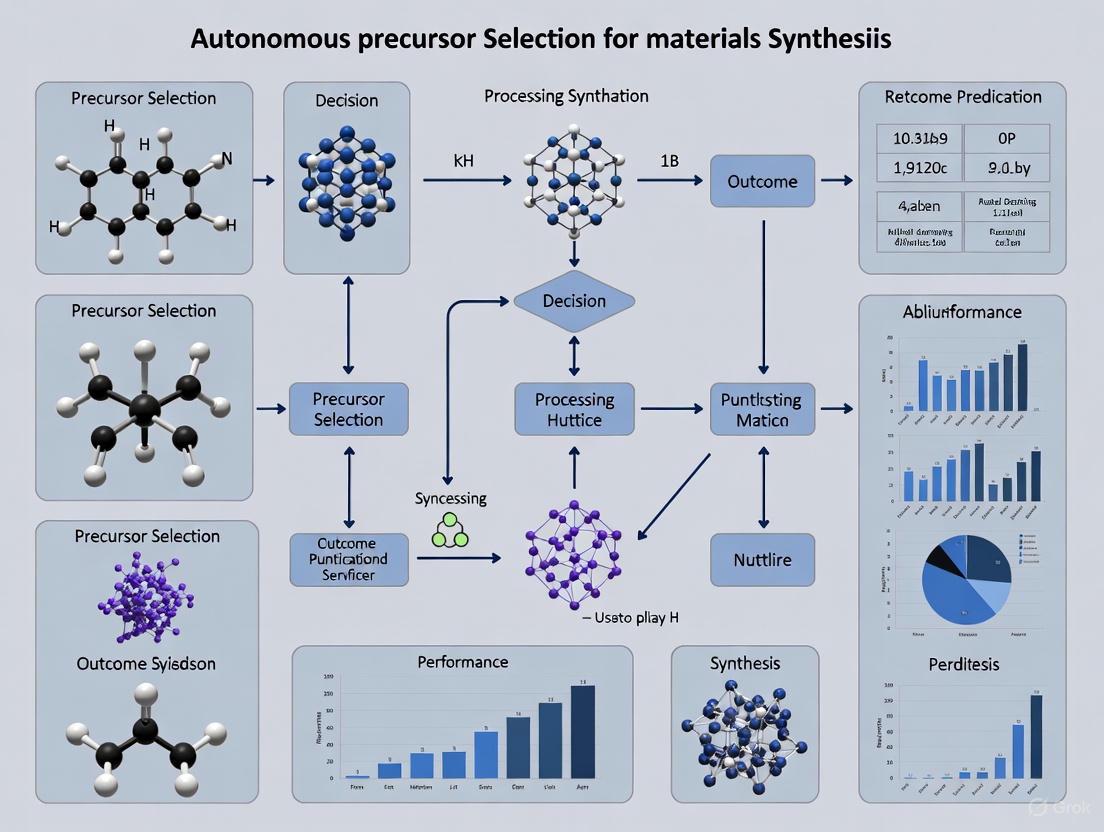
This article explores the transformative role of artificial intelligence (AI) and machine learning (ML) in automating precursor selection for materials synthesis, a critical bottleneck in the discovery of advanced materials.
Autonomous Precursor Selection for Materials Synthesis: AI-Driven Strategies for Accelerated Discovery
Abstract
This article explores the transformative role of artificial intelligence (AI) and machine learning (ML) in automating precursor selection for materials synthesis, a critical bottleneck in the discovery of advanced materials. It covers the foundational shift from trial-and-error methods to data-driven approaches, detailing specific algorithms and platforms that leverage thermodynamic data and historical literature. For researchers and drug development professionals, the content provides actionable methodologies for implementation, strategies for troubleshooting synthesis failures, and comparative validation of autonomous systems against traditional techniques. The review synthesizes evidence from recent breakthroughs, including autonomous laboratories, to demonstrate how these technologies are poised to accelerate the design of functional materials for biomedical and clinical applications.
The Paradigm Shift: From Trial-and-Error to AI-Guided Synthesis
Solid-state synthesis is a fundamental method for developing new inorganic materials and technologies. Despite advancements in in situ characterization and computational methods, experiments for new compounds often require testing numerous precursors and conditions, as outcomes remain difficult to predict [1]. The core challenge lies in selecting optimal precursor combinations that successfully lead to a high-purity target material and avoid the formation of stable intermediate byproducts that consume the thermodynamic driving force and prevent the target from forming [1]. This challenge is particularly acute for metastable materials, which are not the most thermodynamically stable under synthesis conditions but are vital for technologies like photovoltaics and structural alloys [1]. Traditionally, precursor selection relies on researcher intuition and heuristics, but the absence of a clear roadmap for novel materials can lead to extensive, unsuccessful experimental iterations [1]. Autonomous experimentation platforms are now emerging to address this complexity, using algorithms to guide and optimize synthesis planning.
Quantitative Challenges in Precursor Selection
The difficulty of precursor selection is quantified by experimental success rates. In a dedicated study involving 188 synthesis experiments targeting YBa₂Cu₃O₆.₅ (YBCO) with a short 4-hour hold time, only 10 experiments (5.3%) yielded pure YBCO without detectable impurities. Another 83 experiments (44.1%) resulted in partial yield of YBCO alongside unwanted byproducts [1]. This underscores that successful synthesis is the exception rather than the rule when precursors are not optimally chosen.
Analysis of text-mined synthesis data from the literature reveals strong dependencies in precursor pair selection, deviating from random chance [2]. For instance, nitrate precursors like Ba(NO₃)₂ and Ce(NO₃)₃ show a high probability of being used together, likely due to compatible properties like solubility [2].
Table 1: Analysis of Synthesis Outcomes for YBCO from 188 Experiments
| Outcome Category | Number of Experiments | Percentage of Total |
|---|---|---|
| Successful Synthesis (Pure YBCO) | 10 | 5.3% |
| Partial Success (YBCO with Impurities) | 83 | 44.1% |
| Failed Synthesis (No YBCO) | 95 | 50.6% |
Autonomous Approaches to Precursor Selection
The ARROWS3 Algorithm
ARROWS3 (Autonomous Reaction Route Optimization with Solid-State Synthesis) is an algorithm that incorporates physical domain knowledge to automate precursor selection [1]. Its logical workflow is designed to actively learn from experimental outcomes.
ARROWS3 functions through a continuous loop of computation and experimentation [1]:
- Initial Ranking: For a given target material, the algorithm generates a list of stoichiometrically balanced precursor sets. Without prior experimental data, it ranks these sets based on the calculated thermodynamic driving force (ΔG) to form the target, as reactions with more negative ΔG values tend to proceed more rapidly [1].
- Experimental Proposal and Analysis: The top-ranked precursor sets are tested across a range of temperatures. Techniques like X-ray diffraction (XRD) coupled with machine-learned analysis are used to identify the crystalline intermediates formed at different stages, revealing the reaction pathway [1].
- Model Update and Re-ranking: When experiments fail, ARROWS3 learns from the outcomes. It identifies which pairwise reactions led to stable intermediates that consumed the available driving force. The algorithm then updates its model to predict and avoid these intermediates in untested precursor sets, re-ranking them based on the predicted driving force remaining for the target-forming step (ΔG′) [1].
- Validation: This approach was validated on a dataset of 188 YBCO synthesis procedures. ARROWS3 identified all effective precursor sets while requiring substantially fewer experimental iterations compared to black-box optimization methods like Bayesian optimization or genetic algorithms [1].
Machine Learning from Scientific Literature
Another data-driven strategy machines the similarity between materials from vast synthesis databases to recommend precursors. This method mimics the human approach of repurposing recipes for similar, previously synthesized materials [2].
Table 2: Comparison of Autonomous Precursor Selection Strategies
| Feature | ARROWS3 (Physics-Informed) | Literature-Based ML (Data-Driven) |
|---|---|---|
| Core Principle | Active learning from experiments; avoids intermediates with low ΔG′ [1] | Machine-learned materials similarity from text-mined literature data [2] |
| Key Input Data | Calculated reaction energies (ΔG), experimental XRD patterns [1] | Database of 29,900+ synthesis recipes from scientific papers [2] |
| Output | Dynamically updated ranking of precursor sets | Recommended precursor sets based on analogues |
| Reported Success Rate | Identified all effective precursors for YBCO with fewer experiments [1] | 82% success rate for 2,654 unseen test targets [2] |
| Advantages | Incorporates thermodynamics; adapts to real experimental results | Captures decades of human heuristic knowledge; scalable |
The workflow involves [2]:
- Knowledge Base Construction: A large dataset of solid-state synthesis recipes is compiled, for example, 33,343 experimental recipes text-mined from 24,304 scientific papers [2].
- Materials Encoding: An encoding neural network (PrecursorSelector) learns to represent a target material as a numerical vector based on its synthesis context, specifically the precursors used to make it. This self-supervised model brings the vector representations of materials with similar precursors closer together in a latent space [2].
- Similarity and Recommendation: For a novel target material, the algorithm queries the knowledge base to find the most similar material based on their encoded vectors. The precursor set from this reference material is then recommended for the new target, effectively repurposing historical heuristic knowledge [2].
Detailed Experimental Protocol for Validating Precursor Selection
The following protocol is adapted from methods used to validate the ARROWS3 algorithm, focusing on the synthesis of YBa₂Cu₃O₆.₅ (YBCO) from oxide and carbonate precursors [1].
Materials and Equipment
- Precursor Powders: Y₂O₃, BaCO₃, CuO.
- Equipment: Mortar and pestle or ball mill, alumina crucibles, tube furnace, X-ray diffractometer (XRD).
Step-by-Step Procedure
Precursor Weighing and Mixing:
- Weigh out the precursor powders in stoichiometric quantities to yield the desired cation ratio for YBCO (Y:Ba:Cu = 1:2:3).
- Transfer the powder mixture to a mortar and pestle or a ball milling jar. Add an appropriate grinding medium (e.g., ethanol) to facilitate mixing.
- Grind or mill for 30-60 minutes to ensure a homogeneous mixture.
Thermal Treatment:
- Transfer the thoroughly mixed powder into an alumina crucible.
- Place the crucible in a tube furnace.
- Heat the sample to a target temperature (e.g., between 800°C and 950°C) in air atmosphere. Use a moderate heating rate (e.g., 5°C/min).
- Hold the sample at the target temperature for a defined period (e.g., 4 to 12 hours). Shorter hold times make the optimization task more challenging by potentially revealing kinetic limitations [1].
Intermediate Analysis:
- After the hold time, remove a small aliquot of the sample from the furnace and allow it to cool.
- Characterize the aliquot using XRD to identify the crystalline phases present. This snapshot of the reaction pathway helps identify stable intermediates that may have formed [1].
Regrinding and Further Heating (Optional):
- Return the remaining sample to the mortar or ball mill and regrind to improve reactant contact and homogeneity.
- Return the reground powder to the furnace for further heating at the same or a higher temperature. This step may be repeated multiple times to drive the reaction to completion.
Final Product Characterization:
- After the final heating cycle, allow the sample to cool to room temperature.
- Perform final XRD analysis to determine the phase purity of the resulting product. The success of the synthesis is quantified by the presence of YBCO peaks and the absence of impurity peaks (e.g., from unreacted BaCO₃ or intermediate phases like Y₂BaCuO₅) [1].
The Scientist's Toolkit: Key Reagents and Materials
Table 3: Essential Research Reagents and Materials for Solid-State Synthesis
| Item | Function in Synthesis | Examples/Notes |
|---|---|---|
| Oxide Precursors | Provide metal cations in a stable, often refractory form. | Y₂O₃, CuO, TiO₂. Common starting materials for many syntheses [1]. |
| Carbonate Precursors | Source of metal cations; decompose upon heating to release CO₂, which can help drive reactions. | BaCO₃, Li₂CO₃. Decomposition temperature is a key factor in reaction pathway [1]. |
| Nitrate Precursors | Source of metal cations; often have lower decomposition temperatures and can be used in solution-based precursor steps. | Ba(NO₃)₂, Ce(NO₃)₃. Tend to be used together, possibly due to solubility [2]. |
| Alumina Crucibles | Inert containers for holding powder samples during high-temperature reactions. | Withstand temperatures >1000°C; must be chemically inert to the sample. |
| X-Ray Diffractometer (XRD) | Essential characterization tool for identifying crystalline phases in reactants, intermediates, and final products. | Used for in-situ or ex-situ analysis to track reaction progress [1]. |
The Limitations of Traditional Heuristics and Human Intuition
The pursuit of autonomous precursor selection represents a paradigm shift in materials research, moving from experience-driven human decision-making to data-driven, algorithmic discovery. Within this context, a critical examination of traditional heuristics and human intuition reveals significant limitations that hinder the acceleration and scalability of materials synthesis. Heuristics, the efficient mental shortcuts or "rules of thumb" that scientists use to convert complex problems into simpler ones [3], and intuition, the tacit knowledge essential for navigating scientific uncertainties [4], have historically been the bedrock of experimental materials science. However, an increasing body of evidence suggests that these human-centric approaches are fraught with systematic cognitive biases, are difficult to scale or transfer, and are fundamentally constrained by the limited exploration of chemical space in published literature. This application note delineates these limitations through quantitative data analysis, provides experimental protocols for benchmarking human against algorithmic performance, and offers visual frameworks for understanding the transition towards autonomous discovery systems.
Quantitative Analysis of Limitations
The constraints of human intuition and heuristics are not merely theoretical but are demonstrable through quantitative comparisons with artificial intelligence and data-driven algorithms. The tables below summarize key performance metrics across several critical tasks.
Table 1: Performance Comparison in Attribute Inference and Protection Tasks [5]
| Attribute | Task | Human Performance | AI Performance | Performance Gap |
|---|---|---|---|---|
| Gender (from text) | Inference (Eye Task) | Moderate | High | AI outperformed humans by ~2.5x on differing instances |
| Photo Location | Inference (Eye Task) | Moderate | High | AI outperformed humans by ~2.2x on differing instances |
| Social Network Links | Inference (Eye Task) | Low | Low, but superior | AI outperformed humans by ~1.9x on differing instances |
| All Attributes | Protection (Shield Task) | Near Random | High | Human performance was particularly deficient in privacy protection |
Table 2: Data Limitations in Text-Mined Synthesis Recipes [6]
| Data Characteristic | Solid-State Synthesis Dataset | Solution-Based Synthesis Dataset | Impact on Machine Learning Utility |
|---|---|---|---|
| Volume (Number of Recipes) | 31,782 | 35,675 | Limited for training robust, generalizable models |
| Veracity (Data Quality) | Low (Only 28% yield a balanced reaction) | Similar Limitations | Propagates errors and limits predictive accuracy |
| Variety (Chemical Diversity) | Constrained by historical research trends | Constrained by historical research trends | Perpetuates anthropogenic and cultural biases |
| Velocity (Data Currency) | Static historical snapshot | Static historical snapshot | Does not dynamically incorporate new knowledge |
Table 3: Performance of Language Models in Synthesis Planning [7]
| Synthesis Task | Metric | Top-Tier LM Performance (e.g., GPT-4) | Note |
|---|---|---|---|
| Precursor Recommendation | Top-1 Accuracy | 53.8% | Lower bound, as unreported viable routes may exist |
| Precursor Recommendation | Top-5 Accuracy | 66.1% | More relevant for practical experimental validation |
| Calcination Temperature | Mean Absolute Error (MAE) | <126 °C | Matches performance of specialized regression methods |
| Sintering Temperature | Mean Absolute Error (MAE) | <126 °C | Matches performance of specialized regression methods |
Experimental Protocols
Protocol: Benchmarking Human vs. Algorithmic Precursor Selection
Objective: To quantitatively compare the effectiveness of human intuition against machine-learning models in selecting precursors for a target material.
Materials:
- A set of 10-20 novel, computationally predicted materials with no known synthesis reports.
- A control group of materials with known, but non-trivial, synthesis pathways.
- A cohort of experienced materials chemists.
- Machine learning models for precursor recommendation (e.g., a model based on [7] or [6]).
- Access to synthesis and characterization equipment (e.g., furnace, XRD).
Methodology:
- Blinded Precursor Proposal: Present the target materials to both the human cohort and the ML model(s). Humans should propose up to five precursor sets and a synthesis temperature for each target based on their knowledge and intuition. The ML model will generate its own ranked list of precursor suggestions and temperatures.
- Experimental Validation: Execute the top proposed synthesis recipes from both humans and the AI in a controlled laboratory setting (e.g., using an automated platform like the A-Lab [8]).
- Characterization and Success Metric: Characterize the products using X-ray diffraction (XRD). The primary success metric is the yield of the target phase as the majority product (>50%).
- Data Analysis: Compare the success rates of human-proposed recipes versus AI-proposed recipes. Additionally, analyze the nature of failures (e.g., kinetic barriers, precursor volatility) for each group.
Protocol: Interrogating a Text-Mined Database for Anomalous Synthesis Recipes
Objective: To manually analyze a text-mined synthesis database to identify and experimentally validate anomalous recipes that defy conventional heuristic understanding.
Materials:
- A text-mined database of solid-state synthesis recipes (e.g., from [6]).
- Computational resources for calculating reaction energetics (e.g., DFT through the Materials Project).
- Laboratory equipment for solid-state synthesis and XRD.
Methodology:
- Data Filtering: Filter the database for recipes that are statistically uncommon, for instance, those that use precursor combinations or reaction conditions that are rare for the given target material class.
- Thermodynamic Analysis: Compute the reaction energetics for these anomalous recipes using DFT-calculated formation energies. Compare them to the energetics of more conventional synthesis routes.
- Hypothesis Generation: Formulate a mechanistic hypothesis for why the anomalous recipe might be successful despite defying intuition (e.g., it may avoid low-driving-force intermediates).
- Experimental Validation: Design and execute experiments to test the hypothesized mechanism, comparing the performance of the anomalous pathway against the conventional one. The A-Lab's ARROWS³ algorithm provides a framework for this type of active learning [8].
Visualizing Workflows and Relationships
From Human-Heuristic to Autonomous Synthesis Workflow
Cognitive Biases in Heuristic Decision-Making
The Scientist's Toolkit: Research Reagent Solutions
Table 4: Essential Resources for Autonomous Precursor Selection Research
| Resource / Solution | Type | Function in Research | Example/Reference |
|---|---|---|---|
| Text-Mined Synthesis Database | Dataset | Provides historical data for training models and identifying trends/anomalies. | Kononova et al. (2019) [6] |
| Large Language Models (LLMs) | Computational Model | Recalls synthesis conditions from literature; generates synthetic recipes to augment datasets. | GPT-4, Gemini 2.0 [7] |
| Foundation Models for Materials | Computational Model | Learns generalized representations of materials for property prediction and generative design. | [9] |
| Automated Robotic Platform (SDL) | Physical Hardware | Executes synthesis and characterization closed-loop, without human intervention. | The A-Lab [8] |
| Active Learning Algorithm | Software Algorithm | Proposes improved follow-up experiments based on prior outcomes and thermodynamics. | ARROWS³ [8] |
| Ab Initio Phase Stability Database | Dataset | Provides thermodynamic data to assess stability and reaction driving forces. | The Materials Project [8] |
In the pursuit of accelerated materials discovery, autonomous research platforms are transforming how scientists approach synthesis. A critical aspect of this transformation is the development of artificial intelligence (AI) that can intelligently interpret and leverage thermodynamic principles to predict and optimize chemical reactions. For researchers in materials synthesis and drug development, understanding how AI models analyze thermodynamic driving forces and explore complex reaction pathways is fundamental to leveraging these tools effectively. This application note details the core concepts, methodologies, and practical protocols underpinning AI-driven analysis, providing a framework for its application in autonomous precursor selection.
Core Concepts: Thermodynamic Driving Forces and Reaction Pathways
The Role of Thermodynamic Driving Forces
In solid-state materials synthesis, the thermodynamic driving force, typically represented by the negative change in Gibbs free energy (‑ΔG) for a reaction, is a primary indicator of a reaction's feasibility. A larger, more negative ΔG suggests a stronger tendency for the target material to form [1]. However, synthesis outcomes are not determined by the final thermodynamic stability alone. A significant challenge is the formation of stable intermediate phases that consume reactants and exhaust the available driving force before the target product can crystallize [1].
AI algorithms, such as the ARROWS3 (Autonomous Reaction Route Optimization with Solid-State Synthesis) platform, are designed to navigate this complexity. They do not merely select precursors based on the largest initial ΔG to the target. Instead, they actively learn from experimental data to identify and avoid precursor combinations that lead to these kinetic traps, thereby prioritizing reactions that retain a sufficient driving force (ΔG′) at the final target-forming step [1].
Mapping Reaction Pathways with AI
A reaction pathway describes the stepwise sequence of elementary reactions, involving intermediates and transition states, that connects starting materials to final products. The potential energy surface (PES) is the foundational theoretical construct for understanding these pathways, where reactants, intermediates, and products exist as energy minima, and transition states are first-order saddle points connecting them [10] [11].
AI enhances the exploration of the PES through several advanced approaches:
- Active Learning and Automated Exploration: Tools like ARplorer automate the exploration of reaction pathways by integrating quantum mechanics (QM) and rule-based methodologies. They recursively identify active sites, optimize molecular structures, search for transition states, and perform Intrinsic Reaction Coordinate (IRC) analysis to confirm the connection between transition states and minima [10].
- Large Language Model (LLM) Guidance: LLMs can be employed to codify chemical logic from literature and databases. This knowledge generates system-specific rules and SMARTS patterns that guide the PES search, filtering out chemically implausible pathways and focusing computational resources on the most promising routes [10].
- Advanced Potential Energy Surfaces: Methods like AIQM2 provide a breakthrough by offering accuracy that approaches the "gold standard" coupled-cluster level at a computational cost orders of magnitude lower than typical Density Functional Theory (DFT). This enables large-scale reaction simulations, including transition state searches and reactive dynamics, that were previously infeasible [11].
AI Methodologies and Experimental Protocols
This section details specific AI algorithms and provides a protocol for their application in autonomous synthesis campaigns.
Key AI Algorithms and Workflows
ARROWS3 for Solid-State Synthesis ARROWS3 is an algorithm specifically designed for autonomous precursor selection in solid-state materials synthesis. Its logical workflow integrates thermodynamic data and experimental feedback [1].
Diagram 1: ARROWS3 autonomous synthesis optimization workflow.
LLM-Guided Pathway Exploration with ARplorer ARplorer represents an advanced methodology for automated reaction pathway exploration, leveraging large language models to incorporate established chemical knowledge [10].
Table 1: Core Components of the ARplorer Program for Pathway Exploration
| Component | Function | Implementation Example |
|---|---|---|
| Active Site Identification | Identifies atoms and bonds likely to participate in reactions. | Python module (e.g., Pybel) compiles list of active atom pairs from SMILES strings [10]. |
| Transition State Search | Locates first-order saddle points on the PES connecting intermediates. | Combines active-learning sampling with potential energy assessments; uses GFN2-xTB for PES and Gaussian 09 algorithms for search [10]. |
| IRC Analysis | Verifies the transition state correctly connects reactant and product minima. | Follows the reaction path from the TS downhill to confirm it leads to the expected intermediates [10]. |
| LLM-Guided Chemical Logic | Filters unlikely pathways and focuses search based on chemical rules. | Uses LLMs to generate system-specific SMARTS patterns and reaction rules from literature data [10]. |
Application Protocol: Autonomous Synthesis Optimization Campaign
This protocol outlines the steps for using an AI-guided autonomous system, like A-Lab, for solid-state materials synthesis [1] [12].
Objective: To autonomously synthesize a target inorganic material (e.g., YBa₂Cu₃O₆.₅ or a novel metastable phase) by iteratively selecting and testing precursors.
Pre-Experimental Setup
- Target Definition: Specify the composition and crystal structure of the target material.
- Precursor Library: Define a comprehensive library of available solid precursor powders.
- Algorithm Initialization: Configure the AI planner (e.g., ARROWS3) with access to a thermodynamic database (e.g., Materials Project) for initial precursor ranking based on ΔG.
Experimental Cycle
- AI-Driven Experimental Design:
- The AI analyzes the target and proposes a set of precursor combinations and synthesis temperatures for the next iteration.
- In the first iteration, selection is based on the largest initial ΔG to form the target. In subsequent iterations, the selection actively avoids precursors predicted to form stable intermediates.
- Robotic Execution:
- A robotic system automatically weighs, mixes, and pelleted the precursor powders according to the stoichiometric ratios.
- Samples are heated in a furnace under specified conditions (e.g., temperature, atmosphere).
- Automated Characterization and Analysis:
- The synthesized product is automatically transferred for characterization, typically by X-ray Diffraction (XRD).
- A machine learning model (e.g., a convolutional neural network) analyzes the XRD pattern to identify the crystalline phases present, quantifying the yield of the target and any impurity phases.
- Active Learning and Iteration:
- The experimental outcome (success/failure, phases identified) is fed back to the AI algorithm.
- The AI updates its internal model of the reaction network, identifying which pairwise reactions led to undesired intermediates.
- Based on this learning, the algorithm re-ranks all precursor sets, prioritizing those predicted to maximize the remaining driving force (ΔG′) for the target, and the cycle repeats.
Validation: The campaign continues until the target is synthesized with high purity or the experimental budget is exhausted. Successful validation was demonstrated by A-Lab, which synthesized 41 of 58 target materials over 17 days of continuous operation [12].
Essential Research Reagent Solutions
The following table details key computational and experimental "reagents" essential for implementing AI-driven reaction analysis and autonomous synthesis.
Table 2: Key Research Reagent Solutions for AI-Driven Synthesis
| Tool / Material | Type | Function in AI-Driven Workflow |
|---|---|---|
| Thermodynamic Database (e.g., Materials Project) | Computational Data | Provides initial DFT-calculated reaction energies (ΔG) for precursor ranking and stability assessment [1]. |
| Universal Interatomic Potentials (e.g., AIQM2) | Computational Method | Enables fast, accurate reaction simulations (TS search, dynamics) beyond DFT accuracy, crucial for pathway exploration [11]. |
| Reaction Mechanism Generator (RMG) | Software | Automates the construction of detailed kinetic models by systematically generating possible reaction pathways [13]. |
| Solid Precursor Powders | Experimental Material | The starting materials for solid-state reactions; a diverse and well-characterized library is crucial for AI-driven selection [1] [12]. |
| X-ray Diffraction (XRD) | Analytical Technique | The primary characterization method for identifying crystalline phases in synthesis products. Coupled with ML for automated analysis [1] [12]. |
The integration of AI into materials synthesis represents a paradigm shift from intuition-based to data-driven and physics-informed discovery. By interpreting thermodynamic driving forces not as static endpoints but as dynamic quantities that can be consumed by stable intermediates, algorithms like ARROWS3 make intelligent decisions about precursor selection. Furthermore, by leveraging advanced PES exploration tools, LLM-guided chemical logic, and highly accurate force fields, AI can now map complex reaction pathways with unprecedented speed and reliability. These capabilities, when embedded within the closed-loop framework of an autonomous laboratory, create a powerful engine for accelerating the design and synthesis of novel materials and molecules.
The Role of Large-Scale Databases (e.g., Materials Project) in Informing AI Models
Large-scale computational databases have become foundational to modern materials science, serving as the critical data infrastructure that powers artificial intelligence (AI) and machine learning (ML) models. These repositories, exemplified by the Materials Project, provide systematically computed properties for known and predicted materials, creating the essential training data for AI-driven discovery pipelines [14]. The integration of these databases with AI models has transformed the materials discovery paradigm, enabling the rapid identification of novel materials with tailored properties and accelerating the development of autonomous systems for materials synthesis [15].
Within the specific context of autonomous precursor selection for materials synthesis, these databases provide the thermodynamic and structural knowledge base that AI models leverage to propose viable synthesis pathways. By encoding fundamental materials relationships and stability data, databases like the Materials Project allow AI systems to reason about precursor combinations and reaction intermediates with a level of comprehensiveness unattainable through human intuition alone [15]. This document details the application of these integrated database-AI systems through specific protocols, quantitative benchmarks, and experimental workflows.
Database Foundations for AI Training
Key Large-Scale Materials Databases
Large-scale materials databases provide the structured, high-quality data required for training robust AI models. The table below summarizes the primary databases informing AI development in materials science.
Table 1: Key Large-Scale Materials Databases Informing AI Models
| Database Name | Primary Content | Scale | Key AI Applications |
|---|---|---|---|
| Materials Project | Inorganic crystal structures and properties [15] | Over 150,000 materials [15] | Stability prediction, precursor selection, synthesis planning |
| GNoME Database | Predicted stable crystal structures [16] | 2.2 million new crystals; 380,000 stable materials [16] | Inverse design, crystal structure prediction, materials discovery |
| NanoMine | Polymer nanocomposite experimental data [17] | 2,512 manually curated samples [17] | Polymer composite design, property prediction |
Quantitative Impact on Discovery Rates
The integration of these databases with AI models has dramatically accelerated the pace of materials discovery, as evidenced by recent breakthroughs.
Table 2: Quantitative Impact of AI-Database Integration on Discovery Metrics
| Metric | Pre-AI Baseline | With AI-Database Integration | Improvement Factor |
|---|---|---|---|
| New stable materials discovered | ~28,000 materials (cumulative, via computational approaches) [16] | 380,000 stable materials via GNoME [16] | 13.6x |
| Materials discovery rate | Not quantified explicitly | ~800 years of knowledge equivalent [16] | Dramatic acceleration |
| Prediction accuracy | ~50% stability prediction [16] | ~80% stability prediction [16] | 60% relative improvement |
| Experimental success rate | Not explicitly quantified | 71% (41/58 novel compounds) via A-Lab [15] | High validation of predictions |
Experimental Protocols for AI-Driven Materials Discovery
Protocol: Autonomous Synthesis with A-Lab
This protocol details the methodology for autonomous materials synthesis using the A-Lab platform as described in Nature [15]. The workflow integrates computational screening from databases with robotic experimentation.
Materials and Reagents:
- Precursor powders (various inorganic compounds)
- Alumina crucibles
- High-temperature box furnaces (multiple units)
- X-ray diffraction (XRD) sample holders
Procedure:
- Target Identification: Select target materials from stable compounds identified in the Materials Project and cross-referenced with Google DeepMind databases [15]. Filter for air-stable compounds predicted not to react with O₂, CO₂, or H₂O.
- Precursor Selection: Generate up to five initial synthesis recipes using a machine learning model trained on historical synthesis data through natural-language processing of literature [15].
- Temperature Optimization: Determine optimal synthesis temperatures using a secondary ML model trained on heating data from literature [15].
- Robotic Execution:
- Dispensing and Mixing: Use automated stations to dispense and mix precursor powders in stoichiometric ratios.
- Transfer: Transfer mixtures to alumina crucibles using robotic arms.
- Heating: Load crucibles into one of four box furnaces for thermal processing with controlled heating cycles.
- Cooling: Allow samples to cool naturally after synthesis.
- Characterization:
- Grinding: Automatically grind cooled samples into fine powders.
- XRD Analysis: Perform X-ray diffraction to determine phase composition.
- Phase Analysis: Extract phase and weight fractions from XRD patterns using probabilistic ML models trained on experimental structures from the Inorganic Crystal Structure Database (ICSD) [15].
- Validation: Confirm identified phases through automated Rietveld refinement.
- Active Learning: If target yield is <50%, employ ARROWS3 active learning algorithm to propose modified synthesis routes based on observed reaction pathways and thermodynamic driving forces [15].
Quality Control:
- Validate ML-identified phases through automated Rietveld refinement [15]
- Cross-reference predicted structures with experimental databases
- Maintain robotic systems through regular calibration checks
Autonomous Synthesis Workflow
Protocol: Data Extraction from Literature Using ChatExtract
This protocol outlines the ChatExtract methodology for extracting accurate materials data from research papers using conversational large language models (LLMs), as published in Nature Communications [18].
Materials and Software:
- Research papers in PDF format
- GPT-4 or similar conversational LLM
- Python environment for automation
- Text preprocessing tools for HTML/XML syntax removal
Procedure:
- Data Preparation:
- Gather relevant research papers through keyword searches.
- Remove HTML/XML syntax and clean text.
- Divide text into individual sentences.
Stage A: Initial Relevance Classification:
- Apply simple relevancy prompt to all sentences: "Does this sentence contain a material property with a value and unit?"
- Weed out sentences classified as negative (non-relevant).
- For positive sentences, construct a passage containing:
- Paper title
- Preceding sentence
- Positive sentence itself
Stage B: Data Extraction:
- Single-Valued Texts: For sentences containing single data points:
- Ask directly for value, unit, and material name.
- Explicitly allow for negative answers if information is missing.
- Multi-Valued Texts: For sentences with multiple data points:
- Determine if multiple values are present.
- Use uncertainty-inducing redundant prompts to verify extractions.
- Ask follow-up questions to confirm relationships between materials, values, and units.
- Single-Valued Texts: For sentences containing single data points:
Validation:
- Enforce strict Yes/No format for verification questions.
- Use redundancy in questioning to overcome hallucinations.
- Maintain conversation history for information retention.
Quality Control:
- Achieves 90.8% precision and 87.7% recall for bulk modulus data [18]
- For critical cooling rates of metallic glasses: 91.6% precision and 83.6% recall [18]
- Multiple verification steps reduce factual inaccuracies
The Scientist's Toolkit: Research Reagent Solutions
Table 3: Essential Research Reagents and Computational Tools for AI-Driven Materials Discovery
| Item Name | Function/Application | Specifications/Examples |
|---|---|---|
| GNoME (Graph Networks for Materials Exploration) | Deep learning tool for predicting stability of new materials [16] | State-of-the-art graph neural network; identifies stable crystal structures |
| A-Lab Robotic Platform | Autonomous synthesis of inorganic powders [15] | Integrated robotics with three stations: preparation, heating, characterization |
| Materials Project Database | Provides computed materials properties for AI training [15] | Contains stability data, formation energies, and crystal structures |
| ChatExtract Framework | Extracts materials data from research literature [18] | Uses conversational LLMs with precision up to 91.6% |
| ARROWS3 Algorithm | Active learning for synthesis route optimization [15] | Integrates ab initio reaction energies with experimental outcomes |
| Probabilistic XRD Analysis | Automated phase identification from diffraction patterns [15] | ML models trained on ICSD data with automated Rietveld refinement |
Integrated Workflow for Autonomous Precursor Selection
The integration of large-scale databases with AI models creates a powerful workflow for autonomous precursor selection, combining computational predictions with experimental validation.
AI-Driven Precursor Selection
Workflow Description:
- Stability Screening: Identify potential target materials using convex hull analysis from databases (e.g., 380,000 stable materials identified by GNoME) [16].
- AI Precursor Selection: Generate initial synthesis recipes using natural language processing models trained on literature data, assessing target "similarity" to known materials [15].
- Thermodynamic Analysis: Evaluate reaction pathways using computed formation energies from databases, prioritizing intermediates with large driving forces (>50 meV/atom) to form targets [15].
- Active Learning Optimization: Refine synthesis routes using observed reaction outcomes, building knowledge of pairwise reactions to avoid intermediates with small driving forces [15].
This integrated approach demonstrates how databases inform AI models at multiple stages, from initial target identification through synthesis optimization, creating a closed-loop autonomous discovery system.
Defining Autonomous Precursor Selection and its Place in the Materials Discovery Pipeline
Autonomous precursor selection represents a paradigm shift in materials synthesis, moving away from traditional reliance on human intuition and literature mining towards algorithmic, data-driven decision-making. This process involves the use of artificial intelligence (AI) and active learning algorithms to automatically select and optimize the solid powder precursors used in the synthesis of inorganic materials, thereby accelerating the discovery and development of novel compounds [14] [8]. The core challenge it addresses is the non-trivial nature of precursor selection, where even for thermodynamically stable materials, only a fraction of possible precursor sets successfully produce the desired target, as evidenced by the A-Lab's experience where just 37% of 355 tested recipes yielded their targets despite a 71% eventual success rate in obtaining the materials themselves [8].
This automation is particularly crucial for closing the gap between computational screening rates and experimental realization of novel materials. Where high-throughput computations can identify thousands of promising candidates, their experimental synthesis traditionally creates a bottleneck that autonomous methods aim to alleviate [8]. The significance of this approach lies in its ability to systematically navigate the complex thermodynamic and kinetic landscape of solid-state reactions, which often involve concerted displacements and interactions among many species over extended distances, making them difficult to model and predict [1].
The ARROWS3 Algorithm: Core Principles and Workflow
Theoretical Foundation
The Autonomous Reaction Route Optimization with Solid-State Synthesis (ARROWS3) algorithm embodies the cutting edge in autonomous precursor selection. Its design incorporates key physical domain knowledge based on thermodynamics and pairwise reaction analysis, setting it apart from black-box optimization approaches [1]. The algorithm operates on two fundamental hypotheses: first, that solid-state reactions tend to occur between two phases at a time (pairwise reactions), and second, that intermediate phases which leave only a small driving force to form the target material should be avoided, as they often require long reaction times and high temperatures, potentially preventing the target material's formation [1] [8].
ARROWS3 actively learns from experimental outcomes to determine which precursors lead to unfavorable reactions that form highly stable intermediates, preventing the target material's formation. Based on this information, it proposes new experiments using precursors predicted to avoid such intermediates, thereby retaining a larger thermodynamic driving force to form the target [1]. This approach represents a significant advancement over static ranking methods, as it dynamically updates its recommendations based on experimental feedback.
Operational Workflow
The logical flow of ARROWS3 follows a structured sequence that integrates computation, experimentation, and machine learning-driven analysis, creating a closed-loop optimization system as illustrated in the workflow diagram below:
Figure 1: ARROWS3 Autonomous Precursor Selection Workflow
The workflow begins with target material specification, where researchers define the desired composition and structure. The algorithm then generates a comprehensive list of precursor sets that can be stoichiometrically balanced to yield the target's composition. In the absence of experimental data, these precursor sets are initially ranked by their calculated thermodynamic driving force (ΔG) to form the target, leveraging formation energies from databases like the Materials Project [1] [8].
Next, the highest-ranked precursors are tested experimentally across a temperature gradient, providing snapshots of the corresponding reaction pathways. The synthesis products are characterized by X-ray diffraction (XRD), with machine learning models analyzing the patterns to identify intermediate phases that form at each step [1] [8]. ARROWS3 then determines which pairwise reactions led to the formation of each observed intermediate and leverages this information to predict intermediates that will form in precursor sets not yet tested [1].
In subsequent iterations, the algorithm prioritizes precursor sets expected to maintain a large driving force at the target-forming step (ΔG'), even after intermediates have formed. This process continues until the target is successfully obtained with sufficient yield or all available precursor sets are exhausted [1]. Throughout this process, the algorithm continuously builds a database of observed pairwise reactions, which allows the products of some recipes to be inferred without testing, potentially reducing the search space of possible synthesis recipes by up to 80% when many precursor sets react to form the same intermediates [8].
Performance and Validation
Quantitative Performance Metrics
The performance of autonomous precursor selection algorithms has been rigorously validated through experimental implementation. The table below summarizes key quantitative results from validation studies:
Table 1: Performance Metrics of Autonomous Precursor Selection Systems
| System/Metric | Target Materials | Success Rate | Experimental Scale | Key Findings | Citation |
|---|---|---|---|---|---|
| ARROWS3 Validation | YBa₂Cu₃O₆.₅ (YBCO) | Identified all effective routes | 188 synthesis procedures | Required fewer iterations than Bayesian optimization or genetic algorithms | [1] |
| A-Lab Implementation | 58 novel compounds (oxides/phosphates) | 71% (41/58 compounds) | 355 synthesis recipes | 35 obtained via literature-inspired recipes; 6 required active learning optimization | [8] |
| Active Learning Efficacy | 9 targets requiring optimization | 6 obtained after zero initial yield | N/A | Identified routes avoiding low-driving-force intermediates | [8] |
| Search Space Reduction | Various compounds via pairwise analysis | Up to 80% reduction | N/A | Database of observed reactions prevents redundant testing | [8] |
The validation studies demonstrate that ARROWS3 identifies effective precursor sets while requiring substantially fewer experimental iterations compared to black-box optimization methods like Bayesian optimization or genetic algorithms [1]. In the case of YBCO synthesis, from 188 experiments testing 47 different precursor combinations across four temperatures, only 10 produced pure YBCO without detectable impurities, while 83 yielded partial product with byproducts, highlighting the challenging optimization landscape that autonomous methods navigate more efficiently [1].
Case Study: CaFe₂P₂O₉ Synthesis Optimization
A specific example from the A-Lab illustrates the practical impact of autonomous precursor selection. The synthesis of CaFe₂P₂O₉ was optimized by avoiding the formation of FePO₄ and Ca₃(PO₄)₂ as intermediates, which had only a small driving force (8 meV per atom) to form the target. The active learning algorithm identified an alternative synthesis route forming CaFe₃P₃O₁₃ as an intermediate, from which a much larger driving force (77 meV per atom) remained to react with CaO and form CaFe₂P₂O₉, resulting in an approximately 70% increase in target yield [8].
Experimental Protocols and Methodologies
Core Experimental Workflow
The implementation of autonomous precursor selection follows a standardized experimental workflow that integrates robotic execution with intelligent planning. The diagram below illustrates this integrated materials discovery pipeline:
Figure 2: Integrated Autonomous Materials Discovery Workflow
Detailed Protocol: Solid-State Synthesis with Autonomous Precursor Selection
Objective: To synthesize phase-pure inorganic materials through autonomous selection of optimal solid powder precursors.
Materials and Equipment:
Table 2: Essential Research Reagent Solutions and Equipment
| Category | Specific Items | Function/Purpose | Implementation Example |
|---|---|---|---|
| Computational Resources | Materials Project Database, DFT calculations | Provides thermodynamic data for initial precursor ranking | Formation energies for ΔG calculations [1] [8] |
| Precursor Selection Algorithm | ARROWS3 or similar active learning system | Dynamically selects and optimizes precursor sets based on experimental outcomes | Avoids intermediates with small driving force to target [1] |
| Robotics Platform | Automated powder dispensers, mixing stations, robotic arms | Ensures precise, reproducible sample preparation and handling | Three integrated stations for preparation, heating, and characterization [8] |
| Heating Systems | Box furnaces (multiple units recommended) | Enables parallel synthesis at various temperatures | Four box furnaces for simultaneous thermal processing [8] |
| Characterization Tools | X-ray diffractometer with automated sample handling | Provides structural data on synthesis products | XRD with ML analysis for phase identification [1] [8] |
| Analysis Software | ML models for XRD analysis, Rietveld refinement software | Automates phase identification and quantification | Probabilistic ML models trained on ICSD data [8] |
Step-by-Step Procedure:
Target Specification and Precursor Generation
- Define the target material by composition and crystal structure.
- Algorithmically generate all possible precursor sets that can be stoichiometrically balanced to yield the target composition.
- In the absence of prior experimental data, rank these precursor sets by their calculated thermodynamic driving force (ΔG) to form the target, using formation energies from the Materials Project or similar databases [1].
Literature-Inspired Recipe Proposal (Optional First Pass)
Automated Sample Preparation
- Use automated powder dispensers to accurately weigh and mix precursor powders in the appropriate stoichiometric ratios.
- Transfer homogeneous mixtures into appropriate crucibles (e.g., alumina) using robotic arms [8].
- Implement automated milling or grinding if necessary to ensure sufficient reactivity between precursors.
Robotic Thermal Processing
- Load crucibles into box furnaces using robotic arms.
- Execute heating profiles across a temperature gradient (e.g., 600-900°C) to probe different stages of reaction pathways [1].
- Use appropriate atmosphere control if required by the target material.
- Employ hold times appropriate for the specific system (e.g., 4 hours for initial screening, potentially longer for optimization) [1].
Automated Characterization and Analysis
- After cooling, transfer samples to X-ray diffractometer using robotic arms.
- Grind samples to fine powder if necessary to ensure proper XRD analysis.
- Collect XRD patterns with appropriate parameters for phase identification.
- Use machine learning models trained on experimental structures to identify phases present and their weight fractions [8].
- Confirm ML phase identification with automated Rietveld refinement.
Active Learning and Iteration
- Feed experimental outcomes (successes and failures) back to the active learning algorithm.
- Identify pairwise reactions that led to observed intermediate phases.
- Update the precursor ranking to prioritize sets predicted to avoid intermediates that consume excessive driving force.
- Select new precursor sets that maintain large driving force (ΔG') at the target-forming step.
- Repeat steps 3-6 until target is obtained with sufficient purity or all promising precursor sets are exhausted.
Critical Parameters for Optimization:
- Temperature Range: Must be sufficiently broad to capture different stages of reaction pathways
- Heating Duration: Balanced between reaction completion and experimental throughput
- Precursor Physical Properties: Particle size, morphology, and reactivity that may influence reaction kinetics
- Intermediate Identification: Accurate phase analysis is crucial for informing the algorithm of competing reactions
Integration in the Materials Discovery Pipeline
Autonomous precursor selection represents a critical component in the broader context of autonomous materials discovery, occupying a strategic position between computational screening and final material characterization. The evolution of AI in materials science demonstrates a progression from computational tools to autonomous research partners, with autonomous precursor selection embodying the transition to what has been termed "Agentic Science" [19].
In the A-Lab implementation, autonomous precursor selection functions within a comprehensive workflow that begins with ab initio target identification, proceeds through AI-driven synthesis planning, robotic execution, automated characterization, and active learning-driven iteration [8]. This integration demonstrates how autonomous precursor selection connects to both upstream computational screening and downstream application testing, serving as a crucial bridge that transforms theoretical predictions into tangible materials.
The technology's position in the maturity landscape is reflected in survey data from researchers, which shows that while 26% are comfortable with full automation of scientific workflows, most still prefer human involvement in ideation, hypothesis generation, and complex experimental decisions [20]. This suggests that autonomous precursor selection currently functions most effectively as an augmentation to human expertise rather than a complete replacement, particularly for novel materials systems where domain knowledge and intuition remain valuable.
Technical Requirements and Implementation Considerations
System Architecture Components
Successful implementation of autonomous precursor selection requires integration of several specialized components:
Data Infrastructure: Access to comprehensive thermodynamic databases (e.g., Materials Project) is essential for initial precursor ranking [1] [8]. Additionally, a structured database of observed pairwise reactions enables the system to learn from previous experiments and avoid redundant testing [8].
Algorithmic Capabilities: The core algorithm must combine thermodynamic reasoning with machine learning for both precursor selection and experimental analysis. This includes the ability to calculate reaction energies, predict intermediate formation, and interpret characterization data [1].
Robotic Hardware: Reliable automation of powder handling is particularly challenging due to variations in precursor properties like density, flow behavior, particle size, hardness, and compressibility [8]. Integrated platforms with robotic arms and loosely integrated formulation and characterization units offer flexibility for customized workflows [20].
Implementation Challenges and Solutions
Table 3: Implementation Challenges and Mitigation Strategies
| Challenge Category | Specific Challenges | Potential Mitigation Strategies |
|---|---|---|
| Technical Implementation | Powder handling variability, Integration of separate automated steps | Use of flexible robotic arms with modular tooling, Custom end-effector design for powder handling |
| Algorithmic Limitations | Prediction of kinetic barriers, Handling of amorphous phases | Incorporation of heuristic rules from domain experts, Multi-modal characterization to detect amorphous content |
| Data Requirements | Sparse thermochemical data for novel systems, Limited data for kinetic parameters | Transfer learning from related systems, Active learning to prioritize informative experiments |
| Validation and Trust | Ensuring scientific accuracy of AI conclusions, Verification of novel discoveries | Human oversight for novel phenomena, Robust uncertainty quantification in predictions |
Future Directions and Development
The field of autonomous precursor selection continues to evolve rapidly, with several promising directions for advancement. Future systems will likely incorporate more sophisticated multi-objective optimization that balances thermodynamic driving force with practical considerations like precursor cost, availability, and safety [20]. Improved kinetic models that go beyond thermodynamic predictions could further enhance success rates by accounting for reaction rates and barriers.
The integration of large language models and reasoning systems presents another frontier, potentially enabling more sophisticated analogy-based precursor selection and better interpretation of complex experimental outcomes [19]. As these systems mature, we can anticipate greater collaboration between human experts and autonomous systems, with humans focusing on high-level strategy and novel hypothesis generation while algorithms handle the detailed optimization of synthesis parameters [20].
Community-wide efforts to standardize data formats, share datasets including negative results, and develop open-source algorithms will be crucial for accelerating adoption and improving the capabilities of autonomous precursor selection systems [14] [20]. By addressing current challenges in model generalizability, experimental validation, and system integration, autonomous precursor selection is poised to become an increasingly powerful component of the materials discovery pipeline, ultimately reducing the time from materials discovery to commercialization.
AI Tools in Action: Algorithms and Platforms for Autonomous Selection
The synthesis of novel inorganic materials is a fundamental bottleneck in the development of advanced technologies. While computational methods can predict thousands of stable compounds, determining how to synthesize them remains a significant challenge, as convex-hull stability provides no guidance on practical synthesis variables like precursor selection [6]. Natural Language Processing (NLP) has emerged as a transformative technology to bridge this gap by extracting and encoding the collective synthesis knowledge embedded in scientific literature. By converting unstructured text from millions of publications into structured, machine-readable data, NLP enables the development of predictive models that can recommend synthesis pathways for novel target materials, accelerating the transition from materials design to physical realization [21] [2]. This application note details the methodologies, protocols, and practical implementations of NLP for autonomous precursor selection, providing researchers with the tools to leverage historical data for materials synthesis research.
NLP Fundamentals and Data Extraction Pipeline
Natural Language Processing encompasses computer algorithms designed to understand and generate human language. Modern NLP has evolved from handcrafted rules to deep learning approaches, with word embeddings and attention mechanisms enabling models to capture semantic meaning and contextual relationships between words and concepts [21]. In materials science, this capability is crucial for processing the highly specialized terminology and complex descriptions found in synthesis literature.
The foundational step in leveraging historical data is the construction of a structured synthesis database from unstructured text. This process involves multiple stages of text mining and information extraction:
Table 1: Key Stages in NLP Pipeline for Materials Synthesis Data Extraction
| Processing Stage | Primary Function | Techniques/Methods | Output |
|---|---|---|---|
| Literature Procurement | Identify and access relevant synthesis literature | HTML/XML parsing of publisher databases | Collection of synthesis paragraphs |
| Target/Precursor Extraction | Recognize and classify materials entities | BiLSTM-CRF with |
Annotated targets and precursors |
| Operation Identification | Extract synthesis actions and parameters | Latent Dirichlet Allocation (LDA) topic modeling [6] | Classified operations (mixing, heating, etc.) |
| Recipe Compilation | Integrate extracted data into structured format | JSON database construction with stoichiometric balancing [6] | Balanced synthesis reactions with parameters |
The extraction of synthesis recipes presents unique challenges, as the same material can serve different roles (target, precursor, or reaction medium) depending on context. Advanced NLP approaches replace all chemical compounds with a universal
Precursor Recommendation Methodologies
Similarity-Based Recommendation Systems
One prominent approach for precursor recommendation leverages machine-learned materials similarity based on synthesis context. This methodology mimics the human approach of consulting precedent synthesis procedures for analogous materials [2]. The process involves:
- Materials Encoding: Training an encoding neural network to create vector representations of materials based on their synthesis contexts, particularly their precursor sets
- Similarity Query: Identifying reference materials with the smallest Euclidean distance to the target material in the encoded vector space
- Recipe Completion: Adapting precursors from the reference material to the target, with conditional prediction of any missing elements [2]
This approach demonstrated remarkable effectiveness in historical validation, achieving at least 82% success rate when proposing five precursor sets for each of 2,654 unseen test target materials [2]. The system captures nuanced chemical relationships, such as the tendency of certain precursor pairs (e.g., nitrates like Ba(NO₃)₂ and Ce(NO₃)₃) to be used together due to properties like solubility and compatibility with solution processing [2].
Autonomous Optimization Algorithms
Beyond static recommendation, autonomous algorithms like ARROWS3 (Autonomous Reaction Route Optimization with Solid-State Synthesis) implement active learning approaches that iteratively improve precursor selection based on experimental outcomes [1]. The algorithm:
- Initially ranks precursor sets by thermodynamic driving force (ΔG) to form the target
- Proposes testing at multiple temperatures to map reaction pathways
- Identifies intermediates using XRD with machine-learned analysis
- Updates precursor rankings to avoid reactions that form highly stable intermediates
- Prioritizes precursor sets that maintain large driving force even after intermediate formation [1]
In benchmark testing, ARROWS3 identified all effective synthesis routes for YBa₂Cu₃O₆.₅ (YBCO) while requiring substantially fewer experimental iterations than black-box optimization methods [1]. This demonstrates the value of incorporating domain knowledge (thermodynamics and pairwise reaction analysis) into optimization algorithms.
Table 2: Performance Comparison of Precursor Selection Methods
| Method | Approach | Key Metrics | Advantages | Limitations |
|---|---|---|---|---|
| Similarity-Based Recommendation [2] | Machine-learned materials similarity from text-mined recipes | 82% success rate on 2,654 test materials | Captures human heuristics, interpretable | Limited to historical precedents |
| ARROWS3 Optimization [1] | Active learning with thermodynamic analysis | Identifies all effective precursors with fewer iterations | Adapts to experimental results, handles metastable targets | Requires experimental validation |
| Black-Box Optimization [1] | Generic algorithms without domain knowledge | Requires more iterations to identify effective precursors | General-purpose application | Less efficient for materials synthesis |
Experimental Protocols
Protocol: Building a Synthesis Knowledge Base from Literature
Purpose: Extract structured synthesis recipes from scientific literature to enable data-driven precursor recommendation.
Materials and Data Sources:
- Full-text permissions from major scientific publishers (Springer, Wiley, Elsevier, RSC, etc.)
- Computational resources for NLP processing (GPU recommended for deep learning models)
- Text annotation tools for manual validation (e.g., Brat Rapid Annotation Tool)
Procedure:
- Literature Collection: Download full-text publications in HTML/XML format published after year 2000 [6]
- Paragraph Identification: Classify paragraphs as synthesis procedures using keyword probability analysis
- Entity Recognition: Implement BiLSTM-CRF model with
token replacement to identify targets and precursors [6] - Operation Extraction: Apply Latent Dirichlet Allocation to cluster synonyms into operation categories (mixing, heating, etc.)
- Stoichiometric Balancing: Compile balanced chemical reactions including atmospheric gasses
- Quality Validation: Manually review random sample of extracted recipes (recommended: 100+ paragraphs)
Validation: In a test of 100 randomly selected solid-state synthesis paragraphs, approximately 70% yielded complete extraction with balanced chemical reactions [6].
Protocol: Implementing Precursor Recommendation for Novel Targets
Purpose: Recommend precursor sets for synthesizing a novel target material using historical data.
Materials:
- Knowledge base of historical synthesis recipes (minimum 10,000 recipes recommended)
- Composition of target material
- Encoding model (e.g., PrecursorSelector encoding [2])
Procedure:
- Encode Target Material: Process target composition through encoding network to generate vector representation
- Similarity Calculation: Compute Euclidean distance between target vector and all materials in knowledge base
- Reference Identification: Select reference material with smallest distance to target
- Precursor Adaptation: Extract precursors from reference material and adjust for target stoichiometry
- Element Completion: If elements are missing, predict additional precursors using conditional probability models
- Ranking: Generate multiple precursor sets (recommended: 5 options) with success probability estimates
Validation: The recommendation strategy achieved 82% success rate when proposing five precursor sets for 2,654 unseen test materials [2].
Visualization of NLP-Driven Synthesis Workflows
NLP-Driven Synthesis Workflow
Table 3: Key Research Reagents and Computational Resources
| Resource | Function | Implementation Examples |
|---|---|---|
| Text-Mined Synthesis Databases | Structured knowledge base for training models | 29,900 solid-state recipes [2], 31,782 solid-state and 35,675 solution-based recipes [6] |
| Materials Encoding Models | Convert materials to vector representations for similarity calculation | PrecursorSelector encoding [2], Word2Vec [21] |
| Thermodynamic Data | Calculate driving force for reactions | Materials Project DFT calculations [1] |
| Autonomous Optimization Algorithms | Iteratively improve precursor selection based on experimental outcomes | ARROWS3 [1] |
| Large Language Models (LLMs) | Advanced information extraction through prompt engineering | GPT, BERT, Falcon [21] |
Critical Considerations and Future Directions
While NLP approaches show significant promise for autonomous precursor selection, several critical considerations must be addressed:
Data Limitations: Text-mined synthesis datasets often suffer from limitations in volume, variety, veracity, and velocity [6]. These limitations stem from both technical extraction challenges and inherent biases in how chemists have historically explored materials spaces.
Ethical Implementation: When applying similar NLP approaches to clinical research recruitment, studies have identified significant gaps in addressing ethical considerations like patient autonomy and equity [22]. Similar ethical reflection should be incorporated into materials science applications.
Domain Adaptation: Pre-trained general language models often lack the specificity required for intricate materials science tasks [21]. Effective implementation typically requires fine-tuning on domain-specific corpora to capture specialized terminology and relationships.
Future advancements will likely involve greater integration of NLP with autonomous research platforms, where recommendation systems are coupled with robotic synthesis and characterization to create fully closed-loop materials discovery systems [2] [1]. As NLP methodologies continue to evolve, particularly with the development of more sophisticated large language models, the capacity to extract nuanced synthesis knowledge from literature will further enhance our ability to predict and optimize precursor selection for novel materials.
The synthesis of novel inorganic solid-state materials is a cornerstone for developing new technologies, from superconductors to advanced battery components. However, the path from a target material's composition to its successful synthesis is often non-trivial, traditionally relying on domain expertise, heuristic rules, and extensive empirical testing. This process is hampered by the formation of stable intermediate phases that consume the thermodynamic driving force, preventing the formation of the desired target material. To address this core challenge in materials science, researchers have developed Autonomous Reaction Route Optimization with Solid-State Synthesis (ARROWS3), an algorithm designed to automate and optimize the selection of precursors for solid-state synthesis [1] [23].
ARROWS3 represents a significant shift from black-box optimization methods by strategically incorporating physical domain knowledge—specifically, thermodynamic data and pairwise reaction analysis—into an active learning loop [1] [24]. This framework is critical for the development of fully autonomous research platforms, enabling more efficient materials discovery and development, a goal that resonates with professionals in drug development and pharmaceutical research who utilize similar model-informed approaches [8] [25]. This protocol provides a detailed examination of the ARROWS3 framework, its operational mechanisms, experimental validation, and practical implementation guidelines.
Core Principles and Algorithmic Methodology
The ARROWS3 algorithm is built upon the fundamental principle that the selection of precursor materials dictates the reaction pathway and the likelihood of successfully synthesizing a high-purity target material. Its logical flow is designed to mimic the reasoning of an expert chemist, but at a scale and speed enabled by computational power and automation.
Theoretical Foundation
Solid-state synthesis outcomes are profoundly influenced by the competition between the formation of the target phase and the formation of unwanted, often highly stable, intermediate byproducts. These intermediates can consume reactants and reduce the thermodynamic driving force available for the target material's nucleation and growth [1]. ARROWS3 operates on two key hypotheses derived from domain knowledge:
- Pairwise Reactions: Solid-state reactions often proceed through step-by-step transformations involving two phases at a time [1] [8].
- Driving Force Maximization: Intermediate phases that leave only a small driving force (i.e., small change in Gibbs free energy, ΔG) to form the target material should be avoided, as they can halt the reaction or require prohibitively long reaction times and high temperatures [1] [8].
The algorithm's objective is to actively identify and avoid precursor combinations that lead to such unfavorable intermediates, thereby prioritizing synthesis routes that retain a large thermodynamic driving force throughout the reaction pathway.
The ARROWS3 Workflow Logic
The algorithm follows a structured, iterative process that integrates computation, experiment, and learning. The workflow, illustrated in the diagram below, can be broken down into several key stages.
Step 1: Initial Precursor Ranking. Given a target material and a list of potential precursors, ARROWS3 first enumerates all precursor sets that can be stoichiometrically balanced to yield the target's composition. In the absence of prior experimental data, these sets are initially ranked by the thermodynamic driving force (ΔG) to form the target directly from the precursors, computed using formation energies from databases like the Materials Project [1] [24]. Precursor sets with the largest (most negative) ΔG are ranked highest, as they are theoretically the most reactive.
Step 2: Experimental Proposal and Execution. The highest-ranked precursor sets are proposed for experimental testing. Crucially, each set is tested across a range of temperatures (e.g., 600°C to 900°C). This provides "snapshots" of the reaction pathway, revealing the sequence of phase formation at different stages [1].
Step 3: Reaction Pathway Analysis. The products from each heating experiment are characterized, typically using X-ray diffraction (XRD). Machine-learning-assisted analysis is then used to identify the crystalline phases present in the product, including any intermediate phases [1] [8]. ARROWS3 uses this data to reconstruct the pairwise reactions that occurred.
Step 4: Active Learning from Outcomes. This is the core learning step. When an experiment fails to produce the target, ARROWS3 identifies which pairwise reactions led to the formation of stable intermediates. It calculates the driving force consumed by these side reactions. This information is stored in a growing database of observed pairwise reactions [8].
Step 5: Re-ranking and Subsequent Proposal. The algorithm then re-evaluates the remaining untested precursor sets. It uses its database of observed reactions to predict whether a given precursor set is likely to form the known, unfavorable intermediates. Precursor sets predicted to avoid these kinetic traps are promoted in the ranking, as they are expected to retain a larger effective driving force (ΔG′) to form the target in the later stages of the reaction [1]. The loop (Steps 2-5) continues until the target is synthesized with sufficient yield or all viable precursor sets are exhausted.
Experimental Validation and Performance
The ARROWS3 framework has been rigorously validated on several experimental datasets, encompassing over 200 distinct synthesis procedures [1] [24]. Its performance has been benchmarked against black-box optimization algorithms like Bayesian optimization and genetic algorithms.
Benchmarking on YBa₂Cu₃O₆.₅ (YBCO)
A comprehensive dataset was built specifically for validating ARROWS3 by testing 47 different precursor combinations in the Y–Ba–Cu–O chemical space at four synthesis temperatures (600–900 °C), resulting in 188 individual experiments [1].
Table 1: Synthesis Outcomes for YBCO from 188 Experiments [1]
| Outcome Category | Number of Experiments | Percentage of Total |
|---|---|---|
| High-Purity YBCO (No prominent impurities) | 10 | 5.3% |
| Partial Yield of YBCO (With byproducts) | 83 | 44.1% |
| Failed to Produce YBCO | 95 | 50.5% |
This dataset highlighted the difficulty of synthesis, with only a small fraction of experiments directly leading to high-purity targets under the used conditions (4-hour hold time). In this challenging search space, ARROWS3 demonstrated superior efficiency by identifying all effective precursor sets for YBCO while requiring substantially fewer experimental iterations compared to black-box optimization methods [1].
Synthesis of Metastable Targets
ARROWS3 was also successfully applied to synthesize metastable materials, which are often more sensitive to the selection of precursors and conditions.
- Na₂Te₃Mo₃O₁₆ (NTMO): This compound is metastable with respect to decomposition into Na₂Mo₂O₇, MoTe₂O₇, and TeO₂. ARROWS3 guided the selection of precursors that avoided these stable decomposition products, leading to the successful synthesis of NTMO with high purity [1].
- Triclinic LiTiOPO₄ (t-LTOPO): This polymorph has a tendency to undergo a phase transition to a more stable orthorhombic structure (o-LTOPO). ARROWS3 identified a synthesis route that avoided this transformation, successfully stabilizing the metastable triclinic phase [1].
Integration in an Autonomous Laboratory (A-Lab)
The practical power of ARROWS3 is demonstrated by its integration into the A-Lab, a fully autonomous materials discovery platform. In a landmark study, the A-Lab successfully synthesized 41 of 58 novel target compounds over 17 days of continuous operation [8]. The active-learning cycle of ARROWS3 was responsible for identifying synthesis routes with improved yield for nine of these targets, six of which had zero yield from initial literature-inspired recipes [8]. The algorithm's use of observed pairwise reactions allowed it to reduce the search space of possible synthesis recipes by up to 80% by inferring the products of some recipes without testing them [8].
Table 2: ARROWS3 Performance vs. Black-Box Optimization
| Algorithm Feature | ARROWS3 | Black-Box Optimization (e.g., Bayesian) |
|---|---|---|
| Domain Knowledge | Explicitly incorporated (Thermodynamics, Pairwise reactions) | Not incorporated |
| Handling Discrete Variables | Effective at selecting from categorical precursor choices | Challenging, better suited for continuous parameters |
| Data Efficiency | High; identifies optimal precursors in fewer experiments [1] [24] | Lower; typically requires more experimental iterations |
| Interpretability | High; decisions are based on interpretable physical principles | Low; operates as an opaque "black box" |
| Learning Transfer | Learned pairwise reactions can inform other synthesis targets [8] | Learning is typically specific to the single target |
Detailed Protocols for Implementation
This section provides a detailed methodology for implementing the ARROWS3 framework, either within an automated platform or a traditional laboratory setting.
Protocol 1: Initial Precursor Selection and Ranking
Objective: To generate an initial, thermodynamically informed ranking of precursor sets for a given target material.
Materials and Reagents:
- Target material composition.
- List of candidate precursor compounds (typically common oxides, carbonates, nitrates, etc.).
- Computational access to a thermochemical database (e.g., Materials Project [1] [8]).
Procedure:
- Stoichiometric Enumeration: For the target composition, generate all possible combinations of two or more precursors from the candidate list that can be stoichiometrically balanced to yield the target.
- Free Energy Calculation: For each balanced precursor set, calculate the reaction energy (ΔG) to form the target from the precursors. This is typically done using DFT-calculated formation energies from the Materials Project database at a standard state (e.g., 0 K or 298 K) [1] [24].
- Initial Ranking: Rank all valid precursor sets from the most negative (largest driving force) to the least negative (smallest driving force) ΔG. This ranked list serves as the starting point for experimental investigation.
Protocol 2: Experimental Testing and Pathway Analysis
Objective: To execute synthesis experiments and analyze the resulting reaction pathways to identify key intermediates.
Materials and Reagents:
- High-purity precursor powders.
- Mortar and pestle or automated ball mill for mixing.
- High-temperature furnaces with controlled atmosphere.
- Alumina crucibles or other suitable sample containers.
- X-ray Diffractometer (XRD).
- (Optional) Automated robotic platforms for sample handling [8].
Procedure:
- Sample Preparation: Based on the current ranking from ARROWS3, select the top N (e.g., 3-5) precursor sets for testing. Weigh out precursor powders according to the stoichiometric calculations and mix them thoroughly to ensure homogeneity.
- Heat Treatment: For each precursor set, divide the mixed powder into several aliquots. Each aliquot should be heated to a different temperature within a pre-defined range (e.g., 600°C, 700°C, 800°C, 900°C) for a fixed, relatively short duration (e.g., 4-12 hours) to capture pathway snapshots [1].
- Product Characterization: After heating and cooling, grind each sample and perform XRD analysis.
- Phase Identification: Use machine-learning-based analysis (e.g., XRD-AutoAnalyzer [1]) or traditional reference pattern matching to identify all crystalline phases present in each sample. The result is a map of phases present at each temperature for each precursor set.
- Pairwise Reaction Determination: Analyze the phase evolution across temperatures to deduce the most likely sequence of pairwise solid-state reactions that occurred.
Protocol 3: Active Learning and Recipe Optimization
Objective: To update the algorithm's database and re-prioritize precursor sets based on experimental outcomes.
Materials and Reagents:
- Experimental results from Protocol 2 (identified phases and inferred pairwise reactions).
- Updated thermochemical database.
Procedure:
- Database Update: For any failed experiment, log the observed pairwise reactions and the resulting intermediate phases into the algorithm's database.
- Driving Force Analysis: For the intermediates that blocked target formation, calculate the remaining driving force (ΔG′) to form the target from these intermediates. Intermediates with a very small ΔG′ are flagged as "unfavorable."
- Predictive Re-ranking: Re-evaluate all untested precursor sets from the initial list. For each set, predict if it is likely to form the unfavorable intermediates identified in Step 2. This prediction can be based on the stoichiometric compatibility of the precursors with the intermediates.
- Promote and Demote: Demote precursor sets predicted to form the unfavorable intermediates. Promote sets that are predicted to bypass these intermediates, as they retain a larger ΔG′ for the final target-forming step.
- Iterate: Return to Protocol 2 using the newly ranked list. Continue until the target is achieved or the list is exhausted.
The Scientist's Toolkit: Essential Research Reagents and Materials
The following table details key materials and computational resources essential for implementing the ARROWS3 framework.
Table 3: Key Research Reagent Solutions for ARROWS3-Guided Synthesis
| Item Name | Function / Purpose | Critical Specifications |
|---|---|---|
| Precursor Powders | Source of chemical elements for the solid-state reaction. | High chemical purity (>99.9%), controlled particle size distribution to ensure homogeneity and reactivity [23]. |
| Thermochemical Database (e.g., Materials Project) | Provides first-principles calculated formation energies for computing reaction ΔG for ranking and analysis [1] [8] [24]. | Requires access to DFT-calculated data for a wide range of inorganic compounds. |
| X-ray Diffractometer (XRD) | Primary characterization tool for identifying crystalline phases in reaction products and mapping synthesis pathways [1] [8]. | High resolution and sensitivity; coupled with automated sample changers for high-throughput analysis. |
| Probabilistic Deep Learning Model (for XRD) | Automates the identification and quantification of phases from XRD patterns, even for complex multi-phase mixtures [1] [8]. | Must be trained on large datasets of experimental structures (e.g., from ICSD). |
| Automated Robotic Platform (e.g., A-Lab) | Executes the physical tasks of dispensing, mixing, heating, and transferring samples, enabling continuous, autonomous operation [8]. | Integrated systems with robotic arms, powder dispensers, and multiple furnaces. |
Technical Schematics and Logical Pathways
The following diagram deconstructs the core logical unit of the ARROWS3 framework: the analysis of a single failed experiment and the resulting update to the precursor ranking strategy.
The synthesis of novel inorganic materials is a principal bottleneck in the materials discovery pipeline [7]. Determining synthesis variables, particularly the choice of precursor materials, remains challenging because the sequence of solid-state reactions during heating is not well understood [26]. Precursor recommendation engines represent a transformative approach to this problem, leveraging artificial intelligence to systematically decode decades of heuristic synthesis knowledge embedded in the scientific literature [26]. By mathematically learning material similarities from synthesis context, these data-driven systems can recommend viable precursor sets for novel target materials with remarkable accuracy, achieving success rates exceeding 82% in benchmark tests [26]. This application note details the operational frameworks, experimental protocols, and implementation guidelines for these engines within the broader context of autonomous precursor selection for materials synthesis research.
Technological Foundations
Precursor recommendation engines are built upon distinct computational paradigms, each with unique strengths in processing chemical information.
Machine Learning Materials Similarity: This approach utilizes a knowledge base of solid-state synthesis recipes text-mined from scientific literature [26]. The system automatically learns chemical similarities between materials by analyzing precedent synthesis procedures, effectively mimicking human synthesis design intuition [26]. When presented with a novel target material, the engine refers to synthesis pathways of similar materials, ranking precursor combinations based on learned similarity metrics derived from thousands of successful historical syntheses [26].
Language Model-Based Recommendation: An emerging alternative employs large language models (LMs) without task-specific fine-tuning to recall and predict synthesis conditions [7]. These models leverage implicit heuristics, phase-diagram insights, and procedural narratives from their extensive pretraining corpora [7]. Benchmarks demonstrate that off-the-shelf models like GPT-4.1 and Gemini 2.0 Flash can achieve Top-1 precursor prediction accuracy up to 53.8% and Top-5 accuracy of 66.1% on held-out test sets [7]. Ensembling these LMs further enhances predictive accuracy while reducing inference costs [7].
Table 1: Comparison of Precursor Recommendation Approaches
| Approach | Data Source | Mechanism | Top-1 Accuracy | Top-5 Accuracy |
|---|---|---|---|---|
| Machine Learning Materials Similarity | 29,900 text-mined solid-state recipes [26] | Learns chemical similarity from precedent procedures [26] | Not Specified | 82% [26] |
| Language Model-Based (GPT-4.1) | Pretraining corpora with in-context learning [7] | Recalls synthesis conditions from embedded knowledge [7] | 53.8% [7] | 66.1% [7] |
| Ensemble Language Models | Multiple LMs combined [7] | Enhances prediction accuracy through model collaboration [7] | Higher than individual models | Higher than individual models |
Experimental Protocols
Protocol A: Implementing ML-Based Similarity Learning
This protocol details the implementation of a machine learning engine that learns materials similarity from synthesis context.
Step 1: Knowledge Base Curation
- Extract solid-state synthesis recipes from scientific literature using automated text-mining pipelines [26].
- Compile a minimum of 29,900 unique synthesis recipes to ensure adequate training data [26].
- Structure data to include target material, precursor sets, and synthesis conditions (calcination/sintering temperatures, dwell times) [7].
Step 2: Similarity Metric Training
- Implement machine learning algorithms to automatically learn chemical similarity between materials from the compiled synthesis recipes [26].
- Train models to recognize patterns in precursor selection based on material composition and structure.
- Validate similarity metrics through cross-validation against held-out test sets.
Step 3: Precursor Recommendation
- For a novel target material, compute similarity coefficients against all materials in the knowledge base.
- Retrieve synthesis procedures for the most similar materials (k-nearest neighbors).
- Rank precursor combinations based on frequency of use in similar syntheses and learned suitability scores.
- Output the top 5 precursor sets for experimental validation [26].
Step 4: Experimental Validation
- Execute solid-state synthesis using recommended precursor sets.
- Characterize resulting phases using X-ray diffraction to confirm target formation.
- Refine recommendation algorithms based on validation results.
Protocol B: Language Model Implementation for Synthesis Planning
This protocol outlines the deployment of language models for precursor recommendation and synthesis condition prediction.
Step 1: Model Selection and Setup
- Select state-of-the-art language models (GPT-4.1, Gemini 2.0 Flash, or Llama 4 Maverick) [7].
- Implement through API integration (e.g., OpenRouter) [7].
- No task-specific fine-tuning is required for baseline implementation.
Step 2: Prompt Engineering and In-Context Learning
- Design prompts that include the target material composition and request precursor suggestions.
- Provide 40 in-context examples from a validation dataset to establish pattern recognition [7].
- Do not specify the number of precursors, allowing the model to infer appropriate precursor count [7].
Step 3: Ensemble Implementation
- Deploy multiple LMs in parallel to generate precursor recommendations.
- Aggregate predictions through voting or weighted averaging mechanisms.
- This approach enhances accuracy and reduces inference cost per prediction by up to 70% [7].
Step 4: Synthetic Data Generation and Model Refinement
- Employ LMs to generate synthetic reaction recipes (28,548 in demonstrated implementation) [7].
- Combine LM-generated examples with literature-mined data to pretrain a specialized transformer model (SyntMTE) [7].
- Fine-tune on combined dataset to reduce mean-absolute error in temperature prediction to 73°C for sintering and 98°C for calcination [7].
Table 2: Synthesis Condition Prediction Accuracy
| Prediction Model | Training Data | Sintering Temp MAE (°C) | Calcination Temp MAE (°C) |
|---|---|---|---|
| Linear/Tree Regression [7] | Text-mined features | ~140 | ~140 |
| Reaction Graph Network [7] | MTEncoder embeddings | ~90 | ~90 |
| SyntMTE (Fine-tuned) [7] | Literature-mined + 28,548 synthetic recipes | 73 | 98 |
The Scientist's Toolkit
Table 3: Essential Research Reagent Solutions for Implementation
| Reagent/Resource | Function/Application | Specifications |
|---|---|---|
| Solid-State Synthesis Recipes Database [26] | Training data for ML similarity learning | Minimum 29,900 recipes; includes precursors, targets, conditions |
| Language Model API Access [7] | Foundation for LM-based recommendation | GPT-4.1, Gemini 2.0 Flash, or Llama 4 Maverick via OpenRouter |
| Text-Mining Pipeline [26] | Extraction of synthesis recipes from literature | Automated parsing of precursors, targets, and conditions |
| Validation Dataset [7] | Benchmarking model performance | 1,000+ entries with precursors and temperature data |
| Inorganic Precursor Compounds | Experimental validation of recommendations | High-purity oxides, carbonates, nitrates, etc. |
| X-Ray Diffractometer | Phase characterization of synthesis products | Confirmation of target material formation |
Workflow Visualization
The following diagram illustrates the complete precursor recommendation workflow, integrating both ML similarity learning and language model approaches within an autonomous materials synthesis framework.
Implementation Case Study: Li₇La₃Zr₂O₁₂ (LLZO) Solid-State Electrolytes
A practical demonstration of this methodology successfully reconstructed synthesis trends for doped LLZO compounds, a functional ceramic whose cubic phase is challenging to stabilize and requires careful selection of dopants and sintering conditions [7]. The fine-tuned SyntMTE model accurately reproduced experimentally observed dopant-dependent sintering trends, validating the approach for complex multi-step synthesis planning [7]. This case study confirms that precursor recommendation engines can effectively capture and apply nuanced synthesis knowledge for advanced materials systems.
Concluding Remarks
Precursor recommendation engines represent a paradigm shift in materials synthesis planning, transitioning from heuristic-based approaches to data-driven strategies. By learning material similarity from synthesis context, these systems achieve remarkable prediction accuracy while significantly accelerating the discovery of viable synthesis pathways. The integration of machine learning similarity with emerging language model capabilities creates a powerful framework for autonomous precursor selection, establishing a foundation for fully autonomous materials synthesis laboratories. As these technologies continue to evolve, they promise to overcome one of the most persistent bottlenecks in advanced materials development.
The discovery and development of novel materials are fundamental to technological advancement across industries ranging from energy and biomedicine to aerospace. Traditional material research and development (R&D) paradigms, predominantly reliant on "trial-and-error" approaches, impose significant limitations in terms of time, cost, and efficiency. The commercial implementation of new materials traditionally spans decades, creating a critical bottleneck for innovation [27]. Artificial intelligence (AI) and machine learning (ML) have emerged as transformative tools capable of bridging this gap by establishing data-driven paradigms for materials discovery. These approaches can potentially reduce the cost and duration of materials R&D by half, accelerating the development cycle from decades to a mere few years [27].
However, a significant accessibility barrier persists. Many existing AI toolkits and platforms necessitate programming expertise, which excludes many materials scientists lacking computational backgrounds [27]. Furthermore, numerous platforms focus predominantly on material property prediction while overlooking the crucial aspect of inverse materials design—the process of discovering new materials with predefined target properties [27]. The MLMD (Machine Learning for Materials Design) platform directly addresses these limitations by providing a comprehensive, code-free interface for end-to-end materials discovery, from data analysis and model building to the inverse design of novel materials, thereby democratizing AI-powered materials research.
MLMD Platform Architecture and Core Capabilities
MLMD is architected to make machine learning programming-free, empowering materials scientists with an end-to-end approach to materials design [27]. Its development is driven by the need to integrate material experiment/computation with design, thereby accelerating the discovery of new materials with desired single or multiple properties [27] [28]. The platform is designed to function effectively even in scenarios characterized by data scarcity, a common challenge in materials science, by leveraging techniques like active learning [27].
The platform's workflow is structured around six core modules that guide the user from initial data preparation to the final discovery of new materials, all through a web-based, user-friendly interface [27]. The logical flow and interconnections between these modules are visualized below.
Core Functional Modules
Database and Outlier Detection: MLMD provides access to material databases and incorporates outlier detection algorithms such as DBSCAN, IsolationForest, LocalOutlierFactor, and One-Class SVM. These tools help identify data points that deviate significantly from the rest, thereby enhancing the generalization capability of the resulting ML models [27].
Data Visualization and Feature Engineering: This module offers an initial overview of data distributions and statistical summaries [27]. Feature engineering is critical as material compositions and processes are key descriptors that determine the performance limits of prediction models. MLMD facilitates handling missing/duplicate values, assessing feature correlation, and ranking feature importance. A key function is the transformation of composition descriptors into fundamental atomic descriptors (e.g., atomic radius, band gap, valences) [27].
Quantitative CPSP Relationships (QCPSP): This is the core predictive module, establishing Quantitative Composition-Process-Structure-Property (CPSP) relationships through machine learning. It supports a wide array of regression and classification algorithms, including linear analysis, support vector machines, neural networks, and ensemble methods like Random Forest and XGBoost [27]. The platform automatically tunes model hyper-parameters, simplifying the model construction process for non-experts.
Inverse Design via Surrogate Optimization and Active Learning: Moving beyond mere prediction, MLMD integrates predictive models with numerical optimization algorithms (e.g., Genetic Algorithms, Particle Swarm Optimization) to efficiently navigate the vast materials search space and identify optimal compositions and processes that yield desired properties [27]. For data-scarce scenarios, its active learning module employs a Bayesian toolkit with nine utility functions (e.g., Expected Improvement, Upper Confidence Bound) to balance exploration and exploitation, guiding iterative experimental design towards optimal materials with minimal data [27].
Integrated Protocol for Material Property Prediction and Inverse Design
This section provides detailed, actionable protocols for leveraging MLMD in standard materials discovery workflows, incorporating both property prediction and inverse design.
Protocol 1: Predictive Model Development for Material Properties
Objective: To construct a reliable machine learning model for predicting a target material property (e.g., band gap, formation energy, yield strength) from composition and processing data.
Step-by-Step Methodology:
Data Input and Preparation:
- Format: Prepare and upload a CSV file where rows represent individual material samples and columns represent features (material components, process parameters) and the target variable(s) (material properties) [27].
- Module: Navigate to the "Database" module.
- Action: Utilize outlier detection algorithms (e.g., IsolationForest) to identify and remove anomalous data points that could negatively impact model training [27].
Exploratory Data Analysis:
- Module: Navigate to the "Data Visualization" module.
- Action: Examine the distributions of both features and the target variable to understand data spread, potential skewness, and identify the need for potential transformation [27].
Feature Engineering and Selection:
- Module: Navigate to the "Feature Engineering" module.
- Actions:
- Handle missing values (e.g., through imputation or removal).
- Remove highly correlated features to reduce redundancy.
- Use the platform's built-in functions to transform chemical compositions into atomic descriptors (e.g., atomic radius, electronegativity) [27].
- Rank and select the most important features for the prediction task to reduce dimensionality and improve model interpretability.
Model Training and Validation:
- Module: Navigate to the "Quantitative CPSP Relationships (QCPSP)" module.
- Action: Select a suitable machine learning algorithm (e.g., Random Forest Regression, XGBoost Regression, Support Vector Regression). The platform will automatically handle hyper-parameter tuning [27].
- Validation: The model's performance is evaluated using cross-validation, with key metrics like the Coefficient of Determination (R²) for regression or accuracy for classification being reported [27].
Protocol 2: Inverse Design of Novel Materials
Objective: To discover new material compositions with a desired property profile (single or multi-objective) using an optimized predictive model.
Step-by-Step Methodology:
Prerequisite: Execute Protocol 1 to develop a validated predictive model for the property of interest.
Define Search Space and Constraints:
- Action: Specify the bounds for each compositional and processing variable within the virtual search space (e.g., allowable elemental ranges, temperature limits).
Select and Execute Optimization Strategy:
- Path A: Surrogate Optimization (for sufficient data):
- Module: Navigate to the "Surrogate Optimization" module.
- Action: Select an optimization algorithm (e.g., NSGA-II for multi-objective problems, Genetic Algorithm for single-objective) [27]. The algorithm will use the trained model as a surrogate to evaluate candidates and propose optimal material configurations.
- Path B: Active Learning (for data scarcity):
- Module: Navigate to the "Active Learning" module.
- Action: The platform will iteratively propose the most informative experiments to perform next based on a chosen acquisition function (e.g., Expected Improvement). The results from these experiments are used to update the model, efficiently guiding the search toward the optimal region with fewer experiments [27] [29].
- Path A: Surrogate Optimization (for sufficient data):
Validation and Iteration:
- Action: The top candidate materials proposed by the optimization algorithm are synthesized and characterized experimentally or via high-fidelity simulation.
- Feedback Loop: The newly acquired ground-truth data can be fed back into MLMD's database to refine the predictive model, initiating another cycle of the design loop for continuous improvement.
The Scientist's Toolkit: Essential Research Reagents and Solutions
The following table details key computational and experimental "reagents" essential for operating the MLMD platform and executing the associated material discovery workflows.
Table 1: Key Research Reagents and Solutions for MLMD-Driven Materials Discovery
| Item Name | Type/Format | Function in the Workflow | Key Specifications |
|---|---|---|---|
| Material Composition & Process Data | CSV File | Serves as the feature matrix (X) for model training; includes elemental compositions and synthesis parameters. | Columns for features (e.g., at.%, temp.), rows for samples. |
| Target Property Data | CSV File | Serves as the target variable (Y) for model training; contains measured properties for each sample. | Matches row-wise with feature matrix. |
| Atomic Descriptor Set | Digital Transform | Platform function that converts elemental compositions into physically meaningful features (e.g., avg. atomic radius). | Enhances model accuracy and physical interpretability [27]. |
| Optimization Algorithm (e.g., NSGA-II) | Digital Algorithm | Identifies material configurations in the search space that optimize target properties based on the trained model. | Critical for multi-objective inverse design [27]. |
| Acquisition Function (e.g., EI) | Digital Function | Balances exploration vs. exploitation in active learning; selects the most valuable next experiment under data scarcity [27]. | Maximizes information gain per experiment. |
Advanced Integration with Autonomous Synthesis Platforms
The true power of code-free AI platforms like MLMD is fully realized when integrated with autonomous laboratories, creating a seamless, closed-loop pipeline for materials discovery and synthesis as visualized below.
Platforms like MLMD can propose novel material candidates, which are then passed to integrated systems like A-Lab for autonomous synthesis [12]. A-Lab uses natural language models to generate synthesis recipes and robotic systems to execute them [12]. A critical component for handling synthesis failures and optimizing routes is the ARROWS3 algorithm, which embodies the thesis context of autonomous precursor selection. ARROWS3 actively learns from failed experiments by identifying which precursors lead to the formation of highly stable intermediates that consume the thermodynamic driving force needed to form the target material. It then proposes new precursor sets predicted to avoid these kinetic traps, thereby retaining a larger driving force for the target's formation [1]. This integration of AI-driven design (MLMD) with AI-driven synthesis optimization (ARROWS3) within a robotic experimental framework represents the cutting edge in autonomous materials research, dramatically accelerating the entire cycle from concept to validated material.
MLMD stands as a pivotal development in the field of materials informatics, effectively lowering the barrier to entry for AI-powered materials discovery. By providing a programming-free, end-to-end platform that seamlessly integrates data analysis, predictive modeling, and—most importantly—inverse design, it empowers a broader community of materials scientists to leverage advanced machine learning tools. Its demonstrated efficacy across various material systems, including perovskites, steels, and high-entropy alloys, underscores its robust capabilities [27]. When integrated within a broader ecosystem that includes autonomous synthesis platforms and intelligent algorithms like ARROWS3 for precursor selection, code-free AI platforms like MLMD are poised to fundamentally transform the pace and efficiency of materials innovation, turning the vision of fully autonomous materials research into an attainable reality.
The experimental realization of computationally predicted materials has long been a bottleneck in materials discovery. Autonomous systems represent a paradigm shift, overcoming this barrier by integrating artificial intelligence (AI), robotics, and rich computational databases to plan, execute, and analyze synthesis experiments iteratively and without human intervention. This application note details the protocols and outcomes of one such platform, the A-Lab, which successfully synthesized 41 novel inorganic compounds, including a variety of oxides and phosphates, over 17 days of continuous operation. The content is framed within a broader thesis on autonomous precursor selection, highlighting how algorithms like ARROWS3 leverage domain knowledge to dynamically optimize synthesis routes. The methodologies and reagents described herein provide a reproducible framework for researchers and scientists aiming to accelerate materials discovery and development.
The A-Lab is an autonomous laboratory designed for the solid-state synthesis of inorganic powders. Its pipeline integrates several key components to form a closed-loop system [8]:
- Computational Target Identification: Targets are identified using large-scale ab initio phase-stability data from repositories like the Materials Project and are predicted to be stable or near-stable.
- Recipe Generation: Initial synthesis recipes are proposed by machine learning (ML) models trained on historical data text-mined from the scientific literature. These models assess target "similarity" to known materials to suggest effective precursors and heating profiles.
- Robotic Experimentation: The lab features integrated robotic stations for dispensing and mixing precursor powders, loading and heating samples in furnaces, and subsequently grinding and characterizing the products.
- Automated Characterization and Analysis: Synthesis products are characterized by X-ray diffraction (XRD). Their phase composition is analyzed by probabilistic ML models, with results confirmed by automated Rietveld refinement.
- Active Learning: When initial recipes fail, an active learning algorithm (ARROWS3) takes over. This algorithm learns from experimental outcomes to propose improved follow-up recipes by leveraging thermodynamic data and observed reaction pathways.
Core Algorithm: ARROWS3 for Precursor Selection
Autonomous Reaction Route Optimization with Solid-State Synthesis (ARROWS3) is an algorithm designed to automate the selection of optimal precursors, forming the intellectual core of the autonomous optimization process [1]. Its logic is summarized below.
ARROWS3 Workflow
The following diagram illustrates the iterative decision-making process of the ARROWS3 algorithm:
Algorithm Protocol
The ARROWS3 protocol involves the following detailed steps [1]:
Input and Initialization:
- User Input: Provide the target material's composition and structure.
- Precursor Library: Define a comprehensive list of available precursor chemicals.
- Algorithm Input: Generate a list of all possible precursor sets that can be stoichiometrically balanced to yield the target's composition.
Initial Ranking:
- In the absence of prior experimental data, rank all possible precursor sets based on the calculated thermodynamic driving force (ΔG) to form the target, using formation energies from databases like the Materials Project. Precursor sets with the largest (most negative) ΔG are ranked highest.
Experimental Proposal and Execution:
- Propose the highest-ranked precursor sets for synthesis.
- For each precursor set, test multiple temperatures (e.g., from 600 °C to 900 °C) to provide snapshots of the reaction pathway.
Phase Analysis:
- Characterization: Perform X-ray diffraction (XRD) on the resulting products.
- Identification: Use machine-learned analysis (e.g., XRD-AutoAnalyzer) to identify the crystalline phases present in the product, including the target and any intermediate or byproduct phases.
Pathway Deconstruction and Learning:
- Deconstruct the observed reaction pathway into pairwise reactions between solid phases.
- Record which specific pairwise reactions lead to the formation of highly stable intermediates that consume a large portion of the available free energy.
Model Update and Re-ranking:
- Use the learned information to predict the intermediates that would form in precursor sets that have not yet been tested.
- Re-rank all precursor sets based on the predicted driving force remaining to form the target after the formation of intermediates (ΔG′). This prioritizes routes that avoid kinetic traps.
Iteration:
- The loop (Steps 3-6) continues until the target is synthesized with a user-defined high yield or all viable precursor sets are exhausted.
Case Study: The A-Lab Campaign
Experimental Outcomes
The A-Lab's performance provides quantitative validation of the autonomous approach [8]. The table below summarizes the experimental outcomes from its 17-day campaign.
Table 1: Summary of A-Lab Synthesis Campaign Outcomes
| Metric | Value | Details |
|---|---|---|
| Operation Duration | 17 days | Continuous, autonomous operation |
| Novel Targets Attempted | 58 | 33 elements, 41 structural prototypes |
| Successfully Synthesized Compounds | 41 | 71% success rate |
| Synthesized via Literature-ML Recipes | 35 | Initial recipes based on text-mined data |
| Optimized via ARROWS3 Active Learning | 9 | 6 of these had zero yield from initial recipes |
| Total Recipes Tested | 355 | ~37% of tested recipes produced the target |
Illustrative Synthesis Examples
The following table details specific synthesis examples, highlighting the role of active learning in optimizing challenging targets.
Table 2: Detailed Synthesis Examples from the A-Lab
| Target Material | Class | Key Challenge | Autonomous Solution & Outcome |
|---|---|---|---|
| YBa~2~Cu~3~O~6.5~ (YBCO) | Oxide | Formation of stable intermediates consumes driving force. Only 10 of 188 manual experiments were successful. | ARROWS3 identified all effective precursor sets from a dataset of 188 procedures, requiring fewer iterations than black-box optimization [1]. |
| CaFe~2~P~2~O~9~ | Phosphate | Initial recipe formed FePO~4~ and Ca~3~(PO~4~)~2~, leaving a small driving force (8 meV/atom) to form the target. | Active learning identified a route forming CaFe~3~P~3~O~13~ as an intermediate, with a much larger driving force (77 meV/atom) to the target, increasing yield by ~70% [8]. |
| Na~2~Te~3~Mo~3~O~16~ (NTMO) | Oxide | Metastable with respect to decomposition into Na~2~Mo~2~O~7~, MoTe~2~O~7~, and TeO~2~ [1]. | ARROWS3 successfully guided precursor selection to avoid the stable decomposition products, enabling the target's synthesis. |
| LiTiOPO~4~ (t-LTOPO) | Phosphate | Tendency to undergo a phase transition to a lower-energy orthorhombic polymorph (o-LTOPO) [1]. | The algorithm selected precursors and conditions that kinetically favored the formation of the targeted triclinic polymorph. |
Detailed Experimental Protocols
Protocol 1: General Solid-State Synthesis for Powders
This protocol outlines the general workflow for autonomous solid-state synthesis as performed by the A-Lab [8].
I. Objectives and Precursor Selection
- Primary Objective: To synthesize a target inorganic compound in powder form with high phase purity, as determined by XRD.
- Precursor Selection: Precursors are selected from a curated library of solid powders. The initial selection is performed by a natural-language ML model. If this fails, the ARROWS3 algorithm takes over.
II. Materials and Reagent Solutions
- Precursor Powders: High-purity solid powders (e.g., carbonates, oxides, phosphates). See Section 6 for a detailed list.
- Crucibles: High-purity alumina crucibles.
- Solvents for Milling: Ethanol or isopropanol (optional, for wet milling).
III. Step-by-Step Procedure
- Dispensing and Mixing:
- Use a robotic powder dispensing system to weigh out precursor powders according to the stoichiometric ratio required for the target.
- Transfer the powder mixture to a mixing apparatus (e.g., a ball mill jar).
- Mix the powders thoroughly via ball milling for a set duration (e.g., 30 minutes) to ensure homogeneity.
- Loading:
- Robotically transfer the homogeneous powder mixture into an alumina crucible.
- Heating:
- A robotic arm loads the crucible into a box furnace.
- Heat the sample according to a temperature profile suggested by the ML model or active learning algorithm. A typical profile may include:
- Ramp from room temperature to a target temperature (e.g., between 600°C and 1100°C) at a defined rate (e.g., 5°C/min).
- Hold at the target temperature for a set time (e.g., 4 to 12 hours).
- Cool to room temperature, either by natural furnace cooling or controlled ramping.
- Post-Processing and Characterization:
- After cooling, robotically transfer the crucible to a grinding station.
- Grind the resulting solid into a fine powder.
- Prepare a sample for XRD by packing the powder into a well plate or similar holder.
- Perform X-ray diffraction analysis.
IV. Data Analysis and Iteration
- Analyze the XRD pattern using a probabilistic ML model to identify phases and determine their weight fractions via automated Rietveld refinement.
- Report the target yield to the laboratory management system.
- If the yield is below the threshold (e.g., <50%), the active learning algorithm uses the result to propose a new precursor set and/or heating condition for the next iteration.
Protocol 2: Synthesis Optimization via ARROWS3
This protocol is activated when initial synthesis attempts fail to produce high-yield targets [1].
I. Objectives
- Primary Objective: To identify a synthesis route that avoids the formation of kinetically trapping intermediate phases, thereby maximizing the driving force to the target.
II. Procedure
- Input Failed Experiment Data: The system inputs the identity of the precursors used, the heating temperature, and the phases identified in the product (target, intermediates, byproducts).
- Pairwise Reaction Analysis: The algorithm deconstructs the reaction pathway into pairwise reactions between solid phases (e.g., Precursor A + Precursor B → Intermediate C).
- Database Update: The observed pairwise reactions and their products are added to a growing database of solid-state reactions.
- Thermodynamic Calculation: For untested precursor sets, the algorithm predicts the likely intermediates by referencing its database and computes the driving force to form the target from these intermediates (ΔG′) using thermodynamic data.
- Propose Next Experiment: The algorithm selects the precursor set with the largest predicted ΔG′ for the next experimental iteration.
The Scientist's Toolkit: Research Reagent Solutions
The following table lists essential materials and their functions in autonomous solid-state synthesis, as derived from the cited case studies [1] [8] [30].
Table 3: Essential Research Reagents for Autonomous Solid-State Synthesis
| Reagent / Material | Function | Example Usage |
|---|---|---|
| Metal Oxide Powders (e.g., CuO, Y~2~O~3~, TiO~2~, Fe~2~O~3~) | Primary precursor providing metal cations for the target oxide or phosphate. | Used as the main source of Y, Ba, and Cu in the synthesis of YBCO [1]. |
| Metal Carbonate Powders (e.g., BaCO~3~, Li~2~CO~3~) | Primary precursor; decomposes upon heating to release the metal oxide and CO~2~ gas. | BaCO~3~ is a common precursor for barium-containing oxides [1]. |
| Phosphate Salt Powders (e.g., NH~4~H~2~PO~4~, (NH~4~)~2~HPO~4~, KH~2~PO~4~) | Primary precursor providing the phosphate (PO~4~^3-^) anion. | Used in the synthesis of phosphates like LiTiOPO~4~ and CaFe~2~P~2~O~9~ [1] [8]. |
| Alumina Crucibles | Inert, high-temperature container for holding powder samples during reactions. | Standard labware for all heating steps in the A-Lab [8]. |
| High-Purity Alumina Balls | Grinding media for homogenizing precursor mixtures via ball milling. | Used in the mixing station to ensure intimate contact between precursor particles. |
| Inert Atmosphere (e.g., Argon, N~2~) | Control the reaction environment to prevent oxidation or hydrolysis of precursors. | May be required for targets or precursors sensitive to air [31]. |
System Architecture and Workflow
The integration of hardware and software in an autonomous laboratory like the A-Lab can be visualized as follows:
Discussion and Future Directions
The successful synthesis of 41 novel materials by the A-Lab demonstrates the profound efficacy of integrating AI, robotics, and domain knowledge. A key finding is that 71% of the computationally predicted, novel compounds were synthesizable, strongly validating ab initio screening methods [8]. The use of active learning with ARROWS3 was critical for optimizing nine of these targets, showcasing that algorithms incorporating physical principles (like thermodynamics and pairwise reaction analysis) outperform black-box optimization [1].
Despite this success, challenges remain. Seventeen targets were not synthesized, with barriers identified as slow reaction kinetics, precursor volatility, and amorphization [8]. Furthermore, historical data from text-mined literature recipes, while useful for initial suggestions, can be biased and may not satisfy all requirements for robust ML, such as volume, variety, and veracity [6]. Future developments will likely focus on:
- Improving the physical realism of synthesis models.
- Expanding the scope of synthesis techniques to include deposition methods like chemical vapor deposition (CVD) and physical vapor deposition (PVD) for thin-film materials [31].
- Enhancing the integration of real-time, in situ characterization to provide richer feedback for the learning algorithms.
In conclusion, autonomous laboratories are no longer a future concept but a present-day reality that is rapidly accelerating the transition from computational prediction to synthesized material. The protocols and case studies detailed here provide a foundational blueprint for the future of materials synthesis research.
Navigating Synthesis Failure: Strategies for Optimization and Improvement
The development of autonomous laboratories, such as the A-Lab for solid-state synthesis, represents a paradigm shift in materials discovery [15] [8]. These systems integrate robotics, artificial intelligence, and vast computational databases to plan and execute experiments orders of magnitude faster than human researchers. A critical component of their success is autonomous precursor selection, which determines the experimental pathway toward a target material. However, this process is frequently hindered by three predominant failure modes: sluggish reaction kinetics, precursor volatility, and amorphization [15]. This application note details these failure modes within the context of autonomous synthesis, providing quantitative analysis, experimental protocols, and mitigation strategies to enhance the efficacy of self-driving materials research platforms.
Quantitative Analysis of Failure Modes
An analysis of 58 target compounds in an autonomous laboratory setting revealed that 17 targets (29%) failed to synthesize. The prevalence of different failure modes among these unsuccessful attempts is summarized in Table 1.
Table 1: Prevalence of Failure Modes in Autonomous Solid-State Synthesis
| Failure Mode | Number of Affected Targets | Percentage of Failed Syntheses | Key Characteristic |
|---|---|---|---|
| Sluggish Reaction Kinetics | 11 | 65% | Reaction steps with low driving forces (<50 meV per atom) [15]. |
| Precursor Volatility | 3 | 18% | Loss of precursor material during heating, altering stoichiometry [15]. |
| Amorphization | 2 | 12% | Formation of non-crystalline products that evade standard XRD characterization [15]. |
| Computational Inaccuracy | 1 | 6% | Target material is computationally predicted to be stable but is not in reality [15]. |
The data demonstrates that sluggish kinetics is the most significant barrier, affecting nearly two-thirds of failed syntheses. This is followed by precursor volatility and amorphization, which, while less frequent, present distinct challenges for autonomous interpretation and recovery.
Detailed Failure Mode Analysis & Protocols
Sluggish Reaction Kinetics
Background: Sluggish kinetics occurs when the solid-state reaction proceeds too slowly to form the target material within the experimental timeframe, even if it is thermodynamically stable. This is often due to the formation of intermediate phases that consume most of the thermodynamic driving force, leaving a very small energy difference (e.g., <50 meV per atom) for the final reaction step to the target material [15]. This failure mode is a primary focus for advanced algorithms like ARROWS3, which are designed to actively learn from experiments and select precursors that avoid such kinetic traps [1] [32].
Experimental Protocol for Diagnosis and Mitigation:
- Objective: To identify kinetic traps and use active learning to select precursors that maximize the driving force for the target-forming step.
- Materials:
- Procedure:
- Initial Synthesis: The autonomous system proposes an initial set of precursors based on literature data and text-mined similarity models [15].
- XRD Characterization: The reaction product is analyzed via XRD. The phase composition is determined using probabilistic ML models and confirmed with automated Rietveld refinement [15].
- Active Learning Cycle (ARROWS3): If the target yield is low (<50%), the ARROWS3 algorithm is activated [1] [32].
- Pathway Mapping: The algorithm identifies the pairwise reaction steps that led to the observed intermediate phases.
- Driving Force Calculation: It calculates the remaining driving force (ΔG′) to form the target from these intermediates using formation energies from databases like the Materials Project.
- Precursor Re-selection: The algorithm prioritizes new precursor sets predicted to form intermediates with a larger driving force (ΔG′) toward the target, avoiding steps with low energy differences.
- Iteration: Steps 2-3 are repeated until the target is obtained as the majority phase or all precursor options are exhausted.
Precursor Volatility
Background: Precursor volatility involves the loss of a gaseous species from a solid precursor during the heating process. This leads to an off-stoichiometric reaction mixture that cannot form the desired target compound. For example, certain precursors may decompose and release gases before they can react with other solid components, effectively removing an essential element from the synthesis [15]. This failure mode is particularly challenging for autonomous systems as it physically alters the reactant mass.
Experimental Protocol for Diagnosis and Mitigation:
- Objective: To identify and substitute volatile precursors to maintain correct reaction stoichiometry.
- Materials:
- Suspected volatile precursor(s).
- Alternative non-volatile precursor compounds.
- Thermogravimetric Analysis (TGA) instrument coupled to the autonomous platform (if available).
- Sealed or pressurized reaction vessels (e.g., quartz tubes).
- Procedure:
- Post-Synthesis Analysis: After a failed synthesis, the final product is weighed. A significant mass loss compared to the initial precursor mass suggests volatility.
- Phase Identification: XRD analysis of the product shows phases deficient in the volatile element but does not show the target.
- TGA Validation (Offline): The suspected volatile precursor is heated in a TGA instrument under the synthesis temperature profile. A mass loss step confirms volatility.
- Mitigation: The autonomous system's precursor database is updated to flag the volatile compound. Subsequent experiments for the target will either:
- Substitute Precursor: Select a more thermally stable precursor containing the same element.
- Adjust Conditions: Use a sealed ampoule to prevent the escape of gaseous species.
- Use Excess Precursor: Deliberately add a calculated excess of the volatile precursor to compensate for the anticipated loss (requires careful calibration).
Amorphization
Background: Amorphization is the formation of a non-crystalline, disordered solid instead of the desired crystalline material. This presents a significant challenge for autonomous labs that rely primarily on XRD for characterization, as amorphous materials do not produce sharp diffraction peaks and can be misidentified as a failed synthesis [15]. The product may be present but invisible to the lab's primary analysis tool.
Experimental Protocol for Diagnosis and Mitigation:
- Objective: To detect the formation of amorphous products and adjust synthesis conditions to promote crystallization.
- Materials:
- Standard synthesis precursors.
- XRD instrument.
- Supplementary characterization tools (e.g., Raman spectroscopy, PDF (Pair Distribution Function) analysis of XRD data).
- Procedure:
- XRD Analysis: The synthesis product yields an XRD pattern with a broad "hump" characteristic of amorphous materials and no sharp peaks for the crystalline target.
- Confirmation with Complementary Techniques: The autonomy loop can be paused for off-line analysis, or integrated techniques like Raman spectroscopy can be used to probe for short-range order and confirm the presence of the target's chemical bonds.
- Mitigation via Condition Optimization: The autonomous system can propose follow-up experiments with modified parameters designed to induce crystallization:
- Increased Crystallization Temperature: A higher final annealing temperature.
- Longer Annealing Time: Extended dwell times at the target temperature.
- Alternative Thermal Profile: A multi-stage heating profile with a lower-temperature hold to nucleate crystallites before ramping to a higher temperature for growth.
- Use of Flux: The addition of a small amount of a flux material to lower the melting point and enhance atomic mobility.
The Scientist's Toolkit: Research Reagent Solutions
Table 2: Essential Materials and Tools for Autonomous Synthesis
| Item | Function in Autonomous Synthesis |
|---|---|
| Materials Project Database | A large-scale ab initio database used to identify stable target materials and access their computed formation energies for driving force calculations [15] [1]. |
| Text-Mined Synthesis Literature | A database of historical synthesis procedures used to train machine learning models for proposing initial, literature-inspired precursor sets and heating temperatures [15]. |
| ARROWS3 Algorithm | An active-learning algorithm that dynamically selects optimal precursors by avoiding intermediates with low driving forces, based on observed reaction pathways [1] [32]. |
| Inorganic Crystal Structure Database (ICSD) | A database of experimental crystal structures used to train ML models for accurate phase identification from XRD patterns [15]. |
| Automated Rietveld Refinement | A software tool used to confirm the phases identified by ML and quantify their weight fractions in the product mixture, providing critical feedback to the active learning loop [15]. |
Workflow Visualization
The following diagram illustrates the integrated autonomous workflow for materials synthesis, highlighting the decision points related to the key failure modes.
Autonomous Synthesis and Failure Recovery Workflow
The diagram above outlines the core logic of an autonomous synthesis laboratory. The process begins with a target material and proceeds through iterative cycles of precursor selection, synthesis, and characterization. The key to resilience lies in the diagnosis and mitigation feedback loop, where specific failure modes trigger targeted algorithmic responses to guide the system toward a successful synthesis.
Within the paradigm of autonomous materials synthesis, the selection of optimal precursors represents a significant bottleneck. Traditional methods often rely on human intuition and iterative trial-and-error, processes that are both time-consuming and resource-intensive. This application note details how active learning (AL), a subfield of artificial intelligence (AI), is being deployed to overcome this challenge. By strategically using data from both successful and failed experiments, active learning systems can autonomously guide the selection of precursor materials and synthesis conditions, dramatically accelerating the discovery and optimization of novel materials. This document provides a detailed overview of the core principles, quantitative evidence, and practical protocols for implementing active learning in materials research, with a specific focus on its role in autonomous precursor selection.
Core Principles of Active Learning in Synthesis
Active learning is a machine learning strategy that achieves higher accuracy with fewer experimental efforts by iteratively selecting the most informative data points for validation [33]. In the context of materials synthesis, this translates to an automated, closed-loop cycle. The core process involves:
- Initial Model Training: A machine learning model is trained on an initial dataset, which may include historical synthesis data from the literature, computational data, or a small set of initial experiments.
- Uncertainty Quantification and Proposal: The model is used to predict outcomes for a vast space of unexplored precursor combinations and conditions. It also quantifies the uncertainty associated with its own predictions.
- Informed Experimentation: An acquisition function uses the model's predictions and uncertainties to select the most "promising" or "informative" experiments to run next. This balances the exploration of new regions of the chemical space with the exploitation of known promising areas [34] [33].
- Closed-Loop Learning: The results from these robotic experiments—whether successful or failed—are fed back into the model. The failed experiments are particularly valuable as they help the model learn the boundaries of successful synthesis [12] [15]. The model is then updated, and the cycle repeats.
This iterative process allows the AI to rapidly converge on optimal synthesis recipes while building a growing understanding of the complex relationships between precursors, conditions, and outcomes.
Quantitative Evidence of Efficacy
The application of active learning in autonomous laboratories has demonstrated significant improvements in the efficiency of materials synthesis and organic reaction optimization. The following tables summarize key quantitative results from recent, high-impact implementations.
Table 1: Performance of Autonomous Laboratories in Materials Discovery
| System / Study | Key Achievement | Success Rate & Scale | Role of Active Learning |
|---|---|---|---|
| A-Lab [15] | Synthesized novel inorganic powders from computed targets. | 41 of 58 targets successfully synthesized (71% success rate). | Active learning (ARROWS3 algorithm) identified improved synthesis routes for 9 targets, 6 of which had zero yield from initial recipes. |
| Coscientist [12] | Autonomous planning and optimization of palladium-catalyzed cross-couplings. | Successful optimization of a complex organic reaction. | LLM agent used automated tools to design, plan, and execute iterative experiments. |
| Chemma [35] | Optimization of an unreported Suzuki-Miyaura cross-coupling reaction. | Identified optimal ligand/solvent system, achieving 67% isolated yield in only 15 runs. | The fine-tuned LLM was integrated into an active learning framework to suggest subsequent reaction conditions based on experimental feedback. |
Table 2: Impact of Bayesian Optimization in Chemical Synthesis
| Application Context | Optimization Variables | Objectives | Outcome & Efficiency |
|---|---|---|---|
| Reaction Optimization (Lapkin Group) [34] | Temperature, time, concentration, solvents, catalysts. | Yield, selectivity, space-time yield (STY), E-factor. | Bayesian Optimization (BO) with TSEMO algorithm efficiently found Pareto-optimal conditions, demonstrating superior performance in multi-objective optimization. |
| Ultra-fast Synthesis [34] | Residence time (sub-second), other reaction parameters. | Yield and selectivity for lithium-halogen exchange. | BO achieved precise control and optimization within a highly constrained and fast timescale (~50 experiments). |
Experimental Protocols
This section outlines a generalized protocol for implementing an active learning cycle for autonomous solid-state synthesis, based on the workflow of the A-Lab [15].
Protocol: Active Learning for Solid-State Synthesis
Objective: To autonomously synthesize a target inorganic material, identified from computational databases as being stable, by iteratively optimizing precursor selection and synthesis conditions.
Initial Setup Requirements:
- Computational Target: A target material predicted to be stable (e.g., from the Materials Project [15]).
- Robotic Platform: Integrated system with stations for powder dispensing, mixing, heat treatment, and X-ray diffraction (XRD) characterization.
- AI Models: (i) A model for initial recipe proposal (e.g., trained on text-mined literature data), and (ii) An active learning algorithm (e.g., ARROWS3 [15]) for iterative optimization.
Procedure:
- Initial Recipe Generation:
- Input the target material's composition into the recipe-proposal model.
- The model, trained on historical data, generates up to five initial synthesis recipes (precursor sets and a suggested heating temperature) based on analogy to known, similar materials [15].
Robotic Synthesis Execution:
- The robotic system dispenses and mixes the selected precursor powders according to the proposed recipe.
- The mixture is transferred to a furnace and heated under the suggested conditions.
Automated Product Characterization & Analysis:
- The synthesized product is ground and characterized using XRD.
- Machine learning models analyze the XRD pattern to identify phases and quantify the weight fraction of the target material via automated Rietveld refinement [15].
- A synthesis is deemed successful if the target yield exceeds 50%.
Active Learning Cycle:
- Failed Experiment Input: If the yield is below 50%, the result (a "failed" experiment) and the reaction pathway information are fed into the active learning algorithm.
- Route Optimization: The active learning algorithm uses the observed reaction intermediates and thermodynamic data from ab initio databases to propose a new, improved synthesis route. This involves:
- Hypothesis 1: Prioritizing solid-state reactions that occur between two phases at a time (pairwise).
- Hypothesis 2: Avoiding intermediate phases that leave only a small driving force (<50 meV per atom) to form the target, as they hinder kinetics [15].
- New Recipe Proposal: The algorithm proposes a new set of precursors and/or conditions designed to avoid kinetic traps and favor a pathway with a larger thermodynamic driving force.
- Iteration: Steps 2-4 are repeated until the target is synthesized successfully or all plausible recipe options are exhausted.
Workflow Visualization
The following diagram illustrates the closed-loop, active learning process described in the protocol.
Active Learning Cycle for Autonomous Synthesis
The Scientist's Toolkit: Research Reagent Solutions
Implementing an active learning-driven synthesis platform requires a combination of computational and physical resources. The table below details key components.
Table 3: Essential Resources for an Active Learning-Driven Synthesis Lab
| Item Name | Type / Category | Function in the Workflow |
|---|---|---|
| Ab Initio Database (e.g., Materials Project) [15] | Computational Data | Provides target materials screened for thermodynamic stability and calculated reaction energies used by the active learning algorithm. |
| Text-Mined Synthesis Database [6] | Data / Software | Serves as training data for the initial recipe-proposal model, encoding historical human knowledge from scientific literature. |
| Gaussian Process (GP) / Bayesian Optimization [34] | Software Algorithm | A common surrogate model within Bayesian optimization that provides probabilistic predictions and uncertainty estimates for guiding experiments. |
| ARROWS3 Algorithm [15] | Software Algorithm | An active learning method that integrates observed reaction data with thermodynamics to propose improved solid-state synthesis routes. |
| Automated Powder Dispensing System | Laboratory Hardware | Enables precise, robotic handling and mixing of solid precursor materials, ensuring reproducibility and high-throughput. |
| Robotic Furnace Station | Laboratory Hardware | Allows for automated heat treatment of samples according to AI-proposed recipes without human intervention. |
| Integrated XRD & ML Analysis | Laboratory Hardware / Software | Provides rapid, automated feedback on synthesis outcomes by identifying phases and quantifying yield, which is critical for the learning loop. |
Concluding Remarks
The integration of active learning into autonomous laboratories marks a transformative shift in materials synthesis research. By systematically learning from failure, these AI-driven systems convert unproductive experimental outcomes into valuable data that refines the search for optimal precursor combinations and synthesis pathways. This approach directly addresses the critical bottleneck of predictive precursor selection, moving the field beyond artisanal trial-and-error towards an industrial scale of discovery. As these platforms evolve, leveraging more diverse data modalities and robust AI models, their capacity to autonomously navigate the vast chemical space and synthesize novel, high-performance materials will only accelerate, opening new frontiers in drug development, energy storage, and beyond.
Optimizing for Thermodynamic Driving Force and Avoiding Stable Intermediates
The transition from computationally predicted materials to physically synthesized compounds represents a critical bottleneck in materials discovery. A predominant challenge is that even for thermodynamically stable targets, the formation of stable intermediates can consume the available thermodynamic driving force, preventing the synthesis of high-purity target materials [1]. This application note details protocols, grounded in the ARROWS3 algorithm and related thermodynamic frameworks, for autonomously selecting precursors to maximize the driving force for the target material while avoiding kinetic traps posed by such intermediates [1] [36] [24]. By integrating computational thermodynamics with active learning from experimental feedback, these methodologies provide a robust strategy for accelerating the synthesis of novel inorganic materials.
Theoretical Foundation
The Challenge of Stable Intermediates
In solid-state synthesis, the selection of precursor materials is paramount. The initial thermodynamic driving force (∆G) to form a target from a set of precursors is a primary indicator of synthesis feasibility; reactions with a large, negative ∆G are generally favored [1]. However, the reaction pathway often proceeds through a series of pairwise reactions between precursors and intermediates, which can form highly stable intermediate phases [1]. These stable intermediates act as kinetic traps because their formation consumes a significant portion of the available free energy, leaving an insufficient driving force (∆G′) for the final transformation to the desired target material [1]. Consequently, the reaction arrests, and the target phase does not form, or forms only with low yield.
Core Optimization Principles
The ARROWS3 algorithm and the Minimum Thermodynamic Competition (MTC) framework address this challenge by explicitly considering the entire free-energy landscape rather than just the stability of the target [1] [37].
- Principle 1: Maximize Target Driving Force: The algorithm first ranks potential precursor sets based on the calculated ∆G to form the target from the initial precursors, prioritizing those with the largest thermodynamic driving force [1].
- Principle 2: Actively Avoid Kinetic Traps: When experiments fail, the algorithm learns from the results. It identifies which stable intermediates formed and then selects new precursor sets predicted to avoid the formation of those specific energy-consuming intermediates, thereby preserving a larger ∆G′ for the target-forming step [1].
- Principle 3: Minimize Thermodynamic Competition: An analogous concept in aqueous synthesis is the MTC hypothesis, which proposes that phase-pure synthesis is most likely when the difference in free energy between the target phase and the most stable competing phase is maximized [37]. This maximizes the difference in driving force favoring the target over by-products.
Application Notes & Experimental Protocols
The ARROWS3 Workflow for Autonomous Precursor Selection
The following protocol outlines the key steps for implementing the ARROWS3 methodology for the solid-state synthesis of a target compound, exemplified by YBa2Cu3O6.5 (YBCO) [1].
Protocol 1: Iterative Precursor Optimization with ARROWS3
Objective: To autonomously identify the optimal precursor set for synthesizing a target material by learning from experimental outcomes to avoid stable intermediates.
Materials & Reagents:
- Precursor Powders: High-purity solid powders (e.g., Y2O3, BaCO3, CuO for YBCO).
- Synthesis Equipment: Mortar and pestle or ball mill for mixing, high-temperature furnace (capable of 600-1000°C), alumina crucibles.
- Characterization Tool: X-ray Diffractometer (XRD) coupled with an automated phase identification analyzer (e.g., XRD-AutoAnalyzer) [1].
Procedure:
- Input and Initial Ranking:
- Define the target material's composition and structure.
- Generate a comprehensive list of all possible precursor sets that can be stoichiometrically balanced to yield the target.
- Using thermochemical data (e.g., from the Materials Project database), calculate the reaction energy (∆G) to form the target from each precursor set.
- Rank the precursor sets from most negative (most favorable) to least negative ∆G.
Initial Experimental Iteration:
- Select the top-ranked precursor sets from the list.
- For each selected set, mix the precursor powders thoroughly and subject them to heat treatment. It is critical to perform the synthesis at multiple temperatures (e.g., 600°C, 700°C, 800°C, 900°C) for a fixed duration (e.g., 4 hours) to capture snapshots of the reaction pathway [1].
Phase Analysis and Learning:
- Analyze the products of each experiment using XRD.
- Use machine-learned analysis to automatically identify all crystalline phases present in each sample, including the target and any intermediate or byproduct phases [1].
- If the target is formed with high purity and yield, the protocol is successful.
- If the target is not formed, identify the specific stable intermediate phases that appear across multiple temperatures and precursor sets (e.g., BaCuO2 in YBCO synthesis).
Model Update and Subsequent Iterations:
- The algorithm updates its internal model to penalize precursor sets predicted to form the identified stable intermediates.
- It re-ranks the remaining untested precursor sets based on a new criterion: the predicted driving force to form the target after accounting for (and avoiding) the problematic intermediates (∆G′).
- Propose new experiments from the updated ranking and return to Step 2.
Validation: This approach was validated on a dataset of 188 synthesis experiments for YBCO. ARROWS3 identified all effective precursor sets while requiring significantly fewer experimental iterations than black-box optimization algorithms [1].
Quantitative Synthesis Data
The following table summarizes key quantitative data from the application of these principles across different material systems, demonstrating the success rate and experimental scale.
Table 1: Summary of Experimental Validation Data for Thermodynamic Optimization Strategies
| Target Material | Synthesis Type | Key Metric | Experimental Scale | Outcome |
|---|---|---|---|---|
| YBa2Cu3O6.5 (YBCO) [1] | Solid-State (ARROWS3) | Purity of YBCO phase | 188 procedures | Only 10 procedures yielded pure YBCO; ARROWS3 found all effective routes efficiently. |
| Na2Te3Mo3O16 (NTMO) [1] | Solid-State (ARROWS3) | Successful synthesis | Targeted testing | Metastable target successfully synthesized with high purity. |
| LiTiOPO4 (t-LTOPO) [1] | Solid-State (ARROWS3) | Successful synthesis | Targeted testing | Metastable polymorph successfully synthesized with high purity. |
| LiIn(IO3)4 & LiFePO4 [37] | Aqueous (MTC) | Phase purity | Systematic synthesis across conditions | Phase-pure synthesis achieved only at conditions where thermodynamic competition was minimized. |
Protocol for Identifying Intermediates
A crucial component of the ARROWS3 workflow is the accurate identification of intermediate phases that form during reactions.
Protocol 2: Identifying Reaction Intermediates via In Situ Analysis
Objective: To dynamically track the formation and consumption of intermediate phases during solid-state synthesis.
Materials & Reagents:
- Precursor Powders (as in Protocol 1).
- In Situ Characterization Cell: A furnace stage compatible with XRD or Fourier-Transform Infrared Spectroscopy (FTIR).
- Trapping Agents (for solution chemistry): Specific chemical agents (e.g., TEMPO for radicals) to react with and stabilize fleeting intermediates for ex situ analysis [38].
Procedure:
- Sample Preparation: Mix the precursor set under investigation and load it into the in situ characterization cell.
- Data Collection:
- Program a temperature ramp that covers the range of interest (e.g., from room temperature to 900°C).
- Continuously collect XRD patterns or FTIR spectra at regular temperature or time intervals throughout the heating process.
- Data Analysis:
- Analyze the time- or temperature-resolved data to identify the emergence of new diffraction peaks or spectroscopic signatures not associated with the precursors or the final target.
- Match these "fingerprints" to known crystal structures or functional groups to identify the intermediate phases [38].
- The sequence of appearance and disappearance of these signals maps out the reaction pathway.
Complementary Method - Kinetic Analysis:
- When direct observation is difficult, kinetic studies can provide indirect evidence. By measuring reaction rates under different conditions (e.g., temperature, concentration), one can apply the steady-state approximation to infer the presence and involvement of transient intermediates [38].
The Scientist's Toolkit
Table 2: Essential Research Reagent Solutions and Materials for Synthesis Optimization
| Item Name | Function / Application |
|---|---|
| High-Purity Precursor Oxides/Carbonates | Starting materials for solid-state reactions; high purity is essential to avoid unintended side reactions. |
| In Situ XRD/FTIR Stage | A specialized furnace that allows for real-time structural and chemical analysis of a sample during heating, critical for identifying intermediates. |
| Automated Phase Identification Software | Machine-learning tools that rapidly identify crystalline phases from XRD patterns, enabling high-throughput analysis of experimental outcomes [1]. |
| Computational Thermodynamic Database | A database of calculated material properties (e.g., Materials Project) used to compute initial reaction energies (ΔG) and screen precursor sets [1] [37]. |
| Trapping Agents (e.g., TEMPO) | Molecules that rapidly and selectively react with a highly reactive intermediate to form a stable, detectable product, allowing for its isolation and characterization [38]. |
The strategic optimization of thermodynamic driving force, coupled with active measures to avoid the formation of stable intermediates, is a cornerstone of efficient and autonomous materials synthesis. The ARROWS3 algorithm and the MTC framework provide a structured, data-driven approach that moves beyond simple thermodynamic stability. By iteratively learning from experimental failures to guide subsequent precursor selection, these protocols significantly reduce the number of experiments required to synthesize a target material, both stable and metastable. This methodology, integrating computation, experiment, and active learning, is critical for accelerating the discovery and deployment of new functional materials.
Addressing Data Scarcity with Transfer Learning and Bayesian Optimization
Data scarcity presents a significant bottleneck in materials science and drug development, where high experimental costs and lengthy timelines restrict the availability of large datasets. This application note details integrated methodologies that combine transfer learning and Bayesian optimization to overcome data limitations, with a specific focus on autonomous precursor selection for materials synthesis. By leveraging knowledge from related domains and intelligently selecting experiments, these approaches enable researchers to optimize material discovery processes with dramatically reduced experimental iterations.
Technical Approaches: Comparative Analysis
The integration of transfer learning and Bayesian optimization addresses complementary aspects of the data scarcity challenge. The table below summarizes key methodologies and their applications.
Table 1: Technical Approaches for Addressing Data Scarcity
| Methodology | Core Function | Target Application | Key Advantage | Quantitative Performance |
|---|---|---|---|---|
| Physics-Guided Transfer Learning [39] | Integrates physical laws into Gaussian Process models | Chemical port-Hamiltonian systems (water tanks, electrochemical cells, CSTRs) | Ensures physical feasibility while leveraging source domain knowledge | Improved optimization accuracy and convergence speed vs. traditional BO |
| ARROWS3 [1] [24] | Autonomous precursor selection using thermodynamic analysis | Solid-state synthesis of inorganic materials (e.g., YBa₂Cu₃O₆₅) | Avoids stable intermediates that consume driving force | Identified all effective precursor sets with fewer iterations than black-box optimization |
| Cross-Modality Transfer Learning (CroMEL) [40] | Transfers knowledge between different material descriptors | Prediction of experimental material properties from calculated structures | Bridges calculated crystal structures and experimental compositions | R² > 0.95 for experimental formation enthalpies and band gaps |
| Threshold-Driven Hybrid BO (TDUE-BO) [41] | Dynamically switches between UCB and EI acquisition functions | General material discovery across multiple domains | Balanced exploration-exploitation through uncertainty monitoring | Superior convergence efficiency and lower RMSE vs. traditional EI/UCB BO |
| Sim2Real with Domain Transformation [42] | Maps first-principles data to experimental domain using chemical knowledge | Catalyst activity prediction for reverse water-gas shift reaction | Corrects systematic errors in computational data | High accuracy with <10 experimental data points |
Experimental Protocols
ARROWS3 for Solid-State Synthesis
The ARROWS3 algorithm provides a structured methodology for autonomous precursor selection in solid-state materials synthesis.
Table 2: Research Reagents and Computational Tools for Autonomous Precursor Selection
| Resource Category | Specific Examples | Function in Experimental Workflow |
|---|---|---|
| Precursor Candidates | Y₂O₃, BaCO₃, CuO for YBCO synthesis | Provide elemental constituents for target material formation |
| Computational Databases | Materials Project database [1] | Sources thermodynamic data (ΔG) for initial precursor ranking |
| Characterization Equipment | X-ray Diffraction (XRD) with machine-learned analysis [1] | Identifies intermediate and final phases in reaction pathways |
| Analysis Tools | Machine learning classifiers (XRD-AutoAnalyzer) [1] | Automates phase identification from diffraction patterns |
| Thermodynamic Calculators | Density Functional Theory (DFT) codes [1] | Computes formation energies and reaction driving forces |
Step-by-Step Protocol:
- Precursor Set Generation: Enumerate all stoichiometrically balanced precursor combinations for the target material composition.
- Initial Thermodynamic Ranking: Calculate the thermodynamic driving force (ΔG) for each precursor set to form the target using DFT data from sources like the Materials Project. Prioritize precursor sets with the largest (most negative) ΔG values.
- Experimental Pathway Sampling: Heat each top-ranked precursor set at multiple temperatures (e.g., 600°C, 700°C, 800°C, 900°C) with hold times of approximately 4 hours to capture snapshots of the reaction pathway.
- Intermediate Phase Identification: Analyze products at each temperature step using XRD. Apply machine learning classifiers (e.g., XRD-AutoAnalyzer) to identify crystalline intermediate phases present.
- Reaction Path Analysis: Determine which pairwise reactions between precursors and intermediates led to the observed phases. Identify which intermediates consume significant thermodynamic driving force.
- Precursor Set Re-ranking: Update the precursor ranking to prioritize sets predicted to avoid high-stability intermediates, thus maintaining larger driving force (ΔG′) for the final target-forming step.
- Iterative Experimentation: Propose new experiments based on the updated ranking and repeat steps 3-6 until the target is synthesized with sufficient purity or all precursor sets are exhausted.
Cross-Modality Transfer Learning with CroMEL
This protocol enables knowledge transfer from computational crystal structures to experimental property prediction when only chemical compositions are available.
Implementation Steps:
- Source Data Preparation: Gather calculated crystal structures and their properties from computational databases. Preprocess to ensure data consistency.
- Encoder Training:
- Train a structure encoder (π) to generate latent embeddings (zs) from crystal structures.
- Implement CroMEL to align the probability distribution of composition embeddings (P(C;ψ)) with structure embeddings (P(S;π)) by minimizing their statistical divergence using Wasserstein distance.
- Target Model Development:
- Employ the optimized composition encoder (ψ) as a feature extractor for experimental data.
- Train a prediction model (f) on top of these features using limited experimental data containing chemical compositions and target properties.
- Validation: Evaluate model performance on held-out experimental test sets using metrics such as R² score.
Workflow Visualization
Autonomous Precursor Selection Workflow
This workflow illustrates the integrated transfer learning and Bayesian optimization process for autonomous precursor selection. The system begins by leveraging source domain knowledge, then iteratively refines its understanding through experimental feedback.
Adaptive Bayesian Optimization Strategy
This diagram shows the threshold-driven hybrid acquisition policy that dynamically balances exploration and exploitation based on model uncertainty, enabling more efficient navigation of the material design space.
The integration of transfer learning and Bayesian optimization presents a powerful framework for addressing data scarcity in materials science and drug development. By leveraging physical principles, cross-modality knowledge transfer, and adaptive experiment selection, these methods significantly reduce the experimental iterations required to identify optimal precursors and synthesis conditions. The protocols and visualizations provided in this application note offer researchers practical guidance for implementing these advanced data-driven approaches in autonomous materials synthesis research.
Improving Model Generalizability and Integration of Physical Domain Knowledge
Within autonomous materials research, a critical challenge lies in developing models that maintain high performance when applied to new precursors, synthesis techniques, or laboratory conditions beyond their initial training data. This application note details strategies and protocols for integrating physical domain knowledge into machine learning models to enhance their generalizability, focusing on the context of autonomous precursor selection for materials synthesis. By moving beyond purely data-driven approaches, these methods foster more robust, reliable, and trustworthy self-driving laboratories.
Quantitative Performance of Domain-Knowledge-Integrated Models
Integrating domain knowledge significantly improves model performance on unseen data domains (e.g., different scanners or chemical tracers) compared to conventional direct deep learning methods. The tables below summarize quantitative evidence from published studies.
Table 1: Performance Improvement on External Scanners (Cross-Scanner Generalizability) [43]
| Scanner Model | Metric | Direct 2D DL | Direct 3D DL | Decomposition-Based DL | % Improvement (vs. Direct 2D) |
|---|---|---|---|---|---|
| Vision 450 | NRMSE | Baseline | -3.1% | -47.5% | 47.5% |
| Vision 600 | NRMSE | Baseline | +1.6% | -60.0% | 60.0% |
| uMI 780 | NRMSE | Baseline | -4.2% | -20.0% | 20.0% |
| DMI | NRMSE | Baseline | -2.5% | -20.0% | 20.0% |
Note: NRMSE: Normalized Root Mean Square Error.
Table 2: Performance Improvement on External Tracers (Cross-Tracer Generalizability) [43]
| Tracer | Metric | Direct 2D DL | Direct 3D DL | Decomposition-Based DL | % Improvement (vs. Direct 2D) |
|---|---|---|---|---|---|
| 68Ga-FAPI | NRMSE | Baseline | -1.9% | -49.0% | 49.0% |
| 18F-PSMA | NRMSE | Baseline | -3.0% | -32.3% | 32.3% |
| 68Ga-DOTA-TATE | NRMSE | Baseline | -5.0% | ~0% | Not Significant |
| 68Ga-DOTA-TOC | NRMSE | Baseline | -4.5% | ~0% | Not Significant |
Table 3: Performance of Domain-Invariant Representation Learning (DIRL) for Chiller Models [44]
| Model Type | Mean Absolute Error (MAE) | Coefficient of Variation of RMSE (cvRMSE) |
|---|---|---|
| Individual ANN | 0.41 - 0.49 | 7.0 - 8.3 % |
| Combined-Data ANN | 0.10 - 0.13 | 2.0 - 3.1 % |
| DIRL Model | 0.36 (Extrapolation) | 8.5 % (Extrapolation) |
Detailed Experimental Protocols
Protocol: Domain Decomposition for Robust Attenuation Correction
This protocol simplifies a complex end-to-end generation task by decomposing it into anatomy-independent and anatomy-dependent components, making the learning process more robust and generalizable [43].
- Input Data Preparation: Gather non-attenuation corrected and scatter corrected (NASC-PET) images and their corresponding CT-based attenuation scatter corrected (CT ASC-PET) images. This serves as the training dataset.
- Domain Decomposition:
- Process the NASC-PET input to separate high-frequency components (anatomy-independent textures relating to tracers and diseases) from low-frequency components (anatomy-dependent structures requiring correction).
- This can be achieved using frequency-domain filters (e.g., low-pass filters) or other signal decomposition techniques.
- Model Training:
- Train a 3D deep neural network to estimate the low-frequency, anatomy-dependent attenuation correction map using only the low-frequency components of the NASC-PET image as input.
- The target for this network is the difference between the reference CT ASC-PET and the original NASC-PET, or the correction map itself.
- Image Reconstruction:
- Apply the predicted low-frequency correction map from the neural network to the original NASC-PET image.
- Recombine the corrected low-frequency data with the preserved high-frequency texture from the original input to generate the final, attenuation- and scatter-corrected PET (DL ASC-PET) image.
- Validation: Quantitatively compare the output DL ASC-PET images against the ground-truth CT ASC-PET images using metrics like NRMSE, PSNR, and SSIM. Perform clinical validation using metrics like SUVmean and radiomics features [43].
Protocol: Autonomous Closed-Loop Synthesis for Precursor Optimization
This protocol describes a closed-loop cycle integrating AI and robotics to autonomously discover and optimize synthesis recipes for target materials [12].
- Goal Definition: Define the campaign objective, which could be a "Blackbox" goal (e.g., maximize carbon nanotube growth rate) or a "Hypothesis Testing" goal (e.g., confirm catalyst is most active when the metal is in equilibrium with its oxide) [31].
- AI-Driven Precursor Selection & Recipe Generation:
- Robotic Synthesis Execution:
- In-Situ / In-Line Characterization:
- Immediately characterize the synthesized product using integrated analytical instruments. Techniques can include:
- AI Analysis and Planning:
- Analyze the characterization data to determine the success of the experiment (e.g., product yield, phase purity).
- An AI planner (e.g., using Bayesian optimization, active learning, or a heuristic decision-maker) processes these results and proposes improved synthesis parameters or new precursor combinations for the next experiment, balancing exploration and exploitation [12] [31].
- Iteration: Return to Step 3, with the robotic system executing the new experiment designed by the AI. This loop continues until the objective is met or the experimental budget is exhausted.
Protocol: Implementing Domain-Invariant Representation Learning (DIRL)
This protocol uses a bidirectional learning framework to extract generalizable knowledge from multiple source domains, enhancing performance on unseen target domains [44].
- Multi-Domain Data Collection: Gather operational datasets from multiple heterogeneous but related systems (e.g., multiple chillers from different manufacturers). Ensure variables are defined, coded, and checked for errors and missing values as part of data management [44] [45].
- Model Architecture Design:
- Construct a neural network with a shared feature extractor (e.g., initial set of hidden layers) common to all domains. This shared network aims to learn domain-invariant features.
- Following the shared layers, the network branches into task-specific layers for each domain, which learn to map the invariant features to the final prediction (e.g., coefficient of performance) [44].
- Model Training:
- Train the entire network on combined data from all available source domains.
- The training process forces the shared feature extractor to learn a representation that is useful for all domains, thereby inferring the underlying general physics of the system while the task-specific layers handle domain-specific nuances.
- Validation and Extrapolation Testing:
- Validate the model's accuracy on held-out test data from the source domains.
- Critically, test the model's extrapolation ability on data from a completely new system (target domain) or on operational conditions outside the range of the training data (e.g., different part-load ratios) [44].
Workflow Visualization
Autonomous Precursor Selection Workflow
Knowledge-Integrated Model Architecture
The Scientist's Toolkit: Research Reagent Solutions
Table 4: Essential Components for an Autonomous Synthesis Laboratory
| Item | Function in Autonomous Research |
|---|---|
| AI/ML Planners (e.g., Bayesian Optimization, Active Learning, LLM Agents) | Acts as the "brain" of the SDL; designs experiments, selects precursors, optimizes reaction conditions, and plans subsequent steps based on analysis of prior results [12] [31]. |
| Robotic Synthesis Platforms (e.g., Chemspeed ISynth, Custom CVD/PVD Reactors) | Automatically and precisely executes synthesis recipes by handling precursors, controlling reaction parameters (temperature, gas flow), and managing samples without human intervention [12] [31]. |
| In-Situ/In-Line Characterization Tools (e.g., XRD, Raman Spectrometer, UPLC-MS, benchtop NMR) | Provides immediate feedback on synthesis outcomes by analyzing product formation, yield, and phase composition in real-time or with minimal delay, enabling rapid iteration [12] [31]. |
| Mobile Robots | Transfers samples between different fixed stations (e.g., between a synthesizer and analytical instruments) in a modular laboratory setup, enhancing flexibility and throughput [12]. |
| Shared Feature Extractor (DIRL Architecture) | A neural network component that learns domain-invariant representations from multiple data sources, which is crucial for building generalizable models that perform well on new, unseen systems or conditions [44]. |
Benchmarking Success: Validation and Performance of Autonomous Systems
Application Note: Benchmarking Framework for Autonomous AI Systems
The acceleration of materials discovery through artificial intelligence represents a paradigm shift in research and development. This application note establishes a rigorous framework for benchmarking the performance of AI systems in autonomous precursor selection and materials synthesis. The validation of these systems requires assessment across both known materials, to verify predictive accuracy, and novel chemical spaces, to evaluate discovery capability. This document details the experimental protocols and quantitative metrics necessary for standardized performance evaluation, enabling direct comparison between different autonomous research platforms.
Quantitative Performance Benchmarks
Data from recent implementations of self-driving laboratories and AI copilot systems demonstrate significant acceleration in materials discovery. The following table summarizes key performance metrics from documented case studies.
Table 1: Benchmarking Performance of AI-Driven Materials Discovery Platforms
| AI System / Platform | Primary Application | Testing Scale | Key Performance Metrics | Reference / System |
|---|---|---|---|---|
| CRESt AI Platform | Fuel cell catalyst discovery | 900+ chemistries explored, 3,500+ tests | 9.3-fold improvement in power density per dollar; record power density with 1/4 precious metals [46] | MIT Research (Li et al.) |
| Dynamic Flow SDL | General materials discovery | Continuous real-time data collection | 10x more data collection; identification of optimal candidates on first post-training try [47] | NC State University (Abolhasani et al.) |
| BioSage Architecture | Cross-disciplinary scientific discovery | Benchmark: LitQA2, GPQA, WMDP | 13-21% performance improvement over vanilla LLM & RAG approaches [48] | Aptima, Inc. (Volkova et al.) |
| ARES CVD System | Carbon nanotube synthesis | Broad condition range (500°C, 8-10 orders of magnitude pressure) | Validated catalyst activity hypothesis; rapid mapping of parameter space [31] | Air Force Research Laboratory |
Analysis of Benchmarking Results
The aggregated data reveals consistent patterns across leading AI platforms. Systems that integrate multimodal data feedback—combining literature knowledge, experimental results, and real-time characterization—demonstrate superior optimization efficiency [46]. The transition from traditional steady-state experiments to dynamic flow systems has been particularly impactful, enabling continuous data collection and reducing experimental idle time by transforming single data points into continuous reaction "movies" [47]. Furthermore, systems employing compound AI architectures, which orchestrate multiple specialized agents (retrieval, translation, reasoning), show marked improvements in navigating complex, cross-disciplinary research problems compared to single-model approaches [48].
Experimental Protocols
Protocol 1: Benchmarking on Known Material Targets
Objective
To validate an AI system's predictive accuracy and optimization capability by replicating synthesis and performance characteristics of documented materials, using direct formate fuel cell (DFFC) catalysts as a reference system.
Materials and Equipment
- Precursor Solutions: Palladium salts (e.g., PdCl₂, Pd(NO₃)₂), transition metal salts (Fe, Co, Ni nitrates), and additional metal precursors based on AI recommendation [46]
- Synthesis Robot: Liquid-handling robot and carbothermal shock system for rapid synthesis [46]
- Characterization Suite: Automated electron microscope, X-ray diffractometer, Raman spectrometer [46] [31]
- Testing Equipment: Automated electrochemical workstation for fuel cell performance testing [46]
Procedure
- Knowledge Base Integration: The AI system is first provided with a curated knowledge base of scientific literature on palladium-based fuel cell catalysts, including synthesis methods, performance metrics, and known failure modes [46] [48].
- Hypothesis Generation: The AI generates initial precursor combinations and synthesis parameters, aiming to improve upon the benchmark performance of pure palladium [46].
- Robotic Synthesis:
- The liquid-handling robot precisely dispenses precursor solutions according to the AI-generated recipe.
- The carbothermal shock system performs rapid synthesis of the proposed material [46].
- Automated Characterization:
- Performance Testing:
- The synthesized catalyst is integrated into a standardized fuel cell test assembly.
- The automated electrochemical workstation measures power density, durability, and other relevant performance metrics [46].
- Data Feedback and Iteration:
- All experimental results (characterization images, performance data) are fed back to the AI's active learning model.
- The system uses Bayesian optimization in a knowledge-informed reduced search space to propose the next experiment [46].
- Validation: The process repeats until the AI identifies a catalyst that matches or exceeds the performance benchmark of known materials. Success is quantified by achieving a pre-defined power density threshold (e.g., >90% of benchmark performance) within a set number of experimental cycles.
Protocol 2: Validating Performance on Novel Targets
Objective
To assess the AI system's capability for de novo discovery by targeting previously unexplored multi-element compositions for a specified application, without relying on known material templates.
Materials and Equipment
- Expanded Precursor Library: Up to 20 precursor molecules and substrates, including those with no prior application in the target field [46]
- Continuous Flow Reactor System: Microchannel reactors with integrated real-time sensors (e.g., UV-Vis, Raman) for dynamic flow experiments [47]
- High-Throughput Characterization: Rapid serial or parallel measurement capabilities (e.g., autosampler-equipped XRD, SEM) [31]
Procedure
- Goal Definition: The campaign objective is defined for the AI, such as "maximize power density for a direct formate fuel cell catalyst while minimizing precious metal content and cost" [46] [31].
- Exploratory Design:
- The AI's retrieval agent searches cross-disciplinary literature for elements or precursor molecules with potentially useful properties, even outside the immediate domain (e.g., catalysts from other chemical processes) [48].
- The translation agent aligns terminology and methodologies from these disparate fields.
- The reasoning agent synthesizes these insights to propose novel, multi-element precursor combinations [48].
- Dynamic Experimentation:
- The self-driving lab employs a dynamic flow system where chemical mixtures are continuously varied and monitored in real-time.
- Sensors capture data at sub-second intervals (e.g., every 0.5 seconds) throughout the reaction, creating a continuous "movie" of the synthesis process instead of a single endpoint "snapshot" [47].
- Active Learning Loop:
- Hypothesis Testing: The AI may formulate and test specific scientific hypotheses (e.g., "catalyst activity peaks when the metal is in equilibrium with its oxide") as part of its discovery process, using the experimental results to confirm or refute them [31].
- Validation and Scaling:
- Promising candidates identified by the AI are synthesized at a larger scale for validation in functional devices (e.g., working fuel cells).
- Performance is compared against state-of-the-art materials to confirm the discovery. A successful outcome is defined by achieving a record-performing material (e.g., record power density) or a novel composition with competitive performance [46].
Workflow Visualization
Compound AI System Architecture for Discovery
Diagram 1: AI System Architecture
Dynamic Flow Experimentation Workflow
Diagram 2: Dynamic Flow Workflow
Research Reagent Solutions
Table 2: Essential Research Reagents and Equipment for AI-Driven Materials Synthesis
| Reagent / Equipment | Function in Experimental Workflow | Application Notes |
|---|---|---|
| Liquid-Handling Robot | Precisely dispenses precursor solutions according to AI-generated recipes for high-throughput synthesis [46]. | Enables rapid exploration of >900 chemistries; critical for reproducibility. |
| Carbothermal Shock System | Rapidly synthesizes materials by subjecting precursors to brief, high-temperature shocks [46]. | Allows for quick turnaround between AI-generated hypotheses and material creation. |
| Palladium Salts (e.g., PdCl₂) | Primary precious metal precursor for benchmark fuel cell catalysts [46]. | AI goal is often to reduce usage by incorporating cheaper elements in multielement catalysts. |
| Transition Metal Nitrates (Fe, Co, Ni) | Low-cost precursor elements for creating multielement catalysts to optimize coordination environment [46]. | Key to reducing precious metal content while maintaining or improving catalytic activity. |
| Continuous Flow Reactor | Microchannel system where chemical mixtures are continuously varied and react [47]. | Foundation of dynamic flow experiments; enables real-time data collection. |
| In Situ Raman Spectrometer | Characterizes material formation in real-time within the reactor (e.g., monitors CNT growth) [31]. | Provides immediate feedback on reaction progress and material quality. |
| Automated Electron Microscope | Provides high-throughput microstructural imaging and compositional analysis of synthesized materials [46]. | Generates critical multimodal data (images) for AI feedback loops. |
| Automated Electrochemical Workstation | Tests the performance of synthesized materials (e.g., catalysts) in functional devices like fuel cells [46]. | Provides the key performance metric (e.g., power density) for the AI to optimize. |
The integration of artificial intelligence (AI), robotics, and domain-specific algorithms is transforming the pace of materials discovery. A key innovation in this field is the A-Lab, an autonomous laboratory designed for the solid-state synthesis of inorganic powders. By closing the gap between computational prediction and experimental realization, the A-Lab represents a paradigm shift in how new materials are discovered and synthesized [15]. This Application Note details the A-Lab's operational framework, quantifies its performance, and provides detailed protocols for its core functions, situating this technology within the broader context of autonomous precursor selection for materials research.
Quantified Performance and Outcomes
Over 17 days of continuous operation, the A-Lab successfully synthesized 41 out of 58 target novel compounds that were identified using large-scale ab initio phase-stability data from the Materials Project and Google DeepMind. This represents a 71% success rate in first attempts at synthesizing previously unreported materials [15]. The performance highlights the effectiveness of integrating computational screening with autonomous experimentation.
Table 1: Summary of A-Lab Synthesis Outcomes
| Performance Metric | Result |
|---|---|
| Total Operation Time | 17 days |
| Number of Target Compounds | 58 |
| Successfully Synthesized Compounds | 41 |
| Overall Success Rate | 71% |
| Success Rate using Literature-Inspired Recipes | 35 of 41 materials |
| Targets Optimized via Active Learning (ARROWS3) | 9 |
| Successfully Synthesized via Active Learning | 6 |
Table 2: Analysis of Synthesis Failure Modes
| Failure Mode | Number of Affected Targets | Key Characteristics |
|---|---|---|
| Slow Reaction Kinetics | 11 | Reaction steps with low driving forces (<50 meV per atom) [15] |
| Precursor Volatility | Not Specified | Loss of precursor material during heating |
| Amorphization | Not Specified | Failure to form a crystalline product |
| Computational Inaccuracy | Not Specified | Inaccurate ab initio stability predictions |
Experimental Protocols
Core Autonomous Workflow Protocol
The A-Lab operates through a continuous, integrated pipeline. The following protocol describes the primary workflow for synthesizing a novel, computationally predicted material [15].
Target Identification and Validation
- Input: Receive target materials predicted to be stable via ab initio calculations from the Materials Project [15].
- Stability Check: Confirm that targets are predicted to be air-stable and not reactive with O2, CO2, or H2O [15].
- Output: A validated list of target compositions and structures for synthesis.
Synthesis Recipe Generation
- Primary Method (Literature-Based): Use machine learning models, trained on historical data text-mined from literature, to propose initial synthesis recipes. These models assess target "similarity" to known compounds to suggest effective precursors [15].
- Temperature Selection: A second ML model, trained on literature heating data, proposes an initial synthesis temperature [15].
- Output: Up to five initial synthesis recipes for robotic execution.
Robotic Synthesis Execution
- Sample Preparation: A robotic station dispenses and mixes precursor powders in an alumina crucible [15].
- Heating: A robotic arm transfers the crucible to one of four box furnaces for heating according to the proposed temperature profile [15].
- Cooling: The sample is allowed to cool naturally after the heating step.
Product Characterization and Analysis
- Sample Preparation: A robotic arm transfers the cooled sample to a station where it is ground into a fine powder [15].
- X-ray Diffraction (XRD): The powder is characterized using XRD [15].
- Phase Identification: The XRD pattern is analyzed by probabilistic machine learning models trained on experimental structures from the Inorganic Crystal Structure Database (ICSD). For novel targets, patterns are simulated from computed structures (Materials Project) and corrected for DFT errors [15].
- Yield Quantification: Automated Rietveld refinement confirms identified phases and calculates weight fractions of the synthesis products [15].
Active Learning and Optimization (ARROWS3)
- Trigger: This step initiates if the initial recipe yields less than 50% of the target material [15].
- Pathway Analysis: The ARROWS3 algorithm uses observed reaction intermediates and thermodynamic data from the Materials Project to model reaction pathways [15] [1].
- Hypothesis-Driven Re-ranking: ARROWS3 prioritizes new precursor sets predicted to avoid low-driving-force intermediates, thereby retaining a larger thermodynamic driving force to form the target [1].
- Iteration: New recipes are proposed, executed, and characterized (return to Step 3). This loop continues until the target is obtained as the majority phase or all candidate recipes are exhausted [15].
Figure 1: The autonomous workflow of the A-Lab, showing the closed-loop integration of AI-based planning, robotic execution, and active learning.
Protocol for the ARROWS3 Active Learning Algorithm
The ARROWS3 algorithm is critical for optimizing failed synthesis attempts. This protocol details its internal decision-making process [1].
Initial Ranking:
- For a given target, generate a list of all stoichiometrically balanced precursor sets.
- Rank these precursor sets based on the calculated thermodynamic driving force (ΔG) to form the target, using formation energies from the Materials Project [1].
Experimental Pathway Snapshot:
- Propose testing highly-ranked precursor sets at several temperatures.
- Execute these experiments and identify the formed intermediates at each temperature step using XRD with machine-learned analysis [1].
Pairwise Reaction Analysis:
Intermediate Prediction and Re-ranking:
- Use the database of observed pairwise reactions to predict the intermediates that will form in precursor sets that have not yet been tested [1].
- Re-rank all precursor sets based on the predicted driving force remaining for the final step to form the target from the expected intermediates (ΔG') [1].
- Prioritize precursor sets that avoid intermediates with a small driving force to the target, as these often consume the available reaction energy and hinder target formation [15] [1].
Iteration:
- Propose new experiments based on the updated ranking.
- Repeat steps 2-5 until the target is successfully synthesized with high yield or all precursor sets are exhausted.
Figure 2: The logic of the ARROWS3 algorithm for autonomous optimization of synthesis routes based on thermodynamic insights.
The Scientist's Toolkit: Key Research Reagent Solutions
The following table details essential hardware, software, and data resources that constitute the core infrastructure of the A-Lab.
Table 3: Essential Components for an Autonomous Synthesis Lab
| Component Name | Type | Function in the Workflow |
|---|---|---|
| Robotic Arms & Powder Dispensing Stations | Hardware | Automates the precise weighing, dispensing, and mixing of solid precursor powders [15]. |
| Box Furnaces | Hardware | Provides controlled high-temperature environment for solid-state reactions [15]. |
| X-ray Diffractometer (XRD) | Hardware | Characterizes synthesis products to determine crystalline phases present [15]. |
| Probabilistic ML Phase Identification Model | Software / Algorithm | Analyzes XRD patterns to identify phases and quantify their weight fractions in the product [15]. |
| Automated Rietveld Refinement Software | Software | Confirms phase identification and refines quantitative yield calculations from XRD data [15]. |
| Natural Language Processing (NLP) Models | Software / Algorithm | Proposes initial synthesis recipes by learning from historical data text-mined from literature [15]. |
| ARROWS3 Algorithm | Software / Algorithm | The active learning engine that optimizes failed syntheses by leveraging thermodynamics and reaction pathways [15] [1]. |
| The Materials Project Database | Data | Provides ab initio calculated thermodynamic data for target stability assessment and reaction energy calculations [15] [1]. |
| Text-Mined Synthesis Recipes | Data | Serves as the training corpus for the NLP models that propose initial synthesis recipes [15] [6]. |
Autonomous experimentation is revolutionizing materials science, offering a paradigm shift from traditional human-led research to closed-loop systems that integrate artificial intelligence (AI), robotics, and advanced optimization algorithms [49] [50]. Within this framework, the selection of synthesis precursors and parameters is critical, influencing both the efficiency of discovery and the ultimate success of material development. This analysis examines three distinct planning methodologies—human planning, Bayesian optimization (BO), and broader AI approaches—for autonomous precursor selection in materials synthesis. As noted in a recent workshop on autonomous science, the true revolution lies not merely in accelerating discovery but in "completely reshaping the path from idea to impact" [50]. We provide a comparative assessment of these strategies, supported by quantitative data, detailed experimental protocols, and visual workflows to guide researchers in selecting appropriate methodologies for their specific materials development challenges.
Comparative Analysis of Planning Methodologies
Table 1: Comparative analysis of planning methodologies for autonomous precursor selection
| Feature | Human Planning | Bayesian Optimization (BO) | Other AI Planning |
|---|---|---|---|
| Core Principle | Relies on researcher intuition, experience, and domain knowledge [51]. | Probabilistic model-based optimization balancing exploration and exploitation [34]. | Diverse methods, including evolutionary algorithms, collaborative systems, and supervised learning [51]. |
| Typical Application | Curating datasets based on chemical logic; defining research objectives [49] [51]. | Optimizing reaction parameters, catalyst screening, and molecular design [34]. | Classifying materials properties from primary features; collaborative decision-making [52] [51]. |
| Strengths | Incorporates deep physical/chemical insights; effective with well-established knowledge [51]. | High sample efficiency; effective in high-dimensional spaces with limited data [53] [34]. | Can generalize learned rules across material classes; enables human-AI collaboration [52] [51]. |
| Limitations | Susceptible to cognitive biases; difficult to scale or articulate intuition quantitatively [51] [54]. | Can struggle with truly high-dimensional spaces and discrete/categorical variables [34] [54]. | Risk of overfitting with small datasets; "black-box" nature can reduce interpretability [51]. |
| Data Efficiency | Low, relies on iterative manual experimentation [34]. | High, specifically designed for expensive-to-evaluate functions [53] [34]. | Varies; can require large curated datasets for training [51]. |
| Interpretability | Intuitively understandable by humans. | Medium, via surrogate model and acquisition function values. | Often low, depending on the model architecture. |
Table 2: Key Bayesian Optimization variants and their applications in materials science
| BO Variant | Key Feature | Application in Materials Synthesis |
|---|---|---|
| Multi-Objective BO (MOBO) | Optimizes multiple, often competing, objectives simultaneously to find a Pareto front [49]. | Optimizing print parameters in additive manufacturing for both geometric accuracy and layer homogeneity [49]. |
| Target-Oriented BO (t-EGO) | Finds materials with specific target property values rather than just maxima/minima [53]. | Discovering a shape memory alloy with a transformation temperature of 440°C (achieved 437.34°C in 3 iterations) [53]. |
| Human-Algorithm Collaborative BO | Integrates discrete human choices into the BO loop, combining data-driven search with expert insight [52]. | Bioprocess optimization and reactor geometry design, where expert selection guides the algorithm [52]. |
| Sparse Modeling BO (MPDE-BO) | Identifies and ignores unimportant synthesis parameters in high-dimensional spaces [54]. | Efficient thin-film synthesis by focusing only on critical parameters, reducing experimental trials by ~2/3 [54]. |
Experimental Protocols
Protocol for Multi-Objective Bayesian Optimization in Additive Manufacturing
This protocol outlines the procedure for optimizing multiple print parameters using a closed-loop autonomous experimentation system, as demonstrated in the AM-ARES case study [49].
- Initialization: The human researcher defines the research objectives and specifies experimental constraints. For example, the goal may be to simultaneously maximize the geometric similarity between a target object and the printed object while maximizing the homogeneity of the printed layers. Prior knowledge, if available, is also provided at this stage [49].
- Planning: The most up-to-date knowledge base is sent to the MOBO planner. The planner uses an acquisition function, such as Expected Hypervolume Improvement (EHVI), to design the next experiment by proposing a new set of print parameter values expected to maximize the multi-objective improvement [49].
- Experiment: The proposed parameter values are converted into machine code, which instructs the 3D printer to fabricate the target geometry. A key feature of advanced systems is the use of onboard machine vision to automatically capture an image of the printed specimen upon completion [49].
- Analysis: The autonomous system analyzes the printed specimen based on the pre-defined objectives. For instance, image analysis algorithms quantify the geometric accuracy and layer homogeneity. The results are then combined with the experimental parameters to update the central knowledge base [49].
- Iteration: The system cycles back to the planning step and repeats the loop. The process terminates when a stopping criterion defined by the human researcher is met, such as a target performance threshold or a maximum number of iterations [49].
Protocol for Human-Algorithm Collaborative Bayesian Optimization
This protocol enables the formal integration of domain expertise into the data-driven optimization process, fostering accountability and leveraging physical insights [52].
- System Setup: A standard Bayesian optimization loop is established with a multi-objective acquisition function.
- Candidate Generation: Instead of a single candidate, the algorithm generates a set of high-utility and distinct solution proposals for the next experiment [52].
- Human Input: The domain expert reviews the proposed candidates and selects one based on their intuition, knowledge of physical constraints, or strategic considerations not captured by the model. This is a discrete choice intervention [52].
- Evaluation and Update: The human-selected candidate is synthesized and characterized. The resulting data pair (parameters and outcome) is used to update the Gaussian process model of the objective function.
- Iteration: The process repeats, with the algorithm generating a new diverse set of candidates based on the updated model in each cycle. Benchmarking studies show that this approach can recover the performance of standard BO even with an uninformed practitioner and achieve faster convergence with an expert [52].
Workflow Diagrams
The Scientist's Toolkit: Research Reagent Solutions
Table 3: Essential components for an autonomous materials synthesis system
| Tool / Component | Function | Example Implementation |
|---|---|---|
| Syringe Extruder | Precisely dispenses liquid or paste-like precursor materials in a layer-by-layer fashion. | A custom-built syringe extruder integrated into a modified FDM 3D printer, enabling the exploration of novel material feedstocks [49]. |
| Machine Vision System | Provides real-time, automated characterization of synthesized materials, such as geometric accuracy. | A dual-camera system with programmable LED lighting integrated into the print head to capture images of each printed specimen [49]. |
| Autonomous Cleaning Station | Maintains experimental integrity by preventing cross-contamination between iterations. | A wet sponge cleaning station incorporated into the setup, automatically cleaning the dispensing tip between each experiment [49]. |
| Interpretable AI Model | Learns from expert-curated data to discover quantitative descriptors for material properties. | A Dirichlet-based Gaussian Process model with a chemistry-aware kernel, used in the ME-AI framework to identify descriptors like hypervalency [51]. |
| High-Throughput BO Planner | Efficiently proposes the next experiments by balancing multiple objectives and uncertainty. | Algorithms like Expected Hypervolume Improvement (EHVI) for multi-objective problems or target-oriented EI (t-EI) for hitting specific property values [49] [53]. |
The integration of artificial intelligence (AI) and robotics is fundamentally transforming materials science, enabling a paradigm shift from traditional, human-led experimentation to autonomous, data-driven research. A core objective within this emerging field is the development of systems capable of autonomous precursor selection, a critical step in the synthesis of novel inorganic materials. This application note quantifies the significant efficiency gains—measured through the reduction of experimental iterations and the acceleration of time-to-discovery—achieved by recent autonomous laboratories. We present validated experimental protocols and quantitative data demonstrating how the integration of computational screening, machine learning (ML), and active learning creates a closed-loop system that minimizes failed experiments and rapidly converges on successful synthesis recipes.
Quantitative Data on Efficiency Gains
The following tables summarize key performance metrics from recent advancements in autonomous materials synthesis, highlighting the reduced experimental burden and accelerated discovery timelines.
Table 1: Summary of Overall Efficiency Gains from Autonomous Laboratories
| Metric | A-Lab Performance [15] | Traditional Manual Synthesis (Contextual) |
|---|---|---|
| Operation Period | 17 days (continuous) | Often months to years for comparable scope |
| Novel Compounds Synthesized | 41 out of 58 targets | Not directly comparable |
| Success Rate | 71% (improvable to 78%) | Varies widely; often lower for novel materials |
| Key Enabling Technology | Robotics, Active Learning, NLP from literature | Researcher intuition and manual literature review |
Table 2: Reduction in Experimental Iterations for Model and Reaction Optimization
| Application Domain | System Description | Efficiency Gain | Citation |
|---|---|---|---|
| Solid-State Synthesis | A-Lab using active learning (ARROWS³) | Active learning optimized routes for 9 targets, 6 of which had zero initial yield [15] | [15] |
| Chemical Kinetic Modeling | Model-based experimental design for dimethyl ether (DME) ignition | 90% of maximum uncertainty reduction achieved with only the 10 most informative experiments [55] | [55] |
| Phase Diagram Mapping | Autonomous PVD system for Sn–Bi binary system | Accurate eutectic diagram determined with a 6-fold reduction in required experiments [31] | [31] |
Detailed Experimental Protocols
Protocol 1: Autonomous Solid-State Synthesis of Novel Inorganic Powders (A-Lab Protocol)
This protocol details the workflow for the autonomous synthesis of inorganic powders, as implemented by the A-Lab [15].
3.1.1 Research Reagent Solutions
- Precursor Powders: A diverse library of solid-state precursor powders (e.g., metal oxides, phosphates). The selection is based on NLP analysis of historical literature and thermodynamic similarity to the target [15].
- Alumina Crucibles: Used as inert containers for high-temperature reactions.
- X-ray Diffraction (XRD) Equipment: For in situ or ex-situ phase characterization of synthesis products.
3.1.2 Procedure
- Target Identification: Receive a list of target materials predicted to be stable via ab initio computations (e.g., from the Materials Project database) [15].
- Initial Recipe Proposal: a. Use a natural language processing (NLP) model trained on historical synthesis literature to propose up to five initial precursor sets based on chemical similarity to known compounds [15]. b. Assign a synthesis temperature using a separate ML model trained on heating data from the literature [15].
- Robotic Execution: a. Dispensing & Mixing: A robotic station accurately dispenses and mixes precursor powders in an alumina crucible [15]. b. Heating: A robotic arm transfers the crucible to a box furnace for heating under the prescribed temperature profile [15]. c. Cooling & Grinding: After heating, the sample is cooled, then robotically transferred to a station for grinding into a fine powder [15].
- Characterization & Analysis: a. The ground powder is characterized using XRD [15]. b. The XRD pattern is analyzed by probabilistic ML models to identify phases and calculate weight fractions of the product(s) [15]. c. Results are validated with automated Rietveld refinement [15].
- Active Learning Cycle: a. If the target yield is ≤50%, the active learning algorithm (ARROWS³) is triggered [15]. b. The algorithm uses observed reaction pathways and thermodynamic data from the Materials Project to propose a new, optimized synthesis recipe, avoiding low-driving-force intermediates [15]. c. Steps 3-5 are repeated until the target is obtained as the majority phase or all recipe options are exhausted [15].
Protocol 2: Model-Based Design of Experiments for Kinetic Model Optimization
This protocol describes an iterative framework for minimizing the number of experiments required to optimize and reduce uncertainties in chemical kinetic models [55].
3.2.1 Research Reagent Solutions
- High-Fidelity Kinetic Model: A prior chemical kinetic model with quantified parameter uncertainties.
- Target Experimental Data: Quantities of Interest (QoIs), such as ignition delay times, for specific conditions.
- Optimization Framework: Software for uncertainty quantification and optimization (e.g., based on MUM-PCE) [55].
3.2.2 Procedure
- Define Parameter Uncertainties: Establish prior distributions and uncertainties for the model's kinetic parameters [55].
- Set Design Space: Define the range of experimental conditions to be explored (e.g., temperature, pressure, mixture composition) [55].
- Iterative Experimental Design: a. Calculate D-Optimality: For all candidate conditions in the design space, compute the expected parameter covariance matrix. Select the experimental condition that minimizes the determinant of this matrix (D-optimality criterion) [55]. b. Run Experiment/Simulation: Conduct the experiment (or use high-fidelity simulation data) at the selected condition to obtain the QoI [55]. c. Model Calibration: Update the kinetic model parameters by calibrating them against the newly acquired data point(s) [55]. d. Re-assess Uncertainty: Recalculate the parameter uncertainties and covariance matrix based on the updated model [55].
- Termination: Repeat Step 3 until a desired threshold of average prediction uncertainty is achieved or the experimental budget is spent. Studies show that a small number of optimally selected experiments can achieve most of the possible uncertainty reduction [55].
Workflow and Signaling Pathway Visualizations
Autonomous Materials Discovery Workflow
Active Learning Cycle for Synthesis Optimization
The Scientist's Toolkit: Research Reagent Solutions
Table 3: Essential Materials and Tools for Autonomous Materials Synthesis
| Item Name | Function / Explanation |
|---|---|
| Precursor Powder Library | A comprehensive collection of solid-state precursors, enabling the robotic system to access a wide chemical space for recipe formulation [15]. |
| Robotic Dispensing & Milling Station | Automates the precise weighing, mixing, and grinding of precursor powders, ensuring consistency and reproducibility while freeing human researchers from tedious tasks [15]. |
| Multi-Station Box Furnaces | Provide controlled high-temperature environments for solid-state reactions. Multiple furnaces allow for parallel processing of samples, increasing throughput [15]. |
| In Situ/In-Line Characterization (e.g., XRD, Raman) | Provides real-time or rapid ex-situ feedback on synthesis outcomes. This data is critical for the active learning loop to make informed decisions about subsequent experiments [15] [31]. |
| Active Learning Algorithm (e.g., ARROWS³) | The "brain" of the operation. This software uses thermodynamic data and experimental results to propose new synthesis routes, minimizing the number of trials needed [15]. |
| Ab Initio Thermodynamic Database (e.g., Materials Project) | Provides computed formation energies and phase stability data used to predict material stability and calculate reaction driving forces during precursor selection and optimization [15]. |
The pursuit of novel materials, particularly metastable phases and multi-component systems, represents a frontier in materials science with immense potential for catalysis, energy storage, and electronics. Metastable phases, characterized by their higher Gibbs free energy than their stable counterparts, often possess unique electronic structures and enhanced physicochemical properties that are unattainable by stable phases [56]. Similarly, multi-component materials, such as metal-organic frameworks (MOFs) with multiple building units, enable functional complexity within potentially simple network topologies [57]. However, their synthesis presents a formidable challenge for traditional trial-and-error approaches due to vast compositional and parameter spaces, as well as inherent thermodynamic instability.
The integration of artificial intelligence (AI) and autonomous laboratories has emerged as a transformative strategy to navigate this complexity. These approaches leverage computational predictions, historical data, machine learning (ML), and robotics to plan, execute, and interpret experiments at an unprecedented pace and scale. This document outlines application notes and protocols for validating synthesis within these complex chemical spaces, framed within the broader context of autonomous precursor selection for materials synthesis research. The core premise is that through closed-loop, AI-driven workflows, researchers can systematically address the synthetic barriers to obtaining novel, high-value materials.
Foundational Concepts and Validation Metrics
Defining the Chemical Space and Success Criteria
In autonomous materials discovery, "validation" extends beyond simple confirmation of a material's existence. It is a multi-faceted process assessing the outcome of a synthesis experiment against predefined goals.
- Metastable Phases: These materials are kinetically trapped in a state of higher free energy and are susceptible to transitioning to stable phases. Validation must confirm not only the target crystal structure but also its persistence under relevant conditions. Key properties include high-energy structures and easily tunable electronic environments, such as d-band centers, which are responsible for their exceptional reactivity in catalytic applications [56].
- Multi-Component Materials: These systems, such as the pcu-b MOF integrating quaternary components, require validation of the successful integration and spatial arrangement of distinct building units [57]. The "success" of a synthesis is typically quantified by:
- Yield: The weight fraction of the target phase in the product mixture, often targeted to be >50% for a successful synthesis [15].
- Phase Purity: Assessed through techniques like X-ray diffraction (XRD) and subsequent Rietveld refinement.
- Functionality: Demonstration of desired properties, such as enhanced thermal stability or programmable metal doping in multi-component MOFs [57].
Key Performance Indicators for Autonomous Workflows
Validation of the autonomous process itself is critical. The performance of the A-Lab, an autonomous solid-state synthesis platform, provides a benchmark [15] [12].
Table 1: Key performance metrics from an autonomous laboratory (A-Lab) campaign.
| Metric | Reported Value | Context and Significance |
|---|---|---|
| Operation Duration | 17 days | Continuous, hands-off operation demonstrating robustness [15]. |
| Novel Targets Attempted | 58 | Identified as potentially stable via ab initio computations (Materials Project, Google DeepMind) [15]. |
| Successfully Synthesized | 41 compounds | A 71% success rate, validating computational stability predictions [15]. |
| Synthesized via Literature Recipes | 35 compounds | Success driven by ML models trained on historical data [15]. |
| Optimized via Active Learning | 9 compounds | 6 of which had zero initial yield, demonstrating route improvement [15]. |
The following diagram illustrates the core logical framework for validating synthesis in these complex spaces, integrating both computational and experimental pillars.
Autonomous Workflow for Precursor Selection and Synthesis
The autonomous synthesis of novel materials is a multi-stage, closed-loop process. The workflow below details the protocol for a typical campaign, from target selection to validation and optimization, as implemented in state-of-the-art autonomous labs like the A-Lab [15] [12].
Protocol: Autonomous Solid-State Synthesis of Novel Inorganic Powders
Application: Synthesis of novel, computationally predicted inorganic materials in powder form. Based on: The A-Lab autonomous laboratory [15] [12].
Phase 1: Target Selection and Initial Recipe Proposal
Target Identification:
- Input: Screen large-scale ab initio phase-stability databases (e.g., Materials Project, Google DeepMind) for compounds predicted to be on or near (<10 meV per atom) the convex hull of stability.
- Validation Filter: Exclude targets predicted to react with O₂, CO₂, and H₂O to ensure compatibility with open-air handling [15].
Precursor Selection and Recipe Generation:
- Action: For each target compound, generate up to five initial synthesis recipes using a natural language processing (NLP) model.
- Methodology: The NLP model assesses "target similarity" by processing a large database of syntheses extracted from the literature to propose precursors analogous to those used for related known materials [15].
- Temperature Selection: A second ML model, trained on heating data from the literature, proposes the synthesis temperature [15].
Phase 2: Robotic Execution and Characterization
Sample Preparation:
- Automation: A robotic station automatically dispenses and mixes precursor powders in the required stoichiometric ratios.
- Container: The mixed powder is transferred into an alumina crucible.
Thermal Treatment:
- Loading: A robotic arm loads the crucible into one of four available box furnaces.
- Reaction: The furnace heats the sample according to the ML-proposed temperature profile.
Product Characterization:
- Transfer: After cooling, a robotic arm transfers the sample to a characterization station.
- Preparation: The sample is ground into a fine powder.
- XRD Measurement: The powder is analyzed by X-ray diffraction (XRD).
- Phase Analysis:
- The XRD pattern is analyzed by probabilistic ML models trained on experimental structures from the Inorganic Crystal Structure Database (ICSD).
- For novel targets without experimental patterns, simulated XRD patterns from computed structures (Materials Project) are used, corrected to reduce density functional theory (DFT) errors [15].
- Validation: Phases identified by ML are confirmed with automated Rietveld refinement. The weight fraction of the target phase is calculated and reported [15].
Phase 3: Decision and Active Learning
Success Criterion Check:
- Decision Point: If the yield of the target material is >50%, the synthesis is deemed successful, and the result is logged.
Active Learning Cycle (ARROWS3):
- Trigger: If the yield is below 50%, the active learning algorithm is engaged.
- Methodology: The algorithm integrates ab initio computed reaction energies with observed synthesis outcomes. It operates on two principles:
- Solid-state reactions tend to occur pairwise between two phases at a time.
- Intermediate phases with a small driving force to form the target should be avoided, as they lead to kinetic traps [15].
- Action: The algorithm proposes a new synthesis recipe with a different precursor set or conditions to bypass kinetically sluggish intermediates. This loop continues until the target is obtained or all recipe options are exhausted.
Case Studies in Complex Material Synthesis
Case Study 1: Synthesis of a Multicomponent MOF (pcu-b Framework)
Objective: The reticular synthesis of a complex metal-organic framework (MOF) integrating quaternary components into a simple pcu-b (primitive cubic unit-biparticle) network [57].
Table 2: Protocol summary for multi-component MOF synthesis.
| Step | Description | Key Parameters & Techniques |
|---|---|---|
| 1. Digital Design | Exploration of a design space of over 180 candidate configurations to identify an optimal structure balancing synthetic feasibility and function. | Digital reticular chemistry, computational modeling. |
| 2. Synthesis | Integration of [Zn₄O]-core clusters and paddle-wheel secondary building units (SBUs) with organic linkers into a single framework. | Solvothermal or one-pot synthesis. |
| 3. Validation | Confirmation of the framework structure, spatial arrangement of distinct SBUs, and anisotropic modulation. | X-ray diffraction (XRD), electron microscopy. |
| 4. Functional Test | Demonstration of enhanced thermal/chemical stability and programmable metal doping. | Gas adsorption, stability tests, catalytic assays. |
Outcome: The successful synthesis of the predicted framework, named MAC-5, validated the digital design approach. The material exhibited unique anisotropic modulation and properties that defied expectations for typical pcu-based systems, such as tailored metal doping [57].
Case Study 2: Overcoming Failure Modes in Metastable Synthesis
The A-Lab's analysis of 17 unobtained targets provides a critical taxonomy of failure modes in autonomous synthesis [15].
Table 3: Common failure modes and proposed solutions in autonomous synthesis.
| Failure Mode | Prevalence (in A-Lab) | Proposed Mitigation Strategy |
|---|---|---|
| Slow Reaction Kinetics | 11 of 17 failures | Active learning to identify alternative precursors that avoid low-driving-force intermediates; explore higher temperatures or longer dwell times [15]. |
| Precursor Volatility | Not specified | Modify precursor selection to use less volatile compounds; adjust heating ramps or use sealed containers. |
| Amorphization | Not specified | Optimize thermal profiles (e.g., slower cooling rates); explore different synthesis pathways. |
| Computational Inaccuracy | Not specified | Improve DFT functionals; use more accurate ML potentials (e.g., EMFF-2025) for better initial predictions [58]. |
Key Insight: In the A-Lab, sluggish kinetics were often linked to reaction steps with low driving forces (<50 meV per atom). The active learning cycle specifically addresses this by prioritizing pathways with larger driving forces to the target [15].
The Scientist's Toolkit: Essential Research Reagents and Solutions
This section details key software, hardware, and data resources that form the foundation of autonomous materials discovery pipelines.
Table 4: Key resources for autonomous materials discovery.
| Tool / Resource | Type | Function & Application |
|---|---|---|
| Materials Project [15] | Database | Large-scale ab initio database of computed material properties and phase stabilities for target identification. |
| A-Lab / ARROWS3 [15] | Autonomous Lab & Algorithm | Integrated robotic platform and active learning algorithm for autonomous solid-state synthesis and optimization. |
| EMFF-2025 [58] | Software (Neural Network Potential) | A general neural network potential for C, H, N, O-based materials; provides DFT-level accuracy for MD simulations at lower cost. |
| Deep Potential (DP) Generator [58] | Software Framework | A framework for constructing neural network potentials using active learning (DP-GEN). |
| Coscientist / ChemCrow [12] | Software (LLM Agents) | Large Language Model (LLM) based systems for autonomous planning and execution of chemical synthesis experiments. |
| Digital Reticular Chemistry [57] | Methodology | A computational approach for the design and screening of multi-component metal-organic frameworks (MOFs) before synthesis. |
| Robotic Platforms (Chemspeed ISynth) [12] | Hardware | Automated synthesizers and mobile robots for liquid handling, sample transport, and reaction control. |
| Automated Characterization (XRD, UPLC-MS, NMR) [15] [12] | Hardware & Software | Integrated analytical instruments with ML-driven data analysis for rapid phase identification and yield estimation. |
The integration of AI, robotics, and high-throughput computation has created a robust framework for validating synthesis in complex chemical spaces. The protocols and case studies outlined here demonstrate that autonomous laboratories can successfully navigate the challenges of synthesizing metastable and multi-component materials, achieving high success rates by effectively closing the loop between computation, experiment, and data-driven learning.
Future advancements will focus on enhancing the intelligence and generalizability of these systems. This includes the development of foundation models for materials science [59], improved multi-modal representation learning to integrate diverse data types, and the creation of more modular and flexible hardware to expand the range of possible syntheses. Furthermore, addressing data scarcity through standardized formats and the inclusion of negative data will be crucial for training more robust AI models. As these technologies mature, autonomous validation in complex chemical spaces will become the cornerstone of a new, accelerated paradigm for materials discovery.
Conclusion
Autonomous precursor selection, powered by AI and machine learning, represents a fundamental acceleration in materials science. By integrating computational thermodynamics, data mined from historical literature, and active learning from experimental outcomes, these systems have demonstrated a remarkable ability to identify viable synthesis routes with high success rates, often surpassing the efficiency of traditional methods. The key takeaways are the critical importance of incorporating domain knowledge to move beyond black-box models, the proven efficacy of platforms like ARROWS3 and the A-Lab, and the ability to not only predict but also learn from and troubleshoot failed syntheses. Future directions point toward more modular AI systems, improved human-AI collaboration, and the tight integration of synthesis planning with techno-economic analysis. For biomedical and clinical research, these advances promise to drastically shorten the development timeline for novel biomaterials, drug delivery systems, and diagnostic compounds, enabling a more rapid translation of computational predictions into tangible health solutions.
References
- 1. Autonomous and dynamic precursor selection for solid-state materials synthesis | Nature Communications [https://www.nature.com/articles/s41467-023-42329-9]
- 2. Precursor recommendation for inorganic synthesis by machine learning materials similarity from scientific literature - PMC [https://pmc.ncbi.nlm.nih.gov/articles/PMC10256153/]
- 3. Biased decision making in materials science: Where does ... [https://link.springer.com/article/10.1557/s43577-021-00104-5]
- 4. Human intuition is essential to science: Why metrics will not ... [https://blogs.lse.ac.uk/impactofsocialsciences/2015/12/21/why-metrics-will-not-improve-scientific-governance/]
- 5. Human intuition as a defense against attribute inference [https://www.nature.com/articles/s41598-023-43062-5]
- 6. A critical reflection on attempts to machine-learn materials ... [https://pubs.rsc.org/en/content/articlehtml/2025/fd/d4fd00112e]
- 7. Language Models Enable Data-Augmented Synthesis ... [https://arxiv.org/html/2506.12557v1]
- 8. An autonomous laboratory for the accelerated synthesis of ... [https://pmc.ncbi.nlm.nih.gov/articles/PMC10700133/]
- 9. Foundation models for materials discovery – current state ... [https://www.nature.com/articles/s41524-025-01538-0]
- 10. Large language model guided automated reaction ... [https://www.nature.com/articles/s42004-025-01630-y]
- 11. AIQM2: organic reaction simulations beyond DFT [https://pubs.rsc.org/en/content/articlehtml/2025/sc/d5sc02802g]
- 12. Artificial intelligence-driven autonomous laboratory for ... [https://www.oaepublish.com/articles/cs.2025.66]
- 13. Prospects for Using Artificial Intelligence to Understand ... [https://arxiv.org/html/2510.18911v1]
- 14. Advancing materials discovery through artificial intelligence [https://www.sciencedirect.com/science/article/pii/S2352940725003981]
- 15. An autonomous laboratory for the accelerated synthesis of ... [https://www.nature.com/articles/s41586-023-06734-w]
- 16. Millions of new materials discovered with deep learning [https://deepmind.google/blog/millions-of-new-materials-discovered-with-deep-learning/]
- 17. How Well Do Large Language Models Understand Tables ... [https://link.springer.com/article/10.1007/s40192-024-00362-6]
- 18. Extracting accurate materials data from research papers ... [https://www.nature.com/articles/s41467-024-45914-8]
- 19. A Survey on Autonomous Scientific Discovery [https://arxiv.org/html/2508.14111v1]
- 20. Autonomous laboratories for accelerated materials discovery [https://pubs.rsc.org/en/content/articlehtml/2024/dd/d4dd00059e]
- 21. Applications of natural language processing and large ... [https://www.nature.com/articles/s41524-025-01554-0]
- 22. Natural Language Processing in Clinical Research Recruitment [https://pmc.ncbi.nlm.nih.gov/articles/PMC12476210/]
- 23. Autonomous and dynamic precursor selection for solid ... [https://www.osti.gov/pages/biblio/2280390]
- 24. Autonomous decision making for solid-state synthesis of ... [https://arxiv.org/abs/2304.09353]
- 25. Good Practices in Model‐Informed Drug Discovery and ... [https://pmc.ncbi.nlm.nih.gov/articles/PMC4809625/]
- 26. Data: Precursor recommendation for inorganic synthesis by ... [https://datadryad.org/dataset/doi:10.6078/D1XD96]
- 27. MLMD: a programming-free AI platform to predict and ... [https://www.nature.com/articles/s41524-024-01243-4]
- 28. MLMD: a programming-free AI platform to predict and ... [https://researchportal.hkust.edu.hk/en/publications/mlmd-a-programming-free-ai-platform-to-predict-and-design-materia]
- 29. Deep learning framework for material design space ... [https://www.nature.com/articles/s41524-021-00609-2]
- 30. Magnesium ammonium phosphate nanosheets: Synthesis, ... [https://www.sciencedirect.com/science/article/abs/pii/S037877532500789X]
- 31. Autonomous Experimentation and Self-Driving Labs for ... [https://www.nae.edu/340966/Autonomous-Experimentation-and-SelfDriving-Labs-for-Materials-Synthesis-Using-Deposition-Techniques]
- 32. Autonomous and dynamic precursor selection for solid ... [https://www.semanticscholar.org/paper/c80a1c940aec1036e8f139b042b0883bf5f43fce]
- 33. Advancing genetic engineering with active learning [https://pmc.ncbi.nlm.nih.gov/articles/PMC12236445/]
- 34. Bayesian Optimization for Chemical Synthesis in the Era of ... [https://www.mdpi.com/2227-9717/13/9/2687]
- 35. Large Language Models to Accelerate Organic Chemistry ... [https://arxiv.org/html/2504.18340v1]
- 36. Autonomous and dynamic precursor selection for solid ... [https://pubmed.ncbi.nlm.nih.gov/37907493/]
- 37. Optimal thermodynamic conditions to minimize kinetic by- ... [https://www.nature.com/articles/s44160-023-00479-0]
- 38. Identifying Intermediates in a Reaction Mechanism [https://www.bocsci.com/resources/identifying-intermediates-in-a-reaction-mechanism-methods-examples.html?srsltid=AfmBOoph7t74mLSABIkJRSE5vvkMZb36vL8oqmB0EsEU8RxiycIe1uM-]
- 39. Physics-guided transfer learning for Bayesian optimization ... [https://www.sciencedirect.com/science/article/pii/S0098135425003333]
- 40. Cross-modality material embedding loss for transferring ... [https://www.nature.com/articles/s41524-025-01723-1]
- 41. Accelerating material discovery with a threshold-driven ... [https://www.sciencedirect.com/science/article/pii/S2213846324002414]
- 42. Transfer learning from first-principles calculations to ... [https://arxiv.org/html/2504.02848v1]
- 43. Using domain knowledge for robust and generalizable ... [https://www.nature.com/articles/s41467-022-33562-9]
- 44. Domain-invariant representation learning for generalizable ... [https://www.sciencedirect.com/science/article/abs/pii/S0378778825008989]
- 45. An Overview of the Fundamentals of Data Management ... [https://www.sciencedirect.com/science/article/pii/S0749208123000293]
- 46. AI system learns from many types of scientific information ... [https://news.mit.edu/2025/ai-system-learns-many-types-scientific-information-and-runs-experiments-discovering-new-materials-0925]
- 47. This AI-powered lab runs itself—and discovers new ... [https://www.sciencedaily.com/releases/2025/07/250714052105.htm]
- 48. A Compound AI Architecture for Scientific Discovery [https://arxiv.org/html/2511.18298v1]
- 49. Multi-objective Bayesian optimization: a case study in material ... [https://pubs.rsc.org/en/content/articlehtml/2025/dd/d4dd00281d]
- 50. AI Could Help Bridge Valley of Death for New Materials [https://www.nrel.gov/news/detail/program/2025/ai-could-help-bridge-valley-of-death-for-new-materials]
- 51. Materials Expert-Artificial Intelligence for materials discovery [https://www.nature.com/articles/s43246-025-00928-7]
- 52. Human-algorithm collaborative Bayesian optimization for ... [https://www.sciencedirect.com/science/article/pii/S009813542400228X]
- 53. Materials design with target-oriented Bayesian optimization [https://www.nature.com/articles/s41524-025-01704-4]
- 54. Sparse modeling based Bayesian optimization for ... [https://pubs.rsc.org/en/content/articlehtml/2025/ma/d5ma00346f]
- 55. Iterative model-based experimental design for efficient ... [https://www.sciencedirect.com/science/article/abs/pii/S1540748920302790]
- 56. Advances in metastable phase catalysis with ... [https://www.sciencedirect.com/science/article/abs/pii/S1369702125003876]
- 57. Reticular synthesis of a pcu-b framework [https://pubs.rsc.org/en/content/articlelanding/2025/qm/d5qm00561b]
- 58. EMFF-2025: a general neural network potential for ... [https://www.nature.com/articles/s41524-025-01809-w]
- 59. AI4MAT-ICLR-2025: AI for Accelerated Materials Design [https://iclr.cc/virtual/2025/workshop/23992]