Autonomous Laboratory Robotics: Accelerating Materials Synthesis and Drug Discovery
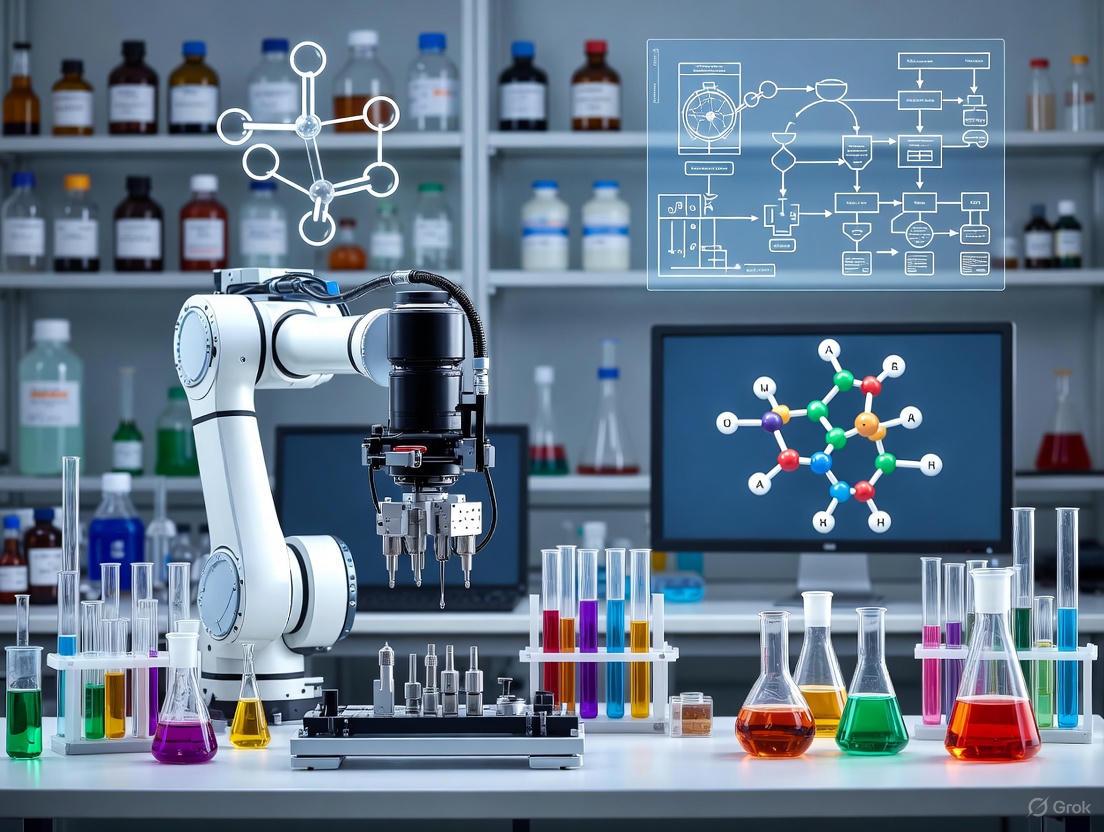
This article explores the transformative impact of autonomous laboratories, or self-driving labs, which integrate artificial intelligence, robotics, and advanced data analysis to create closed-loop systems for materials synthesis and chemical...
Autonomous Laboratory Robotics: Accelerating Materials Synthesis and Drug Discovery
Abstract
This article explores the transformative impact of autonomous laboratories, or self-driving labs, which integrate artificial intelligence, robotics, and advanced data analysis to create closed-loop systems for materials synthesis and chemical discovery. Tailored for researchers, scientists, and drug development professionals, it provides a comprehensive overview from foundational concepts to real-world validation. We examine the core components of these systems, from mobile manipulators and AI-driven decision-making to their application in exploratory synthesis and supramolecular chemistry. The scope extends to methodological workflows, key challenges like data quality and hardware integration, and the crucial frameworks for verifying these systems in industrial and biomedical settings, ultimately outlining a future where AI-orchestrated discovery dramatically shortens innovation cycles.
The Foundations of Self-Driving Labs: From Automation to Autonomous Discovery
An autonomous laboratory, also known as a self-driving lab (SDL) or Materials Acceleration Platform (MAP), represents a transformative paradigm in scientific research. It is a highly integrated system that combines artificial intelligence (AI), robotic experimentation systems, and automation technologies into a continuous closed-loop cycle [1]. The core distinction from traditional automation lies in the shift from mere automated execution of predefined tasks to AI-driven decision-making that plans, executes, and optimizes scientific experiments with minimal human intervention [2] [1]. This paradigm aims to drastically accelerate discovery timelines, potentially reducing the traditional 10-20 year materials development pipeline to just 1-2 years [1].
Key Components and Architectures
The operation of an autonomous laboratory is governed by a continuous, closed-loop workflow. The diagram below illustrates this core cycle.
Core Subsystems
- AI and Computational Intelligence: This subsystem acts as the "brain," responsible for experimental planning, synthesis recipe generation, data analysis, and optimization. It employs techniques like large language models (LLMs), active learning, Bayesian optimization, and convolutional neural networks for tasks such as phase identification from X-ray diffraction patterns [1].
- Robotic Experimentation Systems: This is the "hands" of the lab, comprising hardware that automatically carries out physical tasks. This includes synthesizers (e.g., Chemspeed ISynth), mobile robots for sample transport, and integrated analytical instruments like UPLC–MS and benchtop NMR spectrometers [1].
- Data Infrastructure: This backbone involves standardized data formats, accessible materials databases, and knowledge representation frameworks that ensure data is machine-readable and can be fed back into the AI models [2] [1].
Recent architectures have evolved to include hierarchical multi-agent systems. The following diagram details the coordination of AI agents in a modern self-driving lab.
Application Notes: Representative Case Studies
The following case studies exemplify the real-world implementation and performance of autonomous laboratories.
Case Study 1: A-Lab for Inorganic Materials Synthesis
- Objective: To autonomously synthesize and optimize novel, theoretically stable inorganic materials predicted by large-scale ab initio calculations [1].
- System Components: The A-Lab integrated computational target selection from the Materials Project and Google DeepMind, NLP models for synthesis recipe generation, robotic solid-state synthesis setups, ML models for X-ray diffraction (XRD) phase analysis, and the ARROWS³ active learning algorithm for optimization [1].
- Performance Metrics: Over 17 days of continuous operation, A-Lab successfully synthesized 41 out of 58 target materials, achieving a 71% success rate with minimal human intervention [1].
Case Study 2: Modular Platform for Exploratory Organic Chemistry
- Objective: To autonomously explore complex chemical spaces, including structural diversification, supramolecular assembly, and photochemical catalysis [1].
- System Components: This platform featured free-roaming mobile robots that transported samples between a Chemspeed ISynth synthesizer, a UPLC–MS system, and a benchtop NMR spectrometer. A heuristic reaction planner acted as the decision-maker, using dynamic time warping and precomputed m/z lookup tables to analyze spectral data and determine subsequent experimental steps [1].
- Outcome: The system demonstrated the ability to autonomously perform multi-day campaigns involving screening, replication, scale-up, and functional assays, mimicking expert-like judgment for instantaneous decision-making [1].
Table 1: Comparative Performance of Autonomous Laboratory Systems
| System / Metric | A-Lab (Solid-State) [1] | Modular Organic Platform [1] | Traditional Manual Methods [1] |
|---|---|---|---|
| Operation Duration | 17 days (continuous) | Multi-day campaigns | Months to years |
| Number of Experiments / Syntheses Attempted | 58 target materials | Not explicitly stated | Limited by human throughput |
| Success Rate | 71% (41/58) | Successfully completed complex tasks | Highly variable |
| Primary Optimization Method | Active Learning (ARROWS³) | Heuristic-based decision making | Researcher intuition and trial-and-error |
| Key Achievement | Synthesis of novel inorganic powders | Autonomous exploration of reaction spaces | Baseline for comparison |
Experimental Protocols
This section provides a detailed methodology for establishing and operating a foundational autonomous laboratory workflow for materials synthesis.
Protocol: Closed-Loop Optimization for Inorganic Material Synthesis
Adapted from the A-Lab and related SDL methodologies [1].
I. Preparation and System Setup
Target Identification:
- Input a list of target materials, ideally sourced from computational predictions of stability (e.g., from the Materials Project).
- Ensure targets are air-stable to simplify initial experimental validation.
Precursor Preparation:
- Load a library of solid-state precursors (e.g., metal oxides, carbonates) into the robotic feedstock system.
- Ensure precursors are finely ground and homogenized to promote reaction consistency.
Instrument Calibration:
- Calulate all robotic components: weigh stations, solid dispensers, and milling units.
- Standardize the X-ray Diffractometer (XRD) using a known standard (e.g., Si or Al₂O₃) to ensure accurate phase identification.
II. Experimental Execution Loop
Recipe Generation:
- The AI planner (e.g., an LLM trained on literature data) generates an initial synthesis recipe for a target material. This includes precursor identities, their stoichiometric ratios, a mixing protocol, and a suggested sintering temperature profile.
Robotic Synthesis:
- The robotic system accurately dispenses the calculated masses of precursors into a reaction vessel.
- The precursors are mixed mechanically (e.g., by ball milling) for a specified duration.
- The mixture is transferred to a furnace and heated under a controlled atmosphere (e.g., air) according to the generated temperature profile.
Product Characterization and Analysis:
- The synthesized product is automatically transported to the XRD instrument.
- An XRD pattern is collected and passed to a machine learning model (e.g., a convolutional neural network) for phase identification.
- The model quantifies the amount of the target phase present and identifies any impurity phases.
AI-Driven Decision and Iteration:
- The result is fed to an active learning algorithm (e.g., Bayesian optimization).
- If the yield is insufficient (<100% target phase), the algorithm analyzes the failure (e.g., incorrect precursors, unsuitable temperature) and proposes a modified synthesis recipe.
- Steps 2-4 are repeated autonomously until the yield is maximized or a predefined number of cycles is completed.
III. Data Handling and Completion
- All experimental parameters, characterization data, and outcomes are recorded in a standardized format (e.g., according to the Open Database of Materials protocols) [2].
- Upon completion of a target, the system proceeds to the next material in the queue.
The Scientist's Toolkit: Essential Research Reagents and Materials
Table 2: Key Research Reagent Solutions and Materials for Autonomous Materials Synthesis
| Item | Function / Application | Example / Note |
|---|---|---|
| Solid-State Precursors | High-purity powders serving as starting materials for inorganic synthesis. | Metal oxides (e.g., TiO₂, V₂O₅), carbonates (e.g., Li₂CO₃), nitrates. |
| Solvents | For liquid-phase synthesis, extraction, and cleaning of robotic fluidic paths. | Dimethylformamide (DMF), Acetonitrile, Water (HPLC grade). |
| Catalyst Libraries | Pre-prepared collections of catalysts for reaction discovery and optimization in organic chemistry. | Palladium complexes, organocatalysts. |
| Standardized Samples | Known materials used for calibration and validation of analytical instruments to ensure data quality and reproducibility. | Silicon powder (XRD standard), known concentration solutions (for UPLC-MS). |
| Reaction Vessels | Containers for conducting reactions, compatible with robotic handling and high-temperature or high-pressure conditions. | Glass vials, Teflon-lined stainless steel autoclaves, ceramic crucibles. |
Current Constraints and Future Directions
Despite their promise, autonomous laboratories face several constraints that are active areas of research.
- Data Scarcity and Quality: AI model performance is highly dependent on large, high-quality datasets. Noisy, scarce, or inconsistent experimental data can severely hinder performance [1].
- Limited Generalization: Most systems are specialized for specific tasks (e.g., solid-state synthesis or organic catalysis). Transferring AI models and hardware setups to new scientific problems remains challenging [1].
- AI Hallucination and Uncertainty: LLMs can generate plausible but incorrect chemical information or fail to indicate uncertainty, potentially leading to failed experiments or safety risks [1].
- Hardware Rigidity: A lack of modular, standardized hardware interfaces makes it difficult to reconfigure platforms for different experimental requirements [1].
Future development efforts are focused on creating domain-adaptive foundation models, implementing robust uncertainty quantification, and developing more flexible, modular hardware architectures to enhance the generalization and reliability of self-driving laboratories [1].
Autonomous laboratories represent a paradigm shift in materials science and chemical research, leveraging the seamless integration of artificial intelligence (AI), robotic experimentation systems, and advanced analytical instrumentation. These systems form a continuous, closed-loop cycle capable of autonomously conducting scientific experiments with minimal human intervention, dramatically accelerating the pace of discovery and innovation [1]. This integration is foundational to a new era of scientific research, enabling the rapid exploration of novel materials and the optimization of synthesis strategies, turning processes that once took months of trial and error into routine high-throughput workflows [1]. The core of these systems lies in the synergistic operation of their components: AI acts as the central decision-making "brain," robotic platforms serve as the unmanned "hands" for task execution, and analytical instruments provide the critical "senses" for outcome evaluation [3] [1]. This article details the application notes and experimental protocols for implementing these core components within the context of autonomous materials synthesis.
Core Components and Their Functions
The operational framework of an autonomous laboratory is built upon three interconnected technological pillars. Their individual and collective functions are outlined in the table below.
Table 1: Core Components of an Autonomous Laboratory
| Component | Primary Function | Key Technologies & Examples |
|---|---|---|
| Artificial Intelligence (AI) | Serves as the central planning and optimization system. Generates experimental hypotheses, predicts synthesis routes, and analyzes results to propose subsequent experiments. | Natural Language Processing for recipe generation [1], Large Language Models (e.g., Coscientist, ChemCrow) [1], Active Learning & Bayesian Optimization [1], Multi-Agent Frameworks (e.g., ChemAgents) [1], Predictive Models from ab initio data [1]. |
| Robotic Experimentation | Acts as the automated physical platform that performs liquid handling, solid dispensing, reaction control, and sample transport without human intervention. | Commercial platforms (Chemspeed synthesizer) [1], Mobile Sample Transport Robots [1], Custom Open-Source Systems (e.g., FLUID robot) [4], Syringe Pumps, Valves, and Heated Reactors. |
| Analytical Instrumentation | Provides real-time, automated characterization of synthesized materials or compounds, generating the data required for AI-driven decision-making. | X-ray Diffraction (XRD) [1], Ultraperformance Liquid Chromatography–Mass Spectrometry (UPLC–MS) [1], Benchtop Nuclear Magnetic Resonance (NMR) [1], Spectroscopy (FTIR) [5], Microscopy (SEM, AFM) [5]. |
Workflow Integration and Signaling Logic
The power of an autonomous laboratory is realized through the tight integration of its core components into a continuous, closed-loop workflow. This process, often described as a "Materials Flywheel," enables iterative and self-improving research cycles [3]. The logical sequence and data signaling between components can be visualized in the following workflow.
Autonomous Laboratory Workflow
This diagram illustrates the core closed-loop cycle. The process begins with a research objective, such as synthesizing a target material with specific properties. The AI component first generates an initial synthesis hypothesis and a detailed, executable recipe. This digital recipe is then passed to the robotic experimentation system, which physically executes the procedure. Once the experiment is complete, the resulting product is automatically transferred to the analytical instrumentation for characterization. The raw data from these instruments is fed back to the AI, which interprets the results, compares them to the prediction, and uses optimization algorithms to decide on the next best experiment. This creates a continuous loop of planning, execution, and learning until the research objective is successfully met [3] [1].
Detailed Experimental Protocol: Solid-State Material Synthesis
The following protocol is adapted from the operation of A-Lab, an autonomous system demonstrated for solid-state material synthesis [1]. This provides a concrete example of how the core components interact in practice.
Application Notes
- Objective: To autonomously synthesize and optimize the synthesis of novel, air-stable inorganic materials predicted by computational models.
- System Overview: This protocol leverages an integrated system where an AI model trained on literature data and theoretical databases controls a robotic solid-handling platform and uses machine learning for real-time phase analysis.
- Key Advantages: The system can operate continuously for extended periods (e.g., over 17 days), performing multiple synthesis and analysis iterations with minimal human intervention, achieving high success rates in synthesizing predicted materials [1].
Required Reagents and Equipment
Table 2: Research Reagent Solutions and Essential Materials
| Item | Function / Description |
|---|---|
| Solid Precursor Powders | High-purity metal oxides, carbonates, or other salts that serve as reactants for solid-state reactions. |
| Milling Media | Durable balls (e.g., zirconia) used in the milling step to homogenize and reduce the particle size of the precursor mixture. |
| Crucibles | High-temperature resistant containers (e.g., alumina) to hold samples during firing in the furnace. |
| AI/Software Platform | Integrated software suite for recipe generation (NLP models), phase identification (CNN models), and optimization (e.g., ARROWS3 algorithm) [1]. |
| Automated Robotic Platform | Robotic arm(s) equipped with solid-dispensing tools, balances, and a milling station for precise handling and preparation of solid powders. |
| High-Temperature Furnace | For calcining and sintering the mixed precursors at controlled temperatures (often up to 1000°C+). |
| X-ray Diffractometer (XRD) | Equipped with an automated sample changer for phase identification and quantification of the synthesized product. |
Step-by-Step Protocol
Target Selection and Initial Recipe Generation (AI Component):
- Input: A list of target materials with predicted stability is loaded from computational databases (e.g., the Materials Project) [1].
- Action: The AI, using natural language models trained on vast literature data, generates one or more initial synthesis recipes for a given target. This includes selecting precursor compounds and calculating their required masses, and proposing an initial firing temperature profile [1].
Automated Sample Preparation (Robotic Component):
- Dispensing: The robotic system precisely weighs out the calculated masses of each solid precursor powder into a milling vial.
- Milling: The milling media is added, and the vial is sealed and moved to a mixer mill. The mixture is milled for a predefined duration to ensure homogeneity.
- Pressing and Loading: The milled powder is automatically pressed into a pellet and transferred into a crucible. The robotic arm places the crucible into a designated slot in a custom furnace carousel.
Synthesis and Thermal Processing (Robotic Component):
- The furnace executes the temperature program specified by the AI recipe, which may include ramp rates, hold temperatures, and dwell times.
Product Characterization and Analysis (Analytical + AI Components):
- Sample Transfer: After the furnace cools, the robotic system retrieves the crucible and transports the synthesized pellet to the X-ray diffractometer (XRD).
- Data Acquisition: An XRD pattern of the product is collected automatically.
- Phase Identification: A machine learning model (e.g., a convolutional neural network) analyzes the XRD pattern in real-time to identify the crystalline phases present and estimate their proportions [1].
Data Interpretation and Iterative Optimization (AI Component):
- Success Evaluation: The AI compares the identified phases to the target material. If the synthesis was successful and pure, the result is logged, and the system proceeds to the next target.
- Failed Synthesis Analysis & Replanning: If the synthesis fails or is impure, the AI uses an active learning algorithm (e.g., ARROWS3) to analyze the failure. It identifies the likely reason (e.g., incorrect precursor selection, insufficient temperature) and formulates a new, improved recipe, such as adjusting the precursor mix or increasing the firing temperature [1].
- Loop Closure: The new recipe is sent to the robotic system, and the cycle repeats from Step 2.
Detailed Experimental Protocol: Liquid-Phase Chemical Exploration
This protocol is based on modular autonomous platforms used for exploratory synthetic chemistry in the liquid phase, illustrating the flexibility of the core components [1].
Application Notes
- Objective: To autonomously explore complex chemical spaces, such as reaction discovery, optimization, and supramolecular assembly in solution.
- System Overview: This setup often employs mobile robots to transport samples between modular, standalone instruments, all coordinated by a central "heuristic reaction planner" that mimics expert judgment [1].
- Key Advantages: The modular nature offers flexibility. The use of orthogonal analytical techniques (MS and NMR) and human-like heuristic decision-making allows for robust exploration and replication of complex chemical phenomena [1].
Required Reagents and Equipment
Table 3: Research Reagent Solutions and Essential Materials
| Item | Function / Description |
|---|---|
| Liquid Reagents & Solvents | High-purity starting materials, catalysts, and solvents required for the targeted chemical reactions. |
| Reaction Vials | Vials suitable for use in automated synthesizers and UPLC/MS autosamplers. |
| Mobile Robots | Free-roaming mobile robots equipped with robotic arms to pick, transport, and operate samples across different laboratory stations [1]. |
| Automated Liquid Handler | A synthesizer (e.g., Chemspeed ISynth) capable of precise liquid dispensing, mixing, and temperature control for reaction execution. |
| UPLC–Mass Spectrometry (UPLC-MS) | For rapid separation and mass-based identification of reaction components. |
| Benchtop NMR Spectrometer | For structural elucidation and confirmation of synthesized compounds. |
| Heuristic Reaction Planner | Central AI software that assigns "pass/fail" criteria based on combined MS and NMR data to determine subsequent experimental steps [1]. |
Step-by-Step Protocol
Experiment Planning (AI Component):
- The heuristic planner receives a high-level goal, such as "explore structural diversification of compound X."
- It designs an initial set of reaction conditions or substrates to screen.
Reaction Execution (Robotic Component):
- The automated liquid handler prepares reaction mixtures in vials according to the specified conditions (volumes, concentrations, solvents).
- Reactions are initiated and allowed to proceed under controlled conditions (temperature, stirring, time).
Automated Analysis and Decision-Making (Analytical + AI Components):
- Sample Transfer: A mobile robot collects the reaction vial and transports it first to the UPLC-MS system for analysis [1].
- MS Data Analysis: The heuristic planner analyzes the MS data for expected m/z values and reaction-induced changes using techniques like dynamic time warping.
- NMR Data Analysis: If needed, the mobile robot subsequently transports the sample to the benchtop NMR for further structural analysis. The planner also interprets the NMR spectrum.
- Heuristic Decision: Based on pre-defined, human-like criteria applied to the combined MS and NMR data, the planner assigns a "pass" or "fail" to the outcome and decides the next step. This could be:
- Replication: To confirm a promising result.
- Scale-up: To produce more material for further testing.
- Functional Assay: To test the property of a synthesized compound.
- New Exploration: To test a new condition in the chemical space [1].
Iterative Exploration:
- The system continues this cycle of execution, multi-modal analysis, and heuristic planning over multi-day campaigns, autonomously mapping out the chemical space of interest.
The Scientist's Toolkit: Key Research Reagent Solutions
The following table compiles essential materials and reagents commonly used in the experiments enabled by autonomous laboratories, particularly in materials synthesis and chemical research.
Table 4: Essential Research Reagents and Materials
| Item | Function / Explanation |
|---|---|
| Metal Oxide Precursors | Base materials for solid-state synthesis of inorganic compounds and semiconductors. Examples include SnO₂, ZnO, and Co₃O₄, which are fundamental for developing electrical and electrochemical sensors [6]. |
| Dopants (e.g., V, Rh) | Elements added in small quantities to a host material to alter its electrical or catalytic properties. For example, Vanadium doping in ZnO:Ca can enhance ammonia gas sensing response [6]. |
| Solid-Phase Milling Media | Used to mechanically grind and mix solid precursor powders to achieve a homogeneous mixture with increased surface area for reaction, a critical step in solid-state synthesis. |
| High-Temperature Crucibles | Containers made from materials like alumina that withstand extreme temperatures during calcination and sintering in furnaces. |
| Liquid Reagents & Solvents | Chemicals for solution-based synthesis, including organometallic catalysts (e.g., for palladium-catalyzed cross-couplings), solvents, and substrates for organic and supramolecular chemistry [1]. |
| Analytical Standards | Pure compounds with known concentration and properties used to calibrate analytical instruments like UPLC-MS and NMR, ensuring accurate and reliable data for AI interpretation. |
The Design-Make-Test-Analyze (DMTA) cycle represents a foundational paradigm for scientific discovery, transforming traditionally linear, human-driven research into a rapid, iterative, and self-optimizing process. In the context of autonomous laboratory robotics for materials synthesis, this closed-loop workflow integrates robotic execution, artificial intelligence (AI), and real-time data analysis to form a Self-Driving Laboratory (SDL). Such systems address a critical bottleneck in materials science: the conventional timeline from conceptualization to market can exceed a decade, largely due to manual and labor-intensive experimental processes [7]. Autonomous laboratories are engineered to accelerate this discovery pipeline by orders of magnitude, achieving a rate of materials development that is 10–100 times faster than the current standard [7]. By leveraging robotics for precise and reproducible synthesis and characterization, combined with AI-driven decision-making, these systems not only enhance speed but also systematically explore complex parameter spaces that would be intractable for human researchers, leading to the discovery of novel materials and optimized synthesis pathways with unprecedented efficiency.
The Core Components of a Closed-Loop Workflow
The operational framework of an autonomous laboratory is built upon the seamless integration of four interconnected components: Design, Make, Test, and Analyze. This creates a continuous, closed-loop system that functions with minimal human intervention.
Design: This initial phase utilizes AI and computational models to propose new experimental targets or synthesis routes. Inputs can include vast datasets from prior experiments, known material properties, and computational predictions from sources like the Materials Project. Machine learning algorithms, particularly those based on Bayesian optimization, are employed to suggest the most promising experiments that balance exploration of new chemical spaces with the exploitation of known successful conditions [8] [9]. For instance, these algorithms can propose new inorganic compounds predicted to be stable or specify medium conditions for optimizing microbial production of target molecules [7] [9].
Make: The designed experiments are executed by robotic systems for synthesis and preparation. This component translates digital hypotheses into physical reality. In a materials discovery lab, this typically involves gravimetric powder dispensers and robotic arms that precisely weigh, mix, and handle precursor materials [8]. In biotechnology contexts, this may involve liquid handlers for culture medium preparation and automated incubators [9]. This robotic execution ensures a high degree of precision, reproducibility, and throughput that far surpasses manual methods.
Test: The synthesized materials or cultured samples are automatically transferred to characterization instruments for analysis. A key technology in this phase is in situ or automated X-ray diffraction (XRD), which provides immediate feedback on crystalline structure, phase purity, and reaction products [7] [8]. Other common analytical tools integrated into these platforms include microplate readers for measuring optical density (cell growth) and LC-MS/MS systems for quantifying specific molecules in solution, such as metabolites or product yields [9].
Analyze: Data collected from the "Test" phase is automatically processed and interpreted by machine learning models. For example, probabilistic deep learning approaches can automate the interpretation of multi-phase diffraction spectra to identify crystalline products and their proportions [7]. The results are then fed back to the AI planning algorithms, which update their internal models, identify knowledge gaps, and propose the next set of experiments to advance toward the defined objective, thus closing the loop [7] [8].
The following diagram illustrates the logical flow and iterative nature of this integrated process.
Case Studies in Materials and Biotechnology
The practical implementation and success of autonomous laboratories are demonstrated by several pioneering research platforms. The quantitative outcomes from these case studies, summarized in the table below, highlight the efficiency and effectiveness of the closed-loop workflow.
Table 1: Quantitative Outcomes from Autonomous Laboratory Case Studies
| Case Study / Platform | Primary Objective | Experimental Throughput & Scale | Key Quantitative Results | Reference |
|---|---|---|---|---|
| The A-Lab (Ceder Group) | Synthesize novel, computationally predicted inorganic compounds | 58 target compounds processed in <3 weeks | 41/58 (71%) of target compounds successfully synthesized | [7] [8] |
| Autonomous Lab (ANL) for Biotechnology | Optimize medium conditions for E. coli glutamic acid production | Bayesian optimization of 4 key medium components (CaCl₂, MgSO₄, CoCl₂, ZnSO₄) | Successfully improved cell growth rate and maximum cell growth | [9] |
| Insilico Medicine Robotics Lab | AI-driven drug discovery and preclinical candidate nomination | Platform integrates 1.9 trillion data points from over 10 million samples | Nominated 8 preclinical candidates since 2021; lead candidate for IPF in Phase I trials | [10] |
Case Study 1: The A-Lab for Novel Inorganic Materials Synthesis
The A-Lab, developed by the Ceder Group, is a flagship example of a closed-loop system for solid-state materials synthesis [7] [8]. Its objective was to synthesize novel inorganic compounds predicted to be stable by computational models but previously unreported in literature.
- Experimental Protocol:
- Design: 58 target compounds were selected from a pool of 42,000 computationally stable candidates based on criteria including thermodynamic stability, absence of rare/unsafe elements, and precursor availability [8].
- Make: A robotic system, comprising three coordinated stations, handled all synthesis. A gravimetric powder dispenser and robotic arm weighed and mixed precursor powders. A second, rail-mounted robot arm then transferred the mixed powders to box furnaces for heating [8].
- Test: After heating, a third robot arm retrieved the sample and prepared it for analysis by Automated X-ray Diffraction (XRD) [8].
- Analyze: Machine learning models, specifically a probabilistic deep learning approach, interpreted the XRD patterns to identify successful synthesis and quantify phase purity. If the yield was insufficient, the AI planning algorithm proposed modified recipes (e.g., different precursors or heating conditions) for subsequent attempts [7] [8].
The A-Lab's success in synthesizing 41 new compounds in a single, continuous run demonstrates the profound acceleration possible with autonomous discovery.
Case Study 2: Autonomous Lab (ANL) for Bioproduction Optimization
The Autonomous Lab (ANL) system showcases the application of closed-loop workflows in biotechnology, specifically for optimizing the medium conditions for a recombinant E. coli strain engineered to overproduce glutamic acid [9].
- Experimental Protocol:
- Design: The system used Bayesian optimization to plan experiments. The goal was to maximize objective variables (cell density and glutamic acid concentration) by adjusting the concentrations of four selected medium components: CaCl₂, MgSO₄, CoCl₂, and ZnSO₄ [9].
- Make: The ANL's modular robotic systems, including a liquid handler (Opentrons OT-2), automatically prepared culture media with the specified concentrations of the four components and inoculated them with the E. coli strain. An incubator (LiCONiC STX44) maintained optimal growth conditions [9].
- Test: After a set cultivation period, a transport robot (Brooks PF400) moved culture plates to a centrifuge (BioNex HiG) for processing. The supernatant was then transferred to a LC-MS/MS system (Shimadzu) for precise quantification of glutamic acid concentration, while cell density was measured optically [9].
- Analyze: The data on cell growth and product yield were processed and fed back into the Bayesian optimization algorithm. The algorithm updated its model of the complex relationship between medium composition and output, then proposed a new set of concentrations to test, iteratively driving the system toward the optimal medium formulation [9].
This case study highlights the flexibility of SDLs in handling biological systems and their capability to efficiently navigate multi-variable optimization problems.
Essential Research Reagent Solutions
The execution of automated experiments relies on a suite of core reagent solutions and hardware modules. The following table details key components and their functions within autonomous laboratory systems.
Table 2: Key Research Reagent Solutions and Hardware Modules in Autonomous Labs
| Category | Item / Solution | Function in the Closed-Loop Workflow |
|---|---|---|
| Precursor Materials | High-purity metal oxides and carbonates (e.g., Li₂CO₃, MnO, TiO₂) | Fundamental building blocks for solid-state synthesis of inorganic materials [8]. |
| Culture Media Components | M9 Minimal Medium salts (Na₂HPO₄, KH₂PO₄, NH₄Cl, NaCl) | Provides essential ions and nutrients for controlled microbial growth in bioproduction studies [9]. |
| Trace Elements & Cofactors | CoCl₂, ZnSO₄, CaCl₂, MgSO₄, Thiamine, FAD | Optimizes cell growth and acts as cofactors for enzymatic activity in metabolic pathways (e.g., glutamic acid biosynthesis) [9]. |
| Robotic Synthesis Modules | Automated Gravimetric Powder Dispenser | Precisely weighs and mixes solid precursors with high accuracy, a critical step for reproducible solid-state reactions [8]. |
| Robotic Synthesis Modules | Liquid Handler (e.g., Opentrons OT-2) | Automates the dispensing and mixing of liquid reagents and culture media [9]. |
| Characterization Modules | Automated X-ray Diffractometer (XRD) | Provides rapid, in-situ phase identification and analysis of synthesized materials [7] [8]. |
| Characterization Modules | Microplate Reader & LC-MS/MS System | Measures optical density (cell growth) and quantifies specific metabolite or product concentrations [9]. |
Experimental Protocol: Implementing a Closed-Loop Synthesis Campaign
This protocol provides a detailed methodology for conducting an autonomous synthesis campaign, based on the operational principles of the A-Lab [8] and the ANL [9]. The following diagram outlines the integrated hardware and data flow required for such a campaign.
Stage 1: System Configuration and Target Selection
- Step 1: Define the Research Objective. Clearly articulate the goal, such as "discover a novel sodium-ion conductor" or "maximize the titer of glutamic acid in E. coli."
- Step 2: Select Target Candidates.
- For materials synthesis: Query computational databases (e.g., Materials Project) for predicted stable compounds that meet element and property constraints. Filter for those not present in the Inorganic Crystal Structure Database (ICSD) to ensure novelty [8].
- For bioproduction: Define the output variable (e.g., product concentration, growth rate) and the input variables (e.g., concentration of medium components) to be optimized [9].
- Step 3: Configure Robotic Hardware.
- Ensure all necessary precursors and reagents are loaded into the appropriate dispensers.
- Calibrate robotic arms, powder dispensers, and liquid handlers.
- Validate the operational status of all instruments in the loop (furnaces, incubators, XRD, LC-MS).
Stage 2: Execution of a Single Design-Make-Test-Analyze Cycle
Step 4: Design - Propose an Experiment.
Step 5: Make - Execute Synthesis.
- The robotic system executes the recipe. For solid-state synthesis:
- The powder dispensing system accurately weighs out each precursor.
- A robot arm mixes the powders, potentially using a mortar and pestle or ball milling.
- The mixture is pressed into a pellet and loaded into a furnace by a second robot arm for reaction under specified temperature and time profiles [8].
- For bioproduction:
- The liquid handler prepares the culture medium in a multi-well plate.
- The platform inoculates the medium with the microbial strain and transfers the plate to an incubator [9].
- The robotic system executes the recipe. For solid-state synthesis:
Step 6: Test - Characterize the Product.
Step 7: Analyze - Interpret Data and Update Models.
- Machine learning models (e.g., convolutional neural networks for XRD or statistical models for LC-MS data) automatically process the raw data to determine the outcome (e.g., success/failure, phase fractions, product concentration) [7].
- These results, linked to the experimental parameters, are stored in a central database.
- The AI planner uses this new data to update its predictive model and propose the next experiment, returning to Step 4.
- Step 8: Final Review.
- Once a predefined stopping condition is met (e.g., successful synthesis, number of cycles, or convergence to an optimum), the campaign concludes.
- All experimental data, including successful and failed attempts, is compiled for final analysis and to inform future research directions.
The reproducibility crisis presents a fundamental challenge to scientific progress, with studies indicating that a substantial fraction of published results, particularly in biomedicine, cannot be replicated [11]. In cancer biology, for instance, automated analysis has found that less than one-third of published results are reproducible [12]. This crisis undermines trust in science and wastes substantial resources. Concurrently, the increasing complexity of exploring synthetic chemistry and materials science demands innovative solutions to scale research efficiently.
Autonomous laboratory robotics, integrating artificial intelligence (AI) and advanced instrumentation, emerges as a pivotal solution to both challenges. These systems enhance reproducibility through mechanical repeatability, precise protocol execution, and comprehensive data logging [11]. Furthermore, they scale complex exploration by operating continuously, navigating vast experimental parameters spaces, and making autonomous decisions based on multimodal data [13] [14]. This application note details the key drivers behind this technological paradigm shift and provides detailed protocols for its implementation in materials synthesis research.
Key Driver I: Enhancing Reproducibility and Trustworthiness
Semantic Execution Tracing and Audit Trails
A primary contribution of autonomous robotics to reproducibility is the generation of rich, semantically structured execution traces. Unlike simple data logs, these frameworks capture:
- Low-level sensor data and robot commands: Providing a ground-truth record of physical actions [11].
- Semantically annotated robot belief states: Documenting what the robot believed about the world state at each point, including perceived objects and their spatial relationships [11].
- Narrative reasoning traces: Explaining why actions were taken, how perceptual decisions were made, and the causal reasoning behind them [11].
The RobAuditor framework exemplifies this approach. It functions as a plugin for robotic systems, interpreting execution traces to generate comprehensive, ontology-grounded stories of robot activities, which are persistently stored as Narrative Enabled Episodic Memories (NEEMs) [11]. This creates an indelible audit trail for diagnostic and verification purposes.
Digital Twins and Imagination-Enabled Cognitive Traces
The integration of semantic digital twins—high-fidelity simulations mirroring real-world laboratory environments—enables a form of "imagination-enabled" perception [11]. Before executing a physical action, the robot can simulate anticipated outcomes within the digital twin. Post-execution, it compares actual observations against these predictions. This process generates cognitive traces that document the robot's internal reasoning, hypotheses, and explanations for discrepancies, thereby making the scientific process more transparent and interpretable [11] [14].
FAIR Data Principles and Open Computational Infrastructure
Adherence to Findable, Accessible, Interoperable, and Reusable (FAIR) data principles is a cornerstone of reproducible robot-assisted science [11]. Platforms like the AICOR Virtual Research Building (VRB) provide cloud-based environments that link containerized, deterministic robot simulations with semantically annotated execution traces [11]. This offers open access to code, simulation environments, and data, allowing global researchers to inspect, reproduce, and build upon each other's work, directly addressing the reproducibility crisis.
Table 1: Quantitative Evidence of the Reproducibility Crisis and Robotic Impact
| Field of Study | Reproducibility Rate | Assessment Method | Key Finding |
|---|---|---|---|
| Breast Cancer Cell Biology | 22 out of 74 papers (≈30%) [12] | Automated text analysis & robot scientist 'Eve' | Statistically significant evidence for reproducibility was found for only 22 papers. |
| General Scientific Research | >70% of researchers have failed to reproduce another's experiment [12] | Researcher surveys | Highlights the pervasive nature of the reproducibility crisis across disciplines. |
Key Driver II: Scaling Complex Exploratory Synthesis
Modular Robotic Workflows and Equipment Agnosticism
Traditional autonomous laboratories often rely on bespoke, hardwired equipment, which is costly and inflexible. A transformative approach uses mobile robots to integrate standard laboratory equipment into a cohesive, modular workflow [13]. These free-roaming robots can transport samples and operate synthesizers, chromatographs, and spectrometers without requiring extensive hardware modifications. This "hardware-agnostic" design allows robots to share existing infrastructure with human researchers, dramatically increasing accessibility and scalability while reducing operational monopolization [13].
Heuristic and Multi-Modal Decision-Making
Exploratory synthesis, such as in supramolecular chemistry, often yields diverse products rather than a single, easily optimized output. Scaling this complexity requires moving beyond simple, single-metric optimization. Advanced autonomous systems employ heuristic decision-makers that process orthogonal analytical data (e.g., from UPLC-MS and NMR spectroscopy) [13]. The system gives a binary pass/fail grade to each analysis based on expert-defined criteria. These grades are combined to autonomously decide which reactions to scale up or elaborate, effectively mimicking the decision-making process of a human chemist and remaining open to novel discoveries [13].
Hierarchical Active Learning and AI-Guided Exploration
To efficiently navigate vast, multi-dimensional parameter spaces (e.g., in metastable materials synthesis), autonomous systems employ hierarchical active learning (AL). Frameworks like the Scientific Autonomous Reasoning Agent (SARA) use nested AL cycles built upon machine learning models that incorporate the underlying physics of experiments [15]. This allows the system to strategically design experiments that most efficiently reveal the structure of complex synthesis phase diagrams, leading to orders-of-magnitude acceleration in discovery, such as stabilizing δ-Bi₂O₃ at room temperature [15].
Table 2: Capabilities of Autonomous Systems in Scaling Complex Exploration
| System/Platform | Primary Exploration Capability | Application Example | Reported Outcome |
|---|---|---|---|
| Modular Mobile Robot Platform [13] | Multi-modal decision-making (NMR & UPLC-MS) | Supramolecular host-guest chemistry; Structural diversification | Autonomous identification of successful assemblies and reproducible synthesis pathways. |
| SARA (Scientific Autonomous Reasoning Agent) [15] | Hierarchical active learning for non-equilibrium synthesis | Mapping phase diagrams for Bi₂O₃ | Orders-of-magnitude acceleration in establishing a synthesis phase diagram. |
| Self-Driving Laboratories (SDLs) / MAPs [16] | Closed-loop optimization and AI-driven planning | Nanomaterials synthesis; Electrocatalyst discovery | Reduction of traditional development pipelines from 10-20 years to 1-2 years. |
Experimental Protocols
Protocol: Autonomous Reproducibility Assessment of Literature Claims
This protocol adapts the methodology used by the 'Eve' robot scientist to semi-automate the testing of published scientific results [12].
1. Hypothesis and Paper Selection:
- Use automated text mining and natural language processing to analyze large corpora of scientific literature (e.g., 12,000+ papers) [12].
- Extract specific statements related to experimental outcomes (e.g., "compound X inhibits proliferation of cell line Y").
- Apply inclusion criteria (e.g., scientific interest, feasibility for automated testing) to select a final set of papers for validation.
2. Automated Experimental Replication:
- Liquid Handling: Use a robotic platform (e.g., Chemspeed ISynth) to automatically prepare solutions, cell cultures, and compound dilutions as described in the original publication [13].
- Treatment and Incubation: The robot executes the treatment protocol, adding compounds to cell cultures and managing incubation conditions.
- Assay Execution: Perform the described biological assay (e.g., cell viability) using integrated, automated readers.
3. Data Analysis and Reproducibility Judgment:
- Statistical Analysis: Automatically analyze the resulting data to determine if the effect described in the literature is observed with statistical significance.
- Judgment Criteria: A result is deemed:
- Repeatable if the same effect is observed under identical laboratory conditions.
- Reproducible/Robust if the same effect is observed by a different scientist (or robot) under similar conditions [12].
Protocol: Closed-Loop Exploration of a Synthesis Phase Diagram
This protocol, based on the SARA agent, is designed for the autonomous discovery of metastable materials [15].
1. Hierarchical Experimental Design:
- The AI agent designs a lateral gradient laser spike annealing (lg-LSA) experiment. This allows for the parallel synthesis of a material across a gradient of temperatures and durations in a single sample [15].
- The system uses a high-level active learning cycle to select the most informative regions of the parameter space to explore next.
2. Rapid In-Situ Characterization:
- Immediately after synthesis, use a fast, inline characterization technique such as optical spectroscopy to identify phase transitions across the gradient sample [15].
- This rapid feedback is crucial for efficient exploration.
3. Physics-Informed Model Update:
- The spectroscopic data is used to update a machine learning model of the phase diagram. This model incorporates known physical constraints to improve its predictive power and data efficiency [15].
- A lower-level active learning cycle uses this model to optimize the design of subsequent lg-LSA experiments.
4. Validation and Loop Closure:
- Promising conditions identified through the rapid screening are validated with more precise, ex-situ characterization methods (e.g., X-ray diffraction).
- The results of this validation are fed back into the AI model, closing the loop and informing the next round of experimental designs.
The Scientist's Toolkit: Essential Research Reagents & Platforms
Table 3: Key Platforms and Digital Tools for Autonomous Research
| Item / Platform | Function / Application | Key Feature / Benefit |
|---|---|---|
| AICOR Virtual Research Building (VRB) [11] | Cloud platform for sharing and validating robot task executions. | Enables open, scalable replication of experiments via containerized simulations and semantic traces. |
| Semantic Digital Twin [11] | High-fidelity simulation of a real laboratory environment. | Enables "imagination-enabled" reasoning, hypothesis testing, and prediction vs. reality comparison. |
| Heuristic Decision-Maker [13] | Algorithm for autonomous analysis of multi-modal data (NMR, MS). | Mimics human expert decision-making to select successful reactions in exploratory synthesis. |
| RobAuditor [11] | Plugin for context-aware verification and audit trail generation. | Generates ontology-grounded, persistent narratives (NEEMs) of all robot activities for audit. |
| PyLabRobot [17] | Open-source, hardware-agnostic interface for liquid-handling robots. | Promotes reproducibility and transferability of protocols across different hardware setups. |
| Computer-Assisted Synthesis Planning (CASP) [18] | AI-powered tool for retrosynthetic analysis and route planning. | Proposes innovative synthetic routes, accelerating the "Design" phase of the DMTA cycle. |
Workflow Visualizations
Autonomous Experimentation Cycle
Semantic Execution Tracing Framework
Methodologies in Action: AI and Robotics for Exploratory Synthesis and Materials Discovery
The integration of mobile robots into synthetic laboratories represents a paradigm shift in materials and chemical research, moving from isolated, hardwired automation to flexible, modular autonomous systems. Traditional automated platforms often rely on bespoke engineering and physically integrated analytical equipment, which leads to proximal monopolization of instruments and limited characterization capabilities [19]. In contrast, modular workflows use free-roaming mobile robots to physically connect otherwise independent pieces of laboratory equipment, creating a dynamic system that can share existing infrastructure with human researchers without requiring extensive laboratory redesign [19]. This approach mimics human experimentation protocols, where multiple orthogonal characterization techniques inform decision-making throughout the research process.
The core advantage of this modular paradigm lies in its distributed architecture, which allows researchers to draw upon the wider array of analytical techniques already available in most synthetic laboratories rather than being confined to a single, fixed characterization method [19]. This is particularly valuable for exploratory synthesis in materials science and drug development, where reaction outcomes are often multifaceted and cannot be adequately assessed through unidimensional measurements. By enabling autonomous access to multiple instruments through mobile robotic agents, these systems provide the diverse analytical data necessary for robust autonomous decision-making in complex research domains [19].
System Architecture and Components
Core Hardware Modules
A complete modular robotic workflow for autonomous materials synthesis integrates several specialized components that work in concert through mobile robotic coordination. The architecture typically includes:
- Synthesis Module: A programmable automated synthesizer such as the Chemspeed ISynth platform, capable of performing chemical reactions autonomously with precise control over reaction conditions, reagent additions, and sampling [19].
- Mobile Robotic Agents: Free-roaming robots equipped with multipurpose grippers for sample transportation and instrument operation. These can be task-specific agents or a single robot with a versatile end-effector, providing the physical linkage between discrete modules [19].
- Analytical Instruments: Orthogonal characterization tools including Ultrahigh-Performance Liquid Chromatography-Mass Spectrometry (UPLC-MS) for molecular weight information and separation data, and benchtop Nuclear Magnetic Resonance (NMR) spectrometers (e.g., 80-MHz) for structural elucidation [19].
- Supplementary Modules: Optional specialized equipment such as commercial photoreactors for photochemical synthesis, which can be seamlessly incorporated into the workflow [19].
This distributed architecture allows instruments to be located anywhere in the laboratory, with the only physical limitation being laboratory space rather than engineering constraints of integration [19].
Research Reagent Solutions
Table 1: Essential Research Reagents and Materials for Modular Robotic Workflows
| Reagent/Material | Function in Workflow | Application Examples |
|---|---|---|
| Alkyne amines (e.g., compounds 1-3) | Building blocks for combinatorial synthesis | Parallel synthesis of ureas and thioureas [19] |
| Isothiocyanates & isocyanates (e.g., compounds 4-5) | Electrophilic coupling partners | Condensation reactions with amine nucleophiles [19] |
| Hydrogen peroxide | Oxidizing agent | Thioether oxidation reactions [19] |
| Ammonia and iodine | Reagents for functional group interconversion | Nitrile synthesis from aldehydes [19] |
| Ruppert-Prakash reagent (TMSCF₃) | Trifluoromethylation source | Exploratory trifluoromethylation reaction discovery [19] |
| Formazine precursors | Turbidity reference material | System validation and sensor calibration [19] |
Software and Control Infrastructure
The operational backbone of these modular systems consists of several integrated software components:
- Dynamic Programming Language: Custom χDL language extensions enable self-correcting procedure execution with real-time adaptation to changing process parameters [20].
- Instrument Control Package: Specialized Python packages (e.g., AnalyticalLabware) provide unified interfaces for controlling diverse analytical instruments including UV-Vis, NIR, Raman, NMR spectrometers, and HPLC-DAD systems from various manufacturers [20].
- Optimization Algorithms: Frameworks such as ChemputationOptimizer leverage state-of-the-art optimization algorithms from Summit and Olympus platforms for closed-loop experimental iteration [20].
- Heuristic Decision-Maker: Custom software processes orthogonal analytical data (NMR and UPLC-MS) to autonomously select successful reactions for further study without human input, including reproducibility verification of screening hits [19].
Experimental Protocols
Protocol 1: Autonomous Multi-Step Synthesis with Real-Time Decision Making
This protocol describes an end-to-end autonomous process for divergent multi-step synthesis, exemplified by reactions with medicinal chemistry relevance [19].
Initial Setup and Reagent Preparation
- Stock Solution Preparation: Prepare 100 mL solutions of alkyne amines 1-3 (0.5 M in dry DCM) and place in designated solvent reservoirs on the Chemspeed ISynth platform.
- Reagent Loading: Load solid isothiocyanate 4 and isocyanate 5 into appropriate powder dispensing vessels integrated with the automated synthesis platform.
- System Calibration: Execute calibration routines for all integrated analytical instruments (UPLC-MS and NMR) using standard reference materials.
- Mobile Robot Path Planning: Define and optimize transportation routes between synthesis module, analytical instruments, and temporary storage locations.
Parallel Synthesis Execution
- Reaction Initiation: Program the χDL procedure for the combinatorial condensation of amines 1-3 with either isothiocyanate 4 or isocyanate 5 to produce three ureas and three thioureas.
- Reaction Monitoring: Employ integrated low-cost sensors (temperature, color) to monitor reaction progress in real-time.
- Automated Sampling: At reaction completion, command the ISynth synthesizer to take aliquots of each reaction mixture and reformat them separately for MS and NMR analysis.
- Sample Transportation: Dispatch mobile robots to transport samples to the appropriate analytical instruments using predefined routes.
Analysis and Decision Cycle
- Orthogonal Characterization: Perform parallel UPLC-MS and ¹H NMR analysis on all samples through automated instrument operation.
- Data Processing: Automatically process spectral data (peak picking, baseline correction, apodization for NMR) using integrated algorithms.
- Heuristic Evaluation: Apply binary pass/fail grading to each reaction based on experiment-specific criteria defined by domain experts, requiring reactions to pass both analytical evaluations to proceed.
- Autonomous Scale-Up: Command successful reactions to be scaled up 10-fold automatically based on positive evaluation outcomes.
- Divergent Synthesis: Execute subsequent elaboration of scaled-up intermediates through predefined reaction pathways.
Table 2: Quantitative Performance Metrics for Autonomous Multi-Step Synthesis
| Performance Metric | Value/Outcome | Measurement Technique |
|---|---|---|
| Reaction success rate (passing both analyses) | 83% (5/6 reactions) | Binary evaluation of UPLC-MS and ¹H NMR data [19] |
| Yield improvement over iterations | Up to 50% improvement | Chromatographic peak area quantification [20] |
| Number of autonomous iterations | 25-50 cycles | Closed-loop optimization records [20] |
| Sample processing capacity | 300 samples in 24 hours | Throughput analysis of similar automated systems [21] |
| Mobile robot transport time | <3 minutes between stations | Temporal analysis of workflow execution [19] |
Protocol 2: Self-Optimizing Chemical Synthesis with Real-Time Sensor Monitoring
This protocol focuses on closed-loop reaction optimization using integrated low-cost sensors for real-time process monitoring and dynamic control [20].
Sensor Integration and Calibration
- Sensor Hub Configuration: Connect color, temperature, conductivity, pH, and liquid sensors to the custom-designed SensorHub (Arduino module) with Chemputer IP network connectivity.
- Vision System Setup: Implement complementary vision-based condition monitoring using multi-scale template matching for anomaly detection.
- Sensor Validation: Calibrate all sensors against reference standards (e.g., formazine turbidity standards, pH buffer solutions).
- Dashboard Configuration: Set up web-based dashboard application for real-time sensor monitoring and measurement rate adjustment.
Dynamic Process Control
- Temperature-Controlled Oxidation: Program dynamic χDL procedure for thioether oxidation with hydrogen peroxide addition controlled by real-time temperature feedback to prevent thermal runaway.
- Color-Monitored Reaction: Implement nitrile synthesis from aldehyde with reaction time dynamically adjusted based on color sensor feedback tracking discoloration endpoints.
- Failure Detection: Configure liquid sensors and vision system to detect critical hardware failures (e.g., syringe breakage) with automated operator alerting.
- Process Fingerprinting: Record comprehensive sensor data (ambient conditions, reagent delivery consistency, reaction progression) to create validated process fingerprints.
Closed-Loop Optimization
- Algorithm Selection: Choose appropriate optimization algorithms (e.g., Bayesian optimization, Gaussian processes) from Summit and Olympus frameworks.
- Parameter Space Definition: Define adjustable reaction parameters (concentration, temperature, stoichiometry) and their valid ranges.
- Autonomous Iteration: Execute optimization cycles with automated parameter adjustment based on quantitative reaction outcomes (yield, purity) determined by analytical results.
- Convergence Testing: Implement stopping criteria based on improvement thresholds or maximum iteration counts.
Workflow Visualization
Modular Autonomous Laboratory Workflow - This diagram illustrates the integrated architecture of a modular robotic system for autonomous materials synthesis, showing the information and sample flow between physically distributed instruments connected by mobile robots.
Case Study: Supramolecular Chemistry Exploration
Application in Complex Chemical Systems
The modular workflow approach was successfully demonstrated in supramolecular host-guest chemistry, where synthesis can yield multiple potential products from the same starting materials [19]. This presents a particular challenge for autonomous systems due to the complex product mixtures and diverse characterization data that cannot be adequately assessed through a single analytical technique.
Experimental Implementation
- Reaction Design: Programmed the synthesis of self-assembled supramolecular structures from multiple building blocks with diverse potential outcomes.
- Orthogonal Analysis: Implemented simultaneous UPLC-MS and ¹H NMR characterization to probe molecular weight and structural information complementarily.
- Open-Ended Decision Making: Employed a "loose" heuristic decision-maker that remained open to novelty and chemical discovery rather than optimizing for a single figure of merit.
- Function Assay Integration: Extended autonomy beyond synthesis to include evaluation of host-guest binding properties through automated function assays.
System Performance The modular platform successfully navigated the complex reaction space of supramolecular assemblies, autonomously identifying successful host-guest systems based on multimodal characterization data [19]. This demonstrates the particular strength of modular approaches in exploratory research domains where outcomes are not easily reducible to simple quantitative metrics.
Implementation Guidelines
System Integration and Validation
Successful implementation of modular robotic workflows requires careful attention to integration details and validation protocols:
- Instrument Interfacing: Ensure all laboratory instruments can be operated through standardized software interfaces, with custom Python scripts developed for equipment lacking native automation capabilities [19].
- Mobile Robot Navigation: Implement robust localization and path planning algorithms to ensure reliable sample transportation in dynamic laboratory environments shared with human researchers [19].
- Sensor Validation: Establish regular calibration schedules for all integrated sensors (temperature, color, pH, etc.) using certified reference materials to maintain data integrity [20].
- Failure Mode Analysis: Develop comprehensive contingency plans for common failure scenarios including syringe breakage, liquid handling errors, and instrument communication failures, with automated detection and alert systems [20].
Data Management and Analysis
The substantial data streams generated by these systems require thoughtful management strategies:
- Centralized Database: Implement a unified data repository that stores all experimental procedures, sensor readings, analytical results, and decision pathways with appropriate metadata for reproducibility [20].
- Multimodal Data Fusion: Develop specialized algorithms for integrating and interpreting complementary data from different analytical techniques (e.g., combining MS molecular weight data with NMR structural information) [19].
- Real-Time Processing: Create streamlined data processing pipelines for rapid feature extraction from complex analytical results (e.g., automatic peak picking in chromatograms and spectra) to enable timely decision-making [20].
Modular workflows employing mobile robots to integrate synthesis platforms with analytical instruments represent a significant advancement in autonomous laboratory robotics for materials research. By leveraging distributed, shared instrumentation rather than bespoke integrated systems, this approach provides the flexibility and analytical diversity necessary for sophisticated exploratory research in domains such as drug development and functional materials discovery. The protocols and implementation guidelines presented here provide researchers with a practical framework for deploying these systems to accelerate discovery cycles while maintaining the experimental sophistication characteristic of human-driven research.
The advent of autonomous laboratory robotics represents a paradigm shift in materials synthesis research. A core challenge in these self-driving laboratories is enabling intelligent systems to make reliable discovery decisions, a task that requires the interpretation of complex, multimodal analytical data [16]. Unlike automated experiments where researchers make decisions, autonomous experiments require machines to record and interpret analytical data to decide subsequent actions [19]. This capability is particularly crucial for exploratory synthesis where reaction outcomes are not easily quantifiable by a single figure of merit, such as in supramolecular chemistry which can produce diverse self-assembled products [19].
The integration of orthogonal analytical techniques—specifically Ultra-Performance Liquid Chromatography-Mass Spectrometry (UPLC-MS) and Nuclear Magnetic Resonance (NMR) spectroscopy—provides a powerful solution to this challenge. These techniques deliver complementary structural information that, when processed by heuristic or artificial intelligence (AI) decision-makers, enables autonomous systems to navigate complex chemical spaces with a reliability approaching human expert judgment [22]. This Application Note details the protocols and infrastructure required to implement such systems for autonomous materials synthesis within robotic laboratories.
The Orthogonal Analytical Foundation: UPLC-MS and NMR
Complementary Technical Principles
UPLC-MS and NMR provide fundamentally different, yet highly complementary, structural information. Their orthogonal characteristics are summarized in Table 1.
Table 1: Orthogonal Characteristics of UPLC-MS and NMR Spectroscopy
| Parameter | UPLC-MS | NMR |
|---|---|---|
| Primary Information | Molecular weight, elemental composition, fragmentation patterns [22] | Detailed molecular structure, atomic connectivity, functional groups [22] |
| Key Strengths | High sensitivity (femtomole range), high throughput, identifies specific functional groups (e.g., sulfate) [22] | Non-destructive, inherently quantitative, distinguishes isomers and isobaric compounds [22] [23] |
| Inherent Limitations | Difficulty distinguishing isomers; matrix effects can cause ion suppression [22] | Relatively low sensitivity (nanomole range); longer acquisition times [22] |
| Quantification | Relative, based on comparison with standards [22] | Absolute, using internal standards (e.g., DSS, TSP) [23] |
| Sample Throughput | Seconds to minutes per analysis [22] | Minutes to hours for 1D experiments [22] |
The power of this orthogonality lies in data fusion. MS can provide the atomic formula of an analyte, while NMR reveals the structural moieties those atoms form [22]. For example, NMR can distinguish isobaric compounds and positional isomers that are indistinguishable by MS alone, while MS can identify certain NMR-silent functional groups [22]. This synergy is critical for unambiguous identification of unknown compounds in exploratory synthesis.
Data Integration Approaches
Integrated analysis of UPLC-MS and NMR data sets can be achieved through several methodologies:
- Statistical Heterospectroscopy (SHY): A statistical paradigm for the co-analysis of multispectroscopic data sets that operates by analyzing the intrinsic covariance between signal intensities in the same and related molecules measured by different techniques [24]. This allows direct cross-correlation of spectral parameters, such as chemical shifts from NMR and m/z data from MS, improving the efficiency of molecular biomarker identification [24].
- Comparative Profiling: Studies demonstrate that using UPLC-MS in tandem with comparable NMR data reinforces findings and provides a more comprehensive metabolic picture, as shown in the analysis of maternal biofluids for pregnancy disorder biomarkers [25].
- Heuristic Binary Grading: A modular workflow has been implemented where a decision-maker gives a binary pass/fail grade to each reaction based on experiment-specific criteria for both MS and ¹H NMR analyses. The combined result then determines the subsequent synthetic steps [19].
Autonomous Laboratory Workflow for Data Integration
The integration of UPLC-MS and NMR within an autonomous synthesis platform requires a carefully orchestrated workflow that merges robotics, analytical instrumentation, and intelligent decision-making.
System Architecture and Workflow
The following diagram illustrates the complete autonomous workflow, from synthesis to decision-making, incorporating mobile robotics for material transfer and modular analytical instrumentation.
Diagram 1: Autonomous workflow integrating UPLC-MS and NMR for robotic synthesis.
This workflow leverages mobile robotic agents to physically connect otherwise independent modules, allowing the robots to operate standard laboratory equipment alongside human researchers without requiring extensive instrument modification [19]. This modular approach is inherently scalable and can incorporate additional analytical techniques as needed.
Decision-Making Protocols
The core intelligence of the autonomous system resides in its decision-making algorithms, which process the orthogonal UPLC-MS and NMR data. The following protocols can be implemented:
Protocol 1: Heuristic Binary Decision-Making
- Domain Expert Rule Definition: Before experimentation, scientists with domain expertise define experiment-specific pass/fail criteria for both UPLC-MS and ¹H NMR data. For instance, criteria may include the presence/absence of specific molecular ions in MS or characteristic chemical shifts in NMR.
- Independent Analysis: After each synthesis-analysis cycle, the decision-maker independently grades the MS and NMR results for each reaction as a binary pass or fail.
- Result Integration: The binary results are combined to produce a pairwise, binary grading for each reaction. A typical rule requires a reaction to pass both orthogonal analyses to proceed to the next step, though weighting can be adjusted [19].
- Workflow Execution: Based on the integrated grading, the system automatically instructs the synthesis platform on subsequent operations, such as scaling up successful precursors or elaborating them in divergent syntheses.
Protocol 2: AI-Driven and Active Learning Approaches
- Data Fusion: AI models, such as those used in statistical heterospectroscopy, analyze the covariance between UPLC-MS and NMR data features across a cohort of samples [24].
- Pathway Inference: The system identifies correlated signals between the two analytical modalities, improving biomarker recovery and providing higher-level information on metabolic pathway activity [24].
- Active Learning Optimization: If initial synthesis recipes fail, an active learning algorithm (e.g., ARROWS³) uses ab initio computed reaction energies and observed outcomes to propose improved solid-state reaction pathways, avoiding intermediates with low driving forces to form the target [26].
- Iterative Refinement: The system continuously builds a database of observed pairwise reactions, which constrains the synthesis search space and informs future iterations, mimicking human learning [26].
The Scientist's Toolkit: Essential Research Reagents and Solutions
The implementation of the described autonomous workflow relies on a suite of integrated hardware and software solutions. Key components are detailed in Table 2.
Table 2: Key Research Reagent Solutions for Autonomous UPLC-MS/NMR Workflows
| Component | Function | Example Solutions / Characteristics |
|---|---|---|
| Automated Synthesis Platform | Executes chemical reactions without human intervention. | Chemspeed ISynth synthesizer; capable of aliquoting and reformatting samples for analysis [19]. |
| Mobile Robots | Provide physical linkage between modules; transport and handle samples. | Free-roaming robotic agents with multipurpose grippers; operate standard lab equipment [19]. |
| UPLC-MS System | Provides chromatographic separation, molecular weight, and fragmentation data. | Ultrahigh-performance liquid chromatography–mass spectrometer; high sensitivity and selectivity [19] [22]. |
| Benchtop NMR | Provides definitive structural characterization and quantitation. | 80-MHz benchtop spectrometer; allows use of standard lab consumables and sharing with human researchers [19]. |
| Data Management Platform | Unifies data from disparate sources for integrated analysis. | Platforms like Revvity Signals One; combines ELN (Signals Notebook), data processing, and analytics tools [27]. |
| Automated NMR Software | Enables high-throughput, reproducible NMR data processing and quantification. | Tools like Bayesil, MagMet, or Chenomx NMRSuite; support automated compound identification and quantification [23]. |
| Heuristic/AI Decision Engine | Processes orthogonal data to make autonomous decisions on subsequent steps. | Customizable Python scripts or AI models implementing heuristic rules or active learning algorithms [19] [26]. |
The integration of heuristic and AI decision-makers capable of processing orthogonal UPLC-MS and NMR data represents a cornerstone of advanced autonomous laboratories. By emulating the human researcher's practice of using multiple, complementary characterization techniques, these systems significantly enhance the reliability and discovery potential of robotic materials synthesis. The modular workflows and detailed protocols outlined in this Application Note provide a framework for implementing such intelligent systems. As these technologies mature, particularly with advances in AI-driven data fusion and automated high-throughput NMR [23], we anticipate a fundamental acceleration in the design-make-test-analyze cycle for both materials science and drug development.
The integration of autonomous laboratory robotics represents a paradigm shift in materials synthesis research. These systems, often termed self-driving labs (SDLs), combine artificial intelligence (AI), robotic experimentation, and lab automation to create closed-loop cycles for accelerated discovery [28]. This application note details a modular autonomous platform, leveraging mobile robots and a heuristic decision-maker, to perform complex chemical exploration tasks. The platform is specifically applied to the challenges of structural diversification in drug discovery and the open-ended exploration of supramolecular host-guest assemblies, demonstrating a versatile approach to autonomous materials synthesis [19].
The Autonomous Platform: A Modular Workflow
The core of the system is a modular robotic workflow designed for flexibility and integration with existing laboratory instrumentation. Unlike bespoke automated systems, this platform uses free-roaming mobile robots to physically connect separate modules, mimicking human researchers' actions and allowing equipment to be shared without monopolization [19] [29].
System Architecture and Workflow
The platform architecture partitions the laboratory into physically separated synthesis and analysis modules, linked by mobile robotic agents.
- Synthesis Module: A commercial Chemspeed ISynth synthesizer prepares reaction mixtures and dispenses aliquots for analysis [19].
- Analysis Modules: The system utilizes standard, unmodified analytical instruments:
- An ultrahigh-performance liquid chromatography–mass spectrometer (UPLC–MS) for molecular weight and purity analysis.
- A benchtop NMR spectrometer (80 MHz) for structural elucidation [19].
- Mobile Robots: Free-roaming robots handle sample tubes and transport them between the synthesizer and the analytical instruments, operating the equipment doors automatically [19].
- Control and Decision-Making: A central host computer orchestrates the workflow. Crucially, a heuristic decision-maker processes the orthogonal UPLC-MS and NMR data after each experiment cycle, using rule-based criteria defined by domain experts to autonomously determine the subsequent experimental steps [19].
Table 1: Core Hardware Components of the Modular Autonomous Platform
| Component Type | Specific Instrument/Robot | Primary Function in Workflow |
|---|---|---|
| Synthesis Robot | Chemspeed ISynth | Automated reagent handling, mixing, and reaction execution |
| Analytical Instrument 1 | UPLC-MS System | Separation and mass-based characterization of reaction products |
| Analytical Instrument 2 | 80 MHz Benchtop NMR | Structural analysis of reaction products |
| Transportation & Handling | Mobile Robots (multiple agents or single with multipurpose gripper) | Sample transport and operation of instrument interfaces |
The Decision-Making Engine
The platform employs a "loose" heuristic decision-maker, a key differentiator from AI-driven optimization. For each reaction in a batch, the system assigns a binary pass or fail grade to both the MS and ¹H NMR results [19]. The criteria for passing are experiment-specific and defined in advance by scientists. For instance, in a supramolecular synthesis, a "pass" might require the MS to show a mass corresponding to a target assembly and the NMR to display a simplified spectrum indicating a symmetric, well-defined product [19]. The final decision to scale up a reaction or carry it forward to the next synthetic step is based on the combined outcome of these two orthogonal analyses, closely mirroring human expert judgment [19].
Application Note 1: Autonomous Structural Diversification
Protocol: Parallel Synthesis and Divergent Elaboration
This protocol automates a multi-step synthesis to create a library of structurally diverse compounds, mimicking a common medicinal chemistry workflow [19].
Step 1: Parallel Synthesis of Urea and Thiourea Cores
- Reagent Setup: Load the Chemspeed ISynth with stock solutions of three alkyne-functionalized amines (building blocks 1-3), one isothiocyanate (4), and one isocyanate (5).
- Reaction Execution: The system autonomously performs a combinatorial condensation. It creates reaction mixtures by combining amines 1-3 with either 4 or 5, attempting the synthesis of three ureas and three thioureas in parallel.
- Analysis: After a defined reaction time, the ISynth takes an aliquot of each reaction mixture. A mobile robot transports the samples for sequential UPLC-MS and NMR analysis.
Step 2: Heuristic Analysis and Decision
- Data Processing: The decision-maker analyzes the UPLC-MS data for the expected mass of the urea/thiourea products and the NMR data for clean spectral signatures consistent with the target cores.
- Selection: Reactions that pass both MS and NMR criteria are flagged for scale-up. Failed reactions are logged but not pursued.
Step 3: Scale-up and Click Chemistry Elaboration
- Scale-up: The ISynth automatically scales up the synthesis of the successful urea/thiourea cores.
- Divergent Synthesis: Using the scaled-up material, the system performs copper-catalyzed azide-alkyne cycloaddition (Click Chemistry) with a set of different azides.
- Final Analysis: The resulting triazole products are again characterized by UPLC-MS and NMR to confirm the successful structural diversification [19].
Key Quantitative Outcomes
The platform successfully executed this end-to-end workflow without human intervention, demonstrating the efficiency of autonomous decision-making in multi-step synthesis [19].
Table 2: Performance Metrics for Structural Diversification Protocol
| Metric | Result | Context |
|---|---|---|
| Initial Library Size | 6 compounds | 3 ureas + 3 thioureas |
| Successful Core Synthesis | Selective | Heuristic pass/fail on UPLC-MS & NMR |
| Downstream Reactions | Click Chemistry | Automated scale-up and elaboration of successful cores |
| Primary Advantage | Autonomous decision-making | Replicates human "design-make-test-analyze" cycle without intervention |
Application Note 2: Autonomous Supramolecular Host-Guest Chemistry
Protocol: Exploring Self-Assembly and Function
This protocol addresses the more complex challenge of supramolecular synthesis, where multiple products can form from the same components, requiring functional assessment.
Step 1: Screening of Self-Assembly Reactions
- Reagent Setup: Load the synthesizer with solutions of different molecular building blocks (e.g., aldehydes and diamines) known to form supramolecular cages or helicates.
- Reaction Execution: The system prepares a matrix of reactions by combining different building blocks under varying conditions.
- Orthogonal Analysis: Mobile robots transport samples to UPLC-MS and NMR. MS identifies the mass of large, assembled species, while NMR assesses the symmetry and purity of the assembly.
Step 2: Heuristic Identification of Successful Assemblies
- MS Criteria: A "pass" requires the detection of ion peaks corresponding to the mass-to-charge ratio (m/z) of a target host assembly (e.g., a [4+6] cage).
- NMR Criteria: A "pass" requires a well-resolved and simplified ¹H NMR spectrum, indicating the formation of a single, symmetric supramolecular architecture.
- Decision: Only reactions satisfying both conditions are considered to have produced a successful host and are selected for functional testing [19].
Step 3: Autonomous Host-Guest Binding Assay
- Guest Addition: The system automatically adds a potential guest molecule to the solution containing the successfully synthesized host.
- Functional Analysis: The mixture is analyzed by ¹H NMR.
- Binding Assessment: The decision-maker uses spectral changes, specifically chemical shift perturbations or signal broadening, to assign a pass/fail grade for host-guest binding, thereby autonomously assaying the function of the synthesized material [19].
Key Quantitative Outcomes
The platform's ability to use multiple characterization techniques and a heuristic planner allowed it to navigate the complex product space of supramolecular chemistry and directly evaluate the function of the discovered assemblies.
Table 3: Performance Metrics for Supramolecular Chemistry Protocol
| Metric | Result | Context |
|---|---|---|
| Analysis Techniques | UPLC-MS & ¹H NMR | Orthogonal data for reliable identification |
| Decision Basis | Heuristic pass/fail | Expert-defined rules for assembly quality |
| Functional Assay | Host-guest binding | Automated ¹H NMR assay after synthesis |
| System Ingenuity | Identified unpredicted reactions | e.g., Found low-light pathways human experts might have missed [30] |
The Scientist's Toolkit: Research Reagent Solutions
The following table details key reagents and materials essential for the experiments described in this case study.
Table 4: Essential Research Reagents and Materials
| Reagent/Material | Function in the Experiment |
|---|---|
| Alkyne Amines (e.g., 1-3) | Building blocks for the synthesis of urea/thiourea cores and subsequent "click" chemistry diversification [19]. |
| Isothiocyanate (4) / Isocyanate (5) | Electrophilic coupling partners for the condensation reaction with amines to form thiourea and urea cores, respectively [19]. |
| Organic Azides | Reaction partners for copper-catalyzed azide-alkyne cycloaddition ("click" chemistry) to diversify the core structures [19]. |
| Molecular Building Blocks (Aldehydes, Diamines) | Precursors designed to self-assemble into discrete supramolecular architectures, such as cages or helicates, via dynamic covalent chemistry [19]. |
| Potential Guest Molecules | Small molecules used to probe the function and binding properties of synthesized supramolecular hosts in autonomous assays [19]. |
| Photocatalyst | A light-absorbing molecule used in photochemical reactions optimized by systems like RoboChem, enabling reactions driven by visible light [30]. |
Workflow and Signaling Pathway Diagrams
The following diagrams illustrate the logical flow of the autonomous experimentation process and the specific heuristic decision-making pathway for supramolecular chemistry.
Diagram 1: Autonomous Lab Closed Loop
Diagram 2: Heuristic Decision Pathway
Large Language Models (LLMs) are revolutionizing autonomous laboratories by acting as central coordinating "brains" in multi-agent systems (MAS). These systems transform traditional research workflows by enabling intelligent task decomposition, dynamic planning, and seamless coordination between specialized modules. In materials synthesis research, LLM-based multi-agent frameworks demonstrate remarkable capabilities in orchestrating complex, long-horizon experiments through sophisticated communication and reasoning mechanisms [31] [2]. The integration of LLMs has created a new paradigm where traditionally hard-coded agent programs are replaced with LLM-driven prompts, enabling more adaptive and intelligent behavior in simulated and physical laboratory environments [32]. This shift is particularly valuable in autonomous materials science, where LLM-based agents can manage the entire research and development pipeline, from hypothesis generation to experimental execution and validation, significantly accelerating discovery timelines that traditionally required 10-20 years down to just 1-2 years [2].
The fundamental architecture of these systems typically follows a hierarchical coordination model where a central "lab brain" LLM delegates tasks to specialized sub-agents. This structure enables efficient parallel operation while maintaining coherent progress toward research objectives. Recent surveys highlight that LLM-based multi-agents exhibit impressive planning and reasoning abilities, making them suitable for complex problem-solving and world simulation tasks essential in laboratory environments [31]. The core advantage lies in the systems' ability to understand natural language instructions and translate them into precise experimental actions, bridging the gap between high-level scientific goals and low-level robotic operations [33].
Performance Metrics and Quantitative Outcomes
LLM-powered multi-agent systems have demonstrated significant performance improvements across various laboratory applications. The following tables summarize key quantitative outcomes from recent implementations.
Table 1: Performance Metrics of LLM-Based Multi-Agent Systems in Research Applications
| System/Platform | Application Domain | Key Performance Metrics | Comparative Improvement |
|---|---|---|---|
| R&D-Agent(Q) [34] | Quantitative Finance | ~2x higher annualized returns; 70% fewer factors required | Outperformed state-of-the-art deep time-series models |
| A-Lab [2] [1] | Materials Synthesis | Synthesized 41 of 58 target materials (71% success rate) | Autonomous operation over 17 days with minimal human intervention |
| Ada Framework [33] | Virtual Task Planning | 59-89% task accuracy improvement in kitchen simulator and Mini Minecraft | Surpassed previous AI decision-making baseline "Code as Policies" |
| Coscientist [1] | Chemical Synthesis | Successful optimization of palladium-catalyzed cross-coupling reactions | Demonstrated autonomous design, planning, and execution of experiments |
Table 2: Economic and Efficiency Metrics of Autonomous Laboratory Systems
| Efficiency Parameter | Traditional Workflow | LLM-MAS Enhanced Workflow | Improvement Factor |
|---|---|---|---|
| Materials Discovery Timeline [2] | 10-20 years | 1-2 years | 5-10x acceleration |
| Experimental Iteration Speed | Extensive human intervention | Continuous autonomous operation | Minimal downtime between experiments |
| Resource Utilization [34] | N/A | Cost under $10 for complex tasks | High cost-effectiveness demonstrated |
| Decision-Making Accuracy [33] | Rule-based, limited adaptability | Human-like reasoning and abstraction | 59-89% improvement in complex tasks |
The empirical results demonstrate that LLM-based multi-agent systems achieve superior performance through joint optimization strategies. For instance, the R&D-Agent(Q) framework shows that coordinating factor mining and model innovation delivers an optimal balance between predictive accuracy and strategy robustness [34]. Similarly, in materials science, the integration of AI-driven decision-making with robotic execution has substantially increased success rates in synthesizing novel compounds while reducing resource consumption and experimental iterations.
Experimental Protocols and Implementation Frameworks
Protocol 1: Hierarchical Multi-Agent Setup for Autonomous Materials Synthesis
This protocol outlines the implementation of a hierarchical LLM-based multi-agent system for autonomous materials synthesis, adapted from successful laboratory implementations [2] [1].
Research Reagent Solutions and Essential Materials Table 3: Key Research Components for Autonomous Materials Synthesis Laboratory
| Component Category | Specific Elements | Function/Purpose |
|---|---|---|
| Computational Modules | LLM Core (e.g., GPT-4, specialized models) | Central reasoning, task decomposition, and coordination |
| Knowledge Forest & Data Structures | Stores prior outcomes, hypotheses, and experimental data | |
| Simulation & Modeling Software | Predicts material properties, stability, and synthesis pathways | |
| Laboratory Hardware | Robotic Synthesis Platforms (e.g., Chemspeed ISynth) | Automated execution of chemical synthesis |
| Mobile Sample Transport Robots | Transfers samples between instruments | |
| Analytical Instruments (XRD, UPLC-MS, NMR) | Characterizes synthesized materials and reaction outcomes | |
| Data Infrastructure | Standardized Data Formats (e.g., JSON, XML) | Ensures interoperability between system components |
| Materials Databases (e.g., Materials Project) | Provides prior knowledge and stability data | |
| Cloud Storage and Computing Resources | Enables data sharing and computational scalability |
Step-by-Step Procedure:
- System Specification Phase: Define the research objective in natural language (e.g., "discover a novel inorganic phosphor with 90% quantum efficiency"). The Specification Unit dynamically configures task constraints, data schemas, and output protocols [34].
- Hypothesis Generation: The Synthesis Unit constructs experiment trajectories by selecting relevant historical data from the knowledge forest. It generates new factor or model hypotheses using structured templates that incorporate both theoretical priors and empirical feedback [34].
- Task Decomposition and Assignment: The central LLM (Task Manager) decomposes the hypothesis into executable tasks and delegates to specialized agents:
- Literature Reader Agent: Performs automated literature review to gather relevant synthesis protocols and analogous compounds [1].
- Computation Performer Agent: Runs computational simulations (e.g., DFT calculations) to predict material stability and properties [1].
- Experiment Designer Agent: Designs detailed synthesis recipes, including precursors, intermediates, and reaction conditions [1].
- Robotic Execution: The Robot Operator Agent translates synthesis recipes into machine-readable code and executes them using robotic platforms. Mobile robots transport samples between synthesizers and analytical instruments [1].
- Analysis and Validation: Automated characterization data (XRD, NMR, etc.) is analyzed by specialized ML models for substance identification and yield estimation [2] [1].
- Closed-Loop Optimization: The Analysis Unit evaluates results using unified metrics. A multi-armed bandit scheduler adaptively selects the next optimization direction (factor vs. model), creating a continuous hypothesis-implementation-validation feedback loop [34].
Hierarchical Multi-Agent Laboratory Architecture
Protocol 2: Dynamic Prompt Engineering for Emergent Agent Behavior
This protocol describes the implementation of structured and principle-based prompts to guide LLM-steered agents in simulating complex, emergent behaviors relevant to materials research, adapted from swarm intelligence applications [32].
Research Reagent Solutions and Essential Materials
- Simulation Platform: NetLogo environment with Python extension for API communication [32]
- LLM Access: GPT-4o or comparable model via OpenAI API [32]
- Prompt Templates: Structured for rule-based behavior; principle-based for autonomous reasoning [32]
- Evaluation Metrics: Cohesion measurement, task completion rates, adaptation efficiency [32]
Step-by-Step Procedure:
- Agent Profiling: Define agent attributes and environmental context. For materials research, this may include molecular properties, reaction kinetics parameters, or thermodynamic constraints [31] [32].
- Structured Prompt Design: Create detailed, rule-based prompts for precise control over agent actions. Example: "IF precursor concentration exceeds X AND temperature is between Y-Z, THEN initiate crystallization step and notify central scheduler." [32]
- Principle-Based Prompt Design: Implement broader, knowledge-driven prompts for complex reasoning. Example: "Optimize the synthesis pathway for maximum yield while minimizing side products, applying principles of green chemistry." [32]
- Toolchain Integration: Configure the NetLogo-Python-LLM toolchain to enable real-time agent communication and response to environmental changes [32].
- Hybrid Simulation Setup: Deploy mixtures of LLM-steered agents and traditional rule-based agents within the same environment to study interaction dynamics [32].
- Behavior Monitoring and Analysis: Track emergent behaviors through simulation logs and agent interaction patterns. Use quantitative metrics to evaluate system performance against research objectives [32].
- Iterative Prompt Refinement: Analyze successful and failed behaviors to refine prompt structures, enhancing system performance through continuous learning [32].
Dual Prompting Strategy for Agent Behavior
The Scientist's Toolkit: Essential Components
Implementation of successful LLM-coordinated multi-agent laboratories requires specific computational and hardware components. The following table details the essential "research reagent solutions" for establishing autonomous research capabilities.
Table 4: Essential Toolkit for LLM-Based Autonomous Laboratory Systems
| Toolkit Category | Specific Solutions | Implementation Function |
|---|---|---|
| LLM Architectures | GPT-4o, Fine-tuned Domain Models [32] [1] | Core reasoning and task coordination capabilities |
| Multi-Agent Frameworks | ChemAgents [1], R&D-Agent(Q) [34] | Pre-structured agent coordination systems |
| Simulation Environments | NetLogo with Python Extension [32] | Testing agent behaviors before physical implementation |
| Robotic Platforms | Chemspeed ISynth, Mobile Transport Robots [1] | Automated physical execution of experiments |
| Analytical Instruments | XRD with ML Analysis, UPLC-MS, Benchtop NMR [2] [1] | Automated characterization and quality control |
| Data Management | Standardized JSON/XML Formats, Materials Project Database [2] [34] | Interoperability and access to prior knowledge |
| Planning Algorithms | Multi-armed Bandit Schedulers, Active Learning [34] | Adaptive decision-making for experimental direction |
Critical Analysis and Implementation Challenges
Despite their promising capabilities, LLM-based multi-agent systems face several significant challenges in laboratory environments. Three critical constraints currently limit widespread deployment: data dependency and quality issues, generalization barriers, and safety considerations.
The performance of AI models in these systems depends heavily on high-quality, diverse datasets. Experimental data often suffer from scarcity, noise, and inconsistent sources, hindering accurate materials characterization and product identification [1]. Furthermore, most autonomous systems demonstrate specialization to specific reaction types or materials systems, with limited transferability to new scientific domains [1]. This specialization constraint necessitates extensive retraining or architectural adjustments when applying systems to novel research problems.
Safety and reliability concerns present additional hurdles. LLMs may generate plausible but chemically incorrect information, including impossible reaction conditions or erroneous references [1]. The confident presentation of uncertain outputs without appropriate confidence indicators can lead to expensive failed experiments or potential safety hazards. Moreover, autonomous laboratories frequently lack robust error detection and recovery mechanisms when encountering unexpected experimental failures or novel phenomena [1].
Implementation strategies to address these challenges include developing foundation models trained across diverse materials and reactions, employing transfer learning techniques to adapt to limited new data, creating standardized experimental data formats to improve data quality, and implementing human oversight mechanisms for critical decision points [1]. The hybridization of hierarchical and decentralized coordination approaches presents a promising future direction for enhancing system robustness while maintaining efficient task execution [35].
Overcoming Implementation Hurdles: Data, Generalization, and Hardware Constraints
In autonomous laboratory robotics for materials synthesis, the transition from human-guided experimentation to AI-orchestrated discovery hinges on the quality and quantity of training data [2]. Self-driving laboratories (SDLs) and Materials Acceleration Platforms (MAPs) aim to compress the traditional 10-20 year materials development pipeline into 1-2 years through closed-loop systems that integrate robotic experimentation with computational intelligence [2]. The performance of the artificial intelligence models governing these systems—from predicting synthesis pathways to optimizing material properties—is fundamentally constrained by their training data. This document establishes application notes and protocols for addressing data challenges within this specialized research context, providing researchers with practical frameworks for building robust, data-driven discovery pipelines.
Application Note: Quantifying Data Requirements for Materials Science AI
Defining Data Quantity Parameters
The volume of data required for effective model training varies significantly with task complexity. The following table summarizes estimated data requirements for common AI tasks in autonomous materials research.
Table 1: Data Quantity Guidelines for AI Tasks in Materials Science
| AI Task Complexity | Typical Data Volume Range | Example Use Cases in Materials Research |
|---|---|---|
| Simple Classification | Few thousand examples | Binary classification of successful/unsuccessful synthesis reactions [36] |
| Regression/Prediction | 10,000 - 100,000 examples | Predicting material band gaps, catalytic activity, or mechanical properties from synthesis parameters [36] |
| Complex Deep Learning | 100,000 - millions of examples | Generative design of novel molecular structures or synthesis pathways [36] |
| Large Language Models | Billions of data points | Extracting knowledge from scientific literature, planning experiments [36] [2] |
Strategic Approaches for Data Acquisition
- Leverage External Data Providers: For rapidly bootstrapping projects, specialized AI data providers offer diverse, pre-collected datasets.
- Data Augmentation Protocols: Artificially expand limited experimental datasets by creating modified copies. For spectral or image data, this includes applying random rotations, scaling, noise injection, or varying contrast to improve model robustness [36].
- Synthetic Data Generation: Employ generative models (e.g., GANs, VAEs) to create physically plausible synthetic data where experimental data is scarce or expensive to obtain [36].
Application Note: Ensuring Data Quality for Reliable Model Output
Data Quality Metrics and Impact
High-quality training data is the backbone of machine learning success, with poor data quality being a primary reason most machine learning models fail to reach production [36] [38]. The "garbage in, garbage out" principle is acutely relevant in autonomous laboratories, where flawed data can lead to wasted experimental campaigns and erroneous scientific conclusions.
Table 2: Data Quality Dimensions and Consequences in Materials Research
| Quality Dimension | Quality Issue Example | Potential Impact on AI Model |
|---|---|---|
| Accuracy & Fidelity | Incorrect annotation of a crystal structure in training data. | Model learns incorrect structure-property relationships, leading to invalid predictions [38]. |
| Completeness | Missing metadata for synthesis conditions (e.g., temperature, pressure). | Model cannot learn critical dependencies, reducing predictive accuracy and experimental utility [38]. |
| Consistency | Inconsistent units for reaction times (seconds vs. minutes). | Introduces noise, confusing the model and impairing convergence during training [38]. |
| Bias & Representativeness | Dataset contains mostly daytime imagery of reactions, with few nighttime. | Model fails to perform reliably under different lighting conditions or operational timelines [38]. |
The Amazon Case Study: A Cautionary Tale
A prominent example of dataset bias occurred in an experimental recruiting tool developed by Amazon. The model was trained on resumes submitted to the company over a decade, which were predominantly from men. The system learned to penalize applications containing phrases like "women's chess club captain," demonstrating that a model trained on biased data will produce biased and flawed results [36]. In a materials context, a dataset over-representing certain synthesis methods (e.g., sol-gel) could lead to models that underperform on predicting outcomes for other methods (e.g., chemical vapor deposition).
Protocol: Data Preprocessing and Annotation for Materials Data
Data Preprocessing Workflow
Raw data from autonomous laboratory instruments is rarely ready for immediate model training. The following standardized protocol must be applied:
- Data Cleaning:
- Remove duplicates and handle missing values (e.g., through imputation or removal).
- Correct obvious errors (e.g., negative values for concentration).
- For spectral data, apply baseline correction and noise filtering.
- Normalization/Standardization:
- Scale numerical data (e.g., temperature, pressure, concentration) to a standard range (e.g., 0 to 1) or distribution to ensure all features contribute equally to the model loss function and help the model converge faster [36].
- Structured Formatting:
- Convert all data into a consistent, machine-readable format (e.g., JSON, CSV) suitable for the chosen AI framework [37].
- Ensure all data is tagged with consistent and comprehensive metadata describing experimental conditions.
Data Annotation and Quality Assurance Protocol
For supervised learning, data must be accurately labeled. This is often the most time-consuming step in pipeline development [36].
- Define Annotation Guidelines: Create clear, exhaustive rules for human annotators. For example, guidelines must precisely define what constitutes a "successful crystal formation" from microscopy images [38].
- Implement a Multi-Stage Quality Control Process:
- Calibration Set: Use a small, pre-annotated calibration set to train and align annotators on edge cases and subjective judgments [38].
- Inter-Annotator Agreement: Measure consistency between different annotators on the same data. Resolve disagreements through consensus or expert adjudication [38].
- Spot Checks with Ground Truth: Periodically insert pre-validated "ground truth" data samples into the annotation pipeline to detect annotator fatigue or drift, which can manifest as mislabeled objects or missed annotations [38].
- Statistical Sampling: Manually checking all annotations in a large dataset is impractical. Instead, use a statistically significant random sample to estimate the overall quality of the dataset. Standard metrics like precision, recall, and F1-score should be used for quantifiable quality assessment [38].
Protocol: End-to-End AI Model Training for Autonomous Discovery
With high-quality, preprocessed data in hand, the following seven-step protocol outlines the complete process for training a robust AI model.
- Define the Problem: Clearly articulate the model's objective. Example: "Build a regression model to predict the yield of a sol-gel synthesis based on precursor concentration, pH, and annealing temperature."
- Gather and Prepare Data: Execute the data acquisition, preprocessing, and annotation protocols detailed in Sections 2, 3, and 4.
- Choose the Right Model: Select an architecture appropriate for the data type and task.
- Convolutional Neural Networks (CNNs): Ideal for analyzing microscopy images or spectral data [36].
- Recurrent Neural Networks (RNNs) / Transformers: Suitable for sequential data, such as time-series sensor readings from a reaction vessel [36].
- Graph Neural Networks (GNNs): For modeling molecular structures or complex relationships within material phases.
- Split the Data: Partition the dataset into three subsets to avoid overfitting and ensure a fair evaluation. A common split is 70% for training, 15% for validation, and 15% for testing. The test set must remain completely unseen until the final evaluation [36].
- Train the Model: Feed the training data into the algorithm to adjust its internal parameters (weights).
- Configure hyperparameters (e.g., learning rate, batch size, number of epochs).
- Use the validation set to tune these hyperparameters and monitor for overfitting.
- Evaluate Performance: Use the held-out test set for a final, unbiased assessment of the model's performance. Use domain-relevant metrics (e.g., Mean Absolute Error for property prediction, F1-score for classification of synthesis success).
- Deploy and Monitor: Integrate the trained model into the autonomous laboratory's closed-loop decision-making system. Continuously monitor its performance on new, real-world data and retrain periodically to maintain accuracy [36].
The Scientist's Toolkit: Research Reagent Solutions
The following table details key "reagents"—both software and data—essential for constructing a modern AI training pipeline in materials science.
Table 3: Essential Tools for AI Training in Materials Research
| Tool / Resource | Category | Primary Function |
|---|---|---|
| TensorFlow / PyTorch | Software Library | Open-source frameworks for building and training deep learning models. PyTorch is noted for its flexibility and is a favorite in the research community [36]. |
| Scikit-learn | Software Library | The go-to library for implementing traditional machine learning algorithms (e.g., Random Forests, SVMs) for tasks not requiring deep learning [36]. |
| Scale AI / Appen | Data Provider | Enterprise-grade platforms for sourcing, collecting, and annotating high-quality, multimodal training datasets [37]. |
| Cloud AI Platforms (e.g., Google Vertex AI) | Infrastructure | Managed services that provide access to high-performance computing (GPUs/TPUs) and MLOps tools for scalable model training and deployment [36]. |
| Standardized Data Formats (e.g., JSON, CSV) | Data Protocol | Ensures data is structured, portable, and easily consumed by various AI libraries and pipelines [37]. |
| Materials Databases (e.g., Materials Project) | Domain Data | Curated repositories of material properties and crystal structures used for pre-training or benchmarking models [2]. |
Autonomous laboratories, or self-driving labs, represent a paradigm shift in materials science and chemical research by integrating artificial intelligence (AI), robotic experimentation systems, and automation technologies into a continuous closed-loop cycle [39]. These systems can execute scientific experiments with minimal human intervention, dramatically accelerating the pace of discovery. However, a significant challenge hindering their widespread deployment is the generalization problem—the inability of these highly specialized systems to adapt to new chemical domains, reaction types, or experimental setups without extensive reconfiguration or retraining [39].
The generalization problem manifests in two primary dimensions: AI model transferability and hardware inflexibility. AI models trained on specific datasets often struggle when confronted with unfamiliar materials systems or reaction conditions, while hardware platforms designed for particular tasks lack the modularity to accommodate diverse experimental requirements. This paper examines the core technical barriers limiting generalization in autonomous laboratories and presents standardized protocols and solutions to facilitate cross-domain adaptation, ultimately enhancing the versatility and return on investment for these advanced research platforms.
Core Technical Barriers to Generalization
AI and Data Limitations
The performance of AI models in autonomous laboratories is critically dependent on the quality, quantity, and diversity of training data. Several key data-related challenges directly impact generalization capabilities:
- Data Scarcity and Noise: Experimental data in chemistry and materials science often suffer from scarcity, significant noise, and inconsistent sources from different laboratories or instruments. This data poverty hinders AI models from accurately performing essential tasks such as materials characterization, spectroscopic data analysis, and product identification when moving to new domains [39].
- Specialization Over Generalization: Most AI systems powering autonomous labs are highly specialized for specific reaction types, materials systems, or experimental conditions. Consequently, these models demonstrate limited transferability to new scientific problems outside their original training domains. For instance, a model optimized for solid-state synthesis of inorganic materials may fail when applied to sol-gel processes or organic synthesis without substantial retraining [39].
- LLM Reliability Issues: While large language models (LLMs) show promise as decision-making "brains" for autonomous laboratories, they frequently generate plausible but chemically incorrect information, including impossible reaction conditions or erroneous references [39]. Furthermore, LLMs often provide confident-sounding answers without indicating uncertainty levels, potentially leading to expensive failed experiments or safety hazards when operating outside their training domains.
Hardware and Integration Constraints
Hardware inflexibility presents equally significant barriers to generalization across chemical domains:
- Domain-Specific Instrumentation: Different chemical tasks require specialized instruments that are not easily interchangeable. For example, solid-phase synthesis typically requires furnaces, powder handling systems, and X-ray diffraction (XRD) analysis, while organic synthesis necessitates liquid handling robots and nuclear magnetic resonance (NMR) spectroscopy [39]. Current platforms lack modular architectures that can seamlessly accommodate these diverse experimental requirements.
- Limited Error Recovery: Autonomous laboratories frequently misjudge or crash when confronted with unexpected experimental failures, outliers, or novel phenomena. Robust error detection, fault recovery, and adaptive planning capabilities remain underdeveloped, limiting system resilience when exploring uncharted chemical spaces [39].
- Fixed Workflow Architectures: Many current systems implement rigid, predetermined workflows that cannot dynamically reconfigure experimental sequences based on intermediate results or emerging patterns, particularly when those patterns differ from the system's original design parameters.
Table 1: Quantitative Analysis of Generalization Challenges in Representative Autonomous Laboratories
| System Name | Primary Domain | Success Rate in Native Domain | Key Generalization Limitations | Hardware Constraints |
|---|---|---|---|---|
| A-Lab [39] | Solid-state inorganic materials | 71% (41/58 targets) | Limited to theoretically predicted stable materials; requires pre-computed phase stability data | Specialized for powder handling and solid-state reactions |
| Modular Platform with Mobile Robots [39] | Exploratory synthetic chemistry | Demonstrated for multiple reaction types | Decision-making heuristic requires customization for new reaction classes | Fixed instrument set (synthesizer, UPLC-MS, benchtop NMR) |
| Coscientist [39] | Organic synthesis (cross-couplings) | Successful optimization demonstrated | Tool-using capabilities require programming for new instruments | Limited to supported robotic experimentation systems |
| ChemCrow [39] | Complex chemical task execution | Successful for insect repellent synthesis | Dependent on available expert-designed tools (n=18) | Requires integration with cloud-based robotic platforms |
Solutions and Adaptation Methodologies
Data Standardization and AI Adaptation Techniques
To address AI generalization challenges, researchers have developed several promising approaches centered on data standardization and model adaptation:
Unified Action Languages: The development of standardized representation schemes for chemical synthesis procedures enables more consistent data capture and model training across domains. The Unified Language of Synthesis Actions (ULSA) provides a structured vocabulary for describing inorganic synthesis procedures, covering solid-state, sol-gel, and solution-based methods [40]. This ontology allows for better mapping of synthesis paragraphs into actionable steps, facilitating knowledge transfer between related domains.
Domain-Adaptive Pretraining: Specialized large language models trained on domain-specific corpora demonstrate significantly improved performance on specialized tasks. ChemELLM, a 70-billion-parameter LLM adapted from Spark-70B using 19 billion tokens of chemical engineering data, outperformed general-purpose LLMs like GPT-4o on chemical-specific benchmarks (ChemEBench) [41]. This approach preserves foundational capabilities while acquiring domain-specific knowledge.
Transfer Learning and Meta-Learning: Implementing transfer learning methodologies allows models pretrained on large, diverse datasets to be fine-tuned with limited new data for specific applications. Meta-learning approaches further enable models to "learn how to learn" new tasks with minimal examples, dramatically improving adaptation efficiency when exploring novel chemical spaces [39].
Table 2: Experimental Protocol for Domain Adaptation of AI Models in Autonomous Laboratories
| Step | Procedure | Parameters | Validation Method | Expected Outcomes |
|---|---|---|---|---|
| 1. Domain Assessment | Analyze target domain requirements and data availability | Similarity to source domains, data volume, task complexity | Gap analysis report | Identification of adaptation requirements |
| 2. Data Curation | Collect and preprocess domain-specific data according to ULSA scheme | 19B tokens for pretraining, 1B for fine-tuning (based on ChemELLM) [41] | Data quality metrics (completeness, consistency) | Standardized dataset for model adaptation |
| 3. Model Selection | Choose appropriate base model (foundation model vs. specialized) | Model size (e.g., 70B parameters), architecture, existing capabilities | Benchmarking on ChemEBench or domain-equivalent tests [41] | Suitable base model for adaptation |
| 4. Domain-Adaptive Pretraining | Continue training base model on domain-specific corpus | Learning rate: 1e-5, Batch size: 512, Sequence length: 2048 tokens | Loss convergence monitoring | Domain-aware model with retained general capabilities |
| 5. Instruction Fine-Tuning | Train model on specific tasks using instruction-response pairs | 2.75M high-quality data instances (≈1B tokens) [41] | Task-specific accuracy metrics | Task-aligned model behavior |
| 6. Validation & Testing | Evaluate adapted model on benchmark tasks | ChemEBench (basic knowledge, advanced knowledge, professional skills) [41] | Performance comparison against baseline models | Demonstrated superiority in target domain |
Hardware Modularization and Interface Standardization
Addressing hardware generalization requires rethinking system architecture with flexibility and interoperability as core design principles:
Modular Hardware Architectures: Developing standardized interfaces that allow rapid reconfiguration of different instruments enables autonomous laboratories to adapt to varying experimental requirements. The use of mobile robots to transport samples between fixed instrument stations represents one approach to creating flexible workcells that can be dynamically reconfigured for different experimental workflows [39].
Extended Mobile Robot Capabilities: Enhancing mobile robotic platforms with specialized analytical modules that can be deployed on demand expands the range of experiments these systems can perform without permanent hardware modifications. This approach allows a single platform to address multiple chemical domains with the appropriate temporary instrument configurations.
Cloud-Based Laboratory Platforms: Leveraging cloud-based experimentation platforms enables resource sharing and remote access to specialized instrumentation, reducing the need for every autonomous laboratory to maintain complete sets of equipment for all potential experiments. This approach also facilitates collaboration between institutions with complementary hardware capabilities.
Experimental Protocol for Cross-Domain Validation
Materials and Reagent Solutions
Table 3: Research Reagent Solutions for Cross-Domain Testing of Autonomous Laboratories
| Reagent/Material | Function in Validation | Domain Applicability | Handling Requirements |
|---|---|---|---|
| Polyethylene Terephthalate (PET) waste | Testing recycling and depolymerization processes [42] | Polymer chemistry, circular economy | Solid handling at elevated temperatures |
| High-Density Polyethylene (HDPE) | Evaluation of polymerization and molding processes [42] | Polymer science, materials engineering | Melt processing capabilities |
| Ceramic membrane materials | Assessing separation and purification capabilities [42] | Process chemistry, environmental applications | High-temperature stability |
| Superabsorbent polymer precursors | Testing synthesis under biomass balance approach [42] | Green chemistry, sustainable materials | Controlled reaction conditions |
| Inorganic precursors for solid-state synthesis | Validating materials discovery workflows [39] | Solid-state chemistry, materials science | Powder handling, high-temperature processing |
| Palladium catalysts | Evaluating cross-coupling reaction optimization [39] | Organic synthesis, pharmaceutical research | Air-free handling, precise liquid dispensing |
Workflow Implementation and Testing Procedure
The following experimental protocol provides a standardized methodology for assessing the generalization capability of autonomous laboratory platforms across different chemical domains:
System Baseline Establishment
- Configure the autonomous laboratory for its native domain (e.g., solid-state synthesis for A-Lab)
- Execute 5-10 control experiments to verify baseline performance
- Record success metrics, including reaction yield, product purity, and operational efficiency
Domain Transition Implementation
- Reconfigure hardware modules for target domain (e.g., from solid handling to liquid dispensing)
- Load domain-adapted AI models pretrained on relevant datasets
- Update analytical method libraries with domain-appropriate characterization techniques
Cross-Domain Validation Experiments
- Execute standardized test reactions from the target domain (e.g., palladium-catalyzed cross-couplings for organic synthesis)
- Perform materials synthesis and testing using unfamiliar precursor systems
- Conduct multi-step synthesis requiring dynamic optimization and intermediate characterization
Performance Assessment
- Compare success rates between native and new domains
- Evaluate system recovery from unexpected outcomes or failures
- Quantify optimization efficiency in unfamiliar chemical spaces
Future Directions and Implementation Roadmap
Advancing generalization capabilities in autonomous laboratories requires coordinated progress across multiple technical domains. Promising research directions include:
Foundation Models for Materials Science: Developing large-scale foundation models trained on diverse datasets spanning multiple materials classes and synthesis approaches will provide more robust starting points for domain-specific adaptation [39]. These models would capture fundamental chemical principles applicable across domains rather than specialized correlations within narrow chemical spaces.
Reinforcement Learning for Adaptive Control: Implementing reinforcement learning algorithms enables autonomous systems to learn optimal control strategies through environmental interaction rather than relying solely on pre-programmed protocols. This approach allows systems to adapt in real-time to unexpected conditions or novel materials behavior [39].
Standardized Data Formats and APIs: Widespread adoption of standardized experimental data formats, instrument application programming interfaces (APIs), and communication protocols will facilitate system interoperability and data exchange between laboratories, accelerating collective learning and capability development [39].
The ongoing development of systems like ChemELLM demonstrates that domain-adapted AI models can significantly outperform general-purpose alternatives on specialized chemical tasks [41]. Similarly, modular hardware platforms with mobile robotic components show promise for creating reconfigurable workcells capable of addressing diverse experimental requirements [39]. As these technologies mature and converge, autonomous laboratories will transition from highly specialized instruments to general-purpose discovery engines capable of accelerating innovation across the chemical and materials sciences.
The emergence of autonomous laboratories, particularly for materials synthesis, represents a paradigm shift in scientific research, promising to reduce discovery timelines from decades to just years [16]. These self-driving laboratories (SDLs) and Materials Acceleration Platforms (MAPs) integrate artificial intelligence with advanced robotics to create closed-loop systems for experimental design and execution [16]. However, the transition from human-operated to fully autonomous research environments faces significant hardware and integration barriers. The core challenge lies in the translation of experimental protocols, originally designed for human comprehension, into machine-executable instructions that maintain the nuance, context, and adaptability of expert researchers [43]. This application note examines these barriers within the context of autonomous laboratory robotics for materials synthesis and presents standardized, modular approaches to overcome them, enabling scalable and reproducible accelerated discovery.
Background and Challenge Analysis
The development of traditional materials typically requires 10-20 years, a timeline that autonomous laboratories aim to reduce to 1-2 years through the implementation of closed-loop systems combining physical experimentation with computational intelligence [16]. A primary bottleneck in realizing this potential is the fundamental discrepancy between how human researchers and automated systems interpret and execute experimental protocols.
Recent analysis has identified that protocol translation challenges manifest across three distinct levels [43]:
- Syntax Level: Human-readable protocols use natural language with entangled operations and parameters, while machines require structured representations with precise operation-condition mapping and explicit control flows.
- Semantics Level: Human experimenters rely on implicit knowledge and context (e.g., "room temperature" means 20-25°C), whereas automation systems require complete parameter specification without ambiguity.
- Execution Level: Humans mentally simulate cumulative experimental effects and resource constraints, while machines need explicit pre-execution verification mechanisms for capacity and safety.
Table 1: Core Challenges in Protocol Translation for Autonomous Laboratories
| Challenge Level | Human Interpretation | Machine Requirement | Example Protocol Instruction |
|---|---|---|---|
| Syntax | Understands entangled operations and parameters in natural language | Structured representation with precise operation-condition mapping | "Dissolve 10 g of sodium chloride in 100 mL of distilled water at 80°C" |
| Semantics | Infers implicit parameters from context and domain knowledge | Explicit specification of all parameters without ambiguity | "Stir the mixture at room temperature for 5 minutes" |
| Execution | Mentally simulates cumulative effects and resource constraints | Explicit pre-execution verification of capacity and safety | Sequential instructions to add liquids without explicit container capacity checks |
Without systematic approaches to bridge these gaps, the development of self-driving laboratories remains labor-intensive, requiring extensive collaboration between domain experts and information technology specialists for each new application domain [43].
Experimental Protocol: A Three-Level Translation Framework
This protocol describes a framework for automating the translation of human-readable experimental protocols into machine-executable instructions, specifically designed for autonomous materials synthesis laboratories. The methodology incrementally constructs a Protocol Dependency Graph (PDG) that encapsulates the spatial-temporal dynamics of protocol execution.
Materials and System Requirements
Table 2: Research Reagent Solutions for Autonomous Laboratory Implementation
| Component Category | Specific Examples | Function/Purpose |
|---|---|---|
| Software Libraries | Transformers (Hugging Face), Pandas, PyTorch | Provides natural language processing capabilities for protocol interpretation and structured data manipulation for experimental parameters [44] |
| Domain-Specific Languages | XDL (Chemputer) | Specialized descriptive languages for chemical synthesis reactions that provide structured syntax for machine execution [43] |
| Hardware Interfaces | Robotic control systems, Integrated analytical instrumentation | Enables physical execution of protocol steps and real-time monitoring of experimental outcomes [16] |
| Knowledge Bases | Materials databases, Safety guidelines | Provides contextual information for semantic completion of protocols and hazard identification [44] |
Methodology
The translation process follows a hierarchical three-stage workflow, with each stage addressing a specific level of challenge identified in Table 1.
Stage 1: Syntax-Level Structuring
Purpose: To extract structured representations from natural language protocols. Procedure:
- Protocol Parsing: Implement a ProtocolParser class utilizing regular expressions to identify operational steps, parameters, and control flows from text-based protocols [44].
- Operation-Condition Mapping: Apply pattern matching to disentangle operations from their associated parameters (e.g., volumes, temperatures, durations).
- Control Flow Identification: Detect both linear and non-linear workflow structures (e.g., iterative loops, conditional branches) that may be implicitly described.
Code Example 1: Protocol parsing implementation for syntax-level structuring [44]
Stage 2: Semantics-Level Completion
Purpose: To resolve implicit information and contextual knowledge in protocols. Procedure:
- Parameter Grounding: Identify all omitted parameters required for operations and retrieve their values from domain-specific knowledge bases.
- Unit Normalization: Convert all measurements to standardized units and representations.
- Constraint Validation: Apply domain-specific rules to validate parameter combinations and identify physically impossible or dangerous conditions.
Stage 3: Execution-Level Linking
Purpose: To establish dependencies between operations and verify resource constraints. Procedure:
- Dependency Analysis: Identify prerequisite relationships between protocol steps.
- Resource Tracking: Implement virtual tracking of material volumes and equipment utilization throughout the experimental sequence.
- Safety Validation: Apply safety rules to identify potentially hazardous operations or combinations.
Workflow Visualization
The following diagram illustrates the complete three-stage protocol translation framework:
Diagram 1: Three-Stage Protocol Translation Workflow
Implementation Results and Discussion
Quantitative Performance
Implementation of the three-stage translation framework has demonstrated performance comparable to human experts in protocol translation tasks. In evaluations across multiple experimental science domains, the framework substantially surpassed purely LLM-based alternatives while approaching the efficacy of skilled human experimenters [43].
Table 3: Implementation Outcomes of Standardized Architecture Components
| Architecture Component | Function | Implementation Outcome |
|---|---|---|
| Modular Software Design | Separation of protocol parsing, inventory management, and scheduling | Enabled reusable components across different experimental domains [44] |
| Protocol Dependency Graph (PDG) | Encapsulation of spatial-temporal execution dynamics | Provided explicit representation of operation dependencies and resource constraints [43] |
| Standardized Data Formats | Consistent representation of experimental parameters and outcomes | Enhanced reproducibility and interoperability between different robotic platforms [16] |
| Safety Validation Integration | Automated identification of biosafety and chemical hazards | Reduced potential for dangerous experimental conditions through pre-execution validation [44] |
System Architecture
The integration of these components creates a comprehensive system architecture for autonomous materials synthesis laboratories, as shown in the following diagram:
Diagram 2: Autonomous Laboratory System Architecture
Integration Benefits
The implementation of standardized and modular architectures for autonomous laboratories provides multiple demonstrable benefits:
Accelerated Development: By eliminating the need for labor-intensive manual translation for each new application domain, the framework significantly reduces the development time for self-driving laboratories [43].
Enhanced Reproducibility: Standardized data formats and explicit operation representations ensure experimental procedures and outcomes are consistently documented and reproducible across different platforms [16].
Improved Safety: Integrated safety validation identifies potential hazards before execution, protecting both equipment and researchers from dangerous conditions [44] [43].
Knowledge Preservation: The explicit capture of experimental context and parameters in machine-executable form preserves methodological knowledge that might otherwise remain tacit in research organizations.
This application note has detailed the significant hardware and integration barriers facing autonomous laboratory robotics for materials synthesis, with a specific focus on the protocol translation challenge. The three-level framework addressing syntax, semantics, and execution barriers provides a standardized and modular approach to overcoming these obstacles. Implementation results demonstrate that this approach enables the development of autonomous laboratories with performance approaching human experts while maintaining the scalability, reproducibility, and safety required for accelerated materials discovery. As these technologies continue to evolve, standardized architectures will be critical for realizing the full potential of self-driving laboratories to transform the materials development pipeline from a decade-long process to one requiring just years.
Application Notes: Foundations of Robustness in Autonomous Laboratories
Autonomous laboratories, or self-driving labs (SDLs), represent a paradigm shift in materials science, integrating artificial intelligence (AI), robotic experimentation, and automation into a closed-loop cycle to accelerate discovery. A core challenge in these systems is ensuring robust error handling, as unexpected experimental failures can halt operations and compromise discovery campaigns. Effective error protocols transform these systems from brittle automata into resilient, adaptive research partners. The following notes outline the critical components for developing such systems, with a focus on practical implementation for researchers.
The core challenge in autonomous materials discovery is that traditional development pipelines require 10-20 years, which SDLs aim to reduce to 1-2 years. This acceleration is only possible if the system can handle failures gracefully and maintain continuous operation with minimal human intervention [2] [1].
The role of AI and LLMs is central to modern error handling. Beyond experimental planning, AI, particularly large language models (LLMs), can enhance error diagnosis. For instance, systems like Coscientist and ChemCrow use LLMs equipped with tool-using capabilities to autonomously design, plan, and control robotic operations. However, a key constraint is that LLMs can sometimes generate plausible but incorrect chemical information, requiring robust safeguards and uncertainty quantification to prevent expensive failed experiments [1].
Quantifying performance and reliability is essential for continuous improvement. Research highlights that systems with robust recovery protocols can reduce scheduling downtime by up to 75% compared to those with basic error handling. Furthermore, organizations that implement AI-enhanced error detection report up to 60% faster identification of API issues. The table below summarizes key performance metrics that laboratories should track [45].
Table 1: Key Performance Indicators for Robustness in Autonomous Laboratories
| Metric | Description | Target Impact |
|---|---|---|
| Mean Time to Detection (MTTD) | The average time taken to identify an error or failure after it occurs. | Faster issue identification minimizes experimental waste. |
| Mean Time to Resolution (MTTR) | The average time required to fully resolve an error and restore normal function. | Reduced downtime increases system throughput. |
| Error Recurrence Rate | The frequency at which the same error reappears after an initial resolution. | Indicates the effectiveness of root-cause fixes. |
| Success Rate of Synthesis | The percentage of successfully synthesized target materials, as demonstrated by A-Lab's 71% (41 of 58) rate. | Directly measures the experimental workflow's robustness [1]. |
| Task Success Rate of LLM Agents | The rate at which LLM-driven agents (e.g., ChemCrow) successfully complete complex chemical tasks. | Benchmarks the reliability of AI-driven decision-making [1]. |
Experimental Protocols for Error Handling and System Adaptation
This section provides a detailed, actionable protocol for implementing and testing a robust error-handling framework within an autonomous materials synthesis laboratory.
Protocol: Implementing a Closed-Loop Error Handling System
Objective: To establish a continuous cycle for preempting, detecting, responding to, and recovering from experimental failures in an autonomous materials synthesis workflow.
Background: The protocol leverages integrated AI and robotic systems to create a self-correcting experimental environment. It is based on successful implementations such as the A-Lab for solid-state synthesis and modular platforms using mobile robots for exploratory chemistry [1].
Materials and Reagents:
- AI Planning Agent: An LLM-based agent (e.g., structured like ChemAgents' Task Manager) for high-level experimental planning and error diagnosis [1].
- Robotic Execution System: A robotic platform (e.g., Chemspeed ISynth synthesizer, free-roaming mobile robots) for physical task execution [1].
- Integrated Analytical Instruments: In-line characterization tools (e.g., XRD, UPLC-MS, benchtop NMR) for real-time outcome verification [1].
- Data Broker & Logging System: Centralized software for aggregating all experimental data, system logs, and error messages.
Procedure:
Preemptive Error Prevention (Pre-Experiment): a. Input Validation: Before initiating any synthesis, validate all proposed reaction parameters (e.g., precursors, temperatures, concentrations) against a database of known safe and feasible conditions using the AI Planning Agent. b. Recipe Generation: Use natural-language models trained on literature data, as in A-Lab, to generate initial synthesis recipes, thereby reducing the risk of ill-conceived experiments [1]. c. Hardware Health Check: Perform an automated pre-experiment check of all robotic actuators, fluidic lines, and analytical instruments to ensure they are within operational tolerances.
Real-Time Error Detection (During Experiment): a. Anomaly Detection: Implement machine learning models (e.g., convolutional neural networks for XRD phase analysis) to monitor analytical data streams in real-time. Flag outputs that deviate significantly from expected patterns [1]. b. System Monitoring: Continuously monitor the robotic system for hardware faults (e.g., failed grippers, clogged dispensers) and software exceptions (e.g., API timeouts, communication drops). Use threshold alerts for parameters like response times and failure rates [45].
Structured Error Response: a. Error Classification: Categorize the detected error using a standardized framework (e.g.,
synthesis-failure,sensor-fault,planning-error). b. Contextual Logging: Log all error details with timestamps, request/response data, and system state information to a secure, centralized system [45] [46]. c. Graceful Degradation: If a critical instrument fails, the system should pause dependent experiments but continue others. For a failed synthesis, it should preserve the sample for possible offline analysis. d. AI-Driven Diagnosis: Route the error context to the LLM-based agent for root cause analysis. The agent should consult knowledge bases and prior logs to suggest a cause.Automated Recovery and Failover: a. Intelligent Retry: For transient errors (e.g., temporary network failure), implement an exponential backoff strategy to retry the operation without overwhelming the system [45]. b. Active-Learning Optimization: For synthesis failures, employ active-learning algorithms like ARROWS3, as used in A-Lab, to propose and execute a modified synthesis route based on the failed outcome [1]. c. Hardware Failover: If a primary instrument is unavailable, the system should automatically reroute samples to a redundant or alternative instrument if the laboratory architecture permits.
Post-Recovery Analysis and Learning: a. Data Synchronization: Once a failure is resolved, automatically reconcile any data generated during the error state to ensure database consistency [45]. b. Update Knowledge Base: Use the results of the failure and recovery to update the AI model's training data or the laboratory's rule-based systems, enabling continuous improvement.
Visualization: Error Handling Workflow
The following diagram illustrates the closed-loop error handling protocol, depicting the continuous cycle from prevention to learning.
Diagram 1: Closed-loop error handling and recovery workflow.
The Scientist's Toolkit: Key Research Reagent Solutions
This table details the essential "reagent solutions"—both computational and physical—required to build and operate a robust autonomous laboratory system.
Table 2: Essential Components for an Autonomous Laboratory with Robust Error Handling
| Component / Reagent | Function / Rationale | Example Implementation / Note |
|---|---|---|
| LLM-Based Multi-Agent System | Serves as the central "brain" for planning, coordination, and high-level error diagnosis. A hierarchical system with specialized agents (e.g., Literature Reader, Experiment Designer) divides complex tasks. | ChemAgents framework features a central Task Manager coordinating role-specific agents [1]. |
| Active Learning & Bayesian Optimization Algorithm | Enables the system to intelligently propose the next best experiment after a failure, optimizing for success based on accumulated data. | The ARROWS3 algorithm was used by A-Lab for iterative synthesis route improvement [1]. |
| Machine Learning Models for Characterization | Provides real-time, automated analysis of experimental outcomes, which is critical for detecting synthesis failures. | Convolutional Neural Networks (CNNs) can be used for real-time phase identification from XRD patterns [1]. |
| Mobile Robotic Platforms | Provides physical flexibility, allowing samples to be transported between different, specialized stationary instruments, creating a modular and fault-tolerant lab setup. | Free-roaming mobile robots can connect a synthesizer to a UPLC-MS and a benchtop NMR [1]. |
| Structured Error Logging & Monitoring | Offers a centralized system for tracking all API transactions, system states, and errors with timestamps. This is the foundational data for detection and analysis. | Detailed logging of all API transactions is a cornerstone of robust error detection systems [45]. |
| Standardized Data Formats | Ensures consistent data representation across instruments and software, which is crucial for AI models to parse information correctly and for enabling data reconciliation after errors. | Developing standardized experimental data formats is noted as a key requirement to overcome data scarcity and inconsistency [1]. |
Validating Autonomous Systems: Performance Benchmarks and Industrial Case Studies
Verification and Validation (V&V) Frameworks for Safety, Cybersecurity, and Privacy
The integration of artificial intelligence (AI) and advanced robotics into autonomous laboratories represents a fundamental shift in materials science and drug development research. These self-driving laboratories (SDLs) aim to accelerate discovery cycles from 10-20 years down to just 1-2 years through closed-loop systems combining physical experimentation with computational intelligence [16]. Within this transformative paradigm, robust Verification and Validation (V&V) frameworks become critical pillars ensuring that these complex systems operate safely, securely, and effectively. While verification ensures that the system is built correctly according to specifications, validation confirms that the right system has been built to meet user needs and operational requirements [47] [48]. This application note details specialized V&V protocols tailored specifically for autonomous laboratory robotics operating in materials synthesis environments, addressing the unique challenges at the intersection of physical experimentation and digital control.
Foundational V&V Concepts for Autonomous Systems
In autonomous laboratory environments, V&V processes must address both cyber and physical components in an integrated manner. Verification is a static process focused on reviewing documents, designs, and code without execution, answering "Are we building the product right?" [47]. In contrast, validation is a dynamic process involving actual system execution to check functionality and usability, answering "Are we building the right product?" [47]. For autonomous research systems, this distinction extends across multiple layers of functionality, from low-level robotic control to high-level scientific decision-making.
The table below summarizes the core distinctions between verification and validation in autonomous laboratory contexts:
Table 1: Verification vs. Validation in Autonomous Laboratory Robotics
| Aspect | Verification | Validation |
|---|---|---|
| Definition | Ensuring correct implementation of specific functions [47] | Ensuring the built system is traceable to customer requirements [47] |
| Primary Focus | Documents, designs, code, and programs [47] | Testing and validating the actual product [47] |
| Testing Type | Static testing [47] | Dynamic testing [47] |
| Code Execution | Not included [47] | Included [47] |
| Methods | Reviews, walkthroughs, inspections, desk-checking [47] | Black Box Testing, White Box Testing, Non-Functional testing [47] |
| Error Detection | Prevents errors in early development stages [47] | Detects errors not found during verification [47] |
| Timing | Performed before validation [47] | Performed after verification [47] |
Safety V&V Frameworks
Standards and Regulatory Requirements
Safety V&V for autonomous laboratory robotics must adhere to established international standards. ISO 10218-1 and ISO 10218-2 provide safety requirements for industrial robots and their system integration [49] [50]. For collaborative robots working in proximity to human researchers, ISO/TS 15066 specifies additional requirements for power and force limiting, speed and separation monitoring, and hand guiding applications [49]. The CE marking indicates compliance with European Union health and safety standards, requiring conformity assessment procedures and adherence to applicable directives [51].
In the United States, the ANSI/RIA R15.06 standard provides the national adoption of ISO 10218, while technical reports such as TR 606 (collaborative robot safety) and TR 806 (testing methods for power and force limited applications) offer implementation guidance [49]. Although OSHA has no robotics-specific standards, general requirements for machinery guarding, hazardous energy control, and walking-working surfaces apply [49].
Safety V&V Protocol for Materials Synthesis Laboratories
Protocol Title: Integrated Safety Verification and Validation for Autonomous Materials Synthesis Robotics
Objective: To ensure safe operation of autonomous robotic systems in materials synthesis environments, addressing both conventional industrial hazards and laboratory-specific risks.
Materials and Equipment:
- Robotic system under test
- Safety-rated programmable logic controller (PLC)
- PLd-certified LIDAR sensors [51]
- Emergency stop circuits
- Personal protective equipment (PPE)
- Force measurement sensors
- Simulation software environment
Procedure:
Design Qualification (DQ)
- Verify that robot design specifications address all identified hazards
- Confirm safety function integration including emergency stops, protective stops, and mode selection
- Review safety-related part of control system (SRP/CS) architecture
Installation Qualification (IQ)
- Verify correct installation according to manufacturer specifications
- Confirm proper guarding and safeguarding device installation
- Test emergency stop functionality from all designated locations
- Validate safety sensor coverage and calibration
Operational Qualification (OQ)
- Verify safety functions under all operational modes
- Test speed and separation monitoring in collaborative workspaces
- Validate force and pressure limiting functions for collaborative operations
- Confirm proper safety-rated monitored stop functionality
Performance Qualification (PQ)
- Execute representative materials synthesis experiments with safety monitoring
- Validate system behavior under fault conditions
- Verify safety during automated material transfer operations
- Test interoperability with other laboratory equipment
Collision Risk Assessment
- Map robot workspace and identify potential collision points
- Verify protective separation distance calculations
- Test emergency stop response times
- Validate collision detection and avoidance algorithms
The following diagram illustrates the safety V&V workflow:
Cybersecurity V&V Frameworks
Cybersecurity Threats in Robotic Systems
Autonomous laboratory robotics face significant cybersecurity challenges due to their network connectivity and physical actuation capabilities. Major vulnerability categories include: communication attacks (eavesdropping, message spoofing), software attacks (malware, rootkits), hardware attacks (physical tampering), and control system attacks (unauthorized command injection) [52]. Successful attacks can lead to experimental sabotage, intellectual property theft, equipment damage, or safety incidents with physical consequences.
Cybersecurity V&V Protocol
Protocol Title: Cybersecurity Verification and Validation for Autonomous Laboratory Robotics
Objective: To identify and mitigate cybersecurity vulnerabilities in autonomous laboratory robotic systems, ensuring research integrity and operational security.
Materials and Equipment:
- Network security testing tools
- Vulnerability scanning software
- Protocol analyzers
- Test network environment
- Authentication and encryption testing tools
Procedure:
Architecture Security Review
- Verify secure network segmentation between robot control and corporate networks
- Validate encryption implementation for data in transit and at rest
- Review authentication and authorization mechanisms
- Confirm least privilege access control implementation
Communication Security Testing
- Test ROS/ROS2 message encryption and authentication
- Validate secure robot operating system configurations
- Perform fuzz testing on all communication interfaces
- Verify certificate management and validation
Malware Resistance Testing
- Execute controlled malware injection tests
- Verify system behavior under denial-of-service conditions
- Test recovery procedures after security incidents
- Validate integrity checking mechanisms
Access Control Validation
- Test multi-factor authentication implementations [52]
- Verify user role permissions and privilege separation
- Validate physical access control integration
- Test emergency access procedures
Incident Response Testing
- Execute tabletop exercises for cybersecurity incidents
- Validate forensic data collection capabilities
- Test system isolation and containment procedures
- Verify recovery time objectives
Table 2: Cybersecurity V&V Testing Methods and Objectives
| Test Category | Methods | Validation Metrics |
|---|---|---|
| Network Security | Port scanning, vulnerability assessment, penetration testing [52] | Number of open ports, identified vulnerabilities, time to detection |
| Data Protection | Encryption verification, data integrity testing, access log analysis | Encryption strength, data integrity maintenance, audit trail completeness |
| Authentication | Password policy testing, multi-factor authentication validation, session management testing [52] | Authentication bypass attempts, session timeout adherence, credential strength |
| Resilience | Fault injection, stress testing, recovery testing | System stability, recovery time, data preservation |
The following diagram illustrates the cybersecurity layers for autonomous laboratory robotics:
Privacy V&V Frameworks
Privacy Considerations in Autonomous Research
Autonomous laboratory systems handle sensitive information including experimental designs, proprietary formulations, pre-publication data, and intellectual property. Privacy V&V must ensure protection of this sensitive information throughout the research lifecycle, from experimental design through data analysis and knowledge extraction.
Privacy V&V Protocol
Protocol Title: Privacy Verification and Validation for Autonomous Research Data
Objective: To ensure protection of sensitive research data and intellectual property throughout autonomous experimentation workflows.
Procedure:
Data Classification Verification
- Verify automated classification of experimental data by sensitivity
- Validate access control enforcement based on classification
- Test data handling procedures for different classification levels
- Verify secure deletion of temporary files
Knowledge Extraction Privacy Assessment
- Validate privacy protections in AI-driven hypothesis generation
- Test data anonymization in published results
- Verify intellectual property protection in automated discovery
- Validate differential privacy implementations where applicable
Cross-System Data Transfer Validation
- Test encryption during data exchange between systems
- Verify secure API authentication and authorization
- Validate data integrity during transfer processes
- Test privacy protections in cloud-based services
Integrated V&V for Autonomous Materials Synthesis
Autonomous Laboratory Case Study
Modern autonomous materials synthesis laboratories integrate robotic hardware architectures, analytical instrumentation, and AI-driven decision-making in closed-loop systems [16]. Examples include the Chemputer for automated chemical synthesis [53], FLUID robots for material synthesis [53], and mobile platforms like the Kuka mobile robot for handling vials and operating instruments [53]. These systems demonstrate the convergence of physical automation with computational intelligence, requiring integrated V&V approaches that address both domains simultaneously.
Research Reagent Solutions for V&V Testing
Table 3: Essential Research Reagents and Tools for V&V Testing
| Item | Function in V&V | Application Context |
|---|---|---|
| Standard Reference Materials | Verify analytical instrument calibration and measurement accuracy | Materials characterization and synthesis validation |
| Chemical Spiking Solutions | Test system response to unexpected inputs or conditions | Fault detection and recovery validation |
| Sensor Calibration Standards | Validate sensor accuracy and precision across operational range | Safety system performance verification |
| Network Testing Tools | Validate cybersecurity controls and communication integrity | Vulnerability assessment and penetration testing |
| Force/Torque Measurement Devices | Quantify collaborative robot force limitations | Safety validation per ISO/TS 15066 |
Integrated V&V Protocol for Autonomous Materials Discovery
Protocol Title: Complete V&V for Closed-Loop Autonomous Materials Synthesis
Objective: To validate the integrated performance of autonomous materials discovery systems, ensuring scientific rigor alongside safety and security.
Procedure:
Experimental Workflow Verification
- Verify end-to-end experimental execution from hypothesis to characterization
- Validate automated data recording and metadata capture
- Test error recovery and exception handling procedures
- Verify sample tracking and chain of custody
AI Decision-Making Validation
- Test hypothesis generation algorithms against known systems
- Validate experimental selection criteria and prioritization
- Verify learning efficiency across multiple discovery iterations
- Test handling of uncertain or conflicting results
Multi-Agent Coordination Testing
- Validate resource scheduling and conflict resolution
- Test parallel experimentation management
- Verify equipment sharing protocols
- Validate system-level optimization behavior
The following diagram illustrates the integrated V&V workflow for autonomous materials synthesis:
Autonomous laboratory robotics represent a transformative advancement in materials science and drug development research, enabling accelerated discovery through AI-driven automation. The V&V frameworks presented in this application note provide structured methodologies for ensuring these complex systems operate safely, securely, and effectively while protecting sensitive research data and intellectual property. By implementing these comprehensive V&V protocols, research institutions and pharmaceutical companies can deploy autonomous laboratory systems with greater confidence, realizing their potential for scientific discovery while managing the associated risks. As these technologies continue to evolve toward greater autonomy and capability, V&V frameworks must similarly advance to address emerging challenges in human-robot collaboration, AI scientific reasoning, and distributed research networks.
The adoption of autonomous laboratory robotics for materials synthesis represents a paradigm shift in research methodology. These self-driving labs (SDLs) integrate automated experimental workflows with algorithm-selected parameters to navigate complex reaction spaces with an efficiency unachievable through manual experimentation [54]. However, determining the "success" of an autonomous system requires moving beyond simple metrics and establishing a comprehensive framework of performance indicators tailored to exploratory chemistry. This document details the critical metrics and protocols for benchmarking autonomous platforms, from high-level operational efficiency to the specific challenge of identifying promising hits in open-ended exploration.
Performance Metrics for Autonomous Synthesis
Evaluating an autonomous laboratory's performance requires a multi-faceted approach that quantifies both its operational capabilities and scientific effectiveness. The following metrics are critical for a complete assessment [54].
Table 1: Key Performance Metrics for Autonomous Synthesis Laboratories
| Metric Category | Sub-Category | Definition & Measurement | Significance in Exploratory Chemistry |
|---|---|---|---|
| Degree of Autonomy [54] | Piecewise | Human transfers data and instructions between platform and algorithm. | Suitable for low-throughput, high-cost experiments. |
| Semi-Closed Loop | Human interference is needed for some steps (e.g., measurement, system reset). | Applicable to batch processing and complex offline measurements. | |
| Closed-Loop | No human intervention for experiment conduction, reset, data collection, or analysis. | Enables high data generation rates and data-greedy algorithms (e.g., Bayesian optimization). | |
| Self-Motivated | System defines and pursues novel scientific objectives autonomously. | The target for future full AI-orchestrated discovery; not yet realized. | |
| Operational Lifetime [54] | Demonstrated Unassisted | Maximum/avg. runtime without any human intervention (e.g., refilling precursors). | Indicates labor requirements and reliability for continuous operation. |
| Theoretical Unassisted | Potential runtime without source chemical or hardware limitations. | Shows the intrinsic scalability of the platform design. | |
| Throughput [54] | Theoretical Throughput | Maximum material preparation and measurement rate of the platform. | Defines the upper limit of experimental space exploration speed. |
| Demonstrated Throughput | Actual sampling rate achieved in a specific study with real-world constraints. | Reflects practical performance for a given chemistry and workflow. | |
| Experimental Precision [54] | Standard Deviation of Replicates | Unavoidable spread of data points around a "ground truth" mean. | Critical for algorithm performance; high precision is often more important than high throughput for efficient optimization. |
| Material Usage [54] | Cost & Safety | Quantity of high-value, hazardous, or environmentally impactful materials used per experiment. | Determines the feasibility and safety of exploring large, complex parameter spaces. |
Experimental Protocols for Benchmarking
To ensure consistent and comparable benchmarking of autonomous systems, the following protocols outline standard procedures for assessing critical metrics.
Protocol for Quantifying Experimental Precision
Principle: Precision is quantified by the standard deviation of replicates of a single experimental condition, conducted in an unbiased manner to prevent systematic error [54].
Procedure:
- Condition Selection: Select a representative set of experimental conditions from the parameter space of interest.
- Unbiased Replication: For each test condition, conduct multiple replicates (n ≥ 3). To prevent bias from sequential sampling, alternate each replicate of the test condition with a randomly selected condition from the parameter space.
- Data Collection: For each replicate, measure the primary output variable(s) of interest (e.g., yield, conversion, performance metric).
- Calculation: For each test condition, calculate the mean and standard deviation of the output measurements across all replicates. The average standard deviation across all tested conditions serves as a benchmark for the platform's experimental precision.
Protocol for Autonomous Hit Identification in Exploratory Synthesis
Principle: This protocol mimics human decision-making by using orthogonal analytical techniques and a heuristic decision-maker to autonomously identify successful reactions for further exploration, without a single scalar optimization target [19].
Materials:
- Synthesis Module: Automated synthesizer (e.g., Chemspeed ISynth).
- Analytical Modules: Ultrahigh-performance liquid chromatography–mass spectrometer (UPLC-MS) and a benchtop Nuclear Magnetic Resonance (NMR) spectrometer.
- Mobile Robots: For sample transportation between modules.
- Control Software: Host computer orchestrating the workflow.
Procedure:
- Initial Synthesis: The automated synthesizer performs a set of parallel reactions.
- Sample Reformating: The synthesizer takes an aliquot of each reaction mixture and reformats it into vials suitable for UPLC-MS and NMR analysis.
- Mobile Transport: A mobile robot transports the sample vials to their respective analytical instruments.
- Autonomous Analysis: The UPLC-MS and NMR instruments autonomously collect data, which is saved to a central database.
- Heuristic Decision-Making: A decision-making algorithm processes the orthogonal data (UPLC-MS and NMR) for each reaction.
- The algorithm assigns a binary "pass" or "fail" grade to each dataset based on pre-defined, experiment-specific criteria set by a domain expert (e.g., presence of a target mass peak, complexity of an NMR spectrum).
- The results from both analyses are combined (e.g., a reaction must pass both MS and NMR criteria) to determine the overall success.
- Autonomous Workflow Progression: Based on the decision:
- Passed Reactions: Are selected for the next stage, such as reproducibility testing or scale-up for further elaboration.
- Failed Reactions: Are not pursued further in the workflow.
- Reproducibility Check (Optional): The system automatically re-runs the "hit" reactions to confirm reproducibility before committing resources to scale-up.
Workflow Visualization
The following diagram illustrates the closed-loop, modular workflow for autonomous exploratory synthesis and hit identification, as implemented in the protocol above [19].
Autonomous Exploratory Synthesis Workflow
A Classification of Autonomy
Understanding the level of human involvement is crucial for benchmarking. The following diagram classifies the degrees of autonomy in self-driving labs [54].
Degrees of Autonomy in SDLs
The Scientist's Toolkit: Essential Research Reagents & Materials
The implementation of an autonomous synthesis laboratory relies on a integration of specialized hardware, software, and chemistry-specific reagents.
Table 2: Key Research Reagent Solutions for an Autonomous Laboratory
| Item | Function & Role in Autonomous Workflow |
|---|---|
| Automated Synthesis Platform (e.g., Chemspeed ISynth) [19] | The core module for executing chemical reactions autonomously; handles liquid handling, mixing, and heating of reaction vessels without human intervention. |
| Orthogonal Analytical Instruments (UPLC-MS & Benchtop NMR) [19] | Provides complementary characterization data (molecular weight & structure) essential for the unambiguous identification of reaction products in exploratory synthesis. |
| Mobile Robotic Agents [19] | Provide physical linkage between modular stations; transport samples from synthesizer to analyzers, enabling flexible lab design and shared use of equipment. |
| Heuristic Decision-Making Algorithm [19] | The "brain" that replaces human judgment; processes multimodal analytical data (UPLC-MS, NMR) using expert-defined rules to make pass/fail decisions on reaction outcomes. |
| Unified Language for Synthesis (e.g., ULSA) [40] | A standardized ontology for representing synthesis procedures; enables AI to parse literature, plan experiments, and creates a foundation for autonomous robotic synthesis. |
| Chemical Building Blocks (e.g., Alkyne Amines, Isothiocyanates) [19] | The core chemical reagents for library synthesis; in autonomous workflows, these are stocked in the synthesizer's source rack for combinatorial exploration. |
The integration of autonomous systems in scientific research, particularly in autonomous laboratory robotics for materials synthesis and biomedicine, demands robust validation frameworks to ensure reliability and reproducibility. Cross-domain validation provides a powerful paradigm, allowing methodologies proven in one field to be systematically adapted and verified in another. This approach is especially critical in self-driving laboratories (SDLs) and Materials Acceleration Platforms (MAPs), which aim to compress materials discovery timelines from 10-20 years to just 1-2 years through closed-loop systems combining artificial intelligence, robotics, and computational intelligence [16]. The automotive industry has pioneered sophisticated quality control and validation techniques that offer valuable insights for biomedical research, where the translation of autonomous robotic systems requires rigorous verification to meet stringent regulatory and safety standards. By examining risk-based validation frameworks, measurement uncertainty management, and machine learning prediction models from automotive applications, biomedical researchers can establish more effective validation protocols for autonomous laboratory systems engaged in critical tasks such as drug development and novel biomaterials synthesis.
Core Principles of Risk-Based Validation
Risk-based validation represents a fundamental shift from reactive to proactive quality assurance, emphasizing prevention and systematic risk management throughout the experimental lifecycle. In automotive quality control, this approach optimizes acceptance intervals and control limits to minimize losses associated with incorrect decisions, considering both process and measurement errors [55]. The methodology acknowledges that not all validation points carry equal importance and strategically allocates resources to areas with highest potential impact on final outcomes.
The foundational principle of risk-based validation lies in its mathematical framework for decision optimization. For autonomous laboratories, this translates to developing validation protocols that account for both experimental variability and measurement system performance. The automotive case study demonstrates that effective risk-based approaches must address two critical scenarios: simulated process and measurement errors, and real-world laboratory measurements [55]. This dual approach ensures robustness across both computational and physical experimental domains.
Implementation of risk-based validation in autonomous biomedical robotics requires establishing quantitative risk thresholds for experimental outcomes. These thresholds determine the level of validation rigor needed for different experimental components, prioritizing critical processes such as reagent dispensing, reaction control, and analytical measurements. By adopting this graded approach, autonomous laboratories can optimize resource allocation while maintaining rigorous quality standards for sensitive biomedical applications, including drug formulation and diagnostic material synthesis.
Quantitative Data Comparison Frameworks
Metrics and Measurement Systems
Quantitative comparison forms the cornerstone of cross-domain validation, providing objective assessment of methodological transfer effectiveness. In both automotive quality control and biomedical research, standardized metrics enable reliable performance evaluation across domains. The DIFFENERGY method, originally developed for MRI reconstruction assessment, offers a robust framework for quantitative comparison in frequency domain analysis [56]. This approach can be adapted for autonomous laboratory robotics by comparing computational predictions with experimental outcomes across multiple validation cycles.
Effective quantitative comparison requires careful consideration of global and local error measures. The Global Normalized DIFFENERGY (GDF) represents the overall ratio of valid energy information lost by a model algorithm compared to information lost in truncated data [56]. For autonomous materials synthesis, this translates to comparing the performance of AI-driven prediction models against traditional experimental approaches, quantifying improvements in synthesis efficiency and success rates. These metrics are particularly relevant for assessing the performance of autonomous laboratories like the A-Lab, which successfully synthesized 41 of 58 novel inorganic compounds through integrated computational and experimental approaches [57].
Statistical Comparison Methods
Statistical comparison of quantitative data between different groups or domains follows established methodologies for relational research questions. When comparing quantitative variables across domains, researchers must summarize data for each domain separately and compute differences between means and/or medians [58]. For autonomous laboratory validation, this approach enables systematic comparison between traditional manual experimentation and robotic autonomous systems across multiple performance dimensions.
Visualization tools enhance interpretation of quantitative comparisons across domains. Back-to-back stemplots effectively compare two groups while retaining original data, though they are limited to pairwise comparisons. Two-dimensional dot charts accommodate multiple groups, using stacking or jittering to avoid overplotting of identical observations. Boxplots provide comprehensive visualization of distribution characteristics through five-number summaries (minimum, first quartile, median, third quartile, maximum) and outlier identification [58]. These visualization techniques enable researchers to identify performance patterns, anomalies, and improvement opportunities when validating autonomous laboratory systems across different experimental domains.
Table 1: Statistical Comparison Techniques for Cross-Domain Validation
| Technique | Best Use Case | Data Retention | Group Limitations |
|---|---|---|---|
| Back-to-back Stemplots | Small datasets, two-group comparisons | Complete data retention | Maximum two groups |
| 2-D Dot Charts | Small to moderate datasets, multiple groups | Individual data points visible | No practical limit |
| Boxplots | Moderate to large datasets, distribution comparison | Five-number summary only | No practical limit |
| Difference Between Means | Quantitative summary of group differences | Mean values only | Any number of groups |
Domain Generalization Methodologies
Domain generalization addresses the critical challenge of maintaining model performance when applied to new, unseen domains—a fundamental requirement for autonomous laboratory systems operating across diverse experimental conditions. The Discriminative Adversarial Domain Generalization (DADG) framework combines discriminative adversarial learning with meta-learning based cross-domain validation to learn domain-invariant feature representations [59]. This approach enhances generalization capability by training models on multiple source domains while optimizing for performance on unseen target domains.
The DADG framework operates through two interconnected components. The discriminative adversarial learning (DAL) module learns domain-invariant features by distinguishing source domains of training data, forcing the feature extractor to eliminate domain-specific information. Simultaneously, the meta-learning based cross-domain validation (Meta-CDV) component enhances classifier robustness by simulating domain shift during training and optimizing performance across validation sets from different domains [59]. This dual approach ensures both feature representation and classification decisions maintain consistency across domain boundaries.
For autonomous biomedical laboratories, domain generalization techniques enable robust performance across varied experimental conditions, material batches, and instrumentation configurations. By adopting these methodologies, autonomous systems can maintain prediction accuracy and experimental reliability when transitioning from benchmark materials to novel compounds, or from controlled validation environments to real-world research scenarios. This capability is particularly valuable for drug development applications, where compound libraries and assay conditions frequently evolve throughout the research lifecycle.
Experimental Protocols
Risk-Based Quality Control Protocol
Objective: Implement automotive-derived risk-based quality control techniques for validating autonomous laboratory robotics in biomaterials synthesis.
Materials:
- Autonomous robotic platform with integrated synthesis and characterization capabilities
- Reference materials with certified properties
- Multi-domain validation dataset
- Statistical process control software
Procedure:
- System Characterization
- Quantify measurement uncertainty for all analytical instruments
- Identify critical control points in synthesis workflow
- Establish baseline performance metrics for autonomous operations
Risk Assessment
- Apply Failure Mode and Effects Analysis (FMEA) to experimental workflow
- Calculate risk priority numbers for potential failure modes
- Prioritize validation efforts based on risk assessment
Control Limit Optimization
- Determine optimal control limits using loss function minimization
- Balance trade-offs between false positives and false negatives
- Validate limits through iterative testing with reference materials
Cross-Domain Performance Verification
- Execute standardized validation protocol across multiple experimental domains
- Compare system performance against pre-established acceptance criteria
- Document domain-specific variations and performance boundaries
This protocol adapts risk-based validation techniques from automotive quality control [55], creating a structured approach for verifying autonomous laboratory performance in biomedical research contexts.
Machine Learning Prediction Validation Protocol
Objective: Validate machine learning models for predicting experimental outcomes in autonomous biomaterials synthesis.
Materials:
- Historical experimental data from target and related domains
- Machine learning platform (TensorFlow, PyTorch, or equivalent)
- Cross-validation framework
- Performance metrics dashboard
Procedure:
- Data Preparation
- Curate historical synthesis data from multiple domains
- Apply appropriate data preprocessing (normalization, feature scaling)
- Partition data into training, validation, and test sets
Model Training with Domain Rotation
- Implement leave-one-domain-out cross-validation
- Train models on multiple source domains
- Validate on held-out target domains
Domain Generalization Enhancement
- Apply discriminative adversarial learning to extract domain-invariant features
- Implement meta-learning optimization with cross-domain validation
- Regularize models to prevent overfitting to domain-specific artifacts
Performance Quantification
- Evaluate models using domain-aware metrics
- Compare against domain-specific benchmarks
- Assess generalization gap between source and target domains
This protocol incorporates domain generalization techniques [59] to enhance the reliability of machine learning predictions in autonomous biomedical research systems, adapting methodologies proven in automotive quality prediction applications [60].
Visualization of Cross-Domain Validation Workflows
Cross-Domain Validation Framework
Cross-Domain Validation Framework
Autonomous Laboratory Validation Workflow
Autonomous Laboratory Validation Workflow
The Scientist's Toolkit: Research Reagent Solutions
Table 2: Essential Research Reagents and Materials for Autonomous Laboratory Validation
| Reagent/Material | Function | Validation Application | Domain Considerations |
|---|---|---|---|
| Certified Reference Materials | Analytical calibration and method validation | Establish measurement traceability and accuracy | Select domain-relevant reference materials |
| Stable Isotope Labels | Tracking and quantification | Monitor reaction pathways and yields | Ensure compatibility with analytical techniques |
| Process Surrogate Compounds | System performance assessment | Challenge automated systems with known reactions | Cover diverse chemical space relevant to target domain |
| Multi-element Standards | Instrument calibration and verification | Maintain analytical performance across domains | Include elements relevant to both source and target applications |
| Controlled Challenge Sets | Blind testing of autonomous systems | Evaluate generalization capability without overfitting | Balance difficulty to distinguish skill from luck |
Implementation Case Studies
Automotive-Inspired Predictive Quality Control
The transfer of machine learning prediction models from automotive quality control to biomedical research demonstrates the power of cross-domain validation. In automotive applications, time series data from bumper beam manufacturing enables prediction of quality characteristics for subsequent parts, allowing early detection of tolerance violations [60]. Machine learning models including standard neural networks, Long Short-Term Memory (LSTM) networks, and random forests analyze historical measurement data to predict future product quality, forming a proactive quality control approach.
Implementation in biomedical contexts requires adaptation to the specific characteristics of experimental data. For autonomous biomaterials synthesis, predictive models can forecast synthesis outcomes based on historical experimental data, precursor characteristics, and process parameters. The case study from automotive manufacturing reveals that different algorithms may show varying performance for different prediction tasks—some holes in bumper beams could be predicted with good quality while others showed poor results [60]. This underscores the importance of algorithm selection and domain-specific validation in autonomous biomedical research systems.
A-Lab: Autonomous Materials Synthesis Validation
The A-Lab represents a pioneering implementation of autonomous materials synthesis, successfully synthesizing 41 of 58 novel inorganic compounds through integrated computational design, robotic execution, and active learning [57]. This achievement demonstrates the effective validation of autonomous research methodologies across computational and experimental domains. The laboratory's workflow combines computational screening from the Materials Project, natural language processing of literature data for recipe proposal, robotic synthesis, automated characterization, and active learning optimization.
Critical to the A-Lab's success was its cross-domain validation approach, which continuously verified computational predictions against experimental outcomes. When initial literature-inspired recipes failed to produce target materials, the system employed active learning to propose improved synthesis routes based on observed reaction pathways and thermodynamic calculations [57]. This iterative validation across computational and experimental domains enabled the system to overcome synthetic challenges and achieve a 71% success rate in synthesizing previously unreported compounds, demonstrating the power of cross-domain validation in autonomous materials research.
Cross-domain validation provides a robust framework for transferring methodologies from mature fields like automotive quality control to emerging domains such as autonomous biomedical research. By adopting risk-based validation principles, domain generalization techniques, and structured experimental protocols, researchers can accelerate the development of reliable autonomous laboratory systems while maintaining rigorous quality standards. The integration of these approaches will be essential for realizing the full potential of self-driving laboratories in accelerating materials discovery and drug development, ultimately reducing discovery timelines from decades to years while ensuring reproducible, validated research outcomes.
In the rapidly evolving field of autonomous laboratory robotics for materials synthesis, the integration of artificial intelligence and automated systems has accelerated the pace of discovery. However, this technological advancement has not diminished the critical role of human expertise; it has redefined it. Within modern self-driving laboratories (SDLs) and Materials Acceleration Platforms (MAPs), the human researcher transitions from performing manual operations to exercising strategic oversight, interpretative judgment, and systematic quality control [13] [61]. This paradigm shift ensures that the tremendous data processing capabilities of AI are effectively anchored by human scientific intuition and ethical responsibility. This application note details the practical protocols and frameworks through which human validation secures the reliability, interpretability, and ultimate success of autonomous research campaigns in materials science and drug development.
The efficacy of human oversight in autonomous laboratories can be quantified through key performance indicators (KPIs) that measure quality, efficiency, and cost. The following tables synthesize critical metrics and scenarios that define the human role.
Table 1: Performance Metrics for Human Oversight in Autonomous Workflows
| Metric Category | Specific Measures |
|---|---|
| Quality Control | Error detection rates, false positives/negatives, overall accuracy improvements [62]. |
| Time Efficiency | Review turnaround time, alert response speed, issue resolution timelines [62]. |
| Cost Impact | Labor hours dedicated to oversight, resource utilization efficiency, training costs [62]. |
| Compliance & Documentation | Adherence to regulatory standards, completeness of audit trails [62]. |
Table 2: Oversight Scenarios and Corresponding Risk Levels
| Experimental Scenario | Risk Level | Recommended Human Oversight Role |
|---|---|---|
| "On-Demand" Synthesis of Novel Quantum Dots | High | Strategic validation of AI-generated synthesis planning; verification of final material properties against demand specifications [61]. |
| Exploratory Supramolecular Chemistry | High | Interpretation of complex, multi-modal data (e.g., UPLC-MS & NMR) to confirm product identity where simple metrics are insufficient [13]. |
| High-Throughput Reaction Screening | Medium | Binary pass/fail grading based on pre-defined heuristic criteria; selection of reactions for scale-up and reproducibility checks [13]. |
| Routine Data Acquisition & Processing | Low | Periodic monitoring of system performance and data quality; intervention only in case of anomalies [13] [62]. |
Experimental Protocols for Human Validation
This section provides detailed methodologies for implementing human oversight at critical stages of autonomous research workflows.
Protocol for Heuristic Decision-Making in Exploratory Synthesis
This protocol is adapted from workflows for autonomous exploratory chemistry, where reactions can yield multiple potential products [13].
Objective: To leverage human expertise in defining decision criteria, enabling an autonomous system to intelligently navigate a complex reaction space and identify successful reactions for further investigation.
Materials:
- Autonomous synthesis platform (e.g., Chemspeed ISynth).
- Orthogonal analytical instruments (e.g., UPLC-MS, benchtop NMR).
- Mobile robots for sample transport.
- Centralized database for data aggregation.
- Heuristic decision-maker software.
Procedure:
- Pre-Experimental Criteria Definition (Human Role): Before initiating the autonomous campaign, domain experts (scientists) define experiment-specific, binary pass/fail criteria for each analytical technique.
- Example for MS Data: Pass = Molecular ion peak present within expected m/z range ± tolerance; Fail = No relevant molecular ion peak detected.
- Example for 1H NMR Data: Pass = Signature peaks for desired functional group or molecular structure present; Fail = Spectrum does not indicate formation of target product.
Synthesis and Analysis Cycle (Autonomous):
- The autonomous platform executes a batch of synthesis operations.
- Mobile robots transport reaction aliquots to the UPLC-MS and NMR instruments.
- Analytical data are automatically acquired and saved to a central database [13].
Data Processing and Decision (Autonomous with Human-Defined Logic):
- The heuristic decision-maker processes the data for each reaction, applying the pre-defined criteria to assign a binary grade (Pass/Fail) for both the MS and NMR analyses.
- The results are combined into a pairwise grade. For example, a reaction may be advanced only if it passes both MS and NMR checks.
- Based on this grading, the system autonomously decides the next steps, such as scaling up successful reactions or checking the reproducibility of screening hits [13].
Validation and Refinement (Human Role): Scientists review the system's decisions and the performance of the heuristics at the end of a campaign. The criteria and decision logic are refined based on outcomes to improve future autonomous cycles.
Protocol for Human-in-the-Loop Quality Control
This protocol establishes checkpoints for human intervention in high-risk AI-driven processes, ensuring quality and mitigating automation bias [63] [62].
Objective: To integrate structured human checkpoints into AI workflows to validate inputs, monitor processes, and verify critical outputs.
Materials:
- Centralized AI management platform (e.g., tools that consolidate multiple models).
- Real-time monitoring dashboards.
- Collaborative workspaces for team-based review.
- Systematic feedback collection tools.
Procedure:
- Input Validation Checkpoint (Pre-Processing):
- AI Responsibility: Generate initial experimental parameters or synthesis planning.
- Human Responsibility: Review the AI-generated plan for data quality, chemical feasibility, and relevance to the research goal. This is a pre-processing quality check [62].
Processing Oversight Checkpoint (Real-Time Monitoring):
- AI Responsibility: Execute the synthesis and analysis workflow; monitor sensor data and instrument status.
- Human Responsibility: Oversee the process via real-time monitoring dashboards. The human is not required to constantly watch but must be alert to automated alerts or anomalies [62].
Output Review Checkpoint (Post-Processing):
- AI Responsibility: Deliver characterized results and a preliminary interpretation (e.g., identified compound, measured property).
- Human Responsibility: Verify and refine the AI outputs. For example, a scientist must critically assess the AI's interpretation of a complex NMR spectrum or mass spectrum before a final conclusion is recorded [13] [62]. This step is crucial to prevent "rubber-stamp oversight" [63].
Feedback Integration Checkpoint (Continuous Improvement):
- Human Responsibility: Document areas for improvement, flag AI errors, and provide corrected data.
- System Requirement: Incorporate human feedback systematically into the database to refine future AI models and decision algorithms [62].
Workflow Visualization
The following diagram illustrates the integrated workflow of an autonomous materials synthesis laboratory, highlighting the critical intervention points for human validation.
The Scientist's Toolkit: Research Reagent Solutions
The transition to autonomous laboratories requires a suite of specialized hardware, software, and analytical tools. The following table details the essential components for establishing such a platform.
Table 3: Essential Materials and Tools for Autonomous Materials Synthesis Research
| Item | Function/Description |
|---|---|
| Mobile Robots | Free-roaming robotic agents that physically integrate separate laboratory modules by transporting samples and operating equipment, mimicking human researchers without requiring extensive lab redesign [13]. |
| Automated Synthesis Platform | A core module (e.g., Chemspeed ISynth) for executing chemical reactions autonomously, including liquid handling, mixing, and temperature control [13]. |
| Orthogonal Analytical Instruments | A combination of techniques such as UPLC-MS and benchtop NMR spectroscopy. This multi-modal approach provides complementary data streams, emulating the rigorous characterization standards of manual research and enabling reliable autonomous decision-making [13]. |
| Heuristic Decision-Maker | Algorithmic software that processes complex, multi-modal data based on rules and criteria defined by human domain experts. This allows the system to make context-based decisions, such as selecting successful reactions for further study [13]. |
| Materials Acceleration Operation System (MAOS) | An overarching operating system that integrates demand input, AI-driven optimization, robotic control, and data management to enable end-to-end "on-demand" materials synthesis [61]. |
| Centralized AI Management Platform | Software that provides access to multiple AI models in a single interface, facilitating cross-checking, collaborative review, and streamlined oversight workflows for human supervisors [62]. |
| Virtual Reality (VR) Training Interface | An isomorphic virtual lab that allows administrators to safely train and program robotic systems for new experimental operations, recording tasks for future autonomous execution [61]. |
Conclusion
Autonomous laboratory robotics represent a paradigm shift in materials science and drug discovery, moving from human-guided experimentation to AI-orchestrated discovery campaigns. The synthesis of foundational principles, methodological advances, and rigorous validation confirms their potential to compress development timelines from decades to mere years. For biomedical and clinical research, the implications are profound. The ability to autonomously conduct complex, multi-step syntheses and rapidly identify functional molecules promises to accelerate the development of novel therapeutics and personalized medicine approaches. Future progress hinges on overcoming current limitations in data scarcity and system interoperability. This will pave the way for even more sophisticated applications, such as autonomous experimentation with living systems and the deployment of mobile labs for frontier medicine, ultimately creating a more efficient, reproducible, and accelerated path from scientific concept to clinical application.
References
- 1. Artificial intelligence-driven autonomous for accelerating... laboratory [https://www.oaepublish.com/articles/cs.2025.66]
- 2. ICML Autonomous : Integrating... Materials Synthesis Laboratories [https://icml.cc/virtual/2025/50694]
- 3. Engineering Design AI and Automated AI System for New Materials ... [https://medium.com/@joycebirkins/engineering-design-ai-and-automated-ai-system-for-new-materials-research-synthesis-2025-1-10m-31c028e2d500]
- 4. 3D-printed open-source robot offers accessible solution for materials ... [https://www.sciencedaily.com/releases/2025/04/250409115256.htm]
- 5. Materials Chemistry 2025 | 28th World Congress | Amsterdam, Nov 13-14 [https://materialchemistry.conferenceseries.com/events-list/materials-characterization-techniques-and-instrumentation]
- 6. Metal-Oxide Based Nanomaterials: Synthesis, Characterization and Their Applications in Electrical and Electrochemical Sensors - PMC [https://pmc.ncbi.nlm.nih.gov/articles/PMC8038368/]
- 7. experimentation for accelerated Autonomous discovery... materials [https://ceder.berkeley.edu/research-areas/autonomous-experimentation-for-accelerated-materials-discovery/]
- 8. An AI-driven closed - loop facility for materials | PDF synthesis [https://www.slideshare.net/slideshow/an-aidriven-closedloop-facility-for-materials-synthesis/263369205]
- 9. Development of the autonomous lab system to support biotechnology research | Scientific Reports [https://www.nature.com/articles/s41598-025-89069-y]
- 10. The next step in AI drug discovery: Robots| Insilico Medicine [https://insilico.com/roboticslab]
- 11. Open, Reproducible and Trustworthy Robot-Based Experiments with Virtual Labs and Digital-Twin-Based Execution Tracing [https://arxiv.org/html/2508.11406v1]
- 12. ' Robot scientist' Eve finds that less than one third of... | ScienceDaily [https://www.sciencedaily.com/releases/2022/04/220406101746.htm]
- 13. Autonomous mobile robots for exploratory synthetic chemistry - PMC [https://pmc.ncbi.nlm.nih.gov/articles/PMC11602721/]
- 14. Scaling Laws of Scientific Discovery with AI and Robot Scientists [https://arxiv.org/html/2503.22444v1]
- 15. [2101.07385] Autonomous synthesis of metastable materials [https://arxiv.org/abs/2101.07385]
- 16. Laboratories: Integrating Artificial... Autonomous Materials Synthesis [https://chemrxiv.org/engage/chemrxiv/article-details/688b6f49fc5f0acb521303cc]
- 17. in automated chemistry... | Nature Reproducibility Synthesis [https://www.nature.com/articles/s44160-024-00649-8?error=cookies_not_supported&code=220b349c-95ff-4502-99fc-6516e6cce4ed]
- 18. Accelerating compound synthesis in drug discovery: the role of digitalisation and automation - PMC [https://pmc.ncbi.nlm.nih.gov/articles/PMC12560346/]
- 19. Autonomous mobile for exploratory robots chemistry | Nature synthetic [https://www.nature.com/articles/s41586-024-08173-7?error=cookies_not_supported]
- 20. An integrated self-optimizing programmable chemical synthesis and... [https://pmc.ncbi.nlm.nih.gov/articles/PMC10858227/]
- 21. Zinsser – Customized Lab Automation – Innovation Essence [https://innovationessence.com/zinsser-customized-lab-automation/]
- 22. The integration of LC-MS and NMR for the analysis of low molecular weight trace analytes in complex matrices - PMC [https://pmc.ncbi.nlm.nih.gov/articles/PMC6339611/]
- 23. NMR and Metabolomics—A Roadmap for the Future - PMC [https://pmc.ncbi.nlm.nih.gov/articles/PMC9394421/]
- 24. Statistical heterospectroscopy, an approach to the integrated analysis... [https://pubmed.ncbi.nlm.nih.gov/16408915/]
- 25. - UPLC metabolic profiling of second trimester amniotic fluid and... MS [https://pubs.rsc.org/en/content/articlelanding/2012/mb/c2mb05424h]
- 26. An autonomous for the accelerated laboratory of... | Nature synthesis [https://www.nature.com/articles/s41586-023-06734-w?error=cookies_not_supported]
- 27. Improving Therapeutics Discovery with Orthogonal Assay Data - Revvity Signals [https://revvitysignals.com/article/blog/improving-therapeutics-discovery-orthogonal-assay-data]
- 28. The rise of self-driving labs in chemical and materials sciences | Nature Synthesis [https://www.nature.com/articles/s44160-022-00231-0]
- 29. mobile robots for exploratory synthetic Autonomous chemistry [https://pubmed.ncbi.nlm.nih.gov/39506122/]
- 30. Autonomous synthesis robot uses AI to speed up chemical discovery | ScienceDaily [https://www.sciencedaily.com/releases/2024/01/240125145938.htm]
- 31. [2402.01680] Large based Language - Model : A Survey... Multi Agents [https://arxiv.org/abs/2402.01680]
- 32. - Multi powered by agent ... systems large language models [https://pmc.ncbi.nlm.nih.gov/articles/PMC12135685/]
- 33. Natural language boosts LLM performance in coding, planning, and robotics | MIT News | Massachusetts Institute of Technology [https://news.mit.edu/2024/natural-language-boosts-llm-performance-coding-planning-robotics-0501]
- 34. R&D-Agent-Quant: A Multi-Agent Framework for Data-Centric Factors and Model Joint Optimization [https://arxiv.org/html/2505.15155v2]
- 35. [2502.14743] Multi-Agent Coordination across Diverse Applications: A Survey [https://arxiv.org/abs/2502.14743]
- 36. How To Train An AI ? Step-by-Step Guide Model 2025 [https://dualite.dev/blog/how-train-ai-model]
- 37. 6 Best AI Providers of Data 2025 [https://oxylabs.io/blog/best-ai-training-data-providers]
- 38. Best Practices for Quality Training Assurance | TELUS Digital AI Data [https://www.telusdigital.com/insights/data-and-ai/article/quality-assurance-ai-data]
- 39. Artificial intelligence-driven autonomous laboratory for accelerating... [https://www.oaepublish.com/articles/cs.2025.66/]
- 40. ULSA: unified language of synthesis actions for the representation of... [https://pubs.rsc.org/en/content/articlelanding/2022/dd/d1dd00034a]
- 41. Chinese Researchers' 70-Billion-Parameter LLM Tailored For... [https://theaiinsider.tech/2025/07/23/chinese-researchers-70-billion-parameter-llm-tailored-for-chemical-engineering-outperforms-standard-llms/]
- 42. Materials and Chemical : Partnerships & Innovations... Domain [https://www.alliedmarketresearch.com/resource-center/trends-and-outlook/materials-and-chemicals/materials-and-chemical-domain-partnerships-innovations-transforming-the-domain-Q1-2025-insights]
- 43. Expert-level protocol translation for self-driving labs [https://arxiv.org/html/2411.00444v1]
- 44. Build an Autonomous Wet- Lab Planner and... - MarkTechPost Protocol [https://www.marktechpost.com/2025/11/06/build-an-autonomous-wet-lab-protocol-planner-and-validator-using-salesforce-codegen-for-agentic-experiment-design-and-safety-optimization/]
- 45. AI Scheduling API Error : Integration Success... - myshyft.com Protocols [https://www.myshyft.com/blog/error-handling-protocols/]
- 46. [Part 6] Error and Exception Handling in... - DEV Community Handling [https://dev.to/testamplify/part-6error-handling-and-exception-handling-in-typescript-for-robustness-l9f]
- 47. - GeeksforGeeks Verification Vs Validation [https://www.geeksforgeeks.org/software-engineering/differences-between-verification-and-validation/]
- 48. - Wikipedia Verification and validation [https://en.wikipedia.org/wiki/Verification_and_validation]
- 49. Robotics - Standards | Occupational Safety and Health Administration [https://www.osha.gov/robotics/standards]
- 50. ISO 10218-1:2011 - Robots and robotic devices — Safety requirements for industrial robots — Part 1: Robots [https://www.iso.org/standard/51330.html]
- 51. Safety requirements for industrial robots: guarantee of Collaboration and Efficiency | Robotnik ® [https://robotnik.eu/safety-requirements-for-industrial-robots-guarantee-of-collaboration-and-efficiency/]
- 52. Robotics cyber security: vulnerabilities, attacks, countermeasures, and recommendations | International Journal of Information Security [https://link.springer.com/article/10.1007/s10207-021-00545-8]
- 53. AI and automation: democratizing automation and the evolution... [https://pubs.rsc.org/en/content/articlehtml/2025/sc/d5sc03183d]
- 54. Performance metrics to unleash the power of self-driving labs in... [https://www.nature.com/articles/s41467-024-45569-5?error=cookies_not_supported&code=c837ba13-8a5a-4875-bb33-5b529395d072]
- 55. of risk-based Validation techniques: a quality ... control case study [https://pubmed.ncbi.nlm.nih.gov/36035604/]
- 56. Quantitative Comparison - an overview | ScienceDirect Topics [https://www.sciencedirect.com/topics/computer-science/quantitative-comparison]
- 57. An autonomous for the accelerated laboratory of... | Nature synthesis [https://www.nature.com/articles/s41586-023-06734-w?error=cookies_not_supported&code=81a337ab-a82f-4210-a14a-8841d5305e75]
- 58. 14 Comparing quantitative data between individuals | Scientific Research and Methodology [https://bookdown.org/pkaldunn/SRM-Textbook/BetweenQuantData.html]
- 59. Discriminative adversarial domain generalization with meta-learning based cross-domain validation - ScienceDirect [https://www.sciencedirect.com/science/article/abs/pii/S0925231221014247]
- 60. Using machine learning prediction models for quality : a control ... case [https://link.springer.com/article/10.1007/s10287-023-00448-0]
- 61. Toward “On‐Demand” Materials Synthesis and Scientific Discovery through Intelligent Robots - PMC [https://pmc.ncbi.nlm.nih.gov/articles/PMC7141037/]
- 62. Ultimate Guide to Human in AI Workflows Oversight [https://magai.co/guide-to-human-oversight-in-ai-workflows/]
- 63. Issue #22: The Myth of Human in AI: Why... Oversight [https://www.linkedin.com/pulse/issue-22-myth-human-oversight-ai-why-often-means-less-remy-takang-ppvoe]