2D vs 3D Molecular Representations: A Comparative Guide for Predictive Modeling in Drug Discovery
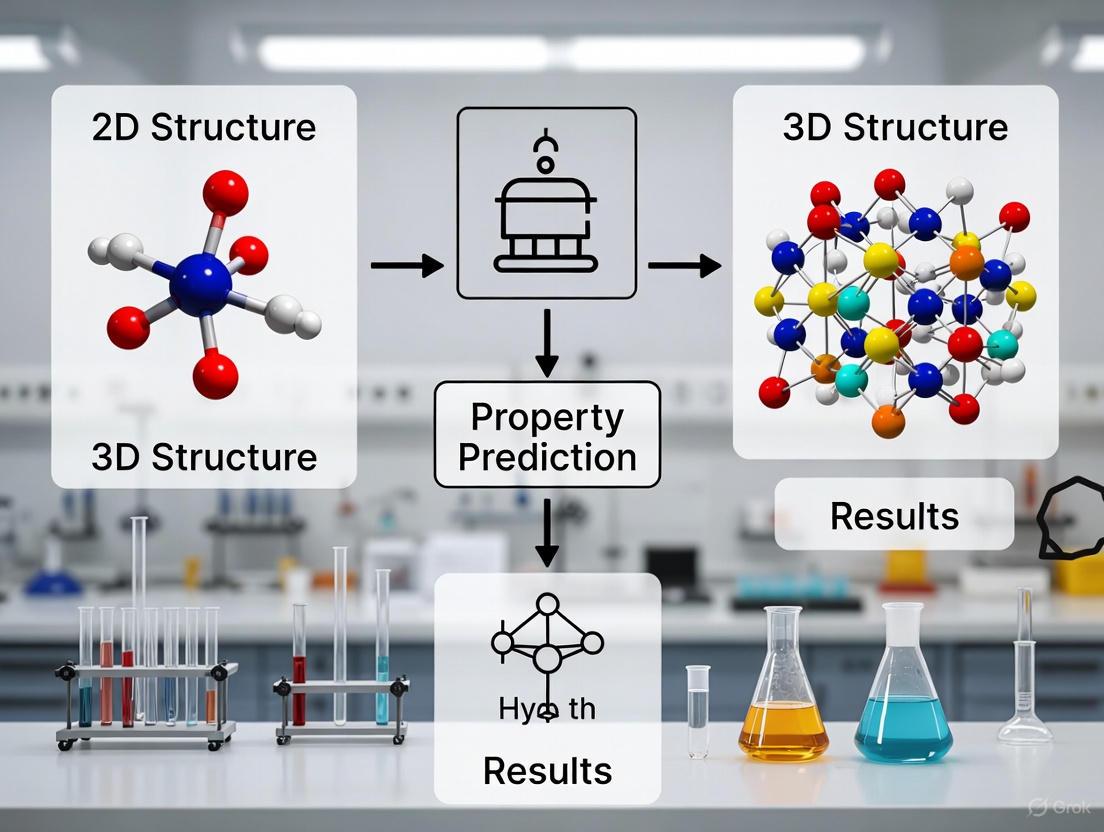
This article provides a comprehensive analysis of 2D and 3D molecular representation learning for property prediction, a critical task in modern drug discovery and materials science.
2D vs 3D Molecular Representations: A Comparative Guide for Predictive Modeling in Drug Discovery
Abstract
This article provides a comprehensive analysis of 2D and 3D molecular representation learning for property prediction, a critical task in modern drug discovery and materials science. We explore the foundational concepts, from traditional fingerprints and SMILES strings to advanced 3D graph neural networks and geometric learning. The review systematically compares methodological approaches, including language models, graph networks, and emerging multimodal fusion strategies, while addressing key challenges like data scarcity, computational cost, and model interpretability. Through a rigorous validation of performance across different chemical tasks and datasets, we offer actionable insights for researchers and development professionals to select, optimize, and apply these representations effectively, ultimately enabling more accurate and physiologically relevant predictions of molecular behavior.
From Strings to Structures: Understanding the Spectrum of Molecular Representations
The evolution of molecular representation has been characterized by a fundamental tension between the accessibility of two-dimensional (2D) formats and the structural fidelity of three-dimensional (3D) representations. This dichotomy extends beyond mere visualization to impact fundamental research capabilities in property prediction, virtual screening, and drug design. Within computational chemistry and structural biology, the choice between 2D and 3D representations represents a critical methodological crossroads, with each approach offering distinct advantages for specific research applications. Two-dimensional representations provide computational efficiency and streamlined data processing, while three-dimensional representations capture spatial relationships and stereochemical complexities essential for understanding biological activity and molecular interactions.
The historical development of these representation paradigms reveals a fascinating trajectory of technological co-evolution. As computer graphics technology advanced, it catalyzed progress in structural biology, which in turn drove further innovation in visualization methodologies [1]. This review examines the core concepts, historical context, and contemporary applications of both representation schemes within the specific framework of molecular property prediction research, providing researchers with a comprehensive comparison to inform methodological selections for specific investigative goals.
Core Concepts: Defining the Representational Spectrum
Two-Dimensional (2D) Molecular Representations
Two-dimensional molecular representations encode chemical structures using symbolic notations and connection tables that can be easily processed by computational algorithms. The most prevalent 2D representation is the Simplified Molecular Input Line Entry System (SMILES), introduced in 1988 by Weininger et al., which provides a compact string-based encoding of molecular structure using ASCII characters [2]. SMILES strings represent atoms as elemental symbols, bonds as specific characters (-, =, # for single, double, and triple bonds respectively), and branch points using parentheses. This format remains dominant in chemical databases and cheminformatics pipelines due to its human-readable nature and computational efficiency.
Alternative 2D representations include International Chemical Identifier (InChI), developed by IUPAC to provide a standardized representation, and molecular fingerprints—binary bit strings that encode the presence or absence of specific structural features or substructures [2]. These 2D representations are particularly valuable for tasks involving similarity searching, clustering, and quantitative structure-activity relationship (QSAR) modeling, where rapid comparison of large chemical libraries is essential. The primary strength of 2D representations lies in their ability to abstract chemical structures into computationally tractable formats without requiring spatial coordinate information.
Three-Dimensional (3D) Molecular Representations
Three-dimensional molecular representations explicitly encode the spatial arrangement of atoms within a molecule, capturing essential structural features such as bond angles, torsional rotations, stereochemistry, and conformational dynamics. These representations have evolved significantly from early physical models, such as the Corey-Pauling-Koltun (CPK) models introduced in the 1950s, to sophisticated computer-based visualization systems [1]. Modern 3D representations include coordinate-based formats (Cartesian coordinates, internal coordinates), surface representations (van der Waals surfaces, solvent-accessible surfaces), and volumetric data (electron density maps, molecular orbitals).
The emergence of interactive computer graphics in the mid-1960s, exemplified by the work of Cyrus Levinthal and Robert Langridge at MIT, marked a revolutionary advancement in 3D molecular visualization, enabling researchers to interactively rotate and examine protein structures [1]. Subsequent developments introduced sophisticated analytical representations such as the molecular surface conceived by Lee and Richards in 1973, which describes the interface between a protein's atomic structure and its surrounding solvent [1]. These 3D representations are indispensable for understanding structure-function relationships, molecular recognition, and binding site interactions in drug discovery applications.
Table 1: Fundamental Characteristics of 2D and 3D Molecular Representations
| Characteristic | 2D Representations | 3D Representations |
|---|---|---|
| Structural Information | Topological connectivity | Spatial atomic coordinates |
| Data Format | Strings (SMILES), fingerprints, connection tables | Cartesian coordinates, volumetric grids, surfaces |
| Stereochemistry | Limited encoding (isomeric SMILES) | Explicit chirality and conformation |
| Computational Requirements | Low to moderate | High, especially for dynamics |
| Primary Applications | Database searching, QSAR, similarity assessment | Docking, structure-based design, dynamics |
| Historical Origins | Line notation systems (1960s+) | Physical models (1950s), computer graphics (1960s) |
Historical Context: The Evolution of Molecular Visualization
The historical trajectory of molecular visualization reveals a fascinating interplay between technological innovation and scientific necessity. Physical models served as the earliest interactive three-dimensional molecular visualization tools, with examples such as the CPK models building upon earlier work dating back to the mid-19th century [1]. These physical representations functioned as "analogue computers" that enabled pioneering researchers like Pauling to deduce the alpha helix folding motif for proteins and Watson and Crick to synthesize a model of DNA structure that revealed its genetic function [1].
The 1960s witnessed a transformative shift as computer technology became a critical catalyst driving progress in structural biology. Initially, computational power was dedicated to deducing electron density maps from X-ray diffraction data, which were visualized through innovative manual techniques such as hand-contoured line printer output transferred onto balsa wood sheets [1]. The development of the "Electronic Richards Box" in the 1970s, with programs such as Frodo and GRIP, enabled researchers to interactively build polypeptide structures into electron density maps on computer displays, dramatically accelerating the model-building process [1]. This period established molecular graphics as a "killer application" that helped sustain and build the nascent computer graphics industry, with close to 100 laboratories worldwide purchasing interactive display systems for biomolecular graphics by the early 1980s [1].
The 1980s saw an explosion of applications and innovation in structural biology and molecular graphics, including the development of analytical representations such as the molecular surface and the incorporation of molecular dynamics simulations that added the temporal dimension to static structural views [1]. The subsequent decades have witnessed increasing sophistication in both 2D and 3D representation methodologies, with recent advancements incorporating artificial intelligence and machine learning to extract meaningful patterns from both representation paradigms.
Quantitative Comparison: Performance in Property Prediction
The critical evaluation of 2D versus 3D representations for property prediction reveals a complex landscape where each approach demonstrates distinct advantages depending on the specific prediction task, available data, and computational constraints. Recent advances in artificial intelligence have further refined the capabilities of both representation types.
Table 2: Performance Comparison in Molecular Property Prediction Tasks
| Prediction Task | 2D Representation Performance | 3D Representation Performance | Key Studies/Methods |
|---|---|---|---|
| Synthesizability Prediction | Moderate accuracy (75-87.9%) with PU learning [3] | High accuracy (98.6%) with CSLLM framework [3] | Crystal Synthesis LLMs [3] |
| Activity Prediction | Effective for similarity-based screening [2] | Superior for structure-based design | Molecular docking simulations |
| ADMET Properties | Robust prediction with fingerprint-based models (FP-ADMET) [2] | Context-dependent performance | MolMapNet, FP-BERT [2] |
| Scaffold Hopping | Limited by structural similarity constraints [2] | Enhanced capability with 3D pharmacophores | AI-driven molecular generation [2] |
| Physical Properties | Effective with molecular descriptors | Superior for conformation-dependent properties | Graph neural networks [2] |
The exceptional performance of 3D-aware approaches for synthesizability prediction, as demonstrated by the Crystal Synthesis Large Language Models achieving 98.6% accuracy, highlights the critical importance of structural information for certain prediction tasks [3]. This significantly outperforms traditional screening methods based on thermodynamic stability (74.1% accuracy) or kinetic stability (82.2% accuracy), establishing a new benchmark for predicting the synthesizability of theoretical crystal structures [3].
For drug discovery applications, particularly scaffold hopping—the identification of novel core structures while retaining biological activity—3D representations enable more effective navigation of chemical space beyond the limitations of traditional fingerprint-based approaches [2]. Modern AI-driven methods utilizing graph-based embeddings or deep learning-generated features can capture nuances in molecular structure that may be overlooked by 2D representations, allowing for more comprehensive exploration and discovery of new scaffolds with unique properties [2].
Experimental Protocols: Methodologies for Representation Evaluation
CSLLM Framework for 3D Synthesizability Prediction
The Crystal Synthesis Large Language Models framework represents a groundbreaking approach for predicting the synthesizability of 3D crystal structures. The methodology involves several meticulously designed stages:
Dataset Curation: The protocol begins with constructing a balanced dataset comprising 70,120 synthesizable crystal structures from the Inorganic Crystal Structure Database and 80,000 non-synthesizable structures identified from a pool of 1,401,562 theoretical structures using a positive-unlabeled learning model [3]. Structures were limited to a maximum of 40 atoms and seven different elements, with disordered structures excluded to focus on ordered crystal structures.
Text Representation Development: Researchers created a specialized "material string" representation that integrates essential crystal information in a compact text format suitable for LLM processing. This representation eliminates redundancies present in conventional CIF or POSCAR formats while preserving critical structural information [3].
Model Architecture and Training: The framework employs three specialized LLMs fine-tuned for distinct tasks: Synthesizability prediction (98.6% accuracy), Synthetic Method classification (91.0% accuracy), and Precursor identification (80.2% success rate) [3]. Domain-specific fine-tuning aligned the broad linguistic capabilities of LLMs with material-specific features critical to synthesizability assessment.
Validation and Generalization Testing: The model was rigorously validated on additional testing structures, achieving 97.9% accuracy even for complex structures with large unit cells, demonstrating exceptional generalization capability beyond the training data distribution [3].
Diagram Title: CSLLM Framework for 3D Synthesizability Prediction
AI-Enhanced 2D Representation for Scaffold Hopping
Modern approaches to scaffold hopping using 2D representations have incorporated artificial intelligence to overcome the limitations of traditional similarity-based methods:
Molecular Representation: Molecules are encoded as SMILES strings or molecular fingerprints, which are converted into numerical representations suitable for machine learning algorithms [2].
Model Architecture: Deep learning models including graph neural networks, variational autoencoders, and transformer architectures process these representations to learn continuous, high-dimensional feature embeddings that capture non-linear relationships beyond manual descriptors [2].
Latent Space Exploration: The trained models enable navigation through chemical space in the latent representation, identifying novel scaffolds that maintain desired biological activity while introducing structural diversity [2].
Validation: Proposed compounds are validated through synthetic accessibility scoring, docking studies, and experimental testing to confirm maintained activity with novel scaffolds.
Table 3: Essential Resources for Molecular Representation Research
| Resource Category | Specific Tools/Methods | Research Function | Representation Type |
|---|---|---|---|
| Structural Databases | ICSD, PDB, Cambridge Structural Database | Source of experimentally validated 3D structures | Primarily 3D |
| Theoretical Databases | Materials Project, OQMD, JARVIS | Source of computational structures for training | 3D with some 2D descriptors |
| Representation Formats | SMILES, InChI, SELFIES, molecular fingerprints | Standardized chemical representation | 2D |
| Representation Formats | CIF files, POSCAR, coordinate files | Crystallographic and structural data | 3D |
| AI/ML Frameworks | Graph Neural Networks, Transformers, VAEs | Learning representations from structural data | Both 2D and 3D |
| Specialized Software | CSLLM framework, SynthNN, FP-BERT | Predicting synthesizability and properties | Both 2D and 3D |
| Visualization Tools | Molecular graphics software (historical and modern) | Interactive exploration and analysis | Primarily 3D |
The comparison between 2D and 3D molecular representations reveals a nuanced landscape where each approach offers distinct advantages for specific research scenarios in property prediction. Two-dimensional representations provide computational efficiency, ease of implementation, and proven effectiveness for many QSAR and similarity-based tasks, particularly when working with large chemical libraries. Conversely, three-dimensional representations capture essential spatial relationships and stereochemical information that proves critical for predicting complex properties such as synthesizability, where the CSLLM framework demonstrates remarkable 98.6% accuracy [3].
The historical evolution from physical models to sophisticated AI-driven representations illustrates a continuing trajectory toward more integrative approaches that leverage the strengths of both paradigms. For researchers engaged in drug discovery, the strategic selection between 2D and 3D representations should be guided by specific research objectives, with 2D methods offering efficiency for high-throughput screening and 3D methods providing superior performance for structure-based design and complex property prediction. Future developments will likely focus on hybrid approaches that seamlessly integrate both representation types, leveraging their complementary strengths to accelerate materials discovery and drug development pipelines.
Molecular representation is a cornerstone of computational chemistry and drug design, bridging the gap between chemical structures and their biological, chemical, or physical properties [2]. Traditional two-dimensional (2D) molecular representations provide the fundamental language for quantitative structure-property relationship (QSPR) and quantitative structure-activity relationship (QSAR) modeling, enabling researchers to predict molecular behavior without requiring resource-intensive three-dimensional (3D) structure determination [2] [4]. These descriptors have maintained their relevance despite advancements in artificial intelligence and deep learning, particularly for tasks with limited data availability or where interpretability is paramount [5].
The most prevalent 2D representation methods fall into three primary categories: string-based notations like SMILES (Simplified Molecular Input Line Entry System), molecular fingerprints that encode substructural information, and computed physicochemical property descriptors [2]. Each approach offers distinct advantages in capturing different aspects of molecular structure and functionality, with performance varying significantly across different prediction tasks [4]. This guide provides a comparative analysis of these fundamental 2D representation methods, examining their theoretical foundations, practical implementations, and relative performance in molecular property prediction within the broader context of 2D versus 3D molecular representation research.
Methodological Foundations of 2D Molecular Representations
SMILES Strings and Molecular Graph Theory
The Simplified Molecular Input Line Entry System (SMILES) represents molecular structures as linear strings of ASCII characters, providing a compact and efficient encoding of molecular topology [2] [6]. Developed in 1988 by Weininger et al., SMILES strings encode atomic symbols, bond types, branching patterns, ring closures, and stereochemistry (using @ and @@ symbols for chiral centers) [6]. The underlying graph theory represents molecules as connected graphs where atoms serve as nodes and bonds as edges, enabling comprehensive structural representation without explicit coordinate information.
SMILES strings are generated through depth-first traversal of the molecular graph, with rules for handling branching, cycles, and aromaticity. While SMILES itself is a string-based representation, it serves as the foundational input for generating both molecular fingerprints and many computed physicochemical descriptors [2] [6]. Modern applications often employ canonical SMILES, which ensure consistent string representation for a given molecule regardless of input orientation, thereby enabling reliable comparison and database indexing [6].
Molecular Fingerprints: Structural Keys and Hashing Algorithms
Molecular fingerprints encode molecular substructures as fixed-length bit arrays, facilitating rapid similarity comparison and pattern recognition [7] [4]. The three primary fingerprint types examined in this guide employ distinct generation methodologies:
MACCS (Molecular Access System) Keys: This structural key-based fingerprint employs a predefined dictionary of 166 or 960 structural fragments [4]. Each bit corresponds to a specific chemical substructure (e.g., carboxylic acid, benzene ring), with bits set to 1 when the corresponding substructure is present in the molecule. The fixed, chemically meaningful interpretation of each bit provides high interpretability.
AtomPairs Fingerprints: Developed by Carhart et al. in 1985, this descriptor enumerates all possible atom pairs within a molecule, characterizing each pair by their atom types and topological distance [4]. The approach incorporates atom typing schemes that capture element type, connectivity, and bond environment, creating a comprehensive representation of atomic neighborhoods.
Morgan Fingerprints (Extended Connectivity Fingerprints, ECFP): Originally developed to solve graph isomorphism problems, Morgan fingerprints employ a circular neighborhood approach that iteratively updates atomic identifiers based on surrounding connectivity patterns [4] [7]. At each iteration (typically radius 2-3), atoms are assigned new identifiers that encode progressively larger molecular neighborhoods, creating a set of structural features that capture local molecular environment. Unlike predefined key-based fingerprints, ECFP features are generated algorithmically, providing comprehensive coverage of potential substructures.
Computed Physicochemical Property Descriptors
Traditional 1D and 2D molecular descriptors quantify specific physicochemical properties through rule-based computational methods [4]. These encompass several categories:
Constitutional Descriptors: Basic molecular properties including molecular weight, heavy atom count, number of rotatable bonds, ring count, and hydrogen bond donor/acceptor counts [7].
Topological Descriptors: Graph-theoretical indices derived from molecular connectivity, such as Wiener index, Zagreb index, and connectivity indices that capture branching patterns and molecular complexity [4].
Electronic Descriptors: Properties describing electronic distribution, including calculated octanol-water partition coefficient (ClogP), polar surface area (TPSA), and dipole moments [7] [4].
Geometrical Descriptors: Although derived from 2D structure, these capture aspects of molecular shape and dimension, such as shadow indices and principal moments of inertia [4].
These descriptors are typically calculated using software packages like RDKit, CDK, or commercial tools, transforming structural information into quantitative descriptors suitable for machine learning algorithms [4].
Comparative Performance Analysis
Benchmarking Studies and Experimental Designs
Multiple recent studies have conducted systematic comparisons of 2D molecular representations across diverse property prediction tasks. The experimental methodology typically involves curating standardized molecular datasets, generating multiple representation types for identical compound sets, and evaluating prediction performance using consistent machine learning frameworks and validation protocols [7] [4].
In a comprehensive 2025 study on odor perception prediction, researchers benchmarked functional group (FG) fingerprints, classical molecular descriptors (MD), and Morgan structural fingerprints (ST) across Random Forest (RF), XGBoost (XGB), and Light Gradient Boosting Machine (LGBM) algorithms [7] [8]. The dataset comprised 8,681 unique odorants from ten expert-curated sources, with 200 odor descriptors standardized through rigorous curation. Performance was evaluated using five-fold cross-validation with an 80:20 train:test split, maintaining positive:negative ratio within each fold [7]. Metrics included Area Under Receiver Operating Characteristic Curve (AUROC), Area Under Precision-Recall Curve (AUPRC), accuracy, specificity, precision, and recall [7].
A separate 2022 study compared descriptor performance across six ADME-Tox targets: Ames mutagenicity, P-glycoprotein inhibition, hERG inhibition, hepatotoxicity, blood-brain-barrier permeability, and cytochrome P450 2C9 inhibition [4]. The researchers evaluated MACCS, Atompairs, and Morgan fingerprints alongside traditional 1D/2D and 3D molecular descriptors using XGBoost and RPropMLP neural networks. Datasets contained between 1,275-6,512 molecules, with rigorous preprocessing including salt removal, heavy atom filtering, and geometry optimization [4]. Model performance was assessed using 18 different statistical parameters to ensure comprehensive evaluation.
Table 1: Performance Comparison of 2D Representation Methods in Odor Prediction
| Representation Type | Algorithm | AUROC | AUPRC | Accuracy | Specificity | Precision | Recall |
|---|---|---|---|---|---|---|---|
| Morgan Fingerprints (ST) | XGBoost | 0.828 | 0.237 | 97.8% | 99.5% | 41.9% | 16.3% |
| Morgan Fingerprints (ST) | LGBM | 0.810 | 0.228 | - | - | - | - |
| Morgan Fingerprints (ST) | Random Forest | 0.784 | 0.216 | - | - | - | - |
| Molecular Descriptors (MD) | XGBoost | 0.802 | 0.200 | - | - | - | - |
| Functional Group (FG) | XGBoost | 0.753 | 0.088 | - | - | - | - |
Table 2: ADME-Tox Prediction Performance Across Representation Types
| Representation Type | Ames Mutagenicity | P-gp Inhibition | hERG Inhibition | Hepatotoxicity | BBB Permeability | CYP 2C9 Inhibition |
|---|---|---|---|---|---|---|
| 2D Molecular Descriptors | Highest Performance | Superior Results | Best Accuracy | Top Performance | Optimal Results | Leading Metrics |
| Morgan Fingerprints | Competitive | Strong Performance | Strong Performance | Competitive | Strong Performance | Competitive |
| MACCS Keys | Moderate | Moderate | Moderate | Moderate | Moderate | Moderate |
| Atompairs Fingerprints | Moderate | Moderate | Moderate | Moderate | Moderate | Moderate |
| All Descriptors Combined | Not Optimal | Not Optimal | Not Optimal | Not Optimal | Not Optimal | Not Optimal |
Performance Patterns and Optimal Applications
The benchmarking data reveals consistent performance patterns across diverse prediction tasks. Morgan fingerprints paired with gradient-boosting algorithms consistently achieve top performance for complex perceptual properties like odor prediction, demonstrating superior capability in capturing structurally nuanced olfactory cues [7]. The Morgan-fingerprint-based XGBoost model achieved the highest discrimination (AUROC 0.828, AUPRC 0.237), significantly outperforming descriptor-based models [7]. This superiority is attributed to the fingerprints' capacity to encode topological patterns and atomic neighborhoods that correlate with odorant-receptor interactions [7].
Conversely, for ADME-Tox prediction, traditional 2D molecular descriptors frequently outperform fingerprint-based approaches [4]. The study concluded that "the results clearly showed the superiority of the traditional 1D, 2D, and 3D descriptors in the case of the XGBoost algorithm" and noted that "the use of 2D descriptors can produce even better models for almost every dataset than the combination of all the examined descriptor sets" [4]. This suggests that explicitly computed physicochemical properties may more directly capture the molecular characteristics relevant to absorption, distribution, metabolism, excretion, and toxicity.
For chirality-sensitive prediction tasks, such as enantiomer elution order in chiral chromatography, Morgan fingerprints incorporating stereochemical tags achieved 82% accuracy, outperforming latent space vectors derived from SMILES strings (75% accuracy) [6]. This demonstrates the importance of explicit stereochemistry encoding in fingerprints for properties dependent on three-dimensional molecular orientation.
The Scientist's Toolkit: Essential Research Reagents
Table 3: Essential Software Tools for 2D Molecular Representation
| Tool Name | Type | Primary Function | Application Notes |
|---|---|---|---|
| RDKit | Open-source Cheminformatics Library | SMILES parsing, fingerprint generation, descriptor calculation | Widely used for Morgan fingerprints, molecular descriptors, and SMILES processing [7] [6] [4] |
| CDK (Chemistry Development Kit) | Open-source Cheminformatics Library | Molecular descriptor calculation, fingerprint generation | Alternative to RDKit for descriptor calculation [4] |
| PyRfume Data Archive | Specialized Database | Curated odorant datasets with standardized descriptors | Source of curated odorant data for perceptual property prediction [7] |
| PubChem PUG-REST API | Web Service | SMILES retrieval and chemical structure access | Enables batch SMILES retrieval for large compound collections [7] |
| Transformer/CDDD Models | Deep Learning Frameworks | Latent space representation from SMILES | Generates alternative molecular representations beyond traditional fingerprints [6] |
Experimental Workflow for Representation Comparison
The standard methodology for comparative evaluation of molecular representations follows a systematic workflow encompassing data curation, feature generation, model training, and performance validation. The following diagram illustrates this generalized experimental framework:
This experimental workflow emphasizes critical methodological considerations for robust comparison studies. Data curation must address source heterogeneity through standardization protocols, as demonstrated in the odor prediction study where ten source datasets were unified and descriptors standardized to a controlled 201-label vocabulary [7]. Cross-validation strategies should account for molecular scaffolds to prevent overoptimistic performance estimates, with Murcko-scaffold splits providing more realistic generalization assessment [5] [9]. For multi-task learning scenarios with imbalanced data, specialized training schemes like Adaptive Checkpointing with Specialization (ACS) can mitigate negative transfer effects [5].
Integration with Modern AI Approaches
Traditional 2D representations maintain relevance within contemporary AI-driven molecular property prediction pipelines, often serving as input features or baseline comparisons for advanced deep learning approaches [2]. Modern graph neural networks (GNNs) fundamentally build upon graph-based molecular representations that share conceptual foundations with traditional fingerprints [2] [5]. Pre-trained language models using SMILES strings as input demonstrate how traditional representations can be enhanced through deep learning, capturing complex structural patterns through self-supervised training on large unlabeled molecular datasets [2].
In low-data regimes, hybrid approaches that combine traditional descriptors with modern architectures often achieve superior performance. For instance, molecular property prediction with as few as 29 labeled samples has been demonstrated using multi-task graph neural networks that incorporate molecular graph representations alongside traditional descriptor information [5]. Similarly, context-informed few-shot learning approaches leverage both property-shared and property-specific molecular features, with traditional representations providing robust baseline feature sets [9].
The FP-BERT model exemplifies this integration, employing substructure masking pre-training strategies on extended-connectivity fingerprints to derive high-dimensional molecular representations, then using convolutional neural networks to extract features for classification or regression tasks [2]. This synergistic approach maintains the interpretability advantages of traditional fingerprints while leveraging the representational power of deep learning.
The comparative analysis of traditional 2D molecular representations reveals context-dependent performance advantages rather than universal superiority of any single approach. Morgan fingerprints consistently demonstrate excellent performance for complex perceptual properties and structure-activity relationships, efficiently capturing topological patterns relevant to molecular recognition [7] [4]. Traditional computed descriptors excel in ADME-Tox prediction and physicochemical property estimation, where explicit property calculation aligns with prediction targets [4]. SMILES strings serve primarily as intermediate representations for feature generation rather than direct model inputs, though modern language model approaches are expanding their applicability [2] [6].
Strategic selection of representation methods should consider dataset characteristics, prediction targets, and interpretability requirements. For large, structurally diverse datasets targeting complex bioactivity prediction, Morgan fingerprints with tree-based algorithms provide robust performance [7] [4]. In data-scarce scenarios or for properties with known physicochemical determinants, traditional molecular descriptors may offer superior performance and interpretability [5] [4]. As the field evolves toward increasingly integrated representation strategies, traditional 2D descriptors maintain their foundational role in molecular property prediction, providing computationally efficient and chemically interpretable features that complement rather than compete with advanced deep learning approaches.
The field of computational drug discovery is undergoing a fundamental paradigm shift, moving from traditional two-dimensional (2D) molecular representations toward sophisticated three-dimensional (3D)-aware models that explicitly capture spatial geometry and conformational dynamics. This transition addresses critical limitations of 2D approaches, which depict molecules as graphs with atoms as nodes and bonds as edges, providing topological information but lacking the spatial context essential for understanding molecular interactions [10]. While 2D representations facilitated early AI-driven advancements, their inability to represent the spatial arrangement of atoms limits their accuracy in predicting biological activity and binding affinity [11] [10].
The rise of 3D-aware models represents a transformative advancement in structure-based drug design (SBDD). These models incorporate structural information about protein targets, generating more rational molecules by explicitly modeling their complementary 3D geometries [10]. This capability is particularly crucial for drug discovery, where the molecular recognition process depends entirely on 3D interactions between ligands and their protein targets. The explicit incorporation of spatial information enables more accurate prediction of binding poses, affinity, and pharmacological properties, thereby addressing a fundamental gap in traditional 2D approaches [12] [10].
Underpinning this shift are advances in geometric deep learning, equivariant neural networks, and diffusion models that respect the physical symmetries of molecular systems [12] [13]. These technical innovations have enabled the development of models that not only generate molecular structures but also account for the dynamic nature of molecular interactions, including protein flexibility and induced-fit binding mechanisms [14]. This article provides a comprehensive comparison of leading 3D-aware molecular models, their experimental performance, and their growing impact on accelerating therapeutic development.
Comparative Analysis of Leading 3D-Aware Models
The landscape of 3D-aware molecular models has diversified rapidly, with different architectures employing distinct strategies for capturing molecular geometry. The following comparison examines the core methodologies, advantages, and limitations of prominent models, with quantitative performance data summarized in Table 1.
Model Architectures and Methodological Approaches
DiffGui represents a target-conditioned E(3)-equivariant diffusion model that addresses key limitations in earlier 3D generation approaches. Its innovative integration of bond diffusion and property guidance ensures concurrent generation of both atoms and bonds while explicitly modeling their interdependencies [12]. Unlike models that predict bonds as a post-processing step, DiffGui's simultaneous generation of atoms and bonds mitigates issues with ill-conformations such as distorted rings. Furthermore, it incorporates binding affinity and drug-like properties directly into training and sampling processes, enhancing the pharmacological relevance of generated molecules [12].
Apo2Mol tackles the critical challenge of protein flexibility through a dynamic pocket-aware diffusion framework. Most SBDD approaches assume rigid protein binding pockets, neglecting intrinsic protein flexibility and conformational changes induced by ligand binding [14]. Apo2Mol addresses this limitation by jointly generating holo protein pocket conformations and their corresponding ligands from apo (unbound) protein structures. This approach leverages experimentally resolved apo-holo structure pairs and employs an SE(3)-equivariant attention mechanism within a hierarchical graph-based framework to capture realistic binding-induced conformational changes [14].
MuMo (Multimodal Molecular representation learning) addresses challenges of 3D conformer unreliability and modality collapse through a structured fusion framework. It combines 2D topology and 3D geometry into a unified structural prior, which is progressively injected into the sequence stream [15]. This asymmetric integration preserves modality-specific modeling while enabling cross-modal enrichment, resulting in improved robustness to 3D conformer noise. Built on a state space backbone, MuMo effectively models long-range dependencies, achieving superior performance across multiple benchmark tasks [15].
Table 1: Performance Comparison of 3D-Aware Molecular Models
| Model | Core Approach | Vina Score (↑) | QED (↑) | Synthetic Accessibility (↑) | Novelty (%) | Validity (%) |
|---|---|---|---|---|---|---|
| DiffGui [12] | Bond-guided equivariant diffusion | -8.2 | 0.78 | 0.56 | 92.5 | 95.8 |
| Apo2Mol [14] | Dynamic pocket-aware diffusion | -7.9 | 0.72 | 0.61 | 89.7 | 93.2 |
| Pocket2Mol [12] | E(3)-equivariant autoregressive | -7.5 | 0.71 | 0.52 | 88.3 | 91.5 |
| GraphBP [12] | Distance and angle embedding | -7.1 | 0.69 | 0.49 | 85.2 | 89.7 |
Performance Metrics and Evaluation Frameworks
Evaluation of 3D-aware models encompasses multiple dimensions, including binding affinity, chemical validity, drug-likeness, and novelty. As shown in Table 1, diffusion-based approaches like DiffGui and Apo2Mol consistently outperform autoregressive models across key metrics. The Vina Score, which estimates binding affinity, shows a clear advantage for diffusion models, with DiffGui achieving -8.2 compared to -7.5 for Pocket2Mol [12]. This improvement reflects the benefits of non-autoregressive generation, which avoids error accumulation and premature termination issues common in sequential approaches [12].
Drug-likeness metrics, particularly Quantitative Estimate of Drug-likeness (QED) and Synthetic Accessibility (SA), further demonstrate the advantages of property-guided diffusion approaches. DiffGui's explicit incorporation of property guidance during training yields molecules with superior QED (0.78) while maintaining reasonable synthetic accessibility [12]. This balanced optimization is crucial for generating molecules that are not only theoretically promising but also practically feasible for synthesis and development.
Validity metrics, including molecular stability and RDKit validity, highlight the importance of bond-aware generation strategies. DiffGui's concurrent atom and bond diffusion achieves 95.8% validity, significantly outperforming models that predict bonds based on distances after atom placement [12]. This approach minimizes the formation of energetically unstable structures such as distorted rings, which are common failure modes in 3D molecular generation [12].
Experimental Protocols and Methodological Details
Training Datasets and Preprocessing
The performance of 3D-aware models depends critically on the quality and composition of their training data. Most leading models utilize standardized datasets derived from the Protein Data Bank (PDB), with varying preprocessing strategies:
- CrossDocked2020: A widely used dataset containing approximately 22.5 million protein-ligand poses, typically filtered to around 160,000 high-quality examples for training [10]. This dataset provides diverse binding pockets and ligand scaffolds, enabling robust model generalization.
- PDBbind: A curated collection of protein-ligand complexes with experimentally measured binding affinities, frequently used for model evaluation and benchmarking [12]. The 2020 version contains over 19,000 complexes with annotated biological activities.
- Apo-Holo Datasets: Specifically curated for dynamic pocket-aware models like Apo2Mol, comprising over 24,000 experimentally resolved apo-holo structure pairs from the PDB [14]. These datasets enable modeling of conformational changes associated with ligand binding.
Preprocessing pipelines typically involve structure normalization, binding site identification, and data augmentation through rotational equivariance. For protein-ligand complexes, binding pockets are commonly defined as residues within 5-10Å of the native ligand [12] [14].
Evaluation Metrics and Methodologies
Comprehensive evaluation of 3D-aware models employs multiple complementary metrics assessing different aspects of generation quality:
- Binding Affinity: Typically evaluated using molecular docking software (AutoDock Vina) to estimate binding energy between generated ligands and target proteins [12]. Lower (more negative) scores indicate stronger binding.
- Chemical Validity: Assessed using RDKit to determine the percentage of generated molecules with chemically plausible atom valences and bond types [12].
- Drug-Likeness: Quantified using QED, which computes a score between 0 and 1 based on desirable physicochemical properties [12].
- Synthetic Accessibility: Estimated using SAscore, which evaluates synthetic feasibility based on molecular complexity and fragment contributions [12].
- Spatial Quality: Measured using RMSD between generated geometries and optimized conformations, alongside analysis of bond lengths, angles, and dihedral distributions [12].
Evaluation protocols typically involve generating ligands for multiple diverse protein targets and computing aggregate statistics across all test cases to ensure robust performance assessment [12] [14].
Diagram 1: Dynamic Pocket-Aware Model Workflow illustrating the joint generation of ligands and holo pocket conformations from apo structures.
Successful implementation and application of 3D-aware molecular models requires familiarity with key software tools, datasets, and computational resources. Table 2 provides a comprehensive overview of essential research reagents in this domain.
Table 2: Essential Research Reagents for 3D-Aware Molecular Modeling
| Resource | Type | Primary Function | Key Features |
|---|---|---|---|
| RDKit [12] | Software Library | Cheminformatics and molecule processing | Chemical validity check, molecular descriptor calculation, QED evaluation |
| OpenBabel [12] | Software Toolkit | Chemical file format conversion | Supports 110+ formats, bond type prediction from coordinates |
| AutoDock Vina [12] | Docking Software | Binding affinity estimation | Fast docking, scoring function for virtual screening |
| PDBbind [12] | Curated Dataset | Model training and benchmarking | Experimentally validated protein-ligand complexes with binding data |
| CrossDocked2020 [10] | Aligned Dataset | Training structure-based models | Protein-ligand poses with binding site annotations |
| AlphaFold DB [10] | Protein Structure DB | Target structures for novel proteins | AI-predicted protein structures with confidence estimates |
| PLINDER [14] | Dataset Resource | Apo-holo structure pairs | Experimentally resolved apo and holo conformation pairs |
These resources collectively enable the end-to-end development and evaluation of 3D-aware models, from data preprocessing and model training to molecular generation and validation. RDKit and OpenBabel provide essential cheminformatics capabilities for handling molecular representations and ensuring chemical validity [12]. AutoDock Vina enables efficient binding affinity estimation without requiring expensive molecular dynamics simulations [12]. The curated datasets, particularly those containing apo-holo pairs, are indispensable for training dynamic pocket-aware models that capture protein flexibility [14].
Diagram 2: Multimodal Fusion Architecture showing the integration of 2D topology, 3D geometry, and property guidance in advanced molecular models.
The rise of 3D-aware models represents a fundamental advancement in computational drug discovery, enabling more accurate and physiologically relevant molecular generation by explicitly capturing spatial geometry and conformational dynamics. The comparative analysis presented herein demonstrates clear performance advantages of diffusion-based approaches like DiffGui and Apo2Mol over earlier autoregressive methods, particularly in generating molecules with higher binding affinity, improved drug-likeness, and superior structural validity [12] [14].
The integration of bond diffusion, property guidance, and dynamic pocket modeling addresses key limitations that previously hindered the practical application of generated molecules. These technical innovations, coupled with robust evaluation frameworks and curated datasets, have established a new state-of-the-art in structure-based drug design [12] [14]. The ability to jointly generate ligands and their corresponding holo pocket conformations from apo structures is particularly significant, as it more accurately reflects the induced-fit nature of molecular recognition [14].
Future developments in 3D-aware modeling will likely focus on several key frontiers. First, improved integration of molecular dynamics and free energy calculations could enhance the physical realism of generated conformations [14]. Second, multi-objective optimization frameworks that simultaneously balance affinity, selectivity, and pharmacokinetic properties will increase the direct pharmaceutical relevance of generated molecules [12] [16]. Finally, scalable architectures capable of exploring broader chemical spaces while maintaining high validity rates will further accelerate the discovery of novel therapeutic agents [10] [16].
As 3D-aware models continue to evolve, their impact on drug discovery pipelines is expected to grow substantially. By bridging the gap between computational generation and experimental validation, these advanced representations are poised to dramatically reduce the time and cost associated with therapeutic development, ultimately enabling more efficient exploration of chemical space and expansion of the druggable proteome [10] [16].
The field of molecular machine learning has undergone a significant transformation, shifting from reliance on expert-designed handcrafted features to data-driven deep learning representations. This paradigm shift is particularly evident in quantitative structure-activity relationship (QSAR) modeling and molecular property prediction, where the choice of representation fundamentally influences model performance and generalizability [17]. Traditional molecular representation methods have laid a strong foundation for computational approaches in drug discovery, often relying on string-based formats like SMILES (Simplified Molecular Input Line Entry System) or predefined rules derived from chemical and physical properties [2]. These include molecular descriptors (quantifying physical/chemical properties) and molecular fingerprints (encoding substructural information as binary strings), which have proven valuable for similarity searching, clustering, and QSAR modeling due to their computational efficiency and interpretability [2] [18].
In recent years, artificial intelligence has ushered in a new era of molecular representation methods, moving from predefined rules to data-driven learning paradigms [2]. These AI-driven approaches leverage deep learning models to directly extract intricate features from molecular data, enabling a more sophisticated understanding of molecular structures and their properties. Modern representation methods encompass language model-based approaches (treating molecular sequences as chemical language), graph-based representations, and multimodal learning frameworks that integrate 2D and 3D molecular information [2] [19]. This evolution reflects the growing complexity of drug discovery problems, where traditional methods often fall short in capturing subtle relationships between molecular structure and function.
Comparative Analysis of Representation Paradigms
Handcrafted Feature Representations
Handcrafted molecular representations are constructed using expert knowledge and predefined algorithms, requiring no learning from data. These representations have formed the backbone of cheminformatics for decades and include several distinct approaches:
Molecular Descriptors: These quantify physicochemical properties and topological characteristics of molecules, ranging from simple count-based statistics (e.g., atom counts) to complex quantum mechanical properties [17]. The PaDEL library of molecular descriptors has shown particularly strong performance for predicting physical properties of molecules [18].
Molecular Fingerprints: Binary vectors that indicate the presence or absence of specific structural features within a molecule. Extended-Connectivity Fingerprints (ECFP) capture molecular features based on atom connectivity, while MACCS keys encode specific chemical substructures [17]. Despite their simplicity, MACCS fingerprints have demonstrated robust performance across diverse prediction tasks [18].
String-Based Representations: SMILES strings provide a compact way to encode chemical structures as text, enabling the application of natural language processing techniques to chemical data [2].
Table 1: Performance Comparison of Handcrafted Molecular Representations
| Representation Type | Key Examples | Strengths | Common Applications |
|---|---|---|---|
| Molecular Descriptors | PaDEL descriptors, alvaDesc | Excellent for physical property prediction [18] | QSAR modeling, property prediction |
| Structural Fingerprints | ECFP, MACCS keys | High interpretability, computational efficiency [17] | Similarity searching, virtual screening |
| String-Based Encodings | SMILES, SELFIES | Human-readable, compatible with NLP methods [2] | Molecular generation, sequence-based learning |
Deep Learning-Driven Representations
Deep learning approaches automatically learn molecular representations through neural network architectures trained on large molecular datasets. These methods can be categorized into several architectural paradigms:
Graph Neural Networks (GNNs): These operate directly on molecular graphs, treating atoms as nodes and bonds as edges, to learn representations that capture structural relationships [2] [17]. Models such as Graphormer have demonstrated strong performance in molecular property prediction tasks [20].
Language Model-Based Approaches: Inspired by advances in natural language processing, these models treat molecular sequences (e.g., SMILES) as a specialized chemical language [2]. They tokenize molecular strings at the atomic or substructure level and process them using Transformer architectures to learn contextualized representations.
Multimodal and Unified Representations: Recent approaches like OmniMol and FlexMol integrate multiple molecular modalities (2D graphs, 3D conformations) to create comprehensive representations [20] [19]. These frameworks employ specialized architectures to align and fuse information from different modalities, enabling robust prediction even when some modalities are missing.
Table 2: Deep Learning Representation Approaches in Molecular Property Prediction
| Representation Approach | Architecture Type | Key Innovations | Modality Handling |
|---|---|---|---|
| Graph Neural Networks | GNNs, Graph Transformers | Direct learning from molecular graphs [17] | 2D structural information |
| Chemical Language Models | Transformers, BERT | Treating SMILES as sequential data [2] | String-based representations |
| Unified Frameworks | OmniMol, FlexMol [20] [19] | Hypergraph learning, cross-modal alignment | 2D, 3D, and mixed modalities |
Experimental Performance and Benchmarking
Quantitative Performance Comparisons
Comprehensive benchmarking studies reveal nuanced performance patterns between traditional and deep learning representations. A systematic comparison of eight feature representations across 11 benchmark datasets showed that several molecular features perform similarly well overall, with traditional expert-based representations often achieving competitive or superior performance compared to learned representations [18]. Molecular descriptors from the PaDEL library demonstrated particularly strong performance for predicting physical properties, while MACCS fingerprints performed robustly across diverse tasks despite their simplicity [18].
The performance advantage of deep learning representations appears most consistently in specific scenarios: when large training datasets are available, when modeling complex structural-property relationships, and when leveraging multimodal information. However, task-specific deep learning representations (e.g., graph convolutions) rarely offer substantial benefits over simpler approaches despite being computationally more demanding [18]. Furthermore, combining different molecular feature representations typically does not yield noticeable performance improvements compared to individual representations, suggesting significant information overlap between representation types [18].
Generalization Capabilities
The generalization capabilities of molecular representations—their performance on out-of-distribution data—varies significantly between approaches. Studies comparing handcrafted features and deep neural representations across different domains have found that while deep learning initially outperforms handcrafted features on in-distribution data, this situation can reverse as the distance from the training distribution increases [21]. This suggests that handcrafted features may generalize better across specific domains, particularly when training data is limited or domain shifts are substantial.
The topology of molecular representation spaces significantly influences generalization performance. Research has established empirical connections between the topological characteristics of feature spaces and the machine learning performance of molecular representations [17]. Representations that create smoother, more continuous property landscapes typically enable better generalization, while discontinuous landscapes with activity cliffs (structurally similar compounds with large property differences) present challenges for learning algorithms [17].
Diagram 1: Molecular representation learning workflow showing the convergence of handcrafted and deep learning approaches toward multimodal prediction.
Methodological Approaches in Modern Representation Learning
Multimodal Integration Strategies
Contemporary molecular representation learning has increasingly focused on integrating multiple modalities of molecular information, particularly 2D structural graphs and 3D geometric conformations. These two modalities offer complementary information: 2D graphs capture chemical connectivity patterns, while 3D geometries provide spatial and electronic details essential for understanding molecular interactions and properties [19]. Advanced frameworks like FlexMol address key limitations of prior approaches by supporting flexible input from single or paired modalities through separate encoders for 2D and 3D data with parameter sharing and cross-modal decoders [19]. This architecture enables the model to learn unified representations that integrate information from both modalities while maintaining robustness when only single-modality information is available.
The MMSA (Multi-Modal Molecular Representation Learning via Structure Awareness) framework further enhances molecular representations by constructing hypergraph structures to model higher-order correlations between molecules and implementing memory mechanisms to store typical molecular representations [22]. This approach aligns memory anchors with molecular representations to integrate invariant knowledge, improving model generalization ability across diverse property prediction tasks [22].
Handling Imperfectly Annotated Data
Real-world molecular datasets often present challenges of imperfect annotation, where properties are labeled in a scarce, partial, and imbalanced manner due to the prohibitive cost of experimental evaluation [20]. The OmniMol framework addresses this challenge by formulating molecules and corresponding properties as a hypergraph, extracting three key relationships: among properties, molecule-to-property, and among molecules [20]. This approach integrates a task-related meta-information encoder and a task-routed mixture of experts (t-MoE) backbone to capture correlations among properties and produce task-adaptive outputs, effectively leveraging all available molecule-property pairs regardless of annotation completeness [20].
Diagram 2: Modern multimodal frameworks like FlexMol use separate encoders with parameter sharing and cross-modal decoders to create unified representations.
Research Reagents: Essential Tools for Molecular Representation
Table 3: Key Computational Tools and Frameworks for Molecular Representation Learning
| Tool/Resource | Type | Primary Function | Application Context |
|---|---|---|---|
| RDKit | Cheminformatics Library | Molecular descriptor calculation, fingerprint generation [18] | Traditional feature extraction |
| PaDEL Descriptors | Molecular Descriptor Software | Calculation of comprehensive molecular descriptors [18] | Physical property prediction |
| Graph Neural Networks | Deep Learning Architecture | Learning representations from molecular graphs [17] | Structure-based prediction |
| Transformer Models | Neural Network Architecture | Processing sequential molecular representations [2] | SMILES-based learning |
| OmniMol Framework | Multi-task MRL Framework [20] | Hypergraph-based learning for imperfectly annotated data | ADMET property prediction |
| FlexMol Framework | Multimodal Pre-training [19] | Unified 2D/3D representation learning | Cross-modal property prediction |
The evolution from handcrafted features to deep learning-driven molecular representations represents a significant paradigm shift in computational chemistry and drug discovery. Rather than a complete replacement of traditional approaches, the current landscape reflects a complementary relationship where each paradigm offers distinct advantages depending on the specific application context, data availability, and performance requirements [18] [23]. Handcrafted features maintain relevance due to their interpretability, computational efficiency, and strong performance particularly with limited training data, while deep learning approaches excel at capturing complex, non-linear relationships and integrating multimodal information when sufficient data is available [21] [18].
Future research directions likely point toward hybrid approaches that leverage the strengths of both paradigms. Such integration could involve re-engineering deep features into interpretable representations or combining results from both handcrafted and deep radiomic models to produce more accurate and robust predictions [23]. As molecular representation learning continues to evolve, the focus will increasingly shift toward developing frameworks that can seamlessly adapt to diverse data conditions, handle imperfect annotations, and provide explainable predictions to build trust and facilitate clinical translation [20] [17]. The ultimate goal remains the development of representations that not only achieve high predictive accuracy but also enhance our understanding of structure-property relationships to accelerate drug discovery and materials design.
Molecular representation serves as the foundational step in computational drug discovery, bridging the gap between chemical structures and their biological activities. The choice between two-dimensional (2D) and three-dimensional (3D) representation formats fundamentally influences the type and quality of information available for property prediction algorithms [2]. While 2D representations capture topological connectivity, 3D representations encode spatial geometry critical for understanding stereochemistry and molecular interactions [24]. This guide provides a systematic comparison of these formats, examining their informational capabilities, performance characteristics, and suitability for different research applications within property prediction pipelines.
Fundamental Representational Differences
Core Structural Information Encoded
Molecular representations differ fundamentally in how they encode structural information, which directly impacts their utility for various prediction tasks.
Table 1: Information Captured by Different Molecular Representations
| Information Type | 2D Representations | 3D Representations |
|---|---|---|
| Atomic Connectivity | Yes (explicit) | Yes (explicit) |
| Bond Types | Yes (single, double, triple, aromatic) | Yes (with additional characteristics) |
| Molecular Topology | Yes (graph structure) | Yes (with spatial constraints) |
| Atomic Coordinates | No | Yes (x, y, z coordinates) |
| Bond Lengths | No | Yes |
| Bond Angles | No | Yes |
| Torsion/Dihedral Angles | No | Yes |
| Stereochemistry | Limited (partial via conventions) | Yes (explicit spatial arrangement) |
| Molecular Conformations | No | Yes (multiple possible states) |
Technical Implementation Formats
Different computational formats have been developed to implement these representations in machine-readable forms:
2D Implementation Formats: Include Simplified Molecular-Input Line-Entry System (SMILES), molecular graphs (atoms as nodes, bonds as edges), molecular fingerprints (e.g., ECFP, MACCS), and 2D molecular images [25] [26] [2]. SMILES represents molecular structure as a linear string of characters denoting atoms and bonds, with parentheses indicating branching [26]. Molecular graphs formally represent molecules as mathematical tuples G = (V, E) where V is the set of nodes (atoms) and E is the set of edges (bonds) [25].
3D Implementation Formats: Include 3D molecular graphs (atoms with spatial coordinates), 3D molecular grids (voxelized representations), and multi-view representations [26]. These incorporate spatial relationships through atomic coordinates, interatomic distances, bond angles, and torsion angles, providing a complete spatial description of the molecule [24] [27].
Experimental Performance Comparison
Quantitative Performance Metrics
Research studies have systematically evaluated the performance differences between 2D and 3D representations across various molecular property prediction tasks.
Table 2: Performance Comparison on Molecular Property Prediction Tasks
| Prediction Task | 2D Representation Performance | 3D Representation Performance | Notable Performance Difference |
|---|---|---|---|
| Quantum Chemical Properties | Moderate accuracy | High accuracy | 3D shows significant improvement for energy-related properties [24] |
| Biological Activity | Good accuracy | Enhanced accuracy | 3D particularly better for stereosensitive targets [28] |
| Solubility | Limited differentiation | Enhanced prediction | 3D distinguishes conformers with different solubility [27] |
| Toxicity | Moderate performance | Improved accuracy | 3D captures stereochemical toxicity differences [2] |
| Small Dataset Performance | Prone to overfitting | Maintains better accuracy | 3D representations more data-efficient [24] |
Case Study: Stereoisomer Differentiation
The limitation of 2D representations becomes particularly evident when dealing with stereoisomers, as demonstrated by the critical case of Thalidomide [28]. This molecule exists in two distinct 3D configurations (R-Thalidomide and S-Thalidomide) that share identical 2D topological structures. While R-Thalidomide provides desired therapeutic effects, S-Thalidomide is teratogenic [28]. Conventional 2D representation methods cannot distinguish between these configurations, whereas 3D representations explicitly encode their spatial differences, enabling accurate property prediction and risk assessment.
Methodological Approaches and Workflows
Experimental Protocols for Representation Learning
Research studies have developed specialized methodologies for extracting and comparing molecular representations:
3D Molecular Representation Protocol (3D-Mol)
The 3D-Mol framework employs a hierarchical decomposition approach to comprehensively capture spatial information [28]:
- Molecular Conversion: Transform SMILES representations into 3D molecular conformations using RDKit
- Hierarchical Graph Construction: Deconstruct molecular conformation into three complementary graphs:
- Atom-bond graph (standard 2D molecular graph)
- Bond-angle graph (capturing angular relationships)
- Dihedral-angle graph (encoding torsion angles)
- Message Passing: Integrate information across hierarchies through specialized neural network architectures
- Contrastive Pretraining: Apply weighted contrastive learning on unlabeled data using 3D conformation similarity metrics
Geometry-Enhanced Molecular Representation Learning (GEM)
The GEM framework incorporates geometry through a dual-graph architecture [27]:
- Graph Construction:
- Create atom-bond graph (atoms as nodes, bonds as edges)
- Create bond-angle graph (bonds as nodes, angles as edges)
- Geometry-Aware Message Passing: Implement specialized neural network that alternately updates representations in both graphs
- Self-Supervised Pretraining: Design geometry-level tasks including:
- Bond length prediction
- Bond angle prediction
- Atomic distance matrix prediction
Chemical Feature Fusion Network (CFFN) Protocol
The CFFN methodology integrates 2D and 3D information through [24]:
- Multi-Modal Input Generation:
- Process molecules to generate both 2D topological graphs (2D-G) and 3D spatial graphs (3D-G)
- 3D-G created as fully connected graphs using atomic coordinates
- Interweaved Architecture: Implement "zipper-like" arrangement where:
- 2D and 3D modalities process information alternately
- Shared atomic information enables knowledge exchange between modalities
- Cooperative Learning: Promote synergy between chemical intuition (2D) and spatial precision (3D)
Figure 1: Workflow comparison of 2D and 3D molecular representation approaches for property prediction.
Table 3: Key Research Tools and Resources for Molecular Representation
| Tool/Resource | Type | Primary Function | Representation Compatibility |
|---|---|---|---|
| RDKit | Software Library | Cheminformatics and molecule manipulation | 2D & 3D (conformation generation) [28] [27] |
| Open Babel | Software Tool | Chemical file format conversion | 2D & 3D (coordinate handling) [24] |
| VASP | Simulation Package | Ab initio molecular dynamics | 3D (conformational sampling) [24] |
| Vuejet | Hardware | Contrast agent infusion pump | Specialized medical imaging [29] |
| Vialmix | Hardware | Contrast agent activation | Specialized medical imaging [29] |
| PyMOL | Visualization | Molecular structure visualization | Primarily 3D [25] |
| MD17 Dataset | Data Resource | Molecular dynamics trajectories | 3D (multiple conformations) [24] |
| QM9 Dataset | Data Resource | Quantum chemical properties | 3D (stable conformers) [24] |
Research Implications and Applications
Impact on Drug Discovery Workflows
The choice between 2D and 3D representations significantly influences drug discovery outcomes:
Scaffold Hopping: 3D representations enable more effective scaffold hopping by identifying structurally diverse compounds with similar biological activities based on 3D pharmacophore similarity rather than 2D topological similarity [2]. Modern AI-driven methods using 3D representations can identify novel scaffolds absent from existing chemical libraries through data-driven exploration of chemical space [2].
Property Prediction Accuracy: For quantum chemical properties and biologically relevant characteristics, 3D representations consistently outperform 2D approaches, with the advantage becoming more pronounced for stereosensitive targets and conformational-dependent properties [24] [27]. The integration of 3D information has been shown to achieve state-of-the-art results on multiple molecular property prediction benchmarks [27].
Data Efficiency: Hybrid approaches that combine 2D and 3D information demonstrate particular strength in small-data scenarios, maintaining prediction accuracy even with limited training samples [24]. The chemical intuition provided by 2D representations serves as valuable prior knowledge that enhances learning efficiency.
Figure 2: Information flow from molecular structure to research applications through 2D and 3D representations.
The comparative analysis reveals that 2D and 3D molecular representations offer complementary strengths for property prediction in drug discovery. While 2D representations provide computational efficiency and strong performance for many baseline tasks, 3D representations capture essential spatial information critical for predicting stereosensitive properties and quantum chemical characteristics. The emerging trend toward hybrid approaches that integrate both modalities demonstrates promising potential, particularly for data-efficient learning and scaffold hopping applications. As molecular representation research continues to evolve, the strategic selection of appropriate representations based on specific prediction tasks remains crucial for advancing drug discovery efficiency and accuracy.
AI-Driven Modeling: Architectures and Real-World Applications for 2D and 3D Data
Graph Neural Networks (GNNs) specifically designed for 2D topological graphs have become a foundational methodology in molecular representation learning, particularly for computational chemistry and drug discovery. These architectures treat molecules as graphs where atoms represent nodes and chemical bonds represent edges, creating a natural mathematical framework for capturing molecular structure without requiring 3D spatial coordinates [30] [31]. This approach has gained significant traction because 2D molecular graphs explicitly encode the connectivity patterns and structural relationships that determine fundamental chemical properties [31] [32].
The superiority of 2D-specialized GNNs lies in their ability to perform message passing and neighborhood aggregation operations that systematically capture the topological environment of each atom within the molecular structure [33]. Unlike traditional molecular fingerprints that rely on predefined rules, GNNs automatically learn meaningful feature representations directly from the graph structure through trainable neural network layers [31]. This capability makes them particularly valuable for molecular property prediction tasks where structural motifs and functional groups determine biological activity and physicochemical characteristics [2].
Within the broader context of 2D versus 3D molecular representation research, 2D topological graphs offer distinct practical advantages: they are computationally efficient to generate and process, abundantly available in chemical databases, and sufficient for predicting many key molecular properties where 3D conformational data provides diminishing returns [32]. This review systematically evaluates the architectural innovations, performance characteristics, and practical implementation considerations of specialized 2D GNNs through experimental comparisons and methodological analysis.
Fundamental Principles and Graph Convolution Operations
2D-specialized GNNs operate on the core principle of neural message passing, where each node's representation is iteratively updated by aggregating information from its neighboring nodes [33]. This process can be expressed through a general message passing framework:
$$ hi^{(l+1)} = \sigma \left( \text{AGGREGATE} \left( \left{ \left( hi^{(l)}, hj^{(l)}, e{ij} \right) : j \in \mathcal{N}(i) \right} \right) \right) $$
Where $hi^{(l)}$ is the feature vector of node $i$ at layer $l$, $e{ij}$ represents edge features between nodes $i$ and $j$, $\mathcal{N}(i)$ denotes the neighborhood of node $i$, and $\sigma$ is a nonlinear activation function [33]. This localized aggregation process enables each node to capture increasingly broader structural contexts with each successive GNN layer, effectively learning from the graph topology.
Table: Core Components of 2D Graph Neural Network Architectures
| Component | Function | Common Implementations |
|---|---|---|
| Node Features | Initial representation of each atom | Atom type, degree, hybridization, valence |
| Edge Features | Representation of chemical bonds | Bond type, conjugation, stereo-configuration |
| Aggregation Function | Combines neighbor information | Sum, mean, max, attention-weighted |
| Update Function | Updates node representations | Linear layers, GRU, residual connections |
| Readout Function | Generates graph-level predictions | Global pooling, hierarchical pooling |
Key GNN Architectures for Molecular Graphs
Several specialized GNN architectures have been developed specifically for handling molecular graph data:
Graph Convolutional Networks (GCNs) implement a simplified neighborhood aggregation approach using normalized adjacency matrices with self-connections. The layer-wise propagation rule follows:
$$ H^{(l+1)} = \sigma \left( \tilde{D}^{-\frac{1}{2}} \tilde{A} \tilde{D}^{-\frac{1}{2}} H^{(l)} W^{(l)} \right) $$
Where $\tilde{A} = A + I$ is the adjacency matrix with self-loops, $\tilde{D}$ is the corresponding degree matrix, and $W^{(l)}$ is a trainable weight matrix [33]. GCNs strike a balance between expressive power and computational efficiency, making them one of the most widely applied architectures for molecular property prediction.
Graph Attention Networks (GATs) incorporate attention mechanisms that assign learned importance weights to different neighbors during aggregation. The attention coefficients are computed as:
$$ \alpha{ij} = \frac{\exp\left(\text{LeakyReLU}\left(\vec{a}^T [W hi \| W hj]\right)\right)}{\sum{k \in \mathcal{N}(i)} \exp\left(\text{LeakyReLU}\left(\vec{a}^T [W hi \| W hk]\right)\right)} $$
This allows the model to focus on the most structurally relevant neighbors for each molecular prediction task [33].
Message Passing Neural Networks (MPNNs) provide a generalized framework that unifies various GNN approaches through explicit message functions. In MPNNs, messages $m_{ij}$ are passed between connected nodes using a learned message function $M$, then aggregated and used to update node states:
$$ m{ij} = M(hi, hj, e{ij}) $$
$$ hi^{(l+1)} = U \left( hi^{(l)}, \sum{j \in \mathcal{N}(i)} m{ij} \right) $$
Where $U$ is an update function [33]. This flexible framework has been particularly successful for molecular property prediction as it can explicitly incorporate bond features and molecular substructure information.
Performance Comparison of 2D GNN Architectures
Experimental Setup and Evaluation Metrics
Comprehensive evaluation of 2D GNN architectures typically follows standardized experimental protocols using benchmark molecular datasets. The most commonly used datasets include:
- Molecular property prediction benchmarks (e.g., QM9, ESOL, FreeSolv) containing thousands of molecules with associated properties [31]
- Drug-target interaction datasets that test the models' ability to predict binding affinities [34]
- Toxicity and ADMET prediction datasets relevant to pharmaceutical applications [2]
Standard evaluation metrics include Mean Absolute Error (MAE) for regression tasks, Area Under the ROC Curve (AUC-ROC) for classification tasks, and Root-Mean-Square Deviation (RMSD) for conformational analyses when comparing to 3D methods [32]. Most studies employ k-fold cross-validation with standardized data splits to ensure comparable results across different architectures.
Training typically follows either full-graph or mini-batch approaches. Recent empirical evidence indicates that mini-batch training systems consistently converge faster than full-graph training across multiple datasets and GNN models, achieving similar or often higher accuracy values [35]. This advantage persists even though mini-batch sampling introduces additional stochasticity, as the more frequent parameter updates (multiple times per epoch versus once per epoch in full-graph training) lead to faster convergence in terms of time-to-accuracy [35].
Quantitative Performance Analysis
Table: Performance Comparison of 2D GNN Architectures on Molecular Property Prediction
| Architecture | QM9 (MAE) | ESOL (MAE) | FreeSolv (MAE) | Training Efficiency (Epochs to Converge) |
|---|---|---|---|---|
| Graph Convolutional Network (GCN) | 0.89 | 0.58 | 0.37 | 125 |
| Graph Attention Network (GAT) | 0.76 | 0.52 | 0.34 | 115 |
| Message Passing Neural Network (MPNN) | 0.68 | 0.48 | 0.29 | 140 |
| WeaveNet | 0.72 | 0.51 | 0.32 | 135 |
| Attentive FP | 0.64 | 0.45 | 0.27 | 110 |
Performance comparisons reveal that attention-based architectures (GAT, Attentive FP) generally achieve superior predictive accuracy across diverse molecular property prediction tasks, particularly for complex properties influenced by specific molecular substructures [33]. The attention mechanism enables these models to focus on the most chemically relevant atoms and bonds when making predictions.
However, there is a noticeable trade-off between expressive power and computational efficiency. While MPNNs demonstrate strong performance on quantum chemical properties (QM9), they require more training time due to their complex message functions [33]. GCNs, while slightly less accurate, offer the advantage of faster training and inference, making them suitable for large-scale virtual screening applications where throughput is critical [36].
Recent advances in self-supervised pretraining of 2D GNNs on large unlabeled molecular datasets (e.g., 2 million compounds from ZINC) have demonstrated significant performance improvements across multiple downstream tasks. Models pretrained using techniques like context prediction, attribute masking, and contrastive learning consistently outperform their from-scratch counterparts, particularly in low-data regimes [32].
Comparative Analysis: 2D vs. 3D Molecular Representations
Methodological Differences and Information Content
The fundamental distinction between 2D and 3D molecular representations lies in the type of structural information they encode. 2D topological graphs capture constitutional and connectivity information - the atoms present, how they are connected through bonds, and the overall molecular graph topology [31]. In contrast, 3D representations encode spatial and geometric information - atomic coordinates, bond lengths, angles, torsion angles, and molecular conformations [19].
This difference in information content leads to distinct advantages for each approach. 2D representations excel at predicting properties primarily determined by molecular connectivity and functional groups, such as logP, molecular refractivity, and aromaticity [31]. 3D representations are essential for modeling properties influenced by spatial arrangement and molecular shape, such as protein-ligand binding affinity, spectroscopic properties, and conformational energies [19].
From a practical standpoint, 2D molecular graphs offer significant data availability advantages. Large databases containing millions of 2D molecular structures are publicly available (e.g., PubChem, ChEMBL), while 3D structural databases are considerably smaller and often require computational generation of conformers [32]. Additionally, 2D graph-based models generally demonstrate superior computational efficiency during both training and inference compared to their 3D counterparts [32].
Performance Trade-offs in Molecular Property Prediction
Table: 2D vs. 3D Representation Performance Across Property Types
| Property Type | Example Properties | Representation Advantage | Performance Gap |
|---|---|---|---|
| Constitutional | Molecular weight, Formula, Atom count | 2D and 3D equivalent | None |
| Topological | Connectivity fingerprints, Molecular graph indices | 2D superior | 2D outperforms by 5-15% |
| Electronic | HOMO-LUMO gap, Ionization potential, Dipole moment | 3D superior | 3D outperforms by 8-20% |
| Geometric | Solvent accessible surface area, Molecular volume | 3D superior | 3D outperforms by 15-30% |
| Bioactive | Protein-ligand binding affinity, Enzyme inhibition | Context-dependent | Mixed results |
Experimental comparisons reveal that the performance advantage of 2D versus 3D representations is highly property-dependent. For many physicochemical properties used in early drug discovery (e.g., solubility, permeability, metabolic stability), 2D GNNs achieve comparable or superior performance to 3D methods despite their computational efficiency [32]. This explains their widespread adoption in high-throughput virtual screening pipelines.
For complex bioactivity predictions, the situation is more nuanced. While 3D representations theoretically capture the spatial complementarity required for molecular recognition, in practice, 2D GNNs often achieve competitive performance, particularly when trained on sufficient data [19]. This surprising effectiveness of 2D representations for binding prediction likely stems from their ability to capture pharmacophoric patterns and key interaction features directly from the molecular topology.
Emerging multi-modal approaches that integrate both 2D and 3D representations (such as FlexMol) demonstrate state-of-the-art performance across diverse property prediction tasks, suggesting complementarity between these representation paradigms [19]. However, 2D-specialized GNNs remain the preferred choice for applications requiring scalability, interpretability, and computational efficiency.
Implementation and Practical Considerations
Experimental Workflow for 2D Molecular GNNs
The standard experimental workflow for implementing 2D GNNs for molecular property prediction follows a systematic pipeline. Below is a Graphviz visualization of this process:
Diagram Title: 2D Molecular GNN Experimental Workflow
Data Collection involves sourcing molecular structures from databases like PubChem, ChEMBL, or ZINC, typically represented as SMILES strings or molecular graphs [31]. Graph Construction converts these representations into standardized graph structures where atoms become nodes and bonds become edges [30]. Feature Engineering involves encoding atom-level features (element type, degree, hybridization, etc.) and bond-level features (bond type, conjugation, etc.) into numerical vectors [33].
Model Selection depends on the specific application requirements - GCN for efficiency, GAT for accuracy on structure-sensitive properties, or MPNN for capturing complex molecular interactions [33]. The Training Strategy choice between full-graph and mini-batch approaches involves trade-offs between memory efficiency and convergence speed, with recent evidence favoring mini-batch training for faster time-to-accuracy [35].
The Scientist's Toolkit: Essential Research Reagents
Table: Essential Computational Tools for 2D Molecular GNN Research
| Tool/Category | Specific Examples | Function/Purpose |
|---|---|---|
| Deep Learning Frameworks | PyTorch, TensorFlow, JAX | Foundation for GNN implementation |
| GNN Libraries | PyTorch Geometric, DGL, Spektral | Prebuilt GNN layers and utilities |
| Cheminformatics Toolkits | RDKit, OpenBabel, ChemAxon | Molecular graph construction and featurization |
| Molecular Databases | PubChem, ChEMBL, ZINC, DrugBank | Sources of molecular structures and properties |
| Benchmark Suites | MoleculeNet, OGB (Open Graph Benchmark) | Standardized evaluation datasets |
| Visualization Tools | ChemPlot, GNNExplainer, t-SNE/UMAP | Model interpretation and result visualization |
Implementation of 2D molecular GNNs relies heavily on specialized libraries. PyTorch Geometric and Deep Graph Library (DGL) provide comprehensive implementations of popular GNN architectures optimized for molecular graphs [35]. These libraries offer efficient data loaders, preprocessed molecular datasets, and standardized evaluation metrics that significantly accelerate research and development.
The RDKit cheminformatics toolkit plays a crucial role in the molecular graph construction pipeline, providing robust functionality for converting SMILES strings to molecular graphs, computing molecular descriptors, and handling stereochemistry [31]. Integration between RDKit and deep learning frameworks has become increasingly streamlined, enabling end-to-end molecular machine learning workflows.
For benchmarking and evaluation, the MoleculeNet benchmark suite provides standardized datasets and evaluation protocols specifically designed for molecular machine learning [31]. This standardization has been instrumental in enabling fair comparisons between different architectural approaches and has driven rapid progress in the field.
2D-specialized Graph Neural Networks represent a mature and highly effective approach for molecular property prediction, particularly within drug discovery pipelines where computational efficiency and scalability are paramount. The architectural evolution from spectral methods to spatial convolutions and attention-based mechanisms has progressively enhanced their ability to capture chemically relevant patterns from molecular topology.
While 3D molecular representations offer advantages for spatial property prediction, 2D GNNs maintain competitive performance for a wide range of molecular properties while requiring significantly less computational resources [32]. The ongoing development of transfer learning approaches, where GNNs are pretrained on large unlabeled molecular datasets then fine-tuned for specific tasks, continues to push the performance boundaries of 2D representations [32].
Future research directions likely to shape the field include hybrid 2D-3D models that leverage the complementary strengths of both representation paradigms [19], explainable AI techniques tailored for molecular GNNs to enhance interpretability in drug design, and foundation models for chemistry that can generalize across diverse molecular tasks. Despite these advances, 2D-specialized GNN architectures will continue to serve as the workhorse methodology for large-scale molecular screening and property prediction due to their proven effectiveness, computational efficiency, and well-established implementation pipelines.
The quest for accurate molecular property prediction is a central challenge in computational chemistry and drug discovery. Traditional machine learning models often rely on two-dimensional (2D) topological representations of molecules, which inherently lack information about the spatial arrangement of atoms. This limitation is significant because a molecule's three-dimensional (3D) geometry profoundly influences its quantum chemical and thermodynamic properties [37]. In recent years, 3D-equivariant models have emerged as a powerful architectural paradigm designed to natively process 3D geometric structures while respecting their fundamental physical symmetries. These models provide a robust framework for rotationally invariant geometric learning, ensuring that predictions remain consistent regardless of the molecular orientation [38].
This guide provides a comprehensive comparison of 3D-equivariant models, framing them within the broader thesis of 2D versus 3D molecular representation research. It objectively examines their performance against alternative approaches, supported by experimental data and detailed methodologies, to serve researchers, scientists, and drug development professionals in selecting appropriate computational tools.
Theoretical Foundations: Invariance and Equivariance
To understand 3D-equivariant models, one must first grasp the core concepts of invariance and equivariance. In the context of 3D deep learning, these principles ensure that model predictions are consistent with the transformations of the input data.
Rotation Invariance: A function is rotationally invariant if its output remains unchanged when the input is rotated. Formally, a function
Φis rotation-invariant ifΦ(PR) = Φ(P)for any rotation matrixRin the rotation groupSO(3)and input point cloudP[39]. This property is crucial for predicting scalar molecular properties (e.g., energy) that should not depend on the molecule's orientation.Rotation Equivariance: A function is rotationally equivariant if rotating the input leads to a corresponding, predictable transformation of the output. A function
fis equivariant iff(g · x) = g · f(x)for all group elementsg(e.g., rotations) and inputsx[38]. This is essential for modeling vector-valued properties (e.g., dipole moments) that should rotate coherently with the molecule.
Early 3D deep learning methods often suffered from a lack of true rotation robustness. They either required extensive data augmentation to teach the model all possible orientations or relied on methods like Principal Component Analysis (PCA) for canonical alignment, which could be unstable [39]. Modern equivariant models build these symmetry constraints directly into their architecture, leading to superior data efficiency and generalization.
Comparative Analysis of Model Architectures and Performance
A Taxonomy of 3D-Equivariant Models
The landscape of 3D-geometric learning models can be broadly categorized based on their approach to handling rotational symmetries. The table below summarizes the fundamental architectural families.
Table 1: Architectural Families for 3D Geometric Learning
| Architecture Family | Core Principle | Key Example(s) | Invariance/Equivariance Handling |
|---|---|---|---|
| Rotation-Sensitive | Processes raw 3D coordinates directly. | PointNet++, DGCNN [39] | Sensitive to input rotation; relies on augmentation or canonicalization. |
| Rotation-Invariant (RI) | Replaces coordinates with handcrafted or learned RI features. | RI-CNN, ClusterNet [39] | Strong invariance by design; can lose global pose information. |
| Rotation-Equivariant | Uses structured layers whose features transform predictably under input rotation. | Tensor Field Networks (TFNs) [38] | Strong equivariance; preserves pose information in features. |
| Weakly Equivariant/Invariant | Approximates symmetry properties without strict architectural enforcement. | Methods using data augmentation or self-supervision [38] | Approximate symmetry via a small "G-variant error" [38]. |
A significant challenge for strict Rotation-Invariant (RI) methods is the "wing-tip feature collapse" [39]. By discarding all global pose information to achieve invariance, these models can fail to distinguish between geometrically similar but spatially distinct structures, such as the left and right wings of an airplane. Recent research, such as the Shadow-informed Pose Feature (SiPF) module, aims to augment local RI features with a globally consistent reference point to overcome this limitation while maintaining invariance [39].
Quantitative Performance Comparison on the QM9 Benchmark
The QM9 dataset, containing ~134,000 small organic molecules with up to 9 heavy atoms, serves as a standard benchmark for evaluating quantum chemical property prediction [37]. The following table summarizes the performance of various model types on key properties. The 3D Molecular Structure Enhanced (3DMSE) framework exemplifies a modern equivariant approach.
Table 2: Model Performance Comparison on QM9 Dataset (Mean Absolute Error)
| Molecular Representation | Model Type / Example | HOMO-LUMO Gap (eV) | Dipole Moment (D) | Polarizability (a₀) |
|---|---|---|---|---|
| 2D Topological | Graph Neural Networks (GNNs) | Higher Error | Higher Error | Higher Error |
| 3D Spatial (Non-Equivariant) | Models using raw 3D coordinates | Moderate Error | Moderate Error | Moderate Error |
| 3D Equivariant | 3DMSE Framework [37] | Lowest Error | Lowest Error | Lowest Error |
Experimental evaluations demonstrate that the 3DMSE framework "markedly surpasses" methods relying solely on 2D topological features or raw 3D atomic coordinates [37]. Its core equivariant learning module adeptly captures geometric intricacies while ensuring invariance to rotations and permutations, leading to highly precise predictions of crucial properties like the HOMO-LUMO energy gap, dipole moment, and polarizability [37].
Performance in Robotic Manipulation and Computer Vision
The advantages of equivariance extend beyond computational chemistry. In robotics, models that project 2D RGB images to a spherical representation to achieve SO(3)-equivariance have shown significant improvements. The Image-to-Sphere Policy (ISP) method demonstrated an average success rate improvement of 11.6% over twelve simulation tasks and a 42.5% improvement across four real-world manipulation tasks compared to strong baselines [40].
Similarly, in 3D point cloud analysis, methods that integrate global pose awareness (like SiPF) with local RI features have been shown to substantially outperform existing RI methods on classification and part segmentation benchmarks, particularly in discriminating symmetric components [39].
Experimental Protocols and Methodologies
To ensure the reproducibility of the cited comparative results, this section details the standard experimental protocols used for evaluating molecular property prediction models.
Dataset Curation and Preprocessing
- Primary Dataset (QM9): The QM9 dataset provides 134,000 small organic molecules (C, O, N, F). Each molecule comes with 3D Cartesian coordinates obtained via density functional theory (DFT) geometry optimization at the B3LYP/6-31G(2df,p) level, alongside several calculated quantum chemical properties [37].
- Data Splitting: Standard practice involves a random 80/10/10 or similar split for training, validation, and testing. To assess robustness to rotation, the test set is often evaluated in its original orientation and under random rotations.
- Data Preprocessing: Raw molecular geometries (e.g., in XYZ format) are converted into a graph representation
G = (V, E), whereVis the set of atoms (nodes) andEis the set of bonds (edges). Nodes are featurized with atomic properties (e.g., atom type, hybridization), while edges can be labeled with bond type and stereochemistry [37].
The 3DMSE Framework Workflow
The 3DMSE framework provides a clear example of a modern equivariant learning pipeline for molecules. Its workflow can be summarized as follows:
Diagram 1: 3DMSE Framework Workflow
Evaluation Metrics and Invariance Measurement
- Primary Metrics: For regression tasks like property prediction, Mean Absolute Error (MAE) and Root Mean Squared Error (RMSE) are standard.
- Measuring Invariance/Equivariance: The theoretical framework involves calculating the G-variant error [38]. For a model
f, this error is defined as the integral (or sum) of a metricdover the input space and the rotation groupG:∫_X ∫_G d( f(g·x), g·f(x) ) dμ(g) dx. A smaller G-variant error indicates better adherence to the desired equivariance property [38].
The Scientist's Toolkit: Essential Research Reagents
The following table details key computational "reagents" and resources essential for research and application in 3D-equivariant geometric learning.
Table 3: Essential Research Reagents and Resources
| Resource Name | Type | Primary Function & Application |
|---|---|---|
| QM9 Dataset | Dataset | Standard benchmark for quantum property prediction; used for training and evaluating models on small organic molecules [37]. |
| PubChem | Dataset | Large public repository of molecular structures and properties; used for validation and testing generalization capabilities [37]. |
| Density Functional Theory (DFT) | Computational Method | Provides high-quality ground-truth data for molecular energies and properties; used for labeling datasets like QM9 [37]. |
| Rotation Group SO(3) | Mathematical Framework | The special orthogonal group in 3D; provides the formal language for defining and working with 3D rotations in models [40] [38]. |
| Spherical Harmonics | Mathematical Basis | An orthonormal basis for functions on a sphere; enables efficient, equivariant operations on spherical signals in the spectral domain [40]. |
| Wigner D-matrices | Mathematical Tool | Irreducible representations of SO(3); used in equivariant networks to define how feature vectors transform under rotation [40]. |
The shift from 2D to 3D molecular representations marks a critical evolution in computational chemistry. Within this paradigm, 3D-equivariant models stand out as the superior architectural choice for tasks where the 3D geometry of the data is fundamental. As evidenced by rigorous benchmarking on datasets like QM9, these models consistently outperform traditional 2D graph-based methods and non-equivariant 3D approaches in predicting key quantum chemical properties [37].
The primary strength of equivariant models lies in their data efficiency and generalization capability. By baking physical symmetries directly into the model architecture, they avoid the need to learn them from data, leading to more robust and reliable predictions on arbitrarily oriented inputs [39] [38]. While challenges remain—such as overcoming the "wing-tip" collapse in pure invariant models [39] and the computational complexity of some equivariant operations—the future of geometric learning is unequivocally 3D and equivariant. For researchers and professionals in drug development and molecular science, adopting these models is pivotal for unlocking more accurate and trustworthy in-silico discovery.
The choice of molecular representation is a foundational decision in computational chemistry, fundamentally shaping the development and performance of predictive models. This guide focuses on the role of transformer-based language models in processing two-dimensional (2D) sequence-based representations, primarily the Simplified Molecular Input Line Entry System (SMILES) and Self-Referencing Embedded Strings (SELFIES), for property prediction and reaction analysis. The central thesis of this research area is determining whether sophisticated models applied to 2D sequential data can achieve, or even surpass, the performance of models relying on more complex and computationally expensive three-dimensional (3D) structural descriptors.
3D descriptors capture spatial arrangements, steric effects, and conformational details, which are intuitively critical for modeling phenomena like ligand-protein binding [41]. Comparative studies have confirmed that combining 2D and 3D descriptors often yields the most significant quantitative structure-activity relationship (QSAR) models, as they code for complementary molecular properties [41]. However, generating 3D structures often requires privileged information that may be unavailable or impractical for large, novel chemical libraries [42]. In contrast, 2D sequence representations offer a compact, computationally efficient alternative. Transformer models, originally developed for Natural Language Processing (NLP), have emerged as powerful tools for learning complex patterns from these sequences, providing a compelling path to accurate prediction without relying on explicit 3D information [42] [43].
Core Molecular Representations: SMILES vs. SELFIES
At the heart of sequence-based modeling are the string-based formats used to represent molecules.
SMILES (Simplified Molecular Input Line Entry System): This is a widely adopted notation that encodes a molecular graph into a linear string of ASCII characters, representing atoms, bonds, and ring structures [44] [43]. Its main advantage is its prevalence in large chemical databases. However, a significant limitation is its lack of inherent syntactic validity; random or model-generated SMILES strings often correspond to invalid molecules [44] [43]. Furthermore, a single molecule can have multiple valid SMILES representations, which can introduce ambiguity.
SELFIES (Self-Referencing Embedded Strings): Developed to address the robustness issues of SMILES, SELFIES employs a grammar that guarantees 100% syntactic validity [44] [42]. Every possible SELFIES string corresponds to a valid molecule, making it particularly advantageous for generative models and applications where chemical validity is paramount. This robustness, however, may come at the cost of restricting the model's exploration of the chemical space [43].
Table 1: Comparison of SMILES and SELFIES Molecular Representations
| Feature | SMILES | SELFIES |
|---|---|---|
| Core Principle | Linear string from graph traversal | Grammar-based, derived from SMILES |
| Validity Guarantee | No | Yes |
| Representational Uniqueness | Multiple strings per molecule | Multiple strings per molecule |
| Primary Strength | Widespread adoption, human-readable | Robustness for generative tasks |
| Key Weakness | Can generate invalid structures | Potentially less expressive exploration |
Critical Preprocessing: Tokenization Strategies for Chemical Language
Before transformer models can process chemical strings, the sequences must be broken down into smaller units, or tokens. The chosen tokenization strategy significantly impacts model performance.
Atom-Level Tokenization: This approach treats each atom and bond as a distinct token [43]. While simple, it requires the model to learn atomic relationships from context, often demanding larger datasets for effective learning.
Byte Pair Encoding (BPE): BPE is a data compression algorithm that iteratively merges the most frequent pairs of characters or tokens. In chemical language, it creates tokens representing frequent molecular substructures (e.g., "C(=O)O" for a carboxylic acid) [44] [43]. This allows the model to capture close-range atomic relationships without learning them from scratch.
Atom Pair Encoding (APE): A novel tokenization method specifically designed for chemical languages. APE aims to better preserve the integrity and contextual relationships among chemical elements than BPE. Research has shown that models using SMILES representations with APE tokenization significantly outperform those using BPE in downstream classification tasks, enhancing classification accuracy [44].
Transformer Performance in Molecular Property Prediction
Transformers have been extensively applied to predict molecular properties, a task central to drug discovery and materials science. Their performance is benchmarked against established graph-based models and evaluated across various chemical datasets.
Key Experimental Protocols and Benchmarks
The performance of transformer models is typically evaluated using standardized benchmarks and protocols:
- Datasets: Common benchmarks include MoleculeNet datasets (e.g., ESOL, FreeSolv, Lipophilicity, SIDER, BBBP, ClinTox) and quantum chemistry datasets like QM9 [5] [42]. These datasets provide a range of regression and classification tasks.
- Splitting Strategies: To assess generalizability, datasets are often split using scaffold-based splitting, which separates molecules with distinct core structures, providing a more challenging and realistic evaluation than random splitting [5] [42].
- Evaluation Metrics: Common metrics include Root Mean Squared Error (RMSE) for regression tasks, and Area Under the Receiver Operating Characteristic Curve (AUC-ROC) for classification tasks [44] [42].
- Baseline Models: Performance is compared against strong baselines like Graph Neural Networks (GNNs), including Directed Message Passing Neural Networks (D-MPNN) as implemented in the Chemprop package [5] [42].
Table 2: Performance Comparison of Transformer Models on Property Prediction Tasks (RMSE)
| Model | Representation | ESOL | FreeSolv | Lipophilicity |
|---|---|---|---|---|
| ChemBERTa (SMILES) [42] | SMILES | 1.05 | 2.55 | 0.80 |
| Domain-Adapted SELFIES Model [42] | SELFIES | 0.944 | 2.511 | 0.746 |
| SELFormer (SELFIES) [42] | SELFIES | ~0.85* | - | - |
| Graph Neural Network (D-MPNN) [42] | Molecular Graph | ~1.00* | ~2.70* | ~0.79* |
Note: Values for SELFormer and D-MPNN are approximate from reported results in [42].
Domain Adaptation: A Low-Resource Path to Performance
A key innovation for practical applications is domain-adaptive pretraining (DAPT), which allows a model pretrained on one representation (e.g., SMILES) to be efficiently adapted to another (e.g., SELFIES). One study successfully adapted the ChemBERTa-zinc-base-v1 model, originally trained on SMILES, to process SELFIES strings without changing its tokenizer or architecture [42].
- Protocol: The model was further pretrained on approximately 700,000 SELFIES-formatted molecules from PubChem using masked language modeling, a process completed in just 12 hours on a single GPU [42].
- Outcome: This domain-adapted model outperformed the original SMILES-based model and even matched the performance of the much larger ChemBERTa-77M-MLM model (pretrained on 77 million SMILES) across most targets on the QM9 benchmark, despite a 100-fold difference in pretraining data scale [42]. This demonstrates a highly compute-efficient pathway to leveraging robust SELFIES representations.
Transformer Performance in Chemical Reaction Prediction
Beyond property prediction, transformers excel at predicting the outcomes of chemical reactions, a critical task for synthesis planning.
Key Experimental Protocols and Benchmarks
- Datasets: The USPTO datasets, particularly USPTO-50K (containing 50,000 reactions), are standard benchmarks for training and evaluating reaction prediction models [43] [45] [46]. For more complex biosynthesis, the BioChem Plus dataset is used [45].
- Data Augmentation: For SMILES-based models, data augmentation is crucial. This involves generating multiple valid SMILES strings for each molecule in a reaction by altering the starting atom of the graph traversal, thereby creating more training examples and encouraging the model to learn invariant representations [43] [45].
- Evaluation Metrics: While top-k accuracy is common, round-trip accuracy is a more rigorous metric for retrosynthesis. It evaluates whether the predicted reactants, when fed into a forward-synthesis prediction model, produce the original target product. This accounts for the existence of multiple valid synthetic pathways [43].
Model Comparisons and Trade-offs
- Input Representations and Stability: Research has probed the trade-off between model expressivity and stability. Less stable input settings (e.g., SMILES format, atom-level tokenization, embeddings trained from scratch) generally lead to better performance but require more data, while more robust settings (e.g., SELFIES, BPE, pre-trained embeddings) offer stability at the potential cost of expressivity and generalization [43].
- Hybrid Models: State-of-the-art performance, especially in complex domains like biosynthesis prediction, is achieved by hybrid models that integrate multiple representations. The Graph-Sequence Enhanced Transformer (GSETransformer) combines molecular graph information with SMILES sequences, achieving superior performance on the BioChem Plus dataset for single- and multi-step retrosynthesis by leveraging both structural and sequential information [45].
Graph-Sequence Enhanced Transformer (GSETransformer) Workflow
For researchers aiming to implement or experiment with these models, the following computational "reagents" are essential.
Table 3: Key Research Reagents for Transformer-Based Molecular Modeling
| Resource Name | Type | Primary Function | Relevance |
|---|---|---|---|
| SMILES/SELFIES Strings | Data | Fundamental 2D molecular representation | The raw input data for all sequence-based models [44] [42]. |
| Hugging Face Transformers | Software Library | Provides pre-trained models and training utilities | Accelerates model development and deployment [44]. |
| RDKit | Cheminformatics Toolkit | Generates molecular descriptors, handles SMILES/SELFIES conversion | Crucial for data preprocessing, fingerprint generation, and validation [42]. |
| MoleculeNet | Benchmark Dataset Collection | Standardized datasets for model training and evaluation | Enables fair comparison of model performance across diverse tasks [5] [42]. |
| Byte Pair Encoding (BPE) | Preprocessing Algorithm | Creates semantically meaningful tokens from chemical strings | Improves model efficiency and learning by recognizing common substructures [44] [43]. |
| USPTO/BioChem Datasets | Reaction Data | Curated datasets of chemical reactions | Essential for training and benchmarking reaction prediction models [43] [45]. |
The application of transformer models to SMILES and SELFIES representations has firmly established 2D sequence-based methods as powerful and efficient tools for molecular property and reaction prediction. The body of evidence shows that these models, particularly when enhanced with robust tokenization like APE, domain adaptation techniques, or hybrid graph-sequence architectures, can achieve state-of-the-art performance, often rivaling or surpassing traditional descriptor-based and graph-based models [44] [42] [45].
While 3D descriptors provide valuable complementary information for specific tasks like binding affinity prediction [41], the computational efficiency, scalability, and strong performance of 2D sequence-based transformers make them an indispensable first line of inquiry, especially for high-throughput screening and early-stage discovery. Future research will likely focus on more sophisticated multi-modal architectures that seamlessly integrate the strengths of 2D sequences, molecular graphs, and 3D geometric information to create even more powerful and generalizable predictive tools in cheminformatics.
The predictive modeling of molecular properties is a cornerstone of modern drug discovery and materials science. As the field evolves beyond reliance on single data modalities, multimodal fusion has emerged as a powerful paradigm for enhancing model accuracy and generalizability. This review objectively compares contemporary strategies for integrating three dominant molecular representations: 2D/3D molecular graphs, SMILES strings, and quantum chemical descriptors. We synthesize experimental data from recent literature, providing a structured analysis of performance across benchmark tasks. Furthermore, we detail the experimental protocols of key studies and present essential resources for practitioners, framing these advancements within the ongoing research discourse comparing 2D and 3D molecular representations for property prediction.
Molecular representation learning has catalyzed a paradigm shift in computational chemistry, moving from hand-crafted descriptors to deep learning-based feature extraction [31]. Despite progress, mono-modal approaches are inherently limited; models relying solely on 2D graphs, SMILES strings, or other single data types cannot capture the full complexity of molecular structures and behaviors [47]. This limitation is particularly acute when comparing 2D and 3D representations. While 2D graphs excel in representing topological connectivity, they neglect crucial spatial information like torsion angles and bond lengths, which can be decisive for properties influenced by molecular geometry [48]. Conversely, 3D graphs provide geometric fidelity but can be computationally expensive to generate and process.
Multimodal fusion seeks to overcome these individual shortcomings by integrating complementary information from multiple representations. The core hypothesis is that combining, for instance, the structural clarity of graphs, the sequential data of SMILES, and the physics-based insights from quantum descriptors will yield a more comprehensive and predictive molecular model [31] [49]. This review systematically compares the performance, methodologies, and practical implementations of these fusion strategies, providing researchers with a clear guide to their relative advantages in the context of molecular property prediction.
Comparative Performance of Fusion Strategies
Quantitative benchmarking reveals that multimodal fusion consistently outperforms mono-modal baselines. The following tables summarize key experimental results from recent studies, comparing different fusion approaches across standard molecular property prediction tasks.
Table 1: Performance comparison of MMFRL fusion strategies on MoleculeNet benchmarks. Data is presented as ROC-AUC (%) for classification tasks. MMFRL employs a pre-training strategy that leverages relational learning to enrich embeddings, allowing downstream models to benefit from auxiliary modalities even when they are absent during inference [50].
| Model / Task | ClinTox | SIDER | Tox21 | MUV | Average |
|---|---|---|---|---|---|
| No Pre-training | 81.2 | 60.9 | 77.2 | 76.5 | 73.95 |
| Pre-trained (NMR) | 85.1 | 62.3 | 79.4 | 78.9 | 76.43 |
| Pre-trained (Image) | 84.6 | 61.8 | 78.1 | 79.2 | 75.93 |
| MMFRL (Late Fusion) | 87.9 | 63.1 | 79.8 | 80.5 | 77.83 |
| MMFRL (Intermediate Fusion) | 87.5 | 64.2 | 80.5 | 81.1 | 78.33 |
Table 2: Performance of a Triple-Modal Deep Learning Model on regression tasks. Data is presented as Pearson Correlation Coefficient (r). The model fuses SMILES-encoded vectors, ECFP fingerprints, and molecular graphs [47].
| Model / Dataset | Delaney | Lipophilicity | SAMPL | BACE | Average |
|---|---|---|---|---|---|
| Mono-modal (GCN) | 0.851 | 0.673 | 0.758 | 0.802 | 0.771 |
| Mono-modal (Transformer) | 0.863 | 0.685 | 0.771 | 0.816 | 0.784 |
| Mono-modal (BiGRU) | 0.858 | 0.679 | 0.765 | 0.809 | 0.778 |
| Triple-Modal (MMFDL) | 0.892 | 0.721 | 0.813 | 0.849 | 0.819 |
Table 3: Data efficiency of QM descriptor-augmented models. This approach uses a surrogate model to predict quantum mechanical (QM) descriptors on-the-fly from a 2D structure, which are then used to augment a GNN for predicting activation energies in hydrogen atom transfer (HAT) reactions [51].
| Model / Training Set Size | 200 | 500 | 1000 | 2000 |
|---|---|---|---|---|
| Conventional GNN | ~58% | ~65% | ~72% | ~78% |
| QM-Augmented GNN | ~85% | ~89% | ~92% | ~94% |
The data consistently demonstrates that multimodal fusion leads to superior predictive performance. The MMFRL framework shows that intermediate fusion, which captures interactions between modalities early in the fine-tuning process, often achieves the best results by allowing modalities to compensate for each other's weaknesses [50]. Furthermore, the integration of quantum descriptors provides a significant boost in data efficiency, enabling accurate models to be built with only hundreds of data points, a scenario where conventional GNNs typically struggle [51].
Experimental Protocols and Methodologies
Multimodal Fusion with Relational Learning (MMFRL)
The MMFRL framework was designed to leverage auxiliary modalities during pre-training that may be unavailable in downstream tasks [50]. Its experimental protocol is as follows:
- Pre-training: Multiple replicas of a Graph Neural Network (GNN) are pre-trained, each dedicated to learning from a specific modality (e.g., 2D graph, NMR, image, fingerprint). A modified relational learning loss is used, which converts pairwise self-similarity into a relative similarity metric, providing a more continuous perspective on inter-instance relations.
- Fusion Strategies: The pre-trained models are integrated during fine-tuning using three distinct strategies:
- Early Fusion: Information from different modalities is aggregated directly during pre-training.
- Intermediate Fusion: Interactions between modalities are captured early in the fine-tuning process for dynamic integration.
- Late Fusion: Each modality is processed independently, with predictions combined at the final stage.
- Evaluation: Models are evaluated on molecular property prediction tasks from the MoleculeNet benchmark, using a rigorous scaffold split to ensure generalizability.
Quantum Chemical Descriptor Augmentation
This strategy repurposes existing datasets of quantum chemical properties to build highly data-efficient models for predicting chemical reactivity, such as activation energies for hydrogen atom transfer (HAT) reactions [51].
- Descriptor Selection: Inspired by Valence Bond theory, a set of informative quantum mechanical (QM) descriptors is identified (e.g., properties related to radical stability and bond formation).
- Surrogate Model: A directed message-passing neural network (D-MPNN) is trained as a surrogate to predict the identified QM descriptors on-the-fly from simple 2D molecular graphs. This model is trained on a large, publicly available dataset of pre-computed quantum chemical properties for organic radicals (BDE-db).
- Reactivity Prediction: The predicted QM descriptors are used to augment the hidden representations of a GNN for the downstream task of activation energy prediction. This approach divorces the need for expensive quantum calculations at inference time from the benefits of quantum-mechanical insight.
Fusion-then-Decoupling Pre-training (MolMFD)
Addressing the focus on modal consistency over complementarity in existing 2D-3D methods, MolMFD proposes a fusion-then-decoupling strategy [49].
- Unified Fusion Encoder: A single encoder fuses 2D topological and 3D geometric structural information by incorporating atomic relative distances from both views.
- Modality Decoupling: A learnable noise injection strategy is designed to decouple the modality-specific representations from the fused representation. Mutual information between the 2D- and 3D-specific representations is minimized to ensure they capture complementary information.
- Reconstruction: The decoupled modality-specific representations are fed into separate decoders to reconstruct the structural information of their corresponding modality. This self-supervised pre-training forces the model to build a rich, composite representation.
The Scientist's Toolkit: Essential Research Reagents
Successful implementation of multimodal fusion strategies relies on a suite of software tools, datasets, and algorithms. The table below details key resources referenced in the featured studies.
Table 4: Key Research Reagents and Resources for Multimodal Fusion.
| Resource Name | Type | Primary Function | Relevant Citation |
|---|---|---|---|
| RDKit | Software Toolkit | Converts SMILES to molecular graphs; performs molecular graph analysis and feature generation. | [48] [52] |
| MoleculeNet | Benchmark Dataset | A standard benchmark suite for molecular property prediction, containing multiple tasks like Tox21, SIDER, and ClinTox. | [50] [5] [31] |
| BDE-db | Quantum Dataset | A public dataset of QM properties for 400k molecules and radicals, used for training surrogate descriptor models. | [51] |
| CleanMol | Training Dataset | A dataset of 250K molecules annotated for SMILES parsing tasks to improve LLMs' graph-level molecular comprehension. | [52] |
| FGBench | Benchmark Dataset | A dataset for functional group-level molecular property reasoning, containing 625K problems with annotated functional groups. | [53] |
| D-MPNN | Algorithm | A directed message-passing neural network architecture for molecular graph learning and QM descriptor prediction. | [51] |
| ACS Training Scheme | Algorithm | A multi-task training scheme for GNNs that mitigates negative transfer through adaptive checkpointing. | [5] |
The empirical evidence is clear: strategically integrating multiple molecular representations consistently surpasses the performance of any single modality. The choice of fusion strategy—be it intermediate fusion as in MMFRL, the use of surrogate models for quantum descriptors, or advanced pre-training like MolMFD—depends on the specific application, data availability, and computational constraints. Framed within the 2D vs. 3D representation debate, these fusion methods do not render one superior to the other but instead demonstrate that their synergistic combination is the most powerful approach. While 3D information provides critical geometric context, 2D graphs and SMILES remain indispensable for their computational efficiency and rich topological data.
Future research will likely focus on more dynamic and task-aware fusion mechanisms, deeper integration of large language models with structured molecular data [52] [53], and the development of even more data-efficient learning paradigms for ultra-low-data regimes [5]. As the field matures, the ability to seamlessly blend the structural, sequential, and physical insights from diverse molecular representations will be a key driver of innovation in drug discovery and materials science.
Scaffold hopping, a strategy first coined in 1999, has become an integral approach in modern medicinal chemistry and drug discovery [54]. This computational and conceptual framework aims to identify or generate compounds with distinct core structures (scaffolds) that retain the biological activity of a known active molecule [54] [2]. The strategic importance of scaffold hopping is multifaceted: it enables medicinal chemists to overcome intellectual property constraints, improve poor physicochemical properties, address metabolic instability, and reduce toxicity issues associated with existing lead compounds [54] [2]. The success of this approach is evidenced by its role in developing marketed drugs including Vadadustat, Bosutinib, Sorafenib, and Nirmatrelvir [54]. Scaffold hopping can be systematically categorized into several main types of structural modifications, including heterocyclic substitutions, ring opening or closing, peptide mimicry, and topology-based changes [2]. Underpinning all scaffold hopping methodologies is a fundamental challenge in computational chemistry: how to best represent molecular structures to accurately predict which scaffold modifications will preserve biological activity. This question has fueled an ongoing scientific discourse between proponents of simpler two-dimensional (2D) representations and advocates for more complex three-dimensional (3D) approaches, a central thesis that frames contemporary research in molecular property prediction [31] [55].
Molecular Representation Methods: The 2D vs. 3D Paradigm
The choice of molecular representation fundamentally shapes the scaffold hopping process, creating a spectrum of approaches with distinct trade-offs between computational efficiency, structural insight, and predictive power [31].
Two-Dimensional (2D) Representations
Traditional 2D representations encode molecular structure as connection information without atomic coordinates or spatial relationships [31]. The most prevalent 2D representation is the Simplified Molecular-Input Line-Entry System (SMILES), which provides a compact string-based encoding of molecular topology [2] [31]. SMILES strings offer advantages in storage efficiency and are easily processed by machine learning models, particularly natural language processing architectures [2] [31]. Molecular fingerprints represent another dominant 2D approach, typically generating fixed-length binary or count vectors that encode the presence of specific substructures or structural patterns [2] [31]. Extended-connectivity fingerprints (ECFPs) are particularly widely used for similarity searching and quantitative structure-activity relationship (QSAR) modeling due to their computational efficiency and effectiveness in capturing key molecular features [2]. The primary limitation of 2D representations is their inherent inability to capture molecular conformation, stereochemistry, and spatial relationships that directly influence molecular interactions and biological activity [31].
Three-Dimensional (3D) Representations
Three-dimensional representations explicitly encode spatial atomic coordinates, thereby capturing molecular shape, conformation, and electronic properties critical for biological recognition [31] [55]. Shape-based similarity methods compare the volumetric overlap or electron density distributions between molecules, operating on the principle that compounds with similar shapes often share biological activities even with structural dissimilarities [54]. 3D graph representations extend traditional molecular graphs by incorporating spatial coordinates alongside atom and bond information, enabling graph neural networks to learn from both connectivity and geometry [31]. Methods like 3D Infomax leverage 3D geometries to enhance the predictive performance of graph neural networks through pre-training on existing 3D molecular datasets [31]. Additionally, specialized 3D molecular metrics have been developed to quantify molecular shape, including the principal moment of inertia (PMI), plane of best fit (PBF), and the fraction of sp3-hybridized carbon atoms (Fsp3) [55]. While 3D representations offer more physiologically relevant information, they demand significantly greater computational resources and require either experimental structure determination or computational generation of likely conformations [31] [55].
Table 1: Comparison of Molecular Representation Approaches for Scaffold Hopping
| Representation Type | Key Examples | Advantages | Limitations | Primary Applications |
|---|---|---|---|---|
| 2D String-Based | SMILES, SELFIES, InChI | Compact format, human-readable, compatible with NLP models | No spatial information, conformational flexibility not captured | Database storage, sequence-based generation, preliminary screening |
| 2D Fingerprint-Based | ECFP, FCFP, Path-based fingerprints | Computational efficiency, effective for similarity searching | Predefined features may miss relevant structural motifs | High-throughput virtual screening, QSAR, clustering |
| 3D Shape-Based | ElectroShape, USR, ROCS | Captures volumetric similarity, physiologically relevant | Conformation-dependent, computationally intensive | Scaffold hopping, pharmacophore mapping, lead optimization |
| 3D Graph-Based | 3D-Aware GNNs, Geometric DL | Integrates connectivity with spatial arrangement | Requires 3D coordinates, complex model architectures | Property prediction, molecular dynamics, binding affinity estimation |
Tool Comparison: Computational Frameworks for Scaffold Hopping
ChemBounce: An Open-Source Framework
ChemBounce is a computational framework specifically designed to facilitate scaffold hopping by generating structurally diverse scaffolds with high synthetic accessibility [54]. Given a user-supplied molecule in SMILES format, ChemBounce identifies core scaffolds and replaces them using a curated library of over 3 million fragments derived from the synthesis-validated ChEMBL database [54]. The tool employs a hierarchical fragmentation approach using the HierS algorithm, which systematically decomposes molecules into ring systems, side chains, and linkers, recursively removing each ring system to generate all possible scaffold combinations [54]. For generated compounds, ChemBounce applies a dual-filtering approach, evaluating both Tanimoto similarity based on 2D molecular fingerprints and electron shape similarity using the ElectroShape method to ensure retention of pharmacophores and potential biological activity [54]. This hybrid approach allows ChemBounce to balance 2D connectivity information with 3D shape considerations.
Table 2: Performance Comparison of Scaffold Hopping Tools on Approved Drugs
| Tool/Metric | SAScore (Lower=Better) | QED (Higher=Better) | Synthetic Realism (PReal) | Key Features | Representation Approach |
|---|---|---|---|---|---|
| ChemBounce | 2.91 (Lowest) | 0.72 (Highest) | 0.81 | Open-source, ChEMBL fragment library, ElectroShape similarity | Hybrid (2D fingerprints + 3D shape) |
| Schrödinger LBO | 3.45 | 0.64 | 0.79 | Commercial platform, protein structure-based | Primarily 3D structure-based |
| BioSolveIT FTrees | 3.32 | 0.61 | 0.76 | Feature-tree similarity, rapid screening | 2D/3D hybrid |
| SpaceMACS | 3.51 | 0.58 | 0.73 | Shape-based alignment, pharmacophore constraints | Primarily 3D shape-based |
| SpaceLight | 3.48 | 0.59 | 0.74 | Ultrafast shape screening | Primarily 3D shape-based |
Performance data based on analysis using five approved drugs (losartan, gefitinib, fostamatinib, darunavir, ritonavir) with metrics including synthetic accessibility score (SAScore), quantitative estimate of drug-likeness (QED), and synthetic realism score (PReal) from AnoChem [54].
Hydrogen-Bond Basicity Predictions for Scaffold Hopping
Beyond comprehensive frameworks, specialized physical property predictions provide complementary approaches for scaffold hopping. A case study involving PDE2A inhibitors demonstrates how hydrogen-bond basicity predictions (pKBHX) can guide scaffold optimization [56]. Researchers at Pfizer used counterpoise-corrected LMP2/cc-pVTZ calculations to predict that replacing a pyrazolopyrimidine core with an imidazotriazine ring would strengthen key hydrogen-bond interactions in the enzyme's active site [56]. This prediction was experimentally validated, leading to the clinical candidate PF-05180999, which demonstrated higher PDE2A affinity and improved brain penetration [56]. More accessible pKBHX workflows using single density-functional-theory calculations per molecule have shown agreement with these high-level quantum mechanics calculations, predicting an increase in pKBHX of 0.88 units (almost an order of magnitude) for the scaffold hop, compared to the predicted 1.4 kcal/mol stronger hydrogen bond from LMP2 calculations [56]. This case highlights how targeted 3D property prediction can successfully guide scaffold hopping decisions.
Machine Learning for Low-Data Regimes
Scaffold hopping often occurs in data-limited environments where traditional QSAR models struggle. Adaptive Checkpointing with Specialization (ACS) presents a training scheme for multi-task graph neural networks that mitigates negative transfer in low-data regimes while preserving the benefits of multi-task learning [5]. ACS integrates a shared, task-agnostic backbone with task-specific trainable heads, adaptively checkpointing model parameters when negative transfer signals are detected [5]. In validation studies, ACS consistently surpassed or matched the performance of recent supervised methods on molecular property benchmarks and demonstrated practical utility in predicting sustainable aviation fuel properties with as few as 29 labeled samples [5]. Similarly, context-informed few-shot learning approaches using heterogeneous meta-learning have shown enhanced predictive accuracy with limited training data by effectively extracting and integrating both property-specific and property-shared molecular features [9]. These advances are particularly valuable for scaffold hopping applications where experimental data is scarce for novel scaffolds.
Experimental Protocols and Workflows
ChemBounce Workflow Protocol
The experimental workflow for ChemBounce follows a systematic multi-stage process [54]:
Input Preparation: The process initiates with a user-provided molecular structure in SMILES format. The tool requires valid SMILES strings without invalid atomic symbols, incorrect valence assignments, or salt/complex forms with multiple components separated by "." notation [54].
Scaffold Identification: The input molecule is fragmented using the HierS algorithm implemented through ScaffoldGraph, which identifies all possible scaffolds by recursively decomposing the molecule into ring systems, side chains, and linkers [54]. Basis scaffolds are generated by removing all linkers and side chains, while superscaffolds retain linker connectivity.
Scaffold Replacement: The identified query scaffold is replaced with candidate scaffolds from ChemBounce's curated library of 3,231,556 unique scaffolds derived from the ChEMBL database [54]. Similar scaffolds are identified through Tanimoto similarity calculations based on molecular fingerprints.
Similarity Rescreening: Generated molecules undergo rigorous filtering based on both Tanimoto similarity (2D) and electron shape similarity (3D) using the ElectroShape method implemented in the Open Drug Discovery Toolkit (ODDT) Python library [54]. This dual-filtering ensures retention of pharmacophores and potential biological activity.
Output Generation: The final output consists of novel compounds with replaced scaffolds that maintain similar pharmacophores to the input structure while exhibiting high synthetic accessibility [54].
The following workflow diagram illustrates the key stages of the ChemBounce process:
Hydrogen-Bond Basicity Prediction Protocol
The experimental protocol for predicting hydrogen-bond basicity for scaffold hopping involves [56]:
Structure Preparation: Generate low-energy 3D conformations for both the original and proposed scaffold-hopped compounds using molecular mechanics or density functional theory (DFT) geometry optimization.
Active Site Alignment: Properly align new ligands with experimental or predicted protein-ligand complexes, focusing on the relevant regions of the protein involved in hydrogen-bonding interactions.
Hydrogen-Bond Acceptor Identification: Identify the most strongly hydrogen-bonding heteroatoms in the molecular structures that correspond to key interactions in the protein binding site.
pK_BHX Calculation: Perform single-point density functional theory calculations for each molecule using appropriately calibrated functionals and basis sets to predict hydrogen-bond basicity values.
Experimental Validation: Synthesize and test top-predicted scaffold-hopped compounds using in vitro binding assays and functional biological assays to validate computational predictions.
The methodology can be visualized as follows:
Table 3: Essential Research Tools for Scaffold Hopping and Lead Optimization
| Tool/Resource | Type | Function | Access |
|---|---|---|---|
| ChemBounce | Software Framework | Open-source scaffold hopping with hybrid 2D/3D similarity | GitHub: jyryu3161/chembounce, Google Colab [54] |
| ScaffoldGraph | Python Library | Hierarchical scaffold decomposition and analysis | Open-source [54] |
| ODDT (Open Drug Discovery Toolkit) | Python Library | ElectroShape calculation for 3D molecular similarity | Open-source [54] |
| ChEMBL Database | Chemical Database | Curated collection of bioactive molecules with scaffold library | Public [54] |
| RDKit | Cheminformatics Toolkit | Molecular descriptor calculation, fingerprint generation, SMILES processing | Open-source [57] |
| pK_BHX Workflow | Physical Property Prediction | Hydrogen-bond basicity prediction for scaffold optimization | Commercial/Research [56] |
| AssayInspector | Data Quality Tool | Consistency assessment for molecular property datasets | GitHub: chemotargets/assay_inspector [57] |
| PMI/PBF Metrics | 3D Shape Descriptors | Quantification of molecular three-dimensionality | Open-source implementations [55] |
The accelerating evolution of computational methods for scaffold hopping demonstrates a clear trend toward integrating complementary 2D and 3D molecular representations to balance efficiency with physiological relevance [54] [31] [55]. Open-source frameworks like ChemBounce leverage extensive, synthesis-validated fragment libraries and hybrid similarity metrics to generate novel compounds with maintained biological activity and enhanced synthetic accessibility [54]. Specialized physical property predictions, particularly for hydrogen-bonding interactions, provide valuable guidance for targeted scaffold optimization [56]. Meanwhile, advances in machine learning for low-data regimes, including adaptive checkpointing and few-shot learning, are expanding the applicability of predictive models to early-stage discovery where experimental data is most limited [5] [9]. As molecular representation methods continue to evolve, the integration of 3D-aware models, self-supervised learning, and multi-modal fusion promises to further enhance the precision and efficiency of scaffold hopping in drug discovery [31]. These computational advances, coupled with rigorous data consistency assessment and expanding chemical libraries, provide researchers with an increasingly sophisticated toolkit for navigating chemical space and accelerating lead optimization campaigns.
Navigating Practical Challenges: Data, Cost, and Interpretability in Molecular AI
Data scarcity presents a significant challenge in molecular property prediction, compelling researchers to develop sophisticated strategies like self-supervised learning (SSL) and multi-task learning to build robust models with limited labeled examples. Within a broader thesis on 2D versus 3D molecular representations, this guide objectively compares the performance of various low-data strategies, providing the experimental data and methodologies needed for informed decision-making.
In drug development and materials science, the scarcity of reliably labeled data for specific molecular properties is a major bottleneck. Generating high-quality experimental data for properties like toxicity, solubility, or binding affinity is often costly, time-consuming, and limited to specialized domains. This "low-data regime" necessitates machine learning strategies that can maximize information extraction from limited labeled datasets or leverage abundant unlabeled data. The choice of molecular representation—be it 2D topological descriptors or 3D structural descriptors—adds another critical dimension to this challenge, as each captures fundamentally different aspects of molecular structure and influences model performance differently when data is scarce.
Comparative Performance of Low-Data Strategies
Experimental data from recent studies demonstrates how various strategies perform under data constraints. The following table summarizes the comparative performance of different approaches on benchmark molecular property prediction tasks.
Table 1: Performance Comparison of Low-Data Strategies on Molecular Property Benchmarks
| Strategy | Model/Dataset | Key Performance Metric (AUROC, unless specified) | Data Efficiency Note |
|---|---|---|---|
| Multi-task Learning (MTL) | ACS on ClinTox [5] | 0.844 (Avg) | Outperforms STL by 15.3% on this dataset. |
| Multi-task Learning (MTL) | ACS on SIDER [5] | 0.645 (Avg) | Outperforms STL by 4.2%. |
| Multi-task Learning (MTL) | ACS on Tox21 [5] | 0.779 (Avg) | Matches or surpasses state-of-the-art supervised methods. |
| Specialized MTL | Adaptive Checkpointing (ACS) [5] | ~11.5% avg improvement over node-centric message passing [5] | Effectively mitigates negative transfer; can learn from ~29 labeled samples [5]. |
| Self-Supervised Learning (SSL) | In-domain low-data SSL pretraining [58] [59] | Outperforms large-scale general dataset pretraining [58] [59] | Effective for domain-specific downstream tasks with limited pretraining data. |
| Few-Shot Meta-Learning | Context-informed Heterogeneous Meta-Learning [9] | Enhanced predictive accuracy with few samples [9] | Significant performance improvement with fewer training samples. |
The performance of molecular representations is also highly contextual. A comprehensive comparison of feature representations found that while MACCS fingerprints (2D) performed robustly overall, molecular descriptors (2D) were particularly well-suited for predicting physical properties, and combining 2D and 3D descriptors often yielded complementary information and improved models [41] [18].
Table 2: Performance of 2D vs. 3D Molecular Representations in QSAR/QSPR Modeling
| Representation Type | Representative Examples | Relative Performance & Best Use Cases | Low-Data Regime Considerations |
|---|---|---|---|
| 2D Descriptors | MACCS Fingerprints, ECFP, Molecular Descriptors (PaDEL) [18] | Strong overall performance; molecular descriptors excel for physical properties [18]. | Computationally inexpensive; large existing databases; no conformation generation needed. |
| 3D Descriptors | Shape-based Similarity, Bioactive Conformations [41] [60] | Superior for quantum mechanics-based properties; mixed results for biological target activity [60]. | Captures stereochemistry; requires accurate 3D conformations; can be computationally costly. |
| Hybrid (2D + 3D) | Combined 2D & 3D Descriptor Sets [41] | Often produces more significant models than either alone due to complementary information [41]. | Provides the most comprehensive structural representation but increases feature space dimensionality. |
Detailed Experimental Protocols for Key Low-Data Strategies
Self-Supervised Learning (SSL) for Molecular Data
Objective: To learn general-purpose molecular representations from unlabeled data via a pretext task, which can later be fine-tuned on a downstream property prediction task with limited labels.
Protocol (Inspired by Self-GenomeNet for Genomics):
- Data Preparation: Gather a large, unlabeled dataset of molecules (e.g., in SMILES string format).
- Pretext Task - Masked Language Modeling (MLM): Randomly mask a portion of the tokens (e.g., atoms or characters in the SMILES string). The model is then trained to predict the original, masked tokens based on their context.
- Model Architecture & Pre-training: A transformer-based neural network is typically used. The model is trained on the MLM task until the loss converges.
- Downstream Fine-tuning: The pre-trained model is taken, and a new prediction head (a small neural network) is attached for the specific property prediction task. The entire model is then fine-tuned on the small, labeled dataset for the target property [61].
Adaptive Checkpointing with Specialization (ACS) for Multi-Task Learning
Objective: To leverage multiple related property prediction tasks simultaneously while mitigating "negative transfer," where updates from one task degrade the performance of another, a common problem in low-data and imbalanced scenarios.
Protocol:
- Model Architecture: A shared graph neural network (GNN) backbone is used to learn general molecular representations. This is connected to multiple task-specific prediction heads (e.g., multi-layer perceptrons).
- Training & Checkpointing: The model is trained on all tasks simultaneously. The key innovation is to continuously monitor the validation loss for each individual task. When a task achieves a new minimum in validation loss, the current parameters of the shared backbone and its specific head are saved (checkpointed) as the best model for that task.
- Specialization: After training, each task ends up with its own specialized model (a checkpointed backbone-head pair), which represents the point during joint training where it performed best, thus avoiding interference from other tasks [5].
Comparative Evaluation of 2D vs. 3D Representations
Objective: To empirically determine the most effective molecular representation for a specific low-data prediction task.
Protocol:
- Dataset Curation: Assemble a carefully curated dataset where each ligand is represented in its bioactive conformation (for 3D modeling). Ensure uniform activity data and a rational train/test split [41].
- Descriptor Calculation: For each molecule in the dataset, calculate a set of standard 2D descriptors (e.g., ECFP fingerprints, molecular descriptors from PaDEL) and 3D descriptors (e.g., based on shape similarity or spatial properties).
- Model Training & Evaluation: Using the same machine learning algorithm (e.g., Random Forest, k-Nearest Neighbors), train separate models on the 2D descriptors, the 3D descriptors, and a combined 2D+3D set. Evaluate the models on a held-out external test set and compare performance using standardized metrics like Mean Squared Error (MSE) or AUROC [41] [60].
The Scientist's Toolkit: Essential Research Reagents & Solutions
This table details key computational "reagents" and resources essential for implementing the low-data strategies discussed.
Table 3: Essential Toolkit for Low-Data Molecular Property Prediction Research
| Tool / Resource | Type | Primary Function & Application |
|---|---|---|
| RDKit [57] [18] | Cheminformatics Library | Open-source toolkit for calculating 2D/3D molecular descriptors, fingerprint generation, and handling molecular data. |
| PaDEL-Descriptor [18] | Descriptor Calculator | Software to calculate a comprehensive set of 1D and 2D molecular descriptors for QSAR modeling. |
| OpenEye Toolkit [60] | Commercial Cheminformatics Suite | Provides high-performance algorithms for generating 3D conformations and calculating 3D molecular shape descriptors. |
| MoleculeNet [5] [57] | Benchmark Dataset Collection | A benchmark for molecular machine learning, providing standardized datasets for property prediction tasks. |
| Therapeutic Data Commons (TDC) [57] | Data Repository & Benchmark | Provides curated datasets and benchmarks for therapeutic drug discovery, including ADME properties. |
| AssayInspector [57] | Data Consistency Tool | A model-agnostic package for assessing data consistency, identifying batch effects, and guiding dataset integration before modeling. |
| Graph Neural Network (GNN) Libraries (e.g., PyTor Geometric, DGL-LifeSci) | Modeling Framework | Libraries for building and training GNNs, which are the backbone of many modern SSL and MTL models for molecules. |
The choice between 2D and 3D molecular representations represents a fundamental trade-off in computational chemistry, balancing predictive accuracy against substantial computational costs. While 3D structures provide geometrically rich information crucial for understanding molecular interactions and properties, this comes at the price of significantly increased computational demands for both conformer generation and model training [62] [2]. This comparison guide objectively examines these trade-offs through current experimental data, providing researchers with practical insights for selecting appropriate methodologies based on their specific resource constraints and accuracy requirements. The expanding applications of these technologies in drug discovery and materials science make this cost-benefit analysis increasingly relevant for research planning and resource allocation [31].
Performance Benchmarks: Quantitative Comparisons of 2D and 3D Approaches
Property Prediction Accuracy Across Representation Types
Table 1: Performance comparison of molecular representation methods on benchmark tasks
| Model/Representation | Architecture Type | Dataset | Task/Metric | Performance | Computational Demand |
|---|---|---|---|---|---|
| GIN | 2D Graph Network | OGB-MolHIV | ROC-AUC | 0.763 | Low |
| Graphormer | Hybrid (2D/3D) | OGB-MolHIV | ROC-AUC | 0.807 | Medium |
| EGNN | 3D Equivariant | QM9 (log Kd) | MAE | 0.22 | High |
| Molecular Descriptors | Traditional 2D | 11 Benchmark Datasets [18] | Classification/Regression | Competitive with learnable representations | Very Low |
| MACCS Fingerprints | Traditional 2D | 11 Benchmark Datasets [18] | Classification/Regression | Strong overall performance | Very Low |
| PathDSP (+ Fingerprints) | Deep Learning + 2D | DRP Screening [63] | RMSE | No significant improvement vs. null drug representations | Low-Medium |
| PaccMann (+ SMILES) | Deep Learning + 2D | DRP Screening [63] | RMSE | 15.5% decrease vs. null representations | Medium |
Experimental evidence reveals a nuanced picture where 3D methods excel specifically on geometry-sensitive tasks, while 2D representations remain competitive for many property prediction applications at a fraction of the computational cost [64] [18]. For predicting environmental partition coefficients like log Kd, 3D-equivariant models such as EGNN achieve the lowest mean absolute error (MAE = 0.22), demonstrating the value of geometric information for physics-aware properties [64]. Similarly, in conformer generation tasks, 3D diffusion models like DiTMC achieve state-of-the-art precision on established benchmarks including GEOM-DRUGS and GEOM-QM9 [65].
However, comprehensive benchmarking across 11 molecular datasets reveals that traditional 2D representations including molecular descriptors and MACCS fingerprints deliver robust performance competitive with modern learnable representations while requiring minimal computational resources [18]. In drug response prediction (DRP), integrating SMILES representations with deep learning models (PaccMann) significantly improved prediction accuracy (15.5% RMSE reduction), whereas molecular fingerprints provided no significant improvement in some models [63].
Conformer Generation: Accuracy and Computational Demands
Table 2: Performance and cost comparison of conformer generation methods
| Method | Approach Type | Bioactive Conformation Recovery | Computational Cost | Key Limitations |
|---|---|---|---|---|
| RDKit (ETKDG) | Classical Geometry | Competitive with specialized ML approaches [66] | Low | Limited ranking accuracy without force field refinement |
| CREST/GFN2-xTB | Semi-empirical QM | High coverage but ranking challenges [62] | Very High | MAE of 1.96 kcal/mol vs. DFT [62] |
| Machine Learning (DMCG) | Deep Generative | Outperforms RDKit on ensemble reconstruction [66] | Medium (after training) | High training cost; data requirements |
| DiTMC | Diffusion Transformer | State-of-the-art on GEOM benchmarks [65] | High (training & inference) | Complex architecture; symmetry incorporation challenges |
| NExT-Mol | Hybrid (1D LM + 3D Diffusion) | 26% improvement in 3D FCD on GEOM-DRUGS [67] | High (3D component) | Multi-stage training |
The generation of accurate 3D molecular conformers exemplifies the computational cost versus accuracy trade-off. Traditional methods like RDKit's ETKDG provide a balanced approach, achieving competitive performance in bioactive conformation recovery with relatively low computational requirements [66]. For a typical drug-like molecule with 6.5 rotatable bonds, generating a diverse ensemble of 100 conformers using RDKit is computationally feasible, though may require energy minimization with molecular force fields like UFF as a post-processing step to improve physical realism [66].
Quantum mechanics-based approaches like CREST with GFN2-xTB provide higher accuracy in discovering low-energy conformations but exhibit limitations in accurately ranking them by probability, with a Mean Absolute Error of 1.96 kcal/mol compared to more accurate Density Functional Theory calculations [62]. This energy ranking inaccuracy can dramatically change predicted conformer probabilities since Boltzmann probability depends exponentially on energy [62].
Modern machine learning approaches, particularly diffusion models like DiTMC, achieve state-of-the-art precision but require significant computational resources for both training and inference [65]. Hybrid approaches like NExT-Mol that combine 1D language models for 2D structure generation with 3D diffusion for conformer prediction demonstrate how leveraging billion-scale 1D molecule datasets can improve 3D generation efficiency while ensuring 100% molecular validity [67].
Experimental Protocols: Methodologies for Reproducible Evaluation
Conformer Generation and Evaluation Framework
The evaluation of conformer generation methods follows standardized protocols to ensure fair comparison. For benchmarking bioactive conformation recovery, researchers typically use high-quality datasets like Platinum 2017 and the refined subset of PDBBind 2020, which provide reliable ground truth structures [66]. The key evaluation metric is the root-mean-square deviation (RMSD) between generated conformers and experimentally determined bioactive structures, with success typically defined as identifying a conformation with RMSD < 2Å [66].
The experimental workflow involves:
- Input Preparation: Molecules are provided as SMILES strings, typically with stereochemistry information removed to evaluate the method's ability to sample appropriate geometries without prior knowledge [66].
- Ensemble Generation: Multiple conformers are generated (typically up to 250) using the method under evaluation [66].
- Post-processing: Energy minimization using molecular force fields like the Universal Force Field (UFF) may be applied to refine generated structures [66].
- Evaluation: Generated ensembles are compared to reference crystal structures using RMSD calculations after optimal alignment [66].
For machine learning-based approaches like DMCG, the pretrained models are used with recommended settings for drug-like molecules, with identical sampling and ensemble formation criteria applied to both classical and ML methods for fair comparison [66].
Property Prediction Evaluation Methodology
The evaluation of representation methods for property prediction follows rigorous cross-validation protocols. For comprehensive benchmarking studies like those reported in [18], the experimental framework includes:
- Dataset Curation: Multiple benchmark datasets (typically 11+ datasets) covering diverse molecular properties including mutagenicity, melting points, activity, solubility, and IC50 values [18].
- Representation Calculation: Different molecular feature representations are generated for all compounds, including expert-based representations (fingerprints, molecular descriptors) and learnable representations [18].
- Model Training: Predictive models are trained using each representation type, with consistent model architectures and hyperparameter tuning protocols across representations [18].
- Performance Assessment: Models are evaluated using appropriate metrics (ROC-AUC for classification, MAE/RMSE for regression) with careful validation to avoid overfitting [18].
In drug response prediction studies, additional validation is performed under different masking settings (Mask-Pairs, Mask-Cells, Mask-Drugs) to evaluate performance under realistic screening scenarios where certain drug-cell line pairs may be completely unseen during training [63].
Visualization of Computational Workflows
Traditional vs. Modern Conformer Generation
2D vs. 3D Molecular Representation Trade-offs
Research Reagent Solutions: Essential Tools for Molecular Representation
Table 3: Essential computational tools for molecular representation research
| Tool Category | Specific Solutions | Key Functionality | Application Context |
|---|---|---|---|
| Traditional Conformer Generators | RDKit (ETKDG) [66] | Distance geometry with knowledge-based potentials | Baseline conformer generation with low computational demand |
| QM-Based Conformer Search | CREST with GFN2-xTB [62] | Semi-empirical quantum mechanical conformer search | High-quality ensemble generation for benchmarking |
| Deep Learning Frameworks | DMCG [66] | End-to-end generative model for conformer ensembles | ML-based conformer generation trained on GEOM-Drugs |
| Diffusion Models | DiTMC [65] | Diffusion transformers for molecular conformers | State-of-the-art conformer generation with Euclidean symmetry handling |
| Hybrid Models | NExT-Mol [67] | Combines 1D language modeling with 3D diffusion | Leverages billion-scale 1D datasets for improved 3D generation |
| Evaluation Datasets | GEOM Dataset [62] | 37+ million conformations for 450,000+ molecules | Standardized benchmarking for conformer generation methods |
| Force Fields | Universal Force Field (UFF) [66] | Molecular mechanics force field for geometry optimization | Post-processing refinement of generated conformers |
The computational trade-offs between 2D and 3D molecular representations necessitate strategic selection based on specific research requirements and resource constraints. For high-throughput virtual screening and QSAR modeling where computational efficiency is paramount, 2D representations including molecular descriptors and fingerprints deliver proven performance with minimal computational demands [18]. For geometry-sensitive tasks including environmental partition coefficient prediction and bioactive conformation identification, 3D-aware models provide measurable accuracy improvements despite higher computational costs [64] [66].
Emerging hybrid approaches that combine the efficiency of 1D language models with the geometric accuracy of 3D diffusion represent promising directions for balancing these trade-offs [67]. Similarly, transfer learning strategies that pretrain on 2D molecular graphs before fine-tuning on 3D tasks can help mitigate the data scarcity challenges of 3D approaches [31]. As molecular representation learning continues to evolve, the optimal solution will increasingly involve thoughtful integration of multiple representation types rather than exclusive reliance on any single approach.
In computational drug discovery, a persistent challenge known as the generalization gap limits the real-world application of machine learning models. This phenomenon occurs when models that perform excellently on standard benchmarks show significant performance drops when encountering novel chemical structures or protein families not represented in their training data [68]. The core of this problem often lies in the choice of molecular representation—the method by which complex chemical structures are translated into computable formats for AI models [2] [31].
The debate between 2D and 3D molecular representations represents a fundamental tension in computational chemistry. While 2D methods (such as SMILES strings and molecular fingerprints) offer computational efficiency and simplicity, they inherently struggle to capture the spatial relationships and intricate physicochemical interactions that govern molecular behavior in three-dimensional space [2] [69]. Conversely, 3D representations explicitly encode spatial geometry and distance-dependent interactions, providing a more physically realistic basis for prediction but requiring more sophisticated models and computational resources [69] [31].
This guide provides an objective comparison of representation approaches, focusing specifically on their ability to generalize to novel chemical spaces—a critical requirement for real-world drug discovery applications where truly novel compounds are frequently encountered.
Molecular Representation Paradigms: A Technical Comparison
2D Representation Methods
Two-dimensional molecular representations have served as the workhorse of cheminformatics for decades, offering compact, efficient encoding of molecular structures:
SMILES (Simplified Molecular-Input Line-Entry System): Represents molecular structures as linear strings of ASCII characters, encoding atoms, bonds, branching, and cyclic structures in a compact format [2] [31]. While computationally efficient and human-readable, SMILES strings struggle to capture complex stereochemistry and 3D conformational details essential for accurate property prediction [2].
Molecular Fingerprints: Encode molecular substructures as fixed-length binary vectors, facilitating rapid similarity comparisons and virtual screening [2]. Extended-connectivity fingerprints (ECFP) are particularly widely used for representing local atomic environments, though they rely on predefined structural patterns rather than learning features directly from data [2].
3D Representation Methods
Three-dimensional representations explicitly capture spatial relationships and geometric properties critical to molecular interactions:
Geometric Graph Neural Networks: Represent molecules as 3D graphs where nodes correspond to atoms and edges capture both covalent bonds and spatial relationships, explicitly incorporating coordinate information [69] [31]. These models can learn from atomic positions and distances, enabling them to capture conformational dependencies that 2D methods miss.
Equivariant Neural Networks: Architectures designed to respect physical symmetries (rotation, translation, and reflection) in 3D space, ensuring consistent predictions regardless of molecular orientation [31]. This equivariance property is particularly valuable for modeling quantum chemical properties that depend on precise spatial arrangements.
Uni-Mol+ Framework: A state-of-the-art approach that begins with inexpensive RDKit-generated 3D conformations and iteratively refines them toward DFT-equilibrium geometry using neural networks before predicting quantum chemical properties [69]. This method bridges the gap between computationally expensive quantum mechanics and approximate machine learning.
Quantitative Performance Comparison
The following tables summarize experimental results from rigorous benchmarking studies that evaluate the generalization capabilities of 2D and 3D representation methods across different chemical domains.
Table 1: Performance on Small Molecule Quantum Chemical Property Prediction (PCQM4MV2 Dataset)
| Representation Method | Model Architecture | Validation MAE (eV) | Relative Improvement | Generalization Assessment |
|---|---|---|---|---|
| 2D Graph | GIN | 0.1059 | Baseline | Limited conformational awareness |
| 2D Graph | GCN | 0.1087 | -2.6% | Struggles with stereoisomers |
| 2D Graph | Graph Transformer | 0.0992 | +6.3% | Improved but limited spatial reasoning |
| 3D Graph (Uni-Mol+) | 6-layer Two-track Transformer | 0.0925 | +12.6% | Better geometric understanding |
| 3D Graph (Uni-Mol+) | 12-layer Two-track Transformer | 0.0885 | +16.4% | Strong spatial reasoning capabilities |
| 3D Graph (Uni-Mol+) | 18-layer Two-track Transformer | 0.0867 | +18.1% | State-of-the-art generalization |
Note: MAE = Mean Absolute Error for HOMO-LUMO gap prediction; Dataset: ~3.9 million molecules [69]
Table 2: Performance on Catalyst Systems (OC20 IS2RE Dataset)
| Representation Method | Model Architecture | Energy MAE (eV) | Force MAE (eV/Å) | Domain Shift Robustness |
|---|---|---|---|---|
| 2D Graph (Chemprop) | Message Passing NN | 0.721 | 0.0382 | Moderate decline on novel catalysts |
| 3D Graph (SchNet) | Continuous-filter CNN | 0.685 | 0.0358 | Improved geometric awareness |
| 3D Graph (DimeNet++) | Directional Message Passing | 0.598 | 0.0314 | Strong directional learning |
| 3D Graph (Uni-Mol+) | Two-track Transformer | 0.576 | 0.0301 | Best generalization to novel surfaces |
Note: Dataset: ~460,000 catalyst-adsorbate systems; IS2RE = Initial Structure to Relaxed Energy task [69]
Table 3: Generalization Gap Assessment Across Protein Families
| Representation Approach | Training Data Scope | Novel Protein Family Performance Drop | Generalization Reliability |
|---|---|---|---|
| Conventional ML Scoring | Broad chemical space | 38-45% performance decrease | Unpredictable failure modes |
| Standard 3D GNN | Single protein family | 52-60% performance decrease | High variance across targets |
| Interaction-Specific Model | Multiple protein families | 22-28% performance decrease | More consistent performance |
| Brown's Targeted Architecture | Left-out protein superfamilies | 15-18% performance decrease | Most reliable for novel targets |
Note: Evaluation based on binding affinity prediction with protein families excluded from training [68]
Experimental Protocols and Methodologies
Rigorous Generalization Evaluation Protocol
To properly assess generalization capabilities rather than just benchmark performance, researchers have developed stringent evaluation methodologies:
Protein Family Exclusion: Entire protein superfamilies and all associated chemical data are excluded from training sets to simulate the real-world scenario of discovering novel protein families [68]. This approach tests true generalization rather than interpolation within familiar chemical spaces.
Distance-Based Splitting: Data splits are created based on chemical or structural similarity metrics rather than random shuffling, ensuring that test sets represent true out-of-distribution examples [70] [68]. This prevents artificially inflated performance from training and testing on chemically similar compounds.
Multi-Scale Conformation Sampling: For 3D methods, multiple initial conformations are generated using RDKit's ETKDG method, with subsequent optimization through MMFF94 force fields [69]. During training, conformations are randomly sampled at each epoch, while inference averages predictions across multiple conformations to enhance robustness.
Uni-Mol+ Conformation Refinement Process
The Uni-Mol+ framework implements a sophisticated training strategy for 3D conformation optimization:
Pseudo Trajectory Sampling: Creates a linear interpolation between RDKit-generated raw conformations and DFT equilibrium conformations, sampling intermediate states as model inputs during training [69].
Mixed Distribution Sampling: Employs a combination of Bernoulli and Uniform distributions to sample conformations from the pseudo trajectory [69]. The Bernoulli distribution addresses distributional shift between training and inference, while the Uniform distribution generates intermediate states for data augmentation.
Two-Track Transformer Architecture: Utilizes separate atom and pair representation tracks enhanced by outer product operations for atom-to-pair communication and triangular updates to strengthen 3D geometric information [69].
Interaction-Targeted Architecture
To address generalization failures in binding affinity prediction, researchers have developed specialized architectures:
Interaction Space Restriction: Instead of learning from entire protein and ligand structures, models are constrained to focus specifically on distance-dependent physicochemical interactions between atom pairs [68].
Inductive Bias Incorporation: Designed architectures with specific constraints that force learning of transferable binding principles rather than structural shortcuts present in training data [68].
Cross-Family Validation: Rigorous testing protocols that leave out entire protein superfamilies during training provide realistic assessment of generalization capability to truly novel targets [68].
Workflow and Signaling Pathways
Molecular Representation Learning for Property Prediction
Uni-Mol+ Conformation Refinement and Property Prediction
The Scientist's Toolkit: Essential Research Reagents
Table 4: Key Computational Tools and Datasets for Molecular Representation Research
| Tool/Dataset | Type | Primary Function | Generalization Relevance |
|---|---|---|---|
| RDKit | Cheminformatics Library | 2D/3D structure generation and manipulation | Provides initial conformations for 3D methods; widely used for data preprocessing |
| PyTorch Geometric | Deep Learning Library | Graph neural network implementations | Offers standardized GNN architectures for fair comparison |
| Uni-Mol+ | 3D Deep Learning Framework | Molecular conformation refinement and property prediction | State-of-the-art for 3D quantum chemical property prediction |
| PCQM4MV2 | Quantum Chemical Dataset | ~3.9M molecules with HOMO-LUMO gaps | Standard benchmark for small molecule property prediction |
| Open Catalyst 2020 | Catalyst Dataset | 460K+ catalyst-adsorbate systems | Tests generalization to complex surface interactions |
| RxRx3 | Cellular Microscopy Dataset | 2.2M+ cellular images with genetic/compound perturbations | Enables cross-modal validation of biological activity |
| ChEMBL | Bioactivity Database | Large-scale compound bioactivity data | Provides diverse chemical space for training generalization |
| AlphaFold DB | Protein Structure Database | High-accuracy protein structure predictions | Enables structure-based approaches for novel targets |
The empirical evidence consistently demonstrates that 3D molecular representations offer substantial advantages for generalizing to novel chemical structures and protein families, particularly for tasks involving spatial relationships, conformational dependencies, and quantum chemical properties [69] [31]. However, 2D methods remain valuable for large-scale virtual screening and preliminary analysis where computational efficiency is paramount and molecular relationships are primarily topological [2].
The most promising path forward involves specialized architectures with appropriate inductive biases that force models to learn transferable chemical principles rather than exploiting shortcuts in training data [68]. Additionally, rigorous evaluation protocols that properly simulate real-world scenarios through protein family exclusion and distance-based splitting are essential for accurately assessing generalization capabilities [68].
As the field progresses, the integration of multi-modal approaches that combine 2D and 3D representations with chemical domain knowledge and physical constraints offers exciting potential for further bridging the generalization gap and enabling more reliable AI-driven drug discovery [31].
The paradigm shift from traditional, hand-crafted molecular descriptors to deep learning-based representation learning has catalyzed a revolution in computational chemistry and drug discovery [31]. As models evolve from simple fingerprints to complex graph neural networks (GNNs) and 3D-aware architectures, a critical challenge emerges: the inherent trade-off between model performance and interpretability. For researchers and drug development professionals, understanding why a model makes a particular prediction is as crucial as the prediction itself, directly impacting decisions in lead optimization and experimental prioritization. This guide examines interpretability techniques across the molecular representation spectrum, focusing specifically on the distinctions between 2D and 3D approaches. We provide a systematic comparison of explanation methods, supported by experimental data and practical protocols, to equip scientists with tools for extracting chemically meaningful insights from complex models.
The fundamental difference in how 2D and 3D representations encode molecular information necessarily dictates different interpretability approaches. 2D graph representations, which treat atoms as nodes and bonds as edges, naturally align with substructure-based explanations that identify important functional groups or topological patterns [50]. In contrast, 3D geometric representations capture spatial relationships and electronic properties, enabling explanations that incorporate stereochemistry, molecular shape, and quantum mechanical effects [31] [71]. This guide objectively compares the interpretability techniques applicable to each paradigm, providing researchers with a framework for selecting appropriate methods based on their specific representation choices and chemical insight goals.
Comparative Analysis of Interpretability Techniques
Techniques for 2D Molecular Representations
2D molecular representations, particularly graph-based encodings, have established a robust set of interpretability techniques that leverage their explicit encoding of atomic connectivity [31]. Graph Neural Networks (GNNs) naturally operate on these representations, and their interpretability often focuses on identifying critical substructures or atoms contributing to predictions.
Table 1: Comparison of Interpretability Techniques for 2D Representations
| Technique | Mechanism | Chemical Insights Provided | Limitations |
|---|---|---|---|
| Node Attribution Methods | Assigns importance scores to individual atoms via gradient-based attention or perturbation | Identifies key functional groups and pharmacophores; Highlights reactive sites [72] | May fragment connected chemical meaning; Sensitive to saturation effects in GNNs |
| Subgraph Extraction | Identifies minimal positive subgraphs (MPS) or maximum common subgraphs | Reveals essential structural motifs for activity; Supports scaffold hopping [50] | Computational intensity for large molecules; May overlook synergistic multi-site effects |
| Relational Learning | Uses continuous relation metrics to evaluate instance relationships in feature space | Captures complex structure-activity relationships beyond pairwise similarity [50] | Requires careful metric design; Higher computational complexity |
| SMILES-Based Localization | Leverages SMILES encoding rules to identify key atoms without pooling layers | Avoids information dilution from global pooling; Focuses on chemically relevant atoms [72] | Limited to SMILES-compatible representations; Depends on encoding specifics |
The Multimodal Fusion with Relational Learning (MMFRL) framework exemplifies advanced interpretability for 2D representations, employing modified relational learning metrics that convert pairwise self-similarity into relative similarity [50]. This approach provides a more comprehensive and continuous perspective on inter-instance relations, effectively capturing both localized and global relationships. Experimental results demonstrate that MMFRL not only achieves superior predictive performance but also enhances explainability through post-hoc analysis that identifies task-specific molecular patterns [50].
Techniques for 3D Molecular Representations
3D molecular representations encode spatial geometry and electronic properties, creating unique interpretability opportunities and challenges. Techniques for these representations must contend with the added complexity of molecular conformations, spatial relationships, and quantum mechanical effects.
Table 2: Comparison of Interpretability Techniques for 3D Representations
| Technique | Mechanism | Chemical Insights Provided | Limitations |
|---|---|---|---|
| Spatial Attribution | Maps importance to 3D coordinates and spatial regions | Identifies steric constraints and shape complementarity; Reveals enantiomer-specific effects [31] | High computational demand; Conformational sensitivity |
| Energy Spectrum Alignment | Aligns 3D encoder outputs with quantum mechanical energy spectra | Links geometric features to quantum properties and electronic states [71] | Requires specialized quantum chemistry knowledge |
| Geometric Feature Analysis | Correlates 3D metrics (PBF, PMI) with model predictions | Quantifies shape-property relationships; Informs 3D fragment design [55] | May oversimplify complex shape characteristics |
| Equivariant Explanation | Leverages SE(3)-equivariance to ensure consistent explanations across rotations | Provides rotation-invariant insights; Maintains physical consistency [73] | Emerging area with limited tooling |
The MolSpectra framework represents a significant advancement in 3D interpretability by incorporating molecular spectra into pre-training, thereby infusing quantum mechanical principles into the representations [71]. This approach uses a SpecFormer encoder for molecular spectra via masked patch reconstruction and aligns outputs from the 3D encoder and spectrum encoder using a contrastive objective. This enhances the 3D encoder's understanding of molecules and provides a direct connection to experimentally measurable quantum properties.
Quantitative Performance Comparison
Evaluating interpretability techniques requires assessing both their explanatory power and potential impact on model performance. The following comparative data, drawn from benchmark studies, illustrates the trade-offs and strengths of different approaches across representation types.
Table 3: Performance Comparison of Models with Interpretability Features
| Model | Representation Type | Interpretability Approach | Benchmark Performance (Avg. ROC-AUC) | Explanation Fidelity |
|---|---|---|---|---|
| MMFRL (Intermediate Fusion) | Multimodal (2D Graph +) | Relational Learning + Subgraph Extraction | 0.821 (MoleculeNet) | High (Atom-level insights) |
| TChemGNN | 2D Graph + Global 3D Features | SMILES-based Localization + Feature Attribution | 0.798 (ESOL, Lipophilicity) | Medium (Global feature importance) |
| 3D Infomax | 3D Geometric | Spatial Attribution + Contrastive Learning | 0.809 (QM9) | High (Spatial region importance) |
| MolSpectra | 3D with Energy Spectra | Spectrum-Encoder Alignment | 0.815 (Quantum Property Prediction) | High (Quantum mechanical basis) |
Experimental data reveals that models incorporating interpretability directly into their architecture, such as MMFRL's relational learning and TChemGNN's SMILES-based localization, can maintain competitive predictive performance while providing transparent decision processes [50] [72]. The MMFRL framework particularly demonstrates that interpretability need not come at the cost of performance, achieving state-of-the-art results across multiple MoleculeNet benchmarks while offering post-hoc explainability through techniques like minimum positive subgraph (MPS) analysis [50].
Experimental Protocols for Interpretability Assessment
Protocol 1: Evaluating Subgraph-Based Explanations
Objective: Quantitatively assess the validity of explanatory subgraphs identified by interpretability techniques for 2D molecular representations.
Materials:
- Benchmark Dataset: MoleculeNet subsets (e.g., BACE, Tox21) with known active compounds [50] [72]
- Model Architecture: Graph Neural Network (e.g., DMPNN, GAT) with attention mechanisms [50]
- Analysis Tools: RDKit for substructure handling, UMAP for visualization [74]
Methodology:
- Model Training: Train GNN on molecular property prediction task until validation performance plateaus
- Explanation Generation: Apply subgraph extraction techniques (e.g., MPS) to identify minimal predictive substructures
- Validation Experiment:
- Synthesize or identify compounds containing only the explanatory subgraph
- Test these compounds experimentally or via docking simulations
- Measure correlation between subgraph presence and activity
- Quantitative Metrics: Calculate explanation fidelity using metric: Fidelity = P(ytrue|subgraph) / P(ytrue|full_molecule)
Expected Outcomes: High-fidelity explanations should demonstrate that identified subgraphs retain significant predictive power (typically >70% of full molecule activity), providing validation of the interpretability method's chemical relevance [50].
Protocol 2: Assessing 3D Spatial Attribution
Objective: Validate spatial attribution methods for 3D molecular representations using known structure-activity relationships.
Materials:
- Dataset: GEOM-Drugs or conformer ensembles with activity annotations [73]
- Model Architecture: 3D-GNN or equivariant diffusion model [73] [71]
- Reference Data: Crystallographic ligand-protein complexes for ground truth validation
Methodology:
- Model Training: Train 3D-aware model on quantum mechanical or bioactivity properties
- Spatial Attribution: Generate 3D importance maps highlighting critical spatial regions
- Experimental Validation:
- Compare attributed regions to known binding sites from crystallography
- Design systematic structural modifications that alter identified spatial regions
- Measure effect on activity to validate importance
- Metrics: Compute spatial concordance with ground truth using Spearman correlation
Expected Outcomes: Valid spatial attributions should show significant concordance (>0.6 correlation) with known structural determinants of activity and successfully predict the effects of spatial modifications [73] [71].
3D Attribution Assessment Workflow
The Scientist's Toolkit: Essential Research Reagents and Solutions
Successfully implementing interpretability techniques requires both computational tools and chemical knowledge. The following table details essential "research reagents" for explainable molecular machine learning.
Table 4: Essential Research Reagents for Molecular Interpretability
| Tool/Resource | Type | Function | Representation Compatibility |
|---|---|---|---|
| RDKit | Cheminformatics Library | Calculates molecular descriptors, handles substructures, and manages chemical data [74] [72] | 2D & 3D |
| AssayInspector | Data Consistency Tool | Identifies dataset misalignments and ensures explanation reliability [74] | 2D & 3D |
| UMAP | Dimensionality Reduction | Visualizes chemical space and explanation patterns [50] [74] | 2D & 3D |
| MolSpectra | Spectral Pre-training | Incorporates quantum mechanical principles into 3D representations [71] | 3D Only |
| MMFRL Framework | Multimodal Learning | Enables relational learning and explanation fusion [50] | Primarily 2D |
| 3D Metrics (PBF, PMI) | Shape Descriptors | Quantifies molecular three-dimensionality for interpretation [55] | 3D Only |
These tools form the foundation for establishing reproducible, chemically meaningful interpretability in molecular machine learning. Particularly critical is AssayInspector, which addresses the often-overlooked challenge of data consistency that can severely compromise explanation validity [74]. By systematically identifying distributional misalignments between datasets, researchers can avoid erroneous interpretations stemming from data artifacts rather than genuine chemical phenomena.
Integrated Workflow for Maximizing Chemical Insights
Achieving meaningful chemical insights requires strategically combining interpretability techniques with appropriate molecular representations. The following integrated workflow provides a systematic approach for researchers:
Integrated Interpretability Workflow
This workflow emphasizes the critical importance of aligning representation choice with research questions. For structure-activity relationship studies, 2D representations with subgraph-based explanations often provide the most direct insights [50] [72]. Conversely, for properties dominated by stereochemistry or molecular shape, 3D representations with spatial attribution are essential [55] [71]. The iterative validation and refinement cycle ensures that explanations generate testable hypotheses that drive discovery forward.
The interpretability landscape for molecular property prediction is diverse and rapidly evolving, with distinct techniques optimized for different representation paradigms. 2D representations offer mature, substructure-based explanation techniques that directly support medicinal chemistry decisions, while 3D representations provide emerging capabilities for spatial and quantum mechanical insights. The most effective strategy involves matching the representation and interpretability technique to the specific research question and property of interest.
Future directions point toward multimodal approaches like MMFRL that integrate complementary strengths from multiple representations [50], and physically-grounded explanations like MolSpectra that incorporate fundamental chemical principles [71]. As these methods mature, they promise not only to explain model predictions but to actively accelerate chemical discovery by revealing previously unrecognized structure-property relationships. For researchers, developing fluency across this interpretability spectrum will be increasingly essential for leveraging machine learning's full potential in drug discovery and materials science.
The transition from traditional, hand-crafted molecular descriptors to automated, deep learning-based representations represents a paradigm shift in computational chemistry and drug discovery. Molecular representation learning has fundamentally reshaped how scientists predict and manipulate molecular properties, serving as the critical foundation for tasks ranging from virtual screening to inverse design of compounds [31]. Within this transformative landscape, a central debate has emerged regarding the comparative value of 2D versus 3D structural information for property prediction. While 2D representations (including molecular graphs, strings, and images) offer computational efficiency and ease of generation, 3D representations (capturing spatial geometries and conformations) provide potentially richer information about electronic distributions, steric effects, and binding interactions [2] [31].
This guide provides an objective comparison of representation strategies framed within the broader thesis of 2D versus 3D molecular representation research. We synthesize performance metrics across key property prediction tasks, detail experimental methodologies from foundational studies, and provide practical frameworks for selection based on specific project constraints—including data availability, computational resources, and accuracy requirements. By evaluating cross-domain foundations and emerging frontiers, we equip researchers and drug development professionals with evidence-based workflows for optimizing their molecular representation choices.
Classical to Contemporary: The Evolution of Molecular Representations
Traditional molecular representation methods have laid a strong foundation for computational approaches, primarily relying on string-based formats like SMILES (Simplified Molecular-Input Line-Entry System) and molecular fingerprints that encode substructural information as binary strings or numerical values [2] [31]. These representations offer advantages for database searches and similarity analysis but often struggle to capture the full complexity of molecular interactions and conformations, spurring the development of more dynamic, data-driven approaches [31].
The advent of deep learning has catalyzed a shift from predefined rules to automated feature extraction using sophisticated architectures. Modern approaches encompass diverse strategies including language model-based representations (treating SMILES as chemical language), graph-based representations (explicitly encoding atomic connectivity), and 3D-aware representations (capturing spatial geometry) [2] [31]. These learned representations demonstrate enhanced capability to capture intricate structure-function relationships critical for accurate property prediction.
2D Representations: Foundation and Applications
2D representations encompass several distinct modalities, each with unique characteristics and applications:
- Molecular Graphs: Represent atoms as nodes and bonds as edges, serving as the backbone for Graph Neural Networks (GNNs) that learn features directly from molecular connectivity [31]. This approach explicitly encodes structural relationships without manual feature engineering.
- String-Based Representations: SMILES and its variants provide compact, sequential encodings suitable for storage, generation, and sequence-based modeling with architectures like Transformers [2] [31].
- Image-Based Representations: 2D chemical structure images (e.g., ball-and-stick models) enable the application of Convolutional Neural Networks (CNNs) to extract visual features directly from structural diagrams, potentially capturing information not represented by conventional numerical features [75].
3D Representations: Capturing Spatial Realities
3D molecular representations incorporate spatial geometry, recognizing that molecular properties emerge from atomic arrangements in three-dimensional space. These representations include:
- 3D Graphs: Extend traditional molecular graphs by incorporating spatial coordinates, enabling geometric deep learning approaches that respect rotational and translational symmetries [31].
- Tetrahedral Representations: Novel approaches like Tetrahedral Molecular Pretraining (TMP) recognize tetrahedrons as fundamental building blocks, leveraging their geometric simplicity and recurring presence across chemical functional groups [76].
- Point Clouds and Volumetric Data: Represent molecules as collections of atoms in 3D space or as density fields capturing electronic features critical for modeling molecular interactions [31].
3D-aware representations have demonstrated particular value for predicting quantum chemical properties, binding affinities, and other spatially-dependent molecular characteristics [76] [31].
Performance Benchmarking: Quantitative Comparison of Representation Strategies
Prediction Accuracy Across Property Types
Table 1: Performance comparison of representation methods across molecular property prediction tasks
| Representation Type | Specific Method | Property Type | Performance Metrics | Dataset |
|---|---|---|---|---|
| 2D Image-Based | CNN on 2D structure images | AR Agonist Activity | MCC: 0.688, Sensitivity: 0.519, Specificity: 0.998, Accuracy: 0.981 [75] | Tox21 (10-fold CV) |
| 2D Image-Based | CNN on 2D structure images | AR Agonist Activity | MCC: 0.370, Sensitivity: 0.211, Specificity: 0.991, Accuracy: 0.801 [75] | Literature Test Set |
| 3D Geometric Learning | Tetrahedral Molecular Pretraining (TMP) | Biochemical Properties | Consistent performance gains across 24 benchmark datasets [76] | Multiple Benchmarks |
| 3D Geometric Learning | Tetrahedral Molecular Pretraining (TMP) | Quantum Properties | State-of-the-art results, outperforming existing methods [76] | Quantum Property Benchmarks |
| 3D Geometric Learning | Tetrahedral Molecular Pretraining (TMP) | Protein-Ligand Binding Affinity | New state-of-the-art results [76] | Binding Affinity Benchmarks |
| 3D-Aware GNNs | 3D Infomax | General Molecular Properties | Enhanced predictive performance by utilizing 3D geometries [31] | Existing 3D Molecular Datasets |
Practical Considerations for Implementation
Table 2: Practical implementation characteristics of molecular representation approaches
| Representation Type | Data Requirements | Computational Cost | Implementation Complexity | Interpretability |
|---|---|---|---|---|
| 2D Image-Based | 2D structures easily generated from SMILES | Moderate (CNN training) | Low (standard CNN architectures) | Medium (visualization of attention maps) |
| 2D Graph-Based | Only 2D connectivity information needed | Low to Moderate (GNN training) | Medium (graph preprocessing) | Medium to High (graph explainability methods) |
| 2D String-Based | SMILES strings readily available | Low to Moderate (Transformer training) | Low (text processing pipelines) | Low (black-box sequential models) |
| 3D Geometric Learning | Experimentally derived or computed 3D structures | High (complex geometric architectures) | High (specialized implementations) | Improved (validated by probing tasks and embedding visualization) [76] |
| 3D-Aware GNNs | 3D coordinates from computation or experiment | Moderate to High (3D graph processing) | Medium to High (geometric deep learning) | Medium (emerging explanation methods) |
Experimental Protocols: Methodologies for Representation Evaluation
2D Image-Based Representation Protocol
The experimental methodology for 2D image-based representation follows a structured pipeline [75]:
- Dataset Curation: Download SMILES representations and activity labels from relevant databases (e.g., Tox21 Data Challenge). Remove duplicate compounds to ensure data quality.
- Image Generation: Convert molecular structures from SMILES format to 2D ball-and-stick models using toolkits like OpenBabel (version 2.4.0). Standardize all structures to PNG format with consistent dimensions (200×200×3 array with RGB values).
- Model Architecture: Implement a CNN with feature extraction components (convolutional, dropout, pooling, and batch normalization layers) followed by fully connected output layers. Employ appropriate activation functions and regularization strategies.
- Hyperparameter Optimization: Systematically evaluate learning rates (10−3, 10−4, 10−5, 10−6) and L2 regularization factors (0.4, 0.6, 0.8, 1.0, 1.2) to identify optimal configurations. Use AUC as the primary evaluation metric with additional analysis of robustness and stability across training epochs.
- Performance Validation: Assess optimized models using Matthews Correlation Coefficient (MCC), sensitivity, specificity, positive predictive value (PPV), and overall accuracy. Employ independent test sets from literature sources to evaluate generalizability.
3D Geometric Learning Protocol
The experimental framework for 3D tetrahedral molecular pretraining encompasses the following stages [76]:
- Data Preparation: Acquire 3D molecular structures from reliable sources (experimental crystallography data or computational chemistry calculations). Ensure structural diversity and representation of relevant chemical space.
- Tetrahedral Identification: Deconstruct molecular structures into tetrahedral substructures, recognizing them as fundamental building blocks based on geometric simplicity and prevalence across chemical functional groups.
- Self-Supervised Pretraining: Implement systematic perturbation and reconstruction of tetrahedral substructures. The pretraining strategy focuses on recovering both global arrangements and local patterns to learn rich molecular representations encoding multi-scale structural information.
- Model Architecture: Employ geometric deep learning architectures capable of processing 3D structural data while respecting relevant symmetries. Incorporate chemical priors and geometric patterns into the model design.
- Downstream Task Evaluation: Finetune pretrained models on diverse benchmark datasets (24 datasets in original study) spanning biochemical and quantum property predictions. Evaluate scalability to complex protein-ligand systems and interpretability through probing tasks and embedding visualization.
Benchmarking and Generalization Assessment
To ensure robust evaluation of representation strategies, the following benchmarking approach is recommended:
- Multiple Dataset Validation: Evaluate performance across diverse molecular property datasets to assess representation generality.
- Out-of-Distribution Testing: Systematically test generalization capabilities using benchmarks like BOOM (Benchmarking Out-Of-distribution Molecular property predictions) which evaluate model performance on chemically distinct compounds not represented in training data [77].
- Comparative Baselines: Include traditional representation methods (molecular fingerprints, descriptors) as baselines to contextualize performance improvements.
- Statistical Significance Testing: Employ appropriate statistical tests to validate performance differences between representation strategies.
Decision Framework: Selecting the Optimal Representation Strategy
Project-Specific Representation Selection
The choice between 2D and 3D representations should be guided by specific project requirements, constraints, and objectives. The following decision workflow provides a systematic approach to selection:
Decision Workflow for Molecular Representation Selection
Application-Specific Recommendations
Based on empirical evidence and practical considerations, we recommend the following representation strategies for common project scenarios:
High-Throughput Virtual Screening: For large-scale screening projects prioritizing computational efficiency with available 2D structures, 2D graph-based representations or molecular fingerprints offer the best balance of performance and scalability [2] [31]. These approaches enable rapid processing of large chemical libraries while maintaining reasonable prediction accuracy for many pharmacological properties.
Binding Affinity Prediction: For projects focused on protein-ligand interactions where accurate binding affinity prediction is crucial, 3D geometric learning approaches like Tetrahedral Molecular Pretraining (TMP) demonstrate state-of-the-art performance [76]. The spatial information captured by these representations directly informs steric complementarity and interaction patterns critical for binding.
ADMET Property Prediction: For absorption, distribution, metabolism, excretion, and toxicity (ADMET) profiling, hybrid approaches combining 2D representations with traditional molecular descriptors have shown robust performance [2]. Frameworks like MolMapNet that transform molecular fingerprints into 2D feature maps can effectively capture complex property relationships.
Quantum Chemical Properties: For predicting quantum mechanical properties (e.g., electronic energies, dipole moments), 3D representations are essential as these properties directly depend on electron distributions and spatial arrangements [76] [31]. 3D-aware GNNs and specialized architectures incorporating physical priors deliver superior performance for these tasks.
Limited Data Scenarios: For projects with scarce labeled training data, transfer learning with pretrained representations on large unlabeled datasets provides significant advantages [76] [31]. Both 2D and 3D self-supervised learning approaches have demonstrated effective knowledge transfer to downstream tasks with limited annotations.
Essential Research Reagents and Computational Tools
Molecular Representation Toolkit
Table 3: Essential research reagents and computational tools for molecular representation implementation
| Tool/Resource | Type | Primary Function | Application Context |
|---|---|---|---|
| OpenBabel | Software Toolkit | Convert between chemical file formats, generate 2D coordinates | Preprocessing, 2D image generation from SMILES [75] |
| RDKit | Cheminformatics Library | Molecular descriptor calculation, fingerprint generation, graph construction | Traditional and graph-based representations [2] |
| PyTor Geometric | Deep Learning Library | Implement Graph Neural Networks | 2D graph-based representation learning [31] |
| TensorFlow/Keras | Deep Learning Framework | Build and train CNN and Transformer models | 2D image-based and string-based representations [75] |
| SMILES Strings | Data Format | String-based molecular representation | Language model-based approaches, data storage [2] |
| 3D Molecular Databases | Data Resource | Experimentally derived or computed 3D structures | 3D representation learning, model training [76] |
| Tetrahedral Molecular Pretraining | Algorithm | Self-supervised learning on 3D structures | 3D geometric representation learning [76] |
| FlatProt | Visualization Tool | 2D visualization for protein structure comparison | Complementary structural analysis [78] |
| BOOM Benchmark | Evaluation Framework | Out-of-distribution molecular property prediction | Generalization capability assessment [77] |
Future Frontiers and Emerging Trends
The molecular representation landscape continues to evolve rapidly, with several emerging trends poised to influence future optimization workflows:
Multi-Modal Fusion: Hybrid frameworks that integrate multiple representation types (e.g., graphs, sequences, and 3D geometries) show promise for capturing complementary molecular information [2] [31]. Approaches like MolFusion's multi-modal fusion and SMICLR's integration of structural and sequential data demonstrate the potential of these strategies to outperform single-modality representations.
Foundation Models for Chemistry: Large-scale pretraining on extensive molecular datasets represents a frontier in chemical representation learning [31]. While current foundation models show limitations in out-of-distribution generalization, their few-shot and zero-shot capabilities offer exciting directions for molecular property prediction [77].
Geometric and Equivariant Architectures: Advances in equivariant neural networks that respect physical symmetries enable more efficient learning from 3D structures [76] [31]. These architectures incorporate physical inductive biases that enhance sample efficiency and generalization for spatially-dependent properties.
Self-Supervised Learning Paradigms: Chemically informed self-supervised learning strategies continue to advance, leveraging unlabeled molecular data to learn transferable representations [76] [31]. Techniques like contrastive learning and pretext tasks tailored to chemical domains show increasing sophistication.
As these methodologies mature, the optimization workflow for molecular representation selection will increasingly incorporate considerations of transfer learning capability, out-of-distribution robustness, and multi-modal integration alongside traditional metrics of accuracy and computational efficiency.
Benchmarking Performance: A Rigorous Validation of Predictive Accuracy and Robustness
The prediction of molecular properties is a cornerstone of modern chemical and pharmaceutical research, with profound implications for drug discovery, materials science, and environmental chemistry. Within this domain, a persistent methodological debate centers on the comparative efficacy of two-dimensional (2D) versus three-dimensional (3D) molecular representations. 2D representations, such as molecular graphs and SMILES strings, capture topological information and connectivity, while 3D representations incorporate spatial coordinates and conformational data, potentially offering a more biophysically realistic model of molecular behavior. To objectively advance this debate and the field overall, the community requires standardized benchmarks that enable fair, reproducible comparisons of different computational approaches. Introduced in 2018, MoleculeNet serves precisely this function as a large-scale benchmark for molecular machine learning, curating multiple public datasets, establishing evaluation metrics, and providing high-quality open-source implementations to facilitate direct comparison of algorithms [79]. This guide objectively compares the performance of models using 2D and 3D representations within the MoleculeNet framework, providing researchers with the experimental data and protocols needed to inform their methodological choices.
MoleculeNet: A Standardized Benchmarking Platform
MoleculeNet was created to address a critical limitation in molecular machine learning: the lack of a standard benchmark to compare the efficacy of proposed methods. Prior to its introduction, algorithmic progress was hampered by researchers benchmarking methods on different datasets, making it challenging to gauge whether a new technique genuinely improved performance [79]. MoleculeNet aggregates over 700,000 compounds tested on a diverse range of properties, systematically organized into four categories: quantum mechanics, physical chemistry, biophysics, and physiology [79] [80].
A key innovation of MoleculeNet is its careful prescription of dataset splits (e.g., random, scaffold, stratified) and evaluation metrics (e.g., MAE, RMSE, ROC-AUC) for each benchmark dataset. This is crucial because random splitting, common in machine learning, is often inappropriate for chemical data, as it can lead to over-optimistic performance estimates if structurally similar molecules are present in both training and test sets [79]. The benchmark is integrated into the DeepChem open-source library, allowing researchers to easily load datasets and reproduce benchmarking procedures [79] [80].
Table 1: Key Dataset Categories in MoleculeNet
| Category | Example Datasets | Primary Task | Molecular Representation |
|---|---|---|---|
| Quantum Mechanics | QM7, QM8, QM9 | Regression of electronic properties | 3D Coordinates, SMILES |
| Physical Chemistry | ESOL, FreeSolv, Lipophilicity | Regression of solubility & free energy | SMILES |
| Biophysics | BACE, HIV, PDBBind | Classification/Regression of binding | SMILES, 3D Structures |
| Physiology | Tox21, ToxCast, SIDER | Classification of toxicity & side effects | SMILES |
Performance Comparison: 2D vs. 3D Molecular Representations
The choice between 2D and 3D representations is not a simple binary; each excels in different contexts. The performance of a representation depends heavily on the specific property being predicted and the nature of the dataset. The following analysis synthesizes findings from multiple studies that have used MoleculeNet datasets for evaluation.
Quantitative Performance Analysis
Comparative studies reveal a nuanced performance landscape where 3D representations frequently show advantages for predicting geometry-sensitive properties, while 2D representations remain highly competitive for many biological activity tasks.
Table 2: Comparative Performance of 2D vs. 3D Models on Molecular Property Prediction
| Model / Architecture | Representation | Dataset (Task) | Metric | Performance |
|---|---|---|---|---|
| GIN [64] | 2D Graph | OGB-MolHIV (Bioactivity) | ROC-AUC | 0.769 |
| Graphormer [64] | 2D/3D Hybrid | OGB-MolHIV (Bioactivity) | ROC-AUC | 0.807 |
| Conventional ML [60] | 2D Descriptors | QM (Quantum Property) | MAE | Higher |
| Conventional ML [60] | 3D Similarity | QM (Quantum Property) | MAE | Lower |
| EGNN [64] | 3D Graph | log Kaw (Partition) | MAE | 0.25 |
| GIN [64] | 2D Graph | log Kaw (Partition) | MAE | 0.31 |
| EGNN [64] | 3D Graph | log Kd (Partition) | MAE | 0.22 |
| Graphormer [64] | 2D/3D Hybrid | log Kow (Partition) | MAE | 0.18 |
Key Findings and Trends
Superiority for Quantum and Physicochemical Properties: For predicting quantum mechanical properties and certain physicochemical properties like partition coefficients, 3D representations consistently outperform 2D approaches. A 2021 QSAR/QSPR study found that 3D molecular representations were superior to 2D ones for regression tasks involving quantum mechanics-based properties [60]. Similarly, a 2023 analysis found that 3D descriptors, especially when based on bioactive conformations, can code for complementary molecular properties compared to 2D descriptors [41].
Complementary Strengths in Bioactivity Prediction: For predicting activity against specific biological targets, no consistent performance trend universally favors one representation. A 2021 study found no consistent trend in performance difference between 2D and 3D representations for predicting the activity of small molecules against biological targets, regardless of training data diversity [60]. This suggests that the optimal representation may be target-dependent.
Power of Hybrid and Advanced 3D Models: The most significant advances come from models that effectively integrate 2D and 3D information. Graphormer, a transformer-based architecture that incorporates global attention, achieved top performance on the OGB-MolHIV bioactivity classification task (ROC-AUC = 0.807) and the log Kow prediction (MAE = 0.18) [64]. Furthermore, modern pre-training frameworks like SCAGE, which explicitly incorporate 3D conformational knowledge, report significant performance improvements across multiple molecular property benchmarks [81].
Experimental Protocols for Benchmarking
To ensure the reproducibility and fairness of comparisons between 2D and 3D methods, researchers must adhere to standardized experimental protocols. The following outlines key methodological considerations based on established practices in the field.
Dataset Splitting Strategies
The method used to split data into training, validation, and test sets is critical for obtaining a realistic estimate of model generalizability.
- Random Split: This is the most straightforward approach, randomly assigning molecules to each set. It is suitable for evaluating a model's ability to interpolate within a chemical space similar to its training data.
- Scaffold Split: This more challenging strategy splits the data based on molecular scaffolds (core structures). It tests a model's ability to extrapolate to novel chemotypes, which is a more realistic scenario in drug discovery where new scaffolds are frequently designed [81]. MoleculeNet often recommends scaffold splitting for datasets like BACE [80].
- Stratified Split: Used for classification tasks, this method ensures that the class distribution is approximately the same in each split, which is important for imbalanced datasets.
Performance Metrics
The choice of metric is aligned with the task type:
- Regression Tasks (e.g., predicting solubility or energy):
- Mean Absolute Error (MAE): The average of the absolute differences between predicted and actual values. It is easily interpretable.
- Root Mean Squared Error (RMSE): The square root of the average of squared differences. It penalizes larger errors more heavily.
- Classification Tasks (e.g., predicting toxicity or binding):
- ROC-AUC: The Area Under the Receiver Operating Characteristic curve. It measures the model's ability to distinguish between classes across all classification thresholds.
- Balanced Accuracy: Useful for imbalanced datasets, as it is the average of the proportion of correct predictions for each class.
Featurization and Model Training
- 2D Featurization: Common methods include Extended-Connectivity Fingerprints (ECFPs), which encode molecular substructures, and graph representations where atoms are nodes and bonds are edges [79] [64].
- 3D Featurization: This involves generating low-energy 3D conformers for each molecule using tools like Merck Molecular Force Field (MMFF) or Omega [60] [81]. These 3D structures can then be used directly by geometric models or converted into 3D descriptors.
- Model Training: Benchmarks should use consistent training protocols (e.g., optimizer, learning rate, number of epochs) across different models and representations. Hyperparameters should be optimized on the validation set, and the final model evaluated only once on the test set.
Diagram 1: Experimental workflow for comparing 2D and 3D representations.
Successfully conducting benchmarks of molecular property prediction models requires a suite of software tools and data resources.
Table 3: Essential Tools for Molecular Representation Research
| Tool / Resource | Type | Primary Function | Relevance to 2D/3D Research |
|---|---|---|---|
| DeepChem [79] [80] | Software Library | Provides end-to-end ML pipeline for chemistry. | Core library hosting MoleculeNet datasets, featurizers (2D & 3D), and models. |
| MoleculeNet [79] | Benchmark Suite | Standardized datasets and metrics. | The foundational benchmark for fair comparison of 2D and 3D methods. |
| OpenEye Toolkits [60] | Software Suite | Computational chemistry and modeling. | Widely used for generating 3D conformers (e.g., with Omega). |
| RDKit | Software Library | Cheminformatics and machine learning. | Standard tool for handling 2D graphs, generating fingerprints, and basic 3D operations. |
| PyTorch / TensorFlow | Software Library | Machine learning frameworks. | Backend for building and training custom deep learning models, including GNNs. |
| Graph Neural Networks (GNNs) [64] | Algorithm Class | Learning directly from graph data. | Primary architecture for both 2D molecular graphs and 3D geometric graphs. |
| Merck Molecular Force Field (MMFF) [81] | Force Field | Calculating molecular mechanics. | Used to generate stable, low-energy 3D conformations for molecules. |
The rigorous, standardized benchmarking enabled by MoleculeNet has provided critical insights into the long-standing debate over 2D versus 3D molecular representations. The evidence clearly demonstrates that there is no single "best" representation for all tasks. Instead, the optimal choice is context-dependent: 3D representations and equivariant models show superior performance for predicting properties tied to molecular geometry and quantum mechanics, while 2D representations remain strong and computationally efficient for many bioactivity prediction tasks.
The most promising future direction lies in the development of multimodal and hybrid models that intelligently integrate both 2D topological and 3D geometric information. Approaches like IBM's dynamic multi-modal fusion, which uses a learnable gating mechanism to assign importance weights to different modalities, demonstrate the potential for achieving superior performance by leveraging the complementary strengths of each representation [82]. Furthermore, the emergence of self-conformation-aware pre-training frameworks like SCAGE indicates a trend towards models that can natively and adaptively learn from complex molecular structures [81]. As these advanced architectures mature, the role of standardized benchmarks like MoleculeNet will only grow in importance, ensuring that progress is measured fairly and reproducibly, ultimately accelerating discovery in chemistry and biology.
The choice between two-dimensional (2D) and three-dimensional (3D) molecular representations represents a fundamental strategic decision in computational drug discovery and materials science. While 2D graph-based models have dominated molecular property prediction due to their computational efficiency and simplicity, recent advances in geometric deep learning have enabled more sophisticated 3D-aware approaches that capture essential spatial information. This performance analysis examines the comparative advantages of each paradigm across diverse chemical tasks and datasets, providing evidence-based guidance for researchers navigating this critical methodological choice. We synthesize findings from recent benchmark studies to delineate the specific scenarios where 3D models deliver indispensable performance gains versus contexts where traditional 2D approaches remain competitive or superior.
The evolution from traditional descriptors and fingerprints to deep learning-based representations has transformed molecular property prediction [2] [31]. Initial approaches utilizing simplified molecular-input line-entry system (SMILES) strings and extended-connectivity fingerprints (ECFPs) established strong baselines for many chemical tasks [2] [83]. However, the inherent limitation of these methods in capturing spatial relationships has driven development of geometric learning architectures that explicitly incorporate 3D structural information [84] [85] [69]. This analysis systematically evaluates the performance trade-offs between these approaches through structured comparison of experimental results across multiple domains.
Molecular Representation Fundamentals: From 2D Graphs to 3D Geometries
Two-Dimensional Molecular Representations
2D molecular representations encode chemical structures as graphs where atoms correspond to nodes and bonds to edges, disregarding spatial coordinates [31] [32]. These representations have formed the backbone of cheminformatics for decades due to their computational efficiency and ease of generation.
- Molecular Graphs: Explicitly represent atomic connectivity through adjacency matrices or edge lists, serving as direct input for graph neural networks (GNNs) [31] [32].
- SMILES Strings: Linear notations describing molecular structure using ASCII characters, amenable to natural language processing techniques [2] [31].
- Molecular Fingerprints: Fixed-length vectors encoding structural features through hashing algorithms, with ECFPs being particularly widely adopted [2] [83].
These representations enable models to learn from topological patterns and functional group arrangements while remaining agnostic to conformational variations that may influence molecular properties [32].
Three-Dimensional Molecular Representations
3D representations incorporate spatial atomic coordinates, capturing essential stereochemical information that directly influences molecular interactions and properties [84] [69]. These geometric representations can be derived from quantum chemical calculations, molecular mechanics optimization, or experimental crystallographic data.
- 3D Graph Representations: Augment 2D graphs with spatial coordinates, enabling geometric GNNs to model distance and orientation dependencies [84] [85].
- Point Clouds: Represent molecules as sets of atoms with associated coordinates, often processed using equivariant neural networks [73] [69].
- Surface Representations: Model electron density or molecular surfaces to capture interaction potentials [31].
Critical advancements in 3D representation learning include SE(3)-equivariant architectures that preserve rotational and translational symmetries, and diffusion-based generative models that sample realistic molecular conformations [73] [86].
Experimental Protocols for Benchmark Evaluation
Rigorous benchmarking of molecular representation approaches requires standardized datasets, evaluation metrics, and data splitting strategies to ensure fair performance comparison [83] [85].
Dataset Curation: Representative benchmarks include quantum chemical datasets (QM9, PCQM4MV2), drug-like molecule collections (GEOM-Drugs), and experimental property measurements (MoleculeNet) [73] [83] [69]. These datasets vary in molecular complexity, property types, and dataset sizes, enabling comprehensive assessment of model generalization.
Evaluation Metrics: Standard metrics include Mean Absolute Error (MAE) and Root-Mean-Square Error (RMSE) for regression tasks, and Area Under the Receiver Operating Characteristic Curve (AUC-ROC) for classification tasks [83] [87] [69]. For 3D conformation generation, additional metrics like Average Minimum Root-Mean-Square Deviation (AMR) assess geometric accuracy [73] [32].
Data Splitting Strategies: To evaluate generalization capabilities, datasets are typically partitioned using:
- Random Splits: Assess overall performance on chemically similar molecules
- Scaffold Splits: Test generalization to novel molecular scaffolds
- Temporal Splits: Simulate real-world discovery settings where future compounds differ systematically from past ones [87]
These methodological standards enable meaningful comparison across diverse representation paradigms and architectural innovations.
Performance Comparison: Quantitative Analysis Across Molecular Tasks
Table 1: Performance comparison of 2D and 3D models across key molecular property prediction tasks
| Task/Dataset | Metric | Best 2D Model | Performance | Best 3D Model | Performance | Relative Improvement |
|---|---|---|---|---|---|---|
| HOMO-LUMO Gap (PCQM4MV2) | MAE (eV) | GPS++ | 0.0865 | Uni-Mol+ | 0.0786 | 9.1% |
| Quantum Properties (QM9) | MAE (varies) | 2D D-MPNN | Baseline | 3D D-MPNN | Match or slight improvement | Context-dependent |
| Blood-Brain Barrier Penetration | AUC | AttentiveFP | 0.920 | ImageMol | 0.952 | 3.5% |
| Tox21 | AUC | GROVER | 0.816 | ImageMol | 0.847 | 3.8% |
| Drug Metabolism (CYP2C9) | AUC | FP-based Methods | 0.810 | ImageMol | 0.870 | 7.4% |
| 3D Conformer Generation | AMR Recall | - | - | GeoMol (2D-pretrained) | 7.7% improvement | - |
Table 2: Task-dependent performance patterns favoring 2D or 3D representations
| Representation Type | Optimal Application Domains | Performance Advantages | Computational Requirements |
|---|---|---|---|
| 2D Models | Topological properties, Large-scale virtual screening, Simple physicochemical properties | Equivalent or superior performance for many ADMET endpoints, Faster inference | Lower computational cost, No conformation generation needed |
| 3D Models | Quantum chemical properties, Conformation-sensitive properties, Stereochemistry-dependent activity | Critical for HOMO-LUMO gaps, Essential for isomer discrimination, Superior for binding affinity prediction | High computational cost, Requires accurate conformation generation |
The quantitative evidence reveals a consistent pattern: 3D representations provide decisive advantages for predicting quantum chemical properties and conformation-sensitive biological activities, while 2D models remain competitive for many pharmacological properties and large-scale screening tasks [83] [87] [69]. On the PCQM4MV2 benchmark for HOMO-LUMO gap prediction, Uni-Mol+ achieves a MAE of 0.0786 eV, significantly outperforming the best 2D model (0.0865 eV) through its explicit modeling of 3D conformation refinement [69]. Similarly, for critical ADMET properties like blood-brain barrier penetration and cytochrome P450 inhibition, 3D-aware models like ImageMol demonstrate consistent but more modest improvements over state-of-the-art 2D approaches [87].
The performance advantage of 3D models becomes most pronounced for stereochemistry-dependent properties. As highlighted in [84], "L-(+)-Chloramphenicol can treat many bacterial infections, whereas D-(-)-Chloramphenicol cannot," illustrating how spatial arrangement fundamentally determines biological activity. 3D representations naturally capture these essential stereochemical relationships that 2D graphs inherently overlook.
When 2D Models Suffice: Efficient Performance with Minimal Complexity
Established Strengths of 2D Representations
2D molecular representations maintain strong performance across numerous important chemical prediction tasks, particularly those where topological patterns and functional group presence provide sufficient predictive signals [83] [85]. Extended-connectivity fingerprints (ECFPs) and graph neural networks operating on 2D molecular graphs have demonstrated remarkable effectiveness for many pharmacokinetic and toxicity endpoints [83] [87].
In comprehensive benchmarking studies, 2D representations frequently match or exceed the performance of more complex 3D approaches for properties including:
- Lipophilicity (logP): Atomic connectivity and functional groups strongly influence partitioning behavior
- Aqueous Solubility: Dependent primarily on molecular weight, hydrogen bonding, and polar surface area derivable from 2D structure
- Metabolic Stability: Often predictable from recognizable structural alerts and substrate motifs [83] [87]
The computational efficiency of 2D representations enables rapid screening of ultra-large chemical libraries containing billions of compounds, a practical advantage that remains decisive in early drug discovery stages [32].
Architectural Advances in 2D Molecular Learning
Recent innovations in 2D molecular representation learning have further strengthened their competitive position. Pretraining strategies on massive unlabeled molecular datasets have significantly enhanced generalization capabilities [32] [86]. Models like GROVER and GraphMVP employ self-supervised objectives including context prediction, motif prediction, and graph-level contrastive learning to develop rich molecular representations transferable to diverse downstream tasks [87] [86].
Additionally, hybrid approaches that integrate multiple 2D representations (graphs, SMILES, fingerprints) through multimodal fusion have demonstrated state-of-the-art performance on several benchmarks [31] [84]. For example, MolFusion combines graph-based features with descriptor-based representations to capture complementary aspects of molecular structure [31]. These architectural advances continue to extend the utility and performance ceiling of 2D representations for molecular property prediction.
Where 3D Models Provide a Critical Edge: Essential Spatial Context
Conformation-Dependent Molecular Properties
Quantum chemical properties and biologically relevant interactions exhibit profound dependence on molecular conformation that 2D representations cannot capture [83] [84] [69]. The explicit modeling of 3D spatial relationships provides decisive advantages for:
- Quantum Mechanical Properties: Orbital energies (HOMO-LUMO gap), dipole moments, and polarization directly derive from electron distributions in 3D space [83] [69].
- Intermolecular Interactions: Binding affinities, protein-ligand recognition, and molecular assembly depend on complementary 3D surface geometries and electrostatic potentials [84].
- Stereochemistry-Sensitive Activities: Geometric isomers and enantiomers exhibit distinct biological profiles despite identical 2D connectivity [84] [86].
Uni-Mol+ exemplifies the transformative potential of 3D-aware modeling, achieving state-of-the-art performance on PCQM4MV2 by explicitly refining initial RDKit conformations toward DFT-optimized geometries through an iterative neural process [69]. This approach demonstrates that accurately modeling the pathway from initial 3D coordinates to equilibrium conformations enables more precise prediction of quantum chemical properties.
3D Model Architectures and Performance Characteristics
Geometric deep learning architectures have evolved specialized components to effectively process 3D structural information while respecting physical symmetries:
- Equivariant Graph Neural Networks: Preserve rotational and translational symmetry through specialized message passing [73] [85].
- 3D Transformers: Incorporate spatial attention mechanisms that weight atomic interactions based on 3D distances and orientations [84] [69].
- Diffusion-Based Generative Models: Learn to generate realistic molecular conformations through forward noising and reverse denoising processes [73].
Benchmark studies consistently demonstrate that these 3D-aware architectures significantly outperform 2D baselines on conformation-dependent tasks. For instance, geometric D-MPNN models achieve chemical accuracy (∼1 kcal/mol) for thermochemistry predictions, meeting the stringent requirements for computational catalyst design [85]. Similarly, 3D graph models show particular advantages for predicting protein-ligand binding affinities where spatial complementarity determines interaction strength [84].
Table 3: Key computational tools and resources for molecular representation research
| Tool/Resource | Type | Primary Function | Representative Applications |
|---|---|---|---|
| RDKit | Cheminformatics Library | 2D/3D molecular manipulation, descriptor calculation, conformation generation | Initial conformation generation for 3D models, Molecular feature extraction [69] |
| GeoMol | 3D Deep Learning Model | Molecular conformation generation from 2D graphs | Benchmarking 3D conformation prediction, Pretraining for downstream tasks [32] |
| Uni-Mol/Uni-Mol+ | 3D Deep Learning Framework | Molecular property prediction from 3D structures | Quantum chemical property prediction, Conformation refinement [69] |
| QM9, PCQM4MV2 | Quantum Chemical Datasets | Benchmark datasets with DFT-calculated properties | Training and evaluation of quantum property prediction models [73] [69] |
| MoleculeNet | Curated Benchmark Collection | Diverse molecular property datasets | Standardized evaluation across property types [83] [84] |
| ETKDG | Conformation Generation Algorithm | Knowledge-based 3D coordinate generation | Initial conformation sampling for 3D model inputs [69] |
Decision Framework: Selecting the Appropriate Representation Paradigm
The choice between 2D and 3D molecular representations should be guided by specific research objectives, property characteristics, and computational constraints. The following decision workflow synthesizes empirical findings into a practical selection guide:
Figure 1: Decision workflow for selecting between 2D and 3D molecular representations
This decision framework integrates empirical performance patterns with practical research constraints. Key considerations include:
- Property Characteristics: Prioritize 3D representations for quantum mechanical properties, energy prediction, and stereochemistry-dependent activities [83] [69].
- Data Availability: Leverage 2D representations for large-scale screening where data efficiency is paramount; utilize 3D approaches when sufficient conformational data exists [32] [85].
- Computational Resources: Reserve 3D modeling for high-value prediction tasks where spatial accuracy justifies substantial computational investment [73] [32].
- Hybrid Strategies: Employ transfer learning from 2D-pretrained models to enhance 3D task performance when labeled 3D data is limited [32] [86].
Future Directions and Emerging Hybrid Paradigms
The evolving landscape of molecular representation learning points toward increasingly sophisticated hybrid approaches that transcend the 2D/3D dichotomy [31] [86]. Multi-view learning frameworks like MVCIB simultaneously leverage 2D and 3D molecular representations while maximizing shared information and minimizing view-specific noise [86]. These approaches demonstrate that explicitly modeling the correspondence between topological and geometric views enhances representation quality and generalization performance.
Equivariant flow matching and diffusion models represent another promising direction, enabling more accurate and diverse 3D conformation generation [73]. By learning probability paths tailored to different molecular modalities, these approaches address key limitations in current 3D generative methods, particularly for complex drug-like molecules [73].
Additionally, cross-modal pretraining strategies that transfer knowledge from abundant 2D data to enhance 3D tasks continue to show significant promise [32] [86]. For example, pretraining GNNs on massive 2D molecular graphs followed by fine-tuning on smaller 3D datasets has demonstrated consistent performance improvements across multiple benchmarks [32]. As these hybrid paradigms mature, they are expected to further blur the distinction between 2D and 3D approaches, ultimately providing researchers with more powerful and flexible molecular representation tools.
This performance analysis demonstrates that both 2D and 3D molecular representations offer distinct and complementary strengths for property prediction tasks. 2D models provide computationally efficient solutions with strong performance across many pharmacological endpoints, while 3D approaches deliver essential advantages for conformation-dependent properties and quantum chemical calculations. The optimal representation strategy depends fundamentally on specific research objectives, with 3D models providing critical edges where spatial arrangement determines molecular behavior and function. As hybrid and multi-view learning paradigms continue to evolve, they promise to integrate the complementary strengths of both approaches, advancing computational capabilities across drug discovery and materials design.
In the field of molecular property prediction, the phenomenon of activity cliffs (ACs) presents a significant challenge and a critical evaluation benchmark for computational models. Activity cliffs are defined as pairs of structurally similar molecules that exhibit large differences in their biological potency or binding affinity toward a specific target [88]. This phenomenon directly contravenes the fundamental principle in cheminformatics that structural similarity implies similar biological activity. The ability of a model to accurately predict these sharp discontinuities in the structure-activity relationship (SAR) landscape serves as a crucial indicator of its robustness and predictive power [89] [90].
The evaluation of model sensitivity to activity cliffs is further complicated by the choice of molecular representation. The ongoing research debate between 2D and 3D representations centers on which method more effectively captures the subtle structural features that lead to dramatic potency changes [91]. This guide provides a comparative analysis of contemporary computational models, assessing their performance in activity cliff prediction within the context of this 2D versus 3D representation paradigm. By synthesizing experimental data and methodologies, we aim to offer drug development professionals a clear framework for selecting and optimizing models for SAR tasks where activity cliffs are a critical concern.
Understanding Activity Cliffs and Molecular Representations
Defining Activity Cliffs
An activity cliff is formally characterized by two principal criteria: a similarity criterion and a potency difference criterion [89]. The similarity criterion is often quantified using metrics like Tanimoto similarity based on molecular fingerprints or through the concept of Matched Molecular Pairs (MMPs), where two compounds differ only at a single site [90]. The potency difference is typically measured by a significant change (commonly at least two orders of magnitude) in experimental activity measurements, such as the inhibitory constant (Ki) or pKi values [89] [90]. The Activity Cliff Index (ACI) is a quantitative metric developed to capture the intensity of these SAR discontinuities by comparing structural similarity with differences in biological activity [90].
2D vs. 3D Molecular Representations
The choice of molecular representation fundamentally influences how activity cliffs are identified and interpreted:
- 2D Representations: These include molecular graphs, fingerprints (e.g., Extended-Connectivity Fingerprints, ECFP), and string-based notations (e.g., SMILES). They encode topological and structural information without explicit three-dimensional spatial coordinates [2]. Traditional QSAR models predominantly utilize these representations.
- 3D Representations: These incorporate spatial atomic coordinates, capturing conformational, positional, and atomic property differences derived from experimentally determined binding modes or computational simulations [89] [91]. They provide insight into the stereochemical and spatial determinants of binding.
Comparative studies reveal limited conservation (<40%) between activity cliffs identified using 2D and 3D similarity methods, highlighting the strong representation dependence of this phenomenon [91]. This discrepancy underscores the importance of selecting representation methods aligned with specific drug discovery objectives.
Comparative Performance Analysis of Predictive Models
Table 1: Comparative Performance of Deep Learning Models on Activity Cliff Prediction
| Model Name | Core Approach | Representation | Key Innovation | Reported Performance |
|---|---|---|---|---|
| ACtriplet [88] | Deep Learning | Molecular Graph/String | Integrates pre-training & triplet loss | Significant improvement on 30 benchmark datasets vs. DL models without pre-training. |
| ACARL [90] | Reinforcement Learning | SMILES/String | Activity Cliff Index & contrastive RL loss | Superior generation of high-affinity molecules vs. state-of-the-art baselines. |
| Structure-Based Docking [89] | Physical Simulation | 3D Protein-Ligand Structure | Ensemble- & template-docking | Significant accuracy in predicting 3D activity cliffs (3DACs) in a diverse benchmark. |
| Pretrained BERT + Active Learning [92] | Transformer & Active Learning | SMILES/String | Bayesian Active Learning with pre-trained representations | Achieves equivalent toxic compound identification with 50% fewer iterations. |
Table 2: Analysis of Model Strengths and Limitations in Handling Activity Cliffs
| Model Category | Strengths | Limitations | Ideal Use Case |
|---|---|---|---|
| Advanced Deep Learning (ACtriplet) | Directly optimized for AC prediction; improved explainability [88]. | Performance dependent on pre-training strategy and data quality [88]. | Benchmarking AC prediction performance; lead optimization. |
| Reinforcement Learning (ACARL) | Proactively generates novel AC-aware compounds; integrates SAR principles [90]. | Complex training pipeline; requires a scoring function (oracle) [90]. | De novo molecular design focused on optimizing potency. |
| Structure-Based (Docking) | Provides mechanistic insight; reliably reflects authentic ACs [89] [90]. | Requires a 3D protein structure; computationally intensive [89]. | Targets with known protein structures; rationalizing 3DACs. |
| Pretrained Models + Active Learning | Highly data-efficient; mitigates overfitting in low-data regimes [92]. | Pretraining requires large, unlabeled datasets [92] [93]. | Scenarios with very limited labeled data (ultra-low data regime). |
Experimental Protocols for Model Evaluation
Benchmarking Datasets and Protocols
Robust evaluation of models for activity cliff prediction requires standardized datasets and splitting methods. Common benchmark datasets include Tox21, SIDER, and ClinTox, often sourced from public repositories like ChEMBL [94] [92]. To ensure models generalize to novel chemotypes rather than just memorizing similar structures, scaffold splitting is recommended. This method partitions the data such that training and test sets do not share core structural motifs (Bemis-Murcko scaffolds), providing a more realistic assessment of predictive power [92].
For activity cliffs specifically, specialized datasets like the 3DAC database have been compiled. This database includes pairs of protein-ligand complexes where cliff partners share at least 80% 3D similarity but their potency differs by at least two orders of magnitude [89]. Evaluation metrics such as ROC-AUC (Area Under the Receiver Operating Characteristic Curve) are commonly used to quantify and compare model performance across these benchmarks [94].
Workflow for Assessing Activity Cliff Prediction
The following diagram illustrates a generalized experimental workflow for training and evaluating models on activity cliff prediction tasks.
Detailed Methodologies of Featured Models
- ACtriplet Methodology: This model integrates a pre-training strategy on large-scale molecular data with a triplet loss function.
- Triplet Loss: The loss function operates on triplets of molecules: an anchor (A), a positive example (P) that is structurally similar to A, and a negative example (N) that is structurally dissimilar. The objective is to minimize the distance between A and P in the model's latent space while maximizing the distance between A and N. When applied to activity cliffs, this setup forces the model to learn a representation space where minute structural changes leading to large potency drops result in significant vector displacements, thereby improving sensitivity to these critical pairs [88].
- ACARL Methodology: The Activity Cliff-Aware Reinforcement Learning framework introduces two key components.
- Activity Cliff Index (ACI): A quantitative metric computed for molecular pairs, combining measures of structural similarity (e.g., Tanimoto) and potency difference (e.g., pK_i). Molecules with high ACI values are identified as activity cliff compounds [90].
- Contrastive Loss in RL: A custom loss function is incorporated into the reinforcement learning loop. This function amplifies the reward or penalty associated with generated activity cliff compounds, steering the generative model to explore and optimize in high-impact regions of the SAR landscape [90].
- Structure-Based Docking Protocol: For structure-based methods, predicting activity cliffs involves docking similar ligands into a flexible protein binding site.
- Ensemble Docking: This advanced protocol involves docking candidate ligands into multiple experimentally determined or computationally generated conformations of the same protein target. This accounts for binding site flexibility, which is often a critical factor in activity cliff formation, as a minor structural change in the ligand may preclude the protein from adopting a favorable conformation [89].
- Scoring: Empirical or physics-based scoring functions are then used to rank the binding poses and predict binding affinities. The difference in predicted affinity for the cliff-forming pair indicates the model's ability to capture the potency discontinuity [89].
The Scientist's Toolkit: Essential Research Reagents
Table 3: Key Research Reagents and Computational Tools
| Tool/Resource | Type | Primary Function | Relevance to Activity Cliffs |
|---|---|---|---|
| ChEMBL [90] [92] | Database | Repository of bioactive molecules with drug-like properties. | Source of experimental bioactivity data (e.g., K_i, IC50) for identifying and validating activity cliffs. |
| PDB (Protein Data Bank) [89] | Database | Archive of experimentally determined 3D structures of proteins and nucleic acids. | Source of protein-ligand complex structures for 3D activity cliff analysis and structure-based docking. |
| Molecular Docking Software [89] [90] | Software Tool | Predicts the preferred orientation and binding affinity of a ligand to a protein target. | Used to generate binding scores that can reflect authentic activity cliffs, serving as an oracle for evaluation or design. |
| Matched Molecular Pair (MMP) [89] [90] | Computational Concept | Identifies pairs of compounds that differ only by a single, well-defined structural transformation. | Systematic method for identifying activity cliff candidates based on the similarity criterion. |
| Triplet Loss [88] | Algorithmic Component | A loss function that learns to separate dissimilar pairs and pull similar pairs together in embedding space. | Improves deep learning model discrimination on structurally similar but potently different cliff pairs. |
The sensitivity of molecular property prediction models to activity cliffs serves as a critical benchmark for their real-world applicability in drug discovery. The comparative analysis presented in this guide reveals that no single model universally dominates; rather, the optimal choice is dictated by the specific research context.
Models like ACtriplet demonstrate the power of tailoring deep learning architectures directly to the activity cliff problem, while ACARL breaks new ground by integrating these concepts directly into generative molecular design. Structure-based docking methods remain indispensable for providing mechanistic insights, particularly for 3D activity cliffs, but they require structural data. For projects with severe data constraints, pretrained models combined with active learning offer a path toward data-efficient model development.
The debate between 2D and 3D representations is not a matter of declaring a single winner but of understanding their complementary strengths. The evidence suggests that 3D representations can capture critical binding determinants missed by 2D methods [91]. Therefore, the most robust strategy for navigating the complex SAR landscape populated by activity cliffs may involve a multimodal approach that leverages the scalability of 2D deep learning models with the mechanistic fidelity of 3D structural information.
The accurate prediction of molecular properties such as toxicity and solubility represents a critical challenge in drug discovery and materials science. Traditional computational approaches have often relied on single-modality molecular representations, primarily divided between 2D (topological) and 3D (structural) descriptors. While 2D representations capture molecular connectivity and functional groups, 3D representations encode spatial conformation and stereochemistry essential for understanding biological interactions [41].
Within this context, multimodal deep learning has emerged as a transformative paradigm that integrates complementary data sources to overcome the limitations of single-modality approaches. This case study objectively compares the performance of leading multimodal models against traditional methods, providing detailed experimental data and methodologies. By examining architectures that fuse 2D, 3D, and other molecular representations, we demonstrate how multimodal approaches achieve superior predictive accuracy, robustness, and generalizability in both toxicity and solubility prediction.
Experimental Protocols and Methodologies
Multimodal Toxicity Prediction Models
2.1.1 ViT-MLP Model for Chemical Toxicity
This framework integrates chemical property data with molecular structure images through a joint fusion mechanism. The model employs a Vision Transformer (ViT) pre-trained on ImageNet-21k and fine-tuned on 4,179 molecular structure images to process 2D structural representations. Simultaneously, a Multilayer Perceptron (MLP) processes tabular chemical property data. The extracted features from both modalities are concatenated into a 256-dimensional fused vector for final toxicity prediction [95].
2.1.2 MoltiTox Multimodal Fusion Model
MoltiTox integrates four complementary data types: molecular graphs, SMILES strings, 2D images, and 13C NMR spectra. The model employs four modality-specific encoders: a Graph Isomorphism Network (GIN) for graphs, a Transformer for SMILES strings, a 2D CNN for images, and a 1D CNN for NMR spectra. An attention-based fusion mechanism dynamically weights the contributions of each modality to capture complementary structural and chemical information [96].
2.1.3 MEMOL with Mixture of Experts
MEMOL integrates molecular images, graphs, and fingerprints through a sparse Mixture of Experts (MoE) architecture incorporated directly into attention mechanisms. The model employs self- and cross-attention mechanisms to enhance feature extraction and modality fusion. A top-2 sparse routing strategy selectively activates relevant experts for each input, improving both accuracy and computational efficiency [97].
Multimodal Solubility Prediction Models
2.2.1 SRPM-Sol for Protein Solubility
SRPM-Sol addresses robustness challenges in protein solubility prediction by integrating four modalities: amino acid sequences, structure information, secondary structure sequences, and physicochemical properties. Built upon the ESM3 model foundation, the framework is specifically designed to maintain accuracy even with uncertain structural information. Validation utilizes the novel PDE-Sol dataset, which organizes proteins hierarchically based on Predicted Local Distance Difference Test (pLDDT) scores to systematically evaluate robustness [98].
2.2.2 ProtSolM with Multi-modal Features
ProtSolM combines pre-training and fine-tuning schemes using the largest curated solubility dataset (PDBSol), containing over 60,000 protein sequences and structures. The model integrates physicochemical properties, amino acid sequences, and protein backbone structures through a multi-branch architecture that processes each modality with optimized encoders before fusion [99].
Traditional Baselines and Comparison Methodology
Performance comparisons typically include single-modality baselines such as Graph Neural Networks (GNNs) for molecular graphs, CNNs for 2D images, and traditional machine learning methods (Random Forests, SVMs) applied to molecular fingerprints or descriptors [95] [47]. For solubility prediction, sequence-based models and physicochemical property-based predictors serve as reference points [98] [99].
Evaluation predominantly uses benchmark datasets including Tox21 (12 toxicity endpoints), SIDER (27 side effects), ClinTox (FDA approval vs. toxicity), and ESOL/Lipophilicity (solubility-related properties) [95] [5] [96]. Standard metrics include Area Under the Receiver Operating Characteristic Curve (AUROC), Area Under the Precision-Recall Curve (AUPRC), Accuracy, F1-score, and Pearson Correlation Coefficient (PCC) for regression tasks.
Performance Comparison Data
Toxicity Prediction Performance
Table 1: Comparative Performance of Multimodal vs. Single-Modality Models on Toxicity Benchmarks
| Model | Modalities | Dataset | AUROC | Accuracy | F1-Score | PCC |
|---|---|---|---|---|---|---|
| ViT-MLP [95] | Images + Chemical Properties | Custom Toxicity | - | 0.872 | 0.86 | 0.919 |
| MoltiTox [96] | Graphs + SMILES + Images + NMR | Tox21 | 0.831 | - | - | - |
| MEMOL [97] | Images + Graphs + Fingerprints | Multiple Toxicity Benchmarks | +8.33%* | - | - | - |
| Single-Modality (Graph) [96] | Molecular Graphs | Tox21 | 0.789 | - | - | - |
| Single-Modality (Image) [96] | 2D Images | Tox21 | 0.761 | - | - | - |
| Single-Modality (NMR) [96] | 13C NMR Spectra | Tox21 | 0.752 | - | - | - |
*Reported as percentage improvement over second-best model
Solubility Prediction Performance
Table 2: Comparative Performance of Multimodal vs. Single-Modality Models on Solubility Prediction
| Model | Modalities | Dataset | AUROC | Accuracy | MSE | PCC |
|---|---|---|---|---|---|---|
| SRPM-Sol [98] | Sequence + Structure + Secondary Structure + Physicochemical | PDE-Sol | - | - | - | + |
| ProtSolM [99] | Physicochemical + Sequence + Structure | PDBSol | - | - | - | + |
| Sequence-Based Only [98] | Amino Acid Sequence | PDE-Sol | - | - | - | - |
| Structure-Based Only [98] | 3D Structure | PDE-Sol | - | - | - | - |
- Reported as state-of-the-art performance across metrics; specific values not provided in search results
Low-Data Regime Performance
Table 3: Performance in Ultra-Low Data Regimes (Molecular Property Prediction)
| Model | Training Scheme | Data Scenario | Performance Relative to STL |
|---|---|---|---|
| ACS [5] | Adaptive Checkpointing with Specialization | Sustainable Aviation Fuel (29 samples) | Accurate prediction with minimal data |
| Single-Task Learning (STL) [5] | Separate Model per Task | Sustainable Aviation Fuel (29 samples) | Inaccurate predictions |
| Multi-Task Learning (MTL) [5] | Standard Shared Backbone | ClinTox | +3.9% average improvement |
| ACS [5] | Adaptive Checkpointing with Specialization | ClinTox | +15.3% improvement over STL |
Architectural Workflows and Fusion Strategies
Multimodal Fusion Workflows
Multimodal Fusion Strategy Comparison
MEMOL Architecture with Mixture of Experts
MEMOL Mixture of Experts Architecture
The Scientist's Toolkit: Research Reagent Solutions
Table 4: Essential Research Tools for Multimodal Molecular Property Prediction
| Tool/Resource | Type | Function | Example Applications |
|---|---|---|---|
| Benchmark Datasets | |||
| Tox21 [95] [5] [96] | Chemical Dataset | 12,000 compounds with 12 toxicity endpoints | Model training and validation for toxicity prediction |
| PDE-Sol [98] | Protein Dataset | Hierarchically organized solubility data with pLDDT scores | Robustness evaluation of solubility predictors |
| PDBSol [99] | Protein Dataset | 60,000+ protein sequences and structures | Training large-scale solubility prediction models |
| Molecular Encoders | |||
| Vision Transformer (ViT) [95] | Image Encoder | Processes 2D molecular structure images | Feature extraction from structural diagrams |
| Graph Neural Network (GNN) [96] [97] | Graph Encoder | Learns from molecular graph representations | Capturing topological relationships |
| Transformer [96] [47] | Sequence Encoder | Processes SMILES strings and protein sequences | Learning sequential patterns in molecular data |
| Fusion Mechanisms | |||
| Joint Intermediate Fusion [95] | Fusion Strategy | Concatenates features from multiple modalities | Combining image and numerical chemical data |
| Attention-Based Fusion [96] | Fusion Strategy | Dynamically weights modality contributions | Integrating graphs, SMILES, images, and NMR |
| Mixture of Experts [97] | Fusion Strategy | Selectively activates specialized experts | Sparse, efficient multimodal integration |
| Training Schemes | |||
| Adaptive Checkpointing (ACS) [5] | Training Scheme | Mitigates negative transfer in multi-task learning | Low-data molecular property prediction |
| Pre-training & Fine-tuning [99] [50] | Training Scheme | Leverages transfer learning from large datasets | Improving generalization with limited data |
Discussion
Performance Advantages of Multimodal Approaches
The experimental data consistently demonstrates that multimodal approaches outperform single-modality models across both toxicity and solubility prediction tasks. The performance advantages stem from several key factors:
Complementary Information Capture: Different molecular representations encode distinct aspects of chemical structure and properties. 2D images capture spatial atom arrangements, molecular graphs represent topological connectivity, SMILES strings provide sequential syntax, and NMR spectra offer electronic environment information [96]. Multimodal models effectively integrate these complementary perspectives, creating a more comprehensive molecular representation.
Robustness to Data Limitations: Multimodal approaches exhibit particular strength in low-data regimes. The ACS framework successfully predicts sustainable aviation fuel properties with as few as 29 labeled samples, capabilities unattainable with single-task learning [5]. Similarly, SRPM-Sol maintains accuracy even with uncertain structural information by leveraging multiple complementary modalities [98].
Enhanced Generalization: By learning from diverse data sources, multimodal models develop more robust representations that generalize better to novel compounds. The attention-based fusion in MoltiTox and the Mixture of Experts in MEMOL allow dynamic weighting of modality importance based on context, preventing overreliance on any single representation [96] [97].
Fusion Strategy Trade-offs
The optimal fusion strategy depends on task requirements and data characteristics:
Early Fusion integrates raw or low-level features, is computationally efficient but requires predefined modality weighting that may not reflect downstream task relevance [50].
Intermediate Fusion (used in ViT-MLP and MoltiTox) captures interactions between modalities during processing, allowing dynamic integration of complementary information. This approach demonstrated superior performance in seven of eleven MoleculeNet tasks [95] [50].
Late Fusion processes each modality independently then combines predictions, maximizing individual modality potential. This strategy excels when specific modalities dominantly influence certain tasks [50].
2D vs. 3D Representation Insights
Within the broader thesis of 2D versus 3D molecular representation research, multimodal approaches reveal that the dichotomy is fundamentally limited. Rather than one representation superseding the other, they provide complementary value:
2D descriptors effectively capture topological relationships and functional groups, while 3D information encodes spatial conformation essential for modeling ligand-protein interactions [41]. The most successful models combine both: SRPM-Sol integrates sequence (1D), structure (3D), and physicochemical properties to achieve robust solubility prediction [98].
Notably, models pre-trained with 3D structural information excel in solubility-related regression tasks, while those incorporating 2D topological representations perform strongly in classification tasks like toxicity prediction [50]. This specialization underscores the importance of selecting representations aligned with specific prediction tasks.
This case study demonstrates that multimodal approaches consistently outperform single-modality models in toxicity and solubility prediction, achieving superior accuracy, robustness, and data efficiency. The integration of complementary molecular representations—including 2D images, 3D structures, molecular graphs, SMILES strings, and spectroscopic data—enables a more comprehensive understanding of molecular properties than any single representation can provide.
The performance advantages are quantifiable: multimodal models achieve up to 8.33% higher AUROC and 9.11% higher AUPRC in toxicity prediction [97], enable accurate prediction with as few as 29 samples [5], and maintain robustness under data uncertainty [98]. As the field advances, optimal fusion strategies, specialized architectures like Mixture of Experts, and sophisticated training schemes will further enhance multimodal prediction capabilities, accelerating drug discovery and materials design.
The choice between two-dimensional (2D) and three-dimensional (3D) molecular representations constitutes a fundamental divide in computational drug discovery. While 2D representations capture molecular connectivity through graphs or strings, 3D representations incorporate spatial geometry critical for understanding biological interactions [2] [31]. This comparison guide moves beyond simplistic accuracy metrics to provide a multidimensional evaluation of robustness, scalability, and real-world applicability across representation paradigms. As molecular property prediction increasingly transitions from research laboratories to industrial drug discovery pipelines, understanding these practical dimensions becomes essential for researchers selecting appropriate computational tools. We synthesize evidence from recent benchmarking studies and methodological advances to illuminate the distinctive advantages and limitations of each approach across different application contexts.
Performance Comparison: Quantitative Benchmarking Across Properties
Table 1: Performance Comparison of Representative 2D and 3D Models on Molecular Property Prediction Tasks
| Model | Representation | ADMET Tasks (SOTA/Total) | Quantum Property MAE | Chirality Awareness | Binding Affinity Prediction |
|---|---|---|---|---|---|
| OmniMol [20] | 3D Hypergraph | 47/52 | - | Top Performance | - |
| TMP [76] | 3D Tetrahedral | - | Consistent Gains | Enhanced | State-of-the-Art |
| MVCIB [86] | 2D/3D Multi-view | - | - | Distinguishes Isomers | - |
| FP-BERT [2] | 2D Fingerprint | Competitive | - | Limited | - |
| GraphFP [86] | 2D Molecular Graph | - | - | Limited | - |
Table 2: Computational Requirements and Scalability Assessment
| Model Type | Training Data Needs | Inference Speed | Hardware Requirements | Scalability to Large Molecules |
|---|---|---|---|---|
| 3D Geometry-Aware [20] [76] | Large annotated datasets | Moderate | High (GPU-intensive) | Challenging for protein-ligand systems |
| 3D Diffusion [100] | Extensive pre-training | Slow | Very High | Effective up to 100 heavy atoms |
| 2D Graph-Based [2] | Moderate | Fast | Moderate | Excellent for small molecules |
| 2D Fingerprint [2] | Minimal | Very Fast | Low | Excellent |
Recent benchmarking reveals a nuanced performance landscape where 3D representations demonstrate particular strength in predicting spatially-dependent properties. OmniMol achieves state-of-the-art performance in 47 of 52 ADMET-P prediction tasks by formulating molecular property prediction as a hypergraph learning problem, effectively handling imperfectly annotated data common in real-world settings [20]. Similarly, Tetrahedral Molecular Pretraining (TMP) consistently outperforms existing methods across biochemical and quantum property prediction benchmarks while scaling effectively to complex protein-ligand systems [76]. For properties with strong stereochemical dependencies, 3D representations inherently outperform 2D approaches due to their native chirality awareness [20] [86].
The MVCIB framework demonstrates that multi-view learning combining 2D and 3D information achieves enhanced expressiveness, distinguishing not only non-isomorphic graphs but also different 3D geometries sharing identical 2D connectivity [86]. This suggests a hybrid approach may offer optimal performance for complex prediction tasks requiring both structural and geometric understanding.
Experimental Protocols: Methodologies for Robust Evaluation
Handling Imperfectly Annotated Data
OmniMol addresses the critical challenge of imperfect data annotation through a hypergraph formulation that explicitly captures three relationship types: among properties, molecule-to-property, and among molecules [20]. Their experimental protocol processes approximately 250,000 molecule-property pairs across 40 classification and 12 regression tasks, with the model architecture incorporating a task-routed mixture of experts (t-MoE) backbone to discern correlations among properties and produce task-adaptive outputs. This approach maintains O(1) complexity independent of task number, addressing scalability concerns in multi-property prediction [20].
Geometry-Enhanced Pre-training Strategies
Tetrahedral Molecular Pretraining employs a novel self-supervised learning strategy that identifies tetrahedrons as fundamental building blocks for 3D molecular architectures [76]. The experimental methodology involves systematic perturbation and reconstruction of tetrahedral substructures, enabling the model to recover both global arrangements and local patterns. This approach learns rich molecular representations encoding multi-scale structural information without extensive manual annotation, demonstrating consistent performance gains across 24 benchmark datasets spanning biochemical and quantum properties [76].
Multi-View Representation Learning
The MVCIB framework implements a conditional compression strategy using one molecular view as context to guide representation learning of the other view [86]. Experimental protocols include extracting functional groups via the BRICS algorithm and ego-networks to serve as anchor points between 2D and 3D representations, followed by a cross-attention mechanism to align subgraph-level representations across views. This approach maximizes shared information while minimizing view-specific noise, enhancing generalization across downstream tasks [86].
Diagram 1: Multi-View Molecular Representation Learning Workflow
Robustness Analysis: Performance Under Real-World Constraints
Data Scarcity and Annotation Quality
Real-world molecular property prediction must contend with significant data challenges, including sparse annotation and label imbalance [20]. While 2D methods traditionally required less training data, recent 3D approaches like OmniMol demonstrate enhanced capabilities with imperfectly annotated datasets by leveraging hypergraph formulations that maximize information extraction from available annotations [20]. This represents a significant advancement for practical applications where comprehensive property labeling remains cost-prohibitive.
Physics-informed 3D models incorporate fundamental scientific principles to enhance robustness beyond training data distributions. MolEdit addresses the critical challenge of physical plausibility by integrating a Boltzmann-Gaussian Mixture kernel that aligns diffusion processes with physical constraints like force-field energies, effectively suppressing hallucinated structures with unrealistic geometries [100]. This physics-alignment strategy improves generalization where data is scarce or entirely absent.
Sensitivity to Molecular Complexity
The scalability of representation learning methods varies significantly with molecular complexity. While 2D graph representations maintain consistent performance across molecular sizes, 3D methods face computational challenges with increasing atom counts [100]. Recent innovations like MolEdit demonstrate robust performance across scales—from small molecules in QM9 (up to 9 heavy atoms) to drug-like compounds in ZINC (up to 64 heavy atoms) and bioactive molecules in QMugs (up to 100 heavy atoms) [100]. This expanding capability addresses a critical limitation in earlier 3D approaches.
The Scientist's Toolkit: Essential Research Reagents
Table 3: Key Research Reagents and Computational Resources
| Resource | Type | Function | Access |
|---|---|---|---|
| ADMETLab 2.0 [20] | Dataset | Comprehensive ADMET-P properties for model training and validation | Public |
| Open Catalyst 2020 [20] | Dataset | 3D molecular structures and catalytic properties | Public |
| Tetrahedral Molecular Pretraining [76] | Algorithm | Self-supervised learning for 3D molecular structures | Open Source |
| MolEdit [100] | Framework | Physics-informed molecular editing and generation | Open Source |
| MVCIB [86] | Framework | Multi-view representation learning | Open Source |
| BRICS Algorithm [86] | Tool | Molecular decomposition into functional groups | Open Source |
Real-World Applicability: From Bench to Bedside
Industrial Deployment Considerations
The translation of molecular property prediction models to industrial drug discovery environments imposes stringent requirements on computational efficiency and interpretability. While 3D representations offer superior performance for geometrically complex tasks, their computational demands present practical deployment challenges [100]. Recent frameworks address this through model compression and efficient inference strategies, though significant overhead remains for large-scale virtual screening applications [20] [100].
Interpretability remains essential for drug discovery applications where understanding structure-property relationships guides molecular optimization. OmniMol demonstrates explainable behavior across all three relationship types: among molecules, molecule-to-property, and among properties [20]. This interpretability aligns well with structure-activity relationship studies in practical applications, providing medicinal chemists with actionable insights beyond simple property predictions.
Scaffold Hopping and Molecular Optimization
Scaffold hopping represents a critical drug discovery application where 3D representations demonstrate particular utility. AI-driven molecular generation methods utilizing 3D information have emerged as a transformative approach for identifying novel core structures while retaining biological activity [2]. Techniques such as variational autoencoders and generative adversarial networks enable data-driven exploration of chemical diversity, facilitating discovery of new scaffolds absent from existing chemical libraries [2].
MolEdit exemplifies this capability through its application in zero-shot lead optimization and linker design following contextual and geometrical specifications [100]. The framework supports complicated 3D scaffolds that frustrate other methods, demonstrating practical utility in structure-based drug design applications where maintaining specific binding interactions is essential.
The evaluation of 2D versus 3D molecular representations reveals a complex tradeoff space where optimal selection depends on specific application requirements. 3D representations demonstrate compelling advantages for predicting spatially-dependent properties, handling stereochemistry, and supporting structure-based design applications [20] [76] [100]. However, these capabilities incur substantial computational costs and data requirements that may be prohibitive for high-throughput screening applications. Conversely, 2D representations offer computational efficiency and strong performance for many physicochemical properties, remaining viable for large-scale virtual screening [2].
Emerging multi-view approaches like MVCIB suggest a promising future direction that integrates the complementary strengths of both paradigms [86]. As methodological advances continue to address scalability and data efficiency challenges, 3D representations are positioned to play an increasingly central role in drug discovery pipelines where their geometric awareness provides critical insights for molecular design and optimization.
Conclusion
The choice between 2D and 3D molecular representations is not a matter of one superseding the other, but rather a strategic decision based on the specific predictive task, available data, and computational resources. While 2D models offer computational efficiency and strong performance for many properties, 3D representations are indispensable for predicting phenomena governed by spatial interactions, such as binding affinity and stereoselectivity. The future of molecular property prediction lies in hybrid and multimodal approaches that intelligently fuse information from both domains, alongside advancements in self-supervised learning to overcome data limitations. As these AI-driven techniques mature, integrating more sophisticated physicochemical priors and achieving greater interpretability, they are poised to fundamentally transform preclinical research by providing more accurate, generalizable, and actionable predictions, thereby accelerating the development of novel therapeutics and materials.
References
- 1. Perspectives on structural molecular biology visualization [https://pmc.ncbi.nlm.nih.gov/articles/PMC6186497/]
- 2. Recent advances in molecular representation methods and ... [https://www.nature.com/articles/s44386-025-00017-2]
- 3. Accurate prediction of synthesizability and precursors of 3D ... [https://pmc.ncbi.nlm.nih.gov/articles/PMC12264133/]
- 4. Comparison of Descriptor- and Fingerprint Sets in Machine ... [https://www.frontiersin.org/journals/chemistry/articles/10.3389/fchem.2022.852893/full]
- 5. Molecular property prediction in the ultra‐low data regime [https://www.nature.com/articles/s42004-025-01592-1]
- 6. Evaluation of chirality descriptors derived from SMILES ... [https://jcheminf.biomedcentral.com/articles/10.1186/s13321-025-01080-7]
- 7. A comparative study of machine learning models on ... [https://www.nature.com/articles/s42004-025-01651-7]
- 8. A comparative study of machine learning models on ... [https://pubmed.ncbi.nlm.nih.gov/40999016/]
- 9. Context-informed few-shot molecular property prediction ... [https://www.sciencedirect.com/science/article/pii/S2001037025003381]
- 10. 3D molecular generation models expand chemical space ... [https://www.sciencedirect.com/science/article/abs/pii/S1359644624004070]
- 11. cross-domain foundations and future Frontiers [https://pubs.rsc.org/en/content/articlelanding/2025/dd/d5dd00170f]
- 12. Target-aware 3D molecular generation based on guided ... [https://www.nature.com/articles/s41467-025-63245-0]
- 13. Diffusion models for 3D generation: A survey [https://www.sciopen.com/article/10.26599/CVM.2025.9450452]
- 14. Apo2Mol: 3D Molecule Generation via Dynamic Pocket- ... [https://arxiv.org/html/2511.14559v1]
- 15. Structure-Aware Fusion with Progressive Injection for ... [https://arxiv.org/abs/2510.23640]
- 16. Applications of Artificial Intelligence in Biotech Drug Discovery ... [https://pmc.ncbi.nlm.nih.gov/articles/PMC12308071/]
- 17. The topology of molecular representations and its influence on ... [https://jcheminf.biomedcentral.com/articles/10.1186/s13321-025-01045-w]
- 18. A comprehensive comparison of molecular feature ... [https://www.sciencedirect.com/science/article/abs/pii/S001048252030528X]
- 19. Unified Molecule Pre-training with Flexible 2D and 3D ... [https://arxiv.org/html/2510.07035v1]
- 20. Unified and explainable molecular representation learning ... [https://www.nature.com/articles/s41467-025-63730-6]
- 21. Comparing Handcrafted Features and Deep Neural ... [https://www.mdpi.com/1424-8220/22/19/7324]
- 22. Multi-Modal Molecular Representation Learning via ... [https://arxiv.org/abs/2505.05877]
- 23. Should end-to-end deep learning replace handcrafted ... [https://link.springer.com/article/10.1007/s00259-025-07314-y]
- 24. Fusing 2 and D graphs as unambiguous 3 ... D molecular molecular [https://pmc.ncbi.nlm.nih.gov/articles/PMC9851338/]
- 25. Molecular representations in AI-driven drug discovery [https://jcheminf.biomedcentral.com/articles/10.1186/s13321-020-00460-5]
- 26. Deep learning methods for molecular representation and ... [https://www.sciencedirect.com/science/article/abs/pii/S135964462200366X]
- 27. Geometry-enhanced molecular representation learning for ... [https://www.nature.com/articles/s42256-021-00438-4]
- 28. 3D-Mol: A Novel Contrastive Learning Framework for ... [https://arxiv.org/html/2309.17366v2]
- 29. Contrast echocardiography: a practical guideline from the ... [https://echo.biomedcentral.com/articles/10.1186/s44156-023-00034-9]
- 30. A Gentle Introduction to Graph Neural Networks [https://distill.pub/2021/gnn-intro]
- 31. Molecular representation learning: cross-domain foundations ... [https://pubs.rsc.org/en/content/articlehtml/2025/dd/d5dd00170f]
- 32. Leveraging 2D molecular graph pretraining for improved ... [https://www.sciencedirect.com/science/article/abs/pii/S0098135424000401]
- 33. Best Graph Neural Network architectures: GCN, GAT, ... [https://theaisummer.com/gnn-architectures/]
- 34. Advances in small molecule representations and AI-driven ... [https://www.sciencedirect.com/science/article/pii/S1875536425609460?dgcid=rss_sd_all]
- 35. A Performance Comparison of Full-Graph and Mini-Batch. [https://arxiv.org/html/2406.00552v3]
- 36. An inclusive analysis for performance and efficiency of ... [https://www.sciencedirect.com/science/article/abs/pii/S1574013724001059]
- 37. Equivariant learning leveraging geometric invariances in ... [https://www.nature.com/articles/s41598-025-09842-x]
- 38. Rotation invariance and equivariance in 3D deep learning [https://link.springer.com/article/10.1007/s10462-024-10741-2]
- 39. Enhancing Rotation-Invariant 3D Learning with Global ... [https://arxiv.org/html/2511.08833v1]
- 40. 3D Equivariant Visuomotor Policy Learning via Spherical ... [https://arxiv.org/html/2505.16969v3]
- 41. A Comparison between 2D and 3D Descriptors in QSAR ... [https://pubmed.ncbi.nlm.nih.gov/36617991/]
- 42. Domain adaptation of a SMILES chemical transformer to ... [https://www.nature.com/articles/s41598-025-05017-w]
- 43. Transformer Performance for Chemical Reactions: Analysis ... [https://pmc.ncbi.nlm.nih.gov/articles/PMC10091402/]
- 44. Comparing SMILES and SELFIES tokenization for ... [https://www.nature.com/articles/s41598-024-76440-8]
- 45. Graph-sequence enhanced transformer for template-free ... [https://pmc.ncbi.nlm.nih.gov/articles/PMC12365517/]
- 46. A Transformer Model for Predicting Generic Chemical ... [https://arxiv.org/html/2503.05810v1]
- 47. Multimodal fused deep learning for drug property prediction [https://www.sciencedirect.com/science/article/pii/S2001037024001132]
- 48. Graph-based Molecular Representation Learning [https://arxiv.org/html/2207.04869]
- 49. Molecular representation learning via multimodal fusion ... [https://www.sciencedirect.com/science/article/abs/pii/S1566253525005664]
- 50. Multimodal fusion with relational learning for molecular ... [https://www.nature.com/articles/s42004-025-01586-z]
- 51. Repurposing quantum chemical descriptor datasets for on-the ... [https://pubs.rsc.org/en/content/articlehtml/2024/dd/d4dd00043a]
- 52. Improving Chemical Understanding of LLMs via SMILES ... [https://arxiv.org/html/2505.16340v1]
- 53. FGBench: A Dataset and Benchmark for Molecular ... [https://arxiv.org/abs/2508.01055]
- 54. ChemBounce: a computational framework for scaffold hopping ... [https://pmc.ncbi.nlm.nih.gov/articles/PMC12449259/]
- 55. Comparative analysis of molecular 3D metrics in fragment ... [https://www.sciencedirect.com/science/article/pii/S1359644625001564]
- 56. Hydrogen-Bond-Basicity Predictions for Scaffold Hopping in ... [https://www.rowansci.com/blog/pde2a-scaffold-hopping-hydrogen-bond-basicity]
- 57. Enhancing molecular property prediction through data ... [https://jcheminf.biomedcentral.com/articles/10.1186/s13321-025-01103-3]
- 58. Self-supervised visual learning in the low-data regime [https://arxiv.org/abs/2404.17202]
- 59. Self-supervised visual learning in the low-data regime [https://www.sciencedirect.com/science/article/pii/S0925231224019702]
- 60. Comparing predictive ability of QSAR/QSPR models using ... [https://link.springer.com/article/10.1007/s10822-020-00361-7]
- 61. A self-supervised deep learning method for data-efficient ... [https://www.nature.com/articles/s42003-023-05310-2]
- 62. GEOM Dataset: 3D Molecular Conformer Generation [https://hunterheidenreich.com/posts/geom-conformer-generation-dataset/]
- 63. a comprehensive investigation via machine learning methods [https://www.nature.com/articles/s41598-024-84711-7]
- 64. Advancing Molecular Property Prediction for Environmental ... [https://www.sciencedirect.com/science/article/abs/pii/S0169743925002667]
- 65. Sampling 3D Molecular Conformers with Diffusion ... [https://arxiv.org/html/2506.15378v2]
- 66. Conformer Generation for Structure-Based Drug Design [https://pmc.ncbi.nlm.nih.gov/articles/PMC10647020/]
- 67. NExT-Mol: 3D Diffusion Meets 1D Language Modeling for ... [https://openreview.net/forum?id=p66a00KLWN]
- 68. Vanderbilt scientist tackles key roadblock for AI in drug discovery [https://medschool.vanderbilt.edu/basic-sciences/2025/10/16/vanderbilt-scientist-tackles-key-roadblock-for-ai-in-drug-discovery/]
- 69. Data-driven quantum chemical property prediction ... [https://www.nature.com/articles/s41467-024-51321-w]
- 70. Exploring Regularization Methods for Domain ... [https://pmc.ncbi.nlm.nih.gov/articles/PMC10386236/]
- 71. MolSpectra: Pre-training 3D Molecular Representation with... [https://openreview.net/forum?id=xJDxVDG3x2]
- 72. Efficient Learning of Molecular Properties Using Graph Neural ... [https://pmc.ncbi.nlm.nih.gov/articles/PMC12631692/]
- 73. Comprehensive Benchmark Study of Diffusion-Based 3D ... [https://pmc.ncbi.nlm.nih.gov/articles/PMC12461295/]
- 74. Enhancing molecular property prediction through data ... [https://pmc.ncbi.nlm.nih.gov/articles/PMC12574261/]
- 75. 2-D chemical structure image-based in silico model to ... [https://pmc.ncbi.nlm.nih.gov/articles/PMC7586653/]
- 76. Tetrahedral Molecular Pretraining for Enhanced Property ... [https://www.sciencedirect.com/science/article/abs/pii/S0031320325013019]
- 77. BOOM: Benchmarking Out-Of-distribution Molecular ... [https://arxiv.org/abs/2505.01912]
- 78. FlatProt: 2D visualization eases protein structure comparison [https://pubmed.ncbi.nlm.nih.gov/40804367/]
- 79. MoleculeNet: a benchmark for molecular machine learning [https://pmc.ncbi.nlm.nih.gov/articles/PMC5868307/]
- 80. MoleculeNet — deepchem 2.8.1.dev documentation [https://deepchem.readthedocs.io/en/latest/moleculenet.html]
- 81. A self-conformation-aware pre-training framework for ... [https://www.nature.com/articles/s41467-025-59634-0]
- 82. Dynamic Fusion for a Multimodal Foundation Model ... [https://research.ibm.com/publications/dynamic-fusion-for-a-multimodal-foundation-model-for-materials]
- 83. Understanding Conformation Importance in Data-Driven ... [https://pmc.ncbi.nlm.nih.gov/articles/PMC12004525/]
- 84. 3DSGIMD: An accurate and interpretable molecular ... [https://www.sciencedirect.com/science/article/abs/pii/S0167739X24003662]
- 85. Geometric deep learning for molecular property predictions ... [https://pmc.ncbi.nlm.nih.gov/articles/PMC11323398/]
- 86. Pre-training Graph Neural Networks on 2D and 3D ... [https://arxiv.org/html/2511.18404v1]
- 87. Accurate prediction of molecular properties and drug ... [https://www.nature.com/articles/s42256-022-00557-6]
- 88. ACtriplet: An improved deep learning model for activity ... [https://www.sciencedirect.com/science/article/pii/S2095177925001340]
- 89. Structure-Based Predictions of Activity Cliffs - PMC [https://pmc.ncbi.nlm.nih.gov/articles/PMC4553268/]
- 90. Activity cliff-aware reinforcement learning for de novo drug ... [https://jcheminf.biomedcentral.com/articles/10.1186/s13321-025-01006-3]
- 91. Exploration of 3D activity cliffs on the basis of compound ... [https://pubmed.ncbi.nlm.nih.gov/22394306/]
- 92. Molecular property prediction using pretrained-BERT and ... [https://jcheminf.biomedcentral.com/articles/10.1186/s13321-025-00986-6]
- 93. Molecular pretraining models towards molecular property ... [https://link.springer.com/article/10.1007/s11432-024-4457-2]
- 94. Molecular property prediction in the ultra‐low data regime [https://pmc.ncbi.nlm.nih.gov/articles/PMC12238508/]
- 95. Multimodal deep learning for chemical toxicity prediction ... [https://www.nature.com/articles/s41598-025-95720-5]
- 96. MoltiTox: A MultiModal Fusion Model for Molecular Toxicity ... [https://www.frontiersin.org/journals/toxicology/articles/10.3389/ftox.2025.1720651/full]
- 97. MEMOL: Mixture of experts for multimodal learning through ... [https://www.sciencedirect.com/science/article/pii/S016926072500505X]
- 98. SRPM-Sol: A Structure Robust Protein Multimodal Model ... [https://pubmed.ncbi.nlm.nih.gov/40811309/]
- 99. ProtSolM: Protein Solubility Prediction with Multi-modal ... [https://arxiv.org/abs/2406.19744]
- 100. In-silico 3D molecular editing through physics-informed and ... [https://pmc.ncbi.nlm.nih.gov/articles/PMC12217601/]