16S rRNA vs. Shotgun Metagenomics: A Performance Comparison for Biomedical Research
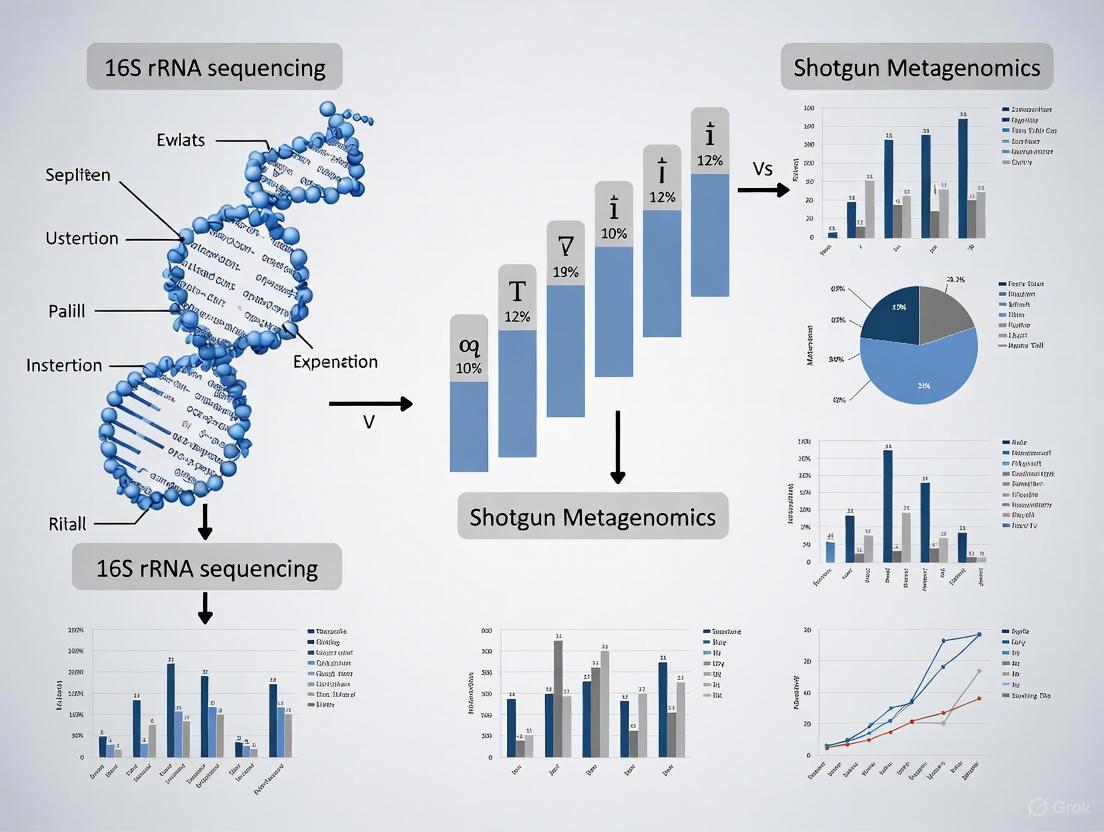
This article provides a comprehensive comparison of 16S rRNA gene sequencing and shotgun metagenomics for researchers and drug development professionals.
16S rRNA vs. Shotgun Metagenomics: A Performance Comparison for Biomedical Research
Abstract
This article provides a comprehensive comparison of 16S rRNA gene sequencing and shotgun metagenomics for researchers and drug development professionals. It covers the foundational principles of each method, their specific applications and methodologies, strategies for troubleshooting and optimization, and a critical validation of their performance based on recent comparative studies. The analysis synthesizes evidence to guide the selection of the appropriate sequencing strategy for various research goals, from initial exploratory surveys to in-depth functional profiling, and discusses the implications of technological advancements for future clinical and biomedical research.
Core Principles: Understanding 16S rRNA and Shotgun Sequencing
In the field of microbiome research, 16S ribosomal RNA (rRNA) sequencing stands as a foundational method for profiling bacterial and archaeal communities. This targeted amplicon approach specifically amplifies and sequences the 16S rRNA gene, a conserved genetic marker that contains variable regions permitting taxonomic classification [1]. In contemporary studies, it is frequently compared to shotgun metagenomic sequencing, a comprehensive method that sequences all genomic DNA present in a sample [2]. The distinction between these two techniques—one a targeted lens and the other a wide-angle view—forms a central thesis in modern microbial ecology. This guide objectively compares the performance of 16S rRNA sequencing against shotgun metagenomics, drawing on recent experimental data to delineate their respective strengths, limitations, and optimal applications for researchers and drug development professionals.
Experimental Protocols in Current Research
To ensure a factual comparison, it is crucial to understand the experimental designs used in recent head-to-head evaluations.
Protocol 1: Comparative Study in Colorectal Cancer
A 2024 study directly compared both technologies using 156 human stool samples from healthy controls, individuals with advanced colorectal lesions, and colorectal cancer (CRC) cases [3].
- Sample Collection: Stool samples were collected one week prior to colonoscopy, stored by participants at -20°C, and delivered on the day of the procedure before being preserved at -80°C [3].
- DNA Extraction: Two different kits were used: the NucleoSpin Soil Kit for shotgun analysis and the Dneasy PowerLyzer Powersoil kit for 16S sequencing [3].
- 16S rRNA Sequencing: The hypervariable V3-V4 region was amplified via PCR. Amplicon sequence variants (ASVs) were inferred using DADA2, and taxonomy was assigned using the SILVA database. An additional classification step using Kraken2 and Bracken2 with the NCBI RefSeq database was performed to increase species-level classification [3].
- Shotgun Metagenomic Sequencing: Whole-genome sequencing was conducted, and human sequence reads were filtered out using the human genome GRCh38 as a reference [3].
Protocol 2: Benchmarking of 16S Analysis Algorithms
A 2025 study performed a comprehensive benchmarking of eight different algorithms for analyzing 16S rRNA amplicon data, using a complex mock community of 227 bacterial strains [4].
- Mock Community: The HC227 mock community, consisting of genomic DNA from 227 bacterial strains across 197 species, was amplified with primers targeting the V3-V4 region and sequenced on an Illumina MiSeq platform [4].
- Data Preprocessing: Primer sequences were stripped, and paired-end reads were merged. Quality filtration involved discarding reads with ambiguous characters and optimizing the maximum expected error rate [4].
- Algorithm Comparison: The study compared denoising algorithms like DADA2, Deblur, and UNOISE3, which produce Amplicon Sequence Variants (ASVs), against clustering algorithms like UPARSE and mothur, which produce Operational Taxonomic Units (OTUs) [4].
Performance Comparison: 16S rRNA vs. Shotgun Metagenomics
Direct comparisons of 16S rRNA and shotgun sequencing reveal consistent patterns of performance across multiple metrics, as summarized in the table below.
Table 1: Experimental Performance Comparison Based on Recent Studies
| Performance Metric | 16S rRNA Sequencing | Shotgun Metagenomic Sequencing | Supporting Evidence |
|---|---|---|---|
| Taxonomic Resolution | Genus-level (sometimes species); lower taxonomic ranks highly differ from shotgun [3]. | Species and strain-level; enables discrimination of single-nucleotide variants [3] [5]. | Comparison of 156 stool samples showed high disagreement at species level [3]. |
| Community Diversity (Alpha) | Lower alpha diversity estimates [3]. | Higher alpha diversity; captures a broader range of taxa [3] [6]. | 16S data was sparser and exhibited lower alpha diversity in CRC study [3]. |
| Functional Profiling | No direct functional data; relies on prediction tools (e.g., PICRUSt) [5]. | Direct profiling of microbial genes, pathways, and functional potential [2] [7]. | Shotgun can identify metabolic pathways and antibiotic resistance genes directly [7]. |
| Disease Prediction Power | Can predict disease status with high accuracy (e.g., AUROC ~0.90 for pediatric UC) [8]. | High predictive power; but not always clearly superior to 16S for group discrimination [3] [8]. | In pediatric ulcerative colitis, both methods achieved similar prediction accuracy [8]. |
| Cost per Sample (Relative) | Lower cost [5]. | Higher cost; typically at least double to triple that of 16S [5]. | Widely acknowledged as a key practical differentiator [3] [5]. |
Table 2: Methodological Characteristics and Best Applications
| Characteristic | 16S rRNA Sequencing | Shotgun Metagenomic Sequencing |
|---|---|---|
| Taxonomic Coverage | Bacteria and Archaea only [5]. | All domains of life: Bacteria, Archaea, Viruses, Fungi [2]. |
| Experimental Bias | Medium to High (primer selection, targeted region, copy number variation) [3] [4]. | Lower ("untargeted"), but biased by DNA extraction, host DNA, and reference databases [3] [1]. |
| Bioinformatics Complexity | Beginner to Intermediate [5]. | Intermediate to Advanced [5]. |
| Optimal Sample Type | Tissue biopsies, low-microbial-biomass samples, studies with high host DNA contamination [3] [5]. | Stool samples, high-microbial-biomass samples, in-depth functional analyses [3]. |
Visualizing Experimental Workflows
The fundamental difference between the two methods lies in their initial processing of genetic material. The following diagram illustrates the core divergence in their experimental pathways.
Beyond the wet-lab workflow, the choice of bioinformatic algorithm significantly impacts the results of a 16S rRNA sequencing study. The following chart outlines the major algorithmic paths and their outcomes as identified in benchmarking studies [4].
The Scientist's Toolkit: Essential Research Reagents and Materials
The reliability of microbiome sequencing data is contingent on the reagents and kits used throughout the experimental pipeline. The following table details key solutions referenced in the protocols cited in this guide.
Table 3: Key Research Reagent Solutions for Microbiome Sequencing
| Reagent / Kit | Function / Application | Relevant Study / Context |
|---|---|---|
| Dneasy PowerLyzer Powersoil Kit (Qiagen) | DNA extraction optimized for difficult-to-lyse microbial cells in soil and stool samples. | Used for 16S rRNA sequencing in the CRC study [3]. |
| NucleoSpin Soil Kit (Macherey-Nagel) | DNA extraction from soil and other complex, humic acid-rich samples. | Used for shotgun metagenomic sequencing in the CRC study [3]. |
| 16S Barcoding Kit (Oxford Nanopore) | PCR amplification and barcoding of the full-length 16S rRNA gene for multiplexed sequencing on nanopore platforms. | Recommended for full-length 16S sequencing to achieve species-level identification [9]. |
| Nextera XT DNA Library Prep Kit (Illumina) | Library preparation for shotgun metagenomic sequencing, using tagmentation to fragment and tag DNA. | Used for metagenomic library construction in the pediatric UC study [8]. |
| ZymoBIOMICS DNA Miniprep Kit | DNA extraction from a variety of sample types, often used for microbial community standards. | Recommended for environmental water samples in nanopore workflows [9]. |
| SILVA Database | A comprehensive, quality-checked database of aligned ribosomal RNA sequences for taxonomic assignment. | Used for initial taxonomic classification in multiple 16S studies [3] [4]. |
| MetaPhlAn & HUMAnN | Bioinformatic pipelines for taxonomic and functional profiling from shotgun metagenomic data. | Part of the bioBakery suite; standard tools for metagenomic analysis [7] [5]. |
The body of evidence confirms that 16S rRNA sequencing and shotgun metagenomics provide "two different lenses" for examining microbial communities [3]. 16S rRNA sequencing remains a powerful, cost-effective tool for hypothesis-driven research focused on bacterial and archaeal composition, especially in large cohort studies or when analyzing samples with high host-DNA background [3] [8] [5]. In contrast, shotgun metagenomics offers a more comprehensive view, delivering superior taxonomic resolution and direct access to the functional potential of the entire community, albeit at a higher cost and computational burden [3] [2] [7].
The choice between them is not a matter of which is universally better, but which is the right tool for the specific research question. For drug development professionals, this distinction is critical: 16S is ideal for identifying microbial biomarkers associated with disease states, while shotgun sequencing is indispensable for unraveling the functional mechanisms and pathways that underlie those associations, ultimately guiding therapeutic strategies.
The study of microbial communities has been revolutionized by high-throughput sequencing technologies, with 16S rRNA gene sequencing and shotgun metagenomic sequencing emerging as the two predominant techniques [3]. While both methods are used to profile microbiomes, they represent fundamentally different approaches. 16S rRNA sequencing is a targeted method that amplifies and sequences a specific, conserved gene to identify and quantify bacteria and archaea. In contrast, shotgun metagenomics is a comprehensive approach that sequences all the genetic material in a sample randomly, enabling not only taxonomic profiling but also functional characterization [10] [11]. This guide provides an objective comparison of these technologies, focusing on their performance characteristics based on recent experimental research, with particular relevance for researchers, scientists, and drug development professionals.
Technical Foundations: Methodologies and Workflows
The fundamental difference between these techniques lies in their starting point and scope. 16S rRNA sequencing uses polymerase chain reaction (PCR) to amplify specific hypervariable regions of the 16S ribosomal RNA gene, which is present in all bacteria and archaea. These amplified regions are then sequenced and compared to reference databases for taxonomic classification [3] [10]. Commonly targeted regions include V3-V4, though this can introduce amplification biases [3]. This method typically employs databases such as SILVA or Greengenes for taxonomic assignment [3] [10].
Shotgun metagenomic sequencing takes a hypothesis-free approach by mechanically fragmenting all DNA in a sample—including from bacteria, viruses, fungi, and archaea—followed by library preparation and sequencing of all these fragments [10] [11]. This generates a complex mixture of sequences that must be computationally assembled and annotated using comprehensive databases and specialized bioinformatics tools [7]. Advanced analysis platforms like Meteor2 leverage microbial gene catalogs to provide integrated taxonomic, functional, and strain-level profiling (TFSP) [7].
Table 1: Core Methodological Differences Between 16S rRNA and Shotgun Sequencing
| Parameter | 16S rRNA Sequencing | Shotgun Metagenomic Sequencing |
|---|---|---|
| Genetic Target | Specific 16S rRNA hypervariable regions [10] | All genomic DNA in sample [10] |
| PCR Amplification | Required (primers target conserved regions) [10] | Not required (fragmentation via mechanical shearing) [11] |
| Taxonomic Scope | Limited to bacteria and archaea [11] | Comprehensive: bacteria, archaea, viruses, fungi, other microorganisms [10] [11] |
| Reference Databases | SILVA, Greengenes, RDP [3] [10] | RefSeq, GTDB, KEGG, CARD [3] [10] |
| Bioinformatics Complexity | Moderate (QIIME2, Mothur) [10] | High (MetaPhlAn, HUMAnN, Meteor2) [10] [7] |
Experimental Comparisons: Performance and Limitations
Detection Sensitivity and Taxonomic Resolution
Direct comparative studies reveal significant differences in the detection capabilities of these methodologies. In a 2024 study comparing both techniques on 156 human stool samples from colorectal cancer patients and healthy controls, shotgun sequencing demonstrated superior detection of less abundant taxa and exhibited higher alpha diversity compared to 16S sequencing [3]. The 16S abundance data was notably sparser and failed to capture the full microbial diversity revealed by shotgun sequencing [3].
A 2021 chicken gut microbiome study provided quantitative insights into these detection differences, showing that shotgun sequencing identified a substantially higher number of statistically significant abundance changes between gastrointestinal tract compartments [12]. When comparing genera abundances between caeca and crop, shotgun sequencing identified 256 statistically significant differences compared to only 108 detected by 16S sequencing [12]. This suggests shotgun sequencing offers greater statistical power for detecting biologically relevant microbial shifts.
Table 2: Quantitative Performance Comparison from Experimental Studies
| Performance Metric | 16S rRNA Sequencing | Shotgun Metagenomics | Experimental Context |
|---|---|---|---|
| Sparsity of Abundance Data | Higher (limited detection) [3] | Lower (broader detection) [3] | 156 human stool samples (2024) [3] |
| Significant Genera Differences | 108 [12] | 256 [12] | Chicken GI tract compartments (2021) [12] |
| Taxonomic Resolution | Genus level (occasionally species) [10] | Species and strain level [10] | Methodological comparison (2025) [10] |
| Functional Capacity | Limited (predicted from taxonomy) [10] | Comprehensive (direct gene detection) [10] | Methodological comparison (2025) [10] |
| Strain-Level Tracking | Not available [10] | Possible (9.8-19.4% more strain pairs) [7] | Meteor2 validation (2025) [7] |
Functional Profiling Capabilities
A critical distinction between these methods lies in their capacity for functional analysis. While 16S sequencing is restricted to taxonomic profiling, shotgun sequencing enables direct assessment of functional genes, metabolic pathways, and antimicrobial resistance (AMR) markers [10]. Tools like HUMAnN3 and Meteor2 can quantify functional orthologs (KEGG), carbohydrate-active enzymes (CAZymes), and antibiotic resistance genes from shotgun data [7]. In the colorectal cancer study, shotgun sequencing enabled functional insights that were not accessible via 16S data alone [3].
For methane emission studies in cattle, researchers compared heritability estimates using both methods and found that while 16S data provided the highest value for "microbiability" (0.38), shotgun metagenomics from the GTDB database yielded the highest heritability estimate for methane (0.14), highlighting how methodological choice can influence conclusions in functional studies [13].
Technical Limitations and Challenges
Both techniques present distinct technical challenges. 16S sequencing is susceptible to PCR amplification biases, primer mismatches, and chimera formation that can distort abundance measurements [3] [10]. The method's reliance on specific hypervariable regions means no single region can adequately distinguish all species [3].
Shotgun sequencing faces different challenges, including host DNA contamination (particularly problematic in clinical samples like blood), high computational demands, and dependency on the completeness of reference databases [3] [14]. A 2025 study on bloodstream infection diagnosis reported that 15 of 51 samples (29%) had to be excluded from analysis due to low DNA library yield or low sequencing output, underscoring the technique's sensitivity to sample quality [14].
Research Applications and Recommendations
Application-Specific Considerations
The choice between sequencing strategies should be guided by research goals, sample type, and resources:
Clinical Diagnostics: Shotgun sequencing excels in identifying pathogens in complex infections, detecting antimicrobial resistance genes, and investigating culture-negative cases [15] [10]. However, its sensitivity can be limited in low-microbial-biomass samples like blood [14].
Environmental Monitoring: 16S sequencing is suitable for initial biodiversity assessments in soil, water, or air, while shotgun sequencing provides insights into functional metabolic processes like pollutant degradation or nutrient cycling [10].
Drug Discovery and Gut Microbiome Analysis: Shotgun sequencing is increasingly preferred for understanding host-microbe interactions, identifying therapeutic targets, and characterizing functional potential [16] [15]. The gut microbiome analysis sector is anticipated to register the fastest growth in metagenomic sequencing applications [15].
Experimental Design and Reagent Solutions
Table 3: Essential Research Reagents and Tools for Metagenomic Studies
| Reagent/Tool Category | Specific Examples | Function and Application |
|---|---|---|
| DNA Extraction Kits | NucleoSpin Soil Kit, Dneasy PowerLyzer Powersoil Kit [3] | Efficient lysis of diverse microorganisms and purification of inhibitor-free DNA |
| Sequencing Platforms | Illumina MiSeq, PacBio Sequel II, Oxford Nanopore PromethION [16] [14] | High-throughput DNA sequencing with varying read lengths and accuracy profiles |
| Bioinformatics Tools | MetaPhlAn4, HUMAnN3, Meteor2, QIIME2 [10] [7] | Taxonomic profiling, functional analysis, and strain-level characterization |
| Reference Databases | SILVA, GTDB, KEGG, CARD [3] [10] [7] | Taxonomic classification and functional annotation of sequencing data |
| Library Prep Kits | Illumina TruSeq, PacBio SMRTbell [17] | Preparation of DNA fragments for sequencing on specific platforms |
Strategic Recommendations
Based on comparative performance data:
Choose 16S rRNA sequencing for large-scale screening studies with limited budgets, when targeting only bacterial and archaeal communities, and when taxonomic profiling at genus level suffices [3] [10]. It remains suitable for tissue samples and studies with targeted aims [3].
Opt for shotgun metagenomics when comprehensive taxonomic profiling (including viruses and fungi), functional characterization, strain-level discrimination, or detection of low-abundance taxa is required [3] [10]. It is particularly recommended for stool microbiome samples and in-depth analyses [3].
The global metagenomic sequencing market reflects a shift toward shotgun approaches, with the shotgun metagenomic sequencing segment accounting for the largest revenue share in 2024 and projected to grow rapidly [15]. However, 16S rRNA sequencing is anticipated to register the fastest CAGR during the forecast period, indicating both technologies will continue to play important but complementary roles in microbiome research [15].
Shotgun metagenomics and 16S rRNA sequencing provide "two different lenses" for examining microbial communities [3]. While 16S sequencing offers a cost-effective method for basic taxonomic profiling, shotgun metagenomics delivers a more comprehensive view of microbial ecosystems, enabling both detailed taxonomic classification and functional potential assessment. The choice between these methods should be guided by specific research questions, with the understanding that shotgun sequencing typically provides greater depth and breadth of biological insights, particularly for functional studies and detection of less abundant community members. As sequencing costs continue to decline and bioinformatics tools become more sophisticated, shotgun metagenomics is increasingly becoming the preferred method for comprehensive microbiome characterization, though 16S sequencing remains valuable for targeted applications and large-scale epidemiological studies.
The choice between 16S rRNA gene sequencing and shotgun metagenomic sequencing is a fundamental decision in microbiome research, with significant implications for experimental design, cost, and biological interpretation [18]. This guide provides an objective, data-driven comparison of these two predominant methods, tracing their workflows from initial DNA extraction to final data output. Framed within the broader thesis of 16S versus shotgun metagenomic performance research, this analysis synthesizes findings from recent peer-reviewed studies to equip researchers, scientists, and drug development professionals with the evidence needed to select the optimal method for their specific applications. The comparison focuses on practical experimental protocols, quantitative performance metrics, and the inherent trade-offs between resolution, cost, and functional insight.
Workflow Comparison: From Sample to Sequence
The methodological pathways for 16S rRNA and shotgun metagenomic sequencing diverge significantly after sample collection, influencing data output and potential applications. The following diagram and table outline these core workflows.
Figure 1: Comparative Workflows for 16S rRNA and Shotgun Metagenomic Sequencing. The 16S pathway (green) involves targeted amplification of specific gene regions, while the shotgun pathway (red) uses random fragmentation of all genomic DNA.
Table 1: Key Procedural Differences in Experimental Workflows
| Workflow Step | 16S rRNA Sequencing | Shotgun Metagenomic Sequencing |
|---|---|---|
| DNA Input Requirements | Low (as low as 10 copies of 16S gene) [18] | High (minimum 1 ng total DNA) [18] |
| PCR Amplification | Required (targets hypervariable regions) [5] | Optional (library amplification) [5] |
| Primer/Region Selection | Critical (e.g., V3-V4, V4, V1-V3) [19] | Not applicable |
| Host DNA Interference | Low impact (targeted approach) [18] | High impact (requires depletion strategies) [20] [18] |
| Sequencing Depth | ~50,000 reads/sample often sufficient [21] | Millions of reads/sample required [21] |
Experimental Protocols from Cited Studies
DNA Extraction and Sample Preparation
Consistent DNA extraction is critical for both methods, though optimal input requirements differ. Studies directly comparing both sequencing methods from the same samples often use commercial kits to ensure uniformity.
Protocol for Pediatric Gut Microbiome Study (2021): Fecal samples from the RESONANCE cohort were collected in OMR-200 tubes (OMNIgene GUT, DNA Genotek) and stored at -80°C. DNA was extracted using the QIAamp Powerfecal DNA kit (Qiagen) following manufacturer's instructions, with mechanical lysis performed using a Vortex-Genie 2 with a horizontal tube holder adaptor [21] [8].
Protocol for Clinical Body Fluid Study (2025): For shotgun metagenomic sequencing, body fluid samples were centrifuged at 20,000 × g for 15 minutes. Whole-cell DNA (wcDNA) was extracted from the precipitate using the Qiagen DNA Mini Kit with bead beating for lysis. For cell-free DNA (cfDNA) analysis, the supernatant was used with the VAHTS Free-Circulating DNA Maxi Kit (Vazyme Biotech) [20].
Library Preparation and Sequencing
The library preparation processes diverge fundamentally after DNA extraction, with 16S relying on targeted amplification and shotgun employing random fragmentation.
16S rRNA Library Preparation (2022): The hypervariable V4 region of the 16S rRNA gene was amplified using barcoded primers (515FB and 806RB). Library quality was assessed using Agilent High Sensitivity DNA Bioanalyzer chips, and sequencing was performed on an Illumina MiSeq System using 2×150bp paired-end protocol [8]. Other studies have highlighted the impact of different variable regions (V1-V3, V3-V4, V6-V8) on taxonomic resolution [19].
Shotgun Metagenomic Library Preparation (2022): Metagenomic libraries were constructed using the Nextera XT DNA Library Preparation Kit (Illumina) with Illumina Nextera XT Index kits. Libraries were quantified and quality-checked before being sequenced on an Illumina NextSeq500 System producing 2×150bp paired-end reads [8]. Host-derived reads were subsequently removed bioinformatically using KneadData [8].
Performance and Data Output Analysis
Taxonomic Resolution and Coverage
The choice between 16S and shotgun sequencing involves significant trade-offs in taxonomic resolution, microbial coverage, and detection accuracy.
Table 2: Taxonomic Profiling Capabilities and Limitations
| Parameter | 16S rRNA Sequencing | Shotgun Metagenomic Sequencing |
|---|---|---|
| Taxonomic Resolution | Genus-level (sometimes species) [18] [5] | Species-level and sometimes strain-level [18] [5] |
| Kingdom Coverage | Bacteria and Archaea only [18] [5] | All domains (Bacteria, Archaea, Fungi, Viruses) [18] [5] |
| Sensitivity to Database Completeness | Moderate (16S databases well-curated) [18] | High (dependent on whole-genome databases) [18] |
| False Positive Risk | Lower (with error-correction like DADA2) [18] | Higher (due to database limitations and horizontal gene transfer) [18] |
| Detection of Novel Organisms | Possible (can classify novel taxa at higher ranks) [18] | Challenging (requires close reference genomes) [18] |
Quantitative Performance Metrics
Recent comparative studies provide empirical data on the performance characteristics of both methods across different sample types.
Table 3: Experimental Performance Metrics from Comparative Studies
| Study Context | 16S rRNA Sequencing Performance | Shotgun Metagenomic Sequencing Performance |
|---|---|---|
| Pediatric UC Diagnosis (2022) [8] | AUROC: ~0.90 for disease prediction | AUROC: ~0.90 for disease prediction |
| Clinical Body Fluid Pathogen Detection (2025) [20] | 58.54% (24/41) concordance with culture | 70.7% (29/41) concordance with culture (wcDNA) |
| Endophthalmitis Pathogen Detection (2023) [22] | Not assessed in this study | 61.9% (13/21) positivity rate vs. 28.5% (6/21) for culture |
| Sensitivity to Host DNA [20] [18] | Low interference | High interference (host DNA can comprise >95% of reads) |
Functional Profiling Capabilities
A critical differentiator between the two methods is their ability to provide insights into microbial community function.
16S rRNA Sequencing: Provides no direct functional information. Tools like PICRUSt can predict functional profiles based on taxonomic assignments, but these are inferences rather than direct measurements [5].
Shotgun Metagenomic Sequencing: Enables comprehensive functional profiling by sequencing all genes in a microbiome. This allows for direct identification of metabolic pathways, antibiotic resistance genes, and virulence factors [18] [5]. However, functional annotation quality is heavily dependent on reference databases, which remain incomplete for many non-model microorganisms.
The Scientist's Toolkit: Essential Research Reagents
Table 4: Key Reagents and Kits for 16S and Shotgun Metagenomic Sequencing
| Reagent/Kits | Application | Function | Example Studies |
|---|---|---|---|
| OMNIgene GUT OMR-200 tubes | Sample Collection | Stabilizes microbial DNA at room temperature | Pediatric gut microbiome studies [21] |
| QIAamp Powerfecal DNA Kit | DNA Extraction | Isolates high-quality microbial DNA from complex samples | Pediatric UC study [8] |
| Nextera XT DNA Library Prep Kit | Library Preparation (Shotgun) | Fragments DNA and adds adapters for sequencing | Metagenomic sequencing [8] |
| VAHTS Free-Circulating DNA Maxi Kit | cfDNA Extraction | Isolates cell-free DNA from body fluids | Body fluid pathogen detection [20] |
| Illumina MiSeq Reagent Kits | Sequencing (16S) | Provides reagents for 2×150bp or 2×250bp sequencing | 16S rRNA gene sequencing [8] [22] |
| Illumina NextSeq500 High Output Kits | Sequencing (Shotgun) | Provides reagents for high-output metagenomic sequencing | Whole metagenome sequencing [8] |
This comparative workflow analysis demonstrates that the choice between 16S rRNA and shotgun metagenomic sequencing involves balancing multiple factors including research objectives, budget, sample type, and bioinformatics capabilities. 16S rRNA sequencing remains a cost-effective method for comprehensive taxonomic profiling of bacterial and archaeal communities, particularly when studying large sample sets or working with samples containing high host DNA. Shotgun metagenomic sequencing provides superior taxonomic resolution, cross-domain coverage, and direct functional insights, but at a higher cost and with greater computational demands. For many research applications, particularly in clinical diagnostics where comprehensive pathogen detection is crucial, shotgun metagenomics offers distinct advantages in sensitivity and resolution. As sequencing costs continue to decline and bioinformatic tools improve, shotgun metagenomics is likely to become increasingly accessible for routine microbiome analysis, though 16S rRNA sequencing will remain valuable for large-scale epidemiological studies and projects with limited budgets.
Inherent Biases and Limitations of Each Foundational Method
The choice between 16S rRNA gene sequencing and shotgun metagenomics is one of the most fundamental decisions in designing a microbiome study. While 16S sequencing targets a specific, conserved gene to profile bacterial and archaeal communities, shotgun metagenomics employs an untargeted approach to sequence all genomic DNA in a sample, enabling broader taxonomic coverage and functional potential assessment [5] [10]. Each method possesses inherent biases and limitations stemming from its underlying workflow, which can significantly impact the resulting data and biological interpretations. This guide objectively compares the performance of these two foundational methods, drawing on recent empirical evidence to outline their respective strengths and weaknesses within the context of microbial community analysis.
The technical workflows of 16S and shotgun sequencing are the primary sources of their distinct biases. A visual summary of these fundamental differences is provided in the diagram below.
16S rRNA Sequencing Biases
Primer and PCR Bias: The initial PCR amplification step introduces significant bias. Primer selection for specific hypervariable regions (e.g., V3-V4) determines which taxa are efficiently amplified and detected [3] [6]. Primer mismatches can lead to the under-representation or complete omission of certain taxa [10]. Furthermore, the PCR process itself can skew abundance estimates due to varying amplification efficiencies between templates and the formation of chimeric sequences [10].
Copy Number Variation: The 16S rRNA gene is present in multiple copies in bacterial genomes, and this copy number varies considerably across taxa [3]. This variation introduces a systematic error in estimating the relative abundance of organisms, as species with higher copy numbers are over-represented in the final data compared to their true biological abundance [3].
Limited Taxonomic and Functional Resolution: 16S sequencing, especially of short regions, often struggles to resolve taxonomy beyond the genus level [5] [10]. Discriminating between closely related species is frequently impossible due to high sequence similarity in the targeted region [12]. Critically, this method cannot directly profile functional genes or metabolic pathways, relying instead on predictive tools (e.g., PICRUSt) which infer function from taxonomy [5].
Shotgun Metagenomic Sequencing Biases
Host DNA Contamination: A major challenge, particularly for samples with low microbial biomass (e.g., tissue, skin swabs), is the sequencing of host DNA [5]. This can consume a large portion of the sequencing reads, drastically reducing the depth for profiling the microbial community and potentially obscuring low-abundance taxa unless mitigated by deep sequencing or host DNA depletion protocols [5].
Database Dependency and Computational Complexity: The accuracy of shotgun metagenomics is heavily reliant on the completeness and quality of reference databases [3]. Reads from novel species or genes without close database representatives may remain unclassified or misclassified. The bioinformatic analysis is also notably more complex, requiring sophisticated software, substantial computational resources, and expert knowledge for tasks like assembly, binning, and functional annotation [5] [10].
Abundance Detection Threshold: While shotgun metagenomics can, in theory, detect a wider range of taxa, the detection of low-abundance organisms is still constrained by sequencing depth [12]. Without sufficient sequencing coverage, rare species may escape detection, a limitation shared with 16S sequencing.
Comparative Performance from Experimental Data
Direct comparisons of 16S and shotgun sequencing using the same sample sets reveal critical differences in their outputs. A 2024 study on colorectal cancer microbiota, which processed 156 human stool samples with both methods, serves as a key source for performance data [3].
Table 1: Comparative Performance of 16S vs. Shotgun Sequencing
| Performance Metric | 16S rRNA Sequencing | Shotgun Metagenomics | Supporting Evidence |
|---|---|---|---|
| Taxonomic Resolution | Genus-level (sometimes species) [5] | Species-level and strain-level [5] | 16S detects only part of the community revealed by shotgun [3] |
| Community Richness (Alpha Diversity) | Lower alpha diversity estimates [3] | Higher alpha diversity estimates [3] | Shotgun finds a statistically significant higher number of taxa [12] |
| Data Sparsity | Sparser abundance data [3] | Less sparse data [3] | Shotgun provides a more detailed snapshot in depth and breadth [3] |
| Functional Profiling | No direct functional data; prediction only [5] | Direct profiling of metabolic pathways, AMR, and virulence genes [5] [10] | Reveals functional potential and genes [5] |
| Correlation of Abundance | N/A | N/A | Positive correlation for shared taxa, but disagreement in lower ranks [3] |
| Sensitivity to Host DNA | Low (targeted amplification) [5] | High (requires mitigation) [5] | Non-microbial reads can obscure results in high-host-DNA samples [5] |
Insights from a Pediatric Ulcerative Colitis Study
A 2022 study on pediatric ulcerative colitis sequenced 19 cases and 23 controls using both methods [8]. It demonstrated that while both techniques could predict disease status with high accuracy (AUROC ~0.90), key differences emerged. The study concluded that 16S data yielded similar results to shotgun data for alpha and beta diversity analyses and prediction accuracy, making it a cost-effective choice for such case-control taxonomic studies where functional insight is not required [8].
Detailed Experimental Protocols for Method Comparison
To ensure reproducible and comparable results in a method benchmarking study, standardized protocols are essential. The following section outlines representative workflows used in recent comparative studies.
Protocol 1: 16S rRNA Gene Sequencing (V3-V4 Region)
This protocol is adapted from the colorectal cancer study that compared both sequencing techniques [3].
Step 1: DNA Extraction
- Kit: Dneasy PowerLyzer Powersoil kit (Qiagen) [3].
- Function: Efficiently lyses microbial cells and purifies DNA from complex sample matrices like stool.
Step 2: PCR Amplification
- Target: Hypervariable V3-V4 region of the 16S rRNA gene.
- Primers: Standard primers targeting the V3-V4 region [3].
- Process: Amplify the target region and attach sample-specific barcodes to allow for multiplexing.
Step 3: Library Preparation and Sequencing
Step 4: Bioinformatic Analysis
Protocol 2: Shotgun Metagenomic Sequencing
This protocol is derived from the same comparative study and other cited sources [3] [8].
Step 1: DNA Extraction
Step 2: Library Preparation
- Kit: Nextera XT DNA Library Preparation Kit (Illumina) [8].
- Process: DNA is fragmented and tagged with adapter sequences in a single step (tagmentation). This is followed by a limited-cycle PCR to add full adapter sequences and unique dual indices.
Step 3: Sequencing
Step 4: Bioinformatic Analysis
- Quality Control: Use tools like Trim Galore! and KneadData to remove low-quality sequences and host-derived reads (e.g., human genome) [8].
- Taxonomic Profiling: Align reads to curated genome databases (e.g., UHGG, GTDB) using tools like MetaPhlAn [3] [5].
- Functional Profiling: Align reads to functional databases (e.g., KEGG, CARD) using tools like HUMAnN [5].
Table 2: Essential Research Reagent Solutions
| Item | Function in Protocol | Example Products / Kits |
|---|---|---|
| Fecal DNA Extraction Kit | Isolates microbial genomic DNA from complex samples | QIAamp PowerFecal DNA Kit, NucleoSpin Soil Kit, Dneasy PowerLyzer Powersoil kit [3] [8] |
| 16S PCR & Barcoding Kit | Amplifies target 16S region and adds sample barcodes | 16S Barcoding Kit (Oxford Nanopore), custom 16S V3-V4 primers [3] [9] |
| Shotgun Library Prep Kit | Fragments DNA and prepares sequencing library | Nextera XT DNA Library Prep Kit (Illumina) [8] |
| Taxonomic Reference DB | Database for classifying sequencing reads | SILVA, Greengenes (16S); UHGG, GTDB, RefSeq (Shotgun) [3] [10] |
| Functional Reference DB | Database for annotating gene functions | KEGG, CARD, NCBI RefSeq [10] |
The collective evidence demonstrates that 16S and shotgun metagenomic sequencing offer complementary views of microbial communities, each with irreducible biases. 16S sequencing provides a cost-effective, focused lens on bacterial and archaeal composition but gives greater weight to dominant taxa and lacks direct functional insight [3]. Shotgun sequencing offers a more comprehensive, untargeted snapshot with superior taxonomic resolution and direct functional profiling, but at a higher cost and computational burden, and with sensitivity to host DNA contamination [3] [5].
The choice between them should be guided by the study's primary objectives, sample type, and available resources. For large-scale, hypothesis-generating studies focused primarily on bacterial taxonomy, 16S remains a powerful tool. For investigations requiring species- or strain-level resolution, comprehensive functional potential, or detection of non-bacterial kingdoms, shotgun metagenomics is the preferred, albeit more resource-intensive, method [3] [10]. As sequencing costs continue to fall and hybrid approaches evolve, researchers can increasingly design studies that leverage the strengths of both foundational methods.
Strategic Application: Choosing the Right Tool for Your Research Goal
When designing a microbiome study, one of the most critical decisions researchers face is the choice between 16S rRNA gene sequencing and shotgun metagenomic sequencing. This decision fundamentally shapes the depth of taxonomic resolution, the breadth of biological questions that can be addressed, and the overall financial footprint of the project. While 16S rRNA sequencing provides a cost-effective targeted approach for profiling bacterial and archaeal communities, shotgun metagenomics offers a comprehensive view of all genetic material in a sample, enabling microbial identification to the species or strain level and allowing functional profiling [23] [5]. The expanding applications in drug discovery and clinical diagnostics are accelerating the adoption of both technologies, with the global metagenomic sequencing market projected to grow from USD 3.66 billion in 2025 to approximately USD 16.81 billion by 2034 [16]. This guide provides an objective, data-driven comparison to help researchers and drug development professionals strategically allocate resources while balancing the critical trade-offs between depth and breadth in experimental design.
Quantitative Comparison at a Glance
The following tables summarize key performance metrics and cost considerations, synthesizing data from comparative studies and market analyses.
Table 1: Performance and Capability Comparison
| Feature | 16S rRNA Sequencing | Shotgun Metagenomics |
|---|---|---|
| Taxonomic Coverage | Bacteria and Archaea only [23] [5] | All domains: Bacteria, Archaea, Viruses, Fungi, and other microbes [23] |
| Typical Taxonomic Resolution | Genus-level (sometimes species) [5] | Species-level, often strain-level and single nucleotide variants [5] |
| Functional Profiling | No direct profiling; only predictions possible (e.g., PICRUSt) [5] | Yes, direct assessment of functional gene content [5] |
| Sensitivity to Host DNA | Low (targets specific microbial gene) [5] | High (sequences all DNA; critical for low-microbial-biomass samples) [5] |
| Detection of Less Abundant Taxa | Lower power; reveals only part of the community [3] [12] | Higher power; identifies a broader range of taxa, including rare species [3] [12] |
| Data Sparsity | Higher (sparser data) [3] | Lower (less sparse data) [3] |
Table 2: Cost and Logistical Considerations
| Consideration | 16S rRNA Sequencing | Shotgun Metagenomics |
|---|---|---|
| Approximate Cost per Sample (USD) | ~$50 [5] | Starting at ~$150 (depends on sequencing depth) [5] |
| Bioinformatics Complexity | Beginner to Intermediate [5] | Intermediate to Advanced [5] |
| Experimental Bias | Medium to High (depends on primer selection and targeted region) [3] [5] | Lower ("untargeted," though biases exist in extraction and analysis) [5] |
| Reference Databases | Established, well-curated (e.g., SILVA, Greengenes) [3] [5] | Relatively new, still growing and improving (e.g., NCBI refseq, GTDB) [3] [5] |
| Optimal Sample Type | Various, including tissue and low-microbial-biomass samples [3] [5] | Samples with high microbial load (e.g., stool) [3] [5] |
Experimental Data and Performance Benchmarks
Taxonomic Profiling and Diversity Assessments
Comparative studies consistently reveal that the choice of sequencing technology directly impacts observed microbial community structure. In a colorectal cancer study comparing 156 human stool samples, shotgun sequencing detected a wider range of microbial diversity. The 16S data was notably sparser and exhibited lower alpha diversity compared to shotgun data [3]. Similarly, a study on chicken gut microbiota found that 16S sequencing only detected part of the community revealed by shotgun sequencing, with the discrepancy most pronounced for less abundant genera [12].
The ability to distinguish between experimental conditions also varies. In the chicken gut study, when comparing genera abundances between two gut compartments (caeca vs. crop), shotgun sequencing identified 256 statistically significant differences, whereas 16S sequencing identified only 108 [12]. This suggests that shotgun sequencing provides greater power to detect biologically meaningful, condition-specific taxa, including those that are low in abundance.
Functional Insights and Microbial Signature Discovery
A critical advantage of shotgun metagenomics is its capacity for functional profiling. By sequencing all genes in a sample, researchers can move beyond "who is there" to infer "what they are doing" [5]. This includes profiling metabolic pathways, antibiotic resistance genes, and other functional elements [5]. While tools like PICRUSt can predict metagenomic functions from 16S data, these are indirect inferences and are less accurate than direct measurements from shotgun data [5].
For disease biomarker discovery, both techniques can uncover relevant microbial signatures. The colorectal cancer study found that machine learning models trained on data from both sequencing techniques revealed taxa previously associated with CRC development, such as Parvimonas micra [3]. However, the increased resolution and comprehensiveness of shotgun sequencing can provide a more detailed and actionable snapshot for downstream applications in drug development and diagnostics [3].
Detailed Experimental Protocols
To ensure reproducibility and provide context for the data discussed, here are the detailed methodologies from two key comparative studies cited in this guide.
Protocol 1: Comparative Analysis in Colorectal Cancer
This protocol is derived from the 2024 study comparing 16S and shotgun sequencing in a human cohort of healthy controls, high-risk colorectal lesion patients, and colorectal cancer cases [3].
Sample Collection and DNA Extraction:
- Cohort: 156 human stool samples from a colorectal cancer screening program.
- Storage: Participants stored samples at -20°C before delivery and long-term storage at -80°C.
- DNA Extraction: Used different kits for each method to optimize yields:
- Shotgun Analysis: NucleoSpin Soil Kit (Macherey-Nagel).
- 16S Analysis: Dneasy PowerLyzer Powersoil kit (Qiagen) [3].
16S rRNA Gene Sequencing:
- Target Region: Hypervariable V3-V4 region.
- Bioinformatics Pipeline: Processed with DADA2 (v1.22.0) in R to resolve Amplicon Sequence Variants (ASVs).
- Taxonomy Assignment: Initially assigned using the SILVA database (v138.1). To improve species-level classification, an additional step was performed using a custom BLASTN database and k-mer based classification with Kraken2/Bracken2 against the NCBI RefSeq Targeted Loci Project database [3].
Shotgun Metagenomic Sequencing:
- Library Preparation: Not detailed in the provided excerpt.
- Bioinformatics: Human sequence reads were filtered out using Bowtie2 against the human genome GRCh38. The remaining reads were analyzed for taxonomic composition [3].
Data Analysis:
- Comparisons were conducted at species, genus, and family levels.
- Analyses included abundance correlations, sparsity, alpha and beta diversities, and machine learning model performance for predicting disease state [3].
Protocol 2: Comparative Analysis in a Mouse Model
This protocol is based on a 2025 study evaluating sequencing technologies for mouse gut microbiota analysis, comparing the impact of primers, platforms, and DNA quality [6].
Animal Model and Sample Collection:
- Subjects: 27 female C57BL/6 mice, divided into control, lactobacilli-administered, and bifidobacteria-administered groups.
- Intervention: Daily intragastric administration of bacterial cultures or PBS (control) for 5 days.
- Sample Type: Fecal samples collected at multiple time points and stored at -80°C [6].
DNA Extraction:
- The study specifically evaluated the impact of DNA extraction, comparing High Molecular Weight (HMW) DNA vs. standard DNA protocols [6].
Sequencing Technologies:
- 16S rRNA Sequencing: Performed on both Illumina and Oxford Nanopore Technologies (ONT) platforms. The study highlighted the critical influence of primer selection on results.
- Metagenome Sequencing (MS): Also performed on both Illumina and ONT platforms [6].
Data Analysis:
- Focused on comparing microbial diversity assessments, taxonomic resolution, and the correlation of results between the different technological approaches [6].
Visualizing Experimental Workflows
The diagrams below illustrate the core logical workflows for the two sequencing technologies and the structure of a comparative experiment.
Core Methodologies
Comparative Study Design
The Scientist's Toolkit: Essential Research Reagents and Materials
The following table details key reagents and consumables critical for executing metagenomic sequencing studies, a segment that currently holds the largest share of the market [15] [24].
Table 3: Essential Reagents and Solutions for Metagenomic Workflows
| Item | Function in Workflow | Example Product / Note |
|---|---|---|
| DNA Extraction Kits | Lysis and purification of genomic DNA from complex sample matrices. Critical for yield and bias. | NucleoSpin Soil Kit [3], Dneasy PowerLyzer Powersoil kit [3] |
| PCR Master Mix | Amplification of target genes (for 16S). Contains polymerase, dNTPs, and buffer. | A key consumable for 16S library prep [5] |
| Library Preparation Kits | Fragmentation, end-repair, adapter ligation, and amplification for shotgun sequencing. | Kits with tagmentation enzymes streamline workflow [5] |
| Sequenceing Reagents | The chemicals consumed during the sequencing run itself (e.g., fluorescent dyes, buffers). | Flow cells and SBS reagents for Illumina; sequencing kits for ONT [16] |
| Quantification Standards | Accurate quantification of DNA libraries prior to pooling and sequencing to ensure balanced representation. | Flurometric assays (e.g., Qubit), qPCR-based kits [5] |
| Purification Beads | Size selection and cleanup of DNA after amplification and library preparation steps. | SPRI beads (Solid Phase Reversible Immobilization) are widely used [5] |
The choice between 16S rRNA and shotgun metagenomic sequencing is not a matter of identifying a superior technology, but rather of selecting the right tool for the specific research question, budget, and analytical capabilities.
Choose 16S rRNA sequencing when: The primary goal is to profile the bacterial and archaeal composition at a genus level across a large number of samples, cost is a primary constraint, the sample type has high host DNA contamination (e.g., tissue biopsies) [3], or bioinformatics expertise is limited. It remains a powerful tool for large-scale cohort studies focused on bacterial community shifts.
Choose shotgun metagenomic sequencing when: The research requires species- or strain-level resolution, comprehensive profiling of all microbial domains (viruses, fungi), or functional metabolic potential [23] [5]. It is particularly suited for biomarker discovery in complex diseases, drug discovery where functional insights are crucial, and any study where a maximal depth of information is required from samples with high microbial load, such as stool [3].
A hybrid approach is also emerging as a strategic option, where 16S sequencing is used for initial screening of a large sample set, followed by in-depth shotgun sequencing on a strategically selected subset [6] [5]. Furthermore, "shallow shotgun" sequencing is bridging the cost-resolution gap, offering a compelling alternative for large-scale studies requiring more detail than 16S can provide [5]. As sequencing costs continue to fall and analytical tools become more sophisticated, the balance is shifting towards shotgun metagenomics for an increasingly wide range of applications, particularly in drug development and clinical diagnostics where precision is paramount.
Metagenomics has revolutionized our ability to study microbial communities without the need for cultivation, leveraging high-throughput sequencing technologies to unravel taxonomic composition. The choice between 16S rRNA gene sequencing and shotgun metagenomic sequencing represents a fundamental methodological decision that directly impacts the depth and reliability of taxonomic classification. While 16S sequencing targets specific hypervariable regions of the bacterial 16S ribosomal RNA gene, shotgun sequencing randomly fragments and sequences all DNA present in a sample, enabling broader genomic coverage [25].
The pursuit of strain-level identification—the highest resolution in microbial taxonomy—has significant implications across multiple fields. In clinical diagnostics, strain-level data can distinguish pathogenic from commensal variants of the same species. In pharmaceutical development, it enables tracking of specific probiotic strains and their functional attributes. In microbial ecology, it reveals fine-scale population dynamics and niche specialization [26]. This guide objectively compares the performance of 16S rRNA and shotgun metagenomic sequencing technologies in achieving progressively higher taxonomic resolution, supported by experimental data and methodological details from recent studies.
Fundamental Technological Differences
The core distinction between these approaches lies in their scope and underlying methodology. 16S rRNA sequencing uses PCR to amplify specific hypervariable regions (V1-V9) of the 16S rRNA gene, which are then sequenced and compared against reference databases like SILVA, Greengenes, or RDP for taxonomic assignment [27] [25]. This targeted approach provides a cost-effective means for bacterial identification but is generally limited to genus-level resolution with occasional species-level classification depending on the targeted region and reference database [3].
In contrast, shotgun metagenomic sequencing employs random fragmentation of all DNA in a sample, followed by adapter ligation and sequencing without amplification bias [25]. The resulting sequences can be aligned to comprehensive genomic databases containing whole microbial genomes, enabling discrimination at the species and potentially strain levels by leveraging unique genomic markers beyond the 16S gene [12]. This comprehensive approach comes with higher computational demands and costs but provides unparalleled resolution and functional insights [3].
Figure 1: Workflow comparison between 16S rRNA sequencing and shotgun metagenomic sequencing approaches, highlighting fundamental methodological differences.
Direct Performance Comparison: Experimental Evidence
Resolution and Detection Capabilities
Multiple controlled studies have systematically compared the taxonomic resolution achieved by both sequencing methods. A comprehensive 2024 study examining colorectal cancer microbiota found that "16S detects only part of the gut microbiota community revealed by shotgun," with shotgun sequencing demonstrating "more power to identify less abundant taxa than 16S sequencing" [3] [12]. This enhanced detection sensitivity stems from shotgun sequencing's ability to sequence entire microbial genomes rather than relying on a single marker gene.
Table 1: Taxonomic Resolution and Detection Capabilities Based on Experimental Studies
| Performance Metric | 16S rRNA Sequencing | Shotgun Metagenomic Sequencing | Experimental Support |
|---|---|---|---|
| Typical Taxonomic Resolution | Genus-level, with some species-level identification [25] | Species to strain-level resolution [25] | 2024 CRC study (n=156 samples) [3] |
| Low-Abundance Taxa Detection | Limited detection of rare taxa; sparser abundance data [3] | Superior detection of less abundant genera [12] | Chicken GI tract study (78 samples) [12] |
| Differential Analysis Power | Identified 108 significant genus differences (caeca vs crop) [12] | Identified 256 significant genus differences (caeca vs crop) [12] | Direct method comparison [12] |
| Community Diversity Assessment | Lower alpha diversity values; reveals only dominant members [3] | Higher alpha diversity; captures broader community structure [3] | Ecological analysis [3] |
| Cross-Domain Coverage | Limited to bacteria and archaea (with specific primers) [25] | Comprehensive detection of bacteria, archaea, viruses, fungi [25] | Methodological capability [25] |
The difference in detection power was quantitively demonstrated in a 2021 chicken gut microbiota study, which found that shotgun sequencing identified 152 statistically significant changes in genera abundance between gastrointestinal compartments that 16S sequencing failed to detect, while 16S found only 4 changes missed by shotgun sequencing [12]. This order-of-magnitude difference highlights shotgun sequencing's superior capability to detect biologically meaningful taxonomic shifts across microbial communities.
Accuracy and Database Dependencies
Both technologies exhibit distinct performance characteristics regarding classification accuracy and susceptibility to false positives. Error-correction tools like DADA2 have dramatically improved the accuracy of 16S sequencing, with demonstrations showing recovery of all 16S sequences from mock microbial communities "with no error in the sequence, i.e., no false positives" [25]. This high accuracy stems from the extensive curation of 16S-specific databases and the focused nature of analyzing a single, well-characterized gene region.
In contrast, shotgun metagenomic sequencing "has a higher dependence on the reference database" and is more prone to false positives when closely related genomes are missing from reference databases [25]. Without a perfect representative genome in the database, bioinformatics analysis "is likely to predict the existence of multiple 'closely-related' genomes," potentially leading to misinterpretation of community composition [25]. This limitation becomes particularly important when studying environments with poorly characterized microbiota or novel microbial species.
Table 2: Methodological Considerations and Application Context
| Consideration | 16S rRNA Sequencing | Shotgun Metagenomic Sequencing | References |
|---|---|---|---|
| Cost Per Sample | ~$80 [25] | ~$200 (full), ~$120 (shallow) [25] | Commercial pricing [25] |
| Minimum DNA Input | As low as 10 copies of 16S gene [25] | Minimum 1 ng [25] | Technical specifications [25] |
| Host DNA Interference | Minimal impact (controlled via PCR adjustments) [25] | Significant concern (may require depletion steps) [25] | Methodological comparison [25] |
| Functional Profiling | Limited to prediction via tools like PICRUSt [25] | Direct assessment of metabolic pathways [25] | Capability analysis [25] |
| Recommended Sample Types | All sample types [25] | Human microbiome samples (feces, saliva) [25] | Best practice guidance [25] |
| Computational Requirements | Moderate | Intensive | Benchmark studies [27] |
Experimental Protocols for Method Comparison
Standardized DNA Extraction and Sequencing
To ensure valid comparisons between sequencing methods, consistent sample processing and DNA extraction protocols are essential. In a 2024 colorectal cancer study, this was achieved through parallel processing: "Each stool sample was processed and sequenced with both shotgun and 16S techniques" using standardized DNA extraction kits (NucleoSpin Soil Kit for shotgun and Dneasy PowerLyzer Powersoil kit for 16S) [3]. This approach minimizes technical variability when comparing methodological performance.
For 16S rRNA sequencing, the hypervariable V3-V4 regions were amplified by PCR using specific primers, followed by sequencing on an Illumina MiSeq System [3] [8]. Bioinformatics processing typically involves quality filtering, chimera removal, and taxonomic assignment using databases such as SILVA [3]. For shotgun sequencing, library preparation involves random fragmentation of genomic DNA, adapter ligation, and sequencing on platforms such as Illumina NextSeq500 or NovaSeq [8]. Bioinformatic processing includes quality trimming, host DNA removal, and taxonomic profiling using tools like Kraken2 or MetaPhlAn against whole-genome databases [27].
Bioinformatic Analysis Frameworks
The bioinformatic pipelines for each method differ substantially in complexity and approach. For 16S data, the QIIME 2 pipeline remains widely used, employing the q2-feature-classifier with a naïve Bayes algorithm for taxonomic assignment [27]. Recent evaluations demonstrate that alternative tools like Kraken 2 and Bracken provide "a very fast, efficient, and accurate solution for 16S rRNA metataxonomic data analysis," achieving up to 100 times faster database generation and 300 times faster classification while maintaining high accuracy [27].
For shotgun metagenomic data, analysis strategies diverge into two main approaches: whole-genome alignment using tools like Kraken2 and Centrifuge, or marker-gene-based analysis using MetaPhlAn or mOTUs [25]. The choice between these approaches involves trade-offs between sensitivity, specificity, and computational requirements, with marker-gene methods generally providing more precise taxonomic assignments at higher ranks, while whole-genome methods offer better detection of novel organisms and strain-level variation.
Figure 2: Bioinformatic workflows for 16S rRNA and shotgun metagenomic data analysis, highlighting key steps, tools, and database dependencies for taxonomic classification.
The Scientist's Toolkit: Essential Research Reagents and Materials
Table 3: Essential Research Reagents and Materials for Metagenomic Studies
| Category | Specific Products/Kits | Function and Application | References |
|---|---|---|---|
| DNA Extraction Kits | NucleoSpin Soil Kit, Dneasy PowerLyzer Powersoil Kit, QIAamp Powerfecal DNA Kit | Efficient lysis of microbial cells and recovery of high-quality DNA from complex samples | [3] [8] |
| 16S PCR Primers | 515FB/806RB (targeting V4 region), 341F/805R (targeting V3-V4) | Amplification of specific hypervariable regions of 16S rRNA gene for sequencing | [8] [6] |
| Library Prep Kits | Nextera XT DNA Library Preparation Kit | Preparation of sequencing libraries for shotgun metagenomic analysis | [8] |
| Host DNA Depletion | HostZERO Microbial DNA Kit | Reduction of host DNA contamination in samples with high host-to-microbe ratio | [25] |
| Reference Databases | SILVA, Greengenes, RDP (16S); RefSeq, GTDB, UHGG (Shotgun) | Taxonomic classification of sequencing reads based on reference sequences | [3] [27] [25] |
| Bioinformatics Tools | QIIME 2, Kraken 2, Bracken, MetaPhlAn, DADA2 | Processing, classification, and analysis of sequencing data | [3] [27] [25] |
| Mock Communities | ZymoBIOMICS Microbial Community Standard | Validation and quality control of sequencing and analysis workflows | [25] |
The choice between 16S rRNA and shotgun metagenomic sequencing for taxonomic profiling involves careful consideration of research goals, budget constraints, and sample characteristics. 16S rRNA sequencing remains a cost-effective choice for large-scale ecological studies focusing on community-level differences at genus resolution, particularly when analyzing diverse sample types beyond the human microbiome [25]. Its lower computational requirements, minimal host DNA interference, and well-established analytical pipelines make it ideal for initial exploratory studies or when processing hundreds to thousands of samples [3].
Shotgun metagenomic sequencing is unequivocally superior for studies requiring species to strain-level discrimination, functional profiling, or analysis of complex microbial communities with high diversity [12]. Despite higher costs and computational demands, its comprehensive genomic coverage enables researchers to address more sophisticated questions about microbial identity, function, and dynamics [3]. The technology is particularly valuable for clinical applications, pharmaceutical development, and investigations linking specific microbial strains to host phenotypes [26].
For research programs requiring both breadth and depth, a hybrid approach—using 16S sequencing for large-scale screening followed by targeted shotgun sequencing of key samples—provides a balanced strategy [6]. This tiered approach maximizes resources while delivering the appropriate level of taxonomic resolution for different stages of investigation. As sequencing costs continue to decline and analytical methods improve, shotgun metagenomics will likely become increasingly accessible for routine taxonomic characterization, potentially making strain-level identification standard practice across microbiome research.
Understanding the metabolic potential of microbial communities is fundamental in fields ranging from human health to environmental science. Two primary methodologies have emerged to address this: one that infers metabolic capacity from taxonomic data (e.g., 16S rRNA sequencing) and another that directly measures it via the genes present in the community (e.g., shotgun metagenomics). This guide provides an objective comparison of these approaches, framing them within broader research on 16S rRNA sequencing versus shotgun metagenomics. We summarize performance data from controlled experiments and detail the essential protocols and reagents that form the scientist's toolkit for this type of investigation.
The core distinction lies in their starting point. Inference-based methods rely on the established taxonomic identities of community members and pre-existing knowledge of those taxa's metabolic capabilities. In contrast, direct measurement methods sequence the entire genetic material of a community, identifying metabolic pathway genes without relying on taxonomic assignment as an intermediate step. The choice between them involves trade-offs in resolution, cost, and analytical depth [28].
Performance Comparison: Inference vs. Direct Measurement
Direct experimental comparisons reveal significant differences in the performance of inference-based and direct measurement approaches. The following tables summarize key quantitative findings from controlled studies.
Table 1: Overall Method Capabilities and Performance
| Feature | Inference from 16S rRNA Data | Direct Measurement via Shotgun Metagenomics |
|---|---|---|
| Taxonomic Resolution | Typically genus-level; species-level identification has a high false-positive rate [28]. | Species and strain-level resolution for multiple kingdoms (bacteria, viruses, fungi, protists) [28] [21]. |
| Functional Profiling | Indirect inference based on known functions of taxa; cannot detect novel functions [28]. | Direct detection of functional genes and pathways; can capture novel microbial marker genes [28] [29]. |
| Multi-Kingdom Coverage | Limited to bacteria and archaea [28] [21]. | Comprehensive coverage of bacteria, viruses, fungi, and protists without protocol adjustments [28]. |
| Recommended Sample Type | Ideal for samples with low microbial biomass and/or high host DNA content (e.g., skin swabs) [28]. | Ideal for samples with high microbial biomass (e.g., stool); host DNA can interfere and may require removal [28]. |
| Cost per Sample | Lower [12] [28]. | Higher, though shallow shotgun sequencing can bring costs closer to 16S [28]. |
Table 2: Quantitative Experimental Data from Comparative Studies
| Study Metric | Inference from 16S rRNA Data | Direct Measurement via Shotgun Metagenomics | Experimental Context |
|---|---|---|---|
| Genera Detected | Identified a larger number of genera in infant gut samples [21]. | Identified fewer genera overall, but with higher-resolution strain-level data [21]. | Comparison of 338 pediatric fecal samples [21]. |
| Detection of Less Abundant Taxa | Lower power; failed to detect 152 genera that were significant in shotgun data [12]. | Higher power; identified a statistically significant higher number of less abundant taxa [12]. | Chicken gut model system across two GI tract compartments [12]. |
| Discriminatory Power (Significant Genera) | Identified 108 statistically significant genera differentiating gut compartments [12]. | Identified 256 statistically significant genera differentiating the same gut compartments [12]. | Comparison of caeca vs. crop in chicken GI tract [12]. |
| Correlation of Abundance | Good agreement for common genera (average Pearson’s r = 0.69) [12]. | Good agreement for common genera with 16S data, but detects additional low-abundance genera [12]. | Taxonomic abundances of genera common to both strategies [12]. |
| Skewness of Genus-Level Distribution | More positively skewed (left-skewed) distributions, indicative of smaller sample size artifacts [12]. | More symmetrical distributions, indicating higher sampling depth and better characterization of rare taxa [12]. | Analysis of Relative Species Abundance (RSA) distributions [12]. |
Experimental Protocols for Key Comparative Studies
The performance data summarized above are derived from specific, reproducible experimental workflows. Below are detailed methodologies for two pivotal types of studies cited in this guide.
Protocol 1: Comparative Taxonomic Profiling of Pediatric Gut Microbiome
This protocol is adapted from the study comparing 16S and shotgun sequencing in 338 children's stool samples [21].
- Step 1: Sample Collection and DNA Extraction. Stool samples are collected by parents or guardians using a standardized collection kit (e.g., OMR-200 tubes from OMNIgene GUT, DNA Genotek). Samples are stored on ice and transferred to a -80°C freezer within 24 hours. DNA is subsequently extracted from the frozen samples.
- Step 2: Library Preparation and Sequencing.
- For 16S rRNA Sequencing: The hypervariable V3-V4 region of the 16S rRNA gene is amplified using PCR with specific primers (e.g., Bakt341F and Bakt805R). The resulting amplicons are then prepared for sequencing on a platform like the Illumina MiSeq with a 300 bp paired-end setting [30].
- For Shotgun Metagenomic Sequencing: Total DNA is mechanically fragmented, and a sequencing library is prepared without a targeted amplification step (e.g., using the Nextera XT kit). Sequencing is performed on a platform like the Illumina NovaSeq6000 with a 100 bp paired-end setting [30].
- Step 3: Bioinformatic Processing.
- 16S Data: Raw sequences are processed using pipelines like DADA2 to resolve Amplicon Sequence Variants (ASVs), which provide genus-level taxonomic assignments [21].
- Shotgun Data: Quality-controlled reads are directly used for taxonomic profiling with tools such as MetaPhlAn2, which uses marker genes to provide species-level resolution [29] [21].
- Step 4: Data Analysis. Alpha-diversity (within-sample diversity) and beta-diversity (between-sample diversity) metrics are calculated for profiles from both methods. The number and identity of taxa detected at different sequencing depths are compared to evaluate the trade-offs between the two techniques [21].
Protocol 2: Direct Metabolic Profiling of Bacterial Communities
This protocol outlines the process for direct functional profiling from metagenomic data, as implemented in software like HUMAnN2 and used in studies of metabolic adaptations [31] [29] [32].
- Step 1: Metagenomic Sequencing and Quality Control. As in Protocol 1, shotgun metagenomic sequencing is performed on extracted DNA. The raw sequencing reads are subjected to quality control (QC) using tools like
fastpto remove adapters and low-quality sequences [30]. - Step 2: Tiered Functional Profiling with HUMAnN2. The QCed reads are analyzed using HUMAnN2, which employs a tiered search strategy [29] [32]:
- Tier A (Taxonomic Profiling): The tool first identifies the known microbial species in the sample using MetaPhlAn2.
- Tier B (Nucleotide-Level Mapping): A custom pangenome database is built from the identified species. All sample reads are rapidly mapped to this database using a nucleotide aligner (Bowtie2).
- Tier C (Translated Search): Reads not mapped in Tier B are subjected to a translated search against a comprehensive protein database (e.g., UniRef90) using DIAMOND.
- Step 3: Gene and Pathway Quantification. The mappings from Tiers B and C are integrated to quantify the abundance of gene families (from UniRef). These gene families are then used to reconstruct and quantify the abundance of metabolic pathways based on databases like MetaCyc [29].
- Step 4: Analysis of Metabolic Capacities. The resulting pathway abundances can be compared across experimental conditions (e.g., different bacterial lineages like Salmonella Kentucky ST198 vs. ST152) to identify differentially abundant metabolic functions, such as the utilization of specific carbon sources like myo-inositol and lactulose [31].
The Scientist's Toolkit: Essential Research Reagents and Solutions
Successful functional profiling requires a combination of wet-lab reagents and bioinformatic tools. The following table details key solutions used in the featured experiments.
Table 3: Key Research Reagent Solutions for Functional Profiling
| Tool / Reagent | Type | Primary Function | Example Use Case |
|---|---|---|---|
| OMNIgene GUT Kit | Sample Collection & Storage | Stabilizes microbial DNA in stool samples at ambient temperature for transport. | Preservation of pediatric stool samples for longitudinal microbiome studies [21]. |
| DNeasy PowerWater Kit | DNA Extraction | Efficiently extracts eDNA from water samples filtered through 0.45µm membranes. | Studying metabolic potential of bacterial communities in drinking water resources [30]. |
| Nextera XT DNA Library Prep Kit | Library Preparation | Prepares shotgun metagenomic sequencing libraries from fragmented genomic DNA. | Standardized library construction for sequencing on Illumina platforms [30]. |
| HUMAnN2 | Bioinformatic Software | Performs species-resolved functional profiling of metagenomes using a tiered search strategy. | Quantifying metabolic pathway abundances and identifying contributing organisms in a community [29] [32]. |
| METABOLIC | Bioinformatic Software | Profiles metabolic traits, biogeochemistry, and functional networks from microbial genomes. | High-throughput annotation and analysis of metabolic pathways in individual genomes or communities [33]. |
| MetaPhlAn2 | Bioinformatic Software | Provides precise taxonomic profiling of microbial communities from metagenomic data. | Rapid identification of known species in a sample as the first step in the HUMAnN2 pipeline [29] [32]. |
| UniRef90/UniRef50 | Protein Database | Provides clustered sets of protein sequences used for gene family identification. | Reference database for translated search in HUMAnN2 to identify and quantify functional genes [29] [32]. |
| MetaCyc | Metabolic Pathway Database | A curated database of experimentally elucidated metabolic pathways and enzymes. | Serves as a reference for reconstructing and quantifying metabolic pathways from gene family data [29] [34]. |
The choice between inferring and directly measuring metabolic potential is a fundamental decision in microbial ecology and related fields. Inference from 16S rRNA data offers a cost-effective and accessible entry point, particularly for large-scale taxonomic studies or when working with low-biomass samples. However, this comes at the cost of lower taxonomic and functional resolution, an inability to detect novel functions, and a reliance on incomplete reference databases.
In contrast, direct measurement via shotgun metagenomics, while more computationally demanding and expensive, provides a comprehensive, high-resolution view of a community's functional capacity. It enables strain-level tracking, direct gene and pathway quantification, and the discovery of novel metabolic elements. For research questions where understanding the specific biochemical capabilities of a microbiome is paramount—such as linking microbial function to host disease states or engineering microbial communities for bioremediation—shotgun metagenomics with direct functional profiling is the unequivocally superior approach. As sequencing costs continue to fall and analytical tools become more refined, direct measurement is increasingly becoming the gold standard for characterizing microbial metabolic potential.
The choice between 16S rRNA gene sequencing and shotgun metagenomic sequencing is a fundamental step in designing microbiome studies, and this decision is profoundly influenced by the type of sample being analyzed. While gut microbiome research frequently utilizes stool samples, which are typically high in microbial biomass, investigating other niches like mucosal tissues, the respiratory tract, or blood requires careful consideration of methodological limitations. The sample type directly impacts DNA yield, the potential for host DNA contamination, and the risk of sequencing artifacts, all of which can skew the resulting microbial profiles. This guide objectively compares the performance of 16S rRNA and shotgun sequencing across feces, tissue, and low-biomass environments, providing supporting experimental data to inform researchers and drug development professionals.
Performance Comparison Across Sample Types
The table below summarizes key comparative studies that have evaluated 16S rRNA and shotgun sequencing performance in different sample types.
Table 1: Experimental Comparisons of 16S rRNA and Shotgun Sequencing Across Sample Types
| Sample Type | Key Comparative Findings | Supporting Experimental Data | Citation |
|---|---|---|---|
| Feces (High Biomass) | Shotgun provides greater taxonomic breadth and depth, detects more species, and enables functional profiling. 16S rRNA data is sparser but can achieve similar case-control prediction accuracy (AUROC ~0.90). | Comparison of 156 human stool samples (CRC, HRL, healthy controls) sequenced with both methods. Shotgun showed lower data sparsity and higher alpha diversity. Machine learning models from both techniques identified CRC-associated taxa like Parvimonas micra. | [3] [8] |
| Mucosal Tissue (Low Biomass) | 16S rRNA is often more practical due to lower DNA input requirements. Shotgun is susceptible to high host DNA contamination, which can overwhelm microbial signals. | Analysis of low-biomass nasopharyngeal and induced sputum specimens. Bacterial biomass was a key driver of 16S rRNA profile quality. Protocols optimized for low biomass (e.g., prolonged mechanical lysing, silica-column DNA isolation) are critical. | [35] |
| Blood (Very Low Biomass) | Shotgun faces significant challenges with low microbial DNA yield, leading to low sensitivity. Its diagnostic utility for bloodstream infections (BSI) is not yet comparable to blood culture. | Evaluation of whole blood from patients with suspected BSI. Of 51 samples, 15 were excluded due to low DNA library yield or low sequencing output. Only 2 samples clearly matched blood culture findings, with most reads representing suspected contamination. | [14] |
Detailed Experimental Data and Protocols
Insights from Stool Sample Comparisons
A comprehensive 2024 study directly compared 16S rRNA (V3-V4 region) and shotgun sequencing on 156 human stool samples from healthy controls, individuals with high-risk colorectal lesions, and colorectal cancer (CRC) patients. The experimental design involved sequencing each sample with both technologies, allowing for a direct, paired comparison [3].
- DNA Extraction Protocol: For shotgun analysis, the NucleoSpin Soil Kit was used. For 16S rRNA sequencing, the Dneasy PowerLyzer Powersoil kit was employed [3].
- Key Findings: The study concluded that while the two methods can reveal common microbial patterns, they offer different resolutions. Shotgun sequencing provided a more detailed snapshot of the community, both in depth and breadth. In contrast, 16S rRNA sequencing tended to show only part of the picture, giving greater weight to the dominant bacteria in a sample. When considering only the taxa shared by both methods, their abundance was positively correlated. Furthermore, machine learning models trained on data from both sequencing techniques could predict CRC status and revealed microbial signatures that included known CRC-associated taxa such as Parvimonas micra [3].
Another study on pediatric ulcerative colitis (UC) that used both 16S rRNA (V4 region) and shotgun sequencing on fecal samples from 19 patients and 23 controls found that 16S rRNA data yielded similar results to shotgun data in terms of alpha diversity, beta diversity, and prediction accuracy (AUROC close to 0.90). This suggests that for well-defined case-control classifications, 16S rRNA can be a cost-effective alternative [8].
Protocols and Limitations in Low-Biomass Analysis
Low-biomass samples, such as tissue biopsies, swabs, and lavages, present unique challenges due to their low bacterial concentration, which makes them highly susceptible to contamination and technical artifacts.
- Determining the Biomass Limit: One systematic study tested the lower limit of bacterial concentration required for robust 16S rRNA gene analysis using a mock community and diluted stool samples. They evaluated three DNA extraction protocols and two PCR protocols (standard and semi-nested) [36].
- Optimized DNA Extraction and PCR: The study found that a silica-column-based DNA extraction kit (ZymoBIOMICS Miniprep) performed best for low biomass samples. Furthermore, a semi-nested PCR protocol provided a better representation of the microbiota composition at lower biomass levels compared to a classical PCR protocol [36].
- Critical Biomass Threshold: The most influential factor was sample biomass. The study concluded that bacterial densities below 10^6 cells resulted in a loss of sample identity based on cluster analysis, regardless of the protocol used. With the optimized protocol, this lower limit for robust analysis was established at 10^6 bacteria per sample [36].
Table 2: Key Research Reagent Solutions for Low-Biomass Microbiome Studies
| Reagent / Kit | Function | Performance Note | Citation |
|---|---|---|---|
| ZymoBIOMICS DNA Miniprep Kit | DNA Extraction | Better yield for low biomass samples; performed well in protocol optimization studies. | [36] |
| NucleoSpin Soil Kit | DNA Extraction | Used for shotgun metagenomic sequencing from stool samples in a comparative study. | [3] |
| Dneasy PowerLyzer Powersoil Kit | DNA Extraction | Used for 16S rRNA amplicon sequencing from stool samples in a comparative study. | [3] |
| PrimeStore Molecular Transport Medium | Sample Storage | Yielded lower levels of background OTUs from low biomass mock communities compared to STGG buffer. | [35] |
| Semi-nested PCR Protocol | Target Amplification | Improved representation of microbiota composition from low biomass samples compared to standard PCR. | [36] |
For shotgun sequencing, the challenge in low-biomass samples is often an overwhelming proportion of host DNA. A study on whole blood from patients with suspected bloodstream infections highlighted this issue. Despite using a pathogen DNA enrichment kit (SelectNA Blood Pathogen kit), 15 out of 51 samples had to be excluded from analysis due to low DNA library yield or low sequencing output. The sensitivity of shotgun metagenomics was low compared to blood culture, primarily due to the insufficient microbial DNA yield [14].
The Impact of 16S rRNA Hypervariable Region Selection
For 16S rRNA sequencing, the choice of which hypervariable region(s) to amplify is another critical methodological factor that influences taxonomic resolution, particularly outside the gut environment.
- Regional Specificity: A 2023 study on human sputum samples compared the resolving power of four different hypervariable region combinations (V1–V2, V3–V4, V5–V7, and V7–V9) for taxonomic identification [37].
- Experimental Protocol: DNA was isolated from 33 sputum samples, and libraries were created using a targeted screening panel. A mock microbial community standard was included for validation. The Deblur algorithm was used to identify amplicon sequence variants (ASVs) at the genus level [37].
- Key Result: The V1–V2 combination demonstrated the highest sensitivity and specificity for identifying respiratory bacterial taxa, as measured by the area under the curve (AUC: 0.736). The V3–V4, V5–V7, and V7–V9 regions did not show significant AUC values. This finding underscores that the optimal 16S rRNA region is habitat-dependent [37].
The following diagram illustrates the decision-making workflow for selecting the appropriate sequencing method based on sample type and research goals.
The choice between 16S rRNA and shotgun metagenomic sequencing is not one-size-fits-all but must be tailored to the sample type and the specific research questions. Shotgun sequencing is the superior choice for fecal samples when the goal is to gain a comprehensive view of the microbiome, including its functional potential and strain-level diversity. However, for well-defined classification problems, such as distinguishing health from disease, 16S rRNA sequencing can provide statistically similar predictive accuracy at a lower cost. In contrast, for low-biomass environments like mucosal tissues or blood, 16S rRNA sequencing currently holds a practical advantage due to its lower DNA requirement and resilience to host DNA contamination, though it requires meticulously optimized protocols to avoid spurious results. Researchers must therefore weigh the trade-offs between resolution, cost, and technical feasibility, with the understanding that the optimal sequencing strategy is fundamentally dictated by the nature of the sample under investigation.
Bioinformatics Pipelines and Database Dependencies for Each Method
The choice between 16S rRNA gene sequencing and shotgun metagenomic sequencing represents a critical methodological crossroads in microbiome research. Each approach offers distinct advantages and limitations, heavily influenced by the bioinformatics pipelines and reference databases used for data analysis. This comparison guide examines the technical performance of these sequencing strategies, focusing specifically on their bioinformatics workflows and database dependencies. As research increasingly links microbial communities to human health and disease, understanding these computational frameworks becomes essential for generating accurate, reproducible results in drug development and clinical diagnostics.
The fundamental distinction between these methods lies in their sequencing approach and analytical requirements. 16S rRNA sequencing employs a targeted amplicon-based strategy, focusing on specific hypervariable regions of the bacterial and archaeal 16S rRNA gene [38] [5]. In contrast, shotgun metagenomics utilizes an untargeted approach that sequences all genomic DNA present in a sample, enabling comprehensive taxonomic profiling across all microbial domains and functional potential analysis [11] [5]. This methodological divergence dictates substantially different bioinformatics processing pathways, database requirements, and ultimately, the biological interpretations researchers can draw from their data.
Key Methodological Differences and Workflows
The experimental and computational workflows for 16S rRNA and shotgun metagenomic sequencing differ significantly in their initial sample processing and subsequent bioinformatics analysis. The schematic below illustrates the fundamental procedural distinctions between these two approaches.
Experimental and Bioinformatics Workflows for 16S rRNA and Shotgun Metagenomic Sequencing
The initial sample processing reveals fundamental methodological differences. In 16S rRNA sequencing, DNA extraction is followed by PCR amplification of specific hypervariable regions (e.g., V3-V4) using primer pairs such as 515F/806R [39]. This targeted amplification step introduces potential biases, as primer selection influences which taxa are efficiently amplified and detected [38] [6]. After sequencing, bioinformatics processing involves converting raw reads into Amplicon Sequence Variants (ASVs) or Operational Taxonomic Units (OTUs) using tools like DADA2 or QIIME, followed by taxonomic classification against 16S-specific databases [3].
For shotgun metagenomics, extracted DNA undergoes random fragmentation without targeted amplification, followed by whole-genome sequencing [5]. The bioinformatics workflow includes quality filtering and often requires host DNA removal, particularly for samples with high host-to-microbe ratios [3]. Taxonomic profiling utilizes tools like MetaPhlAn or Kraken2, while functional potential is analyzed through pipelines like HUMAnN3 that map reads to reference databases of microbial genes and pathways [40] [5]. This comprehensive approach comes with increased computational demands and database dependency compared to 16S analysis.
Bioinformatics Pipelines and Database Dependencies
The analytical frameworks for processing 16S and shotgun sequencing data rely on distinct computational tools and reference databases that significantly impact results. The following diagram illustrates the primary bioinformatics pathways for each method.
Bioinformatics Pathways and Database Dependencies for 16S and Shotgun Sequencing
16S rRNA Sequencing Pipelines
16S rRNA bioinformatics pipelines specialize in processing amplicon sequencing data from specific hypervariable regions. The QIIME 2 pipeline represents a comprehensive framework that incorporates multiple algorithms for quality filtering, denoising, and feature table construction [41]. DADA2 is particularly widely used for its ability to resolve exact amplicon sequence variants (ASVs) through a parametric error model that distinguishes sequencing errors from true biological variation [3]. mothur provides another established pipeline following similar principles with implementations for both ASVs and OTUs [41].
The taxonomic classification in 16S analysis depends heavily on specialized rRNA databases. SILVA, Greengenes, and the Ribosomal Database Project (RDP) represent the most commonly used reference databases [3] [38]. These databases vary in their update frequency, taxonomic nomenclature, and coverage of different variable regions. A significant limitation of 16S analysis is the difficulty in achieving species-level resolution, particularly when using shorter read regions like V3-V4, due to high sequence conservation between closely related species [38] [6]. Some studies employ hybrid approaches, using additional classification with Kraken2 and Bracken against the NCBI RefSeq database to improve species-level assignments [3].
Shotgun Metagenomics Pipelines
Shotgun metagenomic analysis employs more complex computational workflows due to the random fragmentation approach and massive dataset sizes. Taxonomic profiling utilizes two primary strategies: read-based classification and assembly-based approaches. Read-based classifiers like Kraken2 and MetaPhlAn use k-mer matching against reference genome databases for rapid taxonomic assignment [40] [5]. Assembly-based approaches use tools like MEGAHIT or metaSPAdes to reconstruct longer contigs from short reads before gene prediction and annotation, providing more confident identification but requiring substantially greater computational resources [5].
Functional profiling represents a key advantage of shotgun sequencing, typically performed using pipelines like HUMAnN3 that map reads to protein families and metabolic pathways [40]. The functional resolution depends on comprehensive reference databases including KEGG, eggNOG, and UniRef, which catalog gene families and their functional annotations [40]. A significant challenge in shotgun analysis is the dependency on reference genome databases such as NCBI RefSeq, GTDB, and UHGG, which remain incomplete for many environmental and host-associated microbes [3]. This database dependency means that samples from complex or understudied environments may contain a substantial proportion of reads that cannot be classified, limiting interpretability.
Performance Comparison: Experimental Data
Multiple studies have directly compared the performance of 16S rRNA and shotgun metagenomic sequencing using matched samples, providing quantitative insights into their relative strengths and limitations. The table below summarizes key comparative metrics based on recent experimental evidence.
Table 1: Performance Comparison of 16S rRNA and Shotgun Metagenomic Sequencing
| Performance Metric | 16S rRNA Sequencing | Shotgun Metagenomic Sequencing | Experimental Evidence |
|---|---|---|---|
| Taxonomic Resolution | Genus-level (sometimes species); Limited by variable region [5] | Species and strain-level; Based on genomic markers [6] [5] | 16S detects only part of community revealed by shotgun [3] [12] |
| Taxonomic Coverage | Bacteria and Archaea only [11] [5] | All domains: Bacteria, Archaea, Viruses, Fungi, Eukaryotes [11] [5] | Shotgun identifies unique taxa missed by 16S [12] |
| Community Diversity Measures | Lower alpha diversity; Sparser abundance data [3] | Higher alpha diversity; Detects rare taxa [3] [12] | Moderate correlation in alpha-diversity between techniques [3] |
| Functional Profiling | Indirect prediction only (PICRUSt2, Tax4Fun2); Limited accuracy [40] | Direct measurement of functional genes and pathways [40] [5] | Functional inference tools lack sensitivity for health-related changes [40] |
| Differential Abundance Detection | Fewer significant differences identified [12] | More statistically significant changes detected [12] | Shotgun found 256 vs 16S's 108 significant genera in gut compartments [12] |
| Database Dependency | SILVA, Greengenes, RDP; Well-established but limited to 16S [3] [38] | NCBI RefSeq, GTDB, UHGG, KEGG; Growing but incomplete [3] [40] | Database disagreements cause taxonomic classification differences [3] |
Taxonomic Profiling Accuracy
Comparative studies consistently demonstrate that shotgun metagenomics provides greater taxonomic resolution and detects a broader range of organisms compared to 16S rRNA sequencing. Research on chicken gut microbiota revealed that shotgun sequencing identifies statistically significantly more taxa, particularly among less abundant genera, when sufficient sequencing depth is achieved (>500,000 reads per sample) [12]. Similarly, a 2024 study on colorectal cancer microbiota found that 16S sequencing detects only part of the microbial community revealed by shotgun sequencing, with notable disagreements at lower taxonomic ranks partially attributable to reference database differences [3].
The correlation between abundance measurements from the two techniques varies by taxonomic level. When considering only shared taxa, abundance demonstrates positive correlation between methods, particularly at higher taxonomic ranks [3] [12]. However, the sparser nature of 16S abundance data and its tendency to overweight dominant community members results in different ecological interpretations [3]. Shotgun sequencing more reliably captures the full depth of microbial diversity, including rare taxa that may have important biological functions.
Functional Profiling Capabilities
Functional profiling represents a fundamental distinction between these sequencing approaches. While 16S data permits functional inference using tools like PICRUSt2, Tax4Fun2, or PanFP, these predictions show limited concordance with directly measured functional profiles from shotgun sequencing. A systematic benchmark evaluation published in 2024 demonstrated that 16S-based functional inference tools generally lack the sensitivity needed to delineate health-related functional changes in the microbiome [40].
The performance limitation of functional prediction tools stems from several factors. These tools rely on available reference genomes and annotations, which suffer from ambiguous or missing coding regions [40]. Additionally, the variation in 16S rRNA gene copy numbers between taxa confounds abundance estimation unless properly normalized [40]. While these tools show value for predicting highly conserved core functions, they perform poorly for niche-specific metabolic pathways that often distinguish healthy and diseased states [40].
Experimental Protocols for Comparative Studies
Standardized experimental protocols enable valid comparisons between 16S rRNA and shotgun metagenomic sequencing. The following detailed methodologies are derived from published comparative studies.
Sample Processing and DNA Extraction
Comparative studies require identical sample material processed in parallel through both sequencing workflows. For human gut microbiome studies, fecal samples are collected and immediately frozen at -20°C, then transferred to -80°C for long-term storage [3] [39]. DNA extraction methods must be optimized for each sequencing approach. The NucleoSpin Soil Kit (Macherey-Nagel) has been used for shotgun analysis, while the Dneasy PowerLyzer Powersoil kit (Qiagen) is suitable for 16S sequencing [3]. The QIAamp Powerfecal DNA kit (Qiagen) represents another validated option for both methods [39].
DNA quality assessment is critical, with quantification performed using fluorometric methods (e.g., Qubit) and quality verification via microfluidic electrophoresis systems (e.g., LabChip) [42]. For samples with low microbial biomass or high host contamination, additional steps such as host DNA depletion may be necessary for shotgun sequencing to achieve sufficient microbial sequencing depth [3].
Library Preparation and Sequencing
For 16S rRNA sequencing, the hypervariable V3-V4 region is commonly amplified using primers 515F and 806R [39]. PCR conditions typically include an initial denaturation at 95°C followed by 25-30 cycles of denaturation, annealing, and extension, with optimization to minimize amplification bias [39]. Library preparation employs dual-indexing strategies to enable multiplexing, followed by sequencing on Illumina platforms (e.g., MiSeq with 2×250 bp or 2×300 bp chemistry) [3] [39].
For shotgun metagenomic sequencing, DNA undergoes fragmentation either mechanically or enzymatically (tagmentation) [5]. Library preparation uses kits such as the NEXTFLEX Rapid XP V2 DNA-seq kit with unique dual indexes (UDIs) for multiplexing [42]. Sequencing is performed on Illumina platforms (NovaSeq, HiSeq, or MiSeq) with recommended sequencing depths of 5-10 million reads per sample for complex communities like gut microbiota [39] [5].
Bioinformatics Analysis Parameters
For 16S rRNA data, processing typically begins with quality filtering and denoising using DADA2 to infer amplicon sequence variants (ASVs) [3]. Parameters include truncation of forward and reverse reads based on quality profiles (e.g., 290bp for forward, 230bp for reverse), with a maximum expected error threshold of 2 [3]. Taxonomic assignment is performed against the SILVA database (v138.1) using a naive Bayesian classifier, with potential supplementary classification using Kraken2 and Bracken against the NCBI RefSeq database to improve species-level assignments [3].
For shotgun data, quality control includes adapter trimming and host sequence removal using Bowtie2 against the human genome (GRCh38) [3]. Taxonomic profiling utilizes MetaPhlAn or Kraken2 with standard databases, while functional profiling employs HUMAnN3 against the UniRef90 and ChocoPhlAn databases [40] [5]. For both pipelines, rarefaction is recommended to normalize sequencing depth before diversity calculations, and careful attention must be paid to database versions to ensure reproducibility.
Research Reagent Solutions
The following table details key laboratory reagents and computational tools used in 16S and shotgun metagenomic sequencing workflows, as referenced in comparative studies.
Table 2: Essential Research Reagents and Tools for Metagenomic Sequencing
| Category | Product/Tool Name | Specific Application | Function in Workflow |
|---|---|---|---|
| DNA Extraction Kits | NucleoSpin Soil Kit (Macherey-Nagel) [3] | Shotgun metagenomic sequencing | DNA extraction optimized for environmental samples |
| Dneasy PowerLyzer Powersoil Kit (Qiagen) [3] | 16S rRNA sequencing | DNA extraction with mechanical lysis for difficult samples | |
| QIAamp Powerfecal DNA Kit (Qiagen) [39] | Both 16S and shotgun methods | Standardized fecal DNA extraction | |
| 16S Library Prep | 515F/806R Primers [39] | 16S V3-V4 amplification | PCR amplification of hypervariable regions |
| Illumina MiSeq Reagent Kit [39] | 16S sequencing | Sequencing chemistry for amplicon sequencing | |
| Shotgun Library Prep | NEXTFLEX Rapid XP V2 DNA-seq Kit [42] | Shotgun library preparation | Fragmentation, indexing, and library preparation |
| Bioinformatics Tools | DADA2 [3] [41] | 16S data processing | ASV inference from amplicon data |
| QIIME 2 [41] [5] | 16S analysis pipeline | Comprehensive amplicon analysis platform | |
| Bowtie2 [3] | Host DNA removal | Alignment to host genome for contamination removal | |
| MetaPhlAn [5] | Taxonomic profiling | Species-level profiling using marker genes | |
| HUMAnN3 [40] | Functional profiling | Pathway abundance and coverage analysis | |
| Reference Databases | SILVA [3] [38] | 16S taxonomy | Curated 16S rRNA database |
| Greengenes [3] | 16S taxonomy | 16S reference database | |
| GTDB [3] | Shotgun taxonomy | Genome-based taxonomy database | |
| KEGG [40] | Functional annotation | Metabolic pathway database |
The choice between 16S rRNA and shotgun metagenomic sequencing involves important trade-offs in taxonomic resolution, functional profiling capability, and computational requirements. 16S rRNA sequencing remains a cost-effective approach for comprehensive bacterial profiling at genus level, particularly for large cohort studies where budget constraints preclude shotgun sequencing for all samples [5]. However, shotgun metagenomics provides superior taxonomic resolution, detection of non-bacterial domains, and direct measurement of functional potential, making it increasingly the preferred method for comprehensive microbiome characterization [3] [11].
Bioinformatics pipelines and database dependencies significantly influence results from both methods. 16S analysis depends on well-established but limited rRNA databases, while shotgun analysis leverages more comprehensive but still incomplete genomic databases [3] [40]. For researchers seeking to maximize insights while managing resources, a hybrid approach—using 16S sequencing for large-scale screening followed by shotgun sequencing on subsets of interest—represents a strategic compromise [6] [5]. As sequencing costs continue to decline and computational methods improve, shotgun metagenomics is poised to become the standard for microbiome studies requiring both taxonomic and functional insights.
Optimizing Outcomes: Troubleshooting Common Pitfalls and Biases
Primer Selection and its Critical Impact on 16S rRNA Results
In the comparative analysis of 16S rRNA sequencing and shotgun metagenomics, primer selection emerges as a fundamental determinant of data reliability and biological interpretation. While the broader debate often focuses on sequencing platform choices, the specific primers used in 16S rRNA protocols introduce technical variations that can profoundly skew microbial community profiles. This methodological variable affects everything from taxonomic resolution to the ability to detect significant differences between experimental conditions, ultimately influencing how researchers perceive microbial ecosystems and their functional implications. Recognizing that primer choice is not merely a technical detail but a central experimental design consideration is crucial for generating reproducible, accurate microbiome data that can be meaningfully compared across studies and against shotgun metagenomic results.
The Mechanism of Primer-Induced Bias
Primer bias in 16S rRNA sequencing originates from the inherent challenge of using a single primer pair to amplify hypervariable regions across all bacterial taxa present in a complex sample. The 16S rRNA gene contains nine variable regions (V1-V9) interspersed with conserved sequences, which serve as primer binding sites. However, even these conserved regions exhibit sequence divergence across different bacterial lineages, leading to unequal amplification efficiency during PCR.
Experimental evidence demonstrates that this bias manifests through several mechanisms. Primers may exhibit perfect complementarity to some bacterial sequences while having mismatches to others, resulting in preferential amplification of well-matched templates [43]. The degree of this bias varies significantly across primer sets targeting different variable regions, with certain bacterial taxa being systematically underrepresented or completely missed with particular primer combinations [43] [44]. For example, one study found that Verrucomicrobia was detected only when using specific primer pairs, while Bacteroidetes was missed entirely with primers 515F-944R [43].
The impact of these primer-specific biases extends beyond simple presence/absence detection to affect downstream diversity metrics and quantitative abundance estimates. The combinatorial effect of forward and reverse primer mismatches can create particularly strong amplification biases that distort the apparent structure of microbial communities [44]. This fundamental limitation of targeted amplification approaches stands in contrast to shotgun metagenomics, which avoids PCR amplification of target genes and thus circumvents this specific source of bias.
Experimental Evidence of Primer-Dependent Outcomes
Comparative Performance Across Variable Regions
Systematic evaluations of primer performance have revealed substantial differences in taxonomic profiles generated from identical samples. One comprehensive study examined seven commonly used primer pairs targeting different variable regions (V1-V2, V1-V3, V3-V4, V4, V4-V5, V6-V8, and V7-V9) and found that samples from the same human donor clustered by primer pair rather than by donor when analyzing genus-level taxa [43]. This striking result indicates that technical variability introduced by primer choice can overshadow biological signals, presenting significant challenges for cross-study comparisons.
The same investigation demonstrated that these primer-specific profiles varied according to taxonomic level, with differences being less pronounced at higher taxonomic levels (e.g., phylum level) compared to genus level, where resolution is most needed for many research questions [43]. This finding underscores a critical limitation of 16S rRNA sequencing: the taxonomic resolution necessary for discriminating closely related species often coincides with the level most affected by primer selection biases.
Table 1: Impact of Primer Selection on Taxonomic Classification Across Variable Regions
| Target Region | Common Primer Pairs | Key Limitations | Notable Taxonomic Gaps |
|---|---|---|---|
| V1-V2 | 27F-338R | Reduced sensitivity for some Gram-positive bacteria | Varies by ecosystem |
| V3-V4 | 341F-785R | May not allow species-level classification | Underrepresents specific Bacteroidetes |
| V4 | 515F-806R | Most commonly used but has known biases | Misses certain Verrucomicrobia |
| V4-V5 | 515F-944R | Inefficient for some abundant taxa | Fails to detect Bacteroidetes |
| V6-V8 | 939F-1378R | Variable performance across sample types | Limited resolution for Firmicutes |
| V7-V9 | 1115F-1492R | Poor for some environmental samples | Reduced detection of Actinobacteria |
Detection of Rare Taxa and Abundance Estimation
The sensitivity of different primer sets for detecting low-abundance taxa varies considerably, with important implications for studying rare microbial community members. Research has shown that specific but important taxa are not picked up by certain primer pairs, potentially leading to incomplete characterization of microbial communities [43]. This limitation becomes particularly problematic when studying conditions associated with low-abundance pathogens or keystone species that exert disproportionate influence on ecosystem function.
Beyond simple detection, primer choice also affects the accuracy of relative abundance estimates. The degree of primer matching bias—differences in how many primer combinations match each bacterial 16S sequence—can artificially inflate abundance estimates for some taxa while depressing others [44]. This quantitative distortion complicates comparisons between studies using different primer sets and represents a significant challenge for meta-analyses seeking to combine datasets from multiple sources.
Comparative Analysis: 16S rRNA vs. Shotgun Sequencing
Taxonomic Resolution and Detection Power
When compared directly with shotgun metagenomics, 16S rRNA sequencing consistently demonstrates more limited detection capability, particularly for low-abundance taxa. A 2021 study comparing both approaches on the same chicken gut samples found that 16S rRNA gene sequencing detects only part of the gut microbiota community revealed by shotgun sequencing [12]. Specifically, when sufficient sequencing depth was achieved, shotgun sequencing identified statistically significant more taxa than 16S sequencing, with the additional taxa primarily representing less abundant genera [12].
This detection gap has real biological significance, as the study further demonstrated that these less abundant genera detected only by shotgun sequencing were biologically meaningful, showing the same ability to discriminate between experimental conditions as more abundant taxa [12]. This finding challenges the assumption that low-abundance taxa represent unimportant community members and highlights a key limitation of 16S approaches.
Table 2: Performance Comparison of 16S rRNA vs. Shotgun Sequencing
| Parameter | 16S rRNA Sequencing | Shotgun Metagenomics |
|---|---|---|
| Taxonomic Resolution | Limited to genus/species level for some taxa | Species and strain level possible |
| Detection Sensitivity | Misses low-abundance taxa | Higher sensitivity for rare community members |
| Quantitative Accuracy | Affected by primer bias and copy number variation | More accurate abundance estimates |
| Functional Insights | Limited to prediction from taxonomy | Direct assessment of functional potential |
| Breadth of Detection | Bacteria and archaea only | All domains of life (viruses, fungi, etc.) |
| Differential Analysis | 4 significant changes (caeca vs. crop) | 152 significant changes (caeca vs. crop) |
| Cost Considerations | Lower sequencing costs | Higher sequencing costs but decreasing |
Differential Analysis and Biological Interpretation
The practical implications of these technical differences extend to the ability to detect statistically significant changes between experimental conditions. In a direct comparison, shotgun sequencing identified 152 statistically significant changes in genera abundance between different gastrointestinal tract compartments that 16S sequencing failed to detect, while 16S found only 4 changes that shotgun sequencing did not identify [12]. This dramatic difference in statistical power demonstrates how methodological choices can fundamentally shape biological interpretations.
Recent research in human colorectal cancer microbiota further confirms these findings, showing that while both techniques can identify common patterns, 16S provides only part of the picture, giving greater weight to dominant bacteria in a sample [3]. The sparser abundance data from 16S sequencing also exhibited lower alpha diversity compared to shotgun results, potentially missing ecologically important diversity measures [3].
Methodological Considerations and Optimization Strategies
Experimental Design and Validation
The selection of appropriate primer sets should be guided by the specific research question and expected microbial communities. Experimental validation using mock communities of sufficient and adequate complexity is highly recommended to assess primer performance for particular sample types [43]. These controlled mixtures of known microorganisms provide a benchmark for evaluating detection limits, taxonomic resolution, and amplification biases introduced by different primer pairs.
The bioinformatic processing pipeline also interacts with primer choice in determining final outcomes. Parameters such as quality filtering thresholds, clustering methods (OTUs, zOTUs, or ASVs), and reference databases significantly influence results and represent an often-overlooked source of variation in microbiome studies [43]. Researchers should explicitly report and justify these methodological choices to enhance reproducibility and comparability.
Computational Primer Optimization
Emerging computational approaches offer promising strategies for mitigating primer-related biases. Multi-objective optimization algorithms can simultaneously maximize efficiency, specificity, and coverage while minimizing primer matching-bias [44]. These methods leverage expanding 16S sequence databases to design primers with improved taxonomic coverage, accounting for unculturable bacterial sequences that were absent from earlier primer design efforts [44].
One such approach, the mopo16S software tool, employs an algorithm that searches for primer-set-pairs that exhibit high efficiency, coverage, and low matching-bias without requiring degenerate primers, which can lead to inefficient target amplification and batch-to-batch variability [44]. Experimental validation of primer pairs identified by this method confirmed their ability to amplify 16S rRNA from a variety of bacterial species across different genera and phyla [44].
Research Reagent Solutions
Table 3: Essential Research Reagents and Resources for 16S rRNA Studies
| Reagent/Resource | Function/Purpose | Key Considerations |
|---|---|---|
| DNA Extraction Kits | Isolation of microbial DNA from complex samples | Choice affects representation of taxa with resilient cell walls (e.g., Gram-positive) |
| 16S rRNA Primers | Amplification of target variable regions | Selection critical for taxonomic resolution and community representation |
| PCR Enzymes | Amplification of target sequences | High-fidelity polymerases reduce amplification errors |
| Mock Communities | Method validation and quality control | Should reflect expected complexity and composition of samples |
| Reference Databases | Taxonomic classification of sequences | Varying coverage, curation, and nomenclature (SILVA, Greengenes, RDP) |
| Indexed Adapters | Sample multiplexing in sequencing | Enable efficient pooling and demultiplexing of samples |
| Quantification Standards | Absolute abundance estimation | Spike-ins (e.g., Halomonas elongata) enable absolute quantification |
Primer selection represents a critical methodological decision that substantially influences 16S rRNA sequencing outcomes and subsequent biological interpretations. The demonstrated variability across different primer sets, combined with the systematic differences observed between 16S and shotgun sequencing, underscores the importance of aligning methodological choices with specific research objectives. While 16S rRNA sequencing remains a valuable tool for microbial ecology studies, particularly when cost constraints preclude shotgun approaches, researchers must acknowledge and account for its limitations regarding taxonomic resolution, detection sensitivity, and quantitative accuracy. The development of optimized primer sets and standardized protocols continues to improve 16S methodology, but shotgun metagenomics generally provides a more comprehensive and bias-resistant approach for detailed microbial community characterization. As the field advances, thoughtful experimental design that considers these technical nuances will be essential for generating robust, reproducible insights into microbial community structure and function.
Managing Host DNA Contamination in Shotgun Metagenomics
Shotgun metagenomics has revolutionized microbial ecology by enabling untargeted genomic analysis of complex communities, but the pervasive challenge of host DNA contamination substantially compromises its effectiveness [45]. In host-associated samples such as clinical specimens and tissues, host DNA can constitute over 99% of the sequenced genetic material, dramatically reducing microbial sequencing depth and increasing costs [46] [45]. This contamination problem is particularly acute in low microbial biomass environments like urine, respiratory fluids, and tissue biopsies, where host cells vastly outnumber microbial cells [47] [48].
The fundamental challenge stems from genomic size disparities—a single human cell contains approximately 3 Gb of genomic data, while a viral particle may contain only 30 kb, a difference of five orders of magnitude [45]. This imbalance means sequencing resources are predominantly consumed by host genetic material rather than target microorganisms. Managing this host contamination is therefore a critical prerequisite for effective metagenomic studies, requiring integrated strategies spanning both experimental wet-lab procedures and computational bioinformatic approaches [49] [45].
Within the broader context of 16S rRNA sequencing versus shotgun metagenomics performance research, host DNA interference represents a significant differentiator between these methodologies. While 16S sequencing uses targeted amplification with primers specific to bacterial taxonomic markers, shotgun sequencing non-specifically sequences all DNA present in a sample, making it particularly vulnerable to host DNA contamination [50]. Understanding and mitigating this limitation is essential for maximizing the potential of shotgun metagenomics in microbiome research.
Experimental Host DNA Depletion Methods
Experimental host depletion techniques employ physical, chemical, or enzymatic principles to selectively remove host DNA before sequencing. These methods have been systematically evaluated across diverse sample types, with performance varying significantly based on sample characteristics and experimental conditions.
Comparative Performance Across Sample Types
A comprehensive evaluation of seven host depletion methods using bronchoalveolar lavage fluid (BALF) and oropharyngeal swab (OP) samples revealed distinct performance patterns (Table 1) [48]. The commercial HostZERO kit (Kzym) demonstrated the highest effectiveness in increasing microbial reads in BALF samples (2.66% of total reads after host DNA depletion, representing a 100.3-fold improvement over non-depleted controls), followed by saponin lysis with nuclease digestion (Sase) at 1.67% (55.8-fold increase) and the filtration-based Fase method at 1.57% (65.6-fold increase) [48]. In OP samples, however, the Sase method proved most effective (65.60% microbial reads, 5.9-fold increase), followed by the QIAamp DNA Microbiome Kit (K_qia) at 63.00% (4.2-fold increase) [48].
Table 1: Performance of Host Depletion Methods in Respiratory Samples
| Method | Category | BALF Microbial Reads (%) | Fold-Increase (BALF) | OP Microbial Reads (%) | Fold-Increase (OP) | Bacterial DNA Retention |
|---|---|---|---|---|---|---|
| K_zym (HostZERO) | Commercial Kit | 2.66% | 100.3× | 61.00% | 4.2× | Medium |
| S_ase (Saponin+Nuclease) | Chemical Lysis | 1.67% | 55.8× | 65.60% | 5.9× | Low |
| F_ase (Filtration+Nuclease) | Physical Separation | 1.57% | 65.6× | 42.40% | 3.2× | Medium |
| K_qia (QIAamp Microbiome) | Commercial Kit | 1.39% | 55.3× | 63.00% | 4.2× | High |
| O_ase (Osmotic Lysis+Nuclease) | Chemical Lysis | 0.67% | 25.4× | 26.10% | 1.8× | Medium |
| R_ase (Nuclease Digestion) | Enzymatic | 0.32% | 16.2× | 16.70% | 1.2× | High (BALF) |
| O_pma (Osmotic Lysis+PMA) | Chemical Lysis | 0.09% | 2.5× | 6.70% | 0.5× | Low |
In urine samples from healthy dogs—a valuable model for the human urobiome—the QIAamp DNA Microbiome Kit yielded the highest microbial diversity in both 16S rRNA and shotgun metagenomic sequencing data while effectively depleting host DNA in host-spiked samples [47]. This study also established that urine volumes ≥3.0 mL produced the most consistent urobiome profiling results, addressing a critical methodological gap in low-biomass urine microbiome research [47].
Method-Specific Workflows and Principles
The experimental host depletion methods can be categorized into four primary mechanistic approaches:
Physical Separation Methods: These techniques exploit size and density differences between host and microbial cells. Differential centrifugation separates host eukaryotic cells from smaller bacteria, while filtration through membranes with pore sizes of 0.22-5 μm traps host cells but allows passage of microbial cells or DNA [45]. The F_ase method developed for respiratory samples combines 10 μm filtering with nuclease digestion, representing an advanced physical separation approach [48]. A key limitation of physical methods is their inability to remove intracellular host DNA or DNA released from lysed host cells [45].
Chemical Lysis Methods: These approaches use chemical agents to selectively disrupt host cell membranes. Saponin, a plant-derived surfactant, effectively lyses mammalian cells through cholesterol complexation in cell membranes [48]. Optimization studies identified 0.025% saponin as the optimal concentration for respiratory samples, balancing host DNA depletion with bacterial DNA retention [48]. Osmotic lysis represents another chemical approach that exploits differences in osmotic pressure tolerance between host and microbial cells [48].
Enzymatic and Commercial Kits: Enzymatic methods employ nucleases to degrade free DNA, often combined with protective strategies for microbial cells [45]. Commercial kits such as HostZERO and QIAamp DNA Microbiome Kit integrate optimized protocols for host depletion. These kits generally provide more standardized performance but may vary in their efficiency across different sample types [47] [48].
Methylation-Sensitive Depletion: This approach exploits the high methylation density of mammalian genomes compared to microbial DNA. The NEBNext Microbiome DNA Enrichment Kit uses methyl-CpG-binding domains to selectively capture and remove methylated host DNA [47]. However, this method has demonstrated variable performance across sample types, with studies reporting limited effectiveness in respiratory samples [48].
Figure 1: Integrated Workflow for Managing Host DNA Contamination in Shotgun Metagenomics. This diagram illustrates the sequential combination of experimental host depletion methods (green), standard metagenomic processing steps (blue), and computational cleanup (red) that maximizes microbial signal in host-associated samples.
Computational Host DNA Removal Strategies
Computational host DNA removal serves as the essential final defense against host contamination, processing sequencing data after generation to identify and filter host-derived reads. These bioinformatic approaches have become indispensable components of metagenomic analysis pipelines, particularly for samples where experimental depletion was incomplete or impractical.
Performance Comparison of Bioinformatics Tools
A comprehensive benchmarking study evaluated six computational host decontamination tools using simulated metagenomic datasets with varying sizes (10-60 Gbps) and host contamination levels (10-90%) for both human and rice hosts [49]. The tools represented two primary strategic approaches: alignment-based methods (KneadData, Bowtie2, BWA) and k-mer-based techniques (KMCP, Kraken2, KrakenUniq) (Table 2) [49].
Table 2: Performance of Computational Host DNA Removal Tools
| Tool | Strategy | Speed | Resource Usage | Host Removal Efficiency | Ease of Use | Reference Genome Dependency |
|---|---|---|---|---|---|---|
| Kraken2 | k-mer-based | Fastest | Lowest | High | Easy | High |
| Bowtie2 | Alignment-based | Medium | Medium | High | Moderate | High |
| BWA | Alignment-based | Slow | High | High | Moderate | High |
| KneadData | Integrated Pipeline | Medium | Medium | High | Easy | High |
| KMCP | k-mer-based | Fast | Low | Medium | Moderate | High |
| KrakenUniq | k-mer-based | Fast | Low | High | Moderate | High |
Kraken2 emerged as the fastest tool with the lowest computational resource requirements, while Bowtie2 and BWA demonstrated high host removal efficiency at the cost of greater computational time and memory usage [49]. The study also highlighted that all tools performance suffered when an accurate host reference genome was unavailable, underscoring the critical importance of reference genome quality in computational host depletion [49].
Impact on Downstream Analyses
Computational host removal significantly improves the efficiency and accuracy of downstream metagenomic analyses. In simulated datasets with 90% host contamination, host read removal reduced runtime for subsequent analyses dramatically—by 5.98× for binning (MetaWRAP), 7.63× for functional annotation (HUMAnN3), and 20.55× for assembly (MEGAHIT) compared to analyzing raw data containing host reads [49].
Beyond computational efficiency, host read removal substantially enhances biological insights. After computational host depletion, the correlation in Gene Ontology terms between host-removed data and pure microbial data was significantly stronger than between raw data and pure microbial data [49]. Additionally, metagenome-assembled genome (MAG) recovery improved following host removal, with more MAGs detected in host-removed data compared to raw data [49]. These findings demonstrate that computational host depletion not only saves computational resources but also enables more accurate characterization of microbial communities.
Impact of Host Depletion on Microbial Community Profiling
Effective host DNA depletion fundamentally transforms the resolution and accuracy of microbial community characterization, particularly for low-biomass samples where host DNA would otherwise dominate sequencing data.
Enhanced Taxonomic and Functional Resolution
Host depletion methods dramatically increase microbial sequencing depth. In human and mouse colon biopsy samples, host DNA removal increased the rate of bacterial gene detection by 33.89% in human samples and 95.75% in mouse tissues compared to non-depleted controls [45]. This enhanced sequencing depth improved detection of low-abundance bacterial species that may play significant biological roles in health maintenance or disease development [45].
Host depletion also enables more reliable metagenome-assembled genome (MAG) recovery. In urine microbiome studies, the QIAamp DNA Microbiome Kit maximized MAG recovery while effectively depleting host DNA [47]. The resulting MAGs facilitated functional reconstruction of the urobiome, including identification of metabolic pathways and environmental chemical degradation capabilities that would otherwise remain obscured by host DNA [47].
Method-Specific Taxonomic Biases
Different host depletion methods introduce distinct taxonomic biases that researchers must consider when interpreting results. In respiratory samples, certain commensals and pathogens including Prevotella spp. and Mycoplasma pneumoniae were significantly diminished by some host depletion methods [48]. These biases were confirmed using mock microbial communities, revealing that method choice can systematically affect the observed abundance of specific taxa [48].
Similar taxonomic biases have been observed in urine microbiome studies, where individual biological variation rather than extraction method drove overall differences in microbial composition [47]. This highlights the importance of consistent method application within studies and cautious cross-study comparisons where different host depletion approaches were employed.
Figure 2: Impact of Host DNA Depletion on Metagenomic Study Outcomes. This diagram illustrates how host DNA depletion mitigates the major limitations of high host DNA content in samples, transforming problematic datasets into high-quality microbial community data.
16S rRNA Sequencing vs. Shotgun Metagenomics in Host-Associated Samples
The challenge of host DNA contamination presents fundamentally different considerations for 16S rRNA sequencing and shotgun metagenomics, influencing their relative advantages for specific research scenarios.
Method-Specific Vulnerabilities and Strengths
16S rRNA sequencing uses targeted amplification with primers specific to bacterial taxonomic markers, making it inherently resistant to host DNA interference [50]. This technique requires minimal DNA input—as low as 10 copies of the 16S rRNA gene—and provides reliable detection of diverse bacterial taxa with low false-positive rates due to comprehensive 16S reference databases [50]. However, 16S sequencing offers limited taxonomic resolution (typically genus-level, with some species-level identification), cannot detect viruses, fungi, or other non-bacterial microbes, and provides only indirect functional inference through phylogenetic assignment [12] [3] [50].
Shotgun metagenomics sequences all DNA present in a sample, making it vulnerable to host DNA contamination but providing unparalleled comprehensive microbial characterization [50]. This approach achieves species- to strain-level resolution, detects all microbial domains, and enables direct functional profiling through identification of metabolic genes and pathways [12] [3]. The superior resolution of shotgun sequencing was demonstrated in a chicken gut microbiome study, where shotgun sequencing identified 152 statistically significant changes in genera abundance between gut compartments that 16S sequencing failed to detect [12].
Context-Dependent Method Selection
The choice between 16S and shotgun sequencing involves balancing multiple considerations in the context of host-associated samples (Table 3). For human microbiome samples with established reference databases, shotgun sequencing typically provides more detailed information, though 16S sequencing may detect taxa absent from whole-genome databases but present in 16S databases [50].
Table 3: 16S rRNA vs. Shotgun Metagenomic Sequencing for Host-Associated Samples
| Parameter | 16S rRNA Sequencing | Shotgun Metagenomics |
|---|---|---|
| Host DNA Interference | Minimal (targeted amplification) | Significant (requires depletion) |
| Taxonomic Resolution | Genus to Species | Species to Strain |
| Functional Profiling | Indirect inference (PICRUSt) | Direct gene-based analysis |
| Microbial Coverage | Bacteria and Archaea only | All domains (including viruses, fungi) |
| DNA Input Requirement | Very low (10 copy of 16S gene) | Higher (≥1 ng) |
| Reference Database Coverage | Comprehensive for 16S genes | Limited for non-human microbiomes |
| Cost per Sample | ~$80 | ~$200 (full), ~$120 (shallow) |
| Recommended Sample Types | All sample types | Human microbiome samples (feces, saliva) |
For samples with extremely high host content (e.g., tissue biopsies, blood, BALF), 16S sequencing often provides more reliable taxonomic profiling due to its resistance to host DNA interference [3]. However, when functional insights, strain-level discrimination, or detection of non-bacterial microbes are research priorities, shotgun metagenomics with appropriate host depletion is necessary despite the technical challenges [51] [50].
The Scientist's Toolkit: Essential Reagents and Methods
Implementing effective host DNA management requires specific laboratory reagents and computational tools. This toolkit summarizes key solutions validated in recent studies.
Table 4: Research Reagent Solutions for Host DNA Management
| Category | Product/Method | Primary Function | Performance Notes |
|---|---|---|---|
| Commercial Kits | QIAamp DNA Microbiome Kit | Selective host DNA depletion | Highest microbial diversity in urine; good bacterial retention [47] |
| HostZERO Microbial DNA Kit | Comprehensive host cell removal | Best host depletion in BALF (100.3× microbial reads) [48] | |
| Molzym MolYsis Basic | Selective host cell lysis and DNA degradation | Evaluated in urine samples [47] | |
| Enzymatic Methods | NEBNext Microbiome DNA Enrichment | Methylation-based host DNA capture | Variable performance; less effective in respiratory samples [47] [48] |
| DNase I treatment | Degradation of free host DNA | Requires microbial cell protection strategies [45] | |
| Chemical Methods | Saponin Lysis (0.025%) | Selective host membrane disruption | Most effective in OP samples (65.60% microbial reads) [48] |
| Propidium Monoazide (PMA) | DNA cross-linking in compromised cells | Used in osmotic lysis protocols [47] [48] | |
| Bioinformatics Tools | KneadData | Integrated host read removal | Combines Trimmomatic and Bowtie2 [49] |
| Kraken2/Bracken | k-mer-based classification and abundance estimation | Fast, sensitive; effective even with high host DNA [46] | |
| Bowtie2/BWA | Alignment-based host read removal | High accuracy; computationally intensive [49] | |
| Decontam | Statistical contaminant identification | Removes 61% of off-target species in high-host samples [46] |
Managing host DNA contamination requires integrated methodological approaches rather than relying on any single solution. The most effective strategy combines experimental host depletion optimized for specific sample types with computational host read removal using appropriate bioinformatics tools. This dual approach maximizes microbial sequencing depth while maintaining community representation and enabling accurate downstream analyses.
For researchers working with challenging sample types like urine, respiratory fluids, or tissues, method selection should be guided by sample characteristics and research objectives. The QIAamp DNA Microbiome Kit and HostZERO kit have demonstrated particularly effective performance across multiple sample types, while computational tools like Kraken2 and Bowtie2 provide complementary bioinformatic cleanup. As shotgun metagenomics continues to evolve, ongoing refinement of host DNA management strategies will further enhance our ability to explore microbial communities in host-associated environments, ultimately advancing our understanding of host-microbe interactions in health and disease.
DNA Input Requirements and Extraction Method Optimization
The choice between 16S rRNA gene sequencing and shotgun metagenomics is a fundamental decision in microbial ecology and clinical diagnostics, directly influenced by DNA input requirements and the extraction methods employed. These pre-analytical factors are critical determinants of success, as they can introduce significant bias into the representation of microbial communities [52]. The inherent trade-offs between these two mainstream sequencing strategies necessitate a clear understanding of their specific DNA demands and how different lysis techniques can selectively favor certain microbial taxa over others. This guide objectively compares the performance of 16S rRNA and shotgun metagenomic sequencing, focusing on DNA input requirements and extraction protocol efficacy, to inform researchers and drug development professionals in optimizing their experimental designs.
DNA Input Requirements for 16S rRNA Sequencing vs. Shotgun Metagenomics
The quantity and quality of input DNA required differ substantially between 16S rRNA amplicon sequencing and shotgun metagenomic approaches, impacting project feasibility, especially for low-biomass samples.
Table 1: DNA Input Requirements Comparison
| Sequencing Method | Typical Input DNA Requirement | Minimum Input Demonstrated | Key Considerations |
|---|---|---|---|
| 16S rRNA Sequencing | Not always quantified via fluorometry due to amplification; success shown with DNA from ~28,000 bacterial cells [53]. | DNA from ~2,800 cells (though with decreased band intensity post-PCR) [53]. | PCR amplification step allows detection from very low inputs; sensitivity depends on primer set and region targeted [54]. |
| Shotgun Metagenomics (Illumina) | 50 ng - 500 ng [55]. | 1 ng (for small microbial genomes, with potential cost increase) [55]. | Higher input ensures sufficient coverage for complex communities; low-input protocols are available but may require optimization. |
| Shotgun Metagenomics (Oxford Nanopore) | Varies by kit; focus on DNA quality and fragment length for library prep [56]. | Successfully identified all species in a mock community using the PowerFecal Pro DNA kit [56]. | Aims for high molecular weight DNA; quality (e.g., 260/280 ratio >1.8) is often as important as quantity [57]. |
16S rRNA sequencing, reliant on a PCR amplification step, demonstrates remarkable sensitivity for low-biomass samples. Research using a serially diluted mock community showed that a 16S PCR product was detectable via gel electrophoresis even from a dilution containing approximately 28,000 bacterial cells, where prior Nanodrop quantification failed to detect DNA. While sequencing could identify all microbes present at this level, a further dilution to about 2,800 cells resulted in no visible PCR band, indicating a practical lower limit for reliable amplification with this specific protocol [53]. In contrast, shotgun metagenomics on the Illumina platform typically recommends 50-1000 ng of input DNA for standard library preparations to adequately cover the non-amplified genetic material, though specialized low-input protocols can process samples with as little as 1 ng of DNA,albeit with potential need for optimization and increased cost [55]. For Oxford Nanopore Technologies (ONT) sequencing, the emphasis shifts somewhat from pure quantity to the quality and fragment length of the input DNA, which is crucial for generating long reads [56] [57].
Optimization of DNA Extraction Methods
The DNA extraction protocol is a major source of bias in microbiome studies. The lysis step, in particular, can drastically skew the perceived microbial community structure by under-representing taxa with more resilient cell walls.
Impact of Lysis Method on Taxonomic Bias
Different lysis techniques exhibit varying efficiencies against Gram-positive and Gram-negative bacteria.
Table 2: Comparison of DNA Extraction Lysis Methods
| Lysis Method | Principle | Typical Performance | Key Findings |
|---|---|---|---|
| Enzymatic Lysis | Uses enzymes (e.g., lysozyme, proteinase K) to degrade cell walls [56]. | Gentle; can under-represent Gram-positive bacteria with tough cell walls [52] [56]. | In ONT sequencing, enzymatic kits retrieved fewer aligned bases for Gram-positive Staphylococcus aureus and Enterococcus faecium compared to mechanical methods [56]. |
| Mechanical Bead Beating | Uses physical force from beads to disrupt cells [52]. | Stringent; improves lysis of Gram-positive Firmicutes but can shear DNA, causing variability [52]. | Bead beating intensity and duration influence reproducibility. It is effective but difficult to automate uniformly [52]. |
| Chemical/Alkaline Lysis | Uses agents (e.g., KOH, SDS) with heat to denature and solubilize membranes [52]. | Can offer uniform lysis across diverse populations without physical shearing [52]. | A novel "Rapid" alkaline/heat/detergent protocol improved Firmicutes representation vs. standard HMP protocol, reducing bias from both gentle and mechanical methods [52]. |
| Combined Chemical/Mechanical | Integrates bead beating with chemical lysis [56]. | Considered robust for diverse sample types, balancing efficacy against different cell walls. | The Qiagen PowerFecal Pro DNA kit (chemical/mechanical) identified all bacterial species in mock communities for ONT sequencing, outperforming purely enzymatic kits [56]. |
Detailed Experimental Protocols
To illustrate how these principles are applied in practice, here are detailed methodologies from key studies comparing extraction and sequencing methods.
Protocol 1: Comparative DNA Extraction for 16S rRNA Sequencing (from [52])
- Sample Type: Human fecal samples and ZymoBIOMICS Microbial Community Standard.
- Extraction Methods Compared: The novel 'Rapid' alkaline/heat/detergent protocol was compared against several established methods, including the standard Human Microbiome Project (HMP) protocol (Qiagen PowerSoil kit, which involves bead beating).
- Methodology Details:
- The 'Rapid' protocol used a single alkaline/heat/lysis buffer combination on milligram-quantity samples, avoiding bead beating and enzymatic steps.
- The HMP protocol used the Qiagen PowerSoil kit, which includes mechanical bead beating.
- Downstream Analysis: Extracted DNA from both methods was analyzed via 16S rRNA gene sequencing of the V1V3 and V4 regions on the Illumina platform.
- Key Outcome: The 'Rapid' protocol consistently yielded higher levels of Firmicutes species (which have tough Gram-positive cell walls) compared to the HMP protocol, providing a more accurate representation of the bacterial community as confirmed by mock community evaluation [52].
Protocol 2: DNA Extraction Kit Evaluation for Shotgun Metagenomics (from [56])
- Sample Type: ZymoBIOMICS Microbial Community Standard, an in-house ESKAPE pathogens mock community, and clinical swab samples.
- Extraction Kits Compared:
- QIAamp DNA Mini kit (Qiagen): Enzymatic lysis.
- Maxwell RSC Cultured Cells/Buccal Swab kits (Promega): Enzymatic lysis.
- QIAamp PowerFecal Pro DNA kit (Qiagen): Combined chemical and mechanical lysis (bead beating).
- Methodology Details:
- All kits were used according to manufacturers' instructions.
- Bead beating for the PowerFecal Pro kit was performed at 25 Hz for 5 minutes.
- DNA quantity and quality were measured via Qubit Fluorometer and NanoDrop.
- Downstream Analysis & Sequencing: Libraries were prepared with the ONT Rapid Barcoding Kit and sequenced on GridION. Data was analyzed for taxonomy (Kraken2) and AMR genes (alignment against CARD database).
- Key Outcome: The QIAamp PowerFecal Pro DNA kit (chemical and mechanical lysis) successfully identified all bacterial species present in both mock communities at read and assembly levels. Purely enzymatic lysis kits retrieved fewer aligned bases for Gram-positive species [56].
16S rRNA vs. Shotgun Metagenomics: A Performance Comparison
When optimized DNA extraction is applied, the fundamental differences between 16S and shotgun sequencing become apparent in their taxonomic resolution and functional capability.
Table 3: Methodological Comparison of 16S rRNA and Shotgun Metagenomic Sequencing
| Characteristic | 16S rRNA Sequencing | Shotgun Metagenomic Sequencing |
|---|---|---|
| Method Principle | Amplicon sequencing of the bacterial 16S rRNA gene [58]. | Untargeted sequencing of all DNA in a sample [59]. |
| Targeted Microbes | Bacteria and Archaea [58]. | All domains: Bacteria, Archaea, Eukaryotes (e.g., fungi), and Viruses [59]. |
| Taxonomic Resolution | Typically genus-level, potentially species-level [58] [12]. | Species- and strain-level resolution [12]. |
| Functional Gene Analysis | Not available (infers function indirectly via taxonomy) [59]. | Available (directly sequences functional and antimicrobial resistance genes) [59] [56]. |
| Relative Quantitative Bias | Prone to primer bias, under-detecting less abundant taxa [12]. | More power to identify less abundant taxa with sufficient sequencing depth [12]. |
| Best Application | Cost-effective profiling of bacterial community composition and diversity [59]. | Comprehensive taxonomic and functional profiling; identification of novel pathogens [60] [59]. |
A direct comparative study analyzing chicken gut microbiota found that 16S rRNA gene sequencing detects only part of the community revealed by shotgun sequencing. With sufficient read depth (>500,000 reads), shotgun sequencing identified a statistically significant higher number of less abundant taxa. Furthermore, the genera detected exclusively by shotgun sequencing were biologically meaningful, effectively discriminating between different experimental conditions (e.g., gastrointestinal tract compartments and sampling times) [12]. In a clinical context, a study on 50 patients with culture-negative samples found that clinical metagenomics (CMg) had a sensitivity of 70% compared to 16S Sanger sequencing. However, CMg identified clinically relevant bacteria in 19% of samples that were negative by 16S Sanger sequencing, suggesting a complementary role where shotgun methods can find additional pathogens missed by targeted approaches [60].
The Scientist's Toolkit: Essential Research Reagents and Materials
Selecting the appropriate reagents and kits is paramount for success in microbiome sequencing.
Table 4: Key Research Reagent Solutions
| Item | Function | Example Use Case |
|---|---|---|
| Mock Microbial Communities | Comprised of known microbes in defined ratios; used as a positive control and to evaluate extraction/sequencing bias and accuracy [52] [56] [53]. | ZymoBIOMICS Microbial Community Standard used to validate that a new "Rapid" DNA extraction method did not under-represent Gram-positive Firmicutes [52]. |
| Mechanical Lysis Kits | Utilize bead beating to physically disrupt tough cell walls (e.g., Gram-positive bacteria). | QIAamp PowerFecal Pro DNA kit used for effective lysis of Gram-positive species in ESKAPE pathogens for ONT sequencing [56]. |
| Alternative Lysis Kits | Employ chemical or enzymatic methods for lysis, which can be gentler or more standardized. | Novel "Rapid" alkaline/heat/detergent protocol for more uniform lysis without bead-beating-induced shearing [52]. Enzymatic lysis kits (QIAamp DNA Mini) used for comparison in kit evaluations [56]. |
| Human DNA Depletion Kits | Selectively reduce host DNA content in samples, thereby increasing the relative proportion of microbial reads. | A custom human DNA depletion protocol resulted in an 88.73% reduction in human reads and a 99.53% increase in fungal reads in blood samples [57]. |
Experimental and Analytical Workflows
The journey from sample to biological insight involves a series of critical steps, with key decision points influencing the final outcome. The following workflow diagrams map the pathways for 16S rRNA sequencing and shotgun metagenomics, highlighting optimization points for DNA input and extraction.
The optimization of DNA input and extraction is not merely a preliminary step but a central factor determining the validity of findings in microbiome research. The choice between 16S rRNA and shotgun metagenomics is guided by the research question, budget, and sample type. 16S rRNA sequencing is a powerful, cost-effective tool for answering questions focused specifically on bacterial composition and diversity, especially when sample biomass is low. Shotgun metagenomics provides a comprehensive, hypothesis-free approach that delivers superior taxonomic resolution and direct access to functional genetic elements, making it indispensable for pathogen discovery and resistance profiling. Ultimately, the selected DNA extraction protocol must be rigorously evaluated, preferably using mock communities, to minimize lysis-induced bias and ensure that the microbial profile generated—by either sequencing strategy—truly reflects the community under investigation.
Mitigating False Positives and Database-Assignment Errors
In microbiome research, the accuracy of microbial community profiles is paramount. False positives, where non-existent taxa are reported, and database-assignment errors, where taxa are misidentified, represent significant challenges that can compromise data integrity and lead to erroneous biological conclusions. These issues stem from distinct methodological origins in 16S rRNA amplicon sequencing and shotgun metagenomic approaches. Understanding their causes and implementing appropriate mitigation strategies is essential for generating reliable, reproducible results that accurately reflect the microbial communities under investigation. This guide objectively compares how these two predominant sequencing methods manage these critical error types, supported by experimental data and detailed protocols.
Experimental Evidence of Error Profiles
False Positives in 16S rRNA vs. Shotgun Sequencing
False positives arise from different mechanisms in 16S and shotgun sequencing. 16S rRNA sequencing primarily generates false positives through sequencing errors and chimera formation during PCR amplification. These technical artifacts create novel amplicon sequences that do not correspond to any genuine biological organism [4]. In contrast, shotgun metagenomics is susceptible to false positives due to incomplete reference databases and horizontal gene transfer among closely related organisms. When a sequenced microbe lacks a highly similar representative in the reference database, bioinformatics pipelines may misassign its sequences to multiple "closely-related" genomes present in the database, falsely reporting the presence of taxa actually absent from the sample [61].
Comparative benchmarking using mock microbial communities provides empirical evidence of these differing error profiles. One study utilizing the HC227 mock community (227 bacterial strains from 197 species) demonstrated that error-correction algorithms like DADA2 can effectively eliminate false amplicon sequence variants in 16S data, recovering all expected sequences without errors [4] [61]. However, shotgun metagenomics applied to the ZymoBIOMICS Spike-in Control (containing microbes with genomes previously absent from databases) resulted in false positive detection of closely-related taxa when the exact species was missing from the reference database [61].
Table 1: Origins and Mitigation of False Positives
| Sequencing Method | Primary Causes of False Positives | Effective Mitigation Strategies |
|---|---|---|
| 16S rRNA Sequencing | Sequencing errors, PCR chimeras, index hopping [4] | Denoising algorithms (DADA2, Deblur, UNOISE3), chimera removal, mock community validation [4] [61] |
| Shotgun Metagenomics | Incomplete reference databases, horizontal gene transfer, ambiguous read mapping [61] | Curated, comprehensive databases; coverage depth thresholds; sequence assembly; database augmentation with novel genomes [61] |
Database-Assignment Errors and Taxonomic Resolution
Database-assignment errors occur when a sequence is incorrectly classified to a taxonomic group. The accuracy and completeness of reference databases are critical for both techniques, but the impact varies.
For 16S rRNA sequencing, taxonomic resolution is inherently limited by the genetic variation within the targeted hypervariable region(s). While tools like DADA2 have improved resolution to the species level for many organisms, differentiation between highly similar species can remain impossible [61]. Furthermore, the choice of primers introduces bias, as no single variable region can adequately distinguish all bacterial and archaeal species [3]. Database errors in 16S analysis typically result in a taxon being assigned to an incorrect genus or species, or being left unclassified at a higher taxonomic level.
Shotgun metagenomics, in theory, offers superior strain-level resolution because it accesses the entire genome. However, in practice, its performance is heavily dependent on the availability of high-quality, whole-genome references [5] [3]. If a bacterium in a sample does not have a close relative (e.g., from the same genus) in the reference database, it is likely to be missed entirely or severely misassigned, unlike in 16S sequencing where it might still be classified at the family or order level [61]. A comparative study on chicken gut microbiota found that shotgun sequencing identified a statistically significant higher number of less abundant taxa compared to 16S sequencing, but also highlighted the critical role of database completeness [12].
Table 2: Database Dependency and Taxonomic Resolution
| Aspect | 16S rRNA Sequencing | Shotgun Metagenomics |
|---|---|---|
| Typical Taxonomic Resolution | Genus-level (sometimes species) [5] | Species-level (sometimes strain-level) [5] |
| Primary Database Limitation | Inability of short regions to discriminate all species; primer bias [3] | Requirement for a closely related whole genome for accurate assignment [61] |
| Effect of Missing DB Entry | May be classified at a higher rank (e.g., family) or as "unknown" [61] | High probability of being missed completely or misassigned [61] |
| Common Databases | SILVA, Greengenes, RDP [3] | NCBI RefSeq, GTDB, UHGG [3] |
Detailed Experimental Protocols for Error Assessment
Benchmarking with Mock Microbial Communities
Objective: To quantify false positives and database-assignment errors by sequencing a sample of known composition.
Mock Community HC227 Protocol:
- Sample Preparation: Obtain the HC227 mock community, comprising genomic DNA from 227 bacterial strains across 197 species [4].
- Library Preparation & Sequencing:
- For 16S rRNA sequencing: Amplify the V3-V4 hypervariable region using primers 341F (5'-CCTACGGGNGGCWGCAG-3') and 806R (5'-GACTACHVGGGTATCTAATCC-3') [4]. Sequence on an Illumina MiSeq platform (2 × 300 bp paired-end).
- For Shotgun Metagenomic sequencing: Fragment the DNA, prepare libraries without targeted amplification (e.g., using Nextera XT kit), and sequence on an Illumina NextSeq500 or similar platform (2 × 150 bp paired-end) [3] [62].
- Bioinformatic Analysis:
- 16S Pipeline: Process raw reads through a standardized pipeline: quality filtering (PRINSEQ, FIGARO), paired-end read merging (USEARCH), and then analyze with both OTU-clustering (UPARSE) and ASV-denoising (DADA2, Deblur) algorithms [4]. Assign taxonomy using the SILVA database.
- Shotgun Pipeline: Perform quality trimming (Trim Galore), remove host DNA (KneadData/Bowtie2), and conduct taxonomic profiling via both read-based (Kraken2/Bracken) and assembly-based (metaSPAdes) methods against a defined genome database like GTDB [3] [62].
- Error Calculation:
- False Positives: Count any taxon identified in the data that is not part of the known mock community composition.
- Database-Assignment Errors: For known members of the mock community, record any instances of misassignment at the genus or species level.
- Sensitivity: Calculate the percentage of expected taxa that were successfully detected.
Comparative Analysis of Biological Samples
Objective: To evaluate the consistency and discrepancy between 16S and shotgun methods on real, complex samples.
Colorectal Cancer (CRC) Microbiota Study Protocol [3]:
- Sample Collection: Collect 156 human stool samples from healthy controls, patients with advanced colorectal lesions, and CRC patients. Store immediately at -80°C.
- DNA Extraction: Use different optimized kits for each method to maximize yield and quality: NucleoSpin Soil Kit for shotgun sequencing and DNeasy PowerLyzer Powersoil kit for 16S sequencing from the same sample aliquot [3].
- Parallel Sequencing: Subject each sample to both 16S rRNA (V3-V4 region) and whole-genome shotgun sequencing on Illumina platforms.
- Data Integration and Comparison:
- Calculate Pearson's correlation between the relative abundances of genera common to both profiles.
- Assess alpha diversity (e.g., Shannon Index) and beta diversity (e.g., PCoA using Bray-Curtis dissimilarity) for each method.
- Identify taxa that are exclusively detected by one method and validate a subset using an independent method (e.g., qPCR).
- Train machine learning models (e.g., random forest) on datasets from both techniques to predict CRC status and compare the predictive power and the composition of the resulting "microbial signatures."
Visualization of Experimental Workflows
Mock Community Benchmarking Workflow
Error Analysis and Mitigation Logic
The Scientist's Toolkit: Essential Research Reagents and Materials
Table 3: Key Reagents and Materials for Error-Mitigated Microbiome Studies
| Item | Function | Example Use Case |
|---|---|---|
| ZymoBIOMICS Microbial Community Standard | Mock community with fully defined composition; serves as a positive control for quantifying false positives and assessing taxonomic accuracy [61]. | Used in both 16S and shotgun protocols to validate the entire wet-lab and bioinformatic pipeline. |
| HostZERO Microbial DNA Kit | Selectively depletes host DNA (e.g., human) from samples, enriching microbial DNA. Critical for shotgun sequencing of low-biomass/high-host-content samples to increase microbial sequencing depth [61]. | Applied to tissue or blood samples prior to shotgun metagenomic library prep to mitigate host DNA interference. |
| NucleoSpin Soil Kit (Macherey-Nagel) | DNA extraction kit optimized for complex samples like soil and stool. Provides high yield and quality DNA required for shotgun metagenomics [3]. | Used for DNA extraction from stool samples in the CRC study protocol for shotgun sequencing. |
| DNeasy PowerLyzer Powersoil Kit (Qiagen) | DNA extraction kit designed to lyse difficult-to-break microbial cell walls while minimizing co-purification of inhibitors. Often used for 16S sequencing [3]. | Used for DNA extraction from stool samples in the CRC study protocol for 16S rRNA sequencing. |
| SILVA SSU rRNA Database | A curated, comprehensive database of aligned 16S rRNA gene sequences. Essential for accurate taxonomic assignment in 16S rRNA sequencing studies [4] [3]. | Used as the reference database in the 16S bioinformatic pipeline for the mock community and CRC studies. |
| Genome Taxonomy Database (GTDB) | A phylogenetically consistent, genome-based taxonomy database. Provides a standardized framework for classifying shotgun metagenomic reads [3]. | Used as a reference database in the shotgun bioinformatic pipeline for taxonomic profiling. |
The choice between 16S rRNA and shotgun metagenomic sequencing involves a direct trade-off between error susceptibility and informational depth. 16S rRNA sequencing offers a more robust, cost-effective approach for core taxonomic profiling, especially when primer selection is validated and modern denoising algorithms are employed to control false positives. Its primary vulnerability lies in limited taxonomic resolution and primer bias. Shotgun metagenomics provides unparalleled resolution and functional insights but at a higher cost and with a greater risk of false positives and misassignments due to its heavy reliance on the completeness and quality of reference genomic databases. Ultimately, researchers must align their choice with their study's specific goals, sample type, and available bioinformatic resources, while rigorously employing mock communities and standardized protocols to validate their findings and mitigate these pervasive errors.
The Emergence of Shallow Shotgun Sequencing as a Viable Alternative
For years, microbiome researchers have faced a foundational choice: 16S rRNA gene sequencing for broad, cost-effective taxonomic surveys, or whole-metagenome shotgun sequencing for high-resolution functional insights. This dichotomy is being redefined by the emergence of shallow shotgun sequencing, a method that provides species-level taxonomic and functional data at a cost comparable to 16S sequencing. This guide objectively compares the performance of these sequencing strategies, presenting experimental data that validates shallow shotgun sequencing as a powerful alternative for large-scale human microbiome studies, particularly in drug development and clinical research contexts.
The characterization of microbial communities has become indispensable across diverse fields, from human health and disease to environmental monitoring and industrial applications. The two predominant high-throughput sequencing strategies—16S rRNA gene sequencing (metataxonomics) and whole-metagenome shotgun sequencing (metagenomics)—each offer distinct advantages and limitations that have historically guided their application [12] [63].
16S rRNA gene sequencing employs polymerase chain reaction (PCR) to amplify specific hypervariable regions (V1-V9) of the bacterial 16S rRNA gene, which is universally present in Bacteria and Archaea. The resulting amplicons are sequenced and analyzed through bioinformatics pipelines (e.g., QIIME, MOTHUR) that compare sequences to reference databases (e.g., SILVA, Greengenes) to generate taxonomic profiles [63] [5]. This targeted approach provides a cost-effective means for assessing microbial diversity, richness, and community structure, but its resolution is typically limited to the genus level and it cannot directly profile functional genes [12] [5].
In contrast, shotgun metagenomic sequencing fragments all genomic DNA in a sample into small pieces that are sequenced randomly. These sequences are then assembled and mapped to comprehensive genomic databases, enabling simultaneous identification of bacteria, archaea, viruses, fungi, and other microorganisms, often at species or strain-level resolution [64] [65]. Crucially, shotgun sequencing provides direct access to the functional gene content of the microbiome, revealing metabolic pathways, virulence factors, and antibiotic resistance genes that are inaccessible via 16S sequencing [5] [65].
Shallow shotgun sequencing has emerged as a methodological compromise, applying the whole-genome approach but at a significantly reduced sequencing depth (e.g., 0.5 million reads per sample). This strategy maintains the advantages of untargeted sequencing while lowering costs to approximately those of 16S sequencing, making it suitable for large-scale studies where deep shotgun sequencing would be prohibitively expensive [66].
Methodological Comparison: Experimental Protocols and Workflows
16S rRNA Gene Sequencing Protocol
The experimental workflow for 16S sequencing involves multiple standardized steps:
- DNA Extraction: Microbial DNA is extracted from samples while preserving bacterial DNA integrity. The method must be optimized for the specific sample type (e.g., stool, soil, swab) [63].
- PCR Amplification: Specific hypervariable regions of the 16S rRNA gene (commonly V3-V4) are amplified using primer pairs designed for conserved regions. The choice of primers introduces potential amplification biases and significantly influences the taxonomic composition retrieved [12] [63].
- Library Preparation: Amplified DNA is barcoded with sample-specific indices, purified to remove impurities, and pooled with other samples in equimolar ratios for multiplexed sequencing [5].
- Sequencing: Pooled libraries are typically sequenced on Illumina platforms (e.g., MiSeq) with 2 × 301 bp paired-end reads being common for sufficient overlap [63].
- Bioinformatic Analysis: Raw sequences undergo quality filtering, trimming, and error correction. High-quality sequences are clustered into Operational Taxonomic Units (OTUs) or Amplicon Sequence Variants (ASVs) using pipelines like DADA2 or QIIME 2 before taxonomic assignment against reference databases [63] [3].
Shotgun and Shallow Shotgun Sequencing Protocols
Shotgun and shallow shotgun sequencing share a common workflow that differs fundamentally from 16S approaches:
- DNA Extraction: Total DNA is extracted without targeted amplification. Input requirements are higher (minimum ~1 ng) compared to 16S sequencing, which can work with as little as 10 copies of the 16S gene [65] [67].
- Library Preparation: DNA undergoes tagmentation (fragmentation and adapter tagging) rather than targeted PCR. Protocols such as the Illumina Nextera XT are commonly used. For shallow shotgun sequencing, modified protocols using fewer reagents further reduce costs [5] [66].
- Sequencing: Libraries are sequenced on platforms such as Illumina NovaSeq or Oxford Nanopore GridION. The critical distinction between deep and shallow shotgun sequencing is the sequencing depth—shallow protocols typically generate 0.5–1 million reads per sample compared to tens of millions for deep shotgun [68] [66].
- Bioinformatic Analysis: Shotgun data requires more complex computational pipelines. Quality-controlled reads can be either assembled into contigs and genomes (e.g., using MEGAHIT) or directly mapped to reference databases of marker genes (e.g., MetaPhlAn) or whole genomes (e.g., using Kraken2) for taxonomic and functional profiling [5] [65].
Figure 1: Comparative Workflows of 16S rRNA and Shotgun Metagenomic Sequencing. The fundamental divergence occurs after DNA extraction, with 16S sequencing employing targeted PCR amplification of specific marker genes, while shotgun sequencing uses random fragmentation of all genomic DNA.
Performance Comparison: Experimental Data and Quantitative Analysis
Taxonomic Resolution and Community Characterization
Multiple comparative studies have systematically evaluated the taxonomic profiling capabilities of 16S versus shotgun sequencing approaches:
A 2021 study comparing 16S and shotgun sequencing for chicken gut microbiota found that 16S sequencing detects only part of the microbial community revealed by shotgun sequencing, particularly missing less abundant taxa. When sufficient read depth was available (>500,000 reads), shotgun sequencing identified a statistically significant higher number of taxa [12]. In differential analysis comparing gut compartments (caeca vs. crop), shotgun sequencing identified 256 statistically significant genus-level abundance differences, while 16S sequencing detected only 108. Notably, shotgun sequencing found 152 significant changes that 16S missed, while 16S found only 4 changes not identified by shotgun sequencing [12].
A 2024 study on human colorectal cancer microbiota confirmed these findings, demonstrating that 16S sequencing provides only a partial view of the gut microbiota community compared to shotgun sequencing. The abundance data from 16S was sparser and exhibited lower alpha diversity, with significant discrepancies at lower taxonomic ranks partially attributable to differences in reference databases [3].
Functional Profiling Capabilities
A critical advantage of shotgun metagenomic sequencing is its capacity for direct functional characterization, as demonstrated in experimental applications:
In a 2022 clinical diagnostic study, shotgun metagenomics significantly outperformed Sanger 16S sequencing for bacterial detection at the species level in patients with infectious diseases where culture-based methods had failed. Shotgun sequencing identified a bacterial etiology in 46.3% of cases (31/67) compared to 38.8% (26/67) with Sanger 16S, with the difference being particularly significant at the species level (28/67 vs. 13/67) [51].
A 2025 study on vaginal microbiomes utilizing Nanopore-based shallow shotgun sequencing demonstrated perfect agreement with Illumina 16S in detecting dominant taxa and high concordance (92%) in Community State Type classification. Additionally, the shotgun approach enabled detection of non-prokaryotic species, including Lactobacillus phage and Candida albicans, and allowed for methylation-based quantification of human cell types—features inaccessible to 16S sequencing [68].
Table 1: Comparative Performance of Sequencing Methods Based on Experimental Studies
| Performance Metric | 16S rRNA Sequencing | Shallow Shotgun Sequencing | Deep Shotgun Sequencing |
|---|---|---|---|
| Taxonomic Resolution | Genus-level (sometimes species) [5] | Species-level (sometimes strains) [66] | Strain-level & SNVs [5] |
| Functional Profiling | Predicted (e.g., PICRUSt) [65] | Direct measurement [66] | Comprehensive functional & resistance gene profiling [51] |
| Microbial Kingdoms | Bacteria & Archaea only [63] | Bacteria, Archaea, Viruses, Fungi [68] | All microorganisms [3] |
| Sensitivity to Low-Abundance Taxa | Lower sensitivity [12] | Higher sensitivity for rare taxa [12] | Highest sensitivity & resolution [12] |
| Differential Analysis Power | Detected 4 unique significant changes [12] | Detected 152 unique significant changes [12] | Superior for strain-level differences |
| Correlation with Gold Standard | Moderate correlation with shotgun data [3] | High correlation (0.990) with deep shotgun [66] | Gold standard |
Cost-Effectiveness and Scalability for Large Studies
The economic considerations of sequencing strategies are crucial for study design, particularly for large-scale longitudinal research and clinical trials:
Traditional deep shotgun sequencing remains the most expensive option, typically costing 2-3 times more per sample than 16S sequencing [5]. Shallow shotgun sequencing bridges this cost gap, with per-sample costs approaching those of 16S sequencing (approximately $120 vs. $80 for 16S) while providing significantly more biological information [65] [66].
A 2018 study demonstrated that shallow shotgun sequencing with as few as 0.5 million sequences per sample could recover species-level taxonomic and functional profiles with accuracy nearly equivalent to deep shotgun sequencing [66]. For species profiles, shallow sequencing achieved an average correlation of 0.990 with ultradeep sequencing data (2.5 billion sequences per sample), while functional profiles showed a correlation of 0.971 [66].
Table 2: Economic and Practical Considerations for Sequencing Method Selection
| Consideration | 16S rRNA Sequencing | Shallow Shotgun Sequencing | Deep Shotgun Sequencing |
|---|---|---|---|
| Cost Per Sample | ~$50-$80 [5] [65] | ~$120-$150 [5] [65] | ~$200+ [5] [65] |
| DNA Input Requirements | Very low (10 copies of 16S) [65] | 1 ng minimum [65] | 1 ng minimum [65] |
| Host DNA Interference | Low (PCR targets microbes) [65] | High (requires host depletion in non-fecal samples) [65] | High (requires host depletion) [5] |
| Bioinformatics Complexity | Beginner to intermediate [5] | Intermediate [5] | Advanced [5] |
| Recommended Sample Types | All sample types [65] | Human microbiome (especially fecal) [65] | All sample types (with host depletion) [5] |
| False Positive Risk | Low risk with error correction [65] | Higher risk due to database gaps [65] | Higher risk due to database gaps [65] |
The Scientist's Toolkit: Essential Research Reagents and Materials
Successful implementation of shallow shotgun sequencing requires specific laboratory reagents and computational resources:
Table 3: Essential Research Reagent Solutions for Shallow Shotgun Sequencing
| Reagent/Material | Function | Example Products |
|---|---|---|
| DNA Extraction Kits | Isolation of high-quality microbial DNA from specific sample matrices | ZymoBIOMICS DNA/RNA Miniprep Kit, NucleoSpin Soil Kit, DNeasy PowerLyzer Powersoil Kit [68] [3] |
| Library Preparation Kits | Fragmentation, adapter ligation, and barcoding of DNA for sequencing | Illumina Nextera XT DNA Library Preparation Kit, Oxford Nanopore Ligation Sequencing Kit (SQK-LSK109) [51] [68] |
| Host DNA Depletion Kits | Reduction of host DNA contamination in samples with high human DNA | HostZERO Microbial DNA Kit [65] |
| Sequencing Flow Cells | Platform-specific consumables for generating sequencing data | Illumina Flow Cells, Nanopore Flongle/Flow Cells [68] [64] |
| Reference Databases | Bioinformatics resources for taxonomic and functional annotation | SILVA, Greengenes (16S); NCBI RefSeq, GTDB, UHGG (shotgun) [3] |
| Bioinformatics Pipelines | Computational tools for data processing and analysis | MetaPhlAn, Kraken2, Centrifuge (shotgun); QIIME 2, DADA2, MOTHUR (16S) [5] [65] |
The emergence of shallow shotgun sequencing represents a significant methodological advancement in microbiome research, offering a balanced compromise between the cost-effectiveness of 16S sequencing and the high resolution of deep shotgun approaches. Experimental evidence consistently demonstrates that shallow shotgun sequencing provides more accurate species-level taxonomic profiling and direct functional insights compared to 16S sequencing, while remaining economically viable for large-scale studies [12] [66].
Based on comparative performance data, shallow shotgun sequencing is particularly recommended for:
- Large-scale human microbiome studies where statistical power requires numerous samples [66]
- Research requiring species-level taxonomic resolution without the need for strain-level discrimination [3]
- Studies where functional profiling is desirable but deep sequencing remains cost-prohibitive [66]
- Human fecal samples with high microbial biomass and low host DNA contamination [65]
16S rRNA sequencing remains a valuable approach for:
- Studies of novel environments where reference genomes are limited [66]
- Sample types with high host DNA content where shotgun sequencing would be inefficient [5]
- Research focused exclusively on bacterial and archaeal communities without requiring functional data [63]
- Projects with severe budget constraints or minimal DNA input [65]
As sequencing costs continue to decline and reference databases expand, shallow shotgun sequencing is positioned to become the preferred method for large-scale human microbiome studies, particularly in drug development and clinical research contexts where both taxonomic and functional information are crucial for biomarker discovery and mechanistic understanding.
Head-to-Head Validation: Empirical Evidence from Comparative Studies
Comparing Alpha and Beta Diversity Metrics Across Platforms
The characterization of microbial communities through high-throughput sequencing has become foundational in microbial ecology, human health, and drug development research. Two principal methodologies dominate this field: 16S rRNA gene amplicon sequencing and shotgun metagenomic sequencing. Each platform offers distinct advantages and limitations for assessing microbial diversity, particularly in the metrics of alpha diversity (within-sample diversity) and beta diversity (between-sample dissimilarity). Within the broader thesis of 16S rRNA sequencing versus shotgun metagenomics performance research, understanding how these platforms compare in deriving ecological diversity metrics is crucial for robust experimental design and accurate data interpretation. This guide objectively compares the performance of these platforms, supported by recent experimental data, to inform researchers and scientists in selecting the appropriate tool for their specific investigative needs.
Fundamental Platform Characteristics and Workflows
Core Technological Differences
The fundamental difference between the two sequencing strategies lies in their scope and resolution.
- 16S rRNA Gene Sequencing (Metataxonomics): This is a targeted approach that amplifies and sequences specific hypervariable regions (e.g., V4, V3-V4) of the bacterial and archaeal 16S rRNA gene. It is a cost-effective method that requires a relatively low number of sequenced reads (e.g., ~50,000 per sample) to profile a community but has limited taxonomic resolution, often to the genus level [21]. It is generally unsuitable for profiling non-bacterial community members like fungi and viruses.
- Shotgun Metagenomic Sequencing: This method sequences all the DNA present in a sample indiscriminately. It typically requires a higher sequencing depth (millions of reads) and is more costly but provides higher taxonomic resolution, often to the species or strain level. Crucially, it also enables functional profiling of the community and can identify all domains of life, including viruses and microeukaryotes [21] [69].
Standardized Experimental Protocols
To ensure a valid comparison between platforms, studies typically process the same sample(s) through both sequencing methodologies. The following workflow outlines the standard protocol cited in comparative studies [3] [8]:
Table 1: Key Research Reagent Solutions for Comparative Microbiome Studies
| Item Category | Specific Examples | Function in Experimental Protocol |
|---|---|---|
| Sample Collection & Preservation | OMR-200 tubes (OMNIgene GUT) [21] | Stabilizes microbial DNA at room temperature for stool sample transport. |
| DNA Extraction Kits | NucleoSpin Soil Kit [3], QIAamp Powerfecal DNA kit [8], Quick-DNA Fecal/Soil Microbe Microprep kit [70] | Isolates high-quality microbial genomic DNA from complex samples like stool and soil. |
| 16S rRNA Amplification | Primers 515FB/806RB (for V4 region) [8], QIAseq 16S/ITS Region Panel [71] | Amplifies the target hypervariable region of the 16S rRNA gene for sequencing. |
| Library Preparation | Nextera XT DNA Library Prep Kit (Illumina) [8], NEBNext Ultra II DNA library prep kit [69] | Prepares the amplified 16S PCR products or fragmented genomic DNA for sequencing. |
| Bioinformatics Databases | SILVA 16S rRNA database [3] [71], NCBI RefSeq [3], Rep200, WoL [72] [69] | Reference databases for taxonomic classification of 16S reads or metagenomic reads. |
Comparative Analysis of Alpha Diversity Metrics
Alpha diversity summarizes the complexity of a microbial community within a single sample, using metrics such as Shannon Index (combining richness and evenness), Observed Features (richness), and ACE (richness estimator). Comparative studies consistently show that the choice of sequencing platform significantly influences alpha diversity estimates.
Key Findings from Comparative Studies
- Generally Higher Alpha Diversity in Shotgun Sequencing: Multiple studies report that shotgun metagenomics captures a greater number of rare and low-abundance taxa, leading to higher estimates of species richness. A 2023 study on field and museum specimens found "dramatically higher predicted diversity from shotgun metagenomics when compared to 16S rRNA gene sequencing" [72] [69]. This is attributed to the untargeted nature of shotgun sequencing, which can detect organisms that may be missed by 16S primers.
- Sparsity in 16S Data: A 2024 comparison of sequencing platforms in colorectal cancer research confirmed that "16S abundance data was sparser and exhibited lower alpha diversity" compared to shotgun data [3]. The reliance on PCR amplification of a single gene can exacerbate biases and limit detection sensitivity.
- Correlation and Context-Dependence: Despite absolute differences, trends in alpha diversity across sample groups are often consistent. A 2021 study on infant gut microbiomes found that "observed changes in alpha-diversity... with age occur to similar extents using both profiling methods" [21]. Furthermore, a 2022 study on pediatric ulcerative colitis (UC) demonstrated that both platforms reliably detected the same biological phenomenon: lower alpha diversity in UC cases compared to healthy controls [8].
Table 2: Comparison of Alpha Diversity Metrics Across Platforms from Key Studies
| Study Context | Sample Type | 16S rRNA Sequencing Findings | Shotgun Metagenomic Findings | Correlation & Notes |
|---|---|---|---|---|
| Pediatric UC (2022) [8] | Human Stool | Lower alpha diversity in UC cases vs. controls. | Lower alpha diversity in UC cases vs. controls. | High Concordance: Both platforms identified the same significant biological trend. |
| Colorectal Cancer (2024) [3] | Human Stool | Sparser data; lower alpha diversity. | Higher richness; greater detection of rare taxa. | Moderate Correlation: Shotgun gives a more detailed snapshot of community richness. |
| Chicken Gut (2021) [12] | Animal Gut | Positively skewed abundance distributions. | More symmetrical distributions at sufficient depth. | Depth-Dependent: Shotgun with >500,000 reads provided superior richness estimation. |
| Museum Specimens (2023) [72] [69] | Frog Gut (Ethanol-preserved) | Lower diversity capture. | "Dramatically higher" predicted diversity (ACE metric). | Largest Differential: Shotgun was particularly superior for degraded museum samples. |
Comparative Analysis of Beta Diversity Metrics
Beta diversity measures the compositional differences between microbial communities. It is typically visualized using Principal Coordinates Analysis (PCoA) plots and tested for significance with methods like PERMANOVA. The choice of platform can influence the perceived relationships between sample groups.
Key Findings from Comparative Studies
- Consistent Overall Patterns: In many studies, the broad-scale clustering of samples based on primary experimental conditions (e.g., disease state, age) is consistent between platforms. The infant gut microbiome study concluded that changes in beta-diversity with age occurred to a similar extent with both 16S and shotgun profiling [21]. Similarly, the pediatric UC study found that both techniques revealed higher beta diversity within UC cases than controls [8].
- Increased Resolution with Shotgun Sequencing: While overall patterns may align, shotgun sequencing often provides finer resolution. The 2021 chicken gut study demonstrated that shotgun sequencing identified a vastly larger number of genera with statistically significant abundance differences between gut compartments (ceca vs. crop) compared to 16S sequencing (256 vs. 108) [12]. This suggests shotgun data can reveal more subtle, yet biologically meaningful, compositional shifts.
- Dependence on Reference Databases: Beta diversity results from shotgun sequencing can be more variable and are highly dependent on the reference database used (e.g., Rep200 vs. WoL) [69]. In contrast, 16S rRNA analysis, while still database-reliant (e.g., SILVA), uses a more standardized classification pipeline.
Table 3: Comparison of Beta Diversity Metrics Across Platforms from Key Studies
| Study Context | Sample Type | 16S rRNA Sequencing Findings | Shotgun Metagenomic Findings | Concordance & Resolution |
|---|---|---|---|---|
| Pediatric UC (2022) [8] | Human Stool | Clear separation of UC vs. controls; higher within-group variation for UC. | Clear separation of UC vs. controls; higher within-group variation for UC. | High Concordance: Both platforms showed nearly identical patterns in group separation. |
| Infant Gut (2021) [21] | Human Stool | Beta diversity changes significantly with age. | Beta diversity changes significantly with age. | High Concordance: Changes with age were similar for both methods. |
| Chicken Gut (2021) [12] | Animal Gut | Identified 108 significant genera differentiating gut compartments. | Identified 256 significant genera differentiating gut compartments. | Higher Shotgun Resolution: Shotgun detected over twice as many differentially abundant genera. |
| Museum Specimens (2023) [69] | Frog Gut | Beta diversity results were variable. | Beta diversity results were variable and reference-dependent. | Variable Concordance: Significance of beta diversity differences depended on the bioinformatics pipeline. |
Implications for Research and Drug Development
The consistent patterns observed across studies allow for strategic platform selection based on research goals and constraints.
- Recommend 16S rRNA Sequencing When: The research question focuses on broad taxonomic trends at the genus level or above, the study involves a large cohort size where cost-effectiveness is critical, or the primary aim is to assess overall community structure changes (alpha and beta diversity) in well-studied environments like the human gut [3] [8].
- Recommend Shotgun Metagenomic Sequencing When: The research requires high taxonomic resolution (species or strain level), aims to discover functional gene content and metabolic pathways, or needs to profile the entire microbial community, including viruses and eukaryotes [21] [3]. It is also preferable for samples where DNA is degraded, such as museum specimens [69].
- Hybrid or Tiered Approaches: For large-scale studies, a practical strategy is to use 16S rRNA sequencing for an initial broad screen of all samples, followed by shotgun metagenomic sequencing on a selected subset of interest for in-depth functional and taxonomic analysis.
Both 16S rRNA and shotgun metagenomic sequencing are powerful tools for assessing alpha and beta diversity in microbial ecology. The collective evidence indicates that while shotgun metagenomics generally provides a more comprehensive and detailed view of community diversity, particularly for low-abundance taxa, 16S rRNA sequencing reliably captures major ecological patterns such as shifts in diversity associated with disease or environmental gradients. For researchers and drug development professionals, the choice of platform should not be seen as a question of which is universally better, but which is the most appropriate tool to test a specific hypothesis within given practical constraints. As sequencing costs continue to fall and analytical methods improve, shotgun metagenomics is likely to see increased adoption, but 16S sequencing will remain a highly valuable and efficient method for large-scale ecological studies.
The identification of microorganisms that differ in abundance between conditions, known as differential abundance (DA) analysis, is a fundamental objective in microbiome research [73]. High-throughput sequencing technologies have revolutionized our ability to profile complex microbial communities, with 16S ribosomal RNA (rRNA) gene sequencing and shotgun metagenomic sequencing emerging as the two predominant approaches [3] [74]. While both methods aim to characterize microbial taxonomy and abundance, they differ fundamentally in their technical principles, analytical capabilities, and the nature of the results they generate.
The 16S rRNA gene sequencing method (also referred to as metataxonomics) targets specific hypervariable regions of the bacterial and archaeal 16S rRNA gene through PCR amplification [12] [63]. This approach relies on clustering sequences into Operational Taxonomic Units (OTUs) or Amplicon Sequence Variants (ASVs) to estimate taxonomic composition and relative abundances [12]. In contrast, shotgun metagenomic sequencing (metagenomics) fragments and sequences all genomic DNA present in a sample without targeting specific genes [12] [74]. This provides not only taxonomic information but also enables functional profiling by revealing the full complement of microbial genes in a sample [74].
Understanding the concordance and discrepancies between these methods is crucial for robust experimental design and accurate biological interpretation in microbiome studies. This guide provides a comprehensive comparison of their performance in differential abundance analysis, supported by experimental data from comparative studies.
Methodological Foundations
16S rRNA Gene Sequencing Workflow
The 16S rRNA sequencing protocol begins with sample collection from various environments or biological sources, followed by DNA extraction while ensuring bacterial DNA integrity [63]. The process then involves several specialized steps:
PCR Amplification: The 16S rRNA gene undergoes amplification using primers targeting conserved regions that flank variable regions (e.g., V3-V4, V4, V6-V8) [3] [63]. The choice of primer pair is critical as it can introduce amplification biases, preferentially amplifying certain bacterial taxa over others [3] [63].
Library Preparation and Sequencing: Amplified genes are processed into sequencing libraries. The Illumina MiSeq platform is commonly employed due to its high precision and coverage depth [63].
Bioinformatic Processing: Raw sequences undergo quality filtering, adapter trimming, and dereplication [63]. High-quality sequences are clustered into OTUs or denoised into ASVs based on sequence homology [12] [63]. Taxonomy is assigned by comparing representative sequences to reference databases such as SILVA or Greengenes [3].
This workflow ultimately produces a table of relative abundances for bacterial and archaeal taxa, which serves as the input for downstream differential abundance analysis.
Shotgun Metagenomic Sequencing Workflow
Shotgun metagenomics employs a more comprehensive approach without targeted amplification [74] [63]. The methodology consists of:
DNA Fragmentation: Total genomic DNA is randomly sheared into small fragments, simulating a "shotgun" approach to cover all genetic material [63].
Library Preparation and Sequencing: Fragmented DNA is processed into sequencing libraries. Both short-read (Illumina) and long-read (Oxford Nanopore Technologies) platforms can be used [6]. The Illumina platform is widely used for its high accuracy [74] [63].
Bioinformatic Analysis: After quality control, the complex dataset can be analyzed through multiple paths [74] [63]:
- Read-based Taxonomy: Sequencing reads are aligned directly to reference databases (e.g., NCBI RefSeq, GTDB) for taxonomic classification, often using marker genes [3].
- De novo Assembly: Reads are assembled into longer contiguous sequences (contigs) or potentially complete metagenome-assembled genomes (MAGs), which improves taxonomic resolution, particularly for species-level assignment [74].
This workflow enables simultaneous profiling of bacteria, archaea, viruses, and fungi, and provides data for functional gene analysis [63].
Comparative Workflow Visualization
The diagram below illustrates the key procedural differences between 16S rRNA sequencing and shotgun metagenomics, highlighting where methodological disparities may lead to divergent results in differential abundance analysis.
Key Comparative Studies: Experimental Designs and Protocols
Chicken Gut Microbiota Study
Experimental Design: A direct comparison was performed using the same DNA samples extracted from chicken gastrointestinal tracts (crop and caeca) at different time points [12]. These samples were previously analyzed by shotgun sequencing and were re-analyzed using 16S rRNA gene sequencing for this comparative study [12].
Protocol Details:
- Sample Type: Chicken gastrointestinal tract compartments (crop and caeca)
- Sequencing Methods: 16S rRNA gene sequencing (V3-V4 region) vs. whole-genome shotgun sequencing
- Bioinformatic Analysis: Taxonomic profiling followed by comparative analysis of relative abundance distributions and differential abundance testing between gastrointestinal compartments and sampling times [12]
Human Colorectal Cancer Study
Experimental Design: This comprehensive analysis utilized 156 human stool samples from three clinical categories: healthy controls, patients with advanced colorectal lesions, and colorectal cancer cases [3]. Each sample was sequenced using both 16S and shotgun methods, allowing for paired comparisons.
Protocol Details:
- Sample Type: Human stool samples
- DNA Extraction: Different optimized kits for each method (NucleoSpin Soil Kit for shotgun; Dneasy PowerLyzer Powersoil kit for 16S)
- Sequencing Methods: 16S rRNA gene sequencing (V3-V4 region) and whole-genome shotgun sequencing on the same samples
- Bioinformatic Analysis: Custom 16S pipeline with DADA2 and additional BLASTN classification; Shotgun data processed with human DNA removal and MetaPhlAn4 for taxonomic profiling [3]
Technical Comparison Using Human Fecal Sample
Experimental Design: A deep sequencing approach was applied to a single human fecal sample, generating a total of 194.1 million reads using multiple sequencing methods and platforms [74]. This design enabled meticulous technical comparisons.
Protocol Details:
- Sample Type: Single human fecal sample with extensive multiplexing
- Sequencing Platforms: Illumina HiSeq and MiSeq platforms
- Comparative Factors: 16S rRNA amplicon vs. WGS method; read-based analysis vs. de novo assembled contigs; short vs. long read lengths [74]
Comparative Performance in Differential Abundance Analysis
Taxonomic Detection and Resolution
The table below summarizes key quantitative differences in taxonomic detection capabilities between 16S and shotgun sequencing, as revealed by comparative studies.
Table 1: Taxonomic Detection Capabilities of 16S vs. Shotgun Sequencing
| Parameter | 16S rRNA Sequencing | Shotgun Metagenomics | Experimental Evidence |
|---|---|---|---|
| Kingdom Coverage | Bacteria and Archaea only | Bacteria, Archaea, Viruses, Fungi, other microorganisms | [63] |
| Genus-Level Detection | Detects more abundant genera | Identifies significantly more genera (including rare taxa) | [12] |
| Species-Level Resolution | Limited; varies by primer choice | Superior species-level classification | [74] [6] |
| Detection of Rare Taxa | Lower sensitivity for low-abundance species | Enhanced detection of rare and low-abundance species | [12] [74] |
| Quantitative Accuracy | Affected by PCR amplification biases, copy number variation | More accurate abundance quantification; less technical bias | [3] [74] |
The chicken gut microbiota study demonstrated that shotgun sequencing identified a wider range of bacterial genera compared to 16S sequencing, particularly for less abundant taxa [12]. When sufficient sequencing depth was achieved (>500,000 reads), shotgun sequencing showed significantly greater power to detect rare taxa, and these rarely detected genera were biologically meaningful in discriminating between experimental conditions [12].
The human colorectal cancer study confirmed that "16S detects only part of the gut microbiota community revealed by shotgun," with 16S abundance data being sparser and exhibiting lower alpha diversity [3]. However, the study also noted that some genera were only profiled by 16S, indicating that the relationship between the two methods is not simply hierarchical but more complex [3].
Differential Abundance Detection Concordance
The concordance in differential abundance findings between methods varies significantly depending on taxonomic level and abundance of the taxa.
Table 2: Concordance in Differential Abundance Findings Between Methods
| Analysis Level | Concordance Level | Key Findings | Study Reference |
|---|---|---|---|
| Genus Level (High Abundance) | High | 93.3% (97/104) concordant fold changes for caeca vs. crop comparison | [12] |
| Genus Level (All Shared Taxa) | Moderate | Positive correlation for shared taxa (average r=0.69±0.03 in caeca) | [12] |
| Species Level | Lower | Higher discrepancies due to limited 16S species-resolution and database differences | [3] |
| Statistical Significance | Variable | Shotgun detected 256 significant genera vs. 16S's 108 in gut compartment comparison | [12] |
In the chicken gut study, when comparing genera abundances between caeca and crop compartments, 16S sequencing identified 108 statistically significant differences, while shotgun sequencing identified 256 significant differences [12]. Notably, shotgun sequencing found 152 statistically significant changes that 16S sequencing failed to detect, while 16S found only 4 changes that shotgun sequencing did not identify [12]. The discrepancies were largely attributed to detection limitations in 16S samples, particularly for genera close to the detection limit [12].
The human colorectal cancer study reported that differences were more pronounced at lower taxonomic ranks, partially due to disagreements in reference databases used for each method [3]. When considering only shared taxa, abundance correlations were generally positive between the two strategies [3].
Impact of Bioinformatics and Statistical Methods
Differential abundance analysis is complicated by the compositional nature of microbiome data and the statistical methods employed. A comprehensive evaluation of 14 differential abundance testing methods across 38 datasets found that these tools identified "drastically different numbers and sets of significant" features [75]. The performance of differential abundance methods varies substantially, with some tools producing unacceptably high numbers of false positives while others exhibit low sensitivity [75] [76].
Common statistical approaches for differential abundance analysis include:
- Compositional Data Analysis (CoDA) Methods: ALDEx2 (using centered log-ratio transformation) and ANCOM (using additive log-ratio transformation) specifically address the compositional nature of microbiome data [75].
- RNA-Seq Adapted Methods: DESeq2 and edgeR, originally designed for transcriptomic data, assume negative binomial distributions but may have elevated false positive rates with microbiome data [75] [77].
- Non-parametric Methods: LEfSe applies the Kruskal-Wallis test followed by linear discriminant analysis but requires rarefaction to control for varying sequencing depths [75] [77].
Recent benchmarking studies using realistic data simulations indicate that classic statistical methods (linear models, Wilcoxon test, t-test), limma, and fastANCOM generally provide proper false discovery rate control while maintaining relatively high sensitivity [76]. The consistency of results across differential abundance methods is often poor, leading to recommendations for consensus approaches using multiple methods to ensure robust biological interpretations [75].
Essential Research Reagents and Materials
The table below outlines key laboratory reagents and computational tools essential for conducting comparative microbiome studies utilizing both sequencing technologies.
Table 3: Essential Research Reagents and Computational Tools for Microbiome Studies
| Category | Item | Specific Example | Function/Application | Considerations |
|---|---|---|---|---|
| DNA Extraction Kits | PowerSoil DNA Isolation Kit | MO BIO Laboratories #12888-100 | Efficient lysis of diverse microbial cells; crucial for hard-to-lyse organisms | [74] |
| NucleoSpin Soil Kit | Macherey-Nagel | Optimized for shotgun metagenomic sequencing from complex samples | [3] | |
| 16S Sequencing | 16S Amplification Primers | V3-V4 region primers | Target-specific amplification of bacterial diversity | Primer choice introduces bias [3] |
| NEXTflex 16S V1-V3 Kit | Bio Scientific Corp #4202-02 | Library preparation for 16S amplicon sequencing | Region selection affects resolution [74] | |
| Shotgun Sequencing | Library Prep Kit | NEBNext Ultra DNA Library | Fragmentation, adapter ligation, and amplification for shotgun sequencing | [74] |
| Bioinformatics Tools | Taxonomic Profiler (16S) | DADA2, SILVA database | Quality filtering, ASV inference, and taxonomy assignment for 16S data | [3] |
| Taxonomic Profiler (Shotgun) | MetaPhlAn4, Kraken2 | Taxonomic classification from whole-genome sequencing data | Database-dependent [3] | |
| Statistical Analysis | ALDEx2, ANCOM, DESeq2 | Differential abundance testing with different model assumptions | Choice significantly impacts results [75] [76] |
The comparative evidence demonstrates that 16S rRNA sequencing and shotgun metagenomics provide complementary but distinct perspectives on microbial community composition and differential abundance. 16S rRNA sequencing remains a valuable cost-effective tool for analyzing bacterial and archaeal composition, particularly when studying abundant taxa or when processing large sample sizes [3] [63]. However, shotgun metagenomics offers superior taxonomic breadth, enhanced detection of rare taxa, better species-level resolution, and access to functional genetic content [12] [74] [63].
The discrepancies in differential abundance results between these methods stem from multiple factors: the limited taxonomic resolution of 16S sequencing, its lower sensitivity to rare taxa, PCR amplification biases, and differences in reference databases [12] [3]. The choice of statistical methods for differential abundance analysis further compounds these discrepancies, as different tools can yield substantially different results on the same dataset [75].
For researchers designing microbiome studies, the following recommendations emerge from the comparative evidence:
For Comprehensive Discovery: Shotgun sequencing is preferred for stool microbiome samples and in-depth analyses where detection of rare taxa, species-level resolution, or functional potential is important [3].
For Targeted or Large-Scale Studies: 16S sequencing remains suitable for tissue samples and studies with targeted aims or budget constraints, particularly when focusing on abundant bacterial taxa [3].
Methodological Consistency: When comparing across studies, consistent sequencing methods and analytical pipelines are crucial, as results are not directly interchangeable [12] [3].
Statistical Rigor: Employ multiple differential abundance methods and consider consensus approaches to ensure robust biological interpretations, as no single method optimally balances sensitivity and false discovery control across all datasets [75] [76].
The integration of both technologies in a hybrid approach may provide the most comprehensive strategy for elucidating the complex relationships between microbial communities and their hosts or environments [6].
Power to Detect Clinically Relevant Microbial Signatures
The accurate detection of microbial signatures is paramount in clinical and research settings, from diagnosing infectious diseases to understanding the role of the microbiome in complex conditions like colorectal cancer (CRC). The choice of sequencing technology significantly influences the resolution, accuracy, and depth of these microbial profiles. This guide provides an objective comparison of two foundational technologies—16S ribosomal RNA (rRNA) gene sequencing and shotgun metagenomic sequencing—focusing on their power to uncover clinically relevant microbial signatures. Framed within the broader thesis of 16S versus shotgun metagenomics performance research, we summarize key experimental data and detail methodologies to inform researchers, scientists, and drug development professionals.
16S rRNA gene sequencing is a targeted amplicon sequencing approach that uses polymerase chain reaction (PCR) to amplify and sequence specific hypervariable regions (e.g., V3-V4) of the bacterial 16S rRNA gene, which is present in all bacteria and archaea. The resulting sequences are processed through bioinformatics pipelines, compared to reference databases like SILVA, and used to profile the microbial community at various taxonomic levels [63].
In contrast, shotgun metagenomic sequencing is an untargeted approach that involves fragmenting all DNA in a sample and sequencing the random fragments. The resulting reads are then assembled and taxonomically profiled using whole-genome or marker-gene databases, providing a comprehensive view of all genetic material from bacteria, archaea, viruses, fungi, and other microorganisms [63].
The following diagram illustrates the fundamental workflow differences between these two approaches.
Comparative Performance in Detecting Microbial Signatures
Direct comparative studies reveal significant differences in the performance of 16S and shotgun sequencing for microbial profiling. The following table summarizes key quantitative findings from recent research, particularly in the context of colorectal cancer.
Table 1: Comparative Performance of 16S rRNA and Shotgun Sequencing for Microbial Profiling
| Performance Metric | 16S rRNA Sequencing | Shotgun Metagenomic Sequencing | Supporting Evidence |
|---|---|---|---|
| Taxonomic Resolution | Typically genus-level; species-level possible with full-length (V1-V9) long-read sequencing [78]. | Species-level and strain-level resolution [3] [61]. | A 2024 study found higher disagreement at lower taxonomic ranks between the methods [3]. |
| Community Depth & Sparsity | Detects only a portion of the community; higher data sparsity and lower observed alpha diversity [3] [79]. | Reveals a broader microbial community, including less abundant taxa; lower sparsity [3] [79]. | In a chicken gut model, shotgun identified less abundant but biologically meaningful genera missed by 16S [79]. |
| Cross-Domain Coverage | Limited to bacteria and archaea (requires separate approaches for fungi, e.g., ITS sequencing) [63]. | Simultaneously identifies bacteria, archaea, viruses, fungi, and other microorganisms [63]. | Shotgun sequencing provides a more complete view of the microbiome's composition [63]. |
| Functional Profiling | Limited to inference from taxonomy (e.g., PICRUSt); no direct gene content analysis [61]. | Direct profiling of microbial genes, metabolic pathways, and antimicrobial resistance genes [63] [80]. | Enables analysis of the microbiome's functional potential, crucial for mechanistic insights [80]. |
| Detection of CRC-Associated Species | Identifies common biomarkers but may miss some. Full-length Nanopore 16S can increase resolution [78]. | Consistently identifies a wider array of specific CRC-associated species [3] [78]. | Shotgun and full-length 16S identified Parvimonas micra and Fusobacterium nucleatum; shotgun provided more reliable species-level identification across a broader range of taxa [3] [78]. |
| Correlation of Abundance | Abundance of shared taxa is positively correlated with shotgun data [3]. | Considered the more comprehensive benchmark for abundance measurement [3]. | A 2024 study reported a positive correlation in abundance for genera detected by both methods [3]. |
| Impact on Machine Learning Models | Can be used to train predictive models, but may show limited predictive power in independent tests [3]. | Models may show superior predictive power, though superiority is not always absolute [3]. | For CRC prediction, neither technology demonstrated clear superiority over the other in machine learning models [3]. |
Experimental Evidence: Colorectal Cancer Biomarker Discovery
A 2024 direct comparison study used 156 human stool samples (from healthy controls, high-risk lesion patients, and CRC cases) sequenced with both 16S (V3-V4) and shotgun methods [3]. The findings highlight shotgun sequencing's advantage in providing a more detailed and comprehensive snapshot of the gut microbiota.
Another 2025 study investigated the potential of full-length 16S rRNA gene sequencing (V1-V9) using Oxford Nanopore Technologies (ONT) to improve species-resolution over Illumina-based V3-V4 sequencing [78]. While Illumina-V3V4 mostly provided genus-level results, ONT-V1V9 achieved accurate species-level identification, facilitating the discovery of more precise CRC biomarkers such as Parvimonas micra, Fusobacterium nucleatum, and Bacteroides fragilis [78]. This demonstrates that technological improvements in 16S sequencing (e.g., long-read) can narrow the performance gap in taxonomic resolution.
Detailed Experimental Protocols
To ensure reproducibility and provide a clear understanding of the underlying data in comparison studies, this section outlines typical protocols for DNA extraction, library preparation, and bioinformatic analysis for both 16S and shotgun sequencing.
Sample Collection and DNA Extraction
Protocols often differ between the two methods even when applied to the same sample set [3].
- 16S rRNA Sequencing Protocol: For the CRC comparison study, DNA was extracted using the Dneasy PowerLyzer Powersoil kit (Qiagen) [3]. This kit is designed to efficiently lyse a wide range of microbial cells while inhibiting contaminants that could interfere with subsequent PCR amplification.
- Shotgun Metagenomic Sequencing Protocol: For the same cohort, DNA was extracted using the NucleoSpin Soil Kit (Macherey-Nagel) [3]. This kit is optimized for obtaining high-molecular-weight DNA suitable for random fragmentation during shotgun library preparation.
Library Preparation and Sequencing
- 16S rRNA Sequencing: The hypervariable V3-V4 region is amplified using specific primers (e.g., 27F/519R) [81]. The amplicons are then indexed, pooled, and sequenced on a platform such as the Illumina MiSeq [63] [3].
- Shotgun Metagenomic Sequencing: Total DNA is mechanically sheared into small fragments, to which sequencing adapters are ligated. The library is sequenced without target-specific amplification, using high-throughput platforms like Illumina NovaSeq or HiSeq [3] [80]. For long-read metagenomics, platforms like Oxford Nanopore (PromethION) or PacBio (Sequel/Revio) are used, which generate reads spanning thousands of base pairs and facilitate improved genome assembly [82].
Bioinformatics Analysis
The bioinformatics pipelines for the two methods diverge significantly after sequencing.
Table 2: Key Bioinformatics Tools for 16S and Shotgun Data Analysis
| Analysis Step | 16S rRNA Sequencing | Shotgun Metagenomics |
|---|---|---|
| Quality Control & Denoising | DADA2 (for Amplicon Sequence Variants - ASVs) [3] [78] | FastQC, Trimmomatic, KneadData (for host depletion) |
| Taxonomic Profiling | SILVA database, Greengenes, RDP [3] | MetaPhlAn (marker genes), Kraken2 (whole genome) [61] |
| Functional Profiling | PICRUSt (inferred from taxonomy) [61] | HUMAnN (direct from reads/assemblies) |
| Genome Assembly & Binning | Not applicable | metaFlye (long-read assembler), HiFiasm-meta (HiFi assembler), BASALT (binning) [82] |
The following diagram maps the primary bioinformatic workflows, highlighting the key tools used at each stage.
The Scientist's Toolkit: Essential Research Reagents and Materials
Successful microbiome sequencing requires carefully selected reagents and kits. The following table lists essential solutions for conducting these experiments.
Table 3: Essential Research Reagent Solutions for Microbiome Sequencing
| Item | Function | Example Use Case |
|---|---|---|
| NucleoSpin Soil Kit (Macherey-Nagel) | DNA extraction from complex samples for shotgun metagenomics. | Used in the CRC comparison study for shotgun sequencing to obtain high-quality, high-molecular-weight DNA [3]. |
| Dneasy PowerLyzer Powersoil Kit (Qiagen) | DNA extraction optimized for PCR amplification from soil and stool. | Used in the same CRC study for 16S sequencing to yield DNA suitable for PCR amplification of the 16S gene [3]. |
| ZymoBIOMICS Microbial Community Standard | Mock microbial community with known composition for validating sequencing and bioinformatics methods. | Used to benchmark performance, demonstrating 16S sequencing's low false-positive rate compared to shotgun [61]. |
| HostZERO Microbial DNA Kit | Depletes host DNA to increase the proportion of microbial sequences in host-rich samples. | Critical for shotgun sequencing of tissue or blood samples where host DNA can exceed 99% of the total [61]. |
| SILVA Database | Curated database of aligned ribosomal RNA sequences for taxonomic classification of 16S data. | Used as a primary reference for assigning taxonomy to 16S ASVs in multiple studies [3] [78]. |
| Integrated Reference Catalog (e.g., UHGG) | Database of human gut microbial genomes for mapping shotgun metagenomic reads. | Essential for accurate taxonomic and functional profiling of human gut samples with shotgun sequencing [3]. |
The choice between 16S rRNA and shotgun metagenomic sequencing for detecting clinically relevant microbial signatures involves a careful trade-off between cost, resolution, and research goals. Shotgun metagenomics offers a superior comprehensive view, providing species-level resolution, functional insights, and cross-domain coverage, making it the preferred method for in-depth analysis of stool samples and hypothesis-generating research. 16S rRNA sequencing remains a powerful, cost-effective tool for large-scale taxonomic profiling studies, especially when targeting bacteria and archaea in sample types with high host contamination or when using full-length long-read approaches to achieve higher species resolution [3] [78] [61]. Ultimately, the selection should be guided by the specific clinical or research question, sample type, and available computational and budgetary resources.
Machine Learning Model Performance for Disease Prediction
The choice of sequencing technology is a critical decision in microbiome research, directly influencing the quality of data used to train machine learning (ML) models for disease prediction. The debate between using targeted 16S rRNA gene sequencing or comprehensive shotgun metagenomic sequencing is at the forefront of this field. While 16S sequencing has been a longstanding and cost-effective workhorse, shotgun sequencing is gaining traction for its detailed resolution. This guide objectively compares the performance of ML models trained on data derived from these two methods, providing researchers with experimental data and protocols to inform their study designs for disease prediction.
Sequencing Technologies at a Glance
The core difference between the two methods lies in their scope. 16S rRNA gene sequencing is a targeted amplicon approach that amplifies and sequences specific hypervariable regions of the bacterial and archaeal 16S rRNA gene [5]. In contrast, shotgun metagenomic sequencing is an untargeted method that fragments and sequences all genomic DNA present in a sample, allowing for the profiling of all domains of life (bacteria, archaea, viruses, fungi) and their functional genes [3] [5].
Table 1: Core Methodological Differences Between 16S and Shotgun Sequencing
| Feature | 16S rRNA Sequencing | Shotgun Metagenomic Sequencing |
|---|---|---|
| Target | Specific regions of the 16S rRNA gene | All genomic DNA in a sample |
| Taxonomic Coverage | Bacteria and Archaea | All taxa (Bacteria, Archaea, Viruses, Fungi) |
| Typical Taxonomic Resolution | Genus-level (sometimes species) | Species-level and strain-level [5] |
| Functional Profiling | Indirect prediction (e.g., via PICRUSt) | Direct assessment of functional genes [5] |
| Cost per Sample (Relative) | Lower (~$50 USD) | Higher (Starting at ~$150 USD) [5] |
| Bioinformatics Complexity | Beginner to Intermediate | Intermediate to Advanced [5] |
| Sensitivity to Host DNA | Low | High [5] |
Direct Comparative Studies and Machine Learning Outcomes
Recent head-to-head comparisons using the same sample sets have shed light on how these technologies influence downstream ML model performance.
A 2024 study on colorectal cancer (CRC), advanced lesions, and healthy controls sequenced 156 human stool samples with both 16S and shotgun methods [3]. The study found that 16S sequencing detects only a portion of the gut microbiota community revealed by shotgun sequencing. The data from 16S was sparser and exhibited lower alpha diversity. When used to train ML models for disease prediction, only some of the shotgun models showed a degree of predictive power in an independent test set. However, the study concluded that it could not demonstrate a clear superiority of one technology over the other for prediction tasks, as both methods revealed microbial signatures containing taxa like Parvimonas micra that are well-associated with CRC [3].
An earlier 2021 study on the chicken gut microbiome provided further insight into the power of differential analysis, a foundation for feature selection in ML [12]. When comparing genera abundances between different gut compartments, shotgun sequencing identified 256 statistically significant differences, while 16S sequencing identified only 108. This suggests that shotgun data can provide a richer set of discriminatory features for a model to learn from [12].
Table 2: Summary of Key Comparative Study Findings
| Study Model | Sample Type & Size | Key Finding Relevant to Machine Learning |
|---|---|---|
| Colorectal Cancer (2024) [3] | 156 human stool samples | No clear overall superiority for ML prediction; shotgun provided more detailed community snapshot; both identified relevant signature taxa. |
| Chicken Gut (2021) [12] | 78 gut samples | Shotgun detected 2.4x more statistically significant genera in differential analysis, providing more potential predictive features. |
| Gastric Cancer (2025) [83] | 118 human tissue samples | Multi-region 16S sequencing improved species resolution and sensitivity over single-region, enhancing taxonomic data quality for modeling. |
Detailed Experimental Protocols from Cited Studies
To ensure reproducibility and provide a clear framework for experimental design, here are the detailed methodologies from two key comparative studies.
Protocol 1: Colorectal Cancer Microbiota Study (2024)
This study offers a robust protocol for a matched comparison of 16S and shotgun sequencing on human stool samples [3].
- Sample Collection: Human stool samples were collected one week prior to colonoscopy. Participants stored samples at -20°C before transferring them on the day of the procedure, where they were preserved at -80°C. The cohort included 51 healthy controls, 54 patients with high-risk lesions (HRL), and 51 CRC cases [3].
- DNA Extraction: Two different kits were used for parallel extractions. The NucleoSpin Soil Kit was used for shotgun analysis, while the Dneasy PowerLyzer Powersoil kit was used for 16S sequencing [3].
- 16S rRNA Gene Sequencing: The hypervariable V3-V4 region was amplified and sequenced. The bioinformatic pipeline used DADA2 for processing and SILVA for taxonomic assignment. An additional BLASTN step against the SILVA database and k-mer based classification with Kraken2/Bracken2 against the NCBI RefSeq database were performed to increase species-level classification [3].
- Shotgun Metagenomic Sequencing: After sequencing, human sequence reads were filtered out using the human genome GRCh38 and Bowtie2. The subsequent analysis was dependent on reference genome databases [3].
- Machine Learning Analysis: The study trained prediction models using data from both sequencing techniques to distinguish between healthy, HRL, and CRC cases, evaluating their predictive power on an independent test set [3].
Protocol 2: Multi-region 16S rRNA Gene Sequencing (2025)
This protocol demonstrates an advanced amplicon sequencing approach to improve data resolution from challenging samples like tissue [83].
- Sample Preparation: The study used 59 paraffin-embedded and 59 fresh gastric cancer tissue samples. DNA was extracted using optimized, sample-specific protocols (QIAamp DNA FFPE Kit for paraffin-embedded tissues and a custom method for fresh tissues involving grinding in liquid nitrogen) [83].
- Library Preparation: Instead of targeting a single variable region, five primer pairs were designed for regions V2, V3, V5, V6, and V8. A first-round PCR amplified these regions, followed by purification. A second-round PCR added Illumina index primers for multiplexing [83].
- Analysis: The resulting data from multiple regions was integrated, leading to significantly higher operational taxonomic unit (OTU) counts, alpha diversity indices, and detection rates for low-abundance microbes compared to single-region sequencing [83].
Visualizing the Experimental Workflows
The following diagram illustrates the key steps and decision points in the two main sequencing workflows, highlighting where methodological differences arise.
The Scientist's Toolkit: Key Reagents and Materials
The following table details essential reagents and kits used in the protocols cited above, which are crucial for ensuring high-quality, reproducible results.
Table 3: Essential Research Reagents and Kits for Microbiome Sequencing
| Item Name | Function/Application | Relevant Study/Context |
|---|---|---|
| NucleoSpin Soil Kit | DNA extraction optimized for complex samples like stool for shotgun sequencing. | Colorectal Cancer Study [3] |
| Dneasy PowerLyzer PowerSoil Kit | DNA extraction for 16S sequencing; effective for microbial lysis in stool and environmental samples. | Colorectal Cancer Study [3], SituSeq Protocol [84] |
| 16S Barcoding Kit (Oxford Nanopore) | Amplifies full-length 16S gene and adds barcodes for multiplexing on nanopore platforms. | Nanopore Workflow [9] |
| QIAamp DNA FFPE Kit | DNA extraction from formalin-fixed, paraffin-embedded (FFPE) tissue samples. | Gastric Cancer Study [83] |
| KAPA HiFi HotStart ReadyMix | High-fidelity PCR enzyme for accurate amplification of target regions, minimizing errors. | Gastric Cancer Study [83], SituSeq Protocol [84] |
| SILVA Database | Curated database of 16S rRNA gene sequences for taxonomic classification of amplicon data. | Colorectal Cancer Study [3], Algorithm Benchmarking [4] |
| Agencourt AMPure XP Beads | Magnetic beads for PCR product clean-up and size selection in library preparation. | Gastric Cancer Study [83] |
The choice between 16S and shotgun sequencing for machine learning-based disease prediction involves a clear trade-off between cost/depth and resolution/breadth. 16S rRNA sequencing remains a powerful, cost-effective tool for large-scale studies where the primary goal is to uncover broad taxonomic patterns associated with a condition, especially when resources for bioinformatics are limited. Shotgun metagenomic sequencing, while more expensive, provides a superior level of detail, including species- and strain-level identification and direct functional insights, which can be critical for building highly accurate predictive models and for understanding the mechanistic role of the microbiome in disease.
For researchers, the decision should be guided by the specific research question, budget, and analytical capacity. A hybrid approach—using 16S for large-scale screening and shotgun for deeper analysis of key subsets—is an increasingly popular and strategic method to leverage the strengths of both technologies.
The choice between 16S rRNA gene sequencing and shotgun metagenomic sequencing is a fundamental decision in microbiome research, particularly in the study of complex human diseases like colorectal cancer (CRC) and inflammatory bowel disease (IBD). While 16S sequencing targets specific hypervariable regions of the bacterial and archaeal 16S rRNA gene for taxonomic profiling, shotgun sequencing randomly fragments all DNA in a sample, enabling comprehensive taxonomic and functional analysis of all microorganisms, including bacteria, viruses, and fungi [63]. This guide objectively compares the performance of these two sequencing technologies by synthesizing empirical data from recent clinical studies on CRC and IBD, providing researchers with a data-driven foundation for experimental design.
Head-to-Head Performance Comparison in Clinical Studies
Direct comparisons of 16S and shotgun sequencing in clinical gastrointestinal studies reveal critical differences in their power to detect microbial shifts.
Taxonomic Resolution and Community Detection
Table 1: Taxonomic Detection and Diversity in CRC and IBD Studies
| Performance Metric | 16S rRNA Sequencing | Shotgun Metagenomic Sequencing | Supporting Evidence (Study Focus) |
|---|---|---|---|
| Breadth of Taxa Detected | Detects only part of the microbial community [3] | Reveals a more comprehensive community, including less abundant taxa [3] [12] | CRC Microbiota [3], Chicken Gut Model [12] |
| Alpha Diversity (Species Richness) | Lower alpha diversity measurements [3] | Higher alpha diversity measurements; identified increased richness in CRC vs. controls [3] [85] | CRC Meta-Analysis [85], CRC Comparison [3] |
| Detection of Oral Taxa in CRC | Limited capability | Consistently identifies enriched oral cavity species in CRC patients [85] | CRC Meta-Analysis (7 cohorts) [85] |
| Sparsity of Abundance Data | Higher sparsity [3] | Lower sparsity [3] | CRC Comparison [3] |
| Differential Abundance Power | Identified 108 significant genera | Identified 256 significant genera | Chicken Gut (Caeca vs. Crop) [12] |
Predictive Model Performance in Disease Classification
Table 2: Machine Learning Model Performance for Disease State Prediction
| Disease Context | 16S rRNA Sequencing AUC | Shotgun Metagenomics AUC | Notes | Citation |
|---|---|---|---|---|
| Pediatric Ulcerative Colitis | ~0.90 | ~0.90 | Both methods yielded similar high prediction accuracy. | [8] |
| Colorectal Cancer (CRC) | Limited predictive power in some models | Some models showed predictive power; clear superiority not demonstrated | Performance was dataset-dependent. | [3] |
| CRC (Multi-Cohort) | Not assessed | Average AUC = 0.84 | Predictive signatures validated across independent cohorts. | [85] |
Detailed Experimental Protocols from Key Studies
The comparative data above are derived from rigorous experimental designs. The following workflows are synthesized from the methodologies of the cited clinical studies.
Protocol 1: Comparative Microbiome Analysis in Colorectal Cancer
Sample Collection and Groups: This protocol is based on a study comparing 156 human stool samples from healthy controls, patients with high-risk colorectal lesions (HRL), and CRC cases [3]. Each sample was sequenced using both 16S and shotgun methods for direct comparison.
Wet-Lab Procedures:
- DNA Extraction: Two parallel extraction protocols were used. For shotgun sequencing, the NucleoSpin Soil Kit (Macherey-Nagel) was employed. For 16S sequencing, the Dneasy PowerLyzer Powersoil kit (Qiagen) was used [3].
- 16S rRNA Library Preparation and Sequencing: The hypervariable V3-V4 region of the 16S rRNA gene was amplified by PCR. Sequencing was performed on an Illumina MiSeq system using a 2x150bp or 2x250bp paired-end protocol [3] [8].
- Shotgun Metagenomic Library Preparation and Sequencing: Metagenomic libraries were constructed using the Nextera XT DNA Library Preparation Kit (Illumina). Sequencing was performed on Illumina NextSeq500 or HiSeq platforms to achieve sufficient depth, generating 2x150bp paired-end reads [3] [8].
Bioinformatic Analysis:
- 16S Data: Processing typically involves using DADA2 to infer Amplicon Sequence Variants (ASVs), followed by taxonomic assignment against the SILVA database. Additional classification with tools like Kraken2 and databases like NCBI RefSeq can increase species-level assignments [3].
- Shotgun Data: Quality filtering and adapter trimming are performed with tools like Trim Galore. Host-derived reads (e.g., human DNA) are removed using KneadData or Bowtie2 against the human genome. Taxonomic profiling is conducted using tools like MetaPhlAn or Kraken2 against curated genome databases (e.g., UHGG, NCBI refseq) [3] [85].
Protocol 2: Pediatric Ulcerative Colitis Microbiome Profiling
Sample Collection and Cohorts: This protocol is derived from a study of 19 pediatric Ulcerative Colitis (UC) patients and 23 healthy controls (HC), with validation in an independent cohort [8].
Core Methodology:
- DNA Extraction: A single DNA extraction was performed for each sample using the QIAamp Powerfecal DNA Kit (Qiagen), with mechanical lysis. This single extract was then used for both sequencing methods [8].
- Sequencing: The 16S sequencing targeted the V4 region on an Illumina MiSeq. Shotgun libraries were prepared with the Nextera XT kit and sequenced on an Illumina NextSeq500 [8].
- Analysis Workflow: The key feature of this protocol is the parallel analysis of three data types from the same subjects: 1) 16S genus-level abundance, 2) shotgun-derived microbial species abundance, and 3) shotgun-derived pathway abundance. This allows for a direct comparison of the biological conclusions and predictive power drawn from each data type [8].
The Scientist's Toolkit: Essential Research Reagents and Materials
Table 3: Key Reagents and Kits for Microbiome Sequencing Studies
| Item | Function/Application | Examples from Studies |
|---|---|---|
| DNA Extraction Kit | Isolates microbial genomic DNA from complex samples (stool, tissue). Critical for yield and bias minimization. | NucleoSpin Soil Kit [3], Dneasy PowerLyzer Powersoil [3], QIAamp Powerfecal DNA Kit [8] |
| 16S PCR Primers | Amplify specific hypervariable regions of the 16S rRNA gene for targeted sequencing. | 515F/806R (V4) [8], 341F/785R (V3-V4) [6] |
| Library Prep Kit (Shotgun) | Fragments DNA and adds sequencing adapters for whole-genome shotgun sequencing. | Nextera XT DNA Library Preparation Kit (Illumina) [3] [8] |
| Reference Databases (16S) | Curated collections of 16S sequences for taxonomic classification of amplicon data. | SILVA [3], Greengenes, RDP [3] |
| Reference Databases (Shotgun) | Curated collections of whole microbial genomes for taxonomic and functional profiling. | NCBI refseq, GTDB, UHGG [3] |
| Bioinformatics Tools | Software for data processing, quality control, taxonomic assignment, and functional analysis. | DADA2 (16S ASVs) [3], MetaPhlAn (Shotgun taxonomy) [85], HUMAnN (Shotgun pathways) [8] |
Biological Pathways and Microbial Signatures in CRC and IBD
Both sequencing technologies can identify consistent microbial signatures associated with disease states, though shotgun sequencing provides deeper mechanistic insights.
Key Microbial Signatures in Colorectal Cancer
Consistent Taxa: Both 16S and shotgun sequencing have identified enrichment of oral taxa, such as Fusobacterium nucleatum, in the gut microbiota of CRC patients [3] [85]. Other bacteria repeatedly associated with CRC across studies include Parvimonas micra, Porphyromonas asaccharolytica, and Bacteroides fragilis [3]. A meta-analysis of shotgun data from 969 metagenomes confirmed higher microbial richness in CRC and a significant increase in oral species [85].
Functional Pathways: Shotgun sequencing enables the investigation of functional capacities. Meta-analysis has revealed that pathways for gluconeogenesis, putrefaction, and fermentation are associated with CRC [85]. Furthermore, shotgun analysis identified the over-abundance of the choline trimethylamine-lyase (cutC) gene in CRC, uncovering a novel link between microbial choline metabolism and cancer pathogenesis [85].
Consistent Patterns in Pediatric Ulcerative Colitis
Studies using both technologies in pediatric UC have shown remarkable consistency in ecological patterns, though resolution differs. Both methods agree that pediatric UC cases have lower alpha diversity and higher beta diversity (greater compositional variation between patients) compared to healthy controls [8]. Microbial families such as Lachnospiraceae and Akkermansiaceae are frequently found to be depleted in UC. Shotgun sequencing further refined these findings by identifying specific depleted species within these families and revealing unique pediatric UC associations, such as enrichment of some Enterobacteriaceae species [8].
The choice between 16S and shotgun sequencing is not about which is universally better, but which is more appropriate for the specific research question and resources.
- Use 16S rRNA sequencing when: The research budget is limited, the study involves a large number of samples, the primary goal is to compare overall microbial community structure (beta diversity) between groups, or the focus is exclusively on bacteria and archaea. Its strength is cost-effective profiling of dominant community members [3] [8].
- Use shotgun metagenomic sequencing when: The research requires species- or strain-level resolution, functional gene content, or profiling of non-bacterial members (viruses, fungi). It is also preferred for detecting low-abundance taxa and for building predictive models based on fine-grained microbial features [3] [85] [63].
For researchers aiming to maximize both breadth and depth, a hybrid or tiered approach is emerging as a powerful strategy. This might involve using 16S sequencing for large-scale screening of samples, followed by selective deep shotgun sequencing of key samples to uncover functional insights and validate discoveries [6].
Conclusion
The choice between 16S rRNA and shotgun metagenomics is not a matter of one being universally superior, but rather of selecting the right tool for the specific research question and context. 16S rRNA sequencing remains a powerful, cost-effective method for high-level taxonomic profiling and studies with large sample sizes, especially when host DNA is a concern. In contrast, shotgun metagenomics provides unparalleled resolution, functional insights, and cross-domain coverage, making it indispensable for in-depth mechanistic studies, particularly in well-characterized environments like the human gut. Future directions point toward hybrid approaches, improved reference databases, and the continued refinement of methods like shallow shotgun sequencing to make comprehensive profiling more accessible. For biomedical research, this means a growing capacity to discover robust microbial biomarkers and therapeutic targets, ultimately accelerating the translation of microbiome science into clinical applications.
References
- 1. An introduction to the analysis of shotgun metagenomic data [https://pmc.ncbi.nlm.nih.gov/articles/PMC4059276/]
- 2. Introduction to Shotgun Metagenomics, from Sampling ... [https://www.cd-genomics.com/introduction-to-shotgun-metagenomics-from-sampling-to-data-analysis.html]
- 3. Comparison between 16S rRNA and shotgun sequencing in ... [https://bmcgenomics.biomedcentral.com/articles/10.1186/s12864-024-10621-7]
- 4. The unresolved struggle of 16S rRNA amplicon sequencing [https://pmc.ncbi.nlm.nih.gov/articles/PMC12076876/]
- 5. 16S rRNA Gene Sequencing vs. Shotgun Metagenomic ... [https://blog.microbiomeinsights.com/16s-rrna-sequencing-vs-shotgun-metagenomic-sequencing]
- 6. Comparative evaluation of sequencing technologies and ... [https://pmc.ncbi.nlm.nih.gov/articles/PMC12130029/]
- 7. Accurate profiling of microbial communities for shotgun ... [https://microbiomejournal.biomedcentral.com/articles/10.1186/s40168-025-02249-w]
- 8. 16S rRNA and metagenomic shotgun sequencing data ... [https://www.nature.com/articles/s41598-022-07995-7]
- 9. Workflow overview: 16S sequencing [https://nanoporetech.com/resource-centre/workflow-16s-sequencing]
- 10. Difference Between 16S rRNA and Metagenomic Sequencing [https://uncoded.in/difference-between-16s-rrna-and-metagenomic-sequencing/]
- 11. Unravel Your Metagenomic Sample - Shotgun Sequencing ... [https://cegat.com/unravel-your-metagenomic-sample-shotgun-sequencing-vs-16s-sequencing/]
- 12. Comparison between 16S rRNA and shotgun sequencing ... [https://www.nature.com/articles/s41598-021-82726-y]
- 13. Comparison of 16S rRNA Sequencing and Shotgun ... [https://pure.au.dk/portal/en/publications/comparison-of-16s-rrna-sequencing-and-shotgun-metagenome-sequenci/]
- 14. Performance of shotgun metagenomics on whole blood ... [https://www.sciencedirect.com/science/article/pii/S0167701225001472]
- 15. Metagenomic Sequencing Market Size, Trends and Growth ... [https://www.consegicbusinessintelligence.com/metagenomic-sequencing-market]
- 16. Metagenomic Sequencing Market Size 2025 to 2034 [https://www.precedenceresearch.com/metagenomic-sequencing-market]
- 17. 2025 Microbiome SMRT Grant Awardees [https://www.pacb.com/blog/2025-microbiome-smrt-grant-awardees/]
- 18. 16S Sequencing vs Shotgun Metagenomic Sequencing [https://www.zymoresearch.com/blogs/blog/16s-sequencing-vs-shotgun-metagenomic-sequencing?srsltid=AfmBOopjMe-4h13_fm_9PyGRtI-FlxxTM8L92yUR7QXDqYc8bwNRJxZE]
- 19. Refining microbiome diversity analysis by concatenating ... [https://www.nature.com/articles/s41522-025-00686-x]
- 20. Comparative analysis of metagenomic next-generation ... [https://bmcmicrobiol.biomedcentral.com/articles/10.1186/s12866-025-03887-8]
- 21. Comparative Analysis of 16S rRNA Gene and ... [https://pmc.ncbi.nlm.nih.gov/articles/PMC8320171/]
- 22. Comparative evaluation of 16S rRNA metagenomic ... [https://pmc.ncbi.nlm.nih.gov/articles/PMC10503327/]
- 23. Shotgun Metagenomic Sequencing vs 16s rRNA Testing [https://www.viverelife.co.uk/blog/16s-rrna-sequencing-vs-shotgun-metagenomic-sequencing]
- 24. Metagenomic Sequencing Market Size, Growth & Trends ... [https://www.rootsanalysis.com/reports/metagenomic-sequencing-market.html]
- 25. 16S Sequencing vs Shotgun Metagenomic Sequencing [https://www.zymoresearch.com/blogs/blog/16s-sequencing-vs-shotgun-metagenomic-sequencing?srsltid=AfmBOoo-6fr3lcL9flKs98cJPY5fO0VbYHNTPOm21DossVXrRUmQABt4]
- 26. Uses of Metagenomics in Pharmaceutical Development [https://www.psomagen.com/blog/metagenomics-pharmaceutical-development]
- 27. Ultrafast and accurate 16S rRNA microbial ... [https://pmc.ncbi.nlm.nih.gov/articles/PMC7455996/]
- 28. 16S vs Metagenomics: What's the Difference? [https://www.cosmosid.com/blog/16s-vs-metagenomics-whats-the-difference/]
- 29. Species-level functional profiling of metagenomes and ... [https://pmc.ncbi.nlm.nih.gov/articles/PMC6235447/]
- 30. Predictive Functional Profiling Reveals Putative Metabolic ... [https://www.mdpi.com/2073-4441/16/16/2267]
- 31. Comparative Genomics and Functional Profiling Reveal ... [https://pubmed.ncbi.nlm.nih.gov/41009996/]
- 32. humann2 [https://huttenhower.sph.harvard.edu/humann2/]
- 33. METABOLIC: high-throughput profiling of microbial genomes ... [https://microbiomejournal.biomedcentral.com/articles/10.1186/s40168-021-01213-8]
- 34. Metabolic pathway inference using multi-label classification ... [https://journals.plos.org/ploscompbiol/article?id=10.1371/journal.pcbi.1008174]
- 35. Optimizing 16S rRNA gene profile analysis from low biomass ... [https://bmcmicrobiol.biomedcentral.com/articles/10.1186/s12866-020-01795-7]
- 36. Refinement of 16S rRNA gene analysis for low biomass ... [https://www.nature.com/articles/s41598-021-90226-2]
- 37. Determining the most accurate 16S rRNA hypervariable ... [https://www.nature.com/articles/s41598-023-30764-z]
- 38. Performance and Application of 16S rRNA Gene Cycle ... [https://pmc.ncbi.nlm.nih.gov/articles/PMC7484979/]
- 39. 16S rRNA and metagenomic shotgun sequencing data ... [https://pmc.ncbi.nlm.nih.gov/articles/PMC9018687/]
- 40. On the limits of 16S rRNA gene-based metagenome ... [https://pmc.ncbi.nlm.nih.gov/articles/PMC10926695/]
- 41. 16S tools - Metagenomics wiki [https://www.metagenomics.wiki/tools/16s]
- 42. Metagenomics: 16S & Shotgun Sequencing Workflows [https://www.revvity.com/category/metagenomics]
- 43. Primer, Pipelines, Parameters: Issues in 16S rRNA Gene ... [https://pmc.ncbi.nlm.nih.gov/articles/PMC8544895/]
- 44. Optimizing PCR primers targeting the bacterial 16S ribosomal ... [https://bmcbioinformatics.biomedcentral.com/articles/10.1186/s12859-018-2360-6]
- 45. Metagenomic Sequencing: Strategies for Host DNA Removal [https://www.cd-genomics.com/microbioseq/resource-metagenomic-sequencing-host-dna-removal.html]
- 46. Sensitivity of shotgun metagenomics to host DNA [https://pmc.ncbi.nlm.nih.gov/articles/PMC7523627/]
- 47. Evaluating urine volume and host depletion methods to ... [https://microbiomejournal.biomedcentral.com/articles/10.1186/s40168-025-02191-x]
- 48. Benefits and challenges of host depletion methods in ... [https://www.nature.com/articles/s41522-025-00762-2]
- 49. Benchmarking short-read metagenomics tools for removing ... [https://pmc.ncbi.nlm.nih.gov/articles/PMC11878760/]
- 50. 16S Sequencing vs Shotgun Metagenomic Sequencing [https://www.zymoresearch.com/blogs/blog/16s-sequencing-vs-shotgun-metagenomic-sequencing?srsltid=AfmBOoqt5K5zEeq128EWcb5C1dlDzoD9a7nWG6oR2KtL6EWjU7VSxVwt]
- 51. Prospective Comparison Between Shotgun Metagenomics ... [https://pmc.ncbi.nlm.nih.gov/articles/PMC9020828/]
- 52. Improved DNA Extraction and Amplification Strategy for 16S ... [https://pmc.ncbi.nlm.nih.gov/articles/PMC10932036/]
- 53. DNA Requirements for 16S rRNA Gene Analysis | OCMS blog [https://oxfordcms.github.io/OCMS-blog/white_paper/DNA-Requirements-for-16S]
- 54. Optimization of 16S rRNA gene analysis for use in ... [https://www.sciencedirect.com/science/article/pii/S0167701219310978]
- 55. How Much DNA For Genome and Metagenome Sequencing [https://www.mrdnalab.com/how-much-dna-for-genome-and-metagenome-sequencing.html]
- 56. Evaluation of DNA extraction kits for long-read shotgun ... [https://www.nature.com/articles/s41598-024-80660-3]
- 57. Optimizing fungal DNA extraction and purification for ... [https://pubmed.ncbi.nlm.nih.gov/40197053/]
- 58. 16S and ITS rRNA Sequencing | Identify bacteria & fungi ... [https://www.illumina.com/areas-of-interest/microbiology/microbial-sequencing-methods/16s-rrna-sequencing.html]
- 59. Shotgun metagenomics sequencing [https://eu.idtdna.com/pages/applications/infectious-disease/shotgun-metagenomics-for-infectious-diseases]
- 60. Comparison of clinical metagenomics with 16S rDNA ... [https://www.sciencedirect.com/science/article/pii/S1438422125000062]
- 61. ... | ZYMO RESEARCH 16 S Sequencing vs Shotgun Metagenomic [https://www.zymoresearch.com/blogs/blog/16s-sequencing-vs-shotgun-metagenomic-sequencing]
- 62. Shotgun-metagenomics based prediction of antibiotic ... [https://www.nature.com/articles/s41598-021-00383-7]
- 63. 16S rRNA Sequencing VS Shotgun ... [https://www.cd-genomics.com/microbioseq/resource-16s-rrna-sequencing-vs-shotgun-sequencing-for-microbial-research]
- 64. Shotgun Metagenomic Sequencing [https://www.illumina.com/areas-of-interest/microbiology/microbial-sequencing-methods/shotgun-metagenomic-sequencing.html]
- 65. 16S Sequencing vs Shotgun Metagenomic Sequencing [https://www.zymoresearch.com/blogs/blog/16s-sequencing-vs-shotgun-metagenomic-sequencing?srsltid=AfmBOopTqHmMs6bC2nEYEUXiig7adZH6gBw-LksqnULSLilTULZrVMM8]
- 66. Evaluating the Information Content of Shallow Shotgun ... [https://pmc.ncbi.nlm.nih.gov/articles/PMC6234283/]
- 67. 16S vs. Shotgun: Which to Choose? [https://nordicbiosite.com/news/16s-vs-shotgun-which-to-choose]
- 68. Shallow shotgun metagenomic sequencing of vaginal ... [https://bmcmicrobiol.biomedcentral.com/articles/10.1186/s12866-025-04236-5]
- 69. Shotgun metagenomics captures more microbial diversity ... [https://pmc.ncbi.nlm.nih.gov/articles/PMC10508626/]
- 70. Comparative evaluation of sequencing platforms [https://pmc.ncbi.nlm.nih.gov/articles/PMC12365774/]
- 71. Comparative analysis of illumina and oxford nanopore ... [https://www.nature.com/articles/s41598-025-18768-3]
- 72. Shotgun metagenomics captures more microbial diversity ... [https://pubmed.ncbi.nlm.nih.gov/37725594/]
- 73. Benchmarking Differential Abundance Tests for 16S ... [https://pubmed.ncbi.nlm.nih.gov/40388544/]
- 74. Analysis of the microbiome: Advantages of whole genome ... [https://pmc.ncbi.nlm.nih.gov/articles/PMC4830092/]
- 75. Microbiome differential abundance methods produce ... [https://www.nature.com/articles/s41467-022-28034-z]
- 76. A realistic benchmark for differential abundance testing and ... [https://genomebiology.biomedcentral.com/articles/10.1186/s13059-024-03390-9]
- 77. an integrated framework for differential abundance analysis of ... [https://bmcbioinformatics.biomedcentral.com/articles/10.1186/s12859-025-06217-x]
- 78. Nanopore full length 16S rRNA gene sequencing ... [https://www.nature.com/articles/s41598-025-10999-8]
- 79. Comparison between 16S rRNA and shotgun sequencing data for the taxonomic characterization of the gut microbiota - PubMed [https://pubmed.ncbi.nlm.nih.gov/33542369/]
- 80. Gut microbiome metagenomics in clinical practice [https://pmc.ncbi.nlm.nih.gov/articles/PMC12562794/]
- 81. The clinical impact of 16S ribosomal RNA PCR and ... [https://pmc.ncbi.nlm.nih.gov/articles/PMC12367777/]
- 82. Computational Tools and Resources for Long-read ... [https://pmc.ncbi.nlm.nih.gov/articles/PMC12631790/]
- 83. Effectiveness of multi-region 16S rRNA gene sequencing ... [https://pmc.ncbi.nlm.nih.gov/articles/PMC12531793/]
- 84. SituSeq: an offline protocol for rapid and remote Nanopore ... [https://www.nature.com/articles/s43705-023-00239-3]
- 85. Metagenomic analysis of colorectal cancer datasets ... [https://pmc.ncbi.nlm.nih.gov/articles/PMC9533319/]