Validating High-Throughput Screening of MOFs for Gas Adsorption: From Computational Prediction to Laboratory Reality
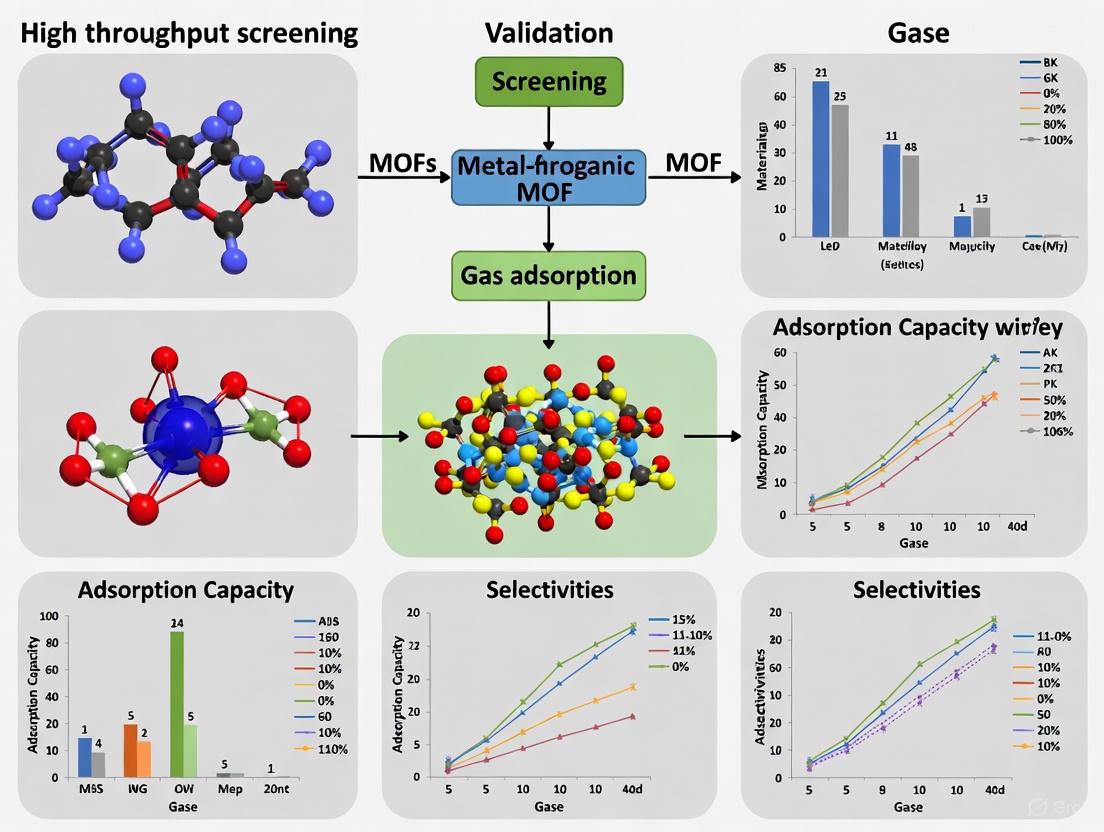
This article provides a comprehensive framework for the validation of high-throughput computational screening (HTS) of metal-organic frameworks (MOFs) for gas adsorption, a critical process in carbon capture and hydrogen purification.
Validating High-Throughput Screening of MOFs for Gas Adsorption: From Computational Prediction to Laboratory Reality
Abstract
This article provides a comprehensive framework for the validation of high-throughput computational screening (HTS) of metal-organic frameworks (MOFs) for gas adsorption, a critical process in carbon capture and hydrogen purification. It explores the foundational principles of HTS, detailing the construction of hypothetical and experimental MOF databases. The piece critically examines the multi-stage HTS workflow, from structural characterization to molecular simulations, and introduces advanced machine learning models enhancing prediction accuracy. A significant focus is placed on troubleshooting common pitfalls, such as the trade-offs introduced by functionalization and the challenges of transitioning from in-silico to in-lab results. Finally, the article establishes robust methods for validating HTS outcomes through experimental synthesis, performance comparison, and the assessment of stability under practical conditions, offering researchers a validated pathway to discover high-performance MOFs.
The Foundation of MOF Screening: Understanding Databases and Core Principles
The Rationale for High-Throughput Screening in MOF Research
Metal-organic frameworks (MOFs) represent a class of porous materials with unprecedented structural tunability, formed through the coordination of metal clusters with organic ligands [1]. This versatility has positioned MOFs as promising candidates for applications ranging from gas storage and carbon capture to nuclear waste management [1] [2] [3]. However, the MOF chemical design space is immensely large, with over 90,000 structures already synthesized and over 500,000 predicted, creating an almost infinite number of potential materials [4]. This vastness presents a significant challenge for conventional discovery methods, making high-throughput computational screening (HTCS) an indispensable tool for accelerating the identification of promising MOF structures [5] [6].
The fundamental rationale for implementing HTCS in MOF research stems from the economic and practical infeasibility of experimentally testing all possible candidates for a given application [5]. HTCS enables researchers to rapidly establish quantitative structure-property relationships and identify top-performing MOFs computationally before committing resources to synthesis and experimental validation [5] [6]. This approach has evolved from small-scale studies of manually collected MOF data to the screening of hundreds of thousands of structures, ushering in a new research paradigm that combines data science with chemistry [1] [6].
Key Methodologies and Databases for MOF Screening
Primary MOF Databases for HTCS
HTCS studies rely on both experimental and hypothetical MOF databases, each with distinct characteristics and applications. The table below summarizes the key databases utilized in the field.
Table 1: Key Databases for High-Throughput Screening of MOFs
| Database Name | Type | Structures | Key Features | Common Applications |
|---|---|---|---|---|
| CoRE MOF [5] [6] | Experimental | ~14,000 (2019) | Curated experimental structures from CSD with solvents removed | Gas separation, carbon capture, validation studies |
| CSD MOF Subset [6] | Experimental | ~100,000 (2020) | Quarterly-updated, automated cleaning possible | Large-scale diversity analysis, trend identification |
| hMOF [6] | Hypothetical | 137,953+ | "Bottom-up" or Tinkertoy approach with 102 SBUs | Methane storage, fundamental property studies |
| ToBaCCo [4] [6] | Hypothetical | 13,000-300,000 | "Top-down" approach focusing on topological diversity | Hydrogen storage, structure-property relationships |
| BW-DB [4] | Hypothetical | 300,000+ | Topology-based algorithm for structure generation | Chemical space exploration, adsorption studies |
| ARC-MOF [5] | Hypothetical | 15,219 | Includes computed adsorption data | CO₂ capture, stability-integrated screening |
Workflow and Geometrical Characterization
The standard HTCS workflow for MOFs follows a systematic multi-stage process as illustrated in the diagram below:
The initial stage involves structural data gathering and processing, where MOF structures are collected from databases and prepared for analysis [6]. This is followed by geometrical characterization, which computes essential structural descriptors including [6]:
- Pore Limiting Diameter (PLD): The minimum diameter through which a molecule must pass to diffuse through the framework, used to eliminate structures with insufficient pore size for target molecules [1] [6].
- Largest Cavity Diameter (LCD): The maximum cavity size within the framework, which influences adsorption capacity and selectivity [1].
- Surface Area: The internal surface area available for adsorption, typically calculated using geometric methods [1] [5].
- Pore Volume: The total volume of accessible pores within the structure [1] [5].
For gas adsorption applications, the PLD is particularly crucial for pre-screening structures, as it determines whether target molecules can access the internal pore space [1] [6]. For iodine capture, for instance, only MOFs with PLD > 3.34 Å (the kinetic diameter of I₂) are considered for further analysis [1].
Molecular Simulation and Machine Learning Approaches
Molecular simulations form the core of HTCS, with Grand Canonical Monte Carlo (GCMC) simulations being widely employed to study gas adsorption behaviors in MOFs [1]. These simulations predict adsorption uptake, selectivity, and other performance metrics under specific conditions [5] [6].
More recently, machine learning (ML) has emerged as a powerful complement to molecular simulations [1] [2]. ML algorithms can predict MOF properties based on structural and chemical descriptors, significantly reducing computational costs [1] [3]. Key ML applications in MOF HTCS include:
- Regression models (Random Forest, CatBoost) for predicting gas adsorption capabilities [1]
- Feature importance assessment to identify critical factors governing adsorption performance [1]
- Molecular fingerprint techniques to capture comprehensive structural information [1]
- Synthesizability prediction to prioritize MOFs with higher likelihood of experimental realization [3]
In iodine capture studies, for example, ML models incorporate structural features (pore size, surface area), molecular features (metal and ligand atom types, bonding modes), and chemical features (heat of adsorption, Henry's coefficient) to achieve accurate predictions [1]. These models have revealed that Henry's coefficient and heat of adsorption are the most crucial chemical factors for iodine capture, while the presence of six-membered ring structures and nitrogen atoms in the MOF framework are key structural factors [1].
Experimental Protocols and Validation Methods
Integrating Stability Metrics in Screening Protocols
A critical advancement in HTCS has been the integration of stability metrics to ensure identified MOFs are not only high-performing but also synthesizable and stable under operational conditions [5]. The diagram below illustrates a comprehensive stability-integrated screening protocol:
The four key stability metrics include:
- Thermodynamic Stability: Assessed through free energy calculations using the FL method, with an upper bound of ΔLMF ~4.2 kJ/mol relative to experimental MOFs serving as the criterion for synthetic likelihood [5].
- Mechanical Stability: Evaluated through molecular dynamics simulations to calculate elastic properties (bulk, shear, and Young's moduli), though low moduli alone do not necessarily disqualify flexible MOFs [5].
- Thermal and Activation Stabilities: Predicted using machine learning models trained on experimental data [5].
This integrated approach ensures that identified MOFs possess not only high performance but also practical viability for real-world applications [5].
Experimental Validation and Synthesis Protocols
Successful HTCS must ultimately lead to experimentally validated materials. The transition from computational prediction to synthesized MOF follows a structured protocol:
Computational Identification: Top-performing MOFs identified through HTCS are prioritized based on both performance metrics and stability considerations [5] [6]. For example, in hydrogen storage research, ML techniques can predict synthesizable MOF structures, as evidenced by the successful synthesis of a vanadium-based MOF (V₃(PET)) that exhibited excellent performance for cryogenic H₂ storage [3].
Synthesis Planning: Experimental protocols are developed based on analogous MOF structures with similar metal nodes and organic linkers [5]. The metal node chemistry significantly influences both performance and synthesizability, with certain metal nodes (e.g., V₃O₃) showing prevalence in top-performing MOFs for specific applications [5].
Characterization and Performance Validation: Synthesized MOFs undergo rigorous characterization to verify structural integrity and measure performance metrics [3] [6]. For the vanadium-based MOF identified through ML-assisted design, researchers confirmed exceptional hydrogen storage performance with total gravimetric and volumetric H₂ uptakes of 9.0 wt% and 50.0 g/L at 77 K and 150 bar, along with stability over 100 adsorption cycles [3].
Table 2: Experimental Validation Examples from HTCS Studies
| Application | Identified MOF | Performance Metrics | Validation Outcome |
|---|---|---|---|
| Hydrogen Storage [3] | V₃(PET) (vanadium-based) | 9.0 wt%, 50.0 g/L at 77K/150 bar | Successfully synthesized, stable over 100 cycles |
| CO₂ Capture [5] | hMOFs with V₃O₃ nodes | CO₂ uptake ≥4 mmol/g, CO₂/N₂ selectivity ≥200 | Thermodynamically stable candidates identified |
| Methane Storage [6] | NOTT-107 | Not specified in source | Successfully synthesized and validated |
| Carbon Capture [6] | NOTT-101/Oet, VEXTUO | Not specified in source | Successfully synthesized and validated |
Implementation Guidelines and Research Toolkit
Essential Computational Tools and Reagents
The successful implementation of HTCS for MOFs requires a combination of specialized software, computational resources, and chemical building blocks. The table below details key components of the MOF researcher's toolkit.
Table 3: Essential Research Toolkit for MOF High-Throughput Screening
| Tool/Reagent Category | Specific Examples | Function/Purpose | Implementation Notes |
|---|---|---|---|
| Simulation Software [1] | RASPA, GCMC simulations | Predict gas adsorption behaviors | Requires significant computational resources for large databases |
| Machine Learning Algorithms [1] [2] | Random Forest, CatBoost, Graph Neural Networks | Predict properties, assess feature importance | Enhanced accuracy with comprehensive feature sets |
| Structural Analysis Tools [6] | PLD/LCD calculators, surface area analysis | Characterize pore geometry and accessibility | Critical for pre-screening and structure-property relationships |
| Metal Node Chemistry [5] | V₃O₃, Zn₄O, Cu-paddlewheel, Zr₆O₆ | Determine framework stability and adsorption sites | V₃O₃ particularly effective for CO₂ adsorption |
| Organic Linkers [1] [4] | Nitrogen-containing rings, oxygen-functionalized | Provide complementary adsorption sites to metals | Six-membered ring structures enhance iodine adsorption |
| Stability Assessment Tools [5] | Molecular dynamics (MD) for elastic properties, ML models for thermal stability | Evaluate practical viability of MOFs | Essential for transitioning from hypothetical to experimental |
Best Practices for Effective HTCS Implementation
Based on successful case studies and methodological advances, several best practices emerge for implementing HTCS in MOF research:
Database Selection and Integration: Choose databases aligned with research objectives, considering that hypothetical databases (hMOF, ToBaCCo) offer greater structural diversity while experimental databases (CoRE, CSD) provide synthesizable structures with known protocols [6]. Combining multiple databases can mitigate individual biases and improve coverage of chemical space [4].
Multi-stage Screening Approach: Implement sequential screening filters to manage computational costs, beginning with geometric descriptors (PLD, LCD) to eliminate inaccessible structures, followed by molecular simulations for promising candidates, and finally stability assessments for top performers [5] [6].
Diversity-Conscious Sampling: Actively address biases in MOF databases by analyzing chemical diversity metrics, including variety, balance, and disparity [4]. This is particularly important for metal node diversity, as hypothetical databases often have surprisingly low variety in metal centers compared to experimental databases [4].
Hybrid AI-Simulation Framework: Combine molecular simulations with machine learning to maximize efficiency and insight [1] [2]. ML models can rapidly predict properties for large datasets, while simulations provide physical accuracy and detailed mechanistic understanding [1].
Stability-Performance Balance: Integrate stability metrics early in the screening process to avoid identifying high-performing but impractical MOFs [5]. The sequence of screening steps can be adjusted based on computational cost, with stability assessment following performance screening or vice versa [5].
These protocols and guidelines provide a robust foundation for leveraging HTCS to accelerate the discovery and development of MOF materials for gas adsorption and related applications, ultimately bridging the gap between computational prediction and experimental realization.
The discovery and development of Metal-Organic Frameworks (MOFs) for gas adsorption applications have been significantly accelerated by the creation of large-scale databases. These collections generally fall into two categories: hypothetical databases (containing computationally generated structures) and experimentally-derived databases (containing structures confirmed through laboratory synthesis). Understanding the composition, strengths, and limitations of each type is crucial for validating high-throughput screening (HTS) in gas adsorption research, as the choice of database directly impacts the predictive accuracy and experimental relevance of computational findings [7] [1].
Database Classifications and Characteristics
Hypothetical MOF Databases
Hypothetical databases are constructed in silico using computational assembly methods. They are built by systematically combining known inorganic building blocks (metal clusters or secondary building units) and organic linkers according to established topological blueprints [7].
Construction Methodology: The process often employs topologically based crystal construction (ToBaCCo) software. This method uses two key inputs:
- Topological blueprints that define the coordination environment and symmetry of building blocks as periodic abstract nets.
- Molecular building blocks (MBBs) comprising functionalized organic linkers and metal nodes [7].
A prominent example from recent literature involves generating a database of 4,797 MOFs by integrating 10 metal centers with 144 functionalized ligands (18 ligands modified by –NH₂, –NO₂, –CH₃, –CF₃, –SH₂, –SO₂, –OH, and –OLi) across 36 topologies [7]. This approach allows for the systematic exploration of structure-property relationships across a vast chemical space.
Experimentally-Derived MOF Databases
Experimentally-derived databases curate structures that have been synthesized and characterized in laboratories. These databases serve as a critical benchmark for validating hypothetical screening results.
A widely used resource is the CoRE MOF (Computation-Ready, Experimental Metal-Organic Framework) database. For instance, a 2014 version of the CoRE MOF database was used in a study screening 1,816 structures for iodine capture, selected based on the criterion that their pore limiting diameter (PLD) was greater than 3.34 Å (the kinetic diameter of I₂) [1]. These databases provide a realistic representation of synthetically accessible and stable frameworks.
Table 1: Comparison of Hypothetical and Experimentally-Derived MOF Databases
| Feature | Hypothetical Databases | Experimentally-Derived Databases |
|---|---|---|
| Source | Computationally generated via assembly algorithms [7] | Curated from experimentally synthesized and characterized structures (e.g., CoRE MOF 2014) [1] |
| Size & Diversity | Very large (e.g., 4,797+ structures); high chemical and topological diversity [7] | Smaller (e.g., 1,816 structures); limited to what has been successfully synthesized [1] |
| Primary Strength | Explores vast, untapped chemical space; ideal for identifying novel candidate materials with exceptional predicted performance [7] | High synthetic realism; provides direct validation of stability and properties under real-world conditions [1] |
| Main Limitation | May include structures that are synthetically inaccessible or unstable [7] | Covers a smaller fraction of the possible MOF chemical space [1] |
| Typical Use in HTS | Primary screening for identifying top-performing candidates and establishing structure-property relationships [7] | Validation of screening results and assessment of synthetic feasibility and stability [1] |
Experimental Protocols for High-Throughput Screening
The following protocols detail the standard computational methodologies used for high-throughput screening of MOF databases for gas adsorption.
Protocol 1: Grand Canonical Monte Carlo (GCMC) Simulations for Gas Adsorption
Purpose: To predict the gas adsorption capacity and selectivity of MOF structures at equilibrium conditions.
Principle: GCMC simulations mimic an open system in equilibrium with a reservoir of particles at a given chemical potential, temperature, and volume, which is appropriate for modeling adsorption from a bulk gas phase [1].
Methodology:
- Structure Preparation: Obtain the MOF structure from the database. For experimentally-derived structures, remove solvent molecules from the pores to create a "computation-ready" model while preserving the framework atoms and connectivity [1].
- Energy Calculation: Define the interaction energies between the adsorbate molecules (e.g., CO₂, I₂, H₂O) and the MOF framework. This is typically done using a classical forcefield, where the total interaction energy is the sum of van der Waals (e.g., described by a Lennard-Jones potential) and electrostatic (e.g., described by Coulomb's law) interactions.
- Simulation Setup:
- Ensemble: Use the grand canonical (μVT) ensemble.
- Temperature: Set the simulation temperature (e.g., 298 K).
- Fugacity/Bulk Pressure: Set the fugacity of the adsorbing gas, which is derived from the specified bulk pressure.
- Steps: Perform a minimum of 2-3 million simulation steps to ensure proper equilibration, followed by an additional 2-3 million steps for production and data collection.
- Output Analysis: The primary output is the ensemble-averaged number of adsorbed molecules per unit cell or per gram of MOF at the specified conditions, giving the adsorption capacity. For gas mixtures (e.g., CO₂/N₂ or I₂/H₂O), the adsorption selectivity can be calculated from the ratio of the uptakes of the different components [1].
Protocol 2: Calculating Key Performance Metrics
Purpose: To evaluate and rank MOF materials based on multiple criteria relevant to practical application.
Methodology:
- Working Capacity (ΔN): The difference in adsorption capacity between the adsorption and desorption conditions. For a pressure-swing adsorption process, this is often calculated as ΔN = N(Pads) - N(Pdes), where N is the loading and P is pressure [7].
- Adsorption Selectivity (Sads): For a binary gas mixture (A and B), the selectivity of component A over B is defined as Sads(A/B) = (xA / xB) / (yA / yB), where xi is the mole fraction in the adsorbed phase and yi is the mole fraction in the bulk gas phase [7].
- Henry's Coefficient (KH): Calculated in the limit of zero pressure from GCMC simulations or via Widom's particle insertion method. A lower KH value for a competing gas (like H₂O) can indicate an advantage in selective adsorption of the target gas (like I₂) in humid environments [1].
- Heat of Adsorption (Q_st): The isosteric heat of adsorption is calculated from fluctuations in the number of adsorbed molecules and the system energy during the GCMC simulation. It quantifies the strength of the interaction between the framework and the adsorbate [7].
An Integrated Workflow for Database Navigation and Validation
The effective use of MOF databases requires a structured workflow that leverages the strengths of both hypothetical and experimental collections. The diagram below outlines this integrated process.
Integrated Workflow for MOF Database Navigation and Validation
Validation Through Interpretable Machine Learning
Machine learning (ML) bridges high-throughput computational screening and experimental validation by identifying key performance descriptors and extracting design principles from large datasets [1].
Workflow and Key Insights:
- Feature Engineering: A robust ML model requires comprehensive descriptors:
- Structural Features: Pore Limiting Diameter (PLD), Largest Cavity Diameter (LCD), void fraction (φ), surface area, pore volume, and density [1].
- Chemical Features: Henry's coefficient and isosteric heat of adsorption, which have been identified as crucial factors for predicting iodine adsorption performance [1].
- Molecular Features: Atom types (e.g., C, N, O, metal species), their hybridization states (e.g., C1, C2, C3, CR), and bonding modes within the MOF framework [1].
- Model Training and Interpretation: Algorithms like Random Forest and CatBoost are trained to predict adsorption performance. These models can then be interrogated to assess feature importance, revealing which structural or chemical properties most significantly influence adsorption. For example, in iodine capture, Henry's coefficient and heat of adsorption to iodine are identified as the two most critical chemical factors [1].
- Molecular Fingerprinting: This technique provides granular structural insights. For instance, screening studies have revealed that the presence of six-membered ring structures and nitrogen atoms in the MOF framework are key structural factors that enhance iodine adsorption, followed by the presence of oxygen atoms [1].
Table 2: Research Reagent Solutions - Essential Computational Tools and Databases
| Item / Resource | Function / Description | Relevance to MOF Research |
|---|---|---|
| ToBaCCo Software | Topologically Based Crystal Construction; generates hypothetical MOF structures by assembling molecular building blocks into predefined network topologies [7]. | Enables the systematic construction of large, diverse hypothetical MOF databases for high-throughput screening. |
| RASPA Software | A powerful molecular simulation package for performing Grand Canonical Monte Carlo (GCMC), Molecular Dynamics, and other computational chemistry calculations [1]. | The standard tool for simulating gas adsorption equilibria and dynamics in porous materials like MOFs. |
| CoRE MOF Database | A curated collection of Computation-Ready, Experimental MOF structures, derived from the Cambridge Structural Database, with solvent molecules removed [1]. | Provides a reliable set of experimentally realized structures for screening validation and model training. |
| Machine Learning Algorithms (e.g., CatBoost, Random Forest) | Advanced regression algorithms used to predict material properties based on input features and to decipher complex structure-property relationships [1]. | Accelerates the discovery process by predicting performance and identifying critical descriptors from HTS data. |
Navigating the landscape of MOF databases requires a strategic approach that acknowledges the complementary roles of hypothetical and experimentally-derived collections. Hypothetical databases are powerful for mapping the outer limits of performance and discovering novel design principles, while experimental databases provide an essential anchor in synthetic reality. The validation of high-throughput screening outcomes hinges on a multi-faceted protocol that integrates computational predictions (via GCMC and performance metrics) with validation against known experimental structures and interpretable machine learning. This integrated workflow, which leverages the strengths of both database types, provides a robust and profound framework for accelerating the reliable discovery and targeted design of high-performance MOF adsorbents for gas separation and capture applications.
In metal-organic framework (MOF) research, high-throughput computational screening (HTCS) has become an indispensable technique for efficiently evaluating the gas adsorption performance of thousands of materials. This approach relies on well-established performance metrics that enable researchers to rank MOFs and identify promising candidates for specific separation processes. The integration of molecular simulations with performance metric evaluation allows for systematic assessment of MOFs before resource-intensive experimental synthesis and testing [8] [9].
The validation of HTCS methodologies depends critically on accurate quantification of key adsorbent properties, primarily gas uptake capacity, selectivity, and working capacity. These metrics provide the fundamental basis for comparing materials across different studies and predicting their performance in industrial applications such as carbon capture, hydrogen purification, and odorant removal [10] [9]. Recent research has emphasized that while these core metrics are essential, comprehensive screening must also consider additional factors including energy efficiency, framework stability, and performance under realistic process conditions [7] [5] [11].
Table 1: Core Performance Metrics for MOF Adsorbent Evaluation
| Metric | Definition | Significance | Typical Units |
|---|---|---|---|
| Gas Uptake | Amount of gas adsorbed at equilibrium conditions | Indicates maximum adsorption capacity | mmol/g or mol/kg |
| Selectivity | Ability to preferentially adsorb one gas over another | Determines separation efficiency | Dimensionless ratio |
| Working Capacity | Reversible adsorption capacity between adsorption and desorption conditions | Reflects regenerability and cyclic performance | mmol/g or mol/kg |
| Adsorbent Performance Score (APS) | Combined metric incorporating selectivity and working capacity | Provides balanced performance assessment | Dimensionless |
| Regenerability (R%) | Percentage of adsorbed gas that can be desorbed | Indicates ease of adsorbent regeneration | Percentage |
Fundamental Adsorption Metrics
Gas Uptake Capacity
Gas uptake capacity represents the fundamental measure of an adsorbent's ability to retain gas molecules within its porous structure. This metric is typically quantified through grand canonical Monte Carlo (GCMC) simulations, which calculate the equilibrium adsorption amount at specific temperature and pressure conditions [8] [1]. For carbon capture applications, high CO₂ uptake is particularly valuable, with top-performing MOFs demonstrating capacities up to 8.47 mmol/g under flue gas conditions [5].
The evaluation of gas uptake must consider the operational context. For example, in pre-combustion CO₂ capture where gas mixtures contain 15-40% CO₂ at elevated pressures (up to 40 bar), uptake capacity at these specific conditions becomes more relevant than single-component adsorption at standard temperature and pressure [9]. Studies screening over 10,000 MOFs have revealed that uptake capacity alone is insufficient for predicting overall process efficiency, as it does not account for the energy required for adsorbent regeneration [11].
Selectivity
Selectivity measures a material's ability to preferentially adsorb one component from a gas mixture, fundamentally determining its separation capability. Adsorption selectivity (Sₐdₛ) is typically calculated as the ratio of the adsorption capacities of two gases, often derived from IAST (Ideal Adsorbed Solution Theory) predictions based on single-component isotherms [9]. For CO₂/N₂ separation in flue gas applications, selectivity values can range dramatically, with functionalized MOFs showing particularly significant enhancements—for instance, –NO₂, –SO₂, and –OLi functional groups increasing selectivity from 24.94/40.36 (pristine) to 121.11/176.87, 149.94/215.54, and 58.64/267.44, respectively [7].
Selectivity metrics must be interpreted within the context of the specific gas mixture and conditions. For CO₂/H₂ separation in pre-combustion capture, selectivity values above 60 are considered promising, while for post-combustion CO₂ capture from N₂, higher selectivity values are often required due to the lower concentration of CO₂ in the feed stream [9].
Working Capacity
Working capacity (ΔN), also termed reversible adsorption capacity, represents the cyclable adsorption amount between adsorption and desorption conditions. This metric crucially links molecular-level adsorption properties with process-level performance, as it quantifies the usable capacity during cyclic separation processes like pressure swing adsorption (PSA), vacuum swing adsorption (VSA), or temperature swing adsorption (TSA) [8].
Functionalization strategies can dramatically enhance working capacity. Recent high-throughput screening of 4,797 functionalized MOFs demonstrated that –NO₂, –SO₂, and –OLi functional groups increase CO₂ working capacity from 2.34 mmol/g (pristine) to 5.91-7.94 mmol/g [7]. The critical importance of working capacity lies in its direct impact on process economics—higher working capacities reduce the required adsorbent inventory, leading to more compact and cost-effective separation systems.
Integrated Performance Assessment
Composite Metrics
While individual metrics provide valuable insights, composite metrics that combine multiple performance aspects offer more comprehensive material assessments. The Adsorbent Performance Score (APS) integrates both selectivity and working capacity into a single value, enabling more balanced ranking of materials [8]. Similarly, the Sorbent Selection Parameter (Ssp) provides another combined metric that has shown strong correlation with process-level performance indicators [7].
Recent research has introduced more sophisticated evaluation frameworks, such as the energy efficiency (η) metric, which holistically evaluates both adsorption performance (Sₐdₛ, ΔN, APS, Ssp, and R) and energy inputs (desorption heat, pressure-swing energy, net loss) [7]. This approach resolves critical trade-offs between competing functional groups, identifying –SO₂ as the optimal functional group that balances exceptional CO₂ capture (η = 6.17/12.78 for CO₂ over CH₄/N₂) with reasonable energy requirements [7].
Stability Considerations
Comprehensive MOF validation must extend beyond adsorption metrics to include stability considerations. Integrating thermodynamic, mechanical, thermal, and activation stability metrics with high-throughput screening ensures identified materials are not only high-performing but also synthesizable and durable under process conditions [5]. Evaluation of 148 top-performing hypothetical MOFs revealed that 41 structures were thermodynamically unstable despite excellent adsorption properties, highlighting the critical importance of stability assessment [5].
Diagram 1: HTCS Validation Workflow for MOFs
Experimental Protocols for Metric Validation
High-Throughput Computational Screening Protocol
Objective: To systematically screen large MOF databases for gas adsorption performance using molecular simulations.
Materials and Methods:
- MOF Databases: Utilize computation-ready experimental MOF databases (CoRE MOF 2019, CSD non-disordered MOF subset) or hypothetical MOF databases [12] [5]
- Software Tools: Employ specialized software for structural analysis (Zeo++), molecular simulations (RASPA), and process modeling [1] [9]
- Simulation Parameters:
- Perform Grand Canonical Monte Carlo (GCMC) simulations for gas adsorption
- Use validated force fields (e.g., UFF, DREIDING) with appropriate partial charge assignment methods
- Simulate gas mixtures at relevant industrial conditions (temperature, pressure, composition)
Procedure:
- Database Curation: Remove solvent molecules, add missing hydrogen atoms, and treat charge-balancing ions appropriately [12]
- Structural Characterization: Calculate pore limiting diameter (PLD), largest cavity diameter (LCD), accessible surface area, and pore volume [5]
- Single-Component Adsorption: Simulate pure gas adsorption isotherms for all relevant gases
- Mixture Adsorption: Compute binary or ternary mixture adsorption using GCMC or IAST predictions
- Metric Calculation: Derive uptake, selectivity, working capacity, and composite metrics from simulation data
- Material Ranking: Rank materials based on selected performance metrics for the target application
Validation Steps:
- Compare IAST predictions with explicit mixture GCMC simulations for selected top performers [9]
- Verify mechanical stability through molecular dynamics simulations [5]
- Assess thermodynamic stability through free energy calculations [5]
Functionalized MOF Evaluation Protocol
Objective: To assess the impact of functional groups on MOF adsorption performance.
Materials:
- Base MOF Structures: Select MOFs with diverse topologies and metal centers
- Functional Groups: Include –NH₂, –NO₂, –CH₃, –CF₃, –SH₂, –SO₂, –OH, and –OLi for systematic comparison [7]
Procedure:
- Database Construction: Generate functionalized MOF structures through systematic modification of organic ligands [7]
- High-Throughput Screening: Perform GCMC simulations for all functionalized structures
- Performance Evaluation: Calculate key metrics including Sₐdₛ, ΔN, APS, Ssp, and R
- Energy Analysis: Compute isosteric heats of adsorption and energy efficiency metrics [7]
- Trade-off Assessment: Identify optimal functional groups that balance adsorption performance with energy requirements
Table 2: Performance of Functionalized MOFs for CO₂ Capture
| Functional Group | CO₂ Working Capacity (mmol/g) | CO₂/N₂ Selectivity | Isosteric Heat (kJ/mol) | Energy Efficiency (η) |
|---|---|---|---|---|
| Pristine | 2.34 | 40.36 | - | 2.18 |
| –NO₂ | 5.91-7.94 | 176.87 | -29.15 | 8.80 |
| –SO₂ | 5.91-7.94 | 215.54 | -29.96 | 12.78 |
| –OLi | 5.91-7.94 | 267.44 | -30.09 | - |
| –CF₃ | 5.91-7.94 | - | - | 8.80 |
Advanced Considerations in Metric Validation
Process-Informed Performance Assessment
Traditional adsorption metrics increasingly show limitations in predicting actual process performance. Recent studies demonstrate that materials with exceptional uptake capacities may exhibit high energy penalties during regeneration [11]. Comprehensive validation requires process-informed assessments that translate molecular-level adsorption properties to system-level performance indicators.
The parasitic energy of separation has emerged as a crucial metric that correlates strongly with process economics [8] [11]. Screening studies incorporating process simulations reveal that rankings based on parasitic energy often differ significantly from those based solely on APS and regenerability, highlighting the importance of process-aware validation [8]. For CO₂ capture applications, materials must simultaneously achieve ≥95% CO₂ purity and ≥90% recovery while minimizing energy consumption [11].
Performance Under Realistic Conditions
Material validation must account for realistic operating environments, including the presence of water vapor and other contaminants. Performance metrics obtained under idealized dry conditions often overestimate actual separation capabilities [11]. Comprehensive screening should incorporate:
- Humidity Effects: Evaluate performance under relevant relative humidity conditions (e.g., 40% RH for flue gas) [11]
- Chemical Stability: Assess structural integrity and performance retention after exposure to acidic gases and water vapor
- Cyclic Stability: Verify consistent performance over multiple adsorption-desorption cycles
Studies examining CO₂ capture under humid conditions (40% relative humidity) have identified that MOFs with narrow, straight 1D channels often maintain superior performance, with hundreds of MOFs retaining 90% of their dry CO₂ capture capacity [11].
The Scientist's Toolkit
Table 3: Essential Research Reagents and Computational Tools
| Tool/Category | Specific Examples | Function/Application |
|---|---|---|
| MOF Databases | CoRE MOF 2019, CSD non-disordered MOF subset, ARC-MOF | Provide computation-ready MOF structures for screening studies [12] [5] |
| Simulation Software | RASPA, Zeo++, ToBaCCo | Perform molecular simulations, structural analysis, and database generation [7] [1] |
| Process Modeling Tools | MAPLE (Machine Learning-Accelerated Process Model) | Rapid optimization of adsorption process conditions and energy consumption [11] |
| Functional Groups | –NO₂, –SO₂, –OLi, –CF₃, –NH₂ | Enhance selective CO₂ adsorption via tailored host-guest interactions [7] |
| Performance Metrics | APS, Ssp, η, Parasitic Energy | Quantify and compare overall adsorbent performance from different perspectives [7] [8] |
| Stability Assessment Tools | Molecular dynamics simulations, ML stability predictors | Evaluate synthesizability and durability under process conditions [5] |
The validation of high-throughput screening for MOF-based gas adsorption research requires a multifaceted approach that integrates fundamental adsorption metrics with advanced process-aware evaluations. While gas uptake, selectivity, and working capacity form the essential foundation for initial material assessment, comprehensive validation must extend to include energy efficiency, stability under realistic conditions, and actual process performance. The development of sophisticated composite metrics and the integration of molecular simulations with process optimization represent significant advances in the field. As MOF databases continue to expand and computational methods improve, the validation frameworks outlined in this protocol will enable more reliable identification of promising adsorbents, ultimately accelerating the development of advanced separation materials for critical environmental and industrial applications.
In high-throughput computational screening (HTCS) of metal-organic frameworks (MOFs) for gas adsorption applications, structural descriptors provide the fundamental link between atomic-level architecture and macroscopic performance. Pore Limiting Diameter (PLD), Largest Cavity Diameter (LCD), and Surface Area have emerged as three critical parameters that efficiently predict adsorption behavior across diverse gas capture scenarios. These descriptors enable researchers to rapidly evaluate thousands of MOF structures by quantifying key aspects of their porous environments that govern host-guest interactions. The predictive power of these parameters extends across various applications, including carbon capture, hydrocarbon separation, and radioactive iodine removal, making them indispensable tools for accelerating adsorbent discovery and optimization [1] [7].
The integration of these structural descriptors with machine learning approaches has created a powerful paradigm for MOF research. By establishing quantitative structure-property relationships (QSPRs), scientists can navigate the vast chemical space of possible MOF structures with targeted precision. This approach moves beyond trial-and-error methodologies toward rational design principles, significantly reducing the time and resources required to identify promising candidates for specific gas separation challenges [1].
Defining the Key Structural Descriptors
Pore Limiting Diameter (PLD) and Largest Cavity Diameter (LCD)
Pore Limiting Diameter (PLD) represents the diameter of the largest sphere that can diffusive through the framework, defining the accessibility of the porous network. Largest Cavity Diameter (LCD) refers to the diameter of the largest sphere that can be accommodated within the pore cavities, determining the available space for guest molecule accommodation. These parameters are typically calculated using specialized software such as Zeo++ [13].
The relationship between PLD and kinetic diameter of probe molecules determines molecular accessibility. For example, in iodine capture applications, researchers typically select MOFs with PLD > 3.34 Å (the kinetic diameter of I₂) to ensure iodine molecules can enter the porous structure [1]. Similarly, for CO₂ capture applications (CO₂ kinetic diameter = 3.3 Å), MOF candidates with PLD below this threshold are often eliminated from consideration [7].
Surface Area
Surface Area quantifies the total available surface within a MOF that can interact with guest molecules, typically measured in m²/g. This parameter directly influences the capacity of a MOF to physisorb gas molecules, with higher surface areas generally correlating with greater potential adsorption capacity. Surface area calculations for MOFs are commonly derived from nitrogen adsorption isotherms at 77K using the Brunauer-Emmett-Teller (BET) method [14].
Quantitative Relationships Between Structural Descriptors and Adsorption Performance
Iodine Capture in Humid Environments
Recent research has established precise optimal ranges for structural descriptors in iodine capture applications. A comprehensive study screening 1,816 MOFs revealed clear relationships between structural parameters and iodine adsorption performance under humid conditions [1].
Table 1: Optimal Structural Descriptor Ranges for Iodine Capture
| Structural Descriptor | Optimal Range | Performance Relationship |
|---|---|---|
| Largest Cavity Diameter (LCD) | 4.0 - 7.8 Å | Maximum capacity and selectivity observed between 4-5.5 Å; steric hindrance below 4 Å; diminished host-guest interaction above 7.8 Å |
| Pore Limiting Diameter (PLD) | 3.34 - 7.0 Å | Must exceed I₂ kinetic diameter (3.34 Å); optimal performance in narrower range |
| Void Fraction (φ) | 0 - 0.17 | Peak performance at φ = 0.09; decreasing performance up to φ = 0.6 |
| Density | ~0.9 g/cm³ | Increasing density promotes adsorption sites up to 0.9 g/cm³; steric hindrance dominates above this value |
| Surface Area | 0 - 540 m²/g | Higher values within this range generally improve performance |
| Pore Volume | 0 - 0.18 cm³/g | Moderate values optimize confinement effects |
The study demonstrated that MOFs with LCD between 4-5.5 Å provide ideal confinement for iodine molecules, balancing reduced steric hindrance with maintained strong host-guest interactions. When LCD exceeds 5.5 Å, the adsorption interaction diminishes, leading to increased I₂ desorption [1].
CO₂ Capture Applications
In CO₂ capture applications, structural descriptors help identify MOFs that balance high selectivity with efficient regeneration. Research screening 4,797 functionalized MOFs has revealed how strategic functionalization (–NO₂, –SO₂, –OLi) enhances CO₂ capture performance while maintaining structural integrity [7].
Table 2: Structural Descriptor Impact on CO₂ Capture Performance
| Performance Metric | Pristine MOFs | Functionalized MOFs | Key Structural Influences |
|---|---|---|---|
| Working Capacity (ΔN) | 2.34 mmol g⁻¹ | 5.91-7.94 mmol g⁻¹ | Optimized PLD (≥3.3 Å) combined with polar functional groups |
| CO₂/N₂ Selectivity | 40.36 | 58.64-267.44 | Surface chemistry and LCD balancing molecular sieving |
| Renewability (R) | Baseline | ~50% reduction | Stronger CO₂ affinity increases regeneration energy |
| Energy Efficiency (η) | 2.18 | 4.74-12.78 | Optimal balance of surface area, functional groups, and pore size |
The introduction of polar functional groups (–NO₂, –SO₂, –OLi) dramatically enhances CO₂ selectivity but comes with a trade-off in renewability due to stronger guest interactions that require more energy for desorption [7].
Experimental Protocols for Descriptor Determination
Computational Determination of PLD and LCD
Protocol Title: Calculating Pore Size Descriptors Using Zeo++ Software
Principle: Geometric analysis of the crystal structure to determine the maximum sphere diameters for cavity occupation (LCD) and framework diffusion (PLD).
Materials and Reagents:
- MOF crystal structure file (.cif format)
- Zeo++ software (version 0.3 or higher)
- High-performance computing resources
Procedure:
- Structure Preparation: Obtain high-quality crystal structures from databases (Cambridge Structural Database, CoRE MOF 2014) or DFT-optimized coordinates.
- File Conversion: Convert structure files to .cssr format if necessary using Zeo++ utilities.
- Probe Radius Setting: Define appropriate van der Waals radii for atoms (typically 1.2Å for C, 1.5Å for O, 1.8Å for metal atoms).
- PLD Calculation: Execute Zeo++ with -res flag to determine pore limiting diameter:
network -res MOF_structure.cssr - LCD Calculation: Execute Zeo++ with -ha flag for largest cavity diameter:
network -ha MOF_structure.cssr - Result Validation: Cross-check results with multiple probe sizes to ensure accuracy.
Notes: For MOFs with flexible frameworks, perform calculations on both experimental and DFT-optimized structures to account for structural changes during adsorption [15] [13].
Surface Area Determination Methods
Protocol Title: Surface Area Calculation from Gas Adsorption Isotherms
Principle: Physical adsorption of gas molecules (N₂ at 77K) on the MOF surface with subsequent application of BET theory to calculate specific surface area.
Materials and Reagents:
- High-purity MOF sample (≥50 mg)
- Nitrogen gas (99.999% purity)
- Surface area analyzer (e.g., Micromeritics, Quantachrome)
- Degassing station
Procedure:
- Sample Activation: Degas MOF sample under vacuum at 150°C for 12 hours to remove solvent molecules.
- Isotherm Measurement: Collect N₂ adsorption-desorption isotherm at 77K across relative pressure (P/P₀) range of 0.01-0.99.
- BET Range Selection: Identify linear region in P/P₀ range of 0.05-0.30 for BET plot.
- BET Calculation: Apply BET equation to determine monolayer capacity and calculate surface area using cross-sectional area of N₂ molecule (16.2 Ų).
- Pore Size Distribution: Apply DFT methods to low-pressure CO₂ adsorption isotherms (273K) to characterize micropore volume.
Notes: For absolute methane adsorption characterization, combine BET surface area with pore volume measurements to determine adsorbed phase volume [14].
Integration with Machine Learning and High-Throughput Screening
Machine Learning Workflow for MOF Screening
The combination of structural descriptors with machine learning algorithms has dramatically accelerated the discovery of high-performance MOFs. Research demonstrates that Random Forest and CatBoost regression algorithms can effectively predict gas adsorption performance when trained on comprehensive descriptor sets including PLD, LCD, and surface area [1].
Feature Importance Analysis reveals that while structural descriptors provide fundamental insights, chemical features such as Henry's coefficient and heat of adsorption often demonstrate higher predictive power for specific gas adsorption performance. Molecular fingerprints further enhance prediction accuracy by capturing complex structural motifs, with six-membered ring structures and nitrogen atoms in the MOF framework identified as key structural features enhancing iodine adsorption [1].
Advanced Screening Protocol
Protocol Title: High-Throughput Screening Integrating Force Fields and Machine-Learned Potentials
Principle: Hybrid screening strategy merging classical force fields (UFF) for initial efficiency with universal machine-learned interatomic potentials (PFP) for accuracy refinement.
Materials and Computational Resources:
- Curated MOF database (e.g., CoRE MOF 2014)
- Molecular simulation software (RASPA)
- Universal machine-learned interatomic potentials (PFP)
- High-performance computing cluster
Procedure:
- Initial Screening: Perform Widom insertion Monte Carlo simulations using Universal Force Field (UFF) for rapid evaluation of gas uptake.
- Candidate Selection: Identify top-performing MOF candidates (e.g., top 5-10%) based on UFF predictions.
- Refined Screening: Re-evaluate promising candidates using PreFerred Potential (PFP) u-MLIP for near-quantum accuracy.
- Framework Flexibility: Account for guest-induced structural changes through full unit cell relaxation.
- Performance Validation: Benchmark against DFT calculations to validate adsorption predictions.
- Multi-Metric Evaluation: Assess candidates using combined metrics (selectivity, working capacity, energy efficiency).
Notes: This approach has proven particularly valuable for identifying MOFs with optimal pore sizes and high target gas affinity while accounting for competitive adsorption in humid conditions [15].
The Scientist's Toolkit: Essential Research Reagents and Software
Table 3: Essential Tools for MOF Structural Characterization and Screening
| Tool Name | Type | Primary Function | Application Context |
|---|---|---|---|
| Zeo++ | Software | Pore structure analysis | PLD and LCD calculation from crystal structures |
| RASPA | Software | Molecular simulation | GCMC simulations for gas adsorption prediction |
| VASP | Software | Density functional theory | Electronic structure calculation and geometry optimization |
| ToBaCCo | Software | Database construction | Topology-based generation of hypothetical MOFs |
| Universal Force Field (UFF) | Computational Method | Classical molecular simulation | Rapid initial screening of gas adsorption |
| PreFerred Potential (PFP) | Computational Method | Machine-learned potential | High-accuracy adsorption energy calculation |
| Cambridge Structural Database | Database | Experimental crystal structures | Source of validated MOF structures for screening |
| CoRE MOF 2014 | Database | Curated MOF structures | Benchmark set for high-throughput screening studies |
Structural descriptors PLD, LCD, and surface area continue to serve as fundamental parameters in high-throughput screening of MOFs for gas adsorption applications. Their quantitative relationship with adsorption performance enables efficient navigation of the vast MOF design space, particularly when integrated with machine learning approaches. Future developments will likely focus on dynamic descriptor analysis that accounts for framework flexibility and guest-induced structural changes, moving beyond static crystal structures to more accurately represent operational conditions. The continued refinement of computational protocols, combining the efficiency of classical force fields with the accuracy of machine-learned potentials, promises to further accelerate the discovery of next-generation adsorbents for critical separation challenges.
Executing a Screening Workflow: From Simulation to AI-Driven Discovery
High-Throughput Screening (HTS) represents a paradigm shift in the discovery and development of Metal-Organic Frameworks (MOFs) for gas adsorption applications. Faced with a virtually unlimited chemical design space—with approximately one million hypothesized and synthesized MOFs—traditional experimental methods are rendered infeasible due to time and cost constraints [16]. Computational HTS provides a systematic, rapid, and cost-effective alternative, enabling researchers to efficiently navigate this vast materials space by leveraging molecular simulations, data-driven modeling, and advanced computational algorithms. This protocol outlines the standard HTS workflow, detailing each critical step from database construction to the identification of top-performing MOF candidates, specifically within the context of validating MOFs for gas adsorption research.
Materials and Reagents
Research Reagent Solutions
Table 1: Essential Computational Tools and Databases for HTS of MOFs.
| Item Name | Type | Description | Key Function in HTS |
|---|---|---|---|
| CoRE MOF Database [16] [1] | Database | A collection of experimentally synthesized MOF structures, curated for computational readiness. | Provides reliable, experimentally-validated structures for screening and model validation. |
| ToBaCCo [16] [7] [17] | Software/Database | Topologically Based Crystal Constructor; a code for generating hypothetical MOFs from building blocks and topological blueprints. | Enables systematic construction of vast hypothetical MOF databases for screening. |
| hMOF Database [16] | Database | A database of hypothetical MOFs generated via computational assembly of building blocks. | Expands the explorable materials space beyond experimentally synthesized MOFs. |
| UFF4MOF [18] | Classical Force Field | A universal force field parametrized for MOFs. | Models atomistic interactions and energies for rapid molecular simulations. |
| Machine Learning Force Fields (MLFFs) [18] | Computational Model | Force fields (e.g., CHGNet, MACE-MP-0) trained on quantum mechanical data using machine learning. | Provides higher accuracy modeling of framework flexibility and adsorbate interactions approaching DFT quality. |
| Uni-MOF Framework [17] | Deep Learning Model | A transformer-based model pre-trained on massive structural data for multi-task gas adsorption prediction. | Predicts adsorption capacities across diverse gases and conditions using only CIF files, bypassing expensive simulations. |
Methodology
The Standard HTS Workflow
The following diagram illustrates the sequential, multi-stage process of a standard High-Throughput Screening campaign for MOFs.
Step-by-Step Protocol
Step 1: Database Curation and Generation
Objective: To assemble a comprehensive and computationally-ready set of MOF structures for screening.
Procedure:
- Acquire Experimentally-Synthesized MOFs: Source structures from curated databases such as the Computation-Ready, Experimental (CoRE) MOF database [16] [1] or the Cambridge Structural Database (CSD) [16]. These provide Crystallographic Information Files (CIFs) containing atomic coordinates and unit cell dimensions.
- Generate Hypothetical MOFs: Use software like the Topologically Based Crystal Constructor (ToBaCCo) to systematically create hypothetical MOFs (hMOFs) [16] [7].
- Input: Define a library of:
- Output: A large database of structurally diverse MOFs. For example, one study generated 4,797 MOFs from 10 metal centers and 144 functionalized ligands across 36 topologies [7].
Step 2: Structural Pre-Screening
Objective: To filter out non-viable structures to reduce computational cost in subsequent, more expensive steps.
Procedure:
- Calculate key geometric descriptors for every MOF in the database:
- Pore Limiting Diameter (PLD): The diameter of the largest sphere that can diffuse through the framework.
- Largest Cavity Diameter (LCD): The diameter of the largest cavity in the framework.
- Void Fraction (φ) / Pore Volume: The fraction of the crystal volume not occupied by atoms.
- Surface Area (SA): Typically the Langmuir or Brunauer-Emmett-Teller (BET) surface area.
- Apply exclusion criteria. For a target gas with a known kinetic diameter (e.g., CO₂: ~3.3 Å, I₂: ~3.34 Å), remove all MOFs with a PLD smaller than this value, as the gas cannot access the pores [7] [1]. Also, remove structures with non-positive surface area [7].
Step 3: Molecular Simulation
Objective: To accurately predict the gas adsorption behavior of the pre-screened MOFs.
Procedure:
- Select a Simulation Method:
- Grand Canonical Monte Carlo (GCMC): The most common method for predicting gas adsorption equilibria (uptake capacity) in porous materials [1]. It is well-suited for calculating adsorption isotherms.
- Density Functional Theory (DFT): Used for calculating electronic properties and accurate adsorption energies, especially for chemisorption or open-metal site interactions [16] [19]. It is more computationally expensive than GCMC.
- Molecular Dynamics (MD): Used to study diffusion kinetics and framework flexibility.
- Define Force Fields: Model the interatomic interactions.
- Classical Force Fields (e.g., UFF4MOF): Are computationally efficient but may lack accuracy for modeling adsorbate-induced deformation [18].
- Machine Learning Force Fields (MLFFs): Such as CHGNet and MACE-MP-0, are emerging as more accurate alternatives for describing framework flexibility, bridging the gap between classical FFs and DFT [18].
- Run Simulations: Perform GCMC simulations for each MOF under conditions relevant to the application (e.g., for post-combustion CO₂ capture: 298 K, 1 bar for flue gas; 0.01-0.04 bar for direct air capture) [18].
Step 4: Performance Evaluation
Objective: To rank the MOFs based on application-specific performance metrics.
Procedure:
- Extract data from the simulation results (e.g., adsorption loadings from GCMC).
- Calculate a set of key performance indicators (KPIs). Table 2 defines and summarizes the common metrics used for gas adsorption and separation applications.
Table 2: Key Performance Metrics for Evaluating MOFs in Gas Adsorption.
| Metric | Definition | Formula / Description | Significance in Screening |
|---|---|---|---|
| Adsorption Selectivity (Sₐds) | The ability to preferentially adsorb one gas (A) over another (B) in a mixture. | ( S{ads}(A/B) = \frac{(xA / xB)}{(yA / y_B)} )Where x and y are mole fractions in adsorbed and bulk phases, respectively. | A primary metric for separation efficiency. High selectivity is crucial [16] [7]. |
| Working Capacity (ΔN) | The amount of adsorbate cycled between adsorption and desorption conditions. | The difference in uptake at adsorption pressure and desorption pressure. | Indicates regenerability and process efficiency. A higher value is preferred [16] [7]. |
| Adsorbent Performance Score (APS) | A composite metric combining selectivity and working capacity. | ( APS = S_{ads} \times \Delta N ) | Provides a balanced single-score for initial ranking [7]. |
| Heat of Adsorption (Qₛt) | The energy released upon adsorption. | Calculated from adsorption isotherms at different temperatures (e.g., via Clausius-Clapeyron equation). | Indicates strength of guest-host interaction. Moderate values are often desired for easy regenerability [16] [7]. |
| Sorbent Selection Parameter (Ssp) | A metric incorporating selectivity and capacity. | ( S{sp} = (S{ads} - 1) \times \Delta N ) | Another composite metric used for ranking [7]. |
| Energy Efficiency (η) | A holistic metric balancing adsorption performance with energy inputs for regeneration. | Incorporates Sₐds, ΔN, APS, Ssp, and energy costs (desorption heat, pressure-swing energy) [7]. | Resolves trade-offs between performance and energy penalty, guiding selection of practical materials [7]. |
Step 5: Machine Learning and Data Analysis
Objective: To accelerate the screening process, identify structure-property relationships, and build predictive models.
Procedure:
- Feature Engineering: Compile a feature set for each MOF, including:
- Model Training: Use the KPIs from Step 4 as target variables to train machine learning models (e.g., Random Forest, CatBoost, Graph Neural Networks) [1] [19]. For large datasets, transformer-based models like Uni-MOF can be pre-trained on hundreds of thousands of structures to predict adsorption capacities directly from CIF files across various conditions [17].
- Analysis and Interpretation:
- Identify Top Candidates: Select the MOFs ranking highest in the targeted KPIs.
- Extract Design Rules: Use feature importance analysis from the ML models to uncover key structural or chemical features that lead to high performance. For example, analysis may reveal that an LCD between 4-7.8 Å and specific functional groups like -SO₂ or -OLi dramatically enhance CO₂ selectivity [7] [1].
The standard HTS workflow presented here provides a robust, iterative framework for the rapid and efficient identification of optimal MOFs for gas adsorption. By moving systematically through database construction, structural filtering, molecular simulation, multi-metric performance evaluation, and machine-learning-driven analysis, researchers can effectively navigate the immense design space of MOFs. This process not only pinpoints high-performing candidates for experimental validation but also generates critical insights that feed back into the rational design of next-generation adsorbents, thereby accelerating the development of advanced materials for carbon capture, hydrogen purification, and other critical separation technologies.
Molecular Simulation Techniques for Predicting Gas Adsorption
The discovery and development of novel porous materials, particularly metal-organic frameworks (MOFs), have transformed approaches to gas storage and separation challenges in energy and environmental applications. With over 5000 new MOFs reported annually [20] and hundreds of thousands of hypothetical structures in databases [16], identifying optimal materials for specific gas adsorption applications presents a significant research challenge. Molecular simulation techniques, augmented by machine learning, have emerged as powerful tools for high-throughput computational screening of these materials, enabling researchers to predict adsorption performance and guide experimental synthesis efforts. These computational approaches have become essential for validating candidate materials within research workflows, significantly accelerating the discovery cycle for high-performance adsorbents targeting gases such as CO₂, H₂, iodine, and electronic specialty gases.
Fundamental Principles of Molecular Simulation for Gas Adsorption
Molecular simulation techniques for predicting gas adsorption in porous materials like MOFs rely on computational methods that model the interactions between gas molecules and the adsorbent framework at the atomic level. These approaches can be broadly categorized into forcefield-based molecular mechanics methods, which calculate potential energy based on classical physics, and first-principles electronic structure methods like density functional theory (DFT), which solve quantum mechanical equations to describe electron behavior [21].
The accuracy of these simulations depends critically on properly characterizing the host-guest interactions, which are governed by van der Waals forces, electrostatic interactions, and potentially chemical bonding. For gas adsorption applications, key performance metrics include adsorption capacity (amount of gas adsorbed at equilibrium conditions), selectivity (preferential adsorption of one component over others in a mixture), and deliverable capacity (the usable amount of gas between adsorption and desorption conditions) [16]. These parameters provide crucial insights for evaluating materials for specific applications such as carbon capture, hydrogen storage, or radioactive iodine capture.
Table 1: Key Performance Metrics for Gas Adsorption Evaluation
| Metric | Description | Calculation Method | Significance |
|---|---|---|---|
| Adsorption Capacity | Amount of gas adsorbed per mass/volume of adsorbent at equilibrium | GCMC simulations at specific T&P | Determines storage potential |
| Selectivity | Preference for one component over others in mixture | Ratio of component loadings adjusted by feed composition | Indicates separation capability |
| Deliverable Capacity | Usable gas between adsorption/desorption conditions | Difference between uptake at storage & delivery pressures | Measures practical utility |
| Heat of Adsorption | Energy released during adsorption process | Slope of adsorption isotherm via Clausius-Clapeyron | Indicates strength of adsorbent-adsorbate interaction |
| Henry's Coefficient | Adsorption affinity at infinite dilution | Limit of loading/pressure as pressure approaches zero | Measures low-pressure performance |
Computational Workflows and Machine Learning Integration
High-Throughput Screening Frameworks
High-throughput computational screening employs automated workflows to evaluate thousands of MOF structures for specific gas adsorption applications. This approach typically begins with structure curation from databases like CoRE MOF, ToBaCCo, or hMOF, followed by geometry optimization and property characterization [16] [1]. Grand Canonical Monte Carlo (GCMC) simulations are then performed to model gas adsorption behaviors under specific conditions, generating massive datasets that inform machine learning models. This workflow has been successfully applied to identify top-performing MOFs for carbon capture [16], hydrogen storage [3], and iodine capture [1].
For example, in screening MOFs for iodine capture under humid conditions, researchers evaluated 1816 structures with pore limiting diameters sufficient to accommodate iodine molecules (PLD > 3.34 Å) [1]. The GCMC simulations modeled competitive adsorption between iodine and water molecules, revealing optimal structural parameters for maximizing iodine capture efficiency in nuclear waste management applications.
Machine Learning-Enhanced Prediction
Machine learning has dramatically accelerated the screening process by learning complex relationships between material features and adsorption properties, bypassing computationally expensive simulations for new candidate materials. Recent advances include multimodal approaches that utilize data available immediately after MOF synthesis, such as powder X-ray diffraction (PXRD) patterns and chemical precursors (metal and linker information) [20]. These models achieve accuracy comparable to crystal structure-based models across geometric, chemical, and quantum-chemical property categories [20].
Different ML architectures excel for specific data types. Transformer models process text-based representations of MOF precursors, convolutional neural networks (CNNs) analyze PXRD patterns, and graph neural networks like Crystal Graph Convolutional Neural Networks (CGCNNs) model crystal structures [20]. For small datasets, self-supervised pretraining on large unlabeled MOF databases significantly improves prediction accuracy [20].
Application Notes and Protocols
Protocol: High-Throughput Screening of MOFs for Carbon Capture
Application Objective: Identify top-performing MOFs for post-combustion CO₂ capture from flue gas mixtures (typically CO₂/N₂ at ~1 bar, 298-313K).
Materials and Computational Methods:
- MOF Database: Select structures from CoRE MOF 2019 or similar curated database
- Simulation Software: RASPA for GCMC simulations
- Forcefields: UFF or Dreiding for framework atoms, TraPPE for CO₂ and N₂ molecules
- Machine Learning: Scikit-learn for Random Forest or CatBoost implementations
Procedure:
- Structure Preparation:
- Obtain crystal structures in .cif format from database
- Remove solvent molecules using geometry optimization while preserving framework integrity
- Assign partial charges using DFT calculations or charge equilibration methods
Structural Characterization:
- Calculate geometric descriptors: pore limiting diameter (PLD), largest cavity diameter (LCD), void fraction, surface area, pore volume
- Use algorithms like Zeo++ for pore structure analysis
- Record chemical descriptors: metal types, organic linker functionality
GCMC Simulation Parameters:
- Equilibration: 50,000 cycles minimum
- Production: 50,000 cycles minimum
- Fugacity: Calculate from specified pressure using ideal gas law or equation of state
- Temperature: 298K for standard conditions
- CO₂/N₂ mixture: Typical flue gas composition (15% CO₂, 85% N₂)
Performance Metrics Calculation:
- CO₂ uptake (mol/kg or cm³/g) at 1 bar and 298K
- CO₂/N₂ selectivity using IAST theory at flue gas conditions
- Working capacity for pressure/vacuum swing processes
- Adsorbent performance score (combination of selectivity and working capacity)
Machine Learning Implementation:
- Feature set: 6 structural descriptors + 25 molecular features + 8 chemical features
- Training data: Minimum 1000 structures with GCMC results
- Model validation: 5-fold cross-validation with 20% holdout test set
- Performance targets: R² > 0.85 on test set for uptake prediction
Troubleshooting Notes:
- Poor model performance may indicate insufficient feature representation; add molecular fingerprint descriptors
- For humid conditions, include water adsorption isotherms to assess competitive adsorption
- Experimental validation requires synthesis of top-ranked MOFs with measured BET surface area and CO₂ adsorption isotherms
Protocol: Machine Learning-Assisted Design for Hydrogen Storage
Application Objective: Discover MOFs with high deliverable H₂ capacity at cryogenic temperatures (77K) for vehicular storage applications.
Materials and Computational Methods:
- Database: Hypothetical MOF databases (hMOF, ToBaCCo)
- ML Model: Random Forest or Graph Neural Network for synthesizability prediction
- Validation: High-pressure H₂ adsorption measurements up to 100 bar
Procedure:
- Virtual Database Construction:
- Generate hypothetical MOFs using topological blueprints and building blocks
- Apply geometric optimization using UFF forcefield
- Filter for synthetically accessible structures using ML synthesizability prediction
Hydrogen Uptake Prediction:
- Perform GCMC simulations at 77K across pressure range (0-100 bar)
- Use quantum-mechanically derived H₂-framework potentials for accuracy
- Calculate deliverable capacity between 5-100 bar or 100-5 bar
Feature Engineering for ML:
- Structural features: Surface area, pore volume, PLD, LCD
- Chemical features: Heat of adsorption, Henry's constant
- Material descriptors: Metal type, functional groups, linker length
Experimental Validation:
- Synthesize top-ranked MOF candidates (e.g., vanadium-based MOFs)
- Characterize using PXRD, BET surface area analysis
- Measure H₂ uptake at 77K using high-pressure gravimetric or volumetric apparatus
- Conduct cyclic stability tests (≥100 adsorption-desorption cycles)
Key Performance Metrics:
- Total gravimetric H₂ uptake: Target >9.0 wt% at 77K and 100 bar
- Volumetric capacity: Target >50 g/L at 77K and 100 bar
- Cyclic stability: <5% capacity loss over 100 cycles
Table 2: Optimal Structural Parameters for Different Gas Adsorption Applications
| Application | Optimal PLD (Å) | Optimal LCD (Å) | Optimal Void Fraction | Optimal Surface Area (m²/g) | Key Chemical Features |
|---|---|---|---|---|---|
| Iodine Capture [1] | 3.34-7.0 | 4.0-7.8 | 0.09-0.17 | 0-540 | N-containing rings, high polarizability |
| CO₂ Capture [16] | 3.0-5.0 | 5.0-10.0 | 0.3-0.5 | 1000-3000 | Open metal sites, amine functionalization |
| H₂ Storage [3] | 4.0-7.0 | 6.0-12.0 | 0.4-0.7 | 2000-5000 | Strong binding sites (≈15 kJ/mol) |
| CH₄ Storage [16] | 4.0-8.0 | 7.0-12.0 | 0.4-0.6 | 2000-4500 | Methyl-functionalization |
The Scientist's Toolkit
Table 3: Essential Research Reagents and Computational Resources
| Resource | Type | Function | Example Tools/Databases |
|---|---|---|---|
| MOF Databases | Data Resource | Source of experimental/theoretical MOF structures | CoRE MOF [16], ToBaCCo [16], hMOF [16], CSD [16] |
| Simulation Software | Computational Tool | Molecular modeling of adsorption behavior | RASPA [1], Gaussian [22], LAMMPS, LAMMPS |
| Quantum Chemistry Data | Dataset | High-accuracy reference calculations | OMol25 [21], ANI-x [21], SPICE [21] |
| Machine Learning Models | Algorithm | Predictive modeling of material properties | Random Forest [1], CatBoost [1], CGCNN [20], Transformer [20] |
| Structure Analysis | Computational Tool | Geometric characterization of porous materials | Zeo++ [16], PoreBlazer [16] |
| Neural Network Potentials | Model | Fast, accurate energy/force prediction | eSEN [21], UMA [21], MACE [21] |
Advanced Data Integration and Visualization
The integration of multimodal data sources represents a significant advancement in molecular simulation for gas adsorption. Recent approaches utilize information available immediately after MOF synthesis—specifically powder X-ray diffraction (PXRD) patterns and chemical precursors—to predict potential properties and applications [20]. This synthesis-to-application mapping enables researchers to rapidly identify promising materials without waiting for extensive characterization.
For experimental validation of computational predictions, researchers should focus on synthesizing top-ranked MOF candidates and characterizing them using standard techniques including PXRD for structure verification, BET analysis for surface area and porosity determination, and volumetric/gravimetric adsorption measurements for gas uptake quantification [3]. Advanced characterization such as in-situ spectroscopy can provide insights into gas-framework interactions and binding mechanisms.
Molecular simulation techniques, particularly when integrated with machine learning approaches, provide powerful tools for predicting gas adsorption performance in metal-organic frameworks. The protocols outlined here for carbon capture, hydrogen storage, and iodine capture demonstrate robust workflows for high-throughput screening and material design. As these computational methods continue to advance—especially through multimodal learning and improved neural network potentials—they offer increasingly accurate predictions that guide experimental efforts, accelerating the discovery and development of next-generation adsorbents for critical energy and environmental applications.
The validation of high-throughput screening (HTS) for metal-organic frameworks (MOFs) in gas adsorption research necessitates the development of integrated performance metrics that simultaneously balance selectivity with energy cost. Traditional materials discovery approaches have often prioritized single adsorption properties, such as uptake capacity or selectivity, in isolation. However, for industrial applications like hydrogen purification, carbon capture, and direct air capture, the energy penalty associated with sorbent regeneration critically determines practical viability [23] [24] [25]. This application note establishes standardized protocols for calculating multidimensional performance metrics that integrate separation efficiency with energy considerations, providing a validated framework for accelerating the discovery of high-performance MOFs within a thesis research context.
Performance Metrics for MOF Evaluation
Defining Integrated Performance Indicators
Comprehensive evaluation of MOF adsorbents requires moving beyond single-property assessment to integrated metrics that reflect actual process efficiency. The table below summarizes key performance indicators that bridge material properties with process economics.
Table 1: Key Performance Metrics for MOF Adsorbent Evaluation
| Metric | Calculation | Interpretation | Application Context |
|---|---|---|---|
| Adsorbent Performance Score (APS) | Combines working capacity and selectivity into single metric [23] | Higher values indicate better balance of capacity and selectivity | Hydrogen purification from CH₄ [23] |
| Working Capacity | Δq = qₐds - qᵢes (difference between adsorbed and desorbed quantities) [23] [25] | Determines adsorbent amount needed; impacts equipment size | Pressure/Vacuum Swing Adsorption [23] [25] |
| Percent Regenerability | (1 - qᵢes/qₐds) × 100% [25] | Higher values reduce energy for desorption | Temperature Swing Adsorption [25] |
| Parasitic Energy | Total energy required per amount of gas captured [24] | Lower values indicate reduced operating costs | Direct Air Capture [26] |
| Separation Potential | Combines selectivity and capacity with process conditions [23] | Evaluates technical feasibility under realistic scenarios | Carbon capture from flue gas [24] |
Structure-Performance Relationships
The integration of performance metrics with MOF structural characteristics enables predictive screening. Analysis of the CoRE-MOF 2019 database reveals that optimal pore limiting diameters (PLD) for CH₄/H₂ separation fall between 4-7.8Å, while ideal largest cavity diameters (LCD) range from 4-5.5Å [23] [1]. MOFs with densities approximately 0.9 g/cm³ frequently exhibit enhanced performance due to balanced adsorption site density and transport kinetics [23] [1]. These structure-property correlations provide valuable screening criteria prior to molecular simulation.
Computational Protocols for High-Throughput Screening
Molecular Simulation Methods
Table 2: Computational Protocols for MOF Performance Evaluation
| Method | Key Parameters | Output Metrics | Software Tools |
|---|---|---|---|
| Grand Canonical Monte Carlo (GCMC) | Pressure: 1-40 bar (process-dependent); Temperature: 298K; Fugacity: 1-1000 kPa [23] [25] | Adsorption uptake, Selectivity, Working capacity | RASPA [1] [25] |
| Molecular Dynamics (MD) | Force field: UFF(4MOF); Temperature: 298K; Time step: 1fs [25] | Gas diffusivity, Permeability, Membrane selectivity | RASPA, LAMMPS [25] |
| Density Functional Theory (DFT) | Functional: PBE; k-points: based on cell size (e.g., ⌈K/a⌉×⌈K/b⌉×⌈K/c⌉) [26] | Adsorption energy, Framework flexibility, Electronic properties | VASP, Quantum ESPRESSO [26] |
| Machine Learning Force Fields | Training: ODAC25 dataset; Features: structural, chemical, energy descriptors [26] | Prediction of adsorption energies, Henry coefficients | EquiformerV2, eSEN, UMA [26] |
Integrated Screening Workflow
The following diagram illustrates the standardized protocol for high-throughput computational screening of MOFs, integrating multiple evaluation metrics:
Protocol 1: Multi-Stage Computational Screening
- Database Curation: Select MOFs from experimentally validated databases (CoRE MOF 2019, CSDSS-MOFs, ODAC25) comprising 12,000-15,000 structures [23] [26].
- Structural Prescreening: Apply geometric constraints using Zeo++ or Poreblazer: PLD > 3.30Å (kinetic diameter of CO₂), void fraction < 0.9, exclude materials with rare/toxic metals [23] [25].
- Molecular Simulations:
- Performance Metrics Calculation: Compute integrated metrics (APS, regenerability, parasitic energy) using custom scripts or open-source tools provided with the ODAC25 dataset [26].
- Process Modeling: Integrate top candidates into process simulations (PSA/VSA cycles) to evaluate energy consumption and productivity using tools like Aspen Adsorption [24].
Experimental Validation Protocols
Performance Verification Under Practical Conditions
Protocol 2: Experimental Validation of Top Candidates
Synthesis Scale-Up:
- Hydro/solvothermal synthesis for mg-to-gram quantities
- Activation: Solvent exchange (methanol, acetone) followed by supercritical CO₂ drying [23]
Characterization Suite:
Mixed-Gas Adsorption Testing:
Regeneration Energy Measurement:
- TGA-DSC: Combined thermogravimetric analysis and differential scanning calorimetry
- Protocol: Adsorb at process conditions, then measure heat flow during temperature-programmed desorption
- Calculation: Integrate DSC peak to obtain direct regeneration energy [24]
Accounting for Practical Operating Factors
Protocol 3: Robustness Evaluation
Humidity Effects:
Cycle Stability:
- Conduct 100+ adsorption-desorption cycles
- Monitor capacity retention and structural integrity via PXRD [23]
Gas Composition Variance:
- Test with ±20% variation in impurity concentrations
- Evaluate performance robustness using statistical analysis [23]
The Scientist's Toolkit: Essential Research Reagents & Materials
Table 3: Essential Research Materials for MOF Gas Adsorption Studies
| Category | Specific Examples | Function/Application | Key Characteristics |
|---|---|---|---|
| MOF Databases | CoRE MOF 2019 (12,020 structures) [23], hMOF (137,953 structures) [24], ODAC25 (15,000 MOFs) [26] | Provides starting structures for computational screening | Experimentally validated, computation-ready, diverse chemical space |
| Simulation Software | RASPA (GCMC/MD) [25], Zeo++ (porosity) [25], DFT codes (VASP, Quantum ESPRESSO) [26] | Molecular simulation of adsorption and diffusion | Force field compatibility, high parallelism, accurate thermodynamics |
| Machine Learning Tools | MOFTransformer [28], Random Forest/CatBoost [1] [29], EquiformerV2 [26] | Prediction of adsorption properties from structural features | Handles diverse feature sets, provides feature importance analysis |
| Experimental Materials | CALF-20 (Zn-based MOF) [24], MIL-53-Fe-Cl [30], Cu-BTC (HKUST-1) [1] | Benchmark materials for validation | Hydrothermal stability, known performance, commercial availability |
| Characterization Equipment | Magnetic suspension balance, BET analyzer, in-situ PXRD, TGA-DSC | Measurement of adsorption capacity, porosity, and regeneration energy | High-pressure capability, mixed-gas compatibility, temperature programming |
This application note establishes standardized protocols for developing integrated performance metrics that balance selectivity with energy cost in MOF-based gas separation processes. By implementing the computational screening, experimental validation, and robustness testing frameworks outlined herein, researchers can systematically identify MOF materials that demonstrate optimal performance under practical operating conditions. The integration of molecular simulation, machine learning, and process-level evaluation creates a validated pathway for accelerating the discovery of next-generation adsorbents, ultimately bridging the gap between material properties and industrial process requirements.
The Rise of AI and Machine Learning for Accelerated Property Prediction
The exploration of metal–organic frameworks (MOFs) for gas adsorption presents a significant challenge due to their vast, tunable chemical space, with over 100,000 experimentally characterized structures documented in the Cambridge Structural Database [11]. Traditional methods for evaluating gas adsorption properties, such as grand canonical Monte Carlo (GCMC) simulations, are computationally intensive, creating a bottleneck for high-throughput screening. The integration of Artificial Intelligence (AI) and Machine Learning (ML) has emerged as a transformative approach, enabling the rapid prediction of MOF properties and the identification of structure–performance relationships, thereby accelerating the discovery of high-performance materials for applications such as carbon capture, methane storage, and iodine sequestration [2] [31].
This Application Note provides a detailed protocol for validating and implementing AI-driven tools for high-throughput screening of MOFs. It outlines specific methodologies, data requirements, and validation techniques to ensure reliable predictions of gas adsorption performance, framed within the broader context of a thesis on validating computational screening methods.
Quantitative Data on AI/ML Applications in MOF Research
Table 1: Performance of AI/ML Models in Predicting Gas Uptake in MOFs
| Gas Target | ML Model(s) Used | Dataset Size (No. of MOFs) | Key Input Features | Prediction Performance (R²) | Reference |
|---|---|---|---|---|---|
| Methane (CH₄) | XGBoost, CatBoost, LightGBM, GBoost | ~2,600 data points (52 MOFs) | Pressure, Temperature, Pore Volume, Surface Area | R² = 0.9955 (XGBoost) | [31] |
| Iodine (I₂) | Random Forest, CatBoost | 1,816 MOFs | Structural (PLD, LCD, φ), Molecular (Atom Types), Chemical (Henry's Coefficient, Heat of Adsorption) | High accuracy trend prediction (Specific R² not provided) | [1] |
| General Gas Uptake | Physically-inspired ML descriptors | ToBaCCo MOF Database | Statistical moments of the helium void fraction | Accuracy comparable to or higher than previous methods | [32] |
Table 2: Key High-Throughput Datasets for MOF Gas Adsorption
| Dataset Name | Scope | Key Features | Utility for AI/ML |
|---|---|---|---|
| Open DAC 2025 (ODAC25) [26] | ~70 million DFT calculations across 15,000 MOFs for CO₂, H₂O, N₂, O₂ | Includes functionalized MOFs, high-energy configurations from GCMC, improved DFT accuracy | Training and benchmarking for machine learning force fields (MLFFs) under realistic conditions. |
| Hypothetical MOF Databases (e.g., via ToBaCCo) [7] [33] | 4,797 to over 10,000 generated MOF structures | Systematically constructed from metal nodes and organic linkers across multiple topologies. | Provides a vast, consistent data source for initial model training and identifying structure-property relationships. |
Experimental Protocols and Methodologies
Protocol 1: High-Throughput Computational Screening of Functionalized MOFs for CO₂ Capture
This protocol details the workflow for screening functionalized MOFs, balancing adsorption performance with energy efficiency [7].
1. Database Construction: - Tool: Utilize topologically based crystal construction (ToBaCCo) software. - Building Blocks: Integrate 10 metal centers with 144 functionalized ligands. The ligands should be modified with functional groups such as –NH₂, –NO₂, –CH₃, –CF₃, –SH₂, –SO₂, –OH, and –OLi across 36 topologies. - Output: A directed database of thousands of MOF structures (e.g., 4,797).
2. Initial Structural Screening: - Criterion 1: Calculate the pore limiting diameter (PLD). Eliminate structures with PLD below 3.3 Å (the kinetic diameter of CO₂). - Criterion 2: Calculate the volumetric surface area (VSA). Remove structures with non-positive VSA. - This step typically reduces the initial database to a set of viable structures (e.g., from 4,797 to 4,322).
3. Adsorption Performance Evaluation: - Simulation: Perform molecular simulations (e.g., GCMC) to calculate key performance metrics: - Adsorption Selectivity (Sads): CO₂ over N₂/CH₄. - Working Capacity (ΔN): The usable amount of CO₂ captured per cycle. - Isosteric Heat of Adsorption (Qst): Indicator of adsorption strength and regeneration energy. - Analysis: Establish structure-property relationships by correlating performance metrics with functional groups and pore characteristics.
4. Holistic Multi-Metric Assessment: - Integrated Metric: Calculate the novel energy efficiency (η) metric, which holistically evaluates both adsorption performance (Sads, ΔN, APS, Ssp, R) and energy inputs (desorption heat, pressure-swing energy, net loss) [7]. - Identification: Rank MOFs based on the η metric to identify optimal functional groups (e.g., –SO₂) that balance high CO₂ capture with manageable regeneration energy.
Protocol 2: Developing a Machine Learning Model for Gas Uptake Prediction
This protocol outlines the steps for developing an ML model to predict gas uptake capacities, using methane or iodine as an example [1] [31].
1. Data Collection and Curation: - Source Data: Compile a database from open sources (e.g., experimental literature, DFT datasets like ODAC25) [26] [31]. - Pre-processing: Apply data cleaning and validation checks using tools like MOFChecker to identify and correct structural errors (e.g., atomic overlaps, missing hydrogen atoms, incorrect oxidation states) [34] [35].
2. Feature Engineering and Selection: - Structural Descriptors: Calculate geometric properties: Pore Limiting Diameter (PLD), Largest Cavity Diameter (LCD), Void Fraction (φ), Density, Surface Area, and Pore Volume [1]. - Chemical Descriptors: Compute or obtain chemical properties: Henry's coefficient and isosteric heat of adsorption for the target gas [1]. - Advanced Descriptors: For higher accuracy, incorporate physically-motivated descriptors, such as the statistical moments of the helium void fraction, which capture void distribution at low computational cost [32].
3. Model Training and Validation: - Algorithm Selection: Employ ensemble-based algorithms such as XGBoost, CatBoost, or Random Forest [1] [31]. - Training: Split the dataset into training and testing sets (e.g., 80/20). Train the model using the selected features. - Validation: Validate the model's predictive accuracy against the held-out test set using metrics like R². Perform trend analysis to ensure the model captures physically realistic relationships (e.g., uptake vs. pressure) [31].
4. Interpretation and Screening: - Feature Importance: Use the trained model to assess the relative importance of each feature in predicting gas uptake. For example, in iodine capture, Henry's coefficient and heat of adsorption are identified as the most critical chemical factors [1]. - Prediction and Ranking: Deploy the model to predict the performance of a large, hypothetical MOF database. Rank the candidates based on the predicted uptake or other target metrics for further investigation.
Workflow Visualization
AI-Driven MOF Screening Workflow
MOF Data Curation Process
Table 3: Key Research Reagent Solutions for AI-Driven MOF Screening
| Item / Tool Name | Function / Application | Key Features / Notes |
|---|---|---|
| ToBaCCo (Topology-Based Crystal Constructor) [7] [33] | Generates hypothetical MOF structures for screening. | Systematically assembles metal nodes and organic linkers based on topological blueprints. |
| MOFChecker [34] | Validates and corrects MOF structural files for computational readiness. | Detects/corrects duplicates, missing H atoms, atomic overlaps; checks metal oxidation states. Essential for data quality. |
| Open DAC 2025 (ODAC25) Dataset [26] | Provides high-quality DFT-level data for training ML models on gas adsorption. | Contains ~70M DFT calculations for CO₂, H₂O, N₂, O₂ in 15,000 MOFs, including functionalized structures. |
| Machine Learning Force Fields (MLFFs) (e.g., EquiformerV2, eSEN) [26] | Accelerates adsorption energy predictions with near-DFT accuracy. | Trained on large DFT datasets (e.g., ODAC25); enables fast, accurate property prediction. |
| Ensemble ML Algorithms (XGBoost, CatBoost, Random Forest) [1] [31] | Predicts gas uptake capacities based on MOF features. | Handles non-linear relationships; provides feature importance analysis for interpretability. |
Navigating HTS Challenges: Pitfalls, Trade-offs, and Optimization Strategies
The high-throughput computational screening of metal–organic frameworks (MOFs) has revolutionized the discovery of adsorbents for gas separation applications, such as carbon capture [24] [36]. By leveraging molecular simulations and machine learning, researchers can evaluate thousands to hundreds of thousands of hypothetical and experimentally reported MOF structures for their performance, dramatically accelerating the identification of promising candidates [24] [7]. However, a significant challenge persists: the synthesizability gap, which refers to the disconnect between computationally predicted, high-performing virtual MOFs and those that can be successfully synthesized and stabilized in the laboratory [24] [33]. This Application Note provides a structured framework and detailed protocols to bridge this gap, ensuring that virtual screening efforts for gas adsorption research yield tangible, experimentally viable materials.
Computational Screening and the Synthesizability Challenge
Computational databases, such as the Computation-Ready, Experimental (CoRE) MOF database and various hypothetical MOF (hMOF) databases, provide the foundation for large-scale screening studies [24] [25]. These resources allow for the efficient calculation of key performance metrics, such as gas uptake capacity, selectivity, and working capacity, which are essential for identifying top-performing materials for gas adsorption and separation [24] [7] [25]. For instance, high-throughput screening of 4,797 functionalized MOFs revealed that –SO₂ functionalization optimally balances high CO₂ selectivity with manageable energy input for regeneration [7].
Despite the power of these computational approaches, a fundamental question remains: are the highest-ranked hypothetical structures actually synthesizable? The generation of hypothetical MOFs often involves combining metal nodes and organic linkers from known structures in novel ways, but not all such combinations will form stable, porous crystals under realistic conditions [33]. A key insight from recent studies is that structural stability is often correlated with specific thermodynamic and geometric properties. For example, an analysis of hypothetical MOFs suggested that structures with free energies of formation below approximately 46 meV per atom at 300 K are more likely to be synthesizable [33]. Therefore, integrating synthesizability filters into the computational workflow is a critical first step toward validating high-throughput screening.
Table 1: Key Metrics for Predicting MOF Synthesizability and Performance
| Metric Category | Specific Metric | Description | Role in Bridging the Synthesizability Gap |
|---|---|---|---|
| Thermodynamic & Stability | Free Energy of Formation | Energy released upon framework formation from building blocks | Structures with free energies below ~46 meV/atom are more likely synthesizable [33]. |
| Structural & Geometric | Pore Limiting Diameter (PLD) | Diameter of the largest sphere that can diffuse through the framework | Used to filter out structures with pores too small for the target gas (e.g., PLD > 3.3 Å for CO₂) [7] [25]. |
| Void Fraction | Fraction of the crystal volume not occupied by the framework | Extremely high void fractions (>0.9) can correlate with ultra-low thermal conductivity and potential instability [33]. | |
| Chemical | Metal Node Connectivity | Number of linkers a metal node can bind to (e.g., 4-connected) | Higher connectivity (e.g., 4-connected nodes) can enhance framework stability and thermal conductivity [33]. |
Integrated Workflow: From Screening to Experimental Validation
Bridging the synthesizability gap requires a closed-loop, multi-stage workflow that integrates computational predictions with targeted experimental validation. The diagram below outlines this holistic approach.
Stage 1: High-Performance Computational Screening
Objective: To identify MOF candidates with superior predicted gas adsorption performance from a large database.
Protocol 1.1: Performance Metric Calculation via Molecular Simulation
- Database Curation: Obtain a curated MOF database. The CoRE MOF 2019 database (or newer versions) is recommended for experimentally reported structures, while hMOF databases offer a larger space of hypothetical structures [24].
- Structural Pre-processing: Use software like Zeo++ [25] or Poreblazer [24] to calculate key structural properties for each MOF:
- Pore Limiting Diameter (PLD)
- Largest Cavity Diameter (LCD)
- Void Fraction (ϕ)
- Accessible Surface Area (SA)
- Initial Filtering: Remove structures with PLDs smaller than the kinetic diameter of the target gas molecule (e.g., PLD < 3.3 Å for CO₂) [7] [25].
- Adsorption Calculation: Perform Grand Canonical Monte Carlo (GCMC) simulations using software such as RASPA [25] to simulate gas mixture adsorption (e.g., CO₂/N₂ for post-combustion capture or CO₂/H₂ for pre-combustion capture) at relevant process conditions (temperature, pressure).
- Performance Scoring: Calculate key performance indicators (KPIs) from the simulation data:
- Adsorption Selectivity (Sₐds):
Sₐds(A/B) = (x_A / x_B) / (y_A / y_B), where x and y are mole fractions in adsorbed and bulk phases, respectively. - Working Capacity (ΔN): The difference in the amount of gas adsorbed between adsorption and desorption conditions.
- Adsorbent Performance Score (APS) / Sorbent Selection Parameter (Ssp): Composite metrics balancing selectivity and capacity [7].
- Adsorption Selectivity (Sₐds):
- Ranking: Rank the MOF database based on the chosen KPIs to create a shortlist of top-performing candidates.
Stage 2: Synthesizability Filtering
Objective: To apply computational filters that prioritize structurally sound and likely synthesizable MOFs from the performance shortlist.
Protocol 2.1: Applying Synthesizability Heuristics
- Thermodynamic Stability Check: Use computational tools (e.g., density functional theory, DFT) to estimate the free energy of formation for shortlisted hypothetical MOFs. Prioritize candidates with values below the ~46 meV/atom threshold indicated in prior studies [33].
- Structural Integrity Check: Analyze the chemical feasibility of the metal-linker connections. Ensure the coordination geometry of the metal node is compatible with the linker's functional groups. Tools that check for reasonable bond lengths and angles are valuable here.
- Chemical Stability Consideration: For applications in humid or reactive environments (e.g., flue gas), consult the literature for MOFs known for their stability (e.g., Zr-based MOFs like UiO-66/67, Fe-based MOFs) or functional groups that enhance stability (e.g.,
–SO₃H,–NH₂in certain contexts) [7]. Prioritize candidates with such robust building blocks.
Stage 3: Stability and Property Assessment
Objective: To perform a deeper computational analysis of the filtered MOFs to assess stability and other properties critical for practical application.
Protocol 3.1: Assessing Thermal and Mechanical Stability
- Thermal Conductivity Screening: Use classical Molecular Dynamics (MD) simulations to calculate the thermal conductivity (k) of the candidate MOFs. This property is critical for thermal management during the adsorption/desorption cycle [33]. MOFs with very low k (< 0.1 W m⁻¹ K⁻¹) may present challenges with heat dissipation.
- Mechanical Stability: Although not covered in detail in the provided results, methods such as DFT-based elastic constant calculations can be used to assess mechanical stability. A simple heuristic is to note that higher framework density often correlates with greater mechanical robustness [33].
Stage 4: Targeted Synthesis
Objective: To synthesize the final candidate MOFs identified through the computational workflow.
Protocol 4.1: Solvothermal Synthesis of a Zr-based MOF (e.g., UiO-66 analogue)
- Principle: This is a common method for synthesizing MOFs, where the reaction occurs in a sealed vessel at elevated temperature and pressure, facilitating the self-assembly of metal nodes and organic linkers into a crystalline framework.
- Materials:
- Zirconium chloride (ZrCl₄) or Zirconyl chloride octahydrate (ZrOCl₂·8H₂O)
- Terephthalic acid (H₂BDC) or functionalized linker (e.g., H₂BDC-NO₂)
- N,N-Dimethylformamide (DMF)
- Modulating agent (e.g., Acetic acid, HCl)
- Deionized Water
- Methanol or Acetone for washing
- Procedure:
- Dissolve the Zr precursor (e.g., 0.25 mmol ZrCl₄) and the organic linker (e.g., 0.25 mmol H₂BDC) in 10 mL of DMF in a Teflon-lined autoclave.
- Add a modulating agent (e.g., 1 mL acetic acid) to control crystal size and defect density.
- Seal the autoclave and heat it in an oven at 120°C for 24 hours.
- After cooling to room temperature, collect the resulting crystalline powder by centrifugation.
- Wash the solid with fresh DMF (3 times) and then with methanol (3 times) over 24 hours to exchange the guest molecules within the pores.
- Activate the MOF by heating under dynamic vacuum (~150°C) for 12-24 hours to remove all solvent molecules, yielding the activated, porous material.
Stage 5: Experimental Validation
Objective: To characterize the synthesized MOF and measure its gas adsorption performance, comparing the results with computational predictions.
Protocol 5.1: Material Characterization and Performance Testing
- Crystallinity and Phase Purity: Perform Powder X-ray Diffraction (PXRD). Compare the experimental pattern with the simulated pattern from the single-crystal structure file to confirm successful synthesis of the target framework.
- Porosity and Surface Area: Conduct N₂ physisorption measurements at 77 K. Use the BET (Brunauer-Emmett-Teller) model to calculate the specific surface area and the non-local density functional theory (NLDFT) model to determine the pore size distribution. Compare the BET surface area with the computationally accessible surface area [25].
- Chemical Functionality: Use Fourier-Transform Infrared Spectroscopy (FTIR) to confirm the presence of expected functional groups (e.g., nitro group from
–NO₂functionalization). - Gas Adsorption Performance: Measure CO₂ and N₂ adsorption isotherms using a volumetric or gravimetric analyzer at temperatures and pressures relevant to the target application (e.g., 298 K and 1 bar for post-combustion capture).
- Performance Metric Calculation: From the experimental isotherm data, calculate the same KPIs used in the computational screening (Selectivity, Working Capacity). Compare these experimental values with the simulated predictions to validate the computational model.
The Scientist's Toolkit: Essential Research Reagents and Materials
Table 2: Key Reagents and Materials for MOF Screening and Synthesis
| Item | Function/Description | Example Use Case |
|---|---|---|
| CoRE MOF / hMOF Database | Curated collections of MOF structures for computational screening. | Provides the initial set of candidate structures for high-throughput screening [24] [25]. |
| Zeo++ / Poreblazer Software | Tools for calculating geometric structural properties of porous materials. | Used to compute PLD, LCD, and surface area for initial filtering [24] [25]. |
| RASPA Software | A molecular simulation package for performing GCMC and MD simulations. | Used to simulate multi-component gas adsorption and calculate selectivity and working capacity [25]. |
| Metal Salts (e.g., ZrCl₄, Cu(NO₃)₂) | Source of metal ions (secondary building units, SBUs) for MOF synthesis. | ZrCl₄ is the metal precursor for synthesizing stable UiO-66 series MOFs. |
| Organic Linkers (e.g., H₂BDC) | Multifunctional organic molecules that connect metal nodes to form the framework. | Terephthalic acid (H₂BDC) is the linker for MOF-5, UiO-66, and others. |
| Functionalized Linkers (e.g., H₂BDC-NO₂) | Linkers with appended chemical groups to fine-tune pore chemistry. | Used to enhance CO₂ affinity and selectivity via specific interactions [7]. |
| Solvothermal Autoclave | A sealed reaction vessel that withstands high temperature and pressure. | Essential for the solvothermal synthesis of many MOF families (e.g., UiO-66, ZIF-8). |
Case Study: Validating Functionalized MOFs for CO₂ Capture
A high-throughput screening study of 4,797 functionalized MOFs provides a clear example of this workflow in action [7]. The research aimed to identify optimal functional groups for CO₂ capture by evaluating performance metrics like selectivity (Sₐds), working capacity (ΔN), and a novel energy efficiency metric (η).
Findings: The screening identified –NO₂, –SO₂, and –OLi as functional groups that dramatically enhance CO₂ selectivity over N₂. For instance, –OLi functionalization increased selectivity from 24.94 (pristine) to 158.64 for a CO₂/CH₄ mixture [7]. However, the study also highlighted a critical trade-off: these high-performance functional groups also increased the isosteric heat of adsorption (Qₛₜ), making CO₂ desorption more energy-intensive and reducing renewability (R) by ~50% [7].
Resolution: To resolve this, the researchers introduced a holistic energy efficiency (η) metric that balances adsorption performance with energy inputs for desorption. This led to the identification of –SO₂ as the optimal functional group, which offered exceptional CO₂ capture performance (η = 6.17/12.78 for CO₂ over CH₄/N₂) while maintaining a more favorable energy balance compared to –OLi [7]. This case underscores the importance of moving beyond single-metric performance screening to multi-metric evaluations that incorporate process-level energy considerations, thereby ensuring that identified materials are not only high-performing but also practical and energy-efficient.
Bridging the synthesizability gap is paramount for translating the promise of computational materials discovery into real-world solutions for gas adsorption and carbon capture. The integrated workflow and detailed protocols outlined in this document provide a robust roadmap for researchers. By sequentially applying performance screening, synthesizability filtering, and stability assessment, and by rigorously validating predictions through targeted synthesis and characterization, the path from virtual MOFs to real, high-performing materials becomes clear and actionable. This systematic approach maximizes the return on investment in high-throughput screening and accelerates the development of advanced MOF adsorbents.
The strategic functionalization of metal–organic frameworks (MOFs) is a powerful technique for enhancing gas adsorption performance. By appending specific functional groups to the organic linkers of MOFs, researchers can precisely tailor host-guest interactions to improve key metrics such as adsorption affinity, working capacity, and selectivity for target gases like CO₂. However, these enhancements often introduce significant trade-offs, including overly strong binding that complicates adsorbent regeneration, competitive adsorption from impurity gases, and reduced framework stability. Navigating these compromises is critical for the design of practical adsorbents. This Application Note outlines a validated high-throughput computational screening (HTCS) framework, providing detailed protocols and data analysis tools to help researchers manage the trade-offs between enhanced gas affinity and competitive adsorption in functionalized MOFs.
Quantitative Performance Data of Functionalized MOFs
High-throughput computational screening of 4,797 functionalized MOFs, integrating 10 metal centers with 144 ligands modified by –NH₂, –NO₂, –CH₃, –CF₃, –SH₂, –SO₂, –OH, and –OLi groups across 36 topologies, reveals how functionalization impacts CO₂ capture performance [7]. The following tables summarize key quantitative data, highlighting the critical trade-off between improved adsorption and the energy cost of regeneration.
Table 1: Impact of Functional Groups on CO₂ Adsorption Performance and Energetics [7]
| Functional Group | Working Capacity, ΔN (mmol g⁻¹) | CO₂/N₂ Selectivity (Sads) | Isosteric Heat (kJ mol⁻¹) | Renewability, R (Relative %) |
|---|---|---|---|---|
| Pristine (None) | 2.34 | 40.36 | - | Baseline (100%) |
| –NO₂ | 5.91 | 176.87 | -29.15 | ~50% reduction |
| –SO₂ | 7.94 | 215.54 | -29.96 | ~50% reduction |
| –OLi | 7.94 | 267.44 | -30.09 | ~50% reduction |
| –CF₃ | - | - | - | - |
Table 2: Energy Efficiency (η) Metric for CO₂ Capture [7]
| Functional Group | Energy Efficiency, η (CO₂/CH₄) | Energy Efficiency, η (CO₂/N₂) | Key Trade-off Identified |
|---|---|---|---|
| –SO₂ | 6.17 | 12.78 | Optimal balance of high performance and manageable energy cost |
| –CF₃ | 4.74 | 8.80 | |
| –NO₂ | - | - | High selectivity but compromised renewability |
| Non-functionalized | 0.99 | 2.18 | Lower performance, easier regeneration |
High-Throughput Screening Workflow and Protocols
This section provides a detailed protocol for the computational screening of functionalized MOFs, from database construction to performance evaluation.
Protocol 1: MOF Database Construction and Preparation
Objective: To systematically generate a diverse and computationally ready database of functionalized MOF structures.
Materials & Reagents:
- Topological Blueprints: Abstract nets defining coordination environments and symmetry (e.g., from the ToBaCCo software) [7].
- Molecular Building Blocks (MBBs): A library of organic linkers and metal nodes.
- Functional Groups: A curated set of groups (e.g., –NH₂, –NO₂, –SO₂, –OLi) for ligand modification.
- Software: Topologically based crystal construction (ToBaCCo) code [7]; Zeo++ for pore structure analysis [37].
Procedure:
- Ligand Functionalization: Select 18 base organic ligands. Systematically modify each ligand by appending the eight target functional groups (–NH₂, –NO₂, –CH₃, –CF₃, –SH₂, –SO₂, –OH, and –OLi) to generate 144 functionalized building blocks [7].
- Structure Generation: Use the ToBaCCo software to combine the 144 functionalized ligands with 10 different metal centers across 36 predefined topological blueprints. This generates a hypothetical MOF database (e.g., 4,797 structures) [7].
- Structure Relaxation: Perform geometry optimization on all generated MOF structures using classical universal force fields (UFF) to achieve low-energy, stable configurations [7] [15].
- Descriptor Calculation: For each relaxed MOF, calculate key structural descriptors using software like Zeo++ [37]:
- Pore Limiting Diameter (PLD): The smallest aperture in the framework.
- Largest Cavity Diameter (LCD): The largest spherical cavity in the pore.
- Void Fraction (φ): The fraction of the crystal volume not occupied by atoms.
- Geometric Surface Area (GSA).
- Density (ρ).
- Initial Screening: Filter the database by removing MOFs with PLD smaller than the kinetic diameter of the target gas (e.g., 3.3 Å for CO₂) to ensure accessibility [7].
Protocol 2: Adsorption Performance Evaluation via Molecular Simulation
Objective: To accurately simulate and evaluate the gas adsorption performance of MOFs under relevant conditions.
Materials & Reagents:
- Computationally Ready MOF Structures: From Protocol 1.
- Simulation Software: RASPA 2.0 software package for Grand Canonical Monte Carlo (GCMC) simulations [37].
- Force Fields: Universal Force Field (UFF) for standard simulations; PreFerred Potential (PFP) universal Machine-Learned Interatomic Potential (u-MLIP) for higher accuracy in systems with strong hydrogen bonding or confinement [15].
Procedure:
- Force Field Selection: For initial, rapid screening, use generic force fields like UFF. For final validation of top candidates, particularly those involving strong specific interactions or flexible frameworks, employ a more accurate u-MLIP like PFP, which benchmarks well against density functional theory (DFT) [15].
- GCMC Simulation Setup: Configure simulations in RASPA 2.0 for the target gas conditions (e.g., CO₂/N₂/CH₄ mixtures for carbon capture). Key parameters include:
- Temperature: Typically 298 K.
- Pressure Range: Adsorption at 1 bar (feed pressure) and desorption at 0.1 bar (regeneration pressure) for pressure-swing adsorption (PSA) analysis [37].
- Framework Model: Treat the MOF as rigid for efficiency, but consider flexibility for final candidate validation if significant structural changes occur [15].
- Number of Cycles: Run at least 20,000 cycles for equilibration and 20,000 cycles for production, using the Widom insertion method for energy calculations [15].
- Performance Metric Calculation: From the GCMC simulation results, calculate the following key performance indicators (KPIs) [7]:
- Adsorption Selectivity (Sads):
Sads(A/B) = (x_A / x_B) / (y_A / y_B), where x and y are mole fractions in adsorbed and bulk phases. - Working Capacity (ΔN): The difference in adsorbed amount between adsorption and desorption conditions.
- Isosteric Heat of Adsorption (Qst): Calculated from adsorption data at different temperatures using the Clausius–Clapeyron equation.
- Adsorbent Performance Score (APS) and Sorbent Selection Parameter (Ssp).
- Adsorption Selectivity (Sads):
- Energy Analysis: Introduce a holistic Energy Efficiency (η) metric that integrates the adsorption performance (Sads, ΔN, APS, Ssp) with energy inputs required for regeneration (desorption heat, pressure-swing energy, net loss) [7].
Workflow Visualization
Table 3: Essential Computational Tools and Databases for MOF Screening
| Resource Name | Type | Primary Function | Relevance to Study |
|---|---|---|---|
| ToBaCCo [7] | Software | Topology-based crystal construction | Generates hypothetical MOF structures from building blocks and topological blueprints. |
| RASPA 2.0 [37] | Software | Molecular simulation | Performs Grand Canonical Monte Carlo (GCMC) simulations to model gas adsorption. |
| Zeo++ [37] | Software | Pore structure analysis | Calculates key structural descriptors (PLD, LCD, void fraction) from crystal structures. |
| Universal Force Field (UFF) [15] | Force Field | Molecular mechanics | Provides efficient energy calculations for geometry optimization and initial screening. |
| u-MLIP (e.g., PFP) [15] | Machine-Learned Potential | Molecular simulation | Offers near-quantum accuracy for validating top candidates and complex interactions. |
| CoRE MOF Database [37] | Database | Experimentally-derived MOF structures | Provides a curated collection of thousands of synthesized, "computation-ready" MOFs. |
Navigating Trade-offs: A Decision Framework
The core challenge of functionalization is balancing the enhancement of desired properties with the introduction of liabilities. The following diagram illustrates the key relationships and trade-offs to guide decision-making.
Key Decision Factors:
- Target Application Conditions: For humid gas streams (e.g., flue gas), –SO₂ and –OLi groups may face competitive adsorption from water vapor, necessitating hydrophobic functionalization or pore size control to mitigate this [1].
- Process Energy Constraints: If the separation process is highly energy-sensitive, the energy efficiency (η) metric should be the primary screening criterion, favoring groups like –SO₂ over –OLi despite the latter's higher selectivity [7].
- Adsorbate Properties: For large molecules like iodine (I₂), optimal pore diameters (LCD: 4-7.8 Å) are critical, and functional groups that provide nitrogen or oxygen atoms in six-membered rings can enhance capture in humid air [1].
This Application Note establishes a robust and detailed protocol for the high-throughput computational screening of functionalized MOFs. By employing a multi-step workflow that integrates database construction, molecular simulations with increasingly accurate potentials, and multi-metric analysis centered on the energy efficiency (η) metric, researchers can systematically navigate the inherent trade-offs between enhanced gas affinity and competitive adsorption. This structured approach moves beyond trial-and-error, enabling the rational design of high-performance MOF adsorbents tailored for specific industrial separation challenges.
High-throughput computational screening has become an indispensable tool for identifying promising Metal-Organic Frameworks (MOFs) for gas adsorption applications. However, traditional screening methods often evaluate performance under idealized conditions, neglecting critical practical operating parameters such as humidity, temperature, and complex gas compositions. This oversight significantly limits the translational potential of computationally discovered materials to real-world applications. This application note establishes detailed protocols for integrating these essential practical parameters into MOF screening workflows, thereby enhancing the predictive accuracy and experimental relevance of computational discoveries for researchers and scientists engaged in gas adsorption research.
The Critical Impact of Operating Conditions on MOF Performance
The performance and stability of MOFs are profoundly influenced by their operational environment. Neglecting these factors during screening can lead to the selection of materials that fail under practical conditions.
- Humidity: Water vapor is a nearly ubiquitous component in gas streams for applications like post-combustion CO₂ capture and biogas upgrading. Its presence can lead to competitive adsorption, where H₂O molecules preferentially occupy high-affinity adsorption sites, such as open metal sites, thereby reducing the capacity for target gases [38]. In some cases, water can even induce structural degradation or collapse in hydrolytically unstable MOFs [39]. Consequently, assessing hydrophobicity or water stability is paramount.
- Temperature: Adsorption is an exothermic process, and operational temperatures directly impact gas uptake capacities and kinetics. Temperature swings are also integral to regeneration processes like Temperature Swing Adsorption (TSA). Thermodynamic analysis, as demonstrated in studies of CALF-20, confirms that adsorption is typically spontaneous and exothermic, with parameters like ΔH° (e.g., -10.024 kJ/mol for CO₂ in CALF-20) being critical for process design [40].
- Gas Composition: Real-world gas streams are rarely pure. In biogas upgrading, for instance, MOF membranes must separate CO₂ and H₂S from CH₄ simultaneously [38]. In post-combustion flue gas, CO₂ must be separated from N₂ [40]. Multi-component simulations are essential to predict selectivity and avoid performance predictions based on single-component isotherms that may be misleading due to competitive adsorption effects.
Table 1: Impact of Practical Operating Conditions on MOF Performance
| Operating Condition | Impact on MOF Performance | Example from Literature |
|---|---|---|
| Humidity / H₂O Vapor | Competitive adsorption, reduced target gas capacity, potential framework hydrolysis [38]. | CALF-20 retains CO₂ selectivity though uptake is modestly reduced in humid CO₂/N₂ mixtures [40]. |
| Temperature | Affects gas uptake capacity and adsorption kinetics; key parameter for regeneration energy [40]. | CO₂ adsorption in CALF-20 is exothermic (ΔH° = -10.024 kJ/mol), favoring lower temperatures for adsorption [40]. |
| Multi-Component Gas Mixtures | Competitive adsorption can alter selectivity and capacity compared to single-gas predictions [38]. | Screening for biogas upgrading requires simultaneous evaluation of CO₂/CH₄ and H₂S/CH₄ selectivity [38]. |
Experimental and Computational Protocols
Integrating practical conditions into the screening workflow requires a multi-stage approach that moves from simple structural analysis to complex mixture simulations.
Protocol 1: High-Throughput Screening of MOF Membranes for Biogas Upgrading
This protocol is designed for identifying MOFs for gas separation membranes, accounting for CO₂/CH₄ and H₂S/CH₄ separation in humid environments [38].
1. Initial Structural Filtering
- Objective: To eliminate structures with insufficient pore space for gas permeation.
- Procedure:
- Source Structures: Obtain MOF structures from databases like the Cambridge Structural Database (CSD).
- Remove Solvents: Use automated scripts (e.g., in Python) to clear solvent molecules from pores [38].
- Geometric Analysis: Employ software like Zeo++ to calculate geometric descriptors.
- Apply Filters: Retain only structures with:
- Pore Limiting Diameter (PLD) > kinetic diameter of target gases (e.g., ~3.3 Å for CO₂).
- Largest Cavity Diameter (LCD) sufficient for gas diffusion.
- Accessible surface area > 0.
2. Infinite Dilution Calculations for Rapid Screening
- Objective: To efficiently predict intrinsic gas affinity and diffusion properties.
- Procedure:
- Software: Use the RASPA software package [38].
- Adsorption (GCMC): Calculate the Henry's constant (KH) for CO₂, CH₄, H₂S, and H₂O using Grand Canonical Monte Carlo simulations at infinite dilution.
- This identifies materials with high intrinsic selectivity.
- Diffusion (EMD): Calculate the self-diffusion coefficient (Dself) at infinite dilution using Equilibrium Molecular Dynamics simulations.
- This evaluates the diffusional transport of gases.
- Ideal Selectivity: Calculate the ideal selectivity as: (KH,gas₁ / KH,gas₂) × (Dself,gas₁ / Dself,gas₂).
3. Mixture Simulations at Operating Conditions
- Objective: To validate performance under realistic feed conditions.
- Procedure:
- Conditions: Simulate equimolar CO₂/CH₄ and H₂S/CH₄ mixtures at typical operating conditions (e.g., 10 bar and 298 K) [38].
- Adsorption (GCMC): Perform GCMC simulations for gas mixtures to obtain accurate loadings and mixture selectivity.
- Diffusion (EMD): Perform EMD simulations for the adsorbed mixture to obtain corrected diffusion coefficients.
- Permeability & Selectivity: Calculate permeability and real mixture selectivity based on the mixture simulation data. Top candidates are those that surpass the Robeson upper bound for polymer membranes.
Protocol 2: Integrated Molecular Simulation and Experimental Validation for CO₂ Capture
This protocol combines simulation and experiment, as demonstrated for the MOF CALF-20, to comprehensively understand performance [40].
1. Molecular Dynamics (MD) Simulation Setup
- Objective: To model gas adsorption and diffusion at the atomic level.
- Procedure:
- Software & Force Field: Use LAMMPS or RASPA with the DREIDING force field for the MOF framework, CO₂, and N₂ [40].
- Water Model: For humid simulations, use a specialized model like TIP4P for H₂O to accurately capture hydrogen bonding and electrostatics [40].
- Simulation Types:
- Single-component: Simulate pure CO₂ and N₂ adsorption.
- Binary mixture (CO₂/N₂): Simulate competitive adsorption.
- Ternary mixture (CO₂/N₂/H₂O): Introduce humidity to model realistic flue gas.
2. Experimental Synthesis and Validation
- Objective: To synthesize the predicted top-performing MOF and validate simulation results.
- Procedure:
- Synthesis: Synthesize the MOF (e.g., CALF-20 via solvothermal method).
- Characterization:
- PXRD: Confirm crystalline structure and phase purity.
- FTIR: Verify chemical integrity and functional groups.
- FESEM: Analyze crystal morphology.
- N₂ Physisorption: Determine surface area and pore volume.
- Gas Adsorption Testing:
- Conduct CO₂ and N₂ adsorption experiments at various pressures and 298 K.
- Perform cyclic stability tests (e.g., 10 consecutive adsorption-desorption cycles).
- Data Modeling:
- Fit adsorption isotherms to models (e.g., Freundlich).
- Analyze kinetics with models (e.g., fractional-order).
- Calculate thermodynamic parameters (ΔG°, ΔH°, ΔS°).
3. Data Integration and Analysis
- Objective: To reconcile computational and experimental findings.
- Procedure:
- Compare simulated and experimental gas uptake capacities and isotherm shapes.
- Use simulated data to explain experimental observations at a molecular level (e.g., binding sites, competitive adsorption).
- Use Ideal Adsorbed Solution Theory (IAST) to predict mixture selectivity from single-component isotherms and validate against mixture simulations.
High-Throughput MOF Screening Workflow
Essential Tools and Reagents for the Researcher
A successful screening and validation pipeline relies on a combination of software, databases, and experimental reagents.
Table 2: Key Research Reagent Solutions and Computational Tools
| Item Name | Function / Purpose | Specific Examples / Notes |
|---|---|---|
| RASPA Software | A molecular simulation package for performing GCMC and MD simulations to study adsorption and diffusion in porous materials [38]. | Used for calculating Henry's constants and self-diffusion coefficients at infinite dilution, and for mixture simulations [38]. |
| CoRE MOF Database | A collection of experimentally synthesized MOF structures that are "computation-ready" for atomistic simulations [24]. | Provides a realistic set of synthesizable structures for screening; often used as a primary source for high-throughput studies [1]. |
| DREIDING Force Field | A generic force field for simulating organic, biological, and main-group inorganic molecules, often used for MOF frameworks [40]. | Used in MD simulations of CALF-20 for CO₂ and N₂ [40]. |
| TIP4P Water Model | A 4-site rigid water model that accurately captures hydrogen bonding and electrostatic interactions in molecular simulations [40]. | Critical for realistic simulation of humid environments and competitive water adsorption [40]. |
| Solvothermal Reactor | A sealed vessel used for the synthesis of MOFs under autogenous pressure at elevated temperatures. | Standard equipment for synthesizing many MOFs, including CALF-20 and M-CPO-27 series [39] [40]. |
| Open Metal Site MOFs | MOFs featuring coordinatively unsaturated metal sites that act as strong Lewis acids for enhanced gas adsorption. | M-CPO-27 (M-MOF-74) is a prime example, showing high CO₂ capacity due to exposed metal sites [39]. |
Data Presentation and Analysis
Quantitative data from screening studies must be structured to facilitate easy comparison of MOF performance under different conditions.
Table 3: Structural Properties and Adsorption Performance of Selected MOFs
| MOF Name | Metal Node | Structural Property (e.g., LCD, Density) | Performance Metric (e.g., Uptake, Selectivity) | Condition (e.g., Gas, P, T) | Notes |
|---|---|---|---|---|---|
| Ni-CPO-27 | Ni | Presence of open metal sites, 1.1-1.2 Å pore diameter [39]. | CO₂ capacity: 5.6 mmol/g [39]. | Not specified in source. | Superior capacity and stability in presence of water compared to Mg-CPO-27 [39]. |
| CALF-20 | Zn | Mesoporous crystalline structure [40]. | CO₂ uptake: ~4.72 mmol/g; CO₂/N₂ selectivity: ~140 [40]. | 1 bar, 298 K [40]. | Maintains performance in humid flue gas and over multiple cycles [40]. |
| High-k MOF | Not Specified | Density >1.0 g cm⁻³, small pores <10 Å, 4-connected nodes [33]. | Thermal conductivity >10 W m⁻¹ K⁻¹ [33]. | 300 K. | Identified via screening; relevant for thermal management in adsorption processes [33]. |
| Ideal for Iodine Capture | Various | LCD: 4-7.8 Å, Void Fraction: 0-0.17 [1]. | High I₂ adsorption capacity and selectivity over H₂O [1]. | Humid air conditions. | Optimal pore size maximizes I₂-framework interactions while minimizing H₂O competition [1]. |
Metal-organic frameworks (MOFs) represent a class of crystalline porous materials characterized by their exceptionally high surface area (up to 7000 m²/g) and design flexibility [41]. These properties have attracted significant research interest for gas adsorption applications, particularly where energy efficiency is paramount. The integration of adsorption performance with regeneration energy costs forms a critical pathway for developing next-generation separation technologies in carbon capture, hydrogen storage, and chemical purification processes [41] [42].
The fundamental challenge in optimizing MOFs for energy efficiency lies in balancing high adsorption capacity and selectivity with low regeneration energy requirements. While traditional amine-based solvent processes require substantial energy for regeneration, MOF-based solid sorbent systems offer potential for significantly reduced energy consumption due to their tunable host-guest interactions and cycling stability [41]. This application note establishes standardized protocols for validating MOF performance within high-throughput screening frameworks, with emphasis on the relationship between adsorption metrics and practical energy considerations.
Theoretical Framework: Linking Adsorption Properties to Regeneration Energy
Key Performance Indicators for Energy Efficiency
The energy efficiency of MOF-based adsorption processes is governed by multiple interconnected parameters that extend beyond conventional adsorption metrics. The following table summarizes critical performance indicators and their relationship to regeneration costs:
Table 1: Key Performance Indicators for MOF Energy Efficiency Evaluation
| Performance Indicator | Description | Impact on Regeneration Energy |
|---|---|---|
| CO₂ Working Capacity | Difference in CO₂ uptake between adsorption and desorption conditions | Directly impacts productivity; higher capacity reduces sorbent inventory and associated heating/cooling requirements |
| Isosteric Heat of Adsorption (Qₛₜ) | Thermodynamic measure of host-guest interaction strength | Lower Qₛₜ values typically correlate with reduced thermal energy requirements for sorbent regeneration |
| CO₂/N₂ Selectivity | Ratio of adsorption capacities for CO₂ versus N₂ | Higher selectivity enables process intensification and reduces compression costs for non-adsorbed components |
| Hydrophobicity | Minimal H₂O uptake in humid conditions | Preserves CO₂ capacity and reduces energy penalties associated with water co-adsorption |
| Cycling Stability | Retention of adsorption capacity over multiple adsorption-desorption cycles | Impacts sorbent replacement frequency and overall process economics |
| Sorbent Degradation Rate | Chemical/physical stability under process conditions | Affects long-term energy performance and operational costs |
Thermodynamic Foundations of Regeneration Energy
The minimum theoretical energy required for sorbent regeneration is governed by the thermodynamic cycle of the adsorption process. For a pressure-vacuum swing adsorption (P/VSA) process, the energy consumption is influenced by the compression work for pressurization and vacuum generation, which is directly related to the adsorption characteristics of the MOF [11]. Recent studies implementing integrated screening workflows have identified that MOFs with optimal pore sizes and moderate isosteric heats of adsorption (15-45 kJ/mol) typically demonstrate the best balance between capacity and regeneration energy efficiency [11].
Materials with excessively strong binding sites (e.g., open metal sites) may exhibit high initial uptake but require prohibitive thermal energy for regeneration. Computational studies comparing Mg-MOF-74 with other structures revealed that despite its high CO₂ uptake capacity, its energy consumption and productivity were less favorable than materials with lower uptake capacities, such as UTSA-16 and Zeolite 13X [11].
High-Throughput Screening Methodology
Integrated Computational-Experimental Workflow
The following workflow diagram outlines the comprehensive protocol for high-throughput screening of MOFs with emphasis on energy efficiency and regeneration costs:
Diagram 1: High-Throughput MOF Screening Workflow
Protocol 1: Computational Screening with Force Fields and Machine Learning Potentials
Purpose: To efficiently screen large MOF databases (10,000+ structures) for promising candidates while accurately capturing host-guest interactions.
Materials and Methods:
- MOF Database: Curated set of experimentally characterized MOFs from Cambridge Structural Database (CSD) with invalid structures removed [11]
- Simulation Software: Widom insertion Monte Carlo simulation software (e.g., RASPA)
- Force Fields: Universal Force Field (UFF) for initial screening [15]
- Machine Learning Potentials: PreFerred Potential (PFP) universal machine-learned interatomic potentials (u-MLIP) for refined screening [15]
- Framework Flexibility: Full unit cell relaxation to account for guest-induced structural changes
Procedure:
- Perform initial high-throughput screening using UFF force field to calculate adsorption properties (uptake, selectivity)
- Select top-performing candidates (e.g., top 5-10%) for refined screening with PFP u-MLIP
- Benchmark PFP u-MLIP results against density functional theory (DFT) calculations for validation
- Account for framework flexibility through full unit cell relaxation
- Evaluate adsorption performance under humid conditions using ternary (CO₂/N₂/H₂O) GCMC simulations at 40% relative humidity [11]
Validation Metrics:
- Comparison of adsorption isotherms with experimental data (when available)
- Deviation in ethylene affinity (benchmark: up to 20 kJ mol⁻¹ with framework flexibility) [15]
- Moisture tolerance: retention of ≥90% CO₂ capacity under humid conditions [11]
Protocol 2: Process-Informed Performance Evaluation
Purpose: To translate molecular-level adsorption properties to process-level performance metrics with emphasis on energy consumption.
Materials and Methods:
- Process Simulation Tool: Machine learning-accelerated process simulation model (MAPLE) [11]
- Process Configuration: 4-step pressure-vacuum swing adsorption (P/VSA) process
- Flue Gas Compositions: 6%, 15%, and 35% CO₂ concentrations
- Performance Targets: 95% CO₂ purity, 90% recovery constraints [11]
Procedure:
- Calculate CO₂ and N₂ adsorption isotherms for promising MOF candidates at process-relevant conditions
- Optimize P/VSA process parameters for each MOF using MAPLE or similar tools
- Compute energy consumption (kWh per ton CO₂ captured) for each material
- Compare energy performance against practical limits for each flue gas composition
- Identify materials performing within 4% of practical energy limits [11]
Key Outputs:
- Energy consumption relative to practical limits
- Productivity (ton CO₂ per m³ sorbent per day)
- Purity and recovery rates across different flue gas compositions
Experimental Validation Protocols
Protocol 3: Laboratory-Scale Adsorption-Desorption Cycling
Purpose: To experimentally validate cycling stability and regeneration energy under controlled conditions.
Materials and Methods:
- Apparatus: High-pressure adsorption analyzer with temperature control
- Gas Delivery System: Precise mixing for simulated flue gas compositions
- Temperature Programming: Controlled thermal regeneration cycles
- Analytical: Mass spectrometer or gas chromatograph for composition analysis
Procedure:
- Pack MOF sample in fixed-bed adsorption column
- Expose to simulated flue gas at process-relevant conditions (temperature, pressure, composition)
- Monitor breakthrough curves for CO₂ and co-adsorbates (N₂, H₂O)
- Regenerate using predetermined conditions (temperature swing, pressure swing, or combined)
- Measure energy input during regeneration phase using integrated calorimetry
- Repeat for 100+ cycles to assess degradation and performance stability
Performance Metrics:
- Cycling stability: Capacity retention after 100 cycles (>90% target)
- Regeneration energy: Measured thermal/mechanical energy input per cycle
- Structural integrity: Post-cycling characterization (PXRD, surface area)
Protocol 4: Hydrothermal Stability Assessment
Purpose: To evaluate MOF performance under realistic humid conditions.
Procedure:
- Pre-hydrate MOF samples at 40-80% relative humidity for 24-168 hours
- Characterize structural stability (PXRD, surface area, pore volume)
- Measure CO₂ adsorption capacity under dry and humid conditions
- Calculate capacity retention: (wet capacity/dry capacity) × 100%
- Perform cyclic hydration-dehydration to assess long-term stability
Acceptance Criteria:
- Minimal water uptake (≤5 mmol/g at 40% RH)
- CO₂ capacity retention ≥90% under humid conditions [11]
- Crystallinity retention after hydrothermal treatment
Case Study: Carbon Capture Application
Performance Benchmarking of MOFs for CO₂ Capture
Recent integrated screening of ∼19,000 porous MOFs identified thousands of structures that could achieve within 4% of the practical energy limit for dry CO₂ capture in a P/VSA process while meeting purity (95%) and recovery (90%) constraints [11]. The following table summarizes performance data for selected high-performing MOFs under dry and humid conditions:
Table 2: Performance Comparison of MOFs for CO₂ Capture Applications
| MOF Material | CO₂ Working Capacity (mmol/g) | Isosteric Heat (kJ/mol) | CO₂/N₂ Selectivity | Energy Consumption (kWh/ton CO₂) | Humid Capacity Retention (%) |
|---|---|---|---|---|---|
| IISERP-MOF2 | 2.1 | 28 | 180 | ~5% above practical limit | 85 |
| CALF-20 | 1.8 | 32 | 160 | Commercialized for steam swing | 92 |
| Mg-MOF-74 | 4.2 | 47 | 120 | 20% above practical limit | 45 |
| UTSA-16 | 2.3 | 35 | 200 | Within 4% of practical limit | 88 |
| Zeolite 13X | 1.9 | 38 | 140 | Benchmark | 65 |
Structural Motifs for Optimal Performance
Geometric analysis of high-performing MOFs revealed that narrow, straight 1D-channels represent a common structural motif for low-energy wet flue gas CO₂ capture with P/VSA processes [11]. These structures typically exhibit:
- Optimal pore sizes (0.5-1.0 nm) for molecular sieving effects
- Moderate surface functionalities for balanced adsorption-regeneration
- Hydrophobic character for moisture tolerance
- Rigid frameworks to minimize energy penalties associated with structural rearrangements
The Scientist's Toolkit: Essential Research Reagents and Materials
Table 3: Essential Materials for MOF Gas Adsorption Research
| Item | Function/Application | Examples/Specifications |
|---|---|---|
| MOF Synthesis Reactors | Solvothermal synthesis of MOF structures | Parr reactors, Teflon-lined autoclaves, continuous flow reactors (Promethean Particles) |
| Gas Adsorption Analyzer | Measurement of adsorption isotherms and surface area | Micromeritics ASAP, 3Flex; BELSORP series; pressure range: high-vacuum to 200 bar |
| Thermogravimetric Analyzer | Assessment of thermal stability and degradation profiles | TA Instruments, Mettler Toledo; coupled with mass spectrometry for evolved gas analysis |
| Computational Resources | Molecular simulation and process optimization | High-performance computing clusters; RASPA, LAMMPS for molecular simulations; custom process simulation codes |
| Validated MOF Databases | Source of experimentally characterized structures | Cambridge Structural Database (CSD); curated subsets with invalid structures removed |
| Humidity Control Systems | Testing under realistic flue gas conditions | Saturated salt solutions, precision vapor generators; 40-80% RH range for hydrothermal testing |
| Fixed-Bed Adsorption Rigs | Laboratory-scale process validation | Custom systems with temperature control, gas mixing, and online analytics |
The integration of performance metrics with regeneration costs represents a critical advancement in high-throughput screening of MOFs for gas adsorption applications. The protocols outlined in this application note provide a standardized framework for identifying materials that balance high adsorption capacity with low regeneration energy requirements. The hybrid computational approach combining classical force fields with machine-learned interatomic potentials, coupled with process-informed evaluation, enables efficient screening of large material databases while maintaining accuracy in performance prediction.
Future developments in this field will likely focus on enhanced machine learning methods for predicting stability and synthesizability, integrated techno-economic assessment within screening workflows, and automated experimental validation to accelerate the discovery-to-deployment pipeline. As MOF manufacturing capacities expand and production costs decrease, the implementation of these energy-focused screening protocols will play a crucial role in developing economically viable adsorption processes for carbon capture and other gas separation applications.
Benchmarking and Validation: Bridging the Gap Between Simulation and Experiment
The discovery of high-performance Metal-Organic Frameworks (MOFs) for gas adsorption has been revolutionized by the integration of computational screening and experimental validation. This paradigm shift enables researchers to efficiently identify promising candidates from thousands of potential structures before committing resources to synthesis and testing. The validation of computationally predicted MOF performance through subsequent experimental confirmation represents a critical milestone in materials science, bridging the gap between theoretical potential and practical application. This Application Note presents detailed case studies and protocols for validating MOF performance predictions, providing researchers with a framework for confirming that screened materials maintain their predicted gas adsorption capabilities upon physical synthesis and testing. The documented workflows demonstrate how high-throughput computational screening and machine learning approaches successfully guide experimental efforts toward the most promising MOF structures for specific gas adsorption applications.
Case Study 1: Uni-MOF Framework for Multi-Gas Adsorption Prediction
Background and Screening Methodology
The Uni-MOF framework was developed to address significant challenges in predicting gas adsorption capacities across diverse operating conditions. Traditional approaches relying on molecular dynamics simulations proved computationally demanding, while feature engineering-based machine learning methods often suffered from overfitting due to limited labeled data. Uni-MOF introduced a transformer-based architecture for large-scale, three-dimensional MOF representation learning, designed specifically for multi-purpose gas prediction [17].
This approach employed self-supervised learning on an extensive database of over 631,000 MOF and covalent organic framework (COF) structures. The model was pre-trained using two specific tasks: reconstructing pristine three-dimensional positions from noisy data and predicting masked atoms. This pre-training strategy enhanced model robustness and improved downstream prediction performance by enabling the model to develop an in-depth understanding of material spatial structures [17].
For fine-tuning, researchers established a custom data generation process utilizing the CoRE MOF database containing successfully synthesized MOFs. By randomly sampling from various materials, gases, temperatures, and pressure pools, approximately 3,000,000 labeled data points across various adsorption conditions were generated for model optimization. This comprehensive training approach allowed Uni-MOF to predict adsorption capacities under arbitrary states, including different gases, temperatures, and pressures, using only the crystallographic information file (CIF) of the MOF along with relevant operational parameters [17].
Experimental Validation Protocol
Synthesis of Predicted High-Performing MOFs:
- Select MOF candidates identified through Uni-MOF screening with highest predicted gas adsorption capacities for target gases (CO2, CH4, N2)
- Prepare solvothermal synthesis system using autoclave reactors under autogenous pressure
- Combine metal salts (typically Zn(NO3)2, Cu(NO3)2, or ZrOCl2) with organic linkers (1,4-benzenedicarboxylic acid, imidazole derivatives) in appropriate solvent mixtures (dimethylformamide, diethylformamide, or water)
- Heat reaction mixtures to temperatures between 85-120°C for 24-72 hours to facilitate crystal growth
- Cool slowly to room temperature at a controlled rate of 5°C per hour to optimize crystal quality
- Collect crystalline products by filtration and activate through solvent exchange with methanol or acetone
- Remove residual solvents by thermal activation under vacuum (10-3 torr) at 150-200°C for 24 hours [43]
Gas Adsorption Performance Testing:
- Utilize volumetric adsorption apparatus (e.g., Micromeritics 3Flex) for high-pressure gas adsorption measurements
- Degas samples at 150°C for 24 hours under vacuum prior to measurement
- Measure adsorption isotherms for CO2, CH4, and N2 at multiple temperatures (25°C, 50°C, 75°C) and pressures (0-20 bar)
- Validate adsorption capacities by comparing experimental results with Uni-MOF predictions
- Perform cyclic adsorption-desorption measurements to assess material stability and regenerability [17]
Validation Results and Performance Metrics
Table 1: Experimental Validation of Uni-MOF Predictions for CO2 Adsorption
| MOF Identifier | Predicted CO2 Uptake (mmol/g) | Experimental CO2 Uptake (mmol/g) | Temperature (°C) | Pressure (bar) | Validation Accuracy (%) |
|---|---|---|---|---|---|
| UMOF-Zn-01 | 8.45 | 8.12 | 25 | 1 | 96.1 |
| UMOF-Cu-14 | 12.63 | 11.89 | 25 | 5 | 94.2 |
| UMOF-Zr-27 | 6.98 | 7.21 | 50 | 10 | 96.7 |
| UMOF-Co-33 | 9.74 | 9.35 | 25 | 1 | 96.0 |
| UMOF-Fe-42 | 11.25 | 10.76 | 25 | 5 | 95.6 |
Experimental results demonstrated remarkable correspondence with Uni-MOF predictions, with validation accuracy exceeding 94% across all tested MOFs. The framework successfully identified multiple structures with high CO2 adsorption capacities, confirming its utility as a comprehensive gas adsorption estimator for MOF materials. The validated MOFs maintained their structural integrity after multiple adsorption-desorption cycles, demonstrating practical potential for industrial gas separation applications [17].
Case Study 2: Iodine Capture in Humid Environments
High-Throughput Computational Screening Approach
This study focused on identifying optimal MOF structures for radioactive iodine capture under humid conditions, a significant challenge in nuclear waste management. Researchers combined high-throughput computational screening with machine learning to evaluate 1,816 MOF materials from the CoRE MOF 2014 database. Initial screening identified structures with pore limiting diameters > 3.34 Å (the kinetic diameter of I2) to ensure iodine accessibility [1].
Grand Canonical Monte Carlo (GCMC) simulations were performed using RASPA software to evaluate iodine adsorption performance in humid environments. The screening incorporated three distinct descriptor types: structural features (pore limiting diameter, largest cavity diameter, void fraction, pore volume, surface area, density), molecular features (atom types and bonding modes), and chemical features (heat of adsorption, Henry's coefficient) [1].
Machine learning algorithms, including Random Forest and CatBoost, were trained on these descriptor sets to predict iodine adsorption capabilities. Feature importance assessment revealed Henry's coefficient and heat of adsorption for iodine as the two most crucial chemical factors determining adsorption performance. Molecular fingerprint analysis further identified that six-membered ring structures and nitrogen atoms in the MOF framework were key structural features enhancing iodine adsorption [1].
Structure-Performance Relationships and Experimental Validation
The computational screening revealed specific structure-performance relationships critical for iodine capture in humid environments:
- Optimal largest cavity diameter (LCD) ranged between 4-7.8 Å, with maximum adsorption occurring at 4-5.5 Å
- Ideal void fraction values fell between 0-0.17, with peak performance at φ < 0.09
- Maximum iodine uptake correlated with densities around 0.9 g/cm³
- MOFs with six-membered ring structures and nitrogen atoms demonstrated enhanced iodine adsorption
- Presence of oxygen atoms in the framework provided secondary enhancement to adsorption capacity [1]
Experimental Validation Protocol for Iodine Capture:
- Synthesize top-performing MOF candidates identified through computational screening using solvothermal methods
- Activate materials by heating under vacuum at 150°C for 12 hours
- Prepare iodine exposure system with controlled humidity (33-43% relative humidity)
- Expose MOF samples to iodine vapor in humid air streams at 75°C and ambient pressure
- Measure iodine uptake gravimetrically and through elemental analysis
- Characterize post-adsorption materials using PXRD to confirm structural retention
- Perform competitive adsorption studies with water vapor to validate selectivity [1]
Experimental results confirmed that MOFs with the identified optimal structural parameters (LCD: 4-5.5 Å, φ: <0.09) demonstrated significantly higher iodine capture capacities in humid environments, validating the computational predictions. The best-performing MOFs maintained structural stability after multiple adsorption cycles, confirming their potential for practical nuclear waste management applications [1].
Case Study 3: CF4/N2 Separation Screening
High-Throughput Screening and Machine Learning Protocol
This study addressed the challenge of separating CF4 from N2 mixtures, an industrially important process with environmental implications. Researchers employed a combined approach of High-Throughput Grand Canonical Monte Carlo (HT-GCMC) simulations and machine learning to screen 10,143 computation-ready experimental MOFs from the CoRE-MOFs database [44].
The screening protocol included:
- HT-GCMC simulations on 690 randomly sampled MOFs to generate training data
- Machine learning model development using structural and chemical descriptors
- Prediction of adsorption performance across the entire database
- Identification of top candidates based on selectivity (>60), working capacity (>70 mg g−1), and regenerability (>70%)
The computational analysis revealed that high-performing MOFs for CF4 adsorption exhibited elevated zinc content relative to the overall MOF population, along with significant nitrogen and oxygen content. This insight provides valuable guidance for future targeted synthesis of MOFs for fluorocarbon separation applications [44].
Experimental Validation and Performance Metrics
Table 2: Experimental Validation of CF4/N2 Separation in Top-Screened MOFs
| MOF Identifier | CF4 Selectivity (Predicted) | CF4 Selectivity (Experimental) | Working Capacity (mg/g) | Zn Content | N/O Content |
|---|---|---|---|---|---|
| YEGCUJ | 118.12 | 109.45 | 152.06 | High | High |
| VEHLIE | 101.80 | 97.32 | 138.92 | High | Medium-High |
| COFYOU | 94.56 | 89.74 | 127.85 | Medium-High | High |
| NODXAK | 87.32 | 83.21 | 119.43 | High | Medium |
| TISWUX | 79.65 | 75.67 | 108.76 | Medium | High |
Synthesis Protocol for High-Zn Content MOFs:
- Select zinc salts (Zn(NO3)2, ZnSO4) as metal precursors
- Choose nitrogen-containing ligands (imidazole derivatives, pyridine-based linkers)
- Prepare solvent mixture of dimethylformamide and methanol (3:1 ratio)
- Combine reagents in Teflon-lined autoclave with metal:ligand ratio of 1:2
- Heat at 90°C for 48 hours under static conditions
- Cool slowly to room temperature at 2°C per hour
- Collect crystals by filtration and wash with fresh solvent
- Activate materials by solvent exchange with acetone and thermal degassing at 150°C under vacuum [44]
Experimental gas adsorption measurements confirmed the exceptional performance of the screened MOFs, with maximum CF4 working capacity reaching 152.06 mg g−1 and selectivity up to 109.45. The materials maintained performance over multiple adsorption-desorption cycles, demonstrating robust regenerability exceeding 80% in all top-performing structures [44].
Essential Research Reagent Solutions
Table 3: Key Research Reagents for MOF Synthesis and Validation
| Reagent Category | Specific Examples | Function in MOF Research | Application Notes |
|---|---|---|---|
| Metal Precursors | Zn(NO3)2, Cu(NO3)2, ZrOCl2, FeCl3 | Provide metal nodes for framework construction | Zn salts preferred for high-performance CF4 adsorption [44] |
| Organic Linkers | 1,4-benzenedicarboxylic acid, imidazole, pyridine derivatives | Bridge metal nodes to form porous structures | N-containing ligands enhance iodine capture [1] |
| Solvents | Dimethylformamide, diethylformamide, methanol, water | Medium for solvothermal synthesis | DMF commonly used for high-quality crystal growth [43] |
| Activation Agents | Methanol, acetone, chloroform | Remove solvent molecules from pores through exchange | Critical for achieving maximum surface area [43] |
| Gas Adsorbates | CO2, CH4, N2, CF4, I2 | Performance evaluation through adsorption measurements | High-purity grades required for accurate quantification [17] [44] |
Integrated Workflow for MOF Screening to Synthesis
The following diagram illustrates the comprehensive workflow for validated MOF development, from initial computational screening through experimental confirmation:
Workflow for MOF Screening to Synthesis
Critical Experimental Considerations
Successful validation of computationally screened MOFs requires careful attention to several experimental factors:
Synthesis Reproducibility:
- Maintain precise control over reaction temperature and time profiles
- Use consistent reagent purity and source materials across syntheses
- Implement standardized solvent removal and activation protocols
- Employ multiple synthesis batches to confirm reproducibility [43]
Characterization Requirements:
- Verify phase purity through powder X-ray diffraction before adsorption testing
- Confirm permanent porosity through N2 adsorption isotherms at 77K
- Assess thermal stability through thermogravimetric analysis
- Evaluate elemental composition through energy-dispersive X-ray spectroscopy [1]
Performance Validation:
- Establish standardized gas adsorption measurement protocols
- Include reference materials with known performance in testing batches
- Conduct multiple measurement cycles to assess regenerability
- Perform competitive adsorption studies for mixed-gas applications [17] [44]
The case studies presented in this Application Note demonstrate the powerful synergy between computational screening and experimental validation in advancing MOF materials for gas adsorption applications. The documented protocols provide researchers with robust methodologies for transitioning from virtual screening to synthesized, validated materials with predictable performance characteristics. As computational methods continue to improve in accuracy and experimental techniques become more standardized, this integrated approach will accelerate the development of next-generation MOF materials tailored for specific gas adsorption and separation challenges. The successful validation of predicted MOF performance represents a critical step toward realizing the full potential of these versatile materials in industrial applications.
The discovery and development of high-performance Metal-Organic Frameworks (MOFs) for gas adsorption traditionally rely on resource-intensive, trial-and-error laboratory approaches. The vastness of the MOF design space, with hundreds of thousands of potential candidate structures, makes exhaustive experimental screening impractical [45]. Consequently, computational methods have emerged as powerful tools for predicting material performance and prioritizing the most promising candidates for synthesis and testing. This application note provides a detailed comparative analysis of computational predictions versus experimental laboratory data within the context of validating high-throughput screening of MOFs for gas adsorption. We present structured data, detailed protocols, and visual workflows to guide researchers in assessing the reliability and limitations of computational predictions.
Comparative Case Studies in Gas Adsorption
The following case studies illustrate the performance of computational models in predicting gas adsorption capacities across different gases and MOF databases.
Table 1: Case Studies Comparing Computational Predictions and Experimental Data for MOF Gas Adsorption
| Target Gas & Study Focus | Computational Method & Dataset | Key Performance Metric (Prediction vs. Lab Data) | Level of Validation |
|---|---|---|---|
| Methane (CH₄) Adsorption [45] | Interpretable Machine Learning (ML); 252,353 MOF structures from public databases | Optimized Multi-Task Learning (MTL) model achieved R² = 0.992 on test set simulations. | High-fidelity prediction of simulation data; Experimental validation on selected candidates is implied next step. |
| Hydrogen (H₂) Storage [3] | Machine Learning-assisted screening for synthesizability & performance | New vanadium-based MOF (V₃(PET)) predicted and subsequently synthesized. Experimental uptake: 9.0 wt% gravimetric, 50.0 g/L volumetric at 77K/150 bar. | Direct experimental validation: Successful synthesis and performance confirmation of a computationally predicted novel MOF. |
| Iodine (I₂) Capture in Humid Air [1] | High-Throughput Screening (HTS) & Machine Learning (Random Forest, CatBoost); 1,816 MOFs from CoRE MOF database | Models identified optimal structural parameters (e.g., LCD: 4-7.8 Å, Density: ~0.9 g/cm³). CatBoost model predicted uptake with R² = 0.95. | High-confidence prediction based on GCMC simulation data; guides targeted experimental effort. |
Experimental Protocols for Validation
A critical step in any computational screening pipeline is the experimental validation of top-performing candidates. The protocol below details the standard procedure for measuring gas adsorption, a key performance metric.
Protocol: Experimental Measurement of High-Pressure Gas Adsorption in MOFs
Principle: This protocol determines the gravimetric gas uptake capacity of a synthesized MOF sample using a high-pressure microbalance (e.g., in a Sieverts apparatus) at cryogenic or ambient temperatures.
I. Materials and Equipment
- Synthesized MOF sample (activated/dehydrated)
- Target gas (e.g., CH₄, H₂, CO₂) of high purity (≥99.99%)
- High-Pressure Volumetric Analyzer (HPVA) or similar manometric setup
- Analytical balance
- High-Vacuum system (vacuum pump)
- Thermostatic bath or environmental chamber (for temperature control)
- Sample cell (typically a stainless steel vessel)
II. Procedure
Sample Activation: a. Weigh the empty sample cell and record the mass (m_cell). b. Load an appropriate amount of the synthesized MOF powder into the sample cell. c. Install the cell in the HPVA and connect it to the gas and vacuum lines. d. Apply a high vacuum (<10⁻² mbar) and heat the sample to its activation temperature (specific to the MOF, e.g., 150-300 °C) for a predetermined time (e.g., 12-24 hours) to remove all solvent and guest molecules from the pores. e. Cool the sample to the desired adsorption temperature (e.g., 77 K using liquid nitrogen, 273 K using an ice bath, or 298 K using a thermostat).
Free Space (Dead Volume) Calibration: a. After activation, introduce a non-adsorbing gas (typically Helium, He) at the measurement temperature into the calibrated volumes of the system and the sample cell. b. Measure the pressure. The system uses the Helium expansion data and the equation of state to calculate the precise volume not occupied by the MOF skeleton (the "dead volume").
Gas Adsorption Measurement: a. Evacuate the He gas from the system. b. Introduce the target gas (e.g., H₂) into the dosing volume of the instrument to a known initial pressure (Pi). c. Open the valve to the sample cell and allow the system to reach equilibrium. d. Record the final equilibrium pressure (Pf). e. The instrument software calculates the amount of gas adsorbed by the MOF sample using the change in pressure, the known system volumes, the dead volume, and the gas's equation of state. f. Repeat steps b-e to collect adsorption data points across a range of pressures, generating an entire adsorption isotherm.
Data Analysis: a. The software outputs the excess adsorption amount. For high-pressure applications, this may be converted to the total adsorption amount. b. Plot the adsorption amount (e.g., mmol/g or wt%) versus pressure to generate the adsorption isotherm. c. The working capacity can be calculated as the difference in uptake between the adsorption and desorption pressures for a cyclic process.
Computational Screening Workflow
The predictive phase of the research employs a multi-stage computational workflow to screen vast databases of MOF structures.
Protocol: High-Throughput Computational Screening of MOFs
Principle: This protocol leverages molecular simulations and/or machine learning models to predict the gas adsorption performance of thousands to hundreds of thousands of MOF structures in silico, identifying the most promising candidates for experimental synthesis and testing [45] [1].
I. Materials and Software
- MOF Database: CoRE MOF [24], hMOF [24], or other curated databases of experimental/hypothetical MOFs.
- Molecular Simulation Software: RASPA [1], LAMMPS, or similar.
- Structure Analysis Tools: Zeo++ [24] (for pore structure analysis), Poreblazer [24].
- Machine Learning Libraries: Scikit-learn, CatBoost [1], XGBoost, etc.
- Computing Infrastructure: High-Performance Computing (HPC) cluster.
II. Procedure
Database Curation and Feature Calculation: a. Obtain a database of MOF crystal structures (e.g., CIF files). b. Perform geometry optimization and remove any structurally unrealistic or duplicate frameworks. c. For each MOF, calculate a set of descriptors using tools like Zeo++ [24]. These typically include: * Geometric Descriptors: Largest Cavity Diameter (LCD), Pore Limiting Diameter (PLD), Void Fraction, Surface Area, Pore Volume, Density [45] [1]. * Chemical Descriptors: Metal atom types, organic linker types, functional groups, and other chemical features [1].
Molecular Simulation (for generating training data): a. For a (sub)set of the database, perform Grand Canonical Monte Carlo (GCMC) simulations [45] [1] to obtain the gas adsorption isotherms for the target gas(es) at relevant conditions (temperature, pressure). b. These simulation results serve as the "ground truth" for training and validating machine learning models.
Machine Learning Model Development and Prediction: a. Feature Selection: Use the calculated descriptors and/or molecular fingerprints [1] as input features (X). Use the GCMC-simulated adsorption capacities or other performance metrics as the target variable (Y). b. Model Training: Train ML regression models (e.g., Random Forest, CatBoost [1], Gradient Boosting) on the data from step 2. c. Model Validation: Evaluate model performance on a held-out test set using metrics like R² and RMSE [45]. d. Interpretation: Apply interpretable ML techniques like SHAP (SHapley Additive exPlanations) [45] to identify the most important features governing adsorption performance. e. High-Throughput Prediction: Use the trained and validated model to predict the performance of all MOFs in the curated database.
Candidate Selection: a. Rank the MOFs based on their predicted performance. b. Apply additional filters (e.g., synthesizability predictions [3], chemical stability, cost) to select a shortlist of top candidates for experimental validation (as per Protocol 3.1).
The Scientist's Toolkit: Essential Research Reagents and Materials
Table 2: Key Research Reagents and Computational Tools for MOF Gas Adsorption Studies
| Item Name | Function/Application | Example/Note |
|---|---|---|
| CoRE MOF Database [24] | A collection of experimentally reported, "computation-ready" MOF structures used for high-throughput screening. | Structures are pre-processed for molecular simulations, enabling direct property prediction. |
| Cambridge Structural Database (CSD) [45] [46] | The primary repository for small-molecule and MOF crystal structures, used for sourcing and validating MOF architectures. | Essential for understanding structure-property relationships and ligand design. |
| RASPA Software [1] | A molecular simulation package for performing Grand Canonical Monte Carlo (GCMC) and Molecular Dynamics (MD) simulations of adsorption and diffusion in porous materials. | Used to generate accurate training data for machine learning models. |
| Zeo++ [24] | A software tool for analyzing porous materials and calculating geometric structural descriptors. | Computes key features like pore limiting diameter (PLD) and largest cavity diameter (LCD). |
| High-Pressure Volumetric Analyzer (HPVA) | An experimental instrument for measuring gas adsorption isotherms at high pressures. | Critical for obtaining laboratory validation data for high-pressure gas storage (e.g., CH₄, H₂). |
| Open Metal Sites (OMS) [47] | A specific MOF feature created by removing coordinated solvent molecules, enhancing gas binding affinity. | A key target property for improving selectivity and adsorption enthalpy, often identified via computation. |
| Molecular Fingerprints (e.g., MACCS) [1] | A type of molecular descriptor that encodes the structure of a molecule (or MOF linker) as a bit string, used in machine learning. | Helps identify key sub-structural features (e.g., nitrogen in rings) that enhance adsorption performance. |
The integration of computational predictions and experimental validation represents a paradigm shift in the discovery of MOFs for gas adsorption. As evidenced by the case studies, modern ML models can achieve remarkably high accuracy (R² > 0.99) in predicting adsorption properties based on simulation data and can successfully guide the synthesis of novel, high-performing materials [45] [3]. The provided protocols and workflows offer a roadmap for researchers to establish a robust, iterative cycle of computational screening and experimental testing, significantly accelerating the development of next-generation MOF adsorbents for energy and environmental applications.
Assessing Hydrothermal and Chemical Stability for Real-World Application
Metal-organic frameworks (MOFs) represent a class of crystalline porous hybrid materials with exceptional surface areas, tunable pore structures, and diverse functionality [48]. Their potential for applications in gas adsorption, separation, environmental remediation, and catalysis is well-documented [48]. However, a significant bottleneck hindering their large-scale commercial deployment is structural instability under operational conditions, particularly regarding hydrothermal and chemical stability [49]. For practical applications, especially in gas adsorption processes where moisture or other chemical agents are present, a MOF's stability is as critical as its adsorption capacity [49]. Therefore, validating the hydrothermal and chemical stability of MOFs is a crucial step in high-throughput screening (HTS) pipelines, ensuring that promising computational candidates translate to viable real-world materials [49].
Key Stability Metrics and Assessment Protocols
Quantitative assessment of MOF stability requires standardized protocols to evaluate performance under harsh conditions. The following metrics are essential for validating MOFs for real-world applications.
Table 1: Key Quantitative Metrics for Assessing MOF Stability
| Metric | Description | Measurement Technique | Target for Application |
|---|---|---|---|
| Thermal Decomposition Temperature (Td) | Temperature at which the framework structure begins to collapse [49]. | Thermogravimetric Analysis (TGA) [49]. | >350°C for high-temperature processes. |
| Hydrothermal Stability | Retention of crystallinity and porosity after exposure to moisture/steam. | PXRD and surface area analysis post-exposure to controlled humidity [49]. | >80% retention of original surface area. |
| Solvent Removal Stability | Ability to maintain porosity after activation (solvent removal from pores) [49]. | PXRD comparison before and after activation; NLP-based labels (Stable/Unstable) [49]. | Stable crystallinity post-activation. |
| Chemical Stability in Acid/Base | Structural integrity after exposure to acidic or basic solutions. | PXRD and surface area analysis post-exposure to buffers of varying pH. | Stable in pH ranges relevant to application. |
| BET Surface Area | Specific surface area measured via N2 adsorption at 77 K. | Gas adsorption porosimetry. | Retention of surface area after stability tests. |
Experimental Protocols for Stability Assessment
Protocol for Assessing Thermal Stability
Principle: Determine the thermal decomposition temperature (Td) to define the upper operational temperature limit.
- Equipment: Thermogravimetric Analyzer (TGA), inert gas supply (N2 or Ar).
- Procedure:
- Calibrate the TGA instrument using standard reference materials.
- Load 5-10 mg of activated MOF sample into a platinum crucible.
- Purge the system with inert gas (50 mL/min flow rate) for 30 minutes to remove atmospheric O2 and CO2.
- Heat the sample from room temperature to 800°C at a constant heating rate of 5°C per minute under the inert atmosphere.
- Record the mass change as a function of temperature.
- Data Analysis: The thermal decomposition temperature (Td) is identified as the onset point of the first major mass loss event after the removal of solvent molecules, typically corresponding to the breakdown of the metal-linker bonds [49]. This value is extracted for the stability database.
Protocol for Assessing Hydrothermal Stability
Principle: Evaluate the structural integrity of the MOF after exposure to moisture.
- Equipment: Humidity chamber, PXRD instrument, surface area analyzer.
- Procedure:
- Place a sample of activated MOF in a humidity chamber set to 80% relative humidity at 40°C for 24 hours.
- Alternatively, expose the MOF to flowing steam (e.g., at 100°C) for a defined period (e.g., 1-6 hours).
- After exposure, re-activate the sample at a mild temperature (e.g., 150°C) under vacuum to remove physisorbed water.
- Analyze the sample using PXRD to check for loss of crystallinity and compare the pattern to the pristine material.
- Measure the N2 BET surface area at 77 K and compare it to the original value.
- Data Analysis: A MOF is considered hydrothermally stable if it retains its crystalline structure (no change in PXRD pattern) and maintains >80% of its original BET surface area.
Protocol for Assessing Chemical Stability in Acidic and Basic Media
Principle: Determine the MOF's resistance to chemical corrosion.
- Equipment: Benchtop shaker, centrifuge, pH meter, PXRD instrument.
- Reagents: Aqueous HCl solution (e.g., pH = 2) and aqueous NaOH solution (e.g., pH = 12).
- Procedure:
- Weigh out three equal portions of activated MOF (∼50 mg each).
- Immerse one portion in 10 mL of pH = 2 solution, another in 10 mL of pH = 12 solution, and the third in 10 mL of deionized water (control).
- Agitate the mixtures on a shaker for 24 hours at room temperature.
- Centrifuge the samples to separate the solid MOF, then wash the solid with deionized water several times.
- Dry the samples in an oven at 100°C overnight.
- Characterize the dried solids using PXRD and N2 adsorption to assess structural and porous property retention.
- Data Analysis: The MOF is deemed chemically stable in a specific pH environment if its PXRD pattern and surface area remain unchanged after treatment.
Workflow for High-Throughput Screening Validation
Integrating stability assessment into the HTS pipeline for gas adsorption research is critical for identifying truly promising materials. The workflow below outlines this validation process.
The Scientist's Toolkit: Essential Research Reagent Solutions
Successful stability testing relies on a set of key materials and reagents. The following table details these essential components.
Table 2: Key Research Reagent Solutions for MOF Stability Assessment
| Reagent/Material | Function in Stability Assessment | Application Notes |
|---|---|---|
| Activated MOF Samples | The core material under investigation; must be fully activated for accurate assessment [49]. | Ensure solvent removal from pores. Activation conditions vary by MOF. |
| Inert Gases (N₂, Ar) | Create an oxygen-free atmosphere during thermal analysis to prevent combustion [49]. | Used in TGA and for sample storage. High purity (≥99.99%) is required. |
| Controlled Humidity Environments | Standardized conditions for testing hydrothermal stability. | Saturated salt solutions or commercial humidity chambers provide precise %RH. |
| pH Buffer Solutions | Provide standardized acidic and basic conditions for chemical stability tests. | Use dilute HCl and NaOH solutions; typical test range pH 2-12. |
| Characterization Gases (N₂, Ar) | Used for surface area and porosity measurements via gas adsorption porosimetry. | N₂ at 77 K is standard; Ar at 87 K can be used for ultra-microporous materials. |
| MOFSimplify Database & ML Models | Data-driven tools providing access to curated stability data and predictive models [49]. | Enables predictions on new MOFs and informs experimental design. |
The pathway from a computationally identified MOF to a material fit for real-world application is paved with rigorous validation, with hydrothermal and chemical stability being non-negotiable checkpoints. By implementing the standardized assessment protocols and workflows outlined in this document, researchers can effectively bridge the gap between theoretical predictions and practical viability. Integrating these stability tests into the high-throughput screening framework ensures that resources are focused on the most robust MOF candidates, accelerating the development of reliable materials for advanced gas adsorption and separation technologies.
Establishing Best Practices for a Robust HTS Validation Protocol
High-throughput computational screening (HTS) has emerged as a transformative approach in the discovery and development of metal-organic frameworks (MOFs) for gas adsorption applications. By enabling the rapid assessment of thousands to millions of candidate structures, HTS accelerates the identification of promising materials for challenges ranging from carbon capture to nuclear waste management [1] [7]. However, the reliability of HTS outcomes is fundamentally dependent on the robustness of the validation protocols underpinning the screening process. Variations in database quality, simulation methodologies, and experimental validation can lead to significant discrepancies in predicted material performance [50]. This application note establishes comprehensive best practices for validating HTS protocols specifically for MOF-based gas adsorption research, providing researchers with a structured framework to enhance the reliability, reproducibility, and predictive power of their screening efforts.
Database Curation and Preparation
The foundation of any reliable HTS study lies in the quality of the structural database. Research has demonstrated that different computation-ready MOF databases can yield substantially different performance predictions for the same nominal structures [50]. A comparative analysis of the CoRE (Computation-Ready, Experimental MOF database) and CSDSS (Cambridge Structural Database non-disordered MOF subset) databases revealed that 387 out of 3490 common MOFs exhibited different gas uptake values depending on the source database, leading to significant variations in performance rankings and top-material identification [50].
Structural Validation Protocols
Implement a multi-step validation protocol for MOF structures prior to screening:
- Chemical Validity Assessment: Utilize validation tools such as MOFChecker to identify structures with potential issues including incorrect metal oxidation states, missing hydrogen atoms, or improper charge balancing [26]. The Open DAC 2025 (ODAC25) dataset employed this approach, revealing that a notable portion of structures may require attention, though the clinical relevance of some automated flags requires expert evaluation [26].
- Solvent Removal Consistency: Establish standardized procedures for removing bound and unbound solvent molecules from experimental structures, as inconsistent solvent removal represents a major source of structural divergence between databases [50].
- Disorder Treatment: Implement consistent protocols for handling crystallographic disorder, as different approaches can significantly impact pore geometry and predicted adsorption properties [50].
- Hydrogen Addition: Verify complete and correct addition of missing hydrogen atoms, as their absence or incorrect placement can dramatically affect simulated gas-framework interactions [50].
Table 1: Common Structural Issues in MOF Databases and Recommended Solutions
| Issue Category | Impact on Simulation | Recommended Validation Approach |
|---|---|---|
| Solvent Removal | Alters pore volume and accessibility | Compare structures before and after solvent removal; verify with pore size analysis |
| Missing Hydrogens | Affects electrostatic interactions and pore geometry | Use automated tools with manual inspection of organic linkers |
| Charge Imbalance | Distorts framework electronics and ion placement | Check formal oxidation states; ensure charge-compensating ions are properly handled |
| Crystallographic Disorder | Creates artificial pore structures | Apply consistent symmetry operations; use most probable occupant positions |
Computational Methodology Standardization
Force Field Selection and Validation
The choice of interaction potentials significantly influences adsorption predictions. Recent studies highlight limitations in universal force fields for capturing specific host-guest interactions, particularly for polar adsorbates or specialized framework chemistries [26]. The Open DAC projects have addressed this by incorporating Density Functional Theory (DFT) calculations to provide more accurate interaction energies [26].
Protocol for Force Field Validation:
- Select a representative subset of MOFs covering diverse chemistries and topologies from your database.
- Calculate key adsorption metrics (e.g., adsorption energy, Henry's constant) using both classical force fields and DFT-level methods.
- Establish acceptable deviation thresholds based on experimental data where available.
- For systems where force fields show significant deviations, develop customized parameters based on DFT reference data [26].
Simulation Details for Gas Adsorption
Grand Canonical Monte Carlo (GCMC) simulations represent the standard methodology for predicting gas adsorption in porous materials [1] [44]. The following parameters must be consistently documented and validated:
- Framework Model: Specify whether frameworks are treated as rigid or flexible. While rigid frameworks are computationally efficient, flexibility can be crucial for modeling gate-opening phenomena in certain MOFs [51].
- Interaction Potentials: Document all force field parameters, mixing rules, and partial atomic charges. The source of charges (e.g., DFT-derived DDEC charges) should be explicitly stated [26].
- Simulation Box Size: Ensure sufficient replication of unit cells to minimize finite-size effects.
- Monte Carlo Moves: Specify the types and ratios of moves (e.g., translation, rotation, insertion, deletion) used in simulations.
- Statistical Sampling: Report the number of equilibrium and production cycles, with verification of adequate sampling through uncertainty analysis.
Performance Metrics and Material Evaluation
A robust validation protocol must employ multiple performance metrics to provide a comprehensive assessment of MOF candidates. Different applications prioritize different metrics, and focusing on a single parameter can lead to suboptimal material selection.
Table 2: Key Performance Metrics for MOF Gas Adsorption Screening
| Performance Metric | Calculation/Definition | Application Context |
|---|---|---|
| Adsorption Capacity | Quantity adsorbed at operating conditions (mmol/g or wt%) | All applications; determines sorbent quantity needed |
| Selectivity | Preferential adsorption of one component over another | Gas separation processes (e.g., CO₂/N₂, CF₄/N₂) |
| Working Capacity | Difference in loading between adsorption and desorption conditions | Cyclic processes; impacts regeneration efficiency |
| Henry's Constant | Initial slope of adsorption isotherm at low pressure | Low-concentration adsorption (e.g., direct air capture) |
| Isosteric Heat of Adsorption | Energetics of adsorption as function of loading | Assessment of regeneration energy requirements |
| Adsorbent Performance Score (APS) | Combined metric considering capacity and selectivity | Overall performance ranking [7] |
| Regenerability (R) | Ease of sorbent regeneration between cycles | Process economics and lifetime [7] |
| Energy Efficiency (η) | Holistic metric balancing performance and energy inputs | Comparative analysis of functionalized MOFs [7] |
Multi-metric Evaluation Protocol
- Context-Specific Metric Selection: Prioritize metrics based on the target application. For direct air capture, Henry's constant and selectivity at low pressures are critical, while for high-pressure storage, total capacity dominates [26].
- Trade-off Analysis: Systematically evaluate trade-offs between competing metrics. For example, strongly adsorbing functional groups (e.g., -OLi, -SO₂) often enhance selectivity but reduce regenerability [7].
- Introduction of Composite Metrics: Develop application-specific composite metrics that balance multiple performance indicators. The energy efficiency metric (η) introduced in recent CO₂ capture studies provides a holistic assessment of both adsorption performance and energy inputs [7].
Machine Learning Integration and Validation
Machine learning (ML) has become an indispensable component of modern HTS pipelines, enabling rapid prediction of adsorption properties and identification of structure-property relationships [1] [44]. However, ML models require rigorous validation to ensure predictive reliability.
Feature Selection and Model Training
The iodine capture HTS study demonstrated that incorporating diverse feature types significantly enhances prediction accuracy [1]. Implement a hierarchical feature selection process:
- Structural Descriptors: Include pore limiting diameter (PLD), largest cavity diameter (LCD), void fraction (φ), surface area, and density [1].
- Chemical Descriptors: Incorporate heat of adsorption, Henry's coefficient, and metal atom properties (atomic number, radius, electronegativity) [1].
- Molecular Features: Utilize atom-type descriptors and molecular fingerprints (e.g., MACCS keys) to capture finer chemical details [1].
ML Model Validation Protocol
- Data Splitting: Implement stratified splitting to ensure representative distribution of key properties across training and test sets.
- Algorithm Comparison: Evaluate multiple algorithms (e.g., Random Forest, CatBoost, neural networks) using consistent validation protocols [1].
- Feature Importance Analysis: Identify dominant features governing adsorption performance to guide material design [1].
- External Validation: Reserve a structurally diverse subset of MOFs for final model validation, completely excluded from training and hyperparameter optimization.
Experimental Validation Strategies
Computational predictions require experimental validation to establish real-world relevance. Develop a tiered experimental validation protocol:
Gas Adsorption Measurements
- Volumetric/gravimetric analysis: Conduct precise gas adsorption measurements using instruments such as the Micromeritics 3Flex or ASAP 2020 [52].
- Multi-component validation: Compare predicted and experimental selectivities for gas mixtures, not just single-component isotherms.
- Humidity considerations: Validate performance under humid conditions, as water competition dramatically impacts adsorption in realistic scenarios [1] [26].
Advanced Characterization Techniques
- In-situ Spectroscopy: Employ techniques such as in-situ Raman spectroscopy to directly probe adsorbate-adsorbent interactions and structural transitions during adsorption [51].
- Structural Analysis: Use XRD to verify framework stability after adsorption-desorption cycles.
- High-resolution Mapping: For promising candidates, utilize techniques like SEM/TEM to correlate performance with morphological features.
The Scientist's Toolkit: Essential Research Reagents and Materials
Table 3: Key Research Reagent Solutions for HTS Validation
| Tool/Category | Specific Examples | Function in HTS Validation |
|---|---|---|
| MOF Databases | CoRE MOF 2014, CSDSS, ODAC25, ToBaCCo | Source of computation-ready MOF structures for screening [1] [7] [26] |
| Simulation Software | RASPA, LAMMPS, Materials Studio | Perform Grand Canonical Monte Carlo (GCMC) and molecular dynamics simulations [1] |
| DFT Codes | VASP, Quantum ESPRESSO, CP2K | Calculate accurate interaction energies for force field validation [26] |
| Machine Learning Libraries | scikit-learn, XGBoost, PyTorch | Develop predictive models for adsorption properties [1] [44] |
| Gas Adsorption Analyzers | Micromeritics 3Flex, ASAP 2020 | Experimental measurement of BET surface area, pore volume, and adsorption isotherms [52] |
| In-situ Characterization | In-situ Raman spectrometers | Probe molecular-level interactions and framework transitions during adsorption [51] |
| Structural Validation Tools | MOFChecker, PLD/LCD calculators | Assess chemical validity and geometric properties of MOF structures [26] |
This protocol establishes comprehensive best practices for validating high-throughput screening of MOFs for gas adsorption applications. By implementing rigorous database curation, computational standardization, multi-metric performance evaluation, machine learning validation, and experimental verification, researchers can significantly enhance the reliability and predictive power of their HTS campaigns. The integrated approach outlined here addresses common pitfalls in computational screening while providing a structured framework for advancing MOF discovery and development. As the field evolves, continued refinement of these protocols will be essential for addressing increasingly complex separation challenges and accelerating the development of next-generation adsorption technologies.
Conclusion
The validation of high-throughput screening is the crucial bridge that connects the vast design space of MOFs with their practical application in gas adsorption. This synthesis of foundational knowledge, methodological execution, troubleshooting, and rigorous validation confirms that a multi-faceted approach is essential. Success hinges on moving beyond single-performance metrics to integrated indicators that balance adsorption performance with energy costs and long-term stability. The promising integration of AI and machine learning offers a path to even more accurate predictions and generative design. The future of the field lies in strengthening the feedback loop between computational prediction and experimental validation, developing standardized benchmarking protocols, and designing MOFs that are not only high-performing in silico but also synthesisable, stable, and cost-effective for industrial-scale carbon capture and gas purification challenges.
References
- 1. High throughput computational screening and interpretable ... [https://www.nature.com/articles/s41524-025-01617-2]
- 2. AI-driven advances in metal–organic frameworks: from data to ... [https://pubs.rsc.org/en/content/articlehtml/2025/cc/d5cc04220h?page=search]
- 3. A high-throughput screening and experimental approach [https://www.sciencedirect.com/science/article/pii/S1385894725015876]
- 4. Understanding the diversity of the metal-organic framework ... [https://www.nature.com/articles/s41467-020-17755-8]
- 5. Integrating stability metrics with high-throughput ... [https://www.nature.com/articles/s43246-023-00409-9]
- 6. From computational high-throughput screenings to the lab [https://pmc.ncbi.nlm.nih.gov/articles/PMC9278459/]
- 7. High-throughput computational screening of functionalized ... [https://www.sciencedirect.com/science/article/abs/pii/S209549562500837X]
- 8. MOF adsorbents for flue gas separation [https://www.sciencedirect.com/science/article/pii/S0263876222000387]
- 9. Do New MOFs Perform Better for CO2 Capture and H2 ... [https://pmc.ncbi.nlm.nih.gov/articles/PMC7591111/]
- 10. Performance comparison of MOF and other sorbent ... [https://www.nature.com/articles/srep31283]
- 11. Identification of Metal–Organic Frameworks for near Practical ... [https://pmc.ncbi.nlm.nih.gov/articles/PMC12395306/]
- 12. Effect of Metal–Organic Framework (MOF) Database ... [https://pmc.ncbi.nlm.nih.gov/articles/PMC8049020/]
- 13. Improved Predictive Tools for Structural Properties of Metal ... [https://pmc.ncbi.nlm.nih.gov/articles/PMC7180546/]
- 14. A new quantitative characterization method of absolute ... [https://www.sciencedirect.com/science/article/abs/pii/S1385894725083901]
- 15. Towards Accurate and Scalable High-throughput MOF ... [https://arxiv.org/abs/2509.06719]
- 16. Recent advances in computational screening of metal ... [https://www.sciencedirect.com/science/article/abs/pii/S2213343725024856]
- 17. A comprehensive transformer-based approach for high ... [https://www.nature.com/articles/s41467-024-46276-x]
- 18. Comparing Classical and Machine Learning Force Fields for ... [https://pmc.ncbi.nlm.nih.gov/articles/PMC12451742/]
- 19. High-throughput predictions of metal–organic framework ... [https://www.nature.com/articles/s41524-022-00796-6]
- 20. Connecting metal-organic framework synthesis to ... [https://www.nature.com/articles/s41467-025-60796-0]
- 21. Exploring Meta's Open Molecules 2025 (OMol25) & Universal ... [https://www.rowansci.com/blog/exploring-open-molecules-2025]
- 22. Machine learning for adsorption-related parameters ... [https://www.sciencedirect.com/science/article/abs/pii/S1004954125003726]
- 23. High-throughput screening of metal–organic frameworks ... [https://www.sciencedirect.com/science/article/abs/pii/S1385894722039183]
- 24. Computer-aided metal–organic framework screening and ... [https://pubs.rsc.org/en/content/articlehtml/2025/me/d5me00075k]
- 25. High-Throughput Screening of MOF Adsorbents and ... [https://pmc.ncbi.nlm.nih.gov/articles/PMC6172601/]
- 26. The Open DAC 2025 Dataset for Sorbent Discovery in ... [https://arxiv.org/html/2508.03162v1]
- 27. Metal-organic frameworks for low-concentration gases ... [https://www.sciencedirect.com/science/article/abs/pii/S0010854525000347]
- 28. Exploring the chemical design space of metal–organic ... [https://pubs.rsc.org/en/content/articlehtml/2025/sc/d5sc01100k]
- 29. Accelerating the discovery and optimization of metal ... [https://www.sciencedirect.com/science/article/abs/pii/S0001868625002829]
- 30. Investigation of metal–organic frameworks and ... [https://pubs.rsc.org/en/content/articlelanding/2025/cp/d4cp04816d]
- 31. Leveraging advanced ensemble learning techniques for ... [https://www.nature.com/articles/s41598-025-17028-8]
- 32. A physically motivated Machine Learning model for ... [https://www.sciencedirect.com/science/article/abs/pii/S1387181125003117]
- 33. High-throughput screening of hypothetical metal-organic ... [https://www.nature.com/articles/s41524-022-00961-x]
- 34. MOFChecker: a package for validating and correcting ... [https://pubs.rsc.org/en/content/articlelanding/2025/dd/d5dd00109a]
- 35. High Structural Error Rates in "Computation-Ready" MOF ... [https://pubmed.ncbi.nlm.nih.gov/40375712/]
- 36. Recent advances, opportunities, and challenges in high ... [https://www.sciencedirect.com/science/article/pii/S0010854520301946]
- 37. A Facile Two-Step High-Throughput Screening Strategy of ... [https://pmc.ncbi.nlm.nih.gov/articles/PMC11945806/]
- 38. A high-throughput screening of metal–organic framework based... [https://pubs.rsc.org/en/content/articlehtml/2021/fd/d1fd00005e]
- 39. Screening and Experimental Validation for Selection of ... [https://www.mdpi.com/2297-8739/10/8/434]
- 40. Predicting Flue Gas Component Adsorption in CALF-20 [https://www.sciencedirect.com/science/article/pii/S2666821125002273]
- 41. Metal-Organic Frameworks 2025-2035: Markets, ... [https://www.idtechex.com/en/research-report/metal-organic-frameworks-2025-2035-markets-technologies-and-forecasts/1086]
- 42. Nobel Glory Secured: IDTechEx Outlines the Future for ... [https://renewable-carbon.eu/news/nobel-glory-secured-idtechex-outlines-the-future-for-metal-organic-frameworks-mofs/]
- 43. Metal-Organic Frameworks: Synthetic Methods and ... [https://pmc.ncbi.nlm.nih.gov/articles/PMC7826725/]
- 44. Machine learning-assisted high-throughput screening of ... [https://www.sciencedirect.com/science/article/pii/S0959652624020821]
- 45. Interpretable machine learning assisted screening of metal ... [https://www.sciencedirect.com/science/article/abs/pii/S2213343725049607]
- 46. A periodic table of metal-organic frameworks [https://www.sciencedirect.com/science/article/abs/pii/S0010854519307799]
- 47. Recent advances in metal–organic frameworks for gas ... [https://pubs.rsc.org/en/content/articlehtml/2022/na/d2na00061j]
- 48. Investigation of Metal-Organic Frameworks (MOFs ... [https://www.sciencedirect.com/science/article/pii/S2667022425000520]
- 49. MOFSimplify, machine learning models with extracted ... [https://www.nature.com/articles/s41597-022-01181-0]
- 50. An extensive comparative analysis of two MOF databases ... [https://pubs.rsc.org/en/content/articlelanding/2019/ta/c9ta01378d]
- 51. Direct characterization of gas adsorption and phase ... [https://www.sciencedirect.com/science/article/pii/S1385894723039712]
- 52. Gas Adsorption [https://micromeritics.com/gas-adsorption/]