Ensuring Reproducibility in Robotic Synthesis: A Comprehensive Assessment for Biomedical Research
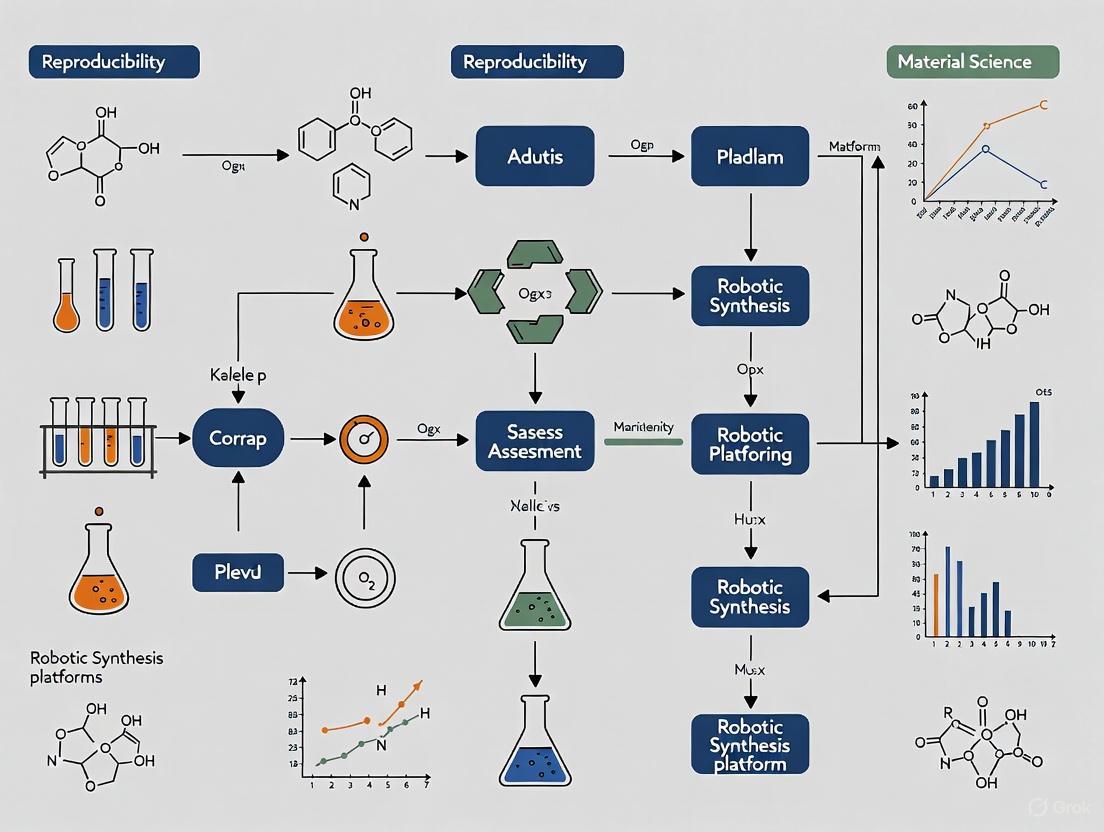
This article provides a systematic assessment of reproducibility in robotic synthesis platforms, a critical challenge for researchers and drug development professionals.
Ensuring Reproducibility in Robotic Synthesis: A Comprehensive Assessment for Biomedical Research
Abstract
This article provides a systematic assessment of reproducibility in robotic synthesis platforms, a critical challenge for researchers and drug development professionals. It explores the foundational causes of irreproducibility in synthetic methods and evaluates how automated platforms integrate AI and standardized protocols to enhance reliability. The analysis covers methodological applications across nanomaterials and biomolecules, troubleshooting for hardware and software optimization, and a comparative validation of performance metrics against manual techniques. By synthesizing evidence from current literature, this work offers a roadmap for leveraging robotic synthesis to achieve consistent, high-quality results in biomedical and clinical research, ultimately accelerating scientific discovery and translation.
The Reproducibility Crisis in Synthesis: Challenges and the Robotic Imperative
In the demanding fields of drug development and materials science, the scientific principle of reproducibility is a critical benchmark for reliability. A lack of reproducible methods, particularly in complex chemical synthesis, can lead to substantial financial losses, delayed research timelines, and a crisis of confidence in scientific data. A landmark study highlighting this issue found that a mere 21% of published findings on potential drug targets could be validated, underscoring the scale of the problem [1]. The economic impact is staggering, with estimates suggesting irreproducible preclinical research costs the U.S. approximately $28 billion annually [2]. This guide objectively compares the performance of emerging robotic synthesis platforms, which are designed to mitigate this crisis by standardizing experimental workflows and enhancing reproducibility.
Experimental Protocols for Reproducibility Assessment
To objectively evaluate the reproducibility of robotic synthesis platforms, a core set of experimental methodologies is employed. The following protocols detail the key procedures cited in this guide.
Protocol 1: Autonomous Multi-Step Synthesis and Analysis
This protocol is designed for exploratory chemistry, where outcomes are not a single measurable value but require verification of product identity and structure [3].
- 1. Synthesis Module Setup: Reactions are prepared in an automated synthesizer (e.g., Chemspeed ISynth). The platform dispenses reactants and solvents into reaction vessels and controls parameters like temperature and stirring [3].
- 2. Automated Sample Aliquot and Reformating: Upon reaction completion, the synthesizer automatically takes an aliquot of the reaction mixture. This sample is then reformatted into separate vials suitable for mass spectrometry and NMR analysis [3].
- 3. Mobile Robotic Transport: A mobile robot collects the prepared sample vials and transports them to the respective analytical instruments located within the laboratory, enabling shared use of equipment without physical reconfiguration [3].
- 4. Orthogonal Analysis: The sample is analyzed by Ultra-High-Performance Liquid Chromatography-Mass Spectrometry (UPLC-MS) and Benchtop Nuclear Magnetic Resonance (NMR) spectroscopy. Data acquisition is performed autonomously via control scripts [3].
- 5. Heuristic Decision-Making: A software-based decision-maker, programmed with domain-specific criteria, processes the UPLC-MS and NMR data. It assigns a binary (pass/fail) grade to each reaction. Only reactions that pass both analyses are selected for subsequent steps, such as scale-up or diversification, initiating the next synthesis cycle without human intervention [3].
Protocol 2: On-line Feedback-Controlled Synthesis of Molecular Machines
This protocol focuses on complex, multi-step synthesis with real-time monitoring to ensure product formation and purity, as demonstrated in the synthesis of [2]rotaxanes [4].
- 1. Programming in XDL: The synthetic procedure (averaging 800 base steps over 60 hours) is codified using the chemical description language XDL. This creates a standardized, executable recipe for the platform [4].
- 2. Automated Synthesis with In-line Analysis: The Chemputer platform executes the synthesis, with integrated on-line NMR and liquid chromatography instruments continuously monitoring reaction progression [4].
- 3. Dynamic Process Adjustment: Based on the real-time analytical data (e.g., yield determination via on-line 1H NMR), the system dynamically adjusts process conditions to steer the reaction toward the desired outcome [4].
- 4. Automated Purification: The workflow includes automated product purification using techniques such as silica gel and size-exclusion chromatography, which are executed by the robotic platform [4].
Comparative Performance Data of Robotic Platforms
The table below summarizes quantitative and qualitative data on two advanced robotic synthesis platforms, highlighting their approaches to ensuring reproducibility.
| Platform Characteristic | Modular Mobile Robot Platform [3] | The Chemputer [4] |
|---|---|---|
| System Architecture | Modular; mobile robots integrate discrete, shared instruments (synthesizer, UPLC-MS, NMR) | Integrated robotic synthesis platform with in-line analysis |
| Primary Reproducibility Mechanism | Heuristic decision-making based on orthogonal (UPLC-MS & NMR) analysis | Standardization via XDL chemical programming language & on-line feedback |
| Reported Synthesis Complexity | Exploratory synthesis (e.g., structural diversification, supramolecular chemistry) | Multi-step synthesis of molecular machines ([2]rotaxanes) |
| Automated Steps | Synthesis, sample preparation, transport, analysis, decision-making | Synthesis, real-time monitoring, purification, process control |
| Key Quantitative Metric | Binary pass/fail based on combined analytical techniques | 800 average base synthetic steps automated over 60 hours |
| Impact on Resources | Reduces equipment redundancy; allows human-instrument sharing | Reduces labor; minimizes manual intervention for complex routines |
Visualizing Robotic Workflows for Enhanced Reproducibility
The following diagrams illustrate the logical workflows of the featured robotic platforms, highlighting how their design inherently promotes reproducible research practices.
Diagram: Workflow of a Modular Robotic Synthesis Platform
Diagram: Workflow of a Feedback-Controlled Synthesis Platform
The Scientist's Toolkit: Key Research Reagent Solutions
The implementation of reproducible, automated synthesis relies on a suite of specialized instruments and software.
| Item | Function in Automated Workflow |
|---|---|
| Automated Synthesis Platform (e.g., Chemspeed ISynth, Chemputer) | Execulates liquid handling, reaction setup, and control of parameters like temperature and stirring, forming the core of the synthetic operation [3] [4]. |
| Benchtop NMR Spectrometer | Provides critical data on molecular structure for reaction verification; its compact size facilitates integration into automated workflows [3] [4]. |
| UPLC-MS (Ultrahigh-Performance Liquid Chromatography-Mass Spectrometer) | Offers orthogonal analytical data on product mass and purity, complementing structural data from NMR [3]. |
| Mobile Robot | Physically connects modular instruments by transporting samples between synthesis and analysis stations, enabling flexibility [3]. |
| Chemical Programming Language (e.g., XDL) | Codifies synthetic procedures in a standardized, machine-readable format, ensuring the exact same steps are executed every time [4]. |
| Heuristic Decision-Maker Software | Algorithmically processes analytical data against expert-defined rules to autonomously decide the next steps in a workflow, replacing human judgment calls [3]. |
The data and workflows presented demonstrate that robotic synthesis platforms directly address the severe costs of irreproducible methods. By automating complex protocols, integrating orthogonal analysis, and codifying chemical procedures, these systems significantly enhance the reliability and robustness of experimental outcomes. For researchers and drug development professionals, adopting these platforms is not merely an exercise in automation but a strategic move to safeguard valuable resources, accelerate discovery timelines, and build a more solid foundation for scientific innovation.
Reproducibility is a cornerstone of the scientific method, serving as the operationalization of objectivity by confirming that findings can be separated from the specific circumstances under which they were first gained [5]. In fields leveraging advanced robotic synthesis platforms, the reproducibility crisis manifests through failures to replicate findings across different laboratories or even using the same automated system at different times. The National Academies of Sciences, Engineering, and Medicine emphasizes that replication involves "obtaining consistent results across studies aimed at answering the same scientific question, each of which has obtained its own data" [6]. In automated science, key sources of irreproducibility span from tangible factors like reagent impurities to more subtle cognitive factors such as assumed knowledge and undocumented experimental context.
Quantitative Comparison of Reproducibility Performance Across Platforms
The integration of artificial intelligence with robotic platforms has revolutionized materials and biological research, enabling unprecedented experimental throughput. However, reproducibility assessments reveal significant variations in performance across different systems and applications.
Table 1: Performance and Reproducibility Metrics of Automated Research Platforms
| Platform/System | Application Area | Key Performance Metrics | Replication Deviations | Experimental Scale |
|---|---|---|---|---|
| iBioFAB [7] | Enzyme Engineering | 90-fold improvement in substrate preference; 16-fold improvement in ethyltransferase activity; 95% mutagenesis accuracy | Target mutation accuracy: ~95%; Requires construction of <500 variants | 4 rounds over 4 weeks |
| AI-Nanomaterial Platform [8] | Nanomaterial Synthesis | LSPR peak deviation: ≤1.1 nm; FWHM deviation: ≤2.9 nm | Reproducibility tested under identical parameters | 735 experiments for Au NRs; 50 for Au NSs/Ag NCs |
| Octo RFM [9] | Industrial Robotics | Significant performance degradation in simulation despite minimal task/observation domain shifts | Failed zero-shot generalization from real-world to simulated environments | Simulation-based evaluation |
Table 2: Reproducibility Failure Analysis Across Domains
| Domain | Reproducibility Rate | Primary Failure Causes | Impact on Field |
|---|---|---|---|
| Preclinical Cancer Research [5] | 11-20% | Biological reagents, cell line contamination, assumed knowledge of protocols | Landmark findings failed replication; ~$28B annual cost of irreproducible studies |
| Psychology [5] | 36-47% | P-hacking, flexible data analysis, selective reporting | Questioned foundational theories |
| Automated Science [7] [8] | Not systematically quantified | Reagent lot variations, undocumented environmental parameters, algorithmic randomness | Hinders technology transfer and industrial adoption |
Experimental Protocols for Reproducibility Assessment
Autonomous Enzyme Engineering Workflow
The Illinois Biological Foundry for Advanced Biomanufacturing (iBioFAB) employs a rigorous seven-module workflow for reproducible protein engineering [7]:
Variant Design: Combination of protein Large Language Models (ESM-2) and epistasis models (EVmutation) generates 180 initial variants, maximizing library diversity and quality.
HiFi-Assembly Mutagenesis: Implements high-fidelity DNA assembly method that eliminates intermediate sequence verification steps while maintaining ~95% accuracy in targeted mutations.
Automated Transformation: Robotic microbial transformation in 96-well plates with plating on 8-well omnitray LB plates.
Protein Expression: Automated protein expression with controlled environmental conditions.
Functional Assays: Crude cell lysate removal from 96-well plates followed by automated enzyme activity assays.
This end-to-end automated workflow requires only an input protein sequence and quantifiable fitness measurement, completing four engineering rounds within 4 weeks while characterizing fewer than 500 variants per enzyme.
Nanomaterial Synthesis Reproducibility Protocol
The automated nanomaterial synthesis platform employs a closed-loop optimization system with integrated characterization [8]:
Literature Mining Module: GPT and Ada embedding models extract and process synthesis methods from academic literature, generating executable experimental procedures.
Automated Synthesis Execution: Prep and Load (PAL) system with dual Z-axis robotic arms, agitators, centrifuge module, and fast wash module performs liquid handling and reaction steps.
In-line Characterization: UV-vis spectroscopy module directly analyzes optical properties of synthesized nanomaterials.
A* Algorithm Optimization: Heuristic search algorithm navigates discrete parameter space to optimize synthesis conditions, demonstrating superior efficiency compared to Bayesian optimization (Optuna) and other algorithms.
The platform's reproducibility was validated through repeated synthesis of Au nanorods, showing deviations in characteristic Localized Surface Plasmon Resonance (LSPR) peak ≤1.1 nm and Full Width at Half Maxima (FWHM) ≤2.9 nm under identical parameters.
Visualization of Reproducibility Challenges and Workflows
The Scientist's Toolkit: Essential Research Reagent Solutions
Table 3: Critical Research Reagents and Their Reproducibility Implications
| Reagent/Material | Function | Reproducibility Considerations | Documentation Requirements |
|---|---|---|---|
| Plasmid Libraries [7] | Template for protein variant generation | Sequence verification, concentration accuracy, storage conditions (-80°C) | Lot number, synthesis method, purification protocol, sequence alignment data |
| Polymerase Enzymes [7] | HiFi-assembly mutagenesis PCR | Fidelity variations between lots, buffer composition, storage history | Vendor, catalog number, lot number, enzyme activity units, buffer composition |
| Cell Lines [7] [10] | Protein expression and functional assays | Microbial contamination, passage number, genetic drift | Authentication method, passage number, growth medium composition, contamination screening results |
| Metal Precursors [8] | Nanomaterial synthesis | Oxidation state, hydration level, particle size distribution | Supplier, purity certificate, molecular weight verification, storage conditions |
| Biological Buffers [7] [10] | pH maintenance in assays | Lot-to-lot pH variation, microbial contamination, temperature sensitivity | pH at working temperature, preparation protocol, filtration method, expiration date |
| Spectral Standards [8] | UV-vis instrument calibration | Photodegradation, concentration accuracy, solvent evaporation | Certification source, expiration date, storage conditions, usage history |
The reproducibility of research conducted on robotic synthesis platforms depends critically on addressing both tangible factors like reagent impurities and subtle cognitive factors such as assumed knowledge. As autonomous research systems become more pervasive, implementing rigorous documentation standards for all research reagents and maintaining comprehensive protocol specifications will be essential for building trustworthy automated science. The experimental data presented demonstrates that while current platforms can achieve impressive reproducibility metrics for specific applications, systematic assessment across broader domains remains challenging. Future development should prioritize explainability, modularity, and robust benchmarking to enable reliable replication of automated scientific discoveries.
The pursuit of scientific discovery, particularly in fields like materials science and chemistry, has traditionally been hampered by a reliance on manual, trial-and-error methodologies. This approach is not only inefficient but also introduces significant human error and variability, leading to a broader reproducibility crisis across many scientific disciplines [11] [12]. In recent years, the integration of robotic platforms with artificial intelligence (AI) has emerged as a transformative solution. These automated systems are revolutionizing the research paradigm by enhancing precision, minimizing human-derived inconsistencies, and ensuring that experiments can be faithfully replicated. This shift is embodied in the concept of "material intelligence," a framework that leverages the seamless integration of AI and robotics to mimic and extend human scientific capabilities [13]. This article assesses the role of robotic platforms in improving research reproducibility by objectively comparing their performance against traditional methods and alternative automation technologies, providing researchers with data-driven insights for platform selection.
The Reproducibility Challenge in Science and the Role of Human Error
Reproducibility is a cornerstone of the scientific method, yet more than 70% of researchers have tried and failed to reproduce another scientist's experiments, and even more have struggled to reproduce their own [12]. This crisis is particularly acute in fields involving complex experimental procedures. Human operators are susceptible to cognitive load, fatigue, and stress, which can lead to miscalculations and critical mistakes, especially in high-speed production environments [14]. Furthermore, manual execution of experiments is inherently variable; differences in technique, timing, and attention to detail can lead to inconsistent results, making it difficult to build upon previous findings [15]. One analysis of surgical robotics research highlighted that poor reporting, flawed analysis, and a lack of shared resources are key factors limiting the replication of published work [12]. This underscores the critical need for systems that can standardize procedures and generate high-quality, reliable data.
How Robotic Platforms Minimize Error and Variability: Core Mechanisms
Automated robotic platforms enhance reproducibility through several key mechanisms that directly address the shortcomings of manual processes.
- Precision and Repeatability: Machines execute programmed instructions with near-perfect precision, eliminating the variability introduced by human fatigue or inconsistency. This ensures every experimental unit meets the same specifications, which is crucial for tasks like robotic welding, CNC machining, or automated liquid dispensing [14].
- Elimination of Experimenter Bias: Robots executing predefined protocols ensure constant procedural conditions across all trials. The code itself makes the operationalization of protocols transparent, providing a computational implementation that can be pre-registered and shared, documenting exactly how protocols translate into physical actions [11].
- Comprehensive Execution Tracing: Advanced platforms go beyond simple task execution. They employ semantic execution tracing frameworks that log low-level sensor data alongside semantically annotated robot belief states. This creates a detailed audit trail that captures not just what the robot did, but also its internal reasoning processes, perceptual interpretations, and verification steps [11].
- Data-Driven Optimization: Closed-loop systems integrate AI decision-making modules that continuously analyze experimental outcomes and refine subsequent parameters. This allows for autonomous optimization of processes, such as nanomaterial synthesis, with minimal human intervention, ensuring convergence to the desired target with high efficiency [16].
Comparative Analysis of Robotic Platform Performance
The performance advantages of robotic platforms can be quantitatively demonstrated by comparing their outputs with those from traditional manual methods and between different types of automated systems.
Robotic vs. Manual Experimentation: A Quantitative Comparison
The following table summarizes key performance indicators from comparative studies, highlighting the tangible benefits of automation in a research context.
Table 1: Performance Comparison of Robotic vs. Manual Experimentation
| Performance Metric | Manual Experimentation | Robotic Platform | Experimental Context |
|---|---|---|---|
| Reproducibility (Spectral Peak Deviation) | Not explicitly reported (high variability implied) | ≤ 1.1 nm | Au nanorod synthesis [16] |
| Reproducibility (FWHM Deviation) | Not explicitly reported (high variability implied) | ≤ 2.9 nm | Au nanorod synthesis [16] |
| Parameter Optimization Efficiency | Inefficient, prone to local optima | 735 experiments for multi-target optimization | Au nanorod LSPR optimization [16] |
| Search Algorithm Efficiency | N/A (Human-guided) | Outperforms Optuna, Olympus | A* algorithm in nanomaterial synthesis [16] |
| Operational Continuity | Limited by shifts, fatigue | 24/7 operation possible | General manufacturing [14] |
Comparison of Leading AI Robotics Platforms
The choice of a robotic platform depends heavily on the specific application. The market offers a range of solutions, from open-source frameworks to specialized industrial systems.
Table 2: Comparison of Top AI Robotics Platforms (2025)
| Platform / Tool | Primary Use Case | Key Features | Pros | Cons |
|---|---|---|---|---|
| NVIDIA Isaac Sim [17] | Simulation & AI training | Photorealistic, physics-based simulation; GPU acceleration | Reduces real-world testing costs; strong AI ecosystem | Requires high-end GPU infrastructure; steep learning curve |
| ROS 2 (Robot Operating System) [17] | Research & Development | Open-source middleware; large community; cross-platform | Free, highly extensible, strong adoption | Limited built-in AI; complex large-scale deployments |
| ABB Robotics IRB Platform [17] | Industrial automation | AI-powered motion control; digital twin; cloud fleet management | Robust, reliable, proven in manufacturing | High deployment cost; less suited for SMEs |
| Boston Dynamics AI Suite [17] | Enterprise robotics | Pre-trained navigation/manipulation models; fleet management | Optimized for advanced robots; industrial-ready | Limited to proprietary hardware; premium pricing |
| AWS RoboMaker [17] | Cloud robotics | ROS-based; large-scale fleet simulation; AWS integration | Cloud-native, excellent for distributed applications | Heavy AWS dependency; ongoing operational costs |
| OpenAI Robotics API [17] | Research & NLP robotics | GPT integration; reinforcement learning environments | Cutting-edge AI, natural language control | Experimental for large-scale use; requires ML expertise |
Experimental Protocols and Workflows in Automated Research
To understand how these platforms achieve their performance, it is essential to examine their underlying experimental workflows and the "research reagent solutions" that form the toolkit for modern automated science.
Detailed Experimental Workflow for Autonomous Nanomaterial Synthesis
A prime example of a closed-loop autonomous platform is one developed for nanomaterial synthesis [16]. Its workflow can be broken down into distinct, automated phases, as illustrated below:
Title: Closed-loop Workflow for Autonomous Nanomaterial Synthesis
Methodology Details:
- Literature Mining: A Generative Pre-trained Transformer (GPT) model, combined with Ada embedding models, processes academic literature to retrieve and suggest initial nanoparticle synthesis methods and parameters [16].
- Script Generation & Execution: The steps generated by the GPT model are translated into an automated operation script (
.mthor.pzmfiles). This script is executed by a commercial "Prep and Load" (PAL) DHR system, which uses robotic arms for liquid handling, agitators for mixing, and a centrifuge for separation [16]. - Characterization & Data Upload: The synthesized nanomaterials are automatically transferred to an integrated UV-vis spectrometer for characterization. The resulting spectral data and the synthesis parameters are uploaded to a specified location for the AI module [16].
- AI-Driven Optimization: The core decision algorithm is a heuristic A* search. It evaluates the outcome and heuristically navigates the discrete parameter space to propose a new set of synthesis parameters for the next experiment. This loop continues until the product meets the researcher's predefined target criteria (e.g., specific UV-vis absorption peaks) [16].
The Scientist's Toolkit: Essential Reagents & Platforms for Automated Research
The following table details key solutions and platforms that form the foundation of a modern, automated research laboratory.
Table 3: Research Reagent Solutions for Automated Experimentation
| Item Name | Type | Function in Automated Research |
|---|---|---|
| PAL DHR System [16] | Robotic Platform | A commercial, modular platform for fully automated liquid handling, mixing, centrifugation, and in-line UV-vis characterization. |
| A* Search Algorithm [16] | AI Decision Module | A heuristic search algorithm that efficiently navigates discrete parameter spaces to optimize synthesis conditions with fewer iterations. |
| Semantic Digital Twin [11] | Software Framework | A high-fidelity simulation of a lab environment used for pre-execution "imagination" of experiments and real-time comparison with actual outcomes. |
| RobAuditor [11] | Verification Software | A plugin-like framework for context-aware and adaptive task verification, planning, and execution to ensure procedural integrity. |
| GPT & LLMs (e.g., ChatGPT) [16] [18] | Literature Mining Tool | Large Language Models that extract synthesis methods and parameters from vast scientific literature, providing a starting point for automated experiments. |
| Knowledge Graph (KG) [18] | Data Management | A structured representation of chemical data and knowledge, enabling efficient storage, retrieval, and reasoning for AI-driven discovery. |
The Future: Semantic Tracing and Virtual Labs for Ultimate Reproducibility
The next frontier in robotic reproducibility moves beyond physical consistency to achieving full transparency and trust through semantic execution tracing and virtual research environments. The AICOR Virtual Research Building (VRB) is a cloud-based platform that links containerized, deterministic robot simulations with semantically annotated execution traces [11]. This approach ensures automated experimentation is not just repeatable, but also open, trustworthy, and transparent.
The semantic tracing framework operates on three integrated layers that provide multi-modal documentation, as shown in the following workflow:
Title: Three-Layer Semantic Execution Tracing Framework
Framework Details:
- Layer 1: Adaptive Perception: This layer uses frameworks like RoboKudo to model perception processes, dynamically combining computer vision methods. It generates traces that document which perception methods were used, their sequence, intermediate results, and confidence scores, making the robot's "sensing" interpretable [11].
- Layer 2: Imagination-Enabled Cognitive Traces: Before executing an action, the robot uses a semantic digital twin to simulate the anticipated outcome. After execution, it compares the actual observation with the prediction. This layer produces "cognitive traces" that document the robot's internal reasoning, predictions, and explanations for success or failure [11].
- Layer 3: Context-Adaptive Verification and Audit: This layer employs tools like RobAuditor to proactively plan and execute verification steps. It checks whether the state of the world matches the robot's beliefs and tasks, enabling failure recovery and generating a comprehensive audit trail for ultimate procedural integrity [11].
The evidence conclusively demonstrates that robotic platforms are fundamental to overcoming the reproducibility crisis in scientific research. By systematically replacing manual, variable processes with automated, precise, and data-driven workflows, these platforms minimize human error and variability at an unprecedented scale. The comparative data shows clear advantages in reproducibility metrics and optimization efficiency. As the field evolves, the convergence of physical automation with semantic tracing and virtual labs promises a future where scientific experiments are not only perfectly repeatable but also fully transparent and trustworthy. For researchers and drug development professionals, embracing these technologies is no longer a matter of convenience but a critical step toward ensuring the rigor, speed, and reliability of scientific discovery.
The integration of robotics into scientific research, particularly in fields like synthetic biology and drug development, presents a paradigm shift for accelerating discovery. However, this promise is critically dependent on solving the challenge of reproducibility. Studies suggest that a substantial fraction of published scientific results across disciplines cannot be replicated, which undermines scientific inquiry and erodes trust [11]. The core thesis of this guide is that a reproducible robotic system is not defined by a single component, but by the synergistic integration of standardized hardware, open and accessible software, and rigorous data integrity practices. This framework ensures that robotic experiments are not just mechanically repeatable but are scientifically replicable and transparent, forming a foundation for trustworthy, robot-supported science [11].
Core Component 1: Reproducible Hardware Platforms
The hardware layer forms the physical foundation of any robotic system. Reproducibility at this level requires platforms that are either standardized, low-cost, and accessible, or highly integrated and automated to eliminate human error and variability.
Comparison of Reproducible Robotic Hardware Platforms
The table below summarizes key hardware platforms designed to enhance reproducibility in scientific automation.
Table 1: Comparison of Reproducible Robotic Hardware Platforms
| Platform Name | Primary Application | Key Reproducibility Features | Reported Performance Metrics |
|---|---|---|---|
| DUCKIENet Autolab [19] | Robotics education & research | Remotely accessible, standardized, low-cost, and reproducible hardware setup. | Low variance across different robot hardware and remote labs [19]. |
| R4 Control System [20] | General robotics research | Open-source hardware (OSH) printed circuit board; creates standardized, fully reproducible research platforms. | Abstracts complexity, interfaces with Arduino and ROS2 for a family of standardized platforms [20]. |
| Chemputer [4] | Chemical synthesis | Universal robotic synthesis platform; automates complex synthetic procedures. | Automated an 800-step synthesis over 60 hours with minimal human intervention [4]. |
| Chemspeed Swing XL [21] | Biomaterials synthesis | Modular robotic platform with precision dispensing and controlled reactor environments (e.g., -40 to 180 °C). | Precision and reproducibility of reaction conditions, including dispense volumes and temperature [21]. |
| Trilobio Platform [22] | Biology research (genetic engineering, synthetic biology) | Whole-lab automation; standardized hardware (Trilobot) and software (Trilobio OS) to ensure protocols are reproducible in any Trilobio-enabled lab. |
33% increase in throughput; 25% increase in data production; reduced human error [22]. |
| iBioFAB [7] | Autonomous enzyme engineering | Integrated biofoundry automating all steps of protein engineering: mutagenesis, transformation, expression, and assay. | Engineered enzyme variants with 26-fold higher activity in 4 weeks; ~95% accuracy in targeted mutations [7]. |
Core Component 2: Reproducible Software & Visualization
Software acts as the cognitive layer of a robotic system, translating experimental intent into physical actions. Reproducibility here demands open interfaces, deterministic execution, and tools that make the robot's reasoning and perceptions transparent.
Semantic Execution Tracing and Virtual Labs
Beyond simple logging, advanced frameworks like the semantic execution tracing framework from the TraceBot project capture a robot's internal belief states and reasoning processes [11]. This integrates three layers:
- Layer 1: Adaptive Perception with Semantic Annotation: Logs not just what objects were detected, but the sequence of perception methods used and the confidence scores for those decisions [11].
- Layer 2: Imagination-Enabled Cognitive Traces: Uses a semantic digital twin to simulate and log the robot's predictions about action outcomes before execution, and then compares them to reality [11].
- Layer 3: Context-Adaptive Verification: Employs frameworks like
RobAuditorfor automated, context-aware verification of task execution to ensure procedural integrity [11].
Complementing this, platforms like the AICOR Virtual Research Building (VRB) provide cloud-based, containerized simulation environments linked to these semantic traces, allowing researchers worldwide to inspect, reproduce, and build upon each other's work [11].
Comparison of Visualization Tools for Data Analysis
Visualization tools are critical for analyzing and debugging the complex data generated by robotic systems, which is a key step in verifying reproducibility.
Table 2: Comparison of Robotics Visualization Tools
| Tool | License & Cost | Key Features | ROS Integration | Best For |
|---|---|---|---|---|
| RViz / RViz 2 [23] | Open-source (BSD). Free. | The classic 3D tool for ROS; highly extensible via C++ plugins. | Tightly integrated with live ROS topics. | Developers deeply embedded in the ROS ecosystem requiring real-time monitoring and custom plugins. |
| Foxglove [23] | Freemium model; free tier available. | Modern, user-friendly interface; available as desktop app or in browser; supports multi-user collaboration. | Connects via foxglove_bridge WebSocket; can be used without a full ROS setup. |
Teams needing collaborative features, a modern UI, and flexibility for both live and logged data. |
| Rerun [23] | Open-source (MIT & Apache 2.0). Free. | Lightweight desktop app; focuses on fast, efficient visualization of multimodal data via programming SDKs (Python, Rust). | Requires user-defined bridge nodes to forward ROS topics; does not open bag files natively. | Developers who prefer a code-driven workflow for logging and visualizing synchronized, multi-modal data. |
Core Component 3: Data Integrity and Provenance
Data integrity ensures that the entire lifecycle of an experiment—from raw sensor data to final conclusions—is captured, traceable, and immutable. This is the bedrock of scientific reproducibility.
Frameworks for Trustworthy Data
The Predictability-Computability-Stability (PCS) framework advocates for veridical data science. While computational reproducibility (the "C") is a prerequisite, it is not sufficient. The "S" (Stability) principle requires examining how scientific conclusions are affected by reasonable perturbations in the data science life cycle (e.g., hyperparameter choices, software versions). This ensures results are robust and trustworthy [24].
Adhering to the FAIR principles (Findable, Accessible, Interoperable, and Reusable) for data and knowledge representation is also crucial. Platforms that integrate semantic world models and ontologies, such as those used in the CRAM architecture, make data machine-actionable and meaningful for long-term reuse and replication [11].
Experimental Validation and Performance Data
Theoretical frameworks must be validated with experimental evidence. The following section details methodologies and quantitative results from real-world deployments of reproducible robotic systems.
Experimental Protocol: Autonomous Enzyme Engineering
The autonomous engineering of enzymes on the iBioFAB platform provides a compelling case study in a fully integrated, reproducible workflow [7].
- Objective: Improve enzymatic properties (e.g., activity, substrate preference) through iterative Design-Build-Test-Learn (DBTL) cycles with minimal human intervention.
- Workflow Modules:
- Design: A protein Large Language Model (ESM-2) and an epistasis model (EVmutation) design a diverse library of protein variants.
- Build: An automated, high-fidelity DNA assembly method constructs the variant library without needing intermediate sequence verification.
- Test: The platform executes fully automated modules for transformation, protein expression, and functional enzyme assays.
- Learn: Machine learning models use the assay data to predict fitness and design the next, improved library for another cycle.
- Key Materials:
- iBioFAB Robotic Platform: Integrated system with central robotic arm, thermocyclers, and liquid handlers [7].
- Protein LLM (ESM-2): For unsupervised variant design based on evolutionary sequence data [7].
- High-Throughput Assays: On-line NMR and liquid chromatography for real-time, automated fitness quantification [7].
Quantitative Results from Reproducible Automation
The following table summarizes experimental performance data from various robotic platforms, demonstrating their impact on reproducibility and research efficiency.
Table 3: Experimental Performance Data of Robotic Platforms
| Platform / Study | Key Experimental Metric | Result | Impact on Reproducibility |
|---|---|---|---|
| Autonomous Enzyme Engineering [7] | Improvement in enzyme activity (YmPhytase). | 26-fold higher activity vs. wild type. | Achieved in 4 weeks via a closed-loop, fully documented DBTL cycle, eliminating human variability. |
| Autonomous Enzyme Engineering [7] | Accuracy of automated mutagenesis. | ~95% accuracy in targeted mutations. | High-fidelity automated construction ensures genetic designs are correctly translated to physical DNA. |
| Trilobio Platform [22] | Throughput and data production increase. | 33% higher throughput; 25% more data. | Standardized hardware/software eliminates protocol deviation, increasing consistency and output. |
| Trilobio Platform [22] | Operational efficiency. | Saved 80 hours of training time. | No-code GUI and reliable hardware reduce operator-dependent errors, enhancing procedural consistency. |
| Semantic Tracing & VRB [11] | Experimental repeatability. | Low variance across different hardware and remote labs. | Semantic logs and virtual labs allow exact replication and validation of experiments independently. |
The Researcher's Toolkit for Reproducibility
Implementing a reproducible robotic system requires a suite of tools and technologies. Below is a non-exhaustive list of key solutions referenced in this guide.
Table 4: Essential Toolkit for Reproducible Robotic Research
| Tool / Solution | Category | Primary Function |
|---|---|---|
| R4 Control System [20] | Hardware | Open-source control board to standardize the interface between software and motors. |
| ROS/RViz 2 [23] | Software | Open-source robotics middleware and core visualization tool for real-time monitoring. |
| Foxglove [23] | Software & Data | Visualization platform for collaborative analysis of live and logged robotics data. |
| AICOR Virtual Research Building [11] | Software & Data | Cloud platform for sharing containerized simulations and semantically annotated execution traces. |
| Semantic Execution Tracing [11] | Data Integrity | Framework for logging sensor data, robot beliefs, and reasoning processes. |
| PCS Framework [24] | Data Integrity | A framework (Predictability, Computability, Stability) for ensuring veridical and robust data science. |
| Chemputer/XDL [4] | Software | Chemical programming language and platform for standardizing and reproducing synthetic procedures. |
| Trilobio OS [22] | Software | No-code software for designing and optimizing biological research protocols for automated execution. |
The journey toward fully reproducible robotic science hinges on a holistic approach. As the evidence shows, no single component is sufficient. The most significant advances are achieved when standardized, open hardware (like the R4 system or integrated biofoundries) is coupled with transparent, accessible software and simulation (such as the AICOR VRB and Foxglove), and all actions are underpinned by rigorous data integrity through semantic tracing and frameworks like PCS. For researchers and drug development professionals, prioritizing investments in this integrated stack is no longer optional but essential for producing trustworthy, replicable, and accelerated scientific outcomes.
Implementing Robotic Synthesis: From AI-Driven Platforms to Standardized Protocols
The field of laboratory automation is undergoing a profound transformation, moving from siloed hardware components to intelligent, software-driven ecosystems. End-to-end automated platforms that integrate artificial intelligence (AI) decision-making with precise liquid handling represent the forefront of this evolution, particularly in addressing critical challenges in reproducibility assessment of robotic synthesis platforms. The global lab automation market, valued at $3.69 billion, is projected to grow to $5.60 billion by 2030, at a compound annual growth rate (CAGR) of 7.2% [25]. Within this market, automated liquid handling systems account for approximately 60% of the total market volume, underscoring their central role in modern research infrastructure [25].
The convergence of AI with workflow automation software is a significant trend reshaping the automated liquid handlers industry [26]. This integration is primarily driven by the need to enhance operational efficiency, ensure data integrity, and overcome the limitations of traditional manual processes in drug discovery and development workflows. AI algorithms facilitate real-time data analysis, allowing devices to optimize liquid handling protocols dynamically, while machine learning models improve accuracy by predicting and correcting errors during operation, thereby reducing waste and increasing reliability [27]. This technological evolution is creating intelligent, adaptive systems capable of autonomous decision-making, which is particularly valuable for complex workflows in pharmaceutical research and diagnostic applications where reproducibility is paramount.
Market and Technology Landscape
Current Market Position and Growth Trajectory
The automated liquid handling technologies market is experiencing substantial growth, expected to reach approximately US$ 7.4 billion by 2034, up from US$ 2.7 billion in 2024, representing a strong CAGR of 10.6% [28]. This expansion is fueled by increasing demands for efficiency and accuracy in laboratory operations across multiple sectors. North America currently dominates the market, holding a 39.5% share, driven by robust R&D expenditures and a concentration of leading pharmaceutical and biotechnology companies [28]. The Asia-Pacific region, however, is forecasted to experience the highest growth rate, fueled by increased government and private investments in life sciences research [28].
Table 1: Automated Liquid Handling Market Overview and Projections
| Metric | 2023-2024 Value | 2030-2034 Projection | CAGR | Key Drivers |
|---|---|---|---|---|
| Global Lab Automation Market | $3.69 billion [25] | $5.60 billion by 2030 [25] | 7.2% [25] | AI integration, demand for reproducibility |
| Liquid Handling Technologies Market | $2.7 billion in 2024 [28] | $7.4 billion by 2034 [28] | 10.6% [28] | High-throughput screening, error reduction |
| Automated Liquid Handlers Segment | ~60% of lab automation volume [25] | Sustained dominance | - | Drug discovery applications, genomic research |
| North America Market Share | 39.5% [28] | Maintained leadership | - | Significant R&D investment, biotech concentration |
Core Liquid Handling Technologies
Automated liquid handling systems employ various technologies, each with distinct advantages for specific applications and reproducibility requirements. Understanding these fundamental technologies is crucial for evaluating their integration with AI decision-making platforms.
Air Displacement Technology: This widely implemented method functions through an air cushion, where positive or negative pressure generated by piston movement transfers liquids. While versatile, it can introduce variability, especially at sub-microliter volumes, due to the compressible nature of air. It also poses risks of carryover contamination from aerosols entering the air channel, particularly with volatile liquids [29].
Positive Displacement Technology: This approach eliminates the air gap as the piston directly contacts the liquid, ensuring precise transfer even at sub-microliter volumes regardless of liquid properties. While traditionally reliant on reusable syringes, modern systems often use sterile, disposable tips to address sterility concerns for sensitive workflows. Systems like the F.A.S.T. and FLO i8 PD liquid handlers utilize positive displacement disposable tips with axially-sealed plungers, further eliminating contamination risks [29].
Microdiaphragm Pumps Technology: This technology uses a flexible diaphragm activated by pneumatic means that rhythmically pulsates to convey precise volumes. It offers broad liquid class compatibility and gentleness, and when combined with non-contact dispensing, significantly mitigates contamination risk. Instruments like the Mantis and Tempest liquid dispensers utilize microdiaphragm chips, achieving high precision and fast speeds essential for reproducible results [29].
AI Integration in Liquid Handling Workflows
Architectural Framework for AI-Driven Platforms
The integration of AI with liquid handling systems transforms them from automated executors to intelligent decision-makers. This architectural shift is fundamental for enhancing reproducibility in complex experimental workflows. AI-powered systems now incorporate predictive analytics to forecast and correct potential errors during operation, real-time protocol optimization that dynamically adjusts parameters based on incoming data, and anomaly detection that identifies deviations from expected patterns that might compromise reproducibility [27] [28].
Table 2: AI Functional Capabilities in Automated Liquid Handling
| AI Capability | Technical Function | Impact on Reproducibility |
|---|---|---|
| Predictive Error Correction | Machine learning models analyze historical performance data to anticipate and prevent errors | Reduces procedural variances and systematic deviations |
| Dynamic Protocol Adjustment | Real-time analysis of sensor data to modify dispensing parameters, volumes, or timing | Maintains optimal conditions despite environmental fluctuations |
| Anomaly Detection | Pattern recognition identifies outliers in liquid transfer, bubble formation, or clot detection | Flags potential reproducibility compromises for investigation |
| Predictive Maintenance | Analysis of component performance data forecasts maintenance needs before failure | Precludes equipment-related variability in experimental outcomes |
| Process Optimization | AI algorithms simulate and test multiple workflow parameters to identify optimal configurations | Systematically enhances protocol efficiency and output consistency |
The implementation of AI extends beyond individual instruments to create connected laboratory ecosystems. Vendor-neutral orchestration platforms promote better collaboration, governance, and real-time tracking—critical elements for reproducibility across multiple research sites [25]. These platforms enable seamless communication between liquid handlers, robotic arms, plate readers, and data management systems, creating a fully automated workflow that reduces manual intervention and associated errors [28]. Middleware solutions that connect legacy and next-generation instruments, combined with standardized data formats, facilitate this integration and support the real-time analytics necessary for AI systems to make accurate, timely decisions [25].
Reproducibility Assessment Framework
Assessing the reproducibility of AI-integrated liquid handling platforms requires a structured methodology with specific performance metrics. The following experimental protocol provides a standardized approach for comparative evaluation across different systems and technologies.
Experimental Protocol 1: Reproducibility Assessment of Liquid Transfer Accuracy
Objective: To quantitatively evaluate the precision and accuracy of automated liquid handling systems across different volume ranges and liquid types, providing standardized metrics for reproducibility assessment.
Materials:
- Test automated liquid handling platforms (e.g., systems with air displacement, positive displacement, and microdiaphragm pump technologies)
- Calibrated analytical balance (0.0001 g sensitivity)
- Distilled water
- Glycerol solution (50% v/v for viscous simulation)
- Dye solution for visual confirmation
- Low-retention microplates and reservoirs
Methodology:
- System Calibration: Pre-condition all systems to controlled environment (20-25°C, 45-65% humidity)
- Volume Range Testing: Program each system to dispense volumes across their operational range (e.g., 0.1 μL, 1 μL, 10 μL, 100 μL, 1000 μL)
- Liquid Type Variability: Test each volume with both aqueous and viscous solutions
- Replication Structure: Perform 96 replicates per volume-liquid combination
- Gravimetric Measurement: Dispense into tared plates, immediately weigh, and calculate actual volume dispensed (assuming water density of 1 g/mL at 20°C)
- Data Collection: Record mean volume, standard deviation, coefficient of variation (CV), and percentage deviation from target
Data Analysis:
- Calculate CV% as (standard deviation/mean) × 100 for precision assessment
- Calculate accuracy as (mean measured volume/target volume) × 100
- Perform statistical analysis (ANOVA) to identify significant differences between systems and conditions
Comparative Performance Analysis of Integrated Platforms
Technology-Specific Performance Benchmarking
The integration of AI with different liquid handling technologies yields distinct performance characteristics that directly impact reproducibility in research applications. Understanding these differences is crucial for selecting appropriate platforms for specific experimental requirements.
AI-Enhanced Positive Displacement Systems: These platforms typically demonstrate superior performance with viscous liquids and volatile compounds where air displacement systems struggle. The direct liquid contact eliminates compressibility issues, while AI integration further optimizes piston movement patterns and timing based on real-time feedback. This combination achieves CVs (coefficients of variation) below 5% even with challenging reagents, making them particularly valuable for assay miniaturization and low-volume transfers where reproducibility is most challenging [29].
AI-Enhanced Air Displacement Systems: Modern AI-integrated air displacement systems utilize machine learning algorithms to create liquid-class specific compensation parameters that adjust for different fluid properties. The AI components continuously analyze performance data to calibrate for environmental factors such as temperature and humidity fluctuations that traditionally affect air displacement accuracy. While generally more cost-effective, their performance reproducibility remains dependent on regular calibration and tip quality [29].
Microdiaphragm Pump Systems with AI: These systems excel in non-contact dispensing applications where contamination risk must be minimized. AI integration enhances their natural strengths by optimizing diaphragm pulsation patterns for different liquids and detecting potential clogging or performance degradation through pattern recognition. Systems like the Mantis liquid dispenser demonstrate CVs below 2% for volumes as low as 100 nL when combined with AI-driven quality control systems that verify every dispense [29].
Table 3: Performance Comparison of AI-Integrated Liquid Handling Technologies
| Performance Metric | Positive Displacement + AI | Air Displacement + AI | Microdiaphragm Pumps + AI |
|---|---|---|---|
| Low Volume Precision (CV%) | <5% at 0.1 μL [29] | 5-10% at 0.1 μL [29] | <2% at 0.1 μL [29] |
| Viscous Liquid Handling | Excellent (liquid-class agnostic) [29] | Good (requires specific liquid classes) [29] | Good with optimized pulsation |
| Volatile Liquid Handling | Excellent [29] | Poor (evaporation issues) [29] | Excellent (non-contact) [29] |
| Cross-Contamination Risk | Low (with disposable tips) [29] | Moderate (aerosol formation) [29] | Very Low (non-contact) [29] |
| AI Optimization Focus | Viscosity compensation, bubble detection | Environmental compensation, tip integrity monitoring | Clog detection, pulsation optimization |
| Ideal Application Scope | Assay miniaturization, diverse reagent types | High-throughput screening, aqueous solutions | Cell-based assays, PCR setup, sensitive reactions |
End-to-End Workflow Reproducibility Assessment
Evaluating complete workflow reproducibility requires testing integrated platforms performing complex, multi-step procedures that represent real-world research applications. The following experimental protocol assesses both technical performance and biological relevance.
Experimental Protocol 2: Next-Generation Sequencing (NGS) Library Preparation Reproducibility
Objective: To compare the reproducibility of NGS library preparation across different AI-integrated liquid handling platforms by assessing both process metrics and final sequencing outcomes.
Materials:
- Test genomic DNA sample (commercially available reference standard)
- NGS library preparation kit (identical lot for all tests)
- Three different AI-integrated liquid handling platforms
- Manual pipetting control (expert user)
- QC instruments (Qubit, Bioanalyzer)
- Sequencing platform (Illumina preferred)
Methodology:
- Platform Programming: Implement identical library preparation protocol on all test platforms
- AI Parameterization: Allow each system's AI components to optimize parameters for the specific workflow
- Replication Structure: Prepare 24 libraries per platform (8 replicates × 3 separate runs)
- Process Monitoring: Record liquid handling performance data (volume deviations, timing, error rates)
- Output Quality Assessment: Quantify DNA concentration, fragment size distribution, and sequencing metrics
- Sequencing Analysis: Perform shallow sequencing to assess library complexity, duplication rates, and coverage uniformity
Data Analysis:
- Compare inter-platform and intra-platform CVs for all quantitative metrics
- Assess concordance with manual preparation control
- Evaluate read distribution uniformity across genomic regions
- Calculate differential gene expression variances between platforms
Diagram 1: NGS Library Preparation Workflow for Reproducibility Assessment
Implementation and Sustainability Considerations
Strategic Implementation Framework
Successfully implementing AI-integrated liquid handling platforms requires careful consideration of multiple factors beyond technical performance. Laboratories must develop comprehensive strategies that address integration complexity, workforce training, and sustainability imperatives.
Integration and Interoperability: As labs scale automation, seamless integration with existing laboratory information management systems (LIMS), electronic health records (EHRs), and analytical instruments becomes crucial for maintaining reproducibility across workflows [25]. Key enablers include middleware solutions that connect legacy and next-generation instruments, standardized data formats (e.g., HL7 protocols), and peer-to-peer orchestration platforms that facilitate communication across instruments and lab networks [25]. Vendors are increasingly offering modular, flexible solutions that integrate with existing infrastructure while supporting both legacy and emerging systems, thereby protecting investments while advancing capabilities.
ROI Justification and Business Case Development: A common challenge for laboratories is justifying the substantial upfront investment in AI-integrated automation. A compelling business case should incorporate both quantitative and qualitative factors, emphasizing core ROI metrics including reduced manual labor, increased throughput and efficiency, error reduction with improved data accuracy, and enhanced compliance with regulatory requirements [25]. Workflow automation, while costly initially, typically offers a fast payback period and lowers total lab operating expenses by improving productivity and compliance [25]. Demonstrating long-term cost-effectiveness through improved productivity is key to securing investment in these advanced systems.
Sustainability and Future Directions
Sustainability has transitioned from a secondary consideration to a central procurement priority for laboratory automation. Modern laboratories increasingly favor instruments with low energy consumption, and there is growing adoption of reusable consumables such as sanitized tips and washable microplates [25]. Additionally, assay miniaturization enabled by precise liquid handling significantly reduces reagent consumption and chemical waste, contributing to more environmentally responsible research practices [25]. This sustainability focus aligns with operational efficiency, as reduced reagent consumption directly lowers operational costs while minimizing environmental impact.
The future trajectory of AI-integrated liquid handling platforms points toward increasingly intelligent, autonomous systems capable of self-optimization based on real-time experimental outcomes. Emerging developments include more sophisticated closed-loop experimentation where AI systems not only execute protocols but also design subsequent experimental iterations based on incoming data, potentially accelerating discovery timelines dramatically. The ongoing maturation of no-code platforms makes advanced automation accessible to broader research teams, reducing dependency on specialized programming expertise [25]. Furthermore, the expansion of cloud-based data management and remote operation capabilities enhances collaboration potential across geographically distributed research teams while maintaining reproducibility standards through centralized protocol management [27].
The Scientist's Toolkit: Essential Research Reagents and Materials
Table 4: Key Research Reagent Solutions for Automated Liquid Handling Applications
| Reagent/Material | Function | Automation-Specific Considerations |
|---|---|---|
| Library Preparation Kits | Fragment DNA, add adapters, amplify libraries | Reformulated for lower volumes; compatibility with non-contact dispensing |
| PCR Master Mixes | Amplify specific DNA sequences | Optimized viscosity and surface tension for accurate low-volume transfers |
| Cell Culture Media | Support cellular growth and maintenance | Formulated to minimize bubbling during automated dispensing |
| Assay Reagents | Enable detection of specific analytes | Stable at higher concentrations for miniaturized assay formats |
| Low-Retention Tips | Liquid transfer without sample loss | Surface treatment to minimize adhesion; compatible with specific disposal systems |
| Microplates | Sample and reagent storage during processing | Automated-compatible dimensions; surface properties for specific applications |
| Quality Control Standards | Verify system performance and accuracy | Stable reference materials with certified values for regular calibration |
The integration of AI decision-making with automated liquid handling represents a paradigm shift in laboratory automation, directly addressing critical challenges in reproducibility assessment for robotic synthesis platforms. These end-to-end solutions transform liquid handlers from mere execution tools to intelligent partners in the research process, capable of optimizing their own performance, detecting anomalies in real-time, and maintaining meticulous records for reproducibility auditing. As the technology continues to evolve, laboratories must develop strategic approaches to implementation that consider not only technical capabilities but also integration requirements, staff training, and sustainability impacts. The future of reproducible research increasingly depends on these intelligent, connected systems that enhance both the efficiency and reliability of scientific discovery across pharmaceutical development, clinical diagnostics, and basic research applications.
The synthesis of nanomaterials with precise control over their physical properties, such as size, morphology, and composition, is fundamental to applications ranging from drug delivery to catalytic systems. However, traditional laboratory methods, which rely heavily on manual, labor-intensive trial-and-error approaches, often suffer from significant reproducibility challenges. These challenges stem from human operational variability, complex interdependencies between synthesis parameters, and difficulties in precisely controlling reaction conditions. The emergence of robotic synthesis platforms integrated with artificial intelligence (AI) decision-making modules presents a paradigm shift, offering a path toward autonomous, data-driven experimentation that can enhance both the efficiency and the reproducibility of nanomaterial development [8] [30]. This case study examines the performance of these AI-guided robotic platforms, with a specific focus on the synthesis of gold nanorods (Au NRs) and other nanomaterials, objectively comparing their capabilities against traditional methods and other algorithmic approaches. The assessment is framed within the critical research context of reproducibility, a key metric for evaluating the maturity and reliability of any synthetic platform.
Platform Comparison: AI-Robotic Systems vs. Traditional and Alternative Methods
The drive for reproducibility has led to the development of various automated platforms. These systems can be broadly categorized into integrated and modular architectures. Integrated systems, like the Chemspeed platforms used in several studies, combine synthesis and sometimes analysis within a single, bespoke unit [31] [21]. In contrast, a more modular approach employs mobile robots to transport samples between standalone, commercially available synthesis and analysis modules (e.g., liquid chromatography–mass spectrometers and benchtop NMR spectrometers) [31]. This modular design leverages existing laboratory equipment without requiring extensive redesign, enhancing flexibility and potentially lowering adoption barriers [31].
A key differentiator is the level of autonomy. Automation involves the robotic execution of predefined tasks, while autonomy incorporates AI or algorithmic agents to interpret analytical data and make decisions about subsequent experiments without human intervention [31]. This closed-loop operation is central to the efficiency claims of these platforms.
Performance and Reproducibility Data
The following table summarizes quantitative performance data from recent studies on AI-guided robotic platforms, specifically for the synthesis of gold nanorods and other nanomaterials, highlighting key reproducibility metrics.
Table 1: Performance Comparison of AI-Guided Robotic Synthesis Platforms
| Platform / Study Focus | AI Algorithm / Method | Key Synthesis Targets | Experimental Scale & Efficiency | Reproducibility & Precision Metrics |
|---|---|---|---|---|
| Automated Platform with AI Decision Modules [8] | Generative Pre-trained Transformer (GPT) for literature mining; A* algorithm for closed-loop optimization | Au nanorods (NRs), Au nanospheres (NSs), Ag nanocubes (NCs), Cu2O, PdCu | Multi-target Au NR optimization over 735 experiments; Au NSs/Ag NCs in 50 experiments. | Deviation in LSPR peak ≤1.1 nm; FWHM deviation ≤2.9 nm for Au NRs under identical parameters [8]. |
| High-Throughput Robotic Platform [32] | Machine Learning (ML) models for parameter optimization | Gold nanorods (seedless approach) | Synthesis of over 1356 Au NRs with varying aspect ratios. | "Highly repeatable morphological yield" with quantifiable precursor adjustments [32]. |
| Modular Workflow with Mobile Robots [31] | Heuristic decision-maker processing UPLC-MS and NMR data | Small molecules, supramolecular assemblies | Emulates human protocols for exploratory synthesis. | Autonomous checking of reproducibility for screening hits before scale-up [31]. |
| Manual / Traditional Synthesis | Researcher-driven trial and error | Various nanomaterials | Highly variable and time-consuming. | Susceptible to significant operator-dependent variability; often poorly documented. |
The data demonstrates that AI-robotic platforms can achieve a high degree of precision. For instance, one platform reported deviations in the characteristic longitudinal surface plasmon resonance (LSPR) peak and its full width at half maxima (FWHM) for Au NRs of ≤1.1 nm and ≤2.9 nm, respectively, under identical parameters [8]. This level of consistency is difficult to maintain with manual operations. Furthermore, a machine learning and robot-assisted study synthesized over 1356 gold nanorods via a seedless approach, achieving "highly repeatable morphological yield" [32]. This high-throughput capability, coupled with precise control, underscores the potential of these platforms to overcome reproducibility bottlenecks.
Algorithmic Efficiency in Parameter Optimization
A critical function of the AI component is to efficiently navigate the complex parameter space of nanomaterial synthesis. Studies have directly compared the performance of different optimization algorithms. One group developed a closed-loop optimization process centered on the A* algorithm, a heuristic search method, arguing it is particularly suited for the discrete parameter spaces common in nanomaterial synthesis [8]. Their comparative analysis concluded that the A* algorithm outperformed other commonly used optimizers, Bayesian optimization (Olympus) and Optuna, in search efficiency, requiring significantly fewer iterations to achieve the synthesis targets [8]. This enhanced search efficiency directly translates to reduced time and resource consumption in research and development.
Experimental Protocols and Workflows
Detailed AI-Guided Synthesis Protocol for Au Nanorods
The following protocol details a representative automated workflow for the synthesis and optimization of gold nanorods, synthesizing methodologies from the cited research.
- Literature Mining and Initial Parameter Definition: The process begins by using a large language model (LLM), such as a Generative Pre-trained Transformer (GPT), to mine existing academic literature. The model retrieves and summarizes synthesis methods and initial parameters for the target nanomaterial, which are then converted into an executable robotic script [8].
- Automated Liquid Handling and Synthesis: A robotic platform (e.g., a platform like the Prep and Load (PAL) system or Chemspeed) performs the synthesis. It automatically handles the precise dispensing of precursors (e.g., HAuCl4, AgNO3, ascorbic acid, cetyltrimethylammonium bromide (CTAB)) into reaction vials based on the initial or AI-updated parameters [8] [32]. The platform controls critical reaction conditions such as temperature and mixing speed.
- In-line/On-line Characterization: An aliquot of the reaction product is automatically transferred to a characterization module, most commonly a UV-Vis spectrophotometer. The system acquires the extinction spectrum, focusing on the LSPR peaks to determine the nanorods' aspect ratio and quality (e.g., FWHM) [8] [32].
- AI Decision-Making and Parameter Update: The characterization data (e.g., LSPR peak position and intensity) is fed to an AI decision module (e.g., the A* algorithm [8] or other ML models [32]). The algorithm evaluates the outcome against the target (e.g., an LSPR peak at a specific wavelength) and heuristically selects a new set of synthesis parameters to test.
- Closed-Loop Iteration: Steps 2-4 are repeated in a closed-loop manner, with the AI agent using the accumulated data to iteratively refine the synthesis conditions without human intervention.
- Validation and Off-line Analysis: Once the target properties are achieved or the optimization loop is complete, the platform may perform final synthesis. Targeted sampling is then conducted for validation using high-resolution techniques like transmission electron microscopy (TEM) to confirm morphology and size [8] [32].
Workflow Visualization
The following diagram illustrates the closed-loop, autonomous workflow described in the protocol.
Diagram 1: Autonomous AI-Robotic Workflow for Nanomaterial Synthesis.
The Scientist's Toolkit: Essential Research Reagents and Materials
The successful implementation of an AI-guided robotic synthesis platform relies on a suite of specialized reagents, hardware, and software. The table below details key components referenced in the case studies.
Table 2: Key Research Reagent Solutions for AI-Guided Nanomaterial Synthesis
| Item Name / Category | Function / Description | Example in Use |
|---|---|---|
| Gold Precursors | Source of gold for nanoparticle formation. | Hydrogen tetrachloroaurate(III) hydrate (HAuCl₄) for synthesizing Au nanorods and nanospheres [8] [32]. |
| Structure-Directing Surfactants | Controls the growth kinetics and morphology of nanoparticles. | Cetyltrimethylammonium bromide (CTAB) is essential for guiding the anisotropic growth of Au nanorods [32]. |
| Reducing Agents | Reduces metal ions to form nucleation centers and facilitate growth. | Ascorbic acid used in seedless and seeded growth of Au nanorods [32]. |
| Robotic Synthesis Platform | Automated hardware for precise liquid handling, mixing, and temperature control. | Chemspeed ISynth/Swing XL or PAL DHR systems for executing synthesis scripts under controlled conditions [8] [31] [21]. |
| In-line Spectrophotometer | Provides immediate optical characterization of products for feedback. | UV-Vis spectrometer integrated into the loop to measure LSPR of Au NRs [8]. |
| AI Decision-Making Software | Algorithmic core for analyzing data and planning subsequent experiments. | Custom implementations of A* search algorithm or machine learning models for parameter optimization [8] [32]. |
| Validation Instruments | Provides high-resolution, ex-situ characterization for final validation. | Transmission Electron Microscopy (TEM) for definitive size and morphology analysis [8] [33] [32]. |
The integration of artificial intelligence with robotic synthesis platforms represents a significant advancement in addressing the long-standing reproducibility crisis in nanomaterial research. The quantitative data from case studies on Au nanorod synthesis consistently demonstrates that these systems can achieve a level of precision and repeatability that is challenging for manual methods. The critical factors contributing to this enhanced reproducibility include the removal of operator variability, the precise and consistent execution of protocols by robots, and the data-driven, heuristic decision-making of AI algorithms that efficiently navigate complex parameter spaces.
While challenges remain—such as the initial cost of hardware, the need for specialized scripting, and the generalizability of AI models—the evidence is compelling. Platforms that implement a closed-loop workflow, from automated literature mining to AI-directed synthesis and characterization, establish a new standard for reproducible nanomaterial development. This paradigm not only accelerates the discovery and optimization of nanomaterials with tailored properties but also produces rich, high-quality datasets that further refine the AI models, creating a virtuous cycle of improvement. For researchers and drug development professionals, the adoption of these AI-guided robotic platforms offers a robust pathway to more reliable, scalable, and reproducible nanomaterial synthesis.
The reproducibility crisis presents a significant challenge in modern chemical research, particularly with the proliferation of automated synthesis platforms. Inconsistent documentation and platform-specific methods often hinder protocol sharing and independent verification. Standardized chemical languages have emerged as a pivotal solution, creating a digital framework for unambiguous procedure capture and execution. This guide objectively compares the performance of the Chemical Description Language (χDL) against alternative standards, evaluating their implementation for cross-platform protocol transfer within the critical context of reproducibility assessment.
Comparative Analysis of Standardized Chemical Languages
The table below summarizes the core characteristics of the primary chemical languages, highlighting their approaches to promoting reproducibility.
Table 1: Comparison of Standardized Chemical Languages for Reproducibility
| Language | Primary Function | Key Features for Reproducibility | Execution Environment | Underpinning Philosophy |
|---|---|---|---|---|
| χDL (Chemical Description Language) | A universal, high-level chemical programming language [34]. | Encodes procedures using computer science constructs: reaction blueprints (functions), variables, and logical iteration [34]. | Chemputer and other robotic platforms [34]. | Digitizes synthesis into general, reproducible, and parallelizable digital workflows [34]. |
| XDL (The X Language) | An executable standard language for programming chemical synthesis [35]. | A hardware-independent description of chemical operations; compilable to various robotic platforms [35]. | Any platform adhering to the XDL standard [35]. | Separates the chemical procedure from the hardware-specific instructions that execute it [35]. |
| CDXML (ChemDraw XML) | A file format for chemical structure and reaction depiction [36]. | A detailed, standardized format for visual representation of molecules and reactions, embedded in publications and patents [36]. | Not an executable language; for documentation and communication. | Faithfully captures and communicates chemical structural information visually [36]. |
Experimental Protocols: Assessing Cross-Platform Transfer and Reproducibility
Protocol A: Automated Multi-Step Synthesis of Organocatalysts Using χDL Blueprints
This protocol tests a language's ability to encapsulate complex, multi-step synthesis for reproducible, hands-off execution.
- Objective: To automate the synthesis of Hayashi-Jørgensen type organocatalysts using χDL's blueprint functionality and assess yield and reproducibility across multiple runs [34].
- Methodology: A general three-step sequence (organometallic addition, N-deprotection, O-silylation) was encoded into a single, parameterized χDL blueprint. The blueprint used relative stoichiometries, allowing the interpreter to calculate specific reagent volumes based on input reagent properties [34].
- Execution: The χDL code was executed on a Chemputer robotic platform. The synthesis was run autonomously to produce three different catalysts ((S)-Cat-1, (S)-Cat-2, (S)-Cat-3) by simply varying the input aryl halide and one deprotection parameter in the blueprint, without hardware reconfiguration [34].
- Key Measurements: The yield and purity of the final catalysts were measured for each run and compared to manual synthesis yields. The total autonomous operation time was also recorded [34].
Table 2: Experimental Results for Organocatalyst Synthesis via χDL Blueprint [34]
| Catalyst Synthesized | Yield (Automated, 3 steps) | Reported Manual Yield | Operation Time | Reproducibility Notes |
|---|---|---|---|---|
| (S)-Cat-1 | 58% | Not specified | 34-38 hours | Successful execution by modifying a single parameter (acid reagent) in the blueprint. |
| (S)-Cat-2 | 77% | 83% (for rac-Cat-2) | 34-38 hours | Yield comparable to manual synthesis. |
| (S)-Cat-3 | 46% | Not specified | 34-38 hours | Demonstrated blueprint generality for different substrates. |
Protocol B: One-Pot Nanomaterial Synthesis with Digitally Encoded Reactors
This protocol evaluates a language's capability to translate digital code into a physical reactor, ensuring reproducibility through hardware integration.
- Objective: To demonstrate the synthesis of nanomaterials using reactors whose morphology is digitally defined by χDL parameters, ensuring the procedure is encoded into the hardware itself [37].
- Methodology: Synthetic parameters for one-pot, multi-step nanoparticle syntheses (e.g., for CdSe quantum dots and Pt-Fe3O4 Janus nanoparticles) were translated into the physical design of single-use reactors using χDL [37].
- Execution: The χDL-described reactors were fabricated, potentially via 3D printing. The reactors automated complex processes like dropwise and sequential addition without electronic components, relying solely on their imprinted design to control the reaction [37].
- Key Measurements: The success of the synthesis was determined by characterizing the resulting nanoparticles' morphology and composition (e.g., via spectroscopy or electron microscopy) and comparing batches for consistency [37].
Protocol C: Cross-Platform Transfer of a Simple Organic Synthesis
This protocol directly tests the core premise of cross-platform transfer using a hardware-independent language.
- Objective: To write a synthetic procedure in XDL and successfully compile and execute it on two distinct robotic synthesis platforms.
- Methodology: A standard reaction, such as the synthesis of ureas or thioureas via condensation of amines with isocyanates/isothiocyanates, is coded in XDL [31] [35].
- Execution: The XDL file is compiled using the appropriate compiler for two different platforms (e.g., a Chemspeed ISynth and a Chemputer). The reaction is run on both platforms, and the outputs are analyzed [31] [35].
- Key Measurements: The primary metric is the success of compilation and execution on both platforms without modifying the core XDL procedure. Yield and purity of the products from each platform are compared to assess reproducibility [35].
Workflow Visualization: From Digital Code to Physical Product
The following diagram illustrates the generalized logical workflow for executing a reproducible, automated synthesis using a high-level chemical language like χDL or XDL.
The Scientist's Toolkit: Essential Research Reagent Solutions
Table 3: Key Reagents and Materials for Automated Synthesis Workflows
| Item | Function in Automated & Reproducible Synthesis |
|---|---|
| Programmable Synthesis Robot (e.g., Chemputer, Chemspeed ISynth) | The physical hardware that executes the translated digital code, performing liquid handling, heating, stirring, etc., with high precision [31] [34]. |
| High-Level Chemical Language (χDL/XDL) | The digital "reagent" that encodes the synthetic intent in a structured, reproducible, and often hardware-agnostic format [35] [34]. |
| Building Blocks (e.g., MIDA/TIDA Boronates, Chiral Proline Derivatives) | Specialized reagents designed for iterative, automated synthesis, often featuring protective groups that simplify purification and facilitate multi-step sequences [34]. |
| Integrated Analytical Modules (UPLC-MS, Benchtop NMR) | Provide real-time or intermittent orthogonal data (MS and NMR) to the system or researcher, which is crucial for making autonomous decisions or verifying reproducibility and product identity [31]. |
| Reaction Blueprints (χDL) | Function as digital templates, allowing a single, validated procedure to be reliably applied to different starting materials, thereby enhancing reproducibility and efficiency [34]. |
Microarray technology remains a powerful tool for global gene expression profiling, enabling researchers to simultaneously measure the transcription levels of thousands of genes. The foundation of any successful microarray experiment lies in the quality of the fluorescently labeled complementary DNA (cDNA) prepared from RNA samples. This process involves reverse transcribing messenger RNA into cDNA and incorporating fluorescent tags, creating targets that hybridize to complementary probes on the microarray surface. The reliability of downstream data is profoundly influenced by the efficiency and consistency of these initial steps, where even minor variations can introduce significant technical noise, obscuring true biological signals.
Traditional manual protocols for cDNA synthesis and labelling are characterized by multiple labor-intensive steps, including purification, precipitation, and quantification. These procedures not only demand considerable hands-on time but also create opportunities for technical variability through inconsistent reagent handling, timing discrepancies, and exposure to ribonucleases. As the biomedical research community places increasing emphasis on reproducibility and data robustness, particularly in high-stakes applications like drug development and diagnostic biomarker discovery, automation has emerged as a critical solution. Automated platforms standardize these processes by performing liquid handling, incubation, and purification with minimal human intervention, thereby addressing the key limitations of manual methods.
Comparative Performance of cDNA Synthesis and Labelling Methodologies
Several cDNA labelling strategies have been developed for microarray applications, each with distinct advantages and limitations. Direct labelling methods incorporate fluorophore-conjugated nucleotides during reverse transcription, offering a streamlined, one-step protocol but sometimes suffering from lower cDNA yields due to steric hindrance of the fluorescent moieties. Indirect labelling (e.g., aminoallyl methods) first incorporates modified nucleotides during cDNA synthesis, then chemically couples the fluorophore in a secondary reaction; this approach typically provides higher dye incorporation and reduced dye bias but requires more steps and time. Dendrimer technology (e.g., 3DNA) uses branched DNA structures for signal amplification, enabling high sensitivity with minimal input RNA, though at increased cost and protocol complexity. More recently, direct random-primed labelling has been introduced as a rapid, cost-effective alternative, combining reverse transcription with 5'-labeled random primers in a single step.
Quantitative Comparison of Labelling Method Performance
Comprehensive evaluations of these methodologies reveal significant differences in their performance characteristics. A systematic comparison of five commercially available cDNA labelling methods using spike-in mRNA controls with predetermined ratio distributions provides objective metrics for accuracy and reproducibility [38].
Table 1: Performance Metrics of Five cDNA Labelling Methods for Microarrays
| Labelling Method | Relative Deviation from Expected Values | Total Coefficient of Variation (CV) | Relative Accuracy and Reproducibility (RAR) | Required Total RNA |
|---|---|---|---|---|
| CyScribe (Direct) | 16% | 0.38 | 0.17 | 50 μg |
| FairPlay (Indirect) | 36% | 0.22 | 0.20 | 20 μg |
| TSA (Hapten-Antibody) | 48% | 0.45 | 0.68 | 5 μg |
| 3DNA (Dendrimer) | 24% | 0.45 | 0.28 | 5 μg |
| 3DNA50 (Dendrimer) | 17% | 0.26 | 0.10 | 20 μg |
The 3DNA50 and CyScribe methods demonstrated superior overall performance with the lowest deviation from expected values (17% and 16%, respectively) and the best combined accuracy and reproducibility scores (RAR of 0.10 and 0.17) [38]. The FairPlay method showed the lowest technical variability (CV=0.22) but consistently overestimated expression ratios (36% deviation) [38]. These findings highlight critical trade-offs between accuracy, reproducibility, and required input RNA that researchers must consider when selecting a labelling strategy for their specific experimental context and resource constraints.
Platform-Specific Performance in Differential Gene Expression Detection
The choice of microarray platform and its corresponding labelling methodology significantly impacts experimental outcomes. A comprehensive evaluation of six microarray technologies revealed substantial differences in their technical reproducibility and ability to detect differentially expressed genes [39].
Table 2: Performance Comparison of Six Microarray Platforms
| Microarray Technology | Reporter Type | Generalized Variance (FE1 cells) | Mean Correlation Between Replicates | Differentially Expressed Genes Detected |
|---|---|---|---|---|
| U74Av2 GeneChip (Affymetrix) | 25mer oligonucleotides | 0.025 | 0.879 | 475 (3.15%) |
| Codelink Uniset I (Amersham) | 30mer oligonucleotides | 0.033 | 0.856 | 755 (7.54%) |
| 22K Mouse Development (Agilent) | 60mer oligonucleotides | 0.056 | 0.840 | 362 (1.81%) |
| 10K Incyte (Agilent) | Spotted cDNA | 0.083 | 0.751 | 56 (0.64%) |
| NIA 15K cDNA (Academic) | Spotted cDNA | 0.138 | 0.764 | 20 (0.13%) |
| MO3 ExpressChip (Mergen) | 30mer oligonucleotides | 0.256 | 0.493 | 0 (0.00%) |
The top-performing platforms (Affymetrix, Amersham, and Agilent oligonucleotide arrays) demonstrated low technical variability and high inter-replicate correlations, translating to an enhanced ability to detect genuine differential expression [39]. Importantly, the study confirmed that biological differences rather than technological variations accounted for the majority of data variance when using these optimized platforms [39].
Automation in cDNA Synthesis and Labelling
Workflow and Implementation of Automated Systems
Automated cDNA synthesis and labelling systems typically integrate robotic liquid handlers, temperature-controlled incubation modules, and magnetic bead-based purification stations into a coordinated workflow. These systems execute the sequential steps of reverse transcription, RNA degradation, purification, dye incorporation (for direct methods) or coupling (for indirect methods), and final cleanup with minimal human intervention. The implementation of automation brings transformative improvements to the cDNA synthesis process, enabling parallel processing of multiple samples in microtiter plates (typically 48-96 samples per run) while maintaining precisely synchronized reaction conditions across all samples [40].
Figure 1: Automated cDNA Synthesis and Labelling Workflow. The process begins with total RNA input and proceeds through automated reverse transcription, hydrolysis, and purification steps before quality control and microarray hybridization.
Impact of Automation on Experimental Reproducibility
The transition from manual to automated protocols yields measurable improvements in data quality and experimental reproducibility. A rigorous comparison demonstrated that automated sample preparation significantly reduced technical variation between replicates, with a median Spearman correlation of 0.92 for automated protocols versus 0.86 for manual procedures [40]. This enhanced reproducibility directly increases statistical power, enabling detection of smaller expression differences and improving the reliability of downstream analyses. In practice, automated protocols identified 175 common differentially expressed genes (87.5%) between replicate experiments, compared to only 155 (77.5%) with manual methods when analyzing the top 200 changing genes [40].
The reproducibility advantages of automation extend beyond microarray applications to next-generation sequencing workflows. Automated, all-in-one cDNA synthesis and library preparation systems, such as the SMART-Seq HT PLUS kit, demonstrate exceptional consistency while providing approximately 5-fold higher library yields than traditional methods [41]. This combination of increased yield and reduced variability is particularly valuable for processing challenging samples with limited RNA quantity or quality, such as clinical research specimens.
Experimental Protocols for Automated cDNA Synthesis and Labelling
Direct Random-Primed Labelling Protocol
The direct random-primed method represents an optimal approach for automated cDNA labelling, combining rapid execution with excellent reproducibility [42]. This protocol can be implemented on standard robotic workstations equipped with thermal cyclers and magnetic bead purification modules.
Procedure:
- Primer Annealing: Combine 1-5 μg total RNA with 2 μg of 5'-Cy3-labeled random nonamer primers in nuclease-free water. Heat mixture to 70°C for 5 minutes, then immediately transfer to 4°C.
- Reverse Transcription: Add reaction components to final concentrations of 1× reverse transcriptase buffer, 500 μM each dNTP, 10 mM DTT, and 200 U reverse transcriptase. Incubate at 42°C for 90 minutes.
- RNA Hydrolysis: Add NaOH to 100 mM and EDTA to 50 mM. Incubate at 65°C for 15 minutes to degrade RNA templates.
- Purification: Transfer reactions to automated purification system. Perform double-capture magnetic bead purification using carboxylic acid-coated paramagnetic beads. Wash five times with 80% ethanol to remove unincorporated dyes.
- Elution: Elute labeled cDNA in 50 μl low-salt elution buffer (e.g., 10 mM Tris-HCl, pH 8.0).
- Quality Assessment: Determine cDNA concentration using fluorometric quantification and dye incorporation efficiency by measuring absorbance at 550 nm (Cy3) and 260 nm (DNA).
This complete protocol requires approximately 5 hours for a full 48-sample run, with most time dedicated to incubation steps [40]. The method's simplicity and minimal handling requirements make it particularly amenable to automation while providing superior correlation between replicates compared to both indirect and double-stranded cDNA labelling approaches [42].
Protocol for Automated Two-Color Microarray Labelling
For two-color microarray experiments requiring differential labelling with Cy3 and Cy5, automated systems can implement indirect (aminoallyl) labelling with enhanced reproducibility:
Procedure:
- First-Strand cDNA Synthesis: Combine RNA with oligo(dT) primers and perform reverse transcription with aminoallyl-dUTP incorporated into the reaction mixture.
- Purification: Automate purification using magnetic bead-based system to remove unincorporated nucleotides.
- Dye Coupling: React aminoallyl-cDNA with NHS-ester Cy3 or Cy5 dyes in separate reactions using automated liquid handling.
- Quenching and Purification: Add hydroxylamine to quench reactions, then perform automated purification to remove unconjugated dye.
- Combination and Concentration: Combine appropriate Cy3 and Cy5 labelled samples, then concentrate using automated vacuum concentration or additional purification.
- Hybridization: Resuspend in hybridization buffer and apply to microarrays.
Automation of this traditionally complex protocol significantly reduces dye incorporation variability between samples, improving the reliability of two-color expression ratios [40].
The Scientist's Toolkit: Essential Reagents and Systems
Successful implementation of automated cDNA synthesis and labelling requires specific reagents, equipment, and computational tools. The following table details essential components of the automated workflow.
Table 3: Research Reagent Solutions for Automated cDNA Synthesis and Labelling
| Component | Function | Example Products/Systems |
|---|---|---|
| Robotic Workstation | Automated liquid handling and process integration | Tecan HS4800, Beckman Coulter Biomek |
| Magnetic Bead Purification | Nucleic acid purification without colum | Carboxylic acid-coated paramagnetic beads |
| Reverse Transcriptase | cDNA synthesis from RNA template | SuperScript IV, SMART-Seq HT technology |
| Labeled Nucleotides/Primers | Fluorescent tag incorporation | Cy3/Cy5-dUTP, 5'-labeled random nonamers |
| Library Prep Kits | Integrated reagents for automated workflows | SMART-Seq HT PLUS Kit, Illumina Stranded mRNA Prep |
| Quality Control Instruments | Assessment of RNA, cDNA, and library quality | Agilent Bioanalyzer, Qubit Fluorometer |
The selection of appropriate magnetic bead purification systems is particularly critical for automation success. These systems enable efficient recovery of cDNA through double-capture approaches, increasing yields by approximately 15% per purification step while effectively removing unincorporated dyes that contribute to background noise [40]. Automated protocols using 150 μL of beads can purify up to 5 μg of labelled cDNA, sufficient for multiple microarray hybridizations [40].
Comparative Analysis of Automated vs. Manual Methodologies
Performance Advantages of Automated Systems
Automated cDNA synthesis and labelling platforms consistently outperform manual methods across multiple performance metrics. The implementation of automation reduces technical variability by standardizing reaction conditions, incubation times, and purification efficiency across all samples in an experiment.
Figure 2: Performance Comparison: Automated vs. Manual cDNA Synthesis. Automated systems demonstrate superior performance across multiple metrics including reproducibility, throughput, and detection power.
The statistical consequences of improved reproducibility are profound. With correlation between replicates increasing from 0.86 to 0.92, the minimum fold-change detectable at 95% confidence decreases substantially, enhancing the ability to identify biologically relevant but modest expression differences [40] [42]. This sensitivity improvement makes automated approaches particularly valuable for detecting subtle transcriptional responses to low-dose compound exposures or identifying modest expression changes in complex disease states.
Impact on Drug Discovery and Development
The integration of automated cDNA synthesis within broader drug development pipelines addresses critical bottlenecks in preclinical research. Automated transcriptomic profiling enables rapid compound screening, mechanism of action studies, and toxicity assessment with enhanced reproducibility essential for regulatory submissions. In the pharmaceutical industry, where research and development expenditures have risen 51-fold over recent decades while clinical success rates remain around 10%, technologies that improve efficiency and predictive power offer tremendous value [43].
The application of automation extends beyond microarray analysis to encompass next-generation sequencing workflows. Automated, all-in-one systems for cDNA synthesis and library preparation, such as the SMART-Seq HT PLUS kit, demonstrate how integrated automation can maintain transcript representation while providing the consistency required for clinical research applications [41]. As drug development increasingly focuses on personalized medicine approaches, these automated systems enable robust transcriptomic profiling from limited clinical samples, including fine-needle aspirates and rare cell populations.
Automated cDNA synthesis and labelling technologies represent a significant advancement in microarray-based genomic research, directly addressing the pressing need for enhanced reproducibility in biomedical studies. Through standardized liquid handling, precise temperature control, and consistent purification, automated systems reduce technical variability, increase throughput, and improve the statistical power of gene expression experiments. The performance advantages of these systems—evidenced by higher inter-replicate correlations and increased detection of differentially expressed genes—make them particularly valuable for applications requiring high precision, including drug development, diagnostic biomarker discovery, and regulatory toxicology.
As transcriptomic technologies continue to evolve, the integration of automation with emerging methodologies will further enhance research capabilities. The demonstrated benefits of automated cDNA synthesis—including the 5-fold higher library yields for sequencing applications and 20% improvement in replicate correlations for microarray studies—provide a compelling rationale for their widespread adoption [40] [41]. For research institutions and pharmaceutical companies seeking to maximize data quality while optimizing operational efficiency, investment in automated cDNA synthesis and labelling platforms represents a strategic priority with measurable returns in research reproducibility and translational impact.
The rise of robot-assisted surgery (RAS) has created an urgent need for robust computer vision models that can reliably perceive and interpret the complex surgical environment. However, developing such models is fundamentally constrained by the scarcity of high-quality, labeled real-world surgical data due to patient privacy concerns, the high cost of data acquisition, and the complexity of obtaining expert annotations [44]. Sim-to-Real approaches, which involve training models on synthetic data generated from simulation environments before deploying them in real-world settings, offer a promising pathway to overcome these data limitations. The core challenge in this pipeline is the sim-to-real gap—the performance drop models experience when moving from simulation to real-world applications due to discrepancies in visual appearance, physics, and environmental dynamics [45]. Within the specific context of robotic surgery, this gap manifests as a risk that models trained on synthetic data may not generalize to actual procedures, potentially affecting precision and patient safety. This guide evaluates the current landscape of Sim-to-Real methodologies, focusing on their reproducibility and effectiveness in generating robust computer vision for RAS, providing a comparative analysis of approaches, metrics, and validation frameworks.
Foundational Concepts and Terminology
To ensure clarity and reproducibility across research efforts, it is essential to define the key concepts underpinning Sim-to-Real research in robotic surgery.
- Sim-to-Real Gap: The performance degradation a model exhibits when applied to real-world data after being trained on synthetic data. This gap arises from domain shift due to differences in visual appearance (e.g., lighting, textures) and physics (e.g., tissue behavior, tool interaction) [45].
- Real-to-Sim: The inverse process, where real-world data is used to calibrate, reconstruct, or improve simulation environments. The resulting "digital twins" can more accurately reflect real-world conditions, creating better proxies for policy evaluation and testing [46].
- Real-to-Sim-to-Real Pipeline: A cyclical framework that uses real-world data to build a calibrated simulator (Real-to-Sim), which is then used to train or fine-tune a model, which is subsequently deployed back into the real world (Sim-to-Real) [47].
- Digital Twin: A high-fidelity virtual replica of a physical object, system, or environment—such as an operating room or surgical instrument—that is dynamically updated with real-world data and is governed by physics-based rules [48].
- Gen2Real Gap: A specific challenge arising from using generative AI models (e.g., for video generation) to create synthetic data. These models can lack true physical understanding and are prone to hallucinations, making their predictive value for real-world outcomes uncertain without proper grounding [48].
Methodological Approaches for Sim-to-Real Translation
Several methodological paradigms have been developed to bridge the sim-to-real gap, each with distinct strengths and trade-offs between data diversity and physical accuracy.
Explicit vs. Implicit World Modeling
Synthetic data generation strategies can be mapped onto a spectrum defined by how explicitly they model the world.
Table 1: Comparison of World Modeling Approaches for Synthetic Data Generation
| Feature | Explicit Models (Physics-Based Simulators) | Implicit Models (Generative AI Models) |
|---|---|---|
| Core Principle | Directly model geometry, physics, and sensor behavior using predefined rules [48]. | Learn statistical correlations from training data to predict sensor outputs (e.g., images) [48]. |
| Strengths | High accuracy, precise control, strong physical grounding [48]. | High generality, ease of use, and massive data diversity [48]. |
| Weaknesses | Can be computationally expensive; requires significant manual setup [48]. | Prone to catastrophic failures and hallucinations; lacks true physical understanding [48]. |
| Typical Use Case | Creating high-fidelity digital twins for precise task training [46]. | Rapidly generating vast and varied datasets for pre-training [48]. |
Hybrid Synthetic Data Pipelines
To leverage the strengths of both paradigms, hybrid approaches are increasingly employed.
- LLM-guided Simulation: Using Large Language Models (LLMs) to generate diverse and complex simulation scenarios automatically, which are then executed with a physics-based simulator to ensure output accuracy and control [48].
- Style Transfer: Using quicker, lower-fidelity proxy simulations to generate basic scene dynamics and then applying implicit models to stylize the output with realistic textures and lighting, enhancing visual fidelity [48].
- Domain-Specific Grounding: Leveraging digital twin simulation to create targeted, domain-specific datasets that are used to post-train and ground general-purpose foundational world models, significantly improving their precision and robustness for specific tasks like off-road autonomy or surgical manipulation [48].
The Real-to-Sim-to-Real Loop for Robustness
For achieving robust performance, the RialTo system exemplifies a closed-loop Real-to-Sim-to-Real approach. This methodology is designed to robustify real-world imitation learning policies via reinforcement learning in "digital twin" simulation environments constructed from small amounts of real-world data [47]. A key component is an "inverse distillation" procedure that brings real-world demonstrations into the simulated environment for efficient fine-tuning with minimal human intervention. This pipeline has been validated on real-world robotic manipulation tasks like stacking dishes and placing books on a shelf, resulting in an increase in policy robustness without requiring extensive and potentially unsafe real-world data collection [47].
Experimental Protocols and Validation Metrics
Reproducible assessment of Sim-to-Real approaches requires standardized experimental protocols and a suite of metrics that go beyond simple task success.
Quantifying the Sim-to-Real Gap and Generalizability
The sim-to-real gap for a model can be formally defined by comparing its performance on a real-world test set when trained under two different conditions [45]:
- P_real: Performance when trained on a real-world dataset.
- P_sim: Performance when trained only on a simulation dataset.
The sim-to-real gap is then quantified as G = Preal - Psim. Consequently, a model's sim-to-real generalizability can be defined as its capability to achieve a high P_sim, indicating that knowledge acquired in simulation transfers effectively to the real world [45].
A Desiderata for Robust Benchmarking
A robust benchmarking framework for sim-to-real transfer in manipulation should systematically evaluate policies along several axes [49]:
- Task Taxonomy: Categorizing tasks by complexity, from T1: Single-motion tasks (e.g., pick, place) to T4: Long-horizon tasks with memory (e.g., retrieving objects from multiple locations with a mobile manipulator) [49].
- Systematic Perturbations: Applying a range of variations during evaluation to test robustness, including V1: Object placement, V2: Number of objects (for occlusion), V3: Texture changes, V4: Lighting changes, and V5: Camera pose variations [49].
- Granular Performance Metrics: Moving beyond binary success rates to include [49]:
- M1: Completion Rate: The percentage of tasks fully completed from start to finish.
- M2: Task Success: A graded measure of the percentage of sub-tasks successfully completed.
- M3: Failure Modes: Categorizing failures (e.g., grasp failure, reachability failure) for precise diagnosis.
Real-to-Sim Policy Evaluation Framework
This framework provides a principled methodology for using simulation to predict real-world policy performance. Its core premise is using simulators as statistical proxies that are explicitly calibrated to minimize behavioral discrepancies with the real world. Key techniques for closing the reality gap within this framework include [46]:
- Scene and Object Reconstruction: Using methods like 3D Gaussian Splatting (3DGS) from RGB-D scans to create photorealistic digital twins.
- Physics and System Identification: Calibrating robot dynamics (mass, friction) through parameter optimization based on real trajectory data.
- Residual Uncertainty Modeling: Using Bayesian or score-based diffusion models to infer unmodeled effects from short real-world trajectories.
The alignment between simulation and reality is then quantified using metrics like the Pearson correlation coefficient (r) between policy performances in both domains and the Mean Maximum Rank Violation (MMRV), which penalizes mis-ranking of policies [46].
Diagram 1: Real-to-Sim Policy Evaluation Workflow
Comparative Analysis of Approaches and Outcomes
This section provides a structured comparison of different Sim-to-Real strategies, highlighting their performance, data requirements, and applicability to surgical tasks.
Comparative Performance of Model Architectures
Research has investigated the inherent sim-to-real generalizability of different deep learning model architectures. In one study, 12 different object detection models (e.g., Faster R-CNN, SSD, RetinaNet) with various feature extractors (e.g., VGG, ResNet, MobileNetV3) were trained exclusively on simulation images and evaluated on real-world images across 144 training runs. The results demonstrated a clear influence of the feature extractor on sim-to-real generalizability, indicating that model choice is a significant factor independent of data quality or domain adaptation techniques [45].
Effectiveness of Data Strategies for Surgical Vision
Table 2: Comparison of Data Strategies for Surgical Computer Vision Tasks
| Strategy | Protocol Description | Reported Outcome / Performance | Key Advantage |
|---|---|---|---|
| Pure Synthetic Training [44] | Train a YOLOv8 model solely on synthetic datasets of varying realism generated in Unity. | Performance on real test sets improved with dataset realism, but was insufficient for full generalization. | Reduces annotation cost and privacy concerns. |
| Hybrid Synthetic+Real Training [44] | Train an instance segmentation model using a combination of synthetic data and a minimal set of real images (30-50). | Achieved a high Dice coefficient of 0.92 for instance segmentation in robotic suturing. | High performance with minimal real-data requirement. |
| Extended Reality (XR) Simulator Training [50] | Robotic novices train on virtual reality simulators (e.g., dVSS, dV-Trainer) before real-world task. | No significant difference in performance (GEARS, time) compared to conventional dry-lab training. | Provides a low-cost, low-risk training environment. |
Validation in Surgical Training and Skill Assessment
The effectiveness of simulation-based training is well-established. A meta-analysis of 15 studies found that robotic novices trained with extended reality (XR) simulators showed a statistically significant improvement in time to complete tasks compared to those with no additional training. Furthermore, XR training showed no statistically significant difference in performance in time to complete or GEARS scores compared to trainees using conventional inanimate physical models (dry labs) [50].
For objective skill assessment, Objective Performance Indicators (OPIs) derived from system kinematics—such as instrument movement, smoothness (jerk), and economy of motion—are gaining traction. While one study found a relatively poor overall correlation between the subjective Global Evaluative Assessment of Robotic Skills (GEARS) and OPIs, certain metrics like efficiency and smoothness were strongly correlated. OPIs offer a more quantitative, granular, and automated approach to assessing surgeon skill [51].
The Scientist's Toolkit: Essential Research Reagents and Solutions
Table 3: Key Research Reagents and Platforms for Sim-to-Real Research
| Item / Platform | Type | Primary Function in Research |
|---|---|---|
| Da Vinci Skills Simulator (dVSS) [52] | Hardware & Software Simulator | Provides a validated virtual reality platform for training and assessing basic robotic surgical skills on the Da Vinci platform. |
| Unity Perception Package [44] | Software Tool | Enables scalable generation of synthetic datasets with ground-truth annotations within the Unity game engine. |
| 3D Gaussian Splatting (3DGS) [46] | Reconstruction Technique | Creates high-fidelity, photorealistic 3D reconstructions of real-world environments from RGB-D scans for digital twin creation. |
| RobotiX Mentor [53] | Hardware & Software Simulator | A robotic surgery simulator used for validation studies, assessing parameters like path length, clutch usage, and task success. |
| YOLOv8 [44] | Computer Vision Model | A state-of-the-art object detection model commonly used to benchmark the efficacy of synthetic datasets through sim-to-real generalization. |
| Digital Twin Simulator (e.g., Falcon) [48] | Physics-Based Simulator | Provides a high-accuracy simulation environment for generating physically plausible data and grounding generative world models. |
Diagram 2: Sim-to-Real Logical Workflow for Robust CV
The pursuit of robust computer vision for robotic surgery is inextricably linked to the advancement of reproducible Sim-to-Real approaches. The evidence indicates that while purely synthetic data is a powerful tool for initial training and pre-training, the most effective and robust strategies are hybrid, combining the scalability of simulation with the grounding of limited real-world data. The emerging Real-to-Sim-to-Real paradigm, which uses real data to create calibrated digital twins for policy improvement, represents a significant step forward in data efficiency and robustness assurance.
Future progress hinges on the development and adoption of standardized benchmarking frameworks that systematically evaluate tasks of increasing complexity under realistic perturbations. Furthermore, closing the Gen2Real gap by grounding generative AI models in physics-based simulations will be crucial for leveraging the scale of implicit world models without sacrificing physical accuracy. As these methodologies mature, supported by rigorous metrics and reproducible protocols, they will accelerate the deployment of safe, effective, and autonomous vision systems in the operating room, ultimately enhancing surgical precision and patient outcomes.
Optimizing Robotic Workflows: Overcoming Hardware and AI Limitations
The pursuit of reproducible results in robotic synthesis represents a cornerstone for advancements in drug development and materials science. However, the transition from manual to automated experimentation has unveiled a significant hardware bottleneck, where the limitations of physical components directly impact the fidelity, reliability, and scalability of scientific findings. This guide objectively compares the performance of different hardware approaches, focusing on the critical roles of precision actuators and computational architectures in overcoming these challenges. The ability of a robotic platform to consistently execute identical procedures across different laboratories is fundamental to assessing the reproducibility of synthetic protocols. We frame this discussion within the broader thesis of reproducibility assessment, examining how hardware selection influences experimental outcomes through standardized performance data and detailed experimental methodologies.
Comparative Analysis of Robotic Synthesis Platforms
The hardware architecture of an automated platform, encompassing its motion control, computational backbone, and system integration, is a primary determinant of its operational efficacy. The table below compares the performance and characteristics of different platforms and components as documented in recent research.
Table 1: Performance Comparison of Automated Platform Components and Approaches
| Platform / Component | Key Performance Metrics | Reported Outcome | Experimental Context |
|---|---|---|---|
| Mobile Robot Platform (Modular) | Integration of synthesis, UPLC-MS, and NMR; heuristic decision-making based on orthogonal data [3]. | Successfully autonomous multi-step synthesis & host-guest function assay; equipment sharing with humans [3]. | Exploratory synthetic chemistry (structural diversification, supramolecular chemistry) [3]. |
| A* Algorithm (Software) | Search efficiency for nanomaterial synthesis parameters [8]. | Outperformed Optuna and Olympus; required significantly fewer iterations (e.g., 50 runs for Au NSs/Ag NCs) [8]. | Optimization of Au nanorods (LSPR 600-900 nm) over 735 experiments [8]. |
| Precision Linear Actuators (Market) | Precision, reliability, integration with smart control systems [54]. | Market growth (CAGR 6.5%) driven by demand for high-precision motion control in automation and robotics [54]. | Industrial automation, manufacturing, healthcare, and aerospace applications [54]. |
| Piezoelectric Bimorph Valve | Response time: <10 ms; Power consumption: 0.07 W; Max flow rate: ~130 L/min at 4 bar [55]. | Superior response speed and power efficiency compared to traditional proportional solenoid valves [55]. | Designed for medical ventilators; tested on an established performance bench [55]. |
| FPGA vs. DSP (Digital Filter) | Execution speed and power consumption for signal processing [56]. | FPGA implementation offered higher performance for a 40-order FIR filter compared to a DSP processor [56]. | Implementation of a digital signal processing algorithm (FIR filter) [56]. |
Detailed Experimental Protocols and Methodologies
To critically assess the reproducibility of research employing robotic platforms, a clear understanding of the underlying experimental protocols is essential. The following sections detail the methodologies from key studies cited in this guide.
Protocol for Modular Autonomous Synthesis and Workflow
This protocol, derived from a platform using mobile robots, outlines an end-to-end process for exploratory synthesis [3].
- Workflow Orchestration: A central control software orchestrates the entire experimental workflow, allowing domain experts to define routines without robotics expertise.
- Synthesis Execution: Chemical synthesis is performed autonomously within an automated synthesizer (e.g., Chemspeed ISynth).
- Sample Reformating and Transport: Upon reaction completion, the synthesizer takes aliquots of the reaction mixture and reformats them for specific analytical techniques. Mobile robots with specialized grippers then transport these samples to the respective, physically separated instruments.
- Orthogonal Data Acquisition: Samples are analyzed by ultrahigh-performance liquid chromatography–mass spectrometry (UPLC-MS) and benchtop nuclear magnetic resonance (NMR) spectroscopy. Data is acquired autonomously via custom Python scripts and saved to a central database.
- Heuristic Decision-Making: A heuristic algorithm processes the UPLC-MS and NMR data. The algorithm first assigns a binary "pass/fail" grade to each analysis based on pre-defined, experiment-specific criteria set by a domain expert. The results from both techniques are then combined into a pairwise binary grade for each reaction. Based on this grading, the algorithm autonomously decides the subsequent synthesis steps, such as scaling up successful reactions or checking reproducibility.
Protocol for AI-Optimized Nanomaterial Synthesis
This protocol describes a closed-loop system for optimizing nanomaterial synthesis using a commercial automated platform and the A* algorithm [8].
- Literature Mining and Initialization: A Generative Pre-trained Transformer (GPT) model mines academic literature to generate potential nanoparticle synthesis methods and parameters. Researchers use this output to edit or call automated operation scripts.
- Automated Synthesis Execution: A commercial "Prep and Load" (PAL) system, equipped with robotic arms, agitators, a centrifuge, and a UV-vis module, executes the synthesis according to the script.
- In-Line Characterization: The synthesized nanomaterials are characterized automatically using UV-vis spectroscopy.
- Data Processing and Algorithmic Optimization: The synthesis parameters and corresponding UV-vis data are uploaded to a specified location. The A* algorithm, framed as a search problem in a discrete parameter space, processes this data to generate a new set of optimized parameters.
- Iterative Closed-Loop Operation: Steps 2-4 are repeated in a closed loop until the nanomaterials meet the target characteristics (e.g., specific LSPR peak, morphology) as determined by the UV-vis spectra, with TEM used for targeted validation.
Protocol for Performance Benchmarking of Computational Hardware
This protocol outlines a methodology for comparing the performance of different hardware architectures, such as FPGAs and DSPs, in executing critical algorithms [56].
- Algorithm Selection: A standard digital signal processing algorithm, such as a 40-order finite impulse response (FIR) filter, is selected for implementation.
- Code Generation: A design tool (e.g., MATLAB's FDATOOL) is used to generate the filter coefficients and then produce both the VHDL code for FPGA implementation and the C code for DSP implementation.
- Hardware Implementation: The generated VHDL code is synthesized and implemented on an FPGA (e.g., Altera Cyclone III), while the C code is compiled and loaded onto a DSP (e.g., TMS320C6713).
- Performance Measurement: The execution speed (e.g., processing time for a given data set) and power consumption of both implementations are measured and compared under identical conditions.
Visualizing Workflows and Logical Relationships
The following diagrams illustrate the core workflows and logical relationships described in the experimental protocols, highlighting the integration of hardware and software in ensuring reproducible results.
Modular Robotic Synthesis Workflow
Closed-Loop Optimization Logic
The Scientist's Toolkit: Essential Research Reagents and Materials
The successful implementation of the protocols above relies on a suite of specialized hardware and software components. This table details key items that constitute the core toolkit for researchers in this field.
Table 2: Key Research Reagent Solutions for Robotic Synthesis Platforms
| Item Name | Function / Description | Experimental Context |
|---|---|---|
| Automated Synthesis Platform (e.g., Chemspeed ISynth) | A robotic platform that automates the handling of liquids and solids, enabling the execution of chemical reactions without manual intervention [3]. | Used for the autonomous synthesis of diverse chemical libraries and supramolecular assemblies [3]. |
| Mobile Robotic Agents | Free-roaming robots that transport samples between standalone modules (synthesizer, analyzers), enabling flexible, modular laboratory layouts [3]. | Physically link synthesis, UPLC-MS, and NMR modules in a modular autonomous platform [3]. |
| Orthogonal Analysis Suite (UPLC-MS & NMR) | Combines separation (UPLC), mass data (MS), and structural information (NMR) to provide comprehensive product characterization, mimicking human researcher protocols [3]. | Used for autonomous characterization and heuristic decision-making in exploratory synthesis [3]. |
| A* Search Algorithm | A heuristic search algorithm used to efficiently navigate a discrete parameter space and optimize synthesis conditions with fewer iterations [8]. | Optimization of parameters for synthesizing Au nanorods, nanospheres, and Ag nanocubes [8]. |
| Precision Linear Actuator | A device that produces high-accuracy linear motion, critical for robotic positioning, liquid handling, and controlling automated valves in synthesis platforms [54]. | Found in industrial automation, robotics, and medical devices; key for precision and reliability [54] [55]. |
| Field-Programmable Gate Array (FPGA) | A programmable hardware accelerator that can be configured to execute specific algorithms (e.g., digital filters, neural networks) with high speed and efficiency [56]. | Implementation of a digital FIR filter, demonstrating superior performance compared to a DSP processor [56]. |
| Heuristic Decision-Maker | A rule-based software algorithm that autonomously interprets complex, multimodal analytical data to make pass/fail decisions on experimental outcomes [3]. | Processes UPLC-MS and NMR data to select successful reactions in an autonomous synthesis workflow [3]. |
Selecting the appropriate optimization algorithm is a critical determinant of success in automated scientific research, particularly for applications such as robotic synthesis platforms where experimental resources are finite and reproducibility is paramount. Parameter search, the process of finding the optimal inputs to maximize or minimize an objective function, lies at the heart of these automated systems. This guide provides an objective comparison of three distinct algorithmic families—A*, Bayesian Optimization, and Evolutionary Algorithms—framed within the context of reproducible research methodologies. We focus on their applicability for black-box optimization problems, where the analytical form of the objective function is unknown and information is gathered solely through evaluation [57] [58]. For researchers in fields like drug development, where experiments are costly and time-consuming, understanding the operational characteristics, strengths, and weaknesses of each algorithm is essential for designing efficient, reliable, and reproducible experimental campaigns.
Fundamental Principles and Applicability to Parameter Search
The three algorithms represent fundamentally different approaches to optimization.
- A* is a graph search and pathfinding algorithm. It is designed for combinatorial problems where the solution is a sequence of states or a path. It relies on a deterministic graph representation and a heuristic function to find the lowest-cost path from a start node to a goal node. Its use in continuous parameter search is limited unless the parameter space is discretized into a graph.
- Bayesian Optimization (BO) is a sequential model-based optimization framework for global optimization of black-box functions that are expensive to evaluate [58]. It builds a probabilistic surrogate model (e.g., a Gaussian Process) of the objective function and uses an acquisition function to decide which point to evaluate next by balancing exploration (probing uncertain regions) and exploitation (probing regions with high predicted performance) [57] [58].
- Evolutionary Algorithms (EAs) are a class of population-based metaheuristic optimization algorithms inspired by biological evolution [57]. They maintain a population of candidate solutions and use mechanisms like selection, crossover (recombination), and mutation to evolve the population toward better regions of the search space over generations. They are typically easy to parallelize as multiple evaluations can be performed independently [59].
Visualized Workflows for Reproducible Experimental Protocols
The diagrams below illustrate the core workflows of Bayesian Optimization and Evolutionary Algorithms, which are most directly applicable to parameter search. A* is omitted due to its more niche application in pathfinding versus general parameter optimization.
Diagram 1: Bayesian Optimization Workflow. This iterative process prioritizes data efficiency by using a surrogate model to guide expensive evaluations [58]. The reliance on all historical data leads to growing computational overhead (O(n³) complexity for Gaussian Processes) as the dataset expands [57].
Diagram 2: Evolutionary Algorithm Workflow. This population-based approach generates new candidate solutions using heuristics that do not typically depend on all previous data, allowing for constant-time candidate generation and easy parallelization [57] [59].
Quantitative Performance Comparison
The performance of these algorithms can be quantified using metrics such as data efficiency (number of evaluations to reach a solution) and time efficiency (solution quality gained per unit of computation time) [57]. The following tables synthesize findings from experimental benchmarks across various domains.
Table 1: Algorithm Characteristics and Comparative Performance
| Feature | Bayesian Optimization (BO) | Evolutionary Algorithms (EAs) | A* Search |
|---|---|---|---|
| Core Principle | Sequential model-based optimization [58] | Population-based, inspired by evolution [57] | Graph-based pathfinding with a heuristic |
| Search Type | Global | Global | Optimal pathfinding (discrete spaces) |
| Data Efficiency | High (State-of-the-art for expensive black-box functions) [57] [58] | Low to Moderate (Often requires many evaluations) [57] | High (for defined graph problems) |
| Time per Candidate | High & Increasing (O(n³) complexity for GP) [57] |
Low & Constant [57] | Dependent on graph size and heuristic |
| Best-Suited For |
|
|
|
| Key Advantage | Exceptional data efficiency, provides uncertainty estimates | Robustness, simplicity, no gradient needed, easy to parallelize [57] [59] | Guaranteed optimal solution (with admissible heuristic) |
Table 2: Experimental Benchmarking Results from Multiple Studies
| Domain / Benchmark | Key Performance Findings | Citation |
|---|---|---|
| Synthetic Test Functions (e.g., Rastrigin, Griewank) | A hybrid Bayesian-Evolutionary Algorithm (BEA) outperformed BO, EA, DE, and PSO in time efficiency (gain per time unit) and ultimate solution quality. BO becomes less time-efficient than EA after a point due to its cubic complexity. | [57] |
| Materials Science Optimization (5 experimental datasets) | BO with anisotropic Gaussian Process or Random Forest surrogates showed comparable high performance, both outperforming the commonly used isotropic GP. Demonstrated high data efficiency for accelerating materials research. | [58] |
| Chip Placement (BBOPlace-Bench) | Evolutionary Algorithms demonstrated better overall performance than Simulated Annealing and BO, especially in high-dimensional search spaces. EAs achieved state-of-the-art results compared to analytical and RL methods. | [59] |
| Robot Learning (9 test cases) | The hybrid BEA led to controllers with higher fitness than those from pure BO or EA, while having computation times similar to EA and much shorter than BO. Validated on physical robots. | [57] |
Experimental Protocols for Reproducible Assessment
To ensure the reproducibility and robustness of algorithm performance assessments, the following experimental protocols are recommended.
Benchmarking Framework and Performance Metrics
A standardized, pool-based active learning framework is effective for simulating optimization campaigns, particularly when using historical experimental datasets [58]. The process involves:
- Dataset Curation: Collect a dataset
D = {(x_i, y_i)}from previous experiments, wherex_iis a vector of parameters andy_iis the corresponding objective value (e.g., product yield, device performance). The dataset should represent a discrete ground truth of the design space [58]. - Experimental Simulation:
- For each optimization algorithm and multiple independent runs, randomly select a small initial set of observations from
D. - The algorithm then iteratively proposes the next parameter
xto "evaluate." - The corresponding
yis retrieved from the datasetD(simulating a real experiment) and added to the algorithm's observation history.
- For each optimization algorithm and multiple independent runs, randomly select a small initial set of observations from
- Performance Tracking: For each run, record the best-found objective value as a function of the number of iterations (data efficiency) and the cumulative computation time (time efficiency).
Key metrics for reproducible assessment include [57] [58]:
- Acceleration/Enhancement Factor: The improvement in the number of experiments or final performance compared to a baseline like random search.
- Time Efficiency (Gain per Time Unit): The expected gain in the objective value per unit of computation time spent. This is crucial for fair comparison when algorithms have vastly different overheads [57].
Detailed Methodology: The Bayesian-Evolutionary Algorithm (BEA)
A modern approach to enhance reproducibility and efficiency is to combine the strengths of different algorithms. The BEA protocol is as follows [57]:
- Stage 1 - Bayesian Optimization:
- Run BO from a small set of initial points.
- Continuously monitor the time efficiency
G_iof both BO and a target EA.
- Stage 2 - Knowledge Transfer:
- Trigger when the time efficiency of the EA is projected to surpass that of BO.
- Select a well-balanced initial population for the EA from all points evaluated by BO, using clustering techniques to ensure diversity and quality.
- Stage 3 - Evolutionary Algorithm:
- Run the EA starting from the transferred population.
- The EA can use the history of gains from BO to dynamically adjust its mutation step-sizes, fostering a more efficient search.
This hybrid protocol leverages BO's superior early-stage data efficiency and the EA's superior late-stage time efficiency, leading to better overall performance on problems with many local optima and in real-world tasks like robot learning [57].
The Scientist's Toolkit: Essential Research Reagents for Algorithm Testing
Before deploying an algorithm on a live robotic synthesis platform, it is essential to test and calibrate it using standardized software "reagents" and benchmarks.
Table 3: Key Research Reagents for Algorithm Benchmarking
| Tool / Resource | Function in Experimental Protocol | Relevance to Reproducibility |
|---|---|---|
| Synthetic Test Functions (e.g., Rastrigin, Schwefel, Griewank) | Provide a controlled, well-understood landscape with many local optima to stress-test algorithm performance on scalability, avoidance of local minima, and convergence [57]. | Enables direct comparison of results across different studies and laboratories. |
| Public Experimental Datasets (e.g., from materials science [58]) | Offer real-world, noisy data from physical experiments, allowing for realistic simulation of optimization campaigns in a pool-based framework without incurring actual experimental costs. | Provides a common benchmark grounded in real scientific domains, enhancing the practical relevance of findings. |
| Specialized Benchmarks (e.g., BBOPlace-Bench [59]) | Supply a unified, domain-specific benchmark (e.g., for chip placement) with integrated problem formulations, algorithms, and evaluation metrics, enabling systematic and comparable evaluations. | Decouples problem formulation, optimization, and evaluation, ensuring that comparisons are fair and methodological. |
| BBOPlace-Bench Framework | A modular benchmark integrating multiple problem formulations and BBO algorithms (SA, EA, BO) for chip placement tasks, using industrial chip cases and standardized metrics [59]. | Facilitates reproducible research by providing a standardized testing platform for the BBO community. |
The selection of an optimization algorithm for parameter search in reproducible robotic synthesis is a strategic decision that balances data efficiency, time efficiency, and the nature of the search space. Bayesian Optimization is the undisputed choice for data-limited scenarios with very expensive evaluations, albeit with growing computational overhead. Evolutionary Algorithms offer robustness, simplicity, and superior scalability in high-dimensional spaces, making them ideal when evaluations can be parallelized and moderate data efficiency is acceptable. For optimal reproducibility, researchers should adopt standardized benchmarking frameworks and metrics like time efficiency. Furthermore, hybrid approaches like the Bayesian-Evolutionary Algorithm demonstrate that combining the strengths of different paradigms can lead to significant performance gains, ultimately accelerating the pace of reproducible scientific discovery in fields like automated drug development.
The use of simulation has become a cornerstone in the development of intelligent systems across fields as diverse as robotics, drug discovery, and materials science. While simulations offer a safe, efficient, and scalable environment for training models, a significant challenge persists: ensuring that behaviors learned in simulation perform reliably in the real world. This discrepancy, known as the sim-to-real gap, poses a major hurdle for the reproducibility and credibility of research, particularly in the context of robotic synthesis platforms. This guide objectively compares the performance of prominent strategies—from domain randomization to digital twins—for validating simulation-trained models, providing researchers with a framework for rigorous reproducibility assessment.
Defining the Sim-to-Real Gap and Validation
The sim-to-real gap is the performance drop a model exhibits when moving from a simulation environment to the real world [45]. The sim-to-real generalizability is the corresponding capability of a model to generalize from simulation training data to real-world applications [45]. Bridging this gap is not merely an engineering task but a fundamental requirement for validation.
In computer simulation, verification and validation are distinct but iterative processes. Verification asks "Have we built the model correctly?" ensuring the implementation matches its specifications. Validation asks "Have we built the correct model?" determining whether the model accurately represents the real system for its intended purpose [60]. For robotic synthesis platforms, this translates to ensuring that a policy trained to control a synthetic process in simulation will produce the same high-quality, reproducible outcome on a physical robotic platform.
Comparative Analysis of Sim-to-Real Strategies
A variety of strategies have been developed to bridge the sim-to-real gap. The table below compares the core methodologies, their underlying principles, and their performance across key metrics.
Table 1: Performance Comparison of Sim-to-Real Bridging Strategies
| Strategy | Core Principle | Reported Performance / Efficiency | Key Advantages | Key Limitations |
|---|---|---|---|---|
| Domain Randomization [61] | Expands simulation conditions to force policy generalization. | Policy becomes robust to varied conditions but may sacrifice peak performance (becomes a "generalist"). | Simple to implement; does not require real-world data collection. | Balancing randomization is tricky; can lead to sub-optimal "jack-of-all-trades" policies. |
| Real-to-Sim [61] | Aligns simulation parameters with real-world data to minimize gap. | More accurate than pure randomization but is complex and time-consuming. | Creates a more faithful simulation; policy can be more specialized. | Requires extensive, precise real-world data collection; more complex pipeline. |
| Two-Stage Pipeline (UAN) [62] | Uses real-world data to model complex actuation; combines pre-training on reference trajectories with fine-tuning. | Enables dynamic tasks (throw, lift, drag) with "remarkable fidelity" from sim-to-real. | Mitigates reward hacking; guides exploration effectively. | Requires a mechanism to collect real-world actuator data. |
| Real-is-Sim Digital Twin [63] | A dynamic digital twin runs in sync with the real world; policies always act on the simulator. | Demonstrated "consistent" virtual and real-world results on long-horizon manipulation (PushT). | Decouples policy from the gap; enables safe testing and virtual rollouts. | Requires a high-fidelity, high-frequency (60Hz) synchronization mechanism. |
| A* Algorithm Optimization [8] | Uses a heuristic search in a discrete parameter space to optimize outcomes. | Optimized Au nanorods in 735 experiments; outperformed Optuna and Olympus in search efficiency. | Highly efficient in discrete spaces; reduces experimental iterations. | Best suited for problems with a well-defined, discrete parameter space. |
Experimental Protocols for Validation
To ensure the reproducibility of sim-to-real models, rigorous experimental validation is non-negotiable. The following protocols, drawn from the compared strategies, provide a template for robust testing.
Protocol for Athletic Loco-Manipulation (Two-Stage Pipeline)
This protocol validates policies for dynamic robotic tasks [62].
- Objective: To train a robot to perform athletic tasks (e.g., throwing a ball) using task rewards and ensure sim-to-real transfer.
- Methodology:
- Unsupervised Actuator Net (UAN) Training: Collect real-world data on the robot's complex actuation mechanisms, without requiring torque sensing. Use this data to train a model that bridges the sim-to-real gap in actuation dynamics.
- Policy Training: Pre-train the policy using reference trajectories to provide an initial exploration hint. Subsequently, fine-tune the policy using task-specific rewards (e.g., "throw the ball as far as you can").
- Validation Metrics: Fidelity of the executed motion in the real world compared to the simulated outcome; success rate of the task (e.g., distance thrown); consistency across multiple trials.
Protocol for Object Detection Generalizability
This protocol quantifies the sim-to-real gap for computer vision models [45].
- Objective: To evaluate the inherent sim-to-real generalizability of different object detection model architectures.
- Methodology:
- Model Training: Train a wide array of object detection models (e.g., Faster R-CNN, SSD, RetinaNet) with various feature extractors (e.g., VGG, ResNet) exclusively on synthetic images from a game engine.
- Model Evaluation: Evaluate all trained models on a dataset of real-world images depicting the same objects.
- Validation Metrics: Standard object detection metrics (e.g., mean Average Precision - mAP) calculated on the real-world test set. The sim-to-real generalizability is defined by this performance.
Protocol for Input-Output Transformation Validation
This statistical protocol validates a model's overall accuracy [60].
- Objective: To determine if a simulation model's output for a given input is sufficiently close to the real system's output.
- Methodology:
- Data Collection: For the same set of input conditions, collect output data from both the real system and multiple independent runs of the simulation model.
- Statistical Testing: Use a confidence interval approach. Define an acceptable range of accuracy, ( \epsilon ). Calculate the ( 100(1-\alpha)% ) confidence interval for the model's output mean. The model is considered valid for that output if the entire confidence interval lies within ( \pm\epsilon ) of the real system's mean value.
- Validation Metrics: The confidence interval boundaries and the pre-defined accuracy threshold ( \epsilon ).
Visualization of Workflows and Relationships
The following diagrams illustrate the logical flow of two fundamental validation approaches.
Diagram 1: Simulation Model Verification & Validation Workflow
Diagram 2: Real-is-Sim Digital Twin Architecture
The Scientist's Toolkit: Essential Research Reagents & Platforms
For researchers building and validating robotic synthesis platforms, the choice of hardware and software components is critical for reproducibility.
Table 2: Key Research Reagent Solutions for Robotic Synthesis Platforms
| Item / Platform | Function / Description | Application in Validation |
|---|---|---|
| PAL DHR Automated System [8] | A commercial, modular platform for high-throughput automated synthesis, featuring robotic arms, agitators, and a centrifuge. | Provides a consistent physical platform to execute synthesis protocols developed in simulation, enabling direct output comparison. |
| Embodied Gaussian Simulator [63] | A high-frequency simulator capable of 60Hz synchronization, forming the core of a dynamic digital twin. | Enables the "Real-is-Sim" paradigm, allowing policies to be trained and validated in a simulation that is continuously corrected by real data. |
| SCENIC Probabilistic Language [64] | A probabilistic programming language for encoding abstract scenarios and querying real-world data for matches. | Validates if failure scenarios identified in simulation are reproducible in a corpus of real-world data, checking for spurious artifacts. |
| iChemFoundry Platform [65] | An intelligent automated platform for high-throughput chemical synthesis integrating AI decision modules. | Serves as a benchmark system for validating the integration of AI-driven synthesis policies from simulation to a physical, automated workflow. |
| Physiologically Based Pharmacokinetic (PBPK) Model [66] | A mechanistic model integrating in vitro/in silico data to predict drug PK-PD in humans. | Used in drug development to validate and predict the efficacy and safety of compounds, bridging in-silico simulations and clinical outcomes. |
In the field of robotic synthesis platforms, the challenge of reproducibility is paramount. Research findings are only as credible as the experiments that produce them, and inconsistent workflows, manual interventions, and poorly managed data pipelines are significant sources of irreproducibility. Workflow orchestration has emerged as a critical discipline for addressing these challenges by providing a structured framework for automating and coordinating complex sequences of tasks across robotics, data management, and analytical systems.
For researchers and drug development professionals, orchestration tools transform robotic platforms from isolated automated instruments into integrated, intelligent systems. By ensuring that every experimental run follows a precise, documented sequence—from chemical synthesis and sample handling to data collection and analysis—these platforms lay the foundation for truly reproducible research. This guide provides an objective comparison of leading orchestration tools and presents experimental data demonstrating their impact on reproducibility in robotic synthesis.
Comparative Analysis of Workflow Orchestration Tools
The landscape of workflow orchestration tools is diverse, encompassing open-source projects and commercial platforms. The choice of tool can significantly influence the efficiency, scalability, and ultimately, the reproducibility of robotic research workflows. The table below summarizes key metrics for actively maintained orchestration tools in 2024, providing a data-driven foundation for evaluation [67].
Table: 2024 Open-Source Workflow Orchestration Tool Metrics
| Tool | Primary Language | Architectural Focus | 2024 GitHub Stars (Trend) | 2024 PyPI Downloads (M) | Active Contributors | Key Differentiator |
|---|---|---|---|---|---|---|
| Apache Airflow | Python | Task-Centric | High (Established) | 320 | 20+ | Market leader, vast community, rich feature set [67] |
| Dagster | Python | Data-Centric | High (Rising) | 15 | 20+ | Native data asset management, strong UI [67] |
| Prefect | Python | Task-Centric | High (Established) | 32 | 10+ | Modern API, hybrid execution model [67] |
| Kestra | Java | Task-Centric | Very High (Spiking) | N/A | <5 | Declarative YAML, event-driven workflows [67] |
| Flyte | Python | Data-Centric | Moderate | <5 | <5 | Kubernetes-native, designed for ML at scale [67] |
| Luigi | Python | Task-Centric | Low (Declining) | 5.6 | 0 | Legacy user base, minimal maintenance [67] |
Beyond open-source metrics, commercial and specialized platforms also play a significant role. Foxglove offers a purpose-built observability stack for robotics, providing powerful visualization and debugging tools for multimodal data streams like images, point clouds, and time-series data [68]. AWS Step Functions provides a fully managed, low-code service for orchestrating AWS services, ideal for cloud-native pipelines [69].
Architectural Paradigms: Task-Centric vs. Data-Centric Orchestration
A fundamental differentiator among orchestration tools is their architectural philosophy, which profoundly impacts how robotic workflows are designed and managed.
- Task-Centric Orchestrators (e.g., Apache Airflow, Prefect): These engines model workflows as a sequence of tasks, organized in a Directed Acyclic Graph (DAG). The scheduler's primary concern is managing control flow and dependencies between tasks. They are highly flexible and agnostic to the work performed within each task, making them suitable for coordinating diverse operations in a robotic platform, such as triggering a synthesizer, then a centrifuge, and finally a spectrometer [67].
- Data-Centric Orchestrators (e.g., Dagster, Flyte): These engines treat data assets—such as a purified sample solution or a spectral analysis file—as the primary focus. Workflows are defined by the flow of data and the transformations it undergoes. This paradigm offers superior data lineage, which is critical for reproducibility, as it automatically tracks how every data product was created, what inputs were used, and what code was executed [67].
Experimental Protocol: Assessing Reproducibility in a Robotic Nanomaterial Synthesis Platform
To quantitatively assess the impact of workflow orchestration on reproducibility, we examine a case study from published research involving an AI-driven automated platform for nanomaterial synthesis [8].
Methodology and Workflow Design
The study developed a closed-loop platform integrating AI decision modules with automated experiments. The core workflow was designed to systematically optimize synthesis parameters for various nanomaterials (Au, Ag, Cu₂O, PdCu) [8].
Diagram: Closed-Loop Workflow for Robotic Nanomaterial Synthesis
Automated Experimental Platform: The system used a commercial PAL DHR platform equipped with two Z-axis robotic arms, agitators, a centrifuge, a fast wash module, and an integrated UV-vis spectrometer. All modules were commercially available to ensure operational consistency and transferability between laboratories [8].
AI-Driven Optimization Core: The platform utilized a heuristic A* algorithm as its optimization engine. The algorithm was selected for its efficiency in navigating the discrete parameter space of chemical synthesis. It was benchmarked against other optimizers like Optuna and Olympus, demonstrating superior search efficiency by requiring significantly fewer experimental iterations to reach the target [8].
Data Integration and Reproducibility Controls: After each synthesis run, the platform automatically characterized the product via UV-vis spectroscopy. The resulting data files (synthesis parameters and spectral output) were automatically uploaded to a specified location, serving as the input for the next A* algorithm cycle. This closed-loop design eliminated manual data transfer and associated errors [8].
Key Findings and Reproducibility Metrics
The study provided quantitative data on the platform's performance and reproducibility, offering a robust benchmark for assessment.
Table: Experimental Reproducibility Metrics for Orchestrated Au Nanorod Synthesis [8]
| Metric | Target | Experimental Runs | Result | Reproducibility (Deviation) |
|---|---|---|---|---|
| Au Nanorods (Multi-target) | LSPR Peak: 600-900 nm | 735 | Successfully Optimized | Characteristic LSPR Peak: ≤ 1.1 nm |
| Au Nanospheres / Ag Nanocubes | Not Specified | 50 | Successfully Optimized | FWHM of Au NRs: ≤ 2.9 nm |
| Algorithm Efficiency (A*) | Outperform Benchmarks | 735 (A*) vs. >735 (Others) | Higher Search Efficiency | Required significantly fewer iterations than Optuna and Olympus |
The remarkably low deviations in the Longitudinal Surface Plasmon Resonance (LSPR) peak (≤1.1 nm) and Full Width at Half Maxima (FWHM) (≤2.9 nm) across repetitive experiments under identical parameters are key indicators of high reproducibility. These metrics reflect consistent control over nanomaterial size, morphology, and dispersion quality, which are often variable in manual processes [8].
The Scientist's Toolkit: Essential Components for an Orchestrated Robotic Platform
Building a reproducible, orchestrated robotic synthesis platform requires the integration of several key components. The table below details essential "research reagent solutions" in the context of both software and hardware.
Table: Essential Toolkit for Orchestrated Robotic Synthesis Platforms
| Item | Category | Function in the Workflow | Example from Protocol |
|---|---|---|---|
| Workflow Orchestrator | Software | Coordinates all tasks, manages dependencies, schedules runs, and handles errors. | The central brain of the operation; a tool like Airflow or Dagster would execute the overall DAG [67]. |
| Decision Algorithm | Software/AI | Analyzes experimental results and intelligently proposes the next set of parameters to test. | The A* algorithm that optimized synthesis parameters after each iteration [8]. |
| Large Language Model (LLM) | Software/AI | Mines scientific literature to suggest initial synthesis methods and parameters. | GPT/Ada model used for literature mining and initial method generation [8]. |
| Automated Liquid Handler | Hardware/Robotics | Precisely dispenses reagents and samples, enabling high-throughput and consistent reactions. | The PAL DHR system's Z-axis robotic arms and solution module [8]. |
| Integrated Analytical Instrument | Hardware | Provides in-line or at-line characterization of reaction products for immediate feedback. | The UV-vis spectrometer integrated into the PAL DHR platform [8]. |
| Data Processing Script | Software | Transforms raw instrument data into a structured format for analysis and decision-making. | Scripts that process UV-vis spectra and prepare them for the A* algorithm [8]. |
The integration of robust workflow orchestration with robotic synthesis platforms is no longer a luxury but a necessity for research demanding high reproducibility. As the experimental data demonstrates, a well-orchestrated platform can systematically navigate complex parameter spaces and produce results with quantifiable consistency. For researchers in drug development and materials science, adopting these tools and principles is a critical step toward ensuring that their automated research is not only efficient but also fundamentally reliable and reproducible.
In the field of robotic synthesis platforms, the reproducibility of experimental results is paramount. The foundation of this reproducibility lies in the quality of the data used to train and guide these automated systems. This guide objectively compares methodologies for ensuring data quality, focusing on the intersection of automated data annotation and hybrid training techniques that minimize reliance on large volumes of real-world data. For researchers in drug development and materials science, the strategic application of these approaches directly impacts the reliability, scalability, and ultimately the success of automated research platforms. High-quality annotated data sets the performance ceiling for any AI-driven discovery pipeline, making the processes behind its creation a critical research variable [70] [71].
Comparative Analysis of Data Annotation Paradigms
The choice between manual and automated data annotation involves a fundamental trade-off between quality, scalability, and cost. The following analysis compares these core methodologies, which are essential for creating the labeled datasets that train robotic platforms.
Table 1: Manual vs. Automated Data Annotation Comparison
| Criterion | Manual Data Annotation | Automated Data Annotation |
|---|---|---|
| Accuracy | High accuracy, especially for complex/nuanced data [70] | Lower accuracy for complex data; consistent for simple tasks [70] |
| Speed & Scalability | Time-consuming; difficult to scale [70] | Fast and efficient; easily scalable [70] |
| Cost Efficiency | Expensive due to labor costs [70] | Cost-effective for large-scale projects [70] |
| Handling Complex Data | Excellent for complex, ambiguous, or subjective data [70] | Struggles with complex data; better for simple tasks [70] |
| Flexibility | Highly flexible; humans adapt quickly [70] | Limited flexibility; requires retraining [70] |
| Best-Suited Projects | Small datasets, complex tasks (e.g., medical imaging, sentiment analysis) [70] | Large datasets, repetitive tasks (e.g., simple object identification) [70] |
A hybrid approach, often called "human-in-the-loop," is increasingly adopted to balance these trade-offs. This model uses automation for initial, high-volume labeling and leverages human expertise for complex edge cases and quality control, thereby optimizing both efficiency and accuracy [70].
Performance Benchmark: Leading Data Annotation Services
For research teams looking to outsource annotation, several specialized providers offer varying strengths. The following table summarizes the performance and focus of leading companies as of 2025.
Table 2: Performance Comparison of Leading Data Annotation Companies (2025)
| Company | Core Specialization | Key Features | Reported Performance / Client Outcomes |
|---|---|---|---|
| Lightly AI | Computer Vision, LLMs, Multimodal Models [71] | Synthetic data generation, RLHF, prediction-aware pre-tagging [71] | For Lythium: 36% detection accuracy increase; For Aigen: 80-90% dataset size reduction [71] |
| Surge AI | LLMs, RLHF, AI Safety [71] | Expert annotator matching, custom alignment & safety tasks [71] | Scaled RLHF for Anthropic's Claude; Built GSM8K dataset for OpenAI [71] |
| iMerit | Complex & Regulated Domains (Medical, Geospatial) [71] | High-accuracy in-house workforce, edge case identification [71] | Specializes in high-accuracy labeling for medical imaging and autonomous systems [71] |
Key Quality Control Metrics and Methodologies
Ensuring data quality requires continuous measurement against defined metrics. For reproducibility assessment, tracking the following Key Performance Indicators (KPIs) is essential.
Table 3: Key Data Quality Metrics and Measurement Methodologies
| Quality Dimension | Definition | Measurement Protocol / KPI |
|---|---|---|
| Accuracy | Correctness of annotations against reality or a verifiable source [72] | Accuracy Rate: Percentage of correctly labeled items vs. a gold-standard dataset [73] [74] |
| Completeness | Sufficiency of data to deliver meaningful inferences [72] | Check for mandatory fields, null values, and missing values to identify and fix data completeness [72] |
| Consistency | Uniformity of data when used across multiple instances [72] | Inter-Annotator Agreement (IAA): Level of agreement between different annotators on the same dataset [73] [74] |
| Validity | Data attributes align with specific domain requirements and formats [72] | Apply business rules to check for conformity with specified formats, value ranges, and data types [72] |
| Uniqueness | Assurance of a single recorded instance without duplication [72] | Run algorithms to identify duplicate data or overlaps across records [72] |
Best practices for maintaining these metrics include establishing multi-layered quality checks, utilizing gold standard datasets for benchmarking, and providing annotators with ongoing training and feedback [73]. Implementing a active learning loop, where the model identifies data points it is uncertain about for human review, can also significantly enhance quality and efficiency over time [73].
Experimental Protocol: Automated Robotic Platform for Nanomaterial Synthesis
The following detailed methodology is adapted from a published study demonstrating a closed-loop, automated platform for nanomaterial synthesis, which exemplifies the application of high-quality data and AI-driven decision-making [8].
The experimental process integrates AI decision-making with automated hardware execution, creating a closed-loop system for reproducible nanomaterial synthesis.
Detailed Methodology
- Literature Mining and Protocol Generation: The system first queries a custom database of academic literature using a Generative Pre-trained Transformer (GPT) model to retrieve established synthesis methods and parameters for the target nanomaterial (e.g., Au nanorods) [8].
- Automated Script Execution: Based on the steps outlined by the GPT model, an automated operation script (
.mthfile) is either called from existing files or manually edited. This script controls all subsequent hardware operations [8]. - Robotic Synthesis via PAL DHR System: The "Prep and Load" (PAL) DHR platform executes the synthesis. Its modules include:
- Z-axis robotic arms for liquid handling and transferring reaction bottles.
- Agitators for mixing solutions.
- A centrifuge module for separating precipitates.
- The system is composed of commercially available, detachable modules to ensure transferability and consistency between different laboratories [8].
- In-line Characterization: The robotic arm transfers the liquid product to an integrated UV-Vis spectrometer for immediate optical characterization [8].
- AI-Driven Parameter Optimization: The synthesis parameters and corresponding UV-Vis data (e.g., Longitudinal Surface Plasmon Resonance (LSPR) peak and Full Width at Half Maxima (FWHM)) are uploaded to a specified location. The A* search algorithm then processes this data to propose the next set of synthesis parameters for the closed-loop optimization. The A* algorithm was selected for its efficiency in navigating discrete parameter spaces and was shown to outperform other optimizers like Optuna and Olympus in this context [8].
- Validation and Reproducibility Assessment: The optimized synthesis parameters are run repeatedly to assess reproducibility. In the cited study, deviations in the characteristic LSPR peak and FWHM of Au nanorods under identical parameters were ≤1.1 nm and ≤2.9 nm, respectively, demonstrating high repeatability [8].
The Scientist's Toolkit: Research Reagent Solutions
Table 4: Essential Materials and Equipment for Autonomous Synthesis Experiments
| Item / Reagent | Function / Rationale |
|---|---|
| PAL DHR Platform | A commercial, modular robotic platform for automated liquid handling, mixing, centrifugation, and sample transfer. Its key advantage is ensuring consistent and reproducible operations [8]. |
| HAuCl₄, AgNO₃, CTAB | Common precursor chemicals for the synthesis of gold and silver nanoparticles (e.g., nanospheres, nanorods, nanocubes) [8]. |
| Integrated UV-Vis Spectrometer | For in-line, rapid characterization of optical properties (e.g., Surface Plasmon Resonance), which serves as the primary feedback signal for the AI optimization algorithm [8]. |
| A* Search Algorithm | The core decision-making model that heuristically navigates the synthesis parameter space to efficiently reach the target material properties, requiring fewer experiments than Bayesian or Evolutionary optimizers in this discrete space [8]. |
| Transmission Electron Microscopy (TEM) | Used for targeted, off-line validation of nanoparticle morphology and size, providing ground-truth data to confirm the results inferred from UV-Vis spectroscopy [8]. |
The convergence of robust data annotation strategies and autonomous robotic platforms is defining a new paradigm in reproducible research. As demonstrated, the choice between manual and automated annotation is not binary but strategic, hinging on project-specific requirements for complexity and scale. The experimental protocol for nanomaterial synthesis provides a tangible blueprint for how these principles—buttressed by rigorous quality metrics and AI-driven closed-loop optimization—can be implemented to achieve reproducible outcomes with minimal human intervention. For researchers in drug development and materials science, mastering this integrated approach to data and automation is no longer optional but fundamental to accelerating discovery and ensuring that results stand the test of scientific rigor.
Benchmarking Robotic Performance: Metrics, Comparative Analysis, and Real-World Validation
In the evolving field of robotic synthesis platforms, the assessment of reproducibility is paramount for validating experimental findings and ensuring the reliability of high-throughput discoveries. Reproducibility metrics provide the fundamental toolkit for evaluating the performance and consistency of automated systems, from the synthesis of new chemical compounds to the analysis of complex biological data. This guide objectively compares key metrics for three critical areas: the width of spectral peaks (Full Width at Half Maximum, or FWHM), the correlation in gene expression data, and the performance of autonomous robotic platforms. By synthesizing current research and experimental data, we provide a structured comparison of these methodologies, detailing their protocols, performance, and optimal applications to guide researchers and drug development professionals in quantifying reproducibility within their own work.
Spectral Peak Analysis: Methods for Estimating FWHM
The Full Width at Half Maximum (FWHM) is a crucial measurement for characterizing the width of a peak resembling a Gaussian curve. It is widely used to evaluate image resolution and scanner performance, especially in medical imaging like Positron Emission Tomography (PET), and in material sciences for analyzing X-ray diffraction (XRD) patterns to determine properties such as surface hardness [75] [76]. The FWHM is defined as the width of a curve measured between the two points where the curve's value is half its maximum [76].
Comparative Analysis of FWHM Estimation Methods
A recent comprehensive study evaluated seven different methods for estimating FWHM, comparing their performance using both simulated and real-world data [75]. The table below summarizes these methods and their performance.
Table 1: Comparison of FWHM Estimation Methods
| Method Name | Brief Description | Key Principle | Reported Performance & Characteristics |
|---|---|---|---|
| F1 (Definition-Based) | Direct measurement at half maximum | Linear interpolation to find points at half the peak height [75]. | High accuracy, reliable even with limited data points [75]. |
| F2 (Height-Based) | Estimates via peak height | Uses maximum height of the curve to estimate standard deviation (σ) [75]. | Performance varies with data quality and distribution shape. |
| F3 (Moment-Based) | Estimates via statistical moments | Calculates σ from the data's mean and variance [75]. | Performance varies with data quality and distribution shape. |
| F4 (Parabolic Fit) | Fits a parabola to logarithmic counts | Fits parabola to log-transformed data to estimate σ [75]. | Ignores low-count data points (yi ≤ 3) to reduce error sensitivity [75]. |
| F5 (Linear Fit) | Fits a line to differential data | Fits a line to the differential of log-transformed data [75]. | Ignores low-count data points (yi ≤ 3) to reduce error sensitivity [75]. |
| F6 (NEMA Standard) | Parabola fit to peak followed by interpolation | Fits a parabola to the peak points, then uses interpolation at half the calculated maximum height [75]. | High accuracy, reliable in real data experiments [75]. |
| F7 (Optimization-Based) | Gaussian curve fitting via optimization | Uses an optimization algorithm to fit a Gaussian curve to the data [75]. | A newer approach, potential improvement on moment-based methods [75]. |
According to the findings, the most accurate methods are the definition-based method (F1) and the NEMA standard method (F6). Both performed reliably on real data, even when only a very limited number of data points were available for the computation [75].
Experimental Protocol for FWHM Measurement
The general workflow for estimating FWHM from a dataset, as detailed in the study, involves the following steps [75]:
- Data Binning: For a dataset Z, choose
n+1ordered bin edgesk_i. Create vectorsxandyof lengthn, wherex_iis the midpoint of the bin[k_i, k_{i+1}), andy_iis the count of data points from Z within that bin. - Peak Identification: Locate the index
jcorresponding to the maximum value in the count vectory. - Half-Maximum Calculation: Determine the half-maximum value as
y_j / 2. - Width Estimation: Apply a specific method (F1 through F7) to estimate the width at this half-maximum level. For instance, the definition-based method (F1) finds the bins on either side of the peak where the count falls below the half-maximum and uses linear interpolation to estimate the precise intersection points
c_landc_r. The FWHM is then calculated asc_r - c_l[75].
This process is visualized in the following workflow, which integrates the decision-making logic of an autonomous platform.
Research Reagent Solutions for Spectral Analysis
Table 2: Key Reagents and Materials for Spectral Reproducibility Studies
| Item | Function / Description | Example Application |
|---|---|---|
| Resolution Phantom | A physical object with known structures used to evaluate imaging system resolution [75]. | PET system performance assessment [75]. |
| ²²Na Point Source | A radioactive sodium-22 point source. | High-resolution preclinical imaging calibration [75]. |
| ¹⁸F-FDG Tracer | A fluorodeoxyglucose radiopharmaceutical. | PET imaging of metabolism in phantoms and living subjects [75]. |
| Polystyrene Colloidal Particles | Monodisperse spheres used to fabricate photonic crystals with precise optical properties [77]. | Serving as reflectance rulers for optical system calibration [77]. |
| XRD Sample Material | Material specimen (e.g., tool steel) for X-ray diffraction analysis. | Non-destructive measurement of surface hardness via FWHM [76]. |
Reproducibility in Gene Expression Correlation Analysis
In transcriptomics, a major challenge is the poor reproducibility of Differentially Expressed Genes (DEGs) across individual studies, especially for complex neurodegenerative diseases. A recent meta-analysis highlighted that a large fraction of DEGs identified in single studies for Alzheimer's disease (AD) and schizophrenia (SCZ) do not replicate in other datasets [78].
Metrics and Methods for Gene Expression Reproducibility
The reproducibility of gene expression findings is typically assessed by two primary means: the consistency of statistical significance across studies, and the predictive power of identified gene sets.
- Reproducibility Rate: An analysis of 17 snRNA-seq studies of AD prefrontal cortex found that over 85% of DEGs identified in one dataset failed to be reproduced in any of the other 16 studies. Very few genes were consistently identified as DEGs in more than three studies [78].
- Predictive Power (AUC): The ability of DEG sets from one study to predict case-control status in another study is measured using the Area Under the receiver operating characteristic Curve (AUC). DEGs from individual AD and SCZ datasets showed poor predictive power (mean AUC of 0.68 and 0.55, respectively), while PD, HD, and COVID-19 datasets showed moderate reproducibility (mean AUCs of 0.77, 0.85, and 0.75, respectively) [78].
To address this challenge, a non-parametric meta-analysis method called SumRank was developed. Instead of relying on significance thresholds from individual studies, SumRank prioritizes DEGs based on the reproducibility of their relative differential expression ranks across multiple datasets. This method has been shown to identify DEGs with substantially higher predictive power and biological relevance compared to traditional methods like dataset merging or inverse variance weighted p-value aggregation [78].
Experimental Protocol for Assessing DEG Reproducibility
The following workflow outlines the steps for a standard pseudobulk analysis and the subsequent evaluation of DEG reproducibility, as employed in the cited study [78].
- Data Compilation & Quality Control: Compile multiple single-cell or single-nucleus RNA-seq datasets from public sources or in-house studies. Perform standard quality control measures on each dataset individually.
- Cell Type Annotation: Annotate cell types consistently across all datasets. This can be done by mapping to an established reference atlas (e.g., using the Azimuth toolkit) for consistent annotation [78].
- Pseudobulk Creation: For each individual in the study and for each cell type, create a pseudobulk profile by aggregating (summing or averaging) gene expression counts across all cells of that type from the same individual. This step is critical to account for the lack of independence between cells from the same donor.
- Differential Expression Testing: Using the pseudobulk data, perform differential expression testing for each cell type between case and control groups within each dataset. Tools like DESeq2 are commonly used for this purpose [78].
- Reproducibility Assessment:
- Overlap Analysis: Count how many genes identified as significant (at a chosen FDR threshold, e.g., 5%) in one dataset are also significant in other datasets.
- Predictive Power Test: Take the top N ranked genes (by p-value) from a "discovery" dataset and use them to calculate a transcriptional disease score (e.g., using the UCell score) for individuals in a "validation" dataset. Evaluate the power of this score to predict case-control status by calculating the AUC.
- Meta-Analysis (SumRank Method): To improve reproducibility, apply the SumRank method. This involves ranking genes by their differential expression p-values or effect sizes within each dataset and then aggregating these ranks across all datasets to identify genes that are consistently highly ranked.
Reproducibility in Robotic Synthesis Platforms
Robotic synthesis platforms represent the physical embodiment of reproducible research, where automation and standardized metrics are designed to minimize human error and variability.
Performance Metrics for Autonomous Platforms
The performance of these platforms is not measured by a single metric but by their overall reliability and the quality of their analytical decision-making.
- Synthesis Reliability: The platform's ability to consistently execute synthetic procedures and handle samples without failure. The modular workflow integrating mobile robots, automated synthesizers, and analytical instruments has been demonstrated to successfully perform multi-step syntheses and analyses without human intervention [31].
- Analytical Decision-Making Accuracy: The core of autonomy lies in the system's ability to correctly interpret multimodal analytical data (e.g., from UPLC-MS and NMR) to make decisions about subsequent experiments. The heuristic decision-maker described in the research was able to correctly identify successful reactions and check the reproducibility of screening hits before scale-up [31].
Experimental Protocol for Autonomous Robotic Workflow
The following protocol describes the modular autonomous platform that uses mobile robots for exploratory synthesis [31].
- Synthesis Module: An automated synthesis platform (e.g., Chemspeed ISynth) performs the chemical reactions. On completion, it automatically takes aliquots of the reaction mixtures and reformats them for different analytical techniques.
- Sample Transportation: Mobile robots pick up the prepared samples and transport them to the various, physically separated analytical instruments located in the laboratory.
- Orthogonal Analysis: The robots deliver samples to the instruments, which perform characterization autonomously. The workflow typically employs:
- UPLC-MS (Ultrahigh-Performance Liquid Chromatography–Mass Spectrometry): Provides data on separation and molecular weight.
- NMR (Nuclear Magnetic Resonance) Spectrometer: Provides structural information.
- Data Processing and Decision Making: A heuristic decision-maker, designed with domain expertise, processes the orthogonal data from MS and NMR. It assigns a binary pass/fail grade to each reaction based on pre-defined criteria. The outcomes are combined to decide the next set of experiments, such as scaling up successful and reproducible reactions [31].
Table 3: Key Metrics and Performance in Robotic Synthesis
| Metric Category | Specific Metric | Supporting Experimental Data / Workflow |
|---|---|---|
| Operational Reliability | Successful execution of multi-step synthesis without human intervention. | Autonomous multi-step synthesis of ureas and thioureas, followed by divergent synthesis [31]. |
| Analytical Decision-Making | Accuracy in identifying successful reactions from multimodal data. | Heuristic decision-maker processing UPLC-MS and ¹H NMR data to give pass/fail grades [31]. |
| Reproducibility Check | Autonomous verification of screening hits. | System automatically checks the reproducibility of any hits from reaction screens before proceeding to scale-up [31]. |
This guide has provided a comparative analysis of key reproducibility metrics across spectral, genomic, and robotic synthesis domains. The evidence indicates that for FWHM estimation, simpler methods like the definition-based approach and the NEMA standard offer high reliability. In transcriptomics, traditional per-study DEG identification shows poor cross-dataset reproducibility, a challenge mitigated by meta-analysis methods like SumRank that prioritize consistent ranking over strict significance. Finally, modular robotic platforms demonstrate that reproducibility in synthesis is achievable through automation and heuristic decision-making based on orthogonal analytical data. Together, these metrics and protocols provide a foundation for rigorous, reproducible scientific research in automated discovery pipelines.
Within modern chemical research and drug development, the reproducibility of synthetic processes is a fundamental pillar of scientific advancement. The assessment of reproducibility forms the core thesis of this guide, which provides a direct, data-driven comparison between robotic and manual synthesis platforms. This analysis objectively examines performance through the critical lenses of variance in experimental outcomes and the statistical power of the data produced, offering researchers a clear framework for evaluating these competing methodologies.
Experimental Data & Quantitative Comparison
Robotic synthesis systems demonstrate superior performance in key metrics of reproducibility and efficiency when compared to manual techniques. The following tables consolidate quantitative data from benchmark studies.
Table 1: Comparative Performance in Nanoparticle Synthesis [79]
| Performance Metric | Manual Synthesis | Robotic Synthesis | Improvement |
|---|---|---|---|
| Coefficient of Variation (Particle Diameter) | 5.8% | 1.8% | 69% reduction |
| Polydispersity Index (PDI) | 0.12 | 0.04 | 67% reduction |
| Personnel Time per Synthesis | Baseline | 75% less | - |
| Synthesis Accuracy (Liquid Dosing) | Lower | Higher (sub-gram precision) | Significant |
Table 2: Outcomes in Clinical Procedure Replication (Percutaneous Coronary Intervention) [80]
| Outcome Metric | Manual PCI (M-PCI) | Robotic-Assisted PCI (R-PCI) | Statistical Significance |
|---|---|---|---|
| Clinical Success (<20% residual stenosis) | Baseline | OR: 7.93 (95% CI: 1.02 to 61.68) | Significant |
| Air Kerma (Radiation Dose) | Baseline | MD: -468.61 (95% CI: -718.32 to -218.90) | Significant |
| Procedure Time | Baseline | MD: 5.57 (95% CI: -5.69 to 16.84) | Not Significant |
| Contrast Dose | Baseline | MD: -6.29 (95% CI: -25.23 to 12.65) | Not Significant |
| Mortality | Baseline | OR: 1.86 (95% CI: 0.82 to 4.22) | Not Significant |
Detailed Experimental Protocols
To ensure clarity and reproducibility of the cited comparative data, this section outlines the specific methodologies employed in the key experiments.
This protocol was designed to directly compare the reproducibility of manual and robotic synthesis for producing monodisperse silica nanoparticles (~200 nm diameter) as building blocks for photonic crystals.
- Synthesis Workflow: The process involved the precise dosing of ethanol, water, and aqueous ammonia into a reaction vessel, followed by mixing via magnetic stirring. The mixture was heated, after which tetraethyl orthosilicate (TEOS) was added. The reaction proceeded with stirring for 2 hours at a controlled temperature of 69°C. The resulting nanoparticles were then cleaned via multiple cycles of centrifugation and washing with deionized water.
- Automation Infrastructure: The robotic system featured a dual-arm robot housed in a modular cell. It was equipped with linear electric grippers with force control, a liquid handling unit for precise dosing (1 µL to 50 mL), an automated centrifuge, and an ultrasonic bath. A Programmable Logic Controller (PLC) orchestrated the entire workflow, calling predefined robot jobs for material transfer and device operation.
- Comparative Analysis: The benchmark study evaluated the accuracy of liquid dosing, the total personnel time required, and the critical quality attributes of the final product (particle diameter and polydispersity) across multiple manual and automated runs.
This protocol demonstrates a modular robotic workflow for general exploratory synthesis, emphasizing orthogonal data analysis for decision-making.
- Modular Workflow: The platform physically separated synthesis (Chemspeed ISynth synthesizer) and analysis modules (UPLC-MS and benchtop NMR). Mobile robots were used for sample transportation and handling between these modules, enabling equipment sharing without monopolization.
- Synthesis and Analysis: The synthesizer prepared reaction mixtures and automatically took aliquots upon completion. A mobile robot transported these samples to the UPLC-MS and NMR instruments for characterization. Data acquisition was performed autonomously.
- Heuristic Decision-Making: A decision-making algorithm processed the orthogonal UPLC-MS and NMR data. Domain expert-defined heuristics were applied to give a binary pass/fail grade for each analysis. Reactions that passed both analyses were automatically selected for subsequent steps, such as scale-up or further diversification, mimicking human decision-making protocols without intermediate intervention.
The CRESt (Copilot for Real-world Experimental Scientists) platform protocol integrates diverse data sources and robotic experimentation for accelerated discovery.
- AI-Guided Workflow: Researchers converse with the system in natural language to define goals. The system's models then search scientific literature and use active learning to suggest promising material recipes.
- Robotic Execution: A suite of robotic equipment, including liquid-handling robots, a carbothermal shock synthesizer, and an automated electrochemical workstation, executes the synthesis and testing of proposed recipes.
- Multimodal Feedback & Optimization: Results from characterization techniques (e.g., electron microscopy, X-ray diffraction) and performance tests are fed back into the AI models. The system uses this feedback, combined with literature knowledge, to refine its search space and propose new, optimized experiments in an iterative closed loop.
Workflow and Logical Relationship Diagrams
The following diagrams illustrate the core logical structures and experimental workflows that underpin robotic synthesis platforms.
Robotic Synthesis Decision-Making Logic
Autonomous Materials Discovery Workflow
The Scientist's Toolkit: Essential Research Reagents & Solutions
Successful implementation and reproducibility in automated synthesis rely on a foundation of specific tools, reagents, and software.
Table 3: Key Research Reagent Solutions for Automated Synthesis
| Item | Function & Application |
|---|---|
| Tetramethyl N-methyliminodiacetic acid (TIDA) | A supporting scaffold used in automated synthesis machines to facilitate C-Csp3 bond formation, enabling the assembly of diverse small molecules from commercial building blocks [81]. |
| Enamine MADE Building Blocks | A vast virtual catalogue of over a billion make-on-demand building blocks, pre-validated with synthetic protocols, which dramatically expands the accessible chemical space for automated drug discovery campaigns [82]. |
| Chemical Inventory Management System | A sophisticated software platform for real-time tracking, secure storage, and regulatory compliance of diverse chemical inventories, which is crucial for ensuring reagent availability in automated workflows [82]. |
| Computer-Assisted Synthesis Planning (CASP) | AI-powered software that uses retrosynthetic analysis and machine learning to propose viable multi-step synthetic routes, forming the intellectual core of the "Design" phase in automated DMTA cycles [81] [82]. |
| Programmable Logic Controller (PLC) | The central hardware control unit in a robotic synthesis cell. It implements the workflow as a step sequence, orchestrating all functional devices and robot jobs to execute the synthesis process without human intervention [79]. |
| Liquid Handling Robot / Automated Multistep Pipette | Provides highly accurate and precise dispensing of liquids, from microliters to milliliters. This is critical for reducing human error and ensuring reproducibility in reaction setup [79]. |
The adoption of artificial intelligence (AI) for parameter optimization represents a paradigm shift in the development of robotic synthesis platforms, particularly for applications in drug development and nanomaterials research [65] [16]. These AI-driven platforms can dramatically accelerate the "design-make-test-analyze" cycle, a critical process in scientific discovery. However, as these platforms become more prevalent, a critical challenge emerges: ensuring that the AI algorithms at their core are not only efficient but also produce reproducible and reliable results across different laboratory settings [31] [16]. This guide provides an objective comparison of the performance of prominent AI algorithms used for parameter optimization, framing the analysis within the broader context of assessing reproducibility in robotic synthesis platforms.
For researchers and drug development professionals, the choice of optimization algorithm can directly impact research outcomes, resource allocation, and the scalability of discovered processes. This article compares the performance of several AI algorithms—including the A* search algorithm, Bayesian optimization, and evolutionary algorithms—based on experimental data from recent, high-impact studies. We summarize quantitative performance metrics, detail experimental methodologies, and provide visualizations of key workflows to aid in the evaluation and selection of these algorithms for robotic synthesis applications.
Performance Comparison of AI Optimization Algorithms
The efficiency of an AI optimization algorithm is typically measured by the number of experimental iterations required to find a set of parameters that meet a specific synthesis goal. Fewer experiments translate to lower costs, less resource consumption, and faster discovery times. Based on recent comparative studies, the performance of algorithms can vary significantly depending on the complexity of the optimization target.
Table 1: Performance Comparison of AI Algorithms in Nanomaterial Synthesis Optimization
| Algorithm | Synthesis Target | Performance Metric | Result | Reference |
|---|---|---|---|---|
| A* Algorithm | Multi-target Au Nanorods (LSPR 600-900 nm) | Experiments to Completion | 735 | [16] |
| A* Algorithm | Au Nanospheres / Ag Nanocubes | Experiments to Completion | 50 | [16] |
| Bayesian Optimization | Multi-target Au Nanorods (Comparison) | Relative Search Efficiency | Lower vs. A* | [16] |
| Evolutionary Algorithm | Au Nanomaterials (3 morphologies) | Optimization via Successive Cycles | Effective | [16] |
| Heuristic Decision-Maker | Exploratory Organic/Supramolecular Chemistry | Binary Pass/Fail based on NMR & MS | Effective | [31] |
A 2025 study provided a direct comparison of search efficiency, demonstrating that the A* algorithm significantly outperformed Bayesian optimization methods like Optuna and Olympus in the context of optimizing synthesis parameters for Au nanorods, requiring far fewer iterations to achieve the target [16]. In a different approach, a platform using a heuristic decision-maker to process orthogonal measurement data (UPLC-MS and NMR) successfully navigated complex reaction spaces in exploratory chemistry, including structural diversification and supramolecular host-guest chemistry [31]. This rule-based method, guided by domain expertise, proved effective for open-ended problems where defining a single quantitative metric is challenging.
Detailed Experimental Protocols
To ensure the reproducibility of any AI-driven optimization platform, a clear understanding of the underlying experimental protocols is essential. Below are the detailed methodologies for two key studies cited in this guide.
Protocol 1: A*-Driven Optimization of Metallic Nanomaterials
This protocol is derived from the 2025 study that showcased a closed-loop optimization platform for nanomaterials [16].
- 1. Objective Definition: Researchers first define the synthesis target using specific, measurable parameters. For Au nanorods, this was the Longitudinal Surface Plasmon Resonance (LSPR) peak within a range of 600-900 nm.
- 2. Literature Mining & Initialization: A Generative Pre-trained Transformer (GPT) model is used to retrieve and suggest initial synthesis methods and parameters from a database of academic literature. This provides a knowledge-informed starting point for the experiments.
- 3. Automated Synthesis: A commercial "Prep and Load" (PAL) system executes the synthesis. The system includes robotic arms for liquid handling, agitators for mixing, and a centrifuge for separation.
- 4. Automated Characterization: The synthesized nanoparticles are automatically transferred to a UV-vis spectrometer for characterization. The output (e.g., the LSPR spectrum) is quantified and stored.
- 5. AI-Driven Parameter Update: The characterized results and the parameters used to create them are fed into the A* algorithm. The algorithm, leveraging its heuristic search strategy, selects the most promising set of parameters for the next experiment to navigate the discrete parameter space efficiently.
- 6. Closed-Loop Iteration: Steps 3 to 5 are repeated in a fully autonomous closed-loop until the characterization data from the synthesized materials meets the pre-defined target criteria. The system required manual intervention only for initial script setup.
Protocol 2: Mobile Robotic Platform for Exploratory Synthesis
This protocol is based on the 2024 Nature paper describing a modular autonomous platform for general exploratory synthetic chemistry [31].
- 1. Workflow Orchestration: A host computer running central control software orchestrates the entire workflow, from synthesis to analysis and decision-making.
- 2. Automated Synthesis: A Chemspeed ISynth synthesizer performs the parallel chemical synthesis of reaction libraries.
- 3. Sample Reformating and Transportation: Upon synthesis completion, the platform reformats aliquots of each reaction mixture into standard consumables for NMR and MS analysis. Mobile robots then transport these samples to the respective, physically separated instruments.
- 4. Orthogonal Analysis: The samples are analyzed by both UPLC-MS and a benchtop NMR spectrometer, providing complementary data on molecular mass and structure.
- 5. Heuristic Decision-Making: A custom heuristic algorithm processes the data from both analytical techniques. The algorithm assigns a binary pass/fail grade to each reaction based on pre-defined, domain-expert designed criteria. Reactions must pass both analyses to proceed.
- 6. Autonomous Workflow Navigation: Based on the decision-maker's output, the platform automatically instructs the synthesizer on the next steps, which may include scaling up successful reactions or checking the reproducibility of screening hits.
Visual Workflow of a Modular Autonomous Platform
The following diagram illustrates the integrated synthesis-analysis-decision cycle of the modular robotic platform described in Protocol 2, which mimics human experimentation protocols [31].
The Scientist's Toolkit: Essential Research Reagents & Materials
The effective operation of an autonomous robotic platform relies on a suite of integrated hardware and software components. The table below details the key "Research Reagent Solutions"—the essential materials and instruments—required to establish a platform like the one described in the experimental protocols [31] [16].
Table 2: Essential Materials for an Autonomous Robotic Synthesis Platform
| Item Name | Function / Role in the Workflow | Example from Research |
|---|---|---|
| Automated Synthesis Platform | Executes liquid handling, mixing, and reaction incubation autonomously according to programmed scripts. | Chemspeed ISynth [31], PAL DHR System [16] |
| Mobile Robotic Agents | Provide physical linkage between modules; transport samples and operate equipment in a human-like way. | Free-roaming mobile robots with grippers [31] |
| Orthogonal Analysis Instruments | Provide complementary characterization data to enable robust decision-making; often shared with human researchers. | UPLC-MS & Benchtop NMR [31], UV-vis Spectrometer [16] |
| Heuristic / AI Decision Module | Processes analytical data and makes autonomous decisions on subsequent workflow steps. | Custom heuristic algorithm [31], A* algorithm [16] |
| Central Control Software | Orchestrates the entire workflow, ensuring all components act in a synchronized manner. | Custom Python scripts & database [31] |
The empirical data clearly demonstrates that the choice of AI algorithm is a critical determinant in the search efficiency and overall performance of robotic synthesis platforms. Algorithm performance is not one-size-fits-all; the A* algorithm shows remarkable efficiency in well-defined, discrete parameter spaces for nanomaterial synthesis [16], while heuristic, rule-based systems offer the flexibility needed for more exploratory chemistry where reaction outcomes are diverse and not easily reduced to a single metric [31].
For the research community, these findings have profound implications for reproducibility assessment. A platform that reliably finds an optimal parameter set in fewer experiments, like the A*-driven system, inherently reduces a source of operational variance. Furthermore, the move towards using commercial, unmodified equipment and modular workflows that leverage orthogonal analysis techniques like NMR and MS helps to standardize platforms across different labs [31]. This directly addresses a key challenge in the field: ensuring that experimental results are reproducible not just on a single, bespoke platform, but across different automated systems and laboratories. As these technologies continue to evolve, the focus must remain on developing AI algorithms and platform designs that prioritize not just speed, but also transparency, reliability, and cross-platform consistency.
The reproducibility of experimental procedures across different automated robotic platforms is a fundamental challenge in scientific research. The "reproducibility crisis" is particularly pressing when automated systems, which are expected to deliver precise and repeatable results, yield inconsistent outcomes when the same protocol is executed on different hardware. This comparison guide objectively assesses the cross-platform performance of various robotic systems, drawing on experimental data from recent studies to evaluate their capabilities in sustaining reproducible science. The analysis is framed within the broader context of reproducibility assessment for robotic synthesis platforms, providing researchers and drug development professionals with critical insights for selecting and validating automated systems.
Experimental Protocols for Cross-Platform Assessment
Semantic Execution Tracing Framework
Recent research has introduced a semantic execution tracing framework designed to enhance reproducibility by logging not only sensor data and robot commands but also the robot's internal reasoning processes [83]. This framework operates through three interconnected layers:
Layer 1: Adaptive Perception with Semantic Annotation: This layer employs the RoboKudo perception framework, which models perception processes as Perception Pipeline Trees (PPTs) based on behavior tree semantics [83]. Unlike monolithic systems, PPTs dynamically combine computer vision methods while maintaining complete traceability of perceptual decisions. The system captures object hypotheses with confidence scores, spatial relationships with uncertainty estimates, temporal sequences of perception events, and method selection justifications.
Layer 2: Imagination-Enabled Cognitive Traces: This layer integrates imagination-enabled perception capabilities that allow robots to generate and test hypotheses about task outcomes using high-fidelity simulations of semantic digital twins [83]. The process involves hypothesis generation through simulation, real-time action synchronization with the digital twin, outcome comparison using pixel-level and semantic similarity metrics, and detailed discrepancy analysis when mismatches occur.
Layer 3: Context-Adaptive Verification, Recovery and Audit: The final layer incorporates RobAuditor, a plugin-like framework for context-aware and adaptive task verification planning and execution, failure recovery, and comprehensive audit trails [83]. This ensures procedural integrity even in complex, unstructured environments.
Synthetic-to-Real Validation Methodology
A separate methodology focused on robotic suturing automation demonstrates a sim-to-real approach for validating computer vision models [84]. The experimental protocol involved:
Synthetic Data Generation: Three distinct synthetic datasets with increasing realism were generated using Unity and the Perception package, containing approximately 5,000 annotated images each [84]. The datasets featured modified Da Vinci surgical tools with geometric variability in tip states (open, closed, folded-closed, folded-open) and distinct tissue models.
Real Data Acquisition: Two hundred frames were extracted from a video recorded using a da Vinci robotic system endoscope and manually annotated with bounding boxes and segmentation masks [84].
Model Training and Evaluation: YOLOv8-m models were trained on different dataset configurations with constant hyperparameters to isolate the effect of training data. Performance was evaluated on both in-distribution and out-of-distribution test sets [84].
Nanomaterial Synthesis Optimization
A chemical autonomous robotic platform was developed for nanomaterial synthesis, implementing a comprehensive validation protocol [8]:
Literature Mining Module: A GPT model processed over 400 papers on Au nanoparticles to extract synthesis methods and parameters, generating structured experimental procedures [8].
Automated Experimental Module: The PAL DHR system executed synthesis protocols with two Z-axis robotic arms, agitators, a centrifuge module, and UV-vis characterization [8].
A* Algorithm Optimization: A heuristic search algorithm optimized synthesis parameters through iterative experimentation, with performance compared against Optuna and Olympus optimization frameworks [8].
Quantitative Performance Comparison of Robotic Platforms
Cross-Platform Reproducibility Metrics
Table 1: Performance Metrics for Robotic Platforms in Reproducible Experimentation
| Platform / System | Key Reproducibility Feature | Experimental Iterations | Deviation / Error Metrics | Reference |
|---|---|---|---|---|
| Chemical Autonomous Platform (PAL DHR) | A* algorithm optimization | 735 for Au NRs, 50 for Au NSs/Ag NCs | LSPR peak deviation ≤1.1 nm, FWHM ≤2.9 nm | [8] |
| Automated Membrane Development System | Compression testing + automated analysis | Validation of known parameter-property trends | Reproduced expected mechanical response | [85] |
| Unity-based Synthetic Data Generation | Sim-to-real with increasing realism | ~5,000 images per dataset | Hybrid model Dice coefficient: 0.92 | [84] |
| Semantic Execution Tracing | Digital twin synchronization | Real-time during task execution | Documented reasoning traces | [83] |
Optimization Algorithm Efficiency
Table 2: Comparison of Optimization Algorithms for Nanomaterial Synthesis
| Algorithm | Search Efficiency | Iterations Required | Implementation Complexity | Reference |
|---|---|---|---|---|
| A* Algorithm | Highest | ~50-735 for target achievement | Medium (discrete parameter space) | [8] |
| Bayesian Optimization | Medium | Higher than A* | Low to Medium | [8] |
| Evolutionary Algorithms | Medium | Typically hundreds | High (fitness evaluation) | [8] |
| GPT-guided Synthesis | Variable | Depends on literature foundation | Low (leverages existing knowledge) | [8] |
Workflow Diagrams for Cross-Platform Validation
Semantic Execution Tracing Framework
Semantic Execution Tracing Workflow
Sim-to-Real Validation Pipeline
Sim-to-Real Computer Vision Validation
The Scientist's Toolkit: Essential Research Reagents and Platforms
Table 3: Key Platforms and Their Functions in Reproducible Robotic Experimentation
| Platform/Reagent | Function | Implementation Example | Reference |
|---|---|---|---|
| Unity Perception Package | Synthetic data generation with automatic annotation | Generating surgical training datasets with bounding boxes and segmentation masks | [84] |
| PAL DHR System | Automated liquid handling and synthesis | Nanomaterial synthesis with robotic arms, agitators, and UV-vis characterization | [8] |
| A* Algorithm | Discrete parameter space optimization | Efficient navigation from initial to target parameters for nanomaterial synthesis | [8] |
| YOLOv8-m | Object detection and instance segmentation | Surgical tool recognition in robotic suturing with real-time capabilities | [84] |
| Semantic Digital Twin | Virtual representation of physical laboratory | Hypothesis testing and outcome prediction before physical execution | [83] |
| RoboKudo Perception Framework | Adaptive perception with traceability | Modeling perception processes as Perception Pipeline Trees (PPTs) | [83] |
| AICOR Virtual Research Building | Cloud platform for sharing robot executions | Containerized simulations with semantically annotated execution traces | [83] |
Cross-platform validation remains a significant challenge in robotic synthesis platforms, but emerging methodologies show promise for enhancing reproducibility. The experimental data and comparisons presented in this guide demonstrate that approaches such as semantic execution tracing, sim-to-real training with hybrid data strategies, and heuristic optimization algorithms can significantly improve the consistency of results across different automated systems. Platforms that integrate comprehensive digital twining, detailed execution logging, and cloud-based sharing capabilities represent the most promising direction for achieving truly reproducible robotic experimentation. As these technologies mature, researchers should prioritize systems that offer not only technical performance but also transparency, auditability, and interoperability across different laboratory environments.
The application of artificial intelligence (AI) in biomedical research and clinical practice faces a significant bottleneck: the scarcity of large, well-annotated datasets collected in real-world settings. The process of acquiring and annotating such data is often prohibitably expensive, time-consuming, and fraught with ethical constraints, particularly in specialized domains like robotic-assisted surgery [86] [84]. Consequently, synthetic data generation has emerged as a compelling alternative, promising to accelerate the development of intelligent systems by creating limitless, perfectly annotated datasets in simulation. However, the central challenge remains whether models trained on this idealized synthetic data can perform reliably when deployed on real-world biomedical data, a challenge known as the sim-to-real gap or domain shift [86].
This guide objectively compares the performance of synthetic-trained models against traditional real-data-trained models and hybrid approaches across various biomedical scenarios. By synthesizing recent experimental evidence, detailing methodological protocols, and providing practical toolkits, we aim to furnish researchers with a clear understanding of the generalizability of synthetic data approaches within the broader context of reproducible robotic synthesis platform research.
Quantitative Performance Comparison Across Biomedical Applications
Experimental data from recent studies demonstrates that the performance of synthetic-trained models varies significantly based on the application domain, the realism of the simulation, and the strategy employed to bridge the domain gap. The following table summarizes key quantitative findings from disparate biomedical applications, providing a basis for comparison.
Table 1: Performance Comparison of Synthetic-Trained Models in Real Biomedical Scenarios
| Application Domain | Model/Task | Training Data | Performance on Real Data | Key Finding |
|---|---|---|---|---|
| Robotic Suturing [84] | YOLOv8m-seg (Instance Segmentation) | Synthetic Data Only (Random + Endoscope1 + Endoscope2) | Dice: 0.72 (Test Set T1) | Models trained solely on synthetic data struggle to generalize completely to real scenarios. |
| Hybrid (Synthetic + 150 Real Images) | Dice: 0.92 (Test Set T1) | A hybrid strategy dramatically boosts performance, achieving robust accuracy with minimal real data. | ||
| X-ray Image Analysis (SyntheX) [86] | Deep Neural Networks (Anatomy Detection) | Precisely Matched Real Data Training Set | Performance Baseline | Training on realistically synthesized data results in models that perform comparably to those trained on matched real data. |
| Large-Scale Synthetic Data (SyntheX) | Performance Comparable or Superior to Real-Data-Trained Models | Synthetic data training can outperform real-data training due to the effectiveness of training on a larger, well-annotated dataset. | ||
| Synthetic CT Generation [87] | CycleGAN (kVCT from MVCT) | Database of 790 CT Images | Lower Fidelity (MAE/SSIM) | Model performance and generalizability improved with increased database size. |
| Database of 44,666 CT Images | Higher Fidelity (MAE/SSIM) | A larger training database enhanced model robustness across patient age, sex, and anatomical region. |
The data reveals a critical pattern: while purely synthetic training has value, the most robust performance in real-world biomedical applications is achieved through strategies that explicitly address the domain gap, either by leveraging massive-scale synthetic data or by combining synthetic data with small amounts of real data.
Detailed Experimental Protocols and Methodologies
To ensure the reproducibility of these findings, this section outlines the detailed experimental protocols from two key studies representing different biomedical domains.
Protocol 1: Sim-to-Real for Robotic Suturing Automation
This protocol, adapted from the reproducible framework for synthetic data generation in robotic suturing, details the workflow for training and evaluating a computer vision model [84].
3D Modeling & Scene Creation: Existing 3D models of Da Vinci surgical tools (e.g., Cadiere forceps, needle drivers) are modified to retain only the portions visible in endoscopic views. To enhance model robustness, multiple geometric states (open, closed, folded) are created for each tool. Additional task-specific models, such as a surgical needle and various tissue cuts, are also developed. These models are imported into the Unity game engine to construct synthetic scenes with varying levels of realism:
- Scene A (Random): Objects are placed randomly against random backgrounds.
- Scene B (Endoscope1): Tools are positioned on either side of the field of view with the needle and tissue central, simulating a basic suturing scenario.
- Scene C (Endoscope2): A conceptually similar scene to B but with enhanced lighting and rendering for increased realism.
Synthetic Data Generation: Using Unity's Perception package, a virtual camera is placed in each scene. Randomizer scripts alter object materials, positions, and movements to ensure high variability. The system automatically generates thousands of annotated images, including bounding boxes and instance segmentation masks, for each scene.
Real Data Acquisition: A small dataset of real images is created by extracting frames from a video recorded using a da Vinci robotic system endoscope. These frames are manually annotated with bounding boxes and segmentation masks using a platform like Roboflow. This dataset is split into an in-distribution test set (T1) and an out-of-distribution test set (T2) with different lighting and background.
Model Training & Evaluation: A data-driven approach is employed, keeping the model architecture (YOLOv8-m) and hyperparameters constant while varying the training dataset. Models are trained on different combinations of the synthetic datasets (Random, Endoscope1, Endoscope2) and a small set of real images. Performance is evaluated on the held-out real test sets (T1 and T2) using metrics like the Dice coefficient for segmentation tasks.
The workflow for this protocol is summarized in the diagram below:
Protocol 2: SyntheX for X-ray Image Analysis
The SyntheX framework demonstrates a viable alternative to large-scale in situ data collection for medical imaging AI [86].
Source Data Curation: The process begins with acquiring annotated computed tomography (CT) scans from human donors. For anatomical tasks (e.g., hip imaging), relevant structures and landmarks are manually annotated in 3D.
Realistic X-ray Simulation: A realistic simulation of X-ray image formation is used to generate synthetic 2D X-ray images from the 3D CT scans. This simulation incorporates different X-ray geometries and domain randomization techniques, which vary parameters like noise statistics and contrast levels during synthesis to encourage model robustness.
Label Projection: The 3D annotations (e.g., segmentations, landmark locations) are projected to 2D following the same simulated X-ray geometries, resulting in perfectly annotated synthetic training images.
Model Training and Domain Generalization: Deep neural networks are trained exclusively on the generated synthetic images and labels. The training incorporates domain generalization techniques to prepare the model for the domain shift it will encounter when applied to clinical X-rays. The performance of the synthetically-trained model is then quantitatively evaluated on a dataset of real X-ray images acquired from cadaveric specimens or clinical systems.
The workflow for this protocol is summarized in the diagram below:
The Scientist's Toolkit: Essential Research Reagents and Solutions
Implementing the aforementioned experimental protocols requires a suite of specific software and hardware solutions. The following table details key resources that constitute a foundational toolkit for researchers in this field.
Table 2: Essential Research Reagent Solutions for Synthetic Data Experiments
| Item Name | Type | Primary Function in Research | Example/Note |
|---|---|---|---|
| Unity Game Engine | Software | Creates realistic virtual environments for synthetic data generation. | Used with the Perception package for automatic annotation [84]. |
| Perception Package (Unity) | Software | Enables scalable generation and annotation of synthetic datasets within Unity. | Automates ground truth generation (bounding boxes, segmentation masks) [84]. |
| YOLOv8 | Software | A state-of-the-art deep learning model for object detection and instance segmentation. | Used as a benchmark architecture to evaluate dataset quality [84]. |
| Roboflow | Software | A platform for managing, preprocessing, and annotating real image datasets. | Facilitates manual annotation of real data for hybrid training [84]. |
| Da Vinci Tool Models | Digital Asset | 3D models of surgical instruments for building realistic simulations. | Sourced from Intuitive GitHub repository and modified [84]. |
| Automated Synthesis Platform | Hardware | A robotic system for executing high-throughput, reproducible chemical synthesis. | Platforms like the PAL DHR system enable automated nanomaterial synthesis [8]. |
| CT Scan Database | Data | A large collection of medical images used for training and generating synthetic data. | Large databases (e.g., 4,000 patient scans) improve model generalizability [87]. |
Analysis of Key Factors Influencing Generalizability
The experimental data indicates that the generalizability of synthetic-trained models is not a binary outcome but is influenced by several interconnected factors. The decision to use a purely synthetic, real-data, or hybrid approach depends on the specific constraints and goals of the research project. The diagram below maps the logical relationship between these factors and the choice of strategy.
The logical relationship between project constraints and data strategy is summarized in the diagram below:
Simulation Realism and Domain Randomization: The fidelity of the simulation is paramount. The SyntheX framework achieved its results by employing a realistic simulation of X-ray image formation from CT scans [86]. Similarly, in robotic suturing, increasing the visual realism of synthetic datasets (from Random to Endoscope2) directly led to improved model performance on real data [84]. Coupling realism with domain randomization—varying parameters like lighting, textures, and noise during synthesis—systematically teaches the model to ignore irrelevant visual features and focus on core tasks, thereby enhancing robustness to domain shift [86].
Dataset Scale and Diversity: The size and diversity of the synthetic training set significantly impact model generalizability. A study on synthetic CT generation demonstrated that increasing the training database from 790 to 44,666 images led to tangible improvements in image fidelity and model robustness across different patient subgroups (age, sex, anatomy) [87]. This underscores that a large, diverse synthetic dataset can help the model learn a more generalized representation of the target domain.
The Hybrid Strategy as a Robust Solution: As evidenced by the robotic suturing experiments, a hybrid training approach that combines large-scale synthetic data with a very small amount of real data offers a powerful and efficient path to high performance. This strategy leverages the cost-effectiveness and scalability of synthetic data while using a minimal set of real-world data to "anchor" the model in the target domain, effectively bridging the sim-to-real gap [84]. This approach is particularly critical when perfect simulation realism is unattainable.
Algorithmic Selection for Optimization: Beyond the data itself, the choice of optimization algorithm plays a crucial role in autonomous research platforms. In one automated nanomaterial synthesis platform, the heuristic A* algorithm was shown to outperform other algorithms like Bayesian optimization (Optuna) in search efficiency, requiring significantly fewer iterations to find optimal synthesis parameters [8]. This highlights that the generalizability and efficiency of an autonomous system depend on a tight integration of data generation and intelligent decision-making algorithms.
Conclusion
The integration of robotic synthesis platforms represents a paradigm shift in addressing the pervasive challenge of reproducibility in biomedical research. Evidence confirms that automation significantly reduces experimental variance, enhances throughput, and enables the precise control required for reliable synthesis of complex materials like nanoparticles and cDNA. The successful implementation of standardized languages and AI-driven optimization, such as the A* algorithm, demonstrates a clear path toward transferable and reproducible protocols across different laboratories. Future progress hinges on closing the remaining hardware and sim-to-real gaps, fostering the adoption of universal data standards, and developing more integrated workflow orchestration tools. For researchers in drug development and clinical applications, the continued maturation of these robotic systems promises not only to accelerate discovery but also to establish a new benchmark of reliability, ensuring that critical biomedical findings can be consistently replicated and trusted.
References
- 1. Experimental Irreproducibility: Causes, (Mis)interpretations, ... [https://pmc.ncbi.nlm.nih.gov/articles/PMC3319669/]
- 2. Irreproducibility in Preclinical Research: Impact, Causes, and ... [https://www.clyte.tech/post/irreproducibility-in-preclinical-research-impact-causes-and-solutions?srsltid=AfmBOorj-o6DkGMfEYnooPV5Dfhw6F6USILLl7JnQbZfV8hUressy_w6]
- 3. Autonomous mobile robots for exploratory synthetic chemistry [https://pmc.ncbi.nlm.nih.gov/articles/PMC11602721/]
- 4. Article A programmable modular robot for the synthesis of ... [https://www.sciencedirect.com/science/article/pii/S2451929425000944]
- 5. Replication crisis [https://en.wikipedia.org/wiki/Replication_crisis]
- 6. Replicability - Reproducibility and Replicability in Science [https://www.ncbi.nlm.nih.gov/books/NBK547524/]
- 7. A generalized platform for artificial intelligence-powered ... [https://www.nature.com/articles/s41467-025-61209-y]
- 8. A chemical autonomous robotic platform for end-to- ... [https://www.nature.com/articles/s41467-025-62994-2]
- 9. Beyond performance: Explaining generalisation failures of ... [https://www.sciencedirect.com/science/article/pii/S2667379725000403]
- 10. Contamination Detection in Pharma Products Market 2025 ... [https://www.towardshealthcare.com/insights/contamination-detection-in-pharma-products-market-sizing]
- 11. Open, Reproducible and Trustworthy Robot-Based ... [https://arxiv.org/html/2508.11406]
- 12. Reproducibility challenges in robotic surgery [https://www.frontiersin.org/journals/robotics-and-ai/articles/10.3389/frobt.2023.1127972/full]
- 13. Material intelligence by the convergence of artificial ... [https://www.sciencedirect.com/science/article/pii/S2950160125000300]
- 14. Automation vs. Human Error: The Hidden Battle in ... [https://www.orcalean.com/article/automation-vs.-human-error:-the-silent-war-on-your-factory-floor]
- 15. Reproducibility in Human-Robot Interaction - PubMed Central [https://pmc.ncbi.nlm.nih.gov/articles/PMC9589714/]
- 16. A chemical autonomous robotic platform for end-to- ... [https://pmc.ncbi.nlm.nih.gov/articles/PMC12354731/]
- 17. Top 10 AI Robotics Platforms Tools in 2025 [https://www.devopsschool.com/blog/top-10-ai-robotics-platforms-tools-in-2025-features-pros-cons-comparison/]
- 18. Autonomous laboratories in China: an embodied intelligence ... [https://pubs.rsc.org/en/content/articlehtml/2025/dd/d5dd00072f]
- 19. Integrated Benchmarking and Design for Reproducible and ... [https://arxiv.org/abs/2009.04362]
- 20. R4: rapid reproducible robotics research open hardware ... [https://ojs.lib.uwo.ca/index.php/openhardware/article/view/22878]
- 21. Chemspeed Robotic Polymer Synthesis Platform [https://biopacificmip.org/platform/instrumentation/chemspeed-robotic-polymer-synthesis-platform]
- 22. Trilobio introduces whole-laboratory automation platform at ... [https://www.cambridgenetwork.co.uk/news/trilobio-introduces-whole-laboratory-automation-platform-slas2025]
- 23. Comparing Robotics Visualization Tools: RViz, Foxglove ... [https://www.reduct.store/blog/comparison-rviz-foxglove-rerun]
- 24. Scientific Reproducibility and Trustworthy AI [https://hdsr.mitpress.mit.edu/pub/8qexde24]
- 25. From Manual to Intelligent: The Evolution of Lab Automation [https://www.frost.com/growth-opportunity-news/healthcare/precision-health/from-manual-to-intelligent-the-evolution-of-lab-automation-hlsad_wb-go_pftg_jul25_webinarkt_cim-sg/]
- 26. Automated Liquid Handlers Market Growth Analysis [https://www.technavio.com/report/automated-liquid-handlers-market-industry-analysis]
- 27. Automated Liquid Handlers Market Study | Growth Drivers ... [https://www.linkedin.com/pulse/automated-liquid-handlers-market-study-growth-7aquc/]
- 28. Automated Liquid Handling Technologies Market Hit $7.4 ... [https://media.market.us/automated-liquid-handling-technologies-market-news/]
- 29. Advanced Liquid Handling Solutions [https://formulatrix.com/liquid-handling-solutions/]
- 30. Advancing materials discovery through artificial intelligence [https://www.sciencedirect.com/science/article/pii/S2352940725003981]
- 31. Autonomous mobile robots for exploratory synthetic chemistry [https://www.nature.com/articles/s41586-024-08173-7]
- 32. Machine learning and robot-assisted synthesis of diverse ... [https://www.sciencedirect.com/science/article/pii/S2949747723000283]
- 33. A direct comparison of experimental methods to measure ... [https://www.sciencedirect.com/science/article/abs/pii/S0304399116302091]
- 34. Reaction blueprints and logical control flow for parallelized ... [https://pmc.ncbi.nlm.nih.gov/articles/PMC11599859/]
- 35. XDL 2.0 Standard [https://croningroup.gitlab.io/chemputer/xdl/standard/index.html]
- 36. An Introduction to the ChemDraw CDXML Format | Depth-First [https://depth-first.com/articles/2021/04/07/an-introduction-to-the-chemdraw-cdxml-format/]
- 37. Digitizing protocols into single reactors for the one-pot ... [https://www.sciencedirect.com/science/article/pii/S2590238523002473]
- 38. Evaluation of five different cDNA labeling methods for ... [https://pmc.ncbi.nlm.nih.gov/articles/PMC324411/]
- 39. Comprehensive comparison of six microarray technologies [https://pmc.ncbi.nlm.nih.gov/articles/PMC516080/]
- 40. Automation of cDNA Synthesis and Labelling Improves ... [https://pmc.ncbi.nlm.nih.gov/articles/PMC2763127/]
- 41. Automation-friendly, all-in-one SMART-Seq cDNA ... [https://www.takarabio.com/learning-centers/next-generation-sequencing/rna-seq/technotes/automation-friendly-all-in-one-cdna-synthesis-and-library-prep?srsltid=AfmBOoqM6cEXrefV9gM--LrpIeXxZIidtHVdWB1j72-S0g4g3Cwps0ni]
- 42. A rapid and inexpensive labeling method for microarray gene ... [https://bmcbiotechnol.biomedcentral.com/articles/10.1186/1472-6750-9-97]
- 43. Can AI and Robotics Reshape Drug Formulation? [https://pmc.ncbi.nlm.nih.gov/articles/PMC11582498/]
- 44. A reproducible framework for synthetic data generation and ... [https://pubmed.ncbi.nlm.nih.gov/40553295/]
- 45. Investigating the Sim-to-Real Generalizability of Deep ... [https://pmc.ncbi.nlm.nih.gov/articles/PMC11509078/]
- 46. Real-to-Sim Policy Evaluation Framework [https://www.emergentmind.com/topics/real-to-sim-policy-evaluation-framework]
- 47. A Real-to-Sim-to-Real Approach for Robust Manipulation [https://arxiv.org/abs/2403.03949]
- 48. Accelerating Physical AI Deployment by Closing the ... [https://www.duality.ai/blog/gen2real]
- 49. Robot Policy Evaluation for Sim-to-Real Transfer [https://arxiv.org/html/2508.11117v1]
- 50. Impact of extended reality on robot-assisted surgery training [https://pmc.ncbi.nlm.nih.gov/articles/PMC12283816/]
- 51. Comparison of Global Evaluative Assessment of Robotic ... [https://www.sciencedirect.com/science/article/abs/pii/S0039606023004968]
- 52. Effectiveness and feasibility of short-course simulator ... [https://www.degruyterbrill.com/document/doi/10.1515/iss-2025-0003/html?srsltid=AfmBOors5YOE5bQhsOsqKZaT6t3glkm6-sesyX64xPaJbCqzaZTiscLC]
- 53. Training benchmarks based on validated composite scores for ... [https://pmc.ncbi.nlm.nih.gov/articles/PMC7875949/]
- 54. Precision Linear Actuators Market Industry-Wide Evolution [https://www.linkedin.com/pulse/precision-linear-actuators-market-industry-wide-evolution-lxrpe/]
- 55. Actuators, Volume 14, Issue 9 (September 2025) – 52 articles [https://www.mdpi.com/2076-0825/14/9]
- 56. Comparison study of hardware architectures performance ... [https://www.sciencedirect.com/science/article/pii/S2590123022003097]
- 57. Time efficiency in optimization with a bayesian ... [https://www.sciencedirect.com/science/article/abs/pii/S2210650221001322]
- 58. Benchmarking the performance of Bayesian optimization ... [https://www.nature.com/articles/s41524-021-00656-9]
- 59. BBOPlace-Bench: Benchmarking Black-Box Optimization ... [https://arxiv.org/html/2510.23472v1]
- 60. Verification and validation of computer simulation models [https://en.wikipedia.org/wiki/Verification_and_validation_of_computer_simulation_models]
- 61. Considerations When Bridging the Reality Gap [https://docs.nvidia.com/learning/physical-ai/getting-started-with-isaac-lab/latest/transferring-robot-learning-policies-from-simulation-to-reality/06-conclusion/index.html]
- 62. Bridging the Sim-to-Real Gap for Athletic Loco-Manipulation [https://arxiv.org/abs/2502.10894]
- 63. Real-is-Sim: Bridging the Sim-to-Real Gap with a Dynamic ... [https://realissim.rai-inst.com/]
- 64. Querying Labelled Data with Scenario Programs for Sim-to ... [https://arxiv.org/abs/2112.00206]
- 65. Automated Intelligent Platforms for High‐Throughput ... [https://www.sciencedirect.com/science/article/pii/S2949747724000150]
- 66. Evolving role of modeling and simulation in drug ... [https://pmc.ncbi.nlm.nih.gov/articles/PMC6989267/]
- 67. State of Open Source Workflow Orchestration Systems 2025 [https://www.pracdata.io/p/state-of-workflow-orchestration-ecosystem-2025]
- 68. Foxglove - Visualization and observability for robotics ... [https://foxglove.dev/]
- 69. Workflow orchestration - Best Practices for Building a Data ... [https://docs.aws.amazon.com/whitepapers/latest/best-practices-building-data-lake-for-games/workflow-orchestration.html]
- 70. Manual vs Automated : Data Annotation 2025 Comparison [https://content-whale.com/us/blog/manual-vs-automated-data-annotation-best-choice/]
- 71. 5 Best Data Companies in Annotation [Services & Pricing...] 2025 [https://www.lightly.ai/blog/best-data-annotation-companies]
- 72. The 6 Data Quality Dimensions with Examples [https://www.collibra.com/blog/the-6-dimensions-of-data-quality]
- 73. Quality Control in Data Annotation: KPIs, Metrics, and Best ... [https://www.truppglobal.com/blog/quality-control-in-data-annotation/]
- 74. Explanation of Annotation Task Metrics | Sapien's AI Glossary [https://www.sapien.io/glossary/definition/annotation-task-metrics]
- 75. Methods for estimating full width at half maximum [https://link.springer.com/article/10.1007/s11760-025-03820-6]
- 76. An Overview of Full Width at Half Maximum | FWHM [https://www.pulstec.net/what-is-full-width-at-half-maximum/]
- 77. Investigation of optical properties of three dimensional ... [https://www.nature.com/articles/s41598-025-22161-5]
- 78. Improving reproducibility of differentially expressed genes ... [https://www.nature.com/articles/s41467-025-62579-z]
- 79. Establishing and testing a robot-based platform to enable ... [https://www.nature.com/articles/s41598-023-38535-6]
- 80. Comparison between robot-assisted and manual ... [https://pmc.ncbi.nlm.nih.gov/articles/PMC12167305/]
- 81. Synthetic Automations: A Revolution from Stone Age to ... [https://www.synthiaonline.com/resources/white-paper/synthetic-automations-a-revolution-from-stone-age-to-modern-era]
- 82. Accelerating compound synthesis in drug discovery [https://pmc.ncbi.nlm.nih.gov/articles/PMC12560346/]
- 83. Open, Reproducible and Trustworthy Robot-Based ... [https://arxiv.org/html/2508.11406v1]
- 84. A reproducible framework for synthetic data generation and ... [https://pmc.ncbi.nlm.nih.gov/articles/PMC12350469/]
- 85. Developing and validating a high-throughput robotic ... [https://www.sciencedirect.com/science/article/pii/S0376738825011172]
- 86. Synthetic data accelerates the development of ... [https://pmc.ncbi.nlm.nih.gov/articles/PMC10959504/]
- 87. Large medical image database impact on generalizability ... [https://www.sciencedirect.com/science/article/pii/S0010482525006547]