Autonomous Multi-Step Synthesis: How Robotic Platforms and AI Are Accelerating Drug Discovery and Materials Science
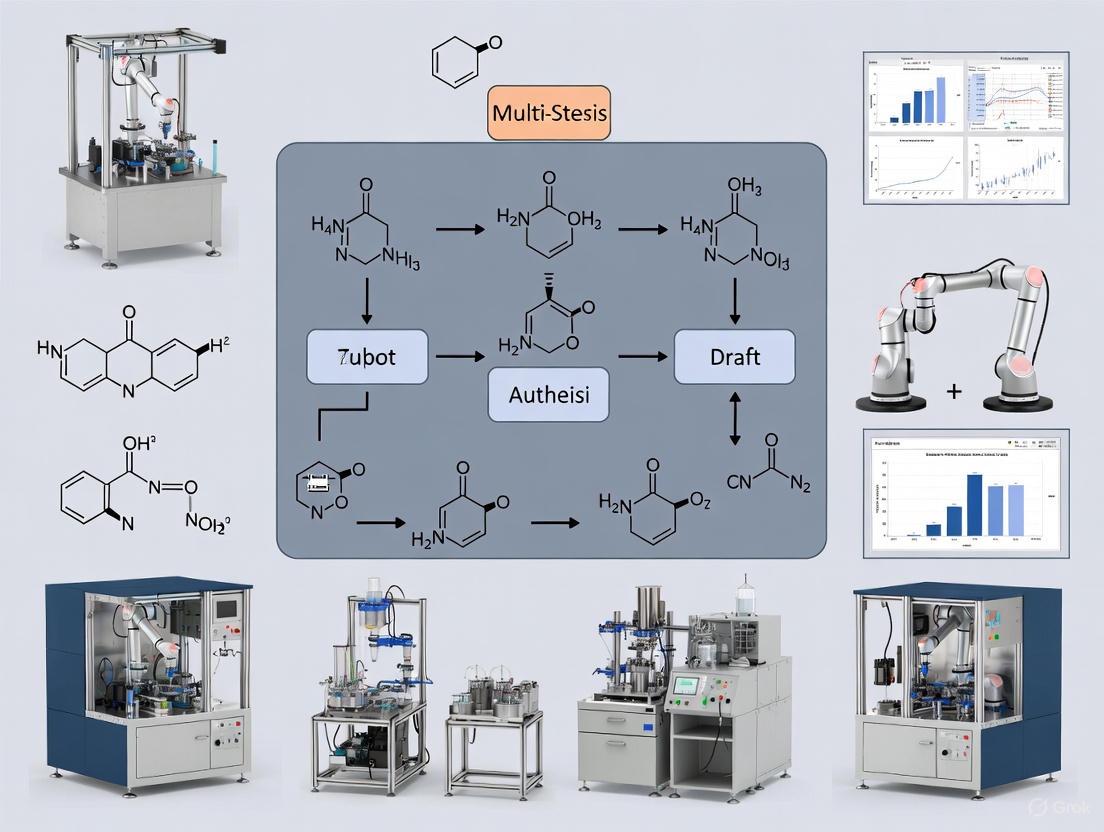
This article explores the transformative impact of autonomous laboratories, or self-driving labs, which integrate robotic platforms with artificial intelligence (AI) to execute multi-step chemical synthesis.
Autonomous Multi-Step Synthesis: How Robotic Platforms and AI Are Accelerating Drug Discovery and Materials Science
Abstract
This article explores the transformative impact of autonomous laboratories, or self-driving labs, which integrate robotic platforms with artificial intelligence (AI) to execute multi-step chemical synthesis. Tailored for researchers, scientists, and drug development professionals, it covers the foundational principles of these closed-loop systems that shift research from traditional trial-and-error to AI-driven, automated experimentation. The scope includes methodological insights into platform architectures, from liquid handling to mobile robots, and their application in synthesizing nanomaterials and organic molecules. It further addresses key challenges in optimization and troubleshooting, such as data quality and hardware modularity, and provides a comparative validation of the performance and efficiency of different AI algorithms. By synthesizing these facets, the article outlines how autonomous synthesis is poised to accelerate discovery in biomedicine and clinical research.
The New Paradigm: Foundations of Autonomous Labs and Closed-Loop Discovery
Autonomous laboratories, often termed self-driving labs, represent a transformative paradigm in scientific research, fundamentally accelerating the discovery and development of novel materials and molecules. These systems integrate artificial intelligence (AI), robotic experimentation, and automation technologies into a continuous, closed-loop cycle to conduct scientific experiments with minimal human intervention [1]. This shift moves research from traditional, often intuitive, trial-and-error approaches to a data-driven, iterative process where AI plans experiments, robotics execute them, and data is automatically analyzed to inform the next cycle. The core value proposition lies in dramatically compressed discovery timelines; processes that once required months of manual effort can now be condensed into high-throughput, automated workflows [1]. This transformation is particularly impactful in fields like inorganic materials synthesis [2] and organic chemistry [3], where the exploration space is vast and the experimental burden is high.
Core Architecture of an Autonomous Laboratory
The operational backbone of an autonomous laboratory is a tightly integrated, closed-loop cycle. This architecture seamlessly connects computational design with physical experimentation and learning, creating a self-optimizing system.
The Autonomous Workflow Cycle
The following diagram illustrates the continuous, closed-loop process that defines a self-driving lab:
Diagram 1: The core closed-loop workflow of an autonomous laboratory.
This workflow consists of four critical, interconnected stages:
- AI-Driven Experimental Planning: Given a target molecule or material, an AI model, trained on vast literature data and prior knowledge, generates initial synthesis schemes. This includes selecting precursors, defining intermediates for each reaction step, and proposing optimal reaction conditions [1]. In advanced systems, Large Language Models (LLMs) can perform this planning, using natural language processing to interpret scientific literature and design feasible experiments [1] [3].
- Robotic Execution: Robotic systems automatically execute the synthesis recipe. This involves precise liquid handling, solid dispensing, reaction control (e.g., temperature, stirring), and sample collection [1]. Platforms can range from modular systems with mobile robots transporting samples between fixed instruments [1] to integrated robotic arms that handle existing laboratory equipment [4].
- Automated Analysis and Characterization: The products are automatically transferred to analytical instruments. Software algorithms or machine learning models then analyze the characterization data (e.g., from XRD, UPLC-MS, NMR) for substance identification and yield estimation [1] [4].
- Data Interpretation and AI Learning: The analyzed results are fed back to the AI system. Using techniques like active learning and Bayesian optimization, the AI interprets the data and proposes improved synthetic routes or refined conditions for the next experiment, thus closing the loop [1] [2].
System Architecture and Control Layers
Implementing the autonomous workflow requires a structured control system. Drawing parallels from robot-aided rehabilitation, a effective control architecture can be conceptualized in three layers [5]:
- Deliberative Layer: This is the "brain" of the operation, where high-level planning occurs. It uses AI for long-term strategy, such as planning a multi-step synthesis campaign or optimizing a therapeutic trajectory over multiple cycles. This layer is implemented using automated planning and scheduling methodologies [5].
- Reactive Layer: This layer processes real-time data from the physical instruments and dynamically adjusts the robot's behavior during an experiment. It can respond to immediate feedback, such as adjusting assistance levels in a physical system or modifying task difficulty, ensuring stability and adaptability during execution [5].
- Physical Layer: This encompasses the direct interaction with the physical world, including both monitoring (sensors, cameras, analytical instruments that collect data on the experiment) and effectors (robotic arms, liquid handlers, and other actuators that carry out the physical tasks) [5].
Quantitative Performance of Pioneering Platforms
The efficacy of autonomous laboratories is demonstrated by several pioneering platforms that have achieved significant milestones in materials and chemical synthesis. The table below summarizes the performance metrics of key implementations.
Table 1: Performance Metrics of Select Autonomous Laboratory Platforms
| Platform Name | Primary Focus | Reported Performance | Key Technologies Integrated | Citation |
|---|---|---|---|---|
| A-Lab | Solid-state synthesis of inorganic powders | Synthesized 41 of 58 target compounds (71% success rate) over 17 days of continuous operation. | AI-powered recipe generation, robotic solid-state synthesis, ML-based XRD phase analysis, ARROWS3 active learning. | [1] [2] |
| Modular Platform (Dai et al.) | Exploratory synthetic chemistry | Autonomously performed screening, replication, scale-up, and functional assays over multi-day campaigns. | Mobile robots, Chemspeed synthesizer, UPLC-MS, benchtop NMR, heuristic reaction planner. | [1] |
| Coscientist | Automated chemical synthesis | Successfully optimized palladium-catalyzed cross-coupling reactions. | LLM agent with web search, document retrieval, and robotic control capabilities. | [1] |
| Camera Detection System | Robotic-arm-based lab automation | Achieved digital display recognition with an error rate of 1.69%, comparable to manual reading. | Low-cost Raspberry Pi camera, fiducial (ArUco) markers, deep learning neural network, OpenCV. | [4] |
Experimental Protocol: Implementing a Basic Autonomous Workflow for Material Synthesis
This protocol outlines the key steps for establishing an autonomous synthesis and characterization cycle, based on the operational principles of platforms like A-Lab [1] [2].
Reagents and Hardware Configuration
Table 2: Essential Research Reagents and Hardware for an Autonomous Materials Lab
| Item Category | Specific Examples / Requirements | Primary Function in the Workflow |
|---|---|---|
| Precursor Materials | High-purity solid powders (e.g., metal oxides, carbonates, phosphates). | Raw materials for solid-state synthesis of target compounds. |
| Robotic Platform | Robotic arm (e.g., Horst600) or integrated synthesis station (e.g., Chemspeed ISynth). | Automated weighing, mixing, and sample handling. |
| High-Temperature Furnace | Programmable furnace with robotic loading/unloading capability. | Performing solid-state reactions at specified temperatures and atmospheres. |
| Characterization Instrument | X-ray Diffractometer (XRD) with an automated sample changer. | Phase identification and quantification of synthesis products. |
| Fiducial Markers | Augmented Reality University of Cordoba (ArUco) markers. | Object detection and spatial localization for robotic cameras [4]. |
| Software & AI Models | Natural-language models for recipe generation, Convolutional Neural Networks (CNNs) for XRD analysis, Active Learning algorithms (e.g., Bayesian optimization). | Experimental planning, data analysis, and iterative optimization. |
Step-by-Step Procedure
Target Selection and Initialization:
- Input: Provide the target material's composition or structure, often identified from computational databases (e.g., the Materials Project) [1] [2].
- AI Planning: The AI system, trained on historical literature, generates an initial synthesis recipe, including precursor selection and mixing ratios, and a proposed reaction temperature profile.
Robotic Synthesis Execution:
- Dispensing: The robotic arm precisely weighs and dispenses the required precursor powders into a reaction vessel (e.g., a ceramic mortar or ball mill vial). Fiducial markers on lab equipment aid the robot in accurate navigation and operation [4].
- Mixing: The system performs mixing or grinding according to the planned protocol.
- Reaction: The robotic arm transfers the sample to a furnace, which is heated according to the AI-defined temperature profile.
Automated Product Characterization:
- Transfer: After the reaction, the robot moves the synthesized powder to an XRD sample holder.
- Measurement: The XRD instrument automatically collects a diffraction pattern.
- Phase Analysis: A machine learning model (e.g., a CNN) analyzes the XRD pattern in real-time to identify the crystalline phases present and estimate the yield of the target material [1].
Data Analysis and Decision Making:
- Learning: The outcome (success/failure and yield) is fed to an active learning algorithm.
- Optimization: If the synthesis fails or the yield is low, the AI uses this data to refine the synthesis parameters (e.g., temperature, precursor ratio, or even a completely new precursor set).
- Iteration: The system automatically initiates the next experiment with the updated recipe, continuing the closed-loop cycle.
The following diagram details the system architecture that enables this protocol:
Diagram 2: The layered control architecture connecting AI planning to physical hardware.
The Scientist's Toolkit: Key Enabling Technologies
The functionality of autonomous labs is enabled by a suite of advanced software and hardware tools.
Table 3: Key Enabling Technologies for Autonomous Laboratories
| Technology | Specific Function | Example Implementation |
|---|---|---|
| Large Language Models (LLMs) | Recipe generation from literature, planning multi-step syntheses, operating robotic systems via natural language commands. | ChemCrow, Coscientist, ChemAgents [1] [3]. |
| Computer Vision | Robotic navigation, sample identification, and automated readout of instrument displays. | ArUco markers with OpenCV, deep learning neural networks for digit recognition [4]. |
| Active Learning & Bayesian Optimization | Intelligently selecting the most informative experiments to perform next, maximizing learning and optimization efficiency. | ARROWS3 algorithm used in A-Lab for iterative route improvement [1] [2]. |
| Mobile Manipulators | Transporting samples between different, non-integrated laboratory instruments, enabling modular automation. | TIAGo mobile manipulator operating with LAPP (Laboratory Automation Plug & Play) concept [6]. |
| Standardized Communication Protocols | Ensuring interoperability between different instruments and software from various manufacturers. | SiLA (Standardization in Lab Automation) and ROS (Robot Operating System) frameworks [6]. |
Current Constraints and Future Directions
Despite their promise, autonomous laboratories face several constraints that limit widespread deployment. Key challenges include:
- Data Dependency: AI model performance is heavily reliant on high-quality, diverse data. Data scarcity, noise, and inconsistency can hinder accurate characterization and planning [1].
- Lack of Generalization: Most systems are specialized for specific reaction types or materials. AI models struggle to transfer knowledge to new scientific domains [1].
- Hardware Rigidity: Current platforms often lack modular hardware architectures that can seamlessly accommodate the diverse requirements of different chemical tasks (e.g., solid-phase vs. liquid-phase synthesis) [1] [6].
- LLM Reliability: LLMs can occasionally generate plausible but incorrect chemical information or confident-sounding answers without indicating uncertainty, which could lead to failed experiments or safety hazards [1].
Future development will focus on overcoming these hurdles by training foundation models across different domains, developing standardized interfaces for hardware, embedding targeted human oversight, and employing advanced techniques like transfer learning to adapt models to new data-poor domains [1]. The continued integration of more advanced AI, coupled with robust and modular robotic systems, promises to further enhance the intelligence, capacity, and reliability of autonomous laboratories, solidifying their role as a cornerstone of modern scientific discovery.
Application Notes
The implementation of closed-loop systems for autonomous multi-step synthesis represents a paradigm shift in materials science and drug development. These systems integrate robotic experimentation, artificial intelligence (AI), and continuous data management to accelerate discovery and optimization processes. By creating a continuous cycle of experimentation, analysis, and decision-making, researchers can navigate complex parameter spaces with unprecedented efficiency and reproducibility.
Core Architectural Components
A robust closed-loop system for autonomous synthesis requires tight integration of several key components that work in concert to enable fully automated discovery workflows.
Robotic Synthesis Platforms: Automated platforms such as the Chemspeed ISynth synthesizer form the physical core of the system, enabling precise and reproducible handling of reagents and execution of synthetic procedures without human intervention [7]. These systems must accommodate a wide range of chemical transformations and process conditions required for multi-step synthesis.
Multi-Modal Analytical Integration: Orthogonal characterization techniques are essential for comprehensive reaction monitoring. Successful implementations combine instruments such as ultrahigh-performance liquid chromatography-mass spectrometry (UPLC-MS) for separation and mass analysis and benchtop nuclear magnetic resonance (NMR) spectroscopy for structural elucidation [7]. This multi-technique approach mirrors the decision-making process of human researchers who rarely rely on single analytical methods.
Mobile Robotic Sample Transfer: Free-roaming mobile robots provide the physical connectivity between modular system components, transporting samples between synthesis platforms and analytical instruments [7]. This modular approach allows existing laboratory equipment to be integrated without extensive redesign or monopolization of instruments, making the system highly flexible and scalable.
AI-Driven Decision-Making: The intelligence of the closed-loop system resides in algorithmic decision-makers that process analytical data to determine subsequent experimental steps. Heuristic approaches designed by domain experts can evaluate results from multiple analytical techniques and provide binary pass/fail decisions for each reaction, determining which pathways to pursue in subsequent synthetic steps [7].
System Performance and Validation
Quantitative assessment of closed-loop system performance demonstrates significant acceleration of research workflows compared to traditional manual approaches.
Table 1: Performance Metrics of Closed-Loop Synthesis Systems
| Performance Metric | Manual Synthesis | Closed-Loop System | Improvement Factor |
|---|---|---|---|
| Experimental Throughput | 1-10 experiments/day | 10-100 experiments/day | 10×−100× acceleration [8] |
| Discovery Timelines | Months to years | Days to weeks | Years reduced to days [9] |
| Data Generation Volume | Limited by human capacity | Continuous, automated collection | Massive dataset generation [8] |
| Reproducibility | Batch-to-batch variation | High reproducibility | Standardized protocols [10] |
The "Rainbow" system for metal halide perovskite (MHP) nanocrystal synthesis exemplifies these performance improvements, autonomously navigating a 6-dimensional input and 3-dimensional output parameter space to optimize optical properties including photoluminescence quantum yield and emission linewidth [8]. Similarly, modular robotic workflows have demonstrated capability in supramolecular host-guest chemistry and photochemical synthesis, autonomously identifying successful reactions and checking reproducibility of screening hits before scale-up [7].
Data Management Infrastructure
Effective data management forms the foundation of successful closed-loop operation, particularly given the massive datasets generated by continuous experimentation.
Centralized Data Repository: All analytical data and experimental parameters are saved in a central database that serves as the system's memory, enabling pattern recognition and trend analysis across multiple experimental cycles [7].
Standardized Data Formats: Adoption of standardized data formats and protocols, such as ROS 2 in robotics applications, ensures interoperability and efficient data exchange between system components [11].
Real-Time Processing Architecture: Edge computing approaches allow data pre-processing closer to the source, reducing latency in control loops and enabling immediate feedback for time-sensitive processes [11].
Experimental Protocols
Protocol: Autonomous Multi-Step Synthesis Using Modular Robotic Workflow
This protocol describes the procedure for conducting autonomous multi-step synthesis using a modular system of mobile robots, automated synthesizers, and analytical instruments.
Preparation and System Configuration
Equipment Setup: Configure the synthesis module (e.g., Chemspeed ISynth), UPLC-MS system, benchtop NMR spectrometer, and mobile robots in physically separated but accessible locations. Install electric actuators on synthesizer doors to enable automated access by mobile robots [7].
Reagent Preparation: Stock the synthesizer with all required starting materials, solvents, and catalysts. Ensure adequate supplies for extended unmanned operation, considering potential scale-up steps for promising synthetic pathways.
Method Programming: Develop synthesis routines using platform-specific control software. For the Chemputer platform, implement procedures using the chemical description language (XDL) to ensure synthetic reproducibility [10].
Analytical Calibration: Calibrate all analytical instruments (UPLC-MS, NMR) using standard references. Establish pass/fail criteria for each analytical technique based on domain expertise and specific research objectives [7].
Synthesis Execution and Analysis
Initial Reaction Array: Program the synthesizer to execute the first set of reactions based on experimental design parameters. For divergent syntheses, this typically involves preparing common precursor molecules [7].
Automated Sampling: Upon reaction completion, the synthesizer takes aliquots of each reaction mixture and reformats them separately for MS and NMR analysis.
Robotic Sample Transfer: Mobile robots retrieve samples from the synthesizer and transport them to the appropriate analytical instruments. A single robot with a multipurpose gripper can perform all transfer tasks, though multiple task-specific robots increase throughput [7].
Orthogonal Analysis: Conduct UPLC-MS analysis to monitor reaction conversion and identify major products. Perform benchtop NMR spectroscopy for structural verification. Data acquisition occurs autonomously through customizable Python scripts [7].
Decision-Making and Iteration
Data Integration: Analytical results are saved in the central database and processed by the heuristic decision-maker. The algorithm evaluates data from both analytical techniques according to predefined criteria.
Pathway Selection: Reactions that meet pass criteria for both NMR and UPLC-MS analyses proceed to the next synthetic step. Failed reactions are documented but not pursued further in the autonomous workflow [7].
Scale-Up and Elaboration: Successful precursors are automatically scaled up and subjected to divergent synthesis steps, creating a library of structurally related compounds for further evaluation.
Iterative Cycling: The synthesis-analysis-decision cycle continues without human intervention until predefined objectives are met or the experimental space is sufficiently explored.
Protocol: Closed-Loop Optimization of Nanocrystal Synthesis
This protocol details the procedure for autonomous optimization of metal halide perovskite (MHP) nanocrystal optical properties using the Rainbow platform.
System Initialization
Hardware Configuration: The Rainbow platform integrates a liquid handling robot for precursor preparation and multi-step synthesis, a characterization robot for spectroscopic measurements, a robotic plate feeder for labware replenishment, and a robotic arm for sample transfer [8].
Parameter Space Definition: Define the 6-dimensional input parameter space including ligand structures, precursor concentrations, reaction times, and temperature parameters. Establish output objectives targeting photoluminescence quantum yield (PLQY), emission linewidth (FWHM), and peak emission energy [8].
AI Agent Configuration: Implement machine learning algorithms for experimental planning. Bayesian optimization approaches are particularly effective for navigating high-dimensional parameter spaces with multiple objectives [8].
Autonomous Optimization Cycle
Parallelized Synthesis: The liquid handling robot prepares NC precursors and conducts parallelized, miniaturized batch synthesis reactions using multiple reactor stations.
Real-Time Characterization: Automated sampling transfers reaction products to spectroscopic instrumentation for continuous measurement of UV-Vis absorption and emission properties.
Performance Evaluation: The AI agent calculates performance metrics based on target objectives, comparing current results to previous experiments and established benchmarks.
Experimental Planning: Based on all accumulated data, the AI agent selects the next set of experimental conditions, balancing exploration of unknown regions of parameter space with exploitation of promising areas [8].
Continuous Operation: The system operates autonomously until reaching target performance thresholds or completing a predefined number of experimental cycles.
Knowledge Extraction and Validation
Pareto-Front Mapping: The system identifies Pareto-optimal formulations that represent the best possible trade-offs between multiple competing objectives, such as PLQY versus FWHM at target emission energies [8].
Retrosynthesis Analysis: Data mining of successful synthetic pathways enables derivation of structure-property relationships and development of retrosynthetic principles for specific material properties.
Scale-Up Validation: Transfer optimal synthesis conditions identified in miniaturized batch reactors to larger-scale production to verify scalability and practical applicability.
Visualization
Core Architecture of Closed-Loop System
Autonomous Synthesis Workflow
The Scientist's Toolkit: Research Reagent Solutions
Table 2: Essential Research Reagents and Materials for Autonomous Synthesis Platforms
| Reagent/Material | Function | Application Example |
|---|---|---|
| Organic Acid/Base Ligands | Control nanocrystal growth and stabilization via acid-base equilibrium reactions; tune optical properties [8]. | MHP NC surface ligation |
| Metal Halide Precursors | Provide metal and halide components for perovskite crystal formation; determine composition and bandgap [8]. | CsPbX₃ (X=Cl, Br, I) NC synthesis |
| Post-Synthesis Halide Exchange Reagents | Fine-tune bandgap through anion exchange; precisely control optical properties in the UV-visible spectral region [8]. | MHP NC bandgap engineering |
| Molecular Machine Building Blocks | Structurally diverse components for complex molecular assembly; enable construction of architectures with specific functions [10]. | [2]Rotaxane synthesis |
| Supramolecular Host-Guest Components | Form self-assembled structures with specific binding properties; enable creation of complex molecular recognition systems [7]. | Host-guest chemistry studies |
| Size Exclusion Chromatography Media | Purify reaction products based on molecular size; separate desired products from starting materials and byproducts [10]. | Purification of molecular machines |
| Silica Gel Chromatography Media | Standard stationary phase for purification; separate compounds based on polarity differences [10]. | Routine reaction purification |
The pursuit of new functional molecules, whether for drug discovery or advanced materials, requires navigating vast chemical spaces—theoretical spaces encompassing all possible molecules and compounds. These spaces are inherently high-dimensional, meaning each molecular descriptor (e.g., molecular weight, lipophilicity, presence of functional groups) constitutes a separate dimension. For a researcher, this high-dimensionality presents a fundamental challenge: the combinatorial explosion of possible experiments makes exhaustive exploration through traditional, manual "one-parameter-at-a-time" methods entirely infeasible [12] [13].
This inefficiency of manual experimentation is a critical bottleneck. In fields like metal halide perovskite (MHP) nanocrystal synthesis, this complex synthesis space limits the full exploitation of the material's extraordinary tunable optical properties [12]. Similarly, in drug discovery, virtual screening methods generate high-dimensional mathematical models that are difficult to interpret and analyze without specialized computational resources [13]. Autonomous multi-step synthesis using robotic platforms emerges as a powerful solution to this challenge, integrating automation, real-time characterization, and intelligent decision-making to navigate this complexity efficiently and reproducibly.
Autonomous Robotic Platforms as a Solution
Autonomous laboratories represent a paradigm shift, moving beyond simple automation to systems where agents, algorithms, or artificial intelligence (AI) not only execute experiments but also record and interpret analytical data to make subsequent decisions [14]. This closed-loop functionality is key to tackling high-dimensional spaces. These self-driving labs (SDLs) can accelerate the discovery of novel materials and synthesis strategies by a factor of 10 to 100 times compared to the status quo in traditional experimental labs [12].
Two prominent architectural philosophies have emerged for these platforms:
- Modular Mobile Robot Systems: These systems use free-roaming mobile robots to physically connect otherwise independent laboratory instruments, such as an automated synthesizer, a liquid chromatography–mass spectrometer (UPLC-MS), and a benchtop nuclear magnetic resonance (NMR) spectrometer [14]. This approach leverages existing laboratory equipment without requiring extensive, bespoke redesign, allowing robots and human researchers to share infrastructure.
- Integrated Multi-Robot Platforms: Systems like the "Rainbow" platform for MHP nanocrystals are designed as integrated units, featuring multiple dedicated robots for tasks like liquid handling, sample transfer, and characterization [12]. This design is optimized for intensified, high-throughput exploration of a specific class of materials.
The core of these platforms' effectiveness lies in their AI-driven decision-making. An AI agent is provided with a human-defined goal and, by emulating existing experimental data, iteratively proposes the next set of experiments, effectively balancing the exploration of the unknown chemical space with the exploitation of promising leads [12].
Application Notes & Protocols
This section provides detailed methodologies for implementing autonomous platforms to navigate complex chemical spaces.
Protocol 1: Modular Mobile Robotics for Exploratory Organic Synthesis
This protocol outlines the procedure for using a modular system with mobile robots to perform exploratory synthesis, as demonstrated for the structural diversification of ureas and thioureas, and supramolecular chemistry [14].
- Primary Objective: To autonomously synthesize and characterize a library of organic molecules, identifying successful reactions for further elaboration without human intervention.
- Experimental Workflow: The following diagram illustrates the closed-loop, decision-making workflow.
- Step-by-Step Procedure:
- Synthesis Module Setup: Load the automated synthesis platform (e.g., Chemspeed ISynth) with the required starting materials and solvents.
- Parallel Synthesis Execution: The platform autonomously performs the combinatorial condensation reactions according to a pre-defined set of starting conditions.
- Sample Reformating and Aliquoting: Upon reaction completion, the synthesizer takes an aliquot of each reaction mixture and reformats it into standard vials for UPLC-MS and NMR analysis.
- Mobile Robot Transport: A mobile robot retrieves the sample vials and transports them across the laboratory to the UPLC-MS and benchtop NMR spectrometers.
- Orthogonal Analysis: The analytical instruments autonomously run their characterization methods. Python scripts control data acquisition, and the results are saved to a central database.
- Heuristic Decision-Making: A decision-maker algorithm processes the orthogonal UPLC-MS and
H NMRdata. For each reaction, it provides a binary "pass" or "fail" grade based on experiment-specific criteria defined by a domain expert. - Data Fusion and Action: The binary results from both analytical techniques are combined. In the demonstrated workflow, a reaction must pass both analyses to proceed.
- Closed-Loop Execution: Reactions that pass are automatically selected for scale-up or further elaboration in a subsequent synthetic step. Failed reactions are not pursued.
Protocol 2: AI-Driven Optimization of Nanocrystal Synthesis
This protocol details the operation of an integrated multi-robot platform, like the "Rainbow" system, for autonomously optimizing the optical properties of metal halide perovskite (MHP) nanocrystals (NCs) [12].
- Primary Objective: To efficiently navigate a high-dimensional, mixed-variable parameter space and identify Pareto-optimal synthesis conditions for target photoluminescence properties.
- Experimental Workflow: The following diagram illustrates the continuous feedback loop of the AI-driven optimization process.
- Step-by-Step Procedure:
- Goal Definition: The user defines the optimization objective, which is typically a multi-objective function combining target peak emission energy (
E_P), maximized photoluminescence quantum yield (PLQY), and minimized emission linewidth (FWHM). - AI Experimental Proposal: Based on initial data or a prior, the AI agent (e.g., using a Bayesian Optimization algorithm) selects a set of promising experimental conditions from the 6-dimensional input space (e.g., involving ligand structure, precursor concentrations, halide exchange parameters).
- Robotic Synthesis and Characterization: A liquid-handling robot prepares NC precursors and executes a multi-step, room-temperature synthesis in parallelized, miniaturized batch reactors. A characterization robot then transfers samples to a benchtop spectrometer to acquire UV-Vis absorption and photoluminescence emission spectra.
- Data Processing: The spectral data is automatically processed to extract the key performance metrics: PLQY, FWHM, and
E_P. - AI Model Update: The new experimental results (both successful and failed) are added to the dataset, and the AI model is updated to refine its understanding of the synthesis landscape.
- Closed-Loop Iteration: The updated AI agent proposes the next batch of experiments, balancing exploration of uncertain regions of the parameter space with exploitation of known high-performance areas.
- Completion and Knowledge Extraction: The loop continues until a target is reached or a user-defined stopping point is met. The system then outputs the Pareto-optimal formulations and provides retrosynthesis knowledge that can be directly transferred to scaled-up production.
- Goal Definition: The user defines the optimization objective, which is typically a multi-objective function combining target peak emission energy (
Data Presentation & Analysis
Quantitative Comparison of Autonomous Platforms
Table 1: Comparative Analysis of Featured Autonomous Robotic Platforms
| Feature | Modular Mobile Robot System [14] | Integrated Multi-Robot Platform (Rainbow) [12] |
|---|---|---|
| System Architecture | Distributed, instruments linked by mobile robots | Integrated, dedicated robots for specific tasks |
| Primary Application | Exploratory organic & supramolecular synthesis | Optimization of nanocrystal optical properties |
| Key Analytical Techniques | UPLC-MS, Benchtop NMR | UV-Vis, Photoluminescence spectroscopy |
| Decision-Making Engine | Heuristic, rule-based algorithm | AI-driven (e.g., Bayesian Optimization) |
| Handled Data Dimensions | Multimodal, orthogonal data fusion | 6-dimensional input, 3-dimensional output space |
| Throughput Advantage | Enables sharing of lab equipment with humans | Highly parallelized, intensified research framework |
| Reported Acceleration | Mimics human decision-making protocols | 10× to 100× acceleration vs. manual methods |
Key Reagent Solutions for Featured Experiments
Table 2: Essential Research Reagents and Materials
| Item | Function in the Protocol | Example/Note |
|---|---|---|
| Alkyne Amines | Building blocks for combinatorial library synthesis (Protocol 1) [14] | e.g., Compounds 1-3 for urea/thiourea formation |
| Isothiocyanates / Isocyanates | Electrophilic coupling partners for diversification [14] | e.g., Compounds 4 and 5 |
| Organic Acid/Base Ligands | Control growth & optical properties of nanocrystals [12] | Critical discrete variable in MHP NC optimization |
| Cesium Lead Halide Precursors | Starting materials for metal halide perovskite synthesis [12] | e.g., CsPbBr3 for post-synthesis halide exchange |
| Morgan Fingerprints | Molecular descriptor for chemical space analysis [15] | 1024-bit, radius 2 used for dimensionality reduction |
| PCA (Principal Component Analysis) | Statistical method for prioritizing molecular descriptors [13] | Reduces dimensionality, eliminates redundant descriptors |
Essential Methodologies for Data Handling
A critical component of managing high-dimensional chemical spaces is the use of dimensionality reduction (DR) techniques, which transform high-dimensional descriptor data into human-interpretable 2D or 3D maps, a process known as chemography [15].
- Technique Selection: Common DR techniques include:
- Principal Component Analysis (PCA): A linear method that finds the axes of greatest variance in the data. It is widely used to reduce the number of dimensions by selecting the most influential molecular descriptors, potentially reducing original dimensions to one-twelfth of their size [13].
- t-SNE and UMAP: Non-linear methods that are particularly effective at preserving local neighborhood structures within the data in the low-dimensional embedding, often providing superior visual cluster separation [15].
- Protocol for Neighborhood Preservation Analysis:
- Descriptor Calculation: Generate high-dimensional molecular descriptors (e.g., Morgan fingerprints, MACCS keys) for the entire compound set.
- Apply Dimensionality Reduction: Project the data into 2D space using PCA, t-SNE, UMAP, or other algorithms.
- Define Neighbors: In both the original high-dimensional space and the reduced latent space, define the k-nearest neighbors for each compound using an appropriate distance metric (e.g., Euclidean distance, Tanimoto similarity).
- Calculate Preservation Metrics: Quantify the quality of the DR using metrics like the percentage of preserved nearest neighbors (
PNNk), which calculates the average number of shared k-nearest neighbors between the original and latent spaces [15]. Other metrics like trustworthiness and continuity further assess the embedding's quality. - Hyperparameter Optimization: Perform a grid-based search of the DR algorithm's hyperparameters (e.g., perplexity for t-SNE, number of neighbors for UMAP) to maximize the neighborhood preservation metrics.
The integration of Large Language Models (LLMs), Bayesian Optimization, and Robotic Arms is creating a paradigm shift in autonomous research laboratories. These technologies collectively enable self-driving labs (SDLs) that can autonomously design, execute, and optimize complex multi-step synthesis processes with minimal human intervention. This technological triad functions as an interconnected system where LLMs provide high-level reasoning and protocol generation, Bayesian Optimization enables efficient experimental space exploration, and robotic arms deliver precise physical execution capabilities.
The significance of this integration lies in its ability to address fundamental challenges in experimental science: overcoming human cognitive limitations in high-dimensional parameter spaces, dramatically accelerating discovery timelines, and enhancing reproducibility. These systems are particularly transformative for fields requiring extensive experimental iteration, including drug development, materials science, and catalyst research, where they enable systematic exploration of complex synthesis landscapes that were previously intractable through manual approaches.
Technology-Specific Roles and Implementation
Large Language Models (LLMs) in Autonomous Experimentation
Large Language Models serve as the cognitive center of autonomous research platforms, providing natural language understanding, reasoning capabilities, and procedural knowledge. In advanced implementations, LLMs are deployed within specialized multi-agent architectures where different LLM instances assume distinct roles mirroring human research teams:
- Biologist Agent: Specializes in experimental design and protocol synthesis using retrieval-augmented generation (RAG) to incorporate current scientific literature. This agent converts research objectives into structured experimental procedures while accounting for laboratory constraints [16].
- Technician Agent: Translates natural language protocols into executable robotic commands through pseudo-code generation. This agent bridges the semantic gap between experimental intent and physical implementation [16].
- Inspector Agent: Utilizes vision-language models (VLMs) for real-time quality control, anomaly detection, and procedural validation during experiment execution [16].
The implementation of LLMs in systems like BioMARS demonstrates the hierarchical specialization essential for handling complex research workflows. In this architecture, the Biologist Agent first generates biologically valid protocols, the Technician Agent then decomposes these into precise robotic instructions, and the Inspector Agent continuously monitors execution fidelity through multimodal perception [16]. This division of labor enables robust handling of the entire experimental lifecycle from design to execution.
Bayesian Optimization for Experimental Design
Bayesian Optimization provides the mathematical framework for efficient exploration of high-dimensional experimental spaces. This machine learning approach employs probabilistic surrogate models to balance exploration of unknown regions with exploitation of promising areas, dramatically reducing the number of experiments required to identify optimal conditions.
In advanced materials research, Bayesian Optimization has demonstrated particular efficacy in navigating mixed-variable parameter spaces containing both continuous and discrete parameters. The Rainbow SDL exemplifies this application in optimizing metal halide perovskite nanocrystals, where the algorithm simultaneously manipulates ligand structures, precursor concentrations, and reaction conditions to maximize target optical properties [8].
The implementation typically follows an iterative cycle:
- Initial experimental design based on prior knowledge or space-filling sampling
- Surrogate model training on accumulated experimental data
- Acquisition function calculation to identify the most promising next experiment
- Automated execution of selected experiment
- Model updating with new results
- Repeat until convergence to optimal conditions or exhaustion of experimental budget
This approach has achieved 10×-100× acceleration in materials discovery compared to traditional one-variable-at-a-time experimentation, making it particularly valuable for optimizing complex, nonlinear synthesis processes with multiple interacting parameters [8].
Robotic Arms for Physical Automation
Robotic arms provide the physical embodiment necessary to transform computational designs into tangible experiments. Modern implementations range from single-arm systems for straightforward liquid handling to complex dual-arm platforms that mimic human dexterity for intricate manipulation tasks.
In biological applications, systems like BioMARS employ dual-arm robotic platforms that enable sophisticated coordination for cell culture procedures including passaging, medium exchange, and viability assessment [16]. These systems achieve performance matching or exceeding manual techniques in consistency, viability, and morphological integrity while operating continuously without fatigue.
Alternative automation architectures include roll-to-roll systems that eliminate the need for robotic arms in specific applications. The CatBot platform for electrocatalyst development exemplifies this approach, using continuous substrate transfer through sequential processing stations for cleaning, synthesis, and electrochemical testing [17]. This design enables fabrication and testing of up to 100 catalyst-coated samples daily without manual intervention.
Table 1: Comparative Analysis of Robotic Automation Architectures
| Architecture | Key Features | Throughput | Application Examples | Limitations |
|---|---|---|---|---|
| Single-Arm Systems | Basic liquid handling, simpler programming | Moderate | Routine liquid transfer, sample preparation | Limited dexterity for complex tasks |
| Dual-Arm Platforms | Human-like coordination, complex manipulation | High | Cell culture, intricate synthesis procedures | Higher cost, complex programming |
| Roll-to-Roll Systems | Continuous processing, minimal moving parts | Very High | Catalyst coating, film deposition | Limited to substrate-based processes |
| Multi-Robot Cells | Parallel processing, specialized stations | Highest | Perovskite nanocrystal synthesis [8] | Highest complexity and cost |
Integrated Experimental Protocols
Protocol 1: Autonomous Cell Culture and Maintenance
System: BioMARS (Biological Multi-Agent Robotic System) [16]
Objective: Fully automated passage and maintenance of mammalian cell lines, achieving viability and consistency comparable to manual techniques.
Experimental Workflow:
Protocol Generation Phase:
- The Biologist Agent processes natural language queries (e.g., "Passage HeLa cells at 80% confluency") using retrieval-augmented generation from scientific literature and internal databases [16].
- Generated protocols undergo validation through Knowledge Checker and Workflow Checker modules to ensure biological accuracy and logical coherence.
- Output includes detailed step-by-step procedures with specific reagent volumes, environmental conditions (37°C, 5% CO₂), and timing parameters.
Code Translation Phase:
- The Technician Agent converts natural language protocols into executable robotic pseudo-code using a CodeGenerator module.
- A CodeChecker module validates instructions against laboratory constraints (container availability, pipette volume limits) [16].
- Output includes primitives such as
aspirate_medium,wash_with_PBS,add_trypsin,incubate,neutralize,seed_new_flask.
Execution Phase:
- Dual robotic arms coordinate to execute the translated protocol with one arm handling container positioning and the other performing liquid transfer operations.
- The Inspector Agent employs real-time vision monitoring to confirm procedural steps including confluency assessment, detachment verification, and morphological inspection [16].
- Anomalies such as misaligned containers or pipetting errors trigger automatic pausing and corrective protocols.
Data Recording and Optimization:
- All experimental parameters and outcomes are logged with timestamps for reproducibility analysis.
- Cell viability and confluency metrics are recorded to inform future protocol adjustments.
Diagram 1: BioMARS Cell Culture Workflow
Protocol 2: Autonomous Optimization of Metal Halide Perovskite Nanocrystals
System: Rainbow Multi-Robot Self-Driving Laboratory [8]
Objective: Autonomous navigation of a 6-dimensional parameter space to optimize photoluminescence quantum yield (PLQY) and emission linewidth at target emission energies.
Experimental Workflow:
Objective Definition Phase:
- Researchers specify target optical properties through a web interface, typically defining a multi-objective function combining PLQY, FWHM (full-width-at-half-maximum), and target peak emission energy.
- The AI agent initializes with prior knowledge or begins with space-filling experimental design.
Parallel Experiment Planning Phase:
- Bayesian Optimization algorithm selects the most informative next set of experiments based on current belief of the synthesis landscape.
- The system generates specific formulations varying ligand structures, precursor ratios, and reaction conditions.
- Liquid handling robot prepares precursor solutions in miniaturized batch reactors according to generated formulations [8].
Synthesis and Characterization Phase:
- Robotic systems transfer reaction vessels through temperature-controlled zones with precise timing.
- Characterization robot performs automated UV-Vis absorption and photoluminescence spectroscopy on synthesized nanocrystals.
- Optical properties (PLQY, FWHM, peak emission) are automatically extracted and quantified.
Learning and Iteration Phase:
- New experimental results update the Bayesian Optimization surrogate model.
- The acquisition function identifies the most promising region for subsequent experimentation, balancing exploration of uncertain regions with exploitation of promising formulations.
- Cycle continues until Pareto-optimal formulations are identified or experimental budget is exhausted [8].
Table 2: Key Optimization Parameters in Perovskite Nanocrystal Synthesis
| Parameter Category | Specific Variables | Optimization Range | Impact on Properties |
|---|---|---|---|
| Ligand Structure | Organic acid chain length, binding group | 6 different organic acids | Crystal growth kinetics, surface passivation |
| Precursor Chemistry | Cesium concentration, Halide ratios (Br/Cl/I) | 0.05-0.2M Cs, various Br:I ratios | Emission energy, phase purity |
| Reaction Conditions | Temperature, Reaction time, Stirring rate | 25-100°C, 1-60 minutes | NC size, size distribution, defect density |
| Post-Synthesis Processing | Purification methods, Ligand exchange | Various solvent systems | Quantum yield, colloidal stability |
Diagram 2: Rainbow SDL Optimization Workflow
Protocol 3: High-Throughput Electrocatalyst Synthesis and Testing
System: CatBot Roll-to-Roll Automation Platform [17]
Objective: Fully automated synthesis and electrochemical characterization of up to 100 catalyst variants daily under industrially relevant conditions.
Experimental Workflow:
Substrate Preparation Phase:
- Continuous substrate (e.g., Ni wire) is fed from spool through sequential cleaning stations.
- Acid cleaning station (3M HCl) removes surface oxides and contaminants.
- Rinse station eliminates residual acid using deionized water [17].
Electrodeposition Phase:
- Cleaned substrate enters synthesis station containing metal salt electrolyte.
- Custom liquid distribution system with 7 syringe pumps enables precise multi-element catalyst deposition.
- Potentiostat applies programmed potential/current sequences to drive electrodeposition.
- System accommodates temperatures up to 100°C in highly alkaline (>30 wt% KOH) or acidic (3M HCl) media [17].
Electrochemical Testing Phase:
- Coated substrate transfers directly to testing station for performance evaluation.
- Three-electrode configuration enables accurate measurement of catalyst activity for target reactions (HER, OER, CO2RR).
- Automated system records polarization curves, impedance spectra, and stability metrics.
Sample Management Phase:
- Tested catalyst samples are collected on take-up drum for potential post-mortem characterization.
- System recycles to initial state for next experimental segment.
- All synthesis parameters and performance data are automatically correlated and stored.
The Scientist's Toolkit: Essential Research Reagents and Materials
Table 3: Key Research Reagents and Their Functions in Autonomous Synthesis Platforms
| Reagent/Material | Function | Application Examples | Technical Specifications |
|---|---|---|---|
| Specialized Cell Culture Media | Support cell growth and maintenance | Mammalian cell culture (HeLa, HUVECs) [16] | Serum-free formulations, defined components, temperature stability |
| Ligand Libraries | Control nanocrystal growth and surface passivation | Perovskite NC optimization [8] | Variable alkyl chain lengths, binding groups, purity >95% |
| Metal Salt Precursors | Source of catalytic or structural metals | Electrocatalyst electrodeposition [17] | High purity (>99.9%), solubility in deposition solvents |
| Electrolyte Formulations | Enable electrochemical synthesis and testing | Catalyst performance evaluation [17] | Acidic/alkaline stability, temperature resistance, oxygen-free |
| Functionalized Substrates | Support material for catalyst deposition | Roll-to-roll catalyst synthesis [17] | Controlled surface chemistry, electrical conductivity, mechanical stability |
Quantitative Performance Metrics
Table 4: Comparative Performance Metrics of Autonomous Research Platforms
| Performance Metric | Manual Research | BioMARS (Biology) [16] | Rainbow (Materials) [8] | CatBot (Catalysis) [17] |
|---|---|---|---|---|
| Experimental Throughput | 1-10 experiments/day | Comparable to skilled technician | 10-100× acceleration vs. manual | Up to 100 catalysts/day |
| Parameter Space Dimensionality | Typically 2-3 variables | 5+ simultaneous parameters | 6-dimensional optimization | 4+ continuous variables |
| Reproducibility (Variance) | 15-30% inter-operator | <5% batch-to-batch variance | <10% property deviation | 4-13 mV overpotential uncertainty |
| Optimization Efficiency | Sequential one-variable | Multi-parameter parallel optimization | Identifies Pareto-optimal formulations in <50 cycles | Full activity-stability mapping |
| Operational Duration | 8-hour shifts | 24-hour continuous operation | Continuous until objective achieved | 24-hour continuous operation |
Inside the Self-Driving Lab: Architectures, Workflows, and Real-World Applications
Multi-robot systems (MRS) represent a paradigm shift in automated laboratories, enabling collaborative task execution that surpasses the capabilities of single-robot units [18]. In the context of autonomous multi-step synthesis, these systems provide the foundational infrastructure for parallel experimentation, distributed sensing, and coordinated material handling. The integration of MRS with modular hardware architecture creates a scalable framework that accelerates discovery cycles in pharmaceutical development and materials science.
The significance of MRS lies in their inherent robustness through redundancy, where the failure of a single unit does not compromise entire experimental campaigns [19] [18]. Furthermore, these systems enable specialized role allocation, where different robots can be optimized for specific tasks such as synthesis, sampling, analysis, or reagent replenishment. This specialization, combined with coordination, mirrors the sophisticated workflows of human research teams while operating with machine precision and endurance.
Architectural Framework and Core Components
Multi-Robot System Architectures
Multi-robot systems employ various control architectures, each with distinct implications for autonomous synthesis applications [19]:
- Centralized Control: A single controller makes decisions and issues commands to all robots. While this provides global coordination, it creates a single point of failure and limited scalability.
- Decentralized Control: Decision-making is distributed among the robots, enabling local autonomy and adaptability but requiring more complex coordination mechanisms.
- Hybrid Approaches: These combine elements of both centralized and decentralized control, striking a balance between global coordination and local flexibility through hierarchical structures.
For synthetic chemistry applications, a hybrid approach often proves most effective, with centralized oversight of experimental objectives and decentralized execution of physical operations.
Modular Hardware Design Principles
Modular hardware architecture implements electronic systems as reusable, interchangeable blocks or modules, each with functional independence and well-defined interfaces [20]. This approach is characterized by several key advantages for research environments:
- Shorter time-to-market cycles for new experimental capabilities
- Shared platform strategy across multiple product families or experimental setups
- Specialization of hardware teams working in parallel on different modules
- Resilience to supply chain volatility through swappable modules
- Hardware-software separation allowing firmware reuse across configurations [20]
A well-structured modular system for robotic synthesis typically implements these architectural layers:
- Core processing module containing SoC, FPGA, or MCU with processing power and memory
- Interface layer with I/O expansion, ADCs, DACs, USB, Ethernet, CAN, PCIe, or LVDS
- Power management module with swappable power supplies, PMICs, or battery management systems
- Application-specific daughterboards for sensors, display drivers, RF modules, or motor drivers
- Mechanical enclosures with standardized dimensions accommodating various combinations [20]
Communication Protocols for Coordinated Operations
Protocol Classification and Characteristics
Effective communication is the cornerstone of functional multi-robot systems. Protocols can be categorized by their physical implementation and performance characteristics [21]:
Wired Communication Protocols
- EtherNet/IP: Built on standard TCP/IP, using existing network infrastructure; supports both implicit (time-sensitive I/O) and explicit messaging (configuration, monitoring) [22] [23].
- PROFINET: Designed for deterministic, high-speed data transfer with sub-millisecond cycle times; ideal for motion-heavy environments [23].
- EtherCAT: Ethernet-based protocol providing real-time communication; can control up to 65,535 nodes [22].
- CAN (Controller Area Network): Efficient data exchange between multiple microcontrollers without a host computer; commonly used in automotive and industrial robotics [21].
Wireless Communication Protocols
- Wi-Fi: Enables remote operation and real-time data transfer for autonomous robots [21].
- Zigbee: Low-power, mesh-network protocol used in swarm robotics and home automation systems [21].
- LoRa (Long Range): Designed for low-power, long-range communication, suitable for environmental monitoring robots [21].
Table 1: Comparative Analysis of Robotic Communication Protocols
| Protocol | Data Rate | Range | Topology | Use Case in Synthesis |
|---|---|---|---|---|
| EtherNet/IP | 10 Mbps - 1 Gbps+ | Up to 100m per segment | Star | Integration of synthesis modules with enterprise network |
| PROFINET | 100 Mbps - 1 Gbps | Up to 100m | Star, Ring, Line | Precision motion control in liquid handling |
| EtherCAT | 100 Mbps | Up to 1000m (copper) | Line, Star, Tree | Synchronization of multiple analysis instruments |
| CAN | 20 Kbps - 1 Mbps | Up to 1200m | Bus | Intra-module sensor networks |
| Wi-Fi | 54 Mbps - 1 Gbps+ | Up to 100m | Star | Mobile robot coordination |
| Zigbee | 250 Kbps | 10-100m | Mesh | Environmental monitoring sensors |
| Modbus TCP | 10/100 Mbps | Network dependent | Star | Basic instrument control (heating, stirring) |
Protocol Selection Framework
Selecting the appropriate communication protocol depends on several application-specific factors [21] [23]:
- Data Transfer Speed: Real-time applications such as autonomous synthesis require low-latency, high-speed communication.
- Wired vs. Wireless: Wired protocols provide stable and secure connections, while wireless protocols offer greater flexibility for mobile robots.
- Security Requirements: Protocols should include encryption and authentication mechanisms, particularly for IP-sensitive research.
- Scalability: The protocol should support seamless communication among numerous devices without significant data congestion.
- Compatibility: The selected protocol must integrate with existing laboratory equipment and control systems.
For pharmaceutical research environments with existing PLC infrastructure, the native protocol of the installed PLC platform (EtherNet/IP for Rockwell Automation or PROFINET for Siemens) often provides the most straightforward integration path [23].
Experimental Protocols for Autonomous Multi-Step Synthesis
Workflow Architecture for Chemical Synthesis
The following diagram illustrates the core workflow for autonomous multi-step synthesis using a multi-robot platform:
This workflow implements a closed-loop experimentation cycle where analytical results directly inform subsequent synthetic steps without human intervention, dramatically accelerating the design-make-test-analyze cycle [7].
Platform Integration and Robot Coordination
The modular laboratory architecture enables flexible integration of specialized instruments through mobile robot coordination:
This distributed architecture allows instruments to be shared between automated workflows and human researchers, maximizing utilization of expensive analytical equipment [7].
Detailed Experimental Protocol: Autonomous Perovskite Nanocrystal Optimization
Objective: Autonomous optimization of metal halide perovskite (MHP) nanocrystal optical properties including photoluminescence quantum yield (PLQY) and emission linewidth at targeted emission energies [8].
Platform Configuration:
- Synthesis Module: Parallelized, miniaturized batch reactors for room-temperature NC synthesis
- Robotic Handling: Liquid handling robot for precursor preparation and multi-step NC synthesis
- Analysis Module: Characterization robot for UV-Vis absorption and emission spectra
- Feeding System: Robotic plate feeder for labware replenishment
- AI Integration: Machine learning-driven decision-making for closed-loop experimentation [8]
Step-by-Step Procedure:
Precursor Preparation:
- Liquid handling robot prepares precursor solutions according to initial experimental design or AI-generated parameters
- Systematic variation of ligand structures and precursor conditions in 6-dimensional parameter space
Nanocrystal Synthesis:
- Parallel synthesis in miniaturized batch reactors with precise temperature control
- Robotic sampling at predetermined time points for growth kinetics analysis
Real-Time Characterization:
- Automated transfer of reaction aliquots to spectroscopic analysis
- Measurement of photoluminescence quantum yield (PLQY), emission linewidth (FWHM), and peak emission energy
- Continuous spectroscopic feedback for reaction monitoring
Data Analysis and Decision Making:
- Machine learning algorithm processes analytical data to evaluate performance against objectives
- Bayesian optimization identifies promising regions of parameter space for subsequent experiments
- Selection of next experimental conditions balancing exploration and exploitation
Iterative Optimization:
- Closed-loop experimentation continues until target optical properties are achieved
- Pareto-optimal front identification for multiple competing objectives
- Elucidation of structure-property relationships through systematic exploration
Validation and Scale-Up:
- Automated reproduction of optimal formulations to verify reproducibility
- Scalable synthesis conditions transferred to larger production formats [8]
Essential Research Reagents and Materials
Table 2: Key Research Reagent Solutions for Autonomous Nanocrystal Synthesis
| Reagent/Material | Function | Application Example |
|---|---|---|
| Metal Halide Salts (e.g., CsPbBr₃) | Primary nanocrystal precursors | Metal halide perovskite NC synthesis [8] |
| Organic Acid/Base Ligands | Surface stabilization & property tuning | Control of NC growth kinetics & optical properties [8] |
| Coordinating Solvents | Reaction medium & surface ligation | Solubilization of precursors & stabilization of NCs [8] |
| Halide Exchange Reagents | Post-synthesis bandgap tuning | Fine-tuning emission energy across UV-vis spectrum [8] |
| Stabilization Additives | Enhanced colloidal stability | Improved shelf-life & processability of NC formulations [8] |
Implementation Considerations and Future Directions
Engineering Challenges and Mitigation Strategies
Implementing modular multi-robot systems for autonomous synthesis presents several engineering challenges:
- Signal Integrity: High-speed interfaces (USB 3.1, HDMI, PCIe) require careful impedance matching, simulation, and shielding when using modular connectors [20].
- Power Management: Swappable modules can introduce voltage mismatches, necessitating well-designed PMIC and hot-swap protection circuits [20].
- Thermal Management: Modular enclosures may constrain airflow, requiring optimized heat sinks and thermal simulation [20].
- Firmware Abstraction: Hardware Abstraction Layer (HAL) development is essential to isolate firmware logic from hardware dependencies [20].
Emerging Trends and Future Capabilities
The field of autonomous multi-robot synthesis platforms is rapidly evolving with several promising directions:
- Edge Computing Integration: Reducing latency by processing data closer to the source [21]
- AI-Driven Protocol Optimization: Enhancing efficiency using machine learning algorithms [21]
- 5G-Powered Robotics: Enabling ultra-fast and reliable robot communication in distributed laboratory environments [21]
- Blockchain for Secure Communication: Improving data integrity and security in robotic networks [21]
- Hybrid Communication Models: Combining wired and wireless protocols for seamless connectivity [21]
These advancements will further enhance the capabilities of autonomous research platforms, accelerating the discovery and development of novel materials and pharmaceutical compounds through highly parallelized, intelligent experimentation.
The integration of artificial intelligence (AI), robotics, and advanced analytics has given rise to autonomous laboratories, fundamentally transforming the research and development landscape for chemical synthesis and drug development. These end-to-end workflows encapsulate the entire experimental cycle: from the initial AI-driven design of a target molecule to the automated physical synthesis, real-time characterization, and data-driven decision-making for subsequent iterations. This closed-loop paradigm minimizes human intervention, eliminates subjective decision points, and dramatically accelerates the exploration of novel chemical spaces. By turning processes that once took months of manual trial and error into routine, high-throughput workflows, autonomous labs are poised to accelerate discovery in pharmaceuticals and materials science [1].
At the core of these platforms is a continuous cycle. It begins with an AI model that generates synthetic routes and reaction conditions for a given target. Robotic systems then execute these recipes, handling tasks from reagent dispensing to reaction control. The resulting products are characterized using integrated analytical instruments, and the data is fed back to the AI. This AI analyzes the outcomes, learns from the results, and proposes improved experiments, creating a self-optimizing system [1] [24]. This approach is particularly powerful for multi-step synthesis and exploratory chemistry, where the goal may not simply be to maximize the yield of a known compound, but to navigate complex reaction landscapes and identify new functional molecules or supramolecular assemblies [14].
Several pioneering platforms exemplify the implementation of end-to-end autonomous workflows. The "Chemputer" standardizes and autonomously executes complex syntheses, such as the multi-step synthesis of [2]rotaxanes, by using a chemical description language (XDL) and integrating online feedback from NMR and liquid chromatography. This automation of time-consuming procedures enhances reproducibility and efficiency, averaging 800 base steps over 60 hours with minimal human intervention [10].
Another system, the "AI-driven robotic chemist" (Synbot), features a distinct three-layer architecture: an AI software layer for planning and optimization, a robot software layer for translating recipes into commands, and a robot layer for physical execution. Synbot has demonstrated the ability to autonomously determine synthetic recipes for organic compounds, achieving conversion rates that outperform existing references through iterative refinement using feedback from the experimental robot [24].
A modular approach, leveraging mobile robots, offers a highly flexible alternative. In one demonstrated workflow, free-roaming mobile robots transport samples between a Chemspeed ISynth synthesizer, a UPLC–MS, and a benchtop NMR spectrometer. This setup allows robots to share existing laboratory equipment with human researchers without monopolizing it or requiring extensive redesign. A key feature of this platform is its heuristic decision-maker, which processes orthogonal analytical data (NMR and MS) to autonomously select successful reactions for further study, mimicking human judgment [14].
Table 1: Comparison of Key Autonomous Synthesis Platforms
| Platform Name | Core Architecture | Key Analytical Techniques | Reported Application |
|---|---|---|---|
| Chemputer [10] | Universal robotic platform controlled by XDL language | On-line NMR, Liquid Chromatography | Multi-step synthesis of [2]rotaxanes |
| Synbot [24] | Three-layer AI/robot software/hardware | LC-MS | Optimization of organic compound synthesis |
| Modular Mobile Robot Platform [14] | Mobile robots coordinating modular instruments | Benchtop NMR, UPLC-MS | Exploratory synthesis, supramolecular chemistry, photochemical synthesis |
| A-Lab [1] | AI-driven solid-state synthesis platform | X-ray Diffraction (XRD) | Synthesis of inorganic materials |
Detailed Experimental Protocols
Protocol: Autonomous Multi-Step Synthesis on a Modular Mobile Robot Platform
This protocol describes the procedure for conducting exploratory organic synthesis and supramolecular assembly using a platform where mobile robots coordinate standalone instruments [14].
- Step 1: Experimental Planning & Recipe Input. A domain expert defines the initial set of target reactions and the specific chemical building blocks. The heuristic decision-maker's pass/fail criteria for the subsequent NMR and MS analysis are also established at this stage and programmed into the system.
- Step 2: Automated Synthesis. The Chemspeed ISynth synthesizer prepares reaction mixtures in parallel according to the inputted recipe. It handles all dispensing of reagents and solvents into reaction vials and controls reaction conditions (temperature, stirring).
- Step 3: Sample Preparation & Transportation. Upon reaction completion, the ISynth unit automatically takes aliquots from each reaction mixture and reformats them into appropriate vials for MS and NMR analysis. A mobile robot collects these sample vials and transports them to the respective analytical instruments.
- Step 4: Orthogonal Analysis.
- UPLC-MS Analysis: The mobile robot loads the sample into the UPLC-MS. The system acquires chromatographic and mass spectrometric data.
- NMR Analysis: The robot then transports a separate aliquot to a benchtop NMR spectrometer, which acquires a 1H NMR spectrum.
- Step 5: Heuristic Decision-Making. The control software processes the acquired MS and NMR data. The pre-defined heuristic rules are applied to assign a binary "pass" or "fail" grade for each technique per reaction. A reaction must pass both analyses to be considered a "hit."
- Step 6: Autonomous Workflow Progression. Based on the decision-making outcome:
- For "pass" reactions: The system automatically proceeds to the next programmed step, which may include scale-up, further functionalization, or an autonomous function assay (e.g., testing host-guest binding properties).
- For "fail" reactions: The system may withdraw the recipe from further investigation or, in an optimization context, propose new conditions.
- Step 7: Iteration and Scale-up. The cycle (synthesis → analysis → decision) repeats autonomously. Successful intermediates from a screening phase are automatically scaled up for use in subsequent synthetic steps, enabling fully autonomous multi-step synthesis campaigns [14].
Protocol: Closed-Loop Optimization with an AI-Driven Robotic Chemist (Synbot)
This protocol outlines the workflow for the goal-specific dynamic optimization of molecular synthesis recipes using the Synbot platform [24].
- Step 1: Target and Task Definition. The user inputs the target molecule and the objective of the experiment (e.g., "maximize reaction yield").
- Step 2: AI-Driven Synthesis Planning.
- The retrosynthesis module proposes viable synthetic pathways.
- The Design of Experiments (DoE) and optimization module suggests initial reaction conditions. For known chemical spaces, a Message-Passing Neural Network (MPNN) provides informed starting points. For unfamiliar tasks, a Bayesian Optimization (BO) algorithm drives exploration.
- Step 3: Recipe Translation and Scheduling. The abstract recipe is converted into quantified action sequences and then into specific hardware control commands by the robot software layer. An online scheduling module dispatches these commands when the necessary robots and modules are available.
- Step 4: Robotic Execution and Monitoring. The robot layer executes the commands:
- The pantry and dispensing modules prepare the reaction vial.
- The reaction module carries out the synthesis under controlled conditions.
- The system periodically samples the reaction mixture (20-25 μL).
- Step 5: Automated Analysis and Feedback. Sampled solutions are transported to the sample-prep module for dilution/filtration and are then injected into an LC-MS for analysis. The conversion rate or yield is calculated and fed back to the AI's database.
- Step 6: AI Decision and Iteration. The decision-making module assesses the result. It may decide to:
- Continue the current reaction for more time.
- Withdraw the current condition and start a new one.
- Issue a "Sweep" signal to abandon the current synthetic path entirely.
- The DoE and optimization module updates its AI model and revises the recipe repository. The system then requests a new, optimized recipe, and the loop continues until the objective is satisfied [24].
Workflow Visualization and System Architecture
The following diagrams, generated with Graphviz, illustrate the core logical workflows and technical architectures of autonomous synthesis platforms.
Diagram 1: Generic Closed-Loop Autonomous Synthesis Workflow. This diagram depicts the continuous cycle of planning, execution, analysis, and learning that is fundamental to self-driving laboratories [1] [24] [14].
Diagram 2: Technical Architecture of an AI-Driven Robotic Chemist. This diagram shows the three-layer architecture (AI, Robot Software, Hardware) and the flow of information and commands between them, as exemplified by platforms like Synbot [24].
The Scientist's Toolkit: Essential Research Reagents and Materials
The operation of autonomous synthesis platforms requires both chemical and hardware components. The table below details key research reagent solutions and essential materials used in the featured experiments.
Table 2: Key Research Reagent Solutions and Essential Materials for Autonomous Synthesis
| Item Name | Type | Function / Application | Example in Context |
|---|---|---|---|
| Alkyne Amines [14] | Chemical Reagent | Building blocks for the synthesis of ureas and thioureas via condensation reactions. | Used in parallel synthesis for structural diversification. |
| Isothiocyanates & Isocyanates [14] | Chemical Reagent | Electrophilic partners for condensation with amines to form thiourea and urea products, respectively. | Reacted with alkyne amines to create a library of compounds. |
| Palladium Catalysts [1] | Chemical Reagent | Facilitates cross-coupling reactions, a key transformation in pharmaceutical synthesis. | Autonomously optimized in LLM-driven systems like Coscientist. |
| Chemspeed ISynth Synthesizer [14] | Automated Hardware | An automated synthesis platform for precise dispensing, reaction control, and aliquot sampling. | Core synthesis module in the mobile robot workflow. |
| Benchtop NMR Spectrometer [14] | Analytical Instrument | Provides structural information for molecular identification and reaction monitoring. | Used for orthogonal analysis alongside UPLC-MS. |
| UPLC-MS (Ultraperformance Liquid Chromatography–Mass Spectrometry) [14] | Analytical Instrument | Separates reaction mixtures (chromatography) and provides molecular weight and fragmentation data (mass spectrometry). | Primary tool for analyzing reaction outcomes and purity. |
| Mobile Robots with Multipurpose Grippers [14] | Robotic Hardware | Free-roaming agents that transport samples between different fixed modules (synthesizer, NMR, LC-MS). | Enable a flexible, modular lab architecture by linking instruments. |
Metal halide perovskite (MHP) nanocrystals (NCs) represent a highly promising class of semiconducting materials with exceptional optoelectronic properties, including near-unity photoluminescence quantum yields (PLQY), narrow emission linewidths, and widely tunable bandgaps [8]. These characteristics make them ideal candidates for numerous photonic applications such as displays, solar cells, light-emitting diodes, and quantum information technologies [8]. However, fully exploiting this potential has been fundamentally challenged by the vast, complex, and high-dimensional synthesis parameter space, where traditional one-parameter-at-a-time manual experimentation techniques suffer from low throughput, batch-to-batch variation, and critical time gaps between synthesis, characterization, and decision-making [8].
To address these challenges, we present a case study of "Rainbow," a multi-robot self-driving laboratory (SDL) that autonomously navigates the mixed-variable synthesis landscape of MHP NCs [8] [25]. Rainbow integrates automated NC synthesis, real-time characterization, and machine learning (ML)-driven decision-making within a closed-loop experimentation framework [8]. This platform systematically explores critical parameters—including ligand structures and precursor conditions—to elucidate structure-property relationships and identify Pareto-optimal formulations for targeted spectral outputs, thereby accelerating the discovery and retrosynthesis of high-performance MHP NCs [8] [26].
Platform Architecture & Workflow
The Rainbow platform employs a multi-robotic architecture designed for fully autonomous operation, capable of conducting and analyzing up to 1,000 experiments per day without human intervention [25]. This integrated system eliminates the physical disconnection between NC synthesis and characterization that plagues traditional experimental workflows [8].
Table: Rainbow Platform Robotic Components and Functions [8] [25]
| Robotic Component | Primary Function | Key Capabilities |
|---|---|---|
| Liquid Handling Robot | NC precursor preparation and multi-step synthesis | Liquid handling tasks, NC sampling for characterization, waste collection/management |
| Characterization Robot | Optical property analysis | Automated acquisition of UV-Vis absorption and emission spectra |
| Robotic Plate Feeder | Labware replenishment | Ensures continuous operation by supplying fresh labware |
| Robotic Arm | System integration | Transfers samples and labware between other robotic components |
The platform utilizes parallelized, miniaturized batch reactors that enable up to 96 simultaneous reactions, significantly enhancing experimental throughput compared to traditional methods [8] [25]. This batch reactor approach was strategically selected over flow reactors for its superior capacity to handle discrete parameters, particularly when exploring room-temperature reactions and varying ligand structures [8].
Autonomous Workflow
The operational workflow of Rainbow establishes a complete closed-loop cycle of design, synthesis, characterization, and learning. The process begins with researchers defining a target material property and an experimental budget [25].
Diagram 1: Autonomous closed-loop workflow of the Rainbow platform.
As illustrated in Diagram 1, the AI agent first designs an experiment based on the user-defined objective [8] [25]. The liquid handling robot then executes the synthesis using miniaturized batch reactors [8]. Subsequently, the characterization robot automatically acquires UV-Vis absorption and emission spectra [8]. The collected data is processed and analyzed, feeding into the machine learning model, which decides whether the target has been reached or proposes the next experiment for exploration or exploitation [8]. This closed-loop feedback mechanism continues until the target performance is achieved, ultimately outputting an optimal, scalable NC formulation [8] [25].
Experimental Protocols
Synthesis Parameter Space
Rainbow navigates a complex 6-dimensional input parameter space to optimize a 3-dimensional output space targeting optical performance [8]. The platform systematically explores both continuous and discrete variables, the latter being a particular challenge for alternative flow reactor systems [8].
Table: Input and Output Parameters for MHP NC Optimization [8]
| Parameter Category | Specific Parameters | Role in NC Synthesis |
|---|---|---|
| Input: Continuous | Precursor concentrations, Reaction times, Temperature | Controls NC nucleation, growth kinetics, and final particle size |
| Input: Discrete | Organic acid ligand structure, Halide composition (Cl, Br, I) | Determines surface ligation, stability, and bandgap tuning via acid-base equilibrium |
| Output: Optical Properties | Photoluminescence Quantum Yield (PLQY), Emission Linewidth (FWHM), Peak Emission Energy (EP) | Defines target performance metrics for optoelectronic applications |
The platform's ability to handle diverse organic acid ligands is particularly noteworthy, as ligand structure plays a critical role in controlling PLQY, FWHM, and peak emission energy via a two-step synthetic route [8]. The surface ligation of MHP NCs relies on an acid-base equilibrium reaction, which stabilizes the resulting NCs in organic solvent and controls their growth [8]. For example, decreasing the alkyl chain length of the organic acid used results in the formation of MHP nanocubes with increasing edge lengths [8].
AI-Guided Optimization Protocol
The AI agent employs sophisticated machine learning strategies to navigate the high-dimensional parameter space efficiently. The optimization process typically follows this detailed protocol:
- Objective Definition: Researchers define a target optical property (e.g., specific emission wavelength or bandgap) and set an experimental budget (number of experiments to conduct) [25].
- Initialization: The AI agent may start with a space-filling experimental design or leverage prior knowledge to establish an initial belief about the reaction system [8].
- Parallelized Synthesis:
- The liquid handling robot prepares chemical precursors in parallel format [25].
- It executes multi-step reactions simultaneously in miniaturized batch reactors (up to 96 at a time) [8] [25].
- Reactions proceed via either one-pot synthesis or post-synthesis halide exchange reactions, the latter enabling fine-tuning of bandgaps across the UV-vis spectral region [8].
- Automated Characterization:
- Machine Learning Decision-Making:
- The AI agent processes the new experimental data, updating its model of the synthesis landscape [8].
- Using a Bayesian optimization (BO) framework, the agent balances exploration (probing uncertain regions) and exploitation (refining promising conditions) [8].
- Based on this analysis, the agent selects the next set of experimental conditions expected to maximize progress toward the target [8].
- Iterative Loop: Steps 3-5 repeat autonomously until the experimental budget is exhausted or the target performance is achieved [8] [25].
- Output: The system identifies Pareto-optimal formulations, representing the best possible trade-offs between multiple objectives (e.g., maximizing PLQY while minimizing FWHM at a target emission energy) [8].
Key Research Reagent Solutions
The successful operation of the Rainbow platform relies on several critical reagents and materials that enable the autonomous synthesis and optimization of MHP NCs.
Table: Essential Research Reagents for MHP NC Synthesis on Rainbow Platform [8]
| Reagent Category | Specific Examples | Function in Synthesis |
|---|---|---|
| Perovskite Precursors | Cesium lead bromide (CsPbBr3), Lead halide salts | Forms the inorganic framework of the nanocrystal (ABX3 structure) |
| Organic Ligands | Variety of organic acids with different alkyl chain lengths | Controls surface passivation, growth kinetics, and colloidal stability via acid-base equilibrium |
| Halide Exchange Sources | Chloride (Cl-) or Iodide (I-) anions | Enables post-synthesis bandgap tuning through anion exchange |
| Solvents | Organic solvents | Provides reaction medium for solution-phase synthesis |
Results & Performance Analysis
Optimization Outcomes
Rainbow has demonstrated exceptional capability in autonomously mapping the structure-property relationships of MHP NCs and identifying high-performing formulations. In one representative campaign, the platform systematically explored the impact of six different organic acid ligands on the optical properties of cesium lead halide (CsPbX3, X=Cl, Br, I) NCs [8]. For each ligand structure, Rainbow efficiently navigated the continuous parameter space to identify conditions that maximize PLQY and minimize emission linewidth at targeted peak emission energies [8].
The platform successfully established scalable retrosynthesis knowledge, elucidating the pivotal role of ligand structure in controlling the optical properties of MHP NCs [8]. This discovery was facilitated by the platform's capacity to handle discrete variables (ligand types) that are often challenging to address with traditional high-throughput methods or flow reactors [8]. The knowledge gained from these autonomous campaigns directly transfers to large-scale production, as the miniaturized batch reactors used in Rainbow can be readily scaled up for room-temperature NC synthesis [8].
Performance Metrics
The Rainbow platform achieves orders-of-magnitude acceleration in materials discovery and optimization compared to traditional manual methods. The system can perform up to 1,000 experiments per day without human intervention, completing in days what would typically take human researchers years [25]. This represents a 10×−100× acceleration over the status quo in experimental chemistry and materials science [8].
This dramatic acceleration stems from several key factors: the complete elimination of time gaps between synthesis, characterization, and decision-making; the parallel execution of up to 96 reactions simultaneously; and the AI-guided intelligent selection of subsequent experiments that maximize information gain and progress toward the target [8] [25]. Furthermore, the platform generates comprehensive experimental data and metadata with minimal experimental noise, creating valuable datasets for future research and model training [8].
Implementation Guidelines
Scalability and Knowledge Transfer
A critical advantage of the Rainbow platform is the direct scalability of its discoveries from research to manufacturing. The miniaturized batch reactors used for exploration can be readily scaled up for room-temperature NC synthesis, ensuring that the knowledge gained from autonomous experimentation directly translates to large-scale production [8]. This seamless transition from discovery to manufacturing represents a significant advancement over traditional materials development workflows, where scale-up often presents major challenges.
The platform's digital twin and codebase have been made publicly available, facilitating replication and further development by the research community [27]. This transparency accelerates the adoption of self-driving laboratory technologies and enables continuous improvement of the platform through community contributions.
Integration with Broader Research Context
The Rainbow platform exemplifies the powerful trend toward autonomous experimentation in materials science and chemistry. It shares conceptual similarities with other self-driving laboratories, such as AlphaFlow, which employs reinforcement learning for multi-step flow synthesis, and various SDLs optimized for thin-film fabrication and organic compound discovery [8] [28]. These platforms collectively represent a paradigm shift from human-driven to AI-driven experimentation.
Within the specific domain of perovskite research, Rainbow addresses a critical need for accelerated development, complementing other autonomous platforms designed for perovskite solar cell manufacturing and lead-free perovskite nanocrystal synthesis [28] [29]. As the field continues to evolve, the integration of these specialized platforms into a comprehensive materials discovery ecosystem will further accelerate the development of next-generation photonic materials and technologies.
The Rainbow platform establishes a robust framework for autonomous discovery and optimization of metal halide perovskite nanocrystals. By integrating multi-robot hardware with AI-driven decision-making in a closed-loop workflow, it overcomes the fundamental limitations of traditional experimentation in navigating complex, high-dimensional synthesis spaces. The platform's ability to efficiently explore both continuous and discrete parameters, particularly organic ligand structures, provides unprecedented insights into structure-property relationships while simultaneously identifying Pareto-optimal formulations for targeted optical properties.
This case study demonstrates the transformative potential of self-driving laboratories in accelerating materials research, reducing discovery timelines from years to days, and generating reproducible, high-quality datasets. The Rainbow blueprint extends beyond perovskite nanocrystals to diverse classes of functional materials, pointing toward a future where autonomous experimentation becomes standard practice in both academic research and industrial development.
Application Notes
The integration of artificial intelligence (AI) with robotic automation is revolutionizing materials science, enabling the autonomous discovery and synthesis of novel nanomaterials. This application note details a case study on the use of a GPT-enhanced robotic platform for the end-to-end synthesis and optimization of diverse nanoparticles, including plasmonic metals (Gold and Silver) and a metal oxide semiconductor (Cuprous Oxide, Cu2O). This work is situated within a broader thesis on autonomous multi-step synthesis, demonstrating a closed-loop workflow where AI directs experimental procedures, robotic platforms execute physical tasks, and real-time analytical feedback refines subsequent actions [8] [7].
The "Rainbow" platform exemplifies this paradigm, functioning as a multi-robot self-driving laboratory. It integrates automated nanocrystal synthesis, real-time characterization, and machine-learning-driven decision-making to efficiently navigate the high-dimensional parameter landscape of nanoparticle synthesis [8]. Such platforms can achieve a 10× to 100× acceleration in the discovery of novel materials and synthesis strategies compared to traditional manual experimentation [8]. This approach is particularly powerful for optimizing multiple optical properties simultaneously, such as photoluminescence quantum yield (PLQY) and emission linewidth, while targeting a specific peak emission energy [8].
For nanoparticle synthesis, the AI agent, often powered by advanced models like GPT-4o or o3-mini, proposes experimental conditions—such as precursor ratios, temperature, and ligand types—based on its training and the project's defined objectives [8] [30]. A modular robotic workflow then executes these experiments. This typically involves a synthesis module (e.g., a Chemspeed ISynth synthesizer), orthogonal analysis modules (e.g., Liquid Chromatography-Mass Spectrometry (LC-MS) and benchtop Nuclear Magnetic Resonance (NMR) spectroscopy), and mobile robots that transport samples between these stations, mimicking human researchers' actions without requiring extensive lab redesign [7].
The synthesis of Au–Cu2O and Ag–Cu2O nanocomposites highlights a key application. Individually, Cu2O is a p-type semiconductor with a bandgap in the visible region (2.2 eV), but it suffers from a high recombination rate of photogenerated electron-hole pairs. Plasmonic Au and Ag nanoparticles exhibit strong Localized Surface Plasmon Resonance (LSPR), but their cost (Au) and instability (Ag) are limiting factors [31]. Creating nanocomposites addresses these drawbacks; the metal-semiconductor interface forms a Schottky junction that inhibits charge carrier recombination, thereby enhancing photocatalytic activity. Furthermore, the LSPR properties of the metals can be tuned by the high-refractive-index Cu2O environment, enabling broader light absorption [31].
The autonomous platform manages this complex synthesis by leveraging heuristic decision-makers that process orthogonal data from LC-MS and NMR. Reactions are given a binary pass/fail grade based on expert-defined criteria, and successful reactions are autonomously selected for scale-up or further experimentation, ensuring reproducibility and efficient exploration of the reaction space [7].
Experimental Protocols
Protocol 1: Synthesis of Cu2O Nanorods using Gallic Acid
This protocol describes the aqueous-phase synthesis of Cu2O nanorods, where gallic acid acts as both a reducing agent and a crystal growth modifier, leading to dominant active facets that enhance photocatalytic performance [32].
- Primary Materials:
- Copper(II) sulfate solution (CuSO4)
- Gallic Acid (C7H6O5)
- Sodium hydroxide (NaOH) for pH adjustment
- Equipment:
- Automated synthesis platform (e.g., Chemspeed ISynth) or standard glassware
- Thermostatically controlled heating stirrer
- pH meter
- Procedure:
- Solution Preparation: Prepare an aqueous solution of gallic acid.
- pH Adjustment: Adjust the pH of the gallic acid solution to 10.0 - 10.2 using a sodium hydroxide solution.
- Reaction Initiation: Heat the solution to 80 °C under constant stirring. Add the CuSO4 solution to the heated gallic acid solution at a controlled dropping rate of 10 mL/min. The initial molar ratio of Cu2+ to Gallic Acid should be maintained between 1:1 and 2:1.
- Crystal Growth: Allow the reaction to proceed at 80 °C with continuous stirring. The crystal growth occurs primarily via an orientation attachment mechanism.
- Product Isolation: Once the reaction is complete, as indicated by a color change, cool the mixture to room temperature. Isolate the Cu2O nanorods by centrifugation, followed by repeated washing with water and ethanol to remove any impurities.
- Key Parameters:
- Temperature: 80 °C is critical for forming the nanorod morphology.
- pH: A basic environment (pH 10) is essential.
- Dropping Rate: A fast addition rate (10 mL/min) promotes the desired crystal growth.
Protocol 2: Synthesis of Au-Cu2O and Ag-Cu2O Nanocomposites
This protocol outlines a general two-pot synthesis for decorating pre-formed Cu2O nanostructures with plasmonic Au or Ag nanoparticles [31].
- Primary Materials:
- Pre-synthesized Cu2O nanostructures (e.g., nanocubes, nanorods)
- Gold salt (e.g., Hydrogen tetrachloroaurate(III) hydrate, HAuCl4)
- Silver salt (e.g., Silver nitrate, AgNO3)
- Reducing agent (e.g., Sodium citrate)
- Capping agents (e.g., Polyvinylpyrrolidone, PVP)
- Equipment:
- Automated liquid handling robot
- Ultrasonic bath
- Centrifuge
- Procedure:
- Cu2O Dispersion: Disperse the pre-formed Cu2O nanostructures in an appropriate solvent (e.g., water) using mild sonication to create a homogeneous suspension.
- Metal Precursor Addition: Under constant stirring, introduce a solution of the metal salt (HAuCl4 for Au, AgNO3 for Ag) to the Cu2O dispersion.
- Reduction and Decoration: Add a reducing agent to the mixture. The reduction of metal ions (Au3+ or Ag+) occurs preferentially on the surface of the Cu2O, leading to the formation of metal nanoparticles attached to the semiconductor.
- Capping and Stabilization: A capping agent like PVP can be added to control the size and prevent aggregation of the deposited metal nanoparticles.
- Purification: Purify the resulting PM–Cu2O nanocomposites via repeated centrifugation and redispersion cycles.
- Key Parameters:
Protocol 3: Autonomous Optimization via Closed-Loop Platform
This protocol describes the operation of the GPT-enhanced robotic platform for the autonomous synthesis and optimization of nanoparticles, such as metal halide perovskites, a process directly transferable to Au, Ag, and Cu2O systems [8].
- Primary Materials:
- Libraries of precursors, ligands, and solvents.
- Equipment:
- Multi-robot platform: Includes a liquid handling robot, a characterization robot, a robotic plate feeder, and a robotic arm for transfer [8].
- Synthesis Module: An automated synthesizer with parallelized, miniaturized batch reactors.
- Characterization Modules: UV-Vis absorption and emission spectrometers; can be expanded to LC-MS and NMR [8] [7].
- Procedure:
- Goal Definition: The human researcher defines the optimization goal (e.g., "Maximize PLQY at an emission energy of 2.1 eV with the narrowest possible FWHM").
- AI Proposal: The GPT-enhanced AI agent analyzes the current state of knowledge and proposes a set of experimental conditions, including discrete variables like ligand identity and continuous variables like precursor ratios [8].
- Robotic Execution: The liquid handling robot prepares precursor solutions and executes the synthesis in the batch reactors.
- Automated Characterization: The characterization robot transfers samples to the analytical instruments (e.g., UV-Vis, LC-MS) for immediate property measurement.
- Heuristic Decision-Making: The analytical data is processed by a heuristic decision-maker. It assigns a pass/fail grade based on the goal and instructs the AI agent on the next set of experiments to run [7].
- Convergence: This closed-loop cycle (Propose → Execute → Characterize → Decide) continues autonomously until the target performance is achieved or the Pareto-optimal front is identified [8].
Data Presentation
Table 1: Key Synthesis Parameters and Outcomes for Diverse Nanoparticles
| Nanoparticle Type | Synthetic Method | Key Controlled Parameters | Primary Characterization Techniques | Optimized Properties / Outcomes |
|---|---|---|---|---|
| Cu2O Nanorods [32] | Chemical reduction in aqueous solution | pH: 10-10.2; Temp: 80 °C; Cu2+:Gallic Acid ratio: (1-2):1 | Electron Microscopy, XRD | Dominant {111} and {211} active facets; Enhanced photocatalytic performance |
| Au–Cu2O Nanocomposites [31] | Two-pot decoration | Au nanoparticle size; Cu2O morphology (e.g., porous spheres) | UV-Vis-NIR Spectroscopy, TEM | LSPR tunability; Enhanced charge separation via Schottky junction |
| Ag–Cu2O Nanocomposites [31] | Two-pot decoration | Ag precursor concentration; Reaction time | UV-Vis-NIR Spectroscopy, TEM | Improved material durability; Strong plasmon response enhancement |
| MHP NCs (CsPbX3) [8] | Autonomous robotic platform | Ligand identity & structure; Precursor ratios; Halide exchange | Real-time UV-Vis & PL Spectroscopy | Targeted Peak Emission Energy (EP); High PLQY; Narrow FWHM (Pareto-optimal) |
Table 2: The Scientist's Toolkit - Essential Research Reagent Solutions
| Reagent / Material | Function in Nanoparticle Synthesis | Example Use Case |
|---|---|---|
| Gallic Acid | Acts as both a reducing agent and a crystal growth modifier. | Directs the morphology of Cu2O crystals towards nanorods in aqueous synthesis [32]. |
| Organic Acid/Base Ligands | Control surface ligation, stabilize NCs in solvent, and tune optical properties via acid-base equilibrium. | Used in autonomous optimization of Metal Halide Perovskite NCs to control edge length and properties [8]. |
| Polyvinylpyrrolidone (PVP) | A capping agent that controls particle size and prevents aggregation by steric stabilization. | Used in the synthesis of anisotropic Au and Ag nanostructures and PM-Cu2O composites [31]. |
| Precursor Salts | Source of metal and anion components for the nanocrystal lattice. | CuSO4 for Cu2O; HAuCl4 for Au; AgNO3 for Ag; Cs-, Pb-, Halide- salts for MHP NCs [31] [8] [32]. |
| Halide Exchange Salts | Enable post-synthetic fine-tuning of nanocrystal composition and bandgap. | Anion exchange on CsPbBr3 NCs to adjust emission across the UV-Vis spectrum [8]. |
Workflow Visualization
Autonomous Synthesis Closed-Loop
Modular Robotic Platform Workflow
The convergence of artificial intelligence (AI), advanced robotics, and automation is forging a new paradigm in biomedicine research: the self-driving laboratory. These autonomous systems are revolutionizing the discovery of both organic molecules and inorganic materials by executing multi-step synthesis and optimization with unprecedented speed and precision. By integrating AI-driven experimental planning with robotic execution in a closed-loop system, these platforms are accelerating the entire research lifecycle—from initial design to final optimized product—dramatically reducing the time from years to days [1]. This document details specific protocols and applications of this transformative technology, framed within the broader thesis that autonomous multi-step synthesis is a cornerstone for the next generation of biomedical discovery.
Autonomous Discovery of Inorganic Materials
The Rainbow Platform for Perovskite Nanocrystal Optimization
Metal halide perovskite (MHP) nanocrystals are a highly promising class of semiconducting materials for biomedical applications such as medical imaging, biosensing, and photodynamic therapy. Their optical properties, including photoluminescence quantum yield (PLQY) and emission wavelength, are highly tunable but exist within a vast and complex synthesis parameter space [8].
Experimental Workflow: Autonomous Nanocrystal Synthesis & Optimization
The following diagram illustrates the closed-loop, autonomous workflow of the Rainbow platform for discovering high-performance nanocrystals.
Detailed Protocol: Multi-Robot Synthesis of MHP Nanocrystals
This protocol details the operation of the Rainbow self-driving lab for the autonomous optimization of metal halide perovskite nanocrystals [33] [8].
Objective Definition:
- The user specifies the target material properties, most commonly a peak emission energy (wavelength).
- Secondary objectives, such as maximizing Photoluminescence Quantum Yield (PLQY) and minimizing Emission Linewidth (FWHM), are defined, often as a multi-objective optimization (Pareto front).
- An experimental "budget" (total number of experiments) is set.
AI-Driven Experimental Planning:
- An AI agent, typically using a Bayesian Optimization algorithm, designs the first set of experiments based on prior knowledge or an initial space-filling design.
- The agent selects values for both continuous and discrete parameters from a 6-dimensional input space, which includes:
- Precursor concentrations (e.g., Cs-oleate, PbBr₂)
- Ligand structure and ratios (e.g., organic acids like octanoic acid and amines like oleylamine)
- Reaction time for the initial synthesis step.
Robotic Execution:
- A liquid handling robot prepares the NC precursors in a multi-well plate according to the AI's specifications.
- The robot then executes a two-step, room-temperature synthesis:
- Step 1 (Primary Synthesis): Precursors are mixed in miniaturized batch reactors (up to 96 in parallel) to form base CsPbBr₃ NCs.
- Step 2 (Anion Exchange): The crude product is automatically sampled and mixed with a halide exchange solution (e.g., PbCl₂ or PbI₂ in a ligand solution) to fine-tune the final emission energy.
- A robotic plate feeder and robotic arm work in concert to replenish labware and transfer samples between stations.
Automated Characterization and Analysis:
- The liquid handler transfers an aliquot of the final reaction product to a cuvette.
- A characterization robot acquires UV-Vis absorption and photoluminescence emission spectra.
- Software algorithms automatically extract key performance metrics: peak emission energy (Ep), photoluminescence quantum yield (PLQY), and emission linewidth (FWHM).
Closed-Loop Feedback and Learning:
- The extracted data is fed back to the AI agent.
- The machine learning model is updated, and the agent uses this new information to propose the next set of experiments that best balance exploration of the parameter space and exploitation of promising regions.
- This loop (Steps 2-5) continues iteratively until the user-defined objective or experimental budget is reached.
Quantitative Performance Data
The accelerated discovery capabilities of platforms like Rainbow are quantified below.
Table 1: Performance Metrics of Advanced Self-Driving Laboratories
| Platform/System | Application | Throughput | Key Achievement | Acceleration Factor | Citation |
|---|---|---|---|---|---|
| Rainbow | MHP Nanocrystal Optimization | Up to 1,000 experiments/day | Identifies Pareto-optimal formulations for targeted emission | 10x - 100x vs. manual methods | [33] [8] |
| Dynamic Flow Platform | CdSe Quantum Dot Synthesis | >10x data acquisition efficiency | Reduces time and chemical consumption vs. previous fluidic SDLs | Order-of-magnitude improvement | [34] |
| A-Lab | Inorganic Solid-State Materials | 41 materials in 17 days | 71% success rate in synthesizing predicted stable materials | Highly accelerated vs. traditional R&D | [1] |
Research Reagent Solutions for MHP Nanocrystal Synthesis
Table 2: Key Reagents for Autonomous Perovskite Nanocrystal Discovery
| Reagent Category | Specific Examples | Function |
|---|---|---|
| Metal Precursors | Cesium oleate, Lead bromide (PbBr₂), Lead chloride (PbCl₂), Lead iodide (PbI₂) | Provides the metal and halide ions for the perovskite crystal structure (CsPbX₃, where X=Cl, Br, I). |
| Organic Acid Ligands | Octanoic acid, Oleic acid | Bind to the nanocrystal surface to control growth, stabilize the colloid, and passivate surface defects, directly influencing PLQY and stability. |
| Amine Ligands | Oleylamine, Octylamine | Work in concert with organic acids to control nanocrystal growth, shape, and surface properties. The ligand structure is critical for tuning optical properties. |
| Solvents | Octadecene, Toluene | Serve as the reaction medium for room-temperature synthesis and post-synthetic anion exchange. |
Autonomous Discovery of Organic Molecules
AI-Driven Small Molecule Design and Late-Stage Functionalization
In organic synthesis, autonomy is being applied to both the de novo design of novel drug candidates and the efficient optimization of existing molecules. A key strategy is skeletal editing, which allows for the precise modification of a molecule's core structure to enhance its properties without a full re-synthesis.
Experimental Workflow: AI-Driven Antibiotic Discovery
The following diagram maps the end-to-end process of using AI and robotics to discover and optimize new antibiotic candidates.
Detailed Protocol: Sulfenylcarbene-Mediated Skeletal Editing for Late-Stage Functionalization
This protocol describes a groundbreaking method for diversifying drug-like molecules by inserting a single carbon atom into nitrogen-containing heterocycles, a common scaffold in pharmaceuticals [35].
Objective: To enhance the chemical diversity and improve the pharmacological properties (e.g., potency, selectivity, metabolic stability) of a lead compound in the late stages of development.
Reaction Setup:
- Reaction Vessel: A vial or well plate suitable for room-temperature reactions.
- Atmosphere: The reaction can be performed under air or an inert atmosphere, as the reagents are bench-stable.
- Reagents:
- Substrate: The nitrogen-containing heterocycle (e.g., a drug candidate) to be modified.
- Reagent: A bench-stable sulfenylcarbene precursor.
- Conditions: The reaction proceeds under metal-free conditions at room temperature in a suitable organic solvent.
Reaction Execution:
- The substrate and sulfenylcarbene precursor are dissolved in solvent.
- The reaction mixture is stirred at room temperature. Reaction progress can be monitored by TLC or LC-MS.
- Upon completion, the mixture is worked up and purified to isolate the skeletal-edited product.
Analysis:
- The product is characterized using standard techniques (NMR, LC-MS) to confirm the successful carbon atom insertion and determine yield (reported up to 98%).
Downstream Testing:
- The new derivative is tested for its biological activity (e.g., minimum inhibitory concentration (MIC) against target bacteria) and other pharmacological properties to assess improvement over the original lead compound.
Research Reagent Solutions for Organic Molecule Discovery
Table 3: Key Reagents and Tools for Autonomous Organic Synthesis
| Reagent/Tool Category | Specific Examples | Function |
|---|---|---|
| Skeletal Editing Reagents | Bench-stable sulfenylcarbene precursors | Enables late-stage functionalization of drug candidates by inserting a single carbon atom into heterocycles, rapidly generating new analogs. [35] |
| Building Blocks for DELs | DNA-encoded chemical libraries | Allows for the rapid screening of billions of small molecules for binding to disease-relevant protein targets. The metal-free, room-temperature skeletal editing is ideal for DEL diversification. [35] |
| AI & LLM Agents | Coscientist, ChemCrow, gRED Research Agent | Acts as the "brain" of the autonomous lab, capable of planning synthetic routes, controlling robotic hardware, and analyzing data based on natural language commands. [36] [1] |
The protocols and data presented herein demonstrate that autonomous multi-step synthesis is no longer a futuristic concept but a present-day tool driving tangible advances in biomedicine. The Rainbow platform exemplifies a fully integrated system for inorganic material discovery, while AI-driven skeletal editing and generative molecule design are accelerating the optimization and creation of organic therapeutics. The critical enabler is the closed-loop operation—the seamless, iterative cycle of computational design, robotic execution, and automated analysis. As these platforms become more sophisticated and widespread, they promise to fundamentally reshape the research and development landscape, enabling a future where the discovery of life-saving materials and medicines occurs at an unprecedented pace and scale.
Navigating Challenges: Optimization Strategies and Critical Limitations
In the field of autonomous multi-step synthesis using robotic platforms, the success of artificial intelligence (AI) and machine learning (ML) models is fundamentally dependent on the quality and quantity of available data [37]. Data scarcity, often resulting from the time-consuming and resource-intensive nature of wet-lab experiments, poses a significant challenge for training robust models [37] [38]. Simultaneously, noisy data—corrupted by measurement errors, sensor malfunctions, or environmental fluctuations—can severely distort analytical results and lead to unreliable predictions [39] [40]. This document outlines standardized protocols and application notes to address these dual challenges, providing researchers with methodologies to generate high-quality, reliable data for accelerating drug discovery.
Application Note: Overcoming Data Scarcity
Data scarcity is a major bottleneck in AI-driven drug discovery, particularly for data-gulping deep learning models [37]. The following strategies have proven effective in mitigating this issue.
Table 1: Strategies for Overcoming Data Scarcity in AI-Driven Drug Discovery
| Strategy | Core Principle | Key Advantage | Example Application in Drug Discovery |
|---|---|---|---|
| Transfer Learning (TL) [37] | Leverages knowledge from a pre-trained model on a large, related dataset to a new task with limited data. | Reduces the amount of new data required for effective learning. | Pre-training a model on a large molecular database to predict specific molecular properties with a small dataset. |
| Multi-Task Learning (MTL) [37] [38] | Simultaneously learns several related tasks, sharing representations between them. | Improves generalization and model robustness by leveraging commonalities across tasks. | Jointly predicting drug-target affinity and other molecular properties like solubility or toxicity. |
| Data Synthesis [37] [41] | Generates artificial data that mirrors the statistical properties of real-world data. | Creates virtually unlimited data for training while preserving privacy. | Generating synthetic molecular structures or reaction data to augment real experimental datasets. |
| Federated Learning (FL) [37] | Trains an algorithm across multiple decentralized devices or servers holding local data samples without exchanging them. | Enables collaboration and model training on proprietary data across organizations without compromising privacy. | Pharmaceutical companies collaboratively training a model on their respective, private compound libraries. |
Protocol: Implementing a Semi-Supervised Multi-Task Training Framework
This protocol is adapted from recent work on drug-target affinity (DTA) prediction, designed to operate effectively in low-data regimes [38].
Objective: To enhance model performance by combining limited paired data with abundant unpaired data and multi-task objectives.
Materials:
- Datasets: A small dataset of paired drug-target affinity values (e.g., from BindingDB); large-scale unpaired molecular and protein data (e.g., from PubChem or UniProt).
- Software: Machine learning framework (e.g., Python, PyTorch/TensorFlow).
- Computing: GPU-enabled computing environment.
Procedure:
- Representation Learning with Unpaired Data:
- Utilize a semi-supervised training method to pre-train separate encoders for drug (molecule) and target (protein) representations.
- Train the molecular encoder on large-scale unpaired molecule datasets using a masked language model objective, where parts of the input molecular sequence (e.g., SMILES string) are randomly masked and the model must predict them.
- Similarly, pre-train the protein encoder on large-scale unpaired protein sequences, also using a masked language modeling objective.
Multi-Task Fine-Tuning with Paired Data:
- Integrate the pre-trained encoders into a DTA prediction model.
- On the small, paired DTA dataset, implement a multi-task training approach:
- Primary Task: Predict the continuous drug-target affinity value (regression task).
- Auxiliary Task: Perform masked language modeling on the combined drug-target pair input. This helps the model learn richer, context-aware representations from the limited paired data.
- Incorporate a lightweight cross-attention module to model the interaction between the drug and target representations, further refining the affinity prediction.
Validation:
- Validate the model's performance on standard benchmark datasets (e.g., DAVIS, KIBA) using metrics like Mean Squared Error (MSE) and Concordance Index (CI).
- Conduct case studies on specific drug-target pairs and virtual screening to demonstrate real-world utility.
Workflow: Autonomous Discovery with Data Generation
The following diagram illustrates how data generation techniques can be integrated into an autonomous discovery loop, creating a virtuous cycle of data generation and model improvement.
Application Note: Mitigating Noisy Data
Noisy data introduces errors that can compromise the integrity of AI models and lead to erroneous conclusions in synthetic chemistry [40]. A proactive approach to identification and mitigation is essential.
Table 2: Techniques for Identifying and Mitigating Noisy Data
| Category | Technique | Description | Application Context |
|---|---|---|---|
| Identification | Visual Inspection [40] | Using box plots, scatter plots, and histograms to spot outliers and inconsistencies. | Preliminary analysis of reaction yield data or spectroscopic readouts. |
| Statistical Methods [40] | Applying Z-scores or Interquartile Range (IQR) to quantitatively flag outliers. | Automatically identifying failed reactions in high-throughput screening data. | |
| Automated Anomaly Detection [40] | Using algorithms like Isolation Forest or DBSCAN to detect anomalies in high-dimensional data. | Monitoring sensor data from robotic platforms for unexpected behavior. | |
| Mitigation | Data Preprocessing [42] | Cleaning data, removing outliers, and imputing missing values using statistical methods. | Standardizing datasets before training a predictive model for reaction optimization. |
| Robust Algorithms [37] | Employing models and architectures that are inherently less sensitive to noise. | Using ensemble methods (e.g., Random Forests) to average out noise from individual decision trees. | |
| Fourier Transform & Autoencoders [42] | Using signal processing or neural networks to filter out noise from the data. | Denoising spectral data (e.g., NMR, MS) from automated analyzers. |
Protocol: A Heuristic-Based Workflow for Noisy Analytical Data
This protocol is designed for an autonomous laboratory integrating multiple analytical techniques, such as UPLC-MS and NMR, to make robust decisions despite noisy inputs [14].
Objective: To autonomously grade reaction outcomes and select successful candidates for further experimentation, using orthogonal analytical data while being robust to noise.
Materials:
- Platform: Modular robotic platform with synthesis (e.g., Chemspeed ISynth), UPLC-MS, and benchtop NMR modules [14].
- Software: Control software (e.g., Python scripts) for data acquisition and a heuristic decision-maker.
Procedure:
- Data Acquisition:
- After a synthetic cycle, the platform prepares aliquots of the reaction mixture for UPLC-MS and NMR analysis.
- Mobile robots transport samples to the respective instruments for autonomous characterization [14].
Heuristic Decision-Making:
- The control software processes the raw data from both UPLC-MS and 1H NMR.
- For each analytical technique, apply experiment-specific, binary pass/fail criteria defined by a domain expert. For example:
- MS Pass Criteria: Presence of a peak with the expected mass-to-charge ratio and signal-to-noise ratio above a defined threshold.
- NMR Pass Criteria: Appearance of specific diagnostic peaks and the disappearance of reactant peaks, within acceptable noise limits.
- The final grading for each reaction is a pairwise combination of the MS and NMR results. A typical rule is that a reaction must "pass" both analyses to be considered successful and selected for scale-up or further diversification.
Validation and Reproducibility:
- The system automatically checks the reproducibility of screening hits by repeating the synthesis and analysis of promising candidates.
- This multi-technique, heuristic approach mimics human decision-making, providing resilience against noise that might affect only one characterization method.
Workflow: Data Quality Control Pipeline
This workflow visualizes the comprehensive process of ensuring data quality, from raw, noisy data to a clean, standardized dataset ready for analysis.
The Scientist's Toolkit: Research Reagent Solutions
This section details key resources for implementing the strategies discussed in these application notes.
Table 3: Essential Tools and Platforms for Data Generation and Management
| Category | Item | Function/Description |
|---|---|---|
| Robotic Platforms | Chemspeed ISynth [14] | An automated synthesis platform for performing parallel and sequential chemical reactions without manual intervention. |
| Analytical Instruments | Benchtop NMR & UPLC-MS [14] | Provides orthogonal analytical data (structural and molecular weight information) for robust autonomous decision-making. |
| Software & Libraries | SDV (Synthetic Data Vault) [43] | A set of Python libraries for generating synthetic tabular, relational, and time-series data. |
| Gretel [43] | An API-driven platform for generating privacy-preserving synthetic data for AI and ML workflows. | |
| MOSTLY AI [43] | A synthetic data generation platform focused on compliance and fairness controls for enterprise data. | |
| Data Management | RudderStack [44] | A data pipeline tool that enables real-time data standardization and transformation at the point of collection. |
Experimental Protocols for Data Handling
Protocol: Synthetic Data Generation and Validation
Generating high-quality synthetic data is critical for overcoming data scarcity while preserving privacy [41].
Objective: To create a realistic, statistically representative synthetic dataset from an original, scarce dataset.
Materials: Original (source) dataset; synthetic data generation tool (e.g., those listed in Table 3).
Procedure:
- Understand the Use Case: Define the specific purpose of the synthetic data (e.g., model training, testing) and identify critical variables, relationships, and distributions that must be preserved [41].
- Define Schema and Exclude Identifiers: Configure the dataset schema to mirror the real data. Exclude unique identifiers (e.g., user IDs) from the features to be learned, as they can hinder model quality [41].
- Generate Synthetic Data: Use the chosen tool to generate synthetic data. To avoid overfitting, ensure the process introduces sufficient variability to cover edge cases and not just replicate common patterns from the small training set [41].
- Validate the Synthetic Data: Rigorously validate the output against the original data. Do not rely on a single metric [41].
- Statistical Validation: Compare distributions, correlations, and summary statistics between the original and synthetic datasets.
- Visual Validation: Use visualization (e.g., histograms, scatter plots) to spot errors or unrealistic patterns that metrics might miss.
- Utility Validation: Train a model on the synthetic data and test its performance on a holdout set of real data, comparing the results to a model trained directly on the real data.
Protocol: Data Standardization Process
Standardization ensures data from diverse sources (e.g., different instruments, robotic platforms) is consistent and comparable [45] [44].
Objective: To transform raw data from multiple sources into a consistent, uniform format.
Procedure:
- Audit Data Sources: Profile and map all data entry points (sensors, instruments, databases) to identify inconsistencies in structure, naming, and formatting [45] [44].
- Define Standards: Establish and document clear rules for data. This includes:
- Naming Conventions: e.g.,
snake_casefor all event properties. - Value Formatting: e.g.,
YYYY-MM-DDfor all dates, standardized units (e.g., milliliters to mL). - Schema Enforcement: Define required fields, data types, and allowed values [44].
- Naming Conventions: e.g.,
- Clean and Transform: Clean the raw data by removing duplicates and correcting errors. Then, apply standardization rules automatically using ETL (Extract, Transform, Load) pipelines or tools like RudderStack Transformations to modify event structures and property values in real-time [45] [44].
- Implement Governance: Continuously monitor data quality and validate against standards. Update rules as business needs and data models evolve [45].
The shift towards autonomous multi-step synthesis using robotic platforms presents a fundamental challenge in research efficiency: how to best navigate vast, complex experimental spaces with minimal manual intervention. The selection of an appropriate optimization or search algorithm is critical, as it directly dictates the speed and cost of discovering new functional molecules or materials. Within this context, Bayesian Optimization (BO), Genetic Algorithms (GAs), and the A* algorithm represent three powerful but philosophically distinct strategies. This article provides a detailed comparison of these algorithms, framed specifically for applications in autonomous chemical synthesis and materials discovery. We present structured data, experimental protocols, and visual workflows to guide researchers in selecting the optimal algorithm for their specific experimental goals.
Algorithm Fundamentals and Comparative Analysis
Core Principles and Typical Use-Cases
- Bayesian Optimization (BO) is a sequential model-based optimization strategy ideal for optimizing expensive-to-evaluate "black-box" functions. It operates by building a probabilistic surrogate model (typically a Gaussian Process) of the objective function and uses an acquisition function to guide the selection of the next most promising experiment by balancing exploration and exploitation [46]. It is exceptionally well-suited for tasks like optimizing reaction yields or synthesis conditions where each experiment is costly or time-consuming [47] [48] [46].
- Genetic Algorithms (GAs) are population-based metaheuristic optimizers inspired by natural selection. A GA operates on a population of candidate solutions, applying selection, crossover (recombination), and mutation operators to evolve the population toward better regions of the search space over generations. They are particularly effective for complex, discontinuous, or combinatorial problems, such as the structural synthesis of robotic manipulators or modular robot design [49] [50].
- A* Algorithm is a graph traversal and path search algorithm that finds the least-cost path from a start node to a goal node. It combines the cost to reach a node (g-cost) with a heuristic estimate of the cost to the goal (h-cost), prioritizing nodes with the lowest total cost (f-cost = g-cost + h-cost). While not directly featured in the provided search results for synthesis applications, its primary use-case in related research domains is deterministic path planning for mobile robots [51].
Structured Quantitative Comparison
The following table summarizes the key characteristics of each algorithm, providing a direct comparison for researchers.
Table 1: Algorithm Comparison for Autonomous Synthesis Applications
| Feature | Bayesian Optimization (BO) | Genetic Algorithms (GA) | A* Algorithm |
|---|---|---|---|
| Primary Strength | Data efficiency; handles noisy data; effective with small budgets | Global search in complex, non-differentiable spaces; handles diverse variable types | Guarantees finding an optimal path (if heuristic is admissible) |
| Typical Synthesis Application | Optimizing reaction yield, selectivity, or process conditions [47] [48] | Evolving robot morphology or kinematic structure [49] [50] | Spatial path planning for robotic platforms [51] |
| Search Strategy | Sequential, model-based | Population-based, evolutionary | Informed, graph-based |
| Data Efficiency | High (designed for expensive evaluations) | Low to Moderate (requires large populations) | High (for pathfinding) |
| Handling of Noise | Excellent (explicitly models uncertainty) | Good (robust via population) | Poor (typically deterministic) |
| Solution Type | Single or Pareto-optimal set | Diverse population of solutions | Single optimal path |
| Key Hyperparameters | Surrogate model, acquisition function | Population size, crossover/mutation rates | Heuristic function |
Application Notes and Protocols for Autonomous Synthesis
Protocol 1: Multi-step Synthesis Optimization with Bayesian Optimization
This protocol is adapted from the autonomous optimization of a two-step synthesis of p-cymene from crude sulphate turpentine and the sulfonation of redox-active molecules [47] [48].
1. Objective: Maximize the yield and/or selectivity of a multi-step chemical reaction. 2. Algorithm: Bayesian Optimization (e.g., TS-EMO or a flexible batch BO) [47] [48]. 3. Experimental Setup: - Robotic Platform: High-throughput robotic synthesis platform capable of executing liquid handling, reaction steps, and in-line analysis (e.g., HPLC, UV-Vis). - Software: Python-based BO library (e.g., BoTorch, Ax, Scikit-optimize) [46]. 4. Parameters to Optimize: Define the experimental domain (e.g., temperature, reaction time, catalyst concentration, precursor stoichiometry). For the p-cymene synthesis, eight continuous variables were optimized [47]. 5. Procedure: - Initialization: Define the search space bounds and the objective function (e.g., reaction yield). Start with a small, space-filling initial dataset (e.g., 5-10 experiments). - BO Loop: a. Model Training: Train a Gaussian Process (GP) surrogate model on all data collected so far. b. Acquisition Optimization: Using the GP posterior, optimize the acquisition function (e.g., Expected Improvement, Upper Confidence Bound) to propose the next experiment or batch of experiments. c. Execution: The robotic platform automatically prepares and runs the proposed experiment(s). d. Analysis & Feedback: The product yield is quantified via in-line analysis and fed back into the dataset. - Termination: The loop continues until a performance threshold is met or the experimental budget is exhausted. 6. Key Considerations: The algorithm efficiently navigates the trade-off between exploring new regions and exploiting known high-yield conditions. For multi-step workflows with different batch size constraints, flexible batch strategies can be employed [48].
Protocol 2: Robotic Manipulator Design using Genetic Algorithms
This protocol is based on the use of GAs for task-based optimization of a robotic manipulator's kinematic structure [49].
1. Objective: Evolve a manipulator design optimized for a specific task (e.g., reaching a set of points while avoiding obstacles). 2. Algorithm: Genetic Algorithm. 3. Simulation Environment: - Simulator: A physics-based simulator such as CoppeliaSim [49]. - Evaluation: The simulator assesses each manipulator design based on a cost function (e.g., task completion, collision avoidance, torque efficiency). 4. Genotype Encoding: A chromosome encodes the manipulator as a sequence of modules (e.g., joint types, link types and their parameters) [49]. 5. Procedure: - Initialization: Generate an initial population of random manipulator designs. - Evaluation: Simulate each design in the population and calculate its fitness (inverse of the cost function). - Evolution: a. Selection: Select parent designs based on their fitness (e.g., tournament selection). b. Crossover: Recombine parents to create offspring by swapping genomic segments. c. Mutation: Randomly alter parameters in the offspring (e.g., link length, joint orientation). - Termination: Repeat the evaluation-selection-crossover-mutation cycle for a set number of generations or until convergence. 6. Key Considerations: The choice of link complexity (straight, rounded, curved) impacts convergence and performance, with simpler links often yielding better results [49].
Essential Workflow Visualizations
Bayesian Optimization for Autonomous Synthesis
The following diagram illustrates the closed-loop, iterative workflow of Bayesian Optimization within an autonomous robotic platform.
Title: BO Workflow for Autonomous Synthesis
Genetic Algorithm for System Design
This diagram outlines the evolutionary process of a Genetic Algorithm as applied to the design of a system, such as a robotic manipulator.
Title: Genetic Algorithm Optimization Process
The Scientist's Toolkit: Research Reagent Solutions
Table 2: Key Components for an Autonomous Optimization Laboratory
| Item | Function in Protocol | Example/Note |
|---|---|---|
| High-Throughput Robotic Platform | Executes synthesis and preparation steps without human intervention. | Platforms capable of liquid handling, solid dispensing, and reactor control. |
| In-line or At-line Analyzer | Provides rapid feedback on experimental outcome (the objective function). | HPLC, GC-MS, UV-Vis spectrophotometer [47]. |
| Bayesian Optimization Software | Core intelligence for suggesting optimal experiments. | Open-source Python libraries like BoTorch, Ax, or Scikit-optimize [46]. |
| Physics Simulator | Evaluates the performance of proposed designs in a virtual environment. | CoppeliaSim, used for manipulator design evaluation [49]. |
| Modular Reaction Vessels | Facilitates flexible and automated multi-step synthesis. | Compatible with robotic platforms for parallel experimentation. |
| Chemical Reagents & Precursors | The subject of the optimization process. | e.g., Crude sulphate turpentine mixture, redox-active molecules [47] [48]. |
The selection of a search algorithm for autonomous multi-step synthesis is not a one-size-fits-all decision. Bayesian Optimization stands out for its data-efficient approach to direct chemical process optimization, making it the premier choice for expensive experiments. Genetic Algorithms excel in complex combinatorial and structural design problems, such as optimizing the physical configuration of a robotic synthesis platform itself. The A* algorithm, while less directly applicable to molecular optimization, provides a foundational strategy for spatial planning tasks within the laboratory environment. Understanding the core strengths and application domains of each algorithm, as detailed in these application notes and protocols, empowers scientists to strategically deploy these powerful tools, thereby accelerating the pace of discovery in autonomous research.
Autonomous multi-step synthesis using robotic platforms represents a paradigm shift in chemical research and drug development. However, the full potential of these systems is often limited by significant hardware and integration hurdles that challenge the reproducibility and modularity of experimental outcomes across different platforms and laboratories. A primary obstacle is non-determinism in computational workflows, where even with identical initial conditions and software, small computational differences can accumulate over time, resulting in noticeable discrepancies in model outputs and, consequently, experimental actions [52]. This is particularly problematic in deep learning, where models perform billions of such operations. Furthermore, the specialized nature of High-Performance Computing (HPC) infrastructure, with its proprietary software and restrictive security policies, can prevent broad access to systems, thereby limiting opportunities for independent verification and reproducibility [53]. This article details application notes and protocols designed to overcome these challenges, ensuring that autonomous synthesis platforms are both reproducible and modular.
Application Notes
Core Challenges in Hardware Integration
Achieving reproducibility across different hardware platforms is a multi-faceted challenge. The root cause often lies in the non-associative nature of floating-point arithmetic [52]. Operations such as addition and multiplication can produce slightly different results based on the order of execution and the specific hardware used, meaning (a + b) + c ≠ a + (b + c). This inherent trait means that differences in GPU architectures (e.g., Ampere vs. Ada Lovelace) can affect computational results, even when running the same code [52].
Modularity, a key requirement for scalable and flexible research platforms, is often hampered by bespoke engineering. Many automated platforms use physically integrated analytical equipment, which leads to proximal monopolization of instruments and forces decision-making algorithms to operate with limited analytical information [14]. A more effective strategy involves a modular workflow where mobile robots operate equipment and make decisions in a human-like way, sharing existing laboratory equipment with human researchers without requiring extensive redesign [14].
Quantitative Analysis of Reproducibility Factors
The table below summarizes key factors affecting reproducibility and their proposed mitigation strategies, drawing from experiments in both deep learning and autonomous chemistry.
Table 1: Factors Affecting Reproducibility and Proposed Mitigations
| Factor | Impact on Reproducibility | Evidence/Example | Proposed Mitigation |
|---|---|---|---|
| Floating-Point Non-Associativity [52] | Introduces small errors that accumulate, causing divergent outputs in LLMs and AI-driven systems. | Error margin of 1e-4 in GEMM kernels on different GPUs (L4, 3090, 4080) leads to divergent text generation [52]. | Rewrite key computational kernels to use deterministic order of operations and avoid non-deterministic hardware features [52]. |
| Hardware Architecture Differences [52] | Different GPU generations (e.g., Ampere, Ada Lovelace) execute operations differently, yielding different results. | Non-deterministic PTX files generated for different target architectures [52]. | Use CUDA cores over Tensor Cores for backwards compatibility and consistent execution across architectures [52]. |
| Incomplete Software Environment Control [53] | Code may be difficult or impossible to compile and run, requiring specific software dependencies and hardware. | Specialized HPC infrastructure limits the ability to reproduce results [53]. | Use containerization solutions like Singularity/Apptainer and environment managers like Conda/Spack [53]. |
| Limited Analytical Data in Decision-Making [14] | Forces decision-making algorithms to operate with limited information, unlike multifaceted manual approaches. | Autonomous systems relying on a single, fixed characterization technique [14]. | Integrate orthogonal measurement techniques (e.g., UPLC-MS and NMR) via a modular, robot-accessible workflow [14]. |
Experimental Protocols
Protocol for Establishing a Deterministic Computational Environment
This protocol is designed to eliminate computational non-determinism in AI-driven synthesis platforms, ensuring that models produce identical outputs across different hardware.
1. Setting Reproducibility Flags: Begin by configuring the software environment for maximum determinism. In PyTorch, this involves the following code snippet and configurations [52]:
* Rationale: These settings control random number generation and force the use of deterministic algorithms, reducing variability. Disabling features like TF32 and the cuDNN benchmark ensures consistent precision and algorithm selection across runs [52].2. Implementing Deterministic CUDA Kernels: Software-level flags are often insufficient due to low-level kernel non-determinism. * Action: Identify non-deterministic operations, such as General Matrix Multiply (GEMM) kernels. Rewrite these kernels to ensure a deterministic order of operations [52]. * Key Strategy: Avoid using Tensor Cores and restrict computations to CUDA cores only. This ensures operations are executed consistently across different GPU architectures [52]. * Validation: Test the rewritten kernels on multiple hardware platforms (e.g., NVIDIA RTX 3090, 4080, L4) and verify that outputs are bitwise identical [52].
Protocol for a Modular Autonomous Synthesis Workflow
This protocol outlines the setup for a modular laboratory where mobile robots integrate disparate instruments for autonomous, multi-step synthesis.
1. System Configuration and Integration: * Synthesis Module: Employ an automated synthesizer (e.g., Chemspeed ISynth). Configure it to reformat reaction aliquots for different analytical techniques [14]. * Analysis Modules: Integrate orthogonal characterization techniques such as UPLC-MS and a benchtop NMR spectrometer. These instruments should be physically separate and unmodified to allow for shared use [14]. * Robotic Mobility: Use one or more mobile robots equipped with multipurpose grippers for sample transportation and handling. The robots should be capable of operating doors and instruments designed for human use [14].
2. Autonomous Workflow Execution: * Synthesis and Aliquotting: The synthesis platform performs the programmed chemical reactions and automatically takes aliquots, reformatting them for MS and NMR analysis [14]. * Sample Transport and Analysis: Mobile robots retrieve the prepared samples, transport them to the respective instruments (UPLC-MS, NMR), and initiate automated data acquisition [14]. * Heuristic Decision-Making: Implement a decision-maker that processes the orthogonal UPLC-MS and ¹H NMR data. The algorithm should assign a binary pass/fail grade to each analysis based on expert-defined criteria. Only reactions that pass both analyses are selected for further steps, such as scale-up or diversification, and the reproducibility of screening hits is automatically checked [14].
The following workflow diagram illustrates this modular, autonomous process:
The Scientist's Toolkit: Research Reagent Solutions
The following table details essential components for establishing a reproducible and modular autonomous synthesis platform.
Table 2: Essential Materials for Autonomous Synthesis Platforms
| Item | Function/Explanation |
|---|---|
| Mobile Robotic Agents [14] | Free-roaming robots provide physical linkage between modular synthesis and analysis stations, emulating human operations and allowing equipment to be shared without monopolization. |
| Automated Synthesis Platform [14] | A core module (e.g., Chemspeed ISynth) for executing chemical reactions in parallel and automatically preparing aliquots for analysis. |
| Orthogonal Analysis Instruments [14] | Instruments like UPLC-MS and benchtop NMR provide diverse, complementary characterization data, which is crucial for reliable autonomous decision-making in exploratory synthesis. |
| Heuristic Decision-Maker [14] | An algorithm that processes multimodal analytical data (e.g., NMR and MS) using expert-defined rules to autonomously select successful reactions for further study. |
| Containerization Software [53] | Tools like Singularity/Apptainer allow packaging of the complete software environment, ensuring consistent execution across different HPC systems without needing root privileges. |
| Deterministic CUDA Kernels [52] | Custom-written computational kernels that enforce a deterministic order of floating-point operations, eliminating hardware-induced variability in AI-driven workflows. |
| Continuous Integration (CI) System [53] | A system like CORRECT (a GitHub Action) that automates the execution of tests on remote HPC resources, providing regular, documented validation of reproducibility. |
Mitigating AI Hallucinations and Ensuring Safety in LLM-Driven Experimentation
The integration of Large Language Models (LLMs) into autonomous multi-step synthesis platforms represents a paradigm shift in chemical and pharmaceutical research. These systems, which combine robotic platforms like the Chemputer or mobile robotic agents with AI-driven decision-making, accelerate the discovery and development of novel molecules and materials [14] [10]. However, the inherent propensity of LLMs to generate hallucinations—content that is factually incorrect or unfaithful to source data—poses a significant risk to experimental integrity and reproducibility [54] [55]. In the context of autonomous experimentation, where AI may control synthesis parameters, analyze analytical data, and decide subsequent experimental steps, hallucinations can lead to erroneous protocols, misinterpreted results, and substantial resource waste [14]. This document provides application notes and detailed protocols for mitigating AI hallucinations and ensuring operational safety within LLM-driven robotic synthesis environments, directly supporting the broader thesis that reliable autonomous multi-step synthesis requires robust, verifiable AI oversight.
Understanding and Classifying LLM Hallucinations
A precise understanding of hallucination types is fundamental to developing effective countermeasures. Hallucinations are not monolithic; they manifest in specific ways that require tailored mitigation strategies, especially in scientific contexts.
Table 1: Classification of LLM Hallucinations Relevant to Experimental Science
| Hallucination Type | Description | Example in an Experimental Context |
|---|---|---|
| Factual Hallucination [56] | Outputs are incorrect or entirely fabricated. | An LLM suggests a reagent concentration of 5M for a reaction where the compound's solubility limit is 0.1M. |
| Temporal Hallucination [56] | Presents outdated knowledge as current. | The model uses a deprecated synthetic pathway that has been superseded by a safer, more efficient method published in the last year. |
| Contextual Hallucination [56] | Adds concepts not mentioned or implied in the source. | When summarizing a chromatography report, the LLM incorrectly states an impurity was detected, a conclusion not supported by the raw data. |
| Extrinsic Hallucination [56] | Makes claims unsupported by the provided source documents. | In a Retrieval-Augmented Generation (RAG) system grounded in a lab's Standard Operating Procedures (SOPs), the LLM cites a non-existent safety check. |
| Intrinsic Hallucination [56] | Generates self-contradictory information. | The model first states a reaction must be performed under nitrogen atmosphere, but later in the same protocol advises performing it open to air. |
Theoretical frameworks explain these behaviors not merely as glitches, but as outcomes of systemic issues. The 2025 research reframes hallucinations as an incentive problem: next-token prediction objectives and common evaluation benchmarks reward models for confident guessing over calibrated uncertainty [54]. In a laboratory setting, this can manifest as an AI confidently proposing an unsafe reaction condition rather than admitting the limits of its knowledge.
Systematic Mitigation Strategies for Experimental Workflows
Mitigating hallucinations in autonomous science requires a layered defense strategy, combining state-of-the-art technical approaches with rigorous process design.
Retrieval-Augmented Generation (RAG) with Span-Level Verification
Simple RAG, which grounds LLM responses in external knowledge sources, is a starting point but is insufficient alone. Advanced implementations must include verification mechanisms.
- Data Curation and Organization: Ground the LLM in high-quality, curated enterprise data such as electronic lab notebooks, validated SOPs, chemical databases (e.g., PubChem, Reaxys), and instrument manuals [56]. Data should be cleaned, organized by topic (e.g., "organic synthesis," "chromatography methods"), and regularly audited to remove outdated or biased content.
- Hybrid Search and Retrieval: Employ a combination of keyword (e.g., "Suzuki coupling workup"), vector (semantic similarity), and hybrid search methods to maximize retrieval accuracy. Use metadata filtering (e.g., tagging documents by "recency," "reliability-score") to prioritize the highest-quality information [56].
- Span-Level Verification: This is a critical enhancement. Each generated claim, especially concerning experimental steps or analytical results, must be matched against specific spans (sections) of the retrieved evidence [54]. Any claim that cannot be directly supported should be flagged to the user or rejected. For instance, if an LLM suggests a "stirring time of 2 hours," the system should be able to cite the specific protocol or paper that recommends this duration.
Advanced Prompt Engineering for Scientific Precision
Prompt design is crucial for guiding LLMs to produce factual, relevant, and safe experimental outputs.
- The ICE Method:
- Instruction: Use direct, specific commands. "Generate a step-by-step procedure for the solid-phase synthesis of the peptide H-Tyr-D-Ala-Gly-Phe-Leu-OH based on the retrieved documents from Journal of Peptide Science."
- Constraints: Set strict boundaries. "Use only reagents and reaction conditions listed in the provided safety data sheets. Do not suggest steps involving azides or peroxides."
- Escalation: Define fallback behavior. "If the required purity of the final product cannot be confidently determined from the context, state 'Insufficient data to specify purification method.'" [56]
- Chain-of-Thought (CoT) for Protocol Design: Encourage logical, stepwise reasoning for complex tasks. "Break down the multi-step synthesis of [2]rotaxane into its constituent reactions. For each step, first identify the objective, then list the required reagents and equipment, and finally detail the reaction mechanics and purification process." [56]
- Structured Output and Repetition: Require outputs in a structured format (e.g., JSON) with predefined fields like
{"reaction_step": 1, "action": "add", "reagent": "compound_A", "volume_ml": 5, "supporting_source": "document_X_page_Y"}. Repetition of key instructions at the beginning and end of the prompt reinforces constraints [56].
Model-Level Defenses and Uncertainty Quantification
For developers fine-tuning models on proprietary scientific data, several advanced techniques show promise.
- Rewarding Calibrated Uncertainty: Instead of penalizing "I don't know," new reinforcement learning schemes integrate confidence calibration, rewarding the model for accurately signaling uncertainty. This creates an incentive structure where the model learns that abstention in low-confidence scenarios is preferable to guessing [54].
- Hallucination-Aware Fine-Tuning: Models can be fine-tuned on datasets specifically engineered to contain examples of hard-to-detect hallucinations, training them to prefer faithful outputs. A 2025 NAACL study demonstrated this approach could reduce hallucination rates by 90–96% without hurting overall performance [54].
- Internal Concept Steering: Research from Anthropic demonstrates that internal "concept vectors" within a model can be steered, allowing the model to learn refusal as a policy for dangerous or uncertain queries rather than relying on fragile prompt-based tricks [54].
The following workflow diagram integrates these mitigation strategies into a coherent system for safe autonomous experimentation.
Diagram 1: Integrated safety and verification workflow for autonomous experimentation.
Safety Protocols Against Adversarial Attacks
The deployment of LLMs in connected laboratory environments introduces cybersecurity risks. Malicious actors may use "jailbreak" techniques to bypass safety filters and generate harmful or dangerous content [57] [58].
- Risk Profile: A 2025 security analysis of nine prominent LLMs found widespread vulnerabilities, where adversarially crafted prompts could induce models to generate content related to the promotion of criminal activity, societal harms, and dangerous code generation [57]. The study introduced a Risk Severity Index (RSI) to quantify these vulnerabilities.
- Common Attack Vectors and Defenses:
- Role-Play Jailbreaks (e.g., DAN): Attackers assign the model a fictional identity (e.g., "a developer mode AI") to ignore safety protocols. Mitigation: Deploy metaprompts that firmly define the AI's role as a scientific assistant and use content filters to detect and block role-play patterns [58] [56].
- Multilingual and Token-Smuggling Attacks: Translating harmful queries into low-resource languages or breaking sensitive words into fragments can bypass filters. Mitigation: Implement multilingual safety filters and tokenization-level security checks that detect and reassemble fragmented terms [58].
- Persuasive Adversarial Prompts (PAP): Harmful requests are framed as legitimate academic research. Mitigation: Combine Azure AI Content Safety or similar filters with logical reasoning layers that scrutinize the underlying intent of a query, even if it uses sophisticated framing [58] [56].
- Function-Calling Exploits: Attackers disguise harmful requests as innocent-looking API calls to connected lab equipment. Mitigation: Implement strict Role-Based Access Control (RBAC) and principle of least privilege for all function calls. Use Microsoft Entra ID and Azure Private Link to secure network access to robotic platforms [58] [56].
Application Notes: Protocols for Key Experiments
Protocol: Validating an LLM-Generated Synthetic Procedure
This protocol ensures that a chemical synthesis procedure generated by an LLM is safe, feasible, and accurate before it is executed on an autonomous robotic platform.
Query and Context Submission:
- Input: A natural language query to the LLM (e.g., "Provide a detailed procedure for the synthesis of compound X via Y reaction, scaled to 100 mg").
- System Prompt: The LLM must be constrained with a system prompt that includes: "You are an expert synthetic chemist. Your responses must be grounded in the provided databases of chemical literature and safety data sheets. You must express uncertainty if requested information is incomplete. Format the procedure as a numbered list with distinct sections for Reagents, Safety Precautions, Procedure, and Purification."
RAG and Automated Verification:
- The query triggers a hybrid search across internal SOPs, Reaxys, and PubChem.
- The retrieved documents are fed to the LLM as context.
- The LLM's generated protocol is passed through a fact-checking module that performs span-level verification, highlighting every statement (e.g., "stir at 78°C") and ensuring it is present in the source material.
Human-in-the-Loop Review:
- The draft protocol is presented to a human chemist via a dashboard interface.
- The dashboard clearly displays the supporting sources for each step and flags any unverified assertions.
- The chemist approves, edits, or rejects the protocol.
Robotic Execution:
- The validated protocol is converted into an instrument-readable format (e.g., XDL for a Chemputer) [10].
- The robotic platform executes the synthesis.
Orthogonal Analysis and Feedback:
- The product is analyzed using multiple orthogonal techniques (e.g., UPLC-MS and benchtop NMR) to confirm identity and purity [14].
- Results are fed back into the database, creating a closed loop for continuous model improvement.
Protocol: Autonomous Multi-Step Synthesis with Heuristic Decision-Making
This protocol outlines a workflow for a closed-loop, multi-step synthesis, where the LLM and decision-maker autonomously analyze results and plan the next steps.
Workflow Initialization:
- A high-level goal is defined (e.g., "Diversify core structure A using a library of B building blocks").
- The robotic platform (e.g., a Chemspeed ISynth synthesizer) is loaded with starting materials and solvents.
Synthesis and Analysis Cycle:
- The platform performs the first round of parallel syntheses.
- Upon completion, a mobile robot transports reaction aliquots to a UPLC-MS and a benchtop NMR spectrometer [14].
- Data acquisition runs autonomously, and results are stored in a central database.
Heuristic Decision-Making:
- A heuristic decision-maker, designed with domain expert input, processes the orthogonal UPLC-MS and NMR data.
- It applies binary pass/fail criteria specific to the chemistry (e.g., "NMR shows >95% consumption of starting material," "MS shows peak for desired product mass").
- Reactions that pass both analyses are selected for scale-up or further elaboration [14].
Iterative Execution:
- The decision-maker instructs the robotic platform on the next set of experiments (e.g., "Scale up reaction wells 3, 7, and 12").
- The cycle (Synthesis -> Analysis -> Decision) repeats until a final product meeting all criteria is obtained.
The following diagram details the RAG verification process, a critical component of the safety framework.
Diagram 2: RAG with span-level verification workflow.
The Scientist's Toolkit: Research Reagent Solutions
This section details key computational and experimental "reagents" essential for building safe and effective LLM-driven research platforms.
Table 2: Essential Components for an LLM-Driven Autonomous Laboratory
| Tool / Component | Function | Example/Notes |
|---|---|---|
| Retrieval-Augmented Generation (RAG) [54] [56] | Grounds LLM responses in verified, up-to-date data sources. | Implemented using Azure AI Search or similar over curated internal databases (SOPs, ELN) and scientific literature. |
| Heuristic Decision-Maker [14] | Algorithmically processes analytical data to autonomously select successful reactions. | Uses custom rules from domain experts (e.g., "pass both NMR and MS criteria") to decide next synthetic steps. |
| Span-Level Verification [54] | Checks each generated claim against specific sections of retrieved evidence. | Critical for verifying numerical data (e.g., concentrations, temperatures) in proposed experimental protocols. |
| Azure AI Content Safety [56] | Filters harmful, hateful, or unsafe content. | Used as a primary defense layer to screen user prompts and model outputs for dangerous instructions. |
| Uncertainty-Calibrated LLMs [54] | LLMs trained to express uncertainty rather than guess. | Future models incorporating "Rewarding Doubt" RL schemes will be more reliable for exploratory tasks. |
| Mobile Robotic Agents [14] | Transport samples between fixed modules (synthesizer, NMR, LC-MS). | Enable flexible, modular lab design by linking specialized but physically separate equipment. |
| Orthogonal Analytical Tech [14] | Provides diverse data streams for robust analysis. | Benchtop NMR and UPLC-MS used together to compensate for the limitations of any single technique. |
| Chemical Description Language (XDL) [10] | Provides a standardized, machine-readable format for synthetic procedures. | Used by platforms like the Chemputer to ensure reproducible execution of complex multi-step syntheses. |
The advancement of autonomous robotic platforms for multi-step synthesis, whether in chemical manufacturing or drug development, hinges on their ability to operate reliably despite unexpected failures and dynamic environmental changes. Robustness is not merely a desirable feature but a fundamental requirement for deploying autonomous systems in resource-intensive and sensitive applications. This article details the application of adaptive planning and fault recovery methodologies, framing them within the context of autonomous synthesis research. We provide structured experimental protocols and quantitative data to equip scientists and engineers with the tools to build more resilient robotic systems capable of self-diagnosis and recovery from faults, thereby ensuring continuous and successful operation.
Core Concepts and Definitions
- Adaptive Planning: A planning paradigm where the system can dynamically adjust its future actions and goals based on real-time feedback and changing environmental conditions. In robotic navigation, this involves adjusting the fidelity of the robot's dynamics model in real-time to balance computational efficiency with trajectory feasibility in complex environments [59].
- Fault Recovery: The capability of a system to automatically identify ineffective or faulty behaviors and modify its control strategy to recover the desired performance after a damage event [60]. This is distinct from fault tolerance, which focuses on maintaining performance despite a fault, often through redundancy.
- Online Adaptation (OA): A mechanism for the runtime modification of a robot's control software, driven by a performance function, to achieve behavioral recovery from faults [60].
- Deliberative Layer: A component in a robot's control architecture responsible for high-level decision-making and long-term planning, often implemented using automated planning and scheduling methodologies [61].
Quantitative Data on Fault Recovery and Adaptive Planning
The effectiveness of adaptive strategies is demonstrated through quantitative performance metrics. The table below summarizes key findings from recent research on fault recovery and adaptive planning.
Table 1: Quantitative Performance of Adaptive and Recovery Systems
| System / Method | Key Metric | Performance Result | Comparative Baseline | Reference |
|---|---|---|---|---|
| Online Adaptation (OA) with Boolean Networks | Fault Recovery Speed | Significantly faster at recovering performance post-fault | Searching for a new controller from scratch | [60] |
| Adaptive Dynamics Planning (ADP) | Navigation Success Rate | Consistently improved success in constrained environments | Fixed fidelity reduction (DDP) | [59] |
| Boolean Network Controller | Network Topology | 500 nodes, input connections (k)=3, bias (p)=0.79 | Optimized for computational capabilities | [60] |
| Deliberative Layer Planning | Problem Formulation | Tuple ( \mathcal{P} = (\mathcal{S}, \mathcal{A}, \mathcal{T}, \mathcal{I}, \mathcal{G}) ) | Foundational model for automated planning | [61] |
Application Notes: Protocols for Robust Autonomous Systems
Protocol 1: Implementing Online Fault Recovery for Robotic Controllers
This protocol is adapted from research on fault recovery using Boolean Networks (BNs) and is suitable for protecting robotic systems during synthesis tasks [60].
- Objective: To enable a robotic controller to automatically recover from sensor or actuator faults during operation.
- Materials:
- A robot with sensors and actuators.
- A Boolean Network-based controller (see Scientist's Toolkit).
- A defined performance function to evaluate task success.
- Methodology:
- Controller Initialization: Configure a synchronous Boolean Network with parameters optimized for computational capabilities (e.g., 500 nodes, k=3, bias p=0.79). Randomly establish initial couplings between sensor inputs and BN nodes, and between BN nodes and actuator outputs [60].
- Fault Induction: Introduce a simulated or physical fault (e.g., sensor occlusion, actuator jam) during task execution.
- Performance Monitoring: Continuously compute the performance function based on the robot's ability to achieve its goal.
- Adaptation Trigger: When performance drops below a predefined threshold, initiate the adaptation phase.
- Coupling Reconfiguration: Randomly re-couple a subset of the input-to-node mappings (e.g., up to 6 inputs). The output couplings remain fixed.
- Evaluation and Selection: If the new set of couplings yields a higher performance score, it replaces the previous best set and becomes the basis for future adaptations.
- Validation: Compare the time and final performance level achieved through online adaptation against the time required to learn a new controller from scratch after a fault.
Protocol 2: Adaptive Dynamics Planning for Navigation in Constrained Environments
This protocol, based on Adaptive Dynamics Planning (ADP), is critical for mobile robots operating in complex, changing environments such as laboratories or manufacturing facilities [59].
- Objective: To dynamically adjust the fidelity of a robot's dynamics model during navigation to maximize success and efficiency.
- Materials:
- A mobile robot with onboard sensors (e.g., LiDAR).
- A motion planner capable of incorporating dynamics models.
- A trained Reinforcement Learning (RL) agent for meta-control.
- Methodology:
- Problem Formulation: Model the ADP problem as a Markov Decision Process (MDP) where the state space includes sensor observations, previous dynamics configuration, and the goal. The action space consists of adjustments to the dynamics parameters ( \phit ) [59].
- State Observation: At each time step ( t ), the system captures the current state ( st = (ot, \phi{t-1}, gt) ), where ( ot ) are sensor observations (e.g., laser scans) and ( gt ) is the goal.
- Meta-Control Action: The RL agent selects an action ( at ) that defines the new dynamics configuration ( \phit ). This configuration can modulate parameters like the integration interval or collision-checking resolution.
- Plan Execution: The motion planner generates and executes commands using the selected dynamics model ( f(st, ut; \phit) ).
- Reward Calculation: The system receives a reward ( r_t ) based on navigation success, safety, and efficiency.
- Closed-Loop Adaptation: The process repeats, allowing the planner to continuously adapt its dynamics modeling to the immediate environmental complexity.
- Validation: Benchmark the ADP-integrated planner against static and decremental (DDP) planning approaches in both simulated (e.g., BARN dataset) and real-world environments, measuring success rate, collision frequency, and time to goal [59].
System Architectures and Workflows
The integration of adaptive planning and fault recovery requires a structured system architecture. The following diagrams, defined using the DOT language, illustrate the core workflows and logical relationships.
Layered Control Architecture for an Autonomous Robot
Online Adaptation for Fault Recovery Workflow
Integrated Adaptive Planning and Recovery System
The Scientist's Toolkit
This section details essential reagents, materials, and computational tools for implementing the protocols described in this article.
Table 2: Key Research Reagent Solutions for Robust Autonomous Systems
| Item Name | Function / Role | Specifications / Examples |
|---|---|---|
| Boolean Network (BN) Controller | Serves as the core, adaptable control software for the robot. It is a dynamical system with high computational capabilities and potential for hardware implementation [60]. | 500 nodes, connection parameter k=3, bias p=0.79, synchronous update [60]. |
| Performance Function | A quantitative measure that drives the online adaptation process by identifying ineffective behaviors and guiding the controller towards effective ones [60]. | User-defined metric specific to the task (e.g., distance to target, synthesis yield, accuracy). |
| Reinforcement Learning (RL) Agent | Acts as a meta-controller for Adaptive Dynamics Planning, learning to adjust dynamics model fidelity based on environmental observations [59]. | Trained within an MDP framework ( (\mathcal{S}, \mathcal{A}, \mathcal{T}, \mathcal{R}, \gamma) ) to select dynamics parameters ( \phi_t ). |
| Chemputer Platform | A universal robotic chemical synthesis platform that automates complex, multi-step molecular syntheses, integrating online feedback for dynamic adjustment [10]. | Uses XDL chemical description language; integrates online NMR and liquid chromatography for real-time feedback [10]. |
| On-line Spectroscopy (NMR/LC) | Provides real-time feedback on reaction progression and product purification in automated synthesis, enabling closed-loop control [10]. | Used for yield determination and purity assessment within an autonomous synthesis workflow [10]. |
Proof of Performance: Validating Efficiency, Reproducibility, and Algorithmic Superiority
The emergence of autonomous multi-step synthesis using robotic platforms represents a paradigm shift in materials science and drug development. These "self-driving laboratories" combine artificial intelligence, robotic execution, and high-throughput experimentation to accelerate discovery cycles [62] [63]. However, the effectiveness of these systems depends critically on robust quantitative frameworks for evaluating both the synthesis processes and the resulting material properties. Establishing standardized metrics and protocols ensures reliable benchmarking across different platforms, enables comparative analysis of autonomous strategies, and ultimately builds trust in automated discovery pipelines. This document provides comprehensive application notes and protocols for quantitative benchmarking within autonomous synthesis research, specifically designed for researchers, scientists, and drug development professionals implementing these technologies.
Quantitative Metrics Framework
Synthesis Accuracy Metrics
Synthesis accuracy metrics evaluate how precisely an autonomous system can execute synthetic procedures and produce target outcomes. These metrics are essential for validating experimental fidelity and reproducibility in automated platforms.
Table 1: Core Metrics for Synthesis Accuracy Assessment
| Metric | Formula/Calculation | Application Context | Interpretation Guidelines | ||
|---|---|---|---|---|---|
| Peak Signal-to-Noise Ratio (PSNR) | ( PSNR = 20 \cdot \log{10}\left(\frac{MAXf}{\sqrt{MSE}}\right) ) | Image-based synthesis validation (e.g., material microstructure) [64] | Higher values indicate better fidelity; >30 dB typically acceptable for synthesis | ||
| Structural Similarity Index (SSIM) | ( SSIM(f,g) = \frac{(2\muf\mug + c1)(2\sigma{fg} + c2)}{(\muf^2 + \mug^2 + c1)(\sigmaf^2 + \sigmag^2 + c_2)} ) | Comparing synthesized and reference material structures [64] | Range: 0-1; values >0.9 indicate excellent structural preservation | ||
| Mean Absolute Error (MAE) | ( MAE = \frac{1}{n}\sum_{i=1}^{n} | yi - \hat{y}i | ) | Property prediction accuracy (e.g., band gap, yield strength) [65] | Lower values better; context-dependent thresholds based on property range |
| Coefficient of Determination (R²) | ( R^2 = 1 - \frac{\sum{i=1}^{n}(yi - \hat{y}i)^2}{\sum{i=1}^{n}(y_i - \bar{y})^2} ) | Model performance in predicting material properties [65] | Range: -∞ to 1; values >0.7 generally acceptable, >0.9 excellent | ||
| Synthesis Route Accuracy | ( Accuracy = \frac{\text{Correctly predicted steps}}{\text{Total steps}} \times 100\% ) | Multi-step reaction validation [66] | >90% typically required for reliable autonomous operation |
Beyond these core metrics, autonomous systems require specialized measures for evaluating operational efficiency. Scheduling efficiency quantifies how effectively robotic platforms utilize resources and coordinate multiple experiments simultaneously. In multi-robot systems, this can reduce total execution time by nearly 40% compared to sequential execution [62]. Sample efficiency measures how quickly active learning strategies acquire informative data, with some methods achieving performance parity with full datasets using only 10-30% of samples [65]. These metrics are particularly important for evaluating the economic viability of autonomous platforms.
Material Performance Metrics
Material performance metrics characterize the functional properties of synthesized materials, connecting synthesis parameters to application-relevant characteristics.
Table 2: Key Material Performance Metrics
| Property Category | Specific Metrics | Measurement Techniques | Benchmark Values |
|---|---|---|---|
| Structural Properties | Crystal structure, Phase purity, Defect density | XRD, SEM, TEM [67] | XRD pattern matching with reference databases |
| Thermodynamic Properties | Stability, Formation energy, Phase transition temperatures | DFT, DSC, TGA [68] | DFT calculations compared to experimental formation energies |
| Electronic Properties | Band gap, Conductivity, Electron mobility | DFT, Hall effect, Spectroscopic ellipsometry [65] [68] | Band gap predictions with MAE <0.2 eV considered excellent [65] |
| Mechanical Properties | Yield strength, Elastic modulus, Hardness | Nanoindentation, Tensile testing [65] | High-entropy alloys: yield strength ~873 MPa at 800°C [65] |
| Functional Performance | Catalytic activity, Energy storage capacity, Drug release kinetics | Electrochemical testing, Chromatography, Biological assays | Context-dependent on material class and application |
For specific applications, additional specialized metrics may be required. In energy storage materials, key metrics include capacity retention, cycle life, and rate capability. For pharmaceutical applications, critical quality attributes include purity, dissolution rate, and bioavailability. Establishing application-specific benchmark values is essential for meaningful performance evaluation.
Experimental Protocols
Protocol 1: Benchmarking Active Learning Strategies in Autonomous Workflows
This protocol evaluates different active learning (AL) strategies for guiding autonomous experimentation in data-scarce environments typical of materials science.
Materials and Equipment
- Robotic synthesis platform with multi-task capabilities [62]
- Characterization instruments relevant to target material properties
- Computational infrastructure for AutoML implementation [65]
- Unlabeled dataset of candidate materials (feature vectors)
- Initial labeled dataset (minimum 5-10% of total samples)
Procedure
Initial Setup Phase
- Partition available data into training (80%) and test (20%) sets
- Randomly select (n{init}) samples (typically 5-10% of dataset) as initial labeled set (L = {(xi, yi)}{i=1}^l)
- Designate remaining samples as unlabeled pool (U = {xi}{i=l+1}^n) [65]
Active Learning Cycle
- Train initial AutoML model on labeled set (L) using 5-fold cross-validation [65]
- For each AL iteration: a. Apply AL strategy to select most informative sample (x^) from (U) b. Query "oracle" (experimental measurement or simulation) for target value (y^) c. Update labeled set: (L = L \cup {(x^, y^)}) d. Remove (x^) from unlabeled pool: (U = U \setminus {x^}) e. Retrain AutoML model on expanded labeled set f. Evaluate model performance on test set using MAE and R² [65]
Strategy Comparison
- Test multiple AL strategies in parallel: uncertainty-based (LCMD, Tree-based-R), diversity-based (RD-GS), and random sampling baseline [65]
- Execute until stopping criterion met (typically when U is exhausted or performance plateaus)
- Record learning curves (performance vs. number of samples) for each strategy
Data Analysis
- Calculate mean performance metrics across multiple runs with different random seeds
- Perform statistical significance testing between strategies (paired t-tests)
- Identify optimal strategy for early-stage (data-scarce) and late-stage (data-rich) regimes [65]
Active Learning Benchmarking Workflow
Protocol 2: Multi-Robot Multi-Task Scheduling Efficiency
This protocol evaluates the scheduling efficiency of autonomous platforms when handling multiple concurrent experiments, a critical capability for high-throughput discovery.
Materials and Equipment
- Multi-robot system with at least 3 robotic platforms [62]
- Multiple experimental stations (minimum 18 recommended) [62]
- Scheduling software implementing FESP-B algorithm [62]
- Sample tracking system
- Diverse set of chemical experiments with varying step counts and durations
Procedure
System Characterization
- Map laboratory workspace and identify all stations WS = {WS₁, WS₂,⋯, WSₘ}
- Define station capabilities and constraints (temperature, stirring speed, etc.)
- Determine maximum working capacity for each station [62]
Task Definition
- Define experimental tasks T = {T₁, T₂, ⋯, Tₙ} with varying complexity
- For each task, specify ordered operation steps with parameters (time, temperature, etc.)
- Identify stations capable of performing each operation step [62]
Scheduling Implementation
- Formulate as Flexible Experiment Scheduling Problem with Batch-processing (FESP-B)
- Apply constraint programming approach with objective to minimize makespan
- Implement Conflict-Based Search (CBS) algorithm for mobile robot path planning [62]
Performance Evaluation
- Execute experiments using generated schedule
- Record actual start/end times for each operation
- Compare total execution time against sequential execution baseline
- Calculate resource utilization rates for stations and robots
Data Analysis
- Calculate efficiency improvement: ( \eta = \frac{T{sequential} - T{scheduled}}{T_{sequential}} \times 100\% )
- Target: ~40% reduction in total execution time compared to optimized sequential execution [62]
- Analyze resource utilization bottlenecks
- Evaluate scheduling flexibility through dynamic task insertion tests
Protocol 3: Multimodal Model Benchmarking for Synthesis Planning
This protocol evaluates vision-language models on their ability to assist with chemical synthesis tasks, from literature extraction to experimental execution.
Materials and Equipment
- MaCBench benchmark suite [67]
- Multimodal LLMs (Claude 3.5 Sonnet, GPT-4V, Llama 3.2 90B Vision) [67]
- Chemical literature corpus with figures, tables, and reaction schemes
- Laboratory safety assessment images
- Spectral data (XRD, NMR, mass spectrometry) [67]
Procedure
Data Extraction Assessment
- Present models with scientific literature containing tables, plots, and chemical structures
- Task: Extract specific information (synthesis conditions, material properties)
- Evaluate extraction accuracy compared to human-annotated ground truth [67]
Experimental Execution Evaluation
- Present laboratory setup images for equipment identification
- Provide experimental scenarios for safety assessment
- Evaluate crystal structure rendering interpretation [67]
Data Interpretation Testing
- Provide spectral data (XRD, NMR, MS) for interpretation
- Task: Identify key features (peak positions, compound identification)
- Evaluate reasoning about spatial relationships (isomeric assignments) [67]
Data Analysis
- Calculate accuracy scores for each task category
- Identify specific failure modes (spatial reasoning, cross-modal integration)
- Compare performance across different model architectures
- Establish performance baselines for reliable autonomous operation
The Scientist's Toolkit
Table 3: Essential Research Reagent Solutions for Autonomous Synthesis
| Tool/Resource | Function | Application Example |
|---|---|---|
| AutoML Platforms | Automated model selection and hyperparameter optimization | Data-efficient modeling with limited labeled data [65] |
| Active Learning Strategies | Intelligent sample selection to maximize information gain | Uncertainty-driven sampling (LCMD) for band gap prediction [65] |
| Multi-Robot Scheduling Algorithms | Coordinated task allocation across multiple robotic platforms | FESP-B algorithm for concurrent experiment execution [62] |
| Vision-Language Models | Multimodal understanding of scientific information | Literature mining and experimental procedure extraction [67] |
| High-Throughput Computing (HTC) | Rapid screening of material candidates | DFT calculations for electronic structure prediction [68] |
| Physics-Informed Machine Learning | Integration of domain knowledge with data-driven models | Hybrid symbolic-AI and ML for material prediction [68] |
| Joint RGB-PBR Representation | Unified encoding of visual appearance and physical properties | MatPedia foundation model for material generation [69] |
| Diffusion Models | High-fidelity synthesis of complex structures | MU-Diff for medical image synthesis with application to materials [64] |
Autonomous Synthesis Tool Integration
The quantitative metrics and experimental protocols outlined in this document provide a comprehensive framework for benchmarking autonomous synthesis systems. As these technologies continue to evolve, standardized assessment methodologies will be crucial for comparing different approaches, identifying areas for improvement, and ultimately accelerating the adoption of autonomous discovery platforms. The integration of AI-driven experimental planning with robotic execution represents a fundamental shift in materials research methodology, potentially reducing discovery timelines from years to months or weeks. By implementing these benchmarking protocols, research institutions and industrial laboratories can systematically evaluate and improve their autonomous synthesis capabilities, leading to more efficient and reproducible materials discovery.
The integration of artificial intelligence (AI) and robotics into chemical synthesis has given rise to autonomous laboratories, transformative systems designed to overcome limitations in traditional experimental approaches [70]. A significant challenge in this domain is seamlessly transitioning from discovery-oriented miniaturized batch reactors to production-relevant gram-scale synthesis without sacrificing the reproducibility or performance of the target materials. This document outlines detailed application notes and protocols for achieving this transition, framed within the context of autonomous multi-step synthesis using robotic platforms. The strategies herein are designed for researchers, scientists, and drug development professionals aiming to bridge the gap between accelerated discovery and scalable production.
Core Principles: Reproducibility and Scalability
Reproducibility-by-Design in Autonomous Systems
In the context of large-scale research infrastructure, Reproducibility-by-Design is a principle where experiments are inherently structured to be repeatable and reproducible [71]. This is achieved through two key factors: live images and automation.
- Live Images: Each experiment boots a consistently clean software environment, ensuring identical system configuration for every experimental run.
- Full Automation: Every step of the experiment, from synthesis to analysis, is part of an automated script. This eliminates manual intervention errors and allows for the exact recreation of experiments by the same team (achieving repeatability) or by different teams on the same infrastructure (achieving reproducibility) [71].
For autonomous synthesis, this translates to using detailed, version-controlled code to operate robotic platforms and analytical instruments, ensuring that every parameter is precisely recorded and can be faithfully re-executed.
Scalability Strategies for Reactor Systems
Scaling chemical processes from milligram to gram scale presents unique challenges. The table below summarizes and compares the primary scale-up strategies available for modern reactor systems.
Table 1: Scale-up Strategies for Micro-/Milli-Reactors and Miniaturized Batch Reactors
| Scale-up Strategy | Description | Key Advantages | Key Challenges | Best-Suated Applications |
|---|---|---|---|---|
| Numbering-Up | Operating multiple identical reactor units in parallel [72]. | Preserves the superior transport properties (heat/mass transfer) of the small-scale reactor [72]. | Requires complex distribution and control systems to ensure uniform flow across all units [73]. | Continuous flow processes requiring high throughput of a single, optimized reaction. |
| Sizing-Up | Increasing the physical dimensions (e.g., channel length, diameter) of a single reactor [72]. | Simpler hardware setup compared to numbering-up. | Increased dimensions can degrade heat and mass transfer efficiency, altering reaction performance [72]. | Less critical for batch processes; often used in flow when combined with other strategies. |
| Hybrid & Combined | Employing a combination of numbering-up and sizing-up, or using different reactor types for different steps [72] [73]. | Balances scalability with process intensification; leverages strengths of different reactor types. | Increased system complexity and integration effort. | Multi-step syntheses where different steps have different optimal reactor conditions [73]. |
| Knowledge Transfer & Scale-Up of Batch | Using miniaturized batch reactors for optimization and directly scaling the optimized conditions to larger batch reactors [8]. | Simpler and more cost-effective for room-temperature reactions; knowledge gained is directly transferable [8]. | Potential for reduced mixing efficiency and heat transfer in larger batches. | Recommended Approach: Room-temperature synthesis of sensitive materials, like Metal Halide Perovskite NCs, where recipe is key [8]. |
For miniaturized batch reactors used in autonomous discovery platforms like the "Rainbow" system for perovskite nanocrystals, the most straightforward and effective strategy is often knowledge transfer and direct scale-up [8]. The knowledge gained from the high-throughput, miniaturized experiments directly informs the reaction conditions for larger batch production.
Experimental Protocols
Protocol: Autonomous Optimization and Scale-up of Metal Halide Perovskite Nanocrystals
This protocol is adapted from the "Rainbow" self-driving laboratory, which autonomously optimizes and retrosynthesizes metal halide perovskite (MHP) nanocrystals (NCs) [8].
1. Objective: Autonomously navigate a mixed-variable synthesis parameter space to identify Pareto-optimal conditions for MHP NCs based on Photoluminescence Quantum Yield (PLQY) and emission linewidth (FWHM) at a target emission energy, and subsequently scale up the successful formulation.
2. Experimental Setup and Reagents: Table 2: Research Reagent Solutions for MHP Nanocrystal Synthesis
| Reagent / Material | Function / Explanation |
|---|---|
| Cesium Lead Halide Precursors (e.g., CsPbX₃, X=Cl, Br, I) | Source of metal and halide ions for nanocrystal formation. |
| Organic Acid/Amine Ligands (Varying alkyl chain lengths) | Surface-capping agents that control NC growth, stability, and optical properties [8]. |
| Coordinating Solvents (e.g., Octadecene) | Medium for the room-temperature synthesis reaction. |
| Post-synthesis Halide Exchange Solutions | Used for fine-tuning the bandgap and emission energy of pre-formed NCs [8]. |
3. Workflow Diagram:
4. Step-by-Step Procedure:
- Goal Definition: The human operator defines the target objective for the AI, typically a multi-objective function combining high PLQY, narrow FWHM, and a specific peak emission energy (EP) [8].
- Closed-Loop Optimization: a. AI Proposal: The AI agent (e.g., using Bayesian optimization) proposes a new set of experimental conditions, which may include continuous variables (precursor ratios, concentrations) and discrete variables (ligand identity) [8]. b. Robotic Execution: A liquid handling robot prepares the NC precursors and ligands in the specified ratios and delivers them to parallelized, miniaturized batch reactors. c. Real-time Characterization: The robotic platform transfers an aliquot of the reaction mixture for characterization. Key optical properties (PLQY, FWHM, EP) are measured in real-time using photoluminescence spectroscopy [8]. d. Feedback: The results are fed back to the AI agent, which updates its internal model of the synthesis landscape. e. Iteration: Steps a-d are repeated until the target performance is achieved or the parameter space is sufficiently explored.
- Scale-up via Knowledge Transfer: a. Once optimal conditions are identified in the miniaturized batch reactors (e.g., 1 mL volume), the recipe is directly transferred to a larger batch reactor (e.g., 100 mL or 1 L). b. The same precursor and ligand solutions are used, maintaining identical concentrations, ratios, and reaction conditions (e.g., room temperature, stirring rate). c. The product from the gram-scale reaction is characterized using the same methods to confirm that the key optical properties have been maintained from the small scale [8].
Protocol: Multi-Step Organic Synthesis in Flow with Integrated Analytics
This protocol is adapted from platforms that integrate computer-aided synthesis planning with robotic flow synthesis for multi-step organic molecules, such as the synthesis of Sonidegib [74].
1. Objective: Automatically optimize a multi-step synthetic route for a target organic molecule by varying continuous and categorical process variables in a modular flow chemistry platform.
2. Experimental Setup and Reagents:
- Reagents: Substrates, reagents, catalysts, and solvents as dictated by the retrosynthetic analysis (e.g., from ASKCOS software) [74].
- Modular Flow Reactors: Including reaction modules for specific transformations (e.g., hydrogenation, photochemistry, electrochemistry) [74].
- Process Analytical Technology (PAT): In-line or at-line analytical tools such as FTIR and HPLC/MS for real-time reaction monitoring [74].
3. Workflow Diagram:
4. Step-by-Step Procedure:
- Route Planning: A computer-aided synthesis planning (CASP) tool, such as ASKCOS, proposes potential retrosynthetic pathways and forward reaction conditions for the target molecule [74].
- Recipe Assessment & Initialization: A human expert assesses the proposed routes for feasibility. An approximate multi-step recipe is loaded onto the modular, robotic flow synthesis platform.
- Closed-Loop Optimization: a. Algorithmic Guidance: A multi-objective Bayesian optimization algorithm selects values for both continuous (temperature, residence time, concentration) and categorical (catalyst identity, order of addition) process variables [74]. b. Robotic Execution: The flow platform automatically reconfigures its modules to execute the multi-step synthesis under the selected conditions. c. Process Analysis: The reaction stream is analyzed using integrated PAT (e.g., FTIR, HPLC/MS) to measure key performance indicators like conversion and yield [74]. d. Iteration: The analytical results are used by the optimization algorithm to propose the next set of conditions. This loop continues until optimal performance is achieved.
- Scale-up via Numbering-Up: The optimized continuous flow process can be scaled to higher production volumes by numbering-up the reactor modules, maintaining the same efficient reaction conditions discovered at the smaller scale [72] [74].
The protocols detailed above demonstrate a cohesive framework for achieving reproducible and scalable chemical synthesis within autonomous laboratories. The key to success lies in the Reproducibility-by-Design principle, implemented through full automation and detailed metadata capture, coupled with a strategic approach to scalability. For batch-type reactions, knowledge transfer from miniaturized discovery platforms to larger vessels is a robust path [8]. For continuous processes, numbering-up of microreactors provides a viable route to production while preserving the intensified properties of the small-scale system [72] [73].
The ongoing integration of more diverse analytical techniques [7], more sophisticated AI-driven decision-making [8] [74], and modular, robot-accessible laboratory infrastructure [7] promises to further accelerate the transition from a research idea to a scalable and reproducible synthetic process.
In the pursuit of autonomous multi-step synthesis using robotic platforms, the selection of an appropriate optimization algorithm is a critical determinant of success. This analysis provides a comparative examination of three distinct algorithmic families—A*, Bayesian Optimization, and Evolutionary Algorithms—framed within the context of self-driving laboratories for chemical synthesis and materials discovery. These platforms integrate artificial intelligence, robotic experimentation systems, and automation technologies into a continuous closed-loop cycle to conduct scientific experiments with minimal human intervention [1]. Each algorithm brings unique capabilities to address different challenges within the autonomous discovery pipeline, from pathfinding in experimental parameter spaces to global optimization of complex chemical reactions.
The "Rainbow" system exemplifies this integration, combining a multi-robot nanocrystal synthesis and characterization platform with an AI agent to autonomously investigate synthesis landscapes [33]. Similarly, A-Lab demonstrates a fully autonomous solid-state synthesis platform powered by AI tools and robotics [1]. Understanding the relative strengths, implementation requirements, and performance characteristics of the algorithms discussed herein is therefore essential for researchers designing next-generation autonomous discovery systems.
Algorithmic Fundamentals and Comparative Analysis
Core Principles and Applications
A* Search Algorithm is a graph traversal and pathfinding algorithm that guarantees finding the shortest path between a specified source and goal node when using an admissible heuristic [75]. It operates by maintaining a tree of paths originating at the start node and extending these paths one edge at a time based on the minimization of ( f(n) = g(n) + h(n) ), where ( g(n) ) represents the cost of the path from the start node to ( n ), and ( h(n) ) is a heuristic function that estimates the cost of the cheapest path from ( n ) to the goal [75]. Its major practical drawback is its ( O(b^d) ) space complexity, where ( b ) is the branching factor and ( d ) is the depth of the solution [75].
Bayesian Optimization (BO) is a principled optimization strategy for black-box objective functions that are expensive to evaluate [76]. It is particularly useful when dealing with functions that lack an analytical expression, are noisy, or are computationally costly to evaluate [77]. BO builds a probabilistic surrogate model—typically a Gaussian Process—that approximates the objective function and uses an acquisition function to balance exploration and exploitation in the search space [77]. This approach is especially valuable for hyperparameter tuning in machine learning and optimizing experimental conditions in autonomous laboratories where each evaluation is resource-intensive.
Evolutionary Algorithms (EAs) are population-based metaheuristics inspired by biological evolution that simulate essential mechanisms of natural selection, including reproduction, mutation, recombination, and selection [78]. Candidate solutions to the optimization problem play the role of individuals in a population, and a fitness function determines the quality of the solutions [78]. EAs ideally do not make any assumption about the underlying fitness landscape, making them well-suited for approximating solutions to various types of problems where problem structure is not well understood [78].
Quantitative Comparison
Table 1: Comparative Analysis of Algorithm Characteristics
| Characteristic | A* Search | Bayesian Optimization | Evolutionary Algorithms |
|---|---|---|---|
| Primary Optimization Type | Pathfinding | Global (Black-box) | Global (Population-based) |
| Theoretical Guarantees | Completeness, Optimality | Convergence (Theoretical) | Probabilistic Convergence |
| Computational Complexity | ( O(b^d) ) time and space [75] | Model-dependent (GPs: ( O(n^3) )) | ( O(m \cdot g \cdot c) ) where ( m ): population size, ( g ): generations, ( c ): cost of fitness evaluation [78] |
| Key Parameters | Heuristic function, Graph structure | Surrogate model, Acquisition function, Initial samples | Population size, Mutation/recombination rates, Selection strategy |
| Handling of Noise | Poor (assumes deterministic costs) | Excellent (explicitly models noise) | Good (population provides averaging) |
| Parallelization Potential | Low (sequential node expansion) | Moderate (batch acquisition functions) | High (population evaluation) |
| Domain Expertise Integration | Heuristic design | Prior distributions, Kernel design | Representation, Fitness function, Operators |
Table 2: Performance in Autonomous Laboratory Applications
| Application Context | A* Search | Bayesian Optimization | Evolutionary Algorithms |
|---|---|---|---|
| Chemical Reaction Optimization | Not suitable | Excellent (e.g., palladium-catalyzed cross-couplings) [1] | Good (e.g., gold nanoparticle synthesis) [8] |
| Materials Discovery | Not suitable | Excellent (e.g., thin-film fabrication) [1] | Good (e.g., inorganic materials) |
| Experimental Path Planning | Excellent (equipment sequencing) | Moderate | Not suitable |
| High-Dimensional Spaces | Not applicable | Moderate (curse of dimensionality) | Good (with specialized operators) |
| Mixed Variable Types | Not applicable | Good (with appropriate kernels) | Excellent (flexible representations) |
| Multi-objective Optimization | Not applicable | Good (Pareto front approaches) | Excellent (e.g., NSGA-II) |
Experimental Protocols
Bayesian Optimization for Nanocrystal Synthesis
Objective: Optimize the photoluminescence quantum yield (PLQY) and emission linewidth of metal halide perovskite (MHP) nanocrystals at a targeted emission energy using the Rainbow self-driving laboratory [8].
Materials and Reagents:
- Precursor Solutions: Cesium lead halide precursors (CsPbX₃, X=Cl, Br, I) in appropriate solvents
- Ligand Library: Organic acids with varying alkyl chain lengths (e.g., octanoic acid, decanoic acid, dodecanoic acid)
- Solvents: Anhydrous dimethylformamide (DMF), dimethyl sulfoxide (DMSO), toluene
- Characterization Standards: Reference materials for UV-Vis and PL calibration
Robotic Platform Components [8]:
- Liquid handling robot for precursor preparation and synthesis
- Miniaturized parallel batch reactors (96 reactions simultaneously)
- Robotic sample transfer system
- Characterization robot with UV-Vis absorption and emission spectroscopy
- Robotic plate feeder for labware replenishment
Procedure:
- Define Objective Function: Formulate the optimization target combining PLQY (maximize), emission linewidth-FWHM (minimize), and peak emission energy (target): ( f(x) = w1 \cdot \text{PLQY} - w2 \cdot \text{FWHM} + w3 \cdot |EP - E{\text{target}}| ) where ( wi ) are weighting factors.
Initialize Search Space: Define ranges for continuous parameters (precursor concentrations, reaction times, temperatures) and discrete parameters (ligand types, halide compositions).
Collect Initial Data: Execute 20-50 random initial experiments across the parameter space to build initial dataset.
Train Surrogate Model: Fit Gaussian Process regression model with Matérn kernel to the experimental data, modeling both the objective function and uncertainty.
Select Next Experiment: Apply Expected Improvement acquisition function to identify the most promising parameter combination balancing exploration and exploitation.
Execute Experiment: Robotic system automatically prepares precursors, conducts reaction in batch reactors, transfers product for characterization, and records results.
Update and Iterate: Augment dataset with new results and retrain surrogate model. Repeat steps 4-6 for 50-200 iterations or until performance targets are met.
Validate and Scale: Confirm optimal synthesis conditions with triplicate experiments, then transition to scaled-up production using the identified parameters.
Critical Steps: Ensure robotic calibration before campaign, maintain anhydrous conditions for moisture-sensitive precursors, and implement quality control checks on spectroscopic characterization.
Evolutionary Algorithm for Real-Parameter Optimization
Objective: Optimize complex chemical reactions with multiple continuous parameters using a computationally efficient evolutionary approach [79].
Procedure:
- Initialize Population: Generate initial population of 50-200 candidate solutions (parameter sets) randomly distributed across the search space.
Evaluate Fitness: For each candidate solution, execute synthetic procedure and evaluate performance against objective function (e.g., reaction yield, product purity).
Parent Selection: Identify promising solutions using tournament selection or fitness-proportional methods.
Create Offspring: Apply parent-centric recombination operator (PCX) [79] to generate new candidate solutions:
- Select three parents: one primary and two secondary
- Create offspring along the direction vector connecting secondary parents
- Incorporate step size control for adaptive mutation
Environmental Selection: Combine parents and offspring, retaining elite individuals for next generation using steady-state replacement [79].
Iterate: Repeat steps 2-5 for 100-500 generations or until convergence criteria met.
Final Validation: Execute triplicate experiments with best-performing parameter sets to confirm reproducibility.
Key Parameters: Population size (typically 10× number of parameters), recombination operator (PCX for real parameters), mutation rate (self-adaptive), selection pressure (tournament size 2-5).
A* Search for Experimental Workflow Planning
Objective: Determine optimal sequence of robotic operations to minimize time or resource usage in multi-step synthesis [75].
Procedure:
- Graph Construction: Represent experimental steps as graph nodes with transitions weighted by time, cost, or resource consumption.
Heuristic Definition: Develop admissible heuristic estimating remaining cost to goal (e.g., minimum possible time based on theoretical limits).
Path Optimization: Execute A* algorithm to find optimal path from initial to goal state:
- Maintain priority queue of paths to explore
- Always expand node with minimal ( f(n) = g(n) + h(n) )
- Track expanded nodes to avoid cycles
Path Execution: Translate optimal path into robotic instruction sequence for execution.
Workflow Visualization
Bayesian Optimization Workflow
Evolutionary Algorithm Workflow
A* Search Algorithm Workflow
Research Reagent Solutions for Autonomous Synthesis
Table 3: Essential Materials for Self-Driving Laboratory Implementation
| Reagent/Component | Function | Application Example |
|---|---|---|
| Metal Halide Perovskite Precursors | Provides elemental composition for nanocrystal synthesis | CsPbBr₃ for optoelectronic materials [8] |
| Organic Acid/Base Ligands | Controls nanocrystal growth, stability, and optical properties | Chain length variation for property tuning [8] |
| Palladium Catalysts | Facilitates cross-coupling reactions | Palladium-catalyzed cross-couplings [1] |
| Solvent Libraries | Medium for reactions, affects kinetics and thermodynamics | DMF, DMSO, toluene for perovskite synthesis [8] |
| Solid-State Precursors | Source materials for inorganic synthesis | Metal oxides and carbonates for A-Lab [1] |
| Characterization Standards | Calibrates analytical instruments for accurate readouts | UV-Vis and PL standards for quantum yield [8] |
The comparative analysis of A, Bayesian Optimization, and Evolutionary Algorithms reveals distinct complementary strengths for autonomous multi-step synthesis platforms. Bayesian Optimization excels in sample-efficient optimization of expensive black-box functions, making it ideal for experimental conditions optimization where each data point requires substantial resources. Evolutionary Algorithms offer robust global optimization capabilities for complex, multi-modal landscapes with mixed variable types, while A provides guaranteed optimality for pathfinding and sequencing problems within automated workflows.
In practice, hybrid approaches that leverage the strengths of multiple algorithms show particular promise. For instance, EAs can perform coarse global exploration followed by BO for local refinement, or A* can sequence experimental workflows that are then optimized by BO. As autonomous laboratories continue to evolve, the strategic selection and integration of these algorithmic frameworks will play an increasingly critical role in accelerating materials discovery and synthetic optimization.
The integration of artificial intelligence (AI) with automated robotic platforms is revolutionizing the development of functional molecules and nanomaterials. This paradigm shift addresses a core challenge in chemical and pharmaceutical research: the need to simultaneously optimize multiple, often competing, objectives—such as binding affinity, synthetic accessibility, and pharmacokinetic properties—while ensuring experimental reproducibility. Retrosynthetic planning, the process of deconstructing a target molecule into available starting materials, is a cornerstone of this automated workflow. However, traditional single-objective optimization is insufficient for real-world applications where optimal solutions must balance numerous criteria. This is where the concept of Pareto optimality becomes critical; it identifies solutions where improvement in one property necessitates compromise in another, thus providing a suite of optimally balanced candidates for experimental validation [80] [81].
This article details practical protocols and case studies demonstrating the successful application of Pareto-optimal formulations and retrosynthetic planning within autonomous research platforms. We provide validated experimental methodologies and data analysis techniques to guide researchers in implementing these advanced strategies for efficient multi-objective optimization in drug discovery and materials science.
Case Studies in Small Molecule and Nanomaterial Optimization
Case Study 1: Multi-Objective Drug Discovery with ParetoDrug
Background: Effective drug candidates must exhibit high binding affinity for their target protein while also possessing favorable drug-like properties, such as good solubility and low toxicity. The ParetoDrug algorithm was developed to address this multi-objective challenge directly within the molecule generation process [82].
- Objective: To generate novel small-molecule ligands that simultaneously optimize binding affinity to a specific protein target and key drug-like properties, including Quantitative Estimate of Drug-likeness (QED) and Synthetic Accessibility Score (SA Score).
- Methodology: The ParetoDrug algorithm employs a Pareto Monte Carlo Tree Search (MCTS). It navigates the chemical space by maintaining a global pool of Pareto-optimal molecules. The search is guided by a pre-trained autoregressive model to ensure generated molecules have high binding affinity, while a novel selection scheme (ParetoPUCT) balances the exploration of new chemical structures with the exploitation of known high-scoring regions [82].
- Key Results: In a benchmark test across 100 protein targets, ParetoDrug successfully generated novel candidate molecules. The algorithm's performance was quantitatively superior in balancing multiple objectives compared to baseline methods. The table below summarizes the key findings from the benchmark study [82].
Table 1: Performance Metrics of ParetoDrug in Benchmark Experiments [82]
| Property Metric | Description | Performance of ParetoDrug |
|---|---|---|
| Docking Score | Measures binding affinity (higher is better). | Achieved satisfactory scores across multiple protein targets. |
| QED | Drug-likeness (0 to 1, higher is better). | Optimized concurrently with binding affinity. |
| SA Score | Synthetic Accessibility (lower is better). | Maintained at synthesizable levels. |
| Uniqueness | Sensitivity to different protein targets. | High, generating distinct molecules per target. |
Protocol: Implementing ParetoDrug for Target-Aware Molecule Generation
- Input Definition: Specify the 3D structure of the target protein pocket and select the desired molecular property objectives (e.g., Docking Score, QED, SA Score).
- Algorithm Initialization: Load a pre-trained autoregressive generative model and initialize the MCTS with a starting molecular fragment.
- Pareto MCTS Execution: Run the iterative search process involving selection, expansion, simulation, and backpropagation. The ParetoPUCT function guides the selection of the next atom to add.
- Pareto Front Identification: After a predefined number of iterations, extract the global pool of non-dominated molecules, which constitute the Pareto front.
- Validation: The top-generated molecules can be synthesized and tested experimentally for binding affinity and other pharmacological properties.
Case Study 2: High-Dimensional Molecular Optimization with PMMG
Background: Drug discovery often requires balancing a larger number of objectives than just affinity and drug-likeness. The Pareto Monte Carlo Tree Search Molecular Generation (PMMG) method was designed to handle this high-dimensional complexity [83].
- Objective: To generate molecules that simultaneously optimize seven distinct properties, including biological activity (e.g., against EGFR and HER2), solubility, permeability, metabolic stability, toxicity, SA Score, and QED.
- Methodology: PMMG combines a Recurrent Neural Network (RNN) generator with an MCTS guided by Pareto dominance. The MCTS iteratively builds a search tree, using a backpropagation step to update the performance of nodes based on multiple normalized objectives [83].
- Key Results: PMMG demonstrated a remarkable success rate of 51.65% in generating molecules that satisfied all seven objectives, outperforming state-of-the-art baselines by 2.5 times. Its hypervolume indicator (0.569) was 31.4% higher than the best comparator, indicating superior coverage of the multi-objective space [83].
Table 2: Multi-Objective Optimization Results for PMMG [83]
| Method | Hypervolume (HV) | Success Rate (SR) | Diversity (Div) |
|---|---|---|---|
| PMMG | 0.569 ± 0.054 | 51.65% ± 0.78% | 0.930 ± 0.005 |
| SMILES_GA | 0.184 ± 0.021 | 3.02% ± 0.12% | 0.891 ± 0.007 |
| Graph-MCTS | 0.233 ± 0.019 | 10.34% ± 0.45% | 0.901 ± 0.006 |
Protocol: Multi-Objective Optimization via PMMG
- Objective Selection & Normalization: Define the set of objectives for optimization. Use a Gaussian modifier to normalize all objectives to a consistent scale, transforming the problem into a maximization task for all properties [83].
- Tree Search Setup: Initialize the MCTS with an RNN trained on SMILES strings to predict the next token.
- Iterative Expansion and Scoring: For each node, the RNN generates new molecular candidates. Each candidate is scored by the objective functions, and its position in the multi-objective space is evaluated for Pareto dominance.
- Backpropagation: The performance of a newly added node is backpropagated through the tree to update the statistics of its parent nodes, refining the search direction.
- Pareto Front Extraction: Upon completion, the algorithm outputs the set of molecules that form the Pareto front, providing a range of optimal trade-offs.
Case Study 3: Autonomous Nanomaterial Synthesis with the A* Algorithm
Background: The synthesis of nanomaterials with specific optical properties, such as Au nanorods (Au NRs) with a target Longitudinal Surface Plasmon Resonance (LSPR), requires precise control over multiple interdependent parameters.
- Objective: To autonomously discover synthesis parameters for Au NRs with LSPR peaks within the 600-900 nm range, optimizing for peak wavelength and uniformity (Full Width at Half Maxima, FWHM) [84].
- Methodology: An automated robotic platform integrated a GPT model for initial literature-based parameter suggestion and a heuristic A* search algorithm for closed-loop optimization. The A* algorithm efficiently navigated the discrete parameter space (e.g., concentrations, temperatures) by evaluating the cost-to-goal and prioritizing the most promising experiments [84].
- Key Results: The platform conducted 735 autonomous experiments, successfully identifying parameters that produced Au NRs meeting the target specifications. Reproducibility tests showed high consistency, with LSPR peak deviations ≤1.1 nm and FWHM deviations ≤2.9 nm. The A* algorithm demonstrated higher search efficiency compared to other optimizers like Optuna and Olympus [84].
Protocol: Autonomous Nanomaterial Synthesis Workflow
- Literature Mining: A GPT model processes academic literature to generate initial synthesis methods and parameters for the target nanomaterial [84].
- Automated Script Generation: The experimental steps are translated into an automated script for the robotic platform.
- Closed-Loop Optimization: The A* algorithm is executed:
- It selects the most promising set of parameters from the candidate list based on a heuristic cost function.
- The robotic platform performs the synthesis and characterizes the product via UV-vis spectroscopy.
- The results (LSPR peak, FWHM) are fed back to the A* algorithm, which updates the search space.
- Iteration: The process repeats until the synthesized material's properties meet the target criteria or the search space is sufficiently explored.
Integrated Workflows and Signaling Pathways
The following diagram illustrates the core logical workflow unifying the case studies above, showcasing the integration of AI planning with robotic execution for autonomous multi-objective research.
The Scientist's Toolkit: Research Reagent Solutions
This table details key reagents, algorithms, and platforms that form the essential toolkit for deploying autonomous multi-objective synthesis systems.
Table 3: Essential Reagents and Platforms for Autonomous Synthesis Research
| Item Name | Type | Function in Experiment | Example/Source |
|---|---|---|---|
| Pareto MCTS | Algorithm | Guides exploration in chemical/parameter space to find optimal trade-offs between multiple objectives. | ParetoDrug [82], PMMG [83] |
| A* Search | Algorithm | Heuristically navigates discrete parameter spaces for efficient, goal-directed optimization. | Nanomaterial Synthesis Optimizer [84] |
| Automated Robotic Platform | Platform | Executes physical experiments (dispensing, reaction, work-up) reliably and reproducibly. | Synbot [24], PAL DHR System [84] |
| Retrosynthesis Prediction Model | Software | Proposes plausible single-step disconnections or full synthetic routes for a target molecule. | Triple Transformer Loop (TTL) [85] |
| Building Block (BB) Set | Chemical Database | A curated set of commercially available starting materials to define the end-point of retrosynthetic searches. | Combined MolPort & Enamine databases [85] |
| Route Penalty Score (RPScore) | Metric | Evaluates and prioritizes multi-step synthetic routes based on length, confidence, and simplicity. | TTLA Algorithm [85] |
The case studies and protocols presented herein demonstrate a powerful new paradigm for chemical research. By integrating Pareto-optimal formulation techniques with AI-driven retrosynthetic planning and automated robotic execution, researchers can now navigate complex, multi-objective design spaces with unprecedented efficiency and rigor. These methodologies move beyond single-objective optimization, enabling the direct discovery of balanced, high-quality candidates for drugs and materials, thereby accelerating the entire development pipeline from virtual design to physical realization.
Within autonomous multi-step synthesis research, the promise of unattended, end-to-end pharmaceutical production by robotic platforms is tempered by a significant challenge: ensuring that a synthetic protocol developed on one robotic system yields identical results when executed on another. The reproducibility crisis in computational science is well-documented [86], and a parallel challenge exists in robotic synthesis, where variations in hardware can lead to inconsistent experimental outcomes. This application note details the specific challenges and provides validated protocols to achieve cross-platform consistency, a prerequisite for the scalable deployment of autonomous synthesis in drug development.
Background and Challenges
Automated synthesis, encompassing automated multistep continuous-flow synthesis and automated digitalized batch synthesis, is transforming pharmaceutical research by liberating chemists from laborious work and minimizing human error [87]. The core challenge in cross-platform reproducibility stems from hardware heterogeneity. Commercial platforms from various manufacturers (e.g., ABB Ltd., FANUC) and custom, research-built rigs introduce variability in several key parameters that critically influence chemical reactions [88] [89].
These include precision in liquid handling (mixing and dosing), accuracy of temperature control, stability of reaction environments, and timing of operational steps. Minor discrepancies in any of these parameters can alter reaction kinetics, yields, and impurity profiles, leading to the failure of experiments when transferred. Furthermore, the high implementation costs and technical complexity of maintaining and integrating these systems create significant barriers to establishing a standardized environment [90] [91].
Quantitative Comparison of Hardware Variability
The following table summarizes key performance metrics for different hardware components used in synthesis robots, highlighting potential sources of inconsistency. These quantitative differences underscore the need for rigorous calibration and validation protocols.
Table 1: Performance Metrics of Robotic Hardware Components Influencing Reproducibility
| Hardware Component | Key Performance Metric | Typical Commercial Robot Performance | Custom Hardware Variability | Impact on Synthesis |
|---|---|---|---|---|
| Liquid Handling Arm | Dosing Accuracy | ± 0.1% (e.g., ABB IRB 120 [89]) | ± 1-5% common | Alters stoichiometry, reaction yields, and impurity levels. |
| Thermal Control Unit | Temperature Stability | ± 0.1 °C | ± 1-2 °C common | Affects reaction rates, selectivity, and decomposition. |
| Reaction Vessel Agitator | Stirring Speed Consistency | > 99.5% (e.g., Marchesini Group [89]) | 90-95% common | Influences mixing efficiency and mass transfer, critical for heterogeneous reactions. |
| In-line Spectrometer | Measurement Precision | ± 0.5% absorbance | ± 2-5% common | Impacts accuracy of real-time reaction monitoring and endpoint determination. |
| System Controller | Timing Precision for Step Execution | Sub-millisecond | Millisecond-to-second variability | Alters reaction time for fast kinetics, affecting conversion and byproducts. |
Protocols for Ensuring Cross-Platform Reproducibility
Protocol 1: Hardware Performance Calibration and Benchmarking
This protocol establishes a baseline for comparing the functional performance of any synthesis platform, commercial or custom.
I. Purpose To quantify and calibrate the critical performance parameters of a robotic synthesis platform, ensuring its output aligns with a predefined standard before executing any experimental protocol.
II. Reagents and Materials
- Deionized Water
- Isopropanol (HPLC Grade)
- Potassium Hydrogen Phthalate (KHP), analytical standard
- Sodium Hydroxide, 0.1M standardized solution
- Phenolphthalein indicator solution
- Tared analytical balance (± 0.1 mg)
- NIST-traceable thermometer and timer
III. Experimental Procedure
- Liquid Handling Accuracy and Precision:
- Dispense 10 mL of deionized water ten times into a tared vessel at room temperature.
- Weigh each dispense and calculate the average mass, standard deviation, and percent error.
- Repeat for a viscous solvent (e.g., Isopropanol) to assess performance with different fluid properties.
- Temperature Control Verification:
- Place the NIST-traceable thermometer probe in a reaction vessel filled with 50 mL of water.
- Program the platform to heat the vessel to 50 °C, 70 °C, and 90 °C.
- Record the actual temperature every 30 seconds for 10 minutes after the setpoint is reached. Calculate the average temperature and its fluctuation range.
- Timing Synchronization Check:
- Program a sequence: Add reagent A, stir for 60 seconds, add reagent B, stir for 120 seconds.
- Use an external high-speed camera or the integrated timer to measure the actual duration of each stir step across 5 repetitions. Calculate the average and variance.
IV. Analysis and Validation Compare the measured values (mass, temperature, time) against the programmed commands and the specifications of the original platform where the protocol was developed. Establish acceptable tolerance limits (e.g., dosing within ±1% of target). The platform should not be used for experimental work until it performs within these specified tolerances.
Protocol 2: Cross-Platform Validation via a Model Chemical Reaction
This protocol uses a standardized chemical transformation to validate the entire integrated workflow of a robotic platform.
I. Purpose To functionally validate the performance of a robotic synthesis platform by executing a well-characterized model reaction and comparing the yield and purity to a reference value obtained on a benchmark system.
II. Reagents and Materials
- Model Reaction: Copper/TEMPO-catalyzed aerobic oxidation of benzyl alcohol to benzaldehyde [92].
- Reagents: Benzyl alcohol (≥99%), CuBr (≥99.9%), TEMPO (≥98%), N-Methylimidazole (NMI, ≥99%), Acetonitrile (MeCN, anhydrous, 99.8%).
- Compressed Air Supply, with regulator.
- Analysis: Gas Chromatography (GC) system with flame ionization detector (FID) or HPLC with UV detector.
III. Experimental Procedure
- Platform Setup: Ensure the platform is calibrated per Protocol 1. Load all reagents and solvents in their designated, pre-weighed containers.
- Synthesis Execution: Execute the following automated sequence based on the literature procedure [92]:
- Charge a reaction vessel with MeCN (5 mL).
- Add benzyl alcohol (1.0 mmol, 108 mg).
- Add N-Methylimidazole (NMI, 0.2 mmol, 16.4 mg).
- Add TEMPO (0.1 mmol, 15.6 mg).
- Add CuBr (0.05 mmol, 7.2 mg).
- Initiate stirring and introduce a continuous stream of air from the compressed air supply.
- Maintain the reaction at ambient temperature (documented precisely) for 6 hours.
- Quenching and Sampling: Automatically withdraw a 100 µL aliquot from the reaction mixture. Dilute with 1 mL of dichloromethane and pass through a small plug of silica gel for analysis.
- Repetition: Perform the experiment in triplicate on the test platform.
IV. Analysis and Validation
- Quantitative Analysis: Use GC/FID with an internal standard (e.g., mesitylene) to determine the conversion of benzyl alcohol and yield of benzaldehyde.
- Validation Criteria: The average yield and standard deviation from the test platform must fall within the confidence interval (e.g., ±3%) of the yield obtained on the reference or benchmark platform. Significant deviation indicates a systemic hardware issue requiring investigation.
The Scientist's Toolkit: Key Research Reagent Solutions
Table 2: Essential Materials for Automated Synthesis Reproducibility
| Item Name | Function & Importance in Reproducibility |
|---|---|
| NIST-Traceable Standards | Provides an unbroken chain of calibration to SI units for mass, volume, temperature, and pH. Critical for validating sensor readings on different platforms. |
| In-line Process Analytical Technology (PAT) | Tools like in-line IR or RAMAN spectrometers enable real-time reaction monitoring, providing a direct, platform-agnostic measure of reaction progress [87]. |
| Automation-Compatible Purification Kits | Pre-packed columns and solvents designed for automated workstations (e.g., for flash chromatography) ensure consistent post-reaction workup across different labs [87]. |
| Stable Metal-Organic Catalysts | Catalysts like Cu/TEMPO for oxidation [92] are less sensitive to slight variations in oxygen pressure or mixing, making them more robust for cross-platform use than highly air/moisture-sensitive catalysts. |
| Standardized Solvents & Reagents | Using solvents from a single manufacturer with lot-to-lot certification minimizes variability in impurity profiles that can poison catalysts or initiate side reactions. |
Workflow Visualization
The following diagram illustrates the logical workflow for achieving and validating cross-platform consistency, integrating the protocols and concepts described in this document.
Cross-Platform Validation Workflow
Achieving cross-platform consistency is not an incidental outcome but a deliberate engineering goal within autonomous synthesis research. By implementing the systematic calibration and validation strategies outlined in this application note—quantifying hardware performance, validating with model reactions, and leveraging platform-agnostic monitoring tools—researchers can build the rigorous reproducibility required to accelerate drug development. This foundational work ensures that the promising molecules discovered by autonomous platforms can be reliably and efficiently translated from one robotic system to another, ultimately speeding their path to patients.
Conclusion
Autonomous multi-step synthesis represents a paradigm shift in research, seamlessly integrating AI decision-making with robotic execution to navigate vast chemical spaces with unprecedented speed and efficiency. The convergence of foundational closed-loop systems, robust methodological applications, intelligent optimization strategies, and rigorous validation establishes a powerful framework for accelerated discovery. For biomedical and clinical research, the implications are profound. These platforms promise to dramatically shorten the development timeline for new drug candidates, optimize complex multi-step synthetic routes for active pharmaceutical ingredients (APIs), and enable the on-demand discovery of novel materials for drug delivery and diagnostics. Future directions will involve developing more generalized AI models, creating standardized, cloud-based networks of distributed autonomous labs for collaborative discovery, and advancing field-deployable systems that can operate with minimal human oversight, ultimately personalizing and democratizing the creation of new therapeutics and materials.
References
- 1. Artificial intelligence-driven autonomous laboratory for accelerating chemical discovery [https://www.oaepublish.com/articles/cs.2025.66]
- 2. An autonomous laboratory for the accelerated synthesis of novel materials - PubMed [https://pubmed.ncbi.nlm.nih.gov/38030721/]
- 3. Large Language Models Transform Organic Synthesis From Reaction Prediction to Automation [https://arxiv.org/html/2508.05427]
- 4. Facilitating laboratory automation using a robot with a ... [https://www.nature.com/articles/s41598-025-05670-1]
- 5. Automated planning and scheduling in robot-aided rehabilitation [https://pmc.ncbi.nlm.nih.gov/articles/PMC12363123/]
- 6. Towards robotic Laboratory Automation Plug & Play: LAPP ... [https://www.sciencedirect.com/science/article/pii/S2472630325000093]
- 7. Autonomous mobile robots for exploratory synthetic chemistry [https://pmc.ncbi.nlm.nih.gov/articles/PMC11602721/]
- 8. Autonomous multi-robot synthesis and optimization of ... [https://www.nature.com/articles/s41467-025-63209-4]
- 9. Trump aims to boost AI innovation, build platform ... [https://www.bworldonline.com/technology/2025/11/25/714419/trump-aims-to-boost-ai-innovation-build-platform-to-harness-government-data/]
- 10. Article A programmable modular robot for the synthesis of ... [https://www.sciencedirect.com/science/article/pii/S2451929425000944]
- 11. Best Practices for Managing Robotics Data in 2025 [https://www.heex.io/en-gb/blog/best-practices-for-managing-robotics-data-in-2025]
- 12. Autonomous multi-robot synthesis and optimization of ... [https://pmc.ncbi.nlm.nih.gov/articles/PMC12373857/]
- 13. Feature optimization in high dimensional chemical space [https://bmcresnotes.biomedcentral.com/articles/10.1186/s13104-018-3535-y]
- 14. Autonomous mobile robots for exploratory synthetic chemistry [https://www.nature.com/articles/s41586-024-08173-7]
- 15. Exploring Dimensionality Reduction for Chemical Space ... [https://pmc.ncbi.nlm.nih.gov/articles/PMC11733715/]
- 16. BioMARS: A Multi-Agent Robotic System for Autonomous ... [https://arxiv.org/html/2507.01485v1]
- 17. CatBot – a high-throughput catalyst synthesis and testing ... [https://pubs.rsc.org/en/content/articlehtml/2025/dd/d5dd00403a]
- 18. Multi-Robot Systems [https://www.meegle.com/en_us/topics/robotics/multi-robot-systems]
- 19. 6.6 Multi-robot coordination [https://fiveable.me/introduction-autonomous-robots/unit-6/multi-robot-coordination/study-guide/UNlQ9Wfz4ZmCV7Cw]
- 20. Modular Hardware Architecture: Scaling Electronics ... [https://promwad.com/news/modular-hardware-architecture-electronics-lines]
- 21. Robot Communication Protocols: A Comprehensive Guide [https://thinkrobotics.com/blogs/learn/robot-communication-protocols-a-comprehensive-guide?srsltid=AfmBOor5nGwyZ4dtx-wuYSbPRNg-zlrJy_r8bdS-z2s9WCWCoMD9I_Pm]
- 22. What Are The Communication Protocols Used In Industrial ... [https://blog.robotiq.com/bid/32559/what-are-the-communication-protocols-used-in-industrial-robotics]
- 23. Choosing the Right Control Protocol Can… - fanuc crx [https://crx.fanucamerica.com/articles/choosing-the-right-control-protocol-can-make-cobot-integration-much-easier]
- 24. AI-driven robotic chemist for autonomous synthesis of ... [https://pmc.ncbi.nlm.nih.gov/articles/PMC10619927/]
- 25. Scientists design multi-robot lab to discover new quantum ... [https://compoundsemiconductor.net/article/122356/Scientists_design_multi-robot_lab_to_discover_new_quantum_dots]
- 26. Autonomous multi-robot synthesis and optimization of ... [https://pubmed.ncbi.nlm.nih.gov/40846706/]
- 27. Code for the publication "Autonomous Multi-Robot ... [https://zenodo.org/records/15866667]
- 28. Autonomous nanomanufacturing of lead-free metal halide ... [https://pubs.rsc.org/en/content/articlelanding/2024/nr/d3nr05034c]
- 29. Unlocking a self-driving research workflow for perovskite ... [https://www.sciencedirect.com/science/article/abs/pii/S2590238525001407]
- 30. 10 Most Popular AI Models of 2025 [https://orca.security/resources/blog/most-popular-ai-models-2025/]
- 31. Nanocomposites of Cu2O with plasmonic metals (Au, Ag) [https://pmc.ncbi.nlm.nih.gov/articles/PMC10597568/]
- 32. Controlled synthesis of Cu 2 O nanorods in aqueous ... [https://www.sciencedirect.com/science/article/pii/S1566736722000991]
- 33. The Multi-Robot Lab Racing to Discover the Next Quantum Dots [https://news.ncsu.edu/2025/08/rainbow-multi-robot-lab/]
- 34. Flow-driven data intensification to accelerate autonomous ... [https://www.nature.com/articles/s44286-025-00249-z]
- 35. Accelerating drug discovery with a single carbon atom [https://www.sciencedaily.com/releases/2025/05/250506131509.htm]
- 36. Highlights from the 2025 AWS Life Sciences Symposium's ... [https://aws.amazon.com/blogs/industries/highlights-from-the-2025-aws-life-sciences-symposiums-drug-discovery-track/]
- 37. Current strategies to address data scarcity in artificial ... [https://www.sciencedirect.com/science/article/pii/S0010482524008199]
- 38. Breaking the barriers of data scarcity in drug-target affinity ... [https://pubmed.ncbi.nlm.nih.gov/37903413/]
- 39. Noisy data [https://en.wikipedia.org/wiki/Noisy_data]
- 40. Key Techniques for Dealing with Noisy Data [https://www.sapien.io/blog/key-techniques-for-dealing-with-noisy-data]
- 41. 7 Best Practices for Synthetic Data Generation [https://ydata.ai/resources/synthetic-data-generation-best-practices.html]
- 42. How to handle Noise in Machine learning? [https://www.geeksforgeeks.org/machine-learning/how-to-handle-noise-in-machine-learning/]
- 43. Top Synthetic Data Generation Tools for AI and Testing in ... [https://linuxsecurity.com/news/security-trends/best-synthetic-data-generation-tools]
- 44. Data standardization: Why and how to standardize data [https://www.rudderstack.com/blog/data-standardization/]
- 45. Data Standardization: The Ultimate Guide to Why It Matters ... [https://improvado.io/blog/data-standardization-guide]
- 46. Bayesian optimisation for chemical problems - RSC Publishing [https://pubs.rsc.org/en/content/articlehtml/2024/dd/d3dd00234a]
- 47. Multi-objective Bayesian optimisation of a two-step ... [https://www.sciencedirect.com/science/article/abs/pii/S0009250921005030]
- 48. Autonomous Organic Synthesis for Redox Flow Batteries ... [https://chemrxiv.org/engage/chemrxiv/article-details/677d85cc6dde43c908a633ec]
- 49. Genetic Optimization of a Manipulator: Comparison ... [https://www.mdpi.com/2076-3417/11/6/2471]
- 50. Robotic Manipulator Synthesis using a Hierarchical Multi- ... [https://www.academia.edu/98975586/Robotic_Manipulator_Synthesis_using_a_Hierarchical_Multi_objective_Genetic_Algorithm]
- 51. A comparison of genetic programming and ... [https://www.semanticscholar.org/paper/A-comparison-of-genetic-programming-and-genetic-for-Walker-Messom/ecc0cf1a210634bc67280a72ef739f34e54e8326]
- 52. Solving Reproducibility Challenges in Deep Learning and ... [https://www.ingonyama.com/post/solving-reproducibility-challenges-in-deep-learning-and-llms-our-journey]
- 53. Addressing Reproducibility Challenges in HPC with ... [https://arxiv.org/html/2508.21289v1]
- 54. LLM Hallucinations in 2025: How to Understand and ... [https://www.lakera.ai/blog/guide-to-hallucinations-in-large-language-models]
- 55. Theoretical Foundations and Mitigation of Hallucination in ... [https://arxiv.org/abs/2507.22915]
- 56. Best Practices for Mitigating Hallucinations in Large ... [https://techcommunity.microsoft.com/blog/azure-ai-foundry-blog/best-practices-for-mitigating-hallucinations-in-large-language-models-llms/4403129]
- 57. Safety and Security Analysis of Large Language Models [https://arxiv.org/html/2509.10655v1]
- 58. 15 LLM Jailbreaks That Shook AI Safety | by Nirdiamant [https://medium.com/@nirdiamant21/15-llm-jailbreaks-that-shook-ai-safety-981d2796d5c6]
- 59. Adaptive Dynamics Planning for Robot Navigation [https://arxiv.org/html/2510.05330v1]
- 60. Fault Recovery Through Online Adaptation of Boolean ... [https://pmc.ncbi.nlm.nih.gov/articles/PMC12473709/]
- 61. Automated planning and scheduling in robot-aided rehabilitation [https://jneuroengrehab.biomedcentral.com/articles/10.1186/s12984-025-01710-z]
- 62. A multi-robot–multi-task scheduling system for autonomous ... [https://pubs.rsc.org/no/content/articlehtml/2025/dd/d4dd00313f]
- 63. Material intelligence by the convergence of artificial ... [https://www.sciencedirect.com/science/article/pii/S2950160125000300]
- 64. MU-Diff: a mutual learning diffusion model for synthetic MRI ... [https://www.nature.com/articles/s44387-025-00016-8]
- 65. A comprehensive benchmark of active learning strategies ... [https://www.nature.com/articles/s41598-025-24613-4]
- 66. Large language models in materials science and the need ... [https://arxiv.org/html/2511.10673v1]
- 67. Probing the limitations of multimodal language models for ... [https://pmc.ncbi.nlm.nih.gov/articles/PMC12513823/]
- 68. Digitized material design and performance prediction ... [https://www.frontiersin.org/journals/materials/articles/10.3389/fmats.2025.1599439/full]
- 69. MatPedia: A Universal Generative Foundation for High ... [https://arxiv.org/html/2511.16957v1]
- 70. Recent Progress in Autonomous Laboratories for Chemical ... [https://global-sci.com/index.php/cicc/article/view/22828]
- 71. Reproducibility-by-Design - Scientific LargeScale ... [https://www.slices-ri.eu/reproducibility-by-design/]
- 72. Scale-up of micro- and milli-reactors: An overview ... [https://www.sciencedirect.com/science/article/pii/S2590140021000101]
- 73. Comparison of Microreactors vs Batch Reactors in Fine ... [https://eureka.patsnap.com/report-comparison-of-microreactors-vs-batch-reactors-in-fine-chemical-synthesis]
- 74. Automated Optimization of Multistep Synthesis in Flow and ... [https://jensenlab.mit.edu/automated-optimization-of-multistep-synthesis-in-flow-and-data-rich-experimentations/]
- 75. A* search algorithm [https://en.wikipedia.org/wiki/A*_search_algorithm]
- 76. Geometric Metrics for Bayesian Optimization [https://arxiv.org/abs/2401.01981]
- 77. Bayesian Optimization: Smarter Hyperparameter Tuning for ... [https://medium.com/@sachinsoni600517/bayesian-optimization-smarter-hyperparameter-tuning-for-machine-learning-8129534b9067]
- 78. Evolutionary algorithm [https://en.wikipedia.org/wiki/Evolutionary_algorithm]
- 79. A computationally efficient evolutionary algorithm for real ... [https://pubmed.ncbi.nlm.nih.gov/12450456/]
- 80. Multi-objective synthesis planning by means of Monte ... [https://www.sciencedirect.com/science/article/pii/S2667318525000066]
- 81. Pareto optimization to accelerate multi-objective virtual ... [https://pubs.rsc.org/en/content/articlehtml/2024/dd/d3dd00227f]
- 82. Enabling target-aware molecule generation to follow multi ... [https://www.nature.com/articles/s42003-024-06746-w]
- 83. A Multi‐Objective Molecular Generation Method Based on ... [https://pmc.ncbi.nlm.nih.gov/articles/PMC12120794/]
- 84. A chemical autonomous robotic platform for end-to- ... [https://www.nature.com/articles/s41467-025-62994-2]
- 85. Multistep retrosynthesis combining a disconnection aware ... [https://pmc.ncbi.nlm.nih.gov/articles/PMC10510629/]
- 86. Making Scientific Computational Reproducibility Easy [https://arxiv.org/html/2504.10134v1]
- 87. Review Multistep automated synthesis of pharmaceuticals [https://www.sciencedirect.com/science/article/abs/pii/S2589597423000886]
- 88. The Rise of Pharma Robots: Transforming Drug ... [https://www.roboticstomorrow.com/news/2025/02/07/the-rise-of-pharma-robots-transforming-drug-manufacturing-and-research/24079/]
- 89. How pharmaceutical robots are being used in 2025 [https://standardbots.com/blog/pharmaceutical-robots]
- 90. 5 Challenges to Address in Scaling Robotics Solutions ... [https://www.artiba.org/blog/5-challenges-to-address-in-scaling-robotics-solutions-in-the-workforce]
- 91. Top Challenges Manufacturers Face with Robotics - Mujin Corp [https://mujin-corp.com/blog/top-robotics-challenges-manufacturers-face/]
- 92. An automatic end-to-end chemical synthesis development ... [https://www.nature.com/articles/s41467-024-54457-x]