A Comprehensive Guide to 16S rRNA Gene Sequencing for Fecal Microbiota Analysis: From Protocol to Application in Biomedical Research
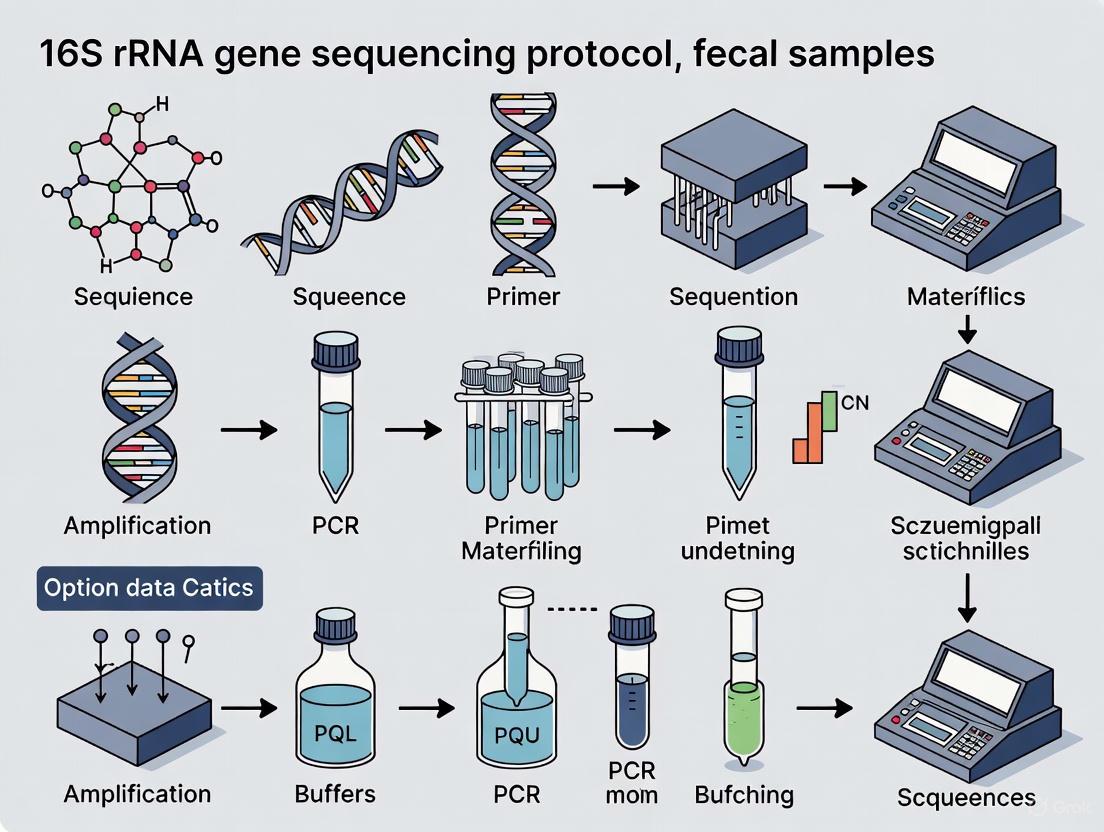
This article provides a detailed guide for researchers and drug development professionals on conducting robust 16S rRNA gene sequencing of fecal samples.
A Comprehensive Guide to 16S rRNA Gene Sequencing for Fecal Microbiota Analysis: From Protocol to Application in Biomedical Research
Abstract
This article provides a detailed guide for researchers and drug development professionals on conducting robust 16S rRNA gene sequencing of fecal samples. It covers foundational principles, a step-by-step methodological protocol from sample collection to data analysis, common troubleshooting and optimization strategies, and a comparative evaluation of different sequencing platforms and regions. The content synthesizes current best practices to ensure reproducible and accurate gut microbiome profiling, which is crucial for studies investigating the role of gut microbiota in health, disease, and therapeutic development.
Understanding 16S rRNA Sequencing: Principles and Applications in Gut Microbiome Research
The 16S ribosomal RNA (rRNA) gene is a cornerstone of modern microbial ecology and a pivotal tool for bacterial identification and phylogenetic studies. This gene, approximately 1,550 base pairs long, contains nine hypervariable regions (V1-V9) that provide species-specific signatures, flanked by conserved regions that allow for the design of universal primers [1] [2]. Its universal distribution in bacteria, functional constancy, and appropriate evolutionary clock characteristics make it an ideal molecular marker for determining taxonomic relationships [1] [2]. The advent of high-throughput sequencing technologies has revolutionized the use of 16S rRNA gene sequencing, enabling comprehensive analysis of complex microbial communities from diverse environments, including the human gut [3] [4]. This article provides detailed application notes and protocols for employing 16S rRNA gene sequencing in fecal sample research, framed within the context of a broader thesis on gut microbiome analysis for drug development and clinical diagnostics.
Comparative Analysis of 16S rRNA Sequencing Approaches
The choice of 16S rRNA sequencing strategy represents a critical decision point in experimental design, balancing taxonomic resolution, cost, and throughput. The historical compromise of sequencing short hypervariable regions due to technological limitations is increasingly being superseded by full-length gene sequencing approaches.
Table 1: Comparison of 16S rRNA Sequencing Approaches
| Feature | Short-Read (e.g., V3-V4) | Full-Length (V1-V9) |
|---|---|---|
| Typical Platform | Illumina MiSeq/HiSeq | PacBio Sequel IIe, Oxford Nanopore |
| Amplicon Length | ~460 bp (V3-V4) [5] | ~1,500 bp [4] |
| Primary Analysis | OTU clustering (97% identity) or ASVs [5] | ASVs with single-nucleotide resolution [5] |
| Taxonomic Resolution | Predominantly genus-level [3] [6] | Species- and strain-level [3] [4] |
| Key Limitations | Cannot differentiate closely related species (e.g., E. coli vs. Shigella) [5] | Higher initial error rate, though improving with CCS [3] [4] |
| Relative Cost | Lower | Higher, but becoming more comparable [5] |
Table 2: Performance of Different 16S Sub-regions for Species-Level Identification
| Sequenced Region | Proportion Correctly Classified to Species Level | Notable Taxonomic Biases |
|---|---|---|
| V4 | ~44% [4] | Consistently performs worst for species discrimination [4] |
| V1-V2 | Variable | Poor for classifying Proteobacteria [4] |
| V3-V5 | Variable | Poor for classifying Actinobacteria [4] |
| V1-V3 | Better approximation of diversity | Good for Escherichia/Shigella [4] |
| V6-V9 | Variable | Best for Clostridium and Staphylococcus [4] |
| Full-Length (V1-V9) | Nearly 100% [4] | Consistently produces the best results across taxa [4] |
Recent advancements have demonstrated the superior performance of full-length 16S (FL16S) sequencing. A 2025 clinical study on metabolic dysfunction-associated steatotic liver disease (MASLD) found that a predictive model based on FL16S data (AUC = 86.98%) significantly outperformed one based on V3-V4 sequencing data (AUC = 70.27%) [5]. Furthermore, a 2025 study on colorectal cancer biomarker discovery confirmed that Nanopore full-length 16S sequencing identified more specific bacterial biomarkers than Illumina V3-V4 sequencing, including species such as Parvimonas micra, Fusobacterium nucleatum, and Bacteroides fragilis [3].
Detailed Experimental Protocols
Sample Preparation and DNA Extraction from Fecal Samples
Principle: High-quality, inhibitor-free genomic DNA is essential for successful 16S rRNA gene amplification and sequencing. The inclusion of an internal standard at the lysis step enables absolute quantification.
Protocol:
- Homogenize 2g of fecal sample in a sterile container.
- Add Internal Standard (Optional): For absolute quantification, add a synthetic DNA standard of known concentration to the lysis buffer before DNA extraction. This allows for the calculation of DNA recovery yield and subsequent absolute abundance of taxa [7]. The standard can be designed to be quantified by qPCR or with the same primers used for 16S amplification [7].
- Extract DNA using a commercial kit such as the QIAamp PowerFecal Pro DNA Kit, following the manufacturer's instructions.
- Assess DNA Quality and Quantity using a fluorometer (e.g., Qubit 4.0) and check for purity via spectrophotometry (e.g., NanoPhotometer). Store DNA at -80°C until library preparation.
Library Preparation for Short-Read (V3-V4) Sequencing
Principle: This protocol amplifies the ~460 bp V3-V4 hypervariable region using primers tailed with Illumina sequencing adapters [5].
Reagents:
- KAPA HiFi HotStart ReadyMix
- Primer Set: 341F (5'-CCTACGGGNGGCWGCAG-3') and 806R (5'-GACTACHVGGGTATCTAATCC-3') [5]
- AMPure XP Beads
Protocol:
- Primary PCR: In a 25 µL reaction, combine 12.5 ng of gDNA with 0.2 µM of each primer and KAPA HiFi HotStart ReadyMix.
- Amplify using the following thermocycling conditions:
- 95°C for 3 minutes
- 25 cycles of: 95°C for 30 s, 55°C for 30 s, 72°C for 30 s
- Final extension: 72°C for 5 minutes
- Hold at 4°C
- Verify Amplicons by running 5 µL of the PCR product on a 1.5% agarose gel. A distinct band at ~500 bp should be visible.
- Purify the PCR products using AMPure XP beads.
- Index PCR: Perform a secondary PCR to attach dual indices and Illumina sequencing adapters using a kit like the Nextera XT Index Kit.
- Purify the final library and quantify using a fluorometer. Assess library size distribution (e.g., ~570 bp) using a fragment analyzer or similar system.
- Sequence on an Illumina MiSeq platform with paired-end 300 bp reads [5].
Library Preparation for Full-Length 16S (V1-V9) Sequencing
Principle: This protocol generates a ~1,500 bp amplicon encompassing all nine variable regions, suitable for platforms like PacBio.
Reagents:
- KAPA HiFi HotStart ReadyMix
- Barcoded Full-Length Primers (e.g., Forward: 5'Phos/GCATC-[16-base barcode]-AGRGTTYGATYMTGGCTCAG-3'; Reverse: 5'Phos/GCATC-[16-base barcode]-RGYTACCTTGTTACGACTT-3') [5]
- AMPure PB Beads
Protocol:
- Primary PCR: In a 25 µL reaction, combine 2 ng of gDNA with barcoded primers and KAPA HiFi HotStart ReadyMix.
- Amplify using the following thermocycling conditions:
- 95°C for 3 minutes
- 20–27 cycles (optimize per sample) of: 95°C for 30 s, 57°C for 30 s, 72°C for 60 s
- Final extension: 72°C for 5 minutes
- Hold at 4°C
- Verify Amplicons on a 1% agarose gel. A sharp band at ~1,500 bp should be present.
- Purify the PCR products using AMPure PB beads.
- Prepare SMRTbell Library according to PacBio's recommended protocol.
- Sequence on a PacBio Sequel IIe instrument in Circular Consensus Sequencing (CCS) mode to generate high-fidelity HiFi reads [5].
Figure 1: 16S rRNA Gene Sequencing Workflow for Fecal Samples. The workflow outlines the key steps from sample collection to data analysis, highlighting the parallel paths for short-read and full-length sequencing approaches.
From Relative to Absolute Quantification
Traditional 16S rRNA sequencing produces relative abundance data, where the proportion of one taxon is dependent on the abundances of all others. This compositionality can obscure true biological changes [7] [8]. Absolute quantification addresses this limitation by determining the exact number of 16S rRNA gene copies per unit of sample.
Principle: A synthetic DNA standard, which is absent from natural environments and can be distinguished by qPCR or sequencing, is spiked into the sample at a known concentration before DNA extraction [7].
Protocol for Absolute Quantification:
- Spike Synthetic Standard: Add a known quantity (e.g., 100 ppm to 1% of the expected 16S rRNA genes) of the synthetic DNA standard to the lysis buffer during DNA extraction [7].
- Extract DNA as described in Section 3.1.
- Perform Two qPCR Reactions:
- One to quantify the total 16S rRNA genes in the sample, using the same primers as for sequencing (e.g., 341F/806R for V3-V4) for maximum accuracy [7].
- One to quantify the recovered synthetic standard using specific primers or probes.
- Calculate Absolute Abundance: The absolute concentration of each OTU/ASV (in 16S rRNA gene copies per gram of sample) is calculated based on its relative abundance from sequencing and the total 16S load determined by qPCR, corrected for the recovery yield of the internal standard [7] [8].
Figure 2: Absolute Quantification Workflow Using a Synthetic Spike-in Standard. This method converts relative sequencing data into absolute counts by accounting for DNA recovery efficiency through a spiked internal standard.
The Scientist's Toolkit: Essential Reagents and Materials
Table 3: Research Reagent Solutions for 16S rRNA Gene Sequencing
| Item | Function | Example Product/Catalog Number |
|---|---|---|
| Fecal DNA Extraction Kit | To obtain high-quality, inhibitor-free microbial genomic DNA from complex fecal samples. | QIAamp PowerFecal Pro DNA Kit (Qiagen, 51804) [5] |
| High-Fidelity DNA Polymerase | For accurate amplification of the 16S rRNA target region with low error rates. | KAPA HiFi HotStart ReadyMix (Roche, 07958935001) [5] |
| Synthetic DNA Standard | For absolute quantification; added before extraction to determine DNA recovery yield. | Custom-designed sequence (e.g., based on [7]) |
| 16S V3-V4 Primer Set | For amplification of the ~460 bp V3-V4 region for Illumina sequencing. | 341F / 806R [5] |
| Full-Length 16S Primer Set | For amplification of the ~1,500 bp V1-V9 region for long-read sequencing. | e.g., 27F / 1492R or barcoded custom primers [5] |
| Library Quantification Kit | For accurate quantification of the final sequencing library. | Qubit dsDNA HS Assay Kit |
| Positive Control DNA | To monitor the entire workflow, from extraction to sequencing. | ZymoBIOMICS Microbial Community DNA Standard (Zymo Research, D6306) [5] |
The 16S rRNA gene remains an indispensable tool for exploring the gut microbiome. The choice between short-read and full-length sequencing is fundamental, with the latter providing superior species-level resolution and stronger associations with clinical outcomes like MASLD and colorectal cancer [3] [5]. Furthermore, the integration of synthetic DNA standards for absolute quantification moves beyond the limitations of relative abundance data, providing a more accurate picture of microbial community dynamics [7] [8]. By following the detailed protocols and considerations outlined in this application note, researchers can design robust studies to investigate the role of the gut microbiota in health and disease, ultimately informing drug development and diagnostic strategies.
Why 16S rRNA Sequencing is Indispensable for Fecal Microbiota Studies
16S ribosomal RNA (rRNA) gene sequencing has established itself as a cornerstone methodology in microbial ecology, providing an indispensable tool for characterizing the composition and dynamics of fecal microbiota. This technique leverages the evolutionary characteristics of the 16S rRNA gene—containing highly conserved regions flanking variable regions that permit precise taxonomic identification. As a library, NLM provides access to scientific literature. Inclusion in an NLM database does not imply endorsement of, or agreement with, the contents by NLM or the National Institutes of Health [5]. The advent of high-throughput sequencing technologies has revolutionized our ability to decode complex microbial communities, with 16S rRNA sequencing serving as a primary driver for discoveries linking gut microbiota to human health, disease states, and therapeutic interventions [9] [10]. This application note details the experimental protocols, analytical frameworks, and practical considerations for implementing 16S rRNA sequencing in fecal microbiota research, providing researchers with a comprehensive resource for study design and execution.
Technical Foundations: Variable Regions and Sequencing Platforms
The 16S rRNA gene (~1500 bp) comprises nine hypervariable regions (V1-V9) that provide the taxonomic resolution necessary for bacterial classification [5] [4]. The strategic selection of which variable region(s) to sequence represents a critical methodological decision that balances taxonomic resolution, sequencing platform capabilities, and research objectives.
Table 1: Comparison of 16S rRNA Sequencing Approaches for Fecal Microbiota
| Parameter | Full-Length 16S (V1-V9) | Partial 16S (V3-V4) | V4 Region |
|---|---|---|---|
| Approximate Length | ~1500 bp [4] | ~460 bp [5] | ~250 bp [4] |
| Taxonomic Resolution | Species to strain level [4] | Genus to species level [5] | Genus level [4] |
| Platform | PacBio Sequel IIe, Oxford Nanopore [5] [11] | Illumina MiSeq [5] | Illumina platforms [4] |
| Key Advantage | Highest taxonomic accuracy; detects intragenomic variation [4] | Balanced cost and resolution; well-established protocols [6] | Cost-effective; high throughput; standardized pipelines [4] |
| Limitation | Higher cost; longer sequencing time [6] | Cannot differentiate some closely related species [5] | Poor species-level discrimination; taxonomic bias [4] |
| Species-Level Classification Rate | Nearly 100% [4] | Varies with pipeline [6] | ~44% [4] |
Recent advances in long-read sequencing technologies have made full-length 16S rRNA sequencing increasingly accessible. Studies demonstrate that sequencing the entire gene provides significantly better taxonomic resolution compared to shorter variable regions, with the V4 region performing particularly poorly for species-level discrimination (approximately 44% classification rate compared to nearly 100% for full-length) [4]. This enhanced resolution is particularly valuable for clinical applications where species-level or even strain-level identification is crucial, as different strains within the same species can exhibit substantially variations in pathogenic potential and metabolic capabilities [6].
Experimental Protocol: From Sample Collection to Data Generation
Sample Collection and DNA Extraction
Sample Collection: Fecal samples can be collected using various methods depending on study design. For clinical studies, residual material from fecal immunochemical test (FIT) tubes has been validated as a robust source for microbiome analysis [11]. Samples remain stable at room temperature for several days, though prolonged storage (4+ days) may increase proportions of certain bacteria like Enterococcus faecalis [11]. Alternatively, fresh fecal samples can be collected and immediately frozen at -80°C [5].
DNA Extraction:
- Use commercially available kits such as the QIAamp PowerFecal Pro DNA Kit for optimal recovery of microbial DNA from complex fecal matter [5].
- Homogenize samples before aliquoting to ensure representative sampling of microbial communities.
- For absolute quantification approaches, add synthetic internal standard DNA during the lysis step (see Section 5) [7] [8].
Library Preparation and Sequencing
Primer Design and PCR Amplification:
For Full-Length 16S (V1-V9) Sequencing:
- Forward Primer: 5'-AGRGTTYGATYMTGGCTCAG-3' [5]
- Reverse Primer: 5'-RGYTACCTTGTTACGACTT-3' [5]
- PCR Conditions: 95°C for 3 min; 20-27 cycles of 95°C for 30 s, 57°C for 30 s, 72°C for 60 s; final extension at 72°C for 5 min [5]
For V3-V4 Region Sequencing:
- Forward Primer (341F): 5'-CCTACGGGNGGCWGCAG-3' [5]
- Reverse Primer (806R): 5'-GACTACHVGGGTATCTAATCC-3' [5]
- PCR Conditions: 95°C for 3 min; 25 cycles of 95°C for 30 s, 55°C for 30 s, 72°C for 30 s; final extension at 72°C for 5 min [5]
Library Preparation and Sequencing:
- For Illumina platforms (short-read): Use dual-indexed approach with Illumina sequencing adapters [5].
- For PacBio (long-read): Prepare SMRTbell library and sequence in circular consensus sequencing (CCS) mode on Sequel IIe platform to generate high-fidelity (HiFi) reads [5].
- For Oxford Nanopore: Utilize ligation sequencing kit and sequence on MinION or PromethION platforms [11].
Diagram 1: 16S rRNA sequencing workflow for fecal microbiota studies, showing key steps from sample collection to data analysis.
Data Analysis Pipeline: From Raw Sequences to Biological Insights
Preprocessing and Denoising
Quality Filtering:
- Use QIIME2 Cutadapt plugin to trim primer sequences and remove low-quality reads [5].
- For full-length sequencing: Apply minimum predicted accuracy threshold of 0.9 using SMRT Link software [5].
Sequence Denoising:
- Apply DADA2 algorithm for amplicon sequence variant (ASV) inference rather than traditional operational taxonomic unit (OTU) clustering [5].
- ASV methods provide single-nucleotide resolution by distinguishing sequencing errors from biological sequences [6].
- Remove chimeric sequences using reference-based or de novo methods [5].
Taxonomic Classification and Diversity Analysis
Taxonomic Assignment:
- Utilize reference databases (Silva, Greengenes, RDP) for taxonomic classification [5] [12].
- For enhanced species-level identification with V3-V4 data, implement specialized pipelines like ASVtax that apply flexible classification thresholds [6].
- For full-length sequences, the RDP classifier achieves near-complete species-level classification [4].
Diversity Assessment:
- Calculate alpha diversity metrics (Chao1, ACE, Shannon, Simpson) to assess within-sample richness and evenness [9].
- Compute beta diversity using weighted/unweighted UniFrac distances to evaluate between-sample differences [9].
- Perform principal coordinates analysis (PCoA) to visualize community similarity patterns [9] [11].
Advanced Application: Absolute Quantification Methods
Traditional 16S rRNA sequencing provides relative abundance data, which can be misleading when total microbial load varies between samples. Absolute quantitative 16S amplicon sequencing addresses this limitation by incorporating synthetic internal standards of known concentration [7] [8].
Protocol for Absolute Quantification:
- Standard Design: Create a synthetic 16S rRNA gene sequence with modified regions (45-73 bp) that distinguish it from natural sequences while maintaining amplification efficiency [7].
- Spike-in Addition: Add the internal standard to the lysis buffer before DNA extraction at a concentration representing 0.01-1% of total 16S rRNA genes [7].
- qPCR Quantification: Quantify both the internal standard and total 16S rRNA genes using qPCR with the same primers used for sequencing [7].
- Data Normalization: Calculate absolute abundance using the formula:
Absolute copies = (Sample reads / Standard reads) × Known standard copies[8].
Diagram 2: Absolute quantification workflow using synthetic DNA standards to convert relative sequencing data to absolute microbial counts.
Table 2: Comparison of Quantification Methods for Microbiome Studies
| Method | Principle | Advantages | Limitations |
|---|---|---|---|
| Relative Abundance | Normalization to total reads per sample | Simple; standard output of sequencing pipelines | Compositional effect; obscures true abundance changes [7] |
| Spiked DNA Standards | Addition of synthetic DNA of known concentration | Accounts for DNA extraction efficiency; applicable to any sample type | Requires precise quantification; additional experimental step [7] [8] |
| Cell Counting | Flow cytometry of fixed aliquots | Direct measurement of cell numbers; no sequence bias | Requires fresh samples; doesn't distinguish viable/dead cells [7] |
| qPCR | Amplification of target genes with standard curves | Highly sensitive; specific to target taxa | Requires specific standards; difficult for complex communities [7] |
Research Reagent Solutions and Essential Materials
Table 3: Essential Research Reagents and Materials for 16S rRNA Sequencing
| Category | Specific Product/Kit | Function/Application |
|---|---|---|
| DNA Extraction | QIAamp PowerFecal Pro DNA Kit (Qiagen) [5] | Efficient lysis and purification of microbial DNA from complex fecal samples |
| PCR Amplification | KAPA HiFi HotStart ReadyMix (Roche) [5] | High-fidelity amplification of 16S rRNA gene regions with minimal bias |
| Library Preparation | Nextera XT Index Kit (Illumina) [5] | Dual-indexed library preparation for multiplexed sequencing on Illumina platforms |
| Long-read Sequencing | SMRTbell Express Template Prep Kit (PacBio) [5] | Library preparation for full-length 16S sequencing on PacBio systems |
| Quantification Standards | Synthetic 16S rRNA gene standard [7] [8] | Internal reference for absolute quantification of microbial abundance |
| Positive Control | ZymoBIOMICS Microbial Community DNA Standard (Zymo Research) [5] | Quality control for extraction, amplification, and sequencing processes |
| Sequencing Platforms | Illumina MiSeq (V3-V4); PacBio Sequel IIe (full-length); Oxford Nanopore [5] [11] | Platform selection based on required read length, accuracy, and throughput needs |
16S rRNA sequencing remains an indispensable methodology for fecal microbiota studies, offering a powerful combination of taxonomic precision, methodological flexibility, and cost-effectiveness. The ongoing evolution of this technology—particularly through full-length sequencing and absolute quantification approaches—continues to expand its applications in both basic research and clinical settings. By implementing the detailed protocols and considerations outlined in this application note, researchers can design robust experiments that yield meaningful insights into the composition and dynamics of gut microbial communities, ultimately advancing our understanding of host-microbiome interactions in health and disease.
Application Note: Advancing Gut-Brain Axis Research with 16S rRNA Sequencing
The gut-brain axis represents a complex, bidirectional communication network between the gastrointestinal tract and the central nervous system. Growing evidence implicates gut microbiota as a critical modulator of this axis, influencing neurodevelopment, neurodegenerative disorders, and mental health. 16S ribosomal RNA (rRNA) gene sequencing has emerged as a fundamental tool for exploring these microbial communities, enabling researchers to characterize taxonomic profiles and identify dysbiosis patterns associated with neurological conditions.
Recent studies demonstrate the expanding applications of 16S rRNA sequencing in gut-brain axis investigations. Prenatal immune activation using poly(I:C) in rodent models induces gut microbiota alterations in offspring, providing insights into environmental risk factors for neurodevelopmental disorders [13]. In Parkinson's disease (PD) research, clinical protocols now integrate 16S sequencing to monitor how acupuncture and moxibustion interventions modulate gut microbiome composition alongside motor and non-motor symptom improvement [14]. Furthermore, investigations into preterm infant neurodevelopment utilize 16S sequencing to identify gestational age-dependent microbial patterns that may influence long-term cognitive outcomes [15].
The technological evolution from short-read (V3-V4) to full-length 16S rRNA sequencing has significantly enhanced taxonomic resolution. A recent comparative study demonstrated that random forest models based on full-length 16S data achieved superior predictive power for Metabolic Dysfunction-Associated Steatotic Liver Disease (MASLD) classification compared to V3-V4 sequencing (AUC: 86.98% vs. 70.27%, p=0.008) [5]. This enhanced performance underscores the value of full-length 16S sequencing for detecting clinically relevant microbial signatures.
Table 1: Performance Comparison of 16S rRNA Sequencing Approaches in Disease Classification
| Sequencing Method | Target Region | Read Length | Predictive AUC for MASLD | Key Advantages |
|---|---|---|---|---|
| Full-Length 16S | V1-V9 | ~1500 bp | 86.98% | Superior species-level resolution, exact ASV inference |
| Short-Read 16S | V3-V4 | ~500 bp | 70.27% | Established protocols, lower sequencing depth requirements |
Application Note: 16S rRNA Sequencing in Pharmaceutical Development
Within drug development, 16S rRNA sequencing has transitioned from a basic research tool to an integral component of therapeutic discovery and development. Applications span from identifying microbiome-mediated drug metabolism mechanisms to discovering microbial biomarkers for patient stratification. The incorporation of microbiome analysis into early-stage development provides insights into variable drug responses and potential adverse effects mediated by host microbiota.
In biologics development, understanding host-cell protein (HCP) profiles is critical for product safety and quality control. While 16S sequencing characterizes microbial contaminants, mass spectrometry (MS) has become the preferred method for HCP quantification due to its ability to identify and quantify individual HCPs within complex mixtures [16]. The U.S. Pharmacopeia has formally recognized this application in General Chapter <1132.1>, establishing LC-MS approaches for HCP analysis [16].
The gut microbiome's influence on drug efficacy is particularly relevant for neurological therapeutics. Research demonstrates that gut microbiota can metabolize neuroactive compounds and influence blood-brain barrier permeability, potentially altering drug pharmacokinetics and pharmacodynamics [17]. Monitoring microbial shifts during treatment interventions provides valuable insights for optimizing therapeutic outcomes.
Table 2: Key Applications of 16S rRNA Sequencing in Drug Development Pipeline
| Development Stage | Application | Utility | Considerations |
|---|---|---|---|
| Target Discovery | Identification of microbial biomarkers | Patient stratification, companion diagnostic development | Full-length 16S provides superior taxonomic resolution |
| Preclinical Development | Microbiome-mediated drug metabolism assessment | Predicting interindividual variability in drug response | Gnotobiotic models complement sequencing data |
| Clinical Trials | Monitoring intervention-induced microbial shifts | Understanding mechanisms of action, identifying responders | Standardized sampling protocols critical for data quality |
| Lifecycle Management | Post-market safety monitoring | Detecting long-term microbial alterations | Large sample sizes required for statistical power |
Experimental Protocols
Protocol 1: Full-Length 16S rRNA Sequencing for Gut Microbiome Profiling
Principle: This protocol amplifies and sequences the entire V1-V9 region of the bacterial 16S rRNA gene using long-read sequencing technology, enabling high-resolution taxonomic classification down to the species level.
Materials and Reagents:
- QIAamp PowerFecal Pro DNA Kit (Qiagen, Cat. No. 51804)
- KAPA HiFi HotStart ReadyMix (Roche, REF: 07958935001)
- AMPure PB beads (PacBio, PN: 100-265-900)
- Barcoded FL16S primers: Forward (5'-Phos/GCATC-[16-base barcode]-AGRGTTYGATYMTGGCTCAG-3'), Reverse (5'-Phos/GCATC-[16-base barcode]-RGYTACCTTGTTACGACTT-3')
- Sequel II Binding Kit (2.1) for PacBio sequencing
- ZymoBIOMICS Microbial Community DNA Standard (D6306) for quality control
Procedure:
- DNA Extraction: Extract total genomic DNA from 180-220 mg fecal sample using QIAamp PowerFecal Pro DNA Kit according to manufacturer's instructions.
- Quality Assessment: Quantify DNA concentration using Qubit Fluorometer and assess purity via NanoPhotometer (A260/A280 ratio >1.8 acceptable).
- FL16S Amplification: Perform PCR with 2 ng template DNA using KAPA HiFi HotStart ReadyMix with the following cycling conditions:
- 95°C for 3 minutes
- 20-27 cycles (optimize per sample): 95°C for 30s, 57°C for 30s, 72°C for 60s
- 72°C for 5 minutes, then hold at 4°C
- Amplicon Purification: Clean PCR products with AMPure PB beads according to manufacturer's protocol.
- Library Preparation: Prepare SMRTbell library following PacBio recommendations for full-length 16S sequencing.
- Sequencing: Perform sequencing on PacBio Sequel IIe system in Circular Consensus Sequencing (CCS) mode to generate HiFi reads with minimum predicted accuracy of Q30.
Data Analysis:
- Process CCS reads using SMRT Link software (minimum accuracy threshold: 0.9).
- Denoise sequences and infer amplicon sequence variants (ASVs) using DADA2 plugin in QIIME2.
- Assign taxonomy against Silva database using classify-sklearn method.
- Perform differential abundance analysis (ALDEx2 or similar) to identify significantly altered taxa between experimental groups.
Protocol 2: Fecal Immunochemical Test (FIT) Sample Processing for Large-Scale Studies
Principle: This protocol validates the use of residual material from fecal immunochemical test tubes for 16S rRNA sequencing, enabling cost-effective large-scale population studies in colorectal cancer screening programs.
Materials and Reagents:
- FIT sampling tubes with buffer medium
- Sterile spatulas for sample collection
- 2mL cryotubes for storage
- DNA extraction kit suitable for FIT samples (e.g., QIAamp PowerFecal Pro DNA Kit)
- Oxford Nanopore Technology (ONT) sequencing platform for full-length 16S
Procedure:
- Sample Collection: Collect approximately 10mg fecal material from stool surface using sterile spatula and transfer to FIT tube containing buffer medium.
- Short-Term Storage: Store samples at room temperature (+20°C) for up to 10 days to simulate mail transport conditions.
- Long-Term Storage: For extended storage, maintain samples at -18°C or -80°C for up to 400 days.
- DNA Extraction: Extract bacterial DNA from 1.5mL residual FIT buffer solution using optimized protocol for low-biomass samples.
- Library Preparation and Sequencing: Prepare libraries using ONT full-length 16S protocol and sequence on GridION or PromethION platforms.
Quality Control Considerations:
- Microbiome richness, Shannon diversity, and individual characteristics remain stable despite storage variations [11].
- Monitor potential overgrowth of collagenase-producing bacteria (e.g., Enterococcus faecalis) in samples stored at +20°C for >4 days.
- No significant differences observed between surface vs. core sampling or between buffer vs. water medium.
Protocol 3: Integrated 16S rRNA Sequencing and Metabolomics for Functional Insights
Principle: This protocol combines full-length 16S rRNA sequencing with liquid chromatography-tandem mass spectrometry (LC-MS/MS) to correlate microbial composition with metabolic activity, providing functional insights into gut-brain axis communication.
Materials and Reagents:
- Vanquish UHPLC system (ThermoFisher)
- Orbitrap Q Exactive HF-X mass spectrometer (Thermo Fisher)
- Hypesil Gold column (100×2.1 mm, 1.9μm)
- Solvents: LC-MS grade water, methanol, formic acid, ammonium acetate
- Homogenization reagents: 80% methanol aqueous solution
Procedure:
- Sample Preparation:
- Aliquot 100mg fecal sample into EP tube
- Add 500μL of 80% methanol aqueous solution
- Vortex thoroughly and incubate in ice bath for 5 minutes
- Centrifuge at 15,000g for 20 minutes at 4°C
- Dilute supernatant with MS-grade water to 53% methanol concentration
- Recentrifuge at 15,000g for 20 minutes at 4°C
- Collect supernatant for LC-MS analysis
- LC-MS/MS Analysis:
- Column temperature: 40°C
- Flow rate: 0.2 mL/min
- Gradient program:
- 2% B to 85% B over 3 minutes
- 100% B for 10 minutes
- Return to 2% B for column re-equilibration
- MS parameters:
- Polarity: Positive/negative switching
- Spray voltage: 3.2 kV
- Capillary temperature: 320°C
- Sheath gas flow rate: 40 arb
- Data Integration:
- Correlate microbial abundances (from 16S data) with metabolite intensities
- Perform pathway enrichment analysis using KEGG database
- Identify potential microbial-derived neuroactive metabolites
Signaling Pathways and Experimental Workflows
Diagram 1: Gut-Brain Axis Bioelectric Signaling. This diagram illustrates the integrated communication network between dietary factors, gut microbiota, and neural function, highlighting the emerging role of bioelectric signaling in gut-brain axis communication [18].
Diagram 2: 16S rRNA Sequencing Experimental Workflow. This workflow outlines the key steps in 16S rRNA sequencing from sample collection to clinical interpretation, highlighting critical decision points for researchers [11] [5].
Research Reagent Solutions
Table 3: Essential Research Reagents for 16S rRNA Sequencing Studies
| Reagent/Category | Specific Product Examples | Function/Application | Key Considerations |
|---|---|---|---|
| DNA Extraction Kits | QIAamp PowerFecal Pro DNA Kit (Qiagen) | Efficient bacterial lysis and inhibitor removal for complex fecal samples | Optimized for low biomass samples like FIT tubes |
| PCR Master Mixes | KAPA HiFi HotStart ReadyMix (Roche) | High-fidelity amplification of 16S rRNA gene regions | Reduces amplification bias in complex communities |
| Sequencing Platforms | PacBio Sequel IIe (FL16S), Illumina MiSeq (V3-V4) | Generation of sequencing reads for microbiome analysis | Platform choice depends on required resolution vs. cost |
| Quality Controls | ZymoBIOMICS Microbial Community DNA Standard | Verification of sequencing accuracy and reproducibility | Identifies potential contamination or technical artifacts |
| Bioinformatics Tools | QIIME2, DADA2, SILVA database | Processing raw sequences, ASV inference, taxonomic assignment | Full-length 16S enables higher resolution ASVs |
| Storage Media | FIT tube buffer, DNA/RNA Shield | Sample preservation for longitudinal or multi-site studies | Maintains microbiome integrity during transport [11] |
Sample Collection and Storage: Preserving Microbial Integrity from the Start
The integrity of any 16S rRNA gene sequencing study is determined at the very first step: sample collection. Inappropriate collection and storage methods can introduce significant bias, affecting downstream analyses and potentially leading to erroneous conclusions.
Collection Method Selection
The choice between stabilized and unstabilized collection methods significantly influences microbial community profiles recovered from fecal samples [19]. Stabilized collection kits (e.g., OMNIgene•GUT OMR-200) contain reagents that preserve microbial DNA, allowing samples to remain at room temperature for several days without major shifts in composition [20]. This makes them ideal for studies where immediate freezing is logistically challenging, such as in large population cohorts or home-based collection. In contrast, unstabilized methods (e.g., sterile swabs or screw-top tubes) require immediate cold storage to prevent microbial community changes [19].
Comparative studies show that sample collection methods result in taxonomic and diversity differences with distinct patterns between swab and OMNIgene samples [19]. Furthermore, unstabilized swab samples are disproportionally affected by increased transport time, with exposure to variable temperatures during shipping introducing additional variability [19].
Storage Conditions and Transport
Even with optimal collection, storage conditions and transport time to the laboratory are critical. Research indicates that storage at 4°C for up to 24 hours before transfer to -80°C is adequate for 16S rRNA analysis, with overall microbiome composition remaining largely unaffected compared to immediate freezing [20]. For longer-term storage, -80°C is the standard to preserve microbial DNA integrity indefinitely.
Table 1: Impact of Fecal Sample Collection Methods on 16S rRNA Sequencing Results
| Collection Method | Storage Conditions | Maximum Recommended Storage | Key Effects on Microbiota | Best Use Cases |
|---|---|---|---|---|
| Stabilized Kits (e.g., OMNIgene) | Room Temperature | 3-14 days [20] | Minimal change in overall composition; potential increase in Bacteroides after 7 days [20] | Large cohorts, remote collection, postal transport |
| Unstabilized (Swab) | Room Temperature | Not recommended | High susceptibility to transport time; significant taxonomic shifts [19] | Clinic collection with immediate processing |
| Unstabilized (Screw-top tube) | 4°C | 24 hours [20] | Minor differences in taxon abundance | Controlled research settings |
| Unstabilized (Screw-top tube) | -80°C | Long-term (months to years) [20] | Considered the "gold standard" for preservation | All studies where feasible |
Defining Sequencing Objectives: Choosing the Right Genetic Target
The specific variable region of the 16S rRNA gene targeted for sequencing directly impacts the taxonomic resolution achievable in your study. Your choice should be guided by your primary research question.
Full-Length (V1-V9) vs. Partial Gene (e.g., V3-V4) Sequencing
Full-length 16S rRNA gene sequencing (approximately 1500 bp, covering regions V1-V9) is increasingly feasible with third-generation sequencing platforms like PacBio and Oxford Nanopore [21] [6] [22]. This approach provides superior taxonomic resolution, often enabling species-level identification [22]. A recent study directly comparing full-length and V3-V4 sequencing for predicting metabolic dysfunction-associated steatotic liver disease (MASLD) found that the model based on full-length data had a significantly higher predictive accuracy (AUC of 86.98%) than the V3-V4 model (AUC of 70.27%) [22].
Partial gene sequencing, targeting specific hypervariable regions like V3-V4 or V4 on Illumina platforms, remains widely used due to its lower cost and higher throughput [6] [23]. While this method is sufficient for genus-level classification and general community profiling, it often struggles to differentiate between closely related species, such as Escherichia coli and Shigella serogroups, which have high sequence identity [22].
Matching the Target to the Research Goal
The table below summarizes key considerations for selecting a sequencing approach.
Table 2: Choosing Between Full-Length and Partial 16S rRNA Gene Sequencing
| Factor | Full-Length 16S (V1-V9) | Partial Region (e.g., V3-V4) |
|---|---|---|
| Taxonomic Resolution | High (species-/strain-level) [21] [22] | Moderate (genus-level, limited species) [6] |
| Cost | Higher | Lower [6] |
| Throughput | Lower | Higher |
| Technology | PacBio, Oxford Nanopore [6] | Illumina MiSeq [23] |
| Ideal Use Case | Pathogen detection, functional inference, clinical diagnostics [21] | Population-level ecology, diversity studies, large cohorts [23] |
| Ability to Resolve Closely Related Species | Superior [22] | Limited (e.g., cannot differentiate E. coli from Shigella) [22] |
Study Design and Quantitative Profiling: Moving Beyond Relative Abundance
Standard 16S rRNA gene sequencing data is compositional, meaning results are expressed as relative abundances. This can be a major limitation, as an increase in one taxon's relative abundance can artificially appear to decrease others, regardless of actual changes in absolute abundance [21]. To overcome this, researchers can implement quantitative profiling techniques.
Incorporating Internal Controls
The use of spike-in controls is a powerful method for estimating absolute microbial abundance from sequencing data [21]. This involves adding a known quantity of synthetic or foreign microbial cells (e.g., ZymoBIOMICS Spike-in Control) to the sample prior to DNA extraction. By comparing the sequencing reads from the spike-in to those of the native microbiota, bioinformatic models can be used to infer the absolute abundance of bacterial taxa in the original sample [21]. This method has been shown to provide robust quantification across varying DNA inputs and different sample origins [21].
Power Analysis and Sample Size
Microbiome studies are characterized by high inter-individual variability [20]. To ensure robust and reproducible results, careful consideration of sample size is crucial during the planning phase. While the search results do not provide specific power calculations, they consistently emphasize that differences between individuals dominate the total variation in gut microbiome studies [20]. This underscores the need for adequate replication to detect biologically meaningful effect sizes, especially when investigating subtle associations with environmental exposures or disease states.
Implementation Workflow and Research Toolkit
The following diagram and table provide a consolidated overview of key decision points and reagents for initiating a 16S rRNA sequencing study for fecal samples.
Diagram 1: Experimental Design Workflow for 16S rRNA Sequencing of Fecal Samples. This workflow outlines key decision points from study design through sequencing strategy.
Table 3: Essential Research Reagent Solutions for 16S rRNA Sequencing
| Reagent / Kit | Function | Example Use Case & Note |
|---|---|---|
| OMNIgene•GUT (OMR-200) | Fecal sample collection & stabilization at room temperature [20] | Ideal for multi-site studies; effective stabilization for up to 3 days at room temperature [20]. |
| QIAamp PowerFecal Pro DNA Kit | DNA extraction from complex fecal samples [21] [24] [22] | Widely used; includes mechanical lysis (bead-beating) for robust cell disruption of tough gram-positive bacteria. |
| ZymoBIOMICS Microbial Community Standards | Mock community control for protocol validation [21] | Contains defined strains at known ratios; essential for benchmarking extraction, amplification, and sequencing accuracy. |
| ZymoBIOMICS Spike-in Control I | Internal control for absolute quantification [21] | Added pre-extraction; allows estimation of absolute bacterial abundance from relative sequencing data. |
| KAPA HiFi HotStart ReadyMix | High-fidelity PCR amplification of 16S gene [22] | Reduces PCR errors and chimera formation, crucial for accurate amplicon sequence variant (ASV) calling. |
A Step-by-Step 16S rRNA Sequencing Protocol for Fecal Samples: From Collection to Data
The integrity of microbiome research findings is fundamentally rooted in the pre-analytical phase of sample management. For studies utilizing 16S rRNA gene sequencing to investigate the human gut microbiome, the procedures governing the collection and storage of fecal samples are critical. Variations in these initial steps can introduce significant bias, affecting the apparent taxonomic composition and diversity [25]. Proper handling ensures that the microbial community analyzed in the laboratory accurately reflects the in vivo state at the time of collection. This protocol outlines evidence-based best practices for fecal sample collection and storage, providing a standardized approach to maximize sample stability and data integrity for sequencing-based studies.
Best Practices for Sample Collection & Storage
Adhering to standardized procedures from the moment of collection is essential for preserving microbial integrity.
- Sample Acquisition and Homogenization: Upon passage, stool samples should be collected using a sterile commode specimen collector or similar device. It is crucial to manually homogenize the entire sample using a sterile plastic spatula before aliquoting. Research indicates that the effect of homogenization on the taxonomic composition is negligible, thereby ensuring that small subsamples are representative of the whole [26].
- Immediate Aliquoting and Temperature Management: The homogenized stool should be separated into multiple small, sterile aliquots (e.g., 0.1-0.5 g) to prevent repeated freeze-thaw cycles of a single bulk sample [27]. The "gold standard" for long-term preservation is immediate freezing of aliquots at -70 °C to -80 °C [26]. This practice halts microbial metabolic activity and preserves the native community structure for extended periods, ideally until DNA extraction.
- Short-Term and Field-Based Storage Strategies: While immediate deep-freezing is ideal, it is often logistically challenging in clinical or population-based studies where self-collection is required. For such scenarios, robust short-term strategies are available:
- Refrigeration at 4 °C: Samples can be stored at 4 °C for up to 96 hours without major shifts in key alpha-diversity metrics (e.g., Shannon's Diversity) and overall community composition, as inter-individual variability remains greater than the variability introduced by this storage duration [25].
- Use of Chemical Preservatives: For longer-term stability at ambient temperatures, fecal collection tubes containing DNA/RNA preservatives (e.g., DNA/RNA Shield) are highly effective. Samples stored in such tubes have demonstrated exceptional stability for up to 18 months at room temperature, with minimal changes to taxonomic composition, alpha and beta diversity, and inferred functional pathways compared to frozen baseline samples [26].
Impact of Storage Conditions: Quantitative Data
The choice of storage temperature and method directly influences the stability of microbial cells and nucleic acids. The following tables summarize key quantitative findings on the effects of storage from recent studies.
Table 1: Impact of Short-Term Storage on Microbial Richness and Diversity at 4°C (compared to baseline -80°C freeze) [25]
| Storage Duration at 4°C | Shannon's Diversity (ICC) | Inverse Simpson's (ICC) | Chao1 Richness (ICC) | Community Composition |
|---|---|---|---|---|
| 6 hours | Excellent (>0.90) | Excellent (>0.90) | Good to Excellent (>0.75) | Stable |
| 24 hours | Excellent (>0.90) | Excellent (>0.90) | Good to Excellent (>0.75) | Greatest change occurs between 0-24h, then stabilizes |
| 48 hours | Excellent (>0.90) | Excellent (>0.90) | Good to Excellent (>0.75) | Stable |
| 72 hours | Excellent (>0.90) | Excellent (>0.90) | Good to Excellent (>0.75) | Stable |
| 96 hours | Excellent (>0.90) | Excellent (>0.90) | Good to Excellent (>0.75) | Stable; inter-individual variability > variability from storage time |
Table 2: Cell Viability and DNA Stability Across Different Storage Temperatures over 28 Days [28]
| Storage Temperature | Vegetative Cell Viability (Day 28) | Spore Viability (Day 28) | DNA Stability (tcdA/B qPCR) |
|---|---|---|---|
| -70 °C | ~47% of Day 0 counts | ~65% of Day 0 counts | Stable (7.8-8.6 log CFU/mL) |
| -20 °C | ~47% of Day 0 counts | ~65% of Day 0 counts | Stable (7.8-8.6 log CFU/mL) |
| 4 °C | ~80% at Day 1, stable thereafter | ~65% of Day 0 counts | Slight decrease after Day 7 |
| Room Temperature | ~36% of Day 0 counts | Lowest among all conditions | Lower number detected after Day 28 |
Table 3: Long-Term Taxonomic and Functional Stability after 18 Months of Storage [26]
| Storage Condition | Taxonomic Composition | Alpha Diversity Stability | Beta Diversity Change | Functional Pathway Stability |
|---|---|---|---|---|
| -70 °C (Control) | Best preserved | Least deviation | Minimal | Best preserved |
| DNA/RNA Shield Tube (Room Temp) | Best preserved | Least deviation | Non-significant (q=0.848) | Significantly well preserved |
| OMNIgene-GUT Tube (Room Temp) | Moderately preserved | Moderate deviation | Significant | Moderate preservation |
| Room Temperature (No Preservative) | Wide variation | Significant deviation | Significant | Least preserved |
Experimental Protocols for Stability Assessment
The following section details the core methodologies used to generate the stability data referenced in this document, providing a template for researchers to validate their own protocols.
Protocol for Assessing Microbiota Stability at 4°C
This protocol evaluates the short-term stability of fecal samples under refrigeration, mimicking typical transit times in population-based studies [25].
Sample Processing:
- Homogenization: Upon receipt, manually homogenize the entire stool sample with a sterile spatula.
- Aliquoting: Divide the homogenized stool into multiple 0.1 g aliquots under sterile conditions.
- Baseline Controls: Immediately freeze a set of aliquots (e.g., n=3 per participant) at -80 °C. These serve as the baseline (Time 0).
- Experimental Timepoints: Store the remaining aliquots at 4 °C. For each participant, include three replicates for each timepoint (e.g., 6, 24, 48, 72, and 96 hours).
- Long-term Storage: After each storage duration, transfer the respective aliquots to a -80 °C freezer until DNA extraction.
DNA Extraction and Sequencing:
- Lysis: Perform mechanical lysis using zirconia/silica beads, followed by enzymatic lysis with a cocktail (e.g., lysozyme, mutanolysin).
- Extraction: Use a phenol:chloroform:isoamyl alcohol protocol followed by isopropanol precipitation.
- Purification: Clean the DNA using a commercial clean-up kit.
- 16S rRNA Gene Amplification: Amplify the V4 region of the 16S rRNA gene using specific primers.
- Sequencing: Sequence the amplified libraries on an Illumina MiSeq platform with a 2x250 bp kit.
Data Analysis:
- Bioinformatics: Process raw sequences using a standardized pipeline (e.g., mothur or QIIME2). Cluster sequences into Operational Taxonomic Units (OTUs) at 97% similarity.
- Statistical Evaluation:
- Alpha Diversity: Calculate metrics like Shannon's Diversity, Chao1 Richness, and Inverse Simpson's index. Assess stability using Intra-class Correlation Coefficients (ICC) comparing each timepoint to baseline.
- Beta Diversity: Calculate Bray-Curtis dissimilarity and UniFrac distances to evaluate changes in overall community structure.
Protocol for Evaluating Preservative Tubes for Long-Term Storage
This protocol assesses the performance of commercial collection tubes for maintaining microbiome integrity at room temperature over long durations [26].
Sample Collection and Storage Conditions:
- Tube Preparation: Aliquot homogenized stool samples into different collection systems (e.g., DNA/RNA Shield-fecal collection tubes, OMNIgene-GUT tubes).
- Temperature Groups: Store samples at various temperatures: -70 °C, -20 °C, 4 °C, and room temperature (20-25 °C).
- Long-Term Storage: Maintain samples under these conditions for the desired period (e.g., 18 months).
Downstream Analysis:
- DNA Extraction and Sequencing: Extract DNA directly from the collection tubes according to the manufacturer's instructions. Perform 16S rRNA gene sequencing as described in section 4.1.
- Stability Assessment:
- Taxonomic Composition: Compare relative abundances at phylum, family, and genus levels to baseline.
- Diversity Metrics: Analyze alpha and beta diversity as in section 4.1.
- Functional Stability: Infer metabolic pathway abundances from 16S data using tools like PICRUSt2 and compare the stability of these functional profiles.
Sample Storage Decision Workflow
The following diagram outlines a logical pathway for selecting the appropriate storage method based on research constraints and objectives.
The Scientist's Toolkit: Essential Research Reagents & Materials
Table 4: Key Materials for Fecal Sample Collection and Storage
| Item Name | Function/Application | Key Consideration |
|---|---|---|
| Commode Specimen Collector | Sterile, non-invasive collection of stool sample. | Ensures sample is not contaminated by toilet water or environment [25]. |
| DNA/RNA Shield Fecal Collection Tube | Chemical preservative that inactivates microbes and stabilizes nucleic acids at room temperature. | Ideal for long-term storage and shipping without cold chain; preserves taxonomy and function [26]. |
| OMNIgene-GUT Tube | Commercial collection system with stabilizing solution for ambient temperature transport. | An alternative preservative method; performance may vary compared to other stabilizers [26]. |
| Sterile Spatula | For homogenizing stool sample prior to aliquoting. | Critical for obtaining a representative subsample for analysis [25]. |
| Cryogenic Vials | For creating aliquots and long-term storage at ultra-low temperatures. | Prevents repeated freeze-thaw cycles of the main sample [27]. |
The reliability of 16S rRNA gene sequencing data for fecal microbiome research is profoundly influenced by the initial step of DNA extraction. Variations in extraction protocols can introduce significant biases in microbial community profiles, affecting downstream analyses and inter-study comparisons [29] [30] [31]. The structural differences between bacterial cells, particularly the thick peptidoglycan layer in Gram-positive organisms, make them more resistant to lysis compared to Gram-negative bacteria, which can lead to their under-representation if lysis is not optimized [30] [32]. This application note synthesizes current evidence to guide researchers in selecting and optimizing DNA extraction methods for robust and reproducible 16S rRNA gene sequencing of fecal samples.
Performance Comparison of Commercial DNA Extraction Kits
A review of recent comparative studies reveals that the choice of DNA extraction kit affects critical parameters including DNA yield, purity, and the accurate representation of microbial diversity.
Table 1: Performance Comparison of Selected DNA Extraction Kits for Fecal Samples
| Kit Name (Abbreviation) | Lysis Method | Average DNA Yield | Purity (A260/280) | Impact on Microbial Diversity | Key Findings |
|---|---|---|---|---|---|
| DNeasy PowerLyzer PowerSoil (DQ) [29] | Mechanical (Bead-beating) | Variable; improved with SPD* | ~1.8 (optimal) | High alpha-diversity; balanced Gram-positive/-negative recovery | Best overall performance when combined with a stool preprocessing device (S-DQ) [29]. |
| QIAamp PowerFecal Pro DNA (QPFPD) [33] [34] | Mechanical (Bead-beating) | High | Not specified | Reliable for high-biomass stool samples | Recommended for high-throughput studies; effective removal of PCR inhibitors [33] [34]. |
| NucleoSpin Soil (MN) [29] [34] | Mechanical (Bead-beating) | Lower yield; negatively impacted by SPD* | Below 1.8 (protein/phenol contamination) | Good alpha-diversity | Recovered enough DNA for 86% of samples; lower DNA purity [29]. |
| ZymoBIOMICS DNA Mini (Z) [29] | Mechanical (Bead-beating) | Low yield; improved with SPD* | Below 1.8 (protein/phenol contamination) | Good alpha-diversity | SPD combined protocol (S-Z) recovered sufficient DNA for 88% of samples [29]. |
| Maxwell RSC Faecal Microbiome [31] | Magnetic Beads (Semi-automated) | Not specified | Not specified | Skewed composition without pre-lysis | Standard workflow without bead-beating skewed Firmicutes/Bacteroidetes ratio; additional lysis steps recommended [31]. |
*SPD: Stool Preprocessing Device
Key Insights from Comparative Studies
- Lysis Efficiency is Critical: Protocols incorporating rigorous mechanical bead-beating generally provide more balanced lysis across both Gram-positive and Gram-negative bacteria, leading to higher observed microbial diversity and more accurate community representation [29] [34] [35].
- Standardization Enhances Reproducibility: The use of a stool preprocessing device (SPD) upstream of DNA extraction has been shown to improve the standardization, yield, and overall efficiency of several commercial protocols [29].
- Sample Type Matters: While the compared kits perform robustly with high-biomass fecal samples, their efficiency can drop significantly with low-biomass samples like bronchoalveolar lavage fluid or sputum [34].
Recommended Experimental Workflow
The following workflow outlines the key steps for the standardized processing of fecal samples for DNA extraction, from collection to quality control.
Detailed Step-by-Step Protocol
This protocol is adapted from published methodologies [33] and is optimized for the QIAamp PowerFecal Pro DNA Kit, which demonstrates strong performance for fecal samples.
Step 1: Fecal Collection
- Timing: 5 minutes per subject/sample.
- Collect fresh fecal pellets or material using a sterile scooper or swab. For mice, place the animal in a clean, sterile cage until excretion occurs [33].
- Critical: Avoid pellets that have been in contact with urine [33].
- Immediately place the sample in a sterile, pre-labeled tube and freeze on dry ice. For long-term storage, transfer samples to a -80°C freezer until DNA extraction [33].
Step 2: DNA Extraction from Fecal Material
- Timing: 5–7 hours for 94 samples and 2 controls.
- Reagents: QIAamp PowerFecal Pro DNA Kit (QIAGEN), ZymoBIOMICS Microbial Community Standard (for positive control), nuclease-free water (for negative control) [33].
- Equipment: Biosafety cabinet, Precellys 24 tissue homogenizer (or equivalent), microcentrifuge, vortex.
- Procedure:
- In a biosafety cabinet, weigh approximately 25 mg of frozen or fresh fecal sample directly into a PowerBead Pro tube provided in the kit. For a positive control, use 30 µL of a mock microbial community standard. For a negative control, use 50 µL of nuclease-free water [33].
- Add the recommended volume of lysis buffer (e.g., C1 solution from the kit) to each tube.
- Secure the tubes in a bead-beating homogenizer and lyse the samples at 5,000 rpm for 30-60 seconds. This mechanical lysis step is crucial for breaking tough cell walls, especially of Gram-positive bacteria [33] [32].
- Centrifuge the tubes to pellet the debris.
- Transfer the supernatant to a new tube and complete the remaining steps of the manufacturer's protocol, which typically involve further chemical lysis, binding of DNA to a silica membrane, several wash steps, and final elution. Elute the DNA in 85-100 µL of nuclease-free water [33].
Step 3: Quality Control and Quantification
- Timing: 1 hour.
- Quantify the double-stranded DNA (dsDNA) concentration using a fluorescence-based method such as the Qubit dsDNA HS Assay Kit. This is more accurate for complex samples than spectrophotometry [33].
- Assess DNA purity by measuring the A260/280 and A260/230 ratios using a NanoDrop. Optimal A260/280 for pure DNA is ~1.8, while a low A260/230 ratio may indicate contamination by salts or organic compounds [34] [30].
- Success Criteria: DNA concentration > 5 ng/µL is generally required for successful 16S rRNA library preparation [29]. Proceed only with samples that meet your quality thresholds.
The Scientist's Toolkit: Essential Research Reagents
Table 2: Key Reagent Solutions for Fecal DNA Extraction and QC
| Item | Function/Application | Example Products & Catalog Numbers |
|---|---|---|
| DNA Extraction Kit | Lysis, purification, and elution of genomic DNA from complex fecal samples. | QIAamp PowerFecal Pro DNA Kit (Cat. # 51804) [33]; DNeasy PowerLyzer PowerSoil Kit [29]. |
| Mock Community | Positive control for assessing extraction and sequencing accuracy. | ZymoBIOMICS Microbial Community Standard (Cat. # D6300) [33] [32]. |
| dsDNA Quantification Assay | Accurate fluorometric measurement of DNA concentration. | Qubit dsDNA HS Assay Kit (Cat. # Q32851) [33]. |
| Bead Beating Homogenizer | Mechanical disruption of robust bacterial cell walls. | Precellys 24 (Bertin Instruments) [33]. |
| Nuclease-free Water | Solvent for DNA elution and preparation of negative controls. | Sigma-Aldrich (CAS 7732-18-5) [33]. |
The selection of a DNA extraction protocol is a critical determinant in the success of 16S rRNA gene sequencing studies. Based on current evidence, kits that incorporate a robust mechanical bead-beating step, such as the DNeasy PowerLyzer PowerSoil and QIAamp PowerFecal Pro DNA kits, consistently provide high-quality DNA and a more accurate representation of the gut microbial community. For studies requiring high throughput, semi-automated magnetic bead-based systems are an excellent option, provided they are validated against a manual method that includes mechanical lysis. Adherence to a standardized and documented protocol, inclusive of appropriate controls, is paramount for generating reliable and comparable data in fecal microbiota research.
Within the framework of a comprehensive thesis on 16S rRNA gene sequencing protocols for fecal samples, the steps of library preparation—specifically primer selection and PCR amplification—are critical. These steps directly determine the accuracy, reproducibility, and biological validity of the resulting microbial community profiles [36]. The 16S rRNA gene contains nine hypervariable regions (V1-V9), and the choice of which region(s) to amplify involves balancing taxonomic resolution, amplification bias, and compatibility with sequencing technology [37] [38]. This document provides detailed application notes and protocols to guide researchers in making informed decisions during this crucial phase of microbiome research.
Comparative Analysis of Primer Performance
The selection of an appropriate hypervariable region is not one-size-fits-all; it depends heavily on the sample type and research objectives. The table below summarizes the performance characteristics of commonly targeted regions, with a specific focus on implications for human gut microbiome studies.
Table 1: Comparative Performance of Commonly Used 16S rRNA Gene Hypervariable Regions
| Target Region | Key Advantages | Key Limitations | Impact on Gut Microbiome Profiles |
|---|---|---|---|
| V1-V2 | High taxonomic richness, reduced off-target human DNA amplification [39]. | May require modified primers (V1-V2M) to capture phyla like Fusobacteriota [39]. | More desirable for gut microbiota; profile closer to quantitative PCR data for key genera like Akkermansia [40]. |
| V3-V4 | Widely used standard (e.g., Illumina); good for detecting Bifidobacteriales [40]. | Susceptible to off-target human DNA amplification in biopsies [39]. | Can overestimate Akkermansia and Bifidobacterium compared to V1-V2 and qPCR [40]. |
| V4 | Another widely used standard (e.g., Earth Microbiome Project) [39]. | High off-target human DNA amplification; lower taxonomic richness in gastrointestinal biopsies [39]. | Can miss specific taxa (e.g., Bacteroidetes with 515F-944R primers) [36]. Lower resolution for gut samples. |
| V4-V5 | Shown to be representative of the full-length 16S rRNA gene [41]. | Resolution may not be as high as V1-V2 for gut microbiota. | Information specific to gut microbiota is limited in current literature. |
| Full-Length (V1-V9) | Maximum taxonomic resolution, enabling species-level classification [21] [41]. | Higher cost; requires long-read sequencing (Nanopore, PacBio); higher error rates [36]. | Robust correlation with expected abundance in mock communities at genus and species level [41]. |
Detailed Experimental Protocols
Protocol A: Amplicon Sequencing of the V1-V2 Region for Gut Microbiota
This protocol is optimized for the Illumina MiSeq platform and is based on the modified V1-V2 primer set (V1-V2M), which has demonstrated superior performance for fecal samples [39] [40].
Primer Sequences:
- Forward Primer (27Fmod): 5'- TCG TCG GCA GCG TCA GAT GTG TAT AAG AGA CAG AGR GTT TGA TYM TGG CTC AG -3' [40]
- Reverse Primer (338R): 5'- GTC TCG TGG GCT CGG AGA TGT GTA TAA GAG ACA G TG CTG CCT CCC GTA GGA GT -3' [40]
- Note: The underlined portions are the gene-specific sequences. The 5' ends contain Illumina sequencing adapter overhangs.
PCR Reaction Setup:
- Template DNA: 1-10 ng of purified fecal DNA.
- Master Mix: KAPA HiFi HotStart ReadyMix (Roche).
- Primer Concentration: 400 nM each.
- Total Reaction Volume: 25-50 µL.
Thermocycling Conditions:
- Initial Denaturation: 95°C for 3 minutes.
- Amplification (25-35 cycles):
- Denaturation: 95°C for 30 seconds.
- Annealing: 55°C for 30 seconds.
- Extension: 72°C for 30 seconds.
- Final Extension: 72°C for 5 minutes.
- Hold: 4°C.
Critical Notes:
- Cycle Number: The number of PCR cycles should be minimized to reduce chimera formation and amplification bias. Testing cycles between 25 and 30 is recommended [41].
- Validation: For studies focusing on the phylum Fusobacteriota, the forward primer 68F_M should be included in an equimolar mixture to ensure its amplification [39].
Protocol B: Full-Length 16S rRNA Gene Sequencing for High-Resolution Profiling
This protocol utilizes Oxford Nanopore Technology (ONT) to sequence the entire ~1,500 bp 16S rRNA gene, enabling species-level classification [21] [41].
Primer Sequences:
PCR Reaction Setup:
- Template DNA: 1 ng of purified fecal DNA.
- Polymerase: LongAmp Hot Start Taq DNA Polymerase (NEB) is recommended by ONT.
- Primer Concentration: 400 nM each (barcoded with ONT's PCR Barcoding Expansion kit).
- Total Reaction Volume: 25 µL.
Thermocycling Conditions:
- Initial Denaturation: 94°C for 1 minute.
- Amplification (20-25 cycles):
- Denaturation: 94°C for 20 seconds.
- Annealing: 50°C for 30 seconds.
- Extension: 65°C for 90 seconds.
- Final Extension: 65°C for 3 minutes.
- Hold: 4°C.
Critical Notes:
- Cycle Number: Elevated PCR cycles (>25) introduce significant bias. A range of 20-25 cycles is optimal for maintaining community structure fidelity [41].
- Polymerase Choice: The choice of polymerase (e.g., LongAmp vs. iTaq) can significantly impact the results and should be standardized within a study [41].
- Spike-in Controls: For absolute quantification, incorporate an internal spike-in control (e.g., Halomonas elongata for in vitro communities, or ZymoBIOMICS Spike-in Control) at a fixed proportion of the total DNA input [21] [42].
Workflow Visualization
The following diagram illustrates the logical decision-making process and subsequent wet-lab workflow for primer selection and library preparation, as detailed in this document.
The Scientist's Toolkit: Research Reagent Solutions
Table 2: Essential Reagents and Kits for 16S rRNA Gene Library Preparation
| Item Name | Function / Application | Example Product / Citation |
|---|---|---|
| DNA Extraction Kit | Isolates microbial genomic DNA from complex fecal samples. | QIAamp PowerFecal Pro DNA Kit (QIAGEN) [21] [20] |
| 16S PCR Primers | Targets specific hypervariable regions for amplification. | See Primer Sequences in Section 3.1 and 3.2 [39] [40] [41] |
| High-Fidelity PCR Master Mix | Reduces PCR errors and amplification bias during library construction. | KAPA HiFi HotStart ReadyMix (Roche) [40] |
| Long-Range PCR Polymerase | Essential for amplifying the full-length ~1,500 bp 16S gene. | LongAmp Hot Start Taq DNA Polymerase (NEB) [41] |
| Mock Community Standard | Validates the entire workflow, from extraction to sequencing, and controls for bias. | ZymoBIOMICS Microbial Community Standard (Zymo Research) [21] [41] |
| Spike-in Control | Added to samples in known quantities to enable absolute abundance quantification. | ZymoBIOMICS Spike-in Control I [21] or Halomonas elongata [42] |
| Library Prep Kit | Prepares the amplified DNA for sequencing on the chosen platform. | ONT PCR Barcoding Expansion Kit [41]; Illumina Nextera XT Index Kit [40] |
Selecting an appropriate sequencing platform is a critical step in designing a 16S rRNA gene sequencing study for fecal samples. The choice between second-generation short-read and third-generation long-read technologies significantly impacts the taxonomic resolution, depth of analysis, and overall interpretation of gut microbiome data [43]. This application note provides a comparative evaluation of three prominent sequencing platforms—Illumina, Pacific Biosciences (PacBio), and Oxford Nanopore Technologies (ONT)—focusing on their performance characteristics, experimental requirements, and suitability for gut microbiota research. We present standardized protocols and quantitative performance data to guide researchers in selecting the most appropriate technology for their specific research objectives.
Illumina MiSeq: A dominant short-read sequencing platform that typically sequences the V3-V4 hypervariable regions of the 16S rRNA gene (approximately 460 bp) [44] [45]. It employs sequencing by synthesis technology with fluorescently labeled reversible terminators, providing high output and accuracy but limited read length.
PacBio Sequel II: A third-generation long-read platform utilizing Single Molecule, Real-Time (SMRT) technology. It enables full-length 16S rRNA gene sequencing (≈1,500 bp) through Circular Consensus Sequencing (CCS), which generates highly accurate HiFi reads by making multiple passes of the same DNA molecule [46] [43].
Oxford Nanopore MinION: A third-generation long-read platform based on nanopore technology that measures changes in electrical current as DNA strands pass through protein nanopores. It sequences the full-length 16S rRNA gene (V1-V9 regions) and offers real-time sequencing capabilities with rapidly improving accuracy through updated chemistries and basecalling algorithms [44] [47].
Comparative Performance Metrics
Table 1: Quantitative Performance Comparison of 16S rRNA Sequencing Platforms
| Performance Metric | Illumina MiSeq | PacBio Sequel II | ONT MinION |
|---|---|---|---|
| Typical Read Length | 300-600 bp (V3-V4) | ~1,453 bp (Full-length) | ~1,412 bp (Full-length) |
| Species-Level Classification Rate | 47-55% | 63-74% | 76% |
| Genus-Level Classification Rate | 80-95% | 85% | 91% |
| Sequencing Accuracy | ~99.9% (Q30) | ~99.9% (Q27) | >99% (Q20+) |
| Average Reads/Sample | 30,184 ± 1,146 | 41,326 ± 6,174 | 630,029 ± 92,449 |
| Data Output (gigabases) | 0.12 GB | 0.55 GB | 0.89 GB |
| Key Advantage | High throughput, low cost per sample | High accuracy full-length sequencing | Real-time analysis, long reads |
Table 2: Taxonomic Resolution Across Platforms Based on Experimental Data
| Taxonomic Level | Illumina MiSeq | PacBio Sequel II | ONT MinION |
|---|---|---|---|
| Phylum | >99% | >99% | >99% |
| Family | >99% | >99% | >99% |
| Genus | 80% | 85% | 91% |
| Species | 47-55% | 63-74% | 76% |
Data derived from comparative studies of rabbit gut microbiota and human microbiome samples [44] [43]. Note that a significant proportion of species-level classifications are labeled as "uncultured_bacterium" across all platforms.
Experimental Protocols
DNA Extraction and Quality Control
For fecal samples, DNA extraction should be performed using methods that ensure efficient lysis of both Gram-positive and Gram-negative bacteria. The following protocol is recommended:
- Sample Preparation: Homogenize fecal samples using a stool preprocessing device (e.g., bioMérieux SPD) or bead-beating with Lysing Matrix E tubes [29].
- DNA Extraction: Use the DNeasy PowerLyzer PowerSoil kit (QIAGEN) with the following modifications:
- Add 200-250 mg of fecal material to PowerBead Tubes
- Perform bead-beating for 2 minutes at 50 oscillations/second using a TissueLyser
- Follow manufacturer's protocol for subsequent steps
- Elute DNA in 50-100 μL of elution buffer [29]
- Quality Control:
- Quantify DNA using fluorometric methods (Qubit dsDNA HS Assay)
- Assess purity using spectrophotometry (A260/280 ratio of ~1.8)
- Verify fragment size using agarose gel electrophoresis or Fragment Analyzer
Library Preparation Protocols
Illumina MiSeq Protocol for V3-V4 Regions
PCR Amplification:
- Primers: 341F (5'-CCTACGGGNGGCWGCAG-3') and 805R (5'-GACTACHVGGGTATCTAATCC-3') [44]
- Reaction: 25 μL containing 2.5 μL template DNA, 5× Green GoTaq Flexi Buffer, 2.5 mM MgCl₂, 200 μM dNTPs, 400 nM each primer, and 1.25 U GoTaq DNA Polymerase
- Cycling: 95°C for 3 min; 25-30 cycles of 95°C for 30s, 55°C for 30s, 72°C for 30s; final extension at 72°C for 5 min
Library Preparation:
- Clean amplicons using AMPure XP beads
- Attach dual indices and sequencing adapters using Nextera XT Index Kit
- Pool libraries in equimolar concentrations
- Verify library size and quality using Bioanalyzer DNA 1000 chip [44]
PacBio Full-Length 16S rRNA Protocol
PCR Amplification:
SMRTbell Library Preparation:
- Purify amplicons using AMPure PB beads
- Prepare SMRTbell library using SMRTbell Express Template Prep Kit 2.0
- Assess library quality using Qubit HS and Fragment Analyzer
- Sequence on Sequel II system using Sequel II Binding Kit 2.0 and Sequencing Kit 2.0 [44]
Oxford Nanopore Full-Length 16S rRNA Protocol
PCR Amplification:
Library Preparation:
Bioinformatic Analysis Pipelines
Diagram 1: Bioinformatic workflow for different sequencing platforms. Note the different initial processing tools for each technology.
The Scientist's Toolkit: Research Reagent Solutions
Table 3: Essential Materials and Reagents for 16S rRNA Gene Sequencing
| Category | Specific Product | Application | Performance Notes |
|---|---|---|---|
| DNA Extraction | DNeasy PowerLyzer PowerSoil Kit (QIAGEN) | Fecal DNA extraction | Superior yield and diversity recovery; enhanced with stool preprocessing device [29] |
| DNA Extraction | ZymoBIOMICS DNA Miniprep Kit | Fecal DNA extraction | Effective for Gram-positive bacteria; recommended for difficult-to-lyse species [29] |
| PCR Amplification | KAPA HiFi HotStart DNA Polymerase | PacBio library prep | High fidelity amplification essential for full-length 16S rRNA gene [44] [46] |
| Library Prep | 16S Barcoding Kit (SQK-RAB204) | ONT library prep | Includes barcoded primers for multiplexing full-length 16S amplification [47] |
| Library Prep | SMRTbell Express Template Prep Kit 2.0 | PacBio library prep | Optimized for preparing amplicon libraries for Sequel II system [44] |
| Quality Control | Fragment Analyzer / Bioanalyzer | DNA quality assessment | Essential for verifying amplicon size distribution and library quality [44] |
| Bioinformatics | DADA2 (R package) | Illumina/PacBio processing | Amplicon Sequence Variant analysis for single-nucleotide resolution [44] [46] |
| Bioinformatics | Spaghetti/Emu | ONT processing | Custom pipelines designed for Nanopore 16S rRNA data analysis [44] [49] |
| Reference Database | SILVA database | Taxonomic assignment | Curated database of ribosomal RNA genes; can be customized for specific platforms [44] |
Discussion and Platform Selection Guidelines
Technical Considerations for Fecal Microbiome Studies
The selection of an appropriate sequencing platform depends on multiple factors, including research objectives, budget constraints, and required taxonomic resolution:
Illumina MiSeq is ideal for large-scale comparative studies where cost-effectiveness and high sample throughput are priorities, and where genus-level classification is sufficient. The main limitation is reduced species-level discrimination, particularly for closely related taxa [43].
PacBio Sequel II provides the optimal balance of read length and accuracy for human microbiome studies, enabling reliable species-level identification with high-fidelity full-length 16S rRNA gene sequencing. This platform is particularly valuable for studying clinically relevant genera containing multiple species with different pathological implications (e.g., Streptococcus, Escherichia/Shigella) [43].
Oxford Nanopore MinION offers the advantages of real-time sequencing, rapid turnaround time, and the longest read lengths. While historically limited by higher error rates, recent improvements in chemistry (R10.4.1 flow cells) and basecalling algorithms have significantly improved accuracy, making it suitable for full-length 16S sequencing [47] [48]. The platform's portability and low capital cost make it accessible for clinical and point-of-care applications.
Impact on Taxonomic Composition
Despite technological differences, studies demonstrate that all three platforms produce generally comparable microbial community profiles at higher taxonomic levels (phylum to family). However, significant differences emerge at genus and species levels, both in terms of relative abundances and classification rates [44] [43]. A notable finding across platforms is the high percentage of species-level classifications labeled as "uncultured_bacterium," highlighting limitations in current reference databases rather than platform capabilities [44].
Recommendations for Fecal Microbiome Studies
Based on comparative performance data:
- For clinical diagnostics requiring species-level identification, PacBio HiFi sequencing provides the most reliable results with high accuracy.
- For large-scale population studies focused on community-level differences, Illumina MiSeq targeting V3-V4 regions offers the most cost-effective solution.
- For studies requiring rapid turnaround or investigating structural variations beyond the 16S gene, Oxford Nanopore provides flexibility and real-time analysis capabilities.
When comparing results across studies, it is essential to consider the impact of both sequencing platform and primer selection, as these factors significantly influence observed microbial compositions and diversity metrics [44] [50].
Within the framework of a comprehensive 16S rRNA gene sequencing protocol for fecal microbiota research, the bioinformatic processing of raw sequence data is a critical step that transforms primary sequencing output into biologically meaningful taxonomic units. This step directly influences all subsequent statistical analyses and ecological interpretations. The advent of Amplicon Sequence Variants (ASVs) represents a significant methodological advancement over traditional Operational Taxonomic Units (OTUs), offering higher resolution by distinguishing sequence variants differing by as little as a single nucleotide [51] [52]. This protocol details a robust, reproducible pipeline using QIIME 2 (Quantitative Insights Into Microbial Ecology 2) and the DADA2 algorithm (Divisive Amplicon Denoising Algorithm 2) to process raw paired-end sequencing reads from fecal samples into a refined feature table and representative sequences, ready for phylogenetic diversity analysis and taxonomic assignment.
The bioinformatic pipeline involves a sequential process of data import, quality control, denoising, and phylogenetic reconstruction. The following diagram illustrates the complete workflow from raw data to analytical outputs.
Detailed Experimental Protocol
Pre-processing and Data Import
Before initiating the QIIME 2 pipeline, ensure your raw sequence data meets the prerequisites: samples must be demultiplexed (split into individual per-sample FASTQ files), and all non-biological nucleotides (e.g., primers, adapters) must have been removed [51]. The first step within QIIME 2 is to import the data using a manifest file, which is a tab-delimited text file specifying the sample IDs and paths to the forward and reverse reads [53].
Creating a Manifest File: The header must be exactly
sample-id,forward-absolute-filepath, andreverse-absolute-filepath. Each subsequent line corresponds to one sample.Example Manifest File (
manifest_file.tsv):sample-id forward-absolute-filepath reverse-absolute-filepath EG10D100R2 /path/to/EG10D100R216SR1.fastq /path/to/EG10D100R216SR2.fastq EG10D100R3 /path/to/EG10D100R316SR1.fastq /path/to/EG10D100R316SR2.fastq Importing Data into QIIME 2:
This command generates a QIIME 2 artifact (
paired-end-demux.qza) containing all sequence data and quality scores.
Sequence Quality Control and Denoising with DADA2
DADA2 performs a model-based correction of Illumina-sequenced amplicon errors, resolving true biological sequences (ASVs) from sequencing noise [51]. Critical Note: If your project involves data from multiple sequencing runs, DADA2 must be run on each run individually before merging the results, as the error model is run-specific [54] [52].
Visualizing Quality Profiles:
The resulting
demux.qzvfile can be viewed at https://view.qiime2.org/. It provides interactive plots of read quality scores across base positions, which are essential for determining the optimal truncation parameters (--p-trunc-len-fand--p-trunc-len-r). The goal is to trim reads where quality plummets to minimize the impact of errors while retaining sufficient length for paired-end read merging [53] [51].Denoising Paired-end Reads: The following command executes the core DADA2 algorithm, including filtering, dereplication, sample inference, read merging, and chimera removal.
Table 1: Key DADA2 Parameters for Fecal 16S rRNA Data
| Parameter | Typical Value (Example) | Function and Rationale |
|---|---|---|
--p-trunc-len-f |
220-240 | Truncates forward reads at this position. Based on quality profile inspection to remove low-quality 3' ends [51] [52]. |
--p-trunc-len-r |
160-200 | Truncates reverse reads at this position. Must ensure sufficient overlap with truncated forward read for merging (e.g., ≥20 bp) [51] [52]. |
--p-max-ee |
2 | Filters reads where the expected number of errors is greater than this value. A stricter filter (lower value) increases stringency [51]. |
--p-trim-left-f / --p-trim-left-r |
0-13 | Removes a specified number of nucleotides from the 5' start of reads. Used if the initial bases are of low quality [54]. |
Downstream Analysis: Phylogeny and Taxonomy
Phylogenetic Tree Construction: A phylogenetic tree is required for phylogenetically-aware diversity metrics (e.g., Faith's PD).
This pipeline aligns the representative sequences with MAFFT, masks hypervariable regions, infers an unrooted tree with FastTree, and finally applies midpoint rooting [53] [52].
Taxonomic Classification: Representative sequences can be classified against a reference database (e.g., SILVA, Greengenes) using a trained classifier. Alternatively, for an external tool like the RDP classifier, you can export the sequences and run the classifier directly [53].
The Scientist's Toolkit: Research Reagent Solutions
Table 2: Essential Materials and Reagents for the 16S rRNA Bioinformatic Pipeline
| Item | Function in the Protocol | Specification / Note |
|---|---|---|
| QIIME 2 Software Platform [55] | Primary bioinformatics environment for data import, processing, and analysis. | Install via Conda in a dedicated virtual environment. Ensure version compatibility with plugins. |
| DADA2 QIIME 2 Plugin [53] [54] | Core denoising algorithm for identifying amplicon sequence variants (ASVs). | Part of the core QIIME 2 distribution; invoked via qiime dada2 denoise-paired. |
| Reference Databases (e.g., SILVA, Greengenes) | Used for taxonomic assignment of the resulting ASVs. | Must be pre-formatted and trained for use with QIIME 2's qiime feature-classifier plugin. |
| RDP Classifier [53] | Alternative, standalone tool for taxonomic classification. | Requires separate installation (java -jar classifier.jar). |
| FastTree / MAFFT [53] [52] | Software for multiple sequence alignment and phylogenetic tree inference. | Executed within QIIME 2 via the qiime phylogeny commands. |
Anticipated Results and Outputs
Successful execution of this pipeline will generate several key QIIME 2 artifacts (.qza files) and visualizations (.qzv files):
- Feature Table (
table.qza): A biomes file (which can be converted to TSV) containing the frequency of each ASV in every sample. This is the core data for ecological analysis [53] [51]. - Representative Sequences (
rep-seqs.qza): A FASTA file containing the exact nucleotide sequence for each ASV in the feature table [53] [51]. - Denoising Stats (
denoising-stats.qza): A summary table showing how many reads were processed, filtered, merged, and denoised for each sample [54]. - Rooted Phylogenetic Tree (
rooted-tree.qza): A Newick-format tree file for use in phylogenetic diversity calculations [53].
These outputs can be directly imported into R (e.g., using the phyloseq package [53] [51]) for further statistical analysis, visualization, and integration with patient metadata, thereby fulfilling the objective of translating raw sequence data into actionable insights within a fecal microbiota research project.
Troubleshooting Your 16S rRNA Seq: Overcoming Common Pitfalls and Optimizing for Reproducibility
In the field of microbiome research, 16S rRNA gene sequencing of fecal samples has become a cornerstone technique for exploring the relationships between microbial communities and host health. However, the reliability of this research is critically dependent on the rigor of experimental protocols to mitigate two major challenges: batch effects and contamination. Batch effects, the technical variation introduced when samples are processed in different runs, kits, or locations, can obscure true biological signals and lead to spurious findings [23] [56]. Contamination, particularly problematic in samples with inherently low microbial biomass, can introduce misleading taxa and distort study conclusions [57]. This application note, framed within a broader thesis on optimizing 16S rRNA sequencing for fecal samples, details evidence-based protocols and controls essential for producing robust, reproducible, and comparable data across studies. The implementation of these practices is non-negotiable for researchers, scientists, and drug development professionals aiming to generate high-quality, translatable microbiome data.
The Critical Challenge of Technical Variability
Technical variability in microbiome studies arises from inconsistencies across the entire workflow, from sample collection to computational analysis.
- Batch Effects: These are systematic technical differences that are not related to the biological variables of interest. Large-scale studies often process samples across multiple sequencing runs, times, or locations, introducing variation from reagents, equipment, and personnel [56]. This variation can be substantial enough to obscure true associations between microbes and clinical outcomes. Standard genomic batch-effect correction tools like ComBat assume normally distributed data and often fail to handle the zero-inflated and over-dispersed nature of microbial read counts effectively [56] [58].
- Contamination in Low-Biomass Contexts: While fecal samples are generally high-biomass, the proportional impact of contaminating DNA is a universal concern. Contaminants can originate from DNA extraction kits, laboratory reagents, sampling equipment, and personnel [57]. Without proper controls, this contaminating DNA can be misinterpreted as a true signal, potentially leading to false discoveries, as witnessed in historical debates surrounding the microbiomes of supposedly sterile sites [57].
A Rigorous Pre-Analytical Protocol: Sample Collection and Storage
The integrity of a microbiome study is established at the very moment of sample collection. Standardizing this initial phase is paramount to minimizing introduced variability.
Sample Collection Methods
The choice of collection method significantly influences the resulting microbial profile. Evidence suggests that stabilized collection tubes (e.g., OMNIgene•GUT) better preserve taxonomic composition compared to unstabilized methods (e.g., sterile swabs), especially when samples are subject to variable transport times and temperatures [59]. A comparative study found that swab samples were "disproportionally affected by increased transport time," whereas stabilized kits were designed to resist such changes [59].
Storage Conditions and Preservation Buffers
When immediate freezing at -80°C is not feasible, the use of preservation buffers is critical. A 2024 systematic evaluation found that the choice of preservation buffer had the largest effect on the resulting microbial community composition, outperforming the effects of storage temperature or duration [60].
Table 1: Comparison of Fecal Sample Preservation Buffers for 16S rRNA Sequencing
| Preservation Buffer | DNA Yield | Closeness to Original Sample Profile | Key Considerations |
|---|---|---|---|
| PSP Buffer | High; similar to dry stool [60] | High [60] | Effective for maintaining community structure. |
| RNAlater | Low initially; requires a PBS washing step for good yield [60] | High [60] | A washing step before DNA extraction is crucial. |
| 95% Ethanol | Significantly lower [60] | Lower | High failure rate in 16S rRNA sequencing [60]. |
| OMNIgene•GUT | Not specified in data | Microbiome composition shows little difference after 3 days at room temp vs. immediate freezing [61] | Designed for room temperature stabilization. |
Storage temperature itself is also a key factor. Research indicates that storage at 4 °C for up to 24 hours before transfer to -80 °C is generally adequate for 16S rRNA analysis, causing only minor differences compared to the much larger variation observed between individuals [61].
Experimental Protocol: Standardized Fecal Sample Collection
Objective: To collect fecal samples that accurately preserve the in vivo microbial community structure for downstream 16S rRNA gene sequencing. Materials:
- OMNIgene•GUT OMR-200 kit or equivalent stabilized collection tube, OR sterile screw-top tubes and PSP buffer.
- Personal protective equipment (PPE): gloves, mask.
- -80 °C freezer for long-term storage.
- (Optional) 4 °C refrigerator for short-term storage.
Procedure:
- Don PPE to minimize contamination from the operator [57].
- Collection:
- Using Stabilized Kit: Collect an approximately 5 mm³ smear (roughly the size of a pencil eraser) of feces using the provided swab and place it into the stabilization liquid in the tube. Secure the lid and shake vigorously to homogenize [23] [61].
- Using Unstabilized Method: Collect a similar sample size into a sterile tube containing an appropriate volume of preservation buffer like PSP [60].
- Short-Term Storage & Transport:
- Long-Term Storage: Upon receipt in the laboratory, process samples for DNA extraction immediately or store them at -80 °C until processing [23] [61].
Laboratory Workflow: DNA Extraction to Sequencing
Uniform protocols in the wet-lab phase are critical to minimizing batch effects.
DNA Extraction and PCR Amplification
- DNA Extraction: Use a single, validated DNA extraction kit throughout a study (e.g., QIAamp PowerFecal Pro DNA Kit) to minimize variability [21] [60]. Direct-PCR approaches that bypass DNA purification columns can enable high-throughput, reproducible handling of many samples [23].
- 16S rRNA Gene Amplification: The choice of the 16S region to sequence has a major impact on taxonomic resolution. Full-length 16S sequencing (V1-V9) using long-read technologies (e.g., Nanopore or PacBio) provides superior species-level discrimination compared to short-read sequencing of single variable regions like V4 [47] [4]. If using short-read platforms, the V1-V3 or V3-V5 regions generally perform better than V4 alone [4].
- PCR Protocol: Use a 96-well plate format for efficiency. Perform amplification in triplicate for each sample to control for PCR stochasticity. A typical reaction uses 35 cycles with an annealing temperature of 55°C [23]. To enable absolute quantification, consider spiking in a known quantity of an internal control (e.g., ZymoBIOMICS Spike-in Control) during DNA extraction [21].
Experimental Protocol: Library Preparation and Sequencing
Objective: To prepare a 16S rRNA amplicon library for high-throughput sequencing with minimal technical variation. Materials:
- PCR-grade water, 2X PCR Master Mix, 5 μM forward and barcoded reverse primers.
- DNA polymerase, gel extraction kit, and dsDNA quantification reagents.
- Nanopore 16S Barcoding Kit or Illumina-compatible library prep kit.
Procedure:
- PCR Setup: In a pre-PCR, amplicon-free clean bench, prepare a PCR reaction mix for all samples. For a 20 μL reaction: 15 μL of master mix (containing forward primer, master mix, and water) + 1 μL of unique barcoded reverse primer + 4 μL of extracted DNA template. Perform each sample in triplicate [23].
- PCR Cycling:
- Initial denaturation: 94°C for 3 min.
- 35 cycles of: Denaturation (94°C, 1 min), Annealing (55°C, 1 min), Extension (72°C, 1 min).
- Final extension: 72°C for 10 min [23].
- Post-PCR Processing: Combine the triplicate PCR reactions for each sample. Verify amplicon size and quality by running an aliquot on an agarose gel [23].
- Library Pooling and Cleaning: Quantify each amplicon using a fluorescent dsDNA assay. Pool 500 ng of each sample to create an equimolar library. For short-read platforms, size-select the pooled library (e.g., ~375-425 bp for V4) using a gel extraction kit to remove non-specific products [23].
- Sequencing: Dilute the library to the appropriate concentration (e.g., 7 pM for Illumina MiSeq) and spike in a required percentage of control library (e.g., 20% PhiX for Illumina). Sequence using the manufacturer's recommended protocol [23].
The Essential Role of Controls
The incorporation of various controls is mandatory for identifying and correcting for technical noise and contamination.
- Negative Controls: These are processing controls that contain no sample. They include DNA extraction blanks (only lysis buffer) and PCR blanks (water instead of DNA template). Sequencing these controls allows for the identification of contaminants derived from kits and reagents [57].
- Positive Controls: Using a mock microbial community with a known composition of bacteria (e.g., ZymoBIOMICS Microbial Community Standard) allows researchers to validate the entire workflow, from DNA extraction to bioinformatic analysis, and to assess accuracy and bias in taxonomic assignment [21].
- Spike-In Controls: Adding a known quantity of non-native cells or DNA (e.g., ZymoBIOMICS Spike-in Control) to the sample during the lysis step enables the estimation of absolute microbial abundance from sequencing data, which is otherwise purely compositional [21].
Experimental Protocol: Implementing a Contamination Monitoring Plan
Objective: To systematically track and account for contamination throughout the experimental workflow. Materials: DNA-free water, mock community standard, spike-in control.
Procedure:
- For every batch of DNA extractions (e.g., a 96-well plate), include at least one negative control (extraction blank) and one positive control (mock community) [57].
- For absolute quantification studies, add a consistent, small percentage (e.g., 10%) of spike-in control to each sample at the start of the DNA extraction process [21].
- Sequence these controls alongside the actual samples.
- Use the data from the negative controls to identify contaminating taxa for downstream removal using tools like Decontamer or the R package
decontam. - Use the data from the positive mock community to calculate metrics like PPV and NMDS to assess batch effect and data quality.
Table 2: Key Controls for Robust 16S rRNA Sequencing
| Control Type | Purpose | When to Include | Expected Outcome |
|---|---|---|---|
| Negative Control (Extraction Blank) | Identify contaminants from kits and reagents [57] | Every DNA extraction batch | Very low sequencing depth; reveals reagent-derived taxa. |
| Positive Control (Mock Community) | Assess accuracy, precision, and bias of the entire workflow [21] | Every sequencing run | High concordance between expected and observed community composition. |
| Spike-In Control | Convert relative abundance to absolute abundance [21] | When microbial load is a key variable | Enables estimation of absolute bacterial counts per gram of sample. |
Bioinformatic Correction of Batch Effects
Even with meticulous wet-lab protocols, batch effects can persist. Computational tools offer a final layer of correction.
- Conditional Quantile Regression (ConQuR): This is a robust, non-parametric method designed specifically for the zero-inflated and over-dispersed nature of microbiome count data. ConQuR models the conditional distribution of each taxon using a two-part model (logistic regression for presence-absence and quantile regression for abundance) and removes batch effects relative to a reference batch. It generates batch-corrected read counts suitable for any downstream analysis [56].
- Percentile Normalization: This model-free approach is particularly useful for case-control studies. It converts case sample abundances into percentiles of the equivalent control distribution within the same study/batch. This mitigates batch effects because the same technical variation affects both cases and controls, allowing for pooling of data across studies for meta-analysis [58].
The following diagram illustrates the complete workflow, integrating both wet-lab and computational steps to minimize technical variability.
The Scientist's Toolkit: Essential Research Reagent Solutions
Table 3: Key Reagents and Kits for 16S rRNA Fecal Microbiome Studies
| Item | Function | Example Products & Notes |
|---|---|---|
| Stabilized Collection Kit | Stabilizes microbial DNA at room temperature for transport. | OMNIgene•GUT [59] [61] |
| Preservation Buffer | Preserves microbial composition in non-stabilized tubes. | PSP Buffer, RNAlater (with PBS wash) [60] |
| DNA Extraction Kit | Isolates high-quality microbial DNA from complex fecal matter. | QIAamp PowerFecal Pro DNA Kit [21] [60] |
| Mock Community Standard | Validates entire workflow and assesses technical performance. | ZymoBIOMICS Microbial Community Standard [21] |
| Spike-In Control | Enables estimation of absolute microbial abundance. | ZymoBIOMICS Spike-in Control [21] |
| 16S PCR Primers | Amplifies the target region of the 16S rRNA gene. | Full-length V1-V9 primers (Nanopore) or V4-specific primers (Illumina) [23] [47] [4] |
| Sequencing Platform | Determines read length and impacts taxonomic resolution. | Oxford Nanopore (full-length), PacBio (full-length), Illumina (short-read) [47] [4] |
Minimizing batch effects and contamination is not merely a technical detail but a foundational requirement for generating scientifically valid and reproducible 16S rRNA sequencing data from fecal samples. This requires a holistic strategy that integrates uniform protocols from sample collection through sequencing, the mandatory inclusion of comprehensive controls (negative, positive, and spike-ins), and the application of sophisticated bioinformatic correction tools like ConQuR. By adopting these detailed application notes and protocols, researchers can significantly enhance the reliability of their data, ensure comparability across studies, and fortify the conclusions drawn about the role of the gut microbiome in health and disease.
Within the framework of establishing a robust 16S rRNA gene sequencing protocol for fecal sample research, addressing primer bias is a critical methodological step. The selection of PCR primers is not a neutral process; it significantly influences the taxonomic composition and diversity metrics derived from microbial community analyses [62]. Primer bias arises from mismatches between the primer sequence and the target gene in certain bacterial taxa, leading to their under-amplification and under-detection [63]. This bias can distort our understanding of microbial ecosystems, such as the gut microbiome, with potential implications for downstream interpretations in both basic research and drug development. The use of degenerate primers—primers that incorporate nucleotide ambiguity at variable positions to match a wider range of target sequences—has been proposed as a strategy to mitigate this bias [64]. This Application Note details the impact of primer degeneracy on diversity estimates and provides validated protocols for its implementation in 16S rRNA gene sequencing studies of fecal samples.
Experimental Evidence: Comparative Performance of Primer Sets
Key Findings from Comparative Studies
A growing body of evidence demonstrates that the degree of primer degeneracy substantially impacts microbial community profiles. The following table summarizes the core findings from a key comparative study that investigated this effect in human fecal samples.
Table 1: Impact of Primer Degeneracy on Microbiome Analysis in Human Fecal Samples [62] [65]
| Parameter | Standard 27F-I Primer (Low Degeneracy) | Degenerate 27F-II Primer (High Degeneracy) |
|---|---|---|
| Overall Biodiversity | Significantly lower | Significantly higher |
| Relative Abundance: Firmicutes | Overrepresented | Balanced, in line with expected profiles |
| Relative Abundance: Bacteroidetes | Underrepresented (high Firmicutes/Bacteroidetes ratio) | Balanced (normalized Firmicutes/Bacteroidetes ratio) |
| Relative Abundance: Proteobacteria | Overrepresented | Balanced |
| Correlation with Reference Data | Weak correlation | Strong correlation (e.g., with American Gut Project) |
| Inferred Community Composition | Skewed, less representative | More accurate and realistic |
The striking difference in taxonomic profiles, as quantified in Table 1, underscores that the standard primer (27F-I) can present a distorted picture of the microbial community, potentially leading to incorrect biological conclusions [62]. The degenerate primer (27F-II), in contrast, recovers a significantly higher biodiversity and generates a community profile that aligns more closely with large-scale reference datasets like the American Gut Project.
Mechanisms and Broader Implications of Primer Bias
The bias introduced by non-degenerate primers is not merely a quantitative issue but also a qualitative one. For instance, the standard 27F primer included in a widely used commercial nanopore sequencing kit contains three base mismatches with the 16S rRNA gene of Bifidobacterium species, leading to a substantial underrepresentation of this clinically important genus in results [63]. Degenerate primers, which incorporate ambiguity codes (e.g., "Y" for C/T, "R" for A/G) at these variable positions, enhance the binding efficiency across a broader taxonomic range, thereby mitigating this dropout effect [62] [64].
This principle extends beyond full-length 16S sequencing. Studies on arthropod metabarcoding have similarly found that primers with higher degeneracy or those targeting more conserved regions reduce amplification bias and improve taxonomic coverage [64] [66]. Furthermore, in challenging sample types like human gastrointestinal biopsies where host DNA predominates, primer choice drastically impacts off-target amplification. One study showed that common V4 region primers resulted in up to 98% of sequences mapping to the human genome, whereas optimized V1-V2 primers virtually eliminated this problem, allowing for meaningful bacterial profiling [39].
Recommended Protocols for Mitigating Primer Bias
Protocol 1: Full-Length 16S rRNA Gene Sequencing with Degenerate Primers
This protocol is adapted for nanopore sequencing (e.g., Oxford Nanopore Technologies MinION) to achieve species-level resolution in human fecal samples [62] [63].
1. DNA Extraction:
- Sample Collection: Collect fecal samples using sterile swabs and immediately transfer into DNA/RNA shielding buffer. Store at room temperature and process within 3 days [62].
- Extraction: Use a bead-based extraction kit (e.g., Quick-DNA HMW MagBead Kit) according to the manufacturer's protocol. Quantify DNA purity and concentration using a fluorometer [62].
2. PCR Amplification:
- Primer Sequences:
- First PCR (16S Amplification):
- Reaction Mix: 50 ng genomic DNA, 0.5 µL of each primer (27F-II and 1492R-II), 12.5 µL LongAMP Taq 2x Master Mix, nuclease-free water to 25 µL.
- Cycling Conditions: 95°C for 1 min; 25 cycles of: 95°C for 20 s, 51°C for 30 s, 65°C for 2 min; final extension at 65°C for 5 min [62].
- Second PCR (Barcoding):
- Reaction Mix: 100 fmol of the first PCR product, 0.5 µL barcode primer, 12.5 µL LongAMP Taq 2x Master Mix, nuclease-free water to 25 µL.
- Cycling Conditions: 95°C for 1 min; 15 cycles of: 95°C for 20 s, 62°C for 30 s, 65°C for 2 min; final extension at 65°C for 5 min [62].
3. Library Preparation & Sequencing:
- Quantify the barcoded amplicons, pool them in equimolar amounts, and prepare the sequencing library according to the ONT "Ligation sequencing amplicons" protocol (e.g., SQK-LSK110 with EXP-PBC096) [62].
- Load the library onto a MinION flow cell (e.g., R10.4) for sequencing.
Protocol 2: Direct-PCR for High-Throughput Short-Amplicon Sequencing
This column-free protocol enables simultaneous handling of large numbers of fecal samples for short-read sequencing platforms, minimizing batch effects [23].
1. Sample Handling and DNA Extraction:
- Collect a 5 mm² smear of a fresh fecal sample with a sterile swab and store at -80°C.
- Boiling-Based Extraction: Transfer the swab to a tube containing 250 µL of Extraction Solution, vortex, and heat at 95-100°C for 10 min. Add 250 µL of Dilution Solution and vortex. The supernatant containing the DNA is used directly in PCR [23].
2. PCR Amplification and Library Preparation:
- Primers: Target the V4 region using primers (e.g., 515F/806R) with appended barcodes and sequencing adapters [23].
- PCR Setup: In a 96-well plate, add 15 µL of a master mix containing forward primer, 2X PCR master mix, and water. Add 1 µL of a unique reverse barcoding primer to each of three wells per sample (triplicate reaction). In a pre-PCR zone, add 4 µL of extracted DNA sample to each well.
- Cycling Conditions: 94°C for 3 min; 35 cycles of: 94°C for 1 min, 55°C for 1 min, 72°C for 1 min; final extension at 72°C for 10 min [23].
- Post-PCR: Combine the triplicate reactions for each sample. Verify amplicon size (~400 bp) on an agarose gel.
3. Library Cleaning and Sequencing:
- Quantify amplicons and pool 500 ng from each sample.
- Perform gel extraction to size-select the pooled library and remove non-specific products.
- Measure the final library concentration and size distribution. Dilute to 7 pM and sequence on an Illumina platform (e.g., MiSeq) using a 2x250 bp kit [23].
Workflow Visualization
The following diagram illustrates the logical sequence and decision points for the two primary protocols described above, guiding the researcher in selecting the appropriate path based on their research goals and available sequencing technology.
The Scientist's Toolkit: Research Reagent Solutions
The following table lists key reagents and their functions critical for implementing the protocols and minimizing bias in 16S rRNA gene sequencing studies.
Table 2: Essential Research Reagents for 16S rRNA Sequencing Protocols
| Item | Function/Application | Example Product/Catalog Number |
|---|---|---|
| DNA/RNA Shielding Buffer | Preserves sample integrity at room temperature post-collection by stabilizing nucleic acids. | DNA/RNA Shield (#R1101, Zymo Research) [62] |
| Bead-Based DNA Extraction Kit | Efficient lysis of diverse bacterial cells and purification of high-molecular-weight DNA suitable for long-read sequencing. | Quick-DNA HMW MagBead Kit (#D6060, Zymo Research) [62] |
| High-Fidelity PCR Master Mix | Robust amplification of GC-rich templates and long amplicons with high fidelity. | LongAMP Taq 2x Master Mix (New England Biolabs) [62] |
| Degenerate Primers (27F-II/1492R-II) | Amplification of full-length 16S rRNA gene with broad taxonomic coverage due to incorporated ambiguity codes. | Custom synthesized oligos [62] [63] |
| Nanopore Sequencing Kit | Library preparation and sequencing of full-length amplicons on MinION platforms. | Ligation Sequencing Kit (e.g., SQK-LSK110) & 16S Barcoding Kit (EXP-PBC096) [62] |
| Direct-PCR Extraction Solution | Rapid, column-free DNA extraction enabling high-throughput processing for short-read amplicon sequencing. | Various commercial or lab-made formulations [23] |
Optimizing for Low-Biomass Samples and Inhibitor Removal
The accurate analysis of fecal microbiota via 16S rRNA gene sequencing is foundational to understanding host-microbe interactions in health and disease. However, samples with low microbial biomass or high levels of PCR-inhibitory substances present significant analytical challenges that can compromise data integrity and reproducibility. These challenges are particularly relevant in clinical and pharmaceutical research where sample quantities may be limited, such as with pediatric patients, longitudinal studies requiring small serial samples, or specific pathogen-focused investigations. Inhibitors co-extracted from fecal material can suppress amplification, while low biomass samples are increasingly susceptible to contamination and stochastic PCR effects. This application note details optimized protocols and strategic considerations to overcome these hurdles, ensuring reliable and robust microbiome data. The methods presented are framed within a comprehensive 16S rRNA gene sequencing protocol for fecal samples, emphasizing practical solutions for researchers and drug development professionals.
Key Challenges in Low-Biomass and Inhibitor-Rich Fecal Samples
The Low-Biomass Limit for Robust Analysis
A critical consideration in experimental design is the minimum amount of starting material required for a representative microbial profile. Studies systematically evaluating this limit have demonstrated that bacterial concentrations below 10^6 cells per sample result in a significant loss of sample identity based on cluster analysis [67]. Below this threshold, the relative abundance of dominant bacterial phyla shifts dramatically, typically characterized by a decrease in Bacteroidetes and an increase in Firmicutes and Proteobacteria [67]. Furthermore, low biomass samples are increasingly vulnerable to the effects of environmental contamination, where species minor or absent in the original sample can appear dominant in sequencing results due to the stochastic amplification of contaminating DNA [67].
Common PCR Inhibitors in Fecal Samples
Fecal extracts contain a complex mixture of substances that can inhibit the enzymatic reactions required for sequencing library preparation. The table below summarizes the primary classes of inhibitors and their mechanisms of action.
Table 1: Common PCR Inhibitors Found in Fecal Samples and Their Effects
| Inhibitor Category | Example Substances | Mechanism of Interference |
|---|---|---|
| Biological Molecules | Polysaccharides, bile salts, complex lipids | Polymerase inhibition, co-factor chelation, interaction with nucleic acids [68] [69]. |
| Bile Pigments | Bilirubin, Biliverdin | Fluorescence quenching, interference with fluorescent signal detection [69]. |
| Bacterial Cell Wall Components | Lipopolysaccharides (LPS) | Binding to DNA polymerase, reducing enzyme activity [69]. |
| Dietary Compounds | Phenols, tannins, plant polysaccharides | DNA degradation, fluorescence interference, polymerase inhibition [68]. |
The impact of these inhibitors manifests in several ways, including delayed quantification cycle (Cq) values in qPCR, poor amplification efficiency, abnormal amplification curves, or complete reaction failure [68]. Unlike qPCR, digital PCR (dPCR) is generally less affected by inhibitors for quantification because it relies on end-point measurements rather than amplification kinetics, though complete inhibition can still occur at high inhibitor concentrations [69].
Optimized Experimental Workflows
DNA Extraction: Maximizing Yield and Purity
The DNA extraction step is paramount for success with challenging samples. The goal is to achieve complete cell lysis while effectively removing inhibitors and minimizing DNA loss.
Protocol: Enhanced Mechanical Lysis and Silica-Column Purification
This protocol is optimized for low-biomass fecal samples (≥10^6 bacteria) and inhibitor-rich samples [67].
- Sample Preparation: Weigh or aliquot the fecal sample. For very dense samples, a preliminary homogenization in a suitable buffer (e.g., PBS) is recommended.
- Mechanical Lysis: Transfer the sample to a tube containing a lysing matrix (e.g., a mixture of silica and ceramic beads). Increase mechanical lysing time and utilize repeated beating cycles to ameliorate the representation of bacterial composition, especially for Gram-positive bacteria [67]. A typical protocol might involve bead-beating for 5-10 minutes.
- Chemical Lysis: Following mechanical disruption, incubate the lysate with a chemical lysis buffer. Protocols utilizing a combination of mechanical and chemical lysis have been shown to provide better representation compared to chemical methods alone [67].
- Purification: Purify the genomic DNA using a silica-membrane column-based kit (e.g., QIAamp PowerFecal Pro DNA Kit). Silica columns have demonstrated better extraction yield and performance for low biomass samples compared to magnetic bead absorption or chemical precipitation methods [21] [67]. For samples with very high inhibitor content, an additional purification step using chromatographic cellulose fiber powder (CF11) can be incorporated to remove inhibitors like polysaccharides and humic acids [70].
- Elution: Elute DNA in a low-EDTA TE buffer or nuclease-free water. DNA concentration should be measured using a fluorometric method (e.g., Qubit) for accuracy.
Library Preparation: Overcoming Inhibition and Low Input
Strategy 1: Use of Spike-In Controls for Absolute Quantification For quantitative microbial profiling (QMP), incorporate an internal spike-in control (e.g., ZymoBIOMICS Spike-in Control I) at a fixed proportion (e.g., 10%) of the total DNA input [21]. This allows for the estimation of absolute abundance from sequencing data, which is crucial for comparing samples with varying microbial loads. The method has been validated to provide robust quantification across varying DNA inputs and sample origins [21].
Strategy 2: PCR Protocol Selection and Optimization
- Semi-Nested PCR for Low Biomass: For samples with very low bacterial density (e.g., 10^5 - 10^6 cells), a semi-nested PCR protocol represents microbiota composition better than a classical single-step PCR, providing a tenfold improvement in sensitivity [67].
- Inhibitor-Tolerant Master Mixes: Use a qPCR or PCR master mix specifically designed for high inhibitor tolerance. These mixes often include enhancers like BSA (Bovine Serum Albumin) or trehalose to stabilize the enzyme and counteract inhibitors [68] [69]. Adjusting MgCl₂ concentration can also help counteract chelators like heparin [68].
- PCR Cycle Optimization: While increasing PCR cycles can help with low-input samples, it can also exacerbate biases. A balance must be struck, typically between 25-35 cycles, depending on initial DNA concentration [21].
Strategy 3: Full-Length 16S rRNA Gene Amplification Whenever possible, leverage long-read sequencing technologies (Oxford Nanopore or PacBio) to sequence the full-length (~1500 bp) 16S rRNA gene (V1-V9 region). In silico and sequence-based experiments have consistently demonstrated that full-length 16S sequencing provides superior taxonomic resolution at the species and strain level compared to short-read sequencing of single variable regions (e.g., V4) [21] [4]. This is because it captures a greater amount of phylogenetic information, allowing for better discrimination between closely related taxa.
Diagram 1: An optimized end-to-end workflow for processing low-biomass and inhibitor-rich fecal samples for 16S rRNA gene sequencing, highlighting critical steps and alternative strategies.
Sequencing and Bioinformatics
Sequencing Platform Choice: For full-length 16S sequencing, platforms like Oxford Nanopore Technology's MinION or PacBio's Sequel systems are recommended [21] [4]. These long-read technologies enable sequencing of the entire ~1500 bp 16S gene, which is key to achieving species-level resolution.
Bioinformatic Processing:
- Taxonomic Classification: Use analytical tools designed for long-read data, such as Emu, which has been shown to perform well at providing genus and species-level resolution from full-length 16S sequences [21].
- Read Processing: For short-read data targeting multiple variable regions, consider concatenating paired-end reads using a direct joining (DJ) method instead of the traditional merging approach. This has been shown to improve taxonomic resolution, particularly for the V1-V3 and V6-V8 regions, by retaining more genetic information [71].
- Database Selection: The choice of reference database (e.g., SILVA, Greengenes2, RDP) impacts classification accuracy. It is crucial to use a curated, up-to-date database, and performance may vary between sample types [71].
The Scientist's Toolkit: Essential Reagents and Materials
Table 2: Key Research Reagent Solutions for Optimized 16S rRNA Sequencing
| Item | Function/Application | Example Products / Notes |
|---|---|---|
| Inhibitor-Tolerant DNA Polymerase / Master Mix | Resists PCR failure in presence of fecal inhibitors; essential for reliable amplification. | GoTaq Endure qPCR Master Mix; Phusion Flash High-Fidelity PCR Master Mix [68] [69]. |
| Silica-Membrane DNA Extraction Kit | High-yield, high-purity DNA extraction from complex samples; optimal for low biomass. | QIAamp PowerFecal Pro DNA Kit [21] [67]. |
| Mock Microbial Community Standard | Validates entire workflow (extraction to bioinformatics); controls for bias and accuracy. | ZymoBIOMICS Microbial Community Standard (D6300) [21] [4]. |
| Spike-In Control | Enables absolute quantification of bacterial load by accounting for sample-specific losses and inhibition. | ZymoBIOMICS Spike-in Control I (D6320) [21]. |
| FTA Cards for Sample Preservation | Room-temperature stabilization of fecal microbiome for transport/storage from remote areas. | Whatman FTA Cards; paired with simplified elution-based DNA extraction protocols [72]. |
| Full-Length 16S rRNA Primers | Amplification of the entire ~1500 bp gene for maximum taxonomic resolution. | Primers targeting V1-V9 regions, compatible with Nanopore or PacBio sequencing [21] [4]. |
The following table synthesizes key quantitative findings from the literature to guide protocol optimization.
Table 3: Summary of Optimized Parameters and Their Impacts from Experimental Data
| Parameter | Recommended Optimization | Experimental Basis and Impact |
|---|---|---|
| Sample Biomass | Maintain ≥ 10^6 bacteria per sample. | Below this limit, loss of sample identity and inflated diversity measures occur due to stochastic effects and contamination [67]. |
| DNA Extraction | Silica-column purification with enhanced mechanical lysis. | Higher DNA yield and better representation of Gram-positive bacteria compared to bead absorption or chemical precipitation [67]. |
| PCR Protocol | Semi-nested PCR for very low biomass (<10^6). | Represents microbiota composition with tenfold higher sensitivity than standard PCR [67]. |
| Spike-in Proportion | 10% of total DNA input. | Provides robust absolute quantification across varying DNA inputs and sample origins [21]. |
| 16S Region | Full-length (V1-V9) or concatenated V1-V3 / V6-V8. | Full-length provides best species-level resolution [4]. Concatenating V1-V3 or V6-V8 reads (DJ method) improves family-level detection accuracy over merged reads [71]. |
| Inhibitor Removal | CF11 cellulose powder purification for highly inhibitory samples. | Enabled detection of viral RNA in fecal samples at 1,000-10,000-fold higher dilutions than without purification [70]. |
The analysis of microbial communities through 16S rRNA gene sequencing has become a cornerstone of modern microbiome research. For decades, the scientific community relied on Operational Taxonomic Units (OTUs), clustered at a fixed identity threshold (typically 97%), to categorize bacterial diversity [73]. While this approach reduced computational burden and mitigated sequencing errors, it often obscured biological variation by grouping genetically distinct sequences. Recent methodological shifts have introduced Amplicon Sequence Variants (ASVs), which provide single-nucleotide resolution by distinguishing sequences through denoising algorithms rather than similarity-based clustering [73] [6]. This transition from OTUs to ASVs, particularly in studies involving human fecal samples, represents a significant advancement in our ability to resolve fine-scale microbial dynamics, thereby enhancing the precision of ecological interpretations and clinical correlations [22].
Comparative Analysis: OTUs vs. ASVs
The fundamental difference between these methods lies in their approach to handling sequence data. OTUs are clusters of sequences deemed similar at an arbitrary threshold (e.g., 97% or 99% identity), a process that inherently masks subtle genetic variation [73]. In contrast, ASVs are inferred biological sequences obtained through a process of error correction and denoising, allowing for the discrimination of sequences that may differ by as little as a single nucleotide [6]. This distinction has profound implications for data resolution and reproducibility.
Table 1: Key Methodological Differences Between OTUs and ASVs
| Feature | OTU (Operational Taxonomic Unit) | ASV (Amplicon Sequence Variant) |
|---|---|---|
| Definition | Cluster of sequences based on identity threshold (e.g., 97%) | Exact biological sequence inferred via denoising |
| Resolution | Lower; masks within-cluster variation | Higher; single-nucleotide resolution |
| Reproducibility | Varies with clustering parameters and algorithm | Highly reproducible across datasets and studies |
| Reference Database | Often required for clustering | Not required; can be generated de novo |
| Typical Pipeline | Mothur, QIIME (older versions) | DADA2, QIIME2, DEBLUR |
The choice of methodology significantly impacts downstream ecological interpretations. A 2022 comparative study on freshwater and host-associated communities demonstrated that the pipeline choice (exemplified by DADA2 for ASVs vs. Mothur for OTUs) significantly influenced alpha and beta diversity metrics, especially for presence/absence indices like richness and unweighted UniFrac [73]. Interestingly, the discrepancy between OTU and ASV-based diversity metrics could be partially mitigated by rarefaction of the community table, although the pipeline effect remained the dominant factor [73].
The Critical Role of 16S rRNA Gene Region Selection
While the bioinformatic pipeline is crucial, the targeted region of the 16S rRNA gene also fundamentally determines taxonomic resolution. The ~1500 bp 16S rRNA gene contains nine hypervariable regions (V1-V9), and the selection of which region(s) to sequence is a critical, yet often overlooked, decision [74] [4].
Table 2: Comparative Taxonomic Resolution of Different 16S rRNA Gene Regions
| Targeted Region | Read Length (approx.) | Primary Use Case | Key Findings / Performance |
|---|---|---|---|
| V4 | ~250 bp | Illumina MiSeq, general profiling | Lowest discriminatory power; failed to classify 56% of species in silico [4]. |
| V3-V4 | ~460 bp | Illumina MiSeq, human gut studies | Widely used "gold standard," but generally confined to genus-level identification [6] [4]. |
| V1-V3 | ~500 bp | Illumina, 454 | Reasonable approximation of diversity; good for Escherichia/Shigella [4]. |
| V6-V9 | Variable | Specific taxa (e.g., Clostridium) | Best sub-region for some genera like Clostridium and Staphylococcus [4]. |
| Full-Length (V1-V9) | ~1500 bp | PacBio, Oxford Nanopore | Provides the best taxonomic resolution, enabling accurate species and strain-level identification [4] [22]. |
Evidence strongly supports transitioning to full-length 16S sequencing where possible. A 2024 in silico analysis concluded that the V1-V3 region was generally more suitable for plant-related genera than the widely used V3-V4 region, but emphasized that the optimal region is taxon-dependent [74]. A 2025 clinical study on children with obesity directly compared full-length 16S sequencing to V3-V4 sequencing for predicting metabolic dysfunction-associated steatotic liver disease (MASLD). The random forest model built on full-length data (AUC of 86.98%) significantly outperformed the model based on V3-V4 data (AUC of 70.27%), demonstrating the superior clinical predictive power of enhanced taxonomic resolution [22].
Diagram 1: A workflow to guide the selection of 16S rRNA gene regions and bioinformatic pipelines based on research goals and available technology.
Advanced Protocols for Enhanced Species-Level Identification
Protocol: DADA2 Pipeline for ASV Inference from Fecal Samples
The following protocol details the processing of 16S rRNA gene sequences (e.g., V3-V4 or full-length) from human fecal samples using the DADA2 pipeline within the QIIME2 environment [73] [22].
1. Sample Preparation and Sequencing:
- DNA Extraction: Use a standardized kit (e.g., QIAamp PowerFecal Pro DNA Kit) for total genomic DNA extraction from approximately 0.5g of fecal material [22].
- Library Preparation: Amplify the target region (e.g., V3-V4 with primers 341F/806R, or full-length V1-V9) using a high-fidelity polymerase (e.g., KAPA HiFi HotStart ReadyMix) to minimize PCR errors [22].
- Sequencing: Perform sequencing on an appropriate platform (Illumina for short-read, PacBio Sequel IIe for full-length HiFi reads) [22].
2. Core DADA2 Bioinformatic Workflow in R/QIIME2:
- Filter and Trim: Quality filter raw reads based on sequence quality scores. For short reads, typically truncate forward and reverse reads at positions where quality drops (e.g., 280F, 220R) [73].
- Learn Error Rates: DADA2 uses a machine-learning algorithm to learn the specific error profile of the sequencing run, which is critical for distinguishing true biological variation from sequencing errors [73].
- Dereplication: Combine identical sequences to reduce computational load.
- Sample Inference (Core Step): The DADA2 algorithm applies the learned error model to infer the true biological sequences in each sample, outputting the ASV table [73].
- Merge Paired Reads: For short-read paired-end data, merge the forward and reverse reads after denoising to create the full-length ASV sequences.
- Remove Chimeras: Identify and remove chimeric sequences de novo by comparing each ASV to the others in the dataset.
3. Taxonomic Assignment:
- Assign taxonomy to the final ASV sequences using a reference database (e.g., SILVA, NCBI). The standard
assignTaxonomyfunction in DADA2 uses a naive Bayesian classifier method for this purpose [6].
Protocol: The ASVtax Pipeline for Species-Level V3-V4 Analysis
For projects constrained to V3-V4 sequencing but requiring species-level clarity, a specialized pipeline like ASVtax can be implemented. This protocol leverages a custom, non-redundant ASV database and flexible classification thresholds [6].
1. Database Construction:
- Integrate seed sequences from authoritative databases like LPSN and NCBI RefSeq.
- Supplement this primary database with V3-V4 region sequences (positions 341–806) derived from 1,082 human gut samples to dramatically improve coverage, especially for strict anaerobes and uncultured organisms [6].
2. Threshold Determination:
- Analyze the integrated database to establish genus- and species-specific identity thresholds, which can range from 80% to 100%, moving beyond the fixed 97% or 98.5% cutoffs [6].
- For example, this method has established precise thresholds for 896 of the most common human gut species, resolving misclassification among closely related taxa.
3. Classification and Analysis:
- Run the ASVtax pipeline, which applies these dynamic thresholds for taxonomic assignment.
- The pipeline combines k-mer feature extraction and phylogenetic tree topology to accurately annotate new ASVs, enabling the discovery of novel taxa, such as 23 new genera within the family Lachnospiraceae [6].
The Scientist's Toolkit: Essential Reagents and Computational Tools
Table 3: Key Research Reagent Solutions for 16S rRNA-based Microbiome Studies
| Item | Function / Description | Example Product / Tool |
|---|---|---|
| Fecal DNA Extraction Kit | Standardized isolation of high-quality microbial DNA from complex fecal matter. | QIAamp PowerFecal Pro DNA Kit [22] |
| High-Fidelity PCR Master Mix | Amplification of target 16S region with minimal introduction of errors. | KAPA HiFi HotStart ReadyMix [22] |
| 16S rRNA Primer Set | Target-specific amplification (e.g., V3-V4: 341F/806R; Full-length: 27F/1492R). | Well-established published primers [9] [22] |
| Positive Control DNA | Verification of entire workflow, from extraction to sequencing. | ZymoBIOMICS Microbial Community DNA Standard [22] |
| Reference Database | Essential for accurate taxonomic assignment of OTUs or ASVs. | SILVA, NCBI, Greengenes, LPSN [73] [6] |
| Bioinformatic Pipeline | Suite for processing raw sequences into OTUs or ASVs and diversity metrics. | QIIME2, Mothur, DADA2 [73] [75] [22] |
| Species-Level ID Pipeline | Tool for achieving species-level resolution from V3-V4 data. | ASVtax Pipeline [6] |
The evolution from OTU clustering to ASV inference marks a pivotal advancement in microbiome research, enabling reproducible, high-resolution insights into microbial community structure. For fecal microbiome studies, maximizing taxonomic resolution requires careful consideration of both the wet-lab protocol (prioritizing full-length 16S rRNA gene sequencing where feasible) and the dry-lab analysis (employing denoising algorithms like DADA2 or specialized tools like ASVtax). As research increasingly links specific gut microbes and their functions to human health and disease [76] [77], the adoption of these refined methodologies will be crucial for uncovering clinically actionable biomarkers and advancing our understanding of host-microbe interactions in the context of personalized medicine.
Validating Your Results: Comparing Platforms, Regions, and Analytical Tools
The selection of an appropriate 16S rRNA gene sequencing strategy is a critical decision in microbial ecology, particularly for fecal microbiome studies which form the cornerstone of many host-microbe interaction investigations. The fundamental challenge lies in balancing taxonomic resolution with practical considerations such as cost, throughput, and data analysis complexity [78]. While short-amplicon sequencing of hypervariable regions (such as V3-V4) has become the default approach for many Illumina-based platforms due to its cost-effectiveness and high throughput [79], third-generation sequencing technologies now enable full-length 16S rRNA gene sequencing, promising enhanced taxonomic classification [47] [80]. This Application Note provides a systematic comparison of these approaches, focusing on their resolution and accuracy for fecal microbiome research, to guide researchers in selecting the optimal method for their specific scientific objectives.
Comparative Performance Analysis
Taxonomic Resolution Across Taxonomic Hierarchies
The primary advantage of full-length 16S rRNA sequencing lies in its superior resolution at lower taxonomic levels. The complete ~1,550 bp sequence encompasses all nine variable regions (V1-V9), providing substantially more phylogenetic information for discriminating between closely related organisms [47] [80]. Empirical comparisons demonstrate that while both approaches perform comparably at higher taxonomic levels (phylum to family), significant discrepancies emerge at genus and species levels [79].
A direct comparison between Oxford Nanopore Technologies (ONT) full-length 16S sequencing and Illumina V3-V4 sequencing in head and neck cancer tissues revealed that correlation in relative abundance between the two techniques was higher at higher taxonomic levels and decreased at lower levels [79]. Most notably, full-length sequencing identified 75% of bacterial isolates at the species level compared to MALDI-TOF MS validation, while V3-V4 sequencing achieved only 18.8% species-level identification [79]. Similarly, in respiratory microbiome samples, full-length 16S sequencing with specialized bioinformatics pipelines like Emu provided "superior species-level resolution" compared to V3-V4 amplicon sequencing [81].
Table 1: Comparative Taxonomic Resolution of Full-Length vs. V3-V4 16S Sequencing
| Taxonomic Level | Full-Length 16S Performance | V3-V4 Performance | Comparative Notes |
|---|---|---|---|
| Phylum to Family | High resolution | High resolution | Strong correlation between methods [79] |
| Genus Level | High resolution | Moderate resolution | Generally consistent for high-abundance bacteria [78] |
| Species Level | High resolution (75% identification rate) [79] | Limited resolution (18.8% identification rate) [79] | FL-16S provides clinically relevant species differentiation [81] |
| Strain Level | Potentially possible | Not achievable | Dependent on reference database completeness |
Technical Performance Metrics
Beyond taxonomic resolution, several technical performance metrics differentiate these approaches. Full-length 16S sequencing demonstrates particular value for analyzing complex microbial communities where species-level differentiation is critical, such as in clinical diagnostics or mechanistic studies [81]. However, it is important to note that even full-length 16S sequencing has limitations, as it cannot achieve 100% taxonomic resolution at the species level for all samples due to database limitations and the inherent conservation of the 16S gene across some closely related species [78].
Table 2: Technical Specifications and Performance Characteristics
| Parameter | Full-Length 16S Sequencing | V3-V4 Short-Amplicon Sequencing |
|---|---|---|
| Sequencing Technology | Oxford Nanopore Technologies (ONT), Pacific Biosciences (PacBio) [78] [47] | Illumina platforms (MiSeq, HiSeq, NovaSeq) [82] |
| Target Region | V1-V9 (full-length ~1,550 bp) [47] [80] | V3-V4 (~465 bp) [79] |
| Read Length | >1,500 bp [80] | 250-300 bp (paired-end) [83] |
| Error Rates | Historically higher (~4-8%) but improved with Q20+ chemistry (~99% accuracy) [81] | ~0.1% [81] |
| Species-Level Resolution | High [79] [81] | Limited [79] |
| Best-Suited Applications | Pathogen detection, strain tracking, functional prediction, studies requiring high taxonomic precision [2] [81] | Population-level studies, diversity assessments, large-scale cohort studies [78] |
Methodology for Fecal Microbiome Studies
Full-Length 16S rRNA Sequencing Protocol
DNA Extraction from Fecal Samples: Begin with the QIAamp PowerFecal Pro DNA Kit (Qiagen, cat. no. 51804). Use 250 mg of fecal sample as starting material. Include a mechanical lysis step using a FastPrep-24 bead-beater for 1 minute at 6.5 m/s, followed by a 1-minute cooldown, repeated twice [80]. Elute the DNA in 100 μL of Solution C6 and quantify using a microvolume spectrophotometer.
16S Library Preparation for ONT: Utilize the 16S Barcoding Kit 24 V14 (Oxford Nanopore Technologies, cat. no. SQK-16S114.24). Amplify the full-length 16S rRNA gene using PCR with barcoded primers. Employ the LongAmp Hot Start Taq 2X Master Mix for robust amplification of the ~1.5 kb product. Purify the PCR amplicons using magnetic beads according to the manufacturer's instructions [80].
Sequencing and Basecalling: Load the prepared library onto an R10.4.1 flow cell and sequence on a MinION device. Perform basecalling in real-time using MinKNOW software with the high-accuracy (HAC) basecaller or the Dorado basecaller for improved read accuracy [47] [80].
V3-V4 Short-Amplicon Sequencing Protocol
DNA Extraction: Similar to the full-length protocol, begin with DNA extraction using the QIAamp PowerFecal Pro DNA Kit with bead-beating step to ensure comprehensive lysis of diverse bacterial taxa [83].
Library Preparation for Illumina: Amplify the V3-V4 region using primers 341F (CCTAYGGGRBGCASCAG) and 806R (GGACTACNNGGGTATCTAAT) [79] [81]. Perform PCR amplification with conditions optimized for the ~465 bp amplicon. Index samples with dual indices to enable multiplexing. Pool equimolar amounts of amplicons for sequencing [83].
Sequencing: Sequence on the Illumina MiSeq platform using 2 × 300 bp paired-end chemistry to adequately cover the V3-V4 region [83].
Bioinformatics Considerations
Analysis Pipelines for Different Data Types
Specialized bioinformatics pipelines have been developed to handle the unique characteristics of full-length and short-amplicon sequencing data. For full-length ONT reads, the Emu pipeline is specifically designed to leverage the complete 16S gene sequence while accounting for the higher error rate associated with long-read technologies [81] [80]. Emu uses an expectation-maximization algorithm that utilizes information from the entire community to improve taxonomic classification when read assignment is ambiguous due to sequencing errors or database limitations [80].
For V3-V4 Illumina data, established pipelines such as QIIME2 and DADA2 represent the standard for processing [81] [83]. These pipelines excel at processing high-volume short-read data and performing amplicon sequence variant (ASV) analysis, which provides single-nucleotide resolution for differentiating between sequences.
Reference Database Selection
The accuracy of taxonomic assignment is heavily dependent on the reference database used, regardless of sequencing approach. For full-length 16S analysis with Emu, a pre-built, curated database is recommended to maximize species-level discrimination [80]. This database contains entries from NCBI RefSeq and rrnDB without duplicates, providing greater taxonomic rigor compared to more general databases [81].
For V3-V4 analysis, databases such as SILVA, Greengenes, or the Ribosomal Database Project (RDP) are commonly used [83]. However, it is important to note that these databases may have limitations for species-level identification due to the shorter sequence length being matched.
Research Reagent Solutions
Table 3: Essential Research Reagents and Kits for 16S rRNA Sequencing
| Reagent/Kits | Function | Example Product |
|---|---|---|
| Fecal DNA Extraction Kit | Isolation of high-quality microbial DNA from complex stool matrices | QIAamp PowerFecal Pro DNA Kit (Qiagen) [80] |
| Full-Length 16S Amplification | PCR amplification of the complete 16S rRNA gene with barcoding | 16S Barcoding Kit 24 V14 (Oxford Nanopore Technologies) [80] |
| Short-Amplicon PCR Master Mix | Robust amplification of specific hypervariable regions | LongAmp Hot Start Taq 2X Master Mix (NEB) [80] |
| Magnetic Beads | Purification and size selection of PCR amplicons | AMPure PB beads (for PacBio) [78] or equivalent |
| Sequencing Flow Cells | Platform-specific sequencing matrix | ONT R10.4.1 Flow Cell [80] or Illumina MiSeq Reagent Kit [83] |
Workflow and Decision Pathway
The following diagram illustrates the key decision points and experimental workflow for selecting and implementing the appropriate 16S sequencing method:
The choice between full-length and V3-V4 16S rRNA sequencing represents a fundamental trade-off between taxonomic resolution and practical considerations. Full-length 16S sequencing demonstrates clear advantages for studies requiring species-level discrimination, such as tracking specific pathogens or differentiating between closely related bacterial strains [79] [81]. Conversely, V3-V4 short-amplicon sequencing remains a robust, cost-effective solution for large-scale epidemiological studies or investigations focused on community-level dynamics [78]. The decision framework presented in this Application Note provides researchers with a systematic approach for selecting the optimal methodology based on their specific research questions, technical constraints, and analytical requirements. As sequencing technologies continue to evolve and costs decrease, full-length 16S sequencing is poised to become increasingly accessible for routine characterization of fecal microbiomes, particularly when species-level precision is critical for understanding host-microbe interactions in health and disease.
The accurate taxonomic classification of microbial communities from 16S rRNA gene sequencing is a cornerstone of microbiome research. The choice of bioinformatics tools significantly impacts the reliability of results, particularly in minimizing false-positive classifications that can distort biological interpretations. This application note provides a comparative evaluation of two prominent metagenomic classifiers, Kraken 2 and KrakenUniq, focusing on their performance in reducing false positives within the context of 16S rRNA gene sequencing of fecal samples. We present quantitative benchmarking data, detailed experimental protocols, and strategic recommendations to guide researchers in optimizing their bioinformatic analyses for more accurate and reproducible microbial profiling.
In the study of gut microbiota through 16S rRNA gene sequencing, the precision of taxonomic classification is paramount. False positives—the erroneous assignment of reads to a species not present in the sample—pose a significant challenge, potentially leading to incorrect biological conclusions [84]. The problem is particularly acute in clinical and drug development settings, where accurate microbial identification can inform diagnostic and therapeutic decisions [85].
Kraken 2 and KrakenUniq are widely used k-mer-based metagenomic classifiers that employ distinct approaches to taxonomic assignment. While Kraken 2 is renowned for its computational efficiency and speed, it can be prone to a higher rate of false-positive classifications [85]. KrakenUniq, an extension of Kraken, enhances the original algorithm by incorporating unique k-mer counting, which provides a more accurate estimation of species abundance and helps distinguish genuine signals from spurious classifications [86]. This document benchmarks these tools against the critical metric of false-positive reduction, providing researchers with a framework for their implementation in 16S rRNA-based studies of the gut microbiome.
Comparative Performance Benchmarking
Quantitative Analysis of False Positive Rates
Independent evaluations consistently demonstrate KrakenUniq's superior performance in suppressing false positives. A recent diagnostic study directly compared the two tools on reference bacterial samples and found that Kraken 2 yielded false-positive results in 25% of cases, whereas KrakenUniq's identifications were identical to those of a validated commercial platform, with no reported false positives [85] [87].
The following table summarizes key performance metrics derived from published studies:
Table 1: Comparative Performance Metrics of Kraken 2 and KrakenUniq
| Metric | Kraken 2 | KrakenUniq | Context & Notes |
|---|---|---|---|
| False Positive Rate | High (25% in a diagnostic study) [85] | Significantly Lower (0% in same study) [85] | KrakenUniq's unique k-mer counting helps filter spurious hits. |
| Primary Strength | Computational speed and efficiency [86] | Accurate estimation of species abundance [86] | Kraken 2 is ~5x faster than the original Kraken/KrakenUniq. |
| Key Differentiating Feature | Reports cumulative read counts per taxon [86] | Reports both read counts and number of unique k-mers per taxon [86] | Unique k-mer count is critical for distinguishing true pathogens. |
| Best Application | Large-scale microbiome profiling where speed is critical | Pathogen detection and diagnostics where accuracy is paramount [85] |
The Impact of Analysis Parameters
The performance of Kraken 2 is highly sensitive to parameter settings, especially the confidence score (CS) and the choice of reference database.
Confidence Score: This parameter (a value between 0 and 1) sets the threshold of k-mer agreement required for a taxonomic assignment. A higher score increases stringency.
- Using the default CS of 0 results in high sensitivity but also a high number of false positives [84] [88].
- Increasing the CS to 0.2 or 0.4 can significantly improve precision and the F1 score, particularly when used with comprehensive databases [88]. However, this comes at the cost of a reduced classification rate, as more reads remain unclassified.
Reference Database: The comprehensiveness and quality of the reference database are critical.
- Larger databases (e.g., NCBI
nt,GTDB) generally provide better precision and recall under moderate to high confidence scores (0.2-0.4) compared to smaller ones likeMinikraken[88]. - One study developed a method to remove false positives by using species-specific regions (SSRs) from the Salmonella pan-genome as a confirmation step after an initial Kraken 2 classification. This hybrid approach successfully eliminated all remaining false positives when Kraken 2 was run with a confidence score of 0.25 or higher [84].
- Larger databases (e.g., NCBI
The workflow below illustrates the logical relationship between tool selection, parameter configuration, and their impact on analytical outcomes:
Experimental Protocols
16S rRNA Gene Sequencing from Fecal Samples
The following protocol, adapted from published methodologies [23] [20] [89], ensures robust and reproducible results for gut microbiome studies.
A. Sample Collection and DNA Extraction
- Collection: Collect a fresh fecal sample using a sterile swab and place it in a collection tube. Samples should be stored at -80°C within 24 hours [23] [20].
- DNA Extraction: a. Transfer the fecal swab to a 2 mL collection tube and add 250 µL of an Extraction Solution. b. Heat the sample for 10 minutes in a boiling water bath (95–100°C) to lyse cells. c. Add 250 µL of a Dilution Solution and vortex to mix. d. Store the extracted DNA at 4°C for immediate use or at -80°C for long-term storage [23].
B. PCR Amplification and Library Preparation
- Target Amplification: Amplify the hypervariable V3-V4 region of the 16S rRNA gene using primers 341F and 785R [85] [89] in a PCR reaction with the following conditions:
- Library Quality Control: Verify the success and size (~550 bp) of the amplification via agarose gel electrophoresis.
- Library Pooling and Cleaning: Quantify individual amplicons, pool them in an equimolar concentration, and perform size-selection to remove non-specific products [23].
C. Sequencing Dilute the pooled library to an appropriate concentration (e.g., 7 pM) and sequence on an Illumina MiSeq platform using a v2 or v3 kit to generate paired-end reads (e.g., 2x250 bp or 2x300 bp) [23] [85] [89].
Bioinformatic Analysis Protocol
A. Pre-processing of Sequencing Data
- Quality Filtering and Denoising: Use tools like
fastpfor quality control andDADA2[89] orDADA2via QIIME 2 [23] to correct errors and generate amplicon sequence variants (ASVs), which are higher-resolution analogues of traditional operational taxonomic units (OTUs).
B. Taxonomic Classification with Kraken Tools
- Database Selection and Download: For comprehensive analysis, download a large, standard database such as the Standard (RefSeq) or GTDB database.
- Example for Kraken 2:
kraken2-build --standard --db /path/to/db --use-ftp - Example for KrakenUniq:
krakuniq-build --db /path/to/db --standard --use-ftp
- Example for Kraken 2:
- Running the Classification:
- Result Interpretation: Analyze the report files to identify the detected taxa and their read counts. For KrakenUniq, the unique k-mer count provides an additional layer of confidence for abundance estimation.
The Scientist's Toolkit: Essential Research Reagents and Materials
Table 2: Key Research Reagents and Computational Tools for 16S rRNA Sequencing and Analysis
| Item Name | Function / Application | Protocol Notes |
|---|---|---|
| Sterile Fecal Swab & Tube | Standardized sample collection and transport. | Ensures sample integrity from point of collection [23]. |
| E.Z.N.A. Soil DNA Kit | Microbial genomic DNA extraction from complex fecal material. | Effective for breaking down tough microbial cell walls [89]. |
| 341F / 785R Primers | Amplification of the V3-V4 hypervariable region of the 16S rRNA gene. | Universal primers for bacterial community profiling [85]. |
| Illumina MiSeq Platform | High-throughput sequencing of amplified 16S rRNA libraries. | Common platform for generating paired-end reads [23] [89]. |
| SILVA 16S rRNA Database | Reference database for taxonomic classification. | A high-quality, curated database often used with classifiers [89]. |
| NCBI RefSeq/nt or GTDB | Comprehensive genome databases for Kraken tools. | Larger databases improve precision and recall [84] [88]. |
Based on the benchmarking data and protocol analysis, the choice between Kraken 2 and KrakenUniq should be guided by the specific research objectives:
For large-scale microbiome studies where processing speed and resource efficiency are primary concerns, Kraken 2 is a robust choice. To mitigate its tendency for false positives, researchers should avoid the default confidence score of 0 and instead use a confidence score of 0.2 to 0.4 in conjunction with a comprehensive reference database [84] [88].
For applications where accuracy is critical, such as clinical diagnostics, pathogen detection, or studies focusing on low-abundance taxa, KrakenUniq is strongly recommended. Its unique k-mer counting feature provides a more reliable signal, effectively reducing false positives without necessitating the same level of parameter optimization as Kraken 2 [85] [86].
In summary, while Kraken 2 offers impressive speed, KrakenUniq provides a demonstrably superior approach for minimizing false positives, making it an invaluable tool for rigorous and reproducible gut microbiome research.
The selection of a sequencing platform is a critical decision in 16S rRNA gene-based microbiome studies, directly impacting the resolution and accuracy of taxonomic profiling. While Illumina systems have been the cornerstone of high-throughput amplicon sequencing, third-generation technologies from PacBio and Oxford Nanopore Technologies (ONT) enable full-length 16S rRNA gene sequencing, promising superior taxonomic resolution down to the species level [44] [43]. This application note provides a systematic, evidence-based comparison of these three major platforms—Illumina, PacBio, and Oxford Nanopore—focusing on their performance in characterizing human gut microbiota from fecal samples. We summarize quantitative performance metrics and provide detailed experimental protocols to guide researchers in selecting and implementing the most appropriate technology for their specific research objectives in drug development and clinical diagnostics.
Comparative Performance Analysis
Key Metrics for Platform Selection
The table below summarizes the core performance characteristics of Illumina, PacBio, and Oxford Nanopore Technologies platforms for 16S rRNA gene sequencing, as evidenced by recent comparative studies.
Table 1: Comparative Performance of 16S rRNA Gene Sequencing Platforms
| Feature | Illumina (e.g., MiSeq) | Pacific Biosciences (PacBio HiFi) | Oxford Nanopore (ONT, e.g., MinION) |
|---|---|---|---|
| Typical Target Region | Partial gene (e.g., V3-V4, ~300-500 bp) [44] [43] | Full-length gene (V1-V9, ~1,500 bp) [44] [90] | Full-length gene (V1-V9, ~1,500 bp) [44] [47] |
| Read Length | Short (e.g., 2x300 bp) [43] | Long (≥1,400 bp) [44] | Long (≥1,400 bp) [44] |
| Species-Level Resolution | Lower (47-55% of classified reads) [44] [43] | Higher (63% of classified reads) [44] | Highest (76% of classified reads) [44] |
| Relative Abundance Accuracy | High correlation with other platforms but may underestimate certain genera [44] [43] | High correlation; can reveal abundances closer to expected values for some taxa [43] | High correlation; may show different relative abundances for specific families [44] |
| Key Advantage | High throughput, low cost per base, established protocols [49] | High-fidelity (HiFi) long reads for accurate species-level ID [90] | Real-time analysis, portability, lowest upfront cost [47] [80] |
| Primary Limitation | Limited resolution beyond genus level due to short read length [43] | Higher cost for deep sequencing; lower throughput than Illumina [43] | Higher raw error rate requires specialized bioinformatics [44] [49] |
Taxonomic Resolution and Abundance Discrepancies
A direct comparison of sequencing platforms on rabbit gut microbiota revealed a clear hierarchy in taxonomic classification performance. ONT demonstrated the highest species-level resolution, successfully classifying 76% of sequences to the species level, followed by PacBio at 63%, and Illumina at 47% [44]. This translates to a 29% improvement for ONT and a 16% improvement for PacBio over Illumina for species-level classification [44]. All platforms performed similarly well at lower taxonomic ranks (genus, family) [44].
However, a significant challenge across all technologies is the high proportion of species-level classifications assigned to "uncultured_bacterium" or similar ambiguous annotations, which limits the immediate biological insight gained [44]. This highlights a critical dependency on the quality and comprehensiveness of reference databases.
Furthermore, while the overall structure of microbial communities is consistent, relative abundances of specific taxa can vary significantly between platforms. For instance, one study reported the relative abundance of Lachnospiraceae was nearly double in ONT (51.1%) compared to Illumina (27.8%) and PacBio [44]. Similarly, in human saliva and plaque, the genus Streptococcus was observed at higher frequencies with PacBio than with Illumina [43]. These discrepancies underscore that data from different platforms should be compared with caution, as the choice of technology can influence the perceived abundance of specific organisms.
Detailed Experimental Protocols
Cross-Platform 16S rRNA Sequencing Workflow
The following diagram illustrates the core experimental workflow for preparing and sequencing 16S rRNA amplicons across the three platforms, highlighting key divergences in PCR amplification and library preparation.
Sample Collection and DNA Extraction
Sample Collection: Fecal samples can be collected and stored in various media. For standard research protocols, storing ~250 mg of feces in RNAlater at -80°C is common [43]. In clinical or screening settings, Fecal Immunochemical Test (FIT) tubes have been validated as a robust source for microbiome DNA, even after storage at room temperature for several days [11].
Critical DNA Extraction Protocol: Consistent and efficient cell lysis is paramount for unbiased representation of community composition, especially for Gram-positive bacteria.
- Recommended Kit: The DNeasy PowerLyzer PowerSoil Kit (QIAGEN) is highly recommended. A comparative study found that coupling this kit with a stool preprocessing device (SPD) significantly improved performance, creating the S-DQ protocol [29].
- Procedure: The S-DQ protocol follows the manufacturer's instructions with an upstream homogenization step using the SPD. This combination demonstrated high DNA yield, improved alpha-diversity measurements, and better recovery of Gram-positive bacteria compared to other methods [29].
- Key Parameters: Incorporate a vigorous bead-beating step to ensure lysis of tough bacterial cell walls. Evaluate DNA concentration, fragment size (aiming for >10,000 bp), and purity (A260/280 ratio ~1.8) using a fluorometer and agarose gel electrophoresis [29].
Platform-Specific Library Preparation and Sequencing
Table 2: Key Reagent Solutions for 16S rRNA Library Preparation
| Item Name | Specific Product Example | Function in Workflow |
|---|---|---|
| DNA Extraction Kit | DNeasy PowerLyzer PowerSoil Kit (QIAGEN) [29] | Bacterial cell lysis and genomic DNA purification from complex samples. |
| Full-Length 16S Primers | 27F (AGAGTTTGATYMTGGCTCAG) and 1492R (GGTTACCTTGTTAYGACTT) [49] [80] | PCR amplification of the nearly complete (~1500 bp) 16S rRNA gene. |
| Illumina Indexing Kit | Nextera XT Index Kit (Illumina) [44] | Adds unique dual indices and adapters for multiplexing on Illumina platforms. |
| PacBio Library Prep Kit | SMRTbell Express Template Prep Kit 2.0 (PacBio) [44] | Creates SMRTbell libraries for circular consensus sequencing (CCS). |
| ONT 16S Barcoding Kit | 16S Barcoding Kit (SQK-RAB204 or SQK-16S024, ONT) [44] [80] | Amplifies full-length 16S and adds barcodes/adapters for Nanopore sequencing. |
| ONT Flow Cell | FLO-MIN106 (R10.4.1) (ONT) [44] [80] | The disposable nanopore array device where sequencing occurs. |
For Illumina (Targeting V3-V4 regions):
- PCR Amplification: Amplify the V3-V4 hypervariable regions using primers from Klindworth et al. (2013) [44] [43].
- Indexing and Library Prep: Use the Nextera XT Index Kit to add dual indices and Illumina sequencing adapters via a second PCR [44] [91].
- Sequencing: Sequence on an Illumina MiSeq system using a 2x300 bp paired-end reagent kit [43].
For PacBio (Full-length 16S):
- PCR Amplification: Amplify the full-length 16S rRNA gene using barcoded versions of the 27F/1492R primer pair over 27-30 cycles [44] [49].
- Library Preparation: Construct libraries using the SMRTbell Express Template Prep Kit 2.0. The SMRTbell structure is key to generating HiFi reads through Circular Consensus Sequencing (CCS) [44] [90].
- Sequencing: Sequence on a PacBio Sequel II/IIe system. The CCS process generates HiFi reads with very high accuracy (>Q20) by repeatedly sequencing the same molecule [44] [90].
For Oxford Nanopore (Full-length 16S):
- PCR Amplification and Barcoding: Use the ONT 16S Barcoding Kit with primers 27F/1492R over 40 cycles to simultaneously amplify and barcode the full-length gene [44] [80].
- Library Loading: The prepared library is loaded onto a MinION flow cell (e.g., FLO-MIN106) without further fragmentation [44].
- Sequencing and Basecalling: Run sequencing on a MinION device for up to 72 hours, using the high-accuracy (HAC) basecaller within the MinKNOW software for real-time or post-run analysis [47] [80].
Bioinformatic Analysis Considerations
The processing pipeline differs significantly between platforms, primarily due to inherent differences in read accuracy and length.
- Illumina & PacBio HiFi: Denoising with the DADA2 pipeline is highly effective for generating high-resolution Amplicon Sequence Variants (ASVs) from both Illumina's short reads and PacBio's accurate long reads [44] [43].
- Oxford Nanopore: The higher per-read error rate of ONT makes error correction more challenging. While some studies use traditional Operational Taxonomic Unit (OTU) clustering approaches [44], newer, specialized tools like Emu are recommended. Emu uses an expectation-maximization algorithm that leverages community-level information to account for sequencing errors and database incompleteness, yielding more accurate abundance profiles [49] [80].
For taxonomic assignment, a consistent strategy is crucial for cross-platform comparisons. A recommended approach is to train a Naïve Bayes classifier within QIIME2 on a curated database (e.g., SILVA), customized for each platform's specific primer set and expected read length [44].
The choice between Illumina, PacBio, and Oxford Nanopore for 16S rRNA-based microbiome studies involves a clear trade-off between throughput, cost, and taxonomic resolution. Illumina remains a cost-effective solution for high-throughput profiling at the genus level. For research demanding species-level discrimination, PacBio HiFi and ONT full-length sequencing are superior, with ONT showing a marginal edge in classification rate in direct comparisons [44]. PacBio offers very high single-read accuracy, while ONT provides advantages in real-time analysis, portability, and lower capital investment. Robust DNA extraction and standardized bioinformatic processing are essential for reliable, comparable results across any platform. This validation provides a framework for researchers to make informed decisions, advancing more precise and reproducible microbiome research in drug development and clinical science.
Correlating 16S Data with Metabolomics for Functional Insights
Within the framework of 16S rRNA gene sequencing protocol research for fecal samples, the integration with metabolomics has emerged as a powerful strategy to bridge the gap between microbial community structure and functional phenotype. While 16S sequencing effectively profiles taxonomic composition, it provides only indirect clues about the biochemical activities occurring within the gut ecosystem [92]. Metabolomics, which identifies and quantifies small molecules, delivers a direct readout of microbial functionality and host-microbiome interactions [93]. Correlating these datasets allows researchers to move beyond cataloging "who is there" to understanding "what they are doing" functionally, thereby uncovering mechanistically how gut microbiota influence host health, disease states, and drug responses [93] [94].
Experimental Design and Workflow
A typical integrated 16S-metabolomics study involves parallel data generation from the same biological samples, followed by individual preprocessing and integrative bioinformatic analysis. The overarching workflow, from sample collection to biological insight, is illustrated below.
Integrated 16S-Metabolomics Workflow
Key Design Considerations:
- Sample Synchronization: For a valid correlation analysis, 16S and metabolomics data must be generated from the same sample aliquots collected from the same subjects at the same time point [95]. This ensures that the microbial and metabolic profiles reflect the same biological state.
- Replication: Robust results require sufficient biological replication. For group comparisons, a minimum of 8-10 samples per group is recommended, with larger sample sizes (e.g., n > 30) providing greater statistical power for correlation analyses [95].
- Controls: Including appropriate positive and negative controls during both sequencing and metabolomic phases is crucial for assessing data quality and identifying potential contamination.
Detailed Methodological Protocols
16S rRNA Gene Sequencing from Fecal Samples
This protocol details the steps for preparing fecal samples for 16S sequencing, from DNA extraction to sequencing-ready libraries.
3.1.1. Genomic DNA Extraction Fecal samples are homogenized, and genomic DNA is extracted from the total microbial community using a commercial kit such as the QIAamp Fast DNA Stool Mini Kit (Qiagen) [96]. The extraction should be performed according to the manufacturer's instructions, including optional steps for difficult-to-lyse organisms. The resulting DNA should be quantified using a fluorometric method and assessed for purity via spectrophotometry (A260/A280 ratio ~1.8-2.0).
3.1.2. Library Preparation and Sequencing
- Amplification of Target Region: The hypervariable V3-V4 regions of the 16S rRNA gene are amplified using primers 341F (5′-ACTCCTACGGGAGGCAGCAG-3′) and 806R (5′-GGACTACHVGGGTWTCTAAT-3′) [96].
- PCR Purification and Quantification: The PCR products are purified using magnetic beads to remove primers, dimers, and other contaminants. The purified products are then quantified.
- Library Pooling and Sequencing: The quantified amplicons are pooled in equimolar ratios and sequenced on an Illumina MiSeq platform using a PE300 (paired-end 300 bp) cartridge, following the manufacturer's standard protocols [96].
3.1.3. Bioinformatic Processing The raw sequencing data is processed using a standardized pipeline on platforms like QIIME 2 [96]:
- Denoising and ASV Calling: Sequences are quality-filtered, denoised, and merged using DADA2 to generate amplicon sequence variants (ASVs), which provide single-nucleotide resolution [96].
- Taxonomic Assignment: ASVs are classified taxonomically by alignment to reference databases (e.g., SILVA, Greengenes). Advanced pipelines like
asvtaxcan be employed for more accurate species-level identification using flexible, species-specific thresholds for the V3-V4 region [6]. - Diversity Analysis: Alpha diversity (within-sample diversity) and beta diversity (between-sample diversity) are calculated. Principal Coordinates Analysis (PCoA) based on Bray-Curtis distances is used to visualize sample clustering [96].
Fecal Metabolomics via LC-MS/MS
This protocol describes the untargeted profiling of metabolites from fecal samples using Liquid Chromatography coupled with Tandem Mass Spectrometry (LC-MS/MS).
3.2.1. Metabolite Extraction
- Weigh approximately 100 mg of frozen fecal material.
- Grind the sample with liquid nitrogen to a fine homogeneous powder.
- Resuspend the homogenate in a pre-chilled solution of 80% methanol and vortex thoroughly.
- Incubate the mixture on ice for 5 minutes.
- Centrifuge at 15,000× g at 4°C for 20 minutes.
- Dilute a portion of the supernatant with LC-MS-grade water to a final methanol concentration of 53%.
- Centrifuge again at 15,000× g at 4°C for 20 minutes. The final supernatant is injected into the LC-MS/MS system for analysis [97].
3.2.2. LC-MS/MS Analysis
- Chromatography: Use a Vanquish UHPLC system (Thermo Fisher) with a reverse-phase column (e.g., Hypersil Gold column, 100 × 2.1 mm, 1.9 µm). Employ a 12-minute linear gradient at a flow rate of 0.2 mL/min. Eluents are typically 0.1% formic acid in water (Eluent A) and 0.1% formic acid in acetonitrile or methanol (Eluent B) [97].
- Mass Spectrometry: Couple the UHPLC to a high-resolution mass spectrometer like an Orbitrap Q Exactive HF-X. Acquire data in both positive and negative ionization modes to maximize metabolite coverage. Data-Dependent Acquisition (DDA) is commonly used to fragment top ions for metabolite identification.
3.2.3. Metabolomic Data Processing
- Peak Picking and Alignment: Use software like XCMS, MS-DIAL, or mzMine for peak detection, alignment, and integration across samples [98].
- Metabolite Annotation: Annotate peaks by matching their accurate mass (m/z) and fragmentation spectra (MS/MS) against public databases such as HMDB, Metlin, and CEU Mass Mediator [98]. Statistical analysis (e.g., fold-change, t-tests, ANOVA) is performed to identify differentially abundant metabolites between experimental groups.
Data Integration and Analytical Strategies
Integrating 16S and metabolomics data requires specialized statistical approaches to uncover meaningful relationships. The choice of method depends on the specific research question.
Logical Flow of Data Integration Strategies
A systematic benchmark of integrative strategies provides guidance on selecting the most appropriate method based on research goals and data characteristics [94].
Table 1: Benchmark of Microbiome-Metabolome Integration Methods
| Research Goal | Category of Methods | Example Algorithms | Key Considerations & Performance |
|---|---|---|---|
| Global Association | Assesses overall correlation between the entire 16S and metabolome datasets. | Mantel Test, Procrustes Analysis, MMiRKAT [94] | Serves as an initial check. MMiRKAT is powerful for detecting complex, non-linear global associations while controlling for false positives [94]. |
| Data Summarization | Reduces dimensionality to identify major sources of shared variation. | CCA, PLS, MOFA2 [94] | MOFA2 is a flexible factor analysis model that effectively captures hidden factors driving variation across both data types without requiring strong prior assumptions about data distribution [98] [94]. |
| Individual Associations | Identifies specific pairwise relationships between single microbes and metabolites. | Spearman Correlation, Sparse CCA (sCCA), Sparse PLS (sPLS) [94] | Spearman correlation is simple but suffers from multiple testing burdens. sCCA and sPLS incorporate regularization to select the most robust associations, improving interpretability [94]. |
| Feature Selection | Pinpoints a small set of the most relevant, predictive features from both omics. | LASSO, DIABLO [94] | These methods are ideal for identifying biomarker panels. DIABLO is designed specifically for multi-omics integration, effectively identifying correlated features that discriminate between groups (e.g., disease vs. healthy) [94]. |
Handling Data Complexity: Microbiome data is compositional, meaning the absolute abundance of one taxon is dependent on others. Applying transformations like Centered Log-Ratio (CLR) before integration is often necessary to avoid spurious correlations [94]. User-friendly, comprehensive bioinformatic tools like BiomiX are becoming available, which provide pipelines for both single-omics analysis and multi-omics integration via MOFA, making these advanced analyses more accessible to non-bioinformaticians [98].
The Scientist's Toolkit: Essential Reagents and Materials
The following table lists key reagents, kits, and software essential for executing the protocols described in this document.
Table 2: Essential Research Reagents and Solutions for 16S and Metabolomics Integration
| Item | Function / Purpose | Example Product / Specification |
|---|---|---|
| DNA Extraction Kit | Isolation of high-quality genomic DNA from complex fecal material. | QIAamp Fast DNA Stool Mini Kit (Qiagen) [96] |
| 16S PCR Primers | Amplification of the target hypervariable region for sequencing. | 341F / 806R (for V3-V4 region) [96] |
| Sequencing Platform | High-throughput sequencing of amplified 16S libraries. | Illumina MiSeq System (PE300) [96] |
| Metabolite Extraction Solvents | Efficient extraction of a broad range of polar and non-polar metabolites. | Pre-chilled 80% Methanol [97] |
| LC-MS/MS System | Separation, detection, and fragmentation of metabolites for identification and quantification. | UHPLC (e.g., Thermo Vanquish) coupled to high-resolution mass spectrometer (e.g., Orbitrap Q Exactive HF-X) [97] |
| Bioinformatics Platforms | Processing, analyzing, and integrating sequencing and metabolomics data. | QIIME2 [96], Majorbio Cloud Platform [96], BiomiX [98], MetaboAnalyst [94] |
| Reference Databases | Taxonomic assignment of 16S sequences; annotation of metabolites. | SILVA/NCBI 16S database [6], HMDB/Metlin Metabolite database [98] |
Functional Prediction and Interpretation
A powerful application of 16S data is the computational prediction of microbial community function, which can be directly triangulated with measured metabolomic data.
- PICRUSt2: This tool (Phylogenetic Investigation of Communities by Reconstruction of Unobserved States) predicts the functional potential (metagenome) of a microbial community based on its 16S rRNA gene sequencing data and a reference genome database [96]. It outputs abundances of gene families (e.g., KEGG orthologs), which can be mapped to metabolic pathways such as butyrate synthesis or bile acid transformation [92] [99].
- Correlation Analysis for Validation and Hypothesis Generation: The predicted functional genes from PICRUSt2 and the empirically measured metabolites can be correlated. For instance, a positive correlation between the predicted abundance of a bile salt hydrolase (BSH) gene and the actual levels of deconjugated bile acids measured by LC-MS/MS would provide strong, multi-layered evidence for that specific microbial function [93]. This integrated approach was key in revealing how indole-3-propionic acid (IPA), a microbially derived metabolite, inhibits gut dysbiosis and attenuates steatohepatitis, connecting a specific metabolite to a host disease phenotype through multi-omics correlation [100].
The correlation of 16S rRNA sequencing data with metabolomics represents a foundational methodology in modern microbiome research. The detailed protocols for fecal sample processing, sequencing, and metabolomic profiling, combined with the strategic application of integrative bioinformatic tools, provide a robust framework for extracting functional insights from taxonomic data. This multi-omics approach moves beyond correlation towards mechanistic understanding, powerfully elucidating how the gut microbiota and their metabolic products influence host physiology, thereby accelerating discovery in basic research and drug development.
Conclusion
A robust 16S rRNA gene sequencing protocol for fecal samples is foundational for reliable gut microbiome research. By integrating careful sample collection, standardized DNA extraction, informed selection of sequencing regions and platforms, and stringent bioinformatic analysis, researchers can generate high-quality, reproducible data. Future directions point towards the adoption of full-length sequencing for superior taxonomic resolution, the integration of multi-omics data like metabolomics to infer function, and the standardization of protocols across laboratories to enable large-scale, comparative studies. These advancements will be crucial for unlocking the translational potential of the gut microbiome in diagnosing diseases and developing novel therapeutics.
References
- 1. Impact of 16S rRNA Gene Sequence Analysis for ... [https://pmc.ncbi.nlm.nih.gov/articles/PMC523561/]
- 2. Applications of 16S rRNA Sequencing [https://www.cd-genomics.com/applications-of-16s-rrna-sequencing.html]
- 3. Nanopore full length 16S rRNA gene sequencing ... [https://www.nature.com/articles/s41598-025-10999-8]
- 4. Evaluation of 16S rRNA gene sequencing for species and ... [https://www.nature.com/articles/s41467-019-13036-1]
- 5. Full-length 16S rRNA Sequencing Reveals Gut ... [https://pmc.ncbi.nlm.nih.gov/articles/PMC11912586/]
- 6. A species-level identification pipeline for human gut ... [https://www.frontiersin.org/journals/microbiology/articles/10.3389/fmicb.2025.1553124/full]
- 7. Absolute quantitation of microbes using 16S rRNA gene ... [https://pmc.ncbi.nlm.nih.gov/articles/PMC7066463/]
- 8. Absolute Quantitative 16s/18s/ITS Amplicon Sequencing [https://www.cd-genomics.com/absolute-quantitative-16s-18s-its-amplicon-sequencing.html]
- 9. Fecal 16S rRNA sequencing and metabolomics reveal ... [https://pmc.ncbi.nlm.nih.gov/articles/PMC12146292/]
- 10. Advantages of whole genome shotgun versus 16S ... [https://www.sciencedirect.com/science/article/abs/pii/S0006291X15310883]
- 11. Fecal microbiomes from screening sampling tubes are ... [https://www.nature.com/articles/s41598-025-12506-5]
- 12. Accurate taxonomy assignments from 16S rRNA ... [https://pmc.ncbi.nlm.nih.gov/articles/PMC2566877/]
- 13. 16S rRNA sequencing data of fecal microbiota from ... [https://www.sciencedirect.com/science/article/pii/S2352340925003208]
- 14. Changes in Gut Microbiome Following Acupuncture and ... [https://www.researchprotocols.org/2025/1/e76551]
- 15. Fecal 16S rRNA sequencing and metabolomics reveal ... [https://www.frontiersin.org/journals/cellular-and-infection-microbiology/articles/10.3389/fcimb.2025.1530653/full]
- 16. Growing Importance of Mass Spectrometry from Drug ... [https://www.coriolis-pharma.com/growing-importance-of-mass-spectrometry-from-drug-discovery-through-commercialization-and-life-cycle-management/]
- 17. Nutrition & microbiome research highlights NeuroGASTRO ... [https://www.gutmicrobiotaforhealth.com/nutrition-and-microbiome-research-highlights-from-neurogastro-2025/]
- 18. New insights in the gut–brain axis: the role of bioelectrical ... [https://www.sciencedirect.com/science/article/pii/S2214799325000839]
- 19. Stabilized and unstabilized sampling methods result in ... [https://journals.plos.org/plosone/article?id=10.1371/journal.pone.0324351]
- 20. Influence of fecal collection conditions and 16S rRNA gene ... [https://www.nature.com/articles/s41598-018-22491-7]
- 21. Quantitative profiling of bacterial communities via full ... [https://pmc.ncbi.nlm.nih.gov/articles/PMC12581304/]
- 22. Full-length 16S rRNA Sequencing Reveals Gut Microbiome ... [https://bmcmicrobiol.biomedcentral.com/articles/10.1186/s12866-025-03849-0]
- 23. Guided Protocol for Fecal Microbial Characterization by 16S ... [https://pmc.ncbi.nlm.nih.gov/articles/PMC5933208/]
- 24. 16S rRNA gene sequencing of stool samples collected ... [https://pmc.ncbi.nlm.nih.gov/articles/PMC10258780/]
- 25. Assessing the impact of storage time on the stability of stool microbiota richness, diversity, and composition | Gut Pathogens | Full Text [https://gutpathogens.biomedcentral.com/articles/10.1186/s13099-021-00470-0]
- 26. Long-term taxonomic and functional stability of the gut microbiome from human fecal samples | Scientific Reports [https://www.nature.com/articles/s41598-022-27033-w]
- 27. 16S rRNA Sequencing Guide [https://blog.microbiomeinsights.com/16s-rrna-sequencing-guide]
- 28. Pragmatic Strategy for Fecal Specimen Storage and the Corresponding Test Methods for Clostridioides difficile Diagnosis - PMC [https://pmc.ncbi.nlm.nih.gov/articles/PMC8400358/]
- 29. Comparison of DNA extraction methods for 16S rRNA gene ... [https://www.nature.com/articles/s41598-023-33959-6]
- 30. Impact of DNA Extraction and 16S rRNA Gene ... [https://pmc.ncbi.nlm.nih.gov/articles/PMC12154973/]
- 31. Comparison of four DNA extraction methods for 16s rRNA ... [https://bmcresnotes.biomedcentral.com/articles/10.1186/s13104-023-06451-7]
- 32. Improved DNA Extraction and Amplification Strategy for ... [https://www.mdpi.com/1422-0067/25/5/2966]
- 33. Microbiota DNA isolation, 16S rRNA amplicon sequencing ... [https://pmc.ncbi.nlm.nih.gov/articles/PMC9597187/]
- 34. Comparison of four DNA extraction kits efficiency for ... [https://pmc.ncbi.nlm.nih.gov/articles/PMC10051199/]
- 35. Assessment of fecal DNA extraction protocols for ... [https://pmc.ncbi.nlm.nih.gov/articles/PMC7355182/]
- 36. Primer, Pipelines, Parameters: Issues in 16S rRNA Gene ... [https://pmc.ncbi.nlm.nih.gov/articles/PMC8544895/]
- 37. Incorporation of Data From Multiple Hypervariable Regions ... [https://www.frontiersin.org/journals/genetics/articles/10.3389/fgene.2022.799615/full]
- 38. Evaluation of 16S rRNA Hypervariable Regions for ... [https://pmc.ncbi.nlm.nih.gov/articles/PMC7533751/]
- 39. 16S rRNA gene primer choice impacts off-target ... [https://www.nature.com/articles/s41598-023-39575-8]
- 40. Benchmark of 16S rRNA gene amplicon sequencing using ... [https://bmcgenomics.biomedcentral.com/articles/10.1186/s12864-021-07746-4]
- 41. Optimized bacterial community characterization through full ... [https://bmcmicrobiol.biomedcentral.com/articles/10.1186/s12866-024-03208-5]
- 42. Optimization of the 16S rRNA sequencing analysis pipeline ... [https://www.sciencedirect.com/science/article/pii/S2589004222001778]
- 43. Full-length 16S rRNA gene sequencing by PacBio improves ... [https://bmcgenomics.biomedcentral.com/articles/10.1186/s12864-024-10213-5]
- 44. Comparative analysis of Illumina, PacBio, and nanopore ... [https://www.frontiersin.org/journals/microbiomes/articles/10.3389/frmbi.2025.1587712/full]
- 45. 16S and ITS rRNA Sequencing | Identify bacteria & fungi ... [https://www.illumina.com/areas-of-interest/microbiology/microbial-sequencing-methods/16s-rrna-sequencing.html]
- 46. High-throughput amplicon sequencing of the full-length ... [https://pmc.ncbi.nlm.nih.gov/articles/PMC6765137/]
- 47. Workflow overview: 16S sequencing [https://nanoporetech.com/resource-centre/workflow-16s-sequencing]
- 48. Standardization of 16S rRNA gene sequencing using ... [https://pmc.ncbi.nlm.nih.gov/articles/PMC11922894/]
- 49. Comparative evaluation of sequencing platforms [https://pmc.ncbi.nlm.nih.gov/articles/PMC12365774/]
- 50. Comparative analysis of full-length 16s ribosomal RNA ... [https://www.frontiersin.org/journals/cellular-and-infection-microbiology/articles/10.3389/fcimb.2025.1658615/full]
- 51. DADA2 Pipeline Tutorial (1.16) [https://benjjneb.github.io/dada2/tutorial.html]
- 52. QIIME2 workflow | CHMI services [https://chmi-sops.github.io/mydoc_qiime2.html]
- 53. Processing 16S Sequences with QIIME2 and DADA2 [https://john-quensen.com/tutorials/processing-16s-sequences-with-qiime2-and-dada2/]
- 54. Fecal microbiota transplant (FMT) study: an exercise [https://docs.qiime2.org/2024.10/tutorials/fmt/]
- 55. Comprehensive end-to-end microbiome analysis ... - qiime 2 [https://curr-protoc-bioinformatics.qiime2.org/]
- 56. Batch effects removal for microbiome data via conditional ... [https://www.nature.com/articles/s41467-022-33071-9]
- 57. Guidelines for preventing and reporting contamination in ... [https://www.nature.com/articles/s41564-025-02035-2]
- 58. Correcting for batch effects in case-control microbiome studies [https://pmc.ncbi.nlm.nih.gov/articles/PMC5940237/]
- 59. Stabilized and unstabilized sampling methods result in differential... [https://pubmed.ncbi.nlm.nih.gov/40802648/]
- 60. Optimised human stool sample collection for multi-omic ... [https://www.nature.com/articles/s41598-024-67499-4]
- 61. Influence of fecal collection conditions and 16 gene... S rRNA [https://www.nature.com/articles/s41598-018-22491-7?error=cookies_not_supported&code=34980418-89e5-4cec-a97e-614911e7de55]
- 62. Comparative analysis of full-length 16s ribosomal RNA ... [https://pmc.ncbi.nlm.nih.gov/articles/PMC10411958/]
- 63. Full-length 16S rRNA gene amplicon analysis of human gut ... [https://bmcmicrobiol.biomedcentral.com/articles/10.1186/s12866-021-02094-5]
- 64. Estimating and mitigating amplification bias in qualitative ... [https://pmc.ncbi.nlm.nih.gov/articles/PMC5732254/]
- 65. Comparative analysis of full-length 16s ribosomal RNA ... [https://www.frontiersin.org/journals/genetics/articles/10.3389/fgene.2023.1213829/full]
- 66. Navigating diversity: primer impact on arthropod recovery ... [https://www.frontiersin.org/journals/ecology-and-evolution/articles/10.3389/fevo.2024.1411388/full]
- 67. Refinement of 16S rRNA gene analysis for low biomass ... [https://www.nature.com/articles/s41598-021-90226-2]
- 68. Overcoming qPCR Inhibitors: Strategies for Reliable ... [https://www.promegaconnections.com/overcoming-qpcr-inhibitors-strategies-for-reliable-quantification/]
- 69. PCR inhibition in qPCR, dPCR and MPS—mechanisms and ... [https://pmc.ncbi.nlm.nih.gov/articles/PMC7072044/]
- 70. Removal of inhibitory substances from human fecal ... [https://pmc.ncbi.nlm.nih.gov/articles/PMC267924/]
- 71. Refining microbiome diversity analysis by concatenating ... [https://www.nature.com/articles/s41522-025-00686-x]
- 72. A simplified protocol for DNA extraction from FTA cards ... [https://www.sciencedirect.com/science/article/pii/S2405844023000683]
- 73. Ranking the biases: The choice of OTUs . ASVs in vs ... 16 S rRNA [https://pmc.ncbi.nlm.nih.gov/articles/PMC8870492/]
- 74. Taxonomic resolution of different 16S rRNA variable ... [https://pmc.ncbi.nlm.nih.gov/articles/PMC10980831/]
- 75. Comparative analysis based on shared amplicon sequence ... [https://pmc.ncbi.nlm.nih.gov/articles/PMC11491291/]
- 76. 16S rRNA gene sequencing and machine learning reveal ... [https://pubmed.ncbi.nlm.nih.gov/37753568/]
- 77. A data-driven approach for predicting the impact of drugs ... [https://www.nature.com/articles/s41467-023-39264-0]
- 78. Comparison of the full-length sequence and sub-regions ... [https://pmc.ncbi.nlm.nih.gov/articles/PMC11264597/]
- 79. A comparison between full-length 16S rRNA Oxford ... [https://link.springer.com/article/10.1007/s00203-024-03985-7]
- 80. Microbial community profiling protocol with full-length 16S ... [https://pmc.ncbi.nlm.nih.gov/articles/PMC10963033/]
- 81. Evaluation of V3–V4 and FL-16S rRNA amplicon ... [https://pmc.ncbi.nlm.nih.gov/articles/PMC12379586/]
- 82. Library preparation protocol to sequence V3-V4 region of ... [https://www.protocols.io/view/library-preparation-protocol-to-sequence-v3-v4-reg-6i7hchn]
- 83. 16S rRNA gene sequencing of stool samples collected from ... [https://bmcresnotes.biomedcentral.com/articles/10.1186/s13104-023-06370-7]
- 84. Managing false positives during detection of pathogen ... [https://bmcbioinformatics.biomedcentral.com/articles/10.1186/s12859-024-05952-x]
- 85. Optimization of 16S RNA Sequencing and Evaluation ... [https://pmc.ncbi.nlm.nih.gov/articles/PMC12428380/]
- 86. Metagenome analysis using the Kraken software suite - PMC [https://pmc.ncbi.nlm.nih.gov/articles/PMC9725748/]
- 87. Optimization of 16S RNA Sequencing and Evaluation ... [https://www.mdpi.com/2075-4418/15/17/2175]
- 88. Impact of database choice and confidence score on the ... [https://link.springer.com/article/10.1007/s42994-024-00178-0]
- 89. Fecal Collection and 16S rRNA Sequencing [https://bio-protocol.org/exchange/minidetail?id=10782825&type=30]
- 90. Microbiome + Metagenomics [https://www.pacb.com/products-and-services/applications/complex-populations/microbial/]
- 91. A novel ultra high-throughput 16S rRNA gene amplicon ... [https://pmc.ncbi.nlm.nih.gov/articles/PMC5501495/]
- 92. Integration of metabolomics and other omics [https://pmc.ncbi.nlm.nih.gov/articles/PMC11659354/]
- 93. Combining metabolomics and 16S rRNA sequencing to ... [https://www.sciencedirect.com/science/article/pii/S2707368824000220]
- 94. A systematic benchmark of integrative strategies for ... [https://www.nature.com/articles/s42003-025-08515-9]
- 95. 代谢组+16S关联分析 [https://www.bgitechsolutions.com/sequencing/215]
- 96. 2.6. 16S rRNA Sequencing and Analysis of Fecal Microbiota [https://bio-protocol.org/exchange/minidetail?id=18619935&type=30]
- 97. 16S rRNA Sequencing and Metabolomics to Analyze ... [https://pmc.ncbi.nlm.nih.gov/articles/PMC11718954/]
- 98. BiomiX, a user-friendly bioinformatic tool for democratized ... [https://bmcbioinformatics.biomedcentral.com/articles/10.1186/s12859-024-06022-y]
- 99. Functional prediction based on 16S rRNA metagenome ... [https://www.nature.com/articles/s41598-024-69538-6]
- 100. 组学发文快,就选16S+代谢 [https://www.oebiotech.com/index.php?c=show&id=406]